EP1284259A1 - 5,6- i TRANS /i -2-ALKYLVITAMIN D DERIVATIVES - Google Patents
5,6- i TRANS /i -2-ALKYLVITAMIN D DERIVATIVES Download PDFInfo
- Publication number
- EP1284259A1 EP1284259A1 EP01930239A EP01930239A EP1284259A1 EP 1284259 A1 EP1284259 A1 EP 1284259A1 EP 01930239 A EP01930239 A EP 01930239A EP 01930239 A EP01930239 A EP 01930239A EP 1284259 A1 EP1284259 A1 EP 1284259A1
- Authority
- EP
- European Patent Office
- Prior art keywords
- methyl
- vitamin
- cholestatriene
- seco
- triol
- Prior art date
- Legal status (The legal status is an assumption and is not a legal conclusion. Google has not performed a legal analysis and makes no representation as to the accuracy of the status listed.)
- Withdrawn
Links
- PSWKLSOBPNHZSY-UHOKWMBRSA-N C[C@@H](CCCC(C)(C)O)C(CC1)C(C)(CCC2)C1/C2=C/C=C(\C[C@@H]([C@H](C)[C@@H]1O)O)/C1=C Chemical compound C[C@@H](CCCC(C)(C)O)C(CC1)C(C)(CCC2)C1/C2=C/C=C(\C[C@@H]([C@H](C)[C@@H]1O)O)/C1=C PSWKLSOBPNHZSY-UHOKWMBRSA-N 0.000 description 1
- RGTURMLVSKCVPH-POEPWTDOSA-N C[C@@H](CCCC(C)(C)O)C(CC1)C2(C)C1C(C/C=C(\C[C@H]([C@H](C)[C@@H]1O)O)/C1=C)CCC2 Chemical compound C[C@@H](CCCC(C)(C)O)C(CC1)C2(C)C1C(C/C=C(\C[C@H]([C@H](C)[C@@H]1O)O)/C1=C)CCC2 RGTURMLVSKCVPH-POEPWTDOSA-N 0.000 description 1
- PSWKLSOBPNHZSY-JFTVJTMHSA-N C[C@H](CCCC(C)(C)O)C(CC1)C(C)(CCC2)C1/C2=C/C=C(\CC(C(C)C1O)O)/C1=C Chemical compound C[C@H](CCCC(C)(C)O)C(CC1)C(C)(CCC2)C1/C2=C/C=C(\CC(C(C)C1O)O)/C1=C PSWKLSOBPNHZSY-JFTVJTMHSA-N 0.000 description 1
- DOSXNVCTVDFPBC-INGIJHBBSA-N C[C@H](CCCC(C)(C)O)C(CC1)C(C)(CCC2)C1/C2=C/C=C(\C[C@@H]([C@@H]1C)O)/C(C)[C@@H]1O Chemical compound C[C@H](CCCC(C)(C)O)C(CC1)C(C)(CCC2)C1/C2=C/C=C(\C[C@@H]([C@@H]1C)O)/C(C)[C@@H]1O DOSXNVCTVDFPBC-INGIJHBBSA-N 0.000 description 1
- ZYMHBTCYLAGOJB-SRJCBBNNSA-N C[C@H]([C@H](C/C(/C1=C)=C\C=C(/CCC2)\C3C2(C)C(CCCCC(C)(C)O)CC3)O)[C@@H]1O Chemical compound C[C@H]([C@H](C/C(/C1=C)=C\C=C(/CCC2)\C3C2(C)C(CCCCC(C)(C)O)CC3)O)[C@@H]1O ZYMHBTCYLAGOJB-SRJCBBNNSA-N 0.000 description 1
Classifications
-
- C—CHEMISTRY; METALLURGY
- C07—ORGANIC CHEMISTRY
- C07C—ACYCLIC OR CARBOCYCLIC COMPOUNDS
- C07C401/00—Irradiation products of cholesterol or its derivatives; Vitamin D derivatives, 9,10-seco cyclopenta[a]phenanthrene or analogues obtained by chemical preparation without irradiation
-
- A—HUMAN NECESSITIES
- A61—MEDICAL OR VETERINARY SCIENCE; HYGIENE
- A61K—PREPARATIONS FOR MEDICAL, DENTAL OR TOILETRY PURPOSES
- A61K31/00—Medicinal preparations containing organic active ingredients
- A61K31/59—Compounds containing 9, 10- seco- cyclopenta[a]hydrophenanthrene ring systems
- A61K31/593—9,10-Secocholestane derivatives, e.g. cholecalciferol, i.e. vitamin D3
-
- A—HUMAN NECESSITIES
- A61—MEDICAL OR VETERINARY SCIENCE; HYGIENE
- A61P—SPECIFIC THERAPEUTIC ACTIVITY OF CHEMICAL COMPOUNDS OR MEDICINAL PREPARATIONS
- A61P3/00—Drugs for disorders of the metabolism
- A61P3/02—Nutrients, e.g. vitamins, minerals
Definitions
- the present invention relates to novel vitamin D derivatives, more particularly, relates to 5,6-trans-2-alkyl-substituted vitamin D derivatives.
- Activated vitamin D 3 derivatives including la,25-dihydroxyvitamin D 3 are known to have many physiological activities such as calcium metabolism regulatory activities, growth inhibitory, and differentiation inducing activities for tumor cells, and immunoregulatory activities.
- some activated vitamin D 3 derivatives may cause hypercalcemia during long-term and continuous administration, therefore they are not suitable for use as antitumor agents, antirheumatic agents, and the like.
- a number of studies have been conducted to synthesize vitamin D derivatives for the purpose of separating those activities.
- the inventors of the present invention intensively studied vitamin D 3 derivatives, in which the 2-position is substituted, the steric configuration at the 20-position is native or epimerized and the double bond at the 5-position is in E configuration.
- R 1 is straight or branched-chain C 1-6 alkyl and R 2 is straight or branched-chain C 1-12 alkyl substituted with hydroxy in Formula (1).
- R 1 is straight or branched-chain C 1-3 alkyl and R 2 is straight or branched-chain C 3-10 alkyl substituted with hydroxy.
- R 1 is methyl or ethyl and R 2 is 4-hydroxy-4-methylpentyl or 4-ethyl-4-hydroxyhexyl.
- R 1 is methyl and R 2 is 4-hydroxy-4-methylpentyl.
- the steric configuration at the 20-position of the compound of Formula (1) may be either S or R.
- R 1 is straight or branched-chain alkyl.
- R 2 is straight or branched-chain alkyl optionally substituted with hydroxy.
- the straight or branched-chain alkyl is preferably straight or branched-chain lower alkyl.
- the straight or branched-chain lower alkyl generally means straight or branched-chain C 1-15 alkyl; examples thereof include methyl, ethyl, n-propyl, i-propyl, n-butyl, s-butyl, i-butyl, and t-butyl as well as pentyl, hexyl, heptyl, octyl, nonyl, and decanyl.
- the straight or branched-chain alkyl substituted with hydroxy means that at least one hydrogen atom of the above-mentioned alkyl is substituted with hydroxy.
- the number of hydrogen atoms substituted with hydroxy is 1, 2, or 3, preferably 1 or 2 and more preferably 1.
- R 1 include methyl, ethyl, propyl, butyl, pentyl, hexyl, heptyl, octyl, nonyl, decanyl, and the like.
- R 1 is straight or branched-chain C 1-6 alkyl, more preferably straight or branched-chain C 2-4 alkyl, still more preferably methyl or ethyl and most preferably methyl.
- R 2 include 4-hydroxy-4-methylpentyl, 4-ethyl-4-hydroxyhexyl, 6-hydroxy-6-methyl-2-heptyl, 7-hydroxy-7-methyl-2-octyl, 5,6-dihydroxy-6-methyl-2-heptyl, 4,6,7-trihydroxy-6-methyl-2-heptyl, and the like.
- R 2 is straight or branched-chain C 1-12 alkyl substituted with hydroxy, more preferably straight or branched-chain C 3-10 alkyl substituted with hydroxy, still more preferably 4-hydroxy-4-methylpentyl or 4-ethyl-4-hydroxyhexyl and most preferably 4-hydroxy-4-methylpentyl.
- the vitamin D derivatives of Formula (1) of the present invention can be used as active ingredients of pharmaceutical compositions (such as a calcium metabolism regulating agent). They can also be used as regents for investigating metabolism of active vitamin D 3 (i.e., 1 ⁇ ,25-dihydroxyvitamin D 3 ).
- vitamin D derivatives of Formula (I) of the present invention which are the novel compounds
- they can be synthesized, for example, according to synthesis route shown in the following Examples.
- vitamin D derivatives of the present invention which are in a trans form
- Compound D which is in a cis form
- Compound D (cis form) in the above reaction scheme is known and can be synthesized according to the methods described in, for example, JP 6-23185 B, JP 6-41059 A, JP 11-116551 A, and JP 11-121589 A (filed by the same applicant as that of the present application).
- Ethanol solutions of 1 ⁇ ,25-dihydroxyvitamin D 3 (the standard substance) and those of the vitamin D derivatives of the present invention were prepared at various concentrations.
- Bovine thymus 1 ⁇ ,25-dihydroxyvitamin D 3 receptor was purchased from Yamasa Biochemcal (Choshi, Chiba, Japan) (lot.111031 and lot.112831) and one ampule (approximately 25 mg) of the receptor was dissolved in 55 mL of 0.05 M phosphate 0.5M potassium buffer (pH 7.4) just before use.
- Each of the ethanol solutions (50 ⁇ l) of vitamin D derivatives of the present invention and 1 ⁇ ,25-dihydroxyvitamin D 3 was put into a respective tube with 500 ⁇ l (0.23 mg protein) of the receptor solution, preincubated at room temperature for 1 hour, and [ 3 H]-1 ⁇ ,25-dihydroxyvitamin D 3 was added at the final concentration of 0.1 nM, followed by incubation overnight at 4°C.
- Each of the reaction mixtures was mixed with DCC (dextran coated charcoal), left for 30 minutes at 4°C and centrifuged at 3000 rpm for ten minutes to separate the bound and free forms of [ 3 H]-1 ⁇ ,25-dihydroxyvitamin D 3 .
- Each of the resultant supernatants (500 ⁇ l) was mixed with ACS-II (9.5 ml) (AMERSHAM, England) for radioactivity measurement.
- the vitamin D derivatives represented by Formula (I) are novel and expected to be useful as medicines, for example, for calcium metabolism regulation.
Landscapes
- Health & Medical Sciences (AREA)
- Chemical & Material Sciences (AREA)
- Organic Chemistry (AREA)
- Medicinal Chemistry (AREA)
- Veterinary Medicine (AREA)
- Public Health (AREA)
- General Health & Medical Sciences (AREA)
- Animal Behavior & Ethology (AREA)
- Life Sciences & Earth Sciences (AREA)
- Pharmacology & Pharmacy (AREA)
- Epidemiology (AREA)
- Bioinformatics & Cheminformatics (AREA)
- Nuclear Medicine, Radiotherapy & Molecular Imaging (AREA)
- General Chemical & Material Sciences (AREA)
- Chemical Kinetics & Catalysis (AREA)
- Obesity (AREA)
- Hematology (AREA)
- Diabetes (AREA)
- Engineering & Computer Science (AREA)
- Nutrition Science (AREA)
- Steroid Compounds (AREA)
- Pharmaceuticals Containing Other Organic And Inorganic Compounds (AREA)
Abstract
Object of the present invention is to synthesize
novel vitamin D derivatives.
The present invention provides 5,6-trans-2-alkyl-substituted
vitamin D derivatives of Formula (1):
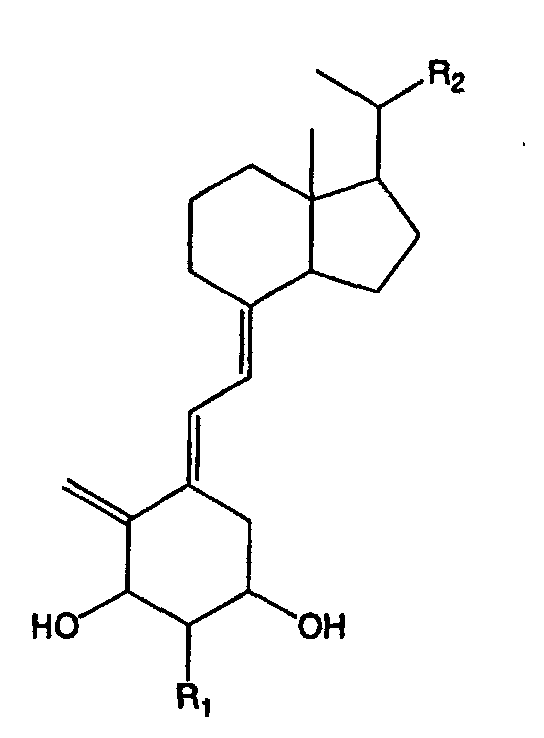 wherein
R1 is straight or branched-chain alkyl; and
R2 is straight or branched-chain alkyl optionally substituted with hydroxy.
R1 is straight or branched-chain alkyl; and
R2 is straight or branched-chain alkyl optionally substituted with hydroxy.
Description
The present invention relates to novel vitamin D
derivatives, more particularly, relates to 5,6-trans-2-alkyl-substituted
vitamin D derivatives.
Activated vitamin D3 derivatives including
la,25-dihydroxyvitamin D3 are known to have many
physiological activities such as calcium metabolism
regulatory activities, growth inhibitory, and
differentiation inducing activities for tumor cells, and
immunoregulatory activities. However, some activated
vitamin D3 derivatives may cause hypercalcemia during long-term
and continuous administration, therefore they are not
suitable for use as antitumor agents, antirheumatic agents,
and the like. Thus, a number of studies have been
conducted to synthesize vitamin D derivatives for the
purpose of separating those activities.
The studies conducted by the inventors of the present
invention clarified that introduction of a 2α-methyl group
into an A ring part of active vitamin D3, that is 1α,25-dihydroxyvitamin
D3, increases the vitamin D receptor (VDR)
binding property (Bioorg. Med. Chem. Lett., 1998, 8, 151; K.
Konno et al.). Furthermore, a combination of the
introduction of a 2α-methyl group and the epimerization of
the side chain at 20-position has been reported to enhance
the VDR binding property (Bioorg. Med. Chem. Lett., 1998, 8,
2145; T. Fujishima et al.). However, no work has been done
to synthesize a vitamin D derivative in which the 2-position
is substituted, the steric configuration at the
20-position is native or epimerized, and the double bond at
the 5-position is in E configuration; further, the
physiologically activities of such a vitamin D derivative
have not been studied.
To provide vitamin D3 derivatives in which the above
problems are improved, the inventors of the present
invention intensively studied vitamin D3 derivatives, in
which the 2-position is substituted, the steric
configuration at the 20-position is native or epimerized
and the double bond at the 5-position is in E
configuration.
As a result of careful studies to solve the above
problems, the inventors have found that the stated object
could be achieved by providing vitamin D3 derivatives, in
which the 2-position is substituted with alkyl and the
double bond at the 5-position is in E configuration, and
thereby completed the present invention.
According to the present invention, there is provided
a 5,6-trans-2-alkyl-substituted vitamin D derivative of
Formula (I):
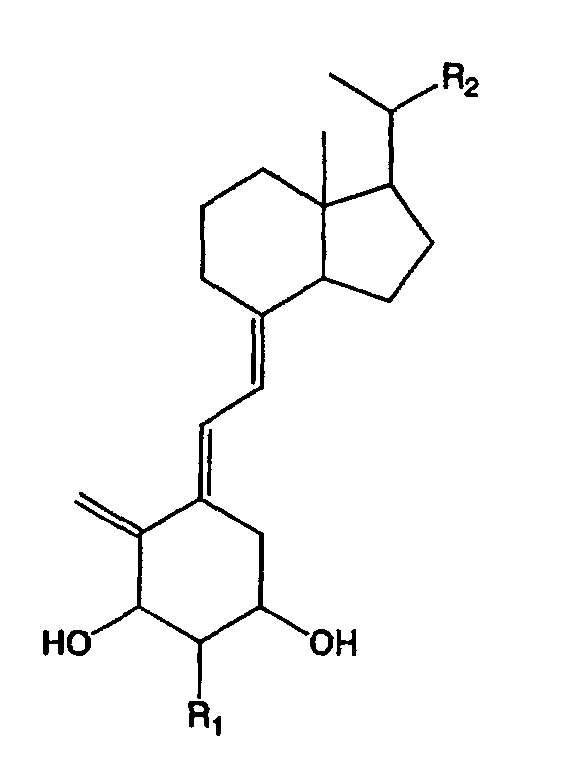 wherein
R1 is straight or branched-chain alkyl and R2 is straight or branched-chain alkyl optionally substituted with hydroxy.
R1 is straight or branched-chain alkyl and R2 is straight or branched-chain alkyl optionally substituted with hydroxy.
Preferably, R1 is straight or branched-chain C1-6alkyl
and R2 is straight or branched-chain C1-12alkyl substituted
with hydroxy in Formula (1).
More preferably, R1 is straight or branched-chain
C1-3alkyl and R2 is straight or branched-chain C3-10alkyl
substituted with hydroxy.
Still more preferably, R1 is methyl or ethyl and R2 is
4-hydroxy-4-methylpentyl or 4-ethyl-4-hydroxyhexyl.
Most preferably, R1 is methyl and R2 is 4-hydroxy-4-methylpentyl.
The steric configuration at the 20-position of the
compound of Formula (1) may be either S or R.
Detailed mode and specific examples for carrying out
the vitamin D derivatives of Formula (1) of the present
invention will be explained below.
In Formula (1), R1 is straight or branched-chain
alkyl. R2 is straight or branched-chain alkyl optionally
substituted with hydroxy.
As used herein, generally, the straight or branched-chain
alkyl is preferably straight or branched-chain lower
alkyl. The straight or branched-chain lower alkyl
generally means straight or branched-chain C1-15alkyl;
examples thereof include methyl, ethyl, n-propyl, i-propyl,
n-butyl, s-butyl, i-butyl, and t-butyl as well as pentyl,
hexyl, heptyl, octyl, nonyl, and decanyl.
The straight or branched-chain alkyl substituted with
hydroxy means that at least one hydrogen atom of the above-mentioned
alkyl is substituted with hydroxy. In the
definition of R2, the number of hydrogen atoms substituted
with hydroxy is 1, 2, or 3, preferably 1 or 2 and more
preferably 1.
Non-limiting examples of R1 include methyl, ethyl,
propyl, butyl, pentyl, hexyl, heptyl, octyl, nonyl, decanyl,
and the like. Preferably R1 is straight or branched-chain
C1-6alkyl, more preferably straight or branched-chain
C2-4alkyl, still more preferably methyl or ethyl and most
preferably methyl.
Non-limiting examples of R2 include 4-hydroxy-4-methylpentyl,
4-ethyl-4-hydroxyhexyl, 6-hydroxy-6-methyl-2-heptyl,
7-hydroxy-7-methyl-2-octyl, 5,6-dihydroxy-6-methyl-2-heptyl,
4,6,7-trihydroxy-6-methyl-2-heptyl, and the like.
Preferably R2 is straight or branched-chain C1-12alkyl
substituted with hydroxy, more preferably straight or
branched-chain C3-10alkyl substituted with hydroxy, still
more preferably 4-hydroxy-4-methylpentyl or 4-ethyl-4-hydroxyhexyl
and most preferably 4-hydroxy-4-methylpentyl.
The vitamin D derivatives of Formula (1) of the
present invention can be used as active ingredients of
pharmaceutical compositions (such as a calcium metabolism
regulating agent). They can also be used as regents for
investigating metabolism of active vitamin D3 (i.e., 1α,25-dihydroxyvitamin
D3).
Although there is no limitation with respect to
methods of synthesizing the vitamin D derivatives of
Formula (I) of the present invention which are the novel
compounds, they can be synthesized, for example, according
to synthesis route shown in the following Examples. In the
following Examples, vitamin D derivatives of the present
invention, which are in a trans form, are synthesized from
Compound D, which is in a cis form, according to the
following reaction scheme.

Compound D (cis form) in the above reaction scheme is
known and can be synthesized according to the methods
described in, for example, JP 6-23185 B, JP 6-41059 A, JP
11-116551 A, and JP 11-121589 A (filed by the same
applicant as that of the present application).
Contents of the specification of Japanese Patent
Application No. 2000-151298, the application on the basis
of which the present application claims priority, are to be
incorporated in their entirety by reference.
The present invention will be described specifically
by way of the following Examples, which in no way limit the
invention.
Ethanol solutions of 1α,25-dihydroxyvitamin D3 (the
standard substance) and those of the vitamin D derivatives
of the present invention were prepared at various
concentrations. Bovine thymus 1α,25-dihydroxyvitamin D3
receptor was purchased from Yamasa Biochemcal (Choshi,
Chiba, Japan) (lot.111031 and lot.112831) and one ampule
(approximately 25 mg) of the receptor was dissolved in 55
mL of 0.05 M phosphate 0.5M potassium buffer (pH 7.4) just
before use.
Each of the ethanol solutions (50 µl) of vitamin D
derivatives of the present invention and 1α,25-dihydroxyvitamin
D3 was put into a respective tube with
500 µl (0.23 mg protein) of the receptor solution, preincubated
at room temperature for 1 hour, and [3H]-1α,25-dihydroxyvitamin
D3 was added at the final concentration of
0.1 nM, followed by incubation overnight at 4°C. Each of
the reaction mixtures was mixed with DCC (dextran coated
charcoal), left for 30 minutes at 4°C and centrifuged at
3000 rpm for ten minutes to separate the bound and free
forms of [3H]-1α,25-dihydroxyvitamin D3. Each of the
resultant supernatants (500 µl) was mixed with ACS-II (9.5
ml) (AMERSHAM, England) for radioactivity measurement.
(5E,7E)-(1S,2R,3R)-2-Methyl-9,10-seco-5,7,10(19)-cholestatriene-1,3,25-triol,
(5E,7E)-(1S,2S,3R)-2-methyl-9,10-seco-5,7,10(19)-cholestatriene-1,3,25-triol,
(5E,7E)-(1R,2R,3R)-2-methyl-9,10-seco-5,7,10(19)-cholestatriene-1,3,25-triol,
(5E,7E)-(1R,2S,3R)-2-methyl-9,10-seco-5,7,10(19)-cholestatriene-1,3,25-triol,
(5E,7E)-(1S,2R,3S)-2-methyl-9,10-seco-5,7,10(19)-cholestatriene-1,3,25-triol,
(5E,7E)-(1S,2S,3S)-2-methyl-9,10-seco-5,7,10(19)-cholestatriene-1,3,25-triol,
(5E,7E)-(1R,2R,3S)-2-methyl-9,10-seco-5,7,10(19)-cholestatriene-1,3,25-triol,
(5E,7E)-(1R,2S,3S)-2-methyl-9,10-seco-5,7,10(19)-cholestatriene-1,3,25-triol,
(5E,7E)-(1S,2R,3R,20S)-2-methyl-9,10-seco-5,7,10(19)-cholestatriene-1,3,25-triol,
(5E,7E)-(1S,2S,3R,20S)-2-methyl-9,10-seco-5,7,10(19)-cholestatriene-1,3,25-triol,
(5E,7E)-(1R,2R,3R,20S)-2-methyl-9,10-seco-5,7,10(19)-cholestatriene-1,3,25-triol,
(5E,7E)-(1R,2S,3R,20S)-2-methyl-9,10-seco-5,7,10(19)-cholestatriene-1,3,25-triol,
(5E,7E)-(1S,2R,3S,20S)-2-methyl-9,10-seco-5,7,10(19)-cholestatriene-1,3,25-triol,
(5E,7E)-(1S,2S,3S,20S)-2-methyl-9,10-seco-5,7,10(19)-cholestatriene-1,3,25-triol,
(5E,7E)-(1R,2R,3S,20S)-2-methyl-9,10-seco-5,7,10(19)-cholestatriene-1,3,25-triol
and
(5E,7E)-(1R,2S,3S,20S)-2-methyl-9,10-seco-5,7,10(19)-cholestatriene-1,3,25-triol,
which were synthesizable in
the following Examples 1-16, were used as the vitamin D
derivatives of the present invention.
The binding property of the vitamin D derivatives of
the present invention expressed in relative value with that
of 1α,25-dihydroxyvitamin D3 taken as 100 was obtained
according to the following equation and the values
calculated are shown in the respective Examples, after the
physical data of the respective derivatives.
X=(y/x)×100
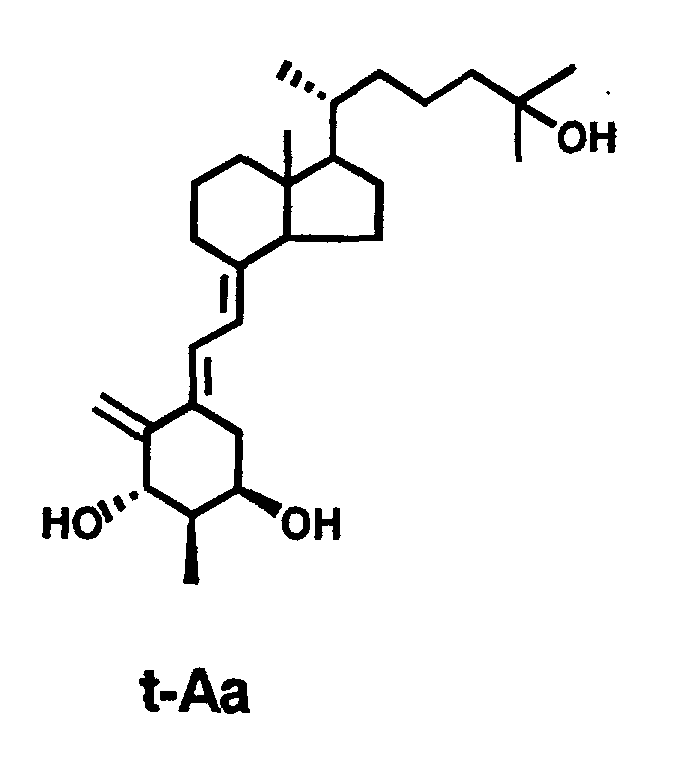
(5Z,7E)-(1S,2R,3R)-2-Methyl-9,10-seco-5,7,10(19)-cholestatriene-1,3,25-triol
(Compound (Aa)) (7.0 mg, 0.016
mmol) was dissolved in liquid sulfur dioxide (∼10 mL).
This solution was refluxed under heating at the boiling
point of the liquid sulfur dioxide for 1 hour. After
distilling off the liquid sulfur dioxide, the resulting
residue was dissolved in ethanol (2 mL), to which sodium
hydrogen carbonate (6.8 mg, 0.081 mmol) was added. The
mixture was heated at 90°C for 1 hour. After distilling off
the solvent, the residue was mixed with water and extracted
with ethyl acetate. The organic layer was dried over
magnesium sulfate, filtered and the filtrate was
concentrated. Thus obtained crude product was purified by
silica gel preparative thin layer chromatography to give
Compound (t-Aa) (4.6 mg, 66%) as a colorless oil.
UV (EtOH) λmax 272 nm, λmin 230 nm; 1H NMR (400 MHz, CDCl3) δ 0.56 (3 H, s), 0.94 (3 H, d, J = 6.4 Hz), 1.08 (3 H, d, J = 7.0 Hz), 1.22 (6 H, s), 1.94 (1 H, m), 2.56 (1 H, dd, J = 13.7, 3.4 Hz), 2.60 (1 H, dd, J = 14.6, 6.7 Hz), 2.83 (1 H, m), 4.13 (1 H, m), 4.14 (1 H, m), 5.01 (1 H, s), 5.15 (1 H, s), 5.87 (1 H, d, J = 11.6 Hz), 6.61 (1 H, d, J = 11.6 Hz); MS 430 [M]+, 412 [M-H2O]+, 394 [M-2H2O]+, 379 [M-2H2O-Me]+; HRMS calcd. for [C28H46O3] 430.3447, found 430.3446. VDR binding property : 8.6
UV (EtOH) λmax 272 nm, λmin 230 nm; 1H NMR (400 MHz, CDCl3) δ 0.56 (3 H, s), 0.94 (3 H, d, J = 6.4 Hz), 1.08 (3 H, d, J = 7.0 Hz), 1.22 (6 H, s), 1.94 (1 H, m), 2.56 (1 H, dd, J = 13.7, 3.4 Hz), 2.60 (1 H, dd, J = 14.6, 6.7 Hz), 2.83 (1 H, m), 4.13 (1 H, m), 4.14 (1 H, m), 5.01 (1 H, s), 5.15 (1 H, s), 5.87 (1 H, d, J = 11.6 Hz), 6.61 (1 H, d, J = 11.6 Hz); MS 430 [M]+, 412 [M-H2O]+, 394 [M-2H2O]+, 379 [M-2H2O-Me]+; HRMS calcd. for [C28H46O3] 430.3447, found 430.3446. VDR binding property : 8.6

The title compound (t-Ds) was synthesized from the
corresponding (5Z)-isomer of the title compound (t-Ds)
according to the same procedure as Example 1.
UV (EtOH) λmax 273 nm, λmin 230 nm; 1H NMR (400 MHz, CDCl3)
δ 0.57 (3 H, s), 0.95 (3 H, d, J = 6.4 Hz), 1.14 (3 H, d, J
= 7.0 Hz), 1.22 (6 H, s), 1.83 (1 H, m), 2.13 (1 H, m),
2.85 (1 H, m), 3.02 (1 H, dd, J = 14.0, 4.3 Hz), 3.85 (1 H,
m), 4.29 (1 H, m), 4.93 (1 H, s), 5.12 (1 H, d, J = 1.8 Hz),
5.89 (1 H, d, J = 11.6 Hz), 6.55 (1 H, dd, J = 11.6, 0.9
Hz); MS 430 [M]+, 412 [M-H2O]+, 394 [M-2H2O]+, 379 [M-2H2O-Me]+;
HRMS calcd. for [C28H46O3] 430.3447, found 430.3447.
VDR binding property :0.4

The title compound (t-As) was synthesized from the
corresponding (5Z)-isomer of the title compound (t-As)
according to the same procedure as Example 1.
UV (EtOH) λmax 274 nm, λmin 231 nm; 1H NMR (400 MHz, CDCl3)
δ 0.57 (3 H, s), 0.94 (3 H, d, J = 6.4 Hz), 1.22 (6 H, s),
1.24 (3 H, d, J = 7.0 Hz); 1.92 (1 H, ddq, J = 2.4, 2.5,
7.0 Hz), 2.27 (1 H, dd, J = 14.7, 3.1 Hz), 2.88 (1 H, dd, J
= 12.8, 3.7 Hz), 3.05 (1 H, dd, J = 14.6, 3.7 Hz), 3.97 (1
H, ddd, J = 2.4, 3.1, 3.7 Hz), 4.21 (1 H, d, J = 2.5 Hz),
4.90 (1 H, d, J = 1.8 Hz), 5.10 (1 H, d, J = 1.8 Hz), 5.91
(1 H, d, J = 11.3 Hz), 6.67 (1 H, d, J = 11.3 Hz); MS 430
[M]+, 412 [M-H2O]+, 394 [M-2H2O]+, 379 [M-2H2O-Me]+; HRMS
calcd. for [C28H46O3] 430.3447, found 430.3449.
VDR binding property :0.1
VDR binding property :0.1

The title compound (t-Da) was synthesized from the
corresponding (5Z)-isomer of the title compound (t-Da)
according to the same procedure as Example 1.
UV (EtOH) λmax 271 nm, λmin 229 nm; 1H NMR (400 MHz, CDCl3)
δ 0.57 (3 H, s), 0.95 (3 H, d, J = 6.2 Hz), 1.03 (3 H, d, J
= 7.0 Hz), 1.22 (6 H, s), 1.89 (1 H, ddq, J = 5.5, 4.8, 7.0
Hz), 2.06 (1 H, dd, J = 15.0, 5.8 Hz), 2.65 (1 H, dd, J =
15.0, 4.8 Hz), 2.87 (1 H, dd, J = 12.2, 3.7 Hz), 3.71 (1 H,
dt, J = 5.8, 4.8 Hz), 3.98 (1 H, d, J = 5.5 Hz), 4.97 (1 H,
s), 5.17 (1 H, s), 5.89 (1 H, d, J = 11.7 Hz), 6.62 (1 H, d,
J = 11.7 Hz); MS 430 [M]+, 412 [M-H2O]+, 394 [M-2H2O]+, 379
[M-2H2O-Me]+; HRMS calcd. for [C28H46O3] 430.3447, found
430.3448.
VDR binding property :<0.01
VDR binding property :<0.01
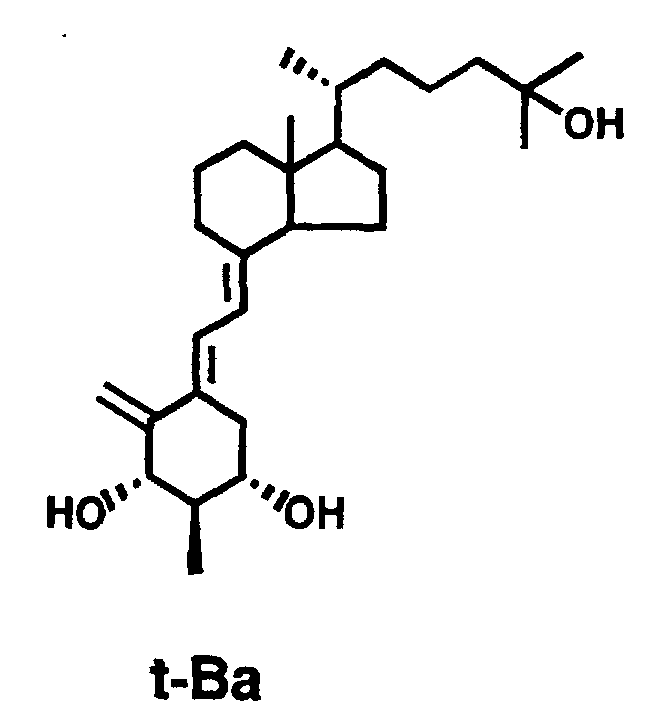
The title compound (t-Ba) was synthesized from the
corresponding (5Z)-isomer of the title compound (t-Ba)
according to the same procedure as Example 1.
UV (EtOH) λmax 271 nm, λmin 229 nm; 1H NMR (400 MHz, CDCl3) δ 0.57 (3 H, s), 0.95 (3 H, d, J = 6.4 Hz), 1.03 (3 H, d, J = 7.0 Hz), 1.22 (6 H, s), 1.91 (1 H, ddq, J = 5.1, 4.8, 7.0 Hz), 2.61 (1 H, dd, J = 15.0, 4.4 Hz), 2.65 (1 H, dd, J = 15.0, 5.1 Hz), 2.86 (1 H, dd, J = 11.9, 3.7 Hz), 3.74 (1 H, dt, J = 4.4, 5.1 Hz), 4.00 (1 H, d, J = 5.1 Hz), 4.97 (1 H, s), 5.18 (1 H, d, J = 1.6 Hz), 5.90 (1 H, d, J = 11.6 Hz), 6.62 (1 H, d, J = 11.6 Hz); MS 430 [M]+, 412 [M-H2O]+, 394 [M-2H2O]+, 379 [M-2H2O-Me]+; HRMS calcd. for [C28H46O3] 430.3447, found 430.3444.
VDR binding property :0.04
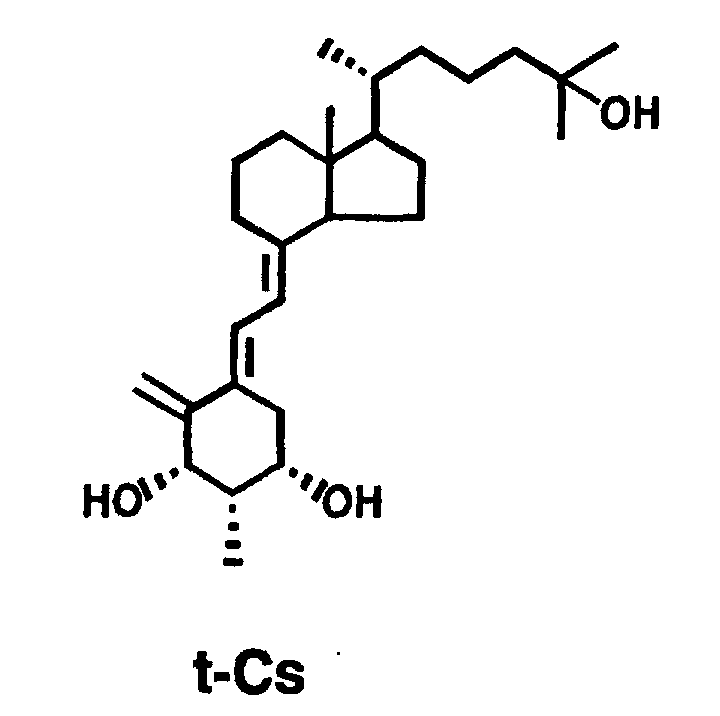
The title compound (t-Cs) was synthesized from the
corresponding (5Z)-isomer of the title compound (t-Cs)
according to the same procedure as Example 1.
UV (EtOH) λmax 274 nm, λmin 231 nm; 1H NMR (400 MHz, CDCl3) δ 0.57 (3 H, s), 0.95 (3 H, d, J = 6.4 Hz), 1.22 (6 H, s), 1.24 (3 H, d, J = 7.0 Hz), 1.93 (1 H, ddq, J = 2.4, 2.1, 7.0 Hz), 2.28 (1 H, dd, J = 14.6, 2.4 Hz), 2.88 (1 H, dd, J = 12.2, 3.7 Hz), 3.06 (1 H, dd, J = 14.6, 3.7 Hz), 3.98 (1 H, ddd, J = 3.7, 2.4, 2.1 Hz), 4.21 (1 H, d, J = 2.1 Hz), 4.91 (1 H, d, J = 1.8 Hz), 5.12 (1 H, d, J = 1.8 Hz), 5.92 (1 H, d, J = 11.3 Hz), 6.67 (1 H, d, J = 11.3 Hz); MS 430 [M]+, 412 [M-H2O]+, 394 [M-2H2O]+, 379 [M-2H2O-Me]+; HRMS calcd. for [C28H46O3] 430.3447, found 430.3448.
VDR binding property :0.013
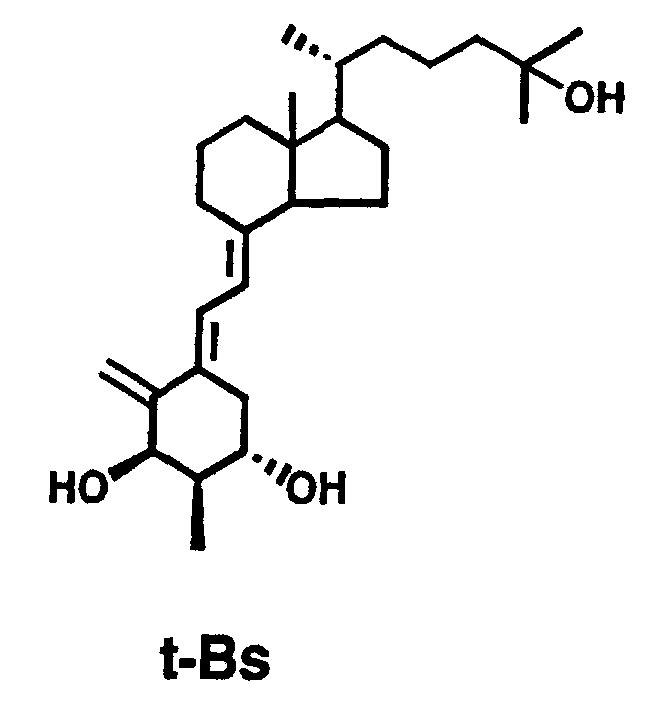
The title compound (t-Bs) was synthesized from the
corresponding (5Z)-isomer of the title compound (t-Bs)
according to the same procedure as Example 1.
UV (EtOH) λmax 275 nm, λmin 231 nm; 1H NMR (400 MHz, CDCl3) δ 0.57 (3 H, s), 0.95 (3 H, d, J = 6.4 Hz), 1.14 (3 H, d, J = 7.0 Hz), 1.22 (6 H, s), 1.83 (1 H, ddq, J = 9.2, 3.1, 7.0 Hz), 2.13 (1 H, dd, J = 14.0, 9.2 Hz), 2.85 (1 H, dd, J = 11.9, 4.0 Hz), 3.01 (1 H, dd, J = 14.0, 4.5 Hz), 3.87 (1 H, dt, J = 4.5, 9.2 Hz), 4.30 (1 H, d, J =3.1 Hz), 4.93 (1 H, d, J =1.8 Hz), 5.11 (1 H, d, J =1.8 Hz), 5.89 (1 H, d, J = 11.6 Hz), 6.55 (1 H, d, J = 11.6 Hz); MS 430 [M]+, 412 [M-H2O]+, 394 [M-2H2O]+, 379 [M-2H2O-Me]+.
VDR binding property :0.03
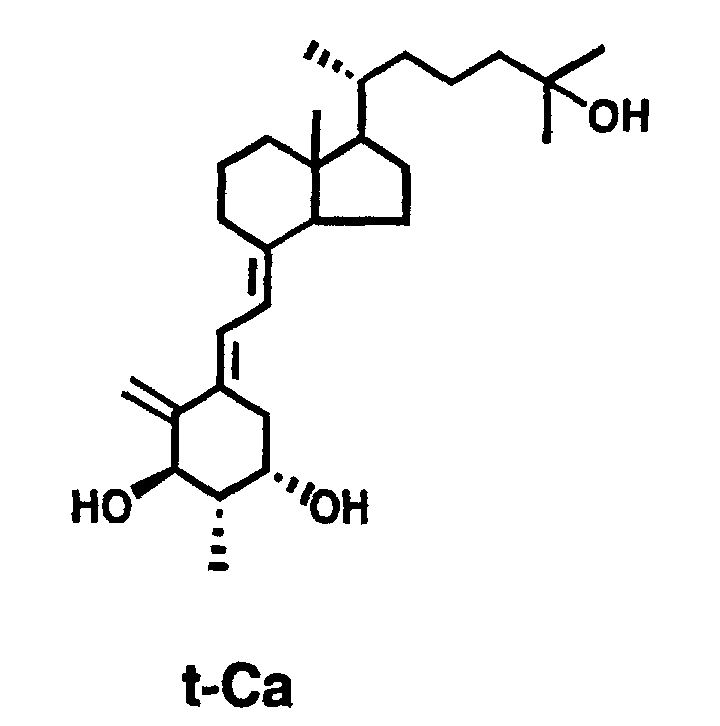
The title compound (t-Ca) was synthesized from the
corresponding (5Z)-isomer of the title compound (t-Ca)
according to the same procedure as Example 1.
UV (EtOH) λmax 274 nm, λmin 232 nm; 1H NMR (400 MHz, CDCl3) δ 0.57 (3 H, s), 0.95 (3 H, d, J = 6.4 Hz), 1.08 (3 H, d, J = 7.0 Hz), 1.22 (6 H, s), 1.93 (1 H, ddq, J = 8.0, 3.4, 7.0 Hz), 2.53 (1 H, dd, J = 14.3, 3.4 Hz), 2.61 (1 H, dd, J = 14.3, 5.8 Hz), 2.85 (1 H, dd, J = 12.2, 3.7 Hz), 4.15 (2 H, m), 5.01 (1 H, s), 5.15 (1 H, s), 5.86 (1 H, d, J = 11.3 Hz), 6.60 (1 H, d, J = 11.3 Hz); MS 430 [M]+, 412 [M-H2O]+, 394 [M-2H2O]+, 379 [M-2H2O-Me]+; HRMS calcd. for [C28H46O3] 430.3447, found 430.3443.
VDR binding property :<0.01
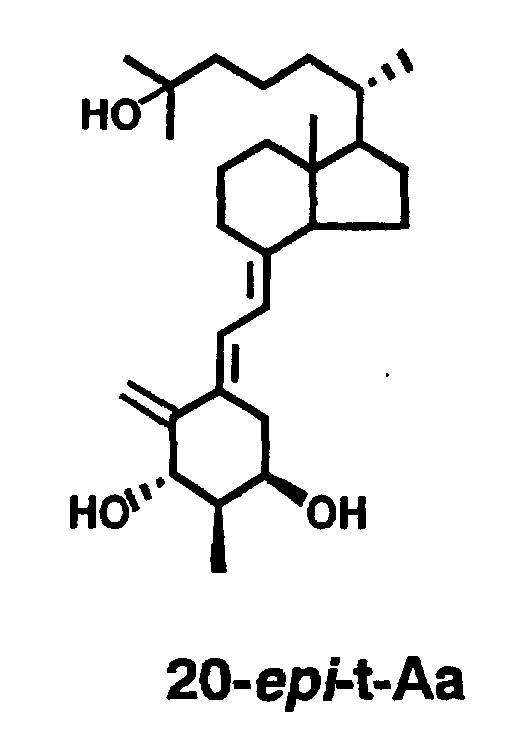
The title compound (20-epi-t-Aa) was synthesized from
the corresponding (5Z)-isomer of the title compound (20-epi-t-Aa)
according to the same procedure as Example 1.
UV (EtOH) λmax 272 nm, λmin 230 nm; 1H NMR (400 MHz, CDCl3) 6 0.56 (3 H, s), 0.86 (3 H, d, J = 6.4 Hz), 1.09 (3 H, d, J = 7.0 Hz), 1.22 (6 H, s), 1.88 (1 H, m), 1.95 (1 H, ddq, J = 7.6, 3.4, 7.0 Hz), 2.53 (1 H, dd, J = 14.3, 4.0 Hz), 2.60 (1 H, dd, J = 14.6, 7.0 Hz), 4.13 (1 H, d, J = 7.6 Hz), 4.17 (1 H, ddd, J = 7.0, 4.0, 3.4 Hz), 5.01 (1 H, s), 5.16 (1 H, s), 5.87 (1 H, d, J = 11.6 Hz), 6.61 (1 H, d, J = 11.6 Hz); MS 430 [M]+, 412 [M-H2O]+, 394 [M-2H2O]+, 379 [M-2H2O-Me]+; HRMS calcd. for [C28H46O3] 430.3447, found 430.3445.
VDR binding property :45

The title compound (20-epi-t-Ds) was synthesized from
the corresponding (5Z)-isomer of the title compound (20-epi-t-Ds)
according to the same procedure as Example 1.
UV (EtOH) λmax 273 nm, λmin 228 nm; 1H NMR (400 MHz, CDCl3) δ 0.56 (3 H, s), 0.86 (3 H, d, J = 6.4 Hz), 1.14 (3 H, d, J = 7.0 Hz), 1.22 (6 H, s), 1.83 (1 H, m), 3.01 (1 H, dd, J = 14.3, 5.2 Hz), 3.84 (1 H, m), 4.29 (1 H, m), 4.93 (1 H, d, J = 2.1 Hz), 5.12 (1 H, d, J = 2.1 Hz), 5.89 (1 H, d, J = 11.4 Hz), 6.54 (1 H, d, J = 11.4 Hz); MS 430 [M]+, 412 [M-H2O]+, 394 [M-2H2O]+, 379 [M-2H2O-Me]+.
VDR binding property :1
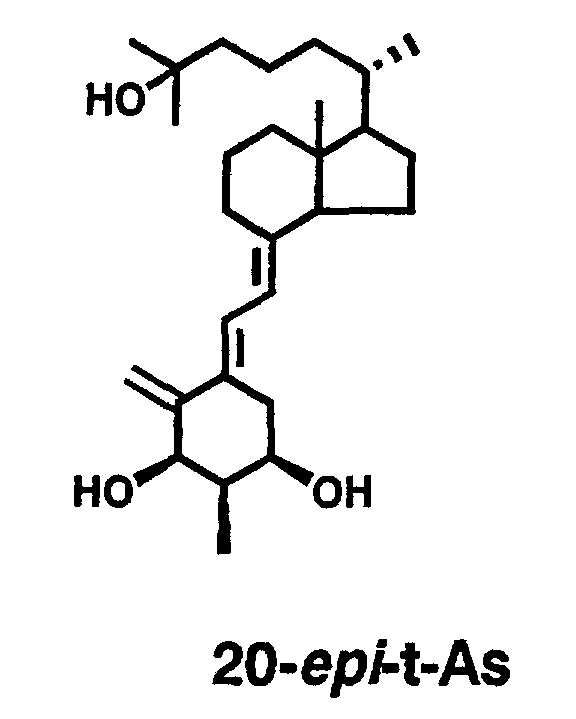
The title compound (20-epi-t-As) was synthesized from
the corresponding (5Z)-isomer of the title compound (20-epi-t-As)
according to the same procedure as Example 1.
UV (EtOH) λmax 274 nm, λmin 231 nm; 1H NMR (400 MHz, CDCl3) δ 0.57 (3 H, s), 0.86 (3 H, d, J = 6.4 Hz), 1.21 (6 H, s), 1.24 (3 H, d, J = 7.0 Hz), 2.28 (1 H, br. d, J = 14.6 Hz), 2.88 (1 H, dd, J = 12.4, 3.7 Hz), 3.04 (1 H, dd, J = 15.0, 4.0 Hz), 3.97 (1 H, m), 4.21 (1 H, m), 4.90 (1 H, d, J = 1.5 Hz), 5.10 (1 H, d, J = 1.8 Hz), 5.91 (1 H, d, J = 11.6 Hz), 6.66 (1 H, d, J = 11.6 Hz); MS 430 [M]+, 412 [M-H2O]+, 394 [M-2H2O]+, 379 [M-2H2O-Me]+; HRMS calcd. for [C28H46O3] 430.3447, found 430.3423.
VDR binding property :0.8

The title compound (20-epi-t-Da) was synthesized from
the corresponding (5Z)-isomer of the title compound (20-epi-t-Da)
according to the same procedure as Example 1.
UV (EtOH) λmax 270 nm, λmin 230 nm; 1H NMR (400 MHz, CDCl3) 6 0.57 (3 H, s), 0.86 (3 H, d, J = 6.4 Hz), 1.03 (3 H, d, J = 7.0 Hz), 1.22 (6 H, s), 1.87 (1 H, m), 2.60 (1 H, dd, J = 15.9, 6.1 Hz), 2.64 (1 H, m), 2.87 (1 H, dd, J = 11.9, 4.0 Hz), 3.71 (1 H, m), 3.98 (1 H, m), 4.97 (1 H, s), 5.17 (1 H, d, J = 1.8 Hz), 5.90 (1 H, d, J = 11.6 Hz), 6.61 (1 H, d, J = 11.6 Hz); MS 430 [M]+, 412 [M-H2O]+, 397 [M-H2O-Me]+; HRMS calcd. for [C28H46O3] 430.3447, found 430.3465.
VDR binding property :0.03

The title compound (20-epi-t-Ba) was synthesized from
the corresponding (5Z)-isomer of the title compound (20-epi-t-Ba)
according to the same procedure as Example 1.
UV (EtOH) λmax 271 nm, λmin 229 nm; 1H NMR (400 MHz, CDCl3) δ 0.56 (3 H, s), 0.86 (3 H, d, J = 6.4 Hz), 1.03 (3 H, d, J = 7.4 Hz), 1.21 (6 H, s), 2.62 (2 H, m), 2.86 (1 H, m), 3.75 (1 H, m), 4.00 (1 H, m), 4.97 (1 H, s), 5.18 (1 H, d, J = 1.8 Hz), 5.90 (1 H, d, J = 11.6 Hz), 6.62 (1 H, d, J = 11.9 Hz); MS 430 [M]+, 412 [M-H2O]+, 394 [M-2H2O]+, 379 [M-2H2O-Me]+; HRMS calcd. for [C28H46O3] 430.3447, found 430.3442.
VDR binding property :0.5

The title compound (20-epi-t-Cs) was synthesized from
the corresponding (5Z)-isomer of the title compound (20-epi-t-Cs)
according to the same procedure as Example 1.
UV (EtOH) λmax 274 nm, λmin 231 nm; 1H NMR (400 MHz, CDCl3) δ 0.57 (3 H, s), 0.86 (3 H, d, J = 6.4 Hz), 1.22 (6 H, s), 1.24 (3 H, d, J = 7.3 Hz), 2.27 (1 H, br. d, J = 14.1 Hz), 2.87 (1 H, dd, J = 12.5, 4.0 Hz), 3.06 (1 H, dd, J = 14.0, 3.7 Hz), 3.98 (1 H, m), 4.20 (1 H,m), 4.91 (1 H, d, J = 1.8 Hz), 5.12 (1 H, d, J = 1.8 Hz), 5.92 (1 H, d, J = 11.6 Hz), 6.66 (1 H, d, J = 11.9 Hz); MS 430 [M]+, 412 [M-H2O]+, 397 [M-H2O-Me]+; HRMS calcd. for [C28H46O3] 430.3447, found 430.3453.
VDR binding property :0.2
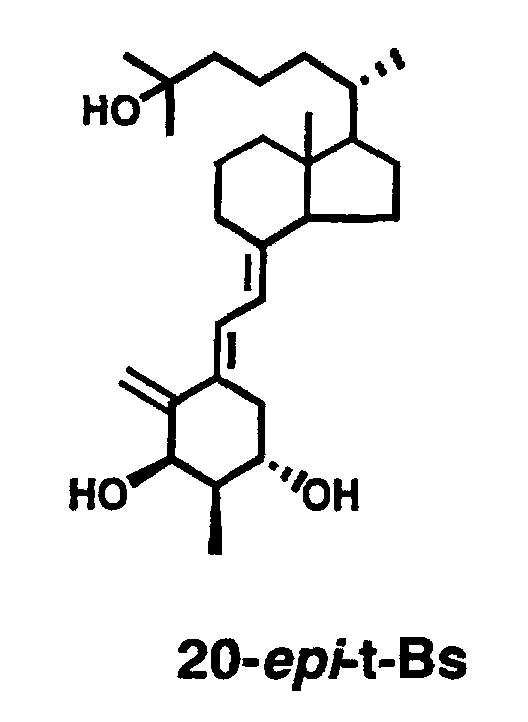
The title compound (20-epi-t-Bs) was synthesized from
the corresponding (5Z)-isomer of the title compound (20-epi-t-Bs)
according to the same procedure as Example 1.
UV (EtOH) λmax 275 nm, λmin 231 nm; 1H NMR (400 MHz, CDCl3) δ 0.57 (3 H, s), 0.86 (3 H, d, J = 6.7 Hz), 1.14 (3 H, d, J = 7.0 Hz), 1.22 (6 H, s), 2.13 (1 H, dd, J = 13.7, 8.5 Hz), 2.85 (1 H, dd, J = 11.9, 4.0 Hz), 3.01 (1 H, dd, J = 14.0, 4.6 Hz), 3.86 (1 H, dt, J = 4.9, 8.5 Hz), 4.29 (1 H, d, J = 2.7 Hz), 4.92 (1 H, d, J =1.2 Hz), 5.10 (1 H, d, J =1.8 Hz), 5.88 (1 H, d, J = 11.6 Hz), 6.55 (1 H, d, J = 11.3 Hz); MS 430 [M]+, 412 [M-H2O]+, 397 [M-H2O-Me]+, 379 [M-2H2O-Me]+; HRMS calcd. for [C28H46O3] 430.3447, found 430.3444.
VDR binding property :0.2
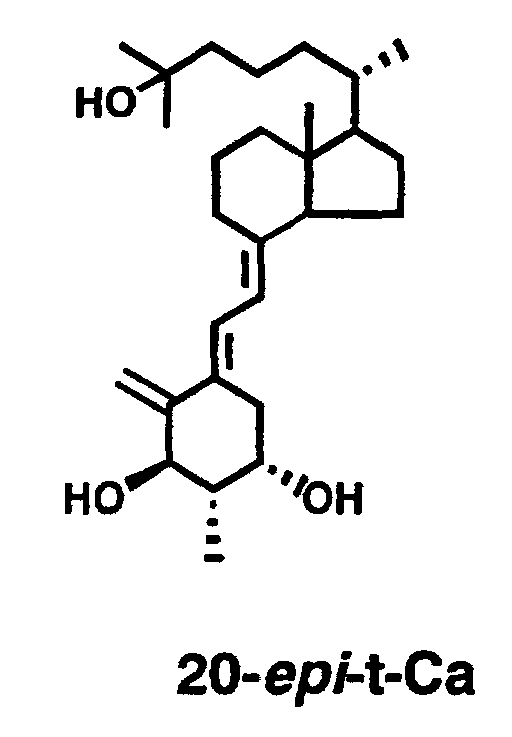
The title compound (20-epi-t-Ca) was synthesized from
the corresponding (5Z)-isomer of the title compound (20-epi-t-Ca)
according to the same procedure as Example 1.
UV (EtOH) λmax 274 nm, λmin 231 nm; 1H NMR (400 MHz, CDCl3) δ 0.56 (3 H, s), 0.86 (3 H, d, J = 6.4 Hz), 1.08 (3 H, d, J = 7.0 Hz), 1.21 (6 H, s), 2.53 (1 H, dd, J = 14.3, 3.1 Hz), 2.60 (1 H, dd, J = 14.3, 5.8 Hz), 2.85 (1 H, dd, J = 12.5, 4.3 Hz), 4.16 (2 H, m), 5.01 (1 H, d, J = 1.2 Hz), 5.15 (1 H, d, J = 1.2 Hz), 5.86 (1 H, d, J = 11.6 Hz), 6.60 (1 H, d, J = 11.3 Hz) ; MS 430 [M]+, 412 [M-H2O]+, 397 [M-H2O-Me]+, 379 [M-2H2O-Me]+; HRMS calcd. for [C28H46O3] 430.3447, found 430.3446.
VDR binding property :0.08
The vitamin D derivatives represented by Formula (I)
are novel and expected to be useful as medicines, for
example, for calcium metabolism regulation.
Claims (7)
- A 5,6-trans-2-alkyl-substituted vitamin D derivative of Formula (1):wherein
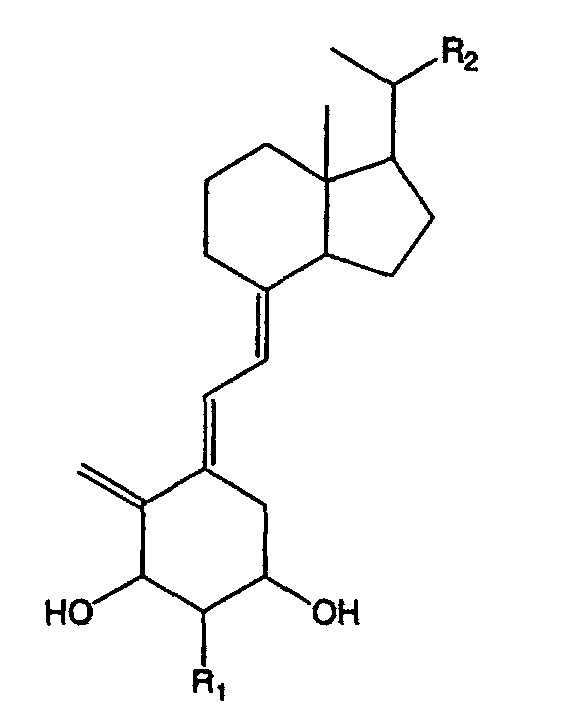
R1 is straight or branched-chain alkyl; and
R2 is straight or branched-chain alkyl optionally substituted with hydroxy. - The vitamin D derivative of claim 1, wherein R1 is straight or branched-chain C1-6alkyl and R2 is straight or branched-chain C1-12alkyl substituted with hydroxy.
- The vitamin D derivative of claim 1, wherein R1 is straight or branched-chain C1-3alkyl and R2 is straight or branched-chain C3-10alkyl substituted with hydroxy.
- The vitamin D derivative of claim 1, wherein R1 is methyl or ethyl and R2 is 4-hydroxy-4-methylpentyl or 4-ethyl-4-hydroxyhexyl.
- The vitamin D derivative of claim 4, wherein R1 is methyl and R2 is 4-hydroxy-4-methylpentyl.
- The vitamin D derivative of claim 1, wherein the stereochemistry at the 20-position is S configuration.
- The vitamin D derivative of claim 1, wherein the stereochemistry at the 20-position is R configuration.
Applications Claiming Priority (3)
| Application Number | Priority Date | Filing Date | Title |
|---|---|---|---|
| JP2000151298 | 2000-05-23 | ||
| JP2000151298 | 2000-05-23 | ||
| PCT/JP2001/004256 WO2001090061A1 (en) | 2000-05-23 | 2001-05-22 | 5,6-trans-2-alkylvitamin d derivatives |
Publications (2)
| Publication Number | Publication Date |
|---|---|
| EP1284259A1 true EP1284259A1 (en) | 2003-02-19 |
| EP1284259A4 EP1284259A4 (en) | 2009-11-11 |
Family
ID=18656881
Family Applications (1)
| Application Number | Title | Priority Date | Filing Date |
|---|---|---|---|
| EP01930239A Withdrawn EP1284259A4 (en) | 2000-05-23 | 2001-05-22 | 5,6- i TRANS /i -2-ALKYLVITAMIN D DERIVATIVES |
Country Status (4)
| Country | Link |
|---|---|
| US (2) | US20030092687A1 (en) |
| EP (1) | EP1284259A4 (en) |
| AU (1) | AU2001256791A1 (en) |
| WO (1) | WO2001090061A1 (en) |
Families Citing this family (3)
| Publication number | Priority date | Publication date | Assignee | Title |
|---|---|---|---|---|
| JPWO2003055854A1 (en) * | 2001-12-26 | 2005-05-12 | 中外製薬株式会社 | Vitamin D derivative having a substituent at the 2-position |
| EP1714656B8 (en) * | 2004-02-06 | 2017-09-20 | Chugai Seiyaku Kabushiki Kaisha | Ed-71 preparation |
| GB202016614D0 (en) | 2020-10-20 | 2020-12-02 | King S College London | Compounds |
Family Cites Families (9)
| Publication number | Priority date | Publication date | Assignee | Title |
|---|---|---|---|---|
| US4512925A (en) * | 1983-09-14 | 1985-04-23 | Wisconsin Alumini Research Foundation | 1,23-Dihydroxyvitamin D compounds |
| US4666634A (en) * | 1984-12-05 | 1987-05-19 | Chugai Seiyaku Kabushiki Kaisha | vitamin D3 derivatives having a substituent at 2-position |
| GB2185017B (en) * | 1985-04-23 | 1989-11-29 | Wisconsin Alumni Res Found | Seco-sterol compounds effective in inducing the differentiation of malignant cells |
| JP3213092B2 (en) * | 1991-11-01 | 2001-09-25 | 中外製薬株式会社 | Vitamin D derivative having substituent at 2β position |
| US6103709A (en) * | 1993-12-23 | 2000-08-15 | The Regents Of The University Of California | Therapeutically effective 1α,25-dihydroxyvitamin D3 analogs and methods for treatment of vitamin D diseases |
| US6121469A (en) * | 1993-12-23 | 2000-09-19 | The Regents Of The University Of California | Therapeutically effective 1α,25-dihydroxyvitamin D3 analogs |
| US5877168A (en) * | 1995-02-10 | 1999-03-02 | Chugai Seiyaku Kabushiki Kaisha | Vitamin D derivative with substituent at the 2β-position |
| US5945410A (en) * | 1997-03-17 | 1999-08-31 | Wisconsin Alumni Research Foundation | 2-alkyl-19-nor-vitamin D compounds |
| US5958896A (en) * | 1997-08-08 | 1999-09-28 | The Mclean Hospital | Cytidine-containing and cytosine-containing compounds as treatments for stimulant exposure |
-
2001
- 2001-05-22 AU AU2001256791A patent/AU2001256791A1/en not_active Abandoned
- 2001-05-22 WO PCT/JP2001/004256 patent/WO2001090061A1/en not_active Ceased
- 2001-05-22 US US10/275,170 patent/US20030092687A1/en not_active Abandoned
- 2001-05-22 EP EP01930239A patent/EP1284259A4/en not_active Withdrawn
-
2004
- 2004-09-13 US US10/938,588 patent/US20050032754A1/en not_active Abandoned
Also Published As
| Publication number | Publication date |
|---|---|
| AU2001256791A1 (en) | 2001-12-03 |
| US20050032754A1 (en) | 2005-02-10 |
| EP1284259A4 (en) | 2009-11-11 |
| WO2001090061A1 (en) | 2001-11-29 |
| US20030092687A1 (en) | 2003-05-15 |
Similar Documents
| Publication | Publication Date | Title |
|---|---|---|
| FI112361B (en) | Process for the preparation of therapeutically useful derivatives of vitamin D | |
| EP0663902B1 (en) | 25-carboxylic acid derivatives in the vitamin d series, pharmaceutical preparations containing these derivatives and their use in the manufacture of medicines | |
| DE2526981C3 (en) | lalpha ^ 4-Dihyaroxycholecalciferol derivatives, process for their preparation and pharmaceutical agents | |
| EP0639179B1 (en) | 23-oxa derivatives of d-series vitamins, method of preparing them, pharmaceutical preparations containing them, and the use of such preparations as drugs | |
| RU2139276C1 (en) | Derivative of vitamin d amide and pharmaceutical composition | |
| DE4141746A1 (en) | 20-METHYL-SUBSTITUTED VITAMIN D DERIVATIVES | |
| DE69307871T2 (en) | NEW VITAMIN-D ANALOGS | |
| AU707942B2 (en) | New vitamin D derivatives with substituents at C-25, process for their production, intermediate products and use for the production of pharmaceutical agents | |
| DD299178A5 (en) | 24-HOMO-VITAMIN-D DERIVATIVES, METHOD FOR THE PRODUCTION THEREOF, PHARMACEUTICAL PREPARATES CONTAINING SUCH DERIVATIVES AND THEIR USE AS MEDICAMENTS | |
| PT97256A (en) | METHOD FOR PREPARING 24-OXA DERIVATIVES IN THE SERIES OF VITAMIN D AND PHARMACEUTICAL COMPOSITIONS CONTAINING THEM | |
| KR100399661B1 (en) | Vitamin d amine and derivatives | |
| JP3213092B2 (en) | Vitamin D derivative having substituent at 2β position | |
| US20030092687A1 (en) | 5,6-Trans-2-alkylvitamin d derivatives | |
| US20060074255A1 (en) | 3-Methyl-20-epi-vitamin D derivatives | |
| DE19744127A1 (en) | New vitamin D derivatives with cyclopropyl rings in the side chains, processes and intermediates for their manufacture and their use in the manufacture of pharmaceuticals | |
| JPH0782151A (en) | Vitamin D compound having antiprogesterone activity | |
| EP1466900B1 (en) | 2-substituted vitamin d derivatives | |
| EP1310484A1 (en) | 1-methyl-20-epivitamin d derivative | |
| EP1219599B1 (en) | Vitamin d derivatives having substituents at the 2 alpha-position | |
| CA2602464A1 (en) | Methods of treating osteoporosis and secondary hyperparathyroidism using 20-methyl, gemini vitamin d3 compounds | |
| DE4234382A1 (en) | New 25-carboxylic acid cpds., exhibiting vitamin=D, anti-proliferative and cell-differentiating activity - are useful for treatment of e.g., psoriasis, acne, malignant tumours and immune disorders e.g. diabetes | |
| JPWO2001090061A1 (en) | 5,6-trans-2-alkyl vitamin D derivatives | |
| JPH05320127A (en) | Active-type vitamin d derivative | |
| JPWO2002012182A1 (en) | 3-methyl-20-epi-vitamin D derivatives | |
| JPWO2002014268A1 (en) | 1-methyl-20-epi-vitamin D derivatives |
Legal Events
| Date | Code | Title | Description |
|---|---|---|---|
| PUAI | Public reference made under article 153(3) epc to a published international application that has entered the european phase |
Free format text: ORIGINAL CODE: 0009012 |
|
| 17P | Request for examination filed |
Effective date: 20021114 |
|
| AK | Designated contracting states |
Designated state(s): AT BE CH CY DE DK ES FI FR GB GR IE IT LI LU MC NL PT SE TR |
|
| AX | Request for extension of the european patent |
Extension state: AL LT LV MK RO SI |
|
| RAP1 | Party data changed (applicant data changed or rights of an application transferred) |
Owner name: TAKAYAMA, HIROAKI |
|
| A4 | Supplementary search report drawn up and despatched |
Effective date: 20091013 |
|
| STAA | Information on the status of an ep patent application or granted ep patent |
Free format text: STATUS: THE APPLICATION HAS BEEN WITHDRAWN |
|
| 18W | Application withdrawn |
Effective date: 20100222 |