EP1283443A1 - Light-sensitive material package - Google Patents
Light-sensitive material package Download PDFInfo
- Publication number
- EP1283443A1 EP1283443A1 EP02017636A EP02017636A EP1283443A1 EP 1283443 A1 EP1283443 A1 EP 1283443A1 EP 02017636 A EP02017636 A EP 02017636A EP 02017636 A EP02017636 A EP 02017636A EP 1283443 A1 EP1283443 A1 EP 1283443A1
- Authority
- EP
- European Patent Office
- Prior art keywords
- light
- sensitive material
- fitting
- paperboard
- box
- Prior art date
- Legal status (The legal status is an assumption and is not a legal conclusion. Google has not performed a legal analysis and makes no representation as to the accuracy of the status listed.)
- Withdrawn
Links
- 239000000463 material Substances 0.000 title claims abstract description 133
- -1 polypropylene Polymers 0.000 claims description 72
- 239000011087 paperboard Substances 0.000 claims description 71
- 229920005992 thermoplastic resin Polymers 0.000 claims description 36
- 239000004743 Polypropylene Substances 0.000 claims description 14
- 229920001155 polypropylene Polymers 0.000 claims description 14
- 239000002216 antistatic agent Substances 0.000 claims description 11
- 229920003023 plastic Polymers 0.000 claims description 11
- 239000004033 plastic Substances 0.000 claims description 10
- 229920000098 polyolefin Polymers 0.000 claims description 5
- 229920005989 resin Polymers 0.000 description 81
- 239000011347 resin Substances 0.000 description 81
- 239000000123 paper Substances 0.000 description 52
- 238000000034 method Methods 0.000 description 41
- 239000010410 layer Substances 0.000 description 40
- 239000010408 film Substances 0.000 description 26
- 239000000428 dust Substances 0.000 description 23
- 239000004698 Polyethylene Substances 0.000 description 22
- 229920000573 polyethylene Polymers 0.000 description 22
- 239000005022 packaging material Substances 0.000 description 20
- 229920006026 co-polymeric resin Polymers 0.000 description 14
- 239000000126 substance Substances 0.000 description 13
- VGGSQFUCUMXWEO-UHFFFAOYSA-N Ethene Chemical compound C=C VGGSQFUCUMXWEO-UHFFFAOYSA-N 0.000 description 12
- 239000005977 Ethylene Substances 0.000 description 12
- 239000002985 plastic film Substances 0.000 description 12
- 229920000139 polyethylene terephthalate Polymers 0.000 description 12
- 239000005020 polyethylene terephthalate Substances 0.000 description 12
- 238000010030 laminating Methods 0.000 description 11
- 241000282320 Panthera leo Species 0.000 description 10
- 229920003171 Poly (ethylene oxide) Polymers 0.000 description 10
- 239000004094 surface-active agent Substances 0.000 description 10
- 238000012360 testing method Methods 0.000 description 10
- 239000003795 chemical substances by application Substances 0.000 description 9
- 229920000092 linear low density polyethylene Polymers 0.000 description 9
- 239000004707 linear low-density polyethylene Substances 0.000 description 9
- 238000004806 packaging method and process Methods 0.000 description 9
- 239000000047 product Substances 0.000 description 9
- 239000004711 α-olefin Substances 0.000 description 9
- 239000000853 adhesive Substances 0.000 description 8
- 230000001070 adhesive effect Effects 0.000 description 8
- 239000004088 foaming agent Substances 0.000 description 8
- 229920001684 low density polyethylene Polymers 0.000 description 8
- 239000004702 low-density polyethylene Substances 0.000 description 8
- 239000004793 Polystyrene Substances 0.000 description 7
- 150000003973 alkyl amines Chemical class 0.000 description 7
- 238000005452 bending Methods 0.000 description 7
- 229920006255 plastic film Polymers 0.000 description 7
- 238000007789 sealing Methods 0.000 description 7
- 230000000694 effects Effects 0.000 description 6
- 239000004744 fabric Substances 0.000 description 6
- 239000006260 foam Substances 0.000 description 6
- 238000003475 lamination Methods 0.000 description 6
- 229910052751 metal Inorganic materials 0.000 description 6
- 239000002184 metal Substances 0.000 description 6
- 230000003068 static effect Effects 0.000 description 6
- 235000010724 Wisteria floribunda Nutrition 0.000 description 5
- 230000002411 adverse Effects 0.000 description 5
- 230000000052 comparative effect Effects 0.000 description 5
- 235000014113 dietary fatty acids Nutrition 0.000 description 5
- 238000009820 dry lamination Methods 0.000 description 5
- VXNZUUAINFGPBY-UHFFFAOYSA-N ethyl ethylene Natural products CCC=C VXNZUUAINFGPBY-UHFFFAOYSA-N 0.000 description 5
- 229920001038 ethylene copolymer Polymers 0.000 description 5
- 239000000194 fatty acid Substances 0.000 description 5
- 229930195729 fatty acid Natural products 0.000 description 5
- 239000011521 glass Substances 0.000 description 5
- 239000006224 matting agent Substances 0.000 description 5
- 239000003921 oil Substances 0.000 description 5
- 229920002223 polystyrene Polymers 0.000 description 5
- 229920000089 Cyclic olefin copolymer Polymers 0.000 description 4
- 229920002472 Starch Polymers 0.000 description 4
- 125000002091 cationic group Chemical group 0.000 description 4
- 229920001577 copolymer Polymers 0.000 description 4
- HQQADJVZYDDRJT-UHFFFAOYSA-N ethene;prop-1-ene Chemical group C=C.CC=C HQQADJVZYDDRJT-UHFFFAOYSA-N 0.000 description 4
- 238000001125 extrusion Methods 0.000 description 4
- 239000000314 lubricant Substances 0.000 description 4
- 238000000691 measurement method Methods 0.000 description 4
- 230000002093 peripheral effect Effects 0.000 description 4
- 229920013716 polyethylene resin Polymers 0.000 description 4
- 229910052709 silver Inorganic materials 0.000 description 4
- 239000004332 silver Substances 0.000 description 4
- 239000008107 starch Substances 0.000 description 4
- 235000019698 starch Nutrition 0.000 description 4
- 230000003746 surface roughness Effects 0.000 description 4
- 229920000219 Ethylene vinyl alcohol Polymers 0.000 description 3
- 239000004952 Polyamide Substances 0.000 description 3
- VYPSYNLAJGMNEJ-UHFFFAOYSA-N Silicium dioxide Chemical compound O=[Si]=O VYPSYNLAJGMNEJ-UHFFFAOYSA-N 0.000 description 3
- BQCADISMDOOEFD-UHFFFAOYSA-N Silver Chemical compound [Ag] BQCADISMDOOEFD-UHFFFAOYSA-N 0.000 description 3
- 235000021355 Stearic acid Nutrition 0.000 description 3
- 239000002253 acid Substances 0.000 description 3
- 150000005215 alkyl ethers Chemical class 0.000 description 3
- XAGFODPZIPBFFR-UHFFFAOYSA-N aluminium Chemical compound [Al] XAGFODPZIPBFFR-UHFFFAOYSA-N 0.000 description 3
- 125000000129 anionic group Chemical group 0.000 description 3
- 229920006378 biaxially oriented polypropylene Polymers 0.000 description 3
- 239000011127 biaxially oriented polypropylene Substances 0.000 description 3
- 239000006229 carbon black Substances 0.000 description 3
- 229920001971 elastomer Polymers 0.000 description 3
- 230000002708 enhancing effect Effects 0.000 description 3
- 150000002148 esters Chemical class 0.000 description 3
- 239000005038 ethylene vinyl acetate Substances 0.000 description 3
- 239000000835 fiber Substances 0.000 description 3
- MTNDZQHUAFNZQY-UHFFFAOYSA-N imidazoline Chemical compound C1CN=CN1 MTNDZQHUAFNZQY-UHFFFAOYSA-N 0.000 description 3
- 238000004519 manufacturing process Methods 0.000 description 3
- 229920001179 medium density polyethylene Polymers 0.000 description 3
- 239000004701 medium-density polyethylene Substances 0.000 description 3
- OQCDKBAXFALNLD-UHFFFAOYSA-N octadecanoic acid Natural products CCCCCCCC(C)CCCCCCCCC(O)=O OQCDKBAXFALNLD-UHFFFAOYSA-N 0.000 description 3
- 239000002245 particle Substances 0.000 description 3
- 229920001200 poly(ethylene-vinyl acetate) Polymers 0.000 description 3
- 229920002647 polyamide Polymers 0.000 description 3
- 229920006122 polyamide resin Polymers 0.000 description 3
- 229920000728 polyester Polymers 0.000 description 3
- 229920005672 polyolefin resin Polymers 0.000 description 3
- 229920005633 polypropylene homopolymer resin Polymers 0.000 description 3
- 229920005990 polystyrene resin Polymers 0.000 description 3
- 238000007639 printing Methods 0.000 description 3
- QQONPFPTGQHPMA-UHFFFAOYSA-N propylene Natural products CC=C QQONPFPTGQHPMA-UHFFFAOYSA-N 0.000 description 3
- 125000004805 propylene group Chemical group [H]C([H])([H])C([H])([*:1])C([H])([H])[*:2] 0.000 description 3
- 125000001453 quaternary ammonium group Chemical group 0.000 description 3
- 150000003242 quaternary ammonium salts Chemical class 0.000 description 3
- 150000003839 salts Chemical class 0.000 description 3
- 239000002356 single layer Substances 0.000 description 3
- 239000008117 stearic acid Substances 0.000 description 3
- 229920001169 thermoplastic Polymers 0.000 description 3
- 239000004416 thermosoftening plastic Substances 0.000 description 3
- DCTOHCCUXLBQMS-UHFFFAOYSA-N 1-undecene Chemical compound CCCCCCCCCC=C DCTOHCCUXLBQMS-UHFFFAOYSA-N 0.000 description 2
- OZAIFHULBGXAKX-UHFFFAOYSA-N 2-(2-cyanopropan-2-yldiazenyl)-2-methylpropanenitrile Chemical compound N#CC(C)(C)N=NC(C)(C)C#N OZAIFHULBGXAKX-UHFFFAOYSA-N 0.000 description 2
- ATRRKUHOCOJYRX-UHFFFAOYSA-N Ammonium bicarbonate Chemical compound [NH4+].OC([O-])=O ATRRKUHOCOJYRX-UHFFFAOYSA-N 0.000 description 2
- VTYYLEPIZMXCLO-UHFFFAOYSA-L Calcium carbonate Chemical compound [Ca+2].[O-]C([O-])=O VTYYLEPIZMXCLO-UHFFFAOYSA-L 0.000 description 2
- 229920008347 Cellulose acetate propionate Polymers 0.000 description 2
- XZMCDFZZKTWFGF-UHFFFAOYSA-N Cyanamide Chemical compound NC#N XZMCDFZZKTWFGF-UHFFFAOYSA-N 0.000 description 2
- RTZKZFJDLAIYFH-UHFFFAOYSA-N Diethyl ether Chemical compound CCOCC RTZKZFJDLAIYFH-UHFFFAOYSA-N 0.000 description 2
- 108010010803 Gelatin Proteins 0.000 description 2
- 239000004594 Masterbatch (MB) Substances 0.000 description 2
- 229910019142 PO4 Inorganic materials 0.000 description 2
- 229930182556 Polyacetal Natural products 0.000 description 2
- 239000004372 Polyvinyl alcohol Substances 0.000 description 2
- UIIMBOGNXHQVGW-UHFFFAOYSA-M Sodium bicarbonate Chemical compound [Na+].OC([O-])=O UIIMBOGNXHQVGW-UHFFFAOYSA-M 0.000 description 2
- PPBRXRYQALVLMV-UHFFFAOYSA-N Styrene Chemical compound C=CC1=CC=CC=C1 PPBRXRYQALVLMV-UHFFFAOYSA-N 0.000 description 2
- GWEVSGVZZGPLCZ-UHFFFAOYSA-N Titan oxide Chemical compound O=[Ti]=O GWEVSGVZZGPLCZ-UHFFFAOYSA-N 0.000 description 2
- HCHKCACWOHOZIP-UHFFFAOYSA-N Zinc Chemical compound [Zn] HCHKCACWOHOZIP-UHFFFAOYSA-N 0.000 description 2
- 239000000654 additive Substances 0.000 description 2
- 125000001931 aliphatic group Chemical group 0.000 description 2
- 239000001099 ammonium carbonate Substances 0.000 description 2
- 239000003963 antioxidant agent Substances 0.000 description 2
- TZCXTZWJZNENPQ-UHFFFAOYSA-L barium sulfate Chemical compound [Ba+2].[O-]S([O-])(=O)=O TZCXTZWJZNENPQ-UHFFFAOYSA-L 0.000 description 2
- VBICKXHEKHSIBG-UHFFFAOYSA-N beta-monoglyceryl stearate Natural products CCCCCCCCCCCCCCCCCC(=O)OCC(O)CO VBICKXHEKHSIBG-UHFFFAOYSA-N 0.000 description 2
- 230000000903 blocking effect Effects 0.000 description 2
- 239000003054 catalyst Substances 0.000 description 2
- 229920002678 cellulose Polymers 0.000 description 2
- 229920002301 cellulose acetate Polymers 0.000 description 2
- 239000003638 chemical reducing agent Substances 0.000 description 2
- 239000011093 chipboard Substances 0.000 description 2
- 150000001875 compounds Chemical class 0.000 description 2
- 229920006038 crystalline resin Polymers 0.000 description 2
- 230000007547 defect Effects 0.000 description 2
- 239000000806 elastomer Substances 0.000 description 2
- 239000000839 emulsion Substances 0.000 description 2
- 229920006242 ethylene acrylic acid copolymer Polymers 0.000 description 2
- 239000004715 ethylene vinyl alcohol Substances 0.000 description 2
- 229920006244 ethylene-ethyl acrylate Polymers 0.000 description 2
- 229920006225 ethylene-methyl acrylate Polymers 0.000 description 2
- 239000007789 gas Substances 0.000 description 2
- 229920000159 gelatin Polymers 0.000 description 2
- 239000008273 gelatin Substances 0.000 description 2
- 235000019322 gelatine Nutrition 0.000 description 2
- 235000011852 gelatine desserts Nutrition 0.000 description 2
- 229920001903 high density polyethylene Polymers 0.000 description 2
- 239000004700 high-density polyethylene Substances 0.000 description 2
- 150000002484 inorganic compounds Chemical class 0.000 description 2
- 229910010272 inorganic material Inorganic materials 0.000 description 2
- 229920000126 latex Polymers 0.000 description 2
- 239000007791 liquid phase Substances 0.000 description 2
- 239000011777 magnesium Substances 0.000 description 2
- 239000000155 melt Substances 0.000 description 2
- 230000007935 neutral effect Effects 0.000 description 2
- 239000002736 nonionic surfactant Substances 0.000 description 2
- 150000002894 organic compounds Chemical class 0.000 description 2
- 239000012071 phase Substances 0.000 description 2
- 235000021317 phosphate Nutrition 0.000 description 2
- BASFCYQUMIYNBI-UHFFFAOYSA-N platinum Chemical compound [Pt] BASFCYQUMIYNBI-UHFFFAOYSA-N 0.000 description 2
- 229920003229 poly(methyl methacrylate) Polymers 0.000 description 2
- 229920001225 polyester resin Polymers 0.000 description 2
- 239000004645 polyester resin Substances 0.000 description 2
- 239000004926 polymethyl methacrylate Substances 0.000 description 2
- 229920006324 polyoxymethylene Polymers 0.000 description 2
- 239000004810 polytetrafluoroethylene Substances 0.000 description 2
- 229920001343 polytetrafluoroethylene Polymers 0.000 description 2
- 229920002635 polyurethane Polymers 0.000 description 2
- 239000004814 polyurethane Substances 0.000 description 2
- 229920002451 polyvinyl alcohol Polymers 0.000 description 2
- 235000019422 polyvinyl alcohol Nutrition 0.000 description 2
- 230000002265 prevention Effects 0.000 description 2
- 229920005653 propylene-ethylene copolymer Polymers 0.000 description 2
- 238000007613 slurry method Methods 0.000 description 2
- 239000011734 sodium Substances 0.000 description 2
- 238000005728 strengthening Methods 0.000 description 2
- 239000002344 surface layer Substances 0.000 description 2
- 229920003051 synthetic elastomer Polymers 0.000 description 2
- 239000005061 synthetic rubber Substances 0.000 description 2
- 229920006027 ternary co-polymer Polymers 0.000 description 2
- 150000003512 tertiary amines Chemical class 0.000 description 2
- 239000010409 thin film Substances 0.000 description 2
- 229920002554 vinyl polymer Polymers 0.000 description 2
- 238000011179 visual inspection Methods 0.000 description 2
- 238000009736 wetting Methods 0.000 description 2
- 229910052725 zinc Inorganic materials 0.000 description 2
- 239000011701 zinc Substances 0.000 description 2
- AFFLGGQVNFXPEV-UHFFFAOYSA-N 1-decene Chemical compound CCCCCCCCC=C AFFLGGQVNFXPEV-UHFFFAOYSA-N 0.000 description 1
- CRSBERNSMYQZNG-UHFFFAOYSA-N 1-dodecene Chemical compound CCCCCCCCCCC=C CRSBERNSMYQZNG-UHFFFAOYSA-N 0.000 description 1
- LIKMAJRDDDTEIG-UHFFFAOYSA-N 1-hexene Chemical compound CCCCC=C LIKMAJRDDDTEIG-UHFFFAOYSA-N 0.000 description 1
- ULQISTXYYBZJSJ-UHFFFAOYSA-N 12-hydroxyoctadecanoic acid Chemical compound CCCCCCC(O)CCCCCCCCCCC(O)=O ULQISTXYYBZJSJ-UHFFFAOYSA-N 0.000 description 1
- GVFAGXZMUQEJBR-UHFFFAOYSA-N 16-[bis(2-hydroxyethyl)amino]hexadecan-1-ol Chemical compound OCCCCCCCCCCCCCCCCN(CCO)CCO GVFAGXZMUQEJBR-UHFFFAOYSA-N 0.000 description 1
- BOXOIWWIBNKJRG-UHFFFAOYSA-N 18-[bis(2-hydroxyethyl)amino]octadecan-1-ol Chemical compound OCCCCCCCCCCCCCCCCCCN(CCO)CCO BOXOIWWIBNKJRG-UHFFFAOYSA-N 0.000 description 1
- BLDFSDCBQJUWFG-UHFFFAOYSA-N 2-(methylamino)-1,2-diphenylethanol Chemical compound C=1C=CC=CC=1C(NC)C(O)C1=CC=CC=C1 BLDFSDCBQJUWFG-UHFFFAOYSA-N 0.000 description 1
- KIHBGTRZFAVZRV-UHFFFAOYSA-N 2-Hydroxyoctadecanoic acid Natural products CCCCCCCCCCCCCCCCC(O)C(O)=O KIHBGTRZFAVZRV-UHFFFAOYSA-N 0.000 description 1
- JQMFQLVAJGZSQS-UHFFFAOYSA-N 2-[4-[2-(2,3-dihydro-1H-inden-2-ylamino)pyrimidin-5-yl]piperazin-1-yl]-N-(2-oxo-3H-1,3-benzoxazol-6-yl)acetamide Chemical compound C1C(CC2=CC=CC=C12)NC1=NC=C(C=N1)N1CCN(CC1)CC(=O)NC1=CC2=C(NC(O2)=O)C=C1 JQMFQLVAJGZSQS-UHFFFAOYSA-N 0.000 description 1
- VYWRBUBXZALATG-UHFFFAOYSA-N 2-hydroxyoctadecanamide Chemical compound CCCCCCCCCCCCCCCCC(O)C(N)=O VYWRBUBXZALATG-UHFFFAOYSA-N 0.000 description 1
- WSSSPWUEQFSQQG-UHFFFAOYSA-N 4-methyl-1-pentene Chemical compound CC(C)CC=C WSSSPWUEQFSQQG-UHFFFAOYSA-N 0.000 description 1
- 239000004925 Acrylic resin Substances 0.000 description 1
- 229920000178 Acrylic resin Polymers 0.000 description 1
- NLHHRLWOUZZQLW-UHFFFAOYSA-N Acrylonitrile Chemical compound C=CC#N NLHHRLWOUZZQLW-UHFFFAOYSA-N 0.000 description 1
- 229910000013 Ammonium bicarbonate Inorganic materials 0.000 description 1
- 239000004156 Azodicarbonamide Substances 0.000 description 1
- KWIUHFFTVRNATP-UHFFFAOYSA-N Betaine Natural products C[N+](C)(C)CC([O-])=O KWIUHFFTVRNATP-UHFFFAOYSA-N 0.000 description 1
- 229920002799 BoPET Polymers 0.000 description 1
- 229920000298 Cellophane Polymers 0.000 description 1
- VYZAMTAEIAYCRO-UHFFFAOYSA-N Chromium Chemical compound [Cr] VYZAMTAEIAYCRO-UHFFFAOYSA-N 0.000 description 1
- RYGMFSIKBFXOCR-UHFFFAOYSA-N Copper Chemical compound [Cu] RYGMFSIKBFXOCR-UHFFFAOYSA-N 0.000 description 1
- PEDCQBHIVMGVHV-UHFFFAOYSA-N Glycerol Natural products OCC(O)CO PEDCQBHIVMGVHV-UHFFFAOYSA-N 0.000 description 1
- 244000043261 Hevea brasiliensis Species 0.000 description 1
- OWYWGLHRNBIFJP-UHFFFAOYSA-N Ipazine Chemical compound CCN(CC)C1=NC(Cl)=NC(NC(C)C)=N1 OWYWGLHRNBIFJP-UHFFFAOYSA-N 0.000 description 1
- 239000005909 Kieselgur Substances 0.000 description 1
- JHWNWJKBPDFINM-UHFFFAOYSA-N Laurolactam Chemical compound O=C1CCCCCCCCCCCN1 JHWNWJKBPDFINM-UHFFFAOYSA-N 0.000 description 1
- FYYHWMGAXLPEAU-UHFFFAOYSA-N Magnesium Chemical compound [Mg] FYYHWMGAXLPEAU-UHFFFAOYSA-N 0.000 description 1
- SPAGIJMPHSUYSE-UHFFFAOYSA-N Magnesium peroxide Chemical compound [Mg+2].[O-][O-] SPAGIJMPHSUYSE-UHFFFAOYSA-N 0.000 description 1
- 229920000339 Marlex Polymers 0.000 description 1
- 229920000881 Modified starch Polymers 0.000 description 1
- 239000000020 Nitrocellulose Substances 0.000 description 1
- 239000004677 Nylon Substances 0.000 description 1
- 229920000571 Nylon 11 Polymers 0.000 description 1
- 229920000299 Nylon 12 Polymers 0.000 description 1
- 229920002292 Nylon 6 Polymers 0.000 description 1
- 229920002302 Nylon 6,6 Polymers 0.000 description 1
- 229920002319 Poly(methyl acrylate) Polymers 0.000 description 1
- 229920001328 Polyvinylidene chloride Polymers 0.000 description 1
- 239000004820 Pressure-sensitive adhesive Substances 0.000 description 1
- 229910021607 Silver chloride Inorganic materials 0.000 description 1
- 229910000831 Steel Inorganic materials 0.000 description 1
- 229920001807 Urea-formaldehyde Polymers 0.000 description 1
- BZHJMEDXRYGGRV-UHFFFAOYSA-N Vinyl chloride Chemical compound ClC=C BZHJMEDXRYGGRV-UHFFFAOYSA-N 0.000 description 1
- 229920002433 Vinyl chloride-vinyl acetate copolymer Polymers 0.000 description 1
- FJWGYAHXMCUOOM-QHOUIDNNSA-N [(2s,3r,4s,5r,6r)-2-[(2r,3r,4s,5r,6s)-4,5-dinitrooxy-2-(nitrooxymethyl)-6-[(2r,3r,4s,5r,6s)-4,5,6-trinitrooxy-2-(nitrooxymethyl)oxan-3-yl]oxyoxan-3-yl]oxy-3,5-dinitrooxy-6-(nitrooxymethyl)oxan-4-yl] nitrate Chemical compound O([C@@H]1O[C@@H]([C@H]([C@H](O[N+]([O-])=O)[C@H]1O[N+]([O-])=O)O[C@H]1[C@@H]([C@@H](O[N+]([O-])=O)[C@H](O[N+]([O-])=O)[C@@H](CO[N+]([O-])=O)O1)O[N+]([O-])=O)CO[N+](=O)[O-])[C@@H]1[C@@H](CO[N+]([O-])=O)O[C@@H](O[N+]([O-])=O)[C@H](O[N+]([O-])=O)[C@H]1O[N+]([O-])=O FJWGYAHXMCUOOM-QHOUIDNNSA-N 0.000 description 1
- WIVNAMJYVSNXOL-UHFFFAOYSA-O [2-hydroxy-2-(octadecanoylamino)ethyl]-dimethyl-propylazanium;nitrate Chemical compound [O-][N+]([O-])=O.CCCCCCCCCCCCCCCCCC(=O)NC(O)C[N+](C)(C)CCC WIVNAMJYVSNXOL-UHFFFAOYSA-O 0.000 description 1
- 238000005299 abrasion Methods 0.000 description 1
- 239000006096 absorbing agent Substances 0.000 description 1
- DHKHKXVYLBGOIT-UHFFFAOYSA-N acetaldehyde Diethyl Acetal Natural products CCOC(C)OCC DHKHKXVYLBGOIT-UHFFFAOYSA-N 0.000 description 1
- 150000001241 acetals Chemical class 0.000 description 1
- 239000004676 acrylonitrile butadiene styrene Substances 0.000 description 1
- 230000000996 additive effect Effects 0.000 description 1
- 235000004279 alanine Nutrition 0.000 description 1
- 125000002723 alicyclic group Chemical group 0.000 description 1
- 125000003282 alkyl amino group Chemical group 0.000 description 1
- 150000008051 alkyl sulfates Chemical class 0.000 description 1
- 229940045714 alkyl sulfonate alkylating agent Drugs 0.000 description 1
- 150000008052 alkyl sulfonates Chemical class 0.000 description 1
- 239000000956 alloy Substances 0.000 description 1
- 229910045601 alloy Inorganic materials 0.000 description 1
- 229910052782 aluminium Inorganic materials 0.000 description 1
- 150000001408 amides Chemical class 0.000 description 1
- 235000012538 ammonium bicarbonate Nutrition 0.000 description 1
- 235000012501 ammonium carbonate Nutrition 0.000 description 1
- 235000019270 ammonium chloride Nutrition 0.000 description 1
- 235000011130 ammonium sulphate Nutrition 0.000 description 1
- 230000003712 anti-aging effect Effects 0.000 description 1
- 125000003118 aryl group Chemical group 0.000 description 1
- XOZUGNYVDXMRKW-AATRIKPKSA-N azodicarbonamide Chemical compound NC(=O)\N=N\C(N)=O XOZUGNYVDXMRKW-AATRIKPKSA-N 0.000 description 1
- 235000019399 azodicarbonamide Nutrition 0.000 description 1
- 229910052788 barium Inorganic materials 0.000 description 1
- 229960003237 betaine Drugs 0.000 description 1
- 239000011230 binding agent Substances 0.000 description 1
- 230000015572 biosynthetic process Effects 0.000 description 1
- 239000002981 blocking agent Substances 0.000 description 1
- QHIWVLPBUQWDMQ-UHFFFAOYSA-N butyl prop-2-enoate;methyl 2-methylprop-2-enoate;prop-2-enoic acid Chemical compound OC(=O)C=C.COC(=O)C(C)=C.CCCCOC(=O)C=C QHIWVLPBUQWDMQ-UHFFFAOYSA-N 0.000 description 1
- 239000001639 calcium acetate Substances 0.000 description 1
- 229910000019 calcium carbonate Inorganic materials 0.000 description 1
- 125000003178 carboxy group Chemical group [H]OC(*)=O 0.000 description 1
- 239000001913 cellulose Substances 0.000 description 1
- 229920006217 cellulose acetate butyrate Polymers 0.000 description 1
- 238000006243 chemical reaction Methods 0.000 description 1
- 239000007795 chemical reaction product Substances 0.000 description 1
- 230000003749 cleanliness Effects 0.000 description 1
- 239000004020 conductor Substances 0.000 description 1
- 229910052802 copper Inorganic materials 0.000 description 1
- 239000010949 copper Substances 0.000 description 1
- 238000004132 cross linking Methods 0.000 description 1
- 238000000354 decomposition reaction Methods 0.000 description 1
- 230000000593 degrading effect Effects 0.000 description 1
- 238000011161 development Methods 0.000 description 1
- GDVKFRBCXAPAQJ-UHFFFAOYSA-A dialuminum;hexamagnesium;carbonate;hexadecahydroxide Chemical class [OH-].[OH-].[OH-].[OH-].[OH-].[OH-].[OH-].[OH-].[OH-].[OH-].[OH-].[OH-].[OH-].[OH-].[OH-].[OH-].[Mg+2].[Mg+2].[Mg+2].[Mg+2].[Mg+2].[Mg+2].[Al+3].[Al+3].[O-]C([O-])=O GDVKFRBCXAPAQJ-UHFFFAOYSA-A 0.000 description 1
- NJLLQSBAHIKGKF-UHFFFAOYSA-N dipotassium dioxido(oxo)titanium Chemical compound [K+].[K+].[O-][Ti]([O-])=O NJLLQSBAHIKGKF-UHFFFAOYSA-N 0.000 description 1
- JRBPAEWTRLWTQC-UHFFFAOYSA-N dodecylamine Chemical compound CCCCCCCCCCCCN JRBPAEWTRLWTQC-UHFFFAOYSA-N 0.000 description 1
- 230000003670 easy-to-clean Effects 0.000 description 1
- 238000004134 energy conservation Methods 0.000 description 1
- UFRKOOWSQGXVKV-UHFFFAOYSA-N ethene;ethenol Chemical compound C=C.OC=C UFRKOOWSQGXVKV-UHFFFAOYSA-N 0.000 description 1
- 229920006226 ethylene-acrylic acid Polymers 0.000 description 1
- 239000005042 ethylene-ethyl acrylate Substances 0.000 description 1
- 229920005680 ethylene-methyl methacrylate copolymer Polymers 0.000 description 1
- 238000011156 evaluation Methods 0.000 description 1
- 150000004665 fatty acids Chemical class 0.000 description 1
- 230000004927 fusion Effects 0.000 description 1
- 239000003365 glass fiber Substances 0.000 description 1
- 235000011187 glycerol Nutrition 0.000 description 1
- PCHJSUWPFVWCPO-UHFFFAOYSA-N gold Chemical compound [Au] PCHJSUWPFVWCPO-UHFFFAOYSA-N 0.000 description 1
- 229910052737 gold Inorganic materials 0.000 description 1
- 239000010931 gold Substances 0.000 description 1
- 239000004519 grease Substances 0.000 description 1
- RZXDTJIXPSCHCI-UHFFFAOYSA-N hexa-1,5-diene-2,5-diol Chemical compound OC(=C)CCC(O)=C RZXDTJIXPSCHCI-UHFFFAOYSA-N 0.000 description 1
- 229920005669 high impact polystyrene Polymers 0.000 description 1
- 239000004797 high-impact polystyrene Substances 0.000 description 1
- OAKJQQAXSVQMHS-UHFFFAOYSA-N hydrazine Substances NN OAKJQQAXSVQMHS-UHFFFAOYSA-N 0.000 description 1
- 229960001545 hydrotalcite Drugs 0.000 description 1
- 229910001701 hydrotalcite Inorganic materials 0.000 description 1
- 230000005764 inhibitory process Effects 0.000 description 1
- 238000012690 ionic polymerization Methods 0.000 description 1
- 238000004898 kneading Methods 0.000 description 1
- 239000005001 laminate film Substances 0.000 description 1
- 239000004816 latex Substances 0.000 description 1
- 239000002346 layers by function Substances 0.000 description 1
- 238000002386 leaching Methods 0.000 description 1
- 229910052749 magnesium Inorganic materials 0.000 description 1
- 230000007257 malfunction Effects 0.000 description 1
- 150000002734 metacrylic acid derivatives Chemical class 0.000 description 1
- 229920000609 methyl cellulose Polymers 0.000 description 1
- 239000001923 methylcellulose Substances 0.000 description 1
- 235000010981 methylcellulose Nutrition 0.000 description 1
- 239000003094 microcapsule Substances 0.000 description 1
- 238000002156 mixing Methods 0.000 description 1
- 239000000203 mixture Substances 0.000 description 1
- 235000019426 modified starch Nutrition 0.000 description 1
- 239000000178 monomer Substances 0.000 description 1
- 229920003052 natural elastomer Polymers 0.000 description 1
- 229920001194 natural rubber Polymers 0.000 description 1
- 229920001220 nitrocellulos Polymers 0.000 description 1
- 229920001778 nylon Polymers 0.000 description 1
- QIQXTHQIDYTFRH-UHFFFAOYSA-N octadecanoic acid Chemical compound CCCCCCCCCCCCCCCCCC(O)=O QIQXTHQIDYTFRH-UHFFFAOYSA-N 0.000 description 1
- 239000005026 oriented polypropylene Substances 0.000 description 1
- TWNQGVIAIRXVLR-UHFFFAOYSA-N oxo(oxoalumanyloxy)alumane Chemical compound O=[Al]O[Al]=O TWNQGVIAIRXVLR-UHFFFAOYSA-N 0.000 description 1
- 238000012856 packing Methods 0.000 description 1
- 239000010452 phosphate Substances 0.000 description 1
- 150000003014 phosphoric acid esters Chemical class 0.000 description 1
- 239000011941 photocatalyst Substances 0.000 description 1
- 229910052697 platinum Inorganic materials 0.000 description 1
- 229920003207 poly(ethylene-2,6-naphthalate) Polymers 0.000 description 1
- 229920005670 poly(ethylene-vinyl chloride) Polymers 0.000 description 1
- 229920002589 poly(vinylethylene) polymer Polymers 0.000 description 1
- 229920002239 polyacrylonitrile Polymers 0.000 description 1
- 229920001083 polybutene Polymers 0.000 description 1
- 229920001707 polybutylene terephthalate Polymers 0.000 description 1
- 229920005668 polycarbonate resin Polymers 0.000 description 1
- 239000004431 polycarbonate resin Substances 0.000 description 1
- 239000011112 polyethylene naphthalate Substances 0.000 description 1
- 238000006116 polymerization reaction Methods 0.000 description 1
- ODGAOXROABLFNM-UHFFFAOYSA-N polynoxylin Chemical compound O=C.NC(N)=O ODGAOXROABLFNM-UHFFFAOYSA-N 0.000 description 1
- 229920002689 polyvinyl acetate Polymers 0.000 description 1
- 239000011118 polyvinyl acetate Substances 0.000 description 1
- 239000005033 polyvinylidene chloride Substances 0.000 description 1
- 230000001681 protective effect Effects 0.000 description 1
- 239000012744 reinforcing agent Substances 0.000 description 1
- 230000003014 reinforcing effect Effects 0.000 description 1
- 230000000452 restraining effect Effects 0.000 description 1
- 239000005060 rubber Substances 0.000 description 1
- 238000006748 scratching Methods 0.000 description 1
- 230000002393 scratching effect Effects 0.000 description 1
- DCKVNWZUADLDEH-UHFFFAOYSA-N sec-butyl acetate Chemical compound CCC(C)OC(C)=O DCKVNWZUADLDEH-UHFFFAOYSA-N 0.000 description 1
- 238000000926 separation method Methods 0.000 description 1
- 239000000377 silicon dioxide Substances 0.000 description 1
- 235000012239 silicon dioxide Nutrition 0.000 description 1
- ADZWSOLPGZMUMY-UHFFFAOYSA-M silver bromide Chemical compound [Ag]Br ADZWSOLPGZMUMY-UHFFFAOYSA-M 0.000 description 1
- HKZLPVFGJNLROG-UHFFFAOYSA-M silver monochloride Chemical compound [Cl-].[Ag+] HKZLPVFGJNLROG-UHFFFAOYSA-M 0.000 description 1
- 238000005245 sintering Methods 0.000 description 1
- 229910000030 sodium bicarbonate Inorganic materials 0.000 description 1
- 235000017557 sodium bicarbonate Nutrition 0.000 description 1
- GGCZERPQGJTIQP-UHFFFAOYSA-N sodium;9,10-dioxoanthracene-2-sulfonic acid Chemical compound [Na+].C1=CC=C2C(=O)C3=CC(S(=O)(=O)O)=CC=C3C(=O)C2=C1 GGCZERPQGJTIQP-UHFFFAOYSA-N 0.000 description 1
- 239000002904 solvent Substances 0.000 description 1
- 238000000935 solvent evaporation Methods 0.000 description 1
- 238000001179 sorption measurement Methods 0.000 description 1
- 238000010561 standard procedure Methods 0.000 description 1
- 239000010959 steel Substances 0.000 description 1
- 150000005846 sugar alcohols Polymers 0.000 description 1
- 150000003460 sulfonic acids Chemical class 0.000 description 1
- 229920001059 synthetic polymer Polymers 0.000 description 1
- 229920003002 synthetic resin Polymers 0.000 description 1
- 239000000057 synthetic resin Substances 0.000 description 1
- 229920002725 thermoplastic elastomer Polymers 0.000 description 1
- 239000004408 titanium dioxide Substances 0.000 description 1
- 150000003626 triacylglycerols Chemical class 0.000 description 1
- 238000009849 vacuum degassing Methods 0.000 description 1
- KAKZBPTYRLMSJV-UHFFFAOYSA-N vinyl-ethylene Natural products C=CC=C KAKZBPTYRLMSJV-UHFFFAOYSA-N 0.000 description 1
- 238000005303 weighing Methods 0.000 description 1
Images



Classifications
-
- B—PERFORMING OPERATIONS; TRANSPORTING
- B65—CONVEYING; PACKING; STORING; HANDLING THIN OR FILAMENTARY MATERIAL
- B65D—CONTAINERS FOR STORAGE OR TRANSPORT OF ARTICLES OR MATERIALS, e.g. BAGS, BARRELS, BOTTLES, BOXES, CANS, CARTONS, CRATES, DRUMS, JARS, TANKS, HOPPERS, FORWARDING CONTAINERS; ACCESSORIES, CLOSURES, OR FITTINGS THEREFOR; PACKAGING ELEMENTS; PACKAGES
- B65D77/00—Packages formed by enclosing articles or materials in preformed containers, e.g. boxes, cartons, sacks or bags
- B65D77/22—Details
- B65D77/24—Inserts or accessories added or incorporated during filling of containers
- B65D77/26—Elements or devices for locating or protecting articles
-
- B—PERFORMING OPERATIONS; TRANSPORTING
- B65—CONVEYING; PACKING; STORING; HANDLING THIN OR FILAMENTARY MATERIAL
- B65D—CONTAINERS FOR STORAGE OR TRANSPORT OF ARTICLES OR MATERIALS, e.g. BAGS, BARRELS, BOTTLES, BOXES, CANS, CARTONS, CRATES, DRUMS, JARS, TANKS, HOPPERS, FORWARDING CONTAINERS; ACCESSORIES, CLOSURES, OR FITTINGS THEREFOR; PACKAGING ELEMENTS; PACKAGES
- B65D77/00—Packages formed by enclosing articles or materials in preformed containers, e.g. boxes, cartons, sacks or bags
- B65D77/02—Wrapped articles enclosed in rigid or semi-rigid containers
-
- G—PHYSICS
- G03—PHOTOGRAPHY; CINEMATOGRAPHY; ANALOGOUS TECHNIQUES USING WAVES OTHER THAN OPTICAL WAVES; ELECTROGRAPHY; HOLOGRAPHY
- G03C—PHOTOSENSITIVE MATERIALS FOR PHOTOGRAPHIC PURPOSES; PHOTOGRAPHIC PROCESSES, e.g. CINE, X-RAY, COLOUR, STEREO-PHOTOGRAPHIC PROCESSES; AUXILIARY PROCESSES IN PHOTOGRAPHY
- G03C3/00—Packages of films for inserting into cameras, e.g. roll-films, film-packs; Wrapping materials for light-sensitive plates, films or papers, e.g. materials characterised by the use of special dyes, printing inks, adhesives
Definitions
- the present invention relates to a sheet-form light-sensitive material package and, more particularly, a light-sensitive material package that can eliminate bag tear and damage to the light-sensitive material that may be caused during transport, etc.
- packaging of sheet-form light-sensitive material is generally carried out by sandwiching or wrapping the sheet-form light-sensitive material in a paper or plastic sheet, which is called a protecting sheet, and then placing it in a light-shielding moisture-resistant bag, and then in a fitting-type box (also known as a 'telescoping' or 'double tray' box).
- a fitting-type box also known as a 'telescoping' or 'double tray' box
- JP-A-7-149370 JP-A denotes a Japanese unexamined patent application publication
- JP-A-6-199378 discloses placing a flexible material such as a corner packing or a foam in four corners as shown in FIG. 4 therein
- JU-B-6-43802 JU-B denotes a Japanese examined utility model application publication
- JU-B discloses a method for preventing bag tear by placing cushioning blocks in four corners.
- Light-sensitive materials that are used in industrial applications are required to have little change in film size and therefore have a thick support and, moreover, due to a large film size the weight of the stored product is considerable.
- Another object of the present invention is to provide a light-sensitive material package that makes it difficult for dirt such as paper dust to adhere to an envelope storing the light-sensitive material.
- a light-sensitive material package comprising a light-shielding envelope containing a stack of sheet-form light-sensitive material, the light-shielding envelope having heat-seal parts on four edges, a cushioning member for holding down all or a part of the heat-seal parts, and a fitting-type box comprising an inner box and a lid, the fitting-type box storing the envelope, and the stiffness of the heat-seal parts being at least 0.05 N•cm.
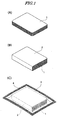
- a sheet-form light-sensitive material stack 1 which may have rounded corners, is protected with a protecting sheet 2, which is a polypropylene sheet having a U-shaped (or horseshore) cross section, and stored in an envelope 3, the four edges of the envelope 3 forming broad heat-seal parts 4.
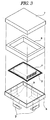
- this envelope 3 is stored within a rectangular parallelepiped container (fitting-type box) comprising a body 6 and a lid 7, and the body 6 and the lid 7 of the fitting-type box are secured by means of a pressure-sensitive tape 9.
- a cushioning member 8 sandwiched between the body 6 and the lid 7 of the fitting-type box is arranged so as to press at least a part of the heat-seal parts against the inner base of the body 6 or the inner top face of the lid 7, thereby restraining movement of the envelope.
- the cushioning member has a variety of shapes as shown in FIG. 5, and is preferably in a shape that substantially evenly fixes the four heat-seal part edges at the periphery of the envelope. The extent to which they are fixed depends on a width a over which the heat-seal parts are held down and a height b that the cushioning member is compressed by, as shown in FIG. 6.
- the light-sensitive material package of the present invention relates to a stack of sheet-form light-sensitive material.
- the stack of sheet-form light-sensitive material is enclosed in a light-shielding envelope, and this envelope is stored in an external box that has a configuration wherein one half thereof fits into the other half.
- the stack of light-sensitive material may be enclosed directly in the light-shielding envelope, or the stack may be packaged with a protecting sheet and then stored in the envelope.
- the protecting sheet is a packaging member for the stack of light-sensitive material and makes direct contact with the light-sensitive material, and it is therefore desirable for it not to adversely influence the light-sensitive material.
- the content of substances harmful to the light-sensitive material is usually at most 1,000 PPM; it is necessary for such substances to have substantially no influence on the light-sensitive material, and in order to prevent the occurrence of spots when taking photographs it is preferable to use a material that forms little dust.
- the influence of harmful substances is preferably eliminated, for example, by using a material in which the content of the aforementioned photographically harmful substances is at most 1,000 PPM, or by providing the surface of the protecting sheet with a protective film of a UV curable resin.
- the protecting sheet it is preferable to use various types of plastic sheet, or paper made from pulp having a fiber length of 3 mm or above.
- the paper include paper with added paper strengthening agent, resin laminated paper, latex- or resin-impregnated paper, paper surface coated with resin, starch, or PVA, surface-sized paper, synthetic paper, dust-free paper, and neutral paper.
- Specific examples of the plastic sheet include polyethylene sheet and polypropylene sheet.
- a plastic sheet is preferably used, and a polypropylene sheet is particularly preferred.
- the thickness of the protecting sheet is preferably 300 to 700 ⁇ m, and the stiffness is preferably 0.05 to 0.1 N•cm.
- the stiffness referred to here denotes a bending moment of the protecting sheet, and details of the measurement method are specified in JIS P8125.
- the surface roughness of the protecting sheet is preferably 10 to 500 ⁇ m.
- the surface roughness referred to here denotes the average gap between projections and depressions of the protecting sheet, and details of the measurement method are specified in JIS B0601.
- the wetting tension of the protecting sheet is preferably 4 x 10 -3 to 5 x 10 -3 N/m (40 to 50 dyne/cm). Details of the method for measuring the wetting tension are specified in JIS K6768.
- the sheet-form light-sensitive material of the present invention is preferably made so that the four corners of the rectangle are rounded, thereby further suppressing bag tear.
- the protecting sheet preferably has a shape that covers the whole lower face of the stack of sheet-form light-sensitive material, and preferably has a shape having a U-shaped cross section that also covers the whole upper face of the stack.
- the stack of sheet-form light-sensitive material is stored in the light-shielding envelope directly or with the protecting sheet packaging.
- the envelope used in the present invention is preferably a completely light-shielding inner packaging material having moisture resistance.
- the envelope can employ various known bag formats including a single layer flat bag, a double layer flat bag, a single layer gusset bag, and a double layer gusset bag.
- the single layer bag employs an inner packaging material formed by extruding molten PE (in an amount corresponding to a thickness of 13 ⁇ m) and laminating 80 ⁇ m thick BPE (Black Polyethylene) on 40 ⁇ m thick BOPP (Biaxially Oriented Polypropylene) using the above PE as an adhesive.
- the above-mentioned inner packaging material is used as an outer bag, and an inner packaging material formed by extrusion laminating molten PE (in an amount corresponding to a thickness of 13 ⁇ m) on the BOPP surface of the above-mentioned inner packaging material is used as an inner bag.
- the stiffness of the inner packaging material is preferably at least 0.01 N ⁇ cm, and the tear strength of the inner packaging material is preferably at least 1.5 N•cm.
- the method for measuring this tear strength is as specified in JIS P8116.
- the process for making a bag can be carried out by appropriately choosing a conventionally known process for sealing a plastic film such as heat sealing, fusion sealing, impulse sealing, ultrasonic sealing, and radio frequency sealing according to the properties of the inner packaging material used here. It is also possible to make a bag using an appropriate adhesive, pressure-sensitive adhesive, etc.
- the four edges of the light-shielding envelope are heat-sealed. If there is insufficient stiffness in the heat-seal parts 4 in FIG. 4, even when the envelope is held down by the cushioning material the bag moves within the fitting-type box, thereby making it impossible to prevent any damage to the light-sensitive materials. Moreover, when the stiffness is too high, the process suitability becomes poor. It is therefore necessary for the stiffness of the heat-seal parts 4 to be at least 0.05 N•cm, and the stiffness is preferably at most 1 N•cm.
- the box storing the envelope is for protecting and storing the light-shielding envelope in which the sheet-form light-sensitive material stack is contained.
- a specific example of the box is formed from a rectangular parallelepiped that is thin overall, and has an inner box (body) and a lid that can be fitted together.
- the material of the fitting-type box is not particularly limited, and it may be a paper box or a plastic box as long as it has a strength that is sufficient for use according to the size and the weight of the stack of sheet-form light-sensitive material.
- a paper box is used as the fitting-type box it is preferable to laminate a paper made from long fiber pulp and having high surface strength on the inside of the fitting-type box or to laminate a low dust forming flexible sheet such as a plastic film or a dust-free paper on the inside as described later. Further adding carbon black or a conductive substance to the fitting-type box is preferable in terms of prevention of dust adsorption and static.
- the pressure within the envelope immediately before or after subjecting the envelope to heat sealing Reducing the pressure to about 10 to 500 mm•H 2 O can restrain movement of the light-sensitive material stack within the envelope.
- the envelope is stored within the fitting-type box.
- the use of a flexible cushioning member in this situation so as to restrain movement of the envelope within the fitting-type box is a feature of the present invention. Preventing movement of the envelope within the fitting-type box can prevent malfunctions such as bag tear, scratching of the light-sensitive material sheets, and abrasion marks, and generation of dust.
- the cushioning member can be placed either above (enclosed above) or beneath (enclosed below) the heat-seal parts (hereinafter also called 'edges') of the envelope stored in the inner box (body), and closing the fitting-type box holds down the edges of the envelope, thereby preventing movement of the envelope within the fitting-type box during transport.
- the cushioning member is disposed above the edges of the envelope, the edges of the inner packaging member are held down by the cushioning member and the inner box (body).
- the edges of the inner packaging member are held down by the cushioning member and the lid.
- the cushioning member may be either enclosed above or enclosed below, but taking manufacturability into account it is preferable for it to be enclosed below.
- the cushioning member can have any configuration as long as longitudinal and lateral movement of the envelope within the fitting-type box can be restrained. Although it is most effective for the cushioning member to be disposed along the whole length of the four edges of the envelope, an effect can be obtained even with it on the corners of the envelope alone, or on a part of the four edges of the envelope. That is, the object of the present invention can be accomplished as long as the envelope is stored within the fitting-type box in a state in which all or a part of the heat-seal parts of the envelope is held down, thereby preventing any undesirable movement of the envelope within the fitting-type box.
- the width (amount held down a ) over which the cushioning member holds down the heat-seal parts is preferably 2 to 10 mm, and particularly preferably 4 to 6 mm.
- the height (amount that box pushes down b ) that the heat-seal parts are to be pushed down between the cushioning member and the lid of the fitting-type box is preferably 1 to 5 mm before the lid is applied, and particularly preferably 2 to 4 mm.
- the cushioning member In order for the cushioning member to exhibit its function, it is necessary for the cushioning member to be compressed within the fitting-type box between the bottom sheet and the top sheet of the fitting-type box while sandwiching the heat-seal parts.
- the two are therefore preferably fixed by appropriate means and there is, for example, a method in which the body and lid of each of the fitting-type boxes are fixed by a pressure-sensitive tape. It is also possible to stack several fitting-type boxes on top of each other and fix the outside of the stack on all sides using a strong tape.
- a conventionally known flexible material can be chosen appropriately, but a material that forms little dust is preferred.
- foams comprising a foaming agent and a polyolefin resin such as various types of polyethylene resin, various types of polypropylene resin, and polybutene resins; ethylene copolymer resins such as polystyrene resins; copolymer resins having propylene as a main component; mixed resins of a polyolefin cross-linked resin or a polyamide resin and one or two or more of the above-mentioned resins; polyurethane; natural rubber (sponge made from rubber latex stock); and synthetic rubber such as SBR.
- a polyolefin resin such as various types of polyethylene resin, various types of polypropylene resin, and polybutene resins
- ethylene copolymer resins such as polystyrene resins
- a preferable cushioning member that can be used effectively in the present invention is a foamed thermoplastic resin having as a main component substantially a polyolefin resin (including modified resins, cross-linked resins, etc.) including various types of high density, medium density, and low density polyethylene resins, linear low density polyethylene (L-LDPE) resins, polypropylene resins, propylene - ethylene copolymer resins, ethylene - vinyl acetate copolymer resins, ethylene - acrylate ester copolymer resins, ethylene - acrylic acid copolymer resins, and polystyrene copolymer resins.
- foamed polyethylene is preferred in terms of cost and properties.
- the foam expansion factor is 10 to 70 times, and preferably 20 to 40 times.
- an inorganic foaming agent either an inorganic foaming agent or an organic foaming agent may be used.
- the inorganic foaming agent include sodium hydrogen carbonate, ammonium carbonate, and ammonium hydrogen carbonate.
- the organic foaming agent include azobisisobutyronitrile, azodicarbonamide, and barium azodicarboxylate.
- processes for forming a foam by adding a foaming agent to a plastic material or a rubber material there are a gas-mixing method, a foaming-agent decomposition method, a solvent-evaporation method, a chemical reaction method, a sintering method, a leaching method, etc., and any method can be used.
- an antistatic agent may be added.
- an anionic type an alkylphosphate ester as a cationic type an alkylamino derivative and a quaternary ammonium salt, as an amphoteric type an imidazoline type metal salt, and as a nonionic type a polyoxyethylene alkylamine, a polyoxyethylene fatty acid ester, and a polyoxyethylene alkyl ether.
- dioxyethylene stearic acid amine, an alkylamine lubricant e.g., that with the product name Electrostripper
- stearic acid monoglyceride etc.
- a fitting-type box that generates no paper dust during transport using a material formed by laminating a thermoplastic resin layer on the front and back surfaces of a paperboard (hereinafter, termed 'packaging material for light-sensitive material' in the present invention) and using it for packaging the envelope it becomes possible to reduce the attachment of dirt to the outside of the envelope during transport and provide a product having a high level of cleanliness. Furthermore, laminating a thermoplastic resin layer on the outside of the fitting-type box makes the surface have a state closer to that of a plastic, thus making the surface easy to clean and thereby making it easy to reuse.
- the packaging material for light-sensitive material has thermoplastic resin layers 13 laminated on ordinary paper 12 on either side of a paperboard 11.
- the packaging material for light-sensitive material is used for a fitting-type box used for packaging an envelope storing a stack of sheet-form light-sensitive material, and is a packaging material obtained by laminating the front and back sides of the paperboard with the thermoplastic resin layer.
- the paperboard is a packaging member for a stack of light-sensitive material, it is desirable for it not to adversely influence the light-sensitive material.
- the content of substances harmful to the light-sensitive material in the paperboard material is usually at most 1,000 PPM, it is necessary for there to be substantially no influence on the light-sensitive material, and in order to prevent the occurrence of spots when taking photographs it is preferable to use a material that forms little dust.
- any paperboard may be used as long as it has a strength sufficient for use in relation to the size and weight of the stack of sheet-form light-sensitive material, and it is preferable to use various types of paper made from pulp having a weight-average fiber length of 3 mm or above.
- Specific examples of the paper include paper with added paper strengthening agent, latex- or resin-impregnated paper, surface-sized paper, synthetic paper, dust-free paper, and neutral paper.
- the basis weight of the paperboard (chipboard basis weight) is preferably 450 to 1,950 g/m 2 , and more preferably 1,000 to 1,950 g/m 2 .
- the thickness of the paperboard is preferably 2 to 3 mm.
- a fitting-type box may be formed from a single sheet of paperboard or by bonding a plurality of paperboards together. When bonding a plurality of paperboards together, the thickness of the bonded paperboards is preferably in the above-mentioned range.
- the stiffness of the paperboard is preferably 1.96 to 19.6 N•cm (200 to 2,000 gf ⁇ cm) when a single sheet of non-bonded paperboard is measured. When bonding a plurality of paperboards together, the stiffness of the bonded paperboards exceeds the above-mentioned value.
- the stiffness referred to here denotes a bending moment of the paperboard, and details of the measurement method are specified in JIS P8125.
- the surface roughness of the paperboard is preferably 10 to 100 ⁇ m.
- the surface roughness referred to here denotes the average gap between projections and depressions of the paperboard, and details of the measurement method are specified in JIS B0601.
- the resin used in the thermoplastic resin layer may be any resin as long as it gives an effect of suppressing the generation of paper dust when it is laminated on the paperboard so that the paperboard does not produce paper dust in the same manner as is the case with conventional paper when its surface is rubbed.
- polyolefins such as polyethylene (PE) and polypropylene (OPP, CPP), polyesters such as polyethylene terephthalate (PET) and polybutylene terephthalate, polyamides such as nylon 6, nylon 66, nylon 11 and nylon 12, polystyrene, polystyrene copolymers, etc. can preferably be used.
- thermoplastic resin layer Adding carbon black or a conductive material to the thermoplastic resin layer is preferable in terms of preventing dirt and dust from becoming attached due to static.
- the thickness of the thermoplastic resin layer is preferably 10 to 200 ⁇ m, more preferably 10 to 100 ⁇ m, and most preferably 10 to 70 ⁇ m.
- thermoplastic resin layer on a paperboard With regard to a method for laminating a thermoplastic resin layer on a paperboard, a conventionally known method can be used, and in the present invention a method in which a thermoplastic film is laminated on a paperboard is preferred. With regard to specific lamination methods, a dry lamination method, a non-solvent lamination method, an extrusion lamination method, etc. can be cited.
- a thermoplastic resin layer such as a biaxially stretched PET film can be laminated on a paperboard by the dry lamination method.
- a comparatively thin film having a thickness of 10 to 20 ⁇ m is preferably used.
- Lumirror #12 manufactured by Toray Industries, Inc., PET, thickness 12 ⁇ m
- a dry lamination adhesive used in the dry lamination method a mixture of E263 (main agent) and C-26 (setting agent) at 3:1 manufactured by Dainichiseika Color & Chemicals Mfg. Co., Ltd. can be cited.
- thermoplastic resin layer such as a polyolefin can first be laminated on a paper other than the paperboard, preferably a paper having a basis weight less than that of the paperboard, and this can then be laminated on the paperboard.
- a comparatively thick film having a thickness of 30 to 100 ⁇ m.
- a thermoplastic resin can be laminated by the extrusion lamination method on an ordinary paper having a basis weight of about 180 to 320 g/m 2 , and this can then be bonded to a paperboard using an adhesive such as an emulsion type adhesive.
- any adhesive can be used as long as it does not adversely influence the light-sensitive material.
- thermoplastic resin layer is preferably laminated on both the front and back sides of the paperboard, but it is also possible to laminate it on one side of the paperboard alone.
- thermoplastic resin When forming a fitting-type box using the packaging material for light-sensitive material formed by laminating the thermoplastic resin layers on the front and back sides of the paperboard, both the inside and the outside of the fitting-type box are covered with the thermoplastic resin. It is therefore possible for a dust generation prevention effect to be imparted to the inside of the fitting-type box and at the same time for the outside of the fitting-type box to be resistant to soiling, and even when dirt adheres thereto it can easily be cleaned off, thereby making the fitting-type box reusable. Furthermore, since both sides of the paperboard are provided with a thermoplastic resin layer, the moisture resistance of the two sides of the paperboard is well balanced, thereby suppressing curling of the paperboard.
- thermoplastic resin layer When forming a box-shaped fitting-type box using the packaging material for light-sensitive material formed by laminating a thermoplastic resin layer on one side of the paperboard alone, it is preferable to use the side with the laminated thermoplastic resin layer as the inside of the fitting-type box.
- the fitting-type box formed from the packaging material for light-sensitive material is for protecting and storing the light-shielding envelope containing the stack of sheet-form light-sensitive material, and as described above a box comprising a rectangular parallelepiped that is thin overall and having an inner box (body) and a lid that can be fitted together can be cited as a specific example.
- the whole surface of the paperboard forming the body 6 and the lid 7, that is, the entire paperboard including the front and back sides and the cross sections, is covered with a plastic, and paper dust is preferably not generated.
- All the surfaces of the fitting-type box are preferably covered with a plastic, that is, a synthetic resin, including the front and the back of the bottom of the inner box (body), the front and the back of the top of the lid, and the insides and the outsides of the four bent parts of the inner box and the lid as well as the cross sections of the paperboard on the ends of the four peripheral side edges of the bottom and the lid, and no parts of the front, back and cross sections of the paperboard used as the material are exposed.
- a plastic that is, a synthetic resin, including the front and the back of the bottom of the inner box (body), the front and the back of the top of the lid, and the insides and the outsides of the four bent parts of the inner box and the lid as well as the cross sections of the paperboard on the ends of the four peripheral side edges of the bottom and the lid, and no parts of the front, back and cross sections of the paperboard used as the material are exposed.
- a standard method for producing the fitting-type box 10 comprises stamping out a thick paper such as a paperboard laminated with a liner such as polyethylene for both the body 6 and the lid 7, ruling half-cut lines into parts corresponding to the bending positions, forming a box shape, and applying a PET pressure-sensitive tape, a resin-impregnated cloth tape, etc. to the paper cross sections.
- the paperboard laminated with a plastic film can be formed using the above-mentioned paperboard, and the surface thereof is preferably laminated with polyethylene, etc. at a thickness of 10 to 200 ⁇ m, and more preferably 20 to 100 ⁇ m.
- the depth that the ruled lines are put into the paperboard is usually at least 1/2 of the paperboard thickness, and preferably 1/2 to 9/10. In the present reusable box, it is preferable to leave at least the thickness of the polyethylene layer on the surface layer in order to prevent the generation of paper dust.
- a flexible pressure-sensitive tape such as, for example, a PET pressure-sensitive tape manufactured by Nitto Denko Corp. (PET No. 31D, 50 ⁇ m x 25 mm width) is applied to the insides and outsides of parts which correspond to the corners of the box and in which a cross section of the paper can be seen, thereby preventing exposure of the paper cross section as well as blocking the interior of the box from contact with outside air.
- PET pressure-sensitive tape manufactured by Nitto Denko Corp.
- the strength of the box might not be sufficient, and when, for example, there is a possibility that the box might deform when carried by hand, a paperboard of the same material may be stuck along the short and long sides of the box. It is preferable to laminate these reinforcing paperboards to the four peripheral sides so that the box can be used repeatedly as a reusable box.
- a tally of the number of times it is used can be written by hand on the box or written by a laser beam at a predetermined position on the box so that it can be read visually or by a machine.
- a No. 111 cloth tape having a width of 50 mm and a resin-impregnated surface, manufactured by Okamoto Industries, Inc., can be used.
- Both the body 6 and the lid 7 of the fitting-type box can be made by the above-mentioned production method.
- the dimensions of the lid are preferably set so that the body and the lid fit together smoothly.
- the dimensions of the paperboard stamped out for the short and long sides of the lid are both preferably set larger than those of the body by about 5 to 12 mm.
- the depth of the lid is preferably set larger than that of the body by about 1 to 3 mm.
- the paperboard for forming the body and the lid in the present invention it is preferable to use a paperboard covered with a plastic, and to cover the parts of the periphery of the body and lid where the cross section of the paperboard is exposed with a pressure-sensitive tape comprising a plastic film or a resin-impregnated cloth tape, which at the same time retains and reinforces the shape of the box.
- a liner laminated with a plastic film, a paper impregnated with a latex or a resin, etc. can be used.
- thermoplastic resin film manufactured from a thermoplastic resin
- lamination method described above can preferably be used.
- the thermoplastic film is explained more specifically below.
- thermoplastic resin used in the thermoplastic resin film there are high density homopolyethylene resins, medium density homopolyethylene resins, low density homopolyethylene resins, various densities of ethylene - ⁇ -olefin copolymer resins, vinyl chloride - vinyl acetate copolymer resins, vinyl chloride resins, polyvinylidene chloride resins, EVA resins, EEA resins, EAA resins, EMA resins, acrylic resins, acrylonitrile resins, polyamide resins, polyester resins, polycarbonate resins, polyacetal resins, ethylene - vinyl alcohol (hereinafter called EVOH) copolymer resins, homopolystyrene resins, synthetic rubber modified polystyrene resins, acrylonitrile - butadiene - styrene (ABS) copolymer resins, high impact polystyrene resins, homopolypropylene resins, propylene -
- EVOH
- thermoplastic resin used in the thermoplastic resin film crystalline resins are preferred since they are low cost and have excellent heat resistance, photographic properties, heat sealability, Young's modulus, grease resistance, etc.
- these crystalline resins there are various densities of homopolyethylene resins, homopolypropylene resins, propylene - ⁇ -olefin copolymer resins, ethylene copolymer resins, polyacetal resins, polyamide resins, polyester resins such as polyethylene terephthalate resin and polyethylene naphthalate resin, polytetrafluoroethylene resins, polyvinylalcohol resins, ethylene - vinyl alcohol copolymer resins, and resins containing 50 wt % or more of one type or two or more types of isotactic polystyrene resin.
- Polyethylene resins and polypropylene resins are preferred, and low density homopolyethylene resin (hereinafter called LDPE resin), medium density homopolyethylene resin (hereinafter called MDPE resin), high density homopolyethylene resin (hereinafter called HDPE resin), various densities of L-LDPE resin, homopolypropylene resin, and propylene - ethylene copolymer resin are particularly preferred.
- LDPE resin low density homopolyethylene resin
- MDPE resin medium density homopolyethylene resin
- HDPE resin high density homopolyethylene resin
- L-LDPE resin low density homopolyethylene resin
- HDPE resin high density homopolyethylene resin
- thermoplastic resin film with the object of improving the ability to uniformly disperse light shielding materials such as carbon black and aluminum powder, and reinforcing agents such as glass fiber and potassium titanate, improving the heat seal suitability (in particular maintaining the heat seal strength over time), enhancing the physical strength, etc., it is preferable for an ethylene copolymer resin to be included at 1 to 99.8 wt %.
- the ethylene copolymer resin is preferably included at 2 to 97 wt %, particularly preferably 5 to 95 wt %, and most preferably 7 to 93 wt %.
- L-LDPE Linear Low Density Polyethylene
- This resin is a polyethylene resin having a linear straight chain structure with short branches, and is a copolymer that is formed by copolymerizing ethylene and an ⁇ -olefin having 3 to 20 carbons, preferably 4 to 15 carbons, particularly preferably 5 to 10 carbons, and most preferably 6 to 8 carbons by a low pressure method or a high pressure improved method.
- this ⁇ -olefin there are various types of this ⁇ -olefin that can be used, such as linear or branched aliphatic ones, alicyclic ones, and aromatic ones such as styrene. From the point of view of physical strength and cost, aliphatic ⁇ -olefins such as propene-1, butene-1, octene-1, hexene-1, 4-methylpentene-1, heptene-1, decene-1, undecene-1, and dodecene-1 are preferably used. These ⁇ -olefins that are copolymerized with ethylene can be used singly, or in a combination of two or more types.
- aliphatic ⁇ -olefins such as propene-1, butene-1, octene-1, hexene-1, 4-methylpentene-1, heptene-1, decene-1, undecene-1, and dodecene-1 are
- the density (ASTM D-1505) is generally of the order of that of a low/medium density polyethylene resin, but in the present invention a density in the range of 0.86 to 0.98 g/cm 3 , and particularly 0.88 to 0.96 g/cm 3 is preferred.
- a melt flow rate (ASTM D-1238, Conditions E) in the range of 0.1 to 80 g/10 min, and particularly 0.3 to 60 g/10 min is preferred.
- a polymerization process for the L-LDPE resin there are a gas phase method, a solution method, and a liquid phase slurry method that use a medium/low pressure system, and an ionic polymerization method, etc. that use a high pressure improved method system.
- Ethylene - butene-1 copolymer resins Dowlex (Dow Chemical) Sclair (DuPont de Nemour, Canada) Marlex (Phillips) Stamylex (DSM) Excellen VL (Sumitomo Chemical Co., Ltd.) Neo-Zex (Mitsui Chemicals, Inc.) Mitsubishi Polyethy-LL (Mitsubishi Chemical Corp.) Nisseki Linirex (Nippon Petrochemicals Co., Ltd.) NUC Polyethylene-LL (Nippon Unicar Co., Ltd.) Idemitsu Polyethylene L (Idemitsu Petrochemical Co., Ltd.) Ethylene - hexene-1 copolymer resins Tuflin (UCC) Tufthene (Nippon Unicar Co., Ltd.) Ethylene - 4-methylpentene-1 copolymer resins Ultzex (Mitsui Chemicals, Inc.) Ethylene
- L-LDPE resins particularly from the point of view of physical strength and film forming characteristics, are those which have a melt flow rate (measured using ASTM D-1238, Conditions E or JIS K-7210 Conditions 4, test temperature 190°C, test load 21.2 N (2.16 kgf); polypropylene resins being measured using ASTM D-1238, Conditions E or JIS K-7210 Conditions 4; test temperature 230°C, test load 21.2 N (2.16 kgf)) of 0.1 to 10 g/10 min, preferably 0.2 to 7 g/10 min, and particularly preferably 0.3 to 5 g/10 min; a density (measured by JIS K-6760 or ASTM D-1505) of 0.860 to 0.950 g/cm 3 , preferably 0.870 to 0.940 g/cm 3 , and particularly preferably 0.880 to 0.930 g/cm 3 ; and which are obtained from an ⁇ -olefin having 3 to 12 carbons, preferably 4 to 10 carbons, and particularly preferably
- a fitting-type box comprising a paperboard covered with a thermoplastic resin film to which an antistatic agent has been added.
- Antistatic agents are known, and a variety of groups of compounds can be cited, but surfactants are preferably used as the antistatic agent in the present invention.
- an antistatic agent is effective in preventing dirt and dust from becoming attached by static to a plastic material, and in particular to a polyethylene laminate film.
- an antistatic agent there can be cited as an anionic type an alkyl phosphate ester, as a cationic type an alkylamine derivative and a quaternary ammonium salt, as an amphoteric type an imidazoline type metal salt, and as a nonionic type a polyoxyethylene alkylamine, a polyoxyethylene fatty acid ester, and a polyoxyethylene alkyl ether. More specifically, dioxyethylene stearic acid amine, an alkylamine lubricant, stearic acid monoglyceride, etc., can preferably be used.
- thermoplastic resin film of aluminum powder By adding a surfactant, in addition to preventing static, an improvement in the slip characteristics can be obtained. Furthermore, the addition of a surfactant improves the dispersibility in the thermoplastic resin film of aluminum powder, light-shielding materials, hydrated double salt compounds (representative examples are hydrotalcite type compounds), etc.
- the amount of surfactant added is 0.01 to 5.0 wt %, preferably 0.05 to 3.0 wt %, and more preferably 0.1 to 1.5 wt %. If the amount added is less than 0.01 wt %, the effect of adding the surfactant is lost, and there is only an increase in the cost of kneading. Furthermore, if the amount added exceeds 5.0 wt%, slip easily occurs between the molten resin and the screw of the extruder, and the amount of resin discharged is unstable. Moreover, stickiness and bleed out easily occur over time after film formation. Furthermore, the surfactant that has bled out transfers to the photographic light-sensitive layer, thus causing inhibition of development, and thereby degrading the quality.
- Resistat 204, 205 (Dai-ichi Kogyo Seiyaku Co., Ltd.), Elegan 2E, 100E (NOF Corp.), Chemistat 1002, 1003, 2010 (NOF Corp.), Erik 51 (Yoshimura Oil Chemical Co., Ltd.), Alromine RV-100 (Geigy), and, furthermore, various surfactants disclosed in the 'Plastic Data Handbook' (KK Kogyo Chosakai Publishing Co., Ltd., published 5 April 1984) pages 776 to 778, etc., and the type and amount added can be selected therefrom.
- nonionic surfactants are particularly preferred since there is little adverse influence on photographic properties or the human body, and they have a large effect in preventing static marks.
- thermoplastic resin film containing one or more type of additive, selected from lubricants, anti-blocking agents, antioxidants, UV absorbers, anti-aging agents, etc. in combination with a surfactant.
- the stack of light-sensitive material that is packaged in the light-sensitive material package of the present invention is formed from a plurality of stacked sheets of photosensitive sheet-form light-sensitive material; for example there are stacked products such as X-ray photographic film, light-sensitive printing material, printing paper, light-sensitive material for lithographic printing (generally known as light-sensitive material for PS plate), heat-developable light-sensitive materials, and glass dry-plates.
- the light-sensitive material package of the present invention is suitable for stacks of light-sensitive material sheets weighing 3 kg or above, and preferably 3 to 5 kg.
- the heat-developable light-sensitive materials are preferably of the mono-sheet type (a type in which an image can be formed on a heat-developable light-sensitive material rather than using a separate sheet such as an image receiving material).
- the heat-developable light-sensitive material has a light-sensitive layer containing a light-sensitive silver halide (catalytically active amount of a photocatalyst) and a reducing agent, and a non light-sensitive layer.
- the light-sensitive layer preferably further contains a binder (generally a synthetic polymer), an organic silver salt (reducible silver source) and a reducing agent.
- a hydrazine compound (ultra high contrast enhancing agent) and a color tone adjustment agent (to control the color tone of the silver) are preferably included.
- a plurality of light-sensitive layers can be included.
- a high speed light-sensitive layer and a low speed light-sensitive layer can be provided in the heat-developable light-sensitive material.
- the low speed light-sensitive layer can be disposed underneath (support side) or the high speed light-sensitive layer can be disposed underneath.
- the non light-sensitive layer can be provided as a dye-containing layer, that is, a filter layer and an antihalation layer, as well as a different functional layer such as a surface protection layer.
- paper polyethylene laminated paper, polypropylene laminated paper, parchment, cloth, a sheet or thin film of a metal (e.g., aluminum, copper, magnesium, zinc), glass, and glass or plastic film laminated with a metal (e.g., chrome alloy, steel, silver, gold, platinum) can be used.
- a metal e.g., aluminum, copper, magnesium, zinc
- glass e.g., glass, and plastic film laminated with a metal (e.g., chrome alloy, steel, silver, gold, platinum)
- a metal e.g., chrome alloy, steel, silver, gold, platinum
- Transparent plastic films are preferable, and examples of plastics that can be used as the support include polyalkyl methacrylates (e.g., polymethyl methacrylate), polyesters (e.g., polyethylene terephthalate: PET), polyvinyl acetal, polyamides (e.g., nylon), and cellulose esters (e.g., cellulose nitrate, cellulose acetate, cellulose acetate propionate, cellulose acetate butyrate). In particular, those with a thickness of 170 to 200 ⁇ m are preferable as the support. In the present invention, polyethylene terephthalate is preferably used.
- polyalkyl methacrylates e.g., polymethyl methacrylate
- polyesters e.g., polyethylene terephthalate: PET
- polyamides e.g., nylon
- cellulose esters e.g., cellulose nitrate, cellulose acetate, cellulose acetate propionate, cellulose acetate but
- a matting agent may be included in the surface protection layer, and preferably in the outermost surface layer. By adding the matting agent, adhesion when stacking the light-sensitive material sheets can be prevented. Fine grains of generally water-insoluble organic or inorganic compounds can preferably be used as the matting agent.
- water-dispersible vinyl polymers such as polymethyl acrylate, polymethyl methacrylate, polyacrylonitrile, acrylonitrile - ⁇ -methyl styrene copolymer, polystyrene, styrene - divinylbenzene copolymer, polyvinyl acetate, polyethylene carbonate, and polytetrafluoroethylene; cellulose derivatives such as methyl cellulose, cellulose acetate, and cellulose acetate propionate; starch derivatives such as carboxy starch, carboxynitrophenyl starch, and urea - formaldehyde - starch reaction products; gelatin hardened with a known hardening agent; and hardened gelatin in the form of microcapsule hollow particles obtained by coacervate hardening are preferably used.
- silicon dioxide titanium dioxide, magnesium dioxide, aluminum oxide, barium sulfate, calcium carbonate, silver chloride desensitized by a known method, silver bromide similarly processed, glass, and diatomaceous earth.
- matting agents can be mixed and used as necessary.
- black and white film used for forming images with line widths of 200 to 500 ⁇ m in general, 100 to 200 ⁇ m for precision machinery, and 1 to 100 ⁇ m for ultra-high-precision machinery.
- IP-S175A, N IP-R175A, and N IP-L175A size: 202 mm x 303 mm to 660 mm x 940 mm
- PCB printed circuit boards
- packaging material for light-sensitive material of the present invention can be applied not only to light-sensitive materials such as film and glass dry plates, but can also be used for the general packaging of heat sensitive film, PS plate sheets, etc.
- a stack of sheet-form light-sensitive material (manufactured by Fuji Photo Film Co., Ltd., product name: IP-S175A, support thickness: 175 ⁇ m, size: 50.8 x 61 cm, number of sheets: 50 sheets, weight: 3 kg) was packaged with a protecting sheet made of a polypropylene sheet and stored in an envelope having a stiffness at heat-seal parts of 0.15 N ⁇ cm, and four edges were heat-sealed.
- the envelope was stored in a fitting-type box in a state in which a cushioning member (FIG. 5A) extending the whole length of the heat-seal part on the four edges of the envelope was enclosed below.
- Example 1 The procedure of Example 1 was repeated except that the cushioning member abutted against only a part of the heat-seal parts as shown in FIGS. 5B, 5C, and 5D to give samples of Examples 2 to 4.
- a light-sensitive material (manufactured by Fuji Photo Film Co., Ltd., product name: IP-S175A, support thickness: 175 ⁇ m, size: 50.8 x 61 cm, number of sheets: 50 sheets, weight: 3 kg) was stored in a protecting sheet made of a polypropylene sheet, stored in an envelope having a stiffness at heat-seal parts of 0.1 N ⁇ cm, and the envelope was stored in a fitting-type box with a cushioning member placed on the heat-seal parts (enclosed above) while changing the amount held down (width over which the cushioning member holds down the heat-seal parts) to 2, 5, and 10 mm. After carrying out a vibration test as specified in JIS Z0200, bag tear and scratches were evaluated.
- Bag tear Scratches (number) Comp. Ex. 3 0 X 156 to 165 Example 5 2 O 20 to 35 Example 6 5 O 10 to 15 Example 7 10 O 10 to 15 Bag tear: XX A hole (diameter 1 mm or above) that allowed light to enter the envelope and allowed the light-sensitive material to be exposed to light. X A hole that allowed air to enter but did not allow light to enter the envelope. O No hole. Scratches: Number of scratches having a length of 10 ⁇ m or above per sheet of film.
- the problems of bag tear and scratches can be eliminated at low cost without changing the size of the fitting-type box. Furthermore, it is possible to decrease the strength of the bag material, thereby reducing the cost of the bag and enhancing the quality of the bag.
- the present invention is particularly effective when the weight of the stack of light-sensitive material is 3 kg or above.
- the present invention is also effective when the thickness of the support of the light-sensitive material is 170 ⁇ m to 200 ⁇ m.
- NRK liner manufactured by Oji Paper Co., Ltd., basis weight 280 g/m 2
- Ultrazex 2021L manufactured by Mitsui Chemicals Inc., LDPE, thickness 40 ⁇ m
- Petrothene manufactured by Tosoh Corporation, LDPE
- the laminate was then further bonded to a paperboard (basis weight 1950 g/m 2 ) using an emulsion type adhesive.
- a fitting-type box as shown in FIG. 4 was formed using the packaging material for light-sensitive material obtained as above.
- a stack of sheet-form light-sensitive material (manufactured by Fuji Photo Film Co., Ltd., product name: N IP-R175A, support thickness: 175 ⁇ m, size: 50.8 x 61 cm, number of sheets: 100 sheets) was packaged with a protecting sheet made of a polypropylene sheet and stored in an envelope, and four edges were heat-sealed. As shown in FIG. 4, the envelope was stored in a fitting-type box, in a state in which a cushioning member extending the whole length of the heat-seal parts on the four edges of the envelope was enclosed below the heat-seal parts, to give a light-sensitive material package.
- a vibration test was carried out according to JIS Z0200 using the light-sensitive material package of Example 8. Subsequently, the envelope was taken out of the fitting-type box and brought into a Class 1,000 clean room as it was, without removing dirt, etc. adhering to the envelope.
- the fitting-type box formed from the light-sensitive material packaging material comprising a thermoplastic resin layer can be easily cleaned of dirt that becomes attached to the surface during use, the fitting-type box can be reused. This is an effective improvement in terms of the environment and cost.
- a fitting-type box storing black and white film having a sheet size of 515 x 665 mm was produced by laminating, on a paperboard, a polyethylene film to which an antistatic agent had been added, as follows.
- Two sheets of chipboard having a basis weight of 700 g/m 2 were bonded together as an inner layer, and the front and back sides thereof were further bonded to polyethylene laminate liners formed by laminating a 30 ⁇ m thick polyethylene film on one side of a 280 g/m 2 liner, so that the polyethylene was exposed on the surface, thus giving a paperboard for box making.
- the polyethylene was a low density polyethylene (LDPE) to which Elestmaster LL-10 (nonionic surfactant) manufactured by Kao Corp. had been added as an antistatic agent at 0.2 wt % of the polyethylene.
- LDPE low density polyethylene
- Elestmaster LL-10 nonionic surfactant manufactured by Kao Corp.
- a master batch containing the antistatic agent at 10 wt % was used, and the master batch was added to the LDPE at 2 wt %.
- the fitting-type box for storing the above-mentioned sheet size was set so as to have internal dimensions of 562 x 715 mm and a height of 25 mm, and external dimensions of 564 x 717 mm and a height of 25 mm.
- the unfolded dimensions (external stamping dimensions) of the paperboard were 614 x 767 mm.
- a flexible pressure-sensitive tape such as, for example, a PET pressure-sensitive tape manufactured by Nitto Denko Corp. (PET No. 31D, 50 ⁇ m x 25 mm width) was applied to the insides and outsides of open parts which corresponded to the corners of the box and in which cross sections of the paper could be seen, thereby preventing exposure of the paper cross section as well as blocking the interior of the box from contact with outside air.
- paperboard of the same material was laminated to the four peripheral sides along the short and long sides of the box.
- the lid of the fitting-type box was made in the same manner as for the body.
- the dimensions of the lid were set about 9 mm larger for both the short and long sides of the box in the paperboard stamping dimensions so that the body and the lid fitted smoothly together.
- the depth was set about 2 mm larger.
- a stack of sheet-form light-sensitive material (manufactured by Fuji Photo Film Co., Ltd., product name: IP-S175A, support thickness: 175 ⁇ m, size: 50.8 x 61 cm, number of sheets: 50 sheets, weight: 3 kg) was packaged with a protecting sheet made of a polypropylene sheet and stored in an envelope having a stiffness at heat-seal parts of 0.15 N•cm, and four edges were heat-sealed.
- the envelope was stored in a fitting-type box in a state in which a cushioning member extending the whole length of the heat-seal parts in the four edges was enclosed below the heat-seal parts.
- a vibration test (according to JIS Z0200) was carried out for the sample below, and the amount of paper dust generated was measured.
- Amounts of paper dust generated were as follows. (Sample 1) with one vibration test 0 (Sample 1) with five vibration tests 0
- a dust-free fitting-type box that prevents the generation of paper dust, etc. can be obtained and, moreover, the box can be used as a reusable fitting-type box that can be used a plurality of times.
Landscapes
- Engineering & Computer Science (AREA)
- Mechanical Engineering (AREA)
- Microelectronics & Electronic Packaging (AREA)
- Physics & Mathematics (AREA)
- General Physics & Mathematics (AREA)
- Packages (AREA)
- Laminated Bodies (AREA)
- Buffer Packaging (AREA)
- Packaging Of Annular Or Rod-Shaped Articles, Wearing Apparel, Cassettes, Or The Like (AREA)
Abstract
A light-sensitive material package includes a light-shielding envelope (3)
containing a stack (1) of sheet-form light-sensitive material, the light-shielding
envelope (3) having heat-seal parts (4) on four edges. The light-sensitive
material package further includes a cushioning member (8), which holds down
all or a part of the heat-seal parts (4). The light-sensitive material package
further includes a fitting-type box for storing the envelope, the fitting-type box
being formed from an inner box (6) and a lid (7). The stiffness of the heat-seal
parts is at least 0.05 N•cm.
Description
The present invention relates to a sheet-form light-sensitive material
package and, more particularly, a light-sensitive material package that can
eliminate bag tear and damage to the light-sensitive material that may be
caused during transport, etc.
Conventionally, packaging of sheet-form light-sensitive material is
generally carried out by sandwiching or wrapping the sheet-form light-sensitive
material in a paper or plastic sheet, which is called a protecting sheet, and then
placing it in a light-shielding moisture-resistant bag, and then in a fitting-type
box (also known as a 'telescoping' or 'double tray' box). In this case, since the
sheet-form light-sensitive material is stacked in layers, the bag forms sharp
corners, thereby causing a lot of trouble with bag tear during transport or when
dropped. As countermeasures therefor, JP-A-7-149370 (JP-A denotes a
Japanese unexamined patent application publication) discloses a corner
treatment, and JP-A-6-199378 discloses placing a flexible material such as a
corner packing or a foam in four corners as shown in FIG. 4 therein.
Furthermore, JU-B-6-43802 (JU-B denotes a Japanese examined utility model
application publication) discloses a method for preventing bag tear by placing
cushioning blocks in four corners.
Light-sensitive materials that are used in industrial applications are
required to have little change in film size and therefore have a thick support
and, moreover, due to a large film size the weight of the stored product is
considerable.
The above-mentioned methods therefore cannot prevent a product-storing
bag itself from moving within a box, and bag tear occurring on dropping
cannot be eliminated completely. Furthermore, light-sensitive materials for
industrial applications might have a matte film surface so that vacuum
degassing can be easily carried out when exposing to light. There is therefore
the problem that movement of the product within the box or the bag during
transport causes scratches or pressure fogging, and when fine lines are
exposed the lines are incomplete.
It is an object of the present invention to provide a light-sensitive material
package that can prevent bag tear caused when a sheet-form light-sensitive
material package is transported, and that can eliminate damage such as
scratches and pressure fogging of the light-sensitive material caused during
transport.
Another object of the present invention is to provide a light-sensitive
material package that makes it difficult for dirt such as paper dust to adhere to
an envelope storing the light-sensitive material.
The above-mentioned objects of the present invention have been
attained by the following means.
A light-sensitive material package comprising a light-shielding envelope
containing a stack of sheet-form light-sensitive material, the light-shielding
envelope having heat-seal parts on four edges, a cushioning member for
holding down all or a part of the heat-seal parts, and a fitting-type box
comprising an inner box and a lid, the fitting-type box storing the envelope, and
the stiffness of the heat-seal parts being at least 0.05 N•cm.
One mode for carrying out the present invention is explained below by
reference to the drawings.
Referring to FIGS. 1 and 2, a sheet-form light-sensitive material stack 1,
which may have rounded corners, is protected with a protecting sheet 2, which
is a polypropylene sheet having a U-shaped (or horseshore) cross section, and
stored in an envelope 3, the four edges of the envelope 3 forming broad heat-seal
parts 4.
Turning to FIGS. 3 and 4, this envelope 3 is stored within a rectangular
parallelepiped container (fitting-type box) comprising a body 6 and a lid 7, and
the body 6 and the lid 7 of the fitting-type box are secured by means of a
pressure-sensitive tape 9. A cushioning member 8 sandwiched between the
body 6 and the lid 7 of the fitting-type box is arranged so as to press at least a
part of the heat-seal parts against the inner base of the body 6 or the inner top
face of the lid 7, thereby restraining movement of the envelope.
The cushioning member has a variety of shapes as shown in FIG. 5, and
is preferably in a shape that substantially evenly fixes the four heat-seal part
edges at the periphery of the envelope. The extent to which they are fixed
depends on a width a over which the heat-seal parts are held down and a
height b that the cushioning member is compressed by, as shown in FIG. 6.
The light-sensitive material package of the present invention relates to a
stack of sheet-form light-sensitive material. The stack of sheet-form light-sensitive
material is enclosed in a light-shielding envelope, and this envelope is
stored in an external box that has a configuration wherein one half thereof fits
into the other half. The stack of light-sensitive material may be enclosed
directly in the light-shielding envelope, or the stack may be packaged with a
protecting sheet and then stored in the envelope. The protecting sheet is a
packaging member for the stack of light-sensitive material and makes direct
contact with the light-sensitive material, and it is therefore desirable for it not to
adversely influence the light-sensitive material. With regard to a material for the
protecting sheet, the content of substances harmful to the light-sensitive
material is usually at most 1,000 PPM; it is necessary for such substances to
have substantially no influence on the light-sensitive material, and in order to
prevent the occurrence of spots when taking photographs it is preferable to use
a material that forms little dust.
With regard to the protecting sheet, more specifically, the influence of
harmful substances is preferably eliminated, for example, by using a material in
which the content of the aforementioned photographically harmful substances
is at most 1,000 PPM, or by providing the surface of the protecting sheet with a
protective film of a UV curable resin. As the protecting sheet, it is preferable to
use various types of plastic sheet, or paper made from pulp having a fiber
length of 3 mm or above. Specific examples of the paper include paper with
added paper strengthening agent, resin laminated paper, latex- or resin-impregnated
paper, paper surface coated with resin, starch, or PVA, surface-sized
paper, synthetic paper, dust-free paper, and neutral paper. Specific
examples of the plastic sheet include polyethylene sheet and polypropylene
sheet. With regard to the protecting sheet used in the present invention, a
plastic sheet is preferably used, and a polypropylene sheet is particularly
preferred.
The thickness of the protecting sheet is preferably 300 to 700 µm, and
the stiffness is preferably 0.05 to 0.1 N•cm. The stiffness referred to here
denotes a bending moment of the protecting sheet, and details of the
measurement method are specified in JIS P8125. The surface roughness of
the protecting sheet is preferably 10 to 500 µm. The surface roughness
referred to here denotes the average gap between projections and depressions
of the protecting sheet, and details of the measurement method are specified in
JIS B0601. Furthermore, the wetting tension of the protecting sheet is
preferably 4 x 10⁻³ to 5 x 10⁻³ N/m (40 to 50 dyne/cm). Details of the method for
measuring the wetting tension are specified in JIS K6768.
The sheet-form light-sensitive material of the present invention is
preferably made so that the four corners of the rectangle are rounded, thereby
further suppressing bag tear.
The protecting sheet preferably has a shape that covers the whole lower
face of the stack of sheet-form light-sensitive material, and preferably has a
shape having a U-shaped cross section that also covers the whole upper face
of the stack.
The stack of sheet-form light-sensitive material is stored in the light-shielding
envelope directly or with the protecting sheet packaging. The
envelope used in the present invention is preferably a completely light-shielding
inner packaging material having moisture resistance. The envelope can
employ various known bag formats including a single layer flat bag, a double
layer flat bag, a single layer gusset bag, and a double layer gusset bag.
More specifically, the single layer bag employs an inner packaging
material formed by extruding molten PE (in an amount corresponding to a
thickness of 13 µm) and laminating 80 µm thick BPE (Black Polyethylene) on
40 µm thick BOPP (Biaxially Oriented Polypropylene) using the above PE as an
adhesive. In the case of the double layer bag, the above-mentioned inner
packaging material is used as an outer bag, and an inner packaging material
formed by extrusion laminating molten PE (in an amount corresponding to a
thickness of 13 µm) on the BOPP surface of the above-mentioned inner
packaging material is used as an inner bag.
The stiffness of the inner packaging material is preferably at least 0.01
N·cm, and the tear strength of the inner packaging material is preferably at
least 1.5 N•cm. The method for measuring this tear strength is as specified in
JIS P8116.
The process for making a bag can be carried out by appropriately
choosing a conventionally known process for sealing a plastic film such as heat
sealing, fusion sealing, impulse sealing, ultrasonic sealing, and radio frequency
sealing according to the properties of the inner packaging material used here.
It is also possible to make a bag using an appropriate adhesive, pressure-sensitive
adhesive, etc. In the present invention, the four edges of the light-shielding
envelope are heat-sealed. If there is insufficient stiffness in the heat-seal
parts 4 in FIG. 4, even when the envelope is held down by the cushioning
material the bag moves within the fitting-type box, thereby making it impossible
to prevent any damage to the light-sensitive materials. Moreover, when the
stiffness is too high, the process suitability becomes poor. It is therefore
necessary for the stiffness of the heat-seal parts 4 to be at least 0.05 N•cm,
and the stiffness is preferably at most 1 N•cm.
The box storing the envelope is for protecting and storing the light-shielding
envelope in which the sheet-form light-sensitive material stack is
contained. A specific example of the box is formed from a rectangular
parallelepiped that is thin overall, and has an inner box (body) and a lid that can
be fitted together.
The material of the fitting-type box is not particularly limited, and it may
be a paper box or a plastic box as long as it has a strength that is sufficient for
use according to the size and the weight of the stack of sheet-form light-sensitive
material. In the case where a paper box is used as the fitting-type box
it is preferable to laminate a paper made from long fiber pulp and having high
surface strength on the inside of the fitting-type box or to laminate a low dust
forming flexible sheet such as a plastic film or a dust-free paper on the inside
as described later. Further adding carbon black or a conductive substance to
the fitting-type box is preferable in terms of prevention of dust adsorption and
static.
With regard to the light-sensitive material package of the present
invention, it is preferable to reduce the pressure within the envelope
immediately before or after subjecting the envelope to heat sealing. Reducing
the pressure to about 10 to 500 mm•H2O can restrain movement of the light-sensitive
material stack within the envelope.
With regard to the package of the present invention, the envelope is
stored within the fitting-type box. The use of a flexible cushioning member in
this situation so as to restrain movement of the envelope within the fitting-type
box is a feature of the present invention. Preventing movement of the envelope
within the fitting-type box can prevent malfunctions such as bag tear, scratching
of the light-sensitive material sheets, and abrasion marks, and generation of
dust.
The cushioning member can be placed either above (enclosed above) or
beneath (enclosed below) the heat-seal parts (hereinafter also called 'edges') of
the envelope stored in the inner box (body), and closing the fitting-type box
holds down the edges of the envelope, thereby preventing movement of the
envelope within the fitting-type box during transport. When the cushioning
member is disposed above the edges of the envelope, the edges of the inner
packaging member are held down by the cushioning member and the inner box
(body). When the cushioning member is disposed beneath the edges of the
envelope, the edges of the inner packaging member are held down by the
cushioning member and the lid.
The cushioning member may be either enclosed above or enclosed
below, but taking manufacturability into account it is preferable for it to be
enclosed below. The cushioning member can have any configuration as long
as longitudinal and lateral movement of the envelope within the fitting-type box
can be restrained. Although it is most effective for the cushioning member to
be disposed along the whole length of the four edges of the envelope, an effect
can be obtained even with it on the corners of the envelope alone, or on a part
of the four edges of the envelope. That is, the object of the present invention
can be accomplished as long as the envelope is stored within the fitting-type
box in a state in which all or a part of the heat-seal parts of the envelope is held
down, thereby preventing any undesirable movement of the envelope within the
fitting-type box.
The width (amount held down a) over which the cushioning member
holds down the heat-seal parts is preferably 2 to 10 mm, and particularly
preferably 4 to 6 mm.
When the cushioning member is enclosed below, in the case where the
depth of the fitting-type box is 20 mm the height (amount that box pushes down
b) that the heat-seal parts are to be pushed down between the cushioning
member and the lid of the fitting-type box is preferably 1 to 5 mm before the lid
is applied, and particularly preferably 2 to 4 mm.
In order for the cushioning member to exhibit its function, it is necessary
for the cushioning member to be compressed within the fitting-type box
between the bottom sheet and the top sheet of the fitting-type box while
sandwiching the heat-seal parts. When using the body and lid that can fit
together, the two are therefore preferably fixed by appropriate means and there
is, for example, a method in which the body and lid of each of the fitting-type
boxes are fixed by a pressure-sensitive tape. It is also possible to stack several
fitting-type boxes on top of each other and fix the outside of the stack on all
sides using a strong tape.
As for the cushioning member, a conventionally known flexible material
can be chosen appropriately, but a material that forms little dust is preferred.
Examples thereof include foams comprising a foaming agent and a polyolefin
resin such as various types of polyethylene resin, various types of
polypropylene resin, and polybutene resins; ethylene copolymer resins such as
polystyrene resins; copolymer resins having propylene as a main component;
mixed resins of a polyolefin cross-linked resin or a polyamide resin and one or
two or more of the above-mentioned resins; polyurethane; natural rubber
(sponge made from rubber latex stock); and synthetic rubber such as SBR.
A preferable cushioning member that can be used effectively in the
present invention is a foamed thermoplastic resin having as a main component
substantially a polyolefin resin (including modified resins, cross-linked resins,
etc.) including various types of high density, medium density, and low density
polyethylene resins, linear low density polyethylene (L-LDPE) resins,
polypropylene resins, propylene - ethylene copolymer resins, ethylene - vinyl
acetate copolymer resins, ethylene - acrylate ester copolymer resins, ethylene -
acrylic acid copolymer resins, and polystyrene copolymer resins. In particular,
foamed polyethylene is preferred in terms of cost and properties. The foam
expansion factor is 10 to 70 times, and preferably 20 to 40 times.
With regard to the foaming agent, either an inorganic foaming agent or
an organic foaming agent may be used. Examples of the inorganic foaming
agent include sodium hydrogen carbonate, ammonium carbonate, and
ammonium hydrogen carbonate. Examples of the organic foaming agent
include azobisisobutyronitrile, azodicarbonamide, and barium azodicarboxylate.
With regard to processes for forming a foam by adding a foaming agent to a
plastic material or a rubber material, there are a gas-mixing method, a foaming-agent
decomposition method, a solvent-evaporation method, a chemical
reaction method, a sintering method, a leaching method, etc., and any method
can be used.
In order to prevent dirt and dust from adhering to the foam due to static
an antistatic agent may be added. With regard to the antistatic agent, there can
be cited as an anionic type an alkylphosphate ester, as a cationic type an
alkylamino derivative and a quaternary ammonium salt, as an amphoteric type
an imidazoline type metal salt, and as a nonionic type a polyoxyethylene
alkylamine, a polyoxyethylene fatty acid ester, and a polyoxyethylene alkyl
ether. More specifically, dioxyethylene stearic acid amine, an alkylamine
lubricant (e.g., that with the product name Electrostripper), stearic acid
monoglyceride, etc. can preferably be used.
In the present invention, it is also possible to use an air cushion, etc.
instead of a foam as the cushioning member.
Furthermore, in the present invention, by making a fitting-type box that
generates no paper dust during transport using a material formed by laminating
a thermoplastic resin layer on the front and back surfaces of a paperboard
(hereinafter, termed 'packaging material for light-sensitive material' in the
present invention) and using it for packaging the envelope it becomes possible
to reduce the attachment of dirt to the outside of the envelope during transport
and provide a product having a high level of cleanliness. Furthermore,
laminating a thermoplastic resin layer on the outside of the fitting-type box
makes the surface have a state closer to that of a plastic, thus making the
surface easy to clean and thereby making it easy to reuse.
A preferable embodiment of the present invention is explained below by
reference to a drawing.
As shown in FIG. 7, the packaging material for light-sensitive material
has thermoplastic resin layers 13 laminated on ordinary paper 12 on either side
of a paperboard 11.
The packaging material for light-sensitive material is used for a fitting-type
box used for packaging an envelope storing a stack of sheet-form light-sensitive
material, and is a packaging material obtained by laminating the front
and back sides of the paperboard with the thermoplastic resin layer.
Since the paperboard is a packaging member for a stack of light-sensitive
material, it is desirable for it not to adversely influence the light-sensitive
material. The content of substances harmful to the light-sensitive
material in the paperboard material is usually at most 1,000 PPM, it is
necessary for there to be substantially no influence on the light-sensitive
material, and in order to prevent the occurrence of spots when taking
photographs it is preferable to use a material that forms little dust.
With regard to the paperboard, any paperboard may be used as long as
it has a strength sufficient for use in relation to the size and weight of the stack
of sheet-form light-sensitive material, and it is preferable to use various types of
paper made from pulp having a weight-average fiber length of 3 mm or above.
Specific examples of the paper include paper with added paper strengthening
agent, latex- or resin-impregnated paper, surface-sized paper, synthetic paper,
dust-free paper, and neutral paper.
The basis weight of the paperboard (chipboard basis weight) is
preferably 450 to 1,950 g/m2, and more preferably 1,000 to 1,950 g/m2.
The thickness of the paperboard is preferably 2 to 3 mm. In the present
invention, a fitting-type box may be formed from a single sheet of paperboard or
by bonding a plurality of paperboards together. When bonding a plurality of
paperboards together, the thickness of the bonded paperboards is preferably in
the above-mentioned range.
The stiffness of the paperboard is preferably 1.96 to 19.6 N•cm (200 to
2,000 gf·cm) when a single sheet of non-bonded paperboard is measured.
When bonding a plurality of paperboards together, the stiffness of the bonded
paperboards exceeds the above-mentioned value. The stiffness referred to
here denotes a bending moment of the paperboard, and details of the
measurement method are specified in JIS P8125.
The surface roughness of the paperboard is preferably 10 to 100 µm.
The surface roughness referred to here denotes the average gap between
projections and depressions of the paperboard, and details of the measurement
method are specified in JIS B0601.
In the present invention, the resin used in the thermoplastic resin layer
may be any resin as long as it gives an effect of suppressing the generation of
paper dust when it is laminated on the paperboard so that the paperboard does
not produce paper dust in the same manner as is the case with conventional
paper when its surface is rubbed.
More specifically, polyolefins such as polyethylene (PE) and
polypropylene (OPP, CPP), polyesters such as polyethylene terephthalate
(PET) and polybutylene terephthalate, polyamides such as nylon 6, nylon 66,
nylon 11 and nylon 12, polystyrene, polystyrene copolymers, etc. can preferably
be used.
Adding carbon black or a conductive material to the thermoplastic resin
layer is preferable in terms of preventing dirt and dust from becoming attached
due to static.
The thickness of the thermoplastic resin layer is preferably 10 to 200 µm,
more preferably 10 to 100 µm, and most preferably 10 to 70 µm.
With regard to a method for laminating a thermoplastic resin layer on a
paperboard, a conventionally known method can be used, and in the present
invention a method in which a thermoplastic film is laminated on a paperboard
is preferred. With regard to specific lamination methods, a dry lamination
method, a non-solvent lamination method, an extrusion lamination method, etc.
can be cited.
As one embodiment of the present invention, a thermoplastic resin layer
such as a biaxially stretched PET film can be laminated on a paperboard by the
dry lamination method. In this case, a comparatively thin film having a
thickness of 10 to 20 µm is preferably used. More specifically, Lumirror #12
(manufactured by Toray Industries, Inc., PET, thickness 12 µm) can be
laminated on a paperboard by the dry lamination method. As a specific
example of a dry lamination adhesive used in the dry lamination method, a
mixture of E263 (main agent) and C-26 (setting agent) at 3:1 manufactured by
Dainichiseika Color & Chemicals Mfg. Co., Ltd. can be cited.
In another embodiment of the present invention, instead of laminating
the thermoplastic resin layer directly on the paperboard, a thermoplastic resin
layer such as a polyolefin can first be laminated on a paper other than the
paperboard, preferably a paper having a basis weight less than that of the
paperboard, and this can then be laminated on the paperboard. In this case, it
is preferable to use a comparatively thick film having a thickness of 30 to 100
µm. For example, a thermoplastic resin can be laminated by the extrusion
lamination method on an ordinary paper having a basis weight of about 180 to
320 g/m2, and this can then be bonded to a paperboard using an adhesive such
as an emulsion type adhesive. With regard to the adhesive, any adhesive can
be used as long as it does not adversely influence the light-sensitive material.
The thermoplastic resin layer is preferably laminated on both the front
and back sides of the paperboard, but it is also possible to laminate it on one
side of the paperboard alone.
When forming a fitting-type box using the packaging material for light-sensitive
material formed by laminating the thermoplastic resin layers on the
front and back sides of the paperboard, both the inside and the outside of the
fitting-type box are covered with the thermoplastic resin. It is therefore possible
for a dust generation prevention effect to be imparted to the inside of the fitting-type
box and at the same time for the outside of the fitting-type box to be
resistant to soiling, and even when dirt adheres thereto it can easily be cleaned
off, thereby making the fitting-type box reusable. Furthermore, since both sides
of the paperboard are provided with a thermoplastic resin layer, the moisture
resistance of the two sides of the paperboard is well balanced, thereby
suppressing curling of the paperboard.
When forming a box-shaped fitting-type box using the packaging
material for light-sensitive material formed by laminating a thermoplastic resin
layer on one side of the paperboard alone, it is preferable to use the side with
the laminated thermoplastic resin layer as the inside of the fitting-type box.
The fitting-type box formed from the packaging material for light-sensitive
material is for protecting and storing the light-shielding envelope containing the
stack of sheet-form light-sensitive material, and as described above a box
comprising a rectangular parallelepiped that is thin overall and having an inner
box (body) and a lid that can be fitted together can be cited as a specific
example.
In the fitting-type box used in the present invention, the whole surface of
the paperboard forming the body 6 and the lid 7, that is, the entire paperboard
including the front and back sides and the cross sections, is covered with a
plastic, and paper dust is preferably not generated.
All the surfaces of the fitting-type box are preferably covered with a
plastic, that is, a synthetic resin, including the front and the back of the bottom
of the inner box (body), the front and the back of the top of the lid, and the
insides and the outsides of the four bent parts of the inner box and the lid as
well as the cross sections of the paperboard on the ends of the four peripheral
side edges of the bottom and the lid, and no parts of the front, back and cross
sections of the paperboard used as the material are exposed.
A standard method for producing the fitting-type box 10 comprises
stamping out a thick paper such as a paperboard laminated with a liner such as
polyethylene for both the body 6 and the lid 7, ruling half-cut lines into parts
corresponding to the bending positions, forming a box shape, and applying a
PET pressure-sensitive tape, a resin-impregnated cloth tape, etc. to the paper
cross sections.
The paperboard laminated with a plastic film can be formed using the
above-mentioned paperboard, and the surface thereof is preferably laminated
with polyethylene, etc. at a thickness of 10 to 200 µm, and more preferably 20
to 100 µm.
In order to form a box shape it is necessary to rule lines into parts
corresponding to the bending positions, but if the ruled lines are put in too
deeply the strength of the box deteriorates, thus causing separation and giving
a defect. If the ruled lines are too shallow, bending becomes difficult and the
box shape varies, thus resulting in defects. The depth that the ruled lines are
put into the paperboard is usually at least 1/2 of the paperboard thickness, and
preferably 1/2 to 9/10. In the present reusable box, it is preferable to leave at
least the thickness of the polyethylene layer on the surface layer in order to
prevent the generation of paper dust.
With regard to the subsequent step for bending the paperboard into a
box shape and fixing it, a flexible pressure-sensitive tape such as, for example,
a PET pressure-sensitive tape manufactured by Nitto Denko Corp. (PET No.
31D, 50 µm x 25 mm width) is applied to the insides and outsides of parts
which correspond to the corners of the box and in which a cross section of the
paper can be seen, thereby preventing exposure of the paper cross section as
well as blocking the interior of the box from contact with outside air.
Depending on the weight of the sheet contents, the strength of the box
might not be sufficient, and when, for example, there is a possibility that the box
might deform when carried by hand, a paperboard of the same material may be
stuck along the short and long sides of the box. It is preferable to laminate
these reinforcing paperboards to the four peripheral sides so that the box can
be used repeatedly as a reusable box.
A tally of the number of times it is used can be written by hand on the
box or written by a laser beam at a predetermined position on the box so that it
can be read visually or by a machine.
As the final step it is preferable to cover parts on the ends of the four
peripheral side edges of the bottom and the lid where the cross section of the
paperboard is exposed and to cover the periphery with a flexible tape so as to
reinforce all the corners of the box as well. For example, a No. 111 cloth tape
having a width of 50 mm and a resin-impregnated surface, manufactured by
Okamoto Industries, Inc., can be used.
Both the body 6 and the lid 7 of the fitting-type box can be made by the
above-mentioned production method.
The dimensions of the lid are preferably set so that the body and the lid
fit together smoothly. The dimensions of the paperboard stamped out for the
short and long sides of the lid are both preferably set larger than those of the
body by about 5 to 12 mm. Furthermore, the depth of the lid is preferably set
larger than that of the body by about 1 to 3 mm.
With regard to the paperboard for forming the body and the lid in the
present invention, it is preferable to use a paperboard covered with a plastic,
and to cover the parts of the periphery of the body and lid where the cross
section of the paperboard is exposed with a pressure-sensitive tape comprising
a plastic film or a resin-impregnated cloth tape, which at the same time retains
and reinforces the shape of the box.
With regard to the paperboard used for the production of the fitting-type
box of the present invention, a liner laminated with a plastic film, a paper
impregnated with a latex or a resin, etc. can be used.
With regard to the above-mentioned plastic film, a thermoplastic resin
film manufactured from a thermoplastic resin can be used. With regard to a
method for providing the thermoplastic film on the paperboard, the lamination
method described above can preferably be used. The thermoplastic film is
explained more specifically below.
With regard to the thermoplastic resin used in the thermoplastic resin
film, there are high density homopolyethylene resins, medium density
homopolyethylene resins, low density homopolyethylene resins, various
densities of ethylene - α-olefin copolymer resins, vinyl chloride - vinyl acetate
copolymer resins, vinyl chloride resins, polyvinylidene chloride resins, EVA
resins, EEA resins, EAA resins, EMA resins, acrylic resins, acrylonitrile resins,
polyamide resins, polyester resins, polycarbonate resins, polyacetal resins,
ethylene - vinyl alcohol (hereinafter called EVOH) copolymer resins,
homopolystyrene resins, synthetic rubber modified polystyrene resins,
acrylonitrile - butadiene - styrene (ABS) copolymer resins, high impact
polystyrene resins, homopolypropylene resins, propylene - α-olefin copolymer
resins, cross linked thermoplastic resins, acid modified thermoplastic resins
(acid modified polyolefin resins, etc.), thermoplastic elastomers (polystyrenes,
polyolefins, polyesters, polyamides, polyurethanes, chlorinated polyethylenes,
1,2-polybutadienes, etc.), etc.
With regard to the thermoplastic resin used in the thermoplastic resin
film, crystalline resins are preferred since they are low cost and have excellent
heat resistance, photographic properties, heat sealability, Young's modulus,
grease resistance, etc. With regard to these crystalline resins, there are
various densities of homopolyethylene resins, homopolypropylene resins,
propylene - α-olefin copolymer resins, ethylene copolymer resins, polyacetal
resins, polyamide resins, polyester resins such as polyethylene terephthalate
resin and polyethylene naphthalate resin, polytetrafluoroethylene resins,
polyvinylalcohol resins, ethylene - vinyl alcohol copolymer resins, and resins
containing 50 wt % or more of one type or two or more types of isotactic
polystyrene resin. Polyethylene resins and polypropylene resins are preferred,
and low density homopolyethylene resin (hereinafter called LDPE resin),
medium density homopolyethylene resin (hereinafter called MDPE resin), high
density homopolyethylene resin (hereinafter called HDPE resin), various
densities of L-LDPE resin, homopolypropylene resin, and propylene - ethylene
copolymer resin are particularly preferred. Among these resins, those formed
using a steroregular catalyst are preferred since they have little catalyst residue
and residual monomer, which adversely influence the photographic properties
of light-sensitive materials. In the case of the thermoplastic resin film, with the
object of improving the ability to uniformly disperse light shielding materials
such as carbon black and aluminum powder, and reinforcing agents such as
glass fiber and potassium titanate, improving the heat seal suitability (in
particular maintaining the heat seal strength over time), enhancing the physical
strength, etc., it is preferable for an ethylene copolymer resin to be included at 1
to 99.8 wt %. The ethylene copolymer resin is preferably included at 2 to 97
wt %, particularly preferably 5 to 95 wt %, and most preferably 7 to 93 wt %.
Representative examples of the ethylene copolymer resin are shown
below.
The above-mentioned L-LDPE (Linear Low Density Polyethylene) resin
that is particularly preferred in the present invention is called the 'third
polyethylene resin' and is a low cost high strength resin that combines the
advantages of both medium/low density and high density homopolyethylene
resins and conforms to the demands of an energy conservation and resource
conservation era. This resin is a polyethylene resin having a linear straight
chain structure with short branches, and is a copolymer that is formed by
copolymerizing ethylene and an α-olefin having 3 to 20 carbons, preferably 4 to
15 carbons, particularly preferably 5 to 10 carbons, and most preferably 6 to 8
carbons by a low pressure method or a high pressure improved method. There
are various types of this α-olefin that can be used, such as linear or branched
aliphatic ones, alicyclic ones, and aromatic ones such as styrene. From the
point of view of physical strength and cost, aliphatic α-olefins such as propene-1,
butene-1, octene-1, hexene-1, 4-methylpentene-1, heptene-1, decene-1,
undecene-1, and dodecene-1 are preferably used. These α-olefins that are
copolymerized with ethylene can be used singly, or in a combination of two or
more types. The density (ASTM D-1505) is generally of the order of that of a
low/medium density polyethylene resin, but in the present invention a density in
the range of 0.86 to 0.98 g/cm3, and particularly 0.88 to 0.96 g/cm3 is preferred.
A melt flow rate (ASTM D-1238, Conditions E) in the range of 0.1 to 80 g/10
min, and particularly 0.3 to 60 g/10 min is preferred. As a polymerization
process for the L-LDPE resin there are a gas phase method, a solution method,
and a liquid phase slurry method that use a medium/low pressure system, and
an ionic polymerization method, etc. that use a high pressure improved method
system.
Specific examples of commercial L-LDPE resins are shown below.
Ethylene - butene-1 copolymer resins
Dowlex (Dow Chemical)
Sclair (DuPont de Nemour, Canada)
Marlex (Phillips)
Stamylex (DSM)
Excellen VL (Sumitomo Chemical Co., Ltd.)
Neo-Zex (Mitsui Chemicals, Inc.)
Mitsubishi Polyethy-LL (Mitsubishi Chemical Corp.)
Nisseki Linirex (Nippon Petrochemicals Co., Ltd.)
NUC Polyethylene-LL (Nippon Unicar Co., Ltd.)
Idemitsu Polyethylene L (Idemitsu Petrochemical Co., Ltd.)
Ethylene - hexene-1 copolymer resins
Tuflin (UCC)
Tufthene (Nippon Unicar Co., Ltd.)
Ethylene - 4-methylpentene-1 copolymer resins
Ultzex (Mitsui Chemicals, Inc.)
Ethylene - octene-1 copolymer resins
Stamylex (DSM)
Dowlex (Dow Chemical)
Sclair (DuPont de Nemour, Canada)
Moretec (Idemitsu Petrochemical Co., Ltd.)
Ethylene - butene-1 copolymer resins
Dowlex (Dow Chemical)
Sclair (DuPont de Nemour, Canada)
Marlex (Phillips)
Stamylex (DSM)
Excellen VL (Sumitomo Chemical Co., Ltd.)
Neo-Zex (Mitsui Chemicals, Inc.)
Mitsubishi Polyethy-LL (Mitsubishi Chemical Corp.)
Nisseki Linirex (Nippon Petrochemicals Co., Ltd.)
NUC Polyethylene-LL (Nippon Unicar Co., Ltd.)
Idemitsu Polyethylene L (Idemitsu Petrochemical Co., Ltd.)
Ethylene - hexene-1 copolymer resins
Tuflin (UCC)
Tufthene (Nippon Unicar Co., Ltd.)
Ethylene - 4-methylpentene-1 copolymer resins
Ultzex (Mitsui Chemicals, Inc.)
Ethylene - octene-1 copolymer resins
Stamylex (DSM)
Dowlex (Dow Chemical)
Sclair (DuPont de Nemour, Canada)
Moretec (Idemitsu Petrochemical Co., Ltd.)
Preferable among these L-LDPE resins, particularly from the point of
view of physical strength and film forming characteristics, are those which have
a melt flow rate (measured using ASTM D-1238, Conditions E or JIS K-7210
Conditions 4, test temperature 190°C, test load 21.2 N (2.16 kgf); polypropylene
resins being measured using ASTM D-1238, Conditions E or JIS K-7210
Conditions 4; test temperature 230°C, test load 21.2 N (2.16 kgf)) of 0.1 to 10
g/10 min, preferably 0.2 to 7 g/10 min, and particularly preferably 0.3 to 5 g/10
min; a density (measured by JIS K-6760 or ASTM D-1505) of 0.860 to 0.950
g/cm3, preferably 0.870 to 0.940 g/cm3, and particularly preferably 0.880 to
0.930 g/cm3; and which are obtained from an α-olefin having 3 to 12 carbons,
preferably 4 to 10 carbons, and particularly preferably 6 to 8 carbons by the
liquid phase slurry method process and the gas phase method process.
As one preferred mode for carrying out the present invention, there can
be cited a fitting-type box comprising a paperboard covered with a
thermoplastic resin film to which an antistatic agent has been added.
Antistatic agents are known, and a variety of groups of compounds can
be cited, but surfactants are preferably used as the antistatic agent in the
present invention.
The addition of an antistatic agent is effective in preventing dirt and dust
from becoming attached by static to a plastic material, and in particular to a
polyethylene laminate film. With regard to the antistatic agent, there can be
cited as an anionic type an alkyl phosphate ester, as a cationic type an
alkylamine derivative and a quaternary ammonium salt, as an amphoteric type
an imidazoline type metal salt, and as a nonionic type a polyoxyethylene
alkylamine, a polyoxyethylene fatty acid ester, and a polyoxyethylene alkyl
ether. More specifically, dioxyethylene stearic acid amine, an alkylamine
lubricant, stearic acid monoglyceride, etc., can preferably be used.
By adding a surfactant, in addition to preventing static, an improvement
in the slip characteristics can be obtained. Furthermore, the addition of a
surfactant improves the dispersibility in the thermoplastic resin film of aluminum
powder, light-shielding materials, hydrated double salt compounds
(representative examples are hydrotalcite type compounds), etc.
The amount of surfactant added is 0.01 to 5.0 wt %, preferably 0.05 to
3.0 wt %, and more preferably 0.1 to 1.5 wt %. If the amount added is less than
0.01 wt %, the effect of adding the surfactant is lost, and there is only an
increase in the cost of kneading. Furthermore, if the amount added exceeds
5.0 wt%, slip easily occurs between the molten resin and the screw of the
extruder, and the amount of resin discharged is unstable. Moreover, stickiness
and bleed out easily occur over time after film formation. Furthermore, the
surfactant that has bled out transfers to the photographic light-sensitive layer,
thus causing inhibition of development, and thereby degrading the quality.
The surfactants that can be used in the present invention are explained
in detail below.
Alkylamide type polyoxyethylene alkylamine: Armostat 310 (Lion Corp.)
Tertiary amine (laurylamine): Armostat 400 (Lion Corp.)
N,N-Bis(2-hydroxyethylcocoamide): Armostat 410 (Lion Corp.)
Tertiary amine: Antistatic 273C, 273, 273E (Fine Org. Chem)
N-Hydroxyhexadecyl diethanolamine: Belg. P. 654,049
N-Hydroxyoctadecyl diethanolamine: (National Dist.)
Elegan P100 (NOF Corp.), Erik SM-2 (Yoshimura Oil Chemical Co., Ltd.)
Hydroxystearamide, oxalic acid-N,N'-distearylamide butyl ester: Hoechst Polyoxyethylene alkylamide
RO(CH2CH2O)nH
Polyoxyethylene alkylphenylether
Special non-ionic type: Resistat 104, PE100, 116 to 118 (Dai-ichi Kogyo Seiyaku Co., Ltd.), Resistat PE132, 139 (Dai-ichi Kogyo Seiyaku Co., Ltd.),
Elegan E115, Chemistat 1005 (NOF Corp.), Erik BM-1 (Yoshimura Oil Chemical Co., Ltd.), Electrostripper TS, TS2, 3, 5, EA, EA2, 3 (Kao Corp.).
Glycerin fatty acid esters: mono-, di-, or tri-glycerides of stearic acid or hydroxystearic acid, Monogly (Nippon Fine Chemical Co., Ltd.), TB-123 (Matsumoto Yushi-Seiyaku Co., Ltd.), Resistat 113 (Dai-ichi Kogyo Seiyaku Co., Ltd.)
Sorbitan fatty acid esters
Special esters: Erik BS-1 (Yoshimura Oil Chemical Co., Ltd.)
1-Hydroxyethyl-2-dodecylglyoxazoline: British Cellophane
Alkylimidazoline type
Rheostat 826, 923 (Lion Corp.)
(RNR'CH2CH2CH2NCH2COO)2Mg {R ≥ C, R' = H or (CH2)mCOO-} (Lion Corp.)
Among the above-mentioned surfactants, nonionic surfactants are
particularly preferred since there is little adverse influence on photographic
properties or the human body, and they have a large effect in preventing static
marks.
As other preferred modes for carrying out the present invention, there
are fitting-type boxes using a thermoplastic resin film containing one or more
type of additive, selected from lubricants, anti-blocking agents, antioxidants, UV
absorbers, anti-aging agents, etc. in combination with a surfactant.
These additives are known and are described, for example, in JP-A-8-254793.
That is, lubricants and antiblocking agents are described in
paragraphs 0069 to 0090 of the same publication, and antioxidants, etc. are
described in paragraphs 0091 to 0168 of the same publication.
The stack of light-sensitive material that is packaged in the light-sensitive
material package of the present invention is formed from a plurality of stacked
sheets of photosensitive sheet-form light-sensitive material; for example there
are stacked products such as X-ray photographic film, light-sensitive printing
material, printing paper, light-sensitive material for lithographic printing
(generally known as light-sensitive material for PS plate), heat-developable
light-sensitive materials, and glass dry-plates. The light-sensitive material
package of the present invention is suitable for stacks of light-sensitive material
sheets weighing 3 kg or above, and preferably 3 to 5 kg.
The heat-developable light-sensitive materials are preferably of the
mono-sheet type (a type in which an image can be formed on a heat-developable
light-sensitive material rather than using a separate sheet such as
an image receiving material).
The heat-developable light-sensitive material has a light-sensitive layer
containing a light-sensitive silver halide (catalytically active amount of a
photocatalyst) and a reducing agent, and a non light-sensitive layer. The light-sensitive
layer preferably further contains a binder (generally a synthetic
polymer), an organic silver salt (reducible silver source) and a reducing agent.
Furthermore, a hydrazine compound (ultra high contrast enhancing agent) and
a color tone adjustment agent (to control the color tone of the silver) are
preferably included. A plurality of light-sensitive layers can be included. For
example, with the object of controlling the gradation, a high speed light-sensitive
layer and a low speed light-sensitive layer can be provided in the heat-developable
light-sensitive material. With regard to the order in which the high
speed light-sensitive layer and the low speed light-sensitive layer are arranged,
the low speed light-sensitive layer can be disposed underneath (support side)
or the high speed light-sensitive layer can be disposed underneath.
The non light-sensitive layer can be provided as a dye-containing layer,
that is, a filter layer and an antihalation layer, as well as a different functional
layer such as a surface protection layer.
With regard to the support for the light-sensitive material, paper,
polyethylene laminated paper, polypropylene laminated paper, parchment,
cloth, a sheet or thin film of a metal (e.g., aluminum, copper, magnesium, zinc),
glass, and glass or plastic film laminated with a metal (e.g., chrome alloy, steel,
silver, gold, platinum) can be used. Transparent plastic films are preferable,
and examples of plastics that can be used as the support include polyalkyl
methacrylates (e.g., polymethyl methacrylate), polyesters (e.g., polyethylene
terephthalate: PET), polyvinyl acetal, polyamides (e.g., nylon), and cellulose
esters (e.g., cellulose nitrate, cellulose acetate, cellulose acetate propionate,
cellulose acetate butyrate). In particular, those with a thickness of 170 to 200
µm are preferable as the support. In the present invention, polyethylene
terephthalate is preferably used.
In the present invention a matting agent may be included in the surface
protection layer, and preferably in the outermost surface layer. By adding the
matting agent, adhesion when stacking the light-sensitive material sheets can
be prevented. Fine grains of generally water-insoluble organic or inorganic
compounds can preferably be used as the matting agent. For example, as
specific examples of organic compounds that can be used as the matting
agent, water-dispersible vinyl polymers such as polymethyl acrylate, polymethyl
methacrylate, polyacrylonitrile, acrylonitrile - α-methyl styrene copolymer,
polystyrene, styrene - divinylbenzene copolymer, polyvinyl acetate,
polyethylene carbonate, and polytetrafluoroethylene; cellulose derivatives such
as methyl cellulose, cellulose acetate, and cellulose acetate propionate; starch
derivatives such as carboxy starch, carboxynitrophenyl starch, and urea -
formaldehyde - starch reaction products; gelatin hardened with a known
hardening agent; and hardened gelatin in the form of microcapsule hollow
particles obtained by coacervate hardening are preferably used. As examples
of the inorganic compounds that can be preferably used, there are silicon
dioxide, titanium dioxide, magnesium dioxide, aluminum oxide, barium sulfate,
calcium carbonate, silver chloride desensitized by a known method, silver
bromide similarly processed, glass, and diatomaceous earth. A variety of
different types of the above-mentioned matting agents can be mixed and used
as necessary.
As a preferred light-sensitive material in the light-sensitive material
package of the present invention, there is black and white film used for forming
images with line widths of 200 to 500 µm in general, 100 to 200 µm for
precision machinery, and 1 to 100 µm for ultra-high-precision machinery.
Specifically, there can be cited, for example, IP-S175A, N IP-R175A, and N IP-L175A
(size: 202 mm x 303 mm to 660 mm x 940 mm) made by Fuji Photo Film
Co., Ltd. These are suitable as mask films for the manufacture of boards for
industrial use (PCB; printed circuit boards)
Furthermore, the packaging material for light-sensitive material of the
present invention can be applied not only to light-sensitive materials such as
film and glass dry plates, but can also be used for the general packaging of
heat sensitive film, PS plate sheets, etc.
Specific examples of the present invention are explained below, but the
present invention is not limited thereby.
As shown in FIG. 1, a stack of sheet-form light-sensitive material
(manufactured by Fuji Photo Film Co., Ltd., product name: IP-S175A, support
thickness: 175 µm, size: 50.8 x 61 cm, number of sheets: 50 sheets, weight: 3
kg) was packaged with a protecting sheet made of a polypropylene sheet and
stored in an envelope having a stiffness at heat-seal parts of 0.15 N·cm, and
four edges were heat-sealed. The envelope was stored in a fitting-type box in a
state in which a cushioning member (FIG. 5A) extending the whole length of the
heat-seal part on the four edges of the envelope was enclosed below.
The procedure of Example 1 was repeated except that the cushioning
member abutted against only a part of the heat-seal parts as shown in FIGS.
5B, 5C, and 5D to give samples of Examples 2 to 4.
As Comparative Example 1, an envelope was stored in a fitting-type box
without using a cushioning member in a state in which the heat-seal part
extended outward.
As Comparative Example 2, an envelope was stored in a fitting-type box
with an enclosed cushioning member shown in FIG. 5A in a state in which the
heat-seal parts were folded toward the inside of the envelope and not held
down by the cushioning member.
After carrying out a vibration test as specified in JIS Z0200, bag tear and
scratches were evaluated. The results are summarized in Table 1.
| Sample | Conformation held down in | Bag tear | (number) |
| Comp. Ex. 1 | None | 156 to 180 | |
| Example 1 | A | 10 to 15 | |
| Example 2 | B | 35 to 40 | |
| Example 3 | C | 33 to 40 | |
| Example 4 | D | 20 to 33 | |
| Comp. Ex. 2 | A (Not held down) | 156 to 165 |
A light-sensitive material (manufactured by Fuji Photo Film Co., Ltd.,
product name: IP-S175A, support thickness: 175 µm, size: 50.8 x 61 cm,
number of sheets: 50 sheets, weight: 3 kg) was stored in a protecting sheet
made of a polypropylene sheet, stored in an envelope having a stiffness at
heat-seal parts of 0.1 N·cm, and the envelope was stored in a fitting-type box
with a cushioning member placed on the heat-seal parts (enclosed above) while
changing the amount held down (width over which the cushioning member
holds down the heat-seal parts) to 2, 5, and 10 mm. After carrying out a
vibration test as specified in JIS Z0200, bag tear and scratches were
evaluated.
| Sample | Amount held down (mm) | Bag tear | Scratches (number) |
| Comp. Ex. 3 | 0 | X | 156 to 165 |
| Example 5 | 2 | O | 20 to 35 |
| Example 6 | 5 | O | 10 to 15 |
| Example 7 | 10 | O | 10 to 15 |
| Bag tear: XX A hole ( | |||
| X A hole that allowed air to enter but did not allow light to enter the envelope. | |||
| O No hole. | |||
| Scratches: Number of scratches having a length of 10 µm or above per sheet of film. |
The effects of the present invention are clear from Table 1 and Table 2.
In accordance with use of the light-sensitive material package of the
present invention, the problems of bag tear and scratches can be eliminated at
low cost without changing the size of the fitting-type box. Furthermore, it is
possible to decrease the strength of the bag material, thereby reducing the cost
of the bag and enhancing the quality of the bag.
The present invention is particularly effective when the weight of the
stack of light-sensitive material is 3 kg or above. The present invention is also
effective when the thickness of the support of the light-sensitive material is 170
µm to 200 µm.
NRK liner (manufactured by Oji Paper Co., Ltd., basis weight 280 g/m2)
and Ultrazex 2021L (manufactured by Mitsui Chemicals Inc., LDPE, thickness
40 µm) were bonded together by extrusion lamination using Petrothene
(manufactured by Tosoh Corporation, LDPE), and the laminate was then further
bonded to a paperboard (basis weight 1950 g/m2) using an emulsion type
adhesive.
Next, a fitting-type box as shown in FIG. 4 was formed using the
packaging material for light-sensitive material obtained as above.
A stack of sheet-form light-sensitive material (manufactured by Fuji
Photo Film Co., Ltd., product name: N IP-R175A, support thickness: 175 µm,
size: 50.8 x 61 cm, number of sheets: 100 sheets) was packaged with a
protecting sheet made of a polypropylene sheet and stored in an envelope, and
four edges were heat-sealed. As shown in FIG. 4, the envelope was stored in a
fitting-type box, in a state in which a cushioning member extending the whole
length of the heat-seal parts on the four edges of the envelope was enclosed
below the heat-seal parts, to give a light-sensitive material package.
A vibration test was carried out according to JIS Z0200 using the light-sensitive
material package of Example 8. Subsequently, the envelope was
taken out of the fitting-type box and brought into a Class 1,000 clean room as it
was, without removing dirt, etc. adhering to the envelope.
Evaluation was made by visual inspection of the inside of the fitting-type
box and by dust count within the clean room. The results are given in Table 3.
| Visual inspection | Dust counter | |
| Example 8 | Scratched, no paper dust generated | 1,000 particles/cf or below |
In accordance with the light-sensitive material package employing the
packaging material for light-sensitive material, it is possible to prevent dirt from
becoming attached to the light-sensitive material at low cost. Furthermore,
since the fitting-type box formed from the light-sensitive material packaging
material comprising a thermoplastic resin layer can be easily cleaned of dirt that
becomes attached to the surface during use, the fitting-type box can be reused.
This is an effective improvement in terms of the environment and cost.
A fitting-type box storing black and white film having a sheet size of 515
x 665 mm was produced by laminating, on a paperboard, a polyethylene film to
which an antistatic agent had been added, as follows.
Two sheets of chipboard having a basis weight of 700 g/m2 were bonded
together as an inner layer, and the front and back sides thereof were further
bonded to polyethylene laminate liners formed by laminating a 30 µm thick
polyethylene film on one side of a 280 g/m2 liner, so that the polyethylene was
exposed on the surface, thus giving a paperboard for box making.
The polyethylene was a low density polyethylene (LDPE) to which
Elestmaster LL-10 (nonionic surfactant) manufactured by Kao Corp. had been
added as an antistatic agent at 0.2 wt % of the polyethylene. As for the method
of addition, a master batch containing the antistatic agent at 10 wt % was used,
and the master batch was added to the LDPE at 2 wt %.
The fitting-type box for storing the above-mentioned sheet size was set
so as to have internal dimensions of 562 x 715 mm and a height of 25 mm, and
external dimensions of 564 x 717 mm and a height of 25 mm. In order to make
this box, the unfolded dimensions (external stamping dimensions) of the
paperboard were 614 x 767 mm.
Next, as for the step for bending the paperboard into a box shape and
fixing it, a flexible pressure-sensitive tape such as, for example, a PET
pressure-sensitive tape manufactured by Nitto Denko Corp. (PET No. 31D, 50
µm x 25 mm width) was applied to the insides and outsides of open parts which
corresponded to the corners of the box and in which cross sections of the paper
could be seen, thereby preventing exposure of the paper cross section as well
as blocking the interior of the box from contact with outside air. Next, in order
to enhance the strength of the box, paperboard of the same material was
laminated to the four peripheral sides along the short and long sides of the box.
As the final step, parts where the cross section of the paperboard was exposed
were covered and all the corner parts of the box were reinforced using a cloth
tape No. 111 having a width of 50 mm and a resin-impregnated surface,
manufactured by Okamoto Industries, Inc.
The lid of the fitting-type box was made in the same manner as for the
body.
The dimensions of the lid were set about 9 mm larger for both the short
and long sides of the box in the paperboard stamping dimensions so that the
body and the lid fitted smoothly together. The depth was set about 2 mm
larger.
As shown in FIG. 2, a stack of sheet-form light-sensitive material
(manufactured by Fuji Photo Film Co., Ltd., product name: IP-S175A, support
thickness: 175 µm, size: 50.8 x 61 cm, number of sheets: 50 sheets, weight: 3
kg) was packaged with a protecting sheet made of a polypropylene sheet and
stored in an envelope having a stiffness at heat-seal parts of 0.15 N•cm, and
four edges were heat-sealed. As shown in FIG. 4, the envelope was stored in a
fitting-type box in a state in which a cushioning member extending the whole
length of the heat-seal parts in the four edges was enclosed below the heat-seal
parts.
A vibration test (according to JIS Z0200) was carried out for the sample
below, and the amount of paper dust generated was measured.
(1) A fitting-type box whose whole surface was laminated with
polyethylene and to which a resin-impregnated cloth tape had been applied in
accordance with the present invention
Amounts of paper dust generated (number of particles of paper dust
attached to the surface of the envelope) were as follows.
(Sample 1) with one vibration test 0
(Sample 1) with five vibration tests 0
A dust-free fitting-type box that prevents the generation of paper dust, etc. can be obtained and, moreover, the box can be used as a reusable fitting-type box that can be used a plurality of times.
(Sample 1) with one vibration test 0
(Sample 1) with five vibration tests 0
A dust-free fitting-type box that prevents the generation of paper dust, etc. can be obtained and, moreover, the box can be used as a reusable fitting-type box that can be used a plurality of times.
Claims (10)
- A light-sensitive material package comprising:wherein the stiffness of the heat-seal parts (4) is at least 0.05 N•cm.a fitting-type box comprising an inner box (6) and a lid (7);a light-shielding envelope (3) containing a stack (1) of sheet-form light-sensitive material, the light-shielding envelope (3) having heat-seal parts (4) on four edges and being stored in the fitting-type box; anda cushioning member (8) for holding down all or a part of the heat-seal parts (4);
- The light-sensitive material package according to Claim 1 wherein the weight of the stack (1) of light-sensitive material is 3 kg or above.
- The light-sensitive material package according to any one of Claims 1 or 2 wherein the light-sensitive material has a support with a thickness of 170 µm to 200 µm.
- The light-sensitive material package according to any one of Claims 1 to 3 wherein the stack (1) of light-sensitive material is packaged with a protecting sheet (2) formed from a polypropylene sheet, and stored in the envelope (3), the stack (1) of light-sensitive material being in direct contact with the protecting sheet (2).
- The light-sensitive material package according to any one of Claims 1 to 4 wherein the fitting-type box (6, 7) is formed from a paperboard (11), a thermoplastic resin layer (13) being laminated on the front and back sides of the paperboard.
- The light-sensitive material package according to Claim 5 wherein the thermoplastic resin layer (13) is a layer comprising a polyolefin.
- The light-sensitive material package according to any one of Claims 5 or 6 wherein the thickness of the thermoplastic resin layer (13) is 10 µm to 200 µm.
- The light-sensitive material package according to any one of Claims 1 to 7 wherein the sheet-form light-sensitive material is light-sensitive material for forming an image having a line width of 500 µm or below.
- The light-sensitive material package according to any one of Claims 1 to 8 wherein the fitting-type box (6, 7) is formed from a paperboard (11) and all the front, back, and cross section of the paperboard forming the inner box (6) and the lid (7) of the fitting-type box are covered with a plastic.
- The light-sensitive material package according to Claim 9 wherein the paperboard is covered with a thermoplastic resin film (13) to which an antistatic agent has been added.
Applications Claiming Priority (2)
| Application Number | Priority Date | Filing Date | Title |
|---|---|---|---|
| JP2001237641A JP2003050445A (en) | 2001-08-06 | 2001-08-06 | Photosensitive material packaged body |
| JP2001237641 | 2001-08-06 |
Publications (1)
| Publication Number | Publication Date |
|---|---|
| EP1283443A1 true EP1283443A1 (en) | 2003-02-12 |
Family
ID=19068688
Family Applications (1)
| Application Number | Title | Priority Date | Filing Date |
|---|---|---|---|
| EP02017636A Withdrawn EP1283443A1 (en) | 2001-08-06 | 2002-08-06 | Light-sensitive material package |
Country Status (3)
| Country | Link |
|---|---|
| US (1) | US6789675B2 (en) |
| EP (1) | EP1283443A1 (en) |
| JP (1) | JP2003050445A (en) |
Cited By (1)
| Publication number | Priority date | Publication date | Assignee | Title |
|---|---|---|---|---|
| EP1521116A3 (en) * | 2003-09-18 | 2005-05-25 | Fuji Photo Film Co., Ltd. | Silver halide photographic light-sensitive material and package thereof |
Families Citing this family (15)
| Publication number | Priority date | Publication date | Assignee | Title |
|---|---|---|---|---|
| JP2005112382A (en) * | 2003-10-06 | 2005-04-28 | Fuji Photo Film Co Ltd | Method for packaging lithographic printing plate |
| BRPI0503994B1 (en) * | 2005-01-17 | 2017-11-21 | Valentim Zanchet César | CONDITIONING PACKAGING FOR TRANSPORT OF FLAT PLATED GLASS PLATES |
| US20060194892A1 (en) * | 2005-02-28 | 2006-08-31 | Sealed Air Corporation (Us) | Blended foam having improved flexibility at sub-freezing temperatures |
| JP2007030930A (en) * | 2005-07-27 | 2007-02-08 | Fujifilm Corp | Packing structure and packing method of photostimulable phosphor plate |
| JP2007084102A (en) * | 2005-09-21 | 2007-04-05 | Fujifilm Corp | Packaging container and packaging form |
| JP2007290777A (en) * | 2006-03-31 | 2007-11-08 | Fujifilm Corp | Lithographic printing plate packaging box and lithographic printing plate packaging structure |
| US9038824B2 (en) * | 2012-10-17 | 2015-05-26 | Shenzhen China Star Optoelectronics Technology Co., Ltd. | Packing box used for accommodation of plate bodies |
| US9365314B2 (en) * | 2012-11-16 | 2016-06-14 | Owens-Brockway Glass Container Inc. | Product and package with a photosensitive use-evident feature |
| US9738424B2 (en) * | 2014-07-11 | 2017-08-22 | Apple Inc. | Molded fiber packaging |
| US9809378B2 (en) | 2014-09-10 | 2017-11-07 | Target Brands, Inc. | Flat screen display device packaging system and method |
| JP6494111B2 (en) * | 2015-11-09 | 2019-04-03 | 信越化学工業株式会社 | Pellicle storage container packaging structure and packaging method thereof |
| CN208813756U (en) * | 2018-10-19 | 2019-05-03 | 北京京东方光电科技有限公司 | A kind of VR pack box |
| US20220219875A1 (en) * | 2021-01-14 | 2022-07-14 | Royal Consumer Products Llc | Fusion pack containing both a sheet stack and corrugated board that are overwrapped by plastic film in a seal tight manner without damage to the sheet stack |
| FR3122869A1 (en) * | 2021-05-14 | 2022-11-18 | Unilever Ip Holdings B.V. | Packaging containing water-soluble capsules |
| US12559285B2 (en) * | 2022-12-12 | 2026-02-24 | Apple Inc. | Packaging with integrated cushioning supports |
Citations (4)
| Publication number | Priority date | Publication date | Assignee | Title |
|---|---|---|---|---|
| JPH05119439A (en) * | 1991-10-29 | 1993-05-18 | Fuji Photo Film Co Ltd | Package for planographic printing plate |
| JPH05249616A (en) * | 1992-03-06 | 1993-09-28 | Fuji Photo Film Co Ltd | Package for photosensitive material |
| US5323905A (en) * | 1993-03-10 | 1994-06-28 | Ethicon, Inc. | Package for surgical instruments |
| JP2001002141A (en) * | 1999-06-17 | 2001-01-09 | Fuji Photo Film Co Ltd | Package of photosensitive material sheet |
Family Cites Families (12)
| Publication number | Priority date | Publication date | Assignee | Title |
|---|---|---|---|---|
| US5246121A (en) * | 1988-10-21 | 1993-09-21 | Konica Corporation | Apparatus for conveying presensitized lithographic printing plates |
| JPH0717280B2 (en) * | 1988-11-26 | 1995-03-01 | キヤノン株式会社 | Sheet loading magazine |
| US5270901A (en) * | 1991-11-08 | 1993-12-14 | Presstek, Incorporated | Charge-dissipating packaging system |
| JPH0786733B2 (en) | 1992-07-24 | 1995-09-20 | 俊一 吉田 | Braille automatic press plate making machine |
| US5447234A (en) | 1992-11-13 | 1995-09-05 | Eastman Kodak Company | Recyclable/reusable containers for packaging graphical sheet materials |
| US5370229A (en) | 1993-08-02 | 1994-12-06 | Eastman Kodak Company | High impact resistant packaging system and method |
| JPH08119239A (en) * | 1994-10-31 | 1996-05-14 | Sony Corp | Carton processing system and carton processing method |
| CA2138192C (en) * | 1994-12-15 | 1998-08-11 | Lieven Dirx | Method for daylight loading a photographic light-sensitive material |
| DE69514329T2 (en) * | 1995-05-24 | 2000-08-10 | Agfa-Gevaert N.V., Mortsel | Process for light-tight packaging of a stack of photosensitive sheets |
| US5893002A (en) * | 1996-06-06 | 1999-04-06 | Agfa-Gevaert | Cassette and method for daylight-loading a photographic sheet pack |
| EP0848285B1 (en) * | 1996-12-11 | 2004-08-18 | Fuji Photo Film Co., Ltd. | Method and apparatus for repacking photosensitive printing plates |
| US6289650B1 (en) * | 1998-05-07 | 2001-09-18 | Fuji Photo Film Co., Ltd. | Automatic plate making machine equipped with photosensitive printing plate supplying apparatus and printing plate packaging means |
-
2001
- 2001-08-06 JP JP2001237641A patent/JP2003050445A/en active Pending
-
2002
- 2002-08-06 EP EP02017636A patent/EP1283443A1/en not_active Withdrawn
- 2002-08-06 US US10/212,053 patent/US6789675B2/en not_active Expired - Fee Related
Patent Citations (4)
| Publication number | Priority date | Publication date | Assignee | Title |
|---|---|---|---|---|
| JPH05119439A (en) * | 1991-10-29 | 1993-05-18 | Fuji Photo Film Co Ltd | Package for planographic printing plate |
| JPH05249616A (en) * | 1992-03-06 | 1993-09-28 | Fuji Photo Film Co Ltd | Package for photosensitive material |
| US5323905A (en) * | 1993-03-10 | 1994-06-28 | Ethicon, Inc. | Package for surgical instruments |
| JP2001002141A (en) * | 1999-06-17 | 2001-01-09 | Fuji Photo Film Co Ltd | Package of photosensitive material sheet |
Non-Patent Citations (3)
| Title |
|---|
| PATENT ABSTRACTS OF JAPAN vol. 017, no. 485 (P - 1605) 2 September 1993 (1993-09-02) * |
| PATENT ABSTRACTS OF JAPAN vol. 018, no. 007 (P - 1670) 7 January 1994 (1994-01-07) * |
| PATENT ABSTRACTS OF JAPAN vol. 2000, no. 16 8 May 2001 (2001-05-08) * |
Cited By (2)
| Publication number | Priority date | Publication date | Assignee | Title |
|---|---|---|---|---|
| EP1521116A3 (en) * | 2003-09-18 | 2005-05-25 | Fuji Photo Film Co., Ltd. | Silver halide photographic light-sensitive material and package thereof |
| US7172855B2 (en) | 2003-09-18 | 2007-02-06 | Fuji Photo Film Co., Ltd. | Silver halide photographic light-sensitive material and package thereof |
Also Published As
| Publication number | Publication date |
|---|---|
| US20030029766A1 (en) | 2003-02-13 |
| JP2003050445A (en) | 2003-02-21 |
| US6789675B2 (en) | 2004-09-14 |
Similar Documents
| Publication | Publication Date | Title |
|---|---|---|
| US6789675B2 (en) | Light-sensitive material package | |
| US4876129A (en) | Packaging material for photographic photosensitive materials | |
| US4906517A (en) | Packaging material for photosensitive materials | |
| US4708896A (en) | Easily openable packaging material for photographic photosensitive materials | |
| US4780357A (en) | Packaging material for photosensitive materials for photographic purposes | |
| US5110643A (en) | Packaging material for photosensitive materials | |
| JP2003057790A (en) | Protection member for sheet type heat developable photosensitive material and package for sheet type heat developable photosensitive material using protection member | |
| JP2004012998A (en) | Fitting box for housing photosensitive material and photosensitive material package | |
| JP2799796B2 (en) | Laminated film and method of manufacturing the same | |
| JPH0641246Y2 (en) | Photosensitive sheet packaging | |
| JPS6218546A (en) | Material for packaging photosensitive material | |
| JP2769847B2 (en) | Packaging materials for photosensitive materials | |
| JP2731943B2 (en) | Packaging materials for photographic photosensitive materials | |
| JP2003270761A (en) | Packaging material for photosensitive material and photosensitive material package using the same | |
| JP2676258B2 (en) | Laminate | |
| JP2003098648A (en) | Tray type protective member, package for sheet-like thermally developable photosensitive material, and manufacturing method of the package | |
| JP2005077465A (en) | Photographic film package, storage box for photographic film package, photographic film assembly package, and method for making photographic film package | |
| JP2769886B2 (en) | Packaging materials for photosensitive materials | |
| JPH03161743A (en) | Packaging material for photographic sensitive material | |
| JP4626267B2 (en) | Sheet-like image recording material tray, sheet-like image recording material packaging | |
| JP2003146330A (en) | Storing box with parallelopiped cylindrical shape for sheet-like thermal developing photo-sensitive material, sheet-like thermal developing photo-sensitive material packaging member using the storing box, and method for manufacturing sheet-like thermal developing photo- sensitive material packaging member | |
| JPH0643802Y2 (en) | Photosensitive material sheet packaging | |
| JPH01177537A (en) | Cushion sheet body | |
| JPH0687139B2 (en) | Photosensitive sheet film package | |
| JPH03160435A (en) | Packaging bag for photosensitive material |
Legal Events
| Date | Code | Title | Description |
|---|---|---|---|
| PUAI | Public reference made under article 153(3) epc to a published international application that has entered the european phase |
Free format text: ORIGINAL CODE: 0009012 |
|
| AK | Designated contracting states |
Designated state(s): AT BE BG CH CY CZ DE DK EE ES FI FR GB GR IE IT LI LU MC NL PT SE SK TR |
|
| AX | Request for extension of the european patent |
Extension state: AL LT LV MK RO SI |
|
| 17P | Request for examination filed |
Effective date: 20030605 |
|
| AKX | Designation fees paid |
Designated state(s): DE |
|
| 17Q | First examination report despatched |
Effective date: 20040504 |
|
| STAA | Information on the status of an ep patent application or granted ep patent |
Free format text: STATUS: THE APPLICATION IS DEEMED TO BE WITHDRAWN |
|
| 18D | Application deemed to be withdrawn |
Effective date: 20060509 |