EP1283213A1 - Process for producing aspartyl dipeptide ester derivatives - Google Patents
Process for producing aspartyl dipeptide ester derivatives Download PDFInfo
- Publication number
- EP1283213A1 EP1283213A1 EP01922023A EP01922023A EP1283213A1 EP 1283213 A1 EP1283213 A1 EP 1283213A1 EP 01922023 A EP01922023 A EP 01922023A EP 01922023 A EP01922023 A EP 01922023A EP 1283213 A1 EP1283213 A1 EP 1283213A1
- Authority
- EP
- European Patent Office
- Prior art keywords
- group
- hydrogen atom
- aldehyde
- hydroxyl group
- derivative
- Prior art date
- Legal status (The legal status is an assumption and is not a legal conclusion. Google has not performed a legal analysis and makes no representation as to the accuracy of the status listed.)
- Withdrawn
Links
- 238000000034 method Methods 0.000 title claims abstract description 112
- -1 aspartyl Chemical group 0.000 title claims description 15
- 108010016626 Dipeptides Proteins 0.000 title claims description 10
- 150000002148 esters Chemical class 0.000 title claims description 10
- 235000010357 aspartame Nutrition 0.000 claims abstract description 39
- IAOZJIPTCAWIRG-QWRGUYRKSA-N aspartame Chemical compound OC(=O)C[C@H](N)C(=O)N[C@H](C(=O)OC)CC1=CC=CC=C1 IAOZJIPTCAWIRG-QWRGUYRKSA-N 0.000 claims abstract description 28
- 108010011485 Aspartame Proteins 0.000 claims abstract description 27
- 239000000605 aspartame Substances 0.000 claims abstract description 27
- 229960003438 aspartame Drugs 0.000 claims abstract description 27
- 239000003054 catalyst Substances 0.000 claims abstract description 23
- UFHFLCQGNIYNRP-UHFFFAOYSA-N Hydrogen Chemical compound [H][H] UFHFLCQGNIYNRP-UHFFFAOYSA-N 0.000 claims abstract description 22
- 239000001257 hydrogen Substances 0.000 claims abstract description 22
- 229910052739 hydrogen Inorganic materials 0.000 claims abstract description 22
- 125000001424 substituent group Chemical group 0.000 claims abstract description 19
- 230000002152 alkylating effect Effects 0.000 claims abstract description 5
- OKKJLVBELUTLKV-UHFFFAOYSA-N Methanol Chemical group OC OKKJLVBELUTLKV-UHFFFAOYSA-N 0.000 claims description 51
- 125000002887 hydroxy group Chemical group [H]O* 0.000 claims description 39
- HEMHJVSKTPXQMS-UHFFFAOYSA-M Sodium hydroxide Chemical group [OH-].[Na+] HEMHJVSKTPXQMS-UHFFFAOYSA-M 0.000 claims description 33
- 125000002485 formyl group Chemical class [H]C(*)=O 0.000 claims description 32
- 125000004435 hydrogen atom Chemical group [H]* 0.000 claims description 32
- 238000006243 chemical reaction Methods 0.000 claims description 29
- 150000001875 compounds Chemical class 0.000 claims description 27
- QTBSBXVTEAMEQO-UHFFFAOYSA-N Acetic acid Chemical compound CC(O)=O QTBSBXVTEAMEQO-UHFFFAOYSA-N 0.000 claims description 24
- KDLHZDBZIXYQEI-UHFFFAOYSA-N Palladium Chemical compound [Pd] KDLHZDBZIXYQEI-UHFFFAOYSA-N 0.000 claims description 24
- 238000005984 hydrogenation reaction Methods 0.000 claims description 24
- 238000005932 reductive alkylation reaction Methods 0.000 claims description 24
- KWYUFKZDYYNOTN-UHFFFAOYSA-M Potassium hydroxide Chemical compound [OH-].[K+] KWYUFKZDYYNOTN-UHFFFAOYSA-M 0.000 claims description 18
- 238000004519 manufacturing process Methods 0.000 claims description 16
- 239000002904 solvent Substances 0.000 claims description 16
- 125000002496 methyl group Chemical group [H]C([H])([H])* 0.000 claims description 15
- 150000003839 salts Chemical group 0.000 claims description 15
- 229910052751 metal Inorganic materials 0.000 claims description 14
- 239000002184 metal Substances 0.000 claims description 14
- 125000000956 methoxy group Chemical group [H]C([H])([H])O* 0.000 claims description 14
- 125000000051 benzyloxy group Chemical group [H]C1=C([H])C([H])=C(C([H])=C1[H])C([H])([H])O* 0.000 claims description 13
- 125000004432 carbon atom Chemical group C* 0.000 claims description 12
- 239000002253 acid Substances 0.000 claims description 11
- 238000006386 neutralization reaction Methods 0.000 claims description 9
- 150000004703 alkoxides Chemical class 0.000 claims description 7
- 125000004429 atom Chemical group 0.000 claims description 7
- VEXZGXHMUGYJMC-UHFFFAOYSA-N Hydrochloric acid Chemical compound Cl VEXZGXHMUGYJMC-UHFFFAOYSA-N 0.000 claims description 6
- QAOWNCQODCNURD-UHFFFAOYSA-N Sulfuric acid Chemical compound OS(O)(=O)=O QAOWNCQODCNURD-UHFFFAOYSA-N 0.000 claims description 6
- 239000012046 mixed solvent Substances 0.000 claims description 6
- LFQSCWFLJHTTHZ-UHFFFAOYSA-N Ethanol Chemical compound CCO LFQSCWFLJHTTHZ-UHFFFAOYSA-N 0.000 claims description 5
- 238000002425 crystallisation Methods 0.000 claims description 5
- 230000008025 crystallization Effects 0.000 claims description 5
- BASFCYQUMIYNBI-UHFFFAOYSA-N platinum Chemical compound [Pt] BASFCYQUMIYNBI-UHFFFAOYSA-N 0.000 claims description 5
- 239000011541 reaction mixture Substances 0.000 claims description 5
- 238000003756 stirring Methods 0.000 claims description 5
- ZLMJMSJWJFRBEC-UHFFFAOYSA-N Potassium Chemical group [K] ZLMJMSJWJFRBEC-UHFFFAOYSA-N 0.000 claims description 4
- 125000003545 alkoxy group Chemical group 0.000 claims description 4
- 125000000217 alkyl group Chemical group 0.000 claims description 4
- 229910052744 lithium Inorganic materials 0.000 claims description 4
- 150000002641 lithium Chemical group 0.000 claims description 4
- 238000002156 mixing Methods 0.000 claims description 4
- 229910052708 sodium Inorganic materials 0.000 claims description 4
- 125000004436 sodium atom Chemical group 0.000 claims description 4
- 239000007868 Raney catalyst Substances 0.000 claims description 3
- 229910000564 Raney nickel Inorganic materials 0.000 claims description 3
- NPXOKRUENSOPAO-UHFFFAOYSA-N Raney nickel Chemical compound [Al].[Ni] NPXOKRUENSOPAO-UHFFFAOYSA-N 0.000 claims description 3
- 150000002642 lithium compounds Chemical class 0.000 claims description 2
- 150000003112 potassium compounds Chemical class 0.000 claims description 2
- 150000003388 sodium compounds Chemical class 0.000 claims description 2
- UHOVQNZJYSORNB-UHFFFAOYSA-N Benzene Chemical group C1=CC=CC=C1 UHOVQNZJYSORNB-UHFFFAOYSA-N 0.000 abstract description 21
- 229960005190 phenylalanine Drugs 0.000 abstract description 14
- 125000001436 propyl group Chemical group [H]C([*])([H])C([H])([H])C([H])([H])[H] 0.000 abstract description 10
- 235000003599 food sweetener Nutrition 0.000 abstract description 8
- 239000003765 sweetening agent Substances 0.000 abstract description 8
- 239000002585 base Substances 0.000 description 24
- 239000000203 mixture Substances 0.000 description 19
- FGOJCPKOOGIRPA-UHFFFAOYSA-N 1-o-tert-butyl 4-o-ethyl 5-oxoazepane-1,4-dicarboxylate Chemical compound CCOC(=O)C1CCN(C(=O)OC(C)(C)C)CCC1=O FGOJCPKOOGIRPA-UHFFFAOYSA-N 0.000 description 12
- 238000004128 high performance liquid chromatography Methods 0.000 description 11
- XLYOFNOQVPJJNP-UHFFFAOYSA-N water Substances O XLYOFNOQVPJJNP-UHFFFAOYSA-N 0.000 description 11
- 239000000047 product Substances 0.000 description 10
- WMFOQBRAJBCJND-UHFFFAOYSA-M Lithium hydroxide Chemical group [Li+].[OH-] WMFOQBRAJBCJND-UHFFFAOYSA-M 0.000 description 7
- 239000000706 filtrate Substances 0.000 description 7
- WQDUMFSSJAZKTM-UHFFFAOYSA-N Sodium methoxide Chemical compound [Na+].[O-]C WQDUMFSSJAZKTM-UHFFFAOYSA-N 0.000 description 6
- 238000005755 formation reaction Methods 0.000 description 6
- 238000010517 secondary reaction Methods 0.000 description 6
- 239000007858 starting material Substances 0.000 description 6
- ZMANZCXQSJIPKH-UHFFFAOYSA-N Triethylamine Chemical compound CCN(CC)CC ZMANZCXQSJIPKH-UHFFFAOYSA-N 0.000 description 5
- IJNZQGWGATTXNO-UHFFFAOYSA-N isoferulaldehyde Natural products COC1=CC=C(C=CC=O)C=C1C IJNZQGWGATTXNO-UHFFFAOYSA-N 0.000 description 5
- 239000003960 organic solvent Substances 0.000 description 5
- 150000001412 amines Chemical class 0.000 description 4
- 230000015572 biosynthetic process Effects 0.000 description 4
- 238000000354 decomposition reaction Methods 0.000 description 4
- 239000012456 homogeneous solution Substances 0.000 description 4
- 229910052987 metal hydride Inorganic materials 0.000 description 4
- 150000004681 metal hydrides Chemical class 0.000 description 4
- 229910000000 metal hydroxide Inorganic materials 0.000 description 4
- 150000004692 metal hydroxides Chemical class 0.000 description 4
- 0 COC([*@](Cc1ccccc1)N*[*@](C*)*CC*(c1c(*)c(*)c(*)c(*)c1*)=C)=O Chemical compound COC([*@](Cc1ccccc1)N*[*@](C*)*CC*(c1c(*)c(*)c(*)c(*)c1*)=C)=O 0.000 description 3
- ZMXDDKWLCZADIW-UHFFFAOYSA-N N,N-Dimethylformamide Chemical compound CN(C)C=O ZMXDDKWLCZADIW-UHFFFAOYSA-N 0.000 description 3
- 239000002262 Schiff base Substances 0.000 description 3
- 150000004753 Schiff bases Chemical class 0.000 description 3
- YXFVVABEGXRONW-UHFFFAOYSA-N Toluene Chemical compound CC1=CC=CC=C1 YXFVVABEGXRONW-UHFFFAOYSA-N 0.000 description 3
- VTHJTEIRLNZDEV-UHFFFAOYSA-L magnesium dihydroxide Chemical compound [OH-].[OH-].[Mg+2] VTHJTEIRLNZDEV-UHFFFAOYSA-L 0.000 description 3
- 239000000347 magnesium hydroxide Substances 0.000 description 3
- 229910001862 magnesium hydroxide Inorganic materials 0.000 description 3
- 238000000746 purification Methods 0.000 description 3
- 238000000926 separation method Methods 0.000 description 3
- 229910000104 sodium hydride Inorganic materials 0.000 description 3
- CDBYLPFSWZWCQE-UHFFFAOYSA-L Sodium Carbonate Chemical compound [Na+].[Na+].[O-]C([O-])=O CDBYLPFSWZWCQE-UHFFFAOYSA-L 0.000 description 2
- UIIMBOGNXHQVGW-UHFFFAOYSA-M Sodium bicarbonate Chemical compound [Na+].OC([O-])=O UIIMBOGNXHQVGW-UHFFFAOYSA-M 0.000 description 2
- WYURNTSHIVDZCO-UHFFFAOYSA-N Tetrahydrofuran Chemical compound C1CCOC1 WYURNTSHIVDZCO-UHFFFAOYSA-N 0.000 description 2
- 230000002378 acidificating effect Effects 0.000 description 2
- 238000005804 alkylation reaction Methods 0.000 description 2
- 230000005587 bubbling Effects 0.000 description 2
- 239000013078 crystal Substances 0.000 description 2
- 238000010612 desalination reaction Methods 0.000 description 2
- HPNMFZURTQLUMO-UHFFFAOYSA-N diethylamine Chemical compound CCNCC HPNMFZURTQLUMO-UHFFFAOYSA-N 0.000 description 2
- 150000007529 inorganic bases Chemical class 0.000 description 2
- 230000007935 neutral effect Effects 0.000 description 2
- ISWSIDIOOBJBQZ-UHFFFAOYSA-N phenol group Chemical group C1(=CC=CC=C1)O ISWSIDIOOBJBQZ-UHFFFAOYSA-N 0.000 description 2
- BDAWXSQJJCIFIK-UHFFFAOYSA-N potassium methoxide Chemical compound [K+].[O-]C BDAWXSQJJCIFIK-UHFFFAOYSA-N 0.000 description 2
- 230000001737 promoting effect Effects 0.000 description 2
- 230000035484 reaction time Effects 0.000 description 2
- 230000002829 reductive effect Effects 0.000 description 2
- 239000002002 slurry Substances 0.000 description 2
- NQRYJNQNLNOLGT-UHFFFAOYSA-N Piperidine Chemical compound C1CCNCC1 NQRYJNQNLNOLGT-UHFFFAOYSA-N 0.000 description 1
- XBDQKXXYIPTUBI-UHFFFAOYSA-M Propionate Chemical compound CCC([O-])=O XBDQKXXYIPTUBI-UHFFFAOYSA-M 0.000 description 1
- KEAYESYHFKHZAL-UHFFFAOYSA-N Sodium Chemical compound [Na] KEAYESYHFKHZAL-UHFFFAOYSA-N 0.000 description 1
- 229910021536 Zeolite Inorganic materials 0.000 description 1
- KXKVLQRXCPHEJC-UHFFFAOYSA-N acetic acid trimethyl ester Natural products COC(C)=O KXKVLQRXCPHEJC-UHFFFAOYSA-N 0.000 description 1
- 125000003158 alcohol group Chemical group 0.000 description 1
- 150000001298 alcohols Chemical class 0.000 description 1
- 230000029936 alkylation Effects 0.000 description 1
- 125000001797 benzyl group Chemical group [H]C1=C([H])C([H])=C(C([H])=C1[H])C([H])([H])* 0.000 description 1
- 230000000052 comparative effect Effects 0.000 description 1
- 239000012043 crude product Substances 0.000 description 1
- 239000012024 dehydrating agents Substances 0.000 description 1
- HNPSIPDUKPIQMN-UHFFFAOYSA-N dioxosilane;oxo(oxoalumanyloxy)alumane Chemical compound O=[Si]=O.O=[Al]O[Al]=O HNPSIPDUKPIQMN-UHFFFAOYSA-N 0.000 description 1
- 201000010099 disease Diseases 0.000 description 1
- 208000037265 diseases, disorders, signs and symptoms Diseases 0.000 description 1
- 235000006694 eating habits Nutrition 0.000 description 1
- 230000000694 effects Effects 0.000 description 1
- 238000001914 filtration Methods 0.000 description 1
- 150000002431 hydrogen Chemical class 0.000 description 1
- 230000001771 impaired effect Effects 0.000 description 1
- 230000014759 maintenance of location Effects 0.000 description 1
- 239000000463 material Substances 0.000 description 1
- 150000007522 mineralic acids Chemical class 0.000 description 1
- 239000002808 molecular sieve Substances 0.000 description 1
- 230000003472 neutralizing effect Effects 0.000 description 1
- 150000007524 organic acids Chemical class 0.000 description 1
- 150000007530 organic bases Chemical class 0.000 description 1
- ISWSIDIOOBJBQZ-UHFFFAOYSA-M phenolate Chemical compound [O-]C1=CC=CC=C1 ISWSIDIOOBJBQZ-UHFFFAOYSA-M 0.000 description 1
- 125000001997 phenyl group Chemical group [H]C1=C([H])C([H])=C(*)C([H])=C1[H] 0.000 description 1
- BXRNXXXXHLBUKK-UHFFFAOYSA-N piperazine-2,5-dione Chemical compound O=C1CNC(=O)CN1 BXRNXXXXHLBUKK-UHFFFAOYSA-N 0.000 description 1
- 229910052697 platinum Inorganic materials 0.000 description 1
- 230000002265 prevention Effects 0.000 description 1
- 238000001953 recrystallisation Methods 0.000 description 1
- 238000006722 reduction reaction Methods 0.000 description 1
- 230000000717 retained effect Effects 0.000 description 1
- URGAHOPLAPQHLN-UHFFFAOYSA-N sodium aluminosilicate Chemical compound [Na+].[Al+3].[O-][Si]([O-])=O.[O-][Si]([O-])=O URGAHOPLAPQHLN-UHFFFAOYSA-N 0.000 description 1
- 235000017557 sodium bicarbonate Nutrition 0.000 description 1
- 229910000030 sodium bicarbonate Inorganic materials 0.000 description 1
- 229910000029 sodium carbonate Inorganic materials 0.000 description 1
- 239000012312 sodium hydride Substances 0.000 description 1
- 239000000126 substance Substances 0.000 description 1
- 235000019605 sweet taste sensations Nutrition 0.000 description 1
- 238000003786 synthesis reaction Methods 0.000 description 1
- YLQBMQCUIZJEEH-UHFFFAOYSA-N tetrahydrofuran Natural products C=1C=COC=1 YLQBMQCUIZJEEH-UHFFFAOYSA-N 0.000 description 1
- 229940086542 triethylamine Drugs 0.000 description 1
- 239000010457 zeolite Substances 0.000 description 1
Classifications
-
- C—CHEMISTRY; METALLURGY
- C07—ORGANIC CHEMISTRY
- C07K—PEPTIDES
- C07K5/00—Peptides containing up to four amino acids in a fully defined sequence; Derivatives thereof
- C07K5/04—Peptides containing up to four amino acids in a fully defined sequence; Derivatives thereof containing only normal peptide links
- C07K5/06—Dipeptides
- C07K5/06104—Dipeptides with the first amino acid being acidic
- C07K5/06113—Asp- or Asn-amino acid
- C07K5/06121—Asp- or Asn-amino acid the second amino acid being aromatic or cycloaliphatic
- C07K5/0613—Aspartame
-
- C—CHEMISTRY; METALLURGY
- C07—ORGANIC CHEMISTRY
- C07K—PEPTIDES
- C07K5/00—Peptides containing up to four amino acids in a fully defined sequence; Derivatives thereof
- C07K5/04—Peptides containing up to four amino acids in a fully defined sequence; Derivatives thereof containing only normal peptide links
- C07K5/06—Dipeptides
- C07K5/06104—Dipeptides with the first amino acid being acidic
- C07K5/06113—Asp- or Asn-amino acid
-
- A—HUMAN NECESSITIES
- A23—FOODS OR FOODSTUFFS; TREATMENT THEREOF, NOT COVERED BY OTHER CLASSES
- A23L—FOODS, FOODSTUFFS OR NON-ALCOHOLIC BEVERAGES, NOT OTHERWISE PROVIDED FOR; PREPARATION OR TREATMENT THEREOF
- A23L27/00—Spices; Flavouring agents or condiments; Artificial sweetening agents; Table salts; Dietetic salt substitutes; Preparation or treatment thereof
- A23L27/30—Artificial sweetening agents
- A23L27/31—Artificial sweetening agents containing amino acids, nucleotides, peptides or derivatives
- A23L27/32—Artificial sweetening agents containing amino acids, nucleotides, peptides or derivatives containing dipeptides or derivatives
Definitions
- the present invention relates to a novel process for production of an aspartyl dipeptide ester derivative expected to serve as a sweetener.
- a problem to be solved by the present invention is to provide an efficient and industrial process for producing conventionally an aspartyl dipeptide ester derivative represented by the general formula (2) described after, more specifically an N-[N-(phenylpropyl having various and specified substituent group(s) on the benzene ring)-L- ⁇ -aspartyl]-L-phenylalanine 1-methyl ester (aspartame derivative).
- the present inventors have earnestly studied on an efficient process for production of the compound represented by the following general formula (2), and as a result, found that the aspartyl dipeptide ester derivative (2) as an objective can be easily produced by alkylating reductively an aspartame in the presence of a base and a catalyst, with an aldehyde represented by the following general formula (1) and hydrogen, and where necessary neutralizing a product with an acid, and reached a completion of the present invention.
- the present invention lies in the following contents.
- Said derivative may be in any form of the free form and the salt form. Accordingly, the object compound can be produced and obtained in the salt form through a reductive alkylation reaction. Where necessary, the salt form is further converted into the free form, whereby the object compound can be produced and obtained. Such any form of the object compound and any process therefor are contained in the present invention.
- an usual and conventional process such as a salt-formation process, a desalination process, and a purification process may be added in a range where the object thereof is not inhibited or impaired.
- R 1 , R 2 , R 3 , R 4 and R 5 are reciprocally independent and each denotes a substituent group selected from the group consisting of a hydrogen atom, a hydroxyl group, an alkoxy group having 1 to 3 carbon atoms, an alkyl group having 1 to 3 carbon atoms, and a hydroxyalkyloxy group having 2 or 3 carbon atoms, wherein two symbols of R 1 and R 2 , or two symbols of R 2 and R 3 may be combined together to denote a methylenedioxy group, and the hydroxyl group may denote a substituent group in its derivative form where the hydrogen atom in said hydroxyl group has been replaced by a metal atom.
- the aldehyde used as the above described starting material has a benzyloxy group
- the benzyloxy group is converted into a hydroxyl group, and thereby the object compound obtained after the reaction does not have a benzyloxy group, and instead has a hydroxyl group.
- R 1 , R 2 , R 3 , R 4 and R 5 are reciprocally independent and each denotes a substituent group selected from the group consisting of a hydrogen atom, a hydroxyl group, a methoxy group, a methyl group and a benzyloxy group
- R 1 , R 2 , R 3 , R 4 and R 5 are reciprocally independent and each denotes a substituent group selected from the group consisting of a hydrogen atom, a hydroxyl group, a methoxy group and a methyl group.
- the aldehyde used as the starting material has a hydroxyl group on the benzene ring or the like, and at least one part (portion) of hydrogen atoms in the hydroxyl groups of the aldehyde molecules has been replaced by a metal atom, and at least one part (portion) of the aldehyde molecules wherein the hydroxyl group has been converted into metal alkoxide, is present as said base.
- the aldehyde in case that the aldehyde has a hydroxyl group, and the hydroxyl group is made to metal alkoxide, the aldehyde can also be served as a base. Therefore, in this case, an addition of additional base is not necessary for use. When the base is used in surplus, it is not suitable since a secondary reaction arises.
- R 1 is a hydrogen atom, a methyl group or a hydroxyl group
- R 2 is a hydrogen atom, a methyl group or a hydroxyl group
- R 3 is a methoxy group
- R 4 and R 5 are a hydrogen atom.
- at least one symbol of R 1 and R 2 may be a benzyloxy group.
- R 2 is a hydrogen atom or a hydroxyl group
- R 3 is a methoxy group
- R 1 , R 4 and R 5 are a hydrogen atom
- R 1 is a hydrogen atom, a methyl group or a methoxy group
- R 2 is a hydrogen atom, a methyl group or a methoxy group
- R 3 is a hydroxyl group
- R 4 and R 5 are a hydrogen atom
- R 3 may be a benzyloxy group.
- X denotes any one of lithium atom, sodium atom and potassium atom.
- Me denotes a methyl group.
- X denotes any one of lithium atom, sodium atom and potassium atom.
- Me denotes a methyl group.
- a temperature for the hydrogenation reaction is in a range of 0 to 60 °C.
- the salt can be removed efficiently for separation.
- the reaction proceeds, only by retaining the solution wherein an aspartame and a specified aldehyde have been dissolved or dispersed in the presence of a base, at a suitable temperature and for a certain constant period (hours), adding a catalyst (a catalyst for hydrogenation) thereto, and stirring the solution under hydrogen gas atmosphere (hydrogenating).
- a catalyst a catalyst for hydrogenation
- stirring the solution under hydrogen gas atmosphere hydrogenating
- the derivative as an objective can be obtained in the salt form.
- an acid is added thereto to neutralization
- the catalyst is removed therefrom by filtration, and the filtrate is concentrated to obtain a crude product of aspartyl dipeptide ester derivative. Therefore, through an usual and common purification process, such as re-crystallization and the like the aspartyl dipeptide ester derivative (free form) as an objective can be easily obtained.
- a method for adding an aspartame to a solution wherein the aldehyde and the base have been mixed therein previously is preferable in view of preventing the aspartame from decomposing.
- an aldehyde having a hydroxyl group, particularly a phenolic hydroxyl group by converting said phenolic hydroxyl group into a salt formation, such as that in a phenoxide or the like in advance and using the thus converted product in the reaction, the alkylation with the aspartame can be conducted without newly adding an additional base thereto.
- This method is preferable, also in view of the fact that a secondary reaction, for example, a formation of diketo piperadine (diketopiperazine) from the aspartame can be suppressed.
- a secondary reaction for example, a formation of diketo piperadine (diketopiperazine) from the aspartame can be suppressed.
- This method is contained in the present invention as a matter of course.
- a compound which corresponds to a base can be used therefor.
- a compound can be selected from, for example, a metal hydride, a metal alcoxide (alkoxide), a metal hydroxide and an amine.
- a metal hydride LiH, NaH, KH and the like can be cited, for the metal alkoxide LiOMe, NaOMe, KOMe and the like can be cited, and for the metal hydroxide LiOH, NaOH, KOH, Mg(OH) 2 and the like can be cited.
- an inorganic base such as sodium carbonate, sodium hydrogen carbonate, sodium hydroxide, lithium hydroxide, potassium hydroxide, magnesium hydroxide, sodium hydride, sodium methoxide and the like, and an organic amine, such as triethyl amine, diethyl amine and the like, are used preferably.
- sodium hydroxide and potassium hydroxide are used more preferably.
- a pH value in the solution before the hydrogenation reaction for reacting hydrogen is preferably 6.5 or higher, since a decomposition reaction proceeds when such value is lower too much. More preferably the pH value is in a range of 7.5 to 12 or so.
- the reaction mixture in the reductive alkylation reaction, before the hydrogenation reaction, the reaction mixture is retained while stirring, preferably at a temperature of 50 °C or lower for at least 10 minutes (10 minutes or longer), and more preferably at a temperature of -10 to 40 °C or so for 2 to 3 hours or so, desirably in view of prevention of a secondary reaction.
- the retention while stirring before the hydrogenation reaction it is more effectively conducted by concentrating the solvent thereof to remove the water from the system of reaction. It is thought that through this method a Schiff base formation reaction with the aldehyde and the aspartame is promoted.
- the water content in the solvent thereof preferably 10 weight % or less, and more preferably 5 to 0.1 weight % or so may be selected.
- a dehydrating agent can be also added thereto.
- zeolite, "molecular sieve(s)" and the like may be also added thereto to be able to remove water therefrom.
- a condition suitable for a hydrogenation reaction as a reductive alkylation reaction can be selected therefor.
- a temperature range of 0 to 40 °C or so and a reaction time range of 2 to 72 hours or so preferably a temperature range of 10 to 30 °C or so and a reaction time range of 10 to 48 hours or so can be selected in view of suppressing a secondary reaction and promoting a reaction desired.
- a neutralization process is needed.
- Acetic acid, hydrochloric acid, sulfuric acid and the like are selected preferably therefor, because they are operated for use industrially at a low price.
- the time for neutralization with an acid in the present invention is not limited to a time after a completion of the hydrogenation reaction, and it can be conducted during the hydrogenation reaction. By in this manner, making it acidic or neutral inside the system of reaction, a yield can be further improved.
- the reaction mixture can be adjusted to acidic or neutral. For example, it may be conducted within a time period of 24 hours at 50 °C or lower from the start.
- it can be conducted after the elapsed time of 1 to 6 hours or so at 0 to 35 °C or so from the start. It is preferable to conduct it after the elapsed time of 2 to 5 hours from the start, in view of preventing a decomposition reaction of the starting materials, the product and the like.
- the reaction may be further continued at a temperature of 10 to 50 °C or so for 15 to 48 hours or so.
- a pH value of the reaction solution after the neutralization in order to suppress a decomposition of the product, preferably a pH value of 2 to 8 or so, and more preferably a pH value of 3 to 7 or so may be employed.
- the solvent employed in the reductive alkylation reaction in the present inventiion there is no particular limitations thereto, as far as a material inactive to a ground substance for reaction, a catalyst and a product may be employed therefor.
- a homogeneous organic solvent which can dissolve aspartame and the aldehyde used for the starting material, and which is a single solvent consisted of one kind of organic solvent only or a mixed solvent consisted of plural kinds of organic solvents, or a mixture of such organic solvent with water may be employed therefor.
- organic solvent for example, alcohols such as methanol, ethanol and the like, tetrahydrofuran, toluene, methyl acetate and dimethylformamide are cited.
- methanol is cited for the particularly preferable solvent.
- a palladium- based catalyst As for the catalyst, a palladium- based catalyst, a platinum-based catalyst, a nickel- based catalyst and the like are cited therefor. Specifically, palladium on carbon, palladium black, Raney Nickel, platinum on carbon and the like are cited therefor. Particularly, the palladium- based catalyst, such as palladium on carbon, palladium black and the like is preferable.
- the present reductive alkylation reaction can be conducted through hydrogenation (hydrogen addition), and in such case, for the hydrogen pressure, preferably 0.1 to 10 MPa or so, and more preferably 0.1 to 1 MPa or so may be selected.
- the molar ratio of the aspartame to the aldehyde used as the starting materials for the reaction a range of preferably 0.5 to 3 moles or so, and more preferably 1 to 2 moles or so, of the aspartame per 1 mole of the aldehyde can be used for reaction.
- the derivative as the object compound can be obtained in the salt form or in the free form, after completion of the reductive alkylation reaction.
- the salt-formation process, the desalination process, and the process or means necessary for separation or purification thereof they can be conducted easily in the usual manner.
- the derivatives thus obtained are all contained in the products which have been produced in the process of the present invention, as a matter of course.
- the salt can be removed efficiently by crystallizing the object compound with the use of water- alcohol (methanol or the like) for a crystallization solvent.
- the reaction solution was filtrated to remove the catalyst, and the filtrate was neutralized with acetic acid and subjected to a HPLC (High Performance Liquid Chromatography) for determination to produce the title compound (2.04 g, 4.45 mmol, 51.8 %).
- HPLC High Performance Liquid Chromatography
- an aspartyl dipeptide ester derivative expected to serve as a sweetener that is, an N-[N-[3-(phenyl having various substituent group(s) on the benzene ring) propyl]-L- ⁇ -aspartyl]-L-phenylalanine 1-methyl ester derivative represented by the above described general formula (2) can be produced industrially and conveniently also at a good yield.
Landscapes
- Chemical & Material Sciences (AREA)
- Life Sciences & Earth Sciences (AREA)
- Proteomics, Peptides & Aminoacids (AREA)
- Organic Chemistry (AREA)
- Health & Medical Sciences (AREA)
- Biochemistry (AREA)
- Biophysics (AREA)
- General Health & Medical Sciences (AREA)
- Genetics & Genomics (AREA)
- Medicinal Chemistry (AREA)
- Molecular Biology (AREA)
- Food Science & Technology (AREA)
- Polymers & Plastics (AREA)
- Engineering & Computer Science (AREA)
- Nutrition Science (AREA)
- Peptides Or Proteins (AREA)
- Organic Low-Molecular-Weight Compounds And Preparation Thereof (AREA)
Abstract
There is provided a process for conveniently producing on an
industrial scale at a high yield an N-[N-[3-(phenyl having various
substituent group(s) on the benzene ring) propyl]-L-α-aspartyl]-L-phenylalanine
1-methyl ester derivative, which is expected to serve
as a sweetener, by alkylating reductively an aspartame with a 3-(phenyl
having specified substituent group(s) on the benzene ring)-2-propenyl
aldehyde and hydrogen in the presence of a catalyst and
a base.
Description
- The present invention relates to a novel process for production of an aspartyl dipeptide ester derivative expected to serve as a sweetener.
- In recent years, as eating habits have been improved to a high level, fatness caused by excessive sugar intake and diseases accompanied by fatness have been at issue. Accordingly, the development of a low-calory sweetener (sweetening agent) that replaces sugar has been strongly in demand. As a sweetener that is widely used at present, there is aspartame which is excellent in safety and quality of sweetness, and however, is somewhat problematic in stability.
- Under these background, an N-[N-(phenylpropyl having various and specified substituent group(s) on the benzene ring)-L- α -aspartyl]-L-phenylalanine 1-methyl ester (aspartame derivative) has been found as a sweetener which is excellent in stability and moreover is better by far in a degree of sweetness, i.e., has an advantage in cost per a sweet taste, by a part of the present inventors and the like (refer to the International Patent Publication WO99/52937). However, concerning an efficient process for production thereof, no method therefor has been known.
- An N-[N-(3-phenylpropyl)-L-α-aspartyl]-L-phenylalanine 1-methyl ester and an N-[N-(3-methoxy-4-hydroxyphenylpropyl)-L- α-aspartyl]-L-phenylalanine 1-methyl ester which are poor in a degree (potency) of sweetness as compared to these compounds, are described in the International Patent Publication WO94/11391. However, in the publication, no example which should show a suitable operation for the synthesis thereof including a certain starting material employed was also contained, and concerning a process for production thereof, there was no mentions at all.
- Meanwhile, as for the above aspartame derivative usable for a sweetener, as an excellent process for production thereof a process for production thereof, which comprises alkylating reductively an aspartame with a 3-(phenyl having various substituent group(s) on the benzene ring)-2-propenyl aldehyde and hydrogen in the presence of a catalyst has been proposed by a part of the present inventors and the like. The content thereof has been filed for a patent in the patent application (refer to Japanese Patent Application 11-287398; PCT/JP00/06626 description). However, a scope for further improvement in yield has remained.
- A problem to be solved by the present invention is to provide an efficient and industrial process for producing conventionally an aspartyl dipeptide ester derivative represented by the general formula (2) described after, more specifically an N-[N-(phenylpropyl having various and specified substituent group(s) on the benzene ring)-L-α-aspartyl]-L-phenylalanine 1-methyl ester (aspartame derivative).
- The present inventors have earnestly studied on an efficient process for production of the compound represented by the following general formula (2), and as a result, found that the aspartyl dipeptide ester derivative (2) as an objective can be easily produced by alkylating reductively an aspartame in the presence of a base and a catalyst, with an aldehyde represented by the following general formula (1) and hydrogen, and where necessary neutralizing a product with an acid, and reached a completion of the present invention.
- That is, the present invention lies in the following contents.
- A process for producing an aspartyl dipeptide ester derivative represented by the following general formula (2), which comprises:
- alkylating reductively an aspartame with an aldehyde represented by the following general formula (1), and hydrogen in the presence of a catalyst and a base.
-
- Said derivative may be in any form of the free form and the salt form. Accordingly, the object compound can be produced and obtained in the salt form through a reductive alkylation reaction. Where necessary, the salt form is further converted into the free form, whereby the object compound can be produced and obtained. Such any form of the object compound and any process therefor are contained in the present invention. To the present invention, in addition to the reductive alkylation reaction process, an usual and conventional process, such as a salt-formation process, a desalination process, and a purification process may be added in a range where the object thereof is not inhibited or impaired.
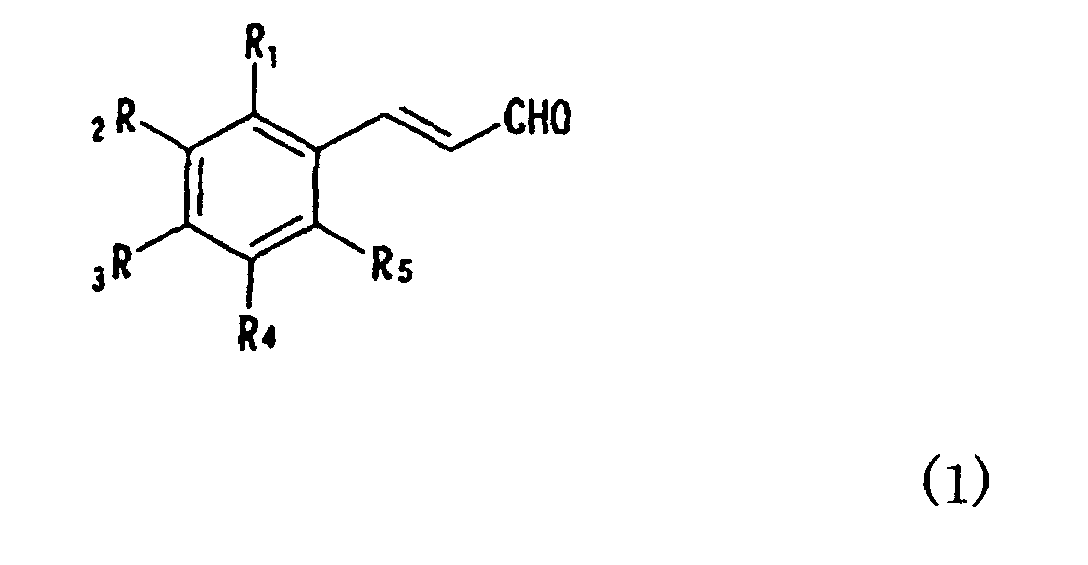
- In the above formula, R1, R2, R3, R4 and R5 are reciprocally independent and each denotes a substituent group selected from the group consisting of a hydrogen atom, a hydroxyl group, an alkoxy group having 1 to 3 carbon atoms, an alkyl group having 1 to 3 carbon atoms, a benzyloxy group and a hydroxyalkyloxy group having 2 or 3 carbon atoms, wherein two symbols of R1 and R2, or two symbols of R2 and R3 may be combined together to denote a methylenedioxy group, and the hydroxyl group (-OH) may denote a substituent group (-OM; M= metal atom) in its derivative form where the hydrogen atom in said hydroxyl group has been replaced by a metal atom.

- In the above formula, R1, R2, R3, R4 and R5 are reciprocally independent and each denotes a substituent group selected from the group consisting of a hydrogen atom, a hydroxyl group, an alkoxy group having 1 to 3 carbon atoms, an alkyl group having 1 to 3 carbon atoms, and a hydroxyalkyloxy group having 2 or 3 carbon atoms, wherein two symbols of R1 and R2, or two symbols of R2 and R3 may be combined together to denote a methylenedioxy group, and the hydroxyl group may denote a substituent group in its derivative form where the hydrogen atom in said hydroxyl group has been replaced by a metal atom.
- Incidentally, in case that the aldehyde used as the above described starting material has a benzyloxy group, in the reaction in the present invention, through a removal of a benzyl group in the benzyloxy moiety, the benzyloxy group is converted into a hydroxyl group, and thereby the object compound obtained after the reaction does not have a benzyloxy group, and instead has a hydroxyl group.
- The process [1] as defined above, wherein said derivative obtained as the object compound is in the free form.
- In this case, it includes a process for converting said derivative in the salt form obtained in the reductive alkylation reaction into that in the free form.
- The process [1] or [2] as defined above, wherein in said general formula (1), R1, R2, R3, R4 and R5 are reciprocally independent and each denotes a substituent group selected from the group consisting of a hydrogen atom, a hydroxyl group, a methoxy group, a methyl group and a benzyloxy group, and in said general formula (2), R1, R2, R3, R4 and R5 are reciprocally independent and each denotes a substituent group selected from the group consisting of a hydrogen atom, a hydroxyl group, a methoxy group and a methyl group.
- The process as defined in the process [1] to [3], wherein in the above process, the aldehyde used as the starting material has a hydroxyl group on the benzene ring or the like, and at least one part (portion) of hydrogen atoms in the hydroxyl groups of the aldehyde molecules has been replaced by a metal atom, and at least one part (portion) of the aldehyde molecules wherein the hydroxyl group has been converted into metal alkoxide, is present as said base.
- In the present invention, in case that the aldehyde has a hydroxyl group, and the hydroxyl group is made to metal alkoxide, the aldehyde can also be served as a base. Therefore, in this case, an addition of additional base is not necessary for use. When the base is used in surplus, it is not suitable since a secondary reaction arises.
- The process as defined above, wherein in said formulae (1) and (2), R1 is a hydrogen atom, a methyl group or a hydroxyl group, R2 is a hydrogen atom, a methyl group or a hydroxyl group, R3 is a methoxy group, and R4 and R5 are a hydrogen atom. In this process, in the formula (1), at least one symbol of R1 and R2 may be a benzyloxy group. In such case, specifically the process as defined above, particularly the process [1] to [4], wherein in the above formulae, R2 is a hydrogen atom or a hydroxyl group, R3 is a methoxy group, and R1, R4 and R5 are a hydrogen atom, is suitable. Among them, the process as defined above, particularly the process [1] to [4], wherein in the above formulae, R1, R4 and R5 are a hydrogen atom, R2 is a hydroxyl group, R3 is a methoxy group, is more suitable.
- The process as defined above, wherein in said formulae (1) and (2), R1 is a hydrogen atom, a methyl group or a methoxy group, R2 is a hydrogen atom, a methyl group or a methoxy group, R3 is a hydroxyl group, and R4 and R5 are a hydrogen atom, and in the formula (1), R3 may be a benzyloxy group. In such case, specifically the process as defined above, particularly the process [1] to [4], wherein in the above formulae, R2 is a hydrogen atom or a methoxy group, R3 is a hydroxyl group, and R1, R4 and R5 are a hydrogen atom, is suitable.
- The process as defined above, particularly the process [1] to [3], wherein said base is at least one selected from a metal hydride, a metal alcoxide (alkoxide), a metal hydroxide and an amine.
- The process [7] as defined above, wherein said metal hydride is LiH, NaH, KH and the like, said metal alkoxide is LiOMe, NaOMe, KOMe and the like, said metal hydroxide is LiOH, NaOH, KOH, Mg(OH)2 and the like, and said base is at least one of these compounds.
- The process [7] as defined above, wherein said amine is at least one of Et3N and Et2NH.
- The process as defined above, particularly the process [1] to [3], wherein said base is a sodium hydroxide or a potassium hydroxide.
- The process as defined above, particularly the process [1] to [3], which comprises a process for mixing said base with said aldehyde previously.
- The process as defined above, particularly the process [1] to [4], wherein said aldehyde is a compound represented by the following general formula (3) or (4); or
which comprises a process for conversion into a compound represented by the following general formula (3) or (4):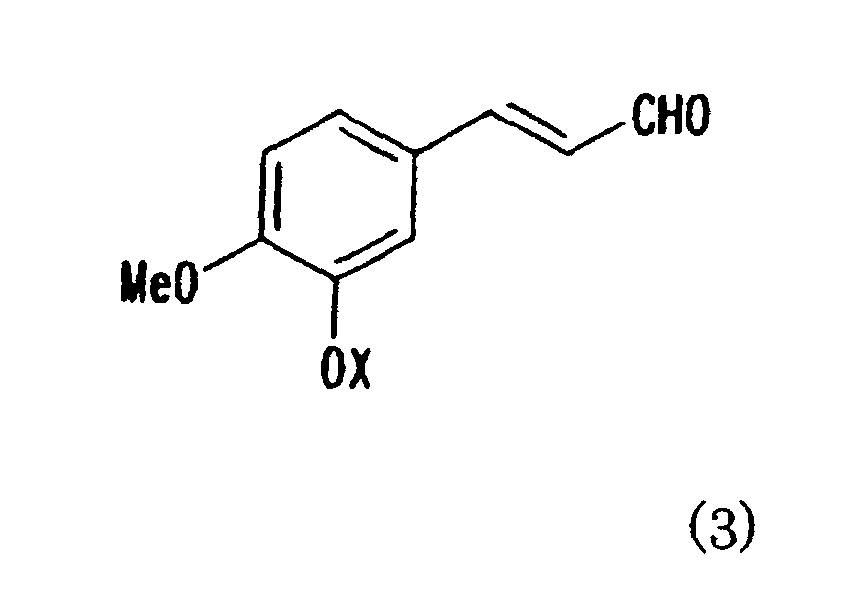
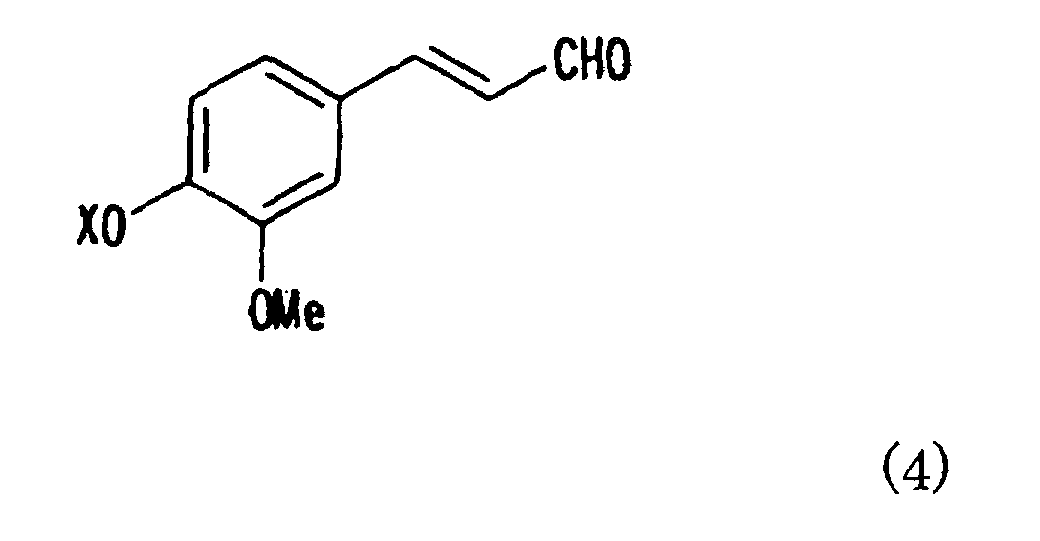
- In the above formulae (3) and (4), X denotes any one of lithium atom, sodium atom and potassium atom. Me denotes a methyl group.
- In the process, since the aldehyde can serve also as the base concurrently, in the reductive alkylation reaction with the aspartame, an addition of additional another base (new base) is not necessary for use.
- The process as defined above, particularly the process [1] to [4], wherein said base is any one of a lithium compound, a sodium compound and a potassium compound, and the above described aldehyde is a compound represented by the following general formula (3') or (4'), and which comprises a process for mixing said aldehyde with said base previously to form a salt represented by the following general formula (3) or (4);
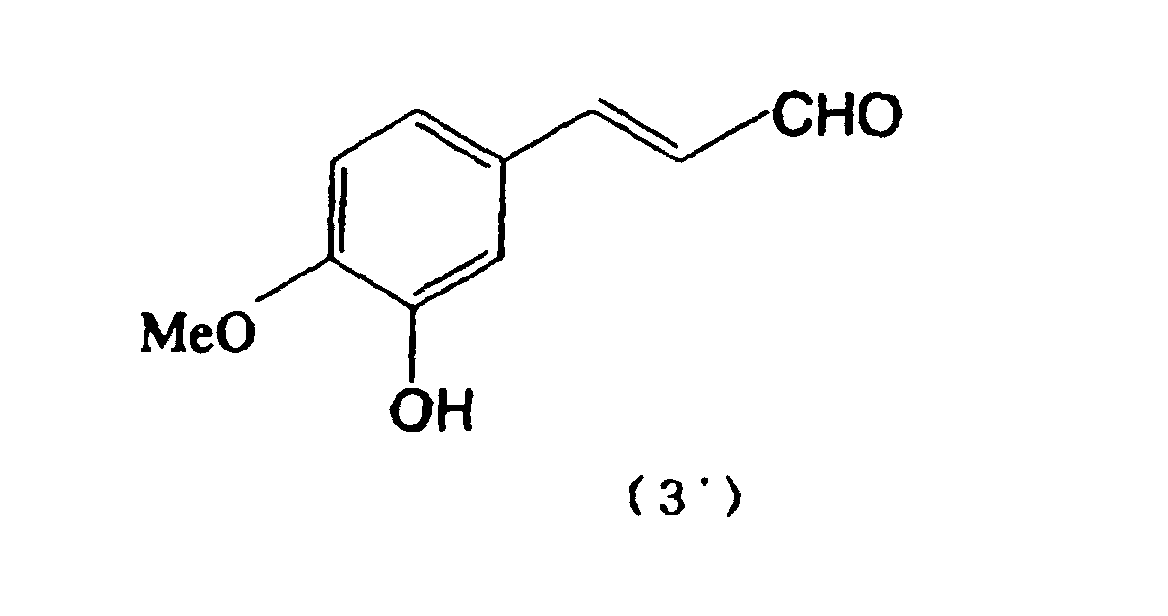
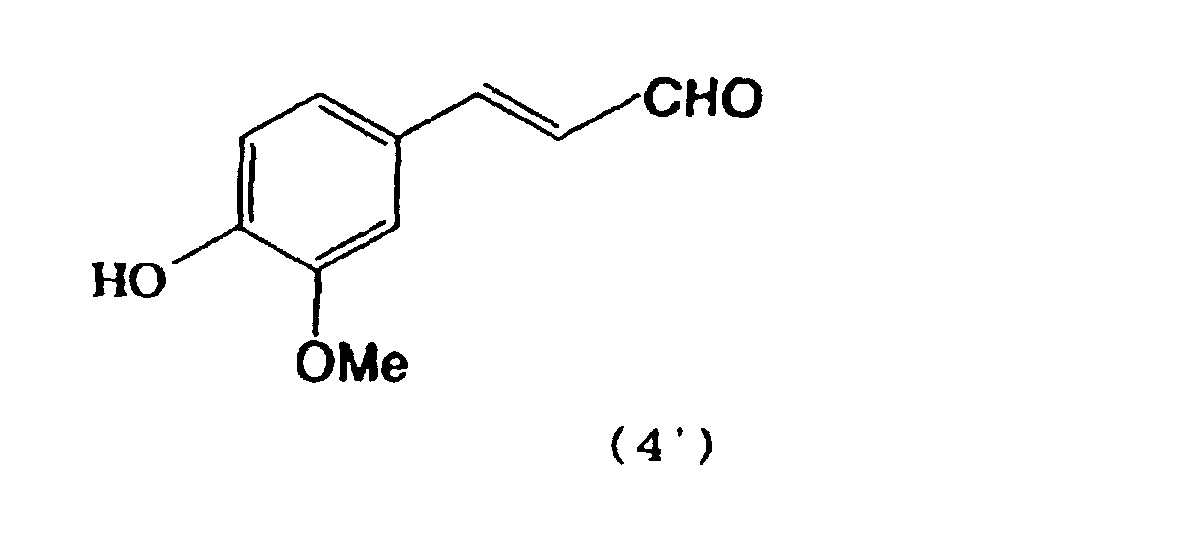
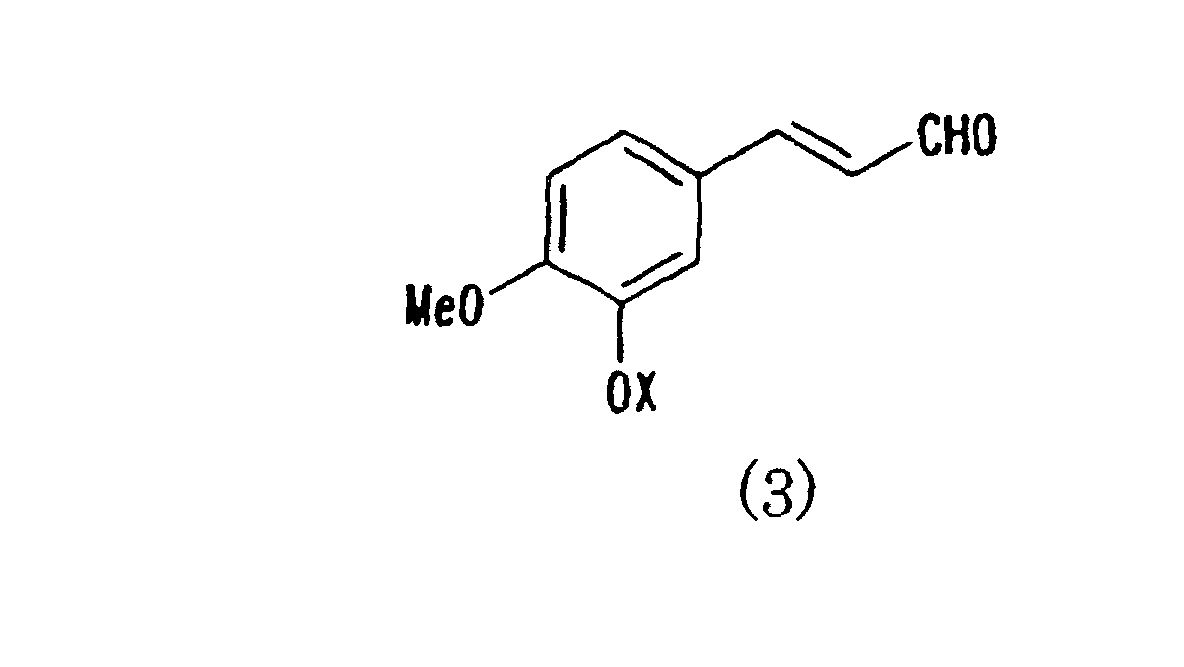

- In the above formulae (3) and (4), X denotes any one of lithium atom, sodium atom and potassium atom. Me denotes a methyl group.
- In the process, similarly as above here again, since the aldehyde can serve also as the base concurrently, in the reductive alkylation reaction with the aspartame, an addition of additional another base is not necessary for use.
- The process as defined above, particularly the process [1] to [4], which comprises a process for converting the derivative in the salt form obtained in said reductive alkylation reaction, into said derivative in the free form through neutralization with an acid.
- The process [14] as defined above, wherein said acid is any one of hydrochloric acid, sulfuric acid and acetic acid.
- The process [14] as defined above, wherein in said reductive alkylation reaction the neutralization with an acid is conducted during a hydrogenation reaction.
- The process as defined above, particularly the process [1] to [4], wherein in said reductive alkylation reaction, a temperature for the hydrogenation reaction is in a range of 0 to 60 °C.
- The process as defined above, particularly the process [1] to [4], which comprises in said reductive alkylation reaction, a process for retaining the reaction mixture while stirring for at least 10 minutes at a temperature of 40 °C or lower before the hydrogenation reaction.
- The process as defined above, particularly the process [1] to [4], which comprises in said reductive alkylation reaction, a process for removing at least one portion of the water contained in the solvent before the hydrogenation reaction.
- The process as defined above, particularly the process [1] to [4], wherein said catalyst is a catalyst for hydrogenation, and is at least one of palladium on carbon, palladium black, Raney Nickel and platinum on carbon.
- The process as defined above, particularly the process [1] to [4], wherein said reaction is conducted in a solvent.
- The process [21] as defined above, wherein said solvent is alcohol, particularly methanol, or a mixed solvent of methanol with other solvent(s) (water-containing methanol and the like).
- The process as defined above, particularly the process [1] to [4], which comprises in said reductive alkylation reaction, a hydrogenation reaction with a hydrogen pressure of 0.1 to 10 MPa, preferably 0.1 to 1.0 MPa.
- The process as defined above, particularly the process [1] to [4], wherein the above described derivative as the object compound is in the free form, and which comprises a process for crystallization of said derivative with a mixed solvent of water-alcohol after the process for production of the free form.
- Through the crystallization process, the salt can be removed efficiently for separation.
- The process [24] as defined above, wherein the alcohol used for the above described solvent for crystallization (the mixed solvent) is a methanol.
- In the followings, the embodiments for carrying out the present invention, are explained. Meanwhile, the typical processes thereof are mainly explained, and however the present invention contains these processes of course, and is not limited thereto.
- In the present invention, the reaction proceeds, only by retaining the solution wherein an aspartame and a specified aldehyde have been dissolved or dispersed in the presence of a base, at a suitable temperature and for a certain constant period (hours), adding a catalyst (a catalyst for hydrogenation) thereto, and stirring the solution under hydrogen gas atmosphere (hydrogenating). After this manner, the derivative as an objective can be obtained in the salt form. In order to obtain a free form thereof, during the hydrogenation reaction or after completion of the hydrogenation reaction, an acid is added thereto to neutralization, the catalyst is removed therefrom by filtration, and the filtrate is concentrated to obtain a crude product of aspartyl dipeptide ester derivative. Therefore, through an usual and common purification process, such as re-crystallization and the like the aspartyl dipeptide ester derivative (free form) as an objective can be easily obtained.
- Incidentally, since a decomposition of aspartame proceeds under a basic condition, a method for adding an aspartame to a solution wherein the aldehyde and the base have been mixed therein previously, is preferable in view of preventing the aspartame from decomposing. In this case, as for an aldehyde having a hydroxyl group, particularly a phenolic hydroxyl group, by converting said phenolic hydroxyl group into a salt formation, such as that in a phenoxide or the like in advance and using the thus converted product in the reaction, the alkylation with the aspartame can be conducted without newly adding an additional base thereto.
- This method is preferable, also in view of the fact that a secondary reaction, for example, a formation of diketo piperadine (diketopiperazine) from the aspartame can be suppressed. This method is contained in the present invention as a matter of course.
- As for the base used in the present invention, there is no particular limitations thereto. Therefore, a compound which corresponds to a base (inorganic base, organic base and the like) can be used therefor. For the base, a compound can be selected from, for example, a metal hydride, a metal alcoxide (alkoxide), a metal hydroxide and an amine. For the metal hydride LiH, NaH, KH and the like can be cited, for the metal alkoxide LiOMe, NaOMe, KOMe and the like can be cited, and for the metal hydroxide LiOH, NaOH, KOH, Mg(OH)2 and the like can be cited. Among them, in view of the fact that its effectuation (operation) can be conducted at a low price on an industrial scale, an inorganic base, such as sodium carbonate, sodium hydrogen carbonate, sodium hydroxide, lithium hydroxide, potassium hydroxide, magnesium hydroxide, sodium hydride, sodium methoxide and the like, and an organic amine, such as triethyl amine, diethyl amine and the like, are used preferably. Particularly, sodium hydroxide and potassium hydroxide are used more preferably.
- In the reductive alkylation reaction in the present invention, a pH value in the solution before the hydrogenation reaction for reacting hydrogen is preferably 6.5 or higher, since a decomposition reaction proceeds when such value is lower too much. More preferably the pH value is in a range of 7.5 to 12 or so.
- In the present invention, in the reductive alkylation reaction, before the hydrogenation reaction, the reaction mixture is retained while stirring, preferably at a temperature of 50 °C or lower for at least 10 minutes (10 minutes or longer), and more preferably at a temperature of -10 to 40 °C or so for 2 to 3 hours or so, desirably in view of prevention of a secondary reaction.
- As for the retention while stirring before the hydrogenation reaction, it is more effectively conducted by concentrating the solvent thereof to remove the water from the system of reaction. It is thought that through this method a Schiff base formation reaction with the aldehyde and the aspartame is promoted. As for the water content in the solvent thereof, preferably 10 weight % or less, and more preferably 5 to 0.1 weight % or so may be selected.
- Further, for the solvent used in the present invention, it is preferable to select and use a solvent having low content of water therein. For a method for removal of water, a dehydrating agent can be also added thereto. For example, zeolite, "molecular sieve(s)" and the like may be also added thereto to be able to remove water therefrom.
- As for temperature and time for the reaction, a condition suitable for a hydrogenation reaction as a reductive alkylation reaction can be selected therefor. For example, preferably a temperature range of 0 to 40 °C or so and a reaction time range of 2 to 72 hours or so, and more preferably a temperature range of 10 to 30 °C or so and a reaction time range of 10 to 48 hours or so can be selected in view of suppressing a secondary reaction and promoting a reaction desired.
- In case that the object compound in the free form is obtained, a neutralization process is needed. To the acid used in the neutralization, there is no particular limitations. An inorganic acid and an organic acid which are used usually, can be used therefor. Acetic acid, hydrochloric acid, sulfuric acid and the like are selected preferably therefor, because they are operated for use industrially at a low price.
- In case that the derivative in the free form as the object compound is obtained, the time for neutralization with an acid in the present invention is not limited to a time after a completion of the hydrogenation reaction, and it can be conducted during the hydrogenation reaction. By in this manner, making it acidic or neutral inside the system of reaction, a yield can be further improved. In this case, preferably, from the start of the hydrogenation reaction the reaction proceeds for a definite period of time, and after that (after the elapsed time), the reaction mixture can be adjusted to acidic or neutral. For example, it may be conducted within a time period of 24 hours at 50 °C or lower from the start. Preferably, it can be conducted after the elapsed time of 1 to 6 hours or so at 0 to 35 °C or so from the start. It is preferable to conduct it after the elapsed time of 2 to 5 hours from the start, in view of preventing a decomposition reaction of the starting materials, the product and the like.
- In case that in this manner, an acid is added thereto on the way of the hydrogenation reaction, with respect to the subsequent reaction, the reaction may be further continued at a temperature of 10 to 50 °C or so for 15 to 48 hours or so.
- As for the pH value of the reaction solution after the neutralization, in order to suppress a decomposition of the product, preferably a pH value of 2 to 8 or so, and more preferably a pH value of 3 to 7 or so may be employed.
- As for the solvent employed in the reductive alkylation reaction in the present inventiion, there is no particular limitations thereto, as far as a material inactive to a ground substance for reaction, a catalyst and a product may be employed therefor.
- A homogeneous organic solvent which can dissolve aspartame and the aldehyde used for the starting material, and which is a single solvent consisted of one kind of organic solvent only or a mixed solvent consisted of plural kinds of organic solvents, or a mixture of such organic solvent with water may be employed therefor.
- For the organic solvent, for example, alcohols such as methanol, ethanol and the like, tetrahydrofuran, toluene, methyl acetate and dimethylformamide are cited. For the particularly preferable solvent, methanol is cited.
- As for the catalyst, a palladium- based catalyst, a platinum-based catalyst, a nickel- based catalyst and the like are cited therefor. Specifically, palladium on carbon, palladium black, Raney Nickel, platinum on carbon and the like are cited therefor. Particularly, the palladium- based catalyst, such as palladium on carbon, palladium black and the like is preferable.
- The present reductive alkylation reaction can be conducted through hydrogenation (hydrogen addition), and in such case, for the hydrogen pressure, preferably 0.1 to 10 MPa or so, and more preferably 0.1 to 1 MPa or so may be selected.
- In case that under normal pressure the present reductive alkylation reaction is conducted, means for bubbling the reaction solution with hydrogen is preferable in view of promoting the reaction.
- As for the molar ratio of the aspartame to the aldehyde used as the starting materials for the reaction, a range of preferably 0.5 to 3 moles or so, and more preferably 1 to 2 moles or so, of the aspartame per 1 mole of the aldehyde can be used for reaction.
- In the present invention, the derivative as the object compound can be obtained in the salt form or in the free form, after completion of the reductive alkylation reaction. As for the salt-formation process, the desalination process, and the process or means necessary for separation or purification thereof, they can be conducted easily in the usual manner. As described before, the derivatives thus obtained are all contained in the products which have been produced in the process of the present invention, as a matter of course.
- Particularly, in case that the object compound is purified for separation in the free form, the salt can be removed efficiently by crystallizing the object compound with the use of water- alcohol (methanol or the like) for a crystallization solvent.
- According to the findings of the present inventors, an yield was low in the alkylation reaction of an aspartame with a 3-(phenyl having various substituent group(s) on the benzene ring)-2-propenyl aldehyde. As the reasons thereto, it is thought that a Schiff base formed in the hydrogenation (hydrogen addition) is unstable and is decomposed, or that a secondary reaction (formation of alcohol) of said aldehyde arises. In the present invention, it is thought that by placing the base in the system of reaction, a Schiff base is formed stably to suppress such a secondary reaction, and thereby the hydrogenation as an objective is promoted.
- The present invention will be explained further in detail with reference to the following Examples therefor.
- Aspartame (3.12 g, 10.2 mmol) and pelletized sodium hydroxide (0.45 g, 10.8 mmol) were added to methanol (100 ml), and the mixture was stirred at 30 °C for 10 minutes. To this solution, 3-(3-hydroxy-4-methoxyphenyl)-2-propenyl aldehyde (1.51 g, 8.59 mmol) was added, and then 10 % palladium on carbon (dried product) (0.9 g) was added thereto, and thus obtained mixture was stirred under hydrogen atmosphere of normal pressure (0.1 MPa) at 35 °C for 47 hours. The reaction solution was filtrated to remove the catalyst, and the filtrate was neutralized with acetic acid and subjected to a HPLC (High Performance Liquid Chromatography) for determination to produce the title compound (2.04 g, 4.45 mmol, 51.8 %).
- Pelletized sodium hydroxide (0.87 g, 20.9 mmol) and 3-(3-hydroxy-4-methoxyphenyl)-2-propenyl aldehyde (3.0 g, 17.0 mmol) were added to methanol (200 ml), and the mixture was stirred for a while to a completely homogeneous solution. Aspartame (5.82 g, 19.8 mmol) was added thereto at room temperature to produce a slurry, and methanol (80 g) was distilled off therefrom under reduced pressure. Subsequently, 10 % palladium on carbon (dried product) (0.77 g) was added thereto, and thus obtained mixture was stirred under hydrogen atmosphere of normal pressure (0.1 MPa) at room temperature for 3 hours. After that, acetic acid (1.72 ml, 29.0 mmol) was added thereto, and further thus obtained mixture was stirred under hydrogen atmosphere of normal pressure (0.1 MPa) at 45 °C for 21 hours. The reaction solution was filtrated to remove the catalyst, and the filtrate was subjected to a HPLC (High Performance Liquid Chromatography) for determination to produce the title compound (4.18 g, 9.12 mmol, 53.6 %).
- Pelletized sodium hydroxide (0.87 g, 20.9 mmol) and 3-(3-hydroxy-4-methoxyphenyl)-2-propenyl aldehyde (3.0 g, 17.0 mmol) were added to methanol (100 ml), and the mixture was stirred for a while to a completely homogeneous solution. Aspartame (5.82 g, 19.8 mmol) was added thereto at room temperature, and then the thus obtained mixture was stirred for 3 hours at 35 °C. Subsequently, 10 % palladium on carbon (dried product) (0.87 g) was added thereto, and the thus obtained mixture was stirred under hydrogen atmosphere of normal pressure (0.1 MPa) at 10 °C for 22 hours. After that, acetic acid (1.72 ml, 29.0 mmol) was added thereto, and further the thus obtained mixture was stirred under hydrogen atmosphere of normal pressure (0.1 MPa) at 35 °C for 21 hours. The reaction solution was filtrated to remove the catalyst, and the filtrate was subjected to a HPLC (High Performance Liquid Chromatography) for determination to produce the title compound (4.95 g, 10.8 mmol, 63.5 %).
- Pelletized sodium hydroxide (2.7 g, 64.8 mmol) and 3-(3-hydroxy-4-methoxyphenyl)-2-propenyl aldehyde (9.11 g, 51.0 mmol) were added to methanol (314 ml), and the mixture was stirred for a while to a completely homogeneous solution. Aspartame (18.1 g, 61.4 mmol) was added thereto at room temperature. After that, the thus obtained mixture was stirred for 3 hours at 10 °C. Subsequently, 10 % palladium on carbon (dried product) (2.7 g) was added thereto, and the thus obtained reaction solution was stirred under bubbling with hydrogen stream of 50 ml/minute at 10 °C for 6 hours. After that, acetic acid (5.35 g, 89.0 mmol) was added thereto, and further the thus obtained mixture was stirred under hydrogen atmosphere of normal pressure (0.1 MPa) at 35 °C for 17 hours. The reaction solution was filtrated to remove the catalyst, and the filtrate was subjected to a HPLC (High Performance Liquid Chromatography) for determination to produce the title compound (16.4 g, 35.8 mmol, 70.1 %).
- From the reduction reaction solution obtained in the Example 4, the solvent is distilled off under reduced pressure, and a mixed solvent (250 ml) of methanol and water (33 % by volume) was added thereto. The mixture was stirred for a while at 60 °C to dissolve a residue completely. Subsequently, the thus obtained solution is cooled down to 10 °C little by little to precipitate crystals. After that, the reaction mixture is aged at the same temperature for 13 hours. The crystals thus obtained were filtered and dried to obtain N-[N-[3-(3-hydroxy-4-methoxyphenyl) propyl]-L-α-aspartyl]-L-phenylalanine 1-methyl ester in the crystalline form (12.7 g).
- Pelletized sodium hydroxide (0.86 g, 20.64 mmol) and 3-(4-hydroxy-3-methoxyphenyl)-2-propenyl aldehyde (3.00 g, 16.7 mmol) were added to methanol (105 ml), and the mixture was stirred for a while to produce a completely homogeneous solution. Aspartame (6.1 g, 20.7 mmol) was added thereto at 10 °C. After that, the thus obtained mixture was stirred for 2.5 hours at the same temperature. Subsequently, 10 % palladium on carbon in the water content of 50 % (1.89 g) was added thereto, and the thus obtained reaction solution was stirred under hydrogen atmosphere of 0.7 MPa at 10 °C for 5 hours. After that, acetic acid (1.62 ml, 27.2 mmol) was added thereto, and the thus obtained mixture was stirred under hydrogen atmosphere of 0.7 MPa at 35 °C for 12 hours. The reaction solution was filtrated to remove the catalyst, and the filtrate was subjected to a HPLC for determination to produce the title compound (5.05 g, 11.0 mmol, 66.0 %).
- Aspartame (0.40 g, 1.47 mmol) and 3-(3-hydroxy-4-methoxyphenyl)-2-propenyl aldehyde (0.25 g, 1.40 mmol) were added to methanol (13 ml), and the mixture was stirred for a while. To the thus obtained slurry, 10 % palladium on carbon in the water content of 50 % (0.12 g) was added thereto, and the thus obtained mixture was stirred under hydrogen atmosphere of normal pressure (0.1 MPa) at room temperature for 24 hours. The reaction solution was filtrated to remove the catalyst, and the filtrate was subjected to a HPLC (High Performance Liquid Chromatography) for determination to produce the title compound (0.21 g, 0.46 mmol, 32.8 %).
- According to the present invention, an aspartyl dipeptide ester derivative expected to serve as a sweetener, that is, an N-[N-[3-(phenyl having various substituent group(s) on the benzene ring) propyl]-L-α-aspartyl]-L-phenylalanine 1-methyl ester derivative represented by the above described general formula (2) can be produced industrially and conveniently also at a good yield.
Claims (21)
- A process for producing an aspartyl dipeptide ester derivative represented by the following general formula (2), wherein said derivative may be in any form of the free form and the salt form, which comprises:In the above formula, R1, R2, R3, R4 and R5 are reciprocally independent and each denotes a substituent group selected from the group consisting of a hydrogen atom, a hydroxyl group, an alkoxy group having 1 to 3 carbon atoms, an alkyl group having 1 to 3 carbon atoms, a benzyloxy group and a hydroxyalkyloxy group having 2 or 3 carbon atoms, wherein two symbols of R1 and R2, or two symbols of R2 and R3 may be combined together to denote a methylenedioxy group, and the hydroxyl group may denote a substituent group in its derivative form where the hydrogen atom in said hydroxyl group has been replaced by a metal atom.alkylating reductively an aspartame with an aldehyde represented by the following general formula (1), and hydrogen in the presence of a catalyst and a base:
 In the above formula, R1, R2, R3, R4 and R5 are reciprocally independent and each denotes a substituent group selected from the group consisting of a hydrogen atom, a hydroxyl group, an alkoxy group having 1 to 3 carbon atoms, an alkyl group having 1 to 3 carbon atoms, and a hydroxyalkyloxy group having 2 or 3 carbon atoms, wherein two symbols of R1 and R2, or two symbols of R2 and R3 may be combined together to denote a methylenedioxy group.
- The process as defined in claim 1, wherein in said general formula (1), R1, R2, R3, R4 and R5 are reciprocally independent and each denotes a substituent group selected from the group consisting of a hydrogen atom, a hydroxyl group, a methoxy group, a methyl group and a benzyloxy group, and in said general formula (2), R1, R2, R3, R4 and R5 are reciprocally independent and each denotes a substituent group selected from the group consisting of a hydrogen atom, a hydroxyl group, a methoxy group and a methyl group, and in the formula (1), the hydroxyl group may denote a substituent group in its derivative form where a hydrogen atom in said hydroxyl group has been replaced by a metal atom.
- The process as defined in claim 1 or 2, wherein in said formulae (1) and (2), R1 is a hydrogen atom, a methyl group or a hydroxyl group, R2 is a hydrogen atom, a methyl group or a hydroxyl group, R3 is a methoxy group, and R4 and R5 are a hydrogen atom, and in the formula (1), at least one symbol of R1 and R2 may be a benzyloxy group.
- The process as defined in claim 1 or 2, wherein in said formulae (1) and (2), R1 is a hydrogen atom, a methyl group or a methoxy group, R2 is a hydrogen atom, a methyl group or a methoxy group, R3 is a hydroxyl group, and R4 and R5 are a hydrogen atom, and in the formula (1), R3 may be a benzyloxy group.
- The process as defined in claim 1 or 2, wherein in said formulae (1) and (2), R1, R4 and R5 are a hydrogen atom, R2 is a hydroxyl group, and R3 is a methoxy group, and in the formula (1), R2 may be a benzyloxy group.
- The process as defined in any one of claims 1 to 5, wherein said aspartyl dipeptide ester derivative is in the free form, and which comprises a process for converting said derivative in the salt form into that in the free from.
- The process as defined in claim 1, 2 or 6, wherein said aldehyde has a hydroxyl group, at least one part (portion) of hydrogen atoms in the hydroxyl groups of the aldehyde molecules is replaced by a metal atom, and at least one part (portion) of the aldehyde molecules wherein the hydroxyl group has been converted into metal alkoxide, is present as said base.
- The process as defined in claim 1, 2 or 6, wherein the base is sodium hydroxide or potassium hydroxide.
- The process as defined in claim 1, 2 or 6, which comprises a process for mixing the base with the aldehyde previously.
- The process as defined in claim 1, 2, 6 or 7,
wherein said aldehyde is a compound represented by the following general formula (3) or (4); or
which comprises a process for conversion into a compound represented by the following general formula (3) or (4):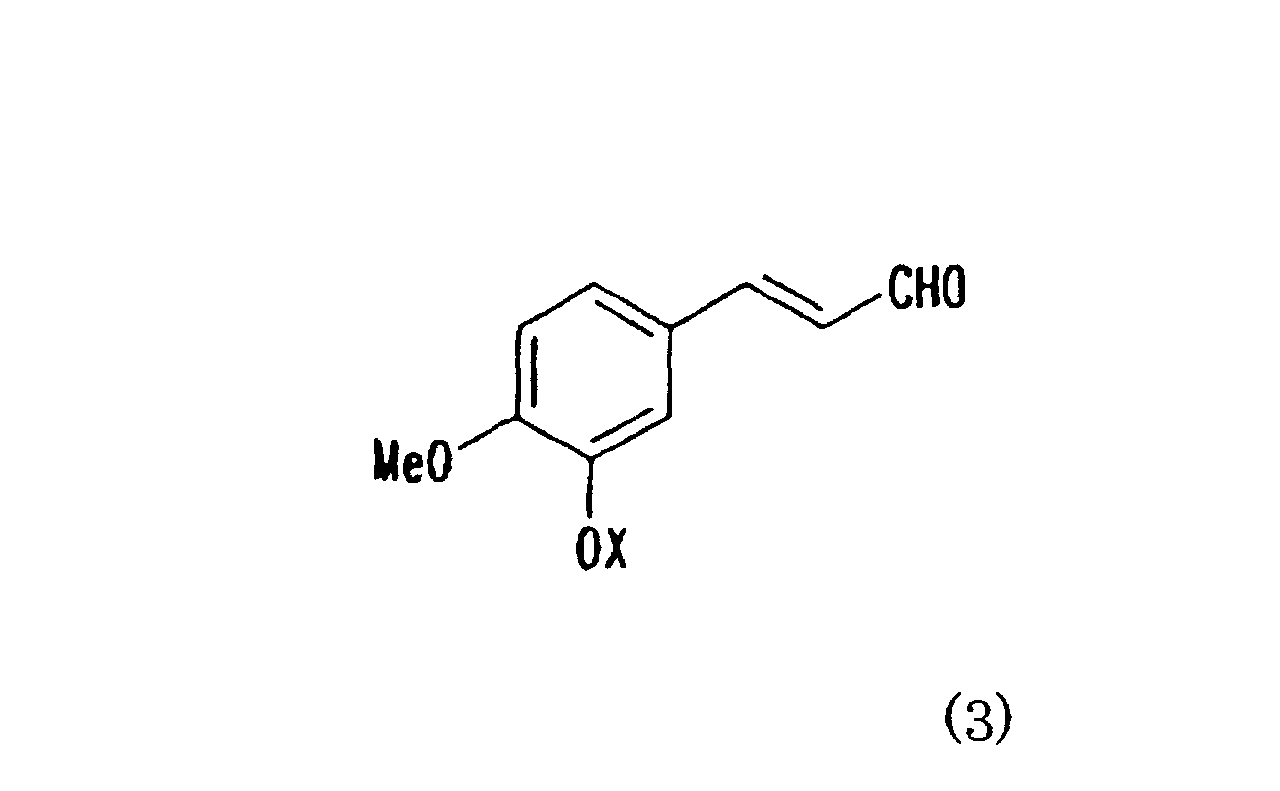 In the above formulae (3) and (4), X denotes any one of lithium atom, sodium atom and potassium atom.
- The process as defined in claim 1, 2, 6 or 7, wherein said base is any one of a lithium compound, a sodium compound and a potassium compound, and said aldehyde is an aldehyde represented by the following general formula (3') or (4'), and which comprises a process for mixing said aldehyde with said base previously to form a salt represented by the following general formula (3) or (4);

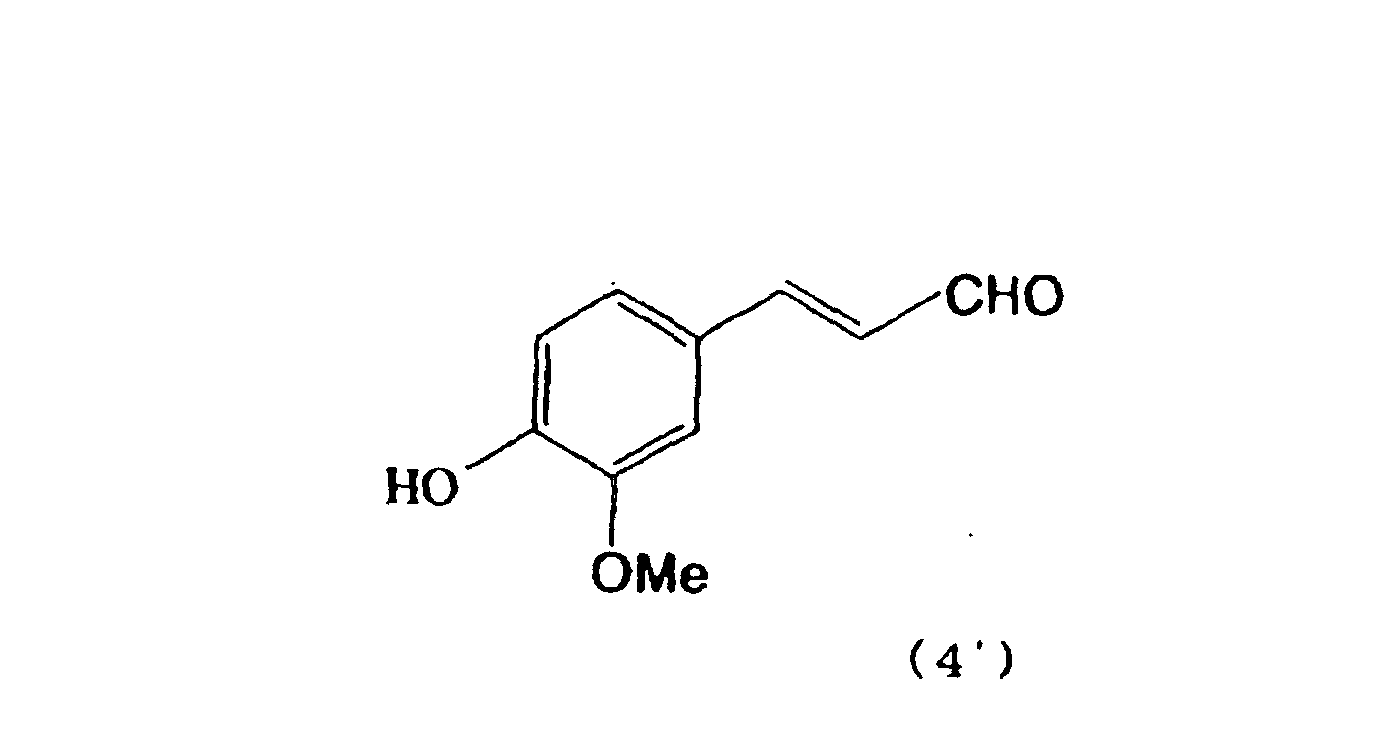
 In the above formulae (3'), (4'), (3) and (4), Me denotes a methyl group, and in the above formulae (3) and (4), X denotes any one of lithium atom, sodium atom and potassium atom.
- The process as defined in claim 1, 2, 6 or 7, which comprises a process for converting the derivative in the salt form obtained in said reductive alkylation reaction, into said derivative in the free form through neutralization with an acid.
- The process as defined in claim 12, wherein said acid is at least one selected from hydrochloric acid, sulfuric acid and acetic acid.
- The process as defined in claim 12, wherein in said reductive alkylation reaction the neutralization with an acid is conducted during a hydrogenation reaction.
- The process as defined in claim 1, 2, 6 or 7, wherein in said reductive alkylation reaction, a temperature for the hydrogenation reaction is a range of 0 to 60 °C.
- The process as defined in claim 1, 2, 6 or 7, which comprises in said reductive alkylation reaction, a process for retaining the reaction mixture while stirring for at least 10 minutes at a temperature of 40 °C or lower before the hydrogenation reaction.
- The process as defined in claim 1, 2, 6 or 7, wherein said catalyst is at least one selected from palladium on carbon, palladium black, Raney Nickel and platinum on carbon.
- The process as defined in claim 1, 2, 6 or 7, wherein said reductive alkylation reaction is conducted in a solvent, and said solvent is a methanol.
- The process as defined in claim 1, 2, 6 or 7, which comprises in said reductive alkylation reaction, a hydrogenation reaction with a hydrogen pressure of 0.1 to 10 MPa.
- The process as defined in claim 1, 2, 6 or 7, wherein said derivative is in the free form, and which comprises a process for crystallization of said derivative with a mixed solvent of water-alcohol after the process for production of the free form.
- The process as defined in claim 20, wherein said alcohol is a methanol.
Applications Claiming Priority (3)
| Application Number | Priority Date | Filing Date | Title |
|---|---|---|---|
| JP2000137028 | 2000-05-10 | ||
| JP2000137028 | 2000-05-10 | ||
| PCT/JP2001/003479 WO2001085761A1 (en) | 2000-05-10 | 2001-04-23 | Process for producing aspartyl dipeptide ester derivatives |
Publications (1)
| Publication Number | Publication Date |
|---|---|
| EP1283213A1 true EP1283213A1 (en) | 2003-02-12 |
Family
ID=18644877
Family Applications (1)
| Application Number | Title | Priority Date | Filing Date |
|---|---|---|---|
| EP01922023A Withdrawn EP1283213A1 (en) | 2000-05-10 | 2001-04-23 | Process for producing aspartyl dipeptide ester derivatives |
Country Status (6)
| Country | Link |
|---|---|
| US (1) | US6822111B2 (en) |
| EP (1) | EP1283213A1 (en) |
| KR (1) | KR20030045672A (en) |
| CN (1) | CN1429234A (en) |
| AU (1) | AU4884101A (en) |
| WO (1) | WO2001085761A1 (en) |
Cited By (1)
| Publication number | Priority date | Publication date | Assignee | Title |
|---|---|---|---|---|
| EP1283197A4 (en) * | 2000-05-16 | 2004-05-26 | Ajinomoto Kk | Process for producing cinnamylaldehyde derivatives, use thereof and the like |
Families Citing this family (4)
| Publication number | Priority date | Publication date | Assignee | Title |
|---|---|---|---|---|
| KR20020038797A (en) * | 1999-10-08 | 2002-05-23 | 에가시라 구니오 | Process for producing aspartame derivative, crystals thereof, novel production intermediates therefor and process for producing the intermediate |
| CN102864196B (en) * | 2012-10-09 | 2014-07-02 | 南京工业大学 | Method for preparing alpha-aspartyl small peptide by dihydroorotic acid enzyme method |
| CN109232711A (en) * | 2018-10-25 | 2019-01-18 | 厦门大学 | A method of synthesis Advantest sweet tea |
| CN111875666B (en) * | 2020-07-07 | 2022-08-12 | 辽宁启康生物科技有限公司 | Method for synthesizing Edwarden sweet |
Family Cites Families (14)
| Publication number | Priority date | Publication date | Assignee | Title |
|---|---|---|---|---|
| JP2669551B2 (en) * | 1989-01-31 | 1997-10-29 | 花王株式会社 | Method for producing secondary amine |
| JPH05178802A (en) * | 1991-12-27 | 1993-07-20 | Sumitomo Seika Chem Co Ltd | Production of n-benzylglycine and its derivative |
| FR2697844B1 (en) * | 1992-11-12 | 1995-01-27 | Claude Nofre | New compounds derived from dipeptides or dipeptide analogues useful as sweetening agents, process for their preparation. |
| JP3648784B2 (en) | 1994-07-08 | 2005-05-18 | 味の素株式会社 | Novel aspartyl dipeptide derivatives and sweeteners |
| JPH08231586A (en) | 1994-12-28 | 1996-09-10 | Ajinomoto Co Inc | Production of alpha-l-aspartyldipeptide amide derivative |
| JPH08333388A (en) | 1995-06-12 | 1996-12-17 | Ajinomoto Co Inc | Novel aspartyl dipeptide amide derivative and sweetener |
| JPH09323966A (en) | 1996-01-12 | 1997-12-16 | Ajinomoto Co Inc | Novel aspartylamide derivative and sweetener |
| JP3951342B2 (en) | 1996-07-10 | 2007-08-01 | 味の素株式会社 | Novel aspartyl dipeptide amide derivatives and sweeteners |
| JPH10259194A (en) | 1997-03-18 | 1998-09-29 | Ajinomoto Co Inc | New peptide derivative and sweetener |
| JPH11130794A (en) | 1997-10-23 | 1999-05-18 | Ajinomoto Co Inc | Purification of aspartame derivative |
| NZ507938A (en) * | 1998-04-09 | 2002-11-26 | Ajinomoto Kk | Aspartyl dipeptide ester derivatives and sweeteners |
| HUP0103426A3 (en) | 1998-06-26 | 2004-09-28 | Ajinomoto Kk | Novel aspartyl dipeptide ester derivatives and sweeteners |
| WO2001025260A1 (en) | 1999-10-07 | 2001-04-12 | Ajinomoto Co., Inc. | Process for the production of aspartyldipeptide ester derivatives, novel intermediates therefor and process for the production of the intermediates |
| WO2001038297A1 (en) | 1999-11-18 | 2001-05-31 | Ajinomoto Co., Inc. | Novel intermediate for sweetener with high sweetness and process for producing the same |
-
2001
- 2001-04-23 EP EP01922023A patent/EP1283213A1/en not_active Withdrawn
- 2001-04-23 WO PCT/JP2001/003479 patent/WO2001085761A1/en not_active Ceased
- 2001-04-23 CN CN01809302A patent/CN1429234A/en active Pending
- 2001-04-23 KR KR1020027014935A patent/KR20030045672A/en not_active Withdrawn
- 2001-04-23 AU AU48841/01A patent/AU4884101A/en not_active Abandoned
-
2002
- 2002-11-04 US US10/286,840 patent/US6822111B2/en not_active Expired - Fee Related
Non-Patent Citations (1)
| Title |
|---|
| See references of WO0185761A1 * |
Cited By (3)
| Publication number | Priority date | Publication date | Assignee | Title |
|---|---|---|---|---|
| EP1283197A4 (en) * | 2000-05-16 | 2004-05-26 | Ajinomoto Kk | Process for producing cinnamylaldehyde derivatives, use thereof and the like |
| US6965055B2 (en) | 2000-05-16 | 2005-11-15 | Ajinomoto Co., Ltd. | Process for producing cinnamaldehyde derivatives, use thereof and the like |
| US7141263B2 (en) | 2000-05-16 | 2006-11-28 | Ajinomoto Co., Inc. | Process for producing cinnamaldehyde derivatives, use thereof and the like |
Also Published As
| Publication number | Publication date |
|---|---|
| KR20030045672A (en) | 2003-06-11 |
| US6822111B2 (en) | 2004-11-23 |
| US20030118710A1 (en) | 2003-06-26 |
| AU4884101A (en) | 2001-11-20 |
| CN1429234A (en) | 2003-07-09 |
| WO2001085761A1 (en) | 2001-11-15 |
Similar Documents
| Publication | Publication Date | Title |
|---|---|---|
| US5728862A (en) | Method for preparing and purifying an N-alkylated aspartame derivative | |
| EP1350791B1 (en) | Process for converting dihydroisoxazole derivatives to gamma-hydroxyamino acid derivatives, e.g. monatins | |
| US7064219B2 (en) | Processes of producing glutamic acid compounds and production intermediates therefore and novel intermediate for the processes | |
| US6794531B2 (en) | Process for production of aspartyl dipeptide ester derivative, novel production intermediate therefor, and process for production thereof | |
| US6822111B2 (en) | Process for production of aspartyl dipeptide ester derivatives | |
| NL8520047A (en) | PROCESS FOR PREPARING N-ACYLPHENYLALANINES. | |
| US6689902B2 (en) | Arylpropyl aldehyde derivatives, processes for producing the same, and methods of using the same | |
| US20020132032A1 (en) | Process for production of aspartame derivative, crystal thereof, novel production intermediate therefor, and process for production of intermediate thereof | |
| US6939987B2 (en) | Method for producing Aspartame derivative, method for purifying the same, crystals thereof and uses of the same | |
| US20040176472A1 (en) | Process for production of aspartyl dipeptide ester derivative, novel production intermediate therefor, and process for production thereof | |
| JPWO2001085761A1 (en) | Method for producing aspartyl dipeptide ester derivatives | |
| US6403843B1 (en) | Process for the preparation of 1-(3,4-dimethoxyphenyl)ethanol | |
| JPWO2001025260A1 (en) | Method for producing aspartyl dipeptide ester derivatives, novel intermediates therefor and method for producing the same | |
| EP1227104A1 (en) | Processes for producing and purifying aspartame derivatives and process for producing production intermediates | |
| JP2001106696A (en) | Production process for aspartame derivative | |
| JPH0977709A (en) | Method for producing 2-substituted-1,3-propanediol | |
| JP2003002864A (en) | Method for producing oxocyclohexyl acetic acid and method for producing hydroxyiminocyclohexyl acetic acid | |
| MXPA99007031A (en) | Method for preparing and purifying an n-alkylated aspartame derivative | |
| JP2001114774A (en) | Method for producing dialkoxychroman derivative |
Legal Events
| Date | Code | Title | Description |
|---|---|---|---|
| PUAI | Public reference made under article 153(3) epc to a published international application that has entered the european phase |
Free format text: ORIGINAL CODE: 0009012 |
|
| 17P | Request for examination filed |
Effective date: 20021002 |
|
| AK | Designated contracting states |
Designated state(s): AT BE CH CY DE DK ES FI FR GB GR IE IT LI LU MC NL PT SE TR |
|
| AX | Request for extension of the european patent |
Extension state: AL LT LV MK RO SI |
|
| STAA | Information on the status of an ep patent application or granted ep patent |
Free format text: STATUS: THE APPLICATION HAS BEEN WITHDRAWN |
|
| 18W | Application withdrawn |
Effective date: 20060623 |