EP1283202A1 - Method for preparing heterocyclic-carboxylic acids - Google Patents
Method for preparing heterocyclic-carboxylic acids Download PDFInfo
- Publication number
- EP1283202A1 EP1283202A1 EP02017635A EP02017635A EP1283202A1 EP 1283202 A1 EP1283202 A1 EP 1283202A1 EP 02017635 A EP02017635 A EP 02017635A EP 02017635 A EP02017635 A EP 02017635A EP 1283202 A1 EP1283202 A1 EP 1283202A1
- Authority
- EP
- European Patent Office
- Prior art keywords
- quinoxaline
- carboxylic acid
- hydroxymethyl
- group
- transition metal
- Prior art date
- Legal status (The legal status is an assumption and is not a legal conclusion. Google has not performed a legal analysis and makes no representation as to the accuracy of the status listed.)
- Withdrawn
Links
- 238000000034 method Methods 0.000 title claims abstract description 62
- PNAADFVYDHLFHT-UHFFFAOYSA-N quinoxalin-6-ylmethanol Chemical compound N1=CC=NC2=CC(CO)=CC=C21 PNAADFVYDHLFHT-UHFFFAOYSA-N 0.000 claims abstract description 35
- 239000003054 catalyst Substances 0.000 claims abstract description 31
- CQLOYHZZZCWHSG-UHFFFAOYSA-N 5-methylquinoxaline Chemical compound C1=CN=C2C(C)=CC=CC2=N1 CQLOYHZZZCWHSG-UHFFFAOYSA-N 0.000 claims abstract description 23
- 239000007900 aqueous suspension Substances 0.000 claims abstract description 16
- 229910052723 transition metal Inorganic materials 0.000 claims abstract description 16
- 150000003624 transition metals Chemical class 0.000 claims abstract description 16
- QVGXLLKOCUKJST-UHFFFAOYSA-N atomic oxygen Chemical compound [O] QVGXLLKOCUKJST-UHFFFAOYSA-N 0.000 claims abstract description 15
- 239000001301 oxygen Substances 0.000 claims abstract description 15
- 229910052760 oxygen Inorganic materials 0.000 claims abstract description 15
- MVPPADPHJFYWMZ-UHFFFAOYSA-N chlorobenzene Chemical compound ClC1=CC=CC=C1 MVPPADPHJFYWMZ-UHFFFAOYSA-N 0.000 claims description 35
- OSRARURJYPOUOV-UHFFFAOYSA-N 6-methylquinoxaline Chemical compound N1=CC=NC2=CC(C)=CC=C21 OSRARURJYPOUOV-UHFFFAOYSA-N 0.000 claims description 25
- 239000012038 nucleophile Substances 0.000 claims description 25
- JGQDBVXRYDEWGM-UHFFFAOYSA-N quinoxaline-6-carboxylic acid Chemical compound N1=CC=NC2=CC(C(=O)O)=CC=C21 JGQDBVXRYDEWGM-UHFFFAOYSA-N 0.000 claims description 24
- KDLHZDBZIXYQEI-UHFFFAOYSA-N Palladium Chemical group [Pd] KDLHZDBZIXYQEI-UHFFFAOYSA-N 0.000 claims description 23
- XSCHRSMBECNVNS-UHFFFAOYSA-N benzopyrazine Natural products N1=CC=NC2=CC=CC=C21 XSCHRSMBECNVNS-UHFFFAOYSA-N 0.000 claims description 16
- 239000001640 5-methylquinoxaline Substances 0.000 claims description 15
- 230000002140 halogenating effect Effects 0.000 claims description 15
- 239000003795 chemical substances by application Substances 0.000 claims description 14
- 239000002904 solvent Substances 0.000 claims description 13
- BASFCYQUMIYNBI-UHFFFAOYSA-N platinum Chemical compound [Pt] BASFCYQUMIYNBI-UHFFFAOYSA-N 0.000 claims description 10
- 239000003999 initiator Substances 0.000 claims description 9
- 150000001735 carboxylic acids Chemical class 0.000 claims description 8
- 150000001875 compounds Chemical class 0.000 claims description 8
- 125000004029 hydroxymethyl group Chemical group [H]OC([H])([H])* 0.000 claims description 7
- GOYDNIKZWGIXJT-UHFFFAOYSA-N 1,2-difluorobenzene Chemical compound FC1=CC=CC=C1F GOYDNIKZWGIXJT-UHFFFAOYSA-N 0.000 claims description 6
- PYLWMHQQBFSUBP-UHFFFAOYSA-N monofluorobenzene Chemical compound FC1=CC=CC=C1 PYLWMHQQBFSUBP-UHFFFAOYSA-N 0.000 claims description 6
- XEMRAKSQROQPBR-UHFFFAOYSA-N (trichloromethyl)benzene Chemical compound ClC(Cl)(Cl)C1=CC=CC=C1 XEMRAKSQROQPBR-UHFFFAOYSA-N 0.000 claims description 5
- GETTZEONDQJALK-UHFFFAOYSA-N (trifluoromethyl)benzene Chemical compound FC(F)(F)C1=CC=CC=C1 GETTZEONDQJALK-UHFFFAOYSA-N 0.000 claims description 5
- RELMFMZEBKVZJC-UHFFFAOYSA-N 1,2,3-trichlorobenzene Chemical compound ClC1=CC=CC(Cl)=C1Cl RELMFMZEBKVZJC-UHFFFAOYSA-N 0.000 claims description 5
- AJKNNUJQFALRIK-UHFFFAOYSA-N 1,2,3-trifluorobenzene Chemical compound FC1=CC=CC(F)=C1F AJKNNUJQFALRIK-UHFFFAOYSA-N 0.000 claims description 5
- 239000002243 precursor Substances 0.000 claims description 5
- 229910052763 palladium Inorganic materials 0.000 claims description 4
- 229910052697 platinum Inorganic materials 0.000 claims description 4
- 229910052707 ruthenium Inorganic materials 0.000 claims description 4
- 229910052802 copper Inorganic materials 0.000 claims description 3
- 229910052748 manganese Inorganic materials 0.000 claims description 3
- 229910052720 vanadium Inorganic materials 0.000 claims description 3
- OCJBOOLMMGQPQU-UHFFFAOYSA-N 1,4-dichlorobenzene Chemical compound ClC1=CC=C(Cl)C=C1 OCJBOOLMMGQPQU-UHFFFAOYSA-N 0.000 claims 1
- 229940117389 dichlorobenzene Drugs 0.000 claims 1
- 125000002887 hydroxy group Chemical group [H]O* 0.000 claims 1
- QLZNISOPACYKOR-UHFFFAOYSA-N quinoxaline-5-carboxylic acid Chemical compound C1=CN=C2C(C(=O)O)=CC=CC2=N1 QLZNISOPACYKOR-UHFFFAOYSA-N 0.000 claims 1
- 125000001743 benzylic group Chemical group 0.000 abstract description 24
- -1 heterocyclic carboxylic acid compounds Chemical class 0.000 abstract description 19
- 125000002496 methyl group Chemical group [H]C([H])([H])* 0.000 abstract description 11
- 230000001590 oxidative effect Effects 0.000 abstract description 7
- 239000000243 solution Substances 0.000 description 36
- HEMHJVSKTPXQMS-UHFFFAOYSA-M Sodium hydroxide Chemical compound [OH-].[Na+] HEMHJVSKTPXQMS-UHFFFAOYSA-M 0.000 description 24
- 238000006243 chemical reaction Methods 0.000 description 23
- XLYOFNOQVPJJNP-UHFFFAOYSA-N water Substances O XLYOFNOQVPJJNP-UHFFFAOYSA-N 0.000 description 20
- PCLIMKBDDGJMGD-UHFFFAOYSA-N N-bromosuccinimide Chemical compound BrN1C(=O)CCC1=O PCLIMKBDDGJMGD-UHFFFAOYSA-N 0.000 description 19
- 230000003647 oxidation Effects 0.000 description 18
- 238000007254 oxidation reaction Methods 0.000 description 18
- OFBQJSOFQDEBGM-UHFFFAOYSA-N Pentane Chemical compound CCCCC OFBQJSOFQDEBGM-UHFFFAOYSA-N 0.000 description 16
- 239000007787 solid Substances 0.000 description 16
- 229910001868 water Inorganic materials 0.000 description 16
- 150000002391 heterocyclic compounds Chemical class 0.000 description 14
- JRNVZBWKYDBUCA-UHFFFAOYSA-N N-chlorosuccinimide Chemical compound ClN1C(=O)CCC1=O JRNVZBWKYDBUCA-UHFFFAOYSA-N 0.000 description 12
- QAOWNCQODCNURD-UHFFFAOYSA-N Sulfuric acid Chemical compound OS(O)(=O)=O QAOWNCQODCNURD-UHFFFAOYSA-N 0.000 description 12
- WYURNTSHIVDZCO-UHFFFAOYSA-N Tetrahydrofuran Chemical compound C1CCOC1 WYURNTSHIVDZCO-UHFFFAOYSA-N 0.000 description 12
- 239000001257 hydrogen Substances 0.000 description 12
- 229910052739 hydrogen Inorganic materials 0.000 description 12
- UFHFLCQGNIYNRP-UHFFFAOYSA-N Hydrogen Chemical compound [H][H] UFHFLCQGNIYNRP-UHFFFAOYSA-N 0.000 description 11
- 239000004342 Benzoyl peroxide Substances 0.000 description 10
- OMPJBNCRMGITSC-UHFFFAOYSA-N Benzoylperoxide Chemical compound C=1C=CC=CC=1C(=O)OOC(=O)C1=CC=CC=C1 OMPJBNCRMGITSC-UHFFFAOYSA-N 0.000 description 10
- YMWUJEATGCHHMB-UHFFFAOYSA-N Dichloromethane Chemical compound ClCCl YMWUJEATGCHHMB-UHFFFAOYSA-N 0.000 description 10
- 229960003328 benzoyl peroxide Drugs 0.000 description 10
- 235000019400 benzoyl peroxide Nutrition 0.000 description 10
- 230000015572 biosynthetic process Effects 0.000 description 10
- RTZKZFJDLAIYFH-UHFFFAOYSA-N Diethyl ether Chemical compound CCOCC RTZKZFJDLAIYFH-UHFFFAOYSA-N 0.000 description 9
- 125000000217 alkyl group Chemical group 0.000 description 9
- 125000004432 carbon atom Chemical group C* 0.000 description 9
- 239000000543 intermediate Substances 0.000 description 9
- 239000003960 organic solvent Substances 0.000 description 9
- 239000007800 oxidant agent Substances 0.000 description 9
- 239000003495 polar organic solvent Substances 0.000 description 9
- 150000003254 radicals Chemical class 0.000 description 9
- 238000003786 synthesis reaction Methods 0.000 description 9
- OZAIFHULBGXAKX-UHFFFAOYSA-N 2-(2-cyanopropan-2-yldiazenyl)-2-methylpropanenitrile Chemical compound N#CC(C)(C)N=NC(C)(C)C#N OZAIFHULBGXAKX-UHFFFAOYSA-N 0.000 description 8
- 150000001732 carboxylic acid derivatives Chemical class 0.000 description 8
- 239000000203 mixture Substances 0.000 description 8
- 230000035484 reaction time Effects 0.000 description 8
- 239000002253 acid Substances 0.000 description 7
- 125000003118 aryl group Chemical group 0.000 description 7
- 238000006073 displacement reaction Methods 0.000 description 7
- 238000002290 gas chromatography-mass spectrometry Methods 0.000 description 7
- 239000003444 phase transfer catalyst Substances 0.000 description 7
- KZNICNPSHKQLFF-UHFFFAOYSA-N succinimide Chemical compound O=C1CCC(=O)N1 KZNICNPSHKQLFF-UHFFFAOYSA-N 0.000 description 7
- 239000000725 suspension Substances 0.000 description 7
- QTBSBXVTEAMEQO-UHFFFAOYSA-N Acetic acid Chemical compound CC(O)=O QTBSBXVTEAMEQO-UHFFFAOYSA-N 0.000 description 6
- WEVYAHXRMPXWCK-UHFFFAOYSA-N Acetonitrile Chemical compound CC#N WEVYAHXRMPXWCK-UHFFFAOYSA-N 0.000 description 6
- UHOVQNZJYSORNB-UHFFFAOYSA-N Benzene Chemical compound C1=CC=CC=C1 UHOVQNZJYSORNB-UHFFFAOYSA-N 0.000 description 6
- ANDGGVOPIJEHOF-UHFFFAOYSA-N CX-516 Chemical compound C=1C=C2N=CC=NC2=CC=1C(=O)N1CCCCC1 ANDGGVOPIJEHOF-UHFFFAOYSA-N 0.000 description 6
- IAZDPXIOMUYVGZ-UHFFFAOYSA-N Dimethylsulphoxide Chemical compound CS(C)=O IAZDPXIOMUYVGZ-UHFFFAOYSA-N 0.000 description 6
- YXFVVABEGXRONW-UHFFFAOYSA-N Toluene Chemical compound CC1=CC=CC=C1 YXFVVABEGXRONW-UHFFFAOYSA-N 0.000 description 6
- 239000007864 aqueous solution Substances 0.000 description 6
- 150000004816 dichlorobenzenes Chemical class 0.000 description 6
- 239000012286 potassium permanganate Substances 0.000 description 6
- 238000002360 preparation method Methods 0.000 description 6
- 239000000047 product Substances 0.000 description 6
- 238000004458 analytical method Methods 0.000 description 5
- WPYMKLBDIGXBTP-UHFFFAOYSA-N benzoic acid Chemical compound OC(=O)C1=CC=CC=C1 WPYMKLBDIGXBTP-UHFFFAOYSA-N 0.000 description 5
- NDKBVBUGCNGSJJ-UHFFFAOYSA-M benzyltrimethylammonium hydroxide Chemical compound [OH-].C[N+](C)(C)CC1=CC=CC=C1 NDKBVBUGCNGSJJ-UHFFFAOYSA-M 0.000 description 5
- 230000003197 catalytic effect Effects 0.000 description 5
- 239000003153 chemical reaction reagent Substances 0.000 description 5
- 238000006356 dehydrogenation reaction Methods 0.000 description 5
- 125000005843 halogen group Chemical group 0.000 description 5
- 239000000126 substance Substances 0.000 description 5
- 0 *c(cc1)cc2c1nn[n]2 Chemical compound *c(cc1)cc2c1nn[n]2 0.000 description 4
- RYHBNJHYFVUHQT-UHFFFAOYSA-N 1,4-Dioxane Chemical compound C1COCCO1 RYHBNJHYFVUHQT-UHFFFAOYSA-N 0.000 description 4
- 238000005160 1H NMR spectroscopy Methods 0.000 description 4
- ALHUXMDEZNLFTA-UHFFFAOYSA-N 2-methylquinoxaline Chemical compound C1=CC=CC2=NC(C)=CN=C21 ALHUXMDEZNLFTA-UHFFFAOYSA-N 0.000 description 4
- HEMGYNNCNNODNX-UHFFFAOYSA-N 3,4-diaminobenzoic acid Chemical compound NC1=CC=C(C(O)=O)C=C1N HEMGYNNCNNODNX-UHFFFAOYSA-N 0.000 description 4
- DGRGLKZMKWPMOH-UHFFFAOYSA-N 4-methylbenzene-1,2-diamine Chemical compound CC1=CC=C(N)C(N)=C1 DGRGLKZMKWPMOH-UHFFFAOYSA-N 0.000 description 4
- KHGHXXHQZHLDSD-UHFFFAOYSA-N 6-benzylquinoxaline Chemical class C=1C=C2N=CC=NC2=CC=1CC1=CC=CC=C1 KHGHXXHQZHLDSD-UHFFFAOYSA-N 0.000 description 4
- BZLVMXJERCGZMT-UHFFFAOYSA-N Methyl tert-butyl ether Chemical compound COC(C)(C)C BZLVMXJERCGZMT-UHFFFAOYSA-N 0.000 description 4
- 239000008346 aqueous phase Substances 0.000 description 4
- 125000001797 benzyl group Chemical group [H]C1=C([H])C([H])=C(C([H])=C1[H])C([H])([H])* 0.000 description 4
- 239000000284 extract Substances 0.000 description 4
- 230000000269 nucleophilic effect Effects 0.000 description 4
- 239000002244 precipitate Substances 0.000 description 4
- ZUCRGHABDDWQPY-UHFFFAOYSA-N pyrazine-2,3-dicarboxylic acid Chemical compound OC(=O)C1=NC=CN=C1C(O)=O ZUCRGHABDDWQPY-UHFFFAOYSA-N 0.000 description 4
- PZLGAOXMPNXQBW-UHFFFAOYSA-N quinoxalin-2-ylmethanol Chemical class C1=CC=CC2=NC(CO)=CN=C21 PZLGAOXMPNXQBW-UHFFFAOYSA-N 0.000 description 4
- 239000011541 reaction mixture Substances 0.000 description 4
- 238000010992 reflux Methods 0.000 description 4
- 150000003839 salts Chemical class 0.000 description 4
- GZHPURDUBITIAR-UHFFFAOYSA-M sodium;hydrogen sulfite;oxaldehyde Chemical compound [Na+].OS([O-])=O.O=CC=O GZHPURDUBITIAR-UHFFFAOYSA-M 0.000 description 4
- VDZOOKBUILJEDG-UHFFFAOYSA-M tetrabutylammonium hydroxide Chemical compound [OH-].CCCC[N+](CCCC)(CCCC)CCCC VDZOOKBUILJEDG-UHFFFAOYSA-M 0.000 description 4
- YLQBMQCUIZJEEH-UHFFFAOYSA-N tetrahydrofuran Natural products C=1C=COC=1 YLQBMQCUIZJEEH-UHFFFAOYSA-N 0.000 description 4
- DRLJCGQHXWFWRG-UHFFFAOYSA-N (2-methylquinoxalin-6-yl)methanol Chemical compound C1=C(CO)C=CC2=NC(C)=CN=C21 DRLJCGQHXWFWRG-UHFFFAOYSA-N 0.000 description 3
- JJYPMNFTHPTTDI-UHFFFAOYSA-N 3-methylaniline Chemical compound CC1=CC=CC(N)=C1 JJYPMNFTHPTTDI-UHFFFAOYSA-N 0.000 description 3
- DMLZDWGHHYSKGY-UHFFFAOYSA-N 6-(bromomethyl)quinoxaline Chemical compound N1=CC=NC2=CC(CBr)=CC=C21 DMLZDWGHHYSKGY-UHFFFAOYSA-N 0.000 description 3
- JWTIXUPQTZMEOF-UHFFFAOYSA-N 6-(chloromethyl)quinoxaline Chemical compound N1=CC=NC2=CC(CCl)=CC=C21 JWTIXUPQTZMEOF-UHFFFAOYSA-N 0.000 description 3
- LFQSCWFLJHTTHZ-UHFFFAOYSA-N Ethanol Chemical compound CCO LFQSCWFLJHTTHZ-UHFFFAOYSA-N 0.000 description 3
- 208000033962 Fontaine progeroid syndrome Diseases 0.000 description 3
- WMFOQBRAJBCJND-UHFFFAOYSA-M Lithium hydroxide Chemical compound [Li+].[OH-] WMFOQBRAJBCJND-UHFFFAOYSA-M 0.000 description 3
- KWYUFKZDYYNOTN-UHFFFAOYSA-M Potassium hydroxide Chemical compound [OH-].[K+] KWYUFKZDYYNOTN-UHFFFAOYSA-M 0.000 description 3
- 239000003513 alkali Substances 0.000 description 3
- 239000012670 alkaline solution Substances 0.000 description 3
- GDTBXPJZTBHREO-UHFFFAOYSA-N bromine Substances BrBr GDTBXPJZTBHREO-UHFFFAOYSA-N 0.000 description 3
- 238000009833 condensation Methods 0.000 description 3
- 230000005494 condensation Effects 0.000 description 3
- SBZXBUIDTXKZTM-UHFFFAOYSA-N diglyme Chemical compound COCCOCCOC SBZXBUIDTXKZTM-UHFFFAOYSA-N 0.000 description 3
- VLKZOEOYAKHREP-UHFFFAOYSA-N n-Hexane Chemical compound CCCCCC VLKZOEOYAKHREP-UHFFFAOYSA-N 0.000 description 3
- 239000012074 organic phase Substances 0.000 description 3
- 230000020477 pH reduction Effects 0.000 description 3
- 239000008188 pellet Substances 0.000 description 3
- 238000001556 precipitation Methods 0.000 description 3
- 230000009467 reduction Effects 0.000 description 3
- DBRMJCLTIHPLCZ-UHFFFAOYSA-N 2-(bromomethyl)quinoxaline Chemical compound C1=CC=CC2=NC(CBr)=CN=C21 DBRMJCLTIHPLCZ-UHFFFAOYSA-N 0.000 description 2
- 239000005711 Benzoic acid Substances 0.000 description 2
- WKBOTKDWSSQWDR-UHFFFAOYSA-N Bromine atom Chemical compound [Br] WKBOTKDWSSQWDR-UHFFFAOYSA-N 0.000 description 2
- OKTJSMMVPCPJKN-UHFFFAOYSA-N Carbon Chemical compound [C] OKTJSMMVPCPJKN-UHFFFAOYSA-N 0.000 description 2
- ZAMOUSCENKQFHK-UHFFFAOYSA-N Chlorine atom Chemical compound [Cl] ZAMOUSCENKQFHK-UHFFFAOYSA-N 0.000 description 2
- 238000004566 IR spectroscopy Methods 0.000 description 2
- CSNNHWWHGAXBCP-UHFFFAOYSA-L Magnesium sulfate Chemical compound [Mg+2].[O-][S+2]([O-])([O-])[O-] CSNNHWWHGAXBCP-UHFFFAOYSA-L 0.000 description 2
- NQRYJNQNLNOLGT-UHFFFAOYSA-N Piperidine Chemical compound C1CCNCC1 NQRYJNQNLNOLGT-UHFFFAOYSA-N 0.000 description 2
- JUJWROOIHBZHMG-UHFFFAOYSA-N Pyridine Chemical compound C1=CC=NC=C1 JUJWROOIHBZHMG-UHFFFAOYSA-N 0.000 description 2
- VYPSYNLAJGMNEJ-UHFFFAOYSA-N Silicium dioxide Chemical compound O=[Si]=O VYPSYNLAJGMNEJ-UHFFFAOYSA-N 0.000 description 2
- UIIMBOGNXHQVGW-UHFFFAOYSA-M Sodium bicarbonate Chemical compound [Na+].OC([O-])=O UIIMBOGNXHQVGW-UHFFFAOYSA-M 0.000 description 2
- DKGAVHZHDRPRBM-UHFFFAOYSA-N Tert-Butanol Chemical compound CC(C)(C)O DKGAVHZHDRPRBM-UHFFFAOYSA-N 0.000 description 2
- GWEVSGVZZGPLCZ-UHFFFAOYSA-N Titan oxide Chemical compound O=[Ti]=O GWEVSGVZZGPLCZ-UHFFFAOYSA-N 0.000 description 2
- HEDRZPFGACZZDS-MICDWDOJSA-N Trichloro(2H)methane Chemical compound [2H]C(Cl)(Cl)Cl HEDRZPFGACZZDS-MICDWDOJSA-N 0.000 description 2
- 150000001299 aldehydes Chemical class 0.000 description 2
- 229910000287 alkaline earth metal oxide Inorganic materials 0.000 description 2
- 230000009435 amidation Effects 0.000 description 2
- 238000007112 amidation reaction Methods 0.000 description 2
- 230000008901 benefit Effects 0.000 description 2
- 235000010233 benzoic acid Nutrition 0.000 description 2
- 230000031709 bromination Effects 0.000 description 2
- 238000005893 bromination reaction Methods 0.000 description 2
- 229910052794 bromium Inorganic materials 0.000 description 2
- 229910052799 carbon Inorganic materials 0.000 description 2
- 239000000460 chlorine Substances 0.000 description 2
- 229910052801 chlorine Inorganic materials 0.000 description 2
- 208000010877 cognitive disease Diseases 0.000 description 2
- 239000000356 contaminant Substances 0.000 description 2
- 238000001914 filtration Methods 0.000 description 2
- 229910052736 halogen Inorganic materials 0.000 description 2
- 150000002367 halogens Chemical class 0.000 description 2
- 238000010438 heat treatment Methods 0.000 description 2
- 150000004679 hydroxides Chemical class 0.000 description 2
- 125000004356 hydroxy functional group Chemical group O* 0.000 description 2
- 229910052500 inorganic mineral Inorganic materials 0.000 description 2
- 230000007246 mechanism Effects 0.000 description 2
- 208000027061 mild cognitive impairment Diseases 0.000 description 2
- 235000010755 mineral Nutrition 0.000 description 2
- 239000011707 mineral Substances 0.000 description 2
- 239000000843 powder Substances 0.000 description 2
- UPUZGXILYFKSGE-UHFFFAOYSA-N quinoxaline-2-carboxylic acid Chemical compound C1=CC=CC2=NC(C(=O)O)=CN=C21 UPUZGXILYFKSGE-UHFFFAOYSA-N 0.000 description 2
- UGOIXUFOAODGNI-UHFFFAOYSA-N quinoxaline-6-carbaldehyde Chemical compound N1=CC=NC2=CC(C=O)=CC=C21 UGOIXUFOAODGNI-UHFFFAOYSA-N 0.000 description 2
- 229910001927 ruthenium tetroxide Inorganic materials 0.000 description 2
- 229960002317 succinimide Drugs 0.000 description 2
- NHGXDBSUJJNIRV-UHFFFAOYSA-M tetrabutylammonium chloride Chemical compound [Cl-].CCCC[N+](CCCC)(CCCC)CCCC NHGXDBSUJJNIRV-UHFFFAOYSA-M 0.000 description 2
- VZGDMQKNWNREIO-UHFFFAOYSA-N tetrachloromethane Chemical compound ClC(Cl)(Cl)Cl VZGDMQKNWNREIO-UHFFFAOYSA-N 0.000 description 2
- YFNKIDBQEZZDLK-UHFFFAOYSA-N triglyme Chemical compound COCCOCCOCCOC YFNKIDBQEZZDLK-UHFFFAOYSA-N 0.000 description 2
- 229910052727 yttrium Inorganic materials 0.000 description 2
- MKWJZTFMDWSRIH-UHFFFAOYSA-N (4-fluoro-3-nitrophenyl)methanol Chemical compound OCC1=CC=C(F)C([N+]([O-])=O)=C1 MKWJZTFMDWSRIH-UHFFFAOYSA-N 0.000 description 1
- ADFIFDHDLIZVFW-UHFFFAOYSA-N 1-chloropiperidine-2,6-dione Chemical compound ClN1C(=O)CCCC1=O ADFIFDHDLIZVFW-UHFFFAOYSA-N 0.000 description 1
- KKTUQAYCCLMNOA-UHFFFAOYSA-N 2,3-diaminobenzoic acid Chemical compound NC1=CC=CC(C(O)=O)=C1N KKTUQAYCCLMNOA-UHFFFAOYSA-N 0.000 description 1
- MARXMDRWROUXMD-UHFFFAOYSA-N 2-bromoisoindole-1,3-dione Chemical compound C1=CC=C2C(=O)N(Br)C(=O)C2=C1 MARXMDRWROUXMD-UHFFFAOYSA-N 0.000 description 1
- OTLNPYWUJOZPPA-UHFFFAOYSA-N 4-nitrobenzoic acid Chemical class OC(=O)C1=CC=C([N+]([O-])=O)C=C1 OTLNPYWUJOZPPA-UHFFFAOYSA-N 0.000 description 1
- ZCYVEMRRCGMTRW-UHFFFAOYSA-N 7553-56-2 Chemical compound [I] ZCYVEMRRCGMTRW-UHFFFAOYSA-N 0.000 description 1
- 208000024827 Alzheimer disease Diseases 0.000 description 1
- 208000006096 Attention Deficit Disorder with Hyperactivity Diseases 0.000 description 1
- KZBUYRJDOAKODT-UHFFFAOYSA-N Chlorine Chemical compound ClCl KZBUYRJDOAKODT-UHFFFAOYSA-N 0.000 description 1
- RWSOTUBLDIXVET-UHFFFAOYSA-N Dihydrogen sulfide Chemical class S RWSOTUBLDIXVET-UHFFFAOYSA-N 0.000 description 1
- PXGOKWXKJXAPGV-UHFFFAOYSA-N Fluorine Chemical compound FF PXGOKWXKJXAPGV-UHFFFAOYSA-N 0.000 description 1
- 229910002567 K2S2O8 Inorganic materials 0.000 description 1
- 206010057672 Male sexual dysfunction Diseases 0.000 description 1
- 238000005481 NMR spectroscopy Methods 0.000 description 1
- 229910021543 Nickel dioxide Inorganic materials 0.000 description 1
- 101100438134 Rattus norvegicus Cabs1 gene Proteins 0.000 description 1
- KJTLSVCANCCWHF-UHFFFAOYSA-N Ruthenium Chemical compound [Ru] KJTLSVCANCCWHF-UHFFFAOYSA-N 0.000 description 1
- 239000005708 Sodium hypochlorite Substances 0.000 description 1
- 150000007513 acids Chemical class 0.000 description 1
- 239000003570 air Substances 0.000 description 1
- 229910001854 alkali hydroxide Inorganic materials 0.000 description 1
- 150000008044 alkali metal hydroxides Chemical class 0.000 description 1
- 150000003973 alkyl amines Chemical class 0.000 description 1
- 125000005233 alkylalcohol group Chemical group 0.000 description 1
- PNEYBMLMFCGWSK-UHFFFAOYSA-N aluminium oxide Inorganic materials [O-2].[O-2].[O-2].[Al+3].[Al+3] PNEYBMLMFCGWSK-UHFFFAOYSA-N 0.000 description 1
- 150000003863 ammonium salts Chemical class 0.000 description 1
- 229940111121 antirheumatic drug quinolines Drugs 0.000 description 1
- 150000004982 aromatic amines Chemical class 0.000 description 1
- 239000002585 base Substances 0.000 description 1
- YOUGRGFIHBUKRS-UHFFFAOYSA-N benzyl(trimethyl)azanium Chemical class C[N+](C)(C)CC1=CC=CC=C1 YOUGRGFIHBUKRS-UHFFFAOYSA-N 0.000 description 1
- KXHPPCXNWTUNSB-UHFFFAOYSA-M benzyl(trimethyl)azanium;chloride Chemical compound [Cl-].C[N+](C)(C)CC1=CC=CC=C1 KXHPPCXNWTUNSB-UHFFFAOYSA-M 0.000 description 1
- 125000005997 bromomethyl group Chemical group 0.000 description 1
- 239000006227 byproduct Substances 0.000 description 1
- 235000013877 carbamide Nutrition 0.000 description 1
- 150000004649 carbonic acid derivatives Chemical class 0.000 description 1
- 125000002843 carboxylic acid group Chemical group 0.000 description 1
- RLGQACBPNDBWTB-UHFFFAOYSA-N cetyltrimethylammonium ion Chemical class CCCCCCCCCCCCCCCC[N+](C)(C)C RLGQACBPNDBWTB-UHFFFAOYSA-N 0.000 description 1
- 238000005660 chlorination reaction Methods 0.000 description 1
- 150000007938 chlorocyclic compounds Chemical class 0.000 description 1
- 125000004218 chloromethyl group Chemical group [H]C([H])(Cl)* 0.000 description 1
- 150000001868 cobalt Chemical class 0.000 description 1
- 229910017052 cobalt Inorganic materials 0.000 description 1
- 239000010941 cobalt Substances 0.000 description 1
- GUTLYIVDDKVIGB-UHFFFAOYSA-N cobalt atom Chemical compound [Co] GUTLYIVDDKVIGB-UHFFFAOYSA-N 0.000 description 1
- 238000010276 construction Methods 0.000 description 1
- 238000007796 conventional method Methods 0.000 description 1
- 239000012933 diacyl peroxide Substances 0.000 description 1
- BBGKDYHZQOSNMU-UHFFFAOYSA-N dicyclohexano-18-crown-6 Chemical compound O1CCOCCOC2CCCCC2OCCOCCOC2CCCCC21 BBGKDYHZQOSNMU-UHFFFAOYSA-N 0.000 description 1
- 238000004821 distillation Methods 0.000 description 1
- 229940079593 drug Drugs 0.000 description 1
- 239000003814 drug Substances 0.000 description 1
- 230000000694 effects Effects 0.000 description 1
- 230000007613 environmental effect Effects 0.000 description 1
- 238000002474 experimental method Methods 0.000 description 1
- 238000000605 extraction Methods 0.000 description 1
- 229910052731 fluorine Inorganic materials 0.000 description 1
- 239000011737 fluorine Substances 0.000 description 1
- 239000012634 fragment Substances 0.000 description 1
- 238000004817 gas chromatography Methods 0.000 description 1
- 230000026030 halogenation Effects 0.000 description 1
- 238000005658 halogenation reaction Methods 0.000 description 1
- 125000004970 halomethyl group Chemical group 0.000 description 1
- 125000004435 hydrogen atom Chemical group [H]* 0.000 description 1
- 238000005984 hydrogenation reaction Methods 0.000 description 1
- 230000007062 hydrolysis Effects 0.000 description 1
- 238000006460 hydrolysis reaction Methods 0.000 description 1
- 238000011065 in-situ storage Methods 0.000 description 1
- 239000011630 iodine Substances 0.000 description 1
- 229910052740 iodine Inorganic materials 0.000 description 1
- 229910052943 magnesium sulfate Inorganic materials 0.000 description 1
- 238000004949 mass spectrometry Methods 0.000 description 1
- OKKJLVBELUTLKV-UHFFFAOYSA-N methanol Substances OC OKKJLVBELUTLKV-UHFFFAOYSA-N 0.000 description 1
- 230000004048 modification Effects 0.000 description 1
- 238000012986 modification Methods 0.000 description 1
- 238000012544 monitoring process Methods 0.000 description 1
- SYSQUGFVNFXIIT-UHFFFAOYSA-N n-[4-(1,3-benzoxazol-2-yl)phenyl]-4-nitrobenzenesulfonamide Chemical class C1=CC([N+](=O)[O-])=CC=C1S(=O)(=O)NC1=CC=C(C=2OC3=CC=CC=C3N=2)C=C1 SYSQUGFVNFXIIT-UHFFFAOYSA-N 0.000 description 1
- 230000007935 neutral effect Effects 0.000 description 1
- 238000006396 nitration reaction Methods 0.000 description 1
- 229940038597 peroxide anti-acne preparations for topical use Drugs 0.000 description 1
- 125000005634 peroxydicarbonate group Chemical group 0.000 description 1
- 239000012450 pharmaceutical intermediate Substances 0.000 description 1
- 125000001997 phenyl group Chemical group [H]C1=C([H])C([H])=C(*)C([H])=C1[H] 0.000 description 1
- DYFXGORUJGZJCA-UHFFFAOYSA-N phenylmethanediamine Chemical class NC(N)C1=CC=CC=C1 DYFXGORUJGZJCA-UHFFFAOYSA-N 0.000 description 1
- 231100000572 poisoning Toxicity 0.000 description 1
- 230000000607 poisoning effect Effects 0.000 description 1
- 230000000750 progressive effect Effects 0.000 description 1
- 230000001737 promoting effect Effects 0.000 description 1
- 238000000746 purification Methods 0.000 description 1
- UMJSCPRVCHMLSP-UHFFFAOYSA-N pyridine Natural products COC1=CC=CN=C1 UMJSCPRVCHMLSP-UHFFFAOYSA-N 0.000 description 1
- 150000003248 quinolines Chemical class 0.000 description 1
- 150000003252 quinoxalines Chemical class 0.000 description 1
- 239000002994 raw material Substances 0.000 description 1
- 239000000376 reactant Substances 0.000 description 1
- 238000006722 reduction reaction Methods 0.000 description 1
- 201000000980 schizophrenia Diseases 0.000 description 1
- 238000000926 separation method Methods 0.000 description 1
- 239000000377 silicon dioxide Substances 0.000 description 1
- 239000011734 sodium Substances 0.000 description 1
- 235000017557 sodium bicarbonate Nutrition 0.000 description 1
- 229910000030 sodium bicarbonate Inorganic materials 0.000 description 1
- SUKJFIGYRHOWBL-UHFFFAOYSA-N sodium hypochlorite Chemical compound [Na+].Cl[O-] SUKJFIGYRHOWBL-UHFFFAOYSA-N 0.000 description 1
- BXKOKMKYMIBZEK-UHFFFAOYSA-M sodium;quinoxaline-6-carboxylate Chemical compound [Na+].N1=CC=NC2=CC(C(=O)[O-])=CC=C21 BXKOKMKYMIBZEK-UHFFFAOYSA-M 0.000 description 1
- 238000001228 spectrum Methods 0.000 description 1
- 239000007858 starting material Substances 0.000 description 1
- 239000000758 substrate Substances 0.000 description 1
- IXZDIALLLMRYOU-UHFFFAOYSA-N tert-butyl hypochlorite Chemical compound CC(C)(C)OCl IXZDIALLLMRYOU-UHFFFAOYSA-N 0.000 description 1
- 150000005621 tetraalkylammonium salts Chemical class 0.000 description 1
- JRMUNVKIHCOMHV-UHFFFAOYSA-M tetrabutylammonium bromide Chemical compound [Br-].CCCC[N+](CCCC)(CCCC)CCCC JRMUNVKIHCOMHV-UHFFFAOYSA-M 0.000 description 1
- 231100000331 toxic Toxicity 0.000 description 1
- 230000002588 toxic effect Effects 0.000 description 1
- 150000003852 triazoles Chemical class 0.000 description 1
- 150000003672 ureas Chemical class 0.000 description 1
- 238000005292 vacuum distillation Methods 0.000 description 1
- 238000011179 visual inspection Methods 0.000 description 1
- 238000005406 washing Methods 0.000 description 1
Classifications
-
- C—CHEMISTRY; METALLURGY
- C07—ORGANIC CHEMISTRY
- C07D—HETEROCYCLIC COMPOUNDS
- C07D235/00—Heterocyclic compounds containing 1,3-diazole or hydrogenated 1,3-diazole rings, condensed with other rings
- C07D235/02—Heterocyclic compounds containing 1,3-diazole or hydrogenated 1,3-diazole rings, condensed with other rings condensed with carbocyclic rings or ring systems
- C07D235/04—Benzimidazoles; Hydrogenated benzimidazoles
- C07D235/06—Benzimidazoles; Hydrogenated benzimidazoles with only hydrogen atoms, hydrocarbon or substituted hydrocarbon radicals, directly attached in position 2
-
- C—CHEMISTRY; METALLURGY
- C07—ORGANIC CHEMISTRY
- C07D—HETEROCYCLIC COMPOUNDS
- C07D215/00—Heterocyclic compounds containing quinoline or hydrogenated quinoline ring systems
- C07D215/02—Heterocyclic compounds containing quinoline or hydrogenated quinoline ring systems having no bond between the ring nitrogen atom and a non-ring member or having only hydrogen atoms or carbon atoms directly attached to the ring nitrogen atom
- C07D215/16—Heterocyclic compounds containing quinoline or hydrogenated quinoline ring systems having no bond between the ring nitrogen atom and a non-ring member or having only hydrogen atoms or carbon atoms directly attached to the ring nitrogen atom with hetero atoms or with carbon atoms having three bonds to hetero atoms with at the most one bond to halogen, e.g. ester or nitrile radicals, directly attached to ring carbon atoms
- C07D215/48—Carbon atoms having three bonds to hetero atoms with at the most one bond to halogen
-
- C—CHEMISTRY; METALLURGY
- C07—ORGANIC CHEMISTRY
- C07D—HETEROCYCLIC COMPOUNDS
- C07D221/00—Heterocyclic compounds containing six-membered rings having one nitrogen atom as the only ring hetero atom, not provided for by groups C07D211/00 - C07D219/00
- C07D221/02—Heterocyclic compounds containing six-membered rings having one nitrogen atom as the only ring hetero atom, not provided for by groups C07D211/00 - C07D219/00 condensed with carbocyclic rings or ring systems
- C07D221/04—Ortho- or peri-condensed ring systems
- C07D221/06—Ring systems of three rings
- C07D221/10—Aza-phenanthrenes
- C07D221/12—Phenanthridines
-
- C—CHEMISTRY; METALLURGY
- C07—ORGANIC CHEMISTRY
- C07D—HETEROCYCLIC COMPOUNDS
- C07D235/00—Heterocyclic compounds containing 1,3-diazole or hydrogenated 1,3-diazole rings, condensed with other rings
- C07D235/02—Heterocyclic compounds containing 1,3-diazole or hydrogenated 1,3-diazole rings, condensed with other rings condensed with carbocyclic rings or ring systems
- C07D235/04—Benzimidazoles; Hydrogenated benzimidazoles
- C07D235/24—Benzimidazoles; Hydrogenated benzimidazoles with hetero atoms or with carbon atoms having three bonds to hetero atoms with at the most one bond to halogen, e.g. ester or nitrile radicals, directly attached in position 2
- C07D235/26—Oxygen atoms
-
- C—CHEMISTRY; METALLURGY
- C07—ORGANIC CHEMISTRY
- C07D—HETEROCYCLIC COMPOUNDS
- C07D241/00—Heterocyclic compounds containing 1,4-diazine or hydrogenated 1,4-diazine rings
- C07D241/36—Heterocyclic compounds containing 1,4-diazine or hydrogenated 1,4-diazine rings condensed with carbocyclic rings or ring systems
- C07D241/38—Heterocyclic compounds containing 1,4-diazine or hydrogenated 1,4-diazine rings condensed with carbocyclic rings or ring systems with only hydrogen or carbon atoms directly attached to the ring nitrogen atoms
- C07D241/40—Benzopyrazines
- C07D241/42—Benzopyrazines with only hydrogen atoms, hydrocarbon or substituted hydrocarbon radicals, directly attached to carbon atoms of the hetero ring
-
- C—CHEMISTRY; METALLURGY
- C07—ORGANIC CHEMISTRY
- C07D—HETEROCYCLIC COMPOUNDS
- C07D249/00—Heterocyclic compounds containing five-membered rings having three nitrogen atoms as the only ring hetero atoms
- C07D249/16—Heterocyclic compounds containing five-membered rings having three nitrogen atoms as the only ring hetero atoms condensed with carbocyclic rings or ring systems
- C07D249/18—Benzotriazoles
Definitions
- the present invention relates to a method for preparing heterocyclic carboxylic acid compounds, especially quinoxaline-5- and 6-carboxylic acids.
- Quinoxaline-6-carboxylic acid is an important chemical intermediate for the preparation of compounds such as AMPHAKINE CX516 [1-(quinoxalin-6-ylcarbonyl) piperidine], a drug being tested for the treatment of Alzheimer's disease, Attention Deficit Hyperactivity Disorder (ADHD), Mild Cognitive Impairment (MCI), Chronic Schizophrenia and male sexual dysfunction (1).
- AMPHAKINE CX516 involves the conversion of 3, 4-diaminobenzoic acid to quinoxaline-6-carboxylic acid with sodium glyoxal bisulfite, followed by amidation of the resulting acid with piperidine, as set out below (2, 12).
- AMPHAKINE CX516 Although the preparation of AMPHAKINE CX516 appears straightforward, the synthesis requires the use of 3, 4-diaminobenzoic acid, an expensive starting material.
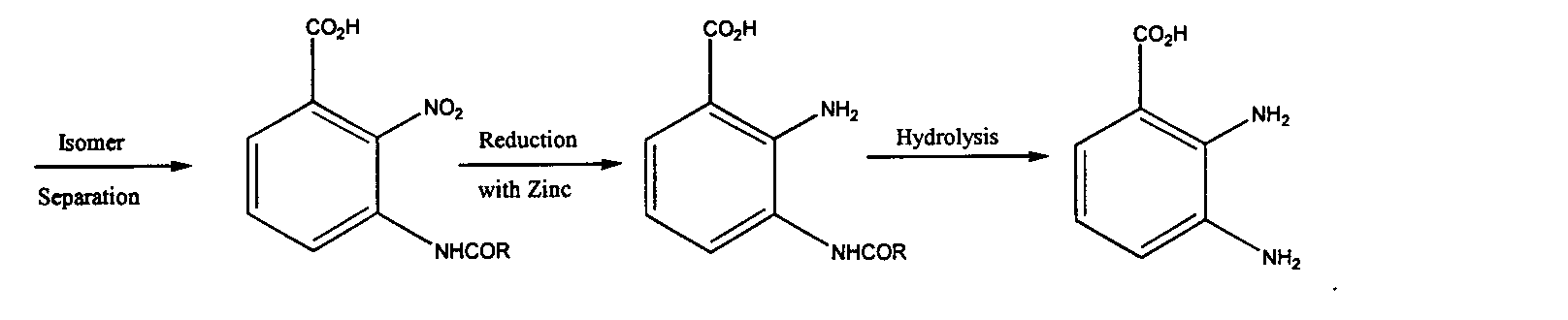
- preparation of the isomeric 2, 3-diaminobenzoic acid employs a multi-step method that includes oxidation, reduction, amidation, nitration, separation of isomers, further reduction, and hydrolysis, as set out below (3).
- Preparation of the isomeric 3, 4-diaminobenzoic acid can be carried out using this multi-step method by isolating and further reacting the 3-amido, 4-nitrobenzoic acid isomer.
- Milder oxidizing agents i.e., air or oxygen in the presence of a catalyst
- Air in the presence of a cobalt salt can oxidize toluene to benzoic acid (6) but does not oxidize methyl-quinoxaline to quinoxaline-carboxylic acid.
- air and oxygen in the presence of a palladium or platinum catalyst are also ineffective (8).
- Most known oxidizing reagents are either too mild to react with methyl-quinoxalines or are too reactive causing structural changes.
- the present invention pertains to a method for preparing quinoxaline-5- and 6-carboxylic acids (I).
- the method comprises contacting an aqueous suspension of a 5-or 6-hydroxymethyl quinoxaline (II) with oxygen in the presence of a transition metal catalyst, to form the respective quinoxaline-5- or 6-carboxylic acid (I).
- the present invention also pertains to a method for preparing a carboxylic acid selected from the group consisting of:
- the method comprises contacting an aqueous suspension of a hydroxymethyl precursor compound of the respective carboxylic acid with oxygen in the presence of a transition metal catalyst, to form the respective carboxylic acid.
- the present invention pertains to a multi-step method for converting benzyl heterocyclic compounds to the corresponding carboxylic acid heterocyclic compounds.
- the multi-step method is especially suitable for converting 5- and 6-benzyl quinoxalines to the corresponding quinoxaline-5- and 6-carboxylic acids.
- the 5- and 6-benzyl quinoxalines may be prepared from ortho -diaminotoluenes, such as 2, 3- and 3, 4-diaminotoluene, by condensation with sodium glyoxal bisulfite.
- the method for oxidizing benzylic methyl groups may also be employed to prepare a wide variety of heterocyclic carboxylic acid compounds.
- 5- or 6-methyl-quinoxaline is halogenated to provide a 5- or 6-halomethyl-quinoxaline intermediate, respectively.
- the 5- or 6-halomethyl-quinoxaline intermediate is converted to 5- or 6-hydroxymethyl-quinoxaline by nucleophilic displacement with a hydroxide group, respectively.
- the 5- or 6-hydroxymethyl-quinoxaline intermediate is selectively oxidized to the corresponding quinoxaline-5- or 6-carboxylic acid, respectively.
- 5- and 6-benzyl quinoxalines may be prepared from ortho-diaminotoluenes, such as 2, 3- and 3, 4-diaminotoluene, by condensation with sodium glyoxal bisulfite.
- 6-benzyl quinoxaline may be prepared by condensation of 3, 4-diaminotoluene with sodium glyoxal bisulfite (9).
- a benzylic methyl heterocyclic compound and a halogenating agent such as N-chlorosuccinimide (NCS) or N-bromosuccinimide (NBS) are reacted in the presence of a radical initiator, such as benzoyl peroxide or azobisisobutyronitrile, in a suitable solvent, to form the respective halomethyl heterocyclic compound, such as 5- or 6-halomethyl quinoxaline.
- NCS N-chlorosuccinimide
- N-bromosuccinimide N-bromosuccinimide
- Suitable solvents may be selected from the group consisting of fluorobenzene, difluorobenzenes, trifluorobenzenes, chlorobenzene, dichlorobenzenes, trichlorobenzenes, ⁇ , ⁇ , ⁇ -trifluorotoluene and ⁇ , ⁇ , ⁇ -trichlorotoluene.
- the method for halogenating benzylic positions may also be employed to halogenate a variety of heterocyclic compounds.
- the method typically affords good yields of halomethyl-quinoxalines when [6QX]/[benzoyl peroxide] ⁇ 40 while maintaining a temperature in the range of 60°C to 115°C for a period of 1 to 12 hours. Yields for benzylic brominations (conversions ⁇ 95%, selectivities ⁇ 97%) are in general better than for benzylic chlorinations (conversions 60%, selectivities ⁇ 75-80%).
- the 5- or 6-halomethyl quinoxaline may be a 5-halomethyl quinoxaline or may be a 6-halomethyl quinoxaline.
- the halomethyl may be a chloromethyl or may be a bromomethyl.
- the method comprises contacting the benzyl precursor compound of the respective halomethyl compound with a halogenating agent in the presence of a radical initiator in a solvent selected from the group consisting of fluorobenzene, difluorobenzenes, trifluorobenzenes, chlorobenzene, dichlorobenzenes, trichlorobenzenes, ⁇ , ⁇ , ⁇ -trifluorotoluene and ⁇ , ⁇ , ⁇ -trichlorotoluene, to form the respective halomethyl compound.
- a radical initiator in a solvent selected from the group consisting of fluorobenzene, difluorobenzenes, trifluorobenzenes, chlorobenzene, dichlorobenzenes, trichlorobenzenes, ⁇ , ⁇ , ⁇ -trifluorotoluene and ⁇ , ⁇ , ⁇ -trichlorotoluene, to form the respective
- benzylic halogenation of heterocyclic compounds depends on a variety of factors including the halogenating agent, the radical initiator, the solvent, temperature, reaction time, reagent concentrations, and procedure.
- the halogenating agents may be any halogenating agent which is capable of selectively halogenating the benzylic methyl group of a heterocyclic compound.
- halogen refers to the elements fluorine, chlorine, bromine, and iodine. Preferred halogens are chlorine and bromine.
- Non-limiting illustrative halogenating agents may be selected from the group consisting of N-chlorosuccinimide, N-bromosuccinimide, Cl 2 , Br 2 , t-butyl hypochlorite, N-chloroglutarimide, N-bromo-glytarimide, N-chloro-N-cyclohexyl-benzenesulfonimide, and N-bromophthalimide.
- Preferred halogenating agents are N-chlorosuccinimide and N-bromosuccinimide.
- the radical initiators may be any radical initiator which is capable of catalyzing the halogenating agent to selectively halogenate the benzylic methyl group of a heterocyclic compound.
- the presence of an initiator is essential for the reaction to occur because radicals propagate these reactions.
- Non-limiting illustrative radical initiator agents may be selected from the group consisting of benzoyl peroxide, azobisisobutyronitrile (AIBN), and diacyl peroxides, dialkyl peroxydicarbonates, and tert-alkylperoxyesters, monoperoxycarbonates, di(tert-alkylperoxy)ketals, and ketone peroxides.
- Preferred radical initiators are benzoyl peroxide and azobisisobutyronitrile.
- radicals can be generated photochemically.
- the solvents may be any solvent which is capable of promoting the halogenating agent to selectively halogenate the benzylic methyl group of a heterocyclic compound.
- the solvent must (a) be a media in which the halogenating agent has a low, but definite, solubility; (b) be stable to the halogenating agent allowing the halogenating agent to react preferentially at the methyl group of the heterocyclic compound to provide a halomethyl-heterocyclic compound that is stable in the solvent under the reaction conditions; and (c) be environmentally acceptable.
- Most conventional benzylic bromination procedures employ highly toxic solvents which are rigorously restricted on an industrial level.
- Suitable solvents may be selected from the group consisting of fluorobenzene, difluorobenzenes, trifluorobenzenes, chlorobenzene, dichlorobenzenes, trichlorobenzenes, ⁇ , ⁇ , ⁇ -trifluorotoluene and ⁇ , ⁇ , ⁇ -trichlorotoluene.
- Preferred solvents are chlorobenzene and ⁇ , ⁇ , ⁇ -trifluorotoluene.
- 5- or 6-halomethyl-quinoxaline is converted to 5- or 6-hydroxymethyl-quinoxaline by nucleophilic displacement with a hydroxide group.
- a first embodiment for preparing a 5- or 6-hydroxymethyl-quinoxaline comprises contacting an aqueous suspension of a 5- or 6-halomethyl-quinoxaline with a water-soluble nucleophile, N 1 , containing moiety Y.
- R 1 may be selected from the group consisting of hydrogen and branched and unbranched alkyl and aryl groups having from 1 to 9 carbon atoms.
- R 1 is selected from the group consisting of hydrogen and branched and unbranched alkyl and aryl groups having from 1 to 6 carbon atoms, more preferably R 1 is selected from the group consisting of hydrogen and branched and unbranched alkyl groups having from 1 to 3 carbon atoms, and most preferably R 1 is hydrogen.
- the water-soluble nucleophiles, N 1 , containing moiety Y may be any water-soluble nucleophile which is capable of selectively displacing the halogen group attached to the benzylic position of the heterocyclic compound in an aqueous suspension.
- the term "water-soluble nucleophile”, as used herein, refers to a nucleophile that can be dissolved in water to yield a solution with a molarity equal to, or greater than, 0.01.
- Non-limiting illustrative water-soluble nucleophiles are those that contain a Y moiety, where Y may be selected from the group consisting of -OR 2 , -NHR 2 , -NR 2 R 3 , -SR 2 , and -CN.
- R 2 and R 3 are independently selected from the group consisting of hydrogen and branched and unbranched alkyl groups having from 1 to 4 carbon atoms.
- R 2 and R 3 are independently selected from the group consisting of hydrogen and branched and unbranched alkyl groups having from 1 to 3 carbon atoms, more preferably R 2 and R 3 are independently selected from the group consisting of hydrogen and alkyl groups having from 1 to 2 carbon atoms, and most preferably R 2 and R 3 are hydrogen.
- Preferred water-soluble nucleophiles may be selected from the group consisting of alkali hydroxides and alkaline earth hydroxides. More preferred water-soluble nucleophiles may be selected from the group consisting of lithium hydroxide, sodium hydroxide, and potassium hydroxide.
- Y is hydroxy.
- a second embodiment for preparing a 5- or 6-hydroxymethyl-quinoxaline comprises contacting a 5- or 6-halomethyl-quinoxaline with an organic solvent-soluble nucleophile, N 2 , containing moiety Y, in an inert polar organic solvent.
- the organic solvent-soluble nucleophiles may be any organic solvent-soluble nucleophile which is capable of selectively displacing the halogen group attached to the benzylic position of the heterocyclic compound in an inert polar organic solvent.
- organic solvent-soluble nucleophile refers to a nucleophile that can be dissolved in an organic solvent to yield a solution with a molarity equal to, or greater than, 0.01.
- Non-limiting illustrative organic solvent-soluble nucleophiles are those that contain a Y moiety, where Y may be selected from the group consisting of -OR 2 , -NHR 2 , -NR 2 R 3 , and -SR 2 R 2 and R 3 are independently selected from the group consisting of hydrogen and branched and unbranched alkyl and aryl groups having from 5 to 9 carbon atoms.
- R 2 and R 3 are independently selected from the group consisting of hydrogen and branched and unbranched alkyl and aryl groups having from 5 to 8 carbon atoms, more preferably R 2 and R 3 are independently selected from the group consisting of hydrogen and branched and unbranched alkyl and aryl groups having from 5 to 7 carbon atoms, and most preferably R 2 and R 3 are hydrogen.
- Preferred organic solvent-soluble nucleophiles may be selected from the group consisting of benzyltrimethyl ammonium hydroxide, tetrabutyl ammonium hydroxide, alkyl alcohols, aryl alcohols, alkylamines, arylamines, alkyl sulfides, aryl sulfides, and the salts thereof. More preferred organic solvent-soluble nucleophiles are benzyltrimethyl ammonium hydroxide and tetrabutyl ammonium hydroxide.
- Y is hydroxy.
- the inert polar organic solvents may be any inert polar organic solvent which is capable of dissolving the organic solvent-soluble nucleophile and the 5- or 6-halomethyl quinoxaline thereby permitting the selective displacement of the halogen group attached to the benzylic position of the heterocyclic compound.
- inert polar organic solvent refers to an organic solvent that does not react with the organic solvent-soluble nucleophile or the 5- or 6-halomethyl quinoxaline and promotes a reaction between the organic solvent-soluble nucleophile and the 5- or 6-halomethyl quinoxaline.
- Non-limiting illustrative inert polar organic solvents may be selected from the group consisting of tetrahydrofuran, dioxane, 2-methoxyethyl ether, triethylene glycol dimethyl ether, dimethylsulfoxide (DMSO), methyl- tert -butyl ether (MTBE), and diethyl ether.
- Preferred inert polar organic solvents may be selected from the group consisting of tetrahydrofuran, dioxane, 2-methoxyethyl ether, triethylene glycol dimethyl ether, and dimethylsulfoxide.
- More preferred inert polar organic solvents may be selected from the group consisting of tetrahydrofuran, dioxane, and 2-methoxyethyl ether. Most preferred inert polar organic solvents are tetrahydrofuran and dioxane.
- a third embodiment for preparing a 5- or 6-hydroxymethyl-quinoxaline comprises contacting a 5- or 6-halomethyl-quinoxaline in an organic solvent with an aqueous solution of a water-soluble nucleophile, N 1 , containing moiety Y, in the presence of a phase transfer catalyst.
- the organic solvents may be any organic solvent which is capable of dissolving the water-soluble nucleophile and the 5- or 6-halomethyl quinoxaline with the assistance of the phase transfer catalyst thereby permitting the selective displacement of the halogen group attached to the benzylic position of the heterocyclic compound.
- Non-limiting illustrative organic solvents may be selected from the group consisting of chlorobenzene, dichlorobenzenes, trichlorobenzenes, ⁇ , ⁇ , ⁇ -trichlorotoluene, fluorobenzene, difluorobenzenes, trifluorobenzenes, and ⁇ , ⁇ , ⁇ -trifluorortoluene.
- Preferred organic solvents may be selected from the group consisting of chlorobenzene, dichlorobenzenes, fluorobenzene, and difluorobenzenes. More preferred organic solvents are chlorobenzene and dichlorobenzenes. The most preferred organic solvent is chlorobenzene.
- the phase transfer catalysts may be any phase transfer catalyst which is capable of dissolving the water-soluble nucleophile and the 5- or 6-halomethyl quinoxaline in the organic phase thereby permitting the selective displacement of the halogen group attached to the benzylic position of the heterocyclic compound.
- the phase transfer catalyst is typically an organic salt (for example, tetraalkyl-ammonium salts, benzyltrimethylammonium salts, etc) that is soluble in both the aqueous phase and the organic phase.
- Non-limiting illustrative phase transfer catalysts may be selected from the group consisting of tetra- n -butyl-ammonium chloride, benzyltrimethylammonium chloride, benzyltrimethylammonium hydroxide, tetralkyl ammonium salts, tetraalkyl sulfonium salts, and cetyltrimethylammonium salts.
- the 5- and 6-halomethyl quinoxalines and the nucleophiles may be reacted in relative amounts ranging from about 1:1 to about 1:100, and preferably from about 1:10 to about 1:30, respectively.
- the 5- and 6-halomethyl quinoxalines and the nucleophiles may be reacted at temperatures ranging from about 25°C. to about 150°C., preferably from about 25°C. to about 100°C., and at pressures ranging from ambient to about 100 psig, and preferably ambient.
- the 5- or 6-hydroxymethyl-quinoxaline intermediate is selectively oxidized to the corresponding quinoxaline-5- or 6-carboxylic acid, respectively.
- the method comprises contacting an aqueous suspension of a 5- or 6-hydroxymethyl quinoxaline (II) with oxygen in the presence of a transition metal catalyst, to form the respective quinoxaline-5- or 6-carboxylic acid (I).
- the method for oxidizing benzylic methyl groups may also be employed to prepare a wide variety of heterocyclic carboxylic acid compounds.
- the invention is directed to a method for preparing a carboxylic acid selected from the group consisting of:
- the method comprises contacting an aqueous suspension of a hydroxymethyl precursor compound of the respective carboxylic acid with oxygen in the presence of a transition metal catalyst, to form the respective carboxylic acid.
- the method for oxidizing benzylic hydroxymethyl compounds depends on a variety of factors including the aqueous suspension, the source of oxygen, the transition metal catalyst, temperature, reaction time, reagent concentrations, and procedure.
- the aqueous suspension may be any aqueous suspension of a 5- or 6-hydroxymethyl quinoxaline (II) having a pH value which is capable of selectively oxidizing the benzylic hydroxymethyl group of a heterocyclic compound.
- the acid can be prepared from the alcohol in a neutral suspension, however, oxidation is more rapid in an alkaline suspension.
- the aqueous suspension of a 5- or 6-hydroxymethyl quinoxaline (II) may have a pH value in the range from about 7 to about 14, preferably from about 8 to about 14, and more preferably from about 12 to about 14.
- Suitable sources for providing the alkalinity include alkali and alkaline earth metal oxides, hydroxides, carbonates, and tetraalkylammonium hydroxide salts.
- the source of oxygen may be any source of oxygen which is capable of selectively oxidizing the benzylic hydroxymethyl group of a heterocyclic compound. Oxygen, air, and mixtures thereof may be employed.
- the transition metal catalysts may be any catalyst which is capable of selectively catalyzing the oxidation of the benzylic hydroxymethyl group of a heterocyclic compound.
- Non-limiting illustrative transition metal catalysts may be selected from the group consisting of Pd, Pt, Ru, Co, Mn, Cu, and V, especially on supports such as carbon, alumina, silica, and titania.
- the transition metal catalyst is Pd/C or Pt/C.
- the temperatures for preparing quinoxaline-5- and 6-carboxylic acids are important to ensure that the benzylic group is oxidized.
- the temperature should be chosen so that an optimum reaction rate can be reached. Such temperatures may range from about 50°C. to about 150°C., preferably from about 80°C. to about 120°C.
- reaction times play an important role in the method for preparing quinoxaline-5- and 6-carboxylic acids. Thus, reaction times should be optimum to ensure maximum conversion. Suitable reaction times may range from about 4 to about 72 hours, preferably from about 8 to about 48 hours.
- the reagent concentrations should be optimum to ensure maximum conversion.
- the quinoxaline concentrations may range from about 0.05M to about 0.5M, preferably from about 0.1M to about 0.3M.
- the alkali concentration may range from about 0.5M to about 3M, preferably from about 0.9M to about 1.5M.
- the method of the present invention has been used for the synthesis of quinoxaline-6-carboxylic acid, a precursor for AMPHAKINE CX516 (I), but other carboxylic acids may also be prepared by the methods of the present invention.
- substrates that are fragile towards strong oxidants but are impervious towards mild oxidizing agents i.e. quinolines, triazoles, ureas derived from ortho-diaminotoluenes, etc
- carboxylic acids that can be made by the present method are:
- the product can remain in the aqueous solution as a salt of the quinoxaline-carboxylic acid (i.e., sodium 6-quinoxaline carboxylate).
- the resulting aqueous solution can then be extracted if necessary with ether (to remove any remaining organic contaminant) followed by acidification with a mineral acid.
- the pale yellow solid that precipitates i.e. 6-quinoxaline carboxylic acid
- the typical yield for the first step is 97% selectivity and 95% conversion.
- the typical yield for the second step hydroxymethyl-quinoxaline synthesis) is 80% conversion.
- the typical yield for the third step (oxidation step) is ⁇ 80%.
- the present method is simple because the new method can convert a readily available chemical (2, 3- or 3, 4-diaminotoluene) into a valuable pharmaceutical intermediate in only three steps. Also, the method requires only routine operations (filtrations, distillation, extraction, etc) without the need to employ complex chemical operations or purification procedures.
- the present method is also economical because the method does not use exotic chemicals and it can produce the desire product in a good yield. Also, using catalytic air oxidation creates fewer environmental problems typically associated with oxidation procedures that rely on metal-oxo compounds (i.e., potassium permanganate). Because the new method takes advantage of diaminotoluenes as a raw material, the synthesis of 6-quinoxaline-carboxylic acid is less laborious and more economical.
- 6-methyl-quinoxaline (10g, 69.4mmol) was dissolved together with N-chlorosuccinimide (14g, 105.3mmol) and benzoyl peroxide (0.4g, 1.65mmol) in 240g of acetonitrile.
- the flask was connected to a reflux-condenser and the solution was refluxed for 6 hours followed by another addition of 0.1g of benzoyl peroxide. Reflux continued for a total reaction time of 12 hours.
- the solution was then analyzed showing the formation of 6-chloromethyl-quinoxaline (80% selectivity and 60% conversion according to GC analysis).
- the acetonitrile solution was concentrated by vacuum distillation to give a yellow suspension that was extracted with pentane (10 times, 50ml each).
- the pentane extracts contained all the quinoxaline products while the residue was composed mainly of succinimide and unreacted N-chlorosuccinimide.
- the pentane extracts were vacuum dried to give 9.2g of a yellow solid.
- the suspension was then filtered to give a yellow/amber clear solution.
- the aqueous solution was cooled and extracted with ether to remove any remaining organic contaminants followed by acidification with 1M sulfuric acid. Upon acidification, a pale yellow solid precipitated which was filtered, washed with water and air dried (1.0g, ⁇ 80% yield).
- 6-methyl-quinoxaline (1.25g, 8.68mmol) was dissolved with N-bromosuccinimide (2.32, 13.0mmol) and benzoyl peroxide (0.15g, 0.62 mml) in 31g of chlorobenzene.
- the mixture was heated to 85°C to give a pale yellow solution that slowly turned red.
- the solution was maintained at 85°C for two hours and then it was cooled to room temperature with the formation of a precipitate mainly composed of succinimide.
- the solution was then mixed with an equal volume ( ⁇ 31 ml) of pentane to ease the precipitation of succinimides (NHS as well as any unreacted NBS).
- 6-methyl-quinoxaline (1.25g, 8.68mmol) was dissolved with N-bromosuccinimide (2.32, 13.0mmol) and benzoyl peroxide (0.15g, 0.62 mml) in 31g of chlorobenzene.
- the mixture was heated up to 85°C to give a pale yellow solution that turned reddish with time.
- the solution was maintained at 85°C for two hours and it was then cooled to -10°C and filtered.
- the solution was vacuum dried to give an orange solid residue.
- the orange solid was then mixed with an alkaline solution prepared by dissolving 2.6g of sodium hydroxide pellets in 50ml of water.
- the chlorobenzene solution was cooled to room temperature and was mixed with aqueous alkali prepared by dissolving 3.0g of sodium hydroxide pellets in 30 ml of water.
- a phase transfer catalyst was added (0.1g tetra- n -butyl ammonium chloride) to improve the solubility of the base in the organic phase.
- the mixture was heated to reflux to give a solution of 6-hydroxymethyl-quinoxaline as determined by GCMS.
- the catalyst (0.2g 5% Pd/C) was added and the mixture was sparged with air for a few hours at 85°C.
- a cooled trap was placed at the exit of the reactor to trap the chlorbenzene that vaporized.
- 6-methyl-quinoxaline (1.25g, 8.68mmol) was dissolved with N bromosuccinimide (2.32g, 13.0mmol) and benzoyl-peroxide (0.15g, 0.62mmol) in 31g of chlorobenzene.
- the solution was stirred with heating at 85°C for 2.0 hours to yield a reddish solution.
- the solution was cooled to room temperature and one volume of pentane was added to facilitate the precipitation of succinimides.
- the solid was filtered (1.6g), washed with pentane and the extracts were combined with the chlorobenzene solution.
- This solution was then vacuum dried to give a yellow solid mainly composed of 6-bromomethyl-quinoxaline (1.92g).
- This solid was dissolved in 38g of THF and mixed with 4.24g of a 40% commercial aqueous solution of benzyltrimethyl ammonium hydroxide. Samples were analyzed during the course of the reaction showing a progressive conversion of 6-bromomethyl-quinoxaline into the hydroxo-derivative. The pale yellow solution was stirred at room temperature overnight until the reaction was completed and no other by-products were detected by GCMS analysis. The alkaline solution was neutralized with dilute sulfuric acid (1M) and pH adjusted with sodium bicarbonate.
- the solution was vacuum dried to give a yellow residue (2.5g) that was dissolved in methylene chloride and extracted with water to remove the organic salt.
- the methylene chloride solutions were dried over anhydrous MgSO 4 and the solution evaporated to give a pale yellow solid mostly composed of 6-hydroxymethyl-quinoxaline (1.20g, ⁇ 85% yield).
- the product was mixed with 30g of water containing 3.0g of sodium hydroxide dissolved.
- the mixture was mixed with 0.2g of 5% Pt/C and the reaction was heated (85-90°C) with air sparging for 12 hours. GCMS analysis showed that the alcohol was completely consumed and no aldehyde was remaining in the reaction mixture.
- the carbon suspension was filtered and acidified with a solution of sulfuric acid to give 1.20g of a yellow solid (6-quinoxaline-carboxylic acid) 92% yield.
Landscapes
- Chemical & Material Sciences (AREA)
- Organic Chemistry (AREA)
- Low-Molecular Organic Synthesis Reactions Using Catalysts (AREA)
Abstract
Description
- The present invention relates to a method for preparing heterocyclic carboxylic acid compounds, especially quinoxaline-5- and 6-carboxylic acids.
- The disclosures referred to herein to illustrate the background of the invention and to provide additional detail with respect to its practice are incorporated herein by reference and, for convenience, are numerically referenced in the following text and respectively grouped in the appended bibliography.
- Quinoxaline-6-carboxylic acid is an important chemical intermediate for the preparation of compounds such as AMPHAKINE CX516 [1-(quinoxalin-6-ylcarbonyl) piperidine], a drug being tested for the treatment of Alzheimer's disease, Attention Deficit Hyperactivity Disorder (ADHD), Mild Cognitive Impairment (MCI), Chronic Schizophrenia and male sexual dysfunction (1). The preparation of AMPHAKINE CX516 involves the conversion of 3, 4-diaminobenzoic acid to quinoxaline-6-carboxylic acid with sodium glyoxal bisulfite, followed by amidation of the resulting acid with piperidine, as set out below (2, 12).


- Although the preparation of AMPHAKINE CX516 appears straightforward, the synthesis requires the use of 3, 4-diaminobenzoic acid, an expensive starting material. For example, preparation of the isomeric 2, 3-diaminobenzoic acid employs a multi-step method that includes oxidation, reduction, amidation, nitration, separation of isomers, further reduction, and hydrolysis, as set out below (3). Preparation of the isomeric 3, 4-diaminobenzoic acid can be carried out using this multi-step method by isolating and further reacting the 3-amido, 4-nitrobenzoic acid isomer.

- Other methods for preparing 3, 4-diaminobenzoic-acid involve the electrochemical reduction of 3, 4-dinitrobenzoic acid and the hydrogenation of substituted benzofurazans (4). These methods also employ expensive chemical intermediates.
- Initial attempts by the applicant to prepare quinoxaline-6-carboxylic acid focused on a one step selective oxidation of the benzyl group to a carboxylic acid without affecting the aromatic rings, as set out below.

- Many methods are known for the direct oxidation of benzylic methyl groups to carboxylic acids. These methods typically employ a strong oxidizing agent, such as potassium permanganate, that reacts with a methyl group providing the remainder of the molecule is not reactive to the oxidizing agent (5). Thus, toluene can be oxidized with potassium permanganate to benzoic acid without affecting the benzene ring (5). Catalytic methods are generally more acceptable for industrial scale because theses methods employ milder oxidizing agents, i.e., air or oxygen, to carry out the oxidation of benzylic methyl groups to the corresponding carboxylic acid (6). The oxidation of 5- and 6-methyl-quinoxalines to 5- and 6-quinoxaline-carboxylic acids is not so straightforward, however, because strong oxidizing agents, such as potassium permanganate, degrade the aromatic ring yielding 2,3-pyrazinedicarboxylic acid (7):

- Milder oxidizing agents, i.e., air or oxygen in the presence of a catalyst, on the other hand, have no effect on the benzylic methyl group of 5- or 6-methyl-quinoxaline. Air in the presence of a cobalt salt can oxidize toluene to benzoic acid (6) but does not oxidize methyl-quinoxaline to quinoxaline-carboxylic acid. Similarly, air and oxygen in the presence of a palladium or platinum catalyst are also ineffective (8). Most known oxidizing reagents are either too mild to react with methyl-quinoxalines or are too reactive causing structural changes.

- Many methods are also known for the oxidation of benzylic hydroxymethyl groups to carboxylic acids. These methods typically employ strong oxidizing agents such as those set out below.

-
- O2/Pt(C), water, reflux 10 h
- Ni Anode, 1M NaOH, 25 °C, 1.5 h
- KOH, H2O, t-BuOH, CCl4, 25-80°C 10-60 min
- ZnCr2O7.3H2O, CH2Cl2, RT, 6 h
- NaMnO4.H2O, hexane, 69°C, 6 h
- Cu(MnO4)2.8H2O, CH2Cl2, RT, 24 h
- Bu4NMnO4, Pyridine, RT
- KMnO4, water, Benzene, Bu4NBr, RT, 3 h
- KMNO4, dicyclohexano-18-crown-6 ether, RT, 2 h
- 1.5 NiO2, Benzene, 30°C, 3 h
- Na2RuO4, NaOH, H2O, 25°C, 1 h
- K2RuO4, K2S2O8, RT, 1.5 h
-
- Thus, when choosing an oxidizing agent, it is important to consider its strength under the reaction conditions.
- Because attempts to prepare quinoxaline-6-carboxylic acid via a one-step selective oxidation of the benzyl group were not successful, a multi-step method to prepare quinoxaline-6-carboxylic acid was developed. In the first step, 6-methyl-quinoxaline is halogenated to provide 6-halomethyl-quinoxaline. In the second step, 6-halomethyl-quinoxaline is converted to 6-hydroxymethyl-quinoxaline by nucleophilic displacement with a hydroxide group. In the third step, 6-hydroxymethyl-quinoxaline intermediate is selectively oxidized to quinoxaline-6-carboxylic acid.
- The present invention pertains to a method for preparing quinoxaline-5- and 6-carboxylic acids (I). The method comprises contacting an aqueous suspension of a 5-or 6-hydroxymethyl quinoxaline (II) with oxygen in the presence of a transition metal catalyst, to form the respective quinoxaline-5- or 6-carboxylic acid (I).

- The present invention also pertains to a method for preparing a carboxylic acid selected from the group consisting of:
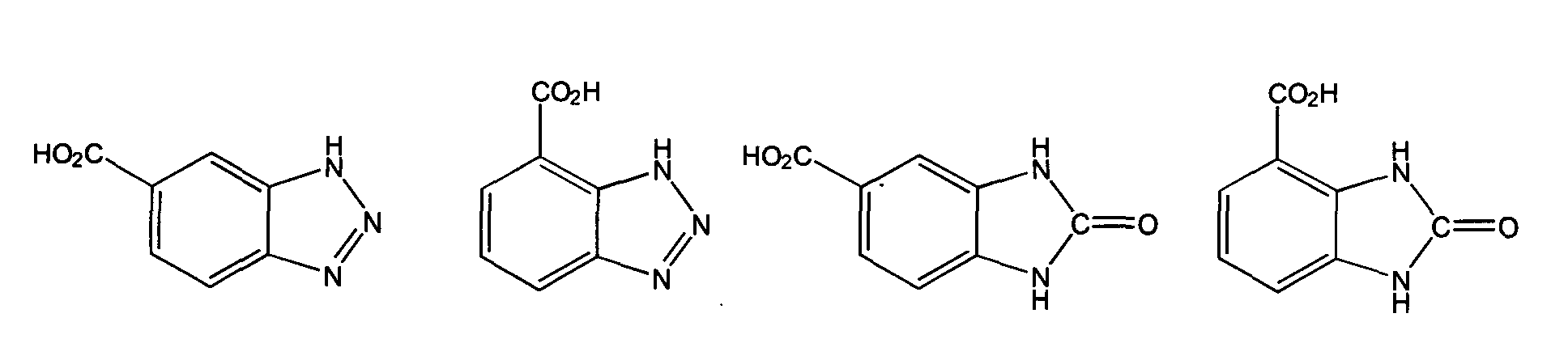
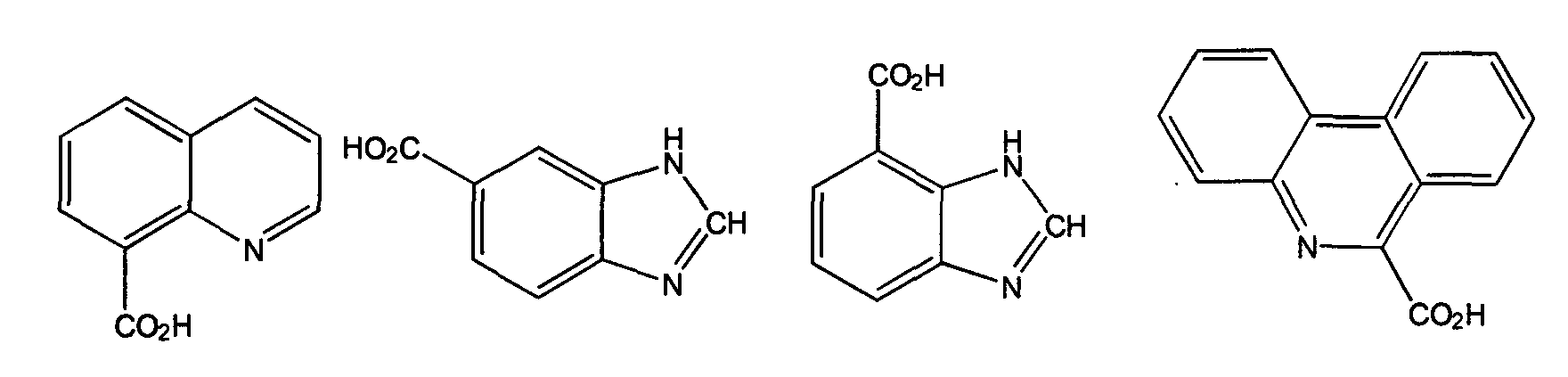
- The method comprises contacting an aqueous suspension of a hydroxymethyl precursor compound of the respective carboxylic acid with oxygen in the presence of a transition metal catalyst, to form the respective carboxylic acid.
- The present invention pertains to a multi-step method for converting benzyl heterocyclic compounds to the corresponding carboxylic acid heterocyclic compounds. The multi-step method is especially suitable for converting 5- and 6-benzyl quinoxalines to the corresponding quinoxaline-5- and 6-carboxylic acids. The 5- and 6-benzyl quinoxalines may be prepared from ortho-diaminotoluenes, such as 2, 3- and 3, 4-diaminotoluene, by condensation with sodium glyoxal bisulfite. The method for oxidizing benzylic methyl groups may also be employed to prepare a wide variety of heterocyclic carboxylic acid compounds.
- In the first step, 5- or 6-methyl-quinoxaline is halogenated to provide a 5- or 6-halomethyl-quinoxaline intermediate, respectively.
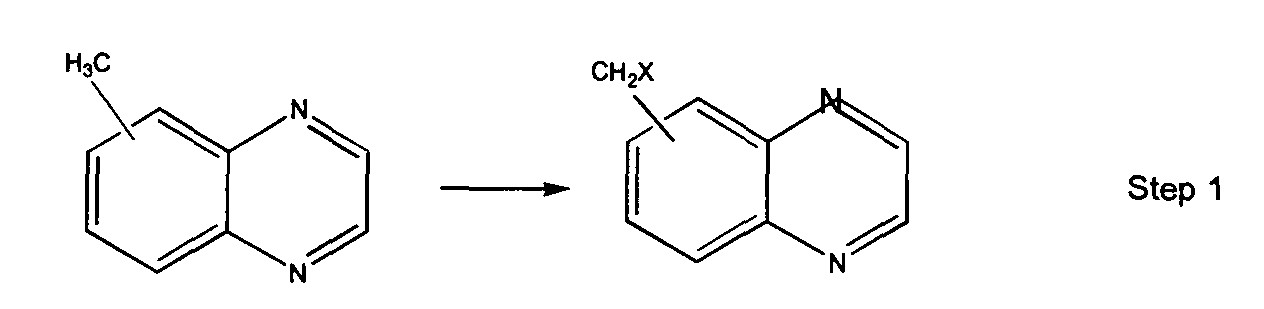
- This first step is more fully described in a copending patent application Serial No. 09/909000 entitled "Method For Preparing Halomethyl Heterocyclic Compounds" filed 19 July 2001 by applicant and assigned to the assignee of this application, which is hereby incorporated by reference.
- In the second step, the 5- or 6-halomethyl-quinoxaline intermediate is converted to 5- or 6-hydroxymethyl-quinoxaline by nucleophilic displacement with a hydroxide group, respectively.

- This second step is more fully described in a copending patent application Serial No. 09/909002 entitled "Methods For Preparing 5- and 6-Benzylfunctionalized Quinoxalines" filed 19 July 2001 by applicant and assigned to the assignee of this application, which is hereby incorporated by reference.
- In the third step, the 5- or 6-hydroxymethyl-quinoxaline intermediate is selectively oxidized to the corresponding quinoxaline-5- or 6-carboxylic acid, respectively.
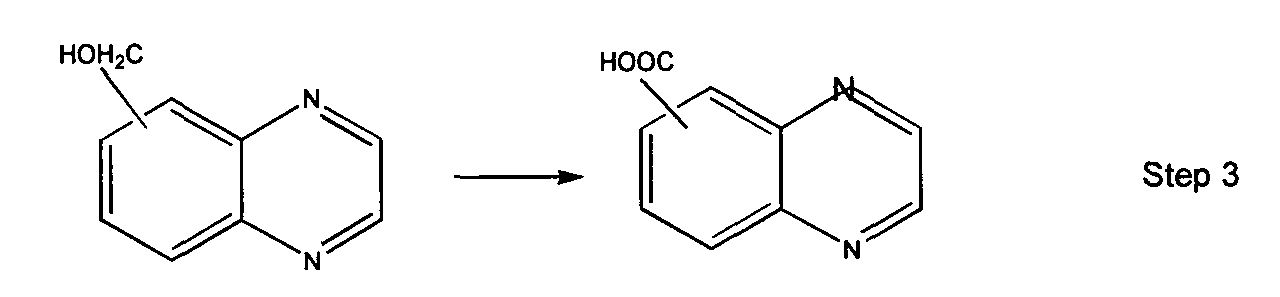
- As set out above, 5- and 6-benzyl quinoxalines may be prepared from ortho-diaminotoluenes, such as 2, 3- and 3, 4-diaminotoluene, by condensation with sodium glyoxal bisulfite. For example, 6-benzyl quinoxaline may be prepared by condensation of 3, 4-diaminotoluene with sodium glyoxal bisulfite (9).
- Because attempts to prepare quinoxaline-6-carboxylic acid via a one-step selective oxidation of the benzyl group were not successful, a multi-step method to prepare quinoxaline-6-carboxylic acid was developed. In the first step, 6-methyl-quinoxaline is halogenated to provide 6-halomethyl-quinoxaline. In the second step, 6-halomethyl-quinoxaline is converted to 6-hydroxymethyl-quinoxaline by nucleophilic displacement with a hydroxide group. In the third step, 6-hydroxymethyl-quinoxaline intermediate is selectively oxidized to quinoxaline-6-carboxylic acid.
- In the first step of the synthesis, a benzylic methyl heterocyclic compound and a halogenating agent, such as N-chlorosuccinimide (NCS) or N-bromosuccinimide (NBS), are reacted in the presence of a radical initiator, such as benzoyl peroxide or azobisisobutyronitrile, in a suitable solvent, to form the respective halomethyl heterocyclic compound, such as 5- or 6-halomethyl quinoxaline.

- Suitable solvents may be selected from the group consisting of fluorobenzene, difluorobenzenes, trifluorobenzenes, chlorobenzene, dichlorobenzenes, trichlorobenzenes, α, α, α-trifluorotoluene and α, α, α-trichlorotoluene.
- The method for halogenating benzylic positions may also be employed to halogenate a variety of heterocyclic compounds. The method typically affords good yields of halomethyl-quinoxalines when [6QX]/[benzoyl peroxide] ≤ 40 while maintaining a temperature in the range of 60°C to 115°C for a period of 1 to 12 hours. Yields for benzylic brominations (conversions ≥95%, selectivities ≥ 97%) are in general better than for benzylic chlorinations (conversions 60%, selectivities ∼ 75-80%). The 5- or 6-halomethyl quinoxaline may be a 5-halomethyl quinoxaline or may be a 6-halomethyl quinoxaline. The halomethyl may be a chloromethyl or may be a bromomethyl.
- The method comprises contacting the benzyl precursor compound of the respective halomethyl compound with a halogenating agent in the presence of a radical initiator in a solvent selected from the group consisting of fluorobenzene, difluorobenzenes, trifluorobenzenes, chlorobenzene, dichlorobenzenes, trichlorobenzenes, α, α, α-trifluorotoluene and α, α, α-trichlorotoluene, to form the respective halomethyl compound.
- The benzylic halogenation of heterocyclic compounds, such as methyl-quinoxalines, depends on a variety of factors including the halogenating agent, the radical initiator, the solvent, temperature, reaction time, reagent concentrations, and procedure.
- The halogenating agents may be any halogenating agent which is capable of selectively halogenating the benzylic methyl group of a heterocyclic compound. The term "halogen", as used herein, refers to the elements fluorine, chlorine, bromine, and iodine. Preferred halogens are chlorine and bromine. Non-limiting illustrative halogenating agents may be selected from the group consisting of N-chlorosuccinimide, N-bromosuccinimide, Cl2, Br2, t-butyl hypochlorite, N-chloroglutarimide, N-bromo-glytarimide, N-chloro-N-cyclohexyl-benzenesulfonimide, and N-bromophthalimide. Preferred halogenating agents are N-chlorosuccinimide and N-bromosuccinimide.
- The radical initiators may be any radical initiator which is capable of catalyzing the halogenating agent to selectively halogenate the benzylic methyl group of a heterocyclic compound. The presence of an initiator is essential for the reaction to occur because radicals propagate these reactions. Non-limiting illustrative radical initiator agents may be selected from the group consisting of benzoyl peroxide, azobisisobutyronitrile (AIBN), and diacyl peroxides, dialkyl peroxydicarbonates, and tert-alkylperoxyesters, monoperoxycarbonates, di(tert-alkylperoxy)ketals, and ketone peroxides. Preferred radical initiators are benzoyl peroxide and azobisisobutyronitrile. Alternatively, radicals can be generated photochemically.
- The solvents may be any solvent which is capable of promoting the halogenating agent to selectively halogenate the benzylic methyl group of a heterocyclic compound. The solvent must (a) be a media in which the halogenating agent has a low, but definite, solubility; (b) be stable to the halogenating agent allowing the halogenating agent to react preferentially at the methyl group of the heterocyclic compound to provide a halomethyl-heterocyclic compound that is stable in the solvent under the reaction conditions; and (c) be environmentally acceptable. Most conventional benzylic bromination procedures employ highly toxic solvents which are rigorously restricted on an industrial level. Suitable solvents may be selected from the group consisting of fluorobenzene, difluorobenzenes, trifluorobenzenes, chlorobenzene, dichlorobenzenes, trichlorobenzenes, α, α, α-trifluorotoluene and α, α, α-trichlorotoluene. Preferred solvents are chlorobenzene and α, α, α-trifluorotoluene.
- In the second step of the synthesis, 5- or 6-halomethyl-quinoxaline is converted to 5- or 6-hydroxymethyl-quinoxaline by nucleophilic displacement with a hydroxide group.

- A first embodiment for preparing a 5- or 6-hydroxymethyl-quinoxaline comprises contacting an aqueous suspension of a 5- or 6-halomethyl-quinoxaline with a water-soluble nucleophile, N1, containing moiety Y.
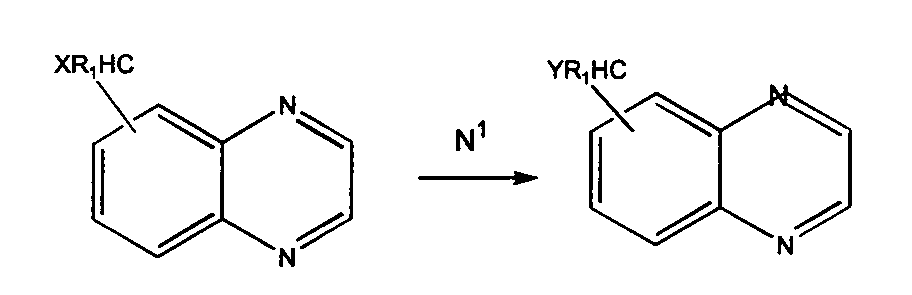
- R1 may be selected from the group consisting of hydrogen and branched and unbranched alkyl and aryl groups having from 1 to 9 carbon atoms. Preferably, R1 is selected from the group consisting of hydrogen and branched and unbranched alkyl and aryl groups having from 1 to 6 carbon atoms, more preferably R1 is selected from the group consisting of hydrogen and branched and unbranched alkyl groups having from 1 to 3 carbon atoms, and most preferably R1 is hydrogen.
- The water-soluble nucleophiles, N1, containing moiety Y, may be any water-soluble nucleophile which is capable of selectively displacing the halogen group attached to the benzylic position of the heterocyclic compound in an aqueous suspension. The term "water-soluble nucleophile", as used herein, refers to a nucleophile that can be dissolved in water to yield a solution with a molarity equal to, or greater than, 0.01. Non-limiting illustrative water-soluble nucleophiles are those that contain a Y moiety, where Y may be selected from the group consisting of -OR2, -NHR2, -NR2R3, -SR2, and -CN. R2 and R3 are independently selected from the group consisting of hydrogen and branched and unbranched alkyl groups having from 1 to 4 carbon atoms. Preferably, R2 and R3 are independently selected from the group consisting of hydrogen and branched and unbranched alkyl groups having from 1 to 3 carbon atoms, more preferably R2 and R3 are independently selected from the group consisting of hydrogen and alkyl groups having from 1 to 2 carbon atoms, and most preferably R2 and R3 are hydrogen. Preferred water-soluble nucleophiles may be selected from the group consisting of alkali hydroxides and alkaline earth hydroxides. More preferred water-soluble nucleophiles may be selected from the group consisting of lithium hydroxide, sodium hydroxide, and potassium hydroxide. Preferably, Y is hydroxy.
- A second embodiment for preparing a 5- or 6-hydroxymethyl-quinoxaline comprises contacting a 5- or 6-halomethyl-quinoxaline with an organic solvent-soluble nucleophile, N2, containing moiety Y, in an inert polar organic solvent.
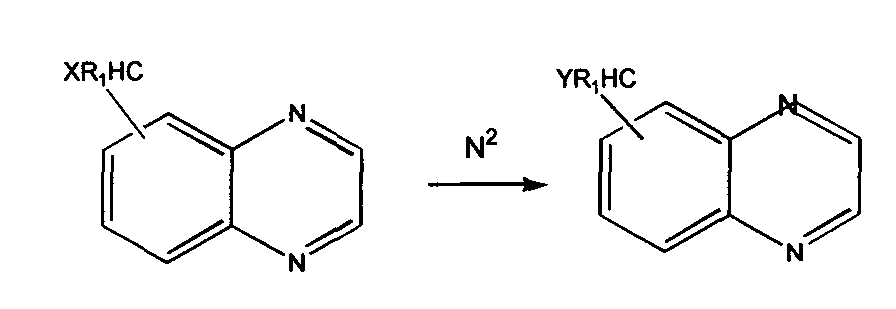
- The organic solvent-soluble nucleophiles may be any organic solvent-soluble nucleophile which is capable of selectively displacing the halogen group attached to the benzylic position of the heterocyclic compound in an inert polar organic solvent. The term "organic solvent-soluble nucleophile", as used herein, refers to a nucleophile that can be dissolved in an organic solvent to yield a solution with a molarity equal to, or greater than, 0.01. Non-limiting illustrative organic solvent-soluble nucleophiles are those that contain a Y moiety, where Y may be selected from the group consisting of -OR2, -NHR2, -NR2R3, and -SR2 R2 and R3 are independently selected from the group consisting of hydrogen and branched and unbranched alkyl and aryl groups having from 5 to 9 carbon atoms. Preferably, R2 and R3 are independently selected from the group consisting of hydrogen and branched and unbranched alkyl and aryl groups having from 5 to 8 carbon atoms, more preferably R2 and R3 are independently selected from the group consisting of hydrogen and branched and unbranched alkyl and aryl groups having from 5 to 7 carbon atoms, and most preferably R2 and R3 are hydrogen. Preferred organic solvent-soluble nucleophiles may be selected from the group consisting of benzyltrimethyl ammonium hydroxide, tetrabutyl ammonium hydroxide, alkyl alcohols, aryl alcohols, alkylamines, arylamines, alkyl sulfides, aryl sulfides, and the salts thereof. More preferred organic solvent-soluble nucleophiles are benzyltrimethyl ammonium hydroxide and tetrabutyl ammonium hydroxide. Preferably, Y is hydroxy.
- The inert polar organic solvents may be any inert polar organic solvent which is capable of dissolving the organic solvent-soluble nucleophile and the 5- or 6-halomethyl quinoxaline thereby permitting the selective displacement of the halogen group attached to the benzylic position of the heterocyclic compound. The term "inert polar organic solvent", as used herein, refers to an organic solvent that does not react with the organic solvent-soluble nucleophile or the 5- or 6-halomethyl quinoxaline and promotes a reaction between the organic solvent-soluble nucleophile and the 5- or 6-halomethyl quinoxaline. Non-limiting illustrative inert polar organic solvents may be selected from the group consisting of tetrahydrofuran, dioxane, 2-methoxyethyl ether, triethylene glycol dimethyl ether, dimethylsulfoxide (DMSO), methyl-tert-butyl ether (MTBE), and diethyl ether. Preferred inert polar organic solvents may be selected from the group consisting of tetrahydrofuran, dioxane, 2-methoxyethyl ether, triethylene glycol dimethyl ether, and dimethylsulfoxide. More preferred inert polar organic solvents may be selected from the group consisting of tetrahydrofuran, dioxane, and 2-methoxyethyl ether. Most preferred inert polar organic solvents are tetrahydrofuran and dioxane.
- A third embodiment for preparing a 5- or 6-hydroxymethyl-quinoxaline comprises contacting a 5- or 6-halomethyl-quinoxaline in an organic solvent with an aqueous solution of a water-soluble nucleophile, N1, containing moiety Y, in the presence of a phase transfer catalyst.

- The organic solvents may be any organic solvent which is capable of dissolving the water-soluble nucleophile and the 5- or 6-halomethyl quinoxaline with the assistance of the phase transfer catalyst thereby permitting the selective displacement of the halogen group attached to the benzylic position of the heterocyclic compound. Non-limiting illustrative organic solvents may be selected from the group consisting of chlorobenzene, dichlorobenzenes, trichlorobenzenes, α, α, α-trichlorotoluene, fluorobenzene, difluorobenzenes, trifluorobenzenes, and α, α, α-trifluorortoluene. Preferred organic solvents may be selected from the group consisting of chlorobenzene, dichlorobenzenes, fluorobenzene, and difluorobenzenes. More preferred organic solvents are chlorobenzene and dichlorobenzenes. The most preferred organic solvent is chlorobenzene.
- The phase transfer catalysts may be any phase transfer catalyst which is capable of dissolving the water-soluble nucleophile and the 5- or 6-halomethyl quinoxaline in the organic phase thereby permitting the selective displacement of the halogen group attached to the benzylic position of the heterocyclic compound. The phase transfer catalyst is typically an organic salt (for example, tetraalkyl-ammonium salts, benzyltrimethylammonium salts, etc) that is soluble in both the aqueous phase and the organic phase. Non-limiting illustrative phase transfer catalysts may be selected from the group consisting of tetra-n-butyl-ammonium chloride, benzyltrimethylammonium chloride, benzyltrimethylammonium hydroxide, tetralkyl ammonium salts, tetraalkyl sulfonium salts, and cetyltrimethylammonium salts.
- The 5- and 6-halomethyl quinoxalines and the nucleophiles may be reacted in relative amounts ranging from about 1:1 to about 1:100, and preferably from about 1:10 to about 1:30, respectively. The 5- and 6-halomethyl quinoxalines and the nucleophiles may be reacted at temperatures ranging from about 25°C. to about 150°C., preferably from about 25°C. to about 100°C., and at pressures ranging from ambient to about 100 psig, and preferably ambient.
- In the third step, the 5- or 6-hydroxymethyl-quinoxaline intermediate is selectively oxidized to the corresponding quinoxaline-5- or 6-carboxylic acid, respectively. The method comprises contacting an aqueous suspension of a 5- or 6-hydroxymethyl quinoxaline (II) with oxygen in the presence of a transition metal catalyst, to form the respective quinoxaline-5- or 6-carboxylic acid (I).

- The method for oxidizing benzylic methyl groups may also be employed to prepare a wide variety of heterocyclic carboxylic acid compounds. In another preferred embodiment, the invention is directed to a method for preparing a carboxylic acid selected from the group consisting of:
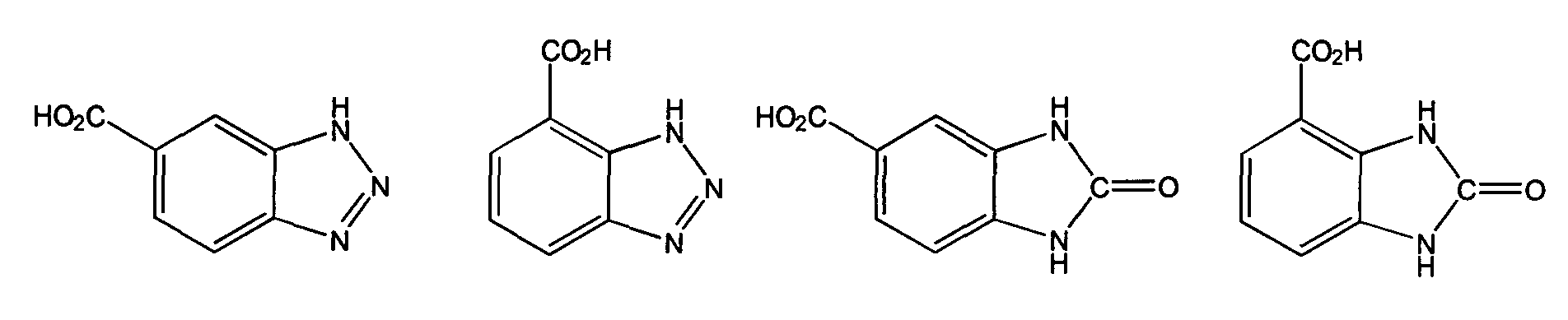

- The method comprises contacting an aqueous suspension of a hydroxymethyl precursor compound of the respective carboxylic acid with oxygen in the presence of a transition metal catalyst, to form the respective carboxylic acid.
- The method for oxidizing benzylic hydroxymethyl compounds, such as hydroxymethyl-quinoxalines, depends on a variety of factors including the aqueous suspension, the source of oxygen, the transition metal catalyst, temperature, reaction time, reagent concentrations, and procedure.
- The aqueous suspension may be any aqueous suspension of a 5- or 6-hydroxymethyl quinoxaline (II) having a pH value which is capable of selectively oxidizing the benzylic hydroxymethyl group of a heterocyclic compound. The acid can be prepared from the alcohol in a neutral suspension, however, oxidation is more rapid in an alkaline suspension. Preferably, the aqueous suspension of a 5- or 6-hydroxymethyl quinoxaline (II) may have a pH value in the range from about 7 to about 14, preferably from about 8 to about 14, and more preferably from about 12 to about 14. Suitable sources for providing the alkalinity include alkali and alkaline earth metal oxides, hydroxides, carbonates, and tetraalkylammonium hydroxide salts.
- The source of oxygen may be any source of oxygen which is capable of selectively oxidizing the benzylic hydroxymethyl group of a heterocyclic compound. Oxygen, air, and mixtures thereof may be employed.
- The transition metal catalysts may be any catalyst which is capable of selectively catalyzing the oxidation of the benzylic hydroxymethyl group of a heterocyclic compound. Non-limiting illustrative transition metal catalysts may be selected from the group consisting of Pd, Pt, Ru, Co, Mn, Cu, and V, especially on supports such as carbon, alumina, silica, and titania. Preferably, the transition metal catalyst is Pd/C or Pt/C.
- The temperatures for preparing quinoxaline-5- and 6-carboxylic acids are important to ensure that the benzylic group is oxidized. The temperature should be chosen so that an optimum reaction rate can be reached. Such temperatures may range from about 50°C. to about 150°C., preferably from about 80°C. to about 120°C.
- The reaction times play an important role in the method for preparing quinoxaline-5- and 6-carboxylic acids. Thus, reaction times should be optimum to ensure maximum conversion. Suitable reaction times may range from about 4 to about 72 hours, preferably from about 8 to about 48 hours.
- The reagent concentrations should be optimum to ensure maximum conversion. The quinoxaline concentrations may range from about 0.05M to about 0.5M, preferably from about 0.1M to about 0.3M. The alkali concentration may range from about 0.5M to about 3M, preferably from about 0.9M to about 1.5M.
- The method of the present invention has been used for the synthesis of quinoxaline-6-carboxylic acid, a precursor for AMPHAKINE CX516 (I), but other carboxylic acids may also be prepared by the methods of the present invention. In particular, substrates that are fragile towards strong oxidants but are impervious towards mild oxidizing agents (i.e. quinolines, triazoles, ureas derived from ortho-diaminotoluenes, etc) can be oxidized to their corresponding acids. Examples of carboxylic acids that can be made by the present method are:


- After oxidation of the hydroxymethyl-quinoxaline, the product can remain in the aqueous solution as a salt of the quinoxaline-carboxylic acid (i.e., sodium 6-quinoxaline carboxylate). The resulting aqueous solution can then be extracted if necessary with ether (to remove any remaining organic contaminant) followed by acidification with a mineral acid. The pale yellow solid that precipitates (i.e. 6-quinoxaline carboxylic acid) can be filtered, washed with water, and air-dried (∼80% yield). The typical yield for the first step (halomethyl-quinoxaline synthesis) is 97% selectivity and 95% conversion. The typical yield for the second step (hydroxymethyl-quinoxaline synthesis) is 80% conversion. The typical yield for the third step (oxidation step) is ∼80%.
- All attempts by applicant to prepare quinoxaline-6-carboxylic acid directly from 6-methyl-quinoxaline failed (i.e., without making the hydroxymethyl-quinoxaline intermediate). These attempts included air oxidation with cobalt catalyst in acetic acid; air oxidation with Co/Mn/Cl-/Br- catalyst in acetic acid; air oxidation with 5% Pd/C catalyst; KMnO4; KCrO4; and ruthenium catalyst in the presence of sodium hypochlorite.
- There are several advantages in using the present method compared to conventional methods. The present method is simple because the new method can convert a readily available chemical (2, 3- or 3, 4-diaminotoluene) into a valuable pharmaceutical intermediate in only three steps. Also, the method requires only routine operations (filtrations, distillation, extraction, etc) without the need to employ complex chemical operations or purification procedures. The present method is also economical because the method does not use exotic chemicals and it can produce the desire product in a good yield. Also, using catalytic air oxidation creates fewer environmental problems typically associated with oxidation procedures that rely on metal-oxo compounds (i.e., potassium permanganate). Because the new method takes advantage of diaminotoluenes as a raw material, the synthesis of 6-quinoxaline-carboxylic acid is less laborious and more economical.
- Throughout this disclosure, applicant may suggest various theories or mechanisms by which applicant believes the present methods function. While applicant may offer various mechanisms to explain the present invention, applicant does not wish to be bound by theory. These theories are suggested to better understand the present invention but are not intended to limit the effective scope of the claims.
- The present invention is further illustrated by the following examples which are presented for purposes of demonstrating, but not limiting, the preparation of the compounds and compositions of this invention.
- In a 500 ml flask, 6-methyl-quinoxaline (10g, 69.4mmol) was dissolved together with N-chlorosuccinimide (14g, 105.3mmol) and benzoyl peroxide (0.4g, 1.65mmol) in 240g of acetonitrile. The flask was connected to a reflux-condenser and the solution was refluxed for 6 hours followed by another addition of 0.1g of benzoyl peroxide. Reflux continued for a total reaction time of 12 hours. The solution was then analyzed showing the formation of 6-chloromethyl-quinoxaline (80% selectivity and 60% conversion according to GC analysis). The acetonitrile solution was concentrated by vacuum distillation to give a yellow suspension that was extracted with pentane (10 times, 50ml each). The pentane extracts contained all the quinoxaline products while the residue was composed mainly of succinimide and unreacted N-chlorosuccinimide. The pentane extracts were vacuum dried to give 9.2g of a yellow solid. GC-MS analysis showed that 80% of the extracted yellow solid was composed of 6-chloromethyl-quinoxaline (M+=178) while the remaining 20% corresponded mainly to unreacted 6-methyl-quinoxaline. The chloro-compound was analyzed by 1H NMR showing the following resonances: 1HNMR (CDCl3): 4.69 ppm (-CH2Cl), 7.97 ppm (singlet, 1 H), 7.68 ppm (1 H, doublet, J = 10 Hz), 7.98 (1 H, doublet, J = 10 Hz), 8.73 (2H, broad doublet). These analyses confirmed the structure of the desired compound.
- A sample of 6-chloromethyl-quinoxaline (1.6g) was then mixed with an alkaline solution (1.29g of sodium hydroxide pellets dissolved in 25g of water) to give upon mild heating a reddish color suspension that turned into a solution. Analysis of this solution showed the presence of 6-hydroxymethyl-quinoxaline that was not isolated but rather oxidized in-situ. The catalyst was added (0.2g of 5% Pd/C) and the solution was heated to 85-90°C with air sparging. After eight hours reflux, the reaction was monitored by GC-MS showing the appearance of 6-quinoxaline-carboxaldehyde in the reaction mixture but all the alcohol and aldehyde were completely consumed after 48 hours. The suspension was then filtered to give a yellow/amber clear solution. The aqueous solution was cooled and extracted with ether to remove any remaining organic contaminants followed by acidification with 1M sulfuric acid. Upon acidification, a pale yellow solid precipitated which was filtered, washed with water and air dried (1.0g, ∼80% yield). The yellow powder was analyzed by infrared spectroscopy and nuclear magnetic resonance. Infrared spectroscopy showed a C=O stretching at 1708 cm-1 which is typical for carboxylic acids, while 1H NMR (d4-MeOH) gave the following resonances: 8.19 (d, 1H), 8.40 (dxd, 1H), 8.78 (1H), 8.99 (2H). MS analysis showed the following fragments: 174 (M+), 157 (M+-OH), 129 (M+-OH-CO), 103 (M+-OH-CO-C2H2). The analysis are in agreement with the structure of 6-quinoxaline-carboxylic acid. The presence of the carboxylic acid group was also confirmed by ND3 proton exchange mass spectroscopy (M+= 175).
- In a 100 ml flask, 6-methyl-quinoxaline (1.25g, 8.68mmol) was dissolved with N-bromosuccinimide (2.32, 13.0mmol) and benzoyl peroxide (0.15g, 0.62 mml) in 31g of chlorobenzene. The mixture was heated to 85°C to give a pale yellow solution that slowly turned red. The solution was maintained at 85°C for two hours and then it was cooled to room temperature with the formation of a precipitate mainly composed of succinimide. The solution was then mixed with an equal volume (∼ 31 ml) of pentane to ease the precipitation of succinimides (NHS as well as any unreacted NBS). After filtration, the orange solid obtained (1.4g) was extracted few times with pentane (4 times, 50 ml each) to recover any remaining 6-bromomethyl-quinoxaline. The extracts were combined with the yellow solution of bromomethyl-quinoxaline and vacuum dried to give a yellow solid (1.92g). This solid was then reacted with 30 ml of a 1.7 M solution of sodium hydroxide to give a solution of 6-hydroxymethyl-quinoxaline that was catalytically oxidized (0.2g 5% Pd/C) with air at 85-95°C for 48 hours. The black suspension was filtered to give an amber solution that was neutralized with dilute sulfuric acid to give a yellow powder (1.28g, 85% yield) that precipitated from solution (6-quinoxaline-carboxylic acid).
- In a 100 ml flask, 6-methyl-quinoxaline (1.25g, 8.68mmol) was dissolved with N-bromosuccinimide (2.32, 13.0mmol) and benzoyl peroxide (0.15g, 0.62 mml) in 31g of chlorobenzene. The mixture was heated up to 85°C to give a pale yellow solution that turned reddish with time. The solution was maintained at 85°C for two hours and it was then cooled to -10°C and filtered. The solution was vacuum dried to give an orange solid residue. The orange solid was then mixed with an alkaline solution prepared by dissolving 2.6g of sodium hydroxide pellets in 50ml of water. The mixture was gently heated to 85-95°C to give a solution of 6-hydroxymethyl-quinoxaline that was mixed with the catalyst (5% Pt/C, 0.2g) and maintained at that temperature with air sparging. The reaction was monitored by GCMS showing the consumption of 6-hydroxymethyl-quinoxaline and the formation of 6-quinoxalinecarboxaldehyde. After 10 hours, both compounds were completely consumed indicating the end of the reaction. The aqueous solution was cooled to room temperature and filtered. The yellow solution obtained was neutralized with 3.18g of 96% sulfuric acid dissolved in 5ml of water. A yellow precipitated was formed during the addition of acid. The yellow solid was filtered and air dried to give 0.67g of dry product (∼ 45% yield). The lower yield in this experiment is attributed to a loss of bromomethyl-quinoxaline that was not recovered with from the succinimides precipitate by washings with pentane as explained in Examples 1 and 2.
- In a 50 ml flask, 6-methyl-quinoxaline (1.25g, 8.68mmol) was dissolved with N bromosuccinimide (2.32g, 13.0mmol) and benzoyl peroxide (0.15g, 0.62mmol) in 31g of chlorobenzene. The solution was stirred and heated to 85°C for 2.0 hours and the reaction mixture was analyzed by GCMS. The molar concentrations and molar ratios of the reactants are shown below:
Solvent [6QX] [NBS] [BP] [NBS]/{6QX] [6QX]/[BP] ClPh 0.31 0.46 2.2 x 10⁻² 1.5 14 - The results are summarized below:
Reaction Time = 120 min Product % Selectivity %Conversion 1 97.0 94.0 2 2.1 2.7 Unknowns 2.9 2.0 - The chlorobenzene solution was cooled to room temperature and was mixed with aqueous alkali prepared by dissolving 3.0g of sodium hydroxide pellets in 30 ml of water. A phase transfer catalyst was added (0.1g tetra-n-butyl ammonium chloride) to improve the solubility of the base in the organic phase. The mixture was heated to reflux to give a solution of 6-hydroxymethyl-quinoxaline as determined by GCMS. The catalyst (0.2g 5% Pd/C) was added and the mixture was sparged with air for a few hours at 85°C. A cooled trap was placed at the exit of the reactor to trap the chlorbenzene that vaporized. After 24 hours, most of the chlorobenzene was removed by the flow of air leaving the aqueous phase inside the flask. At this point, visual inspection showed that the catalyst was not homogeneously dispersed forming black agglomerates. Monitoring the reaction showed that the catalyst was completely ineffective at this point. The poisoned catalyst was filtered from the reaction mixture followed by the addition of fresh catalyst (0.2g). The oxidation was continued for a total reaction time of 72 hours with no further poisoning observed. The catalyst was filtered and the aqueous phase was acidified with a mineral acid (3.6g of 96% sulfuric acid dissolved in 10ml of water). No yellow precipitate of 6-quinoxaline-carboxylic acid was formed during the addition of acid. The precipitation was probably prevented by the presence of chloroaromatics remaining in the aqueous phase. The yellow solution was then extracted with ether (5 times, 100ml each) to give a yellow solid (0.57g) that presumably contained 6-quinoxaline-carboxylic acid. 1H NMR analysis showed a very complex spectrum indicating that the sample produced was not of the same quality as the one described in the previous examples. Nevertheless, the resonances corresponding to 6-quinoxaline-carboxylic acid were clearly observed. Thus, this procedure was ineffective in providing a good sample of 6-quinoxaline-carboxylic acid.
- In a 50 ml flask, 6-methyl-quinoxaline (1.25g, 8.68mmol) was dissolved with N bromosuccinimide (2.32g, 13.0mmol) and benzoyl-peroxide (0.15g, 0.62mmol) in 31g of chlorobenzene. The solution was stirred with heating at 85°C for 2.0 hours to yield a reddish solution. The solution was cooled to room temperature and one volume of pentane was added to facilitate the precipitation of succinimides. The solid was filtered (1.6g), washed with pentane and the extracts were combined with the chlorobenzene solution. This solution was then vacuum dried to give a yellow solid mainly composed of 6-bromomethyl-quinoxaline (1.92g). This solid was dissolved in 38g of THF and mixed with 4.24g of a 40% commercial aqueous solution of benzyltrimethyl ammonium hydroxide. Samples were analyzed during the course of the reaction showing a progressive conversion of 6-bromomethyl-quinoxaline into the hydroxo-derivative. The pale yellow solution was stirred at room temperature overnight until the reaction was completed and no other by-products were detected by GCMS analysis. The alkaline solution was neutralized with dilute sulfuric acid (1M) and pH adjusted with sodium bicarbonate. The solution was vacuum dried to give a yellow residue (2.5g) that was dissolved in methylene chloride and extracted with water to remove the organic salt. The methylene chloride solutions were dried over anhydrous MgSO4 and the solution evaporated to give a pale yellow solid mostly composed of 6-hydroxymethyl-quinoxaline (1.20g, ∼ 85% yield). The product was mixed with 30g of water containing 3.0g of sodium hydroxide dissolved. The mixture was mixed with 0.2g of 5% Pt/C and the reaction was heated (85-90°C) with air sparging for 12 hours. GCMS analysis showed that the alcohol was completely consumed and no aldehyde was remaining in the reaction mixture. The carbon suspension was filtered and acidified with a solution of sulfuric acid to give 1.20g of a yellow solid (6-quinoxaline-carboxylic acid) 92% yield.
- Throughout this application, various publications have been referenced. The disclosures in these publications are incorporated herein by reference in order to more fully describe the state of the art.
- 1. R. Granger, S. Deadwyler, M. Davis, B. Moskovitz, M. Kessler, G. Rogers, G. Lynch, Synapse, 22, pp. 332-337, 1996; and (b) G. Lynch, M. Kessler, G. Rogers, J. Ambross-Ingerson, R. Granger, R. S. Schehr, International Clinical Psychopharmacology, 11, pp. 13-19, 1996.
- 2. (a) J. Gum, J. Org. Chem., 30, 3982, 1965; (b) W. H. Huang, A. R. Lee, C. I. Lin, M. H. Yen, Yixue Yanjiu, 13, 247-54, 1993.
- 3. B. Schilling, Ber., 34, pp. 902-907, 1901.
- 4. (a) A. Tallec, Ann. Chim. (Paris), 3, 164, 1968; (b) V. Cere, D. Dal Monte, E. Sardi, Tetrahedron, 28, 3271, 1972.
- 5. M. Hudlicky "Oxidations in Organic Chemistry", ACS Monograph 186, 1990.
- 6. R. A. Sheldon, J. K. Kochi, "Metal-Catalyzed Oxidation of Organic Compounds", Chapter 5, pp. 121-151, Academic Press, 1981.
- 7. 2,3-Pyrazinedicarboxylic acid: "Organic Synthesis" Coll. Vol. 4 pp. 824-827, J. Wiley & Sons, Inc. NY, 1963.
- 8. R. A. Sheldon, J. K. Kochi, "Metal-Catalyzed Oxidation of Organic Compounds", Chapter 7, pp. 189-214, Academic Press, 1981.
- 9. J. C. Cavagnol, F. Y. Wiselogle, J. Am. Chem. Soc., 69, 795, 1947.
- 10. Thomas D. Waugh, NBS: N-Bromosuccinimide Its Reactions and Uses; Arapahoe Chemicals, Inc. Boulder Co. 1951.
- 11. D. F. Gavin, United States Patent no. 3,690,963 (1976).
- 12. Benzoyl Piperidine: "Organic Synthesis", Coll. Vol. 1 pp. 108-110, J. Wiley & Sons, Inc. New York, 1943.
- 13. 2,3-Pyrazinedicarboxylic acid: "Organic Synthesis" Coll. Vol. 4 pp. 824-827, J. Wiley & Sons, Inc. NY., 1963.
-
- While a number of embodiments of this invention have been represented, it is apparent that the basic construction can be altered to provide other embodiments which utilize the invention without departing from the spirit and scope of the invention. All such modifications and variations are intended to be included within the scope of the invention as defined in the appended claims rather than the specific embodiments which have been presented by way of example.
Claims (11)
- A method for preparing quinoxaline-5- and 6-carboxylic acids (I) which comprises contacting an aqueous suspension of a 5- or 6-hydroxymethyl quinoxaline (II) with oxygen in the presence of a transition metal catalyst, to form the respective quinoxaline-5- or 6-carboxylic acid (I).
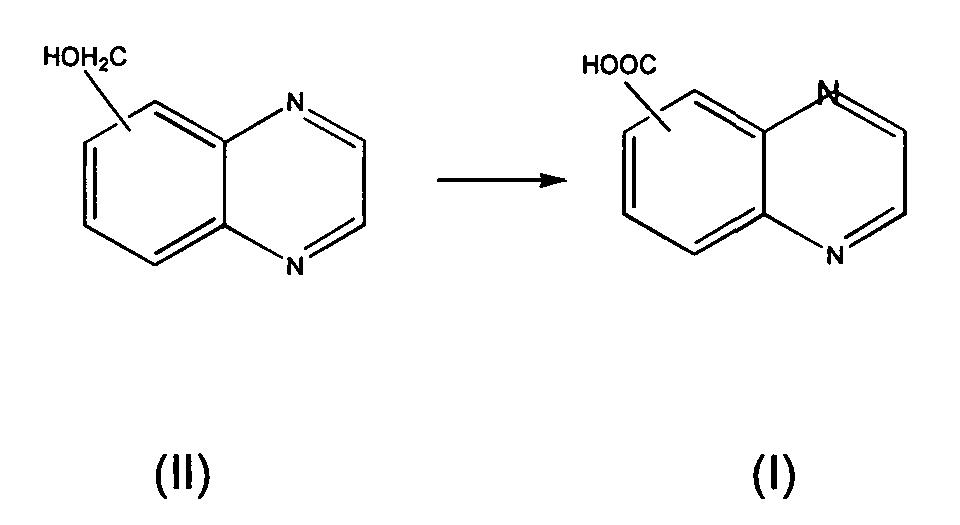
- The method according to claim 1, wherein the quinoxaline-5- or 6-carboxylic acid is a quinoxaline-5-carboxylic acid (I).
- The method according to claim 1, wherein the quinoxaline-5- or 6-carboxylic acid is a quinoxaline-6-carboxylic acid (I).
- The method according to claim 1, wherein the aqueous suspension of a 5- or 6-hydroxymethyl quinoxaline (II) has a pH value in the range from about 8 to about 14.
- The method according to claim 1, wherein the transition metal catalyst is selected from the group consisting of Pd, Pt, Ru, Co, Mn, Cu, and V.
- The method according to claim 5, wherein the transition metal catalyst is Pd/C or Pt/C.
- A method for preparing a carboxylic acid selected from the group consisting of:
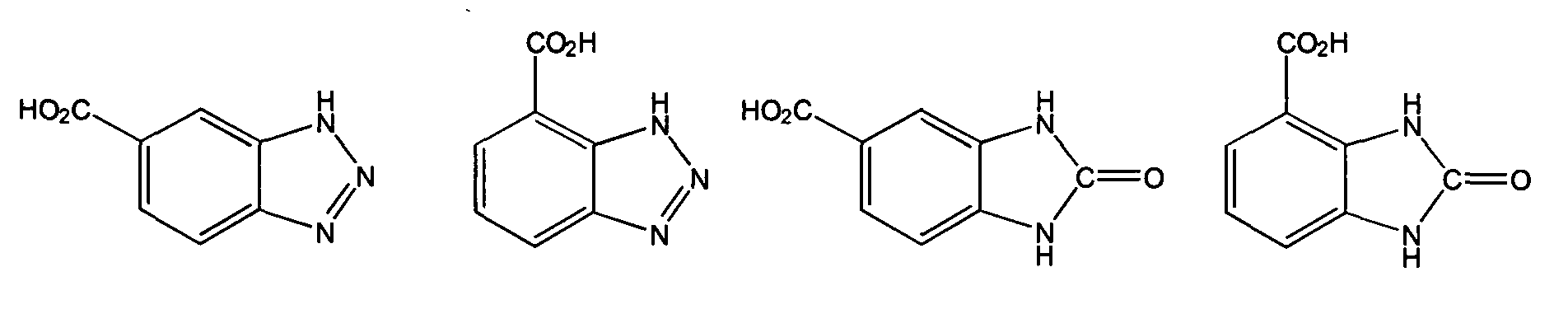 which comprises contacting an aqueous suspension of a hydroxymethyl precursor compound of the respective carboxylic acid with oxygen in the presence of a transition metal catalyst, to form the respective carboxylic acid.
- The method according to claim 7, wherein the aqueous suspension of a 5- or 6-hydroxymethyl quinoxaline has a pH value in the range from about 8 to about 14.
- The method according to claim 7, wherein the transition metal catalyst is selected from the group consisting of Pd, Pt, Ru, Co, Mn, Cu, and V.
- The method according to claim 9, wherein the transition metal catalyst is Pd/C or Pt/C.
- A method for preparing quinoxaline-5- or 6-carboxylic acid which comprises(1) contacting a 5- or 6-methyl quinoxaline with a halogenating agent in the presence of a radical initiator in a solvent selected from the group consisting of fluorobenzene, difluorobenzene, trifluorobenzene, chlorobenzene, dichlorobenzene, trichlorobenzene, α, α, α-trifluorotoluene and α, α, α-trichlorotoluene to form the respective 5- or 6-halomethyl quinoxaline,(2) contacting the 5- or 6-halomethyl quinoxaline with a hydroxyl-containing nucleophile to form the respective 5- or 6-hydroxymethyl quinoxaline, and(3) contacting an aqueous suspension of the 5- or 6-hydroxymethyl quinoxaline with oxygen in the presence of a transition metal catalyst, to form the respective quinoxaline-5- or 6-carboxylic acid.
Applications Claiming Priority (2)
| Application Number | Priority Date | Filing Date | Title |
|---|---|---|---|
| US925239 | 2001-08-09 | ||
| US09/925,239 US6559308B1 (en) | 2001-08-09 | 2001-08-09 | Method for preparing heterocyclic-carboxylic acids |
Publications (1)
| Publication Number | Publication Date |
|---|---|
| EP1283202A1 true EP1283202A1 (en) | 2003-02-12 |
Family
ID=25451432
Family Applications (1)
| Application Number | Title | Priority Date | Filing Date |
|---|---|---|---|
| EP02017635A Withdrawn EP1283202A1 (en) | 2001-08-09 | 2002-08-06 | Method for preparing heterocyclic-carboxylic acids |
Country Status (2)
| Country | Link |
|---|---|
| US (1) | US6559308B1 (en) |
| EP (1) | EP1283202A1 (en) |
Citations (3)
| Publication number | Priority date | Publication date | Assignee | Title |
|---|---|---|---|---|
| US3772273A (en) * | 1969-01-17 | 1973-11-13 | Allied Chem | Derivatives of quinoxaline |
| EP0257518A1 (en) * | 1986-08-21 | 1988-03-02 | BASF Aktiengesellschaft | Quinoline-8-carboxylic acid derivatives |
| DE4410418A1 (en) * | 1994-03-25 | 1995-09-28 | Bayer Ag | Prodn. of quinoline-carboxylic acid from methyl:quinoline |
Family Cites Families (2)
| Publication number | Priority date | Publication date | Assignee | Title |
|---|---|---|---|---|
| US3960963A (en) | 1973-11-19 | 1976-06-01 | Olin Corporation | Separation of 3,4-diaminotoluene from a mixture of o-toluenediamine isomers |
| US6303593B1 (en) * | 1999-03-02 | 2001-10-16 | Merck & Co., Inc. | 3-thienyl and 3-furanyl pyrrolidine modulators of chemokine receptor activity |
-
2001
- 2001-08-09 US US09/925,239 patent/US6559308B1/en not_active Expired - Fee Related
-
2002
- 2002-08-06 EP EP02017635A patent/EP1283202A1/en not_active Withdrawn
Patent Citations (3)
| Publication number | Priority date | Publication date | Assignee | Title |
|---|---|---|---|---|
| US3772273A (en) * | 1969-01-17 | 1973-11-13 | Allied Chem | Derivatives of quinoxaline |
| EP0257518A1 (en) * | 1986-08-21 | 1988-03-02 | BASF Aktiengesellschaft | Quinoline-8-carboxylic acid derivatives |
| DE4410418A1 (en) * | 1994-03-25 | 1995-09-28 | Bayer Ag | Prodn. of quinoline-carboxylic acid from methyl:quinoline |
Non-Patent Citations (2)
| Title |
|---|
| A.R.PRASAD AND M.SUBRAHMANYAM: "Vapor phase oxidation of 4-pyridine methanol to 4-pyridine carboxaldehyde", SYNTH.COMMUN, vol. 20, no. 21, - 1990, pages 3385 - 3390, XP001106942 * |
| RYU OI AND SHINJI TAKENAKA: "Selective Conversion of m-hydroxybenzyl Alcohol to m-Hydroxybezaldehyde", CHEMISTRY LETTTERS, - 1988, pages 1115 - 1116, XP001106256 * |
Also Published As
| Publication number | Publication date |
|---|---|
| US6559308B1 (en) | 2003-05-06 |
Similar Documents
| Publication | Publication Date | Title |
|---|---|---|
| CN112745270A (en) | Novel compound and method for preparing topramezone intermediate by using same | |
| US20020013500A1 (en) | Process for producing trifluoromethylbenzylamines | |
| US6573379B2 (en) | Method for preparing halomethyl heterocyclic compounds | |
| US6559308B1 (en) | Method for preparing heterocyclic-carboxylic acids | |
| US6562972B1 (en) | Method for preparing heterocyclic-carboxylic acids | |
| KR20010085955A (en) | Method for producing 5-amino-3-(thio)carbamoylpyrazoles | |
| Meng et al. | Benzimidazolium dichromate-A new reagent for selective oxidation under microwave irradiation | |
| US6750343B2 (en) | Methods for preparing 5- and 6-benzyl-functionalized quinoxalines | |
| JP2005510551A5 (en) | ||
| EP0863869B1 (en) | Method of preparing 2-trifluoromethoxybenzene sulphonamide | |
| KR100499679B1 (en) | Preparation method of 2-trifluoromethoxy-aniline | |
| RU2161605C2 (en) | Substituted quinolines as semiproducts for herbicide production and method of their synthesis | |
| US6787665B2 (en) | Production method of substituted benzenes | |
| Meschino et al. | Reaction of p-chlorobenzotrifluoride with methylsulfinyl carbanion | |
| JP2865715B2 (en) | Method for hydroxylating electrophilic aromatic compounds | |
| EP1333027B1 (en) | Production method of insecticidal and/or acaricidal ether compounds and intermediates thereof | |
| CN110483383B (en) | Preparation method of pyridine derivative | |
| JP2807064B2 (en) | Manufacturing method of dinitrile | |
| JP4841032B2 (en) | Process for producing 2-methoxy-4-nitrobenzaldehyde | |
| JPS63270640A (en) | 3,4,5-trifluorobenzoic acid derivative and method for producing the same | |
| JP2531228B2 (en) | Biphenyl derivative and method for producing the same | |
| JPS6136244A (en) | Production of 2,4,6-trifluorobenzoic acid | |
| CN121990927A (en) | Preparation method of iminoaryl compound and intermediate | |
| JP3350916B2 (en) | Method for producing monobromomethylquinolines | |
| CZ2008352A3 (en) | Process for preparing cycloalkanecarbonitrile |
Legal Events
| Date | Code | Title | Description |
|---|---|---|---|
| PUAI | Public reference made under article 153(3) epc to a published international application that has entered the european phase |
Free format text: ORIGINAL CODE: 0009012 |
|
| AK | Designated contracting states |
Designated state(s): AT BE BG CH CY CZ DE DK EE ES FI FR GB GR IE IT LI LU MC NL PT SE SK TR |
|
| AX | Request for extension of the european patent |
Extension state: AL LT LV MK RO SI |
|
| 17P | Request for examination filed |
Effective date: 20030225 |
|
| 17Q | First examination report despatched |
Effective date: 20030527 |
|
| AKX | Designation fees paid |
Designated state(s): AT BE BG CH CY CZ DE DK EE ES FI FR GB GR IE IT LI LU MC NL PT SE SK TR |
|
| GRAP | Despatch of communication of intention to grant a patent |
Free format text: ORIGINAL CODE: EPIDOSNIGR1 |
|
| STAA | Information on the status of an ep patent application or granted ep patent |
Free format text: STATUS: THE APPLICATION IS DEEMED TO BE WITHDRAWN |
|
| 18D | Application deemed to be withdrawn |
Effective date: 20040907 |