EP1283197A1 - Process for producing cinnamylaldehyde derivatives, use thereof and the like - Google Patents
Process for producing cinnamylaldehyde derivatives, use thereof and the like Download PDFInfo
- Publication number
- EP1283197A1 EP1283197A1 EP01922073A EP01922073A EP1283197A1 EP 1283197 A1 EP1283197 A1 EP 1283197A1 EP 01922073 A EP01922073 A EP 01922073A EP 01922073 A EP01922073 A EP 01922073A EP 1283197 A1 EP1283197 A1 EP 1283197A1
- Authority
- EP
- European Patent Office
- Prior art keywords
- derivative
- reaction
- cinnamaldehyde
- carbon atoms
- hydroxy
- Prior art date
- Legal status (The legal status is an assumption and is not a legal conclusion. Google has not performed a legal analysis and makes no representation as to the accuracy of the status listed.)
- Granted
Links
- KJPRLNWUNMBNBZ-QPJJXVBHSA-N (E)-cinnamaldehyde Chemical class O=C\C=C\C1=CC=CC=C1 KJPRLNWUNMBNBZ-QPJJXVBHSA-N 0.000 title claims abstract description 50
- 238000000034 method Methods 0.000 title claims abstract description 37
- 230000008569 process Effects 0.000 title claims abstract description 36
- 238000006243 chemical reaction Methods 0.000 claims abstract description 66
- IKHGUXGNUITLKF-UHFFFAOYSA-N Acetaldehyde Chemical compound CC=O IKHGUXGNUITLKF-UHFFFAOYSA-N 0.000 claims abstract description 36
- JVTZFYYHCGSXJV-UHFFFAOYSA-N isovanillin Chemical compound COC1=CC=C(C=O)C=C1O JVTZFYYHCGSXJV-UHFFFAOYSA-N 0.000 claims abstract description 22
- KJPRLNWUNMBNBZ-UHFFFAOYSA-N cinnamic aldehyde Natural products O=CC=CC1=CC=CC=C1 KJPRLNWUNMBNBZ-UHFFFAOYSA-N 0.000 claims abstract description 18
- 229940117916 cinnamic aldehyde Drugs 0.000 claims abstract description 18
- 235000010357 aspartame Nutrition 0.000 claims abstract description 17
- NBBJYMSMWIIQGU-UHFFFAOYSA-N Propionic aldehyde Chemical compound CCC=O NBBJYMSMWIIQGU-UHFFFAOYSA-N 0.000 claims abstract description 16
- 239000007864 aqueous solution Substances 0.000 claims abstract description 16
- 239000003513 alkali Substances 0.000 claims abstract description 14
- 150000003935 benzaldehydes Chemical class 0.000 claims abstract description 14
- 108010011485 Aspartame Proteins 0.000 claims abstract description 10
- 239000000605 aspartame Substances 0.000 claims abstract description 10
- IAOZJIPTCAWIRG-QWRGUYRKSA-N aspartame Chemical compound OC(=O)C[C@H](N)C(=O)N[C@H](C(=O)OC)CC1=CC=CC=C1 IAOZJIPTCAWIRG-QWRGUYRKSA-N 0.000 claims abstract description 10
- 229960003438 aspartame Drugs 0.000 claims abstract description 10
- 238000005932 reductive alkylation reaction Methods 0.000 claims abstract description 9
- 125000000956 methoxy group Chemical group [H]C([H])([H])O* 0.000 claims abstract description 7
- 239000003054 catalyst Substances 0.000 claims description 21
- 239000013078 crystal Substances 0.000 claims description 20
- 108010016626 Dipeptides Proteins 0.000 claims description 18
- -1 aspartyl Chemical group 0.000 claims description 18
- 125000004432 carbon atom Chemical group C* 0.000 claims description 18
- 150000002148 esters Chemical class 0.000 claims description 18
- 125000003545 alkoxy group Chemical group 0.000 claims description 9
- 125000000217 alkyl group Chemical group 0.000 claims description 9
- 125000004435 hydrogen atom Chemical group [H]* 0.000 claims description 9
- 239000001257 hydrogen Substances 0.000 claims description 8
- 229910052739 hydrogen Inorganic materials 0.000 claims description 8
- 238000005984 hydrogenation reaction Methods 0.000 claims description 8
- 238000002844 melting Methods 0.000 claims description 8
- 230000008018 melting Effects 0.000 claims description 8
- UFHFLCQGNIYNRP-UHFFFAOYSA-N Hydrogen Chemical compound [H][H] UFHFLCQGNIYNRP-UHFFFAOYSA-N 0.000 claims description 7
- 239000011203 carbon fibre reinforced carbon Substances 0.000 claims description 6
- 150000003839 salts Chemical group 0.000 claims description 5
- 238000000634 powder X-ray diffraction Methods 0.000 claims description 4
- 238000006722 reduction reaction Methods 0.000 claims description 4
- 150000001875 compounds Chemical class 0.000 abstract description 16
- 238000004519 manufacturing process Methods 0.000 abstract description 16
- 235000003599 food sweetener Nutrition 0.000 abstract description 12
- 239000003765 sweetening agent Substances 0.000 abstract description 12
- 125000001997 phenyl group Chemical group [H]C1=C([H])C([H])=C(*)C([H])=C1[H] 0.000 abstract description 8
- FGOJCPKOOGIRPA-UHFFFAOYSA-N 1-o-tert-butyl 4-o-ethyl 5-oxoazepane-1,4-dicarboxylate Chemical compound CCOC(=O)C1CCN(C(=O)OC(C)(C)C)CCC1=O FGOJCPKOOGIRPA-UHFFFAOYSA-N 0.000 abstract description 7
- 229960005190 phenylalanine Drugs 0.000 abstract description 7
- 125000001436 propyl group Chemical group [H]C([*])([H])C([H])([H])C([H])([H])[H] 0.000 abstract description 7
- ZTQSAGDEMFDKMZ-UHFFFAOYSA-N butyric aldehyde Natural products CCCC=O ZTQSAGDEMFDKMZ-UHFFFAOYSA-N 0.000 abstract description 4
- 230000002829 reductive effect Effects 0.000 abstract description 3
- OKKJLVBELUTLKV-UHFFFAOYSA-N Methanol Chemical compound OC OKKJLVBELUTLKV-UHFFFAOYSA-N 0.000 description 51
- 239000000243 solution Substances 0.000 description 19
- 239000000543 intermediate Substances 0.000 description 13
- 239000000203 mixture Substances 0.000 description 13
- HEMHJVSKTPXQMS-UHFFFAOYSA-M Sodium hydroxide Chemical compound [OH-].[Na+] HEMHJVSKTPXQMS-UHFFFAOYSA-M 0.000 description 12
- XLYOFNOQVPJJNP-UHFFFAOYSA-N water Substances O XLYOFNOQVPJJNP-UHFFFAOYSA-N 0.000 description 12
- 239000002904 solvent Substances 0.000 description 9
- 230000015572 biosynthetic process Effects 0.000 description 8
- 238000003786 synthesis reaction Methods 0.000 description 8
- LFQSCWFLJHTTHZ-UHFFFAOYSA-N Ethanol Chemical compound CCO LFQSCWFLJHTTHZ-UHFFFAOYSA-N 0.000 description 7
- 238000004128 high performance liquid chromatography Methods 0.000 description 7
- QYOYBHCGTRXATB-UHFFFAOYSA-N 3-(3-hydroxy-4-methoxyphenyl)propanal Chemical compound COC1=CC=C(CCC=O)C=C1O QYOYBHCGTRXATB-UHFFFAOYSA-N 0.000 description 6
- WEVYAHXRMPXWCK-UHFFFAOYSA-N Acetonitrile Chemical compound CC#N WEVYAHXRMPXWCK-UHFFFAOYSA-N 0.000 description 6
- OKTJSMMVPCPJKN-UHFFFAOYSA-N Carbon Chemical compound [C] OKTJSMMVPCPJKN-UHFFFAOYSA-N 0.000 description 4
- IAZDPXIOMUYVGZ-WFGJKAKNSA-N Dimethyl sulfoxide Chemical compound [2H]C([2H])([2H])S(=O)C([2H])([2H])[2H] IAZDPXIOMUYVGZ-WFGJKAKNSA-N 0.000 description 4
- VEXZGXHMUGYJMC-UHFFFAOYSA-N Hydrochloric acid Chemical compound Cl VEXZGXHMUGYJMC-UHFFFAOYSA-N 0.000 description 4
- 238000005575 aldol reaction Methods 0.000 description 4
- 239000012046 mixed solvent Substances 0.000 description 4
- 239000000047 product Substances 0.000 description 4
- 238000010517 secondary reaction Methods 0.000 description 4
- 239000007858 starting material Substances 0.000 description 4
- 239000000126 substance Substances 0.000 description 4
- QTBSBXVTEAMEQO-UHFFFAOYSA-N Acetic acid Chemical compound CC(O)=O QTBSBXVTEAMEQO-UHFFFAOYSA-N 0.000 description 3
- XEKOWRVHYACXOJ-UHFFFAOYSA-N Ethyl acetate Chemical compound CCOC(C)=O XEKOWRVHYACXOJ-UHFFFAOYSA-N 0.000 description 3
- ZMXDDKWLCZADIW-UHFFFAOYSA-N N,N-Dimethylformamide Chemical compound CN(C)C=O ZMXDDKWLCZADIW-UHFFFAOYSA-N 0.000 description 3
- KDLHZDBZIXYQEI-UHFFFAOYSA-N Palladium Chemical compound [Pd] KDLHZDBZIXYQEI-UHFFFAOYSA-N 0.000 description 3
- KWYUFKZDYYNOTN-UHFFFAOYSA-M Potassium hydroxide Chemical compound [OH-].[K+] KWYUFKZDYYNOTN-UHFFFAOYSA-M 0.000 description 3
- 238000001914 filtration Methods 0.000 description 3
- 239000003960 organic solvent Substances 0.000 description 3
- 230000000704 physical effect Effects 0.000 description 3
- 238000000746 purification Methods 0.000 description 3
- 230000035484 reaction time Effects 0.000 description 3
- 239000002002 slurry Substances 0.000 description 3
- 125000001424 substituent group Chemical group 0.000 description 3
- WYURNTSHIVDZCO-UHFFFAOYSA-N Tetrahydrofuran Chemical compound C1CCOC1 WYURNTSHIVDZCO-UHFFFAOYSA-N 0.000 description 2
- 150000001299 aldehydes Chemical class 0.000 description 2
- 229910000175 cerite Inorganic materials 0.000 description 2
- 238000002050 diffraction method Methods 0.000 description 2
- 239000000706 filtrate Substances 0.000 description 2
- 239000000463 material Substances 0.000 description 2
- BASFCYQUMIYNBI-UHFFFAOYSA-N platinum Chemical compound [Pt] BASFCYQUMIYNBI-UHFFFAOYSA-N 0.000 description 2
- 239000011541 reaction mixture Substances 0.000 description 2
- 238000006467 substitution reaction Methods 0.000 description 2
- 230000002194 synthesizing effect Effects 0.000 description 2
- WBYWAXJHAXSJNI-VOTSOKGWSA-M .beta-Phenylacrylic acid Natural products [O-]C(=O)\C=C\C1=CC=CC=C1 WBYWAXJHAXSJNI-VOTSOKGWSA-M 0.000 description 1
- 238000001644 13C nuclear magnetic resonance spectroscopy Methods 0.000 description 1
- 238000005160 1H NMR spectroscopy Methods 0.000 description 1
- LBRCSWZZLJVBKB-UHFFFAOYSA-N 3-(3-hydroxy-4-methoxyphenyl)prop-2-enal Chemical compound COC1=CC=C(C=CC=O)C=C1O LBRCSWZZLJVBKB-UHFFFAOYSA-N 0.000 description 1
- YZQCXOFQZKCETR-UWVGGRQHSA-N Asp-Phe Chemical compound OC(=O)C[C@H](N)C(=O)N[C@H](C(O)=O)CC1=CC=CC=C1 YZQCXOFQZKCETR-UWVGGRQHSA-N 0.000 description 1
- WBYWAXJHAXSJNI-SREVYHEPSA-N Cinnamic acid Chemical compound OC(=O)\C=C/C1=CC=CC=C1 WBYWAXJHAXSJNI-SREVYHEPSA-N 0.000 description 1
- 235000005979 Citrus limon Nutrition 0.000 description 1
- 244000131522 Citrus pyriformis Species 0.000 description 1
- YGYAWVDWMABLBF-UHFFFAOYSA-N Phosgene Chemical compound ClC(Cl)=O YGYAWVDWMABLBF-UHFFFAOYSA-N 0.000 description 1
- 150000001298 alcohols Chemical class 0.000 description 1
- 230000002152 alkylating effect Effects 0.000 description 1
- 150000001412 amines Chemical class 0.000 description 1
- FFBHFFJDDLITSX-UHFFFAOYSA-N benzyl N-[2-hydroxy-4-(3-oxomorpholin-4-yl)phenyl]carbamate Chemical compound OC1=C(NC(=O)OCC2=CC=CC=C2)C=CC(=C1)N1CCOCC1=O FFBHFFJDDLITSX-UHFFFAOYSA-N 0.000 description 1
- CREMABGTGYGIQB-UHFFFAOYSA-N carbon carbon Chemical compound C.C CREMABGTGYGIQB-UHFFFAOYSA-N 0.000 description 1
- 229920002678 cellulose Polymers 0.000 description 1
- 239000001913 cellulose Substances 0.000 description 1
- 238000004587 chromatography analysis Methods 0.000 description 1
- 229930016911 cinnamic acid Natural products 0.000 description 1
- 235000013985 cinnamic acid Nutrition 0.000 description 1
- 230000000052 comparative effect Effects 0.000 description 1
- 238000002425 crystallisation Methods 0.000 description 1
- 230000008025 crystallization Effects 0.000 description 1
- HPNMFZURTQLUMO-UHFFFAOYSA-N diethylamine Chemical compound CCNCC HPNMFZURTQLUMO-UHFFFAOYSA-N 0.000 description 1
- 238000004455 differential thermal analysis Methods 0.000 description 1
- 201000010099 disease Diseases 0.000 description 1
- 208000037265 diseases, disorders, signs and symptoms Diseases 0.000 description 1
- 239000003814 drug Substances 0.000 description 1
- 235000006694 eating habits Nutrition 0.000 description 1
- 230000000694 effects Effects 0.000 description 1
- 235000013305 food Nutrition 0.000 description 1
- 239000007789 gas Substances 0.000 description 1
- 230000008570 general process Effects 0.000 description 1
- IXCSERBJSXMMFS-UHFFFAOYSA-N hcl hcl Chemical compound Cl.Cl IXCSERBJSXMMFS-UHFFFAOYSA-N 0.000 description 1
- 125000002887 hydroxy group Chemical group [H]O* 0.000 description 1
- 229910000000 metal hydroxide Inorganic materials 0.000 description 1
- 150000004692 metal hydroxides Chemical class 0.000 description 1
- WBYWAXJHAXSJNI-UHFFFAOYSA-N methyl p-hydroxycinnamate Natural products OC(=O)C=CC1=CC=CC=C1 WBYWAXJHAXSJNI-UHFFFAOYSA-N 0.000 description 1
- 238000002156 mixing Methods 0.000 description 1
- 238000000655 nuclear magnetic resonance spectrum Methods 0.000 description 1
- 238000006053 organic reaction Methods 0.000 description 1
- PXXKQOPKNFECSZ-UHFFFAOYSA-N platinum rhodium Chemical compound [Rh].[Pt] PXXKQOPKNFECSZ-UHFFFAOYSA-N 0.000 description 1
- 239000002994 raw material Substances 0.000 description 1
- 230000036632 reaction speed Effects 0.000 description 1
- 230000009257 reactivity Effects 0.000 description 1
- 229910052703 rhodium Inorganic materials 0.000 description 1
- 239000010948 rhodium Substances 0.000 description 1
- MHOVAHRLVXNVSD-UHFFFAOYSA-N rhodium atom Chemical compound [Rh] MHOVAHRLVXNVSD-UHFFFAOYSA-N 0.000 description 1
- 238000000926 separation method Methods 0.000 description 1
- 238000003756 stirring Methods 0.000 description 1
- 235000019605 sweet taste sensations Nutrition 0.000 description 1
- YLQBMQCUIZJEEH-UHFFFAOYSA-N tetrahydrofuran Natural products C=1C=COC=1 YLQBMQCUIZJEEH-UHFFFAOYSA-N 0.000 description 1
- 238000002411 thermogravimetry Methods 0.000 description 1
- MWOOGOJBHIARFG-UHFFFAOYSA-N vanillin Chemical compound COC1=CC(C=O)=CC=C1O MWOOGOJBHIARFG-UHFFFAOYSA-N 0.000 description 1
- FGQOOHJZONJGDT-UHFFFAOYSA-N vanillin Natural products COC1=CC(O)=CC(C=O)=C1 FGQOOHJZONJGDT-UHFFFAOYSA-N 0.000 description 1
- 235000012141 vanillin Nutrition 0.000 description 1
Images

Classifications
-
- C—CHEMISTRY; METALLURGY
- C07—ORGANIC CHEMISTRY
- C07C—ACYCLIC OR CARBOCYCLIC COMPOUNDS
- C07C45/00—Preparation of compounds having >C = O groups bound only to carbon or hydrogen atoms; Preparation of chelates of such compounds
- C07C45/61—Preparation of compounds having >C = O groups bound only to carbon or hydrogen atoms; Preparation of chelates of such compounds by reactions not involving the formation of >C = O groups
- C07C45/62—Preparation of compounds having >C = O groups bound only to carbon or hydrogen atoms; Preparation of chelates of such compounds by reactions not involving the formation of >C = O groups by hydrogenation of carbon-to-carbon double or triple bonds
-
- C—CHEMISTRY; METALLURGY
- C07—ORGANIC CHEMISTRY
- C07C—ACYCLIC OR CARBOCYCLIC COMPOUNDS
- C07C45/00—Preparation of compounds having >C = O groups bound only to carbon or hydrogen atoms; Preparation of chelates of such compounds
- C07C45/61—Preparation of compounds having >C = O groups bound only to carbon or hydrogen atoms; Preparation of chelates of such compounds by reactions not involving the formation of >C = O groups
- C07C45/67—Preparation of compounds having >C = O groups bound only to carbon or hydrogen atoms; Preparation of chelates of such compounds by reactions not involving the formation of >C = O groups by isomerisation; by change of size of the carbon skeleton
- C07C45/68—Preparation of compounds having >C = O groups bound only to carbon or hydrogen atoms; Preparation of chelates of such compounds by reactions not involving the formation of >C = O groups by isomerisation; by change of size of the carbon skeleton by increase in the number of carbon atoms
- C07C45/72—Preparation of compounds having >C = O groups bound only to carbon or hydrogen atoms; Preparation of chelates of such compounds by reactions not involving the formation of >C = O groups by isomerisation; by change of size of the carbon skeleton by increase in the number of carbon atoms by reaction of compounds containing >C = O groups with the same or other compounds containing >C = O groups
- C07C45/73—Preparation of compounds having >C = O groups bound only to carbon or hydrogen atoms; Preparation of chelates of such compounds by reactions not involving the formation of >C = O groups by isomerisation; by change of size of the carbon skeleton by increase in the number of carbon atoms by reaction of compounds containing >C = O groups with the same or other compounds containing >C = O groups combined with hydrogenation
-
- C—CHEMISTRY; METALLURGY
- C07—ORGANIC CHEMISTRY
- C07C—ACYCLIC OR CARBOCYCLIC COMPOUNDS
- C07C45/00—Preparation of compounds having >C = O groups bound only to carbon or hydrogen atoms; Preparation of chelates of such compounds
- C07C45/61—Preparation of compounds having >C = O groups bound only to carbon or hydrogen atoms; Preparation of chelates of such compounds by reactions not involving the formation of >C = O groups
- C07C45/67—Preparation of compounds having >C = O groups bound only to carbon or hydrogen atoms; Preparation of chelates of such compounds by reactions not involving the formation of >C = O groups by isomerisation; by change of size of the carbon skeleton
- C07C45/68—Preparation of compounds having >C = O groups bound only to carbon or hydrogen atoms; Preparation of chelates of such compounds by reactions not involving the formation of >C = O groups by isomerisation; by change of size of the carbon skeleton by increase in the number of carbon atoms
- C07C45/72—Preparation of compounds having >C = O groups bound only to carbon or hydrogen atoms; Preparation of chelates of such compounds by reactions not involving the formation of >C = O groups by isomerisation; by change of size of the carbon skeleton by increase in the number of carbon atoms by reaction of compounds containing >C = O groups with the same or other compounds containing >C = O groups
- C07C45/74—Preparation of compounds having >C = O groups bound only to carbon or hydrogen atoms; Preparation of chelates of such compounds by reactions not involving the formation of >C = O groups by isomerisation; by change of size of the carbon skeleton by increase in the number of carbon atoms by reaction of compounds containing >C = O groups with the same or other compounds containing >C = O groups combined with dehydration
-
- C—CHEMISTRY; METALLURGY
- C07—ORGANIC CHEMISTRY
- C07C—ACYCLIC OR CARBOCYCLIC COMPOUNDS
- C07C47/00—Compounds having —CHO groups
- C07C47/20—Unsaturated compounds having —CHO groups bound to acyclic carbon atoms
- C07C47/277—Unsaturated compounds having —CHO groups bound to acyclic carbon atoms containing ether groups, groups, groups, or groups
-
- C—CHEMISTRY; METALLURGY
- C07—ORGANIC CHEMISTRY
- C07K—PEPTIDES
- C07K5/00—Peptides containing up to four amino acids in a fully defined sequence; Derivatives thereof
- C07K5/04—Peptides containing up to four amino acids in a fully defined sequence; Derivatives thereof containing only normal peptide links
- C07K5/06—Dipeptides
- C07K5/06104—Dipeptides with the first amino acid being acidic
- C07K5/06113—Asp- or Asn-amino acid
Definitions
- the present invention relates to a novel process for producing cinnamaldehyde derivatives, which are useful as various intermediates for production of foods, medicaments and the like, in particular, as an intermediate for production of aspartyl dipeptide ester derivatives, which are superior as a sweetener (sweetening agent) having a high sweetening potency (degree of sweetness), and a use thereof as the intermediates and the like.
- sweetener sweetening agent having a high sweetening potency (degree of sweetness)
- degree of sweetness degree of sweetness
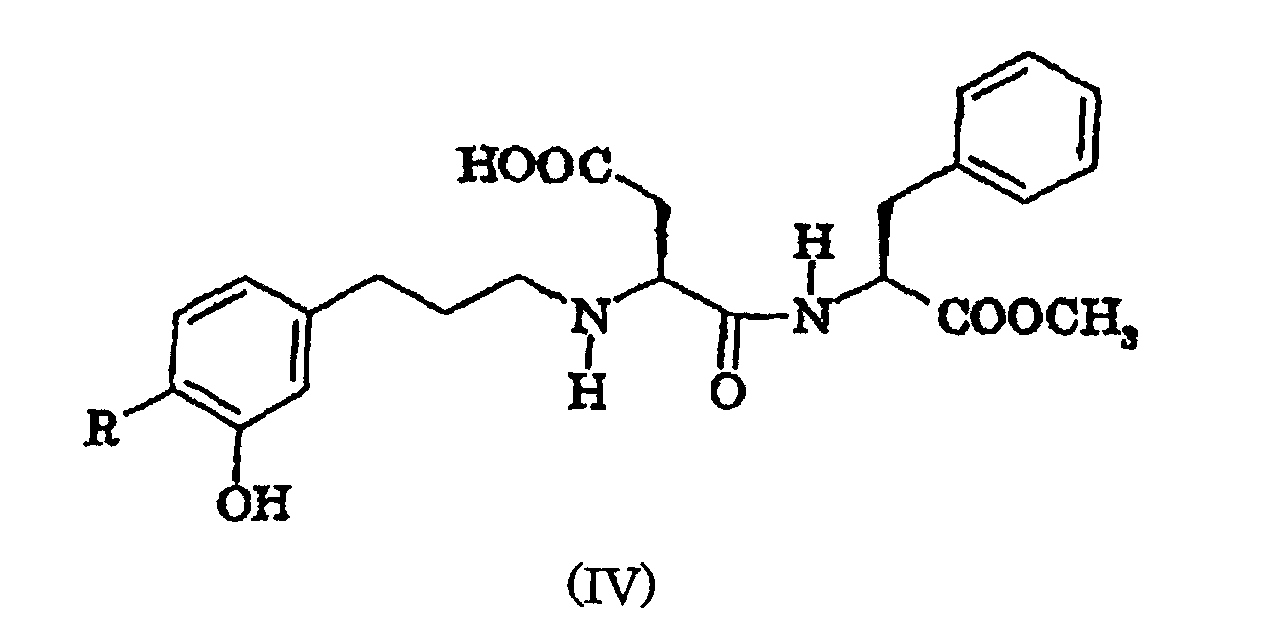
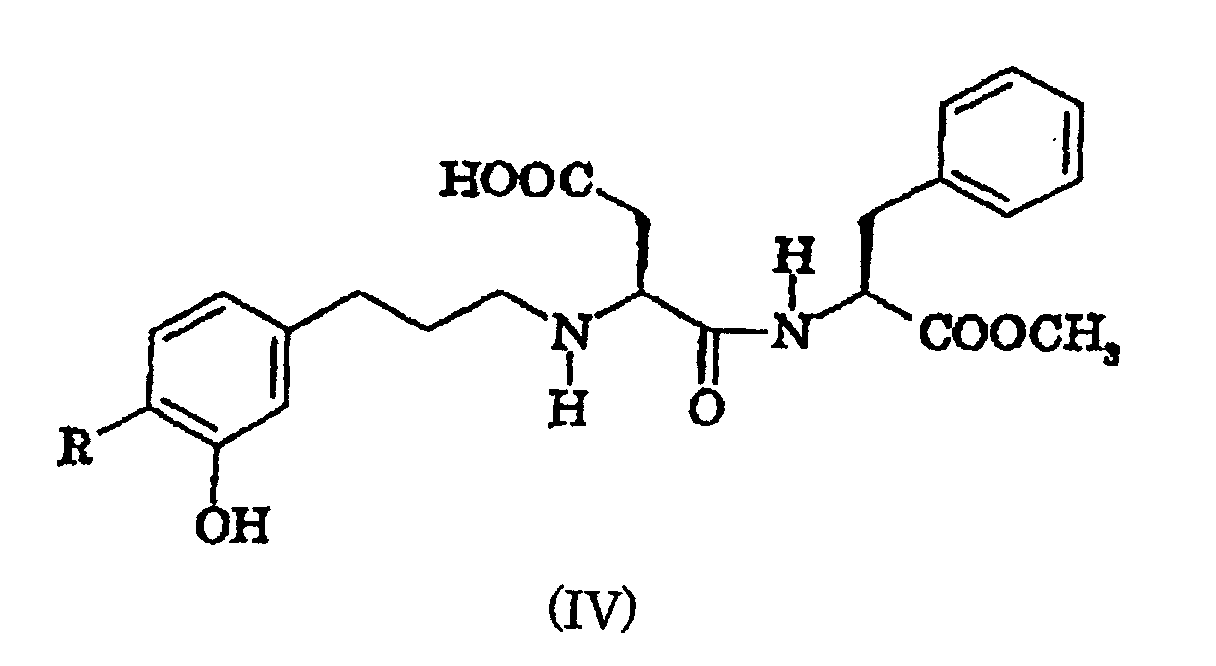
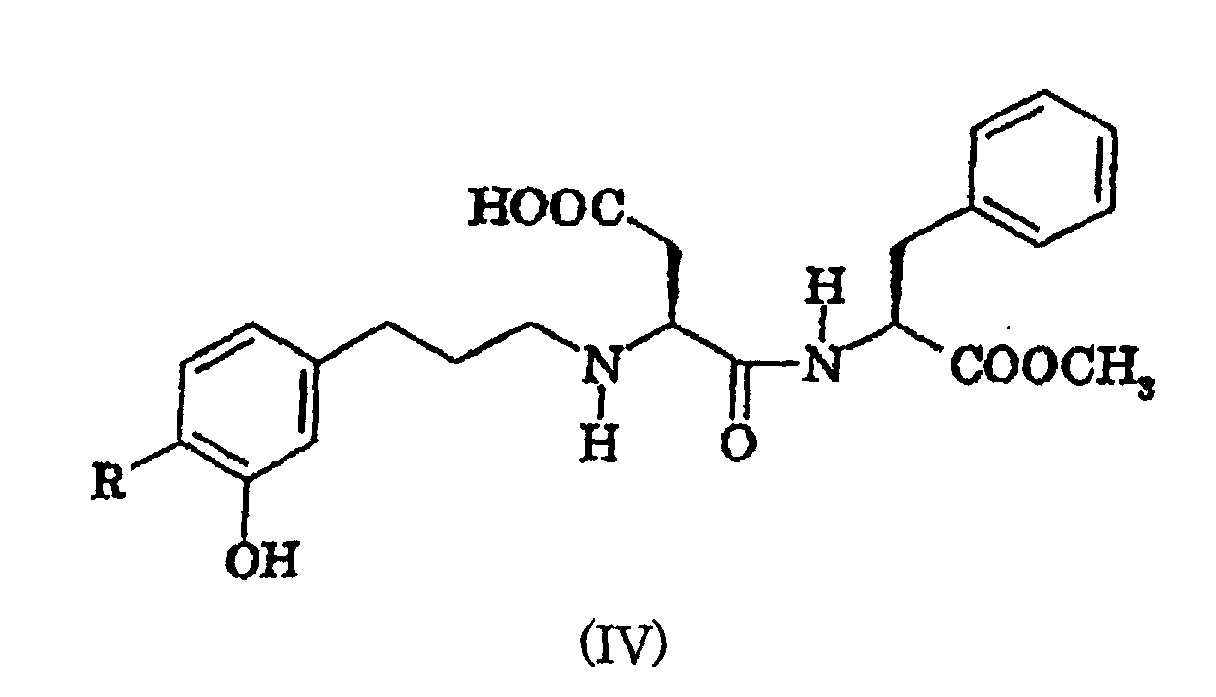
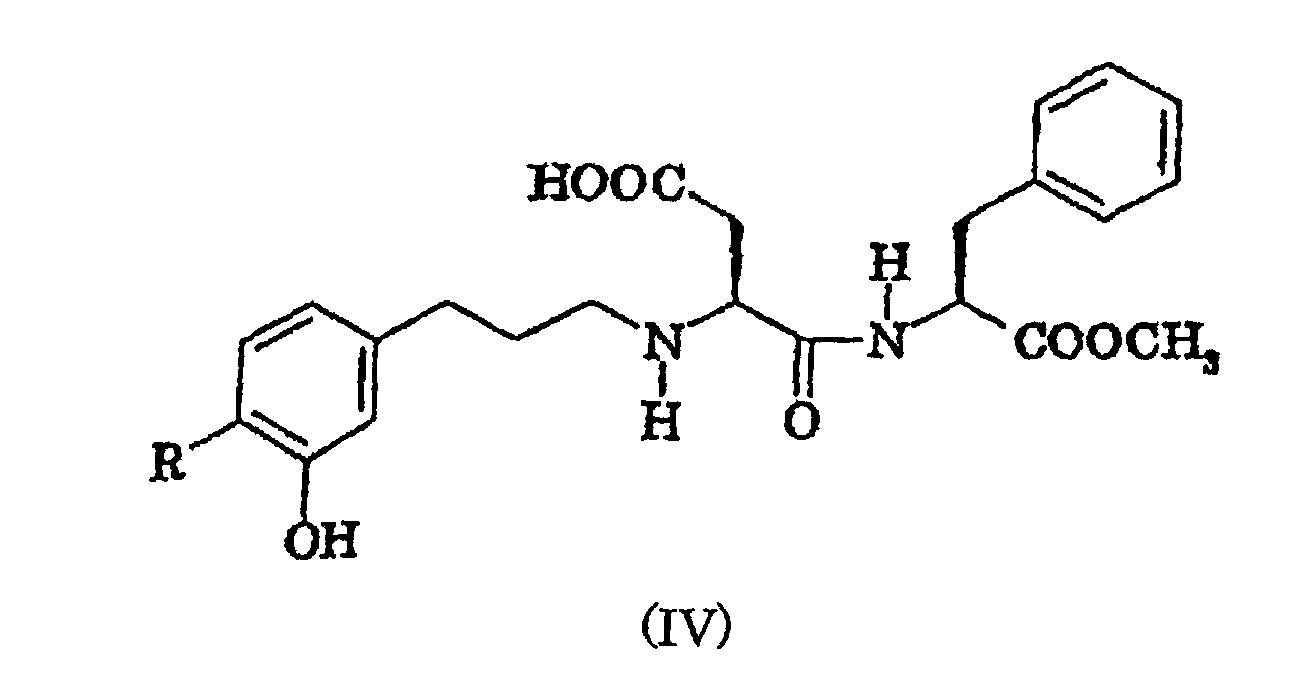
- an aspartyl dipeptide ester derivative represented by the following general formula (IV) has been found as a sweetener, which is excellent in stability and is better by far in sweetening potency, i.e., has an advantage in cost per sweet taste, by a part of the present inventors and the like (See Description in the International Patent Publication WO99/52937.)
- R denotes any one of a hydrogen atom, a lower alkyl group having 1 to 4 carbon atoms and a lower alkoxy group having 1 to 4 carbon atoms.
- R denotes any one of a hydrogen atom, a lower alkyl group having 1 to 4 carbon atoms and a lower alkoxy group having 1 to 4 carbon atoms.
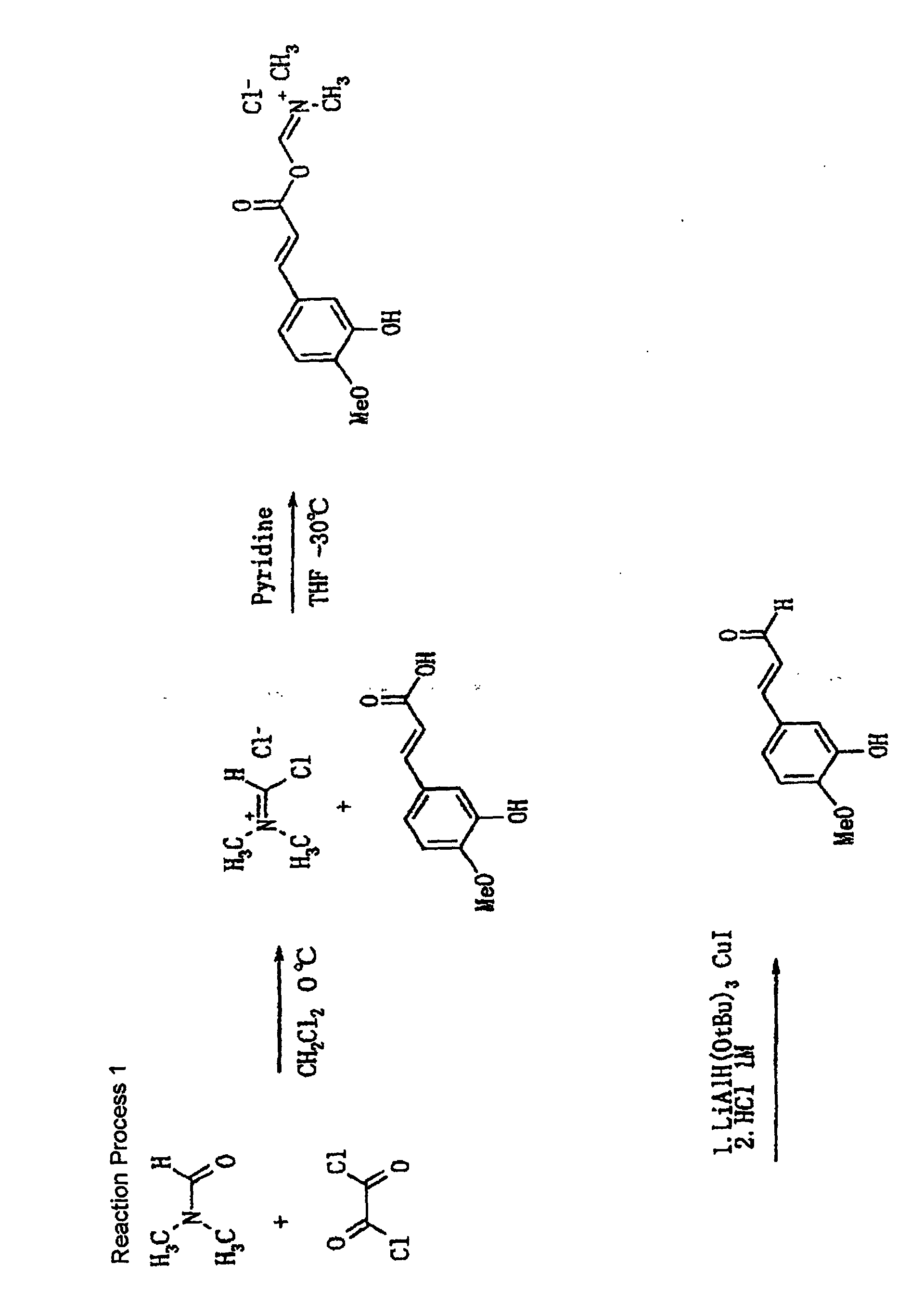
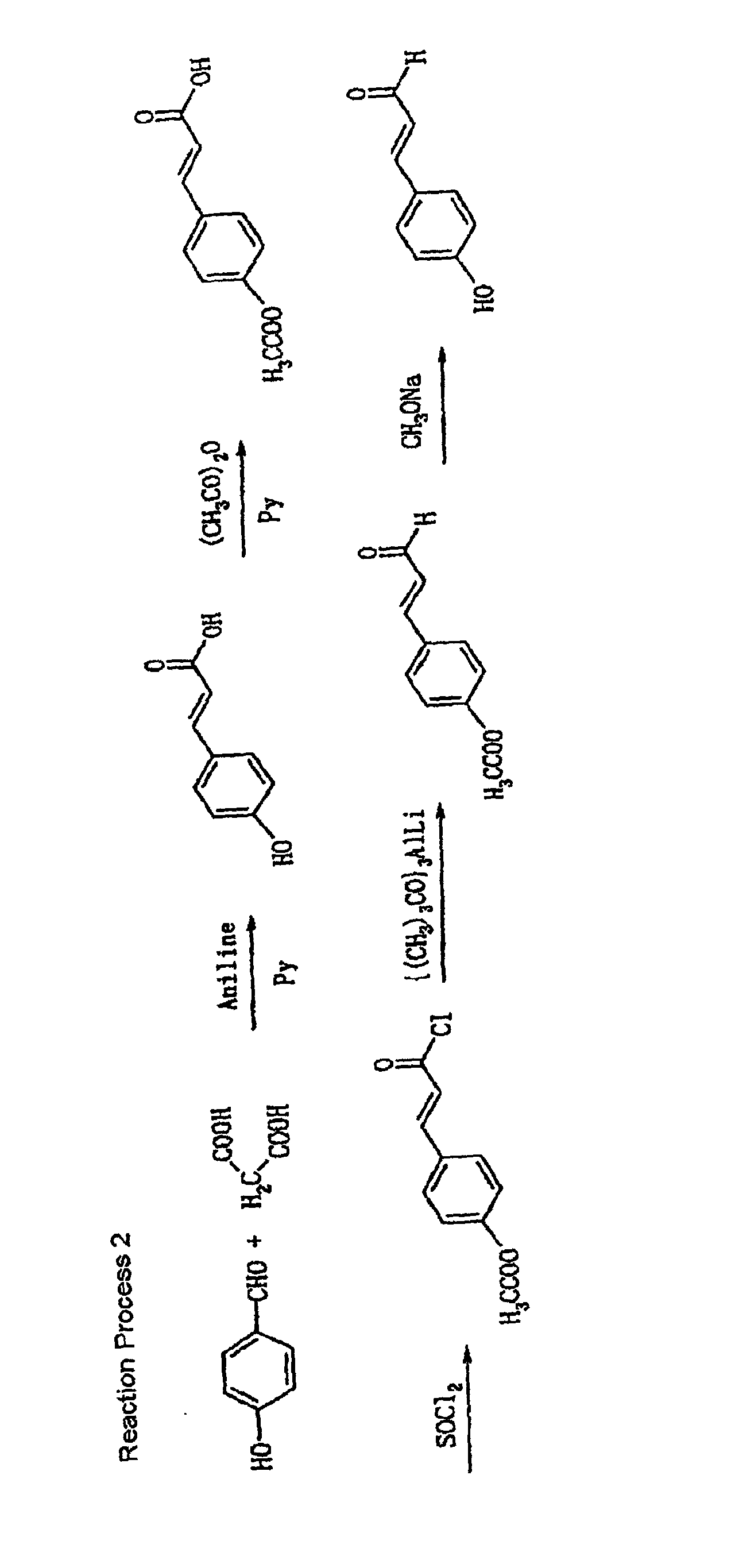
- Reaction Process 2 See Cellulose Chem. Technol., 9, 51-59 1975.
- Reaction Process 2 See Cellulose Chem. Technol., 9, 51-59 1975.
- benzaldehydes are used as a starting material similar to the present invention, and however, because 5 steps of many reactions are necessary, this process is troublesome, and therefore it is difficult to say that this process is an industrially profitable process.
- an aldol reaction is known as a reaction which can be used for a general process of production thereof.
- a reaction which can be used for a general process of production thereof.
- JOHN WILEY & SONS INC., 1968 it is explained that a best result is obtained in the reaction at a temperature of 5 to 25 °C and for a time of 12 to 24 hours.
- the more concrete problem to be solved by the present invention is to provide a process for producing the cinnamaldehyde derivative described above industrially and conventionally, and further in a high purity and at a high yield.
- the cinnamaldehyde derivative obtained in the present invention is a high purity product, and for example, (2E)-(3-hydroxy-4-methoxy)cinnamaldehyde has a melting point of 149 to 152 °C, and the melting point thereof is very different from that (123 to 125 °C) of a compound described in the wellknown literature described above corresponding to such above compound in the present invention, and therefore it is presumed that a purity or a crystal type of the product in the present invention is different from that in the literature.
- R denotes any one of a hydrogen atom, a lower alkyl group having 1 to 4 carbon atoms and a lower alkoxy group having 1 to 4 carbon atoms.
- a cinnamaldehyde derivative as an objective represented by the following general formula (II) can be synthesized at an extremely high yield (not less than 50 %), and a secondary reaction can be minimally suppressed.
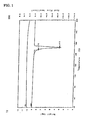
- Figure 1 is a figure showing a result of Differential Scanning Caloriemetry on a crystal of (2E)-(3-hydroxy-4-methoxy)cinnamaldehyde.
- Figure 2 is a figure of a powder X-ray diffractometry (diffraction method) on a crystal of (2E)-(3-hydroxy-4-methoxy)cinnamaldehyde.
- an aldol reaction in the first stage is conducted in the presence of an alkali. It can be conducted by using a solvent, and as for the solvent used in this case, there is no particular limitations thereto, as far as a material inactive to a ground substance for reaction, a catalyst and a product may be used therefor.
- a solvent for the solvent used in this case, there is no particular limitations thereto, as far as a material inactive to a ground substance for reaction, a catalyst and a product may be used therefor.
- water, alcohols, such as methanol and the like, a mixed solvent of alcohol(s) with water, and the like are used, and water is most preferably used.
- alkali used in the present invention there is no particular limitations thereto.
- An inorganic alkali substance and an organic alkali substance can be used therefor.
- a metal hydroxide such as sodium hydroxide, potassium hydroxide and the like
- amines such as diethylamine and the like can be conventionally used therefor.
- an amount used of the alkali employed in the present invention there is no particular limitations thereto.
- the reaction can be conducted in a shorter time to completion.
- the economical point of view preferably not more than 20 molar equivalents, and more preferably 5 to 15 molar equivalents or so, of the alkali to the benzaldehyde derivative, for example, isovanillin may be employed.
- an amount used of the acetaldehyde to the benzaldehyde derivative for example isovanillin, there is no particular limitations thereto, and preferably not less than 1 molar equivalent, and more preferably 1.5 to 3 molar equivalents or so of the acetaldehyde thereto can be employed therefor.
- the reaction is preferably conducted at a low temperature.
- a low temperature Preferably at -20 to 5 °C or so, more preferably at -20 to 3 °C or so, further preferably at -20 to 0 °C or so and in particular preferably at -15 to -5 °C or so, the reaction is conducted, and also, the reaction is preferably conducted in a water to promote much more the reaction. Outside this temperature range, the higher the reaction temperature is, the more the secondary reaction proceeds, and on the other hand, the lower the reaction temperature is, the more the reaction speed becomes extremely slow, and therefore these any cases are not preferable.
- the reaction is conducted at the low temperature as described above, and additionally, acetaldehyde is dropped preferably over (during) a long period of time.
- the time for dropping the acetaldehyde in such case, preferably not less than 12 hours, more preferably 12 to 96 hours or so, and further preferably 24 to 72 hours or so may be selected. Outside this range of time, the shorter the reaction time is, the more the secondary reaction proceeds, and even if the reaction is conducted for a further long time, the yield does not improve, and therefore, these any cases are not preferable.
- any one of the free form and the salt form thereof are contained, and according to the following reaction or the like, the form thereof can be selected.
- (3-Hydroxy-4-methoxy)cinnamaldehyde produced in the above described manner has a particularly high purity, and is preferably used for an intermediate.
- the purity thereof is extremely high. It has a purity of, preferably not less than 95 % by weight, and more preferably not less than 97 % by weight.
- a melting point thereof is preferably at lowest 140 °C, and more preferably not less than 145 °C, and therefore it is clear that the melting point thereof is very different from that of the compound corresponding thereto, which is shown in the prior literature described above. Accordingly, it is thought that a purity or a crystal type of such above compound in the present invention is different from that in the literature.
- the cinnamaldehyde derivative (II) described above may be subjected to a reaction for reducing only carbon-carbon double bond in the derivative selectively by reacting hydrogen therewith in the presence of a catalyst.
- R denotes any one of a hydrogen atom, a lower alkyl group having 1 to 4 carbon atoms and a lower alkoxy group having 1 to 4 carbon atoms.
- the reaction can be conducted in the presence of a solvent.
- a solvent employed in this case, there is no particular limitations thereto, as far as a material inactive to a ground substance for reaction, a catalyst and a product may be employed therefor, and a homogeneous organic solvent (a singular solvent consisting of one kind of solvent or a mixed solvent consisting of plural solvents) or a mixed solvent of such organic solvent(s) with water can be cited therefor.
- a homogeneous organic solvent a singular solvent consisting of one kind of solvent or a mixed solvent consisting of plural solvents
- a mixed solvent of such organic solvent(s) with water can be cited therefor.
- the organic solvent(s) for example, methanol, ethanol, tetrahydrofuran, acetonitrile, dimethylformamide and the like can be cited.
- a lower alcohol such as methanol and the like, can be cited therefor. In particular, methanol is preferably used.
- a catalyst for hydrogenation may be used, and a reduction catalyst, which is typically used as a general catalyst for hydrogenation, such as, preferably palladium-, platinum- and rhodium-based catalysts, and the like can be cited as a preferable example.
- a reduction catalyst which is typically used as a general catalyst for hydrogenation, such as, preferably palladium-, platinum- and rhodium-based catalysts, and the like can be cited as a preferable example.
- a hydrogen pressure preferably 0.01 to 1.0 MPa or so, and more preferably 0.01 to 0.1 MPa or so can be selected.
- a condition suitable for a hydrogenation reaction can be selected.
- a reaction temperature in a range of preferably 25 to 50 °C or so, and more preferably 30 to 40 °C or so, and a reaction time in a range of preferably 2 to 96 hours or so, and more preferably 5 to 48 hours or so can be suitably selected respectively.
- a ratio of the cinnamaldehyde derivative used as the starting material for this reaction to the catalyst may be varied with a kind of the catalyst used, for example a range of 0.1 to 30 % by weight or so, preferably 0.1 to 2 % by weight or so, and more preferably 0.2 to 1 % by weight or so of the cinnamaldehyde derivative to the catalyst can be selected for the reaction.
- a suitable solvent is used for the reductive alkylation reaction, and by conducting the reductive alkylation reaction thereof with hydrogen in the solvent, for example acetonitrile, acetic acid, ethyl acetate, alcohol, alcohol containing water and the like, in the presence of a catalyst used for a reductive alkylation reaction, for example a catalyst for hydrogenation, such as palladium-, platinum-, rhodium-based catalyst and the like, and more preferably under a suitable or effective reaction temperature (for example, 15 to 50 °C or so) and pressure (for example, 0.1 to 1.0 MPa or so), the object compound described above can be produced.
- a catalyst used for a reductive alkylation reaction for example a catalyst for hydrogenation, such as palladium-, platinum-, rhodium-based catalyst and the like, and more preferably under a suitable or effective reaction temperature (for example, 15 to 50 °C or so) and pressure (for example, 0.1 to 1.0 MPa or so
- R denotes any one of a hydrogen atom, a lower alkyl group having 1 to 4 carbon atoms and a lower alkoxy group having 1 to 4 carbon atoms.
- the cinnamaldehyde derivative (II) described above may be used in place of the propionaldehyde derivative (III) described above as the starting material, similar to the above, the aspartyl dipeptide ester derivative descrived above can be produced.
- the aspartyl dipeptide ester derivative thus obtained can be also obtained in the salt form through a salt-formation process or the like, if necessary.
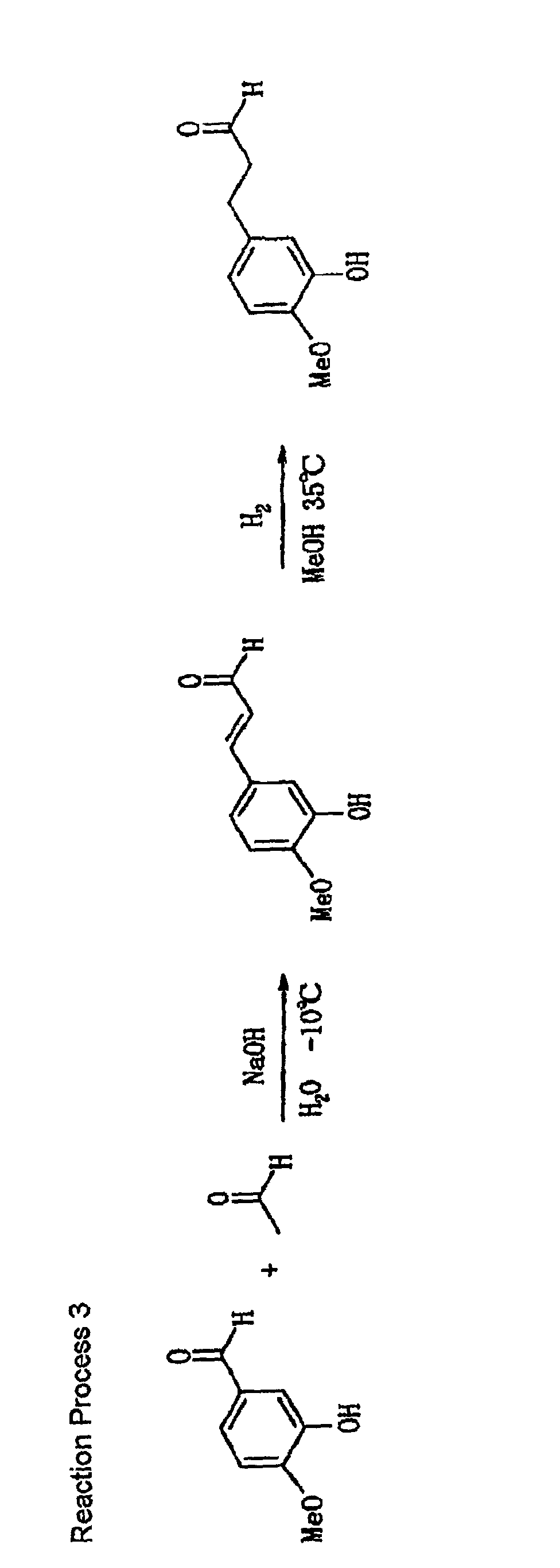
- Isovanillin (121.72 g, 0.8 mol) and sodium hydroxide (320 g, 8 mol) were dissolved in a water (2000 ml) at 30 °C, and thereafter the mixture was cooled until to -10 °C.
- a 28 wt% of acetaldehyde aqueous solution (290 g, 1.84 mol) was continuously dropped to this alkali solution for 45 hours.
- HPLC high performance liquid chromatography
- reaction solution was stirred for 1 hour, and thereafter, by adding a 36 wt% of hydrochloric acid (HCl) aqueous solution (768.1 g, 7.78 mol) thereto, the reaction was stopped.
- the reaction solution thus obtained was filtered to obtain crystals (324 g).
- the crystals thus obtained were dispersed in a water (500 ml) at 25 °C, and thereafter was dissolved therein by adding a 25 wt% of sodium hydroxide aqueous solution (97.5 g) thereto.
- Activated carbon (4 g) and cerite (16 g) were added to the solution thus obtained, and the mixture was stirred for 1 hour, and thereafter the activated carbon and cerite added were filtered for separation.
- the aqueous solution obtained was neutralized by adding a 36 % of hydrochloric acid aqueous solution (55.4 g) thereto.
- the crystals obtained (185.5 g) were dried under reduced pressure.
- the dried crystals were dispersed in a methanol (275 ml) at 60 °C, and the mixture was stirred for 2 hours. And thereafter the mixture was cooled until to a room temperature, and a slurry thus obtained was filtered.
- the wet crystals thus obtained (96g) were dried to obtain (2E)-(3-hydroxy-4-methoxy)cinnamaldehyde (83.2 g, yield: 57 %, purity: 98 %).
- Temperature range for determination 50 to 200 °C, heating-up speed: 5 °C/min., melting point: 147 °C (See Figure 1.).
- a crystal of (2E)-(3-hydroxy-4-methoxy)cinnamaldehyde having a purity of at least 95 % by weight and a melting point of at lowest 145 °C is also contained.
- a 3-(3-hydroxy-4-methoxyphenyl)propionaldehyde (1.50 g, 0.00832mol) /methanol solution (8.15 g) and aspartame (2.57 g, 0.00874 mol) were added to a mixed solvent (86 ml) of methanol with water (mixing ratio: 4:1 v/v), and 10 % palladium on carbon (containing 50 % water) (0.77 g) were added to this mixture. And thereafter, the mixture was stirred for reaction under a hydrogen atmosphere of ordinary pressure (0.1 MPa) at 35 °C for 48 hours. After the reaction was finished, the catalyst was removed therefrom by filtering, and further washed with methanol (20 ml).
- a reaction was all conducted in the same reaction condition as that in Example 1 except that the time for dropping the acetaldehyde aqueous solution continuously to the alkali solution was 2 hours without changing any other reaction condition in Example 1.
- the object compound in the reaction solution was determined quantitatively by a HPLC to give an yield of 38 %.
- a reaction was all conducted in the same reaction condition as that in Example 1 except that the reaction was conducted at a temperature of 5 °C without changing any other reaction condition in Example 1.
- the object compound in the reaction solution was determined quantitatively by a HPLC to give an yield of 64 %. Further, a purity of the crystals obtained was 90 %.
- Example 1 was repeated except that vanillin in the same amount (121.72 g, 0.8 mol) to that of the isovanillin was used in place of the isovanillin without changing any other reaction condition in Example 1.
- the desired reaction proceeded hardly.
- An yield of the title compound produced in the reaction mixture was less than 1% (by weight).
- Isovanillin (121.72 g, 0.8 mol) and sodium hydroxide (320 g, 8 mol) were dissolved in a water (2000 ml) at 30 °C, and thereafter the mixture was cooled until to -10 °C.
- a 28 wt% of acetaldehyde aqueous solution (290 g, 1.84 mol) were continuously dropped to this alkali solution for 45 hours.
- reaction solution was stirred for 1 hour, and thereafter, by adding a 36 wt% of hydrochloric acid aqueous solution (768.1 g, 7.78 mol) to this solution, the reaction was stopped.
- the reaction solution thus obtained was filtered to obtain crystals (324 g).
- the crystals thus obtained were dispersed in methanol (340 ml), and a slurry thus obtained was filtered.
- the wet crystals obtained (214 g) were dispersed in methanol (335 ml) at 60 °C, and the mixture was stirred for 2 hours. And thereafter the mixture was cooled until to a room temperature, and a slurry thus obtained was filtered.
- Aspartame (24.75 g, 0.0841 mol) and 10 % platinum on carbon (containing 53 % water) (1.98 g) were dispersed in methanol (290 ml) under a hydrogen atmosphere of ordinary pressure (0.1 MPa), and a reaction was conducted by dropping a 3-(3-hydroxy-4-methoxyphenyl)propionaldehyde (14.4 g, 0.08 mol) /methanol solution (112.5 g) to this mixture at 25 °C for 6 hours while stirring. After the reaction was finished, the catalyst was removed by filtering, and further washed with a 50 % of methanol aqueous solution (20 ml).
- the cinnamaldehyde derivative (II), for example (2E)-(3-hydroxy-4-methoxy)cinnamaldehyde can be industrially and conventionally produced from the benzaldehyde derivative (I), for example isovanillin, and further, it can be produced at a high yield and at a high purity.
- the cinnamaldehyde derivative thus obtained is used, and a reaction for reducing a carbon-carbon double bond in the derivative selectively can be conducted to produce 3-(3-hydroxy-4-substituted (with methoxy group or the like)phenyl)propionaldehyde.
- an aspartyl dipeptide ester derivative which is useful as a sweetener having a high sweetening potency, for example N-[N-[3-(3-hydroxy-4-methoxyphenyl)propyl]-L- ⁇ -aspartyl]-L-phenylalanine 1-methyl ester can be industrially and efficiently produced.
- the cinnamaldehyde derivative described above, which is obtained in the present invention is extremely useful as an intermediate for production of the aspartyl dipeptide ester derivative, which is useful as a sweetener having a high sweetening potency, described above, or is extremely useful also in production of an important intermediate for the aspartyl dipeptide ester derivative described above, for example 3-(3-hydroxy-4-substituted (with methoxy group or the like) phenyl) propionaldehyde.
- (2E)-(3-hydroxy-4-methoxy)cinnamaldehyde in the high purity crystalline form, particularly expected as an intermediate for production thereof described above is also provided.
Landscapes
- Chemical & Material Sciences (AREA)
- Organic Chemistry (AREA)
- Chemical Kinetics & Catalysis (AREA)
- Medicinal Chemistry (AREA)
- Biochemistry (AREA)
- Biophysics (AREA)
- General Health & Medical Sciences (AREA)
- Genetics & Genomics (AREA)
- Life Sciences & Earth Sciences (AREA)
- Molecular Biology (AREA)
- Proteomics, Peptides & Aminoacids (AREA)
- Health & Medical Sciences (AREA)
- Organic Low-Molecular-Weight Compounds And Preparation Thereof (AREA)
- Peptides Or Proteins (AREA)
- Low-Molecular Organic Synthesis Reactions Using Catalysts (AREA)
- Seasonings (AREA)
Abstract
Description



Claims (12)
- A process for producing a cinnamaldehyde derivative represented by the following general formula (II), which comprises reacting a benzaldehyde derivative represented by the following general formula (I) with acetaldehyde in the presence of an alkali. Said cinnamaldehyde derivative may be in the salt form.
 In the above formulae (I) and (II), R denotes any one of a hydrogen atom, a lower alkyl group having 1 to 4 carbon atoms and a lower alkoxy group having 1 to 4 carbon atoms.
- The process as defined in claim 1, wherein a reaction is conducted in an aqueous solution at a range of 0 to -20 °C.
- The process as defined in claim 1 or 2, which comprises, in said reaction, a step for adding acetaldehyde to said benzaldehyde derivative in an aqueous solution over a period of 12 to 96 hours.
- The process as defined in claim 1, which comprises, in said reaction, a step for adding acetaldehyde to said benzaldehyde derivative in an aqueous solution at 0 to -20 °C over a period of 12 to 96 hours.
- The process as defined in claim 1, wherein R is a methoxy group.
- The process as defined in claim 1, wherein said cinnamaldehyde derivative is (2E)-(3-hydroxy-4-methoxy)cinnamaldehyde; which comprises, in said reaction, a step for adding acetaldehyde to isovanillin in an aqueous solution at 0 to -20 °C over a period of 12 to 96 hours; and wherein said cinnamaldehyde derivative in the crystalline form having a melting point of at lowest 140 °C is produced.
- A process for producing a propionaldehyde derivative represented by the following general formula (III), which comprises, after obtaining a cinnamaldehyde derivative (II) in the process as defined in any one claim of claims 1 to 6, subjecting said cinnamaldehyde derivative (II) to a reaction for reducing a carbon-carbon double bond selectively with hydrogen in the presence of a reduction catalyst.In the above formula (III), R denotes any one of a hydrogen atom, a lower alkyl group having 1 to 4 carbon atoms and a lower alkoxy group having 1 to 4 carbon atoms.

- The process as defined in claim 7, wherein said reaction for reducing a carbon-carbon double bond selectively is a hydrogenation reaction in the presence of a catalyst for hydrogenation.
- A process for producing an aspartyl dipeptide ester derivative represented by the following general formula (IV), which comprises, after obtaining a propionaldehyde derivative (III) in the process as defined in claim 7, subjecting said propionaldehyde derivative and an aspartame to a reductive alkylation reaction. Said aspartyl dipeptide ester derivative may be in the salt form.In the above formula (IV), R denotes any one of a hydrogen atom, a lower alkyl group having 1 to 4 carbon atoms and a lower alkoxy group having 1 to 4 carbon atoms.
- A process for producing an aspartyl dipeptide ester derivative represented by the following general formula (IV), which comprises, after obtaining a cinnamaldehyde derivative (II) in the process as defined in any one claim of claims 1 to 6, subjecting said cinnamaldehyde derivative and an aspartame to a reductive alkylation reaction. Said aspartyl dipeptide ester derivative may be in the salt form.In the above formula (IV), R denotes any one of a hydrogen atom, a lower alkyl group having 1 to 4 carbon atoms and a lower alkoxy group having 1 to 4 carbon atoms.
- A crystal of (2E)-(3-hydroxy-4-methoxy)cinnamaldehyde having a purity of at least 95 % by weight and a melting point of at lowest 145 °C.
- The crystal as defined in claim 11, which shows peaks of diffractive X-ray in at least diffraction angles of 13.75°, 16.53°, 24.43° and 27.75° (2, CuKα ray) when determined in the powder X-ray diffractometry.
Applications Claiming Priority (3)
| Application Number | Priority Date | Filing Date | Title |
|---|---|---|---|
| JP2000142811 | 2000-05-16 | ||
| JP2000142811 | 2000-05-16 | ||
| PCT/JP2001/003545 WO2001087813A1 (en) | 2000-05-16 | 2001-04-24 | Process for producing cinnamylaldehyde derivatives, use thereof and the like |
Publications (3)
| Publication Number | Publication Date |
|---|---|
| EP1283197A1 true EP1283197A1 (en) | 2003-02-12 |
| EP1283197A4 EP1283197A4 (en) | 2004-05-26 |
| EP1283197B1 EP1283197B1 (en) | 2009-10-21 |
Family
ID=18649714
Family Applications (1)
| Application Number | Title | Priority Date | Filing Date |
|---|---|---|---|
| EP01922073A Expired - Lifetime EP1283197B1 (en) | 2000-05-16 | 2001-04-24 | Process for producing cinnamylaldehyde derivatives, use thereof and the like |
Country Status (10)
| Country | Link |
|---|---|
| US (2) | US6965055B2 (en) |
| EP (1) | EP1283197B1 (en) |
| JP (1) | JP4706161B2 (en) |
| KR (1) | KR100776924B1 (en) |
| CN (1) | CN1252020C (en) |
| AT (1) | ATE446308T1 (en) |
| AU (1) | AU2001248859A1 (en) |
| DE (1) | DE60140250D1 (en) |
| ES (1) | ES2335193T3 (en) |
| WO (1) | WO2001087813A1 (en) |
Families Citing this family (15)
| Publication number | Priority date | Publication date | Assignee | Title |
|---|---|---|---|---|
| KR100574684B1 (en) * | 2003-06-10 | 2006-04-28 | 한국생명공학연구원 | New cinnamic aldehyde derivatives having cancer cell growth inhibiting function and cell cycle regulation function, preparation method thereof and pharmaceutical composition containing the same as an active ingredient |
| US9101160B2 (en) | 2005-11-23 | 2015-08-11 | The Coca-Cola Company | Condiments with high-potency sweetener |
| US8017168B2 (en) | 2006-11-02 | 2011-09-13 | The Coca-Cola Company | High-potency sweetener composition with rubisco protein, rubiscolin, rubiscolin derivatives, ace inhibitory peptides, and combinations thereof, and compositions sweetened therewith |
| EP2088389B1 (en) * | 2008-02-05 | 2017-05-10 | Evonik Degussa GmbH | Absorption cooling machine |
| CN103073403A (en) * | 2012-12-26 | 2013-05-01 | 淮安万邦香料工业有限公司 | Production process of anisyl propionaldehyde |
| KR101356454B1 (en) | 2013-01-30 | 2014-02-04 | 강원대학교산학협력단 | Method for preparing unsaturated aldehyde compound |
| IN2015CH02019A (en) | 2015-04-20 | 2015-06-05 | Divis Lab Ltd | |
| CN109160875A (en) * | 2018-08-07 | 2019-01-08 | 华南理工大学 | A kind of sweetener intermediate 3- hydroxyl -4- methoxyl group-cinnamaldehyde and preparation method thereof |
| CN109020794A (en) * | 2018-08-27 | 2018-12-18 | 上海华堇生物技术有限责任公司 | The preparation method of 3- methoxycinnamic aldehyde |
| CN109020795A (en) * | 2018-08-27 | 2018-12-18 | 上海华堇生物技术有限责任公司 | The preparation method of 4- methoxycinnamic aldehyde |
| CN108863745A (en) * | 2018-08-27 | 2018-11-23 | 上海华堇生物技术有限责任公司 | The preparation method of 3- hydroxycinnamaldehyde |
| CN111875666B (en) * | 2020-07-07 | 2022-08-12 | 辽宁启康生物科技有限公司 | Method for synthesizing Edwarden sweet |
| CN113620792A (en) * | 2021-08-09 | 2021-11-09 | 绵阳三香汇生物科技有限公司 | Preparation method of 3-hydroxy-4-methoxy phenylpropylaldehyde |
| CN115403456B (en) * | 2022-09-22 | 2023-11-17 | 成都大学 | Method for synthesizing Edwan sweet intermediate 3-hydroxy-4-methoxy phenylpropionaldehyde |
| CN117820101B (en) * | 2023-12-29 | 2026-02-03 | 上海再启生物技术有限公司 | Amplified preparation method of Edwan sweet |
Family Cites Families (7)
| Publication number | Priority date | Publication date | Assignee | Title |
|---|---|---|---|---|
| US2529186A (en) * | 1947-04-05 | 1950-11-07 | Us Rubber Co | Preparation of cinnamaldehyde |
| FR2697844B1 (en) * | 1992-11-12 | 1995-01-27 | Claude Nofre | New compounds derived from dipeptides or dipeptide analogues useful as sweetening agents, process for their preparation. |
| NL9401708A (en) * | 1994-10-17 | 1996-06-03 | Dsm Nv | Process for the preparation of 3-phenylpropanal. |
| KR100583547B1 (en) * | 1998-04-09 | 2006-05-26 | 아지노모토 가부시키가이샤 | Aspartyl Dipeptide Esters Derivatives, Sweeteners Comprising the Same, and Food Products Containing the Sweeteners |
| AU7321900A (en) * | 1999-10-07 | 2001-05-10 | Ajinomoto Co., Inc. | Process for the production of aspartyldipeptide ester derivatives, novel intermediates therefor and process for the production of the intermediates |
| CN1391553A (en) * | 1999-11-18 | 2003-01-15 | 味之素株式会社 | Novel intermediate for sweetener with high sweetness and process for producing the same |
| CN1429234A (en) * | 2000-05-10 | 2003-07-09 | 味之素株式会社 | Process for phoducing aspartyl dipeptide ester derivatives |
-
2001
- 2001-04-24 KR KR1020027015378A patent/KR100776924B1/en not_active Expired - Lifetime
- 2001-04-24 AU AU2001248859A patent/AU2001248859A1/en not_active Abandoned
- 2001-04-24 ES ES01922073T patent/ES2335193T3/en not_active Expired - Lifetime
- 2001-04-24 DE DE60140250T patent/DE60140250D1/en not_active Expired - Lifetime
- 2001-04-24 AT AT01922073T patent/ATE446308T1/en not_active IP Right Cessation
- 2001-04-24 CN CNB018095348A patent/CN1252020C/en not_active Expired - Lifetime
- 2001-04-24 EP EP01922073A patent/EP1283197B1/en not_active Expired - Lifetime
- 2001-04-24 JP JP2001584211A patent/JP4706161B2/en not_active Expired - Lifetime
- 2001-04-24 WO PCT/JP2001/003545 patent/WO2001087813A1/en not_active Ceased
-
2002
- 2002-11-18 US US10/295,997 patent/US6965055B2/en not_active Expired - Lifetime
-
2005
- 2005-06-17 US US11/154,658 patent/US7141263B2/en not_active Expired - Lifetime
Also Published As
| Publication number | Publication date |
|---|---|
| EP1283197A4 (en) | 2004-05-26 |
| AU2001248859A1 (en) | 2001-11-26 |
| DE60140250D1 (en) | 2009-12-03 |
| US20030163004A1 (en) | 2003-08-28 |
| US20050245759A1 (en) | 2005-11-03 |
| US7141263B2 (en) | 2006-11-28 |
| WO2001087813A1 (en) | 2001-11-22 |
| CN1429193A (en) | 2003-07-09 |
| ES2335193T3 (en) | 2010-03-23 |
| KR20020094954A (en) | 2002-12-18 |
| CN1252020C (en) | 2006-04-19 |
| JP4706161B2 (en) | 2011-06-22 |
| ATE446308T1 (en) | 2009-11-15 |
| US6965055B2 (en) | 2005-11-15 |
| KR100776924B1 (en) | 2007-11-20 |
| EP1283197B1 (en) | 2009-10-21 |
Similar Documents
| Publication | Publication Date | Title |
|---|---|---|
| EP1283197B1 (en) | Process for producing cinnamylaldehyde derivatives, use thereof and the like | |
| JPWO2001087813A1 (en) | Method for producing cinnamyl aldehyde derivatives and their uses | |
| US6794531B2 (en) | Process for production of aspartyl dipeptide ester derivative, novel production intermediate therefor, and process for production thereof | |
| WO2001047949A1 (en) | Aspartame derivative crystals | |
| US20040230073A1 (en) | Process for production of aspartame derivative, crystal thereof, novel production intermediate therefor, and process for production of intermediate thereof | |
| US6822111B2 (en) | Process for production of aspartyl dipeptide ester derivatives | |
| US6899912B2 (en) | Method for producing aspartame derivative, method for purifying the same, crystals thereof and uses of the same | |
| US20030032842A1 (en) | Novel arylpropyl aldehyde derivatives, processes for producing the same, and methods of using the same | |
| CN114105872A (en) | Intermediate for preparing procaterol hydrochloride and preparation method thereof | |
| CN114195712A (en) | Intermediate capable of being used for preparing procaterol hydrochloride and preparation method thereof | |
| US20040176472A1 (en) | Process for production of aspartyl dipeptide ester derivative, novel production intermediate therefor, and process for production thereof | |
| US6841183B2 (en) | Process for producing aspartame derivatives, process for purifying aspartame derivatives, production intermediates, and process for producing production intermediates | |
| JPWO2001025260A1 (en) | Method for producing aspartyl dipeptide ester derivatives, novel intermediates therefor and method for producing the same | |
| JPWO2001018034A1 (en) | Method for producing aspartame derivatives, method for purifying them, and crystals thereof, and uses thereof | |
| JP2001106696A (en) | Production process for aspartame derivative | |
| JPWO2001047949A1 (en) | Crystals of aspartame derivatives | |
| JPWO2001027142A1 (en) | Method for producing aspartame derivatives, their crystals, and novel intermediates therefor and method for producing the intermediates | |
| HK40064096A (en) | A preparation method of l-salbutamol hydrochloride |
Legal Events
| Date | Code | Title | Description |
|---|---|---|---|
| PUAI | Public reference made under article 153(3) epc to a published international application that has entered the european phase |
Free format text: ORIGINAL CODE: 0009012 |
|
| 17P | Request for examination filed |
Effective date: 20021007 |
|
| AK | Designated contracting states |
Designated state(s): AT BE CH CY DE DK ES FI FR GB GR IE IT LI LU MC NL PT SE TR |
|
| AX | Request for extension of the european patent |
Extension state: AL LT LV MK RO SI |
|
| A4 | Supplementary search report drawn up and despatched |
Effective date: 20040414 |
|
| RIC1 | Information provided on ipc code assigned before grant |
Ipc: 7C 07C 47/277 B Ipc: 7C 07C 45/62 B Ipc: 7C 07C 45/74 B Ipc: 7C 07C 45/73 B Ipc: 7C 07K 5/06 A |
|
| 17Q | First examination report despatched |
Effective date: 20070917 |
|
| GRAP | Despatch of communication of intention to grant a patent |
Free format text: ORIGINAL CODE: EPIDOSNIGR1 |
|
| GRAC | Information related to communication of intention to grant a patent modified |
Free format text: ORIGINAL CODE: EPIDOSCIGR1 |
|
| GRAS | Grant fee paid |
Free format text: ORIGINAL CODE: EPIDOSNIGR3 |
|
| GRAA | (expected) grant |
Free format text: ORIGINAL CODE: 0009210 |
|
| RAX | Requested extension states of the european patent have changed |
Extension state: LT Payment date: 20021007 |
|
| AK | Designated contracting states |
Kind code of ref document: B1 Designated state(s): AT BE CH CY DE DK ES FI FR GB GR IE IT LI LU MC NL PT SE TR |
|
| AX | Request for extension of the european patent |
Extension state: RO |
|
| REG | Reference to a national code |
Ref country code: GB Ref legal event code: FG4D |
|
| REG | Reference to a national code |
Ref country code: CH Ref legal event code: EP |
|
| REG | Reference to a national code |
Ref country code: IE Ref legal event code: FG4D |
|
| REF | Corresponds to: |
Ref document number: 60140250 Country of ref document: DE Date of ref document: 20091203 Kind code of ref document: P |
|
| REG | Reference to a national code |
Ref country code: ES Ref legal event code: FG2A Ref document number: 2335193 Country of ref document: ES Kind code of ref document: T3 |
|
| NLV1 | Nl: lapsed or annulled due to failure to fulfill the requirements of art. 29p and 29m of the patents act | ||
| PG25 | Lapsed in a contracting state [announced via postgrant information from national office to epo] |
Ref country code: PT Free format text: LAPSE BECAUSE OF FAILURE TO SUBMIT A TRANSLATION OF THE DESCRIPTION OR TO PAY THE FEE WITHIN THE PRESCRIBED TIME-LIMIT Effective date: 20100222 Ref country code: SE Free format text: LAPSE BECAUSE OF FAILURE TO SUBMIT A TRANSLATION OF THE DESCRIPTION OR TO PAY THE FEE WITHIN THE PRESCRIBED TIME-LIMIT Effective date: 20091021 Ref country code: FI Free format text: LAPSE BECAUSE OF FAILURE TO SUBMIT A TRANSLATION OF THE DESCRIPTION OR TO PAY THE FEE WITHIN THE PRESCRIBED TIME-LIMIT Effective date: 20091021 |
|
| PG25 | Lapsed in a contracting state [announced via postgrant information from national office to epo] |
Ref country code: BE Free format text: LAPSE BECAUSE OF FAILURE TO SUBMIT A TRANSLATION OF THE DESCRIPTION OR TO PAY THE FEE WITHIN THE PRESCRIBED TIME-LIMIT Effective date: 20091021 Ref country code: AT Free format text: LAPSE BECAUSE OF FAILURE TO SUBMIT A TRANSLATION OF THE DESCRIPTION OR TO PAY THE FEE WITHIN THE PRESCRIBED TIME-LIMIT Effective date: 20091021 |
|
| PG25 | Lapsed in a contracting state [announced via postgrant information from national office to epo] |
Ref country code: DK Free format text: LAPSE BECAUSE OF FAILURE TO SUBMIT A TRANSLATION OF THE DESCRIPTION OR TO PAY THE FEE WITHIN THE PRESCRIBED TIME-LIMIT Effective date: 20091021 |
|
| PLBE | No opposition filed within time limit |
Free format text: ORIGINAL CODE: 0009261 |
|
| STAA | Information on the status of an ep patent application or granted ep patent |
Free format text: STATUS: NO OPPOSITION FILED WITHIN TIME LIMIT |
|
| 26N | No opposition filed |
Effective date: 20100722 |
|
| PG25 | Lapsed in a contracting state [announced via postgrant information from national office to epo] |
Ref country code: GR Free format text: LAPSE BECAUSE OF FAILURE TO SUBMIT A TRANSLATION OF THE DESCRIPTION OR TO PAY THE FEE WITHIN THE PRESCRIBED TIME-LIMIT Effective date: 20100122 |
|
| PG25 | Lapsed in a contracting state [announced via postgrant information from national office to epo] |
Ref country code: MC Free format text: LAPSE BECAUSE OF NON-PAYMENT OF DUE FEES Effective date: 20100430 |
|
| REG | Reference to a national code |
Ref country code: CH Ref legal event code: PL |
|
| PG25 | Lapsed in a contracting state [announced via postgrant information from national office to epo] |
Ref country code: IE Free format text: LAPSE BECAUSE OF NON-PAYMENT OF DUE FEES Effective date: 20100424 |
|
| PG25 | Lapsed in a contracting state [announced via postgrant information from national office to epo] |
Ref country code: LI Free format text: LAPSE BECAUSE OF NON-PAYMENT OF DUE FEES Effective date: 20100430 Ref country code: CH Free format text: LAPSE BECAUSE OF NON-PAYMENT OF DUE FEES Effective date: 20100430 |
|
| PG25 | Lapsed in a contracting state [announced via postgrant information from national office to epo] |
Ref country code: CY Free format text: LAPSE BECAUSE OF FAILURE TO SUBMIT A TRANSLATION OF THE DESCRIPTION OR TO PAY THE FEE WITHIN THE PRESCRIBED TIME-LIMIT Effective date: 20091021 |
|
| PG25 | Lapsed in a contracting state [announced via postgrant information from national office to epo] |
Ref country code: NL Free format text: LAPSE BECAUSE OF FAILURE TO SUBMIT A TRANSLATION OF THE DESCRIPTION OR TO PAY THE FEE WITHIN THE PRESCRIBED TIME-LIMIT Effective date: 20091021 Ref country code: LU Free format text: LAPSE BECAUSE OF NON-PAYMENT OF DUE FEES Effective date: 20100424 |
|
| PG25 | Lapsed in a contracting state [announced via postgrant information from national office to epo] |
Ref country code: TR Free format text: LAPSE BECAUSE OF FAILURE TO SUBMIT A TRANSLATION OF THE DESCRIPTION OR TO PAY THE FEE WITHIN THE PRESCRIBED TIME-LIMIT Effective date: 20091021 |
|
| REG | Reference to a national code |
Ref country code: FR Ref legal event code: PLFP Year of fee payment: 15 |
|
| REG | Reference to a national code |
Ref country code: FR Ref legal event code: PLFP Year of fee payment: 16 |
|
| REG | Reference to a national code |
Ref country code: FR Ref legal event code: PLFP Year of fee payment: 17 |
|
| REG | Reference to a national code |
Ref country code: FR Ref legal event code: PLFP Year of fee payment: 18 |
|
| PGFP | Annual fee paid to national office [announced via postgrant information from national office to epo] |
Ref country code: FR Payment date: 20200312 Year of fee payment: 20 |
|
| PGFP | Annual fee paid to national office [announced via postgrant information from national office to epo] |
Ref country code: DE Payment date: 20200415 Year of fee payment: 20 Ref country code: ES Payment date: 20200504 Year of fee payment: 20 |
|
| PGFP | Annual fee paid to national office [announced via postgrant information from national office to epo] |
Ref country code: IT Payment date: 20200312 Year of fee payment: 20 Ref country code: GB Payment date: 20200416 Year of fee payment: 20 |
|
| REG | Reference to a national code |
Ref country code: DE Ref legal event code: R071 Ref document number: 60140250 Country of ref document: DE |
|
| REG | Reference to a national code |
Ref country code: GB Ref legal event code: PE20 Expiry date: 20210423 |
|
| REG | Reference to a national code |
Ref country code: ES Ref legal event code: FD2A Effective date: 20210730 |
|
| PG25 | Lapsed in a contracting state [announced via postgrant information from national office to epo] |
Ref country code: GB Free format text: LAPSE BECAUSE OF EXPIRATION OF PROTECTION Effective date: 20210423 |
|
| PG25 | Lapsed in a contracting state [announced via postgrant information from national office to epo] |
Ref country code: ES Free format text: LAPSE BECAUSE OF EXPIRATION OF PROTECTION Effective date: 20210425 |