EP1282588B1 - Preparation of hydroxy compounds - Google Patents
Preparation of hydroxy compounds Download PDFInfo
- Publication number
- EP1282588B1 EP1282588B1 EP01961421A EP01961421A EP1282588B1 EP 1282588 B1 EP1282588 B1 EP 1282588B1 EP 01961421 A EP01961421 A EP 01961421A EP 01961421 A EP01961421 A EP 01961421A EP 1282588 B1 EP1282588 B1 EP 1282588B1
- Authority
- EP
- European Patent Office
- Prior art keywords
- group
- optionally substituted
- acid
- process according
- alkyl
- Prior art date
- Legal status (The legal status is an assumption and is not a legal conclusion. Google has not performed a legal analysis and makes no representation as to the accuracy of the status listed.)
- Expired - Lifetime
Links
Classifications
-
- C—CHEMISTRY; METALLURGY
- C07—ORGANIC CHEMISTRY
- C07B—GENERAL METHODS OF ORGANIC CHEMISTRY; APPARATUS THEREFOR
- C07B41/00—Formation or introduction of functional groups containing oxygen
- C07B41/02—Formation or introduction of functional groups containing oxygen of hydroxy or O-metal groups
-
- C—CHEMISTRY; METALLURGY
- C07—ORGANIC CHEMISTRY
- C07C—ACYCLIC OR CARBOCYCLIC COMPOUNDS
- C07C37/00—Preparation of compounds having hydroxy or O-metal groups bound to a carbon atom of a six-membered aromatic ring
- C07C37/01—Preparation of compounds having hydroxy or O-metal groups bound to a carbon atom of a six-membered aromatic ring by replacing functional groups bound to a six-membered aromatic ring by hydroxy groups, e.g. by hydrolysis
- C07C37/055—Preparation of compounds having hydroxy or O-metal groups bound to a carbon atom of a six-membered aromatic ring by replacing functional groups bound to a six-membered aromatic ring by hydroxy groups, e.g. by hydrolysis the substituted group being bound to oxygen, e.g. ether group
Definitions
- This invention relates to a process for the preparation of certain hydroxy compounds and, in particular, certain aromatic hydroxy compounds.
- ethers are generally unreactive compounds. Dialkyl ethers can be cleaved under strongly acidic conditions to form an alcohol by the intermediate formation of a dialkyloxonium salt using a strong acid such as hydrobromic or hydroiodic acid at reflux temperature. Similarly, aryl alkyl ethers are cleaved with hydrogen bromide or hydrogen iodide to yield a phenol and an alkyl halide at temperatures of 120-130°C. However, diaryl ethers, such as diphenyl ether, do not react with hydrogen iodide even at 200°C.
- precursor Compounds which are readily convertible to compounds of formula II by reaction with an acid according to the process of the present invention can be referred to by the term "precursor.
- the term “precursor” therefore includes, for instance, compounds containing protecting groups which are easily removable by reaction with an acid to give a compound of formula II and compounds in which substituents on adjacent atoms of the aromatic ring together with the interjacent atoms form a ring which can be readily broken on reaction with an acid to give a compound of formula II.
- the term “precursor” embraces compounds which are capable of forming compounds of formula II in situ on reaction with an acid according to the process of the present invention and which can then be converted into compounds of formula I. without isolation of the intermediate compound of formula II.
- any alkyl group may be linear or branched and may contain up to 12, preferably up to 6, and especially up to 4, carbon atoms.
- Preferred alkyl groups are methyl, ethyl; propyl and butyl.
- an alkyl moiety forms part of another group, for example the alkyl moiety of an aralkyl group, it is preferred that it contains up to 6, especially up to 4, carbon atoms.
- Preferred alkyl moieties are methyl and ethyl.
- An aryl group may be any aromatic monocylic or polycyclic hydrocarbon group and may contain from 6 to 24, preferably 6 to 18, more preferably 6 to 16, and especially 6 to 14, carbon atoms.
- Preferred aryl groups include phenyl, naphthyl, anthryl, phenanthryl and pyryl groups, especially a phenyl or naphthyl, and particularly a phenyl, group.
- an aryl moiety forms part of another group, for example the aryl moiety of an aralkyl group, it is preferred that it is a phenyl, naphthyl, anthryl, phenanthryl or pyryl, especially a phenyl or naphthyl, and particularly a phenyl, moiety.
- An aralkyl group may be any alkyl group substituted by an aryl group.
- a preferred aralkyl group contains from 7 to 16, especially 7 to 10, carbon atoms, a particularly preferred aralkyl group being a benzyl group.
- the substituent groups which are optionally present may be any one or more of those customarily employed in the modification of compounds to influence their structure/activity, stability, bioavailability or other property.
- substituents include, for example, halogen atoms, nitro, cyano, hydroxyl, cycloalkyl, alkyl, haloalkyl, cycloalkyloxy, alkoxy, haloalkoxy, amino, alkylamino, dialkylamino, formyl, alkoxycarbonyl, carboxyl, alkanoyl, alkylthio, alkylsulphinyl, alkylsulphonyl, alkylsulphonato, arylsulphinyl, arylsulphonyl, arylsulphonato, carbamoyl and alkylamido groups.
- substituents represents or contains an alkyl substituent group
- this may be linear or branched and may contain up to 12, preferably up to 6, and especially up to 4, carbon atoms.
- a cycloalkyl group may contain from 3 to 8, preferably from 3 to 6, carbon atoms.
- An aryl group or moiety may contain from 6 to 10 carbon atoms, phenyl groups being especially preferred.
- a halogen atom may be a fluorine, chlorine, bromine or iodine atom and any group which contains a halo moiety, such as a haloalkyl group, may thus contain any one or more of these halogen atoms.
- the group Ar is defined above as representing an aryl group substituted by at least one electron-donating group, it will be apparent that the group Ar may also be substituted by one or more other substituents at any of the remaining vacant substitution sites.
- additional substituents may be selected from the list of optional substituents given above.
- Preferred additional substituents include alkyl, hydroxyl and alkoxy groups, especially C 1-4 alkyl, hydroxyl and C 1-4 alkoxy groups. Of these, methyl, tert-butyl, hydroxyl and methoxy groups, especially tert-butyl groups, are particularly preferred.
- Ar represents a C 6-10 aryl, especially a phenyl or naphthyl, group each substituted by at least one electron-donating group.
- Ar represents a phenyl group substituted by at least one electron-donating group.
- the or each electron-donating group in the compound of formula II is located in the ortho or para position relative to the group -OR
- the or each electron-donating group in the compound of formula II is located in the ortho or para position relative to the group -OR
- An electron-donating group is any atom or group which enhances the availability of electrons about the aromatic ring to which it is attached.
- Typical electron-donating groups thus include substituents which have an unshared pair of electrons, especially on the atom of the substituent which is adjacent to the ring, which can stabilise intermediates in the reaction by interacting with the n electrons of the ring in an electron-donating resonance effect.
- Electron-donating groups also include substituents which are capable of polarising the bonding electrons of the ring thus giving rise to an electron-donating polar or polarisability effect.
- electron-donating groups are selected from the group consisting of halogen, alkyl, aryl, hydroxyl, alkoxy, aralkyloxy, aryloxy, acyloxy, alkylthio, aralkylthio, arylthio, amino, alkylamino, dialkylamino and acylamino groups.
- an acyl group is an alkylcarbonyl, aralkylcarbonyl or arylcarbonyl group.
- the or each electron-donating group is selected from the group consisting of alkyl, hydroxyl, alkoxy, amino, alkylamino and dialkylamino groups, especially C 1-4 alkyl, hydroxyl, C 1-4 alkoxy, amino, C 1-4 alkylamino and di-(C 1-4 alkyl)amino groups. More preferably, the electron-donating group or one of the electron-donating groups is a hydroxyl group.
- R is an optionally substituted alkyl or aralkyl, especially a C 1-4 alkyl or C 7-10 aralkyl, group. More preferably, R is a methyl or benzyl, especially a methyl, group.
- BHA butylated hydroxyanisole
- TBHQ tert-butyl-hydroquinone
- BHA is a mixture of 2-tert-butyl-4-methoxyphenol(3-tert-butyl-4-hydroxyanisole) and 3-tert-butyl-4-methoxyphenol(2-tert-butyl-4-hydroxy-anisole) and may therefore be represented by the following formula
- the compound of formula II is 2-tert-butyl-4-methoxyphenol(3-tert-butyl-4-hydroxyanisole), 3-tert-butyl-4-methoxyphenol(2-tert-butyl-4-hydroxyanisole) or a mixture thereof (BHA).
- the process of the present invention could be useful in the synthesis of other commercial antioxidants which contain aryl groups substituted by at least one hydroxyl group, particularly antioxidants containing a naphthol or, especially, a phenol group.
- Specific commercial antioxidants in this respect include BHA, BHT (butylated hydroxytoluene or 2,6-di-tert-butyl-4-methylphenol) and the gallates, particularly the alkyl gallates (alkyl esters of 3,4,5-trihydroxybenzoic acid) and, especially, the ethyl, propyl, octyl and dodecyl gallates.
- the compound of formula II may therefore have one of the following formulae:- in which R, R 1 , R 2 and R 3 are as previously defined and at least one of R 4 , R 5 and R 6 , is an electron-donating group as previously defined.
- R is an alkyl, especially a methyl, or an aralkyl, especially a benzyl, group and R 1 is a hydroxyl or methoxy group. It is also preferred that one of R 2 and R 3 is an alkyl, especially a tert-butyl, group and that the other of R 2 and R 3 is a hydrogen atom. It is particularly preferred that the compound of formula IIA is BHA or a precursor of BHA which is capable of forming TBHQ when subjected to the process of the present invention. In another preferred embodiment, the compound of formula IIA is capable of forming BHA when subjected to the process of the present invention.
- the compound of formula IIA is a compound in which R is an alkyl or aralkyl, especially a methyl or benzyl, group, R 1 is an alkoxy or aralkoxy, especially a methoxy or benzyloxy, group, one of R 2 and R 3 is a tert-butyl group and the other of R 2 and R 3 is a hydrogen atom and the reaction is interrupted at an intermediate stage and the product of formula I isolated to give BHA.
- R is an alkyl, especially a methyl, or an aralkyl, especially a benzyl, group.
- R 4 , R 5 and R 6 each independently represent an alkyl, especially a C 1-4 alkyl group. More preferably, R 4 and R 5 each represent a tert-butyl group and R 6 represents a methyl group. It is particularly preferred that the compound of formula IIC is capable of forming BHT when subjected to the process of the present invention.
- R is an alkyl, especially a methyl, or an aralkyl, especially a benzyl, group. It is also preferred that each group R 1 is a hydroxyl group.
- the acid utilised in the process of the present invention must comprise at least one short chain (C 1-6 ) alkanoic acid in which the alkyl moiety is optionally substituted by a halogen atom.
- the acid may comprise a short chain alkanoic acid, a mixture of two or more short chain alkanoic acids or a mixture of one or more short chain alkanoic acids and one or more strong acids, such as mineral acids: If a mixture of one or more short chain alkanoic acids and one or more mineral acids is used, it is preferred that the or each mineral acid forms only a minor part of the total acid mixture.
- the total quantity of mineral acid(s) present will not exceed 20%, more preferably 10%, of the total acid mixture.
- the short chain alkanoic acid is preferably a carboxylic acid which contains from 1 to 4 carbon atoms. Most preferably, the short chain alkanoic acid is a C 1-3 alkanoic acid, especially methanoic acid.
- the alkyl moiety of the short chain alkanoic acid may be substituted by a halogen atom as defined above. However, it is preferred that the alkyl moiety is unsubstituted.
- Short chain alkanoic acids are commercially available in various grades of purity. In some circumstances, it may be advantageous to use a substantially pure, that is, 98-100% alkanoic acid. However, it is preferred that the alkanoic acid contains some water. In this respect, 85% methanoic acid is particularly preferred.
- reaction temperature selected will depend on the compound of formula II and the short chain alkanoic acid which are to be used. However, a suitable reaction temperature range is from ambient temperature, for instance, 0° to 30°C, to the reflux temperature of the reaction mixture. In general, the higher the temperature, the faster the reaction proceeds.
- silage aids for the acidic preservation of organic by-products such as fish waste, slaughter waste, poultry waste and food waste in order to protect such products from oxidation.
- Such silage aids also include at least one acid which is used to treat the raw material to obtain the optimum pH (3:5-4.5) with regard to enzymatic hydrolysis.
- an antioxidant such as TBHQ can be produced in an acid solution which can be used without further processing, for instance, as a silage aid in the silage industry.
- the acid used in the process is methanoic acid, especially 85% methanoic acid.
- Silage aids comprising at least one antioxidant and at least one short chain carboxylic acid form the subject of co-pending International Patent Application No. PCT/NO00/00079 the contents of which are hereby incorporated by reference.
- the acid can easily be removed by conventional means.
- BHA was dissolved in 85% methanoic acid to give a concentration of 0.75% by weight BHA and the solution was then stored at room temperature (25°C). Analysis by HPLC and 1 H-NMR spectroscopy at regular time intervals gave the following results:- Elapsed time % by weight BHA 2 weeks 0.72 5 weeks 0.69 10 weeks 0.15 22 weeks 0.10
- Example 3 (Not in accordance with the invention)
- Hydroquinone monobenzyl ether (1.5g) was dissolved in 85% methanoic acid (100 ml) and the solution was heated with continous stirring. After refluxing for about 3 hours, analysis by 1 H-NMR spectroscopy revealed that ether cleavage had taken place to produce a solution of hydroquinone in 85% methanoic acid.
Landscapes
- Chemical & Material Sciences (AREA)
- Organic Chemistry (AREA)
- Organic Low-Molecular-Weight Compounds And Preparation Thereof (AREA)
- Polysaccharides And Polysaccharide Derivatives (AREA)
Abstract
Description
- This invention relates to a process for the preparation of certain hydroxy compounds and, in particular, certain aromatic hydroxy compounds.
- It is well-known that ethers are generally unreactive compounds. Dialkyl ethers can be cleaved under strongly acidic conditions to form an alcohol by the intermediate formation of a dialkyloxonium salt using a strong acid such as hydrobromic or hydroiodic acid at reflux temperature. Similarly, aryl alkyl ethers are cleaved with hydrogen bromide or hydrogen iodide to yield a phenol and an alkyl halide at temperatures of 120-130°C. However, diaryl ethers, such as diphenyl ether, do not react with hydrogen iodide even at 200°C.
- Surprisingly, it has now been found that certain ethers containing at least one aryl group can be converted to the corresponding hydroxy compound under mild conditions.
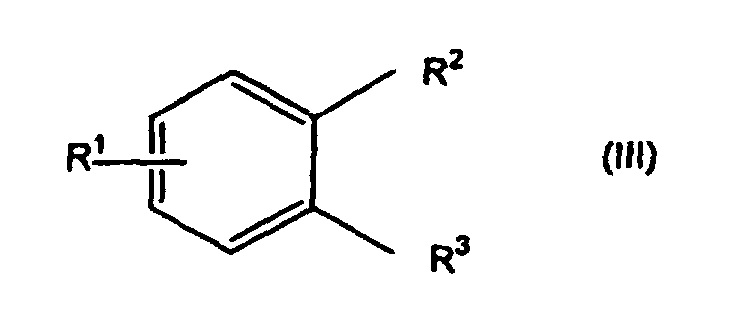
- According to the present invention there is therefore provided a process for the preparation of a compound of the general formulain which R1 represents an electron-donating group, one of R2 and R3 independently represents a hydrogen atom or an optionally substituted alkyl group and the other of R2 and R3 represents an optionally substituted alkyl group, or R2 and R3 together with the interjacent carbon atoms form an optionally substituted aryl group, which comprises reacting a compound of the general formula

- Compounds which are readily convertible to compounds of formula II by reaction with an acid according to the process of the present invention can be referred to by the term "precursor. The term "precursor" therefore includes, for instance, compounds containing protecting groups which are easily removable by reaction with an acid to give a compound of formula II and compounds in which substituents on adjacent atoms of the aromatic ring together with the interjacent atoms form a ring which can be readily broken on reaction with an acid to give a compound of formula II. Thus, the term "precursor" embraces compounds which are capable of forming compounds of formula II in situ on reaction with an acid according to the process of the present invention and which can then be converted into compounds of formula I. without isolation of the intermediate compound of formula II.
- Throughout this specification, any alkyl group, unless otherwise specified, may be linear or branched and may contain up to 12, preferably up to 6, and especially up to 4, carbon atoms. Preferred alkyl groups are methyl, ethyl; propyl and butyl. When an alkyl moiety forms part of another group, for example the alkyl moiety of an aralkyl group, it is preferred that it contains up to 6, especially up to 4, carbon atoms. Preferred alkyl moieties are methyl and ethyl.
- An aryl group may be any aromatic monocylic or polycyclic hydrocarbon group and may contain from 6 to 24, preferably 6 to 18, more preferably 6 to 16, and especially 6 to 14, carbon atoms. Preferred aryl groups include phenyl, naphthyl, anthryl, phenanthryl and pyryl groups, especially a phenyl or naphthyl, and particularly a phenyl, group. When an aryl moiety forms part of another group, for example the aryl moiety of an aralkyl group, it is preferred that it is a phenyl, naphthyl, anthryl, phenanthryl or pyryl, especially a phenyl or naphthyl, and particularly a phenyl, moiety.
- An aralkyl group may be any alkyl group substituted by an aryl group. A preferred aralkyl group contains from 7 to 16, especially 7 to 10, carbon atoms, a particularly preferred aralkyl group being a benzyl group.
- When any of the foregoing substituents are designated as being optionally substituted, the substituent groups which are optionally present may be any one or more of those customarily employed in the modification of compounds to influence their structure/activity, stability, bioavailability or other property. Specific examples of such optional substituents include, for example, halogen atoms, nitro, cyano, hydroxyl, cycloalkyl, alkyl, haloalkyl, cycloalkyloxy, alkoxy, haloalkoxy, amino, alkylamino, dialkylamino, formyl, alkoxycarbonyl, carboxyl, alkanoyl, alkylthio, alkylsulphinyl, alkylsulphonyl, alkylsulphonato, arylsulphinyl, arylsulphonyl, arylsulphonato, carbamoyl and alkylamido groups. When any of the foregoing substituents represents or contains an alkyl substituent group, this may be linear or branched and may contain up to 12, preferably up to 6, and especially up to 4, carbon atoms. A cycloalkyl group may contain from 3 to 8, preferably from 3 to 6, carbon atoms. An aryl group or moiety may contain from 6 to 10 carbon atoms, phenyl groups being especially preferred. A halogen atom may be a fluorine, chlorine, bromine or iodine atom and any group which contains a halo moiety, such as a haloalkyl group, may thus contain any one or more of these halogen atoms.
- Although the group Ar is defined above as representing an aryl group substituted by at least one electron-donating group, it will be apparent that the group Ar may also be substituted by one or more other substituents at any of the remaining vacant substitution sites. Such additional substituents may be selected from the list of optional substituents given above. Preferred additional substituents include alkyl, hydroxyl and alkoxy groups, especially C1-4 alkyl, hydroxyl and C1-4 alkoxy groups. Of these, methyl, tert-butyl, hydroxyl and methoxy groups, especially tert-butyl groups, are particularly preferred.
- Preferably, Ar represents a C6-10 aryl, especially a phenyl or naphthyl, group each substituted by at least one electron-donating group.
- It is particularly preferred that Ar represents a phenyl group substituted by at least one electron-donating group.
- Preferably, the or each electron-donating group in the compound of formula II is located in the ortho or para position relative to the group -OR When two electron-donating groups are present, it is preferred that one of these is located in the ortho position relative to the group -OR and the other is located in the other ortho position or the para position relative to the group -OR.
- An electron-donating group is any atom or group which enhances the availability of electrons about the aromatic ring to which it is attached. Typical electron-donating groups thus include substituents which have an unshared pair of electrons, especially on the atom of the substituent which is adjacent to the ring, which can stabilise intermediates in the reaction by interacting with the n electrons of the ring in an electron-donating resonance effect. Electron-donating groups also include substituents which are capable of polarising the bonding electrons of the ring thus giving rise to an electron-donating polar or polarisability effect.
- Preferably, electron-donating groups are selected from the group consisting of halogen, alkyl, aryl, hydroxyl, alkoxy, aralkyloxy, aryloxy, acyloxy, alkylthio, aralkylthio, arylthio, amino, alkylamino, dialkylamino and acylamino groups. In this context, an acyl group is an alkylcarbonyl, aralkylcarbonyl or arylcarbonyl group. It is particularly preferred that the or each electron-donating group is selected from the group consisting of alkyl, hydroxyl, alkoxy, amino, alkylamino and dialkylamino groups, especially C1-4 alkyl, hydroxyl, C1-4 alkoxy, amino, C1-4 alkylamino and di-(C1-4 alkyl)amino groups. More preferably, the electron-donating group or one of the electron-donating groups is a hydroxyl group.
- It is preferred that R is an optionally substituted alkyl or aralkyl, especially a C1-4 alkyl or C7-10 aralkyl, group. More preferably, R is a methyl or benzyl, especially a methyl, group.
- It has been found that the commercial antioxidant BHA (butylated hydroxyanisole) can be converted to the commercial antioxidant TBHQ (tert-butyl-hydroquinone) using the process of the present invention. This is particularly advantageous since TBHQ is more expensive than BHA. Moreover, BHA and TBHQ are currently produced commercially by different synthetic pathways and the commercial advantages of a common synthetic route to both compounds will therefore be readily apparent.
- Commercially available BHA is a mixture of 2-tert-butyl-4-methoxyphenol(3-tert-butyl-4-hydroxyanisole) and 3-tert-butyl-4-methoxyphenol(2-tert-butyl-4-hydroxy-anisole) and may therefore be represented by the following formula
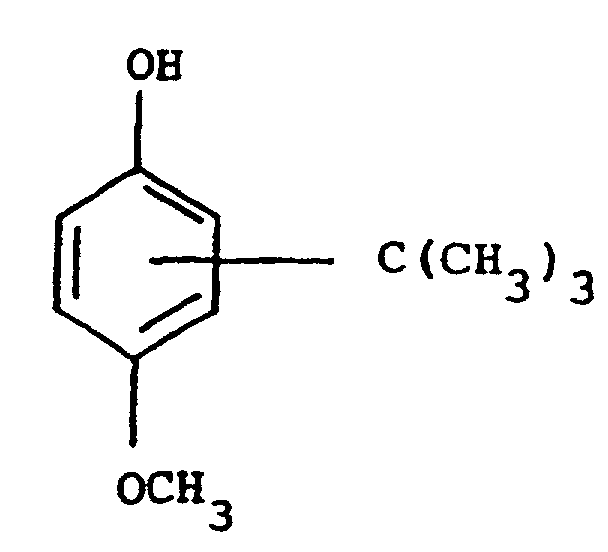
- It is therefore preferred that the compound of formula II is 2-tert-butyl-4-methoxyphenol(3-tert-butyl-4-hydroxyanisole), 3-tert-butyl-4-methoxyphenol(2-tert-butyl-4-hydroxyanisole) or a mixture thereof (BHA).
- It is also envisaged that the process of the present invention could be useful in the synthesis of other commercial antioxidants which contain aryl groups substituted by at least one hydroxyl group, particularly antioxidants containing a naphthol or, especially, a phenol group. Specific commercial antioxidants in this respect include BHA, BHT (butylated hydroxytoluene or 2,6-di-tert-butyl-4-methylphenol) and the gallates, particularly the alkyl gallates (alkyl esters of 3,4,5-trihydroxybenzoic acid) and, especially, the ethyl, propyl, octyl and dodecyl gallates. The compound of formula II may therefore have one of the following formulae:-

 in which R, R1, R2 and R3 are as previously defined and at least one of R4, R5 and R6, is an electron-donating group as previously defined.
- In formulae IIA and IIB, it is preferred that R is an alkyl, especially a methyl, or an aralkyl, especially a benzyl, group and R1 is a hydroxyl or methoxy group. It is also preferred that one of R2 and R3 is an alkyl, especially a tert-butyl, group and that the other of R2 and R3 is a hydrogen atom. It is particularly preferred that the compound of formula IIA is BHA or a precursor of BHA which is capable of forming TBHQ when subjected to the process of the present invention. In another preferred embodiment, the compound of formula IIA is capable of forming BHA when subjected to the process of the present invention. Thus, preferably, the compound of formula IIA is a compound in which R is an alkyl or aralkyl, especially a methyl or benzyl, group, R1 is an alkoxy or aralkoxy, especially a methoxy or benzyloxy, group, one of R2 and R3 is a tert-butyl group and the other of R2 and R3 is a hydrogen atom and the reaction is interrupted at an intermediate stage and the product of formula I isolated to give BHA.
- In formula IIC, it is preferred that R is an alkyl, especially a methyl, or an aralkyl, especially a benzyl, group. Preferably, R4, R5 and R6 each independently represent an alkyl, especially a C1-4 alkyl group. More preferably, R4 and R5 each represent a tert-butyl group and R6 represents a methyl group. It is particularly preferred that the compound of formula IIC is capable of forming BHT when subjected to the process of the present invention.
- In formula (IID), is preferred that R is an alkyl, especially a methyl, or an aralkyl, especially a benzyl, group. It is also preferred that each group R1 is a hydroxyl group.
- The acid utilised in the process of the present invention must comprise at least one short chain (C1-6) alkanoic acid in which the alkyl moiety is optionally substituted by a halogen atom. However, the acid may comprise a short chain alkanoic acid, a mixture of two or more short chain alkanoic acids or a mixture of one or more short chain alkanoic acids and one or more strong acids, such as mineral acids: If a mixture of one or more short chain alkanoic acids and one or more mineral acids is used, it is preferred that the or each mineral acid forms only a minor part of the total acid mixture. Preferably, the total quantity of mineral acid(s) present will not exceed 20%, more preferably 10%, of the total acid mixture.
- The short chain alkanoic acid is preferably a carboxylic acid which contains from 1 to 4 carbon atoms. Most preferably, the short chain alkanoic acid is a C1-3 alkanoic acid, especially methanoic acid. The alkyl moiety of the short chain alkanoic acid. may be substituted by a halogen atom as defined above. However, it is preferred that the alkyl moiety is unsubstituted.
- Short chain alkanoic acids are commercially available in various grades of purity. In some circumstances, it may be advantageous to use a substantially pure, that is, 98-100% alkanoic acid. However, it is preferred that the alkanoic acid contains some water. In this respect, 85% methanoic acid is particularly preferred.
- The reaction temperature selected will depend on the compound of formula II and the short chain alkanoic acid which are to be used. However, a suitable reaction temperature range is from ambient temperature, for instance, 0° to 30°C, to the reflux temperature of the reaction mixture. In general, the higher the temperature, the faster the reaction proceeds.
- Antioxidants of the type described above are utilised in silage aids for the acidic preservation of organic by-products such as fish waste, slaughter waste, poultry waste and food waste in order to protect such products from oxidation. Such silage aids also include at least one acid which is used to treat the raw material to obtain the optimum pH (3:5-4.5) with regard to enzymatic hydrolysis. It is therefore a further advantage of the process of the present invention that an antioxidant such as TBHQ can be produced in an acid solution which can be used without further processing, for instance, as a silage aid in the silage industry. In this respect, it is particularly preferred that the acid used in the process is methanoic acid, especially 85% methanoic acid. Silage aids comprising at least one antioxidant and at least one short chain carboxylic acid form the subject of co-pending International Patent Application No. PCT/NO00/00079 the contents of which are hereby incorporated by reference. However, if the end-product of formula I is to be used in another application, the acid can easily be removed by conventional means.
- The invention is further illustrated by the following examples.
- BHA (1.5g) was dissolved in 85% methanoic acid (100 ml) and the solution was heated with continuous stirring. After refluxing for about 24 hours, analysis by 1H-NMR spectroscopy revealed that ether cleavage had taken place to produce a solution of TBHQ in 85% methanoic acid.
- BHA was dissolved in 85% methanoic acid to give a concentration of 0.75% by weight BHA and the solution was then stored at room temperature (25°C). Analysis by HPLC and 1H-NMR spectroscopy at regular time intervals gave the following results:-
Elapsed time % by weight BHA 2 weeks 0.72 5 weeks 0.69 10 weeks 0.15 22 weeks 0.10 - Conversion of BHA to TBHQ was confirmed by 1H-NMR spectroscopy.
- Hydroquinone monobenzyl ether (1.5g) was dissolved in 85% methanoic acid (100 ml) and the solution was heated with continous stirring. After refluxing for about 3 hours, analysis by 1H-NMR spectroscopy revealed that ether cleavage had taken place to produce a solution of hydroquinone in 85% methanoic acid.
Claims (12)
- A process for the preparation of a compound of the general formulain which R1 represents an electron-donating group, one of R2 and R3 independently represents a hydrogen atom or an optionally substituted alkyl group and the other of R2 and R3 represents an optionally substituted alkyl group, or R2 and R3 together with the interjacent carbon atoms form an optionally substituted aryl group, which comprises reacting a compound of the general formula
- A process according to claim 1 in which Ar represents a C8-10 aryl group substituted by at least one electron-donating group.
- A process according to any one of the preceding claims in which Ar represents a phenyl group substituted by at least one electron-donating group.
- A process according to any one of the preceding claims in which the or each electron-donating group in the compound of formula II is located in the ortho or para position relative to the group -OR.
- A process according to any one of the preceding claims in which the or each electron-donating group is selected from the group consisting of alkyl, hydroxyl, alkoxy, amino, alkylamino and dialkylamino groups.
- A process according to any one of the preceding claims in which the electron-donating group or one of the electron-donating groups is a hydroxyl group.
- A process according to any one of the preceding claims in which R is an optionally substituted C1-4 alkyl or C7-10 aralkyl group.
- A process according to any one of the preceding claims in which R is a methyl group.
- A process according to any one of the preceding claims in which the compound of formula II is 2-tert-butyl-4-methoxyphenol (3-tert-butyl-4-hydroxyanisole), 3-tert-butyl-4-methoxyphenol (2-tert-butyl-4-hydroxyanisote) or a mixture thereof (BHA).
- A process according to any one of the preceding claims in which the acid comprises a C1-6 alkanoic acid in which the alkyl moiety is optionally substituted by a halogen atom, a mixture of two or more C1-6 alkanoic acids in which the alkyl moiety is optionally substituted by a halogen atom, or a mixture of one or more C1-6 alkanoic acids in which the alkyl moiety is optionally substituted by a halogen atom and one or more mineral acids.
- A process according to any one of the preceding claims in which the or each C1-6 alkanoic acid is a C1-3 alkanoic acid.
- A process according to any one of the preceding claims in which the acid is methanoic acid.
Priority Applications (1)
| Application Number | Priority Date | Filing Date | Title |
|---|---|---|---|
| DK01961421T DK1282588T3 (en) | 2000-05-12 | 2001-05-11 | Preparation of hydroxy compounds |
Applications Claiming Priority (3)
| Application Number | Priority Date | Filing Date | Title |
|---|---|---|---|
| NO20002497A NO312361B1 (en) | 2000-05-12 | 2000-05-12 | Process for the preparation of hydroxy compounds |
| NO20002497 | 2000-05-12 | ||
| PCT/NO2001/000195 WO2001085658A1 (en) | 2000-05-12 | 2001-05-11 | Preparation of hydroxy compounds |
Publications (2)
| Publication Number | Publication Date |
|---|---|
| EP1282588A1 EP1282588A1 (en) | 2003-02-12 |
| EP1282588B1 true EP1282588B1 (en) | 2005-01-05 |
Family
ID=19911144
Family Applications (1)
| Application Number | Title | Priority Date | Filing Date |
|---|---|---|---|
| EP01961421A Expired - Lifetime EP1282588B1 (en) | 2000-05-12 | 2001-05-11 | Preparation of hydroxy compounds |
Country Status (8)
| Country | Link |
|---|---|
| US (1) | US20040010166A1 (en) |
| EP (1) | EP1282588B1 (en) |
| AT (1) | ATE286497T1 (en) |
| AU (1) | AU2001282682A1 (en) |
| CA (1) | CA2408552A1 (en) |
| DE (1) | DE60108242T2 (en) |
| NO (1) | NO312361B1 (en) |
| WO (1) | WO2001085658A1 (en) |
Family Cites Families (6)
| Publication number | Priority date | Publication date | Assignee | Title |
|---|---|---|---|---|
| NL61567C (en) * | 1945-09-07 | |||
| US2697732A (en) * | 1952-02-28 | 1954-12-21 | Universal Oil Prod Co | O-dealkylation process |
| US3207786A (en) * | 1961-02-20 | 1965-09-21 | Olin Mathieson | 2-(o-halobenzyloxy) formanilides |
| FR2513631A1 (en) * | 1981-09-29 | 1983-04-01 | Rhone Poulenc Spec Chim | PROCESS FOR HYDROLYSIS OF ARYL-ALIPHATIC ETHERS |
| US5138069A (en) * | 1986-07-11 | 1992-08-11 | E. I. Du Pont De Nemours And Company | Angiotensin II receptor blocking imidazoles |
| SE8604566D0 (en) * | 1986-10-27 | 1986-10-27 | Haessle Ab | NOVEL COMPUNDS |
-
2000
- 2000-05-12 NO NO20002497A patent/NO312361B1/en unknown
-
2001
- 2001-05-11 WO PCT/NO2001/000195 patent/WO2001085658A1/en not_active Ceased
- 2001-05-11 DE DE60108242T patent/DE60108242T2/en not_active Expired - Fee Related
- 2001-05-11 AT AT01961421T patent/ATE286497T1/en not_active IP Right Cessation
- 2001-05-11 AU AU2001282682A patent/AU2001282682A1/en not_active Abandoned
- 2001-05-11 EP EP01961421A patent/EP1282588B1/en not_active Expired - Lifetime
- 2001-05-11 US US10/275,552 patent/US20040010166A1/en not_active Abandoned
- 2001-05-11 CA CA002408552A patent/CA2408552A1/en not_active Abandoned
Also Published As
| Publication number | Publication date |
|---|---|
| ATE286497T1 (en) | 2005-01-15 |
| DE60108242D1 (en) | 2005-02-10 |
| EP1282588A1 (en) | 2003-02-12 |
| CA2408552A1 (en) | 2001-11-15 |
| US20040010166A1 (en) | 2004-01-15 |
| NO20002497L (en) | 2001-11-13 |
| NO20002497D0 (en) | 2000-05-12 |
| AU2001282682A1 (en) | 2001-11-20 |
| NO312361B1 (en) | 2002-04-29 |
| DE60108242T2 (en) | 2005-12-08 |
| WO2001085658A1 (en) | 2001-11-15 |
Similar Documents
| Publication | Publication Date | Title |
|---|---|---|
| PL200685B1 (en) | Method for production of aryl alkyl ethers | |
| Serra et al. | Regiospecific synthesis of heterosubstituted phenols from 3-alkoxycarbonyl-3, 5-dienoic acids via benzannulation reaction | |
| US4262152A (en) | Preparation of trifluoromethylphenyl nitrophenylethers | |
| EP0298803A1 (en) | Process for the perhaloalkylation of aromatic derivatives | |
| Kubo et al. | Prostaglandin synthetase inhibitors from the African medicinal plant Ozoroa mucronata | |
| US20040010166A1 (en) | Preparation of hydroxy compounds | |
| EP0578550B1 (en) | Process for the para-hydroxyalkylation of hydroxylated aromatic compounds | |
| US4665226A (en) | Process for preparing 5-(2,5-dimethylphenoxy)-2,2-dimethylpentanoic acid | |
| US3488380A (en) | Carbamate esters and their method of preparation | |
| US4131618A (en) | Preparation of salicylic acid and derivatives | |
| HUT56826A (en) | Process for the production of betha-ketoesthers | |
| IT1201443B (en) | INTERMEDIATES FOR THE SYNTHESIS OF CARBOXYLIC ACIDS | |
| CA1271780A (en) | Process for producing 6-hydroxy-2-naphthones | |
| US4025539A (en) | Process for preparing 2-substituted or unsubstituted geranyl acetic acids and esters thereof | |
| US4140794A (en) | Compounds having a trichloromethylic end group having a juvenile hormone action on insects and acaricide activity | |
| JP4004640B2 (en) | α- (Alkoxyoxalyl) fatty acid ester and α-alkyl or alkenyl acrylate ester, and method for synthesizing phenylidone using the same | |
| JPS625139B2 (en) | ||
| JPH06157418A (en) | Reducing dehalogenation process | |
| US4605761A (en) | Process using achiral co-catalyst promoter for chiral phase transfer alkylation process for an enantiomer of a substituted fluorenyloxyacetic acid | |
| US5922889A (en) | Synthesis of isochromans and their derivatives | |
| Hearn et al. | A convenient method for the preparation of 1-acyl-2-phenylhydrazines | |
| WO2001005739A1 (en) | Process for the preparation of 5- and/or 6-substituted-2-hydroxybenzoic acid esters | |
| JPH0830030B2 (en) | Method for producing alkyl ester of β- (3,5-dialkyl-4-hydroxyphenyl) propionic acid | |
| US4810814A (en) | Preparation of cyanoalkylphenols | |
| US4219505A (en) | Process for preparing tetrahalocyclohexanone |
Legal Events
| Date | Code | Title | Description |
|---|---|---|---|
| PUAI | Public reference made under article 153(3) epc to a published international application that has entered the european phase |
Free format text: ORIGINAL CODE: 0009012 |
|
| 17P | Request for examination filed |
Effective date: 20021129 |
|
| AK | Designated contracting states |
Designated state(s): AT BE CH CY DE DK ES FI FR GB GR IE IT LI LU MC NL PT SE TR |
|
| AX | Request for extension of the european patent |
Extension state: AL LT LV MK RO SI |
|
| 17Q | First examination report despatched |
Effective date: 20030617 |
|
| GRAP | Despatch of communication of intention to grant a patent |
Free format text: ORIGINAL CODE: EPIDOSNIGR1 |
|
| GRAS | Grant fee paid |
Free format text: ORIGINAL CODE: EPIDOSNIGR3 |
|
| GRAA | (expected) grant |
Free format text: ORIGINAL CODE: 0009210 |
|
| AK | Designated contracting states |
Kind code of ref document: B1 Designated state(s): AT BE CH CY DE DK ES FI FR GB GR IE IT LI LU MC NL PT SE TR |
|
| PG25 | Lapsed in a contracting state [announced via postgrant information from national office to epo] |
Ref country code: TR Free format text: LAPSE BECAUSE OF FAILURE TO SUBMIT A TRANSLATION OF THE DESCRIPTION OR TO PAY THE FEE WITHIN THE PRESCRIBED TIME-LIMIT Effective date: 20050105 Ref country code: NL Free format text: LAPSE BECAUSE OF FAILURE TO SUBMIT A TRANSLATION OF THE DESCRIPTION OR TO PAY THE FEE WITHIN THE PRESCRIBED TIME-LIMIT Effective date: 20050105 Ref country code: LI Free format text: LAPSE BECAUSE OF FAILURE TO SUBMIT A TRANSLATION OF THE DESCRIPTION OR TO PAY THE FEE WITHIN THE PRESCRIBED TIME-LIMIT Effective date: 20050105 Ref country code: IT Free format text: LAPSE BECAUSE OF FAILURE TO SUBMIT A TRANSLATION OF THE DESCRIPTION OR TO PAY THE FEE WITHIN THE PRESCRIBED TIME-LIMIT;WARNING: LAPSES OF ITALIAN PATENTS WITH EFFECTIVE DATE BEFORE 2007 MAY HAVE OCCURRED AT ANY TIME BEFORE 2007. THE CORRECT EFFECTIVE DATE MAY BE DIFFERENT FROM THE ONE RECORDED. Effective date: 20050105 Ref country code: FR Free format text: LAPSE BECAUSE OF NON-PAYMENT OF DUE FEES Effective date: 20050105 Ref country code: FI Free format text: LAPSE BECAUSE OF FAILURE TO SUBMIT A TRANSLATION OF THE DESCRIPTION OR TO PAY THE FEE WITHIN THE PRESCRIBED TIME-LIMIT Effective date: 20050105 Ref country code: CH Free format text: LAPSE BECAUSE OF FAILURE TO SUBMIT A TRANSLATION OF THE DESCRIPTION OR TO PAY THE FEE WITHIN THE PRESCRIBED TIME-LIMIT Effective date: 20050105 Ref country code: BE Free format text: LAPSE BECAUSE OF FAILURE TO SUBMIT A TRANSLATION OF THE DESCRIPTION OR TO PAY THE FEE WITHIN THE PRESCRIBED TIME-LIMIT Effective date: 20050105 Ref country code: AT Free format text: LAPSE BECAUSE OF FAILURE TO SUBMIT A TRANSLATION OF THE DESCRIPTION OR TO PAY THE FEE WITHIN THE PRESCRIBED TIME-LIMIT Effective date: 20050105 |
|
| REG | Reference to a national code |
Ref country code: GB Ref legal event code: FG4D |
|
| REG | Reference to a national code |
Ref country code: CH Ref legal event code: EP |
|
| RAP2 | Party data changed (patent owner data changed or rights of a patent transferred) |
Owner name: YARA INTERNATIONAL ASA |
|
| REG | Reference to a national code |
Ref country code: IE Ref legal event code: FG4D |
|
| REF | Corresponds to: |
Ref document number: 60108242 Country of ref document: DE Date of ref document: 20050210 Kind code of ref document: P |
|
| NLT2 | Nl: modifications (of names), taken from the european patent patent bulletin |
Owner name: YARA INTERNATIONAL ASA |
|
| PG25 | Lapsed in a contracting state [announced via postgrant information from national office to epo] |
Ref country code: SE Free format text: LAPSE BECAUSE OF FAILURE TO SUBMIT A TRANSLATION OF THE DESCRIPTION OR TO PAY THE FEE WITHIN THE PRESCRIBED TIME-LIMIT Effective date: 20050405 Ref country code: GR Free format text: LAPSE BECAUSE OF FAILURE TO SUBMIT A TRANSLATION OF THE DESCRIPTION OR TO PAY THE FEE WITHIN THE PRESCRIBED TIME-LIMIT Effective date: 20050405 |
|
| PG25 | Lapsed in a contracting state [announced via postgrant information from national office to epo] |
Ref country code: ES Free format text: LAPSE BECAUSE OF FAILURE TO SUBMIT A TRANSLATION OF THE DESCRIPTION OR TO PAY THE FEE WITHIN THE PRESCRIBED TIME-LIMIT Effective date: 20050416 |
|
| PGFP | Annual fee paid to national office [announced via postgrant information from national office to epo] |
Ref country code: DE Payment date: 20050506 Year of fee payment: 5 |
|
| PG25 | Lapsed in a contracting state [announced via postgrant information from national office to epo] |
Ref country code: LU Free format text: LAPSE BECAUSE OF NON-PAYMENT OF DUE FEES Effective date: 20050511 Ref country code: IE Free format text: LAPSE BECAUSE OF NON-PAYMENT OF DUE FEES Effective date: 20050511 Ref country code: CY Free format text: LAPSE BECAUSE OF FAILURE TO SUBMIT A TRANSLATION OF THE DESCRIPTION OR TO PAY THE FEE WITHIN THE PRESCRIBED TIME-LIMIT Effective date: 20050511 |
|
| PGFP | Annual fee paid to national office [announced via postgrant information from national office to epo] |
Ref country code: GB Payment date: 20050511 Year of fee payment: 5 |
|
| PGFP | Annual fee paid to national office [announced via postgrant information from national office to epo] |
Ref country code: DK Payment date: 20050513 Year of fee payment: 5 |
|
| PG25 | Lapsed in a contracting state [announced via postgrant information from national office to epo] |
Ref country code: MC Free format text: LAPSE BECAUSE OF NON-PAYMENT OF DUE FEES Effective date: 20050531 |
|
| NLV1 | Nl: lapsed or annulled due to failure to fulfill the requirements of art. 29p and 29m of the patents act | ||
| REG | Reference to a national code |
Ref country code: CH Ref legal event code: PL |
|
| REG | Reference to a national code |
Ref country code: DK Ref legal event code: T3 |
|
| PLBE | No opposition filed within time limit |
Free format text: ORIGINAL CODE: 0009261 |
|
| STAA | Information on the status of an ep patent application or granted ep patent |
Free format text: STATUS: NO OPPOSITION FILED WITHIN TIME LIMIT |
|
| 26N | No opposition filed |
Effective date: 20051006 |
|
| REG | Reference to a national code |
Ref country code: GB Ref legal event code: FG4D |
|
| REG | Reference to a national code |
Ref country code: IE Ref legal event code: MM4A |
|
| EN | Fr: translation not filed | ||
| PG25 | Lapsed in a contracting state [announced via postgrant information from national office to epo] |
Ref country code: GB Free format text: LAPSE BECAUSE OF NON-PAYMENT OF DUE FEES Effective date: 20060511 |
|
| PG25 | Lapsed in a contracting state [announced via postgrant information from national office to epo] |
Ref country code: DK Free format text: LAPSE BECAUSE OF NON-PAYMENT OF DUE FEES Effective date: 20060531 |
|
| PG25 | Lapsed in a contracting state [announced via postgrant information from national office to epo] |
Ref country code: DE Free format text: LAPSE BECAUSE OF NON-PAYMENT OF DUE FEES Effective date: 20061201 |
|
| REG | Reference to a national code |
Ref country code: DK Ref legal event code: EBP |
|
| GBPC | Gb: european patent ceased through non-payment of renewal fee |
Effective date: 20060511 |
|
| PG25 | Lapsed in a contracting state [announced via postgrant information from national office to epo] |
Ref country code: PT Free format text: LAPSE BECAUSE OF NON-PAYMENT OF DUE FEES Effective date: 20050605 |