EP1282212A2 - A battery charging device - Google Patents
A battery charging device Download PDFInfo
- Publication number
- EP1282212A2 EP1282212A2 EP02394083A EP02394083A EP1282212A2 EP 1282212 A2 EP1282212 A2 EP 1282212A2 EP 02394083 A EP02394083 A EP 02394083A EP 02394083 A EP02394083 A EP 02394083A EP 1282212 A2 EP1282212 A2 EP 1282212A2
- Authority
- EP
- European Patent Office
- Prior art keywords
- charging device
- seat
- cover
- contacts
- battery
- Prior art date
- Legal status (The legal status is an assumption and is not a legal conclusion. Google has not performed a legal analysis and makes no representation as to the accuracy of the status listed.)
- Withdrawn
Links
Images


Classifications
-
- H—ELECTRICITY
- H02—GENERATION; CONVERSION OR DISTRIBUTION OF ELECTRIC POWER
- H02J—ELECTRIC POWER NETWORKS; CIRCUIT ARRANGEMENTS OR SYSTEMS FOR SUPPLYING OR DISTRIBUTING ELECTRIC POWER; SYSTEMS FOR STORING ELECTRIC ENERGY
- H02J7/00—Circuit arrangements for charging or discharging batteries or for supplying loads from batteries
- H02J7/70—Circuit arrangements for charging or discharging batteries or for supplying loads from batteries characterised by the mechanical construction
- H02J7/731—Circuit arrangements for charging or discharging batteries or for supplying loads from batteries characterised by the mechanical construction specially adapted for holding portable devices containing batteries
-
- H—ELECTRICITY
- H02—GENERATION; CONVERSION OR DISTRIBUTION OF ELECTRIC POWER
- H02J—ELECTRIC POWER NETWORKS; CIRCUIT ARRANGEMENTS OR SYSTEMS FOR SUPPLYING OR DISTRIBUTING ELECTRIC POWER; SYSTEMS FOR STORING ELECTRIC ENERGY
- H02J7/00—Circuit arrangements for charging or discharging batteries or for supplying loads from batteries
- H02J7/485—Circuit arrangements for charging or discharging batteries or for supplying loads from batteries with provisions for charging different types of batteries
Definitions
- the invention relates to battery charging devices.
- Such a device comprising a housing having a seat and charging contacts.
- a rechargeable battery is inserted into the seat for recharging.
- One such charging device comprises a hinged cover plate for protection of charging terminals.
- the invention is directed towards providing such a device.
- a charging device comprising a housing, a seat with charging contacts, and a cover for the contacts, characterised in that the cover is movable between a position covering the seat to protect the contacts and a supporting position providing support for the device while in use.
- the cover is rotatable about a hinge between the covering and supporting positions.
- the seat and the cover are of generally curved rectangular shape.
- the hinge comprises mutually resilient male and female connectors for snap-fitting engagement in the covering and supporting positions.
- a connector is on a resilient wall between arcuate slots, the resilient wall being integral with the cover or the housing at both circumferential ends.
- the slots are co-centric.
- the hinge comprises a hinge pin having a head in contact with a surface of the cover or the housing to provide counter-pressure to a connector.
- the device further comprises a movable seat extension piece comprising means for moving to a position at which it extends size of the seat to accommodate and hold a relatively large battery.
- the extension piece comprises means for pressing a battery against the contacts and holding it in position.
- the pressing means comprises a lip for engagement with a top side edge of a battery, and the contacts are resiliently mounted.
- the extension piece comprises means for rotating between inoperative and extended positions.
- the seat comprises a modular replaceable seat module inserted in a cavity of the housing.
- the seat module comprises means for snap-fitting into the cavity.
- the invention also provides a charging device kit comprising a charging device as defined above and at least one additional seat module comprising means for charging a different battery.
- the device 1 comprises a housing 2 having a flat base for free-standing use.
- An electrical socket 3 is connected to a charging circuit (not shown) inside the housing 2. It is for converting 12V DC received at the socket 3 into a charging current at a pair of charging contacts 4 in a seat 5 of the housing 2.
- the charging circuit is conventional.
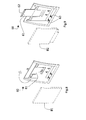
- a cover 10 is rotatable about a hinge 11 between a cover position (Fig. 1) and a supporting leg position (Fig. 2). In the cover position it covers the seat 5 and hence also the contacts 4. Curved ridges 12 on each side of the housing 2 act as a rim for the cover 10.
- the cover 10 is stable in the cover position and so it provides protection for the contacts by preventing physical damage to them or ingress of grease or dirt.
- the cover 10 supports the device 1, providing particularly stable support when a battery is inserted in the seat 5. There is excellent stability because the cover 10 extends across the full width of the device.
- the hinge 11 comprises a central aperture 20 formed by mating two housing mould parts 2(a) and 2(b). There is also a pair of recesses 21 on each side located at the same radial distance from the axis of rotation.
- the cover 10 comprises a corresponding pin 22 for insertion into the central aperture 20 during manufacture before connection of the two mould parts 2(a) and 2(b) of the housing.
- the pin 22 comprises a disc-shaped head 22(a) on a shank 22(b) and the length of the pin 22 is such that the head 22(a) is in contact with the internal surface of the housing 2 behind the aperture 20.
- the cover 10 also comprises a weakened resilient portion between two curved slots 23.
- the weakened portion has an integral curved projection 24.
- the cover 10 receives a cap 26 on each side on curved ridges 27.
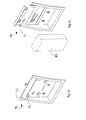
- the seat 3 is formed by, during manufacture, snap-fitting a seat module into a cavity 40 of the housing mould part 2(a).
- the cavity 40 is of universal configuration for holding one of a wide variety of seat modules chosen during manufacture.
- a seat module 45 shown in Fig. 6 comprises a seat 46 having charging terminals 47 and snap-fitting battery retainers 48. It also comprises a hook 49 for snap-fitting engagement with the mould part 2(a).
- a module 50, shown in Fig. 7, comprises a seat 51, terminals 52, and a hook 53.
- a seat module 60 can accommodate a battery B1. However, it comprises a hinged extension piece 61 which can be rotated upwardly to a position shown in Fig. 9 at which it can hold a larger battery B2.
- the extension piece 61 comprises a lip 62 for gripping the battery B2 at its top edge. Because there is resilience in contacts 63 it effectively presses the battery B2 downwardly against the contacts. Thus, the extension piece 61 holds the battery B2 in a stable position because of snap-fitting grip of the lip 62, and also provides for good electrical contact.
- a seat module 70 shown in Fig. 10 has an extension piece 71 which allows either a small battery when in a lower position, or a large battery B3 to be accommodated as shown in Fig. 11 when in an upper position.
- the charging device 1 of the invention may be supplied with a single seat module in situ in the cavity 40, or with a number of modules. In the latter case, the end user can easily remove one module by inserting a blade into a notch at the top of the module and prising it out of position. To insert another module the user grips an electrical plug at the end of a lead extending for the back of the new module and inserts it into a socket 41 in the cavity 40 for electrical connection of the module.
- the cover 10 In use, the cover 10 is in the covering position when in storage. This allows the device 1 to be compact and also protects the contacts 4 from dust and other contamination, and from physical damage.
- the cover 10 For charging a battery, the cover 10 is opened in the direction of the arrows of Fig. 1 so that it provides stable support for the device 1 as shown in Fig. 2.
- the movement to the leg (supporting) position causes the projection 24 to exit one recess 21 and snap into the other one.
- the two slots 23 extend in a circular direction about the same centre they provide a particularly strong base for the projection 24 while also providing the required resilience. Because the weakened wall of the cover 10 between the slots 23 is integral at both ends in the circumferential direction with the cover 10, the only movement allowed is in the axial direction. Thus, there is no freedom of circumferential movement once the cover is in one of the stable positions. This helps both protection of the contacts in the covering position and stability in the supporting position.
- the cover has the dual purposes of protecting the charging terminals and providing a stable support for an upright operative position. Also, there is excellent versatility both because one of a variety of different seat modules may be used, and because of the hinged extension pieces in at least some modules. This versatility is extremely important at present because of the ever-increasing range of different consumer appliances and associated rechargeable batteries.
Landscapes
- Engineering & Computer Science (AREA)
- Power Engineering (AREA)
- Battery Mounting, Suspending (AREA)
- Connector Housings Or Holding Contact Members (AREA)
- Connection Of Batteries Or Terminals (AREA)
Abstract
Description
Claims (14)
- A charging device (1) comprising a housing (2), a seat (5) with charging contacts (4), and a cover (10) for the contacts (4), characterised in that the cover (10) is movable between a position covering the seat (5) to protect the contacts (4) and a supporting position providing support for the device while in use.
- A charging device as claimed in claim 1, wherein the cover (10) is rotatable about a hinge (11) between the covering and supporting positions.
- A charging device as claimed in claim 1 or 2, wherein the seat (5) and the cover (10) are of generally curved rectangular shape.
- A charging device as claimed in claims 2 or 3, wherein the hinge (11) comprises mutually resilient male (24) and female (21) connectors for snap-fitting engagement in the covering and supporting positions.
- A charging device as claimed in claim 4, wherein a connector (24) is on a resilient wall between arcuate slots (23), the resilient wall being integral with the cover or the housing at both circumferential ends.
- A charging device as claimed in claim 6, wherein the slots are co-centric.
- A charging device as claimed in any of claims 4 to 6, wherein the hinge comprises a hinge pin (22) having a head (22(b)) in contact with a surface of the cover or the housing to provide counter-pressure to a connector.
- A charging device as claimed in any preceding claim, wherein the device further comprises a movable seat extension piece (61, 71) comprising means for moving to a position at which it extends size of the seat to accommodate and hold a relatively large battery.
- A charging device as claimed in claim 8, wherein the extension piece comprises means (62) for pressing a battery against the contacts and holding it in position.
- A charging device as claimed in claim 9, wherein the pressing means comprises a lip (62) for engagement with a top side edge of a battery, and the contacts (63) are resiliently mounted.
- A charging device as claimed in any of claims 8 to 10, wherein the extension piece comprises means for rotating between inoperative and extended positions.
- A charging device as claimed in any preceding claim, wherein the seat comprises a modular replaceable seat module (45, 50, 60, 70) inserted in a cavity (40) of the housing.
- A charging device as claimed in claim 12, wherein the seat module comprises means (49) for snap-fitting into the cavity.
- A charging device kit comprising a charging device as claimed in claims 12 or 13, and at least one additional seat module comprising means for charging a different battery.
Applications Claiming Priority (2)
| Application Number | Priority Date | Filing Date | Title |
|---|---|---|---|
| IE20010736 | 2001-08-02 | ||
| IE20010736 | 2001-08-02 |
Publications (2)
| Publication Number | Publication Date |
|---|---|
| EP1282212A2 true EP1282212A2 (en) | 2003-02-05 |
| EP1282212A3 EP1282212A3 (en) | 2005-01-05 |
Family
ID=11042822
Family Applications (1)
| Application Number | Title | Priority Date | Filing Date |
|---|---|---|---|
| EP02394083A Withdrawn EP1282212A3 (en) | 2001-08-02 | 2002-07-31 | A battery charging device |
Country Status (2)
| Country | Link |
|---|---|
| EP (1) | EP1282212A3 (en) |
| IE (1) | IES20020645A2 (en) |
Cited By (5)
| Publication number | Priority date | Publication date | Assignee | Title |
|---|---|---|---|---|
| EP1337026A1 (en) * | 2002-02-14 | 2003-08-20 | The Haehnel Partnership | A battery charging device |
| EP1496593A1 (en) * | 2003-07-07 | 2005-01-12 | Wahl Clipper Corporation | Charging stand having open and closed positions |
| GB2401484B (en) * | 2003-05-07 | 2007-09-26 | Milwaukee Electric Tool Corp | Battery charging apparatus |
| CN104942844A (en) * | 2015-06-05 | 2015-09-30 | 浙江美森电器有限公司 | Shaver base |
| CN115514035A (en) * | 2021-06-23 | 2022-12-23 | 美的集团股份有限公司 | Charging units and mobile devices |
Family Cites Families (10)
| Publication number | Priority date | Publication date | Assignee | Title |
|---|---|---|---|---|
| DE4036373A1 (en) * | 1990-11-15 | 1992-05-21 | Kress Elektrik Gmbh & Co | CHARGING DEVICE FOR RECHARGEABLE BATTERIES |
| DE4041988A1 (en) * | 1990-12-21 | 1992-07-02 | Mannesmann Ag | COMMUNICATION DEVICE, IN PARTICULAR TERMINAL DEVICE FOR TELEPHONE TRAFFIC |
| DE9209947U1 (en) * | 1992-07-23 | 1993-01-07 | Siemens AG, 8000 München | Desk holder for a radio telephone |
| JP2711784B2 (en) * | 1992-11-16 | 1998-02-10 | ユピテル工業株式会社 | Battery pack charger |
| GB2293056B (en) * | 1994-09-08 | 1999-08-18 | Nokia Mobile Phones Ltd | A holder for charging a radio telephone battery |
| JP2959494B2 (en) * | 1996-11-18 | 1999-10-06 | 日本電気株式会社 | Portable communication equipment |
| KR100497675B1 (en) * | 1996-12-13 | 2005-10-04 | 코닌클리즈케 필립스 일렉트로닉스 엔.브이. | Casing for a cordless telephone, and assembly of a casing with a cordless telephone |
| JP3474466B2 (en) * | 1998-11-13 | 2003-12-08 | ホシデン株式会社 | Charging device |
| FR2791842B1 (en) * | 1999-04-02 | 2004-01-09 | Sagem | MOBILE TELEPHONE DEVICE WITH PROTECTIVE SHUTTER |
| US6127802A (en) * | 1999-11-19 | 2000-10-03 | Motorola, Inc. | Charger with battery retention door |
-
2002
- 2002-07-31 EP EP02394083A patent/EP1282212A3/en not_active Withdrawn
- 2002-07-31 IE IE20020645A patent/IES20020645A2/en unknown
Cited By (7)
| Publication number | Priority date | Publication date | Assignee | Title |
|---|---|---|---|---|
| EP1337026A1 (en) * | 2002-02-14 | 2003-08-20 | The Haehnel Partnership | A battery charging device |
| GB2401484B (en) * | 2003-05-07 | 2007-09-26 | Milwaukee Electric Tool Corp | Battery charging apparatus |
| US7659696B2 (en) | 2003-05-07 | 2010-02-09 | Milwaukee Electric Tool Corporation | Battery charger and assembly |
| EP1496593A1 (en) * | 2003-07-07 | 2005-01-12 | Wahl Clipper Corporation | Charging stand having open and closed positions |
| US7102328B2 (en) | 2003-07-07 | 2006-09-05 | Wahl Clipper Corporation | Charging stand having open and closed positions |
| CN104942844A (en) * | 2015-06-05 | 2015-09-30 | 浙江美森电器有限公司 | Shaver base |
| CN115514035A (en) * | 2021-06-23 | 2022-12-23 | 美的集团股份有限公司 | Charging units and mobile devices |
Also Published As
| Publication number | Publication date |
|---|---|
| EP1282212A3 (en) | 2005-01-05 |
| IE20020646A1 (en) | 2003-03-19 |
| IES20020645A2 (en) | 2003-03-19 |
Similar Documents
| Publication | Publication Date | Title |
|---|---|---|
| US6075341A (en) | Power pack charging system for a power tool | |
| US6139359A (en) | Cordless screwdriver and multi-position battery pack therefor | |
| AU718653B3 (en) | Safety dual plug structure | |
| US5148094A (en) | Charger with universal battery pack receptacle | |
| US5286213A (en) | Locking receptacle | |
| US6364716B1 (en) | Adaptor with rotary plug | |
| EP2433340B1 (en) | Interface between connectable electrical devices | |
| EP1282212A2 (en) | A battery charging device | |
| JP3985726B2 (en) | Battery Charger | |
| GB2237695A (en) | Cable clamp in electrical connector | |
| JPH0542616Y2 (en) | ||
| GB2376354A (en) | A dual pivoting plug battery adapter | |
| JP3272248B2 (en) | Service plug lever holding mechanism | |
| IE83997B1 (en) | A battery charging device | |
| EP0310718B1 (en) | Socket and plug therefor | |
| JP2011129307A (en) | Plate of socket and embedded socket including the same | |
| EP1071169B1 (en) | Electrical plug device | |
| CA2329849C (en) | Power connector ground polarization insert and connector used therewith | |
| JP3591016B2 (en) | Battery storage device | |
| KR200225206Y1 (en) | Charger for Cellular Phone | |
| JP3021847U (en) | Battery storage device | |
| JP2002254355A (en) | Cordless tool | |
| CN210468841U (en) | Portable traveling charger | |
| AU2003220750B2 (en) | Power pack charging system for a power tool | |
| JP3094033U (en) | Emergency charger for mobile phone |
Legal Events
| Date | Code | Title | Description |
|---|---|---|---|
| PUAI | Public reference made under article 153(3) epc to a published international application that has entered the european phase |
Free format text: ORIGINAL CODE: 0009012 |
|
| AK | Designated contracting states |
Designated state(s): AT BE BG CH CY CZ DE DK EE ES FI FR GB GR IE IT LI LU MC NL PT SE SK TR |
|
| AX | Request for extension of the european patent |
Extension state: AL LT LV MK RO SI |
|
| PUAL | Search report despatched |
Free format text: ORIGINAL CODE: 0009013 |
|
| AK | Designated contracting states |
Kind code of ref document: A3 Designated state(s): AT BE BG CH CY CZ DE DK EE ES FI FR GB GR IE IT LI LU MC NL PT SE SK TR |
|
| AX | Request for extension of the european patent |
Extension state: AL LT LV MK RO SI |
|
| 17P | Request for examination filed |
Effective date: 20050212 |
|
| 17Q | First examination report despatched |
Effective date: 20050412 |
|
| AKX | Designation fees paid |
Designated state(s): AT BE BG CH CY CZ DE DK EE ES FI FR GB GR IE IT LI LU MC NL PT SE SK TR |
|
| GRAP | Despatch of communication of intention to grant a patent |
Free format text: ORIGINAL CODE: EPIDOSNIGR1 |
|
| STAA | Information on the status of an ep patent application or granted ep patent |
Free format text: STATUS: THE APPLICATION IS DEEMED TO BE WITHDRAWN |
|
| 18D | Application deemed to be withdrawn |
Effective date: 20090703 |