EP1281071B1 - Voltammetric analysis using an amalgam electrode - Google Patents
Voltammetric analysis using an amalgam electrode Download PDFInfo
- Publication number
- EP1281071B1 EP1281071B1 EP01938839A EP01938839A EP1281071B1 EP 1281071 B1 EP1281071 B1 EP 1281071B1 EP 01938839 A EP01938839 A EP 01938839A EP 01938839 A EP01938839 A EP 01938839A EP 1281071 B1 EP1281071 B1 EP 1281071B1
- Authority
- EP
- European Patent Office
- Prior art keywords
- electrode
- amalgam
- analyses
- dental
- zinc
- Prior art date
- Legal status (The legal status is an assumption and is not a legal conclusion. Google has not performed a legal analysis and makes no representation as to the accuracy of the status listed.)
- Expired - Lifetime
Links
- 238000004458 analytical method Methods 0.000 title claims abstract description 36
- 229910000497 Amalgam Inorganic materials 0.000 title claims description 29
- QSHDDOUJBYECFT-UHFFFAOYSA-N mercury Chemical compound [Hg] QSHDDOUJBYECFT-UHFFFAOYSA-N 0.000 claims abstract description 18
- 229910052753 mercury Inorganic materials 0.000 claims abstract description 18
- 239000007772 electrode material Substances 0.000 claims abstract description 7
- BQCADISMDOOEFD-UHFFFAOYSA-N Silver Chemical compound [Ag] BQCADISMDOOEFD-UHFFFAOYSA-N 0.000 claims description 19
- 229910052709 silver Inorganic materials 0.000 claims description 19
- 239000004332 silver Substances 0.000 claims description 19
- 238000000034 method Methods 0.000 claims description 17
- 238000003943 differential pulse anodic stripping voltammetry Methods 0.000 claims description 8
- 239000007787 solid Substances 0.000 claims description 6
- 238000006479 redox reaction Methods 0.000 claims description 4
- 238000004519 manufacturing process Methods 0.000 claims description 3
- 239000013078 crystal Substances 0.000 claims description 2
- HCHKCACWOHOZIP-UHFFFAOYSA-N Zinc Chemical compound [Zn] HCHKCACWOHOZIP-UHFFFAOYSA-N 0.000 abstract description 24
- 229910052725 zinc Inorganic materials 0.000 abstract description 24
- 239000011701 zinc Substances 0.000 abstract description 24
- 239000000448 dental amalgam Substances 0.000 abstract description 17
- 229910001312 Amalgam (dentistry) Inorganic materials 0.000 abstract description 16
- 239000001257 hydrogen Substances 0.000 abstract description 7
- 229910052739 hydrogen Inorganic materials 0.000 abstract description 7
- 238000004832 voltammetry Methods 0.000 abstract description 7
- 239000003673 groundwater Substances 0.000 abstract description 6
- UFHFLCQGNIYNRP-UHFFFAOYSA-N Hydrogen Chemical compound [H][H] UFHFLCQGNIYNRP-UHFFFAOYSA-N 0.000 abstract description 5
- XEEYBQQBJWHFJM-UHFFFAOYSA-N Iron Chemical compound [Fe] XEEYBQQBJWHFJM-UHFFFAOYSA-N 0.000 abstract description 4
- PXHVJJICTQNCMI-UHFFFAOYSA-N Nickel Chemical compound [Ni] PXHVJJICTQNCMI-UHFFFAOYSA-N 0.000 abstract description 4
- 239000002689 soil Substances 0.000 abstract description 4
- 229910017052 cobalt Inorganic materials 0.000 abstract description 2
- 239000010941 cobalt Substances 0.000 abstract description 2
- GUTLYIVDDKVIGB-UHFFFAOYSA-N cobalt atom Chemical compound [Co] GUTLYIVDDKVIGB-UHFFFAOYSA-N 0.000 abstract description 2
- 239000003344 environmental pollutant Substances 0.000 abstract description 2
- 229910052742 iron Inorganic materials 0.000 abstract description 2
- 229910052759 nickel Inorganic materials 0.000 abstract description 2
- 231100000719 pollutant Toxicity 0.000 abstract description 2
- RYGMFSIKBFXOCR-UHFFFAOYSA-N Copper Chemical compound [Cu] RYGMFSIKBFXOCR-UHFFFAOYSA-N 0.000 description 13
- 239000000243 solution Substances 0.000 description 10
- 229910052802 copper Inorganic materials 0.000 description 8
- 239000010949 copper Substances 0.000 description 8
- 229910045601 alloy Inorganic materials 0.000 description 6
- 239000000956 alloy Substances 0.000 description 6
- FGIUAXJPYTZDNR-UHFFFAOYSA-N potassium nitrate Chemical compound [K+].[O-][N+]([O-])=O FGIUAXJPYTZDNR-UHFFFAOYSA-N 0.000 description 6
- 229910052793 cadmium Inorganic materials 0.000 description 5
- BDOSMKKIYDKNTQ-UHFFFAOYSA-N cadmium atom Chemical compound [Cd] BDOSMKKIYDKNTQ-UHFFFAOYSA-N 0.000 description 5
- 229910001385 heavy metal Inorganic materials 0.000 description 5
- 238000001075 voltammogram Methods 0.000 description 5
- IJGRMHOSHXDMSA-UHFFFAOYSA-N Atomic nitrogen Chemical compound N#N IJGRMHOSHXDMSA-UHFFFAOYSA-N 0.000 description 4
- 238000001514 detection method Methods 0.000 description 4
- ATJFFYVFTNAWJD-UHFFFAOYSA-N Tin Chemical compound [Sn] ATJFFYVFTNAWJD-UHFFFAOYSA-N 0.000 description 3
- 239000000919 ceramic Substances 0.000 description 3
- 239000003792 electrolyte Substances 0.000 description 3
- 238000002474 experimental method Methods 0.000 description 3
- 239000007788 liquid Substances 0.000 description 3
- 239000000203 mixture Substances 0.000 description 3
- 239000011135 tin Substances 0.000 description 3
- 229910052718 tin Inorganic materials 0.000 description 3
- 230000001988 toxicity Effects 0.000 description 3
- 231100000419 toxicity Toxicity 0.000 description 3
- XLYOFNOQVPJJNP-UHFFFAOYSA-N water Chemical compound O XLYOFNOQVPJJNP-UHFFFAOYSA-N 0.000 description 3
- 229910021607 Silver chloride Inorganic materials 0.000 description 2
- 239000003153 chemical reaction reagent Substances 0.000 description 2
- 150000001875 compounds Chemical class 0.000 description 2
- 230000008021 deposition Effects 0.000 description 2
- 230000007613 environmental effect Effects 0.000 description 2
- 150000002431 hydrogen Chemical class 0.000 description 2
- 229910052757 nitrogen Inorganic materials 0.000 description 2
- OKTJSMMVPCPJKN-UHFFFAOYSA-N Carbon Chemical compound [C] OKTJSMMVPCPJKN-UHFFFAOYSA-N 0.000 description 1
- 239000004593 Epoxy Substances 0.000 description 1
- WCUXLLCKKVVCTQ-UHFFFAOYSA-M Potassium chloride Chemical class [Cl-].[K+] WCUXLLCKKVVCTQ-UHFFFAOYSA-M 0.000 description 1
- QVGXLLKOCUKJST-UHFFFAOYSA-N atomic oxygen Chemical compound [O] QVGXLLKOCUKJST-UHFFFAOYSA-N 0.000 description 1
- 239000003564 dental alloy Substances 0.000 description 1
- 238000011161 development Methods 0.000 description 1
- WYEHFWKAOXOVJD-UHFFFAOYSA-N diflufenican Chemical compound FC1=CC(F)=CC=C1NC(=O)C1=CC=CN=C1OC1=CC=CC(C(F)(F)F)=C1 WYEHFWKAOXOVJD-UHFFFAOYSA-N 0.000 description 1
- 239000012535 impurity Substances 0.000 description 1
- 238000013383 initial experiment Methods 0.000 description 1
- 238000012423 maintenance Methods 0.000 description 1
- 239000000463 material Substances 0.000 description 1
- 235000012054 meals Nutrition 0.000 description 1
- 238000005259 measurement Methods 0.000 description 1
- 150000002731 mercury compounds Chemical class 0.000 description 1
- 229910052751 metal Inorganic materials 0.000 description 1
- 239000002184 metal Substances 0.000 description 1
- 150000002739 metals Chemical class 0.000 description 1
- 239000004570 mortar (masonry) Substances 0.000 description 1
- 239000001301 oxygen Substances 0.000 description 1
- 229910052760 oxygen Inorganic materials 0.000 description 1
- 239000002245 particle Substances 0.000 description 1
- BASFCYQUMIYNBI-UHFFFAOYSA-N platinum Chemical compound [Pt] BASFCYQUMIYNBI-UHFFFAOYSA-N 0.000 description 1
- 230000000607 poisoning effect Effects 0.000 description 1
- 238000003969 polarography Methods 0.000 description 1
- 238000000746 purification Methods 0.000 description 1
- 229920006395 saturated elastomer Polymers 0.000 description 1
- HKZLPVFGJNLROG-UHFFFAOYSA-M silver monochloride Chemical compound [Cl-].[Ag+] HKZLPVFGJNLROG-UHFFFAOYSA-M 0.000 description 1
- 239000011343 solid material Substances 0.000 description 1
- 241000894007 species Species 0.000 description 1
- 239000012086 standard solution Substances 0.000 description 1
- 238000003950 stripping voltammetry Methods 0.000 description 1
- JBQYATWDVHIOAR-UHFFFAOYSA-N tellanylidenegermanium Chemical compound [Te]=[Ge] JBQYATWDVHIOAR-UHFFFAOYSA-N 0.000 description 1
Images



Classifications
-
- G—PHYSICS
- G01—MEASURING; TESTING
- G01N—INVESTIGATING OR ANALYSING MATERIALS BY DETERMINING THEIR CHEMICAL OR PHYSICAL PROPERTIES
- G01N27/00—Investigating or analysing materials by the use of electric, electrochemical, or magnetic means
- G01N27/26—Investigating or analysing materials by the use of electric, electrochemical, or magnetic means by investigating electrochemical variables; by using electrolysis or electrophoresis
- G01N27/416—Systems
- G01N27/48—Systems using polarography, i.e. measuring changes in current under a slowly-varying voltage
Definitions
- the present invention relates to a method of performing voltammetric analysis.
- dental amalgam as an electrode material in voltammetry have been studied. It was found that dental amalgam has a very high overpotential to hydrogen, allowing one to carry out trace analyses at potentials sufficiently negative to allow determination of e.g. zinc, cobalt, nickel and iron at trace levels. This has not previously been possible except from using a mercury or a mercury film electrode. Such determinations are very important for field and online analyses of pollutants in soil and groundwater, and the electrode can be used repeatedly. The electrode is also solid.
- Silver and mercury are main components of dental amalgam.
- commercial dental alloy has some tin, copper and zinc content in order to improve the mechanical properties for dental use.
- a pure suver amalgam is used to avoid interferences.
- the electrodes can be produced using techniques well established in dental practice.
- the present analyses describe such electrodes and some preliminary practical applications for trace heavy metal analyses, using differential pulse stripping voltammetry. This enables one to determine e.g. zinc in the concentration level less than 10 ppb. Further improvements can obviously be obtained by optimising the composition of the alloy and the electrolyte, and by application of sound to the electrode system. (Application of sound to an electrode system is described in the inventors' Norwegian patent application number 1999 1814.)
- a method of performing voltammetric analysis where the working electrode material consists of a pure silver amalgam in a solid state.
- the invention provides a method for performing electrochemical analyses involving a redox reaction at an electrode surface, using an analysis cell, a system of electrodes arranged in the analysis cell filled with a solution to be analysed producing a measuring signal as a consequence of a redox reaction at the electrodes, wherein the measuring signal is a measure of the concentration of a component in the solution, and where at least one of the electrodes comprises amalgam in a solid state.
- the amalgam may be any solid amalgam to be approved to be at least in the same environmental safety level as the requirements for dental use.
- the electrode may be in the form of a ceramic rod enclosing the amalgam, and with a copper wire for electrical connection.
- the amalgam in the electrode may be made using methods familiar in dental techniques.
- the method may relate to differential pulse anodic stripping voltammetry.
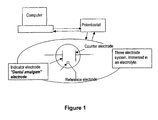
- the analyses were performed as differential pulse anodic stripping voltammetry, using a three- electrode system as shown in Figure 1.
- the three electrodes in Figure 1 is an indicator electrode, which is the dental amalgam electrode, a counter electrode and a reference electrode.
- the three- electrode system is immersed in an electrolyte.
- the three- electrode system is connected to a potentiostat.
- the potentiostat is connected to a computer.
- the voltammetric equipment was made in our laboratories, and is a digital device that can perform all modes of voltammetry.
- the counter electrode was a platinum wire and potentials were measured v s. a silver/silver chloride/saturated silver chloride/saturated potassium chloride reference electrode.
- the working electrode was a silver amalgam electrode as illustrated in Figure 2.
- Three types of dental amalgams were investigated:
- the three types of working electrodes were polished once before the experiments using a fine soften sandpaper, and washed in water purified by Millipore Elix and then with Millipore Milli-Q Gradient system (Millipore Corporation, SA 67120 Molsheim France). Also standard solutions were made by use of water from this water purification system. All reagents were of analytical reagent grade quality.
- the result will be divided into three sections, dealing with the respective working electrode used.
- Analyses in order to prove if it was possible to detect heavy meals on an electrode consisting of a non-zinc (high copper non- gamma 2 - alloy) amalgam for dental use was performed.
- Analyses of zinc in the range from 100 ⁇ g/l to 1500 ⁇ g/l in NH 4 Ac (0,05 M) solution was carried out.
- Differential pulse anodic stripping voltammetry with a scan rate of 10 mV/sec, pulse height 70 mV, and a 120 seconds deposition time was used.
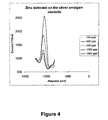
- Figure 4 shows a voltammogram were zinc was added successively to the NH 4 Ac solution.
- current (100nA) is shown versus potential (mV).
- the experimental conditions were as in Figure 4.
- Table 1 is analyses of zinc on dental amalgam electrode, two parallels.
- the table state the current values (corrected for offset) obtained in each parallel. Also the average response, the standard deviation and the relative standard deviation are listed in the table.
- a working electrode material which consists of pure silver amalgam has many properties making it a preferable material for electrode use in voltammetry. It has a high overvoltage against hydrogen and this enables one to determine several compounds which previously could not be determined except from using a mercury electrode. It is a solid material, and this makes it possible to be used in online analyses in the field. It can also be used repeatedly over a long period of time without any maintenance, which is essential for online and field apparatus.
Landscapes
- Chemical & Material Sciences (AREA)
- Life Sciences & Earth Sciences (AREA)
- Health & Medical Sciences (AREA)
- Pathology (AREA)
- General Physics & Mathematics (AREA)
- Electrochemistry (AREA)
- Physics & Mathematics (AREA)
- Analytical Chemistry (AREA)
- Biochemistry (AREA)
- General Health & Medical Sciences (AREA)
- Chemical Kinetics & Catalysis (AREA)
- Immunology (AREA)
- Molecular Biology (AREA)
- Investigating Or Analyzing Non-Biological Materials By The Use Of Chemical Means (AREA)
- Dental Tools And Instruments Or Auxiliary Dental Instruments (AREA)
- Analysing Materials By The Use Of Radiation (AREA)
- Measurement Of Radiation (AREA)
- Consolidation Of Soil By Introduction Of Solidifying Substances Into Soil (AREA)
- Battery Electrode And Active Subsutance (AREA)
- Secondary Cells (AREA)
- Saccharide Compounds (AREA)
- Investigating, Analyzing Materials By Fluorescence Or Luminescence (AREA)
- Inert Electrodes (AREA)
- Electrolytic Production Of Metals (AREA)
Abstract
Description
- The present invention relates to a method of performing voltammetric analysis.
- Since the development of polarography by Professor J. Heyrovsky in 1922, liquid mercury and liquid diluted mercury amalgams have been superior as electrode material for the use of voltammetry for analytical purposes. This is mainly due to the high overvoltage to hydrogen, which enables one to use a wide potential range for the measurements. A typical example is the determination of zinc, this being virtually impossible without using a mercury - or a mercury film electrode.
- Due to the toxicity of mercury and liquid diluted mercury compounds, the use of such compounds are increasingly restricted, and cannot be included in voltammetric devices for field and online applications.
- The properties of dental amalgam as an electrode material in voltammetry have been studied. It was found that dental amalgam has a very high overpotential to hydrogen, allowing one to carry out trace analyses at potentials sufficiently negative to allow determination of e.g. zinc, cobalt, nickel and iron at trace levels. This has not previously been possible except from using a mercury or a mercury film electrode. Such determinations are very important for field and online analyses of pollutants in soil and groundwater, and the electrode can be used repeatedly. The electrode is also solid.
- Silver and mercury are main components of dental amalgam. However, commercial dental alloy has some tin, copper and zinc content in order to improve the mechanical properties for dental use. According to the invention, a pure suver amalgam is used to avoid interferences.
- The electrodes can be produced using techniques well established in dental practice.
- Due to the special properties of dental amalgam compared with mercury itself, its toxicity is very low, although its use in the mouth is somewhat disputed. As no increased amount of mercury is reported in the groundwater close to cemeteries, the use of such small electrodes for soil and groundwater analyses are obviously without any hazard.
- The present analyses describe such electrodes and some preliminary practical applications for trace heavy metal analyses, using differential pulse stripping voltammetry. This enables one to determine e.g. zinc in the concentration level less than 10 ppb. Further improvements can obviously be obtained by optimising the composition of the alloy and the electrolyte, and by application of sound to the electrode system. (Application of sound to an electrode system is described in the inventors' Norwegian patent application number 1999 1814.)
- In a first aspect of the invention there is provided a method of performing voltammetric analysis, where the working electrode material consists of a pure silver amalgam in a solid state.
- In a further aspect the invention provides a method for performing electrochemical analyses involving a redox reaction at an electrode surface, using an analysis cell, a system of electrodes arranged in the analysis cell filled with a solution to be analysed producing a measuring signal as a consequence of a redox reaction at the electrodes, wherein the measuring signal is a measure of the concentration of a component in the solution, and where at least one of the electrodes comprises amalgam in a solid state.
- The amalgam may be any solid amalgam to be approved to be at least in the same environmental safety level as the requirements for dental use. The electrode may be in the form of a ceramic rod enclosing the amalgam, and with a copper wire for electrical connection. The amalgam in the electrode may be made using methods familiar in dental techniques.
- In a further embodiment, the method may relate to differential pulse anodic stripping voltammetry.
- The invention is stated in the appended claims.
- Embodiments of the invention will now be described in the following with reference to the accompanying drawings, where
- Figure 1 shows a three-electrode system;
- Figure 2 is a cross-sectional view of a solid electrode which is suitable for use in the method of the invention;
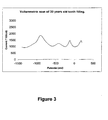
- Figure 3 is a graph showing a voltammetric scan of a 30 years old tooth filling in KNO3 (0.1M) solution;
- Figure 4 is a voltammogram showing the detection of zinc on a working electrode containing a non-zinc amalgam for dental use;
- Figure 5 is a graph showing peak current for zinc as a function of concentration for the experimental conditions in Figure 4; and
- Figure 6 is a voltammogram of a simultaneous detection of zinc, cadmium and lead.
-
- The analyses were performed as differential pulse anodic stripping voltammetry, using a three- electrode system as shown in Figure 1. The three electrodes in Figure 1 is an indicator electrode, which is the dental amalgam electrode, a counter electrode and a reference electrode. The three- electrode system is immersed in an electrolyte. The three- electrode system is connected to a potentiostat. The potentiostat is connected to a computer. The voltammetric equipment was made in our laboratories, and is a digital device that can perform all modes of voltammetry.
- The counter electrode was a platinum wire and potentials were measured vs. a silver/silver chloride/saturated silver chloride/saturated potassium chloride reference electrode.
- The working electrode was a silver amalgam electrode as illustrated in Figure 2. Three types of dental amalgams were investigated:
- a. The initial experiments were performed by using an about 30 years old amalgam tooth filling, attached to a copper wire with silver epoxy, and than sealed in cernit (from T+F GmbH). The copper wire was connected to the voltammetric equipment. These experiments were carried out to study if the dental amalgam showed overpotential to hydrogen. The analyses were performed by differential pulse anodic stripping voltammetry in KNO3 (0.1 M, 100 ml) solution that was purged with nitrogen (10 min) prior to the analyses.
- b. The second silver amalgam electrode was prepared by the following procedure using the facilities in a dental clinic: Equal amounts of analytical grade mercury were mixed with high copper non- gamma 2 - alloy for dental use (ARDENT FUTURA, AB Ardent, Märsta Sweden). The non- gamma 2 alloy consists of 44,5 % silver, 30,0 % tin and 25,5 % copper. A Dentomat 2 Degussa amalgam mixer for dental use was employed for mixing the amalgam. The amalgam was forced into an inert ceramic rod by an amalgam gun (No. 940, Hawe Neos Dental), in a way similar to the technique used for dental fillings, and sealed around a copper wire as shown in Figure 2. The copper wire was connected to the voltammetric equipment. The experiments using this electrode were done to prove if it was possible to detect zinc at a non-zinc dental amalgam electrode. If it was found that zinc could be deposited and detected voltammetrically by using this electrode, this would also indicate that other heavy metals could be detected by use of a pure silver dental amalgam. The analyses were performed as differential pulse anodic stripping voltammetry in NH4Ac (0.05 M, 100 ml) solution. The solution was purged with nitrogen (10 min) prior to the analyses to avoid any disturbance of oxygen.
- c. The third silver amalgam electrode was prepared by mixing one part of pure silver crystals for dental use (particle < 50 µ) with 0.65 parts analytical grade mercury, using a mortar. Immediately after mixing the amalgam was pressed into a ceramic rod with an amalgam gun as described above. Analyses were performed by differential pulse anodic stripping voltammetry in NH4Ac (0.05 M, 100 ml). These analyses were done to prove if it was possible to detect heavy metals, for instance zinc, cadmium and lead, on the dental amalgam electrode using a silver amalgam free from impurities like copper and zinc.
-
- The three types of working electrodes were polished once before the experiments using a fine soften sandpaper, and washed in water purified by Millipore Elix and then with Millipore Milli-Q Gradient system (Millipore Corporation, SA 67120 Molsheim France). Also standard solutions were made by use of water from this water purification system. All reagents were of analytical reagent grade quality.
- The result will be divided into three sections, dealing with the respective working electrode used.
- Some voltammetric scans were performed initially to find if the dental amalgam showed overvoltage to hydrogen to allow the use of a wide potential range. As explained under the experimental section a thirty years old tooth filling was used as a working electrode in a voltammetric arrangement. The typical voltammogram obtained in a KNO3 (0.1 M, 100 ml) solution is showed in Figure 3. The voltammetric scan in Figure 3 shows current (100nA) as a function of potential (mV) and was performed with a scan rate of 10mV/sec and pulse height 25mV.
- As shown in Figure 3, there are no doubt about that the dental amalgam possess the property of a greater overvoltage against hydrogen. The peaks observed are reflecting the composition of the tooth filling, presumably corresponding to zinc, tin, copper and silver, from left to right. If the scan had been extended to around +300 mV, a peak for mercury would probably also appear.
- Analyses in order to prove if it was possible to detect heavy meals on an electrode consisting of a non-zinc (high copper non- gamma 2 - alloy) amalgam for dental use was performed. Analyses of zinc in the range from 100 µg/l to 1500 µg/l in NH4Ac (0,05 M) solution was carried out. Differential pulse anodic stripping voltammetry with a scan rate of 10 mV/sec, pulse height 70 mV, and a 120 seconds deposition time was used.
- Figure 4 shows a voltammogram were zinc was added successively to the NH4Ac solution. In Figure 4 current (100nA) is shown versus potential (mV).
- As seen in Figure 4 the addition of zinc resulted in corresponding increase in the current signal. Figure 5 shows a plot of the peak current (µA) as a function of zinc concentration (µg/l). The peak current is corrected for a 1,5 µA offset. As shown, there is a good linearity (R2=0.99) between the to variables. The experimental conditions were as in Figure 4.
- The results obtained in this section prove that zinc can be detected on the dental amalgam electrode. These results also indicate that an analogous situation will appear for other heavy metals, like cadmium, lead and copper.
- The reproducibility was investigated by performing two parallels and is given in Table 1. Table 1 is analyses of zinc on dental amalgam electrode, two parallels. The table state the current values (corrected for offset) obtained in each parallel. Also the average response, the standard deviation and the relative standard deviation are listed in the table.
Concentration µg/l Response µA Response µA Avg. resp. µA Std. deviation µA Relative std. deviation (%) 500 12.1 11.0 11.6 0.8 6.9 1000 22.8 20.3 21.6 1.7 8.0 1500 35.7 32.2 33.9 2.5 7.3 - As seen in Table 1 there is a relative standard deviation of about 7,5%. This is good with a view to that the electrode surface of the working electrode only was polish with soft sandpaper.
- Some analyses were performed to investigate the use of a pure silver amalgam as a working electrode material. Some simultaneous analyses of zinc, cadmium and lead were performed. The given metals are in the range from 100 µg/l to 150 µg/l in NH4Ac (0,05 M) solution was used. Differential pulse anodic stripping voltammetry with a scan rate of 10 mV/sec,
pulse height 100 mV, and 180 seconds deposition time was applied. A typical plot of the given voltammogram with current (µA) as a function of potential (mV) is shown in Figure 6 for the simultaneous detection of 150 µg/l zinc (Zn), 100 µg/l cadmium (Cd) and 100 µg/l lead (Pb) is plotted. - From the given results it is found that a working electrode consisting of pure silver amalgam can be used in voltammetry for detection of heavy metals and other species in ppb levels. Further improvements can obviously also be obtained by optimising the composition of the alloy and the electrolyte, and by application of sound to the electrode system (Ref. Patent application 1999 1814, Norway).
- A working electrode material which consists of pure silver amalgam has many properties making it a preferable material for electrode use in voltammetry. It has a high overvoltage against hydrogen and this enables one to determine several compounds which previously could not be determined except from using a mercury electrode. It is a solid material, and this makes it possible to be used in online analyses in the field. It can also be used repeatedly over a long period of time without any maintenance, which is essential for online and field apparatus.
- The toxicity of dental amalgam is not greater than that people can live with it inside their mouth for a whole life without any poisoning effects, and its use is without any formal environmental restrictions. Also in an electrode the amount of an amalgam will be much lower than the amount used in a tooth filling. Moreover as no increased amount of mercury is reported in the groundwater close to cemeteries, the use of such small electrodes for soil and groundwater analyses are obviously without any hazard.
- Finally, it is easy and cheap to manufacture such electrodes, for use in the method according to the invention, using techniques well established for dental clinics.
- Having described preferred embodiments of the invention it will be apparent to those skilled in the art that other embodiments incorporating the concepts may be used. These and other examples of the invention illustrated above are intended by way of example only and the actual scope of the invention is to be determined from the following claims.
- The authors are very grateful to dentist Thor Pande, Trondheim, Norway, for assisting with the dental techniques for production of electrodes in his dental clinic.
Claims (4)
- Method of performing voltammetric analysis,
characterized by using an electrode system comprising at least one electrode wherein the working electrode material of said electrode consists of a pure silver amalgam in a solid state. - Method according to claim 1, characterized in that said pure silver amalgam consists of one part pure silver crystals for dental use and 0,65 parts analytical grade mercury.
- Method according to claim 1 or 2,
characterized in that the voltammetric analysis is of the type differential pulse anodic stripping voltammetry. - Method as claimed in claim 1 or 2 or 3 in which the voltammetric analysis involves a redox reaction at an electrode surface, using an analysis cell and a system of electrodes arranged in the analysis cell, said analysis cell to be filled with a solution to be analysed through production of a measuring signal as a consequence of a redox reaction at the electrodes, wherein the measuring signal is a measure of the concentration of a component in the solution.
Applications Claiming Priority (5)
| Application Number | Priority Date | Filing Date | Title |
|---|---|---|---|
| PCT/NO2000/000124 WO2000063686A1 (en) | 1999-04-16 | 2000-04-14 | Method and means for performing electrochemical analysis |
| WOPCT/NO00/00124 | 2000-04-14 | ||
| NO20002783A NO316341B1 (en) | 2000-04-14 | 2000-05-31 | Electrode for voltammetric analysis |
| NO20002783 | 2000-05-31 | ||
| PCT/NO2001/000155 WO2001080328A2 (en) | 2000-04-14 | 2001-04-09 | Electrode for electrochemical analyses |
Publications (2)
| Publication Number | Publication Date |
|---|---|
| EP1281071A2 EP1281071A2 (en) | 2003-02-05 |
| EP1281071B1 true EP1281071B1 (en) | 2005-08-03 |
Family
ID=26649024
Family Applications (1)
| Application Number | Title | Priority Date | Filing Date |
|---|---|---|---|
| EP01938839A Expired - Lifetime EP1281071B1 (en) | 2000-04-14 | 2001-04-09 | Voltammetric analysis using an amalgam electrode |
Country Status (9)
| Country | Link |
|---|---|
| US (1) | US7056431B2 (en) |
| EP (1) | EP1281071B1 (en) |
| AT (1) | ATE301289T1 (en) |
| AU (1) | AU2001264415A1 (en) |
| DE (1) | DE60112425T2 (en) |
| DK (1) | DK1281071T3 (en) |
| ES (1) | ES2244626T3 (en) |
| NO (1) | NO316341B1 (en) |
| WO (1) | WO2001080328A2 (en) |
Families Citing this family (9)
| Publication number | Priority date | Publication date | Assignee | Title |
|---|---|---|---|---|
| GB0514081D0 (en) | 2005-07-08 | 2005-08-17 | Univ Robert Gordon | Measurement apparatus |
| CN100434908C (en) * | 2006-10-24 | 2008-11-19 | 东北电力大学 | A kind of all-solid Zn ion selective electrode and preparation method thereof |
| DE102009060004B4 (en) | 2009-12-21 | 2024-06-13 | Ech Elektrochemie Halle Gmbh | Method and device for determining layer thicknesses of less noble metals on more noble metals |
| US20120048748A1 (en) * | 2010-08-30 | 2012-03-01 | Wickersham Jr Charles E | Air Quality Analyzer |
| KR101324742B1 (en) * | 2013-02-01 | 2013-11-05 | 서강대학교산학협력단 | Amalgam electrode, producing method thereof, and method of electrochemical reduction of carbon dioxide using the same |
| CN103898573A (en) * | 2013-12-30 | 2014-07-02 | 聚光科技(杭州)股份有限公司 | Electroplate liquid for improving stability of mercury film electrode |
| CN103837693B (en) * | 2014-03-10 | 2015-06-03 | 中国农业大学 | Extraction, filtration and electrochemical detection all-in-one device for soil heavy metals and method of device |
| US10689768B2 (en) | 2014-08-01 | 2020-06-23 | Sogang University Research Foundation | Amalgam electrode, producing method thereof, and method of electrochemical reduction of carbon dioxide using the same |
| CN115791914B (en) * | 2022-10-12 | 2025-06-13 | 南京理工大学 | A solid electrode for quantitative detection of selenomonosaccharides and its application |
Family Cites Families (6)
| Publication number | Priority date | Publication date | Assignee | Title |
|---|---|---|---|---|
| US4211623A (en) * | 1978-12-27 | 1980-07-08 | Orion Research Incorporated | Halide electrode |
| SU1002943A1 (en) | 1981-11-02 | 1983-03-07 | Всесоюзный Научно-Исследовательский И Проектный Институт По Переработке Газа | Stationary indicator electrode for oxygen determination |
| JPS59217154A (en) * | 1983-05-25 | 1984-12-07 | Mitsubishi Chem Ind Ltd | Potential stripping analysis method and equipment therefor |
| JPS6073450A (en) * | 1983-09-30 | 1985-04-25 | Fuji Electric Corp Res & Dev Ltd | Quantitative determination of nitrate ion |
| JP2519144B2 (en) | 1991-11-07 | 1996-07-31 | 株式会社ナカボーテック | Reference electrode for measuring electric potential and portable sensor for corrosion detection using it- |
| GB9311035D0 (en) * | 1993-05-28 | 1993-07-14 | Environmental Med Prod | Electrochemical metal analysis |
-
2000
- 2000-05-31 NO NO20002783A patent/NO316341B1/en not_active IP Right Cessation
-
2001
- 2001-04-09 DK DK01938839T patent/DK1281071T3/en active
- 2001-04-09 AT AT01938839T patent/ATE301289T1/en not_active IP Right Cessation
- 2001-04-09 US US10/257,443 patent/US7056431B2/en not_active Expired - Fee Related
- 2001-04-09 EP EP01938839A patent/EP1281071B1/en not_active Expired - Lifetime
- 2001-04-09 AU AU2001264415A patent/AU2001264415A1/en not_active Abandoned
- 2001-04-09 ES ES01938839T patent/ES2244626T3/en not_active Expired - Lifetime
- 2001-04-09 WO PCT/NO2001/000155 patent/WO2001080328A2/en not_active Ceased
- 2001-04-09 DE DE60112425T patent/DE60112425T2/en not_active Expired - Lifetime
Non-Patent Citations (2)
| Title |
|---|
| GROSS M.J.; HARRISON J.A.: "Some electrochemical features of the in vivo corrosion of dental amalgams", JOURNAL OF APPLIED ELECTROCHEMISTRY, vol. 19, 1 December 1989 (1989-12-01), pages 301 - 310 * |
| TOUMELIN-CHEMLA F.; DEGRANGE M.: "Electrochemical study of insulating properties of dental amalgam bonding polymers", PHYSICS IN MEDICINE AND BIOLOGY, vol. 43, pages 1429 - 1438, XP009039253 * |
Also Published As
| Publication number | Publication date |
|---|---|
| ES2244626T3 (en) | 2005-12-16 |
| WO2001080328A2 (en) | 2001-10-25 |
| US7056431B2 (en) | 2006-06-06 |
| NO20002783D0 (en) | 2000-05-31 |
| DK1281071T3 (en) | 2005-09-12 |
| DE60112425D1 (en) | 2005-09-08 |
| WO2001080328A3 (en) | 2002-01-24 |
| AU2001264415A1 (en) | 2001-10-30 |
| ATE301289T1 (en) | 2005-08-15 |
| NO316341B1 (en) | 2004-01-12 |
| US20040020792A1 (en) | 2004-02-05 |
| NO20002783L (en) | 2001-10-15 |
| EP1281071A2 (en) | 2003-02-05 |
| DE60112425T2 (en) | 2006-05-11 |
Similar Documents
| Publication | Publication Date | Title |
|---|---|---|
| Mikkelsen et al. | Dental amalgam in voltammetry. Some preliminary results | |
| Mikkelsen et al. | Amalgam electrodes for electroanalysis | |
| McQuaker et al. | Determination of total fluoride in soil and vegetation using an alkali fusion-selective ion electrode technique | |
| Jagner | Instrumental approach to potentiometric stripping analysis of some heavy metals | |
| Marrese | Preparation of strongly adherent platinum black coatings | |
| Mikkelsen et al. | Alloy electrodes with high hydrogen overvoltage for analytical use in voltammetry. Some preliminary results | |
| US7056431B2 (en) | Method for electrochemical analyses | |
| Yosypchuk et al. | Determination of iodates using silver solid amalgam electrodes | |
| US4211623A (en) | Halide electrode | |
| Iwamoto et al. | Cathodic reduction of thyroxine and related compounds on silver | |
| Zirino et al. | Stripping polarography and the reduction of copper (II) in sea water at the hanging mercury drop electrode | |
| US7195703B2 (en) | Electrode for analytical voltammetry | |
| Ireland-Ripert et al. | Determination of methylmercury in the presence of inorganic mercury by anodic stripping voltammetry | |
| CA1222795A (en) | Electrochemical reference electrode | |
| Yosypchuk et al. | Reference electrodes based on solid amalgams | |
| Guanghan et al. | Anodic stripping voltammetry for the determination of trace iodide | |
| Posey et al. | Stripping voltammetry of Tellurium (IV) in 0.1 M perchloric acid at rotating gold disk electrodes | |
| He et al. | Voltammetric method based on an ion-pairing reaction for the determination of trace amount of iodide at carbon-paste electrodes | |
| Skogvold et al. | Electrochemical properties and range of application of mixed gold bismuth electrodes | |
| SU1833814A1 (en) | Voltammetering method for determination of iodate-ions | |
| Vytřas et al. | Voltammetric and potentiometric determination of gold in gold-plated electrotechnical components | |
| Gumiński | Electroanalytical determination of the solubility of noble metals in mercury | |
| Žežula et al. | Application of abrasive stripping voltammetry in corrosion science. I. determination of the corrosion potentials of metals | |
| DE2605568A1 (en) | ELECTROCHEMICAL MEASURING ELECTRODE | |
| Higgins et al. | Polarographic irreversibility of the copper (II) pyrophosphate system |
Legal Events
| Date | Code | Title | Description |
|---|---|---|---|
| PUAI | Public reference made under article 153(3) epc to a published international application that has entered the european phase |
Free format text: ORIGINAL CODE: 0009012 |
|
| 17P | Request for examination filed |
Effective date: 20021023 |
|
| AK | Designated contracting states |
Designated state(s): AT BE CH CY DE DK ES FI FR GB GR IE IT LI LU MC NL PT SE TR |
|
| AX | Request for extension of the european patent |
Extension state: AL LT LV MK RO SI |
|
| 17Q | First examination report despatched |
Effective date: 20040223 |
|
| GRAP | Despatch of communication of intention to grant a patent |
Free format text: ORIGINAL CODE: EPIDOSNIGR1 |
|
| RTI1 | Title (correction) |
Free format text: VOLTAMMETRIC ANALYSIS USING AN AMALGAM ELECTRODE |
|
| GRAS | Grant fee paid |
Free format text: ORIGINAL CODE: EPIDOSNIGR3 |
|
| GRAA | (expected) grant |
Free format text: ORIGINAL CODE: 0009210 |
|
| AK | Designated contracting states |
Kind code of ref document: B1 Designated state(s): AT BE CH CY DE DK ES FI FR GB GR IE IT LI LU MC NL PT SE TR |
|
| PG25 | Lapsed in a contracting state [announced via postgrant information from national office to epo] |
Ref country code: BE Free format text: LAPSE BECAUSE OF FAILURE TO SUBMIT A TRANSLATION OF THE DESCRIPTION OR TO PAY THE FEE WITHIN THE PRESCRIBED TIME-LIMIT Effective date: 20050803 Ref country code: IT Free format text: LAPSE BECAUSE OF FAILURE TO SUBMIT A TRANSLATION OF THE DESCRIPTION OR TO PAY THE FEE WITHIN THE PRESCRIBED TIME-LIMIT;WARNING: LAPSES OF ITALIAN PATENTS WITH EFFECTIVE DATE BEFORE 2007 MAY HAVE OCCURRED AT ANY TIME BEFORE 2007. THE CORRECT EFFECTIVE DATE MAY BE DIFFERENT FROM THE ONE RECORDED. Effective date: 20050803 Ref country code: TR Free format text: LAPSE BECAUSE OF FAILURE TO SUBMIT A TRANSLATION OF THE DESCRIPTION OR TO PAY THE FEE WITHIN THE PRESCRIBED TIME-LIMIT Effective date: 20050803 |
|
| REG | Reference to a national code |
Ref country code: GB Ref legal event code: FG4D |
|
| REG | Reference to a national code |
Ref country code: CH Ref legal event code: EP |
|
| REG | Reference to a national code |
Ref country code: SE Ref legal event code: TRGR |
|
| REG | Reference to a national code |
Ref country code: IE Ref legal event code: FG4D |
|
| REF | Corresponds to: |
Ref document number: 60112425 Country of ref document: DE Date of ref document: 20050908 Kind code of ref document: P |
|
| REG | Reference to a national code |
Ref country code: DK Ref legal event code: T3 |
|
| PG25 | Lapsed in a contracting state [announced via postgrant information from national office to epo] |
Ref country code: GR Free format text: LAPSE BECAUSE OF FAILURE TO SUBMIT A TRANSLATION OF THE DESCRIPTION OR TO PAY THE FEE WITHIN THE PRESCRIBED TIME-LIMIT Effective date: 20051103 |
|
| REG | Reference to a national code |
Ref country code: ES Ref legal event code: FG2A Ref document number: 2244626 Country of ref document: ES Kind code of ref document: T3 |
|
| PG25 | Lapsed in a contracting state [announced via postgrant information from national office to epo] |
Ref country code: PT Free format text: LAPSE BECAUSE OF FAILURE TO SUBMIT A TRANSLATION OF THE DESCRIPTION OR TO PAY THE FEE WITHIN THE PRESCRIBED TIME-LIMIT Effective date: 20060103 |
|
| ET | Fr: translation filed | ||
| PG25 | Lapsed in a contracting state [announced via postgrant information from national office to epo] |
Ref country code: MC Free format text: LAPSE BECAUSE OF NON-PAYMENT OF DUE FEES Effective date: 20060430 |
|
| PLBE | No opposition filed within time limit |
Free format text: ORIGINAL CODE: 0009261 |
|
| STAA | Information on the status of an ep patent application or granted ep patent |
Free format text: STATUS: NO OPPOSITION FILED WITHIN TIME LIMIT |
|
| 26N | No opposition filed |
Effective date: 20060504 |
|
| PG25 | Lapsed in a contracting state [announced via postgrant information from national office to epo] |
Ref country code: LU Free format text: LAPSE BECAUSE OF NON-PAYMENT OF DUE FEES Effective date: 20060409 |
|
| PGFP | Annual fee paid to national office [announced via postgrant information from national office to epo] |
Ref country code: AT Payment date: 20080414 Year of fee payment: 8 |
|
| PGFP | Annual fee paid to national office [announced via postgrant information from national office to epo] |
Ref country code: IE Payment date: 20080418 Year of fee payment: 8 |
|
| PG25 | Lapsed in a contracting state [announced via postgrant information from national office to epo] |
Ref country code: CY Free format text: LAPSE BECAUSE OF FAILURE TO SUBMIT A TRANSLATION OF THE DESCRIPTION OR TO PAY THE FEE WITHIN THE PRESCRIBED TIME-LIMIT Effective date: 20050803 |
|
| PGFP | Annual fee paid to national office [announced via postgrant information from national office to epo] |
Ref country code: DK Payment date: 20090420 Year of fee payment: 9 Ref country code: ES Payment date: 20090421 Year of fee payment: 9 |
|
| PGFP | Annual fee paid to national office [announced via postgrant information from national office to epo] |
Ref country code: FI Payment date: 20090422 Year of fee payment: 9 Ref country code: NL Payment date: 20090421 Year of fee payment: 9 Ref country code: SE Payment date: 20090417 Year of fee payment: 9 |
|
| PGFP | Annual fee paid to national office [announced via postgrant information from national office to epo] |
Ref country code: CH Payment date: 20090421 Year of fee payment: 9 |
|
| PG25 | Lapsed in a contracting state [announced via postgrant information from national office to epo] |
Ref country code: AT Free format text: LAPSE BECAUSE OF NON-PAYMENT OF DUE FEES Effective date: 20090409 |
|
| REG | Reference to a national code |
Ref country code: IE Ref legal event code: MM4A |
|
| PG25 | Lapsed in a contracting state [announced via postgrant information from national office to epo] |
Ref country code: IE Free format text: LAPSE BECAUSE OF NON-PAYMENT OF DUE FEES Effective date: 20090409 |
|
| PGFP | Annual fee paid to national office [announced via postgrant information from national office to epo] |
Ref country code: DE Payment date: 20100412 Year of fee payment: 10 |
|
| REG | Reference to a national code |
Ref country code: NL Ref legal event code: V1 Effective date: 20101101 |
|
| EUG | Se: european patent has lapsed | ||
| REG | Reference to a national code |
Ref country code: CH Ref legal event code: PL |
|
| REG | Reference to a national code |
Ref country code: DK Ref legal event code: EBP |
|
| PG25 | Lapsed in a contracting state [announced via postgrant information from national office to epo] |
Ref country code: FI Free format text: LAPSE BECAUSE OF NON-PAYMENT OF DUE FEES Effective date: 20100409 Ref country code: NL Free format text: LAPSE BECAUSE OF NON-PAYMENT OF DUE FEES Effective date: 20101101 |
|
| PG25 | Lapsed in a contracting state [announced via postgrant information from national office to epo] |
Ref country code: LI Free format text: LAPSE BECAUSE OF NON-PAYMENT OF DUE FEES Effective date: 20100430 Ref country code: CH Free format text: LAPSE BECAUSE OF NON-PAYMENT OF DUE FEES Effective date: 20100430 |
|
| PG25 | Lapsed in a contracting state [announced via postgrant information from national office to epo] |
Ref country code: DK Free format text: LAPSE BECAUSE OF NON-PAYMENT OF DUE FEES Effective date: 20100503 |
|
| REG | Reference to a national code |
Ref country code: ES Ref legal event code: FD2A Effective date: 20110714 |
|
| PG25 | Lapsed in a contracting state [announced via postgrant information from national office to epo] |
Ref country code: ES Free format text: LAPSE BECAUSE OF NON-PAYMENT OF DUE FEES Effective date: 20110704 |
|
| PG25 | Lapsed in a contracting state [announced via postgrant information from national office to epo] |
Ref country code: ES Free format text: LAPSE BECAUSE OF NON-PAYMENT OF DUE FEES Effective date: 20100410 |
|
| PG25 | Lapsed in a contracting state [announced via postgrant information from national office to epo] |
Ref country code: DE Free format text: LAPSE BECAUSE OF NON-PAYMENT OF DUE FEES Effective date: 20111101 |
|
| REG | Reference to a national code |
Ref country code: DE Ref legal event code: R119 Ref document number: 60112425 Country of ref document: DE Effective date: 20111101 |
|
| PG25 | Lapsed in a contracting state [announced via postgrant information from national office to epo] |
Ref country code: SE Free format text: LAPSE BECAUSE OF NON-PAYMENT OF DUE FEES Effective date: 20100410 |
|
| PGFP | Annual fee paid to national office [announced via postgrant information from national office to epo] |
Ref country code: GB Payment date: 20130402 Year of fee payment: 13 |
|
| PGFP | Annual fee paid to national office [announced via postgrant information from national office to epo] |
Ref country code: FR Payment date: 20140423 Year of fee payment: 14 |
|
| GBPC | Gb: european patent ceased through non-payment of renewal fee |
Effective date: 20140409 |
|
| PG25 | Lapsed in a contracting state [announced via postgrant information from national office to epo] |
Ref country code: GB Free format text: LAPSE BECAUSE OF NON-PAYMENT OF DUE FEES Effective date: 20140409 |
|
| REG | Reference to a national code |
Ref country code: FR Ref legal event code: ST Effective date: 20151231 |
|
| PG25 | Lapsed in a contracting state [announced via postgrant information from national office to epo] |
Ref country code: FR Free format text: LAPSE BECAUSE OF NON-PAYMENT OF DUE FEES Effective date: 20150430 |