EP1280895B1 - Polypeptide inhibiting a proton-gated na+ channel - Google Patents
Polypeptide inhibiting a proton-gated na+ channel Download PDFInfo
- Publication number
- EP1280895B1 EP1280895B1 EP01929932A EP01929932A EP1280895B1 EP 1280895 B1 EP1280895 B1 EP 1280895B1 EP 01929932 A EP01929932 A EP 01929932A EP 01929932 A EP01929932 A EP 01929932A EP 1280895 B1 EP1280895 B1 EP 1280895B1
- Authority
- EP
- European Patent Office
- Prior art keywords
- asic1a
- pctx1
- venom
- polypeptide
- channel blocker
- Prior art date
- Legal status (The legal status is an assumption and is not a legal conclusion. Google has not performed a legal analysis and makes no representation as to the accuracy of the status listed.)
- Expired - Lifetime
Links
Images


Classifications
-
- C—CHEMISTRY; METALLURGY
- C07—ORGANIC CHEMISTRY
- C07K—PEPTIDES
- C07K14/00—Peptides having more than 20 amino acids; Gastrins; Somatostatins; Melanotropins; Derivatives thereof
- C07K14/435—Peptides having more than 20 amino acids; Gastrins; Somatostatins; Melanotropins; Derivatives thereof from animals; from humans
- C07K14/46—Peptides having more than 20 amino acids; Gastrins; Somatostatins; Melanotropins; Derivatives thereof from animals; from humans from vertebrates
-
- A—HUMAN NECESSITIES
- A61—MEDICAL OR VETERINARY SCIENCE; HYGIENE
- A61K—PREPARATIONS FOR MEDICAL, DENTAL OR TOILETRY PURPOSES
- A61K38/00—Medicinal preparations containing peptides
Definitions
- the present invention pertains to a substantially pure polypeptide functioning as an ASIC1a channel blocker, more particularly this polypeptide has the amino acid sequence represented in the list of sequences in the appendix under the number SEQ ID No.1. Also provided is a nucleic acid coding for such polypeptide and a method of manufacturing an ASIC1a channel blocker.
- Proton-gated Na + -permeable channels are the simplest form of ligand-gated channels. They are present in many neuronal cell types throughout the central nervous system, suggesting an important function of these channels in signal transduction associated with local pH variations during normal neuronal activity. These channels might also play an important role in pathological situations such as brain ischemia or epilepsy which produce significant extracellular acidification. They are also present in nociceptive neurons and are thought to be responsible for the sensation of pain that accompanies tissue acidosis in muscle and cardiac ischemia, corneal injury, and in inflammation and local infection.
- ASIC for Acid Sensitive Ion Channel
- ENaCs amiloride-sensitive epithelial Na + channels
- FaNaC FMRFamide-gated Na + channel
- DEGs nematode degenerins
- ASIC1a Wood, R., above
- ASIC1b Choen, C.C., England, S., Akopian, A.N and Wood, J.N., "a Sensory Neuron-Specific, Proton-Gated Ion Channel", Proc. Natl. Acad . Sci. USA, 95, 10240-10245, 1998)
- ASIC2a Price, M.P., Snyder, P.M. and Welsh, M.J., "Cloning and Expression of a Novel Human Brain Na + Channel", J . Biol.
- ASIC1a and ASIC1b both mediate rapidly inactivating currents following rapid and modest acidification of the external pH. However while ASIC1a is present in both brain and afferent sensory neurons, its splice variant ASIC1b is found only in sensory neurons.
- ASIC2a forms an active H + -gated channel and is abundant in the brain but essentially absent in sensory neurons while its splice variant ASIC2b is present in both brain and sensory neurons and is inactive as an homomultimer.
- ASIC2b can form functional heteromultimers with other ASIC subunits and particularly ASIC3.
- ASIC3 is found exclusively in small sensory neurons which act as nociceptors. Its expression in various heteromultimeric systems generates a biphasic current with a fast inactivating phase followed by a sustained component.
- ASIC2b with ASIC3 forms an heteromultimer with properties (time course and ionic selectivity) similar to those of a native sustained H+-sensitive channel which is present in dorsal root ganglion cells and appears to play a particularly important role in pain sensation.
- Venoms from snakes, scorpions, sea anemones, marine snails and spiders are rich sources of peptide toxins which have proven of great value in the functional exploration of voltage-sensitive and ligand-gated ion channels (Hucho, F. (1995), "Toxins as tools in neurochemistry", Ang. Chem. Int. Ed. Eng., 34, 39-50). Nevertheless, there is a continuing need to find new materials which affect these channels.
- Psalmotoxin 1 Psalmotoxin 1
- the molecular scaffold of PcTX1 is likely to be similar to that previously described for both cone snail and spider toxins (Narasimhan, L., Singh, Jr., Humblet, C. Guruprasad, K. and Blundell, T., "Snail and Spider Toxins Share a Similar Tertiary Structure and 'Cystine Motif'", Nat. Struct. Biol., 1, 850-852, 1994; Pallaghy, P.K., Nielsen, K.J., Craik, D.J.
- PcTX1 is characterized by the unusual quadruplet Lys 25 ,-Arg 26 -Arg 27 -Arg 28' which probably forms a strongly positive "patch" at the surface of the toxin molecule, constituting an area which is a strong candidate for receptor recognition.
- PcTX1 is absolutely specific for ASIC1a and can distinguish between the two ASIC1 splice variants ASIC1a and ASIC1b although they only differ in their N-terminal sequence. PcTX1 can also distinguish between ASIC1a, ASIC2 and ASIC3. Furthermore, PcTX1 loses its capacity to block. ASIC1a as soon as this subunit is associated with another member of the family, be it ASIC2a or ASIC3.
- ASIC1a An important site of the interaction of ASIC1a with PcTX1 is probably located in the extracellular stretch of 113 amino acids situated immediately after the first transmembrane domain. This is the only extracellular site in which there are differences between ASICla and ASIC1b.
- ASIC1a is present in the central nervous system (notably in the hippocampus and the cerebellar granular layer) as well as in DRG neurons. Electrophysiological experiments have shown that both cerebellar granule cells and a sub-population of DRG neurons possess H + -gated currents that inactivate at pH 6 with time constants of 1.95 - 2.06s. This is very similar if not identical to the time constant of inactivation (2.10 ⁇ 0.30s) of the homomultimeric ASIC1a current expressed in COS cells. The H + -gated currents in these neurons are inhibited by very low concentrations of PcTX1.
- DRG neurons also express H-gated currents with time constants of inactivation that are either faster or slower than the time constant of inactivation of the homomultimeric ASIC1a current.
- This rapidly inactivating current like the current generated by ASIC1a/ASIC3 heteromultimers, is insensitive to PcTX1. Therefore, it is likely that the fast inactivating H + -gated Na + channel in DRG neurons is the ASIC1a/ASIC3 heteromultimer.
- ASIC3 current alone or in association with ASIC2b corresponds to the maintained current recorded in DRG cells.
- ASIC3 homomultimers, ASIC3/ASIC2b heteromultimers nor the native non-activating H + -gated channels are blocked by PcTX1.
- Spider venoms are cocktails of neuroactive peptides capable of incapacitations their preys through a myriad of molecular mechanisms.
- PcTX1 is a potent tool which now opens the way to a more detailed analysis of the physiological function of the important class of H + -gated Na + channels.
- the invention concerns a substantially pure polypeptide functioning as an ASIC1a channel blocker.
- the invention concerns more particularly a substantially pure polypeptide functioning as an ASIC1a channel blocker extracted from the venom of the South-American tarantula Psalmopoeus carnbridgei.
- This polypeptide functioning as an ASIC1a channel blocker has advantageously a calculated molecular weight of about 4689 Da.
- the effects of said polypeptide functioning as an ASIC1a channel blocker are advantageously reversible.
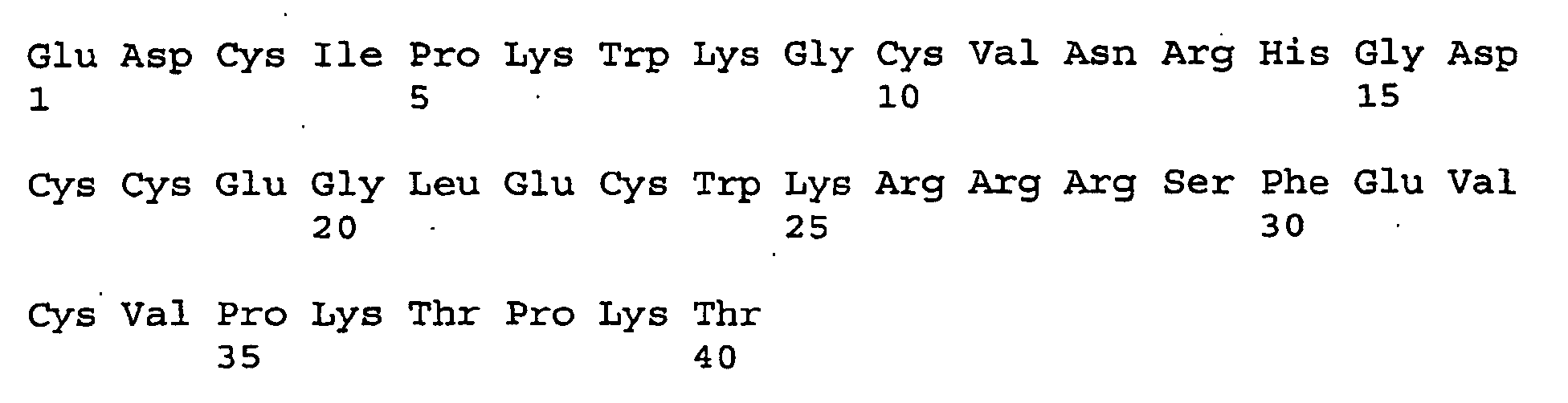
- the polypeptide functioning as an ASIC1a channel blocker comprises the following amino acid sequence EDCIPKWKGCVNRHGDCCEGLECWKRRRSFEVCVPKTPKT represented in the list of sequences in the appendix under the number SEQ ID No.1 and the pharmaceutically-acceptable salts thereof.
- the invention concerns a nucleic acid molecule comprising or constituted of an encoding nucleic sequence for a polypeptide functioning as an ASIC1a channel blocker.
- the invention also concerns a nucleic acid molecule which encodes for a polypeptide functioning as an ASIC1a channel blocker whose amino acid sequence is represented in the list of sequences in the appendix under the number SEQ ID No. 1.
- Another aim of the present invention is polyclonal or monoclonal antibodies directed against a polypeptide functioning as an ASIC1a channel blocker of the invention, a derivative or a fragment of these.
- These antibodies can be prepared by the methods described in the literature. According to prior art techniques, polyclonal antibodies are formed by the injection of proteins, extracted from the epithelium or produced by genetic transformation of a host, into animals, and then recuperation of antiserums and antibodies from the antiserums for example by affinity chromatography.
- the monoclonal antibodies can be produced by fusing myeloma cells with spleen cells from animals previously immunised using the receptors of the invention. These antibodies are useful in the search for new polypeptides functioning as an ASIC1a channel blocker or the homologues of this polypeptide in other species.
- the invention also concerns a vector comprising at least one molecule of nucleic acid above, advantageously associated with adapted control sequences, together with a production or expression process in a cellular host of a polypeptide functioning as an ASIC1a channel blocker of the invention or a fragment thereof.
- the preparation of these vectors as well as the production or expression in a protein host of the invention can be carried out by molecular biology and genetic engineering techniques well known to the professional.
- An encoding nucleic acid molecule for a polypeptide functioning as an ASIC1a channel blocker or a vector according to the invention can also be used to transform animals and establish a line of transgenic animals.
- the vector used is chosen in function of the host into which it is to be transferred; it can be any vector such as a plasmid.
- the invention also relates to cellular hosts expressing a polypeptide functioning as an ASIC1a channel blocker obtained in conformity with the preceding processes.
- the invention also relates to nucleic and oligonucleotide probes prepared from the molecules of nucleic acid according to the invention. These probes, marked advantageously, are useful for hybridisation detection of similar polypeptide functioning as an ASIC1a channel blocker in other individuals or species. According to prior art techniques, these probes are put into contact with a biological sample. Different hybridisation techniques can be used, such as Dot-blot hybridisation or replica hybridisation (Southern technique) or other techniques (DNA chips).
- the oligonucleotide probes are useful for PCR experiments, for example to search for genes in other species or with a diagnostic aim.
- Another aspect of this invention is a pharmaceutical composition containing a polypeptide functioning as an ASIC1a channel blocker as disclosed in the invention or the pharmaceutically-acceptable salts thereof and a pharmaceutically-acceptable carrier.
- the invention relates to a method of manufacturing an ASIC1a channel blocker comprising the steps of:
- Psalmopoeus carmbridgei Araneae Theraphosidae venom was obtained by electrical stimulation of anesthetized spiders (Invertebrate Biologics, Los Gatos, USA). Freeze-dried crude venom was resuspended in distilled water, centrifuged (140000 rpm, 4°C, 20 min), filtered on 0.45 ⁇ m microfilters (SJHVL04NS, 4 mm diameter, Millipore, Japan) and stored at -20°C prior to analysis.
- SJHVL04NS 0.45 ⁇ m microfilters
- Crude venom diluted to ten times the initial volume was fractionated by reversed-phase C8 HPLC (10x250 mm, 5C8MS, Nacalai Tesque, Japan) using a linear gradient of acetonitrile/water in constant 0.1% trifluoroacetic acid (TFA).
- a second purification step used cation-exchange chromatography on a Tosoh TSK-Gel SP5PW sulfopropyl column (4.6x70 mm) (Tosoh, Japan), with a linear gradient of ammonium acetate in water (20 mM to 2 M).
- a total of 160 ⁇ l of venom was purified, in two separate batches (10 and 150 ⁇ l). All solvents used were of HPLC grade. Separation was conducted on a Hewlett-Packard HP1100 system coupled to a diode-array detector and a microcomputer running the Chemstation® software. Monitoring of the elution was done at 215 and 280 nm
- the peptide was reduced and alkylated by 4-vinyl-pyridine, desalted by C8 RP-HPLC and submitted to automated N-terminal sequencing on an Applied Biosystems model 477A gas-phase sequencer.
- Reduced-alkylated toxin was submitted to the following treatments: (a) TPCK-treated Trypsin (Sigma Co, USA), 2% w/w, 37°C, 14 h. in 100 mM ammonium bicarbonate, 0.1 mM CaCl 2 pH 8.1. (b) V8 protease, 37°C, 24 h. in 50 mM ammonium bicarbonate pH 7.8 in 10% acetonitrile and (c) BNP-skatole (2-(nitrophenylsulfenyl)-3-methyl-3-bromoindolenine), 37°C, 24 h. in 75% acetic acid. Resulting peptides were separated by RP-HPLC using a linear gradient of acetonitrile/water in constant 0.1% TFA.
- Mass spectra of native PcTX1 dissolved in ( ⁇ -cyano-4-hydroxycinnamic acid ( ⁇ -CHCA) matrix were recorded on a MALDI-TOF Perseptive Voyager Elite spectrometer (Perseptive Biosystems, USA), in positive ion linear mode using an internal calibration method with a mixture of ⁇ -insulin (3495.94 Da) and bovine insulin (5733.5 Da). Data were analyzed using the GRAMS 386 software. Theoretical molecular weights and pI values were calculated from sequence data using the GPMAW protein analysis software (http: //130.225-147.138/gpmaw/default.htm). Synthetic PcTX1 was analyzed on a Micromass Platform II electrospray system (Micromass, Altrincharn, UK), in positive mode (cone voltage 20kV, temperature 60°C).
- Sequence homologies were determined using sequences obtained from a non-redundant search of protein databases, via the BLAST server (blast program http: //www.ncbi.nlm.nih-gov/). Sequence alignments and percentages of similarity were calculated with ClustalW (http: //www.caos.kun.nl/cammsa/CLUSTALW/clustalw.html).
- the acidic mixture was then precipitated twice in 100 ml of cold diethylether.
- the solid was dissolved in 50 ml of 10% acetic acid in water, and freeze-dried.
- the crude reduced toxin was purified by RP-HPLC on a C18 preparative column (21x250 mm, Jupiter) using a 40 min gradient of acetonitrile / water in 0.1% TFA (0% to 18%B in 4 min, 30%B in 30 min, 100%B in 6 min with B: 90% acetonitrile/H 2 O/0.1%TFA).
- the disappearance of the reduced peptide was monitored by RP-HPLC on a C18 analytical column (10x15 mm, Vydac, USA) using a 40 min gradient (0% to 18% B in 8 min, 30% B in 26 min, 60% B in 14 min with B: 90% acetonitrile/H 2 O/ 0.1%TFA).
- ND96 saline solution
- cRNA (ASIC1a, ASIC2a, Kv2.1, Kv2.2) or DNA (ASIC1b, ratASIC3, Kv4.2, Kv4.3) solutions were injected (5 to 10 ng/ ⁇ l for cRNA and 50 to 100 ng/ ⁇ l for DNA, 50 nl/oocyte) using a pressure micro injector.
- the oocytes were kept at 19°C in the ND96 saline solution supplemented with gentamycin (5 ⁇ g/ml). Oocytes were studied within 2 to 4 days following injection of cRNA.
- a single oocyte was impaled with two standard glass micro electrodes (1-2.5 M_resistance) filled with 3M KC1 and maintained under voltage-clamp using a Dagan TEV 200 amplifier. Stimulation of the preparation, data acquisition and analysis were performed using the pClamp software (Axon Instruments, USA). All experiments were performed at room temperature (21-22°C) in ND96 0.1% bovine serum albumin was added in solutions containing PcTX1 to prevent its adsorption to tubing and containers. For measurements of ASIC currents, changes in extracellular pH were induced by rapid perfusion, with or without PcTX1, near the oocyte.
- Test solutions with a pH of 4 or 5 were buffered with MES rather than HEPES.
- Voltage-dependent K + channels were activated by depolarization tests to +10 mV from a holding potential of -80 mV and the toxin solutions were applied externally by gently puffing 100 ⁇ l near the oocyte.
- COS cells at a density of 20.000 cells per 35 mm diameter petri dish, were transfected with a mix of CD8 and one of the following plasmids: PCI-ASIC1a, PCI-ASIC1b, PCI-ASIC2a, or PCI-ASIC3 (1:5) using the DEAE-Dextran method.
- Cells were used for electrophysiological measurements one to three days after transfection. Successfully transfected cells were recognized by their ability to fix CD8-antibody-coated beads (Dynal, Norway).
- Dorsal root ganglia of 2-3 days old Wistar rats were mechanically dissociated and maintained in culture in Eagle's medium supplemented with 100 ng/ml nerve growth factor. Cells were used for electrophysiological recordings 2 or 3 days after plating.
- Ion currents were recorded using either the whole-cell or outside-out patch-clamp technique and results stored on hard disk. Data analysis was carried out using the Serf freeware (http://ipmc.cnrs.fr/deweille/serf.html). Statistical significance of differences between sets of data was estimated by the single-sided Student test.
- the pipette solution contained (in mM): KC1 140, MgCl 2 2, EGTA 5, HEPES 10 (pH7.2).
- the bath solution contained (in mM) : NaCl 140, KC1 5, MgCl 2 2, CaCl 2 2, HEPES 10 (pH7.3). Changes in extracellular pH were induced by shifting one out of six outlets of a microperfusion system in front of the cell or patch. Experiments were carried out at room temperature (20-24°C).
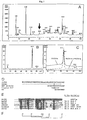
- PcTX1 is a 40-amino acid peptide, possessing 6 half-cysteines linked by three disulfide bridges. Its full sequence was established by the N-terminal Edman degradation of the reduced-alkylated toxin and of the several cleavage fragments. These fragments are shown in Figure 1D.
- the calculated molecular weight (MW 4689.40 Da average) was in accordance with the measured MW (4689.25 Da) and suggested a free carboxylic acid at the C-terminal extremity.
- PcTX1 has limited overall homology to other spider venom toxins identified to date.
- Figure 1E shows a comparison between PcTX1 and other spider venom toxins. Homology varies from 55.6 to 68.9%. However, PcTX1 shares a conserved cysteine distribution found both in spider venom and cone snails and polypeptide toxins, as shown in Fig. 1F.
- PcTX1 is a basic (pI 10.38) polypeptide comprising nine basic and six acidic residues.
- PsTXI-OH unambiguously confirmed the structure of PcTX1.
- the purified refolded synthetic toxin (PcTX1s) and the native form have identical measured MW, and when co-injected in two separate experiments using reversed-phase and cation-exchange HPLC, native and synthetic.
- PcTX1 were indistinguishable in their migration and co-eluted in both systems (Fig.1C). Most electrophysiological experiments were therefore conducted with the synthetic toxin.
- Fig. 2C The effect of PcTX1 on the activity of ASIC1a, ASIC1b, ASIC2a and ASIC3 channels expressed in Xenopus laevi oocytes is shown in Fig. 2.
- the natural as well as the synthetic toxin block the ASIC1a current recorded at pH6, with an IC 50 of 0.9 nM (Fig. 2A and B).
- the blockade is rapid and reversible.
- PcTX1 at a 10 nM concentration also completely blocks the ASIC1a current activated by a pH drop to pH5 or pH4 (not shown).
- PcTX1 is highly selective. Neither the native nor the synthetic PcTX1 (10 nM or 100 nM) blocked ASIC1b currents activated at pH6 (Fig. 2C).
- the ASIC2a channel activated by a pH drop to pH5 was insensitive to the action of PcTX1 at 10 nM (Fig. 2D) or 100 nM (not shown).
- the rapid and slow components of the ASIC3 channel were also insensitive to the perfusion of PcTX1 at 10 nM (Fig. 2E) and 100 nM (not shown).
- PcTX1 was then assayed on heteromultimers of the ASICla subunit (Fig. 3).
- ASIC1a/ASIC2a heteromultimers were also insensitive to PcTX1 (Fig. 3B), demonstrating the specificity of PcTX1.
- the ASIC1a channel can also be blocked by amiloride, but the IC 50 is 10 ⁇ M, i.e. 10 4 lower in affinity than PcTX1. Moreover amiloride is not selective. It blocks all transient expression of current generated by ASIC1a, ASIC1b, ASIC2a, and ASIC3. Amiloride also inhibits epithelial Na + channels, the FMRFamide Na + channel, T-type Ca 2+ channels and many other transport systems such as the Na + /H + and Na + /Ca 2+ exchangers.
- the small dorsal root ganglion (DRG) neurons isolated from 2 day-old rats were voltage-clamped at -60 MV and stimulated by a pH drop from pH7.3 to pH6. As previously observed in small sensory neurons in.trigeminal ganglia, this pH change evoked three different types of responses which are presented in Fig. 4A-C. Currents presented in Fig. 4A were blocked by 3-10 nM of the toxin PcTX1, while H + -evoked currents in other neurons were insensitive to the toxin (Fig. 4B-C). DRG neurons express at least two subpopulations of transient currents as judged by their constants of inactivation (Fig. 4A-B, 4D).
- the dose-response curve presented in Fig. 4E was obtained from the PcTX1-sensitive population of neurons.
- the IC 50 value for half-maximum inhibition is 0.7 nM, very similar to the value of 0.9 nM obtained for ASIC1a channels expressed in Xenopus oocytes.
- Fig. 4F shows that a change of the extracellular pH from pH7.3 to pH6 in neurons that express the channel type shown in Fig. 4A evokes a rapid depolarization resulting in a train of action potentials. This effect is blocked by very low concentrations of PcTX1 and this inhibition is reversible, as shown in the return to control behavior after washing.
Landscapes
- Chemical & Material Sciences (AREA)
- Health & Medical Sciences (AREA)
- Life Sciences & Earth Sciences (AREA)
- Organic Chemistry (AREA)
- General Health & Medical Sciences (AREA)
- Gastroenterology & Hepatology (AREA)
- Biochemistry (AREA)
- Biophysics (AREA)
- Zoology (AREA)
- Genetics & Genomics (AREA)
- Medicinal Chemistry (AREA)
- Molecular Biology (AREA)
- Proteomics, Peptides & Aminoacids (AREA)
- Toxicology (AREA)
- Medicines That Contain Protein Lipid Enzymes And Other Medicines (AREA)
- Peptides Or Proteins (AREA)
Abstract
Description
- Figure 1 has several parts relating to the purification and characterization of PcTX1. Part A is a graphical depiction of a reversed-phase HPLC separation of crude Psalmopoeus carmbridgei venom. Part B is a graphical depiction of cation-exchange chromatography of the reversed-phase HPLC fraction containing PcTX1. Part C is a graphical depiction of cation-exchange chromatography of PcTX1n and PcTX1n + PcTX1s. Part D shows the sequence of PcTX1s and fragments thereof. Part E is a comparison of PcTX1 and short spider peptides of similar structure and known mode of action. Part F shows the conserved disulfide bridges in PcTX1.
- Figure 2 has several parts which relate to the selective blocking of H+-gated channels by PcTX1. Part A is a graphical representation of the effect of 10nM PcTX1 on ASIC1a current. Part B is a graph showing the close-response curve for synthetic PcTX1 block of ASIC1a current with a pH drop from 7.4 to 6. Part C is a graphical representation of the effect of 10nM PcTX1 on ASIC1b current with pH drop from 7.4 to 6. Part D is a graphical representation of the effect of 10nM PcTX1 on ASIC2a current. Part E is a graphical representation of the effect of 10nM PcTX1 on ASIC3 current.
- Figure 3 has several parts relating to the effect of PcTX1 on homomultimers and heteromultimers. Part A is a graph demonstrating the effect of PcTX1 on the ASIC1a homomultimer. Part B is a graph showing the effect of PcTX1a on an ASIC1a + ASIC2a heteromultimer. Part C is a graph showing the effect of PcTX1a on an ASIC1a + ASIC3a heteromultimer.
- Figure 4 has several parts relating to the effect of PcTX1 on a subpopulation of H+-gated currents in dorsal root ganglion neurons. Part A shows inhibition of H+-gated currents by PcTX1 in 23 of 48 neurons. Part B shows the effect of PcTX1 on a portion of the remaining 25 of 48 neurons which were not responsive. Part C shows the effect of PcTX1 on a portion of the remaining 25 of 48 neurons which were not responsive. Part D is a profile of the distribution of time constants in different cells. Part E is a graph showing a dose-inhibition curve obtained from cells expressing the PcTX1- sensitive channels. Part F is a graph showing the suppression of activity in DRG neurons by PcTX1.
- Figure 5. Part A is a graphical representation of the current inhibition in cerebellar granule cells by PcTX1. Part B is a graph showing the pH-dependence of proton-gated current in cerebellar cells.
<141> 2001-05-10
<151> 2000-05-10
<211> 40
<212> PRT
<213> Psalmopoeus carmbridgei
<221> CHAIN
<222> (1) .. (40)
<223>
Claims (14)
- A substantially pure polypeptide functioning as an ASIC1a channel blocker comprising the amino acid sequence represented in the list of sequences in the appendix under the number SEQ ID No.1.
- A substantially pure polypeptide functioning as an ASIC1a channel blocker, characterized in that it is extractable from the venom of the South-American tarantula Psalmopoeus carnbridgei.
- A polypeptide according to claim 2, characterized in that it has a calculated molecular weight of about 4689 Da.
- A polypeptide according to any of claims 2 or 3, characterized in that its effects are reversible.
- A polypeptide according to any of claims 2 to 4, characterized in that it comprises the amino acid sequence represented in the list of sequences in the appendix under the number SEQ ID No.1 and the pharmaceutically-acceptable salts thereof.
- A nucleic acid molecule comprising or constituted of an encoding nucleic sequence for a polypeptide according to any of claims 1 to 5.
- A nucleic acid molecule according to claim 6, coding for the amino acid sequence represented in the list of sequences in the appendix under the number SEQ ID No. 1.
- A polyclonal or monoclonal antibody directed against a polypeptide according to any of claims 1 to 5, a derivative or a fragment of these.
- A vector comprising at least one molecule of nucleic acid according to any of claims 6 or 7, associated with adapted control sequences.
- A cellular host transformed by one molecule of nucleic acid according to any of claims 6 or 7.
- A cellular host transformed by a vector according to claim 9.
- A nucleic or oligonucleotide probe prepared from one molecule of nucleic acid according to any of claims 6 or 7.
- A pharmaceutical composition containing a polypeptide according to any of claims 1 to 5 or the pharmaceutically-acceptable salts thereof and a pharmaceutically-acceptable carrier.
- A method of manufacturing an ASIC1a channel blocker comprising the steps of:(a) obtaining at least one Psalmopoeus carmbridgei spider;(b) obtaining venom from said at least one spider by electrically milking said at least one spider;(c) separating the components of said venom by reversed-phase chromatography such that toxins of said venom are separated;(d) further separating the components of said venom by cation exchange chromatography;(e) recovering and isolating the separated toxins of said venom; and(f) combining said isolated toxin with a pharmaceutically acceptable carrier such that the toxin is capable of functioning as an ASIC1a channel blocker.
Applications Claiming Priority (5)
| Application Number | Priority Date | Filing Date | Title |
|---|---|---|---|
| US20330900P | 2000-05-10 | 2000-05-10 | |
| US203309P | 2000-05-10 | ||
| US852378 | 2001-05-10 | ||
| PCT/IB2001/000934 WO2001085931A2 (en) | 2000-05-10 | 2001-05-10 | Polypeptide inhibiting a proton-gated na+ channel |
| US09/852,378 US7132505B1 (en) | 2001-05-10 | 2001-05-10 | Polypeptide inhibiting a proton-gated Na+ channel, a nucleic acid coding for such polypeptide and a method of manufacturing an ASIC1a channel blocker |
Publications (2)
| Publication Number | Publication Date |
|---|---|
| EP1280895A2 EP1280895A2 (en) | 2003-02-05 |
| EP1280895B1 true EP1280895B1 (en) | 2005-08-03 |
Family
ID=26898503
Family Applications (1)
| Application Number | Title | Priority Date | Filing Date |
|---|---|---|---|
| EP01929932A Expired - Lifetime EP1280895B1 (en) | 2000-05-10 | 2001-05-10 | Polypeptide inhibiting a proton-gated na+ channel |
Country Status (4)
| Country | Link |
|---|---|
| EP (1) | EP1280895B1 (en) |
| AT (1) | ATE301190T1 (en) |
| DE (1) | DE60112424T2 (en) |
| WO (1) | WO2001085931A2 (en) |
Cited By (3)
| Publication number | Priority date | Publication date | Assignee | Title |
|---|---|---|---|---|
| US9340590B2 (en) | 2011-03-16 | 2016-05-17 | Amgen Inc. | Potent and selective inhibitors of NaV1.3 and NaV1.7 |
| US9636418B2 (en) | 2013-03-12 | 2017-05-02 | Amgen Inc. | Potent and selective inhibitors of NAV1.7 |
| US10344060B2 (en) | 2013-03-12 | 2019-07-09 | Amgen Inc. | Potent and selective inhibitors of Nav1.7 |
Families Citing this family (7)
| Publication number | Priority date | Publication date | Assignee | Title |
|---|---|---|---|---|
| EP1667735A2 (en) * | 2003-09-11 | 2006-06-14 | The Uab Research Foundation | Inhibition of inward sodium currents in cancer |
| JP2008513477A (en) * | 2004-09-16 | 2008-05-01 | バイロゲノミックス インコーポレイテッド | Treatment method for ischemia |
| US9629838B2 (en) | 2004-09-16 | 2017-04-25 | Morehouse School Of Medicine | Composition for reducing nervous system injury and method of making and use thereof |
| US8030442B2 (en) | 2004-09-16 | 2011-10-04 | Morehouse School Of Medicine | Treatment of injury to the brain by inhibition of acid sensing ion channels |
| US10603316B2 (en) | 2013-08-21 | 2020-03-31 | Morehouse School Of Medicine | Composition and methods for preventing or reducing the incidence of transient ischemic attacks |
| WO2017011863A1 (en) * | 2015-07-17 | 2017-01-26 | The University Of Queensland | Neuroprotective agents derived from spider venom peptides |
| AU2024361525A1 (en) * | 2023-10-16 | 2026-04-30 | Infensa Bioscience Pty Ltd | Inhibitors and uses therefor |
Family Cites Families (2)
| Publication number | Priority date | Publication date | Assignee | Title |
|---|---|---|---|---|
| WO1994010195A1 (en) * | 1992-10-30 | 1994-05-11 | Pfizer Inc. | Calcium channel blocking polypeptides from heteropoda venatoria |
| CA2158051A1 (en) * | 1993-03-18 | 1994-09-29 | Michael C. Sanguinetti | Potassium channel blocking compounds and their use |
-
2001
- 2001-05-10 WO PCT/IB2001/000934 patent/WO2001085931A2/en not_active Ceased
- 2001-05-10 EP EP01929932A patent/EP1280895B1/en not_active Expired - Lifetime
- 2001-05-10 DE DE60112424T patent/DE60112424T2/en not_active Expired - Lifetime
- 2001-05-10 AT AT01929932T patent/ATE301190T1/en not_active IP Right Cessation
Cited By (4)
| Publication number | Priority date | Publication date | Assignee | Title |
|---|---|---|---|---|
| US9340590B2 (en) | 2011-03-16 | 2016-05-17 | Amgen Inc. | Potent and selective inhibitors of NaV1.3 and NaV1.7 |
| US9796766B2 (en) | 2011-03-16 | 2017-10-24 | Amgen Inc. | Potent and selective inhibitors of NAV1.3 and NAV1.7 |
| US9636418B2 (en) | 2013-03-12 | 2017-05-02 | Amgen Inc. | Potent and selective inhibitors of NAV1.7 |
| US10344060B2 (en) | 2013-03-12 | 2019-07-09 | Amgen Inc. | Potent and selective inhibitors of Nav1.7 |
Also Published As
| Publication number | Publication date |
|---|---|
| EP1280895A2 (en) | 2003-02-05 |
| DE60112424D1 (en) | 2005-09-08 |
| WO2001085931A2 (en) | 2001-11-15 |
| WO2001085931A3 (en) | 2002-05-30 |
| ATE301190T1 (en) | 2005-08-15 |
| DE60112424T2 (en) | 2006-05-24 |
Similar Documents
| Publication | Publication Date | Title |
|---|---|---|
| Garcia-Calvo et al. | Purification, characterization, and biosynthesis of margatoxin, a component of Centruroides margaritatus venom that selectively inhibits voltage-dependent potassium channels. | |
| LEBRUN et al. | A four-disulphide-bridged toxin, with high affinity towards voltage-gated K+ channels, isolated from Heterometrus spinnifer (Scorpionidae) venom | |
| Masler et al. | Isolation and identification of a pheromonotropic neuropeptide from the brain-suboesophageal ganglion complex of Lymantria dispar: a new member of the PBAN family | |
| Gordon et al. | Functional anatomy of scorpion toxins affecting sodium channels | |
| Gimenez-Gallego et al. | Purification, sequence, and model structure of charybdotoxin, a potent selective inhibitor of calcium-activated potassium channels. | |
| Pedarzani et al. | Tamapin, a venom peptide from the Indian red scorpion (Mesobuthus tamulus) that targets small conductance Ca2+-activated K+ channels and afterhyperpolarization currents in central neurons | |
| Utkin et al. | “Weak toxin” from Naja kaouthia is a nontoxic antagonist of α7 and muscle-type nicotinic acetylcholine receptors | |
| Sautière et al. | New toxins acting on sodium channels from the scorpion Leiurus quinquestriatus hebraeus suggest a clue to mammalian vs insect selectivity | |
| Schweitz et al. | MIT1, a black mamba toxin with a new and highly potent activity on intestinal contraction | |
| Cassola et al. | ω-Phonetoxin-IIA: a calcium channel blocker from the spider Phoneutria nigriventer | |
| Giangiacomo et al. | Synthetic charybdotoxin-iberiotoxin chimeric peptides define toxin binding sites on calcium-activated and voltage-dependent potassium channels | |
| CN101796069B (en) | Vm23 and Vm24, two scorpion peptides that block human T-lymphocyte potassium channels (sub-type Kv1.3) with high selectivity and decrease the in vivo DTH-responses in rats | |
| Kauferstein et al. | A novel conotoxin inhibiting vertebrate voltage-sensitive potassium channels | |
| Sabatier et al. | Leiurotoxin I, a scorpion toxin specific for Ca2+‐activated K+ channels Structure‐activity analysis using synthetic analogs | |
| JP2571197B2 (en) | Calcium channel inhibitory polypeptide from Agelenopsis aperta | |
| US7132505B1 (en) | Polypeptide inhibiting a proton-gated Na+ channel, a nucleic acid coding for such polypeptide and a method of manufacturing an ASIC1a channel blocker | |
| Martin et al. | Novel K+-channel-blocking toxins from the venom of the scorpion Centruroides limpidus limpidus Karsch | |
| Selisko et al. | Cobatoxins 1 and 2 from Centruroides noxius Hoffmann constitute a subfamily of potassium‐channel‐blocking scorpion toxins | |
| EP1280895A2 (en) | Polypeptide inhibiting a proton-gated na+ channel | |
| JP4212651B2 (en) | Scorpion-derived neuropeptide | |
| Benkhadir et al. | Molecular cloning and functional expression of the alpha-scorpion toxin BotIII: pivotal role of the C-terminal region for its interaction with voltage-dependent sodium channels | |
| Legros et al. | Expression of the standard scorpion alpha-toxin AaH II and AaH II mutants leading to the identification of some key bioactive elements | |
| WO1998005780A2 (en) | Voltage-gated calcium channel antagonist and methods | |
| CA2572225A1 (en) | Osk1 derivatives | |
| Dudina et al. | OsK2, a new selective inhibitor of Kv1. 2 potassium channels purified from the venom of the scorpion Orthochirus scrobiculosus |
Legal Events
| Date | Code | Title | Description |
|---|---|---|---|
| PUAI | Public reference made under article 153(3) epc to a published international application that has entered the european phase |
Free format text: ORIGINAL CODE: 0009012 |
|
| 17P | Request for examination filed |
Effective date: 20021108 |
|
| AK | Designated contracting states |
Designated state(s): AT BE CH CY DE DK ES FI FR GB GR IE IT LI LU MC NL PT SE TR |
|
| AX | Request for extension of the european patent |
Extension state: AL LT LV MK RO SI |
|
| RIN1 | Information on inventor provided before grant (corrected) |
Inventor name: LAZDUNSKI, MICHEL Inventor name: ESCOUBAS, PIERREVILLA 40, FOUR SEASONS PARK Inventor name: DE WEILLE, JAN Inventor name: DIOCHOT, SYLVIE |
|
| 17Q | First examination report despatched |
Effective date: 20031030 |
|
| GRAP | Despatch of communication of intention to grant a patent |
Free format text: ORIGINAL CODE: EPIDOSNIGR1 |
|
| RTI1 | Title (correction) |
Free format text: POLYPEPTIDE INHIBITING A PROTON-GATED NA+ CHANNEL |
|
| GRAS | Grant fee paid |
Free format text: ORIGINAL CODE: EPIDOSNIGR3 |
|
| GRAA | (expected) grant |
Free format text: ORIGINAL CODE: 0009210 |
|
| AK | Designated contracting states |
Kind code of ref document: B1 Designated state(s): AT BE CH CY DE DK ES FI FR GB GR IE IT LI LU MC NL PT SE TR |
|
| PG25 | Lapsed in a contracting state [announced via postgrant information from national office to epo] |
Ref country code: IT Free format text: LAPSE BECAUSE OF FAILURE TO SUBMIT A TRANSLATION OF THE DESCRIPTION OR TO PAY THE FEE WITHIN THE PRESCRIBED TIME-LIMIT;WARNING: LAPSES OF ITALIAN PATENTS WITH EFFECTIVE DATE BEFORE 2007 MAY HAVE OCCURRED AT ANY TIME BEFORE 2007. THE CORRECT EFFECTIVE DATE MAY BE DIFFERENT FROM THE ONE RECORDED. Effective date: 20050803 Ref country code: FI Free format text: LAPSE BECAUSE OF FAILURE TO SUBMIT A TRANSLATION OF THE DESCRIPTION OR TO PAY THE FEE WITHIN THE PRESCRIBED TIME-LIMIT Effective date: 20050803 Ref country code: AT Free format text: LAPSE BECAUSE OF FAILURE TO SUBMIT A TRANSLATION OF THE DESCRIPTION OR TO PAY THE FEE WITHIN THE PRESCRIBED TIME-LIMIT Effective date: 20050803 Ref country code: NL Free format text: LAPSE BECAUSE OF FAILURE TO SUBMIT A TRANSLATION OF THE DESCRIPTION OR TO PAY THE FEE WITHIN THE PRESCRIBED TIME-LIMIT Effective date: 20050803 Ref country code: TR Free format text: LAPSE BECAUSE OF FAILURE TO SUBMIT A TRANSLATION OF THE DESCRIPTION OR TO PAY THE FEE WITHIN THE PRESCRIBED TIME-LIMIT Effective date: 20050803 |
|
| REG | Reference to a national code |
Ref country code: GB Ref legal event code: FG4D |
|
| REG | Reference to a national code |
Ref country code: CH Ref legal event code: EP |
|
| REG | Reference to a national code |
Ref country code: IE Ref legal event code: FG4D |
|
| REF | Corresponds to: |
Ref document number: 60112424 Country of ref document: DE Date of ref document: 20050908 Kind code of ref document: P |
|
| PG25 | Lapsed in a contracting state [announced via postgrant information from national office to epo] |
Ref country code: SE Free format text: LAPSE BECAUSE OF FAILURE TO SUBMIT A TRANSLATION OF THE DESCRIPTION OR TO PAY THE FEE WITHIN THE PRESCRIBED TIME-LIMIT Effective date: 20051103 Ref country code: GR Free format text: LAPSE BECAUSE OF FAILURE TO SUBMIT A TRANSLATION OF THE DESCRIPTION OR TO PAY THE FEE WITHIN THE PRESCRIBED TIME-LIMIT Effective date: 20051103 Ref country code: DK Free format text: LAPSE BECAUSE OF FAILURE TO SUBMIT A TRANSLATION OF THE DESCRIPTION OR TO PAY THE FEE WITHIN THE PRESCRIBED TIME-LIMIT Effective date: 20051103 |
|
| PG25 | Lapsed in a contracting state [announced via postgrant information from national office to epo] |
Ref country code: ES Free format text: LAPSE BECAUSE OF FAILURE TO SUBMIT A TRANSLATION OF THE DESCRIPTION OR TO PAY THE FEE WITHIN THE PRESCRIBED TIME-LIMIT Effective date: 20051114 |
|
| REG | Reference to a national code |
Ref country code: CH Ref legal event code: NV Representative=s name: ABREMA AGENCE BREVETS ET MARQUES GANGUILLET & HUMP |
|
| PG25 | Lapsed in a contracting state [announced via postgrant information from national office to epo] |
Ref country code: PT Free format text: LAPSE BECAUSE OF FAILURE TO SUBMIT A TRANSLATION OF THE DESCRIPTION OR TO PAY THE FEE WITHIN THE PRESCRIBED TIME-LIMIT Effective date: 20060103 |
|
| NLV1 | Nl: lapsed or annulled due to failure to fulfill the requirements of art. 29p and 29m of the patents act | ||
| PG25 | Lapsed in a contracting state [announced via postgrant information from national office to epo] |
Ref country code: IE Free format text: LAPSE BECAUSE OF NON-PAYMENT OF DUE FEES Effective date: 20060510 |
|
| ET | Fr: translation filed | ||
| PG25 | Lapsed in a contracting state [announced via postgrant information from national office to epo] |
Ref country code: MC Free format text: LAPSE BECAUSE OF NON-PAYMENT OF DUE FEES Effective date: 20060531 |
|
| PLBE | No opposition filed within time limit |
Free format text: ORIGINAL CODE: 0009261 |
|
| STAA | Information on the status of an ep patent application or granted ep patent |
Free format text: STATUS: NO OPPOSITION FILED WITHIN TIME LIMIT |
|
| 26N | No opposition filed |
Effective date: 20060504 |
|
| REG | Reference to a national code |
Ref country code: IE Ref legal event code: MM4A |
|
| PG25 | Lapsed in a contracting state [announced via postgrant information from national office to epo] |
Ref country code: LU Free format text: LAPSE BECAUSE OF NON-PAYMENT OF DUE FEES Effective date: 20060510 |
|
| PG25 | Lapsed in a contracting state [announced via postgrant information from national office to epo] |
Ref country code: CY Free format text: LAPSE BECAUSE OF FAILURE TO SUBMIT A TRANSLATION OF THE DESCRIPTION OR TO PAY THE FEE WITHIN THE PRESCRIBED TIME-LIMIT Effective date: 20050803 |
|
| PGFP | Annual fee paid to national office [announced via postgrant information from national office to epo] |
Ref country code: DE Payment date: 20130423 Year of fee payment: 13 Ref country code: CH Payment date: 20130424 Year of fee payment: 13 Ref country code: GB Payment date: 20130424 Year of fee payment: 13 Ref country code: BE Payment date: 20130424 Year of fee payment: 13 |
|
| PGFP | Annual fee paid to national office [announced via postgrant information from national office to epo] |
Ref country code: FR Payment date: 20130626 Year of fee payment: 13 |
|
| REG | Reference to a national code |
Ref country code: DE Ref legal event code: R119 Ref document number: 60112424 Country of ref document: DE |
|
| REG | Reference to a national code |
Ref country code: CH Ref legal event code: PL |
|
| GBPC | Gb: european patent ceased through non-payment of renewal fee |
Effective date: 20140510 |
|
| PG25 | Lapsed in a contracting state [announced via postgrant information from national office to epo] |
Ref country code: LI Free format text: LAPSE BECAUSE OF NON-PAYMENT OF DUE FEES Effective date: 20140531 Ref country code: CH Free format text: LAPSE BECAUSE OF NON-PAYMENT OF DUE FEES Effective date: 20140531 |
|
| REG | Reference to a national code |
Ref country code: DE Ref legal event code: R119 Ref document number: 60112424 Country of ref document: DE Effective date: 20141202 |
|
| REG | Reference to a national code |
Ref country code: FR Ref legal event code: ST Effective date: 20150130 |
|
| PG25 | Lapsed in a contracting state [announced via postgrant information from national office to epo] |
Ref country code: DE Free format text: LAPSE BECAUSE OF NON-PAYMENT OF DUE FEES Effective date: 20141202 |
|
| PG25 | Lapsed in a contracting state [announced via postgrant information from national office to epo] |
Ref country code: GB Free format text: LAPSE BECAUSE OF NON-PAYMENT OF DUE FEES Effective date: 20140510 Ref country code: FR Free format text: LAPSE BECAUSE OF NON-PAYMENT OF DUE FEES Effective date: 20140602 |
|
| PG25 | Lapsed in a contracting state [announced via postgrant information from national office to epo] |
Ref country code: BE Free format text: LAPSE BECAUSE OF NON-PAYMENT OF DUE FEES Effective date: 20140531 |