EP1279755A2 - Polyester tape yarn - Google Patents
Polyester tape yarn Download PDFInfo
- Publication number
- EP1279755A2 EP1279755A2 EP02090280A EP02090280A EP1279755A2 EP 1279755 A2 EP1279755 A2 EP 1279755A2 EP 02090280 A EP02090280 A EP 02090280A EP 02090280 A EP02090280 A EP 02090280A EP 1279755 A2 EP1279755 A2 EP 1279755A2
- Authority
- EP
- European Patent Office
- Prior art keywords
- strength
- polyester
- tape yarn
- yarn
- polyester tape
- Prior art date
- Legal status (The legal status is an assumption and is not a legal conclusion. Google has not performed a legal analysis and makes no representation as to the accuracy of the status listed.)
- Granted
Links
Images
Classifications
-
- D—TEXTILES; PAPER
- D01—NATURAL OR MAN-MADE THREADS OR FIBRES; SPINNING
- D01D—MECHANICAL METHODS OR APPARATUS IN THE MANUFACTURE OF ARTIFICIAL FILAMENTS, THREADS, FIBRES, BRISTLES OR RIBBONS
- D01D5/00—Formation of filaments, threads, or the like
- D01D5/42—Formation of filaments, threads, or the like by cutting films into narrow ribbons or filaments or by fibrillation of films or filaments
- D01D5/426—Formation of filaments, threads, or the like by cutting films into narrow ribbons or filaments or by fibrillation of films or filaments by cutting films
-
- D—TEXTILES; PAPER
- D01—NATURAL OR MAN-MADE THREADS OR FIBRES; SPINNING
- D01F—CHEMICAL FEATURES IN THE MANUFACTURE OF ARTIFICIAL FILAMENTS, THREADS, FIBRES, BRISTLES OR RIBBONS; APPARATUS SPECIALLY ADAPTED FOR THE MANUFACTURE OF CARBON FILAMENTS
- D01F1/00—General methods for the manufacture of artificial filaments or the like
- D01F1/02—Addition of substances to the spinning solution or to the melt
- D01F1/10—Other agents for modifying properties
-
- D—TEXTILES; PAPER
- D01—NATURAL OR MAN-MADE THREADS OR FIBRES; SPINNING
- D01F—CHEMICAL FEATURES IN THE MANUFACTURE OF ARTIFICIAL FILAMENTS, THREADS, FIBRES, BRISTLES OR RIBBONS; APPARATUS SPECIALLY ADAPTED FOR THE MANUFACTURE OF CARBON FILAMENTS
- D01F6/00—Monocomponent artificial filaments or the like of synthetic polymers; Manufacture thereof
- D01F6/58—Monocomponent artificial filaments or the like of synthetic polymers; Manufacture thereof from homopolycondensation products
- D01F6/62—Monocomponent artificial filaments or the like of synthetic polymers; Manufacture thereof from homopolycondensation products from polyesters
-
- Y—GENERAL TAGGING OF NEW TECHNOLOGICAL DEVELOPMENTS; GENERAL TAGGING OF CROSS-SECTIONAL TECHNOLOGIES SPANNING OVER SEVERAL SECTIONS OF THE IPC; TECHNICAL SUBJECTS COVERED BY FORMER USPC CROSS-REFERENCE ART COLLECTIONS [XRACs] AND DIGESTS
- Y10—TECHNICAL SUBJECTS COVERED BY FORMER USPC
- Y10T—TECHNICAL SUBJECTS COVERED BY FORMER US CLASSIFICATION
- Y10T428/00—Stock material or miscellaneous articles
- Y10T428/29—Coated or structually defined flake, particle, cell, strand, strand portion, rod, filament, macroscopic fiber or mass thereof
- Y10T428/2913—Rod, strand, filament or fiber
-
- Y—GENERAL TAGGING OF NEW TECHNOLOGICAL DEVELOPMENTS; GENERAL TAGGING OF CROSS-SECTIONAL TECHNOLOGIES SPANNING OVER SEVERAL SECTIONS OF THE IPC; TECHNICAL SUBJECTS COVERED BY FORMER USPC CROSS-REFERENCE ART COLLECTIONS [XRACs] AND DIGESTS
- Y10—TECHNICAL SUBJECTS COVERED BY FORMER USPC
- Y10T—TECHNICAL SUBJECTS COVERED BY FORMER US CLASSIFICATION
- Y10T428/00—Stock material or miscellaneous articles
- Y10T428/29—Coated or structually defined flake, particle, cell, strand, strand portion, rod, filament, macroscopic fiber or mass thereof
- Y10T428/2913—Rod, strand, filament or fiber
- Y10T428/2929—Bicomponent, conjugate, composite or collateral fibers or filaments [i.e., coextruded sheath-core or side-by-side type]
-
- Y—GENERAL TAGGING OF NEW TECHNOLOGICAL DEVELOPMENTS; GENERAL TAGGING OF CROSS-SECTIONAL TECHNOLOGIES SPANNING OVER SEVERAL SECTIONS OF THE IPC; TECHNICAL SUBJECTS COVERED BY FORMER USPC CROSS-REFERENCE ART COLLECTIONS [XRACs] AND DIGESTS
- Y10—TECHNICAL SUBJECTS COVERED BY FORMER USPC
- Y10T—TECHNICAL SUBJECTS COVERED BY FORMER US CLASSIFICATION
- Y10T428/00—Stock material or miscellaneous articles
- Y10T428/29—Coated or structually defined flake, particle, cell, strand, strand portion, rod, filament, macroscopic fiber or mass thereof
- Y10T428/2913—Rod, strand, filament or fiber
- Y10T428/2933—Coated or with bond, impregnation or core
- Y10T428/2964—Artificial fiber or filament
- Y10T428/2967—Synthetic resin or polymer
- Y10T428/2969—Polyamide, polyimide or polyester
-
- Y—GENERAL TAGGING OF NEW TECHNOLOGICAL DEVELOPMENTS; GENERAL TAGGING OF CROSS-SECTIONAL TECHNOLOGIES SPANNING OVER SEVERAL SECTIONS OF THE IPC; TECHNICAL SUBJECTS COVERED BY FORMER USPC CROSS-REFERENCE ART COLLECTIONS [XRACs] AND DIGESTS
- Y10—TECHNICAL SUBJECTS COVERED BY FORMER USPC
- Y10T—TECHNICAL SUBJECTS COVERED BY FORMER US CLASSIFICATION
- Y10T428/00—Stock material or miscellaneous articles
- Y10T428/29—Coated or structually defined flake, particle, cell, strand, strand portion, rod, filament, macroscopic fiber or mass thereof
- Y10T428/2913—Rod, strand, filament or fiber
- Y10T428/2973—Particular cross section
Definitions
- the present invention relates to polyester tape yarn made of polyester and , more particularly, to polyester tape yarn made of polyester that is excellent in mechanical strength and dye affinity, and, therefore, suitable as fancy work yarn.
- the tape yarn conventionally used in the rear dyeing system has been made of rayon, which excels in dye affinity.
- the rayon tape yarn varies in strength or tensile, resulting in the difficulty of securing certain qualities of products. And a high cost is another problem that the rayon yarn has.
- the first object of the present invention is to provide the polyester tape yarn that is suitable as fancy work yarn.
- the second object of the present invention is to provide the polyester tape yarn that is suitable as fancy work yarn excellent in touch and mechanical strength.
- the other object of the present invention is to provide the polyester tape yarn that is excellent in dye affinity, and is suitable in the rear dyeing system as being dyed into any color in response to demand and provide.
- the other object of the present invention is to provide the polyester tape yarn that is suitable to provide on the basis of small-lot production of a wide variety of products by means of that it is stocked in the form of white or colorless tape yarn and dyed into any color in response to demand.
- Polyester tape yarn that is formed through uni-axial orientation of polyester having the ultimate viscosity of 0.7 or more, and is 1.0 cN/dt or more intensile strength, 0.8 cN/dt or more in Knot strength represented by the below-mentioned formula (1), 1.8 cN/dt or more in Loop strength represented by the below-mentioned formula (2), and 0.5 mm or more in yarn width.
- Loop strength (cN/dt) scratch strength (N) x 100/fineness (dt)
- the present invention is to provide the aforementioned polyester tape yarn having a lot of slits formed in the longitudinal direction, the aforementioned polyester tape yarn made of polyester containing inorganic filler at least on the surface, the aforementioned polyester tape yarn having the polyester layer containing inorganic filler on the one or both sides of the tape yarn, and the aforementioned polyester tape yarn having the thermoplastic resins layers varying in melting point or ultimate viscosity that forms a mound through heat treatment.
- polyester tape yarn according to the present invention comprises polyester resins having a specific character with the ultimate viscosity of 0.70 or more and, more preferably, 0.85 or more. Polyester resins having the viscosity lower than 0.70 are not preferable, since their processability is inferior and their intensity declines.
- polyester resins homopolymer and/or copolymer of polyethylene terephthalate are illustrated as the polyester resins.
- the homopolymer of polyethylene terephthalate is mainly made by reaction between terephthalic acid ingredient and ethylene glycol ingredient.
- bifunctional carboxylic acid such as aromatic dicarboxylic acids including isophthalic acid, naphthalene dicarboxylic acid, diphenyl dicarboxylic acid, diphenoxyethane dicarboxylic acid, phenylether dicarboxylic acid and diphenyl sulfone dicarboxylic acid, or alicyclic dicarboxylic acid including hexahydroterephthalic acid and hexahydroisophthalic acid, or aliphatic dicarboxylic acid including adipic acid, sebacic acid, azelaic acid, or oxyacid including p- ⁇ -hydroxyethoxybenzoic acid
- aromatic dicarboxylic acids including isophthalic acid, naphthalene dicarboxylic acid, diphenyl dicarboxylic acid, diphenoxyethane dicarboxylic acid, phenylether dicarboxylic acid and diphenyl sulfone dicarboxylic acid, or
- polyfunctional compounds such as glycols including trimethylene glycol, tetramethylene glycol, hexamethylene glycol, decamethylene glycol, neopentyl glycol, diethylene glycol, 1,1-cyclohexanedimethylol, 1,4-cyclohexanedimethylol, 2,2-bis(4'- ⁇ -hydroxyethoxyphenyl)propane, bis(4'- ⁇ -hydroxyethoxyphenyl)sulfonic acid, and their functional derivatives, for example, are illustrated as the above polyfunctional compounds.
- glycols including trimethylene glycol, tetramethylene glycol, hexamethylene glycol, decamethylene glycol, neopentyl glycol, diethylene glycol, 1,1-cyclohexanedimethylol, 1,4-cyclohexanedimethylol, 2,2-bis(4'- ⁇ -hydroxyethoxyphenyl)propane, bis(4'- ⁇ -hydroxy
- polyester resins as are 1.0 cN/dt or more and, more preferably, 1.5 cN/dt or more in tensile strength, 0.8 cN/dt or more and, more preferably, 1.0 cN/dt or more in Knot strength, 1.8 cN/dt or more and, more preferably, 2.0 cN/dt or more in Loop strength.
- Knot strength is the node strength defined in JIS L-1013.
- the Loop strength is the scratch strength defined in JIS-L1013.
- polyester resins can be experientially obtained through selection of polymerization components of polyester resins, selection of ultimate viscosities or selection of forming conditions.
- polyester resins can be mixed, if necessary, with different kinds of resins or various kinds of additives such as olefin series polymer including high density polyethylene, low density polyethylene, linear low density polyethylene, propylene polymer, ethylene-propylene copolymer and ethylene-vinyl acetate copolymer; thermoplastic resins such as polyamide; lubricants within amide series, wax series, organic metal salt series and ester series; flame retardant such as bromine-laced organic series and phosphoric acid series; organic pigment; inorganic pigment; organic filler; inorganic or organic antimicrobials such as metal ion series.
- additives such as olefin series polymer including high density polyethylene, low density polyethylene, linear low density polyethylene, propylene polymer, ethylene-propylene copolymer and ethylene-vinyl acetate copolymer
- thermoplastic resins such as polyamide
- polyester resins can be mixed with antistatic agent.
- the antistatic agent usable under the present invention is surfactant, which can be anionic, cationic, nonionic or ampholytic.
- the anionic surfactant can be used higher alcohol ester sulfate or alkylallyl sulfonate.
- the cationic surfactant can be used products that are obtained through transformation into hydrochloride or hydrobromide of broader ammonia derivatives such as amide group, imido group, tertiary amine, pyridinium, quinolinium, imidazolium compound.
- the nonionic surfactant can be used ester compounds of higher alcohol and polyhydric alcohol such as polyethylene glycol, pentaerythritol and glucose, or etherified compounds of higher alcohol.
- ingredients are combined in any proportion, if necessary, and mixed or hot-kneaded in an ordinary mixer or a kneader such as Henschel mixer, Supermixer, V-blender, tumbler mixer, ribbon mixer, Bambery mixer, kneader-blender and single- or twin-screw extruder, and thereafter formed into film.
- a kneader such as Henschel mixer, Supermixer, V-blender, tumbler mixer, ribbon mixer, Bambery mixer, kneader-blender and single- or twin-screw extruder, and thereafter formed into film.
- Either extrusion molding by means of T-die or inflation molding is applicable as a forming method.
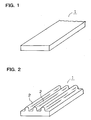
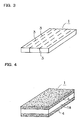
- the polyester tape yarn according to the present invention is composed of uniaxial oriented tape 1, which can be flat tape-state as shown in Fig. 1, but can be provided with small ribs 2 in the longitudinal direction that improve the yarn's feeling. And, the polyester tape according to the present invention can also be endowed with softness by becoming what is called split yarn that has splits 3 in the longitudinal direction as shown in Fig. 3.
- inorganic filler can be added, which addition develops micro-cracks when the polyester is stretched, improving dye affinity and improving feeling owing to delustering.
- the inorganic fillers usable is talc, carbon black, graphite, titanium dioxide, silica, mica, calcium carbonate, calcium sulfate, barium carbonate, magnesium carbonate, magnesium sulfate, barium sulfate, alumina, kaolin, silicon carbide, metal powder or the like.
- the inorganic filler can be added to the whole of the uniaxial oriented tape 1, but it is also all right to laminate a surface layer 4 made of polyester containing the inorganic filler on one or both sides of the uniaxial oriented tape 1a having no inorganic filler added as showing in Fig.4. Lamination of the polyester having the inorganic filler added on the uniaxial oriented tape 1a having no inorganic filler added can maintain the intensity and at the same time improves the feeling.
- the uniaxial oriented tape 1 it is also possible to laminate different kinds of materials on one or both sides of the polyester resin 1a constituting a substratum.
- materials usable are olefin series copolymers such as polyesters that are different in melting point, ultimate viscosity, and etc., high density polyethylene, low density polyethylene, linear low density polyethylene, propylene polymer, ethylene-propylene, ethylene-vinyl acetate copolymer and polyamide, and the like.
- thermoplastic resins are laminated to form split yarn, they are heat-treated. This heat treatment crimps the tape yarn to give a mound.
- the film-state body thus formed is longitudinally stretched by means of a stretching device, and relaxingly heat-treated.
- the stretching can be made by means of a hot roll, a heat plate, a heat air circulating oven or the like.
- the appropriate multiplying factor of stretching is 2.5 - 12 and, more preferably, around 3 - 10, and the appropriate stretching temperature is 70 - 130°C and, more preferably, around 80 - 120°C.
- the relaxing heat treatment can be made by means of the hot roll, the heat plate, the heat air circulating oven or the like.
- the appropriate relaxation ratio is 1 - 15% and, more preferably, around 3 - 13%, and the appropriate heat treatment temperature is 100 - 250°C and, more preferably, around 120 - 230°C.
- the width of the stretched uniaxial oriented tape 1 is made 0.5 mm or more and, more preferably, 0.5 - 70 mm and, further preferably, around 1.0 - 50 mm, and its thickness is made 5 - 200 ⁇ m and, more preferably, around 8 - 100 ⁇ m, and its fineness is made 30 - 10000 dt and, more preferably, around 80 - 8000 dt.
- polyester tape yarn according to the present invention is suitable as the material required for piece dyeing such as fancy work yarn and interior material, since it is excellent in dye affinity, therefore, it can be manufactured, stocked in the form of white or colorless tape yarn, and dyed into any color in response to demand, then shipped.
Landscapes
- Engineering & Computer Science (AREA)
- Textile Engineering (AREA)
- Chemical & Material Sciences (AREA)
- Chemical Kinetics & Catalysis (AREA)
- General Chemical & Material Sciences (AREA)
- Mechanical Engineering (AREA)
- Manufacturing & Machinery (AREA)
- Yarns And Mechanical Finishing Of Yarns Or Ropes (AREA)
- Artificial Filaments (AREA)
Abstract
Knot strength:

Description
- The present invention relates to polyester tape yarn made of polyester and , more particularly, to polyester tape yarn made of polyester that is excellent in mechanical strength and dye affinity, and, therefore, suitable as fancy work yarn.
- Fancy work has been here to stay in years, and a variety of pieces of work are being created, leading to a demand for a wide range of kinds of fancy work yarn.
- On the other hand, the demand for synthetic resins such as polypropylene, polyamide and polyester is on the rise as raw materials of fiber owing to their high intensity and excellent mass-production efficiency.
- However, it is rather difficult to stock fibers produced with various kinds of hues, using pre-dyed materials, because materials for fancy work are often manufactured on the basis of small-lot production of a wide variety of products.
- So, a rear dyeing system, in which colorless or white fibers are produced in the first place and they are dyed and shipped in response to the fashion and/or demand later, are presently applied.
- The tape yarn conventionally used in the rear dyeing system has been made of rayon, which excels in dye affinity.
- However, the rayon tape yarn varies in strength or tensile, resulting in the difficulty of securing certain qualities of products. And a high cost is another problem that the rayon yarn has.
- Therefore, development of such tape yarn as is less expensive and more excellent in dye affinity as well as in mechanical and physical strengths has been in demand.
- The first object of the present invention is to provide the polyester tape yarn that is suitable as fancy work yarn.
- The second object of the present invention is to provide the polyester tape yarn that is suitable as fancy work yarn excellent in touch and mechanical strength.
- The other object of the present invention is to provide the polyester tape yarn that is excellent in dye affinity, and is suitable in the rear dyeing system as being dyed into any color in response to demand and provide.
- And the other object of the present invention is to provide the polyester tape yarn that is suitable to provide on the basis of small-lot production of a wide variety of products by means of that it is stocked in the form of white or colorless tape yarn and dyed into any color in response to demand.
- The above object of the present invention are acheaved by the following inventions;
- Polyester tape yarn that is formed through uni-axial orientation of polyester having the ultimate viscosity of 0.7 or more, and is 1.0 cN/dt or more intensile strength, 0.8 cN/dt or more in Knot strength represented by the below-mentioned formula (1), 1.8 cN/dt or more in Loop strength represented by the below-mentioned formula (2), and 0.5 mm or more in yarn width.


- Furthermore, the present invention is to provide the aforementioned polyester tape yarn having a lot of slits formed in the longitudinal direction, the aforementioned polyester tape yarn made of polyester containing inorganic filler at least on the surface, the aforementioned polyester tape yarn having the polyester layer containing inorganic filler on the one or both sides of the tape yarn, and the aforementioned polyester tape yarn having the thermoplastic resins layers varying in melting point or ultimate viscosity that forms a mound through heat treatment.
-
- Fig. 1 is a perspective view showing an embodiment of the polyester tape yarn according to the present invention.
- Fig. 2 is a perspective view showing an another embodiment of the polyester tape yarn according to the present invention.
- Fig. 3 is a perspective view showing an another embodiment of the polyester tape yarn according to the present invention.
- Fig. 4 is a perspective view showing an another embodiment of the polyester tape yarn according to the present invention.
- The polyester tape yarn according to the present invention comprises polyester resins having a specific character with the ultimate viscosity of 0.70 or more and, more preferably, 0.85 or more. Polyester resins having the viscosity lower than 0.70 are not preferable, since their processability is inferior and their intensity declines.
- In the present invention, homopolymer and/or copolymer of polyethylene terephthalate are illustrated as the polyester resins.
- The homopolymer of polyethylene terephthalate is mainly made by reaction between terephthalic acid ingredient and ethylene glycol ingredient.
- The polyethylene terephthalate copolymer obtained through copolymerization by one or more kinds of bifunctional carboxylic acid within 15 mol.% and, more preferably, 5 mol.% for part of terephthalic acid ingredient.
- One or more kinds of bifunctional carboxylic acid such as aromatic dicarboxylic acids including isophthalic acid, naphthalene dicarboxylic acid, diphenyl dicarboxylic acid, diphenoxyethane dicarboxylic acid, phenylether dicarboxylic acid and diphenyl sulfone dicarboxylic acid, or alicyclic dicarboxylic acid including hexahydroterephthalic acid and hexahydroisophthalic acid, or aliphatic dicarboxylic acid including adipic acid, sebacic acid, azelaic acid, or oxyacid including p-β-hydroxyethoxybenzoic acidThe bifunctional carboxylic acid, for example, are illustrated as the above bifunctional carboxylic acid.
- And the polyethylene terephthalate copolymer obtained through copolymerization by one or more kinds of polyfunctional compounds within 15 mol.% and, more preferably, 5 mol.% for part of ethylene glycol ingredient.
- One or more kinds of polyfunctional compounds such as glycols including trimethylene glycol, tetramethylene glycol, hexamethylene glycol, decamethylene glycol, neopentyl glycol, diethylene glycol, 1,1-cyclohexanedimethylol,
1,4-cyclohexanedimethylol, 2,2-bis(4'-β
-hydroxyethoxyphenyl)propane, bis(4'-β -hydroxyethoxyphenyl)sulfonic acid, and their functional derivatives, for example, are illustrated as the above polyfunctional compounds. - In the present invention, what can be used are such polyester resins as are 1.0 cN/dt or more and, more preferably, 1.5 cN/dt or more in tensile strength, 0.8 cN/dt or more and, more preferably, 1.0 cN/dt or more in Knot strength, 1.8 cN/dt or more and, more preferably, 2.0 cN/dt or more in Loop strength.
- The Knot strength is the node strength defined in JIS L-1013.The Knot strength is calculated through division by the fineness of the tension at the moment of rupture of a measuring sample that has been tied into a knot, and attached to a tensile test machine, then pulled at a certain constant speed, using the following formula(1):

- The Loop strength is the scratch strength defined in JIS-L1013.The Loop strength is calculated through division by the fineness of the tension at the moment of rupture of a measuring sample that has been made chained, and attached to a tensile test machine, then pulled at a certain constant speed, using the following formula(2):

- Such polyester resins can be experientially obtained through selection of polymerization components of polyester resins, selection of ultimate viscosities or selection of forming conditions.
- These polyester resins can be mixed, if necessary, with different kinds of resins or various kinds of additives such as olefin series polymer including high density polyethylene, low density polyethylene, linear low density polyethylene, propylene polymer, ethylene-propylene copolymer and ethylene-vinyl acetate copolymer; thermoplastic resins such as polyamide; lubricants within amide series, wax series, organic metal salt series and ester series; flame retardant such as bromine-laced organic series and phosphoric acid series; organic pigment; inorganic pigment; organic filler; inorganic or organic antimicrobials such as metal ion series.
- Also, these polyester resins can be mixed with antistatic agent. The antistatic agent usable under the present invention is surfactant, which can be anionic, cationic, nonionic or ampholytic.
- The anionic surfactant can be used higher alcohol ester sulfate or alkylallyl sulfonate.
- The cationic surfactant can be used products that are obtained through transformation into hydrochloride or hydrobromide of broader ammonia derivatives such as amide group, imido group, tertiary amine, pyridinium, quinolinium, imidazolium compound.
- The nonionic surfactant can be used ester compounds of higher alcohol and polyhydric alcohol such as polyethylene glycol, pentaerythritol and glucose, or etherified compounds of higher alcohol.
- These ingredients are combined in any proportion, if necessary, and mixed or hot-kneaded in an ordinary mixer or a kneader such as Henschel mixer, Supermixer, V-blender, tumbler mixer, ribbon mixer, Bambery mixer, kneader-blender and single- or twin-screw extruder, and thereafter formed into film. Either extrusion molding by means of T-die or inflation molding is applicable as a forming method.
- The polyester tape yarn according to the present invention is composed of uniaxial
oriented tape 1, which can be flat tape-state as shown in Fig. 1, but can be provided withsmall ribs 2 in the longitudinal direction that improve the yarn's feeling. And, the polyester tape according to the present invention can also be endowed with softness by becoming what is called split yarn that has splits 3 in the longitudinal direction as shown in Fig. 3. - Furthermore, inorganic filler can be added, which addition develops micro-cracks when the polyester is stretched, improving dye affinity and improving feeling owing to delustering. The inorganic fillers usable is talc, carbon black, graphite, titanium dioxide, silica, mica, calcium carbonate, calcium sulfate, barium carbonate, magnesium carbonate, magnesium sulfate, barium sulfate, alumina, kaolin, silicon carbide, metal powder or the like.
- The inorganic filler can be added to the whole of the uniaxial oriented
tape 1, but it is also all right to laminate asurface layer 4 made of polyester containing the inorganic filler on one or both sides of the uniaxialoriented tape 1a having no inorganic filler added as showing in Fig.4. Lamination of the polyester having the inorganic filler added on the uniaxialoriented tape 1a having no inorganic filler added can maintain the intensity and at the same time improves the feeling. - As for the uniaxial
oriented tape 1, it is also possible to laminate different kinds of materials on one or both sides of thepolyester resin 1a constituting a substratum. Among different kinds of materials usable are olefin series copolymers such as polyesters that are different in melting point, ultimate viscosity, and etc., high density polyethylene, low density polyethylene, linear low density polyethylene, propylene polymer, ethylene-propylene, ethylene-vinyl acetate copolymer and polyamide, and the like. - However, when the both sides are laminated, at least one side should be laminated with the polyester resin. After these thermoplastic resins are laminated to form split yarn, they are heat-treated. This heat treatment crimps the tape yarn to give a mound.
- The film-state body thus formed, after or before it is slit into predetermined width, is longitudinally stretched by means of a stretching device, and relaxingly heat-treated. The stretching can be made by means of a hot roll, a heat plate, a heat air circulating oven or the like. The appropriate multiplying factor of stretching is 2.5 - 12 and, more preferably, around 3 - 10, and the appropriate stretching temperature is 70 - 130°C and, more preferably, around 80 - 120°C.
- The relaxing heat treatment can be made by means of the hot roll, the heat plate, the heat air circulating oven or the like. The appropriate relaxation ratio is 1 - 15% and, more preferably, around 3 - 13%, and the appropriate heat treatment temperature is 100 - 250°C and, more preferably, around 120 - 230°C.
- The width of the stretched uniaxial oriented
tape 1 is made 0.5 mm or more and, more preferably, 0.5 - 70 mm and, further preferably, around 1.0 - 50 mm, and its thickness is made 5 - 200 µm and, more preferably, around 8 - 100 µm, and its fineness is made 30 - 10000 dt and, more preferably, around 80 - 8000 dt. - The polyester tape yarn according to the present invention is suitable as the material required for piece dyeing such as fancy work yarn and interior material, since it is excellent in dye affinity, therefore, it can be manufactured, stocked in the form of white or colorless tape yarn, and dyed into any color in response to demand, then shipped.
Claims (5)
- Polyester tape yarn that is formed through uniaxial orientation of polyester having the ultimate viscosity of 0.7 or more, and is 1.0 cN/dt or more in tensile strength, 0.8 cN/dt or more in Knot strength represented by the below-mentioned formula (1), 1.8 cN/dt or more in Loop strength represented by the below-mentioned formula (2), and 0.5 mm or more in yarn width.


- Polyester tape yarn according to claim 1 have a lot of slits formed in the longitudinal direction.
- Polyester tape yarn according to claim 1 made of the polyester containing inorganic filler.
- Polyester tape yarn according to claim 1 have the face layer made of polyester containing inorganic filler ,laminated on the one or both sides of the uniaxial oriented tape.
- Polyester tape yarn according to claim 1 to have a mound through heat treatment of thermoplastic resins different in melting point or ultimate viscosity laminated on polyester.
Applications Claiming Priority (2)
| Application Number | Priority Date | Filing Date | Title |
|---|---|---|---|
| JP2001228271A JP4785288B2 (en) | 2001-07-27 | 2001-07-27 | Polyester tape yarn |
| JP2001228271 | 2001-07-27 |
Publications (3)
| Publication Number | Publication Date |
|---|---|
| EP1279755A2 true EP1279755A2 (en) | 2003-01-29 |
| EP1279755A3 EP1279755A3 (en) | 2003-08-06 |
| EP1279755B1 EP1279755B1 (en) | 2005-03-02 |
Family
ID=19060808
Family Applications (1)
| Application Number | Title | Priority Date | Filing Date |
|---|---|---|---|
| EP02090280A Expired - Lifetime EP1279755B1 (en) | 2001-07-27 | 2002-07-25 | Polyester tape yarn |
Country Status (4)
| Country | Link |
|---|---|
| US (1) | US6627311B2 (en) |
| EP (1) | EP1279755B1 (en) |
| JP (1) | JP4785288B2 (en) |
| DE (1) | DE60203072D1 (en) |
Cited By (3)
| Publication number | Priority date | Publication date | Assignee | Title |
|---|---|---|---|---|
| WO2009130032A1 (en) * | 2008-04-24 | 2009-10-29 | Saudi Basic Industries Corporation | Flexible intermediate bulk container |
| WO2012055796A1 (en) * | 2010-10-27 | 2012-05-03 | Basf Se | Use of polymer blends for producing slit film tapes |
| US9556540B2 (en) | 2008-04-24 | 2017-01-31 | Saudi Basic Industries Corporation | Process for making opaque polyester film |
Family Cites Families (8)
| Publication number | Priority date | Publication date | Assignee | Title |
|---|---|---|---|---|
| GB1132641A (en) * | 1965-08-24 | 1968-11-06 | Polymer Processing Res Inst | Process for the preparation of crimped split fiber |
| JPS50123932A (en) * | 1974-03-23 | 1975-09-29 | ||
| DE2428464B2 (en) * | 1973-06-14 | 1979-08-23 | Teijin Ltd., Osaka (Japan) | Biaxially stretched and heat-bonded multilayer film and its use |
| US4179875A (en) * | 1975-11-20 | 1979-12-25 | Fiber Industries, Inc. | High tenacity, low denier poly(ethylene terephthalate) fibrillated tape yarn |
| US4036003A (en) * | 1975-11-20 | 1977-07-19 | Celanese Corporation | Poly(ethylene terephthalate) fibrillated tape sewing thread |
| JPS61119744A (en) * | 1984-11-13 | 1986-06-06 | ダイヤテックス株式会社 | Crimping processing of flat yarn |
| JPH0261122A (en) * | 1988-08-22 | 1990-03-01 | Koizumi Seima Kk | Production of drawn polyester tape yarn |
| ES2069590T3 (en) * | 1988-09-23 | 1995-05-16 | Amoco Corp | POLYESTER / POLYPROPYLENE RESIN COMBINATION TAPE THREAD AND WOVEN CARPET SUPPORT FROM THE SAME. |
-
2001
- 2001-07-27 JP JP2001228271A patent/JP4785288B2/en not_active Expired - Fee Related
-
2002
- 2002-07-18 US US10/198,471 patent/US6627311B2/en not_active Expired - Lifetime
- 2002-07-25 DE DE60203072T patent/DE60203072D1/en not_active Expired - Lifetime
- 2002-07-25 EP EP02090280A patent/EP1279755B1/en not_active Expired - Lifetime
Cited By (5)
| Publication number | Priority date | Publication date | Assignee | Title |
|---|---|---|---|---|
| WO2009130032A1 (en) * | 2008-04-24 | 2009-10-29 | Saudi Basic Industries Corporation | Flexible intermediate bulk container |
| US8349422B2 (en) | 2008-04-24 | 2013-01-08 | Saudi Basic Industries Corporation | Flexible intermediate bulk container |
| US9556540B2 (en) | 2008-04-24 | 2017-01-31 | Saudi Basic Industries Corporation | Process for making opaque polyester film |
| WO2012055796A1 (en) * | 2010-10-27 | 2012-05-03 | Basf Se | Use of polymer blends for producing slit film tapes |
| CN103201342A (en) * | 2010-10-27 | 2013-07-10 | 巴斯夫欧洲公司 | Use of polymer blends for producing slit film tapes |
Also Published As
| Publication number | Publication date |
|---|---|
| US20030021992A1 (en) | 2003-01-30 |
| EP1279755B1 (en) | 2005-03-02 |
| JP2003041446A (en) | 2003-02-13 |
| US6627311B2 (en) | 2003-09-30 |
| DE60203072D1 (en) | 2005-04-07 |
| EP1279755A3 (en) | 2003-08-06 |
| JP4785288B2 (en) | 2011-10-05 |
Similar Documents
| Publication | Publication Date | Title |
|---|---|---|
| KR100364302B1 (en) | Polyester fiber with excellent processability and process for producing the same | |
| US6641916B1 (en) | Poly(trimethylene terephthalate) bicomponent fibers | |
| KR101314878B1 (en) | High Crimping Bicomponent Fibers | |
| AU2014341887B2 (en) | Multipolymer fibers and method of making same | |
| JP4536064B2 (en) | Fiber or textile products that can be laser marked | |
| JP2005076147A (en) | Flame-retardant polyester fiber for artificial hair | |
| US6627311B2 (en) | Polyester tape yarn | |
| MXPA02004584A (en) | Thick and thin polyester multifilament yarn. | |
| EP1728900A1 (en) | Flame-retardant artificial polyester hair | |
| JPH0742024A (en) | Self-transformable fiber and production thereof | |
| KR101710555B1 (en) | Differential-shrinkage polyester combined filament yarn with a high bulky property and manufacturing method thereof | |
| JP2004332152A (en) | Pigmented thermoadhesive filament fiber | |
| JPH0827653A (en) | Thermally color-changing nonwoven fabric | |
| JP2000234233A (en) | Webbing for sheet belt | |
| JP2008169512A (en) | Flocked polyester fiber and method for producing the same | |
| JP2006233388A (en) | Curtain | |
| JP2004084119A (en) | Polyester short fiber and pile fabric using the same | |
| US20050085567A1 (en) | Flame retardant spiral crimp polyester staple fiber | |
| US20240052540A1 (en) | Multicolored tufted textiles and methods of making the same | |
| JPH10130946A (en) | Polarized fiber | |
| JP3042947B2 (en) | Polyester loop fluff yarn | |
| JPS63135538A (en) | Molding cloth | |
| JP2008088576A (en) | Sheath-core conjugate fiber | |
| JP2001248019A (en) | Polyester fiber | |
| KR19990026534A (en) | Opaque Composite Fiber |
Legal Events
| Date | Code | Title | Description |
|---|---|---|---|
| PUAI | Public reference made under article 153(3) epc to a published international application that has entered the european phase |
Free format text: ORIGINAL CODE: 0009012 |
|
| AK | Designated contracting states |
Designated state(s): AT BE BG CH CY CZ DE DK EE ES FI FR GB GR IE IT LI LU MC NL PT SE SK TR |
|
| AX | Request for extension of the european patent |
Extension state: AL LT LV MK RO SI |
|
| PUAL | Search report despatched |
Free format text: ORIGINAL CODE: 0009013 |
|
| AK | Designated contracting states |
Designated state(s): AT BE BG CH CY CZ DE DK EE ES FI FR GB GR IE IT LI LU MC NL PT SE SK TR |
|
| AX | Request for extension of the european patent |
Extension state: AL LT LV MK RO SI |
|
| 17P | Request for examination filed |
Effective date: 20030718 |
|
| RAP1 | Party data changed (applicant data changed or rights of an application transferred) |
Owner name: DIATEXS CO., LTD. |
|
| 17Q | First examination report despatched |
Effective date: 20030903 |
|
| AKX | Designation fees paid |
Designated state(s): CH DE ES IT LI NL |
|
| GRAP | Despatch of communication of intention to grant a patent |
Free format text: ORIGINAL CODE: EPIDOSNIGR1 |
|
| GRAS | Grant fee paid |
Free format text: ORIGINAL CODE: EPIDOSNIGR3 |
|
| GRAA | (expected) grant |
Free format text: ORIGINAL CODE: 0009210 |
|
| AK | Designated contracting states |
Kind code of ref document: B1 Designated state(s): CH DE ES IT LI NL |
|
| PG25 | Lapsed in a contracting state [announced via postgrant information from national office to epo] |
Ref country code: NL Free format text: LAPSE BECAUSE OF FAILURE TO SUBMIT A TRANSLATION OF THE DESCRIPTION OR TO PAY THE FEE WITHIN THE PRESCRIBED TIME-LIMIT Effective date: 20050302 Ref country code: LI Free format text: LAPSE BECAUSE OF FAILURE TO SUBMIT A TRANSLATION OF THE DESCRIPTION OR TO PAY THE FEE WITHIN THE PRESCRIBED TIME-LIMIT Effective date: 20050302 Ref country code: IT Free format text: LAPSE BECAUSE OF FAILURE TO SUBMIT A TRANSLATION OF THE DESCRIPTION OR TO PAY THE FEE WITHIN THE PRESCRIBED TIME-LIMIT;WARNING: LAPSES OF ITALIAN PATENTS WITH EFFECTIVE DATE BEFORE 2007 MAY HAVE OCCURRED AT ANY TIME BEFORE 2007. THE CORRECT EFFECTIVE DATE MAY BE DIFFERENT FROM THE ONE RECORDED. Effective date: 20050302 Ref country code: ES Free format text: LAPSE BECAUSE OF FAILURE TO SUBMIT A TRANSLATION OF THE DESCRIPTION OR TO PAY THE FEE WITHIN THE PRESCRIBED TIME-LIMIT Effective date: 20050302 Ref country code: CH Free format text: LAPSE BECAUSE OF FAILURE TO SUBMIT A TRANSLATION OF THE DESCRIPTION OR TO PAY THE FEE WITHIN THE PRESCRIBED TIME-LIMIT Effective date: 20050302 |
|
| REG | Reference to a national code |
Ref country code: CH Ref legal event code: EP |
|
| REG | Reference to a national code |
Ref country code: IE Ref legal event code: FG4D |
|
| REF | Corresponds to: |
Ref document number: 60203072 Country of ref document: DE Date of ref document: 20050407 Kind code of ref document: P |
|
| PG25 | Lapsed in a contracting state [announced via postgrant information from national office to epo] |
Ref country code: DE Free format text: LAPSE BECAUSE OF FAILURE TO SUBMIT A TRANSLATION OF THE DESCRIPTION OR TO PAY THE FEE WITHIN THE PRESCRIBED TIME-LIMIT Effective date: 20050603 |
|
| NLV1 | Nl: lapsed or annulled due to failure to fulfill the requirements of art. 29p and 29m of the patents act | ||
| REG | Reference to a national code |
Ref country code: CH Ref legal event code: PL |
|
| PLBE | No opposition filed within time limit |
Free format text: ORIGINAL CODE: 0009261 |
|
| STAA | Information on the status of an ep patent application or granted ep patent |
Free format text: STATUS: NO OPPOSITION FILED WITHIN TIME LIMIT |
|
| 26N | No opposition filed |
Effective date: 20051205 |