EP1279711A1 - Acrylic pressure-sensitive adhesive and process for producing the same - Google Patents
Acrylic pressure-sensitive adhesive and process for producing the same Download PDFInfo
- Publication number
- EP1279711A1 EP1279711A1 EP02016107A EP02016107A EP1279711A1 EP 1279711 A1 EP1279711 A1 EP 1279711A1 EP 02016107 A EP02016107 A EP 02016107A EP 02016107 A EP02016107 A EP 02016107A EP 1279711 A1 EP1279711 A1 EP 1279711A1
- Authority
- EP
- European Patent Office
- Prior art keywords
- molecular weight
- sensitive adhesive
- weight
- polymer
- acrylic
- Prior art date
- Legal status (The legal status is an assumption and is not a legal conclusion. Google has not performed a legal analysis and makes no representation as to the accuracy of the status listed.)
- Granted
Links
- 239000004820 Pressure-sensitive adhesive Substances 0.000 title claims abstract description 41
- NIXOWILDQLNWCW-UHFFFAOYSA-N acrylic acid group Chemical group C(C=C)(=O)O NIXOWILDQLNWCW-UHFFFAOYSA-N 0.000 title claims abstract description 31
- 238000000034 method Methods 0.000 title claims description 32
- 239000000178 monomer Substances 0.000 claims abstract description 61
- CURLTUGMZLYLDI-UHFFFAOYSA-N Carbon dioxide Chemical compound O=C=O CURLTUGMZLYLDI-UHFFFAOYSA-N 0.000 claims abstract description 60
- 229920000642 polymer Polymers 0.000 claims abstract description 37
- 239000001569 carbon dioxide Substances 0.000 claims abstract description 30
- 229910002092 carbon dioxide Inorganic materials 0.000 claims abstract description 30
- 229920000058 polyacrylate Polymers 0.000 claims abstract description 20
- 125000000217 alkyl group Chemical group 0.000 claims abstract description 15
- 239000003085 diluting agent Substances 0.000 claims abstract description 11
- NIXOWILDQLNWCW-UHFFFAOYSA-M Acrylate Chemical compound [O-]C(=O)C=C NIXOWILDQLNWCW-UHFFFAOYSA-M 0.000 claims abstract description 10
- 238000006243 chemical reaction Methods 0.000 claims description 26
- 238000009826 distribution Methods 0.000 claims description 24
- 125000004432 carbon atom Chemical group C* 0.000 claims description 2
- 238000006116 polymerization reaction Methods 0.000 description 22
- 230000001070 adhesive effect Effects 0.000 description 19
- 239000000853 adhesive Substances 0.000 description 11
- 239000003999 initiator Substances 0.000 description 11
- 239000000203 mixture Substances 0.000 description 10
- 230000001105 regulatory effect Effects 0.000 description 9
- 229920005989 resin Polymers 0.000 description 8
- 239000011347 resin Substances 0.000 description 8
- OZAIFHULBGXAKX-UHFFFAOYSA-N 2-(2-cyanopropan-2-yldiazenyl)-2-methylpropanenitrile Chemical compound N#CC(C)(C)N=NC(C)(C)C#N OZAIFHULBGXAKX-UHFFFAOYSA-N 0.000 description 6
- PPBRXRYQALVLMV-UHFFFAOYSA-N Styrene Chemical compound C=CC1=CC=CC=C1 PPBRXRYQALVLMV-UHFFFAOYSA-N 0.000 description 6
- 239000003960 organic solvent Substances 0.000 description 6
- 238000004132 cross linking Methods 0.000 description 5
- 239000000047 product Substances 0.000 description 5
- XLPJNCYCZORXHG-UHFFFAOYSA-N 1-morpholin-4-ylprop-2-en-1-one Chemical compound C=CC(=O)N1CCOCC1 XLPJNCYCZORXHG-UHFFFAOYSA-N 0.000 description 4
- GOXQRTZXKQZDDN-UHFFFAOYSA-N 2-Ethylhexyl acrylate Chemical compound CCCCC(CC)COC(=O)C=C GOXQRTZXKQZDDN-UHFFFAOYSA-N 0.000 description 4
- 150000001252 acrylic acid derivatives Chemical class 0.000 description 4
- 239000003431 cross linking reagent Substances 0.000 description 4
- 238000010556 emulsion polymerization method Methods 0.000 description 4
- 238000005227 gel permeation chromatography Methods 0.000 description 4
- 238000010558 suspension polymerization method Methods 0.000 description 4
- SMZOUWXMTYCWNB-UHFFFAOYSA-N 2-(2-methoxy-5-methylphenyl)ethanamine Chemical compound COC1=CC=C(C)C=C1CCN SMZOUWXMTYCWNB-UHFFFAOYSA-N 0.000 description 3
- YXFVVABEGXRONW-UHFFFAOYSA-N Toluene Chemical compound CC1=CC=CC=C1 YXFVVABEGXRONW-UHFFFAOYSA-N 0.000 description 3
- 239000000654 additive Substances 0.000 description 3
- 239000012790 adhesive layer Substances 0.000 description 3
- 239000002390 adhesive tape Substances 0.000 description 3
- 230000015572 biosynthetic process Effects 0.000 description 3
- CQEYYJKEWSMYFG-UHFFFAOYSA-N butyl acrylate Chemical compound CCCCOC(=O)C=C CQEYYJKEWSMYFG-UHFFFAOYSA-N 0.000 description 3
- 125000003178 carboxy group Chemical group [H]OC(*)=O 0.000 description 3
- 239000002270 dispersing agent Substances 0.000 description 3
- 238000001035 drying Methods 0.000 description 3
- -1 e.g. Substances 0.000 description 3
- 239000003995 emulsifying agent Substances 0.000 description 3
- 238000010528 free radical solution polymerization reaction Methods 0.000 description 3
- 239000000123 paper Substances 0.000 description 3
- XLYOFNOQVPJJNP-UHFFFAOYSA-N water Substances O XLYOFNOQVPJJNP-UHFFFAOYSA-N 0.000 description 3
- IANQTJSKSUMEQM-UHFFFAOYSA-N 1-benzofuran Chemical compound C1=CC=C2OC=CC2=C1 IANQTJSKSUMEQM-UHFFFAOYSA-N 0.000 description 2
- YBYIRNPNPLQARY-UHFFFAOYSA-N 1H-indene Chemical compound C1=CC=C2CC=CC2=C1 YBYIRNPNPLQARY-UHFFFAOYSA-N 0.000 description 2
- HRPVXLWXLXDGHG-UHFFFAOYSA-N Acrylamide Chemical compound NC(=O)C=C HRPVXLWXLXDGHG-UHFFFAOYSA-N 0.000 description 2
- SOGAXMICEFXMKE-UHFFFAOYSA-N Butylmethacrylate Chemical compound CCCCOC(=O)C(C)=C SOGAXMICEFXMKE-UHFFFAOYSA-N 0.000 description 2
- VTYYLEPIZMXCLO-UHFFFAOYSA-L Calcium carbonate Chemical compound [Ca+2].[O-]C([O-])=O VTYYLEPIZMXCLO-UHFFFAOYSA-L 0.000 description 2
- 239000004593 Epoxy Substances 0.000 description 2
- VZCYOOQTPOCHFL-OWOJBTEDSA-N Fumaric acid Chemical compound OC(=O)\C=C\C(O)=O VZCYOOQTPOCHFL-OWOJBTEDSA-N 0.000 description 2
- 239000005057 Hexamethylene diisocyanate Substances 0.000 description 2
- BAPJBEWLBFYGME-UHFFFAOYSA-N Methyl acrylate Chemical compound COC(=O)C=C BAPJBEWLBFYGME-UHFFFAOYSA-N 0.000 description 2
- VYPSYNLAJGMNEJ-UHFFFAOYSA-N Silicium dioxide Chemical compound O=[Si]=O VYPSYNLAJGMNEJ-UHFFFAOYSA-N 0.000 description 2
- ZJCCRDAZUWHFQH-UHFFFAOYSA-N Trimethylolpropane Chemical compound CCC(CO)(CO)CO ZJCCRDAZUWHFQH-UHFFFAOYSA-N 0.000 description 2
- XTXRWKRVRITETP-UHFFFAOYSA-N Vinyl acetate Chemical compound CC(=O)OC=C XTXRWKRVRITETP-UHFFFAOYSA-N 0.000 description 2
- 238000012662 bulk polymerization Methods 0.000 description 2
- 239000006227 byproduct Substances 0.000 description 2
- 239000011248 coating agent Substances 0.000 description 2
- 238000000576 coating method Methods 0.000 description 2
- 150000001875 compounds Chemical class 0.000 description 2
- 230000006866 deterioration Effects 0.000 description 2
- 230000007613 environmental effect Effects 0.000 description 2
- 239000000499 gel Substances 0.000 description 2
- 230000009477 glass transition Effects 0.000 description 2
- RRAMGCGOFNQTLD-UHFFFAOYSA-N hexamethylene diisocyanate Chemical compound O=C=NCCCCCCN=C=O RRAMGCGOFNQTLD-UHFFFAOYSA-N 0.000 description 2
- 239000012535 impurity Substances 0.000 description 2
- 239000012948 isocyanate Substances 0.000 description 2
- 238000002955 isolation Methods 0.000 description 2
- 239000010410 layer Substances 0.000 description 2
- 238000002156 mixing Methods 0.000 description 2
- 239000005056 polyisocyanate Substances 0.000 description 2
- 229920001228 polyisocyanate Polymers 0.000 description 2
- 239000003505 polymerization initiator Substances 0.000 description 2
- 150000003254 radicals Chemical class 0.000 description 2
- 239000000758 substrate Substances 0.000 description 2
- 239000010409 thin film Substances 0.000 description 2
- DVKJHBMWWAPEIU-UHFFFAOYSA-N toluene 2,4-diisocyanate Chemical compound CC1=CC=C(N=C=O)C=C1N=C=O DVKJHBMWWAPEIU-UHFFFAOYSA-N 0.000 description 2
- VZCYOOQTPOCHFL-UHFFFAOYSA-N trans-butenedioic acid Natural products OC(=O)C=CC(O)=O VZCYOOQTPOCHFL-UHFFFAOYSA-N 0.000 description 2
- IVIDDMGBRCPGLJ-UHFFFAOYSA-N 2,3-bis(oxiran-2-ylmethoxy)propan-1-ol Chemical compound C1OC1COC(CO)COCC1CO1 IVIDDMGBRCPGLJ-UHFFFAOYSA-N 0.000 description 1
- JAHNSTQSQJOJLO-UHFFFAOYSA-N 2-(3-fluorophenyl)-1h-imidazole Chemical compound FC1=CC=CC(C=2NC=CN=2)=C1 JAHNSTQSQJOJLO-UHFFFAOYSA-N 0.000 description 1
- MTLWTRLYHAQCAM-UHFFFAOYSA-N 2-[(1-cyano-2-methylpropyl)diazenyl]-3-methylbutanenitrile Chemical compound CC(C)C(C#N)N=NC(C#N)C(C)C MTLWTRLYHAQCAM-UHFFFAOYSA-N 0.000 description 1
- WDQMWEYDKDCEHT-UHFFFAOYSA-N 2-ethylhexyl 2-methylprop-2-enoate Chemical compound CCCCC(CC)COC(=O)C(C)=C WDQMWEYDKDCEHT-UHFFFAOYSA-N 0.000 description 1
- 125000000954 2-hydroxyethyl group Chemical group [H]C([*])([H])C([H])([H])O[H] 0.000 description 1
- CFVWNXQPGQOHRJ-UHFFFAOYSA-N 2-methylpropyl prop-2-enoate Chemical compound CC(C)COC(=O)C=C CFVWNXQPGQOHRJ-UHFFFAOYSA-N 0.000 description 1
- FRIBMENBGGCKPD-UHFFFAOYSA-N 3-(2,3-dimethoxyphenyl)prop-2-enal Chemical compound COC1=CC=CC(C=CC=O)=C1OC FRIBMENBGGCKPD-UHFFFAOYSA-N 0.000 description 1
- UPMLOUAZCHDJJD-UHFFFAOYSA-N 4,4'-Diphenylmethane Diisocyanate Chemical compound C1=CC(N=C=O)=CC=C1CC1=CC=C(N=C=O)C=C1 UPMLOUAZCHDJJD-UHFFFAOYSA-N 0.000 description 1
- CUXGDKOCSSIRKK-UHFFFAOYSA-N 7-methyloctyl prop-2-enoate Chemical compound CC(C)CCCCCCOC(=O)C=C CUXGDKOCSSIRKK-UHFFFAOYSA-N 0.000 description 1
- RSWGJHLUYNHPMX-UHFFFAOYSA-N Abietic-Saeure Natural products C12CCC(C(C)C)=CC2=CCC2C1(C)CCCC2(C)C(O)=O RSWGJHLUYNHPMX-UHFFFAOYSA-N 0.000 description 1
- NLHHRLWOUZZQLW-UHFFFAOYSA-N Acrylonitrile Chemical compound C=CC#N NLHHRLWOUZZQLW-UHFFFAOYSA-N 0.000 description 1
- OMPJBNCRMGITSC-UHFFFAOYSA-N Benzoylperoxide Chemical compound C=1C=CC=CC=1C(=O)OOC(=O)C1=CC=CC=C1 OMPJBNCRMGITSC-UHFFFAOYSA-N 0.000 description 1
- JIGUQPWFLRLWPJ-UHFFFAOYSA-N Ethyl acrylate Chemical compound CCOC(=O)C=C JIGUQPWFLRLWPJ-UHFFFAOYSA-N 0.000 description 1
- YIVJZNGAASQVEM-UHFFFAOYSA-N Lauroyl peroxide Chemical compound CCCCCCCCCCCC(=O)OOC(=O)CCCCCCCCCCC YIVJZNGAASQVEM-UHFFFAOYSA-N 0.000 description 1
- CERQOIWHTDAKMF-UHFFFAOYSA-N Methacrylic acid Chemical compound CC(=C)C(O)=O CERQOIWHTDAKMF-UHFFFAOYSA-N 0.000 description 1
- 229920000538 Poly[(phenyl isocyanate)-co-formaldehyde] Polymers 0.000 description 1
- 239000004721 Polyphenylene oxide Substances 0.000 description 1
- 239000004793 Polystyrene Substances 0.000 description 1
- OFOBLEOULBTSOW-UHFFFAOYSA-N Propanedioic acid Natural products OC(=O)CC(O)=O OFOBLEOULBTSOW-UHFFFAOYSA-N 0.000 description 1
- KHPCPRHQVVSZAH-HUOMCSJISA-N Rosin Natural products O(C/C=C/c1ccccc1)[C@H]1[C@H](O)[C@@H](O)[C@@H](O)[C@@H](CO)O1 KHPCPRHQVVSZAH-HUOMCSJISA-N 0.000 description 1
- USDJGQLNFPZEON-UHFFFAOYSA-N [[4,6-bis(hydroxymethylamino)-1,3,5-triazin-2-yl]amino]methanol Chemical class OCNC1=NC(NCO)=NC(NCO)=N1 USDJGQLNFPZEON-UHFFFAOYSA-N 0.000 description 1
- 239000006096 absorbing agent Substances 0.000 description 1
- 125000005250 alkyl acrylate group Chemical group 0.000 description 1
- 150000001408 amides Chemical class 0.000 description 1
- 239000012298 atmosphere Substances 0.000 description 1
- 125000000751 azo group Chemical group [*]N=N[*] 0.000 description 1
- 235000019400 benzoyl peroxide Nutrition 0.000 description 1
- HIFVAOIJYDXIJG-UHFFFAOYSA-N benzylbenzene;isocyanic acid Chemical class N=C=O.N=C=O.C=1C=CC=CC=1CC1=CC=CC=C1 HIFVAOIJYDXIJG-UHFFFAOYSA-N 0.000 description 1
- 229910000019 calcium carbonate Inorganic materials 0.000 description 1
- 239000003086 colorant Substances 0.000 description 1
- 230000000052 comparative effect Effects 0.000 description 1
- 238000010924 continuous production Methods 0.000 description 1
- 238000001816 cooling Methods 0.000 description 1
- 229920001577 copolymer Polymers 0.000 description 1
- LDHQCZJRKDOVOX-NSCUHMNNSA-N crotonic acid Chemical compound C\C=C\C(O)=O LDHQCZJRKDOVOX-NSCUHMNNSA-N 0.000 description 1
- 125000004093 cyano group Chemical group *C#N 0.000 description 1
- 238000000354 decomposition reaction Methods 0.000 description 1
- FWLDHHJLVGRRHD-UHFFFAOYSA-N decyl prop-2-enoate Chemical compound CCCCCCCCCCOC(=O)C=C FWLDHHJLVGRRHD-UHFFFAOYSA-N 0.000 description 1
- LSXWFXONGKSEMY-UHFFFAOYSA-N di-tert-butyl peroxide Chemical compound CC(C)(C)OOC(C)(C)C LSXWFXONGKSEMY-UHFFFAOYSA-N 0.000 description 1
- 238000007865 diluting Methods 0.000 description 1
- 238000007599 discharging Methods 0.000 description 1
- 230000000694 effects Effects 0.000 description 1
- 238000010894 electron beam technology Methods 0.000 description 1
- 239000000945 filler Substances 0.000 description 1
- 239000001530 fumaric acid Substances 0.000 description 1
- 125000000524 functional group Chemical group 0.000 description 1
- 238000001879 gelation Methods 0.000 description 1
- 238000010438 heat treatment Methods 0.000 description 1
- 125000002887 hydroxy group Chemical group [H]O* 0.000 description 1
- 230000001771 impaired effect Effects 0.000 description 1
- 238000011835 investigation Methods 0.000 description 1
- PBOSTUDLECTMNL-UHFFFAOYSA-N lauryl acrylate Chemical compound CCCCCCCCCCCCOC(=O)C=C PBOSTUDLECTMNL-UHFFFAOYSA-N 0.000 description 1
- VZCYOOQTPOCHFL-UPHRSURJSA-N maleic acid Chemical compound OC(=O)\C=C/C(O)=O VZCYOOQTPOCHFL-UPHRSURJSA-N 0.000 description 1
- 239000011976 maleic acid Substances 0.000 description 1
- 150000007974 melamines Chemical class 0.000 description 1
- 150000002734 metacrylic acid derivatives Chemical class 0.000 description 1
- LVHBHZANLOWSRM-UHFFFAOYSA-N methylenebutanedioic acid Natural products OC(=O)CC(=C)C(O)=O LVHBHZANLOWSRM-UHFFFAOYSA-N 0.000 description 1
- JAYXSROKFZAHRQ-UHFFFAOYSA-N n,n-bis(oxiran-2-ylmethyl)aniline Chemical compound C1OC1CN(C=1C=CC=CC=1)CC1CO1 JAYXSROKFZAHRQ-UHFFFAOYSA-N 0.000 description 1
- 239000004745 nonwoven fabric Substances 0.000 description 1
- MDYPDLBFDATSCF-UHFFFAOYSA-N nonyl prop-2-enoate Chemical compound CCCCCCCCCOC(=O)C=C MDYPDLBFDATSCF-UHFFFAOYSA-N 0.000 description 1
- NZIDBRBFGPQCRY-UHFFFAOYSA-N octyl 2-methylprop-2-enoate Chemical compound CCCCCCCCOC(=O)C(C)=C NZIDBRBFGPQCRY-UHFFFAOYSA-N 0.000 description 1
- 229940065472 octyl acrylate Drugs 0.000 description 1
- ANISOHQJBAQUQP-UHFFFAOYSA-N octyl prop-2-enoate Chemical compound CCCCCCCCOC(=O)C=C ANISOHQJBAQUQP-UHFFFAOYSA-N 0.000 description 1
- 150000001451 organic peroxides Chemical class 0.000 description 1
- PNJWIWWMYCMZRO-UHFFFAOYSA-N pent‐4‐en‐2‐one Natural products CC(=O)CC=C PNJWIWWMYCMZRO-UHFFFAOYSA-N 0.000 description 1
- 239000003208 petroleum Substances 0.000 description 1
- 239000002985 plastic film Substances 0.000 description 1
- 239000004014 plasticizer Substances 0.000 description 1
- 229920000728 polyester Polymers 0.000 description 1
- 229920000570 polyether Polymers 0.000 description 1
- 230000000379 polymerizing effect Effects 0.000 description 1
- 229920002223 polystyrene Polymers 0.000 description 1
- LYBIZMNPXTXVMV-UHFFFAOYSA-N propan-2-yl prop-2-enoate Chemical compound CC(C)OC(=O)C=C LYBIZMNPXTXVMV-UHFFFAOYSA-N 0.000 description 1
- PNXMTCDJUBJHQJ-UHFFFAOYSA-N propyl prop-2-enoate Chemical compound CCCOC(=O)C=C PNXMTCDJUBJHQJ-UHFFFAOYSA-N 0.000 description 1
- 238000010526 radical polymerization reaction Methods 0.000 description 1
- 239000011342 resin composition Substances 0.000 description 1
- 239000000377 silicon dioxide Substances 0.000 description 1
- 238000003756 stirring Methods 0.000 description 1
- 150000003505 terpenes Chemical class 0.000 description 1
- 235000007586 terpenes Nutrition 0.000 description 1
- KHPCPRHQVVSZAH-UHFFFAOYSA-N trans-cinnamyl beta-D-glucopyranoside Natural products OC1C(O)C(O)C(CO)OC1OCC=CC1=CC=CC=C1 KHPCPRHQVVSZAH-UHFFFAOYSA-N 0.000 description 1
- LDHQCZJRKDOVOX-UHFFFAOYSA-N trans-crotonic acid Natural products CC=CC(O)=O LDHQCZJRKDOVOX-UHFFFAOYSA-N 0.000 description 1
- 229920001567 vinyl ester resin Polymers 0.000 description 1
- 125000000391 vinyl group Chemical group [H]C([*])=C([H])[H] 0.000 description 1
Images
Classifications
-
- C—CHEMISTRY; METALLURGY
- C09—DYES; PAINTS; POLISHES; NATURAL RESINS; ADHESIVES; COMPOSITIONS NOT OTHERWISE PROVIDED FOR; APPLICATIONS OF MATERIALS NOT OTHERWISE PROVIDED FOR
- C09J—ADHESIVES; NON-MECHANICAL ASPECTS OF ADHESIVE PROCESSES IN GENERAL; ADHESIVE PROCESSES NOT PROVIDED FOR ELSEWHERE; USE OF MATERIALS AS ADHESIVES
- C09J133/00—Adhesives based on homopolymers or copolymers of compounds having one or more unsaturated aliphatic radicals, each having only one carbon-to-carbon double bond, and at least one being terminated by only one carboxyl radical, or of salts, anhydrides, esters, amides, imides, or nitriles thereof; Adhesives based on derivatives of such polymers
- C09J133/04—Homopolymers or copolymers of esters
- C09J133/06—Homopolymers or copolymers of esters of esters containing only carbon, hydrogen and oxygen, the oxygen atom being present only as part of the carboxyl radical
-
- C—CHEMISTRY; METALLURGY
- C09—DYES; PAINTS; POLISHES; NATURAL RESINS; ADHESIVES; COMPOSITIONS NOT OTHERWISE PROVIDED FOR; APPLICATIONS OF MATERIALS NOT OTHERWISE PROVIDED FOR
- C09J—ADHESIVES; NON-MECHANICAL ASPECTS OF ADHESIVE PROCESSES IN GENERAL; ADHESIVE PROCESSES NOT PROVIDED FOR ELSEWHERE; USE OF MATERIALS AS ADHESIVES
- C09J133/00—Adhesives based on homopolymers or copolymers of compounds having one or more unsaturated aliphatic radicals, each having only one carbon-to-carbon double bond, and at least one being terminated by only one carboxyl radical, or of salts, anhydrides, esters, amides, imides, or nitriles thereof; Adhesives based on derivatives of such polymers
- C09J133/04—Homopolymers or copolymers of esters
- C09J133/06—Homopolymers or copolymers of esters of esters containing only carbon, hydrogen and oxygen, the oxygen atom being present only as part of the carboxyl radical
- C09J133/10—Homopolymers or copolymers of methacrylic acid esters
-
- C—CHEMISTRY; METALLURGY
- C08—ORGANIC MACROMOLECULAR COMPOUNDS; THEIR PREPARATION OR CHEMICAL WORKING-UP; COMPOSITIONS BASED THEREON
- C08F—MACROMOLECULAR COMPOUNDS OBTAINED BY REACTIONS ONLY INVOLVING CARBON-TO-CARBON UNSATURATED BONDS
- C08F2/00—Processes of polymerisation
- C08F2/04—Polymerisation in solution
-
- C—CHEMISTRY; METALLURGY
- C08—ORGANIC MACROMOLECULAR COMPOUNDS; THEIR PREPARATION OR CHEMICAL WORKING-UP; COMPOSITIONS BASED THEREON
- C08F—MACROMOLECULAR COMPOUNDS OBTAINED BY REACTIONS ONLY INVOLVING CARBON-TO-CARBON UNSATURATED BONDS
- C08F20/00—Homopolymers and copolymers of compounds having one or more unsaturated aliphatic radicals, each having only one carbon-to-carbon double bond, and only one being terminated by only one carboxyl radical or a salt, anhydride, ester, amide, imide or nitrile thereof
- C08F20/02—Monocarboxylic acids having less than ten carbon atoms, Derivatives thereof
- C08F20/10—Esters
- C08F20/12—Esters of monohydric alcohols or phenols
-
- C—CHEMISTRY; METALLURGY
- C09—DYES; PAINTS; POLISHES; NATURAL RESINS; ADHESIVES; COMPOSITIONS NOT OTHERWISE PROVIDED FOR; APPLICATIONS OF MATERIALS NOT OTHERWISE PROVIDED FOR
- C09J—ADHESIVES; NON-MECHANICAL ASPECTS OF ADHESIVE PROCESSES IN GENERAL; ADHESIVE PROCESSES NOT PROVIDED FOR ELSEWHERE; USE OF MATERIALS AS ADHESIVES
- C09J2301/00—Additional features of adhesives in the form of films or foils
- C09J2301/30—Additional features of adhesives in the form of films or foils characterized by the chemical, physicochemical or physical properties of the adhesive or the carrier
- C09J2301/302—Additional features of adhesives in the form of films or foils characterized by the chemical, physicochemical or physical properties of the adhesive or the carrier the adhesive being pressure-sensitive, i.e. tacky at temperatures inferior to 30°C
Definitions
- the present invention relates to an acrylic pressure-sensitive adhesive useful as, e.g., an adhesive for adhesive tapes or sheets.
- the invention further relates to a process for producing the pressure-sensitive adhesive.
- Acrylic pressure-sensitive adhesives are excellent in pressure-sensitive adhesive properties such as tackiness and cohesive force and in weatherability, oil resistance, etc.
- the adhesives are hence extensively used as pressure-sensitive adhesives (tacky adhesives) for forming the pressure-sensitive adhesive layers of pressure-sensitive adhesive tapes, labels or sheets.
- Acrylic pressure-sensitive adhesives heretofore in use comprise a copolymer obtained by copolymerizing one or more alkyl (meth)acrylates, as the main component, which are capable of forming a tacky polymer having a relatively low glass transition point, such as n-butyl acrylate or 2-ethylhexyl acrylate, with a monomer having a functional group, such as acrylic acid, 2-hydroxyethyl (meth)acrylate, or acrylamide, as an component serving to form crosslinkable sites in the tacky polymer or to enhance intermolecular force or improve cohesive force and with a monomer such as styrene or vinyl acetate as a monomer component capable of forming a hard polymer having a relatively high glass transition point.
- Such polymers for use as acrylic pressure-sensitive adhesives are generally produced by the solution polymerization method, suspension polymerization method or emulsion polymerization method.
- the solution polymerization method not only necessarily has a problem concerning environmental sanitation because of the use of a large amount of an organic solvent, but also is costly because polymer isolation necessitates energy and a step for distilling off the organic solvent.
- the suspension polymerization and emulsion polymerization methods have a drawback that the emulsifying agent or dispersant used in polymerization comes into the polymer and, hence, a pure polymer is difficult to obtain.
- the suspension polymerization and emulsion polymerization methods are costly like the solution polymerization method because water should be evaporated for polymer isolation.
- the polymerization system since polymerization for producing an acrylic pressure-sensitive adhesive by each of those methods is usually conducted batchwise, the polymerization system has poor evenness in polymerization conditions such as temperature and monomer concentration. Because of this, increasing the conversion into polymer results in a widened molecular-weight distribution, and the reduced monomer concentration in the final stage of the reaction results in formation of a large amount of low molecular products. As a result, the polymer obtained has impaired pressure-sensitive adhesive properties. Use of this polymer as a pressure-sensitive adhesive poses a problem that the amount of components transferred to an adherend is large.
- the polymerization system can be easily regulated so as to have even reaction conditions and the formation of low-molecular components can be inhibited, and that since the polymerization system can be made to have a narrow temperature distribution, a polymer having a narrow molecular weight distribution can ideally be obtained.
- the related-art continuous bulk polymerization method has a problem that there are cases where the reaction proceeds rapidly depending on the kind of the monomers and the resultant increase in viscosity makes temperature control difficult, leading to a runaway reaction. Namely, the design of polymer molecular weight is difficult.
- one object of the present invention is to provide an acrylic pressure-sensitive adhesive which comprises a polymer reduced in the content of low molecular weight components and having a narrow molecular weight distribution and a high weight average molecular weight and which has excellent pressure-sensitive adhesive properties and is less apt to foul adherends.
- Another object of the present invention is to provide a process for producing the acrylic pressure-sensitive adhesive.
- the present invention provides a process for producing an acrylic pressure-sensitive adhesive which comprises continuously feeding a monomer component comprising at least one alkyl (meth)acrylate and carbon dioxide as a diluent to a reactor and radical-polymerizing the monomer component under the conditions of a temperature of from 50 to 100°C and a residence time of from longer than 60 minutes to 200 minutes to thereby continuously obtain an acrylic pressure-sensitive adhesive comprising an acrylic polymer.
- the present invention further provides an acrylic pressure-sensitive adhesive comprising an acrylic polymer which has a weight average molecular weight of 1,200,000 or higher and in which the proportion of components having a molecular weight of 100,000 or lower is 10% by weight or lower based on the weight of the whole polymer.
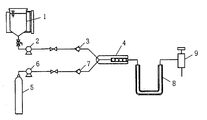
- the Figure is a schematic flow chart showing the continuous reactor used in the Examples; in which
- alkyl (meth)acrylate examples include alkyl acrylates and methacrylates in which the alkyl group has 1 to 18 carbon atoms. Specific examples thereof include methyl acrylate, ethyl acrylate, propyl acrylate, isopropyl acrylate, butyl acrylate, isobutyl acrylate, 2-ethylhexyl acrylate, octyl acrylate, nonyl acrylate, isononyl acrylate, decyl acrylate, dodecyl acrylate, butyl methacrylate, 2-ethylhexyl methacrylate and octyl methacrylate.
- Those alkyl (meth)acrylates can be used alone or as a mixture of two or more thereof.
- alkyl (meth)acrylates may be used as the only monomer(s), those may be used as the main component in combination with monomers copolymerizable therewith.
- Typical examples of the copolymerizable monomers include carboxyl-containing ethylenically unsaturated monomers such as (meth)acrylic acid, crotonic acid, itaconic acid, maleic acid and fumaric acid.
- carboxyl-containing ethylenically unsaturated monomers acrylic acid is particularly preferable.
- carboxyl-containing ethylenically unsaturated monomers are important components for forming crosslinkages in the polymer.
- copolymerizable monomers include various monomers known as modifying monomers for acrylic pressure-sensitive adhesives, such as vinyl esters, e.g., vinyl acetate, styrenic monomers such as styrene, cyano-containing monomers such as acrylonitrile, amide-containing monomers such as (meth)acrylamide or acryloylmorpholine, hydroxyl-containing monomers, and epoxy-containing monomers. Any of those monomers can be used. From the standpoint of adhesive properties, the amount of those copolymerizable monomers to be used is preferably up to 50% by weight based on the weight of all monomers including the alkyl (meth)acrylates.
- the polymerization reaction can be conducted with the aid of a polymerization initiator which upon decomposition generates a free radical.
- a polymerization initiator for general use in radical polymerization can be used.
- the initiator include organic peroxides such as dibenzoyl peroxide, di-tert-butyl peroxide, cumene hydroperoxide or lauroyl peroxide, and azo compounds such as 2,2'-azobisisobutyronitrile or azobisisovaleronitrile.
- the amount of the initiator used may be the same as in the ordinary polymerization of acrylic monomers.
- the amount of the generator used is generally about 0.01 to 1 part by weight, preferably about 0.05 to 0.5 part by weight, per 100 parts by weight of all monomers.
- the amount of the carbon dioxide to be used as a diluent in the present invention is, for example, from 5 to 2,000 parts by weight, preferably from 20 to 900 parts by weight, per 100 parts by weight of all monomers. Although a diluent consisting of carbon dioxide only is usually sufficient, a small amount of an organic solvent may be contained therein according to need for the purpose of improving miscibility, etc.
- the reactor that can be used in the present invention is not particularly limited so long as the contents present therein can be mixed, controlled with respect to reaction temperature, and continuously transferred.
- Preferred reactors are ones having the excellent ability to mix the contents and perform heat exchange.
- Use of such a reactor has the following advantages: a large amount of heat generated by the polymerization of acrylic monomers can be easily removed; because the system can be easily made to have evenness in reaction conditions, the residence time distribution, polymerization temperature distribution, and the like can be narrowed and a polymer having a narrow molecular weight distribution can hence be obtained; and the acrylic monomers remaining unreacted after the polymerization can be removed under reduced pressure by a continuous operation in the same apparatus.
- An especially advantageous example of the process of the present invention comprises polymerizing the monomers in a continuous flow in a tubular reactor.
- the length of the tubular reactor can be suitably selected according to, for example, polymerization temperature, polymerization pressure, monomer concentration in carbon dioxide and radical initiator concentration.
- usable examples of continuous reactors include single- or twin-screw continuous kneaders and single- or twin-screw extruders. Two or more of these may be used in combination.
- the monomer component comprising at least one alkyl (meth)acrylate and carbon dioxide are continuously fed to the reactor, and the monomer component is radical-polymerized under the conditions of a temperature of from 50 to 100°C and a residence time of from longer than 60 minutes to 200 minutes.
- a free-radical initiator may be supplied separately from the monomers, the general technique is to mix the initiator beforehand with the monomers and feed this mixture to the reactor. It is preferred that an in-line mixer for mixing the monomer component with carbon dioxide be disposed at the inlet to the reactor so as to feed a mixture of these to the reactor.
- the reaction temperature is preferably from about 55 to 90°C, and the residence time is preferably from longer than 60 minutes to 180 minutes, more preferably from 70 to 120 minutes. In case where the reaction temperature is lower than 50°C, the rate of reaction is too low and a residence time exceeding 200 minutes is necessary. Such a long residence time is impractical. In case where the reaction temperature exceeds 100°C, the reaction proceeds rapidly to cause thermal crosslinking. On the other hand, residence times of 60 minutes and shorter do not result in a sufficient conversion, while residence times exceeding 200 minutes are undesirable in that thermal crosslinking occurs.
- the polymerization can be conducted in carbon dioxide regulated so as to have a pressure of, for example, from about 5.73 to 50 MPa (e.g., in supercritical carbon dioxide).
- the polymerization pressure and temperature may be regulated in several steps according to need.
- the residence time distribution can be regulated by regulating the diameter of the tube, ratio of the tube length to the inner diameter (L/D), etc.
- the residence time distribution can be regulated by suitably selecting a paddle or screw arrangement, distance between the barrel and the paddles and/or screw(s), etc.
- carbon dioxide is used as a diluent, and one or more monomers and the carbon dioxide are continuously fed to a reactor to continuously polymerize the monomers under specific conditions. Because of this constitution, polymerization conditions including polymerization temperature and concentration can be more easily made even than in the batch polymerization processes heretofore used. Furthermore, due to the diluting effect of the carbon dioxide, the system is kept in a low viscosity state throughout, making the control of the reaction easy.
- the process of the present invention necessitates neither an emulsifying agent nor a dispersant unlike the suspension polymerization method, emulsion polymerization method, and the like. Because of those, the process of the present invention can provide a homogeneous acrylic polymer reduced in impurity content and in the content of low molecular weight components and having a narrow molecular weight distribution.
- the acrylic pressure-sensitive adhesive which comprises such a polymer, is excellent in pressure-sensitive adhesive properties such as cohesive force and adhesive force and is extremely less apt to foul adherends.
- the process of the present invention there is no need of using an organic solvent or water. Consequently, the process is advantageous from the standpoint of environmental sanitation, has high productivity, and attains a cost reduction.
- an acrylic pressure-sensitive adhesive comprising an acrylic polymer which, for example, has a weight average molecular weight of 1,200,000 or higher (e.g., from 1,200,000 to 5,000,000), preferably from 1,500,000 to 3,000,000, and in which the proportion of components having a molecular weight of 100,000 or lower is 10% by weight or lower, preferably 5% by weight or lower, based on the weight of the whole polymer can be prepared.
- This acrylic polymer preferably has a molecular weight distribution (ratio of the weight average molecular weight to the number average molecular weight (M w /M n )) of from about 2.0 to 6.0.
- the weight average molecular weight, proportion of components having a molecular weight of 100,000 or lower, and molecular weight distribution in the acrylic polymer can be regulated, for example, by suitably selecting the kinds and proportions of monomers, kind and amount of a polymerization initiator, polymerization conditions (e.g., reaction temperature, reaction pressure, and residence time), kind and shape of a reactor, and shape and structure of a stirring unit.
- the weight average molecular weight, proportion of components having a molecular weight of 100,000 or lower, and molecular weight distribution can be determined through gel permeation chromatography (GPC).
- the pressure-sensitive adhesive prepared by the process described above may be used as it is, various additives may be added thereto before use according to need.
- a known or common tackifier resin e.g., a rosin resin, terpene resin, petroleum resin, coumarone resin, indene resin or styrene resin
- various known additives may be incorporated, such as plasticizers, fillers, e.g., calcium carbonate and finely powdery silica, colorants, and ultraviolet absorbers.
- the amount of each of such additives to be added may be the same as in ordinary acrylic pressure-sensitive adhesives.
- a crosslinking agent can be incorporated into the pressure-sensitive adhesive of the present invention. By crosslinking the acrylic polymer with the crosslinking agent, the adhesive can be made to have further enhanced cohesive force.
- the crosslinking agent to be used can be selected from a wide range of known crosslinking compounds. Especially preferred examples thereof include polyfunctional melamine compounds such as a methylated trimethylolmelamine, and polyfunctional epoxy compounds such as diglycidylaniline or glycerol diglycidyl ether.
- the amount of the crosslinking agent to be used is, for example, from 0.001 to 10 parts by weight, preferably from 0.01 to 5 parts by weight, per 100 parts by weight of the acrylic polymer.
- a polyfunctional isocyanate compound examples thereof include tolylene diisocyanate, hexamethylene diisocyanate, polymethylenepolyphenyl isocyanate, diphenylmethane diisocyanate, diphenylmethane diisocyanate dimer, products of the reaction of trimethylolpropane with tolylene diisocyanate, products of the reaction of trimethylolpropane with hexamethylene diisocyanate, polyether polyisocyanates, and polyester polyisocyanates.
- the amount of such an isocyanate compound to be used is, for example, from 0.01 to 20 parts by weight, preferably from 0.05 to 15 parts by weight, per 100 parts by weight of the acrylic polymer.
- the pressure-sensitive adhesive of the invention may be formed into a thin film. This can be accomplished, for example, by discharging the adhesive which contains carbon dioxide and is in a highly pressurized state into an atmosphere having atmospheric pressure through the orifice of a die or the like. Alternatively, a method may be used which comprises depressurizing the polymer to the atmospheric pressure, subsequently redissolving the polymer in an organic solvent such as toluene, and forming the solution into a thin film by a technique heretofore in use, e.g., roll coating.
- the pressure-sensitive adhesive may be applied in any of various formed such as, e.g., an adhesive tape produced by applying the adhesive on one or each side of any of various substrates such as paper, nonwoven fabrics, plastic sheets, and foamed sheets to form an adhesive layer having a given thickness or a substrate-less adhesive tape produced by applying the adhesive on a release paper to form an adhesive layer having a given thickness.
- an adhesive tape produced by applying the adhesive on one or each side of any of various substrates such as paper, nonwoven fabrics, plastic sheets, and foamed sheets to form an adhesive layer having a given thickness
- a substrate-less adhesive tape produced by applying the adhesive on a release paper to form an adhesive layer having a given thickness.
- the acrylic polymer constituting the adhesive layer may be suitably crosslinked. This crosslinking can be accomplished, for example, by a drying step after coating or by the step of light irradiation or electron beam irradiation after the drying step.
- the diluent volatilizes upon pressure release after the polymerization. Consequently, the step of drying with an oven or the like can be simplified.
- the use of this diluent is preferred also from the standpoints of energy saving, etc.
- an acrylic pressure-sensitive adhesive which comprises a homogeneous polymer reduced in the content of low molecular weight components and having a narrow molecular weight distribution and which has excellent pressure-sensitive adhesive properties and is less apt to foul adherends.
- the average molecular weight was measured by gel permeation chromatography and calculated for standard polystyrene.
- the molecular weight was measured by gel permeation chromatography, and the distribution is expressed in terms of the ratio of the weight average molecular weight to the number average molecular weight (M w /M n ).
- Continuous polymerization reactor shown in Fig. 1 was used to produce an acrylic pressure-sensitive adhesive.
- a monomer/initiator mixture prepared beforehand by mixing 80 parts of 2-ethylhexyl acrylate, 20 parts of acryloylmorpholine and 0.1 part of azobisisobutyronitrile (initiator) was introduced into a reserve tank 1.
- the monomer/initiator mixture was pressurized to 15 MPa with a high-pressure pump 2 and continuously fed to a junction block 4 equipped with an in-line mixer, while regulating the flow rate of the mixture with a needle valve 3.
- carbon dioxide supplied from a carbon dioxide bomb 5 was compressed to 15 MPa with a high-pressure pump 6 and continuously fed to the junction block 4 equipped with an in-line mixer, while regulating the flow rate of the carbon dioxide with a needle valve 7.
- the monomer/initiator mixture and carbon dioxide fed were uniformly mixed in the junction block 4 equipped with an in-line mixer and then fed to a tubular reactor 8 (length: 2,000 mm; inner diameter: 10 mm) in which temperature control was possible by heating or cooling with a jacket.
- the temperature in the reactor 8 was kept constant at 70°C.
- the monomer/initiator mixture and carbon dioxide fed flowed continuously through the reactor 8 over a residence time of 70 minutes, during which polymerization proceeded to produce an acrylic polymer.
- the polymer produced was continuously discharged together with the carbon dioxide through a pressure-holding valve 9 into a vessel.
- the carbon dioxide was discharged through a gas meter to measure its volume. The rate of discharge of carbon dioxide was determined from that volume.
- the rate of discharge of the polymer was 1.0 g/min, and the rate of discharge of carbon dioxide was 0.9 g/min.
- an acrylic polymer having a weight average molecular weight of 1,790,000 and an M w /M n of 5.4 was obtained.
- the conversion of the monomers was 90.1%.
- the proportion of components having a molecular weight of 100,000 or lower, as determined from a molecular weight distribution curve, was 6.43%.
- Example 2 The same procedure as in Example 1 was conducted, except that 80 parts of 2-ethylhexyl acrylate, 20 parts of acryloylmorpholine and 3 parts of acrylic acid were fed as a monomer component together with 0.1 part of azobisisobutyronitrile, the pressure was changed to 20 MPa, and the temperature and residence time in the reactor 8 were changed to 60°C and 100 minutes, respectively.
- the rate of discharge of the polymer produced was 1.0 g/min, and the rate of discharge of carbon dioxide was 1.0 g/min.
- an acrylic polymer having a weight average molecular weight of 2,460,000 and an M w /M n of 4.2 was obtained.
- the conversion of the monomers was 83.5%.
- the proportion of components having a molecular weight of 100,000 or lower, as determined from a molecular weight distribution curve, was 2.24%.
- Example 2 The same procedure as in Example 1 was conducted, except that the pressure was changed to 25MPa, and the temperature and residence time in the reactor 8 were changed to 60°C and 120 minutes, respectively.
- the rate of discharge of the polymer produced was 0.8 g/min, and the rate of discharge of carbon dioxide was 1.0 g/min.
- an acrylic polymer having a weight average molecular weight of 2,010,000 and an M w /M n of 5.64 was obtained.
- the conversion of the monomers was 90.4%.
- the proportion of components having a molecular weight of 100,000 or lower, as determined from a molecular weight distribution curve, was 5.55%.
- Example 2 The same procedure as in Example 1 was conducted, except that 80 parts of butyl acrylate and 20 parts of acryloylmorpholine were used as a monomer component, the pressure was changed to 20 MPa and carbon dioxide was not fed to the reactor 8, and the temperature and residence time in the reactor 8 were changed to 70°C and 90 minutes, respectively. As a result, the reaction came to run away during the residence time to cause gelation, and the polymer produced could not be discharged from the reactor.
Landscapes
- Chemical & Material Sciences (AREA)
- Organic Chemistry (AREA)
- Health & Medical Sciences (AREA)
- Chemical Kinetics & Catalysis (AREA)
- Medicinal Chemistry (AREA)
- Polymers & Plastics (AREA)
- Adhesives Or Adhesive Processes (AREA)
- Addition Polymer Or Copolymer, Post-Treatments, Or Chemical Modifications (AREA)
- Polymerisation Methods In General (AREA)
- Adhesive Tapes (AREA)
Abstract
Description
- The present invention relates to an acrylic pressure-sensitive adhesive useful as, e.g., an adhesive for adhesive tapes or sheets. The invention further relates to a process for producing the pressure-sensitive adhesive.
- Acrylic pressure-sensitive adhesives are excellent in pressure-sensitive adhesive properties such as tackiness and cohesive force and in weatherability, oil resistance, etc. The adhesives are hence extensively used as pressure-sensitive adhesives (tacky adhesives) for forming the pressure-sensitive adhesive layers of pressure-sensitive adhesive tapes, labels or sheets.
- Acrylic pressure-sensitive adhesives heretofore in use comprise a copolymer obtained by copolymerizing one or more alkyl (meth)acrylates, as the main component, which are capable of forming a tacky polymer having a relatively low glass transition point, such as n-butyl acrylate or 2-ethylhexyl acrylate, with a monomer having a functional group, such as acrylic acid, 2-hydroxyethyl (meth)acrylate, or acrylamide, as an component serving to form crosslinkable sites in the tacky polymer or to enhance intermolecular force or improve cohesive force and with a monomer such as styrene or vinyl acetate as a monomer component capable of forming a hard polymer having a relatively high glass transition point. Such polymers for use as acrylic pressure-sensitive adhesives are generally produced by the solution polymerization method, suspension polymerization method or emulsion polymerization method.
- However, the solution polymerization method not only necessarily has a problem concerning environmental sanitation because of the use of a large amount of an organic solvent, but also is costly because polymer isolation necessitates energy and a step for distilling off the organic solvent. The suspension polymerization and emulsion polymerization methods have a drawback that the emulsifying agent or dispersant used in polymerization comes into the polymer and, hence, a pure polymer is difficult to obtain. In addition, the suspension polymerization and emulsion polymerization methods are costly like the solution polymerization method because water should be evaporated for polymer isolation.
- Furthermore, since polymerization for producing an acrylic pressure-sensitive adhesive by each of those methods is usually conducted batchwise, the polymerization system has poor evenness in polymerization conditions such as temperature and monomer concentration. Because of this, increasing the conversion into polymer results in a widened molecular-weight distribution, and the reduced monomer concentration in the final stage of the reaction results in formation of a large amount of low molecular products. As a result, the polymer obtained has impaired pressure-sensitive adhesive properties. Use of this polymer as a pressure-sensitive adhesive poses a problem that the amount of components transferred to an adherend is large.
- On the other hand, a continuous bulk polymerization method which comprises using a single- or twin-screw extruder as a reactor to continuously polymerize monomers to obtain a polymer has been proposed (see, for example, Japanese Patent Publication No. 62-41532) in order to eliminate the problems described above. Since this method uses neither an organic solvent nor water nor other components such as an emulsifying agent and dispersant, it can not only attain a reduction in energy cost, etc., but also yield a polymer containing no impurities. Use of a continuous process is advantageous in that since monomers are continuously fed, the polymerization system can be easily regulated so as to have even reaction conditions and the formation of low-molecular components can be inhibited, and that since the polymerization system can be made to have a narrow temperature distribution, a polymer having a narrow molecular weight distribution can ideally be obtained. Virtually, however, the related-art continuous bulk polymerization method has a problem that there are cases where the reaction proceeds rapidly depending on the kind of the monomers and the resultant increase in viscosity makes temperature control difficult, leading to a runaway reaction. Namely, the design of polymer molecular weight is difficult. Furthermore, use of a screw extruder as a reactor poses a problem that it is difficult to completely eliminate the residence zone (dead space) and, hence, by-products such as gels and deterioration products generate and a homogeneous polymer is not obtained.
- Accordingly, one object of the present invention is to provide an acrylic pressure-sensitive adhesive which comprises a polymer reduced in the content of low molecular weight components and having a narrow molecular weight distribution and a high weight average molecular weight and which has excellent pressure-sensitive adhesive properties and is less apt to foul adherends.
- Another object of the present invention is to provide a process for producing the acrylic pressure-sensitive adhesive.
- As a result of intensive investigations to overcome the problems described above, it has been found that when one or more monomers comprising an alkyl (meth)acrylate are continuously fed to a reactor together with carbon dioxide as a diluent to radical-polymerize the monomers under specific conditions, then a polymer reduced in the content of low molecular weight components and having a narrow molecular weight distribution and a high weight average molecular weight is formed and an adhesive composition which has excellent pressure-sensitive adhesive properties and is less apt to foul adherends is obtained. The invention has been completed based on this finding.
- The present invention provides a process for producing an acrylic pressure-sensitive adhesive which comprises continuously feeding a monomer component comprising at least one alkyl (meth)acrylate and carbon dioxide as a diluent to a reactor and radical-polymerizing the monomer component under the conditions of a temperature of from 50 to 100°C and a residence time of from longer than 60 minutes to 200 minutes to thereby continuously obtain an acrylic pressure-sensitive adhesive comprising an acrylic polymer.
- The present invention further provides an acrylic pressure-sensitive adhesive comprising an acrylic polymer which has a weight average molecular weight of 1,200,000 or higher and in which the proportion of components having a molecular weight of 100,000 or lower is 10% by weight or lower based on the weight of the whole polymer.
- The Figure is a schematic flow chart showing the continuous reactor used in the Examples; in which
- 1: reserve tank
- 2, 6: high-pressure pump
- 3, 7: needle valve
- 4: junction block with in-line mixer
- 5: carbon dioxide bomb
- 8: jacketed tubular reactor
- 9: pressure-holding valve
- Examples of the alkyl (meth)acrylate to be used as or in the monomer component in the present invention include alkyl acrylates and methacrylates in which the alkyl group has 1 to 18 carbon atoms. Specific examples thereof include methyl acrylate, ethyl acrylate, propyl acrylate, isopropyl acrylate, butyl acrylate, isobutyl acrylate, 2-ethylhexyl acrylate, octyl acrylate, nonyl acrylate, isononyl acrylate, decyl acrylate, dodecyl acrylate, butyl methacrylate, 2-ethylhexyl methacrylate and octyl methacrylate. Those alkyl (meth)acrylates can be used alone or as a mixture of two or more thereof.
- Although one or more of those alkyl (meth)acrylates may be used as the only monomer(s), those may be used as the main component in combination with monomers copolymerizable therewith. Typical examples of the copolymerizable monomers include carboxyl-containing ethylenically unsaturated monomers such as (meth)acrylic acid, crotonic acid, itaconic acid, maleic acid and fumaric acid. Of those carboxyl-containing ethylenically unsaturated monomers, acrylic acid is particularly preferable. Those carboxyl-containing ethylenically unsaturated monomers are important components for forming crosslinkages in the polymer. Other examples of the copolymerizable monomers include various monomers known as modifying monomers for acrylic pressure-sensitive adhesives, such as vinyl esters, e.g., vinyl acetate, styrenic monomers such as styrene, cyano-containing monomers such as acrylonitrile, amide-containing monomers such as (meth)acrylamide or acryloylmorpholine, hydroxyl-containing monomers, and epoxy-containing monomers. Any of those monomers can be used. From the standpoint of adhesive properties, the amount of those copolymerizable monomers to be used is preferably up to 50% by weight based on the weight of all monomers including the alkyl (meth)acrylates.
- The polymerization reaction can be conducted with the aid of a polymerization initiator which upon decomposition generates a free radical. Initiators for general use in radical polymerization can be used. Examples of the initiator include organic peroxides such as dibenzoyl peroxide, di-tert-butyl peroxide, cumene hydroperoxide or lauroyl peroxide, and azo compounds such as 2,2'-azobisisobutyronitrile or azobisisovaleronitrile.
- The amount of the initiator used may be the same as in the ordinary polymerization of acrylic monomers. For example, the amount of the generator used is generally about 0.01 to 1 part by weight, preferably about 0.05 to 0.5 part by weight, per 100 parts by weight of all monomers.
- The amount of the carbon dioxide to be used as a diluent in the present invention is, for example, from 5 to 2,000 parts by weight, preferably from 20 to 900 parts by weight, per 100 parts by weight of all monomers. Although a diluent consisting of carbon dioxide only is usually sufficient, a small amount of an organic solvent may be contained therein according to need for the purpose of improving miscibility, etc.
- The reactor that can be used in the present invention is not particularly limited so long as the contents present therein can be mixed, controlled with respect to reaction temperature, and continuously transferred. Preferred reactors are ones having the excellent ability to mix the contents and perform heat exchange. Use of such a reactor has the following advantages: a large amount of heat generated by the polymerization of acrylic monomers can be easily removed; because the system can be easily made to have evenness in reaction conditions, the residence time distribution, polymerization temperature distribution, and the like can be narrowed and a polymer having a narrow molecular weight distribution can hence be obtained; and the acrylic monomers remaining unreacted after the polymerization can be removed under reduced pressure by a continuous operation in the same apparatus.
- An especially advantageous example of the process of the present invention comprises polymerizing the monomers in a continuous flow in a tubular reactor. The length of the tubular reactor can be suitably selected according to, for example, polymerization temperature, polymerization pressure, monomer concentration in carbon dioxide and radical initiator concentration. Besides tubular reactors, usable examples of continuous reactors include single- or twin-screw continuous kneaders and single- or twin-screw extruders. Two or more of these may be used in combination.
- In the process of the present invention, the monomer component comprising at least one alkyl (meth)acrylate and carbon dioxide are continuously fed to the reactor, and the monomer component is radical-polymerized under the conditions of a temperature of from 50 to 100°C and a residence time of from longer than 60 minutes to 200 minutes. Although a free-radical initiator may be supplied separately from the monomers, the general technique is to mix the initiator beforehand with the monomers and feed this mixture to the reactor. It is preferred that an in-line mixer for mixing the monomer component with carbon dioxide be disposed at the inlet to the reactor so as to feed a mixture of these to the reactor.
- The reaction temperature is preferably from about 55 to 90°C, and the residence time is preferably from longer than 60 minutes to 180 minutes, more preferably from 70 to 120 minutes. In case where the reaction temperature is lower than 50°C, the rate of reaction is too low and a residence time exceeding 200 minutes is necessary. Such a long residence time is impractical. In case where the reaction temperature exceeds 100°C, the reaction proceeds rapidly to cause thermal crosslinking. On the other hand, residence times of 60 minutes and shorter do not result in a sufficient conversion, while residence times exceeding 200 minutes are undesirable in that thermal crosslinking occurs.
- The polymerization can be conducted in carbon dioxide regulated so as to have a pressure of, for example, from about 5.73 to 50 MPa (e.g., in supercritical carbon dioxide). The polymerization pressure and temperature may be regulated in several steps according to need.
- For obtaining a resin composition having a narrower molecular weight distribution, it is effective to narrow the residence time distribution. In the case of using a tubular reactor such as a straight tube reactor, the residence time distribution can be regulated by regulating the diameter of the tube, ratio of the tube length to the inner diameter (L/D), etc. In the case where a single- or twin-screw continuous kneader or a single- or twin-screw extruder is used as a reactor, the residence time distribution can be regulated by suitably selecting a paddle or screw arrangement, distance between the barrel and the paddles and/or screw(s), etc.
- In the process of the present invention, carbon dioxide is used as a diluent, and one or more monomers and the carbon dioxide are continuously fed to a reactor to continuously polymerize the monomers under specific conditions. Because of this constitution, polymerization conditions including polymerization temperature and concentration can be more easily made even than in the batch polymerization processes heretofore used. Furthermore, due to the diluting effect of the carbon dioxide, the system is kept in a low viscosity state throughout, making the control of the reaction easy. As a result, not only the viscosity increase accompanying rapid proceeding of reaction and the runaway of reaction can be prevented, but also the dead spaces in the reactor, e.g., a reaction tube or screw extruder, can be eliminated to thereby inhibit the formation of by-products such as gels and deterioration products. In addition, the process of the present invention necessitates neither an emulsifying agent nor a dispersant unlike the suspension polymerization method, emulsion polymerization method, and the like. Because of those, the process of the present invention can provide a homogeneous acrylic polymer reduced in impurity content and in the content of low molecular weight components and having a narrow molecular weight distribution. The acrylic pressure-sensitive adhesive, which comprises such a polymer, is excellent in pressure-sensitive adhesive properties such as cohesive force and adhesive force and is extremely less apt to foul adherends.
- Moreover, in the process of the present invention, there is no need of using an organic solvent or water. Consequently, the process is advantageous from the standpoint of environmental sanitation, has high productivity, and attains a cost reduction.
- By the process of the present invention described above, an acrylic pressure-sensitive adhesive comprising an acrylic polymer which, for example, has a weight average molecular weight of 1,200,000 or higher (e.g., from 1,200,000 to 5,000,000), preferably from 1,500,000 to 3,000,000, and in which the proportion of components having a molecular weight of 100,000 or lower is 10% by weight or lower, preferably 5% by weight or lower, based on the weight of the whole polymer can be prepared. This acrylic polymer preferably has a molecular weight distribution (ratio of the weight average molecular weight to the number average molecular weight (Mw/Mn)) of from about 2.0 to 6.0. The weight average molecular weight, proportion of components having a molecular weight of 100,000 or lower, and molecular weight distribution in the acrylic polymer can be regulated, for example, by suitably selecting the kinds and proportions of monomers, kind and amount of a polymerization initiator, polymerization conditions (e.g., reaction temperature, reaction pressure, and residence time), kind and shape of a reactor, and shape and structure of a stirring unit. The weight average molecular weight, proportion of components having a molecular weight of 100,000 or lower, and molecular weight distribution can be determined through gel permeation chromatography (GPC).
- Although the pressure-sensitive adhesive prepared by the process described above may be used as it is, various additives may be added thereto before use according to need. For example, a known or common tackifier resin (e.g., a rosin resin, terpene resin, petroleum resin, coumarone resin, indene resin or styrene resin) may be incorporated in order to regulate the adhesive properties of an adhesive composition containing the acrylic polymer as the main adhesive component. Besides such tackifier resins, various known additives may be incorporated, such as plasticizers, fillers, e.g., calcium carbonate and finely powdery silica, colorants, and ultraviolet absorbers. The amount of each of such additives to be added may be the same as in ordinary acrylic pressure-sensitive adhesives.
- A crosslinking agent can be incorporated into the pressure-sensitive adhesive of the present invention. By crosslinking the acrylic polymer with the crosslinking agent, the adhesive can be made to have further enhanced cohesive force.
- The crosslinking agent to be used can be selected from a wide range of known crosslinking compounds. Especially preferred examples thereof include polyfunctional melamine compounds such as a methylated trimethylolmelamine, and polyfunctional epoxy compounds such as diglycidylaniline or glycerol diglycidyl ether. The amount of the crosslinking agent to be used is, for example, from 0.001 to 10 parts by weight, preferably from 0.01 to 5 parts by weight, per 100 parts by weight of the acrylic polymer.
- It is. also preferred to use a polyfunctional isocyanate compound. Examples thereof include tolylene diisocyanate, hexamethylene diisocyanate, polymethylenepolyphenyl isocyanate, diphenylmethane diisocyanate, diphenylmethane diisocyanate dimer, products of the reaction of trimethylolpropane with tolylene diisocyanate, products of the reaction of trimethylolpropane with hexamethylene diisocyanate, polyether polyisocyanates, and polyester polyisocyanates. The amount of such an isocyanate compound to be used is, for example, from 0.01 to 20 parts by weight, preferably from 0.05 to 15 parts by weight, per 100 parts by weight of the acrylic polymer.
- The pressure-sensitive adhesive of the invention may be formed into a thin film. This can be accomplished, for example, by discharging the adhesive which contains carbon dioxide and is in a highly pressurized state into an atmosphere having atmospheric pressure through the orifice of a die or the like. Alternatively, a method may be used which comprises depressurizing the polymer to the atmospheric pressure, subsequently redissolving the polymer in an organic solvent such as toluene, and forming the solution into a thin film by a technique heretofore in use, e.g., roll coating. Furthermore, the pressure-sensitive adhesive may be applied in any of various formed such as, e.g., an adhesive tape produced by applying the adhesive on one or each side of any of various substrates such as paper, nonwoven fabrics, plastic sheets, and foamed sheets to form an adhesive layer having a given thickness or a substrate-less adhesive tape produced by applying the adhesive on a release paper to form an adhesive layer having a given thickness.
- Before the pressure-sensitive adhesive layer formed on an adherend, substrate, release paper or the like is applied, the acrylic polymer constituting the adhesive layer may be suitably crosslinked. This crosslinking can be accomplished, for example, by a drying step after coating or by the step of light irradiation or electron beam irradiation after the drying step.
- Since carbon dioxide is used as a diluent in the present invention as described above, the diluent volatilizes upon pressure release after the polymerization. Consequently, the step of drying with an oven or the like can be simplified. The use of this diluent is preferred also from the standpoints of energy saving, etc.
- According to the present invention, since carbon dioxide is used as a diluent and a monomer component comprising an alkyl (meth)acrylate is continuously polymerized under specific conditions, an acrylic pressure-sensitive adhesive can be obtained which comprises a homogeneous polymer reduced in the content of low molecular weight components and having a narrow molecular weight distribution and which has excellent pressure-sensitive adhesive properties and is less apt to foul adherends.
- The present invention will be explained in more detail by reference to the following Examples, but the invention should not be construed as being limited thereto. Hereinafter, unless otherwise indicated, all "parts" and "percents" are by weight. The average molecular weight and molecular weight distribution of each polymer obtained were determined by the following methods.
- The average molecular weight was measured by gel permeation chromatography and calculated for standard polystyrene.
- The molecular weight was measured by gel permeation chromatography, and the distribution is expressed in terms of the ratio of the weight average molecular weight to the number average molecular weight (Mw/Mn).
- Continuous polymerization reactor shown in Fig. 1 was used to produce an acrylic pressure-sensitive adhesive.
- A monomer/initiator mixture prepared beforehand by mixing 80 parts of 2-ethylhexyl acrylate, 20 parts of acryloylmorpholine and 0.1 part of azobisisobutyronitrile (initiator) was introduced into a
reserve tank 1. The monomer/initiator mixture was pressurized to 15 MPa with a high-pressure pump 2 and continuously fed to ajunction block 4 equipped with an in-line mixer, while regulating the flow rate of the mixture with aneedle valve 3. On the other hand, carbon dioxide supplied from acarbon dioxide bomb 5 was compressed to 15 MPa with a high-pressure pump 6 and continuously fed to thejunction block 4 equipped with an in-line mixer, while regulating the flow rate of the carbon dioxide with aneedle valve 7. The monomer/initiator mixture and carbon dioxide fed were uniformly mixed in thejunction block 4 equipped with an in-line mixer and then fed to a tubular reactor 8 (length: 2,000 mm; inner diameter: 10 mm) in which temperature control was possible by heating or cooling with a jacket. The temperature in thereactor 8 was kept constant at 70°C. The monomer/initiator mixture and carbon dioxide fed flowed continuously through thereactor 8 over a residence time of 70 minutes, during which polymerization proceeded to produce an acrylic polymer. The polymer produced was continuously discharged together with the carbon dioxide through a pressure-holdingvalve 9 into a vessel. The carbon dioxide was discharged through a gas meter to measure its volume. The rate of discharge of carbon dioxide was determined from that volume. The rate of discharge of the polymer was 1.0 g/min, and the rate of discharge of carbon dioxide was 0.9 g/min. - As a result, an acrylic polymer having a weight average molecular weight of 1,790,000 and an Mw/Mn of 5.4 was obtained. The conversion of the monomers was 90.1%. In this polymer, the proportion of components having a molecular weight of 100,000 or lower, as determined from a molecular weight distribution curve, was 6.43%.
- The same procedure as in Example 1 was conducted, except that 80 parts of 2-ethylhexyl acrylate, 20 parts of acryloylmorpholine and 3 parts of acrylic acid were fed as a monomer component together with 0.1 part of azobisisobutyronitrile, the pressure was changed to 20 MPa, and the temperature and residence time in the
reactor 8 were changed to 60°C and 100 minutes, respectively. The rate of discharge of the polymer produced was 1.0 g/min, and the rate of discharge of carbon dioxide was 1.0 g/min. - As a result, an acrylic polymer having a weight average molecular weight of 2,460,000 and an Mw/Mn of 4.2 was obtained. The conversion of the monomers was 83.5%. In this polymer, the proportion of components having a molecular weight of 100,000 or lower, as determined from a molecular weight distribution curve, was 2.24%.
- The same procedure as in Example 1 was conducted, except that the pressure was changed to 25MPa, and the temperature and residence time in the
reactor 8 were changed to 60°C and 120 minutes, respectively. The rate of discharge of the polymer produced was 0.8 g/min, and the rate of discharge of carbon dioxide was 1.0 g/min. - As a result, an acrylic polymer having a weight average molecular weight of 2,010,000 and an Mw/Mn of 5.64 was obtained. The conversion of the monomers was 90.4%. In this polymer, the proportion of components having a molecular weight of 100,000 or lower, as determined from a molecular weight distribution curve, was 5.55%.
- The same procedure as in Example 1 was conducted, except that 80 parts of butyl acrylate and 20 parts of acryloylmorpholine were used as a monomer component, the pressure was changed to 20 MPa and carbon dioxide was not fed to the
reactor 8, and the temperature and residence time in thereactor 8 were changed to 70°C and 90 minutes, respectively. As a result, the reaction came to run away during the residence time to cause gelation, and the polymer produced could not be discharged from the reactor. - It should further be apparent to those skilled in the art that various changes in form and detail of the invention as shown and described above may be made. It is intended that such changes be included within the spirit and scope of the claims appended hereto.
- This application is based on Japanese Patent Application No. P2001-227344 filed July 27, 2001, the disclosure of which is incorporated herein by reference in its entirety.
Claims (9)
- A process for producing an acrylic pressure-sensitive adhesive which comprises continuously feeding a monomer component comprising at least one alkyl (meth)acrylate and carbon dioxide as a diluent to a reactor and radical-polymerizing the monomer component under the conditions of a temperature of from 50 to 100°C and a residence time of from longer than 60 minutes to 200 minutes to thereby continuously obtain an acrylic pressure-sensitive adhesive comprising an acrylic polymer.
- The process as claimed in claim 1, wherein the reaction temperature is from about 55 to 90°C.
- The process as claimed in claim 1, wherein the residence time is from longer than 60 minutes to 180 minutes.
- The process as claimed in claim 1, wherein said alkyl (meth)acrylate has 1 to 18 carbon atoms in the alkyl moiety.
- The process as claimed in claim 1, wherein said monomer component comprises at least one alkyl (meth)acrylate and a monomer copolymerizable therewith.
- An acrylic pressure-sensitive adhesive comprising an acrylic polymer which has a weight average molecular weight of 1,200,000 or higher and in which the proportion of components having a molecular weight of 100,000 or lower is 10% by weight or lower based on the weight of the whole polymer.
- The acrylic pressure-sensitive adhesive as claimed in claim 6, wherein said acrylic polymer has a weight average molecular weight of from 1,500,000 to 3,000,000.
- The acrylic pressure-sensitive adhesive as claimed in claim 6, wherein said proportion of components having a molecular weight of 100,000 or lower is 5% by weight or lower.
- The acrylic pressure-sensitive adhesive as claimed in claim 6, wherein said acrylic polymer has a molecular weight distribution (ratio of the weight average molecular weight to the number average molecular weight (Mw/Mn)) of from about 2.0 to 6.0.
Applications Claiming Priority (2)
| Application Number | Priority Date | Filing Date | Title |
|---|---|---|---|
| JP2001227344A JP4803916B2 (en) | 2001-07-27 | 2001-07-27 | Acrylic pressure-sensitive adhesive and method for producing the same |
| JP2001227344 | 2001-07-27 |
Publications (2)
| Publication Number | Publication Date |
|---|---|
| EP1279711A1 true EP1279711A1 (en) | 2003-01-29 |
| EP1279711B1 EP1279711B1 (en) | 2007-12-05 |
Family
ID=19060022
Family Applications (1)
| Application Number | Title | Priority Date | Filing Date |
|---|---|---|---|
| EP02016107A Expired - Lifetime EP1279711B1 (en) | 2001-07-27 | 2002-07-19 | Acrylic pressure-sensitive adhesive and process for producing the same |
Country Status (8)
| Country | Link |
|---|---|
| US (1) | US20030023018A1 (en) |
| EP (1) | EP1279711B1 (en) |
| JP (1) | JP4803916B2 (en) |
| KR (1) | KR20030010565A (en) |
| CN (1) | CN1275984C (en) |
| DE (1) | DE60223876T2 (en) |
| SG (1) | SG105553A1 (en) |
| TW (1) | TW593615B (en) |
Families Citing this family (14)
| Publication number | Priority date | Publication date | Assignee | Title |
|---|---|---|---|---|
| JP2005213341A (en) * | 2004-01-29 | 2005-08-11 | Lintec Corp | Pressure sensitive adhesive composition and pressure sensitive adhesive optical member |
| JP4969036B2 (en) * | 2004-11-30 | 2012-07-04 | 日東電工株式会社 | Adhesive sheets |
| US7897683B2 (en) * | 2006-05-24 | 2011-03-01 | Nitto Denko Corporation | Medical adhesive and medical adhesive tape or sheet |
| JP2009074083A (en) * | 2007-08-31 | 2009-04-09 | Nitto Denko Corp | Adhesive composition and adhesive sheet |
| JP5415725B2 (en) * | 2008-08-08 | 2014-02-12 | リンテック株式会社 | Adhesive sheet |
| US8398804B2 (en) * | 2010-01-11 | 2013-03-19 | Navaid Baqai | Pressure sensitive textile adhesive |
| US10029816B2 (en) | 2010-05-26 | 2018-07-24 | Avery Dennison Retail Information Services, Llc | Pressure sensitive labels for use in a cold transfer method and process for making |
| JP5788102B2 (en) * | 2013-03-06 | 2015-09-30 | 古河電気工業株式会社 | Non-crosslinking adhesive composition and adhesive sheet |
| JP5877858B2 (en) * | 2014-03-11 | 2016-03-08 | リンテック株式会社 | Adhesive composition, adhesive sheet, and method for manufacturing semiconductor device |
| CN103933921B (en) * | 2014-04-18 | 2016-06-29 | 盘锦万通科工贸有限公司 | A kind of device and method producing high molecular polymer |
| US11180735B2 (en) | 2016-10-28 | 2021-11-23 | The Board Of Trustees Of The Leland Stanford Junior University | Methods to preserve tumor-stromal interactions in culture and therapeutic predictive applications thereof |
| WO2019139396A1 (en) * | 2018-01-11 | 2019-07-18 | 주식회사 엘지화학 | Method for preparing low-molecular weight acryl-based resin |
| CN115895521A (en) * | 2022-11-15 | 2023-04-04 | 江苏斯迪克新材料科技股份有限公司 | Solvent-type acrylic pressure-sensitive adhesive and preparation method thereof |
| CN120904379B (en) * | 2025-10-10 | 2026-03-17 | 中国农业科学院农业环境与可持续发展研究所 | A method for preparing polymethyl methacrylate based on bulk polymerization |
Citations (2)
| Publication number | Priority date | Publication date | Assignee | Title |
|---|---|---|---|---|
| FR2664280A1 (en) * | 1990-07-06 | 1992-01-10 | Novacel Sa | PROCESS FOR THE PREPARATION OF EMULSION ADHESIVES, FILMS COATED WITH SAID ADHESIVES AND THEIR USE, NOVEL ADHESIVES MAY BE PREPARED BY SAID METHOD. |
| US20010053814A1 (en) * | 2000-02-02 | 2001-12-20 | Nitto Denko Corporation | Acrylic pressure-sensitive adhesive and process for producing the same |
Family Cites Families (13)
| Publication number | Priority date | Publication date | Assignee | Title |
|---|---|---|---|---|
| JPS5811450B2 (en) * | 1980-11-20 | 1983-03-03 | 三菱瓦斯化学株式会社 | Method for thermal stabilization of oxymethylene copolymers |
| JP2592875B2 (en) * | 1987-12-29 | 1997-03-19 | 日東電工株式会社 | Pressure sensitive adhesive |
| EP0592668B1 (en) * | 1991-07-03 | 1999-03-10 | Kanebo, Ltd. | Method and device for the manufacture of a thermoplastic polyurethane elastomer |
| US5780553A (en) * | 1993-07-30 | 1998-07-14 | University Of North Carolina At Chapel Hill | Heterogeneous polymerizations in carbon dioxide |
| DE4418149A1 (en) * | 1994-05-25 | 1995-11-30 | Bayer Ag | Process for the preparation of styrene-acrylonitrile copolymers |
| US5618894A (en) * | 1995-03-10 | 1997-04-08 | The University Of North Carolina | Nonaqueous polymerization of fluoromonomers |
| DE19546095A1 (en) * | 1995-12-11 | 1997-06-12 | Basf Ag | Process for the preparation of copolymers of vinyl aromatic compounds in one step using twin screw extruders |
| DE19618833A1 (en) * | 1996-05-10 | 1997-11-13 | Bayer Ag | Process for the production of ethylene-vinyl acetate copolymers |
| US6444772B1 (en) * | 1998-10-28 | 2002-09-03 | Nitto Denko Corporation | Supercritical fluid pressure sensitive adhesive polymers and their preparation |
| JP3904129B2 (en) * | 1998-12-08 | 2007-04-11 | 日東電工株式会社 | Method and apparatus for producing foamed adhesive tape or sheet |
| JP2000192007A (en) * | 1998-12-28 | 2000-07-11 | Nitto Denko Corp | Acrylic pressure-sensitive adhesive composition and method for producing the same |
| JP2003534416A (en) * | 2000-05-19 | 2003-11-18 | ユニヴァーシティ・オヴ・ノース・キャロライナ・アト・チャペル・ヒル | Multimodal fluoropolymer and method for producing the same |
| US20020077435A1 (en) * | 2000-10-09 | 2002-06-20 | Desimone Joseph M. | Methods for preparing polymers in carbon dioxide having reactive functionality |
-
2001
- 2001-07-27 JP JP2001227344A patent/JP4803916B2/en not_active Expired - Fee Related
-
2002
- 2002-07-19 DE DE60223876T patent/DE60223876T2/en not_active Expired - Lifetime
- 2002-07-19 EP EP02016107A patent/EP1279711B1/en not_active Expired - Lifetime
- 2002-07-22 SG SG200204416A patent/SG105553A1/en unknown
- 2002-07-23 US US10/200,192 patent/US20030023018A1/en not_active Abandoned
- 2002-07-25 TW TW091116559A patent/TW593615B/en not_active IP Right Cessation
- 2002-07-26 CN CNB021270376A patent/CN1275984C/en not_active Expired - Fee Related
- 2002-07-26 KR KR1020020044308A patent/KR20030010565A/en not_active Ceased
Patent Citations (2)
| Publication number | Priority date | Publication date | Assignee | Title |
|---|---|---|---|---|
| FR2664280A1 (en) * | 1990-07-06 | 1992-01-10 | Novacel Sa | PROCESS FOR THE PREPARATION OF EMULSION ADHESIVES, FILMS COATED WITH SAID ADHESIVES AND THEIR USE, NOVEL ADHESIVES MAY BE PREPARED BY SAID METHOD. |
| US20010053814A1 (en) * | 2000-02-02 | 2001-12-20 | Nitto Denko Corporation | Acrylic pressure-sensitive adhesive and process for producing the same |
Also Published As
| Publication number | Publication date |
|---|---|
| CN1400269A (en) | 2003-03-05 |
| DE60223876T2 (en) | 2008-04-03 |
| EP1279711B1 (en) | 2007-12-05 |
| DE60223876D1 (en) | 2008-01-17 |
| US20030023018A1 (en) | 2003-01-30 |
| TW593615B (en) | 2004-06-21 |
| KR20030010565A (en) | 2003-02-05 |
| JP2003041222A (en) | 2003-02-13 |
| JP4803916B2 (en) | 2011-10-26 |
| SG105553A1 (en) | 2004-08-27 |
| CN1275984C (en) | 2006-09-20 |
Similar Documents
| Publication | Publication Date | Title |
|---|---|---|
| US6783850B2 (en) | Acrylic polymer compositions, acrylic pressure-sensitive adhesion tapes and process for producing the same | |
| EP1279711B1 (en) | Acrylic pressure-sensitive adhesive and process for producing the same | |
| KR100375588B1 (en) | Water-based (meth) acrylic latex polymer for peeling | |
| JP4509279B2 (en) | Method for producing acrylic pressure-sensitive adhesive | |
| EP0841351B1 (en) | Water borne pressure sensitive adhesive compositions derived from copolymers of higher vinyl esters | |
| CA2460691C (en) | High solids content, low-viscosity emulsion polymers | |
| FI90245B (en) | Contact adhesive containing latex particles with reinforced structure | |
| US5292842A (en) | Adhesive acrylic copolymers with a broad molecular weight distribution | |
| EP1016680B1 (en) | Acrylic pressure-sensitive adhesive composition and process for producing the same | |
| KR102339253B1 (en) | Water-based acrylic flame retardant adhesive resin composition for interior sheet with high solid content and flame retardant acrylic emulsion adhesive polymerized using the same | |
| EP1008638B1 (en) | Method for producing foamed pressure-sensitive adhesive tape or sheet and apparatus for producing the same | |
| EP1281739B1 (en) | Acrylic pressure-sensitive adhesive and process for producing the same | |
| JP4151830B2 (en) | Manufacturing method of adhesive sheet | |
| JP3006646B2 (en) | Acrylic pressure-sensitive adhesive | |
| KR102611863B1 (en) | Reactive nonionic surfactant having vinyl group and propylene oxide group and adhesive composition comprising the same | |
| KR101349848B1 (en) | Method of producing high performance water-soluble acrylic adhesive compositon | |
| JP3738465B2 (en) | Method for producing water-dispersible acrylic pressure-sensitive adhesive | |
| JP2002179802A (en) | Method for producing acrylic polymer composition and pressure-sensitive adhesive sheet for processing members | |
| CN114573736A (en) | Method for reducing content of volatile matters in poly (methyl) acrylate | |
| JPH0339522B2 (en) | ||
| CN113929812A (en) | Acrylate thermal polymerization resin and preparation method thereof | |
| JP2001288204A (en) | Preparation method of acrylic polymer composition and acrylic polymer composition obtained by preparation method | |
| KR20210031320A (en) | Acrylic emulsion pressure snsitive adhesive composition | |
| JPH04248803A (en) | Photopolymerization device and production of acrylic polymer using the same | |
| AU2002334879B2 (en) | High solids content, low-viscosity emulsion polymers |
Legal Events
| Date | Code | Title | Description |
|---|---|---|---|
| PUAI | Public reference made under article 153(3) epc to a published international application that has entered the european phase |
Free format text: ORIGINAL CODE: 0009012 |
|
| AK | Designated contracting states |
Designated state(s): AT BE BG CH CY CZ DE DK EE ES FI FR GB GR IE IT LI LU MC NL PT SE SK TR |
|
| AX | Request for extension of the european patent |
Extension state: AL LT LV MK RO SI |
|
| 17P | Request for examination filed |
Effective date: 20030613 |
|
| AKX | Designation fees paid |
Designated state(s): BE DE FR GB IT |
|
| 17Q | First examination report despatched |
Effective date: 20040506 |
|
| 17Q | First examination report despatched |
Effective date: 20040506 |
|
| GRAP | Despatch of communication of intention to grant a patent |
Free format text: ORIGINAL CODE: EPIDOSNIGR1 |
|
| GRAS | Grant fee paid |
Free format text: ORIGINAL CODE: EPIDOSNIGR3 |
|
| GRAA | (expected) grant |
Free format text: ORIGINAL CODE: 0009210 |
|
| AK | Designated contracting states |
Kind code of ref document: B1 Designated state(s): BE DE FR GB IT |
|
| REG | Reference to a national code |
Ref country code: GB Ref legal event code: FG4D |
|
| REF | Corresponds to: |
Ref document number: 60223876 Country of ref document: DE Date of ref document: 20080117 Kind code of ref document: P |
|
| ET | Fr: translation filed | ||
| PLBE | No opposition filed within time limit |
Free format text: ORIGINAL CODE: 0009261 |
|
| STAA | Information on the status of an ep patent application or granted ep patent |
Free format text: STATUS: NO OPPOSITION FILED WITHIN TIME LIMIT |
|
| 26N | No opposition filed |
Effective date: 20080908 |
|
| PGFP | Annual fee paid to national office [announced via postgrant information from national office to epo] |
Ref country code: FR Payment date: 20110727 Year of fee payment: 10 |
|
| PGFP | Annual fee paid to national office [announced via postgrant information from national office to epo] |
Ref country code: GB Payment date: 20110713 Year of fee payment: 10 |
|
| PGFP | Annual fee paid to national office [announced via postgrant information from national office to epo] |
Ref country code: IT Payment date: 20110719 Year of fee payment: 10 |
|
| PGFP | Annual fee paid to national office [announced via postgrant information from national office to epo] |
Ref country code: DE Payment date: 20120711 Year of fee payment: 11 |
|
| GBPC | Gb: european patent ceased through non-payment of renewal fee |
Effective date: 20120719 |
|
| REG | Reference to a national code |
Ref country code: FR Ref legal event code: ST Effective date: 20130329 |
|
| PG25 | Lapsed in a contracting state [announced via postgrant information from national office to epo] |
Ref country code: GB Free format text: LAPSE BECAUSE OF NON-PAYMENT OF DUE FEES Effective date: 20120719 Ref country code: FR Free format text: LAPSE BECAUSE OF NON-PAYMENT OF DUE FEES Effective date: 20120731 |
|
| PG25 | Lapsed in a contracting state [announced via postgrant information from national office to epo] |
Ref country code: IT Free format text: LAPSE BECAUSE OF NON-PAYMENT OF DUE FEES Effective date: 20120719 |
|
| REG | Reference to a national code |
Ref country code: DE Ref legal event code: R119 Ref document number: 60223876 Country of ref document: DE Effective date: 20140201 |
|
| PG25 | Lapsed in a contracting state [announced via postgrant information from national office to epo] |
Ref country code: DE Free format text: LAPSE BECAUSE OF NON-PAYMENT OF DUE FEES Effective date: 20140201 |
|
| PGFP | Annual fee paid to national office [announced via postgrant information from national office to epo] |
Ref country code: BE Payment date: 20140714 Year of fee payment: 13 |
|
| PG25 | Lapsed in a contracting state [announced via postgrant information from national office to epo] |
Ref country code: BE Free format text: LAPSE BECAUSE OF NON-PAYMENT OF DUE FEES Effective date: 20150731 |