EP1279668A1 - Methods for preparing 5- and 6-benzyl functionalized quinoxalines - Google Patents
Methods for preparing 5- and 6-benzyl functionalized quinoxalines Download PDFInfo
- Publication number
- EP1279668A1 EP1279668A1 EP02015578A EP02015578A EP1279668A1 EP 1279668 A1 EP1279668 A1 EP 1279668A1 EP 02015578 A EP02015578 A EP 02015578A EP 02015578 A EP02015578 A EP 02015578A EP 1279668 A1 EP1279668 A1 EP 1279668A1
- Authority
- EP
- European Patent Office
- Prior art keywords
- group
- compound
- hydrogen
- carbon atoms
- formula
- Prior art date
- Legal status (The legal status is an assumption and is not a legal conclusion. Google has not performed a legal analysis and makes no representation as to the accuracy of the status listed.)
- Withdrawn
Links
- 238000000034 method Methods 0.000 title claims abstract description 59
- 150000003252 quinoxalines Chemical class 0.000 title abstract description 10
- 239000012038 nucleophile Substances 0.000 claims abstract description 45
- 239000003444 phase transfer catalyst Substances 0.000 claims abstract description 15
- 239000003960 organic solvent Substances 0.000 claims abstract description 14
- 239000003495 polar organic solvent Substances 0.000 claims abstract description 14
- 239000007864 aqueous solution Substances 0.000 claims abstract description 10
- 239000007900 aqueous suspension Substances 0.000 claims abstract description 7
- MVPPADPHJFYWMZ-UHFFFAOYSA-N chlorobenzene Chemical compound ClC1=CC=CC=C1 MVPPADPHJFYWMZ-UHFFFAOYSA-N 0.000 claims description 45
- HEMHJVSKTPXQMS-UHFFFAOYSA-M Sodium hydroxide Chemical compound [OH-].[Na+] HEMHJVSKTPXQMS-UHFFFAOYSA-M 0.000 claims description 33
- 150000001875 compounds Chemical class 0.000 claims description 33
- 239000001257 hydrogen Substances 0.000 claims description 30
- 229910052739 hydrogen Inorganic materials 0.000 claims description 30
- 125000000217 alkyl group Chemical group 0.000 claims description 27
- 125000004432 carbon atom Chemical group C* 0.000 claims description 27
- UFHFLCQGNIYNRP-UHFFFAOYSA-N Hydrogen Chemical compound [H][H] UFHFLCQGNIYNRP-UHFFFAOYSA-N 0.000 claims description 18
- KWYUFKZDYYNOTN-UHFFFAOYSA-M Potassium hydroxide Chemical compound [OH-].[K+] KWYUFKZDYYNOTN-UHFFFAOYSA-M 0.000 claims description 18
- 125000003118 aryl group Chemical group 0.000 claims description 18
- WYURNTSHIVDZCO-UHFFFAOYSA-N Tetrahydrofuran Chemical compound C1CCOC1 WYURNTSHIVDZCO-UHFFFAOYSA-N 0.000 claims description 12
- 125000004435 hydrogen atom Chemical group [H]* 0.000 claims description 12
- WMFOQBRAJBCJND-UHFFFAOYSA-M Lithium hydroxide Chemical compound [Li+].[OH-] WMFOQBRAJBCJND-UHFFFAOYSA-M 0.000 claims description 9
- -1 aryl alcohols Chemical class 0.000 claims description 9
- 125000001246 bromo group Chemical group Br* 0.000 claims description 9
- 125000001309 chloro group Chemical group Cl* 0.000 claims description 9
- RTZKZFJDLAIYFH-UHFFFAOYSA-N Diethyl ether Chemical compound CCOCC RTZKZFJDLAIYFH-UHFFFAOYSA-N 0.000 claims description 8
- IAZDPXIOMUYVGZ-UHFFFAOYSA-N Dimethylsulphoxide Chemical compound CS(C)=O IAZDPXIOMUYVGZ-UHFFFAOYSA-N 0.000 claims description 8
- NDKBVBUGCNGSJJ-UHFFFAOYSA-M benzyltrimethylammonium hydroxide Chemical compound [OH-].C[N+](C)(C)CC1=CC=CC=C1 NDKBVBUGCNGSJJ-UHFFFAOYSA-M 0.000 claims description 7
- BZLVMXJERCGZMT-UHFFFAOYSA-N Methyl tert-butyl ether Chemical compound COC(C)(C)C BZLVMXJERCGZMT-UHFFFAOYSA-N 0.000 claims description 6
- 125000004356 hydroxy functional group Chemical group O* 0.000 claims description 6
- VDZOOKBUILJEDG-UHFFFAOYSA-M tetrabutylammonium hydroxide Chemical compound [OH-].CCCC[N+](CCCC)(CCCC)CCCC VDZOOKBUILJEDG-UHFFFAOYSA-M 0.000 claims description 6
- RYHBNJHYFVUHQT-UHFFFAOYSA-N 1,4-Dioxane Chemical compound C1COCCO1 RYHBNJHYFVUHQT-UHFFFAOYSA-N 0.000 claims description 5
- 150000004816 dichlorobenzenes Chemical class 0.000 claims description 5
- YLQBMQCUIZJEEH-UHFFFAOYSA-N tetrahydrofuran Natural products C=1C=COC=1 YLQBMQCUIZJEEH-UHFFFAOYSA-N 0.000 claims description 5
- GOYDNIKZWGIXJT-UHFFFAOYSA-N 1,2-difluorobenzene Chemical class FC1=CC=CC=C1F GOYDNIKZWGIXJT-UHFFFAOYSA-N 0.000 claims description 4
- 229910001854 alkali hydroxide Inorganic materials 0.000 claims description 4
- 150000008044 alkali metal hydroxides Chemical class 0.000 claims description 4
- SBZXBUIDTXKZTM-UHFFFAOYSA-N diglyme Chemical compound COCCOCCOC SBZXBUIDTXKZTM-UHFFFAOYSA-N 0.000 claims description 4
- PYLWMHQQBFSUBP-UHFFFAOYSA-N monofluorobenzene Chemical compound FC1=CC=CC=C1 PYLWMHQQBFSUBP-UHFFFAOYSA-N 0.000 claims description 4
- 150000003839 salts Chemical class 0.000 claims description 4
- XEMRAKSQROQPBR-UHFFFAOYSA-N (trichloromethyl)benzene Chemical compound ClC(Cl)(Cl)C1=CC=CC=C1 XEMRAKSQROQPBR-UHFFFAOYSA-N 0.000 claims description 3
- RELMFMZEBKVZJC-UHFFFAOYSA-N 1,2,3-trichlorobenzene Chemical class ClC1=CC=CC(Cl)=C1Cl RELMFMZEBKVZJC-UHFFFAOYSA-N 0.000 claims description 3
- AJKNNUJQFALRIK-UHFFFAOYSA-N 1,2,3-trifluorobenzene Chemical class FC1=CC=CC(F)=C1F AJKNNUJQFALRIK-UHFFFAOYSA-N 0.000 claims description 3
- 150000003973 alkyl amines Chemical class 0.000 claims description 3
- 150000004679 hydroxides Chemical class 0.000 claims description 3
- NHGXDBSUJJNIRV-UHFFFAOYSA-M tetrabutylammonium chloride Chemical compound [Cl-].CCCC[N+](CCCC)(CCCC)CCCC NHGXDBSUJJNIRV-UHFFFAOYSA-M 0.000 claims description 3
- YFNKIDBQEZZDLK-UHFFFAOYSA-N triglyme Chemical compound COCCOCCOCCOC YFNKIDBQEZZDLK-UHFFFAOYSA-N 0.000 claims description 3
- RWSOTUBLDIXVET-UHFFFAOYSA-N Dihydrogen sulfide Chemical class S RWSOTUBLDIXVET-UHFFFAOYSA-N 0.000 claims description 2
- 125000005233 alkylalcohol group Chemical group 0.000 claims description 2
- 150000003863 ammonium salts Chemical class 0.000 claims description 2
- 150000004982 aromatic amines Chemical class 0.000 claims description 2
- KXHPPCXNWTUNSB-UHFFFAOYSA-M benzyl(trimethyl)azanium;chloride Chemical compound [Cl-].C[N+](C)(C)CC1=CC=CC=C1 KXHPPCXNWTUNSB-UHFFFAOYSA-M 0.000 claims description 2
- RLGQACBPNDBWTB-UHFFFAOYSA-N cetyltrimethylammonium ion Chemical class CCCCCCCCCCCCCCCC[N+](C)(C)C RLGQACBPNDBWTB-UHFFFAOYSA-N 0.000 claims description 2
- XSCHRSMBECNVNS-UHFFFAOYSA-N benzopyrazine Natural products N1=CC=NC2=CC=CC=C21 XSCHRSMBECNVNS-UHFFFAOYSA-N 0.000 abstract description 18
- 239000000243 solution Substances 0.000 description 44
- DMLZDWGHHYSKGY-UHFFFAOYSA-N 6-(bromomethyl)quinoxaline Chemical compound N1=CC=NC2=CC(CBr)=CC=C21 DMLZDWGHHYSKGY-UHFFFAOYSA-N 0.000 description 24
- 239000007787 solid Substances 0.000 description 18
- OFBQJSOFQDEBGM-UHFFFAOYSA-N Pentane Chemical compound CCCCC OFBQJSOFQDEBGM-UHFFFAOYSA-N 0.000 description 16
- PCLIMKBDDGJMGD-UHFFFAOYSA-N N-bromosuccinimide Chemical compound BrN1C(=O)CCC1=O PCLIMKBDDGJMGD-UHFFFAOYSA-N 0.000 description 15
- PNAADFVYDHLFHT-UHFFFAOYSA-N quinoxalin-6-ylmethanol Chemical compound N1=CC=NC2=CC(CO)=CC=C21 PNAADFVYDHLFHT-UHFFFAOYSA-N 0.000 description 14
- 238000006243 chemical reaction Methods 0.000 description 13
- 238000010438 heat treatment Methods 0.000 description 13
- 239000000543 intermediate Substances 0.000 description 10
- OSRARURJYPOUOV-UHFFFAOYSA-N 6-methylquinoxaline Chemical class N1=CC=NC2=CC(C)=CC=C21 OSRARURJYPOUOV-UHFFFAOYSA-N 0.000 description 9
- YMWUJEATGCHHMB-UHFFFAOYSA-N Dichloromethane Chemical compound ClCCl YMWUJEATGCHHMB-UHFFFAOYSA-N 0.000 description 9
- CSNNHWWHGAXBCP-UHFFFAOYSA-L Magnesium sulfate Chemical compound [Mg+2].[O-][S+2]([O-])([O-])[O-] CSNNHWWHGAXBCP-UHFFFAOYSA-L 0.000 description 9
- 239000012074 organic phase Substances 0.000 description 9
- 239000012071 phase Substances 0.000 description 8
- XLYOFNOQVPJJNP-UHFFFAOYSA-N water Substances O XLYOFNOQVPJJNP-UHFFFAOYSA-N 0.000 description 8
- 125000001743 benzylic group Chemical group 0.000 description 7
- 239000004342 Benzoyl peroxide Substances 0.000 description 6
- OMPJBNCRMGITSC-UHFFFAOYSA-N Benzoylperoxide Chemical compound C=1C=CC=CC=1C(=O)OOC(=O)C1=CC=CC=C1 OMPJBNCRMGITSC-UHFFFAOYSA-N 0.000 description 6
- QAOWNCQODCNURD-UHFFFAOYSA-N Sulfuric acid Chemical compound OS(O)(=O)=O QAOWNCQODCNURD-UHFFFAOYSA-N 0.000 description 6
- 229960003328 benzoyl peroxide Drugs 0.000 description 6
- 235000019400 benzoyl peroxide Nutrition 0.000 description 6
- 230000015572 biosynthetic process Effects 0.000 description 6
- 238000002360 preparation method Methods 0.000 description 6
- 239000000047 product Substances 0.000 description 6
- 238000010992 reflux Methods 0.000 description 6
- 239000002904 solvent Substances 0.000 description 6
- ZMBQZWCDYKGVLW-UHFFFAOYSA-N 1-methylcyclohexa-3,5-diene-1,2-diamine Chemical compound CC1(N)C=CC=CC1N ZMBQZWCDYKGVLW-UHFFFAOYSA-N 0.000 description 5
- 238000002290 gas chromatography-mass spectrometry Methods 0.000 description 5
- 125000005843 halogen group Chemical group 0.000 description 5
- 150000002391 heterocyclic compounds Chemical group 0.000 description 5
- GZHPURDUBITIAR-UHFFFAOYSA-M sodium;hydrogen sulfite;oxaldehyde Chemical compound [Na+].OS([O-])=O.O=CC=O GZHPURDUBITIAR-UHFFFAOYSA-M 0.000 description 5
- 238000003786 synthesis reaction Methods 0.000 description 5
- ALHUXMDEZNLFTA-UHFFFAOYSA-N 2-methylquinoxaline Chemical compound C1=CC=CC2=NC(C)=CN=C21 ALHUXMDEZNLFTA-UHFFFAOYSA-N 0.000 description 4
- 239000001640 5-methylquinoxaline Substances 0.000 description 4
- JRNVZBWKYDBUCA-UHFFFAOYSA-N N-chlorosuccinimide Chemical compound ClN1C(=O)CCC1=O JRNVZBWKYDBUCA-UHFFFAOYSA-N 0.000 description 4
- 239000002585 base Substances 0.000 description 4
- 238000009833 condensation Methods 0.000 description 4
- 230000005494 condensation Effects 0.000 description 4
- 239000000284 extract Substances 0.000 description 4
- 239000007788 liquid Substances 0.000 description 4
- 229910052943 magnesium sulfate Inorganic materials 0.000 description 4
- 239000000203 mixture Substances 0.000 description 4
- VOZKAJLKRJDJLL-UHFFFAOYSA-N 2,4-diaminotoluene Chemical compound CC1=CC=C(N)C=C1N VOZKAJLKRJDJLL-UHFFFAOYSA-N 0.000 description 3
- QTBSBXVTEAMEQO-UHFFFAOYSA-N Acetic acid Chemical compound CC(O)=O QTBSBXVTEAMEQO-UHFFFAOYSA-N 0.000 description 3
- YXFVVABEGXRONW-UHFFFAOYSA-N Toluene Chemical compound CC1=CC=CC=C1 YXFVVABEGXRONW-UHFFFAOYSA-N 0.000 description 3
- HQABUPZFAYXKJW-UHFFFAOYSA-N butan-1-amine Chemical compound CCCCN HQABUPZFAYXKJW-UHFFFAOYSA-N 0.000 description 3
- 238000006073 displacement reaction Methods 0.000 description 3
- 238000004821 distillation Methods 0.000 description 3
- 229910052736 halogen Inorganic materials 0.000 description 3
- 150000002367 halogens Chemical group 0.000 description 3
- 125000000623 heterocyclic group Chemical group 0.000 description 3
- YNHKORKECRCJLF-UHFFFAOYSA-N n-(quinoxalin-6-ylmethyl)butan-1-amine Chemical compound N1=CC=NC2=CC(CNCCCC)=CC=C21 YNHKORKECRCJLF-UHFFFAOYSA-N 0.000 description 3
- VLKZOEOYAKHREP-UHFFFAOYSA-N n-Hexane Chemical compound CCCCCC VLKZOEOYAKHREP-UHFFFAOYSA-N 0.000 description 3
- WSLDOOZREJYCGB-UHFFFAOYSA-N 1,2-Dichloroethane Chemical compound ClCCCl WSLDOOZREJYCGB-UHFFFAOYSA-N 0.000 description 2
- OZAIFHULBGXAKX-UHFFFAOYSA-N 2-(2-cyanopropan-2-yldiazenyl)-2-methylpropanenitrile Chemical compound N#CC(C)(C)N=NC(C)(C)C#N OZAIFHULBGXAKX-UHFFFAOYSA-N 0.000 description 2
- YYNJYMYRHBOARL-UHFFFAOYSA-N 7-methoxyquinoxalin-5-amine Chemical compound N1=CC=NC2=CC(OC)=CC(N)=C21 YYNJYMYRHBOARL-UHFFFAOYSA-N 0.000 description 2
- WKBOTKDWSSQWDR-UHFFFAOYSA-N Bromine atom Chemical compound [Br] WKBOTKDWSSQWDR-UHFFFAOYSA-N 0.000 description 2
- ANDGGVOPIJEHOF-UHFFFAOYSA-N CX-516 Chemical compound C=1C=C2N=CC=NC2=CC=1C(=O)N1CCCCC1 ANDGGVOPIJEHOF-UHFFFAOYSA-N 0.000 description 2
- ZAMOUSCENKQFHK-UHFFFAOYSA-N Chlorine atom Chemical compound [Cl] ZAMOUSCENKQFHK-UHFFFAOYSA-N 0.000 description 2
- HEDRZPFGACZZDS-UHFFFAOYSA-N Chloroform Chemical compound ClC(Cl)Cl HEDRZPFGACZZDS-UHFFFAOYSA-N 0.000 description 2
- UIIMBOGNXHQVGW-UHFFFAOYSA-M Sodium bicarbonate Chemical compound [Na+].OC([O-])=O UIIMBOGNXHQVGW-UHFFFAOYSA-M 0.000 description 2
- HEDRZPFGACZZDS-MICDWDOJSA-N Trichloro(2H)methane Chemical compound [2H]C(Cl)(Cl)Cl HEDRZPFGACZZDS-MICDWDOJSA-N 0.000 description 2
- 239000003513 alkali Substances 0.000 description 2
- 238000004458 analytical method Methods 0.000 description 2
- 239000008346 aqueous phase Substances 0.000 description 2
- 125000001797 benzyl group Chemical group [H]C1=C([H])C([H])=C(C([H])=C1[H])C([H])([H])* 0.000 description 2
- 230000031709 bromination Effects 0.000 description 2
- 238000005893 bromination reaction Methods 0.000 description 2
- GDTBXPJZTBHREO-UHFFFAOYSA-N bromine Substances BrBr GDTBXPJZTBHREO-UHFFFAOYSA-N 0.000 description 2
- 229910052794 bromium Inorganic materials 0.000 description 2
- 239000006227 byproduct Substances 0.000 description 2
- 239000003153 chemical reaction reagent Substances 0.000 description 2
- 229910052801 chlorine Inorganic materials 0.000 description 2
- 239000000460 chlorine Substances 0.000 description 2
- 238000006396 nitration reaction Methods 0.000 description 2
- 239000008188 pellet Substances 0.000 description 2
- BWHMMNNQKKPAPP-UHFFFAOYSA-L potassium carbonate Chemical compound [K+].[K+].[O-]C([O-])=O BWHMMNNQKKPAPP-UHFFFAOYSA-L 0.000 description 2
- 230000035484 reaction time Effects 0.000 description 2
- 238000003756 stirring Methods 0.000 description 2
- 239000000126 substance Substances 0.000 description 2
- KZNICNPSHKQLFF-UHFFFAOYSA-N succinimide Chemical class O=C1CCC(=O)N1 KZNICNPSHKQLFF-UHFFFAOYSA-N 0.000 description 2
- 239000000725 suspension Substances 0.000 description 2
- 239000011269 tar Substances 0.000 description 2
- HMVJXTUUQJUYJI-UHFFFAOYSA-N (3,4-diaminophenyl)methanol Chemical compound NC1=CC=C(CO)C=C1N HMVJXTUUQJUYJI-UHFFFAOYSA-N 0.000 description 1
- GETTZEONDQJALK-UHFFFAOYSA-N (trifluoromethyl)benzene Chemical compound FC(F)(F)C1=CC=CC=C1 GETTZEONDQJALK-UHFFFAOYSA-N 0.000 description 1
- 238000005160 1H NMR spectroscopy Methods 0.000 description 1
- RMBFBMJGBANMMK-UHFFFAOYSA-N 2,4-dinitrotoluene Chemical compound CC1=CC=C([N+]([O-])=O)C=C1[N+]([O-])=O RMBFBMJGBANMMK-UHFFFAOYSA-N 0.000 description 1
- IKIQFGGJBLWCBC-UHFFFAOYSA-N 3-(benzenesulfonyl)-4-methoxy-2-nitroaniline Chemical compound COC1=CC=C(N)C([N+]([O-])=O)=C1S(=O)(=O)C1=CC=CC=C1 IKIQFGGJBLWCBC-UHFFFAOYSA-N 0.000 description 1
- JJYPMNFTHPTTDI-UHFFFAOYSA-N 3-methylaniline Chemical compound CC1=CC=CC(N)=C1 JJYPMNFTHPTTDI-UHFFFAOYSA-N 0.000 description 1
- GZZJZWYIOOPHOV-UHFFFAOYSA-N 4-methoxy-2,6-dinitroaniline Chemical compound COC1=CC([N+]([O-])=O)=C(N)C([N+]([O-])=O)=C1 GZZJZWYIOOPHOV-UHFFFAOYSA-N 0.000 description 1
- DGRGLKZMKWPMOH-UHFFFAOYSA-N 4-methylbenzene-1,2-diamine Chemical compound CC1=CC=C(N)C(N)=C1 DGRGLKZMKWPMOH-UHFFFAOYSA-N 0.000 description 1
- NZZSQNMZDNQOMQ-UHFFFAOYSA-N 5-benzylquinoxaline Chemical compound C=1C=CC2=NC=CN=C2C=1CC1=CC=CC=C1 NZZSQNMZDNQOMQ-UHFFFAOYSA-N 0.000 description 1
- HHSOTJHMTWZCNK-UHFFFAOYSA-N 5-methoxybenzene-1,2,3-triamine Chemical compound COC1=CC(N)=C(N)C(N)=C1 HHSOTJHMTWZCNK-UHFFFAOYSA-N 0.000 description 1
- KHGHXXHQZHLDSD-UHFFFAOYSA-N 6-benzylquinoxaline Chemical compound C=1C=C2N=CC=NC2=CC=1CC1=CC=CC=C1 KHGHXXHQZHLDSD-UHFFFAOYSA-N 0.000 description 1
- ZCYVEMRRCGMTRW-UHFFFAOYSA-N 7553-56-2 Chemical compound [I] ZCYVEMRRCGMTRW-UHFFFAOYSA-N 0.000 description 1
- PXGOKWXKJXAPGV-UHFFFAOYSA-N Fluorine Chemical compound FF PXGOKWXKJXAPGV-UHFFFAOYSA-N 0.000 description 1
- 208000033962 Fontaine progeroid syndrome Diseases 0.000 description 1
- UGUOVPKHADSDSG-UHFFFAOYSA-N N-(7-methoxyquinoxalin-5-yl)hydroxylamine Chemical compound N1=CC=NC2=CC(OC)=CC(NO)=C21 UGUOVPKHADSDSG-UHFFFAOYSA-N 0.000 description 1
- VMHLLURERBWHNL-UHFFFAOYSA-M Sodium acetate Chemical compound [Na+].CC([O-])=O VMHLLURERBWHNL-UHFFFAOYSA-M 0.000 description 1
- 239000012670 alkaline solution Substances 0.000 description 1
- 150000001412 amines Chemical class 0.000 description 1
- VEFXTGTZJOWDOF-UHFFFAOYSA-N benzene;hydrate Chemical compound O.C1=CC=CC=C1 VEFXTGTZJOWDOF-UHFFFAOYSA-N 0.000 description 1
- YOUGRGFIHBUKRS-UHFFFAOYSA-N benzyl(trimethyl)azanium Chemical class C[N+](C)(C)CC1=CC=CC=C1 YOUGRGFIHBUKRS-UHFFFAOYSA-N 0.000 description 1
- 125000005997 bromomethyl group Chemical group 0.000 description 1
- 239000003795 chemical substances by application Substances 0.000 description 1
- 238000005660 chlorination reaction Methods 0.000 description 1
- MVPPADPHJFYWMZ-IDEBNGHGSA-N chlorobenzene Chemical group Cl[13C]1=[13CH][13CH]=[13CH][13CH]=[13CH]1 MVPPADPHJFYWMZ-IDEBNGHGSA-N 0.000 description 1
- 125000004218 chloromethyl group Chemical group [H]C([H])(Cl)* 0.000 description 1
- 229940125782 compound 2 Drugs 0.000 description 1
- 238000000354 decomposition reaction Methods 0.000 description 1
- 238000000605 extraction Methods 0.000 description 1
- 238000001914 filtration Methods 0.000 description 1
- 229910052731 fluorine Inorganic materials 0.000 description 1
- 239000011737 fluorine Substances 0.000 description 1
- 238000007306 functionalization reaction Methods 0.000 description 1
- 238000004817 gas chromatography Methods 0.000 description 1
- 230000002140 halogenating effect Effects 0.000 description 1
- 125000004970 halomethyl group Chemical group 0.000 description 1
- 239000012535 impurity Substances 0.000 description 1
- 239000003999 initiator Substances 0.000 description 1
- 239000011630 iodine Substances 0.000 description 1
- 229910052740 iodine Inorganic materials 0.000 description 1
- 238000004949 mass spectrometry Methods 0.000 description 1
- 239000000155 melt Substances 0.000 description 1
- 125000002496 methyl group Chemical group [H]C([H])([H])* 0.000 description 1
- 238000002156 mixing Methods 0.000 description 1
- 230000004048 modification Effects 0.000 description 1
- 238000012986 modification Methods 0.000 description 1
- 238000005192 partition Methods 0.000 description 1
- 229910000027 potassium carbonate Inorganic materials 0.000 description 1
- 239000002244 precipitate Substances 0.000 description 1
- 238000001556 precipitation Methods 0.000 description 1
- 239000002243 precursor Substances 0.000 description 1
- 230000000750 progressive effect Effects 0.000 description 1
- ZUCRGHABDDWQPY-UHFFFAOYSA-N pyrazine-2,3-dicarboxylic acid Chemical compound OC(=O)C1=NC=CN=C1C(O)=O ZUCRGHABDDWQPY-UHFFFAOYSA-N 0.000 description 1
- 239000000376 reactant Substances 0.000 description 1
- 239000011541 reaction mixture Substances 0.000 description 1
- 239000001632 sodium acetate Substances 0.000 description 1
- 235000017281 sodium acetate Nutrition 0.000 description 1
- 235000017557 sodium bicarbonate Nutrition 0.000 description 1
- 229910000030 sodium bicarbonate Inorganic materials 0.000 description 1
- 150000005621 tetraalkylammonium salts Chemical class 0.000 description 1
- 238000005979 thermal decomposition reaction Methods 0.000 description 1
- 238000005406 washing Methods 0.000 description 1
Classifications
-
- C—CHEMISTRY; METALLURGY
- C07—ORGANIC CHEMISTRY
- C07D—HETEROCYCLIC COMPOUNDS
- C07D241/00—Heterocyclic compounds containing 1,4-diazine or hydrogenated 1,4-diazine rings
- C07D241/36—Heterocyclic compounds containing 1,4-diazine or hydrogenated 1,4-diazine rings condensed with carbocyclic rings or ring systems
- C07D241/38—Heterocyclic compounds containing 1,4-diazine or hydrogenated 1,4-diazine rings condensed with carbocyclic rings or ring systems with only hydrogen or carbon atoms directly attached to the ring nitrogen atoms
- C07D241/40—Benzopyrazines
- C07D241/42—Benzopyrazines with only hydrogen atoms, hydrocarbon or substituted hydrocarbon radicals, directly attached to carbon atoms of the hetero ring
Definitions
- the present invention relates to a method for preparing 5- and 6-benzyl functionalized quinoxalines.
- Substituted quinoxalines are important chemical intermediates for the preparation of pharmaceutical compounds, such as AMPHAKINE CX516® [1-(quinoxalin-6-ylcarbonyl) piperidine].
- Substituted quinoxalines are typically prepared by condensation of substituted ortho-diaminobenzenes with sodium glyoxal bisulfite as set out below (1).
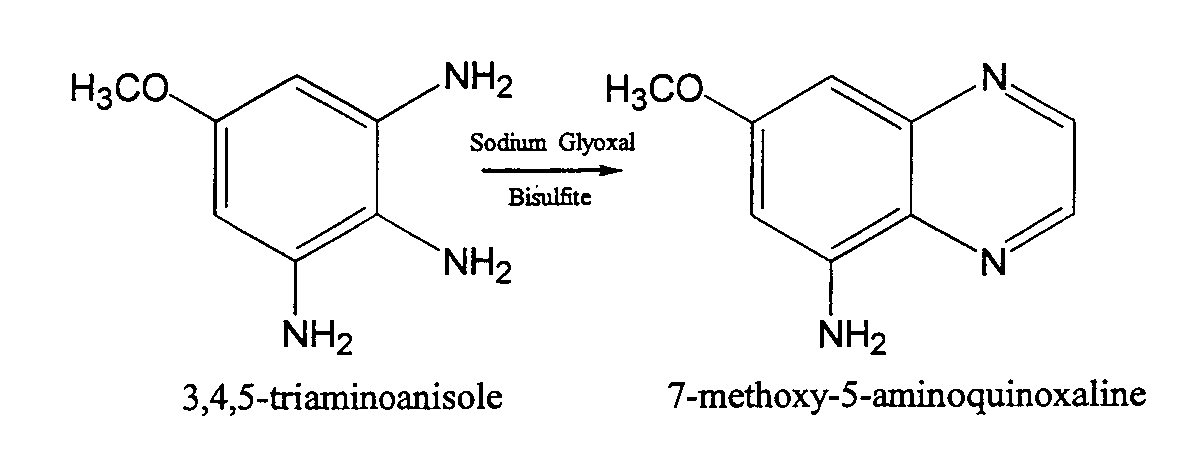
- 7-methoxy-5-aminoquinoxaline has been prepared by condensation of 3, 4, 5-triaminoanisole with sodium glyoxal bisulfite (2).
- 7-methoxy-5-aminoquinoxaline and 7-methoxy-5-hydroxyaminoquinoxaline have been prepared from 3, 5-dinitro-4-aminoanisole, which in turn was prepared by nitration of m -nitrobenzenesulfonyl- p -aminoanisole (3).
- the present invention pertains to a method for preparing a compound having Formula (I).
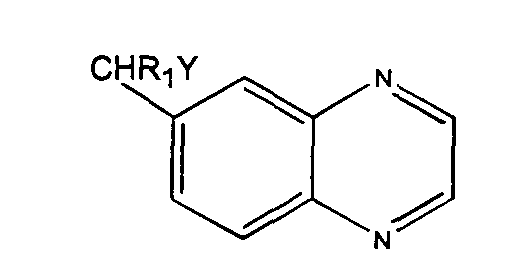
- the method comprises contacting an aqueous suspension of a compound having Formula (II) with a water-soluble nucleophile, N 1 , containing moiety Y; wherein X is chloro or bromo; R 1 is selected from the group consisting of hydrogen and branched and unbranched alkyl and aryl groups having from 1 to 9 carbon atoms; Y is selected from the group consisting of -OR 2 , -NHR 2 , -NR 2 R 3 , -SR 2 , and -CN; and R 2 and R 3 are independently selected from the group consisting of hydrogen and branched and unbranched alkyl groups having from 1 to 4 carbon atoms.
- X is chloro or bromo
- R 1 is selected from the group consisting of hydrogen and branched and unbranched alkyl and aryl groups having from 1 to 9 carbon atoms
- Y is selected from the group consisting of -OR 2 , -NHR 2 , -NR 2 R 3 ,
- the present invention pertains to a method for preparing a compound having Formula (I).
- the method comprises contacting a compound having Formula (II) with an organic solvent-soluble nucleophile, N 2 , containing moiety Y, in an inert polar organic solvent; wherein X is chloro or bromo; R 1 is selected from the group consisting of hydrogen and branched and unbranched alkyl and aryl groups having from 1 to 9 carbon atoms; Y is selected from the group consisting of -OR 2 , -NHR 2 , -NR 2 R 3 , and -SR 2 ; and R 2 and R 3 are independently selected from the group consisting of hydrogen and branched and unbranched alkyl and aryl groups having from 5 to 9 carbon atoms.
- N 2 organic solvent-soluble nucleophile
- the present invention pertains to a method for preparing a compound having Formula (I).
- the method comprises contacting a compound having Formula (II) in an organic solvent with an aqueous solution of a water-soluble nucleophile, N 1 , containing moiety Y, in the presence of a phase transfer catalyst; wherein X is chloro or bromo; R 1 is selected from the group consisting of hydrogen and branched and unbranched alkyl and aryl groups having from 1 to 9 carbon atoms; Y is selected from the group consisting of -OR 2 , -NHR 2 , -NR 2 R 3 , -SR 2 , and -CN; and R 2 and R 3 are independently selected from the group consisting of hydrogen and branched and unbranched alkyl groups having from 1 to 4 carbon atoms.
- a phase transfer catalyst wherein X is chloro or bromo; R 1 is selected from the group consisting of hydrogen and branched and unbranched alkyl and aryl groups having from 1 to 9 carbon atoms; Y is selected from the group consisting of -
- the present invention pertains to methods for preparing 5- and 6-benzyl functionalized quinoxalines.
- the method comprises contacting an aqueous suspension of a 5- and 6-halomethyl quinoxaline with a water-soluble nucleophile.
- the method comprises contacting a 5- and 6-halomethyl quinoxaline with an organic solvent-soluble nucleophile in an inert polar organic solvent.
- the method comprises contacting a 5- and 6-halomethyl quinoxaline in an organic solvent with an aqueous solution of a water-soluble nucleophile in the presence of a phase transfer catalyst.
- the 5- and 6-halomethyl quinoxalines may be prepared from 5- and 6-methyl quinoxalines, which in turn may be prepared from ortho -diaminotoluenes, such as 2,3-and 3,4-diaminotoluene, by condensation with sodium glyoxal bisulfite.
- ortho -diaminotoluenes such as 2,3-and 3,4-diaminotoluene, by condensation with sodium glyoxal bisulfite.
- ortho -diaminotoluenes is not trivial because the nitration of toluene yields mainly 2, 4-dinitrotoluene, the precursor of 2, 4-diaminotoluene (TDA, toluene-diamine), and only 4% or less of the ortho -isomers.
- 4-diaminotoluene is a bulk chemical, from which the ortho -diamine isomers are removed by distillation, and consequently uses for the ortho -diamine by-products are desired.
- the present invention provides a simple route to compounds such as 6-hydroxymethyl-quinoxaline by taking advantage of the availability of ortho -toluene diamine (OTD) using selective functionalization of the methyl group without affecting the aromatic rings.
- OTD ortho -toluene diamine
- a 5- or 6-benzyl-quinoxaline is halogenated to provide the corresponding 5- or 6-halomethyl-quinoxaline intermediate.
- X is halogen.
- halogen refers to fluorine, chlorine, bromine, and iodine. Preferred halogens are chlorine and bromine.
- a benzylic methyl heterocyclic compound and a halogenating agent such as N-chlorosuccinimide (NCS) or N-bromosuccinimide (NBS) are reacted in the presence of a radical initiator, such as benzoyl peroxide or azobisisobutyronitrile, in a suitable solvent, to form the respective 5- or 6-halomethyl quinoxaline (I).
- NCS N-chlorosuccinimide
- N-bromosuccinimide N-bromosuccinimide
- a radical initiator such as benzoyl peroxide or azobisisobutyronitrile
- Suitable solvents may be selected from the group consisting of fluorobenzene, difluorobenzenes, trifluorobenzenes, chlorobenzene, dichlorobenzenes, trichlorobenzenes, ⁇ , ⁇ , ⁇ -trifluorotoluene and ⁇ , ⁇ , ⁇ -trichlorotoluene.
- the method typically affords good yields of halomethyl-quinoxalines when [6QX]/[benzoyl peroxide] ⁇ 40 while maintaining a temperature in the range of 60°C to 115°C for a period of 1 to 12 hours.
- the 5- or 6-halomethyl quinoxaline may be a 5-halomethyl quinoxaline or may be a 6-halomethyl quinoxaline.
- the halomethyl may be a chloromethyl or may be a bromomethyl.
- the 5- or 6-halomethyl-quinoxaline intermediate (II) is contacted with a nucleophile to yield the corresponding 5- or 6-benzyl functionalized quinoxaline (I).
- the present invention pertains to a method for preparing a compound having Formula (I) which comprises contacting an aqueous suspension of a compound having Formula (II) with a water-soluble nucleophile, N 1 , containing moiety Y.
- the compound having Formula (I) may be: or may be
- R 1 may be selected from the group consisting of hydrogen and branched and unbranched alkyl and aryl groups having from 1 to 9 carbon atoms.
- R 1 is selected from the group consisting of hydrogen and branched and unbranched alkyl and aryl groups having from 1 to 6 carbon atoms, more preferably R 1 is selected from the group consisting of hydrogen and branched and unbranched alkyl groups having from 1 to 3 carbon atoms, and most preferably R 1 is hydrogen.
- the water-soluble nucleophiles, N 1 , containing moiety Y, which may be employed in the present invention may be any water-soluble nucleophile which is capable of selectively displacing the halogen group attached to the benzylic position of the heterocyclic compound in an aqueous suspension.
- the term "water-soluble nucleophile”, as used herein, refers to a nucleophile that can be dissolved in water to yield a solution with a molarity equal to, or greater than, 0.01.
- Non-limiting illustrative water-soluble nucleophiles are those that contain a Y moiety, where Y may be selected from the group consisting of -OR 2 , -NHR 2 , -NR 2 R 3 , -SR 2 , and -CN.
- R 2 and R 3 are independently selected from the group consisting of hydrogen and branched and unbranched alkyl groups having from 1 to 4 carbon atoms.
- R 2 and R 3 are independently selected from the group consisting of hydrogen and branched and unbranched alkyl groups having from 1 to 3 carbon atoms, more preferably R 2 and R 3 are independently selected from the group consisting of hydrogen and alkyl groups having from 1 to 2 carbon atoms, and most preferably R 2 and R 3 are hydrogen.
- Preferred water-soluble nucleophiles may be selected from the group consisting of alkali hydroxides and alkaline earth hydroxides. More preferred water-soluble nucleophiles may be selected from the group consisting of lithium hydroxide, sodium hydroxide, and potassium hydroxide.
- Y is hydroxy.
- the invention is directed to a method for preparing a compound having Formula (I) which comprises contacting a compound having Formula (II) with an organic solvent-soluble nucleophile, N 2 , containing moiety Y, in an inert polar organic solvent.
- the compound having Formula (I) may be: or may be
- organic solvent-soluble nucleophiles which may be employed in the present invention may be any organic solvent-soluble nucleophile which is capable of selectively displacing the halogen group attached to the benzylic position of the heterocyclic compound in an inert polar organic solvent.
- organic solvent-soluble nucleophile refers to a nucleophile that can be dissolved in an organic solvent to yield a solution with a molarity equal to, or greater than, 0.01.
- Non-limiting illustrative organic solvent-soluble nucleophiles are those that contain a Y moiety, where Y may be selected from the group consisting of -OR 2 , -NHR 2 , -NR 2 R 3 , and -SR 2.
- R 2 and R 3 are independently selected from the group consisting of hydrogen and branched and unbranched alkyl and aryl groups having from 5 to 9 carbon atoms.
- R 2 and R 3 are independently selected from the group consisting of hydrogen and branched and unbranched alkyl and aryl groups having from 5 to 8 carbon atoms, more preferably R 2 and R 3 are independently selected from the group consisting of hydrogen and branched and unbranched alkyl and aryl groups having from 5 to 7 carbon atoms, and most preferably R 2 and R 3 are hydrogen.
- Preferred organic solvent-soluble nucleophiles may be selected from the group consisting of benzyltrimethyl ammonium hydroxide, tetrabutyl ammonium hydroxide, alkyl alcohols, aryl alcohols, alkylamines, arylamines, alkyl sulfides, aryl sulfides, and the salts thereof. More preferred organic solvent-soluble nucleophiles are benzyltrimethyl ammonium hydroxide and tetrabutyl ammonium hydroxide.
- Y is hydroxy.
- the inert polar organic solvents which may be employed in the present invention may be any inert polar organic solvent which is capable of dissolving the organic solvent-soluble nucleophile and the 5- or 6-halomethyl quinoxaline thereby permitting the selective displacement of the halogen group attached to the benzylic position of the heterocyclic compound.
- inert polar organic solvent refers to an organic solvent that does not react with the organic solvent-soluble nucleophile or the 5- or 6-halomethyl quinoxaline and promotes a reaction between the organic solvent-soluble nucleophile and the 5- or 6-halomethyl quinoxaline.
- Non-limiting illustrative inert polar organic solvents may be selected from the group consisting of tetrahydrofuran, dioxane, 2-methoxyethyl ether, triethylene glycol dimethyl ether, dimethylsulfoxide (DMSO), methyl- tert -butyl ether (MTBE), and diethyl ether.
- Preferred inert polar organic solvents may be selected from the group consisting of tetrahydrofuran, dioxane, 2-methoxyethyl ether, triethylene glycol dimethyl ether, and dimethylsulfoxide.
- More preferred inert polar organic solvents may be selected from the group consisting of tetrahydrofuran, dioxane, and 2-methoxyethyl ether. Most preferred inert polar organic solvents are tetrahydrofuran and dioxane.
- the invention is directed to a method for preparing a compound having Formula (I) which comprises contacting a compound having Formula (II) in an organic solvent with an aqueous solution of a water-soluble nucleophile, N 1 , containing moiety Y, in the presence of a phase transfer catalyst.
- the compound having Formula (I) may be: or may be
- the organic solvents which may be employed in the present invention may be any organic solvent which is capable of dissolving the water-soluble nucleophile and the 5- or 6-halomethyl quinoxaline with the assistance of the phase transfer catalyst thereby permitting the selective displacement of the halogen group attached to the benzylic position of the heterocyclic compound.
- Non-limiting illustrative organic solvents may be selected from the group consisting of chlorobenzene, dichlorobenzenes, trichlorobenzenes, ⁇ , ⁇ , ⁇ -trichlorotoluene, fluorobenzene, difluorobenzenes, trifluorobenzenes, and ⁇ , ⁇ , ⁇ -trifluorortoluene.
- Preferred organic solvents may be selected from the group consisting of chlorobenzene, dichlorobenzenes, fluorobenzene, and difluorobenzenes. More preferred organic solvents are chlorobenzene and dichlorobenzenes. The most preferred organic solvent is chlorobenzene.
- phase transfer catalysts which may be employed in the present invention may be any phase transfer catalyst which is capable of dissolving the water-soluble nucleophile and the 5- or 6-halomethyl quinoxaline in the organic phase thereby permitting the selective displacement of the halogen group attached to the benzylic position of the heterocyclic compound.
- the phase transfer catalyst is typically an organic salt (for example, tetraalkyl-ammonium salts, benzyltrimethylammonium salts, etc) that is soluble in both the aqueous phase and the organic phase.
- Non-limiting illustrative phase transfer catalysts may be selected from the group consisting of tetra- n -butyl-ammonium chloride, benzyltrimethylammonium chloride, benzyltrimethylammonium hydroxide, tetralkyl ammonium salts, tetraalkyl sulfonium salts, and cetyltrimethylammonium salts.
- the 5- and 6-halomethyl quinoxalines and the nucleophiles may be reacted in relative amounts ranging from about 1:1 to about 1:100, and preferably from about 1:10 to about 1:30, respectively.
- the 5- and 6-halomethyl quinoxalines and the nucleophiles may be reacted at temperatures ranging from about 25°C. to about 150°C., preferably from about 25°C. to about 100°C., and at pressures ranging from ambient to about 100psig, and preferably ambient.
- 6-methyl-quinoxaline (2.5 g, 17.4 mmol) was dissolved together with N-bromosuccinimide (4.63 g, 19 mmol) and benzoyl peroxide (0.3 g, 1.24 mmol) in 70 g of 1,2-dichloroethane. The solution was refluxed for 150 minutes and analyzed.
- Example 4 shows that mixing a chlorobenzene solution of 6-bromomethyl-quinoxaline with an aqueous alkali hydroxide solution is not an efficient method because of the unfavorable partition coefficient of the base in the organic phase.
- Example 5 shows that in the presence of a phase transfer catalyst, the reaction can proceed with acceptable rates.
- Example 3 The orange solid obtained in Example 3 was mixed with 50 ml of potassium hydroxide (1.42 M). The reaction mixture was heated to reflux with the aid of a heating mantle for 20 minutes and analyzed. The aqueous suspension was extracted with 250 ml of methylene chloride (5 times, 50 ml each) and the extracts were dried over anhydrous MgSO 4 , filtered and vacuum dried to give 1.5 g of a brownish solid (65% yield) composed of 80% 6-hydroxymethyl-quinoxaline.
- Example 6 shows that some of the compound decomposed during heating and consequently a milder heating source may be used.
- a sample of 6-bromomethyl-quinoxaline (1.0 g) was placed in a 50 ml flask and 14.0 g of a solution of KOH (prepared by dissolving 4 g of KOH pellets in 20 g of water) was added.
- KOH prepared by dissolving 4 g of KOH pellets in 20 g of water
- the yellowish suspension was heated in a water bath to 80°C and maintained at that temperature for about 30 minutes.
- the aqueous solution was then neutralized with dilute aqueous sulfuric acid and the organic product was extracted with 150 ml of chloroform.
- Example 7 shows that when a water bath at 80°C is used as a heating source, the organic phase does not turned completely brown but dark yellow.
- the addition of a phase transfer catalyst minimized even more the formation of brown products (tars) resulting from the thermal decomposition of 6-bromomethyl-quinoxaline.
- brown products tars
- 6-methyl-quinoxaline (1.25 g, 8.68 mmol) was dissolved together with N-bromosuccinimide (2.32 g, 13.0 mmol) and benzoyl peroxide (0.15 g, 0.62 mmol) in 31 g of chlorobenzene.
- the solution was stirred with heating at 85°C for 2.0 hours to yield a reddish solution.
- the solution was cooled down to room temperature and one volume of pentane was added to facilitate the precipitation of succinimides.
- the solid was filtered (1.6 g), washed with pentane and the extracts were combined with the chlorobenzene solution.
- This solution was then vacuum dried to give a yellow solid mainly composed of 6-bromomethyl-quinoxaline (1.92 g).
- This solid was dissolved in 38 g of THF and mixed with 4.24 g of a 40% commercial aqueous solution of benzyltrimethyl ammonium hydroxide. Samples were analyzed during the course of the reaction showing a progressive conversion of 6-bromomethyl-quinoxaline into the hydroxy derivative. The pale yellow solution was stirred at room temperature overnight until the reaction was completed and no other by-products were detected by GCMS analysis. The alkaline solution was neutralized with dilute sulfuric acid (1 M) and pH adjusted with sodium bicarbonate.
- Example 8 shows that the use of a phase transfer reagent minimizes decomposition of 6-bromomethyl-quinoxaline (no tars) because heating is not required to improve the miscibility of the phases.
- 6-methyl-quinoxaline (1.25 g, 8.68 mmol) was dissolved together with N-bromosuccinimide (2.32 g, 13.0 mmol) and benzoyl-peroxide (0.15 g, 0.62 mmol) in 31 g of chlorobenzene.
- the solution was stirred with heating at 85°C for 2.0 hours to yield a reddish solution.
- the solution was cooled down to room temperature and one volume of pentane was added to facilitate the removal of succinimides.
- the precipitate was washed with pentane and the extracts were combined with the chlorobenzene solution.
- the yellow solution was vacuum dried to give a yellow residue mainly composed of 6-bromomethyl-quinoxaline.
- the yellow solid was dissolved in 19.0 g of n -butylamine to give a yellow solution that was stirred at room temperature for ⁇ 5 minutes. Analysis of a sample showed that the 6-bromomethyl-quinoxaline was consumed to give exclusively 6- n -butylaminomethyl-quinoxaline as a deep yellow oil (1.71 g, 92% over all yield).
- Example 10 shows that some organic solvent-soluble nucleophiles (alkylamines, for example) can readily react with 6-bromomethyl-quinoxaline because the compound is completely soluble in the organic phase.
- Example 10 shows that 6-bromomethyl-quinoxaline completely reacted with n-butylamine in few minutes at room temperature to give 6- n -butylaminomethyl-quinoxaline. In this example, n -butylamine acted as both the nucleophile and the solvent.
Landscapes
- Chemical & Material Sciences (AREA)
- Organic Chemistry (AREA)
- Plural Heterocyclic Compounds (AREA)
- Low-Molecular Organic Synthesis Reactions Using Catalysts (AREA)
Abstract
The present invention pertains to methods for preparing 5- and 6-benzyl functionalized quinoxalines. In a first embodiment, the method comprises contacting an aqueous suspension of a 5- and 6-halomethyl quinoxaline with a water-soluble nucleophile. In a second embodiment, the method comprises contacting a 5- and 6-halomethyl quinoxaline with an organic solvent-soluble nucleophile in an inert polar organic solvent. In a third embodiment, the method comprises contacting a 5- and 6-halomethyl quinoxaline in an organic solvent with an aqueous solution of a water-soluble nucleophile in the presence of a phase transfer catalyst.
Description
- The present invention relates to a method for preparing 5- and 6-benzyl functionalized quinoxalines.
- The disclosures referred to herein to illustrate the background of the invention and to provide additional detail with respect to its practice are incorporated herein by reference and, for convenience, are numerically referenced in the following text and respectively grouped in the appended bibliography.
- Substituted quinoxalines are important chemical intermediates for the preparation of pharmaceutical compounds, such as AMPHAKINE CX516® [1-(quinoxalin-6-ylcarbonyl) piperidine]. Substituted quinoxalines are typically prepared by condensation of substituted ortho-diaminobenzenes with sodium glyoxal bisulfite as set out below (1).

- For example, 7-methoxy-5-aminoquinoxaline has been prepared by condensation of 3, 4, 5-triaminoanisole with sodium glyoxal bisulfite (2).
- Similarly, 7-methoxy-5-aminoquinoxaline and 7-methoxy-5-hydroxyaminoquinoxaline have been prepared from 3, 5-dinitro-4-aminoanisole, which in turn was prepared by nitration of m-nitrobenzenesulfonyl-p-aminoanisole (3).

- Nevertheless, there are no reported procedures for preparing 6-hydroxymethylquinoxaline by condensation of 3,4-diaminohydroxymethylbenzene with sodium glyoxal bisulfite, presumably because such a method is not trivial and requires multiple steps. Because attempts to prepare 5- and 6-benzyl functionalized quinoxalines via a one-step selective reaction of the benzyl group were not successful, a two-step method to prepare 5- and 6-benzyl functionalized quinoxalines was developed.
- In a first embodiment, the present invention pertains to a method for preparing a compound having Formula (I).

- In this first embodiment, the method comprises contacting an aqueous suspension of a compound having Formula (II) with a water-soluble nucleophile, N1, containing moiety Y; wherein X is chloro or bromo; R1 is selected from the group consisting of hydrogen and branched and unbranched alkyl and aryl groups having from 1 to 9 carbon atoms; Y is selected from the group consisting of -OR2, -NHR2, -NR2R3, -SR2, and -CN; and R2 and R3 are independently selected from the group consisting of hydrogen and branched and unbranched alkyl groups having from 1 to 4 carbon atoms.
- In a second embodiment, the present invention pertains to a method for preparing a compound having Formula (I).

- In this second embodiment, the method comprises contacting a compound having Formula (II) with an organic solvent-soluble nucleophile, N2, containing moiety Y, in an inert polar organic solvent; wherein X is chloro or bromo; R1 is selected from the group consisting of hydrogen and branched and unbranched alkyl and aryl groups having from 1 to 9 carbon atoms; Y is selected from the group consisting of -OR2, -NHR2, -NR2R3, and -SR2; and R2 and R3 are independently selected from the group consisting of hydrogen and branched and unbranched alkyl and aryl groups having from 5 to 9 carbon atoms.
- In a third embodiment, the present invention pertains to a method for preparing a compound having Formula (I).

- In this third embodiment, the method comprises contacting a compound having Formula (II) in an organic solvent with an aqueous solution of a water-soluble nucleophile, N1, containing moiety Y, in the presence of a phase transfer catalyst; wherein X is chloro or bromo; R1 is selected from the group consisting of hydrogen and branched and unbranched alkyl and aryl groups having from 1 to 9 carbon atoms; Y is selected from the group consisting of -OR2, -NHR2, -NR2R3, -SR2, and -CN; and R2 and R3 are independently selected from the group consisting of hydrogen and branched and unbranched alkyl groups having from 1 to 4 carbon atoms.
- The present invention pertains to methods for preparing 5- and 6-benzyl functionalized quinoxalines. In a first embodiment, the method comprises contacting an aqueous suspension of a 5- and 6-halomethyl quinoxaline with a water-soluble nucleophile. In a second embodiment, the method comprises contacting a 5- and 6-halomethyl quinoxaline with an organic solvent-soluble nucleophile in an inert polar organic solvent. In a third embodiment, the method comprises contacting a 5- and 6-halomethyl quinoxaline in an organic solvent with an aqueous solution of a water-soluble nucleophile in the presence of a phase transfer catalyst.
- The 5- and 6-halomethyl quinoxalines may be prepared from 5- and 6-methyl quinoxalines, which in turn may be prepared from ortho-diaminotoluenes, such as 2,3-and 3,4-diaminotoluene, by condensation with sodium glyoxal bisulfite. The preparation of ortho-diaminotoluenes is not trivial because the nitration of toluene yields mainly 2, 4-dinitrotoluene, the precursor of 2, 4-diaminotoluene (TDA, toluene-diamine), and only 4% or less of the ortho-isomers. However, 2, 4-diaminotoluene is a bulk chemical, from which the ortho-diamine isomers are removed by distillation, and consequently uses for the ortho-diamine by-products are desired. The present invention provides a simple route to compounds such as 6-hydroxymethyl-quinoxaline by taking advantage of the availability of ortho-toluene diamine (OTD) using selective functionalization of the methyl group without affecting the aromatic rings.
- Because attempts to prepare 5- and 6-benzyl functionalized quinoxalines via a one-step selective reaction of the benzyl group were not successful, a two-step method to prepare 5- and 6-benzyl functionalized quinoxalines was developed.
- In the first step, a 5- or 6-benzyl-quinoxaline is halogenated to provide the corresponding 5- or 6-halomethyl-quinoxaline intermediate.

- X is halogen. The term "halogen", as used herein, refers to fluorine, chlorine, bromine, and iodine. Preferred halogens are chlorine and bromine.
- In the first step of the synthesis, a benzylic methyl heterocyclic compound and a halogenating agent, such as N-chlorosuccinimide (NCS) or N-bromosuccinimide (NBS), are reacted in the presence of a radical initiator, such as benzoyl peroxide or azobisisobutyronitrile, in a suitable solvent, to form the respective 5- or 6-halomethyl quinoxaline (I). Suitable solvents may be selected from the group consisting of fluorobenzene, difluorobenzenes, trifluorobenzenes, chlorobenzene, dichlorobenzenes, trichlorobenzenes, α, α, α-trifluorotoluene and α, α, α-trichlorotoluene. The method typically affords good yields of halomethyl-quinoxalines when [6QX]/[benzoyl peroxide] ≤ 40 while maintaining a temperature in the range of 60°C to 115°C for a period of 1 to 12 hours. Yields for benzylic brominations (conversions ≥95%, selectivities ≥ 97%) are in general better than for benzylic chlorinations (conversions 60%, selectivities ∼ 75-80%). The 5- or 6-halomethyl quinoxaline may be a 5-halomethyl quinoxaline or may be a 6-halomethyl quinoxaline. The halomethyl may be a chloromethyl or may be a bromomethyl.
- This first step is more fully described in a copending patent application entitled "Method For Preparing Halomethyl Heterocyclic Compounds" filed by applicant concurrently with the present patent application and assigned to the assignee of this application, which is hereby incorporated by reference.
- In the second step, the 5- or 6-halomethyl-quinoxaline intermediate (II) is contacted with a nucleophile to yield the corresponding 5- or 6-benzyl functionalized quinoxaline (I).

- In a first embodiment, the present invention pertains to a method for preparing a compound having Formula (I) which comprises contacting an aqueous suspension of a compound having Formula (II) with a water-soluble nucleophile, N1, containing moiety Y.

- In this first embodiment, the compound having Formula (I) may be:


- R1 may be selected from the group consisting of hydrogen and branched and unbranched alkyl and aryl groups having from 1 to 9 carbon atoms. Preferably, R1 is selected from the group consisting of hydrogen and branched and unbranched alkyl and aryl groups having from 1 to 6 carbon atoms, more preferably R1 is selected from the group consisting of hydrogen and branched and unbranched alkyl groups having from 1 to 3 carbon atoms, and most preferably R1 is hydrogen.
- The water-soluble nucleophiles, N1, containing moiety Y, which may be employed in the present invention may be any water-soluble nucleophile which is capable of selectively displacing the halogen group attached to the benzylic position of the heterocyclic compound in an aqueous suspension. The term "water-soluble nucleophile", as used herein, refers to a nucleophile that can be dissolved in water to yield a solution with a molarity equal to, or greater than, 0.01. Non-limiting illustrative water-soluble nucleophiles are those that contain a Y moiety, where Y may be selected from the group consisting of -OR2, -NHR2, -NR2R3, -SR2, and -CN. R2 and R3 are independently selected from the group consisting of hydrogen and branched and unbranched alkyl groups having from 1 to 4 carbon atoms. Preferably, R2 and R3 are independently selected from the group consisting of hydrogen and branched and unbranched alkyl groups having from 1 to 3 carbon atoms, more preferably R2 and R3 are independently selected from the group consisting of hydrogen and alkyl groups having from 1 to 2 carbon atoms, and most preferably R2 and R3 are hydrogen. Preferred water-soluble nucleophiles may be selected from the group consisting of alkali hydroxides and alkaline earth hydroxides. More preferred water-soluble nucleophiles may be selected from the group consisting of lithium hydroxide, sodium hydroxide, and potassium hydroxide. Preferably, Y is hydroxy.
- In a second embodiment, the invention is directed to a method for preparing a compound having Formula (I) which comprises contacting a compound having Formula (II) with an organic solvent-soluble nucleophile, N2, containing moiety Y, in an inert polar organic solvent.

- In this second embodiment, the compound having Formula (I) may be:


- The definition of X and R1 are as defined above.
- The organic solvent-soluble nucleophiles which may be employed in the present invention may be any organic solvent-soluble nucleophile which is capable of selectively displacing the halogen group attached to the benzylic position of the heterocyclic compound in an inert polar organic solvent. The term "organic solvent-soluble nucleophile", as used herein, refers to a nucleophile that can be dissolved in an organic solvent to yield a solution with a molarity equal to, or greater than, 0.01. Non-limiting illustrative organic solvent-soluble nucleophiles are those that contain a Y moiety, where Y may be selected from the group consisting of -OR2, -NHR2, -NR2R3, and -SR2. R2 and R3 are independently selected from the group consisting of hydrogen and branched and unbranched alkyl and aryl groups having from 5 to 9 carbon atoms. Preferably, R2 and R3 are independently selected from the group consisting of hydrogen and branched and unbranched alkyl and aryl groups having from 5 to 8 carbon atoms, more preferably R2 and R3 are independently selected from the group consisting of hydrogen and branched and unbranched alkyl and aryl groups having from 5 to 7 carbon atoms, and most preferably R2 and R3 are hydrogen. Preferred organic solvent-soluble nucleophiles may be selected from the group consisting of benzyltrimethyl ammonium hydroxide, tetrabutyl ammonium hydroxide, alkyl alcohols, aryl alcohols, alkylamines, arylamines, alkyl sulfides, aryl sulfides, and the salts thereof. More preferred organic solvent-soluble nucleophiles are benzyltrimethyl ammonium hydroxide and tetrabutyl ammonium hydroxide. Preferably, Y is hydroxy.
- The inert polar organic solvents which may be employed in the present invention may be any inert polar organic solvent which is capable of dissolving the organic solvent-soluble nucleophile and the 5- or 6-halomethyl quinoxaline thereby permitting the selective displacement of the halogen group attached to the benzylic position of the heterocyclic compound. The term "inert polar organic solvent", as used herein, refers to an organic solvent that does not react with the organic solvent-soluble nucleophile or the 5- or 6-halomethyl quinoxaline and promotes a reaction between the organic solvent-soluble nucleophile and the 5- or 6-halomethyl quinoxaline. Non-limiting illustrative inert polar organic solvents may be selected from the group consisting of tetrahydrofuran, dioxane, 2-methoxyethyl ether, triethylene glycol dimethyl ether, dimethylsulfoxide (DMSO), methyl-tert-butyl ether (MTBE), and diethyl ether. Preferred inert polar organic solvents may be selected from the group consisting of tetrahydrofuran, dioxane, 2-methoxyethyl ether, triethylene glycol dimethyl ether, and dimethylsulfoxide. More preferred inert polar organic solvents may be selected from the group consisting of tetrahydrofuran, dioxane, and 2-methoxyethyl ether. Most preferred inert polar organic solvents are tetrahydrofuran and dioxane.
- In a third embodiment, the invention is directed to a method for preparing a compound having Formula (I) which comprises contacting a compound having Formula (II) in an organic solvent with an aqueous solution of a water-soluble nucleophile, N1, containing moiety Y, in the presence of a phase transfer catalyst.

- In this third embodiment, the compound having Formula (I) may be:


- The definition of X, R1, and the water-soluble nucleophile are as defined above.
- The organic solvents which may be employed in the present invention may be any organic solvent which is capable of dissolving the water-soluble nucleophile and the 5- or 6-halomethyl quinoxaline with the assistance of the phase transfer catalyst thereby permitting the selective displacement of the halogen group attached to the benzylic position of the heterocyclic compound. Non-limiting illustrative organic solvents may be selected from the group consisting of chlorobenzene, dichlorobenzenes, trichlorobenzenes, α, α, α-trichlorotoluene, fluorobenzene, difluorobenzenes, trifluorobenzenes, and α, α, α-trifluorortoluene. Preferred organic solvents may be selected from the group consisting of chlorobenzene, dichlorobenzenes, fluorobenzene, and difluorobenzenes. More preferred organic solvents are chlorobenzene and dichlorobenzenes. The most preferred organic solvent is chlorobenzene.
- The phase transfer catalysts which may be employed in the present invention may be any phase transfer catalyst which is capable of dissolving the water-soluble nucleophile and the 5- or 6-halomethyl quinoxaline in the organic phase thereby permitting the selective displacement of the halogen group attached to the benzylic position of the heterocyclic compound. The phase transfer catalyst is typically an organic salt (for example, tetraalkyl-ammonium salts, benzyltrimethylammonium salts, etc) that is soluble in both the aqueous phase and the organic phase. Non-limiting illustrative phase transfer catalysts may be selected from the group consisting of tetra-n-butyl-ammonium chloride, benzyltrimethylammonium chloride, benzyltrimethylammonium hydroxide, tetralkyl ammonium salts, tetraalkyl sulfonium salts, and cetyltrimethylammonium salts.
- The 5- and 6-halomethyl quinoxalines and the nucleophiles may be reacted in relative amounts ranging from about 1:1 to about 1:100, and preferably from about 1:10 to about 1:30, respectively. The 5- and 6-halomethyl quinoxalines and the nucleophiles may be reacted at temperatures ranging from about 25°C. to about 150°C., preferably from about 25°C. to about 100°C., and at pressures ranging from ambient to about 100psig, and preferably ambient.
- The present invention is further illustrated by the following examples which are presented for purposes of demonstrating, but not limiting, the preparation of the compounds and compositions of this invention.
- To a solution of 122 g of ortho-toluenediamine (1.0 mole) dissolved in 500 cc of 2 M acetic acid, 250 cc of 4 M sodium acetate solution was added with stirring. The mixture was heated up to 60°C and poured rapidly into a solution of 298.4 g (1.05 moles) of sodium glyoxal bisulfite in 1500 cc of water previously heated to 60°C. The resulting dark solution was stirred for one hour and it was then cooled down in an ice bath until the temperature had dropped below 10°C. The solution was then neutralized with 120 g of sodium hydroxide pellets. After the sodium hydroxide had dissolved, 500 g of potassium carbonate was added. During the addition of alkali, the solution turned red and a black oil separated out. Most of the oily amine was removed by extraction with pentane or hexane and the combined organic phase was dried over MgSO4, filtered and vacuum dried to give a brown oil that upon distillation gave methyl-quinoxaline (92 g) as a clear pale yellow to colorless liquid (80% yield).
- In a 50 ml flask, 6-methyl-quinoxaline (1.25 g, 8.68 mmol) was dissolved together with N-bromosuccinimide (2.32 g, 13.0 mmol) and benzoyl-peroxide (0.15 g, 0.62 mmol) in 31 g of chlorobenzene. The solution was stirred with heating at 85°C for 2.0 hours to yield a reddish solution. The molar concentrations are shown in the following table:
Solvent [6QX] [NBS] [BP] CIPh 0.31 0.46 2.2 x 10⁻² - Analysis of the reddish solution by GC-MS showed mostly the formation of compounds 1 while compound 2 (ring bromination) was not detected:

Reaction Time = 120 min Product % Selectivity % Conversion 1 97.0 95.0 Unknowns 3.0 2.5 - The light reddish solution of 6-bromomethyl-quinoxaline was used to prepare 6-hydroxymethyl-quinoxaline as shown in the examples below.
- In a 100 ml flask, 6-methyl-quinoxaline (2.5 g, 17.4 mmol) was dissolved together with N-bromosuccinimide (4.63 g, 19 mmol) and benzoyl peroxide (0.3 g, 1.24 mmol) in 70 g of 1,2-dichloroethane. The solution was refluxed for 150 minutes and analyzed. The concentrations of the reactants and some of their molar ratios are shown below:
Solvent [6QX] [NBS] [BP] [NBS]/{6QX] [6QX]/[BP] 1,2-DCE 0.31 0.46 0.022 1.5 14 Total Reaction Time = 150 min Product % Selectivity %Conversion 1 93.4 85.0 2 1.6 1.5 3 5.0 4.6 - The solution was cooled in the freezer overnight and the solid residue was separated by filtration. The solid was washed with pentane and the washings were combined with the liquid fraction. The clear reddish solution was then vacuum dried to give an orange solid that was used in the preparation of 6-hydroxymethyl-quinoxaline.
- A sample of solution of 6-bromomethyl-quinoxaline in chlorobenzene prepared in Example 2 (3.90 g of solution) was mixed with 4 ml of 1.9 M aqueous sodium hydroxide and the two-phase liquid was refluxed for 30 minutes. The chlorobenzene phase was analyzed by gas chromatography and mass spectroscopy. Most of the 6-bromomethyl-quinoxaline remained unreacted. Careful GC-MS analysis of the organic phase showed the presence of traces of 6-hydroxymethyl-quinoxaline. Although the presence of a base was expected to react with the bromo-compound to yield 6-hydroxymethyl-quinoxaline, reflux of the two phase mixture (water/chlorobenzene) was inappropriate for the reagents to get mixed yielding only a trace of the desired product.
- Example 4 shows that mixing a chlorobenzene solution of 6-bromomethyl-quinoxaline with an aqueous alkali hydroxide solution is not an efficient method because of the unfavorable partition coefficient of the base in the organic phase.
- In a 50 ml flask, the solution of 6-bromomethyl-quinoxaline in chlorobenzene prepared in Example 2 (24.1 g of solution) was mixed with an aqueous solution of sodium hydroxide prepared by dissolving 1.7 g of sodium hydroxide in 4 ml of water. A phase-transfer catalyst (tetra-n-butyl-ammonium chloride) was added to the two-phase liquid mixture (0.1 g) followed by a gentle reflux. Upon heating, the reddish chlorobenzene solution turned dark-brown. The reaction was stopped after 30 minutes refluxed and the aqueous phase was neutralized with a 4 M solution of sulfuric acid. The chlorobenzene phase (reddish color) was separated and dried over anhydrous MgSO4.
- GC-MS analysis of the chlorobenzene phase showed absence of 6-bromomethyl-quinoxaline and the presence of 6-hydroxymethyl-quinoxaline. The chlorobenzene solution was evaporated under vacuum and the solid residue was washed with pentane to remove some remaining organic impurities. The brown solid residue (∼0.5 g, 52% yield)) was analyzed by GCMS showing mostly 6-hydroxymethyl-quinoxaline (80% purity).
- Example 5 shows that in the presence of a phase transfer catalyst, the reaction can proceed with acceptable rates.
- The orange solid obtained in Example 3 was mixed with 50 ml of potassium hydroxide (1.42 M). The reaction mixture was heated to reflux with the aid of a heating mantle for 20 minutes and analyzed. The aqueous suspension was extracted with 250 ml of methylene chloride (5 times, 50 ml each) and the extracts were dried over anhydrous MgSO4, filtered and vacuum dried to give 1.5 g of a brownish solid (65% yield) composed of 80% 6-hydroxymethyl-quinoxaline.
- Upon heating, the 6-bromomethyl-quinoxaline melts and strong stirring is required to get the organic phase in contact with the alkali. When heating, the organic phase slowly turned brown particularly in the areas where the flask was in contact with the heating mantle. Example 6 shows that some of the compound decomposed during heating and consequently a milder heating source may be used.
- A sample of 6-bromomethyl-quinoxaline (1.0 g) was placed in a 50 ml flask and 14.0 g of a solution of KOH (prepared by dissolving 4 g of KOH pellets in 20 g of water) was added. The yellowish suspension was heated in a water bath to 80°C and maintained at that temperature for about 30 minutes. The aqueous solution was then neutralized with dilute aqueous sulfuric acid and the organic product was extracted with 150 ml of chloroform. The extracts were dried over anhydrous magnesium sulfate, filtered and vacuum dried to give a dark yellow solid (1.0 g) that was washed with pentane and ether to give 0.6 g (∼ 80% yield) of a yellow solid mostly composed of 6-hydroxymethyl-quinoxaline.
- Example 7 shows that when a water bath at 80°C is used as a heating source, the organic phase does not turned completely brown but dark yellow. The addition of a phase transfer catalyst minimized even more the formation of brown products (tars) resulting from the thermal decomposition of 6-bromomethyl-quinoxaline. Thus, minimizing heating and finding a solvent media that favors the solution of both 6-bromomethyl-quinoxaline and the base seems to be the most appropriate procedure to make 6-hydroxymethyl-quinoxaline from its bromo compound.
- In a 50 ml flask, 6-methyl-quinoxaline (1.25 g, 8.68 mmol) was dissolved together with N-bromosuccinimide (2.32 g, 13.0 mmol) and benzoyl peroxide (0.15 g, 0.62 mmol) in 31 g of chlorobenzene. The solution was stirred with heating at 85°C for 2.0 hours to yield a reddish solution. The solution was cooled down to room temperature and one volume of pentane was added to facilitate the precipitation of succinimides. The solid was filtered (1.6 g), washed with pentane and the extracts were combined with the chlorobenzene solution. This solution was then vacuum dried to give a yellow solid mainly composed of 6-bromomethyl-quinoxaline (1.92 g). This solid was dissolved in 38 g of THF and mixed with 4.24 g of a 40% commercial aqueous solution of benzyltrimethyl ammonium hydroxide. Samples were analyzed during the course of the reaction showing a progressive conversion of 6-bromomethyl-quinoxaline into the hydroxy derivative. The pale yellow solution was stirred at room temperature overnight until the reaction was completed and no other by-products were detected by GCMS analysis. The alkaline solution was neutralized with dilute sulfuric acid (1 M) and pH adjusted with sodium bicarbonate. The solution was vacuum dried to give a yellow residue (2.5 g) that was dissolved in methylene chloride and extracted with water to remove the organic salt. The methylene chloride solutions were dried over anhydrous MgSO4 and the solution evaporated to give a pale yellow solid mostly composed of 6-hydroxymethyl-quinoxaline (1.15 g, ∼ 83% yield).
- Example 8 shows that the use of a phase transfer reagent minimizes decomposition of 6-bromomethyl-quinoxaline (no tars) because heating is not required to improve the miscibility of the phases.
- A sample of the brownish solid obtained in Example 6 was further purified by distillation. The product was isolated as a white solid that showed the following analytical data: MS (70 ev): 160 (M+); 143 (M+-OH); 131 (M+-OH-C); 1H NMR (CDCl3): 4.85 (s, 2H, =CH2), 5.2 (br, 1H, -OH), 7.65 (d, 1H, C-H aromatic), 7.90 (d, 1H, C-H aromatic), 7.95 (s, 1H, C-H aromatic), 8.65 (s, 2H, C-H aromatic).
- In a 50 ml flask, 6-methyl-quinoxaline (1.25 g, 8.68 mmol) was dissolved together with N-bromosuccinimide (2.32 g, 13.0 mmol) and benzoyl-peroxide (0.15 g, 0.62 mmol) in 31 g of chlorobenzene. The solution was stirred with heating at 85°C for 2.0 hours to yield a reddish solution. The solution was cooled down to room temperature and one volume of pentane was added to facilitate the removal of succinimides. The precipitate was washed with pentane and the extracts were combined with the chlorobenzene solution. The yellow solution was vacuum dried to give a yellow residue mainly composed of 6-bromomethyl-quinoxaline. The yellow solid was dissolved in 19.0 g of n-butylamine to give a yellow solution that was stirred at room temperature for ∼ 5 minutes. Analysis of a sample showed that the 6-bromomethyl-quinoxaline was consumed to give exclusively 6-n-butylaminomethyl-quinoxaline as a deep yellow oil (1.71 g, 92% over all yield). MS (70 ev): 215 M+, 172 (M+-CH3-CH2-CH2), 143 (M+-CH3-CH2-CH2-CH2).
- Example 10 shows that some organic solvent-soluble nucleophiles (alkylamines, for example) can readily react with 6-bromomethyl-quinoxaline because the compound is completely soluble in the organic phase. Example 10 shows that 6-bromomethyl-quinoxaline completely reacted with n-butylamine in few minutes at room temperature to give 6-n-butylaminomethyl-quinoxaline. In this example, n-butylamine acted as both the nucleophile and the solvent.

- Throughout this application, various publications have been referenced. The disclosures in these publications are incorporated herein by reference in order to more fully describe the state of the art.
- 1. a) G. W. H. Cheeseman in "Advances in Heterocyclic Chemistry" by A. R. Katritzky Academic Press. Vol. 2. pp. 203-221. 1963. b) G. W. H. Cheeseman and E. S. G. Werstiuk 367-419 in "Advances in Heterocyclic Chemistry" by A. R. Katritzky Academic Press. Vol. 22. pp. 203-221. 1978 c) J. C. Cavagnol, F. Y. Wiselogle, J. Am. Chem. Soc., 69, 795, 1947.
- 2. O. Gawron, P. E. Spoerri, J. Am.Chem. Soc., 67, 514, 1945.
- 3. R. Mizzoni, P. E. Spoerri, J. Am.Chem. Soc., 67, 1652, 1945.
- 4. O. Gawron, A. Rampal, P. Johnson, J. Am.Chem. Soc., 94, 5396, 1972.
- 5. R. C. DeSelms, R. J. Greaves, W. R. Schleigh, J. Heterocyclic Chem., 11, 595,1974.
- 6. Venet et al. United States patent no. 5,028,606 (1991).
- 7. (a) R. Granger, S. Deadwyler, M. Davis, B. Moskovitz, M. Kessler, G. Rogers, G. Lynch, Synapse, 22, pp. 332-337, 1996. (b) G. Lynch, M. Kessler, G. Rogers, J. Ambross-Ingerson, R. Granger, R. S. Schehr, International Clinical Psycopharmacology, 11, pp.13-19, 1996.
- 8. 2,3-Pyrazinedicarboxylic acid: "Organic Synthesis" Coll. Vol. 4 pp. 824-827, J. Wiley & Sons, Inc. NY., 1963.
- 9. D. F. Gavin, United states patent no. 3,960,963 (1976).
- While a number of embodiments of this invention have been represented, it is apparent that the basic construction can be altered to provide other embodiments which utilize the invention without departing from the spirit and scope of the invention. All such modifications and variations are intended to be included within the scope of the invention as defined in the appended claims rather than the specific embodiments which have been presented by way of example.
Claims (32)
- A method for preparing a compound having Formula (I)

- The method according to claim 1, wherein the compound having Formula (I) is:

- The method according to claim 1, wherein the compound having Formula (I) is:
- The method according to claim 1, wherein X is chloro.
- The method according to claim 1, wherein X is bromo.
- The method according to claim 1, wherein R1 is selected from the group consisting of hydrogen and branched and unbranched alkyl and aryl groups having from 1 to 6 carbon atoms.
- The method according to claim 1, wherein the water-soluble nucleophile, N1, is selected from the group consisting of alkali hydroxides and alkaline earth hydroxides.
- The method according to claim 7, wherein the water-soluble nucleophile, N1, is selected from the group consisting of lithium hydroxide, sodium hydroxide, and potassium hydroxide.
- The method according to claim 1, wherein Y is hydroxy.
- The method according to claim 1, wherein R2 and R3 are independently selected from the group consisting of hydrogen and alkyl groups having from 1 to 2 carbon atoms.
- A method for preparing a compound having Formula (I)

- The method according to claim 11, wherein the compound having Formula (I) is:

- The method according to claim 11, wherein the compound having Formula (I) is:

- The method according to claim 11, wherein X is chloro.
- The method according to claim 11, wherein X is bromo.
- The method according to claim 11, wherein R1 is selected from the group consisting of hydrogen and branched and unbranched alkyl and aryl groups having from 1 to 6 carbon atoms.
- The method according to claim 11, wherein the organic solvent-soluble nucleophile, N2 is selected from the group consisting of benzyltrimethyl ammonium hydroxide, tetrabutyl ammonium hydroxide, alkyl alcohols, aryl alcohols, alkylamines, arylamines, alkyl sulfides, aryl sulfides, and the salts thereof.
- The method according to claim 11, wherein the inert polar organic solvent is selected from the group consisting of tetrahydrofuran, dioxane, 2-methoxyethyl ether, triethylene glycol dimethyl ether, dimethylsulfoxide, methyl-tert-butyl ether, and diethyl ether.
- The method according to claim 11, wherein Y is hydroxy.
- The method according to claim 11, wherein R2 and R3 are independently selected from the group consisting of hydrogen and branched and unbranched alkyl and aryl groups having from 5 to 8 carbon atoms.
- A method for preparing a compound having Formula (I)

- The method according to claim 21, wherein the compound having Formula (I) is:

- The method according to claim 21, wherein the compound having Formula (I) is:

- The method according to claim 21, wherein X is chloro.
- The method according to claim 21, wherein X is bromo.
- The method according to claim 21, wherein R1 is selected from the group consisting of hydrogen and branched and unbranched alkyl and aryl groups having from 1 to 6 carbon atoms.
- The method according to claim 21, wherein the water-soluble nucleophile, N1, is selected from the group consisting of alkali hydroxides and alkaline earth hydroxides.
- The method according to claim 27, wherein the water-soluble nucleophile, N1, is selected from the group consisting of lithium hydroxide, sodium hydroxide, and potassium hydroxide.
- The method according to claim 21, wherein the organic solvent is selected from the group consisting of chlorobenzene, dichlorobenzenes, trichlorobenzenes, α, α, α-trichlorotoluene, fluorobenzene, difluorobenzenes, trifluorobenzenes, and α, α, α-trifluorortoluene.
- The method according to claim 21, wherein the phase transfer catalyst is selected from the group consisting of tetra-n-butyl-ammonium chloride, benzyltrimethylammonium chloride, benzyltrimethylammonium hydroxide, tetralkyl ammonium salts, tetraalkyl sulfonium salts, and cetyltrimethylammonium salts.
- The method according to claim 21, wherein Y is hydroxy.
- The method according to claim 21, wherein R2 and R3 are independently selected from the group consisting of hydrogen and alkyl groups having from 1 to 2 carbon atoms.
Applications Claiming Priority (2)
| Application Number | Priority Date | Filing Date | Title |
|---|---|---|---|
| US909002 | 2001-07-19 | ||
| US09/909,002 US6548670B1 (en) | 2001-07-19 | 2001-07-19 | Methods for preparing 5- and 6-benzyl-functionalized quinoxalines |
Publications (1)
| Publication Number | Publication Date |
|---|---|
| EP1279668A1 true EP1279668A1 (en) | 2003-01-29 |
Family
ID=25426494
Family Applications (1)
| Application Number | Title | Priority Date | Filing Date |
|---|---|---|---|
| EP02015578A Withdrawn EP1279668A1 (en) | 2001-07-19 | 2002-07-12 | Methods for preparing 5- and 6-benzyl functionalized quinoxalines |
Country Status (3)
| Country | Link |
|---|---|
| US (3) | US6548670B1 (en) |
| EP (1) | EP1279668A1 (en) |
| JP (1) | JP2003055351A (en) |
Families Citing this family (4)
| Publication number | Priority date | Publication date | Assignee | Title |
|---|---|---|---|---|
| MY145368A (en) * | 2004-01-13 | 2012-01-31 | Nissan Chemical Ind Ltd | Aminoquinoxaline compounds and polyaminoquinoxaline compounds, and use thereof |
| EP1713101B1 (en) * | 2004-02-06 | 2012-10-31 | Yamaguchi University | Electrode for energy storage device and process for producing the same |
| NZ567357A (en) * | 2005-10-31 | 2011-05-27 | Janssen Pharmaceutica Nv | Novel processes for the preparation of piperazinyl and diazapanyl benzamide derivatives |
| US7795426B2 (en) * | 2005-10-31 | 2010-09-14 | Janssen Pharmaceutica Nv | Processes for the preparation of cyclopropyl-amide derivatives |
Citations (6)
| Publication number | Priority date | Publication date | Assignee | Title |
|---|---|---|---|---|
| EP0322255A1 (en) * | 1987-12-23 | 1989-06-28 | American Home Products Corporation | N-acyl-N-naphthoylglycines as aldose reductase inhibitors |
| EP0381375A1 (en) * | 1989-01-30 | 1990-08-08 | Imperial Chemical Industries Plc | Heterocyclic derivatives |
| EP0385663A2 (en) * | 1989-02-28 | 1990-09-05 | Zeneca Limited | Heterocyclic cycloalkanes as inhibitors of 5-lipoxygenase |
| EP0385662A2 (en) * | 1989-02-28 | 1990-09-05 | Zeneca Limited | Heterocycles with inhibitory activity of 5-lipoxygenase |
| JPH02223558A (en) * | 1988-11-02 | 1990-09-05 | Kaken Pharmaceut Co Ltd | Phenylalkylamine derivatives and antifungal agents containing them as active ingredients |
| WO1998043959A1 (en) * | 1997-03-28 | 1998-10-08 | Zeneca Limited | Hydroxamic acids substituted by heterocycles useful for inhibition of tumor necrosis factor |
Family Cites Families (3)
| Publication number | Priority date | Publication date | Assignee | Title |
|---|---|---|---|---|
| US3960963A (en) | 1973-11-19 | 1976-06-01 | Olin Corporation | Separation of 3,4-diaminotoluene from a mixture of o-toluenediamine isomers |
| GB8827822D0 (en) | 1988-11-29 | 1988-12-29 | Janssen Pharmaceutica Nv | (1h-azol-1-ylmethyl)substituted quinoline derivatives |
| US6492517B1 (en) * | 2001-07-19 | 2002-12-10 | Air Products And Chemicals, Inc. | Method for preparing halomethyl heterocyclic compounds |
-
2001
- 2001-07-19 US US09/909,002 patent/US6548670B1/en not_active Expired - Fee Related
-
2002
- 2002-07-12 EP EP02015578A patent/EP1279668A1/en not_active Withdrawn
- 2002-07-18 JP JP2002209132A patent/JP2003055351A/en active Pending
-
2003
- 2003-01-20 US US10/348,114 patent/US6750343B2/en not_active Expired - Fee Related
- 2003-01-20 US US10/348,117 patent/US20030166934A1/en not_active Abandoned
Patent Citations (6)
| Publication number | Priority date | Publication date | Assignee | Title |
|---|---|---|---|---|
| EP0322255A1 (en) * | 1987-12-23 | 1989-06-28 | American Home Products Corporation | N-acyl-N-naphthoylglycines as aldose reductase inhibitors |
| JPH02223558A (en) * | 1988-11-02 | 1990-09-05 | Kaken Pharmaceut Co Ltd | Phenylalkylamine derivatives and antifungal agents containing them as active ingredients |
| EP0381375A1 (en) * | 1989-01-30 | 1990-08-08 | Imperial Chemical Industries Plc | Heterocyclic derivatives |
| EP0385663A2 (en) * | 1989-02-28 | 1990-09-05 | Zeneca Limited | Heterocyclic cycloalkanes as inhibitors of 5-lipoxygenase |
| EP0385662A2 (en) * | 1989-02-28 | 1990-09-05 | Zeneca Limited | Heterocycles with inhibitory activity of 5-lipoxygenase |
| WO1998043959A1 (en) * | 1997-03-28 | 1998-10-08 | Zeneca Limited | Hydroxamic acids substituted by heterocycles useful for inhibition of tumor necrosis factor |
Non-Patent Citations (27)
| Title |
|---|
| ANGEW. CHEM., vol. 97, no. 10, 1985, pages 866 * |
| AZERB. KHIM. ZH., no. 2, 1978, pages 53 - 56 * |
| BULL. SOC. CHIM. FR. (1976), (9-10, PT. 2), 1482-1488 * |
| CHEM. BER., vol. 122, no. 9, 1989, pages 1725 - 1727 * |
| CHEM. PHARM. BULL., vol. 33, no. 7, 1985, pages 2809 - 2820 * |
| CHEM. PHARM. BULL., vol. 37, no. 8, 1989, pages 2109 - 2116 * |
| CHEMISTRY EXPRESS, vol. 6, no. 1, 1991, pages 45 - 48 * |
| DATABASE CA [online] CHEMICAL ABSTRACTS SERVICE, COLUMBUS, OHIO, US; BUTIN, K. P. ET AL: "Solvolytic cleavage of 1-(8-quinolyl)ethylmercury bromide in methanol", XP002217026, retrieved from STN Database accession no. 103:54182 * |
| DATABASE CA [online] CHEMICAL ABSTRACTS SERVICE, COLUMBUS, OHIO, US; DUCHENE, KARL HEINZ ET AL: "New helical molecules. 12. The first [2.1]phane. A new helical molecular skeleton", XP002217032, retrieved from STN Database accession no. 104:19491 * |
| DATABASE CA [online] CHEMICAL ABSTRACTS SERVICE, COLUMBUS, OHIO, US; EBMEYER, FRANK ET AL: "Template synthesis of macrobicyclic large cavities of the tris(bipyridine) type", XP002217034, retrieved from STN Database accession no. 111:153771 * |
| DATABASE CA [online] CHEMICAL ABSTRACTS SERVICE, COLUMBUS, OHIO, US; EDWARDS, M. L. ET AL: "Formyl-substituted phenazine 5,10-dioxides", XP002217024, retrieved from STN Database accession no. 85:160024 * |
| DATABASE CA [online] CHEMICAL ABSTRACTS SERVICE, COLUMBUS, OHIO, US; KHYDYROV, D. N. ET AL: "Some reactions based on the sulfhydryl group of 1- naphthylmethanethiol", XP002217033, retrieved from STN Database accession no. 89:215098 * |
| DATABASE CA [online] CHEMICAL ABSTRACTS SERVICE, COLUMBUS, OHIO, US; MAIGROT, NICOLE ET AL: "New and improved synthesis of optically pure (R)- and (S)-2,2'-dimethyl-1,1'-binaphthyl and related compounds", XP002217031, retrieved from STN Database accession no. 103:178020 * |
| DATABASE CA [online] CHEMICAL ABSTRACTS SERVICE, COLUMBUS, OHIO, US; MARSHAM, PETER R. ET AL: "Quinazoline antifolate thymidylate synthase inhibitors: heterocyclic benzoyl ring modifications", XP002217028, retrieved from STN Database accession no. 114:229315 * |
| DATABASE CA [online] CHEMICAL ABSTRACTS SERVICE, COLUMBUS, OHIO, US; MICHELOT, DIDIER ET AL: "Preparation of aldehydes by sigmatropic [2,3] rearrangement of.beta.,.gamma.-unsaturated ammonium ylides bearing thio ether groups on the anionic carbon atom", XP002217035, retrieved from STN Database accession no. 86:120129 * |
| DATABASE CA [online] CHEMICAL ABSTRACTS SERVICE, COLUMBUS, OHIO, US; MURDOCK, K. C. ET AL: "Antitubercular 2,8-bis(alkylaminomethyl)phenazines", XP002217023, retrieved from STN Database accession no. 88:115291 * |
| DATABASE CA [online] CHEMICAL ABSTRACTS SERVICE, COLUMBUS, OHIO, US; NIIMI, ATSUKI ET AL: "Synthesis of alkylaminomethylisoquinoline and N- alkylbenzo[de][1,7]naphthyridinium bromide from bromomethylisoquinolines and amines", XP002217029, retrieved from STN Database accession no. 114:143100 * |
| DATABASE CA [online] CHEMICAL ABSTRACTS SERVICE, COLUMBUS, OHIO, US; RUDDICK, CLARE L. ET AL: "Conversion of alkyl halides into the corresponding alcohols under mild reaction conditions", XP002217030, retrieved from STN Database accession no. 126:31127 * |
| DATABASE CA [online] CHEMICAL ABSTRACTS SERVICE, COLUMBUS, OHIO, US; SUGIMOTO, AKIKO ET AL: "Synthesis and inhibitory effect on platelet aggregation of 2-phenyl-1(2H)-phthalazinone derivatives", XP002217027, retrieved from STN Database accession no. 105:42737 * |
| DATABASE CA [online] CHEMICAL ABSTRACTS SERVICE, COLUMBUS, OHIO, US; UCHIDA, MINORU ET AL: "Studies on proton pump inhibitors. II. Synthesis and antiulcer activity of 8-[(2-benzimidazolyl)sulfinylmethyl]-1,2,3,4- tetrahydroquinolines and related compounds", XP002217025, retrieved from STN Database accession no. 112:198213 * |
| IZV. AKAD. NAUK SSSR, SER. KHIM., no. 2, 1985, pages 443 - 447 * |
| J. HETEROCYCL. CHEM., vol. 13, no. 3, 1976, pages 653 - 656 * |
| J. MED. CHEM., vol. 21, no. 4, 1978, pages 403 - 405 * |
| JOURNAL OF MEDICINAL CHEMISTRY, vol. 34, no. 5, 1991, pages 1594 - 1605 * |
| PATENT ABSTRACTS OF JAPAN vol. 014, no. 535 (C - 0781) 26 November 1990 (1990-11-26) * |
| SYNTHESIS, no. 11, 1996, pages 1359 - 1362 * |
| SYNTHESIS, no. 3, 1985, pages 317 - 320 * |
Also Published As
| Publication number | Publication date |
|---|---|
| US6548670B1 (en) | 2003-04-15 |
| US20030158411A1 (en) | 2003-08-21 |
| US6750343B2 (en) | 2004-06-15 |
| JP2003055351A (en) | 2003-02-26 |
| US20030166934A1 (en) | 2003-09-04 |
Similar Documents
| Publication | Publication Date | Title |
|---|---|---|
| KR100443182B1 (en) | Process for the preparation of dihaloazulopyrimidines | |
| US20110257410A1 (en) | Methods for the preparation of fungicides | |
| US6548670B1 (en) | Methods for preparing 5- and 6-benzyl-functionalized quinoxalines | |
| CN102001979A (en) | Preparation method of 2-(2', 2'-difluoroethoxyl)-6-trifluoromethyl phenyl propyl sulfide | |
| US11512062B2 (en) | Process for the synthesis of piperazinyl-ethoxy-bromophenyl derivates and their application in the production of compounds containing them | |
| US6531605B1 (en) | Process for the manufacture of arylsulfonyl chloride | |
| EP0979820B1 (en) | 2-Phenylpyridine derivatives and production method thereof | |
| JPH11116576A (en) | Production of 2-choloro-benzimidazole derivative | |
| US6559308B1 (en) | Method for preparing heterocyclic-carboxylic acids | |
| EP1873145B1 (en) | Method for producing nicotinic acid derivative or salt thereof | |
| KR100499679B1 (en) | Preparation method of 2-trifluoromethoxy-aniline | |
| JP2003506312A (en) | Meta-nitrophenol derivative and method for producing the same | |
| US8168799B2 (en) | Process for the preparation of tetrazolytetrahydrocyclopentapyrazoles | |
| JP2865715B2 (en) | Method for hydroxylating electrophilic aromatic compounds | |
| US6562972B1 (en) | Method for preparing heterocyclic-carboxylic acids | |
| JP3159405B2 (en) | Method for producing thienyl ether derivative | |
| CN119698408A (en) | Process for preparing substituted benzamides | |
| JP3545466B2 (en) | Dihydrochromancarboxylic acids and method for producing the same | |
| JP2531228B2 (en) | Biphenyl derivative and method for producing the same | |
| US6417407B1 (en) | Method of making 2-bromo-4-chloro substituted phenols | |
| EP0596491B1 (en) | Method for halogenating an aromatic compound | |
| JP4028945B2 (en) | Method for producing 4- (pyridin-2-yl) benzaldehyde, intermediate compound, method for producing the compound, and method for producing hydrazine derivative | |
| WO2026098418A1 (en) | Preparation method for iminoaryl compound and intermediate | |
| JPH11158092A (en) | Method for producing styrene derivative | |
| JPH06239853A (en) | Method for producing diphenyl ether derivative |
Legal Events
| Date | Code | Title | Description |
|---|---|---|---|
| PUAI | Public reference made under article 153(3) epc to a published international application that has entered the european phase |
Free format text: ORIGINAL CODE: 0009012 |
|
| AK | Designated contracting states |
Designated state(s): AT BE BG CH CY CZ DE DK EE ES FI FR GB GR IE IT LI LU MC NL PT SE SK TR |
|
| AX | Request for extension of the european patent |
Extension state: AL LT LV MK RO SI |
|
| 17P | Request for examination filed |
Effective date: 20030212 |
|
| 17Q | First examination report despatched |
Effective date: 20030829 |
|
| AKX | Designation fees paid |
Designated state(s): AT BE BG CH CY CZ DE DK EE ES FI FR GB GR IE IT LI LU MC NL PT SE SK TR |
|
| STAA | Information on the status of an ep patent application or granted ep patent |
Free format text: STATUS: THE APPLICATION IS DEEMED TO BE WITHDRAWN |
|
| 18D | Application deemed to be withdrawn |
Effective date: 20061005 |