EP1278723B1 - P-(sulfonyl)-aryl and -heteroaryl amines - Google Patents
P-(sulfonyl)-aryl and -heteroaryl amines Download PDFInfo
- Publication number
- EP1278723B1 EP1278723B1 EP01943280A EP01943280A EP1278723B1 EP 1278723 B1 EP1278723 B1 EP 1278723B1 EP 01943280 A EP01943280 A EP 01943280A EP 01943280 A EP01943280 A EP 01943280A EP 1278723 B1 EP1278723 B1 EP 1278723B1
- Authority
- EP
- European Patent Office
- Prior art keywords
- compound
- alkyl
- amino
- mmol
- cycloalkyl
- Prior art date
- Legal status (The legal status is an assumption and is not a legal conclusion. Google has not performed a legal analysis and makes no representation as to the accuracy of the status listed.)
- Expired - Lifetime
Links
- AYLQCFZAMQTYCZ-UHFFFAOYSA-N CC(CCN(Cc(cc1)ccc1F)c(cc1)ccc1S(C)(=O)=O)=O Chemical compound CC(CCN(Cc(cc1)ccc1F)c(cc1)ccc1S(C)(=O)=O)=O AYLQCFZAMQTYCZ-UHFFFAOYSA-N 0.000 description 1
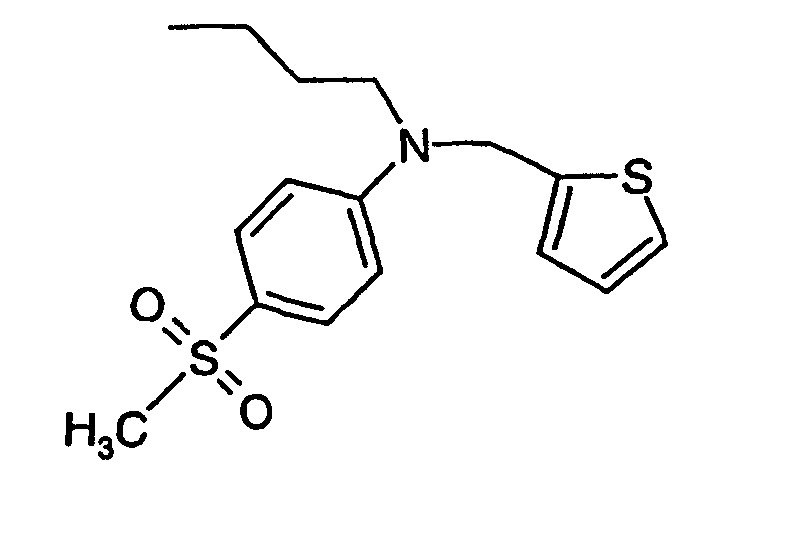
- LMGAVRWQNCYSGE-UHFFFAOYSA-N CCCCN(Cc1ccc[s]1)c(cc1)ccc1S(C)(=O)=O Chemical compound CCCCN(Cc1ccc[s]1)c(cc1)ccc1S(C)(=O)=O LMGAVRWQNCYSGE-UHFFFAOYSA-N 0.000 description 1
- BLOBPTZMGKOQDU-UHFFFAOYSA-N CCOc1ccc(CN(CCS(C)(=O)=O)c(cc2)ccc2S(C)(=O)=O)cc1 Chemical compound CCOc1ccc(CN(CCS(C)(=O)=O)c(cc2)ccc2S(C)(=O)=O)cc1 BLOBPTZMGKOQDU-UHFFFAOYSA-N 0.000 description 1
- HPZWCNDJLSUWDG-UHFFFAOYSA-N CCOc1ccc(CN(Cc2c[s]cc2)c(cc2)ccc2S(C)(=O)=O)cc1 Chemical compound CCOc1ccc(CN(Cc2c[s]cc2)c(cc2)ccc2S(C)(=O)=O)cc1 HPZWCNDJLSUWDG-UHFFFAOYSA-N 0.000 description 1
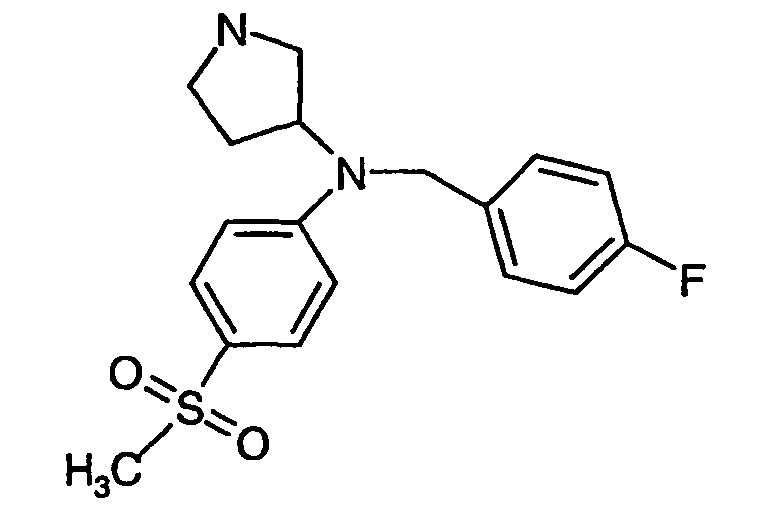
- HBUIHCFMACWBSQ-UHFFFAOYSA-N CS(c(cc1)ccc1N(Cc(cc1)ccc1F)C1CNCC1)(=O)=O Chemical compound CS(c(cc1)ccc1N(Cc(cc1)ccc1F)C1CNCC1)(=O)=O HBUIHCFMACWBSQ-UHFFFAOYSA-N 0.000 description 1
Classifications
-
- C—CHEMISTRY; METALLURGY
- C07—ORGANIC CHEMISTRY
- C07D—HETEROCYCLIC COMPOUNDS
- C07D207/00—Heterocyclic compounds containing five-membered rings not condensed with other rings, with one nitrogen atom as the only ring hetero atom
- C07D207/02—Heterocyclic compounds containing five-membered rings not condensed with other rings, with one nitrogen atom as the only ring hetero atom with only hydrogen or carbon atoms directly attached to the ring nitrogen atom
- C07D207/18—Heterocyclic compounds containing five-membered rings not condensed with other rings, with one nitrogen atom as the only ring hetero atom with only hydrogen or carbon atoms directly attached to the ring nitrogen atom having one double bond between ring members or between a ring member and a non-ring member
- C07D207/22—Heterocyclic compounds containing five-membered rings not condensed with other rings, with one nitrogen atom as the only ring hetero atom with only hydrogen or carbon atoms directly attached to the ring nitrogen atom having one double bond between ring members or between a ring member and a non-ring member with hetero atoms or with carbon atoms having three bonds to hetero atoms with at the most one bond to halogen, e.g. ester or nitrile radicals, directly attached to ring carbon atoms
- C07D207/24—Oxygen or sulfur atoms
- C07D207/26—2-Pyrrolidones
- C07D207/263—2-Pyrrolidones with only hydrogen atoms or radicals containing only hydrogen and carbon atoms directly attached to other ring carbon atoms
- C07D207/27—2-Pyrrolidones with only hydrogen atoms or radicals containing only hydrogen and carbon atoms directly attached to other ring carbon atoms with substituted hydrocarbon radicals directly attached to the ring nitrogen atom
-
- A—HUMAN NECESSITIES
- A61—MEDICAL OR VETERINARY SCIENCE; HYGIENE
- A61P—SPECIFIC THERAPEUTIC ACTIVITY OF CHEMICAL COMPOUNDS OR MEDICINAL PREPARATIONS
- A61P19/00—Drugs for skeletal disorders
- A61P19/02—Drugs for skeletal disorders for joint disorders, e.g. arthritis, arthrosis
-
- A—HUMAN NECESSITIES
- A61—MEDICAL OR VETERINARY SCIENCE; HYGIENE
- A61P—SPECIFIC THERAPEUTIC ACTIVITY OF CHEMICAL COMPOUNDS OR MEDICINAL PREPARATIONS
- A61P19/00—Drugs for skeletal disorders
- A61P19/06—Antigout agents, e.g. antihyperuricemic or uricosuric agents
-
- A—HUMAN NECESSITIES
- A61—MEDICAL OR VETERINARY SCIENCE; HYGIENE
- A61P—SPECIFIC THERAPEUTIC ACTIVITY OF CHEMICAL COMPOUNDS OR MEDICINAL PREPARATIONS
- A61P21/00—Drugs for disorders of the muscular or neuromuscular system
-
- A—HUMAN NECESSITIES
- A61—MEDICAL OR VETERINARY SCIENCE; HYGIENE
- A61P—SPECIFIC THERAPEUTIC ACTIVITY OF CHEMICAL COMPOUNDS OR MEDICINAL PREPARATIONS
- A61P25/00—Drugs for disorders of the nervous system
- A61P25/28—Drugs for disorders of the nervous system for treating neurodegenerative disorders of the central nervous system, e.g. nootropic agents, cognition enhancers, drugs for treating Alzheimer's disease or other forms of dementia
-
- A—HUMAN NECESSITIES
- A61—MEDICAL OR VETERINARY SCIENCE; HYGIENE
- A61P—SPECIFIC THERAPEUTIC ACTIVITY OF CHEMICAL COMPOUNDS OR MEDICINAL PREPARATIONS
- A61P29/00—Non-central analgesic, antipyretic or antiinflammatory agents, e.g. antirheumatic agents; Non-steroidal antiinflammatory drugs [NSAID]
-
- A—HUMAN NECESSITIES
- A61—MEDICAL OR VETERINARY SCIENCE; HYGIENE
- A61P—SPECIFIC THERAPEUTIC ACTIVITY OF CHEMICAL COMPOUNDS OR MEDICINAL PREPARATIONS
- A61P3/00—Drugs for disorders of the metabolism
- A61P3/08—Drugs for disorders of the metabolism for glucose homeostasis
- A61P3/10—Drugs for disorders of the metabolism for glucose homeostasis for hyperglycaemia, e.g. antidiabetics
-
- A—HUMAN NECESSITIES
- A61—MEDICAL OR VETERINARY SCIENCE; HYGIENE
- A61P—SPECIFIC THERAPEUTIC ACTIVITY OF CHEMICAL COMPOUNDS OR MEDICINAL PREPARATIONS
- A61P37/00—Drugs for immunological or allergic disorders
- A61P37/02—Immunomodulators
-
- A—HUMAN NECESSITIES
- A61—MEDICAL OR VETERINARY SCIENCE; HYGIENE
- A61P—SPECIFIC THERAPEUTIC ACTIVITY OF CHEMICAL COMPOUNDS OR MEDICINAL PREPARATIONS
- A61P37/00—Drugs for immunological or allergic disorders
- A61P37/02—Immunomodulators
- A61P37/06—Immunosuppressants, e.g. drugs for graft rejection
-
- A—HUMAN NECESSITIES
- A61—MEDICAL OR VETERINARY SCIENCE; HYGIENE
- A61P—SPECIFIC THERAPEUTIC ACTIVITY OF CHEMICAL COMPOUNDS OR MEDICINAL PREPARATIONS
- A61P43/00—Drugs for specific purposes, not provided for in groups A61P1/00-A61P41/00
-
- C—CHEMISTRY; METALLURGY
- C07—ORGANIC CHEMISTRY
- C07C—ACYCLIC OR CARBOCYCLIC COMPOUNDS
- C07C317/00—Sulfones; Sulfoxides
- C07C317/26—Sulfones; Sulfoxides having sulfone or sulfoxide groups and nitrogen atoms, not being part of nitro or nitroso groups, bound to the same carbon skeleton
- C07C317/32—Sulfones; Sulfoxides having sulfone or sulfoxide groups and nitrogen atoms, not being part of nitro or nitroso groups, bound to the same carbon skeleton with sulfone or sulfoxide groups bound to carbon atoms of six-membered aromatic rings of the carbon skeleton
- C07C317/34—Sulfones; Sulfoxides having sulfone or sulfoxide groups and nitrogen atoms, not being part of nitro or nitroso groups, bound to the same carbon skeleton with sulfone or sulfoxide groups bound to carbon atoms of six-membered aromatic rings of the carbon skeleton having sulfone or sulfoxide groups and amino groups bound to carbon atoms of six-membered aromatic rings being part of the same non-condensed ring or of a condensed ring system containing that ring
- C07C317/36—Sulfones; Sulfoxides having sulfone or sulfoxide groups and nitrogen atoms, not being part of nitro or nitroso groups, bound to the same carbon skeleton with sulfone or sulfoxide groups bound to carbon atoms of six-membered aromatic rings of the carbon skeleton having sulfone or sulfoxide groups and amino groups bound to carbon atoms of six-membered aromatic rings being part of the same non-condensed ring or of a condensed ring system containing that ring with the nitrogen atoms of the amino groups bound to hydrogen atoms or to carbon atoms
-
- C—CHEMISTRY; METALLURGY
- C07—ORGANIC CHEMISTRY
- C07C—ACYCLIC OR CARBOCYCLIC COMPOUNDS
- C07C323/00—Thiols, sulfides, hydropolysulfides or polysulfides substituted by halogen, oxygen or nitrogen atoms, or by sulfur atoms not being part of thio groups
- C07C323/23—Thiols, sulfides, hydropolysulfides or polysulfides substituted by halogen, oxygen or nitrogen atoms, or by sulfur atoms not being part of thio groups containing thio groups and nitrogen atoms, not being part of nitro or nitroso groups, bound to the same carbon skeleton
- C07C323/31—Thiols, sulfides, hydropolysulfides or polysulfides substituted by halogen, oxygen or nitrogen atoms, or by sulfur atoms not being part of thio groups containing thio groups and nitrogen atoms, not being part of nitro or nitroso groups, bound to the same carbon skeleton having the sulfur atom of at least one of the thio groups bound to a carbon atom of a six-membered aromatic ring of the carbon skeleton
- C07C323/33—Thiols, sulfides, hydropolysulfides or polysulfides substituted by halogen, oxygen or nitrogen atoms, or by sulfur atoms not being part of thio groups containing thio groups and nitrogen atoms, not being part of nitro or nitroso groups, bound to the same carbon skeleton having the sulfur atom of at least one of the thio groups bound to a carbon atom of a six-membered aromatic ring of the carbon skeleton having at least one of the nitrogen atoms bound to a carbon atom of the same non-condensed six-membered aromatic ring
- C07C323/35—Thiols, sulfides, hydropolysulfides or polysulfides substituted by halogen, oxygen or nitrogen atoms, or by sulfur atoms not being part of thio groups containing thio groups and nitrogen atoms, not being part of nitro or nitroso groups, bound to the same carbon skeleton having the sulfur atom of at least one of the thio groups bound to a carbon atom of a six-membered aromatic ring of the carbon skeleton having at least one of the nitrogen atoms bound to a carbon atom of the same non-condensed six-membered aromatic ring the thio group being a sulfide group
- C07C323/36—Thiols, sulfides, hydropolysulfides or polysulfides substituted by halogen, oxygen or nitrogen atoms, or by sulfur atoms not being part of thio groups containing thio groups and nitrogen atoms, not being part of nitro or nitroso groups, bound to the same carbon skeleton having the sulfur atom of at least one of the thio groups bound to a carbon atom of a six-membered aromatic ring of the carbon skeleton having at least one of the nitrogen atoms bound to a carbon atom of the same non-condensed six-membered aromatic ring the thio group being a sulfide group the sulfur atom of the sulfide group being further bound to an acyclic carbon atom
-
- C—CHEMISTRY; METALLURGY
- C07—ORGANIC CHEMISTRY
- C07D—HETEROCYCLIC COMPOUNDS
- C07D207/00—Heterocyclic compounds containing five-membered rings not condensed with other rings, with one nitrogen atom as the only ring hetero atom
- C07D207/02—Heterocyclic compounds containing five-membered rings not condensed with other rings, with one nitrogen atom as the only ring hetero atom with only hydrogen or carbon atoms directly attached to the ring nitrogen atom
- C07D207/04—Heterocyclic compounds containing five-membered rings not condensed with other rings, with one nitrogen atom as the only ring hetero atom with only hydrogen or carbon atoms directly attached to the ring nitrogen atom having no double bonds between ring members or between ring members and non-ring members
- C07D207/10—Heterocyclic compounds containing five-membered rings not condensed with other rings, with one nitrogen atom as the only ring hetero atom with only hydrogen or carbon atoms directly attached to the ring nitrogen atom having no double bonds between ring members or between ring members and non-ring members with hetero atoms or with carbon atoms having three bonds to hetero atoms with at the most one bond to halogen, e.g. ester or nitrile radicals, directly attached to ring carbon atoms
- C07D207/14—Nitrogen atoms not forming part of a nitro radical
-
- C—CHEMISTRY; METALLURGY
- C07—ORGANIC CHEMISTRY
- C07D—HETEROCYCLIC COMPOUNDS
- C07D213/00—Heterocyclic compounds containing six-membered rings, not condensed with other rings, with one nitrogen atom as the only ring hetero atom and three or more double bonds between ring members or between ring members and non-ring members
- C07D213/02—Heterocyclic compounds containing six-membered rings, not condensed with other rings, with one nitrogen atom as the only ring hetero atom and three or more double bonds between ring members or between ring members and non-ring members having three double bonds between ring members or between ring members and non-ring members
- C07D213/04—Heterocyclic compounds containing six-membered rings, not condensed with other rings, with one nitrogen atom as the only ring hetero atom and three or more double bonds between ring members or between ring members and non-ring members having three double bonds between ring members or between ring members and non-ring members having no bond between the ring nitrogen atom and a non-ring member or having only hydrogen or carbon atoms directly attached to the ring nitrogen atom
- C07D213/24—Heterocyclic compounds containing six-membered rings, not condensed with other rings, with one nitrogen atom as the only ring hetero atom and three or more double bonds between ring members or between ring members and non-ring members having three double bonds between ring members or between ring members and non-ring members having no bond between the ring nitrogen atom and a non-ring member or having only hydrogen or carbon atoms directly attached to the ring nitrogen atom with substituted hydrocarbon radicals attached to ring carbon atoms
- C07D213/36—Radicals substituted by singly-bound nitrogen atoms
- C07D213/38—Radicals substituted by singly-bound nitrogen atoms having only hydrogen or hydrocarbon radicals attached to the substituent nitrogen atom
-
- C—CHEMISTRY; METALLURGY
- C07—ORGANIC CHEMISTRY
- C07D—HETEROCYCLIC COMPOUNDS
- C07D213/00—Heterocyclic compounds containing six-membered rings, not condensed with other rings, with one nitrogen atom as the only ring hetero atom and three or more double bonds between ring members or between ring members and non-ring members
- C07D213/02—Heterocyclic compounds containing six-membered rings, not condensed with other rings, with one nitrogen atom as the only ring hetero atom and three or more double bonds between ring members or between ring members and non-ring members having three double bonds between ring members or between ring members and non-ring members
- C07D213/04—Heterocyclic compounds containing six-membered rings, not condensed with other rings, with one nitrogen atom as the only ring hetero atom and three or more double bonds between ring members or between ring members and non-ring members having three double bonds between ring members or between ring members and non-ring members having no bond between the ring nitrogen atom and a non-ring member or having only hydrogen or carbon atoms directly attached to the ring nitrogen atom
- C07D213/60—Heterocyclic compounds containing six-membered rings, not condensed with other rings, with one nitrogen atom as the only ring hetero atom and three or more double bonds between ring members or between ring members and non-ring members having three double bonds between ring members or between ring members and non-ring members having no bond between the ring nitrogen atom and a non-ring member or having only hydrogen or carbon atoms directly attached to the ring nitrogen atom with hetero atoms or with carbon atoms having three bonds to hetero atoms with at the most one bond to halogen, e.g. ester or nitrile radicals, directly attached to ring carbon atoms
- C07D213/62—Oxygen or sulfur atoms
- C07D213/63—One oxygen atom
- C07D213/64—One oxygen atom attached in position 2 or 6
-
- C—CHEMISTRY; METALLURGY
- C07—ORGANIC CHEMISTRY
- C07D—HETEROCYCLIC COMPOUNDS
- C07D213/00—Heterocyclic compounds containing six-membered rings, not condensed with other rings, with one nitrogen atom as the only ring hetero atom and three or more double bonds between ring members or between ring members and non-ring members
- C07D213/02—Heterocyclic compounds containing six-membered rings, not condensed with other rings, with one nitrogen atom as the only ring hetero atom and three or more double bonds between ring members or between ring members and non-ring members having three double bonds between ring members or between ring members and non-ring members
- C07D213/04—Heterocyclic compounds containing six-membered rings, not condensed with other rings, with one nitrogen atom as the only ring hetero atom and three or more double bonds between ring members or between ring members and non-ring members having three double bonds between ring members or between ring members and non-ring members having no bond between the ring nitrogen atom and a non-ring member or having only hydrogen or carbon atoms directly attached to the ring nitrogen atom
- C07D213/60—Heterocyclic compounds containing six-membered rings, not condensed with other rings, with one nitrogen atom as the only ring hetero atom and three or more double bonds between ring members or between ring members and non-ring members having three double bonds between ring members or between ring members and non-ring members having no bond between the ring nitrogen atom and a non-ring member or having only hydrogen or carbon atoms directly attached to the ring nitrogen atom with hetero atoms or with carbon atoms having three bonds to hetero atoms with at the most one bond to halogen, e.g. ester or nitrile radicals, directly attached to ring carbon atoms
- C07D213/72—Nitrogen atoms
- C07D213/74—Amino or imino radicals substituted by hydrocarbon or substituted hydrocarbon radicals
-
- C—CHEMISTRY; METALLURGY
- C07—ORGANIC CHEMISTRY
- C07D—HETEROCYCLIC COMPOUNDS
- C07D231/00—Heterocyclic compounds containing 1,2-diazole or hydrogenated 1,2-diazole rings
- C07D231/02—Heterocyclic compounds containing 1,2-diazole or hydrogenated 1,2-diazole rings not condensed with other rings
- C07D231/10—Heterocyclic compounds containing 1,2-diazole or hydrogenated 1,2-diazole rings not condensed with other rings having two or three double bonds between ring members or between ring members and non-ring members
- C07D231/12—Heterocyclic compounds containing 1,2-diazole or hydrogenated 1,2-diazole rings not condensed with other rings having two or three double bonds between ring members or between ring members and non-ring members with only hydrogen atoms, hydrocarbon or substituted hydrocarbon radicals, directly attached to ring carbon atoms
-
- C—CHEMISTRY; METALLURGY
- C07—ORGANIC CHEMISTRY
- C07D—HETEROCYCLIC COMPOUNDS
- C07D233/00—Heterocyclic compounds containing 1,3-diazole or hydrogenated 1,3-diazole rings, not condensed with other rings
- C07D233/54—Heterocyclic compounds containing 1,3-diazole or hydrogenated 1,3-diazole rings, not condensed with other rings having two double bonds between ring members or between ring members and non-ring members
- C07D233/56—Heterocyclic compounds containing 1,3-diazole or hydrogenated 1,3-diazole rings, not condensed with other rings having two double bonds between ring members or between ring members and non-ring members with only hydrogen atoms or radicals containing only hydrogen and carbon atoms, attached to ring carbon atoms
-
- C—CHEMISTRY; METALLURGY
- C07—ORGANIC CHEMISTRY
- C07D—HETEROCYCLIC COMPOUNDS
- C07D237/00—Heterocyclic compounds containing 1,2-diazine or hydrogenated 1,2-diazine rings
- C07D237/02—Heterocyclic compounds containing 1,2-diazine or hydrogenated 1,2-diazine rings not condensed with other rings
- C07D237/06—Heterocyclic compounds containing 1,2-diazine or hydrogenated 1,2-diazine rings not condensed with other rings having three double bonds between ring members or between ring members and non-ring members
- C07D237/10—Heterocyclic compounds containing 1,2-diazine or hydrogenated 1,2-diazine rings not condensed with other rings having three double bonds between ring members or between ring members and non-ring members with hetero atoms or with carbon atoms having three bonds to hetero atoms with at the most one bond to halogen, e.g. ester or nitrile radicals, directly attached to ring carbon atoms
- C07D237/12—Halogen atoms or nitro radicals
-
- C—CHEMISTRY; METALLURGY
- C07—ORGANIC CHEMISTRY
- C07D—HETEROCYCLIC COMPOUNDS
- C07D237/00—Heterocyclic compounds containing 1,2-diazine or hydrogenated 1,2-diazine rings
- C07D237/02—Heterocyclic compounds containing 1,2-diazine or hydrogenated 1,2-diazine rings not condensed with other rings
- C07D237/06—Heterocyclic compounds containing 1,2-diazine or hydrogenated 1,2-diazine rings not condensed with other rings having three double bonds between ring members or between ring members and non-ring members
- C07D237/10—Heterocyclic compounds containing 1,2-diazine or hydrogenated 1,2-diazine rings not condensed with other rings having three double bonds between ring members or between ring members and non-ring members with hetero atoms or with carbon atoms having three bonds to hetero atoms with at the most one bond to halogen, e.g. ester or nitrile radicals, directly attached to ring carbon atoms
- C07D237/14—Oxygen atoms
-
- C—CHEMISTRY; METALLURGY
- C07—ORGANIC CHEMISTRY
- C07D—HETEROCYCLIC COMPOUNDS
- C07D249/00—Heterocyclic compounds containing five-membered rings having three nitrogen atoms as the only ring hetero atoms
- C07D249/02—Heterocyclic compounds containing five-membered rings having three nitrogen atoms as the only ring hetero atoms not condensed with other rings
- C07D249/08—1,2,4-Triazoles; Hydrogenated 1,2,4-triazoles
-
- C—CHEMISTRY; METALLURGY
- C07—ORGANIC CHEMISTRY
- C07D—HETEROCYCLIC COMPOUNDS
- C07D277/00—Heterocyclic compounds containing 1,3-thiazole or hydrogenated 1,3-thiazole rings
- C07D277/02—Heterocyclic compounds containing 1,3-thiazole or hydrogenated 1,3-thiazole rings not condensed with other rings
- C07D277/20—Heterocyclic compounds containing 1,3-thiazole or hydrogenated 1,3-thiazole rings not condensed with other rings having two or three double bonds between ring members or between ring members and non-ring members
- C07D277/22—Heterocyclic compounds containing 1,3-thiazole or hydrogenated 1,3-thiazole rings not condensed with other rings having two or three double bonds between ring members or between ring members and non-ring members with only hydrogen atoms, hydrocarbon or substituted hydrocarbon radicals, directly attached to ring carbon atoms
- C07D277/28—Radicals substituted by nitrogen atoms
-
- C—CHEMISTRY; METALLURGY
- C07—ORGANIC CHEMISTRY
- C07D—HETEROCYCLIC COMPOUNDS
- C07D277/00—Heterocyclic compounds containing 1,3-thiazole or hydrogenated 1,3-thiazole rings
- C07D277/60—Heterocyclic compounds containing 1,3-thiazole or hydrogenated 1,3-thiazole rings condensed with carbocyclic rings or ring systems
- C07D277/62—Benzothiazoles
- C07D277/64—Benzothiazoles with only hydrocarbon or substituted hydrocarbon radicals attached in position 2
-
- C—CHEMISTRY; METALLURGY
- C07—ORGANIC CHEMISTRY
- C07D—HETEROCYCLIC COMPOUNDS
- C07D333/00—Heterocyclic compounds containing five-membered rings having one sulfur atom as the only ring hetero atom
- C07D333/02—Heterocyclic compounds containing five-membered rings having one sulfur atom as the only ring hetero atom not condensed with other rings
- C07D333/04—Heterocyclic compounds containing five-membered rings having one sulfur atom as the only ring hetero atom not condensed with other rings not substituted on the ring sulphur atom
- C07D333/06—Heterocyclic compounds containing five-membered rings having one sulfur atom as the only ring hetero atom not condensed with other rings not substituted on the ring sulphur atom with only hydrogen atoms, hydrocarbon or substituted hydrocarbon radicals, directly attached to the ring carbon atoms
- C07D333/14—Radicals substituted by singly bound hetero atoms other than halogen
- C07D333/20—Radicals substituted by singly bound hetero atoms other than halogen by nitrogen atoms
Definitions
- This invention relates to anti-inflammatory and analgesic compounds, especially to certain p -(sulfonyl)-aryl and -heteroaryl amines, pharmaceutical compositions containing them, methods for their use, and methods for preparing these compounds.
- U.S. Patent No. 4,277,492 discloses 4-bis((phenylmethyl)amino)benzenesulfonic acids and their pharmaceutically-acceptable salts useful as antiviral agents.
- U.S. Patent No. 4,857,530 discloses 6-substituted-4(3H)-quinazolinones which inhibit the enzyme thymidylate synthase and thus are useful as anticancer agents.
- U.S. Patent No. 5,538,976 discloses substituted tertiary amino compounds, one of the substituents being a pyrimidine ring, a pyridazine ring, or a triazine ring, or pharmaceutically acceptable salts thereof. These compounds have aromatase inhibiting activity and are useful as a prophylactics and/or therapeutic agents for breast cancer, mastopathy, endometriosis, prostatic-hypertrophy, and so forth.
- WO 98/25893 discloses arylsulfonamides which have activity as inhibitors of phospholipase A 2 , inhibitors of cytokine release, and as inhibitors of neurodegeneration.
- WO 98/50029 discloses certain substituted benzenesulfonamides as inhibitors of protein isoprenyl transferases.
- EP 757037 A2 discloses certain benzenesulfonyl amino acids as metalloproteinase inhibitors.
- WO 98/01425 discloses 1,4-di-substituted piperidines as muscarinic antagonists.
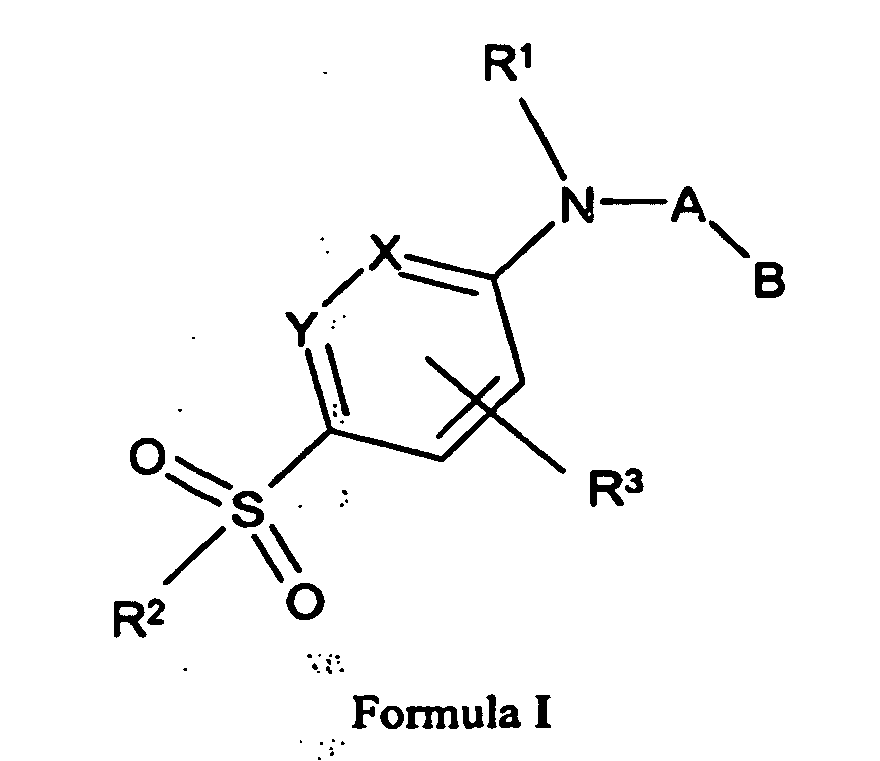
- this invention provides compounds selected from the group of compounds represented by formula (I): wherein:
- this invention provides pharmaceutical compositions containing a therapeutically effective amount of a compound of formula (I) or its pharmaceutically acceptable salt and a pharmaceutically acceptable excipient.
- this invention provides, use of a compound of formula (I) or its pharmaceutically acceptable salt for the manufacture of a medicament for treating a disease in a mammal treatable by administration of a prostaglandin G/H synthase inhibitor, in particular an inflammatory or autoimmune disease.
- this invention provides processes for preparing compounds of formula (I).
- Treating” or “treatment” of a disease includes:
- a therapeutically effective amount means the amount of a compound that, when administered to a mammal for treating a disease, is sufficient to effect such treatment for the disease.
- the “therapeutically effective amount” will vary depending on the compound, the disease and its severity and the age, weight, etc., of the mammal to be treated.
- heterocyclo group optionally mono- or di-substituted with an alkyl group means that the alkyl may but need not be present, and the description includes situations where the heterocyclo group is mono- or disubstituted with an alkyl group and situations where the heterocyclo group is not substituted with the alkyl group.
- isomers Compounds that have the same molecular formula but differ in the nature or sequence of bonding of their atoms or the arrangement of their atoms in space are termed “isomers”. Isomers that differ in the arrangement of their atoms in space are termed “stereoisomers”. Stereoisomers that are not mirror images of one another are termed “diastereomers” and those that are non-superimposable mirror images of each other are termed “enantiomers”. When a compound has an asymmetric center, for example, it is bonded to four different groups, a pair of enantiomers is possible.
- An enantiomer can be characterized by the absolute configuration of its asymmetric center and is described by the R - and S -sequencing rules of Cahn and Prelog, or by the manner in which the molecule rotates the plane of polarized light and designated as dextrorotatory or levorotatory (i.e., as (+) or (-)-isomers respectively).
- a chiral compound can exist as either individual enantiomer or as a mixture thereof. A mixture containing equal proportions of the enantiomers is called a "racemic mixture".
- the compounds of this invention may exist in stereoisomeric form if they possess one or more asymmetric centers or a double bond with asymmetric substitution and, therefore, can be produced as individual stereoisomers or as mixtures. Unless otherwise indicated, the description is intended to include individual stereoisomers as well as mixtures.
- the methods for the determination of stereochemistry and the separation of stereoisomers are well-known in the art (see discussion in Chapter 4 of "Advanced Organic Chemistry", 4th edition J. March, John Wiley and Sons, New York, 1992).
- R 3 is hydrogen
- R 2 is methyl
- R 1 is 2-(methylsulfonyl)ethyl
- A is CH 2
- B is 4-fluorophenyl
- X is CH
- Y is CH is named 4- ⁇ N,N-[2-(methylsulfonyl)-ethyl](4-fluorobenzyl)amino ⁇ phenyl methyl sulfone.
- R 3 is hydrogen, R 2 is methyl, R 1 is benzyl, A is CH 2 , B is 4-fluorophenyl, X is CH and Y is CH is named 4-[N,N-(benzyl)(4-fluorobenzyl)amino]-phenyl methyl sulfone.
- R 3 is hydrogen, R 2 is methyl, R 1 is 2-(methylsulfonyl)ethyl, A is CH 2 , B is 4-fluorophenyl, X is nitrogen and Y is CH is named 2- ⁇ N,N-[2-(methylsulfonyl)ethyl](4-fluorobenzyl)amino ⁇ pyridin-5-yl methyl sulfone.
- R 3 is hydrogen, R 2 is NH 2 , R 1 is 2-methylsulfonyl-ethyl, A is CH 2 , B is 4-methyl-phenyl, X is CH and Y is CH is named 4-[(2-methylsulfonyl-ethyl)-(4-methyl-benzyl)-amino]-benzenesulfonamide.
- R 3 is 3-fluoro, R 2 is methyl, R 1 is 2-methylsulfonyl-ethyl, A is CH 2 , B is 4-ethoxy-phenyl, X is CH and Y is CH is named (4-ethoxy-benzyl)-(3-fluoro-4-methanesulfonyl-phenyl)-(2-methanesulfonyl-ethyl)-amine.
- R 1 is alkyl, alkenyl, cycloalkyl, cycloalkylalkyl, aryl, aralkyl, heterocyclyl, heterocyclylalkyl, or heteroalkyl
- R 2 is alkyl, alkenyl, cycloalkyl, cycloalkylalkyl, aryl, aralkyl, hydroxyalkyl, alkoxyalkyl, alkoxycarbonylalkyl, or NR 13 R 14 wherein: R 13 is hydrogen or alkyl; R 14 is hydrogen, alkyl, alkenyl, acyl, cycloalkyl, cycloalkylalkyl, hydroxyalkyl, alkoxyalkyl, carboxyalkyl, alkoxycarbonylalkyl, or aminoalkyl are preferred. Within this group of compounds, further certain compounds of Formula (I) are preferred.
- R 3 is hydrogen
- A is -CH 2 -, CH 2 -CH 2 - or -CH(CH 3 )-; preferably -CH 2 -.
- X is CH and Y is CH.
- X is N and Y is CH.
- X is CH and Y is N.
- B is aryl, preferably optionally substituted phenyl.
- B is heteroaryl, preferably furyl, imidazolyl, pyridyl, thienyl, thiazolyl, benzothiazolyl or pyridazinyl.
- R 1 is alkyl, cycloalkyl, cycloalkyl-alkyl, heterocyclyl, heterocyclylalkyl or heteroalkyl; more preferably heteroalkyl, especially alkylsulfonyl-alkyf (e.g. 2-methylsulfonyl-ethyl).
- R 2 is alkyl, more preferably methyl.
- R 2 is NH 2 .
- a particularly preferred group is (II) where X and Y are CH.
- B is phenyl optionally substituted from the group consisting of halo, alkoxy, and cyano, especially mono-substituted with fluoro (e.g. 4-fluorophenyl);
- R 1 is alkylsulfonylethyl, particularly 2-methylsulfonyl-ethyl; and
- R 2 is alkyl, particularly methyl or NH 2 .
- B is heteroaryl, preferably furyl, imidazolyl, pyridyl, thienyl, thiazolyl, benzothiazolyl or pyridazinyl;
- R 1 is alkylsulfonylethyl, particularly 2-methylsulfonyl-ethyl; and
- R 2 is alkyl, particularly methyl, or NH 2 .
- Another particularly preferred group is (III) where R 3 is hydrogen and both X and Y are CH.
- a further another particularly preferred group is (IV), where R 3 is hydrogen and one of X and Y is N.
- one preferred subgroup is (V) where B is aryl, and especially optionally substituted phenyl; and the preferred subgroup is (VI) where B is heteroaryl.
- one preferred subgroup is (VII) where R 1 is alkyl, cycloalkyl, cycloalkyl-alkyl, heterocyclyl, heterocyclylalkyl heteroaralkyl or heteroalkyl; more preferably heteroalkyl, especially alkylsulfonylalkyl.
- one preferred subgroup is (VIII) where R 2 is alkyl, more preferably methyl; and another preferred subgroup is (IX) where R 2 is NR 13 R 14 wherein R 13 and R 14 are hydrogen.
- one preferred subgroup is (XI) where A is -(CH 2 )-.
- a further another particularly preferred group is (XII) where R 1 is alkylsulfonylalkyl; B is aryl; and X and Y are CH.
- one preferred subgroup is (XIII) where R 2 is alkyl; another preferred subgroup is (XIV) where R 2 is NH 2 and further another subgroup is (XV) where A is -(CH 2 )-.
- one preferred subgroup is (XVI) where A is -(CH 2 )-.
- a further another particularly preferred group is (XVII) where R 3 is hydrogen and at least one of X and Y are CH.
- one preferred subgroup is (XVIII) where B is optionally substituted phenyl or heteroalkyl and/or R 1 is alkyl, cycloalkyl, cycloalkyl-alkyl, heterocyclyl, heterocyclylalkyl or heteroalkyl, more preferably heteroalkyl, especially alkylsulfonylalkyl; and/or R 2 is alkyl or NR 13 R 14 wherein R 13 and R 14 are hydrogen; and/or A is -(CH 2 )-.
- the starting materials and reagents used in preparing these compounds are either available from commercial suppliers such as Aldrich Chemical Co., (Milwaukee, WI), Bachem (Torrance, CA), or Sigma (St. Louis, MO), Lancaster Synthesis (Pelham, N.C.), Maybridge Chemical Co.
- the starting materials and the intermediates of the reaction may be isolated and purified if desired using conventional techniques, including but not limited to filtration, distillation, crystallization, chromatography and the like. Such materials may be characterized using conventional means, including physical constants and spectral data.
- the reactions described herein take place at atmospheric pressure over a temperature range from about -78 °C to about 150 °C, more preferably from about 0 °C to about 125 °C and most preferably at about room (or ambient) temperature, e.g., about 20 °C.
- Schemes A-H describe methods to generate the compounds of Formula (I).
- groups R 1 , R 2 , R 3 , A and B may be present in protected form at any point in the Schemes and will be removed at the appropriate juncture.
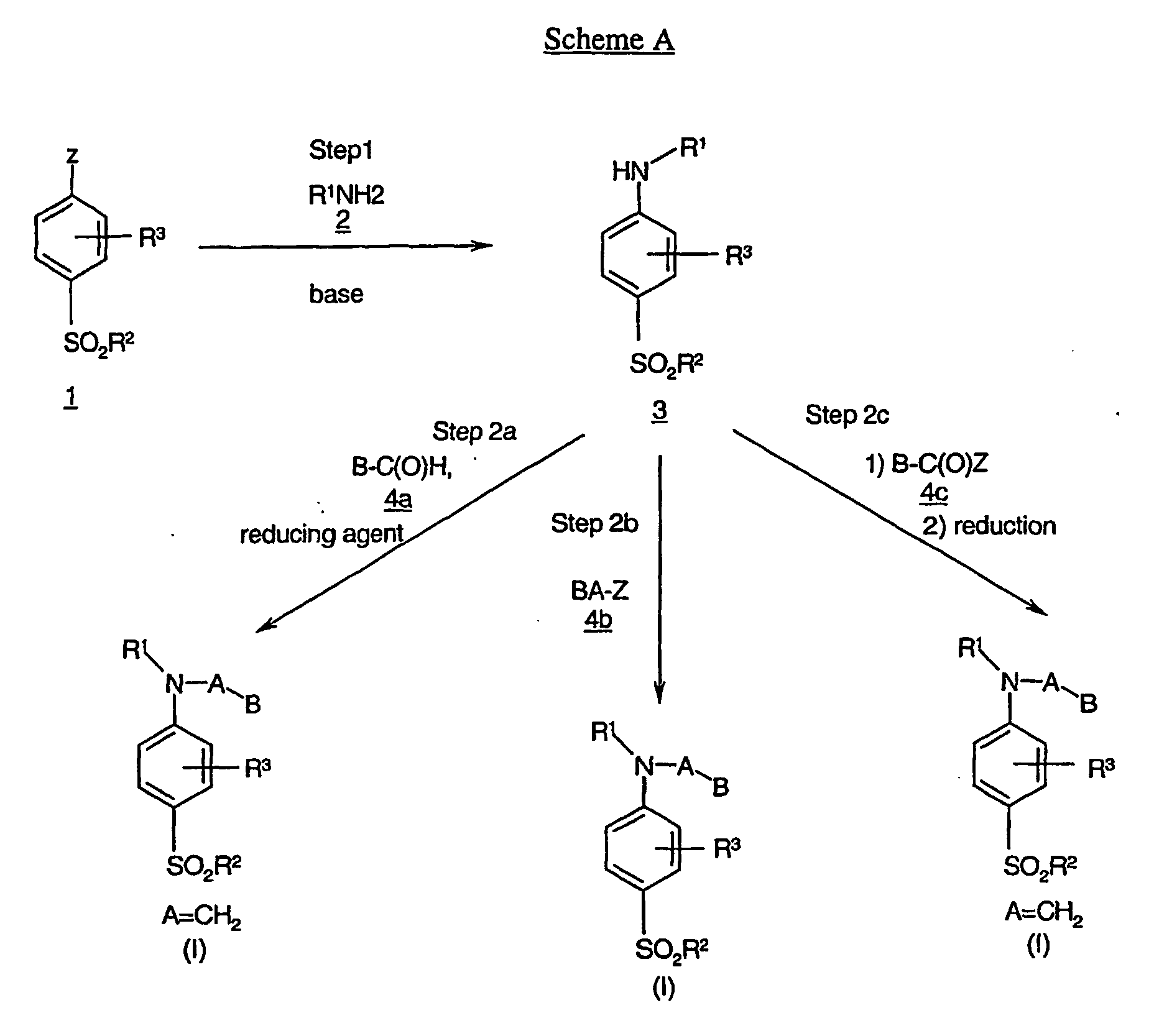
- Scheme A describes the synthesis of a compound of formula (I) wherein X and Y are CH and R 1 , R 2 , R 3 , A, and B are as defined in the Summary of the Invention.
- Step 1 reaction of a phenylsulfonyl compound of formula 1 (where Z is an appropriate leaving group such as fluoro or bromo) with a monosubstituted amine of formula 2 (wherein R 1 is as defined in the Summary of the Invention or a protected precursor thereof) gives a 4-aminophenylsulfonyl compound of formula 3 .
- the reaction is carried out at elevated temperature, preferably in the range of 50 - 80° C and in the presence of a base such as potassium carbonate, triethylamine, and the like.
- Suitable solvents for the reaction are polar aprotic solvents such as DMF, DMSO, HMPA, and the like.
- the compounds of formula 1 are commercially available or can be readily synthesized by those of ordinary skill in the art.
- a compound of formula (I) can be prepared from a compound of formula 3 by reductive amination.
- Reaction of compound 3 with an aldehyde of formula 4a (wherein B is as defined in the Summary of the Invention or a protected precursor thereof) and a suitable reducing agent e.g. a hydride reducing agent such as NaBH(OAc) 3
- a suitable reducing agent e.g. a hydride reducing agent such as NaBH(OAc) 3
- Suitable solvents for the reaction are halogenated hydrocarbons, such as dichloromethane, dichloroethane, and the like. See, for example, Example 3.
- a compound of formula (I) can be prepared from a compound of formula 3 by direct nucleophilic alkylation.
- Reaction of compound 3 with a compound of formula 4b (where B and A are defined in the Summary of the Invention or a protected precursor thereof and Z is an appropriate leaving group such as bromo and chloro) gives a compound of formula (I).
- the reaction is carried out in the presence of a base such as sodium hydride.
- Suitable solvents for the reaction are polar aprotic solvents such as DMF, DMSO, HMPA, and the like. This reaction is carried out at approximately room temperature to 70°C. See, for example, Examples 2 and 4.
- a compound of formula (I) can be prepared from a compound of formula 3 by acylation/reduction.
- Compound 3 is reacted with an acid chloride or carboxylic acid of formula 4c (where Z is a leaving group, such as chloro or -OH and B is as defined in the Summary of the Invention or a protected precursor thereof).
- a coupling agent such as DCC
- This acylation is followed by reduction using a suitable reducing agent (typically a hydride reducing agent such as LAH, B 2 H 6 , BH 3 DMS, and the like) to provide a compound of formula (I) (wherein A is CH 2 ).
- suitable solvents for the reaction are polar, anhydrous solvents such as THF, ether, and the like.
- Additional steps may be added to this general Scheme A as necessary to provide the desired compound of formula (I).
- it may be necessary to protect functional groups in R 1 of compound 3 before preparing a compound of formula (I) by Step 2a, 2b, or 2c and then subsequently deprotect the functional group.
- amine functionality in a compound of formula 3 may be protected by treatment of 3 with di- tert -butyl dicarbonate, followed by removal of the tert-butyloxy carbonyl protecting group after Step 2. Examples of protecting groups and their synthetic use can be found in T.W. Greene and P.G. Futs, Protective Groups in Organic Chemistry, (Wiley, 2nd ed.
- Compounds of formula (I) may also be obtained by further modification of a functional group on a compound of formula (I).
- R 1 is alkylsulfonylalkyl (e.g. methylsulfonyl ethyl)
- R 1 is alkylsulfonylalkyl (e.g. methylsulfonyl ethyl)
- R 1 is alkylsulfonylalkyl
- R 1 is alkylsulfonylalkyl
- step 1 by treating a compound of formula 1 with the corresponding alkylthioalkyl amine.
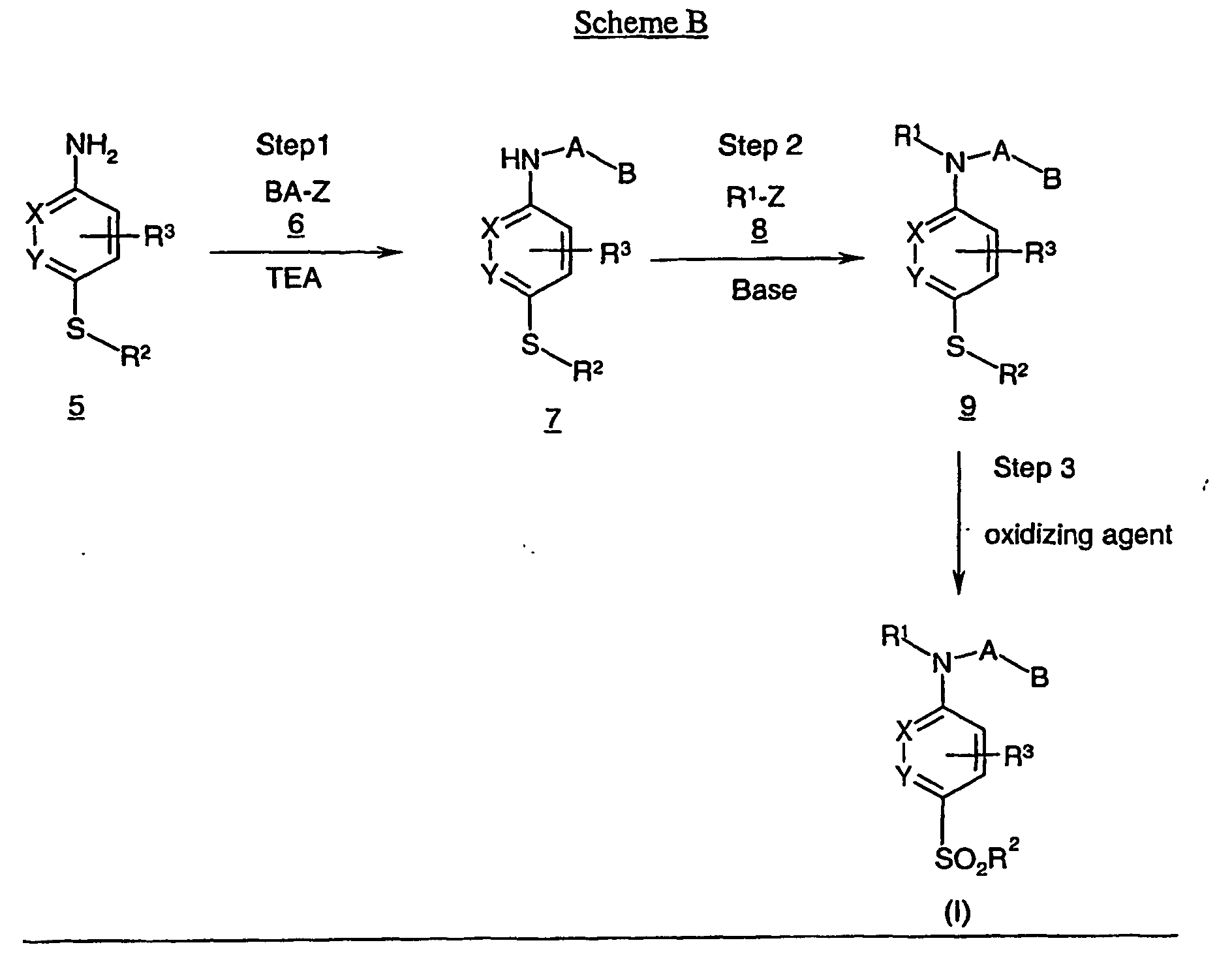
- Scheme B describes an alternative synthesis of a compound of formula (I) by sequential alkylation of an aromatic amine, 5 , wherein X, Y, R 1 , R 2 , R 3 , A and B are as defined in the Summary of the Invention or protected precursors thereof, except that R 2 is not NR 13 R 14
- Step 1 reaction of an aromatic amine of formula 5 with a nucleophilic alkylating agent of formula 6 (where B and A are as defined in the Summary of the Invention or a protected precursor thereof and Z is an appropriate leaving group such as bromo, and chloro) in the presence of a base (such as triethylamine (TEA) or diisopropylethyl amine) provides a compound of formula 7 .
- a base such as triethylamine (TEA) or diisopropylethyl amine
- Suitable solvents for this reaction are dichloromethane, THF, and the like.
- Step 2 a compound of formula 7 is reacted with an alkylating agent of formula 8 (wherein R 1 is as defined in the Summary of the Invention and Z is an appropriate leaving group such as bromo and chloro) to provide a compound of formula 9.
- the reaction is carried out in the presence of a base such as sodium hydride.
- Suitable solvents for the reaction are polar, aprotic solvents such as DMF, DMSO, HMPA, and the like.
- Step 3 oxidation of a compound of formula 9 with a suitable oxidizing agent, such as potassium peroxymonosulfate (OXONE TM), MCPBA, and the like, provides a compound of formula (I).
- a suitable oxidizing agent such as potassium peroxymonosulfate (OXONE TM), MCPBA, and the like.
- Suitable solvents for the reaction are alcohols, such as methanol and ethanol. See, for example, Example 1.
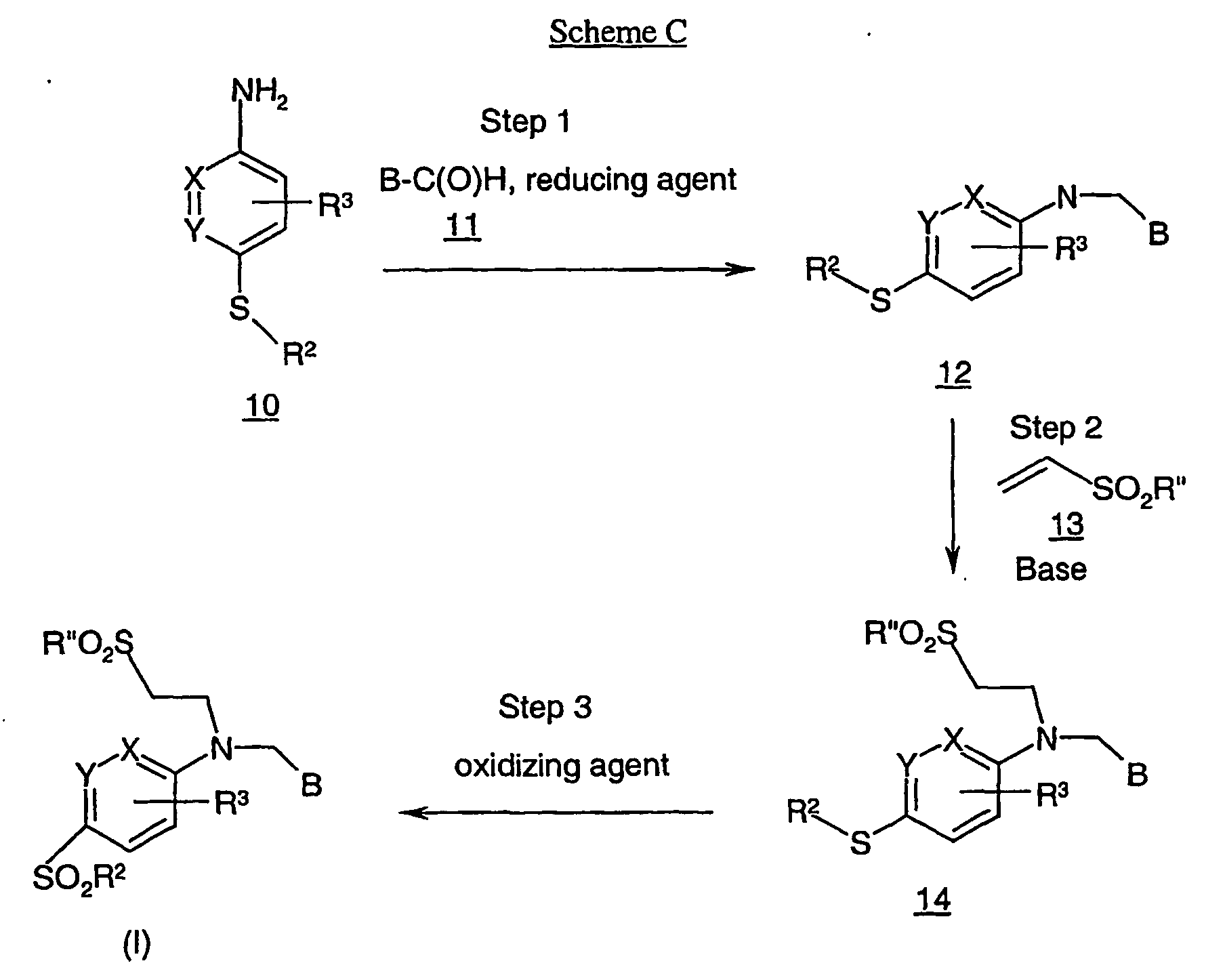
- Scheme C describes the synthesis of a compound of formula (I) wherein X, Y,R 2 , R 3 and B are as defined in the Summary of the Invention (except that R 2 is not NR 13 R 14 ), A is -CH 2 - and R 1 is alkylsulfonylalkyl.
- Step 1 of Scheme C reaction of an aromatic amine sulfide of formula 10 with an aldehyde of formula 11 and a suitable reducing agent (such as NaBH(OAc)3) gives an amino substituted aromatic sulfide of formula 12.
- a suitable reducing agent such as NaBH(OAc)3
- Step 2 an aromatic sulfide of formula 12 is reacted with a vinyl sulfone of formula 13 in the presence of a base such as sodium hydride to provide a sulfide of formula 14 .
- Suitable solvents for the reaction are polar aprotic solvents such as DMF, DMSO, HMPA, and the like
- Step 3 oxidation of a sulfide of formula 14 with a suitable oxidizing agent, such as potassium peroxymonosulfate (OXONE TM), MCPBA, and the like, provides a compound of formula (I).
- a suitable oxidizing agent such as potassium peroxymonosulfate (OXONE TM), MCPBA, and the like.
- Suitable solvents for the reaction are alcohols, such as methanol and ethanol. See, for example, Example 5.
- 4-anilino sulfides of formula 10 where X and Y are both CH are available from commercial suppliers such as Aldrich Chemical Co.
- Amino-pyridyl sulfides and amino-pyridazinyl sulfides of formula 10, where either of X and Y are N may be prepared from the corresponding amino-pyridines and amino-pyridazines by halogenation and alkylation with a thiolate as shown in Scheme C1.
- Step 1 the heteroaromatic amine is treated with I 2 in DMSO as described in Heterocycles 1984, 1195 to give an iodinated product that is treated with NaSR 2 in DMF in Step 2 to displace the iodine to form a compound of formula 10 which is carried forward into Scheme C.
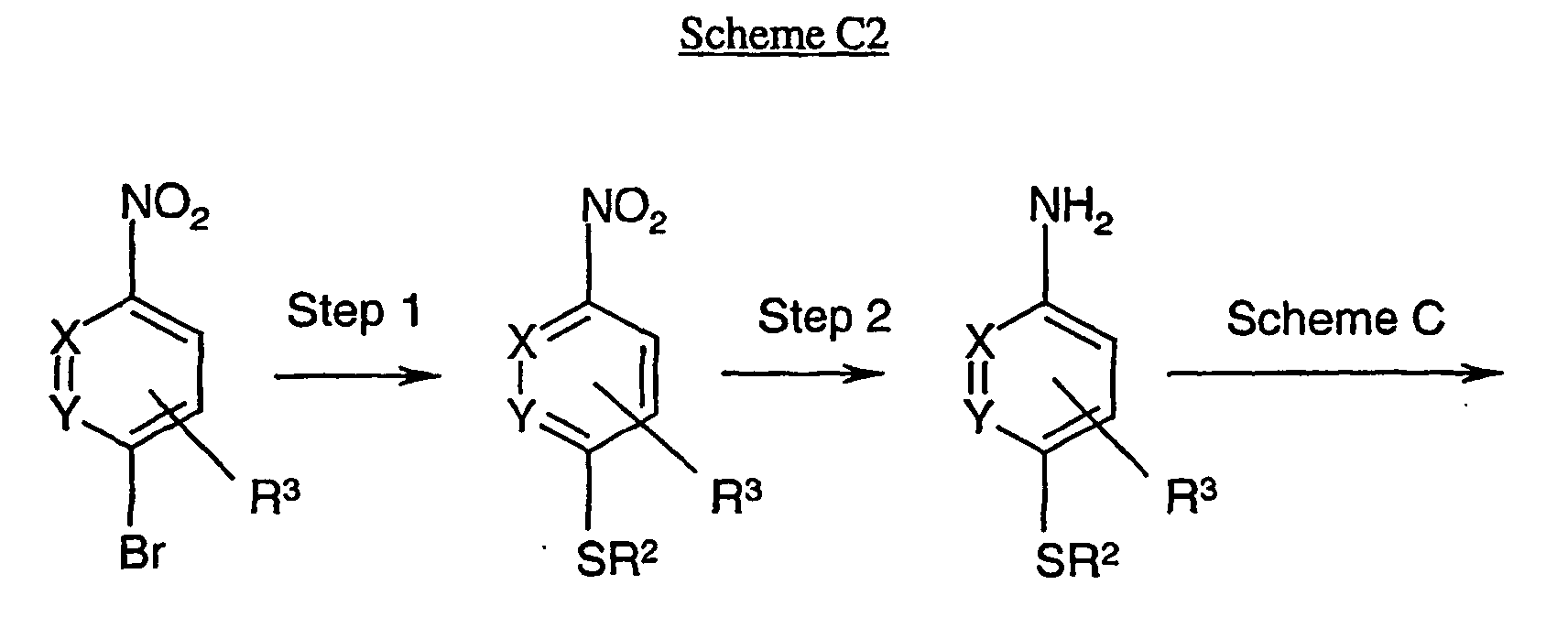
- compounds of formula 10 where either of X and Y are N may also be prepared by thiolation of the corresponding halo nitro heteroaromatic compounds followed by reduction of the nitro group to an amine as shown in Scheme C2.
- Step 1 a bromo-nitro-heteroaromatic compound is treated with NaSR 2 in DMF to displace the bromine to form the corresponding heteroaromatic sulfide.
- the sulfide is treated with TiCl 3 in acetone and NH 4 OAc as described in Chem. Soc. Perkin. Trans. I . 1990, 673 to give a compound of formula 10 that is carried forward into Scheme C.
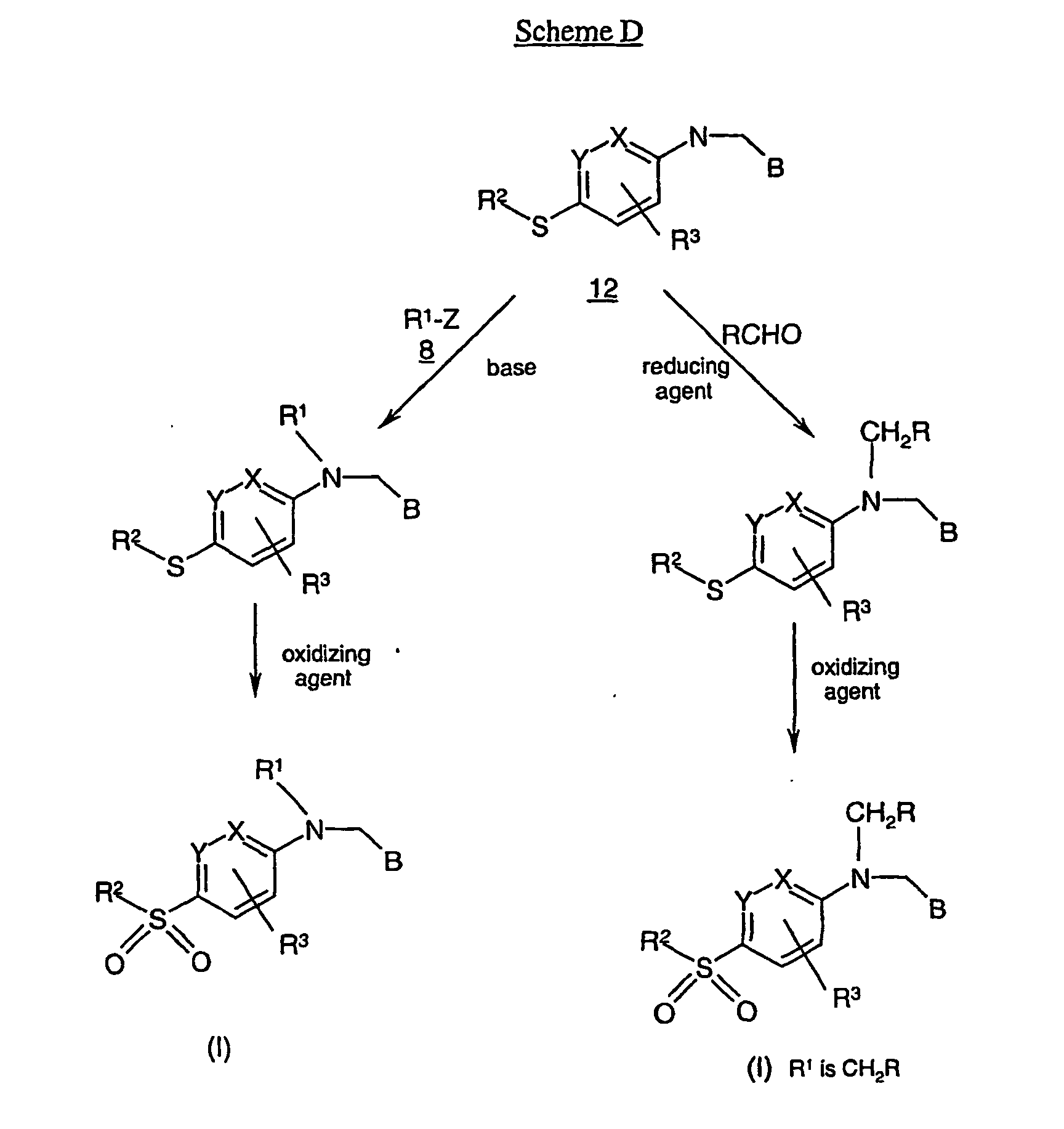
- Intermediates of formula 12 from Scheme C may also be alkylated with an alkylating agent, R 1 -Z, or reductively aminated with an aldehyde, RCHO, as shown in Scheme D to furnish corresponding compounds of Formula I after oxidation.
- Scheme E describes an alternative synthesis of a compound of formula (I) wherein X and Y are CH, R 2 is alkylsulfonylalkyl and R 1 , R 3 , A, and B are as defined in the Summary of the Invention, wherein the alkylsulfonylalkyl group is introduced before the introduction of the A-B group.
- Step 1 reaction of a compound of formula 5 with a vinyl sulfone of formula 13 in the presence of a base such as sodium hydride provides a compound of formula 15.
- Suitable solvents for the reaction are polar aprotic solvents such as DMF, DMSO, HMPA, and the like.
- Step 2 oxidation of a compound of formula 15 with a suitable oxidizing agent, such as such as potassium peroxymonosulfate (OXONE TM), MCPBA, and the like, provides a sulfone of formula 16.
- a suitable oxidizing agent such as potassium peroxymonosulfate (OXONE TM), MCPBA, and the like.
- Suitable solvents for the reaction are alcohols, such as methanol and ethanol.
- Compounds of formula 16 may be converted to compounds of formula (I) by following Scheme A: Steps 2a, 2b, or 2c above.
- step i) a compound of formula 5 is acylated with an acid chloride of formula 17 to give an amide that is chlorosulfonylated and aminated with bis(p-methoxybenzyl)amine (PMB) steps ii) and iii) to give a benzene sulfonamide of formula 18.
- PMB bis(p-methoxybenzyl)amine
- step iv) reduction of the amide in 18 gives an amine which is then subsequently elaborated in steps v) and vi) by alkylation with a vinyl sulfone to give a compound of formula (I) where R 1 is 2-alkylsulfonyl-ethyl, or by alkylation with R 1 -Z or by reductive amination with an aldehyde RCHO as described earlier.
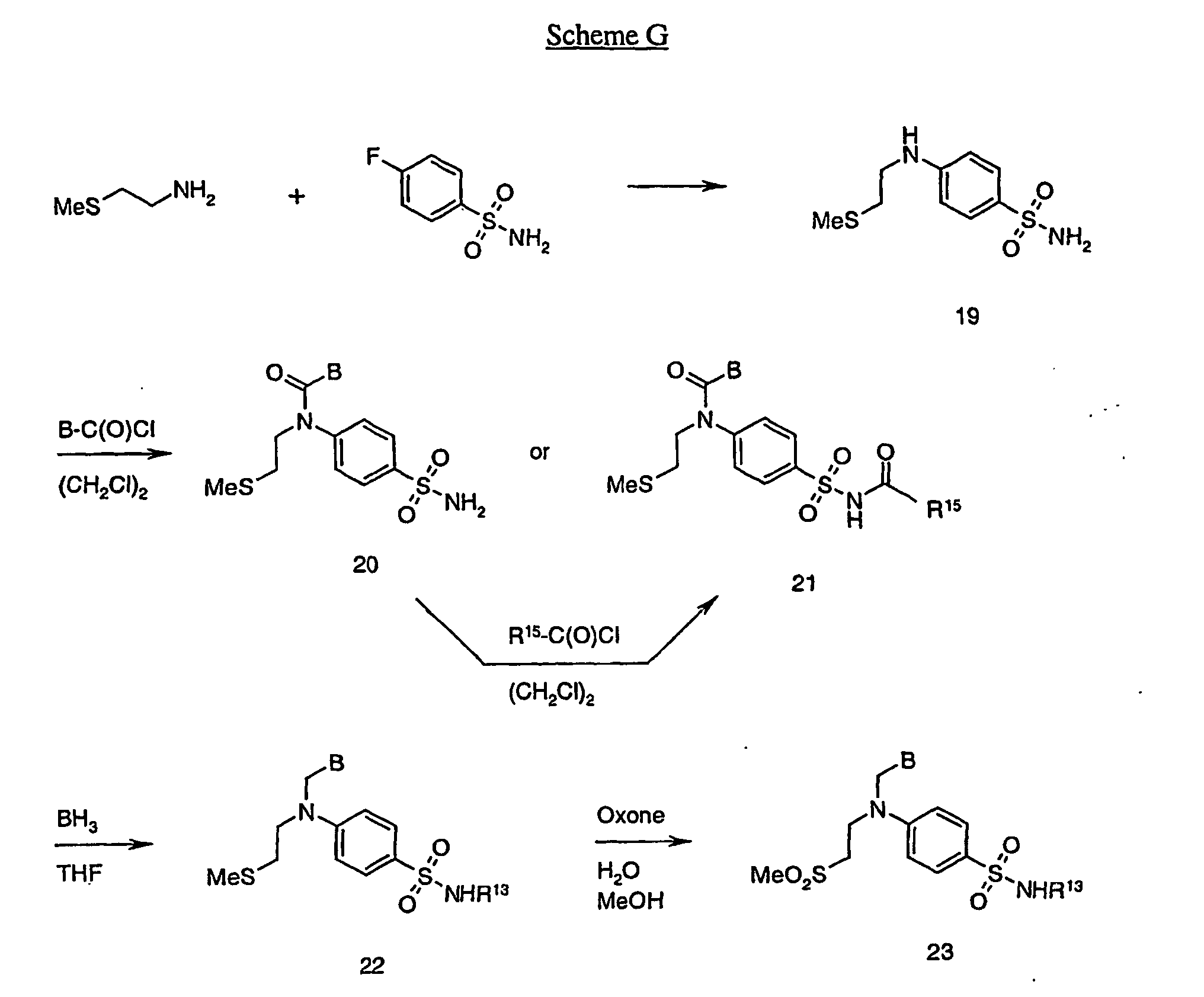
- R 2 is NR 13 R 14 or NH 2 or may be prepared by Schemes G and H respectively as shown below.
- the amide group in monoacylated intermediate 20 may be reduced to provide a compound of Formula 24 , i.e., compounds of Formula I where R 2 is NH 2 .
- Compounds of Formula 24 may be further elaborated by oxidation to provide compounds of Formula 25 where R 1 is alkylsulfonyl-alkyl group.
- the compounds of the invention are inhibitors of prostaglandin G/H Synthase I and II (COX I and COX II), especially COX II, in vitro, and as such are expected to possess both anti-inflammatory and analgesic properties in vivo. See, for example, Goodman and Gilmans's "The Pharmacological Basis of Therapeutics", Ninth Edition, McGraw Hill, New York, 1996, Chapter 27.
- the compounds, and compositions containing them, are therefore useful as anti-inflammatory and analgesic agents in mammals, especially humans.
- rheumatic fever fever, inflammation and pain caused by conditions such as rheumatic fever, symptoms associated with influenza or other viral infections, low back and neck pain, dysmenorrhoea, headache, toothache, sprains, myositis, synovitis, arthritis (rheumatoid arthritis and osteoarthritis), gout, ankylosing spondylitis, bursitis, bums or injuries.
- They maybe used to inhibit prostanoid-induced smooth muscle contractions (e.g., in the treatment of dysmenorrhoea, premature labor and asthma) and to treat autoimmune disorders (such as systemic lupus erythematosus and type I diabetes).
- the compounds of this invention are also expected to be useful in the prevention and treatment of cancer, in particular colon cancer. It has been shown that COX-2 gene expression is upregulated in human colorectal cancers and that drugs that inhibit prostaglandin G/H Synthase are effective in animal models of cancer (Eberhart, C.E., et. al., Gastroenterology , 107 , 1183-1188, (1994), and Ara, G. and Teicher, B.A., Prostaglandins, Leukotrienes and Essential Fatty Acids, 54, 3-16, (1996)).
- the compounds of this invention are also expected to be useful in the prevention and treatment of Alzheimer's disease.
- Indomethacin an inhibitor of prostaglandin G/H synthase
- the use of drugs which inhibit prostaglandin G/H synthase has been linked epidemiologically with a delayed onset of Alzheimer's disease, (Breitner, J.C.S., et. al., Neurobiology of Aging , 16 , No. 4, 523, (1995) and Neurology , 44, 2073, (1994)).
- the anti-inflammatory activity of the compounds of this invention may be assayed by measuring the ability of the compound to inhibit COX I and COX II, especially COX II, in vitro, using a radiometric assay, as described in more detail in Example 9. It may also be assayed by in vivo assays such as the Rat Carrageenan Paw and Rat Air-Pouch assays, as described in more detail in Examples 10 and 11.
- the analgesic activity of the compounds of this invention may be assayed by in vivo assays such as the Randall-Selitto assay and the rat arthritis pain model, as described in Example 12.
- the compounds of this invention will be administered in a therapeutically effective amount by any of the accepted modes of administration for agents that serve similar utilities.
- the actual amount of the compound of this invention, i.e., the active ingredient, will depend upon numerous factors such as the severity of the disease to be treated, the age and relative health of the subject, the potency of the compound used, the route and form of administration, and other factors.
- Therapeutically effective amounts of compounds of formula (I) may range from approximately 0.05-35 mg per kilogram body weight of the recipient per day, preferably about 0.15-7 mg/kg/day, most preferably about 0.35 mg/kg/day to 3 mg/kg/day. Thus, for administration to a 70 kg person, the dosage range would preferably be about 10.5 mg to 500 mg per day, most preferably about 25 mg to 200 mg per day.
- compositions will be administered as pharmaceutical compositions by any one of the following routes: oral, systemic (e.g., transdermal, intranasal or by suppository), or parenteral (e.g., intramuscular, intravenous or subcutaneous) administration.
- routes e.g., oral, systemic (e.g., transdermal, intranasal or by suppository), or parenteral (e.g., intramuscular, intravenous or subcutaneous) administration.
- parenteral e.g., intramuscular, intravenous or subcutaneous
- compositions can take the form of tablets, pills, capsules, semisolids, powders, sustained release formulations, solutions, suspensions, elixirs, aerosols, or any other appropriate compositions.
- formulation depends on various factors such as the mode of drug administration (e.g., for oral administration, formulations in the form of tablets, pills or capsules are preferred) and the bioavailability of the drug substance.
- pharmaceutical formulations have been developed especially for drugs that show poor bioavailability based upon the principle that bioavailability can be increased by increasing the surface area i.e., decreasing particle size.
- U.S. Pat. No. 4,107,288 describes a pharmaceutical formulation having particles in the size range from 10 to 1,000 nm in which the active material is supported on a crosslinked matrix of macromolecules.
- 5,145,684 describes the production of a pharmaceutical formulation in which the drug substance is pulverized to nanoparticles (average particle size of 400 nm) in the presence of a surface modifier and then dispersed in a liquid medium to give a pharmaceutical formulation that exhibits remarkably high bioavailability.
- compositions are comprised of, in general, a compound of formula (I) in combination with at least one pharmaceutically acceptable excipient.
- Acceptable excipients are non-toxic, aid administration, and do not adversely affect the therapeutic benefit of the compound of formula (I).
- excipient may be any solid, liquid, semi-solid or, in the case of an aerosol composition, gaseous excipient that is generally available to one of skill in the art.
- Solid pharmaceutical excipients include starch, cellulose, talc, glucose, lactose, sucrose, gelatin, malt, rice, flour, chalk, silica gel, magnesium stearate, sodium stearate, glycerol monostearate, sodium chloride, dried skim milk and the like.
- Liquid and semisolid excipients may be selected from glycerol, propylene glycol, water, ethanol and various oils, including those of petroleum, animal, vegetable or synthetic origin, e.g., peanut oil, soybean oil, mineral oil, sesame oil, etc.
- Preferred liquid carriers, particularly for injectable solutions include water, saline, aqueous dextrose, and glycols.
- Compressed gases may be used to disperse a compound of this invention in aerosol form.
- Inert gases suitable for this purpose are nitrogen, carbon dioxide, etc.
- the level of the compound in a formulation can vary within the full range employed by those skilled in the art.
- the formulation will contain, on a weight percent (wt %) basis, from about 0.01-99.99 wt % of a compound of formula (I) based on the total formulation, with the balance being one or more suitable pharmaceutical excipients.
- the compound is present at a level of about 1-80 wt %.
- Representative pharmaceutical formulations containing a compound of formula (I) are described in Example 8.
- the crude product was purified by flash chromatography (Hexane : ethyl acetate 1:1) to provide 4-[2-(methylsulfonyl) ethylamino]phenyl methylthiol (3.60 g) as a yellow solid.
- reaction mixture was concentrated and the residue was purified with prep-TLC (hexane: ethyl acetate 1:3) to provide 4- ⁇ N,N-[2-(methylsulfonyl)ethyl]-(4-ethoxybenzyl) amino ⁇ phenyl methyl sulfone (0.664 g) as a white foam.
- Chlorosulfonic acid (5 ml) was cooled to 0 °C under a nitrogen atmosphere and treated with para-methylbenzanilide (850 mg, 4.0 mmol). The resulting solution was stirred at room temperature for 3 h, recooled with an ice-bath, treated with ca. 25 g of ice, ca. 100 ml of saturated sodium bicarbonate and bis(para-methoxybenzyl)amine (prepared according to J. Org. Chem . 1992, 57 , 7056, 1.1 g, 4.4 mmol) dissolved in ca. 50 ml of dichloromethane. The biphasic mixture was stirred vigorously at room temperature for 16 h.
- the first product to elute was 4-[(2-methylsulfonyl-ethyl)-(4-methyl-benzyl)amino]-N-(4-methoxybenzyl)-benzenesulfonamide (276 mg): mp 85.7-86.6 °C.
- the next product to elute was 4-[(2-methylsulfonyl-ethyl)-(4-methyl-benzyl)-amino]-benzenesulfonamide (184 mg): mp 169.1-170.0 °C, Anal. Calcd for C 17 H 22 N 2 O 4 S 2 (H 2 O) 0.6 : C, 53.34; H, 5.77; N, 6.91. Found: C, 53.33; H, 5.74; N, 7.30.
- Step 3 ((4-ethoxy-benzyl)-(3-fluoro-4-methylthio-phenyl)-amine):
- Step 4 ((4-ethoxy-benzyl)-(3-fluoro-4-methanesulfonyl-phenyl)-(2-methanesulfonyl-ethyl)-amine:
- ingredients are mixed intimately and pressed into single scored tablets.
- Ingredient Quantity per tablet mg compound of this invention 400 cornstarch 50 croscarmellose sodium 25 lactose 120 magnesium stearate 5
- Ingredient Amount compound of this invention 1.0 g fumaric acid 0.5 g sodium chloride 2.0 g methyl paraben 0.15 g propyl paraben 0.05 g granulated sugar 25.5 g sorbitol (70% solution) 12.85 g Veegum K (Vanderbilt Co.) 1.0 g flavoring 0.035 ml colorings 0.5 mg distilled water q.s. to 100 ml
- Ingredient Amount compound of this invention 0.4 mg sodium acetate buffer solution, 0.4 M 2.0 ml HCI (1N) or NaOH (1N) q.s. to suitable pH water (distilled, sterile) q.s. to 20 ml
- COX I and COX II inhibitory activity of compounds of this invention in vitro was determined using partially purified COX I and COX II enzymes, prepared as described in J. Barnett et. al., Biochim. Biophys. Acta , 1209 , 130-139 (1994).
- COX I and COX II samples were diluted with Tris-HCI buffer (50mM Tris-HCI, pH 7.9) containing 2 mM EDTA and 10% glycerol and reconstituted by incubating first with 2 mM phenol for 5 minutes and then with 1 micromolar hematin for an additional 5 minutes.
- 125 ⁇ l of the reconstituted COX I or COX II enzyme were preincubated for 10 minutes at room temperature in a shaking water bath with the compounds of the invention dissolved in 2-15 ⁇ l of DMSO or the carrier vehicles (control samples).
- the enzyme reaction was initiated by adding 25 ⁇ l of 1-[14 C]arachidonic acid (80,000-100,000 cpm/tube; 20 micromolar final concentration) and the reaction was allowed to continue for an additional 45 seconds. The reaction was terminated by adding 100 ⁇ l of 2N HCI and 750 ⁇ l water. An aliquot (950 ⁇ l) of the reaction mixture was loaded onto a 1 ml C 18 Sep-Pak column (J.T. Baker, Phillipsburg, NJ) which had been previously washed with 2-3 ml methanol and equilibrated with 5-6 ml distilled water.
- Oxygenated products were quantitatively eluted with 3 ml of acetonitrile/water/acetic acid (50:50:0.1, v/v) and the radioactivity in the eluate determined in a scintillation counter. Compounds of this invention were active in this assay.
- COX inhibitory activities (expressed as IC 50 , the concentration causing 50% inhibition of the COX enzyme being assayed) of some compounds of the invention were:
- the anti-inflammatory activity of compounds of this invention may be determined by measuring the inhibition of carrageenan-induced paw edema in the rat, using a modification of the method described in Winter C. A. et al ., "Carrageenan-Induced Edema in Hind Paw of the Rat as an Assay for Anti-inflammatory Drugs" Proc. Soc. Exp. Biol. Med . 111 , 544-547, (1962). This assay has been used as a primary in vivo screen for anti-inflammatory activity of most NSAIDs, and is considered predictive of human efficacy.
- test materials are administered orally to female rats in a volume of 1 ml prepared as solutions or suspensions in an aqueous vehicle containing 0.9% sodium chloride, 0.5% sodium carboxymethyl-cellulose, 0.4% polysorbate 80, 0.9% benzyl alcohol and 97.3% distilled water.
- Control rats receive vehicle alone.
- 0.05 ml of a 0.5% solution of Carrageenan (Type IV Lambda, Sigma Chemical Co.) in 0.9% saline is injected into the subplantar region of the right hind paw.
- the rats are euthanized in a carbon dioxide atmosphere; hind paws are removed by severing at the tatso-crural joint; and the left and right paws are weighed.
- the increase in weight of the right paw over the left paw is obtained for each animal and the mean increases are calculated for each group.
- the anti-inflammatory activity of the test materials is expressed as the percent inhibition of the increase in hind paw weight of the test group relative to the vehicle dosed control group.
- Compounds of the invention are active in this assay.
- the activity of compounds of this invention in inhibiting in vivo eicosanoid (prostaglandin E 2 ) synthesis in inflamed tissues may be determined by the carrageenan-induced inflammation (air-pouch model) in rats, using a modification of the method described in Futaki, M., et al ., "Selective Inhibition of NS-398 on prostanoid production in inflamed tissue in rat Carrageenan Air-pouch Inflammation" J. Pharm. Pharmacol . 45, 753-755, (1993) and Masferrer, J.
- test materials are administered orally in a volume of 1 ml/100 g body weight as solutions or suspensions in an aqueous vehicle containing 0.9% sodium chloride, 0.5% sodium carboxymethyl-cellulose, 0.4% polysorbate 80, 0.9% benzyl alcohol and 97.3% water.
- Control rats receive vehicle alone. After 30 minutes; 5 ml of a 0.5% solution of carrageenan (Sigma, Lambda Type IV) is injected into the air pouch. The rats are euthanized 3 or 6 h after the compound administration.
- the mean concentrations of PGE 2 are calculated for each group.
- the anti-inflammatory activity of test materials is expressed as the percent inhibition of PGE 2 formation in the test group relative to the control group.
- the analgesic activity of the compounds of this invention may be determined by using a modification of the method described in Randall, L. O., and Selitto, J. J., " A Method for Measurement of Analgesic Activity on Inflamed Tissue", Arch. Int. Pharmacodyn ., CXI, 4, 409, (1957) and Gans, et. al., " Anti-Inflammatory and Safety Profile of DuP 697, a Novel Orally Effective Prostaglandin Synthesis Inhibitor", J. Pharmcol. Exp. Ther., 254 , No. 1, 180, (1990).
- the male Sprague Dawley rats are injected with 0.1 ml of 20% brewer's yeast in deionized water (Sigma, St. Louis) in the subplantar region of the left hind foot.
- the test materials are administered orally in a volume of 1 ml/100 g body weight as solutions or suspensions in an aqueous vehicle containing 0.9% sodium chloride, 0.5% sodium carboxymethyl-cellulose, 0.4% polysorbate 80, 0.9% benzyl alcohol and 97.3% water.
- Control rats receive vehicle alone.
- analgesic activity of compounds of this invention may also be determined by using an adjuvant-induced arthritis pain model in the rat, where pain is assessed by the animal's vocal response to the squeezing or flexing of an inflamed ankle joint, as described in Winter C.A.
Landscapes
- Organic Chemistry (AREA)
- Chemical & Material Sciences (AREA)
- Health & Medical Sciences (AREA)
- Bioinformatics & Cheminformatics (AREA)
- Engineering & Computer Science (AREA)
- Medicinal Chemistry (AREA)
- Veterinary Medicine (AREA)
- Nuclear Medicine, Radiotherapy & Molecular Imaging (AREA)
- General Chemical & Material Sciences (AREA)
- Pharmacology & Pharmacy (AREA)
- Life Sciences & Earth Sciences (AREA)
- Animal Behavior & Ethology (AREA)
- General Health & Medical Sciences (AREA)
- Public Health (AREA)
- Chemical Kinetics & Catalysis (AREA)
- Immunology (AREA)
- Physical Education & Sports Medicine (AREA)
- Diabetes (AREA)
- Neurology (AREA)
- Rheumatology (AREA)
- Biomedical Technology (AREA)
- Neurosurgery (AREA)
- Orthopedic Medicine & Surgery (AREA)
- Pain & Pain Management (AREA)
- Hospice & Palliative Care (AREA)
- Emergency Medicine (AREA)
- Endocrinology (AREA)
- Hematology (AREA)
- Obesity (AREA)
- Psychiatry (AREA)
- Transplantation (AREA)
- Pharmaceuticals Containing Other Organic And Inorganic Compounds (AREA)
- Acyclic And Carbocyclic Compounds In Medicinal Compositions (AREA)
- Organic Low-Molecular-Weight Compounds And Preparation Thereof (AREA)
- Heterocyclic Compounds Containing Sulfur Atoms (AREA)
- Pyridine Compounds (AREA)
- Pyrrole Compounds (AREA)
Abstract
Description
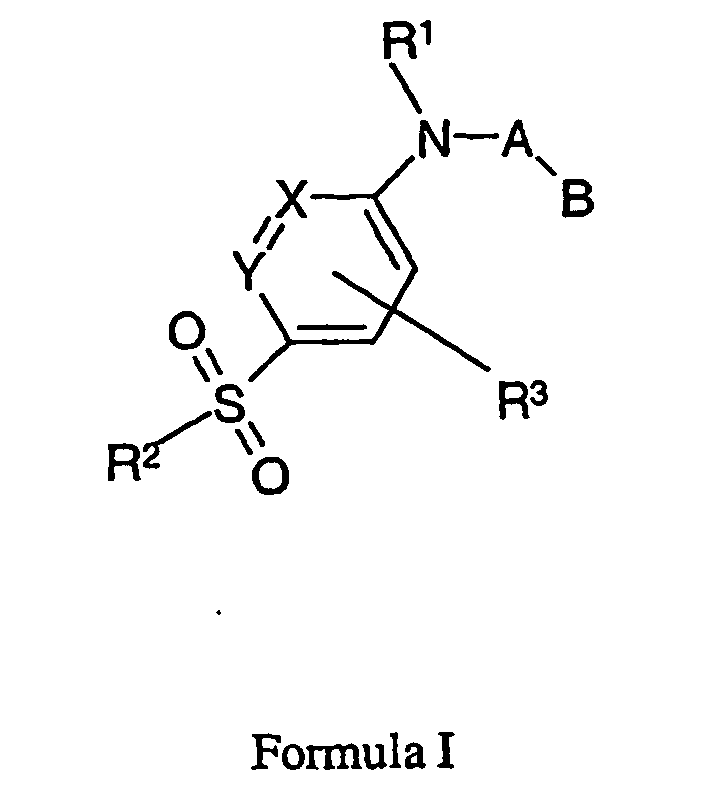
preferred meaning of R1 is alkyl, alkenyl, cycloalkyl, cycloalkylalkyl, aryl, aralkyl, heterocyclyl, heterocyclylalkyl or heteroalkyl;
preferred meaning of R2 is alkyl, cycloalkyl, cycloalkylalkyl, alkenyl, hydroxyalkyl, alkoxyalkyl, alkoxycarbonylalkyl, aryl, aralkyl, or NR13R14 wherein
with the proviso that the following compounds are excluded :
4- {N,N-(benzyl)(1-cyclohexyl-4-piperidyl)amino}phenyl 4-methoxyphenyl sulfone;
4-{N,N-(3-nitrobenzyl)(1-cyclohexyl-4-piperidyl)amino}phenyl 4-methoxyphenyl sulfone;
4-[N,N-[{ 1-(4-cyanophenylmethyl)-5-methyl-imidazol-2-yl}-methyl](cyclopropylmethyl)amino]-2-methyl-phenyl phenyl sulfone;
4-dibenzylamino-benzenesulfonamide; 4-[(benzyl)(ethyl)amino]-N-acetyl-benzenesulfonamide;
4-[(butyl)(3-phenylpropyl)amino]-3-nitro-N,N-butyl-(phenylpropyl)benzenesulfonamide;
3-nitro-4-methylbenzylamino-N-methyl-N-stearyl-benzene-sulfonamide and 4-dibenzylamino-3-methyl-N,N-dimethyl-benzenesulfonamide.

where R3 is hydrogen, R2 is methyl, R1 is benzyl, A is CH2, B is 4-fluorophenyl, X is CH and Y is CH is named 4-[N,N-(benzyl)(4-fluorobenzyl)amino]-phenyl methyl sulfone.
where R3 is hydrogen, R2 is methyl, R1 is 2-(methylsulfonyl)ethyl, A is CH2, B is 4-fluorophenyl, X is nitrogen and Y is CH is named 2-{N,N-[2-(methylsulfonyl)ethyl](4-fluorobenzyl)amino}pyridin-5-yl methyl sulfone.
where R3 is hydrogen, R2 is NH2, R1 is 2-methylsulfonyl-ethyl, A is CH2, B is 4-methyl-phenyl, X is CH and Y is CH is named 4-[(2-methylsulfonyl-ethyl)-(4-methyl-benzyl)-amino]-benzenesulfonamide.
where R3 is 3-fluoro, R2 is methyl, R1 is 2-methylsulfonyl-ethyl, A is CH2, B is 4-ethoxy-phenyl, X is CH and Y is CH is named (4-ethoxy-benzyl)-(3-fluoro-4-methanesulfonyl-phenyl)-(2-methanesulfonyl-ethyl)-amine.
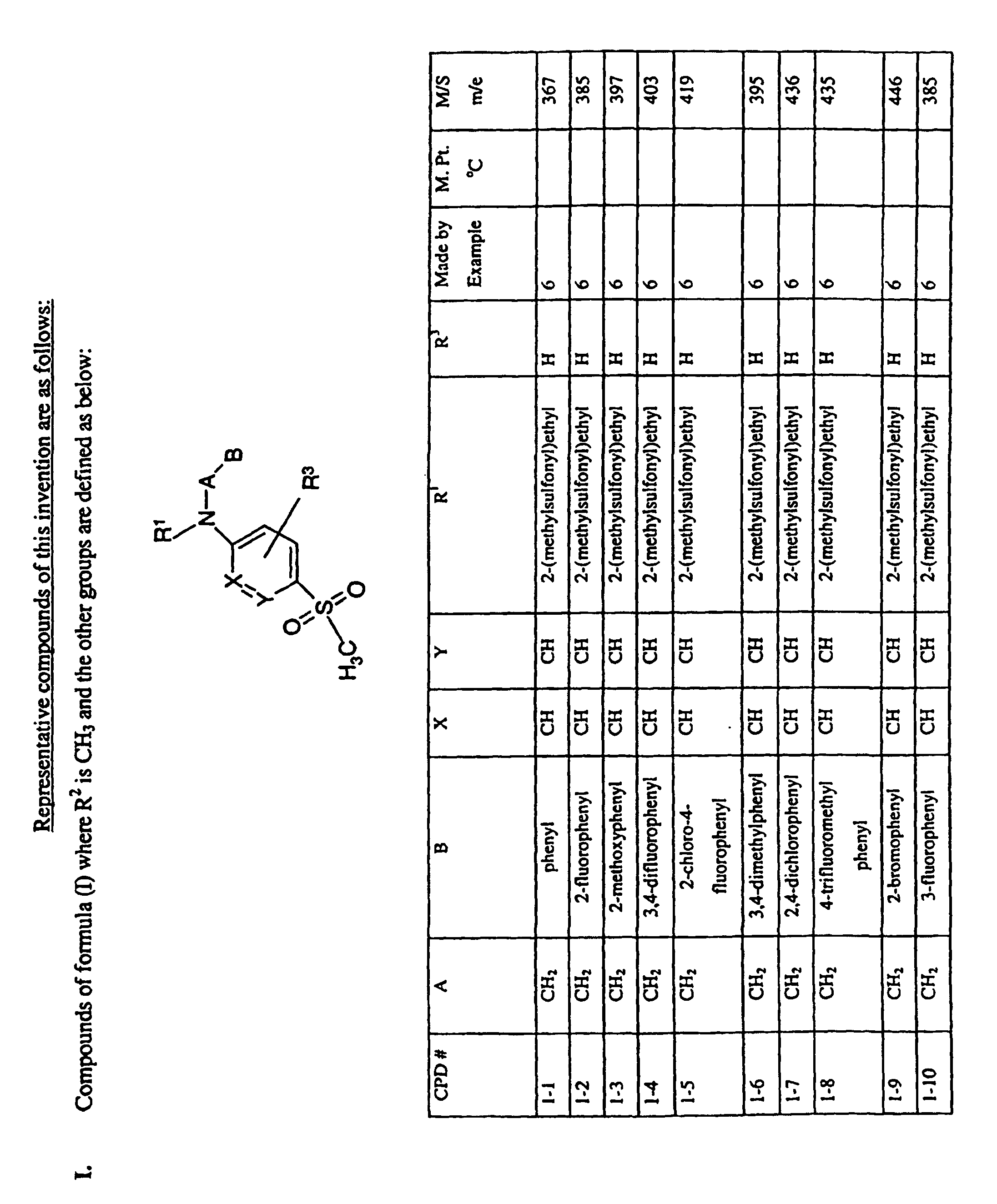
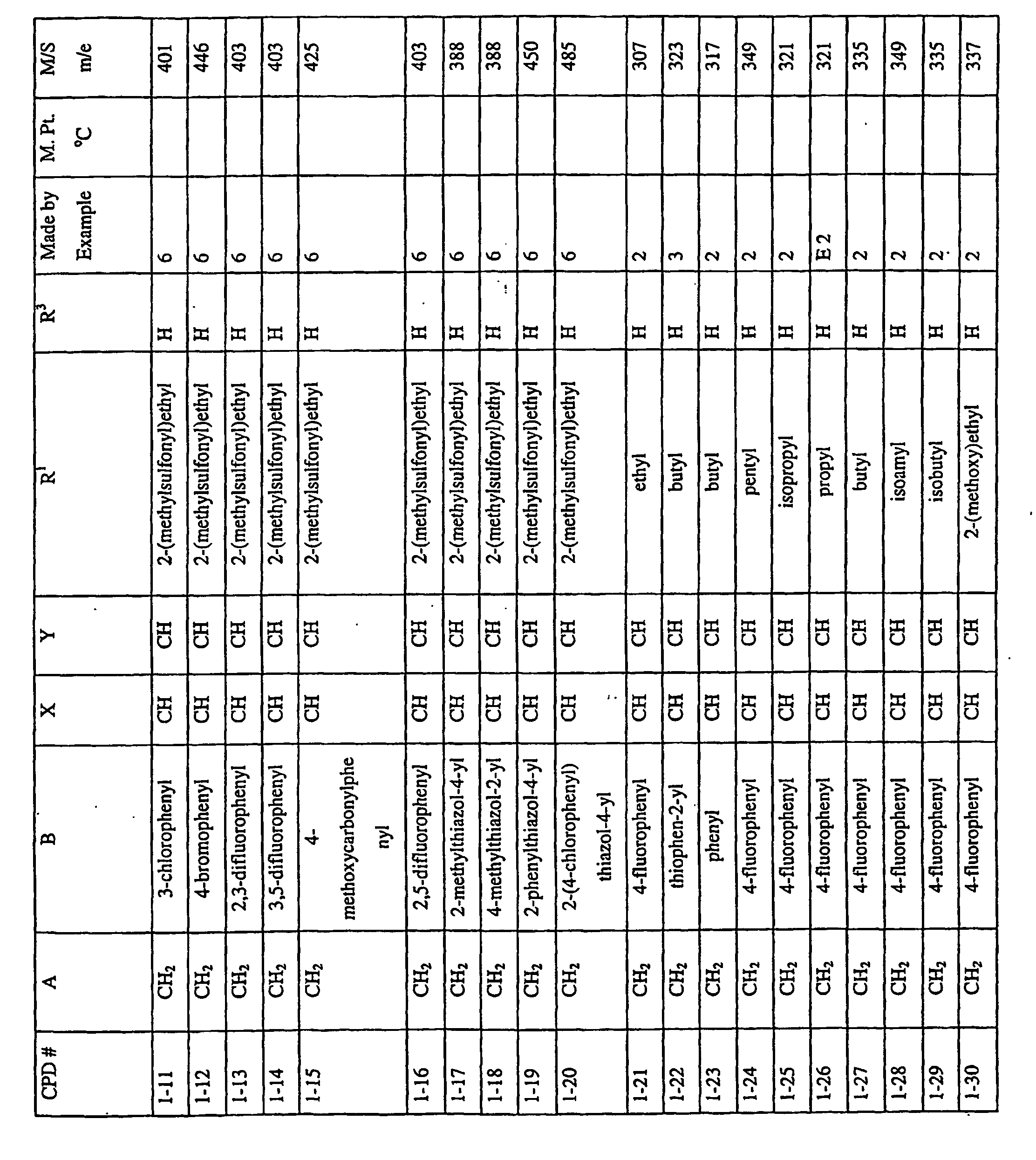


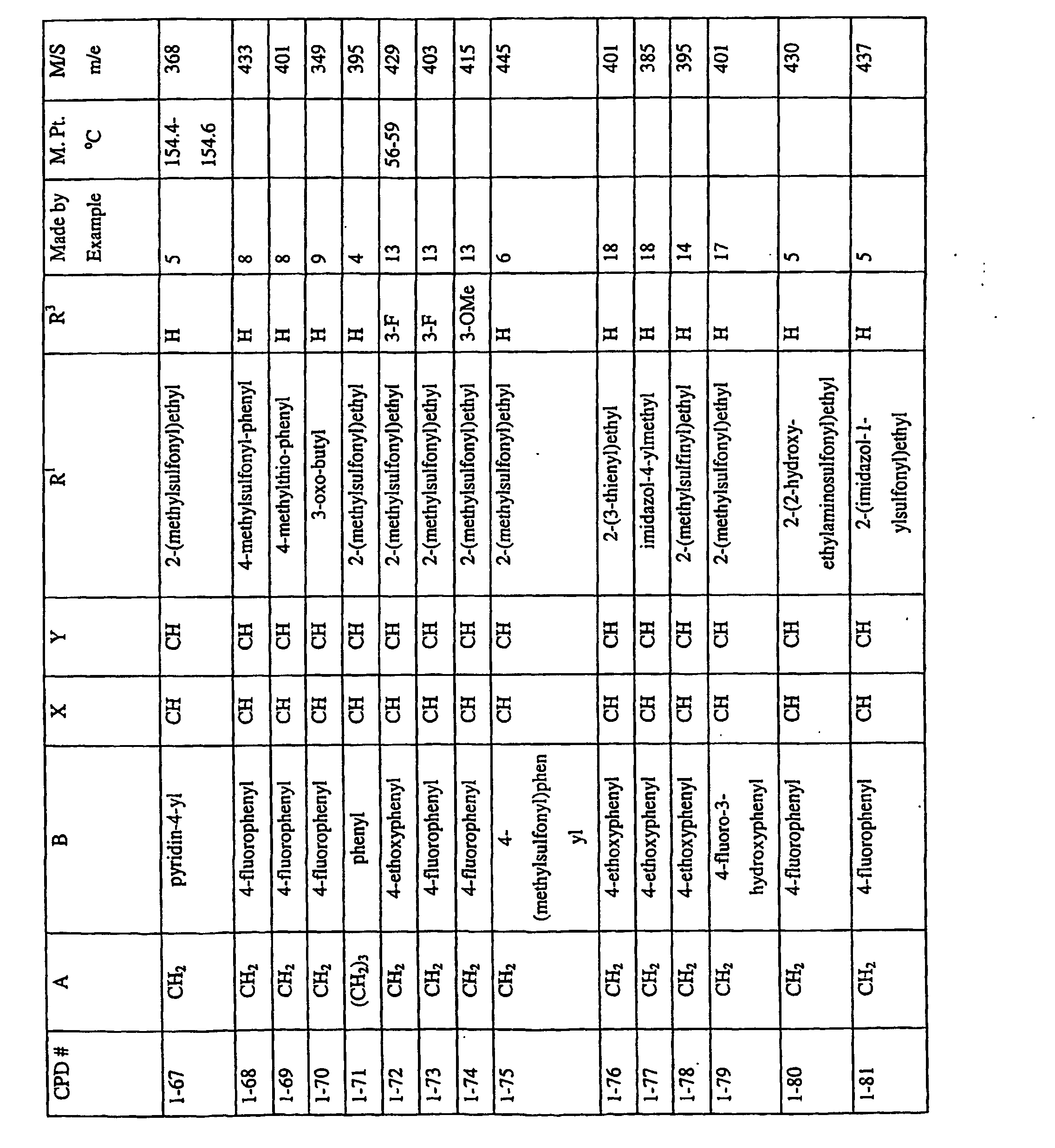







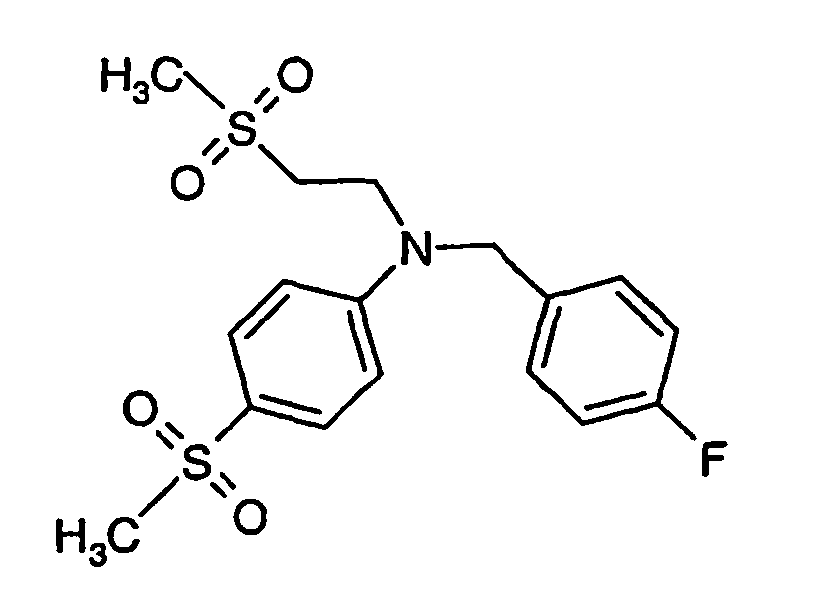

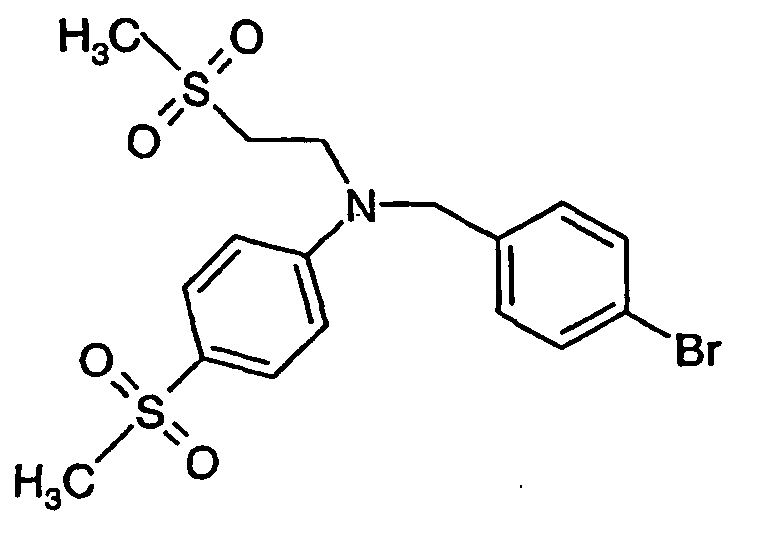

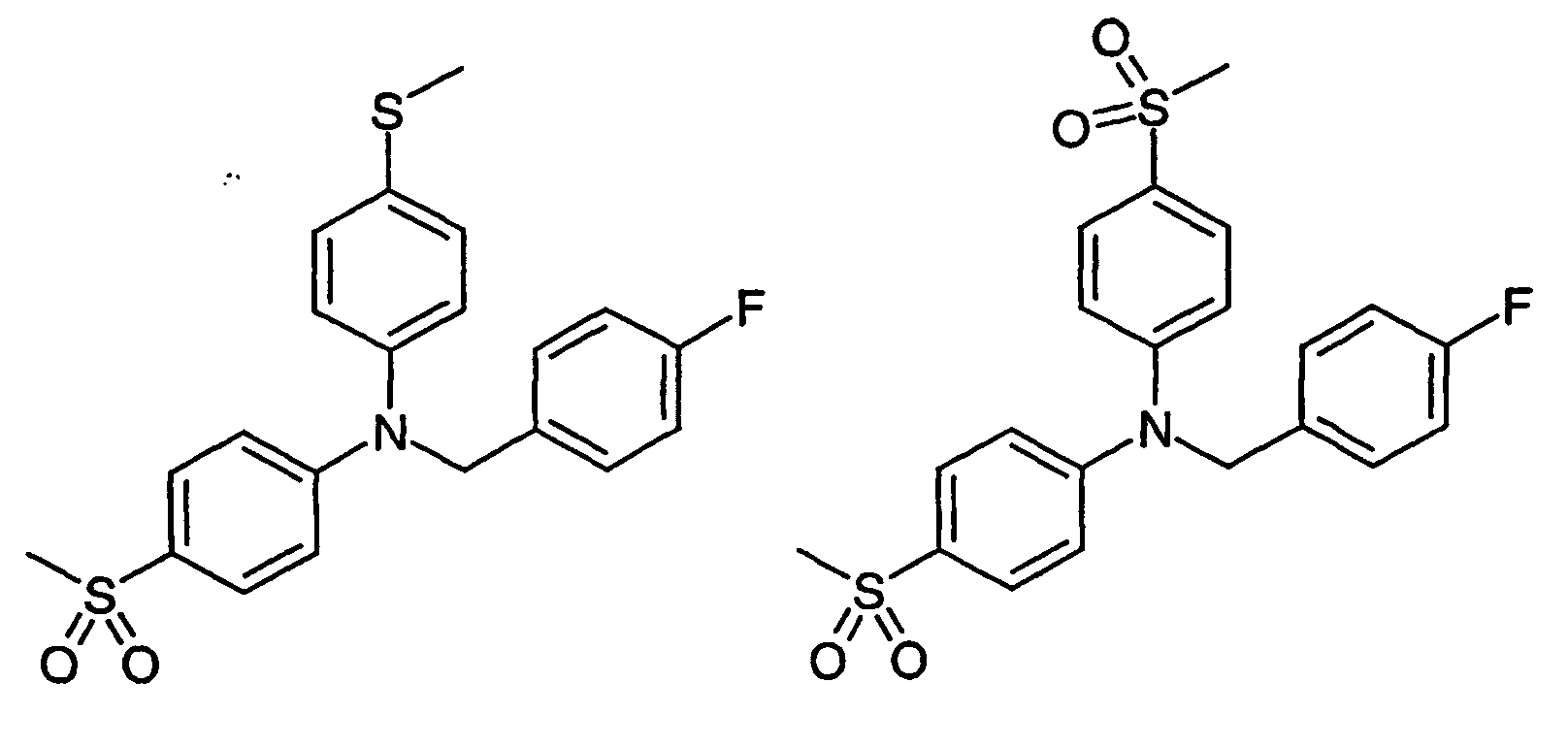


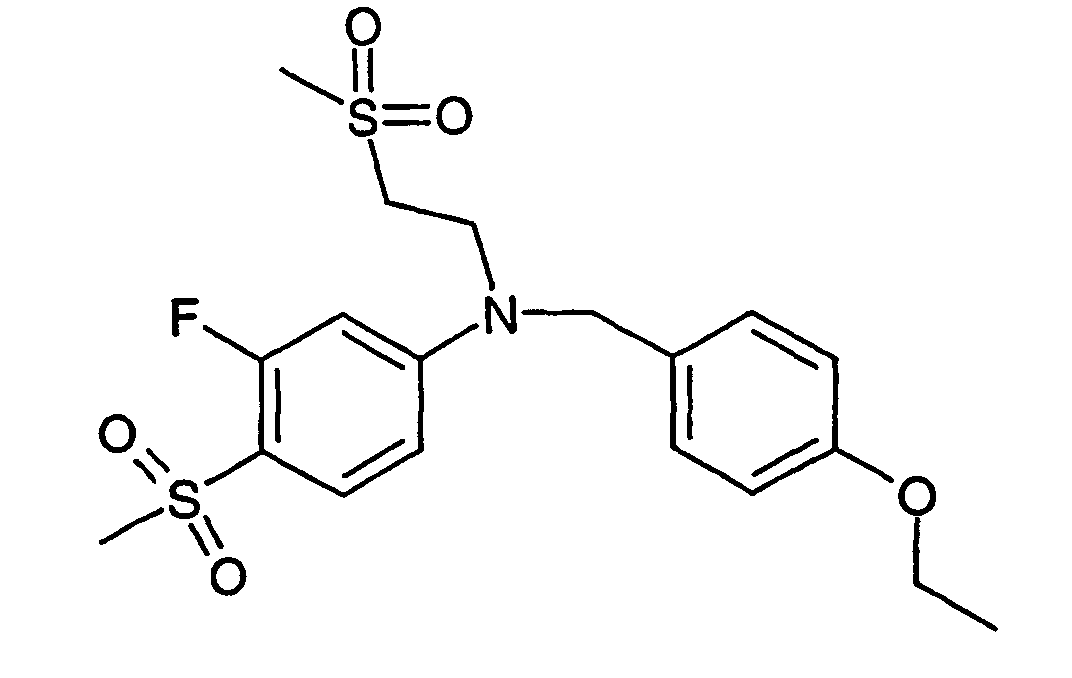
Following the procedure above, but replacing 4-ethoxybenzaldehyde with 4-fluorobenzaldehyde in Step 3 gave (4-fluoro-benzyl)-(3-fluoro-4-methanesulfonylphenyl)-(2-methanesulfonyl-ethyl)-amine (1-73).
Following the procedure above, but replacing 3,4-difluoro-nitrobenzene with 2-bromo-5-nitroanisole in Step1 and 4-ethoxybenzaldehyde with 4-fluorobenzaldehyde in Step 3 gave (4-fluoro-benzyl)-(4-methanesulfonyl-3-methoxy-phenyl)-(2-methanesulfonyl-ethyl)-amine (1-74).




| Ingredient | Quantity per tablet, mg |
| compound of this invention | 400 |
| cornstarch | 50 |
| croscarmellose sodium | 25 |
| lactose | 120 |
| magnesium stearate | 5 |
| Ingredient | Quantity per capsule, mg |
| compound of this invention | 200 |
| lactose, spray-dried | 148 |
| magnesium stearate | 2 |
| Ingredient | Amount |
| compound of this invention | 1.0 g |
| fumaric acid | 0.5 g |
| sodium chloride | 2.0 g |
| methyl paraben | 0.15 g |
| propyl paraben | 0.05 g |
| granulated sugar | 25.5 g |
| sorbitol (70% solution) | 12.85 g |
| Veegum K (Vanderbilt Co.) | 1.0 g |
| flavoring | 0.035 ml |
| colorings | 0.5 mg |
| distilled water | q.s. to 100 ml |
| Ingredient | Amount |
| compound of this invention | 0.4 mg |
| sodium acetate buffer solution, 0.4 M | 2.0 ml |
| HCI (1N) or NaOH (1N) | q.s. to suitable pH |
| water (distilled, sterile) | q.s. to 20 ml |

Claims (17)
- A compound selected from the group of compounds represented by formula (I):wherein:
 with the proviso that the following compounds are excluded :A is -(CR2)n- where n is 1,2, or 3 and R is independently hydrogen or alkyl;B is aryl or heteroaryl;X and Y are, independently, CH or nitrogen;R1 is alkyl, alkenyl, cyanoalkyl, cycloalkyl, cycloalkylalkyl, ary, alkylthio substituted aryl, alkylsulfonyl substituted aryl, aralkyl, heterocyclyl, heterocyclylalkyl, heteroaralkyl, heteroalkyl or alkylcarbonylalkyl;R2 is alkyl, alkenyl, haloalkyl, cycloalkyl, cycloalkylalkyl, aryl, aralkyl, hydroxyalkyl, alkoxyalkyl, alkoxycarbonylalkyl, or NR13R14 wherein:R13 is hydrogen or alkyl;R14 is hydrogen, alkyl, alkenyl, acyl, haloalkyl, cycloalkyl, cycloalkylalkyl, aralkyl, hydroxyalkyl, alkoxyalkyl, carboxyalkyl, alkoxycarbonylalkyl, or aminoalkyl;R3 is hydrogen, alkyl, halo, nitro, cyano, hydroxy, alkoxy; and esters, carbamates of hydroxyl functional groups in compounds of Formula (I), individual isomers, mixtures of isomers, and pharmaceutically acceptable salts thereof;
4-{N,N-(benzyl)(1-cyclohexyl-4-piperidyl)amino}phenyl 4-methoxyphenyl sulfone;
4-{N,N-(3-nitrobenzyl)(1-cyclohexyl-4-piperidyl)amino}phenyl 4-methoxyphenyl sulfone;
4-[N,N-[{1-(4-cyanophenylmethyl)-5-methyl-imidazol-2-yl}-methyl](cyclopropylmethyl)amino]-2-methyl-phenyl phenyl sulfone;
4-dibenzylamino-benzenesulfonamide;
4-[(benzyl)(ethyl)amino]-N-acetyl-benzenesulfonamide;
4-[(butyl)(3-phenylpropyl)amino]-3-nitro-N,N-butyl-(phenylpropyl)benzenesulfonamide;
3-nitro-4-methylbenzylamino-N-methyl-N-stearyl-benzene-sulfonamide and 4-dibenzylamino-3-methyl-N,N-dimethyl-benzenesulfonamide. - The compound of Claim 1, wherein:R1 is alkyl, alkenyl, cycloalkyl, cycloalkylalkyl, aryl, aralkyl, heterocyclyl, heterocyclylalkyl, or heteroalkyl;R2 is alkyl, alkenyl, cycloalkyl, cycloalkylalkyl, aryl, aralkyl, hydroxyalkyl, alkoxyalkyl, alkoxycarbonylalkyl, or NR13R14 wherein:R13 is hydrogen or alkyl;R14 is hydrogen, alkyl, alkenyl, acyl, cycloalkyl, cycloalkylalkyl, hydroxyalkyl, alkoxyalkyl, carboxyalkyl, alkoxycarbonylalkyl, or aminoalkyl.
- The compound of Claim 1 or 2, wherein:R3 is hydrogen, andat least one of X and Y is CH.
- The compound of Claim 1, 2 or 3 wherein B is optionally substituted phenyl or heteroaryl.
- The compound of any one of Claims 1-4 wherein R1 is alkyl, cycloalkyl, cycloalkylalkyl, heterocyclyl, heterocyclylalkyl or heteroalkyl.
- The compound of Claim 5 wherein R1 is heteroalkyl.
- The compound of Claim 6 wherein R1 is alkylsulfonylalkyl.
- The compound of any one of Claims 1-7 wherein R2 is alkyl or NR13R14 wherein R13 and R14 are hydrogen.
- The compound of any one of Claims 1-8 wherein A is -(CH2)-.
- The compound of Claim 1 or 2 wherein:R1 is alkylsulfonylalkyl; B is aryl; and X and Y are CH.
- The compound of Claim 1, 2 or 10, wherein R2 is alkyl or NH2.
- The compound of Claim 1, 2, 10 or 11, wherein A is -(CH2)-.
- A pharmaceutical composition comprising a therapeutically effective amount of a compound of any one of Claims 1-12 and a pharmaceutically acceptable excipient.
- Use of compounds according to any one of Claims 1-12 for the manufacture of a medicament comprising a compound according to any one of Claims 1-12 for treating a disease in a mammal treatable by administration of a prostaglandin G/H synthase inhibitor.
- The use of Claim 14, wherein the disease is an inflammatory disease, Alzheimer's disease or an autoimmune disease.
- The use of Claim 15, wherein the inflammatory disease is selected from myositis, synovitis, arthritis (theumatoid arthritis and osteoarthritis), gout, ankylosing spondylitis and bursitis.
- The use of Claim 15, wherein the autoimmune disease is selected from systemic lupus erythematosus and type I diabetes.
Applications Claiming Priority (3)
| Application Number | Priority Date | Filing Date | Title |
|---|---|---|---|
| US20031000P | 2000-04-28 | 2000-04-28 | |
| US200310P | 2000-04-28 | ||
| PCT/EP2001/004589 WO2001083434A2 (en) | 2000-04-28 | 2001-04-24 | P-(sulfonyl)-aryl and heteroaryls amines |
Publications (2)
| Publication Number | Publication Date |
|---|---|
| EP1278723A2 EP1278723A2 (en) | 2003-01-29 |
| EP1278723B1 true EP1278723B1 (en) | 2005-08-31 |
Family
ID=22741170
Family Applications (1)
| Application Number | Title | Priority Date | Filing Date |
|---|---|---|---|
| EP01943280A Expired - Lifetime EP1278723B1 (en) | 2000-04-28 | 2001-04-24 | P-(sulfonyl)-aryl and -heteroaryl amines |
Country Status (15)
| Country | Link |
|---|---|
| US (2) | US7071177B2 (en) |
| EP (1) | EP1278723B1 (en) |
| JP (1) | JP3942897B2 (en) |
| KR (1) | KR20030017502A (en) |
| CN (1) | CN100374416C (en) |
| AR (1) | AR029913A1 (en) |
| AT (1) | ATE303360T1 (en) |
| AU (1) | AU6589801A (en) |
| BR (1) | BR0110358A (en) |
| CA (1) | CA2405832A1 (en) |
| DE (1) | DE60113090T2 (en) |
| ES (1) | ES2247132T3 (en) |
| MX (1) | MXPA02010564A (en) |
| WO (1) | WO2001083434A2 (en) |
| ZA (1) | ZA200208136B (en) |
Families Citing this family (12)
| Publication number | Priority date | Publication date | Assignee | Title |
|---|---|---|---|---|
| KR20030017502A (en) * | 2000-04-28 | 2003-03-03 | 에프. 호프만-라 로슈 아게 | P-(sulfonyl)aryl and heteroaryls |
| CA2468761A1 (en) * | 2001-10-31 | 2003-05-08 | Morphochem Aktiengesellschaft Fuer Kombinatorische Chemie | Novel anticancer compounds |
| RU2330839C2 (en) * | 2002-01-11 | 2008-08-10 | Санкио Компани, Лимитед | Amino alcohol derivatives or phosphoric acid derivatives and pharmaceutical compositions containing specified derivatives |
| US7169775B2 (en) | 2002-08-21 | 2007-01-30 | Neurogen Corporation | Amino methyl imidazoles as C5a receptor modulators |
| TWI355934B (en) | 2004-02-24 | 2012-01-11 | Sankyo Co | Pharmaceutical composition for treatment or prophy |
| US7714021B2 (en) | 2004-06-15 | 2010-05-11 | Merck & Co., Inc. | Pyrrolidin-3-yl compounds useful as beta-secretase inhibitors for the treatment of Alzheimer's disease |
| TWI410406B (en) * | 2005-05-13 | 2013-10-01 | Otsuka Pharma Co Ltd | Pyrrolidine compound |
| JP5219465B2 (en) * | 2006-11-10 | 2013-06-26 | 大塚製薬株式会社 | Medicine |
| US8076491B2 (en) | 2007-08-21 | 2011-12-13 | Senomyx, Inc. | Compounds that inhibit (block) bitter taste in composition and use thereof |
| GB0915523D0 (en) | 2009-09-07 | 2009-10-07 | Genome Res Ltd | Cells and methods for obtaining them |
| ES2968371T3 (en) | 2013-10-10 | 2024-05-09 | Eastern Virginia Medical School | 4-((2-hydroxy-3-methoxybenzyl)amino)benzenesulfonamide derivatives as 12-lipoxygenase inhibitors |
| CN113200945A (en) * | 2021-04-23 | 2021-08-03 | 上海应用技术大学 | Preparation method of aromatic amine compound |
Family Cites Families (14)
| Publication number | Priority date | Publication date | Assignee | Title |
|---|---|---|---|---|
| US3615606A (en) * | 1967-07-10 | 1971-10-26 | Agfa Gevaert Ag | Colorphotographic material |
| US4277492A (en) | 1980-05-21 | 1981-07-07 | The Dow Chemical Company | Novel 4-bis((Phenylmethyl)amino)-benzenesulfonic acids possessing antiviral activity |
| US4857530A (en) * | 1987-11-03 | 1989-08-15 | Warner-Lambert Company | Substituted quinazolinones as anticancer agents |
| JP3153537B2 (en) * | 1988-03-29 | 2001-04-09 | 株式会社東芝 | Organic thin type device |
| CA2118138A1 (en) * | 1992-04-28 | 1993-10-29 | Minoru Okada | Novel substituted tertiary amino compound or salt thereof |
| TW502026B (en) * | 1995-06-20 | 2002-09-11 | Zeneca Ltd | Aromatic compounds useful as antagonists of e-type prostaglandins, processes for the preparation thereof, pharmaceutical compositions comprising the compounds, and intermediates |
| KR980009238A (en) | 1995-07-28 | 1998-04-30 | 우에노 도시오 | Sulfonyl amino acid derivative |
| US5952349A (en) * | 1996-07-10 | 1999-09-14 | Schering Corporation | Muscarinic antagonists for treating memory loss |
| NZ333513A (en) * | 1996-07-10 | 2000-04-28 | Schering Corp | 1,4-di-substituted piperidines and medicaments useful as muscarinic antagonists |
| US5994398A (en) | 1996-12-11 | 1999-11-30 | Elan Pharmaceuticals, Inc. | Arylsulfonamides as phospholipase A2 inhibitors |
| AU7371998A (en) * | 1997-05-07 | 1998-11-27 | University Of Pittsburgh | Inhibitors of protein isoprenyl transferases |
| US6008254A (en) * | 1997-05-09 | 1999-12-28 | Kligman; Douglas E. | Method of treating skin disorders with high-strength tretinoin |
| GB9920872D0 (en) * | 1999-09-04 | 1999-11-10 | Glaxo Group Ltd | Benzophenones as inhibitors of reverse transcriptase |
| KR20030017502A (en) * | 2000-04-28 | 2003-03-03 | 에프. 호프만-라 로슈 아게 | P-(sulfonyl)aryl and heteroaryls |
-
2001
- 2001-04-24 KR KR1020027014369A patent/KR20030017502A/en not_active Ceased
- 2001-04-24 AU AU65898/01A patent/AU6589801A/en not_active Abandoned
- 2001-04-24 CN CNB018086179A patent/CN100374416C/en not_active Expired - Fee Related
- 2001-04-24 WO PCT/EP2001/004589 patent/WO2001083434A2/en not_active Ceased
- 2001-04-24 JP JP2001580863A patent/JP3942897B2/en not_active Expired - Fee Related
- 2001-04-24 EP EP01943280A patent/EP1278723B1/en not_active Expired - Lifetime
- 2001-04-24 BR BR0110358-0A patent/BR0110358A/en not_active IP Right Cessation
- 2001-04-24 ES ES01943280T patent/ES2247132T3/en not_active Expired - Lifetime
- 2001-04-24 MX MXPA02010564A patent/MXPA02010564A/en unknown
- 2001-04-24 CA CA002405832A patent/CA2405832A1/en not_active Abandoned
- 2001-04-24 DE DE60113090T patent/DE60113090T2/en not_active Expired - Fee Related
- 2001-04-24 AT AT01943280T patent/ATE303360T1/en not_active IP Right Cessation
- 2001-04-26 AR ARP010101953A patent/AR029913A1/en not_active Application Discontinuation
- 2001-04-26 US US09/844,061 patent/US7071177B2/en not_active Expired - Fee Related
-
2002
- 2002-10-09 ZA ZA200208136A patent/ZA200208136B/en unknown
-
2006
- 2006-03-02 US US11/369,544 patent/US20060173075A1/en not_active Abandoned
Also Published As
| Publication number | Publication date |
|---|---|
| MXPA02010564A (en) | 2003-03-10 |
| US7071177B2 (en) | 2006-07-04 |
| DE60113090T2 (en) | 2006-06-29 |
| JP3942897B2 (en) | 2007-07-11 |
| ES2247132T3 (en) | 2006-03-01 |
| KR20030017502A (en) | 2003-03-03 |
| ZA200208136B (en) | 2004-01-22 |
| AU6589801A (en) | 2001-11-12 |
| WO2001083434A3 (en) | 2002-03-28 |
| CN100374416C (en) | 2008-03-12 |
| CN1708478A (en) | 2005-12-14 |
| AR029913A1 (en) | 2003-07-23 |
| ATE303360T1 (en) | 2005-09-15 |
| DE60113090D1 (en) | 2005-10-06 |
| US20060173075A1 (en) | 2006-08-03 |
| EP1278723A2 (en) | 2003-01-29 |
| JP2003531886A (en) | 2003-10-28 |
| BR0110358A (en) | 2003-03-05 |
| US20020052349A1 (en) | 2002-05-02 |
| WO2001083434A2 (en) | 2001-11-08 |
| CA2405832A1 (en) | 2001-11-08 |
Similar Documents
| Publication | Publication Date | Title |
|---|---|---|
| US6417218B1 (en) | Substituted imidazoles, their preparation and use | |
| EP1438289B1 (en) | Indole derivatives as cox ii inhibitors | |
| US7071177B2 (en) | P-(sulfonyl) aryl and heteroarylamines as anti-inflammatory agents | |
| WO1997029097A1 (en) | Sulfonamide derivatives as 5ht7 receptor antagonists | |
| JP4212892B2 (en) | Benzofuran and benzothiophene derivatives | |
| US5962531A (en) | 5-aroylnaphthalene derivatives as anti-inflammatory agents | |
| EP1313707B1 (en) | Quinoline derivatives as anti-inflammation agents | |
| AU2002342722A1 (en) | Indole derivatives as COX II inhibitors |
Legal Events
| Date | Code | Title | Description |
|---|---|---|---|
| PUAI | Public reference made under article 153(3) epc to a published international application that has entered the european phase |
Free format text: ORIGINAL CODE: 0009012 |
|
| 17P | Request for examination filed |
Effective date: 20021128 |
|
| AK | Designated contracting states |
Designated state(s): AT BE CH CY DE DK ES FI FR GB GR IE IT LI LU MC NL PT SE TR |
|
| AX | Request for extension of the european patent |
Extension state: AL LT LV MK RO SI |
|
| 17Q | First examination report despatched |
Effective date: 20040622 |
|
| GRAP | Despatch of communication of intention to grant a patent |
Free format text: ORIGINAL CODE: EPIDOSNIGR1 |
|
| GRAS | Grant fee paid |
Free format text: ORIGINAL CODE: EPIDOSNIGR3 |
|
| GRAA | (expected) grant |
Free format text: ORIGINAL CODE: 0009210 |
|
| AK | Designated contracting states |
Kind code of ref document: B1 Designated state(s): AT BE CH CY DE DK ES FI FR GB GR IE IT LI LU MC NL PT SE TR |
|
| PG25 | Lapsed in a contracting state [announced via postgrant information from national office to epo] |
Ref country code: NL Free format text: LAPSE BECAUSE OF FAILURE TO SUBMIT A TRANSLATION OF THE DESCRIPTION OR TO PAY THE FEE WITHIN THE PRESCRIBED TIME-LIMIT Effective date: 20050831 Ref country code: BE Free format text: LAPSE BECAUSE OF FAILURE TO SUBMIT A TRANSLATION OF THE DESCRIPTION OR TO PAY THE FEE WITHIN THE PRESCRIBED TIME-LIMIT Effective date: 20050831 Ref country code: AT Free format text: LAPSE BECAUSE OF FAILURE TO SUBMIT A TRANSLATION OF THE DESCRIPTION OR TO PAY THE FEE WITHIN THE PRESCRIBED TIME-LIMIT Effective date: 20050831 Ref country code: FI Free format text: LAPSE BECAUSE OF FAILURE TO SUBMIT A TRANSLATION OF THE DESCRIPTION OR TO PAY THE FEE WITHIN THE PRESCRIBED TIME-LIMIT Effective date: 20050831 |
|
| REG | Reference to a national code |
Ref country code: CH Ref legal event code: EP Ref country code: GB Ref legal event code: FG4D |
|
| REG | Reference to a national code |
Ref country code: IE Ref legal event code: FG4D |
|
| REF | Corresponds to: |
Ref document number: 60113090 Country of ref document: DE Date of ref document: 20051006 Kind code of ref document: P |
|
| PG25 | Lapsed in a contracting state [announced via postgrant information from national office to epo] |
Ref country code: GR Free format text: LAPSE BECAUSE OF FAILURE TO SUBMIT A TRANSLATION OF THE DESCRIPTION OR TO PAY THE FEE WITHIN THE PRESCRIBED TIME-LIMIT Effective date: 20051130 Ref country code: DK Free format text: LAPSE BECAUSE OF FAILURE TO SUBMIT A TRANSLATION OF THE DESCRIPTION OR TO PAY THE FEE WITHIN THE PRESCRIBED TIME-LIMIT Effective date: 20051130 Ref country code: SE Free format text: LAPSE BECAUSE OF FAILURE TO SUBMIT A TRANSLATION OF THE DESCRIPTION OR TO PAY THE FEE WITHIN THE PRESCRIBED TIME-LIMIT Effective date: 20051130 |
|
| PG25 | Lapsed in a contracting state [announced via postgrant information from national office to epo] |
Ref country code: PT Free format text: LAPSE BECAUSE OF FAILURE TO SUBMIT A TRANSLATION OF THE DESCRIPTION OR TO PAY THE FEE WITHIN THE PRESCRIBED TIME-LIMIT Effective date: 20060222 |
|
| NLV1 | Nl: lapsed or annulled due to failure to fulfill the requirements of art. 29p and 29m of the patents act | ||
| REG | Reference to a national code |
Ref country code: ES Ref legal event code: FG2A Ref document number: 2247132 Country of ref document: ES Kind code of ref document: T3 |
|
| PG25 | Lapsed in a contracting state [announced via postgrant information from national office to epo] |
Ref country code: IE Free format text: LAPSE BECAUSE OF NON-PAYMENT OF DUE FEES Effective date: 20060424 |
|
| PG25 | Lapsed in a contracting state [announced via postgrant information from national office to epo] |
Ref country code: MC Free format text: LAPSE BECAUSE OF NON-PAYMENT OF DUE FEES Effective date: 20060430 |
|
| ET | Fr: translation filed | ||
| PLBE | No opposition filed within time limit |
Free format text: ORIGINAL CODE: 0009261 |
|
| STAA | Information on the status of an ep patent application or granted ep patent |
Free format text: STATUS: NO OPPOSITION FILED WITHIN TIME LIMIT |
|
| 26N | No opposition filed |
Effective date: 20060601 |
|
| REG | Reference to a national code |
Ref country code: IE Ref legal event code: MM4A |
|
| PGFP | Annual fee paid to national office [announced via postgrant information from national office to epo] |
Ref country code: GB Payment date: 20080317 Year of fee payment: 8 |
|
| PG25 | Lapsed in a contracting state [announced via postgrant information from national office to epo] |
Ref country code: TR Free format text: LAPSE BECAUSE OF FAILURE TO SUBMIT A TRANSLATION OF THE DESCRIPTION OR TO PAY THE FEE WITHIN THE PRESCRIBED TIME-LIMIT Effective date: 20050831 Ref country code: LU Free format text: LAPSE BECAUSE OF NON-PAYMENT OF DUE FEES Effective date: 20060424 |
|
| PGFP | Annual fee paid to national office [announced via postgrant information from national office to epo] |
Ref country code: CH Payment date: 20080425 Year of fee payment: 8 Ref country code: DE Payment date: 20080430 Year of fee payment: 8 Ref country code: ES Payment date: 20080421 Year of fee payment: 8 |
|
| PGFP | Annual fee paid to national office [announced via postgrant information from national office to epo] |
Ref country code: IT Payment date: 20080418 Year of fee payment: 8 |
|
| PG25 | Lapsed in a contracting state [announced via postgrant information from national office to epo] |
Ref country code: CY Free format text: LAPSE BECAUSE OF FAILURE TO SUBMIT A TRANSLATION OF THE DESCRIPTION OR TO PAY THE FEE WITHIN THE PRESCRIBED TIME-LIMIT Effective date: 20050831 |
|
| PGFP | Annual fee paid to national office [announced via postgrant information from national office to epo] |
Ref country code: FR Payment date: 20080403 Year of fee payment: 8 |
|
| REG | Reference to a national code |
Ref country code: CH Ref legal event code: PL |
|
| GBPC | Gb: european patent ceased through non-payment of renewal fee |
Effective date: 20090424 |
|
| REG | Reference to a national code |
Ref country code: FR Ref legal event code: ST Effective date: 20091231 |
|
| PG25 | Lapsed in a contracting state [announced via postgrant information from national office to epo] |
Ref country code: LI Free format text: LAPSE BECAUSE OF NON-PAYMENT OF DUE FEES Effective date: 20090430 Ref country code: CH Free format text: LAPSE BECAUSE OF NON-PAYMENT OF DUE FEES Effective date: 20090430 Ref country code: DE Free format text: LAPSE BECAUSE OF NON-PAYMENT OF DUE FEES Effective date: 20091103 |
|
| PG25 | Lapsed in a contracting state [announced via postgrant information from national office to epo] |
Ref country code: FR Free format text: LAPSE BECAUSE OF NON-PAYMENT OF DUE FEES Effective date: 20091222 Ref country code: GB Free format text: LAPSE BECAUSE OF NON-PAYMENT OF DUE FEES Effective date: 20090424 |
|
| REG | Reference to a national code |
Ref country code: ES Ref legal event code: FD2A Effective date: 20090425 |
|
| PG25 | Lapsed in a contracting state [announced via postgrant information from national office to epo] |
Ref country code: ES Free format text: LAPSE BECAUSE OF NON-PAYMENT OF DUE FEES Effective date: 20090425 |
|
| PG25 | Lapsed in a contracting state [announced via postgrant information from national office to epo] |
Ref country code: IT Free format text: LAPSE BECAUSE OF NON-PAYMENT OF DUE FEES Effective date: 20090424 |