EP1278343A1 - Réseau actif - Google Patents
Réseau actif Download PDFInfo
- Publication number
- EP1278343A1 EP1278343A1 EP02291748A EP02291748A EP1278343A1 EP 1278343 A1 EP1278343 A1 EP 1278343A1 EP 02291748 A EP02291748 A EP 02291748A EP 02291748 A EP02291748 A EP 02291748A EP 1278343 A1 EP1278343 A1 EP 1278343A1
- Authority
- EP
- European Patent Office
- Prior art keywords
- active
- node
- identifier
- message
- application server
- Prior art date
- Legal status (The legal status is an assumption and is not a legal conclusion. Google has not performed a legal analysis and makes no representation as to the accuracy of the status listed.)
- Granted
Links
- 238000000034 method Methods 0.000 claims description 8
- 230000001419 dependent effect Effects 0.000 claims description 2
- 230000007613 environmental effect Effects 0.000 claims 5
- 238000004891 communication Methods 0.000 description 4
- 230000006870 function Effects 0.000 description 3
- 230000005540 biological transmission Effects 0.000 description 2
- 241000408659 Darpa Species 0.000 description 1
Images

Classifications
-
- H—ELECTRICITY
- H04—ELECTRIC COMMUNICATION TECHNIQUE
- H04L—TRANSMISSION OF DIGITAL INFORMATION, e.g. TELEGRAPHIC COMMUNICATION
- H04L45/00—Routing or path finding of packets in data switching networks
-
- H—ELECTRICITY
- H04—ELECTRIC COMMUNICATION TECHNIQUE
- H04L—TRANSMISSION OF DIGITAL INFORMATION, e.g. TELEGRAPHIC COMMUNICATION
- H04L45/00—Routing or path finding of packets in data switching networks
- H04L45/56—Routing software
- H04L45/566—Routing instructions carried by the data packet, e.g. active networks
-
- H—ELECTRICITY
- H04—ELECTRIC COMMUNICATION TECHNIQUE
- H04L—TRANSMISSION OF DIGITAL INFORMATION, e.g. TELEGRAPHIC COMMUNICATION
- H04L67/00—Network arrangements or protocols for supporting network services or applications
- H04L67/01—Protocols
- H04L67/02—Protocols based on web technology, e.g. hypertext transfer protocol [HTTP]
-
- H—ELECTRICITY
- H04—ELECTRIC COMMUNICATION TECHNIQUE
- H04L—TRANSMISSION OF DIGITAL INFORMATION, e.g. TELEGRAPHIC COMMUNICATION
- H04L69/00—Network arrangements, protocols or services independent of the application payload and not provided for in the other groups of this subclass
- H04L69/30—Definitions, standards or architectural aspects of layered protocol stacks
- H04L69/32—Architecture of open systems interconnection [OSI] 7-layer type protocol stacks, e.g. the interfaces between the data link level and the physical level
- H04L69/322—Intralayer communication protocols among peer entities or protocol data unit [PDU] definitions
- H04L69/329—Intralayer communication protocols among peer entities or protocol data unit [PDU] definitions in the application layer [OSI layer 7]
Definitions
- the present invention relates to telecommunication networks whose nodes are able to process specifically, the messages information they receive.
- the invention is particularly applicable to active networks.
- This active network concept was introduced by the work of DARPA in 1994 and has been the subject of several international conferences, for example IWAN 99 ( International Workshop on Active Networks ) or IWAN 2000.
- An active network is a network in which the nodes, or some of them, are able to deal in a specific way, some messages conveyed by the network. In other words, it means that these nodes must be able to roll out an algorithm other than those they knew when they were designing.
- an active message may contain a identifier of an active application.
- a Active router can execute the code associated with this active application.
- an active node has limited storage resources, while the number of active applications is a priori not limited.
- a state-of-the-art solution is to provide a server active applications: On receiving an active message, the active node then contact the active application server to download the code corresponding to the active application identified by the active message.
- the different active nodes of an active network can have different execution environments. This is typically the case when they come from different suppliers or / and when they are implement different operating systems (operating system vendor-specific, Unix operating system etc.)
- Another example is the function of the active node.
- a classic case is the distinction between internal routers ( Core Router according to English terminology) and edge routers ( Edge Router ).
- the purpose of the present invention is to make it possible to take into account specificities of the active node when determining the corresponding code to an active application.
- the invention firstly relates to a node comprising means for receiving an active message, this active message containing a active application identifier, a means of transmitting the identifier active application to an active application server and means for receive from the active application server and execute an associated code.
- This node is characterized in that it further comprises means for transmitting to the active application server information about its environment.
- the subject of the invention is an active application server having means for receiving an active application identifier from an active node, association means for determining a code associated with the active application identifier, and a means for download this associated code to the active node.
- This application server is characterized in that it further comprises a means for receiving information about the environment of the active node and that the means of association determines the associated code according to these information.
- the information relating to the environment include an identifier of the environment execution of the active node.
- the information relating to the environment include an identifier of the characteristic of interiority of the active node.
- the request message is consistent with the HTTP protocol.
- FIG. 1 shows an active network AN composed of active nodes R 1 , R 2 , R 3 ... R n .
- An active message is received by this network and transmitted within active nodes of this network.
- This active node contains the identifier of a active application.
- the active node R 1 On receipt of the active message, the active node R 1 transmits to an active application server S a request message Req 1 containing the active application identifier. It also transmits information relating to its environment.
- this information may include a identifier of the associated runtime environment: operating system, additional modules available, active node provider ...
- the application server S has a means for receiving these two types of identifiers as well as a means of association between active application identifiers, information about the environment of the active nodes and an associated code.
- the left column represents the application identifiers A 1 , A 2 , A 3 ... A p .
- the middle column contains information about the active nodes. In this embodiment, only the active node provider has been shown for the sake of clarity. Two suppliers F 1 and F 2 are presented.
- the right column represents the associated code. It can for example be a pointer to a memory space containing this code.
- the associated code is the code C 21 .
- This associated code C 21 is then downloaded to the active node R 1 where it can be executed.
- the active message can then be transmitted to the node R 2 . It is assumed that this active node comes from the provider F 2 .
- the active node On receipt of the active message, the active node then transmits a request message Req 2 comprising on the one hand an identifier of the provider F 2 and the identifier of the active application A 2 .
- the active application server S can then determine, through the association means T shown in FIG. 2, that the code to be downloaded is the code C 22 .
- the node R 2 can then execute this code C 22 which is adapted to it.
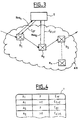
- Figure 3 shows a second implementation of the invention.
- the active network AN is composed of active nodes R 1 , R 2 , R 3 ... R n .
- the active nodes R 1 and R 3 are edge nodes ( Edge routers ) while the nodes R 2 and R n are internal nodes ( Core Router ).
- the boundary nodes can communicate with the outside of the AN network while the internal nodes only communicate with nodes of the active network.
- the one transmits, on the one hand, the active application identifier that it contains and, on the other hand, information relating to its environment; that is to say, in this implementation of the invention an identifier of the interiority characteristic of the active node concerned.
- the active node R 1 when the active node R 1 receives an active message, it transmits to an active application server S, via a request message Req 1 , on the one hand an identifier of the active application contained in the received active message, and on the other hand identifier of the interiority characteristic of the active node concerned.
- the active application server S has means to receive these two types of identifiers, as well as a means of association intended to determine an associated code dependent on these two identifiers.
- the means of association is a table of correspondence T.
- the first column represents the identifier of the active application; Its value is here A 1 or A 2 .
- the second column represents the inner node / node function border; It can only take two values: F for "Border” and Int for "Internal".
- the third column represents the associated code, C 1F , C 1Int , C 2F and C 2Int .
- the active node R 1 transmits to the active application server S a request message Req 1 containing on the one hand this active application identifier A 2 and on the other hand the identifier of its characteristic of interiority worth here "F".
- the active application server S through the association means T, can then determine that the associated code is the C 2F code.
- This code C 2F can then be downloaded to the requesting active node R 1 to be executed.
- the active node R 1 can then transmit the active message to the active node R 2 which is an internal node (ie which has no communication links with nodes located outside the active network considered).
- the active node R 2 transmits a request message Req 2 to the active application server S, containing on the one hand an active application identifier A 2 and on the other hand an identifier of his characteristic of interiority which, in his case, is worth "Int”.
- the active application server S can, thanks to its association means T, determine that the associated code is the code C 2Int .
- the code C 2Int is then downloaded to the requesting active node R 2 .
- This active node R 2 can then execute it and transmit the active message to the next node, for example to the active node R 3 .
- the invention can not be limited to the embodiments previously described but can apply to any kind of information relating to the environment of the active nodes.
- the invention applies to the combination of several types of information about the environment of the active nodes.
- active nodes can transmit both a provider identifier and an identifier of the characteristic of interiority of the active node concerned.
- the communication between the active nodes and the active application server is in accordance with the HTTP protocol ( HyperText Transfer Protocol ).
- HTTP protocol HyperText Transfer Protocol
- the information about the environment of the active node is transmitted to the active application server according to one of the HTTP protocol compliant methods, and the corresponding active code is returned in accordance with the same HTTP protocol.
- the present invention can not be limited to this embodiment and can be implemented using any other communication protocol and data exchange. It can be an application protocol like FTP ( File Transfer Protocol ) or not (communication by sockets ). It can also be a secure protocol such as SSL ( Secure Socket Layer).
- FTP File Transfer Protocol
- SSL Secure Socket Layer
Landscapes
- Engineering & Computer Science (AREA)
- Computer Networks & Wireless Communication (AREA)
- Signal Processing (AREA)
- Computer And Data Communications (AREA)
- Information Transfer Between Computers (AREA)
- Organic Low-Molecular-Weight Compounds And Preparation Thereof (AREA)
- Pharmaceuticals Containing Other Organic And Inorganic Compounds (AREA)
Abstract
Description
- Recevoir le message actif, le message actif contenant un identificateur d'application active,
- Transmettre un message de requête à un serveur d'applications actives (S), contenant cet identificateur d'application active,
- Déterminer, par le serveur d'applications actives, d'un code associé, en fonction de l'identificateur d'application active,
- Télécharger ce code associé vers le noeud actif,
- Exécution du code associé et transmission du message actif vers un noeud actif suivant.
- Les noeuds internes sont plus spécifiquement dédiés au routage de messages et possèdent des capacités matérielles de routage accrues au détriment des capacités logicielles.
- Au contraire, les noeuds frontières possèdent des capacités logicielles plus importantes car ils doivent généralement mettre en oeuvre davantage de fonctions (contrôle d'accès etc.)
Claims (10)
- Noeud actif (R1, R2... Rn) comportant un moyen pour recevoir un message actif, ledit message actif contenant un identificateur d'application active (A1, A2), un moyen pour transmettre ledit identificateur d'application active vers un serveur d'applications actives (S) et un moyen pour recevoir dudit serveur d'applications actives et exécuter un code associé (C11, C12, C21...), caractérisé en ce qu'il comporte en outre un moyen pour transmettre audit serveur d'applications actives des informations relatives à son environnement (F1, F2, Int, F).
- Noeud actif selon la revendication précédente, dans lequel lesdites informations relatives à l'environnement comprennent un identificateur de l'environnement d'exécution (F1, F2) dudit noeud actif.
- Noeud actif selon l'une des revendications 1 ou 2, dans lequel lesdites informations relatives à l'environnement comprennent un identificateur de la caractéristique d'intériorité (F, Int) dudit noeud actif.
- Serveur d'applications actives (S) comportant un moyen pour recevoir un identificateur d'application active (A1, A2) provenant d'un noeud actif (R1, R2... Rn), un moyen d'association (T) pour déterminer un code associé (C11, C12...) dépendant dudit identificateur d'application active, et un moyen pour télécharger ledit code associé vers ledit noeud actif, caractérisé en ce qu'il comporte en outre un moyen pour recevoir des informations relatives à l'environnement (F1, F2, Int, F) dudit noeud actif et en ce que ledit moyen d'association détermine ledit code associé en fonction desdites informations.
- Serveur d'applications actives selon la revendication précédente, dans lequel lesdites informations relatives à l'environnement comprennent un identificateur de l'environnement d'exécution dudit noeud actif.
- Serveur d'applications actives selon l'une des revendications 4 ou 5, dans lequel lesdites informations relatives à l'environnement comprennent un identificateur de la caractéristique d'intériorité dudit noeud actif.
- Procédé de transmission d'un message actif par un noeud actif (R1, R2... Rn) consistant à :caractérisé en ce que ledit message de requête contient de surcroít des informations relatives à l'environnement (F1, F2, Int, F) dudit noeud actif, et en ce que la détermination du code associé est faite en fonction desdites informations.Recevoir ledit message actif, ledit message actif contenant un identificateur d'application active (A1, A2),Transmettre un message de requête (Req1, Req2) à un serveur d'applications actives (S), contenant ledit identificateur d'application active,Déterminer, par ledit serveur d'applications actives, d'un code associé (C11, C12, C1Int...), en fonction dudit identificateur d'application active,Télécharger ledit code associé vers ledit noeud actif,Exécution dudit code associé et transmission du message actif vers un noeud actif suivant,
- Procédé selon la revendication précédente, dans lequel lesdites informations relatives à l'environnement comprennent un identificateur de l'environnement d'exécution dudit noeud actif.
- Procédé selon l'une des revendications 7 ou 8, dans lequel lesdites informations relatives à l'environnement comprennent un identificateur de la caractéristique d'intériorité dudit noeud actif.
- Procédé selon l'une des revendications 7 à 9, dans lequel ledit message de requête est conforme au protocole HTTP.
Applications Claiming Priority (2)
| Application Number | Priority Date | Filing Date | Title |
|---|---|---|---|
| FR0109663A FR2827726B1 (fr) | 2001-07-19 | 2001-07-19 | Prise en compte d'informations relatives a l'environnement des noeuds actifs pour la determination du code associe a une application active |
| FR0109663 | 2001-07-19 |
Publications (2)
| Publication Number | Publication Date |
|---|---|
| EP1278343A1 true EP1278343A1 (fr) | 2003-01-22 |
| EP1278343B1 EP1278343B1 (fr) | 2007-04-04 |
Family
ID=8865705
Family Applications (1)
| Application Number | Title | Priority Date | Filing Date |
|---|---|---|---|
| EP02291748A Expired - Lifetime EP1278343B1 (fr) | 2001-07-19 | 2002-07-11 | Réseau actif |
Country Status (5)
| Country | Link |
|---|---|
| US (1) | US7710955B2 (fr) |
| EP (1) | EP1278343B1 (fr) |
| AT (1) | ATE358935T1 (fr) |
| DE (1) | DE60219244T2 (fr) |
| FR (1) | FR2827726B1 (fr) |
Families Citing this family (3)
| Publication number | Priority date | Publication date | Assignee | Title |
|---|---|---|---|---|
| FR2851105B1 (fr) * | 2003-02-11 | 2005-06-24 | Cit Alcatel | Requette a traitement anticipe pour un routeur actif |
| FR2857539B1 (fr) * | 2003-07-11 | 2005-09-30 | Cit Alcatel | Description de contenu de paquets dans un reseau de communication par paquets |
| CN105721531B (zh) * | 2014-12-05 | 2020-01-31 | 华为软件技术有限公司 | 一种消息同步方法及装置 |
Family Cites Families (14)
| Publication number | Priority date | Publication date | Assignee | Title |
|---|---|---|---|---|
| US6021438A (en) * | 1997-06-18 | 2000-02-01 | Wyatt River Software, Inc. | License management system using daemons and aliasing |
| US6286038B1 (en) * | 1998-08-03 | 2001-09-04 | Nortel Networks Limited | Method and apparatus for remotely configuring a network device |
| JP3214454B2 (ja) * | 1998-09-03 | 2001-10-02 | 日本電気株式会社 | プログラム内蔵方式パケット処理装置 |
| US6167445A (en) * | 1998-10-26 | 2000-12-26 | Cisco Technology, Inc. | Method and apparatus for defining and implementing high-level quality of service policies in computer networks |
| US6393474B1 (en) * | 1998-12-31 | 2002-05-21 | 3Com Corporation | Dynamic policy management apparatus and method using active network devices |
| US6345294B1 (en) * | 1999-04-19 | 2002-02-05 | Cisco Technology, Inc. | Methods and apparatus for remote configuration of an appliance on a network |
| US6529515B1 (en) * | 1999-09-30 | 2003-03-04 | Lucent Technologies, Inc. | Method and apparatus for efficient network management using an active network mechanism |
| US7181532B1 (en) * | 2000-05-19 | 2007-02-20 | Nortel Networks Limited | Scalable policy server |
| US6976079B1 (en) * | 2000-09-29 | 2005-12-13 | International Business Machines Corporation | System and method for upgrading software in a distributed computer system |
| US7171661B1 (en) * | 2000-10-19 | 2007-01-30 | International Business Machines Corporation | Realtime configuration updates and software distribution to active client positions |
| US7418513B2 (en) * | 2000-12-15 | 2008-08-26 | International Business Machines Corporation | Method and system for network management with platform-independent protocol interface for discovery and monitoring processes |
| US7003578B2 (en) * | 2001-04-26 | 2006-02-21 | Hewlett-Packard Development Company, L.P. | Method and system for controlling a policy-based network |
| US6950847B2 (en) * | 2001-07-12 | 2005-09-27 | Sun Microsystems, Inc. | Service provider system for delivering services in a distributed computing environment |
| US6801528B2 (en) * | 2002-07-03 | 2004-10-05 | Ericsson Inc. | System and method for dynamic simultaneous connection to multiple service providers |
-
2001
- 2001-07-19 FR FR0109663A patent/FR2827726B1/fr not_active Expired - Fee Related
-
2002
- 2002-07-11 EP EP02291748A patent/EP1278343B1/fr not_active Expired - Lifetime
- 2002-07-11 DE DE60219244T patent/DE60219244T2/de not_active Expired - Lifetime
- 2002-07-11 AT AT02291748T patent/ATE358935T1/de not_active IP Right Cessation
- 2002-07-18 US US10/197,402 patent/US7710955B2/en active Active
Non-Patent Citations (4)
| Title |
|---|
| A. GALIS ET AL: "A flexible IP active networks architecture.", ACTIVE NETWORKS, SECOND INTERNATIONAL WORKING CONFERENCE, 18 October 2000 (2000-10-18), Tokyo, JP, pages 1 - 15, XP001066349 * |
| KULKARNI A B ET AL: "Implementation of a prototype active network", OPEN ARCHITECTURES AND NETWORK PROGRAMMING, 1998 IEEE SAN FRANCISCO, CA, USA 3-4 APRIL 1998, NEW YORK, NY, USA,IEEE, US, 3 April 1998 (1998-04-03), pages 130 - 142, XP010272580, ISBN: 0-7803-4783-8 * |
| R. CARDOE ET AL: "LARA: a prototype system for supporting high performance active networking.", ACTIVE NETWORKS. FIRST INTERNATIONAL WORKING CONFERENCE, 2 July 1999 (1999-07-02), Berlin, DE, pages 117 - 131, XP008001843 * |
| WETHERALL D J ET AL: "ANTS: a toolkit for building and dynamically deploying network protocols", OPEN ARCHITECTURES AND NETWORK PROGRAMMING, 1998 IEEE SAN FRANCISCO, CA, USA 3-4 APRIL 1998, NEW YORK, NY, USA,IEEE, US, 3 April 1998 (1998-04-03), pages 117 - 129, XP010272584, ISBN: 0-7803-4783-8 * |
Also Published As
| Publication number | Publication date |
|---|---|
| DE60219244T2 (de) | 2008-01-03 |
| US20030016667A1 (en) | 2003-01-23 |
| FR2827726A1 (fr) | 2003-01-24 |
| EP1278343B1 (fr) | 2007-04-04 |
| DE60219244D1 (de) | 2007-05-16 |
| US7710955B2 (en) | 2010-05-04 |
| FR2827726B1 (fr) | 2003-12-19 |
| ATE358935T1 (de) | 2007-04-15 |
Similar Documents
| Publication | Publication Date | Title |
|---|---|---|
| EP1678899B1 (fr) | Procede et dispositif d acces a un terminal serveur mobile d un premier reseau de communication au moyen d un termi nal client d un autre reseau de communication | |
| US6122740A (en) | Method and apparatus for remote network access logging and reporting | |
| US20040215711A1 (en) | Mobile services platform architecture | |
| EP1507384A1 (fr) | Procédé de masquage des traitements applicatifs d'une requete d'accès à un serveur et système de masquage correspondant | |
| EP1104903A1 (fr) | Procédé d'accès selon divers protocoles à des objets d'un arbre représentatif d'au moins une ressource de système | |
| WO2012013893A1 (fr) | Communication de données entre modules | |
| US7167979B2 (en) | Invoking mutual anonymity by electing to become head of a return path | |
| FR2760159A1 (fr) | Procede pour limiter les possibilites d'acces et de navigation d'un terminal internet | |
| EP4132177A1 (fr) | Procédé d'acheminement de données d'une session initialisée entre un terminal et un serveur | |
| EP1278343B1 (fr) | Réseau actif | |
| WO2008012273A1 (fr) | Procede de synchronisation entre un equipement mobile et une carte a puce | |
| US20030206638A1 (en) | Increasing peer privacy by forwarding a label | |
| EP2674860B1 (fr) | Procédé de traitement de données par un module de navigation | |
| WO2007000552A2 (fr) | Procede d'obtention de donnees de configuration pour un terminal par utilisation du protocole dhcp | |
| EP1204246B1 (fr) | Méthode de transmission de messages dans un réseau actif | |
| EP1018818B1 (fr) | Architecture d'agent pouvant coopérer avec des applications corba | |
| EP1202506B1 (fr) | Procédé pour informer de la capacité de traitement spécifique d'un noeud d'un réseau de télécommunication | |
| EP1471713B1 (fr) | Procédé et système de contrôle d'accès à des sites internet au moyen d'un serveur cache | |
| EP3840312B1 (fr) | Transfert de données vers des dispositifs de stockage | |
| EP3337208B1 (fr) | Procédé et dispositif de transmission d'un message | |
| WO2003043361A2 (fr) | Procede pour permettre a une application enregistree dans un terminal de radiocommunication d'acceder aux fonctions du terminal | |
| EP1333641A1 (fr) | Procédé, système et dispositif pour sécuriser l'accès à un serveur | |
| FR2835674A1 (fr) | Deploiement des regles par un dispositif de gestion de services, en fonction d'informations sur les equipements du reseau | |
| FR3085814A1 (fr) | Systeme de communication entre un module cam et un terminal mobile disposant d'une connexion au reseau internet. | |
| EP1865427A1 (fr) | Procédé et système de sauvegarde en ligne |
Legal Events
| Date | Code | Title | Description |
|---|---|---|---|
| PUAI | Public reference made under article 153(3) epc to a published international application that has entered the european phase |
Free format text: ORIGINAL CODE: 0009012 |
|
| AK | Designated contracting states |
Kind code of ref document: A1 Designated state(s): AT BE BG CH CY CZ DE DK EE ES FI FR GB GR IE IT LI LU MC NL PT SE SK TR |
|
| AX | Request for extension of the european patent |
Free format text: AL;LT;LV;MK;RO;SI |
|
| 17P | Request for examination filed |
Effective date: 20030722 |
|
| AKX | Designation fees paid |
Designated state(s): AT BE BG CH CY CZ DE DK EE ES FI FR GB GR IE IT LI LU MC NL PT SE SK TR |
|
| GRAP | Despatch of communication of intention to grant a patent |
Free format text: ORIGINAL CODE: EPIDOSNIGR1 |
|
| RIN1 | Information on inventor provided before grant (corrected) |
Inventor name: DRAGO, CARLO Inventor name: CLEVY, LAURENT Inventor name: MARCE, OLIVIER |
|
| GRAS | Grant fee paid |
Free format text: ORIGINAL CODE: EPIDOSNIGR3 |
|
| GRAA | (expected) grant |
Free format text: ORIGINAL CODE: 0009210 |
|
| AK | Designated contracting states |
Kind code of ref document: B1 Designated state(s): AT BE BG CH CY CZ DE DK EE ES FI FR GB GR IE IT LI LU MC NL PT SE SK TR |
|
| PG25 | Lapsed in a contracting state [announced via postgrant information from national office to epo] |
Ref country code: FI Free format text: LAPSE BECAUSE OF FAILURE TO SUBMIT A TRANSLATION OF THE DESCRIPTION OR TO PAY THE FEE WITHIN THE PRESCRIBED TIME-LIMIT Effective date: 20070404 |
|
| RAP1 | Party data changed (applicant data changed or rights of an application transferred) |
Owner name: ALCATEL LUCENT |
|
| REG | Reference to a national code |
Ref country code: GB Ref legal event code: FG4D Free format text: NOT ENGLISH |
|
| REG | Reference to a national code |
Ref country code: CH Ref legal event code: EP |
|
| REF | Corresponds to: |
Ref document number: 60219244 Country of ref document: DE Date of ref document: 20070516 Kind code of ref document: P |
|
| REG | Reference to a national code |
Ref country code: IE Ref legal event code: FG4D Free format text: LANGUAGE OF EP DOCUMENT: FRENCH |
|
| GBT | Gb: translation of ep patent filed (gb section 77(6)(a)/1977) |
Effective date: 20070613 |
|
| PG25 | Lapsed in a contracting state [announced via postgrant information from national office to epo] |
Ref country code: SE Free format text: LAPSE BECAUSE OF FAILURE TO SUBMIT A TRANSLATION OF THE DESCRIPTION OR TO PAY THE FEE WITHIN THE PRESCRIBED TIME-LIMIT Effective date: 20070704 |
|
| PG25 | Lapsed in a contracting state [announced via postgrant information from national office to epo] |
Ref country code: ES Free format text: LAPSE BECAUSE OF FAILURE TO SUBMIT A TRANSLATION OF THE DESCRIPTION OR TO PAY THE FEE WITHIN THE PRESCRIBED TIME-LIMIT Effective date: 20070715 |
|
| PG25 | Lapsed in a contracting state [announced via postgrant information from national office to epo] |
Ref country code: PT Free format text: LAPSE BECAUSE OF FAILURE TO SUBMIT A TRANSLATION OF THE DESCRIPTION OR TO PAY THE FEE WITHIN THE PRESCRIBED TIME-LIMIT Effective date: 20070904 |
|
| NLV1 | Nl: lapsed or annulled due to failure to fulfill the requirements of art. 29p and 29m of the patents act | ||
| PG25 | Lapsed in a contracting state [announced via postgrant information from national office to epo] |
Ref country code: AT Free format text: LAPSE BECAUSE OF FAILURE TO SUBMIT A TRANSLATION OF THE DESCRIPTION OR TO PAY THE FEE WITHIN THE PRESCRIBED TIME-LIMIT Effective date: 20070404 |
|
| REG | Reference to a national code |
Ref country code: IE Ref legal event code: FD4D |
|
| BERE | Be: lapsed |
Owner name: ALCATEL LUCENT Effective date: 20070731 |
|
| PG25 | Lapsed in a contracting state [announced via postgrant information from national office to epo] |
Ref country code: NL Free format text: LAPSE BECAUSE OF FAILURE TO SUBMIT A TRANSLATION OF THE DESCRIPTION OR TO PAY THE FEE WITHIN THE PRESCRIBED TIME-LIMIT Effective date: 20070404 Ref country code: IE Free format text: LAPSE BECAUSE OF FAILURE TO SUBMIT A TRANSLATION OF THE DESCRIPTION OR TO PAY THE FEE WITHIN THE PRESCRIBED TIME-LIMIT Effective date: 20070404 Ref country code: CZ Free format text: LAPSE BECAUSE OF FAILURE TO SUBMIT A TRANSLATION OF THE DESCRIPTION OR TO PAY THE FEE WITHIN THE PRESCRIBED TIME-LIMIT Effective date: 20070404 Ref country code: DK Free format text: LAPSE BECAUSE OF FAILURE TO SUBMIT A TRANSLATION OF THE DESCRIPTION OR TO PAY THE FEE WITHIN THE PRESCRIBED TIME-LIMIT Effective date: 20070404 Ref country code: BG Free format text: LAPSE BECAUSE OF FAILURE TO SUBMIT A TRANSLATION OF THE DESCRIPTION OR TO PAY THE FEE WITHIN THE PRESCRIBED TIME-LIMIT Effective date: 20070704 |
|
| PLBE | No opposition filed within time limit |
Free format text: ORIGINAL CODE: 0009261 |
|
| STAA | Information on the status of an ep patent application or granted ep patent |
Free format text: STATUS: NO OPPOSITION FILED WITHIN TIME LIMIT |
|
| PG25 | Lapsed in a contracting state [announced via postgrant information from national office to epo] |
Ref country code: SK Free format text: LAPSE BECAUSE OF FAILURE TO SUBMIT A TRANSLATION OF THE DESCRIPTION OR TO PAY THE FEE WITHIN THE PRESCRIBED TIME-LIMIT Effective date: 20070404 |
|
| 26N | No opposition filed |
Effective date: 20080107 |
|
| REG | Reference to a national code |
Ref country code: CH Ref legal event code: PL |
|
| PG25 | Lapsed in a contracting state [announced via postgrant information from national office to epo] |
Ref country code: LI Free format text: LAPSE BECAUSE OF NON-PAYMENT OF DUE FEES Effective date: 20070731 Ref country code: MC Free format text: LAPSE BECAUSE OF NON-PAYMENT OF DUE FEES Effective date: 20070731 Ref country code: CH Free format text: LAPSE BECAUSE OF NON-PAYMENT OF DUE FEES Effective date: 20070731 Ref country code: GR Free format text: LAPSE BECAUSE OF FAILURE TO SUBMIT A TRANSLATION OF THE DESCRIPTION OR TO PAY THE FEE WITHIN THE PRESCRIBED TIME-LIMIT Effective date: 20070705 |
|
| PG25 | Lapsed in a contracting state [announced via postgrant information from national office to epo] |
Ref country code: BE Free format text: LAPSE BECAUSE OF NON-PAYMENT OF DUE FEES Effective date: 20070731 |
|
| PG25 | Lapsed in a contracting state [announced via postgrant information from national office to epo] |
Ref country code: EE Free format text: LAPSE BECAUSE OF FAILURE TO SUBMIT A TRANSLATION OF THE DESCRIPTION OR TO PAY THE FEE WITHIN THE PRESCRIBED TIME-LIMIT Effective date: 20070404 |
|
| PG25 | Lapsed in a contracting state [announced via postgrant information from national office to epo] |
Ref country code: CY Free format text: LAPSE BECAUSE OF FAILURE TO SUBMIT A TRANSLATION OF THE DESCRIPTION OR TO PAY THE FEE WITHIN THE PRESCRIBED TIME-LIMIT Effective date: 20070404 |
|
| PG25 | Lapsed in a contracting state [announced via postgrant information from national office to epo] |
Ref country code: LU Free format text: LAPSE BECAUSE OF NON-PAYMENT OF DUE FEES Effective date: 20070711 |
|
| PG25 | Lapsed in a contracting state [announced via postgrant information from national office to epo] |
Ref country code: TR Free format text: LAPSE BECAUSE OF FAILURE TO SUBMIT A TRANSLATION OF THE DESCRIPTION OR TO PAY THE FEE WITHIN THE PRESCRIBED TIME-LIMIT Effective date: 20070404 |
|
| REG | Reference to a national code |
Ref country code: GB Ref legal event code: 732E Free format text: REGISTERED BETWEEN 20130926 AND 20131002 |
|
| REG | Reference to a national code |
Ref country code: FR Ref legal event code: GC Effective date: 20131018 |
|
| REG | Reference to a national code |
Ref country code: FR Ref legal event code: RG Effective date: 20141016 |
|
| REG | Reference to a national code |
Ref country code: FR Ref legal event code: PLFP Year of fee payment: 14 |
|
| REG | Reference to a national code |
Ref country code: FR Ref legal event code: CA Effective date: 20150521 |
|
| REG | Reference to a national code |
Ref country code: FR Ref legal event code: CA Effective date: 20150521 |
|
| REG | Reference to a national code |
Ref country code: FR Ref legal event code: PLFP Year of fee payment: 15 |
|
| REG | Reference to a national code |
Ref country code: FR Ref legal event code: PLFP Year of fee payment: 16 |
|
| REG | Reference to a national code |
Ref country code: FR Ref legal event code: PLFP Year of fee payment: 17 |
|
| REG | Reference to a national code |
Ref country code: GB Ref legal event code: 732E Free format text: REGISTERED BETWEEN 20190429 AND 20190502 |
|
| REG | Reference to a national code |
Ref country code: DE Ref legal event code: R082 Ref document number: 60219244 Country of ref document: DE Representative=s name: MENZIETTI WETZEL, DE Ref country code: DE Ref legal event code: R081 Ref document number: 60219244 Country of ref document: DE Owner name: PROVENANCE ASSET GROUP LLC, PITTSFORD, US Free format text: FORMER OWNER: ALCATEL LUCENT, PARIS, FR |
|
| PGFP | Annual fee paid to national office [announced via postgrant information from national office to epo] |
Ref country code: IT Payment date: 20190725 Year of fee payment: 18 |
|
| REG | Reference to a national code |
Ref country code: FR Ref legal event code: PLFP Year of fee payment: 20 |
|
| PGFP | Annual fee paid to national office [announced via postgrant information from national office to epo] |
Ref country code: FR Payment date: 20210726 Year of fee payment: 20 |
|
| PGFP | Annual fee paid to national office [announced via postgrant information from national office to epo] |
Ref country code: GB Payment date: 20210726 Year of fee payment: 20 Ref country code: DE Payment date: 20210728 Year of fee payment: 20 |
|
| REG | Reference to a national code |
Ref country code: GB Ref legal event code: 732E Free format text: REGISTERED BETWEEN 20220210 AND 20220216 |
|
| PG25 | Lapsed in a contracting state [announced via postgrant information from national office to epo] |
Ref country code: IT Free format text: LAPSE BECAUSE OF NON-PAYMENT OF DUE FEES Effective date: 20200711 |
|
| REG | Reference to a national code |
Ref country code: DE Ref legal event code: R071 Ref document number: 60219244 Country of ref document: DE |
|
| REG | Reference to a national code |
Ref country code: GB Ref legal event code: PE20 Expiry date: 20220710 |
|
| PG25 | Lapsed in a contracting state [announced via postgrant information from national office to epo] |
Ref country code: GB Free format text: LAPSE BECAUSE OF EXPIRATION OF PROTECTION Effective date: 20220710 |