EP1278119A2 - Progressive instruction folding in a processor with fast instruction decoding - Google Patents
Progressive instruction folding in a processor with fast instruction decoding Download PDFInfo
- Publication number
- EP1278119A2 EP1278119A2 EP02254953A EP02254953A EP1278119A2 EP 1278119 A2 EP1278119 A2 EP 1278119A2 EP 02254953 A EP02254953 A EP 02254953A EP 02254953 A EP02254953 A EP 02254953A EP 1278119 A2 EP1278119 A2 EP 1278119A2
- Authority
- EP
- European Patent Office
- Prior art keywords
- instruction
- successive entries
- instructions
- fold
- contents
- Prior art date
- Legal status (The legal status is an assumption and is not a legal conclusion. Google has not performed a legal analysis and makes no representation as to the accuracy of the status listed.)
- Withdrawn
Links
Images

Classifications
-
- G—PHYSICS
- G06—COMPUTING OR CALCULATING; COUNTING
- G06F—ELECTRIC DIGITAL DATA PROCESSING
- G06F9/00—Arrangements for program control, e.g. control units
- G06F9/06—Arrangements for program control, e.g. control units using stored programs, i.e. using an internal store of processing equipment to receive or retain programs
- G06F9/30—Arrangements for executing machine instructions, e.g. instruction decode
- G06F9/38—Concurrent instruction execution, e.g. pipeline or look ahead
- G06F9/3818—Decoding for concurrent execution
- G06F9/382—Pipelined decoding, e.g. using predecoding
-
- G—PHYSICS
- G06—COMPUTING OR CALCULATING; COUNTING
- G06F—ELECTRIC DIGITAL DATA PROCESSING
- G06F9/00—Arrangements for program control, e.g. control units
- G06F9/06—Arrangements for program control, e.g. control units using stored programs, i.e. using an internal store of processing equipment to receive or retain programs
- G06F9/30—Arrangements for executing machine instructions, e.g. instruction decode
- G06F9/30145—Instruction analysis, e.g. decoding, instruction word fields
- G06F9/30149—Instruction analysis, e.g. decoding, instruction word fields of variable length instructions
- G06F9/30152—Determining start or end of instruction; determining instruction length
-
- G—PHYSICS
- G06—COMPUTING OR CALCULATING; COUNTING
- G06F—ELECTRIC DIGITAL DATA PROCESSING
- G06F9/00—Arrangements for program control, e.g. control units
- G06F9/06—Arrangements for program control, e.g. control units using stored programs, i.e. using an internal store of processing equipment to receive or retain programs
- G06F9/30—Arrangements for executing machine instructions, e.g. instruction decode
- G06F9/3017—Runtime instruction translation, e.g. macros
-
- G—PHYSICS
- G06—COMPUTING OR CALCULATING; COUNTING
- G06F—ELECTRIC DIGITAL DATA PROCESSING
- G06F9/00—Arrangements for program control, e.g. control units
- G06F9/06—Arrangements for program control, e.g. control units using stored programs, i.e. using an internal store of processing equipment to receive or retain programs
- G06F9/30—Arrangements for executing machine instructions, e.g. instruction decode
- G06F9/30181—Instruction operation extension or modification
Definitions
- the present invention is directed, in general, to maximizing instruction throughput in a pipelined processor and, more specifically, to folding instructions.
- Pipelined processors are capable of concurrently executing several different assembly or machine language instructions by breaking the processing steps for each instruction into several discrete processing phases, each of which is executed by a separate pipeline stage. Each instruction must pass through each processing phase--and therefore each pipeline stage--sequentially to complete execution. Within an n stage pipeline (where "n" is any positive nonzero integer), each instruction requires n processing phases to complete execution, although typically at least one instruction may be completed every clock cycle.
- n stage pipeline is capable of working on n instructions concurrently.
- the execution rate is thus theoretically n times faster than an equivalent non-pipelined processor in which every phase of execution for one instruction must be completed prior to initiation of processing of another instruction, although pipeline overheads and other factors typically make the actual performance improvement factor somewhat less than n.
- a full pipeline can theoretically complete an instruction every clock cycle.
- One technique often employed to further increase instruction execution efficiency is folding, a process generally performed by the decode stage and involving combination of two or more program instructions into a single instruction which can be executed more quickly.
- m instructions (where "m" is any positive nonzero integer), each of which would individually require 1 pipeline cycle to execute, are combined into a single instruction taking only one pipeline cycle total to execute, saving m-1 pipeline cycles.
- the folding technique relies upon: (1) the ability of the instruction decoder to extract two or more instructions per clock cycle from the instruction fetch buffer from which the instruction decoder receives instructions, combine instructions (suitably), and forward the resulting single "pseudo" instruction to the operand fetch and execution stages; (2) the ability of the instruction fetch stage to supply (on average) more than one instruction per clock cycle to the instruction fetch buffer so that the instruction fetch buffer normally contains more than one instruction during any given clock cycle, giving the decoder an opportunity to fold instructions; and (3) the ability of the operand fetch and execution stages together to handle operations more complex than those expressed by any individual instruction within the processor's normal instruction set, making possible the combination of instructions into more complex single-cycle operations.
- Instruction folding schemes are limited, however, by the complexity of the instruction decoder, which typically must determine whether two or more instructions may be folded within a single clock cycle.
- ISA instruction set architecture
- the instruction decoder must examine the first two instructions within the instruction fetch buffer for 100 possible folding combinations out of 10,000 possible combinations of two instructions.
- the number of possible instruction combinations increases exponentially. In any case, such checks will significantly limit the decoder speed.
- the instruction decode stage must strictly limit the scope of its search for folding combinations among the instructions contained within the instruction fetch buffer in order to complete the decode operation (which includes producing control information for subsequent pipeline stages) in a short period of time, usually one clock cycle.
- these constraints may produce unsatisfactory results, missing many folding opportunities. For instance, a series of instructions including a load, a subtract, and a store:
- a primary object of the present invention to provide, for use in a processor, a plurality of fold decoders each coupled to a different set of successive entries within an instruction fetch buffer stack and check the contents of the successive entries for a variable number of variable-length instructions which may be folded.
- Folding information for each of the respective set of entries identifying a number of instructions therein which may be folded (if any) and a size of each instruction which may be folded, is produced by the fold decoders and stored in the first entry of the set, then transmitted to the main decoder for use in folding instructions during decoding.
- FIGURES 1 and 2 discussed below, and the various embodiments used to describe the principles of the present invention in this patent document are by way of illustration only and should not be construed in any way to limit the scope of the invention. Those skilled in the art will understand that the principles of the present invention may be implemented in any suitably arranged device.
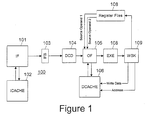
- FIGURE 1 depicts a processor implementing an instruction folding mechanism according to one embodiment of the present invention. Since the present invention may be practiced in conjunction with most conventional pipelined processor designs, FIGURE 1 does not depict a complete processor or all elements and connections within a processor, but instead only so much of the design for a processor as is either required to understand the present invention and/or unique to the present invention is shown.
- Processor 100 includes, within the execution pipeline shown, an instruction fetch (IF) unit 101 which fetches instructions to be executed from an instruction cache (ICACHE) 102 or, on an instruction cache miss, from an external memory, and places fetched instructions in an instruction fetch buffer (IFB) 103.
- the instruction fetch buffer 103 holds prefetched instructions which have not yet been processed by the decode (DCD) unit 104, acting as an instruction reservoir to avoid the possibility of the execution pipeline running out of instructions to process.
- the decode unit 104 takes instructions, usually in a highly compacted and encoded form, from the instruction fetch buffer 103 and decodes such instructions into larger sets of signals which may be used directly for execution by subsequent pipeline stages. After an instruction is decoded, the instruction is removed from the instruction fetch buffer 103. In the present invention, the instruction fetch buffer 103 and/or the decode unit 104 performs pre-decoding and progressive instruction folding as described in further detail below.
- the operand fetch (OF) unit 105 fetches operands to be operated on by the instruction during execution, either from the data cache (DCACHE) 106, from an external memory via the data cache 106, or from register files 107.
- the execution (EXE) unit 108 performs the actual operation (e.g., add, multiply, etc.) on the operands fetched by the operand fetch unit 105 and forms a result for the operation.
- processor 100 may optionally include multiple execution units operating in parallel, including different types of execution units (e.g., integer or fixed point, floating point, etc.) and multiple implementations of a particular type of execution unit (e.g., 2-3 integer units).
- a write-back (WBK) unit 109 writes the result formed by the execution unit 109 into either the data cache 106 or register files 107.
- FIGURE 2 illustrates in greater detail an instruction pre-decoding and progressive folding mechanism according to one embodiment of the present invention, and is intended to be read in conjunction with FIGURE 1.
- the progressive folding technique of the present invention exploits the fact that the instruction fetch buffer 103 normally contains more instructions than the instruction decode unit 104 consumes during a given clock cycle since the instruction fetch unit 101 is normally designed to fetch instructions at an average rate slightly higher than such instructions are consumed by the execution pipeline in order to reduce the probability of the execution pipeline becoming starved for instructions to process. An opportunity thus exists to pre-decode the instructions after the instructions have been placed in the instruction fetch buffer 103 and before the instructions are consumed by the decode unit 104.
- the result of the pre-decode process is one or more pre-decode bits placed in the instruction fetch buffer entry along with the relevant byte of the instruction.
- the decode unit 104 may employ the pre-decode bits to determine folding properties of that instruction with subsequent instructions quickly enough to allow folding combinations which would not be possible absent the pre-decode bits due to the speed constraints on decode unit 104.
- progressive folding may be implemented in a variety of different fashions, consider, as an example, a processor with an average instruction length of between one and two bytes, as may be the case for an embedded processor with an instruction set encoded for high density. Assume that the processor is capable of folding up to three instructions, occupying a maximum of four bytes, into a single pseudo-instruction such as the load/subtract/store operation described above. However, the decode unit 104 is not capable of folding three instructions in that manner unless the number and length of instructions to be folded is known at the beginning of the clock period during each decode cycle.
- the pre-decoder 201 within a progressive fold mechanism 200 supplies information to the decode unit 104 for the instruction at the head 202a of the instruction fetch buffer stack 202 regarding whether the subsequent one or two instructions within the instruction fetch buffer stack 202 may be folded into that instruction, and the length of the instructions in the folded group.
- Pre-decoder 201 includes a set of four identical fold-decoders 201a-201d each connected to a different set of four consecutive entries within entries 2 through 8 202b-202h of the instruction fetch buffer stack 202.
- Each fold-decoder 201a-201d looks at folding combinations for a group of four successive bytes and produces five bits of fold status information as follows:
- each of the four identical fold-decoders 201a-201d generates the above fold-status information by speculatively assuming that the first byte in the group of successive bytes spanned represents the first byte in a group of up to three successive instructions which and checks for folding properties of those instructions based upon that assumption.
- the first byte input to a given fold-decoder 201a-201d may not be the first (or only) byte of an instruction or of a foldable group of instructions.
- the four fold-decoders 201a-201d generate the fold-status information described above, which is then added to the instruction fetch buffer stack entry 202b-202e containing the first byte in the group of four bytes spanned. Since one clock cycle is required for the fold-decoders 201a-201d to generate the fold-status information, instructions should reside in the instruction fetch buffer 103 for at least two clock cycles before being removed by the instruction decoder 104.
- the fold-count is initialized to "00" when instructions are first placed in the instruction fetch buffer stack 202 so that no folding will take place in cases where the instruction decoder 104 is removing instructions from the instruction fetch buffer 103 as fast as the instruction fetch unit 101 is placing instructions within the instruction fetch buffer 103.
- decode unit 104 removes instructions from a near-empty instruction fetch buffer 103 at a slower rate when the instructions have not been preprocessed to determine folding properties means that the instruction fetch unit 101 will then tend to fill up the instruction fetch buffer 103 more quickly (as the lack of folding will slow down the execution pipeline), and therefore the likelihood of the instruction fetch buffer 103 containing sufficient instructions to perform fold pre-decoding is increased in subsequent cycles.
- the progressive folding mechanism of the present invention is, to an extent, self-regulating, allowing the decode unit 104 to potentially consume more instructions per clock cycle only at times when the instruction fetch unit 101 is operating fast enough to maintain a reasonable full instruction fetch buffer 103, helping to balance the speeds of the instruction fetch and execution pipeline stages.
- the main instruction decoder 104 examines the first four bytes in the instruction fetch buffer 103 and the fold-status bits associated with the first entry 202a within the instruction fetch buffer stack 202. If bits 0 and 1 of the fold-status bits are "00", then either fold-decoders did not have time to generate fold-status information for that instruction as described above, or the instruction folding rules dictated by the microarchitecture implementation did not allow folding of the instruction group currently at the head of the instruction fetch buffer stack 202, or only one complete instruction was encoded by the first four bytes within the instruction fetch buffer stack 202.
- the main instruction decoder 104 uses the five fold-status bits associated with the first byte within the instruction fetch buffer stack 202 to immediately determine whether folding can be performed, the number of instructions to be folded, and the byte boundaries of instructions to be folded. The instruction decoder 104 then generates control information to be passed to subsequent pipeline stages much more quickly than if the instruction decoder 104 first had to determine whether folding could be performed, and the instruction boundaries for instructions to be folded.
- the decode unit 104 When the main instruction decoder 104 finishes decoding the instructions at the head of the instruction fetch buffer stack 202, the decode unit 104 generates a shift count signal to the instruction fetch buffer to remove the completed instructions at the next clock edge. Generation of the shift-count is also faster since the number of bytes in a fold group is given at the start of each decode cycle, reducing another potential critical delay path.
- the instruction fetch buffer 103 removes the decoded instructions on the next clock edge, the next group of unprocessed instructions within the instruction fetch buffer 103 are shifted down into the first four bytes of the instruction fetch buffer 103, along with the associated fold-status information, and the decode process is repeated.
- the net effect of progressive instruction folding as described is that the instruction decode unit 104 operates at a significantly higher frequency than if progressive folding was not employed.
- the trade-off is that folding may potentially occur less often when using progressive folding versus a scheme where the main instruction decoder 104 dynamically determines the folding information every clock cycle, since the progressive folding mechanism relies on instructions residing in the instruction fetch buffer 103 for at least one clock cycle before being used, which may not always happen.
- a significant net processor performance gain should be realized.
- folding is either performed fully or not at all depending on whether the instructions remain within the instruction fetch buffer 103 long enough for the fold-decoders 201a-201d to pre-decode the instructions.
- the degree of folding--both in terms of the number of instructions folded and the folding combinations supported-- may increase with the length of time during which the instructions remain in the instruction fetch buffer 103, exploiting the ability of advanced multi-pass fold-decoders to progressively optimize instruction folding over a number of clock cycles.
- the main instruction decoder 104 may perform some simple instruction folding (either in lieu of or in addition to the folding identified by the fold-status bits), providing a higher base-level of performance for instruction which do not remaining within the instruction fetch buffer 103 sufficiently long to be (fully) pre-decoded by the fold-decoders.
- Prior art instruction folding schemes require the main instruction decoder within the decode pipeline stage to dynamically determine potential instruction folding combinations using combinatorial logic, and during the same clock cycle in which the instruction decoder performs the main instruction decode.
- the progressive instruction folding system of the present invention provides advantages over such prior folding schemes for two reasons: First, since the main instruction decoder must be utilized in the prior art folding scheme to determine the folding combinations and folded instruction boundaries before the instructions can be actually decoded, the prior art solution is subject to the inherently longer critical timing paths in the decode stage while progressive instruction folding as described above eliminates the folding determination logic from the critical path within the decode stage. Thus the overall frequency of the processor, to the extent constrained by the instruction decode time (which is common), may be increased with the present invention, increasing the performance of the processor.
- the present invention determines folding information during the clock cycle(s) prior to instructions entering the decode stage so that, unlike prior folding schemes, the fold-decoders may take an entire clock cycle or more to determine folding combinations. Determination of more complex folding combinations is thus enabled, increasing the average number of instructions executed per clock cycle and improving processor performance.
Landscapes
- Engineering & Computer Science (AREA)
- Software Systems (AREA)
- Theoretical Computer Science (AREA)
- Physics & Mathematics (AREA)
- General Engineering & Computer Science (AREA)
- General Physics & Mathematics (AREA)
- Advance Control (AREA)
- Executing Machine-Instructions (AREA)
Abstract
Description
- ld mem1, R1
- (load contents of memory location mem1 into register R1) ;
- add R2, R1
- (add contents of registers R1 and R2 and place the result in register R1).
- ld/add mem1, R2, R1
- (add contents of registers R1 and R2 and place the result in register R1),
- ld mem1, R1
- (load contents of memory location mem1 into register R1) ;
- sub R2, R1
- (subtract contents of register R2 from R1 and place the result in register R1); and
- st R1, mem2
- (store contents of register R1 in memory location mem2)
- ld/sub/st R2, mem1, R1/mem2
- (subtract contents of R2 from mem1 and place result in R1 and mem2).
- Ld/sub R2, mem1, R1
- (subtract contents of R2 from mem1 and place result in R1); and
- st R1, mem2
- (store contents of R1 in mem2)
- bits 0,1 -
- fold-count; 00 = no folding, 01 = 2-way folding; 10 = 3-way folding
- bit 2 -
- byte-count for first folded instruction (0 = 1 byte, 1 = 2 bytes)
- bit 3 -
- byte-count for second folded instruction (0 = 1 byte, 1 = 2 bytes)
- bit 4 -
- byte-count for third folded instruction (0 = 1 byte, 1 = 2 bytes)
Claims (15)
- For use in a processor, an instruction handling system for determining instruction folding comprising:at least one fold decoder associated with an instruction fetch buffer stack,the at least one fold decoder coupled to a set of successive entries within the instruction fetch buffer stack and examining contents within the successive entries prior to a main decode of the contents within the successive entries to determine whether the successive entries contain two or more instructions which may be folded,the at least one fold decoder generating fold-status information for the contents within the successive entries indicating whether the successive entries contain two or more instructions which may be folded.
- The instruction handling system as set forth in Claim 1 wherein the at least one fold decoder further comprises:a plurality of fold decoders associated with the instruction fetch buffer stack and including the at least one fold decoder,each fold decoder coupled to a different set of successive entries within the instruction fetch buffer stack, wherein the different sets of successive entries overlap, and examining contents within a corresponding set of successive entries to determine whether the corresponding set of successive entries contain two or more instructions which may be folded,each fold decoder generating fold-status information for the contents within the corresponding set of successive entries indicating whether the corresponding set of successive entries contain two or more instructions which may be folded.
- The instruction handling system as set forth in Claim 2 wherein the fold-status information produced by each fold decoder includes a number of instructions which may be folded and a size of each instruction which may be folded.
- The instruction handling system as set forth in Claim 2 wherein the fold-status information for each set of successive entries is stored in association with the respective set of successive entries within the instruction fetch buffer stack.
- The instruction handling system as set forth in Claim 1 wherein the at least one fold decoder checks the contents within the successive entries for instructions of a variable size and for possible folding of a variable number of instructions.
- The instruction handling system as set forth in Claim 1 further comprising:a decoder receiving the fold-status information together with the contents of the successive entries for translation of the contents of the successive entries into signals which may be operated on by an execution unit.
- A processor comprising:an instruction fetch mechanism retrieving instructions for storage within an instruction fetch buffer;an instruction decode mechanism for translating instructions into signals which may be operated on by at least one execution unit; andan instruction handling system as claimed in any preceding claim, said system coupled between the instruction fetch buffer and instruction decode mechanism for determining instruction folding.
- the processor as set forth in Claim 7 wherein the instruction decode mechanism receives the fold-status information together with the contents of the successive entries.
- The processor or system as set forth in Claim 1 or 7 wherein the instruction decode mechanism or decoder employs the fold-status information during folding of at least the contents of the successive entries into a single operation.
- For use in a processor, a method of determining instruction folding comprising:prior to decoding contents within a set of successive entries within an instruction fetch buffer stack,
examining the contents within the successive entries to determine whether the successive entries contain two or more instructions which may be folded; and
generating fold-status information for the contents within the successive entries indicating whether the successive entries contain two or more instructions which may be folded. - The method as set forth in Claim 10 wherein the step of examining the contents within the successive entries to determine whether the successive entries contain two or more instructions which may be folded further comprises:examining contents within each of a different set of successive entries within the instruction fetch buffer stack, wherein the different sets of successive entries overlap, to determine whether the corresponding set of successive entries contain two or more instructions which may be folded.
- The method as set forth in Claim 11 wherein the step of generating fold-status information for the contents within the successive entries indicating whether the successive entries contain two or more instructions which may be folded further comprises:generating fold-status information for the contents within each set of successive entries indicating whether the corresponding set of successive entries contain two or more instructions which may be folded, wherein the fold-status information includes a number of instructions which may be folded and a size of each instruction which may be folded.
- The method as set forth in Claim 11 further comprising:storing the fold-status information for each set of successive entries in association with the respective set of successive entries within the instruction fetch buffer stack.
- The method as set forth in Claim 10 wherein the step of examining contents within each of a different set of successive entries within the instruction fetch buffer stack further comprises:checking the contents within the successive entries for instructions of a variable size and for possible folding of a variable number of instructions.
- The method as set forth in Claim 10 further 'comprising:transmitting the fold-status information together with the contents of the successive entries to an instruction decoder translating the contents of the successive entries into signals which may be operated on by an execution unit; andemploying the fold-status information during folding of at least the contents of the successive entries into a single operation within the instruction decoder.
Applications Claiming Priority (2)
| Application Number | Priority Date | Filing Date | Title |
|---|---|---|---|
| US09/909,121 US6832307B2 (en) | 2001-07-19 | 2001-07-19 | Instruction fetch buffer stack fold decoder for generating foldable instruction status information |
| US909121 | 2001-07-19 |
Publications (2)
| Publication Number | Publication Date |
|---|---|
| EP1278119A2 true EP1278119A2 (en) | 2003-01-22 |
| EP1278119A3 EP1278119A3 (en) | 2003-04-16 |
Family
ID=25426664
Family Applications (1)
| Application Number | Title | Priority Date | Filing Date |
|---|---|---|---|
| EP02254953A Withdrawn EP1278119A3 (en) | 2001-07-19 | 2002-07-15 | Progressive instruction folding in a processor with fast instruction decoding |
Country Status (3)
| Country | Link |
|---|---|
| US (1) | US6832307B2 (en) |
| EP (1) | EP1278119A3 (en) |
| JP (1) | JP2003091414A (en) |
Families Citing this family (14)
| Publication number | Priority date | Publication date | Assignee | Title |
|---|---|---|---|---|
| DE69734399D1 (en) * | 1996-01-24 | 2006-03-02 | Sun Microsystems Inc | METHOD AND DEVICE FOR STACKING CACHE STORAGE |
| WO2006126449A1 (en) * | 2005-05-26 | 2006-11-30 | Nec Corporation | Information processing device and command execution method |
| US7502029B2 (en) * | 2006-01-17 | 2009-03-10 | Silicon Integrated Systems Corp. | Instruction folding mechanism, method for performing the same and pixel processing system employing the same |
| US7836282B2 (en) * | 2007-12-20 | 2010-11-16 | International Business Machines Corporation | Method and apparatus for performing out of order instruction folding and retirement |
| KR100957857B1 (en) * | 2008-05-06 | 2010-05-14 | 고려대학교 산학협력단 | Instruction fetcher for 16-bit instruction set |
| US9690591B2 (en) | 2008-10-30 | 2017-06-27 | Intel Corporation | System and method for fusing instructions queued during a time window defined by a delay counter |
| WO2012103373A2 (en) * | 2011-01-27 | 2012-08-02 | Soft Machines, Inc. | Variable caching structure for managing physical storage |
| WO2012103367A2 (en) | 2011-01-27 | 2012-08-02 | Soft Machines, Inc. | Guest to native block address mappings and management of native code storage |
| WO2012103359A2 (en) | 2011-01-27 | 2012-08-02 | Soft Machines, Inc. | Hardware acceleration components for translating guest instructions to native instructions |
| US9183614B2 (en) * | 2011-09-03 | 2015-11-10 | Mireplica Technology, Llc | Processor, system, and method for efficient, high-throughput processing of two-dimensional, interrelated data sets |
| US8898433B2 (en) * | 2012-04-26 | 2014-11-25 | Avago Technologies General Ip (Singapore) Pte. Ltd. | Efficient extraction of execution sets from fetch sets |
| KR101761498B1 (en) | 2013-03-15 | 2017-07-25 | 인텔 코포레이션 | Method and apparatus for guest return address stack emulation supporting speculation |
| WO2014151652A1 (en) | 2013-03-15 | 2014-09-25 | Soft Machines Inc | Method and apparatus to allow early dependency resolution and data forwarding in a microprocessor |
| US11036509B2 (en) | 2015-11-03 | 2021-06-15 | Intel Corporation | Enabling removal and reconstruction of flag operations in a processor |
Family Cites Families (6)
| Publication number | Priority date | Publication date | Assignee | Title |
|---|---|---|---|---|
| US5504932A (en) | 1990-05-04 | 1996-04-02 | International Business Machines Corporation | System for executing scalar instructions in parallel based on control bits appended by compounding decoder |
| US5819056A (en) | 1995-10-06 | 1998-10-06 | Advanced Micro Devices, Inc. | Instruction buffer organization method and system |
| US6026485A (en) * | 1996-01-24 | 2000-02-15 | Sun Microsystems, Inc. | Instruction folding for a stack-based machine |
| US6237086B1 (en) | 1998-04-22 | 2001-05-22 | Sun Microsystems, Inc. | 1 Method to prevent pipeline stalls in superscalar stack based computing systems |
| TW477936B (en) * | 1998-12-29 | 2002-03-01 | Ind Tech Res Inst | Instruction folding method and device used in a stack machine |
| KR100379837B1 (en) * | 2000-06-30 | 2003-04-11 | 주식회사 에이디칩스 | Extended instruction folding system |
-
2001
- 2001-07-19 US US09/909,121 patent/US6832307B2/en not_active Expired - Lifetime
-
2002
- 2002-07-15 EP EP02254953A patent/EP1278119A3/en not_active Withdrawn
- 2002-07-19 JP JP2002211023A patent/JP2003091414A/en active Pending
Also Published As
| Publication number | Publication date |
|---|---|
| US6832307B2 (en) | 2004-12-14 |
| EP1278119A3 (en) | 2003-04-16 |
| JP2003091414A (en) | 2003-03-28 |
| US20030046519A1 (en) | 2003-03-06 |
Similar Documents
| Publication | Publication Date | Title |
|---|---|---|
| US5850543A (en) | Microprocessor with speculative instruction pipelining storing a speculative register value within branch target buffer for use in speculatively executing instructions after a return | |
| EP0840208B1 (en) | Method and system for single cycle execution of successive iterations of a loop | |
| US7725684B2 (en) | Speculative instruction issue in a simultaneously multithreaded processor | |
| US6298423B1 (en) | High performance load/store functional unit and data cache | |
| US6832307B2 (en) | Instruction fetch buffer stack fold decoder for generating foldable instruction status information | |
| US6381692B1 (en) | Pipelined asynchronous processing | |
| CN100559343C (en) | Method and apparatus for pre-decoding instructions for execution | |
| US8667476B1 (en) | Instruction grouping and ungrouping apparatus and method for an adaptive microprocessor system | |
| KR100464406B1 (en) | Apparatus and method for dispatching very long instruction word with variable length | |
| US7945763B2 (en) | Single shared instruction predecoder for supporting multiple processors | |
| US5799180A (en) | Microprocessor circuits, systems, and methods passing intermediate instructions between a short forward conditional branch instruction and target instruction through pipeline, then suppressing results if branch taken | |
| CN118012504A (en) | Pipeline decoding microarchitecture design method for RISC-V vector instructions | |
| US5815420A (en) | Microprocessor arithmetic logic unit using multiple number representations | |
| US6851033B2 (en) | Memory access prediction in a data processing apparatus | |
| US5778208A (en) | Flexible pipeline for interlock removal | |
| US7356673B2 (en) | System and method including distributed instruction buffers for storing frequently executed instructions in predecoded form | |
| US6286094B1 (en) | Method and system for optimizing the fetching of dispatch groups in a superscalar processor | |
| US6654874B1 (en) | Microcomputer systems having compressed instruction processing capability and methods of operating same | |
| US6442675B1 (en) | Compressed string and multiple generation engine | |
| US6170053B1 (en) | Microprocessor with circuits, systems and methods for responding to branch instructions based on history of prediction accuracy | |
| US5815697A (en) | Circuits, systems, and methods for reducing microprogram memory power for multiway branching | |
| US12282430B1 (en) | Macro-op cache data entry pointers distributed as initial pointers held in tag array and next pointers held in data array for efficient and performant variable length macro-op cache entries | |
| JP3721002B2 (en) | Processor and instruction fetch method for selecting one of a plurality of fetch addresses generated in parallel to form a memory request | |
| US20070220235A1 (en) | Instruction subgraph identification for a configurable accelerator | |
| US5895497A (en) | Microprocessor with pipelining, memory size evaluation, micro-op code and tags |
Legal Events
| Date | Code | Title | Description |
|---|---|---|---|
| PUAI | Public reference made under article 153(3) epc to a published international application that has entered the european phase |
Free format text: ORIGINAL CODE: 0009012 |
|
| AK | Designated contracting states |
Kind code of ref document: A2 Designated state(s): AT BE BG CH CY CZ DE DK EE ES FI FR GB GR IE IT LI LU MC NL PT SE SK TR |
|
| AX | Request for extension of the european patent |
Free format text: AL;LT;LV;MK;RO;SI |
|
| PUAL | Search report despatched |
Free format text: ORIGINAL CODE: 0009013 |
|
| AK | Designated contracting states |
Designated state(s): AT BE BG CH CY CZ DE DK EE ES FI FR GB GR IE IT LI LU MC NL PT SE SK TR |
|
| AX | Request for extension of the european patent |
Extension state: AL LT LV MK RO SI |
|
| RIC1 | Information provided on ipc code assigned before grant |
Ipc: 7G 06F 9/38 B Ipc: 7G 06F 9/30 A |
|
| 17P | Request for examination filed |
Effective date: 20031010 |
|
| AKX | Designation fees paid |
Designated state(s): DE FR GB IT |
|
| STAA | Information on the status of an ep patent application or granted ep patent |
Free format text: STATUS: THE APPLICATION HAS BEEN WITHDRAWN |
|
| 18W | Application withdrawn |
Effective date: 20070622 |