EP1278115A1 - Representation data control system, and representation data control device constituting it, and recording medium recording its program - Google Patents
Representation data control system, and representation data control device constituting it, and recording medium recording its program Download PDFInfo
- Publication number
- EP1278115A1 EP1278115A1 EP01953006A EP01953006A EP1278115A1 EP 1278115 A1 EP1278115 A1 EP 1278115A1 EP 01953006 A EP01953006 A EP 01953006A EP 01953006 A EP01953006 A EP 01953006A EP 1278115 A1 EP1278115 A1 EP 1278115A1
- Authority
- EP
- European Patent Office
- Prior art keywords
- data
- control
- expression data
- animation
- unit
- Prior art date
- Legal status (The legal status is an assumption and is not a legal conclusion. Google has not performed a legal analysis and makes no representation as to the accuracy of the status listed.)
- Withdrawn
Links
Images









Classifications
-
- G—PHYSICS
- G06—COMPUTING OR CALCULATING; COUNTING
- G06F—ELECTRIC DIGITAL DATA PROCESSING
- G06F3/00—Input arrangements for transferring data to be processed into a form capable of being handled by the computer; Output arrangements for transferring data from processing unit to output unit, e.g. interface arrangements
- G06F3/01—Input arrangements or combined input and output arrangements for interaction between user and computer
- G06F3/048—Interaction techniques based on graphical user interfaces [GUI]
- G06F3/0481—Interaction techniques based on graphical user interfaces [GUI] based on specific properties of the displayed interaction object or a metaphor-based environment, e.g. interaction with desktop elements like windows or icons, or assisted by a cursor's changing behaviour or appearance
- G06F3/04817—Interaction techniques based on graphical user interfaces [GUI] based on specific properties of the displayed interaction object or a metaphor-based environment, e.g. interaction with desktop elements like windows or icons, or assisted by a cursor's changing behaviour or appearance using icons
-
- H—ELECTRICITY
- H04—ELECTRIC COMMUNICATION TECHNIQUE
- H04N—PICTORIAL COMMUNICATION, e.g. TELEVISION
- H04N21/00—Selective content distribution, e.g. interactive television or video on demand [VOD]
- H04N21/40—Client devices specifically adapted for the reception of or interaction with content, e.g. set-top-box [STB]; Operations thereof
- H04N21/43—Processing of content or additional data, e.g. demultiplexing additional data from a digital video stream; Elementary client operations, e.g. monitoring of home network or synchronising decoder's clock; Client middleware
- H04N21/4302—Content synchronisation processes, e.g. decoder synchronisation
- H04N21/4307—Synchronising the rendering of multiple content streams or additional data on devices, e.g. synchronisation of audio on a mobile phone with the video output on the TV screen
- H04N21/43074—Synchronising the rendering of multiple content streams or additional data on devices, e.g. synchronisation of audio on a mobile phone with the video output on the TV screen of additional data with content streams on the same device, e.g. of EPG data or interactive icon with a TV programme
-
- H—ELECTRICITY
- H04—ELECTRIC COMMUNICATION TECHNIQUE
- H04N—PICTORIAL COMMUNICATION, e.g. TELEVISION
- H04N21/00—Selective content distribution, e.g. interactive television or video on demand [VOD]
- H04N21/40—Client devices specifically adapted for the reception of or interaction with content, e.g. set-top-box [STB]; Operations thereof
- H04N21/43—Processing of content or additional data, e.g. demultiplexing additional data from a digital video stream; Elementary client operations, e.g. monitoring of home network or synchronising decoder's clock; Client middleware
- H04N21/431—Generation of visual interfaces for content selection or interaction; Content or additional data rendering
- H04N21/4312—Generation of visual interfaces for content selection or interaction; Content or additional data rendering involving specific graphical features, e.g. screen layout, special fonts or colors, blinking icons, highlights or animations
-
- H—ELECTRICITY
- H04—ELECTRIC COMMUNICATION TECHNIQUE
- H04N—PICTORIAL COMMUNICATION, e.g. TELEVISION
- H04N21/00—Selective content distribution, e.g. interactive television or video on demand [VOD]
- H04N21/40—Client devices specifically adapted for the reception of or interaction with content, e.g. set-top-box [STB]; Operations thereof
- H04N21/43—Processing of content or additional data, e.g. demultiplexing additional data from a digital video stream; Elementary client operations, e.g. monitoring of home network or synchronising decoder's clock; Client middleware
- H04N21/44—Processing of video elementary streams, e.g. splicing a video clip retrieved from local storage with an incoming video stream or rendering scenes according to encoded video stream scene graphs
-
- H—ELECTRICITY
- H04—ELECTRIC COMMUNICATION TECHNIQUE
- H04N—PICTORIAL COMMUNICATION, e.g. TELEVISION
- H04N21/00—Selective content distribution, e.g. interactive television or video on demand [VOD]
- H04N21/40—Client devices specifically adapted for the reception of or interaction with content, e.g. set-top-box [STB]; Operations thereof
- H04N21/47—End-user applications
- H04N21/478—Supplemental services, e.g. displaying phone caller identification, shopping application
- H04N21/4788—Supplemental services, e.g. displaying phone caller identification, shopping application communicating with other users, e.g. chatting
-
- H—ELECTRICITY
- H04—ELECTRIC COMMUNICATION TECHNIQUE
- H04N—PICTORIAL COMMUNICATION, e.g. TELEVISION
- H04N21/00—Selective content distribution, e.g. interactive television or video on demand [VOD]
- H04N21/40—Client devices specifically adapted for the reception of or interaction with content, e.g. set-top-box [STB]; Operations thereof
- H04N21/47—End-user applications
- H04N21/485—End-user interface for client configuration
-
- H—ELECTRICITY
- H04—ELECTRIC COMMUNICATION TECHNIQUE
- H04N—PICTORIAL COMMUNICATION, e.g. TELEVISION
- H04N21/00—Selective content distribution, e.g. interactive television or video on demand [VOD]
- H04N21/80—Generation or processing of content or additional data by content creator independently of the distribution process; Content per se
- H04N21/81—Monomedia components thereof
- H04N21/8146—Monomedia components thereof involving graphical data, e.g. 3D object, 2D graphics
- H04N21/8153—Monomedia components thereof involving graphical data, e.g. 3D object, 2D graphics comprising still images, e.g. texture, background image
Definitions
- the present invention relates to an expression data control system controlling expression data, such as animation, sound, and text, which is sequentially output, particularly to an expression data control system capable of quickly and correctly controlling various expressions, including small differences between the expressions.
- Tokukaihei 9-81353 Japanese Laid-open Patent Application 9-81353/1997, published on March 28, 1997) discloses a display device displaying both text and graphics on the screen.
- the device displays an image in response to associated control character string contained in a text input.
- the display device displays a smiling face if the text input contains a control character string ":-)" representing a smiling face. This better helps a nuance be displayed than a text-only display.
- the smiling face may come in a variety of different forms, including a beaming smile and sneer. These variations cannot be expressed using ":-)" alone. Use of another character string ":-P" does not push the restriction far enough. Besides, in more expressible varieties the smiling face comes, the more control character strings the user has to handle by memorizing all these control character strings and correctly telling each one from the others, which is increasingly difficult.
- Tokukaihei 9-81353 describes a method of specifying to display an intermediate facial expression between “:-)" and “:- ⁇ ” by inserting a transformation instructing parameter between the two smileys like in ":-)0.5 :- ⁇ 0.8".
- a transformation instructing parameter between the two smileys like in ":-)0.5 :- ⁇ 0.8.
- many users have trouble translating a transformation instructing parameter to an actual facial expression and can learn the input method only by trial and error approaches.
- the display device can offer a limited range of actions and often falls short of meeting participants' expectations for surprises and varieties: participants are quick to get bored with it.
- participants are quick to get bored with it.
- the same problems are found with those devices which uses a specific word(s) in a sentence as a keyword; they present only one facial expression to a specific word, incapable of offering the user control over any more options.
- the present invention has been conceived in view of the above problems has an objective to realize an expression data control system capable of quickly and correctly controlling various expressions, including small differences between the expressions.
- An expression data control system in accordance with the present invention in order to achieve the aforementioned objective, includes: a control data generating unit generation control data representative of actions/conditions of animation as expression data; and an expression data control unit controlling the expression data based on the control data, and is characterized in that it further includes an input unit enabling an input using a combination of icons representative of actions/conditions of the expression data, wherein the control data generating unit generates the control data based on a selected one of the icons.
- the input unit enables the input of control data using a combination of icons.
- the icons unlike when inputting control character string, the icons enable the user to intuitively understand the respective actions/conditions. Further, increasing the kinds of the icons does not add to the work required in inputting, as compared to inputting control character strings.
- both animation and icons are expressed as images, they are easily identifiable for respective differences between different pieces of animation controlled by the actions/conditions even when the differences are subtle. As a result, an expression data control system is realized which enables quick input of various actions/conditions.
- the input unit enables an input using a mixture of an icon and text
- the expression data control unit displays or reads out the text input positioned immediately before or after an icon in synchronism with animation represented by the icon.
- the animation is in synchronism with the text despite no additional inputs compared to a case where the expression data control unit only inputs what are absolutely necessary to display the text and the animation, that is, inputs the icon and the text. Further, the icon and the text which are in synchronism with each other are input so as to be successively positioned, enabling the user to understand their relationship. As a result, the animation and the text can be more easily input and more naturally controlled.
- the expression data control unit may adjust the duration of the animation represented by the icon in accordance with the length of the text or the time required to read out the text.
- the duration of the animation is specified by adjusting, for example, the presentation times of frames or the number of frames generated by interpolating key frames.
- the duration of the animation is adjusted in accordance with the duration of the text or the time required for the voice output. There is thus no need to instruct the duration of the animation; the animation and the text can be more easily input and more naturally controlled.
- the expression data control unit may adjust the number of times the animation represented by the icon is reproduced in accordance with the length of the text or the time required to read out the text.
- the number of times the animation is reproduced is adjusted in accordance with the length of the text or the time required to read out the text. Therefore, there is no particular need to instruct how many times the animation should be reproduced; the animation and the text can be more easily input and more naturally controlled.
- An expression data control device in order to achieve the aforementioned objective, includes a control data generating unit generating control data representative of actions/conditions of animation as expression data, and is characterized in that it further includes an input unit enabling an input using a combination of icons representative of actions/conditions of the expression data, wherein the control data generating unit generates the control data based on a selected one of the icons.
- the input unit also enables the input of control data using a combination of icons and similarly to the foregoing expression data control system, enables quick input of various actions/conditions.
- the icon is displayed as a thumbnail image drawn by scaling down a still or animated image making up part of the animation corresponding to the icon.
- the icon is displayed as an image drawn by scaling down part of the animation, enabling the user to grasp differences between pieces of animation by the image even when the differences are subtle and difficult to translate to a character or the like. As a result, more actions/conditions with subtle differences can be input quickly.
- the expression data control device of any of the foregoing configurations preferably further include a resource memory unit adding or substituting resource data for reproducing animation of controllable actions/conditions and storing the resource data and an icon adding unit adding an icon in accordance with the resource data.
- the resource data can be changed, enabling addition and change of animation of controllable actions/conditions.
- the animation can be controlled in a variety of ways compared to a case where controllable actions/controls are predetermined.
- icons can be added in accordance with the resource data; even if the resource data is changed, actions/conditions can be quickly input with no trouble.
- the expression data control device of the configuration may further include a data transmission unit transmitting the control data through a communications path to an expression data control unit controlling the expression data based on the control data and a resource feeding unit feeding the resource data stored in the resource memory unit to the expression data control unit before the generation and transmission of the control data is repeated.
- the expression data control unit receives the resource data from the resource feeding unit before the transmission of the control data is repeated, thereby reducing the data amounts in the transmission of the control data and enabling quickly responses compared to a case where data representative of animation itself is transmitted for every transmission of control data. Further, the expression data control unit does not know the contents of the resource data until the resource data is received, enabling reproduction unexpected animation. As a result, an expression data control device is realized which quickly transmits various control data.
- Another expression data control system in accordance with the present invention in order to achieve the aforementioned objective, includes a control data generating unit generating control data representative of actions/conditions of expression data and an expression data control unit controlling the expression data based on the control data received through a communications path, and is characterized in that it further includes an input unit enabling an input using a combination of icons representative of the actions/conditions of the expression data and that the control data generating unit generates the control data based on a selected one of the icons and includes a resource memory unit adding or substituting resource data for reproducing the expression data having controllable actions/conditions and storing the resource data and a resource feeding unit feeding the resource data stored in the resource memory unit to the expression data control unit before the generation and transmission of the control data is repeated.
- the expression data is not limited to animation; alternatively, the expression data may be sound or text as examples, so long as it is of the type that is sequentially output.
- the input unit enables an input of control data using a combination of icons. Further, before the transmission of the control data is repeated, the resource data is received from the resource feeding unit. Therefore, similarly to the foregoing expression data control system and expression data control device, control data representative of various actions/conditions can be quickly input/transmitted.
- Another expression data control system in accordance with the present invention in order to achieve the aforementioned objective, includes a control data generating unit generating control data instructing an expression method of text as expression data and an expression data control unit controlling the expression data based on the control data, and is characterized in that it further includes an input unit enabling an input using icons representative of a display method of the text in a mixture with the text and that the control data generating unit generates the control data based on a selected one of the icons; and the expression data control unit changes the display method of the text input positioned immediately before or after an icon in accordance with the selected icon.
- the input unit enables an input of control data using a combination of icons and similarly to the foregoing expression data control system, enables the user to intuitively understand the respective display methods. Further, increasing the kinds of the icons does not add to the work required in inputting, as compared to inputting control character strings. As a result, an expression data control system is realized which enables intuitive and quick input of text display methods.
- the input unit displays a combination of selected icons.
- a combination of icons is displayed, enabling the user to confirm and sufficiently consider input results.
- the display of a combination of icons which requires less computation than the control of expression data, can be handled suitably even by an input unit with a low processing power.
- results (actions/conditions) of control of expression data can be intuitively understood from a combination of icons.
- the expression data control system is a chat system including terminal devices each including both an expression data control unit and a control data generating unit, wherein the terminal devices are capable of sending animation with speech text as the expression data to one another.
- the chat system is a bi-directional communication system and required to allowing for quick input of various actions/conditions. Therefore, constituting a chat system from any of the foregoing expression data control systems is very effective.
- a storage medium in accordance with the present invention stores an expression data control program generating control data representative of actions/conditions of animation as expression data, and is characterized in that, in order to achieve the aforementioned objective, it stores a program causing a computer to operate as an input unit enabling an input using a combination of icons representative of the actions/conditions of the expression data and a control data generating unit generating the control data based on a selected one of the icons.
- a system of the present embodiment is one which controls animation and text as expression data and suitably used as a chat system which enables users to communicated with each other using text-assisted animation, for example.
- the chat system (expression data control system) 1 of the present embodiment includes terminals 2 connected with one another via a radio or wire communications path.
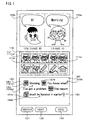
- each terminal (expression data control device) 2 is made up of a transmission and reception unit (data transmission unit, resource feeding unit) 11 for communicating with another party's terminal 2; an animation display unit (expression data control unit) 12 displaying animated characters representing both parties involved in animation display areas 100a and 100b respectively as in Figure 1; a resource memory unit 13 for storing animation display resources (animation resources); a control data generating unit 14 for combining an icon and text by, for example, displaying an icon palette 110 and a control input area 120 as in Figure 1, so as to generate control data for the character representing the user; and an icon adding unit 15 for adding an icon 111 to the icon palette 110.
- the terminals 2 may communicate with each other either directly or connected via switching equipment or a network server.
- the terminal 2 causes the other party's terminal 2 to display a character representing the user and controls actions/conditions of the user-representing character displayed as text-assisted animation on the other party's terminal 2 by feeding control data to the other party's terminal 2. This helps the user convey nuances to the other party relatively easily when compared to conventional, text-only chat systems.
- the control data generating unit 14 of the present embodiment includes an icon data table memory unit 21 for storing an icon data table on which the display of icons 111 in the icon palette 110 is based; an input buffer memory unit 22 for storing control data displayed on the control input area 120; a control data editing unit (input unit) 23 for editing control data stored in the input buffer memory unit 22 according to, for example, a user's character string input or selection of an icon 111, so as to update the display in the control input area 120; and a feed data generating unit (expression data generating unit) 24 for generate data (control data) fed to the other party's terminal 2 according to results of the editing.
- an icon data table memory unit 21 for storing an icon data table on which the display of icons 111 in the icon palette 110 is based
- an input buffer memory unit 22 for storing control data displayed on the control input area 120
- a control data editing unit (input unit) 23 for editing control data stored in the input buffer memory unit 22 according to, for example, a user's character string input or selection
- the user inputs text as shown in the control input area 120 in Figure 1 and selects one of icons; this is all the user has to do to generate control data for a display of an animated character which speaks and acts as he/she wants it to, in such a manner that he/she wants.
- step 1 (hereinafter, referred simply as S1) in Figure 4, prior to a chat, the terminal 2 prepares data representing available actions/conditions of the animated character representing the user during the chat as animation resources for the character representing the user.
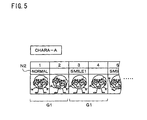
- the animation resources of the present embodiment contain sets, G1, of frames making up animation for each action/condition as shown in Figure 5, for example.
- Each set, G1, of frames has a label N2 by means of which an action or condition is identified.
- the data may be generated by, for example, drawing multiple still images from combinations of lines, polygons, ellipses, text, and/or other patterns according to user's inputs and sequencing them before being stored in the resource memory unit 13. Specifications may be made regarding the coloring of the graphical patterns.
- Favorite animation resources may be downloaded via the transmission and reception unit 11 from, for example, a server distributing animation resources before being stored in the resource memory unit 13.
- the icon data table memory unit 21 stores an icon data table suited to the animation resources of the character representing the user.
- the icon data table of the present embodiment contains combinations (records) of a set of icon image data D11 representing the image of an icon 111 and a set of data D12 representing control data fed when that icon 111 is selected, different combinations for different icons 111, for example.
- the icon 111 represents specific animation or sound
- its data D12 includes a command to reproduce the animation or sound
- the icon 111 represents a change in color or another expression of text
- the data D12 includes a command to change that setting.
- Each icon 111 may embed multiple commands: for example, data D12d embeds a command to reproduce animation and another to change a setting of text.
- the icon image data D11 may be generated by the icon adding unit 15 extracting animated images or still images constituting a part of the animation from the sets, G1, of frames of the animation resources in the resource memory unit 13, and the character strings D12 may be generated by converting the labels N2.
- the icon image data D11 and character strings D12 may be downloaded together with the animation resources from the server.
- the icon adding unit 15 is capable of adding (changing) data D12 according to a command from the user.
- still/animated images from which the icon image data D11 is produced may be automatically selected by the icon adding unit 15 based on, for example, a frame's position relative to the whole animation and alterations between frames or selected by the user from options offered, for example.
- the icon image data D11 is preferably generated from still/animated images which include the unique features of the animation.
- the transmission and reception unit 11 in the terminals 2 communicates with each other in S3 to exchange animation resources which will be used during the chat in S4 and subsequent steps.
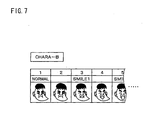
- the resource memory unit 13 stores not only the animation resources for the character representing the user shown in Figure 5, but also those for the character representing the other party shown in Figure 7.
- the terminals 2 may exchange only the information, such as identification number, which specifies animation resources, without exchanging the animation resources as such, and receive animation resources from, for example, the server other than the terminals 2.
- a chat between the terminals 2 is started in S4 and subsequent steps as follows.
- the control data editing unit 23 in the control data generating unit 14 displays the icon palette 110 and the control input area 120 shown in Figure 1 in S4, so as to encourage to input an action/control or speech text of the character representing the user using a combination of an icon 111 and text.
- the control data 120 is an area where a mixture of an icon 121 and text 122 are input; a character is input at a position indicated by the input cursor 123 using a keyboard.
- the icons 121 are the icons 111 which have been selected from those displayed on the icon palette 110 by, for example, specifying (pointing) with a mouse and performing an input operation (clicking) and input one by one at the position of the input cursor 123.
- the control data editing unit 23 changes the contents of the input buffer memory unit 22 according to the input, so as to update the display in the control input area 120.
- the data based on which the character representing the user is controlled can be input as a combination of a peacefully smiling icon 121a, "Morning" text 121a, a sad-looking icon 121b, and "You know what? I've got a problem” text 122b so that the character greets smilingly saying "Morning" then puts on a rather sad look and says "You know what? I've got a problem.”
- Control data can be thus input intuitively and swiftly even when expressions carry various, subtle nuances.
- the icon 111 does not have to represent animation and may represent sound. Further, the icon 111 may represent a change in display settings of the text 122d, as with the icon 121d. In the example illustrated in Figure 1, the icon 121d, showing spilling black ink, represents a command to display the part of the text 122d subsequent to the icon in black.
- control input area 120 a mixture of the icon 121a representing the actions/conditions of the character representing the user and the text 122a representing the speech text of the character representing the user is displayed according to inputs from the user.
- This enables the user to confirm the combination of the icon 121, text 122, etc. in the control input area 120 before transmission of control data.
- the user can sufficiently consider the contents of control before transmission.
- an icon combination display which requires less computation than an animation display/control, can be handled suitably even by a terminal 2 with a low processing power.
- the control data editing unit 23 is capable of editing results of inputs made in the control input area 120 and allows for editing/adjustment according to results of pre-transmission consideration before transmission.
- the animation display unit 12 of the present embodiment is displaying animation specified by the input to the control input area 120 in the animation display area 100a shown in Figure 1 while referring to the animation resources for the character representing the user stored in the resource memory unit 13.
- the user of the terminal 2 can confirm the animation for the character representing the user displayed at the other party's terminal 2 more accuaretely than only by watching the display in the control input area 120.
- the feed data generating unit 24 of the terminal 2 in S5 converts input results to control data and transmits to another party's terminal 2 via the transmission and reception unit 11 according to an instruction from the user, for example, a push of a SEND button 130 shown in Figure 1.
- the control data transmitted to another party in a single transmission will be regarded as forming one message.
- a pushing action is, for example, a pointing and clicking action using a mouse.
- the animation expressing the actions/conditions available to the character representing the user during a chat is sent in advance to the other party's terminal 2 as animation resources; the animation display unit 12 of the other party's terminal 2 in later detailed S7 reproduces the animation specified by the control data in reference to the animation resource forwarded in advance.
- the animation display unit 12 of the other party's terminal 2 in later detailed S7 reproduces the animation specified by the control data in reference to the animation resource forwarded in advance.
- the amount of data transmitted between terminals 2 can be greatly reduced compared with the transmission of frame contents for every message.
- a swift response becomes possible in conjunction with swift inputs owing to a combination of the icon 111 and text, and the users of the terminals 2 can communicate with each other in real time.
- the animation display unit 12 in S7 reproduces the animation represented by the control data in the animation display area 100b shown in Figure 1 while referring to the animation resources for the other party in the resource memory unit 13.
- the animation display unit 12 changes the presentation time or the number of presentations of the animation or otherwise adjusts in accordance with the length of the speech text. This helps the animation more visually appealing. Under these circumstances, if the animation represented by the icon is cut short, synchronizing becomes more accurate, but the number of inputs of the icon may increase and the animation represented by each icon becomes less identifiable. A balance between the two is specified according to a purpose.
- the animation display unit 12 displays the animation based on the control data from the other party's terminal 2 in the animation display area 100b and the animation based on the control data generated the user in the animation display area 100a.
- animation is displayed sequentially at the user's and the other party's terminals 2 as if the characters displayed respectively to represent the other party and the user were talking to each other.
- the relationship of the user and the other party is reversed; the characters representing them in the animation display areas 100a and 100b are reversed accordingly, and icons 111 representing the character of the other party are displayed in the icon palette 110.
- Figure 1 demonstrates as an example two animation display areas 100 for communication between two terminals 2; alternatively, in cases where three or more parties are involved in communication, the animation display unit 12 may display animation display areas 100 representing respective terminals 2.
- Steps S4-S7 are repeated for every message of each terminal 2 until the chat is over, and the users of the terminals 2 can communicate in real time while controlling the actions/conditions and the speech text for the character representing the user through combinations of an icon 121 and text 122.
- the terminal 2 inputs control data as a combination of the icon 121 and the text 122.
- the icon 121 is an image similarly to the animation to be controlled, subtle nuances are easily expressed compared with cases where animation is specified using a character string.
- any icon 121 can be selected from the icon palette 110 or input otherwise by a single action, unlike cases where an icon is specified using a combination of characters. Quick inputs are therefore possible even when there are various expressions used and differences between expressions are subtle.
- the icons 121 representing actions/conditions can be input in combinations. Control data for altering actions/conditions can be therefore easily input in a single message. As a result, quick inputs of more expressions become possible.
- the animation resource for the character representing the other party is notified from the other party's terminal 2; animation that is least expected by the user of the receiving-end terminal 2 can be reproduced.
- the terminals 2 selects one from pieces of predetermined animation for display in accordance with the control character string, that is, when expressible animation is fixed. Since each expression is selected from received animation resources at the receiving end, the terminal 2 can reproduce animation that is least expected by the user of the receiving-end terminal 2 without any problem.
- the description was limited to cases where the controlled object was animation.
- the controlled object may vary. Use of icons eliminates the need to remember associations between control character strings and expressions and allows for intuitive and quick inputs of various expressions; the controlled object may be, for example, sounds, including voices, sound effects, and music, or text. In this case, inputting, for example, an "icon for vivid music", "Morning!, an "icon for a disappointing sound effect", and "God! I'll be late.” generates control data to reproduce vivid music while displaying text "Morning! and reproduce a disappointing sound effect while displaying text "God! I'll be late.”
- Other controlled objects are also possible: intuitive and quick inputs are possible without losing the varieties of expressions, by forwarding in advance sound-representing resources or resources, such as fonts, representing changes in appearance of text.
- animation is a controlled object
- inputting other controlled objects, such as text and sounds, using icons makes it possible to use the same input method for control commands for actions/conditions of animation and commands for the other controlled objects. Therefore, when animation is a controlled object, the same command input operability is preferably shared among all the controlled objects through the use of icons.
- the terminal 2 of the present embodiment includes in addition to the foregoing configuration a history managing unit 16 managing the history of control data transmitted/received by the transmission and reception unit 11 as shown in Figure 3.
- the history managing unit 16 updates the control data (message) displayed on the animation display unit 12 shown in Figure 1 to a previous or next message, in response to a push of a PREVIOUS button 131, a NEXT button 132, or the like.
- the animation display unit 12 changes the display from message Y3 to Y2, X2, Y1, and X1 as the user keeps on pushing the PREVIOUS button 131. Hence, the user of the terminal 2 can check old messages.
- the resource memory unit 13 stores, for each animation resource, image data D20 representing frames of animation and animation frame data D30 by means of which the association between each set of image data D20 and a frame is managed.
- the animation frame data D30 stores a pointer P31 for representing each set of image data D20 and a combination with label title data N32.
- label title data N32 In the first frame of animation corresponding to a certain action/condition, a label title by which the action/condition is identified is stored as label title data N32. Further, as label title data N32 for the remaining frames, void character mark is stored.
- the animation display unit 12 searches the frames stored in the animation frame data D30 for a frame in which the content of the label title data N32 matches a desired label title, so as to sequentially reproduce, beginning with the frame, the image data D20 in the frame in which the label title data N32 is a void character mark; the animation corresponding to the desired label title can be displayed.
- animation resources are expressed in a key frame format.
- the animation display unit 12 interpolates the image data D20 as key frames where necessary for reproduction of that image data D20.
- each frame is expressed as a combination of graphic components, and the image data D20 includes for each graphic component in the frame, a picture-drawing command C21 for specifying the graphic component, a pointer P23 representing in a next frame a graphic component corresponding to the graphic component, and a pointer P22 representing in the same frame a next graphic component.
- the picture-drawing command C21 includes, for example, a command indicating the shape and position of the graphics, such as "LINE (0,0)-(0,10)-(10-10)-(0,0)", when a triangle is shown, so as to add various attributes including the width and color of a line and the color filling inside. Further, a command for a character string may be in some cases specified as the graphic's shape. Where the corresponding graphic component, next graphic component, etc. do not exist, a predetermined end mark is stored as the pointers P22, P23, etc.
- the animation display unit 12 reproduces the frame by drawing the graphic components represented by the picture-drawing commands C21 along the pointer P22. Further, the animation display unit 12, for example, interpolates a feature amount, such as position, color, and shape of the graphic component, which differs between two successive key frames (image data D20) according to picture-drawing/computation capabilities and the like of the animation display unit 12, so that the corresponding graphic component changes smoothly between the two key frames.
- a feature amount such as position, color, and shape of the graphic component
- the graphic component is located in that frame at coordinates (5,5).
- the coordinates as a feature amount is linearly interpolated, that is, equally divided, as an example; alternatively, another method may be used for the interpolation, such as non-linear interpolation using a predetermined function, so long as an arbitrary frame can be produced from key frames.
- the resource memory unit 13 stores an animation resource title table T40, and the table T40 stores combinations of a pointer P41 indicating the animation frame data D30 which will be the resource itself and the resource title data N42 with respect to each animation resource stored in the resource title table T40.
- the icon data table memory unit 21 stores combinations of data (icon image data D51) representing images of the icons 111 and the control data D52 corresponding to the icons 111 as an icon data table T50 for each of the icons 111 displayed in the icon palette 110.
- the icon data table T50 is realized as, for example, a sequence of pointers P53 representing the icon image data D51 and pointers P54 representing the control data D52.
- a character end mark is attached to each set of the control data D52.
- the input buffer memory unit 22 records icon-specifying data D61 representing the icon 121 and data D62 representing the text 122 in the order of displays in the control input area 120 as shown in Figure 11.
- the icon-specifying data D61 is described as a combined character string of a specific character ("#") and ordinal numbers in the icon data table T50, and a hard return is inserted at each division between the data sets D61, D62.
- the ordinal numbering start, for example, with the upper left icon 111 in the icon palette 110 (the icon 111 is the first icon).
- the icon-specifying data D61 does not have to be in the format of character strings (character codes), needless to say; alternatively, the icon-specifying data D61 may be expressed using control codes which do not correspond to any display characters so long as the icon 121 can be specified.
- the control data editing unit 23 When the text 122, the icon 121, etc. are input, the control data editing unit 23 inserts icon-specifying data D61 or character string data D62 at positions corresponding to the input cursor 123 in the input buffer memory unit 22 according to the inputs. Further, the control data editing unit 23 displays icon image data D51 corresponding to the icon-specifying data D61 or a character string represented by the character string data D62 in the order of records in the input buffer memory unit 22. In this manner, as shown Figure 1, a mixture of the icon 121 and the text 122 can be displayed.
- control data editing unit 23 is capable of changing the content of the input buffer memory unit 22 according to edit operations and updating the display in the control input area 120 when, for example, a command is issued for another edit operation such as deletion, cutting, pasting, or copying, through a key (not shown) operation, a mouse operation, etc.
- the feed data generating unit 24 changes the content of the input buffer memory unit 22 to control data in the format shown in Figure 8.
- the control data is, for example, the content of the input buffer memory unit 22 plus the information required to correctly reproduce control data at another party's terminal 2, for example animation resources: in the chat system 1 of the present embodiment, a format complying with the specifications of XML (eXtensible Mark-up Language) 1. 0 recommended by a standardization organization, World Wide Web Consortium (W3C).
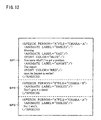
- the history managing unit 16 stores control data for each message as shown in Figure 12, for example.
- control data shown in Figure 8 has a logic configuration shown in Figure 13 whereby an individual set of control data is constituted by a SPEECH element which has a PERSON attribute indicating the author of the control data and a FILE attribute indicating an animation resource.
- the SPEECH element may have an ANIMATE element corresponding to the icon 121 and text data corresponding to the text 122 with the order being preserved.
- the control data editing unit 23 of the present embodiment displays icons of different purposes on different rows in the icon palette 110: for example, in the example of Figure 1, the top row shows icons 111 for animation control, and the bottom row shows icons 111 for a text control, recovery of the initial conditions, and other purposes.
- the control data editing unit 23 displays icons 111 at memory locations (in the order of addition) in the icon data table T50; the display positions of the icons 111 are specified by adjusting the memory locations in the icon data table T50. If a field showing the purposes of the icons 111 is added to the icon data table T50 for the control data editing unit 23 to control the display position of the icons 111 based on the data, data representing those purposes is stored in the field of the icon data table T50.
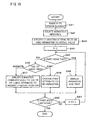
- the control data generating unit 14 is showing a display as shown in Figure 1 as a user interface.
- a variable P showing the ordinal number of the message which should be displayed now is initialized to "0", indicating that there is no message to be displayed.
- the terminal 2 is waiting for an input event.
- the terminal 2 of the present embodiment waits for three kinds of events as an input event: character input at the keyboard, pointing to a specific position on screen and a click using a mouse, and reception of incoming data at the transmission and reception unit 11.
- the terminal 2 determines the kind of the input event in S13. Under these circumstances, as actions by the user, first, if a specific icon 111b in the icon palette 110 is clicked to input the icon 121 in the control input area 120 shown in Figure 1, the input event is determined to be a mouse click in S13, and the click position is interpreted as a selection of the icon palette 110 in S14. In this case, in S15, the control data editing unit 23 stores icon-specifying data D61 ("#2") representing the icon 111b at the start of the input buffer memory unit 22 as shown in Figure 11.
- the control data editing unit 23 updates the display in the control input area 120 in S16. Specifically, the icon image data D51 contained in the second record of the icon data table T50 shown in Figure 10 is searched for based on the icon-specifying data D61 ("#2") in the input buffer memory unit 22 and displayed as the icon 121 in the control input area 120. As the updating of the display is completed in S16 above, step S12 and following steps are repeated.
- the user Having repeated S12 to S17 above to input all the icon-specifying data D61 and the character string data D62 displayed in the control input area 120, the user presses the SEND button 130 shown in Figure 1. Under these circumstances, since the pressing action of the SEND button 130 is a clicking action using a mouse, the determination of S14 is executed, and since the "SEND" button is pressed in the action, the feed data generating unit 24 changes the content of the input buffer to control data of a tag format in S21.
- control data editing unit 23 generates a single SPEECH element (everything from line L1 to line L11 in Figure 8) in a single conversion.
- the value of the PERSON attribute contained in the start tag (L1) in the SPEECH element (for example, "A") is a nickname of the user predetermined by the user himself/herself.
- the value of the FILE attribute (for example, "CHARA-A”) is specified from the animation resource corresponding to the icon 111 displayed in the icon palette 110.
- the character string data D62 is, for example, used as such as character string data like in line L3.
- lines L4 and L5 are generated by transferring the control data D52 in the icon data table T50 in the same procedure as is line L2; however, in the fourth record of the icon data table T50, as the control data D52, multiple sets (two sets in this case) of control data are stored, and multiple lines, i.e., lines L4 and L5, are generated.
- a element representing reproduction of music in this case, vivid music
- ⁇ MUSIC TITLE trademark.mid
- the transmission and reception unit 11 feeds the control data to another party's terminal 2 via a communications path in S22. Further, the control data is transferred to a control the history manage buffer (not shown) in the history managing unit 16 in S23. Further, in according with this, the history managing unit 16 updates the latest position in the history of the message: for example, specifies the latest position to "1" when a first message SP1 is transferred.
- Figure 12 shows a state where the control data received from the other party and the control data which the user inputs thereafter are added after the control data is transmitted, that is, a case where three messages SP1 to SP3 are included.
- the history managing unit 16 determines whether or not the value of the variable P, i.e., the ordinal number of the message which should be displayed now, is one position ahead of the latest position. Under these circumstances, initially, in S11, the variable P is set to "0". Meanwhile, the history managing unit 16 only stores the first message SP1 and the latest position is set to "1". Therefore, at this stage, the result of S24 is YES and after the variable P is increased by 1 in S25, the animation display unit 12 reproduces the control data represented by the variable P, that is, animation based on the first message SP1 in S26.
- the variable P i.e., the ordinal number of the message which should be displayed now
- the animation display unit 12 parses the SPEECH element corresponding to the variable P. Parsing is analysis of a SPEECH element or another target data to be processed and reconfiguration of the data into a data format for ease of subsequent processing. Parsing the first message SP1 shown in Figure 12 results in parsing into the data format shown in Figure 13. Figure 13 shows a node enclosed in a quadrangle with the SPEECH element is parsed in the top node. Further, the SPEECH element has attributes including a PERSON attribute and a FILE attribute and has sub-nodes including an ANIMATE element, a FONT element, and text data. This example demonstrates a typical XML parse processing and is executable using a computer program (XML parser) made publicly available or distributed by, for example, XML-related organizations.
- XML parser computer program
- the animation display unit 12 selects an animation resource of the same name from the animation resources stored in the resource memory unit 13 in advance using the FILE attribute value ("CHARA-A") among the results of the parsing in S41, as a preparation for reproduction.
- the animation display unit 12 sets the character attribute to be used in subsequent steps to the initial value (for example, the character color to black, the thickness to thin) and the variable I representing the ordinal number of the node to be processed to the initial value "1" in S44.
- the nodes are processed one after the other, and when the variable I reaches 4, since the fourth node is a FONT element, S48 is executed according to the results of the judgement in S45, S46, and the font's attribute for use thereafter is set to the value of the attribute of the node.
- the animation display unit 12 changes the attribute of the characters displayed thereafter to blue. As a result, for example, the next node (text data "You know what?") is displayed in blue.
- the animation display unit 12 displays animation and text in synch in the animation display areas 100a and 100b.
- the judgement in S50 is YES, completing the display process for one message.
- the animation display unit 12 As a method of the animation display unit 12 synchronizing the animation represented by an icon and the speech text represented by a character string, adjustment of presentation time will be now described.
- each icon represents a key frame and the animation display unit 12 generates frames with transitional shapes by interpolating feature amounts, such as shape and color, between that key frame and a successive key frame for reproduction of smooth animation.
- the animation display unit 12 controls the time it takes for the display to move from the frame represented by "Icon 1" to the frame represented by "Icon 2", according to the length of the text "Morning".
- Whether the presentation time or the number of presentations should be adjusted may be determined in advance so that the input-end control data generating unit 14 and the display-end animation display unit 12 carry out the same adjustment.
- a switching command may be embedded in the control data.
- the switching between the two is preferably input using an icon, so as to agree with another input.
- Figure 9 demonstrated an example in which the animation resource is in a key frame format; this is not the only possibility.
- the animation resource is in a bitmap format.
- each set of image data D20 is stored, for example, as bitmap data with fixed horizontal and vertical dimensions.
- the animation display unit 12 can reproduce the frame by displaying the image data D20 represented by the pointers P32 of the frames.
- general key frame formats like the one employed in the present embodiment do not require as much data transmission. Further, the interpolation, and thus synchronization between the text and the animation, could be easier if the association among the graphic components is stored.
- Each member making up the terminal 2 may be realized by either software or hardware.
- computation means such as a CPU
- a storage medium such as a ROM or RAM
- the same functions can be realized by a combination of hardware implementing part of the process and computation means implementing the rest of the process and controlling the hardware by executing such programs.
- the computation means may be a single entity or multiple entities connected with each other via internal bus and various communications paths to work together to execute a program.
- Distribution channels may vary: the program itself or data required to produce the program may be stored on a storage medium for later distribution or such program data may be transmitted via over communications lines or radio communications.
- the storage medium used for the distribution of the program data is preferably removable. However, the storage medium is not necessarily removable after the distribution of the program data. Further, the storage medium may be rewriteable or non-rewriteable, volatile or nonvolatile, and of any storing method and shape, so long as the program data is stored thereon. Examples of such storage media include magnetic tape, cassette tape, and other types of tape; floppy disks, hard disks, and other type of magnetic disks; CD-ROMs, Magneto-optical disks (MO), mini disks (MD), digital video disks (DVDs), and other types of disks. Further, the storage medium may be a card, such as an IC card or an optical card, or a semiconductor memory, such as Mask ROM, EPROM, EEPROM, or flash ROM.
- the program data may be instruction codes executed by the computation means to implement the whole procedures.
- a basic program for example, operating system or library
- the codes may be partly or entirely replaced with codes or pointers to instruct the computation means to fetch the basic program.
- the program data may be stored on the storage medium in one of many storage formats, including those in which the program data is accessible by the computation means for execution, for example, as loaded in actual memory, in which the program data is installed on a local storage medium (for example, actual memory or hard disk) permanently accessible by the computation means, but not loaded into actual memory yet, or in which the program data is yet to be installed on a local storage medium over a network or transportable storage medium.
- the program data is not limited to compiled object codes, but may be stored as source codes or intermediate codes generated during interpretation or compilation.
- the same effects can be achieved regardless of the format in which the program data is stored on the storage medium, provided that the format can be converted to another format executable by the computation means by means of one or more processes decompression, decoding, interpretation, compilation, linking, or loading into actual memory.
- the terminal 2 includes a CPU 201 delivering each of the foregoing members by executing a predetermined program, a memory 202 connected to the CPU 201, a display screen 203 connected to the CPU 201, an input device 204 connected to the CPU 201, and a communications device 205 connected to the CPU 201 and serving as the transmission and reception unit 11, as shown in Figure 17.
- the configuration includes an additional member too: a sound reproduction module 206 made up primarily of a D/A converter (not shown), an analog signal amplifier, and speakers. If music is used as expression data, the sound reproduction module 206 may have a sound source device. If a synthesized voice output reading out text is used as expression data, the sound reproduction module 206 may have a voice synthesizer.
- a timer 207 may be added when accurate reproduction time control is required in animation reproduction, for example.
- the members 201 to 207 are provided by, for example, an enclosure 301 housing a CPU 201 and memory 202, a keyboard 302 and mouse 303 as the input device 204, and a display device 304 as the display screen 203 as shown in Figure 18.
- the communications device 306 corresponding to the communications device 205 in Figure 17 is, for example, a DSU, terminal adapter, modem, or any combination of the devices, and connects to an external communications network through the device.
- the speaker 305 is a part of the sound reproduction module 206, and the rest is housed in the enclosure 301. Alternatively, naturally, this is not the only possible device configuration. Mobile phones will do, for example.
- a bi-directionally communicable chat system incorporating animation was taken as an example. This is however not the only possibility.
- the same effects can be achieved with a bi-directional communication system employing another communication method whereby, for example, one of two parties involved can send animated images, while the other can send only text and sound.
- Some of the effects are achieved with unidirectional communication and configurations (authoring configurations) whereby the user displays the animation he/she inputs, with no communication involved, thanks to the capabilities to swiftly input various expressions. Note that effects are especially notable with bi-directional communication systems, more swift responses are required.
- An expression data control system in accordance with the present invention includes an input unit enabling the input of control data representative of actions/conditions of expression data using a combination of icons. Therefore, an expression data control system is realized which allows for quick input of various actions/conditions.
- Another expression data control system in accordance with the present invention enables control data representative of actions/conditions of expression data to be input using a combination of icons and resource data for reproducing the expression data having the controllable actions/conditions to be transmitted before the control data is repeatedly transmitted. Therefore, an expression data control system can be realized which allows for quick input of various actions/conditions.
- Another expression data control system in accordance with the present invention enables an icon representative of an expression method of text to be input in a mixture with the text as expression data and an expression data control unit to change the expression method of the text input so as to appear immediately before or after the icon according to the icon. Therefore, an expression data control system can be realized which allows for intuitive and quick input of the expression method of text.
Landscapes
- Engineering & Computer Science (AREA)
- Multimedia (AREA)
- Signal Processing (AREA)
- General Engineering & Computer Science (AREA)
- Human Computer Interaction (AREA)
- Theoretical Computer Science (AREA)
- General Physics & Mathematics (AREA)
- Physics & Mathematics (AREA)
- Computer Graphics (AREA)
- User Interface Of Digital Computer (AREA)
- Processing Or Creating Images (AREA)
- Information Transfer Between Computers (AREA)
- Computer And Data Communications (AREA)
- Controls And Circuits For Display Device (AREA)
Abstract
A terminal displays icons (111) representative of
actions/conditions of expression data, such as animation,
sound, or text, on an icon palette (110). Further, on the
terminal's display screen, there is provided a control input
area (120) where icons (121) and text (122) are displayed in
a mixture, allowing the user to input an icon (121) by
selecting it from the icons (111) on the icon palette (110)
and to input text (122) from a keyboard or the like. The
terminal controls the actions/conditions of a character
representing the user displayed in the animation display
area (100a) based on input results in accordance with the
icon (121) and displays the text (122) positioned
immediately after the icon (121) in synchronism with the
animated character representing the user. In this manner,
an expression data control system is realized which is
capable of quickly and correctly controlling various
expressions, including subtle differences between them.
Description
The present invention relates to an expression data
control system controlling expression data, such as
animation, sound, and text, which is sequentially output,
particularly to an expression data control system capable
of quickly and correctly controlling various expressions,
including small differences between the expressions.
For example, Tokukaihei 9-81353 (Japanese
Laid-open Patent Application 9-81353/1997, published on
March 28, 1997) discloses a display device displaying both
text and graphics on the screen. The device displays an
image in response to associated control character string
contained in a text input. For example, the display device
displays a smiling face if the text input contains a control
character string ":-)" representing a smiling face. This
better helps a nuance be displayed than a text-only display.
Meanwhile, in the U.S., Microsoft Corporation makes
a similar suggestion in a paper about communications
device, titled "Comic Chat" (COMPUTER GRAPHICS
Proceedings, SIGGRAPH Annual Conference Series, 1996).
In the paper, Microsoft Corporation suggests not only
image-controlling character strings consisting of special
signs like ":-)", but also control character strings which are
a word or words found in ordinary sentences: for example,
typing in a sentence which contains the word "hello"
results in a display of a hand-waving image. Similarly,
Tokukaihei 11-242751 (Japanese Laid-open Patent
Application 11-242751/1999, published on September 7.
1999) discloses a text-to-speech device which reads out the
text while displaying animation controlled by including a
specific word or words in a sentence.
As with the display device disclosed in Tokukaihei
9-81353, entering a special control character string,
however, entails difficulties in inputting various
expressions quickly.
To put it more specifically, the smiling face may come
in a variety of different forms, including a beaming smile
and sneer. These variations cannot be expressed using ":-)"
alone. Use of another character string ":-P" does not push
the restriction far enough. Besides, in more expressible
varieties the smiling face comes, the more control character
strings the user has to handle by memorizing all these
control character strings and correctly telling each one
from the others, which is increasingly difficult.
Tokukaihei 9-81353 describes a method of specifying
to display an intermediate facial expression between ":-)"
and ":-<" by inserting a transformation instructing
parameter between the two smileys like in ":-)0.5 :-<0.8".
However, many users have trouble translating a
transformation instructing parameter to an actual facial
expression and can learn the input method only by trial
and error approaches.
Besides, the display device can offer a limited range of
actions and often falls short of meeting participants'
expectations for surprises and varieties: participants are
quick to get bored with it. The same problems are found
with those devices which uses a specific word(s) in a
sentence as a keyword; they present only one facial
expression to a specific word, incapable of offering the user
control over any more options.
The present invention has been conceived in view of
the above problems has an objective to realize an
expression data control system capable of quickly and
correctly controlling various expressions, including small
differences between the expressions.
An expression data control system in accordance with
the present invention, in order to achieve the
aforementioned objective, includes: a control data
generating unit generation control data representative of
actions/conditions of animation as expression data; and an
expression data control unit controlling the expression
data based on the control data, and is characterized in that
it further includes an input unit enabling an input using a
combination of icons representative of actions/conditions
of the expression data, wherein the control data generating
unit generates the control data based on a selected one of
the icons.
With the configuration, the input unit enables the
input of control data using a combination of icons. Under
these circumstances, unlike when inputting control
character string, the icons enable the user to intuitively
understand the respective actions/conditions. Further,
increasing the kinds of the icons does not add to the work
required in inputting, as compared to inputting control
character strings. Moreover, since both animation and
icons are expressed as images, they are easily identifiable
for respective differences between different pieces of
animation controlled by the actions/conditions even when
the differences are subtle. As a result, an expression data
control system is realized which enables quick input of
various actions/conditions.
It is preferred if besides the configuration, the input
unit enables an input using a mixture of an icon and text,
and the expression data control unit displays or reads out
the text input positioned immediately before or after an
icon in synchronism with animation represented by the
icon.
According to the configuration, the animation is in
synchronism with the text despite no additional inputs
compared to a case where the expression data control unit
only inputs what are absolutely necessary to display the
text and the animation, that is, inputs the icon and the
text. Further, the icon and the text which are in
synchronism with each other are input so as to be
successively positioned, enabling the user to understand
their relationship. As a result, the animation and the text
can be more easily input and more naturally controlled.
As a method of synchronization, the expression data
control unit may adjust the duration of the animation
represented by the icon in accordance with the length of
the text or the time required to read out the text. The
duration of the animation is specified by adjusting, for
example, the presentation times of frames or the number of
frames generated by interpolating key frames.
With the configuration, the duration of the animation
is adjusted in accordance with the duration of the text or
the time required for the voice output. There is thus no
need to instruct the duration of the animation; the
animation and the text can be more easily input and more
naturally controlled.
As a method of synchronization, the expression data
control unit may adjust the number of times the animation
represented by the icon is reproduced in accordance with
the length of the text or the time required to read out the
text.
With the configuration, the number of times the
animation is reproduced is adjusted in accordance with the
length of the text or the time required to read out the text.
Therefore, there is no particular need to instruct how many
times the animation should be reproduced; the animation
and the text can be more easily input and more naturally
controlled.
An expression data control device in accordance with
the present invention, in order to achieve the
aforementioned objective, includes a control data
generating unit generating control data representative of
actions/conditions of animation as expression data, and is
characterized in that it further includes an input unit
enabling an input using a combination of icons
representative of actions/conditions of the expression data,
wherein the control data generating unit generates the
control data based on a selected one of the icons.
With the configuration, the input unit also enables
the input of control data using a combination of icons and
similarly to the foregoing expression data control system,
enables quick input of various actions/conditions.
It is preferred if in the expression data control device
of the configuration, the icon is displayed as a thumbnail
image drawn by scaling down a still or animated image
making up part of the animation corresponding to the icon.
With the configuration, the icon is displayed as an
image drawn by scaling down part of the animation,
enabling the user to grasp differences between pieces of
animation by the image even when the differences are
subtle and difficult to translate to a character or the like.
As a result, more actions/conditions with subtle
differences can be input quickly.
The expression data control device of any of the
foregoing configurations preferably further include a
resource memory unit adding or substituting resource data
for reproducing animation of controllable
actions/conditions and storing the resource data and an
icon adding unit adding an icon in accordance with the
resource data.
According to the configuration, the resource data can
be changed, enabling addition and change of animation of
controllable actions/conditions. As a result, the animation
can be controlled in a variety of ways compared to a case
where controllable actions/controls are predetermined.
Further, icons can be added in accordance with the
resource data; even if the resource data is changed,
actions/conditions can be quickly input with no trouble.
The expression data control device of the
configuration may further include a data transmission unit
transmitting the control data through a communications
path to an expression data control unit controlling the
expression data based on the control data and a resource
feeding unit feeding the resource data stored in the
resource memory unit to the expression data control unit
before the generation and transmission of the control data
is repeated.
With the configuration, the expression data control
unit receives the resource data from the resource feeding
unit before the transmission of the control data is repeated,
thereby reducing the data amounts in the transmission of
the control data and enabling quickly responses compared
to a case where data representative of animation itself is
transmitted for every transmission of control data. Further,
the expression data control unit does not know the
contents of the resource data until the resource data is
received, enabling reproduction unexpected animation. As a
result, an expression data control device is realized which
quickly transmits various control data.
Another expression data control system in accordance
with the present invention, in order to achieve the
aforementioned objective, includes a control data
generating unit generating control data representative of
actions/conditions of expression data and an expression
data control unit controlling the expression data based on
the control data received through a communications path,
and is characterized in that it further includes an input
unit enabling an input using a combination of icons
representative of the actions/conditions of the expression
data and that the control data generating unit generates
the control data based on a selected one of the icons and
includes a resource memory unit adding or substituting
resource data for reproducing the expression data having
controllable actions/conditions and storing the resource
data and a resource feeding unit feeding the resource data
stored in the resource memory unit to the expression data
control unit before the generation and transmission of the
control data is repeated. The expression data is not limited
to animation; alternatively, the expression data may be
sound or text as examples, so long as it is of the type that
is sequentially output.
With the configuration, the input unit enables an
input of control data using a combination of icons. Further,
before the transmission of the control data is repeated, the
resource data is received from the resource feeding unit.
Therefore, similarly to the foregoing expression data control
system and expression data control device, control data
representative of various actions/conditions can be quickly
input/transmitted.
Another expression data control system in accordance
with the present invention, in order to achieve the
aforementioned objective, includes a control data
generating unit generating control data instructing an
expression method of text as expression data and an
expression data control unit controlling the expression
data based on the control data, and is characterized in that
it further includes an input unit enabling an input using
icons representative of a display method of the text in a
mixture with the text and that the control data generating
unit generates the control data based on a selected one of
the icons; and the expression data control unit changes the
display method of the text input positioned immediately
before or after an icon in accordance with the selected icon.
According to the configuration, the input unit enables
an input of control data using a combination of icons and
similarly to the foregoing expression data control system,
enables the user to intuitively understand the respective
display methods. Further, increasing the kinds of the icons
does not add to the work required in inputting, as
compared to inputting control character strings. As a result,
an expression data control system is realized which enables
intuitive and quick input of text display methods.
It is preferred if in any of the foregoing expression
data control systems, the input unit displays a
combination of selected icons.
According to the configuration, a combination of icons
is displayed, enabling the user to confirm and sufficiently
consider input results. In many cases, the display of a
combination of icons, which requires less computation than
the control of expression data, can be handled suitably
even by an input unit with a low processing power. As
mentioned in the foregoing, results (actions/conditions) of
control of expression data can be intuitively understood
from a combination of icons.
Further, it is preferred if in any of the foregoing
expression data control systems, the expression data
control system is a chat system including terminal devices
each including both an expression data control unit and a
control data generating unit, wherein the terminal devices
are capable of sending animation with speech text as the
expression data to one another.
Under these circumstances, the chat system is a
bi-directional communication system and required to
allowing for quick input of various actions/conditions.
Therefore, constituting a chat system from any of the
foregoing expression data control systems is very effective.
Besides, a storage medium in accordance with the
present invention stores an expression data control
program generating control data representative of
actions/conditions of animation as expression data, and is
characterized in that, in order to achieve the
aforementioned objective, it stores a program causing a
computer to operate as an input unit enabling an input
using a combination of icons representative of the
actions/conditions of the expression data and a control
data generating unit generating the control data based on a
selected one of the icons.
When a computer reads out the program for execution,
the foregoing expression data control device is realized.
Therefore, various actions/conditions can be quickly input.
For a fuller understanding of the nature and
advantages of the invention, reference should be made to
the ensuing detailed description taken in conjunction with
the accompanying drawings.
The following will describe the present invention in
more detail by way of embodiments and comparative
examples, which are by no means intended to limit the
present invention.
An embodiment of the present invention is now
described in reference to Figure 1 to Figure 18. A system of
the present embodiment is one which controls animation
and text as expression data and suitably used as a chat
system which enables users to communicated with each
other using text-assisted animation, for example.
As shown in Figure 2, the chat system (expression
data control system) 1 of the present embodiment includes
terminals 2 connected with one another via a radio or wire
communications path. Referring to Figure 3, each terminal
(expression data control device) 2 is made up of a
transmission and reception unit (data transmission unit,
resource feeding unit) 11 for communicating with another
party's terminal 2; an animation display unit (expression
data control unit) 12 displaying animated characters
representing both parties involved in animation display
areas 100a and 100b respectively as in Figure 1; a resource
memory unit 13 for storing animation display resources
(animation resources); a control data generating unit 14 for
combining an icon and text by, for example, displaying an
icon palette 110 and a control input area 120 as in Figure
1, so as to generate control data for the character
representing the user; and an icon adding unit 15 for
adding an icon 111 to the icon palette 110. The terminals 2
may communicate with each other either directly or
connected via switching equipment or a network server.
The terminal 2 causes the other party's terminal 2 to
display a character representing the user and controls
actions/conditions of the user-representing character
displayed as text-assisted animation on the other party's
terminal 2 by feeding control data to the other party's
terminal 2. This helps the user convey nuances to the other
party relatively easily when compared to conventional,
text-only chat systems.
The control data generating unit 14 of the present
embodiment includes an icon data table memory unit 21
for storing an icon data table on which the display of icons
111 in the icon palette 110 is based; an input buffer
memory unit 22 for storing control data displayed on the
control input area 120; a control data editing unit (input
unit) 23 for editing control data stored in the input buffer
memory unit 22 according to, for example, a user's
character string input or selection of an icon 111, so as to
update the display in the control input area 120; and a
feed data generating unit (expression data generating unit)
24 for generate data (control data) fed to the other party's
terminal 2 according to results of the editing. The user
inputs text as shown in the control input area 120 in
Figure 1 and selects one of icons; this is all the user has to
do to generate control data for a display of an animated
character which speaks and acts as he/she wants it to, in
such a manner that he/she wants.
In the configuration, referring to step 1 (hereinafter,
referred simply as S1) in Figure 4, prior to a chat, the
terminal 2 prepares data representing available
actions/conditions of the animated character representing
the user during the chat as animation resources for the
character representing the user. The animation resources
of the present embodiment contain sets, G1, of frames
making up animation for each action/condition as shown
in Figure 5, for example. Each set, G1, of frames has a
label N2 by means of which an action or condition is
identified.
The data may be generated by, for example, drawing
multiple still images from combinations of lines, polygons,
ellipses, text, and/or other patterns according to user's
inputs and sequencing them before being stored in the
resource memory unit 13. Specifications may be made
regarding the coloring of the graphical patterns. Favorite
animation resources may be downloaded via the
transmission and reception unit 11 from, for example, a
server distributing animation resources before being stored
in the resource memory unit 13.
In S2, the icon data table memory unit 21 stores an
icon data table suited to the animation resources of the
character representing the user. As shown in Figure 6, the
icon data table of the present embodiment contains
combinations (records) of a set of icon image data D11
representing the image of an icon 111 and a set of data
D12 representing control data fed when that icon 111 is
selected, different combinations for different icons 111, for
example.
If the icon 111 represents specific animation or sound,
its data D12 includes a command to reproduce the
animation or sound; if the icon 111 represents a change in
color or another expression of text, the data D12 includes a
command to change that setting. For example, the icon
111b shown in Figure 1 represents benign animation used,
for example, for a greeting and has a character string
"<ANIMATE LABEL="SMILE1"/>" embedded as a command
for reproduction of the animation, for example, as in Data
D12b in Figure 6. Each icon 111 may embed multiple
commands: for example, data D12d embeds a command to
reproduce animation and another to change a setting of
text.
The icon image data D11 may be generated by the
icon adding unit 15 extracting animated images or still
images constituting a part of the animation from the sets,
G1, of frames of the animation resources in the resource
memory unit 13, and the character strings D12 may be
generated by converting the labels N2. Alternatively, the
icon image data D11 and character strings D12 may be
downloaded together with the animation resources from the
server. Instead of (besides) extracting the labels N2, the
icon adding unit 15 is capable of adding (changing) data
D12 according to a command from the user.
When the icon adding unit 15 generates based on
animation resources, still/animated images from which the
icon image data D11 is produced may be automatically
selected by the icon adding unit 15 based on, for example,
a frame's position relative to the whole animation and
alterations between frames or selected by the user from
options offered, for example. In either case, when the icon
111 represents animation, the icon image data D11 is
preferably generated from still/animated images which
include the unique features of the animation.
As an animation resource and an icon are added in S1,
S2 in Figure 4, the transmission and reception unit 11 in
the terminals 2 communicates with each other in S3 to
exchange animation resources which will be used during
the chat in S4 and subsequent steps. The resource memory
unit 13 stores not only the animation resources for the
character representing the user shown in Figure 5, but also
those for the character representing the other party shown
in Figure 7. Alternatively, if the animation resources for
the characters representing the user and the other party
can be stored, the terminals 2 may exchange only the
information, such as identification number, which specifies
animation resources, without exchanging the animation
resources as such, and receive animation resources from,
for example, the server other than the terminals 2.
As the terminals 2 stores the animation resources for
the characters representing the user and the other party, a
chat between the terminals 2 is started in S4 and
subsequent steps as follows. During the chat, in the
terminal 2, the control data editing unit 23 in the control
data generating unit 14 displays the icon palette 110 and
the control input area 120 shown in Figure 1 in S4, so as
to encourage to input an action/control or speech text of
the character representing the user using a combination of
an icon 111 and text.
The control data 120 is an area where a mixture of an
icon 121 and text 122 are input; a character is input at a
position indicated by the input cursor 123 using a
keyboard. The icons 121 are the icons 111 which have been
selected from those displayed on the icon palette 110 by,
for example, specifying (pointing) with a mouse and
performing an input operation (clicking) and input one by
one at the position of the input cursor 123.
As an icon or characters are input, the control data
editing unit 23 changes the contents of the input buffer
memory unit 22 according to the input, so as to update the
display in the control input area 120. As a result, the data
based on which the character representing the user is
controlled can be input as a combination of a peacefully
smiling icon 121a, "Morning" text 121a, a sad-looking icon
121b, and "You know what? I've got a problem" text 122b
so that the character greets smilingly saying "Morning"
then puts on a rather sad look and says "You know what?
I've got a problem." Control data can be thus input
intuitively and swiftly even when expressions carry various,
subtle nuances.
Alternatively, the icon 111 does not have to represent
animation and may represent sound. Further, the icon 111
may represent a change in display settings of the text 122d,
as with the icon 121d. In the example illustrated in Figure
1, the icon 121d, showing spilling black ink, represents a
command to display the part of the text 122d subsequent
to the icon in black.
Further, as shown in Figure 1, in the control input
area 120, a mixture of the icon 121a representing the
actions/conditions of the character representing the user
and the text 122a representing the speech text of the
character representing the user is displayed according to
inputs from the user. This enables the user to confirm the
combination of the icon 121, text 122, etc. in the control
input area 120 before transmission of control data. As a
result, the user can sufficiently consider the contents of
control before transmission. Under these circumstances, in
many cases, an icon combination display, which requires
less computation than an animation display/control, can
be handled suitably even by a terminal 2 with a low
processing power. The control data editing unit 23 is
capable of editing results of inputs made in the control
input area 120 and allows for editing/adjustment according
to results of pre-transmission consideration before
transmission.
Moreover, the animation display unit 12 of the
present embodiment is displaying animation specified by
the input to the control input area 120 in the animation
display area 100a shown in Figure 1 while referring to the
animation resources for the character representing the
user stored in the resource memory unit 13. As a result,
the user of the terminal 2 can confirm the animation for
the character representing the user displayed at the other
party's terminal 2 more accuaretely than only by watching
the display in the control input area 120.
As the actions/conditions; the speech text, etc. of the
character representing the user are input as a combination
of the icon 121, the text 122, etc. in S4 above, the feed
data generating unit 24 of the terminal 2 in S5 converts
input results to control data and transmits to another
party's terminal 2 via the transmission and reception unit
11 according to an instruction from the user, for example,
a push of a SEND button 130 shown in Figure 1. In the
following, the control data transmitted to another party in
a single transmission will be regarded as forming one
message. A pushing action is, for example, a pointing and
clicking action using a mouse.
Under these circumstances, in the present
embodiment, in S3 above, the animation expressing the
actions/conditions available to the character representing
the user during a chat is sent in advance to the other
party's terminal 2 as animation resources; the animation
display unit 12 of the other party's terminal 2 in later
detailed S7 reproduces the animation specified by the
control data in reference to the animation resource
forwarded in advance. As a result, in S5, in the middle of a
chat, as shown in Figure 8, information (tag L1, detailed
later) for specifying an animation resource and a
combination of animation, text, etc. (tag L2, text L3, etc.,
detailed later) are fed as control data; nothing more needs
to be fed. The content of the frames constituting the
animation does not need to be fed. Therefore, the amount
of data transmitted between terminals 2 can be greatly
reduced compared with the transmission of frame contents
for every message. As a result, a swift response becomes
possible in conjunction with swift inputs owing to a
combination of the icon 111 and text, and the users of the
terminals 2 can communicate with each other in real time.
Meanwhile, as control data is received from another
party's terminal 2 in S6, the animation display unit 12 in
S7 reproduces the animation represented by the control
data in the animation display area 100b shown in Figure 1
while referring to the animation resources for the other
party in the resource memory unit 13. To display the
animation in synch with the speech text, the animation
display unit 12 changes the presentation time or the
number of presentations of the animation or otherwise
adjusts in accordance with the length of the speech text.
This helps the animation more visually appealing. Under
these circumstances, if the animation represented by the
icon is cut short, synchronizing becomes more accurate,
but the number of inputs of the icon may increase and the
animation represented by each icon becomes less
identifiable. A balance between the two is specified
according to a purpose.
Under these circumstances, the animation display
unit 12 displays the animation based on the control data
from the other party's terminal 2 in the animation display
area 100b and the animation based on the control data
generated the user in the animation display area 100a. As
a result, animation is displayed sequentially at the user's
and the other party's terminals 2 as if the characters
displayed respectively to represent the other party and the
user were talking to each other. Note that at the other
party's terminal 2 the relationship of the user and the
other party is reversed; the characters representing them
in the animation display areas 100a and 100b are reversed
accordingly, and icons 111 representing the character of
the other party are displayed in the icon palette 110.
Figure 1 demonstrates as an example two animation
display areas 100 for communication between two
terminals 2; alternatively, in cases where three or more
parties are involved in communication, the animation
display unit 12 may display animation display areas 100
representing respective terminals 2.
Steps S4-S7 are repeated for every message of each
terminal 2 until the chat is over, and the users of the
terminals 2 can communicate in real time while controlling
the actions/conditions and the speech text for the
character representing the user through combinations of
an icon 121 and text 122.
Under these circumstances, when animation is used
to communicate, for example, smiles may vary greatly
including a beaming smile and sneer. Therefore, inputting
control character strings representing actions of the
character representing the user in a mix with text
representing speech text as in Tokukaihei 9-81353
described above may likely require an increased number of
input characters to input various expressions and a limited
number of expressions to reduce the number of input
characters; further, the user needs to remember the
associations between control character strings and
expressions. Growing varieties of expressions place on the
user an extremely large burden which is not alleviated
using smileys, such as ":-)" and ":-P", as control character
strings. Moreover, character strings express only part of
complex information on facial expressions and actions and
are not intuitive. Correct inputs therefore become
increasingly difficult when there are more kinds of
expressions or differences between expressions become
more subtle.
By contrast, in the present embodiment, the terminal
2 inputs control data as a combination of the icon 121 and
the text 122. Under these circumstances, since the icon
121 is an image similarly to the animation to be controlled,
subtle nuances are easily expressed compared with cases
where animation is specified using a character string.
Further, any icon 121 can be selected from the icon palette
110 or input otherwise by a single action, unlike cases
where an icon is specified using a combination of
characters. Quick inputs are therefore possible even when
there are various expressions used and differences between
expressions are subtle.
Further, using the terminal 2, the icons 121
representing actions/conditions can be input in
combinations. Control data for altering actions/conditions
can be therefore easily input in a single message. As a
result, quick inputs of more expressions become possible.
Besides, in the present embodiment, the animation
resource for the character representing the other party is
notified from the other party's terminal 2; animation that is
least expected by the user of the receiving-end terminal 2
can be reproduced. As a result, more expressions become
available than in cases where the terminals 2 selects one
from pieces of predetermined animation for display in
accordance with the control character string, that is, when
expressible animation is fixed. Since each expression is
selected from received animation resources at the receiving
end, the terminal 2 can reproduce animation that is least
expected by the user of the receiving-end terminal 2
without any problem. Further, although a growing variety
of animation resources makes it increasingly difficult to
express subtle differences between expressions invariably
using character strings, since expressions are identified
using icons at the transmitting-end as mentioned in the
foregoing, the user at the transmitting end can intuitively
and quickly input various expressions without any
problems.
In the foregoing, the description was limited to cases
where the controlled object was animation. The controlled
object may vary. Use of icons eliminates the need to
remember associations between control character strings
and expressions and allows for intuitive and quick inputs
of various expressions; the controlled object may be, for
example, sounds, including voices, sound effects, and
music, or text. In this case, inputting, for example, an
"icon for vivid music", "Morning!", an "icon for a
disappointing sound effect", and "God! I'll be late."
generates control data to reproduce vivid music while
displaying text "Morning!" and reproduce a disappointing
sound effect while displaying text "God! I'll be late." Other
controlled objects are also possible: intuitive and quick
inputs are possible without losing the varieties of
expressions, by forwarding in advance sound-representing
resources or resources, such as fonts, representing
changes in appearance of text.
Note that when the controlled object is expressed
using an image such as animation as in the present
embodiment, since both the icon for input use and the
controlled object are expressed using an image, subtle
differences between expressions can be correctly displayed
on the icon 111 displayed in either the icon palette 110 or
the control input area 120. Therefore, it is particularly
effective if the controlled object is animation.
When animation is a controlled object, inputting other
controlled objects, such as text and sounds, using icons
makes it possible to use the same input method for control
commands for actions/conditions of animation and
commands for the other controlled objects. Therefore, when
animation is a controlled object, the same command input
operability is preferably shared among all the controlled
objects through the use of icons.
Incidentally, when communication involves three or
more parties, that is, there are more than one other party's
terminal 2, if the user is nowhere near the terminal or is
distracted away from messages, the other two parties may
talk on leaving the user behind. Further, even when there
is only one other party's terminal 2 involved, the user may
sometimes want to refer back to an earlier message.
The terminal 2 of the present embodiment includes in
addition to the foregoing configuration a history managing
unit 16 managing the history of control data
transmitted/received by the transmission and reception
unit 11 as shown in Figure 3. The history managing unit 16
updates the control data (message) displayed on the
animation display unit 12 shown in Figure 1 to a previous
or next message, in response to a push of a PREVIOUS
button 131, a NEXT button 132, or the like. For example,
supposing that the messages of participants X and Y are
labeled X1, Y1, X2, Y2, and Y3 in the order of time (X and Y
represent the sender of the message) and that message Y3
is being currently shown, the animation display unit 12
changes the display from message Y3 to Y2, X2, Y1, and X1
as the user keeps on pushing the PREVIOUS button 131.
Hence, the user of the terminal 2 can check old messages.
Alternatively, in the description so far, text was, as an
example, displayed on the animation display unit 12 in
conjunction with animation, sound, or another controlled
object; alternatively, the text can be read out. In either
case, the same effects are achieved if the animation display
unit 12 is capable of calling the user's attention to the text
in conjunction with animation, sound, or another
controlled object. Further, Figure 1 demonstrates that text
is reproduced as if the character read out the text;
alternatives are available: the same effects are achieved so
long as the control data commands that the text be either
displayed or read out in conjunction with animation, sound,
or another controlled object. Moreover, in the example
shown in Figure 1, the icon 121a preceded the text 122a;
alternatively, the icon 121a may be displayed following the
text 122a to express the control of the same content. In
either case, as long as the icon 121a representing
actions/conditions of a controlled object and the text 122a
displaying (reading out) in conjunction with the controlled
object are closely located, the relationship between them is
easily to understand and more intuitive and quick inputs
become possible.
Now, a configuration example of the foregoing
members is described in more detail. Referring to Figure 9,
the resource memory unit 13 stores, for each animation
resource, image data D20 representing frames of animation
and animation frame data D30 by means of which the
association between each set of image data D20 and a
frame is managed. For each frame, the animation frame
data D30 stores a pointer P31 for representing each set of
image data D20 and a combination with label title data N32.
In the first frame of animation corresponding to a certain
action/condition, a label title by which the
action/condition is identified is stored as label title data
N32. Further, as label title data N32 for the remaining
frames, void character mark is stored.
In this case, the animation display unit 12 searches
the frames stored in the animation frame data D30 for a
frame in which the content of the label title data N32
matches a desired label title, so as to sequentially
reproduce, beginning with the frame, the image data D20 in
the frame in which the label title data N32 is a void
character mark; the animation corresponding to the desired
label title can be displayed.
In the present embodiment, animation resources are
expressed in a key frame format. The animation display
unit 12 interpolates the image data D20 as key frames
where necessary for reproduction of that image data D20.
Specifically, in the present embodiment, each frame is
expressed as a combination of graphic components, and the
image data D20 includes for each graphic component in the
frame, a picture-drawing command C21 for specifying the
graphic component, a pointer P23 representing in a next
frame a graphic component corresponding to the graphic
component, and a pointer P22 representing in the same
frame a next graphic component. The picture-drawing
command C21 includes, for example, a command indicating
the shape and position of the graphics, such as "LINE
(0,0)-(0,10)-(10-10)-(0,0)", when a triangle is shown, so as
to add various attributes including the width and color of a
line and the color filling inside. Further, a command for a
character string may be in some cases specified as the
graphic's shape. Where the corresponding graphic
component, next graphic component, etc. do not exist, a
predetermined end mark is stored as the pointers P22, P23,
etc.
In this case, to reproduce a frame, the animation
display unit 12 reproduces the frame by drawing the
graphic components represented by the picture-drawing
commands C21 along the pointer P22. Further, the
animation display unit 12, for example, interpolates a
feature amount, such as position, color, and shape of the
graphic component, which differs between two successive
key frames (image data D20) according to
picture-drawing/computation capabilities and the like of
the animation display unit 12, so that the corresponding
graphic component changes smoothly between the two key
frames.
For example, supposing that a graphic component is
located at coordinates (0,0) in a key frame and at (10,10) in
a subsequent key frame and that a single frame is linearly
interpolated between the two key frame, the graphic
component is located in that frame at coordinates (5,5). In
this example, the coordinates as a feature amount is
linearly interpolated, that is, equally divided, as an
example; alternatively, another method may be used for the
interpolation, such as non-linear interpolation using a
predetermined function, so long as an arbitrary frame can
be produced from key frames.
Further, the resource memory unit 13 stores an
animation resource title table T40, and the table T40 stores
combinations of a pointer P41 indicating the animation
frame data D30 which will be the resource itself and the
resource title data N42 with respect to each animation
resource stored in the resource title table T40.
Meanwhile, the icon data table memory unit 21, for
example, as shown in Figure 10, stores combinations of
data (icon image data D51) representing images of the
icons 111 and the control data D52 corresponding to the
icons 111 as an icon data table T50 for each of the icons
111 displayed in the icon palette 110. The icon data table
T50 is realized as, for example, a sequence of pointers P53
representing the icon image data D51 and pointers P54
representing the control data D52. In this example, a
character end mark is attached to each set of the control
data D52.
Further, in the control data editing unit 23, the input
buffer memory unit 22 records icon-specifying data D61
representing the icon 121 and data D62 representing the
text 122 in the order of displays in the control input area
120 as shown in Figure 11. Under these circumstances, in
the figure, the icon-specifying data D61 is described as a
combined character string of a specific character ("#") and
ordinal numbers in the icon data table T50, and a hard
return is inserted at each division between the data sets
D61, D62. Further, the ordinal numbering start, for
example, with the upper left icon 111 in the icon palette
110 (the icon 111 is the first icon). The icon-specifying data
D61 does not have to be in the format of character strings
(character codes), needless to say; alternatively, the
icon-specifying data D61 may be expressed using control
codes which do not correspond to any display characters so
long as the icon 121 can be specified.
When the text 122, the icon 121, etc. are input, the
control data editing unit 23 inserts icon-specifying data
D61 or character string data D62 at positions
corresponding to the input cursor 123 in the input buffer
memory unit 22 according to the inputs. Further, the
control data editing unit 23 displays icon image data D51
corresponding to the icon-specifying data D61 or a
character string represented by the character string data
D62 in the order of records in the input buffer memory unit
22. In this manner, as shown Figure 1, a mixture of the
icon 121 and the text 122 can be displayed.
Although in the foregoing, input operations were
described only for character strings and icons, the control
data editing unit 23 is capable of changing the content of
the input buffer memory unit 22 according to edit
operations and updating the display in the control input
area 120 when, for example, a command is issued for
another edit operation such as deletion, cutting, pasting,
or copying, through a key (not shown) operation, a mouse
operation, etc.
Further, upon receiving a transmission command for
control data such as a push of the SEND button 130 shown
in Figure 1, the feed data generating unit 24 changes the
content of the input buffer memory unit 22 to control data
in the format shown in Figure 8. The control data is, for
example, the content of the input buffer memory unit 22
plus the information required to correctly reproduce
control data at another party's terminal 2, for example
animation resources: in the chat system 1 of the present
embodiment, a format complying with the specifications of
XML (eXtensible Mark-up Language) 1. 0 recommended by
a standardization organization, World Wide Web
Consortium (W3C). Further, the history managing unit 16
stores control data for each message as shown in Figure 12,
for example.
Specifically, the control data shown in Figure 8 has a
logic configuration shown in Figure 13 whereby an
individual set of control data is constituted by a SPEECH
element which has a PERSON attribute indicating the
author of the control data and a FILE attribute indicating
an animation resource. Moreover, the SPEECH element may
have an ANIMATE element corresponding to the icon 121
and text data corresponding to the text 122 with the order
being preserved.
The control data editing unit 23 of the present
embodiment displays icons of different purposes on
different rows in the icon palette 110: for example, in the
example of Figure 1, the top row shows icons 111 for
animation control, and the bottom row shows icons 111 for
a text control, recovery of the initial conditions, and other
purposes. In the present embodiment, the control data
editing unit 23 displays icons 111 at memory locations (in
the order of addition) in the icon data table T50; the
display positions of the icons 111 are specified by
adjusting the memory locations in the icon data table T50.
If a field showing the purposes of the icons 111 is added to
the icon data table T50 for the control data editing unit 23
to control the display position of the icons 111 based on
the data, data representing those purposes is stored in the
field of the icon data table T50.
Detailed operations of the terminal 2 during a chat
will be described assuming the configuration and in
reference to Figure 14. The control data generating unit 14
is showing a display as shown in Figure 1 as a user
interface.
In S11, a variable P showing the ordinal number of
the message which should be displayed now is initialized to
"0", indicating that there is no message to be displayed. In
S12, the terminal 2 is waiting for an input event. The
terminal 2 of the present embodiment waits for three kinds
of events as an input event: character input at the
keyboard, pointing to a specific position on screen and a
click using a mouse, and reception of incoming data at the
transmission and reception unit 11.
In response to an input event, the terminal 2
determines the kind of the input event in S13. Under these
circumstances, as actions by the user, first, if a specific
icon 111b in the icon palette 110 is clicked to input the
icon 121 in the control input area 120 shown in Figure 1,
the input event is determined to be a mouse click in S13,
and the click position is interpreted as a selection of the
icon palette 110 in S14. In this case, in S15, the control
data editing unit 23 stores icon-specifying data D61 ("#2")
representing the icon 111b at the start of the input buffer
memory unit 22 as shown in Figure 11.
As the content of the input buffer memory unit 22 is
changed in S15 above or S17 which will be detailed later,
the control data editing unit 23 updates the display in the
control input area 120 in S16. Specifically, the icon image
data D51 contained in the second record of the icon data
table T50 shown in Figure 10 is searched for based on the
icon-specifying data D61 ("#2") in the input buffer memory
unit 22 and displayed as the icon 121 in the control input
area 120. As the updating of the display is completed in
S16 above, step S12 and following steps are repeated.
When the character "M", a part of the character string
"Morning", is typed in at the keyboard as a next user
operation, S17 is executed according to the determination
in S13 above, and "M" in the character string "Morning"
shown in Figure 11 is stored in the input buffer memory
unit 22. In this case, the display in the control input area
120 is also updated according to the content of the input
buffer memory unit 22 in S16. The character "M" is
subsequently displayed and the process then returns to the
standby step in S12.
Having repeated S12 to S17 above to input all the
icon-specifying data D61 and the character string data D62
displayed in the control input area 120, the user presses
the SEND button 130 shown in Figure 1. Under these
circumstances, since the pressing action of the SEND
button 130 is a clicking action using a mouse, the
determination of S14 is executed, and since the "SEND"
button is pressed in the action, the feed data generating
unit 24 changes the content of the input buffer to control
data of a tag format in S21.
In other words, the control data editing unit 23
generates a single SPEECH element (everything from line
L1 to line L11 in Figure 8) in a single conversion. Under
these circumstances, the value of the PERSON attribute
contained in the start tag (L1) in the SPEECH element (for
example, "A") is a nickname of the user predetermined by
the user himself/herself. Further, the value of the FILE
attribute (for example, "CHARA-A") is specified from the
animation resource corresponding to the icon 111
displayed in the icon palette 110.
Further, lines L2 to L10 represent the icon 121, the
text 122, etc. displayed in the control input area 120: for
example, "<ANIMATE LABEL="SMILE1"/>" in line L2 was
found in a search of the control data D52 contained in the
second records in the icon data table T50 shown in Figure
10 based on the icon-specifying data D61 (#2) in the input
buffer memory unit 22 and transferred as such as. Further,
the character string data D62 is, for example, used as such
as character string data like in line L3. Further, lines L4
and L5 are generated by transferring the control data D52
in the icon data table T50 in the same procedure as is line
L2; however, in the fourth record of the icon data table T50,
as the control data D52, multiple sets (two sets in this
case) of control data are stored, and multiple lines, i.e.,
lines L4 and L5, are generated. If sound effects are
controlled in addition to/in place of animation, a element
representing reproduction of music (in this case, vivid
music), such as "<MUSIC TITLE="vivid.mid">", is stored in
the control data D52 of the icon data table T50. Writing
both an ANIMATE element and a MUSIC element in the
control data D52 enables concurrent control of the
animation and sound by means of a single icon.
When the control data shown in Figure 8 is generated
in this manner, the transmission and reception unit 11
feeds the control data to another party's terminal 2 via a
communications path in S22. Further, the control data is
transferred to a control the history manage buffer (not
shown) in the history managing unit 16 in S23. Further, in
according with this, the history managing unit 16 updates
the latest position in the history of the message: for
example, specifies the latest position to "1" when a first
message SP1 is transferred. Figure 12 shows a state where
the control data received from the other party and the
control data which the user inputs thereafter are added
after the control data is transmitted, that is, a case where
three messages SP1 to SP3 are included.
Moreover, in S24, the history managing unit 16
determines whether or not the value of the variable P, i.e.,
the ordinal number of the message which should be
displayed now, is one position ahead of the latest position.
Under these circumstances, initially, in S11, the variable P
is set to "0". Meanwhile, the history managing unit 16 only
stores the first message SP1 and the latest position is set
to "1". Therefore, at this stage, the result of S24 is YES and
after the variable P is increased by 1 in S25, the animation
display unit 12 reproduces the control data represented by
the variable P, that is, animation based on the first
message SP1 in S26.
Under these circumstances, as mentioned in the
foregoing, when the PREVIOUS button 131, the NEXT
button 132, or the like in Figure 1 is pressed, as a result of
judgement in S13, S14, the value of the variable P is
increased or decreased in accordance with an operation in
S27, and control data represented by the variable P is
reproduced similarly to S26. For example, when the
PREVIOUS button 131 is pressed, the variable P is
decreased by 1 unless the variable P is 0 and the
PREVIOUS option is not available. When the NEXT button
132, the variable P is increased by 1 unless the variable P
is in the latest position and the NEXT option is not
available. In this manner, as shown in Figure 12, among
the sets of control data (SPEECH element) stored in the
history managing unit 16, the SPEECH element
corresponding to the variable P moves forward or backward
and the corresponding SPEECH element is displayed in S26
described above.
Note that if a new SPEECH element is added in S23
with the variable P not indicating the latest position, for
example, if the SEND button 130 is pressed, the result of
judgement in S24 is NO, and the latest animation is
displayed. In this manner, the interruption display of a
new message is prevented during the reproduction of an old
message, preventing conversation from being interrupted
during the reproduction of an old message. Even during the
reproduction of an old message, the user can redisplay the
latest animation display by pressing the NEXT button 132.
Meanwhile, when the transmission and reception unit
11 receives control data from another party's terminal 2, a
data reception event occurs in S31, which is followed by
the execution of aforementioned S12, S13 and then of S23
and subsequent steps to display animation and text.
Now, the following will describe processing in S26 in
more detail in reference to Figure 15. In S41, the animation
display unit 12 parses the SPEECH element corresponding
to the variable P. Parsing is analysis of a SPEECH element
or another target data to be processed and reconfiguration
of the data into a data format for ease of subsequent
processing. Parsing the first message SP1 shown in Figure
12 results in parsing into the data format shown in Figure
13. Figure 13 shows a node enclosed in a quadrangle with
the SPEECH element is parsed in the top node. Further,
the SPEECH element has attributes including a PERSON
attribute and a FILE attribute and has sub-nodes including
an ANIMATE element, a FONT element, and text data. This
example demonstrates a typical XML parse processing and
is executable using a computer program (XML parser) made
publicly available or distributed by, for example,
XML-related organizations.
Moreover, in S42, the animation display unit 12
selects an animation resource of the same name from the
animation resources stored in the resource memory unit 13
in advance using the FILE attribute value ("CHARA-A")
among the results of the parsing in S41, as a preparation
for reproduction. In S43, the animation display unit 12
sets the character attribute to be used in subsequent steps
to the initial value (for example, the character color to
black, the thickness to thin) and the variable I representing
the ordinal number of the node to be processed to the
initial value "1" in S44.
Thereafter, the processing of S45 and subsequent
steps are repeated until there is no more object to be
processed. That is, in S45, it is determined whether or not
the I-th node is text data. Under these circumstances,
since the first sub-node in Figure 13 is an ANIMATE
element and not text data, it is determined in S46 of which
kind the tag is. Moreover, since the tag is ANIMATE, S47 is
executed, and as to the animation display unit 12, the first
frame of the set, G1, of frames having the same label as the
attribute's value among the animation corresponding to the
value of the LABEL attribute (in this case, "SIMLE1") of the
ANIMATE element, that is, the animation resource selected
earlier in S42, is specified as the starting frame of the
animation. Moreover, when the node represented by the
variable I is not the last mode (NO in S50), the variable I is
increased by 1 in S51, and S35 and subsequent steps are
repeated with a next node as the processing target.
In the example in Figure 13, since the second node is
text data, S49 is executed according to the earlier
determination in S45, and the set, G1, of frames are
reproduced in synchronism with the text data. Under these
circumstances, since the character attribute is not changed
from the initial setting in S43, animation of the character
reading out the speech text with initial character attribute
settings (black and thin characters) is displayed as shown
in Figure 1.
The nodes are processed one after the other, and
when the variable I reaches 4, since the fourth node is a
FONT element, S48 is executed according to the results of
the judgement in S45, S46, and the font's attribute for use
thereafter is set to the value of the attribute of the node. In
the fourth node in Figure 13, since the COLOR attribute's
value is set to "BLUE", the animation display unit 12
changes the attribute of the characters displayed thereafter
to blue. As a result, for example, the next node (text data
"You know what?") is displayed in blue.
S45 through S51 are repeated until the last node. The
animation display unit 12 displays animation and text in
synch in the animation display areas 100a and 100b. At
the last node, the judgement in S50 is YES, completing the
display process for one message.
As a method of the animation display unit 12
synchronizing the animation represented by an icon and
the speech text represented by a character string,
adjustment of presentation time will be now described. As
an example, suppose that each icon represents a key frame
and the animation display unit 12 generates frames with
transitional shapes by interpolating feature amounts, such
as shape and color, between that key frame and a
successive key frame for reproduction of smooth animation.
To reproduce control data generated by inputting "Icon 1",
"Morning", and "Icon 2", the animation display unit 12
controls the time it takes for the display to move from the
frame represented by "Icon 1" to the frame represented by
"Icon 2", according to the length of the text "Morning".
Therefore, as an example, suppose that "Icon M" represents
a key frame of an "M" uttering face image, "Icon O"
represents a key frame of a "Or" uttering face image, and
"Icon I" represents a key frame of an "Ing" uttering face
image; generating control data in response to the input
"Icon M" → "M" → "Icon O" → "Or" → "Icon I" → "Ing"
causes the animation display unit 12 reproducing the
control data to reproduce animation of a face image with
the mouth uttering "M" → "Or" → "Ing", closely in
synchronism with the speech text "Morning". Specifying
individual pieces of animation corresponding to respective
icons to be short in duration in this manner enables more
detailed control of the animation and more accurate
synchronism.
Further, as an example, suppose an icon represents a
key frame and the number of presentations is adjusted.
When "Icon Open" and "Icon Close" represent face images
with an open mouth and a closed mouth respectively,
generating control data by inputting "Icon Open" → "Good
afternoon" → "Icon Close" causes the animation display
unit 12 to reproduce animation of a face image with the
mouth moving "Open" → "Closed" → "Open" → "Closed"
according to the length of the text "Good afternoon". In this
case, although not strictly following real movements, the
mouth in the reproduced animation opens and closes
substantially closely in synchronism with the speech text.
Whether the presentation time or the number of
presentations should be adjusted may be determined in
advance so that the input-end control data generating unit
14 and the display-end animation display unit 12 carry out
the same adjustment. Alternatively, for example, a
switching command may be embedded in the control data.
In this case, the switching between the two is preferably
input using an icon, so as to agree with another input.
Figure 9 demonstrated an example in which the
animation resource is in a key frame format; this is not the
only possibility. Alternatively, for example, as shown in
Figure 16, the animation resource is in a bitmap format. In
this case, each set of image data D20 is stored, for example,
as bitmap data with fixed horizontal and vertical
dimensions. The animation display unit 12 can reproduce
the frame by displaying the image data D20 represented by
the pointers P32 of the frames. Note that general key frame
formats like the one employed in the present embodiment
do not require as much data transmission. Further, the
interpolation, and thus synchronization between the text
and the animation, could be easier if the association among
the graphic components is stored.
Each member making up the terminal 2 may be
realized by either software or hardware. In the former case,
for example, computation means, such as a CPU , executes
a program stored in a storage medium, such as a ROM or
RAM, thereby delivering the required functions.
Alternatively, the same functions can be realized by a
combination of hardware implementing part of the process
and computation means implementing the rest of the
process and controlling the hardware by executing such
programs. Moreover, the computation means may be a
single entity or multiple entities connected with each other
via internal bus and various communications paths to work
together to execute a program.
The program is distributed for execution by the
computation means. Distribution channels may vary: the
program itself or data required to produce the program may
be stored on a storage medium for later distribution or
such program data may be transmitted via over
communications lines or radio communications.
The storage medium used for the distribution of the
program data is preferably removable. However, the storage
medium is not necessarily removable after the distribution
of the program data. Further, the storage medium may be
rewriteable or non-rewriteable, volatile or nonvolatile, and
of any storing method and shape, so long as the program
data is stored thereon. Examples of such storage media
include magnetic tape, cassette tape, and other types of
tape; floppy disks, hard disks, and other type of magnetic
disks; CD-ROMs, Magneto-optical disks (MO), mini disks
(MD), digital video disks (DVDs), and other types of disks.
Further, the storage medium may be a card, such as an IC
card or an optical card, or a semiconductor memory, such
as Mask ROM, EPROM, EEPROM, or flash ROM.
The program data may be instruction codes executed
by the computation means to implement the whole
procedures. Alternatively, if a basic program (for example,
operating system or library) exists which can be fetched by
a predetermined procedure and implement a part of the
entirety of each process, the codes may be partly or
entirely replaced with codes or pointers to instruct the
computation means to fetch the basic program.
Further, the program data may be stored on the
storage medium in one of many storage formats, including
those in which the program data is accessible by the
computation means for execution, for example, as loaded in
actual memory, in which the program data is installed on a
local storage medium (for example, actual memory or hard
disk) permanently accessible by the computation means,
but not loaded into actual memory yet, or in which the
program data is yet to be installed on a local storage
medium over a network or transportable storage medium.
Further, The program data is not limited to compiled object
codes, but may be stored as source codes or intermediate
codes generated during interpretation or compilation. In
either case, the same effects can be achieved regardless of
the format in which the program data is stored on the
storage medium, provided that the format can be converted
to another format executable by the computation means by
means of one or more processes decompression, decoding,
interpretation, compilation, linking, or loading into actual
memory.
Under these circumstances, in reference to Figure 17
and Figure 18, the following will describe an example of
hardware configuration. That is, the terminal 2 includes a
CPU 201 delivering each of the foregoing members by
executing a predetermined program, a memory 202
connected to the CPU 201, a display screen 203 connected
to the CPU 201, an input device 204 connected to the CPU
201, and a communications device 205 connected to the
CPU 201 and serving as the transmission and reception
unit 11, as shown in Figure 17. Further, if sound is used
as expression data, the configuration includes an
additional member too: a sound reproduction module 206
made up primarily of a D/A converter (not shown), an
analog signal amplifier, and speakers. If music is used as
expression data, the sound reproduction module 206 may
have a sound source device. If a synthesized voice output
reading out text is used as expression data, the sound
reproduction module 206 may have a voice synthesizer. A
timer 207 may be added when accurate reproduction time
control is required in animation reproduction, for example.
The members 201 to 207 are provided by, for example,
an enclosure 301 housing a CPU 201 and memory 202, a
keyboard 302 and mouse 303 as the input device 204, and
a display device 304 as the display screen 203 as shown in
Figure 18. Moreover, the communications device 306
corresponding to the communications device 205 in Figure
17 is, for example, a DSU, terminal adapter, modem, or any
combination of the devices, and connects to an external
communications network through the device. The speaker
305 is a part of the sound reproduction module 206, and
the rest is housed in the enclosure 301. Alternatively,
naturally, this is not the only possible device configuration.
Mobile phones will do, for example.
Incidentally, in the present embodiment, a
bi-directionally communicable chat system incorporating
animation was taken as an example. This is however not
the only possibility. The same effects can be achieved with
a bi-directional communication system employing another
communication method whereby, for example, one of two
parties involved can send animated images, while the other
can send only text and sound. Some of the effects are
achieved with unidirectional communication and
configurations (authoring configurations) whereby the user
displays the animation he/she inputs, with no
communication involved, thanks to the capabilities to
swiftly input various expressions. Note that effects are
especially notable with bi-directional communication
systems, more swift responses are required.
The invention being thus described, it will be obvious
that the same way may be varied in many ways. Such
variations are not to be regarded as a departure from the
spirit and scope of the invention, and all such
modifications as would be obvious to one skilled in the art
are intended to be included within the scope of the
following claims.
An expression data control system in accordance with
the present invention includes an input unit enabling the
input of control data representative of actions/conditions
of expression data using a combination of icons. Therefore,
an expression data control system is realized which allows
for quick input of various actions/conditions.
Another expression data control system in accordance
with the present invention enables control data
representative of actions/conditions of expression data to
be input using a combination of icons and resource data
for reproducing the expression data having the controllable
actions/conditions to be transmitted before the control
data is repeatedly transmitted. Therefore, an expression
data control system can be realized which allows for quick
input of various actions/conditions.
Another expression data control system in accordance
with the present invention enables an icon representative
of an expression method of text to be input in a mixture
with the text as expression data and an expression data
control unit to change the expression method of the text
input so as to appear immediately before or after the icon
according to the icon. Therefore, an expression data control
system can be realized which allows for intuitive and quick
input of the expression method of text.
Claims (21)
- An expression data control system, being characterized in that the system comprises:whereina control data generating unit generating control data representative of actions/conditions of animation as expression data;an expression data control unit controlling the expression data based on the control data; andan input unit enabling an input using a combination of icons representative of actions/conditions of the expression data,
the control data generating unit generates the control data based on a selected one of the icons. - The expression data control system as defined in claim 1, wherein:the input unit enables an input using a mixture of an icon and text; andthe expression data control unit displays or reads out the text input positioned immediately before or after an icon in synchronism with animation represented by the icon.
- The expression data control system as defined in claim 2, wherein:the expression data control unit adjusts a duration of the animation represented by the icon in accordance with a length of the text or a time required to read out the text.
- The expression data control system as defined in claim 3, wherein
the expression data control unit adjusts the duration of the animation by controlling respective presentation times of frames making up the animation. - The expression data control system as defined in claim 3, wherein
the expression data control unit generates a frame displayed between successive key frames making up the animation by interpolation based on the key frames and adjusts the duration of the animation by controlling the number of frames generated. - The expression data control system as defined in claim 2, wherein
the expression data control unit adjusts the number of times the animation represented by the icon is reproduced in accordance with a length of the text or a time required to read out the text. - The expression data control system as defined in claim 1, wherein
the input unit displays a combination of selected icons. - The expression data control system as defined in claim 1, used as a chat system comprising terminal devices each including the expression data control unit and the control data generating unit, wherein
the terminal devices are capable of sending animation with speech text as the expression data to one another. - An expression data control device, being characterized in that the device comprises:whereina control data generating unit generating control data representative of actions/conditions of animation as expression data; andan input unit enabling an input using a combination of icons representative of actions/conditions of the expression data,
the control data generating unit generates the control data based on a selected one of the icons. - The expression data control device as defined in claim 9, further comprising:a resource memory unit adding or substituting resource data for reproducing animation of controllable actions/conditions and storing the resource data; andan icon adding unit adding an icon in accordance with the resource data.
- The expression data control device as defined in claim 10, further comprising:a data transmission unit transmitting the control data through a communications path to an expression data control unit controlling the expression data based on the control data; anda resource feeding unit feeding the resource data stored in the resource memory unit to the expression data control unit before the generation and transmission of the control data is repeated.
- The expression data control device as defined in claim 9, wherein:the icon is displayed as a thumbnail image drawn by scaling down a still or animated image making up part of the animation corresponding to the icon.
- The expression data control device as defined in claim 12, further comprising:a resource memory unit adding or substituting resource data for reproducing animation of controllable actions/conditions and storing the resource data; andan icon adding unit adding an icon in accordance with the resource data.
- The expression data control device as defined in claim 13, further comprising:a data transmission unit transmitting the control data through a communications path to an expression data control unit controlling the expression data based on the control data; anda resource feeding unit feeding the resource data stored in the resource memory unit to the expression data control unit before the generation and transmission of the control data is repeated.
- An expression data control system, being characterized in that it comprises:whereina control data generating unit generating control data representative of actions/conditions of expression data;an expression data control unit controlling the expression data based on the control data received through a communications path;an input unit enabling an input using a combination of icons representative of the actions/conditions of the expression data;a resource memory unit adding or substituting resource data for reproducing the expression data having controllable actions/conditions and storing the resource data; anda resource feeding unit feeding the resource data stored in the resource memory unit to the expression data control unit before the generation and transmission of the control data is repeated,
the control data generating unit generates the control data based on a selected one of the icons. - The expression data control system as defined in claim 15, wherein
the input unit displays a combination of selected icons. - The expression data control system as defined in claim 15, used as a chat system comprising terminal devices each including the expression data control unit and the control data generating unit, wherein
the terminal devices are capable of sending animation with speech text as the expression data to one another. - An expression data control system, being characterized in that it comprises:wherein:a control data generating unit generating control data instructing an expression method of text as expression data;an expression data control unit controlling the expression data based on the control data; andan input unit enabling an input using icons representative of a display method of the text in a mixture with the text,the control data generating unit generates the control data based on a selected one of the icons; andthe expression data control unit changes the display method of the text input positioned immediately before or after an icon in accordance with the selected icon.
- The expression data control system as defined in claim 18, wherein
the input unit displays a combination of selected icons. - The expression data control system as defined in claim 18, used as a chat system comprising terminal devices each including the expression data control unit and the control data generating unit, wherein
the terminal devices are capable of sending animation with speech text as the expression data to one another. - A storage medium storing an expression data control program generating control data representative of actions/conditions of animation as expression data, wherein
the storage medium stores a program causing a computer to operate as:an input unit enabling an input using a combination of icons representative of the actions/conditions of the expression data; anda control data generating unit generating the control data based on a selected one of the icons.
Applications Claiming Priority (3)
| Application Number | Priority Date | Filing Date | Title |
|---|---|---|---|
| JP2000041917A JP3720230B2 (en) | 2000-02-18 | 2000-02-18 | Expression data control system, expression data control apparatus constituting the same, and recording medium on which the program is recorded |
| JP2000041917 | 2000-02-18 | ||
| PCT/JP2001/000684 WO2001061446A1 (en) | 2000-02-18 | 2001-01-31 | Representation data control system, and representation data control device constituting it, and recording medium recording its program |
Publications (2)
| Publication Number | Publication Date |
|---|---|
| EP1278115A1 true EP1278115A1 (en) | 2003-01-22 |
| EP1278115A4 EP1278115A4 (en) | 2007-01-17 |
Family
ID=18565062
Family Applications (1)
| Application Number | Title | Priority Date | Filing Date |
|---|---|---|---|
| EP01953006A Withdrawn EP1278115A4 (en) | 2000-02-18 | 2001-01-31 | Representation data control system, and representation data control device constituting it, and recording medium recording its program |
Country Status (6)
| Country | Link |
|---|---|
| US (1) | US20030011643A1 (en) |
| EP (1) | EP1278115A4 (en) |
| JP (1) | JP3720230B2 (en) |
| CN (1) | CN1241095C (en) |
| AU (1) | AU2001228864A1 (en) |
| WO (1) | WO2001061446A1 (en) |
Families Citing this family (93)
| Publication number | Priority date | Publication date | Assignee | Title |
|---|---|---|---|---|
| US7016828B1 (en) | 2000-10-23 | 2006-03-21 | At&T Corp. | Text-to-scene conversion |
| US7664313B1 (en) * | 2000-10-23 | 2010-02-16 | At&T Intellectual Property Ii, L.P. | Text-to scene conversion |
| US20050162431A1 (en) * | 2001-02-02 | 2005-07-28 | Masafumi Hirata | Animation data creating method, animation data creating device, terminal device, computer-readable recording medium recording animation data creating program and animation data creating program |
| US6957389B2 (en) * | 2001-04-09 | 2005-10-18 | Microsoft Corp. | Animation on-object user interface |
| WO2002095594A1 (en) * | 2001-05-18 | 2002-11-28 | Sharp Kabushiki Kaisha | Content delivery system, content server, and content delivery method |
| EP1267532A3 (en) * | 2001-06-11 | 2007-03-21 | Qript one soft, Inc. | Messaging system |
| US7093201B2 (en) * | 2001-09-06 | 2006-08-15 | Danger, Inc. | Loop menu navigation apparatus and method |
| EP1443463A4 (en) * | 2001-10-29 | 2006-02-15 | Sharp Kk | Cellular terminal, method for creating animation on cellular terminal, and animation creation system. |
| US20030222874A1 (en) * | 2002-05-29 | 2003-12-04 | Kong Tae Kook | Animated character messaging system |
| AU2002950502A0 (en) | 2002-07-31 | 2002-09-12 | E-Clips Intelligent Agent Technologies Pty Ltd | Animated messaging |
| US7636755B2 (en) | 2002-11-21 | 2009-12-22 | Aol Llc | Multiple avatar personalities |
| US8037150B2 (en) | 2002-11-21 | 2011-10-11 | Aol Inc. | System and methods for providing multiple personas in a communications environment |
| US7484176B2 (en) * | 2003-03-03 | 2009-01-27 | Aol Llc, A Delaware Limited Liability Company | Reactive avatars |
| US7908554B1 (en) | 2003-03-03 | 2011-03-15 | Aol Inc. | Modifying avatar behavior based on user action or mood |
| EP1599862A2 (en) * | 2003-03-03 | 2005-11-30 | America Online, Inc. | Using avatars to communicate |
| US7707520B2 (en) * | 2004-01-30 | 2010-04-27 | Yahoo! Inc. | Method and apparatus for providing flash-based avatars |
| WO2005074596A2 (en) * | 2004-01-30 | 2005-08-18 | Yahoo! Inc. | Method and apparatus for providing real-time notification for avatars |
| KR100630085B1 (en) * | 2004-02-06 | 2006-09-27 | 삼성전자주식회사 | Combination type emoticon input method of wireless terminal |
| US8872843B2 (en) * | 2004-07-02 | 2014-10-28 | Samsung Electronics Co., Ltd. | Method for editing images in a mobile terminal |
| JP2006164011A (en) * | 2004-12-09 | 2006-06-22 | Pioneer Electronic Corp | Operation instruction device, electronic device, operation instruction method, and operation instruction program |
| US8015009B2 (en) * | 2005-05-04 | 2011-09-06 | Joel Jay Harband | Speech derived from text in computer presentation applications |
| JP4756914B2 (en) * | 2005-05-30 | 2011-08-24 | キヤノン株式会社 | Remote cooperative work support system and control method thereof |
| US8225231B2 (en) | 2005-08-30 | 2012-07-17 | Microsoft Corporation | Aggregation of PC settings |
| JP4087420B2 (en) * | 2006-06-28 | 2008-05-21 | シャープ株式会社 | Image display device, image data transmission device, image display system, image display method, image display program and recording medium thereof, and image data transmission program and recording medium thereof |
| CN100570545C (en) * | 2007-12-17 | 2009-12-16 | 腾讯科技(深圳)有限公司 | Expression input method and device |
| US20100087173A1 (en) * | 2008-10-02 | 2010-04-08 | Microsoft Corporation | Inter-threading Indications of Different Types of Communication |
| US20100087169A1 (en) * | 2008-10-02 | 2010-04-08 | Microsoft Corporation | Threading together messages with multiple common participants |
| US20100105441A1 (en) * | 2008-10-23 | 2010-04-29 | Chad Aron Voss | Display Size of Representations of Content |
| US20100107100A1 (en) | 2008-10-23 | 2010-04-29 | Schneekloth Jason S | Mobile Device Style Abstraction |
| US8385952B2 (en) * | 2008-10-23 | 2013-02-26 | Microsoft Corporation | Mobile communications device user interface |
| US8411046B2 (en) * | 2008-10-23 | 2013-04-02 | Microsoft Corporation | Column organization of content |
| US20100105424A1 (en) * | 2008-10-23 | 2010-04-29 | Smuga Michael A | Mobile Communications Device User Interface |
| US8498867B2 (en) * | 2009-01-15 | 2013-07-30 | K-Nfb Reading Technology, Inc. | Systems and methods for selection and use of multiple characters for document narration |
| US8238876B2 (en) | 2009-03-30 | 2012-08-07 | Microsoft Corporation | Notifications |
| US8175653B2 (en) | 2009-03-30 | 2012-05-08 | Microsoft Corporation | Chromeless user interface |
| US8355698B2 (en) | 2009-03-30 | 2013-01-15 | Microsoft Corporation | Unlock screen |
| US8269736B2 (en) * | 2009-05-22 | 2012-09-18 | Microsoft Corporation | Drop target gestures |
| US8836648B2 (en) * | 2009-05-27 | 2014-09-16 | Microsoft Corporation | Touch pull-in gesture |
| EP2355472B1 (en) * | 2010-01-22 | 2020-03-04 | Samsung Electronics Co., Ltd. | Apparatus and method for transmitting and receiving handwriting animation message |
| JP5149328B2 (en) * | 2010-05-14 | 2013-02-20 | 船井電機株式会社 | Communication method, master display device, slave display device, and communication system including them |
| JP5601070B2 (en) * | 2010-07-27 | 2014-10-08 | コニカミノルタ株式会社 | GUI mounting program, GUI mounting apparatus, and GUI mounting method |
| US9449308B2 (en) * | 2010-12-14 | 2016-09-20 | Microsoft Technology Licensing, Llc | Defining actions for data streams via icons |
| US20120159395A1 (en) | 2010-12-20 | 2012-06-21 | Microsoft Corporation | Application-launching interface for multiple modes |
| US20120159383A1 (en) | 2010-12-20 | 2012-06-21 | Microsoft Corporation | Customization of an immersive environment |
| US8689123B2 (en) | 2010-12-23 | 2014-04-01 | Microsoft Corporation | Application reporting in an application-selectable user interface |
| US8612874B2 (en) | 2010-12-23 | 2013-12-17 | Microsoft Corporation | Presenting an application change through a tile |
| US9423951B2 (en) | 2010-12-31 | 2016-08-23 | Microsoft Technology Licensing, Llc | Content-based snap point |
| US9383917B2 (en) | 2011-03-28 | 2016-07-05 | Microsoft Technology Licensing, Llc | Predictive tiling |
| US9158445B2 (en) | 2011-05-27 | 2015-10-13 | Microsoft Technology Licensing, Llc | Managing an immersive interface in a multi-application immersive environment |
| US9658766B2 (en) | 2011-05-27 | 2017-05-23 | Microsoft Technology Licensing, Llc | Edge gesture |
| US9104440B2 (en) | 2011-05-27 | 2015-08-11 | Microsoft Technology Licensing, Llc | Multi-application environment |
| US20120304132A1 (en) | 2011-05-27 | 2012-11-29 | Chaitanya Dev Sareen | Switching back to a previously-interacted-with application |
| US9104307B2 (en) | 2011-05-27 | 2015-08-11 | Microsoft Technology Licensing, Llc | Multi-application environment |
| US8893033B2 (en) | 2011-05-27 | 2014-11-18 | Microsoft Corporation | Application notifications |
| US8687023B2 (en) | 2011-08-02 | 2014-04-01 | Microsoft Corporation | Cross-slide gesture to select and rearrange |
| US20130057587A1 (en) | 2011-09-01 | 2013-03-07 | Microsoft Corporation | Arranging tiles |
| US9557909B2 (en) | 2011-09-09 | 2017-01-31 | Microsoft Technology Licensing, Llc | Semantic zoom linguistic helpers |
| US10353566B2 (en) | 2011-09-09 | 2019-07-16 | Microsoft Technology Licensing, Llc | Semantic zoom animations |
| US8922575B2 (en) | 2011-09-09 | 2014-12-30 | Microsoft Corporation | Tile cache |
| US9146670B2 (en) | 2011-09-10 | 2015-09-29 | Microsoft Technology Licensing, Llc | Progressively indicating new content in an application-selectable user interface |
| US8933952B2 (en) | 2011-09-10 | 2015-01-13 | Microsoft Corporation | Pre-rendering new content for an application-selectable user interface |
| US9244802B2 (en) | 2011-09-10 | 2016-01-26 | Microsoft Technology Licensing, Llc | Resource user interface |
| US9223472B2 (en) | 2011-12-22 | 2015-12-29 | Microsoft Technology Licensing, Llc | Closing applications |
| US9128605B2 (en) | 2012-02-16 | 2015-09-08 | Microsoft Technology Licensing, Llc | Thumbnail-image selection of applications |
| US9235324B2 (en) * | 2012-05-04 | 2016-01-12 | Google Inc. | Touch interpretation for displayed elements |
| US20140002260A1 (en) * | 2012-06-08 | 2014-01-02 | Elta Wright | Apology Stick |
| CN102761610B (en) * | 2012-06-29 | 2015-07-08 | 宇龙计算机通信科技(深圳)有限公司 | Icon configuration method and device based on cloud computation and terminal |
| JP5382191B2 (en) * | 2012-11-26 | 2014-01-08 | 船井電機株式会社 | Communication method, master display device, slave display device, and communication system including them |
| US9450952B2 (en) | 2013-05-29 | 2016-09-20 | Microsoft Technology Licensing, Llc | Live tiles without application-code execution |
| CN103226473B (en) * | 2013-04-08 | 2016-08-17 | 小米科技有限责任公司 | A kind of arrangement figure calibration method, device and equipment |
| USD731553S1 (en) * | 2013-07-31 | 2015-06-09 | Sears Brands, L.L.C. | Display screen or portion thereof with an icon |
| USD758379S1 (en) * | 2013-08-01 | 2016-06-07 | Sears Brands, L.L.C. | Display screen or portion thereof with icon |
| USD759036S1 (en) * | 2013-08-01 | 2016-06-14 | Sears Brands, L.L.C. | Display screen or portion thereof with icon |
| USD731551S1 (en) * | 2013-08-01 | 2015-06-09 | Sears Brands, L.L.C. | Display screen or portion thereof with an icon |
| USD734345S1 (en) * | 2013-08-01 | 2015-07-14 | Sears Brands, L.L.C. | Display screen or portion thereof with an icon |
| CN105359094A (en) | 2014-04-04 | 2016-02-24 | 微软技术许可有限责任公司 | Extensible Application Representation |
| WO2015154276A1 (en) | 2014-04-10 | 2015-10-15 | Microsoft Technology Licensing, Llc | Slider cover for computing device |
| KR102107275B1 (en) | 2014-04-10 | 2020-05-06 | 마이크로소프트 테크놀로지 라이센싱, 엘엘씨 | Collapsible shell cover for computing device |
| US9412358B2 (en) * | 2014-05-13 | 2016-08-09 | At&T Intellectual Property I, L.P. | System and method for data-driven socially customized models for language generation |
| US10592080B2 (en) | 2014-07-31 | 2020-03-17 | Microsoft Technology Licensing, Llc | Assisted presentation of application windows |
| US9779532B2 (en) | 2014-07-31 | 2017-10-03 | Emonster, Inc. | Customizable animations for text messages |
| US10678412B2 (en) | 2014-07-31 | 2020-06-09 | Microsoft Technology Licensing, Llc | Dynamic joint dividers for application windows |
| US10254942B2 (en) | 2014-07-31 | 2019-04-09 | Microsoft Technology Licensing, Llc | Adaptive sizing and positioning of application windows |
| US10642365B2 (en) | 2014-09-09 | 2020-05-05 | Microsoft Technology Licensing, Llc | Parametric inertia and APIs |
| CN106662891B (en) | 2014-10-30 | 2019-10-11 | 微软技术许可有限责任公司 | Multiple configuration input devices |
| KR102131895B1 (en) * | 2017-01-31 | 2020-07-08 | 리마 주식회사 | Method and program for tracking replicated webtoon |
| US10318109B2 (en) * | 2017-06-09 | 2019-06-11 | Microsoft Technology Licensing, Llc | Emoji suggester and adapted user interface |
| US10671251B2 (en) | 2017-12-22 | 2020-06-02 | Arbordale Publishing, LLC | Interactive eReader interface generation based on synchronization of textual and audial descriptors |
| US11443646B2 (en) | 2017-12-22 | 2022-09-13 | Fathom Technologies, LLC | E-Reader interface system with audio and highlighting synchronization for digital books |
| JP7179512B2 (en) * | 2018-07-10 | 2022-11-29 | Line株式会社 | Information processing method, information processing device, and program |
| EP4003766B1 (en) | 2019-07-30 | 2026-05-06 | Carrier Corporation | Trailer compartment transportation refrigeration unit operation visualization |
| USD929412S1 (en) * | 2019-08-08 | 2021-08-31 | Carrier Corporation | Display screen or portion thereof with graphical user interface |
| CN114492342B (en) * | 2022-02-15 | 2024-11-19 | 平安证券股份有限公司 | Table icon filling method, device, equipment and storage medium |
Family Cites Families (23)
| Publication number | Priority date | Publication date | Assignee | Title |
|---|---|---|---|---|
| JPH04196987A (en) * | 1990-11-28 | 1992-07-16 | Matsushita Electric Ind Co Ltd | Video access device and video link editing device |
| JP3185225B2 (en) * | 1991-01-10 | 2001-07-09 | 三菱電機株式会社 | Communication device and communication method |
| US5689618A (en) * | 1991-02-19 | 1997-11-18 | Bright Star Technology, Inc. | Advanced tools for speech synchronized animation |
| JP3512507B2 (en) * | 1995-02-03 | 2004-03-29 | 富士通株式会社 | 3D image processing device |
| JP2798119B2 (en) * | 1995-05-23 | 1998-09-17 | 日本電気株式会社 | Electronic book display device |
| US5973694A (en) * | 1995-06-02 | 1999-10-26 | Chatham Telecommunications, Inc., | Method of communication using sized icons, text, and audio |
| JP3437686B2 (en) * | 1995-09-13 | 2003-08-18 | 富士通株式会社 | Display device |
| JPH09138767A (en) * | 1995-11-14 | 1997-05-27 | Fujitsu Ten Ltd | Communication device for emotional expression |
| US5880731A (en) * | 1995-12-14 | 1999-03-09 | Microsoft Corporation | Use of avatars with automatic gesturing and bounded interaction in on-line chat session |
| JPH10198615A (en) * | 1996-11-18 | 1998-07-31 | Sharp Corp | Multimedia email system and recording medium recording multimedia email program |
| US6414685B1 (en) * | 1997-01-29 | 2002-07-02 | Sharp Kabushiki Kaisha | Method of processing animation by interpolation between key frames with small data quantity |
| US6567779B1 (en) * | 1997-08-05 | 2003-05-20 | At&T Corp. | Method and system for aligning natural and synthetic video to speech synthesis |
| JP3895014B2 (en) * | 1997-09-19 | 2007-03-22 | パイオニア株式会社 | Video playback device and karaoke device |
| JP4281121B2 (en) * | 1998-01-16 | 2009-06-17 | ソニー株式会社 | Editing apparatus and method, and recording medium |
| US6636219B2 (en) * | 1998-02-26 | 2003-10-21 | Learn.Com, Inc. | System and method for automatic animation generation |
| US6181351B1 (en) * | 1998-04-13 | 2001-01-30 | Microsoft Corporation | Synchronizing the moveable mouths of animated characters with recorded speech |
| JP3645716B2 (en) * | 1998-07-31 | 2005-05-11 | シャープ株式会社 | Animation creating method, animation creating apparatus, and computer-readable recording medium recording animation creating program |
| JP2000099225A (en) * | 1998-09-18 | 2000-04-07 | Sony Corp | Information processing apparatus and method, and providing medium |
| JP4266411B2 (en) * | 1998-10-19 | 2009-05-20 | キヤノン株式会社 | Information processing apparatus and control method therefor, information transmission system, and storage medium |
| JP2000331182A (en) * | 1999-05-21 | 2000-11-30 | Fujitsu Ltd | Animation editing device, animation reproducing device, and program recording medium |
| US6654018B1 (en) * | 2001-03-29 | 2003-11-25 | At&T Corp. | Audio-visual selection process for the synthesis of photo-realistic talking-head animations |
| US7076429B2 (en) * | 2001-04-27 | 2006-07-11 | International Business Machines Corporation | Method and apparatus for presenting images representative of an utterance with corresponding decoded speech |
| US7484176B2 (en) * | 2003-03-03 | 2009-01-27 | Aol Llc, A Delaware Limited Liability Company | Reactive avatars |
-
2000
- 2000-02-18 JP JP2000041917A patent/JP3720230B2/en not_active Expired - Fee Related
-
2001
- 2001-01-31 AU AU2001228864A patent/AU2001228864A1/en not_active Abandoned
- 2001-01-31 WO PCT/JP2001/000684 patent/WO2001061446A1/en not_active Ceased
- 2001-01-31 EP EP01953006A patent/EP1278115A4/en not_active Withdrawn
- 2001-01-31 CN CNB018064221A patent/CN1241095C/en not_active Expired - Fee Related
- 2001-01-31 US US10/204,054 patent/US20030011643A1/en not_active Abandoned
Also Published As
| Publication number | Publication date |
|---|---|
| US20030011643A1 (en) | 2003-01-16 |
| JP3720230B2 (en) | 2005-11-24 |
| WO2001061446A1 (en) | 2001-08-23 |
| CN1416543A (en) | 2003-05-07 |
| CN1241095C (en) | 2006-02-08 |
| EP1278115A4 (en) | 2007-01-17 |
| AU2001228864A1 (en) | 2001-08-27 |
| JP2001228947A (en) | 2001-08-24 |
Similar Documents
| Publication | Publication Date | Title |
|---|---|---|
| US20030011643A1 (en) | Representation data control system, and representation data control device constituting it, and recording medium recording its program | |
| JP2001228947A5 (en) | ||
| US6275849B1 (en) | Communication system for electronic messages | |
| US7343561B1 (en) | Method and apparatus for message display | |
| US9516155B2 (en) | Multi-modal messaging | |
| JP4803859B2 (en) | Video message processing method and video message processing apparatus | |
| US7823166B2 (en) | Enhanced information and presence service | |
| US20070216761A1 (en) | System and method for multimedia-to-video conversion to enhance real-time mobile video services | |
| CN101552829B (en) | Method, system and information terminal for editing multimedia message | |
| US6750830B1 (en) | Image communication system | |
| JP4072900B2 (en) | Terminal device | |
| US8914745B2 (en) | Portable terminal and display data editing method for the same | |
| EP1351155A2 (en) | Multi-media template file distribution and editing system | |
| US12087328B2 (en) | Moving image editing device, moving image editing method, and program | |
| JP4586063B2 (en) | Terminal device | |
| Ouhyoung et al. | The MOS multimedia e-mail system | |
| JPH10198615A (en) | Multimedia email system and recording medium recording multimedia email program | |
| KR100474305B1 (en) | User interface method for generating multimedia message of mobile communication device | |
| JPH1075286A (en) | Man-machine interface device for telephone terminal | |
| KR100705165B1 (en) | Mobile communication terminal and multimedia message writing method using the same | |
| KR100584135B1 (en) | Mobile communication terminal with string editing method and sequential string editing function of mobile communication terminal | |
| Ouhyoung et al. | Communications zyxwvutsrqponmlk | |
| JP2007133722A (en) | Mail processing method, mobile communication terminal apparatus and information processing apparatus | |
| CA3135297A1 (en) | A system and method for allowing messaging between a first computing device operated by a first user and a second computing device operated by a second user and a structured message data set for use in that system and method | |
| JP2007133833A (en) | Mail communication method, mail server, and mail communication system |
Legal Events
| Date | Code | Title | Description |
|---|---|---|---|
| PUAI | Public reference made under article 153(3) epc to a published international application that has entered the european phase |
Free format text: ORIGINAL CODE: 0009012 |
|
| 17P | Request for examination filed |
Effective date: 20020909 |
|
| AK | Designated contracting states |
Kind code of ref document: A1 Designated state(s): AT BE CH CY DE DK ES FI FR GB GR IE IT LI LU MC NL PT SE TR |
|
| A4 | Supplementary search report drawn up and despatched |
Effective date: 20061219 |
|
| 17Q | First examination report despatched |
Effective date: 20090428 |
|
| STAA | Information on the status of an ep patent application or granted ep patent |
Free format text: STATUS: THE APPLICATION IS DEEMED TO BE WITHDRAWN |
|
| 18D | Application deemed to be withdrawn |
Effective date: 20090909 |