EP1278062A2 - System and method of taste recognition - Google Patents
System and method of taste recognition Download PDFInfo
- Publication number
- EP1278062A2 EP1278062A2 EP02014981A EP02014981A EP1278062A2 EP 1278062 A2 EP1278062 A2 EP 1278062A2 EP 02014981 A EP02014981 A EP 02014981A EP 02014981 A EP02014981 A EP 02014981A EP 1278062 A2 EP1278062 A2 EP 1278062A2
- Authority
- EP
- European Patent Office
- Prior art keywords
- taste
- solvent
- recognized
- sensor
- holding section
- Prior art date
- Legal status (The legal status is an assumption and is not a legal conclusion. Google has not performed a legal analysis and makes no representation as to the accuracy of the status listed.)
- Withdrawn
Links
Images



Classifications
-
- G—PHYSICS
- G01—MEASURING; TESTING
- G01N—INVESTIGATING OR ANALYSING MATERIALS BY DETERMINING THEIR CHEMICAL OR PHYSICAL PROPERTIES
- G01N33/00—Investigating or analysing materials by specific methods not covered by groups G01N1/00 - G01N31/00
- G01N33/15—Medicinal preparations ; Physical properties thereof, e.g. dissolubility
-
- G—PHYSICS
- G01—MEASURING; TESTING
- G01N—INVESTIGATING OR ANALYSING MATERIALS BY DETERMINING THEIR CHEMICAL OR PHYSICAL PROPERTIES
- G01N33/00—Investigating or analysing materials by specific methods not covered by groups G01N1/00 - G01N31/00
- G01N33/0001—Investigating or analysing materials by specific methods not covered by groups G01N1/00 - G01N31/00 by organoleptic means
-
- Y—GENERAL TAGGING OF NEW TECHNOLOGICAL DEVELOPMENTS; GENERAL TAGGING OF CROSS-SECTIONAL TECHNOLOGIES SPANNING OVER SEVERAL SECTIONS OF THE IPC; TECHNICAL SUBJECTS COVERED BY FORMER USPC CROSS-REFERENCE ART COLLECTIONS [XRACs] AND DIGESTS
- Y10—TECHNICAL SUBJECTS COVERED BY FORMER USPC
- Y10T—TECHNICAL SUBJECTS COVERED BY FORMER US CLASSIFICATION
- Y10T436/00—Chemistry: analytical and immunological testing
- Y10T436/11—Automated chemical analysis
-
- Y—GENERAL TAGGING OF NEW TECHNOLOGICAL DEVELOPMENTS; GENERAL TAGGING OF CROSS-SECTIONAL TECHNOLOGIES SPANNING OVER SEVERAL SECTIONS OF THE IPC; TECHNICAL SUBJECTS COVERED BY FORMER USPC CROSS-REFERENCE ART COLLECTIONS [XRACs] AND DIGESTS
- Y10—TECHNICAL SUBJECTS COVERED BY FORMER USPC
- Y10T—TECHNICAL SUBJECTS COVERED BY FORMER US CLASSIFICATION
- Y10T436/00—Chemistry: analytical and immunological testing
- Y10T436/11—Automated chemical analysis
- Y10T436/117497—Automated chemical analysis with a continuously flowing sample or carrier stream
-
- Y—GENERAL TAGGING OF NEW TECHNOLOGICAL DEVELOPMENTS; GENERAL TAGGING OF CROSS-SECTIONAL TECHNOLOGIES SPANNING OVER SEVERAL SECTIONS OF THE IPC; TECHNICAL SUBJECTS COVERED BY FORMER USPC CROSS-REFERENCE ART COLLECTIONS [XRACs] AND DIGESTS
- Y10—TECHNICAL SUBJECTS COVERED BY FORMER USPC
- Y10T—TECHNICAL SUBJECTS COVERED BY FORMER US CLASSIFICATION
- Y10T436/00—Chemistry: analytical and immunological testing
- Y10T436/11—Automated chemical analysis
- Y10T436/117497—Automated chemical analysis with a continuously flowing sample or carrier stream
- Y10T436/118339—Automated chemical analysis with a continuously flowing sample or carrier stream with formation of a segmented stream
-
- Y—GENERAL TAGGING OF NEW TECHNOLOGICAL DEVELOPMENTS; GENERAL TAGGING OF CROSS-SECTIONAL TECHNOLOGIES SPANNING OVER SEVERAL SECTIONS OF THE IPC; TECHNICAL SUBJECTS COVERED BY FORMER USPC CROSS-REFERENCE ART COLLECTIONS [XRACs] AND DIGESTS
- Y10—TECHNICAL SUBJECTS COVERED BY FORMER USPC
- Y10T—TECHNICAL SUBJECTS COVERED BY FORMER US CLASSIFICATION
- Y10T436/00—Chemistry: analytical and immunological testing
- Y10T436/25—Chemistry: analytical and immunological testing including sample preparation
-
- Y—GENERAL TAGGING OF NEW TECHNOLOGICAL DEVELOPMENTS; GENERAL TAGGING OF CROSS-SECTIONAL TECHNOLOGIES SPANNING OVER SEVERAL SECTIONS OF THE IPC; TECHNICAL SUBJECTS COVERED BY FORMER USPC CROSS-REFERENCE ART COLLECTIONS [XRACs] AND DIGESTS
- Y10—TECHNICAL SUBJECTS COVERED BY FORMER USPC
- Y10T—TECHNICAL SUBJECTS COVERED BY FORMER US CLASSIFICATION
- Y10T436/00—Chemistry: analytical and immunological testing
- Y10T436/25—Chemistry: analytical and immunological testing including sample preparation
- Y10T436/25375—Liberation or purification of sample or separation of material from a sample [e.g., filtering, centrifuging, etc.]
- Y10T436/255—Liberation or purification of sample or separation of material from a sample [e.g., filtering, centrifuging, etc.] including use of a solid sorbent, semipermeable membrane, or liquid extraction
-
- Y—GENERAL TAGGING OF NEW TECHNOLOGICAL DEVELOPMENTS; GENERAL TAGGING OF CROSS-SECTIONAL TECHNOLOGIES SPANNING OVER SEVERAL SECTIONS OF THE IPC; TECHNICAL SUBJECTS COVERED BY FORMER USPC CROSS-REFERENCE ART COLLECTIONS [XRACs] AND DIGESTS
- Y10—TECHNICAL SUBJECTS COVERED BY FORMER USPC
- Y10T—TECHNICAL SUBJECTS COVERED BY FORMER US CLASSIFICATION
- Y10T436/00—Chemistry: analytical and immunological testing
- Y10T436/25—Chemistry: analytical and immunological testing including sample preparation
- Y10T436/2575—Volumetric liquid transfer
Definitions
- the present invention relates to a system and a method for recognizing the taste of an object to be recognized.
- Oral medicines such as a tablet, a troche, a powder have various tastes.
- the taste of such an oral medicine is recognized by a method using a so-called sensory test in which a human being called a panel member or a panelist actually takes and tastes the medicine.
- a lipid membrane taste sensor for performing taste recognition by measuring membrane potentials by the use of artificial lipid membranes and polymers and an ion sensitive FET (Field Effect Transistors) taste sensor appear on the market, and by using these taste sensors, the taste of the oral medicine can be recognized objectively (without a human being).
- the taste of an oral medicine other than a liquid medicine is recognized by using such a taste sensor, the taste is measured by completely dissolving or suspending the oral medicine in 80 ml to 100 ml of water and putting the taste sensor in a solution or a suspension.
- the present invention is made in view of such a point, and its object is to provide a mechanism capable of recognizing the taste of a solid or semisolid medicine or food taken orally, or a medicine, food or the like held in a solid or semi-solid state in a mouth in a state closest to actuality.
- a taste recognition system for performing taste recognition by dissolving or suspending an object to be recognized in a solvent, comprising: a holding section for holding the object to be recognized; a delivery flow path for delivering the solvent to the holding section; and a taste sensor for measuring a taste of the solvent which has flowed through the holding section is provided.
- an oral medicine such as a tablet, a troche, an oral mucous membrane plaster, a powder, an easy-to-crumble tablet, a fine particle medicine is shown as an example, but food in addition to the oral medicine, food to be masticated, lemonade candy, gummy, and so on are included in the objects to be recognized.
- a phosphate buffer and inorganic solvents including water can be used, and an organic solvent also may be used.
- the pH of the solvent is preferably adjusted at about 5 to about 9, and more preferably at about 6.2 to about 7.6.
- a lipid membrane taste sensor such as SA402 manufactured by Anritsu Corporation for performing taste recognition by measuring potentials with eight kinds of artificial lipid membranes and polymers and an ion sensitive FET (Field Effect Transistors) taste sensor such as ⁇ ASTREE manufactured by Alpha M.O.S (France, Its General Agency in Japan is Primetech Corporation) are used, but other newly developed taste sensors also may be used.
- SA402 manufactured by Anritsu Corporation for performing taste recognition by measuring potentials with eight kinds of artificial lipid membranes and polymers
- an ion sensitive FET (Field Effect Transistors) taste sensor such as ⁇ ASTREE manufactured by Alpha M.O.S (France, Its General Agency in Japan is Primetech Corporation) are used, but other newly developed taste sensors also may be used.
- the solvent is made to flow through the delivery flow path and supplied to the holding section which holds the object to be recognized.
- the flow rate of the solvent for example, at about 1 ml/min. It is said that the quantity of human saliva secretion per one day (1440 min) is about 1 liter to about 1.5 liters.
- the flow rate of the solvent is set at about 1 ml/min, the solvent whose quantity is almost equal to that of saliva secreted in the mouth can be supplied to the object to be recognized held in the holding section.
- the object to be recognized and the solvent then make contact with each other in the holding section, whereby the object to be recognized is dissolved or suspended in the solvent.
- the taste sensor is brought into contact with the solvent in which the object to be recognized is dissolved or suspended by the solvent having flowed through the holding section, and measures the solvent to perform taste recognition.
- the holding section and the taste sensor for example, in a constant temperature bath, and maintain them at a temperature almost equal to a human body temperature. If so, the object to be recognized is dissolved or suspended in the solvent under almost the same temperature condition as in the mouth, whereby taste recognition can be performed by the taste sensor under almost the same temperature condition as in the mouth.
- a taste recognition system for performing taste recognition by dissolving or suspending taste substances contained in an object to be recognized in a solvent, comprising: a supporting mechanism for supporting the object to be recognized and letting the taste substances pass therethrough; a pressing mechanism for pressing the object to be recognized supported by the supporting mechanism; a catch container, filled with the solvent, for catching the taste substances which have passed through the supporting mechanism; and a taste sensor for measuring a taste of the solvent filled into the catch container is provided. Also in this taste recognition system, it is preferable to place the catch container in a constant temperature bath.
- FIG. 1 is an explanatory view schematically showing the structure of a taste recognition system 1 according to an embodiment of the present invention.
- a tank 10, a delivery pump 11, a holding section 12, a first sensor section 13, and a second sensor section 14 are connected in series by a flow path 15.
- a solvent 20 of a phosphate buffer whose pH is adjusted at about 6.2 to about 7.6 is filled into the tank 10.
- the solvent 20 in the tank 10 is drawn up by the delivery pump 11 and flows through the flow path 15, so that it is delivered rightward in FIG. 1 in the order of the holding section 12, the first sensor section 13, and the second sensor section 14.
- an object to be recognized (a) is held.
- an oral medicine such as a tablet, a troche, or a powder is held in the holding section 12.
- the holding section 12 is filled with holding members 21 made of materials such as glass beads which are insoluble in the solvent 20.
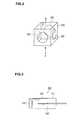
- Both of the first sensor section 13 and the second sensor section 14 have the same structure, and a measuring container 25 as shown in FIG. 2 is provided in each of these first sensor section 13 and second sensor section 14.
- the measuring container 25 has a prism shape with their upper and lower faces open, and in an illustrated example, the solvent 20 flows in the direction from bottom to top within the measuring container 25.
- the internal volume of the measuring container 25 is preferably about 1 cm 3 .
- a hole 26 is formed in each of four side faces of the measuring container 25, and a taste sensor 30 described later is inserted into each of these holes 26.
- the taste sensor 30 has a structure in which a sensor electrode 32 is inserted into a sensor container 31, and a lipid membrane 33 is attached to a front end of the sensor container 31.
- the interior of the sensor container 31 is filled with an internal liquid 34 of 3M KCl + saturated AgCl water solution, and the internal liquid 34 is in contact with the periphery of the sensor electrode 32.
- the lipid membrane 33 is an artificial membrane formed in imitation of a living body by fixing a lipid, which performs an important function to sense a taste, with a high polymer compound.
- one measuring container 25 is arranged in each of the first sensor section 13 and the second sensor section 14, the solvent 20 comes into contact with the lipid membranes 33 of four taste sensors 30 in the first sensor section 13, and similarly, the solvent 20 also comes into contact with the lipid membranes 33 of four taste sensors 30 in the second sensor section 13.
- the solvent 20 flowing through the flow path 15 comes into contact with the lipid membranes 33 of eight taste sensors 30 in all (Incidentally, as described later, the number of taste sensors 30 is not limited to eight).
- the eight sensors 30 thus arranged in the first sensor section 13 and the second sensor section 14 include the lipid membranes 33 which are made of membrane materials (lipids) different in property, respectively. Thereby, as described later, various taste substances contained in the solvent 20 come into contact with the lipid membranes 33 of the respective sensors 30 and selectively adsorbed.
- lipid membranes 33 which are made of membrane materials (lipids) different in property, respectively.
- the taste sensors 30 provided with the lipid membranes 33 each made of a negatively charged membrane material are arranged in the first sensor section 13, and the taste sensors 30 provided with the lipid membranes 33 each made of a positively charged membrane material are arranged in the second sensor section 14. Therefore, it is possible that in the first sensor section 13, positively charged taste substances (bitter ingredients) such as quinine hydrochloride are selectively adsorbed by the lipid membranes 33 of the respective taste sensors 30, and on the other hand, in the second sensor section 14, negatively charged taste substances such as iso-alpha-acid (a principal bitter substance of beer) are selectively adsorbed by the lipid membranes 33 of the respective taste sensors 30.
- positively charged taste substances such as quinine hydrochloride
- iso-alpha-acid a principal bitter substance of beer
- the membrane potential of the lipid membrane 33 is changed.
- the membrane potential of the lipid membrane 33 thus changed by the adsorption of the taste substance is measured by the sensor electrode 32 placed in the internal liquid 34 within the sensor container 31.
- the membrane potential measured by the sensor electrode 32 in each of the eight taste sensors 30 is inputted to an computing mechanism not illustrated.
- a reference electrode 40 is placed close to the measuring container 25, in a position to enable contact with the solvent 20 which flows upward within the measuring container 25.
- the periphery of the reference electrode 40 is wrapped with agar 41, and the potential of the solvent 20 flowing in the measuring container 25 is measured by the reference electrode 40 via the agar 41.
- the potential of the solvent 20 measured by the reference electrode 40 is inputted to the computing mechanism not illustrated.
- the computing mechanism not illustrated measures changes in membrane potential measured by the sensor electrodes 32 in the respective eight taste sensors 30 with the potential of the solvent 20 measured by the reference electrode 40 as a reference, performs computing processing of values measured by the respective taste sensors 30, and recognizes taste by pattern recognition or the peculiarities of the respective lipid membranes 33 for various kinds of tastes.
- the method of recognizing taste by performing computing processing of plural signals obtained from the respective taste sensors 30 by the use of the respective sensors 30 provided with eight different kinds of lipid membranes 33 can be implemented by a technique disclosed in Japan Society of Pharmaceutical Machinery and Engineering Journal Vol. 6, No. 4 (1997) (Akira Taniguchi, Chief researcher of Sensing Technology Project Team, Research Laboratory, Anritsu Corporation).
- the constant temperature bath 45 is filled with a heat medium such as warm water, whereby all of the holding section 12, the first sensor section 13, and the second sensor section 14 are maintained at a temperature almost equal to a human body temperature.
- the solvent 20 in the tank 10 is delivered in the order of the holding section 12, the first sensor section 13, and the second sensor section 14 via the flow path 15.
- the flow rate of the solvent 20 for example, at about 1 ml/min. In so doing, the solvent 20 whose quantity is almost equal to that of saliva secreted per unit time in a human mouth can be delivered.
- the solvent 20 thus delivered via the flow path 15 first flows through the holding section 12, and on this occasion, makes contact with the object to be recognized (a). Thereby, the object to be recognized (a) is dissolved or suspended in the solvent 20, and turns into taste substances, which flow out together with the solvent 20.
- the solvent 20 (the solvent 20 containing the taste substances) in which the object to be recognized (a) is dissolved or suspended by having flowed through the holding section 12 as described above is further delivered via the flow path 15, and then flows through the first sensor section 13 and the second sensor section 14.
- the solvent 20 flows through the interior of the measuring container 25 in the direction from bottom to top in each of the first sensor section 13 and the second sensor section 14, and on this occasion comes into contact with each of the eight lipid membranes 33 exposed to the interiors of the measuring containers 25. Consequently, various kinds of taste substances contained in the solvent 20 are selectively adsorbed by the lipid membranes 33 of the respective taste sensors 30.
- the membrane potentials of the lipid membranes 33 change, and these membrane potential changes are measured by the sensor electrodes 32 of the respective taste sensors 30 and inputted to the computing mechanism not illustrated.
- the computing mechanism performs computing processing of the membrane potential changes measured by the sensor electrodes 32 in the respective eight taste sensors 30 with reference to the potential of the solvent 20 measured by the reference electrode 40, and performs taste recognition by statistical analysis such as multivariate analysis (main ingredient analysis or discriminant analysis).
- this taste recognition system by delivering the solvent 20 at 1 ml/min by the delivery pump 11, the object to be recognized (a) can be dissolved or suspended in the solvent 20 under almost the same condition as in the human mouth in the holding section 12 placed within the constant temperature bath 45. Moreover, by delivering the solvent 20, in which the object to be recognized (a) is dissolved or suspended under the same condition as in an actual mouth, to the first sensor section 13 and the second sensor section 14 and measuring it by the taste sensors 30, taste recognition can be performed in the constant temperature bath 45 under almost the same condition as in the mouth.
- an example of the preferred embodiment of the present invention is explained, but the present invention is not limited to the embodiment illustrated above.
- a lipid membrane taste sensor such as SA402 manufactured by Anritsu Corporation
- an ion sensitive FET (Field Effect Transistors) taste sensor such as ⁇ ASTREE manufactured by Alpha M.O.S (France, Its General Agency in Japan is Primetech Corporation) can be used as the taste sensor 30.
- ⁇ ASTREE Field Effect Transistors
- Alpha M.O.S France, Its General Agency in Japan is Primetech Corporation
- inorganic solvents including water, and organic solvents may be used as the solvent 20.
- food and others besides the oral medicine may be used.
- the example, in which the four taste sensors 30 are arranged in the measuring container 25 provided in each of the first sensor section 13 and the second sensor section 14, and hence the eight taste sensors 30 in all are arranged, is explained, but the number of the taste sensors 30 is arbitrary, and, for example, the number of the taste sensors 30 may be reduced to seven or less by closing part of the holes 26 with blind patches or the like. Further, it is suitable to provide one taste sensor 30 in the measuring container 25. Furthermore, the shape of the measuring container 25 provided in each of the first sensor section 13 and the second sensor section 14 need not be a prism shape.
- the percentage of voids in the holding section 12 can be set as desired by adjusting the quantity of the holding members 21 filled into the holding section 12, and the same condition as in the actual mouth can be reproduced.
- the taste sensors 30 each provided with the lipid membrane 33 made of the negatively charged membrane material be arranged in the first sensor section 13 on the upstream side of the flow path 15, and the taste sensors 30 each provided with the lipid membrane 33 made of the positively charged membrane material be arranged in the second sensor section 13 on the downstream side of the flow path 15.
- the example in which the first sensor section 13 and the second sensor section 14 are provided midway in the flow path 15, but it is possible to perform taste measurement in batch mode by using a measuring container 50 as shown in FIG. 5.
- the measuring container 50 shown in FIG. 5 has a prism shape with its upper face open and its lower face closed, and the solvent 20 can be stored in the measuring container 50 by pouring the solvent 20 from above the measuring container 50.
- Holes 51 are formed in four side faces of this measuring container 50, respectively, the front ends of the taste sensors 30 described previously are inserted into the holes 51, respectively, and thus the lipid membranes 33 at the front ends of the respective taste sensors 30 can be exposed to the interior of the measuring container 50.
- the solvent 20 is also possible to pour the solvent 20 into such a measuring container 50, put the object (a) therein, and measure the taste in batch mode. By measuring potentials continuously, taste changes with time come to be shown. In this case, it is recommended that the quantity of the solvent 20 poured into the measuring container 50 be 1 ml, but, of course, the quantity is not limited to this quantity.
- FIG. 6 is a perspective view schematically showing the structure of a taste recognition system 2 according to another embodiment of the present invention.
- a mesh 61 as a supporting mechanism is attached to an opening of an upper face of a catch container 60.
- the interior of the catch container 60 is filled with a solvent of a phosphate buffer whose pH is adjusted at about 6.2 to about 7.6.
- a stirrer bar 65 for stirring the solvent is placed at the center of a bottom face of the catch container 60, and four lipid membranes 66 constituting taste sensors and a reference electrode 67 are arranged around the stirrer bar 65.
- the object to be recognized (a) is placed on the mesh 61 and pressed from above by a plunger 68 as a pressing mechanism.
- the taste substances contained in the object to be recognized (a) are made to flow down through the mesh 61, and dissolved or suspended in the solvent within the catch container 60. Consequently, the taste substances are adsorbed by the lipid membranes 66, and taste recognition becomes possible in the same manner as above.
- the object to be recognized (a) by being pressed by the plunger 68, the object to be recognized (a) can be measured under the same condition as in the case where the object to be recognized (a) is masticated. It is preferable that the pressing force of the plunger 68 can be changed optionally corresponding to the object to be recognized (a). Moreover, by measuring the pressing force of the plunger 68 necessary to press the object to be recognized (a), the texture necessary for mastication can be known, whereby new taste data (texture data) can be obtained.
- the catch container 60 may be placed in a constant temperature bath or a band heater (not illustrated). In so doing, taste recognition can be performed under almost the same condition in the human mouth. Moreover, it is appropriate that each aperture of the mesh 61 is about 1 mm to about 5 mm, and the provision of sufficient strength is recommended.
- Taste measurement is performed by using the taste recognition system shown in FIG. 1. First, one gram of fine particle medicine as the object to be recognized is held in the holding section, the solvent is delivered at a flow rate of 1 ml/min, and then measured in the first and second sensor sections. Consequently, results shown in FIG. 8 are obtained.
- the concentration of a principal agent is defined as 100 % when all of one gram of particle medicine is dissolved. Since 92 % of the principal agent is dissolved in one minute, it is expected that in the case of the entire particle medicine, almost the same percentage of particle medicine is dissolved.
- a sweetening agent is considerably more than the principal agent which tastes bitter, and hence if their concentrations are simply compared, sweetness ought to increase with a lapse of time.
- an oral mucous membrane plaster brand name: "Nitrofix” containing isosorbide nitrate as an active ingredient, as the object to be recognized, is held in the holding section and measured. Consequently, results shown in FIG. 9 are obtained. It is found that the taste of a first taste ingredient (bitter ingredient) becomes gradually stronger and then becomes gradually weaker as time passes. A second taste ingredient (sweet ingredient) hardly changes. The object to be recognized which has very little taste is measured in this example, but this system is also useful for an oral mucous membrane plaster, a troche, or the like which has a strong taste.
- the present invention it becomes possible to recognize the taste of the object to be recognized with a lapse of time in a state closest to actuality. According to the present invention, the taste of the object to be recognized can be measured in a solid state, and hence it is unnecessary to dissolve objects to be recognized one by one in the solvent.
Landscapes
- Life Sciences & Earth Sciences (AREA)
- Health & Medical Sciences (AREA)
- Chemical & Material Sciences (AREA)
- Engineering & Computer Science (AREA)
- Biochemistry (AREA)
- Analytical Chemistry (AREA)
- Pathology (AREA)
- Immunology (AREA)
- Food Science & Technology (AREA)
- Medicinal Chemistry (AREA)
- Physics & Mathematics (AREA)
- General Physics & Mathematics (AREA)
- General Health & Medical Sciences (AREA)
- Bioinformatics & Cheminformatics (AREA)
- Molecular Biology (AREA)
- Biophysics (AREA)
- Pharmacology & Pharmacy (AREA)
- Sampling And Sample Adjustment (AREA)
- Investigating Or Analysing Biological Materials (AREA)
Abstract
Description
Claims (6)
- A taste recognition system for performing taste recognition by dissolving or suspending an object to be recognized in a solvent, comprising:a holding section for holding the object to be recognized;a delivery flow path for delivering the solvent to said holding section; anda taste sensor for measuring a taste of the solvent which has flowed through said holding section.
- A taste recognition system as set forth in claim 1, further comprising:a delivery pump for letting the solvent flow through said delivery flow path.
- A taste recognition system as set forth in claim 1,
wherein said holding section and said taste sensor are placed in a constant temperature bath. - A taste recognition system for performing taste recognition by dissolving or suspending taste substances contained in an object to be recognized in a solvent, comprising:a supporting mechanism for supporting the object to be recognized and letting the taste substances pass therethrough;a pressing mechanism for pressing the object to be recognized supported by said supporting mechanism;a catch container, filled with the solvent, for catching the taste substances which have passed through said supporting mechanism; anda taste sensor for measuring a taste of the solvent filled into said catch container.
- A taste recognition system as set forth in claim 4,
wherein said catch container is placed in a constant temperature bath. - A taste recognition method for performing taste recognition by dissolving or suspending an object to be recognized in a solvent,
wherein taste recognition is performed by measuring the solvent which has flowed through a holding section which holds the object to be recognized while letting the solvent flow through the holding section.
Applications Claiming Priority (2)
| Application Number | Priority Date | Filing Date | Title |
|---|---|---|---|
| JP2001210311A JP3680167B2 (en) | 2001-07-11 | 2001-07-11 | Taste identification device and identification method |
| JP2001210311 | 2001-07-11 |
Publications (2)
| Publication Number | Publication Date |
|---|---|
| EP1278062A2 true EP1278062A2 (en) | 2003-01-22 |
| EP1278062A3 EP1278062A3 (en) | 2004-06-23 |
Family
ID=19045804
Family Applications (1)
| Application Number | Title | Priority Date | Filing Date |
|---|---|---|---|
| EP02014981A Withdrawn EP1278062A3 (en) | 2001-07-11 | 2002-07-09 | System and method of taste recognition |
Country Status (3)
| Country | Link |
|---|---|
| US (1) | US7090805B2 (en) |
| EP (1) | EP1278062A3 (en) |
| JP (1) | JP3680167B2 (en) |
Families Citing this family (7)
| Publication number | Priority date | Publication date | Assignee | Title |
|---|---|---|---|---|
| JP4728879B2 (en) * | 2006-06-07 | 2011-07-20 | 株式会社島津製作所 | Taste analyzer |
| EP2654455B1 (en) | 2010-12-20 | 2018-10-24 | DSM IP Assets B.V. | Use of nitrooxy organic molecules in feed for reducing methane emission in ruminants |
| JP2013195289A (en) * | 2012-03-21 | 2013-09-30 | Takasago Internatl Corp | Method for evaluating sense stimulating component |
| WO2015152219A1 (en) * | 2014-03-31 | 2015-10-08 | 株式会社堀場製作所 | Electrode, composite electrode, and liquid analyzer |
| US10502092B2 (en) * | 2014-11-20 | 2019-12-10 | United Technologies Corporation | Internally cooled turbine platform |
| US10702695B2 (en) | 2015-09-28 | 2020-07-07 | Virginia Commonwealth University | Wireless implantable taste system |
| JP7017727B2 (en) * | 2017-06-05 | 2022-02-09 | 島根県 | Taste sensor |
Family Cites Families (11)
| Publication number | Priority date | Publication date | Assignee | Title |
|---|---|---|---|---|
| JP2708437B2 (en) * | 1987-11-13 | 1998-02-04 | 株式会社日立製作所 | Automatic analyzer |
| IT1217205B (en) * | 1988-04-17 | 1990-03-14 | Aboca Di Meracati Valentino & | Infusion prepn. prod. |
| US5011608A (en) * | 1988-11-18 | 1991-04-30 | Dragana Damjanovic | Biogenic amine assay using HPLC-ECD |
| WO1990015996A1 (en) * | 1989-06-16 | 1990-12-27 | Mitsui Toatsu Chemicals, Inc. | Automatic analyzing method and device |
| IT1249433B (en) * | 1991-08-06 | 1995-02-23 | Pompeo Moscetta | PROCEDURE FOR DOSING ANALYTES IN LIQUID SAMPLES AND RELATED EQUIPMENT. |
| WO1996030753A1 (en) * | 1995-03-30 | 1996-10-03 | Anritsu Corporation | Method of determining taste with gustatory sensor made from molecular membrane |
| US5726750A (en) * | 1995-06-29 | 1998-03-10 | Sumitomo Metal Mining Co., Ltd. | Non-destructive taste characteristics measuring apparatus and tray used in the apparatus |
| JPH0991534A (en) * | 1995-09-26 | 1997-04-04 | Fuji Electric Co Ltd | Taste control device for cup type vending machine |
| EP0878711A1 (en) * | 1997-05-15 | 1998-11-18 | Interuniversitair Micro-Elektronica Centrum Vzw | Chemically sensitive sensor comprising arylene alkenylene oligomers |
| DE19812519A1 (en) * | 1998-03-21 | 1999-09-23 | Horst Ahlers | Measuring apparatus for determining constituents and/or taste directions of solid samples |
| JP2000076541A (en) * | 1998-08-28 | 2000-03-14 | Fuji Electric Co Ltd | Cup type coffee vending machine |
-
2001
- 2001-07-11 JP JP2001210311A patent/JP3680167B2/en not_active Expired - Fee Related
-
2002
- 2002-07-09 EP EP02014981A patent/EP1278062A3/en not_active Withdrawn
- 2002-07-10 US US10/191,495 patent/US7090805B2/en not_active Expired - Fee Related
Also Published As
| Publication number | Publication date |
|---|---|
| EP1278062A3 (en) | 2004-06-23 |
| US7090805B2 (en) | 2006-08-15 |
| US20030013198A1 (en) | 2003-01-16 |
| JP2003028830A (en) | 2003-01-29 |
| JP3680167B2 (en) | 2005-08-10 |
Similar Documents
| Publication | Publication Date | Title |
|---|---|---|
| DE60212044T2 (en) | Buccal resolution test for pharmaceutically active substrates | |
| Hedou et al. | Effects of cocaine on dopamine in subregions of the rat prefrontal cortex and their efferents to subterritories of the nucleus accumbens | |
| DE69505511T2 (en) | LIQUID SUPPLY AND COLLECTION METHOD | |
| DE69404472T2 (en) | MONITORING THE CONCENTRATION OF AN INGREDIENT OR A GROUP OF INGREDIENTS IN A BODY LIQUID | |
| Normand et al. | Modeling the kinetics of flavour release during drinking | |
| DE69307145T2 (en) | CALIBRATION SOLUTIONS FOR ANALYZES OF BIOLOGICAL LIQUIDS AND METHOD FOR THEIR USE | |
| Si-Nang et al. | Determination of coating thickness of microcapsules and influence upon diffusion | |
| Pardridge et al. | Tracer kinetic model of blood-brain barrier transport of plasma protein-bound ligands. Empiric testing of the free hormone hypothesis. | |
| US7090805B2 (en) | Taste recognition system and recognition method | |
| Pernarowski et al. | Continuous flow apparatus for the determination of the dissolution characteristics of tablets and capsules | |
| Fine et al. | Mechanism by which glucose stimulates the passive absorption of small solutes by the human jejunum in vivo | |
| US7129717B2 (en) | Systems and methods for measuring tear film osmolarity | |
| KOKINI et al. | Use of mass transfer theory to predict viscosity‐sweetness interactions of fructose and sucrose solutions containing tomato solids | |
| US20070067148A1 (en) | Computer system for determining a drug dosage | |
| US4594326A (en) | Time-integrated measurement for determining substances in biological fluids | |
| Bunaciu et al. | Amitriptyline-selective plastic membrane sensors and their pharmaceutical applications | |
| Soma et al. | Prerace venous blood acid‐base values in Standardbred horses | |
| US4798207A (en) | Device for enabling time-integrated measurement of substances in biological fluids | |
| US20080223116A1 (en) | Drug Release Cell and a Method for Testing the Drug Release of a Suspension in a Liquid Utilizing the Same | |
| Maddineni et al. | Dissolution research-a predictive tool for conventional and novel dosage forms | |
| EP1051618B1 (en) | Method and apparatus for determining blood oxygen transport | |
| JP3145498B2 (en) | Flow type corneal permeation test equipment | |
| DE1933118A1 (en) | Device and method for in vitro investigation of the dissolution behavior of drugs in the gastrointestinal tract | |
| Howard et al. | Dissolution profiles for multisized prednisolone acetate suspensions | |
| Rosen et al. | The use of constant volume ultrafiltration for dissolution studies |
Legal Events
| Date | Code | Title | Description |
|---|---|---|---|
| PUAI | Public reference made under article 153(3) epc to a published international application that has entered the european phase |
Free format text: ORIGINAL CODE: 0009012 |
|
| AK | Designated contracting states |
Kind code of ref document: A2 Designated state(s): AT BE BG CH CY CZ DE DK EE ES FI FR GB GR IE IT LI LU MC NL PT SE SK TR |
|
| AX | Request for extension of the european patent |
Free format text: AL;LT;LV;MK;RO;SI |
|
| PUAL | Search report despatched |
Free format text: ORIGINAL CODE: 0009013 |
|
| RIC1 | Information provided on ipc code assigned before grant |
Ipc: 7G 01N 30/62 B Ipc: 7G 01N 30/06 B Ipc: 7G 01N 33/00 B Ipc: 7G 01N 33/487 A |
|
| AK | Designated contracting states |
Kind code of ref document: A3 Designated state(s): AT BE BG CH CY CZ DE DK EE ES FI FR GB GR IE IT LI LU MC NL PT SE SK TR |
|
| AX | Request for extension of the european patent |
Extension state: AL LT LV MK RO SI |
|
| 17P | Request for examination filed |
Effective date: 20041221 |
|
| AKX | Designation fees paid |
Designated state(s): DE FR GB |
|
| RAP1 | Party data changed (applicant data changed or rights of an application transferred) |
Owner name: EISAI R&D MANAGEMENT CO., LTD. |
|
| 17Q | First examination report despatched |
Effective date: 20070926 |
|
| STAA | Information on the status of an ep patent application or granted ep patent |
Free format text: STATUS: THE APPLICATION IS DEEMED TO BE WITHDRAWN |
|
| 18D | Application deemed to be withdrawn |
Effective date: 20140201 |