EP1277356B1 - Services in a telecommunication network - Google Patents
Services in a telecommunication network Download PDFInfo
- Publication number
- EP1277356B1 EP1277356B1 EP01929573A EP01929573A EP1277356B1 EP 1277356 B1 EP1277356 B1 EP 1277356B1 EP 01929573 A EP01929573 A EP 01929573A EP 01929573 A EP01929573 A EP 01929573A EP 1277356 B1 EP1277356 B1 EP 1277356B1
- Authority
- EP
- European Patent Office
- Prior art keywords
- service
- terminal
- requests
- support
- entities
- Prior art date
- Legal status (The legal status is an assumption and is not a legal conclusion. Google has not performed a legal analysis and makes no representation as to the accuracy of the status listed.)
- Expired - Lifetime
Links
- 238000000034 method Methods 0.000 claims abstract description 18
- 230000011664 signaling Effects 0.000 claims description 17
- 238000004458 analytical method Methods 0.000 claims description 9
- 238000001228 spectrum Methods 0.000 claims description 4
- 239000000470 constituent Substances 0.000 claims description 3
- 238000001914 filtration Methods 0.000 description 8
- 230000001413 cellular effect Effects 0.000 description 7
- 230000003247 decreasing effect Effects 0.000 description 3
- 230000006870 function Effects 0.000 description 3
- 230000007246 mechanism Effects 0.000 description 2
- 230000032258 transport Effects 0.000 description 2
- 230000000007 visual effect Effects 0.000 description 2
- 230000008901 benefit Effects 0.000 description 1
- 230000004656 cell transport Effects 0.000 description 1
- 230000006835 compression Effects 0.000 description 1
- 238000007906 compression Methods 0.000 description 1
- 230000006855 networking Effects 0.000 description 1
- 238000005457 optimization Methods 0.000 description 1
- 230000001105 regulatory effect Effects 0.000 description 1
- 230000009131 signaling function Effects 0.000 description 1
Images


Classifications
-
- H—ELECTRICITY
- H04—ELECTRIC COMMUNICATION TECHNIQUE
- H04Q—SELECTING
- H04Q3/00—Selecting arrangements
- H04Q3/0016—Arrangements providing connection between exchanges
- H04Q3/0029—Provisions for intelligent networking
- H04Q3/0054—Service creation techniques
Definitions
- the invention is concerned with a communication network and a method therein for invoking services to one or more terminals from at least two service entities.
- the invention is also concerned with a terminal and a an assembler unit to be used in the communication network.
- Network support of conventional end user services (e.g. telephony) of today are mostly monolithically packaged to be invoked from a user terminal from a servoce entity belonging to one service provider.
- the traditionally bundled, packaged network support of end-user services may be decomposed into constituting sub-components when the packaged services from a particurar service provider are not used.
- Each of these constituting components may then be offered separately to the end-users by several different service providers, allowing the end-user to choose with whom to establish a business relation and thereby be allowed to invoke the individual service component.
- One service provider may also have many instances, service entities, of the same service component, e.g. geographically distributed. The end-user may also choose between the different service entities.
- individual service components such as a conference unit, a transcoder, an encryption service, a multiplexer, etc. may be required and the end-user may invoke each of these from his terminal, as e.g. were they end-points in a conference.
- terminal control logic complexity is increased in such an procedure, which also is adrawback.
- the existing telecommunication networks such as ISDN or GSM, use network based call control entity, not terminal based call control.
- network based call control entity not terminal based call control.
- terminal based call control is an option.
- QoS Quality of Service
- Such an architecture is described in the article "QoS Agency: An agent based Architecture for supporting Quality of service in Distributed Multimedia Systems” by L.A. guedes et al, 1997 IEEE Conference on Protocols for Multimedia Systems-Multimedia Networking PROMS-MnNet (Cat. No 97TB100116) p. 204-12, ISBN 0818679166, 24-27 Nov. 1997.
- An object of the invention is to give more freedom of choice for a terminal with respect to decisions about how services or service components implemented in a service entity, are controlled, e.g. how the terminal invokes services and service components and to realize this without a complex terminal control logic.
- An object of the invention is also to decrease the overall signaling load in the network.
- the method of the invention is performed in a communication network for invoking services, wherein the communication network comprises at least one or more terminals and at least two service entities. It is deduced at the terminal, by e.g. its control logic, what support and what service components that are necessary for providing a given end-user service.
- the terminal has in an unspecified manner identified service entities in the network which can provide the service component required.
- the terminal then constructs configuration requests, each of which is associated with one or more specific service entities for invoking individual service components composing a service.
- Each configuration request is forwarded from the terminal to the service entity/entities indirectly, by using a special network support function for configuring service entities - the assembler unit of the invention - or directly in a way, which is chosen in accordance with pre-defined criteria.
- the communication network and the terminal of the invention has means for performing the method of the invention.
- the terminal can decide the way for forwarding each configuration request in accordance with the pre-defined criteria, in other words it can choose in which extent it desires to use netwotk support in the configuration and distribution of the service requests and it can also decide not to use network support at all.
- the assembler unit of the invention is characterised by means for handling the configuration request(s) sent from a terminal in the communication network, each of them associated with one or more specific service entities for invoking individual service components.
- the means for handling the configuration request(s) preferably consist of means to analyse and distribute the set of configuration requests accordingly to the service entities in a way chosen by the terminal.
- the means for handling the configuration requests consist of means to distribute the requests to the service entities in a way influenced at least partly by the assembler unit. Then these means to forward the requests to the service entities in a way chosen at least partly by the assembler unit can comprise means to analyse at least one of the requests sent by the terminal and means to send the least one of the configuration requests via a further assembler unit in the communication network to the service entities.
- the terminal might for example give alternatives for the assembler to use some of the service components and the assembler might make its decision about which of the service components to choose based on a geographical analysis.
- a unit is introduced in the network giving support in that it can act on the behalf of the terminal and which, on its explicit request, invokes other service entities as requested on a case-by case principle.
- This unit here called an assembler unit, receives request from the user terminal.
- the assembler unit analyses the request and distributes individual configuration requests to the service units in question.
- the terminal that primarily decides the service components needed for a given service.
- the terminal has thus more control over decisions of which service components and which service entity (one or more) to invoke for a given service. If the terminal finds it convenient, it uses the service unit for one or more, usually all of the configuration requests. This decision made by the terminal takes place in accordance with pre-defined critera, which might depend on geographical position, price, available equipment, signalling amounts, spectrum allocation and desired performance/cha-racteristics.
- the analysis of which service components that are needed to get a complete end-user service is primarily performed at the terminal.
- the service entity analyses the service configuration request and distributes them to the different service entities.
- the assembler unit might only act on behalf of the terminal without any own intelligence. Alternatively, it may have some intelligent functions e.g. in the composing of the service by and in deciding how to distribute the requests. It might consider the need for assembling at least part of the requests in the set of request and use some further service unit to forward them. It might even have means for reporting the outcome of the terminal's original request.
- the invention focuses on terminal control. It is terminal control logic which analyses the need of service components on a case-by-case principle and, if network support from an assembler unit is needed for comfiguring and distributing the servgice components.
- the invention both allows for a solution in which the best of the available service components to be used in implementing the session on a case-by-case principle with respect to decreasing spectrum cost, total service configuration time as well as lowering terminal complexity. Furtherrmore, signalling over the air interface can be decreased.
- the basic underlying principle is to have the simplest possible procedure possible. Recognizing that in most situations, the terminals will no require any other network support than a transport, the invention provides a mechanism in which the terminal chooses to require support to configure service entities in the network, in the situations where these are needed. Then and only then are these support entities invoked. The benefit is simplicity- only invoke the more complex network support entities when needed.
- the invention also allows the end-user to directly establish a business relation with individual service component providing operators, while at service invocation let a 3 rd party support in assembling the different services, e.g. to a multimedia service.
- Introducing an assembler unit also opens up for new roles for operators which runs the assembly service without having to own the service entities it interacts with.
- the telecommunication network 1 comprises a terminal 2, another terminal 3, a router 4 for routing IP packets sent by the terminals to the right end-point, and several service entities (service providing entities) A, B, C and D.
- the cellular link layer is indicated with 5, which gives the functionality for the terminals to communicate over radio waves.
- the terminal 2 When the terminal 2 wishes to invoke services from the different service entities A,B,C and D, it sends a separate message to each one of them as indicated by the dotted lines A', B', C' and D'.
- the telecommunication network 1' comprises, in addition to the components in figure 1, i.e. 2, 3,4, 5, A, B, C, and D, an assembler support G.
- the terminal 2 wishes to invoke services from several service entities, it makes a decision whether to send the service component requests composing the service as in figure 1 or as in figure 2.
- it first send the set of requests to the service support 6 as indicated by the straight line G'.
- the assembler unit G disassembles the request in its constituent requests a,b,c,d and forwards them to the service entities A,B,C and D.
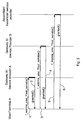
- Figure 3 shows a detailed signalling example showing the overall principle for configuring and invoking services in the existing solution.
- Terminal A locates possible service entities via some unspecified mechanism known in the art.
- a negotiation is performed with each about the right to invoke the service provided at a later stage.
- the signalling messages for requesting the service from each entities A, B and C are indicated with steps 1, 3 and 5 respectively and the messages from the service entities A, B and C telling that the requests are granted are indicated with steps 2, 4 and 6 respectively.
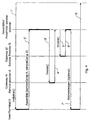
- FIG 4 shows a detailed signalling example showing the overall principle for configuring and invoking services in the invention.
- the B-terminal invites A to a session in step 1'.
- A determines that it requires support from service entities A and B, each providing a supporting service for the invited session.
- A also chooses to use the assembler unit as network support in coordinating the configuration.
- A therefore requests the assembler unit in step 2' to coordinate the configuration.
- the assembler unit invokes the desired services from the service entities in question in steps 3' and 5', the services being granted in steps 4' and 6'.
- step 7' the granted services are informed to A and the session is started in step 8'.
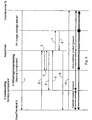
- Figure 5 shows another detailed signaling example showing the overall principle for configuring and invoking services in the invention. It is assumed that two users shall communicate. During the initial session signaling, it is discovered that there is a need for a transcoding service since the two speech coders in the terminals are not compatible. It is also discovered that since one of the terminals uses a cellular access, it wishes some of the data to be compressed and irrelevant information filtered away.
- A has previously located such service components and agreed with the service entity that he may use them.
- A send a request to the assembler unit to configure these two service components as well, i.e. the transcoder and the filter.
- the assembler unit performs the configuration and acknowledges this to A.
- A responds to B and the session may start.
- step 1 A determines that he wishes to respond with audio and visual information exchange where the image is stored in a separate server. A also determines that he requires a filtering optimization device for the visual data stream due to the cost of the cellular access and a transcoding service for the audio data stream since the codecs in the two terminals are not compatible.
- step 2 A requests the assembler unit to configure the transcoding service and the filtering/compressing service but also and end-point in which images to be exchanged between A and B is stored.
- step 3 the assembler unit requests filtering/compressing from a filtering/compressing service component, and gets the filtering/compressing in step 4.
- step 5 the assembler unit requests the transcoding from a transcoding service component and gets the transcoding in step 6.
- An image storage server is contacted by the assembler unit in step 7, the service of which is received in step 8.
- the assembler unit then configures the two service components and the image storage end-pont and aknowledges this to A in step 9.
- A then responds to B in step 10 and the session starts.
- the data phase is indicated by the bold arrows.
- the upper arrows indicates that a transcoding component is needed as an inter-working function between the terminals to convert between cellular coded speech and non-cellular coded speech.
- the lower arrows indicates that filtering and compressing as well as image storing takes place between the two terminals.
Landscapes
- Engineering & Computer Science (AREA)
- Computer Networks & Wireless Communication (AREA)
- Mobile Radio Communication Systems (AREA)
- Telephonic Communication Services (AREA)
- Communication Control (AREA)
- Sub-Exchange Stations And Push- Button Telephones (AREA)
- Diaphragms For Electromechanical Transducers (AREA)
- Pharmaceuticals Containing Other Organic And Inorganic Compounds (AREA)
Abstract
Description
- The invention is concerned with a communication network and a method therein for invoking services to one or more terminals from at least two service entities. The invention is also concerned with a terminal and a an assembler unit to be used in the communication network.
- Network support of conventional end user services (e.g. telephony) of today are mostly monolithically packaged to be invoked from a user terminal from a servoce entity belonging to one service provider.
- In a de-regulated market, which is the trend of today, the traditionally bundled, packaged network support of end-user services may be decomposed into constituting sub-components when the packaged services from a particurar service provider are not used. Each of these constituting components may then be offered separately to the end-users by several different service providers, allowing the end-user to choose with whom to establish a business relation and thereby be allowed to invoke the individual service component. One service provider may also have many instances, service entities, of the same service component, e.g. geographically distributed. The end-user may also choose between the different service entities.
- For example, in a multimedia conversation, individual service components, such as a conference unit, a transcoder, an encryption service, a multiplexer, etc. may be required and the end-user may invoke each of these from his terminal, as e.g. were they end-points in a conference.
- Such a procedure would however have some drawbacks, e.g. result in a heavy signalling load, which in case of a cellular link has a high price in terms of spectrum cost. For a cellular operator, even savings in terms of single percentages counts, which is why signalling should be decreased if a cellular transport is used.
- Furthermore, the terminal control logic complexity is increased in such an procedure, which also is adrawback.
- The existing telecommunication networks, such as ISDN or GSM, use network based call control entity, not terminal based call control. In an IP-network, terminal based call control is an option.
- Prior art methods exist which are meant to decrease signaling when invoking services. In the European Patent Application EP 0 762 789 A2, a netweork based agent performs complex signaling functions related to call processing on behalf of an associated mobile terminal, thus reducing the amount of signaling traffic that must travel over the valuable ait interface.
- Also agencies for establishing and maintaining desired Quality of Service (QoS) in wired systems are known. Such an architecture is described in the article "QoS Agency: An agent based Architecture for supporting Quality of service in Distributed Multimedia Systems" by L.A. guedes et al, 1997 IEEE Conference on Protocols for Multimedia Systems-Multimedia Networking PROMS-MnNet (Cat. No 97TB100116) p. 204-12, ISBN 0818679166, 24-27 Nov. 1997.
- An object of the invention is to give more freedom of choice for a terminal with respect to decisions about how services or service components implemented in a service entity, are controlled, e.g. how the terminal invokes services and service components and to realize this without a complex terminal control logic.
- An object of the invention is also to decrease the overall signaling load in the network.
- The method of the invention is performed in a communication network for invoking services, wherein the communication network comprises at least one or more terminals and at least two service entities. It is deduced at the terminal, by e.g. its control logic, what support and what service components that are necessary for providing a given end-user service. The terminal has in an unspecified manner identified service entities in the network which can provide the service component required. The terminal then constructs configuration requests, each of which is associated with one or more specific service entities for invoking individual service components composing a service. Each configuration request is forwarded from the terminal to the service entity/entities indirectly, by using a special network support function for configuring service entities - the assembler unit of the invention - or directly in a way, which is chosen in accordance with pre-defined criteria.
- The communication network and the terminal of the invention has means for performing the method of the invention. Especially, it is mentioned that the terminal can decide the way for forwarding each configuration request in accordance with the pre-defined criteria, in other words it can choose in which extent it desires to use netwotk support in the configuration and distribution of the service requests and it can also decide not to use network support at all.
- The assembler unit of the invention is characterised by means for handling the configuration request(s) sent from a terminal in the communication network, each of them associated with one or more specific service entities for invoking individual service components.
- The means for handling the configuration request(s) preferably consist of means to analyse and distribute the set of configuration requests accordingly to the service entities in a way chosen by the terminal.
- Another preferred embodiment of the assembler unit is that the means for handling the configuration requests consist of means to distribute the requests to the service entities in a way influenced at least partly by the assembler unit. Then these means to forward the requests to the service entities in a way chosen at least partly by the assembler unit can comprise means to analyse at least one of the requests sent by the terminal and means to send the least one of the configuration requests via a further assembler unit in the communication network to the service entities. The terminal might for example give alternatives for the assembler to use some of the service components and the assembler might make its decision about which of the service components to choose based on a geographical analysis.
- Other advantageous embodiments of the invention is presented in the subclaims.
- Thus, a unit is introduced in the network giving support in that it can act on the behalf of the terminal and which, on its explicit request, invokes other service entities as requested on a case-by case principle. This unit, here called an assembler unit, receives request from the user terminal. The assembler unit analyses the request and distributes individual configuration requests to the service units in question.
- It is, however, the terminal that primarily decides the service components needed for a given service. The terminal has thus more control over decisions of which service components and which service entity (one or more) to invoke for a given service. If the terminal finds it convenient, it uses the service unit for one or more, usually all of the configuration requests. This decision made by the terminal takes place in accordance with pre-defined critera, which might depend on geographical position, price, available equipment, signalling amounts, spectrum allocation and desired performance/cha-racteristics.
- As was mentioned above, the analysis of which service components that are needed to get a complete end-user service is primarily performed at the terminal. When the terminal decides to use the assembler unit for support in configuring the individual service componetns, the service entity analyses the service configuration request and distributes them to the different service entities.
- The assembler unit might only act on behalf of the terminal without any own intelligence. Alternatively, it may have some intelligent functions e.g. in the composing of the service by and in deciding how to distribute the requests. It might consider the need for assembling at least part of the requests in the set of request and use some further service unit to forward them. It might even have means for reporting the outcome of the terminal's original request.
- The invention focuses on terminal control. It is terminal control logic which analyses the need of service components on a case-by-case principle and, if network support from an assembler unit is needed for comfiguring and distributing the servgice components.
- By placing more control in the terminal, solutions providing more user control are facilitated. The invention both allows for a solution in which the best of the available service components to be used in implementing the session on a case-by-case principle with respect to decreasing spectrum cost, total service configuration time as well as lowering terminal complexity. Furtherrmore, signalling over the air interface can be decreased.
- The basic underlying principle is to have the simplest possible procedure possible. Recognizing that in most situations, the terminals will no require any other network support than a transport, the invention provides a mechanism in which the terminal chooses to require support to configure service entities in the network, in the situations where these are needed. Then and only then are these support entities invoked. The benefit is simplicity- only invoke the more complex network support entities when needed.
- The invention also allows the end-user to directly establish a business relation with individual service component providing operators, while at service invocation let a 3rd party support in assembling the different services, e.g. to a multimedia service. Introducing an assembler unit also opens up for new roles for operators which runs the assembly service without having to own the service entities it interacts with.
-
- Figure 1 shows the architecture and method principle in the existing solution to invoke services from several service entities.
- Figure 2 shows the architecture and method principle in the invention to invoke services from several service entities.
- Figure 3 shows a detailed signalling example showing the overall principle for configuring and invoking services in the existing solution.
- Figure 4 shows a detailed signalling example showing the overall principle for configuring and invoking services in the invention.
- Figure 5 shows another detailed signalling example showing the overall principle for configuring and invoking services in the invention.
-
- Some examples of embodiments of the inevntion are presented in the following, which are not menat to restrict the invention. In these exasmples, most of the intelligence and the decisions are made in the terminal, but as has been indicated easrlier in the text, the assembler might be given more intelligence and it might make a part of the decisions with respect to distributing and composing the service for the terminal. The terminal might also decide not to use the assembler unit as support for invoking the desired service.
- In the architecture of figure 1, which is used in existing prior art solutions when a terminal can use several service entities or servic eproviders for invoking services, the
telecommunication network 1 comprises aterminal 2, anotherterminal 3, arouter 4 for routing IP packets sent by the terminals to the right end-point, and several service entities (service providing entities) A, B, C and D. The cellular link layer is indicated with 5, which gives the functionality for the terminals to communicate over radio waves. - When the
terminal 2 wishes to invoke services from the different service entities A,B,C and D, it sends a separate message to each one of them as indicated by the dotted lines A', B', C' and D'. - The architecture of figure 2, used in the invention, the telecommunication network 1' comprises, in addition to the components in figure 1, i.e. 2, 3,4, 5, A, B, C, and D, an assembler support G. When the
terminal 2 wishes to invoke services from several service entities, it makes a decision whether to send the service component requests composing the service as in figure 1 or as in figure 2. In figure 2 it first send the set of requests to theservice support 6 as indicated by the straight line G'. The assembler unit G disassembles the request in its constituent requests a,b,c,d and forwards them to the service entities A,B,C and D. - Figure 3 shows a detailed signalling example showing the overall principle for configuring and invoking services in the existing solution. Terminal A locates possible service entities via some unspecified mechanism known in the art. A negotiation is performed with each about the right to invoke the service provided at a later stage. The signalling messages for requesting the service from each entities A, B and C are indicated with
steps steps - Figure 4 shows a detailed signalling example showing the overall principle for configuring and invoking services in the invention. In this signalling example, the B-terminal invites A to a session in step 1'. A determines that it requires support from service entities A and B, each providing a supporting service for the invited session. A also chooses to use the assembler unit as network support in coordinating the configuration. A therefore requests the assembler unit in step 2' to coordinate the configuration. The assembler unit invokes the desired services from the service entities in question in steps 3' and 5', the services being granted in steps 4' and 6'. In step 7', the granted services are informed to A and the session is started in step 8'.
- Figure 5 shows another detailed signaling example showing the overall principle for configuring and invoking services in the invention. It is assumed that two users shall communicate. During the initial session signaling, it is discovered that there is a need for a transcoding service since the two speech coders in the terminals are not compatible. It is also discovered that since one of the terminals uses a cellular access, it wishes some of the data to be compressed and irrelevant information filtered away.
- Thus, to complete the service, there is a need for a transcoding service component and a compression/filtering service component in addition to the transport services.
- It is assumed that A invites B to a session and A determines the need for a transcoding service and a filtering service. A has previously located such service components and agreed with the service entity that he may use them. A send a request to the assembler unit to configure these two service components as well, i.e. the transcoder and the filter. The assembler unit performs the configuration and acknowledges this to A. A responds to B and the session may start.
- This is presented in detail in figure 5, in which B invites A to an audio session in
step 1. A determines that he wishes to respond with audio and visual information exchange where the image is stored in a separate server. A also determines that he requires a filtering optimization device for the visual data stream due to the cost of the cellular access and a transcoding service for the audio data stream since the codecs in the two terminals are not compatible. Instep 2, A requests the assembler unit to configure the transcoding service and the filtering/compressing service but also and end-point in which images to be exchanged between A and B is stored. Instep 3, the assembler unit requests filtering/compressing from a filtering/compressing service component, and gets the filtering/compressing instep 4. Instep 5, the assembler unit requests the transcoding from a transcoding service component and gets the transcoding instep 6. An image storage server is contacted by the assembler unit instep 7, the service of which is received instep 8. The assembler unit then configures the two service components and the image storage end-pont and aknowledges this to A instep 9. A then responds to B instep 10 and the session starts. - The data phase is indicated by the bold arrows. The upper arrows indicates that a transcoding component is needed as an inter-working function between the terminals to convert between cellular coded speech and non-cellular coded speech. The lower arrows indicates that filtering and compressing as well as image storing takes place between the two terminals.
Claims (11)
- Method in a communication network for invoking services, the communication network comprising
a terminal requiring an end-user service;
at least one service entity, providing services to support the required end-user service, wherein the terminal has performed a negotiation with each of the at least one service entity about the right to invoke the respective service;
a configuration support entity, a so-called assembler unit (G), acting on behalf of the terminal, providing support for configuring said service entity or entities, with which assembler unit (G) the terminal has pre-defined criteria
for handling configuration service requests
the method being characterized by the following stepsa) deducing at the terminal the support and service components to support the required end-user service provided by the one or more specific service entities,b) constructing at the terminal a set of configuration requests, each request associated with one or more specific service entities for invoking individual service components composing a service to support the required end-user service and sending said set of requests to the assembler unit (G) if the terminal deduces so; andc) disassembling at the assembler unit (G) said set of requests in its constituent requests and forwarding them to the respective at least one service entity, in a way chosen in accordance with said pre-defined criteria, for invoking the respective service, based on said negotiation. - Method of claim 1, characterized in that the pre-defined criteria deciding the way of forwarding the requests are based on geographical position, price, signalling amounts, available equipment, spectrum allocation and desired performance/characteristics.
- Method of claim 1 or 2, characterized in that depending on the pre-defined criteria, two or more of the configuration requests are forwarded to the service entities in a coordinated way by using network support.
- Method of any of claims 1 - 3, characterized in that all decisions about the composing of the service and the way of forwarding the requests is made by the terminal.
- Method of any of claims 1 - 3, characterized in that the decisions about the composing of the service and the way of distributing the requests is partly made by using network support.
- Terminal in a communication network for invoking services, the communication network comprising at least one or more terminals and at least one service entity, providing services to support a required end-user service,
characterized by the terminal having performed a negotiation with each of the at least one service entity about the right to invoke the respective service; a configuration support entity, the communication network further comprising a so-called assembler unit (G), providing support for configuring said service entity or entities, with which assembler unit (G) the terminal has pre-defined criteria for handling service requests, the terminal comprising:a) means for deducing at a terminal necessary support and service components for providing an end-user service and deducing if network support from the assembler unit (G) is needed for a required end-user service, andb) means for constructing a set of configuration requests, each associated with one or more specific service entities for invoking individual service components composing a service deduced and sending said set of configuration requests to the assembler unit (G) when the terminal has deduced that network support is needed. - Terminal of claim 6, characterized by means for forwarding two or more of the configuration requests to the service entities in a coordinated way by using network support.
- Assembler unit in a communication network for invoking services, the communication network also comprising a terminal requiring an end-user service and at least one service entity, providing services to support the required end-user service, the terminal having performed a negotiation with each of the at least one service entity about the right to invoke the respective service, the assembler (G) unit being characterized by,
providing support for configuring said service entity or entities, and for which assembler unit (G) the terminal has pre-defined criteria for handling configuration service requests, and
means for handling a set of requests received from the terminal, by disassembling the set in its constituent requests, analysing them and forwarding them to the respective at least one service entity, in a way chosen in accordance with said pre-defined criteria, for invoking the respective service, based on said negotiation. - Assembler unit of claim 9, characterized in that the means for handling the set of configuration requests consist of means to analyse and distribute the requests to the service entities in a way influenced at least partly by the assembler unit.
- Assembler unit of claim 9, characterized in that the means to distribute the requests to the service entities in a way influenced at least partly by the assembler unit comprises
means to analyse and coordinate at least one of the requests sent by the terminal and
means to send the least one of the configuration requests via a further assembler unit in the communication network to the service entities. - Assembler unit of any of claim 7 - 11, characterized in that it has means for reporting to the terminal the outcome of the terminal's original request.
Priority Applications (1)
| Application Number | Priority Date | Filing Date | Title |
|---|---|---|---|
| EP01929573A EP1277356B1 (en) | 2000-04-28 | 2001-04-18 | Services in a telecommunication network |
Applications Claiming Priority (4)
| Application Number | Priority Date | Filing Date | Title |
|---|---|---|---|
| EP00850075 | 2000-04-28 | ||
| EP00850075A EP1150519A1 (en) | 2000-04-28 | 2000-04-28 | Services in a telecommunication network |
| PCT/EP2001/004381 WO2001084858A1 (en) | 2000-04-28 | 2001-04-18 | Services in a telecommunication network |
| EP01929573A EP1277356B1 (en) | 2000-04-28 | 2001-04-18 | Services in a telecommunication network |
Publications (2)
| Publication Number | Publication Date |
|---|---|
| EP1277356A1 EP1277356A1 (en) | 2003-01-22 |
| EP1277356B1 true EP1277356B1 (en) | 2004-07-28 |
Family
ID=8175659
Family Applications (2)
| Application Number | Title | Priority Date | Filing Date |
|---|---|---|---|
| EP00850075A Withdrawn EP1150519A1 (en) | 2000-04-28 | 2000-04-28 | Services in a telecommunication network |
| EP01929573A Expired - Lifetime EP1277356B1 (en) | 2000-04-28 | 2001-04-18 | Services in a telecommunication network |
Family Applications Before (1)
| Application Number | Title | Priority Date | Filing Date |
|---|---|---|---|
| EP00850075A Withdrawn EP1150519A1 (en) | 2000-04-28 | 2000-04-28 | Services in a telecommunication network |
Country Status (7)
| Country | Link |
|---|---|
| US (2) | US6920490B2 (en) |
| EP (2) | EP1150519A1 (en) |
| JP (1) | JP2003533105A (en) |
| AT (1) | ATE272295T1 (en) |
| AU (1) | AU2001256301A1 (en) |
| DE (1) | DE60104537D1 (en) |
| WO (1) | WO2001084858A1 (en) |
Families Citing this family (3)
| Publication number | Priority date | Publication date | Assignee | Title |
|---|---|---|---|---|
| US7526572B2 (en) * | 2001-07-12 | 2009-04-28 | Research In Motion Limited | System and method for providing remote data access for a mobile communication device |
| US20050198643A1 (en) * | 2004-02-17 | 2005-09-08 | Lachelt David J. | Journaling proxy in activation solution |
| US8838687B2 (en) * | 2008-05-20 | 2014-09-16 | Telefonaktiebolaget L M Ericsson (Publ) | Composite services provision within a telecommunications network |
Family Cites Families (10)
| Publication number | Priority date | Publication date | Assignee | Title |
|---|---|---|---|---|
| US5528677A (en) * | 1992-05-01 | 1996-06-18 | Sprint Communications Company L.P. | System for providing communications services in a telecommunications network |
| US5469684A (en) * | 1993-08-10 | 1995-11-28 | Franklin; James W. | Concrete building frame construction method |
| WO1995030317A1 (en) | 1994-04-28 | 1995-11-09 | British Telecommunications Public Limited Company | Service provision system for communications networks |
| JP3725209B2 (en) * | 1995-08-22 | 2005-12-07 | 株式会社東芝 | Communication system and communication control method for communication system |
| CA2179337C (en) | 1995-08-22 | 2000-11-14 | Thomas F. Laporta | Network-based migrating user agents for personal communication services |
| US5740236A (en) * | 1995-12-21 | 1998-04-14 | Ericsson, Inc. | System for providing feature services in a telecommunications system |
| US5946618A (en) * | 1996-11-04 | 1999-08-31 | Qualcomm Incorporated | Method and apparatus for performing position-based call processing in a mobile telephone system using multiple location mapping schemes |
| SE9902683L (en) * | 1998-08-25 | 2000-02-26 | Telia Ab | Improvements to, or with respect to, telecommunications service management systems |
| SE521930C2 (en) * | 1998-08-25 | 2003-12-23 | Telia Ab | Telecommunication service hating system adapted to handle a number of complex telecommunications services |
| CN1197297C (en) * | 2000-03-10 | 2005-04-13 | 黎明网络有限公司 | A platform information switch |
-
2000
- 2000-04-28 EP EP00850075A patent/EP1150519A1/en not_active Withdrawn
-
2001
- 2001-04-18 WO PCT/EP2001/004381 patent/WO2001084858A1/en not_active Ceased
- 2001-04-18 EP EP01929573A patent/EP1277356B1/en not_active Expired - Lifetime
- 2001-04-18 DE DE60104537T patent/DE60104537D1/en not_active Expired - Lifetime
- 2001-04-18 AT AT01929573T patent/ATE272295T1/en not_active IP Right Cessation
- 2001-04-18 JP JP2001581551A patent/JP2003533105A/en active Pending
- 2001-04-18 AU AU2001256301A patent/AU2001256301A1/en not_active Abandoned
- 2001-04-20 US US09/839,100 patent/US6920490B2/en not_active Expired - Lifetime
-
2005
- 2005-05-26 US US11/138,133 patent/US7149793B2/en not_active Expired - Lifetime
Also Published As
| Publication number | Publication date |
|---|---|
| EP1150519A1 (en) | 2001-10-31 |
| US7149793B2 (en) | 2006-12-12 |
| WO2001084858A1 (en) | 2001-11-08 |
| ATE272295T1 (en) | 2004-08-15 |
| US20050216574A1 (en) | 2005-09-29 |
| US20020023149A1 (en) | 2002-02-21 |
| US6920490B2 (en) | 2005-07-19 |
| JP2003533105A (en) | 2003-11-05 |
| EP1277356A1 (en) | 2003-01-22 |
| AU2001256301A1 (en) | 2001-11-12 |
| DE60104537D1 (en) | 2004-09-02 |
Similar Documents
| Publication | Publication Date | Title |
|---|---|---|
| US6671367B1 (en) | Capability negotiation in a telecommunications network | |
| US7414981B2 (en) | Method and system for event and message registration by an association controller | |
| US8214879B2 (en) | System and method for enforcing policy in a communication network | |
| US5583914A (en) | Intelligent wireless signaling overlay for a telecommunication network | |
| US7471653B2 (en) | Method and system for imposing air interface service level | |
| EP1400137B1 (en) | Circuit-switched and packet-switched communications | |
| EP1263242B1 (en) | Call waiting service in a multimedia network | |
| US20020167935A1 (en) | Method and system for dynamic service profile integration by a service controller | |
| EP1867202B1 (en) | Telecommunication network support for service based policy in roaming configurations | |
| US20020167908A1 (en) | Method and system for dynamic service classification and integrated service control | |
| US9350784B2 (en) | Method and communication system for selecting a transmission mode for transmitting payload data | |
| JP5118757B2 (en) | Function negotiation in telecommunications networks | |
| KR19980079480A (en) | Operational method for real-time user selection of communication network and voice and / or data path in that network | |
| WO2002039669A2 (en) | Method and system for providing services in communications networks | |
| US7113987B2 (en) | Method and system for dynamic message registration by a service controller | |
| EP1405497B1 (en) | Processing multimedia calls in a packet-based network | |
| EP1195030A2 (en) | Adaption of services in a telephone network | |
| US7149793B2 (en) | Communication network and method therein | |
| US8483206B2 (en) | Method and system for providing a multimedia call model | |
| US7414970B2 (en) | Provision of static QoS control using dynamic service based policy mechanisms | |
| GB2350257A (en) | Capability negotiation in a telecommunications network | |
| WO2000011886A2 (en) | Improvements in, or relating to, teleservice management systems |
Legal Events
| Date | Code | Title | Description |
|---|---|---|---|
| PUAI | Public reference made under article 153(3) epc to a published international application that has entered the european phase |
Free format text: ORIGINAL CODE: 0009012 |
|
| 17P | Request for examination filed |
Effective date: 20021012 |
|
| AK | Designated contracting states |
Kind code of ref document: A1 Designated state(s): AT BE CH CY DE DK ES FI FR GB GR IE IT LI LU MC NL PT SE TR |
|
| AX | Request for extension of the european patent |
Free format text: AL;LT;LV;MK;RO;SI |
|
| GRAP | Despatch of communication of intention to grant a patent |
Free format text: ORIGINAL CODE: EPIDOSNIGR1 |
|
| RAP1 | Party data changed (applicant data changed or rights of an application transferred) |
Owner name: TELEFONAKTIEBOLAGET LM ERICSSON (PUBL) |
|
| GRAS | Grant fee paid |
Free format text: ORIGINAL CODE: EPIDOSNIGR3 |
|
| GRAA | (expected) grant |
Free format text: ORIGINAL CODE: 0009210 |
|
| AK | Designated contracting states |
Kind code of ref document: B1 Designated state(s): AT BE CH CY DE DK ES FI FR GB GR IE IT LI LU MC NL PT SE TR |
|
| PG25 | Lapsed in a contracting state [announced via postgrant information from national office to epo] |
Ref country code: TR Free format text: LAPSE BECAUSE OF FAILURE TO SUBMIT A TRANSLATION OF THE DESCRIPTION OR TO PAY THE FEE WITHIN THE PRESCRIBED TIME-LIMIT Effective date: 20040728 Ref country code: FI Free format text: LAPSE BECAUSE OF FAILURE TO SUBMIT A TRANSLATION OF THE DESCRIPTION OR TO PAY THE FEE WITHIN THE PRESCRIBED TIME-LIMIT Effective date: 20040728 Ref country code: ES Free format text: LAPSE BECAUSE OF FAILURE TO SUBMIT A TRANSLATION OF THE DESCRIPTION OR TO PAY THE FEE WITHIN THE PRESCRIBED TIME-LIMIT Effective date: 20040728 Ref country code: NL Free format text: LAPSE BECAUSE OF FAILURE TO SUBMIT A TRANSLATION OF THE DESCRIPTION OR TO PAY THE FEE WITHIN THE PRESCRIBED TIME-LIMIT Effective date: 20040728 Ref country code: CH Free format text: LAPSE BECAUSE OF FAILURE TO SUBMIT A TRANSLATION OF THE DESCRIPTION OR TO PAY THE FEE WITHIN THE PRESCRIBED TIME-LIMIT Effective date: 20040728 Ref country code: LI Free format text: LAPSE BECAUSE OF FAILURE TO SUBMIT A TRANSLATION OF THE DESCRIPTION OR TO PAY THE FEE WITHIN THE PRESCRIBED TIME-LIMIT Effective date: 20040728 Ref country code: AT Free format text: LAPSE BECAUSE OF FAILURE TO SUBMIT A TRANSLATION OF THE DESCRIPTION OR TO PAY THE FEE WITHIN THE PRESCRIBED TIME-LIMIT Effective date: 20040728 Ref country code: BE Free format text: LAPSE BECAUSE OF FAILURE TO SUBMIT A TRANSLATION OF THE DESCRIPTION OR TO PAY THE FEE WITHIN THE PRESCRIBED TIME-LIMIT Effective date: 20040728 |
|
| REG | Reference to a national code |
Ref country code: GB Ref legal event code: FG4D |
|
| REG | Reference to a national code |
Ref country code: CH Ref legal event code: EP |
|
| REG | Reference to a national code |
Ref country code: IE Ref legal event code: FG4D |
|
| REF | Corresponds to: |
Ref document number: 60104537 Country of ref document: DE Date of ref document: 20040902 Kind code of ref document: P |
|
| PG25 | Lapsed in a contracting state [announced via postgrant information from national office to epo] |
Ref country code: GR Free format text: LAPSE BECAUSE OF FAILURE TO SUBMIT A TRANSLATION OF THE DESCRIPTION OR TO PAY THE FEE WITHIN THE PRESCRIBED TIME-LIMIT Effective date: 20041028 Ref country code: DK Free format text: LAPSE BECAUSE OF FAILURE TO SUBMIT A TRANSLATION OF THE DESCRIPTION OR TO PAY THE FEE WITHIN THE PRESCRIBED TIME-LIMIT Effective date: 20041028 Ref country code: SE Free format text: LAPSE BECAUSE OF FAILURE TO SUBMIT A TRANSLATION OF THE DESCRIPTION OR TO PAY THE FEE WITHIN THE PRESCRIBED TIME-LIMIT Effective date: 20041028 |
|
| PG25 | Lapsed in a contracting state [announced via postgrant information from national office to epo] |
Ref country code: DE Free format text: LAPSE BECAUSE OF FAILURE TO SUBMIT A TRANSLATION OF THE DESCRIPTION OR TO PAY THE FEE WITHIN THE PRESCRIBED TIME-LIMIT Effective date: 20041029 |
|
| NLV1 | Nl: lapsed or annulled due to failure to fulfill the requirements of art. 29p and 29m of the patents act | ||
| LTIE | Lt: invalidation of european patent or patent extension |
Effective date: 20040728 |
|
| REG | Reference to a national code |
Ref country code: CH Ref legal event code: PL |
|
| PG25 | Lapsed in a contracting state [announced via postgrant information from national office to epo] |
Ref country code: IE Free format text: LAPSE BECAUSE OF NON-PAYMENT OF DUE FEES Effective date: 20050418 Ref country code: CY Free format text: LAPSE BECAUSE OF FAILURE TO SUBMIT A TRANSLATION OF THE DESCRIPTION OR TO PAY THE FEE WITHIN THE PRESCRIBED TIME-LIMIT Effective date: 20050418 Ref country code: LU Free format text: LAPSE BECAUSE OF NON-PAYMENT OF DUE FEES Effective date: 20050418 |
|
| PG25 | Lapsed in a contracting state [announced via postgrant information from national office to epo] |
Ref country code: MC Free format text: LAPSE BECAUSE OF NON-PAYMENT OF DUE FEES Effective date: 20050430 |
|
| ET | Fr: translation filed | ||
| PLBE | No opposition filed within time limit |
Free format text: ORIGINAL CODE: 0009261 |
|
| STAA | Information on the status of an ep patent application or granted ep patent |
Free format text: STATUS: NO OPPOSITION FILED WITHIN TIME LIMIT |
|
| 26N | No opposition filed |
Effective date: 20050429 |
|
| PG25 | Lapsed in a contracting state [announced via postgrant information from national office to epo] |
Ref country code: PT Free format text: LAPSE BECAUSE OF NON-PAYMENT OF DUE FEES Effective date: 20041228 |
|
| REG | Reference to a national code |
Ref country code: FR Ref legal event code: PLFP Year of fee payment: 15 |
|
| PGFP | Annual fee paid to national office [announced via postgrant information from national office to epo] |
Ref country code: GB Payment date: 20150427 Year of fee payment: 15 |
|
| PGFP | Annual fee paid to national office [announced via postgrant information from national office to epo] |
Ref country code: FR Payment date: 20150417 Year of fee payment: 15 Ref country code: IT Payment date: 20150428 Year of fee payment: 15 |
|
| GBPC | Gb: european patent ceased through non-payment of renewal fee |
Effective date: 20160418 |
|
| REG | Reference to a national code |
Ref country code: FR Ref legal event code: ST Effective date: 20161230 |
|
| PG25 | Lapsed in a contracting state [announced via postgrant information from national office to epo] |
Ref country code: GB Free format text: LAPSE BECAUSE OF NON-PAYMENT OF DUE FEES Effective date: 20160418 Ref country code: FR Free format text: LAPSE BECAUSE OF NON-PAYMENT OF DUE FEES Effective date: 20160502 |
|
| PG25 | Lapsed in a contracting state [announced via postgrant information from national office to epo] |
Ref country code: IT Free format text: LAPSE BECAUSE OF NON-PAYMENT OF DUE FEES Effective date: 20160418 |