EP1276401B1 - Soft applicator dome - Google Patents
Soft applicator dome Download PDFInfo
- Publication number
- EP1276401B1 EP1276401B1 EP01932619A EP01932619A EP1276401B1 EP 1276401 B1 EP1276401 B1 EP 1276401B1 EP 01932619 A EP01932619 A EP 01932619A EP 01932619 A EP01932619 A EP 01932619A EP 1276401 B1 EP1276401 B1 EP 1276401B1
- Authority
- EP
- European Patent Office
- Prior art keywords
- applicator
- dome
- product
- drag
- applicator dome
- Prior art date
- Legal status (The legal status is an assumption and is not a legal conclusion. Google has not performed a legal analysis and makes no representation as to the accuracy of the status listed.)
- Expired - Lifetime
Links
Images




Classifications
-
- A—HUMAN NECESSITIES
- A45—HAND OR TRAVELLING ARTICLES
- A45D—HAIRDRESSING OR SHAVING EQUIPMENT; EQUIPMENT FOR COSMETICS OR COSMETIC TREATMENTS, e.g. FOR MANICURING OR PEDICURING
- A45D34/00—Containers or accessories specially adapted for handling liquid toiletry or cosmetic substances, e.g. perfumes
- A45D34/04—Appliances specially adapted for applying liquid, e.g. using roller or ball
-
- A—HUMAN NECESSITIES
- A45—HAND OR TRAVELLING ARTICLES
- A45D—HAIRDRESSING OR SHAVING EQUIPMENT; EQUIPMENT FOR COSMETICS OR COSMETIC TREATMENTS, e.g. FOR MANICURING OR PEDICURING
- A45D40/00—Casings or accessories specially adapted for storing or handling solid or pasty toiletry or cosmetic substances, e.g. shaving soaps or lipsticks
- A45D40/02—Casings wherein movement of the lipstick or like solid is a sliding movement
- A45D40/04—Casings wherein movement of the lipstick or like solid is a sliding movement effected by a screw
Definitions
- Multi-use rub-on antiperspirant and deodorant (APDO) products are currently marketed in a multi-use canister with a means to dispense the product through an applicator affixed to the top of the canister.
- the applicator is typically shaped in a way so as to fit the contours of the underarm, and is commonly molded using a polypropylene (PP), polyethylene (PE), polyester (pest), polyvinylchloride (PVC) or similar thermoplastic material.
- PP polypropylene
- PE polyethylene
- PVC polyvinylchloride
- These current applicator designs are known to have in-use disadvantages such as (a) insufficient product spreading, (b) being too hard thus irritating to rub in the underarm, and (c) being too loud thus giving the consumer the perception of irritation.
- One approach to solving these problems is to formulate the product to be less viscous, such as a cream or gel.
- these product-applicator combinations generally feel too slimy to the consumer during
- US 5727892 discloses a device for applying and packaging a substance in the form of a liquid or a paste, such as a cosmetic, comprising a reservoir and a dome-shaped applicator communicating internally with the reservoir and provided with outlet orifices for the substance to be dispensed.
- the applicator comprises an inner wall of rigid or semi-rigid plastic material fixed to the reservoir, and pierced by feed orifices, an outer membrane supported by the inner wall and having dispensing orifices in alignment with the feed orifices, but of smaller substance-passing section; and also internal closure studs for closing the dispensing orifices and located with clearance inside the feed orifices.
- the membrane is also capable of moving resiliently away from the closure studs under the effect of dispensing pressure in the substance so as to enable the substance to be move out from the applicator.
- an applicator contains an anti-perspirant or deodorant product.
- the applicator comprises an applicator dome having a first material and a second material, the first material being made of a thermoplastic elastomer and the second material being made of a material having more rigidity than the first material.
- the second material provides structural support for the first material and the applicator dome has an outward-deflection value on application of a 500-gram load ranging from 0.000mm to 0.4mm.
- an applicator dome has a first material and a second material, wherein, the first material has a Dimethicone Droplet Spread Rate value from about 200mm 2 to about 900mm 2 .
- an applicator dome has an inward-deflection value of at least 0.17mm.
- an applicator dome has a wet-drag value ranging from about 300mJ to about 600mJ.
- an applicator dome has a dry-drag value ranging from about 500mJ to about 3000mJ. In yet another unclaimed embodiment, an applicator dome has an increase in wet-drag value of at least 150mJ after four product application strokes onto an application surface.
- Applicator 10 is disclosed.
- Applicator 10 is a screw dispensing package commonly used in applying deodorant and other materials.
- Applicator 10 employs a screw mechanism hand wheel 50 to move an elevator 30 within a container body 40 which pushes product 80 from the container body 40 through the applicator dome 20.
- an applicator dome with soft material application surface is disclosed.
- the applicator dome 20 is perforated with apertures 60 to allow the passage of product 80.
- Applicator base material 30 provides support and a means of attachment for soft applicator surface 70.
- Base material 30 and soft applicator surface 70 may be joined using known connection means, including but not limited to, co-injection molding, insert molding, and adhesion.
- Drag is defined as the amount of energy required to move a flat plaque of material across a surface under a fixed force exerted normal to the application surface. Thus, drag is the result of both frictional and mechanical resistance to lateral movement across the surface.
- dry-drag is measured without any product applied to the plaque.
- Wet-drag is measured with product applied to the plaque.
- Figure 5a depicts a dry-drag test method 100 used to quantify the energy necessary to drag a plaque 110 of a soft material 70 across a skin-like substrate 120 (for example, boltaflex vinyl which may be purchased from Irvin & Alan Company).
- a skin-like substrate 120 for example, boltaflex vinyl which may be purchased from Irvin & Alan Company.
- the skin-like substrate 120 is cut into a rectangular shape having dimensions of about 254mm (10 inches) long and about 76.199mm (3 inches) wide.
- the skin-like substrate 120 is adhered to a supporting horizontal planer surface 130 using double-faced adhesive tape (not shown).
- a plaque 110 of soft material 70 is cut into a rectangular shape having dimensions of about 50.8mm (2 inches) long and about 19.049 mm(0.75 inches) wide and from about 3.175mm (0.125) to about 7.6199mm (0.3 inches) thick.
- Plaque 110 is attached to a sled 140 using double-faced adhesive tape (not shown).
- Sled 140 with attached plaque 110 is placed at the far end of the skin-like substrate 120.
- Sled 140 is then loaded with a 500-gram weight 150.
- a vertically oriented Instron 160 (or any similar load cell device having the capabilities of controlled motion, force measurement, and data acquisition) is attached to the sled 140 using a string 170 routed 90 degrees over a pulley 180.
- polypropylene PP
- high density polyethylene HDPE
- PET polyester
- Thermoplastic elastomers is not limited only those listed below, in fact, other suitable materials will be discussed later.
- Figure 6a depicts a wet-drag test method 200 used to quantify the energy necessary to drag a plaque 210 of a soft material 70 across a skin-like substrate 220 (for example, boltaflex vinyl which may be purchased from Irvin & Alan Company).
- a skin-like substrate 220 for example, boltaflex vinyl which may be purchased from Irvin & Alan Company.
- the skin-like substrate 220 is cut into a rectangular shape having dimensions of about 254mm (10 inches) long and about 76.199mm (3 inches) wide.
- the skin-like substrate 220 is adhered to a supporting horizontal planer surface 230 using double-faced adhesive tape (not shown).
- a plaque 210 of soft material 70 is cut into a rectangular shape having dimensions of about 50.8mm (2 inches) long and about 19.0499mm (0.75 inches) wide and from about 3.175mm (0.125) to about 7.6199mm (0.3 inches) thick.
- Plaque 210 is attached to a sled 240 using double-faced adhesive tape (not shown).
- Approximately 0.4 grams of product 80 is uniformly coated onto the bottom surface of plaque 210.
- Sled 240 with attached plaque 210 and product 80 is placed at the far end of the skin-like substrate 220. Sled 240 is then loaded with a 500-gram weight 250.
- a vertically oriented Instron 260 (or any similar load cell device having the capabilities of controlled motion, force measurement, and data acquisition) is attached to the sled 240 using a string 270 routed 90 degrees over a pulley 280. Remove any slack from string 270, initialize Instron 260 and set the traverse speed to 1270mm (50 inches) per minute. Sled 240 is then pulled a distance of approximately 152.399 (6 inches). A force versus displacement plot is then produced, example in Figure 6b entitled "Pass 1". From this plot, the energy necessary to drag plaque 210 of soft material 70 across skin-like substrate 220 is calculated. To replicate the consumer experience of applying product 80 (e.g.
- an applicator dome 20 made with TPE will exert more drag energy (and subsequently more shear to spread the product 80) after each stroke, while the first stroke is smooth and the later strokes are rougher however lubricated.
- the TPE material exerts more total drag energy (1079mJ) than the polypropylene (943mJ), an increase of 14%. Therefore, an applicator dome 20 made with TPE will provide better shearing and spreading than an applicator made with conventional materials.
- a soft material 70 having increased Dimethicone Droplet Spread Rate (DDSR) properties for hydrophobic product ingredients e.g. cyclomethicone, cyclopentasiloxane, cyclohexasiloxane, volatile and non-volitile isoparaffins, volatile and non-volatile dimethicone ranging in viscosity from 0.65 centistokes to about 12000 centistokes, mineral oil, or other similar hydrophobic materials
- DDSR is a measure of the rate a drop of dimethicone spreads on a flat surface of a material.
- the test method for calculating DDSR begins with dropping a single droplet of dimethicone onto a flat sheet of the material.
- the droplet should be created by using a syringe fitted with a Monoject 250 hypodermic needle (20GA x 25.4mm (1 inch); having a squared-off tip accomplished by sanding) and dropped on the material from a height of about 50.8mm (2 inches). Then after waiting 75 seconds, estimate the approximate area of the puddle formed by the droplet by measuring the puddle's width and length.
- DDSR is the area of the puddle in square millimeters (mm 2 ).
- the chart below shows the results of testing conventional materials and TPE materials.
- an increase in DDSR results in an increase in the efficiency of spreading of hydrophobic product ingredients (e.g. antiperspirant or deodorant).
- the increased DDSR indicates an increased attractive force between the material (e.g. TPE) and the hydrophobic product ingredients. These attractive forces act to retain the product on the material. If this material is added to an applicator dome 20, then the product would remain on the applicator dome 20 longer during product application which would result in improved spreading of the product.
- one preferred embodiment for an applicator dome may comprise of at least one material having a Dimethicone Droplet Spread Rate value from about 200mm 2 to about 900mm 2 , more preferably from about 250mm 2 to about 500mm 2 .
- Figure 7a and 7b depicts a method 300 for measuring product spread.
- a skin-like substrate 310 for example, boltaflex vinyl which may be purchased from Irvin & Alan Company
- a single-dose of product (about 0.25 gram) from the applicator 10 is dispensed and applied to the skin-like substrate 310 during a 254mm (10-inch stroke) under a 500-gram load 340.
- This product spread data shows that a TPB material with a DDSR of 319 provides 10% more product coverage than a conventional applicator material (polypropylene) with a DDSR of 79.
- a soft material 70 having a decreased durometer value is added to applicator dome 20.
- Durometer is a measure of hardness.
- the durometer value also known as Shore A hardness value
- ASTM D2240-97 The table below provides the durometer value for both conventional and TPE materials.
- FIG. 8 shows an example of a test method 400 for calculating inward deflection.
- Applicator 10 is placed inside of Instron 410 (e.g., model 8511), more specifically, between moving top plate 420 and stationary bottom plate 430. As top plate 420 travels downward at a rate of about 0.3175mm (0.0125 in) sec, it exerts force onto applicator dome 20. The applied force and resulting inward deflection are electronically acquired. The amount of inward deflection at a 500-gram load is reported below.
- Instron 410 e.g., model 8511
- applicator dome 20 is made using a material having a lower durometer value which results in an increased inward deflection, then product spreading will be increased.
- two samples having the same type of material i.e., Kraton G2607 but having different underlining support (i.e.
- FIG. 9 shows an elevated sectional view of an example of a test method 500 for measuring outward deflection.
- the bottom portion of the container body 520 of an empty product package is cut away to expose the underside of the applicator dome 20.
- Two dowel pins 530 slide through holes drilled in the side of the container body 520. These dowel pins support the applicator dome 20 in an upside-down position on the test apparatus 540.
- a rod 550 attached to the Instron 560 travels downward at a rate of about 0.3175mm (0.125 in) /sec, it exerts a force to the inside wall of the applicator dome 20.
- the applied force and resulting outward deflection are electronically acquired.
- the amount of outward deflection at a 500-gram load is reported below.
- Product weeping is defined as the separation of a fluid product component from an APDO product resulting from a stress applied to the APDO product. If applicator dome 20 has a high outward deflection, then the stress imparted into the applicator dome 20 would be rebounded onto the product resulting in product weeping. As such, until recently, it has been believed that an antiperspirant/deodorant (APDO) applicator dome 20 should be molded entirely of hard, rigid thermoplastic materials such as PP, PE, PET, PVC, and similar materials.
- APDO antiperspirant/deodorant
- an applicator dome 20 may be constructed with a stiffer material underneath (e.g., polypropylene) a layer of TPE, as exampled in Figure 4 .
- This embodiment provides sufficient inward deflection for improved product spreading while minimizing outward deflection to minimize product weeping.
- an applicator-product wet-drag value may be increased into the new preferred range by merely change from a conventional applicator dome to a TPE dome without having to reformulate the product (e.g., Secret Platinum with G6730 and G7930, Speed Stick Gel with G2706, etc.). This technique is possible after having discovered the unexpected reduction in dry-drag value and preferred resulting wet-drag value of TPE applicators.
- TPE materials for applicator domes decreases the level of audible noise.
- the TPE material provides dampening of noise and shock absorption which results in a lower level of audible noise.
- the consumer associates such audible noise with irritation of the skin. Accordingly, it is beneficial to minimize the level of audible noise.
- a decibel meter (Quest Technologies - model 2900) was used in a consumer study to measure the noise generated from applicators being rubbed against women's leg razor stubble (similar to underarm razor stubble, however, less offensive to examine). The women were told not to shave their legs for 1 to 2 days before conducting this test. The lower leg of each participant was tested.
- Audible noise during application Conventional Decibel level Polypropylene - Dow H700 12NA 31.8 dB Thermoplastic Elastomers Kraton G2706 (GLS Corporation) 24.3 dB * * 24.3 equals the background noise in the test facility. The sound generated from the TPE applicator dome was insufficient to be measured above the background noise in the test facility.
- Audible noise of various locations Decibel level Bathroom Background Noise 20 - 30 dB Toilet Flush 70 - 80 dB Faucet Running Water 60 - 70 dB Hair Dyer 70 - 80 dB Bathroom Exhaust Fan 55 - 70 dB
- thermoplastic elastomers include all suitable materials having a Shore A hardness ranging from Shore A 3 to Shore A 95 selected from the groups of thermoplastic elastomers, thermoplastic vulcanizates, thermosetting or vulcanized elastomers, ethylene copolymers and terpolymers, propylene copolymers and terpolymers, closed or open cell polymeric foam, and mixtures or compounds thereof. More specifically:
Landscapes
- Cosmetics (AREA)
- Coating Apparatus (AREA)
- Orthopedics, Nursing, And Contraception (AREA)
- Laminated Bodies (AREA)
- Professional, Industrial, Or Sporting Protective Garments (AREA)
- Finger-Pressure Massage (AREA)
- Prostheses (AREA)
- Closures For Containers (AREA)
- Management, Administration, Business Operations System, And Electronic Commerce (AREA)
- Nozzles (AREA)
Abstract
Description
- Multi-use rub-on antiperspirant and deodorant (APDO) products are currently marketed in a multi-use canister with a means to dispense the product through an applicator affixed to the top of the canister. The applicator is typically shaped in a way so as to fit the contours of the underarm, and is commonly molded using a polypropylene (PP), polyethylene (PE), polyester (pest), polyvinylchloride (PVC) or similar thermoplastic material. These current applicator designs are known to have in-use disadvantages such as (a) insufficient product spreading, (b) being too hard thus irritating to rub in the underarm, and (c) being too loud thus giving the consumer the perception of irritation. One approach to solving these problems is to formulate the product to be less viscous, such as a cream or gel. However, these product-applicator combinations generally feel too slimy to the consumer during product application.
- It is, therefore, desirable to provide a product applicator which provides sufficient product spreading with use of a softer applicator dome while not feeling too slimy to the consumer during product application.
US 5727892 discloses a device for applying and packaging a substance in the form of a liquid or a paste, such as a cosmetic, comprising a reservoir and a dome-shaped applicator communicating internally with the reservoir and provided with outlet orifices for the substance to be dispensed. The applicator comprises an inner wall of rigid or semi-rigid plastic material fixed to the reservoir, and pierced by feed orifices, an outer membrane supported by the inner wall and having dispensing orifices in alignment with the feed orifices, but of smaller substance-passing section; and also internal closure studs for closing the dispensing orifices and located with clearance inside the feed orifices. The membrane is also capable of moving resiliently away from the closure studs under the effect of dispensing pressure in the substance so as to enable the substance to be move out from the applicator. - In a claimed exemplary embodiment of the invention, an applicator contains an anti-perspirant or deodorant product. The applicator comprises an applicator dome having a first material and a second material, the first material being made of a thermoplastic elastomer and the second material being made of a material having more rigidity than the first material. The second material provides structural support for the first material and the applicator dome has an outward-deflection value on application of a 500-gram load ranging from 0.000mm to 0.4mm.
- In yet another unclaimed embodiment, an applicator dome has a first material and a second material, wherein, the first material has a Dimethicone Droplet Spread Rate value from about 200mm2 to about 900mm2. In yet another unclaimed embodiment an applicator dome has an inward-deflection value of at least 0.17mm. In yet another unclaimed embodiment, an applicator dome has a wet-drag value ranging from about 300mJ to about 600mJ.
- In yet another unclaimed embodiment, an applicator dome has a dry-drag value ranging from about 500mJ to about 3000mJ. In yet another unclaimed embodiment, an applicator dome has an increase in wet-drag value of at least 150mJ after four product application strokes onto an application surface.
- Other advantages and novel features of the present invention will become apparent to those skilled in the art from the following detailed description, which simply illustrates various modes contemplated for carrying out the invention. As will be realized, the invention is capable of other different obvious aspects, all without departing from the invention. Accordingly, the drawings and descriptions are illustrative in nature and not restrictive.
- While the specification concludes with claims particularly pointing out and distinctly claiming the present invention it is believed that the same will be better understood from the following description, taken in conjunction with the accompanying drawings, in which:
-
FIG. 1 is an elevational view of an assembled screw driven applicator with a perforated applicator dome; -
FIG. 2 is an exploded sectional view of the screw driven applicator inFig 1 ; -
FIG. 3 is a top view of the perforated applicator dome being constructed of a first and second material; -
FIG. 4 is a cross-sectional view of the perforated applicator dome inFig 3 ; -
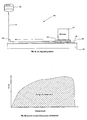
FIG. 5a is an elevational view of an example of a dry-drag test method; -
FIG. 5b is an example of a data plot of force versus displacement; -
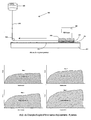
FIG. 6a is an elevational view of an example of a wet-drag test method; -
FIG. 6b is an example of a set of four data plots of force versus displacement; -
FIG. 7a is an elevational view of an example of a test method for measuring product spread; -
FIG. 7b is a top view of the material inFig. 7a after a spread test has been completed; -
FIG. 8 is an elevational view of an example of a test method for measuring inward deflection of an applicator dome using an Instron; and -
FIG. 9 is an elevational view of an example of a test method for measuring outward deflection of an applicator dome using an Instron. - Reference will now be made in detail to various exemplary embodiments of tha invention, several of which are also illustrated in the accompanying drawings, wherein like numerals indicate the same elements throughout the views, and numbers with the same final two digits indicate corresponding elements among embodiments.
- With reference to
FIGS. 1 and 2 ,applicator 10 is disclosed.Applicator 10 is a screw dispensing package commonly used in applying deodorant and other materials.Applicator 10 employs a screwmechanism hand wheel 50 to move anelevator 30 within acontainer body 40 which pushesproduct 80 from thecontainer body 40 through theapplicator dome 20. - With reference to
FIGS. 3 and 4 , an applicator dome with soft material application surface is disclosed. Theapplicator dome 20 is perforated withapertures 60 to allow the passage ofproduct 80.Applicator base material 30 provides support and a means of attachment forsoft applicator surface 70.Base material 30 andsoft applicator surface 70 may be joined using known connection means, including but not limited to, co-injection molding, insert molding, and adhesion. - In a first approach to increase spreading of
product 80, asoft material 70 having increased drag properties is added toapplicator dome 20. Drag is defined as the amount of energy required to move a flat plaque of material across a surface under a fixed force exerted normal to the application surface. Thus, drag is the result of both frictional and mechanical resistance to lateral movement across the surface. There are two types of drag discussed herein, dry-drag and wet-drag. Dry-drag is measured without any product applied to the plaque. Wet-drag is measured with product applied to the plaque. -
Figure 5a depicts a dry-drag test method 100 used to quantify the energy necessary to drag aplaque 110 of asoft material 70 across a skin-like substrate 120 (for example, boltaflex vinyl which may be purchased from Irvin & Alan Company). In this dry-drag test method 100, the skin-like substrate 120 is cut into a rectangular shape having dimensions of about 254mm (10 inches) long and about 76.199mm (3 inches) wide. The skin-like substrate 120 is adhered to a supportinghorizontal planer surface 130 using double-faced adhesive tape (not shown). Aplaque 110 ofsoft material 70 is cut into a rectangular shape having dimensions of about 50.8mm (2 inches) long and about 19.049 mm(0.75 inches) wide and from about 3.175mm (0.125) to about 7.6199mm (0.3 inches) thick.Plaque 110 is attached to asled 140 using double-faced adhesive tape (not shown).Sled 140 with attachedplaque 110 is placed at the far end of the skin-like substrate 120.Sled 140 is then loaded with a 500-gram weight 150. A vertically oriented Instron 160 (or any similar load cell device having the capabilities of controlled motion, force measurement, and data acquisition) is attached to thesled 140 using astring 170 routed 90 degrees over apulley 180. Remove any slack fromstring 170, initializeInstron 160 and set the traverse speed to 1270mm (50 inches) per minute.Sled 140 is then pulled a distance of approximately 152.399mm (6 inches). A force versus displacement plot is then produced, example inFigure 5b . From this plot, the energy necessary to dragplaque 110 ofsoft material 70 across skin-like substrate 120 is calculated. The chart below shows the results of testing two different types of materials (conventional materials versus thermoplastic elastomers [TPE]) using dry-drag test method 100. Each material was tested four times and then their average result was calculated. Under "conventional materials", polypropylene (PP), high density polyethylene (HDPE), and polyester (PET) were selected because they are commonly used in manufacturing of applicator domes 20. "Thermoplastic elastomers" is not limited only those listed below, in fact, other suitable materials will be discussed later.Dry Drag Data energy reported in (mJ) Conventional Materials Pass 1 Pass 2Pass 3Pass 4Average Polypropylene - Dow H700 12NA 305 288 284 280 289 High density polyethylene - Petrothene LS 3150-00 270 222 215 211 230 Polyester - Easlman EN058 347 338 334 349 342 Thermoplastic Elastomers Kraton G2708 (GLS Corporation) 984 992 1006 1059 1010 Kraton G6730 (GLS Corporation) 1127 1165 1184 1166 1158 Kraton G7930 (GLS Corporation) 1096 1058 1077 1075 1077 Santoprene 8211-35 (Advanced Elastomer Systems) 1218 1181 1178 1157 1183 Santoprene 9271-55 (Advenced Elastomer Systems) 795 793 771 800 790 Santoprene 9911-35 (Advanced Elastomer systems) 1147 1094 1126 1131 1125 -
Figure 6a depicts a wet-drag test method 200 used to quantify the energy necessary to drag aplaque 210 of asoft material 70 across a skin-like substrate 220 (for example, boltaflex vinyl which may be purchased from Irvin & Alan Company). In this wet-drag test method 200, the skin-like substrate 220 is cut into a rectangular shape having dimensions of about 254mm (10 inches) long and about 76.199mm (3 inches) wide. The skin-like substrate 220 is adhered to a supportinghorizontal planer surface 230 using double-faced adhesive tape (not shown). Aplaque 210 ofsoft material 70 is cut into a rectangular shape having dimensions of about 50.8mm (2 inches) long and about 19.0499mm (0.75 inches) wide and from about 3.175mm (0.125) to about 7.6199mm (0.3 inches) thick.Plaque 210 is attached to asled 240 using double-faced adhesive tape (not shown). Approximately 0.4 grams ofproduct 80 is uniformly coated onto the bottom surface ofplaque 210.Sled 240 with attachedplaque 210 andproduct 80 is placed at the far end of the skin-like substrate 220.Sled 240 is then loaded with a 500-gram weight 250. A vertically oriented Instron 260 (or any similar load cell device having the capabilities of controlled motion, force measurement, and data acquisition) is attached to thesled 240 using astring 270 routed 90 degrees over apulley 280. Remove any slack fromstring 270, initializeInstron 260 and set the traverse speed to 1270mm (50 inches) per minute.Sled 240 is then pulled a distance of approximately 152.399 (6 inches). A force versus displacement plot is then produced, example inFigure 6b entitled "Pass 1". From this plot, the energy necessary to dragplaque 210 ofsoft material 70 across skin-like substrate 220 is calculated. To replicate the consumer experience of applying product 80 (e.g. antiperspirant or deodorant to the underarm), four passes (i.e., strokes) were conducted and their respective data acquired as exampled inFigure 6b . The chart below shows the results of testing polypropylene (PP) and Kraton G2706 (available from the GLS Corporation). Although these two materials were chosen for further testing purposes, it is believed that other conventional and thermoplastic elastomers would perform similarly.Multi-pass Drag Energy (mJ) Conventional
Polypropylene (Dow H700 12NA)TPE
Kraton G2706 (GLS Corporation)Pass 1210 190 Pass 2228 258 Pass 3248 309 Pass 4257 322 Average 236 270 Energy Delta (4-1) 47 132 Total Energy 943 1079 ← 14% increase 
- This graph further demonstrates the increase in drag energy for two separate comparisons. First, for the TPE material itself, the drag energy is substantially increased after each pass (i.e.
pass 4 »pass 3 >>pass 2 >> pass 1). In fact, in the experiment described above, the difference between the drag energy betweenpass 4 and pass 1 equals 132mJ, which is almost equal to an additional stroke. Without wishing to be bound by theory, it is believed that this phenomenon occurs because the TPB's wet-drag value (190mJ) is moving closer to the much higher dry-drag value (1010mJ) as compared to the slight increase in polypropylene which has a wet-drag value of 210mJ and a dry-drag value of 289mJ. As such, anapplicator dome 20 made with TPE will exert more drag energy (and subsequently more shear to spread the product 80) after each stroke, while the first stroke is smooth and the later strokes are rougher however lubricated. Secondly, the TPE material exerts more total drag energy (1079mJ) than the polypropylene (943mJ), an increase of 14%. Therefore, anapplicator dome 20 made with TPE will provide better shearing and spreading than an applicator made with conventional materials. - In another approach to increase spreading of
product 80, asoft material 70 having increased Dimethicone Droplet Spread Rate (DDSR) properties for hydrophobic product ingredients (e.g. cyclomethicone, cyclopentasiloxane, cyclohexasiloxane, volatile and non-volitile isoparaffins, volatile and non-volatile dimethicone ranging in viscosity from 0.65 centistokes to about 12000 centistokes, mineral oil, or other similar hydrophobic materials) is added toapplicator dome 20. DDSR is a measure of the rate a drop of dimethicone spreads on a flat surface of a material. The test method for calculating DDSR begins with dropping a single droplet of dimethicone onto a flat sheet of the material. The droplet should be created by using a syringe fitted with aMonoject 250 hypodermic needle (20GA x 25.4mm (1 inch); having a squared-off tip accomplished by sanding) and dropped on the material from a height of about 50.8mm (2 inches). Then after waiting 75 seconds, estimate the approximate area of the puddle formed by the droplet by measuring the puddle's width and length. DDSR is the area of the puddle in square millimeters (mm2). The chart below shows the results of testing conventional materials and TPE materials.Dimethicone Droplet Spread Rate (DDSR) (using Dow Coming 200 Fluid 10 cSt Dimethicone) Conventional (mm2) Polypropylene - Dow H700 12NA 79 High density polyethylene - Petrothene LS 3150-00 95 Polyester - Bastman EN058 113 Thermoplastic Elastomers Kraton G2706 (GLS Corporation) 319 Kraton G6730 (GLS Corporation) 398 Kraton G7930 (GLS Corporation) 325 Santoprene 8211-35 (Advanced Elastomer Systems) 314 Santoprene 9271-55 (Advanced Elastomer Systems) 330 Santoprene 9911-35 (Advanced Elastomer Systems) 404 - An increase in DDSR results in an increase in the efficiency of spreading of hydrophobic product ingredients (e.g. antiperspirant or deodorant). The increased DDSR indicates an increased attractive force between the material (e.g. TPE) and the hydrophobic product ingredients. These attractive forces act to retain the product on the material. If this material is added to an
applicator dome 20, then the product would remain on theapplicator dome 20 longer during product application which would result in improved spreading of the product. As such, one preferred embodiment for an applicator dome may comprise of at least one material having a Dimethicone Droplet Spread Rate value from about 200mm2 to about 900mm2, more preferably from about 250mm2 to about 500mm2. -
Figure 7a and 7b depicts amethod 300 for measuring product spread. First, a skin-like substrate 310 (for example, boltaflex vinyl which may be purchased from Irvin & Alan Company) is adhered to the top surface of a 25.4mm (one-inch) thickpolyurethane foam pad 330. Next, a single-dose of product (about 0.25 gram) from theapplicator 10 is dispensed and applied to the skin-like substrate 310 during a 254mm (10-inch stroke) under a 500-gram load 340. Then, using a computer (e.g.,Deskscan II version 2 and BioScan Optimas version 4.10 software) and an optical scanner, the skin-like substrate 310 having spreadproduct 350 is scanned to determine the coverage area ofspread product 350. The following spread test data was obtained using productspread test method 300 and Secret® Platintum® brand antiperspirant:Product Spread using Secret® Platinum® Conventional (in2) (a) Polyptopylene - Dow H700 12NA- 0.889mm (0.035") thick PP mesh dome 177.79mm (7.00) Thermoplastic Elastomers (b) Kraton G2706 (GLS Corporation) - over 0.899mm (0.035") thick PP mesh dome 195.579mm(7.70) (10% increase) **Note: Row (b) is significantly different than row (a) to a 90% confidence level. - This product spread data shows that a TPB material with a DDSR of 319 provides 10% more product coverage than a conventional applicator material (polypropylene) with a DDSR of 79.
- In yet another approach to increase spreading of
product 80, asoft material 70 having a decreased durometer value is added toapplicator dome 20. Durometer is a measure of hardness. The durometer value (also known as Shore A hardness value) is often supplied by the manufacturer or may be tested by commonly used test methods (e.g., ASTM D2240-97). The table below provides the durometer value for both conventional and TPE materials.Durometer Conventional Polypropylene - Dow H700 12NA > 100 High density polyethylene - Petrothene LS 3150-00 > 100 Polyester - Eastman EN058 > 100 Thermoplastic Elastomers Kraton G2706 (GLS Corporation) 28 Kraton G6730 (GLS Corporation) 30 Kraton G7930 (GLS Corporation) 30 Santoprene 8211-35 (Advanced Elastomer Systems) 35 Santoprene 9271-55 (Advanced Elastomer Systems) 55 Santoprene 9911-35 (Advanced Elastomer Systems) 35 - If
applicator dome 20 is made using a material having a lower durometer value, then the inward deflection is increased. Inward deflection is measured by the distance that theapplicator dome 20 travels inwardly when an outward force is applied to it.Figure 8 shows an example of atest method 400 for calculating inward deflection.Applicator 10 is placed inside of Instron 410 (e.g., model 8511), more specifically, between movingtop plate 420 and stationarybottom plate 430. Astop plate 420 travels downward at a rate of about 0.3175mm (0.0125 in) sec, it exerts force ontoapplicator dome 20. The applied force and resulting inward deflection are electronically acquired. The amount of inward deflection at a 500-gram load is reported below.Inward Deflection at a 500-gram load Conventional (mm) Secret (PP) 0.16 Lever Ultra Dry (HDPE) 0.07 Gillette Clear (PET) 0.07 Mennen Speed Stick (PET) 0.08 Thermoplastic Elastomers Kraton G2706 (OLS Corporation) over 0.889mm (0.035") thick PP mesh dome 0.20 Kraton G2706 (GLS Corporation) over 0.7619mm (0.030") thick PP mesh dome 0.37 Kraton G6730 (GLS Corporation) over 0.889mm (0.035") thick PP mesh dome 0.17 Kraton G930 (GLS Corporation) over 0.889mm (0.035") thick PP mesh dome 0.21 Santoprene 8211-35 (Advanced Elastomer Systems) 0.19 - If
applicator dome 20 is made using a material having a lower durometer value which results in an increased inward deflection, then product spreading will be increased. To illustrate this phenomenon, two samples having the same type of material (i.e., Kraton G2607) but having different underlining support (i.e. 0.889mm (0.035 inch) thick PP mesh dome versus 0.7619mm (0.030 inch) thick PP mesh dome mesh) were tested using the product test method inFigures 7a and 7b Product Spread using Secret® Platinum® Thermoplastic Elastomers (in2) (a) Kraton G2706 (GLS Corporation) over 0.889mm (0.035") thick PP mesh dome 195.579mm (7.7) (b) Kraton G2706 (GLS Corporation) over 0.7619mm (0.030") thick PP mesh dome 241.299mm (9.5) (23% increase) **Note: Row (b) is significantly different than row (a) to a 90% confidence level. - While increased inward deflection is desirable to improve product spread,
applicator dome 20 must still be sufficiently rigid to minimize outward deflection to prevent product weeping. Outward deflection is measured as the distance that theapplicator dome 20 travels when an inward force is applied to it.Figure 9 shows an elevated sectional view of an example of atest method 500 for measuring outward deflection. The bottom portion of thecontainer body 520 of an empty product package is cut away to expose the underside of theapplicator dome 20. Two dowel pins 530 slide through holes drilled in the side of thecontainer body 520. These dowel pins support theapplicator dome 20 in an upside-down position on thetest apparatus 540. Arod 550 attached to theInstron 560 travels downward at a rate of about 0.3175mm (0.125 in) /sec, it exerts a force to the inside wall of theapplicator dome 20. The applied force and resulting outward deflection are electronically acquired. The amount of outward deflection at a 500-gram load is reported below.Outward Deflection at a 500-gram load Conventional (mm) Secret (PP) 0.19 Lever Ultra Dry (HDPE) 0.10 Gillette Clear (PET) 0.06 Mennen Speed Stick (PET) 0.08 Thermoplastic Elastomers Kraton G2706 (GLS Corporation) over 0.899mm (0.035") thick PP mesh dome 0.18 Kraton G2706 (GLS Corporation) over 0.7619mm (0.030") thick PP mesh dome 0.25 - Product weeping is defined as the separation of a fluid product component from an APDO product resulting from a stress applied to the APDO product. If
applicator dome 20 has a high outward deflection, then the stress imparted into theapplicator dome 20 would be rebounded onto the product resulting in product weeping. As such, until recently, it has been believed that an antiperspirant/deodorant (APDO)applicator dome 20 should be molded entirely of hard, rigid thermoplastic materials such as PP, PE, PET, PVC, and similar materials. - To overcome the competing interests of desirable inward deflection and undesirable outward deflection, it has been discovered that an
applicator dome 20 may be constructed with a stiffer material underneath (e.g., polypropylene) a layer of TPE, as exampled inFigure 4 . This embodiment provides sufficient inward deflection for improved product spreading while minimizing outward deflection to minimize product weeping. - To further demonstrate the benefits of improved spreading from
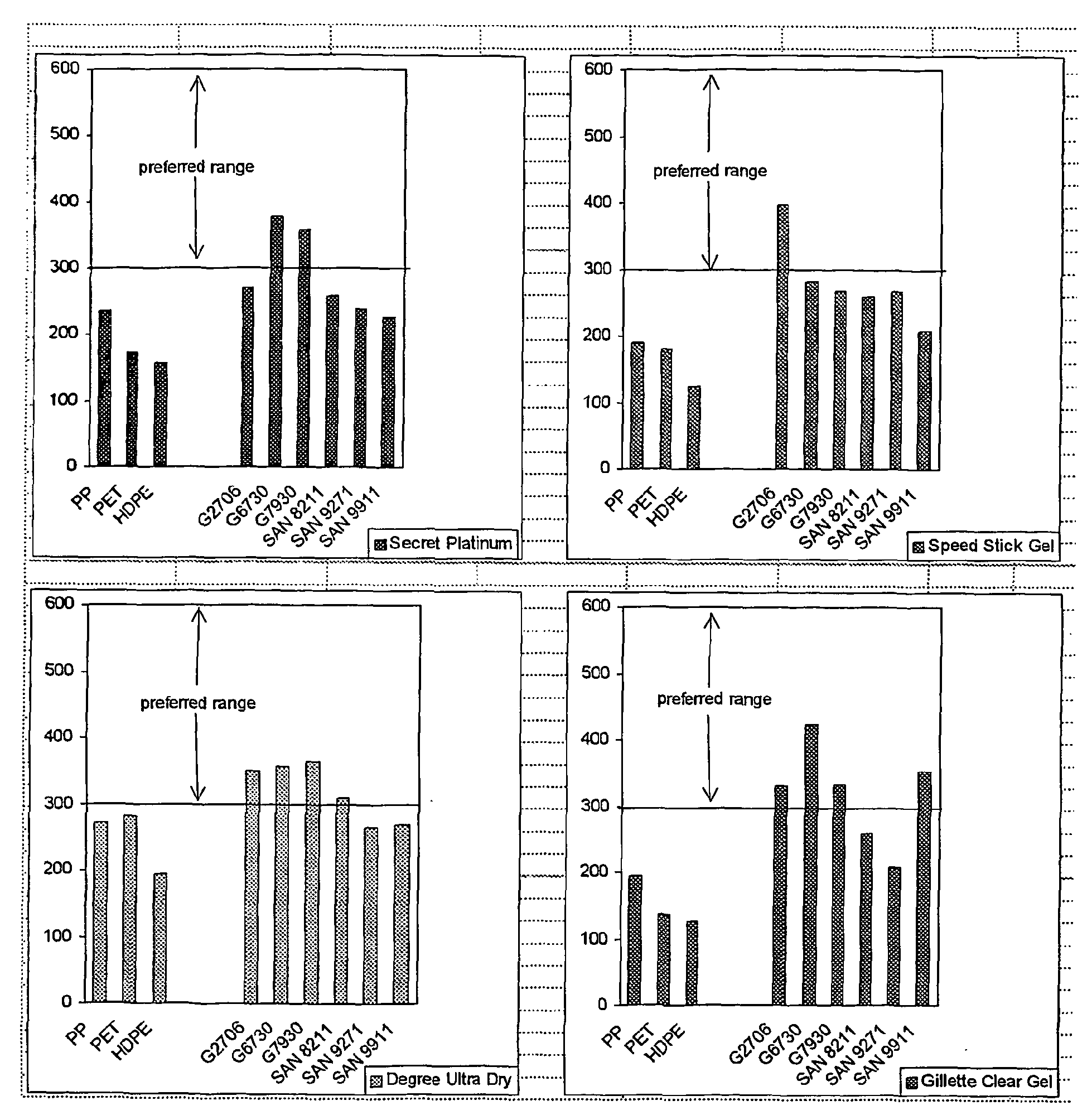
applicator domes 20 having TPE, the following chart shows that improved spreading leads to a decreased amount of product residue after 4 hours from application as measured by expert panelists.Expert Panel Results Scale 1-7 (1 = best: 7 = worst) PP (Conventional Material) TPE (G2706) Applicator (a) (b) Product Residue @ 4 hours 1.74 1.35a ** Note: Column (b) is significantly different than column (a) to a 95% confidence level. - Until recently, it was believed that consumers preferred an applicator with APDO products to have a wet-drag level in the range from about 100mJ to about 300mJ. As such, applicators currently marketed with APDO products typically have a wet-drag level within the range of 100mJ to 300mJ. Thus, the range of wet-drag level from 100mJ to 300mJ is defined as the old-acceptable range.
Average Drag Energy (mJ) with a variety of antiperspirant products Secret Platinum Degree Ultra Dry Speed Stick Gel Gillette Clear Gel Conventional Polypropylene -Dow H700 12NA 236 272 191 195 High density polyethylene - Petrothene LS 3150-00 172 281 181 137 Polyester - Eastman EN058 157 195 125 126 - However, it has been discovered that increasing the wet-drag level to a range from about 300mJ to about 600mJ provides improved application feel. The discovery, that had previously not been appreciated, is that when the wet-drag level is too low, such as less than about 300mJ, consumers perceive the product to be too slimy during application. Furthermore, when the wet-drag level is too high, such as above about 600mJ, the applicator is irritating to the underarm during application. Thus, a new consumer preferred range of wet-drag for an APDO product ranges from about 300mJ to about 600mJ.
Average Drag Energy (mJ) with a variety of antiperspirant products Secret Platinum Degree Ultra Dry Speed Stick Gel Gillette Clear Gel Thermoplastic Elastomers Kraton G2706 (GLS Corporation) 270 350 397 331 Kraton G6730 (GLS Corporation) 378 356 282 424 Kraton G7930 (GLS Corporation) 357 364 268 332 Santoprene 8211-35 (Advanced Elastomer Systems) 259 309 260 259 Santoprene 9271-55 (Advanced Elastomer Systems) 238 266 268 207 Santoprene 9911-35 (Advanced Elastomer Systems) 226 269 208 353 - Having just discovered a new consumer preferred range of wet-drag for an APDO product ranges from about 300mJ to about 600mJ, it can be further appreciated via the graphs below that an applicator-product wet-drag value may be increased into the new preferred range by merely change from a conventional applicator dome to a TPE dome without having to reformulate the product (e.g., Secret Platinum with G6730 and G7930, Speed Stick Gel with G2706, etc.). This technique is possible after having discovered the unexpected reduction in dry-drag value and preferred resulting wet-drag value of TPE applicators.
- In addition to the benefits of improved product spreading and better consumer feel, the use of TPE materials for applicator domes decreases the level of audible noise. Without wishing to be bound by theory, it is discovered and believed that the TPE material provides dampening of noise and shock absorption which results in a lower level of audible noise. The consumer associates such audible noise with irritation of the skin. Accordingly, it is beneficial to minimize the level of audible noise.
- A decibel meter (Quest Technologies - model 2900) was used in a consumer study to measure the noise generated from applicators being rubbed against women's leg razor stubble (similar to underarm razor stubble, however, less offensive to examine). The women were told not to shave their legs for 1 to 2 days before conducting this test. The lower leg of each participant was tested.
Audible noise during application Conventional Decibel level Polypropylene - Dow H700 12NA 31.8 dB Thermoplastic Elastomers Kraton G2706 (GLS Corporation) 24.3 dB * * 24.3 equals the background noise in the test facility. The sound generated from the TPE applicator dome was insufficient to be measured above the background noise in the test facility. Audible noise of various locations Decibel level Bathroom Background Noise 20 - 30 dB Toilet Flush 70 - 80 dB Faucet Running Water 60 - 70 dB Hair Dyer 70 - 80 dB Bathroom Exhaust Fan 55 - 70 dB - Having shown and described various embodiments of the present invention, further adaptations of the present invention as described herein can be accomplished by appropriate modifications by one of ordinary skill in the art without departing from the scope of the present invention. Several of these potential modifications and alternatives have been mentioned, and others will be apparent to those skilled in the art. For example, while exemplary embodiments of the inventive system have been discussed for illustrative purposes, it should be understood that the elements described may be constantly updated and improved by technological advances. In yet another example, it should be noted that the term "thermoplastic elastomers" as used herein is intended include all suitable materials having a Shore A hardness ranging from
Shore A 3 to Shore A 95 selected from the groups of thermoplastic elastomers, thermoplastic vulcanizates, thermosetting or vulcanized elastomers, ethylene copolymers and terpolymers, propylene copolymers and terpolymers, closed or open cell polymeric foam, and mixtures or compounds thereof. More specifically: - Suitable thermoplastic elastomers include, but are not limited to: a) styreneisoprene-styrene triblock coplymers such as the Kraton D series from Shell; b) styrene-butadiene-styrene triblock coplymers such as the Kraton D series from Shell; c) styrene-saturated olefin-styrene triblock coplymers such as the Kraton G series from Shell; d) thermoplastic rubber compounds such as the Dynaflex series from GLS Corporation; e) ethylene propylene elastomers; f) polyester-polyether multiblock copolymers such as the Hytrel Series from DuPont; g) polyamide-polyether multiblock copolymers such as the Pebax series from Atochem; and h) polyurethane elastomers such as the Estane family from BF Goodrich.
- Suitable thermoplastic vulcanizates include, but are not limited to: Santoprene series from Advanced Elastomers.
- Suitable thermosetting or vulcanized elastomers include, but are not limited to: a) polyisoprene rubber; b) polybutadiene; c) styrene butadiene; d) nitrile; e) chloropene " (= Neoprene = chloroisoprene); f) butyl; and g) ethylene-propylene diene monomer (EPDM).
- Suitable ethylene copolymers include, but are not limited to: a) ethylene vinylacetate; b) ethylene methyl acrlylate; c) ethylene ethyl acrylate; d) ethylene butene; e) ethylene hexene; f) ethylene octene; and g) ethylene propylene in which the mole % ethylene is > 50%.
- Suitable propylene copolymers include, but are not limited to: ethylene propylene in which the mole % ethylene is < 50%.
- Accordingly, the scope of the present invention should be considered in terms of the following claims and is understood not to be limited to the details shown and described in the specification and drawings.
Claims (1)
- An applicator (10) containing an anti-perspirant or deodorant product (80) the applicator (10) comprising an applicator dome (20), characterised in that the applicator dome (20) has a first material (70) and a second material, said first material (70) being made of a thermoplastic elastomer, said second material being made of a material having more rigidity than said first material, said second material providing structural support for said first material, the applicator dome (20) having an outward-deflection value on application of a 500-gram load ranging from 0.000mm to 0.4mm.
Applications Claiming Priority (3)
| Application Number | Priority Date | Filing Date | Title |
|---|---|---|---|
| US19941400P | 2000-04-24 | 2000-04-24 | |
| US199414P | 2000-04-24 | ||
| PCT/US2001/013147 WO2001080684A2 (en) | 2000-04-24 | 2001-04-24 | Soft applicator dome |
Publications (2)
| Publication Number | Publication Date |
|---|---|
| EP1276401A2 EP1276401A2 (en) | 2003-01-22 |
| EP1276401B1 true EP1276401B1 (en) | 2010-01-20 |
Family
ID=22737383
Family Applications (1)
| Application Number | Title | Priority Date | Filing Date |
|---|---|---|---|
| EP01932619A Expired - Lifetime EP1276401B1 (en) | 2000-04-24 | 2001-04-24 | Soft applicator dome |
Country Status (11)
| Country | Link |
|---|---|
| US (1) | US6572300B2 (en) |
| EP (1) | EP1276401B1 (en) |
| JP (1) | JP2003530930A (en) |
| CN (1) | CN1190160C (en) |
| AT (1) | ATE455475T1 (en) |
| AU (1) | AU2001259132A1 (en) |
| CA (1) | CA2405598A1 (en) |
| DE (1) | DE60141130D1 (en) |
| HU (1) | HUP0301060A2 (en) |
| MX (1) | MXPA02010468A (en) |
| WO (1) | WO2001080684A2 (en) |
Families Citing this family (30)
| Publication number | Priority date | Publication date | Assignee | Title |
|---|---|---|---|---|
| FR2850545B1 (en) * | 2003-01-31 | 2006-07-28 | Cosmetologie Moderne Lab De | DEVICE FOR APPLYING AN OXIDATION COLORING COMPOSITION FOR HAIR |
| US7309184B2 (en) * | 2003-08-15 | 2007-12-18 | Revlon Consumer Products Corporation | Dispenser for fluid materials |
| US20050183897A1 (en) * | 2004-02-24 | 2005-08-25 | Lear Corporation | Two-shot co-injected automotive interior trim assembly and method |
| US7871119B2 (en) | 2004-04-30 | 2011-01-18 | International Automotive Components Group North America, Inc. | Door trim panel with dual density bolster armrest and integrated components |
| US20060061127A1 (en) * | 2004-09-20 | 2006-03-23 | Emerling David M | Molded automotive visor |
| WO2006041701A2 (en) | 2004-10-04 | 2006-04-20 | Colgate-Palmolive Company | A dispenser seal |
| US7458631B2 (en) | 2004-10-19 | 2008-12-02 | International Automotive Components Group North America, Inc. | Automotive armrest with soft feel and method of making the same |
| US7478854B2 (en) | 2004-10-19 | 2009-01-20 | International Automotive Components Group North America, Inc. | Automotive handle with soft feel and method of making the same |
| US7156437B2 (en) * | 2004-10-19 | 2007-01-02 | Lear Corporation | Automotive trim part with applique and method of making same |
| US7458604B2 (en) | 2004-10-20 | 2008-12-02 | International Automotive Components Group North America, Inc. | Automotive trim assembly having an integrated airbag door |
| US8157467B2 (en) * | 2005-03-21 | 2012-04-17 | Johnson & Johnson Consumer Companies, Inc. | Device for administering fluid compositions including tensioning polymers |
| US20070172304A1 (en) * | 2005-11-15 | 2007-07-26 | Bolander Michael J | Package for merchandising consumer care products |
| US8096724B2 (en) * | 2005-11-15 | 2012-01-17 | The Procter & Gamble Company | Package for merchandising consumer care products |
| TWM293897U (en) * | 2005-11-18 | 2006-07-11 | Yuan Harng Co Ltd | Structure for extruding type squeeze tube |
| US8014389B2 (en) * | 2005-12-06 | 2011-09-06 | Lippershy Celestial Llc | Bidding network |
| US20070136209A1 (en) * | 2005-12-06 | 2007-06-14 | Shabbir Khan | Digital object title authentication |
| US8194701B2 (en) * | 2005-12-06 | 2012-06-05 | Lippershy Celestial Llc | System and/or method for downstream bidding |
| US8055897B2 (en) * | 2005-12-06 | 2011-11-08 | Lippershy Celestial Llc | Digital object title and transmission information |
| US9686183B2 (en) | 2005-12-06 | 2017-06-20 | Zarbaña Digital Fund Llc | Digital object routing based on a service request |
| US8226318B1 (en) * | 2006-06-01 | 2012-07-24 | Douglas Williams | Tube with integral elastomeric applicator and method of manufacture therefor |
| US8388249B2 (en) * | 2006-08-28 | 2013-03-05 | The Procter & Gamble Company | Packages and consumer products comprising same |
| US8407879B1 (en) * | 2009-02-11 | 2013-04-02 | Plastek Industries, Inc. | Applicator filling/assembly method |
| US8985390B2 (en) | 2009-09-18 | 2015-03-24 | The Procter & Gamble Company | Unit dose dispensing apparatus |
| FR2980342B1 (en) | 2011-09-23 | 2014-01-24 | Oreal | DEVICE FOR CONDITIONING AND APPLYING A SOLID COSMETIC PRODUCT |
| WO2015112487A1 (en) | 2014-01-21 | 2015-07-30 | The Procter & Gamble Company | Package for antiperspirant compositions |
| FR3025075A1 (en) * | 2014-08-28 | 2016-03-04 | Oreal | NEW CARE AND / OR MAKE-UP DEVICE COMPRISING A GEL / GEL ARCHITECTURE COMPOSITION |
| FR3047154B1 (en) * | 2016-01-29 | 2021-01-22 | Chanel Parfums Beaute | COSMETIC ARTICLE, ESPECIALLY FOR LIPS INCLUDING SUPERIMPOSED GRIDS |
| US11382400B2 (en) | 2018-08-10 | 2022-07-12 | Go Products Co. | Material applicator |
| KR200492726Y1 (en) * | 2020-05-25 | 2020-12-01 | 한국콜마주식회사 | Container |
| USD1076297S1 (en) | 2023-07-10 | 2025-05-20 | Church & Dwight Co., Inc. | Dispenser |
Family Cites Families (9)
| Publication number | Priority date | Publication date | Assignee | Title |
|---|---|---|---|---|
| FR1370714A (en) | 1963-07-09 | 1964-08-28 | Liquid product dispenser-applicator | |
| MX157234A (en) | 1982-07-22 | 1988-11-07 | Menen Company | IMPROVEMENTS IN APPLICATOR FOR CREAMS OR VISCOUS LIQUIDS |
| US4915268A (en) * | 1988-11-02 | 1990-04-10 | Pittway Corporation | Closure with dispensing applicator |
| FR2655022B1 (en) | 1989-11-30 | 1992-02-28 | Oreal | DEVICE FOR APPLYING A LIQUID OR PASTY PRODUCT TO A SURFACE. |
| DE4421230C2 (en) | 1994-06-17 | 1996-11-21 | Werner & Mertz Gmbh | Device for distributing pasty material on surfaces |
| FR2736623B1 (en) | 1995-07-10 | 1997-08-22 | Oreal | PACKAGING AND DISTRIBUTION DEVICE FOR A LIQUID, GELIFIED OR PASTE PRODUCT WITH DOME-SHAPED APPLICATOR |
| FR2736622B1 (en) | 1995-07-12 | 1997-08-29 | Oreal | DEVICE FOR PACKAGING AND DISPENSING A LIQUID OR PASTY PRODUCT WITH A DOME APPLICATOR |
| US6196747B1 (en) * | 1995-12-21 | 2001-03-06 | Creative Packaging Corp. | Product dispensing cover |
| US6116803A (en) * | 1996-04-10 | 2000-09-12 | The Plastek Group | Dispenser |
-
2001
- 2001-04-23 US US09/840,567 patent/US6572300B2/en not_active Expired - Lifetime
- 2001-04-24 CN CNB018084478A patent/CN1190160C/en not_active Expired - Fee Related
- 2001-04-24 HU HU0301060A patent/HUP0301060A2/en unknown
- 2001-04-24 AU AU2001259132A patent/AU2001259132A1/en not_active Abandoned
- 2001-04-24 DE DE60141130T patent/DE60141130D1/en not_active Expired - Lifetime
- 2001-04-24 CA CA002405598A patent/CA2405598A1/en not_active Abandoned
- 2001-04-24 WO PCT/US2001/013147 patent/WO2001080684A2/en not_active Ceased
- 2001-04-24 JP JP2001577791A patent/JP2003530930A/en active Pending
- 2001-04-24 AT AT01932619T patent/ATE455475T1/en not_active IP Right Cessation
- 2001-04-24 MX MXPA02010468A patent/MXPA02010468A/en active IP Right Grant
- 2001-04-24 EP EP01932619A patent/EP1276401B1/en not_active Expired - Lifetime
Also Published As
| Publication number | Publication date |
|---|---|
| EP1276401A2 (en) | 2003-01-22 |
| AU2001259132A1 (en) | 2001-11-07 |
| CN1190160C (en) | 2005-02-23 |
| MXPA02010468A (en) | 2003-04-25 |
| ATE455475T1 (en) | 2010-02-15 |
| US6572300B2 (en) | 2003-06-03 |
| CN1426282A (en) | 2003-06-25 |
| WO2001080684A2 (en) | 2001-11-01 |
| US20020048483A1 (en) | 2002-04-25 |
| JP2003530930A (en) | 2003-10-21 |
| DE60141130D1 (en) | 2010-03-11 |
| WO2001080684A3 (en) | 2002-02-28 |
| HUP0301060A2 (en) | 2003-08-28 |
| CA2405598A1 (en) | 2001-11-01 |
Similar Documents
| Publication | Publication Date | Title |
|---|---|---|
| US6572300B2 (en) | Soft applicator dome | |
| US5772347A (en) | Dispenser for a product with a liquid-to-pasty consistency | |
| AU626814B2 (en) | Topical applicator for liquid | |
| US6415961B2 (en) | Apparatus and method for dispensing a product | |
| CZ20004715A3 (en) | Antiperspirant/deodorant applicator | |
| JP7765645B2 (en) | Pen applicator system for applying cosmetic products - Patent Application 20070122637 | |
| WO1999029585A1 (en) | Package for dispensing flowable cosmetics | |
| CN118647294A (en) | Applicator system for applying a cosmetic product | |
| CZ20004651A3 (en) | Applicator for applying and distribution of substances to target surfaces | |
| JPH0641310B2 (en) | Distributor for paste material | |
| TWI866091B (en) | Applicator system for applying a cosmetic product | |
| KR20240145517A (en) | Applicator system for applying cosmetics | |
| WO2021146379A1 (en) | Fluid discharger and applicator device, method for assembling and manufacturing the same and assembling system | |
| HK40118745A (en) | Applicator system for applying a cosmetic product | |
| HK40117004A (en) | Pen applicator system for applying a cosmetic product |
Legal Events
| Date | Code | Title | Description |
|---|---|---|---|
| PUAI | Public reference made under article 153(3) epc to a published international application that has entered the european phase |
Free format text: ORIGINAL CODE: 0009012 |
|
| 17P | Request for examination filed |
Effective date: 20021028 |
|
| AK | Designated contracting states |
Kind code of ref document: A2 Designated state(s): AT BE CH CY DE DK ES FI FR GB GR IE IT LI LU MC NL PT SE TR |
|
| AX | Request for extension of the european patent |
Free format text: AL;LT;LV;MK;RO;SI |
|
| 17Q | First examination report despatched |
Effective date: 20040608 |
|
| GRAP | Despatch of communication of intention to grant a patent |
Free format text: ORIGINAL CODE: EPIDOSNIGR1 |
|
| GRAS | Grant fee paid |
Free format text: ORIGINAL CODE: EPIDOSNIGR3 |
|
| GRAA | (expected) grant |
Free format text: ORIGINAL CODE: 0009210 |
|
| AK | Designated contracting states |
Kind code of ref document: B1 Designated state(s): AT BE CH CY DE DK ES FI FR GB GR IE IT LI LU MC NL PT SE TR |
|
| REG | Reference to a national code |
Ref country code: GB Ref legal event code: FG4D |
|
| REG | Reference to a national code |
Ref country code: CH Ref legal event code: EP |
|
| REG | Reference to a national code |
Ref country code: IE Ref legal event code: FG4D |
|
| REF | Corresponds to: |
Ref document number: 60141130 Country of ref document: DE Date of ref document: 20100311 Kind code of ref document: P |
|
| REG | Reference to a national code |
Ref country code: NL Ref legal event code: VDEP Effective date: 20100120 |
|
| PG25 | Lapsed in a contracting state [announced via postgrant information from national office to epo] |
Ref country code: AT Free format text: LAPSE BECAUSE OF FAILURE TO SUBMIT A TRANSLATION OF THE DESCRIPTION OR TO PAY THE FEE WITHIN THE PRESCRIBED TIME-LIMIT Effective date: 20100120 |
|
| PG25 | Lapsed in a contracting state [announced via postgrant information from national office to epo] |
Ref country code: PT Free format text: LAPSE BECAUSE OF FAILURE TO SUBMIT A TRANSLATION OF THE DESCRIPTION OR TO PAY THE FEE WITHIN THE PRESCRIBED TIME-LIMIT Effective date: 20100520 Ref country code: ES Free format text: LAPSE BECAUSE OF FAILURE TO SUBMIT A TRANSLATION OF THE DESCRIPTION OR TO PAY THE FEE WITHIN THE PRESCRIBED TIME-LIMIT Effective date: 20100501 Ref country code: NL Free format text: LAPSE BECAUSE OF FAILURE TO SUBMIT A TRANSLATION OF THE DESCRIPTION OR TO PAY THE FEE WITHIN THE PRESCRIBED TIME-LIMIT Effective date: 20100120 |
|
| PG25 | Lapsed in a contracting state [announced via postgrant information from national office to epo] |
Ref country code: FI Free format text: LAPSE BECAUSE OF FAILURE TO SUBMIT A TRANSLATION OF THE DESCRIPTION OR TO PAY THE FEE WITHIN THE PRESCRIBED TIME-LIMIT Effective date: 20100120 |
|
| PG25 | Lapsed in a contracting state [announced via postgrant information from national office to epo] |
Ref country code: BE Free format text: LAPSE BECAUSE OF FAILURE TO SUBMIT A TRANSLATION OF THE DESCRIPTION OR TO PAY THE FEE WITHIN THE PRESCRIBED TIME-LIMIT Effective date: 20100120 Ref country code: SE Free format text: LAPSE BECAUSE OF FAILURE TO SUBMIT A TRANSLATION OF THE DESCRIPTION OR TO PAY THE FEE WITHIN THE PRESCRIBED TIME-LIMIT Effective date: 20100120 Ref country code: GR Free format text: LAPSE BECAUSE OF FAILURE TO SUBMIT A TRANSLATION OF THE DESCRIPTION OR TO PAY THE FEE WITHIN THE PRESCRIBED TIME-LIMIT Effective date: 20100421 Ref country code: CY Free format text: LAPSE BECAUSE OF FAILURE TO SUBMIT A TRANSLATION OF THE DESCRIPTION OR TO PAY THE FEE WITHIN THE PRESCRIBED TIME-LIMIT Effective date: 20100120 |
|
| PLBE | No opposition filed within time limit |
Free format text: ORIGINAL CODE: 0009261 |
|
| STAA | Information on the status of an ep patent application or granted ep patent |
Free format text: STATUS: NO OPPOSITION FILED WITHIN TIME LIMIT |
|
| PG25 | Lapsed in a contracting state [announced via postgrant information from national office to epo] |
Ref country code: MC Free format text: LAPSE BECAUSE OF NON-PAYMENT OF DUE FEES Effective date: 20100430 |
|
| REG | Reference to a national code |
Ref country code: CH Ref legal event code: PL |
|
| 26N | No opposition filed |
Effective date: 20101021 |
|
| REG | Reference to a national code |
Ref country code: FR Ref legal event code: ST Effective date: 20101230 |
|
| PG25 | Lapsed in a contracting state [announced via postgrant information from national office to epo] |
Ref country code: DK Free format text: LAPSE BECAUSE OF FAILURE TO SUBMIT A TRANSLATION OF THE DESCRIPTION OR TO PAY THE FEE WITHIN THE PRESCRIBED TIME-LIMIT Effective date: 20100120 Ref country code: IE Free format text: LAPSE BECAUSE OF NON-PAYMENT OF DUE FEES Effective date: 20100424 |
|
| PG25 | Lapsed in a contracting state [announced via postgrant information from national office to epo] |
Ref country code: LI Free format text: LAPSE BECAUSE OF NON-PAYMENT OF DUE FEES Effective date: 20100430 Ref country code: CH Free format text: LAPSE BECAUSE OF NON-PAYMENT OF DUE FEES Effective date: 20100430 |
|
| PG25 | Lapsed in a contracting state [announced via postgrant information from national office to epo] |
Ref country code: FR Free format text: LAPSE BECAUSE OF NON-PAYMENT OF DUE FEES Effective date: 20100430 |
|
| PG25 | Lapsed in a contracting state [announced via postgrant information from national office to epo] |
Ref country code: LU Free format text: LAPSE BECAUSE OF NON-PAYMENT OF DUE FEES Effective date: 20100424 |
|
| PG25 | Lapsed in a contracting state [announced via postgrant information from national office to epo] |
Ref country code: TR Free format text: LAPSE BECAUSE OF FAILURE TO SUBMIT A TRANSLATION OF THE DESCRIPTION OR TO PAY THE FEE WITHIN THE PRESCRIBED TIME-LIMIT Effective date: 20100120 |
|
| PGFP | Annual fee paid to national office [announced via postgrant information from national office to epo] |
Ref country code: IT Payment date: 20130419 Year of fee payment: 13 |
|
| PG25 | Lapsed in a contracting state [announced via postgrant information from national office to epo] |
Ref country code: IT Free format text: LAPSE BECAUSE OF NON-PAYMENT OF DUE FEES Effective date: 20140424 |
|
| PGFP | Annual fee paid to national office [announced via postgrant information from national office to epo] |
Ref country code: DE Payment date: 20170420 Year of fee payment: 17 Ref country code: GB Payment date: 20170419 Year of fee payment: 17 |
|
| REG | Reference to a national code |
Ref country code: DE Ref legal event code: R119 Ref document number: 60141130 Country of ref document: DE |
|
| GBPC | Gb: european patent ceased through non-payment of renewal fee |
Effective date: 20180424 |
|
| PG25 | Lapsed in a contracting state [announced via postgrant information from national office to epo] |
Ref country code: DE Free format text: LAPSE BECAUSE OF NON-PAYMENT OF DUE FEES Effective date: 20181101 |
|
| PG25 | Lapsed in a contracting state [announced via postgrant information from national office to epo] |
Ref country code: GB Free format text: LAPSE BECAUSE OF NON-PAYMENT OF DUE FEES Effective date: 20180424 |