This application is based on Japanese Patent Application No. 2001-212973 filed in Japan, the contents of which are incorporated hereinto by reference.
BACKGROUND OF THE INVENTION
1. Field of the Invention
This invention relates to a material for liquid-crystal alignment films,
a liquid-crystal display element and a process for its production, and a
liquid-crystal unit.
2. Description of the Related Art
As liquid-crystal display elements used in liquid-crystal units and so
forth, those of a TFT (thin-film transistor) switching system are widely used.
In recent years, improvements in their display performance are being
achieved, and liquid-crystal alignment films used therein have become
required to satisfy various characteristics simultaneously.
Liquid-crystal alignment film characteristics required in this TFT
switching system are known to include, as disclosed in, e.g., Japanese
Patent Application Laid-open No. 10-197875, pre-tilt angles of liquid-crystal
molecules, voltage holding ratio, and residual DC (direct current) voltage
of direct-current voltage, as well as adherence to substrates with
transparent electrodes, and printability free of any non-uniformity or
pinholes. Meanwhile, in order to meet requirements for higher precision
in future liquid-crystal display elements and for changes in display modes,
liquid-crystal alignment films are required to have good step(difference in
level)-covering properties against any differeneces in surface levels of TFT
substrates.
Liquid-crystal alignment films are commonly obtained by coating a
solution of a soluble polyimide or polyimide precursor on a substrate,
followed by baking to effect curing to form a polyimide film, which is then
subjected to rubbing to make alignment. In order to improve the
step-covering properties, it may be contemplated to make the soluble
polyimide or polyimide precursor solution have a higher solid-matter
concentration to form a thicker film so that the differences in levels can be
covered. However, in usual cases, solvent-soluble polyimide or polyimide
precursors are so low soluble that there has been a limit to the improving of
step-covering properties by making the solid-matter concentration higher.
SUMMARY OF THE INVENTION
Accordingly, an object of the present invention is to provide a
material for a liquid-crystal alignment film which satisfies fundamental
prescribed properties such as voltage holding ratio, pre-tilt angles, residual
DC voltage, adherence to substrates, and printability, and also has superior
step-covering properties, and to provide a liquid-crystal display element
making use of this material, a process for producing the device, and a
liquid-crystal display unit having the device.
To achieve the above object, the present invention provides a
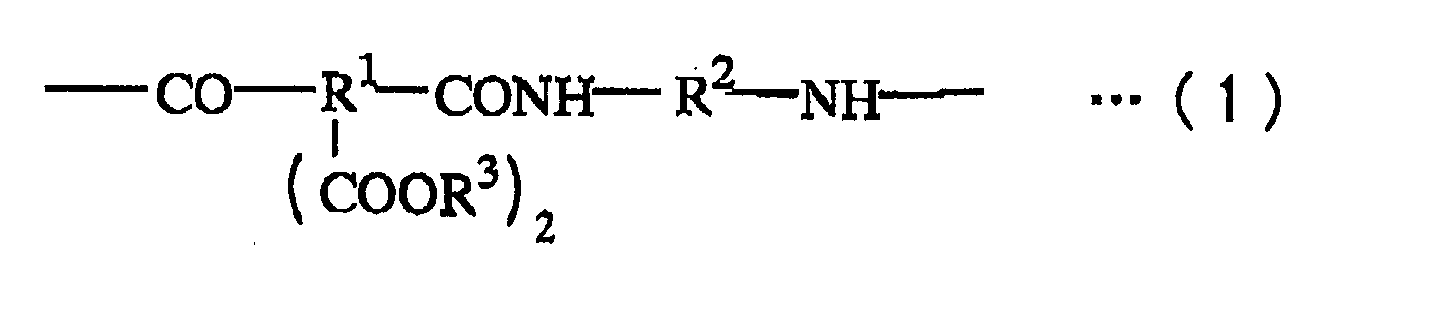
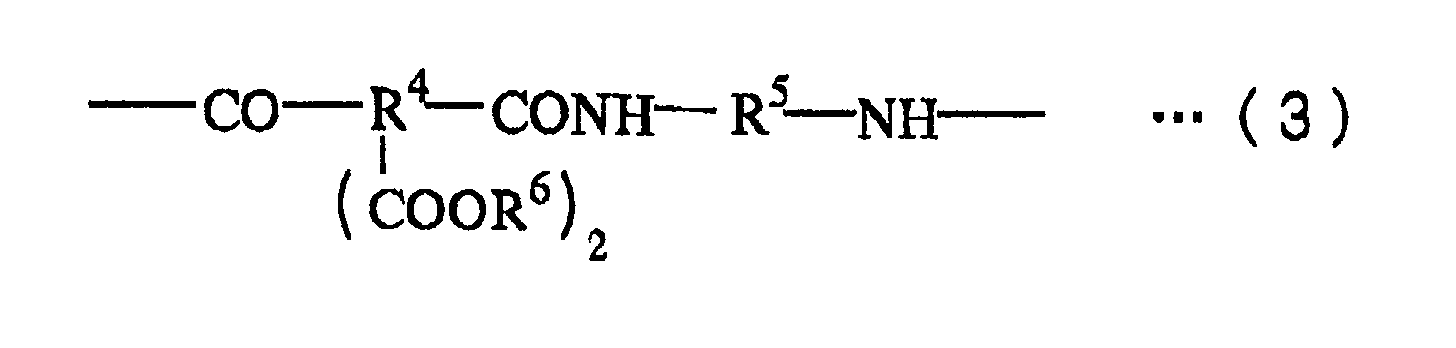
material for a liquid-crystal alignment film which comprises:
wherein R
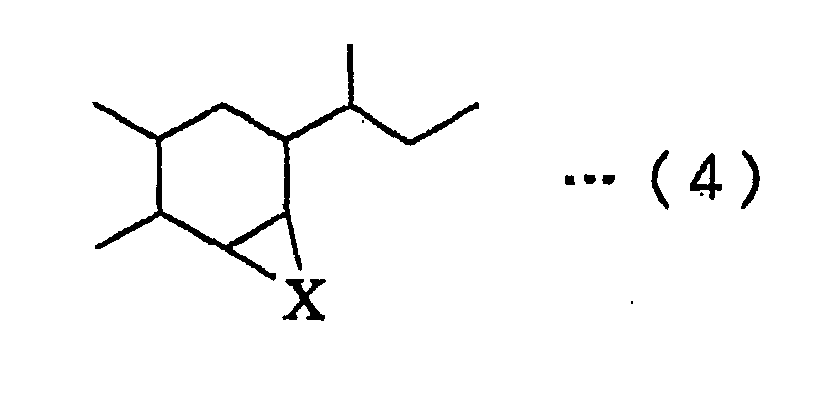
4 is a tetravalent organic group represented by the following
Formula (4), R
5 is a divalent organic group, and R
6 is an alkyl group having
3 to 10 carbon atoms or a fluoroalkyl group having 3 to 10 carbon atoms.
wherein X is a saturated or unsaturated hydrocarbon group.
wherein R
7 is a straight-chain alkyl group having 6 to 20 carbon atoms or a
straight-chain fluoroalkyl group having 6 to 20 carbon atoms.
The present invention also provides a liquid-crystal display element
comprising:
and also provides a liquid-crystal display unit having the device.
The present invention still also provides a process for producing a
liquid-crystal display element; the process comprising:
BRIEF DESCRIPTION OF THE DRAWINGS
These and other features, objects and advantages of the present
invention will become more apparent from the following description when
taken in conjunction with the accompanying drawings wherein;
Fig. 1 is a partial cross-sectional view of a liquid-crystal display
element in Example 4.
Fig. 2 is a function diagram of a liquid-crystal display unit in
Example 4.
Figs. 3A to 3C show the steps of producing a driving circuit substrate
member in Example 4.
Figs. 4A to 4E show the steps of producing a filter substrate member
in Example 4.
Figs. 5A and 5E show the steps of producing a liquid-crystal display
element in Example 4.
DETAILED DESCRIPTION OF THE INVENTION
The material for a liquid-crystal alignment film according to the
present invention is, as described above, a composition comprising the first
and second polyamides. Since these polyamides are polyamide acid esters,
any carboxyl groups having high polarity do not stand bare to the surfaces.
Since also they are esters of alkyl groups having 3 or more carbon atoms
and so having a relatively great steric hindrance, their molecular chains
have highly bending properties. Hence, the first and second polyamides
have a high solubility to non-polar solvents. Accordingly, the use of these
polyamides enables preparation of solutions in a high solid-matter
concentration, so that a material for liquid-crystal alignment films which
has high step-covering properties can be obtained. Moreover, the material
for liquid-crystal alignment films according to the present invention have
so high a polyamide solubility that it can promise a high storage stability of
its solution.
The first polyamide may preferably be a copolymer further having a
fourth repeating unit represented by the following Formula (6). Even in
the case when the first polyamide contains this fourth repeating unit, the
number of the first repeating unit with respect to the number of total
repeating units in one molecule of the first polyamide may preferably be in
a proportion of at least 30 mole% in terms of material ratio of acid
anhydrides.
wherein R
8 is a tetravalent organic group represented by any of the
following structural formulas (7).
In the material for liquid-crystal alignment films according to the
present invention, the first polyamide and the second polyamide may be in
a weight ratio selected appropriately as occasion calls, as long as the
material can satisfy the required characteristics such as pre-tilt angles,
voltage holding ratio and residual DC voltage, and, in view of these
characteristics, may usually be in a weight ratio of from 99:1 to 5:95. They
may preferably be in a weight ratio of from 95:5 to 50:50.
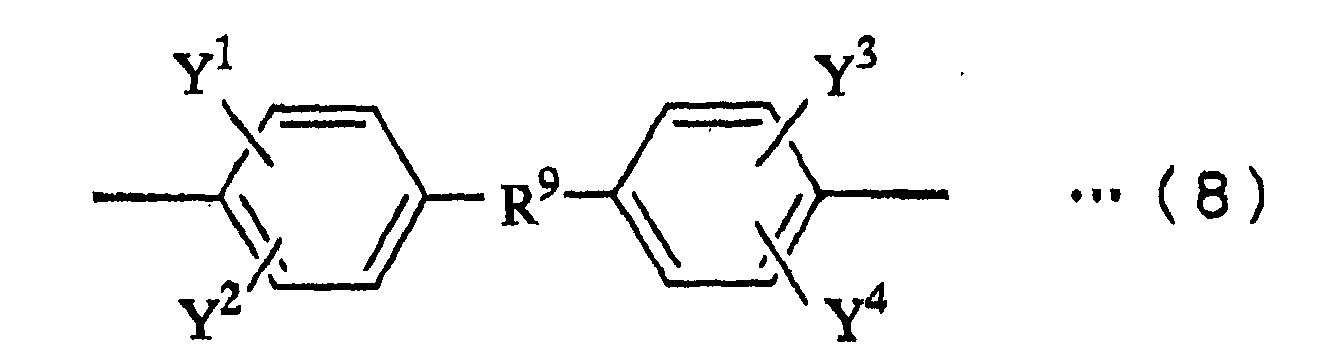
Because of an improvement in adherence to the substrate, at least
part of a plurality of R
2s contained in one molecule of the first polyamide
may also have at least one of a carboxyl group and a hydroxyl group as a
substituent, or may preferably be an organic group represented by the
following Formula (8) and may more preferably be an organic group
represented by the following Formula (9).
In the formulas, Y1 to Y4 are each a hydrogen atom, a hydroxyl group,
a carboxyl group having 1 to 8 carbon atoms, an aldehyde group having 1
to 8 carbon atoms, an alkyl group having 1 to 8 carbon atoms or an aryl
group having 6 to 18 carbon atoms, R9 is a divalent organic group such as
an alkyl group or a carbonyl group, or an oxygen atom.
At least part of a plurality of diamine residual groups (R2 and/or R5)
contained in one molecule(s) of the first polyamide and/or the second
polyamide may be made into a silicon-containing organic group. This
enables an improvement in the adherence to substrate and the printability.
The silicon-containing organic group with respect to the total number of the
diamine residual groups contained in the first or second polyamide may
preferably be in a proportion of from 0 mole% to 80 mole% for each
polyamide. In particular, it is effective to make part of the diamine
residual group R5 of the second polyamide into the silicon-containing
organic group.
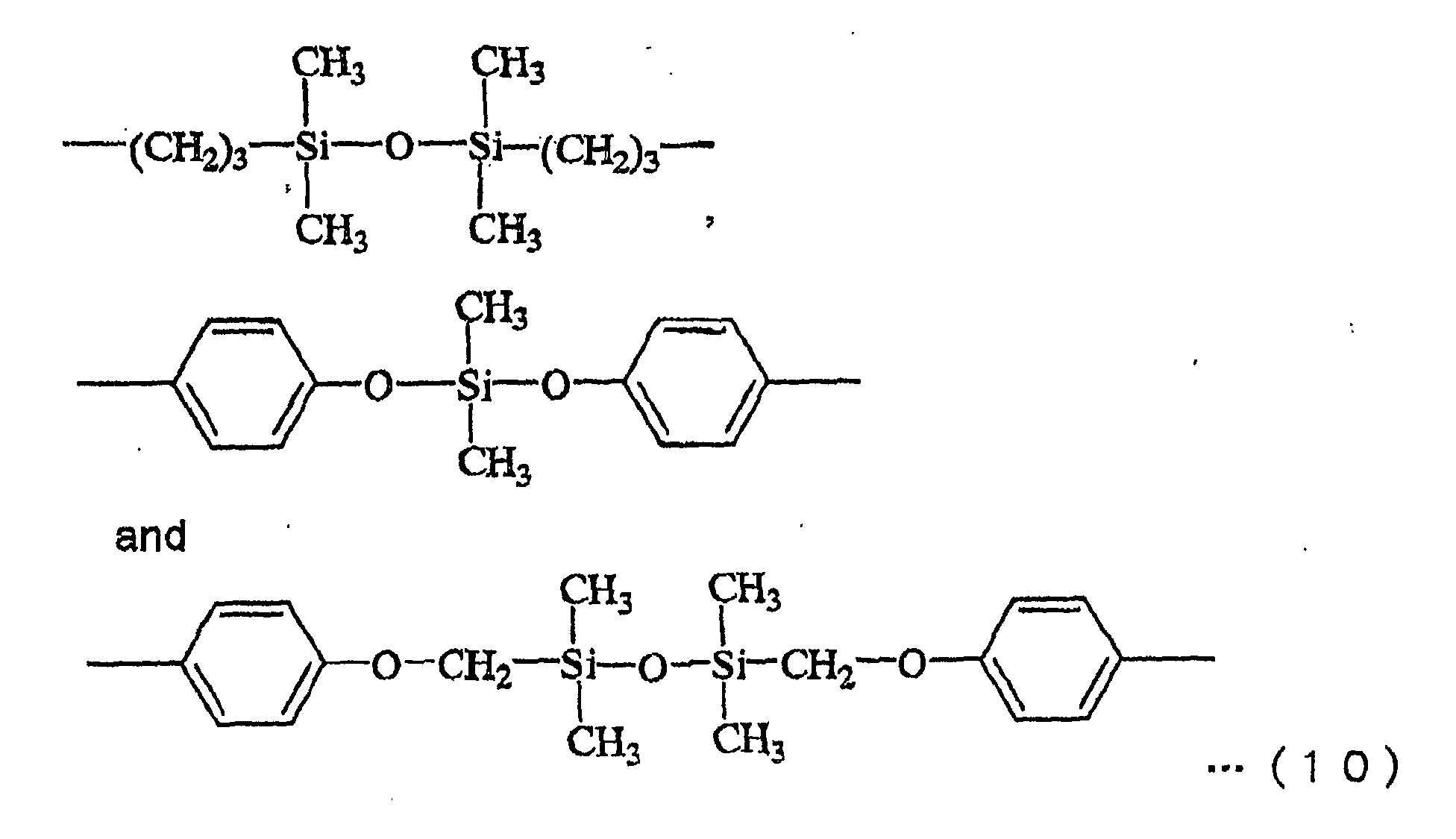
The silicon-containing organic group used here may preferably
contain a siloxane structure in order to improve adherence and printability,
and may particularly preferably be at least one of organic groups
represented by any of the following structural formulas (10).
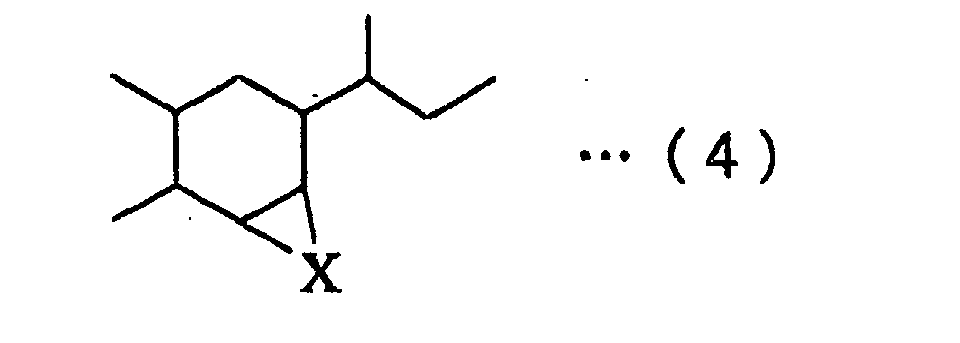
The group represented by R
4 in the second polyamide is the
tetravalent organic group represented by the above Formula (4). Herein, X
is a saturated or unsaturated hydrocarbon group, which forms a condensed
ring together with a cyclohexane ring. This hydrocarbon group X may
preferably have 3 to 8 carbon atoms at its part constituting the closed-ring
structure, and may further have, as a substituent or substituents, an alkyl
group having 1 to 8 carbon atoms and/or an aryl group having 6 to 18
carbon atoms. The group represented by R
4 may preferably be, e.g., an
organic group represented by any of the following structural formulas (11).
wherein Z
1 to Z
8 are each any of a hydrogen atom, an alkyl group having 1
to 8 carbon atoms and an aryl group having 6 to 18 carbon atoms; and n is
an integer of 1 to 8, m is an integer of 1 to 4, p is an integer of 1 to 8, q is an
integer of 1 to 4, r is an integer of 1 or 2, s is an integer of 1 to 4, t is an
integer of 1 or 2, u is an integer of 1 to 4, v is an integer of 1 or 2, and w is
an integer of 1 to 4.
The group represented by R7 in the third repeating unit may also
preferably be a straight-chain alkyl group such as a hexadecyl group, or its
fluoride a straight-chain fluoroalkyl group. This enables materialization
of stabler and higher pre-tilt angles.
The material for liquid-crystal alignment films according to the
present invention may further optionally contain a solvent. There are no
particular limitations on the total content of the first and second
polyamides as long as they are in a uniform liquid form. Usually, the
solvent may be used so as to provide a solid-matter concentration of from
1% by weight to 70% by weight. A higher solid-matter concentration is
preferred in view of the step-covering properties. In view of the
printability, it may be from 1 to 15% by weight.
There are no particular limitations on the solvent usable in the
present invention as long as it can dissolve the first and second polyamides.
For example, preferred are good solvents such as 2-pyrrolidone,
N-methylpyrrolidone, N-ethylpyrrolidone, N-vinylpyrrolidone,
N,N-dimethylacetamide, N,N-dimethylformamide and γ-butyrolactone.
Even a poor solvent in which the first and/or second polyamide(s)
is/are low soluble, it may also be used in the form of a mixture with the
above good solvent as long as the dissolving power of the whole solvent is
not damaged. The poor solvent usable in such a form may include, e.g.,
ethyl cellosolve, butyl cellosolve, ethyl Carbitol, butyl Carbitol, ethyl
Carbitol acetate, and ethylene glycol.
The first and second polyamides used in the present invention may
each be isolated as a precipitate by, e.g., allowing a tetracarboxylic diester
obtained by the reaction of a tetracarboxylic dianhydride with an alcohol,
and a diamine to react in a polar solvent to effect polymerization, and
introducing the resultant polyamide solution into a poor solvent such as
methanol, ethanol or water. The material for liquid-crystal alignment
films may be prepared by purifying the polyamides thus isolated and
thereafter dissolving again in solvents the first and second polyamides
obtained. Here, these polyamides having a polyamide acid ester structure
may be converted into polyimides by heating them at 100°C to 350°C.
Tetracarboxylic dianhdrides used as materials for synthesizing the
first and second polyamides may include the following. Incidentally, as
for these acid dianhydrides, one compound may be used alone or two or
more compounds may be copolymerized.
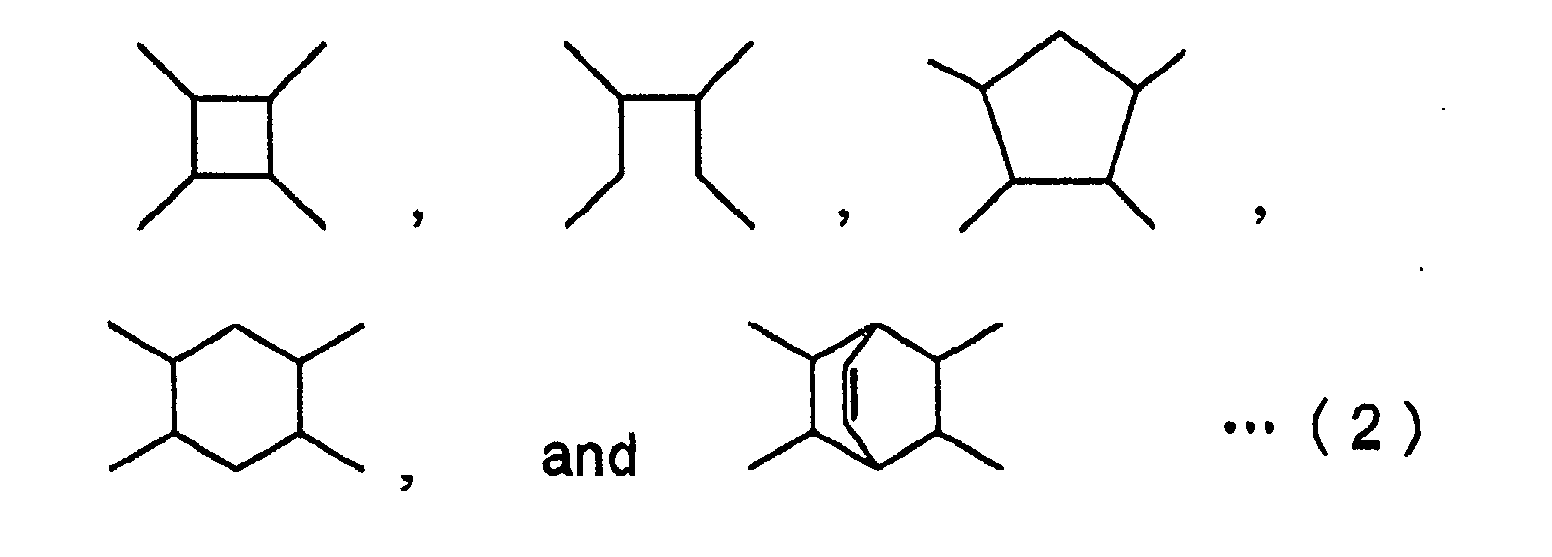
In the synthesis for the first polyamide, a tetracarboxylic dianhydride
used as a material for the first repeating unit may include, as specific
examples, cyclobutanetetracacboxylic dianhydride,
cyclopentanetetracacboxylic dianhydride, cyclohexanetetracacboxylic
dianhydride and butanetetracacboxylic dianhydride. Of these,
cyclobutanetetracacboxylic dianhydride is preferred.
In the synthesis for the first polyamide, a tetracarboxylic dianhydride
used as a material for the fourth repeating unit may include, as specific
examples, pyromellitic dianhydride, biphenyltetracacboxylic dianhydride,
naphthalenetetracacboxylic dianhydride and terphenyltetracacboxylic
dianhydride. Of these, pyromellitic dianhydride is preferred.
A tetracarboxylic dianhydride used as a material for synthesizing the
second polyamide may include, as a specific example,
3,4-dicarboxy-1,2,3,4-tetrahydro-1-naphthalenesuccinic dianhydride.
Diamines used as materials for synthesizing the first and second
polyamide may include the following. Incidentally, as for these diamines,
one compound may be used alone or two or more compounds may be
copolymerized.
A diamine used as a material for synthesizing the first polyamide
may include, as specific examples, aromatic diamines such as
3,5-daminobenzoic acid, 4,4'-diamino-3.3'-dicarboxydiphenylmethane,
p-phenylenediamine, 1,4-bis(4-aminophenyl)benzene, 4,4'-diaminobiphenyl,
3,3'-dimethyl-4,4'-diaminobiphenyl, 3,3'-dimethoxy-4,4'-diaminobiphenyl,
3,3'-dihydroxy-4,4'-diaminobiphenyl, 3,3'-dichloro-4,4'-diaminobiphenyl,
3,3'-dicarboxy-4,4'-diaminobiphenyl, 4,4'-his(4-aminophenoxy)biphenyl,
diaminodiphenylmethane, diaminodiphenyl ether,
2,2-diaminodiphenylpropane, 4,4'-diaminodiphenylsulfone,
diaminobenzophenone, 1,3-bis(4-aminophenoxy)benzene,
1,4-bis(4-aminophenoxy)benzene, 4,4'-di(4-aminophenoxy)diphenylsulfone,
2,2-bis[4-(4-aminophenoxy)phenyl]propane and
1,1,1,3,3,3-hexafluoro-2,2-bis[4-(4-aminophenoxy)phenyl]propane; alicyclic
diamines such as diaminodicylcohexylmethane, diaminodicylcohexyl ether
and diaminocyclohexane; and aliphatic diamines such as 1,2-diaminoethane,
1,3-diaminopropane, 1,4-diaminobutane and 1,6-diaminohexane.
Of these, 3,5-daminobenzoic acid and
4,4'-diamino-3.3'-dicarboxydiphenylmethane, having a carboxyl group, are
preferred, and 4,4'-diamino-3,3'-dicarboxydiphenylmethane is particularly
preferred.
A diamine used as a material for synthesizing the second polyamide
may include, as specific examples, aromatic diamines such as
p-phenylenediamine, 1,4-bis(4-aminophenyl)benzene, 4,4'-diaminobiphenyl,
3,3'-dimethyl-4,4'-diaminobiphenyl, 3,3'-dimethoxy-4,4'-diaminobiphenyl,
3,3'-dihydroxy-4,4'-diaminobiphenyl, 3,3'-dichloro-4,4'-diaminobiphenyl,
3,3'-dicarboxy-4,4'-diaminobiphenyl, 4,4'-bis(4-aminophenoxy)biphenyl,
diaminodiphenylmethane, diaminodiphenyl ether,
2,2-diaminodiphenylpropane, 4,4'-diaminodiphenylsulfone,
diaminobenzophenone, 1,3-bis(4-aminophenoxy)benzene,
1,4-bis(4-aminophenoxy)benzene, 4,4'-di(4-aminophenoxy)diphenylsulfone,
2,2-bis[4-(4-aminophenoxy)phenyl]propane and
1,1,1,3,3,3-hexafluoro-2,2-bis[4-(4-aminophenoxy)phenyl]propane; alicyclic
diamines such as diaminodicylcohexylmethane, diaminodicylcohexyl ether
and diaminocyclohexane; and aliphatic diamines such as 1,2-diaminoethane,
1,3-diaminopropane, 1,4-diaminobutane and 1,6-diaminohexane.
In synthesizing the first and/or second polyamide(s), in order to
improve the adherence to substrate, a diaminosiloxane may preferably be
used in combination with these diamines and be copolymerized. The
diaminosiloxane usable here may include
1,3-bis(3-aminopropyl)tetramethyldisiloxane,
bis(4-aminophenoxy)dimethysilane and
1,3-bis(4-aminophenoxymethyl)-1,1,3,3-tetramethyldisiloxane. For these
diaminosiloxanes, too, one compound may be used alone, or two or more
compounds may be used in combination and be copolymerized.
Alcohols usable as materials for synthesizing the first polyamide and
for the second repeating unit of the second polyamide is an alkyl alcohol
having 3 to 10 carbon atoms or a fluoride thereof. As specific examples,
they may include n-propanol, isopropanol, n-butanol, n-perfluoropropanol,
perfluoroisopropanol and n-perfluorobutanol. Any of these may be used
alone, or may be used in the form of a mixture of two or more types.
An alcohol usable as a material for synthesizing the third repeating
unit of the second polyamide is a straight-chain alkyl alcohol having 6 to 20
carbon atoms, such as n-pentadecanol or n-hexadecanol; or a fluoride
thereof, including straight-chain fluoroalkyl alcohols having 6 to 20 carbon
atoms, such as n-perfluoropentadecanol and n-perfluorohexadecanol. Any
of these may be used alone, or may be used in the form of a mixture of two
or more types.
As solvents for reaction solutions for synthesizing the first and
second polyamides, usable are. e.g., N,N-dimethylformamide,
N,N-dimethylacetamide, N-methyl-2-pyrroliodne, N-methylcaprolactam,
dimethylsulfoxide, tetramethylurea, pyridine, dimethylsulfone,
hexamethylphosphoramide and butyl lactone. Any of these may be used
alone or in the form of a mixture. A solvent in which polyamides are
insoluble or slightly soluble may also be mixed as long as it is in a mixing
ratio within the range in which a uniform solution is obtainable.
The liquid-crystal display element of the present invention is
described below. The liquid-crystal display element of the present
invention may have a liquid-crystal alignment film comprised of a cured
product of the material for liquid-crystal alignment films according to the
present invention, without any particular limitations on other construction.
For example, as shown in Fig. 1, the device may be set up as a TFT
switching type liquid-crystal display element 100 having a driving circuit
substrate member 10 and a filter substrate member 20 which are disposed
opposingly to each other, and a liquid-crystal layer 30 held between them.
The liquid-crystal layer 30 is sealed at a sealing part 40, and the two
substrate members 10 and 20 are supportedly held with a frame 50 at that
part.
The driving circuit substrate member 10 has a transparent substrate
11 made of glass, resin or the like, a polarized-light film 12 formed on one
side of the transparent substrate 11, and formed on the other side thereof a
thin-film transistor 13 and a transparent electrode 14 such as ITO (indium
tin oxide), and a liquid-crystal alignment film 15 so formed as to cover
them.
The fiter substrate member 20 has a transparent substrate 21 made of
glass, resin or the like, a polarized-light film 22 formed on one side of the
transparent substrate 21, and formed on the other side thereof a color filter
23 and a black matrix 24, an overcoat layer 25 which are so formed as to
cover them, a transparent electrode 26 such as ITO formed on the surface of
the overcoat layer 25, and a liquid-crystal alignment film 27 formed on the
surface of the transparent electrode 26.
In the example shown here, the liquid- crystal alignment films 15 and
27 are provided on both the two substrate members 10 and 20, respectively,
and the two substrate members 10 and 20 are so disposed that the two
liquid- crystal alignment films 15 and 27 stand opposite to each other. At
least one or both of the two liquid- crystal alignment films 15 and 27 is/are
comprised of a cured product of the material for liquid-crystal alignment
films according to the present invention.
In the example shown here, the color filter 23 is provided. Without
limitation thereto, in the present invention, a liquid-crystal display element
of monochromatic display may instead be provided. Here is also
described the device taking the case of an active matrix type liquid-crystal
display element making use of TFT as a switching element for selecting
pixels. Without limitation thereto, in the present invention, the element
may also be a liquid-crystal display element of any other driving system.
Such a liquid-crystal display element may be produced, e.g., in the
following way.
First, on the surface of the transparent substrate 11, the transparent
electrode 14 and the thin-film transistor 13 are formed in prescribed
patterns. Thereafter, the material for liquid-crystal alignment films
according to the present invention is so coated as to cover the transparent
electrode 14 and the thin-film transistor 13, followed by baking to form a
resin film comprised of a polyamide or polyimide. The surface of the resin
film thus obtained is subjected to rubbing to make it into the liquid-crystal
alignment film 15, and then a sealing material 40 is printed, followed by
drying. Thus, the driving circuit substrate member 10 is obtained.
Then, on the surface of the transparent substrate 21, the color filter 23
and the black matrix 24 are formed in prescribed patterns, and the overcoat
layer 25 is so formed as to cover them. Thereafter, on the surface of the
overcoat layer 25, the transparent electrode 26 is formed, and the material
for liquid-crystal alignment films according to the present invention is so
coated as to cover the transparent electrode 26, followed by baking to form
a resin film comprised of a polyamide or polyimide. The surface of the
resin film thus obtained is subjected to rubbing to make it into the
liquid-crystal alignment film 27. Thus, the filter substrate member 20 is
obtained.
Subsequently, the driving circuit substrate member 10 and the filter
substrate member 20 are set opposite to each other with their liquid- crystal
alignment films 15 and 27 sides inside, and are fixed with the frame 50,
adjusting the substrate members 10 and 20 so that their opposing distance
is kept uniform. Thereafter, the sealing material 40 is baked, and the
liquid crystal 30 is injected into the space between the substrate members
10 and 20, followed by sealing. After the liquid crystal has been subjected
to re-alignment, and after cleaning, the polarized- light films 12 and 22 are
stuck on the outside surfaces of the substrate members 10 and 20. Thus,
the liquid-crystal display element 100 is obtained.
The liquid-crystal display element of the present invention may also
be assembled together with a power source system, a drive system and so
forth to set up the liquid-crystal display unit of the present invention. For
example, as shown in Fig. 2, a liquid-crystal display unit 110 of the present
invention has the liquid-crystal display element 100 of the present
invention, an integrated circuit 101 for driving the liquid-crystal display
element, a backlight 102, an input/output interface 103 and a power source
circuit 104.
According to the present invention, liquid-crystal alignment films
can be formed which satisfy the properties such as voltage holding ratio,
pre-tilt angles, residual DC voltage, printability, adherence and solution
storage stability and at the same time have much superior step-covering
properties, and a highly reliable, superior liquid-crystal display element
and liquid-crystal display unit can be produced in a good yield.
THE PREFERRED EMBODIMENTS
Example 1
(1) Synthesis of first polyamide:
Into a 200 ml four-necked flask, 3.14 g (0.016 mole) of
cyclobutanetetracacboxylic dianhydride, 3.49 g (0.016 mole) of pyromellitic
dianhydride, 3.85 g (0.064 mole) of n-propanol, 5.06 g (0.064 mole) of
pyridine and 60 ml of N-methyl-2-pyrrolidone (NMP) were introduced and
then stirred at 60°C, whereupon a transparent solution was formed in 1
hour. This solution was further stirred for 7 hours at room temperature.
Thereafter, the flask was cooled with ice, and 9.88 g (0.083 mole) of thionyl
chloride was dropwise added thereto over a period of 10 minutes, followed
by stirring at room temperature for 1 hour to obtain a solution containing
acid chloride.
Into another 200 ml four-necked flask, 7.32 g (0.026 mole) of
4,4'-diamino-3.3'-dicarboxydiphenylmethane, 2.42 g (0.0064 mole) of
1,3-bis(4-aminophenoxymethyl)-1,1,3,3-tetramethyldisiloxane, 5.06 g (0.064
mole) of pyridine and 50 ml of N-methyl-2-pyrrolidone (NMP) were
introduced and then the flask was cooled with ice, where the above acid
chloride solution was slowly dropwise added over a period of 1 hour with
stirring while keeping the temperature at 10°C or below.
Thereafter, the reaction solution was stirred at room temperature for
1 hour, and then poured into 1 liter of water, and the polymer precipitated
was collected by filtration, followed by washing with water twice, and then
vacuum drying to obtain 19 g of polyamide (A-1). Weight-average
molecular weight of this polymer was measured by GPC (gel permeation
chromatography) to find that it was 20,000 in terms of polystyrene.
The polyamide (A-1) is the first polyamide which is a copolymer
having first repeating units represented by the following structural
formulas (12) and fourth repeating units represented by the following
structural formulas (13).
In the formulas, R
9s are any of two organic groups represented by the
following structural formulas (14).
Into a 200 ml four-necked flask, 9.6 g (0.032 mole) of
3,4-dicarboxy-1,2,3,4-tetrahydro-1-naphthalenesuccinic dianhydride
(hereinafter "TDA"), 3.46 g (0.0576 mole) of n-propanol, 1.55 g (0.0064 mole)
of n-hexadecanol, 5.06 g (0.064 mole) of pyridine and 60 ml of
N-methyl-2-pyrrolidone (hereinafter "NMP") were introduced and then
stirred at 60°C, whereupon a transparent solution was formed in 1 hour.
This solution was further stirred for 7 hours at room temperature.
Thereafter, the flask was cooled with ice, and 9.88 g (0.083 mole) of thionyl
chloride was dropwise added thereto over a period of 10 minutes, followed
by stirring at room temperature for 1 hour to obtain a solution containing
acid chloride.
Into another 200 ml four-necked flask, 2.76 g (0.056 mole) of
p-phenylenediamine, 2.42 g (0.0064 mole) of
1,3-bis(4-aminophenoxymethyl)-1,1,3,3-tetramethyldisiloxane, 5.06 g (0.064
mole) of pyridine and 50 ml of NMP were introduced and then the flask
was cooled with ice, where the above acid chloride solution was slowly
dropwise added over a period of 1 hour with stirring (keeping the
temperature at 10°C or below).
Thereafter, the reaction solution was stirred at room temperature for
1 hour, and then poured into 1 liter of water, and the polymer precipitated
was collected by filtration, followed by washing with water twice, and then
vacuum drying to obtain 15 g of polyamide (B-1). Weight-average
molecular weight of this polymer was measured by GPC (gel permeation
chromatography) to find that it was 21,000 in terms of polystyrene.
The polyamide (B-1) is the second polyamide which is a copolymer
having second repeating units represented by the following structural
formulas (15) when R
10s are each a n-propyl group, and having third
repeating units represented by the following structural formulas (15) when
R
10s are each a n-hexadecyl group.
In the formulas, R
11's are any of two organic groups represented by
the following structural formulas (16).
Next, the polyamide (A-1) and the polyamide (B-1) were mixed in a
weight ratio of (A-1)/(B-1) = 4/1, and the mixture obtained was diluted
with a mixed solvent of γ-butylolactone and ethylene glycol-n-butyl ether
(weight ratio: 87/13), followed by thorough stirring to obtain a solution
having a total solid-matter concentration of 4%.
To this solution, in order to remove chlorine ions,
poly(-vinylypyridine) (cross-linked by 2%; 60 meshes; a product of Acros
organics) was added in an amount equal to that of polyamides, and the
resultant mixture was stirred in a beaker for 4 hours, followed by filtration
with a filter of 5 µm in pore size to effect purification of the solution. Thus,
a material for liquid-crystal alignment films was obtained.
In order to ascertain the viscosity stability of this material for
liquid-crystal alignment films, the solution was left at 23°C, where a change
in viscosity after 30 days was at a rate as low as 2.5% of the initial viscosity.
(4) Production of liquid-crystal cell;
The solution having been purified was printed on each of two glass
substrates with transparent electrodes, by means of a screen printer,
followed by hot-plate baking at 70°C for 1 minute to obtain polyamide resin
films of 1,000 angstroms in layer thickness. The resin films obtained were
films having neither pinholes nor print unevenness and having a good
adherence.
These resin films were subjected to rubbing with a rubbing cloth
made of velvet, to make them into liquid-crystal alignment films. Then,
the resultant two glass substrate members were set opposite to each other
with their liquid-crystal alignment film sides inside in such a way that the
rubbing directions stood anti-parallel interposing a spacer of 20 µm high,
and were fixed with the sealing material and the frame, where a liquid
crystal (HA5073LA, available from Chisso Petrochemical Corporation) was
injected into the space between the substrate members, followed by sealing
to produce a liquid-crystal cell.
The state of alignment of this liquid-crystal cell was observed with a
polarizing microscope to ascertain that the liquid-crystal stood aligned in a
defect-free and uniform state. On this cell, the pre-tilt angle of
liquid-crystal molecules was measured by the crystal rotation method to
find that it was 6.0°, thus the cell had a high pre-tilt angl required as TFT
alignment films.
Next, to measure electrical properties of the liquid-crystal cell, a 90°
twist liquid-crystal cell was produced using substrates on which polyamide
films were formed and subjected to rubbing in the same manner as in the
above, where, after a spacer of 6 µm was sprayed over the film surfaces, the
directions of rubbing were set to fall substantially at right angles, and a
liquid crystal (HA5073LA, available from Chisso Petrochemical
Corporation) was injected into the space between the substrate members.
The state of alignment of this liquid-crystal cell was observed with a
polarizing microscope to ascertain that the liquid-crystal stood aligned in a
defect-free and uniform state.
On this liquid-crystal cell, the voltage holding ratio was measured to
find that the cell showed a value of as high as 99.5% at 23°C. Also,
residual DC voltage was measured by "the dielectric absorption method" in
which a direct current of 5 V was applied to this cell at 23°C for 30 minutes
and then left for one second in that state and any residual DC voltage
remaining in the liquid-crystal cell after 10 minutes was measured. As a
result, it was 0.10 V, showing a good property having a small accumulation
of electric charges.
Example 2
19 g of the first polyamide, polyamide (A-2), was obtained in the
same manner as in Example 1 except that 3.95 g (0.026 mole) of
3.5-diaminobenzoic acid was used in place of
4,4'-diamino-3.3'-dicarboxydiphenylmethane. Weight-average molecular
weight of this polymer was measured by GPC (gel permeation
chromatography). to find that it was 23,000 in terms of polystyrene.
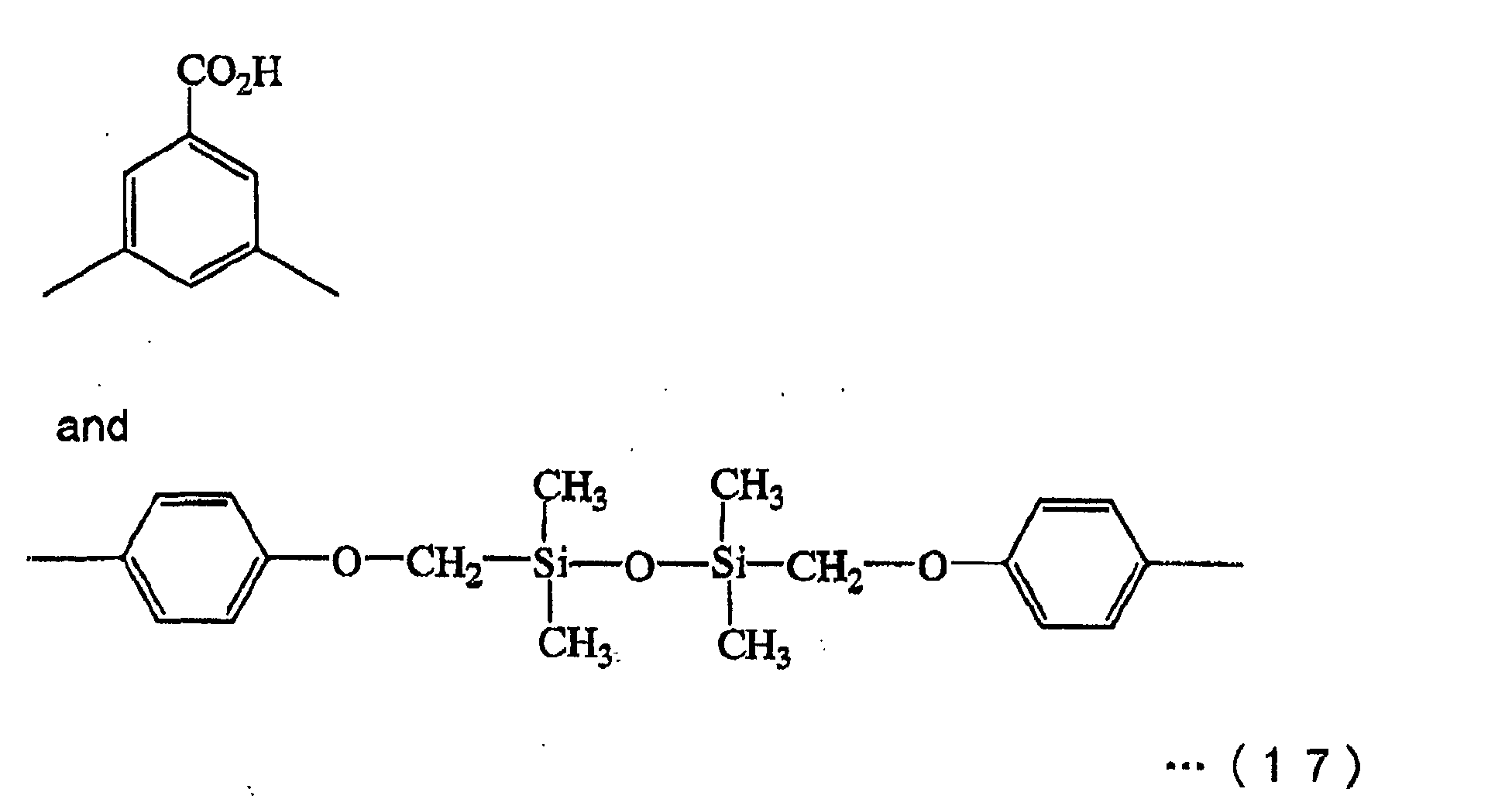
The polyamide (A-2) is the first polyamide which is a copolymer
having first repeating units represented by the above structural formulas
(12) when R
9s are each any of two organic groups represented by the
following structural formulas (17), and having fourth repeating units
represented by the above structural formulas (13).
A material for liquid-crystal alignment films was prepared in the
same manner as in Example 1 except that the polyamide (A-2) was used in
place of the polyamide (A-1). In order to ascertain the viscosity stability of
this material for liquid-crystal alignment films, the solution was left at 23°C,
where a change in viscosity after 30 days was at a rate as low as 1.9% of the
initial viscosity.
Subsequently, the material for liquid-crystal alignment films, thus
obtained, was printed on each of two glass substrates with transparent
electrodes, by means of a screen printer in the same manner as in Example
1, followed by hot-plate baking at 70°C for 1 minute to obtain polyamide
resin films of 1,000 angstroms in layer thickness. The resin films obtained
were films having neither pinholes nor print unevenness and having a good
adherence.
These resin films were subjected to rubbing with a rubbing cloth
made of velvet, and thereafter a liquid-crystal cell was produced in the
same manner as in Example 1. The state of alignment of this liquid-crystal
cell was observed with a polarizing microscope to ascertain that the
liquid-crystal stood aligned in a defect-free and uniform state. On this cell,
the pre-tilt angle of liquid-crystal molecules was also measured by the
crystal rotation method to find that it was 5.5°, thus the cell had a high
pre-tilt angle required as TFT alignment films.
Next, a 90° twist liquid-crystal cell was produced in the same manner
as in Example 1, and the state of alignment of this liquid-crystal cell was
observed with a polarizing microscope to ascertain that the liquid-crystal
stood aligned in a defect-free and uniform state. On this liquid-crystal cell,
the voltage holding ratio was also measured to find that the cell showed a
value of as high as 99.0% at 23°C. On this liquid-crystal cell, residual DC
voltage was still also measured in the same manner as in Example 1. As a
result, it was 0.12 V, showing a good property having a small accumulation
of electric charges.
Example 3
15 g of the second polyamide, polyamide (B-2), was obtained in the
same manner as in Example 1 except that the n-propanol was added in an
amount of 3.07 g (0.0512 mole) and the n-hexadecanol in an amount of 3.10
g (0.0128 mole). Weight-average molecular weight of this polymer was
measured by GPC (gel permeation chromatography) to find that it was
20,000 in terms of polystyrene.
A material for liquid-crystal alignment films was prepared in the
same manner as in Example 1 except that the polyamide (B-2) was used in
place of the polyamide (B-1). In order to ascertain the viscosity stability of
this material for liquid-crystal alignment films, the solution was left at 23°C,
where a change in viscosity after 30 days was at a rate as low as 2% of the
initial viscosity.
Subsequently, the material for liquid-crystal alignment films, thus
obtained, was printed on each of two glass substrates with transparent
electrodes, by means of a screen printer in the same manner as in Example
1, followed by hot-plate baking at 70°C for 1 minute to obtain polyamide
resin films of 1,000 angstroms in layer thickness. The resin films obtained
were films having neither pinholes nor print unevenness and having a good
adherence.
These resin films were subjected to rubbing with a rubbing cloth
made of velvet, and thereafter a liquid-crystal cell was produced in the
same manner as in Example 1. The state of alignment of this liquid-crystal
cell was observed with a polarizing microscope to ascertain that the
liquid-crystal stood aligned in a defect-free and uniform state. On this cell,
the pre-tilt angle of liquid-crystal molecules was also measured by the
crystal rotation method to find that it was 6.7°, thus the cell had a high
pre-tilt angle required as TFT alignment films.
Next, a 90° twist liquid-crystal cell was produced in the same manner
as in Example 1, and the state of alignment of this liquid-crystal cell was
observed with a polarizing microscope to ascertain that the liquid-crystal
stood aligned in a defect-free and uniform state. On this liquid-crystal cell,
the voltage holding ratio was also measured to find that the cell showed a
value of as high as 99.6% at 23°C. On this liquid-crystal cell, residual DC
voltage was still also measured in the same manner as in Example 1. As a
result, it was 0.12 V, showing a good property having a small accumulation
of electric charges.
Example 4
A. Production of Liquid-crystal Display element
(1) Production of driving circuit substrate member:
As shown in Figs. 3A to 3C, first, on the surface of a transparent
substrate 11, a transparent electrode 14 and a thin-film transistor 13 were
formed in prescribed patterns (Fig. 3A). Then, the material for
liquid-crystal alignment films obtained in Example 1 was so coated as to
cover these, followed by hot-plate baking at 70°C for 1 minute to form a
polyamide resin film 15a of 1,000 angstroms in layer thickness (Fig. 3B).
The surface of this resin film 15a was subjected to rubbing to make it
into a liquid-crystal alignment film 15, and then a sealing material was
printed to form a frame-shaped pattern, followed by drying to provide a
sealing part 40. Thus, a driving circuit substrate member 10a was obtained
(Fig. 3C).
(2) Production of filter substrate member:
As shown in Figs. 4A to 4E, on the surface of the transparent
substrate 21, a photosensitive resin composition containing a black coloring
matter was coated in a prescribed pattern, followed by exposure and
development in the prescribed pattern to form a black matrix 24, and
thereafter photosensitive resin compositions respectively containing a red
coloring matter, a green coloring matter and a blue coloring matter were
coated in the same way, followed by exposure and development in the
prescribed pattern to form a color filter 23 (Fig. 4A).
Subsequently, an overcoat layer 25 was so formed as to cover the
color filter 23 and the black matrix 24 (Fig. 4B). Thereafter, on its surface,
a transparent electrode 26 is formed in a prescribed pattern (Fig. 4C), and
the material for liquid-crystal alignment films obtained in Example 1 was
so coated as to cover the transparent electrode 26, followed by hot-plate
baking at 70°C for 1 minute to form a polyamide resin film 27a of 1,000
angstroms in layer thickness (Fig. 4D).
The surface of this resin film 27a obtained was subjected to rubbing
to make it into a liquid-crystal alignment film 27. Thus, a filter substrate
member 20a was obtained (Fig. 4E).
(3) Assemblage of liquid-crystal display element
As shown in Figs. 5A and 3B, the driving circuit substrate member
10a and the filter substrate member 20a were set opposite to each other and
put together with their liquid- crystal alignment films 15 and 27 sides inside
in such a way that the rubbing directions stood anti-parallel interposing a
spacer of 20 µm high, and were fixed with the frame 50, adjusting the
substrate members 10a and 20a so that their opposing distance is kept
uniform (Fig. 5A).
Subsequently, a liquid crystal (HA5073LA, available from Chisso
Petrochemical Corporation) was injected into the space 31 between the
substrate members 10a and 20a, followed by sealing to produce a
liquid-crystal cell (Fig. 5A). Thereafter, the liquid crystal was subjected to
re-alignment and then cleaned, and polarized- light films 12 and 22 were
stuck on the outside surfaces of the transparent substrates 11 and 21. Thus,
the liquid-crystal display element 100 shown in Fig. 1 was obtained.
The liquid-crystal display element thus obtained, like the
liquid-crystal cell in Example 1, was in a good state of alignment and had a
high pre-tilt angle, showing good results on both the voltage holding ratio
and the residual DC voltage. Also, the steps (difference in level) due to
the electrodes 14 and 26, TFT 13, the color filter 24 and so forth were
perfectly stood covered with the liquid-crystal alignment films 15 and 17
without any defects.
B. Production of Liquid-crystal Display Unit
Using the liquid-crystal display element 100, as shown in Fig. 2, a
liquid-crystal display unit was assembled together with the integrated
circuit 101 for driving the liquid-crystal display element, the backlight 102,
the input/output interface 103 and the power source circuit 104. As a
result, a highly reliable good product was obtainable.
While we have shown and described several embodiments in
accordance with our invention, it should be understood that disclosed
embodiments are susceptible of changes and modifications without
departing from the scope of the invention. Therefore, we do not intend to
be bound by the details shown and described herein but intend to cover all
such changes and modifications a fall within the ambit of the appended
claims.






 and
and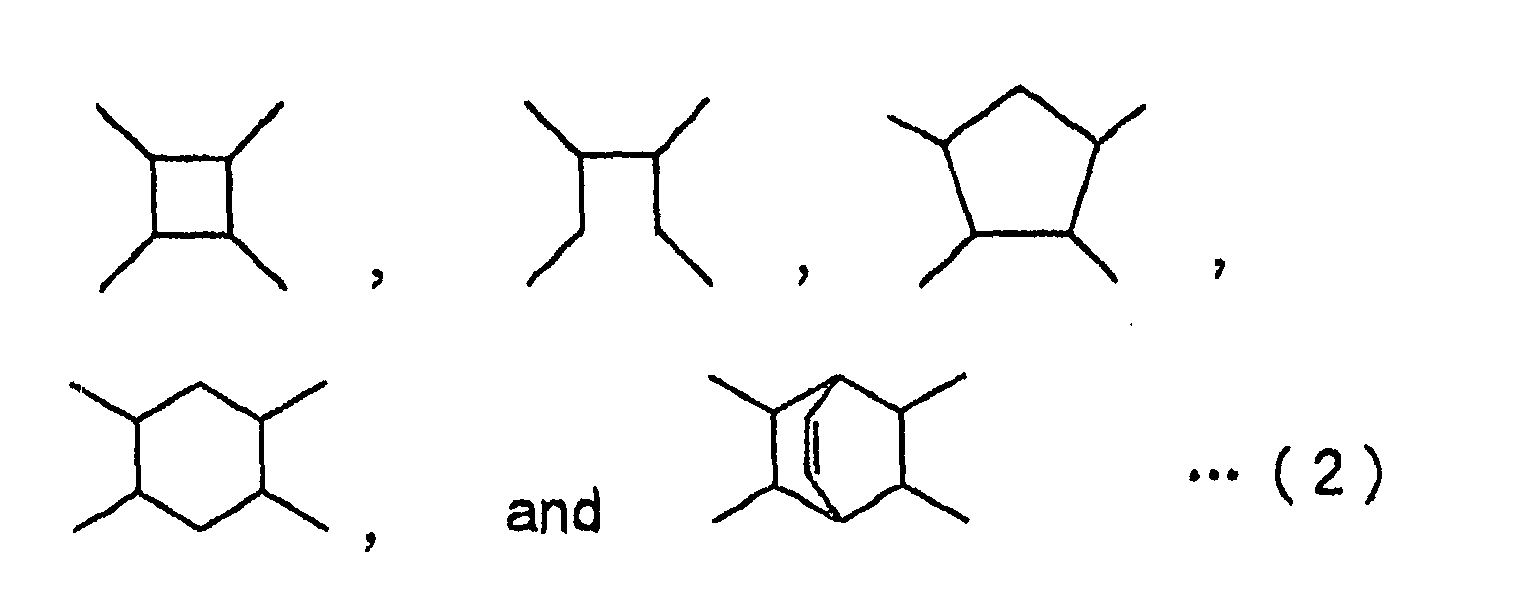 (ii) a second polyamide having a second repeating unit represented by the following Formula (3) and a third repeating unit represented by the following Formula (5), and having a weight-average molecular weight of from 5,000 to 200,000.
 wherein X is a saturated or unsaturated hydrocarbon group.
 wherein R7 is a straight-chain alkyl group having 6 to 20 carbon atoms or a straight-chain fluoroalkyl group having 6 to 20 carbon atoms.
 and the number of the first repeating unit with respect to the number of total repeating units in one molecule of said first polyamide is in a proportion of at least 30 mole% in terms of material ratio of acid anhydrides.