EP1275632A2 - Method for concentrating 2,6-dimethylnaphthalene in a dimethylnaphthalene mixture - Google Patents
Method for concentrating 2,6-dimethylnaphthalene in a dimethylnaphthalene mixture Download PDFInfo
- Publication number
- EP1275632A2 EP1275632A2 EP02254915A EP02254915A EP1275632A2 EP 1275632 A2 EP1275632 A2 EP 1275632A2 EP 02254915 A EP02254915 A EP 02254915A EP 02254915 A EP02254915 A EP 02254915A EP 1275632 A2 EP1275632 A2 EP 1275632A2
- Authority
- EP
- European Patent Office
- Prior art keywords
- dimethylnaphthalene
- type zeolite
- adsorption column
- concentrating
- isomer mixture
- Prior art date
- Legal status (The legal status is an assumption and is not a legal conclusion. Google has not performed a legal analysis and makes no representation as to the accuracy of the status listed.)
- Withdrawn
Links
Images
Classifications
-
- C—CHEMISTRY; METALLURGY
- C07—ORGANIC CHEMISTRY
- C07C—ACYCLIC OR CARBOCYCLIC COMPOUNDS
- C07C7/00—Purification; Separation; Use of additives
- C07C7/12—Purification; Separation; Use of additives by adsorption, i.e. purification or separation of hydrocarbons with the aid of solids, e.g. with ion-exchangers
-
- C—CHEMISTRY; METALLURGY
- C07—ORGANIC CHEMISTRY
- C07C—ACYCLIC OR CARBOCYCLIC COMPOUNDS
- C07C7/00—Purification; Separation; Use of additives
- C07C7/12—Purification; Separation; Use of additives by adsorption, i.e. purification or separation of hydrocarbons with the aid of solids, e.g. with ion-exchangers
- C07C7/13—Purification; Separation; Use of additives by adsorption, i.e. purification or separation of hydrocarbons with the aid of solids, e.g. with ion-exchangers by molecular-sieve technique
Definitions
- the present invention relates to methods for selectively concentrating 2,6-dimethylnaphthalene by adsorption in a mixture containing dimethylnaphthalene isomers.
- Polyethylene naphthalate (PEN) resins have excellent characteristics, including thermal resistance and impermeability to gases, which are not exhibited by well-known PET resins, and 2,6-dimethylnaphthalene (2,6-DMN) is a starting material for these polyethylene naphthalate resins.
- Dimethylnaphthalene includes nine isomers. If 2,6-dimethylnaphthalene used for PEN contains the other isomers, the physical properties of the end product, that is, PEN, including thermal resistance and strength are degraded. Therefore, 2,6-dimethylnaphthalene must be separated out from the isomer mixture with high purity.
- cooling crystallization methods In order to separate out 2,6-dimethylnaphthalene, cooling crystallization methods, adsorption methods, and the like have been suggested. However, since 2,6-dimethylnaphthalene and 2,7-dimethylnaphthalene form a eutectic mixture, cooling crystallization decreases the yield of 2,6-dimethylnaphthalene and increases the cost of purification.
- Japanese Examined Patent Application Publication No. 49-27578 discloses a method for separating out 2,6-dimethylnaphthalene by adsorption, in which a dimethylnaphthalene isomer mixture is supplied to an adsorption column packed with Y-type zeolite, serving as an adsorbent, to be concentrated by adsorption and, further, the discharged solution is separated into 2,7-dimethylnaphthalene and 2,6-dimethylnaphthalene by cooling crystallization.
- Japanese Unexamined Patent Application Publication No. 6-65114 suggests that a Y-type zeolite containing potassium ions be used as an adsorbent for separating out 2,6-dimethylnaphthalene.
- KNa-Y type zeolite pellets in which 98% of cation sites are exchanged for potassium ions are packed in a column having an inner diameter of 1.07 cm and a length of 50 cm.
- adsorbents having a smaller grain size improve the separation performance thereof, these adsorbents increase the pressure loss of the adsorption column.
- an adsorption column having a higher ratio of the length to the inner diameter thereof increases the linear velocity of fluid supplied to the adsorption column, thereby reducing the diffusion resistance, at the surface of the adsorbent, of dimethylnaphthalene in the adsorption column.
- the separation performance is enhanced; however, the pressure loss of the column increases.
- an object of the present invention is to provide a method for fully bringing out the performance of adsorbents and selectively concentrating 2,6-dimethylnaphthalene in a dimethylnaphthalene isomer mixture.
- the inventors have conducted intensive research to accomplish this object and found a factor for fully bring out the performance of adsorbents.
- the factor is expressed by (u 1/3 / ⁇ )d -5/3 (m 5/3 s -1/3 kg -1 ), wherein u represents the linear velocity (m/s) of a solution of dimethylnaphthalene isomer mixture supplied to an adsorption column, ⁇ represents the packing density (kg/m 3 ) of a Y-type zeolite adsorbent, and d represents the grain size (m) of the adsorbent.
- a method for concentrating 2,6-dimethylnaphthalene in a dimethylnaphthalene isomer mixture in which o-xylene contains the 2,6-dimethylnaphthalene and 2,7-dimethylnaphthalene includes the step of supplying the dimethylnaphthalene isomer mixture to an adsorption column packed with Y-type zeolite.
- the value of (u 1/3 / ⁇ )d -5/3 is set at 14 (m 5/3 s -1/3 kg -1 ) or more.
- u represents the linear velocity (m/s) of the solution of dimethylnaphthalene isomer mixture supplied to the adsorption column
- ⁇ represents the packing density (kg/m 3 ) of the Y-type zeolite
- d represents the grain size (m) of the Y-type zeolite.
- the linear velocity u is in the range of 1 ⁇ 10 -5 to 1 ⁇ 10 -3 m/s
- the packing density ⁇ is in the range of 500 to 1000 kg/m 3
- the grain size d is in the range of 1 ⁇ 10 -4 to 5 ⁇ 10 -3 m.
- At least part of ion-exchanging sites of the Y-type zeolite are exchanged for potassium ions.
- a method of the present invention is used for concentrating 2,6-dimethylnaphthalene in a dimethylnaphthalene isomer mixture in which o-xylene contains 2,6-dimethylnaphthalene and 2,7-dimethylnaphthalene.
- the method is conducted by supplying the isomer mixture to an adsorption column packed with Y-type zeolite.
- the method is characterized in that the value derived from the expression (u 1/3 / ⁇ )d -5/3 is 14 (m 5/3 s -1/3 kg -1 ) or more, wherein u is the linear velocity (m/s) of the isomer mixture supplied, ⁇ is the packing density (kg/m 3 ) of the Y-type zeolite, and d is the grain size (m) of the Y-type zeolite.
- the recovery ratio of 2,6-dimethylnaphthalene in the discharged solution must be 90% or more with respect to the supplied 2,6-dimethylnaphthalene and, preferably, the concentration ratio of the 2,6-dimethylnaphthalene to 2,7-dimethylnaphthalene is 2.0 or more, from the view point of economical efficiency in the manufacturing process of 2,6-dimethylnaphthalene.
- the value of the above-described expression (u 1/3 / ⁇ )d -5/3 must be 14 (m 5/3 s -1/3 kg -1 ) or more.
- the dimethylnaphthalene isomer mixture used in the method of the present invention may contain other hydrocarbons and it may be diluted with o-xylene. Also, an undiluted dimethylnaphthalene isomer mixture may be used.
- Y-type zeolite is used as an adsorbent in the method of the present invention.
- part of the ion-exchanging sites of the Y-type zeolite are exchanged for potassium ions.
- a small grain size of the adsorbent is desired because a smaller grain size reduces the diffusion time of the adsorbent. However, an excessively small grain size increases the pressure loss of the adsorption column.
- the grain size d of the adsorbent is in the range of 1 ⁇ 10 -4 to 5 ⁇ 10 -3 m. More preferably, the grain size d is in the range of 5 ⁇ 10 -4 to 3 ⁇ 10 -3 m.
- the packing density ⁇ of the Y-type zeolite in an adsorption column is important for concentrating 2,6-dimethylnaphthalene effectively.
- a higher packing density ⁇ of the adsorbent increases the amount of packed adsorbent per volume and, therefore, leads to an adsorption column packed with a larger amount of adsorbent.
- the packing density ⁇ depends on the shape (for example, powder, granule, pellet, or sphere) and the size of the Y-type zeolite, and preferably, the packing density ⁇ is in the range of 500 to 1000 kg/m 3 .
- the linear velocity u of the dimethylnaphthalene isomer mixture and a desorbent supplied to the adsorption column is, preferably, in the range of 1 ⁇ 10 -5 to 1 ⁇ 10 -3 m/s.
- the linear velocity u increases, the thickness of a laminar film formed between the adsorbent and the dimethylnaphthalene isomer mixture becomes smaller and, accordingly, the mass transfer becomes faster.
- an excessively high linear velocity u increases the pressure loss of the adsorption column.
- the linear velocity u, the packing density ⁇ , and the grain size d of the adsorbent are set such that the value derived from the expression (u 1/3 / ⁇ )d -5/3 is 14 (m 5/3 s -1/3 kg -1 ) or more and, therefore, they must be set within the ranges described above.
- the temperature of the adsorption column is in the range of 100 to 250°C during operation.
- a higher temperature decreases the amount of the desorbing solvent required to desorb the dimethylnaphthalene.
- operation at a high temperature causes the operation to be under high pressure, and this is not suitable.
- the temperature of the adsorption column during operation is in the range of 100 to 200°C, and still more preferably in the range of 150 to 200°C.
- the adsorbent can be recycled for the following concentration of 2,6-dimethylnaphthalene by desorbing adsorbates.
- Any desorbent capable of desorbing adsorbates can be used, and preferably, o-xylene is used.
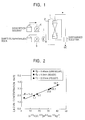
- Fig. 1 shows an exemplary system used in the method of the present invention. The experiment was conducted on a laboratory scale.
- An absorption column 1 in Fig. 1 is packed with Y-type zeolite.
- the adsorption column 1 is surrounded by a heater 2.
- a dimethylnaphthalene isomer mixture solution is supplied to the adsorption column 1 from the bottom with a pump 3. While the solution passes through the adsorption column 1, 2,7-dimethylnaphthalene is selectively adsorbed, and thus concentrated 2,6-dimethylnaphthalene is discharged.
- a desorbent is supplied to the adsorption column 1 with another pump 4. The 2,7-dimethylnaphthalene is eluted in the desorbent to be discharged from the adsorption column 1.
- Three K-Y type zeolites in which at least part of ion-exchanging sites of the Y-type zeolite were exchanged for potassium ions, were used as the adsorbent, and they were each in the shape of a pellet (2.07 ⁇ 10 -3 m in grain size), granule (4.6 ⁇ 10 -4 m in grain size), or bead (5.0 ⁇ 10 -4 m in grain size).
- dimethylnaphthalene isomers were used: 1,2-dimethylnaphthalene, 1,3-dimethylnaphthalene, 1,4-dimethylnaphthalene, 1,6-dimethylnaphthalene, 1,7-dimethylnaphthalene, 2,3-dimethylnaphthalene, 2,6-dimethylnaphthalene, and 2,7-dimethylnaphthalene.
- the isomers were each diluted with o-xylene in the proportion of 1 to 1 and then a dimethylnaphthalene isomer mixture solution was prepared such that the content of 2,6-dimethylnaphthalene and 2,7-dimethylnaphthalene was 10% (the ratio of 2,6-dimethylnaphthalene to 2,7-dimethylnaphthalene was 1.0).
- Dimethylnaphthalene solutions which were discharged from the adsorption column in a sequential process of adsorption-desorption were subjected to gas chromatography and the concentrations of 2,6-dimethylnaphthalene and 2,7-dimethylnaphthalene in each discharged solution were determined. Then, the concentration ratio of 2,6-dimethylnaphthalene to 2,7-dimethylnaphthalene and the recovery ratio of 2,6-dimethylnaphthalene in the sequential process of adsorption-desorption were derived from the volume and the concentrations of the discharged dimethylnaphthalene isomers.
- Table 1 shows the conditions of the concentration process, the value of the expression (u 1/3 / ⁇ )d -5/3 (m 5/3 s -1/3 kg -1 ), and the concentration ratio of 2,6-dimethylnaphthalene to 2,7-dimethylnaphthalene after the sequential process of the adsorption-desorption when the recovery ratio of 2,6-dimethylnaphthalene was 90%.
- Fig. 2 shows the relationship between the concentration ratio of 2,6-dimethylnaphthalene and the value of the expression(u 1/3 / ⁇ )d -5/3 (m 5/3 s -1/3 kg -1 ).
- the y-axis represents the concentration ratio of 2,6-dimethylnaphthalene and the x-axis represents the value derived from the expression (u 1/3 / ⁇ )d -5/3 (m 5/3 s -1/3 kg -1 ). No.
- Adsorption column size (mm) L/D Shape Depth (m) Packing density ⁇ (kg/m 3 ) Linear velocity u(m/s) Concentration ratio Expression value (m 5/3 s -1/3 kg -1 ) diameter (D) Length (L) 1 7.6 750 98.7 Bead 5.0 ⁇ 10 -4 711 3.75x10 -4 3 32 2 7.6 750 98.7 granule 4.6 ⁇ 10 -4 665 3.75x10 -4 3.5 40 3 20 100 5.0 granule 4.6 ⁇ 10 -4 665 5.0x10 -5 2.2 18 4 30 50 1.7 granule 4.6 ⁇ 10 -4 665 2.5x10 -5 2.0 14 5 40 1000 25.0 pellet 2.7 ⁇ 10 -3 639 2.67x10 -5 1.7 3 6 40 1000 25.0 granule 4.6 ⁇ 10 -4 665 2.67x10 -5 2.9 31
- Fig. 2 shows a correlation between the concentration ratio of 2,6-dimethylnaphthalene and the value of the expression (u 1/3 / ⁇ )d -5/3 (m 5/3 s -1/3 kg -1 ).
- concentration ratio of 2,6-dimethylnaphthalene that is, the performance of the adsorbent in an adsorption process, can be estimated by the value derived from the expression. (u 1/3 / ⁇ )d -5/3 (m 5/3 s -1/3 kg -1 ).
- the performance of the adsorbent can be estimated without attempting a test operation on an actual scale.
- dimethylnaphthalene isomers were used: 1,2-dimethylnaphthalene, 1,3-dimethylnaphthalene, 1,4-dimethylnaphthalene, 1,6-dimethylnaphthalene, 1,7-dimethylnaphthalene, 2,3-dimethylnaphthalene, 2,6-dimethylnaphthalene, and 2,7-dimethylnaphthalene.
- the isomers were each diluted with o-xylene in the proportion of 1 to 1 and then a dimethylnaphthalene isomer mixture solution was prepared such that the content of 2,6-dimethylnaphthalene and 2,7-dimethylnaphthalene was 10% (the ratio of 2,6-dimethylnaphthalene to 2,7-dimethylnaphthalene was 1.0).
- a K-Y type zeolite having a bead shape (0.5 ⁇ 10 -3 m in grain size) was used as an adsorbent and was packed in an adsorption column of 800 mm in inner diameter and 2000 mm in length.
- the packing density ⁇ was 650 kg/m 3 .
- the dimethylnaphthalene isomer mixture solution was supplied with a pump at a linear velocity u of 2.3 ⁇ 10 -5 m/s to the adsorption column, which had been heated at 180°C in advance. After predetermined time lapse, the supply of the dimethylnaphthalene solution was stopped, and subsequently o-xylene serving as a desorbent was supplied at a linear velocity u of 2.3 ⁇ 10 -5 m/s to the adsorption column to conduct desorption. In this instance, the value of the expression (u 1/3 / ⁇ )d -5/3 was 14 (m 5/3 s -1/3 kg -1 ).
- Table 2 shows the size of the adsorption column, the linear velocity u and the packing density ⁇ of the Y-type zeolite, the grain size d of the Y-type zeolite, the concentration ratio of 2,6-dimethylnaphthalene to 2,7-dimethylnaphthalene, and the value of the expression (u 1/3 / ⁇ )d -5/3 (m 5/3 s -1/3 kg -1 ) in this example.
- Adsorption column size (mm) L/D Shape Depth (m) Packing density ⁇ (kg/m 3 ) Linear velocity u (m/s) Concentration ratio Expression value (m 5/3 s -1/3 kg -1 ) diameter (D) Length (L)
- Example 800 2000 2.5 Bead 5.0 ⁇ 10 -4 650 2.3 ⁇ 10 -5 2.1 14
- the solution discharged from the adsorption column was subjected to gas chromatography.
- the concentration ratio of 2,6-dimethylnaphthalene to 2,7-dimethylnaphthalene was 2.1 when the recovery ratio of 2,6-dimethylnaphthalene was 90%.
- This concentration ratio value is subsequently equivalent to the value derived from the correlation diagram shown in Fig. 2, which was obtained by the experiment described above.
- the concentration ratio of 2,6-dimethylnaphthalene to 2,7-dimethylnaphthalene can be set at 2.0 or more by setting the value of the expression (u 1/3 / ⁇ )d -5/3 , which is a factor for operating an adsorption column, at 14 (m 5/3 s -1/3 kg -1 ) or more.
- u represents the linear velocity (m/s) of a dimethylnaphthalene isomer mixture supplied to an adsorption column
- ⁇ represents the packing density (kg/m 3 ) of Y-type zeolite
- d represents the grain size (m) of the Y-type zeolite.
Landscapes
- Chemical & Material Sciences (AREA)
- Organic Chemistry (AREA)
- Engineering & Computer Science (AREA)
- Analytical Chemistry (AREA)
- Oil, Petroleum & Natural Gas (AREA)
- Water Supply & Treatment (AREA)
- Organic Low-Molecular-Weight Compounds And Preparation Thereof (AREA)
- Treatment Of Liquids With Adsorbents In General (AREA)
Abstract
Description
| No. | Adsorption column size (mm) | L/D | Shape | Depth (m) | Packing density ε (kg/m3) | Linear velocity u(m/s) | Concentration ratio | Expression value (m5/3s-1/3kg-1) | |
| diameter (D) | Length (L) | ||||||||
| 1 | 7.6 | 750 | 98.7 | Bead | 5.0×10⁻⁴ | 711 | 3.75 | 3 | 32 |
| 2 | 7.6 | 750 | 98.7 | granule | 4.6×10⁻⁴ | 665 | 3.75x10⁻⁴ | 3.5 | 40 |
| 3 | 20 | 100 | 5.0 | granule | 4.6×10⁻⁴ | 665 | 5.0x10⁻⁵ | 2.2 | 18 |
| 4 | 30 | 50 | 1.7 | granule | 4.6×10⁻⁴ | 665 | 2.5x10⁻⁵ | 2.0 | 14 |
| 5 | 40 | 1000 | 25.0 | pellet | 2.7×10⁻³ | 639 | 2.67x10⁻⁵ | 1.7 | 3 |
| 6 | 40 | 1000 | 25.0 | granule | 4.6×10⁻⁴ | 665 | 2.67x10⁻⁵ | 2.9 | 31 |
| Adsorption column size (mm) | L/D | Shape | Depth (m) | Packing density ε (kg/m3) | Linear velocity u (m/s) | Concentration ratio | Expression value (m5/3s-1/3kg-1) | ||
| diameter (D) | Length (L) | ||||||||
| Example | 800 | 2000 | 2.5 | Bead | 5.0×10⁻⁴ | 650 | 2.3×10⁻⁵ | 2.1 | 14 |
Claims (6)
- A method for concentrating 2,6-dimethylnaphthalene, in a dimethylnaphthalene isomer mixture containing at least 2,6-dimethylnaphthalene and 2,7-dimethylnaphthalene, and optionally a diluent, comprising:wherein the value of (u1/3/ε)d-5/3 is 14 (m5/3 s-1/3 kg-1) or more, where u represents linear velocity (m/s) of the dimethylnaphthalene isomer mixture supplied to the adsorption column, ε represents packing density (kg/m3) of the Y-type zeolite, and d represents grain size (m) of the Y-type zeolite.the step of supplying the dimethylnaphthalene isomer mixture to an adsorption column packed with Y-type zeolite,
- A method for concentrating 2,6-dimethylnaphthalene according to claim 1, wherein the diluent, when present, is o-xylene.
- A method for concentrating 2,6-dimethylnaphthalene according to claim 1 or 2, wherein the linear velocity u is in the range of 1×10⁻⁵ to 1×10⁻³ m/s.
- A method for concentrating 2,6-dimethylnaphthalene, according to any one of claims 1 to 3, wherein the packing density ε is in the range of 500 to 1000 kg/m3.
- A method for concentrating 2,6-dimethylnaphthalene, according to any one of Claims 1 to 4, wherein the grain size d is in the range of 1×10⁻⁴ to 5×10⁻³ m.
- A method for concentrating 2,6-dimethylnaphthalene, according to any one of claims 1 to 5, wherein at least part of ion-exchanging sites of the Y-type zeolite are exchanged for potassium ions.
Applications Claiming Priority (2)
| Application Number | Priority Date | Filing Date | Title |
|---|---|---|---|
| JP2001214141A JP2003026614A (en) | 2001-07-13 | 2001-07-13 | Method for concentrating 2,6-dimethylnaphthalene |
| JP2001214141 | 2001-07-13 |
Publications (2)
| Publication Number | Publication Date |
|---|---|
| EP1275632A2 true EP1275632A2 (en) | 2003-01-15 |
| EP1275632A3 EP1275632A3 (en) | 2003-02-19 |
Family
ID=19049009
Family Applications (1)
| Application Number | Title | Priority Date | Filing Date |
|---|---|---|---|
| EP02254915A Withdrawn EP1275632A3 (en) | 2001-07-13 | 2002-07-12 | Method for concentrating 2,6-dimethylnaphthalene in a dimethylnaphthalene mixture |
Country Status (4)
| Country | Link |
|---|---|
| US (1) | US6706939B2 (en) |
| EP (1) | EP1275632A3 (en) |
| JP (1) | JP2003026614A (en) |
| KR (1) | KR20030007154A (en) |
Families Citing this family (3)
| Publication number | Priority date | Publication date | Assignee | Title |
|---|---|---|---|---|
| JP3852409B2 (en) | 2003-02-04 | 2006-11-29 | 富士通株式会社 | Optical functional device |
| KR100621823B1 (en) * | 2004-07-21 | 2006-09-14 | 재단법인서울대학교산학협력재단 | Method for producing 2,6-dialkyltetraline |
| MY202882A (en) * | 2018-03-30 | 2024-05-28 | Ngk Insulators Ltd | Zeolite membrane complex, method for producing zeolite membrane complex, and separation method |
Family Cites Families (10)
| Publication number | Priority date | Publication date | Assignee | Title |
|---|---|---|---|---|
| US3668267A (en) * | 1970-01-30 | 1972-06-06 | Sun Oil Co | Separation of 2,7-dimethylnaphthalene from 2,6-dimethylnaphthalene with molecular sieves |
| GB2199590B (en) | 1986-11-28 | 1991-07-10 | Mitsubishi Chem Ind | Process for separating 2, 6-dimethylnaphthalene |
| JP3101844B2 (en) * | 1992-08-21 | 2000-10-23 | 財団法人石油産業活性化センター | Method for separating 2,6-dimethylnaphthalene |
| US5744670A (en) | 1996-06-10 | 1998-04-28 | Kobe Steel, Ltd. | Process for preparing dialkylnaphthalene |
| US5723711A (en) | 1996-11-06 | 1998-03-03 | Kobe Steel, Ltd. | Process for preparing 2-methylnaphthalene |
| US6011190A (en) | 1997-07-02 | 2000-01-04 | Kabushiki Kaisha Kobe Seiko Sho | Process for preparing dialkylnaphthalene |
| JPH11104402A (en) | 1997-10-03 | 1999-04-20 | Kobe Steel Ltd | Separation method of alkyl naphthalene |
| US6018087A (en) | 1997-10-10 | 2000-01-25 | Kabushiki Kaisha Kobe Seiko Sho. | Isomerization of dimethylnaphthalene to produce 2,6-dimethylnaphthalene |
| US6018086A (en) | 1997-10-10 | 2000-01-25 | Kabushiki Kaisha Kobe Seiko Sho | Process for preparing 2,6-dialkylnaphthalene |
| JP2002114718A (en) | 2000-10-02 | 2002-04-16 | Kobe Steel Ltd | Method for producing 2,6-dimethylnaphthalene |
-
2001
- 2001-07-13 JP JP2001214141A patent/JP2003026614A/en not_active Withdrawn
-
2002
- 2002-07-12 KR KR1020020040715A patent/KR20030007154A/en not_active Ceased
- 2002-07-12 EP EP02254915A patent/EP1275632A3/en not_active Withdrawn
- 2002-07-12 US US10/193,228 patent/US6706939B2/en not_active Expired - Lifetime
Also Published As
| Publication number | Publication date |
|---|---|
| US20030028064A1 (en) | 2003-02-06 |
| US6706939B2 (en) | 2004-03-16 |
| KR20030007154A (en) | 2003-01-23 |
| JP2003026614A (en) | 2003-01-29 |
| EP1275632A3 (en) | 2003-02-19 |
Similar Documents
| Publication | Publication Date | Title |
|---|---|---|
| CA1190482A (en) | Process for separating normal paraffins | |
| US8936727B2 (en) | Multiple bed temperature controlled adsorption | |
| US3037338A (en) | Method for molecular sieve adsorption and desorption | |
| US4748013A (en) | Adsorbent for recovery of bromine and bromine-recovering process using same | |
| US4329280A (en) | Process for separating esters of fatty and rosin acids | |
| US4029717A (en) | Simulated moving bed adsorption-desorption process for paraxylene recovery | |
| US3859417A (en) | Selective chromatographic separation | |
| US4433195A (en) | Separation of trans- and cis-olefins | |
| US4486618A (en) | Process for separating C6 olefin hydrocarbons | |
| US4902829A (en) | Process for the adsorptive separation of hydroxy paraffinic dicarboxylic acids from olefinic dicarboxylic acids | |
| US6706939B2 (en) | Method for concentrating 2,6-dimethylnaphthalene | |
| US4467126A (en) | Process for the separation of di-substituted benzene | |
| NO802035L (en) | PROCEDURE FOR SEPARATION AND CLEANING OF MIXTURES | |
| US3996306A (en) | Aromatic hydrocarbon isomer separation process | |
| US2917556A (en) | Process for separating vinylidene fluoride from vinyl fluoride | |
| US6137024A (en) | Process for separating meta-xylene | |
| EP0192394B1 (en) | Selective adsorption process | |
| US4175099A (en) | Separation and recovery of ethylbenzene from C8 aromatic mixtures using rubidium-X sieves | |
| US4593149A (en) | Process for separating ethylbenzene from xylenes by selective adsorption on a cesium substituted X zeolite | |
| CA2268489C (en) | Adsorbent for separating halogenated aromatic compounds and separation method using it | |
| US5143685A (en) | Process for purification of ortho-chlorotoluene | |
| Rao et al. | Production of motor fuel grade alcohol by concentration swing adsorption | |
| Baronskaya et al. | Ethylene recovery from the gas product of methane oxidative coupling by temperature swing adsorption | |
| US3932589A (en) | Selective chromatographic separation of sulfur dioxide with organic reagents | |
| US4827049A (en) | Process for the separation of dihydroxybenzene isomers |
Legal Events
| Date | Code | Title | Description |
|---|---|---|---|
| PUAI | Public reference made under article 153(3) epc to a published international application that has entered the european phase |
Free format text: ORIGINAL CODE: 0009012 |
|
| PUAL | Search report despatched |
Free format text: ORIGINAL CODE: 0009013 |
|
| 17P | Request for examination filed |
Effective date: 20020731 |
|
| AK | Designated contracting states |
Kind code of ref document: A2 Designated state(s): AT BE BG CH CY CZ DE DK EE ES FI FR GB GR IE IT LI LU MC NL PT SE SK TR |
|
| AX | Request for extension of the european patent |
Free format text: AL;LT;LV;MK;RO;SI |
|
| AK | Designated contracting states |
Designated state(s): AT BE BG CH CY CZ DE DK EE ES FI FR GB GR IE IT LI LU MC NL PT SE SK TR |
|
| AX | Request for extension of the european patent |
Extension state: AL LT LV MK RO SI |
|
| AKX | Designation fees paid |
Designated state(s): AT BE BG CH CY CZ DE DK EE ES FI FR GB GR IE IT LI LU MC NL PT SE SK TR |
|
| 17Q | First examination report despatched |
Effective date: 20041026 |
|
| STAA | Information on the status of an ep patent application or granted ep patent |
Free format text: STATUS: THE APPLICATION IS DEEMED TO BE WITHDRAWN |
|
| 18D | Application deemed to be withdrawn |
Effective date: 20050507 |