EP1275233B1 - Method, gateway system and arrangement in a communication network - Google Patents
Method, gateway system and arrangement in a communication network Download PDFInfo
- Publication number
- EP1275233B1 EP1275233B1 EP01925548A EP01925548A EP1275233B1 EP 1275233 B1 EP1275233 B1 EP 1275233B1 EP 01925548 A EP01925548 A EP 01925548A EP 01925548 A EP01925548 A EP 01925548A EP 1275233 B1 EP1275233 B1 EP 1275233B1
- Authority
- EP
- European Patent Office
- Prior art keywords
- service
- gateway
- gateway system
- network
- processing
- Prior art date
- Legal status (The legal status is an assumption and is not a legal conclusion. Google has not performed a legal analysis and makes no representation as to the accuracy of the status listed.)
- Expired - Lifetime
Links
- 238000004891 communication Methods 0.000 title claims abstract description 24
- 238000000034 method Methods 0.000 title claims description 29
- 238000012545 processing Methods 0.000 claims abstract description 26
- 230000004044 response Effects 0.000 claims description 12
- 230000004913 activation Effects 0.000 claims description 11
- 230000003213 activating effect Effects 0.000 claims 2
- 238000004590 computer program Methods 0.000 description 7
- 230000008901 benefit Effects 0.000 description 6
- 238000010586 diagram Methods 0.000 description 4
- 230000001276 controlling effect Effects 0.000 description 3
- 238000013459 approach Methods 0.000 description 2
- 238000006243 chemical reaction Methods 0.000 description 2
- 230000007246 mechanism Effects 0.000 description 2
- 230000008569 process Effects 0.000 description 2
- 101000969688 Homo sapiens Macrophage-expressed gene 1 protein Proteins 0.000 description 1
- 102100021285 Macrophage-expressed gene 1 protein Human genes 0.000 description 1
- 239000000470 constituent Substances 0.000 description 1
- 230000002074 deregulated effect Effects 0.000 description 1
- 230000006870 function Effects 0.000 description 1
- 230000000977 initiatory effect Effects 0.000 description 1
- 238000013507 mapping Methods 0.000 description 1
- 239000012092 media component Substances 0.000 description 1
- 238000010295 mobile communication Methods 0.000 description 1
- 238000012986 modification Methods 0.000 description 1
- 230000004048 modification Effects 0.000 description 1
- 230000009466 transformation Effects 0.000 description 1
Images


Classifications
-
- H—ELECTRICITY
- H04—ELECTRIC COMMUNICATION TECHNIQUE
- H04L—TRANSMISSION OF DIGITAL INFORMATION, e.g. TELEGRAPHIC COMMUNICATION
- H04L65/00—Network arrangements, protocols or services for supporting real-time applications in data packet communication
- H04L65/10—Architectures or entities
- H04L65/102—Gateways
- H04L65/1023—Media gateways
- H04L65/103—Media gateways in the network
-
- H—ELECTRICITY
- H04—ELECTRIC COMMUNICATION TECHNIQUE
- H04L—TRANSMISSION OF DIGITAL INFORMATION, e.g. TELEGRAPHIC COMMUNICATION
- H04L61/00—Network arrangements, protocols or services for addressing or naming
-
- H—ELECTRICITY
- H04—ELECTRIC COMMUNICATION TECHNIQUE
- H04L—TRANSMISSION OF DIGITAL INFORMATION, e.g. TELEGRAPHIC COMMUNICATION
- H04L61/00—Network arrangements, protocols or services for addressing or naming
- H04L61/45—Network directories; Name-to-address mapping
-
- H—ELECTRICITY
- H04—ELECTRIC COMMUNICATION TECHNIQUE
- H04L—TRANSMISSION OF DIGITAL INFORMATION, e.g. TELEGRAPHIC COMMUNICATION
- H04L65/00—Network arrangements, protocols or services for supporting real-time applications in data packet communication
- H04L65/10—Architectures or entities
- H04L65/102—Gateways
- H04L65/1033—Signalling gateways
- H04L65/104—Signalling gateways in the network
-
- H—ELECTRICITY
- H04—ELECTRIC COMMUNICATION TECHNIQUE
- H04L—TRANSMISSION OF DIGITAL INFORMATION, e.g. TELEGRAPHIC COMMUNICATION
- H04L65/00—Network arrangements, protocols or services for supporting real-time applications in data packet communication
- H04L65/40—Support for services or applications
- H04L65/401—Support for services or applications wherein the services involve a main real-time session and one or more additional parallel real-time or time sensitive sessions, e.g. white board sharing or spawning of a subconference
-
- H—ELECTRICITY
- H04—ELECTRIC COMMUNICATION TECHNIQUE
- H04L—TRANSMISSION OF DIGITAL INFORMATION, e.g. TELEGRAPHIC COMMUNICATION
- H04L65/00—Network arrangements, protocols or services for supporting real-time applications in data packet communication
- H04L65/60—Network streaming of media packets
- H04L65/75—Media network packet handling
- H04L65/765—Media network packet handling intermediate
-
- H—ELECTRICITY
- H04—ELECTRIC COMMUNICATION TECHNIQUE
- H04L—TRANSMISSION OF DIGITAL INFORMATION, e.g. TELEGRAPHIC COMMUNICATION
- H04L67/00—Network arrangements or protocols for supporting network services or applications
- H04L67/50—Network services
- H04L67/51—Discovery or management thereof, e.g. service location protocol [SLP] or web services
-
- H—ELECTRICITY
- H04—ELECTRIC COMMUNICATION TECHNIQUE
- H04L—TRANSMISSION OF DIGITAL INFORMATION, e.g. TELEGRAPHIC COMMUNICATION
- H04L9/00—Cryptographic mechanisms or cryptographic arrangements for secret or secure communications; Network security protocols
- H04L9/40—Network security protocols
-
- H—ELECTRICITY
- H04—ELECTRIC COMMUNICATION TECHNIQUE
- H04L—TRANSMISSION OF DIGITAL INFORMATION, e.g. TELEGRAPHIC COMMUNICATION
- H04L65/00—Network arrangements, protocols or services for supporting real-time applications in data packet communication
- H04L65/1066—Session management
- H04L65/1101—Session protocols
-
- H—ELECTRICITY
- H04—ELECTRIC COMMUNICATION TECHNIQUE
- H04L—TRANSMISSION OF DIGITAL INFORMATION, e.g. TELEGRAPHIC COMMUNICATION
- H04L69/00—Network arrangements, protocols or services independent of the application payload and not provided for in the other groups of this subclass
- H04L69/08—Protocols for interworking; Protocol conversion
-
- H—ELECTRICITY
- H04—ELECTRIC COMMUNICATION TECHNIQUE
- H04L—TRANSMISSION OF DIGITAL INFORMATION, e.g. TELEGRAPHIC COMMUNICATION
- H04L69/00—Network arrangements, protocols or services independent of the application payload and not provided for in the other groups of this subclass
- H04L69/30—Definitions, standards or architectural aspects of layered protocol stacks
- H04L69/32—Architecture of open systems interconnection [OSI] 7-layer type protocol stacks, e.g. the interfaces between the data link level and the physical level
- H04L69/322—Intralayer communication protocols among peer entities or protocol data unit [PDU] definitions
- H04L69/329—Intralayer communication protocols among peer entities or protocol data unit [PDU] definitions in the application layer [OSI layer 7]
-
- H—ELECTRICITY
- H04—ELECTRIC COMMUNICATION TECHNIQUE
- H04M—TELEPHONIC COMMUNICATION
- H04M7/00—Arrangements for interconnection between switching centres
- H04M7/006—Networks other than PSTN/ISDN providing telephone service, e.g. Voice over Internet Protocol (VoIP), including next generation networks with a packet-switched transport layer
Definitions
- the present invention relates to a gateway system, a method and an arrangement (IP) environments. More specifically it relates to networked application infrastructure services.
- the network centric approach is the dominant one.
- the network centric approach traditionally implies that services are provided by the network in a monolithic fashion, and the one who owns the network owns the services.
- the implication is that the terminal and the end system are restricted to use the services offered basically by one or a few operators, and as such mainly on subscription basis.
- the system service is typically a bundling of a set of supporting network services, you get everything or nothing.
- the bundling is typically done in the switching systems e.g. local exchanges, Mobile Switching Centre (MSC), etc.
- MSC Mobile Switching Centre
- a Gateway is a network node in a communications network, equipped for interfacing with another network that uses different protocols.
- the gateways mentioned here interconnect higher layers than the link and network (IP) layer. It usually supports address mapping and may also provide transformation of the data between the networks to support end to end application connectivity.
- IP link and network
- D1 discloses a method involving a transcoding unit (proxy) which performs necessary transcoding. The method in D1 relies on control of content as well as the content
- the method in D1 relies on sending all requests, and responses via the proxy.
- the requests and responses are then filtered to adapt both the content of the actual requests (like stripping of HTML tags), as well as the contents referenced by primarily the responses (e.g. actually retrieving a file referenced in the HTML page and then changing the format of it).
- the proxy in D1 performs content transcoding in a store-and-forward fashion. A complete file is retrieved, it is adapted and changed into a new file, and then the file is forwarded. So, the content is retrieved in its entirety, then processed, and lastly sent in its entirety. D1 does not target streaming media.
- D2 discloses is similar method as described in D1 i.e. all requests/responses for content goes via the proxy. Media is transcoded in a store-and-forward fashion. D2 operates on a file of finite size, but starts transcoding and output of transcoded data before the entire file is received. D2 does neither target streaming media The target of D2 is a client-server with request-response of content This means that each object to be transcoded must be separately requested, and as the response comes with the object, it is transcoded.
- the present invention relates to multimedia communication between end systems in IP environments. More particularly it relates to that all services concerning processing of media streams are bundled. When you get a subscription from one service provider, you are more or less forced to use the services of that provider. The service in question typically only provides services to subscribers of that service provider.
- the solution is a communications system in which the service is publicly available by any end system via a published Uniform Resource Identifier (URI).
- URI Uniform Resource Identifier
- the gateway system comprising a gateway controller having a Uniform Resource Identifier (URI) which is known to any potential service user, such that the gateway system is available for external control by any potential service user, through the gateway controller, according to a first aspect of the invention, includes the steps of:
- the invention can be implemented by software code segments and e.g. be stored in any of the relevant entities of a communication system, such as an end system or terminal, a gateway controller, a gateway etc.
- the computer program product is directly loadable into the internal memory of a digital computer within said entities and includes the software code portions for performing the steps of the method according to the invention, when said program is run on a computer.
- the computer program product is stored on a computer usable medium, comprising readable program for causing a computer, within an entity in the communications system according the invention, to control an execution of the steps of the method according to the invention.
- a communications system for processing streaming media used in inter-personal communication services includes a first entity, a second entity and a service providing gateway system all being connected to an IP network within the communications system, characterised in that:
- Identifier which is known to any potential service user, including the first entity, such that the gateway system is available for control by any potential service user, through the gateway controller.
- a communication system according to this fourth aspect of the invention is not covered by the claims.
- a gateway system is connected to an IP network.
- the gateway system offers a service of processing a media stream sent between end systems connected to the IP network.
- the gateway system includes a gateway that has means for processing the media stream sent from a first end system via the IP network to a second end system.
- the gateway system further includes a gateway controller that manages the gateway.
- the gateway controller has a URI.
- the gateway system is made known to any potential service user, via a Uniform Resource Identifier (URI) of the gateway controller.
- the gateway system has means for being configured by any of the potential service users in a first path that is separate from the second path, and wherein the service is independent of the end user application control.
- URI Uniform Resource Identifier
- a communications system is hereby characterised by what are the features of claim 19.
- An advantage of the present invention is freedom of choice for all types of services.
- Examples of services supported by the gateway and gateway controller system using the present invention are audio and video transcoding, transmedia coding (e.g. text to speech), audio or video mixing devices, and trusted security services such as anonymizers.
- Another advantage of the present invention is that a full end-system choice of service is possible without being a subscriber to a particular service provider.
- Another advantage of the invention is that it makes it possible for any end system to access the service.
- a video transcoding service may equally well be used in a video telephony application, or in a video streaming ("web-TV") application. This means a high degree of service reusability as well as a removing the need to develop that service specifically as part of a particular application.
- Another advantage of the present invention is that more services become available to choose between and the probability to find a suitable service for a specific call or session is increased.
- the end-user can also choose a service that costs as much as he is willing to pay.
- service providers may select the best of service systems from suppliers that suit their individual needs. They are hence not limited to monolithic or bundled systems from a few suppliers.
- the invention relates to conversational multimedia communications including a media stream.
- the media stream here is defined as a stream of information that is continuously transferred and is not necessarily finite in time or size.
- a stream is characterised by that the receiver is processing and interpreting the information before the sender has ceased sending it
- Example of a media stream is real time information, voice, music, video conference, etc.
- Example of not being a media stream is sending a file to a server for conversion, down loading of a video film from a server on Internet and after the download look at the film, etc.
- FIG. 1 shows a communications system 101 according to the invention.
- the communications system 101 includes a first entity A and a second entity B, the first entity A being a mobile terminal and the second entity being an end system or end user serving terminals. Both entities being involved in the same session.
- the first entity A and the second entity B have both a respectively digital computer, each computer having an internal memory for storing a computer program, not shown in the figure.
- the session in this fictitious example has two media components, C1 and C2, e.g. voice and video that are to be transferred from the second entity B, over an IP network 102 to the first entity A, within the communications system 101.
- the first entity A and the second entity B have negotiated specific formats for the voice and video streams, e.g.
- GSM Global System for Mobile communication
- MPEG2 Motion Pictures Expert Group 2
- the second entity B can only support MPEG2 video C1
- the first entity A is a mobile terminal that has a small screen and can only handle H.261 video.
- H.261 is a video codec standard protocol for audio-visual services at rates of px64kbit/s.
- the first entity A has agreed to letting the second entity B transmit the video in the MPEG2 format.
- a transcoding service is required that transcodes MPEG2 to H.261 video.
- the voice stream C2 which is typically bi-directional is in this example left unmodified end to end between the second entity B and the first entity A that is depicted in Figure 1.
- the A to B session invitation and negotiation 103 may for example be done using standard Session Initiation Protocol/Session Description Protocol (SIP/SDP) procedures.
- SIP Session Initiation Protocol/Session Description Protocol
- SDP Session Description Protocol
- the communications system 101 also includes a gateway system S providing a service of streaming media processing. This service is independent of the end user application control. In this example the service is transcoding of MPEG2 to H.261 video.
- the gateway system which is referred to as 201 in figure 2, comprises a gateway controller 202 and a gateway 203. These two entities can be co-located in the same node or be two separate nodes, each separately connected to the IP network. They are both connected to the IP network (see 102 in Figure 1) and each typically has an IP address.
- the gateway system 201 is available for external control through the gateway controller 202.
- the gateway controller 202 is publicly available via its published Universe Resource Identifier (URI) e.g. service@domain.
- URI Universe Resource Identifier
- the URI can e.g. be published on a homepage on the Internet.
- the gateway has means 204 for processing the media stream C1, i.e.
- the gateway controller 202 manages the gateway 203.
- the gateway 203 and the gateway controller 202 each has a digital computer having an internal memory for storing a computer program 207.
- the first entity A separately, i.e. outside the A to B session 103, invokes 104 a separate transcoding service by the gateway system S that transcodes MPEG2 to H.261 video. This is shown in Figure 1.
- This example will show a unidirectional flow, but a bi-directional flow is also possible.
- the first step is to configure the service. That is done with one or more service requests sent in a control protocol 206 from the first entity A to the gateway controller 202.
- the control protocol may be based on SIP or SDP. It is also possible to send the service request in the same message exchange as the A to B session invitation.
- the gateway controller 202 is addressed using a URI in the form service@host e.g. transcoder@services.oprator.com in the request.
- the URI would be used in the SIP Uniform Resource Locator (URL) according to known practice in the format sip:service@host.
- the service request typically contains information about type of service, e.g. transcoding from MPEG2 to H.261.
- the service request(s) also contains information about the address to which the stream should be sent, e.g. IP address and port number of first entity A and other necessary address information pertaining to the entities A and B and the associated media stream.
- One or more responses 206 to the service request(s) including the necessary address information, pertaining to the gateway system S and gateway 203, of relevance to the associated media stream may be exchanged. This includes the address information about the inlet to the gateway 203 in the form of an IP address and a port number. At this stage the service is configured. The response(s) typically also indicate the result of the configuration requests, such as success or failure.
- the next step is the actual activation of the service. This is indicated by the service activation request of 206.
- the second entity B starts transmitting the media stream C1.
- the video stream C1 in MPEG2 format, is transferred over the IP network 102, through the assigned port of the gateway 203 and is processed by the means for processing i.e. the transcoder from MPEG2 to H.261 video.
- the media stream C1' in H.261 video format is then transferred, over the IP network 102, to the assigned port of the first entity A.
- the voice stream C2 is transferred unmodified over the IP network between the entities.
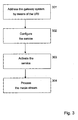
- Figure 3 shows a flowchart of a possible scenario of processing a media stream transferred from a first end system via a gateway system to a second end system within a communications system.
- the method includes the following steps:
- the method is implemented by means of a computer program product comprising the software code portions for performing the steps of the method.
- the computer program product is run on a computer stored in a digital computer within the end system and in the gateway system.
- the computer program is loaded directly or from a computer usable medium, such as floppy-disc, CD, Internet etc.
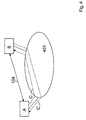
- the end system A requires to process a media stream C.
- A sends the media stream C over the Internet 401 to a gateway system S in which the media stream is processed and forwarded to A.
- An example of this is if the end system A may be listening to a radio broadcast that it wishes to record parts of. Which part to record is not known beforehand.
- the end system A prefers to store the recorded format of MPEG1 layer 3 (MP3) due to internal memory limitations, whereas the radio broadcast is available in 44,1 kHz Pulse Code Modulation (PCM) in stereo.
- the end system A then continuously sends the 44,1 kHz PCM stream C to the service system S, which in this case constitutes an MP3 compressor system.
- the service system S returns MP3 in streamed format C' to the end system A.
- A may then record selected parts in MP3 format as A listens to the radio broadcast.
Landscapes
- Engineering & Computer Science (AREA)
- Computer Networks & Wireless Communication (AREA)
- Signal Processing (AREA)
- Multimedia (AREA)
- Computer Security & Cryptography (AREA)
- Data Exchanges In Wide-Area Networks (AREA)
- Mobile Radio Communication Systems (AREA)
- Two-Way Televisions, Distribution Of Moving Picture Or The Like (AREA)
Abstract
Description
- The present invention relates to a gateway system, a method and an arrangement (IP) environments. More specifically it relates to networked application infrastructure services.
- In existing communication models, the network centric approach is the dominant one. The network centric approach traditionally implies that services are provided by the network in a monolithic fashion, and the one who owns the network owns the services. The implication is that the terminal and the end system are restricted to use the services offered basically by one or a few operators, and as such mainly on subscription basis. The system service is typically a bundling of a set of supporting network services, you get everything or nothing. The bundling is typically done in the switching systems e.g. local exchanges, Mobile Switching Centre (MSC), etc. There is no or little freedom to choose the best available service provider for these supporting network services on a call by call or session by session basis. For example, a subscriber to a telephony service is more or less restricted of his phone service provider to use any gatewaying services to other networks, transcoder services, bridging services for conferences etc.
- A Gateway is a network node in a communications network, equipped for interfacing with another network that uses different protocols. The gateways mentioned here interconnect higher layers than the link and network (IP) layer. It usually supports address mapping and may also provide transformation of the data between the networks to support end to end application connectivity.
- In a deregulated market, a multitude of service providers of all sorts of services, not only the "obvious ones" are expected to be available on the market This requires that the monolithic services of today are broken apart into their constituent parts and then made available as separate services.
- There are ways to control media gateways today, but these mechanisms rely on a master-slave relationship, i.e. he who wishes to make use of the media gateways must also be the actual owner of the resources. Ownership is defined as a configuration issue, and is not done on a call to call basis. One such mechanism is the megaco protocol, draft-retf-megaco-protocol-07.txt, the Internet Engineering Task Force (IETF)/H.248 of International Telecommunication Union - Telecommunication Standardization Sector (ITU-T).
- Examples of such network-supported services are:
- Transcoder services, for e.g. speech, audio, and video.
- Conference units and audio/video media mixers.
- Security proxies e.g. trusted security proxies for encryption and decryption.
- Other application layer gateway services.
Note that the service processes a media stream that is not necessarily finite in time or size, but it really applies to a stream. Compare the difference to sending a file to a server to perform a file conversion. Also real-time characteristics are generally required by the media processing function. A typical characteristic of a stream is that the receiver starts viewing or listening to it before the sender has ceased to transmit. - Therefore, what is further needed is a way of making these services unbundled so that they may be accessible by anybody as well as provided by anybody as separate services.
- BHARADVAJ H, JOSHI A, AUEPHANWIRIYAKUL: "An active transcoding proxy to support mobile Web access" PROCEEDINGS OF 17TH IEEE SYMPOSIUM ON RELIABLE DISTRIBUTED SYSTEMS, 20-23 October 1998, pages 118-123, XP002147478 West Lafayette, IN, USA, (D1) discloses a method involving a transcoding unit (proxy) which performs necessary transcoding. The method in D1 relies on control of content as well as the content
- The method in D1 relies on sending all requests, and responses via the proxy. The requests and responses are then filtered to adapt both the content of the actual requests (like stripping of HTML tags), as well as the contents referenced by primarily the responses (e.g. actually retrieving a file referenced in the HTML page and then changing the format of it).
The proxy in D1 performs content transcoding in a store-and-forward fashion. A complete file is retrieved, it is adapted and changed into a new file, and then the file is forwarded. So, the content is retrieved in its entirety, then processed, and lastly sent in its entirety. D1 does not target streaming media. - EP-A-0992 992, (D2) discloses is similar method as described in D1 i.e. all requests/responses for content goes via the proxy.
Media is transcoded in a store-and-forward fashion. D2 operates on a file of finite size, but starts transcoding and output of transcoded data before the entire file is received. D2 does neither target streaming media
The target of D2 is a client-server with request-response of content This means that each object to be transcoded must be separately requested, and as the response comes with the object, it is transcoded. - The present invention relates to multimedia communication between end systems in IP environments.
More particularly it relates to that all services concerning processing of media streams are bundled. When you get a subscription from one service provider, you are more or less forced to use the services of that provider. The service in question typically only provides services to subscribers of that service provider. - Accordingly, it is an object of the present invention to unravel the above-mentioned problem.
- Particularly it is an object to unbundle the services to be considered as separate services and to unbundle these services from the end-user application services.
- The solution, according to the invention is a communications system in which the service is publicly available by any end system via a published Uniform Resource Identifier (URI).
- A method for controlling processing of streaming media used in inter-personal communication services, sent from a second end system over an IP network, via a gateway system, over the IP network to a first end system by means of the gateway system providing a service of streaming media processing said service being independent of the end user application control, the gateway system comprising a gateway controller having a Uniform Resource Identifier (URI) which is known to any potential service user, such that the gateway system is available for external control by any potential service user, through the gateway controller, according to a first aspect of the invention, includes the steps of:
- the first system addressing the gateway controller in a first path, for the purpose of controlling the service by configuration and activation, by means of the known URI;
- processing the streaming media in a second path that is separate from the first path, in such a way that the data is processed and forwarded to the first end system continuously without having received the complete media stream before starting the processing.
- According to a second aspect, the invention can be implemented by software code segments and e.g. be stored in any of the relevant entities of a communication system, such as an end system or terminal, a gateway controller, a gateway etc. The computer program product is directly loadable into the internal memory of a digital computer within said entities and includes the software code portions for performing the steps of the method according to the invention, when said program is run on a computer.
- According to a third aspect of the invention the computer program product is stored on a computer usable medium, comprising readable program for causing a computer, within an entity in the communications system according the invention, to control an execution of the steps of the method according to the invention.
- A communications system for processing streaming media used in inter-personal communication services, according to a fourth aspect of the invention includes a first entity, a second entity and a service providing gateway system all being connected to an IP network within the communications system, characterised in that:
- the gateway system is adapted to provide a service of streaming media processing, said service being independent of the end user application control, the first entity, the second entity and the gateway system,
- the gateway system has means for processing a streaming media, sent from the first entity via the IP network to the second entity, in such a way that the data is processed and forwarded to the first end system continuously without having received the complete media stream before starting the processing
- the gateway system comprises a gateway controller adapted to control the service by configuration and activation, said controller having a Uniform Resource
- Identifier (URI) which is known to any potential service user, including the first entity, such that the gateway system is available for control by any potential service user, through the gateway controller.
- A communication system according to this fourth aspect of the invention is not covered by the claims.
- A gateway system according to a fifth aspect of the invention is connected to an IP network. The gateway system offers a service of processing a media stream sent between end systems connected to the IP network. The gateway system includes a gateway that has means for processing the media stream sent from a first end system via the IP network to a second end system. The gateway system further includes a gateway controller that manages the gateway. The gateway controller has a URI. The gateway system is made known to any potential service user, via a Uniform Resource Identifier (URI) of the gateway controller. The gateway system has means for being configured by any of the potential service users in a first path that is separate from the second path, and wherein the service is independent of the end user application control.
- A communications system according to this fifth aspect of the invention is hereby characterised by what are the features of claim 19.
- An advantage of the present invention is freedom of choice for all types of services. Examples of services supported by the gateway and gateway controller system using the present invention are audio and video transcoding, transmedia coding (e.g. text to speech), audio or video mixing devices, and trusted security services such as anonymizers.
- Another advantage of the present invention is that a full end-system choice of service is possible without being a subscriber to a particular service provider.
- Another advantage of the invention is that it makes it possible for any end system to access the service.
- Another advantage of the invention is that the service can be made independent of the end-user application in which it is used. For example, a video transcoding service may equally well be used in a video telephony application, or in a video streaming ("web-TV") application. This means a high degree of service reusability as well as a removing the need to develop that service specifically as part of a particular application.
- Another advantage of the present invention is that more services become available to choose between and the probability to find a suitable service for a specific call or session is increased. The end-user can also choose a service that costs as much as he is willing to pay.
- Yet another advantage is that service providers may select the best of service systems from suppliers that suit their individual needs. They are hence not limited to monolithic or bundled systems from a few suppliers.
- Further scope of applicability of the present invention will become apparent from the detailed description given hereinafter. However, it should be understood that the detailed description and specific examples, while indicating preferred embodiments of the invention, are given by way of illustration only, since various changes and modifications within the scope of the invention will become apparent to those skilled in the art from this detailed description.
-
- Figure 1
- shows a schematic block diagram of the communications system according to the invention.
- Figure 2
- shows a schematic block diagram of a gateway system according to the invention.
- Figure 3
- shows a flowchart of the method according to the invention.
- Figure 4
- shows a schematic block diagram of a scenario according to the present invention.
- The invention relates to conversational multimedia communications including a media stream. The media stream here is defined as a stream of information that is continuously transferred and is not necessarily finite in time or size. A stream is characterised by that the receiver is processing and interpreting the information before the sender has ceased sending it Example of a media stream is real time information, voice, music, video conference, etc. Example of not being a media stream is sending a file to a server for conversion, down loading of a video film from a server on Internet and after the download look at the film, etc.
- Figure 1 shows a
communications system 101 according to the invention. Thecommunications system 101 includes a first entity A and a second entity B, the first entity A being a mobile terminal and the second entity being an end system or end user serving terminals. Both entities being involved in the same session. The first entity A and the second entity B have both a respectively digital computer, each computer having an internal memory for storing a computer program, not shown in the figure. The session in this fictitious example has two media components, C1 and C2, e.g. voice and video that are to be transferred from the second entity B, over anIP network 102 to the first entity A, within thecommunications system 101. In thesession establishment 103, the first entity A and the second entity B have negotiated specific formats for the voice and video streams, e.g. Global System for Mobile communication (GSM) voice and Motion Pictures Expert Group 2 (MPEG2) video. In this example the second entity B can only support MPEG2 video C1, whereas the first entity A is a mobile terminal that has a small screen and can only handle H.261 video. H.261 is a video codec standard protocol for audio-visual services at rates of px64kbit/s. Nevertheless the first entity A has agreed to letting the second entity B transmit the video in the MPEG2 format. To handle this, a transcoding service is required that transcodes MPEG2 to H.261 video. The voice stream C2 which is typically bi-directional is in this example left unmodified end to end between the second entity B and the first entity A that is depicted in Figure 1. The A to B session invitation andnegotiation 103 may for example be done using standard Session Initiation Protocol/Session Description Protocol (SIP/SDP) procedures. SIP is an application layer protocol for creating, modifying and terminating sessions with one or more participants. These sessions include Internet multimedia conferences, Internet telephony calls and multimedia distribution. SDP is a protocol intended for describing multimedia sessions for the purpose of session announcements, session invitation, negotiation and other forms of multimedia session control. Thecommunications system 101 also includes a gateway system S providing a service of streaming media processing. This service is independent of the end user application control. In this example the service is transcoding of MPEG2 to H.261 video. - The gateway system S will now be described in more detail supported by the block diagram showed in Figure 2. The gateway system, which is referred to as 201 in figure 2, comprises a
gateway controller 202 and agateway 203. These two entities can be co-located in the same node or be two separate nodes, each separately connected to the IP network. They are both connected to the IP network (see 102 in Figure 1) and each typically has an IP address. Thegateway system 201 is available for external control through thegateway controller 202. Thegateway controller 202 is publicly available via its published Universe Resource Identifier (URI) e.g. service@domain. The URI can e.g. be published on a homepage on the Internet. The gateway has means 204 for processing the media stream C1, i.e. in this example transcode MPEG2 C1 to H.261 C1' video. Theinvocation 104 takes place on a path between the gateway system S and the first entity A that is separate from the path used for the media stream C1' between the gateway system S and the first entity A, thus unbundling the actual service control from the media stream completely. Thegateway controller 202 manages thegateway 203. Thecommunication 205 between thegateway controller 202 and thegateway 203 may e.g. be according to IETF megacop/ITU-T H.248. (megacop = Media Gateway Control Protocol = H.248). Thegateway 203 and thegateway controller 202 each has a digital computer having an internal memory for storing acomputer program 207. - The first entity A separately, i.e. outside the A to
B session 103, invokes 104 a separate transcoding service by the gateway system S that transcodes MPEG2 to H.261 video. This is shown in Figure 1. - This example will show a unidirectional flow, but a bi-directional flow is also possible.
- The first step is to configure the service. That is done with one or more service requests sent in a
control protocol 206 from the first entity A to thegateway controller 202. The control protocol may be based on SIP or SDP. It is also possible to send the service request in the same message exchange as the A to B session invitation. Thegateway controller 202 is addressed using a URI in the form service@host e.g. transcoder@services.oprator.com in the request. In the case acontrol protocol 206 being based on SIP and SDP, the URI would be used in the SIP Uniform Resource Locator (URL) according to known practice in the format sip:service@host. The service request typically contains information about type of service, e.g. transcoding from MPEG2 to H.261. The service request(s) also contains information about the address to which the stream should be sent, e.g. IP address and port number of first entity A and other necessary address information pertaining to the entities A and B and the associated media stream. - One or
more responses 206 to the service request(s) including the necessary address information, pertaining to the gateway system S andgateway 203, of relevance to the associated media stream may be exchanged. This includes the address information about the inlet to thegateway 203 in the form of an IP address and a port number.
At this stage the service is configured. The response(s) typically also indicate the result of the configuration requests, such as success or failure. - The next step is the actual activation of the service. This is indicated by the service activation request of 206.
- It is fully possible that the service configuration and service activation may be bundled in one and the same request. It is also fully possible that configuration is done in parts using steps of several requests and responses.
- The second entity B starts transmitting the media stream C1. The video stream C1, in MPEG2 format, is transferred over the
IP network 102, through the assigned port of thegateway 203 and is processed by the means for processing i.e. the transcoder from MPEG2 to H.261 video. The media stream C1' in H.261 video format is then transferred, over theIP network 102, to the assigned port of the first entity A. The voice stream C2 is transferred unmodified over the IP network between the entities. - Figure 3 shows a flowchart of a possible scenario of processing a media stream transferred from a first end system via a gateway system to a second end system within a communications system.
- The method includes the following steps:
- 301. An end system shall make a call to another end system. For this specific call the end system wishes to use a service provided by the gateway system for processing a media stream to be transferred. The gateway controller is addressed by the end system in a first path by means of the known URI This is for the purpose of controlling the service by
configuration 302 andactivation 303. - 304. Then the transmitting side sends its media stream, which is processed in the gateway system on the way to the receiving side streaming media is processed in a second path that is separate from the first path, in such a way that the data is processed and forwarded to the other end system continuously without having received the complete media stream before starting the processing.
- The method is implemented by means of a computer program product comprising the software code portions for performing the steps of the method. The computer program product is run on a computer stored in a digital computer within the end system and in the gateway system.
The computer program is loaded directly or from a computer usable medium, such as floppy-disc, CD, Internet etc. - The method above can also be performed in another possible scenario shown in Figure 4. In this scenario, the end system A requires to process a media stream C. A sends the media stream C over the
Internet 401 to a gateway system S in which the media stream is processed and forwarded to A.
An example of this is if the end system A may be listening to a radio broadcast that it wishes to record parts of. Which part to record is not known beforehand. The end system A prefers to store the recorded format of MPEG1 layer 3 (MP3) due to internal memory limitations, whereas the radio broadcast is available in 44,1 kHz Pulse Code Modulation (PCM) in stereo. The end system A then continuously sends the 44,1 kHz PCM stream C to the service system S, which in this case constitutes an MP3 compressor system. The service system S returns MP3 in streamed format C' to the end system A. A may then record selected parts in MP3 format as A listens to the radio broadcast.
Claims (15)
- A method for controlling processing of streaming media (C1) used in inter-personal communication services, sent from a second end system (B) over an IP network, via a gateway system (S), over the IP network (102) to a first end system (A), by means of the gateway system (S) providing a service of streaming media processing characterised in that said service is independent of the end user application control, the gateway system (S) comprising a gateway controller (202) having a Uniform Resource Identifier (URI) which is known to any potential service user, such that the gateway system (S) is available for external control by any potential service user, through the gateway controller (202), the method comprising the steps of:- the first and system (A) addressing the gateway controller (202) in a first path, for the purpose of controlling the service by configuration and activation, by means of the known URI;- processing the streaming media (C1) in a second path that is separate from the first path, in such a way that the data is processed and forwarded to the first end system (A) continuously without having received the complete media stream (C1) before starting the processing.
- The method according to claim 1, wherein the first end system is the same as the second end system.
- The method according to any of the claims 1-2, wherein the step of configuring the service is performed by sending a service request message from the first entity (A) to the gateway system (S).
- The method according to claim 3, wherein the service request message comprises information about a type of service required.
- The method according to claim 3, wherein the service request message includes information about the address to which the stream should be sent
- The method according to any of the claims 1-2, wherein the step of configuring the service is performed by sending a response message to the service request, from the gateway system (S) to the first entity (A).
- The method according to claim 6, wherein the response message includes address information of the inlet to the gateway (203).
- The method according to any of the claims 1-7, wherein the step of activating the service is performed by sending a service activation request message from the first entity (A) to the gateway system (S).
- The method according to any of the claims 1-2, wherein the step of configuration and the step of activation is carried in the same request message.
- A computer readable storage medium storing a set of machine executable code, said set of machine executable code being executable by a computer to perform the method steps of any of the claims 1-9.
- Gateway system (201) connected to an IP network, the gateway system (201) offering a service of processing a media stream (C1) sent between end systems connected to the IP network, the gateway system (201) including a gateway (203) having means (204) for processing the media stream (C1) in a second path sent from a first end system via the IP network, the gateway system (201) further including a gateway controller (202) managing the gateway (203) and having a Uniform Resource Identifier (URI) characterised in that the gateway system (201) is known to any potential service user, including the first end system, via the URI of the gateway controller (202) and the gateway system (201) further has means for being configured by any of the potential service users in a first path that is separate from the second path; and in that the service is independent of the end user application control.
- Gateway system (201) according claim 19 characterised by the gateway controller (202) having means for performing the configuration by receiving a service request from the end system.
- Gateway system (201) according claim 19 characterised by the gateway controller (202) having means for performing the configuration by sending a response message to the end system.
- Gateway system (201) according claim 19 characterised by having means for activating the service.
- Gateway system (201) according claim 22 characterised by the gateway controller (202) having means for performing the activation of the service by receiving a service activation request from the end system.
Priority Applications (1)
| Application Number | Priority Date | Filing Date | Title |
|---|---|---|---|
| EP01925548A EP1275233B1 (en) | 2000-04-20 | 2001-04-12 | Method, gateway system and arrangement in a communication network |
Applications Claiming Priority (4)
| Application Number | Priority Date | Filing Date | Title |
|---|---|---|---|
| EP00850070A EP1148690A1 (en) | 2000-04-20 | 2000-04-20 | Method, gateway system and arrangement in a communication network |
| EP00850070 | 2000-04-20 | ||
| PCT/EP2001/004211 WO2001082557A1 (en) | 2000-04-20 | 2001-04-12 | Method, gateway system and arrangement in a communication network |
| EP01925548A EP1275233B1 (en) | 2000-04-20 | 2001-04-12 | Method, gateway system and arrangement in a communication network |
Publications (2)
| Publication Number | Publication Date |
|---|---|
| EP1275233A1 EP1275233A1 (en) | 2003-01-15 |
| EP1275233B1 true EP1275233B1 (en) | 2006-06-21 |
Family
ID=8175657
Family Applications (2)
| Application Number | Title | Priority Date | Filing Date |
|---|---|---|---|
| EP00850070A Withdrawn EP1148690A1 (en) | 2000-04-20 | 2000-04-20 | Method, gateway system and arrangement in a communication network |
| EP01925548A Expired - Lifetime EP1275233B1 (en) | 2000-04-20 | 2001-04-12 | Method, gateway system and arrangement in a communication network |
Family Applications Before (1)
| Application Number | Title | Priority Date | Filing Date |
|---|---|---|---|
| EP00850070A Withdrawn EP1148690A1 (en) | 2000-04-20 | 2000-04-20 | Method, gateway system and arrangement in a communication network |
Country Status (9)
| Country | Link |
|---|---|
| US (1) | US7310665B2 (en) |
| EP (2) | EP1148690A1 (en) |
| JP (1) | JP4831913B2 (en) |
| CN (1) | CN1201546C (en) |
| AT (1) | ATE331376T1 (en) |
| AU (1) | AU2001252260A1 (en) |
| DE (1) | DE60120952T2 (en) |
| ES (1) | ES2264980T3 (en) |
| WO (1) | WO2001082557A1 (en) |
Families Citing this family (8)
| Publication number | Priority date | Publication date | Assignee | Title |
|---|---|---|---|---|
| US20060020688A1 (en) * | 2001-05-14 | 2006-01-26 | At&T Corp. | System having generalized client-server computing |
| JP4420584B2 (en) * | 2001-05-21 | 2010-02-24 | ソニー株式会社 | Portable information processing terminal, information processing method, program, and information processing system |
| JP3961796B2 (en) * | 2001-08-27 | 2007-08-22 | ソニー株式会社 | Information providing system, information processing apparatus and method, information providing apparatus and method, recording medium, and program |
| ES2272920T3 (en) * | 2003-06-27 | 2007-05-01 | Alcatel Lucent | METHOD AND COMMUNICATION SYSTEM TO FACILITATE IP PERFORMANCES TO A STIMULUS TERMINAL. |
| US8281353B1 (en) * | 2004-09-29 | 2012-10-02 | Avaya Inc. | Service creation system and method for packet based cellular networks |
| US7716586B2 (en) * | 2006-02-17 | 2010-05-11 | International Business Machines Corporation | Apparatus, system, and method for progressively disclosing information in support of information technology system visualization and management |
| US8582559B2 (en) | 2006-08-03 | 2013-11-12 | Aspect Software, Inc. | System and method for handling media streams |
| US9942280B2 (en) * | 2009-09-22 | 2018-04-10 | Orange | Data exchange sessions using groups of terminals of a first user and at least one terminal of a second user |
Family Cites Families (23)
| Publication number | Priority date | Publication date | Assignee | Title |
|---|---|---|---|---|
| WO1995030317A1 (en) | 1994-04-28 | 1995-11-09 | British Telecommunications Public Limited Company | Service provision system for communications networks |
| CA2179337C (en) | 1995-08-22 | 2000-11-14 | Thomas F. Laporta | Network-based migrating user agents for personal communication services |
| US6553410B2 (en) * | 1996-02-27 | 2003-04-22 | Inpro Licensing Sarl | Tailoring data and transmission protocol for efficient interactive data transactions over wide-area networks |
| US5768527A (en) * | 1996-04-23 | 1998-06-16 | Motorola, Inc. | Device, system and method of real-time multimedia streaming |
| US5996022A (en) * | 1996-06-03 | 1999-11-30 | Webtv Networks, Inc. | Transcoding data in a proxy computer prior to transmitting the audio data to a client |
| US5974446A (en) * | 1996-10-24 | 1999-10-26 | Academy Of Applied Science | Internet based distance learning system for communicating between server and clients wherein clients communicate with each other or with teacher using different communication techniques via common user interface |
| JP3668742B2 (en) * | 1996-11-28 | 2005-07-06 | 株式会社日立製作所 | Gateway device and communication system using the same |
| US6711622B1 (en) * | 1997-12-31 | 2004-03-23 | Broadware Technologies, Inc. | Video and audio streaming for multiple users |
| US6421733B1 (en) * | 1997-03-25 | 2002-07-16 | Intel Corporation | System for dynamically transcoding data transmitted between computers |
| US6594699B1 (en) * | 1997-10-10 | 2003-07-15 | Kasenna, Inc. | System for capability based multimedia streaming over a network |
| US6272127B1 (en) * | 1997-11-10 | 2001-08-07 | Ehron Warpspeed Services, Inc. | Network for providing switched broadband multipoint/multimedia intercommunication |
| US6185620B1 (en) * | 1998-04-03 | 2001-02-06 | Lsi Logic Corporation | Single chip protocol engine and data formatter apparatus for off chip host memory to local memory transfer and conversion |
| US6155840A (en) * | 1998-09-18 | 2000-12-05 | At Home Corporation | System and method for distributed learning |
| US6563517B1 (en) * | 1998-10-02 | 2003-05-13 | International Business Machines Corp. | Automatic data quality adjustment to reduce response time in browsing |
| US6760916B2 (en) * | 2000-01-14 | 2004-07-06 | Parkervision, Inc. | Method, system and computer program product for producing and distributing enhanced media downstreams |
| US6697365B1 (en) * | 1999-06-10 | 2004-02-24 | Charles Hayes Messenger | Method of listener transmitted broadcasting |
| US6845398B1 (en) * | 1999-08-02 | 2005-01-18 | Lucent Technologies Inc. | Wireless multimedia player |
| US6795863B1 (en) * | 1999-08-10 | 2004-09-21 | Intline.Com, Inc. | System, device and method for combining streaming video with e-mail |
| US6631410B1 (en) * | 2000-03-16 | 2003-10-07 | Sharp Laboratories Of America, Inc. | Multimedia wired/wireless content synchronization system and method |
| DK1201082T3 (en) * | 2000-04-28 | 2003-12-15 | Swisscom Mobile Ag | Video conferencing method and system |
| US6996768B1 (en) * | 2000-06-15 | 2006-02-07 | International Business Machines Corporation | Electric publishing system and method of operation generating web pages personalized to a user's optimum learning mode |
| AU2001276992A1 (en) * | 2000-07-20 | 2002-02-05 | Aeptec Microsystems, Inc. | Method, system, and protocol for location-aware mobile devices |
| US20020103935A1 (en) * | 2001-01-26 | 2002-08-01 | Neil Fishman | Pushing rich content information to mobile devices |
-
2000
- 2000-04-20 EP EP00850070A patent/EP1148690A1/en not_active Withdrawn
-
2001
- 2001-04-12 EP EP01925548A patent/EP1275233B1/en not_active Expired - Lifetime
- 2001-04-12 AU AU2001252260A patent/AU2001252260A1/en not_active Abandoned
- 2001-04-12 WO PCT/EP2001/004211 patent/WO2001082557A1/en not_active Ceased
- 2001-04-12 CN CNB018084001A patent/CN1201546C/en not_active Expired - Fee Related
- 2001-04-12 JP JP2001579521A patent/JP4831913B2/en not_active Expired - Lifetime
- 2001-04-12 AT AT01925548T patent/ATE331376T1/en not_active IP Right Cessation
- 2001-04-12 DE DE60120952T patent/DE60120952T2/en not_active Expired - Lifetime
- 2001-04-12 ES ES01925548T patent/ES2264980T3/en not_active Expired - Lifetime
- 2001-04-18 US US09/837,493 patent/US7310665B2/en not_active Expired - Lifetime
Also Published As
| Publication number | Publication date |
|---|---|
| ES2264980T3 (en) | 2007-02-01 |
| AU2001252260A1 (en) | 2001-11-07 |
| EP1275233A1 (en) | 2003-01-15 |
| US7310665B2 (en) | 2007-12-18 |
| WO2001082557A1 (en) | 2001-11-01 |
| CN1426653A (en) | 2003-06-25 |
| US20010034784A1 (en) | 2001-10-25 |
| DE60120952T2 (en) | 2007-07-12 |
| DE60120952D1 (en) | 2006-08-03 |
| ATE331376T1 (en) | 2006-07-15 |
| JP2003532340A (en) | 2003-10-28 |
| JP4831913B2 (en) | 2011-12-07 |
| CN1201546C (en) | 2005-05-11 |
| EP1148690A1 (en) | 2001-10-24 |
Similar Documents
| Publication | Publication Date | Title |
|---|---|---|
| EP1334639B1 (en) | Optimal gateway discovery while roaming | |
| US6981263B1 (en) | Methods and systems for converged service creation and execution environment applications | |
| US7103644B1 (en) | Systems for an integrated data network voice-oriented service and non-voice-oriented service converged creation and execution environment | |
| EP1275236B1 (en) | Proxy apparatus and method | |
| RU2288545C2 (en) | Method and system for multimedia message delivery | |
| US7631037B2 (en) | Data transmission | |
| EP2319206B1 (en) | System and method for transmitting and receiving a call on a home network | |
| US8422485B2 (en) | Method and system for providing multimedia portal contents in communication system | |
| CN101313554A (en) | Interactive media session establishing system, method and device based on IP multimedia subsystem | |
| CN101292543B (en) | Method for the transmission of signalling data in a network interface unit and in a control unit and corresponding devices | |
| JP5185491B2 (en) | Method and apparatus for transition to alternative call controller | |
| US6977911B1 (en) | Scalable voice over IP system configured for dynamically switching codecs during a call | |
| JP4051340B2 (en) | Decomposition switching node and its operation method | |
| EP1575245B1 (en) | Method and apparatus to manage network addresses for private voice communications | |
| US7310665B2 (en) | Method, gateway system and arrangement in a communication network | |
| US7512118B1 (en) | CODEC negotiation considering quality and costs | |
| CN101677302B (en) | Method and apparatus for providing information to users in a multi-device environment | |
| EP1299982B1 (en) | Opimization of service access | |
| JP5410977B2 (en) | How to communicate between several terminals | |
| WO2007042620A1 (en) | A method, a system and a proxy for inter-service-provider-ip-backbone | |
| Ackermann et al. | Using DMIF for abstracting from IP-Telephony signaling protocols | |
| Ribeiro et al. | A SIP/H. 323 Signaling Gateway Implementation for IP Telephony. | |
| Wilmot et al. | VoIP and Multimedia with H. 323 | |
| HK1075558B (en) | Method and apparatus to manage network addresses for private voice communications | |
| CN101291448A (en) | Method, system and device for called routing |
Legal Events
| Date | Code | Title | Description |
|---|---|---|---|
| PUAI | Public reference made under article 153(3) epc to a published international application that has entered the european phase |
Free format text: ORIGINAL CODE: 0009012 |
|
| 17P | Request for examination filed |
Effective date: 20020930 |
|
| AK | Designated contracting states |
Kind code of ref document: A1 Designated state(s): AT BE CH CY DE DK ES FI FR GB GR IE IT LI LU MC NL PT SE TR |
|
| AX | Request for extension of the european patent |
Free format text: AL;LT;LV;MK;RO;SI |
|
| RAP1 | Party data changed (applicant data changed or rights of an application transferred) |
Owner name: TELEFONAKTIEBOLAGET LM ERICSSON (PUBL) |
|
| 17Q | First examination report despatched |
Effective date: 20040728 |
|
| GRAP | Despatch of communication of intention to grant a patent |
Free format text: ORIGINAL CODE: EPIDOSNIGR1 |
|
| GRAS | Grant fee paid |
Free format text: ORIGINAL CODE: EPIDOSNIGR3 |
|
| GRAA | (expected) grant |
Free format text: ORIGINAL CODE: 0009210 |
|
| AK | Designated contracting states |
Kind code of ref document: B1 Designated state(s): AT BE CH CY DE DK ES FI FR GB GR IE IT LI LU MC NL PT SE TR |
|
| PG25 | Lapsed in a contracting state [announced via postgrant information from national office to epo] |
Ref country code: IT Free format text: LAPSE BECAUSE OF FAILURE TO SUBMIT A TRANSLATION OF THE DESCRIPTION OR TO PAY THE FEE WITHIN THE PRESCRIBED TIME-LIMIT;WARNING: LAPSES OF ITALIAN PATENTS WITH EFFECTIVE DATE BEFORE 2007 MAY HAVE OCCURRED AT ANY TIME BEFORE 2007. THE CORRECT EFFECTIVE DATE MAY BE DIFFERENT FROM THE ONE RECORDED. Effective date: 20060621 Ref country code: FI Free format text: LAPSE BECAUSE OF FAILURE TO SUBMIT A TRANSLATION OF THE DESCRIPTION OR TO PAY THE FEE WITHIN THE PRESCRIBED TIME-LIMIT Effective date: 20060621 Ref country code: CH Free format text: LAPSE BECAUSE OF FAILURE TO SUBMIT A TRANSLATION OF THE DESCRIPTION OR TO PAY THE FEE WITHIN THE PRESCRIBED TIME-LIMIT Effective date: 20060621 Ref country code: BE Free format text: LAPSE BECAUSE OF FAILURE TO SUBMIT A TRANSLATION OF THE DESCRIPTION OR TO PAY THE FEE WITHIN THE PRESCRIBED TIME-LIMIT Effective date: 20060621 Ref country code: AT Free format text: LAPSE BECAUSE OF FAILURE TO SUBMIT A TRANSLATION OF THE DESCRIPTION OR TO PAY THE FEE WITHIN THE PRESCRIBED TIME-LIMIT Effective date: 20060621 Ref country code: NL Free format text: LAPSE BECAUSE OF FAILURE TO SUBMIT A TRANSLATION OF THE DESCRIPTION OR TO PAY THE FEE WITHIN THE PRESCRIBED TIME-LIMIT Effective date: 20060621 Ref country code: LI Free format text: LAPSE BECAUSE OF FAILURE TO SUBMIT A TRANSLATION OF THE DESCRIPTION OR TO PAY THE FEE WITHIN THE PRESCRIBED TIME-LIMIT Effective date: 20060621 |
|
| REG | Reference to a national code |
Ref country code: GB Ref legal event code: FG4D |
|
| REG | Reference to a national code |
Ref country code: CH Ref legal event code: EP |
|
| REG | Reference to a national code |
Ref country code: IE Ref legal event code: FG4D |
|
| REF | Corresponds to: |
Ref document number: 60120952 Country of ref document: DE Date of ref document: 20060803 Kind code of ref document: P |
|
| PG25 | Lapsed in a contracting state [announced via postgrant information from national office to epo] |
Ref country code: DK Free format text: LAPSE BECAUSE OF FAILURE TO SUBMIT A TRANSLATION OF THE DESCRIPTION OR TO PAY THE FEE WITHIN THE PRESCRIBED TIME-LIMIT Effective date: 20060921 Ref country code: SE Free format text: LAPSE BECAUSE OF FAILURE TO SUBMIT A TRANSLATION OF THE DESCRIPTION OR TO PAY THE FEE WITHIN THE PRESCRIBED TIME-LIMIT Effective date: 20060921 |
|
| PG25 | Lapsed in a contracting state [announced via postgrant information from national office to epo] |
Ref country code: PT Free format text: LAPSE BECAUSE OF FAILURE TO SUBMIT A TRANSLATION OF THE DESCRIPTION OR TO PAY THE FEE WITHIN THE PRESCRIBED TIME-LIMIT Effective date: 20061121 |
|
| NLV1 | Nl: lapsed or annulled due to failure to fulfill the requirements of art. 29p and 29m of the patents act | ||
| REG | Reference to a national code |
Ref country code: CH Ref legal event code: PL |
|
| ET | Fr: translation filed | ||
| REG | Reference to a national code |
Ref country code: ES Ref legal event code: FG2A Ref document number: 2264980 Country of ref document: ES Kind code of ref document: T3 |
|
| PLBE | No opposition filed within time limit |
Free format text: ORIGINAL CODE: 0009261 |
|
| STAA | Information on the status of an ep patent application or granted ep patent |
Free format text: STATUS: NO OPPOSITION FILED WITHIN TIME LIMIT |
|
| 26N | No opposition filed |
Effective date: 20070322 |
|
| PG25 | Lapsed in a contracting state [announced via postgrant information from national office to epo] |
Ref country code: GR Free format text: LAPSE BECAUSE OF FAILURE TO SUBMIT A TRANSLATION OF THE DESCRIPTION OR TO PAY THE FEE WITHIN THE PRESCRIBED TIME-LIMIT Effective date: 20060922 |
|
| PG25 | Lapsed in a contracting state [announced via postgrant information from national office to epo] |
Ref country code: IE Free format text: LAPSE BECAUSE OF NON-PAYMENT OF DUE FEES Effective date: 20070412 |
|
| PG25 | Lapsed in a contracting state [announced via postgrant information from national office to epo] |
Ref country code: MC Free format text: LAPSE BECAUSE OF NON-PAYMENT OF DUE FEES Effective date: 20070430 |
|
| PG25 | Lapsed in a contracting state [announced via postgrant information from national office to epo] |
Ref country code: LU Free format text: LAPSE BECAUSE OF NON-PAYMENT OF DUE FEES Effective date: 20070412 Ref country code: CY Free format text: LAPSE BECAUSE OF FAILURE TO SUBMIT A TRANSLATION OF THE DESCRIPTION OR TO PAY THE FEE WITHIN THE PRESCRIBED TIME-LIMIT Effective date: 20060621 |
|
| PG25 | Lapsed in a contracting state [announced via postgrant information from national office to epo] |
Ref country code: TR Free format text: LAPSE BECAUSE OF FAILURE TO SUBMIT A TRANSLATION OF THE DESCRIPTION OR TO PAY THE FEE WITHIN THE PRESCRIBED TIME-LIMIT Effective date: 20060621 |
|
| REG | Reference to a national code |
Ref country code: FR Ref legal event code: PLFP Year of fee payment: 16 |
|
| PGFP | Annual fee paid to national office [announced via postgrant information from national office to epo] |
Ref country code: GB Payment date: 20160427 Year of fee payment: 16 Ref country code: DE Payment date: 20160427 Year of fee payment: 16 Ref country code: ES Payment date: 20160426 Year of fee payment: 16 |
|
| PGFP | Annual fee paid to national office [announced via postgrant information from national office to epo] |
Ref country code: IT Payment date: 20160421 Year of fee payment: 16 Ref country code: FR Payment date: 20160425 Year of fee payment: 16 |
|
| REG | Reference to a national code |
Ref country code: DE Ref legal event code: R119 Ref document number: 60120952 Country of ref document: DE |
|
| GBPC | Gb: european patent ceased through non-payment of renewal fee |
Effective date: 20170412 |
|
| REG | Reference to a national code |
Ref country code: FR Ref legal event code: ST Effective date: 20171229 |
|
| PG25 | Lapsed in a contracting state [announced via postgrant information from national office to epo] |
Ref country code: FR Free format text: LAPSE BECAUSE OF NON-PAYMENT OF DUE FEES Effective date: 20170502 Ref country code: DE Free format text: LAPSE BECAUSE OF NON-PAYMENT OF DUE FEES Effective date: 20171103 |
|
| PG25 | Lapsed in a contracting state [announced via postgrant information from national office to epo] |
Ref country code: GB Free format text: LAPSE BECAUSE OF NON-PAYMENT OF DUE FEES Effective date: 20170412 |
|
| PG25 | Lapsed in a contracting state [announced via postgrant information from national office to epo] |
Ref country code: IT Free format text: LAPSE BECAUSE OF NON-PAYMENT OF DUE FEES Effective date: 20170412 |
|
| REG | Reference to a national code |
Ref country code: ES Ref legal event code: FD2A Effective date: 20180703 |
|
| PG25 | Lapsed in a contracting state [announced via postgrant information from national office to epo] |
Ref country code: ES Free format text: LAPSE BECAUSE OF NON-PAYMENT OF DUE FEES Effective date: 20170413 |