EP1274711B1 - New aza-indolyl derivatives - Google Patents
New aza-indolyl derivatives Download PDFInfo
- Publication number
- EP1274711B1 EP1274711B1 EP01911722A EP01911722A EP1274711B1 EP 1274711 B1 EP1274711 B1 EP 1274711B1 EP 01911722 A EP01911722 A EP 01911722A EP 01911722 A EP01911722 A EP 01911722A EP 1274711 B1 EP1274711 B1 EP 1274711B1
- Authority
- EP
- European Patent Office
- Prior art keywords
- compound according
- nitrogen
- disorders
- dihydro
- ethylamine
- Prior art date
- Legal status (The legal status is an assumption and is not a legal conclusion. Google has not performed a legal analysis and makes no representation as to the accuracy of the status listed.)
- Expired - Lifetime
Links
Classifications
-
- C—CHEMISTRY; METALLURGY
- C07—ORGANIC CHEMISTRY
- C07D—HETEROCYCLIC COMPOUNDS
- C07D471/00—Heterocyclic compounds containing nitrogen atoms as the only ring hetero atoms in the condensed system, at least one ring being a six-membered ring with one nitrogen atom, not provided for by groups C07D451/00 - C07D463/00
- C07D471/12—Heterocyclic compounds containing nitrogen atoms as the only ring hetero atoms in the condensed system, at least one ring being a six-membered ring with one nitrogen atom, not provided for by groups C07D451/00 - C07D463/00 in which the condensed system contains three hetero rings
- C07D471/14—Ortho-condensed systems
-
- A—HUMAN NECESSITIES
- A61—MEDICAL OR VETERINARY SCIENCE; HYGIENE
- A61P—SPECIFIC THERAPEUTIC ACTIVITY OF CHEMICAL COMPOUNDS OR MEDICINAL PREPARATIONS
- A61P1/00—Drugs for disorders of the alimentary tract or the digestive system
-
- A—HUMAN NECESSITIES
- A61—MEDICAL OR VETERINARY SCIENCE; HYGIENE
- A61P—SPECIFIC THERAPEUTIC ACTIVITY OF CHEMICAL COMPOUNDS OR MEDICINAL PREPARATIONS
- A61P1/00—Drugs for disorders of the alimentary tract or the digestive system
- A61P1/14—Prodigestives, e.g. acids, enzymes, appetite stimulants, antidyspeptics, tonics, antiflatulents
-
- A—HUMAN NECESSITIES
- A61—MEDICAL OR VETERINARY SCIENCE; HYGIENE
- A61P—SPECIFIC THERAPEUTIC ACTIVITY OF CHEMICAL COMPOUNDS OR MEDICINAL PREPARATIONS
- A61P11/00—Drugs for disorders of the respiratory system
-
- A—HUMAN NECESSITIES
- A61—MEDICAL OR VETERINARY SCIENCE; HYGIENE
- A61P—SPECIFIC THERAPEUTIC ACTIVITY OF CHEMICAL COMPOUNDS OR MEDICINAL PREPARATIONS
- A61P13/00—Drugs for disorders of the urinary system
-
- A—HUMAN NECESSITIES
- A61—MEDICAL OR VETERINARY SCIENCE; HYGIENE
- A61P—SPECIFIC THERAPEUTIC ACTIVITY OF CHEMICAL COMPOUNDS OR MEDICINAL PREPARATIONS
- A61P13/00—Drugs for disorders of the urinary system
- A61P13/02—Drugs for disorders of the urinary system of urine or of the urinary tract, e.g. urine acidifiers
-
- A—HUMAN NECESSITIES
- A61—MEDICAL OR VETERINARY SCIENCE; HYGIENE
- A61P—SPECIFIC THERAPEUTIC ACTIVITY OF CHEMICAL COMPOUNDS OR MEDICINAL PREPARATIONS
- A61P15/00—Drugs for genital or sexual disorders; Contraceptives
-
- A—HUMAN NECESSITIES
- A61—MEDICAL OR VETERINARY SCIENCE; HYGIENE
- A61P—SPECIFIC THERAPEUTIC ACTIVITY OF CHEMICAL COMPOUNDS OR MEDICINAL PREPARATIONS
- A61P25/00—Drugs for disorders of the nervous system
-
- A—HUMAN NECESSITIES
- A61—MEDICAL OR VETERINARY SCIENCE; HYGIENE
- A61P—SPECIFIC THERAPEUTIC ACTIVITY OF CHEMICAL COMPOUNDS OR MEDICINAL PREPARATIONS
- A61P25/00—Drugs for disorders of the nervous system
- A61P25/04—Centrally acting analgesics, e.g. opioids
-
- A—HUMAN NECESSITIES
- A61—MEDICAL OR VETERINARY SCIENCE; HYGIENE
- A61P—SPECIFIC THERAPEUTIC ACTIVITY OF CHEMICAL COMPOUNDS OR MEDICINAL PREPARATIONS
- A61P25/00—Drugs for disorders of the nervous system
- A61P25/06—Antimigraine agents
-
- A—HUMAN NECESSITIES
- A61—MEDICAL OR VETERINARY SCIENCE; HYGIENE
- A61P—SPECIFIC THERAPEUTIC ACTIVITY OF CHEMICAL COMPOUNDS OR MEDICINAL PREPARATIONS
- A61P25/00—Drugs for disorders of the nervous system
- A61P25/08—Antiepileptics; Anticonvulsants
-
- A—HUMAN NECESSITIES
- A61—MEDICAL OR VETERINARY SCIENCE; HYGIENE
- A61P—SPECIFIC THERAPEUTIC ACTIVITY OF CHEMICAL COMPOUNDS OR MEDICINAL PREPARATIONS
- A61P25/00—Drugs for disorders of the nervous system
- A61P25/18—Antipsychotics, i.e. neuroleptics; Drugs for mania or schizophrenia
-
- A—HUMAN NECESSITIES
- A61—MEDICAL OR VETERINARY SCIENCE; HYGIENE
- A61P—SPECIFIC THERAPEUTIC ACTIVITY OF CHEMICAL COMPOUNDS OR MEDICINAL PREPARATIONS
- A61P25/00—Drugs for disorders of the nervous system
- A61P25/20—Hypnotics; Sedatives
-
- A—HUMAN NECESSITIES
- A61—MEDICAL OR VETERINARY SCIENCE; HYGIENE
- A61P—SPECIFIC THERAPEUTIC ACTIVITY OF CHEMICAL COMPOUNDS OR MEDICINAL PREPARATIONS
- A61P25/00—Drugs for disorders of the nervous system
- A61P25/22—Anxiolytics
-
- A—HUMAN NECESSITIES
- A61—MEDICAL OR VETERINARY SCIENCE; HYGIENE
- A61P—SPECIFIC THERAPEUTIC ACTIVITY OF CHEMICAL COMPOUNDS OR MEDICINAL PREPARATIONS
- A61P25/00—Drugs for disorders of the nervous system
- A61P25/24—Antidepressants
-
- A—HUMAN NECESSITIES
- A61—MEDICAL OR VETERINARY SCIENCE; HYGIENE
- A61P—SPECIFIC THERAPEUTIC ACTIVITY OF CHEMICAL COMPOUNDS OR MEDICINAL PREPARATIONS
- A61P25/00—Drugs for disorders of the nervous system
- A61P25/28—Drugs for disorders of the nervous system for treating neurodegenerative disorders of the central nervous system, e.g. nootropic agents, cognition enhancers, drugs for treating Alzheimer's disease or other forms of dementia
-
- A—HUMAN NECESSITIES
- A61—MEDICAL OR VETERINARY SCIENCE; HYGIENE
- A61P—SPECIFIC THERAPEUTIC ACTIVITY OF CHEMICAL COMPOUNDS OR MEDICINAL PREPARATIONS
- A61P25/00—Drugs for disorders of the nervous system
- A61P25/30—Drugs for disorders of the nervous system for treating abuse or dependence
-
- A—HUMAN NECESSITIES
- A61—MEDICAL OR VETERINARY SCIENCE; HYGIENE
- A61P—SPECIFIC THERAPEUTIC ACTIVITY OF CHEMICAL COMPOUNDS OR MEDICINAL PREPARATIONS
- A61P25/00—Drugs for disorders of the nervous system
- A61P25/30—Drugs for disorders of the nervous system for treating abuse or dependence
- A61P25/32—Alcohol-abuse
-
- A—HUMAN NECESSITIES
- A61—MEDICAL OR VETERINARY SCIENCE; HYGIENE
- A61P—SPECIFIC THERAPEUTIC ACTIVITY OF CHEMICAL COMPOUNDS OR MEDICINAL PREPARATIONS
- A61P29/00—Non-central analgesic, antipyretic or antiinflammatory agents, e.g. antirheumatic agents; Non-steroidal antiinflammatory drugs [NSAID]
-
- A—HUMAN NECESSITIES
- A61—MEDICAL OR VETERINARY SCIENCE; HYGIENE
- A61P—SPECIFIC THERAPEUTIC ACTIVITY OF CHEMICAL COMPOUNDS OR MEDICINAL PREPARATIONS
- A61P3/00—Drugs for disorders of the metabolism
- A61P3/04—Anorexiants; Antiobesity agents
-
- A—HUMAN NECESSITIES
- A61—MEDICAL OR VETERINARY SCIENCE; HYGIENE
- A61P—SPECIFIC THERAPEUTIC ACTIVITY OF CHEMICAL COMPOUNDS OR MEDICINAL PREPARATIONS
- A61P7/00—Drugs for disorders of the blood or the extracellular fluid
- A61P7/02—Antithrombotic agents; Anticoagulants; Platelet aggregation inhibitors
-
- A—HUMAN NECESSITIES
- A61—MEDICAL OR VETERINARY SCIENCE; HYGIENE
- A61P—SPECIFIC THERAPEUTIC ACTIVITY OF CHEMICAL COMPOUNDS OR MEDICINAL PREPARATIONS
- A61P9/00—Drugs for disorders of the cardiovascular system
- A61P9/10—Drugs for disorders of the cardiovascular system for treating ischaemic or atherosclerotic diseases, e.g. antianginal drugs, coronary vasodilators, drugs for myocardial infarction, retinopathy, cerebrovascula insufficiency, renal arteriosclerosis
-
- C—CHEMISTRY; METALLURGY
- C07—ORGANIC CHEMISTRY
- C07D—HETEROCYCLIC COMPOUNDS
- C07D487/00—Heterocyclic compounds containing nitrogen atoms as the only ring hetero atoms in the condensed system, not provided for by groups C07D451/00 - C07D477/00
- C07D487/12—Heterocyclic compounds containing nitrogen atoms as the only ring hetero atoms in the condensed system, not provided for by groups C07D451/00 - C07D477/00 in which the condensed system contains three hetero rings
- C07D487/14—Ortho-condensed systems
Definitions
- the present invention relates to new aza-indolyl derivatives, to processes and intermediates for their preparation, to pharmaceutical compositions containing them and to their medicinal use.
- the active compounds of the present invention are useful in treating obesity and other disorders.
- BMI body mass index
- m 2 body weight index
- Overweight is defined as a BMI in the range 25-30 kg/m 2
- obesity is a BMI greater than 30 kg/m 2 .
- body fat content is also be defined on the basis of body fat content: greater than 25% and 30% in males and females, respectively.
- Orlistat a lipase inhibitor
- Sibutramine a mixed 5-HT/noradrenaline reuptake inhibitor
- the serotonin releaser/reuptake inhibitors fenfluramine (Pondimin®) and dexfenfluramine (ReduxTM) have been reported to decrease food intake and body weight over a prolonged period (greater than 6 months). However, both products were withdrawn after reports of preliminary evidence of heart valve abnormalities associated with their use. There is therefore a need for the development of a safer anti-obesity agent.
- mCPP m-chlorophenylpiperazine
- TFMPP trifluoromethylphenylpiperazine
- CA-2132887 and CA-2153937 disclose that tricyclic 1-aminoethylpyrrole derivatives and tricyclic 1-aminoethyl pyrazole derivatives bind to 5-HT 2c receptors and may be used in the treatment of obesity.
- WO-A-98/30548 discloses aminoalkylindazole compounds as 5-HT 2C agonists for the treatment of CNS diseases and appetite regulation disorders.
- alkyl means a branched or uubranched, cyclic or acyclic, saturated or unsaturated (e.g. alkenyl or alkynyl) hydrocarbyl radical.
- the alkyl group is preferably C 3 to C 12 , more preferably C 5 to C 10 , more preferably C 5 , C 6 or C 7 .
- the alkyl group is preferably C 1 to C 10 , more preferably C 1 to C 6 , more preferably methyl, ethyl, propyl (n-propyl or isopropryl) or butyl (n-butyl, isobutyl or tertiary-butyl), more preferably methyl.
- lower alkyl means methyl, ethyl, propyl (n-propyl or isopropyl) or butyl (n-butyl, isobutyl or tertiary-butyl).
- aryl means an aromatic group, such as phenyl or naphthyl, or a heteroaromatic group containing one or more, preferably one, heteroatom, such as pyridyl, pyrrolyl, furanyl and thienyL
- alkyl and aryl groups may be substituted or unsubstituted. Where substituted, there will generally be 1 to 3 substituents present, preferably 1 substituent. Substituents may include:
- alkoxy means alkyl-O- and "alkoyl” means alkyl-CO-.
- Alkoxy substituent groups or alkoxy-containing substituent groups may be substituted by one or more alkyl groups.
- halogen means a fluorine, chlorine, bromine or iodine radical, preferably a fluorine, chlorine or bromine radical.
- prodrug means any pharmaceutically acceptable prodrug of the compound of formula (I).
- salts may be prepared from pharmaceutically acceptable non-toxic acids and bases including inorganic and organic acids and bases.
- acids include acetic, benzenesulfonic, benzoic, camphorsulfonic, citric, ethenesulfonic, dichloroacetic, formic, fumaric, gluconic, glutamic, hippuric, hydrobromic, hydrochloric, isethionic, lactic, maleic, malic, mandelic, methanesulfonic, mucic, nitric, oxalic, pamoic, pantothenic, phosphoric, succinic, sulfuric, tartaric, oxalic, p-toluenesulfonic and the like.
- Acceptable base salts include alkali metal (e.g. sodium, potassium), alkaline earth metal (e.g. calcium, magnesium) and aluminium salts.
- lipase inhibitor refers to compounds that are capable of inhibiting the action of lipases, for example gastric and pancreatic lipases.
- lipases for example gastric and pancreatic lipases.
- orlistat and lipstatin as described in U.S. Patent No. 4,598,089 are potent inhibitor of lipases.
- Lipstatin is a natural product of microbial origin, and orlistat is the result of a hydrogenation of lipstatin.
- Other lipase inhibitors include a class of compound commonly referred to as panclicins. Panclicins are analogues of orlistat (Mutoh et al, 1994).
- lipase inhibitor refers also to polymer bound lipase inhibitors for example described in International Patent Application WO99/34786 (Geltex Pharmaceuticals Inc.). These polymers are characterised in that they have been substituted with one or more groups that inhibit lipases.
- lipase inhibitor also comprises pharmaceutically acceptable salts of these compounds.
- lipase inhibitor preferably refers to orlistat.
- Orlistat is a known compound useful for the control or prevention of obesity and hyperlipidemia. See, U.S. Patent No. 4,598,089, issued July 1, 1986, which also discloses processes for making orlistat and U.S. Patent No. 6,004,996, which discloses appropriate pharmaceutical compositions. Further suitable pharmaceutical compositions are described for example in International Patent Applications WO 00/09122 and WO 00/09123. Additional processes for the preparation of orlistat are disclosed in European Patent Applications Publication Nos. 185,359, 189,577, 443,449, and 524,495.
- Orlistat is preferably orally administered from 60 to 720 mg per day in divided doses two to three times per day. Preferred is wherein from 180 to 360 mg, most preferably 360 mg per day of a lipase inhibitor is administered to a subject, preferably in divided doses two or, particularly, three times per day.
- the subject is preferably an obese or overweight human, i.e. a human with a body mass index of 25 or greater.
- the lipase inhibitor be administered within about one or two hours of ingestion of a meal containing fat.
- treatment be administered to a human who has a strong family history of obesity and has obtained a body mass index of 25 or greater.
- Orlistat can be administered to humans in conventional oral compositions, such as, tablets, coated tablets, hard and soft gelatin capsules, emulsions or suspensions.
- carriers which can be used for tablets, coated tablets, dragées and hard gelatin capsules are lactose, other sugars and sugar alcohols like sorbitol, mannitol, maltodextrin, or other fillers; surfactants like sodium lauryl sulfate, Brij 96, or Tween 80; disintegrants like sodium starch glycolate, maize starch or derivatives thereof; polymers like povidone, crospovidone; talc; stearic acid or its salts and the like.
- Suitable carriers for soft gelatin capsules are, for example, vegetable oils, waxes, fats, semi-solid and liquid polyols and the like.
- the pharmaceutical preparations can contain preserving agents, solubilizers, stabilising agents, wetting agents, emulsifying agents, sweetening agents, colouring agents, flavouring agents, salts for varying the osmotic pressure, buffers, coating agents and antioxidants. They can also contain still other therapeutically valuable substances.
- the formulations may conveniently be presented in unit dosage form and may be prepared by any methods known in the pharmaceutical art. Preferably, orlistat is administered according to the formulation shown in the Examples and in U.S. Patent No. 6,004,996, respectively.
- the present invention refers to compounds as defined above wherein in case two of the X 1 , X 2 , X 3 and X 4 groups are nitrogen these nitrogen atoms are in meta or para position to each other.
- the present invention refers to compounds as defined above wherein X 1 is nitrogen, X 2 is CR 5 , X 3 is CR 6 , and X 4 is CR 7 .
- the present invention refers to compounds as defined above wherein X 1 is CR 4 ; X 2 is nitrogen; X 3 is CR 6 and X 4 is CR 7 .
- the present invention refers to compounds as defined above wherein X 1 is CR 4 , X 2 is CR 5 ; X 3 is nitrogen and X 4 is CR 7 .
- the present invention refers to compounds as defined above wherein X 1 is CR 4 , X 2 is CR 5 ; X 3 is CR 6 and X 4 is nitrogen.
- the present invention refers to compounds as defined above wherein X 1 is nitrogen, X 2 is CR 5 , X 3 is nitrogen and X 4 is CR 7 .
- the present invention refers to compounds as defined above wherein X 1 is CR 4 , X 2 is nitrogen, X 3 is CR 6 and X 4 is nitrogen.
- the present invention refers to compounds as defined above wherein X 1 is nitrogen, X 2 is CR 5 , X 3 is CR 6 and X 4 is nitrogen.
- the compounds of formula (I) are selected from compounds in which n is 1.
- the compounds of formula (I) are selected from compounds in which R 1 is the same as R 2 .
- R 1 and R 2 are both hydrogen.
- R 1 is hydrogen and R 2 is alkyl (preferably lower alkyl and more preferably methyl) optionally substituted by an aryl (preferably a substituted or unsubstituted phenyl or thienyl group) or by a cycloalkyl group (preferably saturated and preferably selected from a C 3 , C 4 , C 5 , C 6 and C 7 cycloalkyl group).
- the compounds of formula (I) are selected from compounds in which R 3 is lower alkyl, preferably methyl or ethyl, preferably methyl.
- R 4 to R 7 are independently selected from hydrogen, halogen, hydroxy, alkyl (including cycloalkyl, halo-alkyl (such as trifluoromethyl) and arylalkyl), aryl, alkoxy (including arylalkoxy), aryloxy, alkylthio, arylthio, alkylsulfoxyl, alkylsulfonyl, arylsulfoxyl, arylsulfonyl, amino, monoalkylamino, dialkylamino, nitro, cyano, carboxaldehyde, alkylcarbonyl, arylcarbonyl, aminocarbonyl, monoalkylaminocarbonyl, dialkylaminocarbonyl, alkoxycarbonylamino, aminocarbonyloxy, monoalkylaminocarbonyloxy, dialkylaminocarbonyloxy, monoalkylaminocarbonylamino and dialkylaminocarbonylamino
- R 4 to R 7 are independently selected from hydrogen, halogen, hydroxy, alkyl (including cycloalkyl, halo-alkyl (such as trifluoromethyl) and arylalkyl), aryl, alkoxy (including arylalkoxy), aryloxy, alkylthio, alkylsulfoxyl and alkylsulfonyl.
- R 4 is selected from hydrogen and halogen, preferably hydrogen.
- R 5 is selected from a substituent group other than hydrogen, and preferably from halogen, alkyl, alkoxy, alkylthio, alkylsulfonyl, monoalkylamino and dialkylamino, and more preferably from halogen (preferably fluoro, chloro and bromo), alkyl (preferably lower alkyl and preferably trifluoromethyl), alkoxy (preferably lower alkoxy) and alkylthio (preferably lower alkylthio).
- halogen preferably fluoro, chloro and bromo
- alkyl preferably lower alkyl and preferably trifluoromethyl
- alkoxy preferably lower alkoxy
- alkylthio preferably lower alkylthio
- R 6 is selected from halogen (preferably fluoro and chloro) and hydrogen. In an embodiment of the invention, R 6 is a substituent group other than hydrogen.
- two or three of R 4 , R 5 , R 6 and R 7 are hydrogen.
- the compounds of formula (I) are selected from (R,S)-2-(2,3-dihydro-1H-3a,6-diaza-cyclopenta[a]inden-8-yl)-1-methyl-ethylamine and (R,S)-2-(2,3-dihydro-1H-3a,4-diaza-cyclopenta[a]inden-8-yl)-1-methyl-ethylamine.
- the compounds of formula (I) are in salt form, the fumarate salts are preferred.
- the compounds of the invention may contain one or more asymmetric carbon atoms, so that the compounds can exist in different stereoisomeric forms.
- the compounds can be, for example, racemates or optically active forms.
- the optically active forms can be obtained by resolution of the racemates or by asymmetric synthesis.
- the compounds of formula (I) may be used in the treatment (including prophylactic treatment) of disorders associated with 5-HT 2 receptor function.
- the compounds may act as receptor agonists or antagonists.
- the compounds may be used in the treatment (including prophylactic treatment) of disorders associated with 5-HT 2B and/or 5-HT 2C receptor function.
- the compounds may be used in the treatment (including prophylactic treatment) of disorders where a 5-HT 2C receptor agonist is required.
- the compounds of formula (I) may be used in the treatment or prevention of central nervous disorders such as depression, atypical depression, bipolar disorders, anxiety disorders, obsessive-compulsive disorders, social phobias or panic states, sleep disorders, sexual dysfunction, psychoses, schizophrenia, migraine and other conditions associated with cephalic pain or other pain, raised intracranial pressure, epilepsy, personality disorders, age-related behavioural disorders, behavioural disorders associated with dementia, organic mental disorders, mental disorders in childhood, aggressivity, age-related memory disorders, chronic fatigue syndrome, drug and alcohol addiction, obesity, bulimia, anorexia nervosa or premenstrual tension; damage of the central nervous system such as by trauma, stroke, neurodegenerative diseases or toxic or infective CNS diseases such as encephalitis or meningitis; cardiovascular disorders such as thrombosis; gastrointestinal disorders such as dysfunction of gastrointestinal motility; diabetes insipidus; and sleep apnea.
- central nervous disorders such as depression, atypical depression, bipolar disorders,
- a compound of formula (I) in the manufacture of a medicament for the treatment (including prophylaxis) of the above-mentioned disorders.
- a compound of formula (I) in the manufacture of a medicament for the treatment (including prophylaxis) of obesity.
- the term obesity includes eating disorders.
- a method of treatment (including prophylaxis) of a disorder selected from the group consisting of the above-mentioned disorders comprising administering to a patient in need of such treatment an effective dose of a compound of formula (I).
- a method of treatment (including prophylaxis) of obesity comprising administering to a patient in need of such treatment an effective dose of a compound of formula (I).
- a pharmaceutical composition comprising a compound of formula (I) in combination with a pharmaceutically acceptable carrier or excipient and a method of making such a composition comprising combining a compound of formula (I) with a pharmaceutically acceptable carrier or excipient.
- the compounds of formula I can contain several asymmetric centres and can be present in the form of optically pure enantiomers, mixtures of enantiomers such as, for example, racemates, optically pure diastereoisomers, mixtures of diastereoisomers, diastereoisomeric racemates or mixtures of diastereoisomeric racemates.
- optically active forms can be obtained for example by resolution of the racemates, by asymmetric synthesis or asymmetric chromatography (chromatography with a chiral adsorbens or eluant).
- asymmetric carbon atom means a carbon atom with four different substituents. According to the Cahn-Ingold-Prelog-Convention the asymmetric carbon atom can be of the "R” or "S” configuration.
- Particularly preferred are compounds according to formula (Ib) wherein R 1 to R 3 , X 1 to X 4 and n are defined as before.
- Formula (Ib) means that the asymmetric carbon atom C* is of the R configuration.
- a further particularly preferred aspect of the present invention are compounds according to formula (Ia) wherein R 1 to R 3 , X 1 to X 4 and n are defined as before.
- Formula (Ib) means that the asymmetric carbon atom C * is of the S configuration.
- Another preferred aspect of the invention is a method of treatment of obesity in a human in need of such treatment which comprises administration to the human a therapeutically effective amount of a compound of the present invention and a therapeutically effective amount of a lipase inhibitor.
- this method of treatment wherein the lipase inhibitor is orlistat.
- a compound of the present invention in the manufacture of a medicament for the treatment and prevention of obesity in a patient who is also receiving treatment with a lipase inhibitor.
- a lipase inhibitor is orlistat.
- compositions as before comprising further a therapeutically effective amount of a lipase inhibitor.
- a lipase inhibitor is orlistat.
- Compounds of formula (II) may be prepared by reaction of the corresponding protected amine with iodine (I 2 , nBuLi, TMEDA) and deprotection of the amino group.
- Compounds of formula (II) may be reacted with compounds of formula (III) under palladium catalysed conditions to give compounds of formula (IV).
- the carboxaldehyde (V) may be obtained by reaction of compound (IV) with e.g. the Vilsmeier reagent prepared from DMF and phosphorus oxychloride under standard conditions.
- the nitroalkene (VI) may be obtained by reaction of compound (V) with a nitroalkane.
- Compounds of formula (I) can be formed in the reaction of the nitroalkene (VI) with a reducing agent such as lithium aluminium hydride in an ethereal solvent.
- a reducing agent such as sodium triacetoxyborohydride, formic acid or sodium cyanoborohydride.
- a method of preparing compounds of type (I), especially in enantiomerically pure form (scheme 2)
- the intermediate (IV) is halogenated, perferably brominated or iodinated with suitable halogenating reagents agents (e.g. bromine or N- Iodosuccinirnide in an inert solvent e.g. dimethylformamide or acetonitrile) to yield an intermediate of formula (VII).
- This intermediate (VII) is treated with an agent effecting halogen-metal exchange, preferably halogen-lithium exchange (e.g. with butyl-lithium in an inert solvent e.g.
- the stereochemistry, as indicated by the star (*), present in the chiral Sulfamidates A is without loss of integrity tansferred onto the intermediates (VIII) and compounds (I).
- the novel sulfamidates of type A are conveniently obtained from BOC protected alpha amino alcohols, in particular BOC-glycinol, BOC-D-alalinol and BOC-L-alalinol, by first reacting with thionylchloride in an inert solvent such as tetrahydrofurane dichloromethane or ethyl acetate in the presence of a suitable base such as n-butyl lithium, triethylamine, imidazole or pyridine and the like and oxidizing the intermediate Sulfamidite B with suitable oxidizing agents such as sodium metaperiodate in the presence of suitable catalysts such as rutheniumdioxide hydrate.
- suitable oxidizing agents such as sodium metaperiodate in the presence of suitable catalysts such
- the substituent group R 4 , R 5 , R 6 or R 7 may be converted to the desired substituent by known methods.
- the substituents R 4 , R 5 , R 6 or R 7 may also need protecting against the conditions under which the reaction is carried out. In such a case, the protecting group may be removed after the reaction has been completed.
- a compound of the invention in the form of a free base or as an acid addition salt. If the compound of the invention is obtained as an acid addition salt, the free base can be obtained by basifying a solution of the acid addition salt. Conversely, if the product of the process is a free base, an acid addition salt, particularly a pharmaceutically acceptable acid addition salt, may be obtained by dissolving the free base in a suitable organic solvent and treating the solution with an acid, in accordance with conventional procedures for preparing acid addition salts from basic compounds.
- compositions of the present invention may be formulated in a conventional manner using one or more pharmaceutically acceptable carriers.
- the active compounds of the invention may be formulated for oral, buccal, intranasal, parenteral (e.g., intravenous, intramuscular or subcutaneous) transdermal or rectal administration or in a form suitable for administration by inhalation or insufflation.
- the pharmaceutical compositions may take the form of, for example, tablets or capsules prepared by conventional means with pharmaceutically acceptable excipients such as binding agents (e.g. pregelatinised maize starch, polyvinylpyrrolidone or hydroxypropylmethylcellulose); fillers (e.g. lactose, microcrystalline cellulose or calcium phosphate); lubricants (e.g. magnesium stearate, talc or silica); disintegrants (e.g. potato starch or sodium starch glycollate); or wetting agents (e.g. sodium lauryl sulfate).
- binding agents e.g. pregelatinised maize starch, polyvinylpyrrolidone or hydroxypropylmethylcellulose
- fillers e.g. lactose, microcrystalline cellulose or calcium phosphate
- lubricants e.g. magnesium stearate, talc or silica
- disintegrants e.g. potato starch or sodium starch glycollate
- Liquid preparations for oral administration may take the form of, for example, solutions, syrups or suspensions, or they may be presented as a dry product for constitution with water or other suitable vehicle before use.
- Such liquid preparations may be prepared by conventional means with pharmaceutically acceptable additives such as suspending agents (e.g. sorbitol syrup, methyl cellulose or hydrogenated edible fats); emulsifying agents (e.g. lecithin or acacia); non-aqueous vehicles (e.g. almond oil, oily esters or ethyl alcohol); and preservatives (e.g. methyl or propyl p-hydroxybenzoates or sorbic acid).
- suspending agents e.g. sorbitol syrup, methyl cellulose or hydrogenated edible fats
- emulsifying agents e.g. lecithin or acacia
- non-aqueous vehicles e.g. almond oil, oily esters or ethyl alcohol
- preservatives e.g
- composition may take the form of tablets or lozenges formulated in conventional manner.
- the active compounds of the invention may be formulated for parenteral administration by injection, including using conventional catheterization techniques or infusion.
- Formulations for injection may be presented in unit dosage form e.g. in ampoules or in multi-dose containers, with an added preservative.
- the compositions may take such forms as suspensions, solutions or emulsions in oily or aqueous vehicles, and may contain formulating agents such as suspending, stabilizing and/or dispersing agents.
- the active ingredient may be in powder form for reconstitution with a suitable vehicle, e.g. sterile pyrogen-free water, before use.
- a suitable vehicle e.g. sterile pyrogen-free water
- the active compounds of the invention may also be formulated in rectal compositions such as suppositories or retention enemas, e.g., containing conventional suppository bases such as cocoa butter or other glycerides.
- the active compounds of the invention are conveniently delivered in the form of a solution or suspension from a pump spray container that is squeezed or pumped by the patient or as an aerosol spray presentation from a pressurized container or a nebulizer, with the use of a suitable propellant, e.g. dichlorodifluoromethane, trichlorofluoromethane, dichlorotetrafluoroethane, carbon dioxide or other suitable gas.
- a suitable propellant e.g. dichlorodifluoromethane, trichlorofluoromethane, dichlorotetrafluoroethane, carbon dioxide or other suitable gas.
- the dosage unit may be determined by providing a valve to deliver a metered amount.
- the pressurized container or nebulizer may contain a solution or suspension of the active compound.
- Capsules and cartridges for use in an inhaler or insufflator may be formulated containing a powder mix of a compound of the invention and a suitable powder base such as lactose or starch.
- a proposed dose of the active compounds of the invention for oral, parenteral or buccal administration to the average adult human for the treatment of the conditions referred to above is 0.1 to 500 mg of the active ingredient per unit dose which could be administered, for example, 1 to 4 times per day.
- the affinity of the compounds for 5-HT 2C receptors in a CHO cell line was determined according to the procedure of D. Hoyer, G. Engel and H.O. Kalkman, European J. Pharmacol., 1985, 118, 13-23.
- the affinity of the compounds for human 5-HT 2B receptors in a CHO cell line was determined according to the procedure of K. Schmuck, C. Ullmer, P. Engels and H. Lubbert, FEBS Lett., 1994, 342, 85-90.
- the drug (dissolved in 50 ⁇ L of the assay buffer) was added at a rate of 70 ⁇ L/sec to each well of the FLIPR 96 well plate during fluorescence measurements. The measurements were taken at 1 sec intervals and the maximum fluorescent signal was measured (approx 10-15 secs after drug addition) and compared with the response produced by 10 ⁇ M 5-HT (defined as 100%) to which it was expressed as a percentage response (relative efficacy). Dose response curves were constructed using Graphpad Prism (Graph Software Inc.).
- the compounds of formula (I) have activity at the h5-HT2c receptor in the range of 10,000 to 0.1 nM.
- the compound was prepared according to methods known in the art: Xu, Lianhong; Lewis, lestyn R.; Davidsen, Steven K.; Summers, James B. Tetrahedron Lett. (1998), 39(29), 5159-5162, for synthetic procedures for the preparation of 2-substituted 5-azaindoles; synthesis and cyclization reactions of acetylenic aminopyridines); Collini M D, Ellingboe J W, Tetrahedron Lett 38(46),7963-7966(1997, for Pd catalysed coupling of acetylenes to o-lodoanilines); Iritani, K.; Matsubara, S.; Utimoto, K.; Tetrahedron Lett 1988, 29 (15), 1799.
- the phases were separated and the organic phase was dried over sodium sulfate. The solvent was evaporated and the residue was taken up in acetonitrile (20 ml). To the brownish solution was added sodium iodide (3.00g, 20 mmol) and sodium hydride (ca 55% 0.873 g, 20 mMol) and the mixture was stirred at room temperature for 2h. The mixture was poured onto ice and partitioned between water and ethyl acetate (100 ml water 100 ml ethyl acetate). The phases were separated. The organic phase was extracted with water at pH 1.00 (5x 50 ml).
- Phosphorus oxychloride (3.85ml) was added dropwise to N,N-dimethylformamide (25ml) cooled in an ice-bath. The mixture was stirred 10min before the addition of 2,3-dihydro-1H-3a,4-diaza-cyclopenta[a]indene (4.40g) in N,N-dimethylformamide (7ml). The mixture was stirred 45min at 40 °C, cooled to room temperature and concentrated aqueous sodium hydroxide added dropwise to pH10. The mixture was heated at 50°C 10min, cooled to room temperature and poured onto crushed ice.
- the cooling bath was replaced by an ice bath and the mixture was allowed to stir at 0°C for 30 min.
- the reaction mixture was distributed between water and ethyl aceate.
- ethyl acetate 1 : 1 to yield 2.00g of the sulfamidite inermediate as white crystals.
- To a solution of 1,75 g of this material in 20 ml ethyl acetate was added at 0°C 25 mL of a 10 % solution of sodiummetaperiodate in water.
Landscapes
- Health & Medical Sciences (AREA)
- Chemical & Material Sciences (AREA)
- Organic Chemistry (AREA)
- Engineering & Computer Science (AREA)
- Bioinformatics & Cheminformatics (AREA)
- Veterinary Medicine (AREA)
- Animal Behavior & Ethology (AREA)
- Public Health (AREA)
- Chemical Kinetics & Catalysis (AREA)
- General Chemical & Material Sciences (AREA)
- Medicinal Chemistry (AREA)
- Nuclear Medicine, Radiotherapy & Molecular Imaging (AREA)
- General Health & Medical Sciences (AREA)
- Pharmacology & Pharmacy (AREA)
- Life Sciences & Earth Sciences (AREA)
- Biomedical Technology (AREA)
- Neurosurgery (AREA)
- Neurology (AREA)
- Psychiatry (AREA)
- Pain & Pain Management (AREA)
- Addiction (AREA)
- Urology & Nephrology (AREA)
- Hematology (AREA)
- Diabetes (AREA)
- Anesthesiology (AREA)
- Rheumatology (AREA)
- Vascular Medicine (AREA)
- Hospice & Palliative Care (AREA)
- Cardiology (AREA)
- Obesity (AREA)
- Heart & Thoracic Surgery (AREA)
- Child & Adolescent Psychology (AREA)
- Pulmonology (AREA)
- Nutrition Science (AREA)
- Endocrinology (AREA)
- Reproductive Health (AREA)
- Pharmaceuticals Containing Other Organic And Inorganic Compounds (AREA)
- Medicines That Contain Protein Lipid Enzymes And Other Medicines (AREA)
- Nitrogen Condensed Heterocyclic Rings (AREA)
Abstract
Description
- The present invention relates to new aza-indolyl derivatives, to processes and intermediates for their preparation, to pharmaceutical compositions containing them and to their medicinal use. The active compounds of the present invention are useful in treating obesity and other disorders.
- It has been recognised that obesity is a disease process influenced by environmental factors in which the traditional weight loss methods of dieting and exercise need to be supplemented by therapeutic products (S. Parker, "Obesity: Trends and Treatments", Scrip Reports, PJB Publications Ltd, 1996).
- Whether someone is classified as overweight or obese is generally determined on the basis of their body mass index (BMI) which is calculated by dividing body weight (kg) by height squared (m2). Thus, the units of BMI are kg/m2 and it is possible to calculate the BMI range associated with minimum mortality in each decade of life. Overweight is defined as a BMI in the range 25-30 kg/m2, and obesity as a BMI greater than 30 kg/m2. There are problems with this definition in that it does not take into account the proportion of body mass that is muscle in relation to fat (adipose tissue). To account for this, obesity can also be defined on the basis of body fat content: greater than 25% and 30% in males and females, respectively.
- As the BMI increases there is an increased risk of death from a variety of causes that is independent of other risk factors. The most common diseases with obesity are cardiovascular disease (particularly hypertension), diabetes (obesity aggravates the development of diabetes), gall bladder disease (particularly cancer) and diseases of reproduction. Research has shown that even a modest reduction in body weight can correspond to a significant reduction in the risk of developing coronary heart disease.
- Compounds marketed as anti-obesity agents include Orlistat (XENICAL®) and Sibutramine. Orlistat (a lipase inhibitor) inhibits fat absorption directly and tends to produce a high incidence of unpleasant (though relatively harmless) side-effects such as diarrhoea. Sibutramine (a mixed 5-HT/noradrenaline reuptake inhibitor) can increase blood pressure and heart rate in some patients. The serotonin releaser/reuptake inhibitors fenfluramine (Pondimin®) and dexfenfluramine (Redux™) have been reported to decrease food intake and body weight over a prolonged period (greater than 6 months). However, both products were withdrawn after reports of preliminary evidence of heart valve abnormalities associated with their use. There is therefore a need for the development of a safer anti-obesity agent.
- The non-selective 5-HT2C receptor agonists/partial agonists m-chlorophenylpiperazine (mCPP) and trifluoromethylphenylpiperazine (TFMPP) have been shown to reduce food intake in rats (G.A. Kennett and G. Curzon, Psychopharinacol., 1988, 96, 93-100; G.A. Kennett, C.T. Dourish and G. Curzon, Eur. J. Pharmacol., 1987, 141, 429-435) and to accelerate the appearance of the behavioural satiety sequence (S.J. Kitchener and C.T. Dourish, Psychopharmacol., 1994, 113, 369-377). Recent findings from studies with mCPP in normal human volunteers and obese subjects have also shown decreases in food intake. Thus, a single dose of mCPP decreased food intake in female volunteers (A.E.S. Walsh et al., Psychopharmacol., 1994, 116, 120-122) and decreased the appetite and body weight of obese male and female subjects during subchronic treatment for a 14 day period (P.A. Sargeant et al., Psychopharmacol., 1997, 133, 309-312). The anorectic action of mCPP is absent in 5-HT2C receptor knockout mutant mice (L.H. Tecott et al., Nature, 1995, 374, 542-546) and is antagonised by the 5-HT2C receptor antagonist SB-242084 in rats (G.A. Kennett et al., Neuropharmacol., 1997, 36, 609-620). It seems therefore that mCPP decreases food intake via an agonist action at the 5-HT2C receptor.
- Other compounds which have been proposed as 5-HT2C receptor agonists for use in the treatment of obesity include the substituted 1-aminoethyl indoles disclosed in EP-A-0655440. CA-2132887 and CA-2153937 disclose that tricyclic 1-aminoethylpyrrole derivatives and tricyclic 1-aminoethyl pyrazole derivatives bind to 5-HT2c receptors and may be used in the treatment of obesity. WO-A-98/30548 discloses aminoalkylindazole compounds as 5-HT2Cagonists for the treatment of CNS diseases and appetite regulation disorders. 2-(2,3-Dihydro-1H-pyrrolo[1,2-a]indol-9-yl)ethylamine is disclosed in J.Med.Chem., 1965, 8, 700. The preparation of pyrido[1,2-a]indoles for the treatment of cerebrovascular disorders is disclosed in EP-A-0252643 and EP-A-0167901. The preparation of 10-[(acylamino)ethyl]tetrahydropyrido[1,2-a]indoles as anti-ischemic agents is disclosed in EP-A-0379125.
- It is an object of this invention to provide selective, directly acting 5HT2 receptor ligands for use in therapy and particularly for use as anti-obesity agents. It is a further object of this invention to provide directly acting ligands selective for 5- HT2B and/or 5-HT2C receptors, for use in therapy and particularly for use as anti-obesity agents. It is a further object of this invention to provide selective, directly acting 5-HT2C receptor ligands, preferably 5-HT2C receptor agonists, for use in therapy and particularly for use as anti-obesity agents.
- According to the present invention there is provided a chemical compound of formula (I):

- n is 1, 2 or 3;
- X1 is nitrogen or CR4; X2 is nitrogen or CR5; X3 is nitrogen or CR6; X4 is nitrogen or CR7; wherein one or two of the X1, X2, X3 and X4 groups are nitrogen;
- R1 and R2 are independently selected from hydrogen and alkyl;
- R3 is hydrogen or alkyl;
- R4 to R7 are independently selected from hydrogen, halogen, hydroxy, alkyl, aryl, alkoxy, aryloxy, alkylthio, arylthio, alkylsulfoxyl, alkylsulfonyl, arylsulfoxyl, arylsulfonyl, amino, monoalkylamino, dialkylamino, nitro, cyano, carboxaldehyde, alkylcarbonyl, arylcazbonyl, aminocarbonyl, monoalkylaminocarbonyl, dialkylaminocarbonyl, alkoxycarbonylamino, aminocarbonyloxy, monoalkylaminocarbonyloxy, dialkylaminocarbonyloxy, monoalkylaminocarbonylamino and dialkylaminocarbonylamino, and wherein a carbon ring atom next to a nitrogen is not substituted by halogen;
- Preferred are the compounds according to formula (I) and salts thereof.
- As used herein, the term "alkyl" means a branched or uubranched, cyclic or acyclic, saturated or unsaturated (e.g. alkenyl or alkynyl) hydrocarbyl radical. Where cyclic, the alkyl group is preferably C3 to C12, more preferably C5 to C10, more preferably C5, C6 or C7. Where acyclic, the alkyl group is preferably C1 to C10, more preferably C1 to C6, more preferably methyl, ethyl, propyl (n-propyl or isopropryl) or butyl (n-butyl, isobutyl or tertiary-butyl), more preferably methyl.
- As used herein, the term "lower alkyl" means methyl, ethyl, propyl (n-propyl or isopropyl) or butyl (n-butyl, isobutyl or tertiary-butyl).
- As used herein, the term "aryl" means an aromatic group, such as phenyl or naphthyl, or a heteroaromatic group containing one or more, preferably one, heteroatom, such as pyridyl, pyrrolyl, furanyl and thienyL
- The alkyl and aryl groups may be substituted or unsubstituted. Where substituted, there will generally be 1 to 3 substituents present, preferably 1 substituent. Substituents may include:
- carbon-containing groups such as
alkyl,
aryl,
arylalkyl (e.g, substituted and unsubstituted phenyl, substituted and unsubstituted benzyl); - halogen atoms and halogen-containing groups such as
haloalkyl (e.g. trifluoromethyl); - oxygen-containing groups such as
alcohols (e.g. hydroxy, hydroxyalkyl, aryl(hydroxy)alkyl),
ethers (e.g. alkoxy, aryloxy, alkoxyalkyl, aryloayalkyl),
aldehydes (e.g. carboxaldehyde),
ketones (e.g. alkylcarbonyl, alkylcarbonylalkyl, arylcarbonyl; arylalkylcarbonyl, arylcarbonylalkyl),
acids (e.g. carboxy, carboxyalkyl),
acid derivatives such as esters (e.g. alkoxycarbonyl, alkoxycarbonylalkyl, alkylcarbonyloxy, alkylcarbonyloxyalkyl),
amides (e.g. aminocarbonyl, mono- or dialkylaminocarbonyl, aminocarbonylalkyl, mono- or di-alkylaminocarbonylalkyl, arylaminocarbonyl),
carbamates (e.g. alkoxycarbonylamino, aryloxycarbonylamino, aminocarbonyloxy, mono- or di-alkylaminocarbonyloxy, arylaminocarbonyloxy)
and ureas (e.g. mono- or di-alkylaminocarbonylamino or arylaminocarbonylamino); - nitrogen-containing groups such as
amines (e.g. amino, mono- or di-alkylamino, aminoalkyl, mono- or di-alkylaminoalkyl),
azides,
nitriles (e.g. cyano, cyanoalkyl),
nitro; - sulfur-containing groups such as
thiols, thioethers, sulfoxides and sulfones
(e.g. alkylthio, alkylsulfinyl, alkylsulfonyl, alkylthioalkyl, alkylsulfinylalkyl, alkylsulfonylalkyl, arylthio, arylsulfinyl, arylsulfonyl, arylthioalkyl, arylsulfinylalkyl, arylsulfonylalkyl); - and heterocyclic groups containing one or more, preferably one, heteroatom,
(e.g. thienyl, furanyl, pyrrolyl, imidazolyl, pyrazolyl, thiazolyl, isothiazolyl, oxazolyl, oxadiazolyl, thiadiazolyl, aziridinyl, azetidinyl, pyrrolidinyl, pyrrolinyl, imidazolidinyl, imidazolinyl, pyrazolidinyl, tetrahydrofuranyl, pyranyl, pyronyl, pyridyl, pyrazinyl, pyridazinyl, piperidyl, hexahydroazepinyl, piperazinyl, morpholinyl, thianaphthyl, benzofuranyl, isobenzofuranyl, indolyl, oxyindolyl, isoindolyl, indazolyl, indolinyl, 7-azaindolyl, benzopyranyl, coumarinyl, isocoumarinyl, quinolinyl, isoquinolinyl, naphthyridinyl, cinnolinyl, quinazolinyl, pyridopyridyl, benzoxazinyl, quinoxalinyl, chromenyl, chromanyl, isochromanyl, phthalazinyl and carbolinyl). - As used herein, the term "alkoxy" means alkyl-O- and "alkoyl" means alkyl-CO-. Alkoxy substituent groups or alkoxy-containing substituent groups may be substituted by one or more alkyl groups.
- As used herein, the term "halogen" means a fluorine, chlorine, bromine or iodine radical, preferably a fluorine, chlorine or bromine radical.
- As used herein the term "prodrug" means any pharmaceutically acceptable prodrug of the compound of formula (I).
- As used herein, the term "pharmaceutically acceptable salt" or "salt" means any pharmaceutically acceptable salt of the compound of formula (I). Salts may be prepared from pharmaceutically acceptable non-toxic acids and bases including inorganic and organic acids and bases. Such acids include acetic, benzenesulfonic, benzoic, camphorsulfonic, citric, ethenesulfonic, dichloroacetic, formic, fumaric, gluconic, glutamic, hippuric, hydrobromic, hydrochloric, isethionic, lactic, maleic, malic, mandelic, methanesulfonic, mucic, nitric, oxalic, pamoic, pantothenic, phosphoric, succinic, sulfuric, tartaric, oxalic, p-toluenesulfonic and the like. Particularly preferred are fumaric, hydrochloric, hydrobromic, phosphoric, succinic, sulfuric and methanesulfonic acids. Acceptable base salts include alkali metal (e.g. sodium, potassium), alkaline earth metal (e.g. calcium, magnesium) and aluminium salts.
- The term "lipase inhibitor" refers to compounds that are capable of inhibiting the action of lipases, for example gastric and pancreatic lipases. For example orlistat and lipstatin as described in U.S. Patent No. 4,598,089 are potent inhibitor of lipases. Lipstatin is a natural product of microbial origin, and orlistat is the result of a hydrogenation of lipstatin. Other lipase inhibitors include a class of compound commonly referred to as panclicins. Panclicins are analogues of orlistat (Mutoh et al, 1994). The term "lipase inhibitor" refers also to polymer bound lipase inhibitors for example described in International Patent Application WO99/34786 (Geltex Pharmaceuticals Inc.). These polymers are characterised in that they have been substituted with one or more groups that inhibit lipases. The term "lipase inhibitor" also comprises pharmaceutically acceptable salts of these compounds. The term "lipase inhibitor" preferably refers to orlistat.
- Orlistat is a known compound useful for the control or prevention of obesity and hyperlipidemia. See, U.S. Patent No. 4,598,089, issued July 1, 1986, which also discloses processes for making orlistat and U.S. Patent No. 6,004,996, which discloses appropriate pharmaceutical compositions. Further suitable pharmaceutical compositions are described for example in International Patent Applications WO 00/09122 and WO 00/09123. Additional processes for the preparation of orlistat are disclosed in European Patent Applications Publication Nos. 185,359, 189,577, 443,449, and 524,495.
- Orlistat is preferably orally administered from 60 to 720 mg per day in divided doses two to three times per day. Preferred is wherein from 180 to 360 mg, most preferably 360 mg per day of a lipase inhibitor is administered to a subject, preferably in divided doses two or, particularly, three times per day. The subject is preferably an obese or overweight human, i.e. a human with a body mass index of 25 or greater. Generally, it is preferred that the lipase inhibitor be administered within about one or two hours of ingestion of a meal containing fat. Generally, for administering a lipase inhibitor as defined above it is preferred that treatment be administered to a human who has a strong family history of obesity and has obtained a body mass index of 25 or greater.
- Orlistat can be administered to humans in conventional oral compositions, such as, tablets, coated tablets, hard and soft gelatin capsules, emulsions or suspensions. Examples of carriers which can be used for tablets, coated tablets, dragées and hard gelatin capsules are lactose, other sugars and sugar alcohols like sorbitol, mannitol, maltodextrin, or other fillers; surfactants like sodium lauryl sulfate, Brij 96, or Tween 80; disintegrants like sodium starch glycolate, maize starch or derivatives thereof; polymers like povidone, crospovidone; talc; stearic acid or its salts and the like. Suitable carriers for soft gelatin capsules are, for example, vegetable oils, waxes, fats, semi-solid and liquid polyols and the like. Moreover, the pharmaceutical preparations can contain preserving agents, solubilizers, stabilising agents, wetting agents, emulsifying agents, sweetening agents, colouring agents, flavouring agents, salts for varying the osmotic pressure, buffers, coating agents and antioxidants. They can also contain still other therapeutically valuable substances. The formulations may conveniently be presented in unit dosage form and may be prepared by any methods known in the pharmaceutical art. Preferably, orlistat is administered according to the formulation shown in the Examples and in U.S. Patent No. 6,004,996, respectively.
- In a preferred embodiment the present invention refers to compounds as defined above wherein in case two of the X1, X2, X3 and X4 groups are nitrogen these nitrogen atoms are in meta or para position to each other.
- In a preferred embodiment the present invention refers to compounds as defined above wherein X1 is nitrogen, X2 is CR5, X3 is CR6, and X4 is CR7.
- In a further preferred embodiment the present invention refers to compounds as defined above wherein X1 is CR4; X2 is nitrogen; X3 is CR6 and X4 is CR7.
- In a further preferred embodiment the present invention refers to compounds as defined above wherein X1 is CR4, X2 is CR5; X3 is nitrogen and X4 is CR7.
- In a further preferred embodiment the present invention refers to compounds as defined above wherein X1 is CR4, X2 is CR5; X3 is CR6 and X4 is nitrogen.
- In a further preferred embodiment the present invention refers to compounds as defined above wherein X1 is nitrogen, X2 is CR5, X3 is nitrogen and X4 is CR7.
- In a further preferred embodiment the present invention refers to compounds as defined above wherein X1 is CR4, X2 is nitrogen, X3 is CR6 and X4 is nitrogen.
- In a further preferred embodiment the present invention refers to compounds as defined above wherein X1 is nitrogen, X2 is CR5, X3 is CR6 and X4 is nitrogen.
- In a preferred embodiment, the compounds of formula (I) are selected from compounds in which n is 1.
- Preferably, the compounds of formula (I) are selected from compounds in which R1 is the same as R2. Preferably, R1 and R2 are both hydrogen. In an embodiment of the invention, R1 is hydrogen and R2 is alkyl (preferably lower alkyl and more preferably methyl) optionally substituted by an aryl (preferably a substituted or unsubstituted phenyl or thienyl group) or by a cycloalkyl group (preferably saturated and preferably selected from a C3, C4, C5, C6 and C7 cycloalkyl group).
- Preferably, the compounds of formula (I) are selected from compounds in which R3 is lower alkyl, preferably methyl or ethyl, preferably methyl.
- R4 to R7 are independently selected from hydrogen, halogen, hydroxy, alkyl (including cycloalkyl, halo-alkyl (such as trifluoromethyl) and arylalkyl), aryl, alkoxy (including arylalkoxy), aryloxy, alkylthio, arylthio, alkylsulfoxyl, alkylsulfonyl, arylsulfoxyl, arylsulfonyl, amino, monoalkylamino, dialkylamino, nitro, cyano, carboxaldehyde, alkylcarbonyl, arylcarbonyl, aminocarbonyl, monoalkylaminocarbonyl, dialkylaminocarbonyl, alkoxycarbonylamino, aminocarbonyloxy, monoalkylaminocarbonyloxy, dialkylaminocarbonyloxy, monoalkylaminocarbonylamino and dialkylaminocarbonylamino
- In an embodiment of the invention, R4 to R7 are independently selected from hydrogen, halogen, hydroxy, alkyl (including cycloalkyl, halo-alkyl (such as trifluoromethyl) and arylalkyl), aryl, alkoxy (including arylalkoxy), aryloxy, alkylthio, alkylsulfoxyl and alkylsulfonyl.
- It is preferred that R4 is selected from hydrogen and halogen, preferably hydrogen.
- It is preferred that R5 is selected from a substituent group other than hydrogen, and preferably from halogen, alkyl, alkoxy, alkylthio, alkylsulfonyl, monoalkylamino and dialkylamino, and more preferably from halogen (preferably fluoro, chloro and bromo), alkyl (preferably lower alkyl and preferably trifluoromethyl), alkoxy (preferably lower alkoxy) and alkylthio (preferably lower alkylthio).
- It is preferred that R6 is selected from halogen (preferably fluoro and chloro) and hydrogen. In an embodiment of the invention, R6 is a substituent group other than hydrogen.
- In an embodiment of the invention, two or three of R4, R5, R6 and R7, preferably two or three of R4, R6 and R7 are hydrogen.
- In a preferred embodiment, the compounds of formula (I) are selected from (R,S)-2-(2,3-dihydro-1H-3a,6-diaza-cyclopenta[a]inden-8-yl)-1-methyl-ethylamine and (R,S)-2-(2,3-dihydro-1H-3a,4-diaza-cyclopenta[a]inden-8-yl)-1-methyl-ethylamine. Where the compounds of formula (I) are in salt form, the fumarate salts are preferred.
- The compounds of the invention may contain one or more asymmetric carbon atoms, so that the compounds can exist in different stereoisomeric forms. The compounds can be, for example, racemates or optically active forms. The optically active forms can be obtained by resolution of the racemates or by asymmetric synthesis.
- According to a further aspect of the invention, there is provided a compound of formula (I) for use in therapy.
- The compounds of formula (I) may be used in the treatment (including prophylactic treatment) of disorders associated with 5-HT2 receptor function. The compounds may act as receptor agonists or antagonists. Preferably, the compounds may be used in the treatment (including prophylactic treatment) of disorders associated with 5-HT2B and/or 5-HT2C receptor function. Preferably, the compounds may be used in the treatment (including prophylactic treatment) of disorders where a 5-HT2C receptor agonist is required.
- The compounds of formula (I) may be used in the treatment or prevention of central nervous disorders such as depression, atypical depression, bipolar disorders, anxiety disorders, obsessive-compulsive disorders, social phobias or panic states, sleep disorders, sexual dysfunction, psychoses, schizophrenia, migraine and other conditions associated with cephalic pain or other pain, raised intracranial pressure, epilepsy, personality disorders, age-related behavioural disorders, behavioural disorders associated with dementia, organic mental disorders, mental disorders in childhood, aggressivity, age-related memory disorders, chronic fatigue syndrome, drug and alcohol addiction, obesity, bulimia, anorexia nervosa or premenstrual tension; damage of the central nervous system such as by trauma, stroke, neurodegenerative diseases or toxic or infective CNS diseases such as encephalitis or meningitis; cardiovascular disorders such as thrombosis; gastrointestinal disorders such as dysfunction of gastrointestinal motility; diabetes insipidus; and sleep apnea.
- According to a further aspect of the invention, there is provided use of a compound of formula (I) in the manufacture of a medicament for the treatment (including prophylaxis) of the above-mentioned disorders. In a preferred embodiment, there is provided use of a compound of formula (I) in the manufacture of a medicament for the treatment (including prophylaxis) of obesity. The term obesity includes eating disorders.
- According to a further aspect of the invention, there is provided a method of treatment (including prophylaxis) of a disorder selected from the group consisting of the above-mentioned disorders comprising administering to a patient in need of such treatment an effective dose of a compound of formula (I). In a preferred embodiment, there is provided a method of treatment (including prophylaxis) of obesity.
- According to a further aspect of the invention, there is provided a pharmaceutical composition comprising a compound of formula (I) in combination with a pharmaceutically acceptable carrier or excipient and a method of making such a composition comprising combining a compound of formula (I) with a pharmaceutically acceptable carrier or excipient.
- According to a further aspect of the invention, there is provided a method of preparing a compound of formula (I), especially a method comprising reduction and/or reductive alkylation of a compound of formula (VI)

- The compounds of formula I can contain several asymmetric centres and can be present in the form of optically pure enantiomers, mixtures of enantiomers such as, for example, racemates, optically pure diastereoisomers, mixtures of diastereoisomers, diastereoisomeric racemates or mixtures of diastereoisomeric racemates. The optically active forms can be obtained for example by resolution of the racemates, by asymmetric synthesis or asymmetric chromatography (chromatography with a chiral adsorbens or eluant).
- The term "asymmetric carbon atom (C*) means a carbon atom with four different substituents. According to the Cahn-Ingold-Prelog-Convention the asymmetric carbon atom can be of the "R" or "S" configuration.
- Preferred are chiral compounds of formula (I), wherein R1 to R3, X1 to X4 and n are defined as before. Particularly preferred are compounds according to formula (Ib)

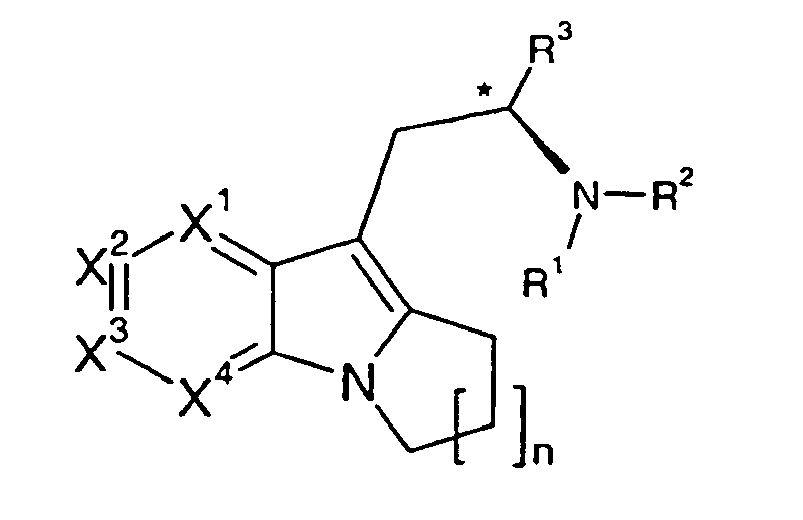
- A further particularly preferred aspect of the present invention are compounds according to formula (Ia)


- Likewise preferred are compounds of formula I, wherein R3 is hydrogen.
- Particularly preferred are compounds of formula I selected from the following compounds:
- (S)-2-(2,3-dihydro- 1H-3a,5-diaza-cyclopenta[a] inden-8-yl)-1-methyl-ethylamine;
- (R)-2-(2,3-dihydro- H-3a,5-diaza-cyclopenta a] inden-8-yl)-1-methyl-ethylamine;
- (S)-2-(2,3-dihydro-1H-3a,6-diaza-cyclopenta[a]inden-8-yl)-1-methyl-ethylamine;
- (R).2.(2,3,dihydro-1H-3a,6-diaza-cyclopenta[a] inden-8-yl)-1-methyl-ethylamine;
- 2-(2,3-dihydro- 1H-3a,6-diaza-cyclopenta [a]inden-8-yl)-ethylamine.
- Another preferred aspect of the invention is a method of treatment of obesity in a human in need of such treatment which comprises administration to the human a therapeutically effective amount of a compound of the present invention and a therapeutically effective amount of a lipase inhibitor. Particularly preferred is this method of treatment, wherein the lipase inhibitor is orlistat.
- Further preferred is the use of a compound of the present invention in the manufacture of a medicament for the treatment and prevention of obesity in a patient who is also receiving treatment with a lipase inhibitor. Particularly preferred is this use, wherein the lipase inhibitor is orlistat.
- Another preferred aspect is the pharmaceutical composition as before comprising further a therapeutically effective amount of a lipase inhibitor. Particularly preferred is this pharmaceutical composition, wherein the lipase inhibitor is orlistat.
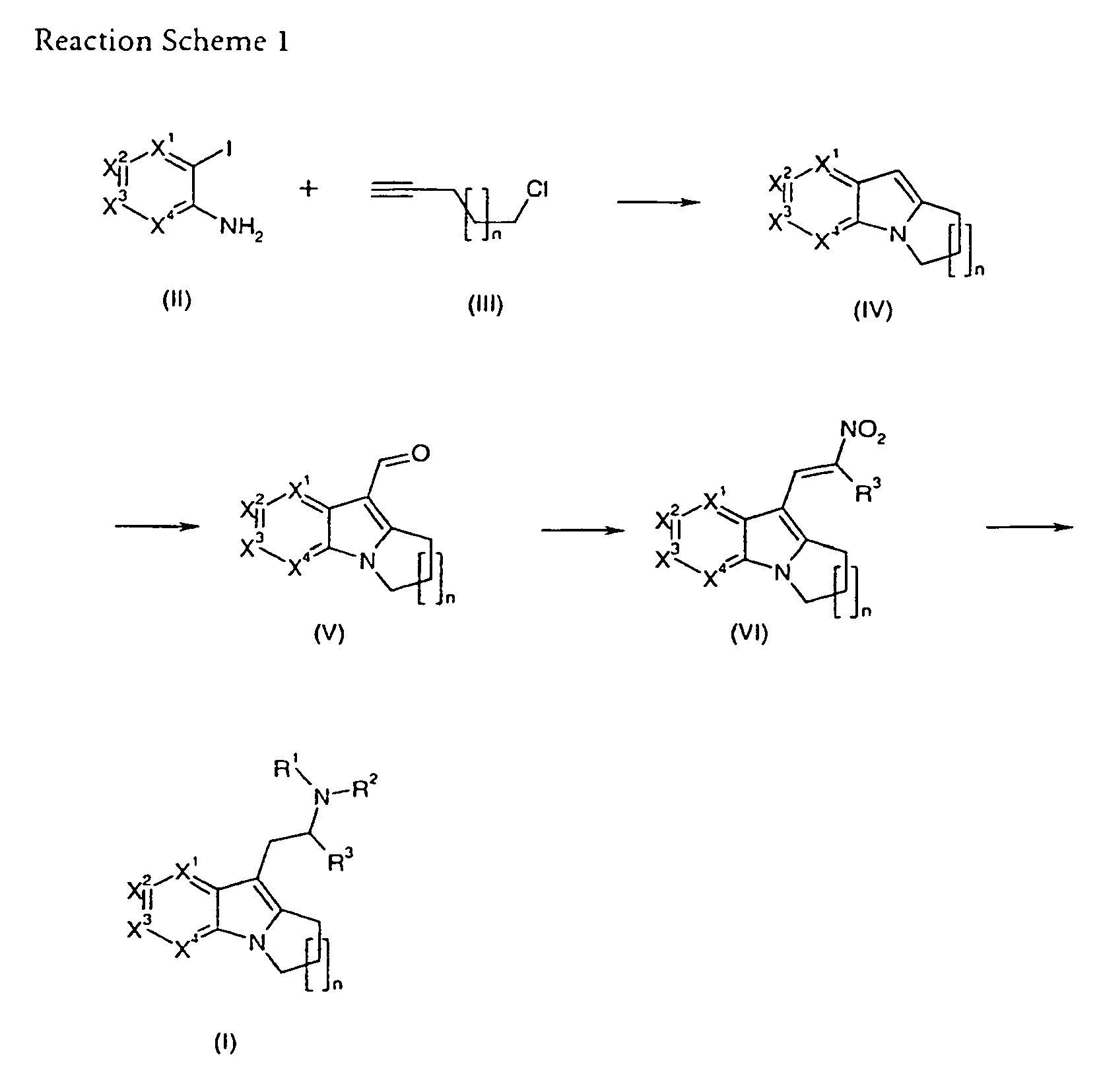
- Compounds of the invention may be prepared according to Reaction Scheme 1 below. R1 to R7 are as previously defined.
- Compounds of formula (II) may be prepared by reaction of the corresponding protected amine with iodine (I2, nBuLi, TMEDA) and deprotection of the amino group.
- Compounds of formula (II) may be reacted with compounds of formula (III) under palladium catalysed conditions to give compounds of formula (IV). The carboxaldehyde (V) may be obtained by reaction of compound (IV) with e.g. the Vilsmeier reagent prepared from DMF and phosphorus oxychloride under standard conditions. The nitroalkene (VI) may be obtained by reaction of compound (V) with a nitroalkane. Compounds of formula (I) can be formed in the reaction of the nitroalkene (VI) with a reducing agent such as lithium aluminium hydride in an ethereal solvent.
- The compounds of formula (I) (R1 and/or R2 = alkyl) may be prepared from compounds of formula (I) (R' = R2 = H) by standard methods such as reductive alkylation with an appropriate aldehyde or ketone in the presence of a reducing agent such as sodium triacetoxyborohydride, formic acid or sodium cyanoborohydride.
- According to a further aspect of the invention there is provided a method of preparing compounds of type (I), especially in enantiomerically pure form. (scheme 2) The intermediate (IV) is halogenated, perferably brominated or iodinated with suitable halogenating reagents agents (e.g. bromine or N- Iodosuccinirnide in an inert solvent e.g. dimethylformamide or acetonitrile) to yield an intermediate of formula (VII). This intermediate (VII) is treated with an agent effecting halogen-metal exchange, preferably halogen-lithium exchange (e.g. with butyl-lithium in an inert solvent e.g. THF) and treated with the novel chiral Sulfamidate A to yield an intermediate of formula (VIII). This latter intermediate (VIII) is transformed to a compound of formula (I) by methods known in the art, particularly by acid mediated cleavage of the BOC (meaning tert.-butlyoxycarbonyl) protecting group. Particularly preferred acids are trifluoroacetic acid or mixtures of trifluoroacetic acid in inert solvents such as dichloromethane and solutions of hydrochloric acid in inert solvents such as ethyl acetate, dioxane or diethyl ether. The stereochemistry, as indicated by the star (*), present in the chiral Sulfamidates A is without loss of integrity tansferred onto the intermediates (VIII) and compounds (I).


- If, in any of the processes mentioned herein, the substituent group R4, R5, R6 or R7 is other than the one required, the substituent group may be converted to the desired substituent by known methods. The substituents R4, R5, R6 or R7 may also need protecting against the conditions under which the reaction is carried out. In such a case, the protecting group may be removed after the reaction has been completed.
- The processes described above may be carried out to give a compound of the invention in the form of a free base or as an acid addition salt. If the compound of the invention is obtained as an acid addition salt, the free base can be obtained by basifying a solution of the acid addition salt. Conversely, if the product of the process is a free base, an acid addition salt, particularly a pharmaceutically acceptable acid addition salt, may be obtained by dissolving the free base in a suitable organic solvent and treating the solution with an acid, in accordance with conventional procedures for preparing acid addition salts from basic compounds.
- The compositions of the present invention may be formulated in a conventional manner using one or more pharmaceutically acceptable carriers. Thus, the active compounds of the invention may be formulated for oral, buccal, intranasal, parenteral (e.g., intravenous, intramuscular or subcutaneous) transdermal or rectal administration or in a form suitable for administration by inhalation or insufflation.
- For oral administration, the pharmaceutical compositions may take the form of, for example, tablets or capsules prepared by conventional means with pharmaceutically acceptable excipients such as binding agents (e.g. pregelatinised maize starch, polyvinylpyrrolidone or hydroxypropylmethylcellulose); fillers (e.g. lactose, microcrystalline cellulose or calcium phosphate); lubricants (e.g. magnesium stearate, talc or silica); disintegrants (e.g. potato starch or sodium starch glycollate); or wetting agents (e.g. sodium lauryl sulfate). The tablets may be coated by methods well known in the art. Liquid preparations for oral administration may take the form of, for example, solutions, syrups or suspensions, or they may be presented as a dry product for constitution with water or other suitable vehicle before use. Such liquid preparations may be prepared by conventional means with pharmaceutically acceptable additives such as suspending agents (e.g. sorbitol syrup, methyl cellulose or hydrogenated edible fats); emulsifying agents (e.g. lecithin or acacia); non-aqueous vehicles (e.g. almond oil, oily esters or ethyl alcohol); and preservatives (e.g. methyl or propyl p-hydroxybenzoates or sorbic acid).
- For buccal administration the composition may take the form of tablets or lozenges formulated in conventional manner.
- The active compounds of the invention may be formulated for parenteral administration by injection, including using conventional catheterization techniques or infusion. Formulations for injection may be presented in unit dosage form e.g. in ampoules or in multi-dose containers, with an added preservative. The compositions may take such forms as suspensions, solutions or emulsions in oily or aqueous vehicles, and may contain formulating agents such as suspending, stabilizing and/or dispersing agents.
- Alternatively, the active ingredient may be in powder form for reconstitution with a suitable vehicle, e.g. sterile pyrogen-free water, before use.
- The active compounds of the invention may also be formulated in rectal compositions such as suppositories or retention enemas, e.g., containing conventional suppository bases such as cocoa butter or other glycerides.
- For intranasal administration or administration by inhalation, the active compounds of the invention are conveniently delivered in the form of a solution or suspension from a pump spray container that is squeezed or pumped by the patient or as an aerosol spray presentation from a pressurized container or a nebulizer, with the use of a suitable propellant, e.g. dichlorodifluoromethane, trichlorofluoromethane, dichlorotetrafluoroethane, carbon dioxide or other suitable gas. In the case of a pressurized aerosol, the dosage unit may be determined by providing a valve to deliver a metered amount. The pressurized container or nebulizer may contain a solution or suspension of the active compound. Capsules and cartridges (made, for example, from gelatin) for use in an inhaler or insufflator may be formulated containing a powder mix of a compound of the invention and a suitable powder base such as lactose or starch.
- A proposed dose of the active compounds of the invention for oral, parenteral or buccal administration to the average adult human for the treatment of the conditions referred to above (e.g., obesity) is 0.1 to 500 mg of the active ingredient per unit dose which could be administered, for example, 1 to 4 times per day.
- The invention will now be described in detail with reference to the following examples. It will be appreciated that the invention is described by way of example only and modification of detail may be made without departing from the scope of the invention.
- The binding of compounds of formula (I) to serotonin receptors was determined in vitro by standard methods. The preparations were investigated in accordance with the assays given hereinafter.
- Method (a): For the binding to the 5-HT2C receptor the 5-HT2C receptors were radiolabeled with [3H]-5-HT. The affinity of the compounds for 5-HT2C receptors in a CHO cell line was determined according to the procedure of D. Hoyer, G. Engel and H.O. Kalkman, European J. Pharmacol., 1985, 118, 13-23.
- Method (b): For the binding to the 5-HT2B receptor the 5-HT2B receptors were radiolabeled with [3H]-5-HT. The affinity of the compounds for human 5-HT2B receptors in a CHO cell line was determined according to the procedure of K. Schmuck, C. Ullmer, P. Engels and H. Lubbert, FEBS Lett., 1994, 342, 85-90.
- Method (c): For the binding to the 5-HT2A, receptor the 5-HT2A receptors were radiolabeled with [125I]-DOI. The affinity of the compounds for 5-HT2A receptors in a CHO cell line was determined according to the procedure of D. J. McKenna and S. J. Peroutka, J. Neurosci., 1989, 9, 3482-90.
- The functional activity of compounds of formula (I) was assayed using a Fluorimetric Imaging Plate reader (FLIPR). CHO cells expressing the human 5-HT2C or human 5-HT2A receptors were counted and plated into standard 96 well microtitre plates on the day before testing to give a confluent monolayer. The cells were then dye loaded with the calcium sensitive dye, Fluo-3-AM. Unincorporated dye was removed using an automated cell washer to leave a total volume of 100 µL/well of assay buffer (Hanks balanced salt solution containing 20 mM Hepes and 2.5 mM probenecid). The drug (dissolved in 50 µL of the assay buffer) was added at a rate of 70 µL/sec to each well of the FLIPR 96 well plate during fluorescence measurements. The measurements were taken at 1 sec intervals and the maximum fluorescent signal was measured (approx 10-15 secs after drug addition) and compared with the response produced by 10 µM 5-HT (defined as 100%) to which it was expressed as a percentage response (relative efficacy). Dose response curves were constructed using Graphpad Prism (Graph Software Inc.).
- The compounds of formula (I) have activity at the h5-HT2c receptor in the range of 10,000 to 0.1 nM.
-

- The compound was prepared according to methods known in the art: Xu, Lianhong; Lewis, lestyn R.; Davidsen, Steven K.; Summers, James B. Tetrahedron Lett. (1998), 39(29), 5159-5162, for synthetic procedures for the preparation of 2-substituted 5-azaindoles; synthesis and cyclization reactions of acetylenic aminopyridines); Collini M D, Ellingboe J W, Tetrahedron Lett 38(46),7963-7966(1997, for Pd catalysed coupling of acetylenes to o-lodoanilines); Iritani, K.; Matsubara, S.; Utimoto, K.; Tetrahedron Lett 1988, 29 (15), 1799. (1988, for Pd catalysed cyclisation of o-amino phenylacetylenes to indoles); Chen H G, Hoechstetter C, Knochel P, Tetrahedron Lett 30(36),4795-4798(1989, for cyclisation of 2-(3-chloropropyl) indoles to 1H-pyrrolo[1,2-a] indoles).
- To a solution of 4-Amino-3-iodopyridine (2.2 g, 10.00 mMol) in acetonitrile (25ml), was added dropwise trifluoroacetic anhydride (2.53g, 1.674 ml) at 0 °C followed by addition of potassium carbonate (4.14g,30 mMol). The mixture was stirred at room temperature for 10 min. To the resulting suspension was added bis(triphenylphosphine)-palladium(II)chloride (0.175 g, 0.25mMol), copper(I)iodide (0.095g, 0.50 mMol) and 5-chloro-1-pentyne (1.23 g, 12.00 mMol) and the mixture was heated to reflux under argon for 3h. The mixture was cooled to room temperature and partitioned between water and ethyl acetate. The phases were separated. The organic phase was extracted with water at pH 1.00. The acidic aqueous phase was mixed with dichloromethane and the pH was raised to 10 by addition of 2N NaOH. The phases were separated and the organic phase was dried over sodium sulfate. The solvent was evaporated and the residue was taken up in acetonitrile (20 ml). To the brownish solution was added sodium iodide (3.00g, 20 mmol) and sodium hydride (ca 55% 0.873 g, 20 mMol) and the mixture was stirred at room temperature for 2h. The mixture was poured onto ice and partitioned between water and ethyl acetate (100 ml water 100 ml ethyl acetate). The phases were separated. The organic phase was extracted with water at pH 1.00 (5x 50 ml). The combined acidic aqueous phases were mixed with dichloromethane (100 ml) and the pH was raised to 10 by addition of 2N NaOH. The phases were separated and the organic phase was dried over sodium sulfate. The solvent was evaporated and the title compound (0.81g, 51 % of theory) was obtained as a brownish solid. For analytical purposes a sample was recrystallised from t-butylmethylether to afford light brown crystals melting at 95-96 °C; Found C, 75.93; H, 6.32; N,17.80%. C10H10N2 requires : C, 75.92; H, 6.37; N, 17.71%
- To dimethylformamide (0.3 ml) was added phosphorus oxychloride (0.33 ml) dropwise at 0°C. The mixture was allowed to stir for 10 min at room temperature. A solution of 2,3-dihydro-1H-3a,6-diaza-cyclopenta[a]indene (0.10 g 0.63 mMol) in 0.1 ml dimethylformamide was added and the mixture was stirred at room temperature for 3h. The reaction was quenched with ice (ca 5g) and the pH was adjusted to 9 by addition of 28% sodium hydroxide. The mixture was heated to reflux for 10 min. cooled to room temperature and extracted with ethyl acetate(3x 5 ml) The combined organic extracts were dried with sodium sulfate and evaporated to dryness to yield the title compound (0.115 g, 97% Th). For analytical purposes a sample was recrystallised from ethyl acetate to afford slightly yellow crystals. mp 150-151 °C. Found C, 70.94; H, 5.56; N, 14.97%; C11H10N2O requires C, 70.95; H, 5.41; N, 15.04%
- To a solution of 2,3-dihydro-1H-3a,6-diaza-cyclopenta[a]indene-8-carbaldehyde (0.30g 1.6 mMol) in nitroethane (3.00 ml) was added ammonium acetate (0.30 g 3.9 mMol) and the mixture was heated to 100 °C for 4 h with stirring under argon. The mixture was cooled to room temperature and purified by chromatography on silicagel gel (ca 30 g) eluting first with ethyl acetate (ca 100 ml) then with a mixture of ethyl acetate (9 parts) and methanol (1part). The product fraction were combined, concentrated and the residue was recrystallised from ethyl acetate to yield the title compound (0.30 g, 77%) as yellow crystals. mp 141-142 C Found C, 64.05; H, 5.51; N, 17.14%; C13H13N3O2 requires C, 64.19; H, 5.39; N, 17.27%.
- To a solution of 8-(2-nitro-propenyl)-2,3-dihydro-1H-3a,6-diazacyclopentafajindene (0.200g 0.82 mMol) in tetrahydrofuran (2 ml) was added dropwise a 1M solution of lithium aluminum hydride (2ml, 2 mMol)in THF at 0°C with stirring under argon. The mixture was then heated to reflux for 4 h, was cooled to 0 °C and a 10% solution of sodium-potassium tartrate in water (5 ml) was added with stirring. The mixture was briefly heated to reflux cooled to room temperature and filtered through a pad of dicalite. The clear filtrate was extracted with dichloromethane. The organic phase was dried with sodium sulfate evaporated and the residue was purified by chromatography on silica gel eluting with dichloromethane: methanol: conc. ammonia=9:1:0.1 to yield the title compound as free base as a yellowish oil (90 mg; 51%). To a solution of this oil (80mg, 0.37 mMol) in tetrahydrofuran (3 ml) was added dropwise with stirring at room temperature a solution of hydrochloric acid in ether (0.2ml 5.5 M, 1.1mMol). The resulting suspension was stirred at room temperature for 30 min and the solid was collected by filtration and dried to constant weight under high vacuum at 40 °C to yield the title compound (100 mg, 93%) as a white powder melting above 280 °C. Found C, 51.93; H 6.79; N,13.68 %; C13H19N3 + 0.73 mol water requires C,51.81; H,6.84; N,13.94 %.NMR δH (400 MHz DMSO-d6) 1.25(d,J=6.4Hz,3H); 2.63(m,2H); 3.10(m,4H); 3.50 (m,1H); 4.27(t,J=7Hz,2H); 7.93(d,J=7Hz,1H); 8.0(s,broad,3H); δ.39(d.J=7Hz,1H); 9.30 (s,1H); 15.0(s,1H)ppm.
-

- To a stirred solution of 2-amino-3-iodoaniline (13g) in triethylamine (260ml) were added bis(triphenylphosphine) palladium dichloride (2g) and copper (I) iodide (1.15g). The mixture was cooled to 5 °C before the addition of 5-chloro-1-pentyne (6.6ml). The mixture was heated to 50 °C and stirred 5h. The mixture was cooled to room temperature, filtered and evaporated. The residue was purified by column chromatography on silica gel (ethyl acetate/ hexane 1:1 to 5:1 eluant) to afford 3-(5-chloropent-1-ynyl)-pyridin-2-ylamine as a red oil (10.6g, 92%): MS (EI) 196,194 (M),159, 157, 131, 104; 1H NMR (δ, CDCl3) 8.0 (dd,1H, J=2,5Hz), 7.47 (dd,1H, J=2,7Hz), 6.59 (dd,1H, J=5,7Hz), 4.94 (br s, 1H), 3.72 (t,2H, J=6Hz), 2.68 (t,2H, J=7Hz), 2.07 (dt,2H, J=6,7Hz) ppm.
- 3-(5-Chloropent-1-ynyl)-pyridin-2-ylamine (10.2g) was dissolved in acetonitrile (120ml) and the solution cooled to 5°C under a stream of argon. Trifluoroacetic anhydride (14.1ml) was added dropwise as a solution in acetonitrile (10ml). The mixture was stirred 2h at 0 °C and 10min at room temperature. The solvent and excess reagent were evaporated under reduced pressure to afford the trifluoroacetate as a viscous oil (20g) that was used without further purification. The oil was dissolved in acetonitrile (120ml) and treated with palladium (II) chloride. The mixture was heated under argon 2h at 75 °C, cooled and evaporated under reduced pressure. The residue was taken up in ethyl acetate and the solution washed with 5% aqueous sodium carbonate solution, brine, dried over sodium sulfate and evaporated. The residue was purified by column chromatography on silica gel (ethyl acetate/ hexane 1:2 to 1:1 eluant) to afford 2-(3-chloro-propyl)-1H-pyrrolo[2,3-b]pyridine as a yellow oil (5.6g, 55%) which solidified on standing. Mp: 75 °C; MS ; 1H NMR (δ, CDCl3) 11.7 (s,1H), 8.25 (dd,1H, J=1.2,4.8Hz), 7.86 (dd,1H, J=1.2,8Hz), 7.06 (dd,1H, J=4.8,8Hz), 6.25 (s,1H), 3.63 (t,2H, J=6.4Hz), 3.08 (t,2H, J=7.6Hz), 2.29 (dt,2H, J=6.4,7.6Hz) ppm.
- 2-(3-Chloro-propyl)-1H-pyrrolo[2,3-b]pyridine (5.6g) was dissolved in acetonitrile under a stream of argon. Potassium iodide (6g) was added, and sodium hydride in mineral oil (4.60g) added in small portions. After stirring 2h at room temperature, the mixture was poured onto a mixture of ice and saturated sodium hydrogencarbonate solution. The organics were extracted twice with ethyl acetate. The combined organic phases were washed with brine, dried over sodium sulfate and evaporated to afford 2,3-dihydro-1H-3a,4-diaza-cyclopenta[a]indene as a crude pale brown solid (4.5g, 99%), which was used without further purification. MS (EI) 159 (M+H)+, 143, 100; 1H NMR (δ, CDCl3) 8.19 (dd,1H, J=1,5Hz), 7.80 (dd,1H, J=1,8Hz), 6.99 (dd,1H, J=5,8Hz), 6.12 (s,1H), 4.22 (t,2H, J=6 Hz), 3.05 (t,2H, J=8 Hz), 2.63 (dt,2H, J=6,8 Hz) ppm.
- Phosphorus oxychloride (3.85ml) was added dropwise to N,N-dimethylformamide (25ml) cooled in an ice-bath. The mixture was stirred 10min before the addition of 2,3-dihydro-1H-3a,4-diaza-cyclopenta[a]indene (4.40g) in N,N-dimethylformamide (7ml). The mixture was stirred 45min at 40 °C, cooled to room temperature and concentrated aqueous sodium hydroxide added dropwise to pH10. The mixture was heated at 50°C 10min, cooled to room temperature and poured onto crushed ice. The organics were extracted with ethyl acetate (2x), the combined organic phases washed with brine, dried over sodium sulfate and evaporated under reduced pressure. The residue was purified by column chromatography on silica gel (ethyl acetate /hexane 1:1 to 1:0) to afford 2,3-dihydro-1H-3a,4-diaza-cyclopenta[a]indene-8-carbaldehyde (2.4g, 46%) as a light orange oil which solidified on standing. Mp. 137-141; MS (EI): 187 (M+H)+, 143, 100; 1H NMR (δ, CDCl3) 10.01 (s, 1H), 8.45 (dd, 1H, J=1,8Hz), 8.32 (dd, 1H, J=1,5Hz), 7.23 (dd, 1H, J=5,8Hz), 4.31 (t, 2H, J=6 Hz), 3.38 (t, 2H, J=8 Hz), 2.76 (dt, 2H, J=6,8 Hz) ppm.
- A stirred solution of 2,3-dihydro-1H-3a,4-diaza-cyclopenta[a]indene-8-carbaldehyde (2.3g) and ammonium acetate (1.05g) in nitroethane was heated to 100°C for 2.5h, cooled to room temperature, and evaporated under reduced pressure. The residue was partitioned between water and ethyl acetate, the phases separated, the aqueous phase re-extracted with ethyl acetate. The combined organic phases were dried over sodium sulfate and evaporated under reduced pressure. The residue was purified by column chromatography on silica gel (ethyl acetate/hexane 2:1 to 4:1) to afford 8-(2-nitropropenyl)-2,3-dihydro-1H-3a,4-diaza-cyclopenta[a]indene as a yellow solid (2.4g, 80%); MS (EI) 244 (M+H)+, 224, 195, 171; 1H NMR (δ, CDCl3) 8.31 (dd, 1H, J= 1,5Hz), 8.29 (s, 1H), 7.92 (dd, 1H, J=1,8Hz), 7.16 (dd,1H, J=5,8Hz), 4.34 (t,2H, J=6 Hz), 3.18 (t,2H, J=8Hz), 2.72 (dt,2H, J=6,8 Hz), 2.45 (s,3H) ppm.
- To lithium aluminium hydride (30mg) in tetrahydrofuran (1ml) at room temperature was slowly added a solution of 8-(2-nitropropenyl)-2,3-dihydro-1H-3a,4-diaza-cyclopenta[a]indene (98mg) in tetrahydrofuran (1ml). The mixture was heated at reflux for 3h, cooled to room temperature and 1M aqueous sodium hydroxide solution added dropwise. The mixture was stirred 30min, and poured into ethyl acetate. The phases were separated, the aqueous phase re-extracted with ethyl acetate. The combined organic phases were washed with brine, dried over sodium sulfate and evaporated under reduced pressure. The residue was purified by column chromatography on silica gel (dichloromethane/methanol/ammonia 9:1:0.1) to afford (R,S)-2-(2,3-dihydro-1H-3a,4-diaza-cyclopenta[a]inden-8-yl)-1-methyl-ethylamine. This was treated with a solution of hydrochloric acid in ether. The mixture was stirred 15min at room temperature and the solvent evaporated under reduced pressure. The residue was recrystallised from ethanol/ether to afford (R,S)-2-(2,3-dihydro-1H-3a,4-diaza-cyclopenta[a]inden-8-yl)-1-methylethylamine dihydrochloride as a white solid (18mg); MS (EI): 216 (M+H)+, 143, 117, 100; 1H NMR (δ, d6-DMSO) 8.42 (d, 1H, J=8Hz), 8.3 (d, 1H, J=5Hz), 8.15 (br s, 2H), 7.35 (dd, 1H, J=5,8Hz), 5.1 (br s), 4.25 (t, 2H, J=5Hz), 3.4 (m, 1H), 3.05 (m, 2H), 2.95 (m,1H), 2.58 (t, 2H, J=6Hz), 1.24 (d, 3H, J=6Hz) ppm.
-

- A mixture of 0.2885g bis(triphenylphosphine) palladium dichloride and 0.1565g copper (I) iodide in 200 mL triethylamine was heated to reflux for 20 min. To the resulting solution was added at room temperature 25.00g N-(4-iodo-3-pyridinyl)-2,2-dimethyl-propanamide and 25.3g 5-chloro-1-pentyne and the mixture was heated to reflux for 30 min. The reaction mixture was distributed between water and ethyl acetate, the phases were separated and the organic phase was washed with water and brine, dried over magnesium sulfate and evaporated. The residue was taken up in 200mL tert-butanol and 18.45 g powdered potassium hydroxyde was added. The mixture was heated to reflux for 30 min. The reaction mixture was distributed between water and ethyl acetate, the phases were separated and the organic phase was washed with water and brine, dried over magnesium sulfate and evaporated. The residue was purified by chromatography on silica gel with ethyl acetate: methanol= 7:3 to yield 7.37 g 2,3-Dihydro-1H-3a,5-diaza-cyclopenta[a]indene as slightly yellow solid melting at 90-91°C
- To a solution of 1.58g in 15 ml dimethylformamide is added dropwise 20 ml of a 10% solution of bromine in dimethylformamide. The mixture was stirred at room temperature for 45 min. The reaction mixture was distributed between water and ethyl acetate, the phases were separated and the organic phase was washed with water and brine, dried over magnesium sulfate and evaporated. The residue was purified by chromatography on silica gel with ethyl acetate: methanol= 9:1 and recrystallized from cyclohexane to yield 1.338g 8-bromo-2,3-dihydro-1H-3a,5-diaza-cyclopenta[a]indene as off white crystals melting at 110.8-112°C.
- To a solution of 0.237g 8-bromo-2,3-dihydro-1H-3a,5-diaza-cyclopenta[a]indene in 3 ml tetrahydrofuran was added dropwise a 1.6M solution of n-butyl lithium in n-hexane during 15 min at -78°C. The mixture was stirred at -78°C for 30 min. To the resulting mixture was added (S)-4-Methyl-2,2-dioxo-[1,2,3]oxathiazolidine-3-carboxylic acid tert-butyl ester at once. The mixture was allowed to warm to room temperature during 15 min. The reaction mixture was distributed between water and ethyl acetate, the phases were separated and the organic phase was washed with water and brine, dried over magnesium sulfate and evaporated. The residue was dissolved in 5 mL trifluoro acetic acid and kept at room temperature for 10 min. The solvent was evaporated and the residue was purified by chromatography on silica gel with dichloromethane : methanol ammonia =9 : 1 : O1 to yield 0.045 g (S)-2-(2,3-Dihydro-1H-3a,5-diaza-cyciopenta [a] inden-8-yl)-1-methyl-ethylamine as a white solid.
MS: 216.4 - By the same general procedure as in Example 7b (S)-4-Methyl-2,2-dioxo-[1,2,3]oxathiazolidine-3-carboxylic acid tert-butyl ester was obtained from (S)-BOC-alalinol as white crystals melting at 121.1-121.8°C after crystallisation from tert. butylmethlyether.
-

- By exactly the same procedure as in 3b the enantiomer (R)-2-(2,3-Dihydro-1H-3a,5. diaza-cyclopenta[a]inden-8-yl)-1-methyl-ethylamine was obtained from 8-bromo-2,3-dihydro-1H-3a,5-diaxa-cyclopenta[a]indene in 3 ml tetrahydrofuran by using the R-enantiomeric sulfamidate (R)-4-Methyl-2,2-dioxo-[1,2,3]oxathiazolidine-3-carboxylic acid tert-butyl ester.
MS: 216.4 - By the same general procedure as in Example 7b (R)-4-Methyl-2,2-dioxo-[1,2,3]oxathiazolidine-3-carboxylic acid tert-butyl ester was obtained from (R)-BOC-alalinol as white crystals melting at 118.5-119.1°C after crystallisation from tert. butylmethlyether.
-

- By the same general procedures as in example 3 (S)-2-(2,3-Dihydro-1H-3a,6-diaza-cyclopenta[a]inden-8-yl)-1-methyl-ethylamine was obtained from 8-Bromo-2,3-dihydro-1H-3a,6-diaza-cyclopenta[a]indene (MS: 238, 238) and (S)-4-Methyl-2,2-dioxo-[1,2,3]oxathiazolidine-3-carboxylic acid tert-butyl ester as white solid.
MS: 216.3 -

- By the same general procedure as in example 3 (R)-2-(2,3-Dihydro-1H-3a,6-diaza-cyclopenta[a]inden-8-yl)-1-methyl-ethylamine was obtained from 8-Bromo-2,3-dihydro-1H-3a,6-diaza-cyclopenta[a] indene and (R)-4-Methyl-2,2-dioxo-[1,2,3]oxathiazolidine-3-carboxylic acid tert-butyl ester as white solid.
MS: 216.3 - The products from example 5 and 6 were both shown to be enantiomerically pure (>98%ee) by chiral GC on a BGB-175 column.
-
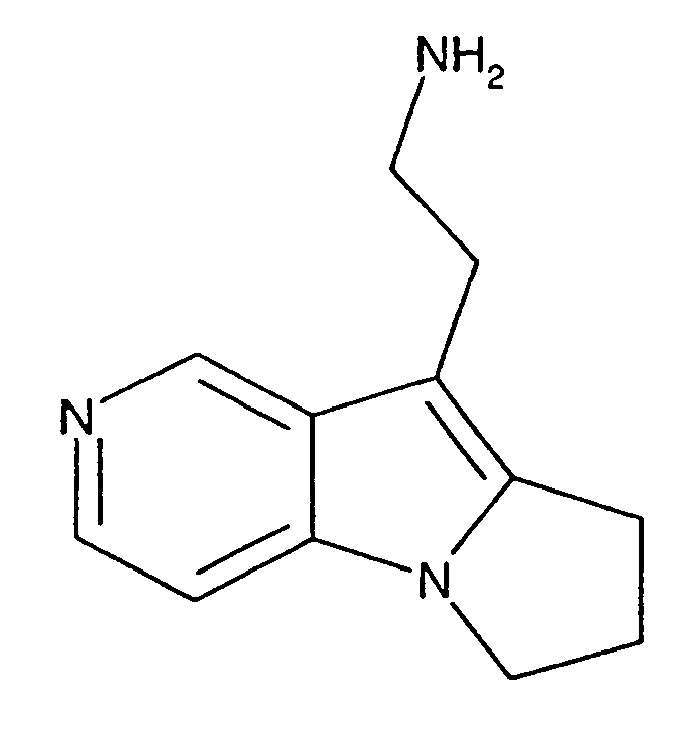
- 7a) By the same general procedure as in example 3 there was obtained from 8-Bromo-2,3-dihydro-1H-3a,6-diaza-cyclopenta[a]indene and 2,2-dioxo-[1,2,3]oxathiazolidine-3-carboxylic acid tert-butyl ester after protecting group cleavage 2-(2,3-dihydro-1H-3a,6-diaza-cyclopenta[a]inden-8-yl)-ethylamine as white solid.
MS: 201.2 - To a solution of 3.22 g BOC-glycinol in 30 ml tetrahydrofuran was added at -78°C 25 ml of a ca 1.6 M solution of n-butyllithium in n-hexane with stirring. The temperature rose to -45°C. The cooling bath was removed and the temperature was allowed to rise to 0°C during 30 min. The mixture was then cooled to -78°C and a solution of 2,376 g thionylchloride in 15 ml THF which was cooled to -78°C in a jacketed dropping funnel was added at once with vigorous stirring. The temperature rose to ca -50°C. The cooling bath was replaced by an ice bath and the mixture was allowed to stir at 0°C for 30 min. The reaction mixture was distributed between water and ethyl aceate. The phases were separated and the organic phase was washed with 10% citric acid, 10% sodium bicarbonate and brine, dried over magnesiumsulfate and purified by chromatography on silica gel with hexane : ethyl acetate = 1 : 1 to yield 2.00g of the sulfamidite inermediate as white crystals. To a solution of 1,75 g of this material in 20 ml ethyl acetate was added at 0°C 25 mL of a 10 % solution of sodiummetaperiodate in water. To the well stirred mixture was added 24 mg rutheniumdioxide hydrate. The mixture was stirred at 0°C for 30 min. The phases were separated and ca 2mL isoproanol was added to the organic phase. The organic phase was washed with 10 % citric acid, 10 % sodium bicarbonate and brine, dried with magnesium sulfate and evaporated to dryness. The solid product was recrystallized from t-butylmethylether to yield 1.24g 2,2-dioxo-[1,2,3]oxathiazolidine-3-carboxylic acid tert-butyl ester as white crystals melting at 121.6-122.1°C
Claims (41)
- A chemical compound of formula (I):
 n is 1, 2 or 3;X1 is nitrogen or CR4; X2 is nitrogen or CR5; X3 is nitrogen or CR6; X4 is nitrogen or CR7; wherein one or two of the X1, X2, X3 and X4 groups are nitrogen;R1 and R2 are independently selected from hydrogen and alkyl;R3 is hydrogen or alkyl;R4 to R7 are independently selected from hydrogen, halogen, hydroxy, alkyl, aryl, alkoxy, aryloxy, alkylthio, arylthio, alkylsulfonyl, alkylsulfoxyl, arylsulfonyl, arylsulfoxyl, amino, monoalkylamino, dialkylamino, nitro, cyano, carboxaldehyde, alkylcarbonyl, arylcarbonyl, aminocarbonyl, monoalkylaminocarbonyl, dialkylaminocarbonyl, alkoxycarbonylamino, aminocarbonyloxy, monoalkylaminocarbonyloxy, dialkylaminocarbonyloxy, monoalkylaminocarbonylamino and dialkylaminocarbonylamino, and wherein a carbon ring atom next to a nitrogen is not substituted by halogen;and pharmaceutically acceptable salts thereof, wherein 2-(2-methoxy-6,7,8,9-tetrahydropyrido(2,3-b)indolizin-10-yl)ethylamine, 2-(3-methoxy6, 7,8,9-tetrahydropyrido(3,2-b)indolizin-5-yl)-ethylamine, 2-(2-methoxy-7,8-dihydro-6H-pyrido(2,3-b)pyrrolizin-9-yl)-ethylamine, 2-(2-isopropyl-7,8-dihydro-6H-pyrido(2,3-b)pyrrolizin-9-yl)-ethylamine and 2-((2-benzyloxy)7,8,9,10-tetrahydro-6H-pyrido(2,3',:4,5)pyrrolo(1,2-a)azepin-11-yl)-ethylamine are excluded.
 - A compound according to claim 1, wherein the compound has the following formula

- A compound according to claim 1 or 2 wherein two of the X1, X2, X3 and X4 groups are nitrogen and these nitrogen atoms are in meta or para position to each other.
- A compound according to claim 1 or 2 wherein X1 is nitrogen, X2 is CR5, X3 is CR6, and X4 is CR7.
- A compound according to claim 1 or 2 wherein X1 is CR4; X2 is nitrogen; X3 is CR6 and X4 is CR7.
- A compound according to claim 1 or 2 wherein X1 is CR4, X2 is CR5; X3 is nitrogen and X4 CR7.
- A compound according to claim 1 or 2 wherein X1 is CR4, X2 is CR5; X3 is CR6 and X4 is nitrogen.
- A compound according to any one of claims 1 to 3 wherein X1 is nitrogen, X2 is CR5; X3 is nitrogen and X4 is CR7.
- A compound according to any one of claims 1 to 3 wherein X1 is CR4, X2 is nitrogen, X3 is CR6 and X4 is nitrogen.
- A compound according to any one of claims 1 to 3 wherein X1 is nitrogen, X2 is CR5, X3 is CR6 and X4 is nitrogen.
- A compound according to any preceding claim wherein n=1.
- A compound according to any preceding claim wherein R1 and R2 are hydrogen.
- A compound according to any one of claims 1 to 11 wherein R1 is hydrogen and R2 is alkyl.
- A compound according to any one of claims 1 to 11 wherein R1 is hydrogen and R2 is arylalkyl.
- A compound according to any preceding claim wherein R3 is methyl.
- A compounds according to any one of claims 1 to 14 wherein R3 is hydrogen.
- A compound according to any preceding claim wherein R4 to R7 are selected from hydrogen, halogen, hydroxy, alkyl, aryl, alkoxy, aryloxy, alkylthio, alkylsulfoxyl and alkylsulfonyl.
- A compound according to any preceding claim wherein R4 is hydrogen or halogen.
- A compound according to any preceding claim wherein R5 is other than hydrogen.
- A compound according to any preceding claim wherein R5 is selected from halogen, alkyl, alkoxy and alkylthio.
- A compound according to any preceding claim wherein R6 is other than hydrogen.
- A compound according to any one of claims 1 to 20 wherein R6 is selected from hydrogen and halogen.
- A compound according to any preceding claim wherein two or three of R4, R5, R6 and R7 are hydrogen.
- A compound according to any preceding claim wherein the compounds of formula (I) are selected from (R,S)-2-(2,3-dihydro-1H-3a,6-diaza-cyclopenta[a]inden-8-yl)-1-methyl-ethylamine and (R,S)-2-(2,3-dihydro-1H-3a,4-diaza-cyclopenta[a]inden-8-yl)-1-methyl-ethylamine.
- A compound according to any one of claims 1 to 23 wherein the compounds of formula (I) are selected from(S)-2-(2,3-dihydro-1H-3a,5-diaza-cyclopenta[a]inden-8-yl)-1-methyl-ethylamine;(R)-2-(2,3-dihydro-1H-3a,5-diaza-cyclopenta[a]inden-8-yl)-1-methyl-ethylamine;(S)-2-(2,3-dihydro-1H-3a,6-diaza-cyclopenta[a] inden-8-yl)-1-methyl-ethylamine;(R)-2-(2,3-dihydro-1H-3a,6-diaza-cyclopenta[a]inden-8-yl)-1-methyl-ethylamine;2-(2,3-dihydro- 1H-3a,6-diaza-cyclopenta[a] inden-8-yl)-ethylamine.
- A compound of formula (I) as set out in any one of claims 1 to 25 for use in therapy.
- The use of a compound of formula (I) as set out in any of claims 1 to 25 in the manufacture of a medicament comprising a compound as defined in any of claim 1 to 25 for the treatment of disorders of the central nervous system, damage to the central nervous system, cardiovascular disorders, gastrointestinal disorders, diabetes insipidus, and sleep apnoea.
- A use according to claim 27 wherein the disorders of the central nervous system are selected from depression, atypical depression, bipolar disorders, anxiety disorders, obsessive-compulsive disorders, social phobias or panic states, sleep disorders, sexual dysfunction, psychoses, schizophrenia, migraine and other conditions associated with cephalic pain or other pain, raised intracranial pressure, epilepsy, personality disorders, age-related behavioural disorders, behavioural disorders associated with dementia, organic mental disorders, mental disorders in childhood, aggressivity, age-related memory disorders, chronic fatigue syndrome, drug and alcohol addiction, obesity, bulimia, anorexia nervosa and premenstrual tension.
- A use according to claim 27 wherein the damage to the central nervous system is by trauma, stroke, neurodegenerative diseases or toxic or infective CNS diseases.
- A use according to claim 29 wherein said toxic or infective CNS disease is encephalitis or meningitis.
- A use according to claim 27 wherein the cardiovascular disorder is thrombosis.
- A use according to claim 27 wherein the gastrointestinal disorder is dysfunction of gastrointestinal motility.
- A use according to claim 27 wherein said medicament is for the treatment of obesity.
- A use according to any of claims 27 to 33 wherein said treatment is prophylactic treatment.
- A method of preparing a compound according to any one of claims 1 to 25 by reduction or reductive alkylation of a compound of formula (VI).

- A pharmaceutical composition comprising a compound of formula (I) as set out in any one of claims 1 to 25 in combination with a pharmaceutically acceptable carrier or excipient.
- A method of making a composition according to claim 36 comprising combining a compound of formula (I) as set out in any one of claims 1 to 25 with a pharmaceutically acceptable carrier or excipient.
- The use of a compound according to any one of claims 1 to 25 in the manufacture of a medicament for the treatment and prevention of obesity in a patient who is also receiving treatment with a lipase inhibitor.
- The use according to claim 38, wherein the lipase inhibitor is orlistat.
- The pharmaceutical composition according to claim 36 comprising further a therapeutically effective amount of a lipase inhibitor.
- The pharmaceutical composition according to claim 40, wherein the lipase inhibitor is orlistat.
Priority Applications (1)
| Application Number | Priority Date | Filing Date | Title |
|---|---|---|---|
| EP01911722A EP1274711B1 (en) | 2000-03-06 | 2001-03-02 | New aza-indolyl derivatives |
Applications Claiming Priority (4)
| Application Number | Priority Date | Filing Date | Title |
|---|---|---|---|
| EP00301814A EP1132389A1 (en) | 2000-03-06 | 2000-03-06 | New aza-indolyl derivatives for the treatment of obesity |
| EP00301814 | 2000-03-06 | ||
| EP01911722A EP1274711B1 (en) | 2000-03-06 | 2001-03-02 | New aza-indolyl derivatives |
| PCT/EP2001/002388 WO2001066548A1 (en) | 2000-03-06 | 2001-03-02 | New aza-indolyl derivatives |
Publications (2)
| Publication Number | Publication Date |
|---|---|
| EP1274711A1 EP1274711A1 (en) | 2003-01-15 |
| EP1274711B1 true EP1274711B1 (en) | 2006-05-17 |
Family
ID=8172768
Family Applications (2)
| Application Number | Title | Priority Date | Filing Date |
|---|---|---|---|
| EP00301814A Withdrawn EP1132389A1 (en) | 2000-03-06 | 2000-03-06 | New aza-indolyl derivatives for the treatment of obesity |
| EP01911722A Expired - Lifetime EP1274711B1 (en) | 2000-03-06 | 2001-03-02 | New aza-indolyl derivatives |
Family Applications Before (1)
| Application Number | Title | Priority Date | Filing Date |
|---|---|---|---|
| EP00301814A Withdrawn EP1132389A1 (en) | 2000-03-06 | 2000-03-06 | New aza-indolyl derivatives for the treatment of obesity |
Country Status (15)
| Country | Link |
|---|---|
| US (1) | US6583134B2 (en) |
| EP (2) | EP1132389A1 (en) |
| JP (1) | JP3828422B2 (en) |
| KR (1) | KR100554817B1 (en) |
| CN (1) | CN1281608C (en) |
| AR (1) | AR029815A1 (en) |
| AT (1) | ATE326470T1 (en) |
| AU (2) | AU4067001A (en) |
| BR (1) | BR0109044A (en) |
| CA (1) | CA2399111A1 (en) |
| DE (1) | DE60119719T2 (en) |
| ES (1) | ES2263595T3 (en) |
| MX (1) | MXPA02008689A (en) |
| WO (1) | WO2001066548A1 (en) |
| ZA (1) | ZA200206198B (en) |
Families Citing this family (86)
| Publication number | Priority date | Publication date | Assignee | Title |
|---|---|---|---|---|
| EP1347979B1 (en) | 2000-12-27 | 2007-08-08 | F. Hoffmann-La Roche Ag | Indole derivatives and their use as 5-ht2b and 5-ht2c receptor ligands |
| AU2003243089B2 (en) | 2002-06-19 | 2010-01-07 | Biovitrum Ab (Publ) | Novel compounds, their use and preparation |
| US7105526B2 (en) | 2002-06-28 | 2006-09-12 | Banyu Pharmaceuticals Co., Ltd. | Benzimidazole derivatives |
| US7407955B2 (en) | 2002-08-21 | 2008-08-05 | Boehringer Ingelheim Pharma Gmbh & Co., Kg | 8-[3-amino-piperidin-1-yl]-xanthines, the preparation thereof and their use as pharmaceutical compositions |
| US7772188B2 (en) | 2003-01-28 | 2010-08-10 | Ironwood Pharmaceuticals, Inc. | Methods and compositions for the treatment of gastrointestinal disorders |
| CL2004000826A1 (en) | 2003-04-25 | 2005-03-04 | Pfizer | USE OF AN AGONIST FOR THE 5-HT2C RECEPTOR TO PREPARE A USEFUL MEDICINAL PRODUCT IN THE TREATMENT OF URINARY INCONTINENCE CAUSED BY STRESS, WITH THE CONDITION THAT THE AGONIST IS NOT 1- [6-CHLORINE-5- (TRIFLUOROMETIL) -2- PIRIDINIL] PIPERAZINA (ORG-129 |
| GB0314967D0 (en) | 2003-06-26 | 2003-07-30 | Hoffmann La Roche | Piperazine derivatives |
| JP4765627B2 (en) | 2003-09-22 | 2011-09-07 | Msd株式会社 | Novel piperidine derivatives |
| US20050143350A1 (en) * | 2003-11-19 | 2005-06-30 | Seed John C. | Combination drug therapy to treat obesity |
| US20080125403A1 (en) | 2004-04-02 | 2008-05-29 | Merck & Co., Inc. | Method of Treating Men with Metabolic and Anthropometric Disorders |
| KR100592805B1 (en) * | 2004-04-13 | 2006-06-26 | 한국화학연구원 | Indene derivatives and preparation method thereof |
| JP2008501758A (en) | 2004-06-09 | 2008-01-24 | グラクソ グループ リミテッド | Pyrrolopyridine derivatives |
| EP1792629A4 (en) | 2004-08-25 | 2010-08-25 | Takeda Pharmaceutical | PREVENTIVE / REMEDY AGENTS FOR INCONTINENCE OF STRESS AND SELECETING METHOD THEREOF |
| ES2325773T5 (en) | 2004-11-01 | 2014-02-24 | Amylin Pharmaceuticals, Llc. | Treatment of obesity and related disorders |
| DE102004054054A1 (en) | 2004-11-05 | 2006-05-11 | Boehringer Ingelheim Pharma Gmbh & Co. Kg | Process for preparing chiral 8- (3-amino-piperidin-1-yl) -xanthines |
| US7737155B2 (en) | 2005-05-17 | 2010-06-15 | Schering Corporation | Nitrogen-containing heterocyclic compounds and methods of use thereof |
| US8138206B2 (en) | 2005-05-30 | 2012-03-20 | Msd. K.K. | Piperidine derivative |
| CA2618112A1 (en) | 2005-08-10 | 2007-02-15 | Banyu Pharmaceutical Co., Ltd. | Pyridone compound |
| AU2006279680B2 (en) | 2005-08-11 | 2012-12-06 | Amylin Pharmaceuticals, Llc | Hybrid polypeptides with selectable properties |
| BRPI0614649A2 (en) | 2005-08-11 | 2011-04-12 | Amylin Pharmaceuticals Inc | hybrid polypeptides with selectable properties |
| WO2007024004A1 (en) | 2005-08-24 | 2007-03-01 | Banyu Pharmaceutical Co., Ltd. | Phenylpyridone derivative |
| AU2006288153A1 (en) | 2005-09-07 | 2007-03-15 | Msd K.K. | Bicyclic aromatic substituted pyridone derivative |
| JP5677717B2 (en) * | 2005-09-14 | 2015-02-25 | 味の素株式会社 | Hemodynamic improver |
| KR20080048502A (en) | 2005-09-29 | 2008-06-02 | 머크 앤드 캄파니 인코포레이티드 | Acylated spiropiperidine derivatives as melanocortin-4 receptor modulators |
| RU2008119687A (en) | 2005-10-21 | 2009-11-27 | Новартис АГ (CH) | COMBINATIONS OF ORGANIC COMPOUNDS |
| CA2627139A1 (en) | 2005-10-27 | 2007-05-03 | Banyu Pharmaceutical Co., Ltd. | Novel benzoxathiin derivative |
| ES2381205T3 (en) | 2005-11-10 | 2012-05-24 | Msd K.K. | Aza-substituted spiro derivative |
| PE20080251A1 (en) | 2006-05-04 | 2008-04-25 | Boehringer Ingelheim Int | USES OF DPP IV INHIBITORS |
| EP1852108A1 (en) | 2006-05-04 | 2007-11-07 | Boehringer Ingelheim Pharma GmbH & Co.KG | DPP IV inhibitor formulations |
| CN102838599A (en) | 2006-05-04 | 2012-12-26 | 贝林格尔.英格海姆国际有限公司 | Polymorphs |
| EP2727585A1 (en) | 2006-05-16 | 2014-05-07 | Takeda Pharmaceutical Company Limited | In-vivo screening method |
| US8173629B2 (en) | 2006-09-22 | 2012-05-08 | Merck Sharp & Dohme Corp. | Method of treatment using fatty acid synthesis inhibitors |
| WO2008047544A1 (en) | 2006-09-28 | 2008-04-24 | Banyu Pharmaceutical Co., Ltd. | Diaryl ketimine derivative |
| DK2118279T3 (en) | 2007-01-16 | 2018-02-26 | Ipintl Llc | HIS UNKNOWN COMPOSITION FOR TREATMENT OF METABOLIC SYNDROME |
| MX2009013293A (en) | 2007-06-04 | 2010-02-15 | Synergy Pharmaceuticals Inc | Agonists of guanylate cyclase useful for the treatment of gastrointestinal disorders, inflammation, cancer and other disorders. |
| US8969514B2 (en) | 2007-06-04 | 2015-03-03 | Synergy Pharmaceuticals, Inc. | Agonists of guanylate cyclase useful for the treatment of hypercholesterolemia, atherosclerosis, coronary heart disease, gallstone, obesity and other cardiovascular diseases |
| EP2216023A4 (en) | 2007-11-15 | 2013-03-13 | Takeda Pharmaceutical | CONDENSED PYRIDINE DERIVATIVE AND USE THEREOF |
| JPWO2009110510A1 (en) | 2008-03-06 | 2011-07-14 | Msd株式会社 | Alkylaminopyridine derivatives |
| US20110015198A1 (en) | 2008-03-28 | 2011-01-20 | Banyu Pharmaceutical Co., Inc. | Diarylmethylamide derivative having melanin-concentrating hormone receptor antagonism |
| PE20091730A1 (en) | 2008-04-03 | 2009-12-10 | Boehringer Ingelheim Int | FORMULATIONS INVOLVING A DPP4 INHIBITOR |
| CA2666036C (en) | 2008-05-16 | 2017-09-12 | Chien-Hung Chen | Novel compositions and methods for treating hyperproliferative diseases |
| EP2810951B1 (en) | 2008-06-04 | 2017-03-15 | Synergy Pharmaceuticals Inc. | Agonists of guanylate cyclase useful for the treatment of gastrointestinal disorders, inflammation, cancer and other disorders |
| JPWO2009154132A1 (en) | 2008-06-19 | 2011-12-01 | Msd株式会社 | Spirodiamine-diarylketoxime derivatives |
| JPWO2010013595A1 (en) | 2008-07-30 | 2012-01-12 | Msd株式会社 | 5-membered or 5-membered or 6-membered condensed cycloalkylamine derivative |
| UY32030A (en) | 2008-08-06 | 2010-03-26 | Boehringer Ingelheim Int | "TREATMENT FOR DIABETES IN INAPPROPRIATE PATIENTS FOR THERAPY WITH METFORMIN" |
| KR20200118243A (en) | 2008-08-06 | 2020-10-14 | 베링거 인겔하임 인터내셔날 게엠베하 | Treatment for diabetes in patients inappropriate for metformin therapy |
| US20200155558A1 (en) | 2018-11-20 | 2020-05-21 | Boehringer Ingelheim International Gmbh | Treatment for diabetes in patients with insufficient glycemic control despite therapy with an oral antidiabetic drug |
| EP2348857B1 (en) | 2008-10-22 | 2016-02-24 | Merck Sharp & Dohme Corp. | Novel cyclic benzimidazole derivatives useful anti-diabetic agents |
| EP2350010B1 (en) | 2008-10-30 | 2014-03-26 | Merck Sharp & Dohme Corp. | Isonicotinamide orexin receptor antagonists |
| JP5557845B2 (en) | 2008-10-31 | 2014-07-23 | メルク・シャープ・アンド・ドーム・コーポレーション | Novel cyclic benzimidazole derivatives useful as antidiabetic agents |
| US20110245209A1 (en) | 2008-12-16 | 2011-10-06 | Schering Corporation | Pyridopyrimidine derivatives and methods of use thereof |
| US20110243940A1 (en) | 2008-12-16 | 2011-10-06 | Schering Corporation | Bicyclic pyranone derivatives and methods of use thereof |
| EA022310B1 (en) | 2008-12-23 | 2015-12-30 | Бёрингер Ингельхайм Интернациональ Гмбх | SALT FORMS OF ORGANIC COMPOUND |
| AR074990A1 (en) | 2009-01-07 | 2011-03-02 | Boehringer Ingelheim Int | TREATMENT OF DIABETES IN PATIENTS WITH AN INAPPROPRIATE GLUCEMIC CONTROL THROUGH METFORMIN THERAPY |
| NZ599298A (en) | 2009-11-27 | 2014-11-28 | Boehringer Ingelheim Int | Treatment of genotyped diabetic patients with dpp-iv inhibitors such as linagliptin |
| JPWO2011071136A1 (en) | 2009-12-11 | 2013-04-22 | アステラス製薬株式会社 | Fibromyalgia treatment |
| AU2011218830B2 (en) | 2010-02-25 | 2014-07-24 | Merck Sharp & Dohme Corp. | Novel cyclic benzimidazole derivatives useful anti-diabetic agents |
| WO2011138421A1 (en) | 2010-05-05 | 2011-11-10 | Boehringer Ingelheim International Gmbh | Combination therapy |
| NZ603319A (en) | 2010-06-24 | 2015-04-24 | Boehringer Ingelheim Int | Diabetes therapy |
| US9616097B2 (en) | 2010-09-15 | 2017-04-11 | Synergy Pharmaceuticals, Inc. | Formulations of guanylate cyclase C agonists and methods of use |
| AR083878A1 (en) | 2010-11-15 | 2013-03-27 | Boehringer Ingelheim Int | VASOPROTECTORA AND CARDIOPROTECTORA ANTIDIABETIC THERAPY, LINAGLIPTINA, TREATMENT METHOD |
| MX348131B (en) | 2011-02-25 | 2017-05-26 | Merck Sharp & Dohme | Novel cyclic azabenzimidazole derivatives useful as anti-diabetic agents. |
| CA3100941C (en) | 2011-03-01 | 2024-03-05 | Synergy Pharmaceuticals Inc. | Process of preparing guanylate cyclase c agonists |
| CA2841552C (en) | 2011-07-15 | 2020-06-23 | Boehringer Ingelheim International Gmbh | Substituted quinazolines, the preparation thereof and the use thereof in pharmaceutical compositions |
| AR088352A1 (en) | 2011-10-19 | 2014-05-28 | Merck Sharp & Dohme | ANTAGONISTS OF THE RECEIVER OF 2-PIRIDILOXI-4-NITRILE OREXINE |
| US9555001B2 (en) | 2012-03-07 | 2017-01-31 | Boehringer Ingelheim International Gmbh | Pharmaceutical composition and uses thereof |
| US20130303554A1 (en) | 2012-05-14 | 2013-11-14 | Boehringer Ingelheim International Gmbh | Use of a dpp-4 inhibitor in sirs and/or sepsis |
| EP3685839A1 (en) | 2012-05-14 | 2020-07-29 | Boehringer Ingelheim International GmbH | Linagliptin for use in the treatment of albuminuria and kidney related diseases |
| WO2013174767A1 (en) | 2012-05-24 | 2013-11-28 | Boehringer Ingelheim International Gmbh | A xanthine derivative as dpp -4 inhibitor for use in modifying food intake and regulating food preference |
| WO2014022528A1 (en) | 2012-08-02 | 2014-02-06 | Merck Sharp & Dohme Corp. | Antidiabetic tricyclic compounds |
| WO2014139388A1 (en) | 2013-03-14 | 2014-09-18 | Merck Sharp & Dohme Corp. | Novel indole derivatives useful as anti-diabetic agents |
| JP2016514671A (en) | 2013-03-15 | 2016-05-23 | シナジー ファーマシューティカルズ インコーポレイテッド | Guanylate cyclase agonists and uses thereof |
| EA201592263A1 (en) | 2013-06-05 | 2016-05-31 | Синерджи Фармасьютикалз, Инк. | ULTRASCULAR AGONISTS OF GUANYLACYCLASE C, METHOD OF THEIR RECEIVING AND USING |
| WO2015066344A1 (en) | 2013-11-01 | 2015-05-07 | Arena Pharmaceuticals, Inc. | 5-ht2c receptor agonists and compositions and methods of use |
| ES2950384T3 (en) | 2014-02-28 | 2023-10-09 | Boehringer Ingelheim Int | Medical use of a DPP-4 inhibitor |
| EP3186242B1 (en) | 2014-08-29 | 2021-10-06 | Tes Pharma S.r.l. | Inhibitors of alpha-amino-beta-carboxymuconic acid semialdehyde decarboxylase |
| WO2016139773A1 (en) * | 2015-03-04 | 2016-09-09 | 株式会社三洋化学研究所 | Novel synthesis method for silodosin synthetic intermediate |
| WO2017211979A1 (en) | 2016-06-10 | 2017-12-14 | Boehringer Ingelheim International Gmbh | Combinations of linagliptin and metformin |
| AU2017342083A1 (en) | 2016-10-14 | 2019-04-11 | Tes Pharma S.R.L. | Inhibitors of alpha-amino-beta-carboxymuconic acid semialdehyde decarboxylase |
| JPWO2019131902A1 (en) | 2017-12-27 | 2020-12-10 | 武田薬品工業株式会社 | Remedies for stress urinary incontinence and fecal incontinence |
| AR117122A1 (en) | 2018-11-20 | 2021-07-14 | Tes Pharma S R L | A-AMINO-b-CARBOXIMUCONIC ACID INHIBITORS SEMIALDEHYDE DECARBOXYLASE |
| TW202045476A (en) | 2019-02-13 | 2020-12-16 | 美商默沙東藥廠 | 5-alkyl pyrrolidine orexin receptor agonists |
| EP3923933A4 (en) | 2019-02-13 | 2022-08-17 | Merck Sharp & Dohme Corp. | PYRROLIDINE-LIKE OREXIN RECEPTOR AGONISTS |
| WO2021026047A1 (en) | 2019-08-08 | 2021-02-11 | Merck Sharp & Dohme Corp. | Heteroaryl pyrrolidine and piperidine orexin receptor agonists |
| MX2023001840A (en) | 2020-08-18 | 2023-03-13 | Merck Sharp & Dohme Llc | Bicycloheptane pyrrolidine orexin receptor agonists. |
| WO2023115165A1 (en) * | 2021-12-24 | 2023-06-29 | Psylo Pty Ltd | Compounds |
Family Cites Families (22)
| Publication number | Priority date | Publication date | Assignee | Title |
|---|---|---|---|---|
| US3250783A (en) * | 1964-09-21 | 1966-05-10 | American Cyanamid Co | Novel pyrrolo (1, 2-alpha) indoles |
| CA1247547A (en) | 1983-06-22 | 1988-12-28 | Paul Hadvary | Leucine derivatives |
| GB8416724D0 (en) | 1984-06-30 | 1984-08-01 | Sorbio Sa Lab | Active compounds |
| CA1270837A (en) | 1984-12-21 | 1990-06-26 | Hoffmann-La Roche Limited | Oxetanones |
| CA1328881C (en) | 1984-12-21 | 1994-04-26 | Pierre Barbier | Process for the manufacture of oxetanones |
| EP0252643A1 (en) | 1986-07-01 | 1988-01-13 | BEECHAM - WUELFING GmbH & Co. KG | Pyrido[1,2-a]indole derivatives, process for their preparation and pharmaceutical compounds containing them |
| CA1329597C (en) | 1986-12-22 | 1994-05-17 | Dagmar Hoeltje | Derivatives of tetrahydropyrido[1,2-a]indole |
| CA2035972C (en) | 1990-02-23 | 2006-07-11 | Martin Karpf | Process for the preparation of oxetanones |
| US5578612A (en) * | 1990-10-15 | 1996-11-26 | Pfizer Inc. | Indole derivatives |
| CA2110574A1 (en) * | 1991-06-21 | 1993-01-07 | Lawrence I. Kruse | Tryptamine analogues, their synthesis and their use as 5-ht1-like or 5-ht2 receptor agonists |
| DE4129779A1 (en) * | 1991-09-07 | 1993-03-11 | Boehringer Mannheim Gmbh | NEW TRICYCLIC THIAZOLE AND OXAZOLE DERIVATIVES AND MEDICINAL PRODUCTS CONTAINING THEM |
| GB9207930D0 (en) | 1992-04-10 | 1992-05-27 | Pfizer Ltd | Indoles |
| EP0620222A3 (en) | 1993-04-14 | 1995-04-12 | Lilly Co Eli | Tetrahydro-beta-carbolines. |
| TW334423B (en) | 1993-10-22 | 1998-06-21 | Hoffmann La Roche | Tricyclic 1-aminoethylpyrrole-derivatives |
| TW270114B (en) * | 1993-10-22 | 1996-02-11 | Hoffmann La Roche | |
| TW403738B (en) | 1994-08-12 | 2000-09-01 | Hoffmann La Roche | Tricyclic pyrazole derivatives |
| WO1998030548A1 (en) | 1997-01-13 | 1998-07-16 | Yamanouchi Pharmaceutical Co., Ltd. | 5-HT2c RECEPTOR AGONISTS AND AMINOALKYLINDAZOLE DERIVATIVES |
| US6004996A (en) | 1997-02-05 | 1999-12-21 | Hoffman-La Roche Inc. | Tetrahydrolipstatin containing compositions |
| US6267952B1 (en) | 1998-01-09 | 2001-07-31 | Geltex Pharmaceuticals, Inc. | Lipase inhibiting polymers |
| DE69916288T2 (en) | 1998-08-14 | 2005-03-24 | F. Hoffmann-La Roche Ag | LIPASE-HEMMER AND CHITOSAN-CONTAINING MEDICINAL PRODUCTS |
| BR9912980B1 (en) | 1998-08-14 | 2013-10-22 | ORALLY MANAGEMENT PHARMACEUTICAL COMPOSITION, MASKING TABLE CONTAINING THE SAME AND USING THE SAME | |
| FR2799757B1 (en) * | 1999-10-15 | 2001-12-14 | Adir | NOVEL AZAINDOLIC POLYCYCLIC DERIVATIVES, THEIR PREPARATION PROCESS AND THE PHARMACEUTICAL COMPOSITIONS CONTAINING THEM |
-
2000
- 2000-03-06 EP EP00301814A patent/EP1132389A1/en not_active Withdrawn
-
2001
- 2001-02-27 US US09/794,491 patent/US6583134B2/en not_active Expired - Fee Related
- 2001-03-02 ES ES01911722T patent/ES2263595T3/en not_active Expired - Lifetime
- 2001-03-02 AU AU4067001A patent/AU4067001A/en active Pending
- 2001-03-02 CA CA002399111A patent/CA2399111A1/en not_active Abandoned
- 2001-03-02 MX MXPA02008689A patent/MXPA02008689A/en active IP Right Grant
- 2001-03-02 AU AU2001240670A patent/AU2001240670B2/en not_active Ceased
- 2001-03-02 DE DE60119719T patent/DE60119719T2/en not_active Expired - Fee Related
- 2001-03-02 WO PCT/EP2001/002388 patent/WO2001066548A1/en not_active Ceased
- 2001-03-02 CN CNB018054730A patent/CN1281608C/en not_active Expired - Fee Related
- 2001-03-02 BR BR0109044-5A patent/BR0109044A/en not_active IP Right Cessation
- 2001-03-02 EP EP01911722A patent/EP1274711B1/en not_active Expired - Lifetime
- 2001-03-02 AR ARP010101008A patent/AR029815A1/en unknown
- 2001-03-02 AT AT01911722T patent/ATE326470T1/en not_active IP Right Cessation
- 2001-03-02 KR KR1020027011649A patent/KR100554817B1/en not_active Expired - Fee Related
- 2001-03-02 JP JP2001565364A patent/JP3828422B2/en not_active Expired - Fee Related
-
2002
- 2002-08-02 ZA ZA200206198A patent/ZA200206198B/en unknown
Also Published As
| Publication number | Publication date |
|---|---|
| JP3828422B2 (en) | 2006-10-04 |
| CN1404483A (en) | 2003-03-19 |
| US20010025039A1 (en) | 2001-09-27 |
| KR100554817B1 (en) | 2006-02-22 |
| AU2001240670B2 (en) | 2006-03-09 |
| AR029815A1 (en) | 2003-07-16 |
| BR0109044A (en) | 2003-06-03 |
| EP1132389A1 (en) | 2001-09-12 |
| CN1281608C (en) | 2006-10-25 |
| DE60119719D1 (en) | 2006-06-22 |
| EP1274711A1 (en) | 2003-01-15 |
| CA2399111A1 (en) | 2001-09-13 |
| ZA200206198B (en) | 2003-11-03 |
| AU4067001A (en) | 2001-09-17 |
| JP2003525941A (en) | 2003-09-02 |
| ATE326470T1 (en) | 2006-06-15 |
| ES2263595T3 (en) | 2006-12-16 |
| DE60119719T2 (en) | 2007-04-26 |
| KR20020084169A (en) | 2002-11-04 |
| MXPA02008689A (en) | 2003-02-24 |
| US6583134B2 (en) | 2003-06-24 |
| WO2001066548A1 (en) | 2001-09-13 |
Similar Documents
| Publication | Publication Date | Title |
|---|---|---|
| AU2001240670B2 (en) | New aza-indolyl derivatives | |
| AU2001240670A1 (en) | New aza-indolyl derivatives | |
| EP1109813B1 (en) | Pyrroloindoles, pyridoindoles and azepinoindoles as 5-ht2c agonists | |
| US6962939B1 (en) | Condensed indoline derivatives and their use as 5HT, in particular 5HT2C, receptor ligands | |
| EP1109809B1 (en) | Pyrroloquinolines for treatment of obesity | |
| WO2000044753A1 (en) | Pirazino(aza)indole derivatives | |
| WO2000012482A2 (en) | Indazole derivatives with 5-ht2 receptor activity | |
| CA2341612A1 (en) | Indazole derivatives with 5-ht2 receptor activity | |
| US20090306121A1 (en) | Aza-beta-carbolines and methods of using same | |
| HK1034967B (en) | Pyrroloindoles, pyridoindoles and azepinoindoles as 5-ht2c agonists |
Legal Events
| Date | Code | Title | Description |
|---|---|---|---|
| PUAI | Public reference made under article 153(3) epc to a published international application that has entered the european phase |
Free format text: ORIGINAL CODE: 0009012 |
|
| 17P | Request for examination filed |
Effective date: 20021007 |
|
| AK | Designated contracting states |
Kind code of ref document: A1 Designated state(s): AT BE CH CY DE DK ES FI FR GB GR IE IT LI LU MC NL PT SE TR |
|
| AX | Request for extension of the european patent |
Free format text: AL;LT;LV;MK;RO;SI |
|
| 17Q | First examination report despatched |
Effective date: 20031104 |
|
| GRAP | Despatch of communication of intention to grant a patent |
Free format text: ORIGINAL CODE: EPIDOSNIGR1 |
|
| GRAS | Grant fee paid |
Free format text: ORIGINAL CODE: EPIDOSNIGR3 |
|
| GRAA | (expected) grant |
Free format text: ORIGINAL CODE: 0009210 |
|
| AK | Designated contracting states |
Kind code of ref document: B1 Designated state(s): AT BE CH CY DE DK ES FI FR GB GR IE IT LI LU MC NL PT SE TR |
|
| PG25 | Lapsed in a contracting state [announced via postgrant information from national office to epo] |
Ref country code: IT Free format text: LAPSE BECAUSE OF FAILURE TO SUBMIT A TRANSLATION OF THE DESCRIPTION OR TO PAY THE FEE WITHIN THE PRESCRIBED TIME-LIMIT;WARNING: LAPSES OF ITALIAN PATENTS WITH EFFECTIVE DATE BEFORE 2007 MAY HAVE OCCURRED AT ANY TIME BEFORE 2007. THE CORRECT EFFECTIVE DATE MAY BE DIFFERENT FROM THE ONE RECORDED. Effective date: 20060517 Ref country code: FI Free format text: LAPSE BECAUSE OF FAILURE TO SUBMIT A TRANSLATION OF THE DESCRIPTION OR TO PAY THE FEE WITHIN THE PRESCRIBED TIME-LIMIT Effective date: 20060517 |
|
| REG | Reference to a national code |
Ref country code: GB Ref legal event code: FG4D |
|
| REG | Reference to a national code |
Ref country code: CH Ref legal event code: EP |
|
| REG | Reference to a national code |
Ref country code: IE Ref legal event code: FG4D |
|
| REF | Corresponds to: |
Ref document number: 60119719 Country of ref document: DE Date of ref document: 20060622 Kind code of ref document: P |
|
| PG25 | Lapsed in a contracting state [announced via postgrant information from national office to epo] |
Ref country code: DK Free format text: LAPSE BECAUSE OF FAILURE TO SUBMIT A TRANSLATION OF THE DESCRIPTION OR TO PAY THE FEE WITHIN THE PRESCRIBED TIME-LIMIT Effective date: 20060817 |
|
| REG | Reference to a national code |
Ref country code: SE Ref legal event code: TRGR |
|
| PG25 | Lapsed in a contracting state [announced via postgrant information from national office to epo] |
Ref country code: PT Free format text: LAPSE BECAUSE OF FAILURE TO SUBMIT A TRANSLATION OF THE DESCRIPTION OR TO PAY THE FEE WITHIN THE PRESCRIBED TIME-LIMIT Effective date: 20061017 |
|
| REG | Reference to a national code |
Ref country code: ES Ref legal event code: FG2A Ref document number: 2263595 Country of ref document: ES Kind code of ref document: T3 |
|
| ET | Fr: translation filed | ||
| PGFP | Annual fee paid to national office [announced via postgrant information from national office to epo] |
Ref country code: CH Payment date: 20070110 Year of fee payment: 7 |
|
| PGFP | Annual fee paid to national office [announced via postgrant information from national office to epo] |
Ref country code: IE Payment date: 20070111 Year of fee payment: 7 |
|
| PGFP | Annual fee paid to national office [announced via postgrant information from national office to epo] |
Ref country code: AT Payment date: 20070202 Year of fee payment: 7 Ref country code: GB Payment date: 20070202 Year of fee payment: 7 |
|
| PGFP | Annual fee paid to national office [announced via postgrant information from national office to epo] |
Ref country code: NL Payment date: 20070214 Year of fee payment: 7 |
|
| PGFP | Annual fee paid to national office [announced via postgrant information from national office to epo] |
Ref country code: SE Payment date: 20070305 Year of fee payment: 7 |
|
| PGFP | Annual fee paid to national office [announced via postgrant information from national office to epo] |
Ref country code: ES Payment date: 20070320 Year of fee payment: 7 |
|
| PLBE | No opposition filed within time limit |
Free format text: ORIGINAL CODE: 0009261 |
|
| STAA | Information on the status of an ep patent application or granted ep patent |
Free format text: STATUS: NO OPPOSITION FILED WITHIN TIME LIMIT |
|
| PGFP | Annual fee paid to national office [announced via postgrant information from national office to epo] |
Ref country code: BE Payment date: 20070329 Year of fee payment: 7 |
|
| PGFP | Annual fee paid to national office [announced via postgrant information from national office to epo] |
Ref country code: DE Payment date: 20070330 Year of fee payment: 7 |
|
| 26N | No opposition filed |
Effective date: 20070220 |
|
| PG25 | Lapsed in a contracting state [announced via postgrant information from national office to epo] |
Ref country code: MC Free format text: LAPSE BECAUSE OF NON-PAYMENT OF DUE FEES Effective date: 20070331 |
|
| PG25 | Lapsed in a contracting state [announced via postgrant information from national office to epo] |
Ref country code: GR Free format text: LAPSE BECAUSE OF FAILURE TO SUBMIT A TRANSLATION OF THE DESCRIPTION OR TO PAY THE FEE WITHIN THE PRESCRIBED TIME-LIMIT Effective date: 20060818 |
|
| PGFP | Annual fee paid to national office [announced via postgrant information from national office to epo] |
Ref country code: FR Payment date: 20070301 Year of fee payment: 7 |
|
| BERE | Be: lapsed |
Owner name: F. *HOFFMANN-LA ROCHE A.G. Effective date: 20080331 Owner name: *VERNALIS RESEARCH LTD Effective date: 20080331 |
|
| REG | Reference to a national code |
Ref country code: CH Ref legal event code: PL |
|
| EUG | Se: european patent has lapsed | ||
| GBPC | Gb: european patent ceased through non-payment of renewal fee |
Effective date: 20080302 |
|
| PG25 | Lapsed in a contracting state [announced via postgrant information from national office to epo] |
Ref country code: NL Free format text: LAPSE BECAUSE OF NON-PAYMENT OF DUE FEES Effective date: 20081001 Ref country code: AT Free format text: LAPSE BECAUSE OF NON-PAYMENT OF DUE FEES Effective date: 20080302 |
|
| NLV4 | Nl: lapsed or anulled due to non-payment of the annual fee |
Effective date: 20081001 |
|
| REG | Reference to a national code |
Ref country code: FR Ref legal event code: ST Effective date: 20081125 |
|
| PG25 | Lapsed in a contracting state [announced via postgrant information from national office to epo] |
Ref country code: DE Free format text: LAPSE BECAUSE OF NON-PAYMENT OF DUE FEES Effective date: 20081001 Ref country code: SE Free format text: LAPSE BECAUSE OF NON-PAYMENT OF DUE FEES Effective date: 20080303 Ref country code: IE Free format text: LAPSE BECAUSE OF NON-PAYMENT OF DUE FEES Effective date: 20080303 Ref country code: CH Free format text: LAPSE BECAUSE OF NON-PAYMENT OF DUE FEES Effective date: 20080331 Ref country code: LI Free format text: LAPSE BECAUSE OF NON-PAYMENT OF DUE FEES Effective date: 20080331 |
|
| PG25 | Lapsed in a contracting state [announced via postgrant information from national office to epo] |
Ref country code: BE Free format text: LAPSE BECAUSE OF NON-PAYMENT OF DUE FEES Effective date: 20080331 |
|
| PG25 | Lapsed in a contracting state [announced via postgrant information from national office to epo] |
Ref country code: FR Free format text: LAPSE BECAUSE OF NON-PAYMENT OF DUE FEES Effective date: 20080331 |
|
| REG | Reference to a national code |
Ref country code: ES Ref legal event code: FD2A Effective date: 20080303 |
|
| PG25 | Lapsed in a contracting state [announced via postgrant information from national office to epo] |
Ref country code: GB Free format text: LAPSE BECAUSE OF NON-PAYMENT OF DUE FEES Effective date: 20080302 |
|
| PG25 | Lapsed in a contracting state [announced via postgrant information from national office to epo] |
Ref country code: ES Free format text: LAPSE BECAUSE OF NON-PAYMENT OF DUE FEES Effective date: 20080303 |
|
| PG25 | Lapsed in a contracting state [announced via postgrant information from national office to epo] |
Ref country code: CY Free format text: LAPSE BECAUSE OF FAILURE TO SUBMIT A TRANSLATION OF THE DESCRIPTION OR TO PAY THE FEE WITHIN THE PRESCRIBED TIME-LIMIT Effective date: 20060517 Ref country code: LU Free format text: LAPSE BECAUSE OF NON-PAYMENT OF DUE FEES Effective date: 20070302 |
|
| PG25 | Lapsed in a contracting state [announced via postgrant information from national office to epo] |
Ref country code: TR Free format text: LAPSE BECAUSE OF FAILURE TO SUBMIT A TRANSLATION OF THE DESCRIPTION OR TO PAY THE FEE WITHIN THE PRESCRIBED TIME-LIMIT Effective date: 20060517 |