EP1273568A2 - Novel diazo derivatives and process for their preparation - Google Patents
Novel diazo derivatives and process for their preparation Download PDFInfo
- Publication number
- EP1273568A2 EP1273568A2 EP02014698A EP02014698A EP1273568A2 EP 1273568 A2 EP1273568 A2 EP 1273568A2 EP 02014698 A EP02014698 A EP 02014698A EP 02014698 A EP02014698 A EP 02014698A EP 1273568 A2 EP1273568 A2 EP 1273568A2
- Authority
- EP
- European Patent Office
- Prior art keywords
- formula
- methyl
- carried out
- process according
- carbamate
- Prior art date
- Legal status (The legal status is an assumption and is not a legal conclusion. Google has not performed a legal analysis and makes no representation as to the accuracy of the status listed.)
- Withdrawn
Links
- 0 CCOC(N*)=O Chemical compound CCOC(N*)=O 0.000 description 2
Classifications
-
- C—CHEMISTRY; METALLURGY
- C07—ORGANIC CHEMISTRY
- C07D—HETEROCYCLIC COMPOUNDS
- C07D295/00—Heterocyclic compounds containing polymethylene-imine rings with at least five ring members, 3-azabicyclo [3.2.2] nonane, piperazine, morpholine or thiomorpholine rings, having only hydrogen atoms directly attached to the ring carbon atoms
- C07D295/04—Heterocyclic compounds containing polymethylene-imine rings with at least five ring members, 3-azabicyclo [3.2.2] nonane, piperazine, morpholine or thiomorpholine rings, having only hydrogen atoms directly attached to the ring carbon atoms with substituted hydrocarbon radicals attached to ring nitrogen atoms
- C07D295/12—Heterocyclic compounds containing polymethylene-imine rings with at least five ring members, 3-azabicyclo [3.2.2] nonane, piperazine, morpholine or thiomorpholine rings, having only hydrogen atoms directly attached to the ring carbon atoms with substituted hydrocarbon radicals attached to ring nitrogen atoms substituted by singly or doubly bound nitrogen atoms
- C07D295/125—Heterocyclic compounds containing polymethylene-imine rings with at least five ring members, 3-azabicyclo [3.2.2] nonane, piperazine, morpholine or thiomorpholine rings, having only hydrogen atoms directly attached to the ring carbon atoms with substituted hydrocarbon radicals attached to ring nitrogen atoms substituted by singly or doubly bound nitrogen atoms with the ring nitrogen atoms and the substituent nitrogen atoms attached to the same carbon chain, which is not interrupted by carbocyclic rings
- C07D295/13—Heterocyclic compounds containing polymethylene-imine rings with at least five ring members, 3-azabicyclo [3.2.2] nonane, piperazine, morpholine or thiomorpholine rings, having only hydrogen atoms directly attached to the ring carbon atoms with substituted hydrocarbon radicals attached to ring nitrogen atoms substituted by singly or doubly bound nitrogen atoms with the ring nitrogen atoms and the substituent nitrogen atoms attached to the same carbon chain, which is not interrupted by carbocyclic rings to an acyclic saturated chain
-
- C—CHEMISTRY; METALLURGY
- C07—ORGANIC CHEMISTRY
- C07C—ACYCLIC OR CARBOCYCLIC COMPOUNDS
- C07C245/00—Compounds containing chains of at least two nitrogen atoms with at least one nitrogen-to-nitrogen multiple bond
- C07C245/12—Diazo compounds, i.e. compounds having the free valencies of >N2 groups attached to the same carbon atom
- C07C245/14—Diazo compounds, i.e. compounds having the free valencies of >N2 groups attached to the same carbon atom having diazo groups bound to acyclic carbon atoms of a carbon skeleton
-
- C—CHEMISTRY; METALLURGY
- C07—ORGANIC CHEMISTRY
- C07C—ACYCLIC OR CARBOCYCLIC COMPOUNDS
- C07C271/00—Derivatives of carbamic acids, i.e. compounds containing any of the groups, the nitrogen atom not being part of nitro or nitroso groups
- C07C271/06—Esters of carbamic acids
- C07C271/08—Esters of carbamic acids having oxygen atoms of carbamate groups bound to acyclic carbon atoms
- C07C271/10—Esters of carbamic acids having oxygen atoms of carbamate groups bound to acyclic carbon atoms with the nitrogen atoms of the carbamate groups bound to hydrogen atoms or to acyclic carbon atoms
- C07C271/20—Esters of carbamic acids having oxygen atoms of carbamate groups bound to acyclic carbon atoms with the nitrogen atoms of the carbamate groups bound to hydrogen atoms or to acyclic carbon atoms to carbon atoms of hydrocarbon radicals substituted by nitrogen atoms not being part of nitro or nitroso groups
-
- C—CHEMISTRY; METALLURGY
- C07—ORGANIC CHEMISTRY
- C07C—ACYCLIC OR CARBOCYCLIC COMPOUNDS
- C07C281/00—Derivatives of carbonic acid containing functional groups covered by groups C07C269/00 - C07C279/00 in which at least one nitrogen atom of these functional groups is further bound to another nitrogen atom not being part of a nitro or nitroso group
- C07C281/02—Compounds containing any of the groups, e.g. carbazates
-
- D—TEXTILES; PAPER
- D21—PAPER-MAKING; PRODUCTION OF CELLULOSE
- D21H—PULP COMPOSITIONS; PREPARATION THEREOF NOT COVERED BY SUBCLASSES D21C OR D21D; IMPREGNATING OR COATING OF PAPER; TREATMENT OF FINISHED PAPER NOT COVERED BY CLASS B31 OR SUBCLASS D21G; PAPER NOT OTHERWISE PROVIDED FOR
- D21H25/00—After-treatment of paper not provided for in groups D21H17/00 - D21H23/00
- D21H25/18—After-treatment of paper not provided for in groups D21H17/00 - D21H23/00 of old paper as in books, documents, e.g. restoring
Definitions
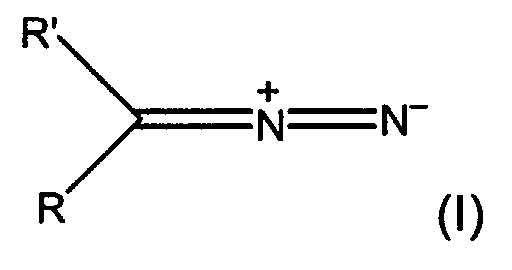
- the present invention concerns novel diazo derivatives of general formula (I) hereafter reported, the process for their preparation and their use as deacidifying agents in the deacidification treatment of paper.
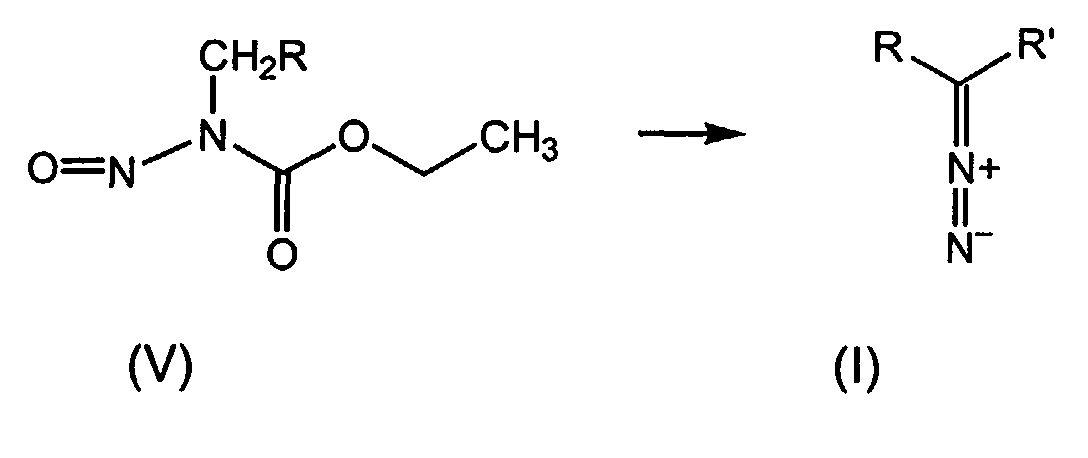
- step a) of the present process is carried out at room temperature using CH 2 Cl 2 as a solvent, and with a large excess of K 2 CO 3 so as to completely neutralise the HCI that forms during the reaction; the preferred stoichiometric ratio between amine (II), K 2 CO 3 and ethyl chlorocarbonate (III) is 1:4:3.
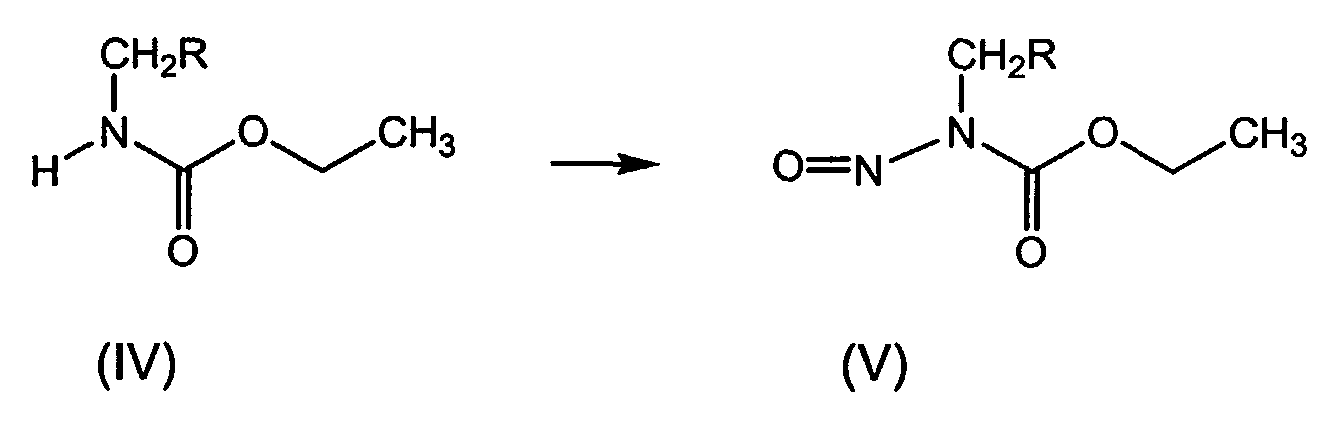
- step b) of the present process can be carried out at a temperature of 1-2°C using HCl/NaNO 2 as reagent.
- a large excess of HCl/NaNO 2 is preferably used so as to achieve complete nitrosation of the formula (IV) product.
- step c) of the present process is carried out at a temperature of 1-2°C with a solution of sodium methoxide in methanol.
- a solution of sodium methoxide in methanol By using a slight excess of sodium methoxide compared to the amount of the formula (V) compound, the formula (I) compound is obtained in which R' is H, whereas with a large excess of sodium methoxide, the compound (I) is obtained in which R' is methyl.
- Methanol, ethanol and Na 2 CO 3 are obtained as the only secondary reaction products.
- the so obtained product is dissolved in a suitable inert stabilising solvent, preferably in diethyl ether, and the ether solution of the products is kept at a temperature of -18°C and away from light, and it is used in this form without isolating the product.
- a suitable inert stabilising solvent preferably in diethyl ether
- the formula (I) compounds can be used for the deacidification of paper products according to techniques known in the art; preferably, these compounds can be used in mass deacidification techniques, where "mass deacidification techniques" means the technique described in the copending patent application in the name of the same Applicant, wherein an increase in the pH up to 9-10 of the paper material treated is obtained, and such an increase persists in time for at least 6 months.
- mass deacidification techniques means the technique described in the copending patent application in the name of the same Applicant, wherein an increase in the pH up to 9-10 of the paper material treated is obtained, and such an increase persists in time for at least 6 months.
- reaction mixture is kept at the same temperature and under stirring for another 60 minutes, then the pH is brought to basic values by adding 15 ml of a saturated solution of Na 2 CO 3 , and the extraction with 40 ml of diethyl ether is carried out. Finally, the organic phase is dehydrated with anhydrous Na 2 SO 4 , then filtered onto paper, and the solvent is removed via distillation in a vacuum at 25°C and away from the light.
- This solution is kept at a temperature of -18°C and away from the light.
Landscapes
- Chemical & Material Sciences (AREA)
- Organic Chemistry (AREA)
- Organic Low-Molecular-Weight Compounds And Preparation Thereof (AREA)
- Non-Silver Salt Photosensitive Materials And Non-Silver Salt Photography (AREA)
- Paper (AREA)
Abstract
Description

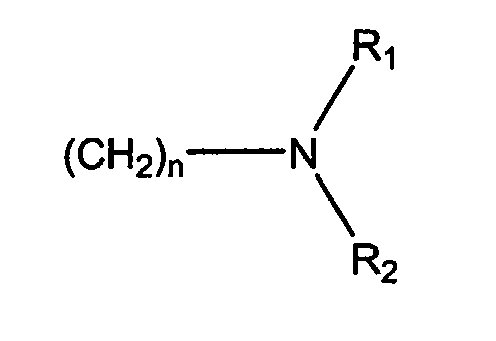
provided that, when n = 2 and R' = H, R1 and R2 are different from methyl.
comprising the following steps:


Claims (14)
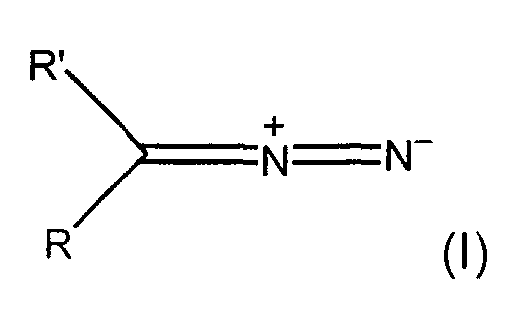
- Diazo derivatives of general formula (I)wherein R' is chosen between H and methyl, and R is the group
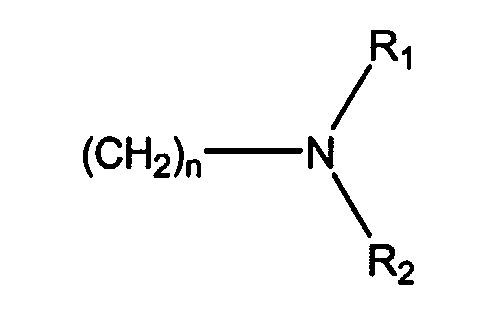
 where n = 1, 2, 3, 4, 5 ; and R1 and R2, equal to one another, are chosen between methyl and ethyl, or R1 and R2, taken together, form with N a piperidine ring or a 4-morpholine ring;
provided that, when n = 2 and R' = H, R1 and R2 are different from methyl. - Diazo derivatives of general formula (I) according to claim 1, wherein R' is H and R is the groupwherein n = 1, and R1 and R2, taken together, form with N a piperidine ring.
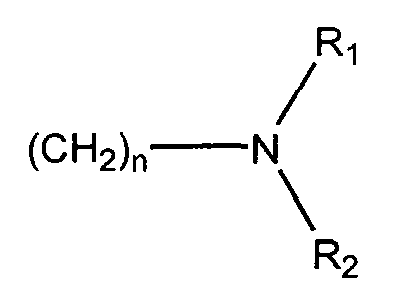
- Process for the preparation of diazo derivatives of general formula (I)in which R' is chosen between H and methyl, and R is the group
 where n = 1, 2, 3, 4, 5 ; and R1 and R2, equal to one another, are chosen between methyl and ethyl, or R1 and R2, taken together, form with N a piperidine ring or a 4-morpholine ring;
comprising the following steps:wherein R and R' are defined as above.a) reaction between the amine of formula (II) and ethyl chlorocarbonate of formula (III) to obtain carbamate (IV)wherein R is as defined ab; b) nitrosation of the carbamate (IV) obtained from step a) to obtain the N-nitroso-carbamate of formula (V):wherein R is as defined above;
 c) reduction of the N-nitroso-carbamate (V) obtained from step b) to obtain the desired compound of formula (I):
- The process as in claim 3, wherein said step a) is carried out in the presence of K2CO3, at room temperature and using CH2Cl2 as a solvent.
- The process according to claims 3 and 4, wherein in said step a) the stoichiometric ratio between amine (II), K2CO3 and ethyl chlorocarbonate (III) is 1:4:3.
- The process according to claim 3, wherein said step b) is carried out using HCl/NaNO2, at a temperature of 1-2°C.
- The process according to claim 6, wherein said step b) is carried out with a strong excess of HCl/NaNO2 compared to the product of formula (IV).
- The process according to claim 3, wherein said step c) is carried out using a methanol solution of sodium methoxide, at a temperature of 1-2°C.
- The process according to claim 8, wherein, in order to obtain the formula (I) compound in which R' is H, said step c) is carried out using a slight excess of sodium methoxide compared to formula (V) compound.
- The process according to claim 8, wherein, in order to obtain the formula (I) compound, in which R' is methyl said step c) is carried out using a large excess of sodium methoxide relative to formula (V) compound.
- The process according to claims 3-10 for the preparation of formula (I) diazo derivative wherein R' is H and R is the groupwhere n = 1, and R1 and R2 together form a piperidine ring with N.

- Use of formula (I) diazo derivatives according to claims 1 and 2 as deacidifying agents in deacidification treatment of paper.
- The use according to claim 12, wherein the said deacidification treatment is carried out using the mass deacidification technique.
- Carbamate compounds of formula (IV) and N-nitroso compounds formula (V) wherein R is the groupwhere n = 1, 2, 3, 4, 5 ; and R1 and R2, equal to one another, are chosen between methyl and ethyl, or R1 and R2, taken together, form with N a piperidine ring or a 4-morpholine ring.

Applications Claiming Priority (2)
| Application Number | Priority Date | Filing Date | Title |
|---|---|---|---|
| ITMI20011412 | 2001-07-04 | ||
| IT2001MI001412A ITMI20011412A1 (en) | 2001-07-04 | 2001-07-04 | NEW DIAZODERIVATI AND PROCESS FOR THEIR PREPARATION |
Publications (2)
| Publication Number | Publication Date |
|---|---|
| EP1273568A2 true EP1273568A2 (en) | 2003-01-08 |
| EP1273568A3 EP1273568A3 (en) | 2003-08-06 |
Family
ID=11447992
Family Applications (1)
| Application Number | Title | Priority Date | Filing Date |
|---|---|---|---|
| EP02014698A Withdrawn EP1273568A3 (en) | 2001-07-04 | 2002-07-03 | Novel diazo derivatives and process for their preparation |
Country Status (4)
| Country | Link |
|---|---|
| US (1) | US6740741B2 (en) |
| EP (1) | EP1273568A3 (en) |
| CA (1) | CA2392282A1 (en) |
| IT (1) | ITMI20011412A1 (en) |
Families Citing this family (2)
| Publication number | Priority date | Publication date | Assignee | Title |
|---|---|---|---|---|
| ITMI20011413A1 (en) * | 2001-07-04 | 2003-01-04 | Consiglio Nazionale Ricerche | METHOD OF CONSERVATIVE TREATMENT OF PAPER MATERIAL |
| CN111517991A (en) * | 2020-04-24 | 2020-08-11 | 常州齐晖药业有限公司 | Preparation method of diclazuril impurity A |
Family Cites Families (7)
| Publication number | Priority date | Publication date | Assignee | Title |
|---|---|---|---|---|
| US3163536A (en) * | 1961-12-26 | 1964-12-29 | Fuji Photo Film Co Ltd | Photographic silver halide emulsion containing carbamate accelerator |
| NL157191C (en) * | 1966-12-17 | Schering Ag | PROCEDURE FOR PREPARING A PREPARATION WITH FUNGICIDE AND FUNGISTATIC ACTION. | |
| DK132756C (en) * | 1971-12-17 | 1976-07-05 | E Gy T Gyogyszervegyeszti Gyar | PROCEDURE FOR THE PREPARATION OF 1-BENZYL-3- (3'-DIMETHYLAMINOPROPOXY) -1H-INDAZOLE |
| AT349159B (en) * | 1974-07-09 | 1979-03-26 | Laevosan Gmbh & Co Kg | PROCESS FOR THE PREPARATION OF NEW BUFADIENOLIDE AND BUFATRIENOLIDE Aethers |
| DE4138750A1 (en) * | 1991-11-26 | 1993-05-27 | Battelle Institut E V | NEUTRALIZING AGENTS FOR THE EFFECTIVE AND GENTLE MASS DE-ACIDIFICATION OF BOOKS AND OTHER PAPER PRODUCTS |
| WO1997029097A1 (en) * | 1996-02-09 | 1997-08-14 | Smithkline Beecham Plc | Sulfonamide derivatives as 5ht7 receptor antagonists |
| ITMI20011413A1 (en) * | 2001-07-04 | 2003-01-04 | Consiglio Nazionale Ricerche | METHOD OF CONSERVATIVE TREATMENT OF PAPER MATERIAL |
-
2001
- 2001-07-04 IT IT2001MI001412A patent/ITMI20011412A1/en unknown
-
2002
- 2002-07-03 US US10/189,695 patent/US6740741B2/en not_active Expired - Fee Related
- 2002-07-03 CA CA002392282A patent/CA2392282A1/en not_active Abandoned
- 2002-07-03 EP EP02014698A patent/EP1273568A3/en not_active Withdrawn
Also Published As
| Publication number | Publication date |
|---|---|
| ITMI20011412A0 (en) | 2001-07-04 |
| US6740741B2 (en) | 2004-05-25 |
| ITMI20011412A1 (en) | 2003-01-04 |
| CA2392282A1 (en) | 2003-01-04 |
| EP1273568A3 (en) | 2003-08-06 |
| US20030065153A1 (en) | 2003-04-03 |
Similar Documents
| Publication | Publication Date | Title |
|---|---|---|
| AU634689B2 (en) | An intermediate for the manufacture of trans-6-{2-(substituted-pyrrol-1-yl)aklyl} pyran-2-ones | |
| EP2486020B1 (en) | Method for the synthesis of ergothioneine and the like | |
| Braga et al. | Ring opening of unprotected aziridines by zinc selenolates in a biphasic system | |
| KR20040030660A (en) | Method of mycophenolate mofetil preparation | |
| US6740741B2 (en) | Diazo derivatives and process for their preparation | |
| KR890014486A (en) | Use of N-cyclopropylaniline in the preparation of N-cyclopropylaniyl and 1-cyclopropyl-quinolonecarboxylic acid and derivatives thereof | |
| GB1570635A (en) | 1,3,4 substituted pyrazoline derivatives | |
| AU627023B2 (en) | Thiazole derivatives | |
| EP1526128A3 (en) | Process the preparation of alpha-hydroxycarboxylic acid amides | |
| ATE10277T1 (en) | PROCESS FOR THE PREPARATION OF HETEROCYCLYLALKYLGUANIDINS, INTERMEDIATE PRODUCTS AND THEIR PREPARATION. | |
| EP0465293A1 (en) | Acrylates having an alcohol, aldehyde and/or ether function, their process of preparation and their use for obtaining polymers and copolymers | |
| EP0760360B1 (en) | Method of manufacturing alkylaniline compounds | |
| US4238423A (en) | Process for preparing cyclo-1,3,2-oxazaphosphoryl derivatives | |
| JP3095549B2 (en) | Method for producing carbonate compound | |
| HU229244B1 (en) | Method for preparing 1-phenylpyrazolin-3-carboxylic acid derivatives | |
| CZ308994A3 (en) | Process for preparing 2,4,5-tribromopyrrole-3-carbonitril | |
| US20190185428A1 (en) | Method for producing chiral aminonitriles | |
| RU2558145C1 (en) | Method for industrial production of nitrogen-substituted amino-5,6,7,8-tetrahydronaphthol | |
| KR100519714B1 (en) | Preparation of allyl halide from allyl alcohol | |
| KR940009935B1 (en) | N-benzoyl-c-thiophenoxyimidoyl chloride derivatives and manufacturing method thereof | |
| EP0916656A3 (en) | A method for production of pyrrolidinone derivatives | |
| FR2761061A1 (en) | BENZENESULFONAMIDE DERIVATIVES, THEIR PREPARATION AND THERAPEUTIC USE THEREOF | |
| RU2134255C1 (en) | Method of preparing n-butyl substituted c60. fullerenes | |
| WO2001058872A1 (en) | Method for diastereoselective preparation of piperidines functionalised in positions 2 and 4 for use as synthesis intermediates | |
| JP2005272314A (en) | Method for producing carbonyl compound |
Legal Events
| Date | Code | Title | Description |
|---|---|---|---|
| PUAI | Public reference made under article 153(3) epc to a published international application that has entered the european phase |
Free format text: ORIGINAL CODE: 0009012 |
|
| AK | Designated contracting states |
Kind code of ref document: A2 Designated state(s): AT BE BG CH CY CZ DE DK EE ES FI FR GB GR IE IT LI LU MC NL PT SE SK TR |
|
| AX | Request for extension of the european patent |
Free format text: AL;LT;LV;MK;RO;SI |
|
| RIN1 | Information on inventor provided before grant (corrected) |
Inventor name: VERARDO, GIANCARLO Inventor name: GIUMANINI, ANGELO (DECEASED) Inventor name: GORASSINI, ANDREA Inventor name: ZAPPALA', ANTONIO |
|
| PUAL | Search report despatched |
Free format text: ORIGINAL CODE: 0009013 |
|
| AK | Designated contracting states |
Designated state(s): AT BE BG CH CY CZ DE DK EE ES FI FR GB GR IE IT LI LU MC NL PT SE SK TR |
|
| AX | Request for extension of the european patent |
Extension state: AL LT LV MK RO SI |
|
| 17P | Request for examination filed |
Effective date: 20040205 |
|
| AKX | Designation fees paid |
Designated state(s): AT BE BG CH CY CZ DE DK EE ES FI FR GB GR IE IT LI LU MC NL PT SE SK TR |
|
| R17P | Request for examination filed (corrected) |
Effective date: 20040204 |
|
| RBV | Designated contracting states (corrected) |
Designated state(s): AT BE BG CH CY CZ DE DK EE ES FI FR GB GR IE IT LI LU MC NL PT SE SK TR |
|
| 17Q | First examination report despatched |
Effective date: 20040907 |
|
| STAA | Information on the status of an ep patent application or granted ep patent |
Free format text: STATUS: THE APPLICATION IS DEEMED TO BE WITHDRAWN |
|
| 18D | Application deemed to be withdrawn |
Effective date: 20050118 |