EP1272484B1 - Benzoamide piperidine compounds as substance p antagonists - Google Patents
Benzoamide piperidine compounds as substance p antagonists Download PDFInfo
- Publication number
- EP1272484B1 EP1272484B1 EP01919702A EP01919702A EP1272484B1 EP 1272484 B1 EP1272484 B1 EP 1272484B1 EP 01919702 A EP01919702 A EP 01919702A EP 01919702 A EP01919702 A EP 01919702A EP 1272484 B1 EP1272484 B1 EP 1272484B1
- Authority
- EP
- European Patent Office
- Prior art keywords
- phenyl
- alkyl
- zero
- fluorine atoms
- disorders
- Prior art date
- Legal status (The legal status is an assumption and is not a legal conclusion. Google has not performed a legal analysis and makes no representation as to the accuracy of the status listed.)
- Expired - Lifetime
Links
- NXUSCSCBRVCRCN-UHFFFAOYSA-N benzamide;piperidine Chemical class C1CCNCC1.NC(=O)C1=CC=CC=C1 NXUSCSCBRVCRCN-UHFFFAOYSA-N 0.000 title abstract description 3
- 239000003890 substance P antagonist Substances 0.000 title description 3
- 150000001875 compounds Chemical class 0.000 claims abstract description 317
- 208000037265 diseases, disorders, signs and symptoms Diseases 0.000 claims abstract description 56
- 208000035475 disorder Diseases 0.000 claims abstract description 43
- 208000002193 Pain Diseases 0.000 claims abstract description 27
- 230000002265 prevention Effects 0.000 claims abstract description 26
- 206010047700 Vomiting Diseases 0.000 claims abstract description 16
- 239000008194 pharmaceutical composition Substances 0.000 claims abstract description 11
- 206010027599 migraine Diseases 0.000 claims abstract description 9
- 208000024172 Cardiovascular disease Diseases 0.000 claims abstract description 5
- 208000018522 Gastrointestinal disease Diseases 0.000 claims abstract description 4
- 241000590002 Helicobacter pylori Species 0.000 claims abstract description 4
- 230000033115 angiogenesis Effects 0.000 claims abstract description 4
- 229940037467 helicobacter pylori Drugs 0.000 claims abstract description 4
- 208000027866 inflammatory disease Diseases 0.000 claims abstract description 4
- LFQSCWFLJHTTHZ-UHFFFAOYSA-N Ethanol Chemical compound CCO LFQSCWFLJHTTHZ-UHFFFAOYSA-N 0.000 claims description 144
- -1 phenyl-(C1-C3)alkoxy Chemical group 0.000 claims description 114
- 125000001153 fluoro group Chemical group F* 0.000 claims description 97
- 125000001424 substituent group Chemical group 0.000 claims description 84
- 125000004169 (C1-C6) alkyl group Chemical group 0.000 claims description 83
- 239000000203 mixture Substances 0.000 claims description 66
- 125000001997 phenyl group Chemical group [H]C1=C([H])C([H])=C(*)C([H])=C1[H] 0.000 claims description 58
- IJGRMHOSHXDMSA-UHFFFAOYSA-N Atomic nitrogen Chemical compound N#N IJGRMHOSHXDMSA-UHFFFAOYSA-N 0.000 claims description 51
- 229910052739 hydrogen Inorganic materials 0.000 claims description 49
- 239000001257 hydrogen Substances 0.000 claims description 49
- 150000003839 salts Chemical class 0.000 claims description 48
- 125000004191 (C1-C6) alkoxy group Chemical group 0.000 claims description 36
- 239000003814 drug Substances 0.000 claims description 33
- 125000005843 halogen group Chemical group 0.000 claims description 33
- 229910052757 nitrogen Inorganic materials 0.000 claims description 33
- 229920006395 saturated elastomer Polymers 0.000 claims description 33
- OKTJSMMVPCPJKN-UHFFFAOYSA-N Carbon Chemical group [C] OKTJSMMVPCPJKN-UHFFFAOYSA-N 0.000 claims description 31
- 125000002023 trifluoromethyl group Chemical group FC(F)(F)* 0.000 claims description 31
- 229910052799 carbon Inorganic materials 0.000 claims description 28
- 125000000623 heterocyclic group Chemical group 0.000 claims description 28
- UFHFLCQGNIYNRP-UHFFFAOYSA-N Hydrogen Chemical group [H][H] UFHFLCQGNIYNRP-UHFFFAOYSA-N 0.000 claims description 26
- 125000004043 oxo group Chemical group O=* 0.000 claims description 22
- 238000004519 manufacturing process Methods 0.000 claims description 21
- 125000004435 hydrogen atom Chemical group [H]* 0.000 claims description 18
- 201000006417 multiple sclerosis Diseases 0.000 claims description 18
- 125000000217 alkyl group Chemical group 0.000 claims description 16
- 229910052760 oxygen Inorganic materials 0.000 claims description 15
- 125000004076 pyridyl group Chemical group 0.000 claims description 15
- 229910052717 sulfur Inorganic materials 0.000 claims description 15
- 125000004432 carbon atom Chemical group C* 0.000 claims description 14
- 125000002971 oxazolyl group Chemical group 0.000 claims description 14
- 125000003831 tetrazolyl group Chemical group 0.000 claims description 14
- 125000000335 thiazolyl group Chemical group 0.000 claims description 14
- 201000010099 disease Diseases 0.000 claims description 13
- VGGSQFUCUMXWEO-UHFFFAOYSA-N Ethene Chemical compound C=C VGGSQFUCUMXWEO-UHFFFAOYSA-N 0.000 claims description 12
- 239000005977 Ethylene Substances 0.000 claims description 12
- 208000028017 Psychotic disease Diseases 0.000 claims description 12
- 125000005842 heteroatom Chemical group 0.000 claims description 12
- 125000000449 nitro group Chemical group [O-][N+](*)=O 0.000 claims description 12
- 208000020401 Depressive disease Diseases 0.000 claims description 11
- QVGXLLKOCUKJST-UHFFFAOYSA-N atomic oxygen Chemical compound [O] QVGXLLKOCUKJST-UHFFFAOYSA-N 0.000 claims description 11
- 239000001301 oxygen Substances 0.000 claims description 11
- 208000019901 Anxiety disease Diseases 0.000 claims description 10
- 125000002837 carbocyclic group Chemical group 0.000 claims description 10
- NINIDFKCEFEMDL-UHFFFAOYSA-N Sulfur Chemical compound [S] NINIDFKCEFEMDL-UHFFFAOYSA-N 0.000 claims description 9
- 125000004104 aryloxy group Chemical group 0.000 claims description 9
- 125000004093 cyano group Chemical group *C#N 0.000 claims description 9
- 239000003937 drug carrier Substances 0.000 claims description 9
- 125000005553 heteroaryloxy group Chemical group 0.000 claims description 9
- 125000005647 linker group Chemical group 0.000 claims description 9
- 239000011593 sulfur Substances 0.000 claims description 9
- KMXAJBNVGPDDEO-UHFFFAOYSA-N 2-methoxy-5-methyl-6-oxo-7,8-dihydro-1,5-naphthyridine-3-carbaldehyde Chemical compound C1CC(=O)N(C)C2=C1N=C(OC)C(C=O)=C2 KMXAJBNVGPDDEO-UHFFFAOYSA-N 0.000 claims description 8
- 206010028980 Neoplasm Diseases 0.000 claims description 8
- 230000001154 acute effect Effects 0.000 claims description 8
- 230000036506 anxiety Effects 0.000 claims description 8
- 235000014632 disordered eating Nutrition 0.000 claims description 8
- 150000002431 hydrogen Chemical group 0.000 claims description 8
- 208000004296 neuralgia Diseases 0.000 claims description 8
- QJGQUHMNIGDVPM-UHFFFAOYSA-N nitrogen group Chemical group [N] QJGQUHMNIGDVPM-UHFFFAOYSA-N 0.000 claims description 8
- 125000003003 spiro group Chemical group 0.000 claims description 8
- 125000004209 (C1-C8) alkyl group Chemical group 0.000 claims description 7
- 208000001640 Fibromyalgia Diseases 0.000 claims description 7
- 238000002512 chemotherapy Methods 0.000 claims description 7
- 125000002496 methyl group Chemical group [H]C([H])([H])* 0.000 claims description 7
- 208000020925 Bipolar disease Diseases 0.000 claims description 6
- 206010012289 Dementia Diseases 0.000 claims description 6
- 208000030814 Eating disease Diseases 0.000 claims description 6
- 208000019454 Feeding and Eating disease Diseases 0.000 claims description 6
- 241000725303 Human immunodeficiency virus Species 0.000 claims description 6
- 208000023105 Huntington disease Diseases 0.000 claims description 6
- 206010020751 Hypersensitivity Diseases 0.000 claims description 6
- 208000019022 Mood disease Diseases 0.000 claims description 6
- 208000016285 Movement disease Diseases 0.000 claims description 6
- 208000018737 Parkinson disease Diseases 0.000 claims description 6
- 239000002249 anxiolytic agent Substances 0.000 claims description 6
- 125000002915 carbonyl group Chemical group [*:2]C([*:1])=O 0.000 claims description 6
- 208000024732 dysthymic disease Diseases 0.000 claims description 6
- 125000001495 ethyl group Chemical group [H]C([H])([H])C([H])([H])* 0.000 claims description 6
- 208000024714 major depressive disease Diseases 0.000 claims description 6
- 208000015238 neurotic disease Diseases 0.000 claims description 6
- 125000004430 oxygen atom Chemical group O* 0.000 claims description 6
- 208000033808 peripheral neuropathy Diseases 0.000 claims description 6
- 125000004434 sulfur atom Chemical group 0.000 claims description 6
- 208000006673 asthma Diseases 0.000 claims description 5
- 229940079593 drug Drugs 0.000 claims description 5
- 229940005483 opioid analgesics Drugs 0.000 claims description 5
- 201000008482 osteoarthritis Diseases 0.000 claims description 5
- 208000023504 respiratory system disease Diseases 0.000 claims description 5
- 125000004105 2-pyridyl group Chemical group N1=C([*])C([H])=C([H])C([H])=C1[H] 0.000 claims description 4
- YEZSOEXNHHSEHF-UHFFFAOYSA-N 3-methoxy-8-methyl-7-oxo-5,6-dihydro-1,8-naphthyridine-2-carbaldehyde Chemical compound C1CC(=O)N(C)C2=C1C=C(OC)C(C=O)=N2 YEZSOEXNHHSEHF-UHFFFAOYSA-N 0.000 claims description 4
- 125000003349 3-pyridyl group Chemical group N1=C([H])C([*])=C([H])C([H])=C1[H] 0.000 claims description 4
- 125000000339 4-pyridyl group Chemical group N1=C([H])C([H])=C([*])C([H])=C1[H] 0.000 claims description 4
- IYTRKIYNYOPXMT-UHFFFAOYSA-N 7-[[(6-ethyl-2-phenylpiperidin-3-yl)amino]methyl]-6-methoxy-1-methyl-3,4-dihydro-1,5-naphthyridin-2-one Chemical compound N1C(CC)CCC(NCC=2C(=NC=3CCC(=O)N(C)C=3C=2)OC)C1C1=CC=CC=C1 IYTRKIYNYOPXMT-UHFFFAOYSA-N 0.000 claims description 4
- 208000008811 Agoraphobia Diseases 0.000 claims description 4
- 208000024827 Alzheimer disease Diseases 0.000 claims description 4
- 125000000882 C2-C6 alkenyl group Chemical group 0.000 claims description 4
- 208000027691 Conduct disease Diseases 0.000 claims description 4
- 201000004624 Dermatitis Diseases 0.000 claims description 4
- 206010020853 Hypertonic bladder Diseases 0.000 claims description 4
- 206010061218 Inflammation Diseases 0.000 claims description 4
- 230000007815 allergy Effects 0.000 claims description 4
- 208000028683 bipolar I disease Diseases 0.000 claims description 4
- RYYVLZVUVIJVGH-UHFFFAOYSA-N caffeine Chemical compound CN1C(=O)N(C)C(=O)C2=C1N=CN2C RYYVLZVUVIJVGH-UHFFFAOYSA-N 0.000 claims description 4
- 230000001684 chronic effect Effects 0.000 claims description 4
- ZPUCINDJVBIVPJ-LJISPDSOSA-N cocaine Chemical compound O([C@H]1C[C@@H]2CC[C@@H](N2C)[C@H]1C(=O)OC)C(=O)C1=CC=CC=C1 ZPUCINDJVBIVPJ-LJISPDSOSA-N 0.000 claims description 4
- 230000006378 damage Effects 0.000 claims description 4
- 206010012601 diabetes mellitus Diseases 0.000 claims description 4
- 230000002496 gastric effect Effects 0.000 claims description 4
- 230000004054 inflammatory process Effects 0.000 claims description 4
- 230000035987 intoxication Effects 0.000 claims description 4
- 231100000566 intoxication Toxicity 0.000 claims description 4
- 125000002950 monocyclic group Chemical group 0.000 claims description 4
- 239000003176 neuroleptic agent Substances 0.000 claims description 4
- 230000000701 neuroleptic effect Effects 0.000 claims description 4
- 229960002715 nicotine Drugs 0.000 claims description 4
- SNICXCGAKADSCV-UHFFFAOYSA-N nicotine Natural products CN1CCCC1C1=CC=CN=C1 SNICXCGAKADSCV-UHFFFAOYSA-N 0.000 claims description 4
- 125000004433 nitrogen atom Chemical group N* 0.000 claims description 4
- 208000019906 panic disease Diseases 0.000 claims description 4
- 125000000714 pyrimidinyl group Chemical group 0.000 claims description 4
- 206010039073 rheumatoid arthritis Diseases 0.000 claims description 4
- 208000011117 substance-related disease Diseases 0.000 claims description 4
- 208000011580 syndromic disease Diseases 0.000 claims description 4
- SNICXCGAKADSCV-JTQLQIEISA-N (-)-Nicotine Chemical compound CN1CCC[C@H]1C1=CC=CN=C1 SNICXCGAKADSCV-JTQLQIEISA-N 0.000 claims description 3
- LKGQQWSQYZASSN-UHFFFAOYSA-N 6-methoxy-1-methyl-7-[[(2-phenyl-6-propylpiperidin-3-yl)amino]methyl]-3,4-dihydro-1,5-naphthyridin-2-one Chemical compound N1C(CCC)CCC(NCC=2C(=NC=3CCC(=O)N(C)C=3C=2)OC)C1C1=CC=CC=C1 LKGQQWSQYZASSN-UHFFFAOYSA-N 0.000 claims description 3
- HAHFXYBKAJETKE-PTLVVNQVSA-N 6-methoxy-1-methyl-7-[[[(2s,3s,6s)-2-phenyl-6-propan-2-ylpiperidin-3-yl]amino]methyl]-3,4-dihydro-1,5-naphthyridin-2-one Chemical compound C1([C@@H]2N[C@@H](CC[C@@H]2NCC2=CC=3N(C)C(=O)CCC=3N=C2OC)C(C)C)=CC=CC=C1 HAHFXYBKAJETKE-PTLVVNQVSA-N 0.000 claims description 3
- 206010006458 Bronchitis chronic Diseases 0.000 claims description 3
- 208000000094 Chronic Pain Diseases 0.000 claims description 3
- 208000011688 Generalised anxiety disease Diseases 0.000 claims description 3
- 208000001431 Psychomotor Agitation Diseases 0.000 claims description 3
- 230000003542 behavioural effect Effects 0.000 claims description 3
- 125000002619 bicyclic group Chemical group 0.000 claims description 3
- 206010006451 bronchitis Diseases 0.000 claims description 3
- 208000007451 chronic bronchitis Diseases 0.000 claims description 3
- 201000003146 cystitis Diseases 0.000 claims description 3
- 230000001667 episodic effect Effects 0.000 claims description 3
- 210000001035 gastrointestinal tract Anatomy 0.000 claims description 3
- 208000029364 generalized anxiety disease Diseases 0.000 claims description 3
- 230000001629 suppression Effects 0.000 claims description 3
- 206010044652 trigeminal neuralgia Diseases 0.000 claims description 3
- 210000001635 urinary tract Anatomy 0.000 claims description 3
- 125000000175 2-thienyl group Chemical group S1C([*])=C([H])C([H])=C1[H] 0.000 claims description 2
- 125000001541 3-thienyl group Chemical group S1C([H])=C([*])C([H])=C1[H] 0.000 claims description 2
- NVWIXWCMNWGGOU-UHFFFAOYSA-N 6-methoxy-1-methyl-7-[[(2-phenylpiperidin-3-yl)amino]methyl]-3,4-dihydro-1,5-naphthyridin-2-one Chemical compound COC1=NC=2CCC(=O)N(C)C=2C=C1CNC1CCCNC1C1=CC=CC=C1 NVWIXWCMNWGGOU-UHFFFAOYSA-N 0.000 claims description 2
- GEKWGAQENFNMEE-UHFFFAOYSA-N 6-methoxy-1-methyl-7-[[(6-methyl-2-phenylpiperidin-3-yl)amino]methyl]-3,4-dihydro-1,5-naphthyridin-2-one Chemical compound COC1=NC=2CCC(=O)N(C)C=2C=C1CNC1CCC(C)NC1C1=CC=CC=C1 GEKWGAQENFNMEE-UHFFFAOYSA-N 0.000 claims description 2
- 206010001052 Acute respiratory distress syndrome Diseases 0.000 claims description 2
- 206010001541 Akinesia Diseases 0.000 claims description 2
- 206010002383 Angina Pectoris Diseases 0.000 claims description 2
- 206010002650 Anorexia nervosa and bulimia Diseases 0.000 claims description 2
- 208000006096 Attention Deficit Disorder with Hyperactivity Diseases 0.000 claims description 2
- 208000027448 Attention Deficit and Disruptive Behavior disease Diseases 0.000 claims description 2
- 208000036864 Attention deficit/hyperactivity disease Diseases 0.000 claims description 2
- 208000020706 Autistic disease Diseases 0.000 claims description 2
- 206010048962 Brain oedema Diseases 0.000 claims description 2
- 208000021465 Brief psychotic disease Diseases 0.000 claims description 2
- 208000009079 Bronchial Spasm Diseases 0.000 claims description 2
- 208000014181 Bronchial disease Diseases 0.000 claims description 2
- 201000004813 Bronchopneumonia Diseases 0.000 claims description 2
- 206010006482 Bronchospasm Diseases 0.000 claims description 2
- 206010008748 Chorea Diseases 0.000 claims description 2
- 206010008874 Chronic Fatigue Syndrome Diseases 0.000 claims description 2
- 208000006545 Chronic Obstructive Pulmonary Disease Diseases 0.000 claims description 2
- 206010009900 Colitis ulcerative Diseases 0.000 claims description 2
- 208000027932 Collagen disease Diseases 0.000 claims description 2
- 208000013586 Complex regional pain syndrome type 1 Diseases 0.000 claims description 2
- 206010010741 Conjunctivitis Diseases 0.000 claims description 2
- 206010010744 Conjunctivitis allergic Diseases 0.000 claims description 2
- 208000020406 Creutzfeldt Jacob disease Diseases 0.000 claims description 2
- 208000003407 Creutzfeldt-Jakob Syndrome Diseases 0.000 claims description 2
- 208000010859 Creutzfeldt-Jakob disease Diseases 0.000 claims description 2
- 208000011231 Crohn disease Diseases 0.000 claims description 2
- 201000003883 Cystic fibrosis Diseases 0.000 claims description 2
- 102000004127 Cytokines Human genes 0.000 claims description 2
- 108090000695 Cytokines Proteins 0.000 claims description 2
- 206010012239 Delusion Diseases 0.000 claims description 2
- 208000024254 Delusional disease Diseases 0.000 claims description 2
- 206010012438 Dermatitis atopic Diseases 0.000 claims description 2
- 206010012442 Dermatitis contact Diseases 0.000 claims description 2
- 208000007590 Disorders of Excessive Somnolence Diseases 0.000 claims description 2
- 201000010374 Down Syndrome Diseases 0.000 claims description 2
- 208000012661 Dyskinesia Diseases 0.000 claims description 2
- 208000010228 Erectile Dysfunction Diseases 0.000 claims description 2
- 206010015866 Extravasation Diseases 0.000 claims description 2
- 201000011240 Frontotemporal dementia Diseases 0.000 claims description 2
- 208000001613 Gambling Diseases 0.000 claims description 2
- 208000007882 Gastritis Diseases 0.000 claims description 2
- 208000031886 HIV Infections Diseases 0.000 claims description 2
- 208000004547 Hallucinations Diseases 0.000 claims description 2
- 206010019196 Head injury Diseases 0.000 claims description 2
- 206010021639 Incontinence Diseases 0.000 claims description 2
- 208000022559 Inflammatory bowel disease Diseases 0.000 claims description 2
- 206010049949 Intercostal neuralgia Diseases 0.000 claims description 2
- 206010022998 Irritability Diseases 0.000 claims description 2
- LPHGQDQBBGAPDZ-UHFFFAOYSA-N Isocaffeine Natural products CN1C(=O)N(C)C(=O)C2=C1N(C)C=N2 LPHGQDQBBGAPDZ-UHFFFAOYSA-N 0.000 claims description 2
- 206010025323 Lymphomas Diseases 0.000 claims description 2
- 206010026749 Mania Diseases 0.000 claims description 2
- 208000026139 Memory disease Diseases 0.000 claims description 2
- 208000036626 Mental retardation Diseases 0.000 claims description 2
- 206010053236 Mixed incontinence Diseases 0.000 claims description 2
- 208000008238 Muscle Spasticity Diseases 0.000 claims description 2
- 201000005625 Neuroleptic malignant syndrome Diseases 0.000 claims description 2
- 208000021384 Obsessive-Compulsive disease Diseases 0.000 claims description 2
- 208000009722 Overactive Urinary Bladder Diseases 0.000 claims description 2
- 208000027089 Parkinsonian disease Diseases 0.000 claims description 2
- 206010034010 Parkinsonism Diseases 0.000 claims description 2
- 208000008469 Peptic Ulcer Diseases 0.000 claims description 2
- 206010034912 Phobia Diseases 0.000 claims description 2
- 208000000609 Pick Disease of the Brain Diseases 0.000 claims description 2
- 206010036376 Postherpetic Neuralgia Diseases 0.000 claims description 2
- 208000027030 Premenstrual dysphoric disease Diseases 0.000 claims description 2
- 206010036618 Premenstrual syndrome Diseases 0.000 claims description 2
- 208000002158 Proliferative Vitreoretinopathy Diseases 0.000 claims description 2
- 208000003251 Pruritus Diseases 0.000 claims description 2
- 201000004681 Psoriasis Diseases 0.000 claims description 2
- 201000001263 Psoriatic Arthritis Diseases 0.000 claims description 2
- 208000036824 Psoriatic arthropathy Diseases 0.000 claims description 2
- 206010037211 Psychomotor hyperactivity Diseases 0.000 claims description 2
- 206010037213 Psychomotor retardation Diseases 0.000 claims description 2
- 208000027465 Psychotic Affective disease Diseases 0.000 claims description 2
- 208000003782 Raynaud disease Diseases 0.000 claims description 2
- 208000012322 Raynaud phenomenon Diseases 0.000 claims description 2
- 201000001947 Reflex Sympathetic Dystrophy Diseases 0.000 claims description 2
- 208000033464 Reiter syndrome Diseases 0.000 claims description 2
- 208000013616 Respiratory Distress Syndrome Diseases 0.000 claims description 2
- 206010038934 Retinopathy proliferative Diseases 0.000 claims description 2
- 208000025747 Rheumatic disease Diseases 0.000 claims description 2
- 208000020114 Schizophrenia and other psychotic disease Diseases 0.000 claims description 2
- 206010039710 Scleroderma Diseases 0.000 claims description 2
- 208000034189 Sclerosis Diseases 0.000 claims description 2
- 201000000552 Scott syndrome Diseases 0.000 claims description 2
- 206010039966 Senile dementia Diseases 0.000 claims description 2
- 201000001880 Sexual dysfunction Diseases 0.000 claims description 2
- 208000019568 Shared Paranoid disease Diseases 0.000 claims description 2
- 208000013738 Sleep Initiation and Maintenance disease Diseases 0.000 claims description 2
- 206010041067 Small cell lung cancer Diseases 0.000 claims description 2
- 206010041250 Social phobia Diseases 0.000 claims description 2
- 206010066218 Stress Urinary Incontinence Diseases 0.000 claims description 2
- 208000013200 Stress disease Diseases 0.000 claims description 2
- 208000032851 Subarachnoid Hemorrhage Diseases 0.000 claims description 2
- 206010042496 Sunburn Diseases 0.000 claims description 2
- 206010043118 Tardive Dyskinesia Diseases 0.000 claims description 2
- 208000000323 Tourette Syndrome Diseases 0.000 claims description 2
- 208000016620 Tourette disease Diseases 0.000 claims description 2
- 241000159243 Toxicodendron radicans Species 0.000 claims description 2
- 208000031674 Traumatic Acute Stress disease Diseases 0.000 claims description 2
- 206010044688 Trisomy 21 Diseases 0.000 claims description 2
- 201000006704 Ulcerative Colitis Diseases 0.000 claims description 2
- 208000000921 Urge Urinary Incontinence Diseases 0.000 claims description 2
- 208000024780 Urticaria Diseases 0.000 claims description 2
- 201000004810 Vascular dementia Diseases 0.000 claims description 2
- 208000005298 acute pain Diseases 0.000 claims description 2
- 208000012826 adjustment disease Diseases 0.000 claims description 2
- 208000011341 adult acute respiratory distress syndrome Diseases 0.000 claims description 2
- 201000000028 adult respiratory distress syndrome Diseases 0.000 claims description 2
- 230000002411 adverse Effects 0.000 claims description 2
- 208000002205 allergic conjunctivitis Diseases 0.000 claims description 2
- 208000026935 allergic disease Diseases 0.000 claims description 2
- 201000002426 animal phobia Diseases 0.000 claims description 2
- 208000022531 anorexia Diseases 0.000 claims description 2
- 230000000949 anxiolytic effect Effects 0.000 claims description 2
- 229940005530 anxiolytics Drugs 0.000 claims description 2
- 201000008937 atopic dermatitis Diseases 0.000 claims description 2
- 208000010668 atopic eczema Diseases 0.000 claims description 2
- 208000015802 attention deficit-hyperactivity disease Diseases 0.000 claims description 2
- 208000025748 atypical depressive disease Diseases 0.000 claims description 2
- 230000006399 behavior Effects 0.000 claims description 2
- 125000000499 benzofuranyl group Chemical group O1C(=CC2=C1C=CC=C2)* 0.000 claims description 2
- 125000004196 benzothienyl group Chemical group S1C(=CC2=C1C=CC=C2)* 0.000 claims description 2
- 125000004541 benzoxazolyl group Chemical group O1C(=NC2=C1C=CC=C2)* 0.000 claims description 2
- 125000002618 bicyclic heterocycle group Chemical group 0.000 claims description 2
- 208000022257 bipolar II disease Diseases 0.000 claims description 2
- 230000017531 blood circulation Effects 0.000 claims description 2
- 208000030963 borderline personality disease Diseases 0.000 claims description 2
- 210000000481 breast Anatomy 0.000 claims description 2
- 229960001948 caffeine Drugs 0.000 claims description 2
- VJEONQKOZGKCAK-UHFFFAOYSA-N caffeine Natural products CN1C(=O)N(C)C(=O)C2=C1C=CN2C VJEONQKOZGKCAK-UHFFFAOYSA-N 0.000 claims description 2
- 150000001721 carbon Chemical group 0.000 claims description 2
- 230000004663 cell proliferation Effects 0.000 claims description 2
- 230000002490 cerebral effect Effects 0.000 claims description 2
- 206010008118 cerebral infarction Diseases 0.000 claims description 2
- 208000026106 cerebrovascular disease Diseases 0.000 claims description 2
- 229960003920 cocaine Drugs 0.000 claims description 2
- 208000010877 cognitive disease Diseases 0.000 claims description 2
- 230000001149 cognitive effect Effects 0.000 claims description 2
- 208000010247 contact dermatitis Diseases 0.000 claims description 2
- 208000026725 cyclothymic disease Diseases 0.000 claims description 2
- 206010061428 decreased appetite Diseases 0.000 claims description 2
- 231100000868 delusion Toxicity 0.000 claims description 2
- 208000035548 disruptive behavior disease Diseases 0.000 claims description 2
- 208000010118 dystonia Diseases 0.000 claims description 2
- 230000002327 eosinophilic effect Effects 0.000 claims description 2
- 206010015037 epilepsy Diseases 0.000 claims description 2
- 230000036251 extravasation Effects 0.000 claims description 2
- 208000006275 fascioliasis Diseases 0.000 claims description 2
- 230000006870 function Effects 0.000 claims description 2
- 125000002541 furyl group Chemical group 0.000 claims description 2
- 206010017758 gastric cancer Diseases 0.000 claims description 2
- 208000010749 gastric carcinoma Diseases 0.000 claims description 2
- 201000011587 gastric lymphoma Diseases 0.000 claims description 2
- 231100000029 gastro-duodenal ulcer Toxicity 0.000 claims description 2
- 239000000380 hallucinogen Substances 0.000 claims description 2
- 230000009610 hypersensitivity Effects 0.000 claims description 2
- 206010020765 hypersomnia Diseases 0.000 claims description 2
- 239000003326 hypnotic agent Substances 0.000 claims description 2
- 230000000147 hypnotic effect Effects 0.000 claims description 2
- 230000008105 immune reaction Effects 0.000 claims description 2
- 201000001881 impotence Diseases 0.000 claims description 2
- 206010021654 increased appetite Diseases 0.000 claims description 2
- 125000001041 indolyl group Chemical group 0.000 claims description 2
- 208000015181 infectious disease Diseases 0.000 claims description 2
- 230000002757 inflammatory effect Effects 0.000 claims description 2
- 206010022437 insomnia Diseases 0.000 claims description 2
- 208000002551 irritable bowel syndrome Diseases 0.000 claims description 2
- 125000000904 isoindolyl group Chemical group C=1(NC=C2C=CC=CC12)* 0.000 claims description 2
- 125000002183 isoquinolinyl group Chemical group C1(=NC=CC2=CC=CC=C12)* 0.000 claims description 2
- 125000001786 isothiazolyl group Chemical group 0.000 claims description 2
- 240000004308 marijuana Species 0.000 claims description 2
- 201000003995 melancholia Diseases 0.000 claims description 2
- 125000000956 methoxy group Chemical group [H]C([H])([H])O* 0.000 claims description 2
- 125000005322 morpholin-1-yl group Chemical group 0.000 claims description 2
- 210000003097 mucus Anatomy 0.000 claims description 2
- 208000029766 myalgic encephalomeyelitis/chronic fatigue syndrome Diseases 0.000 claims description 2
- 208000021971 neovascular inflammatory vitreoretinopathy Diseases 0.000 claims description 2
- 230000001537 neural effect Effects 0.000 claims description 2
- 208000015122 neurodegenerative disease Diseases 0.000 claims description 2
- 201000001119 neuropathy Diseases 0.000 claims description 2
- 208000025319 neurotic depression Diseases 0.000 claims description 2
- 208000020629 overactive bladder Diseases 0.000 claims description 2
- 208000002851 paranoid schizophrenia Diseases 0.000 claims description 2
- 208000028173 post-traumatic stress disease Diseases 0.000 claims description 2
- 230000001144 postural effect Effects 0.000 claims description 2
- 206010036596 premature ejaculation Diseases 0.000 claims description 2
- 230000006785 proliferative vitreoretinopathy Effects 0.000 claims description 2
- 239000003380 propellant Substances 0.000 claims description 2
- 125000005493 quinolyl group Chemical group 0.000 claims description 2
- 208000002574 reactive arthritis Diseases 0.000 claims description 2
- 230000000306 recurrent effect Effects 0.000 claims description 2
- 206010039083 rhinitis Diseases 0.000 claims description 2
- 201000000980 schizophrenia Diseases 0.000 claims description 2
- 208000012672 seasonal affective disease Diseases 0.000 claims description 2
- 230000028327 secretion Effects 0.000 claims description 2
- 239000000932 sedative agent Substances 0.000 claims description 2
- 229940125723 sedative agent Drugs 0.000 claims description 2
- 231100000872 sexual dysfunction Toxicity 0.000 claims description 2
- 208000017520 skin disease Diseases 0.000 claims description 2
- 208000000649 small cell carcinoma Diseases 0.000 claims description 2
- 208000000587 small cell lung carcinoma Diseases 0.000 claims description 2
- 230000000392 somatic effect Effects 0.000 claims description 2
- 208000018198 spasticity Diseases 0.000 claims description 2
- 201000001716 specific phobia Diseases 0.000 claims description 2
- 201000000498 stomach carcinoma Diseases 0.000 claims description 2
- 230000035882 stress Effects 0.000 claims description 2
- 208000022170 stress incontinence Diseases 0.000 claims description 2
- 239000000126 substance Substances 0.000 claims description 2
- 201000000596 systemic lupus erythematosus Diseases 0.000 claims description 2
- 125000001544 thienyl group Chemical group 0.000 claims description 2
- 125000001425 triazolyl group Chemical group 0.000 claims description 2
- 208000019553 vascular disease Diseases 0.000 claims description 2
- 230000024883 vasodilation Effects 0.000 claims description 2
- 230000002455 vasospastic effect Effects 0.000 claims description 2
- 201000005539 vernal conjunctivitis Diseases 0.000 claims description 2
- 210000001835 viscera Anatomy 0.000 claims description 2
- 230000002618 waking effect Effects 0.000 claims description 2
- 208000016261 weight loss Diseases 0.000 claims description 2
- 230000004580 weight loss Effects 0.000 claims description 2
- 125000004356 hydroxy functional group Chemical group O* 0.000 claims 16
- 125000000325 methylidene group Chemical group [H]C([H])=* 0.000 claims 15
- SYSQUGFVNFXIIT-UHFFFAOYSA-N n-[4-(1,3-benzoxazol-2-yl)phenyl]-4-nitrobenzenesulfonamide Chemical class C1=CC([N+](=O)[O-])=CC=C1S(=O)(=O)NC1=CC=C(C=2OC3=CC=CC=C3N=2)C=C1 SYSQUGFVNFXIIT-UHFFFAOYSA-N 0.000 claims 2
- 206010001540 Akathisia Diseases 0.000 claims 1
- 208000016192 Demyelinating disease Diseases 0.000 claims 1
- 230000000694 effects Effects 0.000 abstract description 12
- 208000019695 Migraine disease Diseases 0.000 abstract description 7
- 108010040718 Neurokinin-1 Receptors Proteins 0.000 abstract description 7
- 229940044551 receptor antagonist Drugs 0.000 abstract description 7
- 239000002464 receptor antagonist Substances 0.000 abstract description 7
- 208000015114 central nervous system disease Diseases 0.000 abstract description 3
- 206010046543 Urinary incontinence Diseases 0.000 abstract description 2
- 210000000987 immune system Anatomy 0.000 abstract description 2
- 102000002002 Neurokinin-1 Receptors Human genes 0.000 abstract 2
- OKKJLVBELUTLKV-UHFFFAOYSA-N Methanol Chemical compound OC OKKJLVBELUTLKV-UHFFFAOYSA-N 0.000 description 186
- XEKOWRVHYACXOJ-UHFFFAOYSA-N Ethyl acetate Chemical compound CCOC(C)=O XEKOWRVHYACXOJ-UHFFFAOYSA-N 0.000 description 167
- YMWUJEATGCHHMB-UHFFFAOYSA-N Dichloromethane Chemical compound ClCCl YMWUJEATGCHHMB-UHFFFAOYSA-N 0.000 description 135
- WYURNTSHIVDZCO-UHFFFAOYSA-N Tetrahydrofuran Chemical compound C1CCOC1 WYURNTSHIVDZCO-UHFFFAOYSA-N 0.000 description 134
- YXFVVABEGXRONW-UHFFFAOYSA-N Toluene Chemical compound CC1=CC=CC=C1 YXFVVABEGXRONW-UHFFFAOYSA-N 0.000 description 102
- 238000006243 chemical reaction Methods 0.000 description 89
- 239000002904 solvent Substances 0.000 description 85
- RTZKZFJDLAIYFH-UHFFFAOYSA-N Diethyl ether Chemical compound CCOCC RTZKZFJDLAIYFH-UHFFFAOYSA-N 0.000 description 75
- 239000000243 solution Substances 0.000 description 72
- XLYOFNOQVPJJNP-UHFFFAOYSA-N water Substances O XLYOFNOQVPJJNP-UHFFFAOYSA-N 0.000 description 69
- YLQBMQCUIZJEEH-UHFFFAOYSA-N tetrahydrofuran Natural products C=1C=COC=1 YLQBMQCUIZJEEH-UHFFFAOYSA-N 0.000 description 67
- HEDRZPFGACZZDS-UHFFFAOYSA-N Chloroform Chemical compound ClC(Cl)Cl HEDRZPFGACZZDS-UHFFFAOYSA-N 0.000 description 66
- ZMXDDKWLCZADIW-UHFFFAOYSA-N N,N-Dimethylformamide Chemical compound CN(C)C=O ZMXDDKWLCZADIW-UHFFFAOYSA-N 0.000 description 66
- ZMANZCXQSJIPKH-UHFFFAOYSA-N Triethylamine Chemical compound CCN(CC)CC ZMANZCXQSJIPKH-UHFFFAOYSA-N 0.000 description 55
- VEXZGXHMUGYJMC-UHFFFAOYSA-N Hydrochloric acid Chemical compound Cl VEXZGXHMUGYJMC-UHFFFAOYSA-N 0.000 description 54
- 229940093499 ethyl acetate Drugs 0.000 description 54
- 235000019439 ethyl acetate Nutrition 0.000 description 54
- QTBSBXVTEAMEQO-UHFFFAOYSA-N Acetic acid Chemical compound CC(O)=O QTBSBXVTEAMEQO-UHFFFAOYSA-N 0.000 description 53
- 239000002585 base Substances 0.000 description 47
- 239000011541 reaction mixture Substances 0.000 description 47
- 238000000034 method Methods 0.000 description 44
- 238000010992 reflux Methods 0.000 description 43
- KDLHZDBZIXYQEI-UHFFFAOYSA-N Palladium Chemical compound [Pd] KDLHZDBZIXYQEI-UHFFFAOYSA-N 0.000 description 41
- UHOVQNZJYSORNB-UHFFFAOYSA-N Benzene Chemical compound C1=CC=CC=C1 UHOVQNZJYSORNB-UHFFFAOYSA-N 0.000 description 36
- VLKZOEOYAKHREP-UHFFFAOYSA-N n-Hexane Chemical compound CCCCCC VLKZOEOYAKHREP-UHFFFAOYSA-N 0.000 description 36
- 230000009467 reduction Effects 0.000 description 35
- 238000006722 reduction reaction Methods 0.000 description 35
- HEDRZPFGACZZDS-MICDWDOJSA-N Trichloro(2H)methane Chemical compound [2H]C(Cl)(Cl)Cl HEDRZPFGACZZDS-MICDWDOJSA-N 0.000 description 33
- 238000002360 preparation method Methods 0.000 description 31
- PMZURENOXWZQFD-UHFFFAOYSA-L Sodium Sulfate Chemical compound [Na+].[Na+].[O-]S([O-])(=O)=O PMZURENOXWZQFD-UHFFFAOYSA-L 0.000 description 29
- 229910052938 sodium sulfate Inorganic materials 0.000 description 29
- VYPSYNLAJGMNEJ-UHFFFAOYSA-N Silicium dioxide Chemical compound O=[Si]=O VYPSYNLAJGMNEJ-UHFFFAOYSA-N 0.000 description 28
- UIIMBOGNXHQVGW-UHFFFAOYSA-M Sodium bicarbonate Chemical compound [Na+].OC([O-])=O UIIMBOGNXHQVGW-UHFFFAOYSA-M 0.000 description 28
- 238000001819 mass spectrum Methods 0.000 description 28
- QAOWNCQODCNURD-UHFFFAOYSA-N Sulfuric acid Chemical compound OS(O)(=O)=O QAOWNCQODCNURD-UHFFFAOYSA-N 0.000 description 26
- 239000000047 product Substances 0.000 description 26
- 239000002253 acid Substances 0.000 description 25
- 239000012442 inert solvent Substances 0.000 description 25
- CSCPPACGZOOCGX-UHFFFAOYSA-N Acetone Chemical compound CC(C)=O CSCPPACGZOOCGX-UHFFFAOYSA-N 0.000 description 24
- SCYULBFZEHDVBN-UHFFFAOYSA-N 1,1-Dichloroethane Chemical compound CC(Cl)Cl SCYULBFZEHDVBN-UHFFFAOYSA-N 0.000 description 23
- DGAQECJNVWCQMB-PUAWFVPOSA-M Ilexoside XXIX Chemical compound C[C@@H]1CC[C@@]2(CC[C@@]3(C(=CC[C@H]4[C@]3(CC[C@@H]5[C@@]4(CC[C@@H](C5(C)C)OS(=O)(=O)[O-])C)C)[C@@H]2[C@]1(C)O)C)C(=O)O[C@H]6[C@@H]([C@H]([C@@H]([C@H](O6)CO)O)O)O.[Na+] DGAQECJNVWCQMB-PUAWFVPOSA-M 0.000 description 23
- 150000001299 aldehydes Chemical class 0.000 description 22
- 125000001570 methylene group Chemical group [H]C([H])([*:1])[*:2] 0.000 description 22
- 125000002887 hydroxy group Chemical group [H]O* 0.000 description 20
- LPNYRYFBWFDTMA-UHFFFAOYSA-N potassium tert-butoxide Chemical compound [K+].CC(C)(C)[O-] LPNYRYFBWFDTMA-UHFFFAOYSA-N 0.000 description 20
- 230000002829 reductive effect Effects 0.000 description 20
- 239000003054 catalyst Substances 0.000 description 19
- BWHMMNNQKKPAPP-UHFFFAOYSA-L potassium carbonate Chemical compound [K+].[K+].[O-]C([O-])=O BWHMMNNQKKPAPP-UHFFFAOYSA-L 0.000 description 19
- DTQVDTLACAAQTR-UHFFFAOYSA-N Trifluoroacetic acid Chemical compound OC(=O)C(F)(F)F DTQVDTLACAAQTR-UHFFFAOYSA-N 0.000 description 18
- 150000002466 imines Chemical class 0.000 description 18
- 235000011152 sodium sulphate Nutrition 0.000 description 18
- 238000005160 1H NMR spectroscopy Methods 0.000 description 17
- 239000007787 solid Substances 0.000 description 17
- 229940086542 triethylamine Drugs 0.000 description 17
- 208000008589 Obesity Diseases 0.000 description 16
- VZTDIZULWFCMLS-UHFFFAOYSA-N ammonium formate Chemical compound [NH4+].[O-]C=O VZTDIZULWFCMLS-UHFFFAOYSA-N 0.000 description 16
- 235000020824 obesity Nutrition 0.000 description 16
- 239000011734 sodium Substances 0.000 description 16
- KFZMGEQAYNKOFK-UHFFFAOYSA-N Isopropanol Chemical compound CC(C)O KFZMGEQAYNKOFK-UHFFFAOYSA-N 0.000 description 15
- 241000124008 Mammalia Species 0.000 description 15
- 239000000543 intermediate Substances 0.000 description 15
- 239000011701 zinc Substances 0.000 description 15
- IAZDPXIOMUYVGZ-UHFFFAOYSA-N Dimethylsulphoxide Chemical compound CS(C)=O IAZDPXIOMUYVGZ-UHFFFAOYSA-N 0.000 description 14
- WHXSMMKQMYFTQS-UHFFFAOYSA-N Lithium Chemical compound [Li] WHXSMMKQMYFTQS-UHFFFAOYSA-N 0.000 description 14
- CDBYLPFSWZWCQE-UHFFFAOYSA-L Sodium Carbonate Chemical compound [Na+].[Na+].[O-]C([O-])=O CDBYLPFSWZWCQE-UHFFFAOYSA-L 0.000 description 14
- HCHKCACWOHOZIP-UHFFFAOYSA-N Zinc Chemical compound [Zn] HCHKCACWOHOZIP-UHFFFAOYSA-N 0.000 description 14
- 238000007792 addition Methods 0.000 description 14
- HPALAKNZSZLMCH-UHFFFAOYSA-M sodium;chloride;hydrate Chemical compound O.[Na+].[Cl-] HPALAKNZSZLMCH-UHFFFAOYSA-M 0.000 description 14
- 229910052725 zinc Inorganic materials 0.000 description 14
- XTHFKEDIFFGKHM-UHFFFAOYSA-N Dimethoxyethane Chemical compound COCCOC XTHFKEDIFFGKHM-UHFFFAOYSA-N 0.000 description 13
- VSCWAEJMTAWNJL-UHFFFAOYSA-K aluminium trichloride Chemical compound Cl[Al](Cl)Cl VSCWAEJMTAWNJL-UHFFFAOYSA-K 0.000 description 13
- 239000003795 chemical substances by application Substances 0.000 description 13
- 229960001078 lithium Drugs 0.000 description 13
- 239000003921 oil Substances 0.000 description 13
- 235000019198 oils Nutrition 0.000 description 13
- NXJCBFBQEVOTOW-UHFFFAOYSA-L palladium(2+);dihydroxide Chemical compound O[Pd]O NXJCBFBQEVOTOW-UHFFFAOYSA-L 0.000 description 13
- 229910052708 sodium Inorganic materials 0.000 description 13
- 229910000030 sodium bicarbonate Inorganic materials 0.000 description 13
- PYOKUURKVVELLB-UHFFFAOYSA-N trimethyl orthoformate Chemical compound COC(OC)OC PYOKUURKVVELLB-UHFFFAOYSA-N 0.000 description 13
- LYCAIKOWRPUZTN-UHFFFAOYSA-N Ethylene glycol Chemical compound OCCO LYCAIKOWRPUZTN-UHFFFAOYSA-N 0.000 description 12
- 229910000564 Raney nickel Inorganic materials 0.000 description 12
- NPXOKRUENSOPAO-UHFFFAOYSA-N Raney nickel Chemical compound [Al].[Ni] NPXOKRUENSOPAO-UHFFFAOYSA-N 0.000 description 12
- HEMHJVSKTPXQMS-UHFFFAOYSA-M Sodium hydroxide Chemical compound [OH-].[Na+] HEMHJVSKTPXQMS-UHFFFAOYSA-M 0.000 description 12
- DKGAVHZHDRPRBM-UHFFFAOYSA-N Tert-Butanol Chemical compound CC(C)(C)O DKGAVHZHDRPRBM-UHFFFAOYSA-N 0.000 description 12
- 150000001412 amines Chemical class 0.000 description 12
- 239000012267 brine Substances 0.000 description 12
- 229910052744 lithium Inorganic materials 0.000 description 12
- 229940124834 selective serotonin reuptake inhibitor Drugs 0.000 description 12
- 239000012896 selective serotonin reuptake inhibitor Substances 0.000 description 12
- 230000009466 transformation Effects 0.000 description 12
- RYHBNJHYFVUHQT-UHFFFAOYSA-N 1,4-Dioxane Chemical compound C1COCCO1 RYHBNJHYFVUHQT-UHFFFAOYSA-N 0.000 description 11
- NLXLAEXVIDQMFP-UHFFFAOYSA-N Ammonia chloride Chemical compound [NH4+].[Cl-] NLXLAEXVIDQMFP-UHFFFAOYSA-N 0.000 description 11
- BVKZGUZCCUSVTD-UHFFFAOYSA-M Bicarbonate Chemical compound OC([O-])=O BVKZGUZCCUSVTD-UHFFFAOYSA-M 0.000 description 11
- JGFZNNIVVJXRND-UHFFFAOYSA-N N,N-Diisopropylethylamine (DIPEA) Chemical compound CCN(C(C)C)C(C)C JGFZNNIVVJXRND-UHFFFAOYSA-N 0.000 description 11
- 239000007832 Na2SO4 Substances 0.000 description 11
- 239000007868 Raney catalyst Substances 0.000 description 11
- 230000001476 alcoholic effect Effects 0.000 description 11
- 229940125709 anorectic agent Drugs 0.000 description 11
- 239000002830 appetite depressant Substances 0.000 description 11
- 239000003153 chemical reaction reagent Substances 0.000 description 11
- 239000003638 chemical reducing agent Substances 0.000 description 11
- INQOMBQAUSQDDS-UHFFFAOYSA-N iodomethane Chemical compound IC INQOMBQAUSQDDS-UHFFFAOYSA-N 0.000 description 11
- 229910000104 sodium hydride Inorganic materials 0.000 description 11
- 239000012321 sodium triacetoxyborohydride Substances 0.000 description 11
- JOXIMZWYDAKGHI-UHFFFAOYSA-N toluene-4-sulfonic acid Chemical compound CC1=CC=C(S(O)(=O)=O)C=C1 JOXIMZWYDAKGHI-UHFFFAOYSA-N 0.000 description 11
- KZMGYPLQYOPHEL-UHFFFAOYSA-N Boron trifluoride etherate Chemical compound FB(F)F.CCOCC KZMGYPLQYOPHEL-UHFFFAOYSA-N 0.000 description 10
- GRYLNZFGIOXLOG-UHFFFAOYSA-N Nitric acid Chemical class O[N+]([O-])=O GRYLNZFGIOXLOG-UHFFFAOYSA-N 0.000 description 10
- WQDUMFSSJAZKTM-UHFFFAOYSA-N Sodium methoxide Chemical compound [Na+].[O-]C WQDUMFSSJAZKTM-UHFFFAOYSA-N 0.000 description 10
- DHKHKXVYLBGOIT-UHFFFAOYSA-N acetaldehyde Diethyl Acetal Natural products CCOC(C)OCC DHKHKXVYLBGOIT-UHFFFAOYSA-N 0.000 description 10
- HUMNYLRZRPPJDN-UHFFFAOYSA-N benzaldehyde Chemical compound O=CC1=CC=CC=C1 HUMNYLRZRPPJDN-UHFFFAOYSA-N 0.000 description 10
- 230000003197 catalytic effect Effects 0.000 description 10
- ZCSHNCUQKCANBX-UHFFFAOYSA-N lithium diisopropylamide Chemical compound [Li+].CC(C)[N-]C(C)C ZCSHNCUQKCANBX-UHFFFAOYSA-N 0.000 description 10
- 239000000463 material Substances 0.000 description 10
- 229910000027 potassium carbonate Inorganic materials 0.000 description 10
- 239000000741 silica gel Substances 0.000 description 10
- 229910002027 silica gel Inorganic materials 0.000 description 10
- 235000017557 sodium bicarbonate Nutrition 0.000 description 10
- 239000012279 sodium borohydride Substances 0.000 description 10
- 229910000029 sodium carbonate Inorganic materials 0.000 description 10
- WEVYAHXRMPXWCK-UHFFFAOYSA-N Acetonitrile Chemical compound CC#N WEVYAHXRMPXWCK-UHFFFAOYSA-N 0.000 description 9
- QMMFVYPAHWMCMS-UHFFFAOYSA-N Dimethyl sulfide Chemical compound CSC QMMFVYPAHWMCMS-UHFFFAOYSA-N 0.000 description 9
- GRTGGSXWHGKRSB-UHFFFAOYSA-N dichloromethyl methyl ether Chemical compound COC(Cl)Cl GRTGGSXWHGKRSB-UHFFFAOYSA-N 0.000 description 9
- 239000002024 ethyl acetate extract Substances 0.000 description 9
- 229910052751 metal Inorganic materials 0.000 description 9
- 239000002184 metal Substances 0.000 description 9
- 239000003960 organic solvent Substances 0.000 description 9
- 238000006268 reductive amination reaction Methods 0.000 description 9
- 239000000377 silicon dioxide Substances 0.000 description 9
- BEOOHQFXGBMRKU-UHFFFAOYSA-N sodium cyanoborohydride Chemical compound [Na+].[B-]C#N BEOOHQFXGBMRKU-UHFFFAOYSA-N 0.000 description 9
- USFZMSVCRYTOJT-UHFFFAOYSA-N Ammonium acetate Chemical compound N.CC(O)=O USFZMSVCRYTOJT-UHFFFAOYSA-N 0.000 description 8
- 239000005695 Ammonium acetate Substances 0.000 description 8
- IMNFDUFMRHMDMM-UHFFFAOYSA-N N-Heptane Chemical compound CCCCCCC IMNFDUFMRHMDMM-UHFFFAOYSA-N 0.000 description 8
- 235000019257 ammonium acetate Nutrition 0.000 description 8
- 229940043376 ammonium acetate Drugs 0.000 description 8
- 229910052500 inorganic mineral Inorganic materials 0.000 description 8
- 235000010755 mineral Nutrition 0.000 description 8
- 239000011707 mineral Substances 0.000 description 8
- 150000002923 oximes Chemical class 0.000 description 8
- BASFCYQUMIYNBI-UHFFFAOYSA-N platinum Chemical compound [Pt] BASFCYQUMIYNBI-UHFFFAOYSA-N 0.000 description 8
- 229910000033 sodium borohydride Inorganic materials 0.000 description 8
- 238000003756 stirring Methods 0.000 description 8
- AQRLNPVMDITEJU-UHFFFAOYSA-N triethylsilane Chemical compound CC[SiH](CC)CC AQRLNPVMDITEJU-UHFFFAOYSA-N 0.000 description 8
- KWTSXDURSIMDCE-QMMMGPOBSA-N (S)-amphetamine Chemical compound C[C@H](N)CC1=CC=CC=C1 KWTSXDURSIMDCE-QMMMGPOBSA-N 0.000 description 7
- CPELXLSAUQHCOX-UHFFFAOYSA-N Hydrogen bromide Chemical compound Br CPELXLSAUQHCOX-UHFFFAOYSA-N 0.000 description 7
- 239000012448 Lithium borohydride Substances 0.000 description 7
- KWYUFKZDYYNOTN-UHFFFAOYSA-M Potassium hydroxide Chemical compound [OH-].[K+] KWYUFKZDYYNOTN-UHFFFAOYSA-M 0.000 description 7
- 150000001241 acetals Chemical class 0.000 description 7
- 239000005557 antagonist Substances 0.000 description 7
- 150000002148 esters Chemical class 0.000 description 7
- 229960004592 isopropanol Drugs 0.000 description 7
- 239000002808 molecular sieve Substances 0.000 description 7
- 229910017604 nitric acid Inorganic materials 0.000 description 7
- 239000012044 organic layer Substances 0.000 description 7
- 235000011181 potassium carbonates Nutrition 0.000 description 7
- 239000003586 protic polar solvent Substances 0.000 description 7
- 238000010791 quenching Methods 0.000 description 7
- URGAHOPLAPQHLN-UHFFFAOYSA-N sodium aluminosilicate Chemical compound [Na+].[Al+3].[O-][Si]([O-])=O.[O-][Si]([O-])=O URGAHOPLAPQHLN-UHFFFAOYSA-N 0.000 description 7
- VOITXYVAKOUIBA-UHFFFAOYSA-N triethylaluminium Chemical compound CC[Al](CC)CC VOITXYVAKOUIBA-UHFFFAOYSA-N 0.000 description 7
- CTTBPHLWLPQOGL-UHFFFAOYSA-N 6-methoxy-3-methyl-2-oxo-1a,7b-dihydro-1h-cyclopropa[c]quinoline-5-carbaldehyde Chemical compound C12CC2C(=O)N(C)C2=C1C=C(OC)C(C=O)=C2 CTTBPHLWLPQOGL-UHFFFAOYSA-N 0.000 description 6
- WFDIJRYMOXRFFG-UHFFFAOYSA-N Acetic anhydride Chemical compound CC(=O)OC(C)=O WFDIJRYMOXRFFG-UHFFFAOYSA-N 0.000 description 6
- VHUUQVKOLVNVRT-UHFFFAOYSA-N Ammonium hydroxide Chemical compound [NH4+].[OH-] VHUUQVKOLVNVRT-UHFFFAOYSA-N 0.000 description 6
- CSNNHWWHGAXBCP-UHFFFAOYSA-L Magnesium sulfate Chemical compound [Mg+2].[O-][S+2]([O-])([O-])[O-] CSNNHWWHGAXBCP-UHFFFAOYSA-L 0.000 description 6
- XYFCBTPGUUZFHI-UHFFFAOYSA-N Phosphine Chemical compound P XYFCBTPGUUZFHI-UHFFFAOYSA-N 0.000 description 6
- DNIAPMSPPWPWGF-UHFFFAOYSA-N Propylene glycol Chemical compound CC(O)CO DNIAPMSPPWPWGF-UHFFFAOYSA-N 0.000 description 6
- JUJWROOIHBZHMG-UHFFFAOYSA-N Pyridine Chemical compound C1=CC=NC=C1 JUJWROOIHBZHMG-UHFFFAOYSA-N 0.000 description 6
- KEAYESYHFKHZAL-UHFFFAOYSA-N Sodium Chemical compound [Na] KEAYESYHFKHZAL-UHFFFAOYSA-N 0.000 description 6
- 239000000935 antidepressant agent Substances 0.000 description 6
- UORVGPXVDQYIDP-UHFFFAOYSA-N borane Chemical class B UORVGPXVDQYIDP-UHFFFAOYSA-N 0.000 description 6
- HGCIXCUEYOPUTN-UHFFFAOYSA-N cyclohexene Chemical compound C1CCC=CC1 HGCIXCUEYOPUTN-UHFFFAOYSA-N 0.000 description 6
- 239000012467 final product Substances 0.000 description 6
- 230000014759 maintenance of location Effects 0.000 description 6
- 208000021722 neuropathic pain Diseases 0.000 description 6
- 239000012074 organic phase Substances 0.000 description 6
- MUMZUERVLWJKNR-UHFFFAOYSA-N oxoplatinum Chemical compound [Pt]=O MUMZUERVLWJKNR-UHFFFAOYSA-N 0.000 description 6
- 239000000546 pharmaceutical excipient Substances 0.000 description 6
- 229910003446 platinum oxide Inorganic materials 0.000 description 6
- 229910000105 potassium hydride Inorganic materials 0.000 description 6
- 230000008569 process Effects 0.000 description 6
- 230000000171 quenching effect Effects 0.000 description 6
- QZAYGJVTTNCVMB-UHFFFAOYSA-N serotonin Chemical compound C1=C(O)C=C2C(CCN)=CNC2=C1 QZAYGJVTTNCVMB-UHFFFAOYSA-N 0.000 description 6
- 239000007858 starting material Substances 0.000 description 6
- XJDNKRIXUMDJCW-UHFFFAOYSA-J titanium tetrachloride Chemical compound Cl[Ti](Cl)(Cl)Cl XJDNKRIXUMDJCW-UHFFFAOYSA-J 0.000 description 6
- TXUICONDJPYNPY-UHFFFAOYSA-N (1,10,13-trimethyl-3-oxo-4,5,6,7,8,9,11,12,14,15,16,17-dodecahydrocyclopenta[a]phenanthren-17-yl) heptanoate Chemical compound C1CC2CC(=O)C=C(C)C2(C)C2C1C1CCC(OC(=O)CCCCCC)C1(C)CC2 TXUICONDJPYNPY-UHFFFAOYSA-N 0.000 description 5
- QDZOEBFLNHCSSF-PFFBOGFISA-N (2S)-2-[[(2R)-2-[[(2S)-1-[(2S)-6-amino-2-[[(2S)-1-[(2R)-2-amino-5-carbamimidamidopentanoyl]pyrrolidine-2-carbonyl]amino]hexanoyl]pyrrolidine-2-carbonyl]amino]-3-(1H-indol-3-yl)propanoyl]amino]-N-[(2R)-1-[[(2S)-1-[[(2R)-1-[[(2S)-1-[[(2S)-1-amino-4-methyl-1-oxopentan-2-yl]amino]-4-methyl-1-oxopentan-2-yl]amino]-3-(1H-indol-3-yl)-1-oxopropan-2-yl]amino]-1-oxo-3-phenylpropan-2-yl]amino]-3-(1H-indol-3-yl)-1-oxopropan-2-yl]pentanediamide Chemical compound C([C@@H](C(=O)N[C@H](CC=1C2=CC=CC=C2NC=1)C(=O)N[C@@H](CC(C)C)C(=O)N[C@@H](CC(C)C)C(N)=O)NC(=O)[C@@H](CC=1C2=CC=CC=C2NC=1)NC(=O)[C@H](CCC(N)=O)NC(=O)[C@@H](CC=1C2=CC=CC=C2NC=1)NC(=O)[C@H]1N(CCC1)C(=O)[C@H](CCCCN)NC(=O)[C@H]1N(CCC1)C(=O)[C@H](N)CCCNC(N)=N)C1=CC=CC=C1 QDZOEBFLNHCSSF-PFFBOGFISA-N 0.000 description 5
- MIOPJNTWMNEORI-GMSGAONNSA-N (S)-camphorsulfonic acid Chemical compound C1C[C@@]2(CS(O)(=O)=O)C(=O)C[C@@H]1C2(C)C MIOPJNTWMNEORI-GMSGAONNSA-N 0.000 description 5
- SHPQVJNNBXMZRW-UHFFFAOYSA-N 6-butyldec-5-en-5-yltin Chemical compound CCCCC([Sn])=C(CCCC)CCCC SHPQVJNNBXMZRW-UHFFFAOYSA-N 0.000 description 5
- HBAQYPYDRFILMT-UHFFFAOYSA-N 8-[3-(1-cyclopropylpyrazol-4-yl)-1H-pyrazolo[4,3-d]pyrimidin-5-yl]-3-methyl-3,8-diazabicyclo[3.2.1]octan-2-one Chemical class C1(CC1)N1N=CC(=C1)C1=NNC2=C1N=C(N=C2)N1C2C(N(CC1CC2)C)=O HBAQYPYDRFILMT-UHFFFAOYSA-N 0.000 description 5
- 239000000055 Corticotropin-Releasing Hormone Substances 0.000 description 5
- 102000012289 Corticotropin-Releasing Hormone Human genes 0.000 description 5
- 108010022152 Corticotropin-Releasing Hormone Proteins 0.000 description 5
- 239000002841 Lewis acid Substances 0.000 description 5
- AFVFQIVMOAPDHO-UHFFFAOYSA-N Methanesulfonic acid Chemical compound CS(O)(=O)=O AFVFQIVMOAPDHO-UHFFFAOYSA-N 0.000 description 5
- ZLMJMSJWJFRBEC-UHFFFAOYSA-N Potassium Chemical compound [K] ZLMJMSJWJFRBEC-UHFFFAOYSA-N 0.000 description 5
- 101800003906 Substance P Proteins 0.000 description 5
- 102400000096 Substance P Human genes 0.000 description 5
- 102100037346 Substance-P receptor Human genes 0.000 description 5
- 229910021626 Tin(II) chloride Inorganic materials 0.000 description 5
- 230000002378 acidificating effect Effects 0.000 description 5
- 125000002252 acyl group Chemical group 0.000 description 5
- 229940100198 alkylating agent Drugs 0.000 description 5
- 239000002168 alkylating agent Substances 0.000 description 5
- 150000001408 amides Chemical class 0.000 description 5
- 235000019270 ammonium chloride Nutrition 0.000 description 5
- 150000008064 anhydrides Chemical class 0.000 description 5
- 239000008346 aqueous phase Substances 0.000 description 5
- 125000003118 aryl group Chemical group 0.000 description 5
- VAYGXNSJCAHWJZ-UHFFFAOYSA-N dimethyl sulfate Chemical compound COS(=O)(=O)OC VAYGXNSJCAHWJZ-UHFFFAOYSA-N 0.000 description 5
- 201000006549 dyspepsia Diseases 0.000 description 5
- 239000012039 electrophile Substances 0.000 description 5
- 238000001704 evaporation Methods 0.000 description 5
- 230000008020 evaporation Effects 0.000 description 5
- 238000005984 hydrogenation reaction Methods 0.000 description 5
- 238000007327 hydrogenolysis reaction Methods 0.000 description 5
- 239000003112 inhibitor Substances 0.000 description 5
- 239000010410 layer Substances 0.000 description 5
- 150000007517 lewis acids Chemical class 0.000 description 5
- 239000012280 lithium aluminium hydride Substances 0.000 description 5
- 150000007524 organic acids Chemical class 0.000 description 5
- QNGNSVIICDLXHT-UHFFFAOYSA-N para-ethylbenzaldehyde Natural products CCC1=CC=C(C=O)C=C1 QNGNSVIICDLXHT-UHFFFAOYSA-N 0.000 description 5
- 239000011591 potassium Substances 0.000 description 5
- 238000007363 ring formation reaction Methods 0.000 description 5
- 239000012312 sodium hydride Substances 0.000 description 5
- 239000001119 stannous chloride Substances 0.000 description 5
- 235000011150 stannous chloride Nutrition 0.000 description 5
- 239000000725 suspension Substances 0.000 description 5
- 208000001072 type 2 diabetes mellitus Diseases 0.000 description 5
- DBGIVFWFUFKIQN-VIFPVBQESA-N (+)-Fenfluramine Chemical compound CCN[C@@H](C)CC1=CC=CC(C(F)(F)F)=C1 DBGIVFWFUFKIQN-VIFPVBQESA-N 0.000 description 4
- DBGIVFWFUFKIQN-UHFFFAOYSA-N (+-)-Fenfluramine Chemical compound CCNC(C)CC1=CC=CC(C(F)(F)F)=C1 DBGIVFWFUFKIQN-UHFFFAOYSA-N 0.000 description 4
- LBLYYCQCTBFVLH-UHFFFAOYSA-N 2-Methylbenzenesulfonic acid Chemical compound CC1=CC=CC=C1S(O)(=O)=O LBLYYCQCTBFVLH-UHFFFAOYSA-N 0.000 description 4
- WGIAUTGOUJDVEI-UHFFFAOYSA-N 2-phenylpiperidine Chemical compound N1CCCCC1C1=CC=CC=C1 WGIAUTGOUJDVEI-UHFFFAOYSA-N 0.000 description 4
- WADSJYLPJPTMLN-UHFFFAOYSA-N 3-(cycloundecen-1-yl)-1,2-diazacycloundec-2-ene Chemical compound C1CCCCCCCCC=C1C1=NNCCCCCCCC1 WADSJYLPJPTMLN-UHFFFAOYSA-N 0.000 description 4
- HVDUJPYLXACBMJ-UHFFFAOYSA-N 6-methoxy-1-methylquinolin-2-one Chemical compound CN1C(=O)C=CC2=CC(OC)=CC=C21 HVDUJPYLXACBMJ-UHFFFAOYSA-N 0.000 description 4
- WTFIPDCILMYFQC-UHFFFAOYSA-N 6-methoxy-2-oxo-3,4-dihydro-1h-quinoline-7-carbaldehyde Chemical compound C1CC(=O)NC2=C1C=C(OC)C(C=O)=C2 WTFIPDCILMYFQC-UHFFFAOYSA-N 0.000 description 4
- XNDKYHZDTBGGHY-UHFFFAOYSA-N 6-methoxy-3-methyl-1a,7b-dihydro-1h-cyclopropa[c]quinolin-2-one Chemical compound CN1C(=O)C2CC2C2=CC(OC)=CC=C21 XNDKYHZDTBGGHY-UHFFFAOYSA-N 0.000 description 4
- 229910000497 Amalgam Inorganic materials 0.000 description 4
- QGZKDVFQNNGYKY-UHFFFAOYSA-N Ammonia Chemical compound N QGZKDVFQNNGYKY-UHFFFAOYSA-N 0.000 description 4
- PAYRUJLWNCNPSJ-UHFFFAOYSA-N Aniline Chemical compound NC1=CC=CC=C1 PAYRUJLWNCNPSJ-UHFFFAOYSA-N 0.000 description 4
- BVKZGUZCCUSVTD-UHFFFAOYSA-L Carbonate Chemical compound [O-]C([O-])=O BVKZGUZCCUSVTD-UHFFFAOYSA-L 0.000 description 4
- 238000006842 Henry reaction Methods 0.000 description 4
- QIGBRXMKCJKVMJ-UHFFFAOYSA-N Hydroquinone Chemical compound OC1=CC=C(O)C=C1 QIGBRXMKCJKVMJ-UHFFFAOYSA-N 0.000 description 4
- WTDHULULXKLSOZ-UHFFFAOYSA-N Hydroxylamine hydrochloride Chemical compound Cl.ON WTDHULULXKLSOZ-UHFFFAOYSA-N 0.000 description 4
- 208000031649 Postoperative Nausea and Vomiting Diseases 0.000 description 4
- 102000003141 Tachykinin Human genes 0.000 description 4
- ATJFFYVFTNAWJD-UHFFFAOYSA-N Tin Chemical compound [Sn] ATJFFYVFTNAWJD-UHFFFAOYSA-N 0.000 description 4
- 229910000091 aluminium hydride Inorganic materials 0.000 description 4
- 230000001430 anti-depressive effect Effects 0.000 description 4
- 229940005513 antidepressants Drugs 0.000 description 4
- 239000002246 antineoplastic agent Substances 0.000 description 4
- 150000003934 aromatic aldehydes Chemical class 0.000 description 4
- 239000012298 atmosphere Substances 0.000 description 4
- 230000027455 binding Effects 0.000 description 4
- 230000015572 biosynthetic process Effects 0.000 description 4
- 229910000085 borane Inorganic materials 0.000 description 4
- GDTBXPJZTBHREO-UHFFFAOYSA-N bromine Chemical compound BrBr GDTBXPJZTBHREO-UHFFFAOYSA-N 0.000 description 4
- 229940124630 bronchodilator Drugs 0.000 description 4
- 201000011510 cancer Diseases 0.000 description 4
- 238000009903 catalytic hydrogenation reaction Methods 0.000 description 4
- 210000004027 cell Anatomy 0.000 description 4
- 238000004587 chromatography analysis Methods 0.000 description 4
- DQLATGHUWYMOKM-UHFFFAOYSA-L cisplatin Chemical compound N[Pt](N)(Cl)Cl DQLATGHUWYMOKM-UHFFFAOYSA-L 0.000 description 4
- 229960004316 cisplatin Drugs 0.000 description 4
- 229940127089 cytotoxic agent Drugs 0.000 description 4
- 229960004597 dexfenfluramine Drugs 0.000 description 4
- 239000003085 diluting agent Substances 0.000 description 4
- DLNKOYKMWOXYQA-UHFFFAOYSA-N dl-pseudophenylpropanolamine Natural products CC(N)C(O)C1=CC=CC=C1 DLNKOYKMWOXYQA-UHFFFAOYSA-N 0.000 description 4
- 229960004756 ethanol Drugs 0.000 description 4
- 229960001582 fenfluramine Drugs 0.000 description 4
- 230000022244 formylation Effects 0.000 description 4
- 238000006170 formylation reaction Methods 0.000 description 4
- 239000012458 free base Substances 0.000 description 4
- KWIUHFFTVRNATP-UHFFFAOYSA-N glycine betaine Chemical compound C[N+](C)(C)CC([O-])=O KWIUHFFTVRNATP-UHFFFAOYSA-N 0.000 description 4
- IXCSERBJSXMMFS-UHFFFAOYSA-N hcl hcl Chemical compound Cl.Cl IXCSERBJSXMMFS-UHFFFAOYSA-N 0.000 description 4
- VKYKSIONXSXAKP-UHFFFAOYSA-N hexamethylenetetramine Chemical compound C1N(C2)CN3CN1CN2C3 VKYKSIONXSXAKP-UHFFFAOYSA-N 0.000 description 4
- 150000004678 hydrides Chemical class 0.000 description 4
- 238000011065 in-situ storage Methods 0.000 description 4
- 150000002576 ketones Chemical class 0.000 description 4
- UBSPKGKFFQKZJB-UHFFFAOYSA-N methyl 4-nitrobutanoate Chemical compound COC(=O)CCC[N+]([O-])=O UBSPKGKFFQKZJB-UHFFFAOYSA-N 0.000 description 4
- BQJCRHHNABKAKU-KBQPJGBKSA-N morphine Chemical compound O([C@H]1[C@H](C=C[C@H]23)O)C4=C5[C@@]12CCN(C)[C@@H]3CC5=CC=C4O BQJCRHHNABKAKU-KBQPJGBKSA-N 0.000 description 4
- 230000007935 neutral effect Effects 0.000 description 4
- 239000002767 noradrenalin uptake inhibitor Substances 0.000 description 4
- 238000000655 nuclear magnetic resonance spectrum Methods 0.000 description 4
- 229910052763 palladium Inorganic materials 0.000 description 4
- JQPTYAILLJKUCY-UHFFFAOYSA-N palladium(ii) oxide Chemical class [O-2].[Pd+2] JQPTYAILLJKUCY-UHFFFAOYSA-N 0.000 description 4
- 239000004031 partial agonist Substances 0.000 description 4
- DHHVAGZRUROJKS-UHFFFAOYSA-N phentermine Chemical compound CC(C)(N)CC1=CC=CC=C1 DHHVAGZRUROJKS-UHFFFAOYSA-N 0.000 description 4
- DLNKOYKMWOXYQA-APPZFPTMSA-N phenylpropanolamine Chemical compound C[C@@H](N)[C@H](O)C1=CC=CC=C1 DLNKOYKMWOXYQA-APPZFPTMSA-N 0.000 description 4
- XHXFXVLFKHQFAL-UHFFFAOYSA-N phosphoryl trichloride Chemical compound ClP(Cl)(Cl)=O XHXFXVLFKHQFAL-UHFFFAOYSA-N 0.000 description 4
- NTTOTNSKUYCDAV-UHFFFAOYSA-N potassium hydride Chemical compound [KH] NTTOTNSKUYCDAV-UHFFFAOYSA-N 0.000 description 4
- BDERNNFJNOPAEC-UHFFFAOYSA-N propan-1-ol Chemical compound CCCO BDERNNFJNOPAEC-UHFFFAOYSA-N 0.000 description 4
- 230000005855 radiation Effects 0.000 description 4
- 102000005962 receptors Human genes 0.000 description 4
- 108020003175 receptors Proteins 0.000 description 4
- 108060008037 tachykinin Proteins 0.000 description 4
- 229940124597 therapeutic agent Drugs 0.000 description 4
- 229910052718 tin Inorganic materials 0.000 description 4
- 239000011135 tin Substances 0.000 description 4
- JLTRXTDYQLMHGR-UHFFFAOYSA-N trimethylaluminium Chemical compound C[Al](C)C JLTRXTDYQLMHGR-UHFFFAOYSA-N 0.000 description 4
- 125000000391 vinyl group Chemical group [H]C([*])=C([H])[H] 0.000 description 4
- FDKXTQMXEQVLRF-ZHACJKMWSA-N (E)-dacarbazine Chemical compound CN(C)\N=N\c1[nH]cnc1C(N)=O FDKXTQMXEQVLRF-ZHACJKMWSA-N 0.000 description 3
- PAQZWJGSJMLPMG-UHFFFAOYSA-N 2,4,6-tripropyl-1,3,5,2$l^{5},4$l^{5},6$l^{5}-trioxatriphosphinane 2,4,6-trioxide Chemical compound CCCP1(=O)OP(=O)(CCC)OP(=O)(CCC)O1 PAQZWJGSJMLPMG-UHFFFAOYSA-N 0.000 description 3
- CDROVSVFKGOSEL-UHFFFAOYSA-N 2-(1,3-dioxolan-2-yl)-3-methoxy-6-nitropyridine Chemical compound COC1=CC=C([N+]([O-])=O)N=C1C1OCCO1 CDROVSVFKGOSEL-UHFFFAOYSA-N 0.000 description 3
- WIRXXQAGSWXDDE-UHFFFAOYSA-N 2-ethenyl-3-methoxy-6-nitropyridine Chemical compound COC1=CC=C([N+]([O-])=O)N=C1C=C WIRXXQAGSWXDDE-UHFFFAOYSA-N 0.000 description 3
- INUNLMUAPJVRME-UHFFFAOYSA-N 3-chloropropanoyl chloride Chemical compound ClCCC(Cl)=O INUNLMUAPJVRME-UHFFFAOYSA-N 0.000 description 3
- DBYCCIOLSNTFRN-UHFFFAOYSA-N 3-methoxy-6-nitropyridine-2-carbaldehyde Chemical compound COC1=CC=C([N+]([O-])=O)N=C1C=O DBYCCIOLSNTFRN-UHFFFAOYSA-N 0.000 description 3
- DZAZTLQEBVROMK-UHFFFAOYSA-N 5-(benzenesulfonylmethyl)-2-(1,3-dioxolan-2-yl)-3-methoxy-6-nitropyridine Chemical compound [O-][N+](=O)C=1N=C(C2OCCO2)C(OC)=CC=1CS(=O)(=O)C1=CC=CC=C1 DZAZTLQEBVROMK-UHFFFAOYSA-N 0.000 description 3
- ZJDBWFBHUJRNMJ-UHFFFAOYSA-N 6-methoxy-1-methyl-3,4-dihydro-1,5-naphthyridin-2-one Chemical compound CN1C(=O)CCC2=NC(OC)=CC=C21 ZJDBWFBHUJRNMJ-UHFFFAOYSA-N 0.000 description 3
- NVWIXWCMNWGGOU-RXVVDRJESA-N 6-methoxy-1-methyl-7-[[[(2s,3s)-2-phenylpiperidin-3-yl]amino]methyl]-3,4-dihydro-1,5-naphthyridin-2-one Chemical compound C1([C@@H]2NCCC[C@@H]2NCC2=CC=3N(C)C(=O)CCC=3N=C2OC)=CC=CC=C1 NVWIXWCMNWGGOU-RXVVDRJESA-N 0.000 description 3
- JGBLTUAGYSJVOO-UHFFFAOYSA-N 6-methoxy-3,4-dihydro-1h-1,5-naphthyridin-2-one Chemical compound N1C(=O)CCC2=NC(OC)=CC=C21 JGBLTUAGYSJVOO-UHFFFAOYSA-N 0.000 description 3
- SYBRVWZFFMUJPV-UHFFFAOYSA-N 7-(1,3-dioxolan-2-yl)-6-methoxy-3,4-dihydro-1h-1,8-naphthyridin-2-one Chemical compound COC1=CC=2CCC(=O)NC=2N=C1C1OCCO1 SYBRVWZFFMUJPV-UHFFFAOYSA-N 0.000 description 3
- SWKXGNIWRNLYKX-UHFFFAOYSA-N 7-bromo-6-methoxy-1-methyl-3,4-dihydro-1,5-naphthyridin-2-one Chemical compound C1CC(=O)N(C)C2=C1N=C(OC)C(Br)=C2 SWKXGNIWRNLYKX-UHFFFAOYSA-N 0.000 description 3
- IVOWSGVPGGQXRT-UHFFFAOYSA-N 7-ethenyl-6-methoxy-1-methyl-3,4-dihydro-1,5-naphthyridin-2-one Chemical compound C1CC(=O)N(C)C2=C1N=C(OC)C(C=C)=C2 IVOWSGVPGGQXRT-UHFFFAOYSA-N 0.000 description 3
- RZVAJINKPMORJF-UHFFFAOYSA-N Acetaminophen Chemical compound CC(=O)NC1=CC=C(O)C=C1 RZVAJINKPMORJF-UHFFFAOYSA-N 0.000 description 3
- CPELXLSAUQHCOX-UHFFFAOYSA-M Bromide Chemical compound [Br-] CPELXLSAUQHCOX-UHFFFAOYSA-M 0.000 description 3
- 206010006550 Bulimia nervosa Diseases 0.000 description 3
- VEXZGXHMUGYJMC-UHFFFAOYSA-M Chloride anion Chemical compound [Cl-] VEXZGXHMUGYJMC-UHFFFAOYSA-M 0.000 description 3
- ZCKAMNXUHHNZLN-UHFFFAOYSA-N Chlorphentermine Chemical compound CC(C)(N)CC1=CC=C(Cl)C=C1 ZCKAMNXUHHNZLN-UHFFFAOYSA-N 0.000 description 3
- 241000699694 Gerbillinae Species 0.000 description 3
- AVXURJPOCDRRFD-UHFFFAOYSA-N Hydroxylamine Chemical compound ON AVXURJPOCDRRFD-UHFFFAOYSA-N 0.000 description 3
- GUBGYTABKSRVRQ-QKKXKWKRSA-N Lactose Natural products OC[C@H]1O[C@@H](O[C@H]2[C@H](O)[C@@H](O)C(O)O[C@@H]2CO)[C@H](O)[C@@H](O)[C@H]1O GUBGYTABKSRVRQ-QKKXKWKRSA-N 0.000 description 3
- 241001465754 Metazoa Species 0.000 description 3
- 239000012359 Methanesulfonyl chloride Substances 0.000 description 3
- 229940123685 Monoamine oxidase inhibitor Drugs 0.000 description 3
- SJRJJKPEHAURKC-UHFFFAOYSA-N N-Methylmorpholine Chemical compound CN1CCOCC1 SJRJJKPEHAURKC-UHFFFAOYSA-N 0.000 description 3
- NQRYJNQNLNOLGT-UHFFFAOYSA-N Piperidine Chemical class C1CCNCC1 NQRYJNQNLNOLGT-UHFFFAOYSA-N 0.000 description 3
- 208000004550 Postoperative Pain Diseases 0.000 description 3
- 229910021627 Tin(IV) chloride Inorganic materials 0.000 description 3
- WETWJCDKMRHUPV-UHFFFAOYSA-N acetyl chloride Chemical compound CC(Cl)=O WETWJCDKMRHUPV-UHFFFAOYSA-N 0.000 description 3
- 239000012346 acetyl chloride Substances 0.000 description 3
- 230000004913 activation Effects 0.000 description 3
- 210000000577 adipose tissue Anatomy 0.000 description 3
- 125000003545 alkoxy group Chemical group 0.000 description 3
- 239000000908 ammonium hydroxide Substances 0.000 description 3
- 229940025084 amphetamine Drugs 0.000 description 3
- 125000004429 atom Chemical group 0.000 description 3
- AGEZXYOZHKGVCM-UHFFFAOYSA-N benzyl bromide Chemical compound BrCC1=CC=CC=C1 AGEZXYOZHKGVCM-UHFFFAOYSA-N 0.000 description 3
- SIPUZPBQZHNSDW-UHFFFAOYSA-N bis(2-methylpropyl)aluminum Chemical compound CC(C)C[Al]CC(C)C SIPUZPBQZHNSDW-UHFFFAOYSA-N 0.000 description 3
- 239000000460 chlorine Substances 0.000 description 3
- 229950007046 chlorphentermine Drugs 0.000 description 3
- 238000013375 chromatographic separation Methods 0.000 description 3
- TZWKUQDQKPYNLL-UHFFFAOYSA-N cloforex Chemical compound CCOC(=O)NC(C)(C)CC1=CC=C(Cl)C=C1 TZWKUQDQKPYNLL-UHFFFAOYSA-N 0.000 description 3
- 229950008294 cloforex Drugs 0.000 description 3
- 230000008878 coupling Effects 0.000 description 3
- 238000010168 coupling process Methods 0.000 description 3
- 238000005859 coupling reaction Methods 0.000 description 3
- 239000012043 crude product Substances 0.000 description 3
- 239000002552 dosage form Substances 0.000 description 3
- UJTPZISIAWDGFF-UHFFFAOYSA-N ethenylsulfonylbenzene Chemical compound C=CS(=O)(=O)C1=CC=CC=C1 UJTPZISIAWDGFF-UHFFFAOYSA-N 0.000 description 3
- PQJJJMRNHATNKG-UHFFFAOYSA-N ethyl bromoacetate Chemical compound CCOC(=O)CBr PQJJJMRNHATNKG-UHFFFAOYSA-N 0.000 description 3
- 238000001914 filtration Methods 0.000 description 3
- 229910052736 halogen Inorganic materials 0.000 description 3
- 150000002367 halogens Chemical class 0.000 description 3
- GNOIPBMMFNIUFM-UHFFFAOYSA-N hexamethylphosphoric triamide Chemical compound CN(C)P(=O)(N(C)C)N(C)C GNOIPBMMFNIUFM-UHFFFAOYSA-N 0.000 description 3
- 230000005764 inhibitory process Effects 0.000 description 3
- 208000014674 injury Diseases 0.000 description 3
- 239000003456 ion exchange resin Substances 0.000 description 3
- 229920003303 ion-exchange polymer Polymers 0.000 description 3
- 239000003446 ligand Substances 0.000 description 3
- YNESATAKKCNGOF-UHFFFAOYSA-N lithium bis(trimethylsilyl)amide Chemical compound [Li+].C[Si](C)(C)[N-][Si](C)(C)C YNESATAKKCNGOF-UHFFFAOYSA-N 0.000 description 3
- CETVQRFGPOGIQJ-UHFFFAOYSA-N lithium;hexane Chemical compound [Li+].CCCCC[CH2-] CETVQRFGPOGIQJ-UHFFFAOYSA-N 0.000 description 3
- 229910052943 magnesium sulfate Inorganic materials 0.000 description 3
- 235000019341 magnesium sulphate Nutrition 0.000 description 3
- QARBMVPHQWIHKH-UHFFFAOYSA-N methanesulfonyl chloride Chemical compound CS(Cl)(=O)=O QARBMVPHQWIHKH-UHFFFAOYSA-N 0.000 description 3
- BDAGIHXWWSANSR-UHFFFAOYSA-N methanoic acid Natural products OC=O BDAGIHXWWSANSR-UHFFFAOYSA-N 0.000 description 3
- CWWARWOPSKGELM-SARDKLJWSA-N methyl (2s)-2-[[(2s)-2-[[2-[[(2s)-2-[[(2s)-2-[[(2s)-5-amino-2-[[(2s)-5-amino-2-[[(2s)-1-[(2s)-6-amino-2-[[(2s)-1-[(2s)-2-amino-5-(diaminomethylideneamino)pentanoyl]pyrrolidine-2-carbonyl]amino]hexanoyl]pyrrolidine-2-carbonyl]amino]-5-oxopentanoyl]amino]-5 Chemical compound C([C@@H](C(=O)NCC(=O)N[C@@H](CC(C)C)C(=O)N[C@@H](CCSC)C(=O)OC)NC(=O)[C@H](CC=1C=CC=CC=1)NC(=O)[C@H](CCC(N)=O)NC(=O)[C@H](CCC(N)=O)NC(=O)[C@H]1N(CCC1)C(=O)[C@H](CCCCN)NC(=O)[C@H]1N(CCC1)C(=O)[C@@H](N)CCCN=C(N)N)C1=CC=CC=C1 CWWARWOPSKGELM-SARDKLJWSA-N 0.000 description 3
- 239000002899 monoamine oxidase inhibitor Substances 0.000 description 3
- 239000012299 nitrogen atmosphere Substances 0.000 description 3
- LYGJENNIWJXYER-UHFFFAOYSA-N nitromethane Chemical compound C[N+]([O-])=O LYGJENNIWJXYER-UHFFFAOYSA-N 0.000 description 3
- 239000002674 ointment Substances 0.000 description 3
- 239000000014 opioid analgesic Substances 0.000 description 3
- 230000003287 optical effect Effects 0.000 description 3
- 229910000073 phosphorus hydride Inorganic materials 0.000 description 3
- PZJBWSQQDMRZHY-UHFFFAOYSA-N picilorex Chemical compound CC1NC(C2CC2)CC1C1=CC=C(Cl)C=C1 PZJBWSQQDMRZHY-UHFFFAOYSA-N 0.000 description 3
- 229950003624 picilorex Drugs 0.000 description 3
- NLKNQRATVPKPDG-UHFFFAOYSA-M potassium iodide Chemical compound [K+].[I-] NLKNQRATVPKPDG-UHFFFAOYSA-M 0.000 description 3
- 229940002612 prodrug Drugs 0.000 description 3
- 239000000651 prodrug Substances 0.000 description 3
- 125000006239 protecting group Chemical group 0.000 description 3
- UMJSCPRVCHMLSP-UHFFFAOYSA-N pyridine Natural products COC1=CC=CN=C1 UMJSCPRVCHMLSP-UHFFFAOYSA-N 0.000 description 3
- 239000002516 radical scavenger Substances 0.000 description 3
- 238000001953 recrystallisation Methods 0.000 description 3
- 150000003335 secondary amines Chemical class 0.000 description 3
- 238000000926 separation method Methods 0.000 description 3
- UNAANXDKBXWMLN-UHFFFAOYSA-N sibutramine Chemical compound C=1C=C(Cl)C=CC=1C1(C(N(C)C)CC(C)C)CCC1 UNAANXDKBXWMLN-UHFFFAOYSA-N 0.000 description 3
- 229960004425 sibutramine Drugs 0.000 description 3
- 238000010898 silica gel chromatography Methods 0.000 description 3
- WRIKHQLVHPKCJU-UHFFFAOYSA-N sodium bis(trimethylsilyl)amide Chemical compound C[Si](C)(C)N([Na])[Si](C)(C)C WRIKHQLVHPKCJU-UHFFFAOYSA-N 0.000 description 3
- 239000000758 substrate Substances 0.000 description 3
- BDHFUVZGWQCTTF-UHFFFAOYSA-M sulfonate Chemical compound [O-]S(=O)=O BDHFUVZGWQCTTF-UHFFFAOYSA-M 0.000 description 3
- 238000003786 synthesis reaction Methods 0.000 description 3
- HPGGPRDJHPYFRM-UHFFFAOYSA-J tin(iv) chloride Chemical compound Cl[Sn](Cl)(Cl)Cl HPGGPRDJHPYFRM-UHFFFAOYSA-J 0.000 description 3
- 210000001519 tissue Anatomy 0.000 description 3
- 230000008733 trauma Effects 0.000 description 3
- GKASDNZWUGIAMG-UHFFFAOYSA-N triethyl orthoformate Chemical compound CCOC(OCC)OCC GKASDNZWUGIAMG-UHFFFAOYSA-N 0.000 description 3
- 229910052721 tungsten Inorganic materials 0.000 description 3
- 229920002554 vinyl polymer Polymers 0.000 description 3
- AHOUBRCZNHFOSL-YOEHRIQHSA-N (+)-Casbol Chemical compound C1=CC(F)=CC=C1[C@H]1[C@H](COC=2C=C3OCOC3=CC=2)CNCC1 AHOUBRCZNHFOSL-YOEHRIQHSA-N 0.000 description 2
- YAGBSNMZQKEFCO-SNVBAGLBSA-N (2r)-n-ethyl-1-phenylpropan-2-amine Chemical compound CCN[C@H](C)CC1=CC=CC=C1 YAGBSNMZQKEFCO-SNVBAGLBSA-N 0.000 description 2
- GFMAFYNUQDLPBP-QWRGUYRKSA-N (2s,3s)-2-phenylpiperidin-3-amine Chemical compound N[C@H]1CCCN[C@H]1C1=CC=CC=C1 GFMAFYNUQDLPBP-QWRGUYRKSA-N 0.000 description 2
- OOBHFESNSZDWIU-GXSJLCMTSA-N (2s,3s)-3-methyl-2-phenylmorpholine Chemical compound C[C@@H]1NCCO[C@H]1C1=CC=CC=C1 OOBHFESNSZDWIU-GXSJLCMTSA-N 0.000 description 2
- 125000004178 (C1-C4) alkyl group Chemical group 0.000 description 2
- 125000000229 (C1-C4)alkoxy group Chemical group 0.000 description 2
- KWTSXDURSIMDCE-MRVPVSSYSA-N (R)-amphetamine Chemical compound C[C@@H](N)CC1=CC=CC=C1 KWTSXDURSIMDCE-MRVPVSSYSA-N 0.000 description 2
- RTHCYVBBDHJXIQ-MRXNPFEDSA-N (R)-fluoxetine Chemical compound O([C@H](CCNC)C=1C=CC=CC=1)C1=CC=C(C(F)(F)F)C=C1 RTHCYVBBDHJXIQ-MRXNPFEDSA-N 0.000 description 2
- APQIUTYORBAGEZ-UHFFFAOYSA-N 1,1-dibromoethane Chemical compound CC(Br)Br APQIUTYORBAGEZ-UHFFFAOYSA-N 0.000 description 2
- SPEUIVXLLWOEMJ-UHFFFAOYSA-N 1,1-dimethoxyethane Chemical compound COC(C)OC SPEUIVXLLWOEMJ-UHFFFAOYSA-N 0.000 description 2
- NWUYHJFMYQTDRP-UHFFFAOYSA-N 1,2-bis(ethenyl)benzene;1-ethenyl-2-ethylbenzene;styrene Chemical compound C=CC1=CC=CC=C1.CCC1=CC=CC=C1C=C.C=CC1=CC=CC=C1C=C NWUYHJFMYQTDRP-UHFFFAOYSA-N 0.000 description 2
- AIDNVZGYKFIIFF-UHFFFAOYSA-N 1-ethyl-6-methoxy-2-oxo-3,4-dihydroquinoline-7-carbaldehyde Chemical compound COC1=C(C=O)C=C2N(CC)C(=O)CCC2=C1 AIDNVZGYKFIIFF-UHFFFAOYSA-N 0.000 description 2
- MVXVYAKCVDQRLW-UHFFFAOYSA-N 1h-pyrrolo[2,3-b]pyridine Chemical compound C1=CN=C2NC=CC2=C1 MVXVYAKCVDQRLW-UHFFFAOYSA-N 0.000 description 2
- OISVCGZHLKNMSJ-UHFFFAOYSA-N 2,6-dimethylpyridine Chemical compound CC1=CC=CC(C)=N1 OISVCGZHLKNMSJ-UHFFFAOYSA-N 0.000 description 2
- YKHQFTANTNMYPP-UHFFFAOYSA-N 2-bromopyridin-3-ol Chemical compound OC1=CC=CN=C1Br YKHQFTANTNMYPP-UHFFFAOYSA-N 0.000 description 2
- OSWFIVFLDKOXQC-UHFFFAOYSA-N 4-(3-methoxyphenyl)aniline Chemical compound COC1=CC=CC(C=2C=CC(N)=CC=2)=C1 OSWFIVFLDKOXQC-UHFFFAOYSA-N 0.000 description 2
- PLIKAWJENQZMHA-UHFFFAOYSA-N 4-aminophenol Chemical compound NC1=CC=C(O)C=C1 PLIKAWJENQZMHA-UHFFFAOYSA-N 0.000 description 2
- YYROPELSRYBVMQ-UHFFFAOYSA-N 4-toluenesulfonyl chloride Chemical compound CC1=CC=C(S(Cl)(=O)=O)C=C1 YYROPELSRYBVMQ-UHFFFAOYSA-N 0.000 description 2
- HOSGXJWQVBHGLT-UHFFFAOYSA-N 6-hydroxy-3,4-dihydro-1h-quinolin-2-one Chemical compound N1C(=O)CCC2=CC(O)=CC=C21 HOSGXJWQVBHGLT-UHFFFAOYSA-N 0.000 description 2
- YPAMUYVJWMDJHF-UWJYYQICSA-N 6-methoxy-1-methyl-7-[[[(2s,3s)-2-phenylpiperidin-3-yl]amino]methyl]-3,4-dihydro-1,8-naphthyridin-2-one Chemical compound C1([C@@H]2NCCC[C@@H]2NCC2=NC=3N(C)C(=O)CCC=3C=C2OC)=CC=CC=C1 YPAMUYVJWMDJHF-UWJYYQICSA-N 0.000 description 2
- GEKWGAQENFNMEE-OHEPNIRZSA-N 6-methoxy-1-methyl-7-[[[(2s,3s,6s)-6-methyl-2-phenylpiperidin-3-yl]amino]methyl]-3,4-dihydro-1,5-naphthyridin-2-one Chemical compound C1([C@@H]2N[C@@H](C)CC[C@@H]2NCC2=CC=3N(C)C(=O)CCC=3N=C2OC)=CC=CC=C1 GEKWGAQENFNMEE-OHEPNIRZSA-N 0.000 description 2
- XHKXYVRULOMTOW-UHFFFAOYSA-N 6-methoxy-3,4-dihydro-1h-quinolin-2-one Chemical compound N1C(=O)CCC2=CC(OC)=CC=C21 XHKXYVRULOMTOW-UHFFFAOYSA-N 0.000 description 2
- BKJXGENYXSTOIO-UHFFFAOYSA-N 6-methoxy-3-methyl-5-[[(2-phenylpiperidin-3-yl)amino]methyl]-1a,7b-dihydro-1h-cyclopropa[c]quinolin-2-one Chemical compound COC1=CC=2C3CC3C(=O)N(C)C=2C=C1CNC1CCCNC1C1=CC=CC=C1 BKJXGENYXSTOIO-UHFFFAOYSA-N 0.000 description 2
- HFDLDPJYCIEXJP-UHFFFAOYSA-N 6-methoxyquinoline Chemical compound N1=CC=CC2=CC(OC)=CC=C21 HFDLDPJYCIEXJP-UHFFFAOYSA-N 0.000 description 2
- IYTRKIYNYOPXMT-LEDOBFOHSA-N 7-[[[(2s,3s,6s)-6-ethyl-2-phenylpiperidin-3-yl]amino]methyl]-6-methoxy-1-methyl-3,4-dihydro-1,5-naphthyridin-2-one Chemical compound C1([C@H]2[C@@H](NCC=3C(=NC=4CCC(=O)N(C)C=4C=3)OC)CC[C@@H](N2)CC)=CC=CC=C1 IYTRKIYNYOPXMT-LEDOBFOHSA-N 0.000 description 2
- KDCGOANMDULRCW-UHFFFAOYSA-N 7H-purine Chemical compound N1=CNC2=NC=NC2=C1 KDCGOANMDULRCW-UHFFFAOYSA-N 0.000 description 2
- IKHGUXGNUITLKF-UHFFFAOYSA-N Acetaldehyde Chemical compound CC=O IKHGUXGNUITLKF-UHFFFAOYSA-N 0.000 description 2
- QTBSBXVTEAMEQO-UHFFFAOYSA-M Acetate Chemical compound CC([O-])=O QTBSBXVTEAMEQO-UHFFFAOYSA-M 0.000 description 2
- KAKZBPTYRLMSJV-UHFFFAOYSA-N Butadiene Chemical group C=CC=C KAKZBPTYRLMSJV-UHFFFAOYSA-N 0.000 description 2
- VTYYLEPIZMXCLO-UHFFFAOYSA-L Calcium carbonate Chemical compound [Ca+2].[O-]C([O-])=O VTYYLEPIZMXCLO-UHFFFAOYSA-L 0.000 description 2
- 239000004215 Carbon black (E152) Substances 0.000 description 2
- DLGOEMSEDOSKAD-UHFFFAOYSA-N Carmustine Chemical compound ClCCNC(=O)N(N=O)CCCl DLGOEMSEDOSKAD-UHFFFAOYSA-N 0.000 description 2
- KRKNYBCHXYNGOX-UHFFFAOYSA-K Citrate Chemical compound [O-]C(=O)CC(O)(CC([O-])=O)C([O-])=O KRKNYBCHXYNGOX-UHFFFAOYSA-K 0.000 description 2
- OKKJLVBELUTLKV-MZCSYVLQSA-N Deuterated methanol Chemical compound [2H]OC([2H])([2H])[2H] OKKJLVBELUTLKV-MZCSYVLQSA-N 0.000 description 2
- 208000010235 Food Addiction Diseases 0.000 description 2
- 108010041652 GR 73632 Proteins 0.000 description 2
- PEDCQBHIVMGVHV-UHFFFAOYSA-N Glycerine Chemical compound OCC(O)CO PEDCQBHIVMGVHV-UHFFFAOYSA-N 0.000 description 2
- DHMQDGOQFOQNFH-UHFFFAOYSA-N Glycine Chemical compound NCC(O)=O DHMQDGOQFOQNFH-UHFFFAOYSA-N 0.000 description 2
- GVGLGOZIDCSQPN-PVHGPHFFSA-N Heroin Chemical compound O([C@H]1[C@H](C=C[C@H]23)OC(C)=O)C4=C5[C@@]12CCN(C)[C@@H]3CC5=CC=C4OC(C)=O GVGLGOZIDCSQPN-PVHGPHFFSA-N 0.000 description 2
- 208000027601 Inner ear disease Diseases 0.000 description 2
- 206010022489 Insulin Resistance Diseases 0.000 description 2
- XEEYBQQBJWHFJM-UHFFFAOYSA-N Iron Chemical compound [Fe] XEEYBQQBJWHFJM-UHFFFAOYSA-N 0.000 description 2
- 229910010199 LiAl Inorganic materials 0.000 description 2
- GQYIWUVLTXOXAJ-UHFFFAOYSA-N Lomustine Chemical compound ClCCN(N=O)C(=O)NC1CCCCC1 GQYIWUVLTXOXAJ-UHFFFAOYSA-N 0.000 description 2
- 208000008930 Low Back Pain Diseases 0.000 description 2
- GMPKIPWJBDOURN-UHFFFAOYSA-N Methoxyamine Chemical compound CON GMPKIPWJBDOURN-UHFFFAOYSA-N 0.000 description 2
- 102000010909 Monoamine Oxidase Human genes 0.000 description 2
- 108010062431 Monoamine oxidase Proteins 0.000 description 2
- 208000000112 Myalgia Diseases 0.000 description 2
- MZRVEZGGRBJDDB-UHFFFAOYSA-N N-Butyllithium Chemical compound [Li]CCCC MZRVEZGGRBJDDB-UHFFFAOYSA-N 0.000 description 2
- HOKKHZGPKSLGJE-GSVOUGTGSA-N N-Methyl-D-aspartic acid Chemical compound CN[C@@H](C(O)=O)CC(O)=O HOKKHZGPKSLGJE-GSVOUGTGSA-N 0.000 description 2
- 229910020889 NaBH3 Inorganic materials 0.000 description 2
- CBENFWSGALASAD-UHFFFAOYSA-N Ozone Chemical compound [O-][O+]=O CBENFWSGALASAD-UHFFFAOYSA-N 0.000 description 2
- 229910019142 PO4 Inorganic materials 0.000 description 2
- AHOUBRCZNHFOSL-UHFFFAOYSA-N Paroxetine hydrochloride Natural products C1=CC(F)=CC=C1C1C(COC=2C=C3OCOC3=CC=2)CNCC1 AHOUBRCZNHFOSL-UHFFFAOYSA-N 0.000 description 2
- OFBQJSOFQDEBGM-UHFFFAOYSA-N Pentane Chemical compound CCCCC OFBQJSOFQDEBGM-UHFFFAOYSA-N 0.000 description 2
- MFOCDFTXLCYLKU-CMPLNLGQSA-N Phendimetrazine Chemical compound O1CCN(C)[C@@H](C)[C@@H]1C1=CC=CC=C1 MFOCDFTXLCYLKU-CMPLNLGQSA-N 0.000 description 2
- 101000650578 Salmonella phage P22 Regulatory protein C3 Proteins 0.000 description 2
- 229920002472 Starch Polymers 0.000 description 2
- 238000006859 Swern oxidation reaction Methods 0.000 description 2
- WGLPBDUCMAPZCE-UHFFFAOYSA-N Trioxochromium Chemical compound O=[Cr](=O)=O WGLPBDUCMAPZCE-UHFFFAOYSA-N 0.000 description 2
- 101001040920 Triticum aestivum Alpha-amylase inhibitor 0.28 Proteins 0.000 description 2
- FYJKEHKQUPSJDH-UHFFFAOYSA-N [dimethyl-(trimethylsilylamino)silyl]methane;potassium Chemical compound [K].C[Si](C)(C)N[Si](C)(C)C FYJKEHKQUPSJDH-UHFFFAOYSA-N 0.000 description 2
- 150000007513 acids Chemical class 0.000 description 2
- RJURFGZVJUQBHK-UHFFFAOYSA-N actinomycin D Natural products CC1OC(=O)C(C(C)C)N(C)C(=O)CN(C)C(=O)C2CCCN2C(=O)C(C(C)C)NC(=O)C1NC(=O)C1=C(N)C(=O)C(C)=C2OC(C(C)=CC=C3C(=O)NC4C(=O)NC(C(N5CCCC5C(=O)N(C)CC(=O)N(C)C(C(C)C)C(=O)OC4C)=O)C(C)C)=C3N=C21 RJURFGZVJUQBHK-UHFFFAOYSA-N 0.000 description 2
- 230000010933 acylation Effects 0.000 description 2
- 238000005917 acylation reaction Methods 0.000 description 2
- 239000000556 agonist Substances 0.000 description 2
- 125000003342 alkenyl group Chemical group 0.000 description 2
- 150000004703 alkoxides Chemical class 0.000 description 2
- 229910052782 aluminium Inorganic materials 0.000 description 2
- XAGFODPZIPBFFR-UHFFFAOYSA-N aluminium Chemical compound [Al] XAGFODPZIPBFFR-UHFFFAOYSA-N 0.000 description 2
- PNEYBMLMFCGWSK-UHFFFAOYSA-N aluminium oxide Inorganic materials [O-2].[O-2].[O-2].[Al+3].[Al+3] PNEYBMLMFCGWSK-UHFFFAOYSA-N 0.000 description 2
- 230000000202 analgesic effect Effects 0.000 description 2
- 230000000454 anti-cipatory effect Effects 0.000 description 2
- 230000003474 anti-emetic effect Effects 0.000 description 2
- 229940121363 anti-inflammatory agent Drugs 0.000 description 2
- 239000002260 anti-inflammatory agent Substances 0.000 description 2
- 230000000340 anti-metabolite Effects 0.000 description 2
- 239000002111 antiemetic agent Substances 0.000 description 2
- 229940100197 antimetabolite Drugs 0.000 description 2
- 239000002256 antimetabolite Substances 0.000 description 2
- 239000007864 aqueous solution Substances 0.000 description 2
- 239000007900 aqueous suspension Substances 0.000 description 2
- 239000012131 assay buffer Substances 0.000 description 2
- 230000008901 benefit Effects 0.000 description 2
- JEHKKBHWRAXMCH-UHFFFAOYSA-N benzenesulfinic acid Chemical compound O[S@@](=O)C1=CC=CC=C1 JEHKKBHWRAXMCH-UHFFFAOYSA-N 0.000 description 2
- 229940049706 benzodiazepine Drugs 0.000 description 2
- 150000001557 benzodiazepines Chemical class 0.000 description 2
- PASDCCFISLVPSO-UHFFFAOYSA-N benzoyl chloride Chemical compound ClC(=O)C1=CC=CC=C1 PASDCCFISLVPSO-UHFFFAOYSA-N 0.000 description 2
- YXKTVDFXDRQTKV-HNNXBMFYSA-N benzphetamine Chemical compound C([C@H](C)N(C)CC=1C=CC=CC=1)C1=CC=CC=C1 YXKTVDFXDRQTKV-HNNXBMFYSA-N 0.000 description 2
- 229960002837 benzphetamine Drugs 0.000 description 2
- HSDAJNMJOMSNEV-UHFFFAOYSA-N benzyl chloroformate Chemical compound ClC(=O)OCC1=CC=CC=C1 HSDAJNMJOMSNEV-UHFFFAOYSA-N 0.000 description 2
- 125000001797 benzyl group Chemical group [H]C1=C([H])C([H])=C(C([H])=C1[H])C([H])([H])* 0.000 description 2
- 229960003237 betaine Drugs 0.000 description 2
- 230000037396 body weight Effects 0.000 description 2
- MCQRPQCQMGVWIQ-UHFFFAOYSA-N boron;methylsulfanylmethane Chemical compound [B].CSC MCQRPQCQMGVWIQ-UHFFFAOYSA-N 0.000 description 2
- 229910052794 bromium Inorganic materials 0.000 description 2
- 125000001246 bromo group Chemical group Br* 0.000 description 2
- 239000000872 buffer Substances 0.000 description 2
- 244000309464 bull Species 0.000 description 2
- FUSUHKVFWTUUBE-UHFFFAOYSA-N buten-2-one Chemical compound CC(=O)C=C FUSUHKVFWTUUBE-UHFFFAOYSA-N 0.000 description 2
- 125000000484 butyl group Chemical group [H]C([*])([H])C([H])([H])C([H])([H])C([H])([H])[H] 0.000 description 2
- 239000000969 carrier Substances 0.000 description 2
- 229960003609 cathine Drugs 0.000 description 2
- 210000003169 central nervous system Anatomy 0.000 description 2
- 229910052801 chlorine Inorganic materials 0.000 description 2
- 125000001309 chloro group Chemical group Cl* 0.000 description 2
- LRXXRIXDSAEIOR-ZDUSSCGKSA-N clobenzorex Chemical compound C([C@H](C)NCC=1C(=CC=CC=1)Cl)C1=CC=CC=C1 LRXXRIXDSAEIOR-ZDUSSCGKSA-N 0.000 description 2
- 229960002492 clobenzorex Drugs 0.000 description 2
- HXCXASJHZQXCKK-UHFFFAOYSA-N clortermine Chemical compound CC(C)(N)CC1=CC=CC=C1Cl HXCXASJHZQXCKK-UHFFFAOYSA-N 0.000 description 2
- 229950000649 clortermine Drugs 0.000 description 2
- LSXDOTMGLUJQCM-UHFFFAOYSA-M copper(i) iodide Chemical compound I[Cu] LSXDOTMGLUJQCM-UHFFFAOYSA-M 0.000 description 2
- 239000006071 cream Substances 0.000 description 2
- 239000013078 crystal Substances 0.000 description 2
- 125000004122 cyclic group Chemical group 0.000 description 2
- JHIVVAPYMSGYDF-UHFFFAOYSA-N cyclohexanone Chemical compound O=C1CCCCC1 JHIVVAPYMSGYDF-UHFFFAOYSA-N 0.000 description 2
- BGTOWKSIORTVQH-UHFFFAOYSA-N cyclopentanone Chemical compound O=C1CCCC1 BGTOWKSIORTVQH-UHFFFAOYSA-N 0.000 description 2
- 125000001559 cyclopropyl group Chemical group [H]C1([H])C([H])([H])C1([H])* 0.000 description 2
- 231100000433 cytotoxic Toxicity 0.000 description 2
- 230000001472 cytotoxic effect Effects 0.000 description 2
- 229960003901 dacarbazine Drugs 0.000 description 2
- 230000003247 decreasing effect Effects 0.000 description 2
- 230000003111 delayed effect Effects 0.000 description 2
- NKLCNNUWBJBICK-UHFFFAOYSA-N dess–martin periodinane Chemical compound C1=CC=C2I(OC(=O)C)(OC(C)=O)(OC(C)=O)OC(=O)C2=C1 NKLCNNUWBJBICK-UHFFFAOYSA-N 0.000 description 2
- 229960003957 dexamethasone Drugs 0.000 description 2
- UREBDLICKHMUKA-CXSFZGCWSA-N dexamethasone Chemical compound C1CC2=CC(=O)C=C[C@]2(C)[C@]2(F)[C@@H]1[C@@H]1C[C@@H](C)[C@@](C(=O)CO)(O)[C@@]1(C)C[C@@H]2O UREBDLICKHMUKA-CXSFZGCWSA-N 0.000 description 2
- 229960000632 dexamfetamine Drugs 0.000 description 2
- XLMALTXPSGQGBX-GCJKJVERSA-N dextropropoxyphene Chemical compound C([C@](OC(=O)CC)([C@H](C)CN(C)C)C=1C=CC=CC=1)C1=CC=CC=C1 XLMALTXPSGQGBX-GCJKJVERSA-N 0.000 description 2
- 229960004193 dextropropoxyphene Drugs 0.000 description 2
- 229960002069 diamorphine Drugs 0.000 description 2
- FXORZKOZOQWVMQ-UHFFFAOYSA-L dichloropalladium;triphenylphosphane Chemical compound Cl[Pd]Cl.C1=CC=CC=C1P(C=1C=CC=CC=1)C1=CC=CC=C1 FXORZKOZOQWVMQ-UHFFFAOYSA-L 0.000 description 2
- YNHIGQDRGKUECZ-UHFFFAOYSA-N dichloropalladium;triphenylphosphanium Chemical compound Cl[Pd]Cl.C1=CC=CC=C1[PH+](C=1C=CC=CC=1)C1=CC=CC=C1.C1=CC=CC=C1[PH+](C=1C=CC=CC=1)C1=CC=CC=C1 YNHIGQDRGKUECZ-UHFFFAOYSA-N 0.000 description 2
- HPNMFZURTQLUMO-UHFFFAOYSA-N diethylamine Chemical compound CCNCC HPNMFZURTQLUMO-UHFFFAOYSA-N 0.000 description 2
- XXEPPPIWZFICOJ-UHFFFAOYSA-N diethylpropion Chemical compound CCN(CC)C(C)C(=O)C1=CC=CC=C1 XXEPPPIWZFICOJ-UHFFFAOYSA-N 0.000 description 2
- 229960004890 diethylpropion Drugs 0.000 description 2
- XYYVYLMBEZUESM-UHFFFAOYSA-N dihydrocodeine Natural products C1C(N(CCC234)C)C2C=CC(=O)C3OC2=C4C1=CC=C2OC XYYVYLMBEZUESM-UHFFFAOYSA-N 0.000 description 2
- KZTYYGOKRVBIMI-UHFFFAOYSA-N diphenyl sulfone Chemical group C=1C=CC=CC=1S(=O)(=O)C1=CC=CC=C1 KZTYYGOKRVBIMI-UHFFFAOYSA-N 0.000 description 2
- AFOSIXZFDONLBT-UHFFFAOYSA-N divinyl sulfone Chemical compound C=CS(=O)(=O)C=C AFOSIXZFDONLBT-UHFFFAOYSA-N 0.000 description 2
- 238000001035 drying Methods 0.000 description 2
- 239000002895 emetic Substances 0.000 description 2
- 229960001003 etilamfetamine Drugs 0.000 description 2
- 238000000605 extraction Methods 0.000 description 2
- IQUFSXIQAFPIMR-UHFFFAOYSA-N fenproporex Chemical compound N#CCCNC(C)CC1=CC=CC=C1 IQUFSXIQAFPIMR-UHFFFAOYSA-N 0.000 description 2
- 229960005231 fenproporex Drugs 0.000 description 2
- IVLVTNPOHDFFCJ-UHFFFAOYSA-N fentanyl citrate Chemical compound OC(=O)CC(O)(C(O)=O)CC(O)=O.C=1C=CC=CC=1N(C(=O)CC)C(CC1)CCN1CCC1=CC=CC=C1 IVLVTNPOHDFFCJ-UHFFFAOYSA-N 0.000 description 2
- 239000000945 filler Substances 0.000 description 2
- 239000000706 filtrate Substances 0.000 description 2
- IRXSLJNXXZKURP-UHFFFAOYSA-N fluorenylmethyloxycarbonyl chloride Chemical compound C1=CC=C2C(COC(=O)Cl)C3=CC=CC=C3C2=C1 IRXSLJNXXZKURP-UHFFFAOYSA-N 0.000 description 2
- 229960002464 fluoxetine Drugs 0.000 description 2
- 229960004038 fluvoxamine Drugs 0.000 description 2
- CJOFXWAVKWHTFT-XSFVSMFZSA-N fluvoxamine Chemical compound COCCCC\C(=N/OCCN)C1=CC=C(C(F)(F)F)C=C1 CJOFXWAVKWHTFT-XSFVSMFZSA-N 0.000 description 2
- OVBPIULPVIDEAO-LBPRGKRZSA-N folic acid Chemical compound C=1N=C2NC(N)=NC(=O)C2=NC=1CNC1=CC=C(C(=O)N[C@@H](CCC(O)=O)C(O)=O)C=C1 OVBPIULPVIDEAO-LBPRGKRZSA-N 0.000 description 2
- 150000004675 formic acid derivatives Chemical class 0.000 description 2
- DLGIIZAHQPTVCJ-UHFFFAOYSA-N furfenorex Chemical compound C=1C=COC=1CN(C)C(C)CC1=CC=CC=C1 DLGIIZAHQPTVCJ-UHFFFAOYSA-N 0.000 description 2
- 229950005457 furfenorex Drugs 0.000 description 2
- 239000007789 gas Substances 0.000 description 2
- 239000000499 gel Substances 0.000 description 2
- 208000024798 heartburn Diseases 0.000 description 2
- 238000010438 heat treatment Methods 0.000 description 2
- 125000001072 heteroaryl group Chemical group 0.000 description 2
- 229930195733 hydrocarbon Natural products 0.000 description 2
- OROGSEYTTFOCAN-UHFFFAOYSA-N hydrocodone Natural products C1C(N(CCC234)C)C2C=CC(O)C3OC2=C4C1=CC=C2OC OROGSEYTTFOCAN-UHFFFAOYSA-N 0.000 description 2
- 229910000041 hydrogen chloride Inorganic materials 0.000 description 2
- XMBWDFGMSWQBCA-UHFFFAOYSA-N hydrogen iodide Chemical compound I XMBWDFGMSWQBCA-UHFFFAOYSA-N 0.000 description 2
- 230000007062 hydrolysis Effects 0.000 description 2
- 238000006460 hydrolysis reaction Methods 0.000 description 2
- 150000002440 hydroxy compounds Chemical class 0.000 description 2
- CGIGDMFJXJATDK-UHFFFAOYSA-N indomethacin Chemical compound CC1=C(CC(O)=O)C2=CC(OC)=CC=C2N1C(=O)C1=CC=C(Cl)C=C1 CGIGDMFJXJATDK-UHFFFAOYSA-N 0.000 description 2
- 230000004968 inflammatory condition Effects 0.000 description 2
- NOESYZHRGYRDHS-UHFFFAOYSA-N insulin Chemical compound N1C(=O)C(NC(=O)C(CCC(N)=O)NC(=O)C(CCC(O)=O)NC(=O)C(C(C)C)NC(=O)C(NC(=O)CN)C(C)CC)CSSCC(C(NC(CO)C(=O)NC(CC(C)C)C(=O)NC(CC=2C=CC(O)=CC=2)C(=O)NC(CCC(N)=O)C(=O)NC(CC(C)C)C(=O)NC(CCC(O)=O)C(=O)NC(CC(N)=O)C(=O)NC(CC=2C=CC(O)=CC=2)C(=O)NC(CSSCC(NC(=O)C(C(C)C)NC(=O)C(CC(C)C)NC(=O)C(CC=2C=CC(O)=CC=2)NC(=O)C(CC(C)C)NC(=O)C(C)NC(=O)C(CCC(O)=O)NC(=O)C(C(C)C)NC(=O)C(CC(C)C)NC(=O)C(CC=2NC=NC=2)NC(=O)C(CO)NC(=O)CNC2=O)C(=O)NCC(=O)NC(CCC(O)=O)C(=O)NC(CCCNC(N)=N)C(=O)NCC(=O)NC(CC=3C=CC=CC=3)C(=O)NC(CC=3C=CC=CC=3)C(=O)NC(CC=3C=CC(O)=CC=3)C(=O)NC(C(C)O)C(=O)N3C(CCC3)C(=O)NC(CCCCN)C(=O)NC(C)C(O)=O)C(=O)NC(CC(N)=O)C(O)=O)=O)NC(=O)C(C(C)CC)NC(=O)C(CO)NC(=O)C(C(C)O)NC(=O)C1CSSCC2NC(=O)C(CC(C)C)NC(=O)C(NC(=O)C(CCC(N)=O)NC(=O)C(CC(N)=O)NC(=O)C(NC(=O)C(N)CC=1C=CC=CC=1)C(C)C)CC1=CN=CN1 NOESYZHRGYRDHS-UHFFFAOYSA-N 0.000 description 2
- 235000015110 jellies Nutrition 0.000 description 2
- 239000003199 leukotriene receptor blocking agent Substances 0.000 description 2
- 229950005223 levamfetamine Drugs 0.000 description 2
- 239000007788 liquid Substances 0.000 description 2
- 229910052808 lithium carbonate Inorganic materials 0.000 description 2
- HQKMJHAJHXVSDF-UHFFFAOYSA-L magnesium stearate Chemical compound [Mg+2].CCCCCCCCCCCCCCCCCC([O-])=O.CCCCCCCCCCCCCCCCCC([O-])=O HQKMJHAJHXVSDF-UHFFFAOYSA-L 0.000 description 2
- NUJOXMJBOLGQSY-UHFFFAOYSA-N manganese dioxide Chemical compound O=[Mn]=O NUJOXMJBOLGQSY-UHFFFAOYSA-N 0.000 description 2
- 229960004961 mechlorethamine Drugs 0.000 description 2
- HAWPXGHAZFHHAD-UHFFFAOYSA-N mechlorethamine Chemical compound ClCCN(C)CCCl HAWPXGHAZFHHAD-UHFFFAOYSA-N 0.000 description 2
- XXVROGAVTTXONC-UHFFFAOYSA-N mefenorex Chemical compound ClCCCNC(C)CC1=CC=CC=C1 XXVROGAVTTXONC-UHFFFAOYSA-N 0.000 description 2
- 229960001468 mefenorex Drugs 0.000 description 2
- 230000002503 metabolic effect Effects 0.000 description 2
- KBHMHROOFHVLBA-UHFFFAOYSA-N metamfepramone Chemical compound CN(C)C(C)C(=O)C1=CC=CC=C1 KBHMHROOFHVLBA-UHFFFAOYSA-N 0.000 description 2
- 229950001413 metamfepramone Drugs 0.000 description 2
- MYWUZJCMWCOHBA-VIFPVBQESA-N methamphetamine Chemical compound CN[C@@H](C)CC1=CC=CC=C1 MYWUZJCMWCOHBA-VIFPVBQESA-N 0.000 description 2
- 229960001252 methamphetamine Drugs 0.000 description 2
- OIRDBPQYVWXNSJ-UHFFFAOYSA-N methyl trifluoromethansulfonate Chemical compound COS(=O)(=O)C(F)(F)F OIRDBPQYVWXNSJ-UHFFFAOYSA-N 0.000 description 2
- 150000007522 mineralic acids Chemical class 0.000 description 2
- 229960005181 morphine Drugs 0.000 description 2
- YZLZPSJXMWGIFH-BCXQGASESA-N nalbuphine hydrochloride Chemical compound [H+].[Cl-].C([C@]12[C@H]3OC=4C(O)=CC=C(C2=4)C[C@@H]2[C@]1(O)CC[C@@H]3O)CN2CC1CCC1 YZLZPSJXMWGIFH-BCXQGASESA-N 0.000 description 2
- 210000005036 nerve Anatomy 0.000 description 2
- 230000002981 neuropathic effect Effects 0.000 description 2
- 239000012454 non-polar solvent Substances 0.000 description 2
- 231100000252 nontoxic Toxicity 0.000 description 2
- 230000003000 nontoxic effect Effects 0.000 description 2
- 229940127221 norepinephrine reuptake inhibitor Drugs 0.000 description 2
- 235000005985 organic acids Nutrition 0.000 description 2
- 230000003647 oxidation Effects 0.000 description 2
- 238000007254 oxidation reaction Methods 0.000 description 2
- 238000005949 ozonolysis reaction Methods 0.000 description 2
- 229960005489 paracetamol Drugs 0.000 description 2
- 229960002296 paroxetine Drugs 0.000 description 2
- RGSFGYAAUTVSQA-UHFFFAOYSA-N pentamethylene Natural products C1CCCC1 RGSFGYAAUTVSQA-UHFFFAOYSA-N 0.000 description 2
- UMWAUEZOGHNSCH-UHFFFAOYSA-N pentorex Chemical compound CC(N)(C)C(C)C1=CC=CC=C1 UMWAUEZOGHNSCH-UHFFFAOYSA-N 0.000 description 2
- 229950000821 pentorex Drugs 0.000 description 2
- 239000012071 phase Substances 0.000 description 2
- 229960000436 phendimetrazine Drugs 0.000 description 2
- 229960003209 phenmetrazine Drugs 0.000 description 2
- 229960003562 phentermine Drugs 0.000 description 2
- HXITXNWTGFUOAU-UHFFFAOYSA-N phenylboronic acid Chemical compound OB(O)C1=CC=CC=C1 HXITXNWTGFUOAU-UHFFFAOYSA-N 0.000 description 2
- 229960000395 phenylpropanolamine Drugs 0.000 description 2
- 239000010452 phosphate Substances 0.000 description 2
- NBIIXXVUZAFLBC-UHFFFAOYSA-K phosphate Chemical compound [O-]P([O-])([O-])=O NBIIXXVUZAFLBC-UHFFFAOYSA-K 0.000 description 2
- 235000021317 phosphate Nutrition 0.000 description 2
- LWMPFIOTEAXAGV-UHFFFAOYSA-N piperidin-1-amine Chemical compound NN1CCCCC1 LWMPFIOTEAXAGV-UHFFFAOYSA-N 0.000 description 2
- 125000003386 piperidinyl group Chemical group 0.000 description 2
- 239000002798 polar solvent Substances 0.000 description 2
- 201000010065 polycystic ovary syndrome Diseases 0.000 description 2
- 229920000137 polyphosphoric acid Polymers 0.000 description 2
- 229910052700 potassium Inorganic materials 0.000 description 2
- SCVFZCLFOSHCOH-UHFFFAOYSA-M potassium acetate Chemical compound [K+].CC([O-])=O SCVFZCLFOSHCOH-UHFFFAOYSA-M 0.000 description 2
- 235000015497 potassium bicarbonate Nutrition 0.000 description 2
- IUBQJLUDMLPAGT-UHFFFAOYSA-N potassium bis(trimethylsilyl)amide Chemical compound C[Si](C)(C)N([K])[Si](C)(C)C IUBQJLUDMLPAGT-UHFFFAOYSA-N 0.000 description 2
- 239000002244 precipitate Substances 0.000 description 2
- 230000035935 pregnancy Effects 0.000 description 2
- 125000001436 propyl group Chemical group [H]C([*])([H])C([H])([H])C([H])([H])[H] 0.000 description 2
- 150000003222 pyridines Chemical class 0.000 description 2
- 150000003254 radicals Chemical class 0.000 description 2
- 230000002285 radioactive effect Effects 0.000 description 2
- 239000000376 reactant Substances 0.000 description 2
- 230000002441 reversible effect Effects 0.000 description 2
- 230000008653 root damage Effects 0.000 description 2
- 238000010079 rubber tapping Methods 0.000 description 2
- 229940076279 serotonin Drugs 0.000 description 2
- 239000003772 serotonin uptake inhibitor Substances 0.000 description 2
- 229960002073 sertraline Drugs 0.000 description 2
- VGKDLMBJGBXTGI-SJCJKPOMSA-N sertraline Chemical compound C1([C@@H]2CC[C@@H](C3=CC=CC=C32)NC)=CC=C(Cl)C(Cl)=C1 VGKDLMBJGBXTGI-SJCJKPOMSA-N 0.000 description 2
- 239000001632 sodium acetate Substances 0.000 description 2
- 235000017281 sodium acetate Nutrition 0.000 description 2
- MNWBNISUBARLIT-UHFFFAOYSA-N sodium cyanide Chemical compound [Na+].N#[C-] MNWBNISUBARLIT-UHFFFAOYSA-N 0.000 description 2
- 241000894007 species Species 0.000 description 2
- 238000001228 spectrum Methods 0.000 description 2
- 239000008107 starch Substances 0.000 description 2
- 235000019698 starch Nutrition 0.000 description 2
- 238000007920 subcutaneous administration Methods 0.000 description 2
- 238000006467 substitution reaction Methods 0.000 description 2
- 150000003457 sulfones Chemical class 0.000 description 2
- 238000001356 surgical procedure Methods 0.000 description 2
- 239000003826 tablet Substances 0.000 description 2
- 229940095064 tartrate Drugs 0.000 description 2
- DYHSDKLCOJIUFX-UHFFFAOYSA-N tert-butoxycarbonyl anhydride Chemical compound CC(C)(C)OC(=O)OC(=O)OC(C)(C)C DYHSDKLCOJIUFX-UHFFFAOYSA-N 0.000 description 2
- 150000003512 tertiary amines Chemical class 0.000 description 2
- 238000012360 testing method Methods 0.000 description 2
- 238000007280 thionation reaction Methods 0.000 description 2
- 239000003053 toxin Substances 0.000 description 2
- 231100000765 toxin Toxicity 0.000 description 2
- 108700012359 toxins Proteins 0.000 description 2
- VZCYOOQTPOCHFL-UHFFFAOYSA-N trans-butenedioic acid Natural products OC(=O)C=CC(O)=O VZCYOOQTPOCHFL-UHFFFAOYSA-N 0.000 description 2
- ITMCEJHCFYSIIV-UHFFFAOYSA-M triflate Chemical compound [O-]S(=O)(=O)C(F)(F)F ITMCEJHCFYSIIV-UHFFFAOYSA-M 0.000 description 2
- QAEDZJGFFMLHHQ-UHFFFAOYSA-N trifluoroacetic anhydride Chemical compound FC(F)(F)C(=O)OC(=O)C(F)(F)F QAEDZJGFFMLHHQ-UHFFFAOYSA-N 0.000 description 2
- VFJYIHQDILEQNR-UHFFFAOYSA-M trimethylsulfanium;iodide Chemical compound [I-].C[S+](C)C VFJYIHQDILEQNR-UHFFFAOYSA-M 0.000 description 2
- 208000027491 vestibular disease Diseases 0.000 description 2
- 238000006886 vinylation reaction Methods 0.000 description 2
- JIAARYAFYJHUJI-UHFFFAOYSA-L zinc dichloride Chemical compound [Cl-].[Cl-].[Zn+2] JIAARYAFYJHUJI-UHFFFAOYSA-L 0.000 description 2
- VDPLLINNMXFNQX-UHFFFAOYSA-N (1-aminocyclohexyl)methanol Chemical compound OCC1(N)CCCCC1 VDPLLINNMXFNQX-UHFFFAOYSA-N 0.000 description 1
- IGLYMJRIWWIQQE-QUOODJBBSA-N (1S,2R)-2-phenylcyclopropan-1-amine (1R,2S)-2-phenylcyclopropan-1-amine Chemical compound N[C@H]1C[C@@H]1C1=CC=CC=C1.N[C@@H]1C[C@H]1C1=CC=CC=C1 IGLYMJRIWWIQQE-QUOODJBBSA-N 0.000 description 1
- YWPHCCPCQOJSGZ-LLVKDONJSA-N (2r)-2-[(2-ethoxyphenoxy)methyl]morpholine Chemical compound CCOC1=CC=CC=C1OC[C@@H]1OCCNC1 YWPHCCPCQOJSGZ-LLVKDONJSA-N 0.000 description 1
- MRXDGVXSWIXTQL-HYHFHBMOSA-N (2s)-2-[[(1s)-1-(2-amino-1,4,5,6-tetrahydropyrimidin-6-yl)-2-[[(2s)-4-methyl-1-oxo-1-[[(2s)-1-oxo-3-phenylpropan-2-yl]amino]pentan-2-yl]amino]-2-oxoethyl]carbamoylamino]-3-phenylpropanoic acid Chemical compound C([C@H](NC(=O)N[C@H](C(=O)N[C@@H](CC(C)C)C(=O)N[C@@H](CC=1C=CC=CC=1)C=O)C1NC(N)=NCC1)C(O)=O)C1=CC=CC=C1 MRXDGVXSWIXTQL-HYHFHBMOSA-N 0.000 description 1
- FELGMEQIXOGIFQ-CYBMUJFWSA-N (3r)-9-methyl-3-[(2-methylimidazol-1-yl)methyl]-2,3-dihydro-1h-carbazol-4-one Chemical compound CC1=NC=CN1C[C@@H]1C(=O)C(C=2C(=CC=CC=2)N2C)=C2CC1 FELGMEQIXOGIFQ-CYBMUJFWSA-N 0.000 description 1
- DIWRORZWFLOCLC-HNNXBMFYSA-N (3s)-7-chloro-5-(2-chlorophenyl)-3-hydroxy-1,3-dihydro-1,4-benzodiazepin-2-one Chemical compound N([C@H](C(NC1=CC=C(Cl)C=C11)=O)O)=C1C1=CC=CC=C1Cl DIWRORZWFLOCLC-HNNXBMFYSA-N 0.000 description 1
- SVTKSKRNLMAUKF-HAIKCVHQSA-N (4r,4ar,7s,7ar,12bs)-3-methyl-2,4,4a,7,7a,13-hexahydro-1h-4,12-methanobenzofuro[3,2-e]isoquinoline-7,9-diol;(2r,3r)-2,3-dihydroxybutanedioic acid Chemical compound OC(=O)[C@H](O)[C@@H](O)C(O)=O.O([C@H]1[C@H](C=C[C@H]23)O)C4=C5[C@@]12CCN(C)[C@@H]3CC5=CC=C4O.O([C@H]1[C@H](C=C[C@H]23)O)C4=C5[C@@]12CCN(C)[C@@H]3CC5=CC=C4O SVTKSKRNLMAUKF-HAIKCVHQSA-N 0.000 description 1
- ZGSZBVAEVPSPFM-HYTSPMEMSA-N (4r,4ar,7s,7ar,12bs)-9-methoxy-3-methyl-2,4,4a,5,6,7,7a,13-octahydro-1h-4,12-methanobenzofuro[3,2-e]isoquinoline-7-ol;(2r,3r)-2,3-dihydroxybutanedioic acid Chemical compound OC(=O)[C@H](O)[C@@H](O)C(O)=O.C([C@H]1[C@H](N(CC[C@@]112)C)C3)C[C@H](O)[C@@H]1OC1=C2C3=CC=C1OC ZGSZBVAEVPSPFM-HYTSPMEMSA-N 0.000 description 1
- WRRSFOZOETZUPG-FFHNEAJVSA-N (4r,4ar,7s,7ar,12bs)-9-methoxy-3-methyl-2,4,4a,7,7a,13-hexahydro-1h-4,12-methanobenzofuro[3,2-e]isoquinoline-7-ol;hydrate Chemical compound O.C([C@H]1[C@H](N(CC[C@@]112)C)C3)=C[C@H](O)[C@@H]1OC1=C2C3=CC=C1OC WRRSFOZOETZUPG-FFHNEAJVSA-N 0.000 description 1
- DKSZLDSPXIWGFO-BLOJGBSASA-N (4r,4ar,7s,7ar,12bs)-9-methoxy-3-methyl-2,4,4a,7,7a,13-hexahydro-1h-4,12-methanobenzofuro[3,2-e]isoquinoline-7-ol;phosphoric acid;hydrate Chemical compound O.OP(O)(O)=O.OP(O)(O)=O.C([C@H]1[C@H](N(CC[C@@]112)C)C3)=C[C@H](O)[C@@H]1OC1=C2C3=CC=C1OC.C([C@H]1[C@H](N(CC[C@@]112)C)C3)=C[C@H](O)[C@@H]1OC1=C2C3=CC=C1OC DKSZLDSPXIWGFO-BLOJGBSASA-N 0.000 description 1
- BCXHDORHMMZBBZ-DORFAMGDSA-N (4r,4ar,7s,7ar,12bs)-9-methoxy-3-methyl-2,4,4a,7,7a,13-hexahydro-1h-4,12-methanobenzofuro[3,2-e]isoquinoline-7-ol;sulfuric acid Chemical compound OS(O)(=O)=O.C([C@H]1[C@H](N(CC[C@@]112)C)C3)=C[C@H](O)[C@@H]1OC1=C2C3=CC=C1OC.C([C@H]1[C@H](N(CC[C@@]112)C)C3)=C[C@H](O)[C@@H]1OC1=C2C3=CC=C1OC BCXHDORHMMZBBZ-DORFAMGDSA-N 0.000 description 1
- MWWSFMDVAYGXBV-MYPASOLCSA-N (7r,9s)-7-[(2r,4s,5s,6s)-4-amino-5-hydroxy-6-methyloxan-2-yl]oxy-6,9,11-trihydroxy-9-(2-hydroxyacetyl)-4-methoxy-8,10-dihydro-7h-tetracene-5,12-dione;hydrochloride Chemical compound Cl.O([C@@H]1C[C@@](O)(CC=2C(O)=C3C(=O)C=4C=CC=C(C=4C(=O)C3=C(O)C=21)OC)C(=O)CO)[C@H]1C[C@H](N)[C@H](O)[C@H](C)O1 MWWSFMDVAYGXBV-MYPASOLCSA-N 0.000 description 1
- 125000006273 (C1-C3) alkyl group Chemical group 0.000 description 1
- 125000003088 (fluoren-9-ylmethoxy)carbonyl group Chemical group 0.000 description 1
- KYVBNYUBXIEUFW-UHFFFAOYSA-N 1,1,3,3-tetramethylguanidine Chemical compound CN(C)C(=N)N(C)C KYVBNYUBXIEUFW-UHFFFAOYSA-N 0.000 description 1
- TZJUVVIWVWFLCD-UHFFFAOYSA-N 1,1-dioxo-2-[4-[4-(2-pyrimidinyl)-1-piperazinyl]butyl]-1,2-benzothiazol-3-one Chemical compound O=S1(=O)C2=CC=CC=C2C(=O)N1CCCCN(CC1)CCN1C1=NC=CC=N1 TZJUVVIWVWFLCD-UHFFFAOYSA-N 0.000 description 1
- YLPCXVWMHNNQGI-UHFFFAOYSA-N 1,2-diazabicyclo[3.2.1]octane Chemical compound C1C2CCN1NCC2 YLPCXVWMHNNQGI-UHFFFAOYSA-N 0.000 description 1
- WTAPZWXVSZMMDG-UHFFFAOYSA-N 1,5-diphenylpenta-1,4-dien-3-one;palladium Chemical compound [Pd].C=1C=CC=CC=1C=CC(=O)C=CC1=CC=CC=C1 WTAPZWXVSZMMDG-UHFFFAOYSA-N 0.000 description 1
- POYMFKJUYZDXAT-UHFFFAOYSA-N 1-(4-iodophenyl)pyrrolidine Chemical compound C1=CC(I)=CC=C1N1CCCC1 POYMFKJUYZDXAT-UHFFFAOYSA-N 0.000 description 1
- CNGJXUSVJXWIIL-UHFFFAOYSA-N 1-bromo-1-iodoethane Chemical compound CC(Br)I CNGJXUSVJXWIIL-UHFFFAOYSA-N 0.000 description 1
- RYAGQMSEMGVLGY-UHFFFAOYSA-N 1-chloro-1-iodoethane Chemical compound CC(Cl)I RYAGQMSEMGVLGY-UHFFFAOYSA-N 0.000 description 1
- JWVPMGBXKRXNPD-UHFFFAOYSA-N 1-ethyl-6-methoxy-7-[[(2-phenylpiperidin-3-yl)amino]methyl]-3,4-dihydroquinolin-2-one Chemical compound C1=C2N(CC)C(=O)CCC2=CC(OC)=C1CNC1CCCNC1C1=CC=CC=C1 JWVPMGBXKRXNPD-UHFFFAOYSA-N 0.000 description 1
- PFHGNIMWELIXGP-UHFFFAOYSA-N 1-nitropiperidine Chemical compound [O-][N+](=O)N1CCCCC1 PFHGNIMWELIXGP-UHFFFAOYSA-N 0.000 description 1
- CWMYWRMDANXCSB-UHFFFAOYSA-N 1-oxoethanesulfonic acid Chemical class CC(=O)S(O)(=O)=O CWMYWRMDANXCSB-UHFFFAOYSA-N 0.000 description 1
- XQQZRZQVBFHBHL-UHFFFAOYSA-N 12-crown-4 Chemical compound C1COCCOCCOCCO1 XQQZRZQVBFHBHL-UHFFFAOYSA-N 0.000 description 1
- VFTFKUDGYRBSAL-UHFFFAOYSA-N 15-crown-5 Chemical compound C1COCCOCCOCCOCCO1 VFTFKUDGYRBSAL-UHFFFAOYSA-N 0.000 description 1
- XEZNGIUYQVAUSS-UHFFFAOYSA-N 18-crown-6 Chemical compound C1COCCOCCOCCOCCOCCO1 XEZNGIUYQVAUSS-UHFFFAOYSA-N 0.000 description 1
- VBZDETYCYXPOAK-UHFFFAOYSA-N 2,2,2-trichloro-n-(1-phenylpropan-2-yl)ethanimine Chemical compound ClC(Cl)(Cl)C=NC(C)CC1=CC=CC=C1 VBZDETYCYXPOAK-UHFFFAOYSA-N 0.000 description 1
- LZIPBJBQQPZLOR-UHFFFAOYSA-N 2-(4-methylphenyl)sulfonyloxyethyl 4-methylbenzenesulfonate Chemical compound C1=CC(C)=CC=C1S(=O)(=O)OCCOS(=O)(=O)C1=CC=C(C)C=C1 LZIPBJBQQPZLOR-UHFFFAOYSA-N 0.000 description 1
- UCEXMJMSILZCHZ-UHFFFAOYSA-N 2-[(4-butoxybenzoyl)amino]acetic acid Chemical compound CCCCOC1=CC=C(C(=O)NCC(O)=O)C=C1 UCEXMJMSILZCHZ-UHFFFAOYSA-N 0.000 description 1
- UKFTXWKNVSVVCJ-UHFFFAOYSA-N 2-[(6-hydrazinylpyridazin-3-yl)-(2-hydroxyethyl)amino]ethanol;hydron;dichloride Chemical class Cl.Cl.NNC1=CC=C(N(CCO)CCO)N=N1 UKFTXWKNVSVVCJ-UHFFFAOYSA-N 0.000 description 1
- QKNYBSVHEMOAJP-UHFFFAOYSA-N 2-amino-2-(hydroxymethyl)propane-1,3-diol;hydron;chloride Chemical compound Cl.OCC(N)(CO)CO QKNYBSVHEMOAJP-UHFFFAOYSA-N 0.000 description 1
- MWGATWIBSKHFMR-UHFFFAOYSA-N 2-anilinoethanol Chemical compound OCCNC1=CC=CC=C1 MWGATWIBSKHFMR-UHFFFAOYSA-N 0.000 description 1
- BWJNSRABTDYPPK-UHFFFAOYSA-N 2-bromo-3-methoxy-5-nitropyridine Chemical compound COC1=CC([N+]([O-])=O)=CN=C1Br BWJNSRABTDYPPK-UHFFFAOYSA-N 0.000 description 1
- ZKEAOLVGPKCNCT-UHFFFAOYSA-N 2-bromo-3-methoxy-6-nitropyridine Chemical compound COC1=CC=C([N+]([O-])=O)N=C1Br ZKEAOLVGPKCNCT-UHFFFAOYSA-N 0.000 description 1
- AGJJTKRYTPXPGM-UHFFFAOYSA-N 2-cyclohexyl-n-methylpropan-1-amine Chemical compound CNCC(C)C1CCCCC1 AGJJTKRYTPXPGM-UHFFFAOYSA-N 0.000 description 1
- HJBGMPCMSWJZNH-UHFFFAOYSA-N 2-iodopyridin-3-ol Chemical compound OC1=CC=CN=C1I HJBGMPCMSWJZNH-UHFFFAOYSA-N 0.000 description 1
- WUPLOZFIOAEYMG-UHFFFAOYSA-N 2-methoxy-5-nitropyridine Chemical compound COC1=CC=C([N+]([O-])=O)C=N1 WUPLOZFIOAEYMG-UHFFFAOYSA-N 0.000 description 1
- HDECRAPHCDXMIJ-UHFFFAOYSA-N 2-methylbenzenesulfonyl chloride Chemical compound CC1=CC=CC=C1S(Cl)(=O)=O HDECRAPHCDXMIJ-UHFFFAOYSA-N 0.000 description 1
- QSQFARNGNIZGAW-UHFFFAOYSA-N 2-methylsulfonyloxyethyl methanesulfonate Chemical compound CS(=O)(=O)OCCOS(C)(=O)=O QSQFARNGNIZGAW-UHFFFAOYSA-N 0.000 description 1
- CYLYUCXMSWCTFP-UHFFFAOYSA-N 2-phenyl-6-propan-2-ylpiperidin-3-amine Chemical compound N1C(C(C)C)CCC(N)C1C1=CC=CC=C1 CYLYUCXMSWCTFP-UHFFFAOYSA-N 0.000 description 1
- DHXNGBMVPJHMBV-UHFFFAOYSA-N 3-(benzylazaniumyl)-3-methylbutanoate Chemical compound OC(=O)CC(C)(C)NCC1=CC=CC=C1 DHXNGBMVPJHMBV-UHFFFAOYSA-N 0.000 description 1
- NHQDETIJWKXCTC-UHFFFAOYSA-N 3-chloroperbenzoic acid Chemical compound OOC(=O)C1=CC=CC(Cl)=C1 NHQDETIJWKXCTC-UHFFFAOYSA-N 0.000 description 1
- 239000003185 4 aminobutyric acid B receptor stimulating agent Substances 0.000 description 1
- NBUHTTJGQKIBMR-UHFFFAOYSA-N 4,6-dimethylpyrimidin-5-amine Chemical compound CC1=NC=NC(C)=C1N NBUHTTJGQKIBMR-UHFFFAOYSA-N 0.000 description 1
- DYUTXEVRMPFGTH-UHFFFAOYSA-N 4-(2,5-dimethylphenyl)-5-methyl-1,3-thiazol-2-amine Chemical compound S1C(N)=NC(C=2C(=CC=C(C)C=2)C)=C1C DYUTXEVRMPFGTH-UHFFFAOYSA-N 0.000 description 1
- AVPYQKSLYISFPO-UHFFFAOYSA-N 4-chlorobenzaldehyde Chemical compound ClC1=CC=C(C=O)C=C1 AVPYQKSLYISFPO-UHFFFAOYSA-N 0.000 description 1
- HHKFJMBCHRBJOW-UHFFFAOYSA-N 5-methoxy-1,3-dihydropyrrolo[3,2-b]pyridin-2-one Chemical compound COC1=CC=C2NC(=O)CC2=N1 HHKFJMBCHRBJOW-UHFFFAOYSA-N 0.000 description 1
- XKFPYPQQHFEXRZ-UHFFFAOYSA-N 5-methyl-N'-(phenylmethyl)-3-isoxazolecarbohydrazide Chemical compound O1C(C)=CC(C(=O)NNCC=2C=CC=CC=2)=N1 XKFPYPQQHFEXRZ-UHFFFAOYSA-N 0.000 description 1
- USSIQXCVUWKGNF-UHFFFAOYSA-N 6-(dimethylamino)-4,4-diphenylheptan-3-one Chemical compound C=1C=CC=CC=1C(CC(C)N(C)C)(C(=O)CC)C1=CC=CC=C1 USSIQXCVUWKGNF-UHFFFAOYSA-N 0.000 description 1
- DSCOSIUAQUDGJM-UHFFFAOYSA-N 6-chloro-1h-pyrrolo[2,3-b]pyridine Chemical compound ClC1=CC=C2C=CNC2=N1 DSCOSIUAQUDGJM-UHFFFAOYSA-N 0.000 description 1
- DMIHMALEPYJZFS-UHFFFAOYSA-N 6-methoxy-1-methyl-2-oxo-3,4-dihydroquinoline-7-carbaldehyde Chemical compound C1CC(=O)N(C)C2=C1C=C(OC)C(C=O)=C2 DMIHMALEPYJZFS-UHFFFAOYSA-N 0.000 description 1
- LKGQQWSQYZASSN-ZILOHOTNSA-N 6-methoxy-1-methyl-7-[[[(2r,3r,6r)-2-phenyl-6-propylpiperidin-3-yl]amino]methyl]-3,4-dihydro-1,5-naphthyridin-2-one Chemical compound C1([C@@H]2[C@H](NCC=3C(=NC=4CCC(=O)N(C)C=4C=3)OC)CC[C@H](N2)CCC)=CC=CC=C1 LKGQQWSQYZASSN-ZILOHOTNSA-N 0.000 description 1
- LKGQQWSQYZASSN-PTLVVNQVSA-N 6-methoxy-1-methyl-7-[[[(2s,3s,6s)-2-phenyl-6-propylpiperidin-3-yl]amino]methyl]-3,4-dihydro-1,5-naphthyridin-2-one Chemical compound C1([C@H]2[C@@H](NCC=3C(=NC=4CCC(=O)N(C)C=4C=3)OC)CC[C@@H](N2)CCC)=CC=CC=C1 LKGQQWSQYZASSN-PTLVVNQVSA-N 0.000 description 1
- FTHZLRJBWMZQMI-UHFFFAOYSA-N 6-methoxy-7-[[(2-phenylpiperidin-3-yl)amino]methyl]-3,4-dihydro-1h-quinolin-2-one Chemical compound COC1=CC=2CCC(=O)NC=2C=C1CNC1CCCNC1C1=CC=CC=C1 FTHZLRJBWMZQMI-UHFFFAOYSA-N 0.000 description 1
- KVLGLNTYSXOSCE-UHFFFAOYSA-N 7-(1,3-dioxolan-2-yl)-6-methoxy-1-methyl-3,4-dihydro-1,8-naphthyridin-2-one Chemical compound COC1=CC=2CCC(=O)N(C)C=2N=C1C1OCCO1 KVLGLNTYSXOSCE-UHFFFAOYSA-N 0.000 description 1
- STQGQHZAVUOBTE-UHFFFAOYSA-N 7-Cyan-hept-2t-en-4,6-diinsaeure Natural products C1=2C(O)=C3C(=O)C=4C(OC)=CC=CC=4C(=O)C3=C(O)C=2CC(O)(C(C)=O)CC1OC1CC(N)C(O)C(C)O1 STQGQHZAVUOBTE-UHFFFAOYSA-N 0.000 description 1
- IYTRKIYNYOPXMT-KKLQWCBXSA-N 7-[[[(2r,3r,6r)-6-ethyl-2-phenylpiperidin-3-yl]amino]methyl]-6-methoxy-1-methyl-3,4-dihydro-1,5-naphthyridin-2-one Chemical class C1([C@@H]2[C@H](NCC=3C(=NC=4CCC(=O)N(C)C=4C=3)OC)CC[C@H](N2)CC)=CC=CC=C1 IYTRKIYNYOPXMT-KKLQWCBXSA-N 0.000 description 1
- 208000004998 Abdominal Pain Diseases 0.000 description 1
- 208000024893 Acute lymphoblastic leukemia Diseases 0.000 description 1
- 208000014697 Acute lymphocytic leukaemia Diseases 0.000 description 1
- GUBGYTABKSRVRQ-XLOQQCSPSA-N Alpha-Lactose Chemical compound O[C@@H]1[C@@H](O)[C@@H](O)[C@@H](CO)O[C@H]1O[C@@H]1[C@@H](CO)O[C@H](O)[C@H](O)[C@H]1O GUBGYTABKSRVRQ-XLOQQCSPSA-N 0.000 description 1
- 229910000761 Aluminium amalgam Inorganic materials 0.000 description 1
- 206010002556 Ankylosing Spondylitis Diseases 0.000 description 1
- 206010003210 Arteriosclerosis Diseases 0.000 description 1
- BSYNRYMUTXBXSQ-UHFFFAOYSA-N Aspirin Chemical compound CC(=O)OC1=CC=CC=C1C(O)=O BSYNRYMUTXBXSQ-UHFFFAOYSA-N 0.000 description 1
- NOWKCMXCCJGMRR-UHFFFAOYSA-N Aziridine Chemical class C1CN1 NOWKCMXCCJGMRR-UHFFFAOYSA-N 0.000 description 1
- 108010001478 Bacitracin Proteins 0.000 description 1
- KPYSYYIEGFHWSV-UHFFFAOYSA-N Baclofen Chemical compound OC(=O)CC(CN)C1=CC=C(Cl)C=C1 KPYSYYIEGFHWSV-UHFFFAOYSA-N 0.000 description 1
- 208000035143 Bacterial infection Diseases 0.000 description 1
- 108010006654 Bleomycin Proteins 0.000 description 1
- 208000010392 Bone Fractures Diseases 0.000 description 1
- 241000283690 Bos taurus Species 0.000 description 1
- 108091003079 Bovine Serum Albumin Proteins 0.000 description 1
- 229940122155 Bradykinin receptor antagonist Drugs 0.000 description 1
- WKBOTKDWSSQWDR-UHFFFAOYSA-N Bromine atom Chemical compound [Br] WKBOTKDWSSQWDR-UHFFFAOYSA-N 0.000 description 1
- VOVIALXJUBGFJZ-KWVAZRHASA-N Budesonide Chemical compound C1CC2=CC(=O)C=C[C@]2(C)[C@@H]2[C@@H]1[C@@H]1C[C@H]3OC(CCC)O[C@@]3(C(=O)CO)[C@@]1(C)C[C@@H]2O VOVIALXJUBGFJZ-KWVAZRHASA-N 0.000 description 1
- 208000032841 Bulimia Diseases 0.000 description 1
- FERIUCNNQQJTOY-UHFFFAOYSA-N Butyric acid Natural products CCCC(O)=O FERIUCNNQQJTOY-UHFFFAOYSA-N 0.000 description 1
- GDEWSCZCZPVTEG-UHFFFAOYSA-N C=C[Mg]C=C Chemical compound C=C[Mg]C=C GDEWSCZCZPVTEG-UHFFFAOYSA-N 0.000 description 1
- 0 CCCCC*C(NC(CC*C)=O)=O Chemical compound CCCCC*C(NC(CC*C)=O)=O 0.000 description 1
- 206010058019 Cancer Pain Diseases 0.000 description 1
- OKTJSMMVPCPJKN-NJFSPNSNSA-N Carbon-14 Chemical compound [14C] OKTJSMMVPCPJKN-NJFSPNSNSA-N 0.000 description 1
- 201000009030 Carcinoma Diseases 0.000 description 1
- ZAMOUSCENKQFHK-UHFFFAOYSA-N Chlorine atom Chemical compound [Cl] ZAMOUSCENKQFHK-UHFFFAOYSA-N 0.000 description 1
- VGCXGMAHQTYDJK-UHFFFAOYSA-N Chloroacetyl chloride Chemical compound ClCC(Cl)=O VGCXGMAHQTYDJK-UHFFFAOYSA-N 0.000 description 1
- OLVPQBGMUGIKIW-UHFFFAOYSA-N Chymostatin Natural products C=1C=CC=CC=1CC(C=O)NC(=O)C(C(C)CC)NC(=O)C(C1NC(N)=NCC1)NC(=O)NC(C(O)=O)CC1=CC=CC=C1 OLVPQBGMUGIKIW-UHFFFAOYSA-N 0.000 description 1
- GDLIGKIOYRNHDA-UHFFFAOYSA-N Clomipramine Chemical compound C1CC2=CC=C(Cl)C=C2N(CCCN(C)C)C2=CC=CC=C21 GDLIGKIOYRNHDA-UHFFFAOYSA-N 0.000 description 1
- 208000006561 Cluster Headache Diseases 0.000 description 1
- FKLJPTJMIBLJAV-UHFFFAOYSA-N Compound IV Chemical compound O1N=C(C)C=C1CCCCCCCOC1=CC=C(C=2OCCN=2)C=C1 FKLJPTJMIBLJAV-UHFFFAOYSA-N 0.000 description 1
- 229910021595 Copper(I) iodide Inorganic materials 0.000 description 1
- 206010011224 Cough Diseases 0.000 description 1
- 208000009798 Craniopharyngioma Diseases 0.000 description 1
- CMSMOCZEIVJLDB-UHFFFAOYSA-N Cyclophosphamide Chemical compound ClCCN(CCCl)P1(=O)NCCCO1 CMSMOCZEIVJLDB-UHFFFAOYSA-N 0.000 description 1
- UHDGCWIWMRVCDJ-CCXZUQQUSA-N Cytarabine Chemical compound O=C1N=C(N)C=CN1[C@H]1[C@@H](O)[C@H](O)[C@@H](CO)O1 UHDGCWIWMRVCDJ-CCXZUQQUSA-N 0.000 description 1
- DSLZVSRJTYRBFB-LLEIAEIESA-N D-glucaric acid Chemical compound OC(=O)[C@@H](O)[C@@H](O)[C@H](O)[C@@H](O)C(O)=O DSLZVSRJTYRBFB-LLEIAEIESA-N 0.000 description 1
- RGHNJXZEOKUKBD-SQOUGZDYSA-M D-gluconate Chemical compound OC[C@@H](O)[C@@H](O)[C@H](O)[C@@H](O)C([O-])=O RGHNJXZEOKUKBD-SQOUGZDYSA-M 0.000 description 1
- 108010092160 Dactinomycin Proteins 0.000 description 1
- HCYAFALTSJYZDH-UHFFFAOYSA-N Desimpramine Chemical compound C1CC2=CC=CC=C2N(CCCNC)C2=CC=CC=C21 HCYAFALTSJYZDH-UHFFFAOYSA-N 0.000 description 1
- 238000006646 Dess-Martin oxidation reaction Methods 0.000 description 1
- YZCKVEUIGOORGS-OUBTZVSYSA-N Deuterium Chemical compound [2H] YZCKVEUIGOORGS-OUBTZVSYSA-N 0.000 description 1
- 235000019739 Dicalciumphosphate Nutrition 0.000 description 1
- ZAFNJMIOTHYJRJ-UHFFFAOYSA-N Diisopropyl ether Chemical compound CC(C)OC(C)C ZAFNJMIOTHYJRJ-UHFFFAOYSA-N 0.000 description 1
- 206010013935 Dysmenorrhoea Diseases 0.000 description 1
- 201000009273 Endometriosis Diseases 0.000 description 1
- 206010015958 Eye pain Diseases 0.000 description 1
- 206010016059 Facial pain Diseases 0.000 description 1
- CXLOIJUDIPVKOU-UHFFFAOYSA-N Fludorex Chemical compound CNCC(OC)C1=CC=CC(C(F)(F)F)=C1 CXLOIJUDIPVKOU-UHFFFAOYSA-N 0.000 description 1
- PXGOKWXKJXAPGV-UHFFFAOYSA-N Fluorine Chemical compound FF PXGOKWXKJXAPGV-UHFFFAOYSA-N 0.000 description 1
- GHASVSINZRGABV-UHFFFAOYSA-N Fluorouracil Chemical compound FC1=CNC(=O)NC1=O GHASVSINZRGABV-UHFFFAOYSA-N 0.000 description 1
- 201000001498 Froelich syndrome Diseases 0.000 description 1
- 108010010803 Gelatin Proteins 0.000 description 1
- 239000004471 Glycine Substances 0.000 description 1
- 201000005569 Gout Diseases 0.000 description 1
- WYCLKVQLVUQKNZ-UHFFFAOYSA-N Halazepam Chemical compound N=1CC(=O)N(CC(F)(F)F)C2=CC=C(Cl)C=C2C=1C1=CC=CC=C1 WYCLKVQLVUQKNZ-UHFFFAOYSA-N 0.000 description 1
- 206010019233 Headaches Diseases 0.000 description 1
- 239000004705 High-molecular-weight polyethylene Substances 0.000 description 1
- 208000004454 Hyperalgesia Diseases 0.000 description 1
- 208000035150 Hypercholesterolemia Diseases 0.000 description 1
- 208000035154 Hyperesthesia Diseases 0.000 description 1
- 206010020710 Hyperphagia Diseases 0.000 description 1
- 206010020772 Hypertension Diseases 0.000 description 1
- HEFNNWSXXWATRW-UHFFFAOYSA-N Ibuprofen Chemical compound CC(C)CC1=CC=C(C(C)C(O)=O)C=C1 HEFNNWSXXWATRW-UHFFFAOYSA-N 0.000 description 1
- 102000004877 Insulin Human genes 0.000 description 1
- 108090001061 Insulin Proteins 0.000 description 1
- 239000003810 Jones reagent Substances 0.000 description 1
- FBOZXECLQNJBKD-ZDUSSCGKSA-N L-methotrexate Chemical compound C=1N=C2N=C(N)N=C(N)C2=NC=1CN(C)C1=CC=C(C(=O)N[C@@H](CCC(O)=O)C(O)=O)C=C1 FBOZXECLQNJBKD-ZDUSSCGKSA-N 0.000 description 1
- FEWJPZIEWOKRBE-JCYAYHJZSA-L L-tartrate(2-) Chemical compound [O-]C(=O)[C@H](O)[C@@H](O)C([O-])=O FEWJPZIEWOKRBE-JCYAYHJZSA-L 0.000 description 1
- 208000035945 Labour pain Diseases 0.000 description 1
- JVTAAEKCZFNVCJ-UHFFFAOYSA-M Lactate Chemical compound CC(O)C([O-])=O JVTAAEKCZFNVCJ-UHFFFAOYSA-M 0.000 description 1
- 240000007472 Leucaena leucocephala Species 0.000 description 1
- 235000010643 Leucaena leucocephala Nutrition 0.000 description 1
- GDBQQVLCIARPGH-UHFFFAOYSA-N Leupeptin Natural products CC(C)CC(NC(C)=O)C(=O)NC(CC(C)C)C(=O)NC(C=O)CCCN=C(N)N GDBQQVLCIARPGH-UHFFFAOYSA-N 0.000 description 1
- JAQUASYNZVUNQP-USXIJHARSA-N Levorphanol Chemical compound C1C2=CC=C(O)C=C2[C@]23CCN(C)[C@H]1[C@@H]2CCCC3 JAQUASYNZVUNQP-USXIJHARSA-N 0.000 description 1
- 229910010220 LiAl4 Inorganic materials 0.000 description 1
- 229910021380 Manganese Chloride Inorganic materials 0.000 description 1
- GLFNIEUTAYBVOC-UHFFFAOYSA-L Manganese chloride Chemical compound Cl[Mn]Cl GLFNIEUTAYBVOC-UHFFFAOYSA-L 0.000 description 1
- 240000003183 Manihot esculenta Species 0.000 description 1
- 235000016735 Manihot esculenta subsp esculenta Nutrition 0.000 description 1
- ZPXSCAKFGYXMGA-UHFFFAOYSA-N Mazindol Chemical compound N12CCN=C2C2=CC=CC=C2C1(O)C1=CC=C(Cl)C=C1 ZPXSCAKFGYXMGA-UHFFFAOYSA-N 0.000 description 1
- 208000027530 Meniere disease Diseases 0.000 description 1
- XADCESSVHJOZHK-UHFFFAOYSA-N Meperidine Chemical compound C=1C=CC=CC=1C1(C(=O)OCC)CCN(C)CC1 XADCESSVHJOZHK-UHFFFAOYSA-N 0.000 description 1
- 229920000168 Microcrystalline cellulose Polymers 0.000 description 1
- 229930192392 Mitomycin Natural products 0.000 description 1
- 229940121849 Mitotic inhibitor Drugs 0.000 description 1
- 208000006670 Multiple fractures Diseases 0.000 description 1
- 206010028391 Musculoskeletal Pain Diseases 0.000 description 1
- 208000030858 Myofascial Pain Syndromes Diseases 0.000 description 1
- NWIBSHFKIJFRCO-WUDYKRTCSA-N Mytomycin Chemical compound C1N2C(C(C(C)=C(N)C3=O)=O)=C3[C@@H](COC(N)=O)[C@@]2(OC)[C@@H]2[C@H]1N2 NWIBSHFKIJFRCO-WUDYKRTCSA-N 0.000 description 1
- IDBPHNDTYPBSNI-UHFFFAOYSA-N N-(1-(2-(4-Ethyl-5-oxo-2-tetrazolin-1-yl)ethyl)-4-(methoxymethyl)-4-piperidyl)propionanilide Chemical compound C1CN(CCN2C(N(CC)N=N2)=O)CCC1(COC)N(C(=O)CC)C1=CC=CC=C1 IDBPHNDTYPBSNI-UHFFFAOYSA-N 0.000 description 1
- OVBPIULPVIDEAO-UHFFFAOYSA-N N-Pteroyl-L-glutaminsaeure Natural products C=1N=C2NC(N)=NC(=O)C2=NC=1CNC1=CC=C(C(=O)NC(CCC(O)=O)C(O)=O)C=C1 OVBPIULPVIDEAO-UHFFFAOYSA-N 0.000 description 1
- 238000007126 N-alkylation reaction Methods 0.000 description 1
- 229910002651 NO3 Inorganic materials 0.000 description 1
- 229920000557 Nafion® Polymers 0.000 description 1
- CMWTZPSULFXXJA-UHFFFAOYSA-N Naproxen Natural products C1=C(C(C)C(O)=O)C=CC2=CC(OC)=CC=C21 CMWTZPSULFXXJA-UHFFFAOYSA-N 0.000 description 1
- 238000006987 Nef reaction Methods 0.000 description 1
- 108010040722 Neurokinin-2 Receptors Proteins 0.000 description 1
- 102000003797 Neuropeptides Human genes 0.000 description 1
- 108090000189 Neuropeptides Proteins 0.000 description 1
- NHNBFGGVMKEFGY-UHFFFAOYSA-N Nitrate Chemical compound [O-][N+]([O-])=O NHNBFGGVMKEFGY-UHFFFAOYSA-N 0.000 description 1
- PHVGLTMQBUFIQQ-UHFFFAOYSA-N Nortryptiline Chemical compound C1CC2=CC=CC=C2C(=CCCNC)C2=CC=CC=C21 PHVGLTMQBUFIQQ-UHFFFAOYSA-N 0.000 description 1
- UQCNKQCJZOAFTQ-ISWURRPUSA-N Oxymorphone Chemical compound O([C@H]1C(CC[C@]23O)=O)C4=C5[C@@]12CCN(C)[C@@H]3CC5=CC=C4O UQCNKQCJZOAFTQ-ISWURRPUSA-N 0.000 description 1
- BCGJBQBWUGVESK-KCTCKCTRSA-N Oxymorphone hydrochloride Chemical compound Cl.O([C@H]1C(CC[C@]23O)=O)C4=C5[C@@]12CCN(C)[C@@H]3CC5=CC=C4O BCGJBQBWUGVESK-KCTCKCTRSA-N 0.000 description 1
- 101100272976 Panax ginseng CYP716A53v2 gene Proteins 0.000 description 1
- 235000019483 Peanut oil Nutrition 0.000 description 1
- 208000004983 Phantom Limb Diseases 0.000 description 1
- 206010056238 Phantom pain Diseases 0.000 description 1
- QPFYXYFORQJZEC-FOCLMDBBSA-N Phenazopyridine Chemical class NC1=NC(N)=CC=C1\N=N\C1=CC=CC=C1 QPFYXYFORQJZEC-FOCLMDBBSA-N 0.000 description 1
- RMUCZJUITONUFY-UHFFFAOYSA-N Phenelzine Chemical compound NNCCC1=CC=CC=C1 RMUCZJUITONUFY-UHFFFAOYSA-N 0.000 description 1
- ZPHBZEQOLSRPAK-UHFFFAOYSA-N Phosphoramidon Natural products C=1NC2=CC=CC=C2C=1CC(C(O)=O)NC(=O)C(CC(C)C)NP(O)(=O)OC1OC(C)C(O)C(O)C1O ZPHBZEQOLSRPAK-UHFFFAOYSA-N 0.000 description 1
- 201000010769 Prader-Willi syndrome Diseases 0.000 description 1
- MWQCHHACWWAQLJ-UHFFFAOYSA-N Prazepam Chemical compound O=C1CN=C(C=2C=CC=CC=2)C2=CC(Cl)=CC=C2N1CC1CC1 MWQCHHACWWAQLJ-UHFFFAOYSA-N 0.000 description 1
- 208000006664 Precursor Cell Lymphoblastic Leukemia-Lymphoma Diseases 0.000 description 1
- 206010066962 Procedural nausea Diseases 0.000 description 1
- 206010066963 Procedural vomiting Diseases 0.000 description 1
- XBDQKXXYIPTUBI-UHFFFAOYSA-N Propionic acid Chemical compound CCC(O)=O XBDQKXXYIPTUBI-UHFFFAOYSA-N 0.000 description 1
- 206010067171 Regurgitation Diseases 0.000 description 1
- 206010038776 Retching Diseases 0.000 description 1
- 206010049002 Scar pain Diseases 0.000 description 1
- 208000008765 Sciatica Diseases 0.000 description 1
- 244000000231 Sesamum indicum Species 0.000 description 1
- 208000020221 Short stature Diseases 0.000 description 1
- 206010040744 Sinus headache Diseases 0.000 description 1
- VMHLLURERBWHNL-UHFFFAOYSA-M Sodium acetate Chemical compound [Na+].CC([O-])=O VMHLLURERBWHNL-UHFFFAOYSA-M 0.000 description 1
- DWAQJAXMDSEUJJ-UHFFFAOYSA-M Sodium bisulfite Chemical compound [Na+].OS([O-])=O DWAQJAXMDSEUJJ-UHFFFAOYSA-M 0.000 description 1
- FAPWRFPIFSIZLT-UHFFFAOYSA-M Sodium chloride Chemical class [Na+].[Cl-] FAPWRFPIFSIZLT-UHFFFAOYSA-M 0.000 description 1
- DBMJMQXJHONAFJ-UHFFFAOYSA-M Sodium laurylsulphate Chemical compound [Na+].CCCCCCCCCCCCOS([O-])(=O)=O DBMJMQXJHONAFJ-UHFFFAOYSA-M 0.000 description 1
- 244000061456 Solanum tuberosum Species 0.000 description 1
- 235000002595 Solanum tuberosum Nutrition 0.000 description 1
- 206010072005 Spinal pain Diseases 0.000 description 1
- 208000010040 Sprains and Strains Diseases 0.000 description 1
- 102100037342 Substance-K receptor Human genes 0.000 description 1
- 229930006000 Sucrose Natural products 0.000 description 1
- CZMRCDWAGMRECN-UGDNZRGBSA-N Sucrose Chemical compound O[C@H]1[C@H](O)[C@@H](CO)O[C@@]1(CO)O[C@@H]1[C@H](O)[C@@H](O)[C@H](O)[C@@H](CO)O1 CZMRCDWAGMRECN-UGDNZRGBSA-N 0.000 description 1
- QAOWNCQODCNURD-UHFFFAOYSA-L Sulfate Chemical compound [O-]S([O-])(=O)=O QAOWNCQODCNURD-UHFFFAOYSA-L 0.000 description 1
- 206010043269 Tension headache Diseases 0.000 description 1
- 208000008548 Tension-Type Headache Diseases 0.000 description 1
- 208000026928 Turner syndrome Diseases 0.000 description 1
- 208000001407 Vascular Headaches Diseases 0.000 description 1
- 208000012886 Vertigo Diseases 0.000 description 1
- JXLYSJRDGCGARV-WWYNWVTFSA-N Vinblastine Natural products O=C(O[C@H]1[C@](O)(C(=O)OC)[C@@H]2N(C)c3c(cc(c(OC)c3)[C@]3(C(=O)OC)c4[nH]c5c(c4CCN4C[C@](O)(CC)C[C@H](C3)C4)cccc5)[C@@]32[C@H]2[C@@]1(CC)C=CCN2CC3)C JXLYSJRDGCGARV-WWYNWVTFSA-N 0.000 description 1
- 229940122803 Vinca alkaloid Drugs 0.000 description 1
- 208000036142 Viral infection Diseases 0.000 description 1
- 240000008042 Zea mays Species 0.000 description 1
- 235000005824 Zea mays ssp. parviglumis Nutrition 0.000 description 1
- 235000002017 Zea mays subsp mays Nutrition 0.000 description 1
- GTIVDIGFCBZLEE-UHFFFAOYSA-M [Cl-].CC[Zn+] Chemical compound [Cl-].CC[Zn+] GTIVDIGFCBZLEE-UHFFFAOYSA-M 0.000 description 1
- JBHXQABAFSGYQJ-UHFFFAOYSA-M [Cl-].[Zn+]C=C Chemical compound [Cl-].[Zn+]C=C JBHXQABAFSGYQJ-UHFFFAOYSA-M 0.000 description 1
- QQIRAVWVGBTHMJ-UHFFFAOYSA-N [dimethyl-(trimethylsilylamino)silyl]methane;lithium Chemical compound [Li].C[Si](C)(C)N[Si](C)(C)C QQIRAVWVGBTHMJ-UHFFFAOYSA-N 0.000 description 1
- 238000009825 accumulation Methods 0.000 description 1
- IKHGUXGNUITLKF-XPULMUKRSA-N acetaldehyde Chemical compound [14CH]([14CH3])=O IKHGUXGNUITLKF-XPULMUKRSA-N 0.000 description 1
- 150000001242 acetic acid derivatives Chemical class 0.000 description 1
- FXXACINHVKSMDR-UHFFFAOYSA-N acetyl bromide Chemical compound CC(Br)=O FXXACINHVKSMDR-UHFFFAOYSA-N 0.000 description 1
- LIPOUNRJVLNBCD-UHFFFAOYSA-N acetyl dihydrogen phosphate Chemical class CC(=O)OP(O)(O)=O LIPOUNRJVLNBCD-UHFFFAOYSA-N 0.000 description 1
- 229960001138 acetylsalicylic acid Drugs 0.000 description 1
- 238000007171 acid catalysis Methods 0.000 description 1
- 239000003377 acid catalyst Substances 0.000 description 1
- 239000012445 acidic reagent Substances 0.000 description 1
- RJURFGZVJUQBHK-IIXSONLDSA-N actinomycin D Chemical compound C[C@H]1OC(=O)[C@H](C(C)C)N(C)C(=O)CN(C)C(=O)[C@@H]2CCCN2C(=O)[C@@H](C(C)C)NC(=O)[C@H]1NC(=O)C1=C(N)C(=O)C(C)=C2OC(C(C)=CC=C3C(=O)N[C@@H]4C(=O)N[C@@H](C(N5CCC[C@H]5C(=O)N(C)CC(=O)N(C)[C@@H](C(C)C)C(=O)O[C@@H]4C)=O)C(C)C)=C3N=C21 RJURFGZVJUQBHK-IIXSONLDSA-N 0.000 description 1
- 230000003213 activating effect Effects 0.000 description 1
- 239000004480 active ingredient Substances 0.000 description 1
- 239000013543 active substance Substances 0.000 description 1
- 150000003855 acyl compounds Chemical class 0.000 description 1
- 210000001789 adipocyte Anatomy 0.000 description 1
- 239000000384 adrenergic alpha-2 receptor agonist Substances 0.000 description 1
- 229960001391 alfentanil Drugs 0.000 description 1
- 229960005380 alfentanil hydrochloride Drugs 0.000 description 1
- 239000000783 alginic acid Substances 0.000 description 1
- 235000010443 alginic acid Nutrition 0.000 description 1
- 229920000615 alginic acid Polymers 0.000 description 1
- 229960001126 alginic acid Drugs 0.000 description 1
- 150000004781 alginic acids Chemical class 0.000 description 1
- 230000002152 alkylating effect Effects 0.000 description 1
- 230000029936 alkylation Effects 0.000 description 1
- 238000005804 alkylation reaction Methods 0.000 description 1
- 229940124308 alpha-adrenoreceptor antagonist Drugs 0.000 description 1
- 229960004538 alprazolam Drugs 0.000 description 1
- VREFGVBLTWBCJP-UHFFFAOYSA-N alprazolam Chemical compound C12=CC(Cl)=CC=C2N2C(C)=NN=C2CN=C1C1=CC=CC=C1 VREFGVBLTWBCJP-UHFFFAOYSA-N 0.000 description 1
- AZDRQVAHHNSJOQ-UHFFFAOYSA-N alumane Chemical compound [AlH3] AZDRQVAHHNSJOQ-UHFFFAOYSA-N 0.000 description 1
- 125000003368 amide group Chemical group 0.000 description 1
- 150000001413 amino acids Chemical group 0.000 description 1
- SYAKTDIEAPMBAL-UHFFFAOYSA-N aminorex Chemical compound O1C(N)=NCC1C1=CC=CC=C1 SYAKTDIEAPMBAL-UHFFFAOYSA-N 0.000 description 1
- 229950002544 aminorex Drugs 0.000 description 1
- 229960000836 amitriptyline Drugs 0.000 description 1
- KRMDCWKBEZIMAB-UHFFFAOYSA-N amitriptyline Chemical compound C1CC2=CC=CC=C2C(=CCCN(C)C)C2=CC=CC=C21 KRMDCWKBEZIMAB-UHFFFAOYSA-N 0.000 description 1
- 229910021529 ammonia Inorganic materials 0.000 description 1
- 229960002519 amoxapine Drugs 0.000 description 1
- QWGDMFLQWFTERH-UHFFFAOYSA-N amoxapine Chemical compound C12=CC(Cl)=CC=C2OC2=CC=CC=C2N=C1N1CCNCC1 QWGDMFLQWFTERH-UHFFFAOYSA-N 0.000 description 1
- 238000002266 amputation Methods 0.000 description 1
- 229940035676 analgesics Drugs 0.000 description 1
- HOPRXXXSABQWAV-UHFFFAOYSA-N anhydrous collidine Natural products CC1=CC=NC(C)=C1C HOPRXXXSABQWAV-UHFFFAOYSA-N 0.000 description 1
- 150000001450 anions Chemical class 0.000 description 1
- 230000000578 anorexic effect Effects 0.000 description 1
- 239000000730 antalgic agent Substances 0.000 description 1
- 230000003110 anti-inflammatory effect Effects 0.000 description 1
- 230000000118 anti-neoplastic effect Effects 0.000 description 1
- 229940125684 antimigraine agent Drugs 0.000 description 1
- 239000002282 antimigraine agent Substances 0.000 description 1
- 229940045719 antineoplastic alkylating agent nitrosoureas Drugs 0.000 description 1
- 239000003972 antineoplastic antibiotic Substances 0.000 description 1
- 239000011260 aqueous acid Substances 0.000 description 1
- 239000012736 aqueous medium Substances 0.000 description 1
- 239000003125 aqueous solvent Substances 0.000 description 1
- 206010003074 arachnoiditis Diseases 0.000 description 1
- 208000011775 arteriosclerosis disease Diseases 0.000 description 1
- 229960003071 bacitracin Drugs 0.000 description 1
- 229930184125 bacitracin Natural products 0.000 description 1
- CLKOFPXJLQSYAH-ABRJDSQDSA-N bacitracin A Chemical compound C1SC([C@@H](N)[C@@H](C)CC)=N[C@@H]1C(=O)N[C@@H](CC(C)C)C(=O)N[C@H](CCC(O)=O)C(=O)N[C@@H]([C@@H](C)CC)C(=O)N[C@@H]1C(=O)N[C@H](CCCN)C(=O)N[C@@H]([C@@H](C)CC)C(=O)N[C@H](CC=2C=CC=CC=2)C(=O)N[C@@H](CC=2N=CNC=2)C(=O)N[C@H](CC(O)=O)C(=O)N[C@@H](CC(N)=O)C(=O)NCCCC1 CLKOFPXJLQSYAH-ABRJDSQDSA-N 0.000 description 1
- 229960000794 baclofen Drugs 0.000 description 1
- 208000022362 bacterial infectious disease Diseases 0.000 description 1
- 238000005815 base catalysis Methods 0.000 description 1
- 150000007514 bases Chemical class 0.000 description 1
- VEFXTGTZJOWDOF-UHFFFAOYSA-N benzene;hydrate Chemical compound O.C1=CC=CC=C1 VEFXTGTZJOWDOF-UHFFFAOYSA-N 0.000 description 1
- 229940077388 benzenesulfonate Drugs 0.000 description 1
- SRSXLGNVWSONIS-UHFFFAOYSA-M benzenesulfonate Chemical compound [O-]S(=O)(=O)C1=CC=CC=C1 SRSXLGNVWSONIS-UHFFFAOYSA-M 0.000 description 1
- CSKNSYBAZOQPLR-UHFFFAOYSA-N benzenesulfonyl chloride Chemical compound ClS(=O)(=O)C1=CC=CC=C1 CSKNSYBAZOQPLR-UHFFFAOYSA-N 0.000 description 1
- WPYMKLBDIGXBTP-UHFFFAOYSA-N benzoic acid Chemical compound OC(=O)C1=CC=CC=C1 WPYMKLBDIGXBTP-UHFFFAOYSA-N 0.000 description 1
- RROBIDXNTUAHFW-UHFFFAOYSA-N benzotriazol-1-yloxy-tris(dimethylamino)phosphanium Chemical compound C1=CC=C2N(O[P+](N(C)C)(N(C)C)N(C)C)N=NC2=C1 RROBIDXNTUAHFW-UHFFFAOYSA-N 0.000 description 1
- 125000003236 benzoyl group Chemical group [H]C1=C([H])C([H])=C(C([H])=C1[H])C(*)=O 0.000 description 1
- KCXMKQUNVWSEMD-UHFFFAOYSA-N benzyl chloride Chemical compound ClCC1=CC=CC=C1 KCXMKQUNVWSEMD-UHFFFAOYSA-N 0.000 description 1
- 229940073608 benzyl chloride Drugs 0.000 description 1
- 150000003939 benzylamines Chemical class 0.000 description 1
- 229960002537 betamethasone Drugs 0.000 description 1
- UREBDLICKHMUKA-DVTGEIKXSA-N betamethasone Chemical compound C1CC2=CC(=O)C=C[C@]2(C)[C@]2(F)[C@@H]1[C@@H]1C[C@H](C)[C@@](C(=O)CO)(O)[C@@]1(C)C[C@@H]2O UREBDLICKHMUKA-DVTGEIKXSA-N 0.000 description 1
- 239000011230 binding agent Substances 0.000 description 1
- 230000003115 biocidal effect Effects 0.000 description 1
- YNHIGQDRGKUECZ-UHFFFAOYSA-L bis(triphenylphosphine)palladium(ii) dichloride Chemical compound [Cl-].[Cl-].[Pd+2].C1=CC=CC=C1P(C=1C=CC=CC=1)C1=CC=CC=C1.C1=CC=CC=C1P(C=1C=CC=CC=1)C1=CC=CC=C1 YNHIGQDRGKUECZ-UHFFFAOYSA-L 0.000 description 1
- 229960001561 bleomycin Drugs 0.000 description 1
- OYVAGSVQBOHSSS-UAPAGMARSA-O bleomycin A2 Chemical compound N([C@H](C(=O)N[C@H](C)[C@@H](O)[C@H](C)C(=O)N[C@@H]([C@H](O)C)C(=O)NCCC=1SC=C(N=1)C=1SC=C(N=1)C(=O)NCCC[S+](C)C)[C@@H](O[C@H]1[C@H]([C@@H](O)[C@H](O)[C@H](CO)O1)O[C@@H]1[C@H]([C@@H](OC(N)=O)[C@H](O)[C@@H](CO)O1)O)C=1N=CNC=1)C(=O)C1=NC([C@H](CC(N)=O)NC[C@H](N)C(N)=O)=NC(N)=C1C OYVAGSVQBOHSSS-UAPAGMARSA-O 0.000 description 1
- KGBXLFKZBHKPEV-UHFFFAOYSA-N boric acid Chemical compound OB(O)O KGBXLFKZBHKPEV-UHFFFAOYSA-N 0.000 description 1
- 239000004327 boric acid Substances 0.000 description 1
- 229910052796 boron Inorganic materials 0.000 description 1
- ZADPBFCGQRWHPN-UHFFFAOYSA-N boronic acid Chemical compound OBO ZADPBFCGQRWHPN-UHFFFAOYSA-N 0.000 description 1
- 229940098773 bovine serum albumin Drugs 0.000 description 1
- 210000003461 brachial plexus Anatomy 0.000 description 1
- 239000003152 bradykinin antagonist Substances 0.000 description 1
- 210000000133 brain stem Anatomy 0.000 description 1
- 230000031709 bromination Effects 0.000 description 1
- 238000005893 bromination reaction Methods 0.000 description 1
- 229960004436 budesonide Drugs 0.000 description 1
- RMRJXGBAOAMLHD-IHFGGWKQSA-N buprenorphine Chemical compound C([C@]12[C@H]3OC=4C(O)=CC=C(C2=4)C[C@@H]2[C@]11CC[C@]3([C@H](C1)[C@](C)(O)C(C)(C)C)OC)CN2CC1CC1 RMRJXGBAOAMLHD-IHFGGWKQSA-N 0.000 description 1
- 229960001736 buprenorphine Drugs 0.000 description 1
- 229960001889 buprenorphine hydrochloride Drugs 0.000 description 1
- UAIXRPCCYXNJMQ-RZIPZOSSSA-N buprenorphine hydrochlorie Chemical compound [Cl-].C([C@]12[C@H]3OC=4C(O)=CC=C(C2=4)C[C@@H]2[C@]11CC[C@]3([C@H](C1)[C@](C)(O)C(C)(C)C)OC)C[NH+]2CC1CC1 UAIXRPCCYXNJMQ-RZIPZOSSSA-N 0.000 description 1
- SNPPWIUOZRMYNY-UHFFFAOYSA-N bupropion Chemical compound CC(C)(C)NC(C)C(=O)C1=CC=CC(Cl)=C1 SNPPWIUOZRMYNY-UHFFFAOYSA-N 0.000 description 1
- 229960001058 bupropion Drugs 0.000 description 1
- QWCRAEMEVRGPNT-UHFFFAOYSA-N buspirone Chemical compound C1C(=O)N(CCCCN2CCN(CC2)C=2N=CC=CN=2)C(=O)CC21CCCC2 QWCRAEMEVRGPNT-UHFFFAOYSA-N 0.000 description 1
- 229960002495 buspirone Drugs 0.000 description 1
- 125000004369 butenyl group Chemical group C(=CCC)* 0.000 description 1
- IFKLAQQSCNILHL-QHAWAJNXSA-N butorphanol Chemical compound N1([C@@H]2CC3=CC=C(C=C3[C@@]3([C@]2(CCCC3)O)CC1)O)CC1CCC1 IFKLAQQSCNILHL-QHAWAJNXSA-N 0.000 description 1
- 229960001113 butorphanol Drugs 0.000 description 1
- GMTYREVWZXJPLF-AFHUBHILSA-N butorphanol D-tartrate Chemical compound OC(=O)[C@@H](O)[C@H](O)C(O)=O.N1([C@@H]2CC3=CC=C(C=C3[C@@]3([C@]2(CCCC3)O)CC1)O)CC1CCC1 GMTYREVWZXJPLF-AFHUBHILSA-N 0.000 description 1
- 229960001590 butorphanol tartrate Drugs 0.000 description 1
- 239000006227 byproduct Substances 0.000 description 1
- 229910000019 calcium carbonate Inorganic materials 0.000 description 1
- 229960003563 calcium carbonate Drugs 0.000 description 1
- 235000010216 calcium carbonate Nutrition 0.000 description 1
- 239000001506 calcium phosphate Substances 0.000 description 1
- 235000019577 caloric intake Nutrition 0.000 description 1
- 239000002775 capsule Substances 0.000 description 1
- 239000011203 carbon fibre reinforced carbon Substances 0.000 description 1
- BVKZGUZCCUSVTD-UHFFFAOYSA-N carbonic acid Chemical class OC(O)=O BVKZGUZCCUSVTD-UHFFFAOYSA-N 0.000 description 1
- 150000004649 carbonic acid derivatives Chemical class 0.000 description 1
- 150000001732 carboxylic acid derivatives Chemical class 0.000 description 1
- 150000001735 carboxylic acids Chemical class 0.000 description 1
- 229960005243 carmustine Drugs 0.000 description 1
- 238000006555 catalytic reaction Methods 0.000 description 1
- 230000008859 change Effects 0.000 description 1
- KXZJHVJKXJLBKO-UHFFFAOYSA-N chembl1408157 Chemical compound N=1C2=CC=CC=C2C(C(=O)O)=CC=1C1=CC=C(O)C=C1 KXZJHVJKXJLBKO-UHFFFAOYSA-N 0.000 description 1
- 238000004296 chiral HPLC Methods 0.000 description 1
- JCKYGMPEJWAADB-UHFFFAOYSA-N chlorambucil Chemical compound OC(=O)CCCC1=CC=C(N(CCCl)CCCl)C=C1 JCKYGMPEJWAADB-UHFFFAOYSA-N 0.000 description 1
- 229960004630 chlorambucil Drugs 0.000 description 1
- 229960004782 chlordiazepoxide Drugs 0.000 description 1
- ANTSCNMPPGJYLG-UHFFFAOYSA-N chlordiazepoxide Chemical compound O=N=1CC(NC)=NC2=CC=C(Cl)C=C2C=1C1=CC=CC=C1 ANTSCNMPPGJYLG-UHFFFAOYSA-N 0.000 description 1
- NXAIQSVCXQZNRY-UHFFFAOYSA-N chloromethylsulfonylbenzene Chemical compound ClCS(=O)(=O)C1=CC=CC=C1 NXAIQSVCXQZNRY-UHFFFAOYSA-N 0.000 description 1
- 201000001883 cholelithiasis Diseases 0.000 description 1
- 208000013116 chronic cough Diseases 0.000 description 1
- 108010086192 chymostatin Proteins 0.000 description 1
- 238000003776 cleavage reaction Methods 0.000 description 1
- HAHOPPGVHWVBRR-UHFFFAOYSA-N clominorex Chemical compound O1C(N)=NCC1C1=CC=C(Cl)C=C1 HAHOPPGVHWVBRR-UHFFFAOYSA-N 0.000 description 1
- 229950000352 clominorex Drugs 0.000 description 1
- 229960004606 clomipramine Drugs 0.000 description 1
- 229960003120 clonazepam Drugs 0.000 description 1
- DGBIGWXXNGSACT-UHFFFAOYSA-N clonazepam Chemical compound C12=CC([N+](=O)[O-])=CC=C2NC(=O)CN=C1C1=CC=CC=C1Cl DGBIGWXXNGSACT-UHFFFAOYSA-N 0.000 description 1
- 229960004362 clorazepate Drugs 0.000 description 1
- XDDJGVMJFWAHJX-UHFFFAOYSA-N clorazepic acid Chemical compound C12=CC(Cl)=CC=C2NC(=O)C(C(=O)O)N=C1C1=CC=CC=C1 XDDJGVMJFWAHJX-UHFFFAOYSA-N 0.000 description 1
- 208000018912 cluster headache syndrome Diseases 0.000 description 1
- 229960004126 codeine Drugs 0.000 description 1
- OROGSEYTTFOCAN-DNJOTXNNSA-N codeine Natural products C([C@H]1[C@H](N(CC[C@@]112)C)C3)=C[C@H](O)[C@@H]1OC1=C2C3=CC=C1OC OROGSEYTTFOCAN-DNJOTXNNSA-N 0.000 description 1
- 229960004415 codeine phosphate Drugs 0.000 description 1
- UTBIMNXEDGNJFE-UHFFFAOYSA-N collidine Natural products CC1=CC=C(C)C(C)=N1 UTBIMNXEDGNJFE-UHFFFAOYSA-N 0.000 description 1
- 238000004040 coloring Methods 0.000 description 1
- 238000004440 column chromatography Methods 0.000 description 1
- 238000009833 condensation Methods 0.000 description 1
- 230000005494 condensation Effects 0.000 description 1
- 235000009508 confectionery Nutrition 0.000 description 1
- 230000008602 contraction Effects 0.000 description 1
- 235000005822 corn Nutrition 0.000 description 1
- 239000003246 corticosteroid Substances 0.000 description 1
- 239000006184 cosolvent Substances 0.000 description 1
- 239000007822 coupling agent Substances 0.000 description 1
- 238000002425 crystallisation Methods 0.000 description 1
- 230000008025 crystallization Effects 0.000 description 1
- 125000000753 cycloalkyl group Chemical group 0.000 description 1
- 125000001995 cyclobutyl group Chemical group [H]C1([H])C([H])([H])C([H])(*)C1([H])[H] 0.000 description 1
- 125000000582 cycloheptyl group Chemical group [H]C1([H])C([H])([H])C([H])([H])C([H])([H])C([H])(*)C([H])([H])C1([H])[H] 0.000 description 1
- 125000000113 cyclohexyl group Chemical group [H]C1([H])C([H])([H])C([H])([H])C([H])(*)C([H])([H])C1([H])[H] 0.000 description 1
- 125000001511 cyclopentyl group Chemical group [H]C1([H])C([H])([H])C([H])([H])C([H])(*)C1([H])[H] 0.000 description 1
- 229960004397 cyclophosphamide Drugs 0.000 description 1
- 229960000684 cytarabine Drugs 0.000 description 1
- 229960000640 dactinomycin Drugs 0.000 description 1
- STQGQHZAVUOBTE-VGBVRHCVSA-N daunorubicin Chemical compound O([C@H]1C[C@@](O)(CC=2C(O)=C3C(=O)C=4C=CC=C(C=4C(=O)C3=C(O)C=21)OC)C(C)=O)[C@H]1C[C@H](N)[C@H](O)[C@H](C)O1 STQGQHZAVUOBTE-VGBVRHCVSA-N 0.000 description 1
- 229960000975 daunorubicin Drugs 0.000 description 1
- 230000002950 deficient Effects 0.000 description 1
- 238000006297 dehydration reaction Methods 0.000 description 1
- 238000006356 dehydrogenation reaction Methods 0.000 description 1
- 238000010511 deprotection reaction Methods 0.000 description 1
- 229960003914 desipramine Drugs 0.000 description 1
- 229910052805 deuterium Inorganic materials 0.000 description 1
- CDHICTNQMQYRSM-UHFFFAOYSA-N di(propan-2-yl)alumane Chemical compound CC(C)[AlH]C(C)C CDHICTNQMQYRSM-UHFFFAOYSA-N 0.000 description 1
- 229960003529 diazepam Drugs 0.000 description 1
- AAOVKJBEBIDNHE-UHFFFAOYSA-N diazepam Chemical compound N=1CC(=O)N(C)C2=CC=C(Cl)C=C2C=1C1=CC=CC=C1 AAOVKJBEBIDNHE-UHFFFAOYSA-N 0.000 description 1
- MHDVGSVTJDSBDK-UHFFFAOYSA-N dibenzyl ether Chemical compound C=1C=CC=CC=1COCC1=CC=CC=C1 MHDVGSVTJDSBDK-UHFFFAOYSA-N 0.000 description 1
- NEFBYIFKOOEVPA-UHFFFAOYSA-K dicalcium phosphate Chemical compound [Ca+2].[Ca+2].[O-]P([O-])([O-])=O NEFBYIFKOOEVPA-UHFFFAOYSA-K 0.000 description 1
- 229940038472 dicalcium phosphate Drugs 0.000 description 1
- 229910000390 dicalcium phosphate Inorganic materials 0.000 description 1
- DCOPUUMXTXDBNB-UHFFFAOYSA-N diclofenac Chemical compound OC(=O)CC1=CC=CC=C1NC1=C(Cl)C=CC=C1Cl DCOPUUMXTXDBNB-UHFFFAOYSA-N 0.000 description 1
- 229960001259 diclofenac Drugs 0.000 description 1
- 125000004177 diethyl group Chemical group [H]C([H])([H])C([H])([H])* 0.000 description 1
- YNLAOSYQHBDIKW-UHFFFAOYSA-M diethylaluminium chloride Chemical compound CC[Al](Cl)CC YNLAOSYQHBDIKW-UHFFFAOYSA-M 0.000 description 1
- HQWPLXHWEZZGKY-UHFFFAOYSA-N diethylzinc Chemical compound CC[Zn]CC HQWPLXHWEZZGKY-UHFFFAOYSA-N 0.000 description 1
- UHZJPVXMMCFPNR-UHFFFAOYSA-N difemetorex Chemical compound OCCN1CCCCC1C(C=1C=CC=CC=1)C1=CC=CC=C1 UHZJPVXMMCFPNR-UHFFFAOYSA-N 0.000 description 1
- 229950011229 difemetorex Drugs 0.000 description 1
- RBOXVHNMENFORY-DNJOTXNNSA-N dihydrocodeine Chemical compound C([C@H]1[C@H](N(CC[C@@]112)C)C3)C[C@H](O)[C@@H]1OC1=C2C3=CC=C1OC RBOXVHNMENFORY-DNJOTXNNSA-N 0.000 description 1
- 229960000920 dihydrocodeine Drugs 0.000 description 1
- 229960002705 dihydrocodeine bitartrate Drugs 0.000 description 1
- HPYNZHMRTTWQTB-UHFFFAOYSA-N dimethylpyridine Natural products CC1=CC=CN=C1C HPYNZHMRTTWQTB-UHFFFAOYSA-N 0.000 description 1
- 229910001873 dinitrogen Inorganic materials 0.000 description 1
- QDYBCIWLGJMJGO-UHFFFAOYSA-N dinitromethanone Chemical compound [O-][N+](=O)C(=O)[N+]([O-])=O QDYBCIWLGJMJGO-UHFFFAOYSA-N 0.000 description 1
- 239000007884 disintegrant Substances 0.000 description 1
- 238000006073 displacement reaction Methods 0.000 description 1
- LBOJYSIDWZQNJS-CVEARBPZSA-N dizocilpine Chemical compound C12=CC=CC=C2[C@]2(C)C3=CC=CC=C3C[C@H]1N2 LBOJYSIDWZQNJS-CVEARBPZSA-N 0.000 description 1
- 229950004794 dizocilpine Drugs 0.000 description 1
- 208000002173 dizziness Diseases 0.000 description 1
- FGXWKSZFVQUSTL-UHFFFAOYSA-N domperidone Chemical compound C12=CC=CC=C2NC(=O)N1CCCN(CC1)CCC1N1C2=CC=C(Cl)C=C2NC1=O FGXWKSZFVQUSTL-UHFFFAOYSA-N 0.000 description 1
- 229960001253 domperidone Drugs 0.000 description 1
- 239000003210 dopamine receptor blocking agent Substances 0.000 description 1
- 229960005426 doxepin Drugs 0.000 description 1
- ODQWQRRAPPTVAG-GZTJUZNOSA-N doxepin Chemical compound C1OC2=CC=CC=C2C(=C/CCN(C)C)/C2=CC=CC=C21 ODQWQRRAPPTVAG-GZTJUZNOSA-N 0.000 description 1
- 239000000975 dye Substances 0.000 description 1
- 239000003995 emulsifying agent Substances 0.000 description 1
- 230000001804 emulsifying effect Effects 0.000 description 1
- 150000002081 enamines Chemical class 0.000 description 1
- 238000003821 enantio-separation Methods 0.000 description 1
- 230000007613 environmental effect Effects 0.000 description 1
- 238000006345 epimerization reaction Methods 0.000 description 1
- CCIVGXIOQKPBKL-UHFFFAOYSA-M ethanesulfonate Chemical compound CCS([O-])(=O)=O CCIVGXIOQKPBKL-UHFFFAOYSA-M 0.000 description 1
- 125000005678 ethenylene group Chemical group [H]C([*:1])=C([H])[*:2] 0.000 description 1
- 239000004210 ether based solvent Substances 0.000 description 1
- MDKXBBPLEGPIRI-UHFFFAOYSA-N ethoxyethane;methanol Chemical compound OC.CCOCC MDKXBBPLEGPIRI-UHFFFAOYSA-N 0.000 description 1
- UUACHWPIESZRTJ-UHFFFAOYSA-N ethyl 2-bromoethaneperoxoate Chemical compound CCOOC(=O)CBr UUACHWPIESZRTJ-UHFFFAOYSA-N 0.000 description 1
- XTCAGMPNBHBWPW-UHFFFAOYSA-N ethyl 3-(3-amino-6-methoxypyridin-2-yl)propanoate Chemical compound CCOC(=O)CCC1=NC(OC)=CC=C1N XTCAGMPNBHBWPW-UHFFFAOYSA-N 0.000 description 1
- MNMJTRWGBMHRER-UHFFFAOYSA-N ethyl 3-(6-methoxy-3-nitropyridin-2-yl)prop-2-enoate Chemical compound CCOC(=O)C=CC1=NC(OC)=CC=C1[N+]([O-])=O MNMJTRWGBMHRER-UHFFFAOYSA-N 0.000 description 1
- BYTJMGICPBZAHQ-UHFFFAOYSA-N ethyl 3-[2-amino-6-(1,3-dioxolan-2-yl)-5-methoxypyridin-3-yl]propanoate Chemical compound N1=C(N)C(CCC(=O)OCC)=CC(OC)=C1C1OCCO1 BYTJMGICPBZAHQ-UHFFFAOYSA-N 0.000 description 1
- PLGZTUZHOKIOAV-UHFFFAOYSA-N ethyl 3-[6-(1,3-dioxolan-2-yl)-5-methoxy-2-nitropyridin-3-yl]prop-2-enoate Chemical compound N1=C([N+]([O-])=O)C(C=CC(=O)OCC)=CC(OC)=C1C1OCCO1 PLGZTUZHOKIOAV-UHFFFAOYSA-N 0.000 description 1
- JDCIBQNRJNANBE-UHFFFAOYSA-N ethyl 4-nitrobutanoate Chemical compound CCOC(=O)CCC[N+]([O-])=O JDCIBQNRJNANBE-UHFFFAOYSA-N 0.000 description 1
- UAIZDWNSWGTKFZ-UHFFFAOYSA-L ethylaluminum(2+);dichloride Chemical compound CC[Al](Cl)Cl UAIZDWNSWGTKFZ-UHFFFAOYSA-L 0.000 description 1
- BLHLJVCOVBYQQS-UHFFFAOYSA-N ethyllithium Chemical compound [Li]CC BLHLJVCOVBYQQS-UHFFFAOYSA-N 0.000 description 1
- VJJPUSNTGOMMGY-MRVIYFEKSA-N etoposide Chemical compound COC1=C(O)C(OC)=CC([C@@H]2C3=CC=4OCOC=4C=C3[C@@H](O[C@H]3[C@@H]([C@@H](O)[C@@H]4O[C@H](C)OC[C@H]4O3)O)[C@@H]3[C@@H]2C(OC3)=O)=C1 VJJPUSNTGOMMGY-MRVIYFEKSA-N 0.000 description 1
- 229960005420 etoposide Drugs 0.000 description 1
- 238000002474 experimental method Methods 0.000 description 1
- 235000013861 fat-free Nutrition 0.000 description 1
- BAQKJENAVQLANS-UHFFFAOYSA-N fenbutrazate Chemical compound C=1C=CC=CC=1C(CC)C(=O)OCCN(C1C)CCOC1C1=CC=CC=C1 BAQKJENAVQLANS-UHFFFAOYSA-N 0.000 description 1
- 229960002533 fenbutrazate Drugs 0.000 description 1
- HEXAHJRXDZDVLR-HZPDHXFCSA-N fenisorex Chemical compound C1([C@@H]2C3=CC(F)=CC=C3C[C@@H](O2)NC)=CC=CC=C1 HEXAHJRXDZDVLR-HZPDHXFCSA-N 0.000 description 1
- 229950000734 fenisorex Drugs 0.000 description 1
- 229960002428 fentanyl Drugs 0.000 description 1
- 229960004207 fentanyl citrate Drugs 0.000 description 1
- 238000011832 ferret model Methods 0.000 description 1
- 239000000796 flavoring agent Substances 0.000 description 1
- NYSDRDDQELAVKP-SFHVURJKSA-N flesinoxan Chemical compound C([C@@H](O1)CO)OC2=C1C=CC=C2N(CC1)CCN1CCNC(=O)C1=CC=C(F)C=C1 NYSDRDDQELAVKP-SFHVURJKSA-N 0.000 description 1
- 229950003678 flesinoxan Drugs 0.000 description 1
- 229950002723 fludorex Drugs 0.000 description 1
- NMGYDYBWRZHLHR-UHFFFAOYSA-N fluminorex Chemical compound O1C(N)=NCC1C1=CC=C(C(F)(F)F)C=C1 NMGYDYBWRZHLHR-UHFFFAOYSA-N 0.000 description 1
- 229950007852 fluminorex Drugs 0.000 description 1
- 229960000676 flunisolide Drugs 0.000 description 1
- 239000011737 fluorine Substances 0.000 description 1
- 229910052731 fluorine Inorganic materials 0.000 description 1
- 229960002949 fluorouracil Drugs 0.000 description 1
- 229960000304 folic acid Drugs 0.000 description 1
- 235000019152 folic acid Nutrition 0.000 description 1
- 239000004052 folic acid antagonist Substances 0.000 description 1
- 235000013305 food Nutrition 0.000 description 1
- 235000013355 food flavoring agent Nutrition 0.000 description 1
- 235000012631 food intake Nutrition 0.000 description 1
- 235000003599 food sweetener Nutrition 0.000 description 1
- 235000019253 formic acid Nutrition 0.000 description 1
- 125000002485 formyl group Chemical group [H]C(*)=O 0.000 description 1
- VZCYOOQTPOCHFL-OWOJBTEDSA-L fumarate(2-) Chemical compound [O-]C(=O)\C=C\C([O-])=O VZCYOOQTPOCHFL-OWOJBTEDSA-L 0.000 description 1
- 208000021302 gastroesophageal reflux disease Diseases 0.000 description 1
- 239000008273 gelatin Substances 0.000 description 1
- 229920000159 gelatin Polymers 0.000 description 1
- 239000007903 gelatin capsule Substances 0.000 description 1
- 235000019322 gelatine Nutrition 0.000 description 1
- 235000011852 gelatine desserts Nutrition 0.000 description 1
- 230000002068 genetic effect Effects 0.000 description 1
- 229960000647 gepirone Drugs 0.000 description 1
- QOIGKGMMAGJZNZ-UHFFFAOYSA-N gepirone Chemical compound O=C1CC(C)(C)CC(=O)N1CCCCN1CCN(C=2N=CC=CN=2)CC1 QOIGKGMMAGJZNZ-UHFFFAOYSA-N 0.000 description 1
- 229940050410 gluconate Drugs 0.000 description 1
- 235000011187 glycerol Nutrition 0.000 description 1
- 229960002449 glycine Drugs 0.000 description 1
- MFWNKCLOYSRHCJ-BTTYYORXSA-N granisetron Chemical compound C1=CC=C2C(C(=O)N[C@H]3C[C@H]4CCC[C@@H](C3)N4C)=NN(C)C2=C1 MFWNKCLOYSRHCJ-BTTYYORXSA-N 0.000 description 1
- 229960003727 granisetron Drugs 0.000 description 1
- 238000005469 granulation Methods 0.000 description 1
- 230000003179 granulation Effects 0.000 description 1
- 229960002158 halazepam Drugs 0.000 description 1
- 230000002140 halogenating effect Effects 0.000 description 1
- 230000026030 halogenation Effects 0.000 description 1
- 238000005658 halogenation reaction Methods 0.000 description 1
- 231100000869 headache Toxicity 0.000 description 1
- 150000002373 hemiacetals Chemical class 0.000 description 1
- 125000003187 heptyl group Chemical group [H]C([*])([H])C([H])([H])C([H])([H])C([H])([H])C([H])([H])C([H])([H])C([H])([H])[H] 0.000 description 1
- NEXSMEBSBIABKL-UHFFFAOYSA-N hexamethyldisilane Chemical compound C[Si](C)(C)[Si](C)(C)C NEXSMEBSBIABKL-UHFFFAOYSA-N 0.000 description 1
- 239000004312 hexamethylene tetramine Substances 0.000 description 1
- 235000010299 hexamethylene tetramine Nutrition 0.000 description 1
- 125000004051 hexyl group Chemical group [H]C([H])([H])C([H])([H])C([H])([H])C([H])([H])C([H])([H])C([H])([H])* 0.000 description 1
- 210000000548 hind-foot Anatomy 0.000 description 1
- BHEPBYXIRTUNPN-UHFFFAOYSA-N hydridophosphorus(.) (triplet) Chemical compound [PH] BHEPBYXIRTUNPN-UHFFFAOYSA-N 0.000 description 1
- LLPOLZWFYMWNKH-CMKMFDCUSA-N hydrocodone Chemical compound C([C@H]1[C@H](N(CC[C@@]112)C)C3)CC(=O)[C@@H]1OC1=C2C3=CC=C1OC LLPOLZWFYMWNKH-CMKMFDCUSA-N 0.000 description 1
- 229960000240 hydrocodone Drugs 0.000 description 1
- 229960002764 hydrocodone bitartrate Drugs 0.000 description 1
- QAOWNCQODCNURD-UHFFFAOYSA-M hydrogensulfate Chemical compound OS([O-])(=O)=O QAOWNCQODCNURD-UHFFFAOYSA-M 0.000 description 1
- WVLOADHCBXTIJK-YNHQPCIGSA-N hydromorphone Chemical compound O([C@H]1C(CC[C@H]23)=O)C4=C5[C@@]12CCN(C)[C@@H]3CC5=CC=C4O WVLOADHCBXTIJK-YNHQPCIGSA-N 0.000 description 1
- 229960001410 hydromorphone Drugs 0.000 description 1
- 229960002738 hydromorphone hydrochloride Drugs 0.000 description 1
- 150000004679 hydroxides Chemical class 0.000 description 1
- 208000006575 hypertriglyceridemia Diseases 0.000 description 1
- 229960001680 ibuprofen Drugs 0.000 description 1
- 125000002883 imidazolyl group Chemical group 0.000 description 1
- 229960004801 imipramine Drugs 0.000 description 1
- BCGWQEUPMDMJNV-UHFFFAOYSA-N imipramine Chemical compound C1CC2=CC=CC=C2N(CCCN(C)C)C2=CC=CC=C21 BCGWQEUPMDMJNV-UHFFFAOYSA-N 0.000 description 1
- 238000001727 in vivo Methods 0.000 description 1
- 238000011534 incubation Methods 0.000 description 1
- 229960000905 indomethacin Drugs 0.000 description 1
- 208000021267 infertility disease Diseases 0.000 description 1
- 238000001802 infusion Methods 0.000 description 1
- 230000002401 inhibitory effect Effects 0.000 description 1
- 238000002347 injection Methods 0.000 description 1
- 239000007924 injection Substances 0.000 description 1
- 229940125396 insulin Drugs 0.000 description 1
- 238000007918 intramuscular administration Methods 0.000 description 1
- 238000010255 intramuscular injection Methods 0.000 description 1
- 239000007927 intramuscular injection Substances 0.000 description 1
- 238000010253 intravenous injection Methods 0.000 description 1
- 125000002346 iodo group Chemical group I* 0.000 description 1
- HVTICUPFWKNHNG-UHFFFAOYSA-N iodoethane Chemical compound CCI HVTICUPFWKNHNG-UHFFFAOYSA-N 0.000 description 1
- 229950003599 ipsapirone Drugs 0.000 description 1
- 229910052742 iron Inorganic materials 0.000 description 1
- 125000000959 isobutyl group Chemical group [H]C([H])([H])C([H])(C([H])([H])[H])C([H])([H])* 0.000 description 1
- 229960002672 isocarboxazid Drugs 0.000 description 1
- 238000002955 isolation Methods 0.000 description 1
- 125000001449 isopropyl group Chemical group [H]C([H])([H])C([H])(*)C([H])([H])[H] 0.000 description 1
- 150000004715 keto acids Chemical class 0.000 description 1
- DKYWVDODHFEZIM-UHFFFAOYSA-N ketoprofen Chemical compound OC(=O)C(C)C1=CC=CC(C(=O)C=2C=CC=CC=2)=C1 DKYWVDODHFEZIM-UHFFFAOYSA-N 0.000 description 1
- 229960000991 ketoprofen Drugs 0.000 description 1
- 239000008101 lactose Substances 0.000 description 1
- 210000003140 lateral ventricle Anatomy 0.000 description 1
- CFHGBZLNZZVTAY-UHFFFAOYSA-N lawesson's reagent Chemical compound C1=CC(OC)=CC=C1P1(=S)SP(=S)(C=2C=CC(OC)=CC=2)S1 CFHGBZLNZZVTAY-UHFFFAOYSA-N 0.000 description 1
- GDBQQVLCIARPGH-ULQDDVLXSA-N leupeptin Chemical compound CC(C)C[C@H](NC(C)=O)C(=O)N[C@@H](CC(C)C)C(=O)N[C@H](C=O)CCCN=C(N)N GDBQQVLCIARPGH-ULQDDVLXSA-N 0.000 description 1
- 108010052968 leupeptin Proteins 0.000 description 1
- BKPLVPRTTWIDNL-ZIAGYGMSSA-N levofacetoperane Chemical compound C([C@@H]1[C@H](OC(=O)C)C=2C=CC=CC=2)CCCN1 BKPLVPRTTWIDNL-ZIAGYGMSSA-N 0.000 description 1
- 229950004771 levofacetoperane Drugs 0.000 description 1
- RWTWIZDKEIWLKQ-IWWMGODWSA-N levorphan tartrate Chemical compound OC(=O)[C@H](O)[C@@H](O)C(O)=O.C1C2=CC=C(O)C=C2[C@]23CCN(C)[C@H]1[C@@H]2CCCC3 RWTWIZDKEIWLKQ-IWWMGODWSA-N 0.000 description 1
- 229960003406 levorphanol Drugs 0.000 description 1
- 229960005157 levorphanol tartrate Drugs 0.000 description 1
- 150000002632 lipids Chemical class 0.000 description 1
- 230000004132 lipogenesis Effects 0.000 description 1
- XGZVUEUWXADBQD-UHFFFAOYSA-L lithium carbonate Chemical compound [Li+].[Li+].[O-]C([O-])=O XGZVUEUWXADBQD-UHFFFAOYSA-L 0.000 description 1
- 229910000103 lithium hydride Inorganic materials 0.000 description 1
- 229960002247 lomustine Drugs 0.000 description 1
- 229960004391 lorazepam Drugs 0.000 description 1
- 239000006210 lotion Substances 0.000 description 1
- 239000007937 lozenge Substances 0.000 description 1
- 239000000314 lubricant Substances 0.000 description 1
- 235000019359 magnesium stearate Nutrition 0.000 description 1
- DLPASUVGCQPFFO-UHFFFAOYSA-N magnesium;ethane Chemical compound [Mg+2].[CH2-]C.[CH2-]C DLPASUVGCQPFFO-UHFFFAOYSA-N 0.000 description 1
- FRIJBUGBVQZNTB-UHFFFAOYSA-M magnesium;ethane;bromide Chemical compound [Mg+2].[Br-].[CH2-]C FRIJBUGBVQZNTB-UHFFFAOYSA-M 0.000 description 1
- RMGJCSHZTFKPNO-UHFFFAOYSA-M magnesium;ethene;bromide Chemical compound [Mg+2].[Br-].[CH-]=C RMGJCSHZTFKPNO-UHFFFAOYSA-M 0.000 description 1
- 206010025482 malaise Diseases 0.000 description 1
- VZCYOOQTPOCHFL-UPHRSURJSA-N maleic acid Chemical compound OC(=O)\C=C/C(O)=O VZCYOOQTPOCHFL-UPHRSURJSA-N 0.000 description 1
- 239000011565 manganese chloride Substances 0.000 description 1
- 229960004090 maprotiline Drugs 0.000 description 1
- QSLMDECMDJKHMQ-GSXCWMCISA-N maprotiline Chemical compound C12=CC=CC=C2[C@@]2(CCCNC)C3=CC=CC=C3[C@@H]1CC2 QSLMDECMDJKHMQ-GSXCWMCISA-N 0.000 description 1
- 210000004086 maxillary sinus Anatomy 0.000 description 1
- 229960000299 mazindol Drugs 0.000 description 1
- 235000012054 meals Nutrition 0.000 description 1
- 230000007721 medicinal effect Effects 0.000 description 1
- 230000008018 melting Effects 0.000 description 1
- 238000002844 melting Methods 0.000 description 1
- 229940051129 meperidine hydrochloride Drugs 0.000 description 1
- MJGFBOZCAJSGQW-UHFFFAOYSA-N mercury sodium Chemical compound [Na].[Hg] MJGFBOZCAJSGQW-UHFFFAOYSA-N 0.000 description 1
- 229960001797 methadone Drugs 0.000 description 1
- FJQXCDYVZAHXNS-UHFFFAOYSA-N methadone hydrochloride Chemical compound Cl.C=1C=CC=CC=1C(CC(C)N(C)C)(C(=O)CC)C1=CC=CC=C1 FJQXCDYVZAHXNS-UHFFFAOYSA-N 0.000 description 1
- 229960005189 methadone hydrochloride Drugs 0.000 description 1
- VNWKTOKETHGBQD-UHFFFAOYSA-N methane Natural products C VNWKTOKETHGBQD-UHFFFAOYSA-N 0.000 description 1
- WSFSSNUMVMOOMR-NJFSPNSNSA-N methanone Chemical compound O=[14CH2] WSFSSNUMVMOOMR-NJFSPNSNSA-N 0.000 description 1
- 229960000485 methotrexate Drugs 0.000 description 1
- MFBAJTMHHZXUCK-UHFFFAOYSA-N methyl 2-bromoethaneperoxoate Chemical compound COOC(=O)CBr MFBAJTMHHZXUCK-UHFFFAOYSA-N 0.000 description 1
- XMJHPCRAQCTCFT-UHFFFAOYSA-N methyl chloroformate Chemical compound COC(Cl)=O XMJHPCRAQCTCFT-UHFFFAOYSA-N 0.000 description 1
- LSEFCHWGJNHZNT-UHFFFAOYSA-M methyl(triphenyl)phosphanium;bromide Chemical compound [Br-].C=1C=CC=CC=1[P+](C=1C=CC=CC=1)(C)C1=CC=CC=C1 LSEFCHWGJNHZNT-UHFFFAOYSA-M 0.000 description 1
- FMXOEQQPVONPBU-UHFFFAOYSA-N methylidene(dioxido)azanium Chemical compound [O-][N+]([O-])=C FMXOEQQPVONPBU-UHFFFAOYSA-N 0.000 description 1
- 229960004503 metoclopramide Drugs 0.000 description 1
- TTWJBBZEZQICBI-UHFFFAOYSA-N metoclopramide Chemical compound CCN(CC)CCNC(=O)C1=CC(Cl)=C(N)C=C1OC TTWJBBZEZQICBI-UHFFFAOYSA-N 0.000 description 1
- 239000008108 microcrystalline cellulose Substances 0.000 description 1
- 235000019813 microcrystalline cellulose Nutrition 0.000 description 1
- 229940016286 microcrystalline cellulose Drugs 0.000 description 1
- 239000002480 mineral oil Substances 0.000 description 1
- 235000010446 mineral oil Nutrition 0.000 description 1
- 229960004857 mitomycin Drugs 0.000 description 1
- 230000000394 mitotic effect Effects 0.000 description 1
- YHXISWVBGDMDLQ-UHFFFAOYSA-N moclobemide Chemical compound C1=CC(Cl)=CC=C1C(=O)NCCN1CCOCC1 YHXISWVBGDMDLQ-UHFFFAOYSA-N 0.000 description 1
- 229960004644 moclobemide Drugs 0.000 description 1
- VDCLSGXZVUDARN-UHFFFAOYSA-N molecular bromine;pyridine;hydrobromide Chemical compound Br.BrBr.C1=CC=NC=C1 VDCLSGXZVUDARN-UHFFFAOYSA-N 0.000 description 1
- 150000004682 monohydrates Chemical class 0.000 description 1
- 229960005195 morphine hydrochloride Drugs 0.000 description 1
- XELXKCKNPPSFNN-BJWPBXOKSA-N morphine hydrochloride trihydrate Chemical compound O.O.O.Cl.O([C@H]1[C@H](C=C[C@H]23)O)C4=C5[C@@]12CCN(C)[C@@H]3CC5=CC=C4O XELXKCKNPPSFNN-BJWPBXOKSA-N 0.000 description 1
- GRVOTVYEFDAHCL-RTSZDRIGSA-N morphine sulfate pentahydrate Chemical compound O.O.O.O.O.OS(O)(=O)=O.O([C@H]1[C@H](C=C[C@H]23)O)C4=C5[C@@]12CCN(C)[C@@H]3CC5=CC=C4O.O([C@H]1[C@H](C=C[C@H]23)O)C4=C5[C@@]12CCN(C)[C@@H]3CC5=CC=C4O GRVOTVYEFDAHCL-RTSZDRIGSA-N 0.000 description 1
- 229960003066 morphine tartrate Drugs 0.000 description 1
- 201000003152 motion sickness Diseases 0.000 description 1
- 208000013465 muscle pain Diseases 0.000 description 1
- ZWRDBWDXRLPESY-UHFFFAOYSA-N n-benzyl-n-ethylethanamine Chemical compound CCN(CC)CC1=CC=CC=C1 ZWRDBWDXRLPESY-UHFFFAOYSA-N 0.000 description 1
- 125000004108 n-butyl group Chemical group [H]C([H])([H])C([H])([H])C([H])([H])C([H])([H])* 0.000 description 1
- SQDFHQJTAWCFIB-UHFFFAOYSA-N n-methylidenehydroxylamine Chemical compound ON=C SQDFHQJTAWCFIB-UHFFFAOYSA-N 0.000 description 1
- 229960000805 nalbuphine Drugs 0.000 description 1
- 229960001513 nalbuphine hydrochloride Drugs 0.000 description 1
- KVBGVZZKJNLNJU-UHFFFAOYSA-N naphthalene-2-sulfonic acid Chemical compound C1=CC=CC2=CC(S(=O)(=O)O)=CC=C21 KVBGVZZKJNLNJU-UHFFFAOYSA-N 0.000 description 1
- 229960002009 naproxen Drugs 0.000 description 1
- CMWTZPSULFXXJA-VIFPVBQESA-M naproxen(1-) Chemical compound C1=C([C@H](C)C([O-])=O)C=CC2=CC(OC)=CC=C21 CMWTZPSULFXXJA-VIFPVBQESA-M 0.000 description 1
- UNHGSHHVDNGCFN-UHFFFAOYSA-N naratriptan Chemical compound C=12[CH]C(CCS(=O)(=O)NC)=CC=C2N=CC=1C1CCN(C)CC1 UNHGSHHVDNGCFN-UHFFFAOYSA-N 0.000 description 1
- 229960005254 naratriptan Drugs 0.000 description 1
- VRBKIVRKKCLPHA-UHFFFAOYSA-N nefazodone Chemical compound O=C1N(CCOC=2C=CC=CC=2)C(CC)=NN1CCCN(CC1)CCN1C1=CC=CC(Cl)=C1 VRBKIVRKKCLPHA-UHFFFAOYSA-N 0.000 description 1
- 229960001800 nefazodone Drugs 0.000 description 1
- 208000019382 nerve compression syndrome Diseases 0.000 description 1
- 230000008764 nerve damage Effects 0.000 description 1
- 208000037860 neuroleptic-induced Akathisia Diseases 0.000 description 1
- 125000004971 nitroalkyl group Chemical group 0.000 description 1
- 230000000422 nocturnal effect Effects 0.000 description 1
- 239000000041 non-steroidal anti-inflammatory agent Substances 0.000 description 1
- 229940021182 non-steroidal anti-inflammatory drug Drugs 0.000 description 1
- 230000009871 nonspecific binding Effects 0.000 description 1
- 229960001158 nortriptyline Drugs 0.000 description 1
- 239000012038 nucleophile Substances 0.000 description 1
- 229960005343 ondansetron Drugs 0.000 description 1
- 239000008203 oral pharmaceutical composition Substances 0.000 description 1
- 150000007530 organic bases Chemical class 0.000 description 1
- 125000002524 organometallic group Chemical group 0.000 description 1
- 208000015124 ovarian disease Diseases 0.000 description 1
- 235000020830 overeating Nutrition 0.000 description 1
- 229960004535 oxazepam Drugs 0.000 description 1
- ADIMAYPTOBDMTL-UHFFFAOYSA-N oxazepam Chemical compound C12=CC(Cl)=CC=C2NC(=O)C(O)N=C1C1=CC=CC=C1 ADIMAYPTOBDMTL-UHFFFAOYSA-N 0.000 description 1
- 230000001590 oxidative effect Effects 0.000 description 1
- 229960005118 oxymorphone Drugs 0.000 description 1
- 229960005374 oxymorphone hydrochloride Drugs 0.000 description 1
- MUJIDPITZJWBSW-UHFFFAOYSA-N palladium(2+) Chemical compound [Pd+2] MUJIDPITZJWBSW-UHFFFAOYSA-N 0.000 description 1
- PIBWKRNGBLPSSY-UHFFFAOYSA-L palladium(II) chloride Chemical compound Cl[Pd]Cl PIBWKRNGBLPSSY-UHFFFAOYSA-L 0.000 description 1
- YJVFFLUZDVXJQI-UHFFFAOYSA-L palladium(ii) acetate Chemical compound [Pd+2].CC([O-])=O.CC([O-])=O YJVFFLUZDVXJQI-UHFFFAOYSA-L 0.000 description 1
- NFHFRUOZVGFOOS-UHFFFAOYSA-N palladium;triphenylphosphane Chemical compound [Pd].C1=CC=CC=C1P(C=1C=CC=CC=1)C1=CC=CC=C1.C1=CC=CC=C1P(C=1C=CC=CC=1)C1=CC=CC=C1.C1=CC=CC=C1P(C=1C=CC=CC=1)C1=CC=CC=C1.C1=CC=CC=C1P(C=1C=CC=CC=1)C1=CC=CC=C1 NFHFRUOZVGFOOS-UHFFFAOYSA-N 0.000 description 1
- 238000007911 parenteral administration Methods 0.000 description 1
- 239000006072 paste Substances 0.000 description 1
- 230000001575 pathological effect Effects 0.000 description 1
- 230000007310 pathophysiology Effects 0.000 description 1
- 239000000312 peanut oil Substances 0.000 description 1
- VOKSWYLNZZRQPF-GDIGMMSISA-N pentazocine Chemical compound C1C2=CC=C(O)C=C2[C@@]2(C)[C@@H](C)[C@@H]1N(CC=C(C)C)CC2 VOKSWYLNZZRQPF-GDIGMMSISA-N 0.000 description 1
- 229960005301 pentazocine Drugs 0.000 description 1
- OQGYMIIFOSJQSF-DTOXXUQYSA-N pentazocine hcl Chemical compound Cl.C1C2=CC=C(O)C=C2[C@@]2(C)[C@@H](C)[C@@H]1N(CC=C(C)C)CC2 OQGYMIIFOSJQSF-DTOXXUQYSA-N 0.000 description 1
- 229960003809 pentazocine hydrochloride Drugs 0.000 description 1
- 125000002255 pentenyl group Chemical group C(=CCCC)* 0.000 description 1
- 125000004115 pentoxy group Chemical group [*]OC([H])([H])C([H])([H])C([H])([H])C(C([H])([H])[H])([H])[H] 0.000 description 1
- 125000001147 pentyl group Chemical group C(CCCC)* 0.000 description 1
- 238000005897 peptide coupling reaction Methods 0.000 description 1
- 230000002093 peripheral effect Effects 0.000 description 1
- 208000027232 peripheral nervous system disease Diseases 0.000 description 1
- 208000030062 persistent idiopathic facial pain Diseases 0.000 description 1
- 229960000482 pethidine Drugs 0.000 description 1
- 239000002831 pharmacologic agent Substances 0.000 description 1
- 229960000964 phenelzine Drugs 0.000 description 1
- AHWALFGBDFAJAI-UHFFFAOYSA-N phenyl carbonochloridate Chemical compound ClC(=O)OC1=CC=CC=C1 AHWALFGBDFAJAI-UHFFFAOYSA-N 0.000 description 1
- OAHKWDDSKCRNFE-UHFFFAOYSA-N phenylmethanesulfonyl chloride Chemical compound ClS(=O)(=O)CC1=CC=CC=C1 OAHKWDDSKCRNFE-UHFFFAOYSA-N 0.000 description 1
- BWSDNRQVTFZQQD-AYVHNPTNSA-N phosphoramidon Chemical compound O([P@@](O)(=O)N[C@H](CC(C)C)C(=O)N[C@H](CC=1[C]2C=CC=CC2=NC=1)C(O)=O)[C@H]1O[C@@H](C)[C@H](O)[C@@H](O)[C@@H]1O BWSDNRQVTFZQQD-AYVHNPTNSA-N 0.000 description 1
- 108010072906 phosphoramidon Proteins 0.000 description 1
- QYSPLQLAKJAUJT-UHFFFAOYSA-N piroxicam Chemical compound OC=1C2=CC=CC=C2S(=O)(=O)N(C)C=1C(=O)NC1=CC=CC=N1 QYSPLQLAKJAUJT-UHFFFAOYSA-N 0.000 description 1
- 229960002702 piroxicam Drugs 0.000 description 1
- 229910052697 platinum Inorganic materials 0.000 description 1
- YJGVMLPVUAXIQN-XVVDYKMHSA-N podophyllotoxin Chemical class COC1=C(OC)C(OC)=CC([C@@H]2C3=CC=4OCOC=4C=C3[C@H](O)[C@@H]3[C@@H]2C(OC3)=O)=C1 YJGVMLPVUAXIQN-XVVDYKMHSA-N 0.000 description 1
- 229920001223 polyethylene glycol Polymers 0.000 description 1
- 239000001267 polyvinylpyrrolidone Substances 0.000 description 1
- 229920000036 polyvinylpyrrolidone Polymers 0.000 description 1
- 235000013855 polyvinylpyrrolidone Nutrition 0.000 description 1
- 235000011056 potassium acetate Nutrition 0.000 description 1
- 239000011736 potassium bicarbonate Substances 0.000 description 1
- 239000000843 powder Substances 0.000 description 1
- 229960004856 prazepam Drugs 0.000 description 1
- CPTBDICYNRMXFX-UHFFFAOYSA-N procarbazine Chemical compound CNNCC1=CC=C(C(=O)NC(C)C)C=C1 CPTBDICYNRMXFX-UHFFFAOYSA-N 0.000 description 1
- 229960000624 procarbazine Drugs 0.000 description 1
- 102000004196 processed proteins & peptides Human genes 0.000 description 1
- 108090000765 processed proteins & peptides Proteins 0.000 description 1
- IVRIRQXJSNCSPQ-UHFFFAOYSA-N propan-2-yl carbonochloridate Chemical compound CC(C)OC(Cl)=O IVRIRQXJSNCSPQ-UHFFFAOYSA-N 0.000 description 1
- 125000004368 propenyl group Chemical group C(=CC)* 0.000 description 1
- 229940065347 propoxyphene hydrochloride Drugs 0.000 description 1
- QQONPFPTGQHPMA-UHFFFAOYSA-N propylene Natural products CC=C QQONPFPTGQHPMA-UHFFFAOYSA-N 0.000 description 1
- 125000004805 propylene group Chemical group [H]C([H])([H])C([H])([*:1])C([H])([H])[*:2] 0.000 description 1
- 229960002601 protriptyline Drugs 0.000 description 1
- BWPIARFWQZKAIA-UHFFFAOYSA-N protriptyline Chemical compound C1=CC2=CC=CC=C2C(CCCNC)C2=CC=CC=C21 BWPIARFWQZKAIA-UHFFFAOYSA-N 0.000 description 1
- 238000000746 purification Methods 0.000 description 1
- 239000000649 purine antagonist Substances 0.000 description 1
- BBFCIBZLAVOLCF-UHFFFAOYSA-N pyridin-1-ium;bromide Chemical compound Br.C1=CC=NC=C1 BBFCIBZLAVOLCF-UHFFFAOYSA-N 0.000 description 1
- AOJFQRQNPXYVLM-UHFFFAOYSA-N pyridin-1-ium;chloride Chemical compound [Cl-].C1=CC=[NH+]C=C1 AOJFQRQNPXYVLM-UHFFFAOYSA-N 0.000 description 1
- QJZUKDFHGGYHMC-UHFFFAOYSA-N pyridine-3-carbaldehyde Chemical compound O=CC1=CC=CN=C1 QJZUKDFHGGYHMC-UHFFFAOYSA-N 0.000 description 1
- ZDYVRSLAEXCVBX-UHFFFAOYSA-N pyridinium p-toluenesulfonate Chemical compound C1=CC=[NH+]C=C1.CC1=CC=C(S([O-])(=O)=O)C=C1 ZDYVRSLAEXCVBX-UHFFFAOYSA-N 0.000 description 1
- 239000003790 pyrimidine antagonist Substances 0.000 description 1
- MIXMJCQRHVAJIO-TZHJZOAOSA-N qk4dys664x Chemical compound O.C1([C@@H](F)C2)=CC(=O)C=C[C@]1(C)[C@@H]1[C@@H]2[C@@H]2C[C@H]3OC(C)(C)O[C@@]3(C(=O)CO)[C@@]2(C)C[C@@H]1O.C1([C@@H](F)C2)=CC(=O)C=C[C@]1(C)[C@@H]1[C@@H]2[C@@H]2C[C@H]3OC(C)(C)O[C@@]3(C(=O)CO)[C@@]2(C)C[C@@H]1O MIXMJCQRHVAJIO-TZHJZOAOSA-N 0.000 description 1
- 238000010526 radical polymerization reaction Methods 0.000 description 1
- 238000001959 radiotherapy Methods 0.000 description 1
- 239000000018 receptor agonist Substances 0.000 description 1
- 229940044601 receptor agonist Drugs 0.000 description 1
- 230000003252 repetitive effect Effects 0.000 description 1
- 238000011160 research Methods 0.000 description 1
- 239000011347 resin Substances 0.000 description 1
- 229920005989 resin Polymers 0.000 description 1
- 230000004044 response Effects 0.000 description 1
- 230000000284 resting effect Effects 0.000 description 1
- TXHZXHICDBAVJW-UHFFFAOYSA-N rizatriptan Chemical compound C=1[C]2C(CCN(C)C)=CN=C2C=CC=1CN1C=NC=N1 TXHZXHICDBAVJW-UHFFFAOYSA-N 0.000 description 1
- 229960000425 rizatriptan Drugs 0.000 description 1
- HJORMJIFDVBMOB-UHFFFAOYSA-N rolipram Chemical compound COC1=CC=C(C2CC(=O)NC2)C=C1OC1CCCC1 HJORMJIFDVBMOB-UHFFFAOYSA-N 0.000 description 1
- 229950005741 rolipram Drugs 0.000 description 1
- UAWABSHMGXMCRK-UHFFFAOYSA-L samarium(ii) iodide Chemical compound I[Sm]I UAWABSHMGXMCRK-UHFFFAOYSA-L 0.000 description 1
- 230000007017 scission Effects 0.000 description 1
- MEZLKOACVSPNER-GFCCVEGCSA-N selegiline Chemical compound C#CCN(C)[C@H](C)CC1=CC=CC=C1 MEZLKOACVSPNER-GFCCVEGCSA-N 0.000 description 1
- 229960003946 selegiline Drugs 0.000 description 1
- 230000020341 sensory perception of pain Effects 0.000 description 1
- 239000003369 serotonin 5-HT3 receptor antagonist Substances 0.000 description 1
- 239000008159 sesame oil Substances 0.000 description 1
- 235000011803 sesame oil Nutrition 0.000 description 1
- 150000004760 silicates Chemical class 0.000 description 1
- 210000003625 skull Anatomy 0.000 description 1
- 239000002002 slurry Substances 0.000 description 1
- 210000002460 smooth muscle Anatomy 0.000 description 1
- 235000015424 sodium Nutrition 0.000 description 1
- 229910001023 sodium amalgam Inorganic materials 0.000 description 1
- 239000001509 sodium citrate Substances 0.000 description 1
- NLJMYIDDQXHKNR-UHFFFAOYSA-K sodium citrate Chemical compound O.O.[Na+].[Na+].[Na+].[O-]C(=O)CC(O)(CC([O-])=O)C([O-])=O NLJMYIDDQXHKNR-UHFFFAOYSA-K 0.000 description 1
- 229960001790 sodium citrate Drugs 0.000 description 1
- 235000011083 sodium citrates Nutrition 0.000 description 1
- QDRKDTQENPPHOJ-UHFFFAOYSA-N sodium ethoxide Chemical compound [Na+].CC[O-] QDRKDTQENPPHOJ-UHFFFAOYSA-N 0.000 description 1
- 235000010267 sodium hydrogen sulphite Nutrition 0.000 description 1
- 235000019333 sodium laurylsulphate Nutrition 0.000 description 1
- AKHNMLFCWUSKQB-UHFFFAOYSA-L sodium thiosulfate Chemical compound [Na+].[Na+].[O-]S([O-])(=O)=S AKHNMLFCWUSKQB-UHFFFAOYSA-L 0.000 description 1
- 235000019345 sodium thiosulphate Nutrition 0.000 description 1
- 210000004872 soft tissue Anatomy 0.000 description 1
- 239000008247 solid mixture Substances 0.000 description 1
- 239000011877 solvent mixture Substances 0.000 description 1
- 210000000278 spinal cord Anatomy 0.000 description 1
- 239000007921 spray Substances 0.000 description 1
- 238000012289 standard assay Methods 0.000 description 1
- 238000010561 standard procedure Methods 0.000 description 1
- KXCAEQNNTZANTK-UHFFFAOYSA-N stannane Chemical compound [SnH4] KXCAEQNNTZANTK-UHFFFAOYSA-N 0.000 description 1
- 229910000080 stannane Inorganic materials 0.000 description 1
- 238000011916 stereoselective reduction Methods 0.000 description 1
- 230000004936 stimulating effect Effects 0.000 description 1
- 210000002784 stomach Anatomy 0.000 description 1
- 229960001052 streptozocin Drugs 0.000 description 1
- ZSJLQEPLLKMAKR-GKHCUFPYSA-N streptozocin Chemical compound O=NN(C)C(=O)N[C@H]1[C@@H](O)O[C@H](CO)[C@@H](O)[C@@H]1O ZSJLQEPLLKMAKR-GKHCUFPYSA-N 0.000 description 1
- 238000010254 subcutaneous injection Methods 0.000 description 1
- 239000007929 subcutaneous injection Substances 0.000 description 1
- 125000003107 substituted aryl group Chemical group 0.000 description 1
- KDYFGRWQOYBRFD-UHFFFAOYSA-L succinate(2-) Chemical compound [O-]C(=O)CCC([O-])=O KDYFGRWQOYBRFD-UHFFFAOYSA-L 0.000 description 1
- 239000005720 sucrose Substances 0.000 description 1
- GGCSSNBKKAUURC-UHFFFAOYSA-N sufentanil Chemical group C1CN(CCC=2SC=CC=2)CCC1(COC)N(C(=O)CC)C1=CC=CC=C1 GGCSSNBKKAUURC-UHFFFAOYSA-N 0.000 description 1
- 150000003460 sulfonic acids Chemical class 0.000 description 1
- 125000000472 sulfonyl group Chemical group *S(*)(=O)=O 0.000 description 1
- YBBRCQOCSYXUOC-UHFFFAOYSA-N sulfuryl dichloride Chemical compound ClS(Cl)(=O)=O YBBRCQOCSYXUOC-UHFFFAOYSA-N 0.000 description 1
- MLKXDPUZXIRXEP-MFOYZWKCSA-N sulindac Chemical compound CC1=C(CC(O)=O)C2=CC(F)=CC=C2\C1=C/C1=CC=C(S(C)=O)C=C1 MLKXDPUZXIRXEP-MFOYZWKCSA-N 0.000 description 1
- 229960000894 sulindac Drugs 0.000 description 1
- KQKPFRSPSRPDEB-UHFFFAOYSA-N sumatriptan Chemical compound CNS(=O)(=O)CC1=CC=C2NC=C(CCN(C)C)C2=C1 KQKPFRSPSRPDEB-UHFFFAOYSA-N 0.000 description 1
- 229960003708 sumatriptan Drugs 0.000 description 1
- 239000000829 suppository Substances 0.000 description 1
- 239000000375 suspending agent Substances 0.000 description 1
- 239000003765 sweetening agent Substances 0.000 description 1
- GFYHSKONPJXCDE-UHFFFAOYSA-N sym-collidine Natural products CC1=CN=C(C)C(C)=C1 GFYHSKONPJXCDE-UHFFFAOYSA-N 0.000 description 1
- 208000024891 symptom Diseases 0.000 description 1
- 235000020357 syrup Nutrition 0.000 description 1
- 239000006188 syrup Substances 0.000 description 1
- 239000002462 tachykinin receptor antagonist Substances 0.000 description 1
- 239000000454 talc Substances 0.000 description 1
- 229910052623 talc Inorganic materials 0.000 description 1
- 235000012222 talc Nutrition 0.000 description 1
- RUPAXCPQAAOIPB-UHFFFAOYSA-N tert-butyl formate Chemical group CC(C)(C)OC=O RUPAXCPQAAOIPB-UHFFFAOYSA-N 0.000 description 1
- 125000000999 tert-butyl group Chemical group [H]C([H])([H])C(*)(C([H])([H])[H])C([H])([H])[H] 0.000 description 1
- DRDVJQOGFWAVLH-UHFFFAOYSA-N tert-butyl n-hydroxycarbamate Chemical compound CC(C)(C)OC(=O)NO DRDVJQOGFWAVLH-UHFFFAOYSA-N 0.000 description 1
- 125000005931 tert-butyloxycarbonyl group Chemical group [H]C([H])([H])C(OC(*)=O)(C([H])([H])[H])C([H])([H])[H] 0.000 description 1
- CZDYPVPMEAXLPK-UHFFFAOYSA-N tetramethylsilane Chemical compound C[Si](C)(C)C CZDYPVPMEAXLPK-UHFFFAOYSA-N 0.000 description 1
- 230000001225 therapeutic effect Effects 0.000 description 1
- 238000003354 tissue distribution assay Methods 0.000 description 1
- 208000004371 toothache Diseases 0.000 description 1
- 230000000699 topical effect Effects 0.000 description 1
- LLPOLZWFYMWNKH-UHFFFAOYSA-N trans-dihydrocodeinone Natural products C1C(N(CCC234)C)C2CCC(=O)C3OC2=C4C1=CC=C2OC LLPOLZWFYMWNKH-UHFFFAOYSA-N 0.000 description 1
- 238000000844 transformation Methods 0.000 description 1
- 229960003741 tranylcypromine Drugs 0.000 description 1
- PHLBKPHSAVXXEF-UHFFFAOYSA-N trazodone Chemical compound ClC1=CC=CC(N2CCN(CCCN3C(N4C=CC=CC4=N3)=O)CC2)=C1 PHLBKPHSAVXXEF-UHFFFAOYSA-N 0.000 description 1
- 229960003991 trazodone Drugs 0.000 description 1
- 229960005294 triamcinolone Drugs 0.000 description 1
- GFNANZIMVAIWHM-OBYCQNJPSA-N triamcinolone Chemical compound O=C1C=C[C@]2(C)[C@@]3(F)[C@@H](O)C[C@](C)([C@@]([C@H](O)C4)(O)C(=O)CO)[C@@H]4[C@@H]3CCC2=C1 GFNANZIMVAIWHM-OBYCQNJPSA-N 0.000 description 1
- 229960002117 triamcinolone acetonide Drugs 0.000 description 1
- YNDXUCZADRHECN-JNQJZLCISA-N triamcinolone acetonide Chemical compound C1CC2=CC(=O)C=C[C@]2(C)[C@]2(F)[C@@H]1[C@@H]1C[C@H]3OC(C)(C)O[C@@]3(C(=O)CO)[C@@]1(C)C[C@@H]2O YNDXUCZADRHECN-JNQJZLCISA-N 0.000 description 1
- SYUVAXDZVWPKSI-UHFFFAOYSA-N tributyl(phenyl)stannane Chemical compound CCCC[Sn](CCCC)(CCCC)C1=CC=CC=C1 SYUVAXDZVWPKSI-UHFFFAOYSA-N 0.000 description 1
- ITMCEJHCFYSIIV-UHFFFAOYSA-N triflic acid Chemical compound OS(=O)(=O)C(F)(F)F ITMCEJHCFYSIIV-UHFFFAOYSA-N 0.000 description 1
- WJKHJLXJJJATHN-UHFFFAOYSA-N triflic anhydride Chemical compound FC(F)(F)S(=O)(=O)OS(=O)(=O)C(F)(F)F WJKHJLXJJJATHN-UHFFFAOYSA-N 0.000 description 1
- 125000004044 trifluoroacetyl group Chemical group FC(C(=O)*)(F)F 0.000 description 1
- BQDDAGUCZIAAQI-UHFFFAOYSA-N trifluoromethanesulfonic acid;hydrochloride Chemical compound Cl.OS(=O)(=O)C(F)(F)F BQDDAGUCZIAAQI-UHFFFAOYSA-N 0.000 description 1
- COHOGNZHAUOXPA-UHFFFAOYSA-N trimethyl(phenyl)stannane Chemical compound C[Sn](C)(C)C1=CC=CC=C1 COHOGNZHAUOXPA-UHFFFAOYSA-N 0.000 description 1
- OWUGVJBQKGQQKJ-UHFFFAOYSA-M trimethylsulfanium;chloride Chemical compound [Cl-].C[S+](C)C OWUGVJBQKGQQKJ-UHFFFAOYSA-M 0.000 description 1
- BPLKQGGAXWRFOE-UHFFFAOYSA-M trimethylsulfoxonium iodide Chemical compound [I-].C[S+](C)(C)=O BPLKQGGAXWRFOE-UHFFFAOYSA-M 0.000 description 1
- 229960002431 trimipramine Drugs 0.000 description 1
- ZSCDBOWYZJWBIY-UHFFFAOYSA-N trimipramine Chemical compound C1CC2=CC=CC=C2N(CC(CN(C)C)C)C2=CC=CC=C21 ZSCDBOWYZJWBIY-UHFFFAOYSA-N 0.000 description 1
- RIOQSEWOXXDEQQ-UHFFFAOYSA-N triphenylphosphine Substances C1=CC=CC=C1P(C=1C=CC=CC=1)C1=CC=CC=C1 RIOQSEWOXXDEQQ-UHFFFAOYSA-N 0.000 description 1
- ZNRGQMMCGHDTEI-ITGUQSILSA-N tropisetron Chemical compound C1=CC=C2C(C(=O)O[C@H]3C[C@H]4CC[C@@H](C3)N4C)=CNC2=C1 ZNRGQMMCGHDTEI-ITGUQSILSA-N 0.000 description 1
- 229960003688 tropisetron Drugs 0.000 description 1
- JABYJIQOLGWMQW-UHFFFAOYSA-N undec-4-ene Chemical compound CCCCCCC=CCCC JABYJIQOLGWMQW-UHFFFAOYSA-N 0.000 description 1
- 229930195735 unsaturated hydrocarbon Natural products 0.000 description 1
- 239000003981 vehicle Substances 0.000 description 1
- 229960004688 venlafaxine Drugs 0.000 description 1
- PNVNVHUZROJLTJ-UHFFFAOYSA-N venlafaxine Chemical compound C1=CC(OC)=CC=C1C(CN(C)C)C1(O)CCCCC1 PNVNVHUZROJLTJ-UHFFFAOYSA-N 0.000 description 1
- 231100000889 vertigo Toxicity 0.000 description 1
- 229960001255 viloxazine Drugs 0.000 description 1
- 229960003048 vinblastine Drugs 0.000 description 1
- JXLYSJRDGCGARV-XQKSVPLYSA-N vincaleukoblastine Chemical compound C([C@@H](C[C@]1(C(=O)OC)C=2C(=CC3=C([C@]45[C@H]([C@@]([C@H](OC(C)=O)[C@]6(CC)C=CCN([C@H]56)CC4)(O)C(=O)OC)N3C)C=2)OC)C[C@@](C2)(O)CC)N2CCC2=C1NC1=CC=CC=C21 JXLYSJRDGCGARV-XQKSVPLYSA-N 0.000 description 1
- 229960004528 vincristine Drugs 0.000 description 1
- OGWKCGZFUXNPDA-XQKSVPLYSA-N vincristine Chemical compound C([N@]1C[C@@H](C[C@]2(C(=O)OC)C=3C(=CC4=C([C@]56[C@H]([C@@]([C@H](OC(C)=O)[C@]7(CC)C=CCN([C@H]67)CC5)(O)C(=O)OC)N4C=O)C=3)OC)C[C@@](C1)(O)CC)CC1=C2NC2=CC=CC=C12 OGWKCGZFUXNPDA-XQKSVPLYSA-N 0.000 description 1
- OGWKCGZFUXNPDA-UHFFFAOYSA-N vincristine Natural products C1C(CC)(O)CC(CC2(C(=O)OC)C=3C(=CC4=C(C56C(C(C(OC(C)=O)C7(CC)C=CCN(C67)CC5)(O)C(=O)OC)N4C=O)C=3)OC)CN1CCC1=C2NC2=CC=CC=C12 OGWKCGZFUXNPDA-UHFFFAOYSA-N 0.000 description 1
- PGOLTJPQCISRTO-UHFFFAOYSA-N vinyllithium Chemical compound [Li]C=C PGOLTJPQCISRTO-UHFFFAOYSA-N 0.000 description 1
- 230000003612 virological effect Effects 0.000 description 1
- 208000009935 visceral pain Diseases 0.000 description 1
- 230000008673 vomiting Effects 0.000 description 1
- 238000005406 washing Methods 0.000 description 1
- 229910052727 yttrium Inorganic materials 0.000 description 1
- 239000011592 zinc chloride Substances 0.000 description 1
- 235000005074 zinc chloride Nutrition 0.000 description 1
- QGDIJZMKEQCRBX-UHFFFAOYSA-N zinc;ethene Chemical compound [Zn+2].[CH-]=C.[CH-]=C QGDIJZMKEQCRBX-UHFFFAOYSA-N 0.000 description 1
Classifications
-
- C—CHEMISTRY; METALLURGY
- C07—ORGANIC CHEMISTRY
- C07D—HETEROCYCLIC COMPOUNDS
- C07D401/00—Heterocyclic compounds containing two or more hetero rings, having nitrogen atoms as the only ring hetero atoms, at least one ring being a six-membered ring with only one nitrogen atom
- C07D401/02—Heterocyclic compounds containing two or more hetero rings, having nitrogen atoms as the only ring hetero atoms, at least one ring being a six-membered ring with only one nitrogen atom containing two hetero rings
- C07D401/12—Heterocyclic compounds containing two or more hetero rings, having nitrogen atoms as the only ring hetero atoms, at least one ring being a six-membered ring with only one nitrogen atom containing two hetero rings linked by a chain containing hetero atoms as chain links
-
- A—HUMAN NECESSITIES
- A61—MEDICAL OR VETERINARY SCIENCE; HYGIENE
- A61P—SPECIFIC THERAPEUTIC ACTIVITY OF CHEMICAL COMPOUNDS OR MEDICINAL PREPARATIONS
- A61P1/00—Drugs for disorders of the alimentary tract or the digestive system
-
- A—HUMAN NECESSITIES
- A61—MEDICAL OR VETERINARY SCIENCE; HYGIENE
- A61P—SPECIFIC THERAPEUTIC ACTIVITY OF CHEMICAL COMPOUNDS OR MEDICINAL PREPARATIONS
- A61P1/00—Drugs for disorders of the alimentary tract or the digestive system
- A61P1/04—Drugs for disorders of the alimentary tract or the digestive system for ulcers, gastritis or reflux esophagitis, e.g. antacids, inhibitors of acid secretion, mucosal protectants
-
- A—HUMAN NECESSITIES
- A61—MEDICAL OR VETERINARY SCIENCE; HYGIENE
- A61P—SPECIFIC THERAPEUTIC ACTIVITY OF CHEMICAL COMPOUNDS OR MEDICINAL PREPARATIONS
- A61P1/00—Drugs for disorders of the alimentary tract or the digestive system
- A61P1/14—Prodigestives, e.g. acids, enzymes, appetite stimulants, antidyspeptics, tonics, antiflatulents
-
- A—HUMAN NECESSITIES
- A61—MEDICAL OR VETERINARY SCIENCE; HYGIENE
- A61P—SPECIFIC THERAPEUTIC ACTIVITY OF CHEMICAL COMPOUNDS OR MEDICINAL PREPARATIONS
- A61P1/00—Drugs for disorders of the alimentary tract or the digestive system
- A61P1/16—Drugs for disorders of the alimentary tract or the digestive system for liver or gallbladder disorders, e.g. hepatoprotective agents, cholagogues, litholytics
-
- A—HUMAN NECESSITIES
- A61—MEDICAL OR VETERINARY SCIENCE; HYGIENE
- A61P—SPECIFIC THERAPEUTIC ACTIVITY OF CHEMICAL COMPOUNDS OR MEDICINAL PREPARATIONS
- A61P11/00—Drugs for disorders of the respiratory system
-
- A—HUMAN NECESSITIES
- A61—MEDICAL OR VETERINARY SCIENCE; HYGIENE
- A61P—SPECIFIC THERAPEUTIC ACTIVITY OF CHEMICAL COMPOUNDS OR MEDICINAL PREPARATIONS
- A61P11/00—Drugs for disorders of the respiratory system
- A61P11/02—Nasal agents, e.g. decongestants
-
- A—HUMAN NECESSITIES
- A61—MEDICAL OR VETERINARY SCIENCE; HYGIENE
- A61P—SPECIFIC THERAPEUTIC ACTIVITY OF CHEMICAL COMPOUNDS OR MEDICINAL PREPARATIONS
- A61P11/00—Drugs for disorders of the respiratory system
- A61P11/06—Antiasthmatics
-
- A—HUMAN NECESSITIES
- A61—MEDICAL OR VETERINARY SCIENCE; HYGIENE
- A61P—SPECIFIC THERAPEUTIC ACTIVITY OF CHEMICAL COMPOUNDS OR MEDICINAL PREPARATIONS
- A61P13/00—Drugs for disorders of the urinary system
- A61P13/02—Drugs for disorders of the urinary system of urine or of the urinary tract, e.g. urine acidifiers
-
- A—HUMAN NECESSITIES
- A61—MEDICAL OR VETERINARY SCIENCE; HYGIENE
- A61P—SPECIFIC THERAPEUTIC ACTIVITY OF CHEMICAL COMPOUNDS OR MEDICINAL PREPARATIONS
- A61P13/00—Drugs for disorders of the urinary system
- A61P13/10—Drugs for disorders of the urinary system of the bladder
-
- A—HUMAN NECESSITIES
- A61—MEDICAL OR VETERINARY SCIENCE; HYGIENE
- A61P—SPECIFIC THERAPEUTIC ACTIVITY OF CHEMICAL COMPOUNDS OR MEDICINAL PREPARATIONS
- A61P17/00—Drugs for dermatological disorders
- A61P17/04—Antipruritics
-
- A—HUMAN NECESSITIES
- A61—MEDICAL OR VETERINARY SCIENCE; HYGIENE
- A61P—SPECIFIC THERAPEUTIC ACTIVITY OF CHEMICAL COMPOUNDS OR MEDICINAL PREPARATIONS
- A61P17/00—Drugs for dermatological disorders
- A61P17/06—Antipsoriatics
-
- A—HUMAN NECESSITIES
- A61—MEDICAL OR VETERINARY SCIENCE; HYGIENE
- A61P—SPECIFIC THERAPEUTIC ACTIVITY OF CHEMICAL COMPOUNDS OR MEDICINAL PREPARATIONS
- A61P17/00—Drugs for dermatological disorders
- A61P17/16—Emollients or protectives, e.g. against radiation
-
- A—HUMAN NECESSITIES
- A61—MEDICAL OR VETERINARY SCIENCE; HYGIENE
- A61P—SPECIFIC THERAPEUTIC ACTIVITY OF CHEMICAL COMPOUNDS OR MEDICINAL PREPARATIONS
- A61P19/00—Drugs for skeletal disorders
- A61P19/02—Drugs for skeletal disorders for joint disorders, e.g. arthritis, arthrosis
-
- A—HUMAN NECESSITIES
- A61—MEDICAL OR VETERINARY SCIENCE; HYGIENE
- A61P—SPECIFIC THERAPEUTIC ACTIVITY OF CHEMICAL COMPOUNDS OR MEDICINAL PREPARATIONS
- A61P21/00—Drugs for disorders of the muscular or neuromuscular system
- A61P21/04—Drugs for disorders of the muscular or neuromuscular system for myasthenia gravis
-
- A—HUMAN NECESSITIES
- A61—MEDICAL OR VETERINARY SCIENCE; HYGIENE
- A61P—SPECIFIC THERAPEUTIC ACTIVITY OF CHEMICAL COMPOUNDS OR MEDICINAL PREPARATIONS
- A61P25/00—Drugs for disorders of the nervous system
-
- A—HUMAN NECESSITIES
- A61—MEDICAL OR VETERINARY SCIENCE; HYGIENE
- A61P—SPECIFIC THERAPEUTIC ACTIVITY OF CHEMICAL COMPOUNDS OR MEDICINAL PREPARATIONS
- A61P25/00—Drugs for disorders of the nervous system
- A61P25/04—Centrally acting analgesics, e.g. opioids
-
- A—HUMAN NECESSITIES
- A61—MEDICAL OR VETERINARY SCIENCE; HYGIENE
- A61P—SPECIFIC THERAPEUTIC ACTIVITY OF CHEMICAL COMPOUNDS OR MEDICINAL PREPARATIONS
- A61P25/00—Drugs for disorders of the nervous system
- A61P25/08—Antiepileptics; Anticonvulsants
-
- A—HUMAN NECESSITIES
- A61—MEDICAL OR VETERINARY SCIENCE; HYGIENE
- A61P—SPECIFIC THERAPEUTIC ACTIVITY OF CHEMICAL COMPOUNDS OR MEDICINAL PREPARATIONS
- A61P25/00—Drugs for disorders of the nervous system
- A61P25/14—Drugs for disorders of the nervous system for treating abnormal movements, e.g. chorea, dyskinesia
-
- A—HUMAN NECESSITIES
- A61—MEDICAL OR VETERINARY SCIENCE; HYGIENE
- A61P—SPECIFIC THERAPEUTIC ACTIVITY OF CHEMICAL COMPOUNDS OR MEDICINAL PREPARATIONS
- A61P25/00—Drugs for disorders of the nervous system
- A61P25/14—Drugs for disorders of the nervous system for treating abnormal movements, e.g. chorea, dyskinesia
- A61P25/16—Anti-Parkinson drugs
-
- A—HUMAN NECESSITIES
- A61—MEDICAL OR VETERINARY SCIENCE; HYGIENE
- A61P—SPECIFIC THERAPEUTIC ACTIVITY OF CHEMICAL COMPOUNDS OR MEDICINAL PREPARATIONS
- A61P25/00—Drugs for disorders of the nervous system
- A61P25/18—Antipsychotics, i.e. neuroleptics; Drugs for mania or schizophrenia
-
- A—HUMAN NECESSITIES
- A61—MEDICAL OR VETERINARY SCIENCE; HYGIENE
- A61P—SPECIFIC THERAPEUTIC ACTIVITY OF CHEMICAL COMPOUNDS OR MEDICINAL PREPARATIONS
- A61P25/00—Drugs for disorders of the nervous system
- A61P25/20—Hypnotics; Sedatives
-
- A—HUMAN NECESSITIES
- A61—MEDICAL OR VETERINARY SCIENCE; HYGIENE
- A61P—SPECIFIC THERAPEUTIC ACTIVITY OF CHEMICAL COMPOUNDS OR MEDICINAL PREPARATIONS
- A61P25/00—Drugs for disorders of the nervous system
- A61P25/22—Anxiolytics
-
- A—HUMAN NECESSITIES
- A61—MEDICAL OR VETERINARY SCIENCE; HYGIENE
- A61P—SPECIFIC THERAPEUTIC ACTIVITY OF CHEMICAL COMPOUNDS OR MEDICINAL PREPARATIONS
- A61P25/00—Drugs for disorders of the nervous system
- A61P25/24—Antidepressants
-
- A—HUMAN NECESSITIES
- A61—MEDICAL OR VETERINARY SCIENCE; HYGIENE
- A61P—SPECIFIC THERAPEUTIC ACTIVITY OF CHEMICAL COMPOUNDS OR MEDICINAL PREPARATIONS
- A61P25/00—Drugs for disorders of the nervous system
- A61P25/28—Drugs for disorders of the nervous system for treating neurodegenerative disorders of the central nervous system, e.g. nootropic agents, cognition enhancers, drugs for treating Alzheimer's disease or other forms of dementia
-
- A—HUMAN NECESSITIES
- A61—MEDICAL OR VETERINARY SCIENCE; HYGIENE
- A61P—SPECIFIC THERAPEUTIC ACTIVITY OF CHEMICAL COMPOUNDS OR MEDICINAL PREPARATIONS
- A61P25/00—Drugs for disorders of the nervous system
- A61P25/30—Drugs for disorders of the nervous system for treating abuse or dependence
-
- A—HUMAN NECESSITIES
- A61—MEDICAL OR VETERINARY SCIENCE; HYGIENE
- A61P—SPECIFIC THERAPEUTIC ACTIVITY OF CHEMICAL COMPOUNDS OR MEDICINAL PREPARATIONS
- A61P25/00—Drugs for disorders of the nervous system
- A61P25/30—Drugs for disorders of the nervous system for treating abuse or dependence
- A61P25/32—Alcohol-abuse
-
- A—HUMAN NECESSITIES
- A61—MEDICAL OR VETERINARY SCIENCE; HYGIENE
- A61P—SPECIFIC THERAPEUTIC ACTIVITY OF CHEMICAL COMPOUNDS OR MEDICINAL PREPARATIONS
- A61P25/00—Drugs for disorders of the nervous system
- A61P25/30—Drugs for disorders of the nervous system for treating abuse or dependence
- A61P25/36—Opioid-abuse
-
- A—HUMAN NECESSITIES
- A61—MEDICAL OR VETERINARY SCIENCE; HYGIENE
- A61P—SPECIFIC THERAPEUTIC ACTIVITY OF CHEMICAL COMPOUNDS OR MEDICINAL PREPARATIONS
- A61P27/00—Drugs for disorders of the senses
- A61P27/02—Ophthalmic agents
-
- A—HUMAN NECESSITIES
- A61—MEDICAL OR VETERINARY SCIENCE; HYGIENE
- A61P—SPECIFIC THERAPEUTIC ACTIVITY OF CHEMICAL COMPOUNDS OR MEDICINAL PREPARATIONS
- A61P29/00—Non-central analgesic, antipyretic or antiinflammatory agents, e.g. antirheumatic agents; Non-steroidal antiinflammatory drugs [NSAID]
-
- A—HUMAN NECESSITIES
- A61—MEDICAL OR VETERINARY SCIENCE; HYGIENE
- A61P—SPECIFIC THERAPEUTIC ACTIVITY OF CHEMICAL COMPOUNDS OR MEDICINAL PREPARATIONS
- A61P3/00—Drugs for disorders of the metabolism
- A61P3/04—Anorexiants; Antiobesity agents
-
- A—HUMAN NECESSITIES
- A61—MEDICAL OR VETERINARY SCIENCE; HYGIENE
- A61P—SPECIFIC THERAPEUTIC ACTIVITY OF CHEMICAL COMPOUNDS OR MEDICINAL PREPARATIONS
- A61P31/00—Antiinfectives, i.e. antibiotics, antiseptics, chemotherapeutics
- A61P31/04—Antibacterial agents
-
- A—HUMAN NECESSITIES
- A61—MEDICAL OR VETERINARY SCIENCE; HYGIENE
- A61P—SPECIFIC THERAPEUTIC ACTIVITY OF CHEMICAL COMPOUNDS OR MEDICINAL PREPARATIONS
- A61P31/00—Antiinfectives, i.e. antibiotics, antiseptics, chemotherapeutics
- A61P31/12—Antivirals
- A61P31/14—Antivirals for RNA viruses
- A61P31/18—Antivirals for RNA viruses for HIV
-
- A—HUMAN NECESSITIES
- A61—MEDICAL OR VETERINARY SCIENCE; HYGIENE
- A61P—SPECIFIC THERAPEUTIC ACTIVITY OF CHEMICAL COMPOUNDS OR MEDICINAL PREPARATIONS
- A61P35/00—Antineoplastic agents
-
- A—HUMAN NECESSITIES
- A61—MEDICAL OR VETERINARY SCIENCE; HYGIENE
- A61P—SPECIFIC THERAPEUTIC ACTIVITY OF CHEMICAL COMPOUNDS OR MEDICINAL PREPARATIONS
- A61P37/00—Drugs for immunological or allergic disorders
- A61P37/02—Immunomodulators
- A61P37/06—Immunosuppressants, e.g. drugs for graft rejection
-
- A—HUMAN NECESSITIES
- A61—MEDICAL OR VETERINARY SCIENCE; HYGIENE
- A61P—SPECIFIC THERAPEUTIC ACTIVITY OF CHEMICAL COMPOUNDS OR MEDICINAL PREPARATIONS
- A61P37/00—Drugs for immunological or allergic disorders
- A61P37/08—Antiallergic agents
-
- A—HUMAN NECESSITIES
- A61—MEDICAL OR VETERINARY SCIENCE; HYGIENE
- A61P—SPECIFIC THERAPEUTIC ACTIVITY OF CHEMICAL COMPOUNDS OR MEDICINAL PREPARATIONS
- A61P43/00—Drugs for specific purposes, not provided for in groups A61P1/00-A61P41/00
-
- A—HUMAN NECESSITIES
- A61—MEDICAL OR VETERINARY SCIENCE; HYGIENE
- A61P—SPECIFIC THERAPEUTIC ACTIVITY OF CHEMICAL COMPOUNDS OR MEDICINAL PREPARATIONS
- A61P9/00—Drugs for disorders of the cardiovascular system
-
- A—HUMAN NECESSITIES
- A61—MEDICAL OR VETERINARY SCIENCE; HYGIENE
- A61P—SPECIFIC THERAPEUTIC ACTIVITY OF CHEMICAL COMPOUNDS OR MEDICINAL PREPARATIONS
- A61P9/00—Drugs for disorders of the cardiovascular system
- A61P9/10—Drugs for disorders of the cardiovascular system for treating ischaemic or atherosclerotic diseases, e.g. antianginal drugs, coronary vasodilators, drugs for myocardial infarction, retinopathy, cerebrovascula insufficiency, renal arteriosclerosis
-
- C—CHEMISTRY; METALLURGY
- C07—ORGANIC CHEMISTRY
- C07D—HETEROCYCLIC COMPOUNDS
- C07D401/00—Heterocyclic compounds containing two or more hetero rings, having nitrogen atoms as the only ring hetero atoms, at least one ring being a six-membered ring with only one nitrogen atom
- C07D401/14—Heterocyclic compounds containing two or more hetero rings, having nitrogen atoms as the only ring hetero atoms, at least one ring being a six-membered ring with only one nitrogen atom containing three or more hetero rings
-
- C—CHEMISTRY; METALLURGY
- C07—ORGANIC CHEMISTRY
- C07D—HETEROCYCLIC COMPOUNDS
- C07D405/00—Heterocyclic compounds containing both one or more hetero rings having oxygen atoms as the only ring hetero atoms, and one or more rings having nitrogen as the only ring hetero atom
- C07D405/14—Heterocyclic compounds containing both one or more hetero rings having oxygen atoms as the only ring hetero atoms, and one or more rings having nitrogen as the only ring hetero atom containing three or more hetero rings
-
- C—CHEMISTRY; METALLURGY
- C07—ORGANIC CHEMISTRY
- C07D—HETEROCYCLIC COMPOUNDS
- C07D413/00—Heterocyclic compounds containing two or more hetero rings, at least one ring having nitrogen and oxygen atoms as the only ring hetero atoms
- C07D413/14—Heterocyclic compounds containing two or more hetero rings, at least one ring having nitrogen and oxygen atoms as the only ring hetero atoms containing three or more hetero rings
-
- C—CHEMISTRY; METALLURGY
- C07—ORGANIC CHEMISTRY
- C07D—HETEROCYCLIC COMPOUNDS
- C07D471/00—Heterocyclic compounds containing nitrogen atoms as the only ring hetero atoms in the condensed system, at least one ring being a six-membered ring with one nitrogen atom, not provided for by groups C07D451/00 - C07D463/00
- C07D471/02—Heterocyclic compounds containing nitrogen atoms as the only ring hetero atoms in the condensed system, at least one ring being a six-membered ring with one nitrogen atom, not provided for by groups C07D451/00 - C07D463/00 in which the condensed system contains two hetero rings
- C07D471/10—Spiro-condensed systems
-
- C—CHEMISTRY; METALLURGY
- C07—ORGANIC CHEMISTRY
- C07D—HETEROCYCLIC COMPOUNDS
- C07D491/00—Heterocyclic compounds containing in the condensed ring system both one or more rings having oxygen atoms as the only ring hetero atoms and one or more rings having nitrogen atoms as the only ring hetero atoms, not provided for by groups C07D451/00 - C07D459/00, C07D463/00, C07D477/00 or C07D489/00
- C07D491/02—Heterocyclic compounds containing in the condensed ring system both one or more rings having oxygen atoms as the only ring hetero atoms and one or more rings having nitrogen atoms as the only ring hetero atoms, not provided for by groups C07D451/00 - C07D459/00, C07D463/00, C07D477/00 or C07D489/00 in which the condensed system contains two hetero rings
- C07D491/10—Spiro-condensed systems
Definitions
- the present invention relates to certain benzoamide piperidine containing compounds and related compounds that exhibit activity as NK-1 receptor antagonists, (e.g. , substance P receptor antagonists), to pharmaceutical compositions containing them, and to their use in the treatment and prevention of central nervous system disorders, inflammatory disorders, cardiovascular disorders, ophthalmic disorders, gastrointestinal disorders, disorders caused by helicobacter pylori, disorders of the immune system, urinary incontinence, pain, migraine, emesis, angiogenesis and other disorders.
- NK-1 receptor antagonists e.g. , substance P receptor antagonists
- Substance P is a naturally occurring undecapeptide belonging to the tachykinin family of peptides, the latter being so-named because of their prompt stimulatory action on smooth muscle tissue. More specially, substance P is a pharmaceutically active neuropeptide that is produced in mammals (having originally been isolated from gut) and possesses a characteristic amino acid sequence that is illustrated by D. F. Veber et al . in US Pat. 4,680,283. The wide involvement of substance P and other tachykinins in the pathophysiology of numerous diseases has been amply demonstrated in the art.
- World Patent Application WO 97/03066 published January 30, 1997, and U.S. Patent Application 08/98004, filed May 9, 1996, refer to substituted benzolactam and cyclicthioamide compounds that exhibit activity as substance P receptor antagonists.
- Other substance P receptor antagonists containing a fused bicyclic moiety are referred to in the following: U.S. Patent Application 09/011,271, filed June 10, 1996; U.S. Provisional Patent Application 60/132,858, filed May 6, 1999; U.S. Patent Application 09/402,630, filed October 26, 1998; and World Patent Application WO 99/13663, published June 23, 1994.
- the present invention relates to compounds of the formula
- Examples of the optionally substituted heterocyclic rings of R 3 and the optionally substituted heterocyclic ring substitutents on the alkyl groups of R 3 are the following: pyrimidinyl, benzoxazolyl, 2,3-dihydro-3-oxobenzisosulfonazol-2-yl, morpholin-1-yl, thiomorpholin-1-yl, benzofuranyl, benzothienyl, indolyl, isoindolyl, isoquinolinyl, furyl, pyridyl, isothiazolyl, oxazolyl, triazolyl, tetrazolyl, quinolyl, thiazolyl, and thienyl, and groups of the formulas wherein B 2 and D are selected from carbon, oxygen and nitrogen, and at least one of B 2 and D is other than carbon; E is carbon or nitrogen; q is an integer from 1 to 5; any one of the carbon atoms of said (CH 2
- Compounds of formula I may contain chiral centers and therefore may exist in different enantiomeric and diastereomeric forms.
- This invention relates to all optical isomers and all stereoisomers of compounds of the formula I, both as racemic mixtures and as individual enantiomers and diastereoismers of such compounds, and mixtures thereof, and to all pharmaceutical compositions and methods of treatment defined above that contain or employ them, respectively.
- the compounds of formula I of this invention possess at least two asymmetric centers, they are capable of occurring in various stereoisomeric forms or configurations. Hence, the compounds can exist in separated (+)- and (-)-optically active forms, as well as mixtures thereof.
- the present invention includes all such forms within its scope. Individual isomers can be obtained by known methods, such a s optical resolution, optically selective reaction, or chromatographic separation in the preparation of the final product or its intermediate.
- the compounds of formula I of this invention are basic compounds, they are all capable of forming a wide variety of different salts with various: inorganic and organic acids. Although such salts must be pharmaceutically acceptable for administration to animals, it is often desirable in practice to initially isolate the base compound from the reaction mixture as a pharmaceutically unacceptable salt and then simply convert to the free base compound by treatment with an alkaline reagent and thereafter convert the free base to a pharmaceutically acceptable acid addition salt.
- the acid addition salts of the base compounds of this invention are readily prepared by treating the base compound with a substantially equivalent amount of the chosen mineral or organic acid in an aqueous solvent or in a suitable organic solvent, such as methanol or ethanol. Upon careful evaporation of the solvent, the desired solid salt is readily obtained.
- the acids which are used to prepare the pharmaceutically acceptable acid addition salts of the a forementioned base compounds of this invention are those which form non-toxic acid addition salts, i.e. , salts containing pharmaceutically acceptable anions, such as the hydrochloride, hydrobromide, hydroiodide, nitrate, sulfate or bisulfate, phosphate or acid phosphate, acetate, lactate, citrate or acid citrate, tartrate or bi-tartrate, succinate, maleate, fumarate, gluconate, saccharate, benzoate, methanesulfonate, ethanesulfonate, benzenesulfonate, p-toluenesulfonate and pamoate (i.e., 1,1'-methytene-bis-(2-hydroxy-3-naphthoate))salts.
- non-toxic acid addition salts i.e. , salts containing pharmaceutically acceptable anions,
- Individual enantiomers of the compounds of formula I may have advantages, as compared with the racemic mixtures of these compounds, in the treatment of various disorders or conditions.
- the compounds prepared from the 2S-phenyl-piperidin-3S-ylamino template are preferred.
- the present invention also includes isotopically labelled compounds, which are identical to those recited in formula I, but for the fact that one or more atoms are replaced by an atom having an atomic mass or mass number different from the atomic mass or mass number usually found in nature.
- isotopes that can be incorporated into compounds of the present invention include isotopes of hydrogen, carbon, nitrogen, oxygen, phosphorous, sulfur, fluorine and chlorine, such as 2 H, 3 H, 13 C, 11 C, 14 C, 15 N, 18 O, 17 O, 31 P, 32 P, 35 S, 18 F, and 36 Cl, respectively.
- isotopically labelled compounds of the present invention for example those into which radioactive isotopes such as 3 H and 14 C are incorporated, are useful in drug and/or substrate tissue distribution assays. Tritiated, i.e. , 3 H, and carbon-14, i.e. , 14 C, isotopes are particularly preferred for their ease of preparation and delectability. Further, substitution with heavier isotopes such as deuterium, i.e.
- Isotopically labelled compounds of formula I of this invention and prodrugs thereof can generally be prepared by carrying out the procedures disclosed in the Schemes and/or in the Examples and Preparations below, by substituting a readily available isotopically labelled reagent for a non-isotopically labelled reagent.
- alkyl as used herein, unless otherwise indicated, includes saturated monovalent hydrocarbon radicals having straight, branched or cyclic moieties or combinations thereof.
- alkyl groups include, but are not limited to, methyl, ethyl, propyl, isopropyl, butyl, iso- sec- and tert-butyl, pentyl, hexyl, heptyl, 3-ethylbutyl, cyclopropyl, cyclobutyl, cyclopentyl, cyclohexyl, cycloheptyl, norbomyl, and the like.
- alkoxy as used herein, unless otherwise indicated, means “alkyl-O-", wherein “alkyl” is as defined above.
- alkoxy groups include, but are not limited to, methoxy, ethoxy, propoxy, butoxy and pentoxy.
- alkenyl as used herein, unless otherwise indicated, includes unsaturated hydrocarbon radicals having one or more double bonds connecting two carbon atoms, wherein said hydrocarbon radical may have straight, branched or cyclic moieties or combinations thereof.
- alkenyl groups include, but are not limited to, ethenyl, propenyl, butenyl, pentenyl, and dimethylpentyl, and include E and Z forms where applicable.
- aryl as used herein, unless otherwise indicated, includes an aromatic ring system with no heteroatoms, which can be either unsubstituted or substituted with one, two or three substituents selected from the group consisting of halo, (C 1 -C 4 )alkyl optionally substituted with from one to three fluorine atoms and (C 1 -C 4 )alkoxy optionally substituted with from one to three fluorine atoms.
- aryloxy as used herein, unless otherwise indicated, means “aryl-O-", wherein “aryl” is as defined above.
- heteroaryl includes an aromatic heterocycle containing five or six ring members, of which from 1 to 4 can be heteroatoms selected, independently, from N, S and O, and which rings can be unsubstituted, monosubstituted or disubstituted with substituents selected, independently, from the group consisting of halo, (C 1 -C 4 )alkyl, and (C 1 -C 4 )alkoxy, optionally substituted with from one to three fluorine atoms;
- heteroaryloxy as used herein, unless otherwise indicated, means “heteroaryl-O", wherein heteroaryl is as defined above.
- one or more substituents refers to a number of substituents that equals from one to the maximum number of substituents possible based on the number of available bonding sites.
- halo and halogen, as used herein, unless otherwise indicated, include, fluoro, chloro, bromo and iodo.
- treating refers to reversing, alleviating, inhibiting the progress of, or preventing the disorder or condition to which such term applies, or preventing one or more symptoms of such condition or disorder.
- treatment refers to the act of treating, as “treating” is defined immediately above.
- methylene as used herein, means ⁇ CH 2 -.
- ethylene means ⁇ CH 2 CH 2 -.
- More specific embodiments of the invention include compounds of the formula I wherein B is absent and A is CH 2 .
- R 2 and R 12 are selected, independently, from hydrogen, methyl, ethyl and propyl.
- R 3 is an alkyl group substituted with a heterocyclic ring selected from imidazolyl, 5-oxo-4,5-dihydro-1H-[1,2,4]triazol-3-yl, benzoxazol-2-yl, and 5-oxo-pyrrolidin-2-yl.
- Preferred compounds of the invention include compounds of the formula I wherein R 4 is optionally substituted pyridyl.
- R 2 and R 12 are selected from (C 1 -C 3 )alkyl.
- Examples of preferred compounds of this invention are the isomers of the following compounds that have the stereochemistry depicted in structural formula I, and their pharmaceutically acceptable salts:
- the compounds of formula I of this invention have useful pharmaceutical and medicinal properties.
- the compounds of formula I of this invention exhibit significant substance P receptor-binding activity and therefore are of value in the treatment of a wide variety of clinical conditions that are characterized by the presence of an excess of tachykinin, in particular, substance P, activity.
- an excess of tachykinin, and in particular, substance P, activity is implicated in a variety of disorders of the central nervous system. Such disorders include, but are not limited to those enumerated in the paragraphs below.
- This invention also relates to use of a compound of formula I, or a pharmaceutically acceptable salt thereof, in the manufacture of a medicament for treating a disorder or condition selected from the group consisting of mood disorders, such as depression, or more particularly, depressive disorders, for example, single episodic or recurrent major depressive disorders, dysthymic disorders, depressive neurosis and neurotic depression, melancholic depression, including anorexia, weight loss, insomnia, early morning waking and psychomotor retardation, atypical depression (or reactive depression), including increased appetite, hypersomnia, psychomotor agitation or irritability, seasonal affective disorder and pediatric depression; or bipolar disorders or manic depression, for example, bipolar I disorder, bipolar II disorder and cyclothymic disorder; conduct disorder and disruptive behavior disorder; anxiety disorders, such as panic disorder with or without agoraphobia, agoraphobia without history of panic disorder, specific phobias, for example, specific animal phobias, social anxiety, social phobia, obsessive-compulsive disorder, stress disorders, including
- This invention also relates to use of a compound of formula I, or a pharmaceutically acceptable salt thereof, in the manufacture of a medicament for treating a disorder or condition selected from the group consisting of delerium, dementia, and amnestic and other cognitive or neurodegenerative disorders, such as Parkinson's disease (PD), Huntington's disease (HD), Alzheimer's disease, senile dementia, dementia of the Alzheimer's type, memory disorder, vascular dementia, and other dementias, for example, due to HIV disease, head trauma, Parkinson's disease, Huntington's disease, Pick's disease, Creutzfeldt-Jakob disease, or due to multiple aetiologies; movement disorders such as akinesias, dyskinesias, including familial paroxysmal dyskinesias, spasticities, Tourette's syndrome, Scott syndrome, PALSYS and akinetic-rigid syndrome; extra-pyramidal movement disorders such as medication-induced movement disorders, for example, neuroleptic-induced Parkinsonism, neuroleptic malignant
- Examples of the types of pain that can be treated with the compounds of formula I of the present invention and their pharmaceutically acceptable salts include pain resulting from soft tissue and peripheral damage, such as acute trauma, pain associated with osteoarthritis and rheumatoid arthritis, musculo-skeletal pain, such as pain experienced after trauma; spinal pain, dental pain, myofascial pain syndromes, episiotomy pain, and pain resulting from bums; deep and visceral pain, such as heart pain, muscle pain, eye pain, orofacial pain, for example, odontalgia, abdominal pain, gynaecological pain, for example, dysmenorrhoea, labour pain and pain associated with endometriosis; pain associated with nerve and root damage, such as pain associated with peripheral nerve disorders, for example, nerve entrapment and brachial plexus avulsions, amputation, peripheral neuropathies, tic douloureux, atypical facial pain, nerve root damage, trigeminal neuralgia,
- This invention also relates to use of a compound of formula I, or a pharmaceutically acceptable salt thereof, in the manufacture of a medicament for treating a disorder or condition selected from the group consisting of respiratory diseases, particularly those associated with excess mucus secretion, such as chronic obstructive airways disease, bronchopneumonia, chronic bronchitis, cystic fibrosis, adult respiratory distress syndrome, and bronchospasm; inflammatory diseases such as inflammatory bowel disease, psoriasis, Reiter's syndrome, Raynaud's syndrome, anthropathies, fibrositis, osteoarthritis, rheumatoid arthritis, psoriatic arthritis, asthma, pruritis and sunburn; human immunodeficiency virus (HIV) infections; allergies such as eczema and rhinitis, and other allergies; hypersensitivity disorders such as poison ivy; ophthalmic diseases such as conjunctivitis, vernal conjunctivitis, and
- This invention also relates to use of a compound of formula I, or a pharmaceutically acceptable salt thereof, in the manufacture of a medicament for treating a disorder or condition selected from the group consisting of neoplasms, including breast tumours, gastric carcinomas, gastric lymphomas, neuroganglioblastomas and small cell carcinomas such as small cell lung cancer in a mammal, including a human.
- a disorder or condition selected from the group consisting of neoplasms, including breast tumours, gastric carcinomas, gastric lymphomas, neuroganglioblastomas and small cell carcinomas such as small cell lung cancer in a mammal, including a human.
- This invention also relates to use of a compound of formula I, or a pharmaceutically acceptable salt thereof, in the manufacture of a medicament for treating a disorder or condition selected from the group consisting of gastrointestinal (GI) disorders, including inflammatory gastrointestinal disorders such as inflammation bowel disease, disorders caused by helicobacter pylori and diseases of the GI tract such as gastritis, gastroduodenal ulcers, disorders associated with the neuronal control of viscera, ulcerative colitis, Crohn's disease, irritable bowel syndrome and emesis, including post operative nausea and post operative vomiting, and including acute, delayed or anticipatory emesis in a mammal, including a human.
- GI gastrointestinal
- Emesis includes emesis induced by chemotherapy, radiation, toxins, viral or bacterial infections, pregnancy, vestibular disorders, for example, motion sickness, vertigo, dizziness and Meniere's disease, surgery, migraine, variations in intercranial pressure, gastro-oesophageal reflux disease, acid indigestion, over indulgence in food or drink, acid stomach, waterbrash or regurgitation, heartburn, for example, episodic, nocturnal or meal-induced heartburn, and dyspepsia.
- This invention also relates to use of a compound of formula I, or a pharmaceutically acceptable salt thereof, in the manufacture of a medicament for treating a disorder or condition selected from the group consisting of stress related somatic disorders; reflex sympathetic dystrophy such as shoulder/hand syndrome; adverse immunological reactions such as rejection of transplanted tissues and disorders related to immune enhancement or suppression such as systemic lupus erythematosus; plasma extravasation resulting from cytokine chemotherapy; disorders of bladder function such as cystitis, bladder detrusor hyper-reflexia, inflammation of the urinary tract and incontinence, including urinary urge incontinence, overactive bladder, stress incontinence and mixed incontinence; fibrosing and collagen diseases such as scleroderma and eosinophilic fascioliasis; blood flow disorders caused by vasodilation and vasospastic diseases such as angina and Reynaud's disease; angiogenesis; cardiovascular disorders; eating disorders, such as anorexia nervosa
- the compounds of formula I are also of value in the treatment of a combination of the above conditions, in particular in the treatment of combined post-operative pain and post-operative nausea and vomiting.
- the compounds of formula I are particularly useful in the treatment of emesis, including acute, delayed or anticipatory emesis, wherein the emetic agent or condition is chemotherapy, radiation, toxins, pregnancy, vestibular disorders, motion, surgery, migraine, variations in intercranial pressure, or any other emetic agent or condition.
- the compounds of formula I are of use in the treatment of emesis induced by antineoplastic (cytotoxic) agents including those routinely used in cancer chemotherapy, and emesis induced by other pharmacological agents, for example, rolipram.
- chemotherapeutic agents include alkylating agents, for example, nitrogen mustards, ethyleneimine compounds, alkyl sulphonates and other compounds with an alkylating action such as nitrosoureas, cisplatin and dacarbazine; antimetabolites, for example, folic acid, purine or pyrimidine antagonists; mitotic inhibitors, for example, vinca alkaloids and derivatives of podophyllotoxin; and cytotoxic antibiotics.
- alkylating agents for example, nitrogen mustards, ethyleneimine compounds, alkyl sulphonates and other compounds with an alkylating action such as nitrosoureas, cisplatin and dacarbazine
- antimetabolites for example, folic acid, purine or pyrimidine antagonists
- mitotic inhibitors for example, vinca alkaloids and derivatives of podophyllotoxin
- cytotoxic antibiotics particularly examples of chemotherapeutic agents are described, for instance, by D. J
- chemotherapeutic agents include cisplatin, dacarbazine (DTIC). dactinomycin, mechlorethamine (nitrogen mustard), streptozocin, cyclophosphamide, carmustine (BCNU), lomustine (CCNU), doxorubicin (adriamycin), daunorubicin, procarbazine, mitomycin, cytarabine, etoposide, methotrexate, 5-fluorouracil, vinblastine, vincristine, bleomycin and chlorambucil (R. J.
- the compounds of formula I are also of use in the treatment of emesis induced by radiation, including radiation therapy such as in the treatment of cancer, or radiation sickness; and in the treatment of post-operative nausea and vomiting. It will be appreciated that the compounds of formula I may be presented together with another therapeutic agent as a combined preparation for simultaneous, separate or sequential use for the relief of emesis. Such combined preparations may be, for example, in the form of a twin pack.
- This invention also relates to a pharmaceutical composition
- a pharmaceutical composition comprising a therapeutically effective amount of a compound of the formula I, or a pharmaceutically acceptable salt thereof, and a pharmaceutically acceptable carrier.
- the present invention also relates to compounds of the formula
- a further aspect of the present invention comprises the compounds of formula I in combination with a 5-HT 3 antagonist, such as ondansetron, granisetron or tropisetron, or other anti-emetic medicaments, for example, a dopamine antagonist such as metoclopramide or domperidone, or GABA-B receptor agonists such as baclofen.
- a compound of formula I either alone or in combination with one or more other anti-emetic therapeutic agents, may be administered in combination with an anti-inflammatory corticosteroid, such as dexamethasone, betamethasone, triamcinolone, triamcinolone acetonide, flunisolide, budesonide, or others such as those disclosed in U.S. Patent Nos.
- Dexamethasone (DecadronTM) is particularly preferred.
- a compound of formula I may be administered in combination with a chemotherapeutic agent such as an alkylating agent, antimetabolite, mitotic inhibitor or cytotoxic antibiotic, as described above.
- a chemotherapeutic agent such as an alkylating agent, antimetabolite, mitotic inhibitor or cytotoxic antibiotic, as described above.
- the currently available dosage forms of the known therapeutic agents for use in such combinations will be suitable.
- a compound according to the present invention may be used in conjunction with another pharmacologically active agent.
- a compound of formula I may be used in conjunction with a bronchodilator, such as an ⁇ 2 -adrenergic receptor agonist or tachykinin antagonist which acts at NK-2 receptors.
- the compound of formula I and the bronchodilator may be administered to a patient simultaneously, sequentially or in combination.
- a compound of the present invention may be employed with a leukotriene antagonist, such as a leukotriene D4 antagonist such as a compound selected from those disclosed in European Patent Application Nos. 0 480 717 and 0 604 114 and in US Patent Nos. 4,859,692 and 5,210,324. This combination is particularly useful in the treatment of respiratory diseases such as asthma, chronic bronchitis and cough.
- the present invention accordingly provides use of a compound of formula I and a bronchodilator, in the manufacture of a medicament for the treatment of a respiratory disease, such as asthma.
- the present invention also provides a composition comprising a compound of formula I, a bronchodilator, and a pharmaceutically acceptable carrier.
- a compound of the present invention may be used in conjunction with other anti-migraine agents, such as ergotamines or 5-HT, agonists, especially sumatriptan, naratriptan, zolmatriptan or rizatriptan.
- a compound of the present invention may be used in conjunction with an antagonist of N-methyl D-aspartate (NMDA), such as dizocilpine.
- NMDA N-methyl D-aspartate
- a compound of the present invention may be used in conjunction with an antiinflammatory agent such as a bradykinin receptor antagonist.
- an antiinflammatory agent such as a bradykinin receptor antagonist.
- Specific antiinflammatory agents include diclofenac, ibuprofen, indomethacin, ketoprofen, naproxen, piroxicam and sulindac.
- a compound of the present invention may be used in conjunction with other analgesics, such as acetaminophen (paracetamol), aspirin and other NSAIDs and, in particular, opioid analgesics, especially morphine.
- analgesics such as acetaminophen (paracetamol), aspirin and other NSAIDs and, in particular, opioid analgesics, especially morphine.
- Suitable opioid analgesics of use in conjunction with a compound of the present invention include morphine, codeine, dihydrocodeine, diacetylmorphine, hydrocodone, hydromorphone, levorphanol, oxymorphone, alfentanil, buprenorphine, butorphanol, fentanyl, sufentanyl, meperidine, methadone, nalbuphine, propoxyphene and pentazocine, or a pharmaceutically acceptable salt thereof.
- Preferred salts of these opioid analgesics include morphine sulphate, morphine hydrochloride, morphine tartrate, codeine phosphate, codeine sulphate, dihydrocodeine bitartrate, diacetylmorphine hydrochloride, hydrocodone bitartrate, hydromorphone hydrochloride, levorphanol tartrate, oxymorphone hydrochloride, alfentanil hydrochloride, buprenorphine hydrochloride, butorphanol tartrate, fentanyl citrate, meperidine hydrochloride, methadone hydrochloride, nalbuphine hydrochloride, propoxyphene hydrochloride, propoxyphene napsylate (2-naphthalenesulphonic acid (1:1) monohydrate), and pentazocine hydrochloride.
- a pharmaceutical composition comprising a compound of the present invention and an analgesic, together with at least one pharmaceutically acceptable carrier or excipient.
- a product comprising a compound of the present invention and an analgesic as a combined preparation for simultaneous, separate or sequential use in the treatment or prevention of pain or nociception.
- a compound of the present invention may be used in conjunction with other antidepressant or anti-anxiety agents.
- Suitable classes of anti-depressant agent include norepinephrine reuptake inhibitors, selective serotonin reuptake inhibitors (SSRIs), monoamine oxidase inhibitors (MAOIs), reversible inhibitors of monoamine oxidase (RIMAs), serotonin and noradrenaline reuptake inhibitors (SNRIs), corticotropin releasing factor (CRF) antagonists, ⁇ -adrenoreceptor antagonists and atypical antidepressants.
- SSRIs selective serotonin reuptake inhibitors
- MAOIs monoamine oxidase inhibitors
- RIMAs reversible inhibitors of monoamine oxidase
- SNRIs noradrenaline reuptake inhibitors
- CRF corticotropin releasing factor
- Suitable norepinephrine reuptake inhibitors include tertiary amine tricyclics and secondary amine tricyclics. Suitable examples of tertiary amine tricyclics include amitriptyline, clomipramine, doxepin, imipramine and trimipramine, and pharmaceutically acceptable salts thereof. Suitable examples of secondary amine tricyclics indude amoxapine, desipramine, maprotiline, nortriptyline and protriptyline, and pharmaceutically acceptable salts thereof. Suitable selective serotonin reuptake inhibitors include fluoxetine, fluvoxamine, paroxetine and sertraline, and pharmaceutically acceptable salts thereof.
- Suitable monoamine oxidase inhibitors include isocarboxazid, phenelzine, tranylcypromine and selegiline, and pharmaceutically acceptable salts thereof.
- Suitable reversible inhibitors of monoamine oxidase include moclobemide, and pharmaceutically acceptable salts thereof.
- Suitable serotonin and noradrenaline reuptake inhibitors of use in the present invention include venlafaxine, and pharmaceutically acceptable salts thereof.
- Suitable CRF antagonists include those compounds described in International Patent Application Nos. WO 94/13643, WO 94/13644, WO 94/13661, WO 94/13676 and WO 94/13677.
- Suitable atypical anti-depressants include bupropion, lithium, nefazodone, trazodone and viloxazine, and pharmaceutically acceptable salts thereof.
- Suitable classes of anti-anxiety agents include benzodiazepines and 5-HT IA agonists or antagonists, especially 5-HTIA partial agonists, and corticotropin releasing factor (CRF) antagonists.
- Suitable benzodiazepines include alprazolam, chlordiazepoxide, clonazepam, chlorazepate, diazepam, halazepam, lorazepam, oxazepam, and prazepam, and pharmaceutically acceptable salts thereof.
- Suitable 5-HT IA receptor agonists or antagonists indude, in particular, the 5-HT IA receptor partial agonists buspirone, flesinoxan, gepirone and ipsapirone, and pharmaceutically acceptable salts thereof.
- a pharmaceutical composition comprising a compound of the present invention and an anti-depressant or anti-anxiety agent, together with at least one pharmaceutically acceptable carrier or excipient.
- a product comprising a compound of the present invention and an anti depressant or anti-anxiety agent as a combined preparation for simultaneous, separate or sequential use for the treatment or prevention of depression and/or anxiety.
- a compound of the present invention may be used in conjunction with other anorectic agents.
- the present invention accordingly provides the use of a compound of formula I and an anorectic agent for the manufacture of a medicament for the treatment or prevention of eating disorders.
- a pharmaceutical composition comprising a compound of formula I and an anorectic agent, together with at least one pharmaceutically acceptable carrier or excipient. It will be appreciated that the compound of formula I and anorectic agent may be present as a combined preparation for simultaneous, separate or sequential use for the treatment or prevention of eating disorders.
- Such combined preparations may be, for example, in the form of a twin pack.
- a product comprising a compound of formula I and an anorectic agent as a combined preparation for simultaneous, separate or sequential use in the treatment or prevention of eating disorders.
- Suitable anoretic agents for use in combination with a compound of the present invention include, but are not limited to, aminorex, amphechloral, amphetamine, benzphetamine, chlorphentermine, clobenzorex, cloforex, clominorex, clortermine, cyclexedrine, dexfenfluramine, dextroamphetamine, diethylpropion, diphemethoxidine, N-ethylamphetamine, fenbutrazate, fenfluramine, fenisorex, fenproporex, fludorex, fluminorex, furfurylmethylamphetamine, levamfetamine, levophacetoperane, mazindol, mefenorex, metamfepramone, methamphetamine, norpseudoephedrine, pentorex, phendimetrazine, phenmetrazine, phentermine, phenyl
- anorectic agents include amphetamine and derivatives thereof such as amphetamine, benzphetamine, chlorphentermine, clobenzorex, cloforex, clotermine, dexfenfluramine, dextroamphetamine, diethylpropion, N-ethylamphetamine, fenfluramine, fenproporex, furfurylmethylamphetamine, levamfetamine, mefenorex, metamfepramone, methamphetamine, norpseudoephedrine, pentorex, phendimetrazine, phenmetrazine, phentermine, phenylpropanolamine, picilorex and sibutramine, and pharmaceutically acceptable salts thereof.
- amphetamine and derivatives thereof such as amphetamine, benzphetamine, chlorphentermine, clobenzorex, cloforex, clotermine, dexfenfluramine, dex
- a particularly suitable class of anorectic agent are the halogenated amphetamine derivatives, including chlorphentermine, cloforex, clortermine, dexfenfluramine, fenfluramine, picilorex and sibutramine, and pharmaceutically acceptble salts thereof.
- Particularly preferred halogenated amphetamine derivatives of use in combination with a compound of the present invention include fenfluramine and dexfenfluramine, and pharmaceutically acceptable salts thereof.
- the compounds of the present invention may also be used in combination with a selective serotonin reuptake inhibitor (SSRI).
- SSRI selective serotonin reuptake inhibitor
- the present invention accordingly provides the use of a compound of formula I and an SSRI for the manufacture of a medicament for the treatment or prevention of obesity.
- a pharmaceutical composition for the treatment or prevention of obesity comprising a compound of formula I and an SSRI, together with at least one pharmaceutically acceptable carrier or excipient.
- the compound of formula I and SSRI may be present as a combined preparation for simultaneous, separate or sequential use for the treatment or prevention of obesity.
- Such combined preparations may be, for example, in the form of a twin pack.
- a product comprising a compound of formula I and an SSRI as a combined preparation for simultaneous, separate or sequential use in the treatment or prevention of obesity.
- a compound of formula I and an SSRI for the manufacture of a medicament for reducing the total body fat mass in an obese mammal, especially a human.
- a pharmaceutical composition for reducing the total body fat mass in an obese mammal, especially a human comprising a compound of formula I and an SSRI, together with at least one pharmaceutically acceptable carrier or excipient.
- Suitable selective serotonin reuptake inhibitors for use in combination with a compound of the present invention include fluoxetine, fluvoxamine, paroxetine and sertraline, and pharmaceutically acceptable salts thereof.
- obesity refers to a condition whereby a mammal has a Body Mass Index (BMI), which is calculated as weight per height squared (kg/m 2 ), of at least 25.9. Conventionally, those persons with normal weight, have a BMI of 19.9 to less than 25.9. The obesity herein may be due to any cause, whether genetic or environmental.
- BMI Body Mass Index
- “Treatment” (of obesity) refers to reducing the BMI of the mammal to less than a bout 2 5.9, and maintaining that weight for at least 6 months.
- the treatment suitably results in a reduction in food or calorie intake by the mammal.
- Prevention (of obesity) refers to preventing obesity from occurring if the treatment is administered prior to the onset of the obese condition. Moreover, if treatment is commenced in already obese subjects, such treatment is expected to prevent, or to prevent the progression of, the medical sequelae of obesity, such as, e.g. , arteriosclerosis, Type II diabetes, polycycstic ovarian disease, cardiovascular diseases, osteoarthritis, dermatological disorders, hypertension, insulin resistance, hypercholesterolemia, hypertriglyceridemia, and cholelithiasis.
- this invention relates to the inhibition and/or complete suppression of lipogenesis in obese mammals, i.e.
- the invention ameliorates the conditions that are a consequence of the disease, such as preventing or arresting the progression of polycystic ovarian disease so that the patient is no longer infertile, and increasing the insulin sensitivity and/or decreasing or eliminating the need for usage of insulin in a diabetic patient, e.g. , one with adult-onset diabetes or Type II diabetes.
- Nicotine receptor partial agonists that can be used in such embodiments of this invention include, but are not limited to, those referred to in World Patent Applications WO 98/18798, WO 99/55680 and WO 99/35131, which were published, respectively, on May 7, 1998, November 4, 1999 and July 15, 1999, and in United States Provisional Application No. 60/083,556, which was filed on April 29, 1998.
- the compounds of formula I of the present invention may be prepared as described in the following reaction schemes. Unless otherwise indicated, in the reaction schemes that follow, R 1 through R 13 , Q, Z, G, B, B 2 , A, W, E, D and Y are defined as above.
- Scheme A-I illustrates a method for preparing compounds of the formula (I) wherein A is CH 2 , B is absent and G is NH by reductive amination of a compound of the formula (II) with a compound of the formula T-NH 2 wherein T-NH2 is and R 14 is hydrogen, (C 1 -C 6 )alkyl or CF 3 .
- the above reaction may be carried out in one vessel without isolation of the imine intermediate, or T-NH 2 and (II) may be combined in an inert solvent such as methylene chloride, dichloroethane, toluene or benzene, either at room temperature or the reflux point of the solvent, with or without removal of the byproduct water, to form the imine, which is then reduced.
- an inert solvent such as methylene chloride, dichloroethane, toluene or benzene, either at room temperature or the reflux point of the solvent, with or without removal of the byproduct water, to form the imine, which is then reduced.
- the reduction can be carried out by catalytic hydrogenation, or with several hydride reagents in a reaction inert solvent.
- the catalytic hydrogenation may be carried out in the presence of a metal catalyst such as palladium or Raney nickel.
- Suitable hydride reagents include borohydrides such as sodium borohydride (NaBH 4 ), sodium cyanoborohydride (NaBH 3 CN) and sodium triacetoxyborohydride (NaB(OAc) 3 H), boranes, aluminum based reagents and trialkylsilanes.
- Suitable solvents include polar solvents such as methanol, ethanol, methylene chloride, dichloroethane, tetrahydrofuran (THF), dioxane, toluene, benzene and ethylacetate. This reaction is typically carried out at a temperature from about -78°C to about the reflux temperature of the solvent, preferably from about 0°C to about 25°C, for a period of about 5 minutes to about 48 hours, preferably from 0.5 to 16 hours.
- the compounds of the formula (I) of this invention may be prepared as shown in the following scheme A-II. (wherein LG is a leaving group such as halo or sulfonate including tosylate, triflate or mesylate)
- the compounds of the formula (I) wherein B is absent and G is NH may be prepared by a reaction of a compound of the formula (III) with a compound of the formula T-NH 2 , wherein T-NH 2 is as previously defined.
- the compound of formula (III) is treated with T-NH 2 in the presence of a base (e.g. , K 2 CO 3 or Na 2 CO 3 ) in a polar solvent (e.g. , methanol, ethanol, isopropylalcohol, THF, dioxane, dimethylformamide (DMF) or dimethylsulfoxide (DMSO)).
- This reaction is typically carried out at a temperature from about -78°C to about the reflux temperature of the solvent, preferably from 0°C to 25°C, for a period of about 5 minutes to about 48 hours, preferably for between 0.5 and 16 hours.
- the compounds of formula (III) can be prepared by reduction of an aldehyde of the formula (II), followed by conversion of a hydroxy group of the resultant compound into a leaving group, LG ( e.g. , halo such as chloro, bromo, iodo or fluoro, or sulfonate including tosylate or mesylate).
- LG e.g. , halo such as chloro, bromo, iodo or fluoro, or sulfonate including tosylate or mesylate.
- Suitable reducing agents/solvent systems include sodium tetrahydroborate (NaBH 4 ) in methanol or ethanol; lithium tetrahydroborate (LiBH 4 ) in THF or diethyl ether; lithium tetrahydroaluminium (LiAlH 4 ), lithium triethoxyhydroaluminium (LiAl(OEt) 3 H), lithium tert -butoxyhydroaluminium (LiAl(OBu t ) 3 H) or aluminium trihydride (AlH 3 ) in THF or diethyl ether; and iso -butyl aluminium hydride( i -BuAlH 2 ) or diisopropyl aluminum hydride (DIBAL-H) in dichloromethane, THF or n-hexane.
- NaBH 4 sodium tetrahydroborate
- LiBH 4 lithium tetrahydroborate
- LiAlH 4
- This reaction is generally carried out at a temperature from about -20°C to about 25°C for a period of about 5 minutes to about 12 hours.
- the hydroxy group of the resultant compound is converted into a leaving group LG using methods known to those skilled in the art.
- LG is a sulfonate such as tosylate or mesylate
- the hydroxy compound is reacted with sulfonyl chloride in the presence of pyridine or triethylamine in dichloromethane.
- LG is halo such as chloro or bromo
- the hydroxy compound may be treated with SOX 2 (wherein X is Cl or Br) in the presence of pyridine.
- the compounds of the formula (II) may be prepared by direct or indirect formylation of a compound of the formula (IV). Any formylation methods known to those skilled in the art may be used to introduce a formyl group into a benzene ring. For example, direct formylation may be accomplished by contacting the compound of formula (IV) with a suitable formylating agent in the presence of a suitable catalyst.
- Suitable formylating agent/catalyst systems include dichloromethyl methyl ether/titanium (IV) chloride (Cl 2 CHOCH 3 /TiCl 4 ), dichloromethyl methyl ether/aluminum chloride (Cl 2 CHOCH 3 /AlCl 3 ), dichloromethyl methyl ether/tin (IV) chloride (Cl 2 CHOCH 3 /SnCl 4 ) dichloromethyl methyl ether/boron trifluoride etherate (Cl 2 CHOCH 3 /BF 3 -OEt), trifluoroacetic acid (CF 3 CO 2 H) /hexamethylenetetramine (modified Duff's conditions) and phosphoryl trichloride (POCl 3 )/DMF (Vilsmeier's conditions).
- Indirect formylation may be achieved by halogenating the compound of formula (IV), displacing the halogen atom introduced with a cyano group, and then subjecting the resultant cyano substituted compound to reduction.
- the halogen may be subjected to halogen metal exchange with butyl lithium.
- the lithium intermediate may then be treated with dimethytformamide to afford the compound of formula (II).
- the halogenation as used herein may be carried out according to the procedure reported in G. A. Olah et al. , J. Org Chem , 58 , 3194 (1993).
- the displacement of the halogen atom with a cyano group may be performed according to the methods reported in D. M.
- compounds of formula (II) wherein W is vinylene can be prepared by dehydrogenation of the analogous compounds of formula (II) wherein W is ethylene in a suitable solvent such as dioxane.
- the starting materials of the formula (IV) either are known compounds which are commercially available, or can be prepared by known methods.
- compounds of the formula (IV) wherein R 1 is alkyl can be prepared by N -alkylation of the corresponding compounds (IV) wherein R 1 is hydrogen, in the presence of a base (e.g ., NaH or KH), in a suitable solvent (e.g. , DMSO, DMF and THF).
- a base e.g ., NaH or KH
- a suitable solvent e.g. DMSO, DMF and THF.
- Compounds of the formula (IV) wherein R 2 or R 3 is other than hydrogen can also be prepared from the corresponding compounds of the formula (IV) wherein R 2 or R 3 , respectively, is hydrogen, using similar techniques as described above.
- Compounds of the formula (IV) can be also prepared by other methods as described in European Patent No. 385662 and C. Crestini et al ., Synth. Commun. 24 2853 (1994) and G. W. Rewcastle et al ., J. Med Chem , 37 , 2033 (1994).
- Compounds of the formula (IV) wherein Q is S can be prepared by thionation of the corresponding compounds of formula (IV) wherein Q is O. Suitable thionation agents are Lawesson's reagent ( Tetrahedron, 41, 5061 (1985)) and P 4 S 10 (Chem. Pharm. Bull. , 10 , 647 (1962)).
- Scheme A-III illustrates the preparation of compounds of the formula (Ia) (which are compounds of the formula (I) wherein T is 2-phenylpiperidinyl).
- N-protection of a compound of the formula (V) may be carried out by treatment with ( t -BuOCO) 2 O (Boc 2 O) in the presence of a base such as sodium bicarbonate (NaHCO 3 ) or triethylamine (Et 3 N) to obtain a compound of the formula (VI).
- a base such as sodium bicarbonate (NaHCO 3 ) or triethylamine (Et 3 N)
- Other nitrogen protecting groups that are well known to those of skill in the art can also be used, e.g.
- An alternative route for N-protection of a compound of the formula (V) may be carried out by treatment with carbobenzoxy chloride (Cbz-Cl) in the presence of a base such as sodium bicarbonate (NaHCO 3 ) or triethylamine (Et 3 N).
- the hydrogenolysis may be carried out by treatment with H 2 or ammonium formate (HCO 2 NH 4 ) in the presence of a metal catalyst such as a palladium on charcoal (e.g. , 20% palladium on charcoal) in a suitable solvent.
- the compound of formula (VII) is subjected to the reductive amination as described in Scheme A-I to form the corresponding compound of formula (VIII), which can then be converted into a compound of the formula (Ia) by treatment with an acid catalyst such as hydrochloride (HCl) in methanol, concentrated HCl in ethylacetate or CF 3 CO 2 H in dichloroethane.
- an acid catalyst such as hydrochloride (HCl) in methanol, concentrated HCl in ethylacetate or CF 3 CO 2 H in dichloroethane.
- Acylation of the aniline of formula IX with an acylating agent such as acetic anhydride, acetyl bromide, acetyl chloride, acetyl sulfonates, acetyl phosphates or mixed anhydrides of acetic acid and a phenyl or alkyl chloroformate affords a compound of the formula XIII.
- an acylating agent such as acetic anhydride, acetyl bromide, acetyl chloride, acetyl sulfonates, acetyl phosphates or mixed anhydrides of acetic acid and a phenyl or alkyl chloroformate affords a compound of the formula XIII.
- this transformation is carried out in an inert solvent or mixtures of solvents such as methylene chloride, dichloroethane, toluene, ether, benzene, THF, dioxane, water or chloroform, or any inert solvent, in the presence of a base such as a bicarbonate or carbonate or triethyl amine, at a temperature from about -50°C to about the reflux temperature of the solvent, for a period of about 15 minutes to about 24 hours.
- a base such as a bicarbonate or carbonate or triethyl amine
- the compound of formula XIII is formed by the reaction of acetic anhydride in methylene chloride, using triethyl amine as the base, at about 0°C for about 2 hours.
- a suitable electrophile chosen from methyl iodide, dimethyl sulfate and methyl triflate.
- This reaction is conducted in the presence of a base such as sodium or potassium t-butoxide or sodium or potassium hydride.
- a suitable inert solvent such as THF, ether or dimethoxyethane may be used.
- the reaction is conveniently carried out at a temperature from about -50°C to about ambient temperature. Preferred conditions involve using dimethylsulfate in THF in the presence of potassium t-butoxide, at a temperature from 0°C to ambient temperature, for 16 hours.
- the compound of formula XIII can be acylated with a sulfonyl or sulfinyl halide or anhydride (e.g., methanesutfonyl chloride or bromide or anhydride, trifluoromethanesulfonyl anhydride, phenyl sulfonyl chloride, bromide or anhydride, or tosyl chloride or anhydride) after treatment of such compound with a suitable base (e.g., sodium or potassium hydride, sodium or potassium carbonate, or sodium or potassium t-butoxide), in a solvent such as DMF, THF, N-methylpyrrolidinine, dichloroethane or dichloromethane.
- a suitable base e.g., sodium or potassium hydride, sodium or potassium carbonate, or sodium or potassium t-butoxide
- a solvent such as DMF, THF, N-methylpyrrolidinine, dichloroethane or dich
- the compound of formula XIV can be prepared from the corresponding compound of formula XIII through formation of the enolate with a suitable base such as lithium diisopropyl amide, sodium, lithium or potassium hexamethyldisilazane or potassium t-butoxide, in a solvent such as THF or dimethoxyethane, at a temperature from about -100°C to about -25°C, for a period of about 15 minutes to about 5 hours.
- Suitable electrophiles include acetone, acetaldehyde, benzaldehyde, formaldehyde, cyclopentanone and cyclohexanone.
- Preferred conditions for this transformation involve using lithium diisopropyl amide in THF at about -78°C with either acetone or acetaldehyde as the electrophile, for about 2 hours.
- Formation of the compound of formula XII from the corresponding compound of formula XIV can be accomplished in an acid such as sulfuric, phosphoric, triflic, hydrofluoric or polyphosphoric acid, with or without an additional inert solvent, at a temperature from about 50°C to about 150°C for a period of about 5 minutes to about 2 hours.
- Preferred conditions involve heating the compound of formula XIV in neat polyphosphoric acid for about 15 minutes at about 100°C.
- Compounds of the formula X can be formed via acylation of the aniline of formula IX with an acylating agent such as 3-chloropropionyl chloride or chloroacetyl chloride.
- an acylating agent such as 3-chloropropionyl chloride or chloroacetyl chloride.
- this transformation is carried out in an inert solvent or mixtures of solvents such as methylene chloride, dichloroethane, toluene, ether, benzene, THF, dioxane, water or chloroform, or any inert solvent, in the presence of a base such as a bicarbonate, a carbonate or triethyl amine, at a temperature between about -50°C and about the reflux temperature of the solvent, for a period of about 15 minutes to a bout 24 hours.
- a base such as a bicarbonate, a carbonate or triethyl amine
- the compound of formula X is formed by the reaction of 3-chloropropionyl chloride in methylene chloride/water, using sodium bicarbonate as the base, at about ambient temperature for about 16 hours.
- the compound of formula XI is formed by reacting the corresponding compound of formula X with a Lewis acid such as aluminum chloride, stannic chloride, stannous chloride, or titanium chloride, either neat or in an inert solvent such as methylene chloride, dichloroethane, chloroform, benzene or toluene, at a temperature from about ambient temperature to about 300°C, for a period of about 5 minutes to about 2 hours.
- the compound of formula XI is formed by the reaction of the corresponding compound of formula X with aluminum chloride, neat, at about 210°C for a period of about 10 minutes.
- More preferred conditions involve using trimethylsulfonium iodide in THF with hexyl lithium at a temperature of about 0°C to the reflux point of the solvent for about 1.5 hours.
- Compounds XVI and XVIII can then be transformed as above into compounds of the formula II (see Scheme B) and further transformed into compounds of the formula I (see Schemes A-I and A-III).
- Suitable bases include but are not limited to sodium, potassium or lithium hydride, and lithium dialkylamides such as lithium diisopropyl amide, lithium hexamethyldisilazide, sodium hexamethyldisilazide or potassium hexamethyldisilazide.
- Suitable alkylating agents include dibromoethane, iodobromoethane, ethylene glycol dimesylate or ditosylate, iodochloroethane and the like.
- Suitable inert solvents include THF, ether, dimethoxyethane and DMF.
- the reaction can be conducted at temperatures from about 0°C to a bout the reflux temeperature of the solvent.
- the most preferred conditions involve reaction of the substrate XIX in DMF with sodium hydride as the base and dibromoethane as the alkylating agent at about room temperature for about 4 hours.
- the spirocyclic compounds outlined in Scheme F can be prepared using the following general reaction sequence.
- the starting aldehyde of formula II(a) is dissolved in a non-polar solvent, preferably ethyl acetate, at a temperature from about -50°C to about 50°C, preferably at about room temperature, and to this solution is added aqueous sodium bisulfite, followed by aqueous sodium cyanide (NaCN).
- NaCN aqueous sodium cyanide
- the mixture is stirred for about 1 to about 24 hours, preferably for about 4 hours, a second portion of aqueous NaCN is added, and stirring is continued for about 18 hours.
- the resulting cyanohydrin of formula XX is isolated and dissolved in methanol saturated with hydrogen chloride (HCl) gas. The resulting solution is then refluxed for about 3 hours. From this solution the desired hydroxy-ester of formula XX can be isolated.
- the hydroxy-ester of formula XXI can be oxidized to the corresponding keto-ester using a variety of oxidizing reagents (preferably CrO 3 /H 2 SO 4 ; Jones reagent) in a non-protic solvent, preferably acetone.
- oxidizing reagents preferably CrO 3 /H 2 SO 4 ; Jones reagent
- a non-protic solvent preferably acetone.
- the keto-acid is then reacted with methyl-triphenylphosphonium bromide using standard Wittig conditions (n-Bu Li/THF; about -20°C to about room temperature) to afford the unsaturated ester derivative of formula XXII.
- the unsaturated ester derivative of formula XXII is then mixed with the compound of formula XXIII in a non-polar solvent, preferably tetrahydrofuran (THF), and treated with a non-aqueous base, preferably 1,8-diazabicylclo[5.4.0]undec-7-ene (DBU).
- a non-aqueous base preferably 1,8-diazabicylclo[5.4.0]undec-7-ene (DBU).
- DBU 1,8-diazabicylclo[5.4.0]undec-7-ene
- the reaction is then heated to reflux for about 4 to about 36 hours, preferably for about 18 hours.
- the resulting ester adduct of formula XXIV can then be reduced using a variety of known reducing agents, preferably LiBH 4 , in a nonprotic ether solvent, preferably ethyl ether, to afford the nitro alcohol derivative of formula XXV.
- Reduction of the nitro group can be accomplished using standard methodology, preferably hydrogenation in ethanol using a Raney nickel catalyst, and cyclization to the spirocycle can be accomplished by activation of the alcohol, preferably using methanesulfonyl chloride in methylene chloride at about -20 to about 40°C, preferably about 5°C.
- Separation of the resulting enantiomers by chiral chromatography is a standard procedure known to those skilled in the art.
- Het is defined as the heterocyclic substituents on R 3 are defined above, with the proviso that Het must contain a secondary amine).
- Het-H is condensed with methoxy bromoacetate or ethoxy bromoacetate, in the presence of a tertiary amine hydrochloride base catalyst such as diethyl benzyl amine, pyridinium hydrochloride, or diisopropyl ethyl amine hydrochloride at a temperature of from about 0°C to about ambient temperature.
- the ester is hydrolyzed with a slurry of potassium carbonate in an aqueous potassium hydroxide solution at a temperature of from about 0°C to about the reflux temperature for a period of from about 16 hours to about 48 hours.
- the substituted acetic acid and piperidine I(d) are coupled with any standard peptide coupling agent such as Bop (benzotriazol-1-yloxytris(dimethylamino)phosphonium hexafluorophosphate), Py-Brop (bromo-tris-pyrrolidinophosphonium hexafluorophosphate) or T3P(1-propanephosphonic acid cyclic anhydride), at a temperature of from about 0°C to about ambient temperature for a period of from about 1 hour to about 24 hours, to form the final product.
- Bop benzotriazol-1-yloxytris(dimethylamino)phosphonium hexafluorophosphate
- Py-Brop brom
- Scheme J illustrates the synthesis of certain compounds of the formula I wherein R 2 is alkyl.
- the starting materials used in this scheme can be prepared from commercially available alkyl vinyl ketones by reaction with nitromethane in the presence of a suitable base such as sodium or potassium alkoxide, triethylamine, diisopropylethyl amine, N-methyl morpholine, or sodium and potassium carbonate, in an organic solvent such as methanol, ethanol, propanol, isopropanol, tert-butanol, methylene chloride, chloroform, toluene, THF, DMF, DMSO, ether, oethyl acetate, at a temperature from about -78°C to about 100°C. (J. Am. Chem.
- the reaction is carried out using nitromethane in methanol at between about -30°C and about 0°C with sodium methoxide as the base, and methyl vinyl ketone as the electrophile.
- the reaction can be conducted under neutral aqueous conditions as described in the literature, e . g ., Tetrahedron Lett. 1929-1932 (1982).
- Compounds of the formula XXXIII can be prepared by using a modified Henry reaction that condenses to give substituted cyclic imines.
- the ketone is protected as a ketal by use of a mineral acid such as hydrochloric acid, sulfuric acid, and nitric acid or a catalytic organic acid such as camphor sulfonic acid or toluene sulfonic acid, in an alcoholic solvent such as methanol, ethanol, propanol, or ethylene glycol, with a water scavenger such as trimethyl orthoformate, triethyl orthoformate, magnesium sulfate, or molecular sieves, at a temperature from about 0°C to about 75°C.
- a mineral acid such as hydrochloric acid, sulfuric acid, and nitric acid or a catalytic organic acid such as camphor sulfonic acid or toluene sulfonic acid
- an alcoholic solvent such as methanol,
- the nitroacetal is condensed in situ with an imine created by an amine source such as ammonium acetate, ammonium chloride, or ammonium formate, and an aldehyde such as one of variously substituted aromatic aldehydes, at a temperature from about 0°C to about 75°C.
- an amine source such as ammonium acetate, ammonium chloride, or ammonium formate
- an aldehyde such as one of variously substituted aromatic aldehydes
- nitroketone is dissolved in methanol at about room temperature with a catalytic amount of camphor sulfonic acid and trimethyl orthoformate. Ammonium formate is then added, followed by benzaldehyde. Aqueous sulfuric acid is added and stirred to give the cyclic imine XXXIII.
- the resulting compound of formula XXXIII is dissolved in an alcoholic solvent such as methanol, ethanol, propanol, isopropanol, or t-butanol and its lithium, sodium, or potassium base and added to a solution of a mineral acid such as hydrochloric acid, sulfuric acid, or nitric acid in an alcoholic solvent with a water scavenger such as trimethyl orthoformate, triethyl orthoformate, magnesium sulfate, or molecular sieves, at a temperature from about - 30°C to about 75°C.
- a water scavenger such as trimethyl orthoformate, triethyl orthoformate, magnesium sulfate, or molecular sieves, at a temperature from about - 30°C to about 75°C.
- the nitroimine is dissolved in sodium methoxide in methanol and added to a 0°C solution of sulfuric acid and trimethyl orthoformate in methanol.
- the corresponding compound of formula XXXV-a is created by the stereoselective reduction of the imine of formula XXXIV.
- the imine is reduced with a Lewis acid such as trimethylaluminum, triethylaluminum, and trichloroaluminum and a hydride source such as lithium aluminum hydride or diisobutyl aluminum hydride.
- a Lewis acid such as trimethylaluminum, triethylaluminum, and trichloroaluminum
- a hydride source such as lithium aluminum hydride or diisobutyl aluminum hydride.
- this reaction is conducted in an organic solvent such as THF, ether, or glyme at a temperature from about 0°C to about -78°C.
- the imine is reduced with triethylaluminum and lithium aluminum hydride in THF at about -78°C.
- the compound of formula XXXV-a is converted into the corresponding compound of formula XXXVI-a by conversion of the acetal to the oxime and then reduction to give the amine.
- the acetal is stirred in water and an organic cosolvent such as THF with a mineral acid such as hydrochloric acid, sulfuric acid, or nitric acid, hydroxylamine, and a buffer such as ammonium acetate or ammonium chloride at a temperature from about 0°C to about 100°C.
- Reduction of the oxime is accomplished in an organic solvent such as methanol, ethanol, ethyl acetate, or acetic acid, using a catalyst such as Raney-Nickel, platinum, or palladium, under a hydrogen atmosphere of about 1 to about 50 psi at a temperature from about room temperature to about 60°C.
- a catalyst such as Raney-Nickel, platinum, or palladium
- the compound off formula X XXV-a and hydroxylamine hydrochloride are dissolved in water, THF, and concentrated hydrochloric acid, and then ammonium acetate is added at about room temperature.
- the oxime is then reduced by Raney-Nickel in ethanol under 40 psi of hydrogen at about room temperature.
- the final products of formula XXXVII-a are made by reductive amination of the corresponding compounds of formula XXXVI-a using an appropriate aldehyde, acid such as acetic acid, hydrochloric acid, sulfuric acid, camphor sulfonic acid, or toluene sulfonic acid, and hydride source such as sodium borohydride, sodium cyanoborohydride, or sodium triacetoxyborohydride, in an organic solvent such as methanol, ethanol, or THF at a temperature from about 0°C to about 75°C.
- acid such as acetic acid, hydrochloric acid, sulfuric acid, camphor sulfonic acid, or toluene sulfonic acid
- hydride source such as sodium borohydride, sodium cyanoborohydride, or sodium triacetoxyborohydride
- organic solvent such as methanol, ethanol, or THF at a temperature from about 0°C to about 75°C.
- the compound of formula XXXVI-a, an appropriate aromatic aldehyde, acetic acid, and sodium cyanoborohydride are stirred in methanol at about room temperature to give desired product of formula XXXVII-a.
- Preferred conditions include reduction with NaBH 4 in alcoholic or ethereal solvents or reduction with NaBHOAc 3 in the presence of an acid such as acetic acid in chlorinated solvents such as CH 2 Cl 2 or CHCl 3 or in other inert solvents such as benzene, toluene, ether, THF or glyme. LiAl 4 in ether, THF or glyme in the absence of triethyl aluminum may also be used. These reductions are generally carried out at temperatures from about -78°C to about 100°C, preferably from about 0°C to about 60°C.
- the subsequent reaction sequences which yield the compound of formula XXXVII-b may take place under the same conditions as the reaction sequences which yield the compound of formula XXXVII-a.
- Scheme L illustrates a method of preparing compounds of the formula I wherein R 3 is benzyl and wherein R 12 and R 13 , together with the carbon atoms to which they are attached, from a ring.
- the starting materials for Scheme L can be prepared from 2-bromo-3-hydroxypyridine, or, in a similar fashion, from 2-iodo-3-hydroxypyridine.
- the reaction may be conducted using either of these starting materials and a nucleophile such as phenyl (or substituted phenyl) boronic acid or another aryl substituted boronic ester or phenylalkyl borane and/or an aryl (or substituted aryl) stannane such as phenyl tri-n-butylstannane or phenyltrimethylstannane.
- a palladium catalyst is usually employed.
- It can be either a palladium (0) source with a variety of phosphine ligands, including but not limited to palladium tetrakis[triphenylphosphine], or a non-phosphine source such as palladium dibenzylidene acetone (dba) or a palladium (II) source such as palladium acetate or palladium dichloride bis triphenylphosphine.
- a palladium (0) source with a variety of phosphine ligands, including but not limited to palladium tetrakis[triphenylphosphine], or a non-phosphine source such as palladium dibenzylidene acetone (dba) or a palladium (II) source such as palladium acetate or palladium dichloride bis triphenylphosphine.
- the reaction can be carried out in a variety of solvents or mixtures of solvents such as ethyl acetate, methylene chloride, dichloroethane, toluene, benzene, ether, THF, or DMF and water, at a temperature from about ambient temperature to about the reflux point of the solvent in the presence of a suitable base such as sodium or potassium carbonate or bicarbonate.
- solvents or mixtures of solvents such as ethyl acetate, methylene chloride, dichloroethane, toluene, benzene, ether, THF, or DMF and water, at a temperature from about ambient temperature to about the reflux point of the solvent in the presence of a suitable base such as sodium or potassium carbonate or bicarbonate.
- a suitable base such as sodium or potassium carbonate or bicarbonate.
- the product from this step (compound of formula XLII) is alkylated with benzyl bromide, chloride, mesylate, triflate or iodide or a substituted benzyl bromide in one of a variety of solvents such as a cetonitrile, ethanol, methanol or water, at a temperature from about ambient temperature to about the reflux point of the solvent.
- solvents such as a cetonitrile, ethanol, methanol or water
- the product of this reaction is a pyridine salt (salt of formula XLIII).
- the most preferred conditions involve the use of acetonitrile at reflux with benzyl bromide to form a pyridinium bromide.
- the resulting salt of formula XLIII can be converted into a betaine with a suitable base, either as a separate step or in situ via the following reaction.
- the pyridium salt is treated with amberliteTM or another type of basic ion exchange resin or triethyl amine, diisopropylethyl amine, sodium hydroxide, sodium carbonate or bicarbonate at about ambient temperature.
- amberliteTM a strongly basic ion exchange resin.
- the betaine is then reacted with a vinyl sulfone such as phenyl vinyl sulfone or substituted phenyl vinyl sulfone in an inert solvent such as ethyl acetate, methylene chloride, dichloroethane, toluene, benzene, ether, THF, or DMF, at about the reflux point of the solvent.
- a radical inhibitor such as hydroquinone or a related inhibitor is added to prevent radical polymerization of the vinyl sulfone.
- phenyl vinylsulfone in refluxing toluene with hydroquinone is used.
- an enone (compound of formula XLIV) contains a carbon-carbon double bond, which can be reduced under 1-110 psi of hydrogen pressure using a suitable catalyst such as palladium on carbon, palladium hydroxide, platinum oxide or platinum on carbon.
- a suitable catalyst such as palladium on carbon, palladium hydroxide, platinum oxide or platinum on carbon.
- This reaction may be carried out in a solvent such as methanol, ethanol or water, at a temperature from about ambient temperature to about the reflux point of the solvent.
- the reaction can be conducted using ammonium formate or another formate salt as the source of hydrogen.
- ammonium formate in methanol at reflux is used with Pd(OH) 2 /C.
- the resulting ketone is converted into an oxime ether or an oxime using hydroxylamine methyl ether or, alternatively, ethyl or benzyl ether as well as hydroxyl amine itself.
- the reaction is carried out in a solvent or mixture of solvents selected from ethyl acetate, methylene chloride, dichloroethane, toluene, benzene, ether, THF, DMF, methanol, ethanol and water, or mixtures thereof, at a temperature from about ambient temperature to about the reflux point of the solvent, with a suitable buffer such as sodium or potassium acetate.
- the most preferred conditions involve using a refluxing mixture of methylene chloride, methanol and water with hydroxylamine methyl ether and sodium acetate.
- the resulting oxime methyl ether (compound of formula XLV) can be selectively reduced with a suitable reducing agent such as sodium cyanoborohydride or sodium triacetoxy borohydride or triethyl silane in a solvent under acidic conditions.
- suitable solvents include acetic, formic and trifluoroacetic acid. This reaction is usually run at about ambient temperature.
- sodium cyanoborohydride in acetic acid is used to afford a compound of formula I(g).
- Reduction of the hydroxylamine ether can be combined with removal of the phenylsulfone functionality.
- the reducing agent is typically sodium, lithium or potassium metal, or sodium amalgam, aluminum amalgam or samarium diiodide.
- the reaction can be conducted in a solvent or a mixture of solvents selected from liquid ammonia, ethanol, methanol, toluene, THF, t-butanol and similar solvents.
- the reaction is usually conducted at a temperature from about -33°C to about ambient temperature or about the reflux point of the solvent.
- the most preferred conditions involve using sodium metal in liquid ammonia/THF at reflux to afford a compound of formula XLVI.
- Removal of the N-benzyl protecting group can be accomplished under 1-110 psi of hydrogen pressure using a suitable catalyst such as palladium on carbon or palladium hydroxide.
- a suitable catalyst such as palladium on carbon or palladium hydroxide.
- This reaction can be carried out in a solvent such as methanol, ethanol or water, at a temperature from about ambient temperature to about the reflux point of the solvent.
- this reaction can be conducted using ammonium formate or another formate salt as the source of hydrogen.
- ammonium formate in methanol is used, with palladium hydroxide on carbon as the catalyst and the reaction is conducted at the reflux point of the solvent.
- the aldehyde of formula XLVII is coupled to the diazabicyclo[3.2.1]octane of formula XLVI (wherein the N-benzyl protecting group, Bn, has been removed) under the conditions described above for schemes A-I-A-III.
- the resulting aldehyde of formula LIII can then be formed by reacting the compound of formula LII with titanium tetrachloride (TiCl 4 )/ ⁇ , ⁇ -dichloromethyl methyl ether at about ambient temperture for about 16 hours. Standard reductive amination conditions to couple the compound of formula LIII to the appropriate compound of formula T-NH 2 will yield the desired final product of formula I(h).
- the 4-aza-5-methoxy-oxindole intermediate (LX) can be prepared according to the literature (See Robinson et al. , J. Het. Chem., 1996, 33, 287-293). It is permethylated using methyl iodide/potassium t-butoxide at about ambient temperature for about 16 hours, and then brominated (using liquid bromine (Br 2 ) and acetic acid) at about 60°C for about 1 hour). Vinylation of the compound of formula LXII is accomplished using tri-n-butyl-vinyl tin, hexamethylphosphoramide (HMPA), and a (Ph 3 P) 2 PdCl 2 catalyst at about 65°C for about 14 hours.
- HMPA hexamethylphosphoramide
- 2-methoxy-5-nitropyridine (formula LXV) is converted into the phenyl sulfone derivative having formula LXVII by reacting it with potassium t-butoxide in DMF at about ambient temperature for about 16 hours.
- the latter compound is then alkylated with ethyl bromoacetate in DMF, in the presence of potassium carbonate (K 2 CO 3 ) at about 45°C for about 2 hours.
- Hydrogenation using hydrogen gas at about 40 psi, a palladium on carbon catalyst and an ethanol solvent) for about 18 hours affords the ring cyclized product of formula LXX.
- the compound of formula LXX is then reacted with methyl iodide at about 0°C in DMF for about from 1 to about 4 hours, in the presence of an organic base, preferably potassium t-butoxide. After the reactants are mixed at about 0°C, the reaction mixture is allowed to warm to ambient temperature. Bromination of the resulting intermediate using liquid bromine and acetic acid at about 60°C, for about 1 hour, yields the compound of formula LXXI. Vinylation to produce the compound of formula LXXII can then be accomplished using tri-n-butyl-vinyl tin, HMPA, and a (Ph 3 P) 2 PdCl 2 catalyst at about 65°C for about 14 hours.
- 4-nitrobutyric acid methyl ester is converted into the nitropyridyl derivative of formula LXXIV by reaction with pyridine-3-carboxaldehyde in the presence of an ammonia source such as ammonium acetate, ammonium chloride or ammonium formate.
- the reaction can be conducted in alcoholic solvents such as methanol or ethanol at temperatures ranging from about -78°C to about the reflux temperature, with reflux being the preferred temperature.
- the nitro-group is converted into the dimethyl acetal by subjection to Nef reaction conditions as described earlier. Reduction of the amide group yields a piperidine compound. This reduction can be brought about by a number of conditions known to those skilled in the art.
- Preferred conditions include LiAIH 4 or borane-dimethylsulfide reduction in inert solvents such as ether or THF. This is followed by N-Boc protection via standard protocols as described earlier which yields the compound of formula LXXV. Conversion of the acetal of formula LXXV into the oxime is carried out under acidic conditions catalyzed by mineral acids such as HCl, HBr, HNO 3 or H 2 SO 4 , or organic acids such as carboxylic acids or sulfonic acids, at temperatures ranging from about -78°C to about 100°C.
- mineral acids such as HCl, HBr, HNO 3 or H 2 SO 4
- organic acids such as carboxylic acids or sulfonic acids
- Suitable solvents include water or mixtures of water with a variety of organic solvents such as THF, ether, toluene, DMF, ethanol and methanol.
- Preferred conditions are HCl-catalyzed hydrolysis at about room temperature in water/THF or water/alcohol.
- the initially formed ketone is converted into the oxime by treatment with hydroxylamine hydrochloride and ammonium acetate at about room temperature.
- the oxime is reduced by catalytic hydrogenation as described earlier.
- Preferred conditions for the reduction of the oxime are treatment with Raney nickel in methanol or ethanol under 52 psi of hydrogen.
- the resultant amine of formula LXXVI is converted into the benzylamine derivatives via reductive amination under standard conditions as described previously.
- the N-Boc group is cleaved under standard conditions as described earlier to yield the compound of formula LXXVII.
- the Boc group is installed under standard conditions using di-tert-butyldicarbonante in THF/water or dioxane/water in the presence of a carbonate base such as NaHCO 3 or K 2 CO 3 .
- this group may be installed in CH 2 Cl 2 , CHCl 3 , THF, ether, toluene or related solvents in the presence of triethylamine or an alternative amine base.
- Oxidation of the alcohol to the aldehyde is accomplished under standard conditions associated with the use of Dess-Martin periodinane, Swern oxidation or MnO 2 oxidation. These methods are well known to those skilled in the art.
- a Henry reaction sequence yielding the nitroalkene of formula LXXXII is brought about by treatment of the aldehyde with nitromethane and a suitable base.
- Typical conditions include an alcoholic solvent such as methanol or ethanol and an alkoxide base such as sodium methoxide or sodium ethoxide.
- Alternative conditions include CH 2 Cl 2 , CHCl 3 , THF or ether solvents and an amine base such as triethylamine. These conditions provide an intermediate nitroalcohol which can be converted into the nitroalkene by activation of the alcohol in the presence of base. This dehydration reaction is commonly known to those skilled in the art.
- the preferred method for this transformation involves activation of the alcohol with methanesulfonyl chloride or toluenesulfonyl chloride in the presence of triethylamine.
- the resultant nitroalkene is reduced to the nitroalkane under standard conditions.
- Preferred conditions for this transformation include treatment with NaBH 4 or LiBH 4 in alcoholic solvents such as methanol or ethanol. THF may also be used.
- the reaction may be conducted at temperatures between about -78°C and about 88°C, with about 0°C to about ambient temperature being preferred.
- Cyclization to the 2,3-trans piperidine ring is brought about by condensation with an aryl aldehyde such as benzaldehyde in the presence of a catalyst such as ammonium acetate or amonium chloride.
- the preferred solvent for this transformation is an alcoholic solvent such as methanol or ethanol and the typical temperature for this transformation lies between about -20°C and about 100 °C.
- the transformation may be brought about in solvents such as CH 2 Cl 2 , CHCl 3 , THF, ether, toluene, ethyl acetate or related solvents, with or without acid or base catalysis.
- the 2,3-cis piperidine ring is obtained by treatment of the trans-piperidine with base followed by quenching in a kinetic fashion via addition of the nitronate solution to an excess of an acid in solution.
- Typical bases range from metal alkoxides or hydroxides in alcoholic solution to amine bases such as triethylamine or Hunig's base to LHMDS, KHMDS, NaHMDS in organic solvents such as CH 2 Cl 2 , CHCl 3 , THF, ether, toluene, or ethylacetate.
- Alternative bases include the butyllithiums in THF or ether solution. Temperatures for this transformation can range between about -78°C and about 100°C.
- the nitropiperidine is transformed into the aminopiperidine by reduction according to a variety of possible methods known to those skilled in the art.
- Preferred methods include zinc/HCl, zinc/acetic acid, or iron/HCl reduction in suitable solvents including water, THF/water, or water/alcohol mixtures. Suitable temperatures range from about -20°C to about 118°C.
- the reduction may also be brought about by Raney nickel reduction in alcoholic solvents of in water/alcohol mixtures under an atmosphere of hydrogen. Typical reation temperatures range from about 0°C toabout 100°C.
- the resultant amine is subjected to reductive amination conditions as previously described to provide the compounds of interest.
- the mixture of cis and trans nitroimine of the formula LXXXV-a/LXXXV-b may be transformed by the process of base induced epimerization to a single diastereomer LXXXV-a.
- bases may be used for this process including but not limited to lithium diisopropyl amide, sodium, lithium or potassium hexamethyldisilazane or potassium t-butoxide, potassium or sodium hydride, diazabicycloundecene (DBU), diazabicydononane (DBN), tetramethylguanidine, triethyl amine.
- Suitable quenching agents include silica gel, alumina, hydrated sodium sulfate, paratoluenesulfonic acid pyridinium salt (PPTS), boric acid, hydrogen chloride, aqueous hydrogen chloride or aqueous sulfuric acid, nafion resin, molecular sieves, acidic ion exchange resins and the like.
- Preferred conditions utilize lithium hexamethyldisilazane in THF at about -78°C followed by quench into a suspension of silica gel in THF.
- Reduction of the imine of formula LXXXV-a to afford a mixture favoring either diastereomer of formula LXXXV-c/ LXXXV-d may be accomplished through the use of a reducing agent and optionally a Lewis acid activating agent.
- the imine may be reduced with lithium aluminum hydride with or without added triethyl or trimethyl aluminum.
- Other aluminum reagents may be used such as diethyl aluminum chloride or ethylaluminum dichloride.
- reducing agents include VitrideTM or Red-Al or diisobutylaluminum hydride and also sodium borohydride, sodium cyanoborohydride and sodium triacetoxy borohydride with or without borontrifluoride etherate, lithium sec-butylborohydride (L-selectride) and/or lithium borohydride in the presence of borontrifluoride etherate.
- a suitable inert solvent is used during this transformation and may be selected from THF, ether, dimethoxyethane, toluene, hexane, methylene chloride or other suitable solvents.
- the reaction is generally run below room temperature from about -78°C to about 0°C. The most preferred conditions use lithium aluminum hydride in THF at about -78°C with triethyl aluminum.
- the resulting imine of formula LXXXV-c or LXXXV-d or the mixture of compounds of formulas LXXXV-c/LXXXV-d may be reduced to either a compound of formula LXXXVI-a or a compound of formula LXXXVI-b or a mixture of compounds of formulas LXXXVI-a/LXXXVI-b with a suitable reducing agent.
- Agents capable of reducing compounds of formulas LXXXV-c/LXXXV-d include, but are not limited to, zinc, tin, stannous chloride, zinc amalgam, palladium on carbon, palladium hydroxide, platinum oxide, platinum on carbon and Raney nickel, with or with out the presence of from 1-1000 psi hydrogen pressure, in a suitable solvent such as hydrochloric acid (aq), water, methanol, ethanol, isopropanol, ethyl acetate or similar inert solvents.
- a suitable solvent such as hydrochloric acid (aq), water, methanol, ethanol, isopropanol, ethyl acetate or similar inert solvents.
- the most preferred conditions include zinc metal in aqueous hydrochloric acid at a temperature from about room temperature to about the reflux temperature of the solvent.
- a compound of the formula LXXXVI-a may also be prepared from compounds of the formulas LXXXV-a/LXXXV-b in a straightforward manner.
- the imine of formula LXXXV-a/LXXXV-b prepared above can be converted to an enamine of the formula LXXXVII-a/LXXXVII-b through reaction with an activated acyl compound such as, but not limited to, carbobenzyloxychloroformate (cBz-Cl), benzoyl chloride, 9-fluorenylmethyl choroformate(FMOC-Cl), t-butoxychloroformate, phenyl chloroformate, nitro and dinitrophenylchloroformate, methyl, ethyl and isopropyl chloroformate in an inert solvent and in the presence of a suitable base.
- an activated acyl compound such as, but not limited to, carbobenzyloxychloroformat
- Suitable solvents include methylene chloride, chloroform, dichloroethane, benzene, toluene, water, ethyl acetate, dioxane and other suitable organic solvents.
- Typical bases include aqueous sodium, lithium and potassium carbonate or bicarbonate solutions, pyridine, triethylamine, diisopropylethylamine, lutidine, collidine and other suitable bases.
- the reaction may be run at about room temperature up to about the reflux temperature of the solvent.
- the most preferred conditions involve reaction of a compound of formula LXXXV-a/LXXXV-b with cBz-Cl in methylene chloride and aqueous sodium bicarbonate solution at about the reflux temperature of the solvent mixture.
- the desired cis isomer of formula LXXXVII-a may be obtained directly from the foregoing reaction by direct crystallization of the crude product from a suitable solvent such as diethyl ether or diisopropyl ether.
- a suitable solvent such as diethyl ether or diisopropyl ether.
- the mixture of cis and trans isomers of formula LXXXVII-a/LXXXVII-b may be converted to mainly the cis isomer of formula LXXXVII-a by treatment with a suitable base such as lithium or sodium bis (trimethylsilyl)amide, lithium diisopropylamide, DBU, sodium or potassium carbonate in a suitable solvent such as THF or DME at a temperature of about -78°C to about ambient temperature followed by quenching in a suitable aqueous acid such as dilute aqueous hydrochloric acid or dilute acetic acid.
- a suitable base such as lithium or sodium bis (tri
- the most preferred conditions involve reaction of the compound of formula LXXXVII-a/LXXXVII-b with lithium bis (trimethylsilyl)amide in THF at about -78°C followed by quenching in 1N aqueous HCl.
- the reduction of the compound of formula LXXXVII-a to form the compound of formula CVI may be carried out in several ways.
- the reduction may be conducted under acidic or neutral conditions in an inert solvent at a temperature between a bout -78°C a nd about room temperature.
- Suitable reducing agents include 1-1000 psi hydrogen gas, ammonium formate, sodium cyanoborohydride, sodium triacetoxyborohydride, tetrabutylammonium triacetoxyborohydride, triethylsilane, polyhydroxysilane, and sodium and lithium borohydride. If the reaction requires a suitable acid, then acetic or trifluoroacetic acid may be added. Additionally, hydrogen chloride triflic acid or sulfuric acid may be used.
- Typical solvents include methylene chloride, dichloroethane, chloroform, methanol, ethanol, toluene, dioxane and water.
- the most preferred conditions involve reaction of the compound of formula LXXXVII-a with sodium cyanoborohydride in methylene chloride with trifluoroacetic acid at about -40°C: Equally preferred are conditions involving reaction of the compound of formula LXXXVII-a with triethylsilane in methylene chloride with trifluoroacetic acid at about -40°C.
- Deprotection of the acyl group and reduction of the nitro to an amine as in the compound of formula LXXXVI-a may be done in either order.
- reduction of the nitrogroup may be carried out with agents such as zinc, tin, stannous chloride, zinc amalgam, palladium on carbon, palladium hydroxide, platinum oxide, platinum on carbon or Raney nickel, with or with out the presence of from 1-1000 psi hydrogen pressure, in a suitable solvent such as hydrochloric acid (aq), water, methanol, ethanol, isopropanol, ethyl acetate or similar inert solvents.
- the most preferred conditions include zinc metal in aqueous hydrochloric acid at a temperature from about room temperature to about the reflux temperature of the solvent.
- Removal of the acyl group may be carried out in a variety of ways. If the acyl group is cBz- then catalytic hydrogenation is successful and may or may not be coupled with reduction of the nitro group.
- General conditions indude hydrogenation with 1-1000 psi hydrogen over palladium on carbon or palladium hydroxide or oxide in methanol or ethanol.
- hydrogenolysis may be carried out with ammonium formate or cyclohexene under reflux in methanol or ethanol over a catalyst such as palladium on carbon or palladium hydroxide or oxide.
- cBz cleavage is treatment with HBr in acetic acid or propionic acid solution.
- acyl groups such as tertiary butoxy- (t-BOC)
- simple treatment with strong acid is sufficient
- treatment with aqueous sodium hydroxide solution at a temperature from ambient temperature to about the reflux temperature of the solvent is necessary.
- cBz or t-BOC groups may be removed by treatment with HBr/acetic acid.
- compounds of formula LXLI may be prepared by the sequence of reactions illustrated in Scheme U.
- 4-nitrobutyric acid methyl ester or 4-nitrobutyric acid ethyl ester may be reduced to an aldehyde and said aldehyde be protected as a nitro acetal of formula LXXXVIII.
- Reduction of the 4-nitrobutyric acid methyl ester may be completed in one step through reaction in toluene, hexane or methylene chloride at about -78°C with diisobutylaluminum hydride.
- this reduction may be carried out over two steps via reduction of the 4 -nitrobutyric acid methyl ester in THF or ether at about 0°C to about ambient temperature through the use of lithium aluminum hydride, lithium borohydride or borane in THF.
- the resulting nitroalcohol may then be oxidized to the aldehyde through a Swern oxidation in methylene chloride or a Dess-Martin oxidation.
- the aldehyde is protected as a nitroacetal of formula LXXXVIII by use of a mineral acid such as hydrochloric acid, sulfuric acid, and nitric acid or a catalytic organic acid such as camphor sulfonic acid or toluene sulfonic acid, in an alcoholic solvent such as methanol, ethanol, propanol, or ethylene glycol, with a water scavenger such as trimethyl orthoformate, triethyl orthoformate, magnesium sulfate, or molecular sieves, at a temperature from about 0°C to about 75°C.
- a mineral acid such as hydrochloric acid, sulfuric acid, and nitric acid or a catalytic organic acid such as camphor sulfonic acid or toluene sulfonic acid
- an alcoholic solvent such as methanol, ethanol, propanol, or ethylene glycol
- a water scavenger such as trimethyl
- Compounds of formula LXL can be prepared by using a modified Henry reaction that condenses to give substituted cyclic imines.
- the nitroacetal of formula LXXXVIII is condensed in situ with an imine created by an a mine source such as ammonium acetate, ammonium chloride, or ammonium formate, and an aldehyde such as one of variously substituted aromatic aldehydes, at a temperature from about 0°C to about 75°C.
- the acetal of formula LXXXIX is then converted into a nitroaldehyde by addition of a mineral acid such as hydrochloric acid, sulfuric acid, or nitric acid in water, at a temperature from a bout 0°C to about 75°C, which causes cyclization to occur, giving the compound of formula LXL.
- a mineral acid such as hydrochloric acid, sulfuric acid, or nitric acid in water
- the nitroaldehyde is dissolved in methanol at about room temperature with a catalytic amount of camphor sulfonic acid and trimethyl orthoformate.
- Ammonium formate is then added, followed by benzaldehyde.
- Aqueous hydrochloric acid is added and stirred to give the cyclic imine of formula LXL.
- the imine of formula LXL may be transformed to the compound of formula LXLI through the use of organometallic reagents.
- organometallic reagents For instance, addition of ethyl lithium, ethylmagnesium bromide, diethyl magnesium, diethylzinc, ethylzinc chloride, diethyl cuprate or other cuprate reagents such as higher order cuprates in a solvent such as THF or ether, toluene or dimethoxyethane at a temperature from about - 78°C to about 0°C.
- a solvent such as THF or ether, toluene or dimethoxyethane at a temperature from about -78°C to about 0°C.
- a solvent such as THF or ether, toluene or dimethoxyethane
- the resulting product is hydrogenated under 1-1000 psi hydrogen pressure over palladium on carbon, palladium hydroxide, platinum oxide, platinum on carbon or Raney nickel.
- the resulting amine of formula LXLI may be reduced to the compound of formula LXXXVI-a (Scheme T) with a suitable reducing agent.
- Agents capable of reducing LXLI include, but are not limited to, zinc, tin, stannous chloride, zinc amalgam, palladium on carbon, palladium hydroxide, platinum oxide, platinum on carbon and Raney nickel, with or with out the presence of from 1-1000 psi hydrogen pressure, in a suitable solvent such as hydrochloric acid (aq), water, methanol, ethanol, isopropanol, ethyl acetate or similar inert solvents.
- the most preferred conditions include zinc metal in aqueous hydrochloric acid at a temperature from about room temperature to about the reflux temperature of the solvent.
- a compound of the formula LXXXVI-a may be prepared by the sequence of reactions shown in Scheme V.
- 1-nitrohex-4-one (the compound of formula LXLII) prepared above, may be reacted to form a hemiacetal of formula LXLIII through reaction of phenylglycinol with either configuration in a suitable solvent such as benzene, toluene, dichloroethane, methanol or ethanol with optional removal of water by molecular sieves or through the use of a Dean Stark water separator while under reflux.
- Compounds of the formula LXLIV can be prepared by using a modified Henry reaction which then condenses to give the substituted cyclic acetal of formula LXLV.
- the cyclic acetal of formula LXLV is condensed in situ with an imine created by an amine source such as ammonium acetate, ammonium chloride, or ammonium formate, and an aldehyde such as benzaldehyde or one of variously substituted aromatic aldehydes, at a temperature from about 0°C to about 75°C.
- an amine source such as ammonium acetate, ammonium chloride, or ammonium formate
- an aldehyde such as benzaldehyde or one of variously substituted aromatic aldehydes
- the reduction of the compound of formula LXLV to form the compound of formula LXLVI may be carried out in several ways.
- the reduction may be conducted under acidic or neutral conditions in an inert solvent at a temperature between about -78°C and about room temperature.
- Suitable reducing agents include 1-1000 psi hydrogen gas, ammonium formate, sodium cyanoborohydride, sodium triacetoxyborohydride, tetrabutylammonium triacetoxyborohydride, triethylsilane, polyhydroxysilane, and sodium and lithium borohydride.
- acetic or trifluoroacetic acid and boron trifluoride etherate or trimethyl aluminum may be added.
- hydrogen chloride, triflic acid or sulfuric acid may be used.
- Typical solvents include methylene chloride, dichloroethane, chloroform, methanol, ethanol, toluene, dioxane and water.
- the compound of formula LXLVI may be deprotected through hydrogenolysis. Typically, the nitro group is also reduced to the amine of formula LXXXVI-a during this process.
- General conditions indude hydrogenation with 1-1000 psi hydrogen over palladium on carbon or palladium hydroxide or oxide in methanol or ethanol.
- hydrogenolysis may be carried out with ammonium formate or cyclohexene under reflux in methanol or ethanol over a catalyst such as palladium on carbon or palladium hydroxide or oxide. If the nitro group is to be removed prior to hydrgenolysis, then suitable reaction conditions indude the following.
- the nitro functionality may be reduced by agents which include, but are not limited to, zinc, tin, stannous chloride, zinc amalgam, palladium on carbon, palladium hydroxide, platinum oxide, platinum on carbon and Raney nickel, with or with out the presence of from 1-1000 psi hydrogen pressure, in a suitable solvent such as hydrochloric acid (aq), water, methanol, ethanol, isopropanol, ethyl acetate or similar inert solvents.
- a suitable solvent such as hydrochloric acid (aq)
- water, methanol, ethanol, isopropanol, ethyl acetate or similar inert solvents a suitable solvent
- the most preferred conditions indude zinc metal in aqueous hydrochloric acid at a temperature from about room temperature to the about reflux temperature of the solvent.
- the vinyl compound of formula LXLVIII was treated with ozone at about -100° C to about 0°C (preferably -78°C) in methylene chloride and then quenched with dimethyl sulfide to afford the aldehyde of formula LXLIX.
- the aldehyde of formula LXLIX was protected using methods well known to those of skill in the art, e.g ., reaction with ethylene glycol in benzene in the presence of a catalytic amount of acid (preferably p-toluenesulfonic acid) to afford the acetal of formula C.
- the pyridine derivative of formual C was reacted with benzylsulfonyl chloride using a strong base (preferably potassium t-butoxide) in a non-protic solvent (preferably a mixture of THF and DMF) to afford the sulfone derivative of formula CI.
- a strong base preferably potassium t-butoxide
- a non-protic solvent preferably a mixture of THF and DMF
- the methylene group of the sulfone of formula CI can be alkylated with ethyl bromoacetate in a protic solvent (preferably ethanol) using a strong base (preferably potassium t-butoxide). During these reaction conditions benzenesulfinic acid is eliminated to form the ester of formula CII.
- the ester of formula CII is hydrogenated in a protic solvent (preferably ethanol) using a metal catalyst (preferably 10% palladium on carbon) at about atmospheric pressure to about 50 PSI (preferably 50 PSI). During this reaction the nitro group is reduced to an amine, the double bond is reduced, and cyclization to the 6-membered amide is accomplished to yield the amide of formula CIII. Alkylation of the amide of formula CIII is accomplished with methyl iodide using a strong base (preferably potassium-t-butoxide) in a non-protic solvent (preferably THF) to afford the amide of formula CIV.
- a protic solvent preferably ethanol
- a metal catalyst preferably 10% palladium on carbon
- the aldehyde in the amide of formula CIV is unmasked using acid (preferably p-toluenesulfonic acid) in a non-protic solvent (preferably acetone) to afford the aldehyde of formula CV.
- acid preferably p-toluenesulfonic acid
- non-protic solvent preferably acetone
- pressure is not critical unless otherwise indicated. Pressures from about 0.5 atmospheres to about 5 atmospheres are generally acceptable, and ambient pressure, i.e. , about 1 atmosphere, is preferred as a matter of convenience.
- the compounds of the formula I and their pharmaceutically acceptable salts can be administered to mammals via either the oral, parenteral (such as subcutaneous; intraveneous, intramuscular, intrastemal and infusion techniques), rectal, intranasal or topical routes.
- these compounds are most desirably administered in doses ranging from about 0.01 to about 1500 mg per day, in single or divided doses ( i.e. , from 1 to 4 doses per day), although variations will necessarily occur depending upon the species, weight and condition of the subject being treated and the particular route of administration chosen.
- a dosage level that is in the range of about 0.5 mg to about 500 mg per kg of body weight per day is most desirably employed.
- dosage levels below the lower limit of the aforesaid range may be more than adequate, while in other cases still larger doses may be employed without causing any harmful side effects, provided that such higher dose levels are first divided into several small doses for administration throughout the day.
- the compounds of the present invention may be administered alone or in combination with pharmaceutically acceptable carriers or diluents by either of the routes previously indicated, and such administration may be carried out in single or multiple doses. More particularly, the novel therapeutic agents of this invention can be administered in a wide variety of different dosage forms, i.e. , they may be combined with various pharmaceutically acceptable inert carriers in the form of tablets, capsules, lozenges, troches, hard candies, powders, sprays, creams, salves, suppositories, jellies, gels, pastes, lotions, ointments, aqueous suspensions, injectable solutions, elixirs, syrups, and the like.
- Such carriers include solid diluents or fillers, sterile aqueous media and various non-toxic organic solvents, etc.
- oral pharmaceutical compositions can be suitably sweetened and/or flavored.
- the therapeutically-effective compounds of this invention are present in such dosage forms at concentration levels ranging from about 5.0% to about 70% by weight.
- tablets containing various excipients such as microcrystalline cellulose, sodium citrate, calcium carbonate, dicalcium phosphate and glycine may be employed along with various disintegrants such as starch (and preferably corn, potato or tapioca starch), alginic acid and certain complex silicates, together with granulation binders like polyvinylpyrrolidone, sucrose, gelatin and acacia.
- disintegrants such as starch (and preferably corn, potato or tapioca starch), alginic acid and certain complex silicates, together with granulation binders like polyvinylpyrrolidone, sucrose, gelatin and acacia.
- lubricating agents such as magnesium stearate, sodium lauryl sulfate and talc are often very useful for tabletting purposes.
- compositions of a similar type may also be employed as fillers in gelatin capsules; preferred materials in this connection also include lactose or milk sugar as well as high molecular weight polyethylene glycols.
- preferred materials in this connection also include lactose or milk sugar as well as high molecular weight polyethylene glycols.
- the active ingredient may be combined with various sweetening or flavoring agents, coloring matter or dyes, and, if so desired, emulsifying and/or suspending agents as well, together with such diluents as water, ethanol, propylene glycol, glycerin and various like combinations thereof.
- solutions of a compound of the present invention in either sesame or peanut oil or in aqueous propylene glycol may be employed.
- the aqueous solutions should be suitably buffered (preferably pH greater than 8) if necessary and the liquid diluent first rendered isotonic.
- These aqueous solutions are suitable for intravenous injection purposes.
- the oily solutions are suitable for intra-articular, intra-muscular and subcutaneous injection purposes. The preparation of all these solutions under sterile conditions is readily accomplished by standard pharmaceutical techniques well known to those skilled in the art.
- the activity of the compounds of the present invention as substance P antagonists is determined by their ability to inhibit the binding of substance P at its receptor sites in IM-9 cells employing radioactive ligands.
- the substance P antagonist activity of the compounds described herein is evaluated by using the standard assay procedure described by D. G. Payan et al ., as reported in the The Joumal of Immunology. 133, 3260 (1984). This method essentially involves determining the concentration of the individual compound required to reduce by 50% the amount of radiolabelled substance P ligands at their receptor sites in said isolated cow tissues or IM-9 cells, thereby affording characteristic IC 50 values for each compound tested.
- inhibition of [ 3 H]SP binding to human IM-9 cells by compounds are determined in assay buffer (50 mM Tris-HCl (pH 7.4), 1 mM MnCl 2 , 0.02 % bovine serum albumin, bacitracin (40 ⁇ g/ml), leupeptin (4 ⁇ g/ml), chymostatin (2 ⁇ g/ml) and phosphoramidon (30 ⁇ g/ml)).
- assay buffer 50 mM Tris-HCl (pH 7.4), 1 mM MnCl 2 , 0.02 % bovine serum albumin, bacitracin (40 ⁇ g/ml), leupeptin (4 ⁇ g/ml), chymostatin (2 ⁇ g/ml) and phosphoramidon (30 ⁇ g/ml).
- assay buffer 50 mM Tris-HCl (pH 7.4), 1 mM MnCl 2 , 0.02 % bovine serum albumin, bacitracin
- Incubation is terminated by filtration onto GF/B filters (presoaked in 0.1 % polyethylenamine for 2 hours). Nonspecific binding is defined as the radioactivity remaining in the presence of 1 ⁇ M SP.
- the filters are placed into tubes and counted using liquid scintillation counter.
- the activity of the compounds of this invention against generalized anxiety disorder can be determined by inhibition of GR73632-induced tapping test in gerbils. More specifically, gerbils are lightly anesthetized with ether and the skull surface is exposed. GR73632 or vehicle (PBS, 5 ⁇ l) are administered directly into the lateral ventricles via a 25 gauge needle inserted 4.5 mm below bregma (preceded by pretreatment with an antagonist, 0.1-32.0 mg/kg, s.c. or p.o.). Following injection, gerbils are placed in 1 L beaker individually and monitored for repetitive hind paw tapping. Some compounds prepared in the following Examples were tested in accordance with these testing methods. As a result, it was found that the compounds of the present inventions have good antagonist activity toward substance P, particutarly good activity against CNS disorders with decreased side effects.
- a mixture of 0.29 gm (2.19 mmol) aluminum chloride in 5 ml of methylene chloride was prepared under nitrogen gas N 2 and stirred for 15 minutes and then cooled to 0°C.
- the mixture was treated with 0.2 gm (1.13 mmol) 6-Methoxy-3,4-dihydro-1H-quinolin-2-one in 5 ml of methylene chloride.
- the reaction mixture was stirred for 10 minutes at this temperature and was then cooled to - 5°C.
- ⁇ , ⁇ -dichloromethyl m ethyl ether 0.28 ml (3.07 mmol) was added over a 5 minutes, period and the green reaction mixture was slowly warmed to room temperature and stirred for 6 hours.
- 6-Methoxy-2-oxo-1,2,3,4-tetrahydro-quinoline-7-carbaldehyde (preparation 3) 60 mg (0.293 mmol) was dissolved in 5 ml of anhydrous THF and the solution was cooled to 0°C. The reaction mixture was treated with 33 mg (0.293 mmol) of potassium t-butoxide whereupon it became yellow in color. After stirring for 30 minutes, the mixture was treated with 23 ⁇ l (0.293 mmol) ethyl iodide and slowly warmed to room temperature while stirring for 16 hours (h). The reaction mixture was diluted with saturated aqueous sodium bicarbonate solution and extracted with ethyl acetate.
- the filtrate was concentrated in vacuo to afford 8.0 gm.
- the acetal was separated by chiral HPLC chromatography on a Chiralpak AS 10cm X 50cm column eluting with 60:40 / heptane: ethanol at a flow rate of 200 ml/min.
- the desired isomer (4.13 gm) had a retention time of 4.5 min and was estimated to be 100% ee.
- This material was taken up in 100 chloroform and 5 drops of 1N HCl. The mixture was stirred at room temperature for 16 hours and then dried over sodium sulfate. The solvent was removed in vacuo to afford 3.6 gm of the aldehyde as a single enantiomer.
- the solution was treated with 528 mg (2.49 mmol) sodium triacetoxyborohydride and stirred at room temperature for 16 hours.
- the reaction mixture was washed with saturated aqueous bicarbonate solution followed by brine and then dried over sodium sulfate.
- the product dissolved in dichloroethane (MS, APCI m/e 392 (p+1) was treated with 392 ⁇ l (2.8 mmol) triethylamine and 541 mg (2.48 mmol) t-boc carbonate and the reaction mixture was stirred for 24 hours at ambient temperature.
- the reaction mixture was washed with saturated aqueous bicarbonate solution followed by brine and then dried over sodium sulfate.
- the reaction was quenched with water and stirred at room temperature for 30 minutes.
- the pH of the mixture was adjusted to 8.5 with Na 2 CO 3 .
- the organic layer was separated from the water layer. An additional 20 ml of water was added to the organic layer.
- the pH of the mixture was adjusted to 2 with 1N HCl and extracted with ethyl acetate.
- the pH of the water layer was adjusted to 7.5 with sodium bicarbonate and extracted with ethyl acetate.
Landscapes
- Health & Medical Sciences (AREA)
- Organic Chemistry (AREA)
- Chemical & Material Sciences (AREA)
- Life Sciences & Earth Sciences (AREA)
- Bioinformatics & Cheminformatics (AREA)
- Engineering & Computer Science (AREA)
- General Health & Medical Sciences (AREA)
- Nuclear Medicine, Radiotherapy & Molecular Imaging (AREA)
- Medicinal Chemistry (AREA)
- Pharmacology & Pharmacy (AREA)
- General Chemical & Material Sciences (AREA)
- Animal Behavior & Ethology (AREA)
- Public Health (AREA)
- Veterinary Medicine (AREA)
- Chemical Kinetics & Catalysis (AREA)
- Neurology (AREA)
- Biomedical Technology (AREA)
- Neurosurgery (AREA)
- Psychiatry (AREA)
- Pulmonology (AREA)
- Immunology (AREA)
- Addiction (AREA)
- Pain & Pain Management (AREA)
- Dermatology (AREA)
- Urology & Nephrology (AREA)
- Psychology (AREA)
- Physical Education & Sports Medicine (AREA)
- Virology (AREA)
- Orthopedic Medicine & Surgery (AREA)
- Rheumatology (AREA)
- Cardiology (AREA)
- Heart & Thoracic Surgery (AREA)
- Communicable Diseases (AREA)
- Oncology (AREA)
- Toxicology (AREA)
- Anesthesiology (AREA)
- Tropical Medicine & Parasitology (AREA)
- Molecular Biology (AREA)
- Ophthalmology & Optometry (AREA)
- Obesity (AREA)
Abstract
Description
- The present invention relates to certain benzoamide piperidine containing compounds and related compounds that exhibit activity as NK-1 receptor antagonists, (e.g., substance P receptor antagonists), to pharmaceutical compositions containing them, and to their use in the treatment and prevention of central nervous system disorders, inflammatory disorders, cardiovascular disorders, ophthalmic disorders, gastrointestinal disorders, disorders caused by helicobacter pylori, disorders of the immune system, urinary incontinence, pain, migraine, emesis, angiogenesis and other disorders.
- Substance P is a naturally occurring undecapeptide belonging to the tachykinin family of peptides, the latter being so-named because of their prompt stimulatory action on smooth muscle tissue. More specially, substance P is a pharmaceutically active neuropeptide that is produced in mammals (having originally been isolated from gut) and possesses a characteristic amino acid sequence that is illustrated by D. F. Veber et al. in US Pat. 4,680,283. The wide involvement of substance P and other tachykinins in the pathophysiology of numerous diseases has been amply demonstrated in the art.
- World Patent Application WO 97/03066, published January 30, 1997, and U.S. Patent Application 08/98004, filed May 9, 1996, refer to substituted benzolactam and cyclicthioamide compounds that exhibit activity as substance P receptor antagonists. Other substance P receptor antagonists containing a fused bicyclic moiety are referred to in the following: U.S. Patent Application 09/011,271, filed June 10, 1996; U.S. Provisional Patent Application 60/132,858, filed May 6, 1999; U.S. Patent Application 09/402,630, filed October 26, 1998; and World Patent Application WO 99/13663, published June 23, 1994.
- The present invention relates to compounds of the formula

- wherein Q is C=S or C=O;
- A is CH, CH2, C(C1-C6)alkyl, CH(C1-C6)alkyl, C(CF3) or CH(CF3), with the proviso that when B is present, A must be either CH, C(C1-C6)alkyl or C(CF3);
- B is absent or is methylene or ethylene;
- Y is N and Z is CH, or Y is CH and Z is N;
- G is NH(CH2)q, S(CH2)q or O(CH2)q, wherein q is zero or one;
- with the proviso that when q is zero, G is NHS or O;
- W is a one carbon linking group (i.e., methylene) or a saturated or unsaturated two or three carbon linking group, wherein each of the foregoing W groups can optionally be substituted with one substituent R7 or two substituents R7 and R6, or W is a one carbon linking group that forms, together with a 2, 3, 4 or 5 carbon chain, a 3, 4, 5 or 6 membered spiro ring, respectively;
- or W is a saturated two carbon chain linking group that forms, together with a separate 1, 2 or 3 carbon chain, a fused 3, 4 or 5 membered ring, respectively;
- or W is a saturated two carbon chain linking group, wherein one of the two carbons in the chain forms, together with a separate 2, 3, 4 or 5 carbon chain, a 3, 4, 5 or 6 membered spiro ring, respectively;
- p is zero, one or two;
- R3 is selected from hydrogen, COR9, CO2R9, optionally substituted phenyl, optionally substituted heterocyclic rings, and optionally substituted (C1-C8)alkyl wherein one of the CH2 groups of said (C1-C8) alkyl may optionally be replaced with a sulfur, oxygen or carbonyl group and wherein said (C1-C8)alkyl can optionally be substituted with from one to three substituents, preferably with zero substituents or one substituent, independently selected from hydroxy, oxo, phenyl-(C1-C3)alkoxy, phenyl, cyano, halo, optionally substituted heterocyclic rings, NR9COR10, NR9CO2R10, CONR9R10, COR9, CO2R9, NR9R10, and (C1-C6)alkoxy optionally substituted with from one to seven fluorine atoms, preferably with from zero to three fluorine atoms;
- and wherein the heterocyclic rings of R3 and the heterocyclic ring substituents on the alkyl groups of R3 are selected, independently, from 3 to 7 membered saturated or unsaturated monocyclic rings containing from 1 to 4 ring heteroatoms, and 8 to 12 membered saturated or unsaturated bicyclic rings containing from 1 to 4 ring heteroatoms, wherein said heteroatoms are selected, independently, from oxygen, nitrogen and sulfur, with the proviso that there can not be two adjacent ring oxygen atoms or two adjacent ring sulfur atoms in either the monocyclic or bicyclic heterocyclic rings, and with the proviso that heterocyclic rings formed from NR9R10 or CONR9R10 must contain at least one nitrogen atom;
- and wherein the heterocyclic rings of R3 and the heterocyclic ring substituents on the alkyl groups of R3 can optionally be substituted with one or more substituents, preferably with zero, one or two substituents, independently selected from oxo, hydroxy, thioxc, halo, cyano, phenyl, (CH2)mNR9R10, NR9COR10, (CH2)mOR9, wherein m is zero, one or two, and (C1-C6)alkyl optionally substituted with one or more substituents, preferably with from zero to two substituents, independently selected from halo, CF3, methoxy and phenyl;
- and wherein the phenyl groups of R3 and the phenyl substituents in the alkyl groups of R3 can optionally be substituted with one or more substitutents, preferably with from zero to two substituents, independently selected from the group consisting of halo, cyano, nitro, CF3, (CH2)mNR9R10, wherein m is zero, one or two, NR9COR10, NR9CO2R10, CONR9R10, CO2NR9R10, COR9, CO2R9, (C1-C6)alkyl optionally substituted with from one to seven fluorine atoms, preferably with from zero to three fluorine atoms, (C1-C6)alkoxy optionally substituted with from one to seven fluorine atoms, preferably with from zero to three fluorine atoms, and (C2-C6)alkenyl optionally substituted with from one to seven fluorine atoms, preferably with from zero to three fluorine atoms;
- each of R1, R2, R11, R12 and R13 are selected, independently, from hydrogen and (C1-C6)alkyl optionally substituted with one or more substituents, preferably with zero, one or two substituents, that are selected, independently, from hydroxy, oxo, (C1-C6)alkoxy and cyano;
- or R1 and R2, together with the carbon atoms to which they are attached, or R2 and R3, together with the carbon and nitrogen to which they are attached, respectively, form a 5 or 6 membered saturated heterocyclic ring containing one or two heteroatoms that are selected, independently, from nitrogen, oxygen and sulfur, with the proviso that said ring can not contain two adjacent oxygen atoms or two adjacent sulfur atoms; or R1 and R2, together with the carbons to which they are attached, form a 5 or 6 membered, saturated or unsaturated carbocyclic ring, and wherein said heterocyclic and carbocyclic rings formed by R1 and R2 or by R2 and R3 can be substituted with one or more substituents, preferably with zero substituents or one substituent, independently selected from halo, oxo, NR9R10, (C1-C6)alkyl optionally substituted with from one to seven fluorine atoms, preferably with from zero to three fluorine atoms, and (C1-C6)alkoxy optionally substituted with from one to seven fluorine atoms, preferably with from zero to three fluorine atoms;
- or R12 and R13, together with the carbon atoms to which they are attached, form a 5 or 6 membered saturated heterocyclic ring containing one or two heteroatoms that are selected, independently, from nitrogen, oxygen and sulfur, with the proviso that said ring can not contain two adjacent oxygen atoms or two adjacent sulfur atoms, or R12 and R13, together with the carbons to which they are attached, form a 5 or 6 membered, saturated or unsaturated carbocyclic ring, and wherein said heterocyclic and carbocyclic rings formed by R12 and R13 can be substituted with one or more substituents, preferably with zero substituents or one substituent, independently selected from NR9R10, halo, phenyl-S-, phenyl-SO-, phenyl-SO2-,oxo, (C1-C6)alkoxy optionally substituted with from one to seven fluorine atoms, preferably with from zero to three fluorine atoms, and (C1-C6)alkyl optionally substituted with from one to seven fluorine atoms, preferably with from zero to three fluorine atoms:
- with the proviso that no more than one of R1 and R2, R2 and R3, and R12 and R13 can form a ring;
- R4 is selected from phenyl, 2-, 3- or 4-pyridyl, 2- or 3-thienyl, and pyrimidyl, wherein R4 can be optionally substituted with one or more substituents, preferably with zero or one substituent, selected, independently, from halo, (C1-C6)alkyl optionally substituted with from one to seven fluorine atoms, preferably with from zero to three fluorine atoms, (C1-C6)alkoxy optionally substituted with from one to seven fluorine atoms, preferably with from zero to three fluorine atoms, and (C2-C6) alkenyl optionally substituted with from one to seven fluorine atoms, preferably with from zero to three fluorine atoms;
- R5 is selected from hydrogen, -SO(C1-C6)alkyl, -SO2-(C1-C6)alkyl, -SO-aryl, -SO2-aryl, CF3, halo, phenyl, phenyl-(C1-C2)alkyl, hydroxy, aryloxy, heteroaryloxy, pyridyl, tetrazolyl, oxazolyl, thiazolyl, (C1-C6)alkoxy optionally substituted with from one to seven fluorine atoms, preferably with from zero to three fluorine atoms, (C1-C6)alkyl optionally substituted with from one to seven fluorine atoms, preferably with from zero to three fluorine atoms, and (C1-C6)alkyl substituted with one or more substituents, preferably with from zero to two substituents selected, independently, from hydroxy, oxo, (C1-C6)alkoxy, phenyl-(C1-C3)alkoxy, phenyl, cyano, chloro, bromo, iodo, NR9R10, NR9COR10, NR9CO2R10, CONR9R10, COR9 and CO2R9;
- R6 and R7 are selected, independently, from -SO(C1-C6)alkyl, -SO2-(C1-C 6)alkyl, -SO-aryl, -SO2-aryl, CF3, halo, phenyl, phenyl-(C1-C2)alkyl, hydroxy, aryloxy, heteroaryloxy, pyridyl, tetrazolyl, oxazolyl, thiazolyl, (C1-C6)alkoxy optionally substituted with from one to seven fluorine atoms, preferably with from zero to three fluorine atoms, (C1-C6)alkyl optionally substituted with from one to seven fluorine atoms, preferably with from zero to three fluorine atoms, and (C1-C6)alkyl substituted with one or more substituents, preferably with from zero to two substituents selected, independently, from hydroxy, oxo, (C1-C6)alkoxy, phenyl-(C1-C3)alkoxy, phenyl, cyano, chloro, bromo, iodo, NR9R10, NR9COR10, NR9CO2R10, CONR9R10, COR9 and CO2R9;
- R8 is selected from hydrogen, -SO-(C1-C6)alkyl, -SO2-(C1-C6)alkyl, -SO-aryl, -SO2-aryl, CF3, phenyl, phenyl-(C1-C2)alkyl, pyridyl, tetrazolyl, oxazolyl, thiazolyl, and (C1-C6)alkyl substituted with one or more substituents, preferably from zero to two substituents selected, independently, from hydroxy, oxo, (C1-C6)alkoxy, phenyl-(C1-C3)alkoxy, phenyl, cyano, chloro, bromo, iodo, NR9 R10, NR9 COR10, NR9CO2R10, CONR9R10, COR9 and CO2R9;
- each R9 and each R10 is selected, independently, from hydrogen, (C1-C6)alkyl, hydroxy(C1-C6)alkyl, phenyl and CF3;
- or R9 and R10, when R3 is NR9R10 or CONR9R10, can form, together with the nitrogen to which they are attached, an optionally substituted heterocyclic ring that contains at least one nitrogen atom;
- and wherein the phenyl groups in the definition of R5, R6, R7 and R8 and the phenyl moiety of phenyl (C1-C2)alkyl in the definition of R5, R6, R7 and R8 can optionally be substituted with one or more substituents, preferably with from zero to two substituents, that are selected, independently, from halo, hydroxy, (C1-C6)alkoxy optionally substituted with from one to seven fluorine atoms, preferably with from zero to three fluorine atoms, and (C1-C6)alkyl optionally substituted with from one to seven fluorine atoms, preferably with from zero to three fluorine atoms;
- and the pharmaceutically acceptable salts of such compounds.
-
- Examples of the optionally substituted heterocyclic rings of R3 and the optionally substituted heterocyclic ring substitutents on the alkyl groups of R3 are the following: pyrimidinyl, benzoxazolyl, 2,3-dihydro-3-oxobenzisosulfonazol-2-yl, morpholin-1-yl, thiomorpholin-1-yl, benzofuranyl, benzothienyl, indolyl, isoindolyl, isoquinolinyl, furyl, pyridyl, isothiazolyl, oxazolyl, triazolyl, tetrazolyl, quinolyl, thiazolyl, and thienyl, and groups of the formulaswherein B2 and D are selected from carbon, oxygen and nitrogen, and at least one of B2 and D is other than carbon; E is carbon or nitrogen; q is an integer from 1 to 5; any one of the carbon atoms of said (CH2)q and (CH2)q+1 may be optionally substituted with (C1-C6)alkyl or (C1-C6) spiroalkyl; and either any one pair of the carbon atoms of said (CH2)q and (CH2)q+1 may be bridged by a one or two carbon atom linkage, or any one pair of adjacent carbon atoms of said (CH2)q and (CH2)q+1 may form, together with from one to three carbon atoms that are not members of the carbonyl containing ring, a (C3-C5) fused carbocyclic ring.

- Compounds of formula I may contain chiral centers and therefore may exist in different enantiomeric and diastereomeric forms. This invention relates to all optical isomers and all stereoisomers of compounds of the formula I, both as racemic mixtures and as individual enantiomers and diastereoismers of such compounds, and mixtures thereof, and to all pharmaceutical compositions and methods of treatment defined above that contain or employ them, respectively.
- As the compounds of formula I of this invention possess at least two asymmetric centers, they are capable of occurring in various stereoisomeric forms or configurations. Hence, the compounds can exist in separated (+)- and (-)-optically active forms, as well as mixtures thereof. The present invention includes all such forms within its scope. Individual isomers can be obtained by known methods, such a s optical resolution, optically selective reaction, or chromatographic separation in the preparation of the final product or its intermediate.
- In so far as the compounds of formula I of this invention are basic compounds, they are all capable of forming a wide variety of different salts with various: inorganic and organic acids. Although such salts must be pharmaceutically acceptable for administration to animals, it is often desirable in practice to initially isolate the base compound from the reaction mixture as a pharmaceutically unacceptable salt and then simply convert to the free base compound by treatment with an alkaline reagent and thereafter convert the free base to a pharmaceutically acceptable acid addition salt. The acid addition salts of the base compounds of this invention are readily prepared by treating the base compound with a substantially equivalent amount of the chosen mineral or organic acid in an aqueous solvent or in a suitable organic solvent, such as methanol or ethanol. Upon careful evaporation of the solvent, the desired solid salt is readily obtained. The acids which are used to prepare the pharmaceutically acceptable acid addition salts of the a forementioned base compounds of this invention are those which form non-toxic acid addition salts, i.e., salts containing pharmaceutically acceptable anions, such as the hydrochloride, hydrobromide, hydroiodide, nitrate, sulfate or bisulfate, phosphate or acid phosphate, acetate, lactate, citrate or acid citrate, tartrate or bi-tartrate, succinate, maleate, fumarate, gluconate, saccharate, benzoate, methanesulfonate, ethanesulfonate, benzenesulfonate, p-toluenesulfonate and pamoate (i.e., 1,1'-methytene-bis-(2-hydroxy-3-naphthoate))salts.
- Individual enantiomers of the compounds of formula I may have advantages, as compared with the racemic mixtures of these compounds, in the treatment of various disorders or conditions. For example, the compounds prepared from the 2S-phenyl-piperidin-3S-ylamino template are preferred.
- The present invention also includes isotopically labelled compounds, which are identical to those recited in formula I, but for the fact that one or more atoms are replaced by an atom having an atomic mass or mass number different from the atomic mass or mass number usually found in nature. Examples of isotopes that can be incorporated into compounds of the present invention include isotopes of hydrogen, carbon, nitrogen, oxygen, phosphorous, sulfur, fluorine and chlorine, such as 2H, 3H, 13C, 11C, 14C, 15N, 18O, 17O, 31P, 32P, 35S, 18F, and 36Cl, respectively. Compounds of the present invention, prodrugs thereof, and pharmaceutically acceptable salts of said compounds or of said prodrugs which contain the aforementioned isotopes and/or other isotopes of other atoms are within the scope of t his invention. Certain isotopically labelled compounds of the present invention, for example those into which radioactive isotopes such as 3H and 14C are incorporated, are useful in drug and/or substrate tissue distribution assays. Tritiated, i.e., 3H, and carbon-14, i.e., 14C, isotopes are particularly preferred for their ease of preparation and delectability. Further, substitution with heavier isotopes such as deuterium, i.e., 2H, can afford certain therapeutic advantages resulting from greater metabolic stability, for example increased in vivo half-life or reduced dosage requirements and, hence, may be preferred in some circumstances. Isotopically labelled compounds of formula I of this invention and prodrugs thereof can generally be prepared by carrying out the procedures disclosed in the Schemes and/or in the Examples and Preparations below, by substituting a readily available isotopically labelled reagent for a non-isotopically labelled reagent.
- The term "alkyl", as used herein, unless otherwise indicated, includes saturated monovalent hydrocarbon radicals having straight, branched or cyclic moieties or combinations thereof. Examples of "alkyl" groups include, but are not limited to, methyl, ethyl, propyl, isopropyl, butyl, iso- sec- and tert-butyl, pentyl, hexyl, heptyl, 3-ethylbutyl, cyclopropyl, cyclobutyl, cyclopentyl, cyclohexyl, cycloheptyl, norbomyl, and the like.
- The term "alkoxy", as used herein, unless otherwise indicated, means "alkyl-O-", wherein "alkyl" is as defined above. Examples of "alkoxy" groups include, but are not limited to, methoxy, ethoxy, propoxy, butoxy and pentoxy.
- The term "alkenyl", as used herein, unless otherwise indicated, includes unsaturated hydrocarbon radicals having one or more double bonds connecting two carbon atoms, wherein said hydrocarbon radical may have straight, branched or cyclic moieties or combinations thereof. Examples of "alkenyl" groups include, but are not limited to, ethenyl, propenyl, butenyl, pentenyl, and dimethylpentyl, and include E and Z forms where applicable.
- The term "aryl", as used herein, unless otherwise indicated, includes an aromatic ring system with no heteroatoms, which can be either unsubstituted or substituted with one, two or three substituents selected from the group consisting of halo, (C1-C4)alkyl optionally substituted with from one to three fluorine atoms and (C1-C4)alkoxy optionally substituted with from one to three fluorine atoms.
- The term "aryloxy", as used herein, unless otherwise indicated, means "aryl-O-", wherein "aryl" is as defined above.
- The term "heteroaryl", as used herein, unless otherwise indicated, includes an aromatic heterocycle containing five or six ring members, of which from 1 to 4 can be heteroatoms selected, independently, from N, S and O, and which rings can be unsubstituted, monosubstituted or disubstituted with substituents selected, independently, from the group consisting of halo, (C1-C4)alkyl, and (C1-C4)alkoxy, optionally substituted with from one to three fluorine atoms;
- The term "heteroaryloxy", as used herein, unless otherwise indicated, means "heteroaryl-O", wherein heteroaryl is as defined above.
- The term "one or more substituents", as used herein, refers to a number of substituents that equals from one to the maximum number of substituents possible based on the number of available bonding sites.
- The terms "halo" and "halogen", as used herein, unless otherwise indicated, include, fluoro, chloro, bromo and iodo.
- The term "treating", as used herein, refers to reversing, alleviating, inhibiting the progress of, or preventing the disorder or condition to which such term applies, or preventing one or more symptoms of such condition or disorder. The term "treatment", as used herein, refers to the act of treating, as "treating" is defined immediately above.
- The term "methylene", as used herein, means ―CH2-.
- The term "ethylene", as used herein, means ―CH2CH2-.
- The term "propylene", as used herein, means -―CH2CH2CH2-.
- More specific embodiments of the invention include compounds of the formula I wherein B is absent and A is CH2.
- Other more specific embodiments of the invention include compounds of the formula I wherein Q is a carbonyl group.
- Other more specific embodiments of the invention include compounds of the formula I wherein B is ethylene, A is CH and G is NHCH2.
- Other more specific embodiments of the invention include compounds of the formula I wherein B is ethylene, A is CH and G is SCH2.
- Other more specific embodiments of the invention include compounds of the formula I wherein R3 is hydrogen.
- Other more specific embodiments of the invention include compounds of the formula I wherein B is ethylene, A is CH and G is NHCH2.
- Other more specific embodiments of the invention include compounds of the formula I wherein R3 is CO2R9.
- Other more specific embodiments of the invention include compounds of the formula I wherein B is absent, G is NH and A is CH2.
- Other more specific embodiments of the invention include compounds of the formula I wherein W is ethylene.
- Other more specific embodiments of the invention include compounds of the formula I wherein R4 is phenyl.
- Other more specific embodiments of the invention include compounds of the formula I wherein R4 is phenyl and R8 is hydrogen.
- Other more specific embodiments of the invention include compounds of the formula I wherein R4 is phenyl and R8 is methyl.
- Other more specific embodiments of the invention include compounds of the formula I wherein p is one.
- Other more specific embodiments of the invention include compounds of the formula I wherein R2 is (C1-C6)alkyl.
- Other more specific embodiments of the invention include compounds of the formula I wherein R2 is (C1-C6)alkyl w herein the stereochemical configuration at the chiral carbon to which R2 is attached is "S".
- Other more specific embodiments of the invention include compounds of the formula I wherein R4 is 2-, 3- or 4-pyridyl.
- Other more specific embodiments of the invention include compounds of the formula I wherein R2 and R12 are selected, independently, from hydrogen, methyl, ethyl and propyl.
- Other more specific embodiments of the invention include compounds of the formula I wherein both R2 and R12 are other than hydrogen.
- Other more specific embodiments of the invention include compounds of the formula I wherein Y is CH and Z is nitrogen.
- Other more specific embodiments of the invention include compounds of the formula I wherein Q is C=O and W is methylene optionally substituted with one or two substituents independently selected from (C1-C6)alkyl and CF3.
- Other more specific embodiments of the invention include compounds of the formula I wherein Q is C=O and W is ethylene optionally substituted with one or two substituents independently selected from (C1-C6)alkyl and CF3.
- Other more specific embodiments of the invention include compounds of the formula I wherein Y is nitrogen and Z is CH.
- Other more specific embodiments of the invention include compounds of the formula I wherein Q is C=S.
- Other more specific embodiments of the invention include compounds of the formula I wherein R8 is hydrogen.
- Other more specific embodiments of the invention include compounds of the formula I wherein R8 is methyl.
- Other more specific embodiments of the invention include compounds of the formula I wherein R3 is a heterocyclic ring.
- Other more specific embodiments of the invention include compounds of the formula I wherein R3 is an alkyl group substituted with a heterocyclic ring.
- Other more specific embodiments of the invention include compounds of the formula I wherein R3 is an alkyl group substituted with a heterocyclic ring selected from imidazolyl, 5-oxo-4,5-dihydro-1H-[1,2,4]triazol-3-yl, benzoxazol-2-yl, and 5-oxo-pyrrolidin-2-yl.
- Other more specific embodiments of the invention include compounds of the formula I wherein R8 is a cycloalkyl group.
- Other more specific embodiments of the invention include compounds of the formula I wherein R8 is a cyclopropyl group.
- Preferred compounds of the invention include compounds of the formula I wherein R4 is optionally substituted pyridyl.
- Other preferred compounds of the invention include compounds of the formula I wherein R2 and R12 are selected from (C1-C3)alkyl.
- Examples of preferred compounds of this invention are the isomers of the following compounds that have the stereochemistry depicted in structural formula I, and their pharmaceutically acceptable salts:
- 6-Methoxy-1-methyl-7-[(2-phenyl-piperidin-3-ylamino)-methyl]-3,4-dihydro-1H-[1,5]naphthyridin-2-one;
- 6-Methoxy-1-methyl-7-[(6-methyl-2-phenyl-piperidin-3-ylamino)-methyl]-3,4-dihydro-1 H-[1,5]naphthyridin-2-one;
- 7-[(6-Ethyl-2-phenyl-piperidin-3-ylamino)-methyl]-6-methoxy-1-methyl-3,4-dihydro-1H-[1,5]naphthyridin-2-one; and
- 6-Methoxy-1-methyl-7-[(2-phenyl-6-propyl-piperidin-3-ylamino)-methyl]-3,4-dihydro-1 H-[1,5]naphthyridin-2-one.
-
- Other examples of preferred compounds of this invention are the following compounds of the formula I and their pharmaceutically acceptable salts:
- 7-[((2S,3S,6S)-6-Isopropyl-2-phenyl-piperidin-3-ylamino)-methyl]-6-methoxy-1-methyl-3,4-dihydro-1H-[1,5]naphthyridin-2-one.
-
- The compounds of formula I of this invention have useful pharmaceutical and medicinal properties. The compounds of formula I of this invention exhibit significant substance P receptor-binding activity and therefore are of value in the treatment of a wide variety of clinical conditions that are characterized by the presence of an excess of tachykinin, in particular, substance P, activity. Thus, for example, an excess of tachykinin, and in particular, substance P, activity is implicated in a variety of disorders of the central nervous system. Such disorders include, but are not limited to those enumerated in the paragraphs below.
- This invention also relates to use of a compound of formula I, or a pharmaceutically acceptable salt thereof, in the manufacture of a medicament for treating a disorder or condition selected from the group consisting of mood disorders, such as depression, or more particularly, depressive disorders, for example, single episodic or recurrent major depressive disorders, dysthymic disorders, depressive neurosis and neurotic depression, melancholic depression, including anorexia, weight loss, insomnia, early morning waking and psychomotor retardation, atypical depression (or reactive depression), including increased appetite, hypersomnia, psychomotor agitation or irritability, seasonal affective disorder and pediatric depression; or bipolar disorders or manic depression, for example, bipolar I disorder, bipolar II disorder and cyclothymic disorder; conduct disorder and disruptive behavior disorder; anxiety disorders, such as panic disorder with or without agoraphobia, agoraphobia without history of panic disorder, specific phobias, for example, specific animal phobias, social anxiety, social phobia, obsessive-compulsive disorder, stress disorders, including post-traumatic stress disorder and acute stress disorder, and generalized anxiety disorders; borderline personality disorder; schizophrenia and other psychotic disorders, for example, schizophreniform disorders, schizoaffective disorders, delusional disorders, brief psychotic disorders, shared psychotic disorders, psychotic disorders with delusions or hallucinations, psychotic episodes of anxiety, anxiety associated with psychosis, psychotic mood disorders such as severe major depressive disorder; mood disorders associated with psychotic disorders such as acute mania and depression associated with bipolar disorder, mood disorders associated with schizophrenia; behavioral disturbances associated with mental retardation, autistic disorder, and conduct disorder in a mammal, including a human.
- This invention also relates to use of a compound of formula I, or a pharmaceutically acceptable salt thereof, in the manufacture of a medicament for treating a disorder or condition selected from the group consisting of delerium, dementia, and amnestic and other cognitive or neurodegenerative disorders, such as Parkinson's disease (PD), Huntington's disease (HD), Alzheimer's disease, senile dementia, dementia of the Alzheimer's type, memory disorder, vascular dementia, and other dementias, for example, due to HIV disease, head trauma, Parkinson's disease, Huntington's disease, Pick's disease, Creutzfeldt-Jakob disease, or due to multiple aetiologies; movement disorders such as akinesias, dyskinesias, including familial paroxysmal dyskinesias, spasticities, Tourette's syndrome, Scott syndrome, PALSYS and akinetic-rigid syndrome; extra-pyramidal movement disorders such as medication-induced movement disorders, for example, neuroleptic-induced Parkinsonism, neuroleptic malignant syndrome, neuroleptic-induced acute dystonia, neuroleptic-induced acute akathisia, neuroleptic-induced tardive dyskinesia and medication-induced postural tremour; substance-related disorders arising from the use of alcohol, amphetamines (or amphetamine-like substances) caffeine, cannabis, cocaine, hallucinogens, inhalants and aerosol propellants, nicotine, opioids, phenylglycidine derivatives, sedatives, hypnotics, and anxiolytics, which substance-related disorders include dependence and abuse, intoxication, withdrawal, intoxication delerium and withdrawal delerium; addictive behaviors such as gambling; epilepsy; Down's syndrome; acute pain, chronic pain and migraine; demyelinbting diseases such as multiple sclerosis (MS) and amylolateral sclerosis (ALS), peripheral neuropathy, for example diabetic and chemotherapy-induced-neuropathy, and postherpetic neuralgia, trigeminal neuralgia, segmental or intercostal neuralgia and other neuralgias; and cerebral vascular disorders due to acute or chronic cerebrovascular damage such as cerebral infarction, subarachnoid haemorrhage or cerebral oedema in a mammal, including a human.
- Examples of the types of pain that can be treated with the compounds of formula I of the present invention and their pharmaceutically acceptable salts include pain resulting from soft tissue and peripheral damage, such as acute trauma, pain associated with osteoarthritis and rheumatoid arthritis, musculo-skeletal pain, such as pain experienced after trauma; spinal pain, dental pain, myofascial pain syndromes, episiotomy pain, and pain resulting from bums; deep and visceral pain, such as heart pain, muscle pain, eye pain, orofacial pain, for example, odontalgia, abdominal pain, gynaecological pain, for example, dysmenorrhoea, labour pain and pain associated with endometriosis; pain associated with nerve and root damage, such as pain associated with peripheral nerve disorders, for example, nerve entrapment and brachial plexus avulsions, amputation, peripheral neuropathies, tic douloureux, atypical facial pain, nerve root damage, trigeminal neuralgia, neuropathic lower back pain, HIV related neuropathic pain, cancer related neuropathic pain, diabetic neuropathic pain, and arachnoiditis; neuropathic and non-neuropathic pain associated with carcinoma, often referred to as cancer pain; central nervous system pain, such as pain due to spinal cord or brain stem damage; lower back pain; sciatica; phantom limb pain, headache, including migraine and other vascular headaches, acute or chronic tension headache, cluster headache, temperomandibular pain and maxillary sinus pain; pain resulting from ankylosing spondylitis and gout; pain caused by increased blader contractions; post operative pain; scar pain; and chronic non-neuropathic pain such as pain associated with fibromyalgia, HIV, rheumatoid and osteoarthritis, anthralgia and myalgia, sprains, strains and trauma such as broken bones; and post surgical pain .
- This invention also relates to use of a compound of formula I, or a pharmaceutically acceptable salt thereof, in the manufacture of a medicament for treating a disorder or condition selected from the group consisting of respiratory diseases, particularly those associated with excess mucus secretion, such as chronic obstructive airways disease, bronchopneumonia, chronic bronchitis, cystic fibrosis, adult respiratory distress syndrome, and bronchospasm; inflammatory diseases such as inflammatory bowel disease, psoriasis, Reiter's syndrome, Raynaud's syndrome, anthropathies, fibrositis, osteoarthritis, rheumatoid arthritis, psoriatic arthritis, asthma, pruritis and sunburn; human immunodeficiency virus (HIV) infections; allergies such as eczema and rhinitis, and other allergies; hypersensitivity disorders such as poison ivy; ophthalmic diseases such as conjunctivitis, vernal conjunctivitis, and the like; ophthalmic conditions associated with cell proliferation such as proliferative vitreoretinopathy; cutaneous diseases such as contact dermatitis, atopic dermatitis, urticaria, and other eczematoid dermatitis in a mammal, including a human.
- This invention also relates to use of a compound of formula I, or a pharmaceutically acceptable salt thereof, in the manufacture of a medicament for treating a disorder or condition selected from the group consisting of neoplasms, including breast tumours, gastric carcinomas, gastric lymphomas, neuroganglioblastomas and small cell carcinomas such as small cell lung cancer in a mammal, including a human.
- This invention also relates to use of a compound of formula I, or a pharmaceutically acceptable salt thereof, in the manufacture of a medicament for treating a disorder or condition selected from the group consisting of gastrointestinal (GI) disorders, including inflammatory gastrointestinal disorders such as inflammation bowel disease, disorders caused by helicobacter pylori and diseases of the GI tract such as gastritis, gastroduodenal ulcers, disorders associated with the neuronal control of viscera, ulcerative colitis, Crohn's disease, irritable bowel syndrome and emesis, including post operative nausea and post operative vomiting, and including acute, delayed or anticipatory emesis in a mammal, including a human.
- Emesis, as referred to above, includes emesis induced by chemotherapy, radiation, toxins, viral or bacterial infections, pregnancy, vestibular disorders, for example, motion sickness, vertigo, dizziness and Meniere's disease, surgery, migraine, variations in intercranial pressure, gastro-oesophageal reflux disease, acid indigestion, over indulgence in food or drink, acid stomach, waterbrash or regurgitation, heartburn, for example, episodic, nocturnal or meal-induced heartburn, and dyspepsia.
- This invention also relates to use of a compound of formula I, or a pharmaceutically acceptable salt thereof, in the manufacture of a medicament for treating a disorder or condition selected from the group consisting of stress related somatic disorders; reflex sympathetic dystrophy such as shoulder/hand syndrome; adverse immunological reactions such as rejection of transplanted tissues and disorders related to immune enhancement or suppression such as systemic lupus erythematosus; plasma extravasation resulting from cytokine chemotherapy; disorders of bladder function such as cystitis, bladder detrusor hyper-reflexia, inflammation of the urinary tract and incontinence, including urinary urge incontinence, overactive bladder, stress incontinence and mixed incontinence; fibrosing and collagen diseases such as scleroderma and eosinophilic fascioliasis; blood flow disorders caused by vasodilation and vasospastic diseases such as angina and Reynaud's disease; angiogenesis; cardiovascular disorders; eating disorders, such as anorexia nervosa and bulimia nervosa; attention deficit hyperactivity disorder; chronic fatigue syndrome; sexual dysfunctions including premature ejaculation and male erectile dysfunction; premenstrual syndrome and premenstrual dysphoric disorder; fibromyalgia; and rheumatic diseases such as fibrositis in a mammal, including a human.
- The compounds of formula I are also of value in the treatment of a combination of the above conditions, in particular in the treatment of combined post-operative pain and post-operative nausea and vomiting.
- The compounds of formula I are particularly useful in the treatment of emesis, including acute, delayed or anticipatory emesis, wherein the emetic agent or condition is chemotherapy, radiation, toxins, pregnancy, vestibular disorders, motion, surgery, migraine, variations in intercranial pressure, or any other emetic agent or condition. Most especially, the compounds of formula I are of use in the treatment of emesis induced by antineoplastic (cytotoxic) agents including those routinely used in cancer chemotherapy, and emesis induced by other pharmacological agents, for example, rolipram. Examples of such chemotherapeutic agents include alkylating agents, for example, nitrogen mustards, ethyleneimine compounds, alkyl sulphonates and other compounds with an alkylating action such as nitrosoureas, cisplatin and dacarbazine; antimetabolites, for example, folic acid, purine or pyrimidine antagonists; mitotic inhibitors, for example, vinca alkaloids and derivatives of podophyllotoxin; and cytotoxic antibiotics. Particular examples of chemotherapeutic agents are described, for instance, by D. J. Stewart in Nausea and Vomiting: Recent Research and Clinical Advances, Eds. J. Kucharczyk et al., CRC Press Inc., Boca Raton, Florida, USA (1991) pages 177-203, especially page 188. Commonly used chemotherapeutic agents include cisplatin, dacarbazine (DTIC). dactinomycin, mechlorethamine (nitrogen mustard), streptozocin, cyclophosphamide, carmustine (BCNU), lomustine (CCNU), doxorubicin (adriamycin), daunorubicin, procarbazine, mitomycin, cytarabine, etoposide, methotrexate, 5-fluorouracil, vinblastine, vincristine, bleomycin and chlorambucil (R. J. Gratia et al. in Cancer Treatment Reports (1984) 68(I), 163-172). The compounds of formula I are also of use in the treatment of emesis induced by radiation, including radiation therapy such as in the treatment of cancer, or radiation sickness; and in the treatment of post-operative nausea and vomiting. It will be appreciated that the compounds of formula I may be presented together with another therapeutic agent as a combined preparation for simultaneous, separate or sequential use for the relief of emesis. Such combined preparations may be, for example, in the form of a twin pack.
- This invention also relates to a pharmaceutical composition comprising a therapeutically effective amount of a compound of the formula I, or a pharmaceutically acceptable salt thereof, and a pharmaceutically acceptable carrier.
- The present invention also relates to compounds of the formula

- wherein Q is C=S or C=O;
- Y is N and Z is CH, or Y is CH and Z is N;
- W is a one carbon linking group (i.e., methylene) or a saturated or unsaturated two or three carbon linking group, wherein each of the foregoing W groups can optionally be substituted with one substituent R7 or two substituents R7 and R6, or W is a one carbon.linking group that forms, together with a 2, 3, 4 or 5 carbon chain, a 3, 4, 5 or 6 membered spiro ring, respectively;
- or W is a saturated two carbon chain linking group that forms, together with a separate 1, 2 or 3 carbon chain, a fused 3, 4 or 5 membered ring, respectively;
- or W is a saturated two carbon chain linking group, wherein one of the two carbons in the chain forms, together with a separate 2, 3, 4 or 5 carbon chain, a 3, 4, 5 or 6 membered spiro ring, respectively;
- R5 is selected from hydrogen, -SO(C1-C6)alkyl, -SO2-(C1-C6)alkyl, -SO-aryl, -SO2-aryl, CF3, halo, phenyl, phenyl-(C1-C2)alkyl, hydroxy, aryloxy, heteroaryloxy, pyridyl, tetrazolyl, oxazolyl, thiazolyl, (C1-C6)alkoxy optionally substituted with from one to seven fluorine atoms, preferably with from zero to three fluorine atoms, (C1-C6)alkyl optionally substituted with from one to seven fluorine atoms, preferably with from zero to three fluorine atoms, and (C1-C6)alkyl substituted with one or more substituents, preferably with from zero to two substituents selected, independently, from hydroxy, oxo, (C1-C6)alkoxy, phenyl-(C1-C3)alkoxy, phenyl, cyano, chloro, bromo, iodo, NR9R10, NR9COR10, NR9CO2R10, CONR9R10, COR9 and CO2R9;
- R6 and R7 are selected, independently, from -SO(C1-C6)alkyl, -SO2-(C1-C6)alkyl, -SO-aryl, -SO2-aryl, CF3, halo, phenyl, phenyl-(C1-C2)alkyl, hydroxy, aryloxy, heteroaryloxy, pyridyl, tetrazolyl, oxazolyl, thiazolyl, (C1-C6)alkoxy optionally substituted with from one to seven fluorine atoms, preferably with from zero to three fluorine atoms, (C1-C6)alkyl optionally substituted with from one to seven fluorine atoms, preferably with from zero to three fluorine atoms, and (C1-C6)alkyl substituted with one or more substituents, preferably with from zero to two substituents selected, independently, from hydroxy, oxo, (C1-C6)alkoxy, phenyl-(C1-C3)alkoxy, phenyl, cyano, chloro, bromo, iodo, NR9R10, NR9COR10, NR9CO2R10, CONR9R10, COR9 and CO2R9;
- R8 is selected from hydrogen, -SO-(C1-C6)alkyl, -SO2-(C1-C6)alkyl, -SO-aryl, -SO2-aryl, CF3, phenyl, phenyl-(C1-C2)alkyl, pyridyl, tetrazolyl, oxazolyl, thiazolyl, and (C1-C6)alkyl substituted with one or more substituents, preferably from zero to two substituents selected, independently, from hydroxy, oxo, (C1-C6)alkoxy, phenyl-(C1-C3)alkoxy, phenyl, cyano, chloro, bromo, iodo, NR9 R10, NR9 COR10, NR9CO2R10, CONR9R10, COR9 and CO2R9;
- each R9 and each R10 is selected, independently, from hydrogen, (C1-C6)alkyl, hydroxy(C1-C6)alkyl, phenyl and CF3;
- and wherein the phenyl groups in the definition of R5, R6, R7 and R8 and the phenyl moiety of phenyl (C1-C2)alkyl in the definition of R5, R6, R7 and R8 can optionally be substituted with one or more substituents, preferably with from zero to two substituents, that are selected, independently, from halo, hydroxy, (C1-C6)alkoxy optionally substituted with from one to seven fluorine atoms, preferably with from zero to three fluorine atoms, and (C1-C6)alkyl optionally substituted with from one to seven fluorine atoms, preferably with from zero to three fluorine atoms; and
- R14 is hydrogen, (C1-C6)alkyl or CF3;
- and the pharmaceutically acceptable salts of such compounds.
-
- Compounds of the formula II are useful as intermediates in the preparation of compounds of the formula I.
- Compounds of formula II may contain chiral centers and therefore may exist in different enantiomeric and diastereomeric forms: This invention relates to all optical isomers and all stereoisomers of compounds of the formula II, both as racemic mixtures and as individual enantiomers and diastereoismers of such compounds, and mixtures thereof.
- Other examples of preferred compounds of this invention are the following compounds of the formula II and their pharmaceutically acceptable salts:
- 3-Methoxy-8-methyl-7-oxo-5,6,7,8-tetrahydro-[1,8]naphthyridine-2-carbaldehyde; and 2-Methoxy-5-methyl-6-oxo-5,6,7,8-tetrahydro-[1,5]naphthyridine-3-carbaldehyde.
-
- A further aspect of the present invention comprises the compounds of formula I in combination with a 5-HT3 antagonist, such as ondansetron, granisetron or tropisetron, or other anti-emetic medicaments, for example, a dopamine antagonist such as metoclopramide or domperidone, or GABA-B receptor agonists such as baclofen. Additionally, a compound of formula I either alone or in combination with one or more other anti-emetic therapeutic agents, may be administered in combination with an anti-inflammatory corticosteroid, such as dexamethasone, betamethasone, triamcinolone, triamcinolone acetonide, flunisolide, budesonide, or others such as those disclosed in U.S. Patent Nos. 2,789,118; 2,990,401; 3,048,581; 3,126,375; 3,929,768; 3,996,359; 3,928,326; and 3,749,712. Dexamethasone (Decadron™) is particularly preferred. Furthermore, a compound of formula I may be administered in combination with a chemotherapeutic agent such as an alkylating agent, antimetabolite, mitotic inhibitor or cytotoxic antibiotic, as described above. In general, the currently available dosage forms of the known therapeutic agents for use in such combinations will be suitable. W hen tested in the ferret model of cisplatin-induced emesis described by F. D. Tattersall et al. in Eur. J. Pharmacol., (1993) 250, R5-R6, the compounds of the present invention were found to attenuate the retching and vomiting induced by cisplatin.
- For the treatment of certain conditions it may be desirable to employ a compound according to the present invention in conjunction with another pharmacologically active agent. For example, for the treatment of respiratory diseases such as asthma, a compound of formula I may be used in conjunction with a bronchodilator, such as an α2-adrenergic receptor agonist or tachykinin antagonist which acts at NK-2 receptors. The compound of formula I and the bronchodilator may be administered to a patient simultaneously, sequentially or in combination. Likewise, a compound of the present invention may be employed with a leukotriene antagonist, such as a leukotriene D4 antagonist such as a compound selected from those disclosed in European Patent Application Nos. 0 480 717 and 0 604 114 and in US Patent Nos. 4,859,692 and 5,210,324. This combination is particularly useful in the treatment of respiratory diseases such as asthma, chronic bronchitis and cough.
- The present invention accordingly provides use of a compound of formula I and a bronchodilator, in the manufacture of a medicament for the treatment of a respiratory disease, such as asthma. The present invention also provides a composition comprising a compound of formula I, a bronchodilator, and a pharmaceutically acceptable carrier.
- It will be appreciated that for the treatment or prevention of migraine, a compound of the present invention may be used in conjunction with other anti-migraine agents, such as ergotamines or 5-HT, agonists, especially sumatriptan, naratriptan, zolmatriptan or rizatriptan. Likewise, for the treatment of behavioural hyperalgesia, a compound of the present invention may be used in conjunction with an antagonist of N-methyl D-aspartate (NMDA), such as dizocilpine.
- For the treatment or prevention of inflammatory conditions in the lower urinary tract, especially cystitis, a compound of the present invention may be used in conjunction with an antiinflammatory agent such as a bradykinin receptor antagonist. Specific antiinflammatory agents include diclofenac, ibuprofen, indomethacin, ketoprofen, naproxen, piroxicam and sulindac.
- It will be appreciated that for the treatment or prevention of pain or n ociception, a compound of the present invention may be used in conjunction with other analgesics, such as acetaminophen (paracetamol), aspirin and other NSAIDs and, in particular, opioid analgesics, especially morphine. Suitable opioid analgesics of use in conjunction with a compound of the present invention include morphine, codeine, dihydrocodeine, diacetylmorphine, hydrocodone, hydromorphone, levorphanol, oxymorphone, alfentanil, buprenorphine, butorphanol, fentanyl, sufentanyl, meperidine, methadone, nalbuphine, propoxyphene and pentazocine, or a pharmaceutically acceptable salt thereof. Preferred salts of these opioid analgesics include morphine sulphate, morphine hydrochloride, morphine tartrate, codeine phosphate, codeine sulphate, dihydrocodeine bitartrate, diacetylmorphine hydrochloride, hydrocodone bitartrate, hydromorphone hydrochloride, levorphanol tartrate, oxymorphone hydrochloride, alfentanil hydrochloride, buprenorphine hydrochloride, butorphanol tartrate, fentanyl citrate, meperidine hydrochloride, methadone hydrochloride, nalbuphine hydrochloride, propoxyphene hydrochloride, propoxyphene napsylate (2-naphthalenesulphonic acid (1:1) monohydrate), and pentazocine hydrochloride.
- Therefore, in a further aspect of the present invention, there is provided a pharmaceutical composition comprising a compound of the present invention and an analgesic, together with at least one pharmaceutically acceptable carrier or excipient. In a further or alternative aspect of the present invention, there is provided a product comprising a compound of the present invention and an analgesic as a combined preparation for simultaneous, separate or sequential use in the treatment or prevention of pain or nociception.
- It will be appreciated that for the treatment of depression or anxiety, a compound of the present invention may be used in conjunction with other antidepressant or anti-anxiety agents. Suitable classes of anti-depressant agent include norepinephrine reuptake inhibitors, selective serotonin reuptake inhibitors (SSRIs), monoamine oxidase inhibitors (MAOIs), reversible inhibitors of monoamine oxidase (RIMAs), serotonin and noradrenaline reuptake inhibitors (SNRIs), corticotropin releasing factor (CRF) antagonists, α-adrenoreceptor antagonists and atypical antidepressants. Suitable norepinephrine reuptake inhibitors include tertiary amine tricyclics and secondary amine tricyclics. Suitable examples of tertiary amine tricyclics include amitriptyline, clomipramine, doxepin, imipramine and trimipramine, and pharmaceutically acceptable salts thereof. Suitable examples of secondary amine tricyclics indude amoxapine, desipramine, maprotiline, nortriptyline and protriptyline, and pharmaceutically acceptable salts thereof. Suitable selective serotonin reuptake inhibitors include fluoxetine, fluvoxamine, paroxetine and sertraline, and pharmaceutically acceptable salts thereof. Suitable monoamine oxidase inhibitors include isocarboxazid, phenelzine, tranylcypromine and selegiline, and pharmaceutically acceptable salts thereof. Suitable reversible inhibitors of monoamine oxidase include moclobemide, and pharmaceutically acceptable salts thereof. Suitable serotonin and noradrenaline reuptake inhibitors of use in the present invention include venlafaxine, and pharmaceutically acceptable salts thereof. Suitable CRF antagonists include those compounds described in International Patent Application Nos. WO 94/13643, WO 94/13644, WO 94/13661, WO 94/13676 and WO 94/13677. Suitable atypical anti-depressants include bupropion, lithium, nefazodone, trazodone and viloxazine, and pharmaceutically acceptable salts thereof. Suitable classes of anti-anxiety agents include benzodiazepines and 5-HTIA agonists or antagonists, especially 5-HTIA partial agonists, and corticotropin releasing factor (CRF) antagonists. Suitable benzodiazepines include alprazolam, chlordiazepoxide, clonazepam, chlorazepate, diazepam, halazepam, lorazepam, oxazepam, and prazepam, and pharmaceutically acceptable salts thereof. Suitable 5-HTIA receptor agonists or antagonists indude, in particular, the 5-HTIA receptor partial agonists buspirone, flesinoxan, gepirone and ipsapirone, and pharmaceutically acceptable salts thereof.
- Therefore, in a further aspect of the present invention, there is provided a pharmaceutical composition comprising a compound of the present invention and an anti-depressant or anti-anxiety agent, together with at least one pharmaceutically acceptable carrier or excipient. In a further or alternative aspect of the present invention, there is provided a product comprising a compound of the present invention and an anti depressant or anti-anxiety agent as a combined preparation for simultaneous, separate or sequential use for the treatment or prevention of depression and/or anxiety.
- It will be appreciated that for the treatment or prevention of eating disorders, including obesity, bulimia nervosa and compulsive eating disorders, a compound of the present invention may be used in conjunction with other anorectic agents. The present invention accordingly provides the use of a compound of formula I and an anorectic agent for the manufacture of a medicament for the treatment or prevention of eating disorders. In a further aspect of the present invention, there is provided a pharmaceutical composition comprising a compound of formula I and an anorectic agent, together with at least one pharmaceutically acceptable carrier or excipient. It will be appreciated that the compound of formula I and anorectic agent may be present as a combined preparation for simultaneous, separate or sequential use for the treatment or prevention of eating disorders. Such combined preparations may be, for example, in the form of a twin pack. In a further or alternative aspect of the present invention, there is therefore provided a product comprising a compound of formula I and an anorectic agent as a combined preparation for simultaneous, separate or sequential use in the treatment or prevention of eating disorders.
- In a further embodiment of the present invention there is provided the use of a compound of formula I and an anorectic agent for the manufacture of a medicament for the treatment or prevention of obesity.
- In an alternative embodiment of the present invention there is provided the use of a compound of formula I and an anorectic agent for the manufacture of a medicament for the treatment or prevention of bulimia nervosa.
- In a further embodiment of the present invention there is provided the use of a compound of formula I and an anorectic agent for the manufacture of a medicament for the treatment or prevention of compulsive eating disorders.
- In an alternative embodiment of the present invention there is provided the use of a compound of formula I and an anorectic agent for the manufacture of a medicament for reducing the total body fat mass in an obese mammal, especially a human.
- Suitable anoretic agents for use in combination with a compound of the present invention include, but are not limited to, aminorex, amphechloral, amphetamine, benzphetamine, chlorphentermine, clobenzorex, cloforex, clominorex, clortermine, cyclexedrine, dexfenfluramine, dextroamphetamine, diethylpropion, diphemethoxidine, N-ethylamphetamine, fenbutrazate, fenfluramine, fenisorex, fenproporex, fludorex, fluminorex, furfurylmethylamphetamine, levamfetamine, levophacetoperane, mazindol, mefenorex, metamfepramone, methamphetamine, norpseudoephedrine, pentorex, phendimetrazine, phenmetrazine, phentermine, phenylpropanolamine, picilorex and sibutramine, and pharmaceutically acceptable salts thereof. Particularly preferred anorectic agents include amphetamine and derivatives thereof such as amphetamine, benzphetamine, chlorphentermine, clobenzorex, cloforex, clotermine, dexfenfluramine, dextroamphetamine, diethylpropion, N-ethylamphetamine, fenfluramine, fenproporex, furfurylmethylamphetamine, levamfetamine, mefenorex, metamfepramone, methamphetamine, norpseudoephedrine, pentorex, phendimetrazine, phenmetrazine, phentermine, phenylpropanolamine, picilorex and sibutramine, and pharmaceutically acceptable salts thereof. A particularly suitable class of anorectic agent are the halogenated amphetamine derivatives, including chlorphentermine, cloforex, clortermine, dexfenfluramine, fenfluramine, picilorex and sibutramine, and pharmaceutically acceptble salts thereof. Particularly preferred halogenated amphetamine derivatives of use in combination with a compound of the present invention include fenfluramine and dexfenfluramine, and pharmaceutically acceptable salts thereof.
- It will be appreciated that for the treatment or prevention of obesity, the compounds of the present invention may also be used in combination with a selective serotonin reuptake inhibitor (SSRI). The present invention accordingly provides the use of a compound of formula I and an SSRI for the manufacture of a medicament for the treatment or prevention of obesity. In a further aspect of the present invention, there is provided a pharmaceutical composition for the treatment or prevention of obesity comprising a compound of formula I and an SSRI, together with at least one pharmaceutically acceptable carrier or excipient. It will be appreciated that the compound of formula I and SSRI may be present as a combined preparation for simultaneous, separate or sequential use for the treatment or prevention of obesity. Such combined preparations may be, for example, in the form of a twin pack. In a further or alternative aspect of the present invention, there is therefore provided a product comprising a compound of formula I and an SSRI as a combined preparation for simultaneous, separate or sequential use in the treatment or prevention of obesity.
- In an alternative embodiment of the present invention, there is provided the use of a compound of formula I and an SSRI for the manufacture of a medicament for reducing the total body fat mass in an obese mammal, especially a human. In a further aspect of the present invention, there is provided a pharmaceutical composition for reducing the total body fat mass in an obese mammal, especially a human, comprising a compound of formula I and an SSRI, together with at least one pharmaceutically acceptable carrier or excipient. Suitable selective serotonin reuptake inhibitors for use in combination with a compound of the present invention include fluoxetine, fluvoxamine, paroxetine and sertraline, and pharmaceutically acceptable salts thereof.
- As used herein "obesity" refers to a condition whereby a mammal has a Body Mass Index (BMI), which is calculated as weight per height squared (kg/m2), of at least 25.9. Conventionally, those persons with normal weight, have a BMI of 19.9 to less than 25.9. The obesity herein may be due to any cause, whether genetic or environmental. Examples of disorders that may result in obesity or be the cause of obesity include overeating and bulimia, polycystic ovarian disease, craniopharyngioma, the Prader-Willi Syndrome, Frohlich's syndrome, Type II diabetes, GH-deficient subjects, normal variant short stature, Turner's syndrome, and other pathological conditions showing reduced metabolic activity or a decrease in resting energy expenditure as a percentage of total fat-free mass, e.g., children with acute lymphoblastic leukemia. "Treatment" (of obesity) refers to reducing the BMI of the mammal to less than a bout 2 5.9, and maintaining that weight for at least 6 months. The treatment suitably results in a reduction in food or calorie intake by the mammal. "Prevention" (of obesity) refers to preventing obesity from occurring if the treatment is administered prior to the onset of the obese condition. Moreover, if treatment is commenced in already obese subjects, such treatment is expected to prevent, or to prevent the progression of, the medical sequelae of obesity, such as, e.g., arteriosclerosis, Type II diabetes, polycycstic ovarian disease, cardiovascular diseases, osteoarthritis, dermatological disorders, hypertension, insulin resistance, hypercholesterolemia, hypertriglyceridemia, and cholelithiasis. Thus, in one aspect, this invention relates to the inhibition and/or complete suppression of lipogenesis in obese mammals, i.e., the excessive accumulation of lipids in fat cells, which is one of the major features of human and animal obesity, as well as loss of total body weight. In another aspect, the invention ameliorates the conditions that are a consequence of the disease, such as preventing or arresting the progression of polycystic ovarian disease so that the patient is no longer infertile, and increasing the insulin sensitivity and/or decreasing or eliminating the need for usage of insulin in a diabetic patient, e.g., one with adult-onset diabetes or Type II diabetes.
- In a further embodiment of the present invention there is provided the use of a compound of formula I and a nicotine receptor partial agonist in the manufacture of a medicament for the treatment of chronic pain, neuropathic pain and migraine. Nicotine receptor partial agonists that can be used in such embodiments of this invention include, but are not limited to, those referred to in World Patent Applications WO 98/18798, WO 99/55680 and WO 99/35131, which were published, respectively, on May 7, 1998, November 4, 1999 and July 15, 1999, and in United States Provisional Application No. 60/083,556, which was filed on April 29, 1998.
- The compounds of formula I of the present invention may be prepared as described in the following reaction schemes. Unless otherwise indicated, in the reaction schemes that follow, R1 through R13, Q, Z, G, B, B2, A, W, E, D and Y are defined as above.

- Scheme A-I illustrates a method for preparing compounds of the formula (I) wherein A is CH2, B is absent and G is NH by reductive amination of a compound of the formula (II) with a compound of the formula T-NH2 wherein T-NH2 isand R14 is hydrogen, (C1-C6)alkyl or CF3.
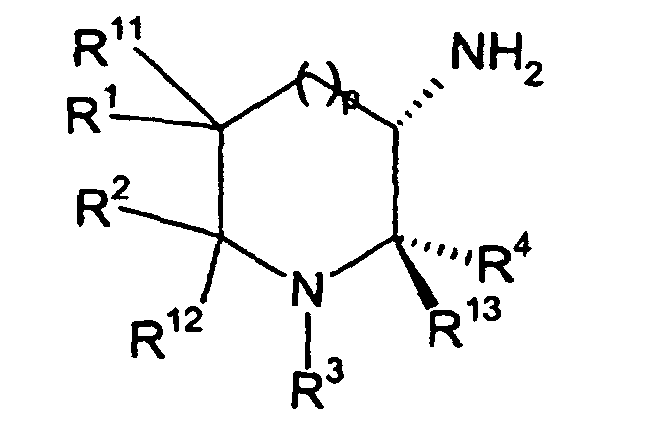
- The above reaction may be carried out in one vessel without isolation of the imine intermediate, or T-NH2 and (II) may be combined in an inert solvent such as methylene chloride, dichloroethane, toluene or benzene, either at room temperature or the reflux point of the solvent, with or without removal of the byproduct water, to form the imine, which is then reduced. The reduction can be carried out by catalytic hydrogenation, or with several hydride reagents in a reaction inert solvent. The catalytic hydrogenation may be carried out in the presence of a metal catalyst such as palladium or Raney nickel. Suitable hydride reagents include borohydrides such as sodium borohydride (NaBH4), sodium cyanoborohydride (NaBH3CN) and sodium triacetoxyborohydride (NaB(OAc)3H), boranes, aluminum based reagents and trialkylsilanes. Suitable solvents include polar solvents such as methanol, ethanol, methylene chloride, dichloroethane, tetrahydrofuran (THF), dioxane, toluene, benzene and ethylacetate. This reaction is typically carried out at a temperature from about -78°C to about the reflux temperature of the solvent, preferably from about 0°C to about 25°C, for a period of about 5 minutes to about 48 hours, preferably from 0.5 to 16 hours.
- Alternatively, the compounds of the formula (I) of this invention may be prepared as shown in the following scheme A-II.(wherein LG is a leaving group such as halo or sulfonate including tosylate, triflate or mesylate)

- Referring to Scheme A-II, the compounds of the formula (I) wherein B is absent and G is NH may be prepared by a reaction of a compound of the formula (III) with a compound of the formula T-NH2, wherein T-NH2 is as previously defined. The compound of formula (III) is treated with T-NH2 in the presence of a base (e.g., K2CO3 or Na2CO3) in a polar solvent (e.g., methanol, ethanol, isopropylalcohol, THF, dioxane, dimethylformamide (DMF) or dimethylsulfoxide (DMSO)). This reaction is typically carried out at a temperature from about -78°C to about the reflux temperature of the solvent, preferably from 0°C to 25°C, for a period of about 5 minutes to about 48 hours, preferably for between 0.5 and 16 hours.
- The compounds of formula (III) can be prepared by reduction of an aldehyde of the formula (II), followed by conversion of a hydroxy group of the resultant compound into a leaving group, LG (e.g., halo such as chloro, bromo, iodo or fluoro, or sulfonate including tosylate or mesylate). Reduction of the aldehyde of formula (II) can be accomplished using a variety of reducing agents in a reaction inert solvent. Suitable reducing agents/solvent systems include sodium tetrahydroborate (NaBH4) in methanol or ethanol; lithium tetrahydroborate (LiBH4) in THF or diethyl ether; lithium tetrahydroaluminium (LiAlH4), lithium triethoxyhydroaluminium (LiAl(OEt)3H), lithium tert-butoxyhydroaluminium (LiAl(OBut)3H) or aluminium trihydride (AlH3) in THF or diethyl ether; and iso-butyl aluminium hydride(i-BuAlH2) or diisopropyl aluminum hydride (DIBAL-H) in dichloromethane, THF or n-hexane. This reaction is generally carried out at a temperature from about -20°C to about 25°C for a period of about 5 minutes to about 12 hours. Then, the hydroxy group of the resultant compound is converted into a leaving group LG using methods known to those skilled in the art. For example, when LG is a sulfonate such as tosylate or mesylate, the hydroxy compound is reacted with sulfonyl chloride in the presence of pyridine or triethylamine in dichloromethane. When LG is halo such as chloro or bromo, the hydroxy compound may be treated with SOX2 (wherein X is Cl or Br) in the presence of pyridine.
- Compounds of formula (II) can be prepared as illustrated in the following scheme B.

- The compounds of the formula (II) may be prepared by direct or indirect formylation of a compound of the formula (IV). Any formylation methods known to those skilled in the art may be used to introduce a formyl group into a benzene ring. For example, direct formylation may be accomplished by contacting the compound of formula (IV) with a suitable formylating agent in the presence of a suitable catalyst. Suitable formylating agent/catalyst systems include dichloromethyl methyl ether/titanium (IV) chloride (Cl2CHOCH3/TiCl4), dichloromethyl methyl ether/aluminum chloride (Cl2CHOCH3/AlCl3), dichloromethyl methyl ether/tin (IV) chloride (Cl2CHOCH3/SnCl4) dichloromethyl methyl ether/boron trifluoride etherate (Cl2CHOCH3/BF3-OEt), trifluoroacetic acid (CF3CO2H) /hexamethylenetetramine (modified Duff's conditions) and phosphoryl trichloride (POCl3)/DMF (Vilsmeier's conditions). Indirect formylation may be achieved by halogenating the compound of formula (IV), displacing the halogen atom introduced with a cyano group, and then subjecting the resultant cyano substituted compound to reduction. Alternatively, the halogen may be subjected to halogen metal exchange with butyl lithium. The lithium intermediate may then be treated with dimethytformamide to afford the compound of formula (II). The halogenation as used herein may be carried out according to the procedure reported in G. A. Olah et al., J. Org Chem, 58, 3194 (1993). The displacement of the halogen atom with a cyano group may be performed according to the methods reported in D. M. Tschaem et al., Smth Commun, 24, 887 (1994), and K. Takagi et al., 64 Bull Chem. Soc. Jpn. 64, 1118 (1991). The reduction can be performed in the presence of diisopropyl aluminiumhydride (DIBAL-H) in dichloromethane or Raney nickel in formic acid.
- In addition, compounds of formula (II) wherein W is vinylene can be prepared by dehydrogenation of the analogous compounds of formula (II) wherein W is ethylene in a suitable solvent such as dioxane.
- The starting materials of the formula (IV) either are known compounds which are commercially available, or can be prepared by known methods. For example, compounds of the formula (IV) wherein R1 is alkyl can be prepared by N-alkylation of the corresponding compounds (IV) wherein R1 is hydrogen, in the presence of a base (e.g., NaH or KH), in a suitable solvent (e.g., DMSO, DMF and THF). Compounds of the formula (IV) wherein R2 or R3 is other than hydrogen, can also be prepared from the corresponding compounds of the formula (IV) wherein R2 or R3, respectively, is hydrogen, using similar techniques as described above. Compounds of the formula (IV) can be also prepared by other methods as described in European Patent No. 385662 and C. Crestini et al., Synth. Commun. 24 2853 (1994) and G. W. Rewcastle et al., J. Med Chem, 37, 2033 (1994). Compounds of the formula (IV) wherein Q is S can be prepared by thionation of the corresponding compounds of formula (IV) wherein Q is O. Suitable thionation agents are Lawesson's reagent (Tetrahedron, 41, 5061 (1985)) and P4S10 (Chem. Pharm. Bull., 10, 647 (1962)).
- Alternatively, compounds of the formula (I) wherein B is absent G is NH and A is CH2 may be prepared as shown in the following Scheme A-III.

- Scheme A-III illustrates the preparation of compounds of the formula (Ia) (which are compounds of the formula (I) wherein T is 2-phenylpiperidinyl).
- Referring to Scheme A-III, N-protection of a compound of the formula (V) (Ar is phenyl or the like) may be carried out by treatment with (t-BuOCO)2O (Boc2O) in the presence of a base such as sodium bicarbonate (NaHCO3) or triethylamine (Et3N) to obtain a compound of the formula (VI). Other nitrogen protecting groups that are well known to those of skill in the art can also be used, e.g., FMOC (via reaction with FMOC-Cl), benzyl (via reaction with benzyl chloride), trifluoroacetyl (via reaction with trifluoroacetic anhydride) and benzoyl (via reaction with benzoylchloride). For a discussion of such protecting groups and methods of attaching and removing them, see Theodora W. Greene and Wuts, Peter G. M., Protective Groups In Organic Synthesis, Second Edition, John Wiley & Sons, Inc., New York, 1991. The compound of formula (VI) is subjected to hydrogenolysis to obtain a compound of the formula (VII). An alternative route for N-protection of a compound of the formula (V) may be carried out by treatment with carbobenzoxy chloride (Cbz-Cl) in the presence of a base such as sodium bicarbonate (NaHCO3) or triethylamine (Et3N). The hydrogenolysis may be carried out by treatment with H2 or ammonium formate (HCO2NH4) in the presence of a metal catalyst such as a palladium on charcoal (e.g., 20% palladium on charcoal) in a suitable solvent. Then, the compound of formula (VII) is subjected to the reductive amination as described in Scheme A-I to form the corresponding compound of formula (VIII), which can then be converted into a compound of the formula (Ia) by treatment with an acid catalyst such as hydrochloride (HCl) in methanol, concentrated HCl in ethylacetate or CF3CO2H in dichloroethane.
- The compounds of formula (I), and the intermediates shown in the above reaction schemes can be isolated and purified by conventional procedures, such as recrystallization or chromatographic separation.
- Selected intermediates depicted as compound IV in Scheme B can be prepared by the transformations depicted in Schemes C and D.
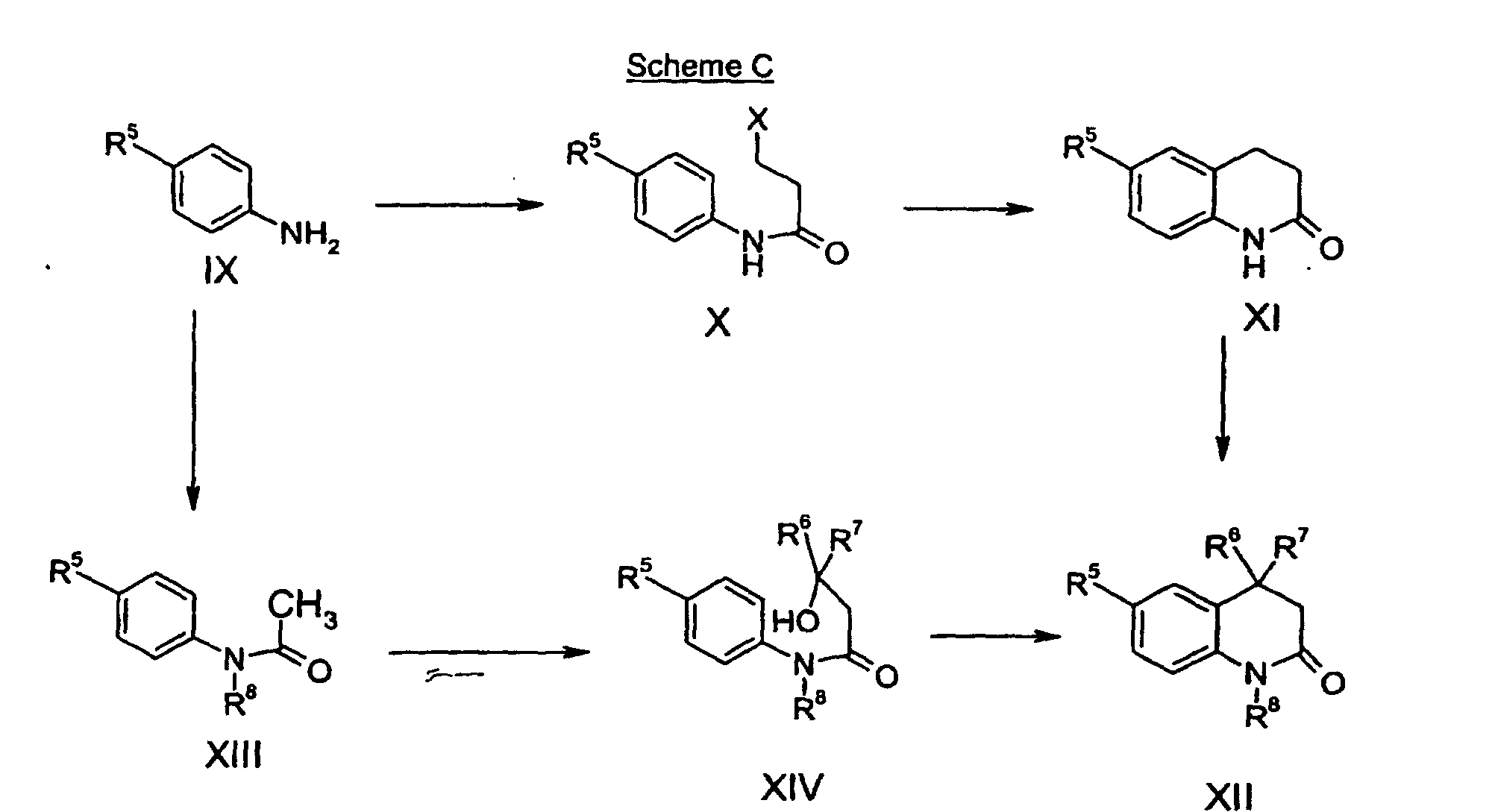
- Acylation of the aniline of formula IX with an acylating agent such as acetic anhydride, acetyl bromide, acetyl chloride, acetyl sulfonates, acetyl phosphates or mixed anhydrides of acetic acid and a phenyl or alkyl chloroformate affords a compound of the formula XIII. Typically, this transformation is carried out in an inert solvent or mixtures of solvents such as methylene chloride, dichloroethane, toluene, ether, benzene, THF, dioxane, water or chloroform, or any inert solvent, in the presence of a base such as a bicarbonate or carbonate or triethyl amine, at a temperature from about -50°C to about the reflux temperature of the solvent, for a period of about 15 minutes to about 24 hours. Preferably, the compound of formula XIII is formed by the reaction of acetic anhydride in methylene chloride, using triethyl amine as the base, at about 0°C for about 2 hours.
- Compounds of the formula XIII wherein R8 = H can be alkylated with a suitable electrophile chosen from methyl iodide, dimethyl sulfate and methyl triflate. This reaction is conducted in the presence of a base such as sodium or potassium t-butoxide or sodium or potassium hydride. A suitable inert solvent such as THF, ether or dimethoxyethane may be used. The reaction is conveniently carried out at a temperature from about -50°C to about ambient temperature. Preferred conditions involve using dimethylsulfate in THF in the presence of potassium t-butoxide, at a temperature from 0°C to ambient temperature, for 16 hours.
- Alternatively, when R8 is hydrogen, the compound of formula XIII can be acylated with a sulfonyl or sulfinyl halide or anhydride (e.g., methanesutfonyl chloride or bromide or anhydride, trifluoromethanesulfonyl anhydride, phenyl sulfonyl chloride, bromide or anhydride, or tosyl chloride or anhydride) after treatment of such compound with a suitable base (e.g., sodium or potassium hydride, sodium or potassium carbonate, or sodium or potassium t-butoxide), in a solvent such as DMF, THF, N-methylpyrrolidinine, dichloroethane or dichloromethane. Preferably, this reaction is carried out with methane sulfonyl chloride as the reactant, using DMF as the solvent and sodium hydride as the base.
- The compound of formula XIV can be prepared from the corresponding compound of formula XIII through formation of the enolate with a suitable base such as lithium diisopropyl amide, sodium, lithium or potassium hexamethyldisilazane or potassium t-butoxide, in a solvent such as THF or dimethoxyethane, at a temperature from about -100°C to about -25°C, for a period of about 15 minutes to about 5 hours. Suitable electrophiles include acetone, acetaldehyde, benzaldehyde, formaldehyde, cyclopentanone and cyclohexanone. Preferred conditions for this transformation involve using lithium diisopropyl amide in THF at about -78°C with either acetone or acetaldehyde as the electrophile, for about 2 hours.
- Formation of the compound of formula XII from the corresponding compound of formula XIV can be accomplished in an acid such as sulfuric, phosphoric, triflic, hydrofluoric or polyphosphoric acid, with or without an additional inert solvent, at a temperature from about 50°C to about 150°C for a period of about 5 minutes to about 2 hours. Preferred conditions involve heating the compound of formula XIV in neat polyphosphoric acid for about 15 minutes at about 100°C.
- Compounds of the formula X can be formed via acylation of the aniline of formula IX with an acylating agent such as 3-chloropropionyl chloride or chloroacetyl chloride. Typically, this transformation is carried out in an inert solvent or mixtures of solvents such as methylene chloride, dichloroethane, toluene, ether, benzene, THF, dioxane, water or chloroform, or any inert solvent, in the presence of a base such as a bicarbonate, a carbonate or triethyl amine, at a temperature between about -50°C and about the reflux temperature of the solvent, for a period of about 15 minutes to a bout 24 hours. Preferably, the compound of formula X is formed by the reaction of 3-chloropropionyl chloride in methylene chloride/water, using sodium bicarbonate as the base, at about ambient temperature for about 16 hours. The compound of formula XI is formed by reacting the corresponding compound of formula X with a Lewis acid such as aluminum chloride, stannic chloride, stannous chloride, or titanium chloride, either neat or in an inert solvent such as methylene chloride, dichloroethane, chloroform, benzene or toluene, at a temperature from about ambient temperature to about 300°C, for a period of about 5 minutes to about 2 hours. Preferably, the compound of formula XI is formed by the reaction of the corresponding compound of formula X with aluminum chloride, neat, at about 210°C for a period of about 10 minutes.
- Compounds of the formula XI wherein R5 is hydroxy and/or R6 is hydrogen can be converted into the corresponding compounds wherein R5 or R8 is, respectively, an alkoxy or alkyl group by reacting them with a suitable electrophile chosen from methyl iodide, dimethyl sulfate and methyl triflate. This reaction is conducted in the presence of a base such as sodium or potassium t-butoxide or sodium or potassium hydride. A suitable inert solvent such as THF, ether or dimethoxyethane can be used. The reaction is conveniently carried out at a temperature from about -50°C to about ambient temperature. Preferred conditions involve using methyl iodide in THF, in the presence of potassium t-butoxide, at a temperature from about 0°C to about ambient temperature, for about 16 hours.

- Compounds XVI and XVIII may be prepared as shown in Scheme D using conditions described by Bernard et al. CAN 67: 120195. The reaction may be conducted with trimethylsulfonium iodide, chloride or bromide, in a solvent such as DMSO, THF, DME, ether or DMF using a base such as sodium or potassium hydride, butyl or hexyl lithium at a temperature f rom a bout 0°C to about 200°C f or a bout 1 h our t o about 2 d ays. P referred conditions involve using trimethylsulfonium chloride in DMSO with sodium hydride at a temperature of about 100°C for about 1 week. More preferred conditions involve using trimethylsulfonium iodide in THF with hexyl lithium at a temperature of about 0°C to the reflux point of the solvent for about 1.5 hours. Compounds XVI and XVIII can then be transformed as above into compounds of the formula II (see Scheme B) and further transformed into compounds of the formula I (see Schemes A-I and A-III).
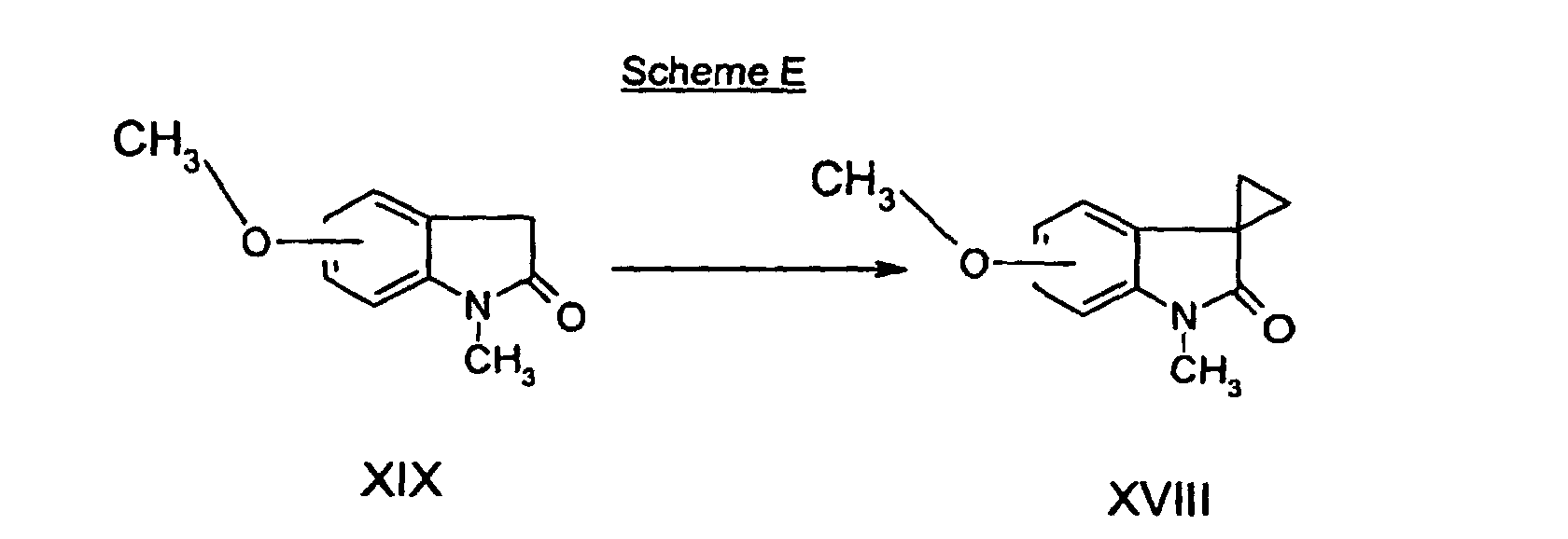
- Compounds of the formula XVIII are preferably prepared directly from the corresponding compounds of formula XIX through the use of a suitable base and alkylating agent in an inert solvent. Suitable bases include but are not limited to sodium, potassium or lithium hydride, and lithium dialkylamides such as lithium diisopropyl amide, lithium hexamethyldisilazide, sodium hexamethyldisilazide or potassium hexamethyldisilazide. Suitable alkylating agents include dibromoethane, iodobromoethane, ethylene glycol dimesylate or ditosylate, iodochloroethane and the like. Suitable inert solvents include THF, ether, dimethoxyethane and DMF. The reaction can be conducted at temperatures from about 0°C to a bout the reflux temeperature of the solvent. The most preferred conditions involve reaction of the substrate XIX in DMF with sodium hydride as the base and dibromoethane as the alkylating agent at about room temperature for about 4 hours.
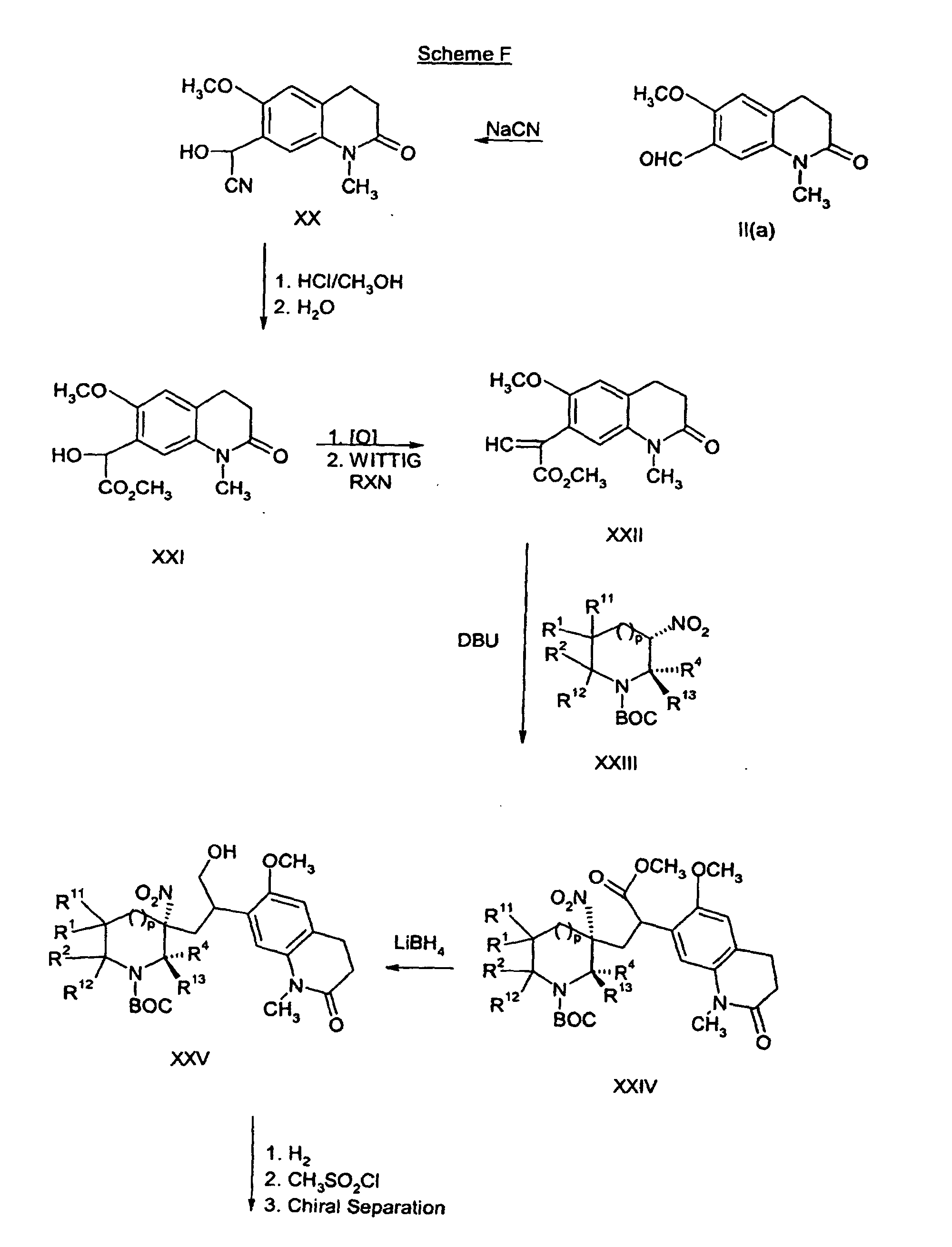
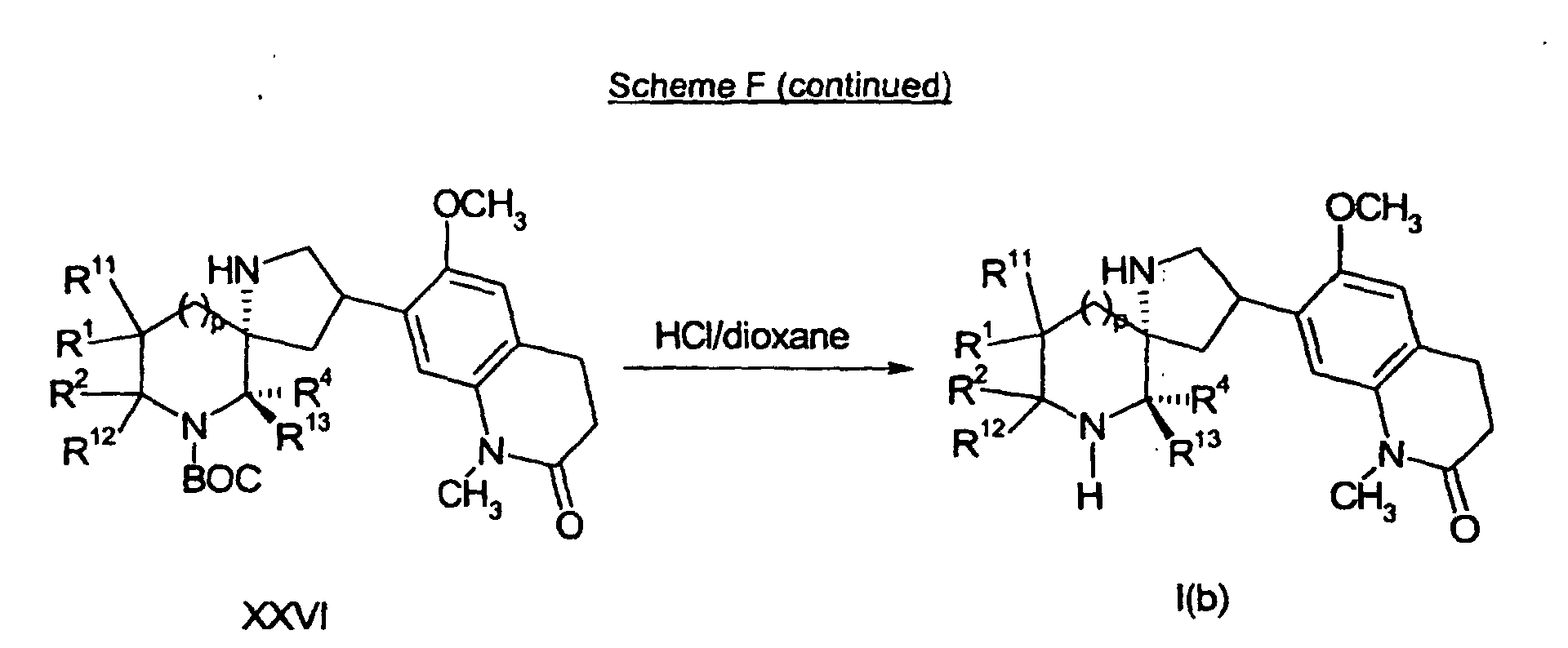
- The spirocyclic compounds outlined in Scheme F can be prepared using the following general reaction sequence. The starting aldehyde of formula II(a) is dissolved in a non-polar solvent, preferably ethyl acetate, at a temperature from about -50°C to about 50°C, preferably at about room temperature, and to this solution is added aqueous sodium bisulfite, followed by aqueous sodium cyanide (NaCN). The mixture is stirred for about 1 to about 24 hours, preferably for about 4 hours, a second portion of aqueous NaCN is added, and stirring is continued for about 18 hours. The resulting cyanohydrin of formula XX is isolated and dissolved in methanol saturated with hydrogen chloride (HCl) gas. The resulting solution is then refluxed for about 3 hours. From this solution the desired hydroxy-ester of formula XX can be isolated.
- The hydroxy-ester of formula XXI can be oxidized to the corresponding keto-ester using a variety of oxidizing reagents (preferably CrO3/H2SO4; Jones reagent) in a non-protic solvent, preferably acetone. The keto-acid is then reacted with methyl-triphenylphosphonium bromide using standard Wittig conditions (n-Bu Li/THF; about -20°C to about room temperature) to afford the unsaturated ester derivative of formula XXII. The unsaturated ester derivative of formula XXII is then mixed with the compound of formula XXIII in a non-polar solvent, preferably tetrahydrofuran (THF), and treated with a non-aqueous base, preferably 1,8-diazabicylclo[5.4.0]undec-7-ene (DBU). The reaction is then heated to reflux for about 4 to about 36 hours, preferably for about 18 hours. The resulting ester adduct of formula XXIV can then be reduced using a variety of known reducing agents, preferably LiBH4, in a nonprotic ether solvent, preferably ethyl ether, to afford the nitro alcohol derivative of formula XXV.
- Reduction of the nitro group can be accomplished using standard methodology, preferably hydrogenation in ethanol using a Raney nickel catalyst, and cyclization to the spirocycle can be accomplished by activation of the alcohol, preferably using methanesulfonyl chloride in methylene chloride at about -20 to about 40°C, preferably about 5°C. Separation of the resulting enantiomers by chiral chromatography is a standard procedure known to those skilled in the art. Final removal of the nitrogen protecting group using standard conditions, preferably dioxane/HCl, affords the final product of formula I(b).
- Compounds of the formula I wherein B is CH2, A is CH and G is OCH2 can be prepared using the method illustrated in Scheme G. Compounds of the formula QQ can be replaced with the appropriate compound of formula IV, as defined above for Scheme B to obtain compounds of the formula I having desired definitions of Q, W, Y, Z, R5, R6, R7 and R8.
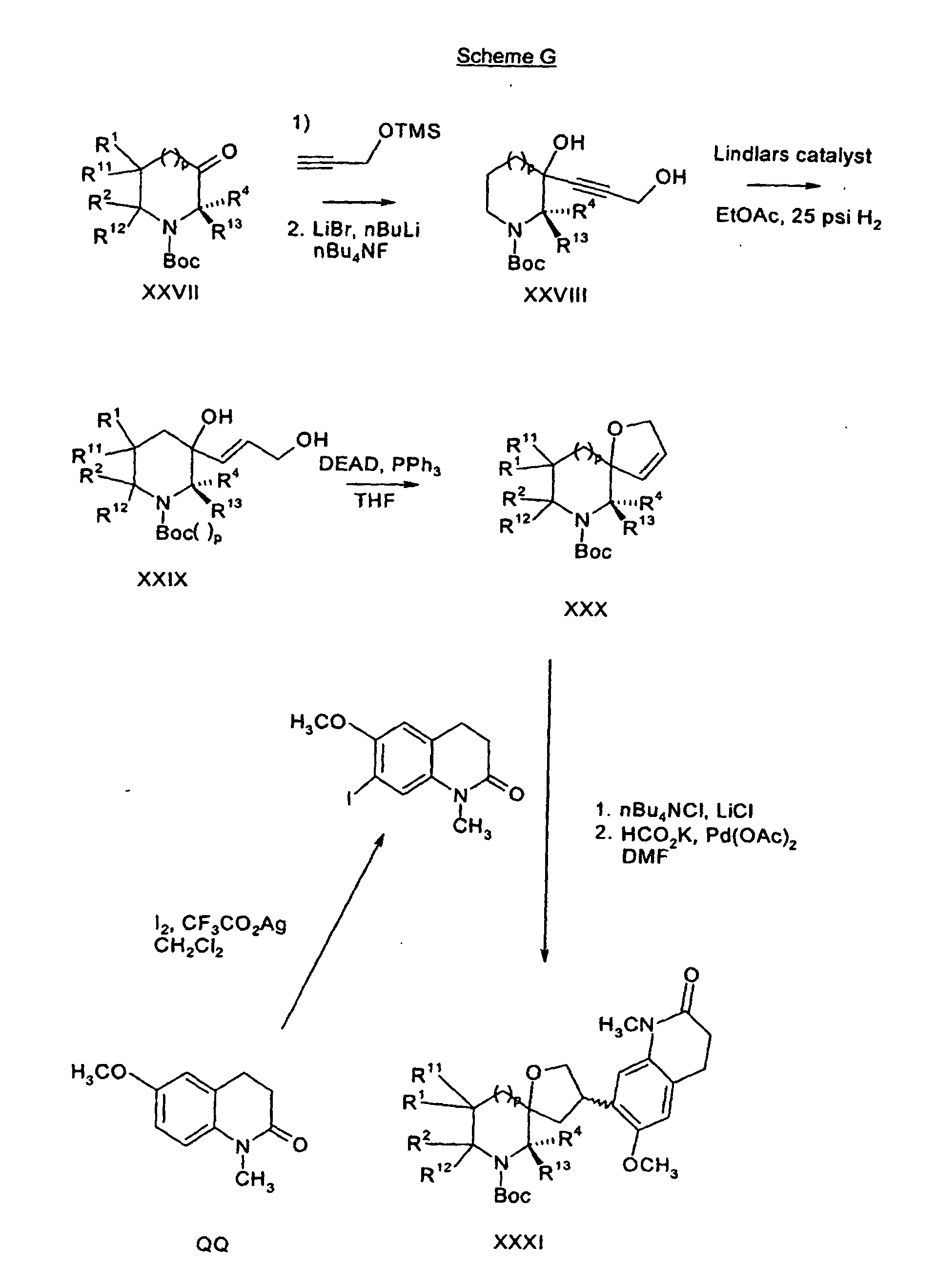

- Scheme H illustrates a method of adding a Het-CH2-C(=O)- group, as substituent R3, to an analogous compound of the formula I wherein R3 is hydrogen. (Het is defined as the heterocyclic substituents on R3 are defined above, with the proviso that Het must contain a secondary amine). Het-H is condensed with methoxy bromoacetate or ethoxy bromoacetate, in the presence of a tertiary amine hydrochloride base catalyst such as diethyl benzyl amine, pyridinium hydrochloride, or diisopropyl ethyl amine hydrochloride at a temperature of from about 0°C to about ambient temperature. The ester is hydrolyzed with a slurry of potassium carbonate in an aqueous potassium hydroxide solution at a temperature of from about 0°C to about the reflux temperature for a period of from about 16 hours to about 48 hours. The substituted acetic acid and piperidine I(d) are coupled with any standard peptide coupling agent such as Bop (benzotriazol-1-yloxytris(dimethylamino)phosphonium hexafluorophosphate), Py-Brop (bromo-tris-pyrrolidinophosphonium hexafluorophosphate) or T3P(1-propanephosphonic acid cyclic anhydride), at a temperature of from about 0°C to about ambient temperature for a period of from about 1 hour to about 24 hours, to form the final product.

- Me=CH3, Et=CH2CH3
- Scheme J illustrates the synthesis of certain compounds of the formula I wherein R2 is alkyl.
- The starting materials used in this scheme (compounds of the formula XXXII) can be prepared from commercially available alkyl vinyl ketones by reaction with nitromethane in the presence of a suitable base such as sodium or potassium alkoxide, triethylamine, diisopropylethyl amine, N-methyl morpholine, or sodium and potassium carbonate, in an organic solvent such as methanol, ethanol, propanol, isopropanol, tert-butanol, methylene chloride, chloroform, toluene, THF, DMF, DMSO, ether, oethyl acetate, at a temperature from about -78°C to about 100°C. (J. Am. Chem. Soc., 74, 3664-3668 (1952)). Preferably, the reaction is carried out using nitromethane in methanol at between about -30°C and about 0°C with sodium methoxide as the base, and methyl vinyl ketone as the electrophile. Alternatively, the reaction can be conducted under neutral aqueous conditions as described in the literature, e.g., Tetrahedron Lett. 1929-1932 (1982).
- Compounds of the formula XXXIII can be prepared by using a modified Henry reaction that condenses to give substituted cyclic imines. Firstly, the ketone is protected as a ketal by use of a mineral acid such as hydrochloric acid, sulfuric acid, and nitric acid or a catalytic organic acid such as camphor sulfonic acid or toluene sulfonic acid, in an alcoholic solvent such as methanol, ethanol, propanol, or ethylene glycol, with a water scavenger such as trimethyl orthoformate, triethyl orthoformate, magnesium sulfate, or molecular sieves, at a temperature from about 0°C to about 75°C. Then, the nitroacetal is condensed in situ with an imine created by an amine source such as ammonium acetate, ammonium chloride, or ammonium formate, and an aldehyde such as one of variously substituted aromatic aldehydes, at a temperature from about 0°C to about 75°C. The acetal is then converted into the ketone by addition of a mineral acid such as hydrochloric acid, sulfuric acid, or nitric acid in water, at a temperature from about 0°C to about 75°C, which causes cyclization to occur, giving the compound XXXIII. Preferably. the nitroketone is dissolved in methanol at about room temperature with a catalytic amount of camphor sulfonic acid and trimethyl orthoformate. Ammonium formate is then added, followed by benzaldehyde. Aqueous sulfuric acid is added and stirred to give the cyclic imine XXXIII.
- The resulting compound of formula XXXIII is dissolved in an alcoholic solvent such as methanol, ethanol, propanol, isopropanol, or t-butanol and its lithium, sodium, or potassium base and added to a solution of a mineral acid such as hydrochloric acid, sulfuric acid, or nitric acid in an alcoholic solvent with a water scavenger such as trimethyl orthoformate, triethyl orthoformate, magnesium sulfate, or molecular sieves, at a temperature from about - 30°C to about 75°C. This reaction yeilds the corresponding compound of formula XXXIV. Preferably, the nitroimine is dissolved in sodium methoxide in methanol and added to a 0°C solution of sulfuric acid and trimethyl orthoformate in methanol.
- The corresponding compound of formula XXXV-a is created by the stereoselective reduction of the imine of formula XXXIV. The imine is reduced with a Lewis acid such as trimethylaluminum, triethylaluminum, and trichloroaluminum and a hydride source such as lithium aluminum hydride or diisobutyl aluminum hydride. Typically, this reaction is conducted in an organic solvent such as THF, ether, or glyme at a temperature from about 0°C to about -78°C. Preferably, the imine is reduced with triethylaluminum and lithium aluminum hydride in THF at about -78°C.
- The compound of formula XXXV-a is converted into the corresponding compound of formula XXXVI-a by conversion of the acetal to the oxime and then reduction to give the amine. The acetal is stirred in water and an organic cosolvent such as THF with a mineral acid such as hydrochloric acid, sulfuric acid, or nitric acid, hydroxylamine, and a buffer such as ammonium acetate or ammonium chloride at a temperature from about 0°C to about 100°C. Reduction of the oxime is accomplished in an organic solvent such as methanol, ethanol, ethyl acetate, or acetic acid, using a catalyst such as Raney-Nickel, platinum, or palladium, under a hydrogen atmosphere of about 1 to about 50 psi at a temperature from about room temperature to about 60°C. Preferably, the compound off formula X XXV-a and hydroxylamine hydrochloride are dissolved in water, THF, and concentrated hydrochloric acid, and then ammonium acetate is added at about room temperature. The oxime is then reduced by Raney-Nickel in ethanol under 40 psi of hydrogen at about room temperature.
- The final products of formula XXXVII-a are made by reductive amination of the corresponding compounds of formula XXXVI-a using an appropriate aldehyde, acid such as acetic acid, hydrochloric acid, sulfuric acid, camphor sulfonic acid, or toluene sulfonic acid, and hydride source such as sodium borohydride, sodium cyanoborohydride, or sodium triacetoxyborohydride, in an organic solvent such as methanol, ethanol, or THF at a temperature from about 0°C to about 75°C. Preferably, the compound of formula XXXVI-a, an appropriate aromatic aldehyde, acetic acid, and sodium cyanoborohydride are stirred in methanol at about room temperature to give desired product of formula XXXVII-a.
- Starting materials of the type of formula XXXVII-b, which possess the opposite stereochemistry at the R2 site from those of formula XXXVII-a, can be prepared through a similar reaction sequence whereby the only change is in the set of conditions used in the imine reduction. For example, substitution of NaBH3CN/MeOH for triethyl aluminum/LiAIH4 gives the compound XXXV-b. Many other reduction methods are available for this transformation and are commonly known to those skilled in the art. Preferred conditions include reduction with NaBH4 in alcoholic or ethereal solvents or reduction with NaBHOAc3 in the presence of an acid such as acetic acid in chlorinated solvents such as CH2Cl2 or CHCl3 or in other inert solvents such as benzene, toluene, ether, THF or glyme. LiAl4 in ether, THF or glyme in the absence of triethyl aluminum may also be used. These reductions are generally carried out at temperatures from about -78°C to about 100°C, preferably from about 0°C to about 60°C. The subsequent reaction sequences which yield the compound of formula XXXVII-b may take place under the same conditions as the reaction sequences which yield the compound of formula XXXVII-a.
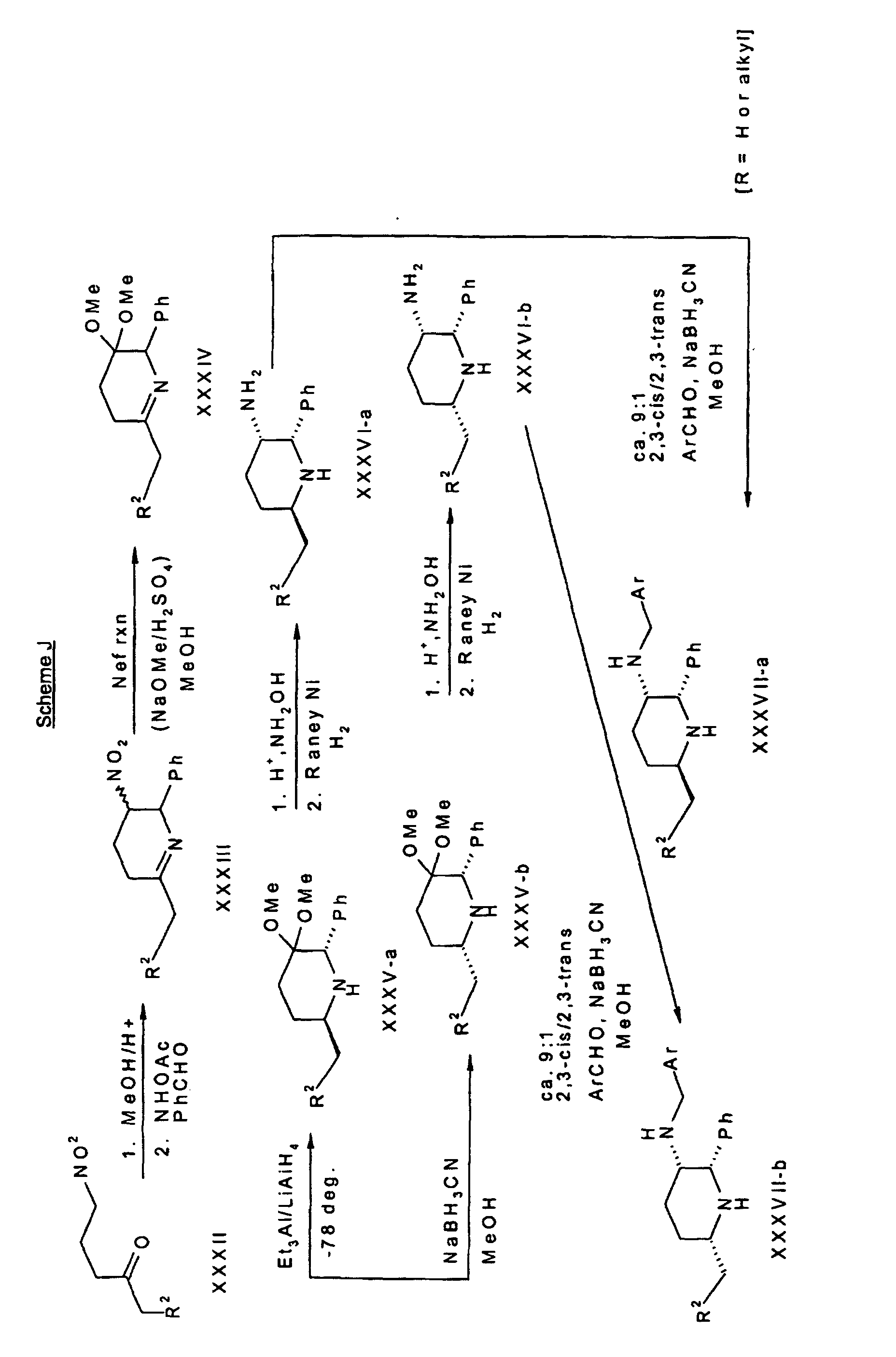
- Scheme L illustrates a method of preparing compounds of the formula I wherein R3 is benzyl and wherein R12 and R13, together with the carbon atoms to which they are attached, from a ring.
- The starting materials for Scheme L can be prepared from 2-bromo-3-hydroxypyridine, or, in a similar fashion, from 2-iodo-3-hydroxypyridine. The reaction may be conducted using either of these starting materials and a nucleophile such as phenyl (or substituted phenyl) boronic acid or another aryl substituted boronic ester or phenylalkyl borane and/or an aryl (or substituted aryl) stannane such as phenyl tri-n-butylstannane or phenyltrimethylstannane. A palladium catalyst is usually employed. It can be either a palladium (0) source with a variety of phosphine ligands, including but not limited to palladium tetrakis[triphenylphosphine], or a non-phosphine source such as palladium dibenzylidene acetone (dba) or a palladium (II) source such as palladium acetate or palladium dichloride bis triphenylphosphine. The reaction can be carried out in a variety of solvents or mixtures of solvents such as ethyl acetate, methylene chloride, dichloroethane, toluene, benzene, ether, THF, or DMF and water, at a temperature from about ambient temperature to about the reflux point of the solvent in the presence of a suitable base such as sodium or potassium carbonate or bicarbonate. Preferably, 2-bromo-3-hydroxypyridine and phenylboronic acid, with palladium tetrakistriphenyl phosphine as the catalyst, in a mixture of benzene water and sodium carbonate, are used.
- The product from this step (compound of formula XLII) is alkylated with benzyl bromide, chloride, mesylate, triflate or iodide or a substituted benzyl bromide in one of a variety of solvents such as a cetonitrile, ethanol, methanol or water, at a temperature from about ambient temperature to about the reflux point of the solvent. The product of this reaction is a pyridine salt (salt of formula XLIII). The most preferred conditions involve the use of acetonitrile at reflux with benzyl bromide to form a pyridinium bromide. The resulting salt of formula XLIII can be converted into a betaine with a suitable base, either as a separate step or in situ via the following reaction. Typically, the pyridium salt is treated with amberlite™ or another type of basic ion exchange resin or triethyl amine, diisopropylethyl amine, sodium hydroxide, sodium carbonate or bicarbonate at about ambient temperature. The most preferred conditions involve using amberlite™, a strongly basic ion exchange resin. The betaine is then reacted with a vinyl sulfone such as phenyl vinyl sulfone or substituted phenyl vinyl sulfone in an inert solvent such as ethyl acetate, methylene chloride, dichloroethane, toluene, benzene, ether, THF, or DMF, at about the reflux point of the solvent. Typically, a radical inhibitor such as hydroquinone or a related inhibitor is added to prevent radical polymerization of the vinyl sulfone. Most preferably, phenyl vinylsulfone in refluxing toluene with hydroquinone is used.
- The resulting product, an enone (compound of formula XLIV), contains a carbon-carbon double bond, which can be reduced under 1-110 psi of hydrogen pressure using a suitable catalyst such as palladium on carbon, palladium hydroxide, platinum oxide or platinum on carbon. This reaction may be carried out in a solvent such as methanol, ethanol or water, at a temperature from about ambient temperature to about the reflux point of the solvent. Alternatively, the reaction can be conducted using ammonium formate or another formate salt as the source of hydrogen. Preferably, ammonium formate in methanol at reflux is used with Pd(OH)2/C. The resulting ketone is converted into an oxime ether or an oxime using hydroxylamine methyl ether or, alternatively, ethyl or benzyl ether as well as hydroxyl amine itself. The reaction is carried out in a solvent or mixture of solvents selected from ethyl acetate, methylene chloride, dichloroethane, toluene, benzene, ether, THF, DMF, methanol, ethanol and water, or mixtures thereof, at a temperature from about ambient temperature to about the reflux point of the solvent, with a suitable buffer such as sodium or potassium acetate. The most preferred conditions involve using a refluxing mixture of methylene chloride, methanol and water with hydroxylamine methyl ether and sodium acetate. The resulting oxime methyl ether (compound of formula XLV) can be selectively reduced with a suitable reducing agent such as sodium cyanoborohydride or sodium triacetoxy borohydride or triethyl silane in a solvent under acidic conditions. Suitable solvents include acetic, formic and trifluoroacetic acid. This reaction is usually run at about ambient temperature. Most preferably, sodium cyanoborohydride in acetic acid is used to afford a compound of formula I(g).
- Reduction of the hydroxylamine ether can be combined with removal of the phenylsulfone functionality. The reducing agent is typically sodium, lithium or potassium metal, or sodium amalgam, aluminum amalgam or samarium diiodide. The reaction can be conducted in a solvent or a mixture of solvents selected from liquid ammonia, ethanol, methanol, toluene, THF, t-butanol and similar solvents. The reaction is usually conducted at a temperature from about -33°C to about ambient temperature or about the reflux point of the solvent. The most preferred conditions involve using sodium metal in liquid ammonia/THF at reflux to afford a compound of formula XLVI. Removal of the N-benzyl protecting group, can be accomplished under 1-110 psi of hydrogen pressure using a suitable catalyst such as palladium on carbon or palladium hydroxide. This reaction can be carried out in a solvent such as methanol, ethanol or water, at a temperature from about ambient temperature to about the reflux point of the solvent. Alternatively, this reaction can be conducted using ammonium formate or another formate salt as the source of hydrogen. Preferably, ammonium formate in methanol is used, with palladium hydroxide on carbon as the catalyst and the reaction is conducted at the reflux point of the solvent. In the final step, the aldehyde of formula XLVII is coupled to the diazabicyclo[3.2.1]octane of formula XLVI (wherein the N-benzyl protecting group, Bn, has been removed) under the conditions described above for schemes A-I-A-III.


- Referring to Scheme M, 7-azaindole (formula XLVII) (Aldrich) is treated with 1.4 equivalents of m-chloroperbenzoic acid in dichloroethane at about ambient temperature for a period of about 4 hours. The product from the foregoing reaction is isolated and dissolved in THF and treated with 1 equivalent of hexamethyldisilane and 2.5 equivalents, of methylchloroformate at about ambient temperature for about 16 hours. This reaction yields the chlorinated compound having formula XLVIII. Sodium hydroxide hydrolysis in methanol/water at about ambient temperature, for about 2 hours yields 6-chloro-7-azaindole (formula XLIX). Sequential treatment of this intermediate with pyridinium bromide perbromide in t-butanol (t-BuOH) at about ambient temperature for about 16 hours, followed by treatment with Zn in acetic acid (HOAc) at about ambient temperature for about 20 minutes affords 6-chloro-7-azaoxindol-2-one (compound LI). The compound of formula LI is then permethytated using methyl iodide/potassium t-butoxide a t about ambient temperature for about 16 h ours and then converted to the 6-methoxy derivative of formula LII using sodium methoxide (NaOMe) in DMF and a copper (I) iodide (Cul) catylist at about 145°C, for about 6 hours. The resulting aldehyde of formula LIII can then be formed by reacting the compound of formula LII with titanium tetrachloride (TiCl4)/α,α-dichloromethyl methyl ether at about ambient temperture for about 16 hours. Standard reductive amination conditions to couple the compound of formula LIII to the appropriate compound of formula T-NH2 will yield the desired final product of formula I(h).

- Referring to Scheme N, the 4-aza-5-methoxy-oxindole intermediate (LX) can be prepared according to the literature (See Robinson et al., J. Het. Chem., 1996, 33, 287-293). It is permethylated using methyl iodide/potassium t-butoxide at about ambient temperature for about 16 hours, and then brominated (using liquid bromine (Br2) and acetic acid) at about 60°C for about 1 hour). Vinylation of the compound of formula LXII is accomplished using tri-n-butyl-vinyl tin, hexamethylphosphoramide (HMPA), and a (Ph3P)2PdCl2 catalyst at about 65°C for about 14 hours. Ozonolysis of the vinyl group in methylene chloride for about 5 minutes afforded the aldehyde derivative of formula LXIV. The desired final product of formula I(j) is formed using standard reductive amination conditions with the appropriate compound of formula T-NH2, as described above for Schemes A-I-A-III.


- Referring to Scheme O, 2-methoxy-5-nitropyridine (formula LXV) is converted into the phenyl sulfone derivative having formula LXVII by reacting it with potassium t-butoxide in DMF at about ambient temperature for about 16 hours. The latter compound is then alkylated with ethyl bromoacetate in DMF, in the presence of potassium carbonate (K2CO3) at about 45°C for about 2 hours. Hydrogenation (using hydrogen gas at about 40 psi, a palladium on carbon catalyst and an ethanol solvent) for about 18 hours affords the ring cyclized product of formula LXX. The compound of formula LXX is then reacted with methyl iodide at about 0°C in DMF for about from 1 to about 4 hours, in the presence of an organic base, preferably potassium t-butoxide. After the reactants are mixed at about 0°C, the reaction mixture is allowed to warm to ambient temperature. Bromination of the resulting intermediate using liquid bromine and acetic acid at about 60°C, for about 1 hour, yields the compound of formula LXXI. Vinylation to produce the compound of formula LXXII can then be accomplished using tri-n-butyl-vinyl tin, HMPA, and a (Ph3P)2PdCl2 catalyst at about 65°C for about 14 hours. Ozonolysis of the vinyl group in methylene chloride for about 5 minutes affords the aldehyde derivative of formula LXXIII. The desired final product of formula I(k) is formed using standard reductive amination conditions with the appropriate compound of formula T-NH2. as described above for Schemes A-I - A-III.

- Referring to Scheme P, 4-nitrobutyric acid methyl ester is converted into the nitropyridyl derivative of formula LXXIV by reaction with pyridine-3-carboxaldehyde in the presence of an ammonia source such as ammonium acetate, ammonium chloride or ammonium formate. The reaction can be conducted in alcoholic solvents such as methanol or ethanol at temperatures ranging from about -78°C to about the reflux temperature, with reflux being the preferred temperature. The nitro-group is converted into the dimethyl acetal by subjection to Nef reaction conditions as described earlier. Reduction of the amide group yields a piperidine compound. This reduction can be brought about by a number of conditions known to those skilled in the art. Preferred conditions include LiAIH4 or borane-dimethylsulfide reduction in inert solvents such as ether or THF. This is followed by N-Boc protection via standard protocols as described earlier which yields the compound of formula LXXV. Conversion of the acetal of formula LXXV into the oxime is carried out under acidic conditions catalyzed by mineral acids such as HCl, HBr, HNO3 or H2SO4, or organic acids such as carboxylic acids or sulfonic acids, at temperatures ranging from about -78°C to about 100°C. Suitable solvents include water or mixtures of water with a variety of organic solvents such as THF, ether, toluene, DMF, ethanol and methanol. Preferred conditions are HCl-catalyzed hydrolysis at about room temperature in water/THF or water/alcohol. The initially formed ketone is converted into the oxime by treatment with hydroxylamine hydrochloride and ammonium acetate at about room temperature. The oxime is reduced by catalytic hydrogenation as described earlier. Preferred conditions for the reduction of the oxime are treatment with Raney nickel in methanol or ethanol under 52 psi of hydrogen. The resultant amine of formula LXXVI is converted into the benzylamine derivatives via reductive amination under standard conditions as described previously. The N-Boc group is cleaved under standard conditions as described earlier to yield the compound of formula LXXVII.

- Referring to Scheme R, 3-Benzylamino-3-methyl-butyric acid is reduced to the corresponding N-Boc amino alcohol under standard conditions which are known to those skilled in the art. Preferably, this series of reactions is brought about by reduction of the carboxylic acid with borane or borane-dimethylsulfide complex in THF or ether. This is followed by hydrogenolysls of the N-benzyl group with palladium on carbon catalysis in ethanol or methanol at about room temperature under an atmosphere of hydrogen. Alternative hydrogen sources include ammonium formate or cyclohexene. The Boc group is installed under standard conditions using di-tert-butyldicarbonante in THF/water or dioxane/water in the presence of a carbonate base such as NaHCO3 or K2CO3. Alternatively, this group may be installed in CH2Cl2, CHCl3, THF, ether, toluene or related solvents in the presence of triethylamine or an alternative amine base. Oxidation of the alcohol to the aldehyde is accomplished under standard conditions associated with the use of Dess-Martin periodinane, Swern oxidation or MnO2 oxidation. These methods are well known to those skilled in the art. A Henry reaction sequence yielding the nitroalkene of formula LXXXII is brought about by treatment of the aldehyde with nitromethane and a suitable base. Typical conditions include an alcoholic solvent such as methanol or ethanol and an alkoxide base such as sodium methoxide or sodium ethoxide. Alternative conditions include CH2Cl2, CHCl3, THF or ether solvents and an amine base such as triethylamine. These conditions provide an intermediate nitroalcohol which can be converted into the nitroalkene by activation of the alcohol in the presence of base. This dehydration reaction is commonly known to those skilled in the art. The preferred method for this transformation involves activation of the alcohol with methanesulfonyl chloride or toluenesulfonyl chloride in the presence of triethylamine. The resultant nitroalkene is reduced to the nitroalkane under standard conditions. Preferred conditions for this transformation include treatment with NaBH4 or LiBH4 in alcoholic solvents such as methanol or ethanol. THF may also be used. The reaction may be conducted at temperatures between about -78°C and about 88°C, with about 0°C to about ambient temperature being preferred. Cyclization to the 2,3-trans piperidine ring is brought about by condensation with an aryl aldehyde such as benzaldehyde in the presence of a catalyst such as ammonium acetate or amonium chloride. The preferred solvent for this transformation is an alcoholic solvent such as methanol or ethanol and the typical temperature for this transformation lies between about -20°C and about 100 °C. Alternatively, the transformation may be brought about in solvents such as CH2Cl2, CHCl3, THF, ether, toluene, ethyl acetate or related solvents, with or without acid or base catalysis. The 2,3-cis piperidine ring is obtained by treatment of the trans-piperidine with base followed by quenching in a kinetic fashion via addition of the nitronate solution to an excess of an acid in solution. Typical bases range from metal alkoxides or hydroxides in alcoholic solution to amine bases such as triethylamine or Hunig's base to LHMDS, KHMDS, NaHMDS in organic solvents such as CH2Cl2, CHCl3, THF, ether, toluene, or ethylacetate. Alternative bases include the butyllithiums in THF or ether solution. Temperatures for this transformation can range between about -78°C and about 100°C. The nitropiperidine is transformed into the aminopiperidine by reduction according to a variety of possible methods known to those skilled in the art. Preferred methods include zinc/HCl, zinc/acetic acid, or iron/HCl reduction in suitable solvents including water, THF/water, or water/alcohol mixtures. Suitable temperatures range from about -20°C to about 118°C. The reduction may also be brought about by Raney nickel reduction in alcoholic solvents of in water/alcohol mixtures under an atmosphere of hydrogen. Typical reation temperatures range from about 0°C toabout 100°C. The resultant amine is subjected to reductive amination conditions as previously described to provide the compounds of interest.

- The mixture of cis and trans nitroimine of the formula LXXXV-a/LXXXV-b (compound of formula XXXIII prepared in Scheme J) may be transformed by the process of base induced epimerization to a single diastereomer LXXXV-a. A variety of bases may be used for this process including but not limited to lithium diisopropyl amide, sodium, lithium or potassium hexamethyldisilazane or potassium t-butoxide, potassium or sodium hydride, diazabicycloundecene (DBU), diazabicydononane (DBN), tetramethylguanidine, triethyl amine. diisopropylethylamine, sodium or potassium or lithium carbonate with or without accompanying 18-crown-6 or 15 crown-5, 12-crown-4, lithium sec-butylborohydride (L-selectride) in a solvent such as THF, ether or dimethoxyethane, at a temperature from about -100°C to about -25°C, for a period of about 15 minutes to about 5 hours. The reaction mixture is quenched into a suitable acidic reagent which is either suspended or dissolved in an inert solvent to afford the desired diastereomer LXXXV-a. Suitable quenching agents include silica gel, alumina, hydrated sodium sulfate, paratoluenesulfonic acid pyridinium salt (PPTS), boric acid, hydrogen chloride, aqueous hydrogen chloride or aqueous sulfuric acid, nafion resin, molecular sieves, acidic ion exchange resins and the like. Preferred conditions utilize lithium hexamethyldisilazane in THF at about -78°C followed by quench into a suspension of silica gel in THF.
- Reduction of the imine of formula LXXXV-a to afford a mixture favoring either diastereomer of formula LXXXV-c/ LXXXV-d may be accomplished through the use of a reducing agent and optionally a Lewis acid activating agent. Thus the imine may be reduced with lithium aluminum hydride with or without added triethyl or trimethyl aluminum. Other aluminum reagents may be used such as diethyl aluminum chloride or ethylaluminum dichloride. Other reducing agents include Vitride™ or Red-Al or diisobutylaluminum hydride and also sodium borohydride, sodium cyanoborohydride and sodium triacetoxy borohydride with or without borontrifluoride etherate, lithium sec-butylborohydride (L-selectride) and/or lithium borohydride in the presence of borontrifluoride etherate. A suitable inert solvent is used during this transformation and may be selected from THF, ether, dimethoxyethane, toluene, hexane, methylene chloride or other suitable solvents. The reaction is generally run below room temperature from about -78°C to about 0°C. The most preferred conditions use lithium aluminum hydride in THF at about -78°C with triethyl aluminum.
- The resulting imine of formula LXXXV-c or LXXXV-d or the mixture of compounds of formulas LXXXV-c/LXXXV-d may be reduced to either a compound of formula LXXXVI-a or a compound of formula LXXXVI-b or a mixture of compounds of formulas LXXXVI-a/LXXXVI-b with a suitable reducing agent. Agents capable of reducing compounds of formulas LXXXV-c/LXXXV-d include, but are not limited to, zinc, tin, stannous chloride, zinc amalgam, palladium on carbon, palladium hydroxide, platinum oxide, platinum on carbon and Raney nickel, with or with out the presence of from 1-1000 psi hydrogen pressure, in a suitable solvent such as hydrochloric acid (aq), water, methanol, ethanol, isopropanol, ethyl acetate or similar inert solvents. The most preferred conditions include zinc metal in aqueous hydrochloric acid at a temperature from about room temperature to about the reflux temperature of the solvent.

- Alternatively, according to Scheme T, a compound of the formula LXXXVI-a may also be prepared from compounds of the formulas LXXXV-a/LXXXV-b in a straightforward manner. The imine of formula LXXXV-a/LXXXV-b prepared above can be converted to an enamine of the formula LXXXVII-a/LXXXVII-b through reaction with an activated acyl compound such as, but not limited to, carbobenzyloxychloroformate (cBz-Cl), benzoyl chloride, 9-fluorenylmethyl choroformate(FMOC-Cl), t-butoxychloroformate, phenyl chloroformate, nitro and dinitrophenylchloroformate, methyl, ethyl and isopropyl chloroformate in an inert solvent and in the presence of a suitable base. Suitable solvents include methylene chloride, chloroform, dichloroethane, benzene, toluene, water, ethyl acetate, dioxane and other suitable organic solvents. Typical bases include aqueous sodium, lithium and potassium carbonate or bicarbonate solutions, pyridine, triethylamine, diisopropylethylamine, lutidine, collidine and other suitable bases. The reaction may be run at about room temperature up to about the reflux temperature of the solvent. The most preferred conditions involve reaction of a compound of formula LXXXV-a/LXXXV-b with cBz-Cl in methylene chloride and aqueous sodium bicarbonate solution at about the reflux temperature of the solvent mixture.
- The desired cis isomer of formula LXXXVII-a may be obtained directly from the foregoing reaction by direct crystallization of the crude product from a suitable solvent such as diethyl ether or diisopropyl ether. Alternatively, the mixture of cis and trans isomers of formula LXXXVII-a/LXXXVII-b may be converted to mainly the cis isomer of formula LXXXVII-a by treatment with a suitable base such as lithium or sodium bis (trimethylsilyl)amide, lithium diisopropylamide, DBU, sodium or potassium carbonate in a suitable solvent such as THF or DME at a temperature of about -78°C to about ambient temperature followed by quenching in a suitable aqueous acid such as dilute aqueous hydrochloric acid or dilute acetic acid. The most preferred conditions involve reaction of the compound of formula LXXXVII-a/LXXXVII-b with lithium bis (trimethylsilyl)amide in THF at about -78°C followed by quenching in 1N aqueous HCl.
- The reduction of the compound of formula LXXXVII-a to form the compound of formula CVI may be carried out in several ways. The reduction may be conducted under acidic or neutral conditions in an inert solvent at a temperature between a bout -78°C a nd about room temperature. Suitable reducing agents include 1-1000 psi hydrogen gas, ammonium formate, sodium cyanoborohydride, sodium triacetoxyborohydride, tetrabutylammonium triacetoxyborohydride, triethylsilane, polyhydroxysilane, and sodium and lithium borohydride. If the reaction requires a suitable acid, then acetic or trifluoroacetic acid may be added. Additionally, hydrogen chloride triflic acid or sulfuric acid may be used. Typical solvents include methylene chloride, dichloroethane, chloroform, methanol, ethanol, toluene, dioxane and water. The most preferred conditions involve reaction of the compound of formula LXXXVII-a with sodium cyanoborohydride in methylene chloride with trifluoroacetic acid at about -40°C: Equally preferred are conditions involving reaction of the compound of formula LXXXVII-a with triethylsilane in methylene chloride with trifluoroacetic acid at about -40°C.
- Deprotection of the acyl group and reduction of the nitro to an amine as in the compound of formula LXXXVI-a may be done in either order. For instance, reduction of the nitrogroup may be carried out with agents such as zinc, tin, stannous chloride, zinc amalgam, palladium on carbon, palladium hydroxide, platinum oxide, platinum on carbon or Raney nickel, with or with out the presence of from 1-1000 psi hydrogen pressure, in a suitable solvent such as hydrochloric acid (aq), water, methanol, ethanol, isopropanol, ethyl acetate or similar inert solvents. The most preferred conditions include zinc metal in aqueous hydrochloric acid at a temperature from about room temperature to about the reflux temperature of the solvent. Removal of the acyl group may be carried out in a variety of ways. If the acyl group is cBz- then catalytic hydrogenation is successful and may or may not be coupled with reduction of the nitro group. General conditions indude hydrogenation with 1-1000 psi hydrogen over palladium on carbon or palladium hydroxide or oxide in methanol or ethanol. Alternatively, hydrogenolysis may be carried out with ammonium formate or cyclohexene under reflux in methanol or ethanol over a catalyst such as palladium on carbon or palladium hydroxide or oxide. An alternative method for cBz cleavage is treatment with HBr in acetic acid or propionic acid solution. For other acyl groups such as tertiary butoxy- (t-BOC), simple treatment with strong acid is sufficient, whereas with other acyl groups, treatment with aqueous sodium hydroxide solution at a temperature from ambient temperature to about the reflux temperature of the solvent is necessary. Alternatively, cBz or t-BOC groups may be removed by treatment with HBr/acetic acid.

- Alternatively, compounds of formula LXLI may be prepared by the sequence of reactions illustrated in Scheme U. 4-nitrobutyric acid methyl ester or 4-nitrobutyric acid ethyl ester may be reduced to an aldehyde and said aldehyde be protected as a nitro acetal of formula LXXXVIII. Reduction of the 4-nitrobutyric acid methyl ester may be completed in one step through reaction in toluene, hexane or methylene chloride at about -78°C with diisobutylaluminum hydride. Alternatively, this reduction may be carried out over two steps via reduction of the 4 -nitrobutyric acid methyl ester in THF or ether at about 0°C to about ambient temperature through the use of lithium aluminum hydride, lithium borohydride or borane in THF. The resulting nitroalcohol may then be oxidized to the aldehyde through a Swern oxidation in methylene chloride or a Dess-Martin oxidation. The aldehyde is protected as a nitroacetal of formula LXXXVIII by use of a mineral acid such as hydrochloric acid, sulfuric acid, and nitric acid or a catalytic organic acid such as camphor sulfonic acid or toluene sulfonic acid, in an alcoholic solvent such as methanol, ethanol, propanol, or ethylene glycol, with a water scavenger such as trimethyl orthoformate, triethyl orthoformate, magnesium sulfate, or molecular sieves, at a temperature from about 0°C to about 75°C.
- Compounds of formula LXL can be prepared by using a modified Henry reaction that condenses to give substituted cyclic imines. The nitroacetal of formula LXXXVIII is condensed in situ with an imine created by an a mine source such as ammonium acetate, ammonium chloride, or ammonium formate, and an aldehyde such as one of variously substituted aromatic aldehydes, at a temperature from about 0°C to about 75°C. The acetal of formula LXXXIX is then converted into a nitroaldehyde by addition of a mineral acid such as hydrochloric acid, sulfuric acid, or nitric acid in water, at a temperature from a bout 0°C to about 75°C, which causes cyclization to occur, giving the compound of formula LXL. Preferably, the nitroaldehyde is dissolved in methanol at about room temperature with a catalytic amount of camphor sulfonic acid and trimethyl orthoformate. Ammonium formate is then added, followed by benzaldehyde. Aqueous hydrochloric acid is added and stirred to give the cyclic imine of formula LXL.
- The imine of formula LXL may be transformed to the compound of formula LXLI through the use of organometallic reagents. For instance, addition of ethyl lithium, ethylmagnesium bromide, diethyl magnesium, diethylzinc, ethylzinc chloride, diethyl cuprate or other cuprate reagents such as higher order cuprates in a solvent such as THF or ether, toluene or dimethoxyethane at a temperature from about - 78°C to about 0°C. Alternatively, in a two step process, one may add vinyl lithium, vinylmagnesium bromide, divinyl magnesium, divinylzinc, vinylzinc chloride, divinyl cuprate or other cuprate reagents such as higher order cuprates in a solvent such as THF or ether, toluene or dimethoxyethane at a temperature from about -78°C to about 0°C. Once addition is complete the resulting product is hydrogenated under 1-1000 psi hydrogen pressure over palladium on carbon, palladium hydroxide, platinum oxide, platinum on carbon or Raney nickel. Alternatively, in another two step process, one may add an acetylenic lithium under similar conditions to those listed above for vinyl. This process is also followed by hydrogenation. Optionally, one may include a Lewis acid in the above additions to the imine. Typical Lewis acids indude boron trifluoride etherate, zinc chloride and trimethyl or triethylaluminum.
- The resulting amine of formula LXLI may be reduced to the compound of formula LXXXVI-a (Scheme T) with a suitable reducing agent. Agents capable of reducing LXLI include, but are not limited to, zinc, tin, stannous chloride, zinc amalgam, palladium on carbon, palladium hydroxide, platinum oxide, platinum on carbon and Raney nickel, with or with out the presence of from 1-1000 psi hydrogen pressure, in a suitable solvent such as hydrochloric acid (aq), water, methanol, ethanol, isopropanol, ethyl acetate or similar inert solvents. The most preferred conditions include zinc metal in aqueous hydrochloric acid at a temperature from about room temperature to about the reflux temperature of the solvent.

- Alternatively, a compound of the formula LXXXVI-a may be prepared by the sequence of reactions shown in Scheme V. 1-nitrohex-4-one (the compound of formula LXLII) prepared above, may be reacted to form a hemiacetal of formula LXLIII through reaction of phenylglycinol with either configuration in a suitable solvent such as benzene, toluene, dichloroethane, methanol or ethanol with optional removal of water by molecular sieves or through the use of a Dean Stark water separator while under reflux. Compounds of the formula LXLIV can be prepared by using a modified Henry reaction which then condenses to give the substituted cyclic acetal of formula LXLV. The cyclic acetal of formula LXLV is condensed in situ with an imine created by an amine source such as ammonium acetate, ammonium chloride, or ammonium formate, and an aldehyde such as benzaldehyde or one of variously substituted aromatic aldehydes, at a temperature from about 0°C to about 75°C. In most cases the compound of formula LXLIV is not isolated but directly cyclizes to the compound of formula LXLV.
- The reduction of the compound of formula LXLV to form the compound of formula LXLVI may be carried out in several ways. The reduction may be conducted under acidic or neutral conditions in an inert solvent at a temperature between about -78°C and about room temperature. Suitable reducing agents include 1-1000 psi hydrogen gas, ammonium formate, sodium cyanoborohydride, sodium triacetoxyborohydride, tetrabutylammonium triacetoxyborohydride, triethylsilane, polyhydroxysilane, and sodium and lithium borohydride. If the reaction requires a suitable acid, then acetic or trifluoroacetic acid and boron trifluoride etherate or trimethyl aluminum may be added. Additionally, hydrogen chloride, triflic acid or sulfuric acid may be used. Typical solvents include methylene chloride, dichloroethane, chloroform, methanol, ethanol, toluene, dioxane and water.
- The compound of formula LXLVI may be deprotected through hydrogenolysis. Typically, the nitro group is also reduced to the amine of formula LXXXVI-a during this process. General conditions indude hydrogenation with 1-1000 psi hydrogen over palladium on carbon or palladium hydroxide or oxide in methanol or ethanol. Alternatively, hydrogenolysis may be carried out with ammonium formate or cyclohexene under reflux in methanol or ethanol over a catalyst such as palladium on carbon or palladium hydroxide or oxide. If the nitro group is to be removed prior to hydrgenolysis, then suitable reaction conditions indude the following. The nitro functionality may be reduced by agents which include, but are not limited to, zinc, tin, stannous chloride, zinc amalgam, palladium on carbon, palladium hydroxide, platinum oxide, platinum on carbon and Raney nickel, with or with out the presence of from 1-1000 psi hydrogen pressure, in a suitable solvent such as hydrochloric acid (aq), water, methanol, ethanol, isopropanol, ethyl acetate or similar inert solvents. The most preferred conditions indude zinc metal in aqueous hydrochloric acid at a temperature from about room temperature to the about reflux temperature of the solvent.

- 2-Bromo-3-methoxy-5-nitropyridine (J. Lombardino, J. Med. Chem. 1981, 24, 39-42) was converted to the 2-aldehyde derivative of formula LXLIX using a two step sequence. The compound of formula LXLVII was treated with tri-n-butyl-vinyltin using a catalytic amount of bis(triphenylphosphine)-palladium(II) chloride in a non-protic solvent (preferably toluene) at about room temperature to about 150° C (preferably 111°C) for about 1 hour to about 24 hours (preferably 2 hours). Chromatography of the reaction mixture yields the vinyl compound of formula LXLVIII: The vinyl compound of formula LXLVIII was treated with ozone at about -100° C to about 0°C (preferably -78°C) in methylene chloride and then quenched with dimethyl sulfide to afford the aldehyde of formula LXLIX. The aldehyde of formula LXLIX was protected using methods well known to those of skill in the art, e.g., reaction with ethylene glycol in benzene in the presence of a catalytic amount of acid (preferably p-toluenesulfonic acid) to afford the acetal of formula C. The pyridine derivative of formual C was reacted with benzylsulfonyl chloride using a strong base (preferably potassium t-butoxide) in a non-protic solvent (preferably a mixture of THF and DMF) to afford the sulfone derivative of formula CI. The methylene group of the sulfone of formula CI can be alkylated with ethyl bromoacetate in a protic solvent (preferably ethanol) using a strong base (preferably potassium t-butoxide). During these reaction conditions benzenesulfinic acid is eliminated to form the ester of formula CII. The ester of formula CII is hydrogenated in a protic solvent (preferably ethanol) using a metal catalyst (preferably 10% palladium on carbon) at about atmospheric pressure to about 50 PSI (preferably 50 PSI). During this reaction the nitro group is reduced to an amine, the double bond is reduced, and cyclization to the 6-membered amide is accomplished to yield the amide of formula CIII. Alkylation of the amide of formula CIII is accomplished with methyl iodide using a strong base (preferably potassium-t-butoxide) in a non-protic solvent (preferably THF) to afford the amide of formula CIV. The aldehyde in the amide of formula CIV is unmasked using acid (preferably p-toluenesulfonic acid) in a non-protic solvent (preferably acetone) to afford the aldehyde of formula CV. Reductive amination using aminopiperidine T-NH2 as described in Scheme A-1 affords the product of formula I(m).
- The preparation of other compounds of the formula I not specifically described in the foregoing experimental section can be accomplished using combinations of the reactions described above that will be apparent to those skilled in the art.
- In each of the reactions discussed or illustrated above, pressure is not critical unless otherwise indicated. Pressures from about 0.5 atmospheres to about 5 atmospheres are generally acceptable, and ambient pressure, i.e., about 1 atmosphere, is preferred as a matter of convenience.
- The compounds of formula I, and the intermediates shown in the above reaction schemes can be isolated and purified by conventional procedures, such as recrystallization or chromatographic separation.
- The compounds of the formula I and their pharmaceutically acceptable salts can be administered to mammals via either the oral, parenteral (such as subcutaneous; intraveneous, intramuscular, intrastemal and infusion techniques), rectal, intranasal or topical routes. In general, these compounds are most desirably administered in doses ranging from about 0.01 to about 1500 mg per day, in single or divided doses (i.e., from 1 to 4 doses per day), although variations will necessarily occur depending upon the species, weight and condition of the subject being treated and the particular route of administration chosen. However, a dosage level that is in the range of about 0.5 mg to about 500 mg per kg of body weight per day is most desirably employed. Nevertheless, variations may occur depending upon the species of animal being treated and its individual response to said medicament, as well as on the type of pharmaceutical formulation chosen and the time period and interval at which such administration is carried out. In some instances, dosage levels below the lower limit of the aforesaid range may be more than adequate, while in other cases still larger doses may be employed without causing any harmful side effects, provided that such higher dose levels are first divided into several small doses for administration throughout the day.
- The compounds of the present invention may be administered alone or in combination with pharmaceutically acceptable carriers or diluents by either of the routes previously indicated, and such administration may be carried out in single or multiple doses. More particularly, the novel therapeutic agents of this invention can be administered in a wide variety of different dosage forms, i.e., they may be combined with various pharmaceutically acceptable inert carriers in the form of tablets, capsules, lozenges, troches, hard candies, powders, sprays, creams, salves, suppositories, jellies, gels, pastes, lotions, ointments, aqueous suspensions, injectable solutions, elixirs, syrups, and the like. Such carriers include solid diluents or fillers, sterile aqueous media and various non-toxic organic solvents, etc. Moreover, oral pharmaceutical compositions can be suitably sweetened and/or flavored. In general, the therapeutically-effective compounds of this invention are present in such dosage forms at concentration levels ranging from about 5.0% to about 70% by weight.
- For oral administration, tablets containing various excipients such as microcrystalline cellulose, sodium citrate, calcium carbonate, dicalcium phosphate and glycine may be employed along with various disintegrants such as starch (and preferably corn, potato or tapioca starch), alginic acid and certain complex silicates, together with granulation binders like polyvinylpyrrolidone, sucrose, gelatin and acacia. Additionally, lubricating agents such as magnesium stearate, sodium lauryl sulfate and talc are often very useful for tabletting purposes. Solid compositions of a similar type may also be employed as fillers in gelatin capsules; preferred materials in this connection also include lactose or milk sugar as well as high molecular weight polyethylene glycols. When aqueous suspensions and/or elixirs are desired for oral administration, the active ingredient may be combined with various sweetening or flavoring agents, coloring matter or dyes, and, if so desired, emulsifying and/or suspending agents as well, together with such diluents as water, ethanol, propylene glycol, glycerin and various like combinations thereof.
- For parenteral administration, solutions of a compound of the present invention in either sesame or peanut oil or in aqueous propylene glycol may be employed. The aqueous solutions should be suitably buffered (preferably pH greater than 8) if necessary and the liquid diluent first rendered isotonic. These aqueous solutions are suitable for intravenous injection purposes. The oily solutions are suitable for intra-articular, intra-muscular and subcutaneous injection purposes. The preparation of all these solutions under sterile conditions is readily accomplished by standard pharmaceutical techniques well known to those skilled in the art.
- Additionally, it is also possible to administer the compounds of the present invention topically when treating inflammatory conditions of the skin and this may be done by way of creams, jellies, gels, pastes, patches, ointments and the like, in accordance with standard pharmaceutical practice.
- The activity of the compounds of the present invention as substance P antagonists is determined by their ability to inhibit the binding of substance P at its receptor sites in IM-9 cells employing radioactive ligands. The substance P antagonist activity of the compounds described herein is evaluated by using the standard assay procedure described by D. G. Payan et al., as reported in the The Joumal of Immunology. 133, 3260 (1984). This method essentially involves determining the concentration of the individual compound required to reduce by 50% the amount of radiolabelled substance P ligands at their receptor sites in said isolated cow tissues or IM-9 cells, thereby affording characteristic IC50 values for each compound tested. More specifically, inhibition of [3H]SP binding to human IM-9 cells by compounds are determined in assay buffer (50 mM Tris-HCl (pH 7.4), 1 mM MnCl2, 0.02 % bovine serum albumin, bacitracin (40 µg/ml), leupeptin (4 µg/ml), chymostatin (2 µg/ml) and phosphoramidon (30 µg/ml)). The reaction is initiated by the addition of cells to assay buffer containing 0.56 nM [3H]SP and various concentrations of compounds (total volume 0.5 ml) and allowed to incubate for 120 min at 4 °C. Incubation is terminated by filtration onto GF/B filters (presoaked in 0.1 % polyethylenamine for 2 hours). Nonspecific binding is defined as the radioactivity remaining in the presence of 1 µM SP. The filters are placed into tubes and counted using liquid scintillation counter.
- All of the title compounds of the examples were tested and at least one stereoisomer of each such compound exhibited a binding affinity, measured as Ki, of at least 600 nM.
- The activity of the compounds of this invention against generalized anxiety disorder can be determined by inhibition of GR73632-induced tapping test in gerbils. More specifically, gerbils are lightly anesthetized with ether and the skull surface is exposed. GR73632 or vehicle (PBS, 5 µl) are administered directly into the lateral ventricles via a 25 gauge needle inserted 4.5 mm below bregma (preceded by pretreatment with an antagonist, 0.1-32.0 mg/kg, s.c. or p.o.). Following injection, gerbils are placed in 1 L beaker individually and monitored for repetitive hind paw tapping. Some compounds prepared in the following Examples were tested in accordance with these testing methods. As a result, it was found that the compounds of the present inventions have good antagonist activity toward substance P, particutarly good activity against CNS disorders with decreased side effects.
- The present invention is illustrated by the following examples. It will be understood, however, that the invention is not limited to the specific details of these examples. Melting points are uncorrected. Proton nuclear magnetic resonance spectra (1H NMR) and 13C nuclear magnetic resonance spectra were measured for solutions in deuterochloroform (CDCl3) or in CD3OD or CD3SOCD3 a nd peak positions are expressed in parts per million (ppm) downfield from tetramethylsilane (TMS). The peak shapes are denoted as follows: s, singlet; d, doublet; t, triplet; q, quartet; m, multiplet; b, broad.
- P-aminophenol [0.5 gm (4.58 mmol)] was dissolved in 30 ml of each methylene chloride and saturated aqueous bicarbonate solution and it was stirred for 5 min at ambient temperature. 3-chloropropionyl chloride [0.49 ml (5.04 mmol.)] was added over 10 min. and the reaction mixture was stirred at ambient temperature for 4 hours. A large amount of precipitate was observed. The solids were filtered and dried to afford 0.82 gm (90 %) of an off white solid. MS APCI m/e 200 (p+1)
- Combine 0.82 gm (4.1 mmol.) and 1.6 gm (12.3 mmol.) aluminum chloride as a mixture of solids. The mixture was then heated in an oil bath at 210°C for 10 min or until the gas evolution ceases. The reaction mixture was then allowed to cool to ambient temperature and then quenched in ice/water mixture. The aqueous phase was extracted with ethyl acetate which was separated, dried over sodium sulfate and evaporated in vacuo to a light brown solid 0.58 gm (87 %) MS APCI m/e 164 (p+1)
- A solution of 0.58 gm (3.56 mmol.) 6-hydroxy-2-oxo-1,2,3,4-tetrahydro-quinoline was prepared in 10 ml acetone followed by the addition of 1.46 gm (10.58 mmol.) potassium carbonate and 0.51 ml (5.36 m mol.) dimethylsulfate. The reaction mixture was stirred at ambient temperature for 16 hours and then evaporated in vacuo. The residue was partitioned between saturated aqueous bicarbonate solution and methylene chloride. The organic phase was dried over sodium sulfate and evaporated. The residue was purified by silica gel chromatography eluting with 96/4 methylene chloride/methanol to afford 0.53 gm (85 %) of the desired product as a white solid. MS APCl m/e 178 (p+1)
- A mixture of 0.29 gm (2.19 mmol) aluminum chloride in 5 ml of methylene chloride was prepared under nitrogen gas N2 and stirred for 15 minutes and then cooled to 0°C. The mixture was treated with 0.2 gm (1.13 mmol) 6-Methoxy-3,4-dihydro-1H-quinolin-2-one in 5 ml of methylene chloride. The reaction mixture was stirred for 10 minutes at this temperature and was then cooled to - 5°C. α,α-dichloromethyl m ethyl ether 0.28 ml (3.07 mmol) was added over a 5 minutes, period and the green reaction mixture was slowly warmed to room temperature and stirred for 6 hours. The reaction mixture was diluted with 2N HCl and extracted with methylene chloride (4 X 10 ml). The combined organics were dried over sodium sulfate, filtered and concentrated to yield an off white solid. The crude product was chromatographically purified on silica gel, eluting with 7/3 ethyl acetate / hexane. There was obtained 125 mg (54 %) of an off white solid. MS APCI m/e 206 (p+1)
- To a flame dried round bottom flask fitted with Dean-Stark trap, condenser and nitrogen atmosphere was placed: 66 mg (0.37 mmole) cis-(2S,3S)-3-amino, 2-phenylpiperidine and 77 mg (0.37 mmole) 6-Methoxy-2-oxo-1,2,3,4-tetrahydro-quinoline-7-carbaldehyde in 15 ml of toluene containing 3A molecular sieves. The reaction mixture was heated under reflux for 6 hours and monitored by mass spectrum analysis for the presence of the imine intermediate. The reaction mixture was allowed to cool to ambient temperature and then evaporated in vacuo. The residue was taken up in approximately 15 ml of dichloroethane and was treated with 102 mg (0.48 mmol.) sodium triacetoxybrohydride and then stirred for 16 hours under nitrogen at ambient temperature. The reaction mixture was then washed with aqueous saturated sodium bicarbonate solution, washed with brine and then dried and evaporated in vacuo. The residue was purified by column chromatography on silica gel eluting with 95/5 CHCl3/MeOH containing 3 drops of concentrated NH4OH solution. There was obtained 100 mg of the free base (75 %) which was converted to the above named product as the hydrochloride in the following manner. Treatment of methanol with 3 equivalents (53 µl, 0.82 mmol) acetyl chloride afforded a methanolic hydrochloric acid (HCl) solution, which was stirred for 10 minutes. The free base was added in methanol and the mixture was again stirred for 10 minutes and then evaporated in vacuo. The residue was taken up in the minimum amount of methanol and treated with ether until a cloudy precipitate form. Upon standing the di-HCl salt was obtained in 46 % overall yield (75 mg). Mp 233-235°C MS, APCI m/e 366 (p+1).
- 6-Methoxy-2-oxo-1,2,3,4-tetrahydro-quinoline-7-carbaldehyde (preparation 3) 60 mg (0.293 mmol) was dissolved in 5 ml of anhydrous THF and the solution was cooled to 0°C. The reaction mixture was treated with 33 mg (0.293 mmol) of potassium t-butoxide whereupon it became yellow in color. After stirring for 30 minutes, the mixture was treated with 23 µl (0.293 mmol) ethyl iodide and slowly warmed to room temperature while stirring for 16 hours (h). The reaction mixture was diluted with saturated aqueous sodium bicarbonate solution and extracted with ethyl acetate. The organic phase was dried over sodium sulfate and concentrated to an oil. The residue was chromatographed on silica gel eluting with 6/4 ethyl acetate / hexane to afford 34 mg (40 %) as a white solid. MS APCI m/e 234 (p+1)
- 6-Methoxy-2-oxo-1,2,3,4-tetrahydro-quinoline-7-carbaldehyde 30 mg (0.146 mmol) was dissolved in 5 ml of anhydrous THF and the solution was cooled to 0°C. The reaction mixture was treated with 16 mg (0.146 mmol) of potassium t-butoxide whereupon it became yellow in color. After stirring for 30 minutes, the mixture was treated with 14 µl (0.146 mmol) dimethylsulfate and slowly warmed to room temperature while stirring for 16 hours. The reaction mixture was diluted with saturated aqueous sodium bicarbonate solution and extracted with ethyl acetate. The organic phase was dried over sodium sulfate and concentrated to an oil. The residue was chromatographed on silica gel eluting with 6/4 ethyl acetate/hexane to afford 16 mg (50 %) as a white solid. MS APCl m/e 220 (p+1)
- To a 50 ml round bottom flask fitted with a Dean Stark water separator, condenser and nitrogen cap was placed 0.027 gm (0.151 mmole) cis-(2S,3S)-3-amino, 2-phenylpiperidine and 0.033 gm (0.151 mmole) 1-Ethyl-6-methoxy-2-oxo-1,2,3,4-tetrahydroquinoline-7-carbaldehyde (preparation 5) in 10 ml of toluene containing 3A molecular sieves. The reaction mixture was heated for 18 hours under reflux. The solution was then allowed to cool to room temperature and then evaporated in vacuo. The residue was taken up in 25 ml of dichloroethane and treated with 0.048 gm (0.229 mmol) sodium triacetoxyborohydride and the solution was stirred at ambient temperature for 16 hours. The reaction was then partitioned between saturated aqueous bicarbonate solution and dichloromethane. The organic phase was washed with saturated brine and then dried over sodium sulfate before evaporation in vacuo. The crude product was chromatographed on silica gel eluting with 95 CHCl3, 4 MeOH, 1 NH4OH. The resulting oil was taken up in methanol which had previously been treated with 17.5 µl of acetyl chloride. The solution was evaporated in vacuo and the dihydrochloride salt of the desired product was obtained by recrystallization from methanol - ether; 33 mg (47 %). Mp 253 - 255°C; MS, APCI m/e 394 (p+1).
- A solution of 10 gm (63 mmol) 6-methoxyquinoline in 150 ml of acetone was treated with 4.4 ml (70 m mol) o f methyl iodide and heated under reflux for 4.5 hours followed by stirring at ambient temperature for 16 hours. The desired product was obtained by filtration of the solution. [14 gm (74%)]. This material was suspended in 360 ml of water and was cooled to 5°C. The mixture was treated with 90 gm (0.273 mol) potassium ferricyanide in a portionwise fashion over 1 hour. This mixture was kept at 5°C for 30 minutes and was then treated over 30 minutes with a solution of 31 gm (0.56 mol) KOH in 65 ml of water which had been previously cooled in an ice bath. The mixture becomes very very thick. Added 250 ml of toluene and heated to 40°C in a water bath for 30 minutes. The organic layer was separated and the aqueous phase was extracted in the same fashion twice more. The combined organic phase was washed with brine, dried over sodium sulfate and evaporated in vacuo to afford 8.2 gm of the desired product . Mass Spectrum APCI m/e 190 (p+1).
- A solution of 50 gm (314.1 mmol) 6-methoxyquinoline in 650 ml of acetone was treated with 21.5 ml (345.5 mmol) of methyl iodide and heated under reflux for 6 hours followed by stirring at ambient temperature for 16 hours. The desired product was obtained by filtration of the solution. [81.4 gm (91%)]. This material (285.4 mmol) was suspended in 2000 ml of water and was cooled to 5°C. The mixture was treated with 552.6 gm (1.68 mol) potassium ferricyanide in a portionwise fashion over 1 hour. This mixture was kept at 5°C for 30 minutes and was then treated over 30 minutes with a solution of 191.8 gm (3.43 mol) KOH in 400 ml of water which had been previously cooled in an ice bath. The mixture becomes very very thick. Added 250 ml of toluene and heated to 45°C in a water bath for 45 minutes. The reaction mixture was treated with 100 ml of saturated aqueous sodium thiosulfate solution. The organic layer was separated and the aqueous phase was extracted in the same fashion with ethyl acetate twice more. The combined organic phase was washed with brine, dried over sodium sulfate and evaporated in vacuo to afford 48.9 gm of the desired product (91 %). Mass Spectrum APCI m/e 190 (p+1).
- A suspension of 7.0 gm (42.0 mmol) potassium iodide and 4.89 gm (38.0 mmol) trimethylsulfoxonium chloride in 30 ml of DMSO under nitrogen was treated portionwise with 1.69 gm (42.0 mmol) of 60% sodium hydride in mineral oil. The mixture was stirred for one hour and then treated with 2.0 gm (11.0 mmol) 6-Methoxy-1-methyl-1H-quinolin-2-one followed by stirring for 0.5 hours at ambient temperature and 4 days at 90°C. The reaction mixture was allowed to cool to ambient temperature before quenching into ice followed by extraction into ether. The ether layer was washed with brine, dried over sodium sulfate and evaporated. The residue was partitioned between acetonitrile and pentane. The acetonitrile layer was concentrated. The residue was partitioned between 1:1 hexane/ethyl acetate and 50% saturated (sat'd) brine solution. The organic layer was washed with saturated brine, dried over sodium sulfate and evaporated in vacuo to afford 1.6 gm of a mixture of desired product and starting material. The residue was purified by silica gel chromatography eluting with 7/3 hexane/ethyl acetate to afford 972 mg (44%). Mass spectrum APCl m/e 204 (p+1).
- A suspension of 3.35 gm (15.1 mmol) trimethylsulfoxonium iodide in 10 ml of THF at 0° C under nitrogen was treated portionwise with 5.8 ml (14.6 mmol) of 2.5 M n-hexyllithium in heptane over 30 minutes. The mixture was stirred for 30 minutes at 0° C and then treated with 1.0 gm (5.02 mmol) 6-Methoxy-1-methyl-1H-quinolin-2-one followed by heating under reflux for 1.5 hours. The reaction mixture was allowed to cool to ambient temperature before quenching with 35 ml of water followed by extraction into ethyl acetate. The organic layer was washed with brine, dried over sodium sulfate and evaporated to afford 1.1 gm of desired product. Mass spectrum APCl m/e 204 (p+1).
- To a flame dried round bottom flask equipped with a nitrogen cap was added 972 mg (4.8 mmol) 6-Methoxy-3-methyl-1,1a,3,7b-tetrahydro-3-aza-cyclopropa[a]naphthalen-2-one, 40 ml of trifluoroacetic acid and 806 mg (5.7 mmol) of hexamethylene tetraamine. The mixture was stirred under reflux for 1.5 hours and then cooled to ambient temperature. The reaction mixture was quenched in 200 ml ice and then treated with solid sodium carbonate until pH 9 was reached. The aqueous phase was extracted with chloroform (3x30ml). The combined organics were then washed with brine followed by drying over sodium sulfate and evaporation in vacuo. The crude residue was taken up in ethyl acetate whereupon crystals formed. Four crops totaling 373 mg were obtained. The mother liquors were purified by silica gel column chromatography eluting with 1/1 ethyl acetate / hexane to afford another 98 mg (total yield 42 %) of a white solid which was used directly in the following step. Mass spectrum APCI m/e 232 (p+1).
- To a flame dried round bottom flask equipped with a nitrogen cap was added 935 mg (4.6 mmol) 6-Methoxy-3-methyl-1,1a,3,7b-tetrahydro-3-aza-cyclopropa[a]naphthalen-2-one, and 40 ml of methylene chloride. The solution was cooled to 0°C and 46.1 ml (46.1 mmol) of 1.0 M titanium tetrachloride was added. Dichloromethytmethylether (2.09 ml (23.05 mmol) was added and the reaction mixture was stirred at room temperature overnight. The reaction mixture was quenched in 100 ml ice / 1N HCl. The aqueous phase was extracted with chloroform (3x30ml). The combined organics were then washed with saturated bicarbonate solution and then brine followed by drying over sodium sulfate and evaporation in vacuo. The crude residue was taken up in ethyl acetate whereupon crystals formed. Four crops totaling 902 mg were obtained. Mass spectrum APCI m/e 232 (p+1).
- To a flame dried round bottomed flask under nitrogen atmosphere was introduced 7.5 gm (32.5 mmol) 6-Methoxy-3-methyl-2-oxo-1a,2,3,7b-tetrahydro-1H-3-aza-cyclopropa[a]-naphthalene-5-carbaldehyde and 150 ml methanol. The solution was treated with a catalytic amount of toluenesulfonic acid and 4.26 ml (38.9 mmol) trimetylorthoformate. The reaction was stirred for 1.5 hours and was then treated with a small amount of solid sodium bicarbonate. The reaction mixture was diluted with chloroform that had been passed through a plug of neutral or basic alumina and filtered to clarify the solution. The filtrate was concentrated in vacuo to afford 8.0 gm. The acetal was separated by chiral HPLC chromatography on a Chiralpak AS 10cm X 50cm column eluting with 60:40 / heptane: ethanol at a flow rate of 200 ml/min. The desired isomer (4.13 gm) had a retention time of 4.5 min and was estimated to be 100% ee. This material was taken up in 100 chloroform and 5 drops of 1N HCl. The mixture was stirred at room temperature for 16 hours and then dried over sodium sulfate. The solvent was removed in vacuo to afford 3.6 gm of the aldehyde as a single enantiomer.
- By a procedure similar to previous reference examples 1 and 2: 331 mg (1.88 mmole) cis-(2S,3S)-3-amino, 2-phenylpiperidine and 443 mg (1.92 mmole) 6-Methoxy-3-methyl-2-oxo-1a,2,3,7b-tetrahydro-1H-3-aza-cyclopropa[a]naphthalene-5-carbaldehyde were combined in 100 ml of toluene and heated under reflux for 4 hours over a Dean -Stark trap. The crude imine (MS APCI m/e = 390 p+1) solution was evaporated in vacuo and redissolved in 100 ml dichloroethane. The solution was treated with 528 mg (2.49 mmol) sodium triacetoxyborohydride and stirred at room temperature for 16 hours. The reaction mixture was washed with saturated aqueous bicarbonate solution followed by brine and then dried over sodium sulfate. The product dissolved in dichloroethane (MS, APCI m/e 392 (p+1) was treated with 392 µl (2.8 mmol) triethylamine and 541 mg (2.48 mmol) t-boc carbonate and the reaction mixture was stirred for 24 hours at ambient temperature. The reaction mixture was washed with saturated aqueous bicarbonate solution followed by brine and then dried over sodium sulfate. After evaporation, the crude residue was chromatographed on silica gel eluting with 98/2/1 methylene chloride, methanol, (CH3OH), ammonium hydroxide (NH4OH) to afford 780 mg of the desired product with protection of the N-1 nitrogen with the tertiary butoxycarbonyl group (t-BOC) in 84 % yield (MS, APCI m/e 492 (p+1). Diastereomeric separation was completed on a Chirlpak AD column eluting with 8/2 hex/IPA. The retention times were 7.0 minutes and 10.8 minutes respectively. Removal of the t-BOC protecting group was achieved by exposure of each substrate to ten molar equivalents of trifluoroacetic acid in dichloroethane at 65°C for 5 hours followed by washing with saturated carbonate solution and brine. Chromatography on silica gel eluting with 95:5 methylene chloride : methanol containing ammonium hydroxide afforded the above titled products in 62 and 86 % yields. (MS, APCI m/e 392 (p+1).
- By a procedure similar to previous examples 1 and 2: 331 mg (1.88 mmole) cis-(2S,3S)-3-amino, 2-phenylpiperidine and 443 mg (1.92 mmole) enantiomerically pure 6-Methoxy-3-methyl-2-oxo-1a,2,3,7b-tetrahydro-1H-3-aza-cyclopropa[a]naphthalene-5-carbaldehyde were combined in 100 ml of toluene and heated under reflux for 4 hours over a Dean -Stark trap. The crude imine (MS APCI m/e = 390 p+1) solution was evaporated in vacuo and redissolved in 100 ml dichloroethane. The solution was treated with 528 mg (2.49 mmol) sodium triacetoxyborohydride and stirred at room temperature for 16 hours. The reaction mixture was washed with saturated aqueous bicarbonate solution followed by brine and then dried over sodium sulfate. Chromatography on silica gel eluting with 95:5 methylene chloride : methanol containing ammonium hydroxide afforded the above titled product (550 mg) in 75 % yield. (MS, APCl m/e 392 (p+1).
- To a solution of 1.0 g (4.3 mmol) 2-bromo-3-methoxy-6-nitropyridine (J. Lombardino, J. Med. Chem. 1981, 24, 39-42) in 25 ml of toluene was added 1.9 ml (6.4 mmol) of tri-n-butyl-vinyltin and a catalytic amount of bis(triphenylphosphine-palladium(II) chloride, and the reaction was refluxed under a nitrogen atmosphere for 2 hours. The reaction mixture was cooled to room temperature and the solvent evaporated. The residue was chromatographed on silica using chloroform as the elutant. Appropriate fractions were combined to yield 0.63 g of 3-methoxy-6-nitro-2-vinyl-pyridine as an oil. TLC: Rf = 0.5 (5:1 hexane/ethyl acetate). 1H NMR (CDCl3) δ 8.15 (d, 1H), 7.35 (d, 1H), 7.10 (m, 1H), 6.55 (d, 1H), 5.65 (d, 1H), 4.0 (s, 3H). Mass spectrum: m/e =181.1 (p+1).
- A solution of 0.63 g (3.5 mmol) 3-methoxy-6-nitro-2-vinyl-pyridine in 50 ml of CH2Cl2 and 10 ml of methanol was cooled to -70° C. Ozone was bubbled into the solution until a blue color persisted. The mixture was stirred for 60 minutes at -70°C and then quenched with excess dimethyl sulfide. The reaction was warmed to room temperature and the solvent evaporated. The residue was dissolved in ethyl acetate and water. The pH of the solution was adjusted to 2.0 with 1N HCl and the mixture stirred for 30 minutes. The pH of the solution was then adjusted to 8.0 with 1 N NaOH. The mixture was extracted with excess ethyl acetate. The ethyl acetate extracts were combined, dried (Na2SO4) and evaporated to yield 0.6 g of 3-methoxy-6-nitro-pyridine-2-carbaldehyde as a tan solid. TLC: Rf = 0.2 (1:1 ethyl acetate/hexane). 1H NMR (CDCl3) δ 10.1 (s, 1H), 8.5 (d, 1H), 7.85 (d, 1H), 4.15 (s, 3H).
- A mixture of 0.55g (0.3 mmol) 3-methoxy-6-nitro-pyridine-2-carbaldehyde, 0.8 ml (15 mmol) of ethylene glycol, and 10 mg (catalytic amount) of p-toluene sulfonic acid was refluxed in 50 ml of toluene using a Dean-Stark trap to trap water. After 90 minutes, the reaction mixture was cooled to room temperature and the solvent evaporated. The residue was chromatographed on silica using 5:1 (chloroform/ethyl acetate) as the elutant. Appropriate fractions were combined and evaporated to yield 0.6 g of 2-[1,3]dioxolan-2-yl-3-methoxy-6-nitro-pyridine as an oil. TLC: Rf = 0.9 (1:1 chloroform/ethyl acetate). 1H NMR (CDCl3) δ 8.25 (d, 1H), 7.40 (d, 1H), 6.30 (s, 1H), 4.30 (m, 2H), 4.10 (m, 2H), 4.0 (s, 3H). Mass Spectrum: m/e = 227.2 (p+1).
- A mixture of 0.6 g (2.6 mmol) 2-[1,3]dioxolan-2-yl-3-methoxy-6-nitro-pyridine, 0.55g (2.9 mmol) of chloromethylphenylsulfone and 2.9 ml (2.9 mmol) of potassium t-butoxide (1M solution in THF) in 5 ml of DMF were combined at 5° C and stirred at ambient temperature for 18 hours. The reaction mixture was quenched with 25 ml of water and extracted with ethyl acetate. The ethyl acetate extracts were combined, dried (Na2SO4), and evaporated. The residue was chromatographed on silica using 5:1 chloroform/ethyl acetate as the elutant. Appropriate fractions were combined and evaporated to yield 0.28 g of 3-benzenesulfonylmethyl-6-[1,3]dioxolan-2-yl-5-methoxy-2-nitro-pyridine as an oil. TLC: Rf = 0.4 (1:1 chloroform/ ethyl acetate). 1H NMR (CDCl3) δ 7.7 (m, 3H), 7.55 (m, 2H), 7.42 (s, 1H), 6.30 (s, 1H), 4.90 (s, 2H), 4.30 (m, 2H), 4.10 (m, 2H), 4.02 (s, 3H).). Mass Spectrum: m/e = 381.0 (p + 1).
- A mixture of 0.28 g (0.73 mmol) 3-benzenesulfonylmethyl-6-[1,3]dioxolan-2-yl-5-methoxy-2-nitro-pyridine and 0.8 ml (0.73 mmol) of ethyl bromoacetate was dissolved in 10 ml of ethanol. To this solution was added 0.5 ml of potassium t-butoxide (1M in t-butyl alcohol) and the reaction mixture was stirred at room temperature for 1 hour. The solvent was evaporated and the residue was added to 5 ml of water. The suspension was extracted with ethyl acetate. The ethyl acetate extract was dried (Na2SO4) and evaporated to yield approximately 0.3 g of an oil. Mass spectrum: m/e = 325.1 (p + 1). This material was used directly in step 6.
- The oil isolated in step 5 was dissolved in 30 ml of ethanol and hydrogenated for 90 minutes at 50 PSI using 10% Pd/C as the catalyst. The reaction mixture was filtered and evaporated to yield the intermediate 3-(2-amino-6-[1,3]dioxolan-2-yl-5-methoxy-pyridin-3-yl)-propionic acid ethyl ester as a dark oil. Mass Spectrum: m/e = 297.1 (p + 1). This material was dissolved in 10 ml of toluene and heated to reflux for 4 hours. The solution was cooled to room temperature and evaporated to yield 0.1g of 7-[1,3]dioxolan-2-yl-6-methoxy-3,4-dihydro-1H-[1,8]naphthyridin-2-one as a dark oil. Mass spectrum: m/e = 251 (p + 1). 1H NMR (CDCl3) δ 7.10 (s, 1H), 6.10 (s, 1H), 4.30 (m, 2H), 4.10 (m, 2H), 3.90 (s, 3H), 2.90 (m, 2H), 2.75 (m, 2H). This material was used without further purification in step 7.
- To a solution of 0.1 g (0.4 mmol) 7-[1,3]dioxolan-2-yl-6-methoxy-3,4-dihydro-1H-[1,8]naphthyridin-2-one in 1 ml of DMF cooled to 5°C was added 0.5 ml (0.5 mmol) of potassium t-butoxide (1M solution in THF). The reaction mixture was stirred fo 30 minutes. To this mixture was added 0.06 ml (1 mmol) of methyl iodide and the reaction stirred at ambient temperature for 2 hours. The reaction mixture was diluted with 5 ml of water and extracted with ethyl acetate. The ethyl acetate extract was dried (Na2SO4) and evaporated to yield intermediate 7-[1,3]dioxolan-2-yl-6-methoxy-1-methyl-3,4-dihydro-1H-[1,8]naphthyridin-2-one as a dark oil. Mass spectrum: m/e = 205.1 (p + 1). This material was dissolved in 5 ml of acetone containing 0.1 g of para-toluenesulfonic acid and refluxed for 2 hours. The reaction mixture was evaporated and the residue triturated with saturated NaHCO3. This mixture was extracted with ethyl acetate. The ethyl acetate extract was dried (Na2SO4) and evaporated and the residue chromatographed on silica using 3:1 chloroform/ethyl acetate as the elutant. Appropriate fractions were combined to yield 12 mg of 3-methoxy-8-methyl-7-oxo-5,6,7,8-tetrahydro-[1,8]naphthyridine-2-carbaidehyde as an oil. Mass spectrum: m/e = 221.1 (p + 1). 1H NMR (CDCl3) δ 10.1 (s, 1H), 7.25 (s, 1H), 3.95 (s, 3H), 3.50 (s, 3H), 3.0 (m, 2H), 2.90 (m, 2H).
- The 3-methoxy-8-methyl-7-oxo-5,6,7,8-tetrahydro-[1,8]naphthyridine-2-carbaldehyde prepared in step 7 (12 mg; 0.05 mmol) was dissolved in 3 ml of dichloroethane. To this was added 25 mg (0.1 mmol) of 2-(S)-phenyl-piperidin-3(S)-ylamine and 0.014 ml (0.1 mmol) of triethylamine, and the mixture was stirred for 60 minutes at room temperature. To this mixture was added 32 mg (0.15 mmol) of sodium triacetoxyborohydride, and the reaction mixture was stirred at room temperature for 18 hours. The reaction was quenched with water and stirred at room temperature for 30 minutes. The pH of the mixture was adjusted to 2 with 1 N HCl and extracted with ethyl acetate. The pH of the water layer was adjusted to 7.0 with sodium bicarbonate and extracted with ethyl acetate. The pH = 7 ethyl acetate extracts were combined, dried(Na2SO4) and evaporated to yield 7 mg of a yellow amorphous solid. 1H NMR (CDCl3) δ 7.2-7.4 (m, 5H), 6.85 (s, 1H), 3.95 (s, 1H), 3.85 (s, 3H), 3.62 (d,d 2H), 3.30 (d. 1H), 3.10 (s, 3H), 3.0 (s, 1H), 2.80 (m, 2H), 2.60 (m, 2H), 2.2-2.4 (m, 3H), 1.9 (m, 2H), 1.7 (m, 2H), 1.4 (m, 1H). Mass spectrum: m/e = 381.1 (p + 1). TLC: Rf = 0.4; (5:1 chloroform/methanol).
- A 2.2g (8.7 mmol) solution of 3-(6-methoxy-3-nitro-pyridin-2-yl)-acrylic acid ethyl ester (M.Makosza, A. Tryula Synthesis, 1987, 1142-1144) in 50 ml of ethanol containing a catalytic amount of 10% Pd/C was hydrogenated at 50 PSI for 2 hours. The reaction was filtered and the solvent evaporated to afford crude intermediate 3-(3-amino-6-methoxypyridin-2-yl)-propionic acid ethyl ester. This material was disolved in 5 ml of acetic acid and heated on a steam bath for 30 minutes. The solution was cooled to room temperature and the solvent evaporated. The residue was dissolved in 25 ml of ethyl acetate and washed with saturated NaHCO3. The ethyl acetate solution was dried (Na2SO4) and evaporated to yield a brown solid residue. This material was chromatographed on silica using 5:1 chloroform/ethyl acetate as the elutant. Appropriate fractions were combined and evaporated to yield 1.2 g of 6-methoxy-3,4-dihydro-1H-[1,5]naphthyridin-2-one. TLC: Rf = 0.55 (5:1 ethyl acetate: hexane). 1H NMR (CDCl3) δ 8.6 (s, 1H), 7.1 (d, 1H), 6.6 (d, 1H), 3.9 (s, 3H), 3.05 (m, 2H), 2.7 (m, 2H). Mass Spectrum: m/e = 179.2 (p +1).
- A solution of 1.2 g (6.7 m mol) 6-methoxy-3,4-dihydro-1H-[1,5]naphthyridin-2-one in 15 ml of DMF was cooled to 5°C and to this solution was slowly added 6.7 ml (6.7 mmol) of potassium t-butoxide (1M solution in THF). The mixture was stirred for 10 minutes followed by addition of 0.46 ml (7.4 mmol) methyl iodide. After addition was complete, the reaction mixture was stirred for 1 hour at 5°C. The reaction mixture was poured into saturated NaCl. The mixture was extracted with ethyl acetate. The ethyl acetate extracts were dried (Na2SO4) and evaporated. The residue was chromatographed on silica using 5:1 chloroform/ethyl acetate as the elutant. Appropriate fractions were combined and evaporated to yield 0.83 g of 6-methoxy-1-methyl-3,4-dihydro-1H-[1,5]naphthyridin-2-one. TLC Rf = 0.6 (1:10 ethyl acetate/chloroform). 1H NMR (CDCl3) δ 7.2 (d, 1H), 6.6 (d, 1H), 3.9 (s, 3H), 3.3 (s, 3H), 3.0 (m, 2H), 2.7 (m, 2H). Mass Spectrum: m/e = 193.2 (p + 1).
- To a solution of 0.6 g (3.1 mmol) 6-methoxy-1-methyl-3.4-dihydro-1H-[1,5]naphthyridin-2-one in 8 ml of acetic acid was added 8 ml of water. To this mixture was added 0.32 ml (6.2 mmol) of bromine. The reaction mixture was heated to 60° C for 1 hour. The reaction mixture was cooled to room temperature and poured into 50 ml of water. The suspension was extracted with ethyl acetate. The ethyl acetate extracts were dried (Na2SO4) and evaporated. The residue was chromatographed on silica using chloroform as the elutant. Appropriate fractions were combined and evaporated to yield 0.69 g of 7-bromo-6-methoxy-1-methyl-3,4-dihydro-1H-[1,5]naphthyridin-2-one. TLC Rf = 0.8 (10:1 ethyl acetate/chloroform). 1H NMR (CDCl3) δ 7.42 (s, 1H). 4.0 (s, 3H), 3.3 (s, 3H), 3.0 (m, 2H), 2.7 (m, 2H). Mass Spectrum: m/e = 271.2, 273.2 (p + 1,3).
- A mixture of 690 mg (2.5 mmol) of 7-bromo-6-methoxy-1-methyl-3,4-dihydro-1H-[1,5]naphthyridin-2-one, 0.8 ml (2.7 mmol) of tri-n-butyl-vinyltin and 100 mg of bis(triphenylphosphine-palladium(II) chloride in 20 ml of dioxane was heated under nitrogen to 100° C for 6 hours. The reaction mixture was cooled to room temperature and diluted with water and ethyl acetate. The ethyl acetate solution was washed with water several times. To this ethyl acetate solution was added 1 ml of saturated K F, and the mixture filtered. The filtrate was dried, evaporated, and the residue chromatographed on silica using 1:5 ethyl acetate/hexanes as the elutant. Appropriate fractions were combined and evaporated to afford 200 mg of 6-methoxy-1-methyl-7-vinyl-3,4-dihydro-1H-[1,5]naphthyridin-2-one. 1H NMR (COCl3) δ 7.28 (s, 1 H), 6.90 (d,d 1H), 5.75 (d, 1H), 5.35 (d, 1H), 3.95 (s, 3H), 3.26 (s, 3H), 3.0 (m, 2H), 2.7 (m, 2H) Mass spectrum: m/e = 219.3 (p + 1).
- A 1.1 g (5.0 mmol) solution of 6-methoxy-1-methyl-7-vinyl-3,4-dihydro-1H-[1,5]naphthyridin-2-one in 50 ml of methylene chloride and 10 ml of methanol was cooled to - 70° C. Ozone (via an ozone generator) was bubbled into the solution until a blue color was achieved. The reaction mixture was stirred at -70° C for 30 minutes and quenched with 4.0 ml of dimethyl sulfide. The reaction mixture was stirred for 18 hours at room temperature. The reaction mixture was poured into 50 ml of water. The organic layer was dried (Na2SO4) and evaporated. This residue was chromatographed on silica using 10:1 chloroform/ethyl acetate as the elutant. Appropriate fractions were combined to yield0.52 g of 2-methoxy-5-methyl-6-oxo-5,6,7,8-tetrahydro-[1,5]naphthyridine-3-carbaldehyde. TLC Rf = 0.4 (1:1 ethyl acetate: hexane). 1H NMR (CDCl3) δ 10.18 (s, 1H), 7.7 (s, 1H), 4.05 (s, 3H), 3.3 (s, 3H), 3.0 (m, 2H), 2.7 (m, 2H). Mass spectrum: m/e = 221.1, (p + 1).
- The 2-methoxy-5-methyl-6-oxo-5,6,7,8-tetrahydro-[1,5]naphthyridine-3-carbaldehyde prepared in step 5 (0.35g; 1.4 mmol) was dissolved in 20 ml of dichloroethane. To this was added 250 mg (1.1 mmol) of 2-(S)-phenyl-piperidin-3(S)-ylamine and 0.4 ml (2.8 mmol) of triethylamine, and the mixture was stirred for 60 minutes at room temperature. To this mixture was added 0.7g (3.3 mmol) of sodium triacetoxyborohydride, and the reaction mixture was stirred at room temperature for 18 hours. The reaction was quenched with water and stirred at room temperature for 30 minutes. The pH of the mixture was adjusted to 8.5 with Na2CO3. The organic layer was separated from the water layer. An additional 20 ml of water was added to the organic layer. The pH of the mixture was adjusted to 2 with 1N HCl and extracted with ethyl acetate. The pH of the water layer was adjusted to 7.5 with sodium bicarbonate and extracted with ethyl acetate. The pH = 7.5 ethyl acetate extracts were combined, dried (Na2SO4), and evaporated to yield 300 mg of 6-methoxy-1-methyl-7-[(2(S)-phenyl-piperidin-3(S)-ylamino)-methyl]-3,4-dihydro-1H-[1,5]naphthyridin-2-one. 1H NMR (CDCl3) δ 7.2-7.4 (m, 5H), 6.85 (s, 1H), 3.90 (s, 1H), 3.85 (s, 3H), 3.60,3.38 (d,d 2H), 3.30 (d. 1H), 3.10 (s, 3H), 3.0 (s, 1H), 2.90 (m, 2H), 2.80 (m, 2H), 2.66 (m, 2H), 2.0-2.2 (m, 3H), 1.9 (m, 1H), 1.6 (m, 1H), 1.45 (m, 1H). Mass spectrum: m/e = 381.1 (p + 1). TLC: Rf = 0.5; (5:1 chloroform/methanol).
- By a procedure similar to the previous example 2: starting with 6(S)-methyt-2(S)-phenyl-piperidin-3(S)-ylamine (Scheme J) and 2-methoxy-5-methyl-6-oxo-5,6,7,8-tetrahydro-[1.5]naphthyridine-3-carbaldehyde (Example 2, step 5) and using the above coupling procedure (Example 2, step 6) 6-methoxy-1-methyl-7-[(6(S)-methyl-2(S)-phenyl-piperidin-3(S)-ylamino)-methyl]-3,4-dihydro-1H-[1,5]naphthyridin-2-one was obtained. 1H NMR (CDCl3) δ 7.2-7.4 (m, 5H), 7.0 (s, 1H), 4.28 (s, 1H), 3.70 (s, 3H), 3.60,3.42 (d,d 2H) 3..45 (m, 1H), 3.15 (s, 3H), 2.90 (m, 3H), 2.60 (m, 2H), 2.0-2.2 (m, 3H), 1.85 (m, 3H), 1.1 (d, 3H). Mass spectrum: m/e = 395.2 (p + 1). TLC: Rf = 0.55; (5:1 chloroform/methanol). [47595-203, 276]
- By a procedure similar to the previous example 2: starting with cis-2-phenyl-3-amino-trans-6-ethyl-piperidine (scheme J) and 2-methoxy-5-methyl-6-oxo-5,6,7,8-tetrahydro-[1,5]naphthyridine-3-carbaldehyde (Example 2, step 5) and using the above coupling procedure (Example 2, step 6) 7-[(6-ethyl-2-phenyl-piperidin-3-ylamino)-methyl]-6-methoxy-1-methyl-3,4-dihydro-1H-[1,5]naphthyridin-2-one was obtained. Using a CHIRALPAK AD (10X50 cm) and a mobil phase of 95:5 heptane/ethanol containing 0.025% diethyl amine (flow rate = 275 ml/min) 7-[(6(S)-ethyl-2(S)-phenyl-piperidin-3(S)-ylamino)-methyl]-6-methoxy-1-methyl-3,4-dihydro-1H-[1,5]naphthyridin-2-one (retention time 13.545 min) was isolated as a pure enantiomer. 1H NMR (CDCl3) δ 7.40 (m, 2H), 7.35 (m, 2H), 7.2 (m, 1H), 4.20 (s, 1H), 3.75 (s, 3H), 2.82, 2.42 (d,d, 2H), 3.17 (s, 3H), 3.08 (m, 1H), 2.90 (m, 2H), 2.85 (m, 1H), 2.65 (m, 2H), 1.8-2.2 (m, 6H), 1.7 (m, 1H), 1.55 (m, 1H), 1.38 (m, 1H), 0.9 (t, 3H). Mass spectrum: m/e = 409.2 (p + 1). The corresponding 7-[(6(R)-ethyl-2(R)-phenyl-piperidin-3(R)-ylamino)-methyl]-6-methoxy-1-methyl-3,4-dihydro-1H-[1,5]naphthyridin-2-one enantiomer (retention time 14.539 min) was also isolated. NMR and mass spectrum was identical to the above spectra.
- By a procedure similar to the previous example 2: starting with cis-2-phenyl-3-amino-trans-6-(n-propyl)-piperidine (Scheme J) and 2-methoxy-5-methyl-6-oxo-5,6,7,8-tetrahydro-[1,5]naphthyridine-3-carbaldehyde (Example. 2, step 5) and using the above coupling procedure (Example 2, step 6) 7-[(6-ethyl-2-phenyl-piperidin-3-ylamino)-methyl]-6-methoxy-1-methyl-3,4-dihydro-1H-[1,5]naphthyridin-2-one was obtained. Using a CHIRALPAK AD (10X50 cm) and a mobil phase of 9 5:5 heptane/ethanol containing 0.025% diethylamine (flow rate = 275 ml/min) 6-methoxy-1-methyl-7-[(2(S)-phenyl-6(S)-propyl-piperidin-3(S)-ylamino)-methyl]-3,4-dihydro-1H-[1,5]naphthyridin-2-one (retention time 11.479 min) was isolated as a pure enantiomer. 1H NMR (CDCl3) δ 7.40 (m, 2H), 7.30 (m, 2H), 7.22 (m, 1H), 6.95 (s, 1H), 4.20 (s, 1H), 3.72 (s, 3H), 3.80, 3.62 (d,d, 2H), 3.20 (m, 1H), 3.10 (s, 3H), 2.90 (m, 2H), 2.85 (m, 1H), 2.62 (m, 2H), 2.10 (m, 2H), 1.90 (m, 3H), 1.70 (m, 1H), 1.42 (m, 1H), 1.30 (m, 3H), 0.9 (t, 3H). Mass spectrum: m/e = 423.2 (p + 1). The corresponding enantiomer 6-methoxy-1-methyl-7-[(2(R)-phenyl-6(R)-propyl-piperidin-3(R)-ylamino)-methyl]-3,4-dihydro-1H-[1,5]naphthyridin-2-one (retention time 11.592 min) was also isolated. NMR and mass spectrum was identical to the above spectra.
- By a procedure similar to Reference Examples 3 and 3A: prepared through the reaction of 6-isopropyl-2-phenyl-piperidin-3-ylamine with 2-Methoxy-5-methyl-6-oxo-5,6,7,8-tetrahydro-[1,5]naphthyridine-3-carbaldehyde. Mass spectrum calcd for C25 H34 N4 O2 (M+1) 423; found 423.
Claims (27)
- A compound of the formula
 wherein Q is C=S or C=O;A is CH, CH2, C(C1-C6)alkyl, CH(C1-C6)alkyl, C(CF3) or CH(CF3), with the proviso that when B is present, A must be either CH, C(C1-C6)alkyl or C(CF3); B is absent or is methylene or ethylene;Y is N and Z is CH, or Y is CH and Z is N;G is NH(CH2)q, S(CH2)q or O(CH2)q, wherein q is zero or one;with the proviso that when q is zero, G is NH, S or O;W is a one carbon linking group (i.e., methylene) or a saturated or unsaturated two or three carbon linking group, wherein each of the foregoing W groups can optionally be substituted with one substituent R7 or two substituents R7 and R6, or W is a one carbon linking group that forms, together with a 2, 3, 4 or 5 carbon chain, a 3, 4, 5 or 6 membered spiro ring, respectively;or W is a saturated two carbon chain linking group that forms, together with a separate 1, 2 or 3 carbon chain, a fused 3, 4 or 5 membered ring, respectively;or W is a saturated two carbon chain linking group, wherein one of the two carbons in the chain forms, together with a separate 2, 3, 4 or 5 carbon chain, a 3, 4, 5 or 6 membered spiro ring, respectively;p is zero, one or two;R3 is selected from hydrogen, COR9, CO2R9, optionally substituted phenyl, optionally substituted heterocyclic rings, and optionally substituted (C1-C8)alkyl wherein one of the CH2 groups of said (C1-C8) alkyl may optionally be replaced with a sulfur, oxygen or carbonyl group and wherein said (C1-C8)alkyl can optionally be substituted with from one to three substituents, preferably with zero substituents or one substituent, independently selected from hydroxy, oxo, phenyl-(C1-C3)alkoxy, phenyl, cyano, halo, optionally substituted heterocyclic rings, NR9COR10, NR9CO2R10, CONR9R10, COR9, CO2R9, NR9R10, and (C1-C6)alkoxy optionally substituted with from one to seven fluorine atoms, preferably with from zero to three fluorine atoms;and wherein the heterocyclic rings of R3 and the heterocyclic ring substituents on the alkyl groups of R3 are selected, independently, from 3 to 7 membered saturated or unsaturated monocyclic rings containing from 1 to 4 ring heteroatoms, and 8 to 12 membered saturated or unsaturated bicyclic rings containing from 1 to 4 ring heteroatoms, wherein said heteroatoms are selected, independently, from oxygen, nitrogen and sulfur, with the proviso that there can not be two adjacent ring oxygen atoms or two adjacent ring sulfur atoms in either the monocyclic or bicyclic heterocyclic rings, and with the proviso that heterocyclic rings formed from NR9R10 or CONR9R10 must contain at least one nitrogen atom;and wherein the heterocyclic rings of R3 and the heterocyclic ring substituents on the alkyl groups of R3 can optionally be substituted with one or more substituents, preferably with zero, one or two substituents, independently selected from oxo, hydroxy, thioxo, halo, cyano, phenyl, (CH2)mNR9R10, NR9COR10, (CH2)mOR9, wherein m is zero, one or two, and (C1-C6)alkyl optionally substituted with one or more substituents, preferably with from zero to two substituents, independently selected from halo, CF3, methoxy and phenyl;and wherein the phenyl groups of R3 and the phenyl substituents in the alkyl groups of R3 can optionally be substituted with one or more substitutents, preferably with from zero to two substituents, independently selected from the group consisting of halo, cyano, nitro, CF3, (CH2)mNR9R10, wherein m is zero, one or two, NR9COR10, NR9CO2R10, CONR9R10, CO2NR9R10, COR9, CO2R9, (C1-C6)alkyl optionally substituted with from one to seven fluorine atoms, preferably with from zero to three fluorine atoms, (C1-C6)alkoxy optionally substituted with from one to seven fluorine atoms, preferably with from zero to three fluorine atoms, and (C2-C6)alkenyl optionally substituted with from one to seven fluorine atoms, preferably with from zero to three fluorine atoms;each of R1, R2, R11, R12 and R13 are selected, independently, from hydrogen and (C1-C6)alkyl optionally substituted with one or more substituents, preferably with zero, one or two substituents, that are selected, independently, from hydroxy, oxo, (C1-C6)alkoxy and cyano;or R1 and R2, together with the carbon atoms to which they are attached, or R2 and R3, together with the carbon and nitrogen to which they are attached, respectively, form a 5 or 6 membered saturated heterocyclic ring containing one or two heteroatoms that are selected, independently, from nitrogen, oxygen and sulfur, with the proviso that said ring can not contain two a djacent oxygen atoms or two adjacent sulfur atoms; or R1 and R2, together with the carbons to which they are attached, form a 5 or 6 membered, saturated or unsaturated carbocyclic ring, and wherein said heterocyclic and carbocyclic rings formed by R1 and R2 or by R2 and R3 can be substituted with one or more substituents, preferably with zero substituents or one substituent, independently selected from halo, oxo, NR9R10, (C1-C6)alkyl optionally substituted with from one to seven fluorine atoms, preferably with from zero to three fluorine atoms, and (C1-C6)alkoxy optionally substituted with from one to seven fluorine atoms, preferably with from zero to three fluorine atoms;or R12 and R13, together with the carbon atoms to which they are attached, form a 5 or 6 membered saturated heterocyclic ring containing one or two heteroatoms that are selected, independently, from nitrogen, oxygen and sulfur, with the proviso that said ring can not contain two adjacent oxygen atoms or two adjacent sulfur atoms, or R12 and R13, together with the carbons to which they are attached, form a 5 or 6 membered, saturated or unsaturated carbocyclic ring, and wherein said heterocyclic and carbocyclic rings formed by R12 and R13 can be substituted with one or more substituents, preferably with zero substituents or one substituent, independently selected from NR9R10, halo, phenyl-S-, phenyl-SO-, phenyl-SO2-, oxo, (C1-C6)alkoxy optionally substituted with from one to seven fluorine atoms, preferably with from zero to three fluorine atoms, and (C1-C6)alkyl optionally substituted with from one to seven fluorine atoms, preferably with from zero to three fluorine atoms:with the proviso that no more than one of R1 and R2, R2 and R3, and R12 and R13 can form a ring;R4 is selected from phenyl, 2-, 3- or 4-pyridyl, 2- or 3-thienyl, and pyrimidyl, wherein R4 can be optionally substituted with one or more substituents, preferably with zero or one substituent, selected, independently, from halo, (C1-C6)alkyl optionally substituted with from one to seven fluorine atoms, preferably with from zero to three fluorine atoms, (C1-C6)alkoxy optionally substituted with from one to seven fluorine atoms, preferably with from zero to three fluorine atoms, and (C2-C6) alkenyl optionally substituted with from one to seven fluorine atoms, preferably with from zero to three fluorine atoms;R5 is selected from hydrogen, -SO(C1-C6)alkyl, -SO2-(C1-C6)alkyl, -SO-aryl, -SO2-aryl, CF3, phenyl, phenyl-(C1-C2)alkyl, hydroxy, aryloxy, heteroaryloxy, pyridyl, tetrazolyl, oxazolyl, thiazolyl, (C1-C6)alkoxy optionally substituted with from one to seven fluorine atoms, preferably with from zero to three fluorine atoms, (C1-C6)alkyl optionally substituted with from one to seven fluorine atoms, preferably with from zero to three fluorine atoms, and (C1-C6)alkyl substituted with one or more substituents, preferably with from zero to two substituents selected, independently, from hydroxy, oxo, (C1-C6)alkoxy, phenyl-(C1-C3)alkoxy, phenyl, cyano, chloro, bromo, iodo, NR9R10, NR9COR10, NR9CO2R10, CONR9R10, COR9 and CO2R9;R6 and R7 are selected, independently, from -SO(C1-C6)alkyl, -SO2-(C1-C6)alkyl, -SO-aryl, -SO2-aryl, CF3, halo, phenyl, phenyl-(C1-C2)alkyl, hydroxy, aryloxy, heteroaryloxy, pyridyl, tetrazolyl, oxazolyl, thiazolyl, (C1-C6)alkoxy optionally substituted with from one to seven fluorine atoms, preferably with from zero to three fluorine atoms, (C1-C6)alkyl optionally substituted with from one to seven fluorine atoms, preferably with from zero to three fluorine atoms, and (C1-C6)alkyl substituted with one or more substituents, preferably with from zero to two substituents selected, independently, from hydroxy, oxo, (C1-C6)alkoxy, phenyl-(C1-C3)alkoxy, phenyl, cyano, chloro, bromo, iodo, NR9R10, NR9COR10, NR9CO2R10, CONR9R10, COR9 and CO2R9;R6 is selected from hydrogen, -SO(C1-C6)alkyl, -SO2-(C1-C6)alkyl, -SO-aryl, - SO2-aryl, CF3, phenyl, phenyl-(C1-C2)alkyl, pyridyl, tetrazolyl, oxazolyl, thiazolyl, and (C1-C6)alkyl substituted with one or more substituents preferably from zero to two substituents selected, independently from hydroxy, oxo, (C1-C6)alkoxy, phenyl-(C1-C3)alkoxy, phenyl, cyano, chloro, bromo, iodo, NR9R10, NR9COR10, NR9CO2R10, CONR9R10, COR9 and CO2R9;each R9 and each R10 is selected, independently, from hydrogen, (C1-C6)alkyl, hydroxy(C1-C6)alkyl, phenyl and CF3;or R9 and R10, when R3 is NR9R10 or CONR9R10, can form, together with the nitrogen to which they are attached, an optionally substituted heterocyclic ring that contains at least one nitrogen atom;and wherein the phenyl groups in the definition of R5, R6, R7 and R8 and the phenyl moiety of phenyl (C1-C2)alkyl in the definition of R5, R6, R7 and R8 can optionally be substituted with one or more substituents, preferably with from zero to two substituents, that are selected, independently, from halo, hydroxy, (C1-C6)alkoxy optionally substituted with from one to seven fluorine atoms, preferably with from zero to three fluorine atoms, and (C1-C6)alkyl optionally substituted with from one to seven fluorine atoms, preferably with from zero to three fluorine atoms;or a pharmaceutically acceptable salt thereof.
 - A compound according to claim 1, wherein R3 is an optionally substituted heterocyclic ring, or an alkyl group substituted with an optionally substituted heterocyclic ring, wherein said heterocyclic ring is selected from the following: pyrimidinyl, benzoxazolyl, 2,3-dihydro-3-oxobenzisosulfonazol-2-yl, morpholin-1-yl, thiomorpholin-1-yl, benzofuranyl, benzothienyl, indolyl, isoindolyl, isoquinolinyl, furyl, pyridyl, isothiazolyl, oxazolyl, triazolyl, tetrazolyl, quinolyl, thiazolyl, and thienyl, and groups of the formulaswherein B2 and D are selected from carbon, oxygen and nitrogen, and at least one of B2 and D is other than carbon; E is carbon or nitrogen; q is an integer from 1 to 5; any one of the carbon atoms of said (CH2)q and (CH2)q+1 may be optionally substituted with (C1-C6)alkyl or (C1-C6) spiroalkyl; and either any one pair of the carbon atoms of said (CH2)q and (CH2)q+1 may be bridged by a one or two carbon atom linkage, or any one pair of adjacent carbon atoms of said (CH2)q and (CH2)q+1 may form, together with from one to three carbon atoms that are not members of the carbonyl containing ring, a (C3-C5) fused carbocyclic ring.
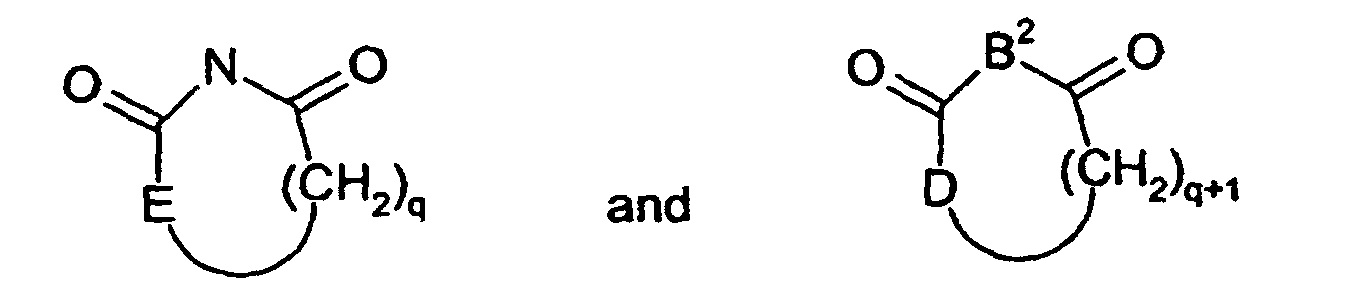
- A compound according to claim 1, wherein Q is a carbonyl group.
- A compound according to claim 1, wherein B is ethylene, A is CH and G is NHCH2.
- A compound according to claim 1, wherein B is ethylene, A is CH and G is SCH2.
- A compound according to claim 1, wherein B is absent, G is NH and A is CH2.
- A compound according to claim 1, wherein W is ethylene.
- A compound according to claim 1, wherein R4 is phenyl.
- A compound according to claim 1, wherein R4 is phenyl and R8 is hydrogen.
- A compound according to claim 1, wherein p is one.
- A compound according to claim 1, wherein R2 is (C1-C6)alkyl.
- A compound according to claim 1, wherein R4 is 2-, 3- or 4-pyridyl.
- A compound according to claim 1, wherein R2 and R12 are selected, independently, from methyl and ethyl.
- A compound according to claim 1, wherein Y is CH and Z is nitrogen.
- A compound according to claim 1, wherein Y is nitrogen and Z is CH.
- A compound according to claim 1, wherein Q is C=S.
- A compound that is selected from isomers and mixtures of isomers of the following compounds, wherein said isomers or mixtures of isomers have the stereochemistry depicted in structural formula (I):and pharmaceutically acceptable salts thereof.6-Methoxy-1-methyl-7-[(2-phenyl-piperidin-3-ylamino)-methyl]-3,4-dihydro-1H-[1,5]naphthyridin-2-one;6-Methoxy-1-methyl-7-[(6-methyl-2-phenyl-piperidin-3-ylamino)-methyl]-3,4-dihydro-1H-[1,5]naphthyridin-2-one;7-[(6-Ethyl-2-phenyl-piperidin-3-ylamino)-methyl]-6-methoxy-1-methyl-3,4-dihydro-1H-[1,5]naphthyridin-2-one;6-Methoxy-1-methyl-7-[(2-phenyl-6-propyl-piperidin-3-ylamino)-methyl]-3,4-dihydro-1H-[1,5]naphthyridin-2-one;7-[((2S,3S,6S)-6-isopropyl-2-phenyl-piperidin-3-ylamino)-methyl]-6-methoxy-1-methyl-3,4-dihydro-1H-[1,5]naphthyridin-2-one;
- A compound of formula (I) as defined in claim 1 for use as a medicament.
- Use of a compound of formula (I) as defined in claim 1 in the manufacture of a medicament for the treatment or prevention of a disorder or condition selected from the group consisting of mood disorders, such as depression, or more particularly, depressive disorders, for example, single episodic or recurrent major depressive disorders, dysthymic disorders, depressive neurosis and neurotic depression, melancholic depression, including anorexia, weight loss, insomnia, early morning waking and psychomotor retardation, atypical depression (or reactive depression), including increased appetite, hypersomnia, psychomotor agitation or irritability, seasonal affective disorder and pediatric depression; or bipolar disorders or manic depression, for example, bipolar I disorder, bipolar II disorder and cyclothymic disorder; conduct disorder and disruptive behavior disorder; anxiety disorders, such as panic disorder with or without agoraphobia, agoraphobia without history of panic disorder, specific phobias, for example, specific animal phobias, social anxiety, social phobias, obsessive-compulsive disorder, stress disorders, including post-traumatic stress disorder and acute stress disorder, and generalized anxiety disorders; borderline personality disorder; schizophrenia and other psychotic disorders, for example, schizophreniform disorders, schizoaffective disorders, delusional disorders, brief psychotic disorders, shared psychotic disorders, psychotic disorders with delusions or hallucinations, psychotic episodes of anxiety, anxiety associated with psychosis, psychotic mood disorders such as severe major depressive disorder; mood disorders associated with psychotic disorders such as acute mania and depression associated with bipolar disorder, mood disorders associated with schizophrenia; behavioral disturbances associated with mental retardation, autistic disorder, and conduct disorder.
- Use of a compound of formula (I) as defined in claim 1 in the manufacture of a medicament for the treatment or prevention of a disorder or condition selected from the group consisting of delerium, dementia, and amnestic and other cognitive or neurodegenerative disorders, such as Parkinson's disease (PD), Huntington's disease (HD), Alzheimer's disease, senile dementia, dementia of the Alzheimer's type, memory disorder, vascular dementia, and other dementias, for example, due to HIV disease, head trauma, Parkinson's disease, Huntington's disease, Pick's disease, Creutzfeldt-Jakob disease, or due to multiple aetiologies; movement disorders such as akinesias, dyskinesias, including familial paroxysmal dyskinesias, spasticities, Tourette's syndrome, Scott syndrome, PALSYS and akinetic-rigid syndrome; extra-pyramidal movement disorders such as medication-induced movement disorders, for example, neuroteptic-induced Parkinsonism, neuroleptic malignant syndrome, neuroleptic-induced acute dystonia, neuroteptic-induced acute akathisia, neurofeptic-induced tardive dyskinesia and medication-induced postural tremour; substance-related disorders arising from the use of alcohol, amphetamines (or amphetamine-like substances) caffeine, cannabis, cocaine, hallucinogens, inhalants and aerosol propellants, nicotine, opioids, phenylglycidine derivatives, sedatives, hypnotics, and anxiolytics, which substance-related disorders include dependence and abuse, intoxication, withdrawal, intoxication delerium and withdrawal delerium; addictive behaviors such as gambling; epilepsy; Down's syndrome; acute pain, chronic pain and migraine; demyelinating diseases such as multiple sclerosis (MS) and amylolateral sclerosis (ALS), peripheral neuropathy, for example diabetic and chemotherapy-induced-neuropathy, and postherpetic neuralgia, trigeminal neuralgia, segmental or intercostal neuralgia and other neuralgias; and cerebral vascular disorders due to acute or chronic cerebrovascular damage such as cerebral infarction, subarachnoid haemorrhage or cerebral oedema.
- Use of a compound of formula (I) as defined in claim 1 in the manufacture of a medicament for the treatment or prevention of a disorder or condition selected from the group consisting of respiratory diseases, particularly those associated with excess mucus secretion, such as chronic obstructive airways disease, bronchopneumonia, chronic bronchitis, cystic fibrosis, adult respiratory distress syndrome, and bronchospasm; inflammatory diseases such as inflammatory bowel disease, psoriasis, Reiter's syndrome, Raynaud's syndrome, anthropathies, fibrositis, osteoarthritis, rheumatoid arthritis, psoriatic arthritis, asthma, pruritis and sunburn; human immunodeficiency virus (HIV) infections; allergies such as eczema and rhinitis, and other allergies; hypersensitivity disorders such as poison ivy; ophthalmic diseases such as conjunctivitis, vernal conjunctivitis, and the like; ophthalmic conditions associated with cell proliferation such as proliferative vitreoretinopathy; cutaneous diseases such as contact dermatitis, atopic dermatitis, urticaria, and other eczematoid dermatitis.
- Use of a compound of formula (I) as defined in claim 1 in the manufacture of a medicament for the treatment or prevention of a disorder or condition selected from the group consisting of neoplasms, including breast tumours, gastric carcinomas, gastric lymphomas, neuroganglioblastomas and small cell carcinomas such as small cell lung cancer.
- Use of a compound of formula (I) as defined in claim 1 in the manufacture of a medicament for the treatment or prevention of a disorder or condition selected from the group consisting of gastrointestinal (GI) disorders, including inflammatory gastrointestinal disorders such as inflammation bowel disease disorders, caused by helicobacter pylori and diseases of the GI tract such as gastritis, gastroduodenal ulcers, disorders associated with the neuronal control of viscera, ulcerative colitis, Crohn's disease, irritable bowel syndrome and emesis.
- Use of a compound of formula (I) as defined in claim 1 in the manufacture of a medicament for the treatment or prevention of a disorder or condition selected from the group consisting of stress related somatic disorders; reflex sympathetic dystrophy such as shoulder/hand syndrome; adverse immunological reactions such as rejection of transplanted tissues and disorders related to immune enhancement or suppression such as systemic lupus erythematosus; plasma extravasation resulting from cytokine chemotherapy; disorders of bladder function such as cystitis, bladder detrusor hyper-reflexia, inflammation of the urinary tract and incontinence, including urinary urge incontinence, overactive bladder, stress incontinence and mixed incontinence; fibrosing and collagen diseases such as scleroderma and eosinophilic fascioliasis; blood flow disorders caused by vasodilation and vasospastic diseases such as angina and Reynaud's disease; angiogenesis; cardiovascular disorders; eating disorders, such as anorexia nervosa and bulimia nervosa; attention deficit hyperactivity disorder; chronic fatigue syndrome; sexual dysfunctions including premature ejaculation and male erectile dysfunction; premenstrual syndrome and premenstrual dysphoric disorder, fibromyalgia; and rheumatic diseases such as fibrositis.
- A pharmaceutical composition comprising a compound according to claim 1 and a pharmaceutically acceptable carrier.
- A compound of the formula
 or a pharmaceutically acceptable salt thereof.wherein Q is C=S or C=O;Y is N and Z is CH, or Y is CH and Z is N;W is a one carbon linking group (i.e., methylene) or a saturated or unsaturated two or three carbon linking group, wherein each of the foregoing W groups can optionally be substituted with one substituent R7 or two substituents R7 and R6, or W is a one carbon linking group that forms, together with a 2, 3, 4 or 5 carbon chain, a 3, 4, 5 or 6 membered spiro ring, respectively;or W is a saturated two carbon chain linking group that forms, together with a separate 1, 2 or 3 carbon chain, a fused 3, 4 or 5 membered ring, respectively;or W is a saturated two carbon chain linking group, wherein one of the two carbons in the chain forms, together with a separate 2, 3, 4 or 5 carbon chain, a 3, 4, 5 or 6 membered spiro ring, respectively;R5 is selected from hydrogen, -SO(C1-C8)alkyl, -SO2-(C1-C6)alkyl, -SO-aryl, - SO2-aryl, CF3, halo, phenyl, phenyl-(C1-C2)alkyl, hydroxy, aryloxy, heteroaryloxy, pyridyl, tetrazolyl, oxazolyl, thiazolyl, (C1-C6)alkoxy optionally substituted with from one to seven fluorine atoms, preferably with from zero to three fluorine atoms, (C1-C6)alkyl optionally substituted with from one to seven fluorine atoms, preferably with from zero to three fluorine atoms, and (C1-C6)alkyl substituted with one or more substituents, preferably with from zero to two substituents selected, independently, from hydroxy, oxo, (C1-C6)alkoxy, phenyl-(C1-C3)alkoxy, phenyl, cyano, chloro, bromo, iodo, NR9R10, NR9COR10, NR9CO2R10, CONR9R10, COR9 and CO2R9;R6 and R7 are selected, independently, from -SO(C1-C6)alkyl, -SO2-(C1-C 6)alkyl, -SO-aryl, -SO2-aryl, CF3, halo, phenyl, phenyl-(C1-C2)alkyl, hydroxy, aryloxy, heteroaryloxy, pyridyl, tetrazolyl, oxazolyl, thiazolyl, (C1-C6)alkoxy optionally substituted with from one to seven fluorine atoms, preferably with from zero to three fluorine atoms, (C1-C6)alkyl optionally substituted with from one to seven fluorine atoms, preferably with from zero to three fluorine atoms, and (C1-C6)alkyl substituted with one or more substituents, preferably with from zero to two substituents selected, independently, from hydroxy, oxo, (C1-C6)alkoxy, phenyl-(C1-C3)alkoxy, phenyl, cyano, chloro, bromo, iodo, NR9R10, NR9COR10, NR9CO2R10, CONR9R10, COR9 and CO2R9;R8 is selected from hydrogen, -SO(C1-C6)alkyl, -SO2-(C1-C6)alkyl, -SO-aryl, - SO2-aryl, CF3, phenyl, phenyl-(C1-C2)alkyl, pyridyl, tetrazolyl, oxazolyl, thiazolyl, and (C1-C6)alkyl substituted with one or more substituents preferably from zero to two substituents selected, independently from hydroxy, oxo, (C1-C6)alkoxy, phenyl-(C1-C3)alkoxy, phenyl, cyano, chloro, bromo, iodo, NR9R10, NR9COR10, NR9CO2R10, CONR9R10, COR9 and CO2R9;each R9 and each R10 is selected, independently, from hydrogen, (C1-C6)alkyl, hydroxy(C1-C6)alkyl, phenyl and CF3;and wherein the phenyl groups in the definition of R5, R6, R7 and R8 and the phenyl moiety of phenyl (C1-C2)alkyl in the definition of R5, R6, R7 and R8 can optionally be substituted with one or more substituents, preferably with from zero to two substituents, that are selected, independently, from halo, hydroxy, (C1-C6)alkoxy optionally substituted with from one to seven fluorine atoms, preferably with from zero to three fluorine atoms, and (C1-C6)alkyl optionally substituted with from one to seven fluorine atoms, preferably with from zero to three fluorine atoms; andR14 is hydrogen, (C1-C6)alkyl or CF3;
 - A compound according to claim 26, selected from the group consisting of: 3-Methoxy-8-methyl-7-oxo-5,6,7,8-tetrahydro-[1,8]naphthyridine-2-carbaldehyde; 2-Methoxy-5-methyl-6-oxo-5,6,7,8-tetrahydro-[1,5]naphthyridine-3-carbaldehyde; and pharmaceutically acceptable salts thereof.
Applications Claiming Priority (5)
| Application Number | Priority Date | Filing Date | Title |
|---|---|---|---|
| US19592200P | 2000-04-10 | 2000-04-10 | |
| US195922P | 2000-04-10 | ||
| US21292200P | 2000-06-20 | 2000-06-20 | |
| US212922P | 2000-06-20 | ||
| PCT/IB2001/000629 WO2001077100A2 (en) | 2000-04-10 | 2001-04-06 | Benzoamide piperidine compounds as substance p antagonists |
Publications (2)
| Publication Number | Publication Date |
|---|---|
| EP1272484A2 EP1272484A2 (en) | 2003-01-08 |
| EP1272484B1 true EP1272484B1 (en) | 2005-07-20 |
Family
ID=26891472
Family Applications (1)
| Application Number | Title | Priority Date | Filing Date |
|---|---|---|---|
| EP01919702A Expired - Lifetime EP1272484B1 (en) | 2000-04-10 | 2001-04-06 | Benzoamide piperidine compounds as substance p antagonists |
Country Status (32)
| Country | Link |
|---|---|
| EP (1) | EP1272484B1 (en) |
| JP (1) | JP4001486B2 (en) |
| KR (1) | KR20020087134A (en) |
| CN (1) | CN1432011A (en) |
| AP (1) | AP2002002647A0 (en) |
| AR (2) | AR033976A1 (en) |
| AT (1) | ATE299875T1 (en) |
| AU (1) | AU2001246761A1 (en) |
| BG (1) | BG107135A (en) |
| BR (1) | BR0109936A (en) |
| CA (1) | CA2405089A1 (en) |
| CZ (1) | CZ20023213A3 (en) |
| DE (1) | DE60112064T2 (en) |
| EA (1) | EA005409B1 (en) |
| EE (1) | EE200200588A (en) |
| ES (1) | ES2244599T3 (en) |
| HR (1) | HRP20020808A2 (en) |
| HU (1) | HUP0300413A2 (en) |
| IL (1) | IL152209A0 (en) |
| IS (1) | IS6561A (en) |
| MA (1) | MA26891A1 (en) |
| MX (1) | MXPA02010029A (en) |
| NO (1) | NO20024874L (en) |
| NZ (1) | NZ521346A (en) |
| OA (1) | OA12245A (en) |
| PA (1) | PA8515101A1 (en) |
| PE (1) | PE20011311A1 (en) |
| PL (1) | PL358623A1 (en) |
| SK (1) | SK13942002A3 (en) |
| UY (1) | UY26662A1 (en) |
| WO (1) | WO2001077100A2 (en) |
| YU (1) | YU73902A (en) |
Cited By (1)
| Publication number | Priority date | Publication date | Assignee | Title |
|---|---|---|---|---|
| US10154988B2 (en) | 2012-11-14 | 2018-12-18 | The Johns Hopkins University | Methods and compositions for treating schizophrenia |
Families Citing this family (42)
| Publication number | Priority date | Publication date | Assignee | Title |
|---|---|---|---|---|
| GB0109871D0 (en) * | 2001-04-20 | 2001-06-13 | Glaxo Group Ltd | Metering method for particulate material |
| US20040171836A1 (en) * | 2001-12-21 | 2004-09-02 | Toshihiro Fujino | Method for producing optical-active cis-piperidine derivatives |
| US20040006135A1 (en) * | 2002-06-19 | 2004-01-08 | Pfizer Inc. | Combination treatment for depression and anxiety |
| KR20050012831A (en) | 2002-06-25 | 2005-02-02 | 와이어쓰 | Use of thio-oxindole derivatives in treatment of skin disorders |
| US7268149B2 (en) | 2002-06-25 | 2007-09-11 | Wyeth | Cyclothiocarbamate derivatives as progesterone receptor modulators and methods of treating skin disorders |
| JP2006503858A (en) * | 2002-10-04 | 2006-02-02 | メルク シャープ エンド ドーム リミテッド | Azabicyclic amine derivatives as NK-1 receptor antagonists |
| US7205328B2 (en) | 2002-10-21 | 2007-04-17 | Irm Llc | Oxindoles with anti-HIV activity |
| US6911544B2 (en) | 2002-10-23 | 2005-06-28 | Pfizer Inc. | Process for the preparation of (S,S)-cis-2-phenyl-3-aminopiperidine |
| US7022605B2 (en) * | 2002-11-12 | 2006-04-04 | Micron Technology, Inc. | Atomic layer deposition methods |
| CN1705636A (en) * | 2002-11-12 | 2005-12-07 | 辉瑞产品公司 | Process for converting a cis-trans mixture of substituted benzylidene amines into the pure cis isomer |
| AU2003902882A0 (en) * | 2003-06-10 | 2003-06-26 | Fujisawa Pharmaceutical Co., Ltd. | Piperidyl derivatives |
| ES2246687B2 (en) | 2004-02-11 | 2006-11-16 | Miguel Muñoz Saez | USE OF NON-PEPTIDIC ANTAGONISTS OF NK1 RECEPTORS FOR THE PRODUCTION OF APOPTOSIS IN TUMOR CELLS. |
| JP2008510711A (en) * | 2004-08-20 | 2008-04-10 | ターガセプト,インコーポレイテッド | Use of N-aryl diazaspira cyclic compounds in the treatment of addiction |
| TW200800959A (en) | 2005-06-10 | 2008-01-01 | Wyeth Corp | Piperazine-piperidine antagonists and agonists of the 5-HT1a receptor |
| US20060281670A1 (en) * | 2005-06-10 | 2006-12-14 | Wisconsin Alumni Research Foundation (Warf) | Compositions and methods for modulating angiogenesis |
| US20070135380A1 (en) | 2005-08-12 | 2007-06-14 | Radiorx, Inc. | O-nitro compounds, pharmaceutical compositions thereof and uses thereof |
| US7507842B2 (en) | 2005-08-12 | 2009-03-24 | Radiorx, Inc. | Cyclic nitro compounds, pharmaceutical compositions thereof and uses thereof |
| DE102006033114A1 (en) | 2006-07-18 | 2008-01-24 | Grünenthal GmbH | Spirocyclic azaindole derivatives |
| TW200901974A (en) | 2007-01-16 | 2009-01-16 | Wyeth Corp | Compounds, compositions, and methods of making and using them |
| EP2117538A1 (en) | 2007-01-24 | 2009-11-18 | Glaxo Group Limited | Pharmaceutical compositions comprising 2-methoxy-5- (5-trifluoromethyl-tetrazol-i-yl-benzyl) - (2s-phenyl-piperidin-3s-yl-) |
| US8471041B2 (en) | 2010-02-09 | 2013-06-25 | Alliant Techsystems Inc. | Methods of synthesizing and isolating N-(bromoacetyl)-3,3-dinitroazetidine and a composition including the same |
| PT2593452T (en) | 2010-07-14 | 2017-04-24 | Novartis Ag | HETEROCYCLICAL COMPOUNDS OF THE IP RECEIVER |
| ES2376564B1 (en) | 2010-08-12 | 2013-01-24 | Manuel Vicente Salinas Martín | USE OF ANTIBODIES AGAINST NK1, NK2 AND / OR NK3 RECEPTORS, TO PRODUCE APOPTOSIS IN TUMOR CELLS AND TO MODIFY STRAMA, IMMUNITY AND INTRA AND PERITUMORAL VASCULARIZATION, AS TREATMENT OF CANCER. |
| US8664247B2 (en) | 2011-08-26 | 2014-03-04 | Radiorx, Inc. | Acyclic organonitro compounds for use in treating cancer |
| US20140308260A1 (en) | 2011-10-07 | 2014-10-16 | Radiorx, Inc. | Methods and compositions comprising a nitrite-reductase promoter for treatment of medical disorders and preservation of blood products |
| US9139519B2 (en) | 2011-10-07 | 2015-09-22 | Epicentrx, Inc. | Organonitro thioether compounds and medical uses thereof |
| US20150297613A1 (en) | 2011-12-13 | 2015-10-22 | Servicio Andaluz De Salud | Use of agents that alter the peritumoral environment for the treatment of cancer |
| RU2506077C1 (en) * | 2013-01-25 | 2014-02-10 | Общество С Ограниченной Ответственностью "Валента-Интеллект" | Combination for prevention, correction and therapy of pain related to neurodegeneration or associated with somatoform disorders |
| ES2493693B1 (en) | 2013-02-11 | 2015-07-07 | Servicio Andaluz De Salud | Method to predict or predict the response of a human subject suffering from cancer to treatment with an NK1 receptor antagonist |
| CN105189500A (en) | 2013-02-13 | 2015-12-23 | 诺华股份有限公司 | IP receptor agonist heterocyclic compounds |
| ES2541870B1 (en) | 2013-12-27 | 2016-05-12 | Servicio Andaluz De Salud | Use of NK1 non-peptide antagonists in a given dose for cancer treatment |
| WO2016105448A1 (en) * | 2014-12-22 | 2016-06-30 | Darryl Rideout | Imidazoline receptor type 1 ligands for use as therapeutics |
| US10342778B1 (en) | 2015-10-20 | 2019-07-09 | Epicentrx, Inc. | Treatment of brain metastases using organonitro compound combination therapy |
| US9987270B1 (en) | 2015-10-29 | 2018-06-05 | Epicentrix, Inc. | Treatment of gliomas using organonitro compound combination therapy |
| CN109069420A (en) | 2016-01-11 | 2018-12-21 | 埃皮辛特瑞柯斯公司 | Compositions and methods for intravenous administration of 2-bromo-1-(3,3-dinitroazetidin-1-yl)ethanone |
| RU2643091C2 (en) * | 2016-04-08 | 2018-01-31 | Федеральное государственное бюджетное научное учреждение "Научно-исследовательский институт фармакологии имени В.В. Закусова" | 4-benzoylpyridine oxime derivatives having anticonvulsant activity as agents for treatment of epilepsy and paroxysmal states |
| CN110352190A (en) | 2016-10-14 | 2019-10-18 | 埃皮辛特瑞柯斯公司 | Sulphur oxygroup alkyl Organic nitro and related compound and pharmaceutical composition for medical application |
| US11744859B2 (en) | 2017-07-07 | 2023-09-05 | Epicentrx, Inc. | Compositions and methods for parenteral administration of therapeutic agents |
| US11510901B2 (en) | 2018-01-08 | 2022-11-29 | Epicentrx, Inc. | Methods and compositions utilizing RRx-001 combination therapy for radioprotection |
| EP4199925A4 (en) | 2020-08-18 | 2024-08-28 | Merck Sharp & Dohme LLC | CYCLOPENTAPYRROLOREXIN RECEPTOR AGONISTS |
| TW202325292A (en) * | 2021-11-18 | 2023-07-01 | 大陸商武漢人福創新藥物研發中心有限公司 | 15-PGDH inhibitor and use thereof |
| AU2023235233A1 (en) | 2022-03-14 | 2024-09-12 | Slap Pharmaceuticals Llc | Multicyclic compounds |
Family Cites Families (8)
| Publication number | Priority date | Publication date | Assignee | Title |
|---|---|---|---|---|
| US3539584A (en) * | 1967-11-14 | 1970-11-10 | Colgate Palmolive Co | 5-substituted-2,1-benzisothiazolines |
| US4581356A (en) * | 1983-03-22 | 1986-04-08 | Fujisawa Pharmaceutical Co., Ltd. | Triazine derivatives, and pharmaceutical compositions comprising the same |
| HUT68667A (en) * | 1990-09-28 | 1995-07-28 | Pfizer | Fused ring analogs of nitrogen containing nonaromatic heterocycles |
| TW202432B (en) * | 1991-06-21 | 1993-03-21 | Pfizer | |
| MX9800187A (en) * | 1995-07-07 | 1998-05-31 | Pfizer | Substituted benzolactam compounds as substance p antagonists. |
| TWI220143B (en) * | 1998-05-13 | 2004-08-11 | Solvay Pharm Gmbh | Method for stereochemically controlled production of isomerically pure highly substituted azacyclic compounds and novel cyclic compounds, and intermediate products |
| WO2000073312A1 (en) * | 1999-05-26 | 2000-12-07 | Astrazeneca Ab | Compounds |
| SE9901901D0 (en) * | 1999-05-26 | 1999-05-26 | Astra Ab | Compounds |
-
2001
- 2001-04-06 HU HU0300413A patent/HUP0300413A2/en unknown
- 2001-04-06 EA EA200200963A patent/EA005409B1/en not_active IP Right Cessation
- 2001-04-06 ES ES01919702T patent/ES2244599T3/en not_active Expired - Lifetime
- 2001-04-06 SK SK1394-2002A patent/SK13942002A3/en not_active Application Discontinuation
- 2001-04-06 EP EP01919702A patent/EP1272484B1/en not_active Expired - Lifetime
- 2001-04-06 AP APAP/P/2002/002647A patent/AP2002002647A0/en unknown
- 2001-04-06 KR KR1020027013582A patent/KR20020087134A/en not_active Ceased
- 2001-04-06 CZ CZ20023213A patent/CZ20023213A3/en unknown
- 2001-04-06 YU YU73902A patent/YU73902A/en unknown
- 2001-04-06 NZ NZ521346A patent/NZ521346A/en unknown
- 2001-04-06 HR HRP20020808 patent/HRP20020808A2/en not_active Application Discontinuation
- 2001-04-06 BR BR0109936-1A patent/BR0109936A/en not_active IP Right Cessation
- 2001-04-06 PL PL01358623A patent/PL358623A1/en not_active Application Discontinuation
- 2001-04-06 EE EEP200200588A patent/EE200200588A/en unknown
- 2001-04-06 AU AU2001246761A patent/AU2001246761A1/en not_active Abandoned
- 2001-04-06 CN CN01807882A patent/CN1432011A/en active Pending
- 2001-04-06 DE DE60112064T patent/DE60112064T2/en not_active Expired - Fee Related
- 2001-04-06 AT AT01919702T patent/ATE299875T1/en not_active IP Right Cessation
- 2001-04-06 CA CA002405089A patent/CA2405089A1/en not_active Abandoned
- 2001-04-06 MX MXPA02010029A patent/MXPA02010029A/en active IP Right Grant
- 2001-04-06 JP JP2001575573A patent/JP4001486B2/en not_active Expired - Fee Related
- 2001-04-06 IL IL15220901A patent/IL152209A0/en unknown
- 2001-04-06 OA OA1200200312A patent/OA12245A/en unknown
- 2001-04-06 WO PCT/IB2001/000629 patent/WO2001077100A2/en not_active Ceased
- 2001-04-09 AR ARP010101678A patent/AR033976A1/en unknown
- 2001-04-10 PE PE2001000329A patent/PE20011311A1/en not_active Application Discontinuation
- 2001-04-10 PA PA20018515101A patent/PA8515101A1/en unknown
- 2001-04-10 UY UY26662A patent/UY26662A1/en not_active Application Discontinuation
-
2002
- 2002-09-20 IS IS6561A patent/IS6561A/en unknown
- 2002-09-23 BG BG107135A patent/BG107135A/en unknown
- 2002-10-02 MA MA26848A patent/MA26891A1/en unknown
- 2002-10-09 NO NO20024874A patent/NO20024874L/en not_active Application Discontinuation
-
2003
- 2003-06-26 AR ARP030102296A patent/AR040346A2/en unknown
Cited By (2)
| Publication number | Priority date | Publication date | Assignee | Title |
|---|---|---|---|---|
| US10154988B2 (en) | 2012-11-14 | 2018-12-18 | The Johns Hopkins University | Methods and compositions for treating schizophrenia |
| EP3610890A1 (en) | 2012-11-14 | 2020-02-19 | The Johns Hopkins University | Methods and compositions for treating schizophrenia |
Also Published As
Similar Documents
| Publication | Publication Date | Title |
|---|---|---|
| EP1272484B1 (en) | Benzoamide piperidine compounds as substance p antagonists | |
| US6136824A (en) | 1-piperidinyl-propan-2-derivatives and their use as therapeutic agents | |
| EP0929554B1 (en) | Spiro-azacyclic derivatives, their preparation and their use as tachykinin antagonists | |
| US6458830B1 (en) | Tetrahydropyran derivatives and their use as therapeutic agents | |
| US7468437B2 (en) | Phenyl pyrrolidine ether tachykinin receptor antagonists | |
| US6225320B1 (en) | Spiro-azacyclic derivatives and their use as therapeutic agents | |
| US7119207B2 (en) | Benzoamide piperidine containing compounds and related compounds | |
| EP1322596B1 (en) | Zwitterionic tachykinin receptor antagonists | |
| US20020035132A1 (en) | Tetrahydropyran derivatives and their use as therapeutic agents | |
| US6727244B2 (en) | Mammalian metabolites of a tachykinin receptor antagonist | |
| US6372754B1 (en) | Spirocyclic ketones and their use as tachykinin antagonists | |
| WO2000068224A1 (en) | Substituted benzolactam compounds |
Legal Events
| Date | Code | Title | Description |
|---|---|---|---|
| PUAI | Public reference made under article 153(3) epc to a published international application that has entered the european phase |
Free format text: ORIGINAL CODE: 0009012 |
|
| 17P | Request for examination filed |
Effective date: 20021009 |
|
| AK | Designated contracting states |
Kind code of ref document: A2 Designated state(s): AT BE CH CY DE DK ES FI FR GB GR IE IT LI LU MC NL PT SE TR |
|
| AX | Request for extension of the european patent |
Free format text: AL PAYMENT 20021009;LT PAYMENT 20021009;LV PAYMENT 20021009;MK PAYMENT 20021009;RO PAYMENT 20021009;SI PAYMENT 20021009 |
|
| 17Q | First examination report despatched |
Effective date: 20030331 |
|
| GRAP | Despatch of communication of intention to grant a patent |
Free format text: ORIGINAL CODE: EPIDOSNIGR1 |
|
| GRAS | Grant fee paid |
Free format text: ORIGINAL CODE: EPIDOSNIGR3 |
|
| GRAA | (expected) grant |
Free format text: ORIGINAL CODE: 0009210 |
|
| AK | Designated contracting states |
Kind code of ref document: B1 Designated state(s): AT BE CH CY DE DK ES FI FR GB GR IE IT LI LU MC NL PT SE TR |
|
| AX | Request for extension of the european patent |
Extension state: AL LT LV MK RO SI |
|
| PG25 | Lapsed in a contracting state [announced via postgrant information from national office to epo] |
Ref country code: FI Free format text: LAPSE BECAUSE OF FAILURE TO SUBMIT A TRANSLATION OF THE DESCRIPTION OR TO PAY THE FEE WITHIN THE PRESCRIBED TIME-LIMIT Effective date: 20050720 Ref country code: AT Free format text: LAPSE BECAUSE OF FAILURE TO SUBMIT A TRANSLATION OF THE DESCRIPTION OR TO PAY THE FEE WITHIN THE PRESCRIBED TIME-LIMIT Effective date: 20050720 Ref country code: LI Free format text: LAPSE BECAUSE OF FAILURE TO SUBMIT A TRANSLATION OF THE DESCRIPTION OR TO PAY THE FEE WITHIN THE PRESCRIBED TIME-LIMIT Effective date: 20050720 Ref country code: TR Free format text: LAPSE BECAUSE OF FAILURE TO SUBMIT A TRANSLATION OF THE DESCRIPTION OR TO PAY THE FEE WITHIN THE PRESCRIBED TIME-LIMIT Effective date: 20050720 Ref country code: CH Free format text: LAPSE BECAUSE OF FAILURE TO SUBMIT A TRANSLATION OF THE DESCRIPTION OR TO PAY THE FEE WITHIN THE PRESCRIBED TIME-LIMIT Effective date: 20050720 Ref country code: BE Free format text: LAPSE BECAUSE OF FAILURE TO SUBMIT A TRANSLATION OF THE DESCRIPTION OR TO PAY THE FEE WITHIN THE PRESCRIBED TIME-LIMIT Effective date: 20050720 Ref country code: NL Free format text: LAPSE BECAUSE OF FAILURE TO SUBMIT A TRANSLATION OF THE DESCRIPTION OR TO PAY THE FEE WITHIN THE PRESCRIBED TIME-LIMIT Effective date: 20050720 |
|
| REG | Reference to a national code |
Ref country code: GB Ref legal event code: FG4D |
|
| REG | Reference to a national code |
Ref country code: CH Ref legal event code: EP |
|
| REG | Reference to a national code |
Ref country code: IE Ref legal event code: FG4D |
|
| REF | Corresponds to: |
Ref document number: 60112064 Country of ref document: DE Date of ref document: 20050825 Kind code of ref document: P |
|
| PG25 | Lapsed in a contracting state [announced via postgrant information from national office to epo] |
Ref country code: GR Free format text: LAPSE BECAUSE OF FAILURE TO SUBMIT A TRANSLATION OF THE DESCRIPTION OR TO PAY THE FEE WITHIN THE PRESCRIBED TIME-LIMIT Effective date: 20051020 Ref country code: DK Free format text: LAPSE BECAUSE OF FAILURE TO SUBMIT A TRANSLATION OF THE DESCRIPTION OR TO PAY THE FEE WITHIN THE PRESCRIBED TIME-LIMIT Effective date: 20051020 Ref country code: SE Free format text: LAPSE BECAUSE OF FAILURE TO SUBMIT A TRANSLATION OF THE DESCRIPTION OR TO PAY THE FEE WITHIN THE PRESCRIBED TIME-LIMIT Effective date: 20051020 |
|
| REG | Reference to a national code |
Ref country code: ES Ref legal event code: FG2A Ref document number: 2244599 Country of ref document: ES Kind code of ref document: T3 |
|
| PG25 | Lapsed in a contracting state [announced via postgrant information from national office to epo] |
Ref country code: PT Free format text: LAPSE BECAUSE OF FAILURE TO SUBMIT A TRANSLATION OF THE DESCRIPTION OR TO PAY THE FEE WITHIN THE PRESCRIBED TIME-LIMIT Effective date: 20051221 |
|
| LTIE | Lt: invalidation of european patent or patent extension |
Effective date: 20050720 |
|
| REG | Reference to a national code |
Ref country code: CH Ref legal event code: PL |
|
| NLV1 | Nl: lapsed or annulled due to failure to fulfill the requirements of art. 29p and 29m of the patents act | ||
| ET | Fr: translation filed | ||
| PG25 | Lapsed in a contracting state [announced via postgrant information from national office to epo] |
Ref country code: MC Free format text: LAPSE BECAUSE OF NON-PAYMENT OF DUE FEES Effective date: 20060430 |
|
| PLBE | No opposition filed within time limit |
Free format text: ORIGINAL CODE: 0009261 |
|
| STAA | Information on the status of an ep patent application or granted ep patent |
Free format text: STATUS: NO OPPOSITION FILED WITHIN TIME LIMIT |
|
| 26N | No opposition filed |
Effective date: 20060421 |
|
| PGFP | Annual fee paid to national office [announced via postgrant information from national office to epo] |
Ref country code: GB Payment date: 20080317 Year of fee payment: 8 |
|
| PG25 | Lapsed in a contracting state [announced via postgrant information from national office to epo] |
Ref country code: LU Free format text: LAPSE BECAUSE OF NON-PAYMENT OF DUE FEES Effective date: 20060406 |
|
| PGFP | Annual fee paid to national office [announced via postgrant information from national office to epo] |
Ref country code: DE Payment date: 20080430 Year of fee payment: 8 Ref country code: ES Payment date: 20080414 Year of fee payment: 8 |
|
| PGFP | Annual fee paid to national office [announced via postgrant information from national office to epo] |
Ref country code: IT Payment date: 20080418 Year of fee payment: 8 |
|
| PGFP | Annual fee paid to national office [announced via postgrant information from national office to epo] |
Ref country code: IE Payment date: 20080424 Year of fee payment: 8 |
|
| PG25 | Lapsed in a contracting state [announced via postgrant information from national office to epo] |
Ref country code: CY Free format text: LAPSE BECAUSE OF FAILURE TO SUBMIT A TRANSLATION OF THE DESCRIPTION OR TO PAY THE FEE WITHIN THE PRESCRIBED TIME-LIMIT Effective date: 20050720 |
|
| PGFP | Annual fee paid to national office [announced via postgrant information from national office to epo] |
Ref country code: FR Payment date: 20080403 Year of fee payment: 8 |
|
| GBPC | Gb: european patent ceased through non-payment of renewal fee |
Effective date: 20090406 |
|
| REG | Reference to a national code |
Ref country code: FR Ref legal event code: ST Effective date: 20091231 |
|
| PG25 | Lapsed in a contracting state [announced via postgrant information from national office to epo] |
Ref country code: DE Free format text: LAPSE BECAUSE OF NON-PAYMENT OF DUE FEES Effective date: 20091103 |
|
| REG | Reference to a national code |
Ref country code: IE Ref legal event code: MM4A |
|
| PG25 | Lapsed in a contracting state [announced via postgrant information from national office to epo] |
Ref country code: IE Free format text: LAPSE BECAUSE OF NON-PAYMENT OF DUE FEES Effective date: 20090406 Ref country code: FR Free format text: LAPSE BECAUSE OF NON-PAYMENT OF DUE FEES Effective date: 20091222 Ref country code: GB Free format text: LAPSE BECAUSE OF NON-PAYMENT OF DUE FEES Effective date: 20090406 |
|
| REG | Reference to a national code |
Ref country code: ES Ref legal event code: FD2A Effective date: 20090407 |
|
| PG25 | Lapsed in a contracting state [announced via postgrant information from national office to epo] |
Ref country code: ES Free format text: LAPSE BECAUSE OF NON-PAYMENT OF DUE FEES Effective date: 20090407 |
|
| PG25 | Lapsed in a contracting state [announced via postgrant information from national office to epo] |
Ref country code: IT Free format text: LAPSE BECAUSE OF NON-PAYMENT OF DUE FEES Effective date: 20090406 |