EP1271958A2 - A method for authenticating animation - Google Patents
A method for authenticating animation Download PDFInfo
- Publication number
- EP1271958A2 EP1271958A2 EP02077247A EP02077247A EP1271958A2 EP 1271958 A2 EP1271958 A2 EP 1271958A2 EP 02077247 A EP02077247 A EP 02077247A EP 02077247 A EP02077247 A EP 02077247A EP 1271958 A2 EP1271958 A2 EP 1271958A2
- Authority
- EP
- European Patent Office
- Prior art keywords
- data
- wire mesh
- animation
- movement
- texture
- Prior art date
- Legal status (The legal status is an assumption and is not a legal conclusion. Google has not performed a legal analysis and makes no representation as to the accuracy of the status listed.)
- Withdrawn
Links
Images


Classifications
-
- G—PHYSICS
- G06—COMPUTING OR CALCULATING; COUNTING
- G06T—IMAGE DATA PROCESSING OR GENERATION, IN GENERAL
- G06T9/00—Image coding
- G06T9/001—Model-based coding, e.g. wire frame
-
- H—ELECTRICITY
- H04—ELECTRIC COMMUNICATION TECHNIQUE
- H04N—PICTORIAL COMMUNICATION, e.g. TELEVISION
- H04N19/00—Methods or arrangements for coding, decoding, compressing or decompressing digital video signals
- H04N19/46—Embedding additional information in the video signal during the compression process
- H04N19/467—Embedding additional information in the video signal during the compression process characterised by the embedded information being invisible, e.g. watermarking
Definitions
- the present invention relates to producing and transmitting animation and, more particularly, to encrypting such animation before transmission for producing a secure animation that is essentially tamper-proof during transmission.
- Animation typically includes a three-dimensional wire mesh produced from an image and a texture model that represents the visual features associated with the wire mesh.
- a set of movement instructions is produced for directing movement of the wire mesh.
- the instructions are input to the wire mesh having the texture model residing thereon, a three-dimensional moving image is produced.
- the wire mesh, texture model and instructions are sent to a customer for their entertainment and/or use.
- animation creation and transmission components are satisfactory, they include drawbacks. During transmission, such components may be intercepted and undesirably modified.
- the invention resides in a method for authenticating animation, the method comprising the steps of (a) capturing an image; (b) converting the captured image into a wire mesh data for permitting animation of the image; (c) providing movement data, which directs movement of the wire mesh data, and texture data indicating the covering for the wire mesh; (d) electronically transmitting the wire mesh data, texture data and movement data; (e) encrypting the movement data; and (f) electronically transmitting the encryption the movement data for verifying that the animation is unaltered during transmission from its source.
- the present invention has the advantage of electronically transmitting animation that is essentially tamper-proof.
- the present invention includes the feature of encrypting the animation before transmission for insuring verification that the animation is unaltered.
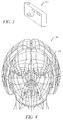
- Fig. 1 is a perspective view of a digital camera of the present invention
- Fig. 2 is a diagram of an animation processor, a corresponding flow chart illustrating creation of a typical animation from the processor and a corresponding wire mesh produced from the processor;
- Fig. 3 is a process flowchart illustrating the method of the present invention for securely transmitting an animation
- Fig. 4 is a perspective view of a typical wire mesh.
- a digital camera 10 for capturing digital images.
- the digital camera 10 includes an image sensor (not shown) for capturing the incident light and converted it into electronic signals.
- image sensor not shown
- Such digital cameras 10 are well known in the art and will not be discussed further detail herein.
- the camera 10 could also be a film based camera whose images are digitized for animation after processing of the film.
- the animation processor 20 includes electronic components therein for producing wire mesh, texture (or skinning) information and movement instructions for the animation.
- the animation process is initiated S2, and the processor 20 produces S4 a three-dimensional wire mesh 30 from the digital image input by the user.
- the wire mesh 30 is a plurality of interconnecting segments 35 that forms a model of the exterior shape of the input image.
- the processor 20 further analyzes the input image, and produces S6 a texture model for each image for producing a digital representation of the exterior, visible features of the image.
- the user will instruct the animation processor 20 as to the particular movements desired for the image. From these instructions, the animation processor 20 produces S8 movement data that directs the individual segments of the wire mesh to deform thus producing movement.
- the animation processor 20 outputs S10 the wire mesh, texture and corresponding movement instructions to the user in a file structure. This process may be repeated for a subsequent image or simply produce different movement instructions for an existing wire frame.
- FIG. 3 there is shown a flow diagram of the present invention for sending the wire mesh 30a, texture database 40a, and movement instructions (wire mesh database) 50a to a user which ensures all of these components have not been modified or altered during transmission.
- the wire mesh 30a, textured database 40a and movement instructions 50a produced by the animation processor is sent to a user, such as via the Internet or manual distribution and the like.
- the sender then encrypts the texture database 40b, wire mesh 30b and wire mesh database 50b with a private key 60 for producing a secure executable file 70 which is essentially tamper proof.
- the sender may send this encryption via any suitable means, such as via the Internet or manual distribution and the like, or it may be send as an attachment to the unencrypted file.
- the receiver of the digital files then decrypts 80 the texture database 40b, wire mesh 30b and wire database 50b with a public key.
- the public key may be sent to the user by the sender, or may be retrieved from publicly accessible facilities, such as the Internet and the like. As well known to those skilled in the art, the public key may only decrypt the digital files, whereas the private key can encrypt and decrypt. Such encryption and decryption technology is well known in the art and will not be discussed in detail herein.
- the customer compares 90 the decrypted texture 40b, wire mesh 30b and wire database 50b with the originally received texture database 40a, wire mesh 30a and wire database 50a. This comparison may be performed by any suitable computer having code for performing such task, which code requires minimal computer skills to prepare and, as a result, will not be discussed in detail herein.
- the animation is verified as being unmodified during transmission. If they are not the same, the originally sent animation has been modified without proper authority.
- duplicate texture database 40b and duplicate wire mesh database (collectively referred to as duplicates), each or any one of these could be "hashed” and then encrypted before sending to the customer.
- hashing includes passing all or each of the desired duplicates through an algorithm for converting it into a unique smaller representation, which is well known in the art.
- One example of a hashing algorithm is the SHA-1 algorithm as specified in FIPS PUB 180-1, which hashes any given size data to only 20 bytes. This hash is then encrypted and sent to the customer where the hash is decrypted.
- the customer then passes the corresponding original (either or all of the wire mesh 30a, texture database 40a and wire mesh 50a) through the same hashing algorithm for obtaining a corresponding smaller unique representation.
- any alteration of the data that is subsequently hashed with a cryptographically strong hashing function is likely to result in a different hash from a hash of the unaltered data, which obviously indicates that the data has been altered.
- the user or customer then compares the two hashes for verifying whether the data has been altered.
Landscapes
- Engineering & Computer Science (AREA)
- Multimedia (AREA)
- Physics & Mathematics (AREA)
- General Physics & Mathematics (AREA)
- Theoretical Computer Science (AREA)
- Signal Processing (AREA)
- Processing Or Creating Images (AREA)
- Two-Way Televisions, Distribution Of Moving Picture Or The Like (AREA)
Abstract
Description
Although the presently known and utilized animation creation and transmission components are satisfactory, they include drawbacks. During transmission, such components may be intercepted and undesirably modified.
Claims (10)
- A method for authenticating animation, the method comprising the steps of:(a) converting the captured image into a wire mesh data for permitting animation of the image;(b) providing movement data, which directs movement of the wire mesh data, and texture data indicating the covering for the wire mesh;(c) electronically transmitting the wire mesh data, texture data and movement data;(d) encrypting the movement data; and(e) electronically transmitting the encryption the movement data for verifying that the animation is unaltered during transmission from its source.
- The method as in claim 1 further comprising the step of encrypting the texture data before electronically transmitting.
- The method as in claim 2 further comprising the step of encrypting the wire mesh data before electronically transmitting.
- The method as in claim 3, wherein step (e) includes transmitting via the Internet.
- The method as in claim 4, wherein step (a) includes converting the captured image by an animation processor.
- A method for authenticating animation, the method comprising the steps of:(a) converting the captured image into a wire mesh data for permitting animation of the image;(b) providing movement data, which directs movement of the wire mesh data, and texture data indicating the covering for the wire mesh;(c) electronically transmitting the wire mesh data, texture data and movement data;(d) encrypting a representation of the movement data which representation includes less bits of data than the movement data; and(e) electronically transmitting the encrypted representation of the movement data for verifying that the animation is unaltered during transmission from its source.
- The method as in claim 6 further comprising the step of encrypting a representation of the texture data before electronically transmitting, which representation includes less bits of data than the texture data.
- The method as in claim 7 further comprising the step of encrypting a representation of the wire mesh data before electronically transmitting, which representation includes less bits of data than the wire mesh data.
- The method as in claim 8, wherein step (e) includes transmitting via the Internet.
- The method as in claim 9, wherein step (a) includes converting the captured image by an animation processor.
Applications Claiming Priority (2)
| Application Number | Priority Date | Filing Date | Title |
|---|---|---|---|
| US882195 | 2001-06-15 | ||
| US09/882,195 US6993162B2 (en) | 2001-06-15 | 2001-06-15 | Method for authenticating animation |
Publications (2)
| Publication Number | Publication Date |
|---|---|
| EP1271958A2 true EP1271958A2 (en) | 2003-01-02 |
| EP1271958A3 EP1271958A3 (en) | 2004-02-18 |
Family
ID=25380093
Family Applications (1)
| Application Number | Title | Priority Date | Filing Date |
|---|---|---|---|
| EP02077247A Withdrawn EP1271958A3 (en) | 2001-06-15 | 2002-06-10 | A method for authenticating animation |
Country Status (3)
| Country | Link |
|---|---|
| US (1) | US6993162B2 (en) |
| EP (1) | EP1271958A3 (en) |
| JP (1) | JP2003099798A (en) |
Families Citing this family (16)
| Publication number | Priority date | Publication date | Assignee | Title |
|---|---|---|---|---|
| US7461405B2 (en) * | 2001-04-26 | 2008-12-02 | Autodesk, Inc. | Mixed-media data encoding |
| US20050168485A1 (en) * | 2004-01-29 | 2005-08-04 | Nattress Thomas G. | System for combining a sequence of images with computer-generated 3D graphics |
| WO2008070688A1 (en) | 2006-12-04 | 2008-06-12 | Commvault Systems, Inc. | Systems and methods for creating copies of data, such as archive copies |
| US7840537B2 (en) * | 2006-12-22 | 2010-11-23 | Commvault Systems, Inc. | System and method for storing redundant information |
| US9098495B2 (en) * | 2008-06-24 | 2015-08-04 | Commvault Systems, Inc. | Application-aware and remote single instance data management |
| US8166263B2 (en) | 2008-07-03 | 2012-04-24 | Commvault Systems, Inc. | Continuous data protection over intermittent connections, such as continuous data backup for laptops or wireless devices |
| US9015181B2 (en) | 2008-09-26 | 2015-04-21 | Commvault Systems, Inc. | Systems and methods for managing single instancing data |
| EP2329378A4 (en) | 2008-09-26 | 2015-11-25 | Commvault Systems Inc | SYSTEMS AND METHODS FOR MANAGING SINGLE-INSTANCE DATA |
| US8412677B2 (en) | 2008-11-26 | 2013-04-02 | Commvault Systems, Inc. | Systems and methods for byte-level or quasi byte-level single instancing |
| US8401996B2 (en) | 2009-03-30 | 2013-03-19 | Commvault Systems, Inc. | Storing a variable number of instances of data objects |
| US8578120B2 (en) | 2009-05-22 | 2013-11-05 | Commvault Systems, Inc. | Block-level single instancing |
| WO2012045023A2 (en) | 2010-09-30 | 2012-04-05 | Commvault Systems, Inc. | Archiving data objects using secondary copies |
| US9020890B2 (en) | 2012-03-30 | 2015-04-28 | Commvault Systems, Inc. | Smart archiving and data previewing for mobile devices |
| US9633022B2 (en) | 2012-12-28 | 2017-04-25 | Commvault Systems, Inc. | Backup and restoration for a deduplicated file system |
| US10324897B2 (en) | 2014-01-27 | 2019-06-18 | Commvault Systems, Inc. | Techniques for serving archived electronic mail |
| US10324914B2 (en) | 2015-05-20 | 2019-06-18 | Commvalut Systems, Inc. | Handling user queries against production and archive storage systems, such as for enterprise customers having large and/or numerous files |
Family Cites Families (7)
| Publication number | Priority date | Publication date | Assignee | Title |
|---|---|---|---|---|
| US6128398A (en) * | 1995-01-31 | 2000-10-03 | Miros Inc. | System, method and application for the recognition, verification and similarity ranking of facial or other object patterns |
| US6788800B1 (en) * | 2000-07-25 | 2004-09-07 | Digimarc Corporation | Authenticating objects using embedded data |
| US6557102B1 (en) | 1997-09-05 | 2003-04-29 | Koninklijke Philips Electronics N.V. | Digital trust center for medical image authentication |
| US6047078A (en) * | 1997-10-03 | 2000-04-04 | Digital Equipment Corporation | Method for extracting a three-dimensional model using appearance-based constrained structure from motion |
| US6744914B1 (en) * | 2000-04-28 | 2004-06-01 | Orametrix, Inc. | Method and system for generating a three-dimensional object |
| US6731287B1 (en) * | 2000-10-12 | 2004-05-04 | Momentum Bilgisayar, Yazilim, Danismanlik, Ticaret A.S. | Method for animating a 3-D model of a face |
| JP4177598B2 (en) * | 2001-05-25 | 2008-11-05 | 株式会社東芝 | Face image recording apparatus, information management system, face image recording method, and information management method |
-
2001
- 2001-06-15 US US09/882,195 patent/US6993162B2/en not_active Expired - Fee Related
-
2002
- 2002-06-05 JP JP2002163902A patent/JP2003099798A/en active Pending
- 2002-06-10 EP EP02077247A patent/EP1271958A3/en not_active Withdrawn
Also Published As
| Publication number | Publication date |
|---|---|
| US6993162B2 (en) | 2006-01-31 |
| US20030005296A1 (en) | 2003-01-02 |
| EP1271958A3 (en) | 2004-02-18 |
| JP2003099798A (en) | 2003-04-04 |
Similar Documents
| Publication | Publication Date | Title |
|---|---|---|
| US6993162B2 (en) | Method for authenticating animation | |
| US6269446B1 (en) | Authenticating images from digital cameras | |
| US5781635A (en) | Method and apparatus for improved digital message transaction model | |
| US8543825B2 (en) | Method and apparatus for input of coded image data | |
| US6553494B1 (en) | Method and apparatus for applying and verifying a biometric-based digital signature to an electronic document | |
| KR20210114323A (en) | Robust selective image, video, and audio content authentication | |
| CN1092433C (en) | Cryptographic device with double feed-forward hash function | |
| US20030126432A1 (en) | Content authentication for digital media based recording devices | |
| US8959357B2 (en) | Biometric encryption and key generation | |
| US20030048908A1 (en) | System and method for protecting the content of digital cinema products | |
| KR20010041400A (en) | Transmitting reviews with digital signatures | |
| US20220271930A1 (en) | Cipher key generation apparatus and cipher key generation method | |
| CN109697188B (en) | Engineering cost data management method and system | |
| JPH07191602A (en) | Electronic autographing method and device | |
| JPH10164549A (en) | System for hiding authentication information in images and image authentication system | |
| IL114361A (en) | File encryption method | |
| WO2017033348A1 (en) | Signature generation system, signature generation apparatus, and signature generation method | |
| CN1838172A (en) | Method and apparatus for inlaying watermark in digital image and digital camera capable of adding watermark | |
| JP4261724B2 (en) | Signature data generation apparatus and image verification apparatus | |
| CN117242744B (en) | Method and apparatus for proving originality of a creative design in a communication system | |
| EP3389280A1 (en) | Method for real-time certifying the integrity of a sequence of video and/or audio frames | |
| US12229849B2 (en) | Avatar identity protection using steganography | |
| JPH11196392A (en) | Electronic image alteration detection method and alteration detection system | |
| US20080069342A1 (en) | Method and system for protecting against unity keys | |
| EP1271400A1 (en) | A method and system for authenticating playback of an animated model |
Legal Events
| Date | Code | Title | Description |
|---|---|---|---|
| PUAI | Public reference made under article 153(3) epc to a published international application that has entered the european phase |
Free format text: ORIGINAL CODE: 0009012 |
|
| AK | Designated contracting states |
Kind code of ref document: A2 Designated state(s): AT BE CH CY DE DK ES FI FR GB GR IE IT LI LU MC NL PT SE TR |
|
| AX | Request for extension of the european patent |
Free format text: AL;LT;LV;MK;RO;SI |
|
| PUAL | Search report despatched |
Free format text: ORIGINAL CODE: 0009013 |
|
| AK | Designated contracting states |
Kind code of ref document: A3 Designated state(s): AT BE CH CY DE DK ES FI FR GB GR IE IT LI LU MC NL PT SE TR |
|
| AX | Request for extension of the european patent |
Extension state: AL LT LV MK RO SI |
|
| RIC1 | Information provided on ipc code assigned before grant |
Ipc: 7G 06T 9/00 B Ipc: 7G 06T 15/70 B Ipc: 7H 04N 7/26 A |
|
| AKX | Designation fees paid | ||
| REG | Reference to a national code |
Ref country code: DE Ref legal event code: 8566 |
|
| STAA | Information on the status of an ep patent application or granted ep patent |
Free format text: STATUS: THE APPLICATION IS DEEMED TO BE WITHDRAWN |
|
| 18D | Application deemed to be withdrawn |
Effective date: 20040819 |