EP1271402A2 - Information terminal device - Google Patents
Information terminal device Download PDFInfo
- Publication number
- EP1271402A2 EP1271402A2 EP02004008A EP02004008A EP1271402A2 EP 1271402 A2 EP1271402 A2 EP 1271402A2 EP 02004008 A EP02004008 A EP 02004008A EP 02004008 A EP02004008 A EP 02004008A EP 1271402 A2 EP1271402 A2 EP 1271402A2
- Authority
- EP
- European Patent Office
- Prior art keywords
- image
- data amount
- terminal device
- information terminal
- user
- Prior art date
- Legal status (The legal status is an assumption and is not a legal conclusion. Google has not performed a legal analysis and makes no representation as to the accuracy of the status listed.)
- Withdrawn
Links
Images

Classifications
-
- H—ELECTRICITY
- H04—ELECTRIC COMMUNICATION TECHNIQUE
- H04N—PICTORIAL COMMUNICATION, e.g. TELEVISION
- H04N21/00—Selective content distribution, e.g. interactive television or video on demand [VOD]
- H04N21/40—Client devices specifically adapted for the reception of or interaction with content, e.g. set-top-box [STB]; Operations thereof
- H04N21/43—Processing of content or additional data, e.g. demultiplexing additional data from a digital video stream; Elementary client operations, e.g. monitoring of home network or synchronising decoder's clock; Client middleware
- H04N21/44—Processing of video elementary streams, e.g. splicing a video clip retrieved from local storage with an incoming video stream or rendering scenes according to encoded video stream scene graphs
- H04N21/4402—Processing of video elementary streams, e.g. splicing a video clip retrieved from local storage with an incoming video stream or rendering scenes according to encoded video stream scene graphs involving reformatting operations of video signals for household redistribution, storage or real-time display
- H04N21/440245—Processing of video elementary streams, e.g. splicing a video clip retrieved from local storage with an incoming video stream or rendering scenes according to encoded video stream scene graphs involving reformatting operations of video signals for household redistribution, storage or real-time display the reformatting operation being performed only on part of the stream, e.g. a region of the image or a time segment
-
- G—PHYSICS
- G06—COMPUTING OR CALCULATING; COUNTING
- G06T—IMAGE DATA PROCESSING OR GENERATION, IN GENERAL
- G06T3/00—Geometric image transformations in the plane of the image
- G06T3/40—Scaling of whole images or parts thereof, e.g. expanding or contracting
-
- H—ELECTRICITY
- H04—ELECTRIC COMMUNICATION TECHNIQUE
- H04N—PICTORIAL COMMUNICATION, e.g. TELEVISION
- H04N21/00—Selective content distribution, e.g. interactive television or video on demand [VOD]
- H04N21/40—Client devices specifically adapted for the reception of or interaction with content, e.g. set-top-box [STB]; Operations thereof
- H04N21/41—Structure of client; Structure of client peripherals
- H04N21/4104—Peripherals receiving signals from specially adapted client devices
- H04N21/4126—The peripheral being portable, e.g. PDAs or mobile phones
-
- H—ELECTRICITY
- H04—ELECTRIC COMMUNICATION TECHNIQUE
- H04N—PICTORIAL COMMUNICATION, e.g. TELEVISION
- H04N21/00—Selective content distribution, e.g. interactive television or video on demand [VOD]
- H04N21/40—Client devices specifically adapted for the reception of or interaction with content, e.g. set-top-box [STB]; Operations thereof
- H04N21/41—Structure of client; Structure of client peripherals
- H04N21/418—External card to be used in combination with the client device, e.g. for conditional access
- H04N21/4184—External card to be used in combination with the client device, e.g. for conditional access providing storage capabilities, e.g. memory stick
-
- H—ELECTRICITY
- H04—ELECTRIC COMMUNICATION TECHNIQUE
- H04N—PICTORIAL COMMUNICATION, e.g. TELEVISION
- H04N21/00—Selective content distribution, e.g. interactive television or video on demand [VOD]
- H04N21/40—Client devices specifically adapted for the reception of or interaction with content, e.g. set-top-box [STB]; Operations thereof
- H04N21/43—Processing of content or additional data, e.g. demultiplexing additional data from a digital video stream; Elementary client operations, e.g. monitoring of home network or synchronising decoder's clock; Client middleware
- H04N21/44—Processing of video elementary streams, e.g. splicing a video clip retrieved from local storage with an incoming video stream or rendering scenes according to encoded video stream scene graphs
- H04N21/4402—Processing of video elementary streams, e.g. splicing a video clip retrieved from local storage with an incoming video stream or rendering scenes according to encoded video stream scene graphs involving reformatting operations of video signals for household redistribution, storage or real-time display
- H04N21/440263—Processing of video elementary streams, e.g. splicing a video clip retrieved from local storage with an incoming video stream or rendering scenes according to encoded video stream scene graphs involving reformatting operations of video signals for household redistribution, storage or real-time display by altering the spatial resolution, e.g. for displaying on a connected PDA
-
- G—PHYSICS
- G09—EDUCATION; CRYPTOGRAPHY; DISPLAY; ADVERTISING; SEALS
- G09G—ARRANGEMENTS OR CIRCUITS FOR CONTROL OF INDICATING DEVICES USING STATIC MEANS TO PRESENT VARIABLE INFORMATION
- G09G2340/00—Aspects of display data processing
- G09G2340/04—Changes in size, position or resolution of an image
-
- H—ELECTRICITY
- H04—ELECTRIC COMMUNICATION TECHNIQUE
- H04N—PICTORIAL COMMUNICATION, e.g. TELEVISION
- H04N2201/00—Indexing scheme relating to scanning, transmission or reproduction of documents or the like, and to details thereof
- H04N2201/32—Circuits or arrangements for control or supervision between transmitter and receiver or between image input and image output device, e.g. between a still-image camera and its memory or between a still-image camera and a printer device
- H04N2201/333—Mode signalling or mode changing; Handshaking therefor
- H04N2201/33307—Mode signalling or mode changing; Handshaking therefor of a particular mode
- H04N2201/33314—Mode signalling or mode changing; Handshaking therefor of a particular mode of reading or reproducing mode
- H04N2201/33321—Image or page size, e.g. A3, A4
Definitions
- the present invention relates to an information terminal device and, more specifically, to an information terminal device provided with an automatic image changing function for changing an image to an image having a data amount equal to or less than a desired amount when transmitting the image data to another information terminal device or storing the image data received and displayed or an information terminal device into a memory or a storage medium.
- the cut portion of the image can also be moved to any desired position on the display screen. And then, any portion needed of an image can be cut and displayed on the display screen of the information terminal device.
- An object of the present invention is to provide an information terminal device provided with a function for changing an image into an image having a data amount equal to or less than a desired amount, which is capable of enlarging/contracting an image data in accord with a size of a display screen, cutting a portion of an image and transmitting or storing the cutout image data.
- Another object of the present invention is to provide an information terminal device that is provided with a function for cutting an image displayed on a screen in accord with a predetermined data amount or a data amount optionally set by a user before transmitting visual information over wire- or wireless-communication line or storing the image on a storage medium such as a memory card and a function for enlarging or contracting a whole image being displayed on a display screen to an image having a data amount in accord with a predetermined data amount or a data amount optionally preset by a user.
- This information terminal device can therefore transmit or store an image containing a desired amount of data in accord with a specified upper limit of transmittal or storable data amount or a data amount optionally set by user the above-described enlarging/contracting or image-cutting functions when transmitting or storing an image data to other information terminal device having a limited capacity of receiving or storing in a storage medium having a limited storage capacity.
- Another object of the present invention is to provide an information terminal device that can further transmit an original image exceeding an upper limit of transmittable data amount by dividing an original image into a plurality of images having a data amount not more than the upper limit and transmitting them in succession and can also receive in turn the divided images and restore the original image.
- Another object of the present invention is to provide an information terminal device that can present a cursor matching a preset data amount on an image being displayed on a display screen when cutting an image, and enabling a user to move the cursor to any desirable position on the image and transmit or store an image portion enclosed by the cursor.
- Another object of the present invention is to provide an information terminal device that is capable of changing a shape of cursor into a desirable shape not exceeding a preset data amount, allowing a user to select whether the cursor shape is changed not to exceed or exceed the preset data amount.
- a further object of the present invention is to provide an information terminal device that is capable of enlarging or contracting a cutout image portion to a preset data amount when the data amount of the cutout image portion differs from the preset data amount.
- a still further object of the present invention is to provide an information terminal device that is capable of discriminating that the data amount of a cutout image portion (enclosed by a cursor) is different from the preset data amount and informing a user of that fact by changing for example the color of the cursor.
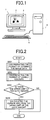
- Figure 1 is a conceptual illustration for explaining an automatic image changing function of an information terminal device according to the present invention.
- Figure 2 is a flowchart depicting a procedure for determining the shape of a cursor on a display device of an information terminal device according to the present invention.
- Figure 3 is a flowchart depicting an exemplary procedure for transmitting image data having a data amount exceeding the upper transmittal limit by an information terminal device according to the present invention.
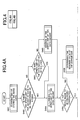
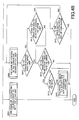
- Figure 4 shows the correct alignment of the drawing sheets for Figures 4A and 4B.
- Figures 4A and 4B are flowcharts depicting an exemplary procedure for changing image data on an information terminal device according to the present invention.
- Figure 1 is a conceptual illustration for explaining an automatic image changing function of an information terminal device according to the present invention.
- the shown information terminal device comprises a display device 1, an information terminal device body 4 such as a computer and an input device 5 such as a keyboard.
- An original image 3 is now displayed on a screen of the display device 1.
- Figure 2 is a flowchart depicting a procedure for determining the shape of a cursor on a display device of an information terminal device according to the present invention.
- the data amount of an image is decided based on the number of usable colors, the format storage of a data and the image size.
- the computer 4 of the information terminal device discriminates first the format of storing the image data (Step S201) and then the number of usable colors (Step S202).
- the computer discriminates whether the upper limit of the image data amount has been preset (Step S203). If the upper limit has been preset, the computer calculates a necessary size of the cursor to be presented on the image (Step S204).
- the size of the cursor 2 is decided in comparison with the number of usable colors and the storage format of the image 3 and the predetermined data amount or the data amount optionally set by the user.
- the computer calculates the cursor shape according to the flowchart of Fig. 2.
- Figure 3 is a flowchart depicting an exemplary procedure for transmitting image data having a data amount exceeding the upper transmittal limit by an information terminal device according to the present invention.
- the computer 4 of the information terminal device discriminates in advance whether the upper limit of transmittable image data is preset (Step S302).
- the computer discriminates whether the amount of the transmittable image data exceeds the upper limit (Step S303). If the data amount does not exceed the upper limit, the image data is then transmitted as it is (Step S308).
- the computer calculates the cursor size corresponding to the upper limit of data amount (Step S304).
- Step S305 the computer divides the image into a plurality of images each having a data amount smaller than the upper limit value using the determined cursor size (Step S306) and prepares data for identifying the arrangement of the divided images (Step S307).
- the divided images with the information of arrangement of the divided images are then transmitted (Step S308).
- the information terminal device can restore the original image based on the data of arrangement.
- the information terminal device allows the user to select the condition of deforming the image portion enclosed by the cursor 2, i.e., the data amount of that portion may be deformed on the condition not to exceed or to exceed the upper limit of transmittable data amount. Once the user selected the condition of deformation of the image portion not to exceed the upper limit, the portion cannot be enlarged more than the cursor size determined in the flowchart of Fig. 2.
- the information terminal device may inform the user, for example by changing the color of the cursor 2, that the data amount of the image portion enclosed by the cursor 2 exceeds the upper limit of the transmittable data amount.
- the data amount of the cutout image portion enclosed by the cursor 2 exceeds the upper limit of data amount, it may also be contracted without changing the aspect ratio or compressed by reducing the number of usable colors to be smaller than the upper limit.
- Figure 4 is a flowchart depicting an exemplary procedure for changing image data on an information terminal device according to the present invention.
- Step S401 When transmitting or storing the image data (Step S401), the computer discriminates in advance whether the upper limit of transmittable or storable data amount is preset or not (Step S402).
- the computer determines the upper limit as the preset value. In absence of the preset value, the computer discriminates whether the user sets an upper limit (Step S403). If the user sets the upper limit, then the computer determines the limit as the value set by the user (Step S404). Then, the computer discriminates whether a whole image is to be enlarged or contracted (Step S406).
- Step S403 if the user did not set the upper limit, the computer determines there is no upper limit (Step S405) and discriminates whether the whole image is to be enlarged or contracted (Step S406).
- Step S406 On the basis of discrimination in Step S406, in case when a whole image is enlarged or contracted, the computer enlarges or contracts the image in accord with the determined upper limit value (Step S407) and transmits or stores the enlarged or contracted image to end the procedure.
- the computer determines the maximum value of a cursor size corresponding to the upper limit of the data amount (Step S408) and the user decides the shape and position of the cursor (Step S409).
- Step S410 the computer discriminates whether the cursor is to be changed in size to exceed the upper limit of the data amount, which has been determined in Step S404. In case of changing the cursor over the upper limit, the computer examines whether the image portion to be cutout exceeds the upper limit (Step S411). If it exceeds the upper limit, the computer further examines whether the image is contracted in size or compressed for example by reducing the number of the used colors (Step S412).
- Step S412 If the image is not contracted or compressed in Step S412, the computer returns to Step S409 to re-select the location of a portion to be cutout from the image.
- the computer performs the contraction or compression of the image and transmits or stores it to end the procedure.
- Step S410 In case if the cursor size is not changed over the upper limit (in Step S410) and the image portion to be cutout does not exceed the upper limit (in Step S411), the computer proceeds to Step S413 to examine whether the image portion is not reach the upper limit.
- the computer discriminates whether the image shall be enlarged (Step S414). If the image shall be enlarged, the computer enlarges the image to a suitable size not exceeding the upper limit (Step S415). If the image shall not be enlarged, the computer transmits or stores the image data as it is, ending the procedure.
- Step S413 If the image portion to be cutout reaches in size the upper limit (in Step S413), the computer directly transmits or stores it and ends the procedure.
- the user can set the upper limit and select whether a whole image is enlarged or contracted in size to meet the upper limit.
- the user can also select the whether the image is contracted in size or compressed for example by reducing the number of the used colors.
- the user can further reselect the location of a portion to be cut from the image, if contraction or compression of the image portion was requested.
- the user can select whether the image shall be enlarged in size or not before transmitting or storing the image portion data.
- an information terminal device enables a user to easily change an image being displayed on a display screen to an image containing a specified or desired amount of data before transmitting the image data to another information terminal having a limited receiving/transmit capacity or storing it in a storage medium having a limited storing capacity.
Landscapes
- Engineering & Computer Science (AREA)
- Multimedia (AREA)
- Signal Processing (AREA)
- Physics & Mathematics (AREA)
- General Physics & Mathematics (AREA)
- Theoretical Computer Science (AREA)
- Editing Of Facsimile Originals (AREA)
- User Interface Of Digital Computer (AREA)
- Information Transfer Between Computers (AREA)
- Digital Computer Display Output (AREA)
- Controls And Circuits For Display Device (AREA)
- Image Processing (AREA)
Abstract
Description
Claims (6)
- A information terminal device provided with a means for cutting an image into a size corresponding to a predetermined data amount or any data amount optionally preset by a user when transmitting an image data over wire- or wireless-line or storing the image data on a storage medium such as memory card and a means for enlarging or contracting whole image being displayed on a display screen to a size corresponding to a predetermined data amount or any desirable data amount optionally determined by a user.
- An information terminal device as defined in claim 1, characterized in that it is provided with a means for dividing an image into portions each corresponding to the predetermined data amount or the data amount optionally preset by a user and transmitting the divided image on a portion-by-portion basis and a means for receiving the portions of image data and restoring an original image from the received image data.
- An information terminal device as defined in claim 1, characterized in that it is provided with a means for changing the cutting-out position of an image to any desirable position thereon.
- An information terminal device as defined in claim 3, characterized in that it is provided with a means for changing the cutting-out shape of an image to any desired shape within the predetermined data amount or the data amount preset by a user and a means for selecting which condition of changing the cutout shape of an image not to exceed or to exceed the predetermined data amount or the data amount preset by a user.
- An information terminal device as defined in claim 4, characterized in that it is provided with a means for enlarging or contracting or compressing the cutout image having a different data size so as to match the predetermined data amount or the data amount optionally preset by a user.
- An information terminal device as defined in claim 4, characterized in that it is provided with a means for informing a user that a data amount of an image to be cut out is different from the predetermined data amount or the data amount optionally preset by the user.
Applications Claiming Priority (2)
| Application Number | Priority Date | Filing Date | Title |
|---|---|---|---|
| JP2001066739 | 2001-03-09 | ||
| JP2001066739A JP2002271613A (en) | 2001-03-09 | 2001-03-09 | Information terminal equipment |
Publications (2)
| Publication Number | Publication Date |
|---|---|
| EP1271402A2 true EP1271402A2 (en) | 2003-01-02 |
| EP1271402A3 EP1271402A3 (en) | 2005-09-28 |
Family
ID=18925196
Family Applications (1)
| Application Number | Title | Priority Date | Filing Date |
|---|---|---|---|
| EP02004008A Withdrawn EP1271402A3 (en) | 2001-03-09 | 2002-02-22 | Information terminal device |
Country Status (3)
| Country | Link |
|---|---|
| US (1) | US20020136467A1 (en) |
| EP (1) | EP1271402A3 (en) |
| JP (1) | JP2002271613A (en) |
Families Citing this family (3)
| Publication number | Priority date | Publication date | Assignee | Title |
|---|---|---|---|---|
| US20040088656A1 (en) * | 2002-10-30 | 2004-05-06 | Kazuto Washio | Method, apparatus, and program for image processing |
| US20080291284A1 (en) * | 2007-05-25 | 2008-11-27 | Sony Ericsson Mobile Communications Ab | Communication device and image transmission method |
| WO2012070241A1 (en) * | 2010-11-25 | 2012-05-31 | パナソニック株式会社 | Content sharing system and method thereof, content mediation device and method thereof, and content providing device and method thereof |
Family Cites Families (12)
| Publication number | Priority date | Publication date | Assignee | Title |
|---|---|---|---|---|
| US5473740A (en) * | 1993-12-29 | 1995-12-05 | International Business Machines Corporation | Method and apparatus for interactively indicating image boundaries in digital image cropping |
| US5917962A (en) * | 1995-06-06 | 1999-06-29 | Apple Computer, Inc. | Method and apparatus for partitioning an image |
| JPH10336647A (en) * | 1997-06-04 | 1998-12-18 | Nikon Corp | Image compression apparatus and computer-readable recording medium recording image compression processing program |
| US6201548B1 (en) * | 1998-02-24 | 2001-03-13 | Hewlett-Packard Company | Graphical user interface for image editing |
| US6212301B1 (en) * | 1998-06-25 | 2001-04-03 | Accusoft Corporation | Systems and methods for digital image compression |
| US6684087B1 (en) * | 1999-05-07 | 2004-01-27 | Openwave Systems Inc. | Method and apparatus for displaying images on mobile devices |
| US6577769B1 (en) * | 1999-09-18 | 2003-06-10 | Wildtangent, Inc. | Data compression through adaptive data size reduction |
| US6563960B1 (en) * | 1999-09-28 | 2003-05-13 | Hewlett-Packard Company | Method for merging images |
| US6611626B1 (en) * | 1999-12-10 | 2003-08-26 | Xerox Corporation | Method of compressing JPEG files using a conditional transform |
| US6337925B1 (en) * | 2000-05-08 | 2002-01-08 | Adobe Systems Incorporated | Method for determining a border in a complex scene with applications to image masking |
| US6590590B1 (en) * | 2000-06-06 | 2003-07-08 | Mustek Systems, Inc. | System and method for updating a graphic representation of a window item using an image information reading apparatus |
| US7209592B2 (en) * | 2001-02-01 | 2007-04-24 | Fuji Film Corp. | Image storage and display system |
-
2001
- 2001-03-09 JP JP2001066739A patent/JP2002271613A/en active Pending
-
2002
- 2002-02-22 EP EP02004008A patent/EP1271402A3/en not_active Withdrawn
- 2002-03-05 US US10/087,768 patent/US20020136467A1/en not_active Abandoned
Also Published As
| Publication number | Publication date |
|---|---|
| JP2002271613A (en) | 2002-09-20 |
| EP1271402A3 (en) | 2005-09-28 |
| US20020136467A1 (en) | 2002-09-26 |
Similar Documents
| Publication | Publication Date | Title |
|---|---|---|
| US7098939B2 (en) | Image display device and method for displaying thumbnail based on three-dimensional image data | |
| US5113492A (en) | Apparatus for processing character and image data | |
| US20220130011A1 (en) | Flexible display device and method for changing display area | |
| US8417023B2 (en) | Image playback device | |
| CN100456795C (en) | Image display method and program | |
| US7307643B2 (en) | Image display control unit, image display control method, image displaying apparatus, and image display control program recorded computer-readable recording medium | |
| CN1312619C (en) | Image processing apparatus, image processing method, program for implementing image processing method, and recording medium recording program | |
| EP1559264A1 (en) | Method and system for conducting image processing from a mobile client device | |
| US7009619B2 (en) | Map display device, map display system, map display method, and map display program product | |
| EP1840716A2 (en) | Display data size adjustment apparatus and method for portable terminal | |
| US10126907B2 (en) | Emulation of multifunction peripheral via remote control device based on display aspect ratios | |
| EP0793376A2 (en) | Method of transferring and displaying 3-D shape data | |
| US5991466A (en) | Image retrieving apparatus | |
| US5463295A (en) | Facsimile apparatus with control of resolution to be compatible with receiving side | |
| US6081831A (en) | Electronic mail apparatus and a method for operating the same | |
| EP0558313B1 (en) | Image processing apparatus | |
| JP5168619B2 (en) | Image display data generation apparatus and image display data generation method | |
| EP1271402A2 (en) | Information terminal device | |
| US9710494B2 (en) | Display control apparatus capable of displaying list of images corresponding to contents, method of controlling the display control apparatus, and storage medium | |
| KR100465059B1 (en) | Method for managing calling card having bar code and mobile phone using the same | |
| JP5834822B2 (en) | Terminal device, font control method, and font control program | |
| JP2009122841A (en) | Image list image construction apparatus, recording medium, and image forming apparatus | |
| KR100430971B1 (en) | Method for managing calling card and mobile phone using the same | |
| WO2005076211A1 (en) | Method for creating, selecting and displaying digital images using a terminal | |
| KR100449554B1 (en) | Apparatus and method for displaying graphic using object of user terminal |
Legal Events
| Date | Code | Title | Description |
|---|---|---|---|
| PUAI | Public reference made under article 153(3) epc to a published international application that has entered the european phase |
Free format text: ORIGINAL CODE: 0009012 |
|
| AK | Designated contracting states |
Kind code of ref document: A2 Designated state(s): AT BE CH CY DE DK ES FI FR GB GR IE IT LI LU MC NL PT SE TR |
|
| AX | Request for extension of the european patent |
Free format text: AL;LT;LV;MK;RO;SI |
|
| PUAL | Search report despatched |
Free format text: ORIGINAL CODE: 0009013 |
|
| AK | Designated contracting states |
Kind code of ref document: A3 Designated state(s): AT BE CH CY DE DK ES FI FR GB GR IE IT LI LU MC NL PT SE TR |
|
| AX | Request for extension of the european patent |
Extension state: AL LT LV MK RO SI |
|
| 17P | Request for examination filed |
Effective date: 20051116 |
|
| AKX | Designation fees paid |
Designated state(s): DE FR GB |
|
| STAA | Information on the status of an ep patent application or granted ep patent |
Free format text: STATUS: THE APPLICATION IS DEEMED TO BE WITHDRAWN |
|
| 18D | Application deemed to be withdrawn |
Effective date: 20060607 |