EP1271258A2 - Printer arranged with at least one custom toner module - Google Patents
Printer arranged with at least one custom toner module Download PDFInfo
- Publication number
- EP1271258A2 EP1271258A2 EP02013811A EP02013811A EP1271258A2 EP 1271258 A2 EP1271258 A2 EP 1271258A2 EP 02013811 A EP02013811 A EP 02013811A EP 02013811 A EP02013811 A EP 02013811A EP 1271258 A2 EP1271258 A2 EP 1271258A2
- Authority
- EP
- European Patent Office
- Prior art keywords
- custom
- toner
- developed
- custom toner
- image
- Prior art date
- Legal status (The legal status is an assumption and is not a legal conclusion. Google has not performed a legal analysis and makes no representation as to the accuracy of the status listed.)
- Withdrawn
Links
- 238000012546 transfer Methods 0.000 claims abstract description 56
- 108091008695 photoreceptors Proteins 0.000 claims description 25
- 239000002131 composite material Substances 0.000 claims description 16
- 239000000843 powder Substances 0.000 claims description 7
- 238000011161 development Methods 0.000 description 19
- 239000003086 colorant Substances 0.000 description 10
- 238000013459 approach Methods 0.000 description 8
- 239000000203 mixture Substances 0.000 description 8
- 238000000034 method Methods 0.000 description 4
- 238000007600 charging Methods 0.000 description 3
- 238000004140 cleaning Methods 0.000 description 3
- 238000002156 mixing Methods 0.000 description 3
- 238000012864 cross contamination Methods 0.000 description 2
- 239000000976 ink Substances 0.000 description 2
- 239000000463 material Substances 0.000 description 2
- 230000003595 spectral effect Effects 0.000 description 2
- 230000015556 catabolic process Effects 0.000 description 1
- 238000011109 contamination Methods 0.000 description 1
- 238000006731 degradation reaction Methods 0.000 description 1
- 238000013461 design Methods 0.000 description 1
- 238000003384 imaging method Methods 0.000 description 1
- 230000003993 interaction Effects 0.000 description 1
- 239000007788 liquid Substances 0.000 description 1
- 238000000926 separation method Methods 0.000 description 1
Images

Classifications
-
- G—PHYSICS
- G03—PHOTOGRAPHY; CINEMATOGRAPHY; ANALOGOUS TECHNIQUES USING WAVES OTHER THAN OPTICAL WAVES; ELECTROGRAPHY; HOLOGRAPHY
- G03G—ELECTROGRAPHY; ELECTROPHOTOGRAPHY; MAGNETOGRAPHY
- G03G15/00—Apparatus for electrographic processes using a charge pattern
- G03G15/01—Apparatus for electrographic processes using a charge pattern for producing multicoloured copies
Definitions
- This invention pertains to xerography and more particularly to a xerographic printer arranged with at least one custom toner module.
- custom colors are typically printed with a separately-blended ink applied in a separate station as another color separation.
- Liquid inks used in the printing industry mix well and stay homogeneous and generally produce stable, precise custom colors.
- Custom color is used in the printing industry to satisfy customer requirements for unique color to uniquely identify their product or service.
- Highlight color is used to highlight various features in a document and is intended to draw the eye of the viewer to particular elements of a document or to help distinguish various aspects of a document to improve readability.
- Highlight or custom colors are laid down as single toner colors or blends of special primary sets which have been shown to produce custom and "pantone" (trade mark) color sets.
- the advantages of producing custom colors in this way instead of using a CYMK full process color approach have been mentioned elsewhere but will be mentioned here briefly. These advantages include, larger range of gamut, smooth, higher resolution fonts, as well as high-resolution custom color lines.
- Dry powder custom color printing represents an opportunity for xerography in that it would allow all the advantages of electronic printing to play in a market now limited to conventional plate print engines.
- Dry powder highlight color printing has been practiced by Xerox in the 4890 family, for example, but only with a very limited number of colors and at fairly low print quality levels. This limited highlight color set is a result of architectural and toner compatibility difficulties, that is, custom colors formed from blends of primaries will not remain homogeneous and powder development systems tend to scavenge previously-developed images.
- the 4890 for example, requires a complex xerographic design, that is, tri-level xerography, and complex development subsystem architecture to insure that the development systems don't interact with the previous images to produce cross-contamination and color hue shifts.
- a complex xerographic design that is, tri-level xerography
- complex development subsystem architecture to insure that the development systems don't interact with the previous images to produce cross-contamination and color hue shifts.
- the result of this approach is a system limited both in color gamut and print quality in a very restricted architecture.
- Xerox has been successful with highlight color in the past with the 4890 family of highlight color printers.
- the approach Xerox has used in these printers is a proprietary process known as "tri-level" xerography, coupled with special colored toners or mixtures of toners for producing the highlight colors.
- This approach has the advantage of perfect registration since the laser writes the highlight and black image together.
- One disadvantage here is the development system is burdened with the task of not disturbing the previously-developed image while developing the color image with a low development potential. Disturbances lead to degradation of the developed image as well as cross-contamination of the developer, causing shifts in color hue over long times which are unacceptable to a customer printing a custom color.
- Another disadvantage is the high contrast voltages and tight restrictions on the charging and exposure systems.
- the tri-level development system must split the contrast between the two colors requiring very large development housings to enable development with low development fields which stresses development.
- Another disadvantage here is the highlight color machine architecture is very specific to custom color. The machine must be designed almost from the beginning for highlight color, making it difficult to insert a highlight color capability into existing architectures. Charging, imaging, development and the control system must be interwoven into any previously designed system.
- a printer comprises a monochrome developer module arranged to form a developed monochrome image on a photoreceptor, and at least one custom toner module arranged to form a developed custom toner image and thereafter to transfer this developed custom toner image onto the developed monochrome image, thus forming a finished composite image.
- the custom toner source comprises means for "on-demand" making the custom toner responsive to the custom toner sensing means.
- a printer comprises a plurality of developer modules arranged to form and transfer a developed multi-color image to an intermediate transfer member, and at least one custom toner module arranged to form a developed custom toner image and thereafter to transfer this developed custom toner image onto the developed multi-color image, thus forming a finished composite image.
- the plurality of developer modules comprising at least three developer modules.
- means are included for transferring and fusing the finished composite image onto a media.
- the at least one custom toner module comprising a custom toner developer unit arranged with a photoreceptor for forming the developed custom toner image, the photoreceptor further arranged with a custom toner transfer station for transferring the developed custom toner image onto the developed multi-color image.
- custom toner developer unit comprising a magnetic brush developing system.
- the at least one custom toner module includes a custom toner source.
- custom toner comprising a dry powder.
- the custom toner source comprises a "ready-made” supply of the custom toner.
- custom toner sensing means for sensing the developed custom toner image are included.
- the custom toner source comprises means for "on-demand" making the custom toner responsive to the custom toner sensing means.
- a xerographic printer includes at least one custom toner module arranged to form a developed custom toner image and thereafter to transfer this developed custom toner image onto an existing developed image.
- the at least one custom toner module transfers the developed custom toner image onto an existing developed monochrome image.
- the at least one custom toner module transfers the developed custom toner image onto an existing developed multi-toner image.
- the printer 100 comprises a monochrome developer module 110.
- the monochrome developer module 110 is arranged to form a developed monochrome image 170 on a moving photoreceptor 160.
- the monochrome developer module 110 comprises any convenient xerographic developing means.
- the monochrome developer module 110 comprises a conventional black-and-white toner developer module, with the corresponding monochrome image 170 comprising a typical black-and-white image.
- the printer 100 also includes at least one custom toner module 150.
- the custom toner module 150 comprises a custom toner source 300 arranged to supply a custom toner comprising dry powder to a custom toner developer unit 151.
- the custom toner developer unit 151 is arranged to form a developed custom toner image 153 on a photoreceptor 152.
- the custom toner developer unit 151 comprises a magnetic brush SCMB developing system.
- the custom toner module 150 optionally includes custom toner sensing means 350 arranged for sensing the developed custom toner image 153 on the photoreceptor 152.
- the custom toner sensing means 350 comprises an inline spectrophotometer arranged for forming an output signal 351 that is based on the spectral or color content of the developed custom toner image 153.
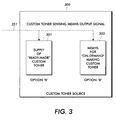
- the custom toner source 300 is shown in greater detail in FIG. 3, which is described below.
- custom toner source 300 may be used with the custom toner module 150 of FIG 1, the custom toner module 250 of FIG. 2, or both.
- the custom toner source 300 comprises a supply 301 of "ready made” custom dry powder toner.
- the custom toner supply 301 is optionally arranged to be controlled by or responsive to the custom toner sensing means 350's output signal 351.
- the custom toner source 300 comprises means 303 for "on-demand” making the custom toner.
- the "on-demand" custom toner making means 303 is arranged to blend and deliver to the custom toner developer unit (corresponding to element 151 in FIG. 1 and element 251 in FIG. 2) a precise mixture of custom color toner primaries, the primary set being appropriately chosen for the custom color being used.
- the "on-demand" custom toner making means 303 is optionally arranged to be controlled by or responsive to the custom toner sensing means output signal 351, thus enabling the system to blend and deliver consistent custom toner color.
- the "on-demand" custom toner making means 303 may include, for example, a control loop for controlling the custom color toner primary mixing and delivering process based on the custom toner sensing means output signal 351.
- the photoreceptor 152 is arranged to thereafter transfer the developed custom toner image 153 onto an intermediate transfer member 154, the transferred image being depicted in FIG. 1 as element 155.
- the intermediate transfer member 154 comprises a belt. In a further embodiment, the intermediate transfer member 154 comprises a drum.
- image transfer from the photoreceptor 152 to the intermediate transfer member 154 may be accomplished by any convenient xerographic transfer means such as, for example, bias transfer rollers ("BTR").
- BTR bias transfer rollers
- the photoreceptor 152 is cleaned prior to the next development cycle. This photoreceptor 152 cleaning step is not depicted in FIG. 1.
- the intermediate transfer member 154 is arranged to act in concert with a custom toner transfer station 180 to again transfer the developed custom toner image 155 onto the developed monochrome image 170 resident on the moving photoreceptor 160, thus forming a finished composite image 175 on the moving photoreceptor 160.
- custom toner transfer station 180 may comprise any convenient xerographic transfer means such as, for example, bias transfer rollers.
- the printer 100 includes further means 190 for transferring and fusing the finished composite image 175 onto a suitable media.
- the media comprises paper.
- the monochrome printer 100 may include more than one custom toner modules 150.
- the printer 100 may include two custom toner modules.
- the first custom toner module comprises the above-described module 150 and the second custom toner module being depicted in FIG. 1 as element 150'.
- the second custom toner module 150' will be arranged to form a second developed toner image and thereafter to transfer this second custom toner image onto the existing composite image 175, thereby forming a finished composite image 175'.
- the printer 100 may include an arbitrary number of custom toner modules 150.
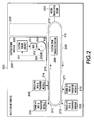
- the printer 200 comprises a plurality of developer modules 210, 220, 230, 240, each developer module of the plurality of developer modules 210, 220, 230, 240 arranged to form and transfer a different color image 271, 272, 273, 274 to a moving intermediate transfer member 260.
- a developed multi-color image 274 is transferred to the intermediate transfer member 260.
- the intermediate transfer member 260 comprises a belt. In a further embodiment, the intermediate transfer member 260 comprises a drum.
- multi-color xerographic printer 200 may comprise an arbitrary number of developer modules.
- each developer module of the plurality of developer modules 210, 220, 230 and 240 may comprise any convenient xerographic developing means.
- the plurality of developer modules 210, 220, 230 and 240 depicted in FIG. 2 comprise the well-known conventional four-color xerographic arrangement of Cyan, Yellow, Magenta, and Black developer modules.
- the plurality of developer modules comprises only three (3) developer modules.
- the printer 200 may comprise an arbitrary number of developer modules, such as 2, 3, 4, etc.
- the printer 200 also includes at least one custom toner module 250.
- the custom toner module 250 comprises a custom toner source 300 arranged to supply a custom toner comprising dry power to a custom toner developer unit 251.
- the custom toner developer unit 251 is arranged to form a developed custom toner image 253 on a photoreceptor 252.
- the custom toner developer unit 251 comprises a magnetic brush SCMB developing system.
- the custom toner module 250 optionally includes the custom toner sensing means 350 discussed in connection with FIG. 1 above which is arranged for sensing the developed custom toner image 253 on the photoreceptor 252. Similar to the discussion of the custom toner sensing means 350 in FIG. 1 above, in one embodiment, for example, the custom toner sensing means 350 comprises an inline spectrophotometer arranged for forming the output signal 351 that is based on the spectral or color content of the developed custom toner image 253.
- the custom toner source 300 is identical to that discussed above in connection with FIG. 3.
- the photoreceptor 252 is arranged to act in concert with a custom toner transfer station 280 to transfer the developed custom toner image 253 onto the developed multi-color image resident on the moving intermediate transfer member 260, thus forming a finished composite image 275 on the moving intermediate transfer member 260.
- custom toner transfer station 280 may comprise any convenient xerographic transfer means such as, for example, bias transfer rollers.
- the printer 200 includes further means 290 for transferring and fusing the finished composite image 275 onto a suitable media.
- the media comprises paper.
- the multi-color printer 200 may include more than one custom toner modules 250.
- the printer 200 may include two custom toner modules.
- the first custom toner module comprises the above-described module 250 and the second custom toner module being depicted in FIG. 2 as element 250'.
- the second custom toner module 250' will be arranged to form a second developed toner image and thereafter to transfer this second custom toner image onto the existing composite image 275, thereby forming a finished composite image 275'.
- the printer 200 may include an arbitrary number of custom toner modules 250.
- a dry power xerographic module for custom color applications.
- the elements include a development system which delivers a blended mixture of custom color toner primaries to a photoreceptor, and thereafter to the main photoreceptor 160 of FIG. 1, or to the main intermediate transfer member 260 of FIG. 2, and ultimately transferred to a media.
- the custom toner is blended external to the printer.
- the custom toner is blended inside the printer's custom toner module, using a spectrophotometer and control loop in the mixing and dispense system to deliver consistent color. Registration issues are solved similar to tandem xerographic engines. A very important advantage to this approach is that it allows the possibility for custom color to be inserted into an existing monochrome or black and white printer.
- the custom color latent image is created in the module in the normal xerographic way by charging a photoreceptor and developing at the custom color develop unit (element 151 in FIG. 1 or element 251 in FIG. 2). There is an inline spectrophotometer (element 350 in FIGS. 1 and 2) looking at the toner color on the custom color photoreceptor.
- the custom toner blending option "B" if the color wanders, it can be adjusted by dispensing the appropriate amount of custom color primary toner or, in the case of a highlight color toner, through adjustment of the development bias, toner concentration, or both.
- toner can be designed with the same charge, unlike the situation in tri-level xerography leveraging knowledge gained from a single material.
- toner-toner interactions happen in the transfer step at the intermediate member interface, which is much easier to deal with successfully than in the development nip.
- the control scheme allows precise color control; the system does not need to be perfect with respect to zero differential development for toner blends.
- the intermediate member protects the custom color development system from contamination; if there is back transfer from the main image, it will be cleaned off before it sees the custom color development zone.
Landscapes
- Physics & Mathematics (AREA)
- General Physics & Mathematics (AREA)
- Color Electrophotography (AREA)
Abstract
A xerographic printer (100) includes a custom toner module (150). The
custom toner module is arranged to form a developed custom toner image
and thereafter to transfer this developed custom toner image onto an
existing developed image (170). In a monochrome printer embodiment, the
custom toner module transfers the developed custom toner image onto an
existing developed monochrome image. In a multi-color printer
embodiment, the custom toner module transfers the developed custom
toner image onto an existing developed multi-toner image.
Description
- This invention pertains to xerography and more particularly to a xerographic printer arranged with at least one custom toner module.
- In the printing industry, custom colors are typically printed with a separately-blended ink applied in a separate station as another color separation. Liquid inks used in the printing industry mix well and stay homogeneous and generally produce stable, precise custom colors.
- Custom color is used in the printing industry to satisfy customer requirements for unique color to uniquely identify their product or service. Highlight color is used to highlight various features in a document and is intended to draw the eye of the viewer to particular elements of a document or to help distinguish various aspects of a document to improve readability. Highlight or custom colors are laid down as single toner colors or blends of special primary sets which have been shown to produce custom and "pantone" (trade mark) color sets. The advantages of producing custom colors in this way instead of using a CYMK full process color approach have been mentioned elsewhere but will be mentioned here briefly. These advantages include, larger range of gamut, smooth, higher resolution fonts, as well as high-resolution custom color lines.
- Dry powder custom color printing represents an opportunity for xerography in that it would allow all the advantages of electronic printing to play in a market now limited to conventional plate print engines. Dry powder highlight color printing has been practiced by Xerox in the 4890 family, for example, but only with a very limited number of colors and at fairly low print quality levels. This limited highlight color set is a result of architectural and toner compatibility difficulties, that is, custom colors formed from blends of primaries will not remain homogeneous and powder development systems tend to scavenge previously-developed images. The 4890, for example, requires a complex xerographic design, that is, tri-level xerography, and complex development subsystem architecture to insure that the development systems don't interact with the previous images to produce cross-contamination and color hue shifts. The result of this approach is a system limited both in color gamut and print quality in a very restricted architecture.
- Xerox has been successful with highlight color in the past with the 4890 family of highlight color printers. The approach Xerox has used in these printers is a proprietary process known as "tri-level" xerography, coupled with special colored toners or mixtures of toners for producing the highlight colors. This approach has the advantage of perfect registration since the laser writes the highlight and black image together. One disadvantage here is the development system is burdened with the task of not disturbing the previously-developed image while developing the color image with a low development potential. Disturbances lead to degradation of the developed image as well as cross-contamination of the developer, causing shifts in color hue over long times which are unacceptable to a customer printing a custom color. Another disadvantage is the high contrast voltages and tight restrictions on the charging and exposure systems. The tri-level development system must split the contrast between the two colors requiring very large development housings to enable development with low development fields which stresses development. Another disadvantage here is the highlight color machine architecture is very specific to custom color. The machine must be designed almost from the beginning for highlight color, making it difficult to insert a highlight color capability into existing architectures. Charging, imaging, development and the control system must be interwoven into any previously designed system.
- In one embodiment, a printer comprises a monochrome developer module arranged to form a developed monochrome image on a photoreceptor, and at least one custom toner module arranged to form a developed custom toner image and thereafter to transfer this developed custom toner image onto the developed monochrome image, thus forming a finished composite image.
In a further embodiment of the printer as defined in claim 9, the custom toner source comprises means for "on-demand" making the custom toner responsive to the custom toner sensing means. - In a further embodiment, a printer comprises a plurality of developer modules arranged to form and transfer a developed multi-color image to an intermediate transfer member, and at least one custom toner module arranged to form a developed custom toner image and thereafter to transfer this developed custom toner image onto the developed multi-color image, thus forming a finished composite image.
- In a further embodiment of the printer as defined in claim 10 the plurality of developer modules comprising at least three developer modules.
- In a further embodiment means are included for transferring and fusing the finished composite image onto a media.
- In a further embodiment the at least one custom toner module comprising a custom toner developer unit arranged with a photoreceptor for forming the developed custom toner image, the photoreceptor further arranged with a custom toner transfer station for transferring the developed custom toner image onto the developed multi-color image.
- In a further embodiment the custom toner developer unit comprising a magnetic brush developing system.
- In a further embodiment the at least one custom toner module includes a custom toner source.
- In a further embodiment the custom toner comprising a dry powder.
- In a further embodiment the custom toner source comprises a "ready-made" supply of the custom toner.
- In a further embodiment custom toner sensing means for sensing the developed custom toner image are included.
- In a further embodiment the custom toner source comprises means for "on-demand" making the custom toner responsive to the custom toner sensing means.
-
- FIG. 1 depicts a xerographic
monochrome printer 100 arranged with at least onecustom toner module 150; - FIG. 2 depicts a xerographic
multi-color printer 200 arranged with at least onecustom toner module 250; and - FIG. 3 depicts a
custom toner source 300 which may be used with either the FIG. 1custom toner module 150 or the FIG. 2custom toner module 250. -
- Briefly, a xerographic printer includes at least one custom toner module arranged to form a developed custom toner image and thereafter to transfer this developed custom toner image onto an existing developed image. In a monochrome printer embodiment, the at least one custom toner module transfers the developed custom toner image onto an existing developed monochrome image. In a multi-color printer embodiment, the at least one custom toner module transfers the developed custom toner image onto an existing developed multi-toner image.
- Referring now to FIG. 1 there is shown a xerographic
monochrome printer 100 arranged with at least onecustom toner module 150. As shown, theprinter 100 comprises amonochrome developer module 110. In turn, themonochrome developer module 110 is arranged to form a developedmonochrome image 170 on a movingphotoreceptor 160. - It will be understood that the
monochrome developer module 110 comprises any convenient xerographic developing means. - In one embodiment, for example, the
monochrome developer module 110 comprises a conventional black-and-white toner developer module, with the correspondingmonochrome image 170 comprising a typical black-and-white image. - Still referring to FIG. 1, the
printer 100 also includes at least onecustom toner module 150. As shown, thecustom toner module 150 comprises acustom toner source 300 arranged to supply a custom toner comprising dry powder to a customtoner developer unit 151. In turn, the customtoner developer unit 151 is arranged to form a developedcustom toner image 153 on aphotoreceptor 152. - In one embodiment, the custom
toner developer unit 151 comprises a magnetic brush SCMB developing system. - In one embodiment, depicted in broken lines in FIG. 1, the
custom toner module 150 optionally includes custom toner sensing means 350 arranged for sensing the developedcustom toner image 153 on thephotoreceptor 152. In one embodiment, for example, the custom toner sensing means 350 comprises an inline spectrophotometer arranged for forming anoutput signal 351 that is based on the spectral or color content of the developedcustom toner image 153. - The
custom toner source 300 is shown in greater detail in FIG. 3, which is described below. - Referring now to FIG. 3, there is depicted a
custom toner source 300. As discussed in greater detail below, thecustom toner source 300 may be used with thecustom toner module 150 of FIG 1, thecustom toner module 250 of FIG. 2, or both. - As shown in FIG. 3, there are at least two embodiments of the
custom toner source 300.
In a first embodiment of thecustom toner source 300, labeled "option A" in FIG. 3, thecustom toner source 300 comprises asupply 301 of "ready made" custom dry powder toner. In a variation of this first embodiment, depicted in broken lines, thecustom toner supply 301 is optionally arranged to be controlled by or responsive to the custom toner sensing means 350's output signal 351. - In a second embodiment of the
custom toner source 300, labeled "option B" in FIG. 3, thecustom toner source 300 comprises means 303 for "on-demand" making the custom toner. In this second embodiment, the "on-demand" customtoner making means 303 is arranged to blend and deliver to the custom toner developer unit (corresponding toelement 151 in FIG. 1 andelement 251 in FIG. 2) a precise mixture of custom color toner primaries, the primary set being appropriately chosen for the custom color being used. - In a variation of this second embodiment, depicted in broken lines, the "on-demand" custom toner making means 303 is optionally arranged to be controlled by or responsive to the custom toner sensing means
output signal 351, thus enabling the system to blend and deliver consistent custom toner color. In this variation it will be understood that the "on-demand" custom toner making means 303 may include, for example, a control loop for controlling the custom color toner primary mixing and delivering process based on the custom toner sensing meansoutput signal 351. - Returning now to FIG. 1, the
photoreceptor 152, in turn, is arranged to thereafter transfer the developedcustom toner image 153 onto anintermediate transfer member 154, the transferred image being depicted in FIG. 1 aselement 155. - In one embodiment, the
intermediate transfer member 154 comprises a belt. In a further embodiment, theintermediate transfer member 154 comprises a drum. - It will be understood that such image transfer from the
photoreceptor 152 to theintermediate transfer member 154 may be accomplished by any convenient xerographic transfer means such as, for example, bias transfer rollers ("BTR"). - It will be understood that, subsequent to image transfer to the
intermediate transfer member 154, thephotoreceptor 152 is cleaned prior to the next development cycle. Thisphotoreceptor 152 cleaning step is not depicted in FIG. 1. - Still referring to FIG. 1, after the developed
custom toner image 155 is transferred to theintermediate transfer member 154, theintermediate transfer member 154 is arranged to act in concert with a customtoner transfer station 180 to again transfer the developedcustom toner image 155 onto the developedmonochrome image 170 resident on the movingphotoreceptor 160, thus forming a finishedcomposite image 175 on the movingphotoreceptor 160. - It will be understood that the custom
toner transfer station 180 may comprise any convenient xerographic transfer means such as, for example, bias transfer rollers. - It will be understood that, subsequent to image transfer to the moving
photoreceptor 160, theintermediate transfer member 154 is cleaned. Thisintermediate transfer member 154 cleaning step is not depicted in FIG. 1. - Subsequent to the finished
composite image 175 being formed by thecustom toner module 150, theprinter 100 includes further means 190 for transferring and fusing the finishedcomposite image 175 onto a suitable media. In one embodiment, for example, the media comprises paper. - Still referring to FIG. 1, it will be understood that the
monochrome printer 100 may include more than onecustom toner modules 150. - For example, the
printer 100 may include two custom toner modules. In this embodiment the first custom toner module comprises the above-describedmodule 150 and the second custom toner module being depicted in FIG. 1 as element 150'. As will be understood, in this embodiment the second custom toner module 150' will be arranged to form a second developed toner image and thereafter to transfer this second custom toner image onto the existingcomposite image 175, thereby forming a finished composite image 175'. - By further application of the above principle, it will be understood that the
printer 100 may include an arbitrary number ofcustom toner modules 150. - Referring now to FIG. 2, there is shown a xerographic
multi-color printer 200 arranged with at least onecustom toner module 250. As shown, theprinter 200 comprises a plurality ofdeveloper modules developer modules different color image intermediate transfer member 260. As a result, a developedmulti-color image 274 is transferred to theintermediate transfer member 260. - In one embodiment, the
intermediate transfer member 260 comprises a belt. In a further embodiment, theintermediate transfer member 260 comprises a drum. - While four (4)
developer modules xerographic printer 200 may comprise an arbitrary number of developer modules. - Still referring to FIG. 2, it further will be understood that each developer module of the plurality of
developer modules - In one embodiment, for example, the plurality of
developer modules - In another embodiment, for example, the plurality of developer modules comprises only three (3) developer modules.
- It will be understood that, in general, the
printer 200 may comprise an arbitrary number of developer modules, such as 2, 3, 4, etc. - Still referring to FIG. 2, the
printer 200 also includes at least onecustom toner module 250. As shown, thecustom toner module 250 comprises acustom toner source 300 arranged to supply a custom toner comprising dry power to a customtoner developer unit 251. In turn, the customtoner developer unit 251 is arranged to form a developedcustom toner image 253 on aphotoreceptor 252. - In one embodiment, the custom
toner developer unit 251 comprises a magnetic brush SCMB developing system. - In one embodiment, depicted in broken lines in FIG. 2, the
custom toner module 250 optionally includes the custom toner sensing means 350 discussed in connection with FIG. 1 above which is arranged for sensing the developedcustom toner image 253 on thephotoreceptor 252. Similar to the discussion of the custom toner sensing means 350 in FIG. 1 above, in one embodiment, for example, the custom toner sensing means 350 comprises an inline spectrophotometer arranged for forming theoutput signal 351 that is based on the spectral or color content of the developedcustom toner image 253. - The
custom toner source 300 is identical to that discussed above in connection with FIG. 3. - Still referring to FIG. 2, the
photoreceptor 252, in turn, is arranged to act in concert with a customtoner transfer station 280 to transfer the developedcustom toner image 253 onto the developed multi-color image resident on the movingintermediate transfer member 260, thus forming a finishedcomposite image 275 on the movingintermediate transfer member 260. - It will be understood that the custom
toner transfer station 280 may comprise any convenient xerographic transfer means such as, for example, bias transfer rollers. - It will be understood that, subsequent to the image transfer to the moving
image transfer member 260, thephotoreceptor 252 is cleaned prior to the next development cycle. Thisphotoreceptor 252 cleaning step is not depicted in FIG. 2. - Subsequent to the finished
composite image 275 being formed by thecustom toner module 250, theprinter 200 includes further means 290 for transferring and fusing the finishedcomposite image 275 onto a suitable media. In one embodiment, for example, the media comprises paper. - Still referring to FIG. 2, it will be understood that the
multi-color printer 200 may include more than onecustom toner modules 250. - For example, the
printer 200 may include two custom toner modules. In this embodiment the first custom toner module comprises the above-describedmodule 250 and the second custom toner module being depicted in FIG. 2 as element 250'. As will be understood, in this embodiment the second custom toner module 250' will be arranged to form a second developed toner image and thereafter to transfer this second custom toner image onto the existingcomposite image 275, thereby forming a finished composite image 275'. - By further application of the above principle, it will be understood that the
printer 200 may include an arbitrary number ofcustom toner modules 250. - Thus there is disclosed herein a dry power xerographic module for custom color applications. The elements include a development system which delivers a blended mixture of custom color toner primaries to a photoreceptor, and thereafter to the
main photoreceptor 160 of FIG. 1, or to the mainintermediate transfer member 260 of FIG. 2, and ultimately transferred to a media. In one embodiment, the custom toner is blended external to the printer. In another embodiment, the custom toner is blended inside the printer's custom toner module, using a spectrophotometer and control loop in the mixing and dispense system to deliver consistent color. Registration issues are solved similar to tandem xerographic engines. A very important advantage to this approach is that it allows the possibility for custom color to be inserted into an existing monochrome or black and white printer. - Moreover, there is disclosed an approach to custom color using a self-contained module in the spirit of a primary color module in a tandem engine full process color IOT. The highlight or custom color is created from a single special toner (option "A", element 301) or as a blend of custom color primaries (option "B", element 303) which address toner compatibility issues, as shown in FIG. 3.
- The custom color latent image is created in the module in the normal xerographic way by charging a photoreceptor and developing at the custom color develop unit (
element 151 in FIG. 1 orelement 251 in FIG. 2). There is an inline spectrophotometer (element 350 in FIGS. 1 and 2) looking at the toner color on the custom color photoreceptor. In the custom toner blending option "B", if the color wanders, it can be adjusted by dispensing the appropriate amount of custom color primary toner or, in the case of a highlight color toner, through adjustment of the development bias, toner concentration, or both. - This approach includes the following advantages: First, by allowing the possibility for adding custom color to an existing B&W architecture. Second, toner can be designed with the same charge, unlike the situation in tri-level xerography leveraging knowledge gained from a single material. Third, toner-toner interactions happen in the transfer step at the intermediate member interface, which is much easier to deal with successfully than in the development nip. Fourth, the control scheme allows precise color control; the system does not need to be perfect with respect to zero differential development for toner blends. Fifth, the intermediate member protects the custom color development system from contamination; if there is back transfer from the main image, it will be cleaned off before it sees the custom color development zone.
- Moreover, this approach should relax materials constraints and allow a broader range of custom colors.
- While various embodiments of a printer arranged with at least one custom toner module have been described above, the scope of the invention is defined by the following claims.
Claims (10)
- A printer comprising:a monochrome developer module arranged to form a developed monochrome image on a photoreceptor, andat least one custom toner module arranged to form a developed custom toner image and thereafter to transfer this developed custom toner image onto the developed monochrome image, thus forming a finished composite image.
- The printer of claim 1, the monochrome image comprising a black-and-white image.
- The printer of claim 1, including means for transferring and fusing the finished composite image onto a media.
- The printer of claim 1, the at least one custom toner module comprising a custom toner developer unit arranged with a photoreceptor for forming the developed custom toner image, the photoreceptor arranged with an intermediate transfer member element and a custom toner transfer station for transferring the developed custom toner image onto the developed monochrome image.
- The printer of claim 4, the custom toner developer unit comprising a magnetic brush developing system.
- The printer of claim 4, wherein the at least one custom toner module includes a custom toner source.
- The printer of claim 6, the custom toner comprising a dry powder.
- The printer of claim 6, wherein the custom toner source comprises a "ready-made" supply of the custom toner.
- The printer of claim 6, including custom toner sensing means for sensing the developed custom toner image.
- A printer comprising:a plurality of developer modules arranged to form and transfer a developed multi-color image to an intermediate transfer member, andat least one custom toner module arranged to form a developed custom toner image and thereafter to transfer this developed custom toner image onto the developed multi-color image, thus forming a finished composite image.
Applications Claiming Priority (2)
| Application Number | Priority Date | Filing Date | Title |
|---|---|---|---|
| US886770 | 2001-06-21 | ||
| US09/886,770 US20020197088A1 (en) | 2001-06-21 | 2001-06-21 | Printer arranged with at least one custom toner module |
Publications (1)
| Publication Number | Publication Date |
|---|---|
| EP1271258A2 true EP1271258A2 (en) | 2003-01-02 |
Family
ID=25389734
Family Applications (1)
| Application Number | Title | Priority Date | Filing Date |
|---|---|---|---|
| EP02013811A Withdrawn EP1271258A2 (en) | 2001-06-21 | 2002-06-21 | Printer arranged with at least one custom toner module |
Country Status (3)
| Country | Link |
|---|---|
| US (1) | US20020197088A1 (en) |
| EP (1) | EP1271258A2 (en) |
| BR (1) | BR0202340A (en) |
Families Citing this family (1)
| Publication number | Priority date | Publication date | Assignee | Title |
|---|---|---|---|---|
| US8294956B2 (en) * | 2008-05-28 | 2012-10-23 | Xerox Corporation | Finishing control system using inline sensing with clear toner |
-
2001
- 2001-06-21 US US09/886,770 patent/US20020197088A1/en not_active Abandoned
-
2002
- 2002-06-20 BR BR0202340-7A patent/BR0202340A/en not_active Application Discontinuation
- 2002-06-21 EP EP02013811A patent/EP1271258A2/en not_active Withdrawn
Also Published As
| Publication number | Publication date |
|---|---|
| BR0202340A (en) | 2003-04-08 |
| US20020197088A1 (en) | 2002-12-26 |
Similar Documents
| Publication | Publication Date | Title |
|---|---|---|
| EP2597522B1 (en) | Color image forming apparatus and method for controlling color image forming apparatus | |
| US6344902B1 (en) | Apparatus and method for using feedback and feedforward in the generation of presentation images in a distributed digital image processing system | |
| KR100738238B1 (en) | Color image forming apparatus and control method thereof | |
| US7869739B2 (en) | Two-color IOI drum module enabling N-color monochrome, highlight, full color, phototone color and extended color architectures | |
| CN102338998B (en) | Image forming apparatus | |
| US6352806B1 (en) | Low toner pile height color image reproduction machine | |
| US7305200B2 (en) | Printing system with extended color gamut | |
| CN101470380B (en) | Image forming apparatus | |
| US6819902B2 (en) | Image forming apparatus with interchangeable developing devices | |
| EP0898208A3 (en) | Xerographic printing system | |
| US6203953B1 (en) | Method for forming a toner image with low toner pile height | |
| JP7521068B2 (en) | Image forming device | |
| JP2004069947A (en) | Color image forming apparatus and method of controlling density-gradation characteristics thereof | |
| JP4228621B2 (en) | Image forming apparatus and image processing apparatus | |
| US8007969B2 (en) | Tri-level xerography for hypochromatic colorants | |
| US7215442B2 (en) | Image formation apparatus and image formation method | |
| US6018636A (en) | System and method for detecting and compensating for changes in liquid xerographic toner developability | |
| US20100092215A1 (en) | Printing system with toner blend | |
| US20100104303A1 (en) | Image forming apparatus | |
| US20110008077A1 (en) | Scalable printing system having multiple intermediate transfer belts | |
| EP0903643A3 (en) | Full color xerographic printing system | |
| US20020197088A1 (en) | Printer arranged with at least one custom toner module | |
| JP2006308888A (en) | Image forming apparatus | |
| JPH08171252A (en) | Image forming device | |
| US6754464B2 (en) | Full-color recorder using potential split developing process |
Legal Events
| Date | Code | Title | Description |
|---|---|---|---|
| PUAI | Public reference made under article 153(3) epc to a published international application that has entered the european phase |
Free format text: ORIGINAL CODE: 0009012 |
|
| AK | Designated contracting states |
Kind code of ref document: A2 Designated state(s): AT BE CH CY DE DK ES FI FR GB GR IE IT LI LU MC NL PT SE TR |
|
| AX | Request for extension of the european patent |
Free format text: AL;LT;LV;MK;RO;SI |
|
| STAA | Information on the status of an ep patent application or granted ep patent |
Free format text: STATUS: THE APPLICATION IS DEEMED TO BE WITHDRAWN |
|
| 18D | Application deemed to be withdrawn |
Effective date: 20050104 |