EP1270939A2 - Process of production of compressor shoe - Google Patents
Process of production of compressor shoe Download PDFInfo
- Publication number
- EP1270939A2 EP1270939A2 EP02012681A EP02012681A EP1270939A2 EP 1270939 A2 EP1270939 A2 EP 1270939A2 EP 02012681 A EP02012681 A EP 02012681A EP 02012681 A EP02012681 A EP 02012681A EP 1270939 A2 EP1270939 A2 EP 1270939A2
- Authority
- EP
- European Patent Office
- Prior art keywords
- shoe
- chrome
- quenching
- production
- manganese
- Prior art date
- Legal status (The legal status is an assumption and is not a legal conclusion. Google has not performed a legal analysis and makes no representation as to the accuracy of the status listed.)
- Withdrawn
Links
Images



Classifications
-
- F—MECHANICAL ENGINEERING; LIGHTING; HEATING; WEAPONS; BLASTING
- F04—POSITIVE - DISPLACEMENT MACHINES FOR LIQUIDS; PUMPS FOR LIQUIDS OR ELASTIC FLUIDS
- F04B—POSITIVE-DISPLACEMENT MACHINES FOR LIQUIDS; PUMPS
- F04B27/00—Multi-cylinder pumps specially adapted for elastic fluids and characterised by number or arrangement of cylinders
- F04B27/08—Multi-cylinder pumps specially adapted for elastic fluids and characterised by number or arrangement of cylinders having cylinders coaxial with, or parallel or inclined to, main shaft axis
-
- F—MECHANICAL ENGINEERING; LIGHTING; HEATING; WEAPONS; BLASTING
- F04—POSITIVE - DISPLACEMENT MACHINES FOR LIQUIDS; PUMPS FOR LIQUIDS OR ELASTIC FLUIDS
- F04B—POSITIVE-DISPLACEMENT MACHINES FOR LIQUIDS; PUMPS
- F04B27/00—Multi-cylinder pumps specially adapted for elastic fluids and characterised by number or arrangement of cylinders
- F04B27/08—Multi-cylinder pumps specially adapted for elastic fluids and characterised by number or arrangement of cylinders having cylinders coaxial with, or parallel or inclined to, main shaft axis
- F04B27/0873—Component parts, e.g. sealings; Manufacturing or assembly thereof
- F04B27/0878—Pistons
- F04B27/0886—Piston shoes
Definitions
- the present invention relates to a process of production of a compressor shoe.
- the refrigeration circuit used in a car air-conditioner includes a compressor for compressing refrigerant gas.
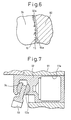
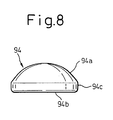
- a compressor for compressing refrigerant gas for example, in a known variable displacement swash plate type compressor, as shown in FIG. 7, a cylinder block 91 is formed with a plurality of cylinder bores 91a. Pistons 92 are accommodated in these cylinder bores 91a to be able to reciprocate in them. Further, a swash plate 93 able to synchronously rotate and be inclined is supported by a not shown rotatably supported drive shaft. Between the swash plate 93 and each piston 92 is provided a pair of shoes 94 sandwiching the swash plate 93. Each shoe 94, as illustrated in FIG. 8, has a top surface forming part of a spherical surface as a spherical part 94a and bottom surface forming a substantially flat surface as the flat part 94b. A cylindrical part 94c is formed through rounded portion.
- the swash plate 93 synchronously rotates and inclines to cause the pistons 92 via the shoe 94 to reciprocate inside the cylinder bores 91a. Due to this, refrigerant gas is sucked in, compressed, and discharged at the head sides of the pistons 92.
- the spherical parts 94a of the shoes 94 slide with the surfaces of the spherical seats 92a of the pistons 92, while the flat parts 94b slide with the surface of the swash plate 93. Therefore, the shoes 94 are subjected to a large frictional force between the pistons 92 and the swash plate 93, so the shoes 94 are required to have abrasion resistance and a long fatigue life.
- Such a shoe 94 was manufactured by the following method (shown in FIG. 1). That is, first, a blank ball 80 was fabricated from the high carbon chrome bearing steel SUJ2 (JIS G4805).
- SUJ2 is comprised of the following: Carbon 0.95 to 1.10 wt% Chrome 1.30 to 1.60 wt% Manganese 0.5 wt% or less Silicon 0.15 to 0.35 wt% Phosphorus 0.025 wt% or less Sulfur 0.025 wt% or less
- the blank ball 80 is obtained by cutting out an amount of material enabling formation of a shoe from a rod member comprised of the above SUJ2, forming this material into a spherical shape, then quenching, tempering, polishing, and annealing it.
- the blank ball 80 is formed into a material 81 of a shoe shape by a press process S71.
- the material 81 is subjected to a quenching process S72 in a quenching furnace to obtain a quenched shoe 82 given a high hardness.
- the quenched shoe 82 is subjected to a tempering process S73 in a tempering furnace to obtain a heat treated shoe 83 maintaining its high hardness and given toughness.
- a polishing process S74 is applied to the heat treated shoe 83 to obtain the compressor shoe 94.
- the thus manufactured shoe 94 is given a high hardness by the application of the quenching process S72 to the material 81 and is given a high toughness by the application of the subsequent tempering process S73, so the required abrasion resistance and long fatigue life are realized.
- An object of the present invention is to provide a process for the production of a compressor shoe superior in durability and reduced in manufacturing cost.
- a process of production of a compressor shoe including a process of quenching a material in a quenching furnace comprised of chrome and/or manganese steel and forming a shoe shape, said quenching process comprising a step of preventing oxidation of the chrome and/or manganese.
- the step is lowering a pressure in the quenching furnace to create a vacuum.
- the step is replacing in atmosphere of the quenching furnace by an inert gas or modified gas.
- the step is forming an antioxidation film able to prevent oxidation of the chrome and/or manganese on the surface of the material before quenching.
- the antioxidation film is a phosphate film.
- modified gas is blown into the heat treatment furnace so as to replace the air in the heat treatment furnace with modified gas.
- the quenching process S72 on the material 81 was performed in this atmosphere. Therefore, the quenching process S72 was performed under conditions where the oxygen in the air remained in the atmosphere in a slight amount and under a considerably high temperature, so the oxygen in the atmosphere reacted with the chrome or manganese present near the surface of the material 81 and oxides of chrome or manganese easily formed at the crystal grain boundaries.
- the oxides of chrome or manganese present on the surface of the shoe 83 are brittle, so as shown in FIG.
- chrome and manganese are elements added to improve the quenchability. Due to these, greater abrasion resistance and longer fatigue life can be realized. Therefore, chrome and manganese are essential elements.
- the obtained heat treated shoe 83 was subjected to a sufficient polishing process S74 to remove all of the oxides of chrome or manganese present at the crystal grain boundaries at the surface.
- a long time was need for the polishing process S74 and the amount of the polishing agent used increased, so soaring costs of manufacture were induced as a result.
- the process of production of a compressor shoe of the present invention is provided with a quenching process for quenching a material comprised of chrome and/or manganese steel formed in the shape of a shoe.
- a means is applied for preventing oxidation of the chrome and/or manganese.
- high carbon chrome bearing steel or other steel in which chrome and manganese are added such as the superior quenchability SUJ2 (JIS G4805) is used as the material.
- the chrome and manganese are added for improving the quenchability.
- the oxidation of the chrome and/or manganese of the material is prevented, so no oxides of chrome or manganese are formed at the crystal grain boundaries. Therefore, no microcracks form at the crystal grain boundaries, the surface of the shoe does not flake off to form abraded dust during operation of the compressor, and the shoe clearance is not increased. As a result, the compressor maintains sufficient performance over a long period.
- the polishing can be completed in a short time, the amount of the polishing agent used is reduced, and in turn it is possible to realize a reduction of the costs of manufacture.
- the means for preventing oxidation it is preferable to perform the quenching process in a vacuum.
- a vacuum By performing the quenching in a vacuum, it is possible to reliably prevent the chrome and/or manganese added to the steel from being oxidized. Therefore, it is possible to reliably obtain the action and effects of the present invention. Further, according to this process, since a gas for replacing the air is not necessary, the running costs also become lower.
- the quenching process in vacuum is preferably performed with a high degree of vacuum.
- the means for preventing oxidation it is preferable to perform the quenching process in an atmosphere of inert gas or modified gas.
- the oxygen in the air should not be left as in the related art. Further, oxygen should not be contained in the inert gas or modified gas.
- the inert gas it is possible to use argon, helium, or another rare gas or nitrogen or another gas poor in reactivity. Further, it is possible to use a mixed gas of these inert gases.
- the modified gas it is possible to use one made from propane etc. Further, to prevent residual oxygen, it is possible to bring the furnace to a vacuum once and then introduce the inert gas or modified gas.
- an antioxidation film able to prevent oxidation of chrome and/or manganese on the surface of the material before the quenching process.
- an antioxidation film formed on the surface of the material, even if there were oxygen present in the atmosphere at the quenching process, it would be possible to prevent oxidation of the chrome and/or manganese in the material and therefore possible to obtain the action and effects of the present invention.
- the vacuum pump and piping for replacement of the atmosphere etc. become unnecessary, so the capital costs for the quenching process can be lowered.
- the antioxidation film it is possible to employ a phosphate film.
- a phosphate film is formed as a dense film on the surface of the material, so is superior in function as an antioxidation film. Further, by forming a phosphate film at a stage prior to forming the shoe shape, it is possible to reduce the press pressure at the press forming process for forming the shoe shape and to improve the dimensional precision of the press forming.
- a blank ball 80 was subjected to a press forming process S71 to form the material 81.
- the material 81 was then subjected to a quenching process S72 to obtain a quenched shoe 82.
- This quenched shoe 82 was subjected to a tempering process S73 to obtain a heat treated shoe 83.
- the heat treated shoe 83 was then subjected to a polishing process S74 to obtain the shoe 94.
- Example 1 differs from the process of the related art in the following processs. That is, at the quenching process S72, a quenching furnace connected to a vacuum pump was used. The material 81 was placed in this quenching furnace and the vacuum pump operated to lower the pressure in the quenching furnace to about 5 to 10 Pa. The material 81 was held at 500 to 750°C for 45 to 60 minutes, then held at 800 to 840°C for 60 to 90 minutes and then rapidly cooled. The material 81 was quenched in this way to obtain the quenched shoe 82.
- a tempering furnace able to be replaced in atmosphere with nitrogen was prepared.
- the quenched shoe 82 was placed in the tempering furnace, the air was replaced with nitrogen, and the pressure of the nitrogen was made about the same as the atmosphere.
- the shoe was held at 120 to 200°C for 100 to 150 minutes to temper the quenched shoe 82.
- a heat treated shoe 83 was obtained in this way.
- Polishing time 10 to 15 minutes (shoes fit into several hundred holes provided in rotating disk)
- Example 3 In the process of production of the compressor shoe of Example 3, the blank ball 80 was dipped in a phosphate film treatment solution, then rinsed to form a phosphate film on the blank ball 80. The rest of the conditions were similar to those of Example 1. The compressor shoe 94 of Example 3 was obtained in this way.
- the shoes 94 of Example 1 and the comparative example manufactured in the above way were examined at their surfaces by a scanning electron microscope and analyzed at their surface by an X-ray microanalyzer. Further, the metallic textures of the cross-sections of the shoes 94 were examined and analyzed by a metallurgical microscope and X-ray microanalyzer.
- each shoe 94 was cut by a cutting machine, then the resultant cut piece was buried in a resin. Next, the cut piece of the shoe 94 buried in the resin was polished to a mirror finish by a polishing machine. Next, the polished surface of the cut piece was analyzed by an X-ray microanalyzer. For examination of the metallic texture of the cross-section, after the analysis of the cross-section by the X-ray analyzer, the mirror polished surface was corroded by a Nytal corrosive solution and then examined by a metallurgical microscope.
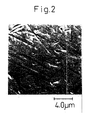
- Example 1 With the shoe 94 of Example 1, as shown in FIG. 2, no presence of granular substances at the surface of the shoe 94 could be observed. With the shoes 94 of Example 2 and Example 3 as well, while not shown, in the same way as Example 1, no presence of granular substances could be observed.
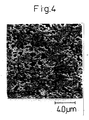
- the shoe 94 of the comparative example As opposed to this, with the shoe 94 of the comparative example, as shown in FIG. 4, granular substances forming dark contrasts were observed at the surface of the shoe 94. The presence of chrome or manganese along with oxygen was observed in the dark contrast portions. Therefore, the granular substances can be considered to be oxides of chrome or manganese.
- Example 1 With the shoe 94 of Example 1, as shown in FIG. 3, no defects could be observed near the surface. With the shoes 94 of Example 2 and Example 3 as well, while not shown, in the same way as Example 1, the presence of granular substances could not be observed.
Landscapes
- Engineering & Computer Science (AREA)
- Mechanical Engineering (AREA)
- General Engineering & Computer Science (AREA)
- Manufacturing & Machinery (AREA)
- Compressors, Vaccum Pumps And Other Relevant Systems (AREA)
- Compressor (AREA)
- Heat Treatment Of Articles (AREA)
Abstract
Description
| Carbon | 0.95 to 1.10 wt% |
| Chrome | 1.30 to 1.60 wt% |
| Manganese | 0.5 wt% or less |
| Silicon | 0.15 to 0.35 wt% |
| Phosphorus | 0.025 wt% or less |
| Sulfur | 0.025 wt% or less |
Claims (5)
- A process of production of a compressor shoe including a process of quenching a material in a quenching furnace comprised of chrome and/or manganese steel and forming a shoe shape,
said quenching process comprising a step of preventing oxidation of the chrome and/or manganese. - A process of production as set forth in claim 1, wherein said step is lowering a pressure in the quenching furnace to create a vacuum.
- A process of production as set forth in claim 1, wherein said step is replacing in atmosphere of the quenching furnace by an inert gas or modified gas.
- A process of production as set forth in any one of claims 1 to 3, where said step is forming an antioxidation film able to prevent oxidation of the chrome and/or manganese on the surface of the material before quenching.
- A process of production as set forth in claim 4, wherein said antioxidation film is a phosphate film.
Applications Claiming Priority (2)
| Application Number | Priority Date | Filing Date | Title |
|---|---|---|---|
| JP2001183113 | 2001-06-18 | ||
| JP2001183113A JP2002371957A (en) | 2001-06-18 | 2001-06-18 | Manufacturing method of compressor shoe |
Publications (2)
| Publication Number | Publication Date |
|---|---|
| EP1270939A2 true EP1270939A2 (en) | 2003-01-02 |
| EP1270939A3 EP1270939A3 (en) | 2003-11-19 |
Family
ID=19023102
Family Applications (1)
| Application Number | Title | Priority Date | Filing Date |
|---|---|---|---|
| EP02012681A Withdrawn EP1270939A3 (en) | 2001-06-18 | 2002-06-07 | Process of production of compressor shoe |
Country Status (6)
| Country | Link |
|---|---|
| US (1) | US6837948B2 (en) |
| EP (1) | EP1270939A3 (en) |
| JP (1) | JP2002371957A (en) |
| KR (1) | KR100496743B1 (en) |
| CN (1) | CN1190591C (en) |
| BR (1) | BR0202282A (en) |
Families Citing this family (1)
| Publication number | Priority date | Publication date | Assignee | Title |
|---|---|---|---|---|
| KR101654285B1 (en) * | 2014-12-02 | 2016-09-06 | 주식회사 나무나라 애 | Sanitary pad containing the phytoncide |
Family Cites Families (4)
| Publication number | Priority date | Publication date | Assignee | Title |
|---|---|---|---|---|
| WO1981002767A1 (en) | 1980-03-28 | 1981-10-01 | Taiho Kogyo Co Ltd | Shoe for swash plate type compressor and method for manufacturing the same |
| US4683804A (en) * | 1985-01-18 | 1987-08-04 | Taiho Kogyo Kabushiki Kaisha | Swash plate type compressor shoe |
| JP2661650B2 (en) | 1988-07-22 | 1997-10-08 | 大豊工業株式会社 | Boron-treated sliding material |
| JP3936447B2 (en) | 1997-10-30 | 2007-06-27 | Ntn株式会社 | Manufacturing method of swash plate type compressor shoe |
-
2001
- 2001-06-18 JP JP2001183113A patent/JP2002371957A/en active Pending
-
2002
- 2002-03-19 KR KR10-2002-0014824A patent/KR100496743B1/en not_active Expired - Fee Related
- 2002-05-31 US US10/160,849 patent/US6837948B2/en not_active Expired - Fee Related
- 2002-06-07 EP EP02012681A patent/EP1270939A3/en not_active Withdrawn
- 2002-06-17 BR BR0202282-6A patent/BR0202282A/en not_active IP Right Cessation
- 2002-06-18 CN CNB021228744A patent/CN1190591C/en not_active Expired - Fee Related
Also Published As
| Publication number | Publication date |
|---|---|
| CN1190591C (en) | 2005-02-23 |
| EP1270939A3 (en) | 2003-11-19 |
| KR100496743B1 (en) | 2005-06-22 |
| BR0202282A (en) | 2003-04-08 |
| US20020189717A1 (en) | 2002-12-19 |
| US6837948B2 (en) | 2005-01-04 |
| KR20020096859A (en) | 2002-12-31 |
| JP2002371957A (en) | 2002-12-26 |
| CN1392342A (en) | 2003-01-22 |
Similar Documents
| Publication | Publication Date | Title |
|---|---|---|
| EP4685361A1 (en) | Rolling member and rolling bearing | |
| JP3948259B2 (en) | Shoe for a swash plate compressor and manufacturing method thereof | |
| US6837948B2 (en) | Process of production of compressor shoe | |
| EP1262662A1 (en) | Swash plate type compressor | |
| JPH09228972A (en) | Iron-based sliding component of compressor, surface treatment method thereof, and compressor | |
| US20080216923A1 (en) | Wear-resistant elements and method of making same | |
| KR950005325B1 (en) | Bain material bain making method of bain | |
| US6708406B2 (en) | Method of manufacturing shoe for compressor | |
| JP3936447B2 (en) | Manufacturing method of swash plate type compressor shoe | |
| CN100366934C (en) | Rolling, sliding part and process for producing same | |
| JP2634617B2 (en) | Show for swash plate type compressor | |
| JP2003148490A (en) | Manufacturing method of thrust type ball bearing race | |
| JP3408366B2 (en) | Sliding member for compressor | |
| JP2002371958A (en) | Manufacturing method of compressor shoe | |
| JP3593221B2 (en) | Surface treatment method for sliding parts | |
| JP2003148488A (en) | Rolling device and manufacturing method thereof | |
| JP2006183845A (en) | Rolling bearing | |
| EP1267074A2 (en) | Method of manufacturing shoe for compressor | |
| JPH03162559A (en) | Sliding member and compressor using the same | |
| JP2013164132A (en) | Self-aligning roller bearing and method of manufacturing the same | |
| JP5211453B2 (en) | Rolling bearing | |
| JP5148147B2 (en) | Thrust bearing for swash plate compressor | |
| JPH11132241A (en) | Shell type needle roller bearing | |
| JP2004183804A (en) | Thrust ball bearing, and method for manufacturing the same | |
| JPH11201016A (en) | Swash plate hydraulic rotating machine, and manufacture of swash plate used in it |
Legal Events
| Date | Code | Title | Description |
|---|---|---|---|
| PUAI | Public reference made under article 153(3) epc to a published international application that has entered the european phase |
Free format text: ORIGINAL CODE: 0009012 |
|
| 17P | Request for examination filed |
Effective date: 20020607 |
|
| AK | Designated contracting states |
Kind code of ref document: A2 Designated state(s): AT BE CH CY DE DK ES FI FR GB GR IE IT LI LU MC NL PT SE TR |
|
| AX | Request for extension of the european patent |
Free format text: AL;LT;LV;MK;RO;SI |
|
| PUAL | Search report despatched |
Free format text: ORIGINAL CODE: 0009013 |
|
| AK | Designated contracting states |
Kind code of ref document: A3 Designated state(s): AT BE CH CY DE DK ES FI FR GB GR IE IT LI LU MC NL PT SE TR |
|
| AX | Request for extension of the european patent |
Extension state: AL LT LV MK RO SI |
|
| AKX | Designation fees paid |
Designated state(s): DE FR IT |
|
| 17Q | First examination report despatched |
Effective date: 20050406 |
|
| STAA | Information on the status of an ep patent application or granted ep patent |
Free format text: STATUS: THE APPLICATION IS DEEMED TO BE WITHDRAWN |
|
| 18D | Application deemed to be withdrawn |
Effective date: 20051018 |