Background of the Invention
-
Cellular membranes serve to differentiate the contents of a cell from the
surrounding environment. These membranes may also serve as effective barriers against the
unregulated influx of hazardous or unwanted compounds, and the unregulated efflux of
desirable compounds. However, the cell does need a supply of desired compounds and the
removal of waste products. Transport proteins which are embedded (singly or in
complexes) in the cellular membrane (reviewed by Oh and Amidon (1999) in Membrane
Transporters as Drug Targets, ed. Amidon and Sadee, Kluwer Academic/Plenum Publishers,
New York, Chapter 1) are major providers of these functions. There are two general classes
of membrane transport proteins: channels or pores, and transporters (also known as carriers
or permeases). Channels and transporters differ in their translocation mechanisms.
Channels are hydrophilic group-lined protein tunnels whose opening by a regulatory event
allows free, rapid passage of their charge-, size-, and geometry-selected small ions down
their concentration gradients. Transporters specifically and selectively bind the molecules
they move, some with and some against their concentration gradients, across membranes.
The binding mechanism causes the action of transporters to be slow and saturable.
-
Transport molecules are specific for a particular target solute or class of
solutes, and are also present in one or more specific membranes. Transport molecules
localized to the plasma membrane permit an exchange of solutes with the surrounding
environment, while transport molecules localized to intracellular membranes (e.g.,
membranes of the mitochondrion, peroxisome, lysosome, endoplasmic reticulum, nucleus,
or vacuole) permit import and export of molecules from organelle to organelle or to the
cytoplasm. For example, in the case of the mitochondrion, transporters in the inner and
outer mitochondrial membranes permit the import of sugar molecules, calcium ions, and
water (among other molecules) into the organelle and the export of newly synthesized ATP
to the cytosol.
-
Transporters can move molecules by two types of processes. In one process,
"facilitated diffusion," transporters move molecules with their concentration gradients. In
the other process, "active transport," transporters move molecules against their
concentration gradients. To move a molecule against its concentration gradient requires
energy. Primary active transporters, such as Na+/K+ ATPases or ABC transporters, use
energy from ATP hydrolysis or light to establish ion gradients and create membrane
potentials. Secondary active transporters, such as the H+/peptide transporter, use the energy
stored in pH or ion gradients (resulting from the actions of primary active transporters) to
transport other molecules. In secondary active transport, the transporter uses two separate
binding sites: one to move the primary ion down its concentration gradient; and another to
move the secondary solute against its gradient, using the energy released by the movement
of the primary ion. The coupled solute either travels in the same direction as the primary
solute (symport) or in the opposite direction (antiport).
-
Transporters play important roles in the ability of the cell to regulate
homeostasis, to grow and divide, and to communicate with other cells, e.g., to transport
signaling molecules, such as hormones, reactive oxygen species, ions, neurotransmitters or
vitamins. A wide variety of human diseases and disorders are associated with defects in
transporter or other membrane transport molecules, including certain types of liver disorders
(e.g., due to defects in transport of long-chain fatty acids (Al Odaib et al. (1998) New Eng. J.
Med. 339:1752-1757), hyperlysinemia (mitochondrial lysine transport defect (Oyanagi et al.
(1986) Inherit. Metab. Dis. 9:313-316)), and cataract (Wintour (1997) Clin. Exp.
Pharmacol. Physiol. 24(1):1-9).
-
There are over 30 families of secondary transporters, also known as solute
carriers or SLCs (reviewed by Berger, et al. (2000) in The Kidney: Physiology and
Pathophysiology, eds. Seldin DW and Giebisch G., Lippincott, Williams & Wilkins,
Philadelphia 1:107-138; see also www.gene.ucl.ac.uk/nomenclature). The SLC families are
classified according to the pair of molecules they move. The SLC13 family couples the
transport of dicarboxylate or sulfate ions to the transport of sodium ions (Chen et al. (1998),
J Biol Chem 273(33):20972-81). SLC13 family members are expressed in a number of
tissues, including kidney, intestine, lung, liver, and brain (Chen et al. (1999), J Clin Invest
103(8):1159-68; Huang et al. (2000), J Pharmacol Exp Ther 295(1):392-403).
Summary of the Invention
-
The present invention is based, in part, on the discovery of a novel transporter
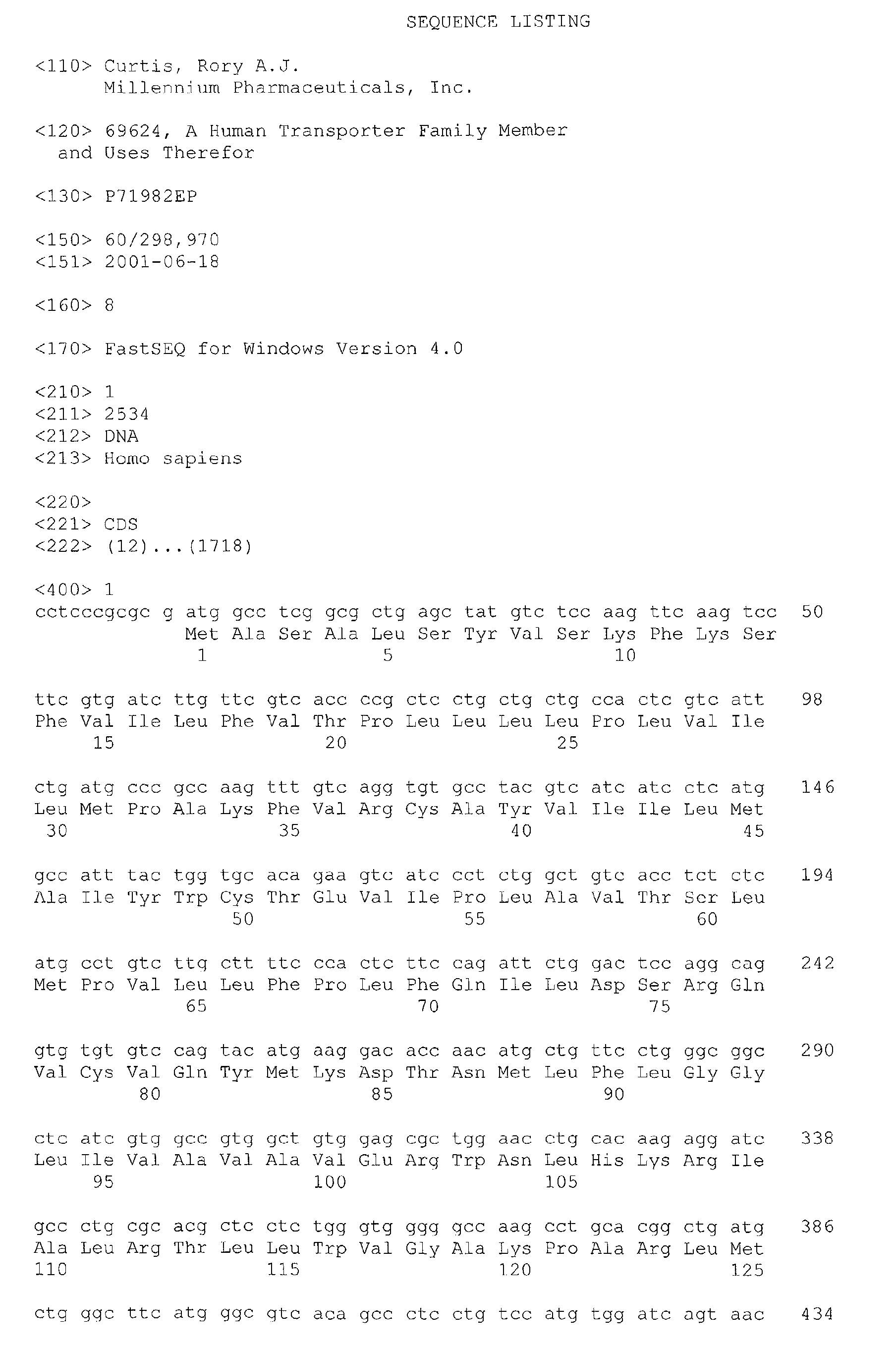
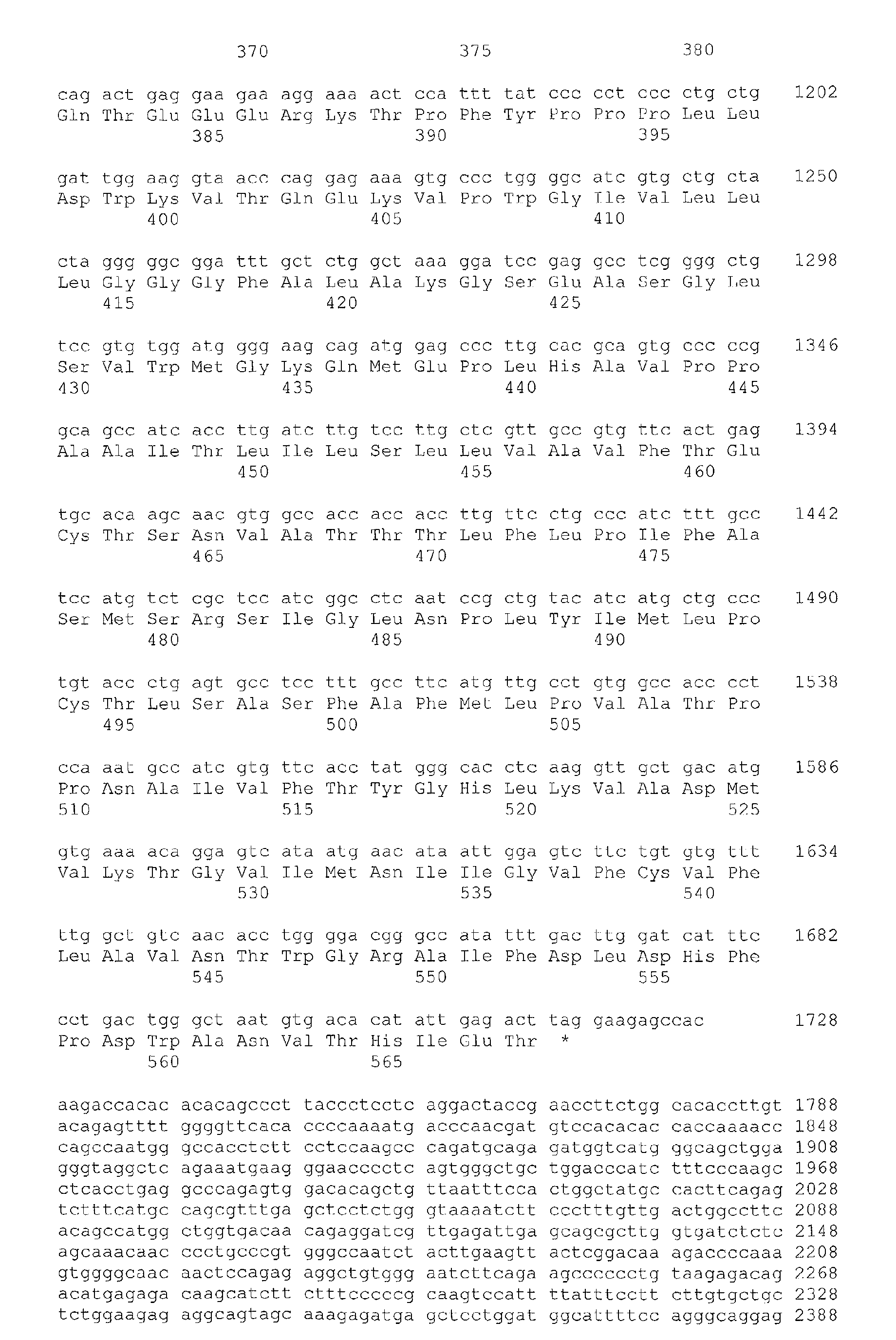
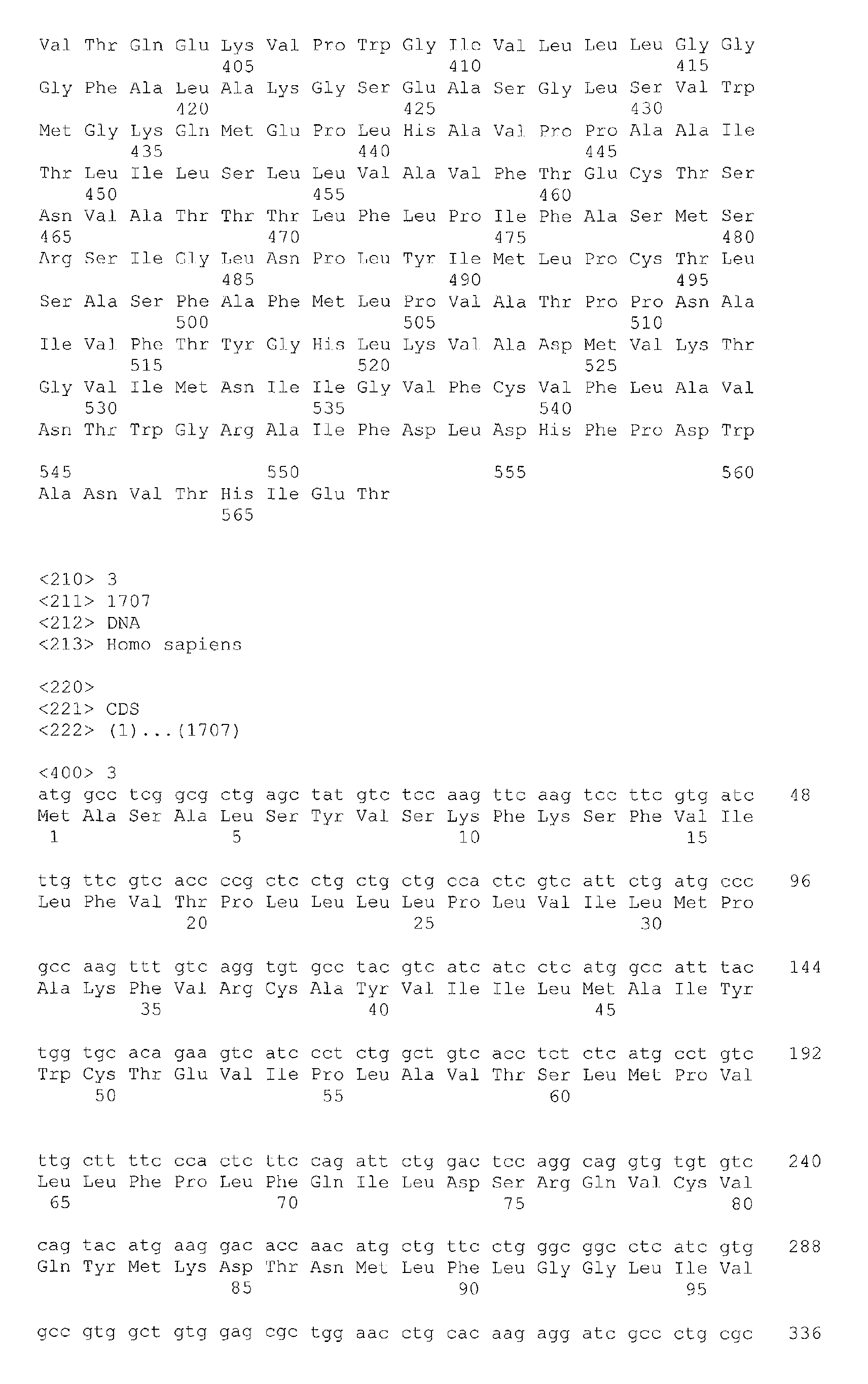
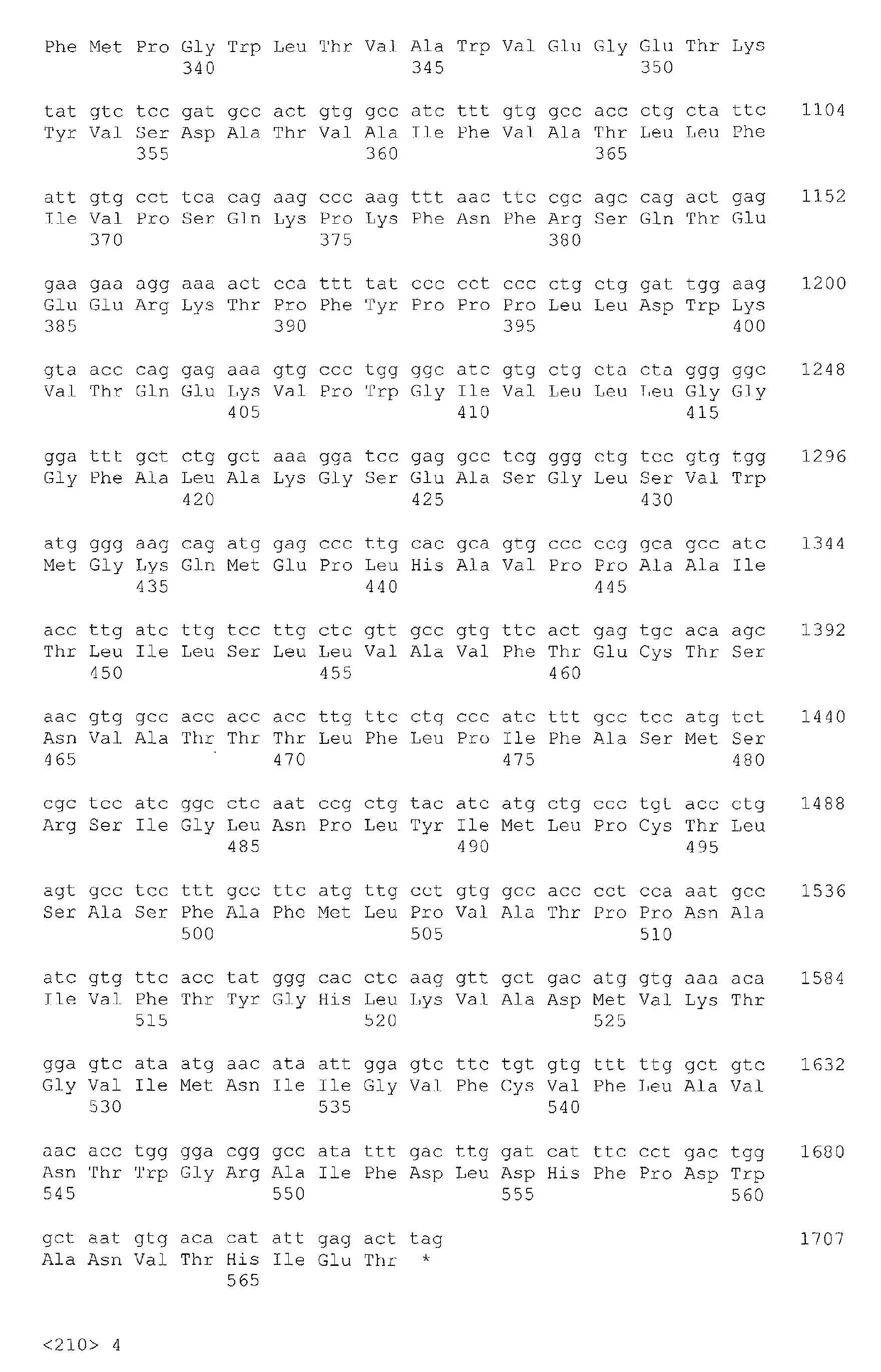
family member, referred to herein as "69624". The nucleotide sequence of a cDNA
encoding 69624 is recited in SEQ ID NO:1, and the amino acid sequence of a 69624
polypeptide is recited in SEQ ID NO:2. In addition, the nucleotide sequences of the coding
region are recited in SEQ ID NO:3.
-
Accordingly, in one aspect, the invention features an isolated nucleic acid
molecule that encodes a 69624 protein or polypeptide, e.g., a biologically active portion of
the 69624 protein. In a preferred embodiment the isolated nucleic acid molecule encodes a
polypeptide having the amino acid sequence of SEQ ID NO:2. In other embodiments, the
invention provides isolated 69624 nucleic acid molecules having the nucleotide sequence
shown in SEQ ID NO:1 or SEQ ID NO:3. In still other embodiments, the invention
provides isolated nucleic acid molecules that are substantially identical (e.g., at least 80%,
85%, 90%, 95%, 96%, 97%, 98% or 99% identical or which are naturally occurring allelic
variants) to the nucleotide sequence shown in SEQ ID NO:1 or SEQ ID NO:3. In other
embodiments, the invention provides an isolated nucleic acid molecule which hybridizes
under a stringency condition described herein to a nucleic acid molecule comprising the
nucleotide sequence of SEQ ID NO: 1 or SEQ ID NO:3, wherein the nucleic acid encodes a
full length 69624 protein or an active fragment thereof. In yet another embodiment, the
isolated nucleic acid molecule encodes a fragment of a polypeptide comprising the amino
acid sequence of SEQ ID NO:2, wherein the fragment comprises at least 150 contiguous
amino acids of SEQ ID NO:2. In another embodiment, the nucleic acid molecule encodes
an antigenic peptide or fragment of a polypeptide comprising the amino acid sequence of
SEQ ID NO:2, wherein the fragment comprises at least 8 contiguous amino acids of SEQ ID
NO:2. In another embodiment, the nucleic acid molecule encodes a naturally occurring
allelic variant of a polypeptide comprising the amino acid sequence of SEQ ID NO:2,
wherein the nucleic acid molecule hybridizes to a nucleic acid molecule comprising SEQ ID
NO:1, 3, or a complement thereof, under a stringent condition as described herein. In still
another embodiment, an isolated nucleic acid described here can further include a
heterologous sequence.
-
In a related aspect, the invention further provides nucleic acid constructs that
include a 69624 nucleic acid molecule described herein. In certain embodiments, the
nucleic acid molecules of the invention are operatively linked to native or heterologous
regulatory sequences. Also included, are vectors and host cells containing the 69624 nucleic
acid molecules of the invention e.g., vectors and host cells suitable for producing 69624
nucleic acid molecules and polypeptides.
-
In another related aspect, the invention provides isolated nucleic acid
fragments suitable as primers or hybridization probes for the detection of 69624-encoding
nucleic acids. In one embodiment, the isolated nucleic acid fragment is at least 300, 400,
500, 600 or more nucleotides of the nucleotide sequence of SEQ ID NO:1 or SEQ ID NO:3.
In still another related aspect, isolated nucleic acid molecules that are antisense to a 69624
encoding nucleic acid molecule are provided.
-
In another aspect, the invention features, isolated 69624 polypeptides, and
biologically active or antigenic fragments thereof that are useful, e.g., as reagents or targets
in assays applicable to treatment and diagnosis of 69624-mediated or -related disorders. In
another embodiment, the invention provides 69624 polypeptides having a 69624 activity.
Preferred polypeptides are 69624 proteins including at least one transporter domain, e.g., a
sodium-dependent dicarboxylate/sulfate transporter domain, and, preferably, having a 69624
activity, e.g., a 69624 activity as described herein.
-
In other embodiments, the invention provides isolated 69624 polypeptides,
e.g., an isolated 69624 polypeptide chosen from one of the following: (i) the amino acid
sequence shown in SEQ ID NO:2; (ii) an amino acid sequence that is substantially identical
(e.g., at least 80%, 85%, 90%, 95%, 96%, 97%, 98%, or 99% identical) to the amino acid
sequence shown in SEQ ID NO:2; (iii) a naturally occurring allelic variant of a polypeptide
comprising the amino acid sequence of SEQ ID NO:2, wherein the polypeptide is encoded
by a nucleic acid molecule which hybridizes to a nucleic acid molecule comprising SEQ ID
NO:1, SEQ ID NO:3, or a complement thereof under stringent conditions as described
herein; (iv) a fragment of a polypeptide comprising the amino acid sequence of SEQ ID
NO:2, wherein the fragment comprises at least 15 contiguous amino acids of SEQ ID NO:2;
or (v) an amino acid sequence encoded by a nucleic acid molecule having a nucleotide
sequence which hybridizes under a stringency condition described herein to a nucleic acid
molecule comprising the nucleotide sequence of SEQ ID NO: 1 or SEQ ID NO:3, wherein
the nucleic acid encodes a full length 69624 protein or an active fragment thereof.
-
In a related aspect, the invention provides 69624 polypeptides or fragments
operatively linked to a heterologous amino acid sequence, e.g., a non-69624 polypeptide to
form fusion proteins.
-
In another aspect, the invention features antibodies and antigen-binding
fragments thereof, that react with, or more preferably specifically bind 69624 polypeptides
or fragments thereof, e.g., a transporter domain, e.g., an extracellular epitope of a 69624
transporter domain. In one embodiment, the antibodies or antigen-binding fragment thereof
competitively inhibit the binding of a second antibody to 69624 polypeptides or fragments
thereof, e.g., a transporter domain, e.g., an extracellular epitope of a 69624 transporter
domain.
-
In another aspect, methods for producing a 69624 polypeptide, e.g., a 69624
polypeptide as described herein, are provided. The method includes introducing a 69624
nucleic acid into a host cell, e.g., a host cell as described herein, and culturing the host cell
under conditions in which the nucleic acid molecule is expressed, thereby producing the
69624 polypeptide.
-
In another aspect, the invention provides a method of identifying or screening
for an agent (e.g., a compound) that modulates the expression or activity of the 69624
polypeptides or nucleic acids. The method includes contacting a 69624 polypeptide or
nucleic acid as described herein, or a cell expressing a 69624 polypeptide or nucleic acid as
described herein with a test agent (e.g., a test compound), and determining whether the test
agent binds to, or modulates the expression or activity of a 69624 polypeptide or nucleic
acid. For example, the binding of the test agent to the polypeptide can be detected by one of
the following methods: (i) detection of binding by direct detection of test agent/polypeptide
binding; (ii) detection of binding using a competition binding assay; or (iii) detection of
binding using an assay for 69624-mediated signal transduction.
-
In still another aspect, the invention provides a process for modulating 69624
polypeptide or nucleic acid expression or activity, e.g. using the screened compounds. In
certain embodiments, the methods involve treatment of conditions related to aberrant
activity or expression of the 69624 polypeptides or nucleic acids, such as conditions
involving aberrant or deficient renal, hepatic, or neural function.
-
The invention also provides assays for determining the activity of or the
presence or absence of 69624 polypeptides or nucleic acid molecules in a biological sample,
including for disease diagnosis.
-
In further aspect, the invention provides assays for determining the presence
or absence of a genetic alteration in a 69624 polypeptide or nucleic acid molecule, including
for disease diagnosis.
-
In another aspect, the invention features a two dimensional array having a
plurality of addresses, each address of the plurality being positionally distinguishable from
each other address of the plurality, and each address of the plurality having a unique capture
probe, e.g., a nucleic acid or peptide sequence. At least one address of the plurality has a
capture probe that recognizes a 69624 molecule. In one embodiment, the capture probe is a
nucleic acid, e.g., a probe complementary to a 69624 nucleic acid sequence. In another
embodiment, the capture probe is a polypeptide, e.g., an antibody specific for 69624
polypeptides. Also featured is a method of analyzing a sample by contacting the sample to
the aforementioned array and detecting binding of the sample to the array.
-
Other features and advantages of the invention will be apparent from the
following detailed description, and from the claims.
Brief Description of the Drawing
-
Figure 1 depicts a hydropathy plot of human 69624. Relative hydrophobic
residues are shown above the dashed horizontal line, and relative hydrophilic residues are
below the dashed horizontal line. The cysteine residues (cys) are indicated by short vertical
lines just below the hydropathy trace. The numbers corresponding to the amino acid
sequence of human 69624 are indicated. Polypeptides of the invention include fragments
which include: all or part of a hydrophobic sequence, i.e., a sequence above the dashed line,
e.g., the sequence from about amino acid 14 to31, from about 253 to 272, and from about
309 to 331 of SEQ ID NO:2; all or part of a hydrophilic sequence, i.e., a sequence below the
dashed line, e.g., the sequence of from about amino acid 189 to 206, from about 290 to 308,
and from about 372 to 388 of SEQ ID NO:2; a sequence which includes a Cys, or a
glycosylation site.
Detailed Description
-
The human 69624 sequence (SEQ ID NO:1), which is approximately 2534
nucleotides long including untranslated regions, contains a predicted methionine-initiated
coding sequence of about 1707 nucleotides, including the termination codon (nucleotides
indicated as coding of SEQ ID NO:1; SEQ ID NO:3). The coding sequence encodes a 568
amino acid protein (SEQ ID NO:2).
-
Human 69624 contains the following regions or other structural features:
-
a sodium sulfate symporter domain (PFAM Accession Number PF00939,
SEQ ID NO:4) located at about amino acid residues 6 to 554 of SEQ ID NO:2;
-
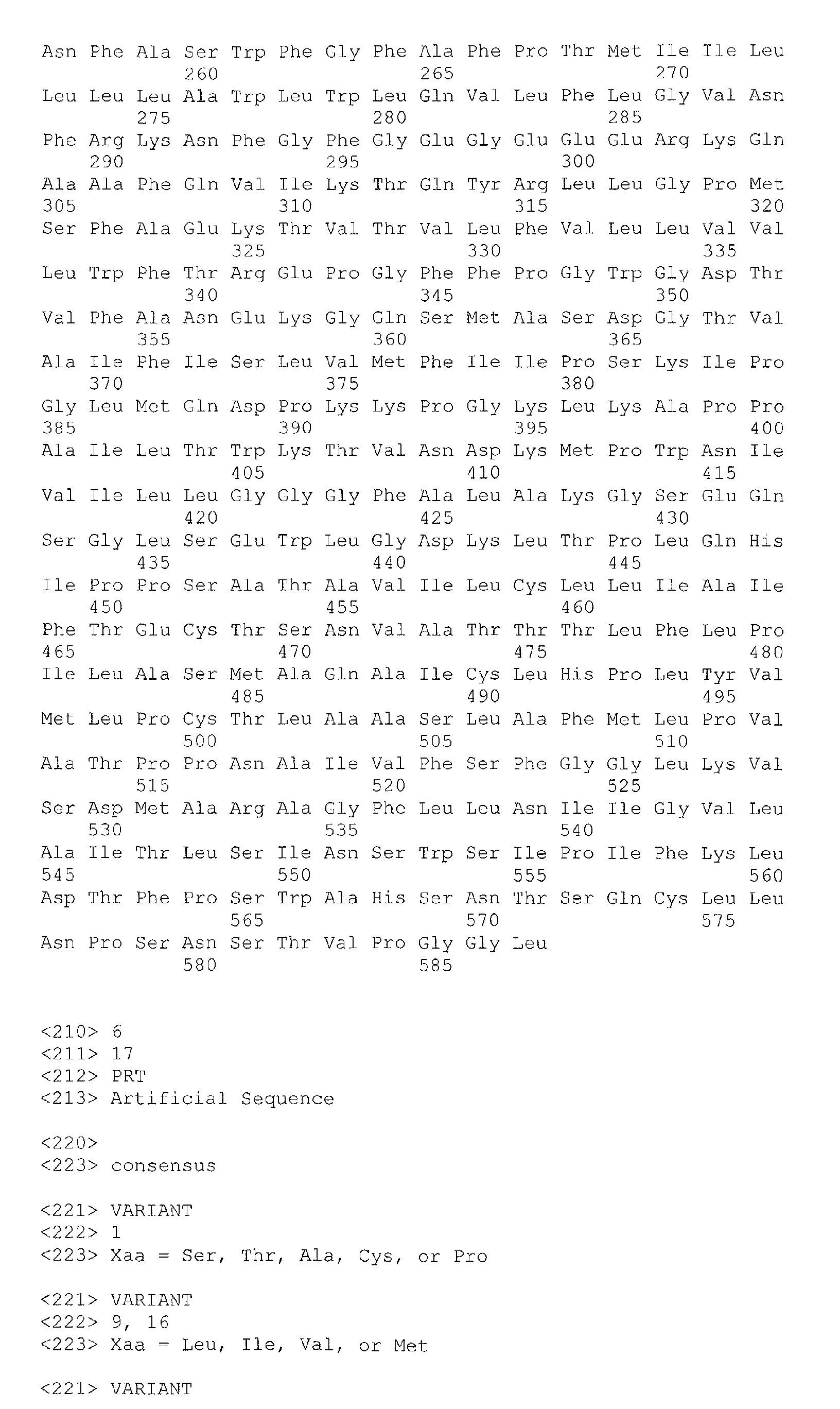
a sodium sulfate symporter signature motif (PS01271, SEQ ID NO:6) located
at about amino acid residues 498 to 514 of SEQ ID NO:2;
-
thirteen transmembrane domains (predicted by MEMSAT, Jones et al. (1994)
Biochemistry 33:3038-3049) located at about amino acid residues 14 to 31, 53 to 73, 87 to
103, 124 to 140, 210 to 234, 253 to 272, 309 to 331, 353 to 370, 406 to 422, 440 to 459, 466
to 483, 490 to 514, and 528 to 544 of SEQ ID NO:2;
-
two Protein Kinase C phosphorylation sites (PS00005) located at about
amino acid residues 291 to 293, and 372 to 374 of SEQ ID NO:2;
-
two Casein Kinase II phosphorylation sites (PS00006) located at about amino
acids 381 to 384, and 564 to 567 of SEQ ID NO:2;
-
one N-glycosylation site (PS00001) located at about amino acids 562 to 565
of SEQ ID NO:2; and
-
three N-myristoylation sites (PS00008) located at about amino acids 118 to
123, 226 to 231, and 423 to 428 of SEQ ID NO:2.
-
For general information regarding PFAM identifiers, PS prefix and PF prefix
domain identification numbers, refer to Sonnhammer et al. (1997) Protein 28:405-420 and
http://www.psc.edu/general/ software/packages/pfam/pfam.html.
-
The 69624 protein contains a significant number of structural characteristics
in common with members of the SLC13 sodium dicarboxylate/sulfate transporter family.
The term "family" when referring to the protein and nucleic acid molecules of the invention
means two or more proteins or nucleic acid molecules having a common structural domain
or motif and having sufficient amino acid or nucleotide sequence homology as defined
herein. Such family members can be naturally or non-naturally occurring and can be from
either the same or different species. For example, a family can contain a first protein of
human origin as well as other distinct proteins of human origin, or alternatively, can contain
homologues of non-human origin, e.g., rat or mouse proteins. Members of a family can also
have common functional characteristics.
-
Sodium dicarboxylate/sulfate transporter family members are characterized
by a common fold. At present, sodium dicarboxylate/sulfate transporter domains are
believed to have at least eleven transmembrane domains, with the possibility of there being
twelve or even thirteen transmembrane domains. It is also believed that the N-terminal non-transmembrane
domain is located in the cytoplasm, while the C-terminal non-transmembrane
domain is located extracellularly, although confirmation of these beliefs
awaits further evidence (see Pajor and Sun (1996), Am J Physiol Cell Physiol 271:C1808-16
and Wang et al. (2000) Am J Physiol Cell Physiol 278:C1019-30, the contents of which are
incorporated herein by reference). The analysis of chimeric sodium dicarboylate/sulfate
transporters has suggested that substrate specificity is encoded in the C-terminal half of the
sodium dicarboxylate/sulfate transporter domain (see Chen et al. (2000), J Clin Invest
103:1159-68, the contents of which are incorporated herein by reference). The 69624
polypeptide shares homology with members of the SLC13 sodium dicarboxylate/sulfate
transporter family. A GAP alignment of human 69624 with a member of the SLC13 sodium
dicarboxylate/sulfate transporter family, rat NaDC-1, a sodium-dependent
dicarboxylate/sulfate transporter (SEQ ID NO:5; Genbank accession number AB001321)
shows 54.7% identity (as determined from a matrix made by matblas from blosum62.iij).
-
A 69624 polypeptide can include a "sodium dicarboxylate/sulfate transporter
domain" or regions homologous with a "sodium dicarboxylate/sulfate transporter domain".
-
As used herein, the term "sodium dicarboxylate/sulfate transporter domain"
includes an amino acid sequence of about 450 to 650 amino acid residues in length and
having a bit score for the alignment of the sequence to the sodium sulfate symporter domain
profile (Pfam HMM, SEQ ID NO:4) of at least 250. Preferably, a sodium
dicarboxylate/sulfate transporter domain includes at least about 500 to 625 amino acids,
more preferably about 525 to 610 amino acid residues, or about 550 to 600 amino acids and
has a bit score for the alignment of the sequence to the sodium sulfate symporter domain
(HMM) of at least 350, 400, 450 or greater. The sodium sulfate symporter domain (HMM)
has been assigned the PFAM Accession Number PF00939
(http;//genome.wustl.edu/Pfam/.html). An alignment of the sodium dicarboxylate/sulfate
domain (amino acids 6 to 554 of SEQ ID NO:2) of human 69624 with a consensus amino
acid sequence (SEQ ID NO:4) derived from a hidden Markov model yields a bit score of
488.2.
-
In a preferred embodiment a 69624 polypeptide or protein has a "sodium
dicarboxylate/sulfate transporter domain" or a region which includes at least about 500 to
625 more preferably about 525 to 610, or 550 to 600 amino acid residues and has at least
about 60%, 70% 80% 90% 95%, 99%, or 100% homology with a "sodium
dicarboxylate/sulfate transporter domain," e.g., the sodium dicarboxylate/sulfate transporter
domain of human 69624 (e.g., residues 6 to 554 of SEQ ID NO:2).
-
In the sodium dicarboxylate/sulfate domain are subdomains which have
homology to portions of ProDom cotransporter sodium/dicarboxylate domains. As used
herein, a "cotransporter sodium/dicarboxylate domain" is a portion of the human 69624
protein which is homologous, e.g., at least about 54%, 55%, 56%, 57%, 58%, 59%, 60%,
61%, 62%, 63%, 64%, 65%, 66%, 67%, 68%, 69%, 70%, 71%, 72%, 73%, or 74% identical
to the ProDom family PD084877 "Transport Cotransporter Transmembrane Sodium
Symport Na/Dicarboxylate Sodium/Dicarboxylate Chromosome" domain (ProDomain
Release 2001.1; http://www.toulouse.inra.fr/prodom.html, SEQ ID NO:7) or to the ProDom
family PD002007 "Transport Cotransporter Transmembrane Sodium Na/Dicarboxylate
Symport Sodium/Dicarboxylate Chromosome" domain (ProDomain Release 2001.1;
http://www.toulouse.inra.fr/prodom.html, SEQ ID NO:8). An alignment of the first
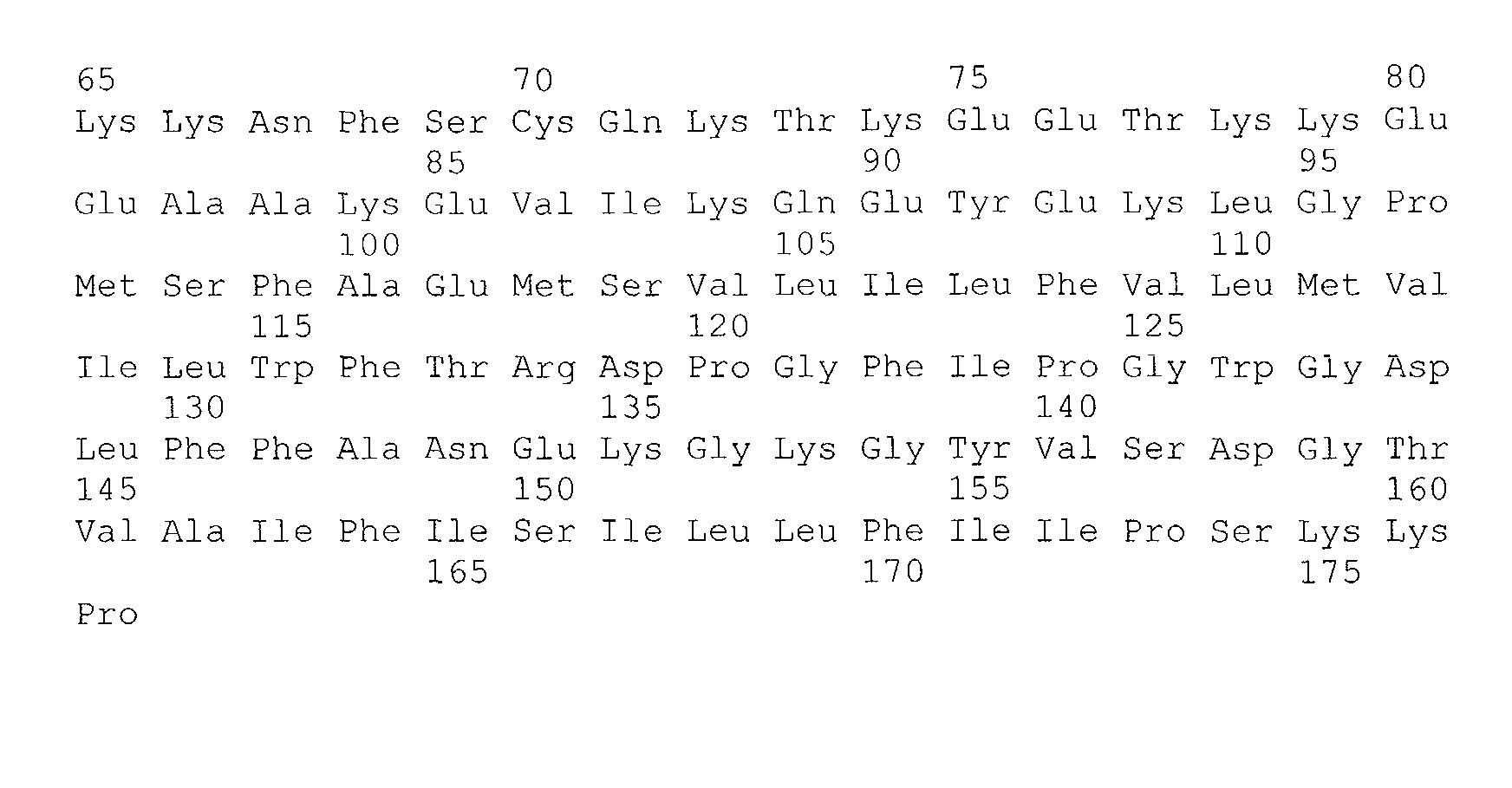
cotransporter sodium/dicarboxylate domain (amino acids 41 to 167 of SEQ ID NO:2) of
human 69624 with the sequence selected from the consensus, SEQ ID NO:7, derived from a
BLAST search model shows 65% identity (as calculated in ProDomain from the blosum62
matrix). An alignment of the second cotransporter sodium/dicarboxylate domain (amino
acids 202 to 375 of SEQ ID NO:2) of human 69624 with the sequence selected from the
consensus, SEQ ID NO:8 derived from a BLAST search model shows 59% identity (as
calculated in ProDomain from the blosum62 matrix).
-
To identify the presence of a "sodium dicarboxylate/sulfate transporter"
domain in a 69624 protein sequence, and make the determination that a polypeptide or
protein of interest has a particular profile, the amino acid sequence of the protein can be
searched against the PFAM database of HMMs (e.g., the PFAM database, release 2.1) using
the default parameters (http://www.sanger.ac.uk/Software/Pfam/HMM_search). For
example, the hmmsf program, which is available as part of the HMMER package of search
programs, is a family specific default program for MILPAT0063 and a score of 15 is the
default threshold score for determining a hit. Alternatively, the threshold score for
determining a hit can be lowered (e.g., to 8 bits). A description of the PFAM database can
be found in Sonhammer et al. (1997) Proteins 28(3):405-420 and a detailed description of
HMMs can be found, for example, in Gribskov et al.(1990) Meth. Enzymol. 183:146-159;
Gribskov et al.(1987) Proc. Natl. Acad. Sci. USA 84:4355-4358; Krogh et al.(1994) J Mol.
Biol. 235:1501-1531; and Stultz et al.(1993) Protein Sci. 2:305-314, the contents of which
are incorporated herein by reference. A search was performed against the HMM database
resulting in the identification of a "sodium sulfate symporter" domain in the amino acid
sequence of human 69624 at about residues 6 to 554 of SEQ ID NO:2.
-
Alternatively, to identify the presence of a "cotransporter
sodium/dicarboxylate" domain in a 69624 protein sequence, and make the determination
that a polypeptide or protein of interest has a particular profile, the amino acid sequence of
the protein can be searched against another database of domains, e.g., the ProDom database
(Corpet et al. (1999), Nucl. Acids Res. 27:263-267). The ProDom protein domain database
consists of an automatic compilation of homologous domains. Current versions of ProDom
are built using recursive PSI-BLAST searches (Altschul SF et al. (1997) Nucleic Acids Res.
25:3389-3402; Gouzy et al. (1999) Computers and Chemistry 23:333-340.) of the SWISS-PROT
38 and TREMBL protein databases. The database automatically generates a
consensus sequence for each domain. A BLAST search was performed against the ProDom
database resulting in the identification of portions of a "cotransporter sodium/dicarboxylate"
domain in the amino acid sequence of human 69624 at about residues 41 to 167 of SEQ ID
NO:2 and about residues 202 to 375 of SEQ ID NO:2.
-
In one embodiment, a 69624 protein includes at least one sodium sulfate
symporter signature motif, located at about amino acid residues 498 to 514 of SEQ ID NO:2.
As used herein, the term "sodium sulfate symporter signature motif' includes a sequence of
at least 13 amino acid residues, defined by the sequence: [STACP]-S-X-X-F-X-X-P-[LIVM]-[GSA]-X-X-X-N-X-[LIVM]-V
(SEQ ID NO:6). A sodium sulfate symporter
signature motif, as defined, can be involved in the transport of sodium and sulfate or
dicarboxylate ions, e.g., citrate, succinate, or N-acetylaspartate, across a biological
membrane. More preferably, a sodium sulfate symporter signature motif includes 16, or
even more preferably, 17 amino acid residues. Sodium sulfate symporter signature motifs
have been described, e.g., in the PROSITE database (http://www.expasy.ch/prosite), where
they have been given the PROSITE accession number PS01271.
-
In a preferred embodiment, a 69624 polypeptide has at least one sodium
sulfate symporter signature motif, or a region which includes 13, 16, or 17 amino acid
residues and has at least about 75%, 85%, 90%, 95%, or 100% homology with a "sodium
sulfate symporter signature motif", e.g., the sodium sulfate symporter signature motif of
human 69624, e.g., about amino acid residues 498 to 514 of SEQ ID NO:2.
-
In another embodiment, a 69624 protein includes at least one, two, three,
four, five, six, seven, eight, nine, ten, or preferably, eleven, twelve or thirteen
transmembrane domains. As used herein, the term "transmembrane domain" includes an
amino acid sequence of at least about 15 amino acid residues in length that inserts into or
spans a phospholipid membrane. A transmembrane domain, as defined, can anchor a
polypeptide to a lipid bilayer. More preferably, a transmembrane domain includes about at
least 18, 20, 22, 24, 25, 30, 35 or 40 amino acid residues and spans a phospholipid
membrane. Transmembrane domains are rich in hydrophobic residues, and typically have
an α-helical structure. In a preferred embodiment, at least 50%, 60%, 70%, 80%, 90%, 95%
or more of the amino acids of a transmembrane domain are hydrophobic, e.g., leucines,
isoleucines, tyrosines, phenylalanine, valine, methionine, or tryptophans. Transmembrane
domains are described in, for example, http://pfam.wustl.edu/cgi-bin/getdesc?name=7tm-1,
and Zagotta W.N. et al, (1996) Annual Rev. Neurosci. 19: 235-63, the contents of which are
incorporated herein by reference.
-
In a preferred embodiment, a 69624 polypeptide or protein has at least one,
two, three, four, five, six, seven, eight, nine, ten, and preferably eleven, twelve or even
thirteen transmembrane domains or regions which include at least 18, 20, 22, 24, 25, 30, 35
or 40 amino acid residues and have at least about 75%, 85%, 90%, 95%, 99%, or 100%
homology with a "transmembrane domain," e.g., at least one transmembrane domain of
human 69624 (e.g., amino acid residues 14 to 31, 53 to 73, 87 to 103, 124 to 140, 210 to
234, 253 to 272, 309 to 331, 353 to 370, 406 to 422, 440 to 459, 466 to 483, 490 to 514, and
528 to 544 of SEQ ID NO:2).
-
A 69624 family member can include at least one sodium
dicarboxylate/sulfate transporter domain. Furthermore, a 69624 family member can include:
at least one sodium sulfate symporter signature sequence (PS01271); at least one, two, three,
four, five, six, seven, eight, nine, ten, preferably eleven, twelve, or even thirteen predicted
transmembrane domains; at least one, preferably two predicted protein kinase C
phosphorylation sites (PS00005); at least one, preferably two predicted casein kinase II
phosphorylation sites (PS00006); at least one, two, preferably three predicted N-myristoylation
sites (PS00008); and at least one predicted N-glycosylation site (PS00001).
-
As the 69624 polypeptides of the invention may modulate 69624-mediated
activities, they may be useful for developing novel diagnostic and therapeutic agents for
69624-mediated or related disorders, as described below.
-
As used herein, a "69624 activity", "biological activity of 69624" or
"functional activity of 69624", refers to an activity exerted by a 69624 protein, polypeptide
or nucleic acid molecule. For example, a 69624 activity can be an activity exerted by 69624
in a physiological milieu on, e.g., a 69624-responsive cell or on a 69624 substrate, e.g., a
protein substrate. A 69624 activity can be determined in vivo or in vitro. In one
embodiment, a 69624 activity is a direct activity, such as an association with a 69624 target
molecule. A "target molecule" or "binding partner" is a molecule with which a 69624
protein binds or interacts in nature. In an exemplary embodiment, 69624 is a transporter,
e.g., an active transporter, e.g., a sodium dicarboxylate/sulfate transporter.
-
A 69624 activity can also be an indirect activity, e.g., a cellular signaling
activity mediated by the intracellular or extracellular transport of a 69624 substrate. Based
on the above-described sequence similarities, the 69624 molecules of the present invention
are predicted to have similar biological activities as sodium dicarboxylate/sulfate transporter
family members. For example, the 69624 proteins of the present invention can have one or
more of the following activities: (1) transport of ions, e.g., sodium ions, across membranes;
(2) transport of dicarboxylate ions, e.g., citrate, succinate, or N-acetylaspartate, across
membranes; (3) transport of sulfate ions across membranes; (4) regulation of the
intracellular concentrations of metabolic intermediates, e.g., citrate and succinate; (5)
regulation of the secretion of anions, e.g., organic anions, e.g., xenobiotic anions or drugs,
from cells, e.g., kidney cells, brain cells, colon cells, liver cells, or salivary gland cells; (6)
regulation of homeostasis, e.g., by resorption of ions, e.g., citrate or sulfate ions, from urine;
(7) regulation, e.g., negative regulation, of the formation of calcium-containing deposits in
the body, e.g., renal stones; (8) regulation myelin synthesis and neuronal myelination; (9)
regulation of hepatic metabolism, e.g., hepatic glutamine and ammonia metabolism; and
(10) regulation of cholesterol metabolism.
-
The 69624 molecules of the invention can modulate the activities of cells in
tissues where they are expressed. For example, cDNA clones containing the 69624
molecules of the invention were isolated from kidney, brain, colon, liver, and salivary gland.
Accordingly, the 69624 molecules of the invention can act as therapeutic or diagnostic
agents for renal, neurological, colon, hepatic, or disorders.
-
Thus, the 69624 molecules of the salivary gland invention may act as novel
diagnostic targets and therapeutic agents for controlling disorders that are known or thought
to involve the abnormal transport of anions, e.g., dicarboxylate anions, e.g. citrate, succinate,
or N-acetylaspartate, and sulfate anions. Such disorders include disorders associated with
abnormal cellular osmotic stress, hypocitranuria, the formation of calcium stones, abnormal
N-acetylaspartate transport, abnormal myelin synthesis, mental retardation (e.g., Canavan
disease), and abnormal body sulfate homeostasis. Furthermore, 69624 molecules can act as
novel diagnostic targets and therapeutic agents for controlling disorders associated with the
kidney, brain, colon, liver, salivary gland, as well as metabolic disorders.
-
Disorders involving the kidney include, but are not limited to, congenital
anomalies including, but not limited to, cystic diseases of the kidney, that include but are not
limited to, cystic renal dysplasia, autosomal dominant (adult) polycystic kidney disease,
autosomal recessive (childhood) polycystic kidney disease, and cystic diseases of renal
medulla, which include, but are not limited to, medullary sponge kidney, and nephronophthisisuremic
medullary cystic disease complex, acquired (dialysis-associated) cystic disease, such as
simple cysts; glomerular diseases including pathologies of glomerular injury that include, but
are not limited to, in situ immune complex deposition, that includes, but is not limited to, anti-GBM
nephritis, Heymann nephritis, and antibodies against planted antigens, circulating
immune complex nephritis, antibodies to glomerular cells, cell-mediated immunity in
glomerulonephritis, activation of alternative complement pathway, epithelial cell injury, and
pathologies involving mediators of glomerular injury including cellular and soluble mediators,
acute glomerulonephritis, such as acute proliferative (poststreptococcal, postinfectious)
glomerulonephritis, including but not limited to, poststreptococcal glomerulonephritis and
nonstreptococcal acute glomerulonephritis, rapidly progressive (crescentic) glomerulonephritis,
nephrotic syndrome, membranous glomerulonephritis (membranous nephropathy), minimal
change disease (lipoid nephrosis), focal segmental glomerulosclerosis, membranoproliferative
glomerulonephritis, IgA nephropathy (Berger disease), focal proliferative and necrotizing
glomerulonephritis (focal glomerulonephritis), hereditary nephritis, including but not limited to,
Alport syndrome and thin membrane disease (benign familial hematuria), chronic
glomerulonephritis, glomerular lesions associated with systemic disease, including but not
limited to, systemic lupus erythematosus, Henoch-Schönlein purpura, bacterial endocarditis,
diabetic glomerulosclerosis, amyloidosis, fibrillary and immunotactoid glomerulonephritis, and
other systemic disorders; diseases affecting tubules and interstitium, including acute tubular
necrosis and tubulointerstitial nephritis, including but not limited to, pyelonephritis and urinary
tract infection, acute pyelonephritis, chronic pyelonephritis and reflux nephropathy, and
tubulointerstitial nephritis induced by drugs and toxins, including but not limited to, acute drug-induced
interstitial nephritis, analgesic abuse nephropathy, nephropathy associated with
nonsteroidal anti-inflammatory drugs, and other tubulointerstitial diseases including, but not
limited to, urate nephropathy, hypercalcemia and nephrocalcinosis, and multiple myeloma;
diseases of blood vessels including benign nephrosclerosis, malignant hypertension and
accelerated nephrosclerosis, renal artery stenosis, and thrombotic microangiopathies including,
but not limited to, classic (childhood) hemolytic-uremic syndrome, adult hemolytic-uremic
syndrome/thrombotic thrombocytopenic purpura, idiopathic HUS/TTP, and other vascular
disorders including, but not limited to, atherosclerotic ischemic renal disease, atheroembolic
renal disease, sickle cell disease nephropathy, diffuse cortical necrosis, and renal infarcts;
urinary tract obstruction (obstructive uropathy); urolithiasis (renal calculi, stones); and tumors
of the kidney including, but not limited to, benign tumors, such as renal papillary adenoma,
renal fibroma or hamartoma (renomedullary interstitial cell tumor), angiomyolipoma, and
oncocytoma, and malignant tumors, including renal cell carcinoma (hypernephroma,
adenocarcinoma of kidney), which includes urothelial carcinomas of renal pelvis.
-
Disorders involving the brain include, but are not limited to, disorders
involving neurons, and disorders involving glia, such as astrocytes, oligodendrocytes,
ependymal cells, and microglia; cerebral edema, raised intracranial pressure and herniation,
and hydrocephalus; malformations and developmental diseases, such as neural tube defects,
forebrain anomalies, posterior fossa anomalies, and syringomyelia and hydromyelia;
perinatal brain injury; cerebrovascular diseases, such as those related to hypoxia, ischemia,
and infarction, including hypotension, hypoperfusion, and low-flow states--global cerebral
ischemia and focal cerebral ischemia--infarction from obstruction of local blood supply,
intracranial hemorrhage, including intracerebral (intraparenchymal) hemorrhage,
subarachnoid hemorrhage and ruptured berry aneurysms, and vascular malformations,
hypertensive cerebrovascular disease, including lacunar infarcts, slit hemorrhages, and
hypertensive encephalopathy; infections, such as acute meningitis, including acute pyogenic
(bacterial) meningitis and acute aseptic (viral) meningitis, acute focal suppurative infections,
including brain abscess, subdural empyema, and extradural abscess, chronic bacterial
meningoencephalitis, including tuberculosis and mycobacterioses, neurosyphilis, and
neuroborreliosis (Lyme disease), viral meningoencephalitis, including arthropod-borne
(Arbo) viral encephalitis, Herpes simplex virus Type 1, Herpes simplex virus Type 2,
Varicalla-zoster virus (Herpes zoster), cytomegalovirus, poliomyelitis, rabies, and human
immunodeficiency virus 1, including HIV-1 meningoencephalitis (subacute encephalitis),
vacuolar myelopathy, AIDS-associated myopathy, peripheral neuropathy, and AIDS in
children, progressive multifocal leukoencephalopathy, subacute sclerosing panencephalitis,
fungal meningoencephalitis, other infectious diseases of the nervous system; transmissible
spongiform encephalopathies (prion diseases); demyelinating diseases, including multiple
sclerosis, multiple sclerosis variants, acute disseminated encephalomyelitis and acute
necrotizing hemorrhagic encephalomyelitis, and other diseases with demyelination;
degenerative diseases, such as degenerative diseases affecting the cerebral cortex, including
Alzheimer disease and Pick disease, degenerative diseases of basal ganglia and brain stem,
including Parkinsonism, idiopathic Parkinson disease (paralysis agitans), progressive
supranuclear palsy, corticobasal degenration, multiple system atrophy, including
striatonigral degenration, Shy-Drager syndrome, and olivopontocerebellar atrophy, and
Huntington disease; spinocerebellar degenerations, including spinocerebellar ataxias,
including Friedreich ataxia, and ataxia-telanglectasia, degenerative diseases affecting motor
neurons, including amyotrophic lateral sclerosis (motor neuron disease), bulbospinal atrophy
(Kennedy syndrome), and spinal muscular atrophy; inborn errors of metabolism, such as
leukodystrophies, including Krabbe disease, metachromatic leukodystrophy,
adrenoleukodystrophy, Pelizaeus-Merzbacher disease, and Canavan disease, mitochondrial
encephalomyopathies, including Leigh disease and other mitochondrial
encephalomyopathies; toxic and acquired metabolic diseases, including vitamin deficiencies
such as thiamine (vitamin B1) deficiency and vitamin B12 deficiency, neurologic sequelae of
metabolic disturbances, including hypoglycemia, hyperglycemia, and hepatic
encephatopathy, toxic disorders, including carbon monoxide, methanol, ethanol, and
radiation, including combined methotrexate and radiation-induced injury; tumors, such as
gliomas, including astrocytoma, including fibrillary (diffuse) astrocytoma and glioblastoma
multiforme, pilocytic astrocytoma, pleomorphic xanthoastrocytoma, and brain stem glioma,
oligodendroglioma, and ependymoma and related paraventricular mass lesions, neuronal
tumors, poorly differentiated neoplasms, including medulloblastoma, other parenchymal
tumors, including primary brain lymphoma, germ cell tumors, and pineal parenchymal
tumors, meningiomas, metastatic tumors, paraneoplastic syndromes, peripheral nerve sheath
tumors, including schwannoma, neurofibroma, and malignant peripheral nerve sheath tumor
(malignant schwannoma), and neurocutaneous syndromes (phakomatoses), including
neurofibromotosis, including Type 1 neurofibromatosis (NF1) and TYPE 2
neurofibromatosis (NF2), tuberous sclerosis, and Von Hippel-Lindau disease.
-
Disorders involving the colon include, but are not limited to, congenital
anomalies, such as atresia and stenosis, Meckel diverticulum, congenital aganglionic
megacolon-Hirschsprung disease; enterocolitis, such as diarrhea and dysentery, infectious
enterocolitis, including viral gastroenteritis, bacterial enterocolitis, necrotizing enterocolitis,
antibiotic-associated colitis (pseudomembranous colitis), and collagenous and lymphocytic
colitis, miscellaneous intestinal inflammatory disorders, including parasites and protozoa,
acquired immunodeficiency syndrome, transplantation, drug-induced intestinal injury,
radiation enterocolitis, neutropenic colitis (typhlitis), and diversion colitis; idiopathic
inflammatory bowel disease, such as Crohn's disease and ulcerative colitis; tumors of the
colon, such as non-neoplastic polyps, adenomas, familial syndromes, colorectal
carcinogenesis, colorectal carcinoma, and carcinoid tumors.
-
Disorders associated with the liver include, but are not limited to, those
arising from an accumulation in the liver of fibrous tissue, such as that resulting from an
imbalance between production and degradation of the extracellular matrix accompanied by
the collapse and condensation of preexisting fibers; hepatocellular necrosis or injury induced
by a wide variety of agents including processes which disturb homeostasis, such as an
inflammatory process, tissue damage resulting from toxic injury or altered hepatic blood
flow, and infections (e.g., bacterial, viral and parasitic); and portal hypertension or hepatic
fibrosis, e.g., fibrosis resulting from a storage disorder such as Gaucher's disease (lipid
abnormalities) or a glycogen storage disease, Al-antitrypsin deficiency; a disorder
mediating the accumulation (e.g., storage) of an exogenous substance, for example,
hemochromatosis (iron-overload syndrome) and copper storage diseases (Wilson's disease),
disorders resulting in the accumulation of a toxic metabolite (e.g., tyrosinemia, fructosemia
and galactosemia) and peroxisomal disorders (e.g., Zellweger syndrome). Additionally,
liver disorders can include injury associated with the administration of various chemicals or
drugs, such as for example, methotrexate, isonizaid, oxyphenisatin, methyldopa,
chlorpromazine, tolbutamide or alcohol, or a hepatic manifestation of a vascular disorder
such as obstruction of either the intrahepatic or extrahepatic bile flow or an alteration in
hepatic circulation resulting, for example, from chronic heart failure, veno-occlusive
disease, portal vein thrombosis or Budd-Chiari syndrome.
-
Salivary gland disorders include, but are not limited to sialadenitis, mumps,
xerostomia, Mikulicz's syndrome, sialolithiasis, Rosai-Dorfman disease, lacrimo-auriculodentodigital
syndrome, hypoplasia/agenesis of the salivary gland, polycystic-dysgenetic
disease of the salivary glands and Wegener's granulomatosis.
-
Furthermore, 69624 may play an important role in the regulation of
metabolism. Diseases of metabolic imbalance include, but are not limited to, obesity,
anorexia nervosa, cachexia, lipid disorders, and diabetes.
-
The 69624 protein, fragments thereof, and derivatives and other variants of
the sequence in SEQ ID NO:2 thereof are collectively referred to as "polypeptides or
proteins of the invention" or "69624 polypeptides or proteins". Nucleic acid molecules
encoding such polypeptides or proteins are collectively referred to as "nucleic acids of the
invention" or "69624 nucleic acids." 69624 molecules refer to 69624 nucleic acids,
polypeptides, and antibodies.
-
As used herein, the term "nucleic acid molecule" includes DNA molecules
(e.g., a cDNA or genomic DNA), RNA molecules (e.g., an mRNA) and analogs of the DNA
or RNA. A DNA or RNA analog can be synthesized from nucleotide analogs. The nucleic
acid molecule can be single-stranded or double-stranded, but preferably is double-stranded
DNA.
-
The term "isolated nucleic acid molecule" or "purified nucleic acid
molecule" includes nucleic acid molecules that are separated from other nucleic acid
molecules present in the natural source of the nucleic acid. For example, with regards to
genomic DNA, the term "isolated" includes nucleic acid molecules which are separated
from the chromosome with which the genomic DNA is naturally associated. Preferably, an
"isolated" nucleic acid is free of sequences which naturally flank the nucleic acid (i.e.,
sequences located at the 5' and/or 3' ends of the nucleic acid) in the genomic DNA of the
organism from which the nucleic acid is derived. For example, in various embodiments, the
isolated nucleic acid molecule can contain less than about 5 kb, 4 kb, 3 kb, 2 kb, 1 kb, 0.5 kb
or 0.1 kb of 5' and/or 3' nucleotide sequences which naturally flank the nucleic acid
molecule in genomic DNA of the cell from which the nucleic acid is derived. Moreover, an
"isolated" nucleic acid molecule, such as a cDNA molecule, can be substantially free of
other cellular material, or culture medium when produced by recombinant techniques, or
substantially free of chemical precursors or other chemicals when chemically synthesized.
-
As used herein, the term "hybridizes under low stringency, medium
stringency, high stringency, or very high stringency conditions" describes conditions for
hybridization and washing. Guidance for performing hybridization reactions can be found
in Current Protocols in Molecular Biology, John Wiley & Sons, N.Y. (1989), 6.3.1-6.3.6,
which is incorporated by reference. Aqueous and nonaqueous methods are described in that
reference and either can be used. Specific hybridization conditions referred to herein are as
follows: 1) low stringency hybridization conditions in 6X sodium chloride/sodium citrate
(SSC) at about 45°C, followed by two washes in 0.2X SSC, 0.1% SDS at least at 50°C (the
temperature of the washes can be increased to 55°C for low stringency conditions); 2)
medium stringency hybridization conditions in 6X SSC at about 45°C, followed by one or
more washes in 0.2X SSC, 0.1% SDS at 60°C; 3) high stringency hybridization conditions
in 6X SSC at about 45°C, followed by one or more washes in 0.2X SSC, 0.1% SDS at 65°C;
and preferably 4) very high stringency hybridization conditions are 0.5M sodium phosphate,
7% SDS at 65°C, followed by one or more washes at 0.2X SSC, 1% SDS at 65°C. Very
high stringency conditions (4) are the preferred conditions and the ones that should be used
unless otherwise specified.
-
Preferably, an isolated nucleic acid molecule of the invention that hybridizes
under a stringency condition described herein to the sequence of SEQ ID NO: or SEQ ID
NO:3, corresponds to a naturally-occurring nucleic acid molecule.
-
As used herein, a "naturally-occurring" nucleic acid molecule refers to an
RNA or DNA molecule having a nucleotide sequence that occurs in nature. For example a
naturally occurring nucleic acid molecule can encode a natural protein.
-
As used herein, the terms "gene" and "recombinant gene" refer to nucleic
acid molecules which include at least an open reading frame encoding a 69624 protein. The
gene can optionally further include non-coding sequences, e.g., regulatory sequences and
introns. Preferably, a gene encodes a mammalian 69624 protein or derivative thereof
-
An "isolated" or "purified" polypeptide or protein is substantially free of
cellular material or other contaminating proteins from the cell or tissue source from which
the protein is derived, or substantially free from chemical precursors or other chemicals
when chemically synthesized. "Substantially free" means that a preparation of 69624
protein is at least 10% pure. In a preferred embodiment, the preparation of 69624 protein
has less than about 30%, 20%, 10% and more preferably 5% (by dry weight), of non-69624
protein (also referred to herein as a "contaminating protein"), or of chemical precursors or
non-69624 chemicals. When the 69624 protein or biologically active portion thereof is
recombinantly produced, it is also preferably substantially free of culture medium, i.e.,
culture medium represents less than about 20%, more preferably less than about 10%, and
most preferably less than about 5% of the volume of the protein preparation. The invention
includes isolated or purified preparations of at least 0.01, 0.1, 1.0, and 10 milligrams in dry
weight.
-
A "non-essential" amino acid residue is a residue that can be altered from the
wild-type sequence of 69624 without abolishing or substantially altering a 69624 activity.
Preferably the alteration does not substantially alter the 69624 activity, e.g., the activity is at
least 20%, 40%, 60%, 70% or 80% of wild-type. An "essential" amino acid residue is a
residue that, when altered from the wild-type sequence of 69624, results in abolishing a
69624 activity such that less than 20% of the wild-type activity is present. For example,
conserved amino acid residues in 69624 are predicted to be particularly unamenable to
alteration.
-
A "conservative amino acid substitution" is one in which the amino acid
residue is replaced with an amino acid residue having a similar side chain. Families of
amino acid residues having similar side chains have been defined in the art. These families
include amino acids with basic side chains (e.g., lysine, arginine, histidine), acidic side
chains (e.g., aspartic acid, glutamic acid), uncharged polar side chains (e.g., glycine,
asparagine, glutamine, serine, threonine, tyrosine, cysteine), nonpolar side chains (e.g.,
alanine, valine, leucine, isoleucine, proline, phenylalanine, methionine, tryptophan), beta-branched
side chains (e.g., threonine, valine, isoleucine) and aromatic side chains (e.g.,
tyrosine, phenylalanine, tryptophan, histidine). Thus, a predicted nonessential amino acid
residue in a 69624 protein is preferably replaced with another amino acid residue from the
same side chain family. Alternatively, in another embodiment, mutations can be introduced
randomly along all or part of a 69624 coding sequence, such as by saturation mutagenesis,
and the resultant mutants can be screened for 69624 biological activity to identify mutants
that retain activity. Following mutagenesis of SEQ ID NO: 1 or SEQ ID NO:3, the encoded
protein can be expressed recombinantly and the activity of the protein can be determined.
-
As used herein, a "biologically active portion" of a 69624 protein includes a
fragment of a 69624 protein which participates in an interaction, e.g., an intramolecular or
an inter-molecular interaction. An inter-molecular interaction can be a specific binding
interaction or an enzymatic interaction (e.g., the interaction can be transient and a covalent
bond is formed or broken). An inter-molecular interaction can be between a 69624 molecule
and a non-69624 molecule or between a first 69624 molecule and a second 69624 molecule
(e.g., a dimerization interaction). Biologically active portions of a 69624 protein include
peptides comprising amino acid sequences sufficiently homologous to or derived from the
amino acid sequence of the 69624 protein, e.g., the amino acid sequence shown in SEQ ID
NO:2, which include less amino acids than the full length 69624 proteins, and exhibit at
least one activity of a 69624 protein. Typically, biologically active portions comprise a
domain or motif with at least one activity of the 69624 protein, e.g., transport of sodium and
dicarboxylate or sulfate ions across biological membranes. A biologically active portion of
a 69624 protein can be a polypeptide which is, for example, 10, 25, 50, 100, 150, 200, 250,
300, 350, 400, 450 or more amino acids in length. Biologically active portions of a 69624
protein can be used as targets for developing agents which modulate a 69624 mediated
activity, e.g., transport of sodium and dicarboxylate or sulfate ions across biological
membranes.
-
Calculations of homology or sequence identity between sequences (the terms
are used interchangeably herein) are performed as follows.
-
To determine the percent identity of two amino acid sequences, or of two
nucleic acid sequences, the sequences are aligned for optimal comparison purposes (e.g.,
gaps can be introduced in one or both of a first and a second amino acid or nucleic acid
sequence for optimal alignment and non-homologous sequences can be disregarded for
comparison purposes). In a preferred embodiment, the length of a reference sequence
aligned for comparison purposes is at least 30%, preferably at least 40%, more preferably at
least 50%, 60%, and even more preferably at least 70%, 80%, 90%, 100% of the length of
the reference sequence. The amino acid residues or nucleotides at corresponding amino acid
positions or nucleotide positions are then compared. When a position in the first sequence is
occupied by the same amino acid residue or nucleotide as the corresponding position in the
second sequence, then the molecules are identical at that position (as used herein amino acid
or nucleic acid "identity" is equivalent to amino acid or nucleic acid "homology").
-
The percent identity between the two sequences is a function of the number
of identical positions shared by the sequences, taking into account the number of gaps, and
the length of each gap, which need to be introduced for optimal alignment of the two
sequences.
-
The comparison of sequences and determination of percent identity between
two sequences can be accomplished using a mathematical algorithm. In a preferred
embodiment, the percent identity between two amino acid sequences is determined using the
Needleman and Wunsch ((1970) J. Mol. Biol. 48:444-453 ) algorithm which has been
incorporated into the GAP program in the GCG software package (available at
http://www.gcg.com), using either a Blossum 62 matrix or a PAM250 matrix, and a gap
weight of 16, 14, 12, 10, 8, 6, or 4 and a length weight of 1, 2, 3, 4, 5, or 6. In yet another
preferred embodiment, the percent identity between two nucleotide sequences is determined
using the GAP program in the GCG software package (available at http://www.gcg.com),
using a NWSgapdna.CMP matrix and a gap weight of 40, 50, 60, 70, or 80 and a length
weight of 1, 2, 3, 4, 5, or 6. A particularly preferred set of parameters (and the one that
should be used unless otherwise specified) are a Blossum 62 scoring matrix with a gap
penalty of 12, a gap extend penalty of 4, and a frameshift gap penalty of 5.
-
The percent identity between two amino acid or nucleotide sequences can be
determined using the algorithm of E. Meyers and W. Miller ((1989) CABIOS, 4:11-17)
which has been incorporated into the ALIGN program (version 2.0), using a PAM120
weight residue table, a gap length penalty of 12 and a gap penalty of 4.
-
The nucleic acid and protein sequences described herein can be used as a
"query sequence" to perform a search against public databases to, for example, identify other
family members or related sequences. Such searches can be performed using the NBLAST
and XBLAST programs (version 2.0) of Altschul, et al. (1990) J. Mol. Biol. 215:403-10.
BLAST nucleotide searches can be performed with the NBLAST program, score = 100,
wordlength = 12 to obtain nucleotide sequences homologous to 69624 nucleic acid
molecules of the invention. BLAST protein searches can be performed with the XBLAST
program, score = 50, wordlength = 3 to obtain amino acid sequences homologous to 69624
protein molecules of the invention. To obtain gapped alignments for comparison purposes,
Gapped BLAST can be utilized as described in Altschul et al., (1997) Nucleic Acids Res.
25:3389-3402. When utilizing BLAST and Gapped BLAST programs, the default
parameters of the respective programs (e.g., XBLAST and NBLAST) can be used. See
http://www.ncbi.nlm.nih.gov.
-
Particular 69624 polypeptides of the present invention have an amino acid
sequence substantially identical to the amino acid sequence of SEQ ID NO:2. In the context
of an amino acid sequence, the term "substantially identical" is used herein to refer to a first
amino acid that contains a sufficient or minimum number of amino acid residues that are i)
identical to, or ii) conservative substitutions of aligned amino acid residues in a second
amino acid sequence such that the first and second amino acid sequences can have a
common structural domain and/or common functional activity. For example, amino acid
sequences that contain a common structural domain having at least about 60%, or 65%
identity, likely 75% identity, more likely 85%, 90%. 91%, 92%, 93%, 94%, 95%, 96%,
97%, 98% or 99% identity to SEQ ID NO:2 are termed substantially identical.
-
In the context of nucleotide sequence, the term "substantially identical" is
used herein to refer to a first nucleic acid sequence that contains a sufficient or minimum
number of nucleotides that are identical to aligned nucleotides in a second nucleic acid
sequence such that the first and second nucleotide sequences encode a polypeptide having
common functional activity, or encode a common structural polypeptide domain or a
common functional polypeptide activity. For example, nucleotide sequences having at least
about 60%, or 65% identity, likely 75% identity, more likely 85%, 90%. 91%, 92%, 93%,
94%, 95%, 96%, 97%, 98% or 99% identity to SEQ ID NO: 1 or 3 are termed substantially
identical.
-
"Misexpression or aberrant expression", as used herein, refers to a non-wildtype
pattern of gene expression at the RNA or protein level. It includes: expression at
non-wild type levels, i.e., over- or under-expression; a pattern of expression that differs from
wild type in terms of the time or stage at which the gene is expressed, e.g., increased or
decreased expression (as compared with wild type) at a predetermined developmental period
or stage; a pattern of expression that differs from wild type in terms of altered, e.g.,
increased or decreased, expression (as compared with wild type) in a predetermined cell
type or tissue type; a pattern of expression that differs from wild type in terms of the splicing
size, translated amino acid sequence, post-transitional modification, or biological activity of
the expressed polypeptide; a pattern of expression that differs from wild type in terms of the
effect of an environmental stimulus or extracellular stimulus on expression of the gene, e.g.,
a pattern of increased or decreased expression (as compared with wild type) in the presence
of an increase or decrease in the strength of the stimulus.
-
"Subject," as used herein, refers to human and non-human animals. The term
"non-human animals" of the invention includes all vertebrates, e.g., mammals, such as non-human
primates (particularly higher primates), sheep, dog, rodent (e.g., mouse or rat),
guinea pig, goat, pig, cat, rabbits, cow, and non-mammals, such as chickens, amphibians,
reptiles, etc. In a preferred embodiment, the subject is a human. In another embodiment,
the subject is an experimental animal or animal suitable as a disease model.
-
A "purified preparation of cells", as used herein, refers to an in vitro
preparation of cells. In the case cells from multicellular organisms (e.g., plants and
animals), a purified preparation of cells is a subset of cells obtained from the organism, not
the entire intact organism. In the case of unicellular microorganisms (e.g., cultured cells and
microbial cells), it consists of a preparation of at least 10% and more preferably 50% of the
subject cells.
-
Various aspects of the invention are described in further detail below.
Isolated Nucleic Acid Molecules
-
In one aspect, the invention provides, an isolated or purified, nucleic acid
molecule that encodes a 69624 polypeptide described herein, e.g., a full-length 69624
protein or a fragment thereof, e.g., a biologically active portion of 69624 protein. Also
included is a nucleic acid fragment suitable for use as a hybridization probe, which can be
used, e.g., to identify a nucleic acid molecule encoding a polypeptide of the invention,
69624 mRNA, and fragments suitable for use as primers, e.g., PCR primers for the
amplification or mutation of nucleic acid molecules.
-
In one embodiment, an isolated nucleic acid molecule of the invention
includes the nucleotide sequence shown in SEQ ID NO:1, or a portion of any of these
nucleotide sequences. In one embodiment, the nucleic acid molecule includes sequences
encoding the human 69624 protein (i.e., "the coding region" of SEQ ID NO:1, as shown in
SEQ ID NO:3), as well as 5' untranslated sequences. Alternatively, the nucleic acid
molecule can include only the coding region of SEQ ID NO:1 (e.g., SEQ ID NO:3 and, e.g.,
no flanking sequences which normally accompany the subject sequence. In another
embodiment, the nucleic acid molecule encodes a sequence corresponding to a fragment of the
protein from about amino acid 6 to 554 of SEQ ID NO:2, or a fragment thereof, e.g. about
amino acid residues 6 to 200, 41 to 167, 200 to 400, 202 to 375, 401 to 554 or 498 to 514 of
SEQ ID NO:2.
-
In another embodiment, an isolated nucleic acid molecule of the invention
includes a nucleic acid molecule which is a complement of the nucleotide sequence shown
in SEQ ID NO:1_or SEQ ID NO:3, or a portion of any of these nucleotide sequences. In
other embodiments, the nucleic acid molecule of the invention is sufficiently complementary
to the nucleotide sequence shown in SEQ ID NO:1 or SEQ ID NO:3, such that it can
hybridize (e.g., under a stringency condition described herein) to the nucleotide sequence
shown in SEQ ID NO:1 or 3, thereby forming a stable duplex.
-
In one embodiment, an isolated nucleic acid molecule of the present
invention includes a nucleotide sequence which is at least about: 60%, 65%, 70%, 75%,
80%, 85%, 90%, 91%, 92%, 93%, 94%, 95%, 96%, 97%, 98%, 99%, or more homologous
to the entire length of the nucleotide sequence shown in SEQ ID NO:1 or SEQ ID NO:3, or
a portion, preferably of the same length, of any of these nucleotide sequences.
69624 Nucleic Acid Fragments
-
A nucleic acid molecule of the invention can include only a portion of the
nucleic acid sequence of SEQ ID NO:1 or 3. For example, such a nucleic acid molecule can
include a fragment which can be used as a probe or primer or a fragment encoding a portion
of a 69624 protein, e.g., an immunogenic or biologically active portion of a 69624 protein.
A fragment can comprise those nucleotides of SEQ ID NO:1, which encode a sodium
dicarboxylate/sulfate transporter domain of human 69624. The nucleotide sequence
determined from the cloning of the 69624 gene allows for the generation of probes and
primers designed for use in identifying and/or cloning other 69624 family members, or
fragments thereof, as well as 69624 homologues, or fragments thereof, from other species.
-
In another embodiment, a nucleic acid includes a nucleotide sequence that
includes part, or all, of the coding region and extends into either (or both) the 5' or 3' noncoding
region. Other embodiments include a fragment which includes a nucleotide sequence encoding
an amino acid fragment described herein. Nucleic acid fragments can encode a specific domain
or site described herein or fragments thereof, particularly fragments thereof which are at least
100, 150, 200, 250, 300, 350, 400, or 450 amino acids in length. Fragments also include
nucleic acid sequences corresponding to specific amino acid sequences described above or
fragments thereof. Nucleic acid fragments should not to be construed as encompassing those
fragments that may have been disclosed prior to the invention.
-
A nucleic acid fragment can include a sequence corresponding to a domain,
region, or functional site described herein. A nucleic acid fragment can also include one or
more domain, region, or functional site described herein. Thus, for example, a 69624 nucleic
acid fragment can include a sequence corresponding to a sodium dicarboxylate/sulfate
transporter domain or a sodium sulfate symporter signature motif.
-
69624 probes and primers are provided. Typically a probe/primer is an
isolated or purified oligonucleotide. The oligonucleotide typically includes a region of
nucleotide sequence that hybridizes under a stringency condition described herein to at least
about 7, 12 or 15, preferably about 20 or 25, more preferably about 30, 35, 40, 45, 50, 55,
60, 65, or 75 consecutive nucleotides of a sense or antisense sequence of SEQ ID NO:1 or
SEQ ID NO:3, or of a naturally occurring allelic variant or mutant of SEQ ID NO: 1 or SEQ
ID NO:3.
-
In a preferred embodiment the nucleic acid is a probe which is at least 5 or
10, and less than 200, more preferably less than 100, or less than 50, base pairs in length. It
should be identical, or differ by 1, or less than in 5 or 10 bases, from a sequence disclosed
herein. If alignment is needed for this comparison the sequences should be aligned for
maximum homology. "Looped" out sequences from deletions or insertions, or mismatches,
are considered differences.
-
A probe or primer can be derived from the sense or anti-sense strand of a
69624 nucleic acid which encodes a sodium dicarboxylate/sulfate transporter domain, e.g.,
about nucleotides 27 to 1673 of SEQ ID NO:1, or a sodium sulfate symporter signature
sequence, e.g., about nucleotides 1503 to 1553 of SEQ ID NO:1.
-
In another embodiment a set of primers is provided, e.g., primers suitable for
use in a PCR, which can be used to amplify a selected region of a 69624 sequence, e.g., a
domain, region, site or other sequence described herein. The primers should be at least 5,
10, or 50 base pairs in length and less than 100, or less than 200, base pairs in length. The
primers should be identical, or differs by one base from a sequence disclosed herein or from
a naturally occurring variant. For example, primers suitable for amplifying all or a portion
of any of the following regions are provided: a nucleotide sequence that encodes a sodium
dicarboxylate/sulfate transporter domain, e.g., from about nucleotides 27 to 1673 of SEQ ID
NO:1; or a nucleotide sequence that encodes a sodium sulfate symproter signature motif,
e.g., from about nucleotides 1503 to 1553 of SEQ ID NO:1.
-
A nucleic acid fragment can encode an epitope bearing region of a polypeptide
described herein. In one embodiment, a nucleic acid fragment encoding an epitope bearing
region of a 69624 polypeptide can encode about amino acids 545 to 568 of SEQ ID NO:2 or a
fragment thereof e.g. about amino acids 553 to 560 or 561 to 568 of SEQ ID NO:2.
-
A nucleic acid fragment encoding a "biologically active portion of a 69624
polypeptide" can be prepared by isolating a portion of the nucleotide sequence of SEQ ID
NO:1 or 3, which encodes a polypeptide having a 69624 biological activity (e.g., the
biological activities of the 69624 proteins are described herein), expressing the encoded
portion of the 69624 protein (e.g., by recombinant expression in vitro) and assessing the
activity of the encoded portion of the 69624 protein. For example, a nucleic acid fragment
encoding a biologically active portion of 69624 includes a sodium dicarboxylate/sulfate
transporter domain, e.g., amino acid residues about 6 to 554 of SEQ ID NO:2 or a
subdomain, e.g. about amino acid residues 41 to 167 or 202 to 375 of SEQ ID NO:2. A
nucleic acid fragment encoding a biologically active portion of a 69624 polypeptide, can
comprise a nucleotide sequence which is greater than 300, 350, 400, 450 or more
nucleotides in length, e.g. about 381 nucleotides, about 522 nucleotides or about 1647
nucleotides in length.
-
In preferred embodiments, a nucleic acid includes a nucleotide sequence
which is about 300, 400, 500, 600, 700, 800, 900, 1000, 1100, 1200, 1300, 1400, 1500,
1600, 1700, 1800, 1900, 2000, 2100, 2200, 2300, 2400, 2500 or more nucleotides in length
and hybridizes under a stringency condition described herein to a nucleic acid molecule of
SEQ ID NO:1, or SEQ ID NO:3.
69624 Nucleic Acid Variants
-
The invention further encompasses nucleic acid molecules that differ from
the nucleotide sequence shown in SEQ ID NO:1 or SEQ ID NO:3. Such differences can be
due to degeneracy of the genetic code (and result in a nucleic acid which encodes the same
69624 proteins as those encoded by the nucleotide sequence disclosed herein. In another
embodiment, an isolated nucleic acid molecule of the invention has a nucleotide sequence
encoding a protein having an amino acid sequence which differs, by at least 1, but less than
5, 10, 20, 50, or 100 amino acid residues that shown in SEQ ID NO:2. If alignment is
needed for this comparison the sequences should be aligned for maximum homology.
"Looped" out sequences from deletions or insertions, or mismatches, are considered
differences.
-
Nucleic acids of the inventor can be chosen for having codons, which are
preferred, or non-preferred, for a particular expression system. E.g., the nucleic acid can be
one in which at least one codon, at preferably at least 10%, or 20% of the codons has been
altered such that the sequence is optimized for expression in E. coli, yeast, human, insect, or
CHO cells.
-
Nucleic acid variants can be naturally occurring, such as allelic variants (same
locus), homologs (different locus), and orthologs (different organism) or can be non naturally
occurring. Non-naturally occurring variants can be made by mutagenesis techniques, including
those applied to polynucleotides, cells, or organisms. The variants can contain nucleotide
substitutions, deletions, inversions and insertions. Variation can occur in either or both the
coding and non-coding regions. The variations can produce both conservative and non-conservative
amino acid substitutions (as compared in the encoded product).
-
In a preferred embodiment, the nucleic acid differs from that of SEQ ID NO: 1
or 3, e.g., as follows: by at least one but less than 10, 20, 30, or 40 nucleotides; at least one but
less than 1%, 5%, 10% or 20% of the nucleotides in the subject nucleic acid. If necessary for
this analysis the sequences should be aligned for maximum homology. "Looped" out
sequences from deletions or insertions, or mismatches, are considered differences.
-
Orthologs, homologs, and allelic variants can be identified using methods
known in the art. These variants comprise a nucleotide sequence encoding a polypeptide that is
50%, at least about 55%, typically at least about 70-75%, more typically at least about 80-85%,
and most typically at least about 90-95% or more identical to the nucleotide sequence shown in
SEQ ID NO:2 or a fragment of this sequence. Such nucleic acid molecules can readily be
identified as being able to hybridize under a stringency condition described herein, to the
nucleotide sequence shown in SEQ ID NO 2 or a fragment of the sequence. Nucleic acid
molecules corresponding to orthologs, homologs, and allelic variants of the 69624 cDNAs of
the invention can further be isolated by mapping to the same chromosome or locus as the
69624 gene, which was mapped to human chromosome 17.
-
Preferred variants include those that are correlated with the transport of sodium
and dicarboxylate or sulfate ions across a biological membrane.
-
Allelic variants of 69624, e.g., human 69624, include both functional and
non-functional proteins. Functional allelic variants are naturally occurring amino acid
sequence variants of the 69624 protein within a population that maintain the ability to
transport sodium and dicarboxylate or sulfate ions across a biological membrane.
Functional allelic variants will typically contain only conservative substitution of one or
more amino acids of SEQ ID NO:2, or substitution, deletion or insertion of non-critical
residues in non-critical regions of the protein. Non-functional allelic variants are naturally-occurring
amino acid sequence variants of the 69624, e.g., human 69624, protein within a
population that do not have the ability to transport sodium and dicarboxylate or sulfate ions
across a biological membrane. Non-functional allelic variants will typically contain a non-conservative
substitution, a deletion, or insertion, or premature truncation of the amino acid
sequence of SEQ ID NO:2, or a substitution, insertion, or deletion in critical residues or
critical regions of the protein.
-
Moreover, nucleic acid molecules encoding other 69624 family members
and, thus, which have a nucleotide sequence which differs from the 69624 sequences of
SEQ ID NO:1 or SEQ ID NO:3 are intended to be within the scope of the invention.
Antisense Nucleic Acid Molecules, Ribozymes and Modified 69624 Nucleic Acid
Molecules
-
In another aspect, the invention features, an isolated nucleic acid molecule
which is antisense to 69624. An "antisense" nucleic acid can include a nucleotide sequence
which is complementary to a "sense" nucleic acid encoding a protein, e.g., complementary
to the coding strand of a double-stranded cDNA molecule or complementary to an mRNA
sequence. The antisense nucleic acid can be complementary to an entire 69624 coding
strand, or to only a portion thereof (e.g., the coding region of human 69624 corresponding to
SEQ ID NO:3). In another embodiment, the antisense nucleic acid molecule is antisense to
a "noncoding region" of the coding strand of a nucleotide sequence encoding 69624 (e.g.,
the 5' and 3' untranslated regions).
-
An antisense nucleic acid can be designed such that it is complementary to
the entire coding region of 69624 mRNA, but more preferably is an oligonucleotide which is
antisense to only a portion of the coding or noncoding region of 69624 mRNA. For
example, the antisense oligonucleotide can be complementary to the region surrounding the
translation start site of 69624 mRNA, e.g., between the -10 and +10 regions of the target
gene nucleotide sequence of interest. An antisense oligonucleotide can be, for example,
about 7, 10, 15, 20, 25, 30, 35, 40, 45, 50, 55, 60, 65, 70, 75, 80, or more nucleotides in
length.
-
An antisense nucleic acid of the invention can be constructed using chemical
synthesis and enzymatic ligation reactions using procedures known in the art. For example,
an antisense nucleic acid (e.g., an antisense oligonucleotide) can be chemically synthesized
using naturally occurring nucleotides or variously modified nucleotides designed to increase
the biological stability of the molecules or to increase the physical stability of the duplex
formed between the antisense and sense nucleic acids, e.g., phosphorothioate derivatives and
acridine substituted nucleotides can be used. The antisense nucleic acid also can be
produced biologically using an expression vector into which a nucleic acid has been
subcloned in an antisense orientation (i.e., RNA transcribed from the inserted nucleic acid
will be of an antisense orientation to a target nucleic acid of interest, described further in the
following subsection).
-
The antisense nucleic acid molecules of the invention are typically
administered to a subject (e.g., by direct injection at a tissue site), or generated in situ such
that they hybridize with or bind to cellular mRNA and/or genomic DNA encoding a 69624
protein to thereby inhibit expression of the protein, e.g., by inhibiting transcription and/or
translation. Alternatively, antisense nucleic acid molecules can be modified to target
selected cells and then administered systemically. For systemic administration, antisense
molecules can be modified such that they specifically bind to receptors or antigens
expressed on a selected cell surface, e.g., by linking the antisense nucleic acid molecules to
peptides or antibodies which bind to cell surface receptors or antigens. The antisense
nucleic acid molecules can also be delivered to cells using the vectors described herein. To
achieve sufficient intracellular concentrations of the antisense molecules, vector constructs
in which the antisense nucleic acid molecule is placed under the control of a strong pol II or
pol III promoter are preferred.
-
In yet another embodiment, the antisense nucleic acid molecule of the
invention is an α-anomeric nucleic acid molecule. An α-anomeric nucleic acid molecule
forms specific double-stranded hybrids with complementary RNA in which, contrary to the
usual β-units, the strands run parallel to each other (Gaultier et al. (1987) Nucleic Acids.
Res. 15:6625-6641). The antisense nucleic acid molecule can also comprise a 2'-o-methylribonucleotide
(Inoue et al. (1987) Nucleic Acids Res. 15:6131-6148) or a chimeric
RNA-DNA analogue (Inoue et al. (1987) FEES Lett. 215:327-330).
-
In still another embodiment, an antisense nucleic acid of the invention is a
ribozyme. A ribozyme having specificity for a 69624-encoding nucleic acid can include one
or more sequences complementary to the nucleotide sequence of a 69624 cDNA disclosed
herein (i.e., SEQ ID NO:1 or SEQ ID NO:3), and a sequence having known catalytic
sequence responsible for mRNA cleavage (see U.S. Pat. No. 5,093,246 or Haselhoff and
Gerlach (1988) Nature 334:585-591). For example, a derivative of a Tetrahymena L-19 IVS
RNA can be constructed in which the nucleotide sequence of the active site is
complementary to the nucleotide sequence to be cleaved in a 69624-encoding mRNA. See,
e.g., Cech et al. U.S. Patent No. 4,987,071; and Cech et al. U.S. Patent No. 5,116,742.
Alternatively, 69624 mRNA can be used to select a catalytic RNA having a specific
ribonuclease activity from a pool of RNA molecules. See, e.g., Bartel, D. and Szostak, J.W.
(1993) Science 261:1411-1418.
-
69624 gene expression can be inhibited by targeting nucleotide sequences
complementary to the regulatory region of the 69624 (e.g., the 69624 promoter and/or
enhancers) to form triple helical structures that prevent transcription of the 69624 gene in
target cells. See generally, Helene, C. (1991) Anticancer Drug Des. 6:569-84; Helene, C. i
(1992) Ann. N.Y. Acad. Sci. 660:27-36; and Maher, L.J. (1992) Bioassays 14:807-15. The
potential sequences that can be targeted for triple helix formation can be increased by
creating a so-called "switchback" nucleic acid molecule. Switchback molecules are
synthesized in an alternating 5'-3', 3'-5' manner, such that they base pair with first one strand
of a duplex and then the other, eliminating the necessity for a sizeable stretch of either
purines or pyrimidines to be present on one strand of a duplex.
-
The invention also provides detectably labeled oligonucleotide primer and
probe molecules. Typically, such labels are chemiluminescent, fluorescent, radioactive, or
colorimetric.
-
A 69624 nucleic acid molecule can be modified at the base moiety, sugar
moiety or phosphate backbone to improve, e.g., the stability, hybridization, or solubility of
the molecule. For non-limiting examples of synthetic oligonucleotides with modifications
see Toulmé (2001) Nature Biotech. 19:17 and Faria et al. (2001) Nature Biotech. 19:40-44.
Such phosphoramidite oligonucleotides can be effective antisense agents.
-
For example, the deoxyribose phosphate backbone of the nucleic acid
molecules can be modified to generate peptide nucleic acids (see Hyrup B. et al. (1996)
Bioorganic & Medicinal Chemistry 4: 5-23). As used herein, the terms "peptide nucleic
acid" or "PNA" refers to a nucleic acid mimic, e.g., a DNA mimic, in which the deoxyribose
phosphate backbone is replaced by a pseudopeptide backbone and only the four natural
nucleobases are retained. The neutral backbone of a PNA can allow for specific
hybridization to DNA and RNA under conditions of low ionic strength. The synthesis of
PNA oligomers can be performed using standard solid phase peptide synthesis protocols as
described in Hyrup B. et al. (1996) supra and Perry-O'Keefe et al. Proc. Natl. Acad. Sci. 93:
14670-675.
-
PNAs of 69624 nucleic acid molecules can be used in therapeutic and
diagnostic applications. For example, PNAs can be used as antisense or antigene agents for
sequence-specific modulation of gene expression by, for example, inducing transcription or
translation arrest or inhibiting replication. PNAs of 69624 nucleic acid molecules can also
be used in the analysis of single base pair mutations in a gene, (e.g., by PNA-directed PCR
clamping); as 'artificial restriction enzymes' when used in combination with other enzymes,
(e.g., S1 nucleases (Hyrup B. et al. (1996) supra)); or as probes or primers for DNA
sequencing or hybridization (Hyrup B. et al. (1996) supra; Perry-O'Keefe supra).
-
In other embodiments, the oligonucleotide may include other appended
groups such as peptides (e.g., for targeting host cell receptors in vivo), or agents facilitating
transport across the cell membrane (see, e.g., Letsinger et al. (1989) Proc. Natl. Acad. Sci.
USA 86:6553-6556; Lemaitre et al. (1987) Proc. Natl. Acad. Sci. USA 84:648-652; PCT
Publication No. W088/09810) or the blood-brain barrier (see, e.g., PCT Publication No.
W089/10134). In addition, oligonucleotides can be modified with hybridization-triggered
cleavage agents (see, e.g., Krol et al. (1988) Bio-Techniques 6:958-976) or intercalating
agents. (see, e.g., Zon (1988) Pharm. Res. 5:539-549). To this end, the oligonucleotide
may be conjugated to another molecule, (e.g., a peptide, hybridization triggered crosslinking
agent, transport agent, or hybridization-triggered cleavage agent).
-
The invention also includes molecular beacon oligonucleotide primer and
probe molecules having at least one region which is complementary to a 69624 nucleic acid
of the invention, two complementary regions one having a fluorophore and one a quencher
such that the molecular beacon is useful for quantitating the presence of the 69624 nucleic
acid of the invention in a sample. Molecular beacon nucleic acids are described, for
example, in Lizardi et al., U.S. Patent No.5,854,033; Nazarenko et al., U.S. Patent No.
5,866,336, and Livak et al., U.S. Patent 5,876,930.
Isolated 69624 Polypeptides
-
In another aspect, the invention features, an isolated 69624 protein, or
fragment, e.g., a biologically active portion, for use as immunogens or antigens to raise or
test (or more generally to bind) anti-69624 antibodies. 69624 protein can be isolated from
cells or tissue sources using standard protein purification techniques. 69624 protein or
fragments thereof can be produced by recombinant DNA techniques or synthesized
chemically.
-
Polypeptides of the invention include those which arise as a result of the
existence of multiple genes, alternative transcription events, alternative RNA splicing
events, and alternative translational and post-translational events. The polypeptide can be
expressed in systems, e.g., cultured cells, which result in substantially the same post-translational
modifications present when expressed the polypeptide is expressed in a native
cell, or in systems which result in the alteration or omission of post-translational
modifications, e.g., glycosylation or cleavage, present when expressed in a native cell.
-
In a preferred embodiment, a 69624 polypeptide has one or more of the following characteristics:
- it has the ability to transport sodium ions across a biological membrane;
- (ii) it has the ability to actively transport dicarboxylate or sulfate ions in
conjunction with the transport of the sodium ions;
- (iii) it has a molecular weight, e.g., a deduced molecular weight, preferably
ignoring any contribution of post translational modifications, amino acid composition or
other physical characteristic of SEQ ID NO:2;
- (iv) it has an overall sequence similarity of at least 60%, preferably at least
70%, more preferably at least 80, 85, 90, or 95%, with a polypeptide a of SEQ ID NO:2;
- (v) it can be found in the kidney, brain, colon, liver, or salivary gland;
- (vi) it has a sodium dicarboxylate/sulfate transporter domain which is
preferably about 70%, 80%, 90% or 95% homologous with amino acid residues about 6 to
554 of SEQ ID NO:2;
- (vii) it has a sodium sulfate symporter signature motif (PS01271);
- (viii) it has at least one, two, three, four, five, six, seven, eight, nine, ten, and
preferably eleven, twelve, or thirteen transmembrane domains;
- (ix) it has at least one, preferably two predicted Protein kinase C
phosphorylation sites (PS00005);
- (x) it has at least one, preferably two predicted Casein kinase II
phosphorylation sites (PS00006);
- (xi) it has at least one, two, preferably three predicted N-myristoylation sites
(PS00008); and
- (xi) it has at least one, two, preferably three predicted N-myristoylation sites
(PS00008); and
- (xii) it has at least one predicted N-glycosylation site (PS00001).
-
-
In a preferred embodiment the 69624 protein, or fragment thereof, differs
from the corresponding sequence in SEQ ID:2. In one embodiment it differs by at least one
but by less than 15, 10 or 5 amino acid residues. In another it differs from the corresponding
sequence in SEQ ID NO:2 by at least one residue but less than 20%, 15%, 10% or 5% of the
residues in it differ from the corresponding sequence in SEQ ID NO:2. (If this comparison
requires alignment the sequences should be aligned for maximum homology. "Looped" out
sequences from deletions or insertions, or mismatches, are considered differences.) The
differences are, preferably, differences or changes at a non essential residue or a
conservative substitution. In a preferred embodiment the differences are not in the sodium
dicarboxylate/sulfate transporter domain, e.g., about amino acid residues 6 to 554 of SEQ ID
NO:2. In another preferred embodiment one or more differences are in the sodium
dicarboxylate/sulfate transporter domain, e.g., about amino acid residues 6 to 554 of SEQ ID
NO:2.
-
Other embodiments include a protein that contains one or more changes in
amino acid sequence, e.g., a change in an amino acid residue which is not essential for
activity. Such 69624 proteins differ in amino acid sequence from SEQ ID NO:2, yet retain
biological activity.
-
In one embodiment, the protein includes an amino acid sequence at least
about 60%, 65%, 70%, 75%, 80%, 85%, 90%, 95%, 96%, 97%, 98%, 99% or more
homologous to SEQ ID NO:2. In another embodiment, the protein includes fragments or
regions homologous to fragments, at least about 70%, 80%, 90%, 95%, 96%, 97%, 98%,
99% or more homologous to a fragment of SEQ ID NO:2. A fragment of a 69624 protein
can be a domain, e.g. a sodium dicarboxylate/sulfate transporter domain, e.g., about amino
acid residues 6 to 554 of SEQ ID NO:2 or a fragment thereof, e.g. about amino acid residues
6 to 200, 41 to 167, 200 to 400, 202 to 375, 401 to 554 or 498 to 514 of SEQ ID NO:2.
-
A 69624 protein or fragment is provided which varies from the sequence of
SEQ ID NO:2 in regions defined by amino acid residues about 141 to 209, 273 to 308, 371
to 405, and 555 to 568 by at least one but by less than 15, 10 or 5 amino acid residues in the
protein or fragment, but which does not differ from SEQ ID NO:2 in regions defined by
amino acid residues about 1 to 140, 210 to 272, 309 to 370, and 406 to 554. Alternatively, a
69624 protein or fragment is provided which varies form the sequence of SEQ ID NO:2 in
regions defined by amino acid residues about 371 to 568 by at least one but by less than 15,
10, or 5 amino acid residues in the protein or fragment, but which does not differ from SEQ
ID NO:2 in regions defined by amino acid residues 1 to 370. (If these comparisons require
alignment the sequences should be aligned for maximum homology. "Looped" out
sequences from deletions or insertions, or mismatches, are considered differences.) In some
embodiments the difference is at a non-essential residue or is a conservative substitution,
while in others the difference is at an essential residue or is a non-conservative substitution.
-
In one embodiment, a biologically active portion of a 69624 protein includes
a sodium dicarboxylate/sulfate transporter domain. Moreover, other biologically active
portions, in which other regions of the protein are deleted, can be prepared by recombinant
techniques and evaluated for one or more of the functional activities of a native 69624
protein.
-
In a preferred embodiment, the 69624 protein has an amino acid sequence
shown in SEQ ID NO:2. In other embodiments, the 69624 protein is substantially identical
to SEQ ID NO:2. In yet another embodiment, the 69624 protein is substantially identical to
SEQ ID NO:2 and retains the functional activity of the protein of SEQ ID NO:2, as
described in detail in the subsections above.
69624 Chimeric or Fusion Proteins
-
In another aspect, the invention provides 69624 chimeric or fusion proteins.
As used herein, a 69624 "chimeric protein" or "fusion protein" includes a 69624 polypeptide
linked to a non-69624 polypeptide. A "non-69624 polypeptide" refers to a polypeptide
having an amino acid sequence corresponding to a protein which is not substantially
homologous to the 69624 protein, e.g., a protein which is different from the 69624 protein
and which is derived from the same or a different organism. The 69624 polypeptide of the
fusion protein can correspond to all or a portion e.g., a fragment described herein of a 69624
amino acid sequence. In a preferred embodiment, a 69624 fusion protein includes at least
one (or two) biologically active portion of a 69624 protein. The non-69624 polypeptide can
be fused to the N-terminus or C-terminus of the 69624 polypeptide.
-
The fusion protein can include a moiety which has a high affinity for a
ligand. For example, the fusion protein can be a GST-69624 fusion protein in which the
69624 sequences are fused to the C-terminus of the GST sequences. Such fusion proteins
can facilitate the purification of recombinant 69624. Alternatively, the fusion protein can be
a 69624 protein containing a heterologous signal sequence at its N-terminus. In certain host
cells (e.g., mammalian host cells), expression and/or secretion of 69624 can be increased
through use of a heterologous signal sequence.
-
Fusion proteins can include all or a part of a serum protein, e.g., an IgG
constant region, or human serum albumin.
-
The 69624 fusion proteins of the invention can be incorporated into
pharmaceutical compositions and administered to a subject in vivo. The 69624 fusion
proteins can be used to affect the bioavailability of a 69624 substrate. 69624 fusion proteins
may be useful therapeutically for the treatment of disorders caused by, for example, (i)
aberrant modification or mutation of a gene encoding a 69624 protein; (ii) mis-regulation of
the 69624 gene; and (iii) aberrant post-translational modification of a 69624 protein.
-
Moreover, the 69624-fusion proteins of the invention can be used as
immunogens to produce anti-69624 antibodies in a subject, to purify 69624 ligands and in
screening assays to identify molecules which inhibit the interaction of 69624 with a 69624
substrate.
-
Expression vectors are commercially available that already encode a fusion
moiety (e.g., a GST polypeptide). A 69624-encoding nucleic acid can be cloned into such
an expression vector such that the fusion moiety is linked in-frame to the 69624 protein.
Variants of 69624 Proteins
-
In another aspect, the invention also features a variant of a 69624
polypeptide, e.g., which functions as an agonist (mimetics) or as an antagonist. Variants of
the 69624 proteins can be generated by mutagenesis, e.g., discrete point mutation, the
insertion or deletion of sequences or the truncation of a 69624 protein. An agonist of the
69624 proteins can retain substantially the same, or a subset, of the biological activities of
the naturally occurring form of a 69624 protein. An antagonist of a 69624 protein can
inhibit one or more of the activities of the naturally occurring form of the 69624 protein by,
for example, competitively modulating a 69624-mediated activity of a 69624 protein. Thus,
specific biological effects can be elicited by treatment with a variant of limited function.
Preferably, treatment of a subject with a variant having a subset of the biological activities
of the naturally occurring form of the protein has fewer side effects in a subject relative to
treatment with the naturally occurring form of the 69624 protein.
-
Variants of a 69624 protein can be identified by screening combinatorial
libraries of mutants, e.g., truncation mutants, of a 69624 protein for agonist or antagonist
activity.
-
Libraries of fragments e.g., N terminal, C terminal, or internal fragments, of a
69624 protein coding sequence can be used to generate a variegated population of fragments
for screening and subsequent selection of variants of a 69624 protein. Variants in which a
cysteine residues is added or deleted or in which a residue which is glycosylated is added or
deleted are particularly preferred.
-
Methods for screening gene products of combinatorial libraries made by
point mutations or truncation, and for screening cDNA libraries for gene products having a
selected property are known in the art. Such methods are adaptable for rapid screening of
the gene libraries generated by combinatorial mutagenesis of 69624 proteins. Recursive
ensemble mutagenesis (REM), a new technique which enhances the frequency of functional
mutants in the libraries, can be used in combination with the screening assays to identify
69624 variants (Arkin and Yourvan (1992) Proc. Natl. Acad. Sci. USA 89:7811-7815;
Delgrave et al. (1993) Protein Engineering 6:327-331).
-
Cell based assays can be exploited to analyze a variegated 69624 library. For
example, a library of expression vectors can be transfected into a cell line, e.g., a cell line,
which ordinarily responds to 69624 by transporting an appropriate substrate, e.g., citrate,
succinate, or sufate, into the cell in a sodium-dependent manner. The transfected cells are
then contacted with 69624 and the effect of the expression of the mutant on transport of the
69624 substrate can be detected, e.g., by measuring uptake of a radiolabeled substrate in the
presence or absence of sodium ions. Plasmid DNA can then be recovered from the cells
which score for inhibition, or alternatively, potentiation of signaling by the 69624 substrate,
and the individual clones further characterized.
-
In another aspect, the invention features a method of making a 69624
polypeptide, e.g., a peptide having a non-wild type activity, e.g., an antagonist, agonist, or
super agonist of a naturally occurring 69624 polypeptide, e.g., a naturally occurring 69624
polypeptide. The method includes: altering the sequence of a 69624 polypeptide, e.g.,
altering the sequence , e.g., by substitution or deletion of one or more residues of a non-conserved
region, a domain or residue disclosed herein, and testing the altered polypeptide
for the desired activity.
-
In another aspect, the invention features a method of making a fragment or
analog of a 69624 polypeptide a biological activity of a naturally occurring 69624
polypeptide. The method includes: altering the sequence, e.g., by substitution or deletion of
one or more residues, of a 69624 polypeptide, e.g., altering the sequence of a non-conserved
region, or a domain or residue described herein, and testing the altered polypeptide for the
desired activity.
Anti-69624 Antibodies
-
In another aspect, the invention provides an anti-69624 antibody, or a
fragment thereof (e.g., an antigen-binding fragment thereof). The term "antibody" as used
herein refers to an immunoglobulin molecule or immunologically active portion thereof, i.e.,
an antigen-binding portion. As used herein, the term "antibody" refers to a protein
comprising at least one, and preferably two, heavy (H) chain variable regions (abbreviated
herein as VH), and at least one and preferably two light (L) chain variable regions
(abbreviated herein as VL). The VH and VL regions can be further subdivided into regions
of hypervariability, termed "complementarity determining regions" ("CDR"), interspersed
with regions that are more conserved, termed "framework regions" (FR). The extent of the
framework region and CDR's has been precisely defined (see, Kabat, E.A., et al. (1991)
-
Sequences of Proteins of Immunological Interest, Fifth Edition, U.S. Department of Health
and Human Services, NIH Publication No. 91-3242, and Chothia, C. et al. (1987) J. Mol.
Biol. 196:901-917, which are incorporated herein by reference). Each VH and VL is
composed of three CDR's and four FRs, arranged from amino-terminus to carboxy-terminus
in the following order: FR1, CDR1, FR2, CDR2, FR3, CDR3, FR4.
-
The anti-69624 antibody can further include a heavy and light chain constant
region, to thereby form a heavy and light immunoglobulin chain, respectively. In one
embodiment, the antibody is a tetramer of two heavy immunoglobulin chains and two light
immunoglobulin chains, wherein the heavy and light immunoglobulin chains are interconnected
by, e.g., disulfide bonds. The heavy chain constant region is comprised of three
domains, CH1, CH2 and CH3. The light chain constant region is comprised of one domain,
CL. The variable region of the heavy and light chains contains a binding domain that
interacts with an antigen. The constant regions of the antibodies typically mediate the
binding of the antibody to host tissues or factors, including various cells of the immune
system (e.g., effector cells) and the first component (Clq) of the classical complement
system.
-
As used herein, the term "immunoglobulin" refers to a protein consisting of
one or more polypeptides substantially encoded by immunoglobulin genes. The recognized
human immunoglobulin genes include the kappa, lambda, alpha (IgAl and IgA2), gamma
(IgG1, IgG2, IgG3, IgG4), delta, epsilon and mu constant region genes, as well as the
myriad immunoglobulin variable region genes. Full-length immunoglobulin "light chains"
(about 25 KDa or 214 amino acids) are encoded by a variable region gene at the NH2-terminus
(about 110 amino acids) and a kappa or lambda constant region gene at the
-
COOH--terminus. Full-length immunoglobulin "heavy chains" (about 50
KDa or 446
-
amino acids), are similarly encoded by a variable region gene (about 116
amino acids) and one of the other aforementioned constant region genes, e.g., gamma
(encoding about 330 amino acids).
-
The term "antigen-binding fragment" of an antibody (or simply "antibody
portion," or "fragment"), as used herein, refers to one or more fragments of a full-length
antibody that retain the ability to specifically bind to the antigen, e.g., 69624 polypeptide or
fragment thereof. Examples of antigen-binding fragments of the anti-69624 antibody
include, but are not limited to: (i) a Fab fragment, a monovalent fragment consisting of the
VL, VH, CL and CH1 domains; (ii) a F(ab')2 fragment, a bivalent fragment comprising two
Fab fragments linked by a disulfide bridge at the hinge region; (iii) a Fd fragment consisting
of the VH and CH1 domains; (iv) a Fv fragment consisting of the VL and VH domains of a
single arm of an antibody, (v) a dAb fragment (Ward et al., (1989) Nature 341:544-546),
which consists of a VH domain; and (vi) an isolated complementarity determining region
(CDR). Furthermore, although the two domains of the Fv fragment, VL and VH, are coded
for by separate genes, they can be joined, using recombinant methods, by a synthetic linker
that enables them to be made as a single protein chain in which the VL and VH regions pair
to form monovalent molecules (known as single chain Fv (scFv); see e.g., Bird et al. (1988)
Science 242:423-426; and Huston et al. (1988) Proc. Natl. Acad. Sci. USA 85:5879-5883).
Such single chain antibodies are also encompassed within the term "antigen-binding
fragment" of an antibody. These antibody fragments are obtained using conventional
techniques known to those with skill in the art, and the fragments are screened for utility in
the same manner as are intact antibodies.
-
The anti-69624 antibody can be a polyclonal or a monoclonal antibody. In
other embodiments, the antibody can be recombinantly produced, e.g., produced by phage
display or by combinatorial methods.
-
Phage display and combinatorial methods for generating anti-69624
antibodies are known in the art (as described in, e.g., Ladner et al. U.S. Patent No.
5,223,409; Kang et al. International Publication No. WO 92/18619; Dower et al.
International Publication No. WO 91/17271; Winter et al. International Publication WO
92/20791; Markland et al. International Publication No. WO 92/15679; Breitling et al.
International Publication WO 93/01288; McCafferty et al. International Publication No. WO
92/01047; Garrard et al. International Publication No. WO 92/09690; Ladner et al.
International Publication No. WO 90/02809; Fuchs et al. (1991) Bio/Technology 9:1370-1372;
Hay et al. (1992) Hum Antibod Hybridomas 3:81-85; Huse et al. (1989) Science
246:1275-1281; Griffths et al. (1993) EMBO J 12:725-734; Hawkins et al. (1992) J Mol Biol
226:889-896; Clackson et al. (1991) Nature 352:624-628; Gram et al. (1992) PNAS
89:3576-3580; Garrad et al. (1991) Bio/Technology 9:1373-1377; Hoogenboom et al. (1991)
Nuc Acid Res 19:4133-4137; and Barbas et al. (1991) PNAS 88:7978-7982, the contents of
all of which are incorporated by reference herein).
-
In one embodiment, the anti-69624 antibody is a fully human antibody (e.g.,
an antibody made in a mouse which has been genetically engineered to produce an antibody
from a human immunoglobulin sequence), or a non-human antibody, e.g., a rodent (mouse
or rat), goat, primate (e.g., monkey), camel antibody. Preferably, the non-human antibody is
a rodent (mouse or rat antibody). Method of producing rodent antibodies are known in the
art.
-
Human monoclonal antibodies can be generated using transgenic mice
carrying the human immunoglobulin genes rather than the mouse system. Splenocytes from
these transgenic mice immunized with the antigen of interest are used to produce
hybridomas that secrete human mAbs with specific affinities for epitopes from a human
protein (see, e.g., Wood et al. International Application WO 91/00906, Kucherlapati et al.
PCT publication WO 91/10741; Lonberg et al. International Application WO 92/03918;
Kay et al. International Application 92/03917; Lonberg, N. et al. 1994 Nature 368:856-859;
Green, L.L. et al. 1994 Nature Genet. 7:13-21; Morrison, S.L. et al. 1994 Proc. Natl. Acad.
Sci. USA 81:6851-6855; Bruggeman et al. 1993 Year Immunol 7:33-40; Tuaillon et al. 1993
PNAS 90:3720-3724; Bruggeman et al. 1991 Eur J Immunol 21:1323-1326).
-
An anti-69624 antibody can be one in which the variable region, or a portion
thereof, e.g., the CDR's, are generated in a non-human organism, e.g., a rat or mouse.
Chimeric, CDR-grafted, and humanized antibodies are within the invention. Antibodies
generated in a non-human organism, e.g., a rat or mouse, and then modified, e.g., in the
variable framework or constant region, to decrease antigenicity in a human are within the
invention.
-
Chimeric antibodies can be produced by recombinant DNA techniques
known in the art. For example, a gene encoding the Fc constant region of a murine (or other
species) monoclonal antibody molecule is digested with restriction enzymes to remove the
region encoding the murine Fc, and the equivalent portion of a gene encoding a human Fc
constant region is substituted (see Robinson et al., International Patent Publication
PCT/US86/02269; Akira, et al., European Patent Application 184,187; Taniguchi, M.,
European Patent Application 171,496; Morrison et al., European Patent Application
173,494; Neuberger et al., International Application WO 86/01533; Cabilly et al. U.S. Patent
No. 4,816,567; Cabilly et al., European Patent Application 125,023; Better et al. (1988
Science 240:1041-1043); Liu et al. (1987) PNAS 84:3439-3443; Liu et al., 1987, J. Immunol.
139:3521-3526; Sun et al. (1987) PNAS 84:214-218; Nishimura et al., 1987, Canc. Res.
47:999-1005; Wood et al. (1985) Nature 314:446-449; and Shaw et al., 1988, J. Natl Cancer
Inst. 80:1553-1559).
-
A humanized or CDR-grafted antibody will have at least one or two but
generally all three recipient CDR's (of heavy and or light immuoglobulin chains) replaced
with a donor CDR. The antibody may be replaced with at least a portion of a non-human
CDR or only some of the CDR's may be replaced with non-human CDR's. It is only
necessary to replace the number of CDR's required for binding of the humanized antibody to
a 69624 or a fragment thereof. Preferably, the donor will be a rodent antibody, e.g., a rat or
mouse antibody, and the recipient will be a human framework or a human consensus
framework. Typically, the immunoglobulin providing the CDR's is called the "donor" and
the immunoglobulin providing the framework is called the "acceptor." In one embodiment,
the donor immunoglobulin is a non-human (e.g., rodent). The acceptor framework is a
naturally-occurring (e.g., a human) framework or a consensus framework, or a sequence
about 85% or higher, preferably 90%, 95%, 99% or higher identical thereto.
-
As used herein, the term "consensus sequence" refers to the sequence formed
from the most frequently occurring amino acids (or nucleotides) in a family of related
sequences (See e.g., Winnaker, From Genes to Clones (Verlagsgesellschaft, Weinheim,
Germany 1987). In a family of proteins, each position in the consensus sequence is occupied
by the amino acid occurring most frequently at that position in the family. If two amino acids
occur equally frequently, either can be included in the consensus sequence. A "consensus
framework" refers to the framework region in the consensus immunoglobulin sequence.
-
An antibody can be humanized by methods known in the art. Humanized
antibodies can be generated by replacing sequences of the Fv variable region which are not
directly involved in antigen binding with equivalent sequences from human Fv variable
regions. General methods for generating humanized antibodies are provided by Morrison, S.
L., 1985, Science 229:1202-1207, by Oi et al., 1986, BioTechniques 4:214, and by Queen et
al. US 5,585,089, US 5,693,761 and US 5,693,762, the contents of all of which are hereby
incorporated by reference. Those methods include isolating, manipulating, and expressing
the nucleic acid sequences that encode all or part of immunoglobulin Fv variable regions
from at least one of a heavy or light chain. Sources of such nucleic acid are well known to
those skilled in the art and, for example, may be obtained from a hybridoma producing an
antibody against a 69624 polypeptide or fragment thereof. The recombinant DNA encoding
the humanized antibody, or fragment thereof, can then be cloned into an appropriate
expression vector.
-
Humanized or CDR-grafted antibodies can be produced by CDR-grafting or
CDR substitution, wherein one, two, or all CDR's of an immunoglobulin chain can be
replaced. See e.g., U.S. Patent 5,225,539; Jones et al. 1986 Nature 321:552-525; Verhoeyan
et al. 1988 Science 239:1534; Beidler et al. 1988 J. Immunol. 141:4053-4060; Winter US
5,225,539, the contents of all of which are hereby expressly incorporated by reference.
Winter describes a CDR-grafting method which may be used to prepare the humanized
antibodies of the present invention (UK Patent Application GB 2188638A, filed on March
26, 1987; Winter US 5,225,539), the contents of which is expressly incorporated by
reference.
-
Also within the scope of the invention are humanized antibodies in which
specific amino acids have been substituted, deleted or added. Preferred humanized
antibodies have amino acid substitutions in the framework region, such as to improve
binding to the antigen. For example, a humanized antibody will have framework residues
identical to the donor framework residue or to another amino acid other than the recipient
framework residue. To generate such antibodies, a selected, small number of acceptor
framework residues of the humanized immunoglobulin chain can be replaced by the
corresponding donor amino acids. Preferred locations of the substitutions include amino
acid residues adjacent to the CDR, or which are capable of interacting with a CDR (see e.g.,
US 5,585,089). Criteria for selecting amino acids from the donor are described in US
5,585,089, e.g., columns 12-16 of US 5,585,089, the e.g., columns 12-16 of US 5,585,089,
the contents of which are hereby incorporated by reference. Other techniques for
humanizing antibodies are described in Padlan et al. EP 519596 A1, published on December
23, 1992.
-
In preferred embodiments an antibody can be made by immunizing with
purified 69624 antigen, or a fragment thereof, e.g., a fragment described herein, membrane
associated antigen, tissue, e.g., crude tissue preparations, whole cells, preferably living cells,
lysed cells, or cell fractions, e.g., membrane fractions.
-
A full-length 69624 protein or antigenic peptide fragment of 69624 can be
used as an immunogen or can be used to identify anti-69624 antibodies made with other
immunogens, e.g., cells, membrane preparations, and the like. The antigenic peptide or
fragment, e.g epitope bearing fragment, of 69624 should include at least 8 amino acid
residues of the amino acid sequence shown in SEQ ID NO:2 and encompasses an epitope of
69624. Preferably, the antigenic peptide or fragment includes at least 10 amino acid
residues, more preferably at least 15 amino acid residues, even more preferably at least 20
amino acid residues, and most preferably at least 30 amino acid residues.
-
Fragments of 69624 can be used, for example, to make antibodies or
characterize the specificity of an antibody. Fragments of 69624 which include residues 189
to 206, 290 to 308, and 372 to 388 of SEQ ID NO:2 can be used to make, e.g., antibodies
against hydrophilic regions of the 69624 protein (see Figure 1). Similarly, fragments of
69624 which include residues about 14 to 31, about 253 to 272, or about 309 to 331 of SEQ
ID NO:2 can be used to make an antibody against a hydrophobic region of the 69624
protein; fragments of 69624 which include residues about 141 to 209, about 273 to 308,
about 371 to 405, or about 545 to 568 of SEQ ID NO:2 or fragments thereof, e.g. about
residues 161 to 181, 553 to 560 or 561 to 568 of SEQ ID NO:2 can be used to make an
antibody against a non-transmembrane region of the 69624 protein; and fragments of 69624
which include residues about 423 to 439, about 460 to 489, or about 498 to 554 of SEQ ID
NO:2 can be used to make an antibody against the sodium dicarboxylate/sulfate transporter
domain of the 69624 protein.
-
Antibodies reactive with, or specific for, any of these regions, or other
regions or domains described herein are provided.
-
Antibodies which bind only native 69624 protein, only denatured or
otherwise non-native 69624 protein, or which bind both, are within the invention.
Antibodies with linear or conformational epitopes are within the invention. Conformational
epitopes can sometimes be identified by identifying antibodies which bind to native but not
denatured 69624 protein.
-
Preferred epitopes encompassed by the antigenic peptide are regions of
69624 are located on the surface of the protein, e.g., hydrophilic regions, as well as regions
with high antigenicity. For example, an Emini surface probability analysis of the human
69624 protein sequence can be used to indicate the regions that have a particularly high
probability of being localized to the surface of the 69624 protein and are thus likely to
constitute surface residues useful for targeting antibody production.
-
In a preferred embodiment the antibody can bind to the extracellular portion
of the 69624 protein, e.g., it can bind to a whole cell which expresses the 69624 protein. In
another embodiment, the antibody binds an intracellular portion of the 69624 protein. In
preferred embodiments antibodies can bind one or more of purified antigen, membrane
associated antigen, tissue, e.g., tissue sections, whole cells, preferably living cells, lysed
cells, cell fractions, e.g., membrane fractions.
-
The anti-69624 antibody can be a single chain antibody. A single-chain
antibody (scFV) may be engineered (see, for example, Colcher, D. et al. (1999) Ann N Y
Acad Sci 880:263-80; and Reiter, Y. (1996) Clin Cancer Res 2:245-52). The single chain
antibody can be dimerized or multimerized to generate multivalent antibodies having
specificities for different epitopes of the same target 69624 protein.
-
In a preferred embodiment the antibody has: effector function; and can fix
complement. In other embodiments the antibody does not; recruit effector cells; or fix
complement.
-
In a preferred embodiment, the antibody has reduced or no ability to bind an
Fc receptor. For example, it is an isotype or subtype, fragment or other mutant, which does
not support binding to an Fc receptor, e.g., it has a mutagenized or deleted Fc receptor
binding region.
-
In a preferred embodiment, an anti-69624 antibody alters (e.g., increases or
decreases) the transport activity of a 69624 polypeptide. For example, the antibody can bind
at or in proximity to the active site, e.g., to an epitope that includes a residue located from
about 498 to 514 of SEQ ID NO:2.
-
The antibody can be coupled to a toxin, e.g., a polypeptide toxin, e,g, ricin or
diphtheria toxin or active fragment hereof or other therapeutic agent, as described below, or
a radioactive nucleus, or imaging agent, e.g. a radioactive, enzymatic, or other, e.g., imaging
agent, e.g., a NMR contrast agent. Labels which produce detectable radioactive emissions
or fluorescence are preferred.
-
An anti-69624 antibody (e.g., monoclonal antibody) can be used to isolate
69624 by standard techniques, such as affinity chromatography or immunoprecipitation.
Moreover, an anti-69624 antibody can be used to detect 69624 protein (e.g., in a cellular
lysate or cell supernatant) in order to evaluate the abundance and pattern of expression of the
protein. Anti-69624 antibodies can be used diagnostically to monitor protein levels in tissue
as part of a clinical testing procedure, e.g., to determine the efficacy of a given treatment
regimen. Detection can be facilitated by coupling (i.e., physically linking) the antibody to a
detectable substance (i.e., antibody labelling). Examples of detectable substances include
various enzymes, prosthetic groups, fluorescent materials, luminescent materials,
bioluminescent materials, and radioactive materials. Examples of suitable enzymes include
horseradish peroxidase, alkaline phosphatase, β-galactosidase, or acetylcholinesterase;
examples of suitable prosthetic group complexes include streptavidin/biotin and
avidin/biotin; examples of suitable fluorescent materials include umbelliferone, fluorescein,
fluorescein isothiocyanate, rhodamine, dichlorotriazinylamine fluorescein, dansyl chloride
or phycoerythrin; an example of a luminescent material includes luminol; examples of
bioluminescent materials include luciferase, luciferin, and aequorin, and examples of
suitable radioactive material include 125I, 131I, 35S or 3H.
-
The invention also includes a nucleic acid which encodes an anti-69624
antibody, e.g., an anti-69624 antibody described herein. Also included are vectors which
include the nucleic acid and cells transformed with the nucleic acid, particularly cells which
are useful for producing an antibody, e.g., mammalian cells, e.g. CHO or lymphatic cells.
-
The invention also includes cell lines, e.g., hybridomas, which make an anti-69624
antibody, e.g., and antibody described herein, and method of using said cells to make
a 69624 antibody.
Recombinant Expression Vectors, Host Cells and Genetically Engineered Cells
-
In another aspect, the invention includes, vectors, preferably expression
vectors, containing a nucleic acid encoding a polypeptide described herein. As used herein,
the term "vector" refers to a nucleic acid molecule capable of transporting another nucleic
acid to which it has been linked and can include a plasmid, cosmid or viral vector. The
vector can be capable of autonomous replication or it can integrate into a host DNA. Viral
vectors include, e.g., replication defective retroviruses, adenoviruses and adeno-associated
viruses.
-
A vector can include a 69624 nucleic acid in a form suitable for expression of
the nucleic acid in a host cell. Preferably the recombinant expression vector includes one or
more regulatory sequences operatively linked to the nucleic acid sequence to be expressed.
The term "regulatory sequence" includes promoters, enhancers and other expression control
elements (e.g., polyadenylation signals). Regulatory sequences include those which direct
constitutive expression of a nucleotide sequence, as well as tissue-specific regulatory and/or
inducible sequences. The design of the expression vector can depend on such factors as the
choice of the host cell to be transformed, the level of expression of protein desired, and the
like. The expression vectors of the invention can be introduced into host cells to thereby
produce proteins or polypeptides, including fusion proteins or polypeptides, encoded by
nucleic acids as described herein (e.g., 69624 proteins, mutant forms of 69624 proteins,
fusion proteins, and the like).
-
The recombinant expression vectors of the invention can be designed for
expression of 69624 proteins in prokaryotic or eukaryotic cells. For example, polypeptides
of the invention can be expressed in E. coli, insect cells (e.g., using baculovirus expression
vectors), yeast cells or mammalian cells. Suitable host cells are discussed further in
Goeddel, (1990) Gene Expression Technology: Methods in Enzymology 185, Academic
Press, San Diego, CA. Alternatively, the recombinant expression vector can be transcribed
and translated in vitro, for example using T7 promoter regulatory sequences and T7
polymerase.
-
Expression of proteins in prokaryotes is most often carried out in E. coli with
vectors containing constitutive or inducible promoters directing the expression of either
fusion or non-fusion proteins. Fusion vectors add a number of amino acids to a protein
encoded therein, usually to the amino terminus of the recombinant protein. Such fusion
vectors typically serve three purposes: 1) to increase expression of recombinant protein; 2)
to increase the solubility of the recombinant protein; and 3) to aid in the purification of the
recombinant protein by acting as a ligand in affinity purification. Often, a proteolytic
cleavage site is introduced at the junction of the fusion moiety and the recombinant protein
to enable separation of the recombinant protein from the fusion moiety subsequent to
purification of the fusion protein. Such enzymes, and their cognate recognition sequences,
include Factor Xa, thrombin and enterokinase. Typical fusion expression vectors include
pGEX (Pharmacia Biotech Inc; Smith, D.B. and Johnson, K.S. (1988) Gene 67:31-40),
pMAL (New England Biolabs, Beverly, MA) and pRIT5 (Pharmacia, Piscataway, NJ) which
fuse glutathione S-transferase (GST), maltose E binding protein, or protein A, respectively,
to the target recombinant protein.
-
Purified fusion proteins can be used in 69624 activity assays, (e.g., direct
assays or competitive assays described in detail below), or to generate antibodies specific for
69624 proteins. In a preferred embodiment, a fusion protein expressed in a retroviral
expression vector of the present invention can be used to infect bone marrow cells which are
subsequently transplanted into irradiated recipients. The pathology of the subject recipient
is then examined after sufficient time has passed (e.g., six weeks).
-
To maximize recombinant protein expression in E. coli is to express the
protein in a host bacteria with an impaired capacity to proteolytically cleave the recombinant
protein (Gottesman, S., (1990) Gene Expression Technology: Methods in Enzymology 185,
Academic Press, San Diego, California 119-128). Another strategy is to alter the nucleic
acid sequence of the nucleic acid to be inserted into an expression vector so that the
individual codons for each amino acid are those preferentially utilized in E. coli (Wada et
al., (1992) Nucleic Acids Res. 20:2111-2118). Such alteration of nucleic acid sequences of
the invention can be carried out by standard DNA synthesis techniques.
-
The 69624 expression vector can be a yeast expression vector, a vector for
expression in insect cells, e.g., a baculovirus expression vector or a vector suitable for
expression in mammalian cells.
-
When used in mammalian cells, the expression vector's control functions can
be provided by viral regulatory elements. For example, commonly used promoters are
derived from polyoma, Adenovirus 2, cytomegalovirus and Simian Virus 40.
-
In another embodiment, the promoter is an inducible promoter, e.g., a
promoter regulated by a steroid hormone, by a polypeptide hormone (e.g., by means of a
signal transduction pathway), or by a heterologous polypeptide (e.g., the tetracycline-inducible
systems, "Tet-On" and "Tet-Off"; see, e.g., Clontech Inc., CA, Gossen and Bujard
(1992) Proc. Natl. Acad. Sci. USA 89:5547, and Paillard (1989) Human Gene Therapy
9:983).
-
In another embodiment, the recombinant mammalian expression vector is
capable of directing expression of the nucleic acid preferentially in a particular cell type
(e.g., tissue-specific regulatory elements are used to express the nucleic acid). Non-limiting
examples of suitable tissue-specific promoters include the albumin promoter (liver-specific;
Pinkert et al. (1987) Genes Dev. 1:268-277), lymphoid-specific promoters (Calame and
Eaton (1988) Adv. Immunol. 43:235-275), in particular promoters of T cell receptors
(Winoto and Baltimore (1989) EMBO J 8:729-733) and immunoglobulins (Banerji et al.
(1983) Cell 33:729-740; Queen and Baltimore (1983) Cell 33:741-748), neuron-specific
promoters (e.g., the neurofilament promoter; Byrne and Ruddle (1989) Proc. Natl. Acad.
Sci. USA 86:5473-5477), pancreas-specific promoters (Edlund et al. (1985) Science
230:912-916), and mammary gland-specific promoters (e.g., milk whey promoter; U.S.
Patent No. 4,873,316 and European Application Publication No. 264,166).
Developmentally-regulated promoters are also encompassed, for example, the murine hox
promoters (Kessel and Gruss (1990) Science 249:374-379) and the α-fetoprotein promoter
(Campes and Tilghman (1989) Genes Dev. 3:537-546).
-
The invention further provides a recombinant expression vector comprising a
DNA molecule of the invention cloned into the expression vector in an antisense orientation.
Regulatory sequences (e.g., viral promoters and/or enhancers) operatively linked to a nucleic
acid cloned in the antisense orientation can be chosen which direct the constitutive, tissue
specific or cell type specific expression of antisense RNA in a variety of cell types. The
antisense expression vector can be in the form of a recombinant plasmid, phagemid or
attenuated virus.
-
Another aspect the invention provides a host cell which includes a nucleic
acid molecule described herein, e.g., a 69624 nucleic acid molecule within a recombinant
expression vector or a 69624 nucleic acid molecule containing sequences which allow it to
homologously recombine into a specific site of the host cell's genome. The terms "host cell"
and "recombinant host cell" are used interchangeably herein. Such terms refer not only to
the particular subject cell but to the progeny or potential progeny of such a cell. Because
certain modifications may occur in succeeding generations due to either mutation or
environmental influences, such progeny may not, in fact, be identical to the parent cell, but
are still included within the scope of the term as used herein.
-
A host cell can be any prokaryotic or eukaryotic cell. For example, a 69624
protein can be expressed in bacterial cells (such as E. coli), insect cells, yeast or mammalian
cells (such as Chinese hamster ovary cells (CHO) or COS cells e.g., COS-7 cells, CV-1
origin SV40 cells; Gluzman (1981) CellI23:175-182). Other suitable host cells are known to
those skilled in the art.
-
Vector DNA can be introduced into host cells via conventional
transformation or transfection techniques. As used herein, the terms "transformation" and
"transfection" are intended to refer to a variety of art-recognized techniques for introducing
foreign nucleic acid (e.g., DNA) into a host cell, including calcium phosphate or calcium
chloride co-precipitation, DEAE-dextran-mediated transfection, lipofection, or
electroporation.
-
A host cell of the invention can be used to produce (i.e., express) a 69624
protein. Accordingly, the invention further provides methods for producing a 69624 protein
using the host cells of the invention. In one embodiment, the method includes culturing the
host cell of the invention (into which a recombinant expression vector encoding a 69624
protein has been introduced) in a suitable medium such that a 69624 protein is produced. In
another embodiment, the method further includes isolating a 69624 protein from the medium
or the host cell.
-
In another aspect, the invention features, a cell or purified preparation of cells
which include a 69624 transgene, or which otherwise misexpress 69624. The cell
preparation can consist of human or non-human cells, e.g., rodent cells, e.g., mouse or rat
cells, rabbit cells, or pig cells. In preferred embodiments, the cell or cells include a 69624
transgene, e.g., a heterologous form of a 69624, e.g., a gene derived from humans (in the
case of a non-human cell). The 69624 transgene can be misexpressed, e.g., overexpressed or
underexpressed. In other preferred embodiments, the cell or cells include a gene that mis-expresses
an endogenous 69624, e.g., a gene the expression of which is disrupted, e.g., a
knockout. Such cells can serve as a model for studying disorders that are related to mutated
or mis-expressed 69624 alleles or for use in drug screening.
-
In another aspect, the invention features, a human cell, e.g., a hepatic stem
cell, transformed with nucleic acid which encodes a subject 69624 polypeptide.
-
Also provided are cells, preferably human cells, e.g., human hepatic or
fibroblast cells, in which an endogenous 69624 is under the control of a regulatory sequence
that does not normally control the expression of the endogenous 69624 gene. The
expression characteristics of an endogenous gene within a cell, e.g., a cell line or
microorganism, can be modified by inserting a heterologous DNA regulatory element into
the genome of the cell such that the inserted regulatory element is operably linked to the
endogenous 69624 gene. For example, an endogenous 69624 gene which is
"transcriptionally silent," e.g., not normally expressed, or expressed only at very low levels,
may be activated by inserting a regulatory element which is capable of promoting the
expression of a normally expressed gene product in that cell. Techniques such as targeted
homologous recombinations, can be used to insert the heterologous DNA as described in,
e.g., Chappel, US 5,272,071; WO 91/06667, published in May 16, 1991.
-
In a preferred embodiment, recombinant cells described herein can be used
for replacement therapy in a subject. For example, a nucleic acid encoding a 69624
polypeptide operably linked to an inducible promoter (e.g., a steroid hormone receptor-regulated
promoter) is introduced into a human or nonhuman, e.g., mammalian, e.g., porcine
recombinant cell. The cell is cultivated and encapsulated in a biocompatible material, such
as poly-lysine alginate, and subsequently implanted into the subject. See, e.g., Lanza (1996)
Nat. Biotechnol. 14:1107; Joki et al. (2001) Nat. Biotechnol. 19:35; and U.S. Patent No.
5,876,742. Production of 69624 polypeptide can be regulated in the subject by
administering an agent (e.g., a steroid hormone) to the subject. In another preferred
embodiment, the implanted recombinant cells express and secrete an antibody specific for a
69624 polypeptide. The antibody can be any antibody or any antibody derivative described
herein.
Transgenic Animals
-
The invention provides non-human transgenic animals. Such animals are
useful for studying the function and/or activity of a 69624 protein and for identifying and/or
evaluating modulators of 69624 activity. As used herein, a "transgenic animal" is a non-human
animal, preferably a mammal, more preferably a rodent such as a rat or mouse, in
which one or more of the cells of the animal includes a transgene. Other examples of
transgenic animals include non-human primates, sheep, dogs, cows, goats, chickens,
amphibians, and the like. A transgene is exogenous DNA or a rearrangement, e.g., a
deletion of endogenous chromosomal DNA, which preferably is integrated into or occurs in
the genome of the cells of a transgenic animal. A transgene can direct the expression of an
encoded gene product in one or more cell types or tissues of the transgenic animal, other
transgenes, e.g., a knockout, reduce expression. Thus, a transgenic animal can be one in
which an endogenous 69624 gene has been altered by, e.g., by homologous recombination
between the endogenous gene and an exogenous DNA molecule introduced into a cell of the
animal, e.g., an embryonic cell of the animal, prior to development of the animal.
-
Intronic sequences and polyadenylation signals can also be included in the
transgene to increase the efficiency of expression of the transgene. A tissue-specific
regulatory sequence(s) can be operably linked to a transgene of the invention to direct
expression of a 69624 protein to particular cells. A transgenic founder animal can be
identified based upon the presence of a 69624 transgene in its genome and/or expression of
69624 mRNA in tissues or cells of the animals. A transgenic founder animal can then be
used to breed additional animals carrying the transgene. Moreover, transgenic animals
carrying a transgene encoding a 69624 protein can further be bred to other transgenic
animals carrying other transgenes.
-
69624 proteins or polypeptides can be expressed in transgenic animals or
plants, e.g., a nucleic acid encoding the protein or polypeptide can be introduced into the
genome of an animal. In preferred embodiments the nucleic acid is placed under the control
of a tissue specific promoter, e.g., a milk or egg specific promoter, and recovered from the
milk or eggs produced by the animal. Suitable animals are mice, pigs, cows, goats, and
sheep.
-
The invention also includes a population of cells from a transgenic animal, as
discussed, e.g., below.
Uses
-
The nucleic acid molecules, proteins, protein homologues, and antibodies
described herein can be used in one or more of the following methods: a) screening assays;
b) predictive medicine (e.g., diagnostic assays, prognostic assays, monitoring clinical trials,
and pharmacogenetics); and c) methods of treatment (e.g., therapeutic and prophylactic).
-
The isolated nucleic acid molecules of the invention can be used, for
example, to express a 69624 protein (e.g., via a recombinant expression vector in a host cell
in gene therapy applications), to detect a 69624 mRNA (e.g., in a biological sample) or a
genetic alteration in a 69624 gene, and to modulate 69624 activity, as described further
below. The 69624 proteins can be used to treat disorders characterized by insufficient or
excessive production of a 69624 substrate or production of 69624 inhibitors. In addition, the
69624 proteins can be used to screen for naturally occurring 69624 substrates, to screen for
drugs or compounds which modulate 69624 activity, as well as to treat disorders
characterized by insufficient or excessive production of 69624 protein or production of
69624 protein forms which have decreased, aberrant or unwanted activity compared to
69624 wild type protein (e.g., disorders associated with renal or hepatic disfunction, or
neural disorders). Moreover, the anti-69624 antibodies of the invention can be used to
detect and isolate 69624 proteins, regulate the bioavailability of 69624 proteins, and
modulate 69624 activity.
-
A method of evaluating a compound for the ability to interact with, e.g., bind,
a subject 69624 polypeptide is provided. The method includes: contacting the compound
with the subject 69624 polypeptide; and evaluating ability of the compound to interact with,
e.g., to bind or form a complex with the subject 69624 polypeptide. This method can be
performed in vitro, e.g., in a cell free system, or in vivo, e.g., in a two-hybrid interaction trap
assay. This method can be used to identify naturally occurring molecules that interact with
subject 69624 polypeptide. It can also be used to find natural or synthetic inhibitors of
subject 69624 polypeptide. Screening methods are discussed in more detail below.
Screening Assays
-
The invention provides methods (also referred to herein as "screening
assays") for identifying modulators, i.e., candidate or test compounds or agents (e.g.,
proteins, peptides, peptidomimetics, peptoids, small molecules or other drugs) which bind to
69624 proteins, have a stimulatory or inhibitory effect on, for example, 69624 expression or
69624 activity, or have a stimulatory or inhibitory effect on, for example, the expression or
activity of a 69624 substrate. Compounds thus identified can be used to modulate the
activity of target gene products (e.g., 69624 genes) in a therapeutic protocol, to elaborate the
biological function of the target gene product, or to identify compounds that disrupt normal
target gene interactions.
-
In one embodiment, the invention provides assays for screening candidate or
test compounds which are substrates of a 69624 protein or polypeptide or a biologically
active portion thereof. In another embodiment, the invention provides assays for screening
candidate or test compounds that bind to or modulate an activity of a 69624 protein or
polypeptide or a biologically active portion thereof.
-
In one embodiment, an activity of a 69624 protein can be assayed by
expressing the protein in an appropriate cell line and assaying for cellular uptake of a
radiolabeled dicarboxylate ions, e.g., citrate or succinate, or radiolabeled sulfate ions present
in the culture medium. Assays of this type have been described, for example, by Kekuda et
al. (1999), J Biol Chem 274(6):3422-29, the contents of which are incorporated herein by
reference.
-
The test compounds of the present invention can be obtained using any of the
numerous approaches in combinatorial library methods known in the art, including:
biological libraries; peptoid libraries (libraries of molecules having the functionalities of
peptides, but with a novel, non-peptide backbone which are resistant to enzymatic
degradation but which nevertheless remain bioactive; see, e.g., Zuckermann, R.N. et al.
(1994) J. Med. Chem. 37:2678-85); spatially addressable parallel solid phase or solution
phase libraries; synthetic library methods requiring deconvolution; the 'one-bead one-compound'
library method; and synthetic library methods using affinity chromatography
selection. The biological library and peptoid library approaches are limited to peptide
libraries, while the other four approaches are applicable to peptide, non-peptide oligomer or
small molecule libraries of compounds (Lam (1997) Anticancer Drug Des. 12:145).
-
Examples of methods for the synthesis of molecular libraries can be found in
the art, for example in: DeWitt et al. (1993) Proc. Natl. Acad. Sci. U.S.A. 90:6909; Erb et
al. (1994) Proc. Natl. Acad. Sci. USA 91:11422; Zuckermann et al. (1994). J. Med. Chem.
37:2678; Cho et al. (1993) Science 261:1303; Carrell et al. (1994) Angew. Chem. Int. Ed.
Engl. 33:2059; Carell et al. (1994) Angew. Chem. Int. Ed. Engl. 33:2061; and Gallop et al.
(1994) J. Med. Chem. 37:1233.
-
Libraries of compounds may be presented in solution (e.g., Houghten (1992)
Biotechniques 13:412-421), or on beads (Lam (1991) Nature 354:82-84), chips (Fodor
(1993) Nature 364:555-556), bacteria (Ladner, U.S. Patent No. 5,223,409), spores (Ladner
U.S. Patent No. 5,223,409), plasmids (Cull et al. (1992) Proc Natl Acad Sci USA 89:1865-1869)
or on phage (Scott and Smith (1990) Science 249:386-390; Devlin (1990) Science
249:404-406; Cwirla et al. (1990) Proc. Natl. Acad. Sci. 87:6378-6382; Felici (1991) J.
Mol. Biol. 222:301-310; Ladner supra.).
-
In one embodiment, an assay is a cell-based assay in which a cell which
expresses a 69624 protein or biologically active portion thereof is contacted with a test
compound, and the ability of the test compound to modulate 69624 activity is determined.
Determining the ability of the test compound to modulate 69624 activity can be
accomplished by monitoring, for example, dicarboxylate or sulfate ion transport. The cell,
for example, can be of mammalian origin, e.g., human.
-
The ability of the test compound to modulate 69624 binding to a compound,
e.g., a 69624 substrate, or to bind to 69624 can also be evaluated. This can be
accomplished, for example, by coupling the compound, e.g., the substrate, with a
radioisotope or enzymatic label such that binding of the compound, e.g., the substrate, to
69624 can be determined by detecting the labeled compound, e.g., substrate, in a complex.
Alternatively, 69624 could be coupled with a radioisotope or enzymatic label to monitor the
ability of a test compound to modulate 69624 binding to a 69624 substrate in a complex.
For example, compounds (e.g., 69624 substrates) can be labeled with 125I, 35S, 14C, or 3H,
either directly or indirectly, and the radioisotope detected by direct counting of
radioemmission or by scintillation counting. Alternatively, compounds can be
enzymatically labeled with, for example, horseradish peroxidase, alkaline phosphatase, or
luciferase, and the enzymatic label detected by determination of conversion of an
appropriate substrate to product.
-
The ability of a compound (e.g., a 69624 substrate) to interact with 69624
with or without the labeling of any of the interactants can be evaluated. For example, a
microphysiometer can be used to detect the interaction of a compound with 69624 without
the labeling of either the compound or the 69624. McConnell, H. M. et al. (1992) Science
257:1906-1912. As used herein, a "microphysiometer" (e.g., Cytosensor) is an analytical
instrument that measures the rate at which a cell acidifies its environment using a light-addressable
potentiometric sensor (LAPS). Changes in this acidification rate can be used as
an indicator of the interaction between a compound and 69624.
-
In yet another embodiment, a cell-free assay is provided in which a 69624
protein or biologically active portion thereof is contacted with a test compound and the
ability of the test compound to bind to the 69624 protein or biologically active portion
thereof is evaluated. Preferred biologically active portions of the 69624 proteins to be used
in assays of the present invention include fragments which participate in interactions with
non-69624 molecules, e.g., fragments with high surface probability scores.
-
Soluble and/or membrane-bound forms of isolated proteins (e.g., 69624
proteins or biologically active portions thereof) can be used in the cell-free assays of the
invention. When membrane-bound forms of the protein are used, it may be desirable to
utilize a solubilizing agent. Examples of such solubilizing agents include non-ionic
detergents such as n-octylglucoside, n-dodecylglucoside, n-dodecylmaltoside, octanoyl-N-methylglucamide,
decanoyl-N-methylglucamide, Triton® X-100, Triton® X-114, Thesit®,
Isotridecypoly(ethylene glycol ether)n, 3-[(3-cholamidopropyl)dimethylamminio]-1-propane
sulfonate (CHAPS), 3-[(3-cholamidopropyl)dimethylamminio]-2-hydroxy- 1-propane
sulfonate (CHAPSO), or N-dodecyl=N,N-dimethyl-3-ammonio-1-propane sulfonate.
-
Cell-free assays involve preparing a reaction mixture of the target gene
protein and the test compound under conditions and for a time sufficient to allow the two
components to interact and bind, thus forming a complex that can be removed and/or
detected.
-
The interaction between two molecules can also be detected, e.g., using
fluorescence energy transfer (FET) (see, for example, Lakowicz et al., U.S. Patent No.
5,631,169; Stavrianopoulos, et al., U.S. Patent No. 4,868,103). A fluorophore label on the
first, 'donor' molecule is selected such that its emitted fluorescent energy will be absorbed
by a fluorescent label on a second, 'acceptor' molecule, which in turn is able to fluoresce
due to the absorbed energy. Alternately, the 'donor' protein molecule may simply utilize the
natural fluorescent energy of tryptophan residues. Labels are chosen that emit different
wavelengths of light, such that the 'acceptor' molecule label may be differentiated from that
of the 'donor'. Since the efficiency of energy transfer between the labels is related to the
distance separating the molecules, the spatial relationship between the molecules can be
assessed. In a situation in which binding occurs between the molecules, the fluorescent
emission of the 'acceptor' molecule label in the assay should be maximal. An FET binding
event can be conveniently measured through standard fluorometric detection means well
known in the art (e.g., using a fluorimeter).
-
In another embodiment, determining the ability of the 69624 protein to bind
to a target molecule can be accomplished using real-time Biomolecular Interaction Analysis
(BIA) (see, e.g., Sjolander, S. and Urbaniczky, C. (1991) Anal. Chem. 63:2338-2345 and
Szabo et al. (1995) Curr. Opin. Struct. Biol. 5:699-705). "Surface plasmon resonance" or
"BIA" detects biospecific interactions in real time, without labeling any of the interactants
(e.g., BIAcore). Changes in the mass at the binding surface (indicative of a binding event)
result in alterations of the refractive index of light near the surface (the optical phenomenon
of surface plasmon resonance (SPR)), resulting in a detectable signal which can be used as
an indication of real-time reactions between biological molecules.
-
In one embodiment, the target gene product or the test substance is anchored
onto a solid phase. The target gene product/test compound complexes anchored on the solid
phase can be detected at the end of the reaction. Preferably, the target gene product can be
anchored onto a solid surface, and the test compound, (which is not anchored), can be
labeled, either directly or indirectly, with detectable labels discussed herein.
-
It may be desirable to immobilize either 69624, an anti-69624 antibody or its
target molecule to facilitate separation of complexed from uncomplexed forms of one or
both of the proteins, as well as to accommodate automation of the assay. Binding of a test
compound to a 69624 protein, or interaction of a 69624 protein with a target molecule in the
presence and absence of a candidate compound, can be accomplished in any vessel suitable
for containing the reactants. Examples of such vessels include microtiter plates, test tubes,
and micro-centrifuge tubes. In one embodiment, a fusion protein can be provided which
adds a domain that allows one or both of the proteins to be bound to a matrix. For example,
glutathione-S-transferase/69624 fusion proteins or glutathione-S-transferase/target fusion
proteins can be adsorbed onto glutathione sepharose beads (Sigma Chemical, St. Louis, MO)
or glutathione derivatized microtiter plates, which are then combined with the test
compound or the test compound and either the non-adsorbed target protein or 69624 protein,
and the mixture incubated under conditions conducive to complex formation (e.g., at
physiological conditions for salt and pH). Following incubation, the beads or microtiter
plate wells are washed to remove any unbound components, the matrix immobilized in the
case of beads, complex determined either directly or indirectly, for example, as described
above. Alternatively, the complexes can be dissociated from the matrix, and the level of
69624 binding or activity determined using standard techniques.
-
Other techniques for immobilizing either a 69624 protein or a target molecule
on matrices include using conjugation of biotin and streptavidin. Biotinylated 69624 protein
or target molecules can be prepared from biotin-NHS (N-hydroxy-succinimide) using
techniques known in the art (e.g., biotinylation kit, Pierce Chemicals, Rockford, IL), and
immobilized in the wells of streptavidin-coated 96 well plates (Pierce Chemical).
-
In order to conduct the assay, the non-immobilized component is added to the
coated surface containing the anchored component. After the reaction is complete,
unreacted components are removed (e.g., by washing) under conditions such that any
complexes formed will remain immobilized on the solid surface. The detection of
complexes anchored on the solid surface can be accomplished in a number of ways. Where
the previously non-immobilized component is pre-labeled, the detection of label
immobilized on the surface indicates that complexes were formed. Where the previously
non-immobilized component is not pre-labeled, an indirect label can be used to detect
complexes anchored on the surface; e.g., using a labeled antibody specific for the
immobilized component (the antibody, in turn, can be directly labeled or indirectly labeled
with, e.g., a labeled anti-Ig antibody).
-
In one embodiment, this assay is performed utilizing antibodies reactive with
69624 protein or target molecules but which do not interfere with binding of the 69624
protein to its target molecule. Such antibodies can be derivatized to the wells of the plate,
and unbound target or 69624 protein trapped in the wells by antibody conjugation. Methods
for detecting such complexes, in addition to those described above for the GST-immobilized
complexes, include immunodetection of complexes using antibodies reactive with the 69624
protein or target molecule, as well as enzyme-linked assays which rely on detecting an
enzymatic activity associated with the 69624 protein or target molecule.
-
Alternatively, cell free assays can be conducted in a liquid phase. In such an
assay, the reaction products are separated from unreacted components, by any of a number
of standard techniques, including but not limited to: differential centrifugation (see, for
example, Rivas, G., and Minton, A.P., (1993) Trends Biochem Sci 18:284-7);
chromatography (gel filtration chromatography, ion-exchange chromatography);
electrophoresis (see, e.g., Ausubel, F. et al., eds. Current Protocols in Molecular Biology
1999, J. Wiley: New York.); and immunoprecipitation (see, for example, Ausubel, F. et al.,
eds. (1999) Current Protocols in Molecular Biology, J. Wiley: New York). Such resins and
chromatographic techniques are known to one skilled in the art (see, e.g., Heegaard, N.H.,
(1998) J Mol Recognit 11:141-8; Hage, D.S., and Tweed, S.A. (1997) J Chromatogr B
Biomed Sci Appl. 699:499-525). Further, fluorescence energy transfer may also be
conveniently utilized, as described herein, to detect binding without further purification of
the complex from solution.
-
In a preferred embodiment, the assay includes contacting the 69624 protein
or biologically active portion thereof with a known compound which binds 69624 to form an
assay mixture, contacting the assay mixture with a test compound, and determining the
ability of the test compound to interact with a 69624 protein, wherein determining the ability
of the test compound to interact with a 69624 protein includes determining the ability of the
test compound to preferentially bind to 69624 or biologically active portion thereof, or to
modulate the activity of a target molecule, as compared to the known compound.
-
The target gene products of the invention can, in vivo, interact with one or
more cellular or extracellular macromolecules, such as proteins. For the purposes of this
discussion, such cellular and extracellular macromolecules are referred to herein as "binding
partners." Compounds that disrupt such interactions can be useful in regulating the activity
of the target gene product. Such compounds can include, but are not limited to molecules
such as antibodies, peptides, and small molecules. The preferred target genes/products for
use in this embodiment are the 69624 genes herein identified. In an alternative embodiment,
the invention provides methods for determining the ability of the test compound to modulate
the activity of a 69624 protein through modulation of the activity of a downstream effector
of a 69624 target molecule. For example, the activity of the effector molecule on an
appropriate target can be determined, or the binding of the effector to an appropriate target
can be determined, as previously described.
-
To identify compounds that interfere with the interaction between the target
gene product and its cellular or extracellular binding partner(s), a reaction mixture
containing the target gene product and the binding partner is prepared, under conditions and
for a time sufficient, to allow the two products to form complex. In order to test an
inhibitory agent, the reaction mixture is provided in the presence and absence of the test
compound. The test compound can be initially included in the reaction mixture, or can be
added at a time subsequent to the addition of the target gene and its cellular or extracellular
binding partner. Control reaction mixtures are incubated without the test compound or with
a placebo. The formation of any complexes between the target gene product and the cellular
or extracellular binding partner is then detected. The formation of a complex in the control
reaction, but not in the reaction mixture containing the test compound, indicates that the
compound interferes with the interaction of the target gene product and the interactive
binding partner. Additionally, complex formation within reaction mixtures containing the
test compound and normal target gene product can also be compared to complex formation
within reaction mixtures containing the test compound and mutant target gene product. This
comparison can be important in those cases wherein it is desirable to identify compounds
that disrupt interactions of mutant but not normal target gene products.
-
These assays can be conducted in a heterogeneous or homogeneous format.
Heterogeneous assays involve anchoring either the target gene product or the binding
partner onto a solid phase, and detecting complexes anchored on the solid phase at the end
of the reaction. In homogeneous assays, the entire reaction is carried out in a liquid phase.
In either approach, the order of addition of reactants can be varied to obtain different
information about the compounds being tested. For example, test compounds that interfere
with the interaction between the target gene products and the binding partners, e.g., by
competition, can be identified by conducting the reaction in the presence of the test
substance. Alternatively, test compounds that disrupt preformed complexes, e.g.,
compounds with higher binding constants that displace one of the components from the
complex, can be tested by adding the test compound to the reaction mixture after complexes
have been formed. The various formats are briefly described below.
-
In a heterogeneous assay system, either the target gene product or the
interactive cellular or extracellular binding partner, is anchored onto a solid surface (e.g., a
microtiter plate), while the non-anchored species is labeled, either directly or indirectly. The
anchored species can be immobilized by non-covalent or covalent attachments.
Alternatively, an immobilized antibody specific for the species to be anchored can be used
to anchor the species to the solid surface.
-
In order to conduct the assay, the partner of the immobilized species is
exposed to the coated surface with or without the test compound. After the reaction is
complete, unreacted components are removed (e.g., by washing) and any complexes formed
will remain immobilized on the solid surface. Where the non-immobilized species is pre-labeled,
the detection of label immobilized on the surface indicates that complexes were
formed. Where the non-immobilized species is not pre-labeled, an indirect label can be used
to detect complexes anchored on the surface; e.g., using a labeled antibody specific for the
initially non-immobilized species (the antibody, in turn, can be directly labeled or indirectly
labeled with, e.g., a labeled anti-Ig antibody). Depending upon the order of addition of
reaction components, test compounds that inhibit complex formation or that disrupt
preformed complexes can be detected.
-
Alternatively, the reaction can be conducted in a liquid phase in the presence
or absence of the test compound, the reaction products separated from unreacted
components, and complexes detected; e.g., using an immobilized antibody specific for one
of the binding components to anchor any complexes formed in solution, and a labeled
antibody specific for the other partner to detect anchored complexes. Again, depending
upon the order of addition of reactants to the liquid phase, test compounds that inhibit
complex or that disrupt preformed complexes can be identified.
-
In an alternate embodiment of the invention, a homogeneous assay can be
used. For example, a preformed complex of the target gene product and the interactive
cellular or extracellular binding partner product is prepared in that either the target gene
products or their binding partners are labeled, but the signal generated by the label is
quenched due to complex formation (see, e.g., U.S. Patent No. 4,109,496 that utilizes this
approach for immunoassays). The addition of a test substance that competes with and
displaces one of the species from the preformed complex will result in the generation of a
signal above background. In this way, test substances that disrupt target gene product-binding
partner interaction can be identified.
-
In yet another aspect, the 69624 proteins can be used as "bait proteins" in a
two-hybrid assay or three-hybrid assay (see, e.g., U.S. Patent No. 5,283,317; Zervos et al.
(1993) Cell 72:223-232; Madura et al. (1993) J Biol. Chem. 268:12046-12054; Bartel et al.
(1993) Biotechniques 14:920-924; Iwabuchi et al. (1993) Oncogene 8:1693-1696; and
Brent WO94/10300), to identify other proteins, which bind to or interact with 69624
("69624-binding proteins" or "69624-bp") and are involved in 69624 activity. Such 69624-bps
can be activators or inhibitors of signals by the 69624 proteins or 69624 targets as, for
example, downstream elements of a 69624-mediated signaling pathway.
-
The two-hybrid system is based on the modular nature of most transcription
factors, which consist of separable DNA-binding and activation domains. Briefly, the assay
utilizes two different DNA constructs. In one construct, the gene that codes for a 69624
protein is fused to a gene encoding the DNA binding domain of a known transcription factor
(e.g., GAL-4). In the other construct, a DNA sequence, from a library of DNA sequences,
that encodes an unidentified protein ("prey" or "sample") is fused to a gene that codes for the
activation domain of the known transcription factor. (Alternatively the: 69624 protein can
be the fused to the activator domain.) If the "bait" and the "prey" proteins are able to
interact, in vivo, forming a 69624-dependent complex, the DNA-binding and activation
domains of the transcription factor are brought into close proximity. This proximity allows
transcription of a reporter gene (e.g., lacZ) which is operably linked to a transcriptional
regulatory site responsive to the transcription factor. Expression of the reporter gene can be
detected and cell colonies containing the functional transcription factor can be isolated and
used to obtain the cloned gene which encodes the protein which interacts with the 69624
protein.
-
In another embodiment, modulators of 69624 expression are identified. For
example, a cell or cell free mixture is contacted with a candidate compound and the
expression of 69624 mRNA or protein evaluated relative to the level of expression of 69624
mRNA or protein in the absence of the candidate compound. When expression of 69624
mRNA or protein is greater in the presence of the candidate compound than in its absence,
the candidate compound is identified as a stimulator of 69624 mRNA or protein expression.
Alternatively, when expression of 69624 mRNA or protein is less (statistically significantly
less) in the presence of the candidate compound than in its absence, the candidate compound
is identified as an inhibitor of 69624 mRNA or protein expression. The level of 69624
mRNA or protein expression can be determined by methods described herein for detecting
69624 mRNA or protein.
-
In another aspect, the invention pertains to a combination of two or more of
the assays described herein. For example, a modulating agent can be identified using a cell-based
or a cell free assay, and the ability of the agent to modulate the activity of a 69624
protein can be confirmed in vivo, e.g., in an animal such as an animal model for renal of
hepatic disfunction, or for a neural disorder.
-
This invention further pertains to novel agents identified by the above-described
screening assays. Accordingly, it is within the scope of this invention to further
use an agent identified as described herein (e.g., a 69624 modulating agent, an antisense
69624 nucleic acid molecule, a 69624-specific antibody, or a 69624-binding partner) in an
appropriate animal model to determine the efficacy, toxicity, side effects, or mechanism of
action, of treatment with such an agent. Furthermore, novel agents identified by the above-described
screening assays can be used for treatments as described herein.
Detection Assays
-
Portions or fragments of the nucleic acid sequences identified herein can be
used as polynucleotide reagents. For example, these sequences can be used to: (i) map their
respective genes on a chromosome e.g., to locate gene regions associated with genetic
disease or to associate 69624 with a disease; (ii) identify an individual from a minute
biological sample (tissue typing); and (iii) aid in forensic identification of a biological
sample. These applications are described in the subsections below.
Chromosome Mapping
-
The 69624 nucleotide sequences or portions thereof can be used to map the
location of the 69624 genes on a chromosome. This process is called chromosome mapping.
Chromosome mapping is useful in correlating the 69624 sequences with genes associated
with disease.
-
Briefly, 69624 genes can be mapped to chromosomes by preparing PCR
primers (preferably 15-25 bp in length) from the 69624 nucleotide sequences. These
primers can then be used for PCR screening of somatic cell hybrids containing individual
human chromosomes. Only those hybrids containing the human gene corresponding to the
69624 sequences will yield an amplified fragment.
-
A panel of somatic cell hybrids in which each cell line contains either a
single human chromosome or a small number of human chromosomes, and a full set of
mouse chromosomes, can allow easy mapping of individual genes to specific human
chromosomes. (D'Eustachio P. et al. (1983) Science 220:919-924).
-
Other mapping strategies e.g., in situ hybridization (described in Fan, Y. et
al. (1990) Proc. Natl. Acad. Sci. USA, 87:6223-27), pre-screening with labeled flow-sorted
chromosomes, and pre-selection by hybridization to chromosome specific cDNA libraries
can be used to map 69624 to a chromosomal location.
-
Fluorescence in situ hybridization (FISH) of a DNA sequence to a metaphase
chromosomal spread can further be used to provide a precise chromosomal location in one
step. The FISH technique can be used with a DNA sequence as short as 500 or 600 bases.
However, clones larger than 1,000 bases have a higher likelihood of binding to a unique
chromosomal location with sufficient signal intensity for simple detection. Preferably 1,000
bases, and more preferably 2,000 bases will suffice to get good results at a reasonable
amount of time. For a review of this technique, see Verma et al., Human Chromosomes: A
Manual of Basic Techniques ((1988) Pergamon Press, New York).
-
Reagents for chromosome mapping can be used individually to mark a single
chromosome or a single site on that chromosome, or panels of reagents can be used for
marking multiple sites and/or multiple chromosomes. Reagents corresponding to noncoding
regions of the genes actually are preferred for mapping purposes. Coding sequences are
more likely to be conserved within gene families, thus increasing the chance of cross
hybridizations during chromosomal mapping.
-
Once a sequence has been mapped to a precise chromosomal location, the
physical position of the sequence on the chromosome can be correlated with genetic map
data. (Such data are found, for example, in V. McKusick, Mendelian Inheritance in Man,
available on-line through Johns Hopkins University Welch Medical Library). The
relationship between a gene and a disease, mapped to the same chromosomal region, can
then be identified through linkage analysis (co-inheritance of physically adjacent genes),
described in, for example, Egeland, J. et al. (1987) Nature, 325:783-787. In one
embodiment, the 69624 gene is mapped to human chromosome 17, so linkage analysis of
69624-associated diseases can map to regions of human chromosome 17.
-
Moreover, differences in the DNA sequences between individuals affected
and unaffected with a disease associated with the 69624 gene, can be determined. If a
mutation is observed in some or all of the affected individuals but not in any unaffected
individuals, then the mutation is likely to be the causative agent of the particular disease.
Comparison of affected and unaffected individuals generally involves first looking for
structural alterations in the chromosomes, such as deletions or translocations that are visible
from chromosome spreads or detectable using PCR based on that DNA sequence.
Ultimately, complete sequencing of genes from several individuals can be performed to
confirm the presence of a mutation and to distinguish mutations from polymorphisms.
Tissue Typing
-
69624 sequences can be used to identify individuals from biological samples
using, e.g., restriction fragment length polymorphism (RFLP). In this technique, an
individual's genomic DNA is digested with one or more restriction enzymes, the fragments
separated, e.g., in a Southern blot, and probed to yield bands for identification. The
sequences of the present invention are useful as additional DNA markers for RFLP
(described in U.S. Patent 5,272,057).
-
Furthermore, the sequences of the present invention can also be used to
determine the actual base-by-base DNA sequence of selected portions of an individual's
genome. Thus, the 69624 nucleotide sequences described herein can be used to prepare two
PCR primers from the 5' and 3' ends of the sequences. These primers can then be used to
amplify an individual's DNA and subsequently sequence it. Panels of corresponding DNA
sequences from individuals, prepared in this manner, can provide unique individual
identifications, as each individual will have a unique set of such DNA sequences due to
allelic differences.
-
Allelic variation occurs to some degree in the coding regions of these
sequences, and to a greater degree in the noncoding regions. Each of the sequences
described herein can, to some degree, be used as a standard against which DNA from an
individual can be compared for identification purposes. Because greater numbers of
polymorphisms occur in the noncoding regions, fewer sequences are necessary to
differentiate individuals. The noncoding sequences of SEQ ID NO:1 can provide positive
individual identification with a panel of perhaps 10 to 1,000 primers which each yield a
noncoding amplified sequence of 100 bases. If predicted coding sequences, such as those in
SEQ ID NO:3 are used, a more appropriate number of primers for positive individual
identification would be 500-2,000.
-
If a panel of reagents from 69624 nucleotide sequences described herein is
used to generate a unique identification database for an individual, those same reagents can
later be used to identify tissue from that individual. Using the unique identification
database, positive identification of the individual, living or dead, can be made from
extremely small tissue samples.
Use of Partial 69624 Sequences in Forensic Biology
-
DNA-based identification techniques can also be used in forensic biology.
To make such an identification, PCR technology can be used to amplify DNA sequences
taken from very small biological samples such as tissues, e.g., hair or skin, or body fluids,
e.g., blood, saliva, or semen found at a crime scene. The amplified sequence can then be
compared to a standard, thereby allowing identification of the origin of the biological
sample.
-
The sequences of the present invention can be used to provide polynucleotide
reagents, e.g., PCR primers, targeted to specific loci in the human genome, which can
enhance the reliability of DNA-based forensic identifications by, for example, providing
another "identification marker" (i.e. another DNA sequence that is unique to a particular
individual). As mentioned above, actual base sequence information can be used for
identification as an accurate alternative to patterns formed by restriction enzyme generated
fragments. Sequences targeted to noncoding regions of SEQ ID NO:1 (e.g., fragments
derived from the noncoding regions of SEQ ID NO:1 having a length of at least 20 bases,
preferably at least 30 bases) are particularly appropriate for this use.
-
The 69624 nucleotide sequences described herein can further be used to
provide polynucleotide reagents, e.g., labeled or labelable probes which can be used in, for
example, an in situ hybridization technique, to identify a specific tissue. This can be very
useful in cases where a forensic pathologist is presented with a tissue of unknown origin.
Panels of such 69624 probes can be used to identify tissue by species and/or by organ type.
-
In a similar fashion, these reagents, e.g., 69624 primers or probes can be used
to screen tissue culture for contamination (i.e. screen for the presence of a mixture of
different types of cells in a culture).
Predictive Medicine
-
The present invention also pertains to the field of predictive medicine in
which diagnostic assays, prognostic assays, and monitoring clinical trials are used for
prognostic (predictive) purposes to thereby treat an individual.
-
Generally, the invention provides, a method of determining if a subject is at
risk for a disorder related to a lesion in or the misexpression of a gene which encodes 69624.
-
Such disorders include, e.g., a disorder associated with the misexpression of
69624 gene, or a disorder of the kidney, liver, or brain.
-
The method includes one or more of the following:
-
detecting, in a tissue of the subject, the presence or absence of a mutation
which affects the expression of the 69624 gene, or detecting the presence or absence of a
mutation in a region which controls the expression of the gene, e.g., a mutation in the 5'
control region;
-
detecting, in a tissue of the subject, the presence or absence of a mutation
which alters the structure of the 69624 gene;
-
detecting, in a tissue of the subject, the misexpression of the 69624 gene, at
the mRNA level, e.g., detecting a non-wild type level of a mRNA ;
-
detecting, in a tissue of the subject, the misexpression of the gene, at the
protein level, e.g., detecting a non-wild type level of a 69624 polypeptide.
-
In preferred embodiments the method includes: ascertaining the existence of
at least one of: a deletion of one or more nucleotides from the 69624 gene; an insertion of
one or more nucleotides into the gene, a point mutation, e.g., a substitution of one or more
nucleotides of the gene, a gross chromosomal rearrangement of the gene, e.g., a
translocation, inversion, or deletion.
-
For example, detecting the genetic lesion can include: (i) providing a
probe/primer including an oligonucleotide containing a region of nucleotide sequence which
hybridizes to a sense or antisense sequence from SEQ ID NO:1, or naturally occurring
mutants thereof or 5' or 3' flanking sequences naturally associated with the 69624 gene; (ii)
exposing the probe/primer to nucleic acid of the tissue; and detecting, by hybridization, e.g.,
in situ hybridization, of the probe/primer to the nucleic acid, the presence or absence of the
genetic lesion.
-
In preferred embodiments, detecting the misexpression includes ascertaining
the existence of at least one of: an alteration in the level of a messenger RNA transcript of
the 69624 gene; the presence of a non-wild type splicing pattern of a messenger RNA
transcript of the gene; or a non-wild type level of 69624.
-
Methods of the invention can be used prenatally or to determine if a subject's
offspring will be at risk for a disorder.
-
In preferred embodiments the method includes determining the structure of a
69624 gene, an abnormal structure being indicative of risk for the disorder.
-
In preferred embodiments the method includes contacting a sample from the
subject with an antibody to the 69624 protein or a nucleic acid, which hybridizes specifically
with the gene. These and other embodiments are discussed below.
Diagnostic and Prognostic Assays
-
Diagnostic and prognostic assays of the invention include method for
assessing the expression level of 69624 molecules and for identifying variations and
mutations in the sequence of 69624 molecules.
Expression Monitoring and Profiling
-
The presence, level, or absence of 69624 protein or nucleic acid in a
biological sample can be evaluated by obtaining a biological sample from a test subject and
contacting the biological sample with a compound or an agent capable of detecting 69624
protein or nucleic acid (e.g., mRNA, genomic DNA) that encodes 69624 protein such that
the presence of 69624 protein or nucleic acid is detected in the biological sample. The term
"biological sample" includes tissues, cells and biological fluids isolated from a subject, as
well as tissues, cells and fluids present within a subject. A preferred biological sample is
serum. The level of expression of the 69624 gene can be measured in a number of ways,
including, but not limited to: measuring the mRNA encoded by the 69624 genes; measuring
the amount of protein encoded by the 69624 genes; or measuring the activity of the protein
encoded by the 69624 genes.
-
The level of mRNA corresponding to the 69624 gene in a cell can be
determined both by in situ and by in vitro formats.
-
The isolated mRNA can be used in hybridization or amplification assays that
include, but are not limited to, Southern or Northern analyses, polymerase chain reaction
analyses and probe arrays. One preferred diagnostic method for the detection of mRNA
levels involves contacting the isolated mRNA with a nucleic acid molecule (probe) that can
hybridize to the mRNA encoded by the gene being detected. The nucleic acid probe can be,
for example, a full-length 69624 nucleic acid, such as the nucleic acid of SEQ ID NO:1, or a
portion thereof, such as an oligonucleotide of at least 7, 15, 30, 50, 100, 250 or 500
nucleotides in length and sufficient to specifically hybridize under stringent conditions to
69624 mRNA or genomic DNA. The probe can be disposed on an address of an array, e.g.,
an array described below. Other suitable probes for use in the diagnostic assays are
described herein.
-
In one format, mRNA (or cDNA) is immobilized on a surface and contacted
with the probes, for example by running the isolated mRNA on an agarose gel and
transferring the mRNA from the gel to a membrane, such as nitrocellulose. In an alternative
format, the probes are immobilized on a surface and the mRNA (or cDNA) is contacted with
the probes, for example, in a two-dimensional gene chip array described below. A skilled
artisan can adapt known mRNA detection methods for use in detecting the level of mRNA
encoded by the 69624 genes.
-
The level of mRNA in a sample that is encoded by one of 69624 can be
evaluated with nucleic acid amplification, e.g., by rtPCR (Mullis (1987) U.S. Patent No.
4,683,202), ligase chain reaction (Barany (1991) Proc. Natl. Acad. Sci. USA 88:189-193),
self sustained sequence replication (Guatelli et al., (1990) Proc. Natl. Acad. Sci. USA
87:1874-1878), transcriptional amplification system (Kwoh et al., (1989), Proc. Natl. Acad.
Sci. USA 86:1173-1177), Q-Beta Replicase (Lizardi et al., (1988) Bio/Technology 6:1197),
rolling circle replication (Lizardi et al., U.S. Patent No. 5,854,033) or any other nucleic acid
amplification method, followed by the detection of the amplified molecules using techniques
known in the art. As used herein, amplification primers are defined as being a pair of
nucleic acid molecules that can anneal to 5' or 3' regions of a gene (plus and minus strands,
respectively, or vice-versa) and contain a short region in between. In general, amplification
primers are from about 10 to 30 nucleotides in length and flank a region from about 50 to
200 nucleotides in length. Under appropriate conditions and with appropriate reagents, such
primers permit the amplification of a nucleic acid molecule comprising the nucleotide
sequence flanked by the primers.
-
For in situ methods, a cell or tissue sample can be prepared/processed and
immobilized on a support, typically a glass slide, and then contacted with a probe that can
hybridize to mRNA that encodes the 69624 gene being analyzed.
-
In another embodiment, the methods further contacting a control sample with
a compound or agent capable of detecting 69624 mRNA, or genomic DNA, and comparing
the presence of 69624 mRNA or genomic DNA in the control sample with the presence of
69624 mRNA or genomic DNA in the test sample. In still another embodiment, serial
analysis of gene expression, as described in U.S. Patent No. 5,695,937, is used to detect
69624 transcript levels.
-
A variety of methods can be used to determine the level of protein encoded
by 69624. In general, these methods include contacting an agent that selectively binds to the
protein, such as an antibody with a sample, to evaluate the level of protein in the sample. In
a preferred embodiment, the antibody bears a detectable label. Antibodies can be
polyclonal, or more preferably, monoclonal. An intact antibody, or a fragment thereof (e.g.,
Fab or F(ab')2) can be used. The term "labeled", with regard to the probe or antibody, is
intended to encompass direct labeling of the probe or antibody by coupling (i.e., physically
linking) a detectable substance to the probe or antibody, as well as indirect labeling of the
probe or antibody by reactivity with a detectable substance. Examples of detectable
substances are provided herein.
-
The detection methods can be used to detect 69624 protein in a biological
sample in vitro as well as in vivo. In vitro techniques for detection of 69624 protein include
enzyme linked immunosorbent assays (ELISAs), immunoprecipitations,
immunofluorescence, enzyme immunoassay (EIA), radioimmunoassay (RIA), and Western
blot analysis. In vivo techniques for detection of 69624 protein include introducing into a
subject a labeled anti-69624 antibody. For example, the antibody can be labeled with a
radioactive marker whose presence and location in a subject can be detected by standard
imaging techniques. In another embodiment, the sample is labeled, e.g., biotinylated and
then contacted to the antibody, e.g., an anti-69624 antibody positioned on an antibody array
(as described below). The sample can be detected, e.g., with avidin coupled to a fluorescent
label.
-
In another embodiment, the methods further include contacting the control
sample with a compound or agent capable of detecting 69624 protein, and comparing the
presence of 69624 protein in the control sample with the presence of 69624 protein in the
test sample.
-
The invention also includes kits for detecting the presence of 69624 in a
biological sample. For example, the kit can include a compound or agent capable of
detecting 69624 protein or mRNA in a biological sample; and a standard. The compound or
agent can be packaged in a suitable container. The kit can further comprise instructions for
using the kit to detect 69624 protein or nucleic acid.
-
For antibody-based kits, the kit can include: (1) a first antibody (e.g.,
attached to a solid support) which binds to a polypeptide corresponding to a marker of the
invention; and, optionally, (2) a second, different antibody which binds to either the
polypeptide or the first antibody and is conjugated to a detectable agent.
-
For oligonucleotide-based kits, the kit can include: (1) an oligonucleotide,
e.g., a detectably labeled oligonucleotide, which hybridizes to a nucleic acid sequence
encoding a polypeptide corresponding to a marker of the invention or (2) a pair of primers
useful for amplifying a nucleic acid molecule corresponding to a marker of the invention.
The kit can also includes a buffering agent, a preservative, or a protein stabilizing agent.
The kit can also includes components necessary for detecting the detectable agent (e.g., an
enzyme or a substrate). The kit can also contain a control sample or a series of control
samples which can be assayed and compared to the test sample contained. Each component
of the kit can be enclosed within an individual container and all of the various containers can
be within a single package, along with instructions for interpreting the results of the assays
performed using the kit.
-
The diagnostic methods described herein can identify subjects having, or at
risk of developing, a disease or disorder associated with misexpressed or aberrant or
unwanted 69624 expression or activity. As used herein, the term "unwanted" includes an
unwanted phenomenon involved in a biological response such as renal, hepatic, or intestinal
disfunction, or a neural disorder.
-
In one embodiment, a disease or disorder associated with aberrant or
unwanted 69624 expression or activity is identified. A test sample is obtained from a
subject and 69624 protein or nucleic acid (e.g., mRNA or genomic DNA) is evaluated,
wherein the level, e.g., the presence or absence, of 69624 protein or nucleic acid is
diagnostic for a subject having or at risk of developing a disease or disorder associated with
aberrant or unwanted 69624 expression or activity. As used herein, a "test sample" refers to
a biological sample obtained from a subject of interest, including a biological fluid (e.g.,
serum), cell sample, or tissue.
-
The prognostic assays described herein can be used to determine whether a
subject can be administered an agent (e.g., an agonist, antagonist, peptidomimetic, protein,
peptide, nucleic acid, small molecule, or other drug candidate) to treat a disease or disorder
associated with aberrant or unwanted 69624 expression or activity. For example, such
methods can be used to determine whether a subject can be effectively treated with an agent
for a renal, hepatic, intestinal, or neural disorder.
-
In another aspect, the invention features a computer medium having a
plurality of digitally encoded data records. Each data record includes a value representing
the level of expression of 69624 in a sample, and a descriptor of the sample. The descriptor
of the sample can be an identifier of the sample, a subject from which the sample was
derived (e.g., a patient), a diagnosis, or a treatment (e.g., a preferred treatment). In a
preferred embodiment, the data record further includes values representing the level of
expression of genes other than 69624 (e.g., other genes associated with a 69624-disorder, or
other genes on an array). The data record can be structured as a table, e.g., a table that is
part of a database such as a relational database (e.g., a SQL database of the Oracle or Sybase
database environments).
-
Also featured is a method of evaluating a sample. The method includes
providing a sample, e.g., from the subject, and determining a gene expression profile of the
sample, wherein the profile includes a value representing the level of 69624 expression.
The method can further include comparing the value or the profile (i.e., multiple values) to a
reference value or reference profile. The gene expression profile of the sample can be
obtained by any of the methods described herein (e.g., by providing a nucleic acid from the
sample and contacting the nucleic acid to an array). The method can be used to diagnose a
renal, hepatic, or neural disorder in a subject wherein a decrease in 69624 expression is an
indication that the subject has or is disposed to having such a disorder. The method can be
used to monitor a treatment for a renal, hepatic, or neural disorder in a subject. For example,
the gene expression profile can be determined for a sample from a subject undergoing
treatment. The profile can be compared to a reference profile or to a profile obtained from
the subject prior to treatment or prior to onset of the disorder (see, e.g., Golub et al. (1999)
Science 286:531).
-
In yet another aspect, the invention features a method of evaluating a test
compound (see also, "Screening Assays", above). The method includes providing a cell and
a test compound; contacting the test compound to the cell; obtaining a subject expression
profile for the contacted cell; and comparing the subject expression profile to one or more
reference profiles. The profiles include a value representing the level of 69624 expression.
In a preferred embodiment, the subject expression profile is compared to a target profile,
e.g., a profile for a normal cell or for desired condition of a cell. The test compound is
evaluated favorably if the subject expression profile is more similar to the target profile than
an expression profile obtained from an uncontacted cell.
-
In another aspect, the invention features, a method of evaluating a subject.
The method includes: a) obtaining a sample from a subject, e.g., from a caregiver, e.g., a
caregiver who obtains the sample from the subject; b) determining a subject expression
profile for the sample. Optionally, the method further includes either or both of steps: c)
comparing the subject expression profile to one or more reference expression profiles; and
d) selecting the reference profile most similar to the subject reference profile. The subject
expression profile and the reference profiles include a value representing the level of 69624
expression. A variety of routine statistical measures can be used to compare two reference
profiles. One possible metric is the length of the distance vector that is the difference
between the two profiles. Each of the subject and reference profile is represented as a multidimensional
vector, wherein each dimension is a value in the profile.
-
The method can further include transmitting a result to a caregiver. The
result can be the subject expression profile, a result of a comparison of the subject
expression profile with another profile, a most similar reference profile, or a descriptor of
any of the aforementioned. The result can be transmitted across a computer network, e.g.,
the result can be in the form of a computer transmission, e.g., a computer data signal
embedded in a carrier wave.
-
Also featured is a computer medium having executable code for effecting the
following steps: receive a subject expression profile; access a database of reference
expression profiles; and either i) select a matching reference profile most similar to the
subject expression profile or ii) determine at least one comparison score for the similarity of
the subject expression profile to at least one reference profile. The subject expression
profile, and the reference expression profiles each include a value representing the level of
69624 expression.
Arrays and Uses Thereof
-
In another aspect, the invention features an array that includes a substrate
having a plurality of addresses. At least one address of the plurality includes a capture probe
that binds specifically to a 69624 molecule (e.g., a 69624 nucleic acid or a 69624
polypeptide). The array can have a density of at least than 10, 50, 100, 200, 500, 1,000,
2,000, or 10,000 or more addresses/cm2, and ranges between. In a preferred embodiment,
the plurality of addresses includes at least 10, 100, 500, 1,000, 5,000, 10,000, 50,000
addresses. In a preferred embodiment, the plurality of addresses includes equal to or less
than 10, 100, 500, 1,000, 5,000, 10,000, or 50,000 addresses. The substrate can be a two-dimensional
substrate such as a glass slide, a wafer (e.g., silica or plastic), a mass
spectroscopy plate, or a three-dimensional substrate such as a gel pad. Addresses in addition
to address of the plurality can be disposed on the array.
-
In a preferred embodiment, at least one address of the plurality includes a
nucleic acid capture probe that hybridizes specifically to a 69624 nucleic acid, e.g., the sense
or anti-sense strand. In one preferred embodiment, a subset of addresses of the plurality of
addresses has a nucleic acid capture probe for 69624. Each address of the subset can include
a capture probe that hybridizes to a different region of a 69624 nucleic acid. In another
preferred embodiment, addresses of the subset include a capture probe for a 69624 nucleic
acid. Each address of the subset is unique, overlapping, and complementary to a different
variant of 69624 (e.g., an allelic variant, or all possible hypothetical variants). The array can
be used to sequence 69624 by hybridization (see, e.g., U.S. Patent No. 5,695,940).
-
An array can be generated by various methods, e.g., by photolithographic
methods (see, e.g., U.S. Patent Nos. 5,143,854; 5,510,270; and 5,527,681), mechanical
methods (e.g., directed-flow methods as described in U.S. Patent No. 5,384,261), pin-based
methods (e.g., as described in U.S. Pat. No. 5,288,514), and bead-based techniques (e.g., as
described in PCT US/93/04145).
-
In another preferred embodiment, at least one address of the plurality
includes a polypeptide capture probe that binds specifically to a 69624 polypeptide or
fragment thereof. The polypeptide can be a naturally-occurring interaction partner of 69624
polypeptide. Preferably, the polypeptide is an antibody, e.g., an antibody described herein
(see "Anti-69624 Antibodies," above), such as a monoclonal antibody or a single-chain
antibody.
-
In another aspect, the invention features a method of analyzing the expression
of 69624. The method includes providing an array as described above; contacting the array
with a sample and detecting binding of a 69624-molecule (e.g., nucleic acid or polypeptide)
to the array. In a preferred embodiment, the array is a nucleic acid array. Optionally, the
method further includes amplifying nucleic acid from the sample prior or during contact
with the array.
-
In another embodiment, the array can be used to assay gene expression in a
tissue to ascertain tissue specificity of genes in the array, particularly the expression of
69624. If a sufficient number of diverse samples is analyzed, clustering (e.g., hierarchical
clustering, k-means clustering, Bayesian clustering and the like) can be used to identify
other genes which are co-regulated with 69624. For example, the array can be used for the
quantitation of the expression of multiple genes. Thus, not only tissue specificity, but also
the level of expression of a battery of genes in the tissue is ascertained. Quantitative data
can be used to group (e.g., cluster) genes on the basis of their tissue expression per se and
level of expression in that tissue.
-
For example, array analysis of gene expression can be used to assess the
effect of cell-cell interactions on 69624 expression. A first tissue can be perturbed and
nucleic acid from a second tissue that interacts with the first tissue can be analyzed. In this
context, the effect of one cell type on another cell type in response to a biological stimulus
can be determined, e.g., to monitor the effect of cell-cell interaction at the level of gene
expression.
-
In another embodiment, cells are contacted with a therapeutic agent. The
expression profile of the cells is determined using the array, and the expression profile is
compared to the profile of like cells not contacted with the agent. For example, the assay
can be used to determine or analyze the molecular basis of an undesirable effect of the
therapeutic agent. If an agent is administered therapeutically to treat one cell type but has an
undesirable effect on another cell type, the invention provides an assay to determine the
molecular basis of the undesirable effect and thus provides the opportunity to co-administer
a counteracting agent or otherwise treat the undesired effect. Similarly, even within a single
cell type, undesirable biological effects can be determined at the molecular level. Thus, the
effects of an agent on expression of other than the target gene can be ascertained and
counteracted.
-
In another embodiment, the array can be used to monitor expression of one or
more genes in the array with respect to time. For example, samples obtained from different
time points can be probed with the array. Such analysis can identify and/or characterize the
development of a 69624-associated disease or disorder; and processes, such as a cellular
transformation associated with a 69624-associated disease or disorder. The method can also
evaluate the treatment and/or progression of a 69624-associated disease or disorder
-
The array is also useful for ascertaining differential expression patterns of
one or more genes in normal and abnormal cells. This provides a battery of genes (e.g.,
including 69624) that could serve as a molecular target for diagnosis or therapeutic
intervention.
-
In another aspect, the invention features an array having a plurality of
addresses. Each address of the plurality includes a unique polypeptide. At least one address
of the plurality has disposed thereon a 69624 polypeptide or fragment thereof. Methods of
producing polypeptide arrays are described in the art, e.g., in De Wildt et al. (2000). Nature
Biotech. 18, 989-994; Lueking et al. (1999). Anal. Biochem. 270, 103-111; Ge, H. (2000).
Nucleic Acids Res. 28, e3, I-VII; MacBeath, G., and Schreiber, S.L. (2000). Science 289,
1760-1763; and WO 99/51773A1. In a preferred embodiment, each addresses of the
plurality has disposed thereon a polypeptide at least 60, 70, 80,85, 90, 95 or 99 % identical
to a 69624 polypeptide or fragment thereof. For example, multiple variants of a 69624
polypeptide (e.g., encoded by allelic variants, site-directed mutants, random mutants, or
combinatorial mutants) can be disposed at individual addresses of the plurality. Addresses
in addition to the address of the plurality can be disposed on the array.
-
The polypeptide array can be used to detect a 69624 binding compound, e.g.,
an antibody in a sample from a subject with specificity for a 69624 polypeptide or the
presence of a 69624-binding protein or ligand.
-
The array is also useful for ascertaining the effect of the expression of a gene
on the expression of other genes in the same cell or in different cells (e.g., ascertaining the
effect of 69624 expression on the expression of other genes). This provides, for example,
for a selection of alternate molecular targets for therapeutic intervention if the ultimate or
downstream target cannot be regulated.
-
In another aspect, the invention features a method of analyzing a plurality of
probes. The method is useful, e.g., for analyzing gene expression. The method includes:
providing a two dimensional array having a plurality of addresses, each address of the
plurality being positionally distinguishable from each other address of the plurality having a
unique capture probe, e.g., wherein the capture probes are from a cell or subject which
express 69624 or from a cell or subject in which a 69624 mediated response has been
elicited, e.g., by contact of the cell with 69624 nucleic acid or protein, or administration to
the cell or subject 69624 nucleic acid or protein; providing a two dimensional array having a
plurality of addresses, each address of the plurality being positionally distinguishable from
each other address of the plurality, and each address of the plurality having a unique capture
probe, e.g., wherein the capture probes are from a cell or subject which does not express
69624 (or does not express as highly as in the case of the 69624 positive plurality of capture
probes) or from a cell or subject which in which a 69624 mediated response has not been
elicited (or has been elicited to a lesser extent than in the first sample); contacting the array
with one or more inquiry probes (which is preferably other than a 69624 nucleic acid,
polypeptide, or antibody), and thereby evaluating the plurality of capture probes. Binding,
e.g., in the case of a nucleic acid, hybridization with a capture probe at an address of the
plurality, is detected, e.g., by signal generated from a label attached to the nucleic acid,
polypeptide, or antibody.
-
In another aspect, the invention features a method of analyzing a plurality of
probes or a sample. The method is useful, e.g., for analyzing gene expression. The method
includes: providing a two dimensional array having a plurality of addresses, each address of
the plurality being positionally distinguishable from each other address of the plurality
having a unique capture probe, contacting the array with a first sample from a cell or subject
which express or mis-express 69624 or from a cell or subject in which a 69624-mediated
response has been elicited, e.g., by contact of the cell with 69624 nucleic acid or protein, or
administration to the cell or subject 69624 nucleic acid or protein; providing a two
dimensional array having a plurality of addresses, each address of the plurality being
positionally distinguishable from each other address of the plurality, and each address of the
plurality having a unique capture probe, and contacting the array with a second sample from
a cell or subject which does not express 69624 (or does not express as highly as in the case
of the 69624 positive plurality of capture probes) or from a cell or subject which in which a
69624 mediated response has not been elicited (or has been elicited to a lesser extent than in
the first sample); and comparing the binding of the first sample with the binding of the
second sample. Binding, e.g., in the case of a nucleic acid, hybridization with a capture
probe at an address of the plurality, is detected, e.g., by signal generated from a label
attached to the nucleic acid, polypeptide, or antibody. The same array can be used for both
samples or different arrays can be used. If different arrays are used the plurality of
addresses with capture probes should be present on both arrays.
-
In another aspect, the invention features a method of analyzing 69624, e.g.,
analyzing structure, function, or relatedness to other nucleic acid or amino acid sequences.
The method includes: providing a 69624 nucleic acid or amino acid sequence; comparing
the 69624 sequence with one or more preferably a plurality of sequences from a collection
of sequences, e.g., a nucleic acid or protein sequence database; to thereby analyze 69624.
Detection of Variations or Mutations
-
The methods of the invention can also be used to detect genetic alterations in
a 69624 gene, thereby determining if a subject with the altered gene is at risk for a disorder
characterized by misregulation in 69624 protein activity or nucleic acid expression, such as
a renal, hepatic, or neural disorder. In preferred embodiments, the methods include
detecting, in a sample from the subject, the presence or absence of a genetic alteration
characterized by at least one of an alteration affecting the integrity of a gene encoding a
69624-protein, or the mis-expression of the 69624 gene. For example, such genetic
alterations can be detected by ascertaining the existence of at least one of 1) a deletion of
one or more nucleotides from a 69624 gene; 2) an addition of one or more nucleotides to a
69624 gene; 3) a substitution of one or more nucleotides of a 69624 gene, 4) a chromosomal
rearrangement of a 69624 gene; 5) an alteration in the level of a messenger RNA transcript
of a 69624 gene, 6) aberrant modification of a 69624 gene, such as of the methylation
pattern of the genomic DNA, 7) the presence of a non-wild type splicing pattern of a
messenger RNA transcript of a 69624 gene, 8) a non-wild type level of a 69624-protein, 9)
allelic loss of a 69624 gene, and 10) inappropriate post-translational modification of a
69624-protein.
-
An alteration can be detected without a probe/primer in a polymerase chain
reaction, such as anchor PCR or RACE PCR, or, alternatively, in a ligation chain reaction
(LCR), the latter of which can be particularly useful for detecting point mutations in the
69624-gene. This method can include the steps of collecting a sample of cells from a
subject, isolating nucleic acid (e.g., genomic, mRNA or both) from the sample, contacting
the nucleic acid sample with one or more primers which specifically hybridize to a 69624
gene under conditions such that hybridization and amplification of the 69624-gene (if
present) occurs, and detecting the presence or absence of an amplification product, or
detecting the size of the amplification product and comparing the length to a control sample.
It is anticipated that PCR and/or LCR may be desirable to use as a preliminary amplification
step in conjunction with any of the techniques used for detecting mutations described herein.
Alternatively, other amplification methods described herein or known in the art can be used.
-
In another embodiment, mutations in a 69624 gene from a sample cell can be
identified by detecting alterations in restriction enzyme cleavage patterns. For example,
sample and control DNA is isolated, amplified (optionally), digested with one or more
restriction endonucleases, and fragment length sizes are determined, e.g., by gel
electrophoresis and compared. Differences in fragment length sizes between sample and
control DNA indicates mutations in the sample DNA. Moreover, the use of sequence
specific ribozymes (see, for example, U.S. Patent No. 5,498,531) can be used to score for
the presence of specific mutations by development or loss of a ribozyme cleavage site.
-
In other embodiments, genetic mutations in 69624 can be identified by
hybridizing a sample and control nucleic acids, e.g., DNA or RNA, two-dimensional arrays,
e.g., chip based arrays. Such arrays include a plurality of addresses, each of which is
positionally distinguishable from the other. A different probe is located at each address of
the plurality. A probe can be complementary to a region of a 69624 nucleic acid or a
putative variant (e.g., allelic variant) thereof. A probe can have one or more mismatches to
a region of a 69624 nucleic acid (e.g., a destabilizing mismatch). The arrays can have a high
density of addresses, e.g., can contain hundreds or thousands of oligonucleotides probes
(Cronin, M.T. et al. (1996) Human Mutation 7: 244-255; Kozal, M.J. et al. (1996) Nature
Medicine 2: 753-759). For example, genetic mutations in 69624 can be identified in two-dimensional
arrays containing light-generated DNA probes as described in Cronin, M.T. et
al. supra. Briefly, a first hybridization array of probes can be used to scan through long
stretches of DNA in a sample and control to identify base changes between the sequences by
making linear arrays of sequential overlapping probes. This step allows the identification of
point mutations. This step is followed by a second hybridization array that allows the
characterization of specific mutations by using smaller, specialized probe arrays
complementary to all variants or mutations detected. Each mutation array is composed of
parallel probe sets, one complementary to the wild-type gene and the other complementary
to the mutant gene.
-
In yet another embodiment, any of a variety of sequencing reactions known
in the art can be used to directly sequence the 69624 gene and detect mutations by
comparing the sequence of the sample 69624 with the corresponding wild-type (control)
sequence. Automated sequencing procedures can be utilized when performing the
diagnostic assays ((1995) Biotechniques 19:448), including sequencing by mass
spectrometry.
-
Other methods for detecting mutations in the 69624 gene include methods in
which protection from cleavage agents is used to detect mismatched bases in RNA/RNA or
RNA/DNA heteroduplexes (Myers et al. (1985) Science 230:1242; Cotton et al. (1988)
Proc. Natl Acad Sci USA 85:4397; Saleeba et al. (1992) Methods Enzymol. 217:286-295).
-
In still another embodiment, the mismatch cleavage reaction employs one or
more proteins that recognize mismatched base pairs in double-stranded DNA (so called
"DNA mismatch repair" enzymes) in defined systems for detecting and mapping point
mutations in 69624 cDNAs obtained from samples of cells. For example, the mutY enzyme
of E. coli cleaves A at G/A mismatches and the thymidine DNA glycosylase from HeLa
cells cleaves T at G/T mismatches (Hsu et al. (1994) Carcinogenesis 15:1657-1662; U.S.
Patent No. 5,459,039).
-
In other embodiments, alterations in electrophoretic mobility will be used to
identify mutations in 69624 genes. For example, single strand conformation polymorphism
(SSCP) may be used to detect differences in electrophoretic mobility between mutant and
wild type nucleic acids (Orita et al. (1989) Proc Natl. Acad. Sci USA: 86:2766, see also
Cotton (1993) Mutat. Res. 285:125-144; and Hayashi (1992) Genet. Anal. Tech. Appl. 9:73-79).
Single-stranded DNA fragments of sample and control 69624 nucleic acids will be
denatured and allowed to renature. The secondary structure of single-stranded nucleic acids
varies according to sequence, the resulting alteration in electrophoretic mobility enables the
detection of even a single base change. The DNA fragments may be labeled or detected
with labeled probes. The sensitivity of the assay may be enhanced by using RNA (rather
than DNA), in which the secondary structure is more sensitive to a change in sequence. In a
preferred embodiment, the subject method utilizes heteroduplex analysis to separate double
stranded heteroduplex molecules on the basis of changes in electrophoretic mobility (Keen
et al. (1991) Trends Genet 7:5).
-
In yet another embodiment, the movement of mutant or wild-type fragments
in polyacrylamide gels containing a gradient of denaturant is assayed using denaturing
gradient gel electrophoresis (DGGE) (Myers et al. (1985) Nature 313:495). When DGGE is
used as the method of analysis, DNA will be modified to insure that it does not completely
denature, for example by adding a GC clamp of approximately 40 bp of high-melting GC-rich
DNA by PCR. In a further embodiment, a temperature gradient is used in place of a
denaturing gradient to identify differences in the mobility of control and sample DNA
(Rosenbaum and Reissner (1987) Biophys Chem 265:12753).
-
Examples of other techniques for detecting point mutations include, but are
not limited to, selective oligonucleotide hybridization, selective amplification, or selective
primer extension (Saiki et al. (1986) Nature 324:163); Saiki et al. (1989) Proc. Natl Acad
Sci USA 86:6230). A further method of detecting point mutations is the chemical ligation of
oligonucleotides as described in Xu et al. ((2001) Nature Biotechnol. 19:148). Adjacent
oligonucleotides, one of which selectively anneals to the query site, are ligated together if
the nucleotide at the query site of the sample nucleic acid is complementary to the query
oligonucleotide; ligation can be monitored, e.g., by fluorescent dyes coupled to the
oligonucleotides.
-
Alternatively, allele specific amplification technology that depends on
selective PCR amplification may be used in conjunction with the instant invention.
Oligonucleotides used as primers for specific amplification may carry the mutation of
interest in the center of the molecule (so that amplification depends on differential
hybridization) (Gibbs et al. (1989) Nucleic Acids Res. 17:2437-2448) or at the extreme 3'
end of one primer where, under appropriate conditions, mismatch can prevent, or reduce
polymerase extension (Prossner (1993) Tibtech 11:238). In addition it may be desirable to
introduce a novel restriction site in the region of the mutation to create cleavage-based
detection (Gasparini et al. (1992) Mol. Cell Probes 6:1). It is anticipated that in certain
embodiments amplification may also be performed using Taq ligase for amplification
(Barany (1991) Proc. Natl. Acad. Sci USA 88:189). In such cases, ligation will occur only if
there is a perfect match at the 3' end of the 5' sequence making it possible to detect the
presence of a known mutation at a specific site by looking for the presence or absence of
amplification.
-
In another aspect, the invention features a set of oligonucleotides. The set
includes a plurality of oligonucleotides, each of which is at least partially complementary
(e.g., at least 50%, 60%, 70%, 80%, 90%, 92%, 95%, 97%, 98%, or 99% complementary) to
a 69624 nucleic acid.
-
In a preferred embodiment the set includes a first and a second
oligonucleotide. The first and second oligonucleotide can hybridize to the same or to
different locations of SEQ ID NO: 1 or the complement of SEQ ID NO: 1. Different
locations can be different but overlapping, or non-overlapping on the same strand. The first
and second oligonucleotide can hybridize to sites on the same or on different strands.
-
The set can be useful, e.g., for identifying SNP's, or identifying specific
alleles of 69624. In a preferred embodiment, each oligonucleotide of the set has a different
nucleotide at an interrogation position. In one embodiment, the set includes two
oligonucleotides, each complementary to a different allele at a locus, e.g., a biallelic or
polymorphic locus.
-
In another embodiment, the set includes four oligonucleotides, each having a
different nucleotide (e.g., adenine, guanine, cytosine, or thymidine) at the interrogation
position. The interrogation position can be a SNP or the site of a mutation. In another
preferred embodiment, the oligonucleotides of the plurality are identical in sequence to one
another (except for differences in length). The oligonucleotides can be provided with
differential labels, such that an oligonucleotide that hybridizes to one allele provides a signal
that is distinguishable from an oligonucleotide that hybridizes to a second allele. In still
another embodiment, at least one of the oligonucleotides of the set has a nucleotide change
at a position in addition to a query position, e.g., a destabilizing mutation to decrease the Tm
of the oligonucleotide. In another embodiment, at least one oligonucleotide of the set has a
non-natural nucleotide, e.g., inosine. In a preferred embodiment, the oligonucleotides are
attached to a solid support, e.g., to different addresses of an array or to different beads or
nanoparticles.
-
In a preferred embodiment the set of oligo nucleotides can be used to
specifically amplify, e.g., by PCR, or detect, a 69624 nucleic acid.
-
The methods described herein may be performed, for example, by utilizing
pre-packaged diagnostic kits comprising at least one probe nucleic acid or antibody reagent
described herein, which may be conveniently used, e.g., in clinical settings to diagnose
patients exhibiting symptoms or family history of a disease or illness involving a 69624
gene.
Use of 69624 Molecules as Surrogate Markers
-
The 69624 molecules of the invention are also useful as markers of disorders
or disease states, as markers for precursors of disease states, as markers for predisposition of
disease states, as markers of drug activity, or as markers of the pharmacogenomic profile of
a subject. Using the methods described herein, the presence, absence and/or quantity of the
69624 molecules of the invention may be detected, and may be correlated with one or more
biological states in vivo. For example, the 69624 molecules of the invention may serve as
surrogate markers for one or more disorders or disease states or for conditions leading up to
disease states. As used herein, a "surrogate marker" is an objective biochemical marker
which correlates with the absence or presence of a disease or disorder, or with the
progression of a disease or disorder (e.g., with the presence or absence of a tumor). The
presence or quantity of such markers is independent of the disease. Therefore, these
markers may serve to indicate whether a particular course of treatment is effective in
lessening a disease state or disorder. Surrogate markers are of particular use when the
presence or extent of a disease state or disorder is difficult to assess through standard
methodologies (e.g., early stage tumors), or when an assessment of disease progression is
desired before a potentially dangerous clinical endpoint is reached (e.g., an assessment of
cardiovascular disease may be made using cholesterol levels as a surrogate marker, and an
analysis of HIV infection may be made using HIV RNA levels as a surrogate marker, well in
advance of the undesirable clinical outcomes of myocardial infarction or fully-developed
AIDS). Examples of the use of surrogate markers in the art include: Koomen et al. (2000) J.
Mass. Spectrom. 35: 258-264; and James (1994) AIDS Treatment News Archive 209.
-
The 69624 molecules of the invention are also useful as pharmacodynamic
markers. As used herein, a "pharmacodynamic marker" is an objective biochemical marker
which correlates specifically with drug effects. The presence or quantity of a
pharmacodynamic marker is not related to the disease state or disorder for which the drug is
being administered; therefore, the presence or quantity of the marker is indicative of the
presence or activity of the drug in a subject. For example, a pharmacodynamic marker may
be indicative of the concentration of the drug in a biological tissue, in that the marker is
either expressed or transcribed or not expressed or transcribed in that tissue in relationship to
the level of the drug. In this fashion, the distribution or uptake of the drug may be
monitored by the pharmacodynamic marker. Similarly, the presence or quantity of the
pharmacodynamic marker may be related to the presence or quantity of the metabolic
product of a drug, such that the presence or quantity of the marker is indicative of the
relative breakdown rate of the drug in vivo. Pharmacodynamic markers are of particular use
in increasing the sensitivity of detection of drug effects, particularly when the drug is
administered in low doses. Since even a small amount of a drug may be sufficient to
activate multiple rounds of marker (e.g., a 69624 marker) transcription or expression, the
amplified marker may be in a quantity which is more readily detectable than the drug itself.
Also, the marker may be more easily detected due to the nature of the marker itself; for
example, using the methods described herein, anti-69624 antibodies may be employed in an
immune-based detection system for a 69624 protein marker, or 69624-specific radiolabeled
probes may be used to detect a 69624 mRNA marker. Furthermore, the use of a
pharmacodynamic marker may offer mechanism-based prediction of risk due to drug
treatment beyond the range of possible direct observations. Examples of the use of
pharmacodynamic markers in the art include: Matsuda et al. US 6,033,862; Hattis et al.
(1991) Env. Health Perspect. 90: 229-238; Schentag (1999) Am. J Health-Syst. Pharm. 56
Suppl. 3: S21-S24; and Nicolau (1999) Am, J. Health-Syst. Pharm. 56 Suppl. 3: S16-S20.
-
The 69624 molecules of the invention are also useful as pharmacogenomic
markers. As used herein, a "pharmacogenomic marker" is an objective biochemical marker
which correlates with a specific clinical drug response or susceptibility in a subject (see,
e.g., McLeod et al. (1999) Eur. J. Cancer 35:1650-1652). The presence or quantity of the
pharmacogenomic marker is related to the predicted response of the subject to a specific
drug or class of drugs prior to administration of the drug. By assessing the presence or
quantity of one or more pharmacogenomic markers in a subject, a drug therapy which is
most appropriate for the subject, or which is predicted to have a greater degree of success,
may be selected. For example, based on the presence or quantity of RNA, or protein (e.g.,
69624 protein or RNA) for specific tumor markers in a subject, a drug or course of treatment
may be selected that is optimized for the treatment of the specific tumor likely to be present
in the subject. Similarly, the presence or absence of a specific sequence mutation in 69624
DNA may correlate 69624 drug response. The use of pharmacogenomic markers therefore
permits the application of the most appropriate treatment for each subject without having to
administer the therapy.
Pharmaceutical Compositions
-
The nucleic acid and polypeptides, fragments thereof, as well as anti-69624
antibodies (also referred to herein as "active compounds") of the invention can be
incorporated into pharmaceutical compositions. Such compositions typically include the
nucleic acid molecule, protein, or antibody and a pharmaceutically acceptable carrier. As
used herein the language "pharmaceutically acceptable carrier" includes solvents, dispersion
media, coatings, antibacterial and antifungal agents, isotonic and absorption delaying agents,
and the like, compatible with pharmaceutical administration. Supplementary active
compounds can also be incorporated into the compositions.
-
A pharmaceutical composition is formulated to be compatible with its
intended route of administration. Examples of routes of administration include parenteral,
e.g., intravenous, intradermal, subcutaneous, oral (e.g., inhalation), transdermal (topical),
transmucosal, and rectal administration. Solutions or suspensions used for parenteral,
intradermal, or subcutaneous application can include the following components: a sterile
diluent such as water for injection, saline solution, fixed oils, polyethylene glycols,
glycerine, propylene glycol or other synthetic solvents; antibacterial agents such as benzyl
alcohol or methyl parabens; antioxidants such as ascorbic acid or sodium bisulfite; chelating
agents such as ethylenediaminetetraacetic acid; buffers such as acetates, citrates or
phosphates and agents for the adjustment of tonicity such as sodium chloride or dextrose.
pH can be adjusted with acids or bases, such as hydrochloric acid or sodium hydroxide. The
parenteral preparation can be enclosed in ampoules, disposable syringes or multiple dose
vials made of glass or plastic.
-
Pharmaceutical compositions suitable for injectable use include sterile
aqueous solutions (where water soluble) or dispersions and sterile powders for the
extemporaneous preparation of sterile injectable solutions or dispersion. For intravenous
administration, suitable carriers include physiological saline, bacteriostatic water,
Cremophor EL™ (BASF, Parsippany, NJ) or phosphate buffered saline (PBS). In all cases,
the composition must be sterile and should be fluid to the extent that easy syringability
exists. It should be stable under the conditions of manufacture and storage and must be
preserved against the contaminating action of microorganisms such as bacteria and fungi.
The carrier can be a solvent or dispersion medium containing, for example, water, ethanol,
polyol (for example, glycerol, propylene glycol, and liquid polyetheylene glycol, and the
like), and suitable mixtures thereof. The proper fluidity can be maintained, for example, by
the use of a coating such as lecithin, by the maintenance of the required particle size in the
case of dispersion and by the use of surfactants. Prevention of the action of microorganisms
can be achieved by various antibacterial and antifungal agents, for example, parabens,
chlorobutanol, phenol, ascorbic acid, thimerosal, and the like. In many cases, it will be
preferable to include isotonic agents, for example, sugars, polyalcohols such as manitol,
sorbitol, sodium chloride in the composition. Prolonged absorption of the injectable
compositions can be brought about by including in the composition an agent which delays
absorption, for example, aluminum monostearate and gelatin.
-
Sterile injectable solutions can be prepared by incorporating the active
compound in the required amount in an appropriate solvent with one or a combination of
ingredients enumerated above, as required, followed by filtered sterilization. Generally,
dispersions are prepared by incorporating the active compound into a sterile vehicle which
contains a basic dispersion medium and the required other ingredients from those
enumerated above. In the case of sterile powders for the preparation of sterile injectable
solutions, the preferred methods of preparation are vacuum drying and freeze-drying which
yields a powder of the active ingredient plus any additional desired ingredient from a
previously sterile-filtered solution thereof.
-
Oral compositions generally include an inert diluent or an edible carrier. For
the purpose of oral therapeutic administration, the active compound can be incorporated
with excipients and used in the form of tablets, troches, or capsules, e.g., gelatin capsules.
Oral compositions can also be prepared using a fluid carrier for use as a mouthwash.
Pharmaceutically compatible binding agents, and/or adjuvant materials can be included as
part of the composition. The tablets, pills, capsules, troches and the like can contain any of
the following ingredients, or compounds of a similar nature: a binder such as
microcrystalline cellulose, gum tragacanth or gelatin; an excipient such as starch or lactose,
a disintegrating agent such as alginic acid, Primogel, or corn starch; a lubricant such as
magnesium stearate or Sterotes; a glidant such as colloidal silicon dioxide; a sweetening
agent such as sucrose or saccharin; or a flavoring agent such as peppermint, methyl
salicylate, or orange flavoring.
-
For administration by inhalation, the compounds are delivered in the form of
an aerosol spray from pressured container or dispenser which contains a suitable propellant,
e.g., a gas such as carbon dioxide, or a nebulizer.
-
Systemic administration can also be by transmucosal or transdermal means.
For transmucosal or transdermal administration, penetrants appropriate to the barrier to be
permeated are used in the formulation. Such penetrants are generally known in the art, and
include, for example, for transmucosal administration, detergents, bile salts, and fusidic acid
derivatives. Transmucosal administration can be accomplished through the use of nasal
sprays or suppositories. For transdermal administration, the active compounds are
formulated into ointments, salves, gels, or creams as generally known in the art.
-
The compounds can also be prepared in the form of suppositories (e.g., with
conventional suppository bases such as cocoa butter and other glycerides) or retention
enemas for rectal delivery.
-
In one embodiment, the active compounds are prepared with carriers that will
protect the compound against rapid elimination from the body, such as a controlled release
formulation, including implants and microencapsulated delivery systems. Biodegradable,
biocompatible polymers can be used, such as ethylene vinyl acetate, polyanhydrides,
polyglycolic acid, collagen, polyorthoesters, and polylactic acid. Methods for preparation of
such formulations will be apparent to those skilled in the art. The materials can also be
obtained commercially from Alza Corporation and Nova Pharmaceuticals, Inc. Liposomal
suspensions (including liposomes targeted to infected cells with monoclonal antibodies to
viral antigens) can also be used as pharmaceutically acceptable carriers. These can be
prepared according to methods known to those skilled in the art, for example, as described
in U.S. Patent No. 4,522,811.
-
It is advantageous to formulate oral or parenteral compositions in dosage unit
form for ease of administration and uniformity of dosage. Dosage unit form as used herein
refers to physically discrete units suited as unitary dosages for the subject to be treated; each
unit containing a predetermined quantity of active compound calculated to produce the
desired therapeutic effect in association with the required pharmaceutical carrier.
-
Toxicity and therapeutic efficacy of such compounds can be determined by
standard pharmaceutical procedures in cell cultures or experimental animals, e.g., for
determining the LD50 (the dose lethal to 50% of the population) and the ED50 (the dose
therapeutically effective in 50% of the population). The dose ratio between toxic and
therapeutic effects is the therapeutic index and it can be expressed as the ratio LD50/ED50.
Compounds which exhibit high therapeutic indices are preferred. While compounds that
exhibit toxic side effects may be used, care should be taken to design a delivery system that
targets such compounds to the site of affected tissue in order to minimize potential damage
to uninfected cells and, thereby, reduce side effects.
-
The data obtained from the cell culture assays and animal studies can be used
in formulating a range of dosage for use in humans. The dosage of such compounds lies
preferably within a range of circulating concentrations that include the ED50 with little or no
toxicity. The dosage may vary within this range depending upon the dosage form employed
and the route of administration utilized. For any compound used in the method of the
invention, the therapeutically effective dose can be estimated initially from cell culture
assays. A dose may be formulated in animal models to achieve a circulating plasma
concentration range that includes the IC50 (i.e., the concentration of the test compound
which achieves a half-maximal inhibition of symptoms) as determined in cell culture. Such
information can be used to more accurately determine useful doses in humans. Levels in
plasma may be measured, for example, by high performance liquid chromatography.
-
As defined herein, a therapeutically effective amount of protein or
polypeptide (i.e., an effective dosage) ranges from about 0.001 to 30 mg/kg body weight,
preferably about 0.01 to 25 mg/kg body weight, more preferably about 0.1 to 20 mg/kg body
weight, and even more preferably about 1 to 10 mg/kg, 2 to 9 mg/kg, 3 to 8 mg/kg, 4 to 7
mg/kg, or 5 to 6 mg/kg body weight. The protein or polypeptide can be administered one
time per week for between about 1 to 10 weeks, preferably between 2 to 8 weeks, more
preferably between about 3 to 7 weeks, and even more preferably for about 4, 5, or 6 weeks.
The skilled artisan will appreciate that certain factors may influence the dosage and timing
required to effectively treat a subject, including but not limited to the severity of the disease
or disorder, previous treatments, the general health and/or age of the subject, and other
diseases present. Moreover, treatment of a subject with a therapeutically effective amount
of a protein, polypeptide, or antibody can include a single treatment or, preferably, can
include a series of treatments.
-
For antibodies, the preferred dosage is 0.1 mg/kg of body weight (generally
10 mg/kg to 20 mg/kg). If the antibody is to act in the brain, a dosage of 50 mg/kg to 100
mg/kg is usually appropriate. Generally, partially human antibodies and fully human
antibodies have a longer half-life within the human body than other antibodies.
Accordingly, lower dosages and less frequent administration is often possible.
Modifications such as lipidation can be used to stabilize antibodies and to enhance uptake
and tissue penetration (e.g., into the brain). A method for lipidation of antibodies is
described by Cruikshank et al. ((1997) J. Acquired Immune Deficiency Syndromes and
Human Retrovirology 14:193).
-
The present invention encompasses agents which modulate expression or
activity. An agent may, for example, be a small molecule. For example, such small
molecules include, but are not limited to, peptides, peptidomimetics (e.g., peptoids), amino
acids, amino acid analogs, polynucleotides, polynucleotide analogs, nucleotides, nucleotide
analogs, organic or inorganic compounds (i.e.,. including heteroorganic and organometallic
compounds) having a molecular weight less than about 10,000 grams per mole, organic or
inorganic compounds having a molecular weight less than about 5,000 grams per mole,
organic or inorganic compounds having a molecular weight less than about 1,000 grams per
mole, organic or inorganic compounds having a molecular weight less than about 500 grams
per mole, and salts, esters, and other pharmaceutically acceptable forms of such compounds.
-
Exemplary doses include milligram or microgram amounts of the small
molecule per kilogram of subject or sample weight (e.g., about 1 microgram per kilogram to
about 500 milligrams per kilogram, about 100 micrograms per kilogram to about 5
milligrams per kilogram, or about 1 microgram per kilogram to about 50 micrograms per
kilogram. It is furthermore understood that appropriate doses of a small molecule depend
upon the potency of the small molecule with respect to the expression or activity to be
modulated. When one or more of these small molecules is to be administered to an animal
(e.g., a human) in order to modulate expression or activity of a polypeptide or nucleic acid
of the invention, a physician, veterinarian, or researcher may, for example, prescribe a
relatively low dose at first, subsequently increasing the dose until an appropriate response is
obtained. In addition, it is understood that the specific dose level for any particular animal
subject will depend upon a variety of factors including the activity of the specific compound
employed, the age, body weight, general health, gender, and diet of the subject, the time of
administration, the route of administration, the rate of excretion, any drug combination, and
the degree of expression or activity to be modulated.
-
An antibody (or fragment thereof) may be conjugated to a therapeutic moiety
such as a cytotoxin, a therapeutic agent or a radioactive ion. A cytotoxin or cytotoxic agent
includes any agent that is detrimental to cells. Examples include taxol, cytochalasin B,
gramicidin D, ethidium bromide, emetine, mitomycin, etoposide, tenoposide, vincristine,
vinblastine, colchicin, doxorubicin, daunorubicin, dihydroxy anthracin dione, mitoxantrone,
mithramycin, actinomycin D, 1-dehydrotestosterone, glucocorticoids, procaine, tetracaine,
lidocaine, propranolol, puromycin, maytansinoids, e.g., maytansinol (see US Patent No.
5,208,020), CC-1065 (see US Patent Nos. 5,475,092, 5,585,499, 5,846,545) and analogs or
homologs thereof. Therapeutic agents include, but are not limited to, antimetabolites (e.g.,
methotrexate, 6-mercaptopurine, 6-thioguanine, cytarabine, 5-fluorouracil decarbazine),
alkylating agents (e.g., mechlorethamine, thioepa chlorambucil, CC-1065, melphalan,
carmustine (BSNU) and lomustine (CCNU), cyclothosphamide, busulfan, dibromomannitol,
streptozotocin, mitomycin C, and cis-dichlorodiamine platinum (II) (DDP) cisplatin),
anthracyclines (e.g., daunorubicin (formerly daunomycin) and doxorubicin), antibiotics
(e.g., dactinomycin (formerly actinomycin), bleomycin, mithramycin, and anthramycin
(AMC)), and anti-mitotic agents (e.g., vincristine, vinblastine, taxol and maytansinoids).
Radioactive ions include, but are not limited to iodine, yttrium and praseodymium.
-
The conjugates of the invention can be used for modifying a given biological
response, the drug moiety is not to be construed as limited to classical chemical therapeutic
agents. For example, the drug moiety may be a protein or polypeptide possessing a desired
biological activity. Such proteins may include, for example, a toxin such as abrin, ricin A,
pseudomonas exotoxin, or diphtheria toxin; a protein such as tumor necrosis factor, α-interferon,
β-interferon, nerve growth factor, platelet derived growth factor, tissue
plasminogen activator; or, biological response modifiers such as, for example, lymphokines,
interleukin-1 ("IL-1"), interleukin-2 ("IL-2"), interleukin-6 ("IL-6"), granulocyte
macrophase colony stimulating factor ("GM-CSF"), granulocyte colony stimulating factor
("G-CSF"), or other growth factors.
-
Alternatively, an antibody can be conjugated to a second antibody to form an
antibody heteroconjugate as described by Segal in U.S. Patent No. 4,676,980.
-
The nucleic acid molecules of the invention can be inserted into vectors and
used as gene therapy vectors. Gene therapy vectors can be delivered to a subject by, for
example, intravenous injection, local administration (see U.S. Patent 5,328,470) or by
stereotactic injection (see e.g., Chen et al. (1994) Proc. Natl. Acad. Sci. USA 91:3054-3057).
The pharmaceutical preparation of the gene therapy vector can include the gene therapy
vector in an acceptable diluent, or can comprise a slow release matrix in which the gene
delivery vehicle is imbedded. Alternatively, where the complete gene delivery vector can be
produced intact from recombinant cells, e.g., retroviral vectors, the pharmaceutical
preparation can include one or more cells which produce the gene delivery system.
-
The pharmaceutical compositions can be included in a container, pack, or
dispenser together with instructions for administration.
Methods of Treatment
-
The present invention provides for both prophylactic and therapeutic methods
of treating a subject at risk of (or susceptible to) a disorder or having a disorder associated
with aberrant or unwanted 69624 expression or activity. As used herein, the term
"treatment" is defined as the application or administration of a therapeutic agent to a patient,
or application or administration of a therapeutic agent to an isolated tissue or cell line from a
patient, who has a disease, a symptom of disease or a predisposition toward a disease, with
the purpose to cure, heal, alleviate, relieve, alter, remedy, ameliorate, improve or affect the
disease, the symptoms of disease or the predisposition toward disease. A therapeutic agent
includes, but is not limited to, small molecules, peptides, antibodies, ribozymes and
antisense oligonucleotides.
-
With regards to both prophylactic and therapeutic methods of treatment, such
treatments may be specifically tailored or modified, based on knowledge obtained from the
field of pharmacogenomics. "Pharmacogenomics", as used herein, refers to the application
of genomics technologies such as gene sequencing, statistical genetics, and gene expression
analysis to drugs in clinical development and on the market. More specifically, the term
refers the study of how a patient's genes determine his or her response to a drug (e.g., a
patient's "drug response phenotype", or "drug response genotype".) Thus, another aspect of
the invention provides methods for tailoring an individual's prophylactic or therapeutic
treatment with either the 69624 molecules of the present invention or 69624 modulators
according to that individual's drug response genotype. Pharmacogenomics allows a
clinician or physician to target prophylactic or therapeutic treatments to patients who will
most benefit from the treatment and to avoid treatment of patients who will experience toxic
drug-related side effects.
-
In one aspect, the invention provides a method for preventing in a subject, a
disease or condition associated with an aberrant or unwanted 69624 expression or activity,
by administering to the subject a 69624 or an agent which modulates 69624 expression or at
least one 69624 activity. Subjects at risk for a disease which is caused or contributed to by
aberrant or unwanted 69624 expression or activity can be identified by, for example, any or
a combination of diagnostic or prognostic assays as described herein. Administration of a
prophylactic agent can occur prior to the manifestation of symptoms characteristic of the
69624 aberrance, such that a disease or disorder is prevented or, alternatively, delayed in its
progression. Depending on the type of 69624 aberrance, for example, a 69624, 69624
agonist or 69624 antagonist agent can be used for treating the subject. The appropriate
agent can be determined based on screening assays described herein.
-
It is possible that some 69624 disorders can be caused, at least in part, by an
abnormal level of gene product, or by the presence of a gene product exhibiting abnormal
activity. As such, the reduction in the level and/or activity of such gene products would
bring about the amelioration of disorder symptoms.
-
The 69624 molecules can act as novel diagnostic targets and therapeutic
agents for controlling disorders of the kidney, brain, colon, liver, salivary gland, as well as
metabolic disorders, as discussed above. In addition, the 69624 molecules may act as novel
diagnostic targets and therapeutic agents for controlling cellular proliferative and/or
differentiative disorders, immune disorders, cardiovascular disorders, and disorders
involving abnormal or excessive pain.
-
Examples of cellular proliferative and/or differentiative disorders include
cancer, e.g., carcinoma, sarcoma, metastatic disorders or hematopoietic neoplastic disorders,
e.g., leukemias. A metastatic tumor can arise from a multitude of primary tumor types,
including but not limited to those of prostate, colon, lung, breast and liver origin.
-
As used herein, the terms "cancer", "hyperproliferative" and "neoplastic"
refer to cells having the capacity for autonomous growth, i.e., an abnormal state or condition
characterized by rapidly proliferating cell growth. Hyperproliferative and neoplastic disease
states may be categorized as pathologic, i.e., characterizing or constituting a disease state, or
may be categorized as non-pathologic, i.e., a deviation from normal but not associated with
a disease state. The term is meant to include all types of cancerous growths or oncogenic
processes, metastatic tissues or malignantly transformed cells, tissues, or organs, irrespective
of histopathologic type or stage of invasiveness. "Pathologic hyperproliferative" cells occur
in disease states characterized by malignant tumor growth. Examples of non-pathologic
hyperproliferative cells include proliferation of cells associated with wound repair.
-
The terms "cancer" or "neoplasms" include malignancies of the various
organ systems, such as affecting lung, breast, thyroid, lymphoid, gastrointestinal, and genitourinary
tract, as well as adenocarcinomas which include malignancies such as most colon
cancers, renal-cell carcinoma, prostate cancer and/or testicular tumors, non-small cell
carcinoma of the lung, cancer of the small intestine and cancer of the esophagus.
-
The term "carcinoma" is art recognized and refers to malignancies of
epithelial or endocrine tissues including respiratory system carcinomas, gastrointestinal
system carcinomas, genitourinary system carcinomas, testicular carcinomas, breast
carcinomas, prostatic carcinomas, endocrine system carcinomas, and melanomas.
Exemplary carcinomas include those forming from tissue of the cervix, lung, prostate,
breast, head and neck, colon and ovary. The term also includes carcinosarcomas, e.g., which
include malignant tumors composed of carcinomatous and sarcomatous tissues. An
"adenocarcinoma" refers to a carcinoma derived from glandular tissue or in which the tumor
cells form recognizable glandular structures.
-
The term "sarcoma" is art recognized and refers to malignant tumors of
mesenchymal derivation.
-
Additional examples of proliferative disorders include hematopoietic
neoplastic disorders. As used herein, the term "hematopoietic neoplastic disorders" includes
diseases involving hyperplastic/neoplastic cells of hematopoietic origin, e.g., arising from
myeloid, lymphoid or erythroid lineages, or precursor cells thereof. Preferably, the diseases
arise from poorly differentiated acute leukemias, e.g., erythroblastic leukemia and acute
megakaryoblastic leukemia. Additional exemplary myeloid disorders include, but are not
limited to, acute promyeloid leukemia (APML), acute myelogenous leukemia (AML) and
chronic myelogenous leukemia (CML) (reviewed in Vaickus, L. (1991) Crit Rev. in
Oncol./Hemotol. 11:267-97); lymphoid malignancies include, but are not limited to acute
lymphoblastic leukemia (ALL) which includes B-lineage ALL and T-lineage ALL, chronic
lymphocytic leukemia (CLL), prolymphocytic leukemia (PLL), hairy cell leukemia (HLL)
and Waldenstrom's macroglobulinemia (WM). Additional forms of malignant lymphomas
include, but are not limited to non-Hodgkin lymphoma and variants thereof, peripheral T
cell lymphomas, adult T cell leukemia/lymphoma (ATL), cutaneous T-cell lymphoma
(CTCL), large granular lymphocytic leukemia (LGF), Hodgkin's disease and Reed-Sternberg
disease.
-
The 69624 nucleic acid and protein of the invention can be used to treat
and/or diagnose a variety of immune, e.g., inflammatory, disorders. Examples of immune
disorders or diseases include, but are not limited to, autoimmune diseases (including, for
example, diabetes mellitus, arthritis (including rheumatoid arthritis, juvenile rheumatoid
arthritis, osteoarthritis, psoriatic arthritis), multiple sclerosis, encephalomyelitis, myasthenia
gravis, systemic lupus erythematosis, autoimmune thyroiditis, dermatitis (including atopic
dermatitis and eczematous dermatitis), psoriasis, Sjögren's Syndrome, Crohn's disease,
aphthous ulcer, iritis, conjunctivitis, keratoconjunctivitis, ulcerative colitis, asthma, allergic
asthma, cutaneous lupus erythematosus, scleroderma, vaginitis, proctitis, drug eruptions,
leprosy reversal reactions, erythema nodosum leprosum, autoimmune uveitis, allergic
encephalomyelitis, acute necrotizing hemorrhagic encephalopathy, idiopathic bilateral
progressive sensorineural hearing loss, aplastic anemia, pure red cell anemia, idiopathic
thrombocytopenia, polychondritis, Wegener's granulomatosis, chronic active hepatitis,
Stevens-Johnson syndrome, idiopathic sprue, lichen planus, Graves' disease, sarcoidosis,
primary biliary cirrhosis, uveitis posterior, and interstitial lung fibrosis), graft-versus-host
disease, cases of transplantation, and allergy such as, atopic allergy. Examples of
inflammatory disorders include, but are not limited to, respiratory inflammatory disorders,
chronic obstructive pulmonary disease, and inflammatory bowel disease.
-
The 69624 nucleic acid and protein of the invention can be used to treat
and/or diagnose a variety of cardiovascular disorders. As used herein, disorders involving
the heart, or "cardiovascular disease" or a "cardiovascular disorder" includes a disease or
disorder which affects the cardiovascular system, e.g., the heart, the blood vessels, and/or
the blood. A cardiovascular disorder can be caused by an imbalance in arterial pressure, a
malfunction of the heart, or an occlusion of a blood vessel, e.g., by a thrombus. A
cardiovascular disorder includes, but is not limited to disorders such as arteriosclerosis,
atherosclerosis, cardiac hypertrophy, ischemia reperfusion injury, restenosis, arterial
inflammation, vascular wall remodeling, ventricular remodeling, rapid ventricular pacing,
coronary microembolism, tachycardia, bradycardia, pressure overload, aortic bending,
coronary artery ligation, vascular heart disease, valvular disease, including but not limited
to, valvular degeneration caused by calcification, rheumatic heart disease, endocarditis, or
complications of artificial valves; atrial fibrillation, long-QT syndrome, congestive heart
failure, sinus node dysfunction, angina, heart failure, hypertension, atrial fibrillation, atrial
flutter, pericardial disease, including but not limited to, pericardial effusion and pericarditis;
cardiomyopathies, e.g., dilated cardiomyopathy or idiopathic cardiomyopathy, myocardial
infarction, coronary artery disease, coronary artery spasm, ischemic disease, arrhythmia,
sudden cardiac death, and cardiovascular developmental disorders (e.g., arteriovenous
malformations, arteriovenous fistulae, raynaud's syndrome, neurogenic thoracic outlet
syndrome, causalgia/reflex sympathetic dystrophy, hemangioma, aneurysm, cavernous
angioma, aortic valve stenosis, atrial septal defects, atrioventricular canal, coarctation of the
aorta, ebsteins anomaly, hypoplastic left heart syndrome, interruption of the aortic arch,
mitral valve prolapse, ductus arteriosus, patent foramen ovale, partial anomalous pulmonary
venous return, pulmonary atresia with ventricular septal defect, pulmonary atresia without
ventricular septal defect, persistance of the fetal circulation, pulmonary valve stenosis,
single ventricle, total anomalous pulmonary venous return, transposition of the great vessels,
tricuspid atresia, truncus arteriosus, ventricular septal defects). A cardiovasular disease or
disorder also can include an endothelial cell disorder.
-
The 69624 nucleic acid and protein of the invention can be used to treat
and/or diagnose a variety of endothelial cell disorders. As used herein, an "endothelial cell
disorder" includes a disorder characterized by aberrant, unregulated, or unwanted
endothelial cell activity, e.g., proliferation, migration, angiogenesis, or vascularization; or
aberrant expression of cell surface adhesion molecules or genes associated with
angiogenesis, e.g., TIE-2, FLT and FLK. Endothelial cell disorders include tumorigenesis,
tumor metastasis, psoriasis, diabetic retinopathy, endometriosis, Grave's disease, ischemic
disease (e.g., atherosclerosis), and chronic inflammatory diseases (e.g., rheumatoid arthritis).
-
Additionally, 69624 may play an important role in the regulation of pain
disorders. Examples of pain disorders include, but are not limited to, pain response elicited
during various forms of tissue injury, e.g., inflammation, infection, and ischemia, usually
referred to as hyperalgesia (described in, for example, Fields, H.L. (1987) Pain, New
York:McGraw-Hill); pain associated with musculoskeletal disorders, e.g., joint pain; tooth
pain; headaches; pain associated with surgery; pain related to irritable bowel syndrome; or
chest pain.
-
As discussed, successful treatment of 69624 disorders can be brought about
by techniques that serve to inhibit the expression or activity of target gene products. For
example, compounds, e.g., an agent identified using an assays described above, that proves
to exhibit negative modulatory activity, can be used in accordance with the invention to
prevent and/or ameliorate symptoms of 69624 disorders. Such molecules can include, but
are not limited to peptides, phosphopeptides, small organic or inorganic molecules, or
antibodies (including, for example, polyclonal, monoclonal, humanized, anti-idiotypic,
chimeric or single chain antibodies, and Fab, F(ab')2 and Fab expression library fragments,
scFV molecules, and epitope-binding fragments thereof).
-
Further, antisense and ribozyme molecules that inhibit expression of the
target gene can also be used in accordance with the invention to reduce the level of target
gene expression, thus effectively reducing the level of target gene activity. Still further,
triple helix molecules can be utilized in reducing the level of target gene activity. Antisense,
ribozyme and triple helix molecules are discussed above.
-
It is possible that the use of antisense, ribozyme, and/or triple helix molecules
to reduce or inhibit mutant gene expression can also reduce or inhibit the transcription (triple
helix) and/or translation (antisense, ribozyme) of mRNA produced by normal target gene
alleles, such that the concentration of normal target gene product present can be lower than
is necessary for a normal phenotype. In such cases, nucleic acid molecules that encode and
express target gene polypeptides exhibiting normal target gene activity can be introduced
into cells via gene therapy method. Alternatively, in instances in that the target gene
encodes an extracellular protein, it can be preferable to co-administer normal target gene
protein into the cell or tissue in order to maintain the requisite level of cellular or tissue
target gene activity.
-
Another method by which nucleic acid molecules may be utilized in treating
or preventing a disease characterized by 69624 expression is through the use of aptamer
molecules specific for 69624 protein. Aptamers are nucleic acid molecules having a tertiary
structure which permits them to specifically bind to protein ligands (see, e.g., Osborne, et al.
(1997) Curr. Opin. Chem Biol. 1: 5-9; and Patel, D.J. (1997) Curr Opin Chem Biol 1:32-46).
Since nucleic acid molecules may in many cases be more conveniently introduced into
target cells than therapeutic protein molecules may be, aptamers offer a method by which
69624 protein activity may be specifically decreased without the introduction of drugs or
other molecules which may have pluripotent effects.
-
Antibodies can be generated that are both specific for target gene product and
that reduce target gene product activity. Such antibodies may, therefore, by administered in
instances whereby negative modulatory techniques are appropriate for the treatment of
69624 disorders. For a description of antibodies, see the Antibody section above.
-
In circumstances wherein injection of an animal or a human subject with a
69624 protein or epitope for stimulating antibody production is harmful to the subject, it is
possible to generate an immune response against 69624 through the use of anti-idiotypic
antibodies (see, for example, Herlyn, D. (1999) Ann Med 31:66-78; and Bhattacharya-Chatterjee,
M., and Foon, K.A. (1998) Cancer Treat Res. 94:51-68). If an anti-idiotypic
antibody is introduced into a mammal or human subject, it should stimulate the production
of anti-anti-idiotypic antibodies, which should be specific to the 69624 protein. Vaccines
directed to a disease characterized by 69624 expression may also be generated in this
fashion.
-
In instances where the target antigen is intracellular and whole antibodies are
used, internalizing antibodies may be preferred. Lipofectin or liposomes can be used to
deliver the antibody or a fragment of the Fab region that binds to the target antigen into
cells. Where fragments of the antibody are used, the smallest inhibitory fragment that binds
to the target antigen is preferred. For example, peptides having an amino acid sequence
corresponding to the Fv region of the antibody can be used. Alternatively, single chain
neutralizing antibodies that bind to intracellular target antigens can also be administered.
Such single chain antibodies can be administered, for example, by expressing nucleotide
sequences encoding single-chain antibodies within the target cell population (see e.g.,
Marasco et al. (1993) Proc. Natl. Acad. Sci. USA 90:7889-7893).
-
The identified compounds that inhibit target gene expression, synthesis
and/or activity can be administered to a patient at therapeutically effective doses to prevent,
treat or ameliorate 69624 disorders. A therapeutically effective dose refers to that amount of
the compound sufficient to result in amelioration of symptoms of the disorders. Toxicity
and therapeutic efficacy of such compounds can be determined by standard pharmaceutical
procedures as described above.
-
The data obtained from the cell culture assays and animal studies can be used
in formulating a range of dosage for use in humans. The dosage of such compounds lies
preferably within a range of circulating concentrations that include the ED50 with little or no
toxicity. The dosage can vary within this range depending upon the dosage form employed
and the route of administration utilized. For any compound used in the method of the
invention, the therapeutically effective dose can be estimated initially from cell culture
assays. A dose can be formulated in animal models to achieve a circulating plasma
concentration range that includes the IC50 (i.e., the concentration of the test compound that
achieves a half-maximal inhibition of symptoms) as determined in cell culture. Such
information can be used to more accurately determine useful doses in humans. Levels in
plasma can be measured, for example, by high performance liquid chromatography.
-
Another example of determination of effective dose for an individual is the
ability to directly assay levels of "free" and "bound" compound in the serum of the test
subject. Such assays may utilize antibody mimics and/or "biosensors" that have been created
through molecular imprinting techniques. The compound which is able to modulate 69624
activity is used as a template, or "imprinting molecule", to spatially organize polymerizable
monomers prior to their polymerization with catalytic reagents. The subsequent removal of
the imprinted molecule leaves a polymer matrix which contains a repeated "negative image"
of the compound and is able to selectively rebind the molecule under biological assay
conditions. A detailed review of this technique can be seen in Ansell, R. J. et al (1996)
Current Opinion in Biotechnology 7:89-94 and in Shea, K.J. (1994) Trends in Polymer
Science 2:166-173. Such "imprinted" affinity matrixes are amenable to ligand-binding
assays, whereby the immobilized monoclonal antibody component is replaced by an
appropriately imprinted matrix. An example of the use of such matrixes in this way can be
seen in Vlatakis, G. et al (1993) Nature 361:645-647. Through the use of isotope-labeling,
the "free" concentration of compound which modulates the expression or activity of 69624
can be readily monitored and used in calculations of IC50.
-
Such "imprinted" affinity matrixes can also be designed to include
fluorescent groups whose photon-emitting properties measurably change upon local and
selective binding of target compound. These changes can be readily assayed in real time
using appropriate fiberoptic devices, in turn allowing the dose in a test subject to be quickly
optimized based on its individual IC50. An rudimentary example of such a "biosensor" is
discussed in Kriz, D. et al (1995) Analytical Chemistry 67:2142-2144.
-
Another aspect of the invention pertains to methods of modulating 69624
expression or activity for therapeutic purposes. Accordingly, in an exemplary embodiment,
the modulatory method of the invention involves contacting a cell with a 69624 or agent that
modulates one or more of the activities of 69624 protein activity associated with the cell.
An agent that modulates 69624 protein activity can be an agent as described herein, such as
a nucleic acid or a protein, a naturally-occurring target molecule of a 69624 protein (e.g., a
69624 substrate or receptor), a 69624 antibody, a 69624 agonist or antagonist, a
peptidomimetic of a 69624 agonist or antagonist, or other small molecule.
-
In one embodiment, the agent stimulates one or 69624 activities. Examples
of such stimulatory agents include active 69624 protein and a nucleic acid molecule
encoding 69624. In another embodiment, the agent inhibits one or more 69624 activities.
Examples of such inhibitory agents include antisense 69624 nucleic acid molecules, anti-69624
antibodies, and 69624 inhibitors. These modulatory methods can be performed in
vitro (e.g., by culturing the cell with the agent) or, alternatively, in vivo (e.g., by
administering the agent to a subject). As such, the present invention provides methods of
treating an individual afflicted with a disease or disorder characterized by aberrant or
unwanted expression or activity of a 69624 protein or nucleic acid molecule. In one
embodiment, the method involves administering an agent (e.g., an agent identified by a
screening assay described herein), or combination of agents that modulates (e.g., up
regulates or down regulates) 69624 expression or activity. In another embodiment, the
method involves administering a 69624 protein or nucleic acid molecule as therapy to
compensate for reduced, aberrant, or unwanted 69624 expression or activity.
-
Stimulation of 69624 activity is desirable in situations in which 69624 is
abnormally downregulated and/or in which increased 69624 activity is likely to have a
beneficial effect. For example, stimulation of 69624 activity is desirable in situations in
which a 69624 is downregulated and/or in which increased 69624 activity is likely to have a
beneficial effect. Likewise, inhibition of 69624 activity is desirable in situations in which
69624 is abnormally upregulated and/or in which decreased 69624 activity is likely to have
a beneficial effect.
Pharmacogenomics
-
The 69624 molecules of the present invention, as well as agents, or
modulators which have a stimulatory or inhibitory effect on 69624 activity (e.g., 69624 gene
expression) as identified by a screening assay described herein can be administered to
individuals to treat (prophylactically or therapeutically) 69624 associated disorders (e.g.,
renal, hepatic, or neural disorders) associated with aberrant or unwanted 69624 activity. In
conjunction with such treatment, pharmacogenomics (i.e., the study of the relationship
between an individual's genotype and that individual's response to a foreign compound or
drug) may be considered. Differences in metabolism of therapeutics can lead to severe
toxicity or therapeutic failure by altering the relation between dose and blood concentration
of the pharmacologically active drug. Thus, a physician or clinician may consider applying
knowledge obtained in relevant pharmacogenomics studies in determining whether to
administer a 69624 molecule or 69624 modulator as well as tailoring the dosage and/or
therapeutic regimen of treatment with a 69624 molecule or 69624 modulator.
-
Pharmacogenomics deals with clinically significant hereditary variations in
the response to drugs due to altered drug disposition and abnormal action in affected
persons. See, for example, Eichelbaum, M. et al. (1996) Clin. Exp. Pharmacol. Physiol.
23:983-985 and Linder, M.W. et al. (1997) Clin. Chem. 43:254-266. In general, two types
of pharmacogenetic conditions can be differentiated. Genetic conditions transmitted as a
single factor altering the way drugs act on the body (altered drug action) or genetic
conditions transmitted as single factors altering the way the body acts on drugs (altered drug
metabolism). These pharmacogenetic conditions can occur either as rare genetic defects or
as naturally-occurring polymorphisms. For example, glucose-6-phosphate dehydrogenase
deficiency (G6PD) is a common inherited enzymopathy in which the main clinical
complication is haemolysis after ingestion of oxidant drugs (anti-malarials, sulfonamides,
analgesics, nitrofurans) and consumption of fava beans.
-
One pharmacogenomics approach to identifying genes that predict drug
response, known as "a genome-wide association", relies primarily on a high-resolution map
of the human genome consisting of already known gene-related markers (e.g., a "bi-allelic"
gene marker map which consists of 60,000-100,000 polymorphic or variable sites on the
human genome, each of which has two variants.) Such a high-resolution genetic map can be
compared to a map of the genome of each of a statistically significant number of patients
taking part in a Phase II/III drug trial to identify markers associated with a particular
observed drug response or side effect. Alternatively, such a high resolution map can be
generated from a combination of some ten-million known single nucleotide polymorphisms
(SNPs) in the human genome. As used herein, a "SNP" is a common alteration that occurs
in a single nucleotide base in a stretch of DNA. For example, a SNP may occur once per
every 1000 bases of DNA. A SNP may be involved in a disease process, however, the vast
majority may not be disease-associated. Given a genetic map based on the occurrence of
such SNPs, individuals can be grouped into genetic categories depending on a particular
pattern of SNPs in their individual genome. In such a manner, treatment regimens can be
tailored to groups of genetically similar individuals, taking into account traits that may be
common among such genetically similar individuals.
-
Alternatively, a method termed the "candidate gene approach," can be
utilized to identify genes that predict drug response. According to this method, if a gene
that encodes a drug's target is known (e.g., a 69624 protein of the present invention), all
common variants of that gene can be fairly easily identified in the population and it can be
determined if having one version of the gene versus another is associated with a particular
drug response.
-
Alternatively, a method termed the "gene expression profiling," can be
utilized to identify genes that predict drug response. For example, the gene expression of an
animal dosed with a drug (e.g., a 69624 molecule or 69624 modulator of the present
invention) can give an indication whether gene pathways related to toxicity have been
turned on.
-
Information generated from more than one of the above pharmacogenomics
approaches can be used to determine appropriate dosage and treatment regimens for
prophylactic or therapeutic treatment of an individual. This knowledge, when applied to
dosing or drug selection, can avoid adverse reactions or therapeutic failure and thus enhance
therapeutic or prophylactic efficiency when treating a subject with a 69624 molecule or
69624 modulator, such as a modulator identified by one of the exemplary screening assays
described herein.
-
The present invention further provides methods for identifying new agents, or
combinations, that are based on identifying agents that modulate the activity of one or more
of the gene products encoded by one or more of the 69624 genes of the present invention,
wherein these products may be associated with resistance of the cells to a therapeutic agent.
Specifically, the activity of the proteins encoded by the 69624 genes of the present invention
can be used as a basis for identifying agents for overcoming agent resistance. By blocking
the activity of one or more of the resistance proteins, target cells, e.g., human cells, will
become sensitive to treatment with an agent that the unmodified target cells were resistant
to.
-
Monitoring the influence of agents (e.g., drugs) on the expression or activity
of a 69624 protein can be applied in clinical trials. For example, the effectiveness of an
agent determined by a screening assay as described herein to increase 69624 gene
expression, protein levels, or upregulate 69624 activity, can be monitored in clinical trials of
subjects exhibiting decreased 69624 gene expression, protein levels, or downregulated
69624 activity. Alternatively, the effectiveness of an agent determined by a screening assay
to decrease 69624 gene expression, protein levels, or downregulate 69624 activity, can be
monitored in clinical trials of subjects exhibiting increased 69624 gene expression, protein
levels, or upregulated 69624 activity. In such clinical trials, the expression or activity of a
69624 gene, and preferably, other genes that have been implicated in, for example, a 69624-associated
disorder can be used as a "read out" or markers of the phenotype of a particular
cell.
69624 Informatics
-
The sequence of a 69624 molecule is provided in a variety of media to
facilitate use thereof. A sequence can be provided as a manufacture, other than an isolated
nucleic acid or amino acid molecule, which contains a 69624. Such a manufacture can
provide a nucleotide or amino acid sequence, e.g., an open reading frame, in a form which
allows examination of the manufacture using means not directly applicable to examining the
nucleotide or amino acid sequences, or a subset thereof, as they exists in nature or in
purified form. The sequence information can include, but is not limited to, 69624 full-length
nucleotide and/or amino acid sequences, partial nucleotide and/or amino acid sequences,
polymorphic sequences including single nucleotide polymorphisms (SNPs), epitope
sequence, and the like. In a preferred embodiment, the manufacture is a machine-readable
medium, e.g., a magnetic, optical, chemical or mechanical information storage device.
-
As used herein, "machine-readable media" refers to any medium that can be
read and accessed directly by a machine, e.g., a digital computer or analogue computer.
Non-limiting examples of a computer include a desktop PC, laptop, mainframe, server (e.g.,
a web server, network server, or server farm), handheld digital assistant, pager, mobile
telephone, and the like. The computer can be stand-alone or connected to a communications
network, e.g., a local area network (such as a VPN or intranet), a wide area network (e.g., an
Extranet or the Internet), or a telephone network (e.g., a wireless, DSL, or ISDN network).
Machine-readable media include, but are not limited to: magnetic storage media, such as
floppy discs, hard disc storage medium, and magnetic tape; optical storage media such as
CD-ROM; electrical storage media such as RAM, ROM, EPROM, EEPROM, flash
memory, and the like; and hybrids of these categories such as magnetic/optical storage
media.
-
A variety of data storage structures are available to a skilled artisan for
creating a machine-readable medium having recorded thereon a nucleotide or amino acid
sequence of the present invention. The choice of the data storage structure will generally be
based on the means chosen to access the stored information. In addition, a variety of data
processor programs and formats can be used to store the nucleotide sequence information of
the present invention on computer readable medium. The sequence information can be
represented in a word processing text file, formatted in commercially-available software
such as WordPerfect and Microsoft Word, or represented in the form of an ASCII file,
stored in a database application, such as DB2, Sybase, Oracle, or the like. The skilled
artisan can readily adapt any number of data processor structuring formats (e.g., text file or
database) in order to obtain computer readable medium having recorded thereon the
nucleotide sequence information of the present invention.
-
In a preferred embodiment, the sequence information is stored in a relational
database (such as Sybase or Oracle). The database can have a first table for storing
sequence (nucleic acid and/or amino acid sequence) information. The sequence information
can be stored in one field (e.g., a first column) of a table row and an identifier for the
sequence can be store in another field (e.g., a second column) of the table row. The database
can have a second table, e.g., storing annotations. The second table can have a field for the
sequence identifier, a field for a descriptor or annotation text (e.g., the descriptor can refer to
a functionality of the sequence, a field for the initial position in the sequence to which the
annotation refers, and a field for the ultimate position in the sequence to which the
annotation refers. Non-limiting examples for annotation to nucleic acid sequences include
polymorphisms (e.g., SNP's) translational regulatory sites and splice junctions. Non-limiting
examples for annotations to amino acid sequence include polypeptide domains, e.g.,
a domain described herein; active sites and other functional amino acids; and modification
sites.
-
By providing the nucleotide or amino acid sequences of the invention in
computer readable form, the skilled artisan can routinely access the sequence information
for a variety of purposes. For example, one skilled in the art can use the nucleotide or amino
acid sequences of the invention in computer readable form to compare a target sequence or
target structural motif with the sequence information stored within the data storage means.
A search is used to identify fragments or regions of the sequences of the invention which
match a particular target sequence or target motif. The search can be a BLAST search or
other routine sequence comparison, e.g., a search described herein.
-
Thus, in one aspect, the invention features a method of analyzing 69624, e.g.,
analyzing structure, function, or relatedness to one or more other nucleic acid or amino acid
sequences. The method includes: providing a 69624 nucleic acid or amino acid sequence;
comparing the 69624 sequence with a second sequence, e.g., one or more preferably a
plurality of sequences from a collection of sequences, e.g., a nucleic acid or protein
sequence database to thereby analyze 69624. The method can be performed in a machine,
e.g., a computer, or manually by a skilled artisan.
-
The method can include evaluating the sequence identity between a 69624
sequence and a database sequence. The method can be performed by accessing the database
at a second site, e.g., over the Internet.
-
As used herein, a "target sequence" can be any DNA or amino acid sequence
of six or more nucleotides or two or more amino acids. A skilled artisan can readily
recognize that the longer a target sequence is, the less likely a target sequence will be
present as a random occurrence in the database. Typical sequence lengths of a target
sequence are from about 10 to 100 amino acids or from about 30 to 300 nucleotide residues.
However, it is well recognized that commercially important fragments, such as sequence
fragments involved in gene expression and protein processing, may be of shorter length.
-
Computer software is publicly available which allows a skilled artisan to
access sequence information provided in a computer readable medium for analysis and
comparison to other sequences. A variety of known algorithms are disclosed publicly and a
variety of commercially available software for conducting search means are and can be used
in the computer-based systems of the present invention. Examples of such software include,
but are not limited to, MacPattern (EMBL), BLASTN and BLASTX (NCBI).
-
Thus, the invention features a method of making a computer readable record
of a sequence of a 69624 sequence which includes recording the sequence on a computer
readable matrix. In a preferred embodiment the record includes one or more of the
following: identification of an ORF; identification of a domain, region, or site; identification
of the start of transcription; identification of the transcription terminator; the full length
amino acid sequence of the protein, or a mature form thereof; the 5' end of the translated
region.
-
In another aspect, the invention features, a method of analyzing a sequence.
The method includes: providing a 69624 sequence, or record, in machine-readable form;
comparing a second sequence to the 69624 sequence; thereby analyzing a sequence.
Comparison can include comparing to sequences for sequence identity or determining if one
sequence is included within the other, e.g., determining if the 69624 sequence includes a
sequence being compared. In a preferred embodiment the 69624 or second sequence is
stored on a first computer, e.g., at a first site and the comparison is performed, read, or
recorded on a second computer, e.g., at a second site. E.g., the 69624 or second sequence
can be stored in a public or proprietary database in one computer, and the results of the
comparison performed, read, or recorded on a second computer. In a preferred embodiment
the record includes one or more of the following: identification of an ORF; identification of
a domain, region, or site; identification of the start of transcription; identification of the
transcription terminator; the full length amino acid sequence of the protein, or a mature form
thereof; the 5' end of the translated region.
-
In another aspect, the invention provides a machine-readable medium for
holding instructions for performing a method for determining whether a subject has a 69624-associated
disease or disorder or a pre-disposition to a 69624-associated disease or disorder,
wherein the method comprises the steps of determining 69624 sequence information
associated with the subject and based on the 69624 sequence information, determining
whether the subject has a 69624-associated disease or disorder or a pre-disposition to a
69624-associated disease or disorder and/or recommending a particular treatment for the
disease, disorder or pre-disease condition.
-
The invention further provides in an electronic system and/or in a network, a
method for determining whether a subject has a 69624-associated disease or disorder or a
pre-disposition to a disease associated with a 69624 wherein the method comprises the steps
of determining 69624 sequence information associated with the subject, and based on the
69624 sequence information, determining whether the subject has a 69624-associated
disease or disorder or a pre-disposition to a 69624-associated disease or disorder, and/or
recommending a particular treatment for the disease, disorder or pre-disease condition. In a
preferred embodiment, the method further includes the step of receiving information, e.g.,
phenotypic or genotypic information, associated with the subject and/or acquiring from a
network phenotypic information associated with the subject. The information can be stored
in a database, e.g., a relational database. In another embodiment, the method further
includes accessing the database, e.g., for records relating to other subjects, comparing the
69624 sequence of the subject to the 69624 sequences in the database to thereby determine
whether the subject as a 69624-associated disease or disorder, or a pre-disposition for such.
-
The present invention also provides in a network, a method for determining
whether a subject has a 69624 associated disease or disorder or a pre-disposition to a 69624-associated
disease or disorder associated with 69624, said method comprising the steps of
receiving 69624 sequence information from the subject and/or information related thereto,
receiving phenotypic information associated with the subject, acquiring information from
the network corresponding to 69624 and/or corresponding to a 69624-associated disease or
disorder (e.g., a renal, hepatic, or neural disorder), and based on one or more of the
phenotypic information, the 69624 information (e.g., sequence information and/or
information related thereto), and the acquired information, determining whether the subject
has a 69624-associated disease or disorder or a pre-disposition to a 69624-associated disease
or disorder. The method may further comprise the step of recommending a particular
treatment for the disease, disorder or pre-disease condition.
-
The present invention also provides a method for determining whether a
subject has a 69624 -associated disease or disorder or a pre-disposition to a 69624-associated
disease or disorder, said method comprising the steps of receiving information
related to 69624 (e.g., sequence information and/or information related thereto), receiving
phenotypic information associated with the subject, acquiring information from the network
related to 69624 and/or related to a 69624-associated disease or disorder, and based on one
or more of the phenotypic information, the 69624 information, and the acquired information,
determining whether the subject has a 69624-associated disease or disorder or a pre-disposition
to a 69624-associated disease or disorder. The method may further comprise the
step of recommending a particular treatment for the disease, disorder or pre-disease
condition.
-
The contents of all references, patents and published patent applications cited
throughout this application are incorporated herein by reference.
Equivalents
-
Those skilled in the art will recognize, or be able to ascertain using no more
than routine experimentation, many equivalents to the specific embodiments of the invention
described herein. Such equivalents are intended to be encompassed by the following claims.