EP1270670A1 - Liquid-crystalline polymer molding - Google Patents
Liquid-crystalline polymer molding Download PDFInfo
- Publication number
- EP1270670A1 EP1270670A1 EP01901534A EP01901534A EP1270670A1 EP 1270670 A1 EP1270670 A1 EP 1270670A1 EP 01901534 A EP01901534 A EP 01901534A EP 01901534 A EP01901534 A EP 01901534A EP 1270670 A1 EP1270670 A1 EP 1270670A1
- Authority
- EP
- European Patent Office
- Prior art keywords
- fibrous filler
- liquid crystal
- molded article
- crystal polymer
- weight
- Prior art date
- Legal status (The legal status is an assumption and is not a legal conclusion. Google has not performed a legal analysis and makes no representation as to the accuracy of the status listed.)
- Ceased
Links
Images


Classifications
-
- C—CHEMISTRY; METALLURGY
- C08—ORGANIC MACROMOLECULAR COMPOUNDS; THEIR PREPARATION OR CHEMICAL WORKING-UP; COMPOSITIONS BASED THEREON
- C08L—COMPOSITIONS OF MACROMOLECULAR COMPOUNDS
- C08L77/00—Compositions of polyamides obtained by reactions forming a carboxylic amide link in the main chain; Compositions of derivatives of such polymers
- C08L77/12—Polyester-amides
-
- C—CHEMISTRY; METALLURGY
- C08—ORGANIC MACROMOLECULAR COMPOUNDS; THEIR PREPARATION OR CHEMICAL WORKING-UP; COMPOSITIONS BASED THEREON
- C08K—Use of inorganic or non-macromolecular organic substances as compounding ingredients
- C08K3/00—Use of inorganic substances as compounding ingredients
- C08K3/01—Use of inorganic substances as compounding ingredients characterized by their specific function
-
- C—CHEMISTRY; METALLURGY
- C08—ORGANIC MACROMOLECULAR COMPOUNDS; THEIR PREPARATION OR CHEMICAL WORKING-UP; COMPOSITIONS BASED THEREON
- C08K—Use of inorganic or non-macromolecular organic substances as compounding ingredients
- C08K7/00—Use of ingredients characterised by shape
-
- Y—GENERAL TAGGING OF NEW TECHNOLOGICAL DEVELOPMENTS; GENERAL TAGGING OF CROSS-SECTIONAL TECHNOLOGIES SPANNING OVER SEVERAL SECTIONS OF THE IPC; TECHNICAL SUBJECTS COVERED BY FORMER USPC CROSS-REFERENCE ART COLLECTIONS [XRACs] AND DIGESTS
- Y10—TECHNICAL SUBJECTS COVERED BY FORMER USPC
- Y10T—TECHNICAL SUBJECTS COVERED BY FORMER US CLASSIFICATION
- Y10T403/00—Joints and connections
- Y10T403/45—Flexibly connected rigid members
Definitions
- the present invention concerns a molded article using a liquid crystal polymer composition blended with a non-fibrous filler and, optionally, a fibrous filler. More in particular, it relates to a liquid crystal polymer composition of excellent less warping property which is particularly suitable for a connector and the like requiring low warp after molding and during reflow heating.
- a liquid crystal polymer capable of forming an anisotropic molten phase has been known among thermoplastic resins, as a material excellent in dimensional accuracy and damping property and generating extremely little flash during molding.
- thermoplastic resins as a material excellent in dimensional accuracy and damping property and generating extremely little flash during molding.
- liquid crystal polymer compositions reinforced with glass fibers have generally been adopted as SMT coping connectors.
- connectors have been reduced in weight, thickness and size in recent years, existent molded articles using reinforcing materials only consisting of glass fibers cause a problem that they are deformed upon reflow to result in soldering failure with substrates due to insufficient rigidity because of the insufficient thickness, the anisotropy of glass fibers and internal stresses caused by pressure upon molding.
- molded articles using a reinforcing material only consisting of non-fibrous fillers or a composite filler reinforcing material comprising a non-fibrous filler and a glass fiber, can suppress deformation upon reflow but involves a problem of fracture upon fitting due to insufficient strength of the molded article per se.
- molded articles capable of overcoming all of the problems described above have not yet been present.
- the present inventors have made earnest research and study on materials having excellent characteristics regarding less warping property and mechanical properties and accomplished the invention based on the finding that the less warping property can be obtained without greatly deteriorating the mechanical properties by using a material in which a non-fibrous filler is blended in a specific amount into a liquid crystal polymer and molding the same so as to provide a particular oriented state.
- this invention provides a molded article of a liquid crystal polymer composition in which 100 parts by weight of a liquid crystal polymer (A) is blended with 5 to 100 parts by weight of a non-fibrous filler (B) in which a non-fibrous filler is so dispersed that when a diffraction peak of the non-fibrous filler is measured by a reflection method and a transmission method by means of a wide-angle X-ray diffraction, the diffraction peak of the non-fibrous filler that can be recognized by the reflection method can not be confirmed by the transmission method.
- the liquid crystalline polymer (A) used in the invention means a melt processable polymer capable of forming an optically anisotropic molten phase.
- the property of the anisotropic molten phase can be recognized by an ordinary polarization inspection method utilizing crossed polarizers. More specifically, the anisotropic molten phase can be confirmed by using a Leitz polarization microscope and observing a molten specimen placed on a Leits hot stage at a 40X magnification ratio in a nitrogen atmosphere.
- the liquid crystal polymer applicable to this invention usually permeates a polarized light even in a molten stationary state to exhibit optical anisotropy when inspected between crossed polarizers.
- the liquid crystal polymer (A) described above has no particular restriction but is preferably an aromatic polyester or an aromatic polyester amide and also includes those polyesters containing an aromatic polyester or aromatic polyester amide partially in one molecular chain. Those having a inherent viscosity (I. V.) of, preferably, at least about 2.0 dl/g and, further preferably, 2.0 to 10.0 dl/g when dissolved at a concentration of 0.1% by weight in pentafluorophenol at 60°C are used.
- I. V. inherent viscosity
- the aromatic polyester or aromatic polyester amide as the liquid crystal polymer (A) employable to this invention is, particularly preferably, an aromatic polyester or aromatic polyester amide having, as the constituent, at least one compound selected from the group consisting of aromatic hydroxycarboxylic acids, aromatic hydroxyamines and aromatic diamines.
- Preferred examples of the specific compounds constituting the liquid crystal polymer (A) applicable to this invention can include aromatic hydroxycarboxylic acids such as p-hydroxybenzoic acid and 6-hydroxy-2-naphthoic acid, aromatic diols such as 2,6-dihydroxynaphthalene, 1,4-dihydroxynaphthalene, 4,4'-dihydroxybiphenyl, hydroquinone, resorcin and compounds represented by the following formulas (I) and (II); and aromatic dicarboxylic acids such as terephthalic acid, isophthalic acid, 4,4'-diphenyldicarboxylic acid, 2,6-naphthalene dicarboxylic acids and compounds represented by the following formula (III); and aromatic amines such as p-aminophenol, and p-phenylene diamine.
- aromatic hydroxycarboxylic acids such as p-hydroxybenzoic acid and 6-hydroxy-2-naphthoic acid
- aromatic diols such
- the particularly preferred liquid crystal polymer (A) applied to this invention is an aromatic polyester amide comprising p-hydroxybenzoic acid, 6-hydroxy-2-naphthoic acid, terephthalic acid and p-aminophenol as the main constituent unit component.
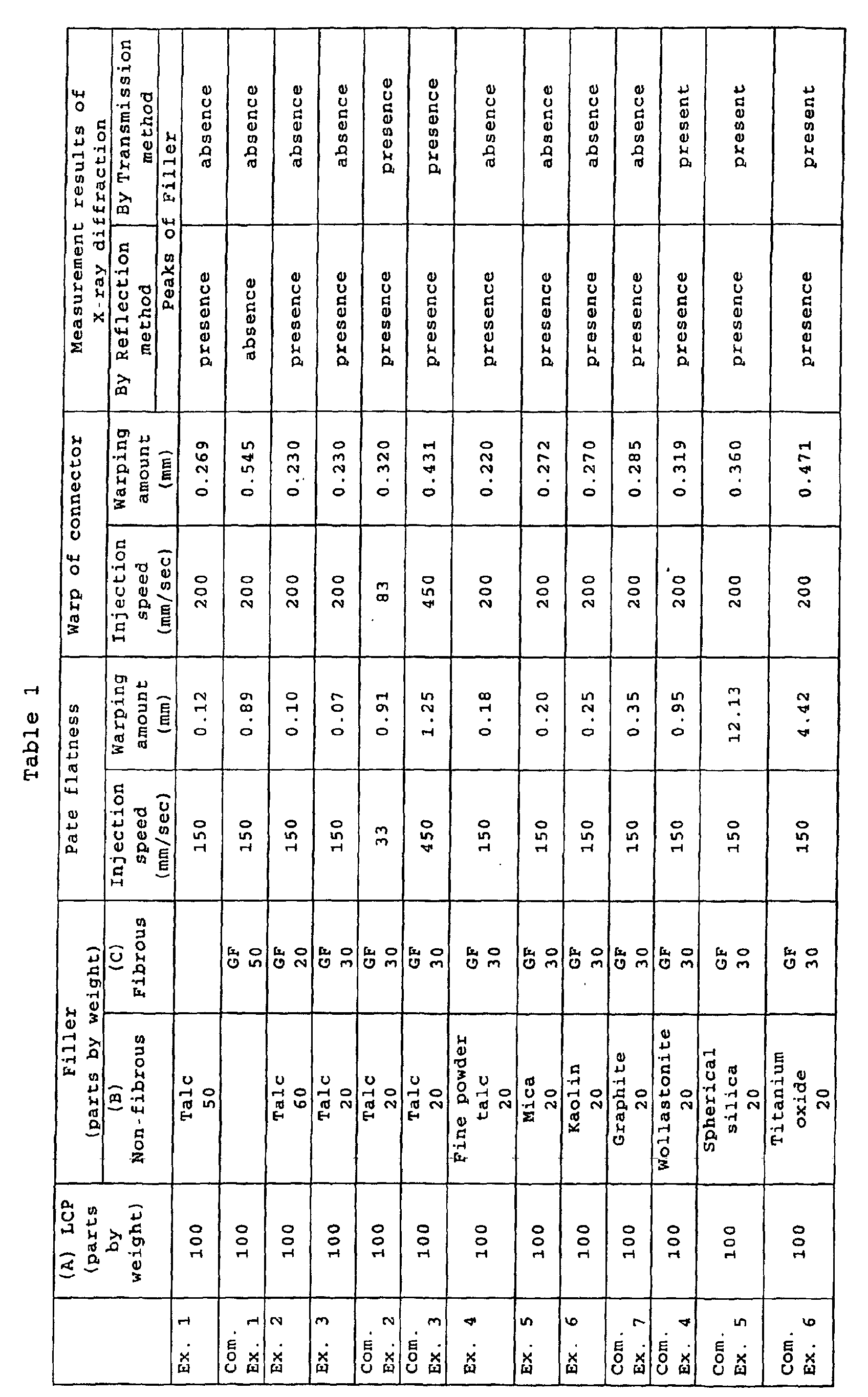
- a non-fibrous filler (B) For attaining the less warping property as an object of the invention, it is necessary that 5 to 100 part by weight of a non-fibrous filler (B) has to be dispersed based on 100 parts by weight of the liquid crystal polymer (A) so that when a diffraction peak of the non-fibrous filler is measured by a transmission method and a reflection method by means of a wide-angle X-ray diffraction, the diffraction peak of the non-fibrous filler confirmed by the reflection method is not confirmed by the transmission method.
- the non-fibrous filler is not dispersed so as to exhibit the less warping property.
- the injection speed during molding is important. If the injection speed is too slow, the non-fibrous filler is not in such a dispersion state that the diffraction peak by the transmission method can not be confirmed.
- the injection speed is preferably 100 to 400 m/sec, preferably, 150 to 300 mm/sec.
- the non-fibrous filler (B) used in the invention is a spherical, indefinite, tetrapot-shaped or plate-shaped filler not having extension in one specified direction like fibrous fillers and, particularly, a plate-like filler such as of disk-like, square, rectangular or indefinite plate shape, particularly having extension in two directions and having no extension in the remaining one direction tend to be dispersed as described above and is used preferably.
- Such a non-fibrous filler and a plate-like filler comprises materials, for example, talc, mica, kaolin, clay, graphite, vermiculite, silicates such as calcium silicate, aluminum silicate, feldspar powder, acidic white clay, agalmatolite clay, sericite, sillimanite, bentonite, slate powder and silane, carbonates such as calcium carbonate, chalk, barium carbonate, magnesium carbonate and dolomite, sulfates such as ballite powder, branc fixe, precipitation calcium sulfate, calcined gypsum, and barium sulfate, hydroxides such as alumina hydrate, oxides such as alumina, antimony oxide, magnesia, titanium oxide, zinc powder, silica, siliceous sand, quartz, white carbon and diatomaceous earth, sulfides such as molybdenum disulfide and metallic particles.
- silicates such as calcium silicate
- talc talc, mica, kaolin and graphite are preferred in view of the performance.
- the content of the non-fibrous filler (B) is from 5 to 100 parts by weight, preferably, 10 to 50 parts by weight based on 100 parts by weight of the liquid crystal polymer (A).
- a fibrous filler (C) with an average fiber diameter of 5 to 20 ⁇ m and an average aspect ratio of at least 15 may further be incorporated.
- fibrous filler (C) glass fiber, carbon milled fiber, fibrous wollastonite, whisker, metallic fiber, inorganic fiber and mineral fiber can be used.
- carbon milled fiber a PAN fiber using polyacrylonitrile as the raw material and a pitch fiber using pitch as the raw material is used.
- silicon nitride whisker silicon trinitride whisker, basic magnesium sulfate whisker, barium titanate whisker, silicon carbide whisker and boron whisker are used.
- metallic fibers of soft steel, stainless steel, steel and alloys thereof, brass, aluminum and alloys thereof and lead are used.
- the inorganic fiber various fibers of rock wool, zirconia, alumina silica, potassium titanate, barium titanate, titanium oxide, silicon carbide, alumina, silica and blast furnace slag are used.
- glass fiber is preferred in view of the performance.
- ordinary glass fibers as well as glass fibers coated with metals such as nickel and copper, or silane fibers can be used.
- the content of the fibrous filler (C) is 5 to 100 parts by weight, preferably, 10 to 50 parts by weight based on 100 parts by weight of the liquid crystal polymer (A).
- the non-fibrous filler (B) serves to improve the less warping property but the excessive content thereof worsens the extrudability and moldability to make the material fragile.
- the fibrous filler (C) serves to improve the mechanical property but the excessive content thereof increases the deformation upon reflow. Accordingly, the total content of the components (B) and (C) has to be 150 parts by weight or less, preferably, 100 parts by weight or less based on 100 parts by weight of the liquid crystal polymer (A).
- non-fibrous filler and the fibrous filler used in the invention can be used as they are but a known surface treating agent and a known binder used generally may be used together.
- compositions provided with desired properties by the addition of additives such as nucleating agent, pigment such as carbon black, antioxidant, stabilizer, plasticizer, lubricant, mold releasing agent and flame retardant are also included within the scope of the liquid crystal polymer composition defined in the invention.
- the non-fibrous filler is dispersed during molding to obtain a molded article of excellent less warping property without deteriorating the mechanical property and, further, higher performance can be provided in a state where each of the fillers is uniformly dispersed in the molded article with the non-fibrous filler being present between the fibrous fillers.
- both of them may be incorporated at the compositional ratio described above and extruded. Usually, they are extruded in an extruder into pellets and then used for injection molding but there is no restriction to the production by such extruders.
- the method of molding by using the liquid crystal polymer composition described above includes injection molding, extrusion molding or blow molding, with no particular restriction only to such methods.
- a flat plate of 60 x 60 x 0.7 mm was fixed at three points on a level plate (platen) and a height of a position where the flat plate was lifted most from the surface of the platen was measured to determine an average for three flat plates.
- a portion to be measured was cut out and used for a wide-angle X-ray diffraction.
- the test piece was measured by the reflection method and the transmission method to confirm the absence or presence of the diffraction peaks of the non-fibrous filler.
- the measurement charts of Example 3 are shown in Figs. 2 and 3 and the measurement charts of Comparative Example 5 are shown in Figs. 4 and 5.
- each of the fillers shown in Table 1 was dry blended at a ratio shown in Table 1.
- the mixture was melt-extruded and pelletized by a twin-screw extruder (Model PCM-30, manufactured by Ikegai Tekko Co., Ltd.).
- a twin-screw extruder Model PCM-30, manufactured by Ikegai Tekko Co., Ltd.
- Talc Crown talc PP, manufactured by Matsumura Sangyo Fine powder talc: HS-T0.5. manufactured by Hayasi Kasei Co.
- Mica REPCOMICA M325CE, manufactured by Repco, Inc.
- Kaolin HYDRITE FLAT D, manufactured by Dry Branch Kaolin Graphite: HAG-15, manufactured by Nippon Kokuen Wollastonite: NYAD325, manufactured by NYCO Spherical silica: FB-74, manufactured by Denki Kagaku Kogyo Titanium oxide: SR1, manufactured by Sakai Chemical GF: glass fibers, chopped strand of 10 ⁇ m fiber diameter, 3 mm fiber length
Landscapes
- Chemical & Material Sciences (AREA)
- Health & Medical Sciences (AREA)
- Chemical Kinetics & Catalysis (AREA)
- Medicinal Chemistry (AREA)
- Polymers & Plastics (AREA)
- Organic Chemistry (AREA)
- Compositions Of Macromolecular Compounds (AREA)
- Processes Of Treating Macromolecular Substances (AREA)
Abstract
Description


Claims (7)
- A molded article of a liquid crystal polymer composition in which 100 parts by weight of a liquid crystal polymer (A) and 5-100 parts by weight of a non-fibrous filler (B) are compounded where the non-fibrous filler is so dispersed that, when a diffraction peak of the non-fibrous filler is measured by a transmission method and a reflection method by means of a wide-angle X-ray diffraction, the diffraction peak of the non-fibrous filler which can be confirmed by the reflection method is not confirmed by the transmission method.
- The molded article according to claim 1, wherein the non-fibrous filler (B) is a plate-shaped filler.
- The molded article according to claim 2, wherein the plate-shaped filler comprises at least one member selected from talc, mica, kaolin and graphite.
- The molded article according to any one of claims 1 to 3, wherein a liquid crystal polymer composition where 5-100 parts by weight of a fibrous filler (C) having an average fiber diameter of 5-20 µm and an average aspect ratio of not less than 15 is further compounded to 100 parts by weight of the liquid crystal polymer (A) is used.
- The molded article according to claim 4, wherein the fibrous filer (C) comprises glass fiber.
- The molded article according to any one of claims 1 to 5, wherein a liquid crystal polymer composition where the liquid crystal polymer (A) is polyester amide is used.
- The molded article according to any one of claims 1 to 6, wherein the molded article is a connector.
Applications Claiming Priority (3)
| Application Number | Priority Date | Filing Date | Title |
|---|---|---|---|
| JP2000014951A JP2001207054A (en) | 2000-01-24 | 2000-01-24 | Molded article of liquid crystalline polymer |
| JP2000014951 | 2000-01-24 | ||
| PCT/JP2001/000448 WO2001053416A1 (en) | 2000-01-24 | 2001-01-24 | Liquid-crystalline polymer molding |
Publications (2)
| Publication Number | Publication Date |
|---|---|
| EP1270670A1 true EP1270670A1 (en) | 2003-01-02 |
| EP1270670A4 EP1270670A4 (en) | 2003-04-02 |
Family
ID=18542327
Family Applications (1)
| Application Number | Title | Priority Date | Filing Date |
|---|---|---|---|
| EP01901534A Ceased EP1270670A4 (en) | 2000-01-24 | 2001-01-24 | Liquid-crystalline polymer molding |
Country Status (4)
| Country | Link |
|---|---|
| US (1) | US6758989B2 (en) |
| EP (1) | EP1270670A4 (en) |
| JP (1) | JP2001207054A (en) |
| WO (1) | WO2001053416A1 (en) |
Families Citing this family (38)
| Publication number | Priority date | Publication date | Assignee | Title |
|---|---|---|---|---|
| JP4161611B2 (en) * | 2002-04-26 | 2008-10-08 | 東レ株式会社 | Liquid crystalline resin composition, long molded product comprising the same, and method for producing the same |
| KR101146958B1 (en) * | 2004-04-02 | 2012-05-22 | 동우 화인켐 주식회사 | Composition, composition solution and shaped article |
| JP4463637B2 (en) * | 2004-07-30 | 2010-05-19 | ポリプラスチックス株式会社 | Liquid crystalline polyester resin composition |
| JP4887645B2 (en) * | 2005-03-29 | 2012-02-29 | 東レ株式会社 | Liquid crystalline resin composition and molded article comprising the same |
| JP5172279B2 (en) * | 2006-11-06 | 2013-03-27 | 上野製薬株式会社 | Liquid crystal polymer composition and molded article comprising the same |
| JP5122116B2 (en) * | 2006-11-29 | 2013-01-16 | ポリプラスチックス株式会社 | Thermally conductive resin composition |
| JP2008231368A (en) * | 2007-03-23 | 2008-10-02 | Nippon Oil Corp | Liquid crystalline polyester resin composition excellent in light reflectance and strength |
| JP2009231269A (en) * | 2008-02-25 | 2009-10-08 | Sumitomo Chemical Co Ltd | Reflection plate and light emitting device |
| US8192645B2 (en) | 2008-03-28 | 2012-06-05 | Jx Nippon Oil & Energy Corporation | Liquid crystal polyester resin composition for camera module |
| JP5165492B2 (en) * | 2008-05-23 | 2013-03-21 | ポリプラスチックス株式会社 | Planar connector |
| KR20120051713A (en) | 2009-07-24 | 2012-05-22 | 티코나 엘엘씨 | Thermally conductive thermoplastic resin compositions and related applications |
| KR20120051712A (en) | 2009-07-24 | 2012-05-22 | 티코나 엘엘씨 | Thermally conductive polymer compositions and articles made therefrom |
| KR20130009981A (en) * | 2010-02-25 | 2013-01-24 | 티코나 엘엘씨 | Thermally conductive and dimensionally stable liquid crystalline polymer composition |
| US9056950B2 (en) | 2010-07-23 | 2015-06-16 | Ticona Gmbh | Composite polymeric articles formed from extruded sheets containing a liquid crystal polymer |
| CN103930464B (en) | 2011-11-15 | 2016-02-10 | 提克纳有限责任公司 | Compact Camera Module |
| CN103930465B (en) | 2011-11-15 | 2016-05-04 | 提克纳有限责任公司 | Low naphthenic liquid crystal polymer composition for molded parts with small dimensional tolerances |
| US8932483B2 (en) | 2011-11-15 | 2015-01-13 | Ticona Llc | Low naphthenic liquid crystalline polymer composition |
| KR101947215B1 (en) | 2011-11-15 | 2019-02-12 | 티코나 엘엘씨 | Fine pitch electrical connector and a thermoplastic composition for use therein |
| TWI534253B (en) | 2011-11-15 | 2016-05-21 | 堤康那責任有限公司 | Naphthenic-rich liquid crystalline polymer composition with improved flammability performance |
| JP5869983B2 (en) * | 2012-08-02 | 2016-02-24 | ポリプラスチックス株式会社 | Liquid crystalline resin composition |
| CN104736672B (en) | 2012-10-16 | 2017-10-24 | 提克纳有限责任公司 | Antistatic Liquid Crystal Polymer Composition |
| WO2014088700A1 (en) | 2012-12-05 | 2014-06-12 | Ticona Llc | Conductive liquid crystalline polymer composition |
| US9340656B2 (en) | 2012-12-19 | 2016-05-17 | Ticona Llc | Liquid crystalline composition having a dark black color |
| KR102155924B1 (en) | 2013-03-13 | 2020-09-14 | 티코나 엘엘씨 | Antistatic liquid crystalline polymer composition |
| WO2015094486A1 (en) | 2013-12-19 | 2015-06-25 | Ticona Llc | Liquid crystalline composition having a pearly luster |
| US9822254B2 (en) | 2014-04-09 | 2017-11-21 | Ticona Llc | Camera module |
| KR102305241B1 (en) | 2014-04-09 | 2021-09-24 | 티코나 엘엘씨 | Antistatic polymer composition |
| US11352480B2 (en) | 2016-03-18 | 2022-06-07 | Ticona Llc | Polyaryletherketone composition |
| WO2018074156A1 (en) * | 2016-10-21 | 2018-04-26 | ポリプラスチックス株式会社 | Composite resin composition and connector molded from same |
| CN109790380B (en) * | 2016-10-21 | 2020-08-25 | 宝理塑料株式会社 | Composite resin composition, and electronic component molded from the composite resin composition |
| US10829634B2 (en) | 2017-12-05 | 2020-11-10 | Ticona Llc | Aromatic polymer composition for use in a camera module |
| WO2020095997A1 (en) * | 2018-11-09 | 2020-05-14 | 住友化学株式会社 | Liquid crystal polyester resin composition and molded article |
| WO2021173408A1 (en) | 2020-02-26 | 2021-09-02 | Ticona Llc | Electronic device |
| CN115700014A (en) | 2020-02-26 | 2023-02-03 | 提克纳有限责任公司 | Circuit structure |
| KR20220147110A (en) | 2020-02-26 | 2022-11-02 | 티코나 엘엘씨 | Polymer Compositions for Electronic Devices |
| JP2023515975A (en) | 2020-02-26 | 2023-04-17 | ティコナ・エルエルシー | electronic device |
| US11728065B2 (en) | 2020-07-28 | 2023-08-15 | Ticona Llc | Molded interconnect device |
| JP2024546075A (en) | 2021-12-01 | 2024-12-17 | ティコナ・エルエルシー | Antenna Module |
Family Cites Families (16)
| Publication number | Priority date | Publication date | Assignee | Title |
|---|---|---|---|---|
| US4124561A (en) * | 1976-12-06 | 1978-11-07 | General Electric Company | Reinforced thermoplastic polyester compositions having improved shatter resistance |
| EP0135904B1 (en) * | 1983-09-26 | 1987-07-29 | Mobay Corporation | Polyethylene terephthalate/polycarbonate blends having a low level of warpage |
| JPH0739534B2 (en) * | 1986-12-10 | 1995-05-01 | ポリプラスチックス株式会社 | Liquid crystalline polyester resin composition having good surface characteristics |
| US5229451A (en) * | 1987-01-16 | 1993-07-20 | Imperial Chemical Industries Plc | Thermotropic polymer |
| JP2629265B2 (en) * | 1988-05-12 | 1997-07-09 | 東レ株式会社 | Liquid crystal polyester resin composition |
| JPH03167252A (en) * | 1989-11-27 | 1991-07-19 | Unitika Ltd | Liquid crystal polymer resin composition |
| JP2884362B2 (en) * | 1990-04-20 | 1999-04-19 | 日本石油化学株式会社 | Cooking table for induction cooker |
| JP3018434B2 (en) * | 1990-05-18 | 2000-03-13 | 凸版印刷株式会社 | Shutter for flexible disk |
| JPH04213354A (en) * | 1990-11-29 | 1992-08-04 | Toray Ind Inc | Liquid crystal polyester resin composition |
| JP2672426B2 (en) * | 1991-10-17 | 1997-11-05 | 帝人株式会社 | Resin composition |
| US5432225A (en) * | 1992-10-22 | 1995-07-11 | Toray Industries, Inc. | Thermotropic resin composition containing a graphite |
| JPH06172619A (en) * | 1992-12-02 | 1994-06-21 | Toray Ind Inc | Liquid crystalline resin composition |
| TW515822B (en) * | 1997-01-31 | 2003-01-01 | Toray Industries | Liquid-crystalline resin composition and precision moldings of the composition |
| JPH10221566A (en) * | 1997-02-10 | 1998-08-21 | Sumitomo Electric Ind Ltd | Optical connector ferrule |
| US6093765A (en) * | 1998-11-03 | 2000-07-25 | E. I. Du Pont De Nemours And Company | Compositions containing liquid crystalline polymers |
| CA2364616A1 (en) * | 1999-04-05 | 2000-10-12 | Kaneka Corporation | Thermoplastic resin composition and process for preparing the same |
-
2000
- 2000-01-24 JP JP2000014951A patent/JP2001207054A/en active Pending
-
2001
- 2001-01-24 WO PCT/JP2001/000448 patent/WO2001053416A1/en not_active Ceased
- 2001-01-24 US US10/181,449 patent/US6758989B2/en not_active Expired - Lifetime
- 2001-01-24 EP EP01901534A patent/EP1270670A4/en not_active Ceased
Also Published As
| Publication number | Publication date |
|---|---|
| EP1270670A4 (en) | 2003-04-02 |
| WO2001053416A1 (en) | 2001-07-26 |
| JP2001207054A (en) | 2001-07-31 |
| US20030030031A1 (en) | 2003-02-13 |
| US6758989B2 (en) | 2004-07-06 |
Similar Documents
| Publication | Publication Date | Title |
|---|---|---|
| US6758989B2 (en) | Liquid-crystalline polymer molding | |
| JP4118425B2 (en) | Liquid crystalline polymer composition for connector and connector | |
| US6797198B1 (en) | Liquid-crystalline polymer composition | |
| US6063848A (en) | Liquid crystalline polymer composition and moldings | |
| US20020190432A1 (en) | Liquid-crystalline polymer composition and molding method | |
| JP5385609B2 (en) | Method for producing liquid crystalline polyester composition | |
| KR102480531B1 (en) | Liquid crystal polyester resin composition and molded article | |
| JPH0739533B2 (en) | Liquid crystalline polyester resin composition | |
| US7547403B2 (en) | Electroconductive resin composition | |
| CN102037620B (en) | Planar connector | |
| JP2000273320A (en) | Liquid crystal polymer composition for optical pickup and optical pickup | |
| JP2004182895A (en) | Conductive resin composition | |
| KR102416379B1 (en) | A connector comprising a liquid crystalline resin composition and a molded article of the liquid crystalline resin composition | |
| JP2021055059A (en) | Resin composition and connector part using the same | |
| CN113874432B (en) | Liquid crystalline resin composition and molded article using same | |
| JP2002194229A (en) | Semiconductive resin composition and molded article | |
| JP2578582B2 (en) | Aromatic polyester composition containing inorganic filler | |
| JP2002194194A (en) | Semiconductive resin composition and molded article |
Legal Events
| Date | Code | Title | Description |
|---|---|---|---|
| PUAI | Public reference made under article 153(3) epc to a published international application that has entered the european phase |
Free format text: ORIGINAL CODE: 0009012 |
|
| 17P | Request for examination filed |
Effective date: 20020821 |
|
| AK | Designated contracting states |
Kind code of ref document: A1 Designated state(s): AT BE CH CY DE DK ES FI FR GB GR IE IT LI LU MC NL PT SE TR |
|
| A4 | Supplementary search report drawn up and despatched |
Effective date: 20030218 |
|
| RIC1 | Information provided on ipc code assigned before grant |
Ipc: 7C 08L 67/04 B Ipc: 7C 08K 3/04 B Ipc: 7C 08L 67/00 B Ipc: 7C 08L 77/12 A Ipc: 7C 08K 7/00 B Ipc: 7C 08K 3/34 B |
|
| 17Q | First examination report despatched |
Effective date: 20031008 |
|
| RBV | Designated contracting states (corrected) |
Designated state(s): AT BE CH DE FR GB LI |
|
| APBN | Date of receipt of notice of appeal recorded |
Free format text: ORIGINAL CODE: EPIDOSNNOA2E |
|
| APBR | Date of receipt of statement of grounds of appeal recorded |
Free format text: ORIGINAL CODE: EPIDOSNNOA3E |
|
| APBK | Appeal reference recorded |
Free format text: ORIGINAL CODE: EPIDOSNREFNE |
|
| APAF | Appeal reference modified |
Free format text: ORIGINAL CODE: EPIDOSCREFNE |
|
| RAP1 | Party data changed (applicant data changed or rights of an application transferred) |
Owner name: POLYPLASTICS CO., LTD. |
|
| APBT | Appeal procedure closed |
Free format text: ORIGINAL CODE: EPIDOSNNOA9E |
|
| STAA | Information on the status of an ep patent application or granted ep patent |
Free format text: STATUS: THE APPLICATION IS DEEMED TO BE WITHDRAWN |
|
| 18D | Application deemed to be withdrawn |
Effective date: 20070320 |
|
| 18R | Application refused |
Effective date: 20070621 |