EP1270643A1 - Functional polyphenylene ether resin - Google Patents
Functional polyphenylene ether resin Download PDFInfo
- Publication number
- EP1270643A1 EP1270643A1 EP02711223A EP02711223A EP1270643A1 EP 1270643 A1 EP1270643 A1 EP 1270643A1 EP 02711223 A EP02711223 A EP 02711223A EP 02711223 A EP02711223 A EP 02711223A EP 1270643 A1 EP1270643 A1 EP 1270643A1
- Authority
- EP
- European Patent Office
- Prior art keywords
- polyphenylene ether
- group
- functionalized polyphenylene
- functionalized
- producing
- Prior art date
- Legal status (The legal status is an assumption and is not a legal conclusion. Google has not performed a legal analysis and makes no representation as to the accuracy of the status listed.)
- Granted
Links
Images


Classifications
-
- C—CHEMISTRY; METALLURGY
- C08—ORGANIC MACROMOLECULAR COMPOUNDS; THEIR PREPARATION OR CHEMICAL WORKING-UP; COMPOSITIONS BASED THEREON
- C08G—MACROMOLECULAR COMPOUNDS OBTAINED OTHERWISE THAN BY REACTIONS ONLY INVOLVING UNSATURATED CARBON-TO-CARBON BONDS
- C08G65/00—Macromolecular compounds obtained by reactions forming an ether link in the main chain of the macromolecule
- C08G65/34—Macromolecular compounds obtained by reactions forming an ether link in the main chain of the macromolecule from hydroxy compounds or their metallic derivatives
- C08G65/48—Polymers modified by chemical after-treatment
-
- C—CHEMISTRY; METALLURGY
- C08—ORGANIC MACROMOLECULAR COMPOUNDS; THEIR PREPARATION OR CHEMICAL WORKING-UP; COMPOSITIONS BASED THEREON
- C08G—MACROMOLECULAR COMPOUNDS OBTAINED OTHERWISE THAN BY REACTIONS ONLY INVOLVING UNSATURATED CARBON-TO-CARBON BONDS
- C08G65/00—Macromolecular compounds obtained by reactions forming an ether link in the main chain of the macromolecule
- C08G65/34—Macromolecular compounds obtained by reactions forming an ether link in the main chain of the macromolecule from hydroxy compounds or their metallic derivatives
- C08G65/48—Polymers modified by chemical after-treatment
- C08G65/485—Polyphenylene oxides
-
- C—CHEMISTRY; METALLURGY
- C08—ORGANIC MACROMOLECULAR COMPOUNDS; THEIR PREPARATION OR CHEMICAL WORKING-UP; COMPOSITIONS BASED THEREON
- C08L—COMPOSITIONS OF MACROMOLECULAR COMPOUNDS
- C08L71/00—Compositions of polyethers obtained by reactions forming an ether link in the main chain; Compositions of derivatives of such polymers
- C08L71/08—Polyethers derived from hydroxy compounds or from their metallic derivatives
- C08L71/10—Polyethers derived from hydroxy compounds or from their metallic derivatives from phenols
- C08L71/12—Polyphenylene oxides
- C08L71/126—Polyphenylene oxides modified by chemical after-treatment
Definitions
- This invention relates to a functionalized polyphenylene ether resin useful as a plastic material in the fields of electrical and electronic products, automobiles and other industrial materials, and foods and packaging fields and to a process of producing the same.
- Polyphenylene ethers are excellent in processability and productivity. They can be molded by melt injection, melt extrusion and similar molding techniques into products or parts of desired shapes with good productivity. Therefore they have been widely used as a material of products and parts in the electrical and electronic fields, automobile field, and other industrial materials fields, and foods and packaging fields.
- General polyphenylene ethers while excellent in heat resistance and mechanical characteristics, have poor compatibility with other materials, and the choice of materials to be combined with is limited. They have particularly poor compatibility with highly polar materials such as polyamide and need to be functionalized to be combined with such resins.
- JP-B-3-52486, U.S. Patents 4,654,405 and 4,888,397, and JP-A-63-54425 propose processes in which polyphenylene ether in a molten state is allowed to react with a reactive functionalizer, such as maleic anhydride, in the presence or absence of a radical initiator.
- a reactive functionalizer such as maleic anhydride
- the proposed processes involve very high temperatures for melting the resin, which cause various problems arising from thermal deterioration of the resin, such as color change, formation of black gel, and poor color tone or appearance.
- European Patent 546497, JP-A-4-239036, and JP-A-3-35020 teach processes in which a mixture of polyphenylene ether and a functionalizer, such as maleic anhydride, in a prescribed mixing ratio is allowed to react in a solvent capable of dissolving polyphenylene ether. These processes achieve only a low functionalization reaction rate and, besides, resin compositions obtained by blending the resulting functionalized polyphenylene ether with different polymers are of low utility as a material due to their inferior mechanical characteristics.
- a functionalizer such as maleic anhydride
- JP-A-2-276823 discloses polyphenylene ether with a 6-chroman end group to which a functional group, e.g., a carboxyl group or an oxidized acyl group, is bonded.
- a functional group e.g., a carboxyl group or an oxidized acyl group
- polyphenylene ether is melted at a high temperature (300°C or 320°C).
- the resulting functionalized polyphenylene ether resins were found to have a poor color tone and to contain considerable black foreign substance which is a scorched resin.
- JP-A-12-191769 and WO 00/52074 disclose a process of obtaining functionalized polyphenylene ether by allowing polyphenylene ether in a solid state to react with a functionalizing compound. According to the disclosed process, because the reaction is preceded by mixing polyphenylene ether with a solid or liquid functionalizing compound in a predetermined ratio, the functionalization reaction rate is extremely low so that resin compositions obtained by blending the resulting functionalized polyphenylene ether and different polymers have inferior mechanical characteristics and low practicability as a material.
- JP-B-63-7204 proposes supplying a radical polymerizable compound in a gaseous phase to polyphenylene ether in the presence of an organic or inorganic radical polymerization initiator.
- the process involves the problem that the functionalizing compound itself is apt to homopolymerize, failing to be added to polyphenylene ether efficiently.
- the present invention relates to a functionalized polyphenylene ether which has an excellent color tone, contains little black foreign substance, and provides polymer alloys with superior mechanical characteristics when blended with other resins.
- the present inventor conducted extensive investigations on the structure of functionalized polyphenylene ethers, and found as a result that a functionalized polyphenylene ether giving a proton NMR spectrum with a peak area ratio (A)/(B) of 0.0001 or greater, wherein (A) is the area of peaks at chemical shifts from 2.95 to 3.04 ppm, and (B) is the area of peaks at chemical shifts from 6.00 to 6.90 ppm, has an excellent color tone, contains little black foreign substance, and provides polymer alloys having superior mechanical characteristics when blended with different polymers and have thus reached the present invention.
- the present invention provides a functionalized polyphenylene ether which has, in its molecule, at least one functional group selected from a carboxyl group, an acid anhydride group, an amino group, an amide group, an imide group, a silyl group, a hydroxyl group and a glycidyl group, and which gives a proton NMR spectrum with a peak area ratio (A)/(B) of 0.0001 or greater, wherein (A) is the area of peaks at chemical shifts from 2.95 to 3.04 ppm, and (B) is the area of peaks at chemical shifts from 6.00 to 6.90 ppm.
- the present invention also relates to a process of producing a functionalized polyphenylene ether comprising:
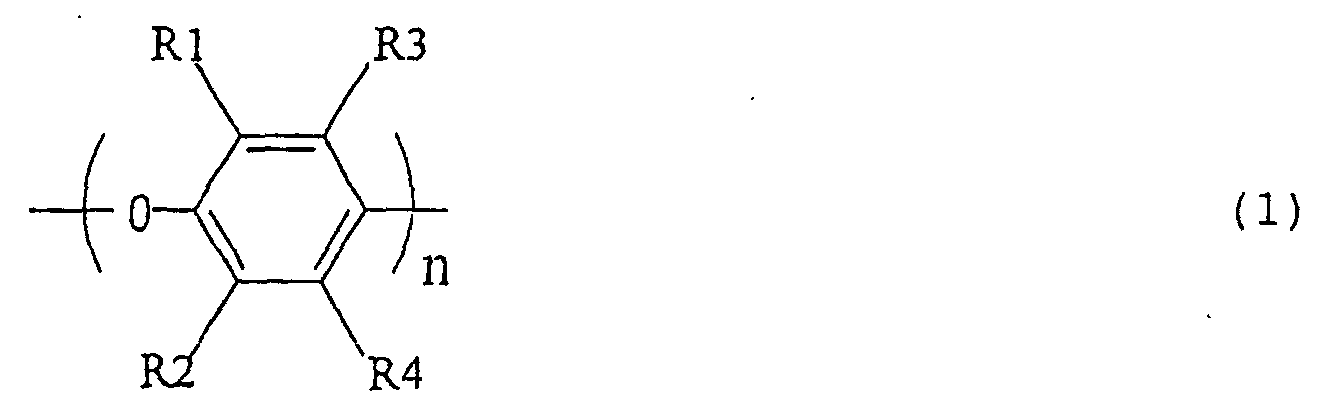
- the functionalized polyphenylene ether according to the present invention is made up of phenylene ether units represented by general formula (1) and has a functional group in the molecule thereof: wherein R 1 , R 2 , R 3 , and R 4 each represent a hydrogen atom, an alkyl group or an alkyl group having an amino group.
- R 1 and R 2 each is a hydrogen atom
- R 3 and R 4 each is a methyl group is preferred.
- the functional group possessed by the functionalized polyphenylene ether of the present invention is a carboxyl group, an acid anhydride group, an imino group, an imide group, a hydroxyl group or a glycidyl group, with an acid anhydride group and a glycidyl group being preferred.
- the functionalized polyphenylene ether of the present invention shows a proton NMR spectrum in which the ratio ((A)/(B)) of peak area (A) between chemical shifts 2.95 and 3.04 to peak area (B) between 6.00 and 6.90 ppm is 0.0001 or greater, preferably 0.001 or greater.
- the proton NMR spectrum of the functionalized polyphenylene ether of the present invention is measured at room temperature with an NMR measuring system having a frequency of 400 MHz or higher on a sample prepared by dissolving the functionalized polyphenylene ether in trimethylsilane-containing deutero-chloroform.
- the chemical shift for each peak in the NMR spectrum was decided by taking the peak assigned to the protons of tetramethylsilane as 0.00 ppm.
- the peak area ratio (A)/(B) according to the present invention is equal to the ratio of integrals of the peaks.
- the functionalized polyphenylene ether and the starting polyphenylene ether preferably have a reduced viscosity ranging from 0.15 to 1.0 dl/g, particularly 0.20 to 0.70 dl/g, in a 0.5 g/dl chloroform solution at 30°C.
- the functionalized polyphenylene ether of the present invention and the starting polyphenylene ether be in a solid state.
- Preferred solid forms include powder and pellets, with powder being still preferred.
- Polyphenylene ethers of powder form are obtainable by, for example, dissolving a polyphenylene ether in a good solvent, such as toluene, xylene, chloroform or chlorobenzene, and adding a poor solvent, such as methanol or acetone; to the solution.
- a good solvent such as toluene, xylene, chloroform or chlorobenzene
- a poor solvent such as methanol or acetone
- the functionalized polyphenylene ether of the present invention and the starting polyphenylene ether are crystalline powder having a melting point ranging 200 to 260°C.
- Literature furnishing the information about the relation between crystalline polyphenylene ethers and their melting points include, for example, Journal of Polymer Science, Part A, 2(6), pp. 1141-1148 (1968), European Polymer Journal, (9), pp. 293-300 (1973), and Polymer, (19), pp. 81-84 (1978).
- the melting point of polyphenylene ethers as referred to in the present invention is defined to be the peak top temperature of the peak observed in a temperature-heat flow rate plot obtained with temperature rising at 20°C/min in differential scanning calorimetry (DSC). Where the plot has a plurality of peak top temperatures, the melting point of the polyphenylene ether is defined to be the highest one.
- the functionalized polyphenylene ether of the present invention can contain appropriate additive(s) according to the use.
- the additives include flame retardants, heat stabilizers, antioxidants, UV absorbers, surface active agents, lubricants, fillers, polymer additives, dialkyl peroxides, peroxy, peroxycarbonates, hydroperoxides, and peroxy ketals.
- the functionalized polyphenylene ether according to the present invention can be obtained by supplying a functionalizing compound in its gaseous state to a polyphenylene ether in its solid state and allowing the functionalizing compound to react with the solid polyphenylene ether at or below the melting temperature of the polyphenylene ether.
- the polyphenylene ether reacting with the functionalizing compound be in a solid state.
- the polyphenylene ether is allowed to react in its molten state with the functionalizing compound, an increase of black foreign substance or deterioration of appearance such as yellowing can result, and no peaks appears in the range from 2.95 to 3.04 ppm in the proton NMR spectrum.
- a solvent e.g., toluene or chlorobenzene
- the functionalizing compound which can be used in the present invention comprises at least one organic compound having in the molecule thereof at least one carbon-carbon double bond or triple bond and at least one functional group selected from the group consisting of a carboxyl group, an acid anhydride group, an amino group, an amide group, an imide group, a silyl group, a hydroxyl group and a glycidyl group.
- functionalizing compounds preferred are those having a double bond and at least one carboxyl group, acid anhydride group, imido group or glycidyl group in the molecule thereof.
- maleic anhydride examples include maleic anhydride, itaconic anhydride, maleic acid, fumaric acid, phenylmaleimide, itaconic acid, methacrylic acid, acrylic acid, glycidyl methacrylate, glycidyl acrylate, allyl glycidyl ether, hydroxyalkyl methacrylate compounds, and 2-dimethylaminoalkyl compounds.
- maleic anhydride is extremely preferred.
- the functionalizing compound is desirably supplied in its gaseous state to the polyphenylene ether.
- the functionalizing compound can be supplied by, for example, directly feeding a vaporized functionalizing compound or feeding a functionalizing compound as diluted with an inert gas.
- the inert gas includes helium, argon, and nitrogen, with nitrogen being particularly preferred.
- the volume concentration of the functionalizing compound is preferably 1% or higher.
- the volume concentration of the functionalizing compound is obtained from the saturated vapor pressure at a temperature for vaporizing the functionalizing compound. For instance, when maleic anhydride reaches gas-liquid equilibrium in a nitrogen atmosphere at 190°C under ambient pressure, the volume concentration of maleic anhydride in the gas phase is 79%. The higher the volume concentration of a functionalizing compound, the higher the reaction rate as is preferred.
- a gaseous functionalizing compound be continuously fed to a polyphenylene ether so that the functionalizing compound may have a linear velocity with respect to the polyphenylene ether.
- the functionalizing compound may have a linear velocity with respect to the polyphenylene ether.
- a higher linear velocity of the gas with respect to the polyphenylene ether results in a higher reaction rate.
- the amount of scattering powder increases with the increasing linear velocity to cause an increased loss of the powder.
- a preferred linear velocity of the gaseous functionalizing compound with respect to the polyphenylene ether ranges from 0.05 m/sec to 10 m/sec.
- a preferred temperature in the reaction between the functionalizing compound and the polyphenylene ether is 110 to 230°C, particularly 155 to 230°C.
- a radical initiator can be added to accelerate the reaction.
- Organic peroxides are preferably used as radical initiators.
- the polyphenylene ether When the gaseous functionalizing compound and the polyphenylene ether are brought into contact to react with each other according to the present invention, the polyphenylene ether may be either allowed to stand still or stirred in a reaction vessel.
- the reaction apparatus to be used where the polyphenylene ether is allowed to react while being stirred includes, but is not limited to, a Henschel mixer, a paddle mixer, and a paddle drier. A Henschel mixer is particularly preferred.
- the functionalized polyphenylene ether according to the present invention is widely applicable in the electrical and electronic fields, automobile and other industrial fields, and food and packaging fields.
- Polymer alloys obtained by melt kneading the functionalized polyphenylene ether of the present invention and polyamide, polyimide or polyester are excellent in color tone, appearance, mechanical characteristics, and productivity and therefore useful with great advantages in applications in the electrical and electronic fields, automobile and other industrial fields, and food and packaging fields.
- the amount of added carboxyl groups and acid anhydride groups in the functionalized polyphenylene ether thus cleaned and dried were determined by titration using phenolphthalein as an indicator. Specifically, 1 g of the functionalized polyphenylene ether was weighed out and put in a 500 ml Erlenmeyer flask. To the flask was added 200 ml of toluene to completely dissolve the functionalized polyphenylene ether. Two or three drops of an ethanolic solution of phenolphthalein were added to the solution, and a 0.01 mol/l methanol solution of sodium methylate was added thereto dropwise from a burette until the whole solution assumed pink. The amount of added carboxyl groups and acid anhydride groups was obtained from the volume of the dropwise added methanol solution of sodium methylate.
- the reduced viscosity of the starting polyphenylene ether used for functionalization was found to be 0.43 dl/g as measured as a 0.5 g/100 ml solution in chloroform at 30°C with a Ubbellohde viscometer.
- a functionalized polyphenylene ether obtained through the purification operation of (1) above was dissolved in deutero-chloroform in a concentration of 2 wt%.
- a trace amount of tetramethylsilane was added to the solution as a standard. Measurement was made at room temperature and 400 MHz NMR. In the NMR spectrum the chemical shift of each peak was decided taking the protons of tetramethylsilane as 0.00 ppm.
- the reaction product obtained in Examples and Comparative Examples was allowed to dry on standing at 150°C in vacuum for 10 hours.
- Thirty parts by weight of the dried functionalized polyphenylene ether powder, 6 parts by weight of a hydrogenated styrene-butadiene block copolymer, 59 parts by weight of a polyamide 66 resin, and 5 parts by weight of a polyamide 6 resin were mixed well and kneaded and extruded at 320°C by means of a twin-screw extruder ZSK-25 supplied by Werner to obtain pellets.
- the pellets were molded by an injection molding machine into a test specimen according to ASTM standards, of which a notched Izod impact strength (ASTM D-256; 23°C) was measured.
- the peak top of the peak observed in a temperature-heat flow rate plot obtained with temperature rising at 20°C/min in differential scanning calorimetry (DSC) was taken as a melting point.
- the melting point of the starting polyphenylene ether used for functionalization was 238°C.
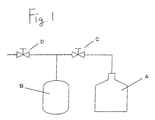
- Example 1 The apparatus used in Example 1 is shown in Fig. 1.
- a 10 liter-volume reactor B was put 2 kg of polyphenylene ether powder.
- a 10 liter-volume maleic anhydride evaporator A was connected to the reactor B via a valve C. Both the reactor B and the evaporator A were. equipped with a jacket, in which hot, temperature-controlled oil was circulated to adjust the polyphenylene ether powder or maleic anhydride in the container at a desired temperature.
- In the evaporator A was put 400 g of maleic anhydride.
- Both the reactor B and the evaporator A were evacuated to 0.1 mmHg or less by means of a vacuum pump connected via a valve D, and the valve D was closed.
- the jacket temperatures were adjusted so as to raise the temperatures of the maleic anhydride in the evaporator A and the polyphenylene ether powder in the reactor B to 190°C.
- the valve C was opened little by little, whereupon gaseous maleic anhydride from the evaporator A was introduced into the reactor tank B. At this time point, the valve C was switched off, and the reactor B was closed tight. The reactor was allowed to stand for 60 minutes while maintaining the temperature and the pressure and then cooled in a water tank. After room temperature was reached, the tank was opened to take out powder of functionalized polyphenylene ether.
- Table 1 are shown the amount of added maleic anhydride in the functionalized polyphenylene ether, the color tone measured value, the number of black foreign substance particles, and the peak area ratio (A)/(B) in proton NMR measurement, i.e., the ratio of (A) the area of peaks in chemical shifts 2.95 to 3.04 mm to (B) the area of peaks in chemical shifts 6.00 to 6.90 ppm.
- the proton NMR spectrum is shown in Fig. 2.
- Example 1 The procedure of Example 1 was repeated, except that the reaction time and temperature were changed.
- the analytical results of the functionalized polyphenylene ether are shown in Table 1.
- Example 1 The procedure of Example 1 was repeated, except that the reaction temperature was changed. The polyphenylene ether melted and adhered to the wall of the reactor. The analytical results obtained are shown in Table 1.
- Example 7 The apparatus used in Example 7 is shown in Fig. 3.
- a 10 liter-volume Henschel mixer B was put 2 kg of polyphenylene ether powder.
- the Henschel mixer B was connected to the same evaporator A as used in Example 1, which contained 400 g of maleic anhydride, via a valve C.
- Oil at 190°C was delivered to each of the jackets of the Henschel mixer B and the evaporator A to raise the temperatures of the polyphenylene ether powder and the maleic anhydride to 190°C.
- valves C, D and E open, 2 liter/min of nitrogen was made to flow through the valve E, whereby a mixed gas of gaseous maleic anhydride and nitrogen was fed to the Henschel mixer.
- the stirring equipment of the Henschel mixer was started up to rotate the stirring blades at 600 rpm to stir the polyphenylene ether powder. After mixing by stirring for 60 minutes, the powder was taken out from the mixer.
- Example 7 The procedure of Example 7 was repeated, except that the reaction time and temperature were changed.
- the analytical results of the functionalized polyphenylene ether are shown in Table 2.
- Example 7 The procedure of Example 7 was repeated, except that the reaction temperature was changed. The polyphenylene ether melted and adhered to the wall of the reactor. The analytical results obtained are shown in Table 2.
- Example 14 The apparatus used in Example 14 is shown in Fig. 4, which apparatus were composed of the same maleic anhydride evaporator A as used in Example 1 and a 10 liter-volume tank B.
- A was put 2.0 kg of maleic anhydride.
- the tank B was packed with glass wool (F1), 1 kg of polyphenylene ether powder was put on the glass wool, and glass wool (F2) was put thereon to prevent the polyphenylene ether powder from scattering in a gas flow.
- Both A and B were evacuated to 0.1 mmHg or less with a vacuum pump, and the inner atmosphere of each tank was completely purged with nitrogen gas.
- Both A and B were placed in the respective hot oil baths, whose temperatures were controlled to heat the maleic anhydride in A and the polyphenylene ether in B to 190°C.
- valves C and D were opened, and nitrogen gas was fed to A through the valve C.
- a mixed gas of maleic anhydride and nitrogen was fed to B at a linear velocity of 0.08 m/sec.
- the valves C and D were closed, and functionalized polyphenylene ether powder was taken out of B.
- the amount of added maleic anhydride in the functionalized polyphenylene ether was 0.57 part by weight.
- the color tone measured value was 0.33, and the number of black foreign substance particles was 0.
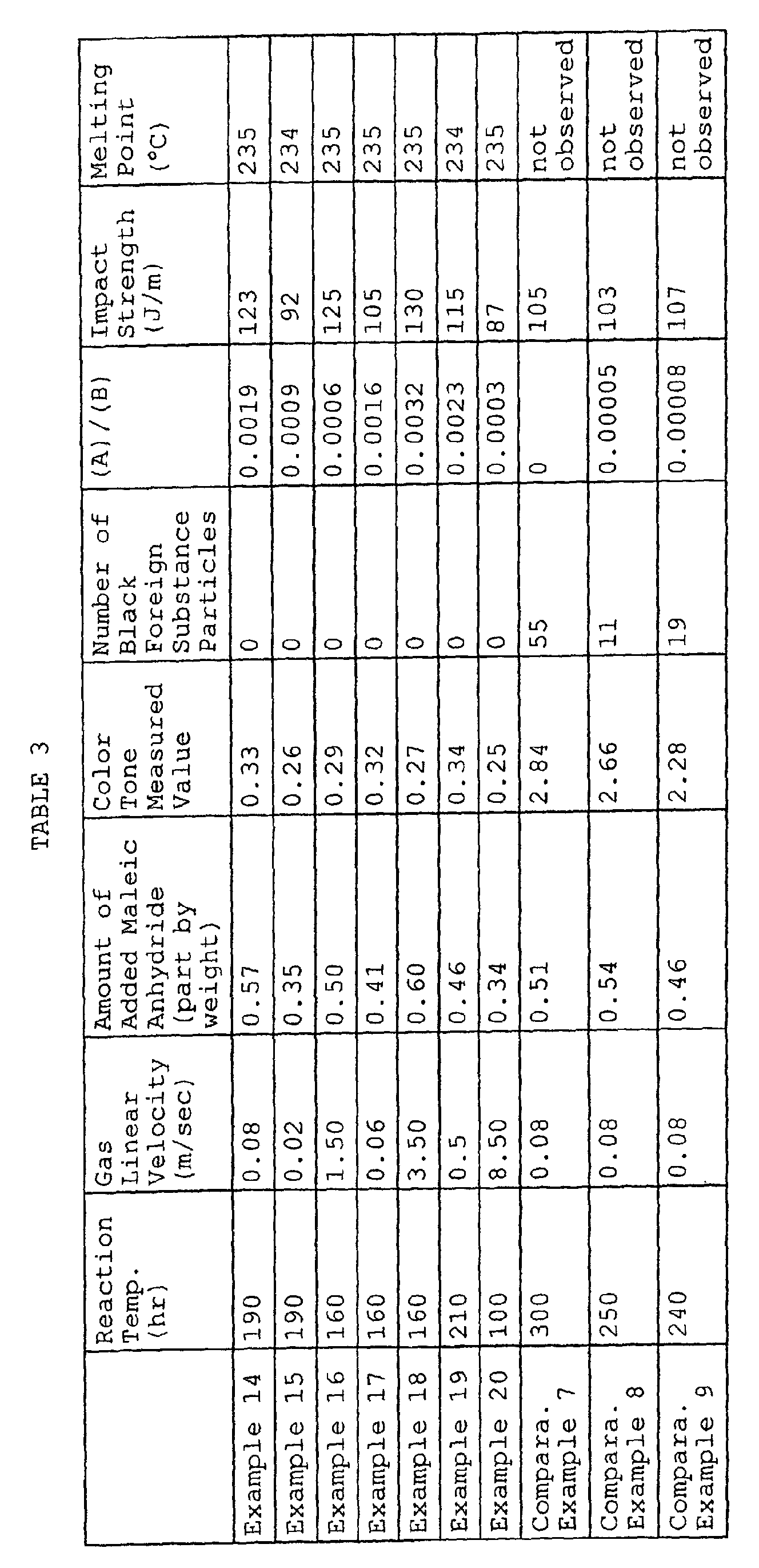
- Example 14 The procedure of Example 14 was repeated, except for changing the linear velocity of the maleic anhydride/nitrogen mixed gas passing through B and the reaction temperature.
- the analytical results of the functionalized polyphenylene ether are shown in Table 3.
- Example 14 The procedure of Example 14 was repeated, except that the reaction temperature was changed. The polyphenylene ether powder particles were fused together into lumps. The analytical results are shown in Table 3.
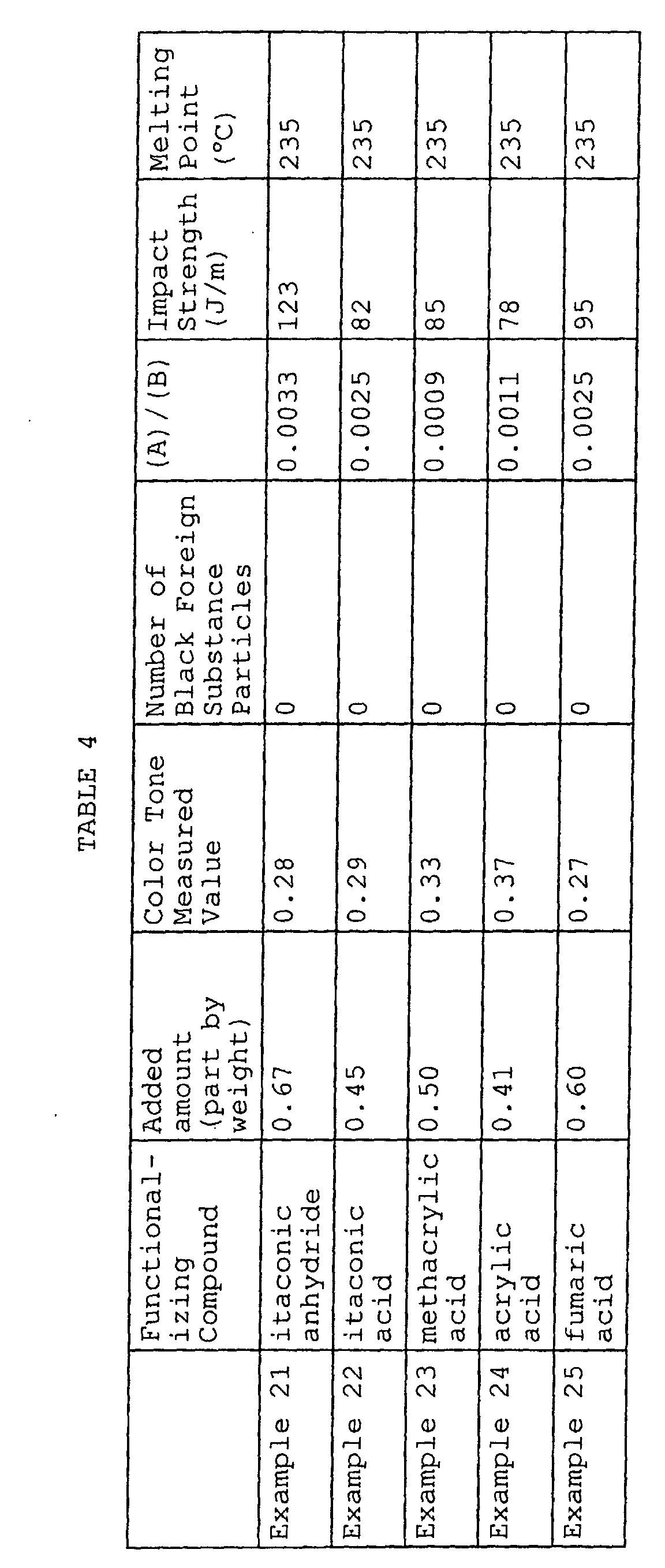
- Example 1 The procedure of Example 1 was repeated, except for changing the functionalizing compound put into the evaporator A. The results obtained are shown in Table 4.
- Polyphenylene ether powder (2 kg) and solid maleic anhydride (20 g) were mixed well and put into the same tank B as used in Example 1.
- the tank B was evacuated to 0.1 mmHg by means of a vacuum pump, the valves C and D were closed, and the container was tightly closed while maintaining the reduced pressure. Heated oil was delivered to the jacket of the tank B to control the temperature of the polyphenylene ether/maleic anhydride mixture at 190°C. The mixture was allowed to stand under these conditions for 60 minutes to react. After 60 minutes' standing and reacting, the polyphenylene ether powder was taken out. The amount of added maleic anhydride in the resulting functionalized polyphenylene ether was 0.02 part by weight.
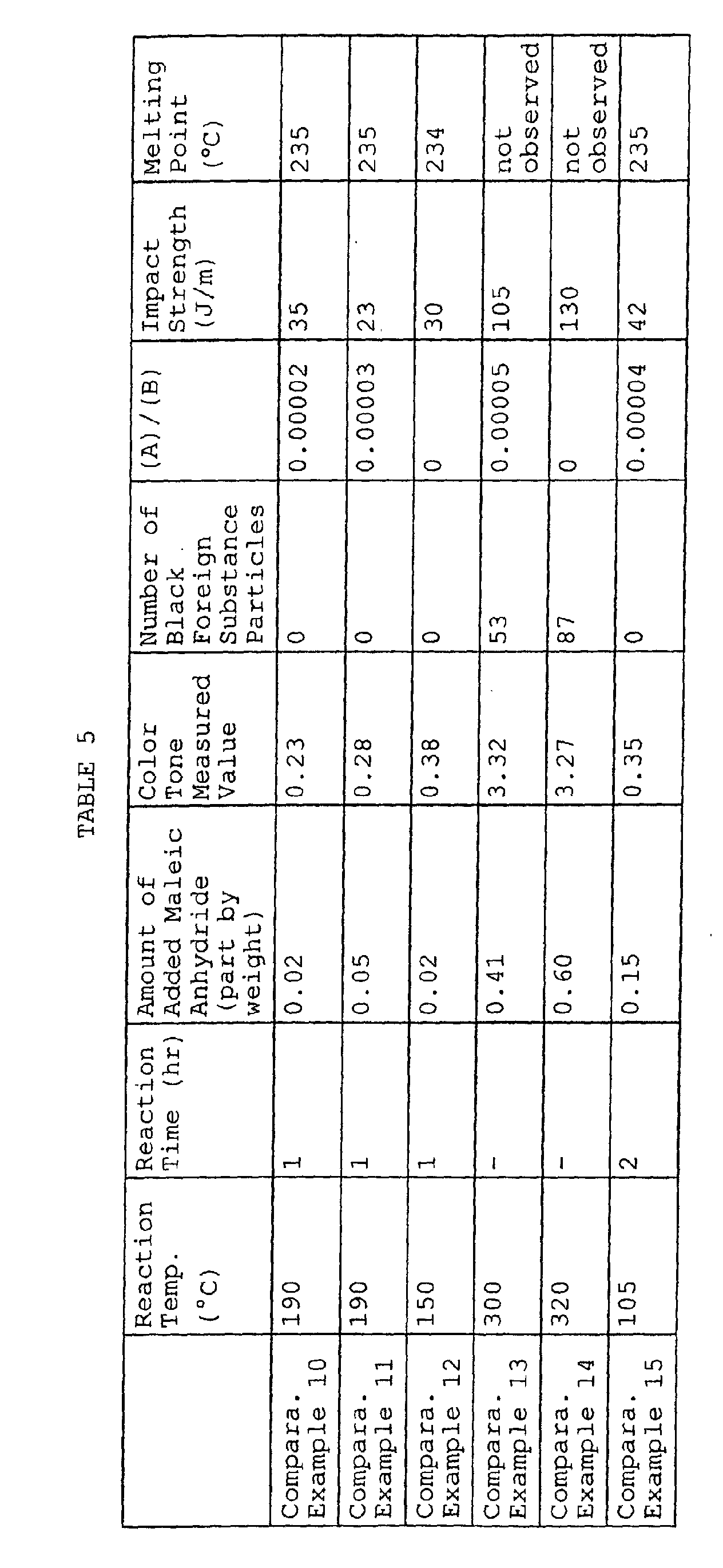
- Example 7 The same Henschel mixer as used in Example 7 was purged with nitrogen, and a mixture of 2 kg of polyphenylene ether powder and 40 g of solid maleic anhydride was put therein. Heated oil was circulated in the jacket of the Henschel mixer to adjust the power temperature in the mixer at 190°C. The stirring blades were rotated at 600 rpm to stir and mix the polyphenylene ether powder. After stirring and mixing for 60 minutes, the powder was taken out from the mixer. The analytical results of the functionalized polyphenylene ether are shown in Table 5.
- Polyphenylene ether powder (5 kg) and solid maleic anhydride (100 g) were mixed well, and the mixture was kneaded and extruded at 300°C by means of a twin-screw extruder ZSK-25 supplied by Werner to obtain pellets.
- the analytical results of the pellets are shown in Table 5.
- the proton NMR is shown in Fig. 5.
- the functionalized polyphenylene ether according to the present invention has an excellent color tone, contains little black foreign substance, and provides polymer alloys with superior mechanical characteristics when blended with different polymers, and therefore makes it possible to provide products and parts in various industrial fields that will sufficiently meet the industrial demands.
Landscapes
- Chemical & Material Sciences (AREA)
- General Chemical & Material Sciences (AREA)
- Health & Medical Sciences (AREA)
- Chemical Kinetics & Catalysis (AREA)
- Medicinal Chemistry (AREA)
- Polymers & Plastics (AREA)
- Organic Chemistry (AREA)
- Polyethers (AREA)
- Compositions Of Macromolecular Compounds (AREA)
Abstract
Description


Claims (14)
- A functionalized polyphenylene ether which has in its molecule at least one functional group selected from a carboxyl group, an acid anhydride group, an amino group, an amide group, an imide group, a silyl group, a hydroxyl group and a glycidyl group, and which gives a proton NMR spectrum with a peak area ratio (A)/(B) of 0.0001 or greater, wherein (A) is the area of peaks at chemical shifts from 2.95 to 3.04 ppm, and (B) is the area of peaks at chemical shifts from 6.00 to 6.90 ppm.
- The functionalized polyphenylene ether according to claim 1, wherein (A)/(B) is 0.001 or greater.
- The functionalized polyphenylene ether according to claim 1, wherein said functional group is an acid anhydride group.
- The functionalized polyphenylene ether according to any one of claims 1 to 3, which has a melting point of 200 to 260°C and is in the form of powder having a particle size of 10 µm to 1,000 µm.
- A process for producing a functionalized polyphenylene ether comprising:wherein said functionalizing compound is supplied in a gaseous state to the polyphenylene ether and allowed to react with the polyphenylene ether of a solid state at or below the melting temperature of the polyphenylene ether.allowing polyphenylene ether to react with at least one functionalizing compound having in its molecule (i) at least one carbon-carbon double bond or triple bond and (ii) at least one functional group selected from the group consisting of a carboxyl group, an acid anhydride group, an amino group, an amide group, an imide group, a silyl group, a hydroxyl group and a glycidyl group,
- The process for producing a functionalized polyphenylene ether according to claim 5, wherein said functionalizing compound is continuously blown in a gaseous state to the polyphenylene ether.
- The process for producing a functionalized polyphenylene ether according to claim 5 or 6, wherein the polyphenylene ether has a melting point of 200 to 260°C and is in the form of powder having a particle size of 10 µm to 1,000 µm.
- The process for producing a functionalized polyphenylene ether according to claim 5 or 6, wherein the functionalizing compound is maleic anhydride.
- The process for producing a functionalized polyphenylene ether according to claim 6, wherein the gaseous functionalizing compound is blown at a linear velocity of 0.05 m/sec to 10 m/sec with respect to the polyphenylene ether.
- The process for producing a functionalized polyphenylene ether according to claim 5 or 6, wherein the gaseous functionalizing compound is diluted with an inert gas.
- The process for producing a functionalized polyphenylene ether according to claim 5 or 6, wherein the reaction temperature is 110°C to 230°C.
- The process for producing a functionalized polyphenylene ether according to claim 5 or 6, wherein the reaction temperature is 155°C to 230°C.
- The process for producing a functionalized polyphenylene ether according to claim 5 or 6, wherein the reaction is carried out in a Henschel mixer.
- The process for producing a functionalized polyphenylene ether according to claim 5 or 6, wherein the reaction is carried out in a paddle drier.
Applications Claiming Priority (5)
| Application Number | Priority Date | Filing Date | Title |
|---|---|---|---|
| JP2001016549A JP3409035B2 (en) | 2001-01-25 | 2001-01-25 | Method for producing functionalized polyphenylene ether |
| JP2001016549 | 2001-01-25 | ||
| JP2001016550A JP3403179B2 (en) | 2001-01-25 | 2001-01-25 | Method for producing polyphenylene ether having a functional group |
| JP2001016550 | 2001-01-25 | ||
| PCT/JP2002/000514 WO2002059180A1 (en) | 2001-01-25 | 2002-01-24 | Functional polyphenylene ether resin |
Publications (3)
| Publication Number | Publication Date |
|---|---|
| EP1270643A1 true EP1270643A1 (en) | 2003-01-02 |
| EP1270643A4 EP1270643A4 (en) | 2003-04-02 |
| EP1270643B1 EP1270643B1 (en) | 2007-06-13 |
Family
ID=26608260
Family Applications (1)
| Application Number | Title | Priority Date | Filing Date |
|---|---|---|---|
| EP02711223A Expired - Lifetime EP1270643B1 (en) | 2001-01-25 | 2002-01-24 | Process for preparing functional polyphenylene ether resins |
Country Status (7)
| Country | Link |
|---|---|
| US (1) | US6835795B2 (en) |
| EP (1) | EP1270643B1 (en) |
| KR (2) | KR100574718B1 (en) |
| CN (1) | CN1235943C (en) |
| AT (1) | ATE364653T1 (en) |
| DE (1) | DE60220588T2 (en) |
| WO (1) | WO2002059180A1 (en) |
Families Citing this family (6)
| Publication number | Priority date | Publication date | Assignee | Title |
|---|---|---|---|---|
| US20070106050A1 (en) * | 2005-11-08 | 2007-05-10 | Sokolowski Alex D | Crosslinked poly(arylene ether) composition, method, and article |
| JP4988218B2 (en) * | 2006-02-13 | 2012-08-01 | 株式会社日立製作所 | Manufacturing method of low dielectric loss resin |
| US20080097069A1 (en) * | 2006-10-20 | 2008-04-24 | Hua Guo | Poly(arylene ether) method and composition |
| KR100771100B1 (en) * | 2007-07-18 | 2007-10-29 | 아이디비켐(주) | Manufacturing method of high purity methoxy polyethylene glycol ethyl maleimide |
| CN109294215B (en) * | 2018-08-08 | 2020-11-20 | 万华化学集团股份有限公司 | A kind of polyurethane resin composition and use and a kind of high strength and high modulus polyurethane material |
| JP2024517111A (en) * | 2021-04-27 | 2024-04-19 | エスエイチピーピー グローバル テクノロジーズ べスローテン フェンノートシャップ | Bifunctional sizing agent for improved adhesion to substrates |
Family Cites Families (16)
| Publication number | Priority date | Publication date | Assignee | Title |
|---|---|---|---|---|
| JPS5634716A (en) * | 1979-08-30 | 1981-04-07 | Kanegafuchi Chem Ind Co Ltd | Preparation of graft copolymer |
| JP2609536B2 (en) * | 1988-05-26 | 1997-05-14 | 旭化成工業株式会社 | Polyphenylene ether copolymer composition |
| JP2805829B2 (en) * | 1989-05-19 | 1998-09-30 | 三菱瓦斯化学株式会社 | Solvent-resistant polyphenylene ether-based resin composition |
| JPH04109320A (en) | 1990-08-30 | 1992-04-10 | Toshiba Corp | Controller for the number of pumps |
| JP2861735B2 (en) * | 1992-07-29 | 1999-02-24 | 住友化学工業株式会社 | Modified polyphenylene ether, method for producing the same, and thermoplastic resin composition |
| JPH07109320A (en) * | 1993-10-13 | 1995-04-25 | Asahi Chem Ind Co Ltd | Production of modified polyphenylene ether resin |
| JPH08239567A (en) * | 1995-02-28 | 1996-09-17 | Asahi Chem Ind Co Ltd | New curable polyphenylene ether resin composition and composite material and laminated material produced by using the composition |
| JPH08245872A (en) * | 1995-03-08 | 1996-09-24 | Asahi Chem Ind Co Ltd | Polyphenylene ether resin composition with low permittivity and low loss tangent |
| JP3289715B2 (en) * | 1998-10-20 | 2002-06-10 | 旭化成株式会社 | Method for producing functionalized polyphenylene ether |
| DE19909219A1 (en) | 1999-03-03 | 2000-09-07 | Buna Sow Leuna Olefinverb Gmbh | Process for the production of functionalized polyphenylene ethers |
| JP2001019839A (en) * | 1999-07-09 | 2001-01-23 | Asahi Chem Ind Co Ltd | Curable resin composition |
| JP4387033B2 (en) * | 2000-04-24 | 2009-12-16 | 旭化成ケミカルズ株式会社 | Process for producing polyphenylene ether resin functionalized with a novel organic substituted silyl group and composition thereof |
| JP4387032B2 (en) * | 2000-04-24 | 2009-12-16 | 旭化成ケミカルズ株式会社 | Method for producing novel functionalized polyphenylene ether resin and composition thereof |
| JP2001302873A (en) * | 2000-04-25 | 2001-10-31 | Asahi Kasei Corp | Resin composition |
| JP2001302901A (en) * | 2000-04-25 | 2001-10-31 | Asahi Kasei Corp | Resin composition |
| JP4518532B2 (en) | 2000-04-25 | 2010-08-04 | 旭化成ケミカルズ株式会社 | Resin composition |
-
2002
- 2002-01-24 EP EP02711223A patent/EP1270643B1/en not_active Expired - Lifetime
- 2002-01-24 KR KR1020027012591A patent/KR100574718B1/en not_active Expired - Fee Related
- 2002-01-24 DE DE60220588T patent/DE60220588T2/en not_active Expired - Lifetime
- 2002-01-24 KR KR1020067001705A patent/KR20060015358A/en not_active Ceased
- 2002-01-24 AT AT02711223T patent/ATE364653T1/en not_active IP Right Cessation
- 2002-01-24 US US10/240,023 patent/US6835795B2/en not_active Expired - Fee Related
- 2002-01-24 CN CNB028001745A patent/CN1235943C/en not_active Expired - Fee Related
- 2002-01-24 WO PCT/JP2002/000514 patent/WO2002059180A1/en not_active Ceased
Also Published As
| Publication number | Publication date |
|---|---|
| EP1270643B1 (en) | 2007-06-13 |
| EP1270643A4 (en) | 2003-04-02 |
| WO2002059180A1 (en) | 2002-08-01 |
| CN1455794A (en) | 2003-11-12 |
| ATE364653T1 (en) | 2007-07-15 |
| KR20060015358A (en) | 2006-02-16 |
| DE60220588D1 (en) | 2007-07-26 |
| US20030130474A1 (en) | 2003-07-10 |
| DE60220588T2 (en) | 2008-02-07 |
| KR20020086685A (en) | 2002-11-18 |
| KR100574718B1 (en) | 2006-04-28 |
| US6835795B2 (en) | 2004-12-28 |
| CN1235943C (en) | 2006-01-11 |
Similar Documents
| Publication | Publication Date | Title |
|---|---|---|
| AU661151B2 (en) | Concentrates suitable for the preparation of functionalized polyolefins and functionalization process using said concentrates | |
| US6001934A (en) | Process for the preparation of a functional group-containing polyarylene sulfide resin | |
| CA2293447C (en) | Oxidatively stable rigid aromatic polyimide compositions and process for their preparation | |
| EP0121974B2 (en) | Polymer mixture comprising a polyphenylene ether and optionally a polystyrene and/or a rubber-modified polystyrene, and articles formed therefrom | |
| US6835795B2 (en) | Functionalized polyphenylene ether resin | |
| CN112521533A (en) | Polyolefin derivative and composite material | |
| CN102643391A (en) | Ethylene propylene diene monomer grafted maleic anhydride and preparation method thereof | |
| CA2085221C (en) | Phosphoroustrislactams and methods for their production | |
| EP0294195A2 (en) | Polyimide resin composition | |
| JPS62129350A (en) | Thermoplastic resin composition | |
| JP3403179B2 (en) | Method for producing polyphenylene ether having a functional group | |
| JPH05501281A (en) | Thermoplastic elastomer and its manufacturing method | |
| JP4086273B2 (en) | Functionalized polyphenylene ethers with novel structures | |
| JP4387032B2 (en) | Method for producing novel functionalized polyphenylene ether resin and composition thereof | |
| JPS62129351A (en) | Thermoplastic resin composition | |
| JPS62129349A (en) | Thermoplastic resin composition | |
| JP3409035B2 (en) | Method for producing functionalized polyphenylene ether | |
| EP0514087A2 (en) | Polyphenylene ether-EPDM compositions | |
| JPS62129345A (en) | Thermoplastic resin composition | |
| JP4322392B2 (en) | Process for producing novel functionalized polyphenylene ether resin | |
| JP3749678B2 (en) | Process for the preparation of novel functionalized polyphenylene ether | |
| CN120818226A (en) | PC and ABS mixed material and preparation process | |
| JP4322393B2 (en) | Method for producing functionalized polyphenylene ether resin using high temperature gas as heat medium | |
| CN117304683A (en) | Polyamide material with high fluidity, high rigidity and high toughness and preparation method thereof | |
| JPS62129342A (en) | Thermoplastic resin composition |
Legal Events
| Date | Code | Title | Description |
|---|---|---|---|
| PUAI | Public reference made under article 153(3) epc to a published international application that has entered the european phase |
Free format text: ORIGINAL CODE: 0009012 |
|
| AK | Designated contracting states |
Kind code of ref document: A1 Designated state(s): AT BE CH CY DE DK ES FI FR GB GR IE IT LI LU MC NL PT SE TR |
|
| A4 | Supplementary search report drawn up and despatched |
Effective date: 20030217 |
|
| 17P | Request for examination filed |
Effective date: 20020921 |
|
| 17Q | First examination report despatched |
Effective date: 20040510 |
|
| GRAP | Despatch of communication of intention to grant a patent |
Free format text: ORIGINAL CODE: EPIDOSNIGR1 |
|
| RTI1 | Title (correction) |
Free format text: PROCESS FOR PREPARING FUNCTIONAL POLYPHENYLENE ETHER RESINS |
|
| GRAS | Grant fee paid |
Free format text: ORIGINAL CODE: EPIDOSNIGR3 |
|
| GRAA | (expected) grant |
Free format text: ORIGINAL CODE: 0009210 |
|
| AK | Designated contracting states |
Kind code of ref document: B1 Designated state(s): AT BE CH CY DE DK ES FI FR GB GR IE IT LI LU MC NL PT SE TR |
|
| PG25 | Lapsed in a contracting state [announced via postgrant information from national office to epo] |
Ref country code: CH Free format text: LAPSE BECAUSE OF FAILURE TO SUBMIT A TRANSLATION OF THE DESCRIPTION OR TO PAY THE FEE WITHIN THE PRESCRIBED TIME-LIMIT Effective date: 20070613 Ref country code: LI Free format text: LAPSE BECAUSE OF FAILURE TO SUBMIT A TRANSLATION OF THE DESCRIPTION OR TO PAY THE FEE WITHIN THE PRESCRIBED TIME-LIMIT Effective date: 20070613 |
|
| REG | Reference to a national code |
Ref country code: GB Ref legal event code: FG4D |
|
| REG | Reference to a national code |
Ref country code: CH Ref legal event code: EP |
|
| REG | Reference to a national code |
Ref country code: IE Ref legal event code: FG4D |
|
| REF | Corresponds to: |
Ref document number: 60220588 Country of ref document: DE Date of ref document: 20070726 Kind code of ref document: P |
|
| PG25 | Lapsed in a contracting state [announced via postgrant information from national office to epo] |
Ref country code: SE Free format text: LAPSE BECAUSE OF FAILURE TO SUBMIT A TRANSLATION OF THE DESCRIPTION OR TO PAY THE FEE WITHIN THE PRESCRIBED TIME-LIMIT Effective date: 20070913 |
|
| PG25 | Lapsed in a contracting state [announced via postgrant information from national office to epo] |
Ref country code: AT Free format text: LAPSE BECAUSE OF FAILURE TO SUBMIT A TRANSLATION OF THE DESCRIPTION OR TO PAY THE FEE WITHIN THE PRESCRIBED TIME-LIMIT Effective date: 20070613 |
|
| NLV1 | Nl: lapsed or annulled due to failure to fulfill the requirements of art. 29p and 29m of the patents act | ||
| REG | Reference to a national code |
Ref country code: CH Ref legal event code: PL |
|
| PG25 | Lapsed in a contracting state [announced via postgrant information from national office to epo] |
Ref country code: BE Free format text: LAPSE BECAUSE OF FAILURE TO SUBMIT A TRANSLATION OF THE DESCRIPTION OR TO PAY THE FEE WITHIN THE PRESCRIBED TIME-LIMIT Effective date: 20070613 |
|
| PG25 | Lapsed in a contracting state [announced via postgrant information from national office to epo] |
Ref country code: PT Free format text: LAPSE BECAUSE OF FAILURE TO SUBMIT A TRANSLATION OF THE DESCRIPTION OR TO PAY THE FEE WITHIN THE PRESCRIBED TIME-LIMIT Effective date: 20071113 Ref country code: NL Free format text: LAPSE BECAUSE OF FAILURE TO SUBMIT A TRANSLATION OF THE DESCRIPTION OR TO PAY THE FEE WITHIN THE PRESCRIBED TIME-LIMIT Effective date: 20070613 Ref country code: ES Free format text: LAPSE BECAUSE OF FAILURE TO SUBMIT A TRANSLATION OF THE DESCRIPTION OR TO PAY THE FEE WITHIN THE PRESCRIBED TIME-LIMIT Effective date: 20070924 |
|
| EN | Fr: translation not filed | ||
| PLBE | No opposition filed within time limit |
Free format text: ORIGINAL CODE: 0009261 |
|
| STAA | Information on the status of an ep patent application or granted ep patent |
Free format text: STATUS: NO OPPOSITION FILED WITHIN TIME LIMIT |
|
| PG25 | Lapsed in a contracting state [announced via postgrant information from national office to epo] |
Ref country code: DK Free format text: LAPSE BECAUSE OF FAILURE TO SUBMIT A TRANSLATION OF THE DESCRIPTION OR TO PAY THE FEE WITHIN THE PRESCRIBED TIME-LIMIT Effective date: 20070613 Ref country code: IT Free format text: LAPSE BECAUSE OF FAILURE TO SUBMIT A TRANSLATION OF THE DESCRIPTION OR TO PAY THE FEE WITHIN THE PRESCRIBED TIME-LIMIT Effective date: 20070613 Ref country code: GR Free format text: LAPSE BECAUSE OF FAILURE TO SUBMIT A TRANSLATION OF THE DESCRIPTION OR TO PAY THE FEE WITHIN THE PRESCRIBED TIME-LIMIT Effective date: 20070914 |
|
| 26N | No opposition filed |
Effective date: 20080314 |
|
| PG25 | Lapsed in a contracting state [announced via postgrant information from national office to epo] |
Ref country code: FR Free format text: LAPSE BECAUSE OF FAILURE TO SUBMIT A TRANSLATION OF THE DESCRIPTION OR TO PAY THE FEE WITHIN THE PRESCRIBED TIME-LIMIT Effective date: 20080208 |
|
| PG25 | Lapsed in a contracting state [announced via postgrant information from national office to epo] |
Ref country code: MC Free format text: LAPSE BECAUSE OF NON-PAYMENT OF DUE FEES Effective date: 20080131 |
|
| GBPC | Gb: european patent ceased through non-payment of renewal fee |
Effective date: 20080124 |
|
| PG25 | Lapsed in a contracting state [announced via postgrant information from national office to epo] |
Ref country code: GB Free format text: LAPSE BECAUSE OF NON-PAYMENT OF DUE FEES Effective date: 20080124 |
|
| PG25 | Lapsed in a contracting state [announced via postgrant information from national office to epo] |
Ref country code: IE Free format text: LAPSE BECAUSE OF NON-PAYMENT OF DUE FEES Effective date: 20080124 |
|
| PG25 | Lapsed in a contracting state [announced via postgrant information from national office to epo] |
Ref country code: FI Free format text: LAPSE BECAUSE OF FAILURE TO SUBMIT A TRANSLATION OF THE DESCRIPTION OR TO PAY THE FEE WITHIN THE PRESCRIBED TIME-LIMIT Effective date: 20070613 |
|
| PG25 | Lapsed in a contracting state [announced via postgrant information from national office to epo] |
Ref country code: CY Free format text: LAPSE BECAUSE OF FAILURE TO SUBMIT A TRANSLATION OF THE DESCRIPTION OR TO PAY THE FEE WITHIN THE PRESCRIBED TIME-LIMIT Effective date: 20070613 |
|
| PG25 | Lapsed in a contracting state [announced via postgrant information from national office to epo] |
Ref country code: LU Free format text: LAPSE BECAUSE OF NON-PAYMENT OF DUE FEES Effective date: 20080124 |
|
| PG25 | Lapsed in a contracting state [announced via postgrant information from national office to epo] |
Ref country code: TR Free format text: LAPSE BECAUSE OF FAILURE TO SUBMIT A TRANSLATION OF THE DESCRIPTION OR TO PAY THE FEE WITHIN THE PRESCRIBED TIME-LIMIT Effective date: 20070613 |
|
| PGFP | Annual fee paid to national office [announced via postgrant information from national office to epo] |
Ref country code: DE Payment date: 20120118 Year of fee payment: 11 |
|
| PG25 | Lapsed in a contracting state [announced via postgrant information from national office to epo] |
Ref country code: DE Free format text: LAPSE BECAUSE OF NON-PAYMENT OF DUE FEES Effective date: 20130801 |
|
| REG | Reference to a national code |
Ref country code: DE Ref legal event code: R119 Ref document number: 60220588 Country of ref document: DE Effective date: 20130801 |