EP1270612A1 - Process for the preparation of diene polymers - Google Patents
Process for the preparation of diene polymers Download PDFInfo
- Publication number
- EP1270612A1 EP1270612A1 EP02013484A EP02013484A EP1270612A1 EP 1270612 A1 EP1270612 A1 EP 1270612A1 EP 02013484 A EP02013484 A EP 02013484A EP 02013484 A EP02013484 A EP 02013484A EP 1270612 A1 EP1270612 A1 EP 1270612A1
- Authority
- EP
- European Patent Office
- Prior art keywords
- catalyst
- process according
- range
- rare
- earth metal
- Prior art date
- Legal status (The legal status is an assumption and is not a legal conclusion. Google has not performed a legal analysis and makes no representation as to the accuracy of the status listed.)
- Withdrawn
Links
- 229920000642 polymer Polymers 0.000 title claims abstract description 26
- 150000001993 dienes Chemical class 0.000 title claims abstract description 11
- 238000000034 method Methods 0.000 title claims description 20
- 238000002360 preparation method Methods 0.000 title claims description 4
- 239000003054 catalyst Substances 0.000 claims abstract description 22
- 239000003426 co-catalyst Substances 0.000 claims abstract description 17
- 229910052761 rare earth metal Inorganic materials 0.000 claims abstract description 11
- 150000002910 rare earth metals Chemical class 0.000 claims abstract description 11
- 239000000178 monomer Substances 0.000 claims abstract description 9
- 239000002841 Lewis acid Substances 0.000 claims abstract description 6
- 150000007517 lewis acids Chemical class 0.000 claims abstract description 6
- 238000004519 manufacturing process Methods 0.000 claims abstract description 3
- KAKZBPTYRLMSJV-UHFFFAOYSA-N Butadiene Chemical compound C=CC=C KAKZBPTYRLMSJV-UHFFFAOYSA-N 0.000 claims description 14
- 239000002904 solvent Substances 0.000 claims description 10
- 229910052782 aluminium Inorganic materials 0.000 claims description 7
- CPOFMOWDMVWCLF-UHFFFAOYSA-N methyl(oxo)alumane Chemical compound C[Al]=O CPOFMOWDMVWCLF-UHFFFAOYSA-N 0.000 claims description 6
- 239000003446 ligand Substances 0.000 claims description 5
- 239000004215 Carbon black (E152) Substances 0.000 claims description 4
- RRHGJUQNOFWUDK-UHFFFAOYSA-N Isoprene Chemical compound CC(=C)C=C RRHGJUQNOFWUDK-UHFFFAOYSA-N 0.000 claims description 4
- XAGFODPZIPBFFR-UHFFFAOYSA-N aluminium Chemical compound [Al] XAGFODPZIPBFFR-UHFFFAOYSA-N 0.000 claims description 4
- 229930195733 hydrocarbon Natural products 0.000 claims description 4
- 150000002430 hydrocarbons Chemical class 0.000 claims description 4
- 125000000129 anionic group Chemical group 0.000 claims description 3
- 150000002894 organic compounds Chemical class 0.000 claims description 3
- 230000000737 periodic effect Effects 0.000 claims description 3
- WCFQIFDACWBNJT-UHFFFAOYSA-N $l^{1}-alumanyloxy(2-methylpropyl)aluminum Chemical compound CC(C)C[Al]O[Al] WCFQIFDACWBNJT-UHFFFAOYSA-N 0.000 claims description 2
- APPOKADJQUIAHP-GGWOSOGESA-N (2e,4e)-hexa-2,4-diene Chemical compound C\C=C\C=C\C APPOKADJQUIAHP-GGWOSOGESA-N 0.000 claims description 2
- POILWHVDKZOXJZ-ARJAWSKDSA-M (z)-4-oxopent-2-en-2-olate Chemical compound C\C([O-])=C\C(C)=O POILWHVDKZOXJZ-ARJAWSKDSA-M 0.000 claims description 2
- BWLBGMIXKSTLSX-UHFFFAOYSA-N 2-hydroxyisobutyric acid Chemical compound CC(C)(O)C(O)=O BWLBGMIXKSTLSX-UHFFFAOYSA-N 0.000 claims description 2
- 229910019142 PO4 Inorganic materials 0.000 claims description 2
- 150000007942 carboxylates Chemical class 0.000 claims description 2
- NBIIXXVUZAFLBC-UHFFFAOYSA-K phosphate Chemical compound [O-]P([O-])([O-])=O NBIIXXVUZAFLBC-UHFFFAOYSA-K 0.000 claims description 2
- 239000010452 phosphate Substances 0.000 claims description 2
- XBDQKXXYIPTUBI-UHFFFAOYSA-M Propionate Chemical compound CCC([O-])=O XBDQKXXYIPTUBI-UHFFFAOYSA-M 0.000 claims 1
- 125000000217 alkyl group Chemical group 0.000 claims 1
- 230000000379 polymerizing effect Effects 0.000 claims 1
- BDERNNFJNOPAEC-UHFFFAOYSA-N propan-1-ol Chemical compound CCCO BDERNNFJNOPAEC-UHFFFAOYSA-N 0.000 claims 1
- 238000006116 polymerization reaction Methods 0.000 abstract description 12
- VLKZOEOYAKHREP-UHFFFAOYSA-N n-Hexane Chemical compound CCCCCC VLKZOEOYAKHREP-UHFFFAOYSA-N 0.000 description 15
- 229920002857 polybutadiene Polymers 0.000 description 9
- YXFVVABEGXRONW-UHFFFAOYSA-N Toluene Chemical compound CC1=CC=CC=C1 YXFVVABEGXRONW-UHFFFAOYSA-N 0.000 description 6
- 229910052779 Neodymium Inorganic materials 0.000 description 5
- XKRFYHLGVUSROY-UHFFFAOYSA-N Argon Chemical compound [Ar] XKRFYHLGVUSROY-UHFFFAOYSA-N 0.000 description 4
- QEFYFXOXNSNQGX-UHFFFAOYSA-N neodymium atom Chemical compound [Nd] QEFYFXOXNSNQGX-UHFFFAOYSA-N 0.000 description 4
- 229920002554 vinyl polymer Polymers 0.000 description 4
- 239000005062 Polybutadiene Substances 0.000 description 3
- 239000000356 contaminant Substances 0.000 description 3
- 239000012535 impurity Substances 0.000 description 3
- 238000006317 isomerization reaction Methods 0.000 description 3
- 239000000203 mixture Substances 0.000 description 3
- 125000000391 vinyl group Chemical group [H]C([*])=C([H])[H] 0.000 description 3
- PMJHHCWVYXUKFD-SNAWJCMRSA-N (E)-1,3-pentadiene Chemical group C\C=C\C=C PMJHHCWVYXUKFD-SNAWJCMRSA-N 0.000 description 2
- 229910018516 Al—O Inorganic materials 0.000 description 2
- XDTMQSROBMDMFD-UHFFFAOYSA-N Cyclohexane Chemical compound C1CCCCC1 XDTMQSROBMDMFD-UHFFFAOYSA-N 0.000 description 2
- 239000005063 High cis polybutadiene Substances 0.000 description 2
- 239000005066 High trans polybutadiene Substances 0.000 description 2
- OFBQJSOFQDEBGM-UHFFFAOYSA-N Pentane Chemical compound CCCCC OFBQJSOFQDEBGM-UHFFFAOYSA-N 0.000 description 2
- -1 alkyl lithium Chemical compound 0.000 description 2
- 229910052786 argon Inorganic materials 0.000 description 2
- 230000003197 catalytic effect Effects 0.000 description 2
- 238000006243 chemical reaction Methods 0.000 description 2
- 150000001875 compounds Chemical class 0.000 description 2
- 230000000694 effects Effects 0.000 description 2
- 238000002474 experimental method Methods 0.000 description 2
- 229920005669 high impact polystyrene Polymers 0.000 description 2
- 239000004797 high-impact polystyrene Substances 0.000 description 2
- 239000003999 initiator Substances 0.000 description 2
- 239000002808 molecular sieve Substances 0.000 description 2
- 239000003960 organic solvent Substances 0.000 description 2
- PMJHHCWVYXUKFD-UHFFFAOYSA-N piperylene Natural products CC=CC=C PMJHHCWVYXUKFD-UHFFFAOYSA-N 0.000 description 2
- URGAHOPLAPQHLN-UHFFFAOYSA-N sodium aluminosilicate Chemical compound [Na+].[Al+3].[O-][Si]([O-])=O.[O-][Si]([O-])=O URGAHOPLAPQHLN-UHFFFAOYSA-N 0.000 description 2
- XLYOFNOQVPJJNP-UHFFFAOYSA-N water Substances O XLYOFNOQVPJJNP-UHFFFAOYSA-N 0.000 description 2
- OVSKIKFHRZPJSS-UHFFFAOYSA-N 2,4-D Chemical compound OC(=O)COC1=CC=C(Cl)C=C1Cl OVSKIKFHRZPJSS-UHFFFAOYSA-N 0.000 description 1
- PQXQGYCQXZLXPU-UHFFFAOYSA-K 2-ethylbutanoate;neodymium(3+) Chemical compound [Nd+3].CCC(CC)C([O-])=O.CCC(CC)C([O-])=O.CCC(CC)C([O-])=O PQXQGYCQXZLXPU-UHFFFAOYSA-K 0.000 description 1
- 229910052684 Cerium Inorganic materials 0.000 description 1
- LFQSCWFLJHTTHZ-UHFFFAOYSA-N Ethanol Chemical compound CCO LFQSCWFLJHTTHZ-UHFFFAOYSA-N 0.000 description 1
- 229910052688 Gadolinium Inorganic materials 0.000 description 1
- 241001441571 Hiodontidae Species 0.000 description 1
- 241000254043 Melolonthinae Species 0.000 description 1
- LRHPLDYGYMQRHN-UHFFFAOYSA-N N-Butanol Chemical compound CCCCO LRHPLDYGYMQRHN-UHFFFAOYSA-N 0.000 description 1
- 238000005299 abrasion Methods 0.000 description 1
- 230000032683 aging Effects 0.000 description 1
- 238000013019 agitation Methods 0.000 description 1
- 150000001336 alkenes Chemical group 0.000 description 1
- 150000004703 alkoxides Chemical class 0.000 description 1
- 150000001408 amides Chemical class 0.000 description 1
- 238000010539 anionic addition polymerization reaction Methods 0.000 description 1
- 239000003963 antioxidant agent Substances 0.000 description 1
- 230000003078 antioxidant effect Effects 0.000 description 1
- 230000005540 biological transmission Effects 0.000 description 1
- 235000013844 butane Nutrition 0.000 description 1
- 125000000484 butyl group Chemical group [H]C([*])([H])C([H])([H])C([H])([H])C([H])([H])[H] 0.000 description 1
- 239000006227 byproduct Substances 0.000 description 1
- 230000015271 coagulation Effects 0.000 description 1
- 238000005345 coagulation Methods 0.000 description 1
- 238000010668 complexation reaction Methods 0.000 description 1
- 238000013329 compounding Methods 0.000 description 1
- ARUVKPQLZAKDPS-UHFFFAOYSA-L copper(II) sulfate Chemical compound [Cu+2].[O-][S+2]([O-])([O-])[O-] ARUVKPQLZAKDPS-UHFFFAOYSA-L 0.000 description 1
- 238000004132 cross linking Methods 0.000 description 1
- 150000001923 cyclic compounds Chemical class 0.000 description 1
- 125000004122 cyclic group Chemical group 0.000 description 1
- 230000002939 deleterious effect Effects 0.000 description 1
- 230000001419 dependent effect Effects 0.000 description 1
- 230000006866 deterioration Effects 0.000 description 1
- 238000009826 distribution Methods 0.000 description 1
- 238000004945 emulsification Methods 0.000 description 1
- 238000005516 engineering process Methods 0.000 description 1
- 230000007613 environmental effect Effects 0.000 description 1
- 125000001495 ethyl group Chemical group [H]C([H])([H])C([H])([H])* 0.000 description 1
- 239000011521 glass Substances 0.000 description 1
- 229920001519 homopolymer Polymers 0.000 description 1
- 125000001183 hydrocarbyl group Chemical group 0.000 description 1
- 238000011065 in-situ storage Methods 0.000 description 1
- 239000012442 inert solvent Substances 0.000 description 1
- 229910052746 lanthanum Inorganic materials 0.000 description 1
- NCRUJFPNHKQCJG-UHFFFAOYSA-K lanthanum(3+);propanoate Chemical compound [La+3].CCC([O-])=O.CCC([O-])=O.CCC([O-])=O NCRUJFPNHKQCJG-UHFFFAOYSA-K 0.000 description 1
- 229910052744 lithium Inorganic materials 0.000 description 1
- 229910052751 metal Inorganic materials 0.000 description 1
- 239000002184 metal Substances 0.000 description 1
- 150000002739 metals Chemical class 0.000 description 1
- 125000002496 methyl group Chemical group [H]C([H])([H])* 0.000 description 1
- IJDNQMDRQITEOD-UHFFFAOYSA-N n-butane Chemical class CCCC IJDNQMDRQITEOD-UHFFFAOYSA-N 0.000 description 1
- IRGLOWNFSUBRSR-UHFFFAOYSA-N neodymium(3+);propan-1-olate Chemical compound [Nd+3].CCC[O-].CCC[O-].CCC[O-] IRGLOWNFSUBRSR-UHFFFAOYSA-N 0.000 description 1
- 230000000269 nucleophilic effect Effects 0.000 description 1
- 229910052763 palladium Inorganic materials 0.000 description 1
- 125000001147 pentyl group Chemical group C(CCCC)* 0.000 description 1
- 238000005120 petroleum cracking Methods 0.000 description 1
- 239000004033 plastic Substances 0.000 description 1
- 229920003023 plastic Polymers 0.000 description 1
- 239000002685 polymerization catalyst Substances 0.000 description 1
- 125000001436 propyl group Chemical group [H]C([*])([H])C([H])([H])C([H])([H])[H] 0.000 description 1
- 239000002994 raw material Substances 0.000 description 1
- 150000003839 salts Chemical class 0.000 description 1
- 241000894007 species Species 0.000 description 1
- 238000003860 storage Methods 0.000 description 1
- 125000000383 tetramethylene group Chemical group [H]C([H])([*:1])C([H])([H])C([H])([H])C([H])([H])[*:2] 0.000 description 1
- 229910052723 transition metal Inorganic materials 0.000 description 1
- 150000003624 transition metals Chemical class 0.000 description 1
- 238000004073 vulcanization Methods 0.000 description 1
Classifications
-
- C—CHEMISTRY; METALLURGY
- C08—ORGANIC MACROMOLECULAR COMPOUNDS; THEIR PREPARATION OR CHEMICAL WORKING-UP; COMPOSITIONS BASED THEREON
- C08F—MACROMOLECULAR COMPOUNDS OBTAINED BY REACTIONS ONLY INVOLVING CARBON-TO-CARBON UNSATURATED BONDS
- C08F36/00—Homopolymers and copolymers of compounds having one or more unsaturated aliphatic radicals, at least one having two or more carbon-to-carbon double bonds
Definitions
- the present invention relates to a process for the preparation of diene polymers.
- Polybutadiene a homopolymer of 1,3-butadiene, can be manufactured by both solution and emulsion methods.
- the polymer has excellent abrasion resistance, high resilience and excellent low-temperature flexibility.
- the polymer exists in isomeric forms, since the 1,3-butadiene monomer can be incorporated into the growing polymer chain in three ways, namely cis 1,4; trans 1,4 or vinyl 1,2.
- the microstructure (i.e. the cis , trans and vinyl content) of the polymer has profound effects on the properties thereof.
- polystyrene polymers The largest application for polybutadiene polymers is in tire technology.
- Tire components which contain the polymer include chafers, sidewalls, carcasses and treads.
- Medium- and high-vinyl polybutadienes are used in tire tread applications; whereas medium- and high-cis polybutadienes are used in the manufacture of high impact polystyrene (HIPS).
- Other polybutadiene applications include golf ball cores, shoe soles, automotive power transmission belts, industrial belts and conveyor belts.
- High-cis polybutadiene is produced by a range of Ziegler-Natta polymerization catalysts. Recently, such polybutadienes have been made available by Neodymium-catalyzed polymerization, which produces a high- cis polybutadiene having improved properties such as green strength, fatigue resistance and processability. High-trans polybutadiene can be prepared by the addition of nucleophilic ligands to transition-metal based Ziegler-Natta catalysts.
- This method has the obvious disadvantage that it is a two-step process (step one being the preparation of the high-cis polymer), which has both time and cost implications.
- step one being the preparation of the high-cis polymer
- the use of isomerisation catalysts and/or initiators may result in a polymer having relatively high levels of impurities or contaminants; such impurities or contaminants (or residues arising therefrom) can have deleterious effects on the properties of the polymer itself, or may interfere with subsequent processing of the polymer (e.g. vulcanization, compounding).
- this polymer still has good elastomeric properties.
- polymerization of butadiene using a two-component catalyst system comprising a rare-earth metal catalyst and a Lewis acid co-catalyst, wherein neither of these components is halogenated, gives a polymer having a trans content in the range of from 10 to 30% in good yield.
- the process disclosed herein comprises the polymerization of a diene in the presence of a two-component catalyst system which comprises a rare-earth metal catalyst and a Lewis acid co-catalyst, wherein neither of these components is halogenated, and with the proviso that the co-catalyst is not a trialkyl aluminum.
- the rare-earth metal catalyst has the general formula : ML 3 wherein M is a rare-earth metal chosen from those of Group IIIB of the Periodic Table, and includes metals such as Ce, La, Pd, Gd and Nd. Preferably, M is Nd.
- Each L which may be the same or different, is an anionic counter-ion or a ligand derived from an organic compound which is soluble in hydrocarbon solvent.
- L is a carboxylate, alcoholate, acetonate or phosphate.
- Preferred catalysts include, but are not limited to, Neodymium propanolate, praesodymium butanolate, lanthanum propionate, neodymium diethylacetate, neodymium acetylacetonate and the like. Most preferred catalysts are Neodymium versatate and Neodymium naphthanoate.
- the co-catalyst is a non-halogenated Lewis acid, with the proviso that it is not a trialkyl aluminum.
- it is an aluminoxane, or a mixture of two or more aluminoxanes.
- the aluminoxane co-catalyst (which may, in fact, be prepared in situ) typically is an oligomeric aluminum compound represented by the general formula (R-Al-O) n , which is a cyclic compound, or R(R-Al-O) n AlR 2 , which is a linear compound.
- R is independently a C 1 to C 10 hydrocarbyl radical (for example, methyl, ethyl, propyl, butyl or pentyl) and n is an integer in the range of from 1 to 100.
- R may also be, independently, other non-hydrocarbyl monovalent ligands such as amide, alkoxide and the like.
- the co-catalyst is an alkylaluminoxane. Most preferably, it is methylaluminoxane, modified methylaluminoxane (M-MAO) or isobutyl-aluminoxane. Modified methyl-aluminoxane is available from Akzo Nobel, and has the Modified methyl-aluminoxane is available from Akzo Nobel, and has the approximate general formula -[Me 0.7 i Bu 0.3 AlO] x - (so-called Type 3A) or -[Me 0.9 i Bu 0.1 AlO] x - (Type 4).
- Aluminoxanes can be prepared by various procedures known in the art. For example, an aluminum alkyl may be treated with water dissolved in an inert organic solvent, or it may be contacted with a hydrated salt, such as hydrated copper sulphate suspended in an inert organic solvent, to yield an aluminoxane. Generally, however prepared, the reaction of an aluminum alkyl with a limited amount of water yields a mixture of the linear and cyclic species, and also there is a possibility of interchain complexation (crosslinking). The catalytic efficiency of aluminoxanes is dependent not only on a given preparative procedure but also on a deterioration in the catalytic activity ("ageing") upon storage, unless appropriately stabilised.
- ageing a deterioration in the catalytic activity
- the polymerization may be carried out in an inert solvent, preferably in a hydrocarbon solvent.
- solvents are known to those skilled in the art, and include hexane, cyclohexane, pentane and toluene.
- Preferred solvents are hexane and cyclohexane.
- the most preferred solvent is hexane.
- the amount of solvent used may vary within wide limits, although environmental and economic factors suggest that the amount should be kept as small as possible.
- Monomers which may be employed in the polymerization reaction include, but are not limited to, conjugated dienes such as 1,3-butadiene, isoprene, 2,4-hexadiene, piperylene and 1,3-pentadiene.
- conjugated dienes such as 1,3-butadiene, isoprene, 2,4-hexadiene, piperylene and 1,3-pentadiene.
- C4-raffinate a by-product of petroleum cracking, is a mixture of 1,3-butadiene and isomeric butanes and butenes, and can serve as both feedstock and solvent for the polymerization reaction.
- the polymerization may be carried out at a temperature in the range of from 20 °C to 200 °C.
- the temperature is in the range of from 50 °C to 100 °C.
- the temperature is in the range of from 50 °C to 75 °C.
- the amount of rare-earth metal catalyst employed in the polymerization reaction is in the range of 0.01 to 10 phm (parts per hundred parts monomer), preferably in the range of 0.02 to 1 phm and most preferably in the range of 0.05 to 0.25 phm.
- the amount of co-catalyst employed in the polymerization reaction is in the range of from 0.01 to 10 phm, preferably in the range of from 0.025 to 5 phm and most preferably in the range of from 0.05 to 5 phm.
- the resulting polymers have a cis double-bond content in the range of from 70 to 90% (70 - 90% per 100 % of all double bonds); a trans double-bond content in the range of from 10 to 30%; and a vinyl content of less than 5%.
- a typical polymer has the following properties
- 1,3-butadiene was obtained from the Olefins unit of Bayer, Inc. in Sarnia, passed through 3A molecular sieves and stored under argon at -20°C.
- M-MAO (7.1% solution in toluene) was obtained from Akzo-Nobel.
Landscapes
- Chemical & Material Sciences (AREA)
- Health & Medical Sciences (AREA)
- Chemical Kinetics & Catalysis (AREA)
- Medicinal Chemistry (AREA)
- Polymers & Plastics (AREA)
- Organic Chemistry (AREA)
- Transition And Organic Metals Composition Catalysts For Addition Polymerization (AREA)
- Addition Polymer Or Copolymer, Post-Treatments, Or Chemical Modifications (AREA)
- Polymerization Catalysts (AREA)
Abstract
Disclosed herein is a process for preparing a diene polymer having a trans content of
in the range of from 10 to 30% by the polymerization of a diene monomer in the
presence of a two-component catalyst system comprising a rare-earth metal catalyst
and a Lewis acid co-catalyst.
Description
- The present invention relates to a process for the preparation of diene polymers.
- Polybutadiene, a homopolymer of 1,3-butadiene, can be manufactured by both solution and emulsion methods. The polymer has excellent abrasion resistance, high resilience and excellent low-temperature flexibility. The polymer exists in isomeric forms, since the 1,3-butadiene monomer can be incorporated into the growing polymer chain in three ways, namely cis 1,4; trans 1,4 or vinyl 1,2. The microstructure (i.e. the cis, trans and vinyl content) of the polymer has profound effects on the properties thereof.
- The largest application for polybutadiene polymers is in tire technology. Tire components which contain the polymer include chafers, sidewalls, carcasses and treads. Medium- and high-vinyl polybutadienes are used in tire tread applications; whereas medium- and high-cis polybutadienes are used in the manufacture of high impact polystyrene (HIPS). Other polybutadiene applications include golf ball cores, shoe soles, automotive power transmission belts, industrial belts and conveyor belts.
- The majority of commercially available elastomeric polybutadienes are produced in solution by either Ziegler-Natta type co-ordination polymerization or anionic polymerization using alkyl lithium catalysts. High-cis polybutadiene is produced by a range of Ziegler-Natta polymerization catalysts. Recently, such polybutadienes have been made available by Neodymium-catalyzed polymerization, which produces a high-cis polybutadiene having improved properties such as green strength, fatigue resistance and processability. High-trans polybutadiene can be prepared by the addition of nucleophilic ligands to transition-metal based Ziegler-Natta catalysts.
- Polybutadienes having a trans-content intermediate in range between the high-cis and high-trans polymers, for example in the range of from 10 to 30%, have been prepared to date only by the isomerisation of high-cis polybutadienes. This method has the obvious disadvantage that it is a two-step process (step one being the preparation of the high-cis polymer), which has both time and cost implications. Further, the use of isomerisation catalysts and/or initiators may result in a polymer having relatively high levels of impurities or contaminants; such impurities or contaminants (or residues arising therefrom) can have deleterious effects on the properties of the polymer itself, or may interfere with subsequent processing of the polymer (e.g. vulcanization, compounding). Unlike high-trans polybutadiene (which is, in fact, plastic in nature) this polymer still has good elastomeric properties.
- We have found a means for preparing a diene polymer having a trans content in the range of from 10 to 30% directly, without having to isomerise a high-cis polymer. Such a direct (i.e. one-step) method means that the polymer can be produced more cheaply, and more efficiently, than by the method of the art. Further, since no isomerisation catalysts or initiators are used the polymer contains fewer impurities or contaminants, and there is no concern with the effects such compounds (or residues arising therefrom) might have on the properties of the polymer, or subsequent treatment thereof. Unexpectedly, polymerization of butadiene using a two-component catalyst system comprising a rare-earth metal catalyst and a Lewis acid co-catalyst, wherein neither of these components is halogenated, gives a polymer having a trans content in the range of from 10 to 30% in good yield.
- The process disclosed herein comprises the polymerization of a diene in the presence of a two-component catalyst system which comprises a rare-earth metal catalyst and a Lewis acid co-catalyst, wherein neither of these components is halogenated, and with the proviso that the co-catalyst is not a trialkyl aluminum.
- The rare-earth metal catalyst has the general formula :
- Each L, which may be the same or different, is an anionic counter-ion or a ligand derived from an organic compound which is soluble in hydrocarbon solvent. Preferably, L is a carboxylate, alcoholate, acetonate or phosphate. Preferred catalysts include, but are not limited to, Neodymium propanolate, praesodymium butanolate, lanthanum propionate, neodymium diethylacetate, neodymium acetylacetonate and the like. Most preferred catalysts are Neodymium versatate and Neodymium naphthanoate.
- The co-catalyst is a non-halogenated Lewis acid, with the proviso that it is not a trialkyl aluminum. Preferably, it is an aluminoxane, or a mixture of two or more aluminoxanes. The aluminoxane co-catalyst (which may, in fact, be prepared in situ) typically is an oligomeric aluminum compound represented by the general formula (R-Al-O)n, which is a cyclic compound, or R(R-Al-O)nAlR2, which is a linear compound. In the general aluminoxane formula, R is independently a C1 to C10 hydrocarbyl radical (for example, methyl, ethyl, propyl, butyl or pentyl) and n is an integer in the range of from 1 to 100. R may also be, independently, other non-hydrocarbyl monovalent ligands such as amide, alkoxide and the like.
- More preferably, the co-catalyst is an alkylaluminoxane. Most preferably, it is methylaluminoxane, modified methylaluminoxane (M-MAO) or isobutyl-aluminoxane. Modified methyl-aluminoxane is available from Akzo Nobel, and has the Modified methyl-aluminoxane is available from Akzo Nobel, and has the approximate general formula -[Me0.7 iBu0.3AlO]x- (so-called Type 3A) or -[Me0.9 iBu0.1AlO]x- (Type 4).
- Aluminoxanes can be prepared by various procedures known in the art. For example, an aluminum alkyl may be treated with water dissolved in an inert organic solvent, or it may be contacted with a hydrated salt, such as hydrated copper sulphate suspended in an inert organic solvent, to yield an aluminoxane. Generally, however prepared, the reaction of an aluminum alkyl with a limited amount of water yields a mixture of the linear and cyclic species, and also there is a possibility of interchain complexation (crosslinking). The catalytic efficiency of aluminoxanes is dependent not only on a given preparative procedure but also on a deterioration in the catalytic activity ("ageing") upon storage, unless appropriately stabilised.
- The polymerization may be carried out in an inert solvent, preferably in a hydrocarbon solvent. Such solvents are known to those skilled in the art, and include hexane, cyclohexane, pentane and toluene. Preferred solvents are hexane and cyclohexane. The most preferred solvent is hexane. The amount of solvent used may vary within wide limits, although environmental and economic factors suggest that the amount should be kept as small as possible.
- Monomers which may be employed in the polymerization reaction include, but are not limited to, conjugated dienes such as 1,3-butadiene, isoprene, 2,4-hexadiene, piperylene and 1,3-pentadiene. So-called "C4-raffinate", a by-product of petroleum cracking, is a mixture of 1,3-butadiene and isomeric butanes and butenes, and can serve as both feedstock and solvent for the polymerization reaction.
- The polymerization may be carried out at a temperature in the range of from 20 °C to 200 °C. Preferably, the temperature is in the range of from 50 °C to 100 °C. Most preferably, the temperature is in the range of from 50 °C to 75 °C.
- The amount of rare-earth metal catalyst employed in the polymerization reaction is in the range of 0.01 to 10 phm (parts per hundred parts monomer), preferably in the range of 0.02 to 1 phm and most preferably in the range of 0.05 to 0.25 phm.
- The amount of co-catalyst employed in the polymerization reaction is in the range of from 0.01 to 10 phm, preferably in the range of from 0.025 to 5 phm and most preferably in the range of from 0.05 to 5 phm.
- The resulting polymers have a cis double-bond content in the range of from 70 to 90% (70 - 90% per 100 % of all double bonds); a trans double-bond content in the range of from 10 to 30%; and a vinyl content of less than 5%.
- A typical polymer has the following properties
- A Mooney viscosity [ML(1+4', 100°C)] in the range of from 30 to 120 Mooney Units (MU).
- A molecular weight in the range of from 100,000 to 500,000 g/mol
- A unimodal molecular weight distribution with a polydispersity index of 2.75.
- Technical hexane was passed through 3A and 13X molecular sieves and stored under argon. 1,3-butadiene was obtained from the Olefins unit of Bayer, Inc. in Sarnia, passed through 3A molecular sieves and stored under argon at -20°C.
- M-MAO (7.1% solution in toluene) was obtained from Akzo-Nobel. Neodymium versatate (NdV) was obtained from Rhodia (18.3% solution in hexane).
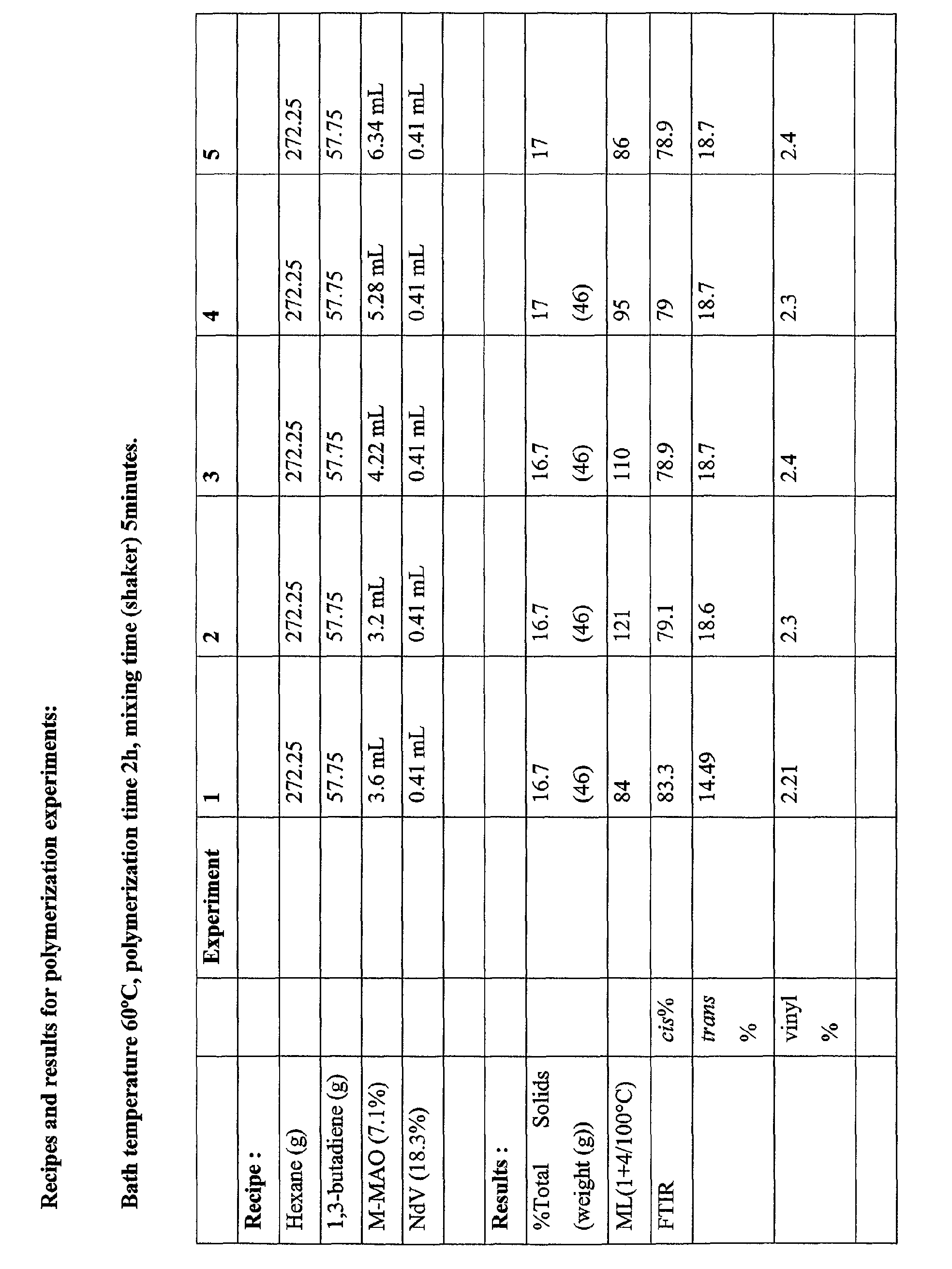
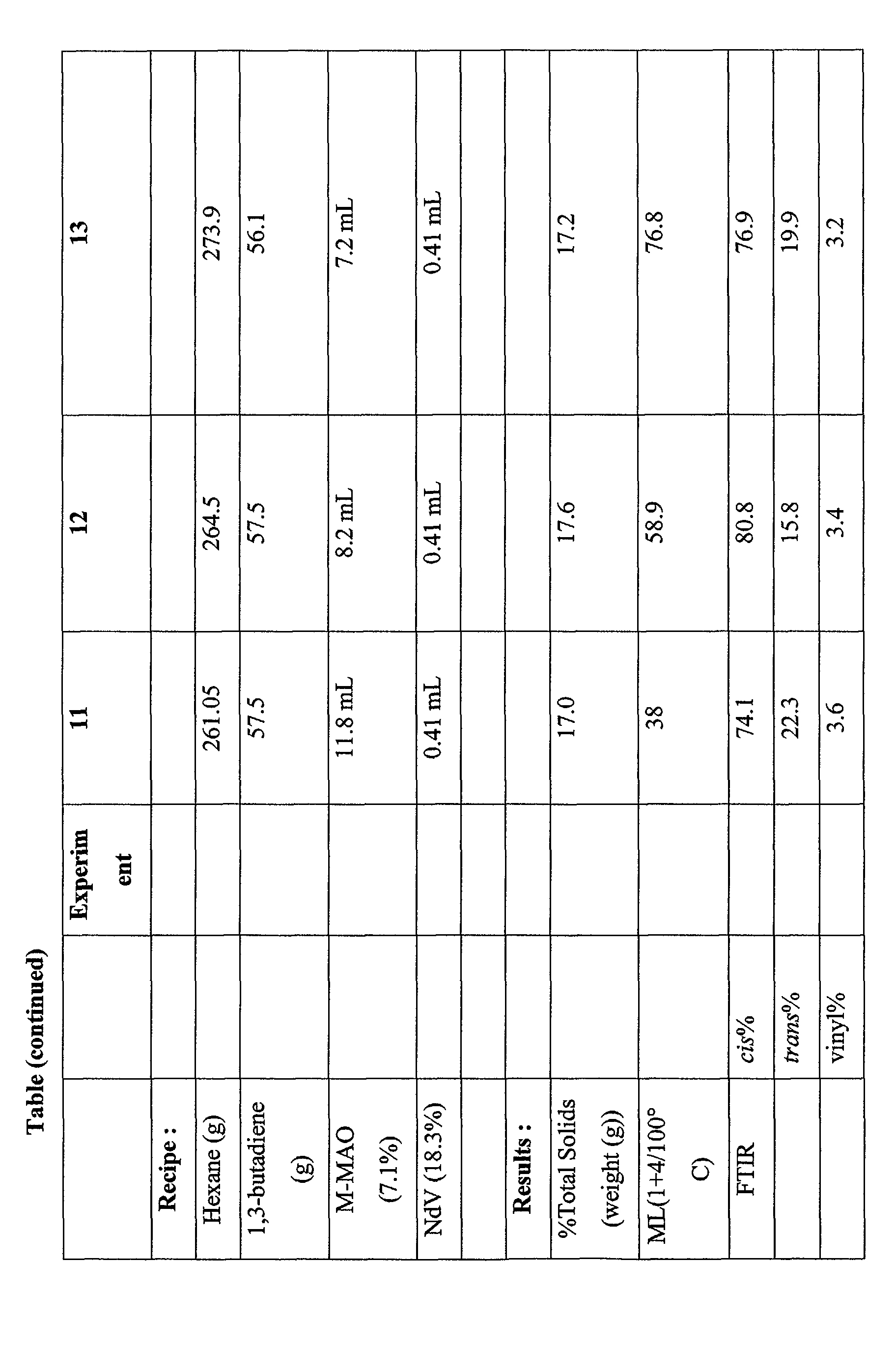
- Experiments were carried out using standard laboratory methodology familiar to those of skill in the art. A fixed amount of dry solvent was dispensed into a dried glass polymerization bottle, followed by the desired amount of dried monomer at low pressure and ambient temperatures. Solutions of catalyst and co-catalyst were added via syringe and the bottles shaken for a specified time, after which they were placed in a polymerizer bath set to the desired temperature. After agitation for the required length of time the reaction was shortstopped with alcohol and antioxidant and the polymer recovered by coagulation.
- Details of experiments carried out and the results thereof are shown in the following table:

Claims (11)
- A process for preparing a diene polymer having a trans content in the range of from 10 to 30% which comprises the step of polymerizing a diene monomer in the presence of a two-component catalyst system comprisingwherein neither the catalyst nor the co-catalyst are halogenated, and with the proviso that the co-catalyst is not a trialkyl aluminum.(a) a rare-earth metal catalyst of formula :(b) a co-catalyst which is a Lewis acid,
- A process according to claim 1 wherein L is selected from the group consisting of a carboxylate, an alcoholate, an acetonate and a phosphate.
- A process according to claim 2 wherein L is selected from the group consisting of propanolate, propionate, acetylacetonate, versatate and naphthanoate.
- A process according to any one of claims 1-3 wherein M is Nd.
- A process according to any one of claims 1-4 wherein the co-catalyst is an aluminoxane.
- A process according to claim 5 wherein the aluminoxane is an alkyl aluminoxane.
- A process according to claim 6 wherein the aluminoxane is selected from the group consisting of methylaluminoxane, modified methylaluminoxane and isobutylaluminoxane.
- A process according to any one of claims 1-7 wherein the amount of rare-earth metal catalyst used is in the range of from 0.01 to 10 parts per hundred parts monomer.
- A process according to any one of claims 1-8 wherein the amount of co-catalyst used is in the range of from 0.025 to 5 parts per hundred parts monomer.
- A process according to any one of claims 1-9 wherein the diene monomer is selected from the group consisting of 1,3-butadiene, isoprene and 2,4-hexadiene.
- A two-component catalyst system for the preparation of a diene polymer having a trans content in the range of from 10 to 30% comprisingwherein neither the catalyst nor the co-catalyst are halogenated, and with the proviso that the co-catalyst is not a trialkyl aluminum.(a) a rare-earth metal catalyst of formula :(b) a co-catalyst which is a Lewis acid,
Applications Claiming Priority (2)
| Application Number | Priority Date | Filing Date | Title |
|---|---|---|---|
| CA002351957A CA2351957A1 (en) | 2001-06-29 | 2001-06-29 | Process for the preparation of diene polymers |
| CA2351957 | 2001-06-29 |
Publications (1)
| Publication Number | Publication Date |
|---|---|
| EP1270612A1 true EP1270612A1 (en) | 2003-01-02 |
Family
ID=4169382
Family Applications (1)
| Application Number | Title | Priority Date | Filing Date |
|---|---|---|---|
| EP02013484A Withdrawn EP1270612A1 (en) | 2001-06-29 | 2002-06-17 | Process for the preparation of diene polymers |
Country Status (4)
| Country | Link |
|---|---|
| US (1) | US20030050183A1 (en) |
| EP (1) | EP1270612A1 (en) |
| JP (1) | JP2003048910A (en) |
| CA (1) | CA2351957A1 (en) |
Cited By (2)
| Publication number | Priority date | Publication date | Assignee | Title |
|---|---|---|---|---|
| EP3250617B1 (en) | 2015-01-28 | 2019-01-02 | Bridgestone Corporation | Cis-1,4-polydienes with improved cold flow resistance |
| EP3250616B1 (en) | 2015-01-28 | 2019-01-23 | Bridgestone Corporation | Aged lanthanide-based catalyst systems and their use in the preparation of cis-1,4-polydienes |
Families Citing this family (3)
| Publication number | Priority date | Publication date | Assignee | Title |
|---|---|---|---|---|
| EP2382241B1 (en) * | 2009-01-23 | 2016-11-23 | Bridgestone Corporation | Polymers functionalized with polycyano compounds |
| KR101656126B1 (en) * | 2013-09-30 | 2016-09-08 | 주식회사 엘지화학 | Novel neodymium compound and catalysts for polymerizing diene comprising the same |
| KR101796360B1 (en) * | 2014-11-20 | 2017-11-09 | 주식회사 엘지화학 | Method of preparing conjugated diene polymer |
Citations (5)
| Publication number | Priority date | Publication date | Assignee | Title |
|---|---|---|---|---|
| WO1996031543A1 (en) * | 1995-04-04 | 1996-10-10 | Bayer Aktiengesellschaft | Novel catalyst for the gas-phase polymerisation of conjugated dienes |
| WO1999020670A1 (en) * | 1997-10-20 | 1999-04-29 | Bayer Aktiengesellschaft | Catalyst with a base consisting of compounds of the rare earth metals for polymerising unsaturated organic compounds |
| WO2000069940A1 (en) * | 1999-05-18 | 2000-11-23 | Bayer Aktiengesellschaft | Method for producing thermoplastic molding materials using rubber solutions |
| EP1078939A2 (en) * | 1999-08-23 | 2001-02-28 | Bayer Ag | Process for copolymerisation of conjugated dienes and vinylaromatic monomers in presence of a catalyst containing a rare earth and the use of the copolymerisate in a rubber composition for a tire |
| EP1099710A1 (en) * | 1999-11-12 | 2001-05-16 | JSR Corporation | Modified conjugated diene polymer and rubber composition comprising it |
-
2001
- 2001-06-29 CA CA002351957A patent/CA2351957A1/en not_active Abandoned
-
2002
- 2002-06-17 EP EP02013484A patent/EP1270612A1/en not_active Withdrawn
- 2002-06-26 JP JP2002186380A patent/JP2003048910A/en active Pending
- 2002-06-26 US US10/180,697 patent/US20030050183A1/en not_active Abandoned
Patent Citations (5)
| Publication number | Priority date | Publication date | Assignee | Title |
|---|---|---|---|---|
| WO1996031543A1 (en) * | 1995-04-04 | 1996-10-10 | Bayer Aktiengesellschaft | Novel catalyst for the gas-phase polymerisation of conjugated dienes |
| WO1999020670A1 (en) * | 1997-10-20 | 1999-04-29 | Bayer Aktiengesellschaft | Catalyst with a base consisting of compounds of the rare earth metals for polymerising unsaturated organic compounds |
| WO2000069940A1 (en) * | 1999-05-18 | 2000-11-23 | Bayer Aktiengesellschaft | Method for producing thermoplastic molding materials using rubber solutions |
| EP1078939A2 (en) * | 1999-08-23 | 2001-02-28 | Bayer Ag | Process for copolymerisation of conjugated dienes and vinylaromatic monomers in presence of a catalyst containing a rare earth and the use of the copolymerisate in a rubber composition for a tire |
| EP1099710A1 (en) * | 1999-11-12 | 2001-05-16 | JSR Corporation | Modified conjugated diene polymer and rubber composition comprising it |
Non-Patent Citations (1)
| Title |
|---|
| WILSON, DAVID J.: "Polymerization of 1,3- butadiene using aluminoxane -based Nd-carboxylate catalysts", POLYMER INTERNATIONAL (1996), 39(3), 235-42, XP008009083 * |
Cited By (4)
| Publication number | Priority date | Publication date | Assignee | Title |
|---|---|---|---|---|
| EP3250617B1 (en) | 2015-01-28 | 2019-01-02 | Bridgestone Corporation | Cis-1,4-polydienes with improved cold flow resistance |
| EP3250616B1 (en) | 2015-01-28 | 2019-01-23 | Bridgestone Corporation | Aged lanthanide-based catalyst systems and their use in the preparation of cis-1,4-polydienes |
| US10774162B2 (en) | 2015-01-28 | 2020-09-15 | Bridgestone Corporation | Aged lanthanide-based catalyst systems and their use in the preparation of cis-1,4-polydienes |
| US12371516B2 (en) | 2015-01-28 | 2025-07-29 | Bridgestone Corporation | Aged lanthanide-based catalyst systems and their use in the preparation of cis-1,4-polydienes |
Also Published As
| Publication number | Publication date |
|---|---|
| JP2003048910A (en) | 2003-02-21 |
| CA2351957A1 (en) | 2002-12-29 |
| US20030050183A1 (en) | 2003-03-13 |
Similar Documents
| Publication | Publication Date | Title |
|---|---|---|
| CA1223396A (en) | Process for producing conjugated diene polymer | |
| KR101538625B1 (en) | Metallocene complex and polymerization catalyst composition containing the same | |
| KR100929292B1 (en) | Synthesis method of rubbery polymer with high trans microstructure | |
| RU2658913C1 (en) | Method of manufacturing polymer of conjugated diene, polymer of conjugated diene, rubber mixture and tire | |
| RU2553474C1 (en) | Copolymer, rubber mixture, cross-linked rubber mixture and tyre | |
| KR20080063191A (en) | Process for producing functionalized cis-1,4-polydiene with high cis-1,4-bond content and high functionality | |
| WO2005000921A1 (en) | Butadiene polymer and process for producing the same, and rubber composition and tire comprising or made from the same | |
| EP3148938A1 (en) | Metallic complex catalyst, polymerization methods employing same and polymer products thereof | |
| HK1039952A1 (en) | Method for polymerizing conjugated diolefins (dienes) with rare earth catalysts in the presence of vinylaromatic solvents | |
| RU2567756C1 (en) | Polymer and method for obtaining thereof, rubber mixture containing it, and tyre which contains rubber mixture | |
| JP2001114809A (en) | Copolymerization of conjugated diolefin (diene) and vinyl- aromatic monomer using rare-earth catalyst and use of copolymer for rubber mixture to be applied to tire | |
| KR101986201B1 (en) | Processes for the preparation of high-cis polydienes | |
| EP2900702B1 (en) | Polymerization method employing an organometallic catalyst complex | |
| RU2345092C1 (en) | Method of obtaining catalyst of butadiene polymerisation and co-polymerisation of butadiene with isoprene | |
| JP7374929B2 (en) | Method for making random butadiene-isoprene copolymers with high content of cis-1,4 units | |
| US20030050183A1 (en) | Process for the preparation of diene polymers | |
| CN104231133A (en) | Rare-earth catalyst and method of using same to prepare high cis conjugated diene polymer | |
| US6492476B1 (en) | Catalyst based on rare earth metal compounds | |
| JPH10330428A (en) | Method for producing polybutadiene | |
| JP4736772B2 (en) | Method for producing polybutadiene | |
| EP2670760A2 (en) | Lanthanide complex catalyst and polymerization method employing same | |
| RU2263121C2 (en) | Method for preparing cis-1,4-diene rubber | |
| KR100905544B1 (en) | Catalysts containing monomolecular aluminum and cobalt on which heteroatoms are coordinated, and methods for producing polybutadiene using the same | |
| CN110283279A (en) | Copolymer of 1,3-butadiene and 1-butene, its preparation method and rubber composition | |
| CN105330763B (en) | Composition for rare earth catalyst, preparation method and application thereof, and olefin polymerization method |
Legal Events
| Date | Code | Title | Description |
|---|---|---|---|
| PUAI | Public reference made under article 153(3) epc to a published international application that has entered the european phase |
Free format text: ORIGINAL CODE: 0009012 |
|
| AK | Designated contracting states |
Kind code of ref document: A1 Designated state(s): AT BE CH CY DE DK ES FI FR GB GR IE IT LI LU MC NL PT SE TR |
|
| AX | Request for extension of the european patent |
Free format text: AL;LT;LV;MK;RO;SI |
|
| 17P | Request for examination filed |
Effective date: 20030702 |
|
| STAA | Information on the status of an ep patent application or granted ep patent |
Free format text: STATUS: THE APPLICATION HAS BEEN WITHDRAWN |
|
| AKX | Designation fees paid |
Designated state(s): DE FR GB IT |
|
| 18W | Application withdrawn |
Effective date: 20030828 |