EP1270582A1 - Triphenylphosphine derivative, production process therefor, palladium complex thereof, and process for producing biaryl derivative - Google Patents
Triphenylphosphine derivative, production process therefor, palladium complex thereof, and process for producing biaryl derivative Download PDFInfo
- Publication number
- EP1270582A1 EP1270582A1 EP01912351A EP01912351A EP1270582A1 EP 1270582 A1 EP1270582 A1 EP 1270582A1 EP 01912351 A EP01912351 A EP 01912351A EP 01912351 A EP01912351 A EP 01912351A EP 1270582 A1 EP1270582 A1 EP 1270582A1
- Authority
- EP
- European Patent Office
- Prior art keywords
- carbon atoms
- palladium
- alkyl
- derivative
- optionally
- Prior art date
- Legal status (The legal status is an assumption and is not a legal conclusion. Google has not performed a legal analysis and makes no representation as to the accuracy of the status listed.)
- Granted
Links
Classifications
-
- C—CHEMISTRY; METALLURGY
- C07—ORGANIC CHEMISTRY
- C07F—ACYCLIC, CARBOCYCLIC OR HETEROCYCLIC COMPOUNDS CONTAINING ELEMENTS OTHER THAN CARBON, HYDROGEN, HALOGEN, OXYGEN, NITROGEN, SULFUR, SELENIUM OR TELLURIUM
- C07F9/00—Compounds containing elements of Groups 5 or 15 of the Periodic Table
- C07F9/02—Phosphorus compounds
- C07F9/28—Phosphorus compounds with one or more P—C bonds
- C07F9/50—Organo-phosphines
- C07F9/5022—Aromatic phosphines (P-C aromatic linkage)
-
- C—CHEMISTRY; METALLURGY
- C07—ORGANIC CHEMISTRY
- C07B—GENERAL METHODS OF ORGANIC CHEMISTRY; APPARATUS THEREFOR
- C07B37/00—Reactions without formation or introduction of functional groups containing hetero atoms, involving either the formation of a carbon-to-carbon bond between two carbon atoms not directly linked already or the disconnection of two directly linked carbon atoms
- C07B37/04—Substitution
-
- C—CHEMISTRY; METALLURGY
- C07—ORGANIC CHEMISTRY
- C07C—ACYCLIC OR CARBOCYCLIC COMPOUNDS
- C07C17/00—Preparation of halogenated hydrocarbons
- C07C17/26—Preparation of halogenated hydrocarbons by reactions involving an increase in the number of carbon atoms in the skeleton
- C07C17/263—Preparation of halogenated hydrocarbons by reactions involving an increase in the number of carbon atoms in the skeleton by condensation reactions
-
- C—CHEMISTRY; METALLURGY
- C07—ORGANIC CHEMISTRY
- C07C—ACYCLIC OR CARBOCYCLIC COMPOUNDS
- C07C205/00—Compounds containing nitro groups bound to a carbon skeleton
- C07C205/06—Compounds containing nitro groups bound to a carbon skeleton having nitro groups bound to carbon atoms of six-membered aromatic rings
-
- C—CHEMISTRY; METALLURGY
- C07—ORGANIC CHEMISTRY
- C07C—ACYCLIC OR CARBOCYCLIC COMPOUNDS
- C07C209/00—Preparation of compounds containing amino groups bound to a carbon skeleton
- C07C209/68—Preparation of compounds containing amino groups bound to a carbon skeleton from amines, by reactions not involving amino groups, e.g. reduction of unsaturated amines, aromatisation, or substitution of the carbon skeleton
-
- C—CHEMISTRY; METALLURGY
- C07—ORGANIC CHEMISTRY
- C07C—ACYCLIC OR CARBOCYCLIC COMPOUNDS
- C07C303/00—Preparation of esters or amides of sulfuric acids; Preparation of sulfonic acids or of their esters, halides, anhydrides or amides
- C07C303/26—Preparation of esters or amides of sulfuric acids; Preparation of sulfonic acids or of their esters, halides, anhydrides or amides of esters of sulfonic acids
- C07C303/30—Preparation of esters or amides of sulfuric acids; Preparation of sulfonic acids or of their esters, halides, anhydrides or amides of esters of sulfonic acids by reactions not involving the formation of esterified sulfo groups
-
- C—CHEMISTRY; METALLURGY
- C07—ORGANIC CHEMISTRY
- C07C—ACYCLIC OR CARBOCYCLIC COMPOUNDS
- C07C37/00—Preparation of compounds having hydroxy or O-metal groups bound to a carbon atom of a six-membered aromatic ring
- C07C37/11—Preparation of compounds having hydroxy or O-metal groups bound to a carbon atom of a six-membered aromatic ring by reactions increasing the number of carbon atoms
- C07C37/18—Preparation of compounds having hydroxy or O-metal groups bound to a carbon atom of a six-membered aromatic ring by reactions increasing the number of carbon atoms by condensation involving halogen atoms of halogenated compounds
-
- C—CHEMISTRY; METALLURGY
- C07—ORGANIC CHEMISTRY
- C07C—ACYCLIC OR CARBOCYCLIC COMPOUNDS
- C07C41/00—Preparation of ethers; Preparation of compounds having groups, groups or groups
- C07C41/01—Preparation of ethers
- C07C41/18—Preparation of ethers by reactions not forming ether-oxygen bonds
- C07C41/30—Preparation of ethers by reactions not forming ether-oxygen bonds by increasing the number of carbon atoms, e.g. by oligomerisation
-
- C—CHEMISTRY; METALLURGY
- C07—ORGANIC CHEMISTRY
- C07C—ACYCLIC OR CARBOCYCLIC COMPOUNDS
- C07C45/00—Preparation of compounds having >C = O groups bound only to carbon or hydrogen atoms; Preparation of chelates of such compounds
- C07C45/61—Preparation of compounds having >C = O groups bound only to carbon or hydrogen atoms; Preparation of chelates of such compounds by reactions not involving the formation of >C = O groups
- C07C45/67—Preparation of compounds having >C = O groups bound only to carbon or hydrogen atoms; Preparation of chelates of such compounds by reactions not involving the formation of >C = O groups by isomerisation; by change of size of the carbon skeleton
- C07C45/68—Preparation of compounds having >C = O groups bound only to carbon or hydrogen atoms; Preparation of chelates of such compounds by reactions not involving the formation of >C = O groups by isomerisation; by change of size of the carbon skeleton by increase in the number of carbon atoms
-
- C—CHEMISTRY; METALLURGY
- C07—ORGANIC CHEMISTRY
- C07C—ACYCLIC OR CARBOCYCLIC COMPOUNDS
- C07C51/00—Preparation of carboxylic acids or their salts, halides or anhydrides
- C07C51/347—Preparation of carboxylic acids or their salts, halides or anhydrides by reactions not involving formation of carboxyl groups
- C07C51/353—Preparation of carboxylic acids or their salts, halides or anhydrides by reactions not involving formation of carboxyl groups by isomerisation; by change of size of the carbon skeleton
-
- C—CHEMISTRY; METALLURGY
- C07—ORGANIC CHEMISTRY
- C07D—HETEROCYCLIC COMPOUNDS
- C07D213/00—Heterocyclic compounds containing six-membered rings, not condensed with other rings, with one nitrogen atom as the only ring hetero atom and three or more double bonds between ring members or between ring members and non-ring members
- C07D213/02—Heterocyclic compounds containing six-membered rings, not condensed with other rings, with one nitrogen atom as the only ring hetero atom and three or more double bonds between ring members or between ring members and non-ring members having three double bonds between ring members or between ring members and non-ring members
- C07D213/04—Heterocyclic compounds containing six-membered rings, not condensed with other rings, with one nitrogen atom as the only ring hetero atom and three or more double bonds between ring members or between ring members and non-ring members having three double bonds between ring members or between ring members and non-ring members having no bond between the ring nitrogen atom and a non-ring member or having only hydrogen or carbon atoms directly attached to the ring nitrogen atom
- C07D213/06—Heterocyclic compounds containing six-membered rings, not condensed with other rings, with one nitrogen atom as the only ring hetero atom and three or more double bonds between ring members or between ring members and non-ring members having three double bonds between ring members or between ring members and non-ring members having no bond between the ring nitrogen atom and a non-ring member or having only hydrogen or carbon atoms directly attached to the ring nitrogen atom containing only hydrogen and carbon atoms in addition to the ring nitrogen atom
-
- C—CHEMISTRY; METALLURGY
- C07—ORGANIC CHEMISTRY
- C07F—ACYCLIC, CARBOCYCLIC OR HETEROCYCLIC COMPOUNDS CONTAINING ELEMENTS OTHER THAN CARBON, HYDROGEN, HALOGEN, OXYGEN, NITROGEN, SULFUR, SELENIUM OR TELLURIUM
- C07F9/00—Compounds containing elements of Groups 5 or 15 of the Periodic Table
- C07F9/02—Phosphorus compounds
- C07F9/28—Phosphorus compounds with one or more P—C bonds
- C07F9/50—Organo-phosphines
- C07F9/5027—Polyphosphines
Definitions
- This invention relates to a process for preparing a biaryl derivative useful as an intermediate for a medical or agricultural agent; a novel water-soluble ligand complex useful as a catalyst for the preparation process; as well as a novel triphenylphosphine derivative with which the complex can be prepared and a preparation process therefor.
- a biaryl derivative has been typically prepared according to a process described in N. Miyaura, A. Suzuki, Synth. Commun., 11, 513 (1981), which has been extensively utilized not only in medical/agricultural applications but also organic synthesis.
- a catalyst used is solubilized in water and at the end of the reaction a desired biaryl derivative is extracted with an organic layer, e. g., (A) synthesis of a biaryl derivative using a water-soluble palladium complex derived from a water-soluble phosphine ligand such as triphenylphosphino-3,3,3-trisulfonate trisodium salt (TPPTS) described in JP-A 8-59514; (B) synthesis of a biaryl derivative using a water-soluble palladium complex derived from a water-soluble phosphine ligand such as triphenylphosphino-3-sulfonate sodium salt (TPPMS) described in A.
- TPPTS triphenylphosphino-3,3,3-trisulfonate trisodium salt
- the process in (A) has drawbacks such as a longer reaction period and a lower yield because of a two-phase reaction.
- an yield in a single-phase reaction is lower.
- the process in (C) has drawbacks such as an extremely lower yield of the ligand as the starting material for the catalyst.
- objectives of this invention are to provide such a water-soluble phosphine ligand and a preparation process therefor, to provide such a complex and to provide a convenient process for preparing a biaryl derivative in a higher yield.
- the inventors have intensely applied themselves to the above objectives and have finally developed a completely novel triphenylphosphine derivative and a palladium and a nickel complexes comprising the derivative as a ligand, and have established a very useful preparation process having the following features: (1) it can be used not only in an organic phase but also in an aqueous phase or a two-phase reaction system of an aqueous phase and an organic phase, (2) a catalyst and a phosphorous compound can be easily removed by post-treatment after the reaction such as water washing, and contamination with the complex or the phosphorous compound can be eliminated and (3) the biaryl derivative can be provided in a good yield using a very small amount of the catalyst.
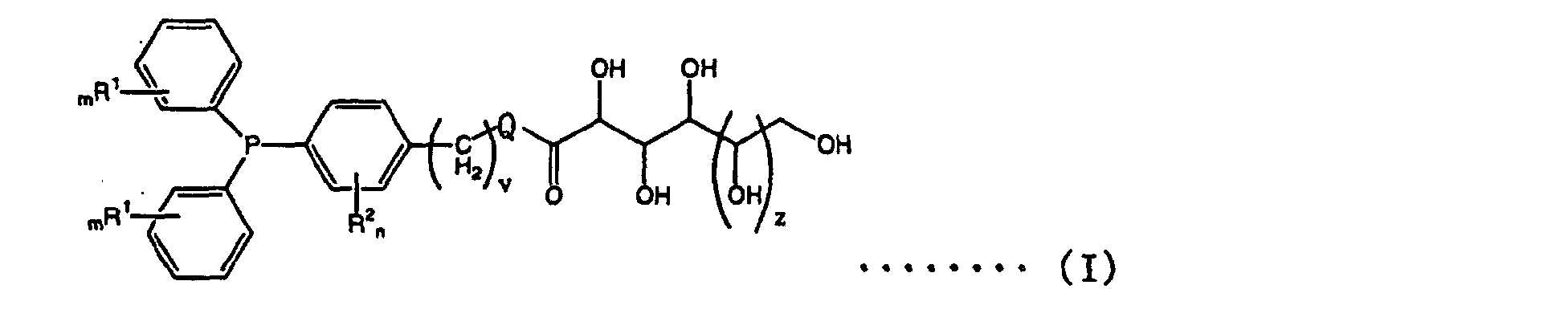
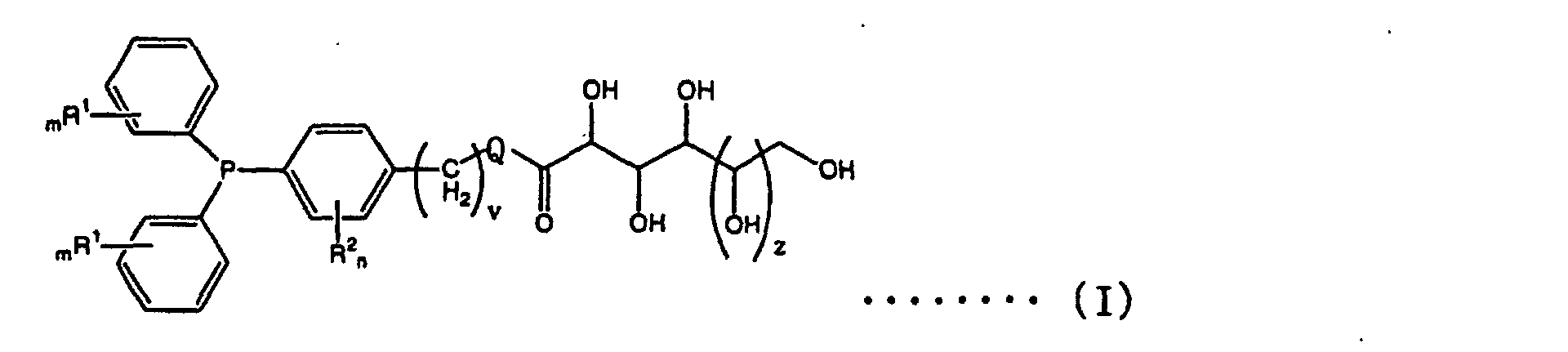
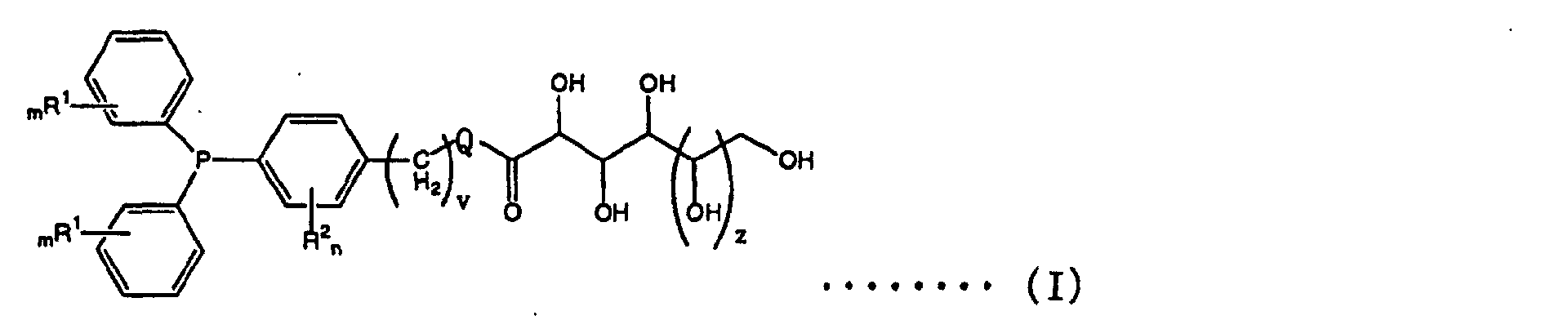
- this invention provides a triphenyl phosphine derivative represented by formula (I): [ in the formula (I), R 1 and R 2 , which may be the same or different, represent hydrogen atom, fluorine atom, alkyl with 1 to 6 carbon atoms, phenyl optionally having alkyl with 1 to 6 carbon atoms, alkenyl with 2 to 6 carbon atoms, alkynyl with 2 to 6 carbon atoms, alkoxy with 1 to 6 carbon atoms, alkylthio with 1 to 6 carbon atoms, cyano, formyl, acyl with 2 to 7 carbon atoms, benzoyl optionally having alkyl with 1 to 6 carbon atoms, alkoxycarbonyl with 2 to 7 carbon atoms, phenoxycarbonyl optionally having alkyl with 1 to 6 carbon atoms, amino optionally having alkyl with 1 to 6 carbon atoms, amido optionally having alkyl with 1 to 6 carbon atoms,
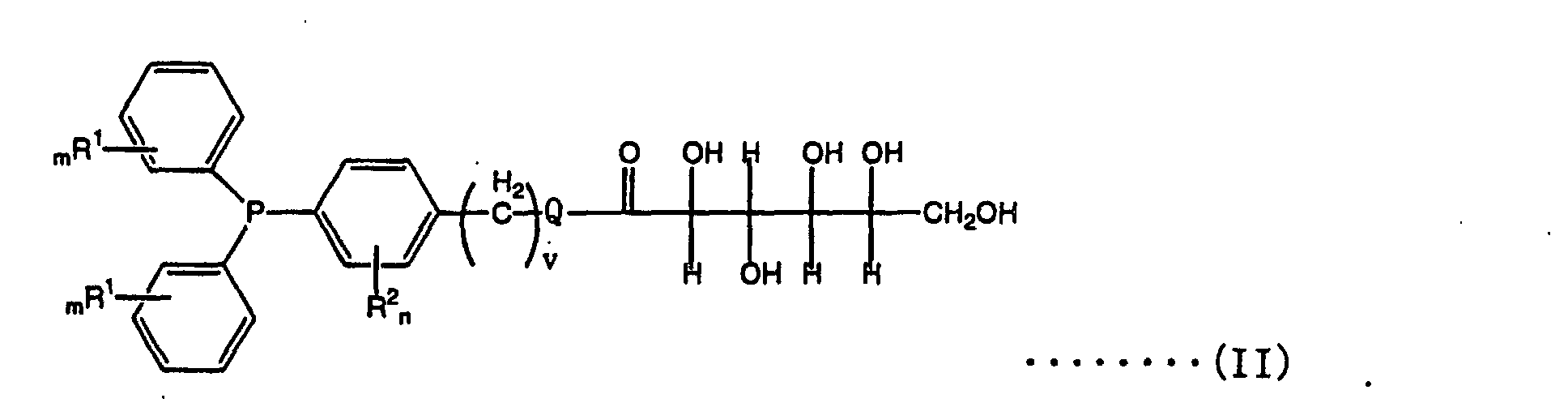
- this invention provides the triphenyl phosphine derivative according to the first aspect of this invention represented by formula (II):
- R 1 and R 2 which may be the same or different, represent hydrogen atom, fluorine atom, alkyl with 1 to 6 carbon atoms, phenyl optionally having alkyl with 1 to 6 carbon atoms, alkenyl with 2 to 6 carbon atoms, alkynyl with 2 to 6 carbon atoms, alkoxy with 1 to 6 carbon atoms, alkylthio with 1 to 6 carbon atoms, cyano, formyl, acyl with 2 to 7 carbon atoms, benzoyl optionally having alkyl with 1 to 6 carbon atoms, alkoxycarbonyl with 2 to 7 carbon atoms, phenoxycarbonyl optionally having alkyl with 1 to 6 carbon atoms, amino optionally having alkyl with 1 to 6 carbon atoms, amido optionally having alkyl with 1 to
- this invention provides the triphenyl phosphine derivative according to the second aspect of this invention wherein in the formula (II), R 1 and R 2 represent hydrogen; m, n and v represent 1; and Q represents -NR- where R represents alkyl or hydrogen.
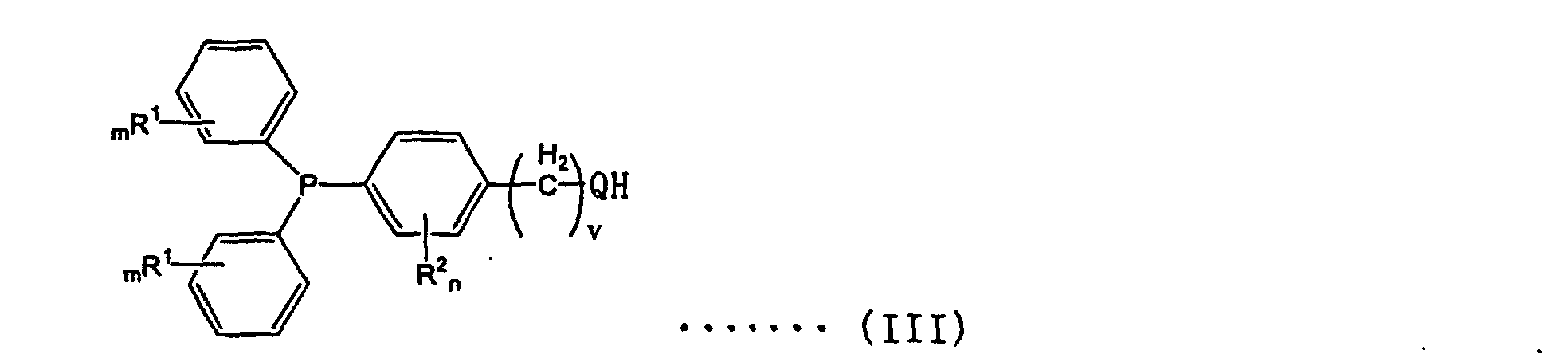
- this invention provides a process for preparing the triphenyl phosphine derivative according to the first aspect of this invention by reacting a hydroxy-containing lactone with the compound represented by formula (III):
- R 1 and R 2 which may be the same or different, represent hydrogen atom, fluorine atom, alkyl with 1 to 6 carbon atoms, phenyl optionally having alkyl with 1 to 6 carbon atoms, alkenyl with 2 to 6 carbon atoms, alkynyl with 2 to 6 carbon atoms, alkoxy with 1 to 6 carbon atoms, alkylthio with 1 to 6 carbon atoms, cyano, formyl, acyl with 2 to 7 carbon atoms, benzoyl optionally having alkyl with 1 to 6 carbon atoms, alkoxycarbonyl with 2 to 7 carbon atoms, phenoxycarbonyl optionally having alkyl with 1 to 6 carbon atoms, amino optionally having alkyl with 1
- this invention provides the process according to the fourth aspect of this invention wherein the hydroxy-containing lactone is ⁇ -gluconolactone. Using this process, the triphenylphosphine derivative according to the third aspect of this invention can be prepared.
- this invention provides a phosphine ligand-palladium complex prepared from the triphenylphosphine derivative according to the first aspect of this invention and at least one palladium compound selected from the group consisting of palladium benzylideneacetones, palladium acetylacetonates, nitrile palladium halides, olefin palladium halides, palladium halides and palladium carboxylates.
- this invention provides a phosphine ligand-palladium complex prepared from the triphenylphosphine derivative according to the second aspect of this invention and at least one palladium compound selected from the group consisting of palladium benzylideneacetones, palladium acetylacetonates, nitrile palladium halides, olefin palladium halides, palladium halides and palladium carboxylates.
- this invention provides a phosphine ligand-palladium complex prepared from the triphenylphosphine derivative according to the third aspect of this invention and at least one palladium compound selected from the group consisting of palladium benzylideneacetones, palladium acetylacetonates, nitrile palladium halides, olefin palladium halides, palladium halides and palladium carboxylates.
- this invention provides a phosphine ligand-palladium complex prepared from the triphenylphosphine derivative according to the first aspect of this invention and at least one palladium compound selected from the group consisting of bis(benzylidene)acetone palladium, palladium bisacetylacetonate, dichlorobisacetonitrile palladium, dichlorobisbenzonitrile palladium, dichloro(1,5-cyclooctadiene) palladium, bis(1,5-cyclooctadiene)palladium, tris(dibenzylideneacetone) dipalladium, palladium chloride and palladium acetate.
- palladium compound selected from the group consisting of bis(benzylidene)acetone palladium, palladium bisacetylacetonate, dichlorobisacetonitrile palladium, dichlorobisbenzonitrile palladium, dichloro(1,5-cyclooctadiene) pal
- this invention provides a phosphine ligand-palladium complex prepared from the triphenylphosphine derivative according to the second aspect of this invention and at least one palladium compound selected from the group consisting of bis(benzylidene)acetone palladium, palladium bisacetylacetonate, dichlorobisacetonitrile palladium, dichlorobisbenzonitrile palladium, dichloro(1,5-cyclooctadiene)palladium, bis(1,5-cyclooctadiene)palladium, tris (dibenzylideneacetone) dipalladium, palladium chloride and palladium acetate.
- palladium compound selected from the group consisting of bis(benzylidene)acetone palladium, palladium bisacetylacetonate, dichlorobisacetonitrile palladium, dichlorobisbenzonitrile palladium, dichloro(1,5-cyclooctadiene)pal
- this invention provides a phosphine ligand-palladium complex prepared from the triphenylphosphine derivative according to the third aspect of this invention and at least one palladium compound selected from the group consisting of bis(benzylidene)acetone palladium, palladium bisacetylacetonate, dichlorobisacetonitrile palladium, dichlorobisbenzonitrile palladium, dichloro(1,5-cyclooctadiene)palladium, bis(1,5-cyclooctadiene)palladium, tris (dibenzylideneacetone) dipalladium, palladium chloride and palladium acetate.
- palladium compound selected from the group consisting of bis(benzylidene)acetone palladium, palladium bisacetylacetonate, dichlorobisacetonitrile palladium, dichlorobisbenzonitrile palladium, dichloro(1,5-cyclooctadiene)pal
- this invention provides a phosphine ligand-palladium complex prepared from the triphenylphosphine derivative according to the second aspect of this invention and dichloro(1,5-cyclooctadiene) palladium.
- this invention provides a phosphine ligand-palladium complex prepared from the triphenylphosphine derivative according to the third aspect of this invention and dichloro(1,5-cyclooctadiene) palladium.
- this invention provide a phosphine ligand-nickel complex prepared from the triphenylphosphine derivative according to the second aspect of this invention and at least one nickel salt selected from the group consisting of nickel halides, nickel nitrates, nickel sulfates, nickel organocarboxylates, nickel-acetylacetonate complex salts and nickel hydroxide.
- this invention provide a phosphine ligand-nickel complex prepared from the triphenylphosphine derivative according to the third aspect of this invention and at least one nickel salt selected from the group consisting of nickel halides, nickel nitrates, nickel sulfates, nickel organocarboxylates, nickel-acetylacetonate complex salts and nickel hydroxide.
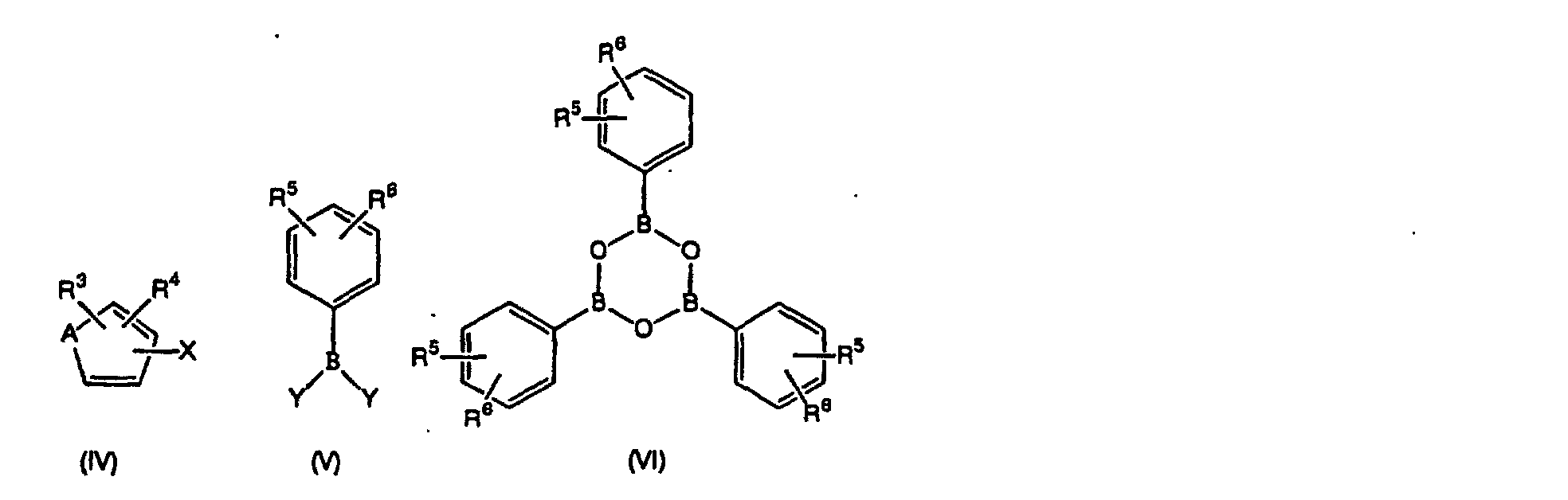
- this invention provides a process for preparing a biaryl derivative represented by formula (VII) by reacting an aryl halide derivative or aryl sulfonyl derivative represented by formula (IV) with an arylboronic acid, its derivative or an arylboronic anhydride represented by formula (V) or (VI):
- R 3 , R 4 , R 5 and R 6 which may be the same or different, represent hydrogen atom, chlorine atom, fluorine atom, alkyl with 1 to 6 carbon atoms, phenyl optionally having alkyl with 1 to 6 carbon atoms, alkenyl with 2 to 6 carbon atoms, alkynyl with 2 to 6 carbon atoms, alkoxywith 1 to 6 carbon atoms, alkylthio with 1 to 6 carbon atoms, cyano, formyl, acyl with 2 to 7
- this invention provides a process for preparing a biaryl derivative according to the sixteenth aspect of this invention wherein the catalyst is the phosphine ligand-palladium complex according to the seventh aspect of this invention.
- this invention provides a process for preparing a biaryl derivative according to the sixteenth aspect of this invention wherein the catalyst is the phosphine ligand-palladium complex according to the eighth aspect of this invention.
- this invention provides a process for preparing a biaryl derivative according to the sixteenth aspect of this invention wherein the catalyst is the phosphine ligand-palladium complex according to the ninth aspect of this invention.
- this invention provides a process for preparing a biaryl derivative according to the sixteenth aspect of this invention wherein the catalyst is the phosphine ligand-palladium complex according to the tenth aspect of this invention.
- this invention provides a process for preparing a biaryl derivative according to the sixteenth aspect of this invention wherein the catalyst is the phosphine ligand-palladium complex according to the eleventh aspect of this invention.
- this invention provides a process for preparing a biaryl derivative according to the sixteenth aspect of this invention wherein the catalyst is the phosphine ligand-palladium complex according to the twelfth aspect of this invention.
- this invention provides a process for preparing a biaryl derivative according to the sixteenth aspect of this invention wherein the catalyst is the phosphine ligand-palladium complex according to the thirteenth aspect of this invention.
- this invention provides a process for preparing a biaryl derivative according to the sixteenth aspect of this invention wherein the catalyst is the phosphine ligand-nickel complex according to the fourteenth aspect of this invention.
- this invention provides a process for preparing a biaryl derivative according to the sixteenth aspect of this invention wherein the catalyst is the phosphine ligand-nickel complex according to the fifteenth aspect.
- R 1 and R 2 which may be the same or different, represent hydrogen atom, fluorine atom, alkyl with 1 to 6 carbon atoms, phenyl optionally having alkyl with 1 to 6 carbon atoms, alkenyl with 2 to 6 carbon atoms, alkynyl with 2 to 6 carbon atoms, alkoxy with 1 to 6 carbon atoms, alkylthio with 1 to 6 carbon atoms, cyano, formyl, acyl with 2 to 7 carbon atoms, benzoyl optionally having alkyl with 1 to 6 carbon atoms, alkoxycarbonyl with 2 to 7 carbon atoms, phenoxycarbonyl optionally having alkyl with 1 to 6 carbon atoms, amino optionally having alkyl with 1 to 6 carbon atoms, amido optionally having alkyl with 1 to 6 carbon atoms, nitro, sulfon
- R 1 and R 2 which may be the same or different, represent hydrogen atom, fluorine atom, alkyl with 1 to 6 carbon atoms, phenyl optionally having alkyl with 1 to 6 carbon atoms, alkenyl with 2 to 6 carbon atoms, alkynyl with 2 to 6 carbon atoms, alkoxy with 1 to 6 carbon atoms, alkylthio with 1 to 6 carbon atoms, cyano, formyl, acyl with 2 to 7 carbon atoms, benzoyl optionally having alkyl with 1 to 6 carbon atoms, alkoxycarbonyl with 2 to 7 carbon atoms, phenoxycarbonyl optionally having alkyl with 1 to 6 carbon atoms, amino optionally having alkyl with 1 to 6 carbon atoms, amido optionally having alkyl with 1 to 6 carbon atoms, nitro, sul
- alkyl with 1 to 6 carbon atoms examples include methyl, ethyl, n-propyl, iso-propyl, n-butyl, iso-butyl, sec-butyl, tert-butyl, n-pentyl, iso-pentyl, sec-pentyl, neopentyl, 1-methylbutyl, 1,2-dimethylpropyl, n-hexyl, 1-methylpentyl and 2-ethylbutyl.
- alkoxy with 1 to 6 carbon atoms examples include methoxy, ethoxy, n-propoxy, iso-propoxy, n-butoxy, iso-butoxy, sec-butoxy, tert-butoxy, n-pentyloxy, iso-pentyloxy, sec-pentyloxy, neopentyloxy, 1-methylbutoxy, 1,2-dimethylpropoxy, n-hexyloxy, 1-methylpentyloxy and 2-ethylbutoxy.
- Q represents oxygen atom, sulfur atom or -NR- wherein R is hydrogen atom or alkyl such as methyl, ethyl, n-propyl, iso-propyl, n-butyl, iso-butyl, sec-butyl, tert-butyl, n-pentyl, iso-pentyl, sec-pentyl, neopentyl, 1-methylbutyl, 1,2-dimethylpropyl, n-hexyl, 1-methylpentyl and 2-ethylbutyl.
- R is hydrogen atom or alkyl such as methyl, ethyl, n-propyl, iso-propyl, n-butyl, iso-butyl, sec-butyl, tert-butyl, n-pentyl, iso-pentyl, sec-pentyl, neopentyl, 1-methylbutyl, 1,2-dimethyl
- the triphenylphosphine derivative represented by the formula (I) or (II) can be prepared by reacting the compound represented by formula (III): [ in the formula (III), R 1 and R 2 , which may be the same or different, represent hydrogen atom, fluorine atom, alkyl with 1 to 6 carbon atoms, phenyl optionally having alkyl with 1 to 6 carbon atoms, alkenyl with 2 to 6 carbon atoms, alkynyl with 2 to 6 carbon atoms, alkoxy with 1 to 6 carbon atoms, alkylthio with 1 to 6 carbonatoms, cyano, formyl, acyl with 2 to 7 carbon atoms, benzoyl optionally having alkyl with 1 to 6 carbon atoms, alkoxycarbonyl with 2 to 7 carbon atoms, phenoxycarbonyl optionally having alkyl with 1 to 6 carbon atoms, amino optionally having alkyl with 1 to 6 carbon atoms, amido optionally having alkyl with 1
- ⁇ -gluconolactone is preferably used in the light of economic efficiency and stable production. It is preferably used in an amount of 0.5 to 2 moles, more preferably 0.9 to 1.5 moles to 1.0 mole of the compound represented by the formula (III).
- the reaction may be conducted using an organic solvent, which may be any solvent without limitations as long as it does not adversely affect the reaction, including amides such as dimethylformamide and dimethylacetamide; pyrrolidones such as N-methyl-2-pyrrolidone; ketones and sulfoxides such as acetone, ethylmethyl ketone and dimethylsulfoxide; aromatic hydrocarbons such as benzene, toluene, xylenes and mesitylene; nitriles such as acetonitrile; ethers such as diisopropyl ether, tetrahydrofuran, 1,4-dioxane, 1,2-dimethoxyethane and anisole; and alcohols such as methanol, ethanol, propanol, ethyleneglycol and propyieneglycol.
- amides such as dimethylformamide and dimethylacetamide
- pyrrolidones such as N-methyl-2-pyrrolidone
- the amount to be used is not particularly limited. In an industrial practice, generally, the amount is preferably 5 to 5000 parts by weight, more preferably 50 to 3000 parts by weight to 100 parts by weight of the compound represented by the formula (III) in the light of operability and economic efficiency.
- the reaction is conducted under an ambient pressure at a temperature preferably in the range of 0 °C to 150 °C, more preferably 30 °C to 100 °C.
- triphenylphosphine derivative thus obtained may be converted into a phosphine ligand-nickel complex or phosphine ligand-palladium complex by reacting it with a nickel salt or palladium compound, respectively.
- Examples of a palladium salt capable of forming a palladium complex with the triphenylphosphine derivative represented by the formula (I) or (II) include bis(benzylidene)acetone palladium, palladium bisacetylacetonate, dichlorobisacetonitrile palladium, dichlorobisbenzonitrile palladium, dichloro(1,5-cyclooctadiene) palladium, bis(1,5-cyclooctadiene) palladium, tris(dibenzylideneacetone)dipalladium, palladium chloride and palladium acetate, preferably dibromo(1,5-cyclooctadiene) palladium.
- the amount of the palladium salt is preferably 0.2 to 2.5 moles, more preferably 0.3 to 1.5 moles to 1.0 mole of the triphenylphosphine derivative represented by the formula (I) or (II).
- Examples of a nickel salt capable of forming a nickel complex with the triphenylphosphine derivative represented by the formula (I) or (II) include nickel halides such as nickel chloride hexahydrate, anhydrous nickel chloride, nickel bromide trihydrate, anhydrous nickel bromide, nickel iodide hexahydrate and anhydrous nickel iodide; nickel nitrates such as nickel nitrate hexahydrate and anhydrous nickel nitrate; nickel sulfates such as nickel sulfate heptahydrate, anhydrous nickel sulfate and nickel sulfate; nickel organocarboxylates such as nickel acetate tetrahydrate, anhydrous nickel acetate, nickel oxalate dihydrate and anhydrous nickel oxalate; nickel acetylacetonate complex salts such as nickel acetylacetonate dihydrate and anhydrous nickel acetylacetonate; and nickel hydroxide.
- the complex can be prepared in an organic solvent, which may be any solvent without limitations as long as it does not adversely affect the reaction, including amides such as dimethylformamide and dimethylacetamide; pyrrolidones such as N-methyl-2-pyrrolidone; ketones and sulfoxides such as acetone, ethylmethyl ketone and dimethylsulfoxide; aromatic hydrocarbons such as benzene, toluene, xylenes and mesitylene; nitriles such as acetonitrile; ethers such as diisopropyl ether, tetrahydrofuran, 1,4-dioxane, 1,2-dimethoxyethane and anisole; and alcohols such as methanol, ethanol, propanol, ethyleneglycol and propyleneglycol.
- organic solvent which may be any solvent without limitations as long as it does not adversely affect the reaction, including amides such as dimethylformamide and dimethylacetamide
- the amount to be used is not particularly limited. In an industrial practice, generally, the amount is preferably 5 to 5000 parts by weight, more preferably 50 to 3000 parts by weight to 100 parts by weight of the compound represented by the formula (III) in the light of operability and economic efficiency.
- the reaction is conducted under an ambient pressure at a temperature preferably in the range of 0 °C to 150 °C, more preferably 30 °C to 100 °C.
- the amount of the palladium or nickel complex catalyst used in preparation of the biaryl derivative is preferably 0.00001 to 0.1 moles (converted into the amount of palladium or nickel), more preferably 0.001 to 0.05 moles to 1.0 mole of the aryl halide derivative or aryl sulfonyl derivative.
- Examples of the aryl halide derivative or aryl sulfonyl derivative represented by the formula (IV) include chloropyridines such as 2-chloropyridine, 3-chloropyridine and 4-chloropyridine; alkyl substituted chloropyridines such as 2-chloro-3-methylpyridine, 2-chloro-4-methylpyridine, 2-chloro-5-methylpyridine, 2-chloro-3-isopropylpyridine, 3-chloro-2-isopropylpyridine, 3-chloro-4-isopropylpyridine, 3-chloro-5-isopropylpyridine, 4-chloro-2-isopropylpyridine and 4-chloro-3-isopropylpyridine; alkenyl substituted chloropyridines such as 2-chloro-3-isopropenylpyridine, 2-chloro-4-isopropenylpyridine, 2-chloro-5-isopropenylpyridine, 3-chloro-2-isopropenyl
- bromopyridines such as 2-bromo-pyridine, 3-bromo-pyridine and 4-bromo-pyridine
- alkyl substituted bromopyridines such as 2-bromo-3-methylpyridine, 2-bromo-4-methylpyridine, 2-bromo-5-methylpyridine, 2-bromo-3-isopropylpyridine, 3-bromo-2'-isopropylpyridine, 3-bromo-4-isopropylpyridine, 3-bromo-5-isopropylpyridine, 4-bromo-2-isopropylpyridine and 4-bromo-3-isopropylpyridine; alkenyl substituted bromopyridines such as 2-bromo-3-isopropenylpyridine, 2-bromo-4-isopropenylpyridine, 2-bromo-5-isopropenylpyridine, 3-bromo-2-isopropenylpyridine, 3-bromo-4-isopropenylpyridine, 3-bromo
- Examples of the arylboronic acid represented by the formula (V) or (VI) include esters of the above boronic acids such as alkyl esters and phenyl esters; for example, alkyl substituted phenylboronic acids such as phenylboronic acid, p-methylphenylboronic acid and m-isopropylphenylboronic acid; alkenyl substituted phenylboronic acids such as p-isopropenylphenylboronic acid; alkynyl substituted phenylboronic acids such as p-ethynylphenylboronic acid; aryl substituted phenylboronic acids such as p-biphenylboronic acid; alkoxy substituted phenylboronic acids such as m-methoxyphenylboronic acid and p-butoxyphenylboronic acid; alkylthio substituted phenylboronic acids such as p-methylthiophenylboronic acid;
- the arylboronic acid or its derivative is used in an amount of preferably 0.8 to 1. 5 moles, more preferably 1 to 1.3 moles to 1 mole of the aryl halide derivative or aryl sulfonyl derivative in the light of economic efficiency and reactivity.
- the arylboronic acid anhydride is used in an amount of preferably 0.3 to 0.5 moles, more preferably 0.33 to 0.43 moles to 1 mole of the aryl halide derivative or aryl sulfonyl derivative.
- a solvent used in preparation of the biaryl derivative may be any of those which do not adversely affect the reaction; for example, amides such as dimethylformamide and dimethylacetamide; pyrrolidones such as N-methyl-2-pyrrolidone; ketones and sulfoxides such as acetone, ethylmethyl ketone and dimethylsulfoxide; aromatic hydrocarbons such as benzene, toluene, xylenes and mesitylene; nitriles such as acetonitrile; ethers such as diisopropyl ether, tetrahydrofuran, 1,4-dioxane, 1,2-dimethoxyethane and anisole; alcohols such as methanol, ethanol, propanol, ethyleneglycol and propyleneglycol; and water.
- amides such as dimethylformamide and dimethylacetamide
- pyrrolidones such as N-methyl-2-pyrrolidone
- its amount is preferably 5 to 5000 parts by weight, more preferably about 50 to 3000 parts by weight to 100 parts by weight of the aryl halide derivative or aryl sulfonyl derivative in the light of operability and economic efficiency.
- solvents may be used alone or in combination, as appropriate.
- the amount of water is preferably 5 to 5000 parts by weight, more preferably about 50 to 3000 parts by weight to 100 parts by weight of the chloropyridine derivative.
- Examples of a base used include alkali metal hydroxides and their salts with a weak acid; alkaline earth metal hydroxides and their salts with a weak acid; and quaternary ammonium hydroxides and their salts with a weak acid.
- Preferable examples include sodium hydroxide, potassium hydroxide, sodium carbonate, sodium bicarbonate, potassium carbonate, potassium bicarbonate, cesium carbonate, tripotassium phosphate and tripotassium phosphate dihydrate.
- the amount of the base is preferably 0.2 to 5 moles, more preferably 1 to 3 moles to 1 mole of the aryl halide derivative or aryl sulfonyl derivative.
- the reaction is conducted at a temperature in the range of preferably -20 to 180 °C in general, more preferably 60 to 140 °C.
- a reaction period generally depends on some factors such as a reaction temperature and the amount of the catalyst, but is preferably 0.2 to 120 hours in general, more preferably 2 to 24 hours.
- the reaction is preferably conducted under an atmosphere of an inert gas such as nitrogen gas and argon gas.
- a reaction pressure is generally, but not limited to, an atmospheric pressure.
- a water-soluble complex catalyst which can be readily prepared from the triphenylphosphine derivative represented by the formula (I) or (II) for the reaction, and successively washing with water, the catalyst and a phosphorous compound can be easily separated without contamination with palladium or phosphorous compounds to give a biaryl derivative with a higher purity. This feature is industrially extremely useful.
- the biaryl derivative represented by formula (VII) which is the desired compound of this invention can be prepared as described above.
- known processes such as washing using, e. g., an aqueous alkali solution or a saturated brine, acid precipitation, concentration, recrystallization and crystallization may be conducted for improving a purity of the biaryl derivative.
- a reaction product may be treated with silica gel or alumina.
- N-(4-diphenylphosphinophenyl)methyl gluconamide which is a triphenylphosphine derivative of this invention can be applied not only to preparation of a biaryl derivative but also to other reactions such as Heck reaction (equation (VIII)), carbonylation (equation (IX)), hydroformylation (equation (X)), hydrogenation (equation (XI)) and asymmetric hydrogenation (equation (XII)).
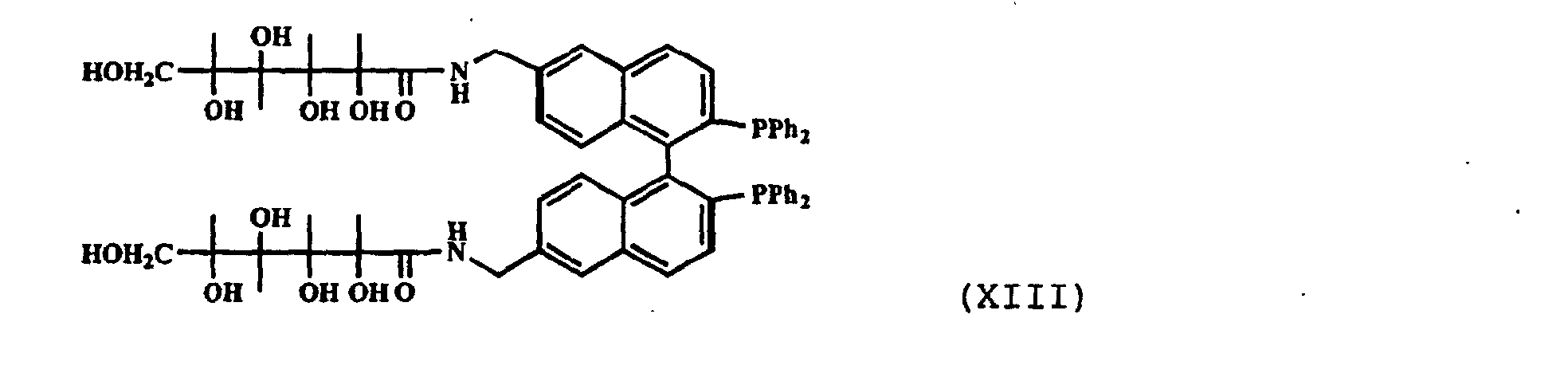
- a technique that a hydroxy-containing lactone is added to a lipophilic triphenylphosphine derivative ligand of this invention to form a water-soluble ligand may be applied not only to preparation of a triphenylphosphine derivative but also to converting an asymmetric ligand such as BINAP (formula (XIII)) and MOP (MAP) (formula (XIV)) into a water-soluble ligand.
- BINAP formula (XIII)
- MOP MAP
- a complex of the ligand with a metal may be used, for example, for asymmetric hydrogenation.
- R 7 represents alkyl, alkenyl or aryl; E represents Cl, Br or I;
- R 8 represents H, alkyl, aryl, CN, CHO, C(O)R 9 , C(O)NR 9 2 , CO 2 R 9 , CO 2 H, NO 2 , NH 2 , NR 2 , OR 9 or F; and
- R 9 represents alkyl, alkenyl or aryl.
- R 10 represents alkyl, alkenyl or aryl; and E represents Cl, Br or I.
- R 11 represents H, alkyl, alkenyl or aryl.
- R 12 and R 13 which are the same or different, represent H, alkyl, alkenyl or aryl; and G represents CH 2 , NH or O.
- R 12 and R 13 which are different from each other, represent H, alkyl, alkenyl or aryl; and G represents CH 2 , NH or O.
- the compound thus prepared is abbreviated to GLCAphos.
- Example 3 The process described in Example 3 was conducted except using 2-bromopyridine as an aryl halide derivative.
- the amount of the aryl halide derivative was the same molar amount as that in Example 3.
- An yield of 2-(p-tolyl)pyridine was 85 %.
- Example 3 The process described in Example 3 was conducted except using 4-bromobenzoic acid as an aryl halide derivative.
- the amount of the aryl halide derivative was the same molar amount as that in Example 3.
- An yield of 4-hydroxycarbonyl-4'-methylbiphenyl was 71 %.
- Example 3 The process described in Example 3 was conducted except using 4-bromodimethylaniline as an aryl halidederivative.
- the amount of the aryl halide derivative was the same molar amount as that in Example 3.
- An yield of 4-dimethylamino-4'-methylbiphenyl was 74 %.
- Example 3 The process described in Example 3 was conducted except using 4-bromofuluorobenzene as an aryl halide derivative.
- the amount of the aryl halide derivative was the same molar amount as that in Example 3.
- An yield of 4-fluoro-4'-methylbiphenyl was 95 %.
- Example 3 The process described in Example 3 was conducted except using 4-bromonitrobenzene as an aryl halide derivative.
- the amount of the aryl halide derivative was the same molar amount as that in Example 3.
- An yield of 4-nitro-4'-methylbiphenyl was 96 %.
- Example 3 The process described in Example 3 was conducted except using 4-bromohydroxybenzene as an aryl halide derivative.
- the amount of the aryl halide derivative was the same molar amount as that in Example 3.
- An yield of 4-hydroxy-4'-methylbiphenyl was 99 %.
- Example 3 The process described in Example 3 was conducted except using 4-chloroacetophenone as an aryl halide derivative.
- the amount of the aryl halide derivative was the same molar amount as that in Example 3.
- An yield of 4-acetyl-4'-methylbiphenyl was 51 %.
- Example 3 The process described in Example 3 was conducted except using 4-chlorobenzaldehyde as an aryl halide derivative.
- the amount of the aryl halide derivative was the same molar amount as that in Example 3.
- An yield of 4-formyl-4'-methylbiphenyl was 93 %.
- Example 3 The process described in Example 3 was conducted except using 4-iodomethanesulfonyloxybenzene as an aryl halide derivative.
- the amount of the aryl halide derivative was the same molar amount as that in Example 3.
- An yield of 4-methanesulfonyloxy-4'-methylbiphenyl was 99 %.
- Example 3 The process described in Example 3 was conducted except using 3-bromopyridine as an aryl halide derivative.
- the amount of the aryl halide derivative was the same molar amount as that in Example 3.
- An yield of 3-(p-tolyl)pyridine was 89 %.
- a triphenylphosphine derivative ligand to which a water-soluble hydroxy-containing lactone is added and a water-soluble complex catalyst derived therefrom can be readily prepared.
- This invention provides an economically efficient, convenient and industrially superb process having the features that a biaryl derivative represented by the formula (VII) can be obtained using one of various aryl halides derivative or aryl sulfonyl derivative in a higher yield; that a product can be easily separated from a catalyst by a simple procedure such as washing with water; and that the amount of the catalyst is vary small.
Landscapes
- Chemical & Material Sciences (AREA)
- Organic Chemistry (AREA)
- Chemical Kinetics & Catalysis (AREA)
- Molecular Biology (AREA)
- Health & Medical Sciences (AREA)
- Life Sciences & Earth Sciences (AREA)
- Biochemistry (AREA)
- General Health & Medical Sciences (AREA)
- Oil, Petroleum & Natural Gas (AREA)
- Engineering & Computer Science (AREA)
- Organic Low-Molecular-Weight Compounds And Preparation Thereof (AREA)
- Catalysts (AREA)
- Low-Molecular Organic Synthesis Reactions Using Catalysts (AREA)
Abstract
Description


using the phosphine ligand-palladium complex according to the sixth aspect of this invention as a catalyst, in water, an organic solvent or a mixture of an organic solvent and water, in the presence of a base:



with a hydroxy-containing lactone such as δ-gluconolactone, L-glucono-1,5-lactone, L-gluconic γ-lactone, D-gluconic γ-lactone, α-D-gluconoheptonic γ-lactone and α,β-glucooctanoic γ-lactone. For production in an industrial scale, readily available and inexpensive δ-gluconolactone is preferably used in the light of economic efficiency and stable production. It is preferably used in an amount of 0.5 to 2 moles, more preferably 0.9 to 1.5 moles to 1.0 mole of the compound represented by the formula (III).



















Claims (25)
- A triphenyl phosphine derivative represented by formula (I):[ in the formula (I), R1 and R2, which may be the same or different, represent hydrogen atom, fluorine atom, alkyl with 1 to 6 carbon atoms, phenyl optionally having alkyl with 1 to 6 carbon atoms, alkenyl with 2 to 6 carbon atoms, alkynyl with 2 to 6 carbon atoms, alkoxy with 1 to 6 carbon atoms, alkylthio with 1 to 6 carbon atoms, cyano, formyl, acyl with 2 to 7 carbon atoms, benzoyl optionally having alkyl with 1 to 6 carbon atoms, alkoxycarbonyl with 2 to 7 carbon atoms, phenoxycarbonyl optionally having alkyl with 1 to 6 carbon atoms, amino optionally having alkyl with 1 to 6 carbon atoms, amido optionally having alkyl with 1 to 6 carbon atoms, nitro, sulfonyl having alkyl with 1 to 6 carbon atoms or having phenyl optionally having alkyl with 1 to 6 carbon atoms, sulfonic ester group having alkyl with 1 to 6 carbon atoms or having phenyl optionally having alkyl with 1 to 6 carbon atoms, fluoroalkyl with 1 to 6 carbon atoms or aminoalkyl with 1 to 3 carbon atoms; m and n independently represent 1 or 2; v represents an integer of 0 to 3; z represents 1 or 2; and Q represents oxygen atom, sulfur atom or -NR- where R represents alkyl with 1 to 6 carbon atoms or hydrogen atom.
- The triphenyl phosphine derivative as claimed in Claim 1 represented by formula (II):[ in the formula (II), R1 and R2, which may be the same or different, represent hydrogen atom, fluorine atom, alkyl with 1 to 6 carbon atoms, phenyl optionally having alkyl with 1 to 6 carbon atoms, alkenyl with 2 to 6 carbon atoms, alkynyl with 2 to 6 carbon atoms, alkoxy with 1 to 6 carbon atoms, alkylthio with 1 to 6 carbonatoms, cyano, formyl, acyl with 2 to 7 carbon atoms, benzoyl optionally having alkyl with 1 to 6 carbon atoms, alkoxycarbonyl with 2 to 7 carbon atoms, phenoxycarbonyl optionally having alkyl with 1 to 6 carbon atoms, amino optionally having alkyl with 1 to 6 carbon atoms, amido optionally having alkyl with 1 to 6 carbon atoms, nitro, sulfonyl having alkyl with 1 to 6 carbon atoms or having phenyl optionally having alkyl with 1 to 6 carbon atoms, sulfonic ester group having alkyl with 1 to 6 carbon atoms or having phenyl optionally having alkyl with 1 to 6 carbon atoms, fluoroalkyl with 1 to 6 carbon atoms or aminoalkyl with 1 to 3 carbon atoms; mandn independently represent 1 or 2; v represents an integer of 0 to 3; and Q represents oxygen atom, sulfur atom or -NR- where R represents alkyl with 1 to 6 carbon atoms or hydrogen atom.
- The triphenyl phosphine derivative as claimed in Claim 2 wherein in the formula (II), R1 and R2 represent hydrogen; m, n and v represent 1; and Q represents -NR- where R represents alkyl with 1 to 6 carbon atoms or hydrogen atom.
- A process for preparing the triphenyl phosphine derivative as claimed in Claim 1 by reacting a hydroxy-containing lactone with the compound represented by formula (III):[in the formula (III), R1 and R2, which may be the same or different, represent hydrogen atom, fluorine atom, alkyl with 1 to 6 carbon atoms, phenyl optionally having alkyl with 1 to 6 carbon atoms, alkenyl with 2 to 6 carbon atoms, alkynyl with 2 to 6 carbon atoms, alkoxy with 1 to 6 carbon atoms, alkylthio with 1 to 6 carbonatoms, cyano, formyl, acyl with 2 to 7 carbon atoms, benzoyl optionally having alkyl with 1 to 6 carbon atoms, alkoxycarbonyl with 2 to 7 carbon atoms, phenoxycarbonyl optionally having alkyl with 1 to 6 carbon atoms, amino optionally having alkyl with 1 to 6 carbon atoms, amido optionally having alkyl with 1 to 6 carbon atoms, nitro, sulfonyl having alkyl with 1 to 6 carbon atoms or having phenyl optionally having alkyl with 1 to 6 carbon atoms, sulfonic ester group having alkyl with 1 to 6 carbon atoms or having phenyl optionally having alkyl with 1 to 6 carbon atoms, fluoroalkyl with 1 to 6 carbon atoms or aminoalkyl with 1 to 3 carbon atoms; m and n independently represent 1 or 2; v represents an integer of 0 to 3; and Q represents oxygen atom, sulfur atom or -NR- where R represents alkyl with 1 to 6 carbon atoms or hydrogen atom.
- The process as claimed in Claim 4 wherein δ-gluconolactone is used as the hydroxy-containing lactone.
- A phosphine ligand-palladium complex prepared from the triphenylphosphine derivative as claimed in Claim 1 and at least one palladium compound selected from the group consisting of palladium benzylideneacetones, palladium acetylacetonates, nitrile palladium halides, olefin palladium halides, palladium halides and palladium carboxylates.
- A phosphine ligand-palladium complex prepared from the triphenylphosphine derivative as claimed in Claim 2 and at least one palladium compound selected from the group consisting of palladium benzylideneacetones, palladium acetylacetonates, nitrile palladium halides, olefin palladium halides, palladium halides and palladium carboxylates.
- A phosphine ligand-palladium complex prepared from the triphenylphosphine derivative as claimed in Claim 3 and at least one palladium compound selected from the group consisting of palladium benzylideneacetones, palladium acetylacetonates, nitrile palladium halides, olefin palladium halides, palladium halides and palladium carboxylates.
- A phosphine ligand-palladium complex prepared from the triphenylphosphine derivative as claimed in Claim 1 and at least one palladium compound selected from the group consisting of bis(benzylidene)acetone palladium, palladium bisacetylacetonate, dichlorobisacetonitrile palladium, dichlorobisbenzonitrile palladium, dichloro(1,5-cyclooctadiene)palladium, bis(1,5-cyclooctadiene)palladium, tris (dibenzylideneacetone) dipalladium, palladium chloride and palladium acetate.
- A phosphine ligand-palladium complex prepared from the triphenylphosphine derivative as claimed in Claim 2 and at least one palladium compound selected from the group consisting of bis(benzylidene)acetone palladium, palladium bisacetylacetonate, dichlorobisacetonitrile palladium, dichlorobisbenzonitrile palladium, dichloro(1,5-cyclooctadiene)palladium, bis(1,5-cyclooctadiene)palladium, tris (dibenzylideneacetone) dipalladium, palladium chloride and palladium acetate.
- A phosphine ligand-palladium complex prepared from the triphenylphosphine derivative as claimed in Claim 3 and at least one palladium compound selected from the group consisting of bis(benzylidene)acetone palladium, palladium bisacetylacetonate, dichlorobisacetonitrile palladium, dichlorobisbenzonitrile palladium, dichloro(1,5-cyclooctadiene)palladium, bis(1,5-cyclooctadiene)palladium, tris(dibenzylideneacetone) dipalladium, palladium chloride and palladium acetate.
- A phosphine ligand-palladium complex prepared from the triphenylphosphine derivative as claimed in Claim 2 and dichloro(1,5-cyclooctadiene) palladium.
- A phosphine ligand-palladium complex prepared from the triphenylphosphine derivative as claimed in Claim 3 and dichloro(1,5-cyclooctadiene) palladium.
- A phosphine ligand-nickel complex prepared from the triphenylphosphine derivative as claimed in Claim 2 and at least one nickel salt selected from the group consisting of nickel halides, nickel nitrates, nickel sulfates, nickel organocarboxylates, nickel-acetylacetonate complex salts and nickel hydroxide.
- A phosphine ligand-nickel complex prepared from the triphenylphosphine derivative as claimed in Claim 3 and at least one nickel salt selected from the group consisting of nickel halides, nickel nitrates, nickel sulfates, nickel organocarboxylates, nickel-acetylacetonate complex salts and nickel hydroxide.
- A process for preparing a biaryl derivative represented by formula (VII) by reacting an aryl halide derivative or aryl sulfonyl derivative represented by formula (IV) with an arylboronic acid, its derivative or an arylboronic anhydride represented by formula (V) or (VI):[ in the formula (IV), (V) and (VI), A represents S, O, HC =CH or N=CH; R3, R4, R5 and R6, which may be the same or different, represent hydrogen atom, chlorine atom, fluorine atom, alkyl with 1 to 6 carbon atoms, phenyl optionally having alkyl with 1 to 6 carbon atoms, alkenyl with 2 to 6 carbon atoms, alkynyl with 2 to 6 carbon atoms, alkoxy with 1 to 6 carbon atoms, alkylthio with 1 to 6 carbon atoms, cyano, formyl, acyl with 2 to 7 carbon atoms, benzoyl optionally having alkyl with 1 to 6 carbon atoms, alkoxycarbonyl with 2 to 7 carbon atoms, phenoxycarbonyl optionally having alkyl with 1 to 6 carbon atoms, amino optionally having alkyl with 1 to 6 carbon atoms, amido optionally having alkyl with 1 to 6 carbon atoms, nitro, sulfonyl having alkyl with 1 to 6 carbon atoms or having phenyl optionally having alkyl with 1 to 6 carbon atoms, sulfonic ester group having alkyl with 1 to 6 carbon atoms or having phenyl optionally having alkyl with 1 to 6 carbon atoms or fluoroalkyl with 1 to 6 carbon atoms; X represents chlorine, bromine, iodine, mesylate or arenesulfonate; Y represents hydroxy, alkoxy with 1 to 6 carbon atoms, phenoxy optionally having alkyl with 1 to 6 carbon atoms or cyclohexyloxy; or two Ys are combined together to form a group represented by formula a, b or c:
 wherein q represents 1, 2, 3 or 4; and r and s independently represent 2, 3, 4 or 5], using the phosphine ligand-palladium complex as claimed in Claim 6 as a catalyst, in water, an organic solvent or a mixture of an organic solvent and water, in the presence of a base:
 [ in the formula (VII), A, R3, R4, R5 and R6 are as defined in the formulas (IV), (V) and (VI).]
- The process for preparing a biaryl derivative as claimed in Claim 16 wherein the catalyst is the phosphine ligand-palladium complex as claimed in Claim 7.
- The process for preparing a biaryl derivative as claimed in Claim 16 wherein the catalyst is the phosphine ligand-palladium complex as claimed in Claim 8.
- The process for preparing a biaryl derivative as claimed in Claim 16 wherein the catalyst is the phosphine ligand-palladium complex as claimed in Claim 9.
- The process for preparing a biaryl derivative as claimed in Claim 16 wherein the catalyst is the phosphine ligand-palladium complex as claimed in Claim 10.
- The process for preparing a biaryl derivative as claimed in Claim 16 wherein the catalyst is the phosphine ligand-palladium complex as claimed in Claim 11.
- The process for preparing a biaryl derivative as claimed in Claim 16 wherein the catalyst is the phosphine ligand-palladium complex as claimed in Claim 12.
- The process for preparing a biaryl derivative as claimed in Claim 16 wherein the catalyst is the phosphine ligand-palladium complex as claimed in Claim 13.
- The process for preparing a biaryl derivative as claimed in Claim 16 wherein the catalyst is the phosphine ligand-nickel complex as claimed in Claim 14.
- The process for preparing a biaryl derivative as claimed in Claim 16 wherein the catalyst is the phosphine ligand-nickel complex as claimed in Claim 15.
Applications Claiming Priority (3)
| Application Number | Priority Date | Filing Date | Title |
|---|---|---|---|
| JP2000070711 | 2000-03-14 | ||
| JP2000070711 | 2000-03-14 | ||
| PCT/JP2001/002011 WO2001068657A1 (en) | 2000-03-14 | 2001-03-14 | Triphenylphosphine derivative, production process therefor, palladium complex thereof, and process for producing biaryl derivative |
Publications (3)
| Publication Number | Publication Date |
|---|---|
| EP1270582A1 true EP1270582A1 (en) | 2003-01-02 |
| EP1270582A4 EP1270582A4 (en) | 2005-06-08 |
| EP1270582B1 EP1270582B1 (en) | 2006-08-30 |
Family
ID=18589408
Family Applications (1)
| Application Number | Title | Priority Date | Filing Date |
|---|---|---|---|
| EP01912351A Expired - Lifetime EP1270582B1 (en) | 2000-03-14 | 2001-03-14 | Triphenylphosphine derivatives, palladium or nickel complexes thereof, and process for preparing biaryl derivatives |
Country Status (4)
| Country | Link |
|---|---|
| US (1) | US6693210B2 (en) |
| EP (1) | EP1270582B1 (en) |
| DE (1) | DE60122692T2 (en) |
| WO (1) | WO2001068657A1 (en) |
Cited By (3)
| Publication number | Priority date | Publication date | Assignee | Title |
|---|---|---|---|---|
| EP1397336A4 (en) * | 2001-02-26 | 2005-12-21 | Honeywell Int Inc | Preparation of polyaryl carboxylic acids |
| US7091373B2 (en) | 2002-03-18 | 2006-08-15 | Sumitomo Chemical Company, Limited | Production method for biarylalanine |
| US9056314B2 (en) | 2010-12-16 | 2015-06-16 | H4Sep Kft | Palladium catalyst, method for its preparation and its use |
Families Citing this family (3)
| Publication number | Priority date | Publication date | Assignee | Title |
|---|---|---|---|---|
| JP5222632B2 (en) * | 2008-06-13 | 2013-06-26 | 白鳥製薬株式会社 | Method for producing biaryl compound |
| CN102126962A (en) * | 2011-01-26 | 2011-07-20 | 大连理工大学 | Method for preparing 2,4,6-triarylaniline compounds in aqueous phase |
| JP7023080B2 (en) * | 2016-10-31 | 2022-02-21 | 東ソー株式会社 | Method for producing aromatic compounds |
Family Cites Families (4)
| Publication number | Priority date | Publication date | Assignee | Title |
|---|---|---|---|---|
| DE4426671A1 (en) | 1994-07-28 | 1996-02-01 | Hoechst Ag | Process for cross-coupling aromatic boron compounds with aromatic halogen compounds or perfluoroalkyl sulfonates |
| DE19654180A1 (en) * | 1996-12-23 | 1998-06-25 | Hoechst Ag | Phosphines, processes for their preparation and their use in metal complexes |
| JP2002505663A (en) * | 1997-04-09 | 2002-02-19 | コモンウエルス サイエンティフィック アンド インダストリアル リサーチ オーガナイゼーション | Aryl borate ester |
| US6534038B2 (en) * | 2000-04-07 | 2003-03-18 | Bristol-Myers Squibb Pharma Company | Ternary ligand complexes useful as radiopharmaceuticals |
-
2001
- 2001-03-14 EP EP01912351A patent/EP1270582B1/en not_active Expired - Lifetime
- 2001-03-14 DE DE60122692T patent/DE60122692T2/en not_active Expired - Lifetime
- 2001-03-14 WO PCT/JP2001/002011 patent/WO2001068657A1/en not_active Ceased
- 2001-03-14 US US10/221,678 patent/US6693210B2/en not_active Expired - Fee Related
Cited By (4)
| Publication number | Priority date | Publication date | Assignee | Title |
|---|---|---|---|---|
| EP1397336A4 (en) * | 2001-02-26 | 2005-12-21 | Honeywell Int Inc | Preparation of polyaryl carboxylic acids |
| US7091373B2 (en) | 2002-03-18 | 2006-08-15 | Sumitomo Chemical Company, Limited | Production method for biarylalanine |
| US9056314B2 (en) | 2010-12-16 | 2015-06-16 | H4Sep Kft | Palladium catalyst, method for its preparation and its use |
| US9101920B2 (en) | 2010-12-16 | 2015-08-11 | H4Sep Kft | Palladium catalyst, method for its preparation and its use |
Also Published As
| Publication number | Publication date |
|---|---|
| EP1270582A4 (en) | 2005-06-08 |
| EP1270582B1 (en) | 2006-08-30 |
| WO2001068657A1 (en) | 2001-09-20 |
| DE60122692D1 (en) | 2006-10-12 |
| DE60122692T2 (en) | 2007-08-23 |
| US6693210B2 (en) | 2004-02-17 |
| US20030065208A1 (en) | 2003-04-03 |
Similar Documents
| Publication | Publication Date | Title |
|---|---|---|
| CN101952298B (en) | Ligands for transition-metal-catalyzed cross-couplings, and methods of use thereof | |
| JP6386888B2 (en) | Complex compound | |
| KR101915491B1 (en) | Preparation of biaryls | |
| JP5259161B2 (en) | Process for the catalytic production of aromatic or heteroaromatic nitriles | |
| Flores-Rojas et al. | Synthesis and characterization of Pd (II) complexes bearing NS, CS, SNS and SCS ligands. Evaluation of their microwave assisted catalytic activity in CC coupling reactions | |
| Özdemir et al. | In situ generated 1-alkylbenzimidazole–palladium catalyst for the Suzuki coupling of aryl chlorides | |
| US6248892B1 (en) | Process for preparing arylpyridines | |
| US6693210B2 (en) | Triphenylphosphine derivative, production process therefor, palladium complex thereof, and process for producing biaryl derivative | |
| ES2283850T3 (en) | NEW CARBEN-NICKEL COMPLEXES, -PALADIO AND -PLATINO, ITS PRODUCTION AND USE IN CATALYTIC REACTIONS. | |
| Smith et al. | Suzuki reactions catalyzed by palladium complexes bearing the bulky (2, 6-dimesitylphenyl) dimethylphosphine | |
| CN110041235B (en) | A kind of N-phenyl-N-p-toluenesulfonyl trifluoroacetamide and application | |
| US6858756B2 (en) | Arylation of olefins | |
| US6566571B1 (en) | Method of producing biaryls | |
| US20020173421A1 (en) | Preparation and use of palladium catalysts for cross-coupling reactions | |
| US7102046B2 (en) | Process for the arylation of olefins | |
| ES2261575T3 (en) | COMPLEXES OF N-HETEROCICLIC CARBENS AND THEIR USE. | |
| US6878663B2 (en) | Method for producing palladium complex compound | |
| US4355168A (en) | Process for preparing aryl- or heteroarylhexadienoic acids | |
| Jurczak et al. | Synthesis of N, N′-dimethyl diazacoronands via double-quaternization reaction | |
| JPWO2001068657A1 (en) | Triphenylphosphine derivatives and their production methods, phosphine ligand palladium complexes, and biaryl derivatives | |
| JP2004107271A (en) | Water-soluble alkylphosphine derivative and method for producing the same, phosphine ligand complex, and method for producing biaryl derivative | |
| JP5544756B2 (en) | Phosphine compound and catalyst comprising the phosphine compound and a transition metal compound | |
| JP4570057B2 (en) | Process for producing arylpyridine derivatives | |
| CN110003062B (en) | A kind of N-phenyl-N-p-toluenesulfonyl difluoroacetamide and application | |
| JP2004182713A (en) | Method for producing haloaryl-substituted pyridine derivative |
Legal Events
| Date | Code | Title | Description |
|---|---|---|---|
| PUAI | Public reference made under article 153(3) epc to a published international application that has entered the european phase |
Free format text: ORIGINAL CODE: 0009012 |
|
| 17P | Request for examination filed |
Effective date: 20021009 |
|
| AK | Designated contracting states |
Kind code of ref document: A1 Designated state(s): AT BE CH CY DE DK ES FI FR GB GR IE IT LI LU MC NL PT SE TR |
|
| RBV | Designated contracting states (corrected) |
Designated state(s): AT BE CH CY DE FR GB LI |
|
| A4 | Supplementary search report drawn up and despatched |
Effective date: 20050426 |
|
| RIC1 | Information provided on ipc code assigned before grant |
Ipc: 7C 07C 63/331 B Ipc: 7C 07C 41/30 B Ipc: 7C 07B 61/00 B Ipc: 7C 07C 51/353 B Ipc: 7C 07F 15/00 B Ipc: 7C 07C 45/61 B Ipc: 7C 07F 9/50 A Ipc: 7C 07C 43/205 B Ipc: 7C 07C 47/546 B Ipc: 7C 07C 17/263 B Ipc: 7C 07B 37/04 B Ipc: 7C 07C 49/784 B Ipc: 7C 07C 25/13 B |
|
| GRAP | Despatch of communication of intention to grant a patent |
Free format text: ORIGINAL CODE: EPIDOSNIGR1 |
|
| RTI1 | Title (correction) |
Free format text: TRIPHENYLPHOSPHINE DERIVATIVES, PALLADIUM OR NICKEL COMPLEXES THEREOF, AND PROCESS FOR PREPARING BIARYL DERIVATIVES |
|
| RBV | Designated contracting states (corrected) |
Designated state(s): CH DE FR GB LI |
|
| GRAS | Grant fee paid |
Free format text: ORIGINAL CODE: EPIDOSNIGR3 |
|
| GRAA | (expected) grant |
Free format text: ORIGINAL CODE: 0009210 |
|
| AK | Designated contracting states |
Kind code of ref document: B1 Designated state(s): CH DE FR GB LI |
|
| REG | Reference to a national code |
Ref country code: GB Ref legal event code: FG4D |
|
| REG | Reference to a national code |
Ref country code: CH Ref legal event code: EP |
|
| REF | Corresponds to: |
Ref document number: 60122692 Country of ref document: DE Date of ref document: 20061012 Kind code of ref document: P |
|
| REG | Reference to a national code |
Ref country code: CH Ref legal event code: NV Representative=s name: R. A. EGLI & CO. PATENTANWAELTE |
|
| EN | Fr: translation not filed | ||
| PLBE | No opposition filed within time limit |
Free format text: ORIGINAL CODE: 0009261 |
|
| STAA | Information on the status of an ep patent application or granted ep patent |
Free format text: STATUS: NO OPPOSITION FILED WITHIN TIME LIMIT |
|
| 26N | No opposition filed |
Effective date: 20070531 |
|
| GBPC | Gb: european patent ceased through non-payment of renewal fee |
Effective date: 20070314 |
|
| PG25 | Lapsed in a contracting state [announced via postgrant information from national office to epo] |
Ref country code: GB Free format text: LAPSE BECAUSE OF NON-PAYMENT OF DUE FEES Effective date: 20070314 Ref country code: FR Free format text: LAPSE BECAUSE OF FAILURE TO SUBMIT A TRANSLATION OF THE DESCRIPTION OR TO PAY THE FEE WITHIN THE PRESCRIBED TIME-LIMIT Effective date: 20070511 |
|
| PG25 | Lapsed in a contracting state [announced via postgrant information from national office to epo] |
Ref country code: FR Free format text: LAPSE BECAUSE OF FAILURE TO SUBMIT A TRANSLATION OF THE DESCRIPTION OR TO PAY THE FEE WITHIN THE PRESCRIBED TIME-LIMIT Effective date: 20060830 |
|
| PGFP | Annual fee paid to national office [announced via postgrant information from national office to epo] |
Ref country code: CH Payment date: 20140312 Year of fee payment: 14 |
|
| PGFP | Annual fee paid to national office [announced via postgrant information from national office to epo] |
Ref country code: DE Payment date: 20140417 Year of fee payment: 14 |
|
| REG | Reference to a national code |
Ref country code: DE Ref legal event code: R119 Ref document number: 60122692 Country of ref document: DE |
|
| REG | Reference to a national code |
Ref country code: CH Ref legal event code: PL |
|
| PG25 | Lapsed in a contracting state [announced via postgrant information from national office to epo] |
Ref country code: DE Free format text: LAPSE BECAUSE OF NON-PAYMENT OF DUE FEES Effective date: 20151001 Ref country code: LI Free format text: LAPSE BECAUSE OF NON-PAYMENT OF DUE FEES Effective date: 20150331 Ref country code: CH Free format text: LAPSE BECAUSE OF NON-PAYMENT OF DUE FEES Effective date: 20150331 |