EP1270512A1 - Process for thermal decomposition and pre-calcination of barium titanyl oxalate for the production of barium titanate - Google Patents
Process for thermal decomposition and pre-calcination of barium titanyl oxalate for the production of barium titanate Download PDFInfo
- Publication number
- EP1270512A1 EP1270512A1 EP01115294A EP01115294A EP1270512A1 EP 1270512 A1 EP1270512 A1 EP 1270512A1 EP 01115294 A EP01115294 A EP 01115294A EP 01115294 A EP01115294 A EP 01115294A EP 1270512 A1 EP1270512 A1 EP 1270512A1
- Authority
- EP
- European Patent Office
- Prior art keywords
- flame
- barium titanate
- barium
- reactor
- precursor
- Prior art date
- Legal status (The legal status is an assumption and is not a legal conclusion. Google has not performed a legal analysis and makes no representation as to the accuracy of the status listed.)
- Granted
Links
Images


Classifications
-
- C—CHEMISTRY; METALLURGY
- C01—INORGANIC CHEMISTRY
- C01G—COMPOUNDS CONTAINING METALS NOT COVERED BY SUBCLASSES C01D OR C01F
- C01G23/00—Compounds of titanium
- C01G23/003—Titanates
- C01G23/006—Alkaline earth titanates
-
- C—CHEMISTRY; METALLURGY
- C01—INORGANIC CHEMISTRY
- C01P—INDEXING SCHEME RELATING TO STRUCTURAL AND PHYSICAL ASPECTS OF SOLID INORGANIC COMPOUNDS
- C01P2004/00—Particle morphology
- C01P2004/01—Particle morphology depicted by an image
- C01P2004/03—Particle morphology depicted by an image obtained by SEM
-
- C—CHEMISTRY; METALLURGY
- C01—INORGANIC CHEMISTRY
- C01P—INDEXING SCHEME RELATING TO STRUCTURAL AND PHYSICAL ASPECTS OF SOLID INORGANIC COMPOUNDS
- C01P2004/00—Particle morphology
- C01P2004/51—Particles with a specific particle size distribution
- C01P2004/52—Particles with a specific particle size distribution highly monodisperse size distribution
-
- C—CHEMISTRY; METALLURGY
- C01—INORGANIC CHEMISTRY
- C01P—INDEXING SCHEME RELATING TO STRUCTURAL AND PHYSICAL ASPECTS OF SOLID INORGANIC COMPOUNDS
- C01P2004/00—Particle morphology
- C01P2004/60—Particles characterised by their size
- C01P2004/62—Submicrometer sized, i.e. from 0.1-1 micrometer
Definitions
- the invention relates to a process for making oxalate-derived barium titanate and, more specifically, to a new and improved process for drying and thermally decomposing barium titanyl oxalate tetrahydrate prior to the final calcination to yield barium titanate.
- Oxalate-derived barium titanate powders due to their high dielectric constant, are used extensively in the manufacturing of passive electronic components such as multilayer ceramic capacitors (MLC's). These powders are typically synthesised in aqueous systems by reacting barium and titanium containing compounds, such as chlorides or carbonates, with oxalic acid in a batch-type or continuous reactor. After the precipitation of the barium titanyl oxalate tetrahydrate (BTO), the crystals are then separated from the liquid phase by filtration or other solid-liquid separation techniques.
- BTO barium titanyl oxalate tetrahydrate
- the BTO which often still contains some physically bound water, must be fully dried and calcined in an oxidizing atmosphere at temperatures in the range of 1000°C in order to thermally decompose the precursor material to barium titanate and to develop the proper crystalline size and structure which are necessary to achieve a high dielectric constant.
- the temperature profile of the kilns must be precisely controlled so as to give the product a very specific time-temperature history.
- the thermal decomposition and calcination of the BTO is typically performed in bulk in a batch-type or continuous tunnel kiln, or in a rotary calciner.
- Bulk calcination of the BTO has the drawback of requiring very slow heating rates in order to avoid fluidization of the powder resulting from rapid off-gassing of water vapor, CO, and CO 2 upon drying and decomposition.
- This fluidization can cause the powder to come out of the containers in a batch or continuous tunnel kiln, or in the case of a rotary calciner, the material may experience widely varied time-temperature histories as a result of fluidization which affect product quality and uniformity. Because of this, heating rates must be reduced to the point where the throughput of the calcination kiln is significantly lower than what would be possible without the problem of fluidization due to rapid off-gasing of powders in the bulk form.
- Another drawback of the current method of pyrolyzing BTO in the bulk phase is temperature control during the rapid evolution of CO gas upon the thermal decomposition of the BTO.
- the volume of material in each container or sagger is greatly reduced as a result of the drying and decomposition of the wet BTO precursor.
- a sagger whose volume is fully loaded with precursor exits the kiln with only about 40% of it's volume occupied by barium titanate product. This also has the effect of reducing the throughput and efficiency of a given kiln due to the limited amount of product in each container as it exits the kiln.
- the present invention provides a new and improved method for the production of oxalate-derived barium titanate by the use of flash calcination prior to the final calcination of the material.
- the process includes as a first step dispersing the barium titanyl oxalate tetrahydrate or a liquid slurry thereof in a gas.
- the temperature of the solids-gas or solids-liquid-gas mixture is increased to a temperature of 100°C - 1400°C according to the extent of decomposition which is desired, and separating the partially or fully decomposed BTO from the gas.
- powders produced according to the inventive method may undergo final calcination in bulk form using high heating rates in a batch, tunnel or rotary calcining furnace without the problem of fluidization of the powders due to rapid off-gassing.
- This allows for higher product throughput of the kilns due to the reduced time allotment for the ramp up phase of the temperature profile.
- the dwell time at the maximum kiln temperature which is required to develop the high dielectric constant of the barium titanate is reduced due to increased heat transfer to the pre-calcined particles as the endothermic decomposition reactions are partially or entirely completed.
- the overall residence time requirement in the furnaces is reduced by the order of 30%.
- the weight loss and volume reduction of the powder is significantly less than that of powder which is processed according to the known method. This results in a greater amount of barium titanate product powder in each sagger upon exiting the kiln. Typically, this amounts to 50% or more product in each sagger, which when combined with the reduced residence time requirement of each sagger, results in a throughput increase on the order of 100% for a given kiln.
- FIG. 1 shows a diagram of a device for the synthesis of barium titanate.
- the device comprises a supply unit 1.
- barium titanyl oxalate (BTO) is dispersed in a gas to produce a solids-gas mixture.
- the BTO is suspended in a liquid to produce a solids-liquids-gas mixture.
- the BTO used in this process is synthesized by conventional techniques. Barium and titanium containing components such as chlorides, carbonates or acetates are reacted with oxalic acid in a batch type or continuous liquid phase reactor. After the precipitation of the BTO the crystals are separated from the liquid phase.
- the BTO is an organic precursor which is used for the synthesis of barium titanate. The precursor contains up to 70% of water by weight.
- the supply unit 1 comprises a proportioning device for controlling the amount of BTO fed in to the flame reactor 2.
- the mixture produced in the supply unit 1 is fed to a flame reactor 2.
- the flame reactor 2 according to Figure 1 is a tubular flame reactor 2 which is vertically oriented.
- a heat source 3 is mounted at the top of the flame reactor 2. Further, the mixture containing BTO is induced at the top of the flame reactor 2. The heat source 3 is generating a flame 4. The flame 4 is vertically oriented, where the length of the flame 4 is contained within the flame reactor 2.
- the heat source 3 is coupled to a feeding device 5.
- the feeding device 5 supplies the heat source 3 with gaseous or liquid fuel.
- the heat source 3 generates a so called chemical flame 4.
- the flame 4 is a pre-mixed flame or a diffusion flame comprised of gaseous fuel which is burned in an oxidizing atmosphere.
- the precursor is introduced into the flame 4 so that the precursor is burned in an oxidizing atmosphere.
- the temperature in the flame reactor 2 is maintained at 100°C to 1400°C.
- the temperature is maintained at 800°C to 1200°C
- the flame reactor 2 there is a vertically oriented downward flow of the precursor.
- the flow conditions within the flame reactor are turbulent, where the Reynolds' number of this flow is greater than 2000.
- the Reynolds' number is greater than 10000.
- the residence time of the particles in the flame 4 is between 0,05 and 10 seconds. During this period the precursor is partially thermally decomposed.
- pre-calcined barium titanate is produced containing barium titanate and less than 25 weight % of organic materials.
- the pre-calcined barium titanate contains less than 15 weight % of organic materials.
- the heating of the BTO in the flame reactor 2 leads to a direct and rapid heating of the particles in the flame 4.
- the heating rates of the particles are varying in a range of 100 to 10.000 Kelvin per second. Due to this high heating rates there is a rapid evolution of CO and CO 2 in addition to the evolution of water. This sudden, rapid evolution of gas from the precursor impacts a porous structure of the pre-calcined barium titanate.
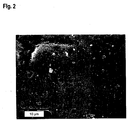
- the porous structure of one particle is shown in Figure 2.
- the pre-calcined barium titanate coming out from the flame 4 is flowing to the bottom of the flame reactor 2.
- the pre-calcined barium titanate is slightly cooled down.
- a quenching unit 6 is connected to the exit of the flame reactor 2.
- the quenching unit 6 serves for cooling the pre-calcined barium titanate.
- the quenching unit 6 supplies cooling water, cooling gas or a combination thereof for cooling the solids-gas mixture coming out from the flame reactor 2.
- the quenching unit 6 is followed by a filtering unit 7.
- the filtering unit 7 consists of a cyclone or filter for collection. In the filtering unit 7 the solid particles are removed from the gas phase.
- the pre-calcined barium titanate synthesized by flash calcination can be used to produce multilayer ceramic capacitors MLC of high quality.
- the rapid heating in the flame reactor 2 leads to a porous structure of the pre-calcined barium titanate. Further, due to the rapid heating during flash calcination water, CO and CO 2 is removed from the pre-calcined barium titanate.
- barium titanate Due to this pre-calcined barium titanate can be easily thermally decomposed to barium titanate in a calcination kiln 8. The barium titanate is then used for the production of MLC's.
- the calcination kiln 8 schematically shown in Figure 1 is a batch type or continuous tunnel kiln.
- pre-calcined barium titanate is fed to the calcination kiln instead of BTO. Due to this fact, the dwell time at the maximum kiln temperature necessary to develop the required dielectric constant of the barium titanate is significantly reduced. As a result of the reduced dwell times at the peak temperature the overall residence time in the kiln is reduced by the order of 30%.
- the barium titanate synthesized by thermally decomposing pre-calcined barium titanate has an improved uniformity.
- the throughput of the thermal process in the kiln is further increased by the fact, that the weight loss and volume reduction using pre-calcined barium titanate instead of BTO is decreased of about 50%.
- barium titanate synthesized by the inventive method has an improved millibility with respect to conventional barium titanate.
- Figure 3 shows different milling curves for barium titanate powders. The milling curve is given by the particle size ( ⁇ m) in dependence of the milling time. As shown in Figure 3 barium titanate synthesized by pre-calcined barium titanate leads to smaller particle sizes or smaller milling times compared to barium titanate synthesized by conventional techniques (reference material).
- the shorter milling times result in a more narrow particle size distribution, particularly with respect to the generation of fewer ultrafine particles.
- barium titanate synthesized by the inventive method leads to an improved temperature coefficient of capacitance (TCC) across a broad temperature range.
- Typical TCC curves are shown in Figure 4.
- the first curve (“reference material”) shows the temperature dependency of the coefficient of capacitance ( ⁇ C/C) for barium titanate synthesized by conventional techniques. This curve has a minimum at a temperature of about 90°C.
- the diagram according to Figure 4 shows the TCC curve for barium titanate synthesized by the inventive method ("pre-calcined material"). The minimum value of this curve at the temperature of about 90°C is shifted to higher values.
- the barium titanate must have a coefficient of capacitance meeting the requirement -10 ⁇ ⁇ C/C ⁇ +10 across the whole temperature range shown in Figure 4.
- barium titanate for certain MLC applications the barium titanate has to meet the so called X7R specification.
- This specification requires the barium titanate particles to be coated with a dopant formulation.
- dopant additives are most effective in a "core-shell" solid structure after final sintering of the MLC, with the core being comprised of the pure micron-scale barium titanate (ferroelectric) and the shell being comprised of only the dopant formulation (paraelectric) without excessive barium titanate contamination due to diffusion of the core material into the shell. Due to the known increase in sintering rates of barium titanate particles in the nanoscale range, the presence of a significant amount of these ultra-fine particles in the particle size distribution of the barium titanate results in excessive solid-state diffusion of barium titanate into the dopant shell structures at firing temperatures below the sintering point of micron-scale barium titanate core particles.
Landscapes
- Chemical & Material Sciences (AREA)
- Organic Chemistry (AREA)
- Life Sciences & Earth Sciences (AREA)
- Environmental & Geological Engineering (AREA)
- General Life Sciences & Earth Sciences (AREA)
- Geology (AREA)
- Inorganic Chemistry (AREA)
- Inorganic Compounds Of Heavy Metals (AREA)
- Compositions Of Oxide Ceramics (AREA)
- Organic Low-Molecular-Weight Compounds And Preparation Thereof (AREA)
Abstract
Description
- The invention relates to a process for making oxalate-derived barium titanate and, more specifically, to a new and improved process for drying and thermally decomposing barium titanyl oxalate tetrahydrate prior to the final calcination to yield barium titanate.
- Oxalate-derived barium titanate powders, due to their high dielectric constant, are used extensively in the manufacturing of passive electronic components such as multilayer ceramic capacitors (MLC's). These powders are typically synthesised in aqueous systems by reacting barium and titanium containing compounds, such as chlorides or carbonates, with oxalic acid in a batch-type or continuous reactor. After the precipitation of the barium titanyl oxalate tetrahydrate (BTO), the crystals are then separated from the liquid phase by filtration or other solid-liquid separation techniques. Following this, the BTO, which often still contains some physically bound water, must be fully dried and calcined in an oxidizing atmosphere at temperatures in the range of 1000°C in order to thermally decompose the precursor material to barium titanate and to develop the proper crystalline size and structure which are necessary to achieve a high dielectric constant. In order to obtain the desired electrical properties of the final barium titanate product, the temperature profile of the kilns must be precisely controlled so as to give the product a very specific time-temperature history.
- The thermal decomposition and calcination of the BTO is typically performed in bulk in a batch-type or continuous tunnel kiln, or in a rotary calciner. Bulk calcination of the BTO has the drawback of requiring very slow heating rates in order to avoid fluidization of the powder resulting from rapid off-gassing of water vapor, CO, and CO2 upon drying and decomposition. This fluidization can cause the powder to come out of the containers in a batch or continuous tunnel kiln, or in the case of a rotary calciner, the material may experience widely varied time-temperature histories as a result of fluidization which affect product quality and uniformity. Because of this, heating rates must be reduced to the point where the throughput of the calcination kiln is significantly lower than what would be possible without the problem of fluidization due to rapid off-gasing of powders in the bulk form.
- Another drawback of the current method of pyrolyzing BTO in the bulk phase is temperature control during the rapid evolution of CO gas upon the thermal decomposition of the BTO.
- Without tightly controlled, slow heating rates and high airflows through the kilns, this evolution of CO in an oxidizing atmosphere can result in rapid burning of the CO, leading to the possibility of uncontrolled heat release which adversely affects the temperature control of the process and variability of the product properties.
- In the case of calcining the BTO precursor in a container which is placed in a batch or tunnel kiln, the volume of material in each container or sagger is greatly reduced as a result of the drying and decomposition of the wet BTO precursor. Typically, a sagger whose volume is fully loaded with precursor exits the kiln with only about 40% of it's volume occupied by barium titanate product. This also has the effect of reducing the throughput and efficiency of a given kiln due to the limited amount of product in each container as it exits the kiln.
- The miniaturization of electronic components and the desire to increase the volumetric efficiency of multilayer capacitors has led to the development of dielectric layers of constantly decreasing thickness. In order to construct these thin layers, MLC manufacturers must be supplied with dielectric powders of smaller particle size. Due to this requirement, the oxalate-derived barium titanate powders commonly require milling to achieve the desired particle size distributions (U.S. 6,129,903), typically in the submicron range for current applications. Calcined barium titanate, due in part to it's solid non-porous structure, requires extensive milling times in order to fulfil these size requirements. These long milling times produce wider particle size distributions, particularly with respect to the generation of ultra-fine particles in the lower end of the size distribution. The presence of these ultra-fine particles, whose relative frequency is due in part to long milling times, is known to adversely affect the temperature coefficient of capacitance response of the dielectric, particularly in the case of thin-layer MLC applications. It is known that the morphology of the calcined barium titanate particles is an important factor with respect to their millibility (U.S. 5,009,876).
- The present invention provides a new and improved method for the production of oxalate-derived barium titanate by the use of flash calcination prior to the final calcination of the material. The process includes as a first step dispersing the barium titanyl oxalate tetrahydrate or a liquid slurry thereof in a gas. In a second step the temperature of the solids-gas or solids-liquid-gas mixture is increased to a temperature of 100°C - 1400°C according to the extent of decomposition which is desired, and separating the partially or fully decomposed BTO from the gas.
- Particularly the following advantages can be obtained with the method according to the invention:
- Unlike oxalate-derived barium titanate manufactured according to the known method, powders produced according to the inventive method may undergo final calcination in bulk form using high heating rates in a batch, tunnel or rotary calcining furnace without the problem of fluidization of the powders due to rapid off-gassing. This allows for higher product throughput of the kilns due to the reduced time allotment for the ramp up phase of the temperature profile. In addition, the dwell time at the maximum kiln temperature which is required to develop the high dielectric constant of the barium titanate is reduced due to increased heat transfer to the pre-calcined particles as the endothermic decomposition reactions are partially or entirely completed. As a result of the reduced time requirements for temperature ramp rates and dwell times at the peak temperature, the overall residence time requirement in the furnaces is reduced by the order of 30%.
- Because the decomposition reactions in which CO gas is evolved take place in the flash calciner (flame reactor) during the pre-calcination step when using the inventive method, the burning of CO does not take place in the final calcination step. This eliminates the problem of uncontrolled heat release in the calcination kilns, and the need for excessive air flows inside the kiln which are used to carry off the gasses of decomposition. The result is improved temperature uniformity in the kiln, along with reduced energy requirement for heating excessive amounts of purge air inside the furnace.
- When the flash calcined material is loaded into saggers for final calcination in a batch-type or continuous tunnel kiln, the weight loss and volume reduction of the powder is significantly less than that of powder which is processed according to the known method. This results in a greater amount of barium titanate product powder in each sagger upon exiting the kiln. Typically, this amounts to 50% or more product in each sagger, which when combined with the reduced residence time requirement of each sagger, results in a throughput increase on the order of 100% for a given kiln.
- As the BTO precursor powder is dispersed in the gas phase then rapidly heated and decomposed in the flash calciner, the evolution of water vapor, CO and CO2 occurs suddenly. This sudden, rapid evolution of gas from the precursor crystals imparts a porous structure into the particles. After final calcination of the barium titanate particles, this porous structure remains and provides the powders produced by the inventive method with improved millibility, made evident by the shorter milling times required to achieve the target average particle size. The shorter milling times result in a more narrow particle size distribution, particularly with respect to a relative decrease in the quantity of ultra-fine particles, which leads to an improved temperature coefficient of capacitance (TCC) across a broad temperature range. This effect is particularly evident in thin-layer MLC applications, where the TCC curve tends to rotate out of specification when using powders manufactured by the known method.
- The invention will now be described with reference to the accompanying drawings and photographs, in which
- Figure 1
- is a schematic diagram of a device for the synthesis of barium titanate,
- Figure 2
- is a photograph showing the microscopic surface structure of a pre-calcined barium titanate particle,
- Figure 3
- is a milling diagram for pre-calcined barium titanate and conventional barium titanate,
- Figure 4
- is a diagram showing the temperature coefficients of capacitance for pre-calcined barium titanate and conventional barium titanate.
- Figure 1 shows a diagram of a device for the synthesis of barium titanate. The device comprises a
supply unit 1. In thissupply unit 1 barium titanyl oxalate (BTO) is dispersed in a gas to produce a solids-gas mixture. Alternatively, the BTO is suspended in a liquid to produce a solids-liquids-gas mixture. - The BTO used in this process is synthesized by conventional techniques. Barium and titanium containing components such as chlorides, carbonates or acetates are reacted with oxalic acid in a batch type or continuous liquid phase reactor. After the precipitation of the BTO the crystals are separated from the liquid phase. The BTO is an organic precursor which is used for the synthesis of barium titanate. The precursor contains up to 70% of water by weight. The
supply unit 1 comprises a proportioning device for controlling the amount of BTO fed in to theflame reactor 2. - The mixture produced in the
supply unit 1 is fed to aflame reactor 2. Theflame reactor 2 according to Figure 1 is atubular flame reactor 2 which is vertically oriented. - A
heat source 3 is mounted at the top of theflame reactor 2. Further, the mixture containing BTO is induced at the top of theflame reactor 2. Theheat source 3 is generating a flame 4. The flame 4 is vertically oriented, where the length of the flame 4 is contained within theflame reactor 2. - The
heat source 3 is coupled to afeeding device 5. Thefeeding device 5 supplies theheat source 3 with gaseous or liquid fuel. By use of this fuel theheat source 3 generates a so called chemical flame 4. Preferably, the flame 4 is a pre-mixed flame or a diffusion flame comprised of gaseous fuel which is burned in an oxidizing atmosphere. The precursor is introduced into the flame 4 so that the precursor is burned in an oxidizing atmosphere. The temperature in theflame reactor 2 is maintained at 100°C to 1400°C. Preferably, the temperature is maintained at 800°C to 1200°C - In the
flame reactor 2, there is a vertically oriented downward flow of the precursor. The flow conditions within the flame reactor are turbulent, where the Reynolds' number of this flow is greater than 2000. Preferably, the Reynolds' number is greater than 10000. - The residence time of the particles in the flame 4 is between 0,05 and 10 seconds. During this period the precursor is partially thermally decomposed. In this process pre-calcined barium titanate is produced containing barium titanate and less than 25 weight % of organic materials. Preferably, the pre-calcined barium titanate contains less than 15 weight % of organic materials.
- During the flame 4 pyrolysis (flash calcination) of BTO in the
flame reactor 2 all physically and chemically bound water is removed from BTO. Therefore, the pre-calcined barium titanate does not contain water. - The heating of the BTO in the
flame reactor 2 leads to a direct and rapid heating of the particles in the flame 4. Typically, the heating rates of the particles are varying in a range of 100 to 10.000 Kelvin per second. Due to this high heating rates there is a rapid evolution of CO and CO2 in addition to the evolution of water. This sudden, rapid evolution of gas from the precursor impacts a porous structure of the pre-calcined barium titanate. The porous structure of one particle is shown in Figure 2. - Due to the downward flow of the particles inside the
flame reactor 2 the pre-calcined barium titanate coming out from the flame 4 is flowing to the bottom of theflame reactor 2. In this section, the pre-calcined barium titanate is slightly cooled down. - A quenching unit 6 is connected to the exit of the
flame reactor 2. The quenching unit 6 serves for cooling the pre-calcined barium titanate. The quenching unit 6 supplies cooling water, cooling gas or a combination thereof for cooling the solids-gas mixture coming out from theflame reactor 2. - The quenching unit 6 is followed by a
filtering unit 7. Thefiltering unit 7 consists of a cyclone or filter for collection. In thefiltering unit 7 the solid particles are removed from the gas phase. - The pre-calcined barium titanate synthesized by flash calcination can be used to produce multilayer ceramic capacitors MLC of high quality. The rapid heating in the
flame reactor 2 leads to a porous structure of the pre-calcined barium titanate. Further, due to the rapid heating during flash calcination water, CO and CO2 is removed from the pre-calcined barium titanate. - Due to this pre-calcined barium titanate can be easily thermally decomposed to barium titanate in a calcination kiln 8. The barium titanate is then used for the production of MLC's.
- The calcination kiln 8 schematically shown in Figure 1 is a batch type or continuous tunnel kiln.
- In contrast to conventional techniques of synthesizing barium titanate, pre-calcined barium titanate is fed to the calcination kiln instead of BTO. Due to this fact, the dwell time at the maximum kiln temperature necessary to develop the required dielectric constant of the barium titanate is significantly reduced. As a result of the reduced dwell times at the peak temperature the overall residence time in the kiln is reduced by the order of 30%.
- Since all water and most of the CO and CO2 has been removed from the BTO precursor, there is no off-gasing of water vapor and very limited off-gasing of CO and CO2 in the kiln during the thermal decomposition of the pre-calcined barium titanate. Therefore, there is no fluidization problem with the pre-calcined barium titanate, when it is fed into two hot zone of the kiln in form of a powder.
- Also, as a result of the removal of water, CO and CO2 from the BTO precursor during flame calcination, there exists a more uniform heating of the bulk precalcined product during final calcination due to the decrease or elimination of highly endothermic or exothermic reactions which are nonuniform with respect to location or position within the bulk powder. This results in a more precise time-temperature profile for each particle present, which contributes to improved product quality and consistency.
- In particular, the barium titanate synthesized by thermally decomposing pre-calcined barium titanate has an improved uniformity.
- Due to the reduced residence time in the kiln the throughput in the production of barium titanate is increased significantly.
- The throughput of the thermal process in the kiln is further increased by the fact, that the weight loss and volume reduction using pre-calcined barium titanate instead of BTO is decreased of about 50%.
- After final calcination of barium titanate the porous structure of the barium titanate particles remains. Therefore, barium titanate synthesized by the inventive method has an improved millibility with respect to conventional barium titanate. Figure 3 shows different milling curves for barium titanate powders. The milling curve is given by the particle size (µm) in dependence of the milling time. As shown in Figure 3 barium titanate synthesized by pre-calcined barium titanate leads to smaller particle sizes or smaller milling times compared to barium titanate synthesized by conventional techniques (reference material).
- The shorter milling times result in a more narrow particle size distribution, particularly with respect to the generation of fewer ultrafine particles.
- Due to this effect, barium titanate synthesized by the inventive method leads to an improved temperature coefficient of capacitance (TCC) across a broad temperature range.
- Typical TCC curves are shown in Figure 4. The first curve ("reference material") shows the temperature dependency of the coefficient of capacitance (ΔC/C) for barium titanate synthesized by conventional techniques. This curve has a minimum at a temperature of about 90°C.
- Further, the diagram according to Figure 4 shows the TCC curve for barium titanate synthesized by the inventive method ("pre-calcined material"). The minimum value of this curve at the temperature of about 90°C is shifted to higher values.
- For X7R MLC applications the barium titanate must have a coefficient of capacitance meeting the requirement -10 ≤ ΔC/C ≤ +10 across the whole temperature range shown in Figure 4.
- Another requirement for the use in MLC applications is to produce thin films of barium titanate. With decreasing thickness of these films the minimum of the TCC curve at 90°C is shifted to lower values. Therefore, when using barium titanate for the production of thin films in MLC applications the above mentioned requirement for the capacitance coefficient is met when using pre-calcined materials. However, when using the reference material according to Figure 4 the TCC curve may be out of the specified range.
- Finally, when using barium titanate for certain MLC applications the barium titanate has to meet the so called X7R specification. This specification requires the barium titanate particles to be coated with a dopant formulation.
- These dopant additives are most effective in a "core-shell" solid structure after final sintering of the MLC, with the core being comprised of the pure micron-scale barium titanate (ferroelectric) and the shell being comprised of only the dopant formulation (paraelectric) without excessive barium titanate contamination due to diffusion of the core material into the shell. Due to the known increase in sintering rates of barium titanate particles in the nanoscale range, the presence of a significant amount of these ultra-fine particles in the particle size distribution of the barium titanate results in excessive solid-state diffusion of barium titanate into the dopant shell structures at firing temperatures below the sintering point of micron-scale barium titanate core particles. This increased diffusion of ultra-fine barium titanate into the shell adversely affects the paraelectric characteristics of the solid phase dopant shell. This phenomena is known to result in an over-rotated TCC curve, particularly in thin layer applications. Due to this over-rotation of the TCC curve, the capacitance coefficient may be out of specification, particularly in the range of 80-100°C. The improved millibility of the flame calcined barium titanate is a result of it's porous structure due to high heating rates and rapid off-gassing of the organic precursor. This use of shorter milling times in the case of flame calcined barium titanate directly results in a decrease in the proportion of highly reactive ultra-fine particles present, which upon sintering of the MLC provide the undesirable diffusion of barium titanate into the dopant shell formulation described above.
-
- 1.
- supply unit
- 2.
- flame reactor
- 3.
- heat source
- 4.
- flame
- 5.
- feeding device
- 6.
- quenching unit
- 7.
- filtering unit
- 8.
- calcination kiln
Claims (28)
- Method for the synthesis of barium titanate including the flame pyrolysis of a solid phase organic precursor containing barium and titanium which is suspended in a high temperature gas phase.
- Method according to claim 1 characterized in that the solid phase organic precursor containing barium and titanium is barium titanyl oxalate.
- Method according to claim 1 characterized in that the solid phase organic precursor containing barium and titanium consists of barium titanyl oxalate suspended in a liquid medium.
- Method according to claim 1 characterized in that the precursor is heated by means of a flame (4) to a temperature from 100 to 1400°C, preferably from 500 to 1000°C.
- Method according to claim 4 characterized in that the flame (4) is a pre-mixed flame (4) comprised of a gaseous or liquid fuel which is burned in an oxidizing atmosphere.
- Method according to claim 4 characterized in that the flame (4) is a diffusion flame (4) comprised of a gaseous fuel which is burned in an oxidizing atmosphere.
- Method according to claims 3 - 6 characterized in that the precursor is introduced into the center of the flame (4).
- Method according to claim 7 characterized in that the flame (4) is vertically oriented and has a downward flow.
- Method according to claim 7 or 8 characterized in that the residence time of the particles in the flame (4) is between 0,05 and 10 seconds.
- Method according to claims 7 - 9 characterized in that the gas flow in the flame reactor (2) is turbulent, having a Reynolds' number greater than 2000, preferably greater than 10000.
- Method according to claim 10 characterized in that the heating rate of the particles is between 100 and 10.000 Kelvin per second.
- Method according to claim 1 characterized in that the precursor contains up to 70% of water by weight.
- Method according to claim 12 wherein the water is thermally removed from the precursor.
- Method according to claims 4 - 13 wherein the gas-solids mixture coming out from the flame (4) is quenched by means of cooling gas, cooling water, or a combination thereof.
- Method according to claim 14 wherein the solid particles are removed from the gas phase by filtering or cyclone separation.
- Method for the synthesis of barium titanate comprisingsynthesis of precalcined barium titanate consisting of barium titanate with a porous particle structure and less than 25 weight % of organic material according to the method of claims 1 - 15thermally decomposing the precalcined barium titanate to barium titanate.
- Method according to claim 16 characterized in that the pre-calcined barium titanate is thermally decomposed in a calcination kiln (8).
- Method according to claim 16 or 17 characterized in that for the synthesis of pre-calcined barium titanate a solid phase organic precursor is partially thermally decomposed.
- Method according to claim 18 characterized in that the precursor is fully thermally decomposed to barium titanate in the calcination kiln (8).
- Barium titanate obtainable through synthesis of pre-calcined barium titanate with a porous particle structure and less than 25 weight % of organic material by flame pyrolysis of a solid phase organic precursor containing barium and titanium which is suspended in a high temperature gas phase and thermal decomposition of the pre-calcined barium titanate to barium-titanate.
- Device for the synthesis of barium titanate comprising a flame reactor (2) for the flame pyrolysis of a solid phase organic precursor containing barium and titanium which is suspended in a high temperature gas phase.
- Device according to claim 21 characterized in that it comprises a supply unit (1) for suspending barium titanyl oxalate solid or a liquid suspension thereof in the gas phase to produce a solids-gas mixture, where the mixture or a solids-liquids-gas mixture is fed to the flame reactor (2).
- Device according to claim 21 characterized in that the flame reactor (2) is a tubular flame reactor (2) in which the temperature is maintained at 100°C to 1400°C.
- Device according to claim 22 or 23 characterized in that the flame reactor (2) comprises a heat source (3) which is provided by a gaseous or liquid fuel which is burned in an oxidizing atmosphere.
- Device according to claims 21 - 24 characterized in that the flame reactor (2) is vertically oriented with a downward flow of the flame (4).
- Device according to claims 21 - 25 characterized in that the flame reactor (2) is followed by a quenching unit (6) for cooling the particles at the exit of the flame reactor (2).
- Device according to claim 26 characterized in that the exit of the quenching unit (6) is coupled to a filtering unit (7) for removing the solid particles from the gas phase.
- Device according to claim 27 characterized in that the filtering unit (7) consists of a cyclone or a filter for collection.
Priority Applications (3)
| Application Number | Priority Date | Filing Date | Title |
|---|---|---|---|
| DE60140180T DE60140180D1 (en) | 2001-06-25 | 2001-06-25 | Process for the thermal decomposition and precalcination of barium titanyl oxalate for the preparation of barium titanates |
| EP01115294A EP1270512B1 (en) | 2001-06-25 | 2001-06-25 | Process for thermal decomposition and pre-calcination of barium titanyl oxalate for the production of barium titanate |
| AT01115294T ATE445573T1 (en) | 2001-06-25 | 2001-06-25 | METHOD FOR THE THERMAL DECOMPOSITION AND PRECALCINATION OF BARIUM TITANYLOXALATE FOR THE PRODUCTION OF BARIUM TITANATES |
Applications Claiming Priority (1)
| Application Number | Priority Date | Filing Date | Title |
|---|---|---|---|
| EP01115294A EP1270512B1 (en) | 2001-06-25 | 2001-06-25 | Process for thermal decomposition and pre-calcination of barium titanyl oxalate for the production of barium titanate |
Publications (2)
| Publication Number | Publication Date |
|---|---|
| EP1270512A1 true EP1270512A1 (en) | 2003-01-02 |
| EP1270512B1 EP1270512B1 (en) | 2009-10-14 |
Family
ID=8177810
Family Applications (1)
| Application Number | Title | Priority Date | Filing Date |
|---|---|---|---|
| EP01115294A Expired - Lifetime EP1270512B1 (en) | 2001-06-25 | 2001-06-25 | Process for thermal decomposition and pre-calcination of barium titanyl oxalate for the production of barium titanate |
Country Status (3)
| Country | Link |
|---|---|
| EP (1) | EP1270512B1 (en) |
| AT (1) | ATE445573T1 (en) |
| DE (1) | DE60140180D1 (en) |
Citations (8)
| Publication number | Priority date | Publication date | Assignee | Title |
|---|---|---|---|---|
| US2860998A (en) | 1955-11-29 | 1958-11-18 | Nat Lead Co | Metal titanate composition |
| US2985506A (en) * | 1957-12-06 | 1961-05-23 | Vita Sam Di | Method of producing barium titanate |
| EP0141696A1 (en) * | 1983-09-14 | 1985-05-15 | Rhone-Poulenc Chimie | Process for the preparation of alkaline earth titanates |
| US5009876A (en) | 1986-10-16 | 1991-04-23 | U.S. Philips Corp. | Method of manufacturing barium titanate BaTiO3 |
| JPH09313918A (en) | 1996-06-04 | 1997-12-09 | Nippon Sanso Kk | Method for producing inorganic spheroidized particles |
| JP2000143229A (en) * | 1998-10-10 | 2000-05-23 | Degussa Huels Ag | DRYING METHOD OF SILICON DIOXIDE (SiO2)-SUSPENSION AT HIGH TEMPERATURE |
| US6129903A (en) | 1998-07-01 | 2000-10-10 | Cabot Corportion | Hydrothermal process for making barium titanate powders |
| JP2001048521A (en) | 1999-08-13 | 2001-02-20 | Denki Kagaku Kogyo Kk | Fine spherical silica powder and its production method and use |
-
2001
- 2001-06-25 DE DE60140180T patent/DE60140180D1/en not_active Expired - Lifetime
- 2001-06-25 EP EP01115294A patent/EP1270512B1/en not_active Expired - Lifetime
- 2001-06-25 AT AT01115294T patent/ATE445573T1/en active
Patent Citations (8)
| Publication number | Priority date | Publication date | Assignee | Title |
|---|---|---|---|---|
| US2860998A (en) | 1955-11-29 | 1958-11-18 | Nat Lead Co | Metal titanate composition |
| US2985506A (en) * | 1957-12-06 | 1961-05-23 | Vita Sam Di | Method of producing barium titanate |
| EP0141696A1 (en) * | 1983-09-14 | 1985-05-15 | Rhone-Poulenc Chimie | Process for the preparation of alkaline earth titanates |
| US5009876A (en) | 1986-10-16 | 1991-04-23 | U.S. Philips Corp. | Method of manufacturing barium titanate BaTiO3 |
| JPH09313918A (en) | 1996-06-04 | 1997-12-09 | Nippon Sanso Kk | Method for producing inorganic spheroidized particles |
| US6129903A (en) | 1998-07-01 | 2000-10-10 | Cabot Corportion | Hydrothermal process for making barium titanate powders |
| JP2000143229A (en) * | 1998-10-10 | 2000-05-23 | Degussa Huels Ag | DRYING METHOD OF SILICON DIOXIDE (SiO2)-SUSPENSION AT HIGH TEMPERATURE |
| JP2001048521A (en) | 1999-08-13 | 2001-02-20 | Denki Kagaku Kogyo Kk | Fine spherical silica powder and its production method and use |
Non-Patent Citations (3)
| Title |
|---|
| PATENT ABSTRACTS OF JAPAN vol. 1998, no. 04 31 March 1998 (1998-03-31) * |
| PATENT ABSTRACTS OF JAPAN vol. 2000, no. 08 6 October 2000 (2000-10-06) * |
| PATENT ABSTRACTS OF JAPAN vol. 2000, no. 19 5 June 2001 (2001-06-05) * |
Also Published As
| Publication number | Publication date |
|---|---|
| ATE445573T1 (en) | 2009-10-15 |
| DE60140180D1 (en) | 2009-11-26 |
| EP1270512B1 (en) | 2009-10-14 |
Similar Documents
| Publication | Publication Date | Title |
|---|---|---|
| US5110565A (en) | Apparatus for producing uniform, fine ceramic powder | |
| WO2002100924A2 (en) | Precursors of engineered powders | |
| CN108290736B (en) | Aluminum nitride particles | |
| JPH09506585A (en) | Heating of fine powder | |
| CN107001068A (en) | Method for preparing lithiated transition metal oxides | |
| EP0187431B1 (en) | Process for producing silicon aluminum oxynitride | |
| HU180947B (en) | Improved process for preparing anhydrous alum earth | |
| US5194234A (en) | Method for producing uniform, fine boron-containing ceramic powders | |
| Mofassal et al. | Comparison between microwave and conventional calcination techniques in regard to reactivity and morphology of co-precipitated BaTiO3 powder, and the electrical and energy storage properties of the sintered samples | |
| US12583800B2 (en) | Ceramic articles made from ceramic beads with open porosity | |
| US20230211270A1 (en) | High filtration efficiency particulate filters having bimodal pore size distribution made from beads with open porosity | |
| Cernea | Sol-gel synthesis and characterization of BaTiO~ 3 powder | |
| JPH0343213B2 (en) | ||
| EP1270512B1 (en) | Process for thermal decomposition and pre-calcination of barium titanyl oxalate for the production of barium titanate | |
| KR20260053091A (en) | Method for producing barium titanyl oxalate and method for producing barium titanate | |
| Yadav et al. | Structural, SEM and dielectric properties of PLZT | |
| JPH10338524A (en) | Production of barium titanate powder | |
| JP2021187710A (en) | High-purity fine-grain alumina powders | |
| JP7761055B2 (en) | High-purity fine alumina powder | |
| Brzozowski et al. | BaCO3–TiO2 solid state reaction: A kinetic study | |
| US4085201A (en) | Process for manufacturing aluminum oxide | |
| JP5060227B2 (en) | Method for producing nickel powder | |
| Vidya et al. | Optical and dielectric investigations of nano crystalline scheelite A0. 5B0. 5MoO4 (A= B= Ba, Sr and Ca) | |
| RU2224718C2 (en) | Barium titanate manufacture process | |
| JP2791596B2 (en) | A method for producing alumina that is easy to grind. |
Legal Events
| Date | Code | Title | Description |
|---|---|---|---|
| PUAI | Public reference made under article 153(3) epc to a published international application that has entered the european phase |
Free format text: ORIGINAL CODE: 0009012 |
|
| 17P | Request for examination filed |
Effective date: 20010625 |
|
| AK | Designated contracting states |
Kind code of ref document: A1 Designated state(s): AT BE CH CY DE DK ES FI FR GB GR IE IT LI LU MC NL PT SE TR |
|
| AX | Request for extension of the european patent |
Free format text: AL;LT;LV;MK;RO;SI |
|
| AKX | Designation fees paid |
Designated state(s): AT BE CH CY DE DK ES FI FR GB GR IE IT LI LU MC NL PT SE TR |
|
| 17Q | First examination report despatched |
Effective date: 20050509 |
|
| RAP1 | Party data changed (applicant data changed or rights of an application transferred) |
Owner name: DEGUSSA GMBH |
|
| RAP1 | Party data changed (applicant data changed or rights of an application transferred) |
Owner name: EVONIK DEGUSSA GMBH |
|
| RAP1 | Party data changed (applicant data changed or rights of an application transferred) |
Owner name: EVONIK DEGUSSA GMBH |
|
| GRAP | Despatch of communication of intention to grant a patent |
Free format text: ORIGINAL CODE: EPIDOSNIGR1 |
|
| GRAS | Grant fee paid |
Free format text: ORIGINAL CODE: EPIDOSNIGR3 |
|
| GRAA | (expected) grant |
Free format text: ORIGINAL CODE: 0009210 |
|
| AK | Designated contracting states |
Kind code of ref document: B1 Designated state(s): AT BE CH CY DE DK ES FI FR GB GR IE IT LI LU MC NL PT SE TR |
|
| REG | Reference to a national code |
Ref country code: GB Ref legal event code: FG4D |
|
| REG | Reference to a national code |
Ref country code: CH Ref legal event code: EP |
|
| REG | Reference to a national code |
Ref country code: IE Ref legal event code: FG4D |
|
| REF | Corresponds to: |
Ref document number: 60140180 Country of ref document: DE Date of ref document: 20091126 Kind code of ref document: P |
|
| NLV1 | Nl: lapsed or annulled due to failure to fulfill the requirements of art. 29p and 29m of the patents act | ||
| PG25 | Lapsed in a contracting state [announced via postgrant information from national office to epo] |
Ref country code: PT Free format text: LAPSE BECAUSE OF FAILURE TO SUBMIT A TRANSLATION OF THE DESCRIPTION OR TO PAY THE FEE WITHIN THE PRESCRIBED TIME-LIMIT Effective date: 20100215 Ref country code: SE Free format text: LAPSE BECAUSE OF FAILURE TO SUBMIT A TRANSLATION OF THE DESCRIPTION OR TO PAY THE FEE WITHIN THE PRESCRIBED TIME-LIMIT Effective date: 20091014 Ref country code: FI Free format text: LAPSE BECAUSE OF FAILURE TO SUBMIT A TRANSLATION OF THE DESCRIPTION OR TO PAY THE FEE WITHIN THE PRESCRIBED TIME-LIMIT Effective date: 20091014 Ref country code: ES Free format text: LAPSE BECAUSE OF FAILURE TO SUBMIT A TRANSLATION OF THE DESCRIPTION OR TO PAY THE FEE WITHIN THE PRESCRIBED TIME-LIMIT Effective date: 20100125 |
|
| PG25 | Lapsed in a contracting state [announced via postgrant information from national office to epo] |
Ref country code: BE Free format text: LAPSE BECAUSE OF FAILURE TO SUBMIT A TRANSLATION OF THE DESCRIPTION OR TO PAY THE FEE WITHIN THE PRESCRIBED TIME-LIMIT Effective date: 20091014 |
|
| PG25 | Lapsed in a contracting state [announced via postgrant information from national office to epo] |
Ref country code: DK Free format text: LAPSE BECAUSE OF FAILURE TO SUBMIT A TRANSLATION OF THE DESCRIPTION OR TO PAY THE FEE WITHIN THE PRESCRIBED TIME-LIMIT Effective date: 20091014 |
|
| PLBE | No opposition filed within time limit |
Free format text: ORIGINAL CODE: 0009261 |
|
| STAA | Information on the status of an ep patent application or granted ep patent |
Free format text: STATUS: NO OPPOSITION FILED WITHIN TIME LIMIT |
|
| 26N | No opposition filed |
Effective date: 20100715 |
|
| PG25 | Lapsed in a contracting state [announced via postgrant information from national office to epo] |
Ref country code: GR Free format text: LAPSE BECAUSE OF FAILURE TO SUBMIT A TRANSLATION OF THE DESCRIPTION OR TO PAY THE FEE WITHIN THE PRESCRIBED TIME-LIMIT Effective date: 20100115 |
|
| PG25 | Lapsed in a contracting state [announced via postgrant information from national office to epo] |
Ref country code: MC Free format text: LAPSE BECAUSE OF NON-PAYMENT OF DUE FEES Effective date: 20100630 |
|
| REG | Reference to a national code |
Ref country code: CH Ref legal event code: PL |
|
| PG25 | Lapsed in a contracting state [announced via postgrant information from national office to epo] |
Ref country code: IT Free format text: LAPSE BECAUSE OF FAILURE TO SUBMIT A TRANSLATION OF THE DESCRIPTION OR TO PAY THE FEE WITHIN THE PRESCRIBED TIME-LIMIT Effective date: 20091014 |
|
| PG25 | Lapsed in a contracting state [announced via postgrant information from national office to epo] |
Ref country code: IE Free format text: LAPSE BECAUSE OF NON-PAYMENT OF DUE FEES Effective date: 20100625 Ref country code: CH Free format text: LAPSE BECAUSE OF NON-PAYMENT OF DUE FEES Effective date: 20100630 Ref country code: LI Free format text: LAPSE BECAUSE OF NON-PAYMENT OF DUE FEES Effective date: 20100630 |
|
| PG25 | Lapsed in a contracting state [announced via postgrant information from national office to epo] |
Ref country code: CY Free format text: LAPSE BECAUSE OF FAILURE TO SUBMIT A TRANSLATION OF THE DESCRIPTION OR TO PAY THE FEE WITHIN THE PRESCRIBED TIME-LIMIT Effective date: 20091014 |
|
| PG25 | Lapsed in a contracting state [announced via postgrant information from national office to epo] |
Ref country code: LU Free format text: LAPSE BECAUSE OF NON-PAYMENT OF DUE FEES Effective date: 20100625 Ref country code: NL Free format text: LAPSE BECAUSE OF FAILURE TO SUBMIT A TRANSLATION OF THE DESCRIPTION OR TO PAY THE FEE WITHIN THE PRESCRIBED TIME-LIMIT Effective date: 20091014 |
|
| PG25 | Lapsed in a contracting state [announced via postgrant information from national office to epo] |
Ref country code: TR Free format text: LAPSE BECAUSE OF FAILURE TO SUBMIT A TRANSLATION OF THE DESCRIPTION OR TO PAY THE FEE WITHIN THE PRESCRIBED TIME-LIMIT Effective date: 20091014 |
|
| PGFP | Annual fee paid to national office [announced via postgrant information from national office to epo] |
Ref country code: AT Payment date: 20120613 Year of fee payment: 12 |
|
| PGFP | Annual fee paid to national office [announced via postgrant information from national office to epo] |
Ref country code: DE Payment date: 20130620 Year of fee payment: 13 Ref country code: GB Payment date: 20130619 Year of fee payment: 13 |
|
| PGFP | Annual fee paid to national office [announced via postgrant information from national office to epo] |
Ref country code: FR Payment date: 20130703 Year of fee payment: 13 |
|
| REG | Reference to a national code |
Ref country code: DE Ref legal event code: R119 Ref document number: 60140180 Country of ref document: DE |
|
| REG | Reference to a national code |
Ref country code: AT Ref legal event code: MM01 Ref document number: 445573 Country of ref document: AT Kind code of ref document: T Effective date: 20140625 |
|
| GBPC | Gb: european patent ceased through non-payment of renewal fee |
Effective date: 20140625 |
|
| REG | Reference to a national code |
Ref country code: FR Ref legal event code: ST Effective date: 20150227 |
|
| REG | Reference to a national code |
Ref country code: DE Ref legal event code: R119 Ref document number: 60140180 Country of ref document: DE Effective date: 20150101 |
|
| PG25 | Lapsed in a contracting state [announced via postgrant information from national office to epo] |
Ref country code: DE Free format text: LAPSE BECAUSE OF NON-PAYMENT OF DUE FEES Effective date: 20150101 |
|
| PG25 | Lapsed in a contracting state [announced via postgrant information from national office to epo] |
Ref country code: FR Free format text: LAPSE BECAUSE OF NON-PAYMENT OF DUE FEES Effective date: 20140630 Ref country code: AT Free format text: LAPSE BECAUSE OF NON-PAYMENT OF DUE FEES Effective date: 20140625 Ref country code: GB Free format text: LAPSE BECAUSE OF NON-PAYMENT OF DUE FEES Effective date: 20140625 |