EP1270066A2 - Method for transporting liquid, and microreactor - Google Patents
Method for transporting liquid, and microreactor Download PDFInfo
- Publication number
- EP1270066A2 EP1270066A2 EP02014246A EP02014246A EP1270066A2 EP 1270066 A2 EP1270066 A2 EP 1270066A2 EP 02014246 A EP02014246 A EP 02014246A EP 02014246 A EP02014246 A EP 02014246A EP 1270066 A2 EP1270066 A2 EP 1270066A2
- Authority
- EP
- European Patent Office
- Prior art keywords
- liquid
- transported
- transporting
- magnetic fluid
- microchannel
- Prior art date
- Legal status (The legal status is an assumption and is not a legal conclusion. Google has not performed a legal analysis and makes no representation as to the accuracy of the status listed.)
- Withdrawn
Links
Images


Classifications
-
- F—MECHANICAL ENGINEERING; LIGHTING; HEATING; WEAPONS; BLASTING
- F04—POSITIVE - DISPLACEMENT MACHINES FOR LIQUIDS; PUMPS FOR LIQUIDS OR ELASTIC FLUIDS
- F04B—POSITIVE-DISPLACEMENT MACHINES FOR LIQUIDS; PUMPS
- F04B17/00—Pumps characterised by combination with, or adaptation to, specific driving engines or motors
-
- B—PERFORMING OPERATIONS; TRANSPORTING
- B01—PHYSICAL OR CHEMICAL PROCESSES OR APPARATUS IN GENERAL
- B01L—CHEMICAL OR PHYSICAL LABORATORY APPARATUS FOR GENERAL USE
- B01L3/00—Containers or dishes for laboratory use, e.g. laboratory glassware; Droppers
- B01L3/50—Containers for the purpose of retaining a material to be analysed, e.g. test tubes
- B01L3/502—Containers for the purpose of retaining a material to be analysed, e.g. test tubes with fluid transport, e.g. in multi-compartment structures
- B01L3/5027—Containers for the purpose of retaining a material to be analysed, e.g. test tubes with fluid transport, e.g. in multi-compartment structures by integrated microfluidic structures, i.e. dimensions of channels and chambers are such that surface tension forces are important, e.g. lab-on-a-chip
- B01L3/50273—Containers for the purpose of retaining a material to be analysed, e.g. test tubes with fluid transport, e.g. in multi-compartment structures by integrated microfluidic structures, i.e. dimensions of channels and chambers are such that surface tension forces are important, e.g. lab-on-a-chip characterised by the means or forces applied to move the fluids
-
- F—MECHANICAL ENGINEERING; LIGHTING; HEATING; WEAPONS; BLASTING
- F04—POSITIVE - DISPLACEMENT MACHINES FOR LIQUIDS; PUMPS FOR LIQUIDS OR ELASTIC FLUIDS
- F04B—POSITIVE-DISPLACEMENT MACHINES FOR LIQUIDS; PUMPS
- F04B19/00—Machines or pumps having pertinent characteristics not provided for in, or of interest apart from, groups F04B1/00 - F04B17/00
- F04B19/006—Micropumps
-
- B—PERFORMING OPERATIONS; TRANSPORTING
- B01—PHYSICAL OR CHEMICAL PROCESSES OR APPARATUS IN GENERAL
- B01L—CHEMICAL OR PHYSICAL LABORATORY APPARATUS FOR GENERAL USE
- B01L2200/00—Solutions for specific problems relating to chemical or physical laboratory apparatus
- B01L2200/06—Fluid handling related problems
- B01L2200/0673—Handling of plugs of fluid surrounded by immiscible fluid
-
- B—PERFORMING OPERATIONS; TRANSPORTING
- B01—PHYSICAL OR CHEMICAL PROCESSES OR APPARATUS IN GENERAL
- B01L—CHEMICAL OR PHYSICAL LABORATORY APPARATUS FOR GENERAL USE
- B01L2300/00—Additional constructional details
- B01L2300/08—Geometry, shape and general structure
- B01L2300/0809—Geometry, shape and general structure rectangular shaped
- B01L2300/0816—Cards, e.g. flat sample carriers usually with flow in two horizontal directions
-
- B—PERFORMING OPERATIONS; TRANSPORTING
- B01—PHYSICAL OR CHEMICAL PROCESSES OR APPARATUS IN GENERAL
- B01L—CHEMICAL OR PHYSICAL LABORATORY APPARATUS FOR GENERAL USE
- B01L2300/00—Additional constructional details
- B01L2300/08—Geometry, shape and general structure
- B01L2300/0861—Configuration of multiple channels and/or chambers in a single devices
- B01L2300/0867—Multiple inlets and one sample wells, e.g. mixing, dilution
-
- B—PERFORMING OPERATIONS; TRANSPORTING
- B01—PHYSICAL OR CHEMICAL PROCESSES OR APPARATUS IN GENERAL
- B01L—CHEMICAL OR PHYSICAL LABORATORY APPARATUS FOR GENERAL USE
- B01L2400/00—Moving or stopping fluids
- B01L2400/04—Moving fluids with specific forces or mechanical means
- B01L2400/0403—Moving fluids with specific forces or mechanical means specific forces
- B01L2400/043—Moving fluids with specific forces or mechanical means specific forces magnetic forces
Definitions
- the present invention relates to a method for transporting a liquid such as a sample or a reagent solution, which can be used for a microreactor inducing a biochemical or chemical reaction in a microregion on a substrate, as in the case of measurement using DNA chips, and to a microreactor to carry out such a liquid transportation method.
- the present invention also relates to a method for transporting a very small specific amount of a liquid in a case where a biochemical or chemical reaction is integrated in a microregion, which is useful for biotechnology and clinical diagnostic fields.
- microreactors which are called microscale total analysis systems ( ⁇ TAS), whereby a biochemical or chemical reaction is induced in a microregion on a substrate. They are expected to be very useful not only for genome analyses, postgenome analyses and medicine screening but also for clinical applications.
- ⁇ TAS microscale total analysis systems
- a reaction chamber, a chamber to store a sample to be analyzed or a reagent solution, and a microchannel (diameter: about 1 to 1,000 ⁇ m) connecting them are integrated in a microregion on the substrate, and it is necessary to transport a very small amount (10 -3 to 1,000 ⁇ l) of a sample or a reagent solution in the microchannel under control.
- the transportation method using an electroosmosis flow pump is a method utilizing an electroosmosis flow generated in a capillary under application of high voltage, whereby the device constitution is relatively simple and therefore is easy to be integrated in a microregion.
- the transportation method using gas pressure is such that a gas is introduced from outside through a gas pipe connected to the microchannel, and the liquid is transported by the pressure.
- gas pressure as it is not necessary to incorporate electric circuits such as electrodes, device manufacturing is even easier than in the case of using an electroosmosis flow pump.
- microscale total analysis systems As described above, analysis systems having a biochemical or chemical reaction process integrated in a microregion, are called microscale total analysis systems ( ⁇ TAS) and many trials have been reported for such systems. They are expected to be extremely effective for genome analyses, post genome analyses, medicine screening and other clinic applications.
- ⁇ TAS microscale total analysis systems
- it is essential to transport and control a very small amount (10 -3 to 1,000 ⁇ l) of liquid in a microchannel (1 to 1,000 ⁇ m) as an element technique.
- an analytical means represented by an antigen antibody reaction or a nucleic acid amplification method, it is necessary to transport a specific amount of a sample or a reagent solution.
- Representative techniques to transport a very small specific amount of liquid may, for example, be a technique of using an electroosmosis pump and switching its electrodes to control the flow and thus transport a specific amount of liquid, and a technique of incorporating valves to control the amount of liquid to be transported.
- the electroosmosis flow pump utilizes an electroosmosis flow generated in a capillary under application of a high voltage, whereby its constitution is relatively simple, and it is easy to practically use it.
- the electroosmosis flow pump is susceptible to influences of the physico-chemical characteristics (such as ionic strength or pH). Especially, there is a problem that it is thereby difficult to transport the liquid having high ionic strength, and thus it can hardly be applied to a sample from a living body such as blood or urine. Moreover, there have been problems with respect to safety and handling efficiency because it requires a high voltage (1 to 30 kV). Furthermore, it is not easy to integrate valves in the microregion, which is a barrier against the miniaturization. It is a second object of the present invention to solve such problems.
- the present invention provides:
- the present invention provides, in order to achieve the above-mentioned first object, a method for transporting a liquid, which comprises transporting a liquid to be transported, in a conduit comprising a microchannel, or in a chamber connected to the conduit, by using a magnetic fluid as a piston.
- the present invention provides the method for transporting a liquid according to Item 1, which comprises the following steps:
- the present invention provides the method for transporting a liquid according to Item 2, wherein said medium is either a gas or a liquid and is insoluble to said magnetic fluid and to said liquid to be transported.
- the present invention further provides a microreactor which comprises the following constituting elements to carry out the above-mentioned method for transporting a liquid:
- the present invention provides the microreactor according to Item 4, wherein the conduit intersects another conduit or a chamber different from the one mentioned above, so that at least two types of liquids to be transported can be mixed at the intersection.
- the present invention provides the microreactor according to Item 5, wherein said at least two types of liquids to be transported, are moved by the magnetic fluid moved solely by applying a magnetic field.
- the microchannel and chamber are structures of from 1 to 1,000 ⁇ m in width. These structures can be formed on a desired substrate by using conventional techniques such as photolithography. Further, in the present invention, such a microchannel or chamber can be a capillary tube such as a glass capillary. Such a microchannel can be connected to another microchannel or chamber.
- the magnetic fluid used in the present invention is one having magnetic fine particles, preferably strong ferromagnetic fine particles, stably dispersed in an optional liquid, for which there is no particular restriction including the method for dispersion.
- magnetic fine particles preferably strong ferromagnetic fine particles
- a surface active agent for example, one having iron oxide fine particles (Fe 3 O 4 , diameter: about 10 nm) dispersed by a surface active agent, may be mentioned as a preferred example of the magnetic fluid.
- a commercial magnetic fluid such as APG832, EXP96009 or EXP96008 (trade name, each manufactured by Ferrotec Corp.) can also be used.
- the present invention is such that a magnetic fluid is used as a piston to transport a liquid to be transported, in the conduit comprising a microchannel, and in a chamber connected to the conduit.
- the liquid to be transported may, for example, be a sample to be analyzed in a microreactor, a reagent solution containing a component reactive with the sample, or a buffer solution to maintain the pH of the sample and/or the reagent solution to be constant.
- the reagent solution means one containing a component to cause a specific reaction, such as an antigen or antibody component to cause an immunologically singular binding reaction, an oligonucleotide component to cause a singular binding reaction of a nucleic acid, a component to cause a nucleic acid amplification reaction, an enzyme component to cause an enzymatic reaction, or a mixture of these components.
- a marker component capable of generating a signal to identify the occurrence of such a reaction. Examples of such a marker component, may be, antibodies, antigens, receptors or oligonucleotides, which are combined with pigments, fluorescent substances, luminous substances, enzymes or the like.
- a specific procedure of the present invention may, for example, be such that (1) a magnetic fluid and a liquid to be transported are introduced into a conduit comprising a microchannel or into a chamber connected to the conduit so that the magnetic fluid and the liquid to be transported are in contact with each other either directly or indirectly via a medium, (2) the magnetic fluid is moved by applying a magnetic field, and (3) the liquid to be transported is moved by letting it follow the movement of the magnetic fluid.
- the magnetic fluid and the liquid to be transported are introduced into the microchannel or into the chamber so that they are in contact with each other directly or indirectly via a medium.
- a magnetic fluid insoluble to the liquid to be transported is to be used.
- the magnetic fluid and the liquid to be transported may be brought in contact with each other indirectly via a medium which is insoluble to them.
- a medium such as a gas, or a liquid insoluble to both of them, may, for example, be used.
- the method for applying a magnetic field to the magnetic fluid is not particularly restricted, and a method of moving the magnetic field relatively by using an electromagnet or a permanent magnet may, for example, be mentioned.
- an electromagnet if used, magnetic array elements may, for example, be arranged along e.g. the conduit comprising a microchannel. And, by moving the magnetic fluid by applying a magnetic field, the liquid to be transported will be moved by the pressure of the magnetic fluid.
- the present invention provides a microreactor based on the above-mentioned liquid transportation method.
- the microreactor of the present invention comprises (1) a conduit comprising a microchannel, (2) a chamber connected to the conduit, (3) a magnetic fluid and a liquid to be transported, introduced into the conduit or the chamber connected thereto, so that the magnetic fluid and the liquid to be transported are in contact with each other directly or indirectly via a medium, and (4) a magnet to apply a magnetic field to the magnetic fluid thereby to move the magnetic fluid.
- separating means such as micropost structures or comb structures, detection elements for e.g. electrochemical detection, and heaters, as the case requires.
- Fig. 1 shows an example wherein a capillary tube is used as a microchannel.
- a magnetic fluid (1) is introduced into a capillary tube (2), and a liquid to be transported (3) is introduced so that it directly contacts the magnetic fluid (1).
- a magnet (4) which is arranged at a position where it can move the magnetic fluid (1), the liquid to be transported, is moved in an optional direction. By the movement of the magnet, the liquid to be transported can be easily introduced into the capillary tube (2).
- the confirmation of liquid transportation was performed by using various magnetic fluids, capillary tubes and liquids to be transported.
- the liquid transportation was possible with various combinations of the magnetic fluid, the capillary tube and the liquid to be transported, as identified in Table 1.
- the magnet a neodium magnet (12 ⁇ 7 ⁇ 4 mm angular shape, surface magnetic flux density: 3,500 G) was used.
- Table 1 shows the combinations of the magnetic fluid, the capillary tube and the liquid to be transported, used.
- the magnetic fluids 1 ⁇ , 2 ⁇ and 3 ⁇ in the Table are commercial magnetic fluids (APG 832, EXP96009 and EXP96008, trade names, manufactured by Ferrotec Corp.) respectively.
- the composition of TBS (Tris buffer saline)-5% or 10% BSA is 10 mM Tris ⁇ HCl (pH 7.9), 0.15 M NaCl, and 5% or 10% bovine serum albumin.
- a microreactor as shown in Fig. 2 was prepared. Namely, a microchannel (6) (length: 100 mm, width: 0.5 mm, depth: 0.5 mm) and chambers (7) (8) (diameter: 5 mm, depth: 2 mm) were formed on a poly-vinyl chloride substrate (5). Then, a poly-vinyl chloride plate was bonded to the top of the microchannel, to obtain a microreactor opened upward only at the chambers.
- the liquid to be transported (water or TBS-5% BSA) was introduced from the chamber (7) to the microchannel (6), and then, the magnetic fluid shown as 3 ⁇ in Table 1 was diluted four times by 1-butanol and introduced from the chamber (7) or (8). Then, by moving the magnet disposed under the substrate, the liquid to be transported was moved to the other chamber.
- the liquid transportation method of the present invention does not require relatively large external equipment, and can be carried out by movement of a small means such as a permanent magnet or an electromagnet.
- the actuator for moving the magnet can also be miniaturized (it is unnecessary when the array is used).
- the present invention is suitable for miniaturization as an analysis system.
- fine control of the movement of the magnet is possible by an electric or mechanical means, accurate transportation of the liquid is possible.
- the present invention provides, in order to achieve the second object, a method for transporting a specific amount of liquid, which has solved the problems of the prior art involved in the integration of a reaction process in a microregion on a device. Namely, it provides a liquid transportation method which is not susceptible to influences of the physico-chemical characteristics of the liquid to be transported, does not require a high voltage, does not require to incorporate of actuator components such as valves, and thus is suitable for miniaturization and easy to handle.
- the present invention provides, as defined in the above Item 7, a method for transporting a liquid, which is a method for transporting a specific amount of an optional liquid, using a conduit wherein at least three microchannels intersect one another, and at least two of them have openings which can be opened or closed, wherein opening and closing of the openings and transportation of the liquid are carried out in a controlled order, so that a specific amount from the liquid introduced in an unspecified amount is transported.
- the present invention provides, as defined in the above Item 8, the method for transporting a liquid according to Item 7, which is a method for transporting a specific amount of an optional liquid, using a conduit wherein i) first, second and third microchannels intersect one another at one intersection, ii) the first and third microchannels have first and third openings, respectively, which can be opened or closed, iii) the intersection and the second microchannel have a portion having a specific volume, which regulates the amount of the liquid filled therein, wherein a specific amount of a liquid is transported by performing a process comprising the following steps:.
- the present invention provides, as defined in the above Item 9, the method for transporting a liquid according to Item 7, which is a method for transporting a specific amount of an optional liquid, using a conduit wherein, i) first, second and third microchannels intersect one another at a first intersection, and the second microchannel, a fourth microchannel and a fifth microchannel intersect one another at a second intersection, ii) the first, third, fourth and fifth microchannels have first, third, fourth and fifth openings, respectively, which can be opened or closed, iii) the first intersection, the second intersection and the second microchannel have a portion having a specific volume, which regulates the amount of the liquid filled therein, whereby a specific amount of a liquid is transported by performing a process comprising the following steps:
- the present invention provides, as defined in the above Item 10, the method for transporting a liquid according to any one of Items 7 to 9, wherein the transportation of the liquid is performed by controlling the pressure of a gas or a liquid filled in the microchannels.
- the present invention provides, as defined in the above Item 11, the method for transporting a liquid according to Item 10, wherein the pressure control of the gas or the liquid is performed by introducing a magnetic fluid in the microchannels, and applying a magnetic field to the magnetic fluid.
- the microchannel in the present invention is a structure of from 1 to 1,000 ⁇ m in width. This structure can be formed on a desired substrate by using conventional techniques such as photolithography. Further, it may be a capillary tube such as a glass capillary. Such a microchannel can be connected to a chamber having an optional volume, as the case requires.
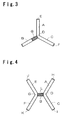
- An embodiment of the second aspect of the present invention is such that, in a conduit wherein i) first (A in Fig. 3), second (B in Fig. 3), and third (C in Fig. 3) microchannels intersect one another at an intersection (D in Fig. 3), ii) the first and third microchannels have first (E in Fig. 3) and third (F in Fig. 3) openings, respectively, which can be opened or closed, iii) the intersection and the second microchannel have a portion having a specific volume (G in Fig. 3), which regulates the specific amount of the liquid filled therein, a specific amount of a liquid can be transported by performing a process comprising the following steps:
- the shape of the above-mentioned opening is not particularly restricted, and the opening can be located at an optional location as long as it does not hinder the transportation of the liquid.
- the method for opening or closing the above-mentioned opening is also not particularly restricted, and it can be performed by sliding a plate provided with an appropriate sealing means.
- the liquid transportation of the above-mentioned process can be performed by controlling the pressure of a gas or a liquid filled in the microchannel.
- the method to control the pressure of the gas or the liquid is not particularly restricted, and it can be performed by introducing a magnetic fluid in the microchannel and applying a magnetic field to the magnetic fluid.
- the magnetic fluid is a liquid having ferromagnetic fine particles stably dispersed therein, and is not particularly restricted in terms of the ferromagnetic fine particles, the solvent and the method for dispersion. However, it is preferably one having fine particles of iron oxide (Fe 3 O 4 , particle diameter: about 10 nm) dispersed by a surface active agent.
- a commercial product such as APG 832, EXP 96009, or EXP 86008 (manufactured by Ferrotec Corp.) can be used.
- the method for applying a magnetic field is not particularly restricted, and it may be a method wherein a magnetic field is relatively moved by using an electromagnet or a permanent magnet. In a case where an electromagnet is used, the method using magnetic array elements may be arranged along the conduit.
- Another embodiment of the second aspect of the present invention is such that, in a conduit wherein i) first (A in Fig. 4), second (B in Fig. 4), and third (C in Fig. 4) microchannels intersect one another at a first intersection (D in Fig. 4), and the second microchannel and a fourth microchannel (E in Fig. 4) and a fifth microchannel (F in Fig. 4) intersect one another at a second intersection (G in Fig. 4), ii) the first, third, fourth and fifth microchannels have first (H in Fig. 4), third (I in Fig. 4), fourth (J in Fig. 4) and fifth (K in Fig.
- the second channel having its both ends at the first intersection and at the second intersection, has a specific volume and regulates the specific volume of the liquid filled in the specific volume portion (L in Fig. 4), a specific amount of a liquid can be transported by performing a process comprising the following steps:
- the present invention is effective as a transportation method of the specific amount of liquid, which can be used to miniaturize and integrate such analytical means as represented by an antibody antigen reaction or a nucleic acid amplification reaction on an optional substrate.
- a microchannel pattern used is shown in Figs. 5(i) to 5(v).
- the pattern comprising microchannels (9, 10, 11, 12, 13, 14 and 15, width: 0.5 mm, depth: 0.5 mm) and openings (16, 17, 18, 19 and 20, diameter: 5 mm, depth: 2 mm) was formed.
- a magnet a neodium magnet (21, 12 ⁇ 7 ⁇ 4 mm angular shape, surface magnetic flux density: 3,500 G) was used. Opening or closing of the openings was performed by sliding a glass plate transversely over the openings. Sealing was improved by applying a silicon grease to the glass plate.
- the present invention provides a simple liquid transportation method without requiring high electric voltage or special external equipment, and a method for transporting liquid based on this transportation method.
- the liquid transportation method comprises a step of introducing a magnetic fluid and a liquid to be transported into a conduit or a chamber connected thereto so that the magnetic fluid and the liquid to be transported are in contact with each other directly or indirectly via a medium, a step of moving the magnetic fluid by applying a magnetic field, and a step of moving above-mentioned liquid to be transported by letting it follow the movement of the magnetic fluid.
- the present invention also provides a simple transportation method of a specific amount of liquid without requiring high voltage or incorporation of specific actuator components such as valves.
- opening and closing of the openings and liquid transportation are carried out in a controlled order, so that only a specific amount from a liquid introduced in an unspecific amount, is transported.
Landscapes
- Engineering & Computer Science (AREA)
- Chemical & Material Sciences (AREA)
- General Engineering & Computer Science (AREA)
- Health & Medical Sciences (AREA)
- Mechanical Engineering (AREA)
- Analytical Chemistry (AREA)
- Clinical Laboratory Science (AREA)
- Chemical Kinetics & Catalysis (AREA)
- Hematology (AREA)
- General Health & Medical Sciences (AREA)
- Dispersion Chemistry (AREA)
- Automatic Analysis And Handling Materials Therefor (AREA)
- Physical Or Chemical Processes And Apparatus (AREA)
Abstract
Description

The present invention also provides a simple transportation method of a specific amount of liquid without requiring high voltage or incorporation of specific actuator components such as valves. Using a conduit wherein at least three microchannels intersect one another and at least two of them have openings which can be opened or closed, opening and closing of the openings and liquid transportation are carried out in a controlled order, so that only a specific amount from a liquid introduced in an unspecific amount, is transported.
Claims (11)
- A method for transporting a liquid, which comprises transporting a liquid to be transported, in a conduit comprising a microchannel, or in a chamber connected to the conduit, by using a magnetic fluid as a piston.
- The method for transporting a liquid according to Claim 1, which comprises the following steps:(1) a step of introducing the magnetic fluid and the liquid to be transported, into the conduit or the chamber connected thereto, so that the magnetic fluid and the liquid to be transported, are in contact with each other directly or indirectly via a medium,(2) a step of moving said magnetic fluid by applying a magnetic field, and(3) a step of moving the liquid to be transported by letting it follow the movement of the magnetic fluid.
- The method for transporting a liquid according to Claim 2, wherein said medium is either a gas or a liquid and is insoluble to said magnetic fluid and to said liquid to be transported.
- A microreactor comprising the following constituting elements:(1) a conduit comprising a microchannel,(2) a chamber connected to said conduit,(3) a magnetic fluid and a liquid to be transported, introduced into the conduit or the chamber connected thereto, so that the magnetic fluid and the liquid to be transported are in contact directly or indirectly via a medium, and(4) a magnet to apply a magnetic field to said magnetic fluid thereby to move the magnetic fluid.
- The microreactor according to Claim 4, wherein the conduit intersects another conduit or a chamber different from the one mentioned above, so that at least two types of liquids to be transported can be mixed at the intersection.
- The microreactor according to Claim 5, wherein said at least two types of liquids to be transported, are moved by the magnetic fluid moved solely by applying a magnetic field.
- A method for transporting a liquid, which is a method for transporting a specific amount of an optional liquid, using a conduit wherein at least three microchannels intersect one another, and at least two of them have openings which can be opened or closed, wherein opening and closing of the openings and transportation of the liquid are carried out in a controlled order, so that a specific amount from the liquid introduced in an unspecified amount is transported.
- The method for transporting a liquid according to Claim 7, which is a method for transporting a specific amount of an optional liquid, using a conduit wherein i) first, second and third microchannels intersect one another at one intersection, ii) the first and third microchannels have first and third openings, respectively, which can be opened or closed, iii) the intersection and the second microchannel have a portion having a specific volume, which regulates the amount of the liquid filled therein, wherein a specific amount of a liquid is transported by performing a process comprising the following steps:(1) opening the first opening, and closing the third opening,(2) introducing an optional liquid into the first microchannel, and transporting the liquid until its front fills the specific volume portion,(3) closing the first opening, and opening the third opening, and(4) transporting the liquid filled in the specific volume portion of the second microchannel to the third microchannel.
- The method for transporting a liquid according to Claim 7, which is a method for transporting a specific amount of an optional liquid, using a conduit wherein, i) first, second and third microchannels intersect one another at a first intersection, and the second microchannel, a fourth microchannel and a fifth microchannel intersect one another at a second intersection, ii) the first, third, fourth and fifth microchannels have first, third, fourth and fifth openings, respectively, which can be opened or closed, iii) the first intersection, the second intersection and the second microchannel have a portion having a specific volume, which regulates the amount of the liquid filled therein, whereby a specific amount of a liquid is transported by performing a process comprising the following steps:(1) opening the first and fifth openings, and closing the third and fourth openings,(2) introducing an optional liquid into the first microchannel, and transporting the liquid so that the specific volume portion is filled with the liquid,(3) closing the first and fifth openings, and opening the third and fourth openings, and(4) transporting the liquid filled in the specific volume portion to the third microchannel.
- The method for transporting a liquid according to any one of Claims 7 to 9, wherein the transportation of the liquid is performed by controlling the pressure of a gas or a liquid filled in the microchannels.
- The method for transporting a liquid according to Claim 10, wherein the pressure control of the gas or the liquid is performed by introducing a magnetic fluid in the microchannels, and applying a magnetic field to the magnetic fluid.
Applications Claiming Priority (4)
| Application Number | Priority Date | Filing Date | Title |
|---|---|---|---|
| JP2001194729A JP2003014772A (en) | 2001-06-27 | 2001-06-27 | Liquid transport method and microreactor |
| JP2001194729 | 2001-06-27 | ||
| JP2001237650 | 2001-08-06 | ||
| JP2001237650A JP2003050245A (en) | 2001-08-06 | 2001-08-06 | How to transport a specific amount of liquid |
Publications (2)
| Publication Number | Publication Date |
|---|---|
| EP1270066A2 true EP1270066A2 (en) | 2003-01-02 |
| EP1270066A3 EP1270066A3 (en) | 2004-06-30 |
Family
ID=26617651
Family Applications (1)
| Application Number | Title | Priority Date | Filing Date |
|---|---|---|---|
| EP02014246A Withdrawn EP1270066A3 (en) | 2001-06-27 | 2002-06-26 | Method for transporting liquid, and microreactor |
Country Status (2)
| Country | Link |
|---|---|
| US (1) | US20030026705A1 (en) |
| EP (1) | EP1270066A3 (en) |
Cited By (5)
| Publication number | Priority date | Publication date | Assignee | Title |
|---|---|---|---|---|
| WO2004018350A1 (en) * | 2002-08-23 | 2004-03-04 | Yuichi Shibata | Method and apparatus for controlling minute amount of fluid |
| DE102004009985A1 (en) * | 2004-03-01 | 2005-09-22 | Fraunhofer-Gesellschaft zur Förderung der angewandten Forschung e.V. | Magnetic manipulation of biological samples |
| WO2008104262A2 (en) | 2007-02-26 | 2008-09-04 | Fraunhofer-Gesellschaft zur Förderung der angewandten Forschung e.V. | Manipulation device and manipulation method for a biological sample |
| FR2934361A1 (en) * | 2008-07-22 | 2010-01-29 | Commissariat Energie Atomique | DEVICE FOR VARYING THE PRESSURE OF A PNEUMATIC FLUID BY DISPLACING LIQUID DROPS AND HEAT PUMP USING SUCH A DEVICE |
| US8372658B2 (en) | 2004-01-15 | 2013-02-12 | Japan Science And Technology Agency | Chemical analytic apparatus and chemical analytic method |
Families Citing this family (2)
| Publication number | Priority date | Publication date | Assignee | Title |
|---|---|---|---|---|
| DE102009001612B9 (en) * | 2009-03-17 | 2012-03-08 | Si Analytics Gmbh | Method and apparatus for generating constant pulsation-free fluid streams for microfluidic applications |
| US10122836B2 (en) * | 2016-09-28 | 2018-11-06 | Intel Corporation | Magnetic convection cooling for handheld device |
Family Cites Families (4)
| Publication number | Priority date | Publication date | Assignee | Title |
|---|---|---|---|---|
| US5856174A (en) * | 1995-06-29 | 1999-01-05 | Affymetrix, Inc. | Integrated nucleic acid diagnostic device |
| JPH09287571A (en) * | 1996-04-18 | 1997-11-04 | Fuji Electric Co Ltd | Micro pump |
| WO2001026813A2 (en) * | 1999-10-08 | 2001-04-19 | Micronics, Inc. | Microfluidics without electrically of mechanically operated pumps |
| US6408884B1 (en) * | 1999-12-15 | 2002-06-25 | University Of Washington | Magnetically actuated fluid handling devices for microfluidic applications |
-
2002
- 2002-06-20 US US10/174,993 patent/US20030026705A1/en not_active Abandoned
- 2002-06-26 EP EP02014246A patent/EP1270066A3/en not_active Withdrawn
Cited By (8)
| Publication number | Priority date | Publication date | Assignee | Title |
|---|---|---|---|---|
| WO2004018350A1 (en) * | 2002-08-23 | 2004-03-04 | Yuichi Shibata | Method and apparatus for controlling minute amount of fluid |
| US8372658B2 (en) | 2004-01-15 | 2013-02-12 | Japan Science And Technology Agency | Chemical analytic apparatus and chemical analytic method |
| DE102004009985A1 (en) * | 2004-03-01 | 2005-09-22 | Fraunhofer-Gesellschaft zur Förderung der angewandten Forschung e.V. | Magnetic manipulation of biological samples |
| WO2008104262A2 (en) | 2007-02-26 | 2008-09-04 | Fraunhofer-Gesellschaft zur Förderung der angewandten Forschung e.V. | Manipulation device and manipulation method for a biological sample |
| WO2008104262A3 (en) * | 2007-02-26 | 2008-10-16 | Fraunhofer Ges Forschung | Manipulation device and manipulation method for a biological sample |
| FR2934361A1 (en) * | 2008-07-22 | 2010-01-29 | Commissariat Energie Atomique | DEVICE FOR VARYING THE PRESSURE OF A PNEUMATIC FLUID BY DISPLACING LIQUID DROPS AND HEAT PUMP USING SUCH A DEVICE |
| WO2010010102A3 (en) * | 2008-07-22 | 2010-04-01 | Commissariat A L'energie Atomique | Device for varying the pressure of a pneumatic fluid by displacing drops of liquid and heat pump using such a device |
| US9151520B2 (en) | 2008-07-22 | 2015-10-06 | Commissariat A L'energie Atomique Et Aux Energies Alternatives | Device for varying the pressure of a pneumatic fluid through displacement of liquid droplets and heat pump using such a device |
Also Published As
| Publication number | Publication date |
|---|---|
| EP1270066A3 (en) | 2004-06-30 |
| US20030026705A1 (en) | 2003-02-06 |
Similar Documents
| Publication | Publication Date | Title |
|---|---|---|
| Sato et al. | Microchip‐based immunoassay system with branching multichannels for simultaneous determination of interferon‐γ | |
| EP1409989B1 (en) | Method for separating components of a mixture | |
| US8317990B2 (en) | Droplet actuator loading and target concentration | |
| JP5124054B2 (en) | Microfluidic devices and systems incorporating protective layers | |
| CN101317086B (en) | Microfluidic detection of analytes | |
| KR20100014917A (en) | Droplet actuator devices and methods employing magnetic beads | |
| US6783992B2 (en) | Methods and using chemico-mechanical microvalve devices for the selective separation of components from multi-component fluid samples | |
| US20050023156A1 (en) | Nanostructured material transport devices and their fabrication by application of molecular coatings to nanoscale channels | |
| CA2306138A1 (en) | Method for enhancing fluorescence | |
| Hervas et al. | Electrochemical immunosensing on board microfluidic chip platforms | |
| CA2504544A1 (en) | Microfluidic system utilizing thin-film layers to route fluid | |
| US20020076350A1 (en) | Microfluidic devices for rotational manipulation of the fluidic interface between multiple flow streams | |
| WO1998056505A1 (en) | Methods and apparatus for in situ concentration and/or dilution of materials in microfluidic systems | |
| CN108139418A (en) | Subject processing chip, subject processing unit and subject processing method | |
| EP3366374B1 (en) | Liquid sending method and liquid sending apparatus | |
| WO2018200896A1 (en) | Fluidic devices with reaction wells and uses thereof | |
| US20090253215A1 (en) | Method for controlling the flow of liquids containing biological material by inducing electro- or magneto-rheological effect | |
| US20030026705A1 (en) | Method for transporting liquid, and microreactor | |
| Huang et al. | Programmable droplet microfluidics for complex multistep bioassays | |
| WO2024061373A1 (en) | Digital micro-fluidic apparatus, driving method therefor, and use thereof | |
| Kuramitz et al. | Application of an automated fluidic system using electrochemical bead-based immunoassay to detect the bacteriophage MS2 and ovalbumin | |
| Sabbagh et al. | Enhancing commercially available immunoassays through a customized electrokinetic biomolecular preconcentration device | |
| Besselink et al. | Electroosmotic guiding of sample flows in a laminar flow chamber | |
| Mavrakis et al. | A chip-based supersonic microfluidic nebulizer for efficient sample introduction into inductively coupled plasma–Mass spectrometry | |
| JP2003014772A (en) | Liquid transport method and microreactor |
Legal Events
| Date | Code | Title | Description |
|---|---|---|---|
| PUAI | Public reference made under article 153(3) epc to a published international application that has entered the european phase |
Free format text: ORIGINAL CODE: 0009012 |
|
| AK | Designated contracting states |
Kind code of ref document: A2 Designated state(s): AT BE CH CY DE DK ES FI FR GB GR IE IT LI LU MC NL PT SE TR |
|
| AX | Request for extension of the european patent |
Free format text: AL;LT;LV;MK;RO;SI |
|
| PUAL | Search report despatched |
Free format text: ORIGINAL CODE: 0009013 |
|
| AK | Designated contracting states |
Kind code of ref document: A3 Designated state(s): AT BE CH CY DE DK ES FI FR GB GR IE IT LI LU MC NL PT SE TR |
|
| AX | Request for extension of the european patent |
Extension state: AL LT LV MK RO SI |
|
| 17P | Request for examination filed |
Effective date: 20041229 |
|
| AKX | Designation fees paid |
Designated state(s): DE FR GB IT |
|
| STAA | Information on the status of an ep patent application or granted ep patent |
Free format text: STATUS: THE APPLICATION IS DEEMED TO BE WITHDRAWN |
|
| 18D | Application deemed to be withdrawn |
Effective date: 20070103 |