EP1270019A1 - Method and kit for removing aldehyde-based stains - Google Patents
Method and kit for removing aldehyde-based stains Download PDFInfo
- Publication number
- EP1270019A1 EP1270019A1 EP02254539A EP02254539A EP1270019A1 EP 1270019 A1 EP1270019 A1 EP 1270019A1 EP 02254539 A EP02254539 A EP 02254539A EP 02254539 A EP02254539 A EP 02254539A EP 1270019 A1 EP1270019 A1 EP 1270019A1
- Authority
- EP
- European Patent Office
- Prior art keywords
- aldehyde
- kit
- reducing agent
- group
- solution
- Prior art date
- Legal status (The legal status is an assumption and is not a legal conclusion. Google has not performed a legal analysis and makes no representation as to the accuracy of the status listed.)
- Granted
Links
Classifications
-
- C—CHEMISTRY; METALLURGY
- C07—ORGANIC CHEMISTRY
- C07C—ACYCLIC OR CARBOCYCLIC COMPOUNDS
- C07C45/00—Preparation of compounds having >C = O groups bound only to carbon or hydrogen atoms; Preparation of chelates of such compounds
- C07C45/78—Separation; Purification; Stabilisation; Use of additives
-
- A—HUMAN NECESSITIES
- A61—MEDICAL OR VETERINARY SCIENCE; HYGIENE
- A61L—METHODS OR APPARATUS FOR STERILISING MATERIALS OR OBJECTS IN GENERAL; DISINFECTION, STERILISATION OR DEODORISATION OF AIR; CHEMICAL ASPECTS OF BANDAGES, DRESSINGS, ABSORBENT PADS OR SURGICAL ARTICLES; MATERIALS FOR BANDAGES, DRESSINGS, ABSORBENT PADS OR SURGICAL ARTICLES
- A61L2/00—Disinfection or sterilisation of materials or objects, in general; Accessories therefor
- A61L2/16—Disinfection or sterilisation of materials or objects, in general; Accessories therefor using chemical substances
-
- A—HUMAN NECESSITIES
- A61—MEDICAL OR VETERINARY SCIENCE; HYGIENE
- A61L—METHODS OR APPARATUS FOR STERILISING MATERIALS OR OBJECTS IN GENERAL; DISINFECTION, STERILISATION OR DEODORISATION OF AIR; CHEMICAL ASPECTS OF BANDAGES, DRESSINGS, ABSORBENT PADS OR SURGICAL ARTICLES; MATERIALS FOR BANDAGES, DRESSINGS, ABSORBENT PADS OR SURGICAL ARTICLES
- A61L2/00—Disinfection or sterilisation of materials or objects, in general; Accessories therefor
- A61L2/16—Disinfection or sterilisation of materials or objects, in general; Accessories therefor using chemical substances
- A61L2/20—Gaseous substances, e.g. vapours
- A61L2/204—Formaldehyde
-
- A—HUMAN NECESSITIES
- A62—LIFE-SAVING; FIRE-FIGHTING
- A62D—CHEMICAL MEANS FOR EXTINGUISHING FIRES OR FOR COMBATING OR PROTECTING AGAINST HARMFUL CHEMICAL AGENTS; CHEMICAL MATERIALS FOR USE IN BREATHING APPARATUS
- A62D3/00—Processes for making harmful chemical substances harmless or less harmful, by effecting a chemical change in the substances
- A62D3/30—Processes for making harmful chemical substances harmless or less harmful, by effecting a chemical change in the substances by reacting with chemical agents
-
- C—CHEMISTRY; METALLURGY
- C07—ORGANIC CHEMISTRY
- C07C—ACYCLIC OR CARBOCYCLIC COMPOUNDS
- C07C227/00—Preparation of compounds containing amino and carboxyl groups bound to the same carbon skeleton
- C07C227/14—Preparation of compounds containing amino and carboxyl groups bound to the same carbon skeleton from compounds containing already amino and carboxyl groups or derivatives thereof
- C07C227/18—Preparation of compounds containing amino and carboxyl groups bound to the same carbon skeleton from compounds containing already amino and carboxyl groups or derivatives thereof by reactions involving amino or carboxyl groups, e.g. hydrolysis of esters or amides, by formation of halides, salts or esters
-
- A—HUMAN NECESSITIES
- A62—LIFE-SAVING; FIRE-FIGHTING
- A62D—CHEMICAL MEANS FOR EXTINGUISHING FIRES OR FOR COMBATING OR PROTECTING AGAINST HARMFUL CHEMICAL AGENTS; CHEMICAL MATERIALS FOR USE IN BREATHING APPARATUS
- A62D2101/00—Harmful chemical substances made harmless, or less harmful, by effecting chemical change
- A62D2101/20—Organic substances
- A62D2101/28—Organic substances containing oxygen, sulfur, selenium or tellurium, i.e. chalcogen
Definitions
- the invention relates to a method and kit for removing or lessening the severity of aldehyde-based stains, in particular, stains formed by reaction of aldehydes with amino-containing compounds.
- Aldehyde-based germicides are commonly used in the healthcare facilities to disinfect and sterilize medical devices.
- aldehyde-based germicides such as formaldehyde, glutaraldehyde and ortho -phthalaldehyde (OPA) that have been reacted with amino-containing compounds is that the surfaces and/or the material that come into contact with the neutralized aldehyde become stained. Also residual aldehyde on surfaces or absorbed into the materials such as plastic will cause staining later when exposed to amino-containing compounds. This is a problem in a hospital environment when sterile surfaces and/or materials that are stained can cause concern that the devices are not sterile.
- Such surfaces include but or not limited to bench tops, floor surfaces, medical devices (metal or plastic) and human skin.
- OPA related stains are the results of formation of Schiff's bases which are dark in color. Although the staining in the hospital environment is very problematic, there are no good measures to solve the problem at present. This invention offers solutions to this problem.
- the invention relates to a method for removing or lessening the severity of aldehyde-based stains on surfaces or in materials comprising the steps of:
- the invention is removal of aldehyde-based stains to no stain or at least to a stain of lessened severity or intensity.
- This invention is effective even for porous surfaces such as filter paper and porous nylon films as well as for smooth surfaces such as glass, aluminum, copper, brass and stainless steel.
- the invention may be used in a variety of formats such as a kit useful for making or using solutions or gels.
- amino acids that are useful in neutralizing aldehydes. These amino acids include:
- the aldehyde can be a germicide that includes formaldehyde, glutaraldehyde, and OPA.
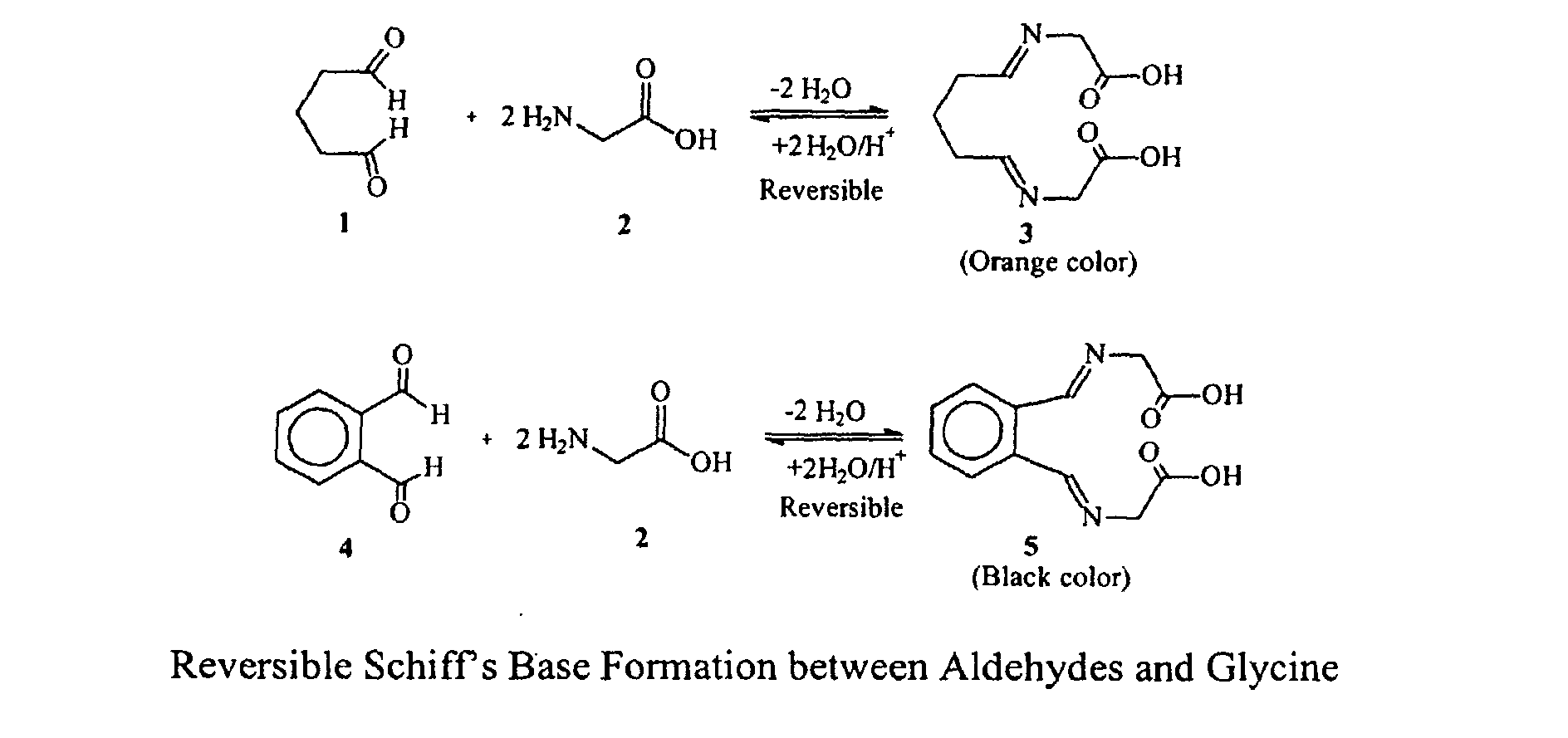
- Schiff's base (3) and (5) do not have the above characteristics and are likely very different compounds.
- One skilled in the art would suspect Schiff's bases to be harder to degrade in nature than the corresponding amino acids.
- a piece of animal skin could decay in a few days in the wild while men's belts, made from animal skin too, could take many years. This is because the belt (leather) has undergone a tanning process.
- Tanning processes often employ the glutaraldehyde derivatives, such as depicted as structures (9) and (10) below, to cross-link proteins (Ref. a. Fein, M. L. and Filachione, E. M., "Tanning studies with aldehydes", J. Am. Leather Chem. Assoc.
- the conditions for Schiff's base reduction (and hence the removal or lessening of stains) is easy and convenient. Normally, it involves the mixing of the reducing agent, such as NaBH 4 , and the imine, such as neutralized aldehyde, in a protonic solvent, such as water, ethanol, methanol, acid, or gel at room temperature.
- the acid may be organic or inorganic having active hydrogens. Due to the formation of colorless or light-colored products between the reducing agent and the imine, it is found that the reducing agent is a good chemical for removing the stains.
- the reducing agent can be applied to the stains by washing, spraying or dropping a solution containing the reducing agent onto the stained surface, by soaking the stained material in the solution containing the reducing agent, or by rubbing a gel or lotion comprising the reducing agent onto the stained surface or into the stained material.
- the imine can be reduced by many reducing agents, such as LiAlH 4 (lithium aluminum hydride), NaBH 4 (sodium borohydride), NaCNBH 3 (sodium cyanoborohydride), Na-EtOH (metallic sodium in ethyl alcohol), and H 2 /catalyst (hydrogen with a catalyst).
- reducing agents such as LiAlH 4 (lithium aluminum hydride), NaBH 4 (sodium borohydride), NaCNBH 3 (sodium cyanoborohydride), Na-EtOH (metallic sodium in ethyl alcohol), and H 2 /catalyst (hydrogen with a catalyst).
- a preferred reducing agent is NaBH 4 .
- Example 5 was duplicated with brass coupons with even better results. The brown-black residue came off instantly while that on the control coupon came off only partially and the remainder came off very slowly and it remained even after soaking in water for 2 days.
- Example 5 was duplicated with copper coupons. The same excellent result was observed as in Example 5.
- Example 5 was duplicated with stainless steel surfaces. Thee same excellent result was observed as in Example 5.
- Example 11 was duplicated with a slight modification. Instead of water, 50% ethanol in water was used as the solvent. In this case, compared to the control (water as solvent), the de-staining rate is somewhat faster.
- Sodium borohydride powder (0.5-5g) is packed in bottles. Cap well. Add water before use (to dilute to near 1%).
- Sodium borohydride powder (0.5-5g) is packed in bottles. Cap well. Add mixture of water or an alcohol (ethanol, or isopropanol or methanol or mixed alcohol) before use (to dilute to near 1%).
- Sodium borohydride powder 0.5-5g
- an amino acid such as glycine, lysine etc
- a mixture of water or an alcohol ethanol, or isopropanol or methanol or mixed alcohol
- a container in the form of a spray bottle or bottle with a dropper may be used for formats 14-1 to 14-3.
- the sodium borohydride powder could be packed into aluminum bags or other types of bags to reduce product sizes.
- Nitrogen or another inert gas could be filled into the packaging formats in order to increase shelf life.
- Desiccators could be used for the above packaging formats in order to increase shelf life.
- reducing agents such as sodium cyanoborohydride, metallic sodium in ethyl alcohol, and H 2 /catalyst.
- kits wherein the dry powder form of the reducing agent may be combined with a solvent such as water, alcohol, or mixtures thereof, to form a solution of desired concentration and pH.
- a solvent such as water, alcohol, or mixtures thereof
- Instructions within the kit would provide guidance regarding the proper amount of reducing agent to be combined with the solvent in order to provide a solution of effective strength to remove or lessen aldehyde-based stains.
- the resulting solutions may be used as soaking, wiping, or spraying solutions to treat the stained surfaces, for example, of medical devices, bench or table tops, floors and skin (if in appropriate pH range), etc.
Landscapes
- Chemical & Material Sciences (AREA)
- Health & Medical Sciences (AREA)
- Organic Chemistry (AREA)
- Chemical Kinetics & Catalysis (AREA)
- General Health & Medical Sciences (AREA)
- General Chemical & Material Sciences (AREA)
- Public Health (AREA)
- Animal Behavior & Ethology (AREA)
- Life Sciences & Earth Sciences (AREA)
- Veterinary Medicine (AREA)
- Epidemiology (AREA)
- Toxicology (AREA)
- Business, Economics & Management (AREA)
- Emergency Management (AREA)
- Detergent Compositions (AREA)
- Coloring (AREA)
- Apparatus For Disinfection Or Sterilisation (AREA)
Abstract
Description
- The invention relates to a method and kit for removing or lessening the severity of aldehyde-based stains, in particular, stains formed by reaction of aldehydes with amino-containing compounds.
- Aldehyde-based germicides are commonly used in the healthcare facilities to disinfect and sterilize medical devices. One related problem associated with the use of aldehyde-based germicides such as formaldehyde, glutaraldehyde and ortho-phthalaldehyde (OPA) that have been reacted with amino-containing compounds is that the surfaces and/or the material that come into contact with the neutralized aldehyde become stained. Also residual aldehyde on surfaces or absorbed into the materials such as plastic will cause staining later when exposed to amino-containing compounds. This is a problem in a hospital environment when sterile surfaces and/or materials that are stained can cause concern that the devices are not sterile. Such surfaces include but or not limited to bench tops, floor surfaces, medical devices (metal or plastic) and human skin. Some OPA related stains are the results of formation of Schiff's bases which are dark in color. Although the staining in the hospital environment is very problematic, there are no good measures to solve the problem at present. This invention offers solutions to this problem.
- In one embodiment the invention relates to a method for removing or lessening the severity of aldehyde-based stains on surfaces or in materials comprising the steps of:
- a) providing an aldehyde-based stain on a surface or in a material; and
- b) applying a reducing agent to the stained surface or material.
In another embodiment, the invention relates to a kit comprising:
- a) a source of reducing agent; and
- b) instructions regarding the proper amount of reducing agent to be combined with a solvent or a gel in order to provide a solution or a suspension of effective strength to remove or lessen aldehyde-based stains.
-
- Among the advantages of the invention is removal of aldehyde-based stains to no stain or at least to a stain of lessened severity or intensity. This invention is effective even for porous surfaces such as filter paper and porous nylon films as well as for smooth surfaces such as glass, aluminum, copper, brass and stainless steel. Also, the invention may be used in a variety of formats such as a kit useful for making or using solutions or gels.
- Additional features, embodiments, and benefits of the invention will be evident in view of the detailed description presented below.
- Commonly assigned and co-pending patent application USSN 09/321,964 discloses the neutralization of aldehdye with amino acid. The neutralized aldehyde product can be formed by reacting an amino group from an amino acid or proteins with an aldehyde group of aldehydes to produce N-substituted adducts (imines or Schiff's bases) as shown below.

- There are a variety of amino acids that are useful in neutralizing aldehydes. These amino acids include:
- (1) Amino acids with apolar R groups (e.g., alanine, proline, amino-caproic acid, phenylalanine, tryptophan and methionine);
- (2) Amino acids with polar R groups (e.g., glycine, serine, cysteine, tyrosine, and glutamine);
- (3) Amino acids with charged R groups (e.g., aspartic acid, glutamic acid, lysine, arginine, and histidine); and,
- (4) Peptides/polypeptides formed by any number or any type of amino acids and proteins.
-
- The aldehyde can be a germicide that includes formaldehyde, glutaraldehyde, and OPA.
- While the discovery of forming neutralized aldehydes for lessening the toxic effects of disposing of aldehyde treated waste was a major advance, resulting colored products (and hence susceptibility to forming stains) and the possibility of the neutralized aldehydes in reforming aldehydes under acidic conditions posed a problem in effectively maintaining nonhazardous waste because of the toxic effects of unneutralized aldehyde. The reversible reaction is depicted below for treatment of glutaraldehyde (1) and o-phthaladehyde (4) with the amino acid, glycine (2) to the neutralized products, (3) and (5), respectively:
- Commonly assigned and co-pending patent application USSN 09/747,230 discloses that the treatment of the neutralized products with a reducing agent to form amino acids do not cause them to revert back to unneutralized aldehyde. This reaction is depicted below for saturated moieties (6) and (7) as for the reduction of Schiff's bases (3) and (5) treated with the reducing agent sodium borohydride, NaBH4:


- Being simple amino acids compounds (6) and (7) would be expected to be biodegradable and thus have significant benefit for the environment. This appears apparent by examination of the resemblance of the structures (6) and (7) with the natural essential amino acid proline, (8). The corresponding resemblance is depicted with bold-faced highlighting of compounds (6) and (7) shown below:The Resemblance of Natural Amino Acid 8 with Amino Acid 6 and 7

- In contrast, Schiff's base (3) and (5) do not have the above characteristics and are likely very different compounds. One skilled in the art would suspect Schiff's bases to be harder to degrade in nature than the corresponding amino acids. For example, a piece of animal skin could decay in a few days in the wild while men's belts, made from animal skin too, could take many years. This is because the belt (leather) has undergone a tanning process. Tanning processes often employ the glutaraldehyde derivatives, such as depicted as structures (9) and (10) below, to cross-link proteins (Ref. a. Fein, M. L. and Filachione, E. M., "Tanning studies with aldehydes", J. Am. Leather Chem. Assoc., 52, 17, 1957; b. Weligsberger, L. and Sadlier, C., "New developments in tanning with aldehydes", J. Am. Leather Chem. Assoc., 52, 2, 1957; c. Hopwood, D., "Comparison of crosslinking abilities of glutaraldehyde, formaldehyde, and α-hydroxyadipaldehyde with bovine serum albumin and casein", Histochemie, 17, 151, 1969). It is well known that OPA has very similar protein cross-liking properties.

- The conditions for Schiff's base reduction (and hence the removal or lessening of stains) is easy and convenient. Normally, it involves the mixing of the reducing agent, such as NaBH4, and the imine, such as neutralized aldehyde, in a protonic solvent, such as water, ethanol, methanol, acid, or gel at room temperature. The acid may be organic or inorganic having active hydrogens. Due to the formation of colorless or light-colored products between the reducing agent and the imine, it is found that the reducing agent is a good chemical for removing the stains. The reducing agent can be applied to the stains by washing, spraying or dropping a solution containing the reducing agent onto the stained surface, by soaking the stained material in the solution containing the reducing agent, or by rubbing a gel or lotion comprising the reducing agent onto the stained surface or into the stained material.
- The imine can be reduced by many reducing agents, such as LiAlH4 (lithium aluminum hydride), NaBH4 (sodium borohydride), NaCNBH3 (sodium cyanoborohydride), Na-EtOH (metallic sodium in ethyl alcohol), and H2/catalyst (hydrogen with a catalyst). A preferred reducing agent is NaBH4.
- In the following examples, all percentages (%) referring to solutions are expressed as wt/vol, except in the case of Cidex® OPA where the percentages is expressed as wt/wt. The pH of the 1% aqueous sodium borohydride solution used in the following examples was measured to be 10.8.
-
- (a) Cidex® OPA solution (0.55%, 1.0 mL) and glycine solution (1%, 1.0 mL) were mixed in a vial for 2 minutes and a green color developed and darkened quickly.
- (b) Sodium borohydride solution (1%, 1.0mL) was added, shaken and mixed to the solution. The solution gradually became yellow and never darkened. The solution never turned black. Thus, the severity or intensity of the staining solution of (a) was lessened by the reducing agent sodium borohydride.
-
-
- (a) Cidex® OPA solution (0.55%, 0.05mL) was applied to porous nylon film for about 10 minutes at room temperature (until dry). Glycine (1%, 0.05mL) was applied on the top of the Cidex® OPA spot. In about 10 minutes, the spot showed a green-black color.
- (b) Sodium borohydride solution (1%, 0.15mL) was applied onto the top of the green-black spot. The green-black spot was de-stained immediately to turn to a much lighter color (yellowish brown).
-
-
- (a) Cidex® OPA (0.55%, 0.05mL) was applied on porous nylon film and dried in about 2 hours at room temperature. Glycine (1%, 0.05mL) was added on the top of the Cidex® OPA spot and after 2 minutes, the spot became green-black.
- (b) The stained nylon film was then soaked in sodium borohydride solution (1%, 10 mL) for 10 minutes, the green-black spot changed to a light-yellow spot. The color was noted to continue to fade with continued soaking.
- (c) For comparison, the same experiment was repeated. However, instead of soaking in the sodium borohydride solution, the film was soaked in the water for 10 minutes. No reduction of the green-black color was observed. In fact, the green-black color never faded by soaking in water for 2 days.
-
-
- (a) Cidex® OPA solution (0.55%, 0.05mL) was applied to filter paper ("Fisherbrand", qualitative P2, porosity: fine) and dried at room temperature for two hours. Glycine (1%, 0.05mL) was added on the top of the Cidex® OPA spot and after about 2 minutes, the spot became a green-black color.
- (b) The stained filter paper was soaked in sodium borohydride solution (1%, 10 mL) for 5 minutes when the green-black spot changed to very light-yellow spot. The spot became colorless when the soaking continued for 2 hours.
- (c) For comparison, the same experiment was repeated. However, instead of soaking in sodium borohydride solution, the filter paper was soaked in the water for 10 minutes. No reduction of the green-black color was observed. In fact, the green-black color never faded even after soaking in water for 2 days.
-
-
- (a) Cidex® OPA solution (0.55%, 0.05mL) was applied to two (2) aluminum coupons (1x1 inches) and glycine (1%, 0.05mL) was added on the top of the Cidex® OPA spots. The aluminum coupons were then heated at 80°C for 2 hours. A brown-black residual spot formed on each coupon.
- (b) One coupon was then soaked in sodium borohydride solution (1%, 10 mL) at room temperature. Surprisingly, the black residue on the aluminum surface disappeared instantly (less than 3 seconds). The solution became clear yellow. The surprisingly good result on the metal surface was not expected.
- (c) The other coupon, the control coupon, was soaked in 10 mL water, where most of the brown-black residue dissolved gradually. However, there was still residue left on the coupon after 3 hours. The solution became dark green with black residue deposit on the bottom of the vial.
-
- Example 5 was duplicated with brass coupons with even better results. The brown-black residue came off instantly while that on the control coupon came off only partially and the remainder came off very slowly and it remained even after soaking in water for 2 days.
- Example 5 was duplicated with copper coupons. The same excellent result was observed as in Example 5.
- Example 5 was duplicated with stainless steel surfaces. Thee same excellent result was observed as in Example 5.
-
- (a) Cidex® OPA solution (0.55%, 0.05mL) was added into a scintillation vial and glycine (1%, 0.05mL) was added and mixed. The solution was heated at 80°C for 1 hour and a black residue was left on the bottom of the vial.
- (b) Sodium borohydride solution (1%, 2 mL) was then added and the black residue was dissolved instantly to give a clear yellowish-brown solution (no green or black color).
- (c) On the other hand, for the control experiment, the same procedure as above was followed except water (instead of sodium borohydride solution) was added to the vial. The black residue came off the glass wall after shaking and most of the residues remain suspended in the solution for 2 days. The solution appeared to be dark-green in color.
-
- Examples 5-9 were repeated. In this case, fresh sodium borohydride versus aged solution (1 day old) was compared. All gave good results. All the black Schiff's base residue on different metal coupons came off instantly after exposing to the 1% sodium borohydride solution.
-
- (a) Silicone tubing (OD = 0.60cm, wall thickness = 2mm) was soaked in the Cidex® OPA solution for seven days, washed with detergent, rinsed with water and then soaked in an amino solution to pick up the homogenous dark stains.
- (b) The above silicone tubing (1.0cm in length) was soaked in sodium borohydride (1%, 5mL) for 2 hours, the majority of the color disappeared.
- (c) Comparatively, the tubing soaked in water in place of the sodium borohydride did not fade in 1 month.
-
- Therefore, based on Examples 1-11, it would be appreciated by those skilled in the art that depending on the nature of the material, the time or the efficiency to remove the stain may vary. Metal may require less time than non-metal, and absorbent or porous materials may require longer time than non-absorbent or nonporous materials.
- Example 11 was duplicated with a slight modification. Instead of water, 50% ethanol in water was used as the solvent. In this case, compared to the control (water as solvent), the de-staining rate is somewhat faster.
-
- (a) Procedure: Cidex® OPA solution (0.55%, 10mL) was mixed with glycine (1%, 10mL). The mixed solution separately was applied to brass and aluminum coupons (20µL mixed solution for each stain). The coupons were then heated at 80°C for 2 hours. Brown-black residual spots formed.
- (b) Each coupon (with one stain spot on it) was soaked in aqueous NaBH4 solutions
of varying concentrations as shown in Table 1. The time it took to remove the
stain spot completely was recorded in Table 1.
Effect of concentration on the Time (in seconds) required to remove Schiff based stains NaBH4 Concentration 1% 0.5% 0.25% 0.125% 0.0625% Schiff base stain on brass 2"±0.5 3"±1 4"±1 15"±5 26"±7 Schiff' base stain on aluminum 3"±0.5 3"+1 4"+1 12"±5 22"±7 -
- Thus aqueous NaBH4 solutions of various concentrations are quite effective for rapid removal of Schiff-based stains
- The following solutions could be used for soaking medical devices or wiping, or spraying medical surfaces or bench tops, floor surfaces etc. Since the pH is around 10.8, normal care should be taken (gloves/ventilation).
- Sodium borohydride powder (0.5-5g) is packed in bottles. Cap well. Add water before use (to dilute to near 1%).
- Sodium borohydride powder (0.5-5g) is packed in bottles. Cap well. Add mixture of water or an alcohol (ethanol, or isopropanol or methanol or mixed alcohol) before use (to dilute to near 1%).
- Sodium borohydride powder (0.5-5g) and an amino acid (such as glycine, lysine etc) are packed in bottles as dry powder. Cap well. Add mixture of water or an alcohol (ethanol, or isopropanol or methanol or mixed alcohol) before use (to dilute to near 1%).
- A container in the form of a spray bottle or bottle with a dropper may be used for formats 14-1 to 14-3.
- Instead of using bottle container, the sodium borohydride powder could be packed into aluminum bags or other types of bags to reduce product sizes.
- Nitrogen or another inert gas could be filled into the packaging formats in order to increase shelf life.
- Desiccators could be used for the above packaging formats in order to increase shelf life.
- Other reducing agents of similar nature could be used, such as sodium cyanoborohydride, metallic sodium in ethyl alcohol, and H2/catalyst.
- The invention is well suited for formation of kits wherein the dry powder form of the reducing agent may be combined with a solvent such as water, alcohol, or mixtures thereof, to form a solution of desired concentration and pH. Instructions within the kit would provide guidance regarding the proper amount of reducing agent to be combined with the solvent in order to provide a solution of effective strength to remove or lessen aldehyde-based stains. The resulting solutions may be used as soaking, wiping, or spraying solutions to treat the stained surfaces, for example, of medical devices, bench or table tops, floors and skin (if in appropriate pH range), etc.
- In the preceding detailed description, the invention is described with reference to specific embodiments thereof. It will, however, be evident that various modifications and changes may be made thereto without departing from the broader spirit and scope of the invention as set forth in the claims. The specification and drawings are, accordingly, to be regarded in an illustrative rather than a restrictive sense.
Claims (17)
- A method for removing or lessening the severity of aldehyde-based stains comprising the steps of:a) providing an aldehyde-based stain on a surface or in a material; andb) applying a reducing agent to the stained surface or material.
- The method of claims 1, wherein the reducing agent is selected from the group consisting of LiAlH4, NaBH4, NaCNBH3, Na-Ethyl alcohol, and hydrogen/catalyst and mixtures thereof.
- The method of claim 1, wherein the aldehyde-based stain comprises an imine formed from an aldehyde and a chemical containing amino group.
- The method of claim 3, wherein the aldehyde comprises a germicide.
- The method of claim 3, wherein the aldehyde comprises one or more (-CHO) functional group.
- The method of claim 3, wherein the aldehyde comprises a dialdehyde.
- The method of claim 3, wherein the aldehyde is selected from the group consisting of ortho-phthalaldehyde, glutaraldehyde, formaldehyde and mixtures thereof.
- The method of claim 3, wherein the chemical is selected from the group consisting of alkyl amine, aryl amine, polymer amine, protein, peptide, amino acid, and any combination thereof.
- The method of claim 1, wherein the surface or material is selected from the group consisting of a bench top, floor, medical device, drape, gown, dressing and human skin.
- , A kit for removing or lessening the severity of aldehyde-based stains comprising:a) a source of reducing agent; andb) instructions regarding the proper amount of reducing agent to be combined with a solvent or a gel in order to provide a solution or a suspension of effective strength to remove or lessen aldehyde-based stains.
- The kit of claim 10, further comprising a container within which to combine the reducing agent and solvent.
- The kit of claim 10 or 11, wherein the instructions require use of a solvent selected from the group consisting of water, alcohol, acid, gel and mixtures thereof.
- The kit of claim 12, wherein the acid includes organic and inorganic compounds with at least one active hydrogen.
- The kit of claim 10, wherein the reducing agent is selected from the group consisting of LiAlH4, NaBH4, NaCNBH3, Na-Ethyl alcohol, and hydrogen/catalyst and mixtures thereof.
- The kit of claim 11 wherein the container is a spray bottle.
- The kit of claim 11 wherein the container comprises a dropper.
- The kit of claim 11 wherein the aldehyde-based stain comprises an imine formed from an aldehyde and a chemical containing amino group.
Applications Claiming Priority (2)
| Application Number | Priority Date | Filing Date | Title |
|---|---|---|---|
| US09/894,402 US20020033184A1 (en) | 1999-05-28 | 2001-06-28 | Method and kit for removing aldehyde-based stains |
| US894402 | 2001-06-28 |
Publications (2)
| Publication Number | Publication Date |
|---|---|
| EP1270019A1 true EP1270019A1 (en) | 2003-01-02 |
| EP1270019B1 EP1270019B1 (en) | 2005-10-26 |
Family
ID=25403027
Family Applications (1)
| Application Number | Title | Priority Date | Filing Date |
|---|---|---|---|
| EP02254539A Expired - Lifetime EP1270019B1 (en) | 2001-06-28 | 2002-06-27 | Method for removing aldehyde-based stains |
Country Status (9)
| Country | Link |
|---|---|
| US (1) | US20020033184A1 (en) |
| EP (1) | EP1270019B1 (en) |
| JP (1) | JP2003201500A (en) |
| KR (1) | KR20030003035A (en) |
| AU (1) | AU784636B2 (en) |
| CA (1) | CA2391920A1 (en) |
| DE (1) | DE60206843T2 (en) |
| ES (1) | ES2250589T3 (en) |
| TW (1) | TWI302839B (en) |
Cited By (1)
| Publication number | Priority date | Publication date | Assignee | Title |
|---|---|---|---|---|
| CN106456811A (en) * | 2014-03-10 | 2017-02-22 | 三维矩阵有限责任公司 | Sterilization and filtration of peptide compositions |
Families Citing this family (3)
| Publication number | Priority date | Publication date | Assignee | Title |
|---|---|---|---|---|
| CN103656955A (en) * | 2012-09-05 | 2014-03-26 | 中铁九局集团工程检测试验有限公司 | Environment-friendly high-efficiency formaldehyde scavenger |
| US11000610B2 (en) * | 2018-06-11 | 2021-05-11 | Asp Global Manufacturing Gmbh | Process and system for in-basin neutralization |
| JP2022059715A (en) * | 2020-10-02 | 2022-04-14 | ウシオ電機株式会社 | Method for treating o-phthalaldehyde and cleaning device |
Citations (2)
| Publication number | Priority date | Publication date | Assignee | Title |
|---|---|---|---|---|
| US3892523A (en) * | 1973-01-08 | 1975-07-01 | Rohm & Haas | Bleaching of aldehyde-tanned leather with sodium borohydride |
| DE19704615A1 (en) * | 1997-02-07 | 1998-08-13 | Basf Ag | Process for the hydrogenation of compounds from the group of the imines or enamines |
-
2001
- 2001-06-28 US US09/894,402 patent/US20020033184A1/en not_active Abandoned
-
2002
- 2002-06-25 AU AU48940/02A patent/AU784636B2/en not_active Ceased
- 2002-06-27 EP EP02254539A patent/EP1270019B1/en not_active Expired - Lifetime
- 2002-06-27 JP JP2002188422A patent/JP2003201500A/en active Pending
- 2002-06-27 CA CA002391920A patent/CA2391920A1/en not_active Abandoned
- 2002-06-27 KR KR1020020036201A patent/KR20030003035A/en not_active Withdrawn
- 2002-06-27 TW TW091114100A patent/TWI302839B/en not_active IP Right Cessation
- 2002-06-27 ES ES02254539T patent/ES2250589T3/en not_active Expired - Lifetime
- 2002-06-27 DE DE60206843T patent/DE60206843T2/en not_active Expired - Fee Related
Patent Citations (2)
| Publication number | Priority date | Publication date | Assignee | Title |
|---|---|---|---|---|
| US3892523A (en) * | 1973-01-08 | 1975-07-01 | Rohm & Haas | Bleaching of aldehyde-tanned leather with sodium borohydride |
| DE19704615A1 (en) * | 1997-02-07 | 1998-08-13 | Basf Ag | Process for the hydrogenation of compounds from the group of the imines or enamines |
Cited By (1)
| Publication number | Priority date | Publication date | Assignee | Title |
|---|---|---|---|---|
| CN106456811A (en) * | 2014-03-10 | 2017-02-22 | 三维矩阵有限责任公司 | Sterilization and filtration of peptide compositions |
Also Published As
| Publication number | Publication date |
|---|---|
| AU784636B2 (en) | 2006-05-18 |
| JP2003201500A (en) | 2003-07-18 |
| CA2391920A1 (en) | 2002-12-28 |
| KR20030003035A (en) | 2003-01-09 |
| TWI302839B (en) | 2008-11-11 |
| AU4894002A (en) | 2003-01-02 |
| US20020033184A1 (en) | 2002-03-21 |
| DE60206843T2 (en) | 2006-07-27 |
| EP1270019B1 (en) | 2005-10-26 |
| ES2250589T3 (en) | 2006-04-16 |
| DE60206843D1 (en) | 2005-12-01 |
Similar Documents
| Publication | Publication Date | Title |
|---|---|---|
| KR101159254B1 (en) | Methods for reducing oxidative damage | |
| JP3124037B2 (en) | Photochemical immobilization of ligands using quinones | |
| Ji | [51] Bifunctional reagents | |
| Gau et al. | Sulfate radical anion as a new reagent for fast photochemical oxidation of proteins | |
| KR20100058454A (en) | Novel lipid peptide and hydrogel | |
| EP1270019B1 (en) | Method for removing aldehyde-based stains | |
| JP5727932B2 (en) | Gel in which compound is encapsulated by low molecular gelling agent | |
| Moss et al. | Peptidomimetic inhibitors of herpes simplex virus ribonucleotide reductase with improved in vivo antiviral activity | |
| Ruiz et al. | Phosphorylcholine-containing polyurethanes for the control of protein adsorption and cell attachment via photoimmobilized laminin oligopeptides | |
| US20040084060A1 (en) | Method and kit for removing aldehyde-based stains | |
| Middaugh et al. | Chemical crosslinking of cell membranes | |
| JPH0233436B2 (en) | ||
| Ngo et al. | p-Azidophenylglyoxal. A heterobifunctional photoactivable cross-linking reagent selective for arginyl residues. | |
| US10363538B2 (en) | Substrate for biochips and method for producing same | |
| US20010025110A1 (en) | Reductive amination for aldehyde neutralization | |
| Kasper | Fragmentation of proteins for sequence studies and separation of peptide mixtures | |
| Bhushan et al. | Amino acids and their derivatives | |
| EP0683197B1 (en) | Method for providing a polymeric surface with carboxyl groups, the surface and a product with such a surface | |
| US20100216969A1 (en) | Immobilisation of polypeptides by irradiation | |
| Cocco et al. | The proton pump of the mitochondrial bc~ 1 complex | |
| Rao et al. | Preparation of photoaffinity labels of pepsin with p-Nitro, p-Azido and p-Diazophenyl ligands and a study of the effects of irradiation of pepsin | |
| Ornelas | Synthesis and Application of Photoreactive Collagen Peptides, and Antiparasitic Agents | |
| JPH0395113A (en) | Deodorant composition | |
| Ho | Gamma-Irradiation of Myoglobins | |
| Ueda et al. | Semisynthesis of mutant cytochromes c replaced by non-natural aromatic amino acid at Phe82 and photoregulation of reduction reaction with 2-mercaptoethanol |
Legal Events
| Date | Code | Title | Description |
|---|---|---|---|
| PUAI | Public reference made under article 153(3) epc to a published international application that has entered the european phase |
Free format text: ORIGINAL CODE: 0009012 |
|
| AK | Designated contracting states |
Kind code of ref document: A1 Designated state(s): AT BE CH CY DE DK ES FI FR GB GR IE IT LI LU MC NL PT SE TR |
|
| AX | Request for extension of the european patent |
Free format text: AL;LT;LV;MK;RO;SI |
|
| 17P | Request for examination filed |
Effective date: 20030610 |
|
| AKX | Designation fees paid |
Designated state(s): DE ES FR GB IT |
|
| 17Q | First examination report despatched |
Effective date: 20030923 |
|
| GRAP | Despatch of communication of intention to grant a patent |
Free format text: ORIGINAL CODE: EPIDOSNIGR1 |
|
| RTI1 | Title (correction) |
Free format text: METHOD FOR REMOVING ALDEHYDE-BASED STAINS |
|
| GRAS | Grant fee paid |
Free format text: ORIGINAL CODE: EPIDOSNIGR3 |
|
| GRAA | (expected) grant |
Free format text: ORIGINAL CODE: 0009210 |
|
| AK | Designated contracting states |
Kind code of ref document: B1 Designated state(s): DE ES FR GB IT |
|
| REG | Reference to a national code |
Ref country code: GB Ref legal event code: FG4D |
|
| REF | Corresponds to: |
Ref document number: 60206843 Country of ref document: DE Date of ref document: 20051201 Kind code of ref document: P |
|
| REG | Reference to a national code |
Ref country code: ES Ref legal event code: FG2A Ref document number: 2250589 Country of ref document: ES Kind code of ref document: T3 |
|
| ET | Fr: translation filed | ||
| PLBE | No opposition filed within time limit |
Free format text: ORIGINAL CODE: 0009261 |
|
| STAA | Information on the status of an ep patent application or granted ep patent |
Free format text: STATUS: NO OPPOSITION FILED WITHIN TIME LIMIT |
|
| 26N | No opposition filed |
Effective date: 20060727 |
|
| PGFP | Annual fee paid to national office [announced via postgrant information from national office to epo] |
Ref country code: IT Payment date: 20080625 Year of fee payment: 7 |
|
| PGFP | Annual fee paid to national office [announced via postgrant information from national office to epo] |
Ref country code: DE Payment date: 20080703 Year of fee payment: 7 Ref country code: ES Payment date: 20080717 Year of fee payment: 7 |
|
| PGFP | Annual fee paid to national office [announced via postgrant information from national office to epo] |
Ref country code: FR Payment date: 20080617 Year of fee payment: 7 |
|
| PGFP | Annual fee paid to national office [announced via postgrant information from national office to epo] |
Ref country code: GB Payment date: 20080702 Year of fee payment: 7 |
|
| GBPC | Gb: european patent ceased through non-payment of renewal fee |
Effective date: 20090627 |
|
| REG | Reference to a national code |
Ref country code: FR Ref legal event code: ST Effective date: 20100226 |
|
| PG25 | Lapsed in a contracting state [announced via postgrant information from national office to epo] |
Ref country code: FR Free format text: LAPSE BECAUSE OF NON-PAYMENT OF DUE FEES Effective date: 20090630 |
|
| PG25 | Lapsed in a contracting state [announced via postgrant information from national office to epo] |
Ref country code: GB Free format text: LAPSE BECAUSE OF NON-PAYMENT OF DUE FEES Effective date: 20090627 |
|
| PG25 | Lapsed in a contracting state [announced via postgrant information from national office to epo] |
Ref country code: DE Free format text: LAPSE BECAUSE OF NON-PAYMENT OF DUE FEES Effective date: 20100101 |
|
| REG | Reference to a national code |
Ref country code: ES Ref legal event code: FD2A Effective date: 20090629 |
|
| PG25 | Lapsed in a contracting state [announced via postgrant information from national office to epo] |
Ref country code: ES Free format text: LAPSE BECAUSE OF NON-PAYMENT OF DUE FEES Effective date: 20090629 |
|
| PG25 | Lapsed in a contracting state [announced via postgrant information from national office to epo] |
Ref country code: IT Free format text: LAPSE BECAUSE OF NON-PAYMENT OF DUE FEES Effective date: 20090627 |