EP1269836A1 - Animals with high histamine productivity - Google Patents
Animals with high histamine productivity Download PDFInfo
- Publication number
- EP1269836A1 EP1269836A1 EP01915743A EP01915743A EP1269836A1 EP 1269836 A1 EP1269836 A1 EP 1269836A1 EP 01915743 A EP01915743 A EP 01915743A EP 01915743 A EP01915743 A EP 01915743A EP 1269836 A1 EP1269836 A1 EP 1269836A1
- Authority
- EP
- European Patent Office
- Prior art keywords
- histamine
- hdc
- animal
- animals
- transgene
- Prior art date
- Legal status (The legal status is an assumption and is not a legal conclusion. Google has not performed a legal analysis and makes no representation as to the accuracy of the status listed.)
- Withdrawn
Links
Images
Classifications
-
- C—CHEMISTRY; METALLURGY
- C12—BIOCHEMISTRY; BEER; SPIRITS; WINE; VINEGAR; MICROBIOLOGY; ENZYMOLOGY; MUTATION OR GENETIC ENGINEERING
- C12N—MICROORGANISMS OR ENZYMES; COMPOSITIONS THEREOF; PROPAGATING, PRESERVING, OR MAINTAINING MICROORGANISMS; MUTATION OR GENETIC ENGINEERING; CULTURE MEDIA
- C12N15/00—Mutation or genetic engineering; DNA or RNA concerning genetic engineering, vectors, e.g. plasmids, or their isolation, preparation or purification; Use of hosts therefor
- C12N15/09—Recombinant DNA-technology
- C12N15/63—Introduction of foreign genetic material using vectors; Vectors; Use of hosts therefor; Regulation of expression
- C12N15/79—Vectors or expression systems specially adapted for eukaryotic hosts
- C12N15/85—Vectors or expression systems specially adapted for eukaryotic hosts for animal cells
- C12N15/8509—Vectors or expression systems specially adapted for eukaryotic hosts for animal cells for producing genetically modified animals, e.g. transgenic
-
- A—HUMAN NECESSITIES
- A01—AGRICULTURE; FORESTRY; ANIMAL HUSBANDRY; HUNTING; TRAPPING; FISHING
- A01K—ANIMAL HUSBANDRY; AVICULTURE; APICULTURE; PISCICULTURE; FISHING; REARING OR BREEDING ANIMALS, NOT OTHERWISE PROVIDED FOR; NEW BREEDS OF ANIMALS
- A01K67/00—Rearing or breeding animals, not otherwise provided for; New or modified breeds of animals
- A01K67/027—New or modified breeds of vertebrates
- A01K67/0275—Genetically modified vertebrates, e.g. transgenic
-
- C—CHEMISTRY; METALLURGY
- C12—BIOCHEMISTRY; BEER; SPIRITS; WINE; VINEGAR; MICROBIOLOGY; ENZYMOLOGY; MUTATION OR GENETIC ENGINEERING
- C12N—MICROORGANISMS OR ENZYMES; COMPOSITIONS THEREOF; PROPAGATING, PRESERVING, OR MAINTAINING MICROORGANISMS; MUTATION OR GENETIC ENGINEERING; CULTURE MEDIA
- C12N9/00—Enzymes; Proenzymes; Compositions thereof; Processes for preparing, activating, inhibiting, separating or purifying enzymes
- C12N9/88—Lyases (4.)
-
- C—CHEMISTRY; METALLURGY
- C12—BIOCHEMISTRY; BEER; SPIRITS; WINE; VINEGAR; MICROBIOLOGY; ENZYMOLOGY; MUTATION OR GENETIC ENGINEERING
- C12Y—ENZYMES
- C12Y401/00—Carbon-carbon lyases (4.1)
- C12Y401/01—Carboxy-lyases (4.1.1)
- C12Y401/01022—Histidine decarboxylase (4.1.1.22)
-
- A—HUMAN NECESSITIES
- A01—AGRICULTURE; FORESTRY; ANIMAL HUSBANDRY; HUNTING; TRAPPING; FISHING
- A01K—ANIMAL HUSBANDRY; AVICULTURE; APICULTURE; PISCICULTURE; FISHING; REARING OR BREEDING ANIMALS, NOT OTHERWISE PROVIDED FOR; NEW BREEDS OF ANIMALS
- A01K2217/00—Genetically modified animals
- A01K2217/05—Animals comprising random inserted nucleic acids (transgenic)
-
- A—HUMAN NECESSITIES
- A01—AGRICULTURE; FORESTRY; ANIMAL HUSBANDRY; HUNTING; TRAPPING; FISHING
- A01K—ANIMAL HUSBANDRY; AVICULTURE; APICULTURE; PISCICULTURE; FISHING; REARING OR BREEDING ANIMALS, NOT OTHERWISE PROVIDED FOR; NEW BREEDS OF ANIMALS
- A01K2227/00—Animals characterised by species
- A01K2227/10—Mammal
- A01K2227/105—Murine
-
- A—HUMAN NECESSITIES
- A01—AGRICULTURE; FORESTRY; ANIMAL HUSBANDRY; HUNTING; TRAPPING; FISHING
- A01K—ANIMAL HUSBANDRY; AVICULTURE; APICULTURE; PISCICULTURE; FISHING; REARING OR BREEDING ANIMALS, NOT OTHERWISE PROVIDED FOR; NEW BREEDS OF ANIMALS
- A01K2267/00—Animals characterised by purpose
- A01K2267/03—Animal model, e.g. for test or diseases
Definitions
- the invention of the present application relates to a histamine-hyperproductive animal. More particularly, it relates to a transgenic animal in which an exogenous gene for histamine synthetase has been introduced into the somatic chromosome, whereby the animal is capable of producing histamine in excess in their body.
- Histamine is a member of autacoids acting in the living body, abundant in the skin, lung, digestive organs, and so on, which is released in allergy and anaphylaxis and associated with the onset of urticaria or inflammation or hematopoiesis.
- histamine is involved in the generation of gastric ulcers because it is present in the enterochromaffin cells to play an important role in promoting secretion of gastric juice.
- histamine is involved in a variety of human disorders and alteration of physical condition, elucidation of the mechanism of its action is essential for development of the therapeutics and remedies used in histamine-related diseases . Since these diseases or change of physical condition arise in the context of i various tissues or organs in the body, it is indispensable to study the effect of histamine in vivo using a model animal.
- the invention was made in view of the above-mentioned situation, aiming for providing animals with high histamine productivity, capable of producing histamine in excess in the body.
- the present patent application provides, as an invention for solving the above-mentioned problems, a histamine-hyperproductive animal, which is a non-human animal or progeny thereof obtained by ontogenesis of totipotent cells transfected with a polynucleotide encoding histidine decarboxylase and which has the above polynucleotide in the cellular chromosome to produce histamine at a higher level in the somatic cells.
- the non-human animals are mice.
- the transgenic animals of the invention can be generated according to the known method for generating transgenic animals (for example, Proc. Natl. Acad. Sci. USA, 77: 7380-7384, 1980). That is, a polynucleotide coding for L-histidine decarboxylase (HDC)(hereinafter sometimes referred to as "transgene”) is transferred into totipotent cells of a non-human animal, which are induced to ontogeny, and the individuals in which the transgene has been integrated in the somatic cells are screened to obtain the intended transgenic animals. Concerning the non-human animals, though all kinds of animals can be used technically as targets, mice are most preferred because a large number of inbred strains have been generated and also established technology for cultivation of fertilized eggs and for external fertilization have been existed.
- HDC L-histidine decarboxylase
- the transgene is a DNA fragment including a polynucleotide coding for HDC.
- a polynucleotide may be derived from the known cDNA of murine HDC (FEBS Lett., 276: 214-218, 1990) or from the cDNA of rat HDC (Pro. Natl. Acad. Sci. USA, 87: 733-737, 1990).
- a promoter sequence and an enhancer sequence are ligated to the transgene.
- Such a transgene may be constructed by insertion and ligation of the above-mentioned polynucleotide and promoter/enhancer sequences into a cyclic vector DNA, a plasmid, so that they are located properly for effective control of the transgene expression. And the vector DNA is cleaved to give a linear fragment, which is then transferred into totipotent cells.
- the totipotent cells into which a gene is transferred in case of mice, fertilized eggs or early embryos may be used.
- a method for gene transfer it is most appropriate to use a physical injection (micro- injection) methodin point of the efficiency of generation of the individual transgenic animals and of transfer of the transgene to the next generation.
- the gene-injected fertilized eggs are then implanted into the oviduct of pseudo-pregnant mothers to matureand fed with a foster parent post partum. Subsequently, DNAs are extracted from a part of the body (in case of a mouse, from the tail ) to confirm the presence of the transgene by the Southern analysis or PCR. Once the transgene has been confirmed in the mouse, they are defined as a founder and it will be transmitted to the next generation (F2) at a rate of 50%.
- F2 next generation
- the F1 individual can be mated with a wild type or another F1 individual to yield a new individual (F2) in which the transgene has been transferred into one (heterozygote) or both (homozygote) allele(s) of the diploid chromosomes.
- transgenic animals generated here are expressing the exogenous HDC in excess in all of the somatic cells or a specific tissue, resulting in production of histamine at a high level.
- the transgenic animals thus produce histamine at a high level, thereby developing a variety of disorders (allergy and gastric ulcer) caused by histamine. Therefore, they are useful as animal models in order to develop remedies or therapeutics in treatment of such disorders.
- a murine cDNA library was screened for the murine HDC cDNA.
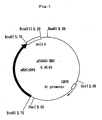
- This cDNA was inserted into a plasmid vector "pCAGGS" to construct a transgene pCAGGS-HDC (Fig. 1).
- pCAGGS plasmid vector
- the HDC cDNA is positioned under the control of the chicken gamma-actin promoter so that it is expressed in various tissues of the transgenic mice.
- the vector was digested with restriction enzymes, Salt and HindIII, to eliminate the vector backbone.
- the resulting linear fragment was injected into the pronuclei of fertilized eggs of BDF1 mice by a microinjection method.
- the gene-transferred fertilized eggs were then implanted into the oviduct of pseudo-pregnant mother in a conventional way to grow to individuals.
- mice were screened according to the conventional Southern analytical method using an oligonucleotide as a probe consisting of a partial sequence of murine HDC cDNA.
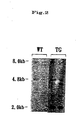
- Fig. 2 shows the results.
- WT wild-type mice
- endogenous HDC fragments about 8.0 kb, 4.8 kb
- the transferred HDC fragment of about 2.0 kb was detected in addition to these endogenous gene fragments in the transgenic mice (TG). From the above results, it was confirmed that the mice No. 641 and 642 were transgenic mice with the transgene on the chromosome.
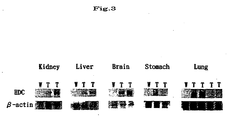
- transgenic mice expression of the transgene in these transgenic mice was examined in their tissue by the Northern analysis. As seen in Fig. 3, excessive expression of the transferred HDC gene was observed in almost all the tissues (kidney, liver, brain, stomach, and lung) examined in the transgenic mouse (T).
- the amount of histamine and the HDC activity were determined in several organs (cerebral cortex, midbrain, kidney, and stomach) of the transgenic mice generated in Example 1 as well as wild-type mice (Nos. 646 and 647).
- the amount of histamine was determined in accordance with the known combined method consisting of high performance liquid chromatography and fluorometry (J. Chromatogr. 344: 115-123, 1985). Briefly, respective tissues were homogenized with a homogenizer, then treated with perchloric acid, and then centrifuged. An aliquot of the supernatant was separated by high performance liquid chromatography, and allowed to react with a fluorescent dye o-phthalaldehyde under alkaline conditions to determine the amount of histamine from the fluorescence intensity of the reaction product as an indicator.
- the HDC activity was determined by means of the amount of histamine from histidine as substrate based on the known method (J. Biochem. 107: 834-839, 1990). Briefly, respective tissues were sonicated in a buffer solution for the HDC reaction. The sonicated sample was centrifuged, and the supernatant was separated and dialyzed overnight against the buffer solution for the HDC reaction. After dialysis, L-histidine as substrate was added and allowed to react at 37°C for 2 hours. The produced histamine was measured according to the above method to determine the activity of HDC.
- a histamine-hyperproductive animal having a foreign HDC gene in chromosome is rovided.
- analysis of the pathogenesis and pathological consequence in various disorders associated with histamine in human as well as development of therapeutic techniques and remedies for these disorders will be developed.
Landscapes
- Life Sciences & Earth Sciences (AREA)
- Health & Medical Sciences (AREA)
- Chemical & Material Sciences (AREA)
- Engineering & Computer Science (AREA)
- Genetics & Genomics (AREA)
- Zoology (AREA)
- Organic Chemistry (AREA)
- Wood Science & Technology (AREA)
- Bioinformatics & Cheminformatics (AREA)
- General Health & Medical Sciences (AREA)
- General Engineering & Computer Science (AREA)
- Biotechnology (AREA)
- Biochemistry (AREA)
- Biomedical Technology (AREA)
- Environmental Sciences (AREA)
- Molecular Biology (AREA)
- Veterinary Medicine (AREA)
- Microbiology (AREA)
- Animal Behavior & Ethology (AREA)
- Medicinal Chemistry (AREA)
- Biodiversity & Conservation Biology (AREA)
- Animal Husbandry (AREA)
- Physics & Mathematics (AREA)
- Biophysics (AREA)
- Plant Pathology (AREA)
- Micro-Organisms Or Cultivation Processes Thereof (AREA)
- Enzymes And Modification Thereof (AREA)
Abstract
Description
| Histidine+ | Histidine- | (+ - -) | mg prot. | HDC act. | AVG | TG/wild | |
| 641 cortex | 640.4734 | 6.521087 | 646.9945 | 0.5103 | 10.56559 | 5.927722 | 20.79827 |
| 642 cortex | 76.91173 | 2.708377 | 79.6201 | 0.5144 | 1.289854 | ||
| 646 cortex | 18.19627 | 1.402746 | 19.59902 | 0.51145 | 0.319337 | 0.28501 | |
| 647 cortex | 9.672152 | 2.046287 | 11.71844 | 0.38955 | 0.250683 | ||
| 641 mid. | 225.595 | 2.007538 | 227.6026 | 0.27435 | 6.913389 | 6.358457 | 17.59877 |
| 642 mid. | 189.3318 | 1.488071 | 190.8199 | 0.274 | 5.803525 | ||
| 646 mid. | 9.147402 | 1.345798 | 10.4932 | 0.2445 | 0.357641 | 0.361301 | |
| 647 mid. | 9.336193 | 2.116288 | 11.45248 | 0.2615 | 0.364961 | ||
| 641 kidney | 2227.092 | 457.7291 | 2684.821 | 1.2995 | 17.21701 | 14.82442 | 0.977838 |
| 642 kidney | 1703.095 | 382.4702 | 2085.565 | 1.398 | 12.43184 | ||
| 646 kidney | 1997.341 | 499.9867 | 2497.327 | 1.1965 | 17.39328 | 15.16041 | |
| 647 kidney | 1635.964 | 213.1143 | 1849.078 | 1.19195 | 12.92754 | ||
| 641 st. | 1320.89 | 15.10884 | 1335.999 | 0.5609 | 19.84904 | 17.79592 | 30.04573 |
| 642 st. | 850.4966 | 7.454651 | 857.9513 | 0.45415 | 15.7428 | ||
| 646 st. | 22.22755 | 0 | 22.22755 | 0.4385 | 0.422416 | 0.592294 | |
| 647 st. | 40.06894 | 0 | 40.06894 | 0.4381 | 0.762173 |
| Sample | Area | pmol/ml | g | pmol/g | AVG | rG/Wild |
| Cort-641 | 2960809 | 536.2428 | 0.20726 | 2587.295 | 1908.832 | 7.463778 |
| Cort-642 | 1436794 | 260.2229 | 0.2115 | 1230.368 | ||
| Cort-646 | 153844 | 27.86324 | 0.2039 | 136.6515 | 255.746 | |
| Cort-647 | 342526 | 62.03612 | 0.1655 | 374.8406 | ||
| Mid-641 | 2033368 | 368.2706 | 0.12566 | 2930.691 | 2334.818 | 8.820128 |
| Mid-642 | 967822 | 175.2857 | 0.1008 | 1738.946 | ||
| Mid-646 | 130723 | 22.66251 | 0.0939 | 241.3472 | 264.7148 | |
| Mid-647 | 194921 | 33.79205 | 0.1173 | 288.0823 | ||
| Kid-641 | 46432775 | 8049.716 | 0.2889 | 27863.33 | 27671.44 | 2.137994 |
| Kid-642 | 68428289 | 11862.92 | 0.4317 | 27479.55 | ||
| Kid-646 | 27439878 | 4757.054 | 0.2845 | 16720.75 | 12942.71 | |
| Kid-647 | 14162296 | 2455.215 | 0.2679 | 9164.671 | ||
| Stom-641 | 35450278 | 6420.527 | 0.14365 | 44695.63 | 40493.66 | 1.335019 |
| Stom-642 | 44063738 | 7980.542 | 0.2199 | 36291.69 | ||
| Stom-646 | 40388951 | 7314.988 | 0.2175 | 33632.13 | 30331.9 | |
| Stom-647 | 18775969 | 3400.583 | 0.1258 | 27031.66 |
Claims (2)
- A histamine-hyperproductive animal, which is a non-human animal or progeny thereof obtained by ontogenesis of totipotent cells transfected with a polynucleotide encoding histidine decarboxylase and has the above polynucleotide in the cellular chromosome to produce histamine at a high level in the somatic cells.
- The histamine-hyperproductive animal of claim 1, wherein the non-human animal is mouse.
Applications Claiming Priority (3)
| Application Number | Priority Date | Filing Date | Title |
|---|---|---|---|
| JP2000082953A JP2002084923A (en) | 2000-03-23 | 2000-03-23 | Histamine-producing animals |
| JP2000082953 | 2000-03-23 | ||
| PCT/JP2001/002363 WO2001070016A1 (en) | 2000-03-23 | 2001-03-23 | Animals with high histamine productivity |
Publications (2)
| Publication Number | Publication Date |
|---|---|
| EP1269836A1 true EP1269836A1 (en) | 2003-01-02 |
| EP1269836A4 EP1269836A4 (en) | 2005-09-21 |
Family
ID=18599685
Family Applications (1)
| Application Number | Title | Priority Date | Filing Date |
|---|---|---|---|
| EP01915743A Withdrawn EP1269836A4 (en) | 2000-03-23 | 2001-03-23 | ANIMALS WITH HIGH HISTAMINE PRODUCTIVITY |
Country Status (4)
| Country | Link |
|---|---|
| US (2) | US7094947B2 (en) |
| EP (1) | EP1269836A4 (en) |
| JP (1) | JP2002084923A (en) |
| WO (1) | WO2001070016A1 (en) |
Families Citing this family (2)
| Publication number | Priority date | Publication date | Assignee | Title |
|---|---|---|---|---|
| JP2002084923A (en) * | 2000-03-23 | 2002-03-26 | Japan Science & Technology Corp | Histamine-producing animals |
| JP2021521795A (en) | 2018-04-20 | 2021-08-30 | ザイマージェン インコーポレイテッド | Modified biosynthetic pathway to produce histamine by fermentation |
Family Cites Families (2)
| Publication number | Priority date | Publication date | Assignee | Title |
|---|---|---|---|---|
| JPH09172908A (en) * | 1995-12-22 | 1997-07-08 | Hoechst Japan Ltd | Interleukin 1 related disease model transgenic animal |
| JP2002084923A (en) * | 2000-03-23 | 2002-03-26 | Japan Science & Technology Corp | Histamine-producing animals |
-
2000
- 2000-03-23 JP JP2000082953A patent/JP2002084923A/en active Pending
-
2001
- 2001-03-23 WO PCT/JP2001/002363 patent/WO2001070016A1/en not_active Ceased
- 2001-03-23 US US10/239,223 patent/US7094947B2/en not_active Expired - Fee Related
- 2001-03-23 EP EP01915743A patent/EP1269836A4/en not_active Withdrawn
-
2006
- 2006-07-28 US US11/494,495 patent/US20060265772A1/en not_active Abandoned
Also Published As
| Publication number | Publication date |
|---|---|
| WO2001070016A1 (en) | 2001-09-27 |
| EP1269836A4 (en) | 2005-09-21 |
| US20060265772A1 (en) | 2006-11-23 |
| US20050005315A1 (en) | 2005-01-06 |
| JP2002084923A (en) | 2002-03-26 |
| US7094947B2 (en) | 2006-08-22 |
Similar Documents
| Publication | Publication Date | Title |
|---|---|---|
| US20220256822A1 (en) | Genetic modification non-human organism, egg cells, fertilized eggs, and method for modifying target genes | |
| US20110041193A1 (en) | Non-human mammal model of epilepsy | |
| KR20050040517A (en) | Transgenic mouse possessing resistance for ischemia | |
| CN114480497A (en) | Construction and application of an ep400 gene knockout zebrafish heart failure model | |
| US6284944B1 (en) | Gene-targeted non-human mammal with a human fad presenilin mutation and generational offspring | |
| US7094947B2 (en) | Animals with high histamine productivity | |
| EP1224861B1 (en) | Test method relating to adipose cells and to obesity by using a human h-pgds overexpressing non-human animal | |
| CN101532018B (en) | Producing method of transgenic mouse containing anthropogenic proto-oncogene c-Ha-ras and application thereof | |
| CN114592011A (en) | Construction method of PTDSS2 conditional gene knockout mouse model | |
| CN117660527B (en) | A method for constructing an ABCA7-Floxp mouse model and its application | |
| KR102934069B1 (en) | Schizophrenia animal model in which the hpcal4 gene is knocked out and its use | |
| CN102399822B (en) | Construction and application of transgenic mouse model for expressing farnesyl pyrophosphate synthetase | |
| JPH11146743A (en) | Alzheimer's disease model animal | |
| CN121896224A (en) | A Rigi gene conditional knockout mouse model, its construction method and application | |
| JP7735260B2 (en) | Methods for identifying substances that affect aging | |
| CN120290567A (en) | Methods for constructing a mouse model of congenital heart disease | |
| CN121472323A (en) | Methods and applications of animal models specifically driven by CAG promoter-mediated LSL-RCAN1-P2A-EGFP-Flag tag expression. | |
| CN121801930A (en) | Method for constructing Myh6-CRE transgenic golden hamster model and application | |
| US9592306B2 (en) | Mitochondrial-nuclear exchanged cells, tissues, organs and animals | |
| ES2257902B1 (en) | TRANSGENIC ANIMAL MODEL FOR THE DEVELOPMENT OF NEW THERAPEUTIC APPROXIMATIONS. | |
| JP2001069871A (en) | Histamine-deficient animals | |
| CN121380196A (en) | A method for constructing and applying a conditional knockout mouse model to study the effects of the CLCF1 gene on cortical bone development. | |
| JP2003088272A (en) | Transgenic animal transformed by green fluorescent protein gene | |
| WO2005084428A1 (en) | Epilepsy model animal (chrna4:s284l) | |
| WO2001001767A1 (en) | Hydrocephaly model animals |
Legal Events
| Date | Code | Title | Description |
|---|---|---|---|
| PUAI | Public reference made under article 153(3) epc to a published international application that has entered the european phase |
Free format text: ORIGINAL CODE: 0009012 |
|
| 17P | Request for examination filed |
Effective date: 20021021 |
|
| AK | Designated contracting states |
Kind code of ref document: A1 Designated state(s): AT BE CH CY DE DK ES FI FR GB GR IE IT LI LU MC NL PT SE TR |
|
| RBV | Designated contracting states (corrected) |
Designated state(s): AT BE CH FR LI |
|
| REG | Reference to a national code |
Ref country code: DE Ref legal event code: 8566 |
|
| RAP1 | Party data changed (applicant data changed or rights of an application transferred) |
Owner name: JAPAN SCIENCE AND TECHNOLOGY AGENCY |
|
| RIC1 | Information provided on ipc code assigned before grant |
Ipc: 7C 12N 15/85 B Ipc: 7C 12N 15/52 B Ipc: 7C 12N 9/88 B Ipc: 7A 01K 67/027 A |
|
| A4 | Supplementary search report drawn up and despatched |
Effective date: 20050808 |
|
| STAA | Information on the status of an ep patent application or granted ep patent |
Free format text: STATUS: THE APPLICATION IS DEEMED TO BE WITHDRAWN |
|
| 18D | Application deemed to be withdrawn |
Effective date: 20080711 |