EP1268176B1 - Paperboard tray having crack-resistant barrier coating - Google Patents
Paperboard tray having crack-resistant barrier coating Download PDFInfo
- Publication number
- EP1268176B1 EP1268176B1 EP00980958A EP00980958A EP1268176B1 EP 1268176 B1 EP1268176 B1 EP 1268176B1 EP 00980958 A EP00980958 A EP 00980958A EP 00980958 A EP00980958 A EP 00980958A EP 1268176 B1 EP1268176 B1 EP 1268176B1
- Authority
- EP
- European Patent Office
- Prior art keywords
- paperboard
- coating
- barrier
- pigment
- food
- Prior art date
- Legal status (The legal status is an assumption and is not a legal conclusion. Google has not performed a legal analysis and makes no representation as to the accuracy of the status listed.)
- Expired - Lifetime
Links
- 239000011087 paperboard Substances 0.000 title claims abstract description 52
- 238000000576 coating method Methods 0.000 title claims abstract description 49
- 230000004888 barrier function Effects 0.000 title claims abstract description 48
- 239000011248 coating agent Substances 0.000 title claims abstract description 46
- 235000013305 food Nutrition 0.000 claims abstract description 39
- 239000010410 layer Substances 0.000 claims abstract description 27
- 239000000049 pigment Substances 0.000 claims abstract description 23
- 229920000728 polyester Polymers 0.000 claims abstract description 16
- 239000000203 mixture Substances 0.000 claims abstract description 14
- 238000000034 method Methods 0.000 claims abstract description 12
- 239000004014 plasticizer Substances 0.000 claims abstract description 9
- 230000008569 process Effects 0.000 claims abstract description 8
- 239000000758 substrate Substances 0.000 claims abstract description 8
- 229920000139 polyethylene terephthalate Polymers 0.000 claims description 25
- 239000005020 polyethylene terephthalate Substances 0.000 claims description 25
- SUPCQIBBMFXVTL-UHFFFAOYSA-N ethyl 2-methylprop-2-enoate Chemical compound CCOC(=O)C(C)=C SUPCQIBBMFXVTL-UHFFFAOYSA-N 0.000 claims description 17
- -1 polyethylene terephthalate Polymers 0.000 claims description 11
- 229920005989 resin Polymers 0.000 claims description 3
- 239000011347 resin Substances 0.000 claims description 3
- 239000011247 coating layer Substances 0.000 claims description 2
- 238000003825 pressing Methods 0.000 claims description 2
- 239000002344 surface layer Substances 0.000 claims description 2
- 150000001875 compounds Chemical class 0.000 claims 6
- 238000002844 melting Methods 0.000 claims 2
- 230000008018 melting Effects 0.000 claims 2
- 238000002156 mixing Methods 0.000 claims 2
- 238000002360 preparation method Methods 0.000 claims 2
- 229920001577 copolymer Polymers 0.000 claims 1
- 229920006225 ethylene-methyl acrylate Polymers 0.000 claims 1
- 239000002356 single layer Substances 0.000 abstract description 3
- 239000004594 Masterbatch (MB) Substances 0.000 abstract 1
- 230000015572 biosynthetic process Effects 0.000 description 9
- 239000000463 material Substances 0.000 description 5
- 239000008199 coating composition Substances 0.000 description 4
- 238000001125 extrusion Methods 0.000 description 4
- 239000000654 additive Substances 0.000 description 3
- 239000007795 chemical reaction product Substances 0.000 description 3
- 239000003795 chemical substances by application Substances 0.000 description 3
- 238000005336 cracking Methods 0.000 description 3
- 239000000123 paper Substances 0.000 description 3
- 239000000047 product Substances 0.000 description 3
- 238000004513 sizing Methods 0.000 description 3
- 239000007858 starting material Substances 0.000 description 3
- 230000006872 improvement Effects 0.000 description 2
- 238000004519 manufacturing process Methods 0.000 description 2
- 238000012986 modification Methods 0.000 description 2
- 230000004048 modification Effects 0.000 description 2
- 229920001707 polybutylene terephthalate Polymers 0.000 description 2
- 229910000831 Steel Inorganic materials 0.000 description 1
- 230000000996 additive effect Effects 0.000 description 1
- 239000012790 adhesive layer Substances 0.000 description 1
- 230000009286 beneficial effect Effects 0.000 description 1
- 230000008901 benefit Effects 0.000 description 1
- 238000006243 chemical reaction Methods 0.000 description 1
- 239000002131 composite material Substances 0.000 description 1
- 239000012141 concentrate Substances 0.000 description 1
- 238000010276 construction Methods 0.000 description 1
- 238000005520 cutting process Methods 0.000 description 1
- 238000011156 evaluation Methods 0.000 description 1
- 239000000945 filler Substances 0.000 description 1
- 239000003063 flame retardant Substances 0.000 description 1
- 235000013611 frozen food Nutrition 0.000 description 1
- 238000010348 incorporation Methods 0.000 description 1
- 239000011101 paper laminate Substances 0.000 description 1
- 229920001225 polyester resin Polymers 0.000 description 1
- 239000004645 polyester resin Substances 0.000 description 1
- 229920000642 polymer Polymers 0.000 description 1
- 239000010959 steel Substances 0.000 description 1
- 238000003860 storage Methods 0.000 description 1
Images

Classifications
-
- B—PERFORMING OPERATIONS; TRANSPORTING
- B32—LAYERED PRODUCTS
- B32B—LAYERED PRODUCTS, i.e. PRODUCTS BUILT-UP OF STRATA OF FLAT OR NON-FLAT, e.g. CELLULAR OR HONEYCOMB, FORM
- B32B27/00—Layered products comprising a layer of synthetic resin
- B32B27/06—Layered products comprising a layer of synthetic resin as the main or only constituent of a layer, which is next to another layer of the same or of a different material
- B32B27/10—Layered products comprising a layer of synthetic resin as the main or only constituent of a layer, which is next to another layer of the same or of a different material of paper or cardboard
-
- B—PERFORMING OPERATIONS; TRANSPORTING
- B32—LAYERED PRODUCTS
- B32B—LAYERED PRODUCTS, i.e. PRODUCTS BUILT-UP OF STRATA OF FLAT OR NON-FLAT, e.g. CELLULAR OR HONEYCOMB, FORM
- B32B27/00—Layered products comprising a layer of synthetic resin
- B32B27/36—Layered products comprising a layer of synthetic resin comprising polyesters
-
- B—PERFORMING OPERATIONS; TRANSPORTING
- B32—LAYERED PRODUCTS
- B32B—LAYERED PRODUCTS, i.e. PRODUCTS BUILT-UP OF STRATA OF FLAT OR NON-FLAT, e.g. CELLULAR OR HONEYCOMB, FORM
- B32B37/00—Methods or apparatus for laminating, e.g. by curing or by ultrasonic bonding
- B32B37/14—Methods or apparatus for laminating, e.g. by curing or by ultrasonic bonding characterised by the properties of the layers
- B32B37/15—Methods or apparatus for laminating, e.g. by curing or by ultrasonic bonding characterised by the properties of the layers with at least one layer being manufactured and immediately laminated before reaching its stable state, e.g. in which a layer is extruded and laminated while in semi-molten state
- B32B37/153—Methods or apparatus for laminating, e.g. by curing or by ultrasonic bonding characterised by the properties of the layers with at least one layer being manufactured and immediately laminated before reaching its stable state, e.g. in which a layer is extruded and laminated while in semi-molten state at least one layer is extruded and immediately laminated while in semi-molten state
-
- B—PERFORMING OPERATIONS; TRANSPORTING
- B32—LAYERED PRODUCTS
- B32B—LAYERED PRODUCTS, i.e. PRODUCTS BUILT-UP OF STRATA OF FLAT OR NON-FLAT, e.g. CELLULAR OR HONEYCOMB, FORM
- B32B38/00—Ancillary operations in connection with laminating processes
-
- B—PERFORMING OPERATIONS; TRANSPORTING
- B65—CONVEYING; PACKING; STORING; HANDLING THIN OR FILAMENTARY MATERIAL
- B65D—CONTAINERS FOR STORAGE OR TRANSPORT OF ARTICLES OR MATERIALS, e.g. BAGS, BARRELS, BOTTLES, BOXES, CANS, CARTONS, CRATES, DRUMS, JARS, TANKS, HOPPERS, FORWARDING CONTAINERS; ACCESSORIES, CLOSURES, OR FITTINGS THEREFOR; PACKAGING ELEMENTS; PACKAGES
- B65D1/00—Rigid or semi-rigid containers having bodies formed in one piece, e.g. by casting metallic material, by moulding plastics, by blowing vitreous material, by throwing ceramic material, by moulding pulped fibrous material or by deep-drawing operations performed on sheet material
- B65D1/34—Trays or like shallow containers
-
- C—CHEMISTRY; METALLURGY
- C09—DYES; PAINTS; POLISHES; NATURAL RESINS; ADHESIVES; COMPOSITIONS NOT OTHERWISE PROVIDED FOR; APPLICATIONS OF MATERIALS NOT OTHERWISE PROVIDED FOR
- C09D—COATING COMPOSITIONS, e.g. PAINTS, VARNISHES OR LACQUERS; FILLING PASTES; CHEMICAL PAINT OR INK REMOVERS; INKS; CORRECTING FLUIDS; WOODSTAINS; PASTES OR SOLIDS FOR COLOURING OR PRINTING; USE OF MATERIALS THEREFOR
- C09D167/00—Coating compositions based on polyesters obtained by reactions forming a carboxylic ester link in the main chain; Coating compositions based on derivatives of such polymers
- C09D167/02—Polyesters derived from dicarboxylic acids and dihydroxy compounds
-
- D—TEXTILES; PAPER
- D21—PAPER-MAKING; PRODUCTION OF CELLULOSE
- D21H—PULP COMPOSITIONS; PREPARATION THEREOF NOT COVERED BY SUBCLASSES D21C OR D21D; IMPREGNATING OR COATING OF PAPER; TREATMENT OF FINISHED PAPER NOT COVERED BY CLASS B31 OR SUBCLASS D21G; PAPER NOT OTHERWISE PROVIDED FOR
- D21H19/00—Coated paper; Coating material
- D21H19/36—Coatings with pigments
- D21H19/44—Coatings with pigments characterised by the other ingredients, e.g. the binder or dispersing agent
- D21H19/62—Macromolecular organic compounds or oligomers thereof obtained otherwise than by reactions only involving carbon-to-carbon unsaturated bonds
-
- B—PERFORMING OPERATIONS; TRANSPORTING
- B32—LAYERED PRODUCTS
- B32B—LAYERED PRODUCTS, i.e. PRODUCTS BUILT-UP OF STRATA OF FLAT OR NON-FLAT, e.g. CELLULAR OR HONEYCOMB, FORM
- B32B2255/00—Coating on the layer surface
- B32B2255/12—Coating on the layer surface on paper layer
-
- B—PERFORMING OPERATIONS; TRANSPORTING
- B32—LAYERED PRODUCTS
- B32B—LAYERED PRODUCTS, i.e. PRODUCTS BUILT-UP OF STRATA OF FLAT OR NON-FLAT, e.g. CELLULAR OR HONEYCOMB, FORM
- B32B2255/00—Coating on the layer surface
- B32B2255/26—Polymeric coating
-
- B—PERFORMING OPERATIONS; TRANSPORTING
- B32—LAYERED PRODUCTS
- B32B—LAYERED PRODUCTS, i.e. PRODUCTS BUILT-UP OF STRATA OF FLAT OR NON-FLAT, e.g. CELLULAR OR HONEYCOMB, FORM
- B32B2317/00—Animal or vegetable based
- B32B2317/12—Paper, e.g. cardboard
-
- B—PERFORMING OPERATIONS; TRANSPORTING
- B32—LAYERED PRODUCTS
- B32B—LAYERED PRODUCTS, i.e. PRODUCTS BUILT-UP OF STRATA OF FLAT OR NON-FLAT, e.g. CELLULAR OR HONEYCOMB, FORM
- B32B2367/00—Polyesters, e.g. PET, i.e. polyethylene terephthalate
-
- B—PERFORMING OPERATIONS; TRANSPORTING
- B32—LAYERED PRODUCTS
- B32B—LAYERED PRODUCTS, i.e. PRODUCTS BUILT-UP OF STRATA OF FLAT OR NON-FLAT, e.g. CELLULAR OR HONEYCOMB, FORM
- B32B2439/00—Containers; Receptacles
- B32B2439/02—Open containers
-
- B—PERFORMING OPERATIONS; TRANSPORTING
- B32—LAYERED PRODUCTS
- B32B—LAYERED PRODUCTS, i.e. PRODUCTS BUILT-UP OF STRATA OF FLAT OR NON-FLAT, e.g. CELLULAR OR HONEYCOMB, FORM
- B32B2439/00—Containers; Receptacles
- B32B2439/70—Food packaging
-
- B—PERFORMING OPERATIONS; TRANSPORTING
- B65—CONVEYING; PACKING; STORING; HANDLING THIN OR FILAMENTARY MATERIAL
- B65D—CONTAINERS FOR STORAGE OR TRANSPORT OF ARTICLES OR MATERIALS, e.g. BAGS, BARRELS, BOTTLES, BOXES, CANS, CARTONS, CRATES, DRUMS, JARS, TANKS, HOPPERS, FORWARDING CONTAINERS; ACCESSORIES, CLOSURES, OR FITTINGS THEREFOR; PACKAGING ELEMENTS; PACKAGES
- B65D2581/00—Containers, packaging elements, or packages, for contents presenting particular transport or storage problems, or adapted to be used for non-packaging purposes after removal of contents
- B65D2581/34—Containers, packaging elements, or packages, for contents presenting particular transport or storage problems, or adapted to be used for non-packaging purposes after removal of contents for packaging foodstuffs or other articles intended to be cooked or heated within
-
- D—TEXTILES; PAPER
- D21—PAPER-MAKING; PRODUCTION OF CELLULOSE
- D21H—PULP COMPOSITIONS; PREPARATION THEREOF NOT COVERED BY SUBCLASSES D21C OR D21D; IMPREGNATING OR COATING OF PAPER; TREATMENT OF FINISHED PAPER NOT COVERED BY CLASS B31 OR SUBCLASS D21G; PAPER NOT OTHERWISE PROVIDED FOR
- D21H23/00—Processes or apparatus for adding material to the pulp or to the paper
- D21H23/02—Processes or apparatus for adding material to the pulp or to the paper characterised by the manner in which substances are added
- D21H23/22—Addition to the formed paper
- D21H23/46—Pouring or allowing the fluid to flow in a continuous stream on to the surface, the entire stream being carried away by the paper
Definitions
- This invention relates to ovenable food containers and more particularly to an ovenable food tray formed from a paperboard laminate. More specifically, this invention is directed to a polyester/paperboard laminate having an extruded layer of a mixture of polyester and a plasticizer which allows a deep draw food container to be formed in which the polyester layer resists cracking.
- a variety of paperboard trays which serve as food containers for use in electric, gas, and microwave ovens are well known in the art.
- a deep draw tray having a tray depth of 1.5 inches (3.8 cm) or greater.
- deep draw, die-formed paperboard trays have been prone to the formation of fine cracks within the polyester barrier layer.
- Such cracks are more pronounced when using dark pigmented polyester materials.
- the cracks are indicative of a loss of the barrier properties of the tray.
- the food product no longer has the protection of a barrier coating.
- the resulting cracking is aesthetically displeasing to the consumer. Accordingly, there is a need for a polyester barrier material which allows the crack-free formation of a deep draw tray.
- a variety of ovenable food containers are known within the art having a paperboard substrate coated with a food contacting surface of a polyester such as a food grade polyethylene terephthalate (PET).
- PET polyethylene terephthalate
- a process for preparing a polyester paperboard laminate is disclosed in U.S. Patent No. 4,455,184 assigned to Blue Ridge Paper Products and incorporated herein by reference. The process provides coextruding a polyester layer and a polymeric adhesive layer as a single step while maintaining separate layers.
- U.S. Patent No. 4,757,940 incorporated herein by reference, is directed to an ovenable paperboard food tray having a food contacting surface of polyester along with various flame retardants or paper laminates applied to the non-food contact surface.
- the barrier coating is not believed suitable for the formation of a deep draw ovenable container.
- This invention relates to a deep draw paperboard tray which exhibits an improved food contacting surface which has a pigment additive therein and which following a deep draw pressure forming step maintains a crack-free finish.
- the invention may be practiced by coating a paperboard substrate with a food grade resin such as a polyethylene terephthalate (PET).
- PET layer further comprises a plasticizer such as ethyl methyl acrylate (EMA).
- EMA ethyl methyl acrylate
- the polyester polymeric coating may further comprise a desired pigment which may either be preblended into the EMA or into the PET.
- the EMA, PET, and the pigment are mechanically blended and then extrusion coated as a single barrier layer to the paperboard stock.
- the paperboard having the composite laminate may be formed by standard press tray methods using heat and pressure within a die.
- the polymeric coating allows for a "deep draw" receptacle to be formed.
- the plasticizer avoids the tendency of prior art polyester barriers to crack or split at the corners or sharp bends of the formed tray structure.
- the pressure formed paperboard trays may be filled with food products, frozen, packaged, and shipped for subsequent consumption.
- Laminate 10 which comprises a paperboard substrate 20 and a barrier layer 30.
- Laminate 10 may be provided from any number of conventional paperboard products.
- paperboard 20 is selected from moldable paperboard stock which is suitable for the formation of deep draw food containers for use in electric, gas and microwave ovens.
- sizing agents such as an alkyl ketene dimer
- fillers as are conventionally employed within the paperboard art
- variations to the wick properties may be made by incorporating a sizing agent such as an alkyl ketene dimer.
- a sizing agent such as an alkyl ketene dimer.
- the presence or absence of a sizing agent or other additives does not play a role in the present invention.
- Barrier coating 30 is an extruded coating applied as a single layer to form a food contacting surface on board 20.
- Coating 30 is comprised of a mixture of a polyester resin such as polyethylene terephthalate, herein after referred to as PET.
- PET polyethylene terephthalate
- PBT polybutylene terephthalate
- barrier layer 30 further comprises ethyl methyl acrylate (EMA) polymer which is mechanically blended with the PET prior to extrusion.
- the barrier coating may further comprise a pigment.
- pigments When pigments are used, it has been found useful to pre-blend the pigment with an either the EMA or the PET. Pigment concentrates which are pre-blended with these materials are commercially available, such as LTB 9418, a black pigmented EMA (Colortech, Brampton, Ontario, Canada).
- LTB 9418 a black pigmented EMA (Colortech, Brampton, Ontario, Canada).
- the PET, the EMA, and the pigment are mechanically blended and extruded as a single coating onto the paperboard.
- the quantity of the coating material can be varied depending upon the substrate and the intended use of the subsequently formed trays.
- the trays are typically formed by a press-tray method in which the paperboard-barrier laminate is formed into a tray by combination of heat and pressure within a die.
- a tray depth of 1.5 inches (3.8 cm) or greater, more preferably having a depth of 1.87 inches (2.22 cm) or greater, has, heretofore, resulted in pigmented polymeric coatings which crack or split along sharp ends or corners of the tray structure.
- EMA as a plasticizer, which is pre-blended with the PET and any desired pigment, results in an extrudable pigmented barrier coating for a paperboard laminate which can be deep drawn without the undesired cracking or splitting of the polymeric coating.
- the barrier coating 30 may comprise the only layer present on the paperboard laminate.
- the present barrier coating is compatible with other coatings and extruded layers which may be necessary or desirable on the end product.
- the thickness of the barrier coating may be varied depending upon the needs of the end product. For instance, the formation of an ovenable tray may require varying thicknesses of the coating composition depending upon the moisture content, fat content, or end use oven temperature of the food packaged within the container.
- a deep draw container 50 is provided by the barrier laminate 10.
- the paperboard support structure is coated along at least the food contact surface with the barrier coating 30 described above.
- Container 50 may have pleated corners or edges and preferably has a receptacle depth of about 17 ⁇ 8 inches.
- the starting material for this example was a paperboard having an average basis weight of 195 per 3,000 square feet average caliber of 0.01550.
- the paperboard was extrusion coated on one side with the barrier composition comprising 23 pounds of PET per 3,000 square feet, 3.0 pounds of EMA per 3,000 square feet, and an 11.5 percent (by weight) loading of pigment premixed with the PET/EMA.
- the barrier coating components were mechanically mixed and extruded as a single barrier coating as set forth in Fig. 2.
- the barrier coating had an average coating weight of 26 pounds per 3,000 square feet.
- Fig. 2 diagrammatically illustrates the coextrusion process for producing the laminate of this invention.
- the paperboard 20 is fed from feed roll 22 to pressure roll 24 and chill roll 26.
- An extrusion apparatus 40 comprises an internal combining die and provides the molten layer consisting of the PET, EMA, and pigment which is thereafter extruded as a single layer.
- the molten barrier layer 30 is received on the paperboard in the vicinity of pressure roll 24, and the coating layer is formed into laminate by means of pressure roll 24 and chill roll 26.
- the subsequently formed laminate 10 can then be withdrawn for storage by take-up roll 28.
- the barrier coated paperboard is thereafter suitable for conversion into a tray using known methods of pressure forming paper trays consisting of the steps of first cutting and creasing a blank using a steel rule die, then placing the blank in a two-piece heated forming die where the paperboard is simultaneously drawn into the die and shaped to form the contours of the tray.
- the paperboard coating as set forth in Example 1 may be formed into a tray having a depth of 17 ⁇ 8 inches.
- the resulting tray has been found suitable for use as a microwavable container in the frozen food industry.
- the starting material for this example was a paperboard having an average basis weight of 195 pounds per 3,000 square feet and having an average caliper of 0.01950 inches.
- the coating composition was prepared as set forth in Example 1 and applied at an average coating weight of 26 pounds per 3,000 square feet of board.
- the extruded board was found suitable for use as an ovenable board in gas, electric and microwave ovens.
- the starting material for this example was a paperboard having a basis weight of 310 pounds per 3,000 square feet and an average caliper of 0.02700 inches.
- the coating composition was prepared as described above in Example 1 and was applied at a coating weight of 26 pounds per 3,000 square feet.
- the extruded paperboard was evaluated by formation into trays as described above and subsequently evaluated as an ovenable tray which was satisfactory for use in microwave, electric and gas ovens.
- the improved blended barrier composition was found to completely eliminate the formation of cracks in the pigmented polymeric coating. While not wishing to be limited by theory, it is believed that the EMA plasticizer, when pre-blended with a pigment and PET, allows a single extrudable barrier layer to be formed on the surface of the board. The barrier layer is subsequently able to be heat pressed into a deep draw tray which avoids the formation of cracks and fissures within the pigmented polymeric coating.
- plasticizers besides EMA are useful in the present invention, the selection and evaluation of which can be easily accomplished by the incorporation of the plasticizer into the PET mixture.
- the board can be drawn as described above and evaluated for the formation of cracks.
- an improved barrier layer may be formed using unpigmented polymeric coatings.
- the examples set forth above provide an improved barrier coating when the pigment is omitted from the blended barrier composition.
- the beneficial properties and improvements reported above are maintained in the unpigmented compositions. While the cracks and fissures within the prior art unpigmented coating compositions used heretofore are not as readily apparent, such flaws still exist and contribute to degraded performance of the resulting ovenable trays.
- the unpigmented barrier compositions described in the present application offer a polymeric coating better suited for heat pressing into a "deep draw" tray.
Landscapes
- Chemical & Material Sciences (AREA)
- Engineering & Computer Science (AREA)
- Chemical Kinetics & Catalysis (AREA)
- Materials Engineering (AREA)
- Mechanical Engineering (AREA)
- Life Sciences & Earth Sciences (AREA)
- Ceramic Engineering (AREA)
- Wood Science & Technology (AREA)
- Organic Chemistry (AREA)
- Laminated Bodies (AREA)
- Containers Having Bodies Formed In One Piece (AREA)
- Wrappers (AREA)
- Cartons (AREA)
Abstract
Description
- This application claims the benefit of US application having serial number of 09/454,372, filed on December 3, 1999.
- This invention relates to ovenable food containers and more particularly to an ovenable food tray formed from a paperboard laminate. More specifically, this invention is directed to a polyester/paperboard laminate having an extruded layer of a mixture of polyester and a plasticizer which allows a deep draw food container to be formed in which the polyester layer resists cracking.
- A variety of paperboard trays which serve as food containers for use in electric, gas, and microwave ovens are well known in the art. For certain food products, it is desirable to supply a deep draw tray having a tray depth of 1.5 inches (3.8 cm) or greater. Heretofore, deep draw, die-formed paperboard trays have been prone to the formation of fine cracks within the polyester barrier layer. Such cracks are more pronounced when using dark pigmented polyester materials. The cracks are indicative of a loss of the barrier properties of the tray. As a result, the food product no longer has the protection of a barrier coating. Further, the resulting cracking is aesthetically displeasing to the consumer. Accordingly, there is a need for a polyester barrier material which allows the crack-free formation of a deep draw tray.
- A variety of ovenable food containers are known within the art having a paperboard substrate coated with a food contacting surface of a polyester such as a food grade polyethylene terephthalate (PET). A process for preparing a polyester paperboard laminate is disclosed in U.S. Patent No. 4,455,184 assigned to Blue Ridge Paper Products and incorporated herein by reference. The process provides coextruding a polyester layer and a polymeric adhesive layer as a single step while maintaining separate layers.
- U.S. Patent No. 4,343,858, assigned to Blue Ridge Paper, Inc. and incorporated herein by reference, discloses a pigment coated paperboard suitable for food containers in which the food contact layer is a polyester which is adjacent an intermediate layer of a pigmented acrylic ester. Since the pigmented layer is not part of the surface layer, the coated paperboard is suitable for use in food containers.
- U.S. Patent No. 4,757,940, incorporated herein by reference, is directed to an ovenable paperboard food tray having a food contacting surface of polyester along with various flame retardants or paper laminates applied to the non-food contact surface.
- U.S. Patent No. 4,026,458, incorporated herein by reference, discloses a paperboard coated food tray having a depth of about 1.375 inches. The barrier coating is not believed suitable for the formation of a deep draw ovenable container.
- While the art discloses a number of teachings directed to various barriers suitable for food containers, and more specifically ovenable food trays, there remains a need for improvement and variation within the art.
- This invention relates to a deep draw paperboard tray which exhibits an improved food contacting surface which has a pigment additive therein and which following a deep draw pressure forming step maintains a crack-free finish.
- The invention may be practiced by coating a paperboard substrate with a food grade resin such as a polyethylene terephthalate (PET). The PET layer further comprises a plasticizer such as ethyl methyl acrylate (EMA). The polyester polymeric coating may further comprise a desired pigment which may either be preblended into the EMA or into the PET. The EMA, PET, and the pigment are mechanically blended and then extrusion coated as a single barrier layer to the paperboard stock. Hereafter, the paperboard having the composite laminate may be formed by standard press tray methods using heat and pressure within a die. The polymeric coating allows for a "deep draw" receptacle to be formed. The plasticizer avoids the tendency of prior art polyester barriers to crack or split at the corners or sharp bends of the formed tray structure. Thereafter, the pressure formed paperboard trays may be filled with food products, frozen, packaged, and shipped for subsequent consumption.
- A full and enabling disclosure of the present invention, including the best mode thereof, to one of ordinary skill in the art, is set forth more particularly in the remainder of the specification, including reference to the accompanying drawings.
- Fig. 1 is a diagrammatic cross-section of a laminate of the invention;
- Fig. 2 schematically illustrates the production of a laminate in accordance with the process of the present invention; and
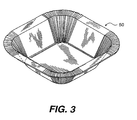
- Fig. 3 is a perspective view of a formed tray made in accordance with the present invention.
-
- Reference now will be made in detail to the embodiments of the invention, one or more examples of which are set forth below. Each example is provided by way of explanation of the invention, not limitation of the invention. In fact, it will be apparent to those skilled in the art that various modifications and variations can be made in the present invention without departing from the scope or spirit of the invention. For instance, features illustrated or described as part of one embodiment, can be used on another embodiment to yield a still further embodiment. Thus, it is intended that the present invention cover such modifications and variations as come within the scope of the appended claims and their equivalents. Other objects, features, and aspects of the present invention are disclosed in, or are obvious from, the following detailed description. It is to be understood by one of ordinary skill in the art that the present discussion is a description of exemplary embodiments only and is not intended as limiting the broader aspects of the present invention, which broader aspects are embodied in the exemplary constructions.
- As seen in reference to Fig. 1, a
laminate 10 is illustrated which comprises apaperboard substrate 20 and abarrier layer 30. Laminate 10 may be provided from any number of conventional paperboard products. Preferably,paperboard 20 is selected from moldable paperboard stock which is suitable for the formation of deep draw food containers for use in electric, gas and microwave ovens. - Depending upon the end use requirements of the end product trays, various sizing agents, additives, and fillers as are conventionally employed within the paperboard art may be used. For instance variations to the wick properties may be made by incorporating a sizing agent such as an alkyl ketene dimer. However, the presence or absence of a sizing agent or other additives does not play a role in the present invention.
- A variety of suitable food grade paperboard substrates are known as set forth in the patents discussed above. Further, the assignee of the present invention offers several paperboard products suitable for use in the present invention.
-
Barrier coating 30 is an extruded coating applied as a single layer to form a food contacting surface onboard 20.Coating 30 is comprised of a mixture of a polyester resin such as polyethylene terephthalate, herein after referred to as PET. However, it is understood that when reference to PET is made, such reference may include other suitable polyester materials such as polybutylene terephthalate (PBT). - In addition to PET,
barrier layer 30 further comprises ethyl methyl acrylate (EMA) polymer which is mechanically blended with the PET prior to extrusion. The barrier coating may further comprise a pigment. When pigments are used, it has been found useful to pre-blend the pigment with an either the EMA or the PET. Pigment concentrates which are pre-blended with these materials are commercially available, such as LTB 9418, a black pigmented EMA (Colortech, Brampton, Ontario, Canada). The PET, the EMA, and the pigment are mechanically blended and extruded as a single coating onto the paperboard. - As set forth in more detail in the examples which follow, the quantity of the coating material can be varied depending upon the substrate and the intended use of the subsequently formed trays. The trays are typically formed by a press-tray method in which the paperboard-barrier laminate is formed into a tray by combination of heat and pressure within a die. In accordance with this invention, it has been found that creating a deep draw to the tray, defined herein as a tray depth of 1.5 inches (3.8 cm) or greater, more preferably having a depth of 1.87 inches (2.22 cm) or greater, has, heretofore, resulted in pigmented polymeric coatings which crack or split along sharp ends or corners of the tray structure. The addition of EMA as a plasticizer, which is pre-blended with the PET and any desired pigment, results in an extrudable pigmented barrier coating for a paperboard laminate which can be deep drawn without the undesired cracking or splitting of the polymeric coating.
- In the simplest embodiment, the
barrier coating 30 may comprise the only layer present on the paperboard laminate. However, the present barrier coating is compatible with other coatings and extruded layers which may be necessary or desirable on the end product. Likewise, the thickness of the barrier coating may be varied depending upon the needs of the end product. For instance, the formation of an ovenable tray may require varying thicknesses of the coating composition depending upon the moisture content, fat content, or end use oven temperature of the food packaged within the container. - As seen in Fig. 3, a
deep draw container 50 is provided by thebarrier laminate 10. The paperboard support structure is coated along at least the food contact surface with thebarrier coating 30 described above.Container 50 may have pleated corners or edges and preferably has a receptacle depth of about 1⅞ inches. - The starting material for this example was a paperboard having an average basis weight of 195 per 3,000 square feet average caliber of 0.01550. The paperboard was extrusion coated on one side with the barrier composition comprising 23 pounds of PET per 3,000 square feet, 3.0 pounds of EMA per 3,000 square feet, and an 11.5 percent (by weight) loading of pigment premixed with the PET/EMA. The barrier coating components were mechanically mixed and extruded as a single barrier coating as set forth in Fig. 2. The barrier coating had an average coating weight of 26 pounds per 3,000 square feet. Fig. 2 diagrammatically illustrates the coextrusion process for producing the laminate of this invention. The
paperboard 20 is fed fromfeed roll 22 topressure roll 24 and chillroll 26. Anextrusion apparatus 40 comprises an internal combining die and provides the molten layer consisting of the PET, EMA, and pigment which is thereafter extruded as a single layer. - The
molten barrier layer 30 is received on the paperboard in the vicinity ofpressure roll 24, and the coating layer is formed into laminate by means ofpressure roll 24 and chillroll 26. The subsequently formedlaminate 10 can then be withdrawn for storage by take-up roll 28. - The barrier coated paperboard is thereafter suitable for conversion into a tray using known methods of pressure forming paper trays consisting of the steps of first cutting and creasing a blank using a steel rule die, then placing the blank in a two-piece heated forming die where the paperboard is simultaneously drawn into the die and shaped to form the contours of the tray.
- The paperboard coating as set forth in Example 1 may be formed into a tray having a depth of 1⅞ inches. The resulting tray has been found suitable for use as a microwavable container in the frozen food industry.
- The starting material for this example was a paperboard having an average basis weight of 195 pounds per 3,000 square feet and having an average caliper of 0.01950 inches. The coating composition was prepared as set forth in Example 1 and applied at an average coating weight of 26 pounds per 3,000 square feet of board. The extruded board was found suitable for use as an ovenable board in gas, electric and microwave ovens.
- The starting material for this example was a paperboard having a basis weight of 310 pounds per 3,000 square feet and an average caliper of 0.02700 inches. The coating composition was prepared as described above in Example 1 and was applied at a coating weight of 26 pounds per 3,000 square feet. The extruded paperboard was evaluated by formation into trays as described above and subsequently evaluated as an ovenable tray which was satisfactory for use in microwave, electric and gas ovens.
- In the examples described above, the improved blended barrier composition was found to completely eliminate the formation of cracks in the pigmented polymeric coating. While not wishing to be limited by theory, it is believed that the EMA plasticizer, when pre-blended with a pigment and PET, allows a single extrudable barrier layer to be formed on the surface of the board. The barrier layer is subsequently able to be heat pressed into a deep draw tray which avoids the formation of cracks and fissures within the pigmented polymeric coating.
- It is believed that other plasticizers besides EMA are useful in the present invention, the selection and evaluation of which can be easily accomplished by the incorporation of the plasticizer into the PET mixture. Following coating of the composition onto the board, the board can be drawn as described above and evaluated for the formation of cracks.
- It has also been found in accordance with this invention that an improved barrier layer may be formed using unpigmented polymeric coatings. The examples set forth above provide an improved barrier coating when the pigment is omitted from the blended barrier composition. The beneficial properties and improvements reported above are maintained in the unpigmented compositions. While the cracks and fissures within the prior art unpigmented coating compositions used heretofore are not as readily apparent, such flaws still exist and contribute to degraded performance of the resulting ovenable trays. The unpigmented barrier compositions described in the present application offer a polymeric coating better suited for heat pressing into a "deep draw" tray.
- Although preferred embodiments of the invention have been described using specific terms, devices, and methods, such description is for illustrative purposes only. The words used are words of description rather than of limitation. It is to be understood that changes and variations may be made by those of ordinary skill in the art without departing from the spirit or the scope of the present invention, which is set forth in the following claims. In addition, it should be understood that aspects of the various embodiments may be interchanged, both in whole or in part. Therefore, the spirit and scope of the appended claims should not be limited to the description of the preferred versions contained therein.
Claims (12)
- A process for forming a laminate of paperboard and polyester for use in the preparation of ovenable, press-molded containers comprising:extruding a molten barrier layer comprising mixing a polyethylene terephthalate resin, an ethylene methyl acrylate copolymer, and a pigment andthereby forming a coating compound;melting the coating compound;extruding the coating compound onto a paperboard substrate to form a single barrier layer forming a food contact surface layer.
- A process for forming a laminate of a paperboard and an extruded barrier layer suitable for use in the preparation of deep draw ovenable containers comprising:mixing at room temperature a polyethylene terephthalate resin and a plasticizer, thereby forming a coating compound;melting the coating compound;extruding the coating compound onto a paperboard substrate to provide a coating layer of between 9.98 and 11.79 kg (22 and 26 pounds) per 278,71 m2 (3,000 square feet);pressing the paperboard-barrier laminate into a tray with a combination of heat and pressure, the tray having a depth of about 4.7 cm.
- The process according to claim 1 wherein said step of providing a pigment further comprises supplying a pigment in a polyethylene terephthalate carrier.
- The process according to claim 1 wherein the step of providing a pigment further comprises supplying the pigment preblended in an ethyl methyl acrylate copolymer.
- A unitary paperboard blank for forming an ovenable food container comprising a paperboard coated on a food contacting surface with a barrier coating, the barrier coating comprising a mixture of an effective amount of polyethylene terephthalate, ethyl methyl acrylate, and a pigment; wherein the coated paperboard may be formed into a deep draw tray.
- The paperboard according to claim 5 wherein the barrier coating has a coating weight of between 9.98 and 11.79 kg (22 and 26 pounds) per 278,71 m2 ( 3,000 square feet).
- The paperboard according to claim 5 or 6 wherein the paperboard has an average basis weight of between 72.57 to 140.61 kg (160 to 310 pounds) per 278,71 m2 (3,000 square feet).
- An ovenable food tray comprising:a paperboard laminate coated on its food contacting surface with a barrier coating comprising a mixture of polyethylene terephthalate and ethyl methyl acrylate forming a single extruded layer;a receptacle defined by an interior portion of the laminate, the barrier layer defining a food contacting surface wherein the edges and the corners of the receptacle maintain an uninterrupted and contiguous barrier.
- The food tray according to claim 8 wherein the barrier coating further comprises a pigment.
- The ovenable food tray according to claim 8 or 9 wherein the barrier coating has a coating weight of between 9.98 and 11.79 kg (22 and 26 pounds) per 278,71 m2 (3,000 square feet).
- The ovenable food tray according to anyone of claims 8 to 10 wherein the food tray comprises a paperboard having an average basis weight of between 72.57 to 140.61 kg (160 to 310 pounds) per 278,71 m2 (3,000 square feet).
- The ovenable food tray according to anyone of claims 9 to 11 wherein the pigment comprises about 11.5 percent by weight of the barrier coating.
Applications Claiming Priority (3)
| Application Number | Priority Date | Filing Date | Title |
|---|---|---|---|
| US45437299A | 1999-12-03 | 1999-12-03 | |
| US454372 | 1999-12-03 | ||
| PCT/US2000/032884 WO2001039968A1 (en) | 1999-12-03 | 2000-12-04 | Paperboard tray having crack-resistant barrier coating |
Publications (3)
| Publication Number | Publication Date |
|---|---|
| EP1268176A1 EP1268176A1 (en) | 2003-01-02 |
| EP1268176A4 EP1268176A4 (en) | 2003-04-16 |
| EP1268176B1 true EP1268176B1 (en) | 2004-03-03 |
Family
ID=23804350
Family Applications (1)
| Application Number | Title | Priority Date | Filing Date |
|---|---|---|---|
| EP00980958A Expired - Lifetime EP1268176B1 (en) | 1999-12-03 | 2000-12-04 | Paperboard tray having crack-resistant barrier coating |
Country Status (6)
| Country | Link |
|---|---|
| EP (1) | EP1268176B1 (en) |
| AT (1) | ATE260755T1 (en) |
| AU (1) | AU1814901A (en) |
| CA (1) | CA2391458C (en) |
| DE (1) | DE60008805T2 (en) |
| WO (1) | WO2001039968A1 (en) |
Families Citing this family (8)
| Publication number | Priority date | Publication date | Assignee | Title |
|---|---|---|---|---|
| EP1295807A1 (en) * | 2001-09-14 | 2003-03-26 | Rabbit | Food package for use in microwave ovens |
| EP1993928B1 (en) | 2006-03-10 | 2011-05-11 | Graphic Packaging International, Inc. | Container with microwave interactive web |
| SE529897C2 (en) | 2006-03-27 | 2007-12-27 | Rottneros Ab | Molded trough |
| EP2435336B1 (en) * | 2009-05-26 | 2015-10-07 | MeadWestvaco Corporation | Tray and hermetically sealed container |
| US8741404B2 (en) | 2010-02-03 | 2014-06-03 | Peter Daute | Packaging for lipophilic materials |
| CH705696A2 (en) * | 2011-10-25 | 2013-04-30 | Packartis Ag | Packing material. |
| SE539559C2 (en) | 2014-04-16 | 2017-10-10 | Stora Enso Oyj | Process for making a heat-resistant polymer-coated oven board |
| CA3103412A1 (en) * | 2018-06-13 | 2019-12-19 | Westrock Mwv, Llc | Coated paperboard and a tray made therefrom |
Family Cites Families (7)
| Publication number | Priority date | Publication date | Assignee | Title |
|---|---|---|---|---|
| US4391833A (en) * | 1975-09-04 | 1983-07-05 | International Paper Company | Method of making and using heat resistant resin coated paperboard product and product thereof |
| US4455184A (en) * | 1980-09-10 | 1984-06-19 | Champion International Corporation | Production of laminate polyester and paperboard |
| US4343858A (en) * | 1981-04-17 | 1982-08-10 | Champion International Corporation | Pigmented coated paperboard |
| US4469258A (en) * | 1982-08-06 | 1984-09-04 | Champion International Corporation | Tray with compound sealed lid |
| US4900594A (en) * | 1987-09-17 | 1990-02-13 | International Paper Company | Pressure formed paperboard tray with oriented polyester film interior |
| US5008333A (en) * | 1988-06-13 | 1991-04-16 | General Electric Co. | Compatible polyphenylene ether-linear polyester blends having improved impact strength |
| US5968647A (en) * | 1997-10-01 | 1999-10-19 | International Paper Company | Enhanced ethylene methyl acrylate adhesive tie material for polyester paperboard ovenable container |
-
2000
- 2000-12-04 AU AU18149/01A patent/AU1814901A/en not_active Abandoned
- 2000-12-04 EP EP00980958A patent/EP1268176B1/en not_active Expired - Lifetime
- 2000-12-04 DE DE60008805T patent/DE60008805T2/en not_active Expired - Lifetime
- 2000-12-04 AT AT00980958T patent/ATE260755T1/en not_active IP Right Cessation
- 2000-12-04 CA CA002391458A patent/CA2391458C/en not_active Expired - Lifetime
- 2000-12-04 WO PCT/US2000/032884 patent/WO2001039968A1/en not_active Ceased
Also Published As
| Publication number | Publication date |
|---|---|
| DE60008805D1 (en) | 2004-04-08 |
| AU1814901A (en) | 2001-06-12 |
| EP1268176A1 (en) | 2003-01-02 |
| WO2001039968A1 (en) | 2001-06-07 |
| CA2391458C (en) | 2006-01-17 |
| DE60008805T2 (en) | 2005-08-11 |
| CA2391458A1 (en) | 2001-06-07 |
| ATE260755T1 (en) | 2004-03-15 |
| EP1268176A4 (en) | 2003-04-16 |
Similar Documents
| Publication | Publication Date | Title |
|---|---|---|
| US4455184A (en) | Production of laminate polyester and paperboard | |
| CN110626027B (en) | Co-extrusion SPC foamed floor and preparation method thereof | |
| US8541074B2 (en) | Packaging materials with enhanced thermal-insulating performance | |
| NL2016223B1 (en) | Panel suitable for constructing a waterproof floor or wall covering, process for producing a panel, panel obtainable by said process. | |
| US5603996A (en) | Coated sheet material and method | |
| CA2391458C (en) | Paperboard tray having crack-resistant barrier coating | |
| EP0958190B1 (en) | A laminated packaging material, a method of producing the material, and a packaging container produced from the material | |
| WO2021151842A1 (en) | A packaging sheet for packaging of butterable products | |
| US20230072645A1 (en) | Polymer solid wood composite flooring and preparation method thereof | |
| US5968647A (en) | Enhanced ethylene methyl acrylate adhesive tie material for polyester paperboard ovenable container | |
| CN105602269A (en) | Wood-plastic composite integrated home furnishing plate and manufacturing process thereof | |
| KR101666835B1 (en) | Eco-friendly and water-soluble food wrapping paper with a moisture-proof, oil resistance, water resistance and heat-sealing by multi-layer coating technology and method of preparing the same | |
| US5942295A (en) | Polyester paperboard ovenable container | |
| JP2014069530A (en) | Foamed laminate | |
| US20200140138A1 (en) | Repulpable corrugated protein box and process for making same using wire side impregnation | |
| CA3114297A1 (en) | Polymer coated paper and paperboard | |
| US7816012B2 (en) | Sheet paper material with the look and feel of plastic, and relative production method | |
| JPS6121240Y2 (en) | ||
| CA3171624A1 (en) | Paperboard bottom blank shaping apparatus and method for shaping a paperboard bottom blank | |
| JPH0911413A (en) | Coextrusion multilayer film for deep drawing | |
| US20240400286A1 (en) | Sustainable barrier boards and associated food packages and methods | |
| US20240392140A1 (en) | Dual ovenable, repulpable coated paperboard for food containers and method for manufacturing thereof | |
| CN114808545A (en) | Manufacturing method of high scratch-resistant decorative paper | |
| JP2683532B2 (en) | Heat resistant food container material | |
| JPH0438994Y2 (en) |
Legal Events
| Date | Code | Title | Description |
|---|---|---|---|
| PUAI | Public reference made under article 153(3) epc to a published international application that has entered the european phase |
Free format text: ORIGINAL CODE: 0009012 |
|
| 17P | Request for examination filed |
Effective date: 20020627 |
|
| AK | Designated contracting states |
Kind code of ref document: A1 Designated state(s): AT BE CH CY DE DK ES FI FR GB GR IE IT LI LU MC NL PT SE TR |
|
| AX | Request for extension of the european patent |
Free format text: AL;LT;LV;MK;RO;SI |
|
| A4 | Supplementary search report drawn up and despatched |
Effective date: 20030303 |
|
| RIC1 | Information provided on ipc code assigned before grant |
Ipc: 7B 32B 1/00 A Ipc: 7B 32B 27/30 B Ipc: 7B 32B 27/36 B Ipc: 7B 32B 27/20 B Ipc: 7B 32B 27/10 B |
|
| GRAH | Despatch of communication of intention to grant a patent |
Free format text: ORIGINAL CODE: EPIDOS IGRA |
|
| GRAS | Grant fee paid |
Free format text: ORIGINAL CODE: EPIDOSNIGR3 |
|
| GRAA | (expected) grant |
Free format text: ORIGINAL CODE: 0009210 |
|
| AK | Designated contracting states |
Kind code of ref document: B1 Designated state(s): AT BE CH CY DE DK ES FI FR GB GR IE IT LI LU MC NL PT SE TR |
|
| PG25 | Lapsed in a contracting state [announced via postgrant information from national office to epo] |
Ref country code: IT Free format text: LAPSE BECAUSE OF FAILURE TO SUBMIT A TRANSLATION OF THE DESCRIPTION OR TO PAY THE FEE WITHIN THE PRE;WARNING: LAPSES OF ITALIAN PATENTS WITH EFFECTIVE DATE BEFORE 2007 MAY HAVE OCCURRED AT ANY TIME BEFORE 2007. THE CORRECT EFFECTIVE DATE MAY BE DIFFERENT FROM THE ONE RECORDED.SCRIBED TIME-LIMIT Effective date: 20040303 Ref country code: AT Free format text: LAPSE BECAUSE OF FAILURE TO SUBMIT A TRANSLATION OF THE DESCRIPTION OR TO PAY THE FEE WITHIN THE PRESCRIBED TIME-LIMIT Effective date: 20040303 Ref country code: BE Free format text: LAPSE BECAUSE OF FAILURE TO SUBMIT A TRANSLATION OF THE DESCRIPTION OR TO PAY THE FEE WITHIN THE PRESCRIBED TIME-LIMIT Effective date: 20040303 Ref country code: TR Free format text: LAPSE BECAUSE OF FAILURE TO SUBMIT A TRANSLATION OF THE DESCRIPTION OR TO PAY THE FEE WITHIN THE PRESCRIBED TIME-LIMIT Effective date: 20040303 Ref country code: LI Free format text: LAPSE BECAUSE OF FAILURE TO SUBMIT A TRANSLATION OF THE DESCRIPTION OR TO PAY THE FEE WITHIN THE PRESCRIBED TIME-LIMIT Effective date: 20040303 Ref country code: NL Free format text: LAPSE BECAUSE OF FAILURE TO SUBMIT A TRANSLATION OF THE DESCRIPTION OR TO PAY THE FEE WITHIN THE PRESCRIBED TIME-LIMIT Effective date: 20040303 Ref country code: FI Free format text: LAPSE BECAUSE OF FAILURE TO SUBMIT A TRANSLATION OF THE DESCRIPTION OR TO PAY THE FEE WITHIN THE PRESCRIBED TIME-LIMIT Effective date: 20040303 Ref country code: CH Free format text: LAPSE BECAUSE OF FAILURE TO SUBMIT A TRANSLATION OF THE DESCRIPTION OR TO PAY THE FEE WITHIN THE PRESCRIBED TIME-LIMIT Effective date: 20040303 Ref country code: CY Free format text: LAPSE BECAUSE OF FAILURE TO SUBMIT A TRANSLATION OF THE DESCRIPTION OR TO PAY THE FEE WITHIN THE PRESCRIBED TIME-LIMIT Effective date: 20040303 Ref country code: FR Free format text: LAPSE BECAUSE OF FAILURE TO SUBMIT A TRANSLATION OF THE DESCRIPTION OR TO PAY THE FEE WITHIN THE PRESCRIBED TIME-LIMIT Effective date: 20040303 |
|
| REG | Reference to a national code |
Ref country code: GB Ref legal event code: FG4D |
|
| REG | Reference to a national code |
Ref country code: CH Ref legal event code: EP |
|
| REG | Reference to a national code |
Ref country code: IE Ref legal event code: FG4D |
|
| REF | Corresponds to: |
Ref document number: 60008805 Country of ref document: DE Date of ref document: 20040408 Kind code of ref document: P |
|
| PG25 | Lapsed in a contracting state [announced via postgrant information from national office to epo] |
Ref country code: DK Free format text: LAPSE BECAUSE OF FAILURE TO SUBMIT A TRANSLATION OF THE DESCRIPTION OR TO PAY THE FEE WITHIN THE PRESCRIBED TIME-LIMIT Effective date: 20040603 Ref country code: GR Free format text: LAPSE BECAUSE OF FAILURE TO SUBMIT A TRANSLATION OF THE DESCRIPTION OR TO PAY THE FEE WITHIN THE PRESCRIBED TIME-LIMIT Effective date: 20040603 Ref country code: SE Free format text: LAPSE BECAUSE OF FAILURE TO SUBMIT A TRANSLATION OF THE DESCRIPTION OR TO PAY THE FEE WITHIN THE PRESCRIBED TIME-LIMIT Effective date: 20040603 |
|
| PG25 | Lapsed in a contracting state [announced via postgrant information from national office to epo] |
Ref country code: ES Free format text: LAPSE BECAUSE OF FAILURE TO SUBMIT A TRANSLATION OF THE DESCRIPTION OR TO PAY THE FEE WITHIN THE PRESCRIBED TIME-LIMIT Effective date: 20040614 |
|
| NLV1 | Nl: lapsed or annulled due to failure to fulfill the requirements of art. 29p and 29m of the patents act | ||
| LTIE | Lt: invalidation of european patent or patent extension |
Effective date: 20040303 |
|
| REG | Reference to a national code |
Ref country code: CH Ref legal event code: PL |
|
| PG25 | Lapsed in a contracting state [announced via postgrant information from national office to epo] |
Ref country code: LU Free format text: LAPSE BECAUSE OF NON-PAYMENT OF DUE FEES Effective date: 20041204 |
|
| PG25 | Lapsed in a contracting state [announced via postgrant information from national office to epo] |
Ref country code: IE Free format text: LAPSE BECAUSE OF NON-PAYMENT OF DUE FEES Effective date: 20041206 |
|
| PG25 | Lapsed in a contracting state [announced via postgrant information from national office to epo] |
Ref country code: MC Free format text: LAPSE BECAUSE OF NON-PAYMENT OF DUE FEES Effective date: 20041231 |
|
| PLBE | No opposition filed within time limit |
Free format text: ORIGINAL CODE: 0009261 |
|
| STAA | Information on the status of an ep patent application or granted ep patent |
Free format text: STATUS: NO OPPOSITION FILED WITHIN TIME LIMIT |
|
| EN | Fr: translation not filed | ||
| 26N | No opposition filed |
Effective date: 20041206 |
|
| REG | Reference to a national code |
Ref country code: GB Ref legal event code: 732E |
|
| REG | Reference to a national code |
Ref country code: IE Ref legal event code: MM4A |
|
| PG25 | Lapsed in a contracting state [announced via postgrant information from national office to epo] |
Ref country code: PT Free format text: LAPSE BECAUSE OF NON-PAYMENT OF DUE FEES Effective date: 20040803 |
|
| PGFP | Annual fee paid to national office [announced via postgrant information from national office to epo] |
Ref country code: GB Payment date: 20181221 Year of fee payment: 19 |
|
| PGFP | Annual fee paid to national office [announced via postgrant information from national office to epo] |
Ref country code: DE Payment date: 20190228 Year of fee payment: 19 |
|
| REG | Reference to a national code |
Ref country code: DE Ref legal event code: R119 Ref document number: 60008805 Country of ref document: DE |
|
| GBPC | Gb: european patent ceased through non-payment of renewal fee |
Effective date: 20191204 |
|
| PG25 | Lapsed in a contracting state [announced via postgrant information from national office to epo] |
Ref country code: GB Free format text: LAPSE BECAUSE OF NON-PAYMENT OF DUE FEES Effective date: 20191204 Ref country code: DE Free format text: LAPSE BECAUSE OF NON-PAYMENT OF DUE FEES Effective date: 20200701 |