EP1267523A1 - Extended user interface in a wireless headset - Google Patents
Extended user interface in a wireless headset Download PDFInfo
- Publication number
- EP1267523A1 EP1267523A1 EP01114336A EP01114336A EP1267523A1 EP 1267523 A1 EP1267523 A1 EP 1267523A1 EP 01114336 A EP01114336 A EP 01114336A EP 01114336 A EP01114336 A EP 01114336A EP 1267523 A1 EP1267523 A1 EP 1267523A1
- Authority
- EP
- European Patent Office
- Prior art keywords
- acoustic transducer
- transducer set
- media
- portable electro
- audio
- Prior art date
- Legal status (The legal status is an assumption and is not a legal conclusion. Google has not performed a legal analysis and makes no representation as to the accuracy of the status listed.)
- Granted
Links
Images


Classifications
-
- H—ELECTRICITY
- H04—ELECTRIC COMMUNICATION TECHNIQUE
- H04M—TELEPHONIC COMMUNICATION
- H04M1/00—Substation equipment, e.g. for use by subscribers
- H04M1/60—Substation equipment, e.g. for use by subscribers including speech amplifiers
- H04M1/6033—Substation equipment, e.g. for use by subscribers including speech amplifiers for providing handsfree use or a loudspeaker mode in telephone sets
- H04M1/6041—Portable telephones adapted for handsfree use
- H04M1/6058—Portable telephones adapted for handsfree use involving the use of a headset accessory device connected to the portable telephone
- H04M1/6066—Portable telephones adapted for handsfree use involving the use of a headset accessory device connected to the portable telephone including a wireless connection
-
- H—ELECTRICITY
- H04—ELECTRIC COMMUNICATION TECHNIQUE
- H04B—TRANSMISSION
- H04B1/00—Details of transmission systems, not covered by a single one of groups H04B3/00 - H04B13/00; Details of transmission systems not characterised by the medium used for transmission
- H04B1/06—Receivers
- H04B1/16—Circuits
- H04B1/20—Circuits for coupling gramophone pick-up, recorder output, or microphone to receiver
- H04B1/202—Circuits for coupling gramophone pick-up, recorder output, or microphone to receiver by remote control
-
- H—ELECTRICITY
- H04—ELECTRIC COMMUNICATION TECHNIQUE
- H04M—TELEPHONIC COMMUNICATION
- H04M1/00—Substation equipment, e.g. for use by subscribers
- H04M1/72—Mobile telephones; Cordless telephones, i.e. devices for establishing wireless links to base stations without route selection
- H04M1/724—User interfaces specially adapted for cordless or mobile telephones
- H04M1/72403—User interfaces specially adapted for cordless or mobile telephones with means for local support of applications that increase the functionality
- H04M1/72442—User interfaces specially adapted for cordless or mobile telephones with means for local support of applications that increase the functionality for playing music files
-
- H—ELECTRICITY
- H04—ELECTRIC COMMUNICATION TECHNIQUE
- H04M—TELEPHONIC COMMUNICATION
- H04M2250/00—Details of telephonic subscriber devices
- H04M2250/02—Details of telephonic subscriber devices including a Bluetooth® interface
Definitions
- the present invention relates to the field of mobile computing, wireless communication, and mobile multimedia.
- it relates to a selective use of a multifunctional headphone or headset for different kind of audio sources.
- Most media sources providing audio data like i.e. mobile phones, mobile computing devices, portable CD or MD players, radios, TV-sets or any combinations thereof can be controlled by control elements on the device itself and/or by a small control unit positioned in the cable connection between the headset and the device or an extra remote control unit.
- the small control unit is usually placed in a short distance from the headphone providing an easy access to the control element when using the device.
- cable connections cause some inconvenience to user by bearing a potential danger of getting tangled up with anything present between the signal source and the headset.
- a cable connection further limits the freedom of movement for a user.
- a number of cable connections will therefore be replaced by wireless technologies like e.g. Bluetooth, a de facto standard for short range radio links between mobile and stationary computing devices, mobile phones and any other portable devices.
- Typical current wireless headsets are operable at two different transmission frequencies, allowing a data transmission from a base station connected by cable to a multimedia device like i.e. a TV-set or a radio or the like to the headset.
- the transmission frequency can be changed to avoid interference with a neighbouring wireless headset of a similar kind, but then the frequency channel has to be changed both on the base station as well as on the headset.
- the communication between the devices is only unidirectional from the base station to the headset.
- a different type of headphone described in the European Patent Application EP 1 052 834 A2 provides control elements for controlling certain functions of a radio set like e.g. the sound volume.
- the bi-directional short range radio link is used for an audio data transmission from the radio set to the headset while the headset transmits control data to the radio set, thereby acting as a remote control for controlling functions of the radio set.
- the radio set is described to communicate with several other mobile devices external to it, the headset itself is committed to an exclusive communication with the radio set.
- JP 8 009 474 proposes to provide a headphone with operating keys and to transmit infrared signals to a TV receiver to remotely control its operation.
- the prior art allows a user to keep the media source providing the desired audio signals apart from the headphone or headset.
- the media source like i.e. a CD-player or a MD-player may be safely stored within a backpack and a user with a wireless headphone will not be at risk of getting tangled in the cables.
- a further device like e.g. for a mobile telephone, which the user might also keep in the backpack, a second headset will have to be used.
- the partner has to use a headphone adapted to the special media source of the user.
- a wireless transmission system for audio data comprising a portable electro-acoustic transducer set adapted to transmit and to receive control data and audio data over an air interface, and a plurality of media sources adapted to transmit and to receive control data and audio data to and from the portable electro-acoustic transducer set, whereby the portable electro-acoustic transducer set comprises means for selectively establishing a link with one of the media sources for a bi-directional transmission of audio and control data.
- a portable electro-acoustic transducer set comprising retrieving means for retrieving information from a plurality of media sources, storage means for storing information retrieved from the plurality of media sources, transducer means for acoustically reproducing information retrieved from the plurality of media sources, and input means for selecting a media source from the plurality of media sources, whereby the retrieving means establishes a selective bi-directional transmission link with a media source selected with the input means based on information retrieved from the media source.
- a method for operating a portable electro-acoustic transducer set comprising the steps of collecting data about accessible media sources on request by a user, acoustically informing the user of the accessible media sources when requested, and selectively establishing a link to a media source requested by a user for a bi-directional transmission of audio and control data.
- a media source comprising a transceiving means for transmitting and receiving control data and audio data to and from a portable electro-acoustic transducer set via an air interface, whereby once a selective link is established between the media source and a portable electro-acoustic transducer set, the media source exchanges audio and control data exclusively with the portable electro-acoustic transducer set.
- the proposed system for wireless transmission of audio data with the proposed portable electro-acoustic transducer set being operated according to the proposed method, and the proposed media source allows a user to establish a selective audio and control data link with any accessible media source of his choice.
- the portable electro-acoustic transducer set is not limited to be used only in combination with a particular media source, but can be used with any media source according to the present invention, whereby the media sources announce their presence and availability which enables the user to select a desired media source from the aggregate supply.
- the portable electro-acoustic transducer set comprises means to broadcast control data requesting type and access information for media sources, allowing the portable electro-acoustic transducer set to contact any media source within its range.
- each media source advantageously transmits control data identifying its type and its address to the portable electro-acoustic transducer set in response to the above-mentioned broadcasting of control data.
- the portable electro-acoustic transducer set is enabled to gather identifying information with combined address information of all media sources available within its range.
- the media source provides audio data in form of an audio message containing a voice sample characterising the type of the media source, such providing a spoken-like identification which can be listened to by a user.
- the audio message may further be transmitted to the portable electro-acoustic transducer set following a request from the portable electro-acoustic transducer set, so that the audio message will only be submitted when requested.
- the transmission of control and audio data is implemented according to the Bluetooth standard, which provides a method for short range radio links with a coverage of typically ten meter.
- the transmission power of typically 1 mW is held sufficiently low, to avoid interference with parasitic devices.
- Bluetooth technology data rates up to 1 Mbit per second can be implemented.
- the low power consumption of the Blutooth chip is ideal for battery powered devices like the electro-acoustic transducer set according to the present invention.
- the input means of the portable electro-acoustic transducer favourably comprises a microphone, allowing a user to control the operation of the electro-acoustic transducer set without using a hand.
- the input means advantageously comprises a speech recognition system for processing voice commands, providing voice activity detection for the control of the operations of the portable electro-acoustic transducer set.
- the media source according to the present invention preferably transmits the audio message to the portable electro-acoustic transducer set following a request from the portable electro-acoustic transducer set, hereby providing it with a spoken-like identity information.
- the media source processes commands received from the portable electro-acoustic transducer set in form of control data specifying certain operations of the media source, hereby allowing a remote control of operations provided by the media source.
- a wireless transmission system for audio data according to the present invention may e.g. be implemented among others in a multimedia environment using mobile ad-hoc networks linking fixed and mobile devices, like e.g. stationary computing devices, hand-held computers, mobile phones and presentation screens or the like.
- a user selects all the resources and services necessary for his current purpose.
- For a multimedia conference call a user will e.g. select a big display screen to visualise the other participants in a conference call or their presentations, a computing device to present his own presentations within the call, a mobile or fixed network phone for the telecommunication connection and an electro-acoustic transducer set according to the present invention to connect to the audio channel of the established multimedia call.
- the user After terminating the call, the user might then switch to another media source like e.g. a TV or radio set for keeping track of stock exchange quotations.
- the wireless transmission system for audio data 100 shown in Fig. 1 comprises a portable electro-acoustic transducer set 101 like e.g. a headphone, a headset or the like for the reproduction of audio data to a user and/or recording of audio signals emitted from this user and transmitting this audio signals to one of the media sources 102 which are a further part of the wireless transmission system for audio data 100.
- the media sources 102 transmit when selected from the portable electro-acoustic transducer set 101 audio data for being reproduced to the user and receive audio and control data from the electro-acoustic transducer set.
- the electro-acoustic transducer 101 according to the present invention is basically set up of an audio unit 110 and a control and processing unit 111.
- the audio unit 110 comprises at least one sound generator like a speaker 120 in one earpad forming a monaural headset.
- a speaker is provided within each of two earpads. It is to be noted, that more than one speaker can be provided in an earpad to improve the sound quality of the headset.
- One or more microphones may additionally provided so that sound produced from a user can be converted into an electrical signal processed in the control and processing unit 111 and then be transmitted as audio or control data to a media source 102.
- a portable electro-acoustic transducer set carried out as a headset with one or two earpads and a microphone. It is to be noted that the particular example has been chosen for demonstrating purposes only, and does not limit the scope of the present invention. Other embodiments of a portable electro-acoustic transducer set are i.e. a public address system or a stand-alone loudspeaker system for personal use.
- a digital-to-analogue converter 123 converts audio data supplied by the control means 130 from a digital data format in an analogous signal.
- the filter 122 removes unwanted spectral components from the analogue audio signal before the signal is amplified by the amplifier 121 to an appropriate power for being finally converted into an acoustic audio signal by the speaker 120. Sound produced by a user, is received and converted into an analogue electrical signal by the microphone 125.
- the subsequent amplifier raises the signal level to a processable value and the filter 127 selects the bandwidth in which the analogue signal is then converted in the analogue-to-digital converter 128 to yield the digital audio data submitted to the control means 130. If the headset is carried out as a headphone, the microphone 125 together with the amplifier 126, the filter 127 and the analogue-to-digital converter is omitted.
- the control and processing unit 111 comprises four main components, the control means 130, the transceiving means 131, the input means 132, and the storage means 133.
- the control means 130 controls the operation of the headset.
- the transceiving means 131 is based on the Bluetooth technology, providing a Bluetooth transceiver 134 and a Bluetooth audio decoder 135.
- the Bluetooth transceiver 134 receives signals from a media source 102 and separates the data contained in the received signal data stream into audio data and control data.
- the audio data supplied by the Bluetooth transceiver 134 are deciphered in the Bluetooth audio decoder 135 before being submitted to the control means 130 which transfers them to the audio unit 110 or the storage means 133.
- the storage means 133 stores control data, like e.g. the type and address of a contacted media source, and audio messages provided by that media sources.
- Audio data representing the media stream from a media source 102 are transferred to the audio unit 110 where they are converted for an acoustic reproduction to the user. Additionally as well as alternatively, a microphone, preferably the microphone from the audio unit 110 can be used as an input means.
- the input means 132 provides facilities for a user to enter control information to the control means 130, wherein this information is being processed to control the operation of the headset.
- the input means preferably provides a knob, whereby the knob delivers different signals depending on the way and the direction in which a force is applied to it.
- the control unit 130 may compare the thereby produced audio data with audio data information stored in the storage means 133, and on finding a match execute the command related to that specific audio message.
- the control means 130 runs a speech recognition system to process voice commands, and on detecting one of the defined commands, the operation related to that particular command is executed by the control means. Audio data destined to be transmitted from the headset to a media source are encoded by the control means 130 before being handed to the Bluetooth transceiver 134 for transmission.
- a media source 102 comprises a transceiving means, which preferably consists of a Bluetooth transceiver 141 and a Bluetooth audio encoder 142, a control means 143, an audio message memory 144, and the media data source 145.
- the media data source 145 denominates an audio channel of a media device or a data storage medium, from which the audio data media stream to be acoustically reproduced to a user originates. Further, an audio data stream generated by a user and inputted via the microphone 125 of the headset 101 may be stored on that media data source.
- the media data source 145 then is a mass storage device which physical embodiment depends on the type of the media source. For a dictaphone i.e.
- the media data source 145 may be carried out as a tape, a hard disk or as an electronic memory device or the like.
- the media data source will have the physical embodiment of a minidisk.
- the media data source is represented by its audio channel, and for a telephone the media data source represents the audio-in and audio-out channels of the device.
- the function and the workings of the transceiving means 140 defers from the transceiving means 131 of the headset 101 in that it comprises a Bluetooth audio encoder instead of a Bluetooth audio decoder for encoding the audio data originating from the media data source 135 for further transmission via the Bluetooth transceiver 141.
- Audio data as well as control data received by the Bluetooth transceiver 141 are forwarded to the control means 143.
- the control means 143 detects the character of the data, and if they show the character of an audio data stream, these data are forwarded to a media data source 145.
- control means 143 detects control data
- the control information underlying the data is analysed and executed.
- a user is e.g. able to change the channels on a radio or TV-set, hop to a different song on a CD- or MD- player, enter a certain call number on a mobile or fixed network telephone, or even turn off the device.
- the media sources may be equipped with a kind of speech recognition system, which allows the control unit 143 to detect audio commands from the audio data stream received by the Bluetooth transceiver 141 and process them.
- An example is a speech controlled selection of a telephone number, where a spoken alias name like e.g. "Concetta" causes a telephone to call up a certain number from its register.
- a media source 102 may comprise an audio message memory 144, for holding an audio message containing a voice sample characterising the type of the media source.
- the audio data underlying the voice sample will be transferred from the control means 143 via the transceiving means 140 to the headset 101 when requested by the headset.
- the flow chart of Fig. 2 is an example for a user initiated search for a first device providing audio data by media stream transmission.
- step S201 the user initiates a query for accessible media sources via the input means 132.
- the control data received from the input means are interpreted by the control means 130 which, based on this starts an enquiry for accessible media sources in step S202.
- the enquiry is broadcasted, so that every media source within the reach of the headset 101 will receive the enquiry.
- each of the addressed media sources delivers information to the headset 101 specifying its type and address.
- the information form the various media sources are stored by the control means 130 in the storage means 133 in step S204.
- the control means 130 queries the media sources 102 for an audio message if available in step S205.
- the media sources respond to that query by transmitting the respective audio message to the headset 101.
- Each of the received audio messages is stored by the control means 130 into the storage means 133, whereby each of this audio messages is linked to the respective type and access information of the particular media source. Now, all information regarding the media sources 102 within the range of the headset 101 is held available in the storage means 133.
- step S208 a user requests information about the available media sources 102 from the control means 130 via the input means 132.
- the control means selects the first entry for a media source 102 in the storage means 133.
- the control means 130 checks the entry in the storage means for the presence of an audio message in step S210, and on positive result in step S211 reproduces the audio message via the loudspeaker 120 to the user in step S213.
- the control means 130 creates an audio message on its own characterising the type of the media source for that entry.
- Those audio messages can be created directly by the program executed on the control means, or can be replayed audio messages prestored on the storage means 133.
- the audio messages can have an expressive meaningful character or can be of coded character like a certain sequence of beeps acting as a type indicator.
- the audio message from step S212 is then replayed to the user in step S213.
- a control means 130 checks for a new user input in step S214.
- step S215 the user instructs the control means 130 on what to do next. If the user input defines to scroll to the next entry for a media source 102 in the storage means 133, the control means 130 continues with step S210. Assumed the media source of a current entry is the one the user prefers, the user will instruct in step S215 the control means 130 to select the current media source, and in a consequence of this, the control means 130 establishes a selective link with the current media source 102 in step S217. Following this, the selected media source transmits the audio data to the headset 101 in step S218 and finally these audio data are played to the user via the loudspeaker 120.
- step S215 a user decides to select a media source 102 different from the currently selected entry in the storage means 133, this input requests a certain different media source, which will get the status of a current media source by the control means 130 in step S216.
- the control means then establishes a selective link with that media source in step S217 joined by the respective media source 102 transmitting audio data to the headset 101 in step S218 and finally acoustically reproducing these audio data to the user by the loudspeaker 120 in step S219.
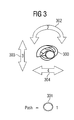
- Fig. 3 shows the mechanical part of a electro-mechanical device for inputting control information to the control means 130.
- the input means must provide enough separate input channels, and must be usable very easily without looking at the device itself.
- the solution according to the present invention is a knob, where the respective input channel is selected by exerting to the knob a force in a certain manner as indicated in Fig. 3. Pushing the knob activates the input channel designated with number "1". Exerting a rotational force to the knob around its axis, activates the input channel with the designated number "2”. A vertical translational force activates the input channel designated with number "3", whereby a sign on the channel number distinguishes whether the knob has been pressed downwards or upwards.
- Exerting horizontal forces to the knob activates the input channel designated with number "4", whereby the sign of the channel input reflects if the knob has been pressed to the left or the right side.
- the interpretation of the input channel signals by the control means 130 depends on the operation mode of the headset 101 and on the type of the media source selected for the audio data transmission. For a better understanding, two examples, one for a media source of a phone type, the other for a media source of a media player type are given below showing the operation controlled on the media source in relation to the input channel number activated with the control knob of Fig. 3.
- a separate device comprising the transceiving means 140, the control means 143, and the audio message memory 144 is proposed to be connected to the remote control access of that legacy audio device.
- This separate device thus forms a bridge between the legacy audio device and the wireless domain of the headset 101.
- the search for media sources 102 by the headset 101 can be implemented on top of the Bluetooth mechanism, like e.g. a device discovery mechanism.
- a headset 101 can set a filter to collect all the information about suitable devices.
- the device interaction mechanism allows, using UPnP (Universal Plug and Play) on top of XML (Extensible Mark-up Language) or similar technologies to retrieve sufficient information from the media sources to build a mapping between the input from the user interface to the device capabilities for controlling their functionality.
- UPnP Universal Plug and Play
- XML Extensible Mark-up Language
- the headset 101 according to the present invention can further provide a common control interface to a Bluetooth enabled mobile ad-hoc network of many media sources thereby transmitting control information to selected but different media sources.
- the headset according to the present invention may be used as a common control interface to all audio sources provided by the networked devices like that of a media player providing light music, a phone for conversation, and PDA (personal digital assistant) signalling scheduled events.
Landscapes
- Engineering & Computer Science (AREA)
- Computer Networks & Wireless Communication (AREA)
- Signal Processing (AREA)
- Telephone Function (AREA)
- Headphones And Earphones (AREA)
Abstract
Description
| Operation on device | Operation on control knob |
| Call accept/hang up | 1 |
| Volume up/down | +2/-2 |
| Operation on device | Operation on control knob |
| Play/ |
1 |
| Volume up/down | +2/-2 |
| Track forward/backward | +4/-4 |
Claims (14)
- A wireless transmission system (100) for audio data comprising:characterised in that said portable electro-acoustic transducer set (101) comprises means for selectively establishing a link with one of the media sources (102) for a bi-directional transmission of audio and control data.a portable electro-acoustic transducer set (101) adapted to transmit and to receive control data and audio data over an air interface, anda plurality of media sources (102) each adapted to transmit and to receive control data and audio data to and from said portable electro-acoustic transducer set,
- A wireless transmission system according to claim 1,
characterised in that said portable electro-acoustic transducer set comprises means (131) to broadcast control data requesting type and access information from media sources (102). - A wireless transmission system according to claim 2,
characterised in that each media source (102) transmits control data identifying its type and its address to said portable electro-acoustic transducer set (101) in response to said broadcasting control data. - A wireless transmission system according to one of the claims 1 to 3,
characterised in that said media source (102) provides audio data in form of an audio message containing a voice sample characterising the type of said media source. - A wireless transmission system according to claim 4,
characterised in that said audio message is transmitted to said portable electro-acoustic transducer set (101) following a request from said portable electro-acoustic transducer set (101). - A wireless transmission system according to one of the claims 1 to 5,
characterised in that the transmission of control and audio data is implemented according to the Bluetooth standard. - A portable electro-acoustic transducer set (101) comprising:characterised in that said retrieving means (130, 131) establishes a selective bi-directional transmission link with a media source (102) selected by said input means (132) based on information retrieved from said media source (102).retrieving means (130, 131) for retrieving information from a plurality of media sources,storage means (133) for storing information retrieved from said plurality of media sources,transducer means (110) for acoustically reproducing information retrieved from said plurality of media sources, andinput means (132) for selecting a media source from said plurality of media sources,
- A portable electro-acoustic transducer set according to claim 7,
characterised in that said input means (132) comprises a microphone. - A portable electro-acoustic transducer set according to claim 7 or 8,
characterised in that said input means (132) comprises a speech recognition system for processing voice commands. - A method for operating a portable electro-acoustic transducer set (101) comprising the steps of:collecting data about accessible media sources (102) on request by a user,acoustically informing a user of said accessible media sources (102) when requested, andselectively establishing a link to a media source (102) requested by a user for a bi-directional transmission of audio and control data.
- A media source (102) comprising
a transceiving means (140) for transmitting and receiving control data and audio data to and from a portable electro-acoustic transducer set (101) via an air interface,
characterised in that once a selective link is established between said media source (102) and a portable electro-acoustic transducer set (101), said media source exchanges audio and control data exclusively with said portable electro-acoustic transducer set (101). - A media source according to claim 11,
characterised by
a memory unit (144) for storing audio data in form of an audio message. - A media source according to claim 12,
characterised in that said audio message is transmitted to said portable electro-acoustic transducer set (101) following a request from said portable electro-acoustic transducer set (101). - A media source according to one of the claims 11 to 13,
characterised in that commands received from said portable electro-acoustic transducer set (101) in form of control data specifying certain operations of said media source (102) are processed.
Priority Applications (1)
| Application Number | Priority Date | Filing Date | Title |
|---|---|---|---|
| EP01114336.9A EP1267523B1 (en) | 2001-06-13 | 2001-06-13 | Extended user interface in a wireless headset |
Applications Claiming Priority (1)
| Application Number | Priority Date | Filing Date | Title |
|---|---|---|---|
| EP01114336.9A EP1267523B1 (en) | 2001-06-13 | 2001-06-13 | Extended user interface in a wireless headset |
Publications (2)
| Publication Number | Publication Date |
|---|---|
| EP1267523A1 true EP1267523A1 (en) | 2002-12-18 |
| EP1267523B1 EP1267523B1 (en) | 2020-01-01 |
Family
ID=8177713
Family Applications (1)
| Application Number | Title | Priority Date | Filing Date |
|---|---|---|---|
| EP01114336.9A Expired - Lifetime EP1267523B1 (en) | 2001-06-13 | 2001-06-13 | Extended user interface in a wireless headset |
Country Status (1)
| Country | Link |
|---|---|
| EP (1) | EP1267523B1 (en) |
Cited By (13)
| Publication number | Priority date | Publication date | Assignee | Title |
|---|---|---|---|---|
| EP1434413A1 (en) * | 2002-12-26 | 2004-06-30 | Kabushiki Kaisha Toshiba | Wireless apparatus for audio acquisition |
| EP1443665A1 (en) * | 2003-01-31 | 2004-08-04 | Kabushiki Kaisha Toshiba | Electronic apparatus and remote control method used in the apparatus |
| EP1455487A1 (en) * | 2003-03-05 | 2004-09-08 | Kabushiki Kaisha Toshiba | Bluetooth-Headset |
| EP1376572A3 (en) * | 2002-06-19 | 2006-06-14 | Pioneer Corporation | A set of electronic apparatuses having first and second electronic devices, and computer program |
| US7292880B2 (en) * | 2000-05-26 | 2007-11-06 | Nokia Corporation | Hands-free function |
| WO2008129332A1 (en) * | 2007-04-19 | 2008-10-30 | Denis Kleva | System of broadcasting the music and voting on music events |
| US7474677B2 (en) | 2003-08-12 | 2009-01-06 | Bose Corporation | Wireless communicating |
| CN100512415C (en) * | 2004-08-13 | 2009-07-08 | 英业达股份有限公司 | Wireless Multimedia Playing System |
| US8121547B2 (en) | 2008-12-24 | 2012-02-21 | Plantronics, Inc. | In-headset conference calling |
| US8442019B2 (en) | 2003-08-12 | 2013-05-14 | Bose Corporation | Method and apparatus for avoiding wireless audio signal transmission interferences |
| EP3157175A4 (en) * | 2014-06-16 | 2017-06-07 | ZTE Corporation | Voice data transmission processing method, terminal, and computer storage medium |
| US9854081B2 (en) | 2013-03-15 | 2017-12-26 | Apple Inc. | Volume control for mobile device using a wireless device |
| US10013381B2 (en) | 2006-08-31 | 2018-07-03 | Bose Corporation | Media playing from a docked handheld media device |
Citations (8)
| Publication number | Priority date | Publication date | Assignee | Title |
|---|---|---|---|---|
| JPH089474B2 (en) | 1990-02-23 | 1996-01-31 | 日立造船株式会社 | Escalator device |
| US6006115A (en) | 1997-10-15 | 1999-12-21 | Sony Corporation | Wireless headphones for entertainment and telephonic communication |
| WO2001019054A1 (en) * | 1999-09-10 | 2001-03-15 | Sony Electronics, Inc. | Integrated headphones for audio programming and wireless communications with a biased microphone boom and method of implementing same |
| EP1100243A2 (en) * | 1999-11-12 | 2001-05-16 | Sony Corporation | Telephone set, communication adaptor, home appliance control method, and program recording medium |
| WO2001037524A1 (en) * | 1999-11-12 | 2001-05-25 | Telefonaktiebolaget Lm Ericsson (Publ) | Reconfigurable headset switch |
| WO2001037262A1 (en) * | 1999-11-12 | 2001-05-25 | Telefonaktiebolaget Lm Ericsson (Publ) | Wireless voice-activated remote control device |
| WO2002005593A2 (en) * | 2000-07-12 | 2002-01-17 | Siemens Aktiengesellschaft | Method for the transmission of audio signals |
| WO2002009345A1 (en) | 2000-07-26 | 2002-01-31 | Gemplus | Secure identification method between two radiofrequency network appliances |
Family Cites Families (1)
| Publication number | Priority date | Publication date | Assignee | Title |
|---|---|---|---|---|
| SE522344C2 (en) * | 1999-02-26 | 2004-02-03 | Ericsson Telefon Ab L M | Method and device for wireless telecommunications |
-
2001
- 2001-06-13 EP EP01114336.9A patent/EP1267523B1/en not_active Expired - Lifetime
Patent Citations (8)
| Publication number | Priority date | Publication date | Assignee | Title |
|---|---|---|---|---|
| JPH089474B2 (en) | 1990-02-23 | 1996-01-31 | 日立造船株式会社 | Escalator device |
| US6006115A (en) | 1997-10-15 | 1999-12-21 | Sony Corporation | Wireless headphones for entertainment and telephonic communication |
| WO2001019054A1 (en) * | 1999-09-10 | 2001-03-15 | Sony Electronics, Inc. | Integrated headphones for audio programming and wireless communications with a biased microphone boom and method of implementing same |
| EP1100243A2 (en) * | 1999-11-12 | 2001-05-16 | Sony Corporation | Telephone set, communication adaptor, home appliance control method, and program recording medium |
| WO2001037524A1 (en) * | 1999-11-12 | 2001-05-25 | Telefonaktiebolaget Lm Ericsson (Publ) | Reconfigurable headset switch |
| WO2001037262A1 (en) * | 1999-11-12 | 2001-05-25 | Telefonaktiebolaget Lm Ericsson (Publ) | Wireless voice-activated remote control device |
| WO2002005593A2 (en) * | 2000-07-12 | 2002-01-17 | Siemens Aktiengesellschaft | Method for the transmission of audio signals |
| WO2002009345A1 (en) | 2000-07-26 | 2002-01-31 | Gemplus | Secure identification method between two radiofrequency network appliances |
Cited By (15)
| Publication number | Priority date | Publication date | Assignee | Title |
|---|---|---|---|---|
| US7292880B2 (en) * | 2000-05-26 | 2007-11-06 | Nokia Corporation | Hands-free function |
| EP1376572A3 (en) * | 2002-06-19 | 2006-06-14 | Pioneer Corporation | A set of electronic apparatuses having first and second electronic devices, and computer program |
| US7209410B2 (en) | 2002-06-19 | 2007-04-24 | Pioneer Corporation | Set of electronic apparatuses having first and second electronic devices, and computer program product |
| EP1434413A1 (en) * | 2002-12-26 | 2004-06-30 | Kabushiki Kaisha Toshiba | Wireless apparatus for audio acquisition |
| EP1443665A1 (en) * | 2003-01-31 | 2004-08-04 | Kabushiki Kaisha Toshiba | Electronic apparatus and remote control method used in the apparatus |
| EP1455487A1 (en) * | 2003-03-05 | 2004-09-08 | Kabushiki Kaisha Toshiba | Bluetooth-Headset |
| US7277520B2 (en) | 2003-03-05 | 2007-10-02 | Kabushiki Kaisha Toshiba | Electronic apparatus having a communication device |
| US7474677B2 (en) | 2003-08-12 | 2009-01-06 | Bose Corporation | Wireless communicating |
| US8442019B2 (en) | 2003-08-12 | 2013-05-14 | Bose Corporation | Method and apparatus for avoiding wireless audio signal transmission interferences |
| CN100512415C (en) * | 2004-08-13 | 2009-07-08 | 英业达股份有限公司 | Wireless Multimedia Playing System |
| US10013381B2 (en) | 2006-08-31 | 2018-07-03 | Bose Corporation | Media playing from a docked handheld media device |
| WO2008129332A1 (en) * | 2007-04-19 | 2008-10-30 | Denis Kleva | System of broadcasting the music and voting on music events |
| US8121547B2 (en) | 2008-12-24 | 2012-02-21 | Plantronics, Inc. | In-headset conference calling |
| US9854081B2 (en) | 2013-03-15 | 2017-12-26 | Apple Inc. | Volume control for mobile device using a wireless device |
| EP3157175A4 (en) * | 2014-06-16 | 2017-06-07 | ZTE Corporation | Voice data transmission processing method, terminal, and computer storage medium |
Also Published As
| Publication number | Publication date |
|---|---|
| EP1267523B1 (en) | 2020-01-01 |
Similar Documents
| Publication | Publication Date | Title |
|---|---|---|
| US7356308B2 (en) | Radio communication apparatus and radio communication method, radio communication system, recording medium, and computer program | |
| EP2173076B1 (en) | Control of a wireless conference telephone system | |
| US7062223B2 (en) | Mobile transceiver and electronic module for controlling the transceiver | |
| JP2003347956A (en) | Audio output device and control method thereof | |
| KR101059299B1 (en) | Remote speaker controller with microphone | |
| US8265293B2 (en) | Audio signal output method and apparatus for short-range communication enabled headset | |
| US20020068610A1 (en) | Method and apparatus for selecting source device and content delivery via wireless connection | |
| US7120463B2 (en) | Network interface cassette adapter and method | |
| EP1267523B1 (en) | Extended user interface in a wireless headset | |
| MX2008016325A (en) | System and method for multimedia networking with mobile telephone and headset. | |
| JP2003050589A (en) | Information processing system, information processing method of information processing system, information processor and information processing program | |
| CN109379490B (en) | Audio playing method and device, electronic equipment and computer readable medium | |
| EP1455487A1 (en) | Bluetooth-Headset | |
| GB2329737A (en) | Earphone and terminal equipment | |
| JP2004312662A (en) | Portable terminal with sound / background sound output function using key buttons during a call | |
| US7266390B2 (en) | Network interface cassette adapter and method | |
| JP2006352799A (en) | Wireless communication apparatus and method, and portable information processing apparatus | |
| JP4368138B2 (en) | Network system, electronic device terminal, server device, and content distribution / playback method | |
| JP2015002394A (en) | Information processing apparatus and computer program | |
| JP5085431B2 (en) | Wireless communication device | |
| JP3949886B2 (en) | Portable audio player and output destination control method for portable audio player | |
| KR101076533B1 (en) | Methods and a apparatus of additional bluetooth equipment with radio receiver for mobile phone | |
| JPH11285069A (en) | Portable telephone system and speech device used for it | |
| KR100730821B1 (en) | Apparatus and method for reproducing a sound source of a mobile communication terminal | |
| CN121174122A (en) | Audio data transmission control method, device and system and vehicle |
Legal Events
| Date | Code | Title | Description |
|---|---|---|---|
| PUAI | Public reference made under article 153(3) epc to a published international application that has entered the european phase |
Free format text: ORIGINAL CODE: 0009012 |
|
| AK | Designated contracting states |
Kind code of ref document: A1 Designated state(s): AT BE CH CY DE DK ES FI FR GB GR IE IT LI LU MC NL PT SE TR |
|
| AX | Request for extension of the european patent |
Free format text: AL;LT;LV;MK;RO;SI |
|
| 17P | Request for examination filed |
Effective date: 20030212 |
|
| AKX | Designation fees paid |
Designated state(s): DE FR GB |
|
| RAP1 | Party data changed (applicant data changed or rights of an application transferred) |
Owner name: SONY DEUTSCHLAND GMBH |
|
| RAP1 | Party data changed (applicant data changed or rights of an application transferred) |
Owner name: SONY DEUTSCHLAND GMBH |
|
| RAP1 | Party data changed (applicant data changed or rights of an application transferred) |
Owner name: SONY DEUTSCHLAND GMBH |
|
| 17Q | First examination report despatched |
Effective date: 20090113 |
|
| STAA | Information on the status of an ep patent application or granted ep patent |
Free format text: STATUS: EXAMINATION IS IN PROGRESS |
|
| GRAP | Despatch of communication of intention to grant a patent |
Free format text: ORIGINAL CODE: EPIDOSNIGR1 |
|
| STAA | Information on the status of an ep patent application or granted ep patent |
Free format text: STATUS: GRANT OF PATENT IS INTENDED |
|
| RIC1 | Information provided on ipc code assigned before grant |
Ipc: H04L 12/28 20060101AFI20190708BHEP Ipc: H04M 1/60 20060101ALI20190708BHEP |
|
| INTG | Intention to grant announced |
Effective date: 20190726 |
|
| RIN1 | Information on inventor provided before grant (corrected) |
Inventor name: LOEBBERT, JOHANNES, C/O ADVANCED TECHN. CENT. STUT |
|
| GRAS | Grant fee paid |
Free format text: ORIGINAL CODE: EPIDOSNIGR3 |
|
| GRAA | (expected) grant |
Free format text: ORIGINAL CODE: 0009210 |
|
| STAA | Information on the status of an ep patent application or granted ep patent |
Free format text: STATUS: THE PATENT HAS BEEN GRANTED |
|
| AK | Designated contracting states |
Kind code of ref document: B1 Designated state(s): DE FR GB |
|
| REG | Reference to a national code |
Ref country code: GB Ref legal event code: FG4D |
|
| REG | Reference to a national code |
Ref country code: DE Ref legal event code: R096 Ref document number: 60151230 Country of ref document: DE |
|
| PGFP | Annual fee paid to national office [announced via postgrant information from national office to epo] |
Ref country code: DE Payment date: 20200618 Year of fee payment: 20 |
|
| PGFP | Annual fee paid to national office [announced via postgrant information from national office to epo] |
Ref country code: GB Payment date: 20200625 Year of fee payment: 20 |
|
| REG | Reference to a national code |
Ref country code: DE Ref legal event code: R097 Ref document number: 60151230 Country of ref document: DE |
|
| PLBE | No opposition filed within time limit |
Free format text: ORIGINAL CODE: 0009261 |
|
| STAA | Information on the status of an ep patent application or granted ep patent |
Free format text: STATUS: NO OPPOSITION FILED WITHIN TIME LIMIT |
|
| 26N | No opposition filed |
Effective date: 20201002 |
|
| PG25 | Lapsed in a contracting state [announced via postgrant information from national office to epo] |
Ref country code: FR Free format text: LAPSE BECAUSE OF NON-PAYMENT OF DUE FEES Effective date: 20200630 |
|
| REG | Reference to a national code |
Ref country code: DE Ref legal event code: R071 Ref document number: 60151230 Country of ref document: DE |
|
| REG | Reference to a national code |
Ref country code: GB Ref legal event code: PE20 Expiry date: 20210612 |
|
| PG25 | Lapsed in a contracting state [announced via postgrant information from national office to epo] |
Ref country code: GB Free format text: LAPSE BECAUSE OF EXPIRATION OF PROTECTION Effective date: 20210612 |