EP1266898A1 - Processes for the production of thienopyrimidine derivatives - Google Patents

Processes for the production of thienopyrimidine derivatives Download PDF

Info

Publication number
EP1266898A1
EP1266898A1 EP01906336A EP01906336A EP1266898A1 EP 1266898 A1 EP1266898 A1 EP 1266898A1 EP 01906336 A EP01906336 A EP 01906336A EP 01906336 A EP01906336 A EP 01906336A EP 1266898 A1 EP1266898 A1 EP 1266898A1
Authority
EP
European Patent Office
Prior art keywords
salt
compound
reaction
formula
compound represented
Prior art date
Legal status (The legal status is an assumption and is not a legal conclusion. Google has not performed a legal analysis and makes no representation as to the accuracy of the status listed.)
Withdrawn
Application number
EP01906336A
Other languages
German (de)
French (fr)
Other versions
EP1266898A4 (en
Inventor
Koichiro Fukuoka
Hiroaki Yamamoto
Kazuhiro Kimura
Junichi Kawakami
Shokyo Miki
Current Assignee (The listed assignees may be inaccurate. Google has not performed a legal analysis and makes no representation or warranty as to the accuracy of the list.)
Takeda Pharmaceutical Co Ltd
Original Assignee
Takeda Chemical Industries Ltd
Priority date (The priority date is an assumption and is not a legal conclusion. Google has not performed a legal analysis and makes no representation as to the accuracy of the date listed.)
Filing date
Publication date
Application filed by Takeda Chemical Industries Ltd filed Critical Takeda Chemical Industries Ltd
Publication of EP1266898A1 publication Critical patent/EP1266898A1/en
Publication of EP1266898A4 publication Critical patent/EP1266898A4/en
Withdrawn legal-status Critical Current

Links

Classifications

    • CCHEMISTRY; METALLURGY
    • C07ORGANIC CHEMISTRY
    • C07DHETEROCYCLIC COMPOUNDS
    • C07D333/00Heterocyclic compounds containing five-membered rings having one sulfur atom as the only ring hetero atom
    • C07D333/02Heterocyclic compounds containing five-membered rings having one sulfur atom as the only ring hetero atom not condensed with other rings
    • C07D333/04Heterocyclic compounds containing five-membered rings having one sulfur atom as the only ring hetero atom not condensed with other rings not substituted on the ring sulphur atom
    • C07D333/26Heterocyclic compounds containing five-membered rings having one sulfur atom as the only ring hetero atom not condensed with other rings not substituted on the ring sulphur atom with hetero atoms or with carbon atoms having three bonds to hetero atoms with at the most one bond to halogen, e.g. ester or nitrile radicals, directly attached to ring carbon atoms
    • C07D333/30Hetero atoms other than halogen
    • C07D333/36Nitrogen atoms
    • CCHEMISTRY; METALLURGY
    • C07ORGANIC CHEMISTRY
    • C07DHETEROCYCLIC COMPOUNDS
    • C07D495/00Heterocyclic compounds containing in the condensed system at least one hetero ring having sulfur atoms as the only ring hetero atoms
    • C07D495/02Heterocyclic compounds containing in the condensed system at least one hetero ring having sulfur atoms as the only ring hetero atoms in which the condensed system contains two hetero rings
    • C07D495/04Ortho-condensed systems
    • CCHEMISTRY; METALLURGY
    • C07ORGANIC CHEMISTRY
    • C07DHETEROCYCLIC COMPOUNDS
    • C07D333/00Heterocyclic compounds containing five-membered rings having one sulfur atom as the only ring hetero atom
    • C07D333/02Heterocyclic compounds containing five-membered rings having one sulfur atom as the only ring hetero atom not condensed with other rings
    • C07D333/04Heterocyclic compounds containing five-membered rings having one sulfur atom as the only ring hetero atom not condensed with other rings not substituted on the ring sulphur atom
    • C07D333/26Heterocyclic compounds containing five-membered rings having one sulfur atom as the only ring hetero atom not condensed with other rings not substituted on the ring sulphur atom with hetero atoms or with carbon atoms having three bonds to hetero atoms with at the most one bond to halogen, e.g. ester or nitrile radicals, directly attached to ring carbon atoms
    • C07D333/38Carbon atoms having three bonds to hetero atoms with at the most one bond to halogen, e.g. ester or nitrile radicals

Definitions

  • the present invention relates to a process for producing thienopyrimidine derivatives which are useful as a medicine and show the useful Gonadotropin releasing hormone [GnRH] antagonistic activity, and intermediates therefor.
  • a process for producing a thieno[2,3-d]pyrimidine compound showing the GnRH antagonistic activity there is a known method for obtaining a thieno[2,3-d]pyrimidine compound by using, as a starting material, 2-amino-4-methyl-5-(4-nitrophenyl)thiophene-3-carboxylic acid ethyl ester which is obtained by reacting 4-nitrophenylacetone with ethyl cyanoacetate, ammonium acetate, acetic acid, sulfur and diethylamine [WO96/24597(JP-A 9-169768)].
  • a process for producing a methylketone compound there is a known method of subjecting a magnesium ethoxy derivative of diethyl malonate and a suitable amount of acid chloride to an acylating reaction, which is subjected to a hydrolysis reaction, and subjecting (two ester groups of) the resulting diethyl acylmalonate to a decarboxylation reaction in the presence of an acid (J.Am.Chem.Soc., Vol.68,pp1386(1946)etc.).
  • the present inventors extensively studied a process for producing thieno[2,3-d]pyrimidine derivatives, found that thieno[2,3-d]pyrimidine derivatives of interest showing the GnRH antagonistic activity can be unexpectedly obtained safely, simply and at a high yield by using 4-nitrophenylacetone, magnesium alkoxide and primary amine as a starting material for the first time and this process is sufficiently satisfactory at an industrial scale, and completed the present invention based on these findings.
  • the present invention relates to:
  • examples of the "halogen" denoted by R 1 include fluoro, chloro, bromo and iodo.
  • R 1 or R 1a examples include mono(C 1-6 alkylcarbonyl)amino (for example, acetylamino, propionylamino and the like).
  • di(alkylcarbonyl)amino examples include di(C 1-6 alkylcarbonyl)amino (for example, diacetylamino, dipropionylamino and the like).
  • alkoxy examples include C 1-6 alkoxy (for example, methoxy, ethoxy, propoxy, butoxy, isopropoxy, isobutoxy, t-butoxy and the like).
  • nitro and phthalimido are preferable. Furthermore nitro is more preferable.
  • alkyl examples include C 1-6 alkyl (for example, methyl, ethyl, propyl, isopropyl, butyl, isobutyl, t-butyl, pentyl, hexyl and the like).
  • aryl examples include C 6-14 aryl, preferably C 6-10 aryl (for example, phenyl, 1-naphthyl, 2-naphthyl and the like.
  • C 1-3 alkyl is preferable, and ethyl is more preferable.
  • alkyl in the “alkyl optionally having a substituent” denoted by R 3 include C 1-6 alkyl (for example, methyl, ethyl, propyl, isopropyl, butyl, isobutyl, t-butyl, pentyl, hexyl and the like).
  • Examples of the "substituent" in the "alkyl optionally having a substituent” denoted by R 3 include (i) C 1-6 alkoxy (for example, methoxy, ethoxy, propoxy, butoxy, isopropoxy, isobutoxy, t-butoxy and the like) (ii) C 1-4 acyl (for example, C 1-3 alkyl-carbonyl such as acetyl and propionyl and the like) and (iii) C 6-14 aryl optionally having a substituent.
  • the number of the substituent is 1 to 5 at replaceable positions.
  • Examples of the "C 6-14 aryl optionally having a substituent" include the same "aryl optionally having a substituent" as that denoted by R 3 described later.
  • Examples of the "substituent" in the "aryl optionally having a substituent” denoted by R 3 include (i) halogen (for example, fluorine, chlorine, bromine, iodine), (ii) C 1-6 alkyl (for example, methyl, ethyl, propyl, isopropyl, butyl, isobutyl, t-butyl, pentyl, hexyl and the like), (iii) C 1-6 alkoxy (for example, methoxy, ethoxy, propoxy, butoxy, isopropoxy, isobutoxy, t-butoxy and the like) optionally having 1 to 3 substituents selected from halogen (for example, fluorine, chlorine, bromine, iodine), hydroxy and C 1-3 alkyl (for example, methyl, ethyl, propyl, isopropyl and the like), and (iv) C 1-4 acyl (for example, C 1-3
  • phenyl optionally having a substituent is preferable, and unsubstituted phenyl is more preferable.
  • Examples of the "leaving group" denoted by R 4 include halogen (for example, fluorine, chlorine, bromine, iodine), alkylsulfonyloxy (for example, C 1-6 alkylsulfonyloxy such as methylsulfonyloxy and the like), arylsulfonyloxy (for example, C 6-14 arylsulfonyloxy (for example, phenylsulfonyloxy and the like) optionally substituted with 1 to 5 of C 1-6 alkyl (for example, methyl, ethyl, propyl, isopropyl, butyl, isobutyl, t-butyl, pentyl, hexyl and the like) such as p-toluenesulfonyloxy and the like).
  • halogen for example, fluorine, chlorine, bromine, iodine
  • alkylsulfonyloxy for example, C
  • Examples of the "aryl optionally having a substituent" denoted by R 5 include the same “aryl optionally having a substituent” as that denoted by R 3 .
  • phenyl optionally having a substituent is preferable.
  • Phenyl optionally having 1 or 2 halogen atoms for example, fluorine, chlorine, bromine and iodine
  • 2,6-difluorophenyl is the most preferable.
  • alkyl optionally having a substituent denoted by R 6 or R 7
  • examples of the “alkyl optionally having a substituent” denoted by R 6 or R 7 include the same “alkyl optionally having a substituent” as that denoted by R 3 .
  • Examples of the "aryl optionally having a substituent" denoted by R 6 or R 7 include the same “aryl optionally having a substituent” as that denoted by R 3 .
  • alkoxy in the “alkoxy optionally having a substituent” denoted by R 6 or R 7 include C 1-6 alkoxy (for example, methoxy, ethoxy, propoxy, isopropoxy, butoxy, isobutoxy, t-butoxy and the like) and the like.
  • Examples of the "substituent" in the "alkoxy optionally having a substituent” denoted by R 6 or R 7 include carboxy, C 1-3 alkyl (for example, methyl, ethyl, propyl, isopropyl and the like) and C 1-4 acyl (C 1-3 alkyl-carbonyl such as acetyl and propionyl).
  • the number of the substituent is 1 to 3 at replaceable positions.
  • Examples of the "aralkyl” in the “aralkyl optionally having a substituent” denoted by R 6 or R 7 include C 7-16 aralkyl (for example, benzyl, phenethyl, 1-naphthylmethyl, 2-naphthylmethyl and the like), preferably benzyl and the like.
  • Examples of the "substituent" in the "aralkyl optionally having a substituent” and the “heterocycle group optionally having a substituent” denoted by R 6 or R 7 include C 1-6 alkyl (for example, methyl, ethyl and the like), C 1-6 alkoxy (for example, methoxy, ethoxy and the like), C 1-6 alkylthio (for example, methylthio, ethylthio and the like), C 1-4 acyl (for example, C 1-3 alkyl-carbonyl such as acetyl and propionyl and the like) and di-C 1-6 alkylamino (for example, dimethyl amino and the like).
  • the number of substituent is 1 to 5 at replaceable positions.
  • R 6 or R 7 it is preferable that one of them is C 1-3 alkyl and the other is benzyl optionally having a substituent, and it is more preferable that one of them is C 1-3 alkyl and the other is benzyl.
  • alkoxy in the “alkoxy optionally having a substituent” denoted by R 8 or R 9 include C 1-6 alkoxy (for example, methoxy, ethoxy, propoxy, isopropoxy, butoxy, isobutoxy, t-butoxy and the like).
  • alkyl in the “alkyl optionally having a substituent” denoted by R 8 or R 9 include C 1-6 alkyl (for example, methyl, ethyl, propyl, isopropyl, butyl, isobutyl, t-butyl, pentyl, hexyl and the like).
  • Examples of the "substituent" in the "alkoxy optionally having a substituent” and the “alkyl optionally having a substituent” denoted by R 8 or R 9 include (i) hydroxy, (ii) C 1-7 acyloxy (for example, C 1-6 alkylcarbonyloxy such as acetoxy and propionyloxy), (iii) benzoyloxy, (iv) amino optionally having 1 or 2 substituents selected from C 1-6 alkoxy-carbonyl (for example, methoxycarbonyl, ethoxycarbonyl, tert-butoxycarbonyl and the like), benzyloxycarbonyl, C 1-4 acyl (C 1-3 alkyl-carbonyl such as acetyl and propionyl and the like), C 1-4 alkyl (for example, methyl, ethyl, propyl, butyl and the like) and C 1-3 alkylsulfonyl (for example, methanes
  • R 8 and R 9 it is preferable that one of them is a hydrogen atom and the other is C 1-3 alkoxy.
  • salts of compounds represented by the formulas (I)-(XIII) and (I a ) herein pharmaceutically acceptable salts are preferable, and examples thereof include salts with an inorganic acid, salts with an organic acid, salts with an inorganic base and salts with an organic base.
  • Examples of the salt with an inorganic acid include salts with hydrochloric acid, hydrobromic acid, nitric acid, sulfuric acid and phosphoric acid and the like.
  • Examples of the salt with an organic acid include salts with formic acid, acetic acid, trifluoroacetic acid, fumaric acid, oxalic acid, tartaric acid, maleic acid, citric acid, succinic acid, malic acid, methanesulfonic acid, benzenesulfonic acid and p-toluenesulfonic acid and the like.
  • Examples of the salt with an inorganic base include alkali metal salts such as sodium salt and potassium salt; alkaline earth metal salts such as calcium salt and magnesium salt; ammonium salt and the like.
  • Examples of the salt with an organic base include salts with trimethylamine, triethylamine, pyridine, picoline, ethanolamine, diethanolamine, triethanolamine, dicyclohexylamine and N,N'-dibenzylethylenediamine and the like.
  • Compound (I) a compound represented by the formula (I) or salt thereof is abbreviated as “Compound (I) ".
  • Other compounds are abbreviated in a similar manner.
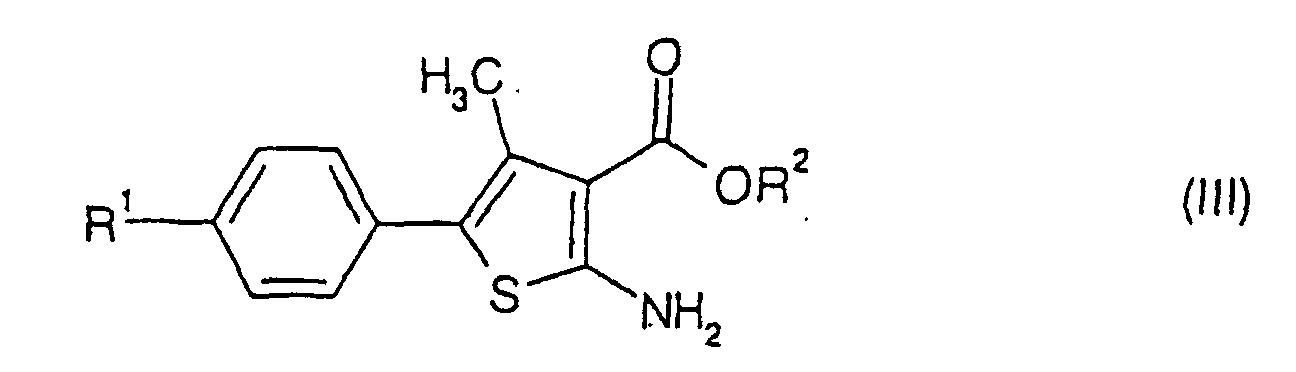
  • a process for producing Compound (III) which is useful as an intermediate for thienopyrimidine derivatives showing the GnRH antagonistic activity is described below.
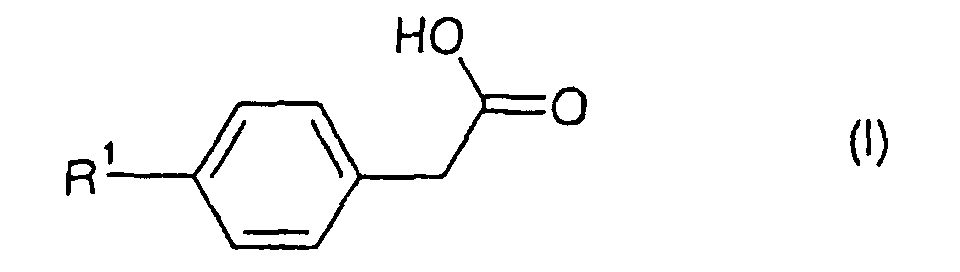
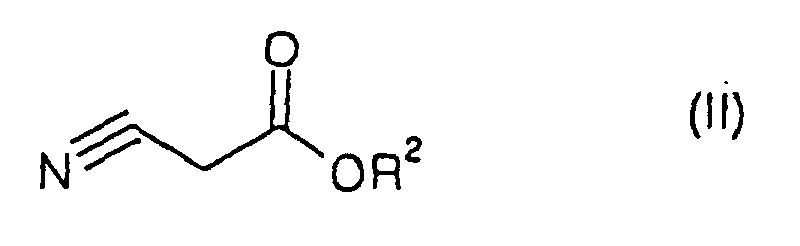
  • Compound (I) is subjected to an acid halogenating reaction, which is successively reacted with malonic acid ester and magnesium alkoxide and, then, treated with an acid and, then, reacted with sulfur and Compound (II) in the presence of primary amine to obtain Compound (III).
  • An acid halogenating reaction for Compound (I) may be performed according to the method known per se, for example, by reacting Compound (I) and an acid halogenating agent (for example, thionyl chloride, thionyl bromide, oxalyl chloride and the like).
  • an acid halogenating agent for example, thionyl chloride, thionyl bromide, oxalyl chloride and the like.
  • the amount of the acid halogenating agent to be used is about 1-4 moles, preferably about 1.5-3 moles relative to 1 mole of Compound (I).
  • the present reaction is performed without any solvent or in the presence of a solvent which is inert with the reaction.
  • a solvent which is inert with the reaction.
  • the solvent is not particularly limited as far as the reaction proceeds, and include halogenated hydrocarbons, aliphatic hydrocarbons, aromatic hydrocarbons, ethers, esters, amides, nitriles and a mixture of 2 or more of them.
  • the reaction temperature is usually about 0-100°C, preferably about 0-80°C.
  • the reaction time is usually about 0.5-3 hours, preferably about 0.5-1 hour.
  • the present reaction may be performed optionally in the presence of N,N-dimethylformamide or the like.
  • the amount of N,N-dimethylformamide to be used is about 0-1 mole, preferably about 0-0.5 mole relative to 1 mole of Compound (I).
  • the product maybe used in the next reaction as the reaction solution itself or as the crude product, or may be isolated from the reaction mixture according to the conventional method and may serve as a starting material in the next step.
  • malonic acid ester examples include a compound represented by the formula "R a OOC-CH 2 -COOR b (wherein R a and R b denote alkyl or aryl, respectively).
  • alkyl examples include C 1-6 alkyl (for example, methyl, ethyl, propyl, isopropyl, butyl, isobutyl, t-butyl, pentyl, hexyl and the like).
  • C 1-6 alkyl is preferable, and ethyl is more preferable.
  • the amount of the "malonic acid ester” to be used is about 1-2 moles, preferably 1.1-1.3 moles relative to 1 mole of Compound (I).
  • magnesium C 1-6 alkoxide such as magnesium methoxide and magnesium ethoxide and the like is preferable, and magnesium C 1-3 alkoxide is more preferable.
  • An amount of the "magnesium alkoxide" to be used is about 1-2 moles, preferably about 1.1-1.3 moles relative to 1 mole of Compound (I).
  • the present reaction may be performed optionally in the presence of Lewis acid.
  • Lewis acid examples include anhydrous aluminium chloride, titanium tetrachloride and magnesium chloride and the like.
  • the amount of the "Lewis acid” to be used is about 1-4 moles, preferably about 1-2 moles relative to 1 mole of Compound (I).
  • the present reaction is performed in the presence of a solvent which is inert with the reaction.
  • the solvent is not particularly limited as far as the reaction proceeds.
  • halogenated hydrocarbons for example, aliphatic hydrocarbons, ethers, amides, alcohols or a mixture of 2 or more of them are used.
  • ethers such as butyl methyl ether (for example, tert-butyl methyl ether and the like), butyl ethyl ether (for example, tert-butyl ethyl ether and the like) are preferable.
  • the reaction temperature is usually about 20-100°C, preferably about 40-70°C.
  • the reaction time is usually about 1-12 hours, preferably 4-7 hours.
  • the product may be used as the reaction solution itself or as the crude product, or may be isolated from the reaction mixture according to the conventional method and may serve as a starting material in the next step.
  • the hydrolysis reaction is performed by using an acid.
  • the "acid” examples include mineral acids such as hydrochloric acid, hydrobromic acid and sulfuric acid and the like; organic acids such as acetic acid and trifluoroacetic acid and the like, or a mixture of 2 or more of them. Among them, the preferable is a mixture of sulfuric acid and acetic acid.
  • the amount of the "acid” to be used is about 1-10 moles, preferably 4-8 moles relative to 1 mole of Compound (I).
  • the present reaction is performed in the presence of a solvent which is inert with the reaction.
  • the solvent is not particularly limited as far as the reaction proceeds.
  • ethers, amides, alcohols, water or a mixture of 2 or more of them are used.
  • water is used.
  • the reaction temperature is usually about 70-140°C, preferably about 90-130°C.
  • the reaction time is usually about 1-12 hours, preferably about 4-7 hours.
  • the product may be used in the next reaction as the reaction solution itself or as the crude product, or may be isolated from the reaction mixture according to the conventional method and may serve as a starting material in the next step.
  • Examples of the "primary amine” include mono-C 3-8 alkylamine (for example, propylamine, butylamine, octylamine and the like), benzylamine and the like. Among them, butylamine is preferable.
  • the amount of the "primary amine” to be used is about 0.01-1.5 moles, preferably about 0.1-1.2 moles relative to 1 mole of Compound (I).
  • the amount of the "sulfur" to be used is about 1-2 moles, preferably 1-1.2 moles relative to 1 mole of Compound (I).
  • the amount of the "Compound (II) " to be used is about 1-1.5 moles, preferably about 1-1.2 moles relative to 1 mole of Compound (I).
  • the present reaction is performed without any solvent or in the presence of a solvent which is inert with the reaction.
  • the solvent is not particularly limited as far as the reaction proceeds.
  • alcohols, nitriles, ethers, esters, amides, or a mixture of 2 or more of them are used.
  • alcohols such as methanol and ethanol and the like are used.
  • the reaction temperature is usually about 20-100°C, preferably about 20-70°C.
  • the reaction time is usually 1-12 hours, preferably 1-5 hours.
  • the product (III) may be used in the next reaction as the reaction solution itself or as the crude product, or may be isolated from the reaction mixture according to the conventional method and may serve as a starting material in the next step.
  • steps 1 ⁇ -4 ⁇ may be performed continuously without isolating an intermediate produced in each step from the reaction mixture, and are industrially advantageous.
  • a Compound wherein R 1 is a hydrogen atom, halogen or alkoxy in Compound (III) can be produced according to the following method: wherein R 1 is a hydrogen atom, halogen or alkoxy, and R 2 has the same meanings as those described above.
  • Compound (III) is obtained by reacting Compound (XIII) and Compound (II) in the presence of organic amine, which is then reacted with sulfur and organic amine.
  • organic amine examples include the aforementioned primary amine and benzyl amine and the like.
  • the amount of the "Compound (II) " to be used is about 1-1.5 moles, preferably about 1-1.2 moles relative to 1 mole of Compound (XIII).
  • the amount of the "organic amine” to be used is about 0.005-0.5 mole, preferably about 0.01-0.1 mole relative to 1 mole of Compound (XIII).
  • the present reaction is performed without any solvent or in the presence of a solvent which is inert with the reaction.
  • the solvent is not particularly limited as far as the reaction proceeds.
  • alcohols, nitriles, ethers, amides, or a mixture of 2 or more of them and the like are used.
  • alcohols are used.
  • the reaction temperature is usually about 20-80°C, preferably about 20-60°C.
  • the reaction time is usually about 2-10 hours, preferably about 4-8 hours.
  • the product may be used as the reaction solution itself or as the crude product, or may be isolated from the reaction mixture according to the conventional method and may serve as a starting material in the next step.
  • organic amine examples include aforementioned primary amine, benzyl amine and morpholine.
  • the amount of the "sulfur" to be used is about 1-2 moles, preferably about 1-1.2 moles relative to 1 mole of Compound (XIII).
  • the amount of the "organic amine” to be used is about 0.1-0.7 mole, preferably about 0.3-0.6 mole relative to 1 mole of Compound (XIII).
  • the present reaction is performed without any solvent or in the presence of a solvent which is inert with the reaction.
  • the solvent is not particularly limited as far as the reaction proceeds.
  • alcohols, nitriles, ethers, amides, or a mixture of 2 or more of them and the like are used.
  • alcohols are used.
  • the reaction temperature is usually 20-80°C, preferably about 20-60°C.
  • the reaction time is usually about 2-10 hours, preferably about 4-8 hours.
  • the product (III) may be used in the next reaction as the crude product, or may be isolated from the reaction mixture according to the conventional method and may serve as a starting material in the next step.
  • the present reaction can suppress the amount of organic amine to be used to a catalytic amount, and is industrially advantageous.
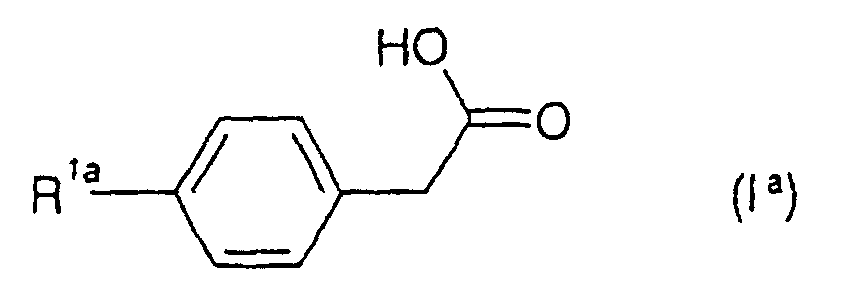
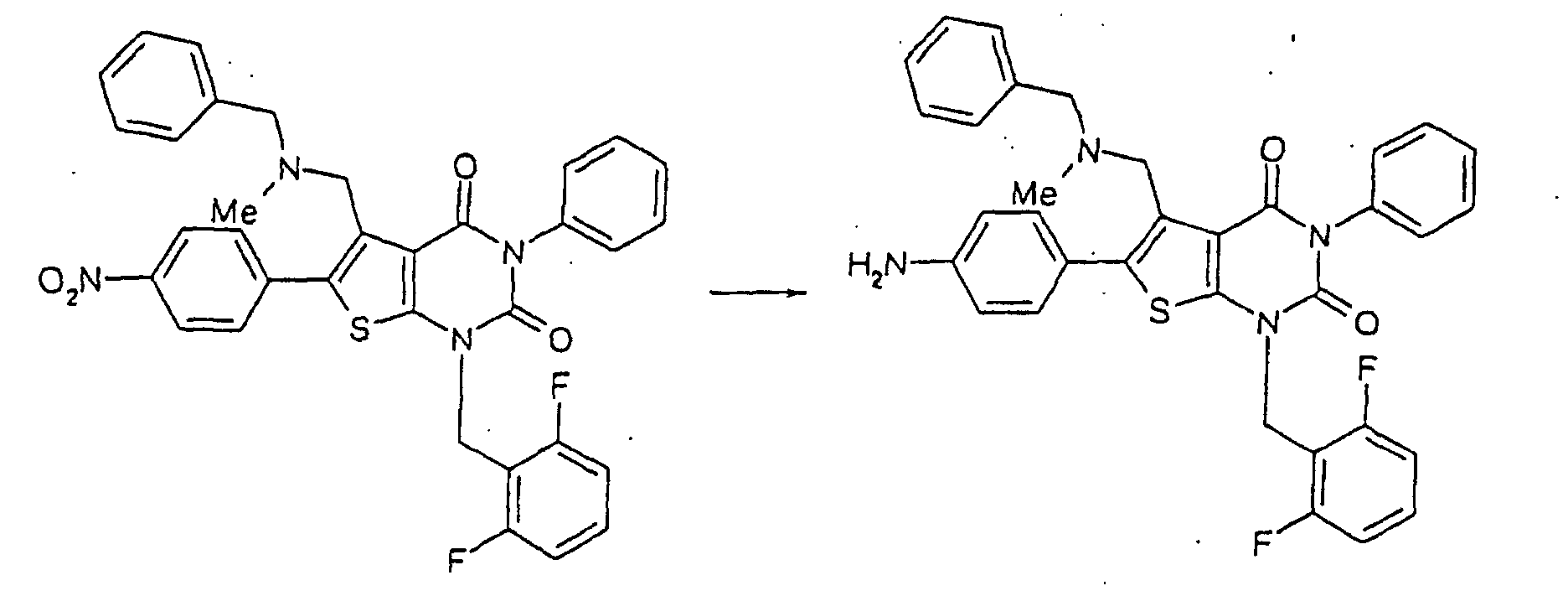
  • a compound (Compound (I a )) wherein R 1 is nitro, phthalimido, mono(alkylcarbonyl)amino or di(alkylcarbonyl)amino in Compound (I), or a salt thereof, may be converted into a thienopyrimidine derivative showing the GnRH antagonistic activity as follows: wherein R 1a denotes nitro, phthalimido, mono(alkylcarbonyl)amino or di(alkylcarbonyl)amino, and R 2 denotes the same meanings as those described above.
  • Compound (I a ) or a salt thereof is subjected to an acid halogenating reaction, which is successively reacted with malonic acid ester and magnesium alkoxide and, thereafter, treated with an acid and, then, reacted with sulfur and Compound (II) in the presence of primary amine to obtain Compound (III).
  • the present reaction may be performed under the same reaction conditions as those described above (Step 1A).
  • R 1a denotes nitro, phthalimido, mono(alkylcarbonyl)amino or di(alkylcarbonyl)amino, and other symbols denote the same meanings as those described above.
  • the present reaction may advantageously proceed usually in the presence of an organic base and examples of such the "organic base” include amines such as triethylamine, diisopropylethyamine, N-methylmorpholine, dimethylaminopyridine, DBU (1,8-diazabicyclo[5.4.0]undec-7-ene) and DBN (1,5-diazabicyclo[4.3.0]non-5-ene), and basic heterocyclic compounds such as pyridine, imidazole and 2,6-lutidine.
  • pyridine is used.
  • the amount of the "Compound (IV)" to be used is about 1-2 moles, preferably about 1.3-1.7 moles relative to 1 mole of Compound (III).
  • the amount of the "organic base” to be used is about 1-2.5 moles, preferably about 1.5-2 moles relative to 1 mole of Compound (III).
  • the present reaction is performed without any solvent or in the presence of a solvent which is inert with the reaction.
  • the solvent is not particularly limited as far as the reaction proceeds.
  • halogenated hydrocarbons aliphatic hydrocarbons, aromatic hydrocarbons, ethers, esters, amides, nitriles, alcohols or a mixture of 2 or more of them and the like are used.
  • toluene is used.
  • the reaction temperature is usually about 80-130°C, preferably about 90-110°C.
  • a reaction time is usually about 2-6 hours, preferably about 3-5 hours.
  • the product (V) may be used in the next reaction as the reaction solution itself or as the crude product, or may be isolated from the reaction mixture according to the conventional method and may serve as a starting material in the next step.
  • R 1a denotes nitro, phthalimido, mono(alkylcarbonyl)amino or di(alkylcarbonyl)amino, and other symbols have the same meanings as those described above.
  • Compound (V) is subjected to a ring closing reaction, which is reacted with Compound (VI) to obtain Compound (VII).
  • Compound (V) is subjected to a ring closing reaction.
  • the present reaction may advantageously proceed usually in the presence of a base and examples of such the "base” include strong bases such as hydrides of an alkali metal or an alkaline earth metal (for example, lithium hydride, sodium hydride, potassium hydride, calcium hydride and the like), amides of an alkali metal or an alkaline earth metal (for example, lithium amide, sodium amide, lithium diisopropylamide, lithium dicyclohexylamide, lithium hexamethyldisilazide, sodium hexamethyldisilazide, potassium hexamethyldisilazide and the like) and lower alkoxides of an alkali metal or an alkaline earth metal (for example, sodium methoxide, sodium ethoxide, potassium tert-butoxide and the like).
  • lower alkoxides of an alkali metal or an alkaline earth metal are used.
  • the amount of the "base” to be used is about 1-1.5 moles, preferably about 1.1-1.4 moles relative to 1 mole of Compound (V).
  • the present reaction is performed without any solvent or in the presence of a solvent which is inert with the reaction.
  • the solvent is not particularly limited as far as the reaction proceeds.
  • nitriles, alcohols, ethers, amides, halogenated hydrocarbons, aliphatic hydrocarbons, aromatic hydrocarbons, or a mixture of 2 or more of them and the like are used.
  • a solvent mixed with an alcohol is used.
  • a mixed solvent of nitriles such as acetonitrile and alcohols such as methanol is preferable.
  • the reaction temperature is usually about 40-100°C, preferably about 60-90°C.
  • the reaction time is usually about 10 minutes-3 hours, preferably about 30 minutes-2 hours.
  • the product may be used in the next reaction as the reaction solution or as the crude product, or may be isolated from the reaction mixture according to the conventional method and may serve as a starting material in the next step.
  • the amount of the "Compound (VI)" to be used is about 1-2 moles, preferably about 1-1.2 moles relative to 1 mole of Compound (V).
  • the present reaction may be performed optionally in the presence of a base.
  • base examples include carbonates of an alkali metal or an alkaline earth metal (for example, sodium hydrogen carbonate, sodium carbonate, potassium carbonate and the like), lower alkoxides of an alkali metal or an alkaline earth metal (for example, sodium methoxide, sodium ethoxide, potassium tert-butoxide and the like), organic bases (for example, amines such as triethylamine, diisopropylethylamine, N-methylmorpholine, dimethylaminopyridine, DBU (1,8-diazabicyclo[5.4.0]undec-7-ene) and DBN (1,5-diazabicyclo[4.3.0]non-5-ene), or organic bases such as basic heterocyclic compounds such as pyridine, imidazole and 2,6-lutidine and the like.
  • organic bases for example, amines such as triethylamine, diisopropylethylamine, N-methylmorpholine, dimethylaminopyridine
  • the amount of the "base” to be used is about 1-2 moles, preferably about 1-1.3 moles relative to 1 mole of Compound (VII).
  • the present reaction is performed without any solvent or in the presence of a solvent which is inert with the reaction.
  • the solvent is not particularly limited as far as the reaction proceeds.
  • nitriles, alcohols, ethers, amides, halogenated hydrocarbons, aliphatic hydrocarbons, aromatic hydrocarbons, or a mixture of 2 or more of them and the like is used.
  • a solvent mixed with an alcohol is used.
  • a mixed solvent of nitriles such as acetonitrile and alcohols such as methanol is preferable.
  • the reaction temperature is usually about 40-100°C, preferably 60-90°C.
  • the reaction time is usually about 1-10 hours, preferably about 3-6 hours.
  • the product (VII) may be used in the next reaction as the reaction solution itself or as the crude product, or may be isolated from the reaction mixture according to the conventional method and may serve as a starting material in the next step.
  • steps 1 ⁇ -2 ⁇ may be performed continuously without isolating an intermediate produced in the step 1 ⁇ from the reaction mixture, and are industrially advantageous.
  • R 1a denotes nitro, phthalimido, mono(alkylcarbonyl)amino or di(alkylcarbonyl)amino, and other symbols denote the same meanings as those described above.
  • Compound (VII) is reacted with a brominating agent.
  • brominating agent examples include N-bromosuccinimide and 1,3-dibromo-5,5-dimethylhydantoin.
  • the amount of the "brominating agent" to be used is about 1-3 moles, preferably about 1-1.5 moles relative to 1 mole of Compound (VII).
  • the present reaction is performed optionally in the presence of bromine and a radical initiator.
  • the amount of the "bromine” to be used is about 0.01-1 mole, preferably about 0.02-0.3 mole relative to 1 mole of Compound (VII).
  • Examples of the "radical initiator” include 2,2'-azobis(isobutyronitrile), 2,2'-azobis(2,4-dimethylvaleronitrile) and 2,2'-azobis(4-methoxy-2,4-dimethylvaleronitrile) and the like.
  • the amount of the "radical initiator" to be used is about 0.01-0.5 mole, preferably about 0.05-0.3 mole relative to 1 mole of Compound (VII).
  • the present reaction is performed in the presence of a solvent which is inert with the reaction.
  • the solvent is not particularly limited as far as the reaction proceeds.
  • nitriles, aromatic hydrocarbons, halogenated hydrocarbons, esters, ethers, amides or a mixture of 2 or more of them and the like are used.
  • nitriles, aromatic hydrocarbons (chlorobenzene and the like), and halogenated hydrocarbons are used.
  • nitriles such as acetonitrile are preferable.
  • the reaction temperature is usually about 20-100°C, preferable 40-90°C.
  • the reaction time is usually about 30 minutes - 3 hours, preferably about 1-2 hours.
  • the product may be used in the next reaction as the reaction solution itself or as the crude product, or may be isolated from the reaction mixture according to the conventional method and may serve as a starting material in the next step.
  • the amount of the "Compound (VIII)" is about 1-2 moles, preferably about 1-1.3 moles relative to 1 mole of Compound (VII).
  • the present reaction may advantageously proceed usually under the presence of a base and examples of such the "base” include carbonates of an alkali metal or an alkaline earth metal (for example, sodium hydrogen carbonate, sodium carbonate, potassium carbonate and the like), and organic bases (for example, organic bases such as amines such as triethylamine, diisopropylethylamine, N-methylmorpholine, dimethylaminopyridine, DBU (1,8-diazabicyclo[5.4.0]undec-7-ene), DBN (1,5-diazabicyclo[4.3.0]non-5-ene) and the like, or basic heterocyclic compounds such as pyridine, imidazole, 2,6-lutidine and the like).
  • triethylamine and diisopropylethylamine are used.
  • the amount of the "base” to be used is about 1-2 moles, preferably about 1-1.3 moles relative to 1 mole of Compound (VII).
  • the present reaction is performed in the presence of a solvent which is inert with the reaction.
  • the solvent is not particularly limited as far as the reaction proceeds.
  • nitriles, aromatic hydrocarbons, halogenated hydrocarbons, esters, ethers, amides or a mixture of 2 or more of them are used.
  • nitriles, aromatic hydrocarbons (chlorobenzene and the like), and halogenated hydrocarbons are used.
  • nitriles such as acetonitrile are preferable.
  • the reaction temperature is usually about 0-100°C, preferably about 20-100°C, more preferably about 50-70°C.
  • the reaction time is usually about 10 minutes-2 hours, preferably, about 20 minutes-1.5 hours.
  • steps 1 ⁇ -2 ⁇ may be continuously performed without isolating an intermediate produced in step 1 ⁇ which is skin stimulating, from the reaction mixture, and are industrially advantageous.
  • R 1a denotes nitro, phthalimido, mono(alkylcarbonyl)amino or di(alkylcarbonyl)amino, and other symbols denote the same meanings as those described above.
  • reducing agent examples include a solution of titanium trichloride, iron powder and the like.
  • solution of titanium trichloride examples include an about 10-30% solution of titanium trichloride in water or dilute hydrochloric acid.
  • the amount of the "reducing agent" to be used is about 1-10 moles, preferably about 3-7 moles relative to 1 mole of Compound (IX).
  • the present reaction may be performed optionally in the presence of dilute hydrochloric acid.
  • dilute hydrochloric acid examples include an about 0.01-10 mol/l aqueous hydrogen chloride solution.
  • the amount of the "dilute hydrochloric acid" to be used is about 1-5 moles, preferably about 1-2 moles relative to 1 mole of Compound (IX).
  • the present reaction is performed in the presence of a solvent which is inert with the reaction.
  • the solvent is not particularly limited as far as the reaction proceeds.
  • alcohols, esters, ethers, aromatic hydrocarbons, organic acids, water or a mixture of 2 or more of them and the like are used.
  • alcohols, organic acids, water or a mixture of 2 or more of them and the like are used.
  • the reaction temperature is usually about 20-100°C, preferably about 20-80°C.
  • the reaction time is usually about 10 minutes-3 hours, preferably about 20 minutes-2 hours.
  • the product (X) may be used in the next reaction as the crude product, or may be isolated from the reaction mixture according to the conventional method and may serve as a starting material in the next step.
  • the deprotecting reaction can be performed, for example, by reacting Compound (IX) and hydrazine.
  • hydrazine examples include hydrazine monohydrate and the like.
  • the amount of the "hydrazine” to be used is about 1-30 moles, preferably about 2-20 moles relative to 1 mole of Compound (IX).
  • the present reaction is performed in the presence of a solvent which is inert with the reaction.
  • the solvent is not particularly limited as far as the reaction proceeds.
  • alcohols, ethers, amides, sulfoxides, nitriles, water or a mixture of 2 or more of them and the like are used.
  • alcohol, or a mixed solvent with alcohol is used.
  • the reaction temperature is usually about 20-100°C, preferably about 20-60°C.
  • the reaction time is usually about 1-24 hours, preferably about 2-20 hours.
  • the product (X) may be used in the next reaction as the crude product, or may be isolated from the reaction mixture according to the conventional method and may serve as a starting material in the next step.
  • R 1a is mono(alkylcarbonyl)amino or di(alkylcarbonyl)amino
  • Compound(IX) is subjected to a hydrolyzing reaction to obtain Compound(X).
  • Compound(IX) is subjected to hydrolysis in the presence of a hydroxide of an alkali metal or an alkaline earth metal, or lower alkoxide of an alkali metal or an alkaline earth metal.
  • hydroxide of an alkali metal or an alkaline earth metal examples include sodium hydroxide, potassium hydroxide, lithium hydroxide and barium hydroxide and the like.
  • lower alkoxide of an alkali metal or an alkaline earth metal examples include sodium methoxide, sodium ethoxide and potassium tert-butoxide.
  • the amount of the "hydroxide of an alkali metal or an alkaline earth metal” or the “lower alkoxide of an alkali metal or an alkaline earth metal” to be used is about 1-30 moles, preferably about 5-20 moles, respectively, relative to 1 mole of Compound (IX).
  • the present reaction is performed in the presence of a solvent which is inert with the reaction.
  • the solvent is not particularly limited as far as the reaction proceeds.
  • alcohols, ethers, sulfoxides, water or a mixture of 2 or more of them and the like are used.
  • the reaction temperature is usually about 20-140°C, preferably about 60-120°C.
  • the reaction time is usually about 1-24 hours, preferably about 4-18 hours.
  • the product (X) may be used in the next reaction as the crude product, or may be isolated from the reaction mixture according to the conventional method and may serve as a starting material in the next step. wherein respective symbols have the same meanings as those described above.
  • halogenoformic acid ester examples include C 6-14 aryl halogenocarbonate (for example, phenyl chlorocarbonate, p-nitrophenyl chlorocarbonate and the like) and the like.
  • the amount of the "halogenoformic acid ester" to be used is about 1-2 moles, preferably about 1-1.3 moles relative to 1 mole of Compound (X).
  • the amount of the "Compound (XI) " to be used is about 1-10 moles, preferably about 1-6 moles relative to 1 mole of Compound (X).
  • the present reaction is performed optionally in the presence of an organic base.
  • organic bases such as amines such as triethylamine, diisopropylethylamine, N-methylmorpholine, dimethylaminopyridine, DBU (1,8-diazabicyclo[5.4.0]undec-7-ene), DBN (1,5-diazabicyclo[4.3.0]non-5-ene) and the like, and basic heterocyclic compounds such as pyridine, imidazole, 2,6-lutidine and the like.
  • pyridine and triethylamine are used.
  • the amount of the "organic base” to be used is about 1-20 moles, preferably about 3-17 moles relative to 1 mole of Compound (X).
  • the present reaction is performed in the presence of a solvent which is inert with the reaction.
  • the solvent is not particularly limited as far as the reaction proceeds.
  • esters, ethers, amides, ketones, sulfoxides, nitriles, or a mixture of 2 or more of them and the like are used.
  • amides are used.
  • the reaction temperature is usually about -10 to 80°C, preferably about -10 to 60°C.
  • the reaction time is usually about 1-24 hours, preferably about 5-20 hours.
  • the product (XII) thus obtained can be isolated from the reaction mixture according to the conventional method.
  • Compound (XII) can be isolated and purified by the separating means known per se such as recrystallization, distillation, chromatography and the like.
  • Compound (XII) can be crystallized by adding water or an aqueous solution of carbonate (for example, potassium carbonate and sodium carbonate) to the reaction solution and stirring for a few hours (preferably, 1 hour-1 day).
  • the crystals can be purified by recrystallization from tetrahydrofuran, acetone, methyl ethyl ketone, alcohols (for example, ethanol) or a mixed organic solvent of them (preferably, a mixed organic solvent of tetrahydrofuran and methyl ethyl ketone).
  • the crystals obtained by such the recrystallization can be further purified to the high purity by suspending in tetrahydrofuran, acetone, methyl ethyl ketone, alcohols (for example, ethanol), water or a mixed organic solvent of them (for example, a mixed solvent of tetrahydrofuranethanol, and a mixed solvent of tetrahydrofuran-water), or recrystallizing from these solvents.
  • alcohols for example, ethanol
  • water or a mixed organic solvent of them for example, a mixed solvent of tetrahydrofuranethanol, and a mixed solvent of tetrahydrofuran-water
  • Compound (XII) may be a hydrate or a non-hydrate.
  • examples of the hydrate include hemihydrate, monohydrate, sesquihydrate and dihydrate.
  • Compound (XII) may be labeled with an isotope element (for example, 3 H, 14 C, 35 S).
  • an isotope element for example, 3 H, 14 C, 35 S.
  • the amount of the "carbonyldiimidazole” is about 1-3 moles, preferably about 1-2 moles relative to 1 mole of Compound (X).
  • the amount of the "Compound (XI) " to be used is about 1-3 moles, preferably about 1-2 moles relative to 1 mole of Compound (X).
  • the present reaction may be performed optionally in the presence of an organic base.
  • organic bases such as amines such as triethylamine, diisopropylethylamine, N-methylmorpholine, dimethylaminopyridine, DBU (1,8-diazabicyclo[5.4.0]undec-7-ene), DBN (1,5-diazabicyclo[4.3.0]non-5-ene) and the like , and basic heterocyclic compounds such as pyridine, imidazole, 2,6-lutidine and the like.
  • triethylamine is used.
  • the amount of the "organic base” to be used is about 1-2 moles, preferably about 1-1.5 moles relative to 1 mole of Compound (X).
  • the present reaction is performed without any solvent or in the presence of a solvent which is inert with the reaction.
  • the solvent is not particularly limited as far as the reaction proceeds.
  • esters, ethers, amides, ketones, sulfoxides, nitriles or a mixture of 2 or more of them and the like are used.
  • amides are used.
  • the reaction temperature is usually about 0-100°C, preferably about 10-70°C.
  • the reaction time is usually about 1-24 hours, preferably about 2-20 hours.
  • the product (XII) thus obtained can be isolated and purified from the reaction mixture by the conventional method, for example, by the method described in the aforementioned step 6-1 or a similar method thereof.
  • a compound wherein R 1 is a hydrogen atom, halogen or alkoxy in Compound (I), or a salt thereof, can be converted into Compound (IX) [compound wherein R 1 is a hydrogen atom, halogen or alkoxy in the formula(IX)] exhibiting the GnRH antagonistic activity, for example, under the same conditions as those for the aformentioned step 1C, step 2, step 3 and step 4.
  • alcohols examples include methanol, ethanol, propanol, isopropanol, t-butanol, ethylene glycol and the like.
  • ethers examples include diethyl ether, diisopropyl ether, t-butyl methyl ether, diphenyl ether, tetrahydrofuran, dioxane, 1,2-dimethoxyethane and the like.
  • halogenated hydrocarbons examples include dichloromethane, chloroform, 1,2-dichloroethane, carbon tetrachloride and the like.
  • aliphatic hydrocarbons examples include hexane, pentane and cyclohexane and the like.
  • aromatic hydrocarbons examples include benzene, toluene, xylene, chlorobenzene and the like.
  • aromatic amines examples include pyridine, lutidine, quinoline and the like.
  • esters examples include methyl acetate, ethyl acetate, ethyl formate and the like.
  • amides examples include N,N-dimethylformamide, N,N-dimethylacetamide, 1-methyl-2-pyrrolidone, hexamethylphosphoric triamide and the like.
  • ketones examples include acetone and methyl ethyl ketone and the like.
  • sulfoxides examples include dimethyl sulfoxide and the like.
  • nitrites examples include acetonitrile, propionitrile and the like.
  • organic acids examples include acetic acid, propionic acid, trifluoroacetic acid and the like.
  • Compound (IX) [compound wherein R 1 is a hydrogen atom, nitro, halogen, phthalimido, mono(alkylcarbonyl)amino, di(alkylcarbonyl)amino or alkoxy] and Compound (XII) have the excellent GnRH antagonistic activity and the low toxicity and, therefore, can be used for preventing or treating male hormone or female hormone-dependent diseases, and can be safely used for preventing or treating diseases derived from excessive these hormones, by inhibiting gonadotropin secretion by the GnRH receptor antagonistic activity and controlling the sex hormone concentration in blood, in a mammal (for example, human being, monkey, cow, horse, dog, cat, rabbit, rat and mouse).
  • a mammal for example, human being, monkey, cow, horse, dog, cat, rabbit, rat and mouse.
  • Compound (IX) and Compound (XII) are useful as an agent for preventing and (or) treating sex hormone-dependent cancers (for example, prostate cancer, uterine cancer, breast cancer, pituitary gland tumor and the like), prostatomegaly, hysteromyoma, endometriosis, precocious puberty, amenorrhea, premenstrual syndrome, multilocular ovary syndrome and pimple, as an agent for regulating reproduction in a male or a female (for example, pregnancy regulating agent, menstrual cycle regulating agent and the like), as a contraceptive for a male and a female, as an ovulation inducing agent for a female, and as an agent for treating infertility.
  • sex hormone-dependent cancers for example, prostate cancer, uterine cancer, breast cancer, pituitary gland tumor and the like
  • prostatomegaly hysteromyoma
  • endometriosis precocious puberty
  • compositions are also useful as an agent for regulating estrus of an animal in the stockbreeding field, as an agent for improving meat quality for edible meat, as an agent for promoting growth of an animal, and as an agent for promoting oviposition of fishes.
  • t-butyl methyl ether (132 ml) was added to the azeotropic residue to dissolve it, which was added dropwise to Solution A. After stirred at 65°C for 30 minutes, the mixture was cooled to room temperature, and 2N hydrochloric acid (264 ml) was added thereto dropwise under cooling. The organic layer was separated, the aqueous layer was reverse-extracted with t-butyl methyl ether (132 ml), the organic layers were combined, and the solvent was distilled off under reduced pressure. Acetic acid (111 ml), water (74 ml) and concentrated sulfuric acid (14 ml) were added to the concentrated residue, and the mixture was refluxed at an outer temperature of 125°C for 5 hours while stirring vigorously.
  • t-butyl methyl ether 400 ml was added to the azeotropic residue to dissolve the residue, which was added to Solution C dropwise.
  • the mixture was stirred at 65°C for 30 minutes, cooled to room temperature, and 2N hydrochloric acid (800 ml) was added thereto dropwise under ice-cooling.
  • the organic layer was separated, the aqueous layer was reverse-extracted with t-butyl methyl ether (400 ml), the organic layers were combined and the solvent was distilled off under reduced pressure.
  • Acetic acid (336 ml), water (224 ml) and concentrated sulfuric acid (42.4 ml) were added to the concentrated residue, and the mixture was refluxed at an external temperature of 125°C for 5 hours while stirring vigorously. After completion of the reaction, the reaction was ice-cooled to room temperature, and t-butyl methyl ether (800 ml) and water (800 ml) were added thereto, followed by extraction. An aqueous saturated sodium hydrogen carbonate solution (800 ml) and ethyl acetate (240 ml) were added to the organic layer to wash the layer, which was further washed with an aqueous saturated sodium hydrogen carbonate solution (800 ml). After washed with brine (800 ml) twice,.
  • Acetonitrile (240 ml), methanol (150 ml) and 28% sodium methoxide (15.24 g, 78.97 mmol) were added to ethyl 4-methyl-5-(4-nitrophenyl)-2-(3-phenylureido)thiophene-3-carboxylate (30.00 g, 70.51 mmol), and the mixture was stirred for 1 hour while refluxing under heating.
  • 2,6-difluorobenzyl bromide (17.52 g, 84.61 mmol) was dissolved in acetonitrile (60 ml), and the solution was added to the previous reaction mixture under refluxing.
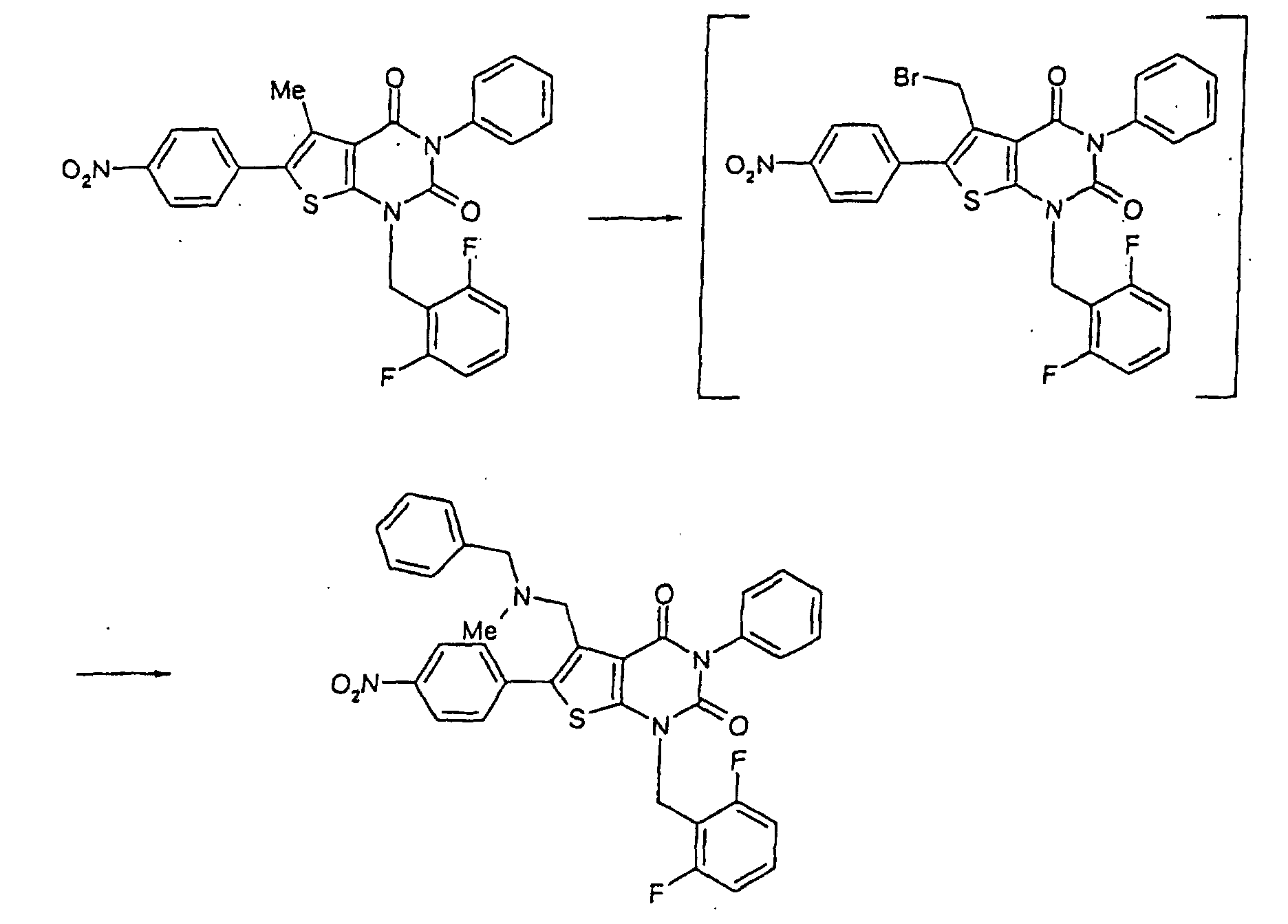
  • Acetonitrile (75 ml), N-bromosuccinimide (2.11 g, 11.87 mmol) and 2,2'-azobis(isobutyronitrile)(0.195 g, 1.19 mmol) were added to 1-(2,6-difluorobenzyl)-5-methyl-6-(4-nitrophenyl)-2,4(1H, 3H)-dioxo-3-phenylthieno[2,3-d]pyrimidine (5.00 g, 9.89 mmol), the mixture was heated to reflux for 20 minutes, a solution obtained by dissolving bromine (0.079 g, 0.49 mmol) in acetonitrile (3 ml) was added thereto, which was further heated to reflux for 1 hour.
  • reaction solution was allowed to cool to 70°C, diisopropylethylamine (1.47 g, 11.37 mmol) and N-benzylmethylamine (1.29 g, 10.38 mmol) were added successively, and the mixture was stirred for 1 hour while allowing to cool.
  • the reaction solution was concentrated to about 25 ml, and water (10 ml) was slowly added dropwise while heating to reflux. The mixture was allowed to cool to room temperature and further stirred at 0°C for 1 hour. The crystals were filtered, and washed with cold acetonitrile (5 ml), water (10 ml) and cold acetonitrile (5 ml) successively.
  • Citric acid monohydrate (12.00 g) was added to the reaction solution to dissolve it, water (50 ml), 2-butanone (80 ml) and 2-aminoethanol (15.0 ml) were added thereto, and the mixture was stirred at room temperature for 20 minutes. The aqueous layer was separated, and reverse-extracted with 2-butanone (50 ml). The organic layers were combined, the insolubles were filtered with Hyflo Super-Cell, and the filtrate was washed with 2-butanone (20 ml). After the aqueous layer mixed in the filtrate was removed, the mixture was washed by addition of an aqueous saturated sodium hydrogen carbonate solution (40 ml) and sodium chloride (7.00 g). The same procedures were further repeated two times.
  • O-methylhydroxylamine hydrochloride (77.2 mg, 92.4 ⁇ mol) and triethylamine (336 ⁇ l, 2.77 mmol) were added thereto, and the mixture was stirred at 50°C for 12 hours. Water (30 ml) was added thereto, and the mixture was vigorously stirred.
  • O-methylhydroxylamine hydrochloride (351 mg, 4.20 mmol) was dissolved in dimethylacetamide (2 ml), pyridine (340 ⁇ l, 4.20 mmol) and phenyl chloroformate (phenyl chlorocarbonate)(527 ⁇ l, 4.20 mmol) were added thereto successively dropwise, and the mixture was stirred at room temperature for 20 minutes.
  • thienopyrimidine derivatives having the GnRH antagonistic activity can be produced effectively and at an industrial large scale at a high yield and simple method.

Landscapes

  • Chemical & Material Sciences (AREA)
  • Organic Chemistry (AREA)
  • Organic Low-Molecular-Weight Compounds And Preparation Thereof (AREA)
  • Pharmaceuticals Containing Other Organic And Inorganic Compounds (AREA)
  • Plural Heterocyclic Compounds (AREA)
  • Low-Molecular Organic Synthesis Reactions Using Catalysts (AREA)
  • Heterocyclic Carbon Compounds Containing A Hetero Ring Having Oxygen Or Sulfur (AREA)

Abstract

The present invention provides a process for producing an intermediate for thienopyrimidine derivatives having the GnRH antagonistic activity at an industrial large scale.
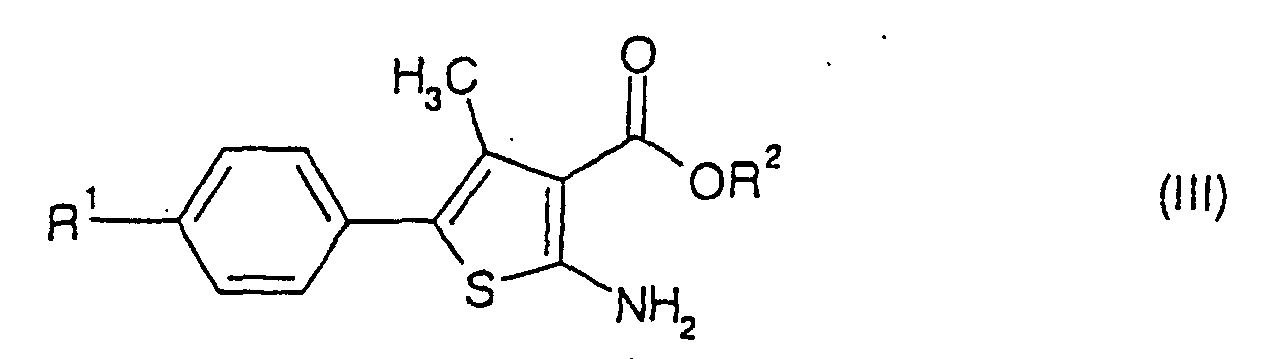
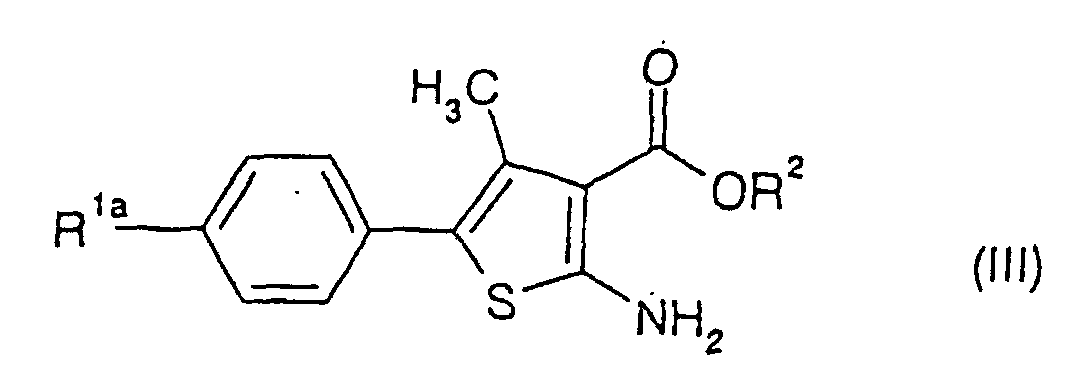
The process for production of the present invention relates to a process for producing a compound represented by the formula (III):
Figure 80000001
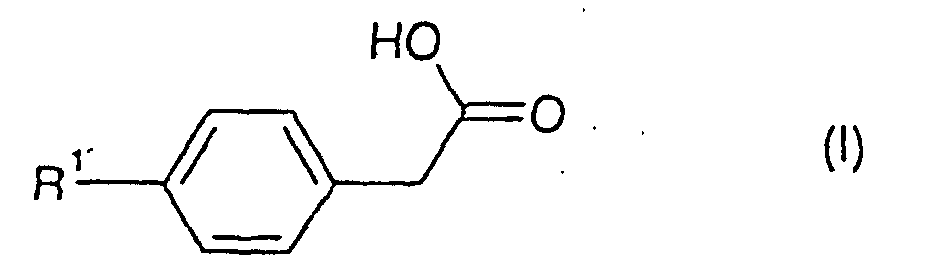
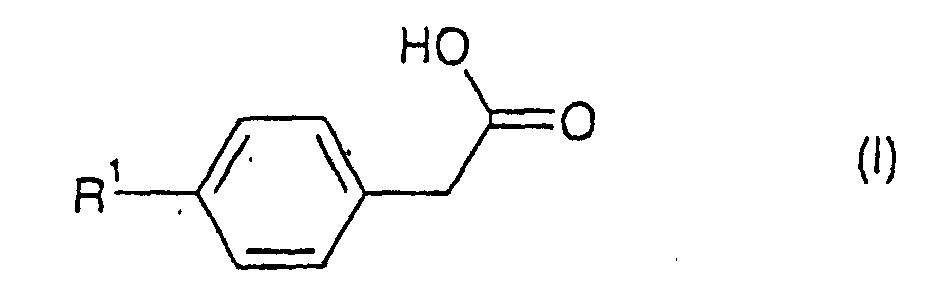
wherein respective symbols have the same meanings as those described below, or a salt thereof, which comprises subjecting a compound represented by the formula (I) :
Figure 80000002
wherein R1 denotes hydrogen, nitro, halogen, phthalimido, mono- or di-(alkylcarbonyl)amino or alkoxy, or a salt thereof, to an acid halogenating reaction, which is successively reacted with malonic acid ester and magnesium alkoxide, treated with an acid, and reacted with sulfur and a compound represented by the formula: NCCH2COOR2 [wherein R2 denotes alkyl or aryl], or a salt thereof, in the presence of primary amine. According to the process of production of the present invention, thienopyrimidine derivatives having the GnRH antagonistic activity can be produced effectively and at an industrial large scale by a high yield and simple method.

Description

Field of the Invention
The present invention relates to a process for producing thienopyrimidine derivatives which are useful as a medicine and show the useful Gonadotropin releasing hormone [GnRH] antagonistic activity, and intermediates therefor.
Background Art
As a process for producing a thieno[2,3-d]pyrimidine compound showing the GnRH antagonistic activity, there is a known method for obtaining a thieno[2,3-d]pyrimidine compound by using, as a starting material, 2-amino-4-methyl-5-(4-nitrophenyl)thiophene-3-carboxylic acid ethyl ester which is obtained by reacting 4-nitrophenylacetone with ethyl cyanoacetate, ammonium acetate, acetic acid, sulfur and diethylamine [WO96/24597(JP-A 9-169768)].
In addition, as a process for producing 2-amino-3-ethoxycarbonyl-4-methyl-5-phenylthiophene, there is a known method of acting morphorine or triethylamine on a solution of phenylacetone, ethyl cyanoacetate and sulfur in ethanol (USP 4,240,820 etc.).
On the other hand, as a process for producing a methylketone compound, there is a known method of subjecting a magnesium ethoxy derivative of diethyl malonate and a suitable amount of acid chloride to an acylating reaction, which is subjected to a hydrolysis reaction, and subjecting (two ester groups of) the resulting diethyl acylmalonate to a decarboxylation reaction in the presence of an acid (J.Am.Chem.Soc., Vol.68,pp1386(1946)etc.).
In the previous process of production, there are problems that the expensive starting materials are used, high toxic carbon tetrachloride is used, high risky metal magnesium is used, and a compound having the strong skin stimulating property is isolated and, therefore, an industrially advantageous process for producing thieno[2,3-d]pyrimidine derivatives showing the GnRH antagonistic activity is desired.
SUMMARY OF THE INVENTION
The present inventors extensively studied a process for producing thieno[2,3-d]pyrimidine derivatives, found that thieno[2,3-d]pyrimidine derivatives of interest showing the GnRH antagonistic activity can be unexpectedly obtained safely, simply and at a high yield by using 4-nitrophenylacetone, magnesium alkoxide and primary amine as a starting material for the first time and this process is sufficiently satisfactory at an industrial scale, and completed the present invention based on these findings.
That is, the present invention relates to:
  • [1] a process for producing a compound represented by the formula(III):
    Figure 00020001
    wherein respective symbols have the same meanings as those described below, or a salt thereof, which comprises:
  • subjecting a compound represented by the formula (I) :
    Figure 00030001
  • wherein R1 denotes a hydrogen atom, nitro, halogen, phthalimido, mono(alkylcarbonyl)amino, di(alkylcarbonyl)amino or alkoxy, or a salt thereof, to an acid halogenating reaction, which is successively reacted with malonic acid ester and magnesium alkoxide and, thereafter, treated with an acid and, then, reacted with sulfur and a compound represented by the formula (II):
    Figure 00030002
    wherein R2 denotes alkyl or aryl, or a salt thereof, in the presence of primary amine,
  • [2] the process described in the [1], wherein R1 is nitro;
  • [3] the process described in the [1], wherein the primary amine is mono-C3-8 alkylamine:
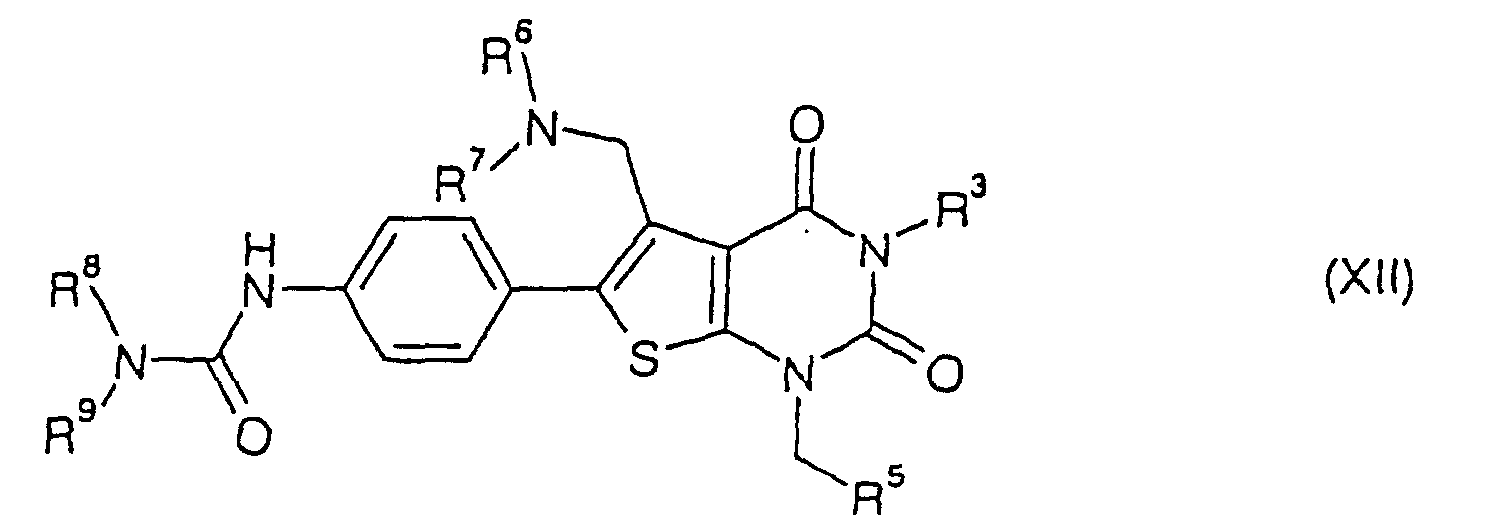
  • [4] a process for producing a compound represented by the formula (XII):
    Figure 00030003
    wherein respective symbols have the same meanings as those described below, which comprises:
  • subjecting a compound represented by the formula (Ia):
    Figure 00030004
  • wherein R1a denotes nitro, phthalimido, mono(alkylcarbonyl)amino or di(alkylcarbonyl)amino, or a salt thereof, to an acid halogenating reaction, which is successively reacted with malonic acid ester and magnesium alkoxide and, thereafter, treated with an acid and, then, reacted with a sulfur and a compound represented by the formula (II):
    Figure 00040001
    wherein R2 denotes alkyl or aryl, or a salt thereof in the presence of primary amine, to obtain a compound represented by the formula (III):
    Figure 00040002
    wherein respective symbols have the same meanings as those described above, or a salt thereof and, then, reacting the compound (III) or a salt thereof with a compound represented by the formula (IV): O=C=N―R3 wherein R3 denotes alkyl optionally having a substituent or aryl optionally having a substituent, or a salt thereof, to obtain a compound represented by the formula (V):
    Figure 00040003
    wherein respective symbols have the same meanings as those described above, or a salt thereof and, then, subjecting the compound (V) or a salt thereof to a ring closing reaction, which is reacted with a comound represented by the formula (VI):
    Figure 00050001
    wherein R4 denotes a leaving group, and R5 denotes aryl optionally having a substituent, or a salt thereof, to obtain a compound represented by the formula (VII):
    Figure 00050002
    wherein respective symbols have the same meanings as those described above, or a salt thereof and, then, subjecting the compound (VII) or a salt thereof to a brominating reaction, which is successively reacted with a compound represented by the formula (VIII):
    Figure 00050003
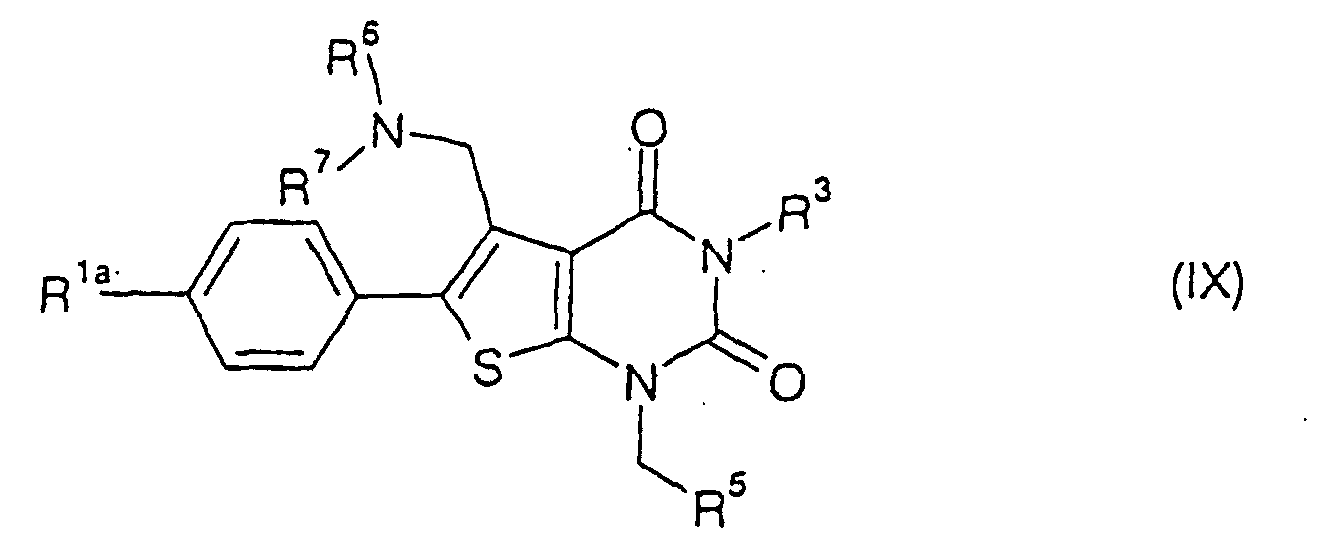
    wherein R6 and R7 denote alkyl optionally having a substituent, aryl optionally having a substituent, alkoxy optionally having a substituent, aralkyl optionally having a substituent or a heterocycle group optionally having a substituent, or a salt thereof, to obtain a compound represented by the formula (IX):
    Figure 00050004
    wherein respective symbols have the same meanings as those described above, or a salt thereof, and
    • (1) when R1a is nitro, subjecting the compound (IX) or a salt thereof to a reducing reaction,
    • (2) when R1a is phthalimido, subjecting the compound (IX) or a salt thereof to a deprotecting reaction, or
    • (3) when R1a is mono(alkylcarbonyl)amino or di(alkylcarbonyl)amino, subjecting the compound (IX) or a salt thereof to a hydrolyzing reaction,
         to obtain a compound represented by the formula (X):
      Figure 00060001
    wherein respective symbols have the same meanings as those described above, or a salt thereof and, then,
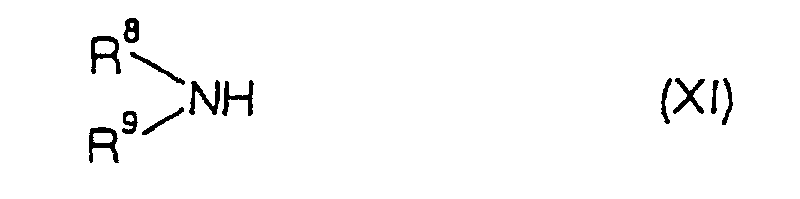
    • (i) reacting the compound (X) or a salt thereof, with halogenoformic acid ester and a compound represented by the formula (XI):
      Figure 00060002
      wherein R8 and R9 denote a hydrogen atom, alkoxy optionally having a substituent or alkyl optionally having a substituent, or a salt thereof, or
    • (ii) reacting the compound (X) or a salt thereof with carbonyldiimidazole and a compound represented by the formula (XI):
      Figure 00060003
    wherein respective symbols have the same meanings as those described above or a salt thereof;
  • [5] the process described in the [4], wherein R1a is nitro;
  • [6] the process described in the [4], wherein R3 is phenyl optionally having a substituent;
  • [7] the process described in the [4], wherein R5 is phenyl optionally having a substituent;
  • [8] the process described in the [4], wherein one of R6 and R7 is C1-3 alkyl, and the other of them is benzyl optionally having a substituent;
  • [9] the process described in the [4], wherein one of R8 and R9 is a hydrogen atom, and the other of them is C1-3 alkoxy;
  • [10] the process described in the [4], wherein the compound (VII) or a salt thereof is subjected to a brominating reaction in the presence of bromine and a radical initiator.
  • BEST MODE FOR CARRYING OUT THE INVENTION
    In the aforementioned formulas, examples of the "halogen" denoted by R1 include fluoro, chloro, bromo and iodo.
    Examples of the "mono(alkylcarbonyl)amino" denoted by R1 or R1a include mono(C1-6 alkylcarbonyl)amino (for example, acetylamino, propionylamino and the like).
    Examples of the "di(alkylcarbonyl)amino" denoted by R1 or R1a include di(C1-6 alkylcarbonyl)amino (for example, diacetylamino, dipropionylamino and the like).
    Examples of the "alkoxy" denoted by R1 include C1-6 alkoxy (for example, methoxy, ethoxy, propoxy, butoxy, isopropoxy, isobutoxy, t-butoxy and the like).
    As R1 or R1a, nitro and phthalimido are preferable. Furthermore nitro is more preferable.
    Examples of the "alkyl" denoted by R2 include C1-6 alkyl (for example, methyl, ethyl, propyl, isopropyl, butyl, isobutyl, t-butyl, pentyl, hexyl and the like).
    Examples of the "aryl" denoted by R2 include C6-14 aryl, preferably C6-10 aryl (for example, phenyl, 1-naphthyl, 2-naphthyl and the like.
    As R2, C1-3 alkyl is preferable, and ethyl is more preferable.
    Examples of the "alkyl" in the "alkyl optionally having a substituent" denoted by R3 include C1-6 alkyl (for example, methyl, ethyl, propyl, isopropyl, butyl, isobutyl, t-butyl, pentyl, hexyl and the like).
    Examples of the "substituent" in the "alkyl optionally having a substituent" denoted by R3 include (i) C1-6 alkoxy (for example, methoxy, ethoxy, propoxy, butoxy, isopropoxy, isobutoxy, t-butoxy and the like) (ii) C1-4 acyl (for example, C1-3 alkyl-carbonyl such as acetyl and propionyl and the like) and (iii) C6-14 aryl optionally having a substituent. The number of the substituent is 1 to 5 at replaceable positions. Examples of the "C6-14 aryl optionally having a substituent" include the same "aryl optionally having a substituent" as that denoted by R3 described later.
    Examples of the "aryl" in the "aryl optionally having a substituent" denoted by R3 include C6-14 aryl, preferably C6-10 aryl (for example, phenyl, 1-naphthyl, 2-naphthyl and the like), particularly preferably phenyl.
    Examples of the "substituent" in the "aryl optionally having a substituent" denoted by R3 include (i) halogen (for example, fluorine, chlorine, bromine, iodine), (ii) C1-6 alkyl (for example, methyl, ethyl, propyl, isopropyl, butyl, isobutyl, t-butyl, pentyl, hexyl and the like), (iii) C1-6 alkoxy (for example, methoxy, ethoxy, propoxy, butoxy, isopropoxy, isobutoxy, t-butoxy and the like) optionally having 1 to 3 substituents selected from halogen (for example, fluorine, chlorine, bromine, iodine), hydroxy and C1-3 alkyl (for example, methyl, ethyl, propyl, isopropyl and the like), and (iv) C1-4 acyl (for example, C1-3 alkyl-carbonyl such as acetyl and propionyl and the like). The number of the substituent is 1 to 3 at replaceable positions.
    As R3, phenyl optionally having a substituent is preferable, and unsubstituted phenyl is more preferable.
    Examples of the "leaving group" denoted by R4 include halogen (for example, fluorine, chlorine, bromine, iodine), alkylsulfonyloxy (for example, C1-6 alkylsulfonyloxy such as methylsulfonyloxy and the like), arylsulfonyloxy (for example, C6-14 arylsulfonyloxy (for example, phenylsulfonyloxy and the like) optionally substituted with 1 to 5 of C1-6 alkyl (for example, methyl, ethyl, propyl, isopropyl, butyl, isobutyl, t-butyl, pentyl, hexyl and the like) such as p-toluenesulfonyloxy and the like).
    Examples of the "aryl optionally having a substituent" denoted by R5 include the same "aryl optionally having a substituent" as that denoted by R3.
    As R5, phenyl optionally having a substituent is preferable. Phenyl optionally having 1 or 2 halogen atoms (for example, fluorine, chlorine, bromine and iodine) is more preferable, and 2,6-difluorophenyl is the most preferable.
    Examples of the "alkyl optionally having a substituent" denoted by R6 or R7, include the same "alkyl optionally having a substituent" as that denoted by R3.
    Examples of the "aryl optionally having a substituent" denoted by R6 or R7 include the same "aryl optionally having a substituent" as that denoted by R3.
    Examples of the "alkoxy" in the "alkoxy optionally having a substituent" denoted by R6 or R7 include C1-6 alkoxy (for example, methoxy, ethoxy, propoxy, isopropoxy, butoxy, isobutoxy, t-butoxy and the like) and the like.
    Examples of the "substituent" in the "alkoxy optionally having a substituent" denoted by R6 or R7 include carboxy, C1-3 alkyl (for example, methyl, ethyl, propyl, isopropyl and the like) and C1-4 acyl (C1-3 alkyl-carbonyl such as acetyl and propionyl). The number of the substituent is 1 to 3 at replaceable positions.
    Examples of the "aralkyl" in the "aralkyl optionally having a substituent" denoted by R6 or R7 include C7-16 aralkyl (for example, benzyl, phenethyl, 1-naphthylmethyl, 2-naphthylmethyl and the like), preferably benzyl and the like.
    Examples of the "heterocycle group" in the "heterocycle group optionally having a substituent" denoted by R6 or R7 include 5 to 6-membered heterocycle groups containing 1 to 3 hetero atoms selected from a nitrogen atom, a sulfur atom and an oxygen atom in addition to a carbon atom, more specifically, thienyl (for example, 2-thienyl, 3-thienyl and the like), pyridyl (for example, 2-pyridyl, 3-pyridyl, 4-pyridyl and the like), furyl (for example, 2-furyl, 3-furyl and the like), pyrazinyl, pyrimidinyl( for example, 2-pyrimidinyl and the like), pyrolyl (for example, 3-pyrolyl and the like), pyridazinyl (for example, 3-pyridazinyl and the like), isothiazolyl (for example, 3-isothiazolyl and the like), isoxazolyl (for example, 3-isoxazolyl and the like), pyrrolidinyl (for example, 1-pyrrolidinyl, 2-pyrrolidinyl, 3-pyrrolidinyl and the like), imidazolinyl (for example, 2-imidazolinyl, 4-imidazolinyl and the like), pyrazolidinyl (for example, 2-pyrazolidinyl, 3-pyrazolidinyl, 4-pyrazolidinyl and the like), piperidino, piperidyl (for example, 2-piperidyl, 3-peperidyl, 4-peperidyl), piperazinyl (for example, 1-piperazinyl, 2-piperazinyl and the like), morpholinyl(for example, morpholino and the like).
    Examples of the "substituent" in the "aralkyl optionally having a substituent" and the "heterocycle group optionally having a substituent" denoted by R6 or R7 include C1-6 alkyl (for example, methyl, ethyl and the like), C1-6 alkoxy (for example, methoxy, ethoxy and the like), C1-6 alkylthio (for example, methylthio, ethylthio and the like), C1-4 acyl (for example, C1-3 alkyl-carbonyl such as acetyl and propionyl and the like) and di-C1-6 alkylamino (for example, dimethyl amino and the like). The number of substituent is 1 to 5 at replaceable positions.
    As R6 or R7, it is preferable that one of them is C1-3 alkyl and the other is benzyl optionally having a substituent, and it is more preferable that one of them is C1-3 alkyl and the other is benzyl.
    Examples of the "alkoxy" in the "alkoxy optionally having a substituent" denoted by R8 or R9 include C1-6 alkoxy (for example, methoxy, ethoxy, propoxy, isopropoxy, butoxy, isobutoxy, t-butoxy and the like).
    Examples of the "alkyl" in the "alkyl optionally having a substituent" denoted by R8 or R9 include C1-6 alkyl (for example, methyl, ethyl, propyl, isopropyl, butyl, isobutyl, t-butyl, pentyl, hexyl and the like).
    Examples of the "substituent" in the "alkoxy optionally having a substituent" and the "alkyl optionally having a substituent" denoted by R8 or R9 include (i) hydroxy, (ii) C1-7 acyloxy (for example, C1-6 alkylcarbonyloxy such as acetoxy and propionyloxy), (iii) benzoyloxy, (iv) amino optionally having 1 or 2 substituents selected from C1-6 alkoxy-carbonyl (for example, methoxycarbonyl, ethoxycarbonyl, tert-butoxycarbonyl and the like), benzyloxycarbonyl, C1-4 acyl (C1-3 alkyl-carbonyl such as acetyl and propionyl and the like), C1-4 alkyl (for example, methyl, ethyl, propyl, butyl and the like) and C1-3 alkylsulfonyl (for example, methanesulfonyl and the like) and the like (for example, amino, dimethylamino, methoxycarbonylamino, ethoxycarbonylamino, t-butoxycarbonylamino, benzyloxycarbonylamino, acetylamino, methanesulfonylamino and the like), (v) C1-10 alkoxy (for example, methoxy, ethoxy, propoxy, t-butoxy and the like), (vi) C3-7 cycloalkyloxycarbonyloxy-C1-3 alkoxy (for example, 1-(cyclohexyloxycarbonyloxy)ethoxy and the like), and (vii) C1-3 alkoxy-C1-3 alkoxy (for example, methoxymethoxy, methoxyethoxy and the like). The number of the substituent is 1 to 5 at replacealble positions.
    As R8 and R9, it is preferable that one of them is a hydrogen atom and the other is C1-3 alkoxy.
    As salts of compounds represented by the formulas (I)-(XIII) and (Ia) herein, pharmaceutically acceptable salts are preferable, and examples thereof include salts with an inorganic acid, salts with an organic acid, salts with an inorganic base and salts with an organic base.
    Examples of the salt with an inorganic acid include salts with hydrochloric acid, hydrobromic acid, nitric acid, sulfuric acid and phosphoric acid and the like.
    Examples of the salt with an organic acid include salts with formic acid, acetic acid, trifluoroacetic acid, fumaric acid, oxalic acid, tartaric acid, maleic acid, citric acid, succinic acid, malic acid, methanesulfonic acid, benzenesulfonic acid and p-toluenesulfonic acid and the like.
    Examples of the salt with an inorganic base include alkali metal salts such as sodium salt and potassium salt; alkaline earth metal salts such as calcium salt and magnesium salt; ammonium salt and the like.
    Examples of the salt with an organic base include salts with trimethylamine, triethylamine, pyridine, picoline, ethanolamine, diethanolamine, triethanolamine, dicyclohexylamine and N,N'-dibenzylethylenediamine and the like.
    Hereinafter, a compound represented by the formula (I) or salt thereof is abbreviated as "Compound (I) ". Other compounds are abbreviated in a similar manner. A process for producing Compound (III) which is useful as an intermediate for thienopyrimidine derivatives showing the GnRH antagonistic activity is described below.
    When Compound (I), Compound (Ia), Compound (II), Compound (IV), Compound (VI), Compound (VIII) and Compound (XI) are commercially available, sold products may be used as they are, or these compounds may be prepared according to the method known per se or a similar method thereof.
    Figure 00130001
    wherein R1 denotes a hydrogen atom, nitro, halogen, phthalimido, mono(alkylcarbonyl)amino, di(alkylcarbonyl)amino or alkoxy, and R2 denotes the same meanings as those described above.
    Compound (I) is subjected to an acid halogenating reaction, which is successively reacted with malonic acid ester and magnesium alkoxide and, then, treated with an acid and, then, reacted with sulfur and Compound (II) in the presence of primary amine to obtain Compound (III).
    1 ○ Acid halogenating reaction
    An acid halogenating reaction for Compound (I) may be performed according to the method known per se, for example, by reacting Compound (I) and an acid halogenating agent (for example, thionyl chloride, thionyl bromide, oxalyl chloride and the like).
    The amount of the acid halogenating agent to be used is about 1-4 moles, preferably about 1.5-3 moles relative to 1 mole of Compound (I).
    It is advantageous that the present reaction is performed without any solvent or in the presence of a solvent which is inert with the reaction. Examples of the solvent is not particularly limited as far as the reaction proceeds, and include halogenated hydrocarbons, aliphatic hydrocarbons, aromatic hydrocarbons, ethers, esters, amides, nitriles and a mixture of 2 or more of them.
    The reaction temperature is usually about 0-100°C, preferably about 0-80°C. The reaction time is usually about 0.5-3 hours, preferably about 0.5-1 hour. The present reaction may be performed optionally in the presence of N,N-dimethylformamide or the like.
    The amount of N,N-dimethylformamide to be used is about 0-1 mole, preferably about 0-0.5 mole relative to 1 mole of Compound (I).
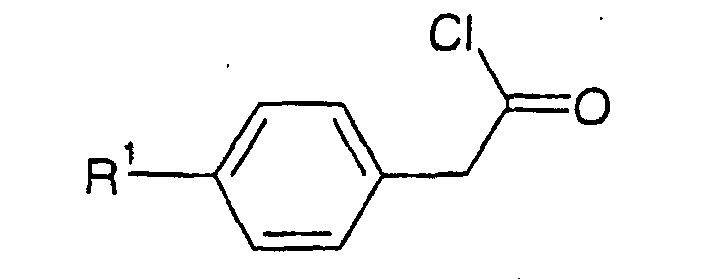
    The product:
    Figure 00140001
    maybe used in the next reaction as the reaction solution itself or as the crude product, or may be isolated from the reaction mixture according to the conventional method and may serve as a starting material in the next step.
    2 ○ Reaction with malonic acid ester and magnesium alkoxide.
    Examples of the "malonic acid ester" include a compound represented by the formula "RaOOC-CH2-COORb (wherein Ra and Rb denote alkyl or aryl, respectively).
    Examples of the "alkyl" denoted by Ra or Rb include C1-6 alkyl (for example, methyl, ethyl, propyl, isopropyl, butyl, isobutyl, t-butyl, pentyl, hexyl and the like).
    Examples of the "aryl" denoted by Ra or Rb include C6-10 aryl (for example, phenyl, 1-naphthyl, 2-naphthyl and the like).
    As Ra and Rb, C1-6 alkyl is preferable, and ethyl is more preferable.
    The amount of the "malonic acid ester" to be used is about 1-2 moles, preferably 1.1-1.3 moles relative to 1 mole of Compound (I).
    As the "magnesium alkoxide", magnesium C1-6 alkoxide such as magnesium methoxide and magnesium ethoxide and the like is preferable, and magnesium C1-3 alkoxide is more preferable.
    An amount of the "magnesium alkoxide" to be used is about 1-2 moles, preferably about 1.1-1.3 moles relative to 1 mole of Compound (I).
    The present reaction may be performed optionally in the presence of Lewis acid.
    Examples of the "Lewis acid" include anhydrous aluminium chloride, titanium tetrachloride and magnesium chloride and the like.
    The amount of the "Lewis acid" to be used is about 1-4 moles, preferably about 1-2 moles relative to 1 mole of Compound (I).
    It is advantageous that the present reaction is performed in the presence of a solvent which is inert with the reaction. The solvent is not particularly limited as far as the reaction proceeds. For example, halogenated hydrocarbons, aliphatic hydrocarbons, ethers, amides, alcohols or a mixture of 2 or more of them are used. Among them, ethers such as butyl methyl ether (for example, tert-butyl methyl ether and the like), butyl ethyl ether (for example, tert-butyl ethyl ether and the like) are preferable.
    The reaction temperature is usually about 20-100°C, preferably about 40-70°C. The reaction time is usually about 1-12 hours, preferably 4-7 hours.
    The product:
    Figure 00160001
    may be used as the reaction solution itself or as the crude product, or may be isolated from the reaction mixture according to the conventional method and may serve as a starting material in the next step.
    3 ○ Treatment with an acid
    The hydrolysis reaction is performed by using an acid.
    Examples of the "acid" include mineral acids such as hydrochloric acid, hydrobromic acid and sulfuric acid and the like; organic acids such as acetic acid and trifluoroacetic acid and the like, or a mixture of 2 or more of them. Among them, the preferable is a mixture of sulfuric acid and acetic acid.
    The amount of the "acid" to be used is about 1-10 moles, preferably 4-8 moles relative to 1 mole of Compound (I).
    It is advantageous that the present reaction is performed in the presence of a solvent which is inert with the reaction. The solvent is not particularly limited as far as the reaction proceeds. For example, ethers, amides, alcohols, water or a mixture of 2 or more of them are used. Preferably, water is used.
    The reaction temperature is usually about 70-140°C, preferably about 90-130°C. The reaction time is usually about 1-12 hours, preferably about 4-7 hours.
    The product:
    Figure 00170001
    may be used in the next reaction as the reaction solution itself or as the crude product, or may be isolated from the reaction mixture according to the conventional method and may serve as a starting material in the next step.
    4 ○ Reaction with sulfur and Compound (II) in the presence of primary amine
    Examples of the "primary amine" include mono-C3-8 alkylamine (for example, propylamine, butylamine, octylamine and the like), benzylamine and the like. Among them, butylamine is preferable.
    The amount of the "primary amine" to be used is about 0.01-1.5 moles, preferably about 0.1-1.2 moles relative to 1 mole of Compound (I).
    As the "sulfur", powdery sulfur and the like is used.
    The amount of the "sulfur" to be used is about 1-2 moles, preferably 1-1.2 moles relative to 1 mole of Compound (I).
    The amount of the "Compound (II) " to be used is about 1-1.5 moles, preferably about 1-1.2 moles relative to 1 mole of Compound (I).
    It is advantageous that the present reaction is performed without any solvent or in the presence of a solvent which is inert with the reaction. The solvent is not particularly limited as far as the reaction proceeds. For example, alcohols, nitriles, ethers, esters, amides, or a mixture of 2 or more of them are used.
    Preferably, alcohols such as methanol and ethanol and the like are used.
    The reaction temperature is usually about 20-100°C, preferably about 20-70°C. The reaction time is usually 1-12 hours, preferably 1-5 hours.
    The product (III) may be used in the next reaction as the reaction solution itself or as the crude product, or may be isolated from the reaction mixture according to the conventional method and may serve as a starting material in the next step.
    The aforementioned steps 1 ○-4 ○ may be performed continuously without isolating an intermediate produced in each step from the reaction mixture, and are industrially advantageous.
    A Compound wherein R1 is a hydrogen atom, halogen or alkoxy in Compound (III) can be produced according to the following method:
    Figure 00180001
    wherein R1 is a hydrogen atom, halogen or alkoxy, and R2 has the same meanings as those described above.
    Compound (III) is obtained by reacting Compound (XIII) and Compound (II) in the presence of organic amine, which is then reacted with sulfur and organic amine.
    1 ○ Reaction with Compound (II)
    Examples of the "organic amine" include the aforementioned primary amine and benzyl amine and the like.
    The amount of the "Compound (II) " to be used is about 1-1.5 moles, preferably about 1-1.2 moles relative to 1 mole of Compound (XIII).
    The amount of the "organic amine" to be used is about 0.005-0.5 mole, preferably about 0.01-0.1 mole relative to 1 mole of Compound (XIII).
    It is advantageous that the present reaction is performed without any solvent or in the presence of a solvent which is inert with the reaction. The solvent is not particularly limited as far as the reaction proceeds. For example, alcohols, nitriles, ethers, amides, or a mixture of 2 or more of them and the like are used. Preferably, alcohols are used.
    The reaction temperature is usually about 20-80°C, preferably about 20-60°C. The reaction time is usually about 2-10 hours, preferably about 4-8 hours.
    The product may be used as the reaction solution itself or as the crude product, or may be isolated from the reaction mixture according to the conventional method and may serve as a starting material in the next step.
    2 ○ Reaction with sulfur and organic amine
    Examples of the "organic amine" include aforementioned primary amine, benzyl amine and morpholine.
    The amount of the "sulfur" to be used is about 1-2 moles, preferably about 1-1.2 moles relative to 1 mole of Compound (XIII).
    The amount of the "organic amine" to be used is about 0.1-0.7 mole, preferably about 0.3-0.6 mole relative to 1 mole of Compound (XIII).
    It is advantageous that the present reaction is performed without any solvent or in the presence of a solvent which is inert with the reaction. The solvent is not particularly limited as far as the reaction proceeds. For example, alcohols, nitriles, ethers, amides, or a mixture of 2 or more of them and the like are used. Preferably, alcohols are used.
    The reaction temperature is usually 20-80°C, preferably about 20-60°C. The reaction time is usually about 2-10 hours, preferably about 4-8 hours.
    The product (III) may be used in the next reaction as the crude product, or may be isolated from the reaction mixture according to the conventional method and may serve as a starting material in the next step.
    The present reaction can suppress the amount of organic amine to be used to a catalytic amount, and is industrially advantageous.
    A compound (Compound (Ia)) wherein R1 is nitro, phthalimido, mono(alkylcarbonyl)amino or di(alkylcarbonyl)amino in Compound (I), or a salt thereof, may be converted into a thienopyrimidine derivative showing the GnRH antagonistic activity as follows:
    Figure 00200001
    wherein R1a denotes nitro, phthalimido, mono(alkylcarbonyl)amino or di(alkylcarbonyl)amino, and R2 denotes the same meanings as those described above.
    Compound (Ia) or a salt thereof is subjected to an acid halogenating reaction, which is successively reacted with malonic acid ester and magnesium alkoxide and, thereafter, treated with an acid and, then, reacted with sulfur and Compound (II) in the presence of primary amine to obtain Compound (III).
    The present reaction may be performed under the same reaction conditions as those described above (Step 1A).
    Figure 00210001
    wherein R1a denotes nitro, phthalimido, mono(alkylcarbonyl)amino or di(alkylcarbonyl)amino, and other symbols denote the same meanings as those described above.
    Compound (III) and Compound (IV) are reacted to obtain Compound (V).
    The present reaction may advantageously proceed usually in the presence of an organic base and examples of such the "organic base" include amines such as triethylamine, diisopropylethyamine, N-methylmorpholine, dimethylaminopyridine, DBU (1,8-diazabicyclo[5.4.0]undec-7-ene) and DBN (1,5-diazabicyclo[4.3.0]non-5-ene), and basic heterocyclic compounds such as pyridine, imidazole and 2,6-lutidine. Preferably, pyridine is used.
    The amount of the "Compound (IV)" to be used is about 1-2 moles, preferably about 1.3-1.7 moles relative to 1 mole of Compound (III).
    The amount of the "organic base" to be used is about 1-2.5 moles, preferably about 1.5-2 moles relative to 1 mole of Compound (III).
    It is advantageous that the present reaction is performed without any solvent or in the presence of a solvent which is inert with the reaction. The solvent is not particularly limited as far as the reaction proceeds. For example, halogenated hydrocarbons, aliphatic hydrocarbons, aromatic hydrocarbons, ethers, esters, amides, nitriles, alcohols or a mixture of 2 or more of them and the like are used. Preferably, toluene is used.
    The reaction temperature is usually about 80-130°C, preferably about 90-110°C. A reaction time is usually about 2-6 hours, preferably about 3-5 hours.
    The product (V) may be used in the next reaction as the reaction solution itself or as the crude product, or may be isolated from the reaction mixture according to the conventional method and may serve as a starting material in the next step.
    Figure 00220001
    wherein R1a denotes nitro, phthalimido, mono(alkylcarbonyl)amino or di(alkylcarbonyl)amino, and other symbols have the same meanings as those described above.
    Compound (V) is subjected to a ring closing reaction, which is reacted with Compound (VI) to obtain Compound (VII).
    1 ○ Ring closing reaction
    Compound (V) is subjected to a ring closing reaction.
    The present reaction may advantageously proceed usually in the presence of a base and examples of such the "base" include strong bases such as hydrides of an alkali metal or an alkaline earth metal (for example, lithium hydride, sodium hydride, potassium hydride, calcium hydride and the like), amides of an alkali metal or an alkaline earth metal (for example, lithium amide, sodium amide, lithium diisopropylamide, lithium dicyclohexylamide, lithium hexamethyldisilazide, sodium hexamethyldisilazide, potassium hexamethyldisilazide and the like) and lower alkoxides of an alkali metal or an alkaline earth metal (for example, sodium methoxide, sodium ethoxide, potassium tert-butoxide and the like). Preferably, lower alkoxides of an alkali metal or an alkaline earth metal are used.
    The amount of the "base" to be used is about 1-1.5 moles, preferably about 1.1-1.4 moles relative to 1 mole of Compound (V).
    It is advantageous that the present reaction is performed without any solvent or in the presence of a solvent which is inert with the reaction. The solvent is not particularly limited as far as the reaction proceeds. For example, nitriles, alcohols, ethers, amides, halogenated hydrocarbons, aliphatic hydrocarbons, aromatic hydrocarbons, or a mixture of 2 or more of them and the like are used. Preferably, a solvent mixed with an alcohol is used. For example, a mixed solvent of nitriles such as acetonitrile and alcohols such as methanol is preferable.
    The reaction temperature is usually about 40-100°C, preferably about 60-90°C. The reaction time is usually about 10 minutes-3 hours, preferably about 30 minutes-2 hours.
    The product:
    Figure 00230001
    may be used in the next reaction as the reaction solution or as the crude product, or may be isolated from the reaction mixture according to the conventional method and may serve as a starting material in the next step.
    2 ○ Reaction with Compound (VI)
    The amount of the "Compound (VI)" to be used is about 1-2 moles, preferably about 1-1.2 moles relative to 1 mole of Compound (V).
    The present reaction may be performed optionally in the presence of a base.
    Examples of the "base" include carbonates of an alkali metal or an alkaline earth metal (for example, sodium hydrogen carbonate, sodium carbonate, potassium carbonate and the like), lower alkoxides of an alkali metal or an alkaline earth metal (for example, sodium methoxide, sodium ethoxide, potassium tert-butoxide and the like), organic bases (for example, amines such as triethylamine, diisopropylethylamine, N-methylmorpholine, dimethylaminopyridine, DBU (1,8-diazabicyclo[5.4.0]undec-7-ene) and DBN (1,5-diazabicyclo[4.3.0]non-5-ene), or organic bases such as basic heterocyclic compounds such as pyridine, imidazole and 2,6-lutidine and the like.
    The amount of the "base" to be used is about 1-2 moles, preferably about 1-1.3 moles relative to 1 mole of Compound (VII).
    It is advantageous that the present reaction is performed without any solvent or in the presence of a solvent which is inert with the reaction. The solvent is not particularly limited as far as the reaction proceeds. For example, nitriles, alcohols, ethers, amides, halogenated hydrocarbons, aliphatic hydrocarbons, aromatic hydrocarbons, or a mixture of 2 or more of them and the like is used. Preferably, a solvent mixed with an alcohol is used. For example, a mixed solvent of nitriles such as acetonitrile and alcohols such as methanol is preferable.
    The reaction temperature is usually about 40-100°C, preferably 60-90°C. The reaction time is usually about 1-10 hours, preferably about 3-6 hours.
    The product (VII) may be used in the next reaction as the reaction solution itself or as the crude product, or may be isolated from the reaction mixture according to the conventional method and may serve as a starting material in the next step.
    The aforementioned steps 1 ○-2 ○ may be performed continuously without isolating an intermediate produced in the step 1 ○ from the reaction mixture, and are industrially advantageous.
    Figure 00250001
    wherein R1a denotes nitro, phthalimido, mono(alkylcarbonyl)amino or di(alkylcarbonyl)amino, and other symbols denote the same meanings as those described above.
    Compound (VII) is subjected to a brominating reaction, which is successively reacted with Compound (VIII) to obtain Compound (IX).
    1 ○ Brominating reaction
    Compound (VII) is reacted with a brominating agent.
    Examples of the "brominating agent" include N-bromosuccinimide and 1,3-dibromo-5,5-dimethylhydantoin.
    The amount of the "brominating agent" to be used is about 1-3 moles, preferably about 1-1.5 moles relative to 1 mole of Compound (VII).
    The present reaction is performed optionally in the presence of bromine and a radical initiator.
    The amount of the "bromine" to be used is about 0.01-1 mole, preferably about 0.02-0.3 mole relative to 1 mole of Compound (VII).
    Examples of the "radical initiator" include 2,2'-azobis(isobutyronitrile), 2,2'-azobis(2,4-dimethylvaleronitrile) and 2,2'-azobis(4-methoxy-2,4-dimethylvaleronitrile) and the like.
    The amount of the "radical initiator" to be used is about 0.01-0.5 mole, preferably about 0.05-0.3 mole relative to 1 mole of Compound (VII).
    It is advantageous that the present reaction is performed in the presence of a solvent which is inert with the reaction. The solvent is not particularly limited as far as the reaction proceeds. For example, nitriles, aromatic hydrocarbons, halogenated hydrocarbons, esters, ethers, amides or a mixture of 2 or more of them and the like are used. Preferably, nitriles, aromatic hydrocarbons (chlorobenzene and the like), and halogenated hydrocarbons are used. Among them, nitriles such as acetonitrile are preferable.
    The reaction temperature is usually about 20-100°C, preferable 40-90°C. The reaction time is usually about 30 minutes - 3 hours, preferably about 1-2 hours.
    The product:
    Figure 00270001
    may be used in the next reaction as the reaction solution itself or as the crude product, or may be isolated from the reaction mixture according to the conventional method and may serve as a starting material in the next step.
    2 ○ Reaction with Compound (VIII)
    The amount of the "Compound (VIII)" is about 1-2 moles, preferably about 1-1.3 moles relative to 1 mole of Compound (VII).
    The present reaction may advantageously proceed usually under the presence of a base and examples of such the "base" include carbonates of an alkali metal or an alkaline earth metal (for example, sodium hydrogen carbonate, sodium carbonate, potassium carbonate and the like), and organic bases (for example, organic bases such as amines such as triethylamine, diisopropylethylamine, N-methylmorpholine, dimethylaminopyridine, DBU (1,8-diazabicyclo[5.4.0]undec-7-ene), DBN (1,5-diazabicyclo[4.3.0]non-5-ene) and the like, or basic heterocyclic compounds such as pyridine, imidazole, 2,6-lutidine and the like). Preferably, triethylamine and diisopropylethylamine are used.
    The amount of the "base" to be used is about 1-2 moles, preferably about 1-1.3 moles relative to 1 mole of Compound (VII).
    It is advantageous that the present reaction is performed in the presence of a solvent which is inert with the reaction. The solvent is not particularly limited as far as the reaction proceeds. For example, nitriles, aromatic hydrocarbons, halogenated hydrocarbons, esters, ethers, amides or a mixture of 2 or more of them are used. Preferably, nitriles, aromatic hydrocarbons (chlorobenzene and the like), and halogenated hydrocarbons are used. Among them, nitriles such as acetonitrile are preferable.
    The reaction temperature is usually about 0-100°C, preferably about 20-100°C, more preferably about 50-70°C. The reaction time is usually about 10 minutes-2 hours, preferably, about 20 minutes-1.5 hours.
    The aforementioned steps 1 ○-2 ○ may be continuously performed without isolating an intermediate produced in step 1 ○ which is skin stimulating, from the reaction mixture, and are industrially advantageous.
    Figure 00280001
    wherein R1a denotes nitro, phthalimido, mono(alkylcarbonyl)amino or di(alkylcarbonyl)amino, and other symbols denote the same meanings as those described above.
    (Step 5-1)
    When R1a is nitro, Compound (IX) is subjected to a reducing reaction to obtain Compound (X).
    In the reducing reaction, Compound (IX) and a reducing agent are reacted.
    Examples of the "reducing agent" include a solution of titanium trichloride, iron powder and the like.
    Examples of the "solution of titanium trichloride" include an about 10-30% solution of titanium trichloride in water or dilute hydrochloric acid.
    The amount of the "reducing agent" to be used is about 1-10 moles, preferably about 3-7 moles relative to 1 mole of Compound (IX).
    The present reaction may be performed optionally in the presence of dilute hydrochloric acid.
    Examples of the "dilute hydrochloric acid" include an about 0.01-10 mol/l aqueous hydrogen chloride solution.
    The amount of the "dilute hydrochloric acid" to be used is about 1-5 moles, preferably about 1-2 moles relative to 1 mole of Compound (IX).
    It is advantageous that the present reaction is performed in the presence of a solvent which is inert with the reaction. The solvent is not particularly limited as far as the reaction proceeds. For example, alcohols, esters, ethers, aromatic hydrocarbons, organic acids, water or a mixture of 2 or more of them and the like are used. Preferably, alcohols, organic acids, water or a mixture of 2 or more of them and the like are used.
    The reaction temperature is usually about 20-100°C, preferably about 20-80°C. The reaction time is usually about 10 minutes-3 hours, preferably about 20 minutes-2 hours.
    The product (X) may be used in the next reaction as the crude product, or may be isolated from the reaction mixture according to the conventional method and may serve as a starting material in the next step.
    (Step 5-2)
    When R1a is phthalimido, a deprotecting reaction affords Compound (X).
    The deprotecting reaction can be performed, for example, by reacting Compound (IX) and hydrazine.
    Examples of the "hydrazine" include hydrazine monohydrate and the like.
    The amount of the "hydrazine" to be used is about 1-30 moles, preferably about 2-20 moles relative to 1 mole of Compound (IX).
    It is advantageous that the present reaction is performed in the presence of a solvent which is inert with the reaction. The solvent is not particularly limited as far as the reaction proceeds. For example, alcohols, ethers, amides, sulfoxides, nitriles, water or a mixture of 2 or more of them and the like are used. Preferably, alcohol, or a mixed solvent with alcohol is used.
    The reaction temperature is usually about 20-100°C, preferably about 20-60°C. The reaction time is usually about 1-24 hours, preferably about 2-20 hours.
    The product (X) may be used in the next reaction as the crude product, or may be isolated from the reaction mixture according to the conventional method and may serve as a starting material in the next step.
    (Step 5-3)
    When R1a is mono(alkylcarbonyl)amino or di(alkylcarbonyl)amino, Compound(IX) is subjected to a hydrolyzing reaction to obtain Compound(X).
    Compound(IX) is subjected to hydrolysis in the presence of a hydroxide of an alkali metal or an alkaline earth metal, or lower alkoxide of an alkali metal or an alkaline earth metal.
    Examples of the "hydroxide of an alkali metal or an alkaline earth metal" include sodium hydroxide, potassium hydroxide, lithium hydroxide and barium hydroxide and the like.
    Examples of the "lower alkoxide of an alkali metal or an alkaline earth metal" include sodium methoxide, sodium ethoxide and potassium tert-butoxide.
    The amount of the "hydroxide of an alkali metal or an alkaline earth metal" or the "lower alkoxide of an alkali metal or an alkaline earth metal" to be used is about 1-30 moles, preferably about 5-20 moles, respectively, relative to 1 mole of Compound (IX).
    It is advantageous that the present reaction is performed in the presence of a solvent which is inert with the reaction. The solvent is not particularly limited as far as the reaction proceeds. For example, alcohols, ethers, sulfoxides, water or a mixture of 2 or more of them and the like are used.
    The reaction temperature is usually about 20-140°C, preferably about 60-120°C. The reaction time is usually about 1-24 hours, preferably about 4-18 hours.
    The product (X) may be used in the next reaction as the crude product, or may be isolated from the reaction mixture according to the conventional method and may serve as a starting material in the next step.
    Figure 00310001
    wherein respective symbols have the same meanings as those described above.
    (Step 6-1)
    Compound (X), halogenoformic acid ester (halogenocarbonic acid ester) and Compound (XI) are reacted to obtain Compound (XII).
    Examples of the "halogenoformic acid ester" include C6-14 aryl halogenocarbonate (for example, phenyl chlorocarbonate, p-nitrophenyl chlorocarbonate and the like) and the like.
    The amount of the "halogenoformic acid ester" to be used is about 1-2 moles, preferably about 1-1.3 moles relative to 1 mole of Compound (X).
    The amount of the "Compound (XI) " to be used is about 1-10 moles, preferably about 1-6 moles relative to 1 mole of Compound (X).
    The present reaction is performed optionally in the presence of an organic base.
    Examples of the "organic base" include organic bases such as amines such as triethylamine, diisopropylethylamine, N-methylmorpholine, dimethylaminopyridine, DBU (1,8-diazabicyclo[5.4.0]undec-7-ene), DBN (1,5-diazabicyclo[4.3.0]non-5-ene) and the like, and basic heterocyclic compounds such as pyridine, imidazole, 2,6-lutidine and the like. Preferably, pyridine and triethylamine are used.
    The amount of the "organic base" to be used is about 1-20 moles, preferably about 3-17 moles relative to 1 mole of Compound (X).
    It is advantageous that the present reaction is performed in the presence of a solvent which is inert with the reaction. The solvent is not particularly limited as far as the reaction proceeds. For example, esters, ethers, amides, ketones, sulfoxides, nitriles, or a mixture of 2 or more of them and the like are used. Preferably, amides are used.
    The reaction temperature is usually about -10 to 80°C, preferably about -10 to 60°C. The reaction time is usually about 1-24 hours, preferably about 5-20 hours.
    The product (XII) thus obtained can be isolated from the reaction mixture according to the conventional method.
    Compound (XII) can be isolated and purified by the separating means known per se such as recrystallization, distillation, chromatography and the like.
    For example, Compound (XII) can be crystallized by adding water or an aqueous solution of carbonate (for example, potassium carbonate and sodium carbonate) to the reaction solution and stirring for a few hours (preferably, 1 hour-1 day). The crystals can be purified by recrystallization from tetrahydrofuran, acetone, methyl ethyl ketone, alcohols (for example, ethanol) or a mixed organic solvent of them (preferably, a mixed organic solvent of tetrahydrofuran and methyl ethyl ketone).
    The crystals obtained by such the recrystallization can be further purified to the high purity by suspending in tetrahydrofuran, acetone, methyl ethyl ketone, alcohols (for example, ethanol), water or a mixed organic solvent of them (for example, a mixed solvent of tetrahydrofuranethanol, and a mixed solvent of tetrahydrofuran-water), or recrystallizing from these solvents.
    When the aforementioned Compound (XII) is obtained as a free compound, it can be converted into a desired salt by the method known per se or a similar method thereof. Conversely, when the Compound (XII) is obtained as a salt, it can be converted into a free compound or a desired other salt according to the method known per se or a similar method thereof.
    Compound (XII) may be a hydrate or a non-hydrate. Examples of the hydrate include hemihydrate, monohydrate, sesquihydrate and dihydrate.
    When Compound (XII) is obtained as a mixture of optical isomers, a desired dextrorotatory optically active compound or a desired levorotatory optically active compound can be prepared by the optical resolving means known per se.
    Compound (XII) may be labeled with an isotope element (for example, 3H, 14C, 35S).
    (Step 6-2)
    Compound (X) is reacted with carbonyldiimidazole (N,N'-carbonyldiimidazole) and Compound(XI) to obtain Compound(XII).
    The amount of the "carbonyldiimidazole" is about 1-3 moles, preferably about 1-2 moles relative to 1 mole of Compound (X).
    The amount of the "Compound (XI) " to be used is about 1-3 moles, preferably about 1-2 moles relative to 1 mole of Compound (X).
    The present reaction may be performed optionally in the presence of an organic base.
    Examples of the "organic base" include organic bases such as amines such as triethylamine, diisopropylethylamine, N-methylmorpholine, dimethylaminopyridine, DBU (1,8-diazabicyclo[5.4.0]undec-7-ene), DBN (1,5-diazabicyclo[4.3.0]non-5-ene) and the like , and basic heterocyclic compounds such as pyridine, imidazole, 2,6-lutidine and the like. Preferably, triethylamine is used.
    The amount of the "organic base" to be used is about 1-2 moles, preferably about 1-1.5 moles relative to 1 mole of Compound (X).
    It is advantageous that the present reaction is performed without any solvent or in the presence of a solvent which is inert with the reaction. The solvent is not particularly limited as far as the reaction proceeds. For example, esters, ethers, amides, ketones, sulfoxides, nitriles or a mixture of 2 or more of them and the like are used. Preferably, amides are used.
    The reaction temperature is usually about 0-100°C, preferably about 10-70°C. The reaction time is usually about 1-24 hours, preferably about 2-20 hours.
    The product (XII) thus obtained can be isolated and purified from the reaction mixture by the conventional method, for example, by the method described in the aforementioned step 6-1 or a similar method thereof.
    A compound wherein R1 is a hydrogen atom, halogen or alkoxy in Compound (I), or a salt thereof, can be converted into Compound (IX) [compound wherein R1 is a hydrogen atom, halogen or alkoxy in the formula(IX)] exhibiting the GnRH antagonistic activity, for example, under the same conditions as those for the aformentioned step 1C, step 2, step 3 and step 4.
    Examples of the "alcohols" include methanol, ethanol, propanol, isopropanol, t-butanol, ethylene glycol and the like.
    Examples of the "ethers" include diethyl ether, diisopropyl ether, t-butyl methyl ether, diphenyl ether, tetrahydrofuran, dioxane, 1,2-dimethoxyethane and the like.
    Examples of the "halogenated hydrocarbons" include dichloromethane, chloroform, 1,2-dichloroethane, carbon tetrachloride and the like.
    Examples of the "aliphatic hydrocarbons" include hexane, pentane and cyclohexane and the like.
    Examples of the "aromatic hydrocarbons" include benzene, toluene, xylene, chlorobenzene and the like.
    Examples of the "aromatic amines" include pyridine, lutidine, quinoline and the like.
    Examples of the "esters" include methyl acetate, ethyl acetate, ethyl formate and the like.
    Examples of the "amides" include N,N-dimethylformamide, N,N-dimethylacetamide, 1-methyl-2-pyrrolidone, hexamethylphosphoric triamide and the like.
    Examples of the "ketones" include acetone and methyl ethyl ketone and the like.
    Examples of the "sulfoxides" include dimethyl sulfoxide and the like.
    Examples of the "nitrites" include acetonitrile, propionitrile and the like.
    Examples of the "organic acids" include acetic acid, propionic acid, trifluoroacetic acid and the like.
    Compound (IX) [compound wherein R1 is a hydrogen atom, nitro, halogen, phthalimido, mono(alkylcarbonyl)amino, di(alkylcarbonyl)amino or alkoxy] and Compound (XII) have the excellent GnRH antagonistic activity and the low toxicity and, therefore, can be used for preventing or treating male hormone or female hormone-dependent diseases, and can be safely used for preventing or treating diseases derived from excessive these hormones, by inhibiting gonadotropin secretion by the GnRH receptor antagonistic activity and controlling the sex hormone concentration in blood, in a mammal (for example, human being, monkey, cow, horse, dog, cat, rabbit, rat and mouse). For example, Compound (IX) and Compound (XII) are useful as an agent for preventing and (or) treating sex hormone-dependent cancers (for example, prostate cancer, uterine cancer, breast cancer, pituitary gland tumor and the like), prostatomegaly, hysteromyoma, endometriosis, precocious puberty, amenorrhea, premenstrual syndrome, multilocular ovary syndrome and pimple, as an agent for regulating reproduction in a male or a female (for example, pregnancy regulating agent, menstrual cycle regulating agent and the like), as a contraceptive for a male and a female, as an ovulation inducing agent for a female, and as an agent for treating infertility. Further, the compositions are also useful as an agent for regulating estrus of an animal in the stockbreeding field, as an agent for improving meat quality for edible meat, as an agent for promoting growth of an animal, and as an agent for promoting oviposition of fishes.
    The present invention is explained in more detail by way of Examples below, but is not limited to them.
    Nuclear magnetic resonance spectrum (1H-NMR) is measured with Brucker DPX-300 using tetramethylsilane as an internal standard, and the whole δ value is shown in ppm. Unless indicated otherwise, % denotes % by weight, provided that, yield denotes mol/mol%.
    Symbols in Examples have the following meanings.
  • s: singlet
  • d: doublet
  • t: triplet
  • m: multiplet
  • bs: broad singlet
  • J: coupling constant
  • Me: methyl
  • Et: ethyl
  • Examples Reference Example-1 Preparation of 4-nitrophenylacetone
    t-butyl methyl ether (290 ml), ethanol (40 ml) and ethyl malonate (70.04 g, 0.437 mol) were added to magnesium ethoxide (50.00 g, 0.437 mol), which was heated to reflux for 30 minutes and returned to room temperature (hereinafter, abbreviated as Solution A). Thionyl chloride (104.04 g, 0.875 mol) was added to 4-nitrophenylacetic acid (66.00 g, 0.364 mol), which was stirred at 70-75°C for 45 minutes. Thionyl chloride was distilled off under reduced pressure, followed by azeotropy with toluene (66 ml) two times. t-butyl methyl ether (132 ml) was added to the azeotropic residue to dissolve it, which was added dropwise to Solution A. After stirred at 65°C for 30 minutes, the mixture was cooled to room temperature, and 2N hydrochloric acid (264 ml) was added thereto dropwise under cooling. The organic layer was separated, the aqueous layer was reverse-extracted with t-butyl methyl ether (132 ml), the organic layers were combined, and the solvent was distilled off under reduced pressure. Acetic acid (111 ml), water (74 ml) and concentrated sulfuric acid (14 ml) were added to the concentrated residue, and the mixture was refluxed at an outer temperature of 125°C for 5 hours while stirring vigorously. After completion of the reaction, the mixture was ice-cooled, returned to room temperature, and t-butyl methyl ether (264 ml) and water (264 ml) were added thereto, followed by extraction. An aqueous saturated sodium hydrogen carbonate solution (264 ml) and ethyl acetate (80 ml) were added to the organic layer to wash the layer, followed by further washing with an aqueous saturated sodium bicarbonate solution (264 ml). After washed with brine (264 ml) twice, the solvent was distilled off under reduced pressure, and the residue was purified by silica gel column chromatography to give 4-nitrophenylacetone (48.96 g, 0.273 mol, 75 %).
    Reference Example 2 Preparation of 4-nitrophenylacetone
    Dichloromethane (3 ml) and ethyl malonate (1.31 g, 8.15 mmol) were added to aluminium chloride (1.10 g, 8.28 mmol) (hereinafter, abbreviated as Solution B). Thionyl chloride (1.58 g, 13.25 mmol) was added to 4-nitrophenylacetic acid (1.00 g, 5.52 mol), followed by stirring at 70-75°C for 45 minutes. Thionyl chloride was distilled off under reduced pressure, followed by azeotropy with toluene (3 ml) twice. Dichloromethane (3 ml) was added to the azeotropic residue to dissolve the residue, which was added to Solution B dropwise. After stirred for 7 hours under reflux, the reaction solution was cooled to room temperature and poured into water (10 ml). The layers were separated, and the aqueous layer was extracted with dichloromethane (3 ml). The organic layers were combined, and the solvent was distilled off under reduced pressure. After the solvent was distilled off, acetic acid (1.7 ml), water (1.1 ml) and concentrated sulfuric acid (0.21 ml) were added thereto, which was refluxed at an external temperature of 125°C for 4 hours while stirring vigorously. After completion of the reaction, the mixture was ice-cooled, returned to room temperature, and t-butyl methyl ether (6 ml) and water (6 ml) were added thereto, followed by extraction. After the organic layer was washed with an aqueous saturated sodium hydrogen carbonate solution (6 ml) twice and brine (6 ml) twice, the solvent was distilled off under reduced pressure, and the residue was purified by silica gel column chromatography to give 4-nitrophenylacetone (0.51 g, 2.87 mmol, 52 %).
    Reference Example 3 Preparation of ethyl 2-amino-4-methyl-5-(4-nitrophenyl)thiophene-3-carboxylate
    Ethanol (68 ml), powdery sulfur (5.83 g, 0.182 mol), ethyl cyanoacetate (20.59 g, 0.182 mol) and butylamine (13.31 g, 0.182 mol) were added to 4-nitrophenylacetone (29.61 g, 0.165 mol), and the mixture was stirred at room temperature for 2 hours. After the reaction solution was stirred for 1 hour under ice-cooling, the crystals were filtered and washed with cold ethanol (20 ml) three times. The crystals were dried under vacuum at 50°C to give ethyl 2-amino-4-methyl-5-(4-nitrophenyl)thiophene-3-carboxylate (34.85 g, 0.114 mol, 69 %).
    1H-NMR(300MHz, DMSO-d6) δ 1.29(t, 3H, J = 7.1 Hz), 2.36(s, 3H), 4.24(q, 2H, J = 7.1 Hz), 7.59(d, 2H, J = 8.9 Hz), 7.67(bs, 2H), 8.23(d, 2H, J = 8.9 Hz)
    Reference Example 4 Preparation of ethyl 2-amino-4-methyl-5-(4-nitrophenyl)thiophene-3-carboxylate
    Ethanol (4 ml), powdery sulfur (0.22 g, 6.70 mmol), ethyl cyanoacetate (0.757 g, 6.70 mmol) and butylamine (81.6 mg, 1.12 mmol) were added to 4-nitrophenylacetone (1.00 g, 5.58 mmol), and the mixture was stirred at room temperature for 15 hours. After the reaction mixture was stirred for 1 hour under ice-cooling, the crystals were filtered and washed with cold ethanol (1.5 ml) three times. The crystals were dried under vacuum at 50°C to give ethyl 2-amino-4-methyl-5-(4-nitrophenyl)thiophene-3-carboxylate (1.36 g, 4.45 mmol, 80 %).
    1H-NMR(300MHz, DMSO-d6) δ 1.29(t, 3H, J = 7.1 Hz), 2.36(s, 3H), 4.24(q, 2H, J = 7.1 Hz), 7.59(d, 2H, J = 8.9 Hz), 7.67(bs, 2H), 8.23(d, 2H, J = 8.9 Hz)
    Reference Example 5-1 Preparation of ethyl 2-amino-5-(4-methoxyphenyl)-4-methylthiophene-3-carboxylate
    Ethanol (500 ml), ethyl cyanoacetate (159.4 g, 1.41 mol) and benzylamine (1.3 g, 0.012 mol) were added to 4-methoxyphenylacetone (199.3 g, 1.2 mol), and the mixture was stirred at room temperature for 6 hours. Then, powdery sulfur (38.5 g, 1.2 mol) and morpholine (52.3 g, 0.6 mol) were successively added thereto, and the mixture was stirred at 50-60°C for 6 hours. The mixture was cooled to room temperature, ethyl acetate (2.5 1) and brine (1.5 1) were added to the reaction solution to stir and, then, the organic layer was separated. After the organic layer was dried over magnesium sulfate, the solvent was distilled off under reduced pressure to give a red brown oil (394 g). Diisopropyl ether: hexane (1:1, v/v, 400 ml) was added thereto, and the mixture was stirred at room temperature for 30 minutes, and for 1 hour under ice-cooling. The precipitated crystals were filtered, and washed with cold diisopropyl ether: hexane (1:1, v/v, 100 ml) twice. The crystals were dried under vacuum at 40°C to give ethyl 2-amino-5-(4-methoxyphenyl)-4-methylthiophene-3-carboxylate (239.3 g, 68.4 %).
    1H-NMR(CDCl3, 300MHz) δ 1.37(t, 3H, J = 7.1 Hz), 2.28(s, 3H), 3.83(s, 3H), 4.31(q, 2H, J = 7.1 H), 6.06(s, 2H), 6.91(d, 2H, J = 8.8 Hz), 7.26(d, 2H, J = 8.8 Hz)
    Reference Example 5-2 Preparation of methyl 2-amino-5-(4-chlorophenyl)-4-methylthiophene-3-carboxylate
    The same procedures as those in Reference Example 3-1 were performed using 4-chlorophenylacetone, to give methyl 2-amino-5-(4-chlorophenyl)-4-methylthiophene-3-carboxylate.
    1H-NMR(CDCl3, 300MHz) δ 1.37(t, 3H, J = 7.1 Hz), 2.30(s, 3H), 4.32(q, 2H, J = 7.1H), 6.12(s, 2H), 7.26(d, 2H, J = 8.5 Hz), 7.34(d, 2H, J = 8.5 Hz)
    Reference Example 5-3 Preparation of methyl 2-amino-5-(4-methoxyphenyl)-4-methylthiophene-3-carboxylate
    The same procedures as those in Reference Example 3-1 were performed using 4-methoxyphenylacetone, to give methyl 2-amino-5-(4-methoxyphenyl)-4-methylthiophene-3-carboxylate.
    1H-MR(CDCl3, 300MHz) δ 2.27(s, 3H), δ 3.83(s, 3H), 3.84(s, 3H), 6.05(s, 2H), 6.91(d, 2H, J = 8.6 Hz), 7.26(d, 2H, J = 8.6 Hz)
    Reference Example 5-4 Preparation of ethyl 2-amino-4-methyl-5-phenylthiophene-3-carboxylate
    The same procedures as those in Reference Example 3-1 were performed using phenylacetone, to give ethyl 2-amine-4-methyl-5-phenylthiophene-3-carboxylate.
    1H-NMR(CDCl3, 300MHz) δ 1.37(t, 3H, J = 7.1 Hz), 2.33(s, 3H), 4.33(q, 2H, J = 7.1 H), 6.09(s, 2H), 7.25-7.40(m, 5H)
    Reference Example 5-5 Preparation of isopropyl 2-amino-5-(4-methoxyphenyl)-4-methylthiophene-3-carboxylate
    The same procedures as those in Reference Example 3-1 were performed using 4-methoxyphenylacetone, to give isopropyl 2-amino-5-(4-methoxyphenyl)-4-methylthiophene-3-carboxylate.
    1H-NMR(CDCl3, 300MHz) δ 1.34(d, 6H, J = 6.3 Hz), 2.28(s, 3H), 3.82(s, 3H), 5.21(quint, 1H, J = 6.2 H), 6.10(s, 2H), 6.90(d, 2H, J = 8.7 Hz), 7.26(d, 2H, J = 8.7 Hz)
    Example 1 (corresponding to Steps 1A and 1C) Preparation of ethyl 2-amino-4-methyl-5-(4-nitrophenyl)thiophene-3-carboxylate
    Figure 00430001
    t-butyl methyl ether (880 ml), ethanol (120 ml) and ethyl malonate (212.23 g, 1.325 mol) were added to magnesium ethoxide (151.62 g, 1.325 mol), and the mixture was heated to reflux for 30 minutes and returned to room temperature (hereinafter, abbreviated as Solution C). Thionyl chloride (315.27 g, 2.650 mol) was added to 4-nitrophenylacetic acid (200.00 g, 1.104 mol), and the mixture was stirred at 70-75°C for 45 minutes. Thionyl chloride was distilled off under reduced pressure, followed by azeotropy with toluene (200 ml) twice. t-butyl methyl ether (400 ml) was added to the azeotropic residue to dissolve the residue, which was added to Solution C dropwise. The mixture was stirred at 65°C for 30 minutes, cooled to room temperature, and 2N hydrochloric acid (800 ml) was added thereto dropwise under ice-cooling. The organic layer was separated, the aqueous layer was reverse-extracted with t-butyl methyl ether (400 ml), the organic layers were combined and the solvent was distilled off under reduced pressure. Acetic acid (336 ml), water (224 ml) and concentrated sulfuric acid (42.4 ml) were added to the concentrated residue, and the mixture was refluxed at an external temperature of 125°C for 5 hours while stirring vigorously. After completion of the reaction, the reaction was ice-cooled to room temperature, and t-butyl methyl ether (800 ml) and water (800 ml) were added thereto, followed by extraction. An aqueous saturated sodium hydrogen carbonate solution (800 ml) and ethyl acetate (240 ml) were added to the organic layer to wash the layer, which was further washed with an aqueous saturated sodium hydrogen carbonate solution (800 ml). After washed with brine (800 ml) twice,. the solvent was distilled off under reduced pressure, followed by azeotropy with toluene (200 ml) twice. Ethyl cyanoacetate (137.33 g, 1.214 mol), ethanol (460 ml) and powdery sulfur (38.92 g, 1.214 mol) and n-butylamine (88.79 g, 1.214 mol) were added to the azeotropic residue, and the mixture was stirred at room temperature for 2 hours. The reaction mixture was stirred for 1 hour under ice-cooling, the crystals were filtered and washed with cold ethanol (400 ml). The crystals were dried under vacuum at 50°C to give ethyl 2-amino-4-methyl-5-(4-nitrophenyl)thiophene-3-carboxylate (215.2 g, 0.702 mol, 63.6 %).
    1H-NMR(300MHz, DMSO-d6) δ 1.29(t, 3H, J = 7.1 Hz), 2.36(s, 3H), 4.24(q, 2H, J = 7.1 Hz), 7.59(d, 2H, J = 8.9 Hz), 7.67(bs, 2H), 8.23(d, 2H, J = 8.9 Hz)
    Example 2 (corresponding to step 2) Preparation of ethyl 4-methyl-5-(4-nitrophenyl)-2-(3-phenylureido)thiophene-3-carboxylate
    Figure 00450001
    Toluene (500 ml), pyridine (12.27 g, 155.06 mmol) and phenyl isocyanate (14.58 g, 122.41 mmol) were added to ethyl 2-amino-4-methyl-5-(4-nitrophenyl)thiophene-3-carboxylate (25.00 g, 81.61 mmol), and the mixture was stirred at 95-100°C for 4 hours. It was confirmed that starting materials were almost disappeared. After the reaction solution was stirred for 2 hours under ice-cooling, the crystals were isolated with a centrifuging machine and washed with cold toluene (150 ml). The crystals were dried under vacuum at 60°C for 8 hours to give ethyl 4-methyl-5-(4-nitrophenyl)-2-(3-phenylureido)thiophene-3-carboxylate (32.42 g, 76.20 mmol, 93.4 %)
    1H-NMR(300MHz, DMSO-d6) δ 1.37(t, 3H, J = 7.1 Hz), 2.41(s, 3H), 4.38(q, 2H, J = 7.1 Hz), 7.05(t, 1H, J = 7.4.Hz), 7.33(t, 2H, J = 7.9 Hz), 7.51(d, 2H, J = 7.6 Hz), 7.71(d, 2H, J = 8.9 Hz), 8.29(d, 2H, J = 8.9 Hz), 10.36(s, 1H), 10.83(s, 1H)
    Example 3 (corresponding to Step 3) Preparation of 1-(2,6-difluorobenzyl)-5-methyl-6-(4-nitrophenyl)-3-phenylthieno[2,3-d]pyrimidine-2,4(1H, 3H)-dione
    Figure 00460001
    Acetonitrile (240 ml), methanol (150 ml) and 28% sodium methoxide (15.24 g, 78.97 mmol) were added to ethyl 4-methyl-5-(4-nitrophenyl)-2-(3-phenylureido)thiophene-3-carboxylate (30.00 g, 70.51 mmol), and the mixture was stirred for 1 hour while refluxing under heating. 2,6-difluorobenzyl bromide (17.52 g, 84.61 mmol) was dissolved in acetonitrile (60 ml), and the solution was added to the previous reaction mixture under refluxing. After refluxing under heating for 5 hours, 28% sodium methoxide (1.36 g, 7.05 mmol) was added thereto under reflux, and the mixture was stirred for 1 hour. The reaction mixture was cooled to room temperature, water (150 ml) was added dropwise, which was stirred at room temperature for 1 hour. The crystals were filtered and washed with water (240 ml) and diisopropyl ether/ethanol=9/1 (240 ml). The resulting crystals were suspended in ethyl acetate (600 ml), and the suspension was stirred for 1 hour under reflux. The mixture was cooled to room temperature and, after stirred for 1 hour, the crystals were filtered, washed with ethyl acetate (60 ml) and dried under vacuum at 60°C to give 1-(2,6-difluorobenzyl)-5-methyl-6-(4-nitrophenyl)-3-phenylthieno[2,3-d]pyrimidine-2,4(1H, 3H)-dione (31.4 g, 62.12 mmol, 88.1 %).
    1H-NMR(300MHz, DMSO-d6) δ 5.30(s, 2H), 7.05-7.55(m, 8H), 7.74(d, 2H, J = 8.8 Hz), 8.32(d, 2H, J = 8.8 Hz)
    Example 4 (corresponding to Step 4) Preparation of 5-(N-benzyl-N-methylaminomethyl)-1-(2,6-difluorobenzyl)-5-methyl-6-(4-nitrophenyl)-3-phenylthieno[2,3-d]pyrimidine-2,4(1H, 3H)-dione
    Figure 00470001
    Acetonitrile (75 ml), N-bromosuccinimide (2.11 g, 11.87 mmol) and 2,2'-azobis(isobutyronitrile)(0.195 g, 1.19 mmol) were added to 1-(2,6-difluorobenzyl)-5-methyl-6-(4-nitrophenyl)-2,4(1H, 3H)-dioxo-3-phenylthieno[2,3-d]pyrimidine (5.00 g, 9.89 mmol), the mixture was heated to reflux for 20 minutes, a solution obtained by dissolving bromine (0.079 g, 0.49 mmol) in acetonitrile (3 ml) was added thereto, which was further heated to reflux for 1 hour. The reaction solution was allowed to cool to 70°C, diisopropylethylamine (1.47 g, 11.37 mmol) and N-benzylmethylamine (1.29 g, 10.38 mmol) were added successively, and the mixture was stirred for 1 hour while allowing to cool. The reaction solution was concentrated to about 25 ml, and water (10 ml) was slowly added dropwise while heating to reflux. The mixture was allowed to cool to room temperature and further stirred at 0°C for 1 hour. The crystals were filtered, and washed with cold acetonitrile (5 ml), water (10 ml) and cold acetonitrile (5 ml) successively. The crystals were dried under vacuum at 50°C to give 5-(N-benzyl-N-methylaminomethyl)-1-(2,6-difluorobenzyl)-5-methyl-6-(4-nitrophenyl)-3-phenylthieno[2,3-d]pyrimidine-2,4(1H, 3H)-dione (5.29 g, 8.47 mmol, 85.6 %).
    1H-NMR(300MHz, DMSO-d6) δ 2.01(s, 3H), 3.49(s, 2H), 3.94(s, 2H), 5.30(s, 2H), 7.09-7.33(m, 9H), 7.41-7.57(m, 4H), 8.03(d, 2H, J = 8.9 Hz), 8.30(d, 2H, J = 8.9 Hz)
    Example 5 (corresponding to Step 5-1) Preparation of 6-(4-aminophenyl)-5-(N-benzyl-N-methylaminomethyl)-1-(2,6-difluorobenzyl)-3-phenylthieno[2,3-d]pyrimidine-2,4(1H, 3H)-dione
    Figure 00480001
    5-(N-benzyl-N-methylaminomethyl)-1-(2,6-difluorobenzyl)-5-methyl-6-(4-nitrophenyl)-3-phenylthieno[2,3-d]pyrimidine-2,4(1H, 3H)-dione (3.00 g, 4.80 mmol) was dissolved in acetic acid (6.00 ml). A 20% titanium (III) chloride solution (22.22 g, 28.82 mmol) was added thereto, and the mixture was stirred at room temperature for 1 hour (slight exothermic). Citric acid monohydrate (7.07 g) was added to the reaction solution to dissolve it, and water (30 ml) and 2-butanone (50 ml) were added thereto. 2-aminoethanol (15 ml) was added thereto while the temperature of the solution was maintained below 40°C, and the mixture was stirred at room temperature for 20 minutes. The organic layer was separated, and the aqueous layer was reverse-extracted with 2-butanone (30 ml). The organic layers were combined, which was washed by addition of an aqueous saturated sodium hydrogen carbonate solution (40 ml) and sodium chloride (7.00 g). Active carbon (0.3 g) was added to the organic layer, and the mixture was stirred at room temperature for 10 minutes. After active carbon was filtered, the organic solvent was distilled off under reduced pressure, acetonitrile (15 ml) was added thereto, and the mixture was heated to reflux for 40 minutes. The mixture was allowed to cool to room temperature for 1 hour, and water (9 ml) was slowly added dropwise. The mixture was stirred at room temperature for 30 minutes, and stirred at 0°C for 30 minutes. The crystals were filtered and washed with cold acetonitrile/water=5/3(5 ml). The resulting crystals were dried under vacuum at 50°C to give 6-(4-aminophenyl)-5-(N-benzyl-N-methylaminomethyl)-1-(2,6-difluorobenzyl)-3-phenylthieno[2,3-d]pyrimidine-2,4(1H, 3H)-dione (2.51 g, 4.23 mmol, 88.1 %).
    1H-NMR(300MHz, DMSO-d6) δ 1.93(s, 3H), 3.44(s, 2H), 3.77(s, 2H), 5.27(s, 2H), 5.41(bs, 2H), 6.63(d, 2H, J = 8.5 Hz), 7.09-7.56(m, 15H)
    Example 6 (corresponding to Step 5-1) Preparation of 6-(4-aminophenyl)-5-(N-benzyl-N-methylaminomethyl)-1-(2,6-difluorobenzyl)-3-phenylthieno[2,3-d]pyrimidine-2,4(H, 3H)-dione
    5-(N-benzyl-N-methylaminomethyl)-1-(2,6-difluorobenzyl)-5-methyl-6-(4-nitrophenyl)-3-phenylthieno[2,3-d]pyrimidine-2,4(1H, 3H)-dione (5.00 g, 8.00 mmol) was dissolved in acetic acid (10 ml). Iron powder (1.79 g, 32.00 mmol) was added thereto, and 5 mol/L hydrochloric acid (6.5 mmol) was slowly added thereto dropwise. After the temperature of the reaction solution became below 80°C, the reaction solution was further heated and stirred at 80°C for 30 minutes. Citric acid monohydrate (12.00 g) was added to the reaction solution to dissolve it, water (50 ml), 2-butanone (80 ml) and 2-aminoethanol (15.0 ml) were added thereto, and the mixture was stirred at room temperature for 20 minutes. The aqueous layer was separated, and reverse-extracted with 2-butanone (50 ml). The organic layers were combined, the insolubles were filtered with Hyflo Super-Cell, and the filtrate was washed with 2-butanone (20 ml). After the aqueous layer mixed in the filtrate was removed, the mixture was washed by addition of an aqueous saturated sodium hydrogen carbonate solution (40 ml) and sodium chloride (7.00 g). The same procedures were further repeated two times. Active carbon (0.5 g) was added thereto, and the mixture was stirred at room temperature for 30 minutes. Active carbon was filtered, and the organic solvent was distilled off under reduced pressure. Acetonitrile (25 ml) was added thereto, and the mixture was heated to reflux for 40 minutes. The mixture was allowed to cool to room temperature for 1 hour, water (15 ml) was slowly added dropwise, and the mixture was stirred at room temperature for 30 minutes. After stirred at 0°C for 30 minutes, the crystals were filtered and washed with cold acetonitrile/water=5/3 (8 ml). Drying under vacuum at 50°C afforded crude 6-(4-aminophenyl)-5-(N-benzyl-N-methylaminomethyl-1-(2,6-difluorobenzyl)-3-phenylthieno[2,3-d]pyrimidine-2,4(1H, 3H)-dione (3.60 g, 6.05 mmol, 75.7 %). Acetonitrile (18 ml) was added to the resulting crystals, which was heated to reflux for 40 minutes. The material was allowed to cool to room temperature for 1 hour, and stirred at room temperature for 1 hour. The crystals were filtered and washed with cold acetonitrile (2 ml). Drying under vacuum at 50°C afforded 6-(4-aminophenyl)-5-(N-benzyl-N-methylaminomethyl)-1-(2,6-difluorobenzyl)-3-phenylthieno[2,3-d]pyrimidine-2,4(1H, 3H)-dione (3.10 g, 5.21 mmol, 65.2 %).
    Example 7 (corresponding to Step 6-1) Preparation of 5-(N-benzyl-N-methylaminomethyl)-1-(2,6-difluorobenzyl)-6-[4-(3-methoxyureido)phenyl]-3-phenylthieno[2,3-d]pyrimidine-2,4(1H, 3H)-dione
    6-(4-aminophenyl)-5-(N-benzyl-N-methylaminomethyl)-1-(2,6-difluorobenzyl)-3-phenylthieno[2,3-d]pyrimidine-2,4(1H, 3H)-dione (0.50 g, 0.84 mmol) was dissolved in dimethyl acetamide (2 ml), pyridine (82 µl, 1.01 mmol) was added thereto, and the mixture was stirred. Phenyl chloroformate (phenyl chlorocarbonate)(126 µl, 1.01 mmol) was added thereto dropwise under ice-cooling, and the mixture was stirred at room temperature for 2 hours. O-methylhydroxylamine hydrochloride (77.2 mg, 92.4 µmol) and triethylamine (336 µl, 2.77 mmol) were added thereto, and the mixture was stirred at 50°C for 12 hours. Water (30 ml) was added thereto, and the mixture was vigorously stirred. The crystals were filtered, and dried under vacuum at 40°C to give white crystals of 5-(N-benzyl-N-methylaminomethyl)-1-(2,6-difluorobenzyl)-6-[4-(3-methoxyureido)phenyl]-3-phenylthieno[2,3-d]pyrimidine-2,4(1H, 3H)-dione (0.55 g, 98.2 %).
    1H-NMR(300MHz, CDCl3) δ 2.03(s, 3H), 3.54(s, 2H), 3.80(s, 3H), 3.88(s, 2H), 5.35(s, 2H), 6.90(t, 2H, J = 8.2 Hz), 7.12-7.36(m, 9H), 7.41-7.63(m, 6H), 6.70(d, 2H, J = 8.7 Hz).
    Example 8 (corresponding to Step 6-1) Preparation of 5-(N-benzyl-N-methylaminomethyl)-1-(2,6-difluorobenzyl)-6-[4-(3-methoxyureido)phenyl]-3-phenylthieno[2,3-d]pyrimidine-2,4(1H, 3H)-dione
    O-methylhydroxylamine hydrochloride (351 mg, 4.20 mmol) was dissolved in dimethylacetamide (2 ml), pyridine (340 µl, 4.20 mmol) and phenyl chloroformate (phenyl chlorocarbonate)(527 µl, 4.20 mmol) were added thereto successively dropwise, and the mixture was stirred at room temperature for 20 minutes. 6-(4-aminophenyl)-5-(N-benzyl-N-methylaminomethyl)-1-(2,6-difluorobenzyl)-3-phenylthieno[2,3-d]pyrimidine-2,4(1H, 3H)-dione (500 mg, 0.84 µmol) and triethylamine (1.29 ml, 9.25 mmol) were added thereto, and the mixture was stirred at 50°C for 18 hours. Water (40 ml) was added thereto, and the mixture was stirred vigorously. The crystals were filtered, and dried under vacuum at 40°C to give white crystals of 5-(N-benzyl-N-methylaminomethyl)-1-(2,6-difluorobenzyl)-6-[4-(3-methoxyureido)phenyl]-3-phenylthieno[2,3-d]pyrimidine-2,4(1H, 3H)-dione (0.58 g) quantitatively.
    1H-NMR(300MHz, CDCl3), δ 2.03(s, 3H), 3.54(s, 2H), 3.80(s, 3H), 3.88(s, 2H), 5.35(s, 2H), 6.90(t, 2H, J = 8.2 Hz), 7.12-7.36(m, 9H), 7.41-7.63(m, 6H), 6.70(d, 2H, J = 8.7 Hz)
    Example 9 (corresponding to Step 6-2) Preparation of 5-(N-benzyl-N-methylaminomethyl)-1-(2,6-difluorobenzyl)-6-[4-(3-methoxyureido)phenyl]-3-phenylthieno[2,3-d]pyrimidine-2,4(1H, 3H)dione
    Figure 00530001
    To a solution obtained by dissolving N,N'-carbonyldiimidazole (584.3 g, 3.53 mmol) in dimethylformamide (1.75 L), was added triethylamine (360.9 g, 3.57 mol) dropwise for 6 minutes under ice-cooling while maintaining below 30°C. Then, while maintaining below 30°C, a solution obtained by dissolving O-methylhydroxylamine hydrochloride (304.0 g, 3.64 mol) in dimethylformamide (1.75 L) was added dropwise thereto for 15 minutes. 6-(4-aminophenyl)-5-(N-benzyl-N-methylaminomethyl)-1-(2,6-difluorobenzyl)-3-phenylthieno[2,3-d]pyrimidine-2,4(1H, 3H)-dione (1400.0 g, 2.35 mol) was dissolved in dimethylformamide (3.5 L), which was added dropwise to the reaction mixture for 4 minutes. The mixture was stirred at 20-30°C for 1 hour and at 50°C for 1 hour. The mixture was cooled to 25°C, water (7.5 L) was added thereto, and the mixture was stirred at 20-30°C for 15 hours. The crystals were filtered, and washed with water (10 L) three times. Under vacuum, the crystals were dried at 50°C for 8 hours to give crystals of crude 5-(N-benzyl-N-methylaminomethyl)-1-(2,6-difluorobenzyl)-6-[4-(3-methoxyureido)phenyl]-3-phenylthieno[2,3-d]pyrimidine-2,4(1H, 3H)-dione (1532.7 g). The resulting crystals were hot-dissolved in tetrahydrofuran (25 L) and filtered. The filtrate was concentrated to about 15 L under reduced pressure. The filtrate was concentrated under reduced pressure while ethanol (15 L) was continuously injected and, finally, adjusted to 15 L. The filtrate was stirred at 20-30°C for 15 hours and 30 minutes. The crystals were filtered and washed with ethanol (2 L). The crystals were dried under vacuum at 50°C for 23 hours to give crystals of 5-(N-benzyl-N-methylaminomethyl)-1-(2,6-difluorobenzyl)-6-[4-(3-methoxyureido)phenyl]-3-phenylthieno[2,3-d]pyrimidine-2,4(1H, 3H)-dione (1447.3 g, 2.17 mol, 92.2 %).
    1H-NMR(300MHz, CDCl3), δ 2.03 (s, 3H), 3.54(s, 2H), 3.80(s, 3H), 3.88(s, 2H), 5.35(s, 2H), 6.90(t, 2H, J = 8.2 Hz), 7.12-7.36(m, 9H), 7.41-7.63(m, 6H), 6.70(d, 2H, J = 8.7 Hz)
    Industrial applicability
    According to the process of production of the present invention, thienopyrimidine derivatives having the GnRH antagonistic activity (for example, Compound (XII)) can be produced effectively and at an industrial large scale at a high yield and simple method.

    Claims (10)

    1. A process for producing a compound represented by the formula (III):
      Figure 00550001
      wherein respective symbols have the same meanings as those described below, or a salt thereof, which comprises:
      subjecting a compound represented by the formula (I):
      Figure 00550002
      wherein R1 denotes a hydrogen atom, nitro, halogen, phthalimido, mono(alkylcarbonyl)amino, di(alkylcarbonyl)amino or alkoxy, or a salt thereof, to an acid halogenating reaction, which is successively reacted with malonic acid ester and magnesium alkoxide and, thereafter, treated with an acid and, then, reacted with sulfur and a compound represented by the formula (II):
      Figure 00550003
      wherein R2 denotes alkyl or aryl, or a salt thereof, in the presence of primary amine.
    2. The process according to claim 1, wherein R1 is nitro.
    3. The process according to claim 1, wherein the primary amine is mono-C3-8 alkylamine.
    4. A process for producing a compound represented by the formula (XII):
      Figure 00560001
      wherein respective symbols have the same meanings as those described below, which comprises:
      subjecting a compound represented by the formula(Ia):
      Figure 00560002
      wherein R1a denotes nitro, phthalimido, mono(alkylcarbonyl)amino or di(alkylcarbonyl)amino, or a salt thereof, to an acid halogenating reaction, which is successively reacted with malonic acid ester and magnesium alkoxide and, thereafter, treated with an acid and, then, reacted with a sulfur and a compound represented by the formula(II):
      Figure 00560003
      wherein R2 denotes alkyl or aryl, or a salt thereof in the presence of primary amine, to obtain a compound represented by the formula (III):
      Figure 00560004
      wherein respective symbols have the same meanings as those described above, or a salt thereof and, then, reacting the compound (III) or a salt thereof with a compound represented by the formula(IV): O=C=N―R3 wherein R3 denotes alkyl optionally having a substituent or aryl optionally having a substituent, or a salt thereof, to obtain a compound represented by the formula (V):
      Figure 00570001
      wherein respective symbols have the same meanings as those described above, or a salt thereof and, then, subjecting the compound (V) or a salt thereof to a ring closing reaction, which is reacted with a compound represented by the formula (VI):
      Figure 00570002
      wherein R4 denotes a leaving group, and R5 denotes aryl optionally having a substituent, or a salt thereof, to obtain a compound represented by the formula (VII):
      Figure 00570003
      wherein respective symbols have the same meanings as those described above, or a salt thereof and, then, subjecting the compound (VII) or a salt thereof to a brominating reaction, which is successively reacted with a compound represented by the formula (VIII):
      Figure 00570004
      wherein R6 and R7 denote alkyl optionally having a substituent, aryl optionally having a substituent, alkoxy optionally having a substitutent, aralkyl optionally having a substituent or a heterocycle group optionally having a substituent, or a salt thereof, to obtain a compound represented by the formula (IX):
      Figure 00580001
      wherein respective symbols have the same meanings as those described above, or a salt thereof, and
      (1) when R1a is nitro, subjecting the compound (IX) or a salt thereof to a reducing reaction,
      (2) when R1a is phthalimido, subjecting the compound (IX) or a salt thereof to a deprotecting reaction, or
      (3) when R1a is mono(alkylcarbonyl)amino or di(alkylcarbonyl)amino, subjecting the compound (IX) or a salt thereof to a hydrolyzing reaction,
         to obtain a compound represented by the formula (X):
      Figure 00580002
      wherein respective symbols have the same meanings as those described above, or a salt thereof and, then,
      (i) reacting the compound (X) or a salt thereof, with halogenoformic acid ester and a compound represented by the formula (XI):
      Figure 00590001
      wherein R8 and R9 denote a hydrogen atom, alkoxy optionally having a substituent or alkyl optionally having a substituent, or a salt thereof, or
      (ii) reacting the compound (X) or a salt thereof with carbonyldiimidazole and a compound represented by the formula (XI):
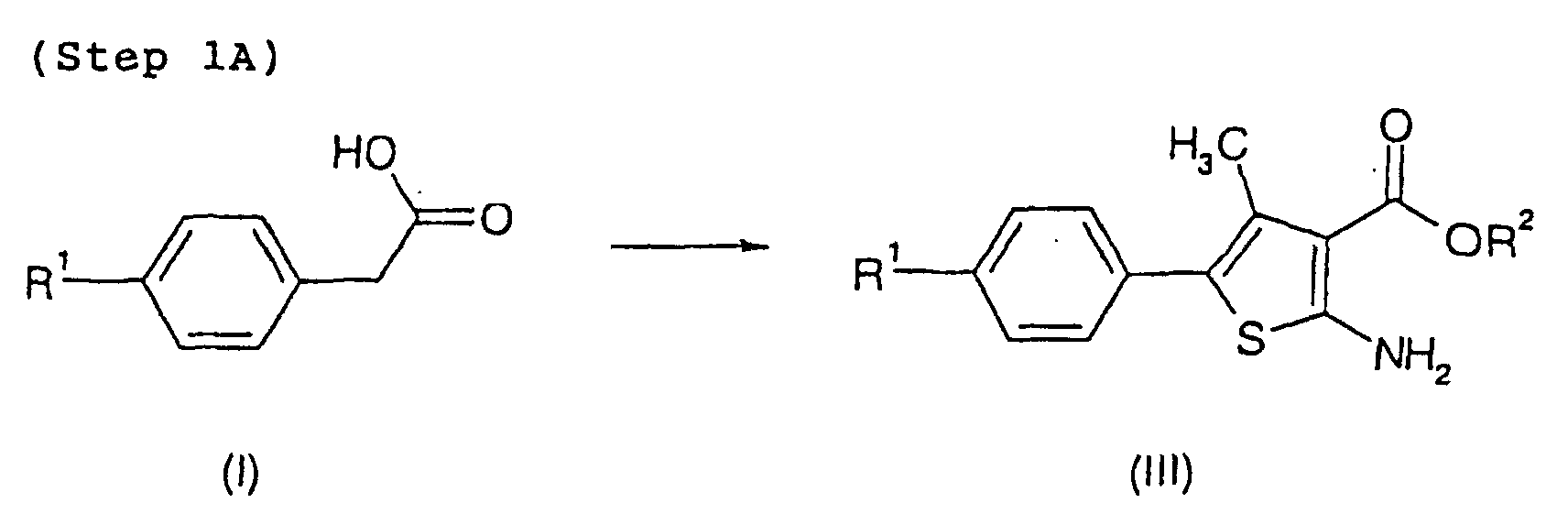
      Figure 00590002
      wherein respective symbols have the same meanings as those described above or a salt thereof.
    5. The process according to claim 4, wherein R1a is nitro.
    6. The process according to claim 4, wherein R3 is phenyl optionally having a substituent.
    7. The process according to claim 4, wherein R5 is phenyl optionally having a substituent.
    8. The process according to claim 4, wherein one of R6 and R7 is C1-3 alkyl, and the other of them is benzyl optionally having a substituent.
    9. The process according to claim 4, wherein one of R8 and R9 is a hydrogen atom, and the other of them is C1-3 alkoxy.
    10. The process according to claim 4, wherein the compound (VII) or a salt thereof is subjected to a brominating reaction in the presence of bromine and a radical initiator.
    EP01906336A 2000-02-29 2001-02-27 METHOD FOR PRODUCING THIENOPYRIMIDINE DERIVATIVES Withdrawn EP1266898A4 (en)

    Applications Claiming Priority (3)

    Application Number Priority Date Filing Date Title
    JP2000105769 2000-02-29
    JP2000105769 2000-02-29
    PCT/JP2001/001447 WO2001064683A1 (en) 2000-02-29 2001-02-27 Processes for the production of thienopyrimidine derivatives

    Publications (2)

    Publication Number Publication Date
    EP1266898A1 true EP1266898A1 (en) 2002-12-18
    EP1266898A4 EP1266898A4 (en) 2003-05-21

    Family

    ID=18619050

    Family Applications (1)

    Application Number Title Priority Date Filing Date
    EP01906336A Withdrawn EP1266898A4 (en) 2000-02-29 2001-02-27 METHOD FOR PRODUCING THIENOPYRIMIDINE DERIVATIVES

    Country Status (7)

    Country Link
    US (1) US6849738B2 (en)
    EP (1) EP1266898A4 (en)
    KR (1) KR20030005205A (en)
    CN (2) CN1539836A (en)
    AU (1) AU2001234188A1 (en)
    CA (1) CA2401379A1 (en)
    WO (1) WO2001064683A1 (en)

    Cited By (3)

    * Cited by examiner, † Cited by third party
    Publication number Priority date Publication date Assignee Title
    US7569570B2 (en) 2002-01-30 2009-08-04 Takeda Pharmaceutical Company Limited Thienopyrimidines, process for preparing the same and use thereof
    WO2014051164A3 (en) * 2012-09-28 2014-05-22 Takeda Pharmaceutical Company Limited Production method of thienopyrimidine derivative
    US12338249B2 (en) 2019-10-10 2025-06-24 Sumitomo Pharma Switzerland Gmbh Crystalline forms of N-(4-(1-(2,6-difluorobenzyl)-5-((dimethylamino)methyl)-3-(6-methoxy-3-pyridazinyl)-2,4-dioxo-1,2,3,4-tetrahydrothieno[2,3-d]pyrimidin-6-yl)phenyl)-N′-methoxyurea

    Families Citing this family (5)

    * Cited by examiner, † Cited by third party
    Publication number Priority date Publication date Assignee Title
    EP1591446B1 (en) 2003-01-29 2013-03-06 Takeda Pharmaceutical Company Limited Thienopyrimidine compounds and use thereof
    EP3518933B2 (en) 2016-09-30 2025-02-26 Sumitomo Pharma Switzerland GmbH Methods of treating uterine fibroids and endometriosis
    CN110248661A (en) 2016-09-30 2019-09-17 梦欧文科学有限责任公司 The treatment of prostate cancer
    CN111499654B (en) * 2019-01-30 2022-09-02 南通诺泰生物医药技术有限公司 Method for synthesizing 3-chloro-thiophene [2, 3-b ] pyridine derivative
    BR112022023937A2 (en) 2020-05-29 2022-12-27 Myovant Sciences Gmbh COMBINATION SOLID ORAL DOSAGE FORMS OF GONADOTROPIN-RELEASING HORMONE ANTAGONISTS

    Family Cites Families (10)

    * Cited by examiner, † Cited by third party
    Publication number Priority date Publication date Assignee Title
    DE2817449A1 (en) * 1978-04-21 1979-10-31 Bayer Ag MEANS OF REGULATING PLANT GROWTH
    US4701528A (en) * 1985-12-23 1987-10-20 Bristol-Myers Company Intermediates useful in the preparation of 3,4-dihydro-4-oxothieno[2,3-d]pyrimidine-2-carboxylates and process for preparing same
    TW449600B (en) * 1994-04-19 2001-08-11 Takeda Chemical Industries Ltd Condensed-ring thiophene derivatives, their production and use
    UY23948A1 (en) 1995-02-08 2001-10-25 Takeda Chemical Industries Ltd DERIVATIVES FROM THYPHENE CONDENSED RINGS, THEIR PRODUCTION AND USE.
    JPH096A (en) 1995-06-19 1997-01-07 Iseki & Co Ltd Row molding machine
    JPH09169766A (en) * 1995-10-19 1997-06-30 Takeda Chem Ind Ltd Thienpyridine, its production and use thereof
    CN1063446C (en) 1995-10-19 2001-03-21 武田药品工业株式会社 Thienopyridine derivatives as gonadotropin releasing hormone antagonists
    DE19724980A1 (en) * 1997-06-13 1998-12-17 Basf Ag 3-Substituted 3,4-dihydro-thieno [2,3-d] pyrimidine derivatives, their preparation and use
    RU2233284C2 (en) * 1999-03-24 2004-07-27 Такеда Кемикал Индастриз, Лтд. Thienopyrimidine derivatives, method for their preparing, pharmaceutical composition and method for antagonization of gonadotropin-releasing hormone
    TWI225863B (en) * 1999-03-24 2005-01-01 Takeda Chemical Industries Ltd Thienopyrimidine compounds, their production and use

    Cited By (13)

    * Cited by examiner, † Cited by third party
    Publication number Priority date Publication date Assignee Title
    US7569570B2 (en) 2002-01-30 2009-08-04 Takeda Pharmaceutical Company Limited Thienopyrimidines, process for preparing the same and use thereof
    WO2014051164A3 (en) * 2012-09-28 2014-05-22 Takeda Pharmaceutical Company Limited Production method of thienopyrimidine derivative
    US9758528B2 (en) 2012-09-28 2017-09-12 Takeda Pharmaceutical Company Limited Production method of thienopyrimidine derivative
    US10150778B2 (en) 2012-09-28 2018-12-11 Takeda Pharmaceutical Company Limited Production method of thienopyrimidine derivative
    US10464945B2 (en) 2012-09-28 2019-11-05 Takeda Pharmaceutical Company Limited Crystalline forms of thienopyrimidine derivative
    US10544160B2 (en) 2012-09-28 2020-01-28 Takeda Pharmaceutical Company Limited Production method of thienopyrimidine derivative
    US11053257B2 (en) 2012-09-28 2021-07-06 Takeda Pharmaceutical Company Limited Production method of thienopyrimidine derivative
    EP4119564A1 (en) * 2012-09-28 2023-01-18 Takeda Pharmaceutical Company Limited Production method of thienopyrimidine derivative
    US11731983B2 (en) 2012-09-28 2023-08-22 Takeda Pharmaceutical Company Limited Production method of thienopyrimidine derivative
    US11795178B2 (en) 2012-09-28 2023-10-24 Takeda Pharmaceutical Company Limited Compositions of thienopyrimidine derivatives
    US12180224B2 (en) 2012-09-28 2024-12-31 Takeda Pharmaceutical Company Limited Thienopyrimidine derivatives and production methods thereof
    US12325714B2 (en) 2012-09-28 2025-06-10 Takeda Pharmaceutical Company Limited Compositions of thienopyrimidine derivatives
    US12338249B2 (en) 2019-10-10 2025-06-24 Sumitomo Pharma Switzerland Gmbh Crystalline forms of N-(4-(1-(2,6-difluorobenzyl)-5-((dimethylamino)methyl)-3-(6-methoxy-3-pyridazinyl)-2,4-dioxo-1,2,3,4-tetrahydrothieno[2,3-d]pyrimidin-6-yl)phenyl)-N′-methoxyurea

    Also Published As

    Publication number Publication date
    WO2001064683A1 (en) 2001-09-07
    US6849738B2 (en) 2005-02-01
    EP1266898A4 (en) 2003-05-21
    KR20030005205A (en) 2003-01-17
    CN1539836A (en) 2004-10-27
    CA2401379A1 (en) 2001-09-07
    CN1173977C (en) 2004-11-03
    CN1406239A (en) 2003-03-26
    AU2001234188A1 (en) 2001-09-12
    US20030055269A1 (en) 2003-03-20

    Similar Documents

    Publication Publication Date Title
    JP4987871B2 (en) Piperidine and piperazine derivatives as P2X3 antagonists
    CA2368834C (en) Bicyclic heteroaromatic compounds useful as lh agonists
    US6313301B1 (en) Thienopyridine derivatives, their intermediates and production thereof
    KR20010032769A (en) Novel compounds
    WO2019020102A1 (en) Method for preparing pyrimidone heteroaryl derivative and intermediate of pyrimidone heteroaryl derivative
    EP2054417A2 (en) Fused thiophene derivatives as mek inhibitors
    US6849738B2 (en) Processes for the production of thienopyrimidine derivatives
    AU2004249697B2 (en) Thiazoline derivatives as selective androgen receptor modulators (SARMS)
    JP2001316391A (en) Method for producing thienopyridine derivative
    CN107108649B (en) Novel process for the preparation of thienopyrimidine compounds and intermediates used therein
    AU755425B2 (en) Substituted isoxazolylthiophene compounds
    JPH11130777A (en) Thienopyridine derivative, its intermediate and their production
    KR100467552B1 (en) 4(4-oxocyclohexyl) benzamides as intermediate products for medicaments
    KR910009915B1 (en) 3,4-dihydrothieno [2,3-d] pyrimidine compounds and their medical uses
    JPWO1999009033A1 (en) Thienopyridine derivatives, intermediates therefor, and methods for producing them
    JP2001151774A (en) Substituted thiophene compounds
    JP2002537389A (en) A new method for producing benzothiazolone compounds
    JP2002537290A (en) Method for producing 6- (perfluoroalkyl) uracil compound from carbamate compound
    JPH11116578A (en) Thienopyridine derivative and its production
    KR20000065865A (en) 4,5-Diamino pyrimidine derivatives and methods for producing said compound
    JPH07267943A (en) Novel 2,3-dihydro-4H-1-benzopyran-4-one derivative or salt thereof

    Legal Events

    Date Code Title Description
    PUAI Public reference made under article 153(3) epc to a published international application that has entered the european phase

    Free format text: ORIGINAL CODE: 0009012

    17P Request for examination filed

    Effective date: 20020803

    AK Designated contracting states

    Kind code of ref document: A1

    Designated state(s): AT BE CH CY DE DK ES FI FR GB GR IE IT LI LU MC NL PT SE TR

    AX Request for extension of the european patent

    Free format text: AL;LT;LV;MK;RO;SI

    RIN1 Information on inventor provided before grant (corrected)

    Inventor name: FUKUOKA, KOICHIRO

    Inventor name: YAMAMOTO, HIROAKI

    Inventor name: KIMURA, KAZUHIRO

    Inventor name: KAWAKAMI, JUNICHI

    Inventor name: MIKI, SHOKYO

    A4 Supplementary search report drawn up and despatched

    Effective date: 20030404

    RAP1 Party data changed (applicant data changed or rights of an application transferred)

    Owner name: TAKEDA PHARMACEUTICAL COMPANY LIMITED

    GRAP Despatch of communication of intention to grant a patent

    Free format text: ORIGINAL CODE: EPIDOSNIGR1

    STAA Information on the status of an ep patent application or granted ep patent

    Free format text: STATUS: THE APPLICATION HAS BEEN WITHDRAWN

    18W Application withdrawn

    Effective date: 20050917