EP1266888A1 - Quinoline derivatives and medicinal use thereof - Google Patents
Quinoline derivatives and medicinal use thereof Download PDFInfo
- Publication number
- EP1266888A1 EP1266888A1 EP01914178A EP01914178A EP1266888A1 EP 1266888 A1 EP1266888 A1 EP 1266888A1 EP 01914178 A EP01914178 A EP 01914178A EP 01914178 A EP01914178 A EP 01914178A EP 1266888 A1 EP1266888 A1 EP 1266888A1
- Authority
- EP
- European Patent Office
- Prior art keywords
- group
- methyloxy
- phenyl
- isopropoxy
- ethoxy
- Prior art date
- Legal status (The legal status is an assumption and is not a legal conclusion. Google has not performed a legal analysis and makes no representation as to the accuracy of the status listed.)
- Withdrawn
Links
- 125000002943 quinolinyl group Chemical class N1=C(C=CC2=CC=CC=C12)* 0.000 title claims abstract 10
- 229940027991 antiseptic and disinfectant quinoline derivative Drugs 0.000 title description 7
- 108091008725 peroxisome proliferator-activated receptors alpha Proteins 0.000 claims abstract description 24
- 239000003814 drug Substances 0.000 claims abstract description 21
- 229940124597 therapeutic agent Drugs 0.000 claims abstract description 14
- 230000003449 preventive effect Effects 0.000 claims abstract description 13
- 102000040945 Transcription factor Human genes 0.000 claims abstract description 7
- 108091023040 Transcription factor Proteins 0.000 claims abstract description 7
- 239000004480 active ingredient Substances 0.000 claims abstract description 7
- 125000001997 phenyl group Chemical group [H]C1=C([H])C([H])=C(*)C([H])=C1[H] 0.000 claims description 178
- -1 phenyloxy group Chemical group 0.000 claims description 67
- 125000004432 carbon atom Chemical group C* 0.000 claims description 38
- 125000000217 alkyl group Chemical group 0.000 claims description 21
- 206010012601 diabetes mellitus Diseases 0.000 claims description 18
- 108060008682 Tumor Necrosis Factor Proteins 0.000 claims description 16
- 102000000852 Tumor Necrosis Factor-alpha Human genes 0.000 claims description 16
- 150000003839 salts Chemical class 0.000 claims description 11
- 108010016731 PPAR gamma Proteins 0.000 claims description 9
- 125000003545 alkoxy group Chemical group 0.000 claims description 8
- 238000004519 manufacturing process Methods 0.000 claims description 8
- 125000004435 hydrogen atom Chemical group [H]* 0.000 claims description 6
- 125000002887 hydroxy group Chemical group [H]O* 0.000 claims description 6
- 125000004453 alkoxycarbonyl group Chemical group 0.000 claims description 5
- 125000003178 carboxy group Chemical group [H]OC(*)=O 0.000 claims description 5
- 201000005577 familial hyperlipidemia Diseases 0.000 claims description 5
- 125000003277 amino group Chemical group 0.000 claims description 4
- 125000003917 carbamoyl group Chemical group [H]N([H])C(*)=O 0.000 claims description 4
- 125000005843 halogen group Chemical group 0.000 claims description 4
- 125000004448 alkyl carbonyl group Chemical group 0.000 claims description 3
- 229910052799 carbon Inorganic materials 0.000 claims description 3
- 125000004414 alkyl thio group Chemical group 0.000 claims description 2
- 239000005557 antagonist Substances 0.000 claims description 2
- 125000003236 benzoyl group Chemical group [H]C1=C([H])C([H])=C(C([H])=C1[H])C(*)=O 0.000 claims description 2
- 125000004093 cyano group Chemical group *C#N 0.000 claims description 2
- 239000003112 inhibitor Substances 0.000 claims description 2
- 125000000449 nitro group Chemical group [O-][N+](*)=O 0.000 claims description 2
- 125000003396 thiol group Chemical group [H]S* 0.000 claims description 2
- RMVRSNDYEFQCLF-UHFFFAOYSA-N thiophenol Chemical group SC1=CC=CC=C1 RMVRSNDYEFQCLF-UHFFFAOYSA-N 0.000 claims description 2
- 125000002023 trifluoromethyl group Chemical group FC(F)(F)* 0.000 claims description 2
- 102000012141 Peroxisome proliferator-activated receptor alpha Human genes 0.000 claims 1
- 102000012132 Peroxisome proliferator-activated receptor gamma Human genes 0.000 claims 1
- 150000001875 compounds Chemical class 0.000 abstract description 206
- 102000023984 PPAR alpha Human genes 0.000 abstract description 23
- 201000010099 disease Diseases 0.000 abstract description 8
- 208000037265 diseases, disorders, signs and symptoms Diseases 0.000 abstract description 8
- 231100000419 toxicity Toxicity 0.000 abstract description 3
- 230000001988 toxicity Effects 0.000 abstract description 3
- GRVDJDISBSALJP-UHFFFAOYSA-N methyloxidanyl Chemical group [O]C GRVDJDISBSALJP-UHFFFAOYSA-N 0.000 description 206
- HEDRZPFGACZZDS-MICDWDOJSA-N Trichloro(2H)methane Chemical compound [2H]C(Cl)(Cl)Cl HEDRZPFGACZZDS-MICDWDOJSA-N 0.000 description 162
- 230000015572 biosynthetic process Effects 0.000 description 113
- XBDQKXXYIPTUBI-UHFFFAOYSA-N dimethylselenoniopropionate Natural products CCC(O)=O XBDQKXXYIPTUBI-UHFFFAOYSA-N 0.000 description 113
- 235000019260 propionic acid Nutrition 0.000 description 112
- 238000003786 synthesis reaction Methods 0.000 description 112
- XEKOWRVHYACXOJ-UHFFFAOYSA-N Ethyl acetate Chemical compound CCOC(C)=O XEKOWRVHYACXOJ-UHFFFAOYSA-N 0.000 description 69
- 238000006243 chemical reaction Methods 0.000 description 67
- 239000006188 syrup Substances 0.000 description 45
- 235000020357 syrup Nutrition 0.000 description 45
- VLKZOEOYAKHREP-UHFFFAOYSA-N n-Hexane Chemical group CCCCCC VLKZOEOYAKHREP-UHFFFAOYSA-N 0.000 description 40
- 239000013078 crystal Substances 0.000 description 36
- LFQSCWFLJHTTHZ-UHFFFAOYSA-N Ethanol Chemical compound CCO LFQSCWFLJHTTHZ-UHFFFAOYSA-N 0.000 description 34
- 230000000694 effects Effects 0.000 description 33
- 238000002844 melting Methods 0.000 description 32
- 230000008018 melting Effects 0.000 description 32
- YMWUJEATGCHHMB-UHFFFAOYSA-N Dichloromethane Chemical compound ClCCl YMWUJEATGCHHMB-UHFFFAOYSA-N 0.000 description 30
- VEXZGXHMUGYJMC-UHFFFAOYSA-N Hydrochloric acid Chemical compound Cl VEXZGXHMUGYJMC-UHFFFAOYSA-N 0.000 description 28
- 125000001495 ethyl group Chemical group [H]C([H])([H])C([H])([H])* 0.000 description 27
- NOESYZHRGYRDHS-UHFFFAOYSA-N insulin Chemical compound N1C(=O)C(NC(=O)C(CCC(N)=O)NC(=O)C(CCC(O)=O)NC(=O)C(C(C)C)NC(=O)C(NC(=O)CN)C(C)CC)CSSCC(C(NC(CO)C(=O)NC(CC(C)C)C(=O)NC(CC=2C=CC(O)=CC=2)C(=O)NC(CCC(N)=O)C(=O)NC(CC(C)C)C(=O)NC(CCC(O)=O)C(=O)NC(CC(N)=O)C(=O)NC(CC=2C=CC(O)=CC=2)C(=O)NC(CSSCC(NC(=O)C(C(C)C)NC(=O)C(CC(C)C)NC(=O)C(CC=2C=CC(O)=CC=2)NC(=O)C(CC(C)C)NC(=O)C(C)NC(=O)C(CCC(O)=O)NC(=O)C(C(C)C)NC(=O)C(CC(C)C)NC(=O)C(CC=2NC=NC=2)NC(=O)C(CO)NC(=O)CNC2=O)C(=O)NCC(=O)NC(CCC(O)=O)C(=O)NC(CCCNC(N)=N)C(=O)NCC(=O)NC(CC=3C=CC=CC=3)C(=O)NC(CC=3C=CC=CC=3)C(=O)NC(CC=3C=CC(O)=CC=3)C(=O)NC(C(C)O)C(=O)N3C(CCC3)C(=O)NC(CCCCN)C(=O)NC(C)C(O)=O)C(=O)NC(CC(N)=O)C(O)=O)=O)NC(=O)C(C(C)CC)NC(=O)C(CO)NC(=O)C(C(C)O)NC(=O)C1CSSCC2NC(=O)C(CC(C)C)NC(=O)C(NC(=O)C(CCC(N)=O)NC(=O)C(CC(N)=O)NC(=O)C(NC(=O)C(N)CC=1C=CC=CC=1)C(C)C)CC1=CN=CN1 NOESYZHRGYRDHS-UHFFFAOYSA-N 0.000 description 26
- 230000009471 action Effects 0.000 description 25
- 239000003795 chemical substances by application Substances 0.000 description 25
- 238000005160 1H NMR spectroscopy Methods 0.000 description 24
- IAZDPXIOMUYVGZ-WFGJKAKNSA-N Dimethyl sulfoxide Chemical compound [2H]C([2H])([2H])S(=O)C([2H])([2H])[2H] IAZDPXIOMUYVGZ-WFGJKAKNSA-N 0.000 description 24
- 239000000203 mixture Substances 0.000 description 22
- YXFVVABEGXRONW-UHFFFAOYSA-N Toluene Chemical compound CC1=CC=CC=C1 YXFVVABEGXRONW-UHFFFAOYSA-N 0.000 description 21
- 125000001797 benzyl group Chemical group [H]C1=C([H])C([H])=C(C([H])=C1[H])C([H])([H])* 0.000 description 21
- 210000004027 cell Anatomy 0.000 description 21
- IAZDPXIOMUYVGZ-UHFFFAOYSA-N Dimethylsulphoxide Chemical compound CS(C)=O IAZDPXIOMUYVGZ-UHFFFAOYSA-N 0.000 description 20
- 239000000243 solution Substances 0.000 description 20
- 210000004369 blood Anatomy 0.000 description 19
- 239000008280 blood Substances 0.000 description 19
- HEDRZPFGACZZDS-UHFFFAOYSA-N Chloroform Chemical compound ClC(Cl)Cl HEDRZPFGACZZDS-UHFFFAOYSA-N 0.000 description 18
- WYURNTSHIVDZCO-UHFFFAOYSA-N Tetrahydrofuran Chemical compound C1CCOC1 WYURNTSHIVDZCO-UHFFFAOYSA-N 0.000 description 18
- 239000002609 medium Substances 0.000 description 17
- OKKJLVBELUTLKV-UHFFFAOYSA-N Methanol Chemical compound OC OKKJLVBELUTLKV-UHFFFAOYSA-N 0.000 description 16
- ISWSIDIOOBJBQZ-UHFFFAOYSA-N Phenol Chemical compound OC1=CC=CC=C1 ISWSIDIOOBJBQZ-UHFFFAOYSA-N 0.000 description 16
- QTBSBXVTEAMEQO-UHFFFAOYSA-N Acetic acid Chemical compound CC(O)=O QTBSBXVTEAMEQO-UHFFFAOYSA-N 0.000 description 15
- 108060001084 Luciferase Proteins 0.000 description 15
- 238000012360 testing method Methods 0.000 description 15
- 238000000034 method Methods 0.000 description 14
- 239000011541 reaction mixture Substances 0.000 description 14
- XLYOFNOQVPJJNP-UHFFFAOYSA-N water Substances O XLYOFNOQVPJJNP-UHFFFAOYSA-N 0.000 description 14
- 102000004877 Insulin Human genes 0.000 description 13
- 108090001061 Insulin Proteins 0.000 description 13
- 102000000536 PPAR gamma Human genes 0.000 description 13
- 229940125396 insulin Drugs 0.000 description 13
- 239000012044 organic layer Substances 0.000 description 13
- CSNNHWWHGAXBCP-UHFFFAOYSA-L Magnesium sulfate Chemical compound [Mg+2].[O-][S+2]([O-])([O-])[O-] CSNNHWWHGAXBCP-UHFFFAOYSA-L 0.000 description 12
- 239000003921 oil Substances 0.000 description 12
- 235000019198 oils Nutrition 0.000 description 12
- 150000003248 quinolines Chemical class 0.000 description 12
- 230000009467 reduction Effects 0.000 description 12
- 239000006144 Dulbecco’s modified Eagle's medium Substances 0.000 description 11
- 239000005089 Luciferase Substances 0.000 description 11
- 125000002496 methyl group Chemical group [H]C([H])([H])* 0.000 description 11
- 238000010898 silica gel chromatography Methods 0.000 description 11
- SYVQLNRZPPOLIR-UHFFFAOYSA-N (6-methoxy-4-propan-2-yloxyquinolin-3-yl)methanol Chemical compound N1=CC(CO)=C(OC(C)C)C2=CC(OC)=CC=C21 SYVQLNRZPPOLIR-UHFFFAOYSA-N 0.000 description 10
- RYHBNJHYFVUHQT-UHFFFAOYSA-N 1,4-Dioxane Chemical compound C1COCCO1 RYHBNJHYFVUHQT-UHFFFAOYSA-N 0.000 description 10
- 108091003079 Bovine Serum Albumin Proteins 0.000 description 10
- UIIMBOGNXHQVGW-UHFFFAOYSA-M Sodium bicarbonate Chemical compound [Na+].OC([O-])=O UIIMBOGNXHQVGW-UHFFFAOYSA-M 0.000 description 10
- 239000002253 acid Substances 0.000 description 10
- HYAFETHFCAUJAY-UHFFFAOYSA-N pioglitazone Chemical compound N1=CC(CC)=CC=C1CCOC(C=C1)=CC=C1CC1C(=O)NC(=O)S1 HYAFETHFCAUJAY-UHFFFAOYSA-N 0.000 description 10
- RIOQSEWOXXDEQQ-UHFFFAOYSA-N triphenylphosphine Chemical compound C1=CC=CC=C1P(C=1C=CC=CC=1)C1=CC=CC=C1 RIOQSEWOXXDEQQ-UHFFFAOYSA-N 0.000 description 10
- 208000001072 type 2 diabetes mellitus Diseases 0.000 description 10
- WQZGKKKJIJFFOK-GASJEMHNSA-N Glucose Natural products OC[C@H]1OC(O)[C@H](O)[C@@H](O)[C@@H]1O WQZGKKKJIJFFOK-GASJEMHNSA-N 0.000 description 9
- ZMXDDKWLCZADIW-UHFFFAOYSA-N N,N-Dimethylformamide Chemical compound CN(C)C=O ZMXDDKWLCZADIW-UHFFFAOYSA-N 0.000 description 9
- HEMHJVSKTPXQMS-UHFFFAOYSA-M Sodium hydroxide Chemical compound [OH-].[Na+] HEMHJVSKTPXQMS-UHFFFAOYSA-M 0.000 description 9
- ZMANZCXQSJIPKH-UHFFFAOYSA-N Triethylamine Chemical compound CCN(CC)CC ZMANZCXQSJIPKH-UHFFFAOYSA-N 0.000 description 9
- 239000008103 glucose Substances 0.000 description 9
- 239000000047 product Substances 0.000 description 9
- RGHHSNMVTDWUBI-UHFFFAOYSA-N 4-hydroxybenzaldehyde Chemical compound OC1=CC=C(C=O)C=C1 RGHHSNMVTDWUBI-UHFFFAOYSA-N 0.000 description 8
- CURLTUGMZLYLDI-UHFFFAOYSA-N Carbon dioxide Chemical compound O=C=O CURLTUGMZLYLDI-UHFFFAOYSA-N 0.000 description 8
- 210000001789 adipocyte Anatomy 0.000 description 8
- 230000004069 differentiation Effects 0.000 description 8
- 230000006698 induction Effects 0.000 description 8
- 239000000463 material Substances 0.000 description 8
- 125000001639 phenylmethylene group Chemical group [H]C(=*)C1=C([H])C([H])=C([H])C([H])=C1[H] 0.000 description 8
- 239000002904 solvent Substances 0.000 description 8
- 108020004414 DNA Proteins 0.000 description 7
- 102000003728 Peroxisome Proliferator-Activated Receptors Human genes 0.000 description 7
- 108090000029 Peroxisome Proliferator-Activated Receptors Proteins 0.000 description 7
- 230000027455 binding Effects 0.000 description 7
- 238000011156 evaluation Methods 0.000 description 7
- 238000000605 extraction Methods 0.000 description 7
- 239000003446 ligand Substances 0.000 description 7
- 238000003756 stirring Methods 0.000 description 7
- 239000000126 substance Substances 0.000 description 7
- 0 COc(cc1)cc2c1ncc(COc1ccc(CC(C(O)=O)Sc3ccccc3)cc1)c2OC(*)* Chemical compound COc(cc1)cc2c1ncc(COc1ccc(CC(C(O)=O)Sc3ccccc3)cc1)c2OC(*)* 0.000 description 6
- 206010022489 Insulin Resistance Diseases 0.000 description 6
- KWYUFKZDYYNOTN-UHFFFAOYSA-M Potassium hydroxide Chemical compound [OH-].[K+] KWYUFKZDYYNOTN-UHFFFAOYSA-M 0.000 description 6
- JUJWROOIHBZHMG-UHFFFAOYSA-N Pyridine Chemical compound C1=CC=NC=C1 JUJWROOIHBZHMG-UHFFFAOYSA-N 0.000 description 6
- QAOWNCQODCNURD-UHFFFAOYSA-N Sulfuric acid Chemical compound OS(O)(=O)=O QAOWNCQODCNURD-UHFFFAOYSA-N 0.000 description 6
- 125000004177 diethyl group Chemical group [H]C([H])([H])C([H])([H])* 0.000 description 6
- 239000012091 fetal bovine serum Substances 0.000 description 6
- 238000001914 filtration Methods 0.000 description 6
- 230000005764 inhibitory process Effects 0.000 description 6
- 229920006395 saturated elastomer Polymers 0.000 description 6
- 239000007858 starting material Substances 0.000 description 6
- YLQBMQCUIZJEEH-UHFFFAOYSA-N tetrahydrofuran Natural products C=1C=COC=1 YLQBMQCUIZJEEH-UHFFFAOYSA-N 0.000 description 6
- 238000013518 transcription Methods 0.000 description 6
- 230000035897 transcription Effects 0.000 description 6
- NIXOWILDQLNWCW-UHFFFAOYSA-N 2-Propenoic acid Natural products OC(=O)C=C NIXOWILDQLNWCW-UHFFFAOYSA-N 0.000 description 5
- 101000741788 Homo sapiens Peroxisome proliferator-activated receptor alpha Proteins 0.000 description 5
- JGSARLDLIJGVTE-MBNYWOFBSA-N Penicillin G Chemical compound N([C@H]1[C@H]2SC([C@@H](N2C1=O)C(O)=O)(C)C)C(=O)CC1=CC=CC=C1 JGSARLDLIJGVTE-MBNYWOFBSA-N 0.000 description 5
- 238000009835 boiling Methods 0.000 description 5
- NEJJCKFYYBEQRQ-UHFFFAOYSA-N ethyl 2-ethoxy-3-(4-hydroxyphenyl)propanoate Chemical compound CCOC(=O)C(OCC)CC1=CC=C(O)C=C1 NEJJCKFYYBEQRQ-UHFFFAOYSA-N 0.000 description 5
- 102000054223 human PPARA Human genes 0.000 description 5
- 229960005095 pioglitazone Drugs 0.000 description 5
- 230000008569 process Effects 0.000 description 5
- 108090000623 proteins and genes Proteins 0.000 description 5
- 229910000030 sodium bicarbonate Inorganic materials 0.000 description 5
- 238000005292 vacuum distillation Methods 0.000 description 5
- GQHTUMJGOHRCHB-UHFFFAOYSA-N 2,3,4,6,7,8,9,10-octahydropyrimido[1,2-a]azepine Chemical compound C1CCCCN2CCCN=C21 GQHTUMJGOHRCHB-UHFFFAOYSA-N 0.000 description 4
- 101000741790 Homo sapiens Peroxisome proliferator-activated receptor gamma Proteins 0.000 description 4
- 241000699670 Mus sp. Species 0.000 description 4
- 206010028980 Neoplasm Diseases 0.000 description 4
- 229940080774 Peroxisome proliferator-activated receptor gamma agonist Drugs 0.000 description 4
- NQRYJNQNLNOLGT-UHFFFAOYSA-N Piperidine Chemical compound C1CCNCC1 NQRYJNQNLNOLGT-UHFFFAOYSA-N 0.000 description 4
- CDBYLPFSWZWCQE-UHFFFAOYSA-L Sodium Carbonate Chemical compound [Na+].[Na+].[O-]C([O-])=O CDBYLPFSWZWCQE-UHFFFAOYSA-L 0.000 description 4
- WQDUMFSSJAZKTM-UHFFFAOYSA-N Sodium methoxide Chemical compound [Na+].[O-]C WQDUMFSSJAZKTM-UHFFFAOYSA-N 0.000 description 4
- 229940100389 Sulfonylurea Drugs 0.000 description 4
- DTQVDTLACAAQTR-UHFFFAOYSA-N Trifluoroacetic acid Chemical compound OC(=O)C(F)(F)F DTQVDTLACAAQTR-UHFFFAOYSA-N 0.000 description 4
- 230000003213 activating effect Effects 0.000 description 4
- 229910052784 alkaline earth metal Inorganic materials 0.000 description 4
- 229940098773 bovine serum albumin Drugs 0.000 description 4
- 201000011510 cancer Diseases 0.000 description 4
- 239000001569 carbon dioxide Substances 0.000 description 4
- 229910002092 carbon dioxide Inorganic materials 0.000 description 4
- 150000001732 carboxylic acid derivatives Chemical class 0.000 description 4
- LTMHNWPUDSTBKD-UHFFFAOYSA-N diethyl 2-(ethoxymethylidene)propanedioate Chemical compound CCOC=C(C(=O)OCC)C(=O)OCC LTMHNWPUDSTBKD-UHFFFAOYSA-N 0.000 description 4
- FAMRKDQNMBBFBR-UHFFFAOYSA-N ethyl n-ethoxycarbonyliminocarbamate Chemical compound CCOC(=O)N=NC(=O)OCC FAMRKDQNMBBFBR-UHFFFAOYSA-N 0.000 description 4
- 239000000706 filtrate Substances 0.000 description 4
- 239000012634 fragment Substances 0.000 description 4
- 235000021588 free fatty acids Nutrition 0.000 description 4
- 239000007789 gas Substances 0.000 description 4
- 238000010438 heat treatment Methods 0.000 description 4
- MNWFXJYAOYHMED-UHFFFAOYSA-N hexane carboxylic acid Natural products CCCCCCC(O)=O MNWFXJYAOYHMED-UHFFFAOYSA-N 0.000 description 4
- ZCSHNCUQKCANBX-UHFFFAOYSA-N lithium diisopropylamide Chemical compound [Li+].CC(C)[N-]C(C)C ZCSHNCUQKCANBX-UHFFFAOYSA-N 0.000 description 4
- JRZJOMJEPLMPRA-UHFFFAOYSA-N olefin Natural products CCCCCCCC=C JRZJOMJEPLMPRA-UHFFFAOYSA-N 0.000 description 4
- 150000007530 organic bases Chemical class 0.000 description 4
- 150000002989 phenols Chemical class 0.000 description 4
- 239000013641 positive control Substances 0.000 description 4
- BWHMMNNQKKPAPP-UHFFFAOYSA-L potassium carbonate Chemical compound [K+].[K+].[O-]C([O-])=O BWHMMNNQKKPAPP-UHFFFAOYSA-L 0.000 description 4
- 235000017557 sodium bicarbonate Nutrition 0.000 description 4
- YROXIXLRRCOBKF-UHFFFAOYSA-N sulfonylurea Chemical compound OC(=N)N=S(=O)=O YROXIXLRRCOBKF-UHFFFAOYSA-N 0.000 description 4
- UFTFJSFQGQCHQW-UHFFFAOYSA-N triformin Chemical compound O=COCC(OC=O)COC=O UFTFJSFQGQCHQW-UHFFFAOYSA-N 0.000 description 4
- IMHAQYVXMIZOLW-UHFFFAOYSA-N (6-methoxy-4-propoxyquinolin-3-yl)methanol Chemical compound C1=C(OC)C=C2C(OCCC)=C(CO)C=NC2=C1 IMHAQYVXMIZOLW-UHFFFAOYSA-N 0.000 description 3
- SCYULBFZEHDVBN-UHFFFAOYSA-N 1,1-Dichloroethane Chemical compound CC(Cl)Cl SCYULBFZEHDVBN-UHFFFAOYSA-N 0.000 description 3
- WEEMDRWIKYCTQM-UHFFFAOYSA-N 2,6-dimethoxybenzenecarbothioamide Chemical compound COC1=CC=CC(OC)=C1C(N)=S WEEMDRWIKYCTQM-UHFFFAOYSA-N 0.000 description 3
- ZVTWZSXLLMNMQC-UHFFFAOYSA-N 4-phenylmethoxybenzaldehyde Chemical compound C1=CC(C=O)=CC=C1OCC1=CC=CC=C1 ZVTWZSXLLMNMQC-UHFFFAOYSA-N 0.000 description 3
- CSCPPACGZOOCGX-UHFFFAOYSA-N Acetone Chemical compound CC(C)=O CSCPPACGZOOCGX-UHFFFAOYSA-N 0.000 description 3
- UHOVQNZJYSORNB-UHFFFAOYSA-N Benzene Chemical compound C1=CC=CC=C1 UHOVQNZJYSORNB-UHFFFAOYSA-N 0.000 description 3
- LSNNMFCWUKXFEE-UHFFFAOYSA-M Bisulfite Chemical compound OS([O-])=O LSNNMFCWUKXFEE-UHFFFAOYSA-M 0.000 description 3
- 230000004568 DNA-binding Effects 0.000 description 3
- 108700028146 Genetic Enhancer Elements Proteins 0.000 description 3
- DGAQECJNVWCQMB-PUAWFVPOSA-M Ilexoside XXIX Chemical compound C[C@@H]1CC[C@@]2(CC[C@@]3(C(=CC[C@H]4[C@]3(CC[C@@H]5[C@@]4(CC[C@@H](C5(C)C)OS(=O)(=O)[O-])C)C)[C@@H]2[C@]1(C)O)C)C(=O)O[C@H]6[C@@H]([C@H]([C@@H]([C@H](O6)CO)O)O)O.[Na+] DGAQECJNVWCQMB-PUAWFVPOSA-M 0.000 description 3
- KFZMGEQAYNKOFK-UHFFFAOYSA-N Isopropanol Chemical compound CC(C)O KFZMGEQAYNKOFK-UHFFFAOYSA-N 0.000 description 3
- FYYHWMGAXLPEAU-UHFFFAOYSA-N Magnesium Chemical compound [Mg] FYYHWMGAXLPEAU-UHFFFAOYSA-N 0.000 description 3
- ZLMJMSJWJFRBEC-UHFFFAOYSA-N Potassium Chemical compound [K] ZLMJMSJWJFRBEC-UHFFFAOYSA-N 0.000 description 3
- RWRDLPDLKQPQOW-UHFFFAOYSA-N Pyrrolidine Chemical compound C1CCNC1 RWRDLPDLKQPQOW-UHFFFAOYSA-N 0.000 description 3
- 240000004808 Saccharomyces cerevisiae Species 0.000 description 3
- 239000000556 agonist Substances 0.000 description 3
- 239000002585 base Substances 0.000 description 3
- FFBHFFJDDLITSX-UHFFFAOYSA-N benzyl N-[2-hydroxy-4-(3-oxomorpholin-4-yl)phenyl]carbamate Chemical compound OC1=C(NC(=O)OCC2=CC=CC=C2)C=CC(=C1)N1CCOCC1=O FFBHFFJDDLITSX-UHFFFAOYSA-N 0.000 description 3
- HQABUPZFAYXKJW-UHFFFAOYSA-N butan-1-amine Chemical compound CCCCN HQABUPZFAYXKJW-UHFFFAOYSA-N 0.000 description 3
- 230000023852 carbohydrate metabolic process Effects 0.000 description 3
- 238000002425 crystallisation Methods 0.000 description 3
- 230000008025 crystallization Effects 0.000 description 3
- UAOMVDZJSHZZME-UHFFFAOYSA-N diisopropylamine Chemical compound CC(C)NC(C)C UAOMVDZJSHZZME-UHFFFAOYSA-N 0.000 description 3
- 125000000118 dimethyl group Chemical group [H]C([H])([H])* 0.000 description 3
- 229940079593 drug Drugs 0.000 description 3
- 238000002474 experimental method Methods 0.000 description 3
- 239000013604 expression vector Substances 0.000 description 3
- 230000014509 gene expression Effects 0.000 description 3
- 201000001421 hyperglycemia Diseases 0.000 description 3
- 238000000338 in vitro Methods 0.000 description 3
- 230000002401 inhibitory effect Effects 0.000 description 3
- 230000037356 lipid metabolism Effects 0.000 description 3
- 150000002632 lipids Chemical class 0.000 description 3
- 239000011777 magnesium Substances 0.000 description 3
- 229910052749 magnesium Inorganic materials 0.000 description 3
- 230000007246 mechanism Effects 0.000 description 3
- 229910052751 metal Inorganic materials 0.000 description 3
- 239000002184 metal Substances 0.000 description 3
- MGJXBDMLVWIYOQ-UHFFFAOYSA-N methylazanide Chemical compound [NH-]C MGJXBDMLVWIYOQ-UHFFFAOYSA-N 0.000 description 3
- 239000012046 mixed solvent Substances 0.000 description 3
- 230000002969 morbid Effects 0.000 description 3
- 210000004940 nucleus Anatomy 0.000 description 3
- 230000002085 persistent effect Effects 0.000 description 3
- 229910052700 potassium Inorganic materials 0.000 description 3
- 239000011591 potassium Substances 0.000 description 3
- UMJSCPRVCHMLSP-UHFFFAOYSA-N pyridine Natural products COC1=CC=CN=C1 UMJSCPRVCHMLSP-UHFFFAOYSA-N 0.000 description 3
- 102000005962 receptors Human genes 0.000 description 3
- 108020003175 receptors Proteins 0.000 description 3
- 229910052708 sodium Inorganic materials 0.000 description 3
- 239000011734 sodium Substances 0.000 description 3
- QDRKDTQENPPHOJ-UHFFFAOYSA-N sodium ethoxide Chemical compound [Na+].CC[O-] QDRKDTQENPPHOJ-UHFFFAOYSA-N 0.000 description 3
- 229960002385 streptomycin sulfate Drugs 0.000 description 3
- QUILMDPXDLKVJZ-UHFFFAOYSA-N (5,7-dimethyl-4-propan-2-yloxyquinolin-3-yl)methanol Chemical compound CC1=CC(C)=C2C(OC(C)C)=C(CO)C=NC2=C1 QUILMDPXDLKVJZ-UHFFFAOYSA-N 0.000 description 2
- SUHXEBPTWMNMRC-UHFFFAOYSA-N (6-ethyl-4-propan-2-yloxyquinolin-3-yl)methanol Chemical compound N1=CC(CO)=C(OC(C)C)C2=CC(CC)=CC=C21 SUHXEBPTWMNMRC-UHFFFAOYSA-N 0.000 description 2
- FCNVFAZTIMBCRD-UHFFFAOYSA-N (6-methoxy-4-octoxyquinolin-3-yl)methanol Chemical compound C1=C(OC)C=C2C(OCCCCCCCC)=C(CO)C=NC2=C1 FCNVFAZTIMBCRD-UHFFFAOYSA-N 0.000 description 2
- USVVENVKYJZFMW-ONEGZZNKSA-N (e)-carboxyiminocarbamic acid Chemical class OC(=O)\N=N\C(O)=O USVVENVKYJZFMW-ONEGZZNKSA-N 0.000 description 2
- ZOBPZXTWZATXDG-UHFFFAOYSA-N 1,3-thiazolidine-2,4-dione Chemical group O=C1CSC(=O)N1 ZOBPZXTWZATXDG-UHFFFAOYSA-N 0.000 description 2
- KBPLFHHGFOOTCA-UHFFFAOYSA-N 1-Octanol Chemical compound CCCCCCCCO KBPLFHHGFOOTCA-UHFFFAOYSA-N 0.000 description 2
- LTMRRSWNXVJMBA-UHFFFAOYSA-L 2,2-diethylpropanedioate Chemical compound CCC(CC)(C([O-])=O)C([O-])=O LTMRRSWNXVJMBA-UHFFFAOYSA-L 0.000 description 2
- FNJIEQTXSACVMQ-UHFFFAOYSA-N 2-[(4-hydroxyphenyl)methyl]-n-methyl-3-oxobutanamide Chemical compound CNC(=O)C(C(C)=O)CC1=CC=C(O)C=C1 FNJIEQTXSACVMQ-UHFFFAOYSA-N 0.000 description 2
- MKARNSWMMBGSHX-UHFFFAOYSA-N 3,5-dimethylaniline Chemical compound CC1=CC(C)=CC(N)=C1 MKARNSWMMBGSHX-UHFFFAOYSA-N 0.000 description 2
- IAVREABSGIHHMO-UHFFFAOYSA-N 3-hydroxybenzaldehyde Chemical compound OC1=CC=CC(C=O)=C1 IAVREABSGIHHMO-UHFFFAOYSA-N 0.000 description 2
- HRXZRAXKKNUKRF-UHFFFAOYSA-N 4-ethylaniline Chemical compound CCC1=CC=C(N)C=C1 HRXZRAXKKNUKRF-UHFFFAOYSA-N 0.000 description 2
- 208000030507 AIDS Diseases 0.000 description 2
- NLXLAEXVIDQMFP-UHFFFAOYSA-N Ammonia chloride Chemical compound [NH4+].[Cl-] NLXLAEXVIDQMFP-UHFFFAOYSA-N 0.000 description 2
- 206010059245 Angiopathy Diseases 0.000 description 2
- 206010003210 Arteriosclerosis Diseases 0.000 description 2
- 208000023275 Autoimmune disease Diseases 0.000 description 2
- 229940123208 Biguanide Drugs 0.000 description 2
- XNCOSPRUTUOJCJ-UHFFFAOYSA-N Biguanide Chemical compound NC(N)=NC(N)=N XNCOSPRUTUOJCJ-UHFFFAOYSA-N 0.000 description 2
- 206010006895 Cachexia Diseases 0.000 description 2
- 206010063094 Cerebral malaria Diseases 0.000 description 2
- 206010009900 Colitis ulcerative Diseases 0.000 description 2
- 208000011231 Crohn disease Diseases 0.000 description 2
- GSNUFIFRDBKVIE-UHFFFAOYSA-N DMF Natural products CC1=CC=C(C)O1 GSNUFIFRDBKVIE-UHFFFAOYSA-N 0.000 description 2
- RTZKZFJDLAIYFH-UHFFFAOYSA-N Diethyl ether Chemical compound CCOCC RTZKZFJDLAIYFH-UHFFFAOYSA-N 0.000 description 2
- VZCYOOQTPOCHFL-OWOJBTEDSA-N Fumaric acid Chemical compound OC(=O)\C=C\C(O)=O VZCYOOQTPOCHFL-OWOJBTEDSA-N 0.000 description 2
- 108010001515 Galectin 4 Proteins 0.000 description 2
- 102100039556 Galectin-4 Human genes 0.000 description 2
- UFHFLCQGNIYNRP-UHFFFAOYSA-N Hydrogen Chemical compound [H][H] UFHFLCQGNIYNRP-UHFFFAOYSA-N 0.000 description 2
- OFOBLEOULBTSOW-UHFFFAOYSA-N Malonic acid Chemical compound OC(=O)CC(O)=O OFOBLEOULBTSOW-UHFFFAOYSA-N 0.000 description 2
- 241001465754 Metazoa Species 0.000 description 2
- AFVFQIVMOAPDHO-UHFFFAOYSA-N Methanesulfonic acid Chemical compound CS(O)(=O)=O AFVFQIVMOAPDHO-UHFFFAOYSA-N 0.000 description 2
- 241000699666 Mus <mouse, genus> Species 0.000 description 2
- JGFZNNIVVJXRND-UHFFFAOYSA-N N,N-Diisopropylethylamine (DIPEA) Chemical compound CCN(C(C)C)C(C)C JGFZNNIVVJXRND-UHFFFAOYSA-N 0.000 description 2
- MZRVEZGGRBJDDB-UHFFFAOYSA-N N-Butyllithium Chemical compound [Li]CCCC MZRVEZGGRBJDDB-UHFFFAOYSA-N 0.000 description 2
- ATWLCPHWYPSRBQ-UHFFFAOYSA-N N-Methylacetoacetamide Chemical compound CNC(=O)CC(C)=O ATWLCPHWYPSRBQ-UHFFFAOYSA-N 0.000 description 2
- GRYLNZFGIOXLOG-UHFFFAOYSA-N Nitric acid Chemical compound O[N+]([O-])=O GRYLNZFGIOXLOG-UHFFFAOYSA-N 0.000 description 2
- VRYOFAPODARMST-UHFFFAOYSA-N O-ethyl 3-(4-hydroxyphenyl)-2-phenylprop-2-enethioate Chemical compound OC1=CC=C(C=C1)C=C(C(=S)OCC)C1=CC=CC=C1 VRYOFAPODARMST-UHFFFAOYSA-N 0.000 description 2
- 239000012124 Opti-MEM Substances 0.000 description 2
- XYFCBTPGUUZFHI-UHFFFAOYSA-N Phosphine Natural products P XYFCBTPGUUZFHI-UHFFFAOYSA-N 0.000 description 2
- GLUUGHFHXGJENI-UHFFFAOYSA-N Piperazine Chemical compound C1CNCCN1 GLUUGHFHXGJENI-UHFFFAOYSA-N 0.000 description 2
- 206010040047 Sepsis Diseases 0.000 description 2
- 206010040070 Septic Shock Diseases 0.000 description 2
- VYPSYNLAJGMNEJ-UHFFFAOYSA-N Silicium dioxide Chemical compound O=[Si]=O VYPSYNLAJGMNEJ-UHFFFAOYSA-N 0.000 description 2
- FAPWRFPIFSIZLT-UHFFFAOYSA-M Sodium chloride Chemical compound [Na+].[Cl-] FAPWRFPIFSIZLT-UHFFFAOYSA-M 0.000 description 2
- 201000006704 Ulcerative Colitis Diseases 0.000 description 2
- 235000010724 Wisteria floribunda Nutrition 0.000 description 2
- YRKCREAYFQTBPV-UHFFFAOYSA-N acetylacetone Chemical compound CC(=O)CC(C)=O YRKCREAYFQTBPV-UHFFFAOYSA-N 0.000 description 2
- 230000002378 acidificating effect Effects 0.000 description 2
- 230000004913 activation Effects 0.000 description 2
- 150000001299 aldehydes Chemical class 0.000 description 2
- 239000003513 alkali Substances 0.000 description 2
- 229910052783 alkali metal Inorganic materials 0.000 description 2
- 150000001342 alkaline earth metals Chemical class 0.000 description 2
- 150000004703 alkoxides Chemical class 0.000 description 2
- 208000026935 allergic disease Diseases 0.000 description 2
- 150000001412 amines Chemical class 0.000 description 2
- 150000001413 amino acids Chemical group 0.000 description 2
- SMWDFEZZVXVKRB-UHFFFAOYSA-N anhydrous quinoline Natural products N1=CC=CC2=CC=CC=C21 SMWDFEZZVXVKRB-UHFFFAOYSA-N 0.000 description 2
- 239000000427 antigen Substances 0.000 description 2
- 239000000010 aprotic solvent Substances 0.000 description 2
- 208000011775 arteriosclerosis disease Diseases 0.000 description 2
- 238000003556 assay Methods 0.000 description 2
- 208000006673 asthma Diseases 0.000 description 2
- 239000012298 atmosphere Substances 0.000 description 2
- WTEOIRVLGSZEPR-UHFFFAOYSA-N boron trifluoride Chemical compound FB(F)F WTEOIRVLGSZEPR-UHFFFAOYSA-N 0.000 description 2
- 239000012888 bovine serum Substances 0.000 description 2
- 206010006451 bronchitis Diseases 0.000 description 2
- 239000000872 buffer Substances 0.000 description 2
- 125000000484 butyl group Chemical group [H]C([*])([H])C([H])([H])C([H])([H])C([H])([H])[H] 0.000 description 2
- FJDQFPXHSGXQBY-UHFFFAOYSA-L caesium carbonate Chemical compound [Cs+].[Cs+].[O-]C([O-])=O FJDQFPXHSGXQBY-UHFFFAOYSA-L 0.000 description 2
- 229910000024 caesium carbonate Inorganic materials 0.000 description 2
- 238000005119 centrifugation Methods 0.000 description 2
- 230000008859 change Effects 0.000 description 2
- JQVDAXLFBXTEQA-UHFFFAOYSA-N dibutylamine Chemical compound CCCCNCCCC JQVDAXLFBXTEQA-UHFFFAOYSA-N 0.000 description 2
- FAMRKDQNMBBFBR-BQYQJAHWSA-N diethyl azodicarboxylate Substances CCOC(=O)\N=N\C(=O)OCC FAMRKDQNMBBFBR-BQYQJAHWSA-N 0.000 description 2
- UFSCCNUMTYAQDB-UHFFFAOYSA-N dimethyl 2-[(4-hydroxyphenyl)methyl]propanedioate Chemical compound COC(=O)C(C(=O)OC)CC1=CC=C(O)C=C1 UFSCCNUMTYAQDB-UHFFFAOYSA-N 0.000 description 2
- USIUVYZYUHIAEV-UHFFFAOYSA-N diphenyl ether Chemical compound C=1C=CC=CC=1OC1=CC=CC=C1 USIUVYZYUHIAEV-UHFFFAOYSA-N 0.000 description 2
- LOKCTEFSRHRXRJ-UHFFFAOYSA-I dipotassium trisodium dihydrogen phosphate hydrogen phosphate dichloride Chemical compound P(=O)(O)(O)[O-].[K+].P(=O)(O)([O-])[O-].[Na+].[Na+].[Cl-].[K+].[Cl-].[Na+] LOKCTEFSRHRXRJ-UHFFFAOYSA-I 0.000 description 2
- 239000003623 enhancer Substances 0.000 description 2
- 230000032050 esterification Effects 0.000 description 2
- 238000005886 esterification reaction Methods 0.000 description 2
- XTWGFLLFJIVMFI-UHFFFAOYSA-N ethyl 2-ethoxy-3-(3-hydroxy-4-methoxyphenyl)propanoate Chemical compound CCOC(=O)C(OCC)CC1=CC=C(OC)C(O)=C1 XTWGFLLFJIVMFI-UHFFFAOYSA-N 0.000 description 2
- YVPGIROMVYUBPE-UHFFFAOYSA-N ethyl 2-ethoxy-3-(3-hydroxyphenyl)propanoate Chemical compound CCOC(=O)C(OCC)CC1=CC=CC(O)=C1 YVPGIROMVYUBPE-UHFFFAOYSA-N 0.000 description 2
- 230000026030 halogenation Effects 0.000 description 2
- 238000005658 halogenation reaction Methods 0.000 description 2
- 208000006454 hepatitis Diseases 0.000 description 2
- 231100000283 hepatitis Toxicity 0.000 description 2
- 229910052739 hydrogen Inorganic materials 0.000 description 2
- 239000001257 hydrogen Substances 0.000 description 2
- 238000001727 in vivo Methods 0.000 description 2
- 230000002757 inflammatory effect Effects 0.000 description 2
- 150000007529 inorganic bases Chemical class 0.000 description 2
- 230000003914 insulin secretion Effects 0.000 description 2
- 230000000302 ischemic effect Effects 0.000 description 2
- JVTZFYYHCGSXJV-UHFFFAOYSA-N isovanillin Chemical compound COC1=CC=C(C=O)C=C1O JVTZFYYHCGSXJV-UHFFFAOYSA-N 0.000 description 2
- 150000002576 ketones Chemical class 0.000 description 2
- 239000007788 liquid Substances 0.000 description 2
- HQKMJHAJHXVSDF-UHFFFAOYSA-L magnesium stearate Chemical compound [Mg+2].CCCCCCCCCCCCCCCCCC([O-])=O.CCCCCCCCCCCCCCCCCC([O-])=O HQKMJHAJHXVSDF-UHFFFAOYSA-L 0.000 description 2
- 150000002690 malonic acid derivatives Chemical class 0.000 description 2
- 238000005259 measurement Methods 0.000 description 2
- UKVIEHSSVKSQBA-UHFFFAOYSA-N methane;palladium Chemical compound C.[Pd] UKVIEHSSVKSQBA-UHFFFAOYSA-N 0.000 description 2
- QARBMVPHQWIHKH-UHFFFAOYSA-N methanesulfonyl chloride Chemical compound CS(Cl)(=O)=O QARBMVPHQWIHKH-UHFFFAOYSA-N 0.000 description 2
- IVQQRFXHVAEJQS-UHFFFAOYSA-N methyl 2-[(4-hydroxyphenyl)methyl]-3-oxopentanoate Chemical compound CCC(=O)C(C(=O)OC)CC1=CC=C(O)C=C1 IVQQRFXHVAEJQS-UHFFFAOYSA-N 0.000 description 2
- RIDUJMLFMNQHFH-UHFFFAOYSA-N methyl 3-(4-hydroxyphenyl)-2-phenoxypropanoate Chemical compound C=1C=CC=CC=1OC(C(=O)OC)CC1=CC=C(O)C=C1 RIDUJMLFMNQHFH-UHFFFAOYSA-N 0.000 description 2
- NQMRYBIKMRVZLB-UHFFFAOYSA-N methylamine hydrochloride Chemical compound [Cl-].[NH3+]C NQMRYBIKMRVZLB-UHFFFAOYSA-N 0.000 description 2
- ZIYVHBGGAOATLY-UHFFFAOYSA-N methylmalonic acid Chemical compound OC(=O)C(C)C(O)=O ZIYVHBGGAOATLY-UHFFFAOYSA-N 0.000 description 2
- 150000007522 mineralic acids Chemical class 0.000 description 2
- 201000006417 multiple sclerosis Diseases 0.000 description 2
- 229910017604 nitric acid Inorganic materials 0.000 description 2
- GVDYDDLMERDWTB-UHFFFAOYSA-N o-methyl 3-(4-hydroxyphenyl)-2-phenylpropanethioate Chemical compound C=1C=CC=CC=1C(C(=S)OC)CC1=CC=C(O)C=C1 GVDYDDLMERDWTB-UHFFFAOYSA-N 0.000 description 2
- 230000003287 optical effect Effects 0.000 description 2
- 201000008482 osteoarthritis Diseases 0.000 description 2
- KDLHZDBZIXYQEI-UHFFFAOYSA-N palladium Substances [Pd] KDLHZDBZIXYQEI-UHFFFAOYSA-N 0.000 description 2
- 229940056360 penicillin g Drugs 0.000 description 2
- VLTRZXGMWDSKGL-UHFFFAOYSA-N perchloric acid Chemical compound OCl(=O)(=O)=O VLTRZXGMWDSKGL-UHFFFAOYSA-N 0.000 description 2
- 230000000144 pharmacologic effect Effects 0.000 description 2
- 239000002953 phosphate buffered saline Substances 0.000 description 2
- 229910000073 phosphorus hydride Inorganic materials 0.000 description 2
- XHXFXVLFKHQFAL-UHFFFAOYSA-N phosphoryl trichloride Chemical compound ClP(Cl)(Cl)=O XHXFXVLFKHQFAL-UHFFFAOYSA-N 0.000 description 2
- 239000013612 plasmid Substances 0.000 description 2
- 229920000729 poly(L-lysine) polymer Polymers 0.000 description 2
- 229910000027 potassium carbonate Inorganic materials 0.000 description 2
- CUQOHAYJWVTKDE-UHFFFAOYSA-N potassium;butan-1-olate Chemical compound [K+].CCCC[O-] CUQOHAYJWVTKDE-UHFFFAOYSA-N 0.000 description 2
- 239000000843 powder Substances 0.000 description 2
- 235000018102 proteins Nutrition 0.000 description 2
- 102000004169 proteins and genes Human genes 0.000 description 2
- 239000003586 protic polar solvent Substances 0.000 description 2
- 150000004322 quinolinols Chemical class 0.000 description 2
- 230000004044 response Effects 0.000 description 2
- 206010039073 rheumatoid arthritis Diseases 0.000 description 2
- 230000036303 septic shock Effects 0.000 description 2
- 229910000029 sodium carbonate Inorganic materials 0.000 description 2
- 239000007787 solid Substances 0.000 description 2
- 239000006228 supernatant Substances 0.000 description 2
- HJUGFYREWKUQJT-UHFFFAOYSA-N tetrabromomethane Chemical compound BrC(Br)(Br)Br HJUGFYREWKUQJT-UHFFFAOYSA-N 0.000 description 2
- VZGDMQKNWNREIO-UHFFFAOYSA-N tetrachloromethane Chemical compound ClC(Cl)(Cl)Cl VZGDMQKNWNREIO-UHFFFAOYSA-N 0.000 description 2
- FYSNRJHAOHDILO-UHFFFAOYSA-N thionyl chloride Chemical compound ClS(Cl)=O FYSNRJHAOHDILO-UHFFFAOYSA-N 0.000 description 2
- JOXIMZWYDAKGHI-UHFFFAOYSA-N toluene-4-sulfonic acid Chemical compound CC1=CC=C(S(O)(=O)=O)C=C1 JOXIMZWYDAKGHI-UHFFFAOYSA-N 0.000 description 2
- 238000001890 transfection Methods 0.000 description 2
- 238000012546 transfer Methods 0.000 description 2
- AQRLNPVMDITEJU-UHFFFAOYSA-N triethylsilane Chemical compound CC[SiH](CC)CC AQRLNPVMDITEJU-UHFFFAOYSA-N 0.000 description 2
- 201000008827 tuberculosis Diseases 0.000 description 2
- 230000006433 tumor necrosis factor production Effects 0.000 description 2
- 239000013598 vector Substances 0.000 description 2
- 230000003612 virological effect Effects 0.000 description 2
- 238000005406 washing Methods 0.000 description 2
- ZKFWJDXPMSASAF-UHFFFAOYSA-N (2-phenylquinolin-4-yl)methanol Chemical compound N=1C2=CC=CC=C2C(CO)=CC=1C1=CC=CC=C1 ZKFWJDXPMSASAF-UHFFFAOYSA-N 0.000 description 1
- XXWJSGLSCJRCSW-UHFFFAOYSA-N (4-methoxyquinolin-2-yl)methanol Chemical compound C1=CC=C2C(OC)=CC(CO)=NC2=C1 XXWJSGLSCJRCSW-UHFFFAOYSA-N 0.000 description 1
- VKCKOZLCMYOYBN-UHFFFAOYSA-N (6,7-dimethoxy-4-propan-2-yloxyquinolin-3-yl)methanol Chemical compound C1=C(CO)C(OC(C)C)=C2C=C(OC)C(OC)=CC2=N1 VKCKOZLCMYOYBN-UHFFFAOYSA-N 0.000 description 1
- XHOCEJQIWHTOBZ-UHFFFAOYSA-N (6,7-dimethoxy-4-propoxyquinolin-3-yl)methanol Chemical compound COC1=C(OC)C=C2C(OCCC)=C(CO)C=NC2=C1 XHOCEJQIWHTOBZ-UHFFFAOYSA-N 0.000 description 1
- WZHLPOAKURBELQ-UHFFFAOYSA-N (8-fluoro-4-propan-2-yloxyquinolin-3-yl)methanol Chemical compound C1=CC=C2C(OC(C)C)=C(CO)C=NC2=C1F WZHLPOAKURBELQ-UHFFFAOYSA-N 0.000 description 1
- MIOPJNTWMNEORI-GMSGAONNSA-N (S)-camphorsulfonic acid Chemical compound C1C[C@@]2(CS(O)(=O)=O)C(=O)C[C@@H]1C2(C)C MIOPJNTWMNEORI-GMSGAONNSA-N 0.000 description 1
- OGYGFUAIIOPWQD-UHFFFAOYSA-N 1,3-thiazolidine Chemical compound C1CSCN1 OGYGFUAIIOPWQD-UHFFFAOYSA-N 0.000 description 1
- WORJRXHJTUTINR-UHFFFAOYSA-N 1,4-dioxane;hydron;chloride Chemical compound Cl.C1COCCO1 WORJRXHJTUTINR-UHFFFAOYSA-N 0.000 description 1
- NYZUDCIUBGSPKR-UHFFFAOYSA-N 2-[(6-methoxy-4-propan-2-yloxyquinolin-3-yl)methoxy]benzaldehyde Chemical compound CC(C)OC=1C2=CC(OC)=CC=C2N=CC=1COC1=CC=CC=C1C=O NYZUDCIUBGSPKR-UHFFFAOYSA-N 0.000 description 1
- VMASZOJHQDYIJR-UHFFFAOYSA-N 2-ethoxy-3-[2-(4-quinolin-3-ylbutoxy)phenyl]propanoic acid Chemical compound CCOC(C(O)=O)CC1=CC=CC=C1OCCCCC1=CN=C(C=CC=C2)C2=C1 VMASZOJHQDYIJR-UHFFFAOYSA-N 0.000 description 1
- APIXJSLKIYYUKG-UHFFFAOYSA-N 3 Isobutyl 1 methylxanthine Chemical compound O=C1N(C)C(=O)N(CC(C)C)C2=C1N=CN2 APIXJSLKIYYUKG-UHFFFAOYSA-N 0.000 description 1
- WNRGWPVJGDABME-UHFFFAOYSA-N 3,5-Dimethoxyaniline Chemical compound COC1=CC(N)=CC(OC)=C1 WNRGWPVJGDABME-UHFFFAOYSA-N 0.000 description 1
- BMYNFMYTOJXKLE-UHFFFAOYSA-N 3-azaniumyl-2-hydroxypropanoate Chemical compound NCC(O)C(O)=O BMYNFMYTOJXKLE-UHFFFAOYSA-N 0.000 description 1
- JAICGBJIBWDEIZ-UHFFFAOYSA-N 3-phenylmethoxybenzaldehyde Chemical compound O=CC1=CC=CC(OCC=2C=CC=CC=2)=C1 JAICGBJIBWDEIZ-UHFFFAOYSA-N 0.000 description 1
- BVFFOAHQDACPFD-UHFFFAOYSA-N 4-(methoxymethoxy)benzaldehyde Chemical compound COCOC1=CC=C(C=O)C=C1 BVFFOAHQDACPFD-UHFFFAOYSA-N 0.000 description 1
- 125000006306 4-iodophenyl group Chemical group [H]C1=C([H])C(*)=C([H])C([H])=C1I 0.000 description 1
- VQVQZFHUXRSRBZ-UHFFFAOYSA-N 4-methoxy-3-phenylmethoxybenzaldehyde Chemical compound COC1=CC=C(C=O)C=C1OCC1=CC=CC=C1 VQVQZFHUXRSRBZ-UHFFFAOYSA-N 0.000 description 1
- AVBKMSSLAIKOGM-UHFFFAOYSA-N 4-methoxyquinoline-2-carboxylic acid Chemical compound C1=CC=C2C(OC)=CC(C(O)=O)=NC2=C1 AVBKMSSLAIKOGM-UHFFFAOYSA-N 0.000 description 1
- YYROPELSRYBVMQ-UHFFFAOYSA-N 4-toluenesulfonyl chloride Chemical compound CC1=CC=C(S(Cl)(=O)=O)C=C1 YYROPELSRYBVMQ-UHFFFAOYSA-N 0.000 description 1
- ZCYVEMRRCGMTRW-UHFFFAOYSA-N 7553-56-2 Chemical group [I] ZCYVEMRRCGMTRW-UHFFFAOYSA-N 0.000 description 1
- 208000010444 Acidosis Diseases 0.000 description 1
- BTRULDJUUVGRNE-DCAQKATOSA-N Ala-Pro-Lys Chemical compound C[C@H](N)C(=O)N1CCC[C@H]1C(=O)N[C@@H](CCCCN)C(O)=O BTRULDJUUVGRNE-DCAQKATOSA-N 0.000 description 1
- GUBGYTABKSRVRQ-XLOQQCSPSA-N Alpha-Lactose Chemical compound O[C@@H]1[C@@H](O)[C@@H](O)[C@@H](CO)O[C@H]1O[C@@H]1[C@@H](CO)O[C@H](O)[C@H](O)[C@H]1O GUBGYTABKSRVRQ-XLOQQCSPSA-N 0.000 description 1
- VHUUQVKOLVNVRT-UHFFFAOYSA-N Ammonium hydroxide Chemical compound [NH4+].[OH-] VHUUQVKOLVNVRT-UHFFFAOYSA-N 0.000 description 1
- 208000019901 Anxiety disease Diseases 0.000 description 1
- 229910015900 BF3 Inorganic materials 0.000 description 1
- WKBOTKDWSSQWDR-UHFFFAOYSA-N Bromine atom Chemical group [Br] WKBOTKDWSSQWDR-UHFFFAOYSA-N 0.000 description 1
- 101000583086 Bunodosoma granuliferum Delta-actitoxin-Bgr2b Proteins 0.000 description 1
- FERIUCNNQQJTOY-UHFFFAOYSA-N Butyric acid Natural products CCCC(O)=O FERIUCNNQQJTOY-UHFFFAOYSA-N 0.000 description 1
- DKGDXLZVXNCGFM-UHFFFAOYSA-N CCOC(C(Cc(cc1)ccc1OCc1cc(OC(C)=C)c(cccc2)c2n1)OC[O]=[IH])=O Chemical compound CCOC(C(Cc(cc1)ccc1OCc1cc(OC(C)=C)c(cccc2)c2n1)OC[O]=[IH])=O DKGDXLZVXNCGFM-UHFFFAOYSA-N 0.000 description 1
- NFHZMFHNQCZBHF-UHFFFAOYSA-N CCOC(Cc(cc1)ccc1OCC1C=Cc2ncccc2C1)C(O)=O Chemical compound CCOC(Cc(cc1)ccc1OCC1C=Cc2ncccc2C1)C(O)=O NFHZMFHNQCZBHF-UHFFFAOYSA-N 0.000 description 1
- OYPRJOBELJOOCE-UHFFFAOYSA-N Calcium Chemical compound [Ca] OYPRJOBELJOOCE-UHFFFAOYSA-N 0.000 description 1
- UXVMQQNJUSDDNG-UHFFFAOYSA-L Calcium chloride Chemical compound [Cl-].[Cl-].[Ca+2] UXVMQQNJUSDDNG-UHFFFAOYSA-L 0.000 description 1
- XJUZRXYOEPSWMB-UHFFFAOYSA-N Chloromethyl methyl ether Chemical compound COCCl XJUZRXYOEPSWMB-UHFFFAOYSA-N 0.000 description 1
- 241000725101 Clea Species 0.000 description 1
- 102000008186 Collagen Human genes 0.000 description 1
- 108010035532 Collagen Proteins 0.000 description 1
- 229920002261 Corn starch Polymers 0.000 description 1
- 229920002307 Dextran Polymers 0.000 description 1
- FEWJPZIEWOKRBE-JCYAYHJZSA-N Dextrotartaric acid Chemical compound OC(=O)[C@H](O)[C@@H](O)C(O)=O FEWJPZIEWOKRBE-JCYAYHJZSA-N 0.000 description 1
- QUSNBJAOOMFDIB-UHFFFAOYSA-N Ethylamine Chemical compound CCN QUSNBJAOOMFDIB-UHFFFAOYSA-N 0.000 description 1
- 101000611183 Homo sapiens Tumor necrosis factor Proteins 0.000 description 1
- OAKJQQAXSVQMHS-UHFFFAOYSA-N Hydrazine Chemical compound NN OAKJQQAXSVQMHS-UHFFFAOYSA-N 0.000 description 1
- 208000013016 Hypoglycemia Diseases 0.000 description 1
- 239000007836 KH2PO4 Substances 0.000 description 1
- GUBGYTABKSRVRQ-QKKXKWKRSA-N Lactose Natural products OC[C@H]1O[C@@H](O[C@H]2[C@H](O)[C@@H](O)C(O)O[C@@H]2CO)[C@H](O)[C@@H](O)[C@H]1O GUBGYTABKSRVRQ-QKKXKWKRSA-N 0.000 description 1
- 239000002841 Lewis acid Substances 0.000 description 1
- ZJWIXBZTAAJERF-IHRRRGAJSA-N Lys-Lys-Arg Chemical compound NCCCC[C@H](N)C(=O)N[C@@H](CCCCN)C(=O)N[C@H](C(O)=O)CCCN=C(N)N ZJWIXBZTAAJERF-IHRRRGAJSA-N 0.000 description 1
- VKCPHIOZDWUFSW-ONGXEEELSA-N Lys-Val-Gly Chemical compound OC(=O)CNC(=O)[C@H](C(C)C)NC(=O)[C@@H](N)CCCCN VKCPHIOZDWUFSW-ONGXEEELSA-N 0.000 description 1
- WESWYMRNZNDGBX-YLCXCWDSSA-N Mefloquine hydrochloride Chemical compound Cl.C([C@@H]1[C@@H](O)C=2C3=CC=CC(=C3N=C(C=2)C(F)(F)F)C(F)(F)F)CCCN1 WESWYMRNZNDGBX-YLCXCWDSSA-N 0.000 description 1
- 239000012359 Methanesulfonyl chloride Substances 0.000 description 1
- BAVYZALUXZFZLV-UHFFFAOYSA-N Methylamine Chemical compound NC BAVYZALUXZFZLV-UHFFFAOYSA-N 0.000 description 1
- UCHDWCPVSPXUMX-TZIWLTJVSA-N Montelukast Chemical compound CC(C)(O)C1=CC=CC=C1CC[C@H](C=1C=C(\C=C\C=2N=C3C=C(Cl)C=CC3=CC=2)C=CC=1)SCC1(CC(O)=O)CC1 UCHDWCPVSPXUMX-TZIWLTJVSA-N 0.000 description 1
- PHSPJQZRQAJPPF-UHFFFAOYSA-N N-alpha-Methylhistamine Chemical compound CNCCC1=CN=CN1 PHSPJQZRQAJPPF-UHFFFAOYSA-N 0.000 description 1
- 108091028043 Nucleic acid sequence Proteins 0.000 description 1
- 208000008589 Obesity Diseases 0.000 description 1
- 108010044210 PPAR-beta Proteins 0.000 description 1
- 108091008768 PPARγ1 Proteins 0.000 description 1
- 108091008767 PPARγ2 Proteins 0.000 description 1
- 229930182555 Penicillin Natural products 0.000 description 1
- 108091000080 Phosphotransferase Proteins 0.000 description 1
- 208000001647 Renal Insufficiency Diseases 0.000 description 1
- 208000017442 Retinal disease Diseases 0.000 description 1
- 206010038923 Retinopathy Diseases 0.000 description 1
- PMZURENOXWZQFD-UHFFFAOYSA-L Sodium Sulfate Chemical compound [Na+].[Na+].[O-]S([O-])(=O)=O PMZURENOXWZQFD-UHFFFAOYSA-L 0.000 description 1
- FEWJPZIEWOKRBE-UHFFFAOYSA-N Tartaric acid Natural products [H+].[H+].[O-]C(=O)C(O)C(O)C([O-])=O FEWJPZIEWOKRBE-UHFFFAOYSA-N 0.000 description 1
- 229940123464 Thiazolidinedione Drugs 0.000 description 1
- JLRGJRBPOGGCBT-UHFFFAOYSA-N Tolbutamide Chemical compound CCCCNC(=O)NS(=O)(=O)C1=CC=C(C)C=C1 JLRGJRBPOGGCBT-UHFFFAOYSA-N 0.000 description 1
- NQPDZGIKBAWPEJ-UHFFFAOYSA-N Valeric acid Natural products CCCCC(O)=O NQPDZGIKBAWPEJ-UHFFFAOYSA-N 0.000 description 1
- HXGBAWXGPZLKPA-UHFFFAOYSA-N [4-propan-2-yl-7-(trifluoromethyl)quinolin-3-yl]methanol Chemical compound FC(F)(F)C1=CC=C2C(C(C)C)=C(CO)C=NC2=C1 HXGBAWXGPZLKPA-UHFFFAOYSA-N 0.000 description 1
- ZXDNOVJWHOAXPZ-UHFFFAOYSA-N [4-propan-2-yloxy-8-(trifluoromethyl)quinolin-3-yl]methanol Chemical compound C1=CC=C2C(OC(C)C)=C(CO)C=NC2=C1C(F)(F)F ZXDNOVJWHOAXPZ-UHFFFAOYSA-N 0.000 description 1
- 229960001466 acetohexamide Drugs 0.000 description 1
- VGZSUPCWNCWDAN-UHFFFAOYSA-N acetohexamide Chemical compound C1=CC(C(=O)C)=CC=C1S(=O)(=O)NC(=O)NC1CCCCC1 VGZSUPCWNCWDAN-UHFFFAOYSA-N 0.000 description 1
- 125000002777 acetyl group Chemical group [H]C([H])([H])C(*)=O 0.000 description 1
- 208000026545 acidosis disease Diseases 0.000 description 1
- 150000007513 acids Chemical class 0.000 description 1
- 239000003463 adsorbent Substances 0.000 description 1
- 235000019270 ammonium chloride Nutrition 0.000 description 1
- 235000011114 ammonium hydroxide Nutrition 0.000 description 1
- 229940121363 anti-inflammatory agent Drugs 0.000 description 1
- 239000002260 anti-inflammatory agent Substances 0.000 description 1
- 239000000043 antiallergic agent Substances 0.000 description 1
- 102000036639 antigens Human genes 0.000 description 1
- 108091007433 antigens Proteins 0.000 description 1
- 239000003430 antimalarial agent Substances 0.000 description 1
- 239000003443 antiviral agent Substances 0.000 description 1
- 230000036506 anxiety Effects 0.000 description 1
- 239000007864 aqueous solution Substances 0.000 description 1
- 239000007900 aqueous suspension Substances 0.000 description 1
- 108010062796 arginyllysine Proteins 0.000 description 1
- 229960000516 bezafibrate Drugs 0.000 description 1
- IIBYAHWJQTYFKB-UHFFFAOYSA-N bezafibrate Chemical compound C1=CC(OC(C)(C)C(O)=O)=CC=C1CCNC(=O)C1=CC=C(Cl)C=C1 IIBYAHWJQTYFKB-UHFFFAOYSA-N 0.000 description 1
- 239000011230 binding agent Substances 0.000 description 1
- SIPUZPBQZHNSDW-UHFFFAOYSA-N bis(2-methylpropyl)aluminum Chemical compound CC(C)C[Al]CC(C)C SIPUZPBQZHNSDW-UHFFFAOYSA-N 0.000 description 1
- 125000004106 butoxy group Chemical group [*]OC([H])([H])C([H])([H])C(C([H])([H])[H])([H])[H] 0.000 description 1
- 125000004744 butyloxycarbonyl group Chemical group 0.000 description 1
- 125000004063 butyryl group Chemical group O=C([*])C([H])([H])C([H])([H])C([H])([H])[H] 0.000 description 1
- 239000011575 calcium Substances 0.000 description 1
- 229910052791 calcium Inorganic materials 0.000 description 1
- 239000001110 calcium chloride Substances 0.000 description 1
- 229910001628 calcium chloride Inorganic materials 0.000 description 1
- 239000001506 calcium phosphate Substances 0.000 description 1
- 229910000389 calcium phosphate Inorganic materials 0.000 description 1
- 235000011010 calcium phosphates Nutrition 0.000 description 1
- 239000002775 capsule Substances 0.000 description 1
- 239000003054 catalyst Substances 0.000 description 1
- 238000004113 cell culture Methods 0.000 description 1
- 239000001913 cellulose Substances 0.000 description 1
- 229920002678 cellulose Polymers 0.000 description 1
- 229910052801 chlorine Inorganic materials 0.000 description 1
- 125000001309 chloro group Chemical group Cl* 0.000 description 1
- 229940061627 chloromethyl methyl ether Drugs 0.000 description 1
- 210000000349 chromosome Anatomy 0.000 description 1
- 230000001684 chronic effect Effects 0.000 description 1
- 238000003776 cleavage reaction Methods 0.000 description 1
- 229960001214 clofibrate Drugs 0.000 description 1
- KNHUKKLJHYUCFP-UHFFFAOYSA-N clofibrate Chemical compound CCOC(=O)C(C)(C)OC1=CC=C(Cl)C=C1 KNHUKKLJHYUCFP-UHFFFAOYSA-N 0.000 description 1
- 229920001436 collagen Polymers 0.000 description 1
- 238000006482 condensation reaction Methods 0.000 description 1
- 238000011109 contamination Methods 0.000 description 1
- 235000005687 corn oil Nutrition 0.000 description 1
- 239000002285 corn oil Substances 0.000 description 1
- 239000008120 corn starch Substances 0.000 description 1
- 235000012343 cottonseed oil Nutrition 0.000 description 1
- 239000002385 cottonseed oil Substances 0.000 description 1
- 125000004122 cyclic group Chemical group 0.000 description 1
- 125000001995 cyclobutyl group Chemical group [H]C1([H])C([H])([H])C([H])(*)C1([H])[H] 0.000 description 1
- 125000001352 cyclobutyloxy group Chemical group C1(CCC1)O* 0.000 description 1
- 125000001559 cyclopropyl group Chemical group [H]C1([H])C([H])([H])C1([H])* 0.000 description 1
- 125000000131 cyclopropyloxy group Chemical group C1(CC1)O* 0.000 description 1
- 125000006612 decyloxy group Chemical group 0.000 description 1
- 230000002950 deficient Effects 0.000 description 1
- 230000018044 dehydration Effects 0.000 description 1
- 238000006297 dehydration reaction Methods 0.000 description 1
- 230000001419 dependent effect Effects 0.000 description 1
- 230000003544 deproteinization Effects 0.000 description 1
- UREBDLICKHMUKA-CXSFZGCWSA-N dexamethasone Chemical compound C1CC2=CC(=O)C=C[C@]2(C)[C@]2(F)[C@@H]1[C@@H]1C[C@@H](C)[C@@](C(=O)CO)(O)[C@@]1(C)C[C@@H]2O UREBDLICKHMUKA-CXSFZGCWSA-N 0.000 description 1
- 229960003957 dexamethasone Drugs 0.000 description 1
- 235000014113 dietary fatty acids Nutrition 0.000 description 1
- UELRTFPNCMRZFR-UHFFFAOYSA-N diethyl 2-[(3-hydroxy-4-methoxyphenyl)methyl]propanedioate Chemical compound CCOC(=O)C(C(=O)OCC)CC1=CC=C(OC)C(O)=C1 UELRTFPNCMRZFR-UHFFFAOYSA-N 0.000 description 1
- RKGDXSLYBJAUHD-UHFFFAOYSA-N diethyl 2-[(3-hydroxy-4-methoxyphenyl)methylidene]propanedioate Chemical compound CCOC(=O)C(C(=O)OCC)=CC1=CC=C(OC)C(O)=C1 RKGDXSLYBJAUHD-UHFFFAOYSA-N 0.000 description 1
- QUIDSLJYIYJBEA-UHFFFAOYSA-N diethyl 2-[(3-hydroxyphenyl)methyl]propanedioate Chemical compound CCOC(=O)C(C(=O)OCC)CC1=CC=CC(O)=C1 QUIDSLJYIYJBEA-UHFFFAOYSA-N 0.000 description 1
- DIBYMGGBLXJIMJ-UHFFFAOYSA-N diethyl 2-[(3-hydroxyphenyl)methylidene]propanedioate Chemical compound CCOC(=O)C(C(=O)OCC)=CC1=CC=CC(O)=C1 DIBYMGGBLXJIMJ-UHFFFAOYSA-N 0.000 description 1
- JBQNXIFJGSBDQB-UHFFFAOYSA-N diethyl 2-[(4-methoxyanilino)methylidene]propanedioate Chemical compound CCOC(=O)C(C(=O)OCC)=CNC1=CC=C(OC)C=C1 JBQNXIFJGSBDQB-UHFFFAOYSA-N 0.000 description 1
- HPNMFZURTQLUMO-UHFFFAOYSA-N diethylamine Chemical compound CCNCC HPNMFZURTQLUMO-UHFFFAOYSA-N 0.000 description 1
- 229940043279 diisopropylamine Drugs 0.000 description 1
- SVNROXUQMHLOTA-UHFFFAOYSA-N dimethyl 2-[(4-hydroxyphenyl)methylidene]propanedioate Chemical compound COC(=O)C(C(=O)OC)=CC1=CC=C(O)C=C1 SVNROXUQMHLOTA-UHFFFAOYSA-N 0.000 description 1
- BEPAFCGSDWSTEL-UHFFFAOYSA-N dimethyl malonate Chemical compound COC(=O)CC(=O)OC BEPAFCGSDWSTEL-UHFFFAOYSA-N 0.000 description 1
- 239000000839 emulsion Substances 0.000 description 1
- 150000002148 esters Chemical class 0.000 description 1
- 125000001301 ethoxy group Chemical group [H]C([H])([H])C([H])([H])O* 0.000 description 1
- 125000003754 ethoxycarbonyl group Chemical group C(=O)(OCC)* 0.000 description 1
- SENWGXCUADSEBA-UHFFFAOYSA-N ethyl 2-ethoxy-3-(4-phenylmethoxyphenyl)propanoate Chemical compound C1=CC(CC(OCC)C(=O)OCC)=CC=C1OCC1=CC=CC=C1 SENWGXCUADSEBA-UHFFFAOYSA-N 0.000 description 1
- CKSRFHWWBKRUKA-UHFFFAOYSA-N ethyl 2-ethoxyacetate Chemical compound CCOCC(=O)OCC CKSRFHWWBKRUKA-UHFFFAOYSA-N 0.000 description 1
- XSNJFNKOHAUNPO-UHFFFAOYSA-N ethyl 4-oxo-8-(trifluoromethyl)-1h-quinoline-3-carboxylate Chemical compound C1=CC=C2C(=O)C(C(=O)OCC)=CNC2=C1C(F)(F)F XSNJFNKOHAUNPO-UHFFFAOYSA-N 0.000 description 1
- POHNLJJSKFWWEE-UHFFFAOYSA-N ethyl 4-propan-2-yl-7-(trifluoromethyl)quinoline-3-carboxylate Chemical compound C1=C(C(F)(F)F)C=CC2=C(C(C)C)C(C(=O)OCC)=CN=C21 POHNLJJSKFWWEE-UHFFFAOYSA-N 0.000 description 1
- YUYOSXYXRKYBMB-UHFFFAOYSA-N ethyl 4-propan-2-yloxy-8-(trifluoromethyl)quinoline-3-carboxylate Chemical compound FC(F)(F)C1=CC=CC2=C(OC(C)C)C(C(=O)OCC)=CN=C21 YUYOSXYXRKYBMB-UHFFFAOYSA-N 0.000 description 1
- CJSPERJKIWETMO-UHFFFAOYSA-N ethyl 5,7-dimethyl-4-propan-2-yloxyquinoline-3-carboxylate Chemical compound C1=C(C)C=C(C)C2=C(OC(C)C)C(C(=O)OCC)=CN=C21 CJSPERJKIWETMO-UHFFFAOYSA-N 0.000 description 1
- YXZGUMDMWPRDBI-UHFFFAOYSA-N ethyl 6-ethyl-4-propan-2-yloxyquinoline-3-carboxylate Chemical compound C1=CC(CC)=CC2=C(OC(C)C)C(C(=O)OCC)=CN=C21 YXZGUMDMWPRDBI-UHFFFAOYSA-N 0.000 description 1
- DAQFVFQSJNKNMF-UHFFFAOYSA-N ethyl 6-methoxy-4-octoxyquinoline-3-carboxylate Chemical compound C1=C(OC)C=C2C(OCCCCCCCC)=C(C(=O)OCC)C=NC2=C1 DAQFVFQSJNKNMF-UHFFFAOYSA-N 0.000 description 1
- VNGGYIBIGOOVNP-UHFFFAOYSA-N ethyl 6-methoxy-4-oxo-1h-quinoline-3-carboxylate Chemical compound C1=C(OC)C=C2C(=O)C(C(=O)OCC)=CNC2=C1 VNGGYIBIGOOVNP-UHFFFAOYSA-N 0.000 description 1
- NDJVJEJRSZRZNQ-UHFFFAOYSA-N ethyl 6-methoxy-4-propan-2-yloxyquinoline-3-carboxylate Chemical compound C1=CC(OC)=CC2=C(OC(C)C)C(C(=O)OCC)=CN=C21 NDJVJEJRSZRZNQ-UHFFFAOYSA-N 0.000 description 1
- CVTZGJPEFPRNNB-UHFFFAOYSA-N ethyl 8-chloro-4-oxo-1h-quinoline-3-carboxylate Chemical compound C1=CC=C2C(=O)C(C(=O)OCC)=CNC2=C1Cl CVTZGJPEFPRNNB-UHFFFAOYSA-N 0.000 description 1
- XEXOVGHTJIOPKO-UHFFFAOYSA-N ethyl 8-chloro-4-propan-2-yloxyquinoline-3-carboxylate Chemical compound ClC1=CC=CC2=C(OC(C)C)C(C(=O)OCC)=CN=C21 XEXOVGHTJIOPKO-UHFFFAOYSA-N 0.000 description 1
- MPUYCZQHTGRPNE-UHFFFAOYSA-N ethyl 8-fluoro-4-oxo-1h-quinoline-3-carboxylate Chemical compound C1=CC=C2C(=O)C(C(=O)OCC)=CNC2=C1F MPUYCZQHTGRPNE-UHFFFAOYSA-N 0.000 description 1
- KCNFIMQQMSPACC-UHFFFAOYSA-N ethyl 8-fluoro-4-propan-2-yloxyquinoline-3-carboxylate Chemical compound FC1=CC=CC2=C(OC(C)C)C(C(=O)OCC)=CN=C21 KCNFIMQQMSPACC-UHFFFAOYSA-N 0.000 description 1
- SVHHAAQTOHCWJX-UHFFFAOYSA-N ethyl quinoline-6-carboxylate Chemical compound N1=CC=CC2=CC(C(=O)OCC)=CC=C21 SVHHAAQTOHCWJX-UHFFFAOYSA-N 0.000 description 1
- WTLGTEPKKMWKPX-UHFFFAOYSA-N ethyl quinoline-8-carboxylate Chemical compound C1=CN=C2C(C(=O)OCC)=CC=CC2=C1 WTLGTEPKKMWKPX-UHFFFAOYSA-N 0.000 description 1
- 239000000194 fatty acid Substances 0.000 description 1
- 229930195729 fatty acid Natural products 0.000 description 1
- 150000004665 fatty acids Chemical class 0.000 description 1
- 229940125753 fibrate Drugs 0.000 description 1
- 210000002950 fibroblast Anatomy 0.000 description 1
- 229910052731 fluorine Inorganic materials 0.000 description 1
- 125000001153 fluoro group Chemical group F* 0.000 description 1
- 239000001530 fumaric acid Substances 0.000 description 1
- 238000010353 genetic engineering Methods 0.000 description 1
- 229960004580 glibenclamide Drugs 0.000 description 1
- 230000004153 glucose metabolism Effects 0.000 description 1
- ZNNLBTZKUZBEKO-UHFFFAOYSA-N glyburide Chemical compound COC1=CC=C(Cl)C=C1C(=O)NCCC1=CC=C(S(=O)(=O)NC(=O)NC2CCCCC2)C=C1 ZNNLBTZKUZBEKO-UHFFFAOYSA-N 0.000 description 1
- 239000008187 granular material Substances 0.000 description 1
- 150000004820 halides Chemical class 0.000 description 1
- 125000005446 heptyloxy group Chemical group [H]C([H])([H])C([H])([H])C([H])([H])C([H])([H])C([H])([H])C([H])([H])C([H])([H])O* 0.000 description 1
- 125000003707 hexyloxy group Chemical group [H]C([H])([H])C([H])([H])C([H])([H])C([H])([H])C([H])([H])C([H])([H])O* 0.000 description 1
- 102000057041 human TNF Human genes 0.000 description 1
- 239000003906 humectant Substances 0.000 description 1
- YPGCWEMNNLXISK-UHFFFAOYSA-N hydratropic acid Chemical class OC(=O)C(C)C1=CC=CC=C1 YPGCWEMNNLXISK-UHFFFAOYSA-N 0.000 description 1
- FUKUFMFMCZIRNT-UHFFFAOYSA-N hydron;methanol;chloride Chemical compound Cl.OC FUKUFMFMCZIRNT-UHFFFAOYSA-N 0.000 description 1
- 230000002218 hypoglycaemic effect Effects 0.000 description 1
- 230000001939 inductive effect Effects 0.000 description 1
- 238000002347 injection Methods 0.000 description 1
- 239000007924 injection Substances 0.000 description 1
- 238000010255 intramuscular injection Methods 0.000 description 1
- 239000007927 intramuscular injection Substances 0.000 description 1
- 238000010253 intravenous injection Methods 0.000 description 1
- 238000011835 investigation Methods 0.000 description 1
- 229910052740 iodine Inorganic materials 0.000 description 1
- PNDPGZBMCMUPRI-UHFFFAOYSA-N iodine Chemical compound II PNDPGZBMCMUPRI-UHFFFAOYSA-N 0.000 description 1
- 125000002510 isobutoxy group Chemical group [H]C([H])([H])C([H])(C([H])([H])[H])C([H])([H])O* 0.000 description 1
- 125000000959 isobutyl group Chemical group [H]C([H])([H])C([H])(C([H])([H])[H])C([H])([H])* 0.000 description 1
- 125000005929 isobutyloxycarbonyl group Chemical group [H]C([H])([H])C([H])(C([H])([H])[H])C([H])([H])OC(*)=O 0.000 description 1
- 125000003253 isopropoxy group Chemical group [H]C([H])([H])C([H])(O*)C([H])([H])[H] 0.000 description 1
- 125000001449 isopropyl group Chemical group [H]C([H])([H])C([H])(*)C([H])([H])[H] 0.000 description 1
- 125000005928 isopropyloxycarbonyl group Chemical group [H]C([H])([H])C([H])(OC(*)=O)C([H])([H])[H] 0.000 description 1
- 125000000842 isoxazolyl group Chemical group 0.000 description 1
- 201000006370 kidney failure Diseases 0.000 description 1
- 239000008101 lactose Substances 0.000 description 1
- 239000010410 layer Substances 0.000 description 1
- 150000007517 lewis acids Chemical class 0.000 description 1
- 230000007774 longterm Effects 0.000 description 1
- 231100000053 low toxicity Toxicity 0.000 description 1
- 239000000314 lubricant Substances 0.000 description 1
- 108010054155 lysyllysine Proteins 0.000 description 1
- 235000019359 magnesium stearate Nutrition 0.000 description 1
- 229960005329 mefloquine hydrochloride Drugs 0.000 description 1
- 230000004060 metabolic process Effects 0.000 description 1
- XZWYZXLIPXDOLR-UHFFFAOYSA-N metformin Chemical compound CN(C)C(=N)NC(N)=N XZWYZXLIPXDOLR-UHFFFAOYSA-N 0.000 description 1
- 229960003105 metformin Drugs 0.000 description 1
- 229940098779 methanesulfonic acid Drugs 0.000 description 1
- 125000000956 methoxy group Chemical group [H]C([H])([H])O* 0.000 description 1
- 125000001160 methoxycarbonyl group Chemical group [H]C([H])([H])OC(*)=O 0.000 description 1
- VHRSJWFENTYXJE-UHFFFAOYSA-N methyl 2-phenoxy-3-(4-phenylmethoxyphenyl)propanoate Chemical compound C=1C=CC=CC=1OC(C(=O)OC)CC(C=C1)=CC=C1OCC1=CC=CC=C1 VHRSJWFENTYXJE-UHFFFAOYSA-N 0.000 description 1
- BZCKRPHEZOHHBK-UHFFFAOYSA-N methyl 2-phenoxyacetate Chemical compound COC(=O)COC1=CC=CC=C1 BZCKRPHEZOHHBK-UHFFFAOYSA-N 0.000 description 1
- FDNMMBMNYRTPLC-UHFFFAOYSA-N methyl 2-phenylquinoline-4-carboxylate Chemical compound N=1C2=CC=CC=C2C(C(=O)OC)=CC=1C1=CC=CC=C1 FDNMMBMNYRTPLC-UHFFFAOYSA-N 0.000 description 1
- RQPIAUUDYIUFFK-UHFFFAOYSA-N methyl 3-hydroxy-2-phenoxy-3-(4-phenylmethoxyphenyl)propanoate Chemical compound C=1C=C(OCC=2C=CC=CC=2)C=CC=1C(O)C(C(=O)OC)OC1=CC=CC=C1 RQPIAUUDYIUFFK-UHFFFAOYSA-N 0.000 description 1
- XJMIXEAZMCTAGH-UHFFFAOYSA-N methyl 3-oxopentanoate Chemical compound CCC(=O)CC(=O)OC XJMIXEAZMCTAGH-UHFFFAOYSA-N 0.000 description 1
- BTVCFPOAOCFSJK-UHFFFAOYSA-N methyl 4-methoxyquinoline-2-carboxylate Chemical compound C1=CC=CC2=NC(C(=O)OC)=CC(OC)=C21 BTVCFPOAOCFSJK-UHFFFAOYSA-N 0.000 description 1
- 239000007758 minimum essential medium Substances 0.000 description 1
- 238000002156 mixing Methods 0.000 description 1
- REOJLIXKJWXUGB-UHFFFAOYSA-N mofebutazone Chemical group O=C1C(CCCC)C(=O)NN1C1=CC=CC=C1 REOJLIXKJWXUGB-UHFFFAOYSA-N 0.000 description 1
- 229910000402 monopotassium phosphate Inorganic materials 0.000 description 1
- 229960005127 montelukast Drugs 0.000 description 1
- 238000010172 mouse model Methods 0.000 description 1
- DMZQOVHBOAWZKE-UHFFFAOYSA-N n-methyl-3-oxo-2-[(4-phenylmethoxyphenyl)methylidene]butanamide Chemical compound C1=CC(C=C(C(=O)NC)C(C)=O)=CC=C1OCC1=CC=CC=C1 DMZQOVHBOAWZKE-UHFFFAOYSA-N 0.000 description 1
- 231100000417 nephrotoxicity Toxicity 0.000 description 1
- 201000001119 neuropathy Diseases 0.000 description 1
- 230000007823 neuropathy Effects 0.000 description 1
- 230000007935 neutral effect Effects 0.000 description 1
- 125000006611 nonyloxy group Chemical group 0.000 description 1
- WFOPLDPCLHCWRG-UHFFFAOYSA-N o-ethyl 2-phenylethanethioate Chemical compound CCOC(=S)CC1=CC=CC=C1 WFOPLDPCLHCWRG-UHFFFAOYSA-N 0.000 description 1
- ARPVSQVQMPQQPV-UHFFFAOYSA-N o-ethyl 3-[4-(methoxymethoxy)phenyl]-2-phenylprop-2-enethioate Chemical compound C=1C=CC=CC=1C(C(=S)OCC)=CC1=CC=C(OCOC)C=C1 ARPVSQVQMPQQPV-UHFFFAOYSA-N 0.000 description 1
- QGZVJQOZMUPQKZ-UHFFFAOYSA-N o-methyl 3-[4-(methoxymethoxy)phenyl]-2-phenylpropanethioate Chemical compound C1=CC(OCOC)=CC=C1CC(C(=S)OC)C1=CC=CC=C1 QGZVJQOZMUPQKZ-UHFFFAOYSA-N 0.000 description 1
- 235000020824 obesity Nutrition 0.000 description 1
- 125000005447 octyloxy group Chemical group [H]C([H])([H])C([H])([H])C([H])([H])C([H])([H])C([H])([H])C([H])([H])C([H])([H])C([H])([H])O* 0.000 description 1
- 239000004006 olive oil Substances 0.000 description 1
- 235000008390 olive oil Nutrition 0.000 description 1
- 238000010397 one-hybrid screening Methods 0.000 description 1
- 239000003538 oral antidiabetic agent Substances 0.000 description 1
- 229940127209 oral hypoglycaemic agent Drugs 0.000 description 1
- 150000007524 organic acids Chemical class 0.000 description 1
- 229940094443 oxytocics prostaglandins Drugs 0.000 description 1
- BHAAPTBBJKJZER-UHFFFAOYSA-N p-anisidine Chemical compound COC1=CC=C(N)C=C1 BHAAPTBBJKJZER-UHFFFAOYSA-N 0.000 description 1
- 238000007911 parenteral administration Methods 0.000 description 1
- 229940049954 penicillin Drugs 0.000 description 1
- 125000004115 pentoxy group Chemical group [*]OC([H])([H])C([H])([H])C([H])([H])C(C([H])([H])[H])([H])[H] 0.000 description 1
- 208000033808 peripheral neuropathy Diseases 0.000 description 1
- 239000000546 pharmaceutical excipient Substances 0.000 description 1
- ICFJFFQQTFMIBG-UHFFFAOYSA-N phenformin Chemical compound NC(=N)NC(=N)NCCC1=CC=CC=C1 ICFJFFQQTFMIBG-UHFFFAOYSA-N 0.000 description 1
- 125000000951 phenoxy group Chemical group [H]C1=C([H])C([H])=C(O*)C([H])=C1[H] 0.000 description 1
- 125000003356 phenylsulfanyl group Chemical group [*]SC1=C([H])C([H])=C([H])C([H])=C1[H] 0.000 description 1
- UHZYTMXLRWXGPK-UHFFFAOYSA-N phosphorus pentachloride Chemical compound ClP(Cl)(Cl)(Cl)Cl UHZYTMXLRWXGPK-UHFFFAOYSA-N 0.000 description 1
- FAIAAWCVCHQXDN-UHFFFAOYSA-N phosphorus trichloride Chemical compound ClP(Cl)Cl FAIAAWCVCHQXDN-UHFFFAOYSA-N 0.000 description 1
- 102000020233 phosphotransferase Human genes 0.000 description 1
- RAIYODFGMLZUDF-UHFFFAOYSA-N piperidin-1-ium;acetate Chemical compound CC([O-])=O.C1CC[NH2+]CC1 RAIYODFGMLZUDF-UHFFFAOYSA-N 0.000 description 1
- GNSKLFRGEWLPPA-UHFFFAOYSA-M potassium dihydrogen phosphate Chemical compound [K+].OP(O)([O-])=O GNSKLFRGEWLPPA-UHFFFAOYSA-M 0.000 description 1
- 239000002244 precipitate Substances 0.000 description 1
- 125000002924 primary amino group Chemical group [H]N([H])* 0.000 description 1
- VVWRJUBEIPHGQF-UHFFFAOYSA-N propan-2-yl n-propan-2-yloxycarbonyliminocarbamate Chemical compound CC(C)OC(=O)N=NC(=O)OC(C)C VVWRJUBEIPHGQF-UHFFFAOYSA-N 0.000 description 1
- 125000001501 propionyl group Chemical group O=C([*])C([H])([H])C([H])([H])[H] 0.000 description 1
- 125000002572 propoxy group Chemical group [*]OC([H])([H])C(C([H])([H])[H])([H])[H] 0.000 description 1
- 125000001436 propyl group Chemical group [H]C([*])([H])C([H])([H])C([H])([H])[H] 0.000 description 1
- 125000004742 propyloxycarbonyl group Chemical group 0.000 description 1
- 150000003180 prostaglandins Chemical class 0.000 description 1
- YQEJIIUSNDZIGO-UHFFFAOYSA-N quinolin-6-ylmethanol Chemical compound N1=CC=CC2=CC(CO)=CC=C21 YQEJIIUSNDZIGO-UHFFFAOYSA-N 0.000 description 1
- BGLZVNYGUGILJU-UHFFFAOYSA-N quinolin-8-ylmethanol Chemical compound C1=CN=C2C(CO)=CC=CC2=C1 BGLZVNYGUGILJU-UHFFFAOYSA-N 0.000 description 1
- QRDZFPUVLYEQTA-UHFFFAOYSA-N quinoline-8-carboxylic acid Chemical compound C1=CN=C2C(C(=O)O)=CC=CC2=C1 QRDZFPUVLYEQTA-UHFFFAOYSA-N 0.000 description 1
- 238000010992 reflux Methods 0.000 description 1
- QWAXKHKRTORLEM-UGJKXSETSA-N saquinavir Chemical compound C([C@@H]([C@H](O)CN1C[C@H]2CCCC[C@H]2C[C@H]1C(=O)NC(C)(C)C)NC(=O)[C@H](CC(N)=O)NC(=O)C=1N=C2C=CC=CC2=CC=1)C1=CC=CC=C1 QWAXKHKRTORLEM-UGJKXSETSA-N 0.000 description 1
- 229960001852 saquinavir Drugs 0.000 description 1
- 230000007017 scission Effects 0.000 description 1
- 210000002966 serum Anatomy 0.000 description 1
- 239000012679 serum free medium Substances 0.000 description 1
- RMAQACBXLXPBSY-UHFFFAOYSA-N silicic acid Chemical compound O[Si](O)(O)O RMAQACBXLXPBSY-UHFFFAOYSA-N 0.000 description 1
- 235000012239 silicon dioxide Nutrition 0.000 description 1
- 239000011780 sodium chloride Substances 0.000 description 1
- 159000000000 sodium salts Chemical class 0.000 description 1
- 229910052938 sodium sulfate Inorganic materials 0.000 description 1
- 235000011152 sodium sulphate Nutrition 0.000 description 1
- 230000001954 sterilising effect Effects 0.000 description 1
- 238000004659 sterilization and disinfection Methods 0.000 description 1
- 150000003431 steroids Chemical class 0.000 description 1
- 238000010254 subcutaneous injection Methods 0.000 description 1
- 239000007929 subcutaneous injection Substances 0.000 description 1
- KZNICNPSHKQLFF-UHFFFAOYSA-N succinimide Chemical class O=C1CCC(=O)N1 KZNICNPSHKQLFF-UHFFFAOYSA-N 0.000 description 1
- YBBRCQOCSYXUOC-UHFFFAOYSA-N sulfuryl dichloride Chemical compound ClS(Cl)(=O)=O YBBRCQOCSYXUOC-UHFFFAOYSA-N 0.000 description 1
- 239000000829 suppository Substances 0.000 description 1
- 239000004094 surface-active agent Substances 0.000 description 1
- 239000000725 suspension Substances 0.000 description 1
- 239000011975 tartaric acid Substances 0.000 description 1
- 235000002906 tartaric acid Nutrition 0.000 description 1
- 125000004213 tert-butoxy group Chemical group [H]C([H])([H])C(O*)(C([H])([H])[H])C([H])([H])[H] 0.000 description 1
- 125000000999 tert-butyl group Chemical group [H]C([H])([H])C(*)(C([H])([H])[H])C([H])([H])[H] 0.000 description 1
- 125000005931 tert-butyloxycarbonyl group Chemical group [H]C([H])([H])C(OC(*)=O)(C([H])([H])[H])C([H])([H])[H] 0.000 description 1
- HFRXJVQOXRXOPP-UHFFFAOYSA-N thionyl bromide Chemical compound BrS(Br)=O HFRXJVQOXRXOPP-UHFFFAOYSA-N 0.000 description 1
- 229960005371 tolbutamide Drugs 0.000 description 1
- VZCYOOQTPOCHFL-UHFFFAOYSA-N trans-butenedioic acid Natural products OC(=O)C=CC(O)=O VZCYOOQTPOCHFL-UHFFFAOYSA-N 0.000 description 1
- TUQOTMZNTHZOKS-UHFFFAOYSA-N tributylphosphine Chemical compound CCCCP(CCCC)CCCC TUQOTMZNTHZOKS-UHFFFAOYSA-N 0.000 description 1
- QORWJWZARLRLPR-UHFFFAOYSA-H tricalcium bis(phosphate) Chemical compound [Ca+2].[Ca+2].[Ca+2].[O-]P([O-])([O-])=O.[O-]P([O-])([O-])=O QORWJWZARLRLPR-UHFFFAOYSA-H 0.000 description 1
- WJKHJLXJJJATHN-UHFFFAOYSA-N triflic anhydride Chemical compound FC(F)(F)S(=O)(=O)OS(=O)(=O)C(F)(F)F WJKHJLXJJJATHN-UHFFFAOYSA-N 0.000 description 1
- GXPHKUHSUJUWKP-UHFFFAOYSA-N troglitazone Chemical compound C1CC=2C(C)=C(O)C(C)=C(C)C=2OC1(C)COC(C=C1)=CC=C1CC1SC(=O)NC1=O GXPHKUHSUJUWKP-UHFFFAOYSA-N 0.000 description 1
- 229960001641 troglitazone Drugs 0.000 description 1
- GXPHKUHSUJUWKP-NTKDMRAZSA-N troglitazone Natural products C([C@@]1(OC=2C(C)=C(C(=C(C)C=2CC1)O)C)C)OC(C=C1)=CC=C1C[C@H]1SC(=O)NC1=O GXPHKUHSUJUWKP-NTKDMRAZSA-N 0.000 description 1
- 238000010396 two-hybrid screening Methods 0.000 description 1
- 150000003667 tyrosine derivatives Chemical class 0.000 description 1
- 238000011144 upstream manufacturing Methods 0.000 description 1
- 125000003774 valeryl group Chemical group O=C([*])C([H])([H])C([H])([H])C([H])([H])C([H])([H])[H] 0.000 description 1
- 210000003462 vein Anatomy 0.000 description 1
Classifications
-
- C—CHEMISTRY; METALLURGY
- C07—ORGANIC CHEMISTRY
- C07D—HETEROCYCLIC COMPOUNDS
- C07D215/00—Heterocyclic compounds containing quinoline or hydrogenated quinoline ring systems
- C07D215/02—Heterocyclic compounds containing quinoline or hydrogenated quinoline ring systems having no bond between the ring nitrogen atom and a non-ring member or having only hydrogen atoms or carbon atoms directly attached to the ring nitrogen atom
- C07D215/16—Heterocyclic compounds containing quinoline or hydrogenated quinoline ring systems having no bond between the ring nitrogen atom and a non-ring member or having only hydrogen atoms or carbon atoms directly attached to the ring nitrogen atom with hetero atoms or with carbon atoms having three bonds to hetero atoms with at the most one bond to halogen, e.g. ester or nitrile radicals, directly attached to ring carbon atoms
- C07D215/20—Oxygen atoms
- C07D215/22—Oxygen atoms attached in position 2 or 4
- C07D215/233—Oxygen atoms attached in position 2 or 4 only one oxygen atom which is attached in position 4
-
- A—HUMAN NECESSITIES
- A61—MEDICAL OR VETERINARY SCIENCE; HYGIENE
- A61P—SPECIFIC THERAPEUTIC ACTIVITY OF CHEMICAL COMPOUNDS OR MEDICINAL PREPARATIONS
- A61P3/00—Drugs for disorders of the metabolism
- A61P3/06—Antihyperlipidemics
-
- A—HUMAN NECESSITIES
- A61—MEDICAL OR VETERINARY SCIENCE; HYGIENE
- A61P—SPECIFIC THERAPEUTIC ACTIVITY OF CHEMICAL COMPOUNDS OR MEDICINAL PREPARATIONS
- A61P3/00—Drugs for disorders of the metabolism
- A61P3/08—Drugs for disorders of the metabolism for glucose homeostasis
- A61P3/10—Drugs for disorders of the metabolism for glucose homeostasis for hyperglycaemia, e.g. antidiabetics
-
- A—HUMAN NECESSITIES
- A61—MEDICAL OR VETERINARY SCIENCE; HYGIENE
- A61P—SPECIFIC THERAPEUTIC ACTIVITY OF CHEMICAL COMPOUNDS OR MEDICINAL PREPARATIONS
- A61P43/00—Drugs for specific purposes, not provided for in groups A61P1/00-A61P41/00
-
- A—HUMAN NECESSITIES
- A61—MEDICAL OR VETERINARY SCIENCE; HYGIENE
- A61P—SPECIFIC THERAPEUTIC ACTIVITY OF CHEMICAL COMPOUNDS OR MEDICINAL PREPARATIONS
- A61P9/00—Drugs for disorders of the cardiovascular system
- A61P9/10—Drugs for disorders of the cardiovascular system for treating ischaemic or atherosclerotic diseases, e.g. antianginal drugs, coronary vasodilators, drugs for myocardial infarction, retinopathy, cerebrovascula insufficiency, renal arteriosclerosis
-
- C—CHEMISTRY; METALLURGY
- C07—ORGANIC CHEMISTRY
- C07D—HETEROCYCLIC COMPOUNDS
- C07D215/00—Heterocyclic compounds containing quinoline or hydrogenated quinoline ring systems
- C07D215/02—Heterocyclic compounds containing quinoline or hydrogenated quinoline ring systems having no bond between the ring nitrogen atom and a non-ring member or having only hydrogen atoms or carbon atoms directly attached to the ring nitrogen atom
- C07D215/12—Heterocyclic compounds containing quinoline or hydrogenated quinoline ring systems having no bond between the ring nitrogen atom and a non-ring member or having only hydrogen atoms or carbon atoms directly attached to the ring nitrogen atom with substituted hydrocarbon radicals attached to ring carbon atoms
- C07D215/14—Radicals substituted by oxygen atoms
Definitions
- the present invention relates to a preventive or therapeutic agent for various diseases, which shows a pharmacological action to various cells in a living body, either by activating a peroxisome proliferator-activated receptor ⁇ or ⁇ (hereinafter referred to as PPAR ⁇ or ⁇ ) as an intranuclear transcription factor; or by controlling the production of a tumor necrosis factor ⁇ (hereinafter referred to as TNF ⁇ ).
- PPAR ⁇ or ⁇ peroxisome proliferator-activated receptor ⁇ or ⁇
- TNF ⁇ tumor necrosis factor
- Diabetes patients are increasing owing to a recent change in customs of living; and the number of patients in Japan is said to be about 7 millions and, when persons thought to be contacting diabetes are included, be 13 millions or more [according to the recent report by the diabetes survey group of the Welfare Ministry, about 10% of the Japanese people of 40 years or older are suffering from diabetes.
- Progress in Diabetic Medicine 1996 (Vol. 30), Shindan-To-Chiryo Sha, Tokyo, p25, 1996 The above trend does not change over the whole world, and the countermeasure therefor is an urgent social task in view of the arrival of future advanced-age society.
- the state of diabetes is said to be a state of persistent hyperglycemia caused by absolute or relative shortage of insulin action.
- This persistent hyperglycemia causes various chronic complications such as renal failure, retinopathy, neuropathy and the like, making the morbid states based on the diabetes complicated and serious (Diabetes Mellitus Metabolism, Vol. 36, Suppl. 1, p22, 1987).
- As a countermeasure therefor it is important to develop an agent which improves glycometabolism and inhibits the state of persistent hyperglycemia.
- an insulin-dependent type type 1
- an insulin-independent type type 2
- diabetes is mostly a type 2 diabetes, that is, an insulin-independent diabetes.
- insulin resistance and insulin secretion insufficiency are known; and investigation on the therapeutic agent for the type 2 diabetes is being made based on these two causes.
- sulfonyl urea agents such as Tolbutamide, Acetohexamide, Glibenclamide and the like
- SU agents sulfonyl urea
- the SU agents have a strong action for blood sugar reduction but have a risk of hypoglycemia as a serious side effect (Diabetic Med., Vol. 5, p315, 1988); therefore, they need be used with care.
- the long-term use of the SU agents has problems such as promotion of obesity (Curr. Opin. Nephrol. Hypertens., Vol. 1, p291, 1992), secondary vitiation and the like.
- biguanide agents such as Fenformin, Metformin and the like.
- These biguanide agents have, for example, problems of insufficiency in blood sugar-reducing action and tendency of inducing serious lactose-acidosis (Diabetic Med., Vol. 5, p315, 1988; Practice, Vol. 13, p331, 1996), and are considered to be agents which need be treated with care in clinical use.
- TNF ⁇ tumor necrosis factor ⁇
- PPAR ⁇ , PPAR ⁇ ( ⁇ ), PPAR ⁇ , etc. are known as sub types of PPAR (Latruffe N. and Vamecq J., Biochemie, Vol. 79, p81, 1997).
- the agent for activating PPAR ⁇ has come to be considered to promote mainly lipid metabolism and show a blood lipid-reducing action.
- Fibrate type agents e.g. Clofibrate and Bezafibrate
- curing hyperlipemia which are already being applied clinically, have a PPAR ⁇ -activating action. Although this action is weak, this action is considered to be one of the mechanisms for expression of pharmacological action.
- part of the blood sugar-reducing action of the above-mentioned agents improving insulin resistance might be derived from the PPAR ⁇ -activating action.
- PPAR has an important role for glycometabolism or lipid metabolism in a living body.
- both PPAR ⁇ and PPAR ⁇ have come to be known to have an influence on a wide range of phlocytes in addition to their known influence on lipid metabolism and glycometabolism (Igaku No Ayumi, Vol. 190, No. 10, p928, 1999); and their application to a new antiinflammatory agent based on those novel mechanisms is expected.
- PPAR ⁇ or ⁇ -activating agents are expected as a preventive or therapeutic agent for many diseases mentioned previously.
- the agents known heretofore show, for example, no sufficient activation regardless of whether they are used singly to PPAR sub types (PPAR ⁇ and PPAR ⁇ ); therefore, they have had inconveniences, for example, in that they are not fully effective or are effective only to limited patients. Further, they have many problems as a drug, in toxicity, phamacokinetics of drug, etc.; and it is desired to develop a preventive or therapeutic agent for the above-mentioned diseases, which is more effective and can be applied to wider patients.
- quinoline derivatives are already being clinically applied or clinically developed as a medicine.
- a medicine being clinically applied include Saquinavir methanesulfonate (Roche) as an antiviral agent, mefloquine hydrochloride (Roche) as an antimalarial agent, and sodium salt of Montelukast (Merck) as an antiallergic agent.
- the object of the present invention is to provide quinoline derivatives which activate PPAR ⁇ or ⁇ (an intranuclear transcription factor) or suppress the production of TNF ⁇ and thereby becomes a preventive or therapeutic agent against diabetes or its complications, hyperlipemia, arteriosclerosis, rheumatoid arthritis, osteoarthritis, asthma, bronchitis, allergic diseases, inflammatory splanchnopathy, ulcerative colitis, Crohn's disease, sepsis, septic shock, Kepla tuberculosis, multiple sclerosis, ischemic angiopathies such as DIC and the like, cerebral malaria, hepatitis, cancer, autoimmune disease, cachexia which becomes a problem in cancer or viral diseases (e.g. AIDS), etc.
- PPAR ⁇ or ⁇ an intranuclear transcription factor
- the present inventors made an effort to find out a substance which shows, in various cell levels, a PPAR ⁇ or ⁇ -activating action, a TNF ⁇ production-inhibiting action in lipocytes or a glucose consumption-promoting activity and, in model animal levels of morbid states, a blood sugar-reducing action, a lipid-reducing action, etc.
- the present inventors found out the following matters concerning the group of the compounds represented by the formulas (1) or (2) of the present invention:
- the quinoline derivatives according to the present invention are the compounds represented by the following formula (1): (wherein R1, R2, R3, R4, R5, R6 and R11 are each independently a hydrogen atom, a lower alkyl group of 1 to 4 carbon atoms, a halogen atom, a hydroxyl gorup, an alkyloxy group of 1 to 10 carbon atoms, a nitro group, an optionally substituted phenyl group, an amino group which may be substituted with a lower alkyl group of 1 to 4 carbon atoms, a cyano group, a carboxyl group, a lower alkyloxycarbonyl group of 1 to 4 carbon atoms, an aminocarbonyl group which may be substituted with a lower alkyl group of 1 to 4 carbon atoms, or a trifluoromethyl group; R7 and R8 are a hydrogen atom or a lower alkyl group of 1 to 4 carbon atoms and may directly bond to each other to form a carbon-to-carbon double
- a preferred form of this quinoline derivative is a compound represented by the following formula (2): (wherein R1, R2, R3, R4, R5, R6, R7, R8 and R1 have the same definitions as in Claim 1; and R12 is a lower alkyl group of 1 to 4 carbon atoms or an optionally substituted phenyl group).
- quinoline derivatives and their pharmacologically acceptable salts as an active ingredient, there can be provided various medical compositions such as antagonist for peroxisome proliferator-activated receptor ⁇ or ⁇ which is an intranuclear transcription factor, inhibitor for production of tumor necrosis factor ⁇ , preventive or therapeutic agent for diabetes, preventive or therapeutic agent for hyperlipemia, preventive or therapeutic agent for arterioscrelosis, and the like.
- the lower alkyl group of 1 to 4 carbon atoms refers to methyl group, ethyl group, propyl group, isopropyl group, cyclopropyl group, butyl group, isobutyl group, tert-butyl group, cyclobutyl group or the like.
- the halogen atom refers to fluorine atom, chlorine atom, bromine atom, iodine atom or the like.
- the alkyloxy group of 1 to 10 carbon atoms refers to a straight chain, branched chain or cyclic alkyloxy group such as methoxy group, ethoxy group, propoxy group, isopropoxy group, cyclopropoxy group, butoxy group, isobutoxy group, tert-butoxy group, cyclobutoxy group, pentyloxy group, hexyloxy group, heptyloxy group, octyloxy group, nonyloxy group, decyloxy group or the like.
- the lower alkylcarbonyl group of 1 to 4 carbon atoms refers to acetyl group, propionyl group, butyryl group, isobutyryl group, valeryl group or the like.
- the lower alkyloxycarbonyl group of 1 to 4 carbon atoms refers to methoxycarbonyl group, ethoxycarbonyl group, propoxycarbonyl group, isopropoxycarbonyl group, cyclopropoxycarbonyl group, butoxycarbonyl group, isobutoxycarbonyl group, tert-butoxycarbonyl group, cyclobutoxycarbonyl group or the like.
- the pharmacologically acceptable salt refers to a salt of a base of a metal such as sodium, potassium, calcium or the like; a salt of an organic base such as pyridine, triethylamine, piperazine or the like; a salt of an inorganic acid such as hydrochloric acid, sulfuric acid, nitric acid or the like; or a salt of an organic acid such as acetic acid, fumaric acid, tartaric acid, malonic acid or the like.
- the compound of the present invention includes those compounds having asymetric carbon atoms and being in the form of optical isomers. Therefore, all of these compounds are included in the present invention. Further, the present compound includes those compounds being in the form of geometrical isomers based on carbon-to-carbon unsaturated bonds. Therefore, all of these compounds are included in the present invention.
- a compound represented by the formula (1) can be synthesized by using a quinoline derivative represented by the above formula (3) and a phenol derivative represented by the following formula (4). Examples of the synthesis are shown in the following reaction schemes (1) and (2). (In the above reaction schemes, R1, R2, R3, R4, R5, R6, R7, R8, R9, R10, R11 and n have the same definitions as given above; and X is a halogen atom or a substituted sulfonyloxy group.)
- a quinoline alcohol derivative represented by the formula (3), obtained by a known or substantially known process is reacted with a phenol derivative represented by the formula (4), obtained by a known or substantially known process, in the presence of an alkyl or aryl phosphine or an azodicarboxylic acid derivative, whereby a compound represented by the formula (1) can be obtained.
- a compound represented by the formula (1) can be obtained.
- the usable alkyl or aryl phosphine but it is exemplified by triphenylphosphine and tributylphosphine.
- the usable azodicarboxylic acid is exemplified by diethylazodicarboxylic acid and diisopropylazodicarboxylic acid.
- the usable solvent is exemplified by dichloromethane, chloroform, dichloroethane, tetrahydrofuran (hereinafter referred to as THF), dioxane, dimethylformamide (hereinafter referred to as DMF), dimethyl sulfoxide (hereinafter referred to as DMSO) and toluene.
- THF tetrahydrofuran
- DMF dimethylformamide
- DMSO dimethyl sulfoxide
- the reaction can be carried out in a temperature range of -100°C to the boiling point of the solvent used, preferably a temperature range of 0°C to the boiling point of the solvent.
- a quinoline alcohol derivative represented by the formula (3) is converted into a halide represented by the formula (5) using a generally known agent for halogenation of alcohol or into a sulfonic acid ester compound represented by the formula (5) using a generally known agent for sulfonic acid esterification of alcohol; then, the compound of the formula (5) is reacted with a phenol derivative represented by the formula (4) under a basic condition; thereby, a compound represented by the formula (1) can be obtained.
- agent for halogenation of alcohol there is no particular restriction as to the agent for halogenation of alcohol, and it is exemplified by hydrochloric acid, hydrobromic acid, thionyl chloride, sulfuryl chloride, phosphorus trichloride, phosphorus pentachloride, phosphorus oxychloride, thionyl bromide, phosphorus tribromide, methanesulfonyl chloride, and a mixed agent between triphenylphosphine and iodine, carbon tetrabromide, carbon tetrachloride or N-halogenated succinimide.
- the base usable in the present reaction It is exemplified by alkali or alkaline earth metals such as sodium, potassium, magnesium and the like; metal alkoxides such as sodium methoxide, sodium ethoxide, potassium butoxide and the like; inorganic bases such as sodium hydroxide, potassium hydroxide, sodium carbonate, potassium carbonate, cesium carbonate and the like; alkali metal amides such as lithium diisopropylamide and the like; and organic bases such as pyridine, triethylamine, 1,8-diazabicyclo-7-undecene (hereinafter referred to as DBU) and the like.
- alkali or alkaline earth metals such as sodium, potassium, magnesium and the like
- metal alkoxides such as sodium methoxide, sodium ethoxide, potassium butoxide and the like
- inorganic bases such as sodium hydroxide, potassium hydroxide, sodium carbonate, potassium carbonate, cesium carbonate and the like
- the usable solvent there is no particular restriction as to the usable solvent. It is exemplified by protic solvents such as water, methanol, ethanol, acetic acid and the like; and aprotic solvents such as dichloromethane, chloroform, dichloroethane, THF, dioxane, DMF, DMSO, toluene and the like.
- protic solvents such as water, methanol, ethanol, acetic acid and the like
- aprotic solvents such as dichloromethane, chloroform, dichloroethane, THF, dioxane, DMF, DMSO, toluene and the like.
- the reaction can be carried out in a temperature range of -100°C to the boiling point of the solvent used, preferably in a temperature range of -20°C to the boiling point of the solvent.
- the compound represented by the formula (1) can also be synthesized by treating either a quinoline derivative represented by the formula (3), or a quinoline derivative represented by the formula (5) which can be obtained from the compound of the formula (3) by the method shown in the synthesis process 1, with a phenol derivative represented by the formula (6) in the same manner as in the ether linkage formation of the synthesis process 1, to obtain an aldehyde or ketone derivative represented by the formula (7) and then reacting the derivative of the formula (7) with a compound represented by the formula (8).
- An example of the synthesis process 2 is shown in the following reaction scheme (3).
- R1, R2, R3, R4, R5, R6, R7, R8, R9, R10, R11, X and n have the same definitions as given above;
- R12 is a hydrogen atom or a lower alkyl group of 1 to 4 carbon atoms; and R13 a hydrogen atom or a lower alkyl group of 1 to 4 carbon atoms.
- An aldehyde or ketone represented by the formula (7) is subjected to a dehydration and condensation reaction under a basic or acidic condition; thereby, an unsaturated derivative included in the formula (3) can be synthesized.
- the base usable in the present synthesis It is exemplified by alkali or alkaline earth metals such as sodium, potassium, magnesium and the like; metal alkoxides such as sodium methoxide, sodium ethoxide, potassium butoxide and the like; inorganic bases such as sodium hydroxide, potassium hydroxide, sodium carbonate, potassium carbonate, cesium carbonate and the like; alkali metal amides such as lithium diisopropylamide and the like; organic bases such as pyridine, piperidine, pyrrolidine, triethylamine, DBU and the like; and salts between such an organic base and acetic acid, sulfonic acid or the like.
- alkali or alkaline earth metals such as sodium, potassium, magnesium and the like
- metal alkoxides such as sodium methoxide, sodium ethoxide, potassium butoxide and the like
- inorganic bases such as sodium hydroxide, potassium hydroxide, sodium carbonate, potassium carbonate, cesium
- the usable acid there is no particular restriction, either, as to the usable acid. It is exemplified by inorganic acids such as hydrochloric acid, sulfuric acid, nitric acid and the like; organic protic acids such as acetic acid, methanesulfonic acid, p-toluenesulfonic acid, camphorsulfonic acid, trifluoroacetic acid and the like; and Lewis acids such as boron trifluoride and the like.
- inorganic acids such as hydrochloric acid, sulfuric acid, nitric acid and the like
- organic protic acids such as acetic acid, methanesulfonic acid, p-toluenesulfonic acid, camphorsulfonic acid, trifluoroacetic acid and the like
- Lewis acids such as boron trifluoride and the like.
- the usable solvent there is no particular restriction as to the usable solvent. It is exemplified by protic solvents such as water, methanol, ethanol, acetic acid and the like; and aprotic solvents such as dichloromethane, chloroform, dichloroethane, THF, dioxane, DMF, DMSO, toluene and the like.
- protic solvents such as water, methanol, ethanol, acetic acid and the like
- aprotic solvents such as dichloromethane, chloroform, dichloroethane, THF, dioxane, DMF, DMSO, toluene and the like.
- the reaction can be carried out in a temperature range of -100°C to the boiling point of the solvent used.
- the compound of the present invention when used as a medicine, can be administered orally or parenterally.
- the dose varies depending upon the disease condition, age, sex, etc. of a patient to which the compound is to be administered.
- the compound can be administered in a total amount of 1 to 1000 mg per adult, in one time or a plurality of times.
- oral administration the compound can be administered in the form of tablet(s), granule(s), powder, suspension, capsule(s), syrup or the like.
- the compound When the compound is made into, for example, tablets, it is possible to use, as an adsorbent, crystalline cellulose, light anhydrous silicic acid or the like; as an excipient, corn starch, lactose, calcium phosphate, magnesium stearate or the like; and, as necessary, a binder, a humectant, a lubricant, etc.
- the present compound can be administered in the form of intravenous injection, subcutaneous injection, intramuscular injection, suppository, percutaneous agent or the like.
- the compound can be used as an aqueous solution obtained by subjecting the compound to isotonization, sterilization, etc., or as an aqueous suspension obtained by using cottonseed oil, corn oil, olive oil or the like, or as an emulsion obtained by using a surfactant such as HCO-60 or the like.
- the ester compound (2.4 g, 5.13 mmol) obtained in Example 1 was dissolved in ethanol (40 ml). Thereto was added, at room temperature, a 2 N aqueous sodium hydroxide solution (3.85 ml, 7.70 mmol), followed by stirring at that temperature for 1 hour. The most part of ethanol was removed from the reaction mixture by vacuum distillation. The residue was dissolved in water (100 ml). The solution was made weakly acidic using 1 N hydrochloric acid, followed by extraction with ethyl acetate. The organic layer was dried over anhydrous magnesium sulfate and then subjected to vacuum concentration to obtain a colorless transparent syrup. The residue was subjected to crystallization using a mixed solvent consisting of ethyl acetate and hexane to obtain an intended title compound (2.10 g, 93%) as white crystals.
- the carboxylic acid compound (150 mg, 0.341 mmol) obtained in Example 2 was dissolved in tetrahydrofuran (10 ml). Thereto was added 1,1-carbonylbisimidazole (110 mg, 0.682 mmol) at room temperature, followed by stirring in that state for 30 minutes. Successively, 28% ammonia water (2 ml) was added, followed by stirring for 30 minutes. The reaction mixture was diluted with water, and extraction of an intended compound was conducted using ethyl acetate. The organic layer was dried over anhydrous magnesium sulfate and then subjected to vacuum concentration to obtain a colorless transparent syrup.
- the carboxylic acid compound (150 mg, 0.341 mmol) obtained in Example 2 was dissolved in tetrahydrofuran (10 ml). Thereto was added 1,1-carbonylbisimidazole (110 mg, 0.682 mmol) at room temperature, followed by stirring in that state for 30 minutes. Successively, n-butylamine (150 mg, 2.05 mmol) was added, followed by stirring for 1 hour. The reaction mixture was diluted with water, and extraction of an intended compound was conducted using ethyl acetate. The organic layer was dried over anhydrous magnesium sulfate and then subjected to vacuum concentration.
- the ester compound (1.07 g, 2.00 mmol) synthesized by the reaction 1 of Example 7 was subjected to the same treatment as in Example 2 to obtain a free carboxylic acid.
- the carboxylic acid was converted into a hydrochloride using 4 N hydrochloric acid and dioxane to obtain an intended title compound (870 mg, 80%) as white crystals.
- the ester compound (710 mg, 1.43 mmol) synthesized by the reaction 1 of Example 8 was subjected to the same treatment as in Example 2 to obtain a free carboxylic acid.
- the carboxylic acid was converted into a hydrochloride using 4 N hydrochloric acid and dioxane to obtain an intended title compound (520 mg, 72%) as white crystals.
- the alcohol compound (710 mg, 2.5 mmol) synthesized in Reference Example 23 and the phenol (610 mg, 2.5 mmol) synthesized in Reference Example 7 were subjected to the same treatment as in Example 1 to obtain an intended title compound (920 mg, 77%) as a colorless transparent oil.
- the alcohol compound (610 mg, 2.6 mmol) synthesized in Reference Example 25 and the phenol (620 mg, 2.6 mmol) synthesized in Reference Example 7 were subjected to the same treatment as in Example 1 to obtain an intended title compound (920 mg, 77%) as a colorless transparent oil.
- the alcohol compound (330 mg, 2.1 mmol) synthesized in Reference Example 27 and the phenol (500 mg, 2.1 mmol) synthesized in Reference Example 7 were subjected to the same treatment as in Example 1 to obtain an intended title compound (610 mg, 76%) as a colorless transparent oil.
- the aldehyde compound (1.0 g, 2.85 mmol) synthesized by the reaction 1 of Example 25 was suspended in toluene (25 ml). Thereto were added a 65% aqueous N-methylacetoacetamide solution (531 mg, 3.0 mmol) and piperidine acetate (200 mg). The mixture was refluxed for 6 hours with heating. The reaction mixture was allowed to cool and poured into water (100 ml), and extraction of an intended compound was conducted using ethyl acetate. The organic layer was subjected to vacuum concentration.
- the aldehyde compound (1.0 g, 2.85 mmol) synthesized by the reaction 1 of Example 25 and acetylacetone (300 mg, 3.0 mmol) were subjected to the same treatment as in the reaction 2 of Example 25 to obtain an intended title compound (680 mg, 55%) as light yellow crystals.
- the malonic acid derivative (117 g, 0.4 mol) synthesized in Reference Example 1 was dissolved in diphenyl ether (500 ml). The solution was stirred at 260°C for 1 hour. The resulting material was cooled slowly to room temperature with stirring, to obtain intended crude crystals. The crude crystals were collected by filtration and then subjected to sludging with ethyl acetate (300 ml) to obtain an intended title compound (44.2 g, 45%) as brown crystals.
- the quinolinol derivative (25 g, 0.1 mol) synthesized in Reference Example 2 was dissolved in methylene chloride (400 ml). Thereto were added, at room temperature, 2-propanol (12.1 g, 0.2 mol), triphenylphosphine (34.3 g, 0.13 mol) and diethyl azodicarboxylate (22.8 g, 0.13 mol). The mixture was stirred at room temperature for 4 hours and then diluted with chloroform (500 ml). The resulting material was washed with water. The organic layer was dried over anhydrous magnesium sulfate and then subjected to vacuum concentration.
- Diisopropylamine (6.07 g, 60 mmol) was dissolved in tetrahydrofuran (120 ml). Thereto was dropwise added a hexane solution of 1.5 M n-butyl lithium (40 ml, 60 mmol) slowly at -60°C. The mixture was heated to 0°C, stirred for 20 minutes, and cooled again to -60°C. Thereto was dropwise added slowly a solution of ethyl ethoxyacetate (7.93 g, 60 mmol) dissolved in tetrahydrofuran (40 ml). The mixture was stirred at the same temperature for 1 hour.
- the alcohol compound (13.0 g, 37.7 mmol) obtained in Reference Example 5 was dissolved in methylene chloride (120 ml). Thereto were added trifluoroacetic acid (30 ml) and triethylsilane (13.2 g, 113 mmol) at room temperature. The mixture was stirred at room temperature for 4 hours and then poured into a saturated aqueous sodium bicarbonate solution. The organic layer was separated, dried over anhydrous magnesium sulfate and subjected to vacuum concentration.
- the ester compound (11.0 g, 33.3 mmol) obtained in Reference Example 6 was dissolved in ethanol (159 mmol). Thereto was added 10% palladium-carbon (containing 50% of water) (2.2 g, 1 wt. % as Pd). The mixture was stirred vigorously in a hydrogen atmosphere at normal pressure at room temperature for 3 hours. The catalyst was removed from the reaction mixture by filtration using Celite. The filtrate was subjected to vacuum concentration to obtain an intended title compound (7.06 g, 89%) as a crude syrup.
- the quinolinol derivative (2.47 g, 10 mmol) synthesized in Reference Example 2 was dissolved in methylene chloride (70 ml). Thereto were added, at room temperature, 1-octanol (3.26 g, 25 mmol), triphenylphosphine (3.93 g, 15 mmol) and diethyl azodicarboxylate (2.61 g, 15 mmol). The mixture was stirred at room temperature for 4 hours and then diluted with chloroform (200 ml). The resulting material was washed with water. The organic layer was dried over anhydrous magnesium sulfate and then subjected to vacuum concentration.
- Methyl 2-phenylquinoline-4-carboxylate (3.0 g) was subjected to the same treatment as in Reference Example 3 to obtain an intended title compound (1.93 g, 72%).
- the aldehyde compound (4.99 g, 30 mmol) synthesized in Reference Example 31 and ethyl phenylthioacetate (4.03 g, 30 mmol) were dissolved in ethanol (60 ml). Thereto was added a 1 N ethanol solution (30 ml) of sodium ethoxide at room temperature. The mixture was heated to 60°C and stirred for 6 hours. The reaction mixture was allowed to cool and diluted with water (200 ml). Extraction of an intended compound was conducted using ethyl acetate. The organic layer was dried over anhydrous magnesium sulfate and subjected to vacuum concentration.
- the ester compound (1.0 g, 2.90 mmol) synthesized in Reference Example 32 was dissolved in methylene chloride (15 ml). Thereto was added a 4 N hydrochloric acid-dioxane solution (5 ml) at room temperature. The mixture was stirred for 2.5 hours. The reaction mixture was poured into a saturated aqueous sodium bicarbonate solution. Thereto was added chloroform. The organic layer was separated and the reaction mixture was subjected to vacuum concentration to obtain an intended title compound (760 mg, 87%) as a light yellow syrup.
- the olefin compound (11.8 g, 50 mmol) synthesized in Reference Example 38 was dissolved in methanol (200 ml). Thereto was added a 10% palladium carbon powder (water content: 50%) (2.4 g, 1 wt. % as Pd). The mixture was stirred vigorously in a hydrogen atmosphere at normal pressure at room temperature for 1.5 hours. The unnecessary matter was removed by filtration using Celite. The filtrate was subjected to vacuum distillation to obtain an intended title compound (12.0 g, 100%) as a colorless transparent syrup.
- PGL2-UAS5-TK-luc was prepared as a reporter plasmid carrying a response sequence of Gal4 protein as a basic transcription factor of yeast, an enhancer sequence with five repeat part of UAS, a luciferase gene (luc) under the control of timidine kinase (TK) promoter.
- TK timidine kinase
- a DNA fragment encoding a TK promoter (-105/+51) on the downstream side of an enhancer sequence comprising two time repeat of UAS was amplified by PCR using pRL-TK carrying a TK promoter (Promega, Trade name: Catalogue No.
- pGL2-UAS5-TK-luc was prepared by inserting the resulting fragment into the KpnI - BgIIIb site of pGL2-UAS2-TK-luc.
- a vector for expression of a chimera receptor protein in which a ligand binding region of an internuclear receptor human PPAR ⁇ or PPAR ⁇ receptor was fused with the carboxyl terminal of a DNA binding region of yeast Ga14 protein, was prepared as follows:
- the structural gene of pSG5 (STRATAGENE, Trade Name: Catalogue No. 216201) as the basic expression vector was changed for the chimera receptor except that the promoter-enhancer region was maintained as it was.
- the DNA encoding the ligand binding region of the human PPAR ⁇ or PPAR ⁇ receptor was fused on the downstream side of the DNA encoding the DNA binding region and the amino acid sequence from 1 to 147 positions of Ga14 protein so that their reading frames were fitted and the resulting fused DNA was inserted into pSG5 (trade name) on the down stream side of the promoter-enhancer region.
- the DNA sequence was arranged so that a signal for transfer into the nucleus (Ala Pro Lys Lys Lys Arg Lys Val Gly (SEQ ID: No:4) derived from SV-40T antigen was located on the amino terminal of the ligand binding region of PPAR ⁇ or PPAR ⁇ receptor in order to localize the chimera receptor in the nucleus.
- an expression vector was prepared which carried a DNA encoding only the DNA binding region and the amino acid sequence from 1 to 147 position of Gal4 protein defective in its PPAR ligand binding region and a signal for transfer into the nucleus of SV-40T-antigen.
- CV-1 cells used as a host cell were cultivated according to an ordinary method. Specifically, a fetal bovine serum (Intergent, Catalogue No. 1020-90) was added to a Dulbecco's modified Eagle's medium (DMEM) so that the final concentration became 10%. Further, penicillin G (50 U/ml) and streptomycin sulfate (50 ⁇ g/ml) were added. Cultivation was conducted in the resulting medium in a 5% carbon dioxide gas at 37°C.
- DMEM Dulbecco's modified Eagle's medium
- Lipofect AMINE (trade name, GIBCOBRL, Catalogue No. 26300-61). Specifically, to a serum-free medium, OPti-MEM (trade name, GIBCOBRL, Catalogue No. 31985-070) (40 ⁇ l/well) were added a reporter plasmid (100 ng/well), a Gal4-PPAR expression vector (12.5 ng/well), pRL-TK (trade name) (200 ng/well) as an internal control, pGEM-3Zf (+) (trade name, Promega, Catalogue No.
- a luciferase activity was taken as 100 which appeared when there was added 10 ⁇ M of a positive control compound Wy-14,643 capable of significantly activating the transcription of luciferase gene against PPAR ⁇ [see Cell, Vol. 83, p813 (1995); J. Biol. Chem., Vol. 270, p12953 (1995); Proc. Natl. Acad. Sci. USA, Vol. 94, p4312 (1997); J. Biol. Chem., Vol. 272, p3406 (1997)]; and a luciferase activity which appeared when there was added a present compound in an amount of 0.1, 1.0 or 10 ⁇ M, was shown in Table 1, as a relative activity to the above.
- a luciferase activity was taken as 100 which appeared when there was added 1 ⁇ M of a positive control compound Pioglitazone capable of significantly activating the transcription of luciferase gene against PPAR ⁇ [see Cell, Vol. 83, p803 (1995) and J. Biol. Chem., Vol. 270, p12953 (1995)]; and a luciferase activity which appeared when there was added a present compound in an amount of 0.1, 1.0 or 10 ⁇ M, was shown in Table 2, as a relative activity to the above.
- PPAR ⁇ agonist activity Compound No.
- Example 1 101) 98.6 127.1 102.3
- Example 2 (61) 85.0 114.2 NT
- Example 3 (102) 74.1 114.5 108.3
- Example 4 (104) 0.4 1.1 14.9
- Example 5 (71) 0.3 0.4 11.6
- Example 6 (67) 122.1 140.3 124.9
- Example 7 (63) 13.5 63.3 114.1
- Example 8 (65) 1.3 13.0 107.2
- Example 9 (97) 0.6 16.8 110.1
- Example 10 32) 1.0 20.8 123.9
- Example 11 99) 75.2 114.7 105.6
- Example 12 (85) 1.2 60.4 111.4
- Example 13 (76) 103.9 139.6 130.5
- Example 14 (86) 19.6 76.0 132.3
- Example 15 (82) 52.3 132.8 124.6
- Example 16 (32) 1.6 71.8 127.4
- Example 18 (112) 0.5 22.2 89.9
- Example 19 (108) 25.2 83.5 97.9
- Example 20 (114) 9.3 91.0 109.5
- Example 21 118) 1.4
- the compound represented by the formula (1) according to the present invention has an action of removing the hTNF ⁇ 's inhibition for glucose intake induced by insulin stimulus.
- the present compound's action of removing the hTNF ⁇ 's inhibition for glucose intake induced by insulin stimulus in 3T3-L1 lipocytes was investigated by measurement of glucose concentration in medium.
- mouse 3T3-L1 fibroblasts (produced by Dainippon Pharmaceutical Co., Ltd.) were suspended in a Dulbecco's modified Eagle's medium (DMEM) containing 10% of a bovine serum and planted in a 24-well collagen plate; and cultivation was conducted until the cells became confluent. Cultivation was continued for a further 2 days (the day of cultivation completion was taken as the 0 (zero) day of differentiation induction).
- DMEM Dulbecco's modified Eagle's medium
- the medium was substituted with a differentiation induction medium (a DMEM containing 10% of a fetal bovine serum, 0.5 mM of 3-isobutyl-1-methyl-xanthine, 0.25 ⁇ M of dexamethasone and 1 ⁇ g/ml of insulin), followed by cultivation for 40 hours.
- a differentiation induction medium a DMEM containing 10% of a fetal bovine serum, 0.5 mM of 3-isobutyl-1-methyl-xanthine, 0.25 ⁇ M of dexamethasone and 1 ⁇ g/ml of insulin
- the medium was substituted with a DMEM containing 10% of a fetal bovine serum and 1 ⁇ g/ml of insulin and cultivation was conducted.
- the medium was substituted with a DMEM containing 10% of a fetal bovine serum and 50 ng/ml of insulin and cultivation was conducted.
- a compound of the present invention was added to a DMEM containing 10% of a fetal bovine serum, 50 ng/ml of insulin and 5 ng/ml of hTNF ⁇ and cultivation was conducted therein.
- the present compound was beforehand dissolved in DMSO and then added to the medium so that the final concentration of DMSO became 0.1%.
- the medium was substituted with a medium containing the present compound, having the same composition as in the 7th day of differentiation induction.
- 50 U/ml of penicillin and 50 ⁇ g/ml of streptomycin sulfate were added to each medium in order to avoid contamination and each cultivation was conducted in a 5% carbon dioxide gas at 37°C.
- the medium On the 11th day of differentiation induction, the medium was substituted with a DMEM containing 2% of a bovine serum albumin (BSA), in order to remove the influence of serum, and cultivation was conducted for 4 hours. The medium was removed and the cells were washed with a Krebs-Ringer buffer (1.2 mM KH 2 PO 4 , 4.7 mM KCl, 118 mM NaCl, 25 mM NaHCO 3 , 2.5 mM CaCl 2 , pH 7.4) containing 0.1% of the BSA and 180 mg/l of glucose.
- BSA bovine serum albumin
- the glucose concentration in supernatant liquid of medium which is an indication of sugar intake, was measured by using Glucose CII Test Wako (produced by Wako Pure Chemicals Industries, Ltd.).
- the activity (the action of removing the hTNF ⁇ 's inhibition of sugar intake) of the present compound (10 ⁇ M) was shown as a relative value when the activity of a positive control compound (Pioglitazone 10 ⁇ M) was taken as 100.
- the results are shown in Table 3. Compound's removal of hTNF ⁇ 's inhibition for glucose metabolism Compound No.
- TNF ⁇ tumor necrosis factor ⁇
- a luciferase gene was bonded to the downstream side of human TNF transcription-controlling region .
- the resulting material was stably inserted into the chromosomes of 3T3-L1 cells.
- the thus-obtained cell strain No. 46 was used for evaluation.
- the cell strain No. 46 was cultivated according to an ordinary method. Specifically, a bovine serum (Cell Culture Technology, Catalogue No. CC017-502) was added to a Dulbecco's modified Eagle's medium (DMEM) so that the final concentration became 10%. Further, 50 U/ml of penicillin G, 50 ug/ml of streptomycin sulfate and 0.4 mg/ml of G418 were added. In the resulting medium was conducted cultivation in a 5% carbon dioxide gas at 37°C.
- DMEM Dulbecco's modified Eagle's medium
- the cell strain No. 46 was planted into a PLL (poly L-lysine)-coated 48-well plate.
- the medium was substituted with the above medium containing 9 ng/m of hTNF (Genzyme) and an activity for TNF ⁇ transcription was induced.
- hTNF was added and, simultaneously therewith, a compound of the present invention was added so that the final concentration became 10 ⁇ M. 24 hours later, the cells were observed by a microscope. Then, the cells were fused and the luciferase activity was measured according to an ordinary method.
- Type 2 diabetes mice "KK-Ay/Ta Jci" (male, Clea Japan, Inc., 10-week old) put in cages were used (each cage contained 5 mice).
- a blood was collected from the orbital vein of each mouse.
- the blood sugar value in the blood was measured by subjecting the blood to deproteinization using perchloric acid, subjecting the resulting material to centrifugation, and subjecting the resulting supernatant liquid to a new blood sugar test (Boehringer Mannheim).
- the blood was subjected to centrifugation to obtain a plasma and the triglyceride concentration and free fatty acid concentration in the plasma were measured using Triglyceride E-Test Wako and NEFA-C Test Wako (Wako Pure Chemical Industries, Ltd.), respectively. Grouping was made so that the blood sugar values in individual groups became the same. Then, an Example 2 compound (exemplary compound No. 61) was suspended in a 0.5% aqueous CMC solution and administered orally one time per day for 4 days. In the 5th day of test, blood collection was made to measure blood sugar value, triglyceride concentration and free fatty acid concentration.
- the compound of the present invention is a novel substance and, as shown in Examples and Test Examples, allows PPAR ⁇ or ⁇ (which is an intranuclear transcription factor) to function strongly. Further, the present compound is low in toxicity and is therefore expected to be used as a preventive or therapeutic agent against various diseases related to PPAR ⁇ or ⁇ .
Landscapes
- Organic Chemistry (AREA)
- Chemical & Material Sciences (AREA)
- Health & Medical Sciences (AREA)
- Engineering & Computer Science (AREA)
- Bioinformatics & Cheminformatics (AREA)
- Medicinal Chemistry (AREA)
- Animal Behavior & Ethology (AREA)
- Veterinary Medicine (AREA)
- Public Health (AREA)
- General Health & Medical Sciences (AREA)
- Chemical Kinetics & Catalysis (AREA)
- General Chemical & Material Sciences (AREA)
- Diabetes (AREA)
- Nuclear Medicine, Radiotherapy & Molecular Imaging (AREA)
- Pharmacology & Pharmacy (AREA)
- Life Sciences & Earth Sciences (AREA)
- Obesity (AREA)
- Hematology (AREA)
- Endocrinology (AREA)
- Emergency Medicine (AREA)
- Urology & Nephrology (AREA)
- Vascular Medicine (AREA)
- Cardiology (AREA)
- Heart & Thoracic Surgery (AREA)
- Pharmaceuticals Containing Other Organic And Inorganic Compounds (AREA)
- Quinoline Compounds (AREA)
Abstract
Description
- The present invention relates to a preventive or therapeutic agent for various diseases, which shows a pharmacological action to various cells in a living body, either by activating a peroxisome proliferator-activated receptor α or γ (hereinafter referred to as PPARα or γ) as an intranuclear transcription factor; or by controlling the production of a tumor necrosis factor α (hereinafter referred to as TNFα).
- Diabetes patients are increasing owing to a recent change in customs of living; and the number of patients in Japan is said to be about 7 millions and, when persons thought to be contacting diabetes are included, be 13 millions or more [according to the recent report by the diabetes survey group of the Welfare Ministry, about 10% of the Japanese people of 40 years or older are suffering from diabetes. Progress in Diabetic Medicine 1996 (Vol. 30), Shindan-To-Chiryo Sha, Tokyo, p25, 1996]. The above trend does not change over the whole world, and the countermeasure therefor is an urgent social task in view of the arrival of future advanced-age society.
- The state of diabetes is said to be a state of persistent hyperglycemia caused by absolute or relative shortage of insulin action. This persistent hyperglycemia causes various chronic complications such as renal failure, retinopathy, neuropathy and the like, making the morbid states based on the diabetes complicated and serious (Diabetes Mellitus Metabolism, Vol. 36, Suppl. 1, p22, 1987). As a countermeasure therefor, it is important to develop an agent which improves glycometabolism and inhibits the state of persistent hyperglycemia. As the morbid state of diabetes, there are two types, that is, an insulin-dependent type (type 1) and an insulin-independent type (type 2). In Japan, diabetes is mostly a type 2 diabetes, that is, an insulin-independent diabetes. As the cause of the type 2 diabetes, insulin resistance and insulin secretion insufficiency are known; and investigation on the therapeutic agent for the type 2 diabetes is being made based on these two causes.
- For the insulin secretion insufficiency, there have been widely used an insulin treatment and long-known sulfonyl urea (SU) agents such as Tolbutamide, Acetohexamide, Glibenclamide and the like (Oral Hypoglycemic Agents, N. Engl. J. Meg., Vol. 321, p1231, 1989). The SU agents have a strong action for blood sugar reduction but have a risk of hypoglycemia as a serious side effect (Diabetic Med., Vol. 5, p315, 1988); therefore, they need be used with care. Further, the long-term use of the SU agents has problems such as promotion of obesity (Curr. Opin. Nephrol. Hypertens., Vol. 1, p291, 1992), secondary vitiation and the like.
- For the insulin resistance, there have heretofore been used biguanide agents such as Fenformin, Metformin and the like. These biguanide agents have, for example, problems of insufficiency in blood sugar-reducing action and tendency of inducing serious lactose-acidosis (Diabetic Med., Vol. 5, p315, 1988; Practice, Vol. 13, p331, 1996), and are considered to be agents which need be treated with care in clinical use.
- In order to solve these problems, there have been clinically applied, in recent years, several agents having a thiazolidinedione skeleton, as a new agent for ameliorating insulin resistance (agents such as Troglitazone, Pioglitazone and the like; JP-A-55-22636, JP-A-60-51189, JP-A-6-157522, etc.); besides the above thiazolidinedione type agents, there are being developed isoxazole ring-containing compounds (WO 95/18125), phenylpropionic acid derivatives (WO 93/21166, WO 96/04260, JP-A-11-158144), malonic acid derivatives (JP-A-9-323982), tyrosine derivatives (JP-A-8-325263), etc. These agents, however, are not sufficiently satisfactory in action, and are anxieties in their uses such as toxicity to kidney, side effects to circulating system, etc. and the like (Lancet., Vol. 350, p1748, 1997).
- In addition, in recent years, a tumor necrosis factor α (TNFα) produced by lipocytes, a free fatty acid or neutral fat in blood, etc. have come to be regarded as important as a substance causing insulin resistance (Prostaglandins Leukotriens Essent. Fatty Acid, Vol. 53, p385, 1995); and a thought is developing that it is necessary to develop a more efficient agent for ameliorating insulin resistance based on a wider mechanism.
- Heretofore, however, there has been no technique for simply determining the TNFα produced by lipocytes; and there has been known substantially no compound which can efficiently inhibit the production of TNFα from lipocytes.
- Meanwhile, up to now, PPARα, PPARβ (δ), PPARγ, etc. are known as sub types of PPAR (Latruffe N. and Vamecq J., Biochemie, Vol. 79, p81, 1997). In recent years, the agent for activating PPARα has come to be considered to promote mainly lipid metabolism and show a blood lipid-reducing action. For example, Fibrate type agents (e.g. Clofibrate and Bezafibrate) for curing hyperlipemia, which are already being applied clinically, have a PPARα-activating action. Although this action is weak, this action is considered to be one of the mechanisms for expression of pharmacological action. Also, it is considered that part of the blood sugar-reducing action of the above-mentioned agents improving insulin resistance (e.g. thiazolidine type agents) might be derived from the PPAR γ-activating action. Thus, it is becoming clear in recent years that PPAR has an important role for glycometabolism or lipid metabolism in a living body.
- Further, both PPARα and PPARγ have come to be known to have an influence on a wide range of phlocytes in addition to their known influence on lipid metabolism and glycometabolism (Igaku No Ayumi, Vol. 190, No. 10, p928, 1999); and their application to a new antiinflammatory agent based on those novel mechanisms is expected.
- Thus, PPARα or γ-activating agents are expected as a preventive or therapeutic agent for many diseases mentioned previously. However, the agents known heretofore show, for example, no sufficient activation regardless of whether they are used singly to PPAR sub types (PPARα and PPARγ); therefore, they have had inconveniences, for example, in that they are not fully effective or are effective only to limited patients. Further, they have many problems as a drug, in toxicity, phamacokinetics of drug, etc.; and it is desired to develop a preventive or therapeutic agent for the above-mentioned diseases, which is more effective and can be applied to wider patients.
- Meanwhile, some quinoline derivatives are already being clinically applied or clinically developed as a medicine. Examples of such a medicine being clinically applied include Saquinavir methanesulfonate (Roche) as an antiviral agent, mefloquine hydrochloride (Roche) as an antimalarial agent, and sodium salt of Montelukast (Merck) as an antiallergic agent. However, no preventive or therapeutic agent has heretofore been known which can activate PPARα or γ or inhibit the production of TNFα produced by lipocytes and which is useful to diabetes or its complications, hyperlipemia, arteriosclerosis, rheumatoid arthritis, osteoarthritis, asthma, bronchitis, allergic diseases, inflammatory splanchnopathy, ulcerative colitis, Crohn's disease, sepsis, septic shock, Kepla tuberculosis, multiple sclerosis, ischemic angiopathies such as DIC and the like, cerebral malaria, hepatitis, cancer, autoimmune disease, cachexia which becomes a problem in cancer or viral diseases (e.g. AIDS), etc. Each of the quinoline derivatives shown in the Claims of the present invention is unknown yet and novel.
- The object of the present invention is to provide quinoline derivatives which activate PPARα or γ (an intranuclear transcription factor) or suppress the production of TNFα and thereby becomes a preventive or therapeutic agent against diabetes or its complications, hyperlipemia, arteriosclerosis, rheumatoid arthritis, osteoarthritis, asthma, bronchitis, allergic diseases, inflammatory splanchnopathy, ulcerative colitis, Crohn's disease, sepsis, septic shock, Kepla tuberculosis, multiple sclerosis, ischemic angiopathies such as DIC and the like, cerebral malaria, hepatitis, cancer, autoimmune disease, cachexia which becomes a problem in cancer or viral diseases (e.g. AIDS), etc.
- In order to achieve the above object, the present inventors made an effort to find out a substance which shows, in various cell levels, a PPARα or γ-activating action, a TNF α production-inhibiting action in lipocytes or a glucose consumption-promoting activity and, in model animal levels of morbid states, a blood sugar-reducing action, a lipid-reducing action, etc. As a result, the present inventors found out the following matters concerning the group of the compounds represented by the formulas (1) or (2) of the present invention:
- They have a strong action for PPARα or γ activation, a strong action for inhibition of TNFα production, or a strong activity for promotion of glucose consumption in various cells; and exhibit a strong action for blood sugar reduction or a strong action for lipid reduction to various animals. They have low toxicity. They are well absorbed when administered orally. They are therefore a very useful medicine.
- These findings have led to the completion of the present invention.
- The quinoline derivatives according to the present invention are the compounds represented by the following formula (1):(wherein R1, R2, R3, R4, R5, R6 and R11 are each independently a hydrogen atom, a lower alkyl group of 1 to 4 carbon atoms, a halogen atom, a hydroxyl gorup, an alkyloxy group of 1 to 10 carbon atoms, a nitro group, an optionally substituted phenyl group, an amino group which may be substituted with a lower alkyl group of 1 to 4 carbon atoms, a cyano group, a carboxyl group, a lower alkyloxycarbonyl group of 1 to 4 carbon atoms, an aminocarbonyl group which may be substituted with a lower alkyl group of 1 to 4 carbon atoms, or a trifluoromethyl group; R7 and R8 are a hydrogen atom or a lower alkyl group of 1 to 4 carbon atoms and may directly bond to each other to form a carbon-to-carbon double bond; R9 is a hydroxyl gorup, an alkyloxy group of 1 to 10 carbon atoms, an optionally substituted phenyloxy group, a thiol group, an alkylthiol group of 1 to 10 carbon atoms, an optionally substituted phenylthiol group, a lower alkylcarbonyl group of 1 to 4 carbon atoms, an optionally substituted benzoyl group, a lower alkyloxycarbonyl group of 1 to 4 carbon atoms, an aminocarbonyl group which may be substituted with a lower alkyl group of 1 to 4 carbon atoms, or a carboxyl group; R10 is a hydroxyl group, a lower alkyl group of 1 to 4 carbon atoms, a lower alkyloxy group of 1 to 4 carbon atoms, an optionally substituted phenyloxy group or an amino group which may be substituted with a lower alkyl group of 1 to 4 carbon atoms; and n is an integer of 1 to 4).
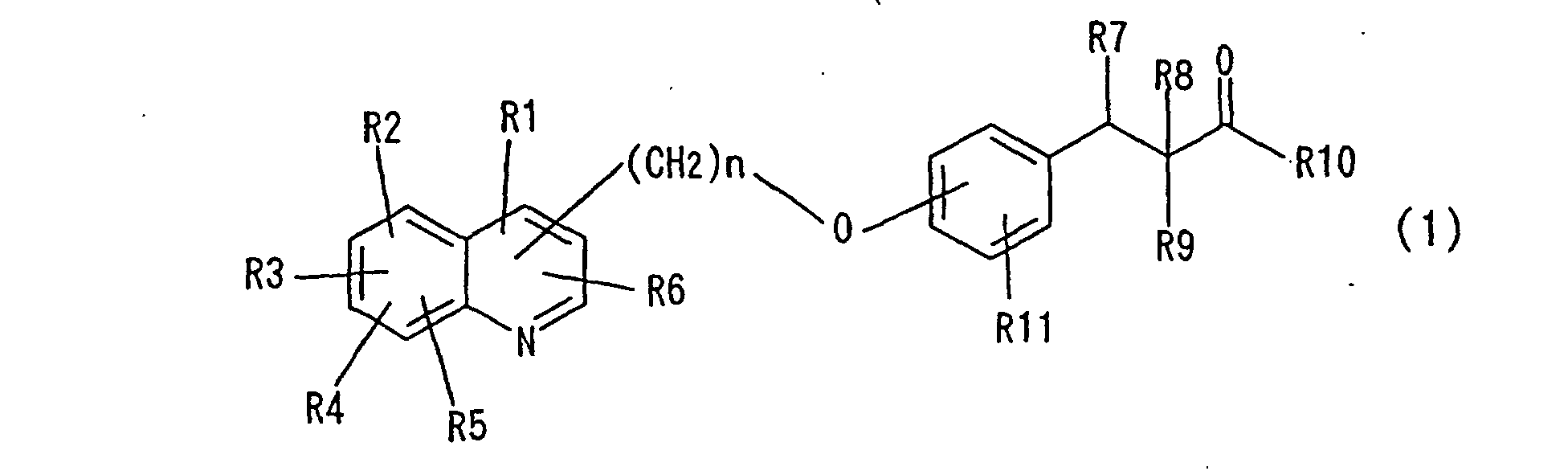
- A preferred form of this quinoline derivative is a compound represented by the following formula (2):(wherein R1, R2, R3, R4, R5, R6, R7, R8 and R1 have the same definitions as in Claim 1; and R12 is a lower alkyl group of 1 to 4 carbon atoms or an optionally substituted phenyl group).

- Other preferred form of the above quinoline derivative is a compound represented by the following formula (3):

- The pharmacologically acceptable salts of these quinoline derivatives are as well included in the present invention.
- By using these quinoline derivatives and their pharmacologically acceptable salts as an active ingredient, there can be provided various medical compositions such as antagonist for peroxisome proliferator-activated receptorα or γ which is an intranuclear transcription factor, inhibitor for production of tumor necrosis factor α, preventive or therapeutic agent for diabetes, preventive or therapeutic agent for hyperlipemia, preventive or therapeutic agent for arterioscrelosis, and the like.
- The present invention is described in more detail below.
- In the above formula (1) or (2), the lower alkyl group of 1 to 4 carbon atoms refers to methyl group, ethyl group, propyl group, isopropyl group, cyclopropyl group, butyl group, isobutyl group, tert-butyl group, cyclobutyl group or the like.
- The halogen atom refers to fluorine atom, chlorine atom, bromine atom, iodine atom or the like.
- The alkyloxy group of 1 to 10 carbon atoms refers to a straight chain, branched chain or cyclic alkyloxy group such as methoxy group, ethoxy group, propoxy group, isopropoxy group, cyclopropoxy group, butoxy group, isobutoxy group, tert-butoxy group, cyclobutoxy group, pentyloxy group, hexyloxy group, heptyloxy group, octyloxy group, nonyloxy group, decyloxy group or the like.
- The lower alkylcarbonyl group of 1 to 4 carbon atoms refers to acetyl group, propionyl group, butyryl group, isobutyryl group, valeryl group or the like.
- The lower alkyloxycarbonyl group of 1 to 4 carbon atoms refers to methoxycarbonyl group, ethoxycarbonyl group, propoxycarbonyl group, isopropoxycarbonyl group, cyclopropoxycarbonyl group, butoxycarbonyl group, isobutoxycarbonyl group, tert-butoxycarbonyl group, cyclobutoxycarbonyl group or the like.
- The pharmacologically acceptable salt refers to a salt of a base of a metal such as sodium, potassium, calcium or the like; a salt of an organic base such as pyridine, triethylamine, piperazine or the like; a salt of an inorganic acid such as hydrochloric acid, sulfuric acid, nitric acid or the like; or a salt of an organic acid such as acetic acid, fumaric acid, tartaric acid, malonic acid or the like.
- The compound of the present invention includes those compounds having asymetric carbon atoms and being in the form of optical isomers. Therefore, all of these compounds are included in the present invention. Further, the present compound includes those compounds being in the form of geometrical isomers based on carbon-to-carbon unsaturated bonds. Therefore, all of these compounds are included in the present invention.
- Description is made below on the synthesis processes of the compound of the present invention.
- A compound represented by the formula (1) can be synthesized by using a quinoline derivative represented by the above formula (3) and a phenol derivative represented by the following formula (4). Examples of the synthesis are shown in the following reaction schemes (1) and (2).
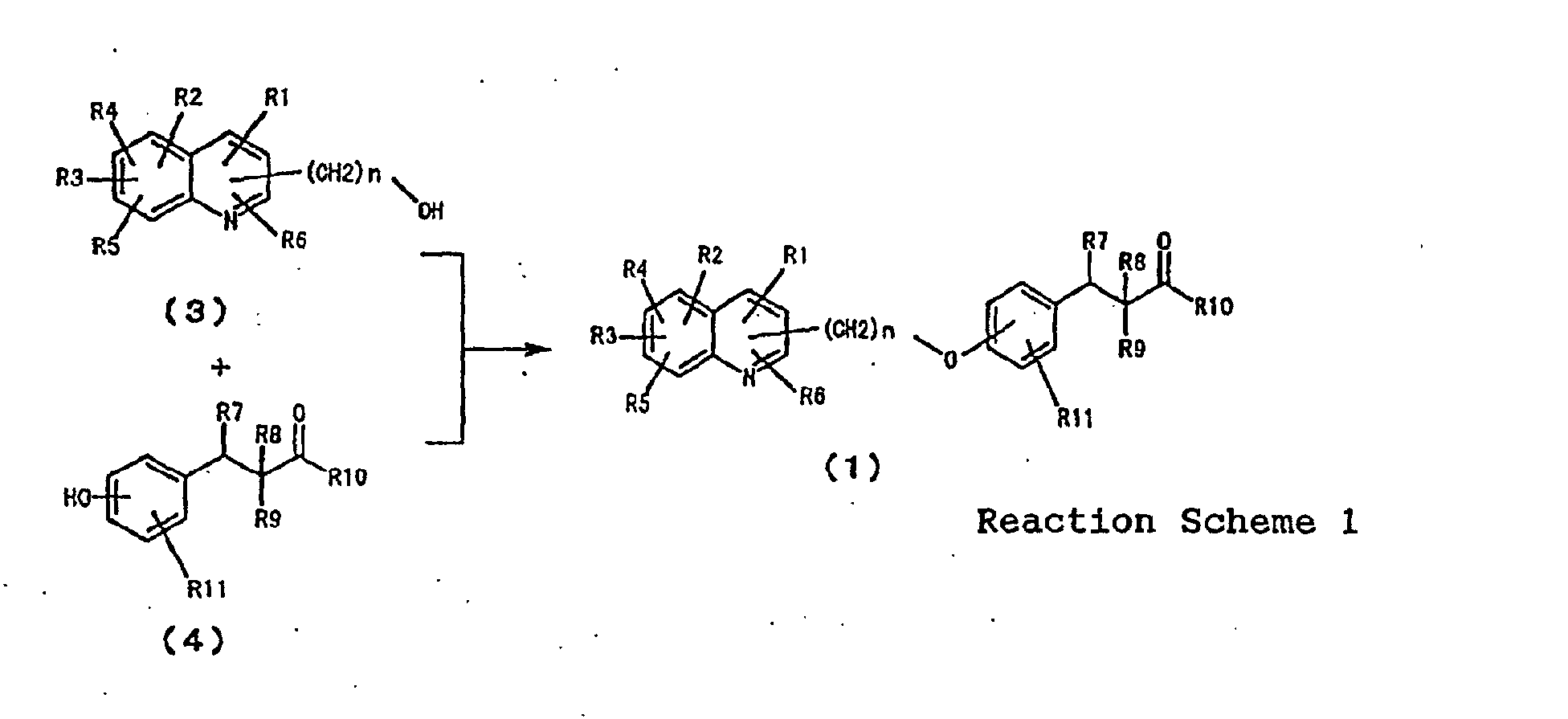 (In the above reaction schemes, R1, R2, R3, R4, R5, R6, R7, R8, R9, R10, R11 and n have the same definitions as given above; and X is a halogen atom or a substituted sulfonyloxy group.)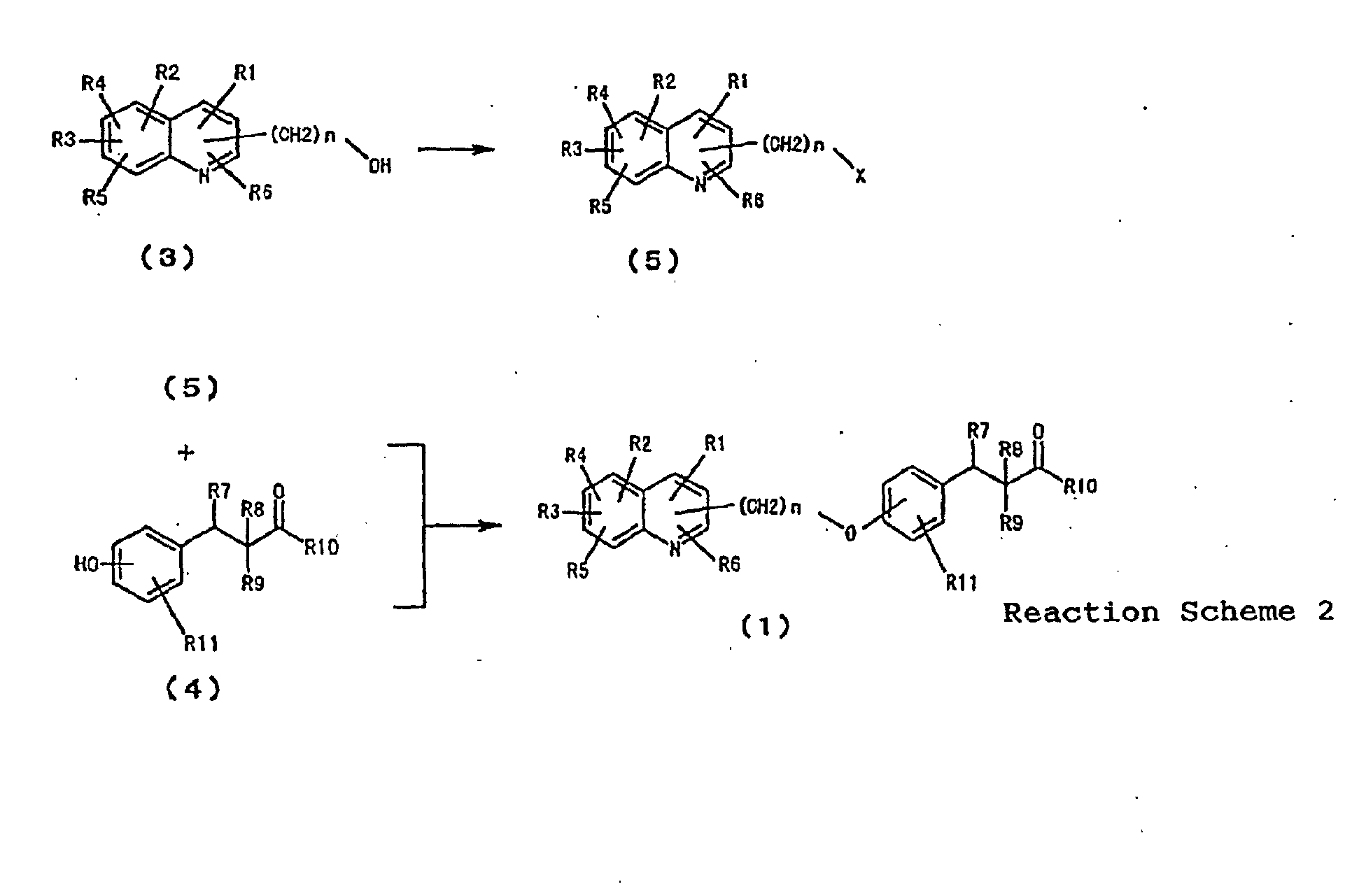
- A quinoline alcohol derivative represented by the formula (3), obtained by a known or substantially known process is reacted with a phenol derivative represented by the formula (4), obtained by a known or substantially known process, in the presence of an alkyl or aryl phosphine or an azodicarboxylic acid derivative, whereby a compound represented by the formula (1) can be obtained. There is no particular restriction as to the usable alkyl or aryl phosphine, but it is exemplified by triphenylphosphine and tributylphosphine.
- There is also no particular restriction as to the usable azodicarboxylic acid, but it is exemplified by diethylazodicarboxylic acid and diisopropylazodicarboxylic acid. There is no particular restriction as to the usable solvent, but it is exemplified by dichloromethane, chloroform, dichloroethane, tetrahydrofuran (hereinafter referred to as THF), dioxane, dimethylformamide (hereinafter referred to as DMF), dimethyl sulfoxide (hereinafter referred to as DMSO) and toluene. The reaction can be carried out in a temperature range of -100°C to the boiling point of the solvent used, preferably a temperature range of 0°C to the boiling point of the solvent.
- A quinoline alcohol derivative represented by the formula (3) is converted into a halide represented by the formula (5) using a generally known agent for halogenation of alcohol or into a sulfonic acid ester compound represented by the formula (5) using a generally known agent for sulfonic acid esterification of alcohol; then, the compound of the formula (5) is reacted with a phenol derivative represented by the formula (4) under a basic condition; thereby, a compound represented by the formula (1) can be obtained.
- There is no particular restriction as to the agent for halogenation of alcohol, and it is exemplified by hydrochloric acid, hydrobromic acid, thionyl chloride, sulfuryl chloride, phosphorus trichloride, phosphorus pentachloride, phosphorus oxychloride, thionyl bromide, phosphorus tribromide, methanesulfonyl chloride, and a mixed agent between triphenylphosphine and iodine, carbon tetrabromide, carbon tetrachloride or N-halogenated succinimide.
- There is no particular restriction as to the usable agent for sulfonic acid esterification of alcohol. It is exemplified by methane sulfonic acid chloride, p-toluenesulfonic acid chloride and trifluoromethanesulfonic acid anhydride.
- There is no particular restriction as to the base usable in the present reaction. It is exemplified by alkali or alkaline earth metals such as sodium, potassium, magnesium and the like; metal alkoxides such as sodium methoxide, sodium ethoxide, potassium butoxide and the like; inorganic bases such as sodium hydroxide, potassium hydroxide, sodium carbonate, potassium carbonate, cesium carbonate and the like; alkali metal amides such as lithium diisopropylamide and the like; and organic bases such as pyridine, triethylamine, 1,8-diazabicyclo-7-undecene (hereinafter referred to as DBU) and the like.
- There is no particular restriction as to the usable solvent. It is exemplified by protic solvents such as water, methanol, ethanol, acetic acid and the like; and aprotic solvents such as dichloromethane, chloroform, dichloroethane, THF, dioxane, DMF, DMSO, toluene and the like.
- The reaction can be carried out in a temperature range of -100°C to the boiling point of the solvent used, preferably in a temperature range of -20°C to the boiling point of the solvent.
- Alternatively, the compound represented by the formula (1) can also be synthesized by treating either a quinoline derivative represented by the formula (3), or a quinoline derivative represented by the formula (5) which can be obtained from the compound of the formula (3) by the method shown in the synthesis process 1, with a phenol derivative represented by the formula (6) in the same manner as in the ether linkage formation of the synthesis process 1, to obtain an aldehyde or ketone derivative represented by the formula (7) and then reacting the derivative of the formula (7) with a compound represented by the formula (8). An example of the synthesis process 2 is shown in the following reaction scheme (3).(In the above reaction scheme, R1, R2, R3, R4, R5, R6, R7, R8, R9, R10, R11, X and n have the same definitions as given above; R12 is a hydrogen atom or a lower alkyl group of 1 to 4 carbon atoms; and R13 a hydrogen atom or a lower alkyl group of 1 to 4 carbon atoms.)

- The reaction scheme (3) is explained in more detail.
- An aldehyde or ketone represented by the formula (7) is subjected to a dehydration and condensation reaction under a basic or acidic condition; thereby, an unsaturated derivative included in the formula (3) can be synthesized.
- There is no particular restriction as to the base usable in the present synthesis. It is exemplified by alkali or alkaline earth metals such as sodium, potassium, magnesium and the like; metal alkoxides such as sodium methoxide, sodium ethoxide, potassium butoxide and the like; inorganic bases such as sodium hydroxide, potassium hydroxide, sodium carbonate, potassium carbonate, cesium carbonate and the like; alkali metal amides such as lithium diisopropylamide and the like; organic bases such as pyridine, piperidine, pyrrolidine, triethylamine, DBU and the like; and salts between such an organic base and acetic acid, sulfonic acid or the like.
- There is no particular restriction, either, as to the usable acid. It is exemplified by inorganic acids such as hydrochloric acid, sulfuric acid, nitric acid and the like; organic protic acids such as acetic acid, methanesulfonic acid, p-toluenesulfonic acid, camphorsulfonic acid, trifluoroacetic acid and the like; and Lewis acids such as boron trifluoride and the like.
- There is no particular restriction as to the usable solvent. It is exemplified by protic solvents such as water, methanol, ethanol, acetic acid and the like; and aprotic solvents such as dichloromethane, chloroform, dichloroethane, THF, dioxane, DMF, DMSO, toluene and the like.
- The reaction can be carried out in a temperature range of -100°C to the boiling point of the solvent used.
- Examples of the compounds included in the formula (1) or (2) are shown below. However, the compound of the present invention is not restricted thereto.
- (1) 2-Hydroxy-3-{[4-(quinoline-3-yl)methyloxy]phenyl} propanoic acid
- (2) 2-Methoxy-3-{[4-(quinoline-3-yl)methyloxylphenyl} propanoic acid
- (3) 2-Ethoxy-3-{[4-(quinoline-3-yl)methyloxy]phenyl} propanoic acid
- (4) 2-Propoxy-3-{[4-(quinoline-3-yl)methyloxy]phenyl} propanoic acid
- (5) 2-Tert-butoxy-3-{[4-(quinoline-3-yl)methyloxy]phenyl} propanoic acid
- (6) 2-Octyloxy-3-{[4-(quinoline-3-yl)methyloxy]phenyl} propanoic acid
- (7) 2-Decyloxy-3-{[4-(quinoline-3-yl)methyloxy]phenyl} propanoic acid
- (8) 2-Phenoxy-3-{[4-(quinoline-3-yl)methyloxy]phenyl} propanoic acid
- (9) 2-[(4-Isopropxy)phenoxy]-3-{[4-(quinoline-3-yl) methyloxy]phenyl}propanoic acid
- (10) 2-(4-Chlorophenoxy)-3-{[4-(quinoline-3-yl)methyloxy] phenyl}propanoic acid
- (11) 2-Mercapto-3-{[4-(quinoline-3-yl)methyloxy]phenyl} propanoic acid
- (12) 2-Ethylthio-3-{[4-(quinoline-3-yl)methyloxy] phenyl}propanoic acid
- (13) 2-Decylthio-3-{[4-(quinoline-3-yl)methyloxy]phenyl} propanoic acid
- (14) 2-Phenylthio-3-{[4-(quinoline-3-yl)methyloxy]phenyl} propanoic acid
- (15) 2-[(4-Isopropoxy)phenylthio]-3-{[4-(quinoline-3-yl) methyloxy]phenyl}propanoic acid
- (16) 2-(4-Chlorophenylthio)-3-{[4-(quinoline-3-yl) methyloxy]phenyl}propanoic acid
- (17) 3-Oxo-2-{[4-(quinoline-3-yl)methyloxy]phenylmethyl} butanoic acid
- (18) 3-Oxo-2-{[4-(quinoline-3-yl)methyloxy]phenylmethyl} pentanoic acid
- (19) 3-Oxo-2-{[4-(quinoline-3-yl)methyloxy]phenylmethyl} heptanoic acid
- (20) 3-Oxo-3-phenyl-2-{[4-(quinoline-3-yl)methyloxy] phenylmethyl}heptanoic acid
- (21) 3-Oxo-3-(4-bromophenyl)-2-{[4-(quinoline-3-yl) methyloxy]phenylmethyl}heptanoic acid
- (22) 3-Oxo-3-(2-ethylphenyl)-2-{[4-(quinoline-3-yl) methyloxy]phenylmethyl}heptanoic acid
- (23) Monomethyl {[4-(quinoline-3-yl)methyloxy] phenyl}methylmalonate
- (24) Monoethyl {[4-(quinoline-3-yl)methyloxy]phenyl} methylmalonate
- (25) Monobutyl {[4-(quinoline-3-yl)methyloxy]phenyl} methylmalonate
- (26) {[4-(Quinoline-3-yl)methyloxy]phenyl}methylmalonic acid mono-N-methylamide
- (27) {[4-(Quinoline-3-yl)methyloxy]phenyl}methylmalonic acid mono-N,N-dibutylamide
- (28) 2-Ethoxy-3-{[4-(quinoline-2-yl)methyloxy]phenyl} propanoic acid
- (29) 2-Ethoxy-3-{[4-(quinoline-4-yl)methyloxy]phenyl} propanoic acid
- (30) 2-Ethoxy-3-{[4-(quinoline-5-yl)methyloxy]phenyl} propanoic acid
- (31) 2-Ethoxy-3-{[4-(quinoline-5-yl)methyloxy]phenyl} propanoic acid
- (32) 2-Ethoxy-3-{[4-(quinoline-6-yl)methyloxy]phenyl} propanoic acid
- (33) 2-Ethoxy-3-{[4-(quinoline-7-yl)methyloxy]phenyl} propanoic acid
- (34) 2-Ethoxy-3-{[4-(quinoline-8-yl)methyloxy]phenyl} propanoic acid
- (35) 2-Ethoxy-3-{[4-(quinoline-3-yl)ethyloxy]phenyl} propanoic acid
- (36) 2-Ethoxy-3-{[4-(quinoline-3-yl)butyloxy]phenyl} propanoic acid
- (37) 2-Ethoxy-2-methyl-3-{[4-(quinoline-3-yl)ethyloxy] phenyl}propanoic acid
- (38) 2-Ethoxy-2-butyl-3-{[4-(quinoline-3-yl)ethyloxy] phenyl}propanoic acid
- (39) 2-Ethoxy-3-{[4-(quinoline-3-yl)ethyloxy]phenyl} propenoic acid
- (40) 3-{{[4-(Quinoline-3-yl)methyloxy]phenyl}methyl}-2,4-dioxopentane
- (41) 5-{{[4-(Quinoline-3-yl)methyloxy]phenyl}methyl}-4,6-dioxodecane
- (42) Methyl 2-ethoxy-3-{[4-(quinoline-3-yl)methyloxy] phenyl}propanoate
- (43) Ethyl 2-ethoxy-3-{[4-(quinoline-3-yl)methyloxy] phenyl}propanoate
- (44) Butyl 2-ethoxy-3-{[4-(quinoline-3-yl)methyloxy] phenyl}propanoate
- (45) Phenyl 2-ethoxy-3-{[4-(quinoline-3-yl)methyloxy] phenyl}propanoate
- (46) 4-Iodophenyl 2-ethoxy-3-{[4-(quinoline-3-yl) methyloxy]phenyl}propanoate
- (47) 2-Ethoxy-3-{[4-(quinoline-3-yl)methyloxy]phenyl} propanoic acid amide
- (48) 2-Ethoxy-3-{[4-(quinoline-3-yl)methyloxy]phenyl} propanoic acid N-methylamide
- (49) 2-Ethoxy-3-{[4-(quinoline-3-yl)methyloxy]phenyl} propanoic acid N-butylamide
- (50) 2-Ethoxy-3-{[4-(quinoline-3-yl)methyloxy]phenyl} propanoic acid N,N-dimethylamide
- (51) 2-Ethoxy-3-{[3-(quinoline-3-yl)methyloxy]phenyl} propanoic acid
- (52) 2-Ethoxy-3-{[2-(quinoline-3-yl)methyloxy]phenyl} propanoic acid
- (53) 2-Ethoxy-3-{[4-methyl-[3-(quinoline-3-yl)methyloxy] phenyl}propanoic acid
- (54) 2-Ethoxy-3-{[4-methyloxy-[3-(quinoline-3-yl) methyloxy]phenyl}propanoic acid
- (55) 2-Ethoxy-3-{[4-chloro-[3-(quinoline-3-yl)methyloxy] phenyl}propanoic acid
- (56) 2-Ethoxy-3-{[4-(4-methoxyquinoline-3-yl)methyloxy] phenyl}propanoic acid
- (57) 2-Ethoxy-3-{[4-(4,6-dimethoxyquinoline-3-yl) methyloxy]phenyl}propanoic acid
- (58) 2-Ethoxy-3-{[4-(4,6,7-trimethoxyquinoline-3-yl)methyloxy]phenyl}propanoic acid
- (59) 2-Ethoxy-3-{[4-(4-ethoxy-6-methoxyquinoline-3-yl)methyloxy]phenyl}propanoic acid
- (60) 2-Ethoxy-3-{[4-(4-propoxy-6-methoxyquinoline-3-yl)methyloxy]phenyl}propanoic acid
- (61) 2-Ethoxy-3-{[4-(4-isopropoxy-6-methoxyquinoline-3-yl)methyloxy]phenyl}propanoic acid
- (62) 2-Ethoxy-3-{[4-(4-heptyloxy-6-methoxyquinoline-3-yl)methyloxy]phenyl}propanoic acid
- (63) 2-Ethoxy-3-{[4-(4-octyloxy-6-methoxyquinoline-3-yl)methyloxy]phenyl}propanoic acid
- (64) 2-Ethoxy-3-{[4-(4-isopropoxy-7-methoxyquinoline-3-yl)methyloxy]phenyl}propanoic acid
- (65) 2-Ethoxy-3-{[4-(4-isopropoxy-6,7-dimethoxyquinoline-3-yl)methyloxy]phenyl}propanoic acid
- (66) 2-Ethoxy-3-{[4-(4-isopropoxy-6-methylquinoline-3-yl)methyloxy]phenyl}propanoic acid
- (67) 2-Ethoxy-3-{[4-(4-isopropoxy-6-ethylquinoline-3-yl)methyloxy]phenyl}propanoic acid
- (68) 2-Ethoxy-3-{[4-(4-decyloxy-6-methylquinoline-3-yl)methyloxy]phenyl}propanoic acid
- (69) 2-Ethoxy-3-{[4-(4-isopropoxy-8-butylquinoline-3-yl)methyloxy]phenyl}propanoic acid
- (70) 2-Ethoxy-3-{[4-(4-isopropoxy-5,6-dimethylquinoline-3-yl)methyloxy]phenyl}propanoic acid
- (71) 2-Ethoxy-3-{[4-(4-isopropoxy-5,7-dimethylquinoline-3-yl)methyloxy]phenyl}propanoic acid
- (72) 2-Ethoxy-3-{[4-(4-isopropoxy-2-chloroquinoline-3-yl)methyloxy]phenyl}propanoic acid
- (73) 2-Ethoxy-3-{[4-(4-isopropoxy-5-chloroquinoline-3-yl)methyloxy]phenyl}propanoic acid
- (74) 2-Ethoxy-3-{[4-(4-isopropoxy-6-chloroquinoline-3-yl)methyloxy]phenyl}propanoic acid
- (75) 2-Ethoxy-3-{[4-(4-isopropoxy-7-chloroquinoline-3-yl)methyloxy]phenyl}propanoic acid
- (76) 2-Ethoxy-3-{[4-(4-isopropoxy-8-chloroquinoline-3-yl)methyloxy]phenyl}propanoic acid
- (77) 2-Ethoxy-3-{[4-(4-isopropoxy-2-bromoquinoline-3-yl)methyloxy]phenyl}propanoic acid
- (78) 2-Ethoxy-3-{[4-(4-isopropoxy-6-bromoquinoline-3-yl)methyloxy]phenyl}propanoic acid
- (79) 2-Ethoxy-3-{[4-(4-isopropoxy-8-bromoquinoline-3-yl)methyloxy]phenyl}propanoic acid
- (80) 2-Ethoxy-3-{[4-(4-isopropoxy-2-fluoroquinoline-3-yl)methyloxy]phenyl}propanoic acid
- (81) 2-Ethoxy-3-{[4-(4-isopropoxy-5-fluoroquinoline-3-yl)methyloxy]phenyl}propanoic acid
- (82) 2-Ethoxy-3-{[4-(4-isopropoxy-8-fluoroquinoline-3-yl)methyloxy]phenyl}propanoic acid
- (83) 2-Ethoxy-3-{[4-(4-isopropoxy-8-iodoquinoline-3-yl)methyloxy]phenyl}propanoic acid
- (84) 2-Ethoxy-3-{[4-(4-isopropoxy-2-trifluoromethyl quinoline-3-yl)methyloxy]phenyl}propanoic acid
- (85) 2-Ethoxy-3-{[4-(4-isopropoxy-7-trifluoromethyl quinoline-3-yl)methyloxy]phenyl}propanoic acid
- (86) 2-Ethoxy-3-{[4-(4-isopropoxy-8-trifluoromethyl quinoline-3-yl)methyloxy]phenyl}propanoic acid
- (87) 2-Ethoxy-3-{[4-(4-isopropoxy-2-hydroxyquinoline-3-yl)methyloxy]phenyl}propanoic acid
- (88) 2-Ethoxy-3-{[4-(4-isopropoxy-2-acetamidoquinoline-3-yl)methyloxy]phenyl}propanoic acid
- (89) 2-Ethoxy-3-{[4-(4-isopropoxy-5-nitroquinoline-3-yl)methyloxy]phenyl}propanoic acid
- (90) 2-Ethoxy-3-{[4-(4-isopropoxy-5-cyanoquinoline-3-yl)methyloxy]phenyl}propanoic acid
- (91) 2-Ethoxy-3-{[4-(4-isopropoxy-8-aminoquinoline-3-yl)methyloxy]phenyl}prppanoic acid
- (92) 2-Ethoxy-3-{[4-(4-isopropoxy-8-N-ethylaminoquinoline -3-yl)methyloxy]phenyl}propanoic acid
- (93) 2-Ethoxy-3-{[4-(4-isopropoxy-8-carboxyquinoline-3-yl)methyloxy]phenyl}propanoic acid
- (94) 2-Ethoxy-3-{[4-(4-isopropoxy-8-ethoxycarbonyl quinoline-3-yl)methyloxy]phenyl}propanoic acid
- (95) 2-Ethoxy-3-{[4-(4-isopropoxy-8-phenylquinoline-3-yl)methyloxy]phenyl}propanoic acid
- (96) 2-Ethoxy-3-{[4-(2-phenylquinoline-3-yl)methyloxy] phenyl}propanoic acid
- (97) 2-Ethoxy-3-{[4-(2-phenylquinoline-4-yl)methyloxy] phenyl}propanoic acid
- (98) 2-Ethoxy-3-{[4-(2-methoxyquinoline-4-yl)methyloxy] phenyl}propanoic acid
- (99) 2-Ethoxy-3-{[4-(2-methoxyquinoline-2-yl)methyloxy] phenyl}propanoic acid
- (100) Methyl 2-ethoxy-3-{[4-(4-isopropoxy-6-methoxyquinoline-3-yl)methyloxy]phenyl}propanoate
- (101) Ethyl 2-ethoxy-3-{[4-(4-isopropoxy-6-methoxyquinoline-3-yl)methyloxy]phenyl}propanoate
- (102) 2-Ethoxy-3-{[4-(4-isopropoxy-6-methoxyquinoline-3-yl)methyloxy]phenyl}propanoic acid amide
- (103) 2-Ethoxy-3-{[4-(4-isopropoxy-6-methoxyquinoline-3-yl)methyloxy]phenyl}propanoic acid N-ethylamide
- (104) 2-Ethoxy-3-{[4-(4-isopropoxy-6-methoxyquinoline-3-yl)methyloxy]phenyl}propanoic acid N-butylamide
- (105) 2-Ethoxy-3-{[4-(4-isopropoxy-6-methoxyquinoline-3-yl)methyloxy]phenyl}propanoic acid N,N-diethylamide
- (106) 3-{[4-(4-Isopropoxy-6-methoxyquinoline-3-yl)methyloxy]phenyl}-2-phenoxypropanoic acid
- (107) 3-{[4-(4-Isopropoxy-6-methoxyquinoline-3-yl)methyloxy]phenyl}-2-(4-chlorophenoxy)propanoic acid
- (108) 3-{(4-(4-Isopropoxy-6-methoxyquinoline-3-yl)methyloxy]phenyl}-2-phenylthiopropanoic acid
- (109) 3-{[4-(4-Isopropoxy-6-methoxyquinoline-3-yl)methyloxy]phenyl}-2-(4-chlorophenylthio)propanoic acid
- (110) 3-{[4-(4-Isopropoxy-6-methoxyquinoline-3-yl)methyloxy]phenyl}-2-phenoxypropenoic acid
- (111) 3-{[4-(4-Isopropoxy-6-methoxyquinoline-3-yl)methyloxy]phenyl}-2-(4-chlorophenoxy)propenoic acid
- (112) 3-{[4-(4-Isopropoxy-6-methoxyquinoline-3-yl)methyloxy]phenyl}-2-phenylthiopropenoic acid
- (113) 3-{[4-(4-Isopropoxy-6-methoxyquinoline-3-yl)methyloxy]phenyl}-2-(4-chlorophenylthio)propenoic acid
- (114) 2-Ethoxy-3-{[3-(4-isopropoxy-6-methoxyquinoline-3-yl)methyloxy]phenyl}propanoic acid
- (115) 2-Ethoxy-3-{[2-(4-isopropoxy-6-methoxyquinoline-3-yl)methyloxy]phenyl}propanoic acid
- (116) 2-Ethoxy-3-{[3-(4-isopropoxy-6-methoxyquinoline-3-yl)methyloxy]-2-methylphenyl}propanoic acid
- (117) 2-Ethoxy-3-{[3-(4-isopropoxy-6-methoxyquinoline-3-yl)methyloxy]-5-chlorophenyl}propanoic acid
- (118) 2-Ethoxy-3-{[3-(4-isopropoxy-6-methoxyquinoline-3-yl)methyloxy]-4-methoxyhenyl}propanoic acid
- (119) Monomethyl {[4-(4-isopropoxy-6-methoxyquinoline-3-yl)methyloxy]phenyl}methylmalonate
- (120) Dimethyl {[4-(4-isopropoxy-6-methoxyquinoline-3-yl)methyloxy]phenyl}methylmalonate
- (121) Monoethyl {[4-(4-isopropoxy-6-methoxyquinoline-3-yl)methyloxy]phenyl}methylmalonate
- (122) Diethyl {[4-(4-isopropoxy-6-methoxyquinoline-3-yl)methyloxy]phenyl}methylmalonate
- (123) Dipropyl {[4-(4-isopropoxy-6-methoxyquinoline-3-yl)methyloxy]phenyl}methylmalonate
- (124) Dibutyl {[4-(4-isopropoxy-6-methoxyquinoline-3-yl)methyloxy]phenyl}methylmalonate
- (125) Monomethyl {[2-(4-isopropoxy-6-methoxyquinoline-3-yl)methyloxy]phenyl}methylmalonate
- (126) Dimethyl {[3-(4-isopropoxy-6-methoxyquinoline-3-yl)methyloxy]phenyl}methylmalonate
- (127) Monoethyl {[3-(4-isopropoxy-6-methoxyquinoline-3-yl)methyloxy]phenyl}methylmalonate
- (128) Diethyl {[3-(4-isopropoxy-6-methoxyquinoline-3-yl)methyloxy]phenyl}methylmalonate
- (129) Diethyl {[3-(4-isopropoxy-6-methoxyquinoline-3-yl)methyloxy]-4-methoxyphenyl}methylmalonate
- (130) Diethyl {[3-(4-isopropoxy-6-methoxyquinoline-3-yl)methyloxy]-6-methylphenyl}methylmalonate
- (131) {[4-(4-Isopropoxy-6-methoxyquinoline-3-yl)methyloxy]phenyl}methylmalonic acid diamide
- (132) {[4-(4-Isopropoxy-6-methoxyquinoline-3-yl) methyloxy]phenyl}methylmalonic acid N,N-dimethyldiamide
- (133) 2-{[4-(4-Isopropoxy-6-methoxyquinoline-3-yl) methyloxy]phenylmethyl}-3-oxobutanoic acid
- (134) Methyl 2-{[4-(4-isopropoxy-6-methoxyquinoline-3-yl)methyloxy]phenylmethyl}-3-oxobutanoate
- (135) Ethyl 2-{[4-(4-isopropoxy-6-methoxyquinoline-3-yl)methyloxy]phenylmethyl}-3-oxobutanoate
- (136) 2-{[4-(4-Isopropoxy-6-methoxyquinoline-3-yl)methyloxy]phenylmethyl}-3-oxopentanoic acid
- (137) Methyl 2-{[4-(4-isopropoxy-6-methoxyquinoline-3-yl)methyloxy]phenylmethyl}-3-oxopentanoate
- (138) Ethyl 2-{[4-(4-isopropoxy-6-methoxyquinoline-3-yl)methyloxy]phenylmethyl}-3-oxopentanoate
- (139) Ethyl 2-{[4-(4-isopropoxy-6-methoxyquinoline-3-yl)methyloxy]phenylmethyl}-3-oxoheptanoic acid
- (140) 2-{[4-(4-Isopropoxy-6-methoxyquinoline-3-yl)methyloxy]phenylmethyl}-3-oxobutanoic acid amide
- (141) 2-{[4-(4-Isopropoxy-6-methoxyquinoline-3-yl)methyloxy]phenylmethyl}-3-oxobutanoic acid N-methylamide
- (142) 2-{[4-(4-Isopropoxy-6-methoxyquinoline-3-yl)methyloxy]phenylmethyl}-3-oxobutanoic acid N,N-dibutylamide
- (143) 2-{[4-(4-Isopropoxy-6-methoxyquinoline-3-yl)methyloxy]phenylmethyl}-3-oxobutanoic acid amide
- (144) 2-{[4-(4-Isopropoxy-6-methoxyquinoline-3-yl)methyloxy]phenylmethylene}-3-oxobutanoic acid N-methylamide
- (145) 2-{[4-(4-Isopropoxy-6-methoxyquinoline-3-yl)methyloxy]phenylmethylene}-3-oxobutanoic acid N,N-dibutylamide
- (146) 3-{[4-(4-Isopropoxy-6-methoxyquinoline-3-yl)methyloxy]phenylmethyl}-2,4-dioxopentane
- (147) 3-{[4-(4-Isopropoxy-6-methoxyquinoline-3-yl)methyloxy]phenylmethylene}-2,4-dioxopentane
- (148) 4-{[4-(4-Isopropoxy-6-methoxyquinoline-3-yl)methyloxy]phenylmethyl}-3,5-dioxoheptane
- (149) 4-{[4-(4-Isopropoxy-6-methoxyquinoline-3-yl)methyloxy]phenylmethylene}-3,5-dioxoheptane
- (150) 5-{[4-(4-Isopropoxy-6-methoxyquinoline-3-yl)methyloxy]phenylmethylene}-4,6-dioxodecane
-
- Some of the above compounds have asymetric carbon atoms and are in the form of optical isomers. Therefore, all of these isomers are included in the scope of the present invention.
- Next, the compound of the present invention, when used as a medicine, can be administered orally or parenterally. The dose varies depending upon the disease condition, age, sex, etc. of a patient to which the compound is to be administered. However, the compound can be administered in a total amount of 1 to 1000 mg per adult, in one time or a plurality of times. In oral administration, the compound can be administered in the form of tablet(s), granule(s), powder, suspension, capsule(s), syrup or the like.
- When the compound is made into, for example, tablets, it is possible to use, as an adsorbent, crystalline cellulose, light anhydrous silicic acid or the like; as an excipient, corn starch, lactose, calcium phosphate, magnesium stearate or the like; and, as necessary, a binder, a humectant, a lubricant, etc.
- In parenteral administration, the present compound can be administered in the form of intravenous injection, subcutaneous injection, intramuscular injection, suppository, percutaneous agent or the like. When the compound is made into, for example, an injection, the compound can be used as an aqueous solution obtained by subjecting the compound to isotonization, sterilization, etc., or as an aqueous suspension obtained by using cottonseed oil, corn oil, olive oil or the like, or as an emulsion obtained by using a surfactant such as HCO-60 or the like.
- The present invention is described in more detail below by way of Examples, Reference Examples and Test Examples. However, the present invention is in no way restricted by them.
-
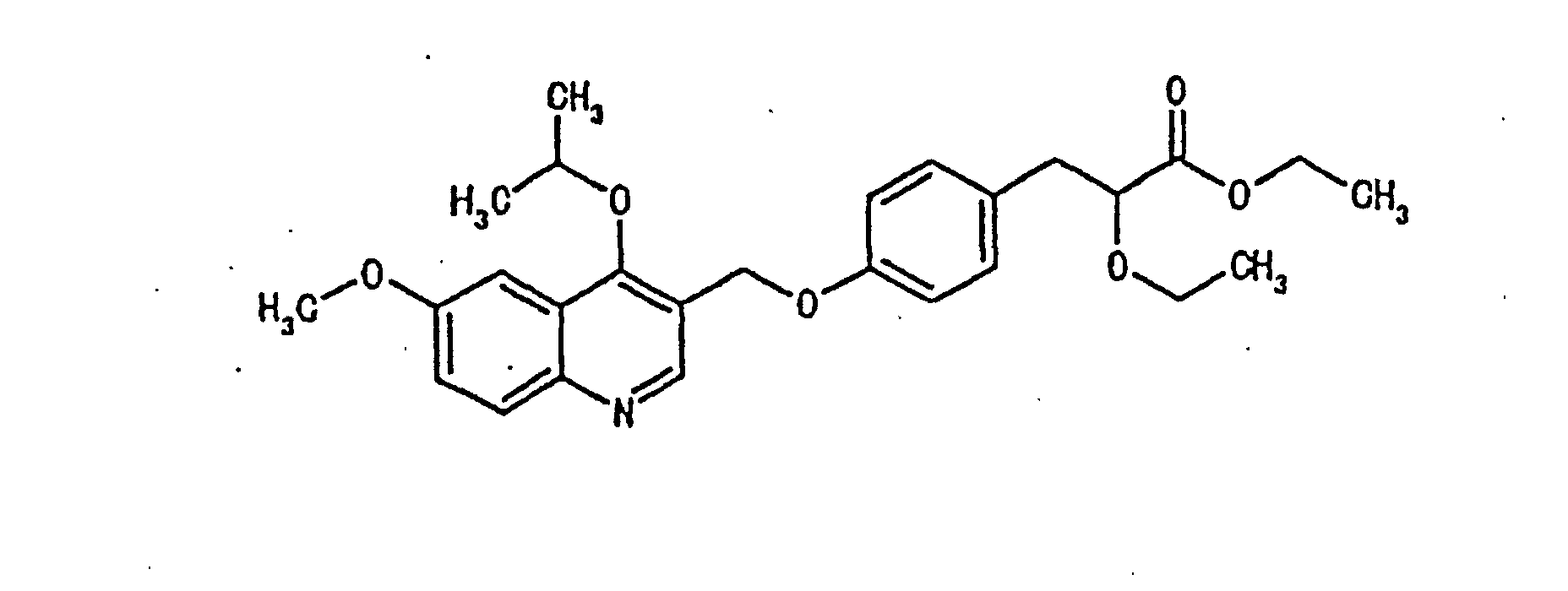
- In methylene chloride (60 ml) were dissolved 4-isopropoxy-6-methoxyquinoline-3-methanol (1.98 g, 8 mmol) synthesized in Reference Example 4 and ethyl 2-ethoxy-3-(4-hydroxyphenyl)propanoate (1.91 g, 8 mmol). Thereto were added, at room temperature, triphenylphosphine (2.52 g, 9.6 mmol) and diethyl azodicarboxylic acid (4.18 g, 9.6 mmol), followed by stirring in that state for 2 hours. The reaction mixture was diluted with chloroform, followed by washing with water. The organic layer was dried over anhydrous magnesium sulfate and subjected to vacuum concentration. The residue was purified by silica gel column chromatography (equivalent product of Merck C-300: 150g, ethyl acetate : hexane =1 : 2) to obtain an intended title compound (2.4 g, 64%) as a colorless transparent syrup.
1H-M.M.R.(CDCl3, 270MHz)d=8.82(s, 1H), 7.98(d, 1H, J=8.0Hz), 7.40-7.30(m, 2H), 7.18 and 6.94(2d, each 2H, J=8.5Hz), 5.20(s, 2H), 4.58(quintet, 1H, J=6.5Hz), 4.21(q, 2H, J=7.3Hz), 3.96(t, 1H, J=7.3Hz), 3.95(s, 3H), 3.65-3.55(m, 1H), 3.40-3.30(m, 1H), 2.95(d, 2H, J=7.3Hz), 1.40(d, 6H, J=6.5Hz), 1.35-1.15(m, 6H) -
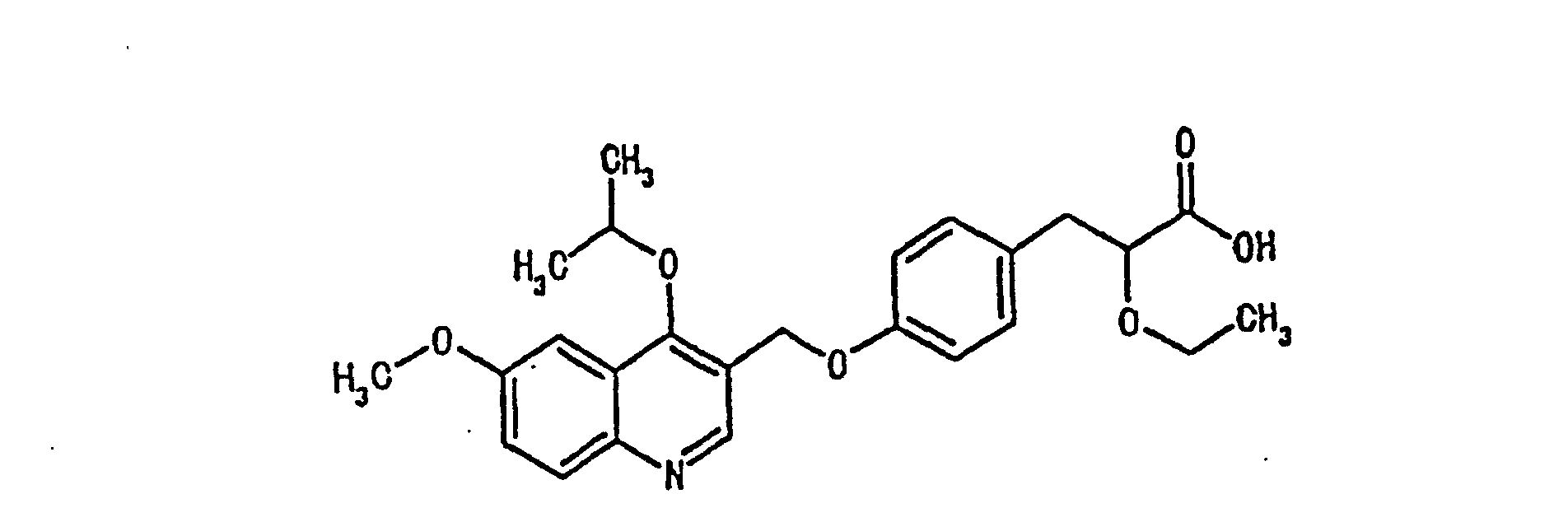
- The ester compound (2.4 g, 5.13 mmol) obtained in Example 1 was dissolved in ethanol (40 ml). Thereto was added, at room temperature, a 2 N aqueous sodium hydroxide solution (3.85 ml, 7.70 mmol), followed by stirring at that temperature for 1 hour. The most part of ethanol was removed from the reaction mixture by vacuum distillation. The residue was dissolved in water (100 ml). The solution was made weakly acidic using 1 N hydrochloric acid, followed by extraction with ethyl acetate. The organic layer was dried over anhydrous magnesium sulfate and then subjected to vacuum concentration to obtain a colorless transparent syrup. The residue was subjected to crystallization using a mixed solvent consisting of ethyl acetate and hexane to obtain an intended title compound (2.10 g, 93%) as white crystals.
- Melting point: 152 to 154°C
- 1H-N.M.R.(CDCl3, 270MHz)d=8.80(s, 1H), 8.07(d, 1H, J=9.0Hz), 7.40-7.30(m, 2H), 7.22 and 6.92(2d, each 2H, J=9.0Hz), 5.20(s, 2H), 4.60(quintet, 1H, J=6.5Hz), 4.08(dd, 1H, J=4.5, 7.3Hz), 3.95(s, 3H), 3.75-3.65(m, 1H), 3.50-3.40(m, 1H), 3.12(dd, 1H, J=4.5, 13.0Hz), 3.02(dd, 1H, J=7.3, 13.0Hz), 1.42(d, 6H, J=6.5Hz), 1.18(t, 3H, J=7.3Hz)
-
-

- The carboxylic acid compound (150 mg, 0.341 mmol) obtained in Example 2 was dissolved in tetrahydrofuran (10 ml). Thereto was added 1,1-carbonylbisimidazole (110 mg, 0.682 mmol) at room temperature, followed by stirring in that state for 30 minutes. Successively, 28% ammonia water (2 ml) was added, followed by stirring for 30 minutes. The reaction mixture was diluted with water, and extraction of an intended compound was conducted using ethyl acetate. The organic layer was dried over anhydrous magnesium sulfate and then subjected to vacuum concentration to obtain a colorless transparent syrup. The residue was subjected to crystallization using a mixed solvent consisting of ethyl acetate and hexane, to obtain an intended title compound (125 mg, 84%) as a white amorphous solid.
1H-N.M.R.(CDCl3, 270MHz)d=8.82(s, 1H), 7.99(d, 1H, J=8.8Hz), 7.39-7.35(m, 2H), 7.19(d, 2H, J=8.8Hz), 6.93(d, 2H, J=8.8Hz), 6.48 and 5.58(2bs, each 1H), 5.21(s, 2H), 4.59(quintet, 1H, J=6.1Hz), 3.96(s, 3H), 3.90(dd, 1H, J=3.6, 7.6Hz), 3.53-3.42(m, 2H), 3.08(dd, 1H, J=3.6, 13.7Hz), 2.90(dd, 1H, J=7.6, 13.7Hz), 1.41(d, 6H, J=6.1Hz), 1.14(t, 3H, J=7.1Hz) -

- The carboxylic acid compound (150 mg, 0.341 mmol) obtained in Example 2 was dissolved in tetrahydrofuran (10 ml). Thereto was added 1,1-carbonylbisimidazole (110 mg, 0.682 mmol) at room temperature, followed by stirring in that state for 30 minutes. Successively, n-butylamine (150 mg, 2.05 mmol) was added, followed by stirring for 1 hour. The reaction mixture was diluted with water, and extraction of an intended compound was conducted using ethyl acetate. The organic layer was dried over anhydrous magnesium sulfate and then subjected to vacuum concentration. The residue was purified by silica gel column chromatography (equivalent product of Merck C-300: 20 g, ethyl acetate : hexane = 1 : 1) to obtain an intended title compound (135 mg, 80%) as white crystals.
Melting point: 66 to 68°C
1H-N.M.R.(CDCl3, 270MHz)d=8.82(s, 1H), 7.98(d, 1H, J=8.8Hz), 7.39-7.35(m, 2H), 7.17(d, 2H, J=8.3Hz), 6.92(d, 2H, J=8.3Hz), 6.50(t, 1H, J=5.9Hz), 5.21(s, 2H), 4.59(quintet, 1H, J=5.8Hz), 3.96(s, 3H), 3.90(dd, 1H, J=3.4, 7.3Hz), 3.50-3.41(m, 2H), 3.23-3.13(m, 2H), 3.09(dd, 1H, J=3.4, 14.1Hz), 2.85(dd, 1H, J=7.3, 14.1Hz), 1.50-1.35(m, 4H), 1.41(d, 6H, J=5.8Hz), 1.14(t, 3H, J=6.8Hz), 0.91(t, 3H, J=6.8Hz) -

- 4-Isopropoxy-5,7-dimethylquinoline-3-methanol (756 mg, 3 mmol) synthesized in Reference Example 9 and ethyl 2-ethoxy-3-(4-hydroxy]phenyl)propanoate (715 mg, 3 mmol) synthesized in Reference Example 7 were subjected to the same treatment as in Example 1 to obtain an intended title compound (580 mg, 41%) as a colorless transparent syrup.
1H-N.M.R.(CDCl3, 270MHz)d=8.85(s, 1H), 7.70(s, 1H), 7.19 and 6.93(2d, each 2H, J=8.6Hz), 7.14(s, 1H), 5.16(s, 2H), 4.48(quintet, 1H, J=6.3Hz), 4.16(q, 2H, J=7.3Hz), 3.98(t, 1H, J=6.9Hz), 3.70-3.55(m, 1H), 3.40-3.30(m, 1H), 2.96(d, 1H, J=6.9Hz), 2.89 and 2.48(2s, each 3H), 1.30(d, 6H, J=6.3Hz), 1.21(t, 3H, J=7.3Hz), 1.17(t, 3H, J=7.3Hz) -

- The ester compound (570 mg, 1.22 mmol) synthesized by the reaction 1 of Example 5 was subjected to the same treatment as in Example 2 to obtain an intended title compound (420 mg, 79%) as white crystals.
Melting point = 144°C (dec.)
1H-N.M.R.(CDCl3, 270MHz)d=8.82(s, 1H), 8.29(s, 1H), 7.38(s, 1H), 7.22 and 6.89(2d, each 2H, J=8.6Hz), 5.20(s, 2H), 4.50(quintet, 1H, J=6.0Hz), 4.08(dd, 1H, J=4.9, 7.3Hz), 3.69-3.58(m, 1H), 3.52-3.41(m, 1H), 3.08(dd, 1H, J=4.9, 13.9Hz), 3.99(dd, 1H, J=7.3, 13.9Hz), 2.92 and 2.56(2s, each 3H), 1.47(d, 6H, J=6.0Hz), 1.19(t, 3H, J=7.3Hz) -

- 4-Isopropoxy-6-ethylquinoline-3-methanol (756 mg, 3 mmol) synthesized in Reference Example 11 and ethyl 2-ethoxy-3-(4-hydroxyphenyl)propanoate (715 mg, 3 mmol) were subjected to the same treatment as in Example 1, to obtain an intended title compound (970 mg, 69%) as a colorless transparent syrup.
1H-N.M.R.(CDCl3, 270MHz)d=8.90(s, 1H), 8.81(d, 1H, J=8.6Hz), 7.89(d, 1H, J=1.5Hz), 7.57(dd, 1H, J=1.5, 8.6Hz), 7.18 and 6.93(2d, each 2H, J=8.6Hz), 5.21(s, 2H), 4.60(quintet, 1H, J=6.3Hz), 4.16(q, 2H, J=7.3Hz), 3.98(t, 1H, J=6.9Hz), 3.61-3.58(m, 1H), 3.39-3.33(m, 1H), 2.96(d, 2H, J=6.9Hz), 2.86(q, 2H, J=7.6Hz), 1.40(d, 6H, J=6.3Hz), 1.35(t, 3H, J=7.6Hz), 1.21(t, 3H, J=7.3Hz), 1.17(t, 3H, J=7.3Hz) -
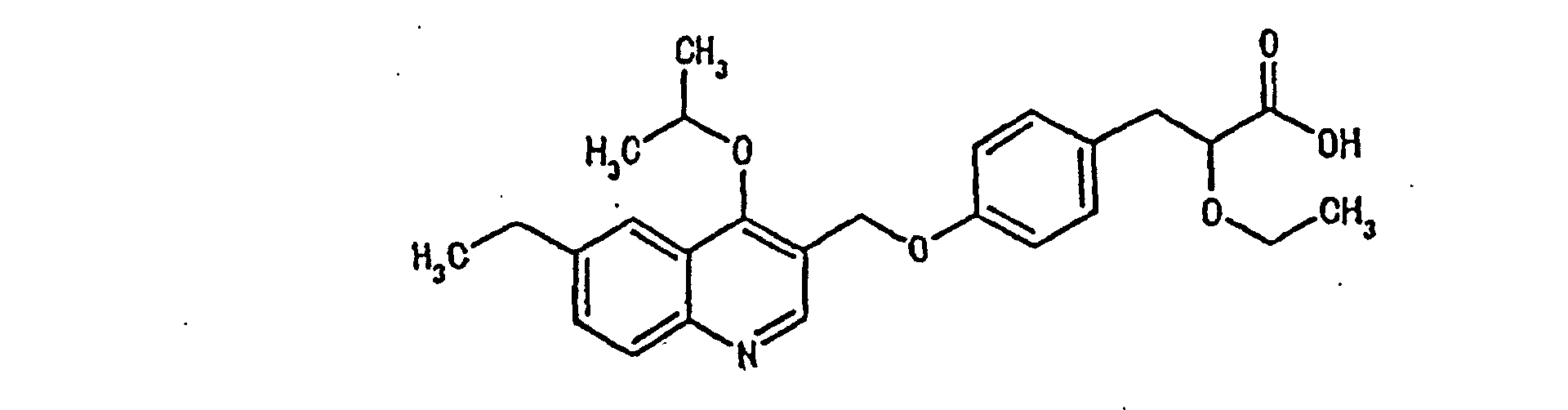
- The ester compound (960 mg, 2.06 mmol) synthesized by the reaction 1 of Example 6 was subjected to the same treatment as in Example 2 to obtain an intended title compound (740 mg, 82%) as white crystals.
Melting point = 92 to 94°C
1H-N.M.R.(CDCl3, 270MHz)d=8.92(s, 1H), 8.26(d, 1H, J=8.6Hz), 7.94(d, 1H, J=1.3Hz), 7.67(dd, 1H, J=1.3, 8.6Hz), 7.23 and 6.92(2d, each 2H, J=8.7Hz), 5.21(s, 2H), 4.75(quintet, 1H, J=6.3Hz), 4.16-4.06(m, 3H), 3.73-3.62(m, 1H), 3.51-3.40(m, 1H), 3.10(dd, 1H, J=4.9, 14.1Hz), 3.01(dd, 1H, J=7.2, 14.1Hz), 2.89(q, 2H, J=7.8Hz), 1.44(d, 6H, J=6.3Hz), 1.35(t, 3H, J=7.8Hz), 1.19(t, 3H, J=7.8Hz) -
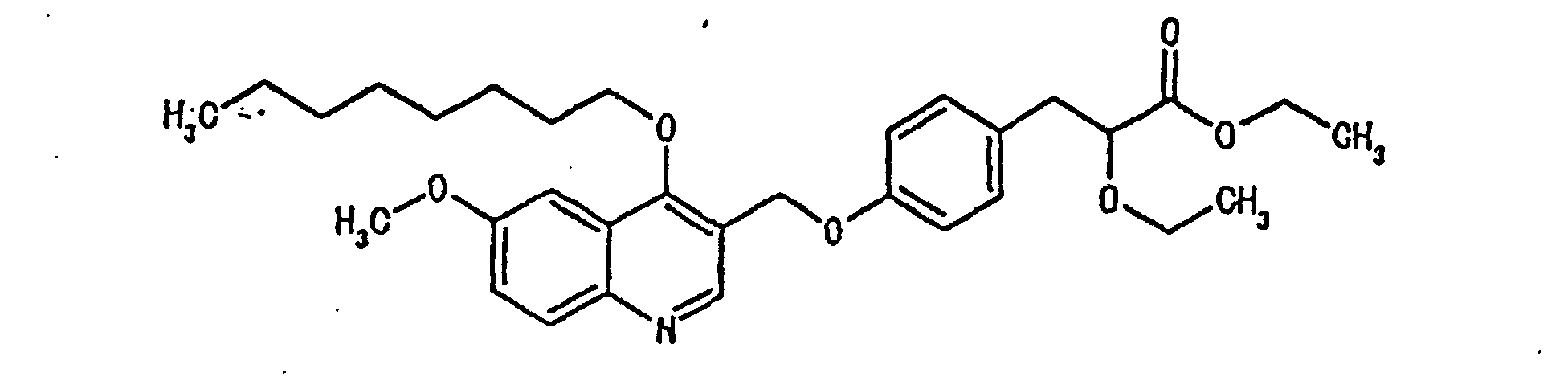
- 4-octyloxy-6-methoxyquinoline-3-methanol (952 mg, 3 mmol) synthesized in Reference Example 13 and ethyl 2-ethoxy-3-(4-hydroxyphenyl)propanoate (715 mg, 3 mmol) synthesized in Reference Example 7 were subjected to the same treatment as in Example 1 to obtain an intended title compound (1.07 g, 66%) as a colorless transparent syrup.
1H-N.M.R.(CDCl3, 270MHz)d=8.81(s, 1H), 8.00(d, 1H, J=8.6Hz), 7.45-7.28(m, 2H), 7.19 and 6.94(2d, each 2H, J=8.6Hz), 5.21(s, 2H), 4.25-4.15(m, 4H), 3.98(t, 1H, J=6.9Hz), 3.96(s, 3H), 3.65-3.55(m, 1H), 3.40-3.30(m, 1H), 2.97(d, 2H, J=6.9Hz), 1.97-1.90(m, 2H), 1.60-1.45(m, 2H), 1.40-1.15(m, 17H), 0.88(t, 3H, J=6.6Hz) -

- The ester compound (1.07 g, 2.00 mmol) synthesized by the reaction 1 of Example 7 was subjected to the same treatment as in Example 2 to obtain a free carboxylic acid. The carboxylic acid was converted into a hydrochloride using 4 N hydrochloric acid and dioxane to obtain an intended title compound (870 mg, 80%) as white crystals.
Melting point = 142 to 143°C
1H-N.M.R.(DMSO-d6, 270MHz)d=8.81(s, 1H), 8.00(d, 1H, J=8.6Hz), 7.45-7.28(m, 2H), 7.19 and 6.94(2d, each 2H, J=8.6Hz), 5.21(s, 2H), 4.20(t, 2H, J=6.9Hz), 3.98(t, 1H, J=6.9Hz), 3.96(s, 3H), 3.65-3.55(m, 1H), 3.40-3.30(m, 1H), 2.97(d, 2H, J=6.9Hz), 1.97-1.90(m, 2H), 1.60-1.45(m, 2H), 1.40-1.15(m, 11H), 0.88(t, 3H, J=6.6Hz) -
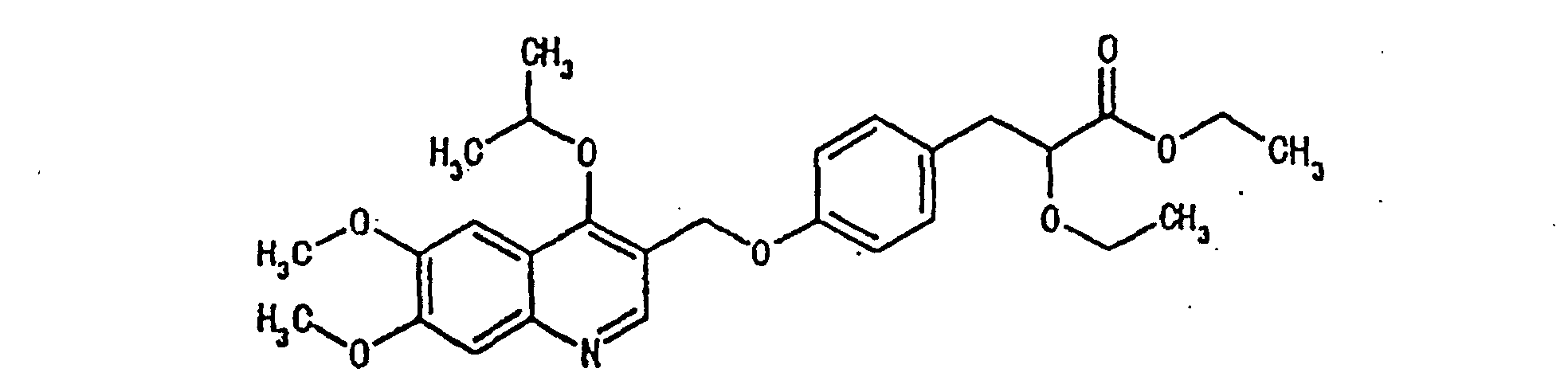
- 4-propoxy-6,7-dimethoxyquinoline-3-methanol (832 mg, 3 mmol) synthesized in Reference Example 14 and ethyl 2-ethoxy-3-(4-hydroxyphenyl)propanoate (715 mg, 3 mmol) synthesized in Reference Example 7 were subjected to the same treatment as in Example 1 to obtain an intended title compound (760 mg, 51%) as a colorless transparent syrup.
1H-N.M.R.(CDCl3, 270MHz)d=8.77(s, 1H), 7.41(s, 1H), 7.37(s, 1H), 7.19 and 6.94(2d, each 2H, J=8.9Hz), 5.18(s, 2H), 4.58(quintet, 1H, J=6.2Hz), 4.22(q, 2H, J=7.3Hz), 4.04(s, 6H), 3.98(t, 1H, J=6.3Hz), 3.70-3.55(m, 1H), 3.45-3.35(m, 1H), 2.97(d, 2H, J=6.3Hz), 1.40(d, 6H, J=6.2Hz), 1.31-1.15(m, 6H) -

- The ester compound (710 mg, 1.43 mmol) synthesized by the reaction 1 of Example 8 was subjected to the same treatment as in Example 2 to obtain a free carboxylic acid. The carboxylic acid was converted into a hydrochloride using 4 N hydrochloric acid and dioxane to obtain an intended title compound (520 mg, 72%) as white crystals.
Melting point = 155°C (dec.)
1H-N.M.R.(DMSO-d6, 270MHz)d=8.77(s, 1H), 7.41(s, 1H), 7.37(s, 1H), 7.19and6.94(2d, each 2H, J=8.9Hz), 5.18(s, 2H), 4.58(quintet, 1H, J=6.2Hz), 4.04(s, 6H), 3.98(t, 1H, J=6.3Hz), 3.70-3.55(m, 1H), 3.45-3.35(m, 1H), 2.97(d, 2H, J=6.3Hz), 1.40(d, 6H, J=6.2Hz), 1.21(t, 6H, J=7.3Hz) -

- The alcohol compound (1.92 g) synthesized in Reference Example 15 and the phenol (1.94 g) synthesized in Reference Example 7 were subjected to the same treatment as in Example 1 to obtain an intended title compound (2.47 g, 66%) as a colorless transparent oil. 1H NMR (CDCl3, 270MHz) d=8.23(d, 1H, J=7.9Hz), 8.15(d, 2H, J=7.9Hz), 8.04(s, 1H), 7.99(d, 1H, J=8.2Hz), 7.76(t, 1H,J=8.2Hz), 7.56-7.46(m, 4H), 7.21(d, 2H, J=8.2Hz), 7.00(d, 2H, J=8.2Hz), 5.58(s, 2H), 4.16(q, 2H, J=6.9Hz), 3.99(t, 1H, J=6.9Hz), 3.67-3.55(m, 1H), 3.41-3.30(m, 1H), 2.98(d, 2H, J=6.9Hz), 1.29-1.13(m, 6H)
-

- The ester compound (1.0 g) synthesized by the reaction 1 was subjected to the same treatment as in Example 2 to obtain an intended title compound (1.05 g, 100%) as white crystals.
Melting point = 142 to 143.5°C
1H NMR (CDCl3, 270MHz) d=8.24(d, 1H, J=8.5Hz), 8.15-8.12(m, 2H), 8.03(s, 1H), 7.98(d, 1H, J=8.5Hz), 7.76(t, 1H, J=7.1Hz), 7.60-7.44(m, 4H), 7.21(d, 2H, J=8.5Hz), 7.00(d, 2H, J=8.5Hz), 5.57(s, 2H), 4.06(dd, 1H, J=4.1, 7.6Hz), 3.64-3.57(m, 1H), 3.50-3.42(m, 1H), 3.10(dd, 1H, J=4.1, 14.3Hz), 2.98(dd, 1H, J=7.6, 14.3Hz), 1.17(t, 3H, J=7.1Hz) -

- The alcohol compound (1.31 g) synthesized in Reference Example 16 and the phenol (1.96 g) synthesized in Reference Example 7 were subjected to the same treatment as in Example 1 to obtain an intended title compound (1.47 g, 47%) as a colorless transparent oil. 1H NMR (CDCl3, 270MHz) d=8.92(d, 1H, J=4.3Hz), 8.19-8.11(m, 2H), 7.88(s, 1H), 7.77(d, 1H, J=8.6Hz), 7.42(dd, 1H, J=4.3. 8.2Hz), 7.18(d, 2H, J=8.6Hz), 6.94(d, 2H, J=8.6Hz), 5.24(s, 2H), 4.16(q, 2H, J=7.3Hz), 3.98(t, 1H, J=6.9Hz), 3.66-3.55(m, 1H), 3.41-3.30(m, 1H), 2.96(d, 2H, J=6.6Hz), 1.29-1.15(m, 6H)
-

- The ester compound (1.47 g) synthesized by the reaction 1 was subjected to the same treatment as in Example 2 to obtain an intended title compound (1.01 g, 75%) as white crystals.
Melting point = 96 to 98°C
1H NMR (CDCl3, 270MHz) d=8.94(d, 1H, J=4.4Hz), 8.23(d, 1H, J=8.3Hz), 8.09(d, 1H, J=8.5Hz), 7.90(s, 1H), 7.77(d, 1H, J=8.8Hz), 7.47(dd, 1H, J=4.4, 8.3Hz), 7.22(d, 2H, J=8.8Hz), 6.93(d, 2H, J=8.8Hz), 5.19(s, 2H), 4.11(dd, 1H, J=4.9, 7.1Hz), 3.71-3.64(m, 1H), 3.53-3.46(m, 1H), 3.13-3.01(m, 2H), 1.21(t, 3H, J=7.1Hz) -
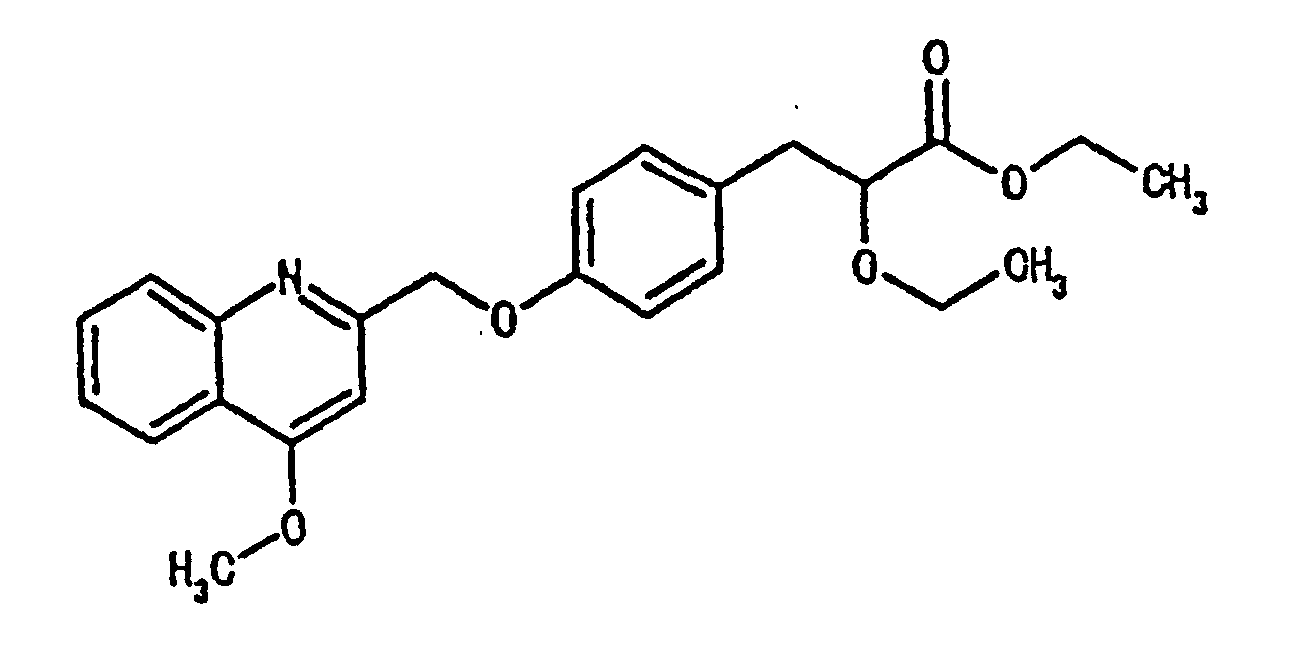
- The alcohol compound (290 mg) synthesized in Reference Example 17 and the phenol (370 mg) synthesized in Reference Example 7 were subjected to the same treatment as in Example 1 to obtain an intended title compound (300 mg, 48%) as a colorless transparent oil.
1H NMR (CDCl3, 270MHz) d=8.18(d, 1H, J=8.2Hz), 7.99(d, 1H, J=8.2Hz), 7.71(t, 1H, J=6.6Hz), 7.50(t, 1H, J=6.6Hz), 7.16(d, 2H, J=6.6Hz), 7.03(s, 1H), 6.96(d, 2H, J=6.6Hz), 5.30(s, 2H), 4.15(q, 2H, J=6.9Hz), 4.04(s, 3H), 3.97(t, 1H, J=6.5Hz), 3.63-3.57(m, 1H), 3.38-3.31(m, 1H), 2.95(d, 1H, J=6.5Hz), 1.23-1.13(m, 6H) -
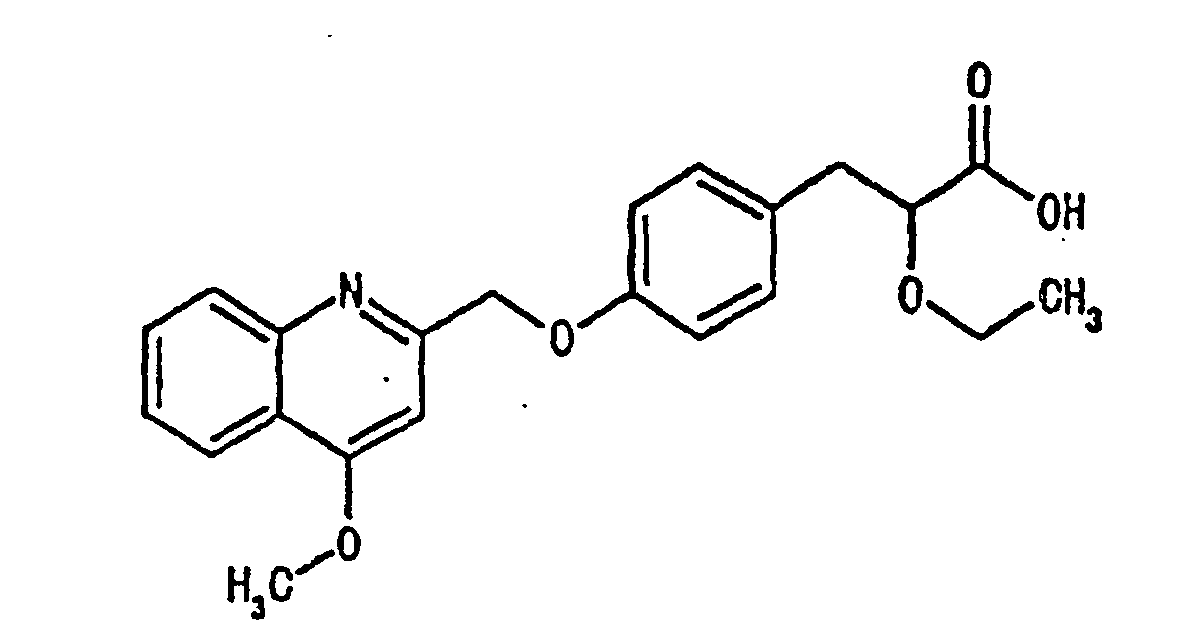
- The ester compound (300 mg) synthesized by the reaction 1 was subjected to the same treatment as in Example 2 to obtain an intended title compound (126 mg, 45%) as white crystals.
Melting point = 138 to 141°C
1H NMR (CDCl3, 270MHz) d=8.18(d, 1H, J=8.4Hz), 8.06(d, 1H, J=8.4Hz), 7.72(t, 1H, J=8.3Hz), 7.50(t, 1H, J=8.3Hz), 7.20(d, 2H, J=8.6Hz), 7.03(s, 1H), 6.93(d, 2H, J=8.6Hz), 5.23(s, 2H), 4.10(d, 1H, J=6.6Hz), 4.04(s, 3H), 3.68-3.60(m, 1H), 3.55-3.49(m, 1H), 3.13-3.08(m, 1H), 3.04-2.98(m, 1H), 1.21(t, 3H, J=6.8Hz) -
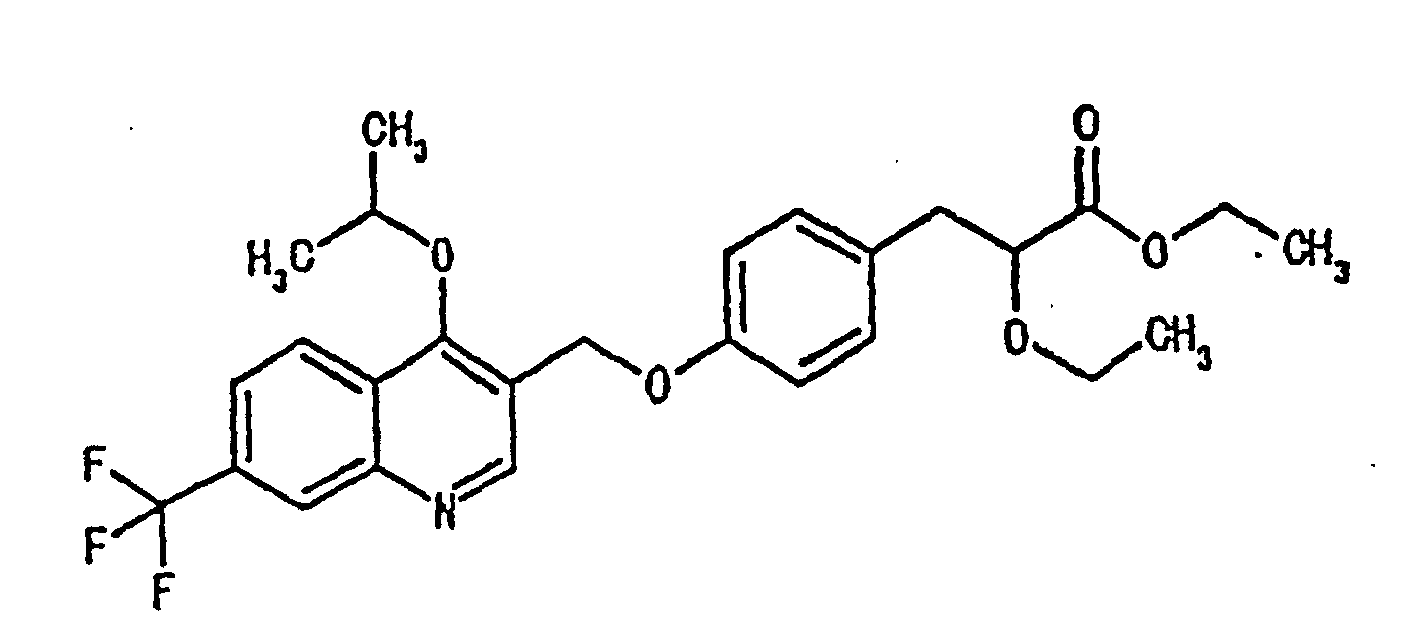
- The alcohol compound (570 mg) synthesized in Reference Example 19 and the phenol (480 mg) synthesized in Reference Example 7 were subjected to the same treatment as in Example 1 to obtain an intended title compound (650 mg, 64%) as a colorless transparent oil.
1H NMR (CDCl3, 270MHz) d=9.07(s, 1H), 8.40(s, 1H), 8.26(d, 1H, J=8.9Hz), 7.72(d, 1H, J=8.9Hz), 7.20(d, 2H, J=8.9Hz), 6.93(d, 2H, J=8.9Hz), 5.24(s, 2H), 4.62(m, 1H), 4.17(q, 2H, J=6.9Hz), 3.98(t, 1H, J=6.9Hz), 3.64-3.56(m, 1H), 3.39-3.33(m, 1H), 2.97(d, 2H, J=6.6Hz), 1.41(d, 6H, J=6.3Hz), 1.25-1.14(m, 6H) -

- The ester compound (626 mg) synthesized by the reaction 1 was subjected to the same treatment as in Example 2 to obtain an intended title compound (450 mg, 76%) as a white amorphous solid.
1H NMR (CDCl3, 270MHz) d=9.06(s, 1H), 8.41(s, 1H), 8.27(d, 1H, J=8.8Hz), 7.73(d, 1H, J=8.8Hz), 7.21(d, 2H, J=8.7Hz), 6.95(d, 2H, J=8.7Hz), 5.24(s, 2H), 4.65-4.61(m, 1H), 4.09(dd, 1H, J=4.4, 7.3Hz), 3.64-3.60(m, 1H), 3.53-3.49(m, 1H), 3.12(dd, 1H, J=4.4, 14.1Hz), 3.00(dd, 1H, JJ=7.1, 14.1Hz), 1.42(d, 6H, J=6.1Hz), 1.20(t, 3H, J=7.1Hz) -
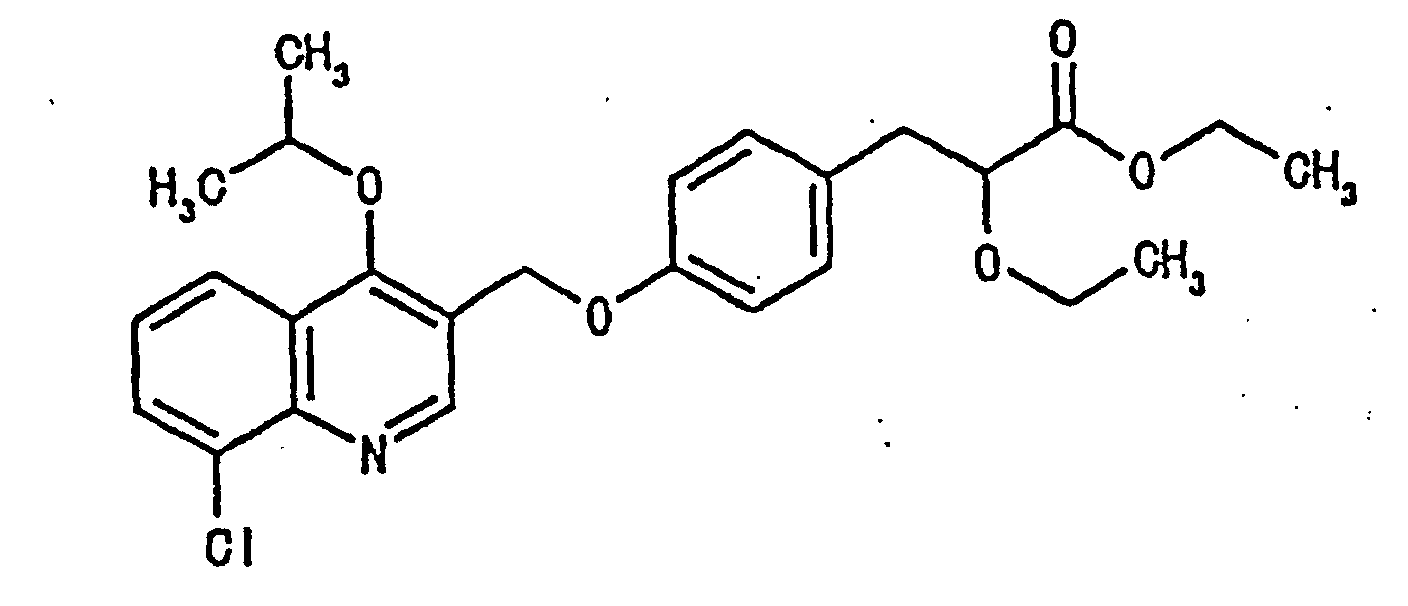
- The alcohol compound (650 mg, 2.6 mmol) synthesized in Reference Example 20 and the phenol (610 mg, 2.6 mmol) synthesized in Reference Example 7 were subjected to the same treatment as in Example 1 to obtain an intended title compound (890 mg, 73%) as a colorless transparent oil.
1H NMR (CDCl3, 270MHz) d=9.09(1H s), 8.08(1H, dd, J=8.2, 1.4Hz), 7.84(1H, dd, J=7.6, 1.4Hz), 7.47(1H, dd., J=8.2, 7.6Hz), 7.19(2H, dd, J=6.5, 2.4Hz), 6.92(2H, dd, J=6.5, 1.9Hz), 5.24 (2H, s), 4.67(1H, sept, J=6.2Hz), 4.16(2H, dd, J=14, 7.3Hz), 3.97 (1H, t, J=6.8Hz), 3.59(1H, dd, J=14, 7.0Hz), 3.37(1H, dd., J=14, 7.0Hz), 2.69(2H, d, J=6.8Hz), 1.40(6H, d, J=6.2Hz), 1.21(3H, t, J=7.3Hz), 1.17(3H, t, J=7.0Hz) -

- The ester compound (880 mg, 1.9 mmol) synthesized by the reaction 1 was subjected to the same treatment as in Example 2 to obtain an intended title compound (740 mg, 89%) as white crystals.
Melting point = 87 to 88°C
1H NMR (CDCl3, 270MHz) d=9.10(lH, s), 8.08(1H, dd, J=8.1, 1.4Hz), 7.83(1H, dd, J=7.6, 1.4Hz), 7.47(1H, dd., J=8.1, 7.6Hz), 7.21(2H, d, J=8.6Hz), 6.93(2H, d, J=8.6Hz), 5.23(2H, s), 4.62(1H, sept, J=6.2Hz), 4.07(1H, dd, J=7.8, 4.6Hz), 3.64(1H, dq, J=9.0, 6.8Hz), 3.44(1H, dq, J=9.0, 4.8Hz), 3.09(1H, dd, J=14, 4.6Hz), 2.98(1H, dd, J=14, 7.8Hz), 1.39(6H, d, J=6.2Hz), 1.18(3H, t, J=6.8Hz)
[Example 14] Synthesis of 2-ethoxy-3-{[4-(4-isopropoxy-8-trifluoromethylquinoline-3-yl)methyloxy]phenyl}propanoic acid: exemplary compound (86) -
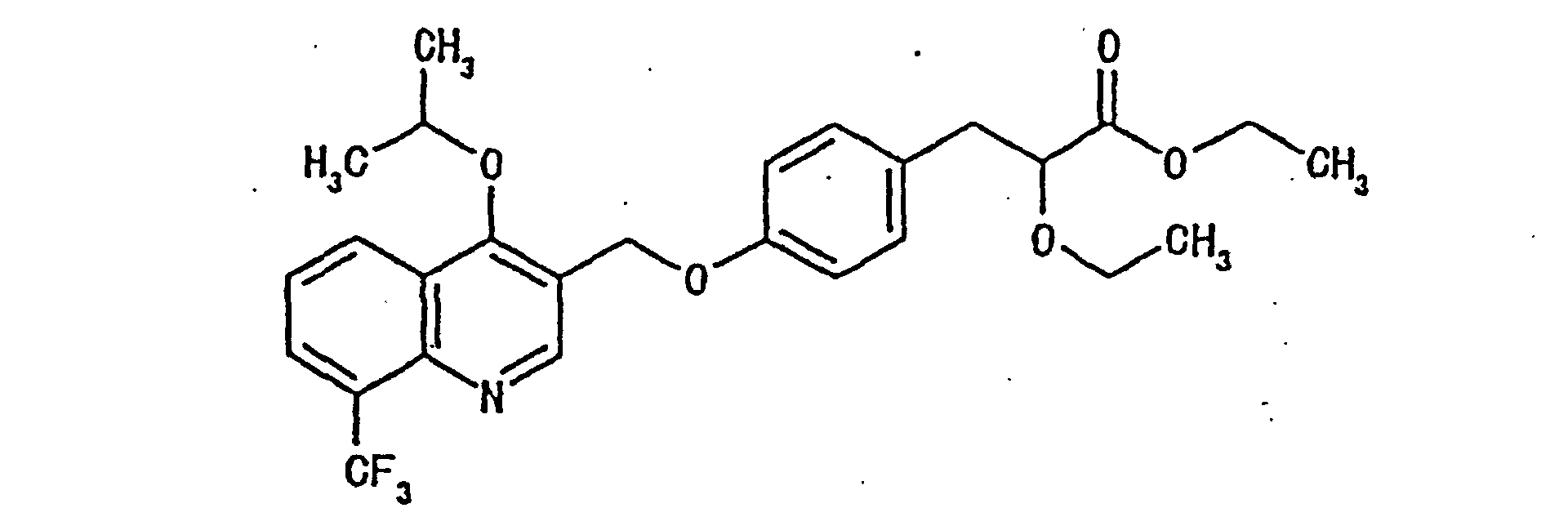
- The alcohol compound (710 mg, 2.5 mmol) synthesized in Reference Example 23 and the phenol (610 mg, 2.5 mmol) synthesized in Reference Example 7 were subjected to the same treatment as in Example 1 to obtain an intended title compound (920 mg, 77%) as a colorless transparent oil.
1H NMR (CDCl3, 270MHz) d=9.13(1H, s), 8.37(1H, dd, J=8.5, 0.9Hz), 8.08(1H, d, J=7.0Hz), 7.60(1H, t, J=7.7Hz), 7.19(2H, dd, J=6.5, 2.2Hz), 6.92(2H, dd, J=6.8, 2.0Hz), 5.24(2H, s), 4.61(1H, sept, J=6.0Hz), 4.16(2H, dd, J=14, 7.2Hz), 3.98(1H, t, J=6.8Hz), 3.62(1H, dd, J=14, 7.0Hz), 3.38(1H, dd, J=14, 7.0Hz), 2.97(2H, d, J=6.8Hz), 1.41(6H, d, J=6.0Hz), 1.21(3H, t, J=7.2Hz), 1.17(3H, t, J=7.0Hz) -

- The ester compound (900 mg, 1.8 mmol) synthesized by the reaction 1 was subjected to the same treatment as in Example 2 to obtain an intended title compound (740 mg, 83%) as white crystals.
Melting point = 113 to 114°C
1H NMR (CDCl3, 270MHz) d=9.12(1H, s), 8.36(1H, dd, J=8.6, 0.8Hz), 8.09(1H, dd, J=6.5, 0.8Hz), 7.61(1H, m), 7.20(2H, dd, J=6.8, 2.1Hz), 6.93(2H, dd, J=6.8, 2.1Hz), 5.24(2H, s), 4.61(1H, sept, J=6.0Hz), 4.07(1H, dd, J=7.3, 4.4Hz), 3.62(1H, dq, J=14, 7.0Hz), 3.47(1H, dq, J=14, 7.0Hz), 3.10(1H, dd., J=14, 4.4Hz), 2.97(1H, dd, J=14, 7.3Hz), 1.41(6H, d, J=6.0Hz), 1.19(3H, t, J=7.0Hz) -

- The alcohol compound (610 mg, 2.6 mmol) synthesized in Reference Example 25 and the phenol (620 mg, 2.6 mmol) synthesized in Reference Example 7 were subjected to the same treatment as in Example 1 to obtain an intended title compound (920 mg, 77%) as a colorless transparent oil.
1H NMR (CDCl3, 270MHz) d=9.01(1H, s), 7.90(1H, dd, J=8.1, 1.4Hz), 7.52-7.36(2H, m), 7.19(2H, dd, J=7.0, 2.2Hz), 6.93(2H, dd, J=7.0, 2.2Hz), 5.23(2H, s), 4.63(1H, sept, J=5.9), 4.16(2H, dd, J=14, 7.0Hz), 3.98(1H, t, J=6.5Hz), 3.59(1H, dq, J=14, 7.0Hz), 3.37(1H, dq, J=14, 7.0Hz), 2.97(2H, d, J=6.5Hz), 1.40(6H, d, J=5.9Hz), 1.22(3H, t, J=7.0Hz), 1.17(3H, t, J=7.0Hz) -

- The ester compound (910 mg, 2.0 mmol) synthesized by the reaction 1 was subjected to the same treatment as in Example 2 to obtain an intended title compound (730 mg, 85%) as white crystals.
Melting point = 131 to 132°C
1H NMR (CDCl3, 270MHz) d=9.05(1H s), 7.92(1H, dd, J=8.1, 1.5Hz), 7.65-7.38(2H, m), 7.23(2H, dd, J=6.5, 2.2Hz), 6.94(2H, dd, J=6.5, 2.2Hz), 5.22(2H, s), 4.65(1H, sept, J=6.0Hz), 4.08(1H, dd, J=7.8, 4.6Hz), 3.67(1H, dq, J=9.2, 7.0Hz), 3.44(1H, dq, J=9.2, 7.0Hz), 3.11(1H, dd, J=14, 4.6Hz), 3.00(1H, dd, J=14, 7.8Hz), 1.40(6H, d, J=6.0Hz), 1.19(3H, t, J=7.0Hz) -

- The alcohol compound (330 mg, 2.1 mmol) synthesized in Reference Example 27 and the phenol (500 mg, 2.1 mmol) synthesized in Reference Example 7 were subjected to the same treatment as in Example 1 to obtain an intended title compound (610 mg, 76%) as a colorless transparent oil.
1H NMR (CDCl3, 270MHz) d=8.94(1H, dd, J=4.2, 1.8Hz), 8.19(1H, dd, J=8.1, 1.8Hz), 7.93(1H, dd, J=7.3, 1.4Hz), 7.77(1H, d, J=8.4Hz), 7.56(1H, t, J=8.1Hz), 7.45(1H, dd, J=8.1, 4.3Hz), 7.17(2H, m), 7.02(2H, m), 5.83(2H, s), 4.16(2H, dd, J=14, 7.1Hz), 3.98(1H, t, J=7.0Hz), 3.60(1H, dq, J=9.0, 7.0Hz), 3.36(1H, dq, J=9.0, 7.0Hz), 2.96(2H, d, J=7.0Hz), 1.21(3H, t, J=7.lHz) , 1.17(3H, t, J=7.0Hz) -
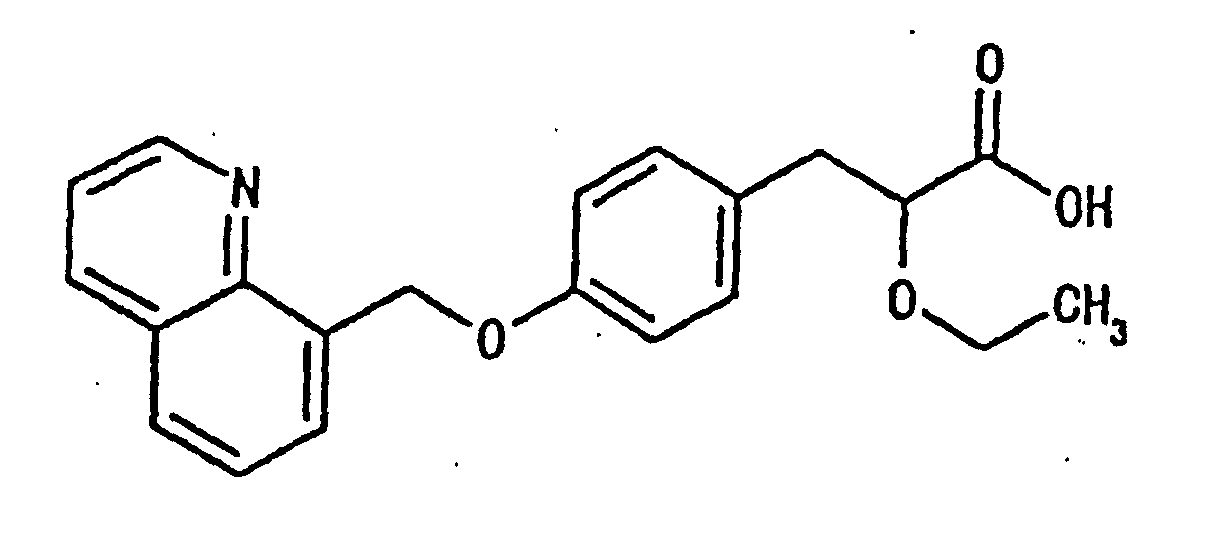
- The ester compound (600 mg, 1.6 mmol) synthesized by the reaction 1 was subjected to the same treatment as in Example 2 to obtain an intended title compound (520 mg, 94%) as white crystals.
Melting point = 178°C (dec.)
1H NMR (DMSO-d6, 270MHz) d=12.7(1H, brd.s), 8.98(1H, dd, J=4.2, 1.8Hz), 8.43(1H, dd, J=8.1, 1.8Hz), 7.98(1H, d, J=8.4Hz), 7.88(1H, d, J=7.0Hz), 7.64(1H, d, J=8.4Hz), 7.60(1H, m), 7.16(2H, d, J=8.4Hz), 6.97(2H, d, J=8.4Hz), 5.72(2H, s), 3.95(1H, dd, J=8.1, 5.4Hz), 3.51(1H, dq, J=14, 7.0Hz), 3.31(1H, dq, J=14, 7.0Hz), 2.90(1H, dd, J=14, 5.4Hz), 2.81(1H, dd, J=14, 8.1Hz), 1.05(3H, t, J=7.0Hz) -

- 4-Propoxy-6-methoxyquinoline-3-methanol (495 mg, 2 mmol) synthesized in Reference Example 4 and methyl 3-(4-hydroxyphenyl)-2-phenoxypropanoate (545 mg, 2 mmol) synthesized in Reference Example XX were subjected to the same treatment as in Example 1 to obtain an intended title compound (640 mg, 64%) as a colorless transparent syrup.
1H-N.M.R.(CDCl3, 270MHz)d=8.71(s, 1H), 8.04(d, 1H, J=9.5Hz), 7.40-7.19(m, 6H), 6.96-6.88(m, 5H), 5.15(s, 2H), 4.86(t, 1H, J=6.0Hz), 4.62(quintet, 1H, J=6.1Hz), 3.94 and 3.60(2s, each 3H), 3.31(d, 2H, J=6.0Hz), 1.39(d, 6H, J=6.1Hz) -

- The ester compound (630 mg, 1.26 mmol) synthesized by the reaction 1 of Example 17 was subjected to the same treatment as in Example 2 to obtain an intended title compound (480 mg, 78%) as white crystals.
Melting point = 137 to 139°C
1H-N.M.R.(CDCl3, 270MHz)d=8.71(s, 1H), 8.04(d, 1H, J=9.5Hz), 7.40-7.19(m, 6H), 6.96-6.88(m, 5H), 5.15(s, 2H), 4.86(t, 1H, J=6.0Hz), 4.62(quintet, 1H, J=6.1Hz), 3.94(s, 3H), 3.31(d, 2H, J=6.0Hz), 1.39(d, 6H, J=6.1Hz) -

- 4-Propoxy-6-methoxyquinoline-3-methanol (613 mg, 2.48 mmol) synthesized in Reference Example 4 and ethyl 3-(4-hydroxyphenyl)-2-phenylthiopropenoate (750 mg, 2.48 mmol) synthesized in Reference Example 33 were subjected to the same treatment as in Example 1 to obtain an intended title compound (1.25 g, 97%) as a colorless transparent syrup.
1H-N.M.R.(CDCl3, 270MHz)d=8.81(s, 1H), 8.10(s, 1H), 7.99(d, 1H, J=9.9Hz), 7.91(d, 2H, J=9.0Hz), 7.40-7.10(m, 6H), 7.03(d, 2H, J=9.0Hz), 5.27(s, 2H), 4.57(quintet, 1H, J=6.2Hz), 4.12(q, 2H, J=7.3Hz), 3.95(s, 3H), 1.41(d, 6H, J=6.1Hz), 1.06(t, 3H, J=7.3Hz) -
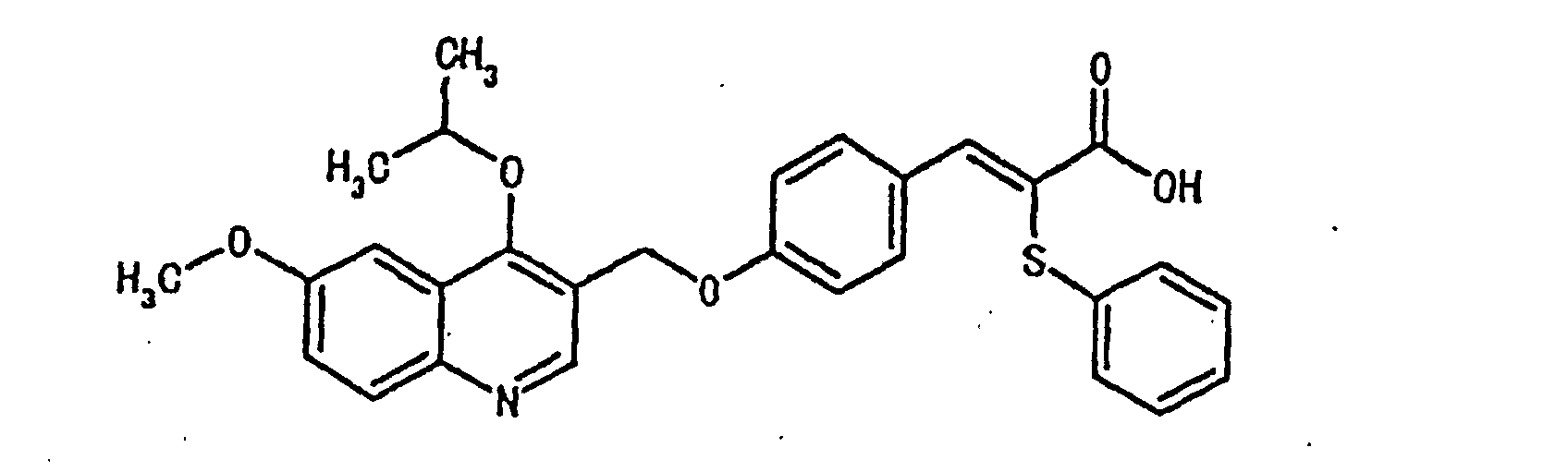
- The ester compound (1.25 g, 2.36 mmol) synthesized by the reaction 1 of Example 18 was subjected to the same treatment as in Example 2 to obtain an intended title compound (890 mg, 75%) as light yellow crystals.
Melting point = 189 to 191°C
1H-N.M.R.(CDCl3, 270MHz)d=8.81(s, 1H), 8.10(s, 1H), 7.99(d, 1H, J=9.9Hz), 7.91(d, 2H, J=9.0Hz), 7.40-7.10(m, 6H), 7.03(d, 2H, J=9.0Hz), 5.27(s, 2H), 4.57(quintet, 1H, J=6.2Hz), 3.95(s, 3H), 1.41(d, 6H, J=6.1Hz) -
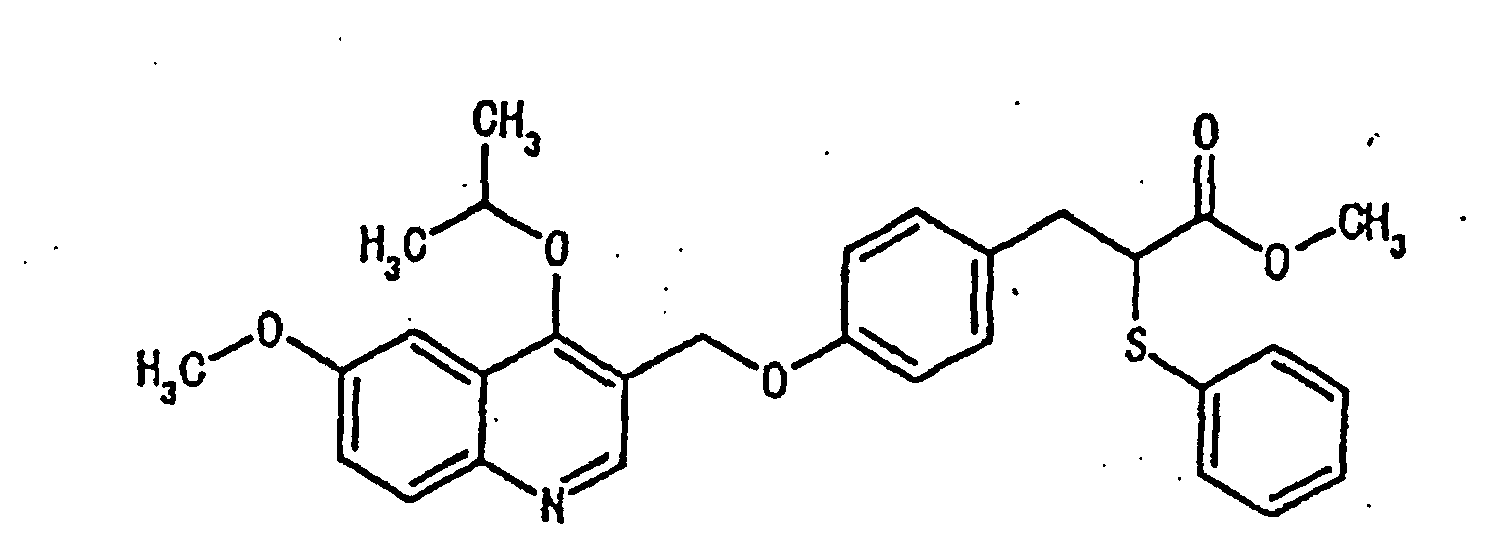
- 4-Propoxy-6-methoxyquinoline-3-methanol (618 mg, 2.5 mmol) synthesized in Reference Example 4 and methyl 3-(4-hydroxyphenyl)-2-phenylthiopropanoate (660 mg, 2.29 mmol) synthesized in Reference Example 35 were subjected to the same treatment as in Example 1 to obtain an intended title compound (790 g, 67%) as a colorless transparent syrup.
1H-N.M.R.(CDCl3, 270MHz)d=8.81(s, 1H), 7.99(d, 1H, J=9.6Hz), 7.45-7.30(m, 7H), 7.13 and 7.03(2d, each 2H, J=8.9Hz), 5.20(s, 2H), 4.58(quintet, 1H, J=6.3Hz), 3.95 and 3.58(2s, each 3H), 3.87(dd, 1H, J=6.6, 9.2Hz), 3.12(dd, 1H, J=9.2, 13.0Hz), 3.03(dd, 1H, J=6.6, 13.0Hz), 1.40(d, 6H, J=6.3Hz) -

- The ester compound (790 mg, 1.53 mmol) synthesized by the reaction 1 of Example 19 was subjected to the same treatment as in Example 2 to obtain an intended title compound (660 mg, 86%) as a light yellow amorphous material.
1H-N.M.R.(CDCl3, 270MHz)d=8.81(s, 1H), 7.99(d, 1H, J=9.6Hz), 7.45-7.30(m, 7H), 7.13 and 7.03(2d, each 2H, J=8.9Hz), 5.20(s, 2H), 4.58(quintet, 1H, J=6.3Hz), 3.95(2s, each 3H), 3.87(dd, 1H, J=6.6, 9.2Hz), 3.12(dd, 1H, J=9.2, 13.0Hz), 3.03(dd, 1H, J=6.6, 13.0Hz), 1.40(d, 6H, J=6.3Hz) -

- 4-Isopropoxy-6-methoxyquinoline-3-methanol (903 mg, 3.65 mmol) synthesized in Reference Example 4 and ethyl 2-ethoxy-3-(3-hydroxyphenyl)propanoate (870 mg, 3.65 mmol) synthesized in Reference Example 36 were subjected to the same treatment as in Example 1 to obtain an intended title compound (1.28 g, 75%) as a colorless transparent syrup.
1H-N.M.R.(CDCl3, 270MHz)d=8.83(s, 1H), 8.00(d, 1H, J=8.6Hz), 7.45-7.20(m, 3H), 6.94(s, 1H), 6.88(d, 2H, J=8.5Hz), 5.21(s, 2H), 4.60(quintet, 1H, J=5.9Hz), 4.20(q, 2H, J=7.3Hz), 4.02(t, 1H, J=6.9Hz), 3.96(s, 3H), 3.70-3.52(m, 1H), 3.40-3.30(m, 1H), 3.00(d, 2H, J=6.9Hz), 1.41(d, 6H, J=5.9Hz), 1.31-1.13(m, 6H) -

- The ester compound (1.28 g, 2.74 mmol) synthesized by the reaction 1 of Example 20 was subjected to the same treatment as in Example 2 to obtain an intended title compound (900 mg, 69%) as white crystals.
Melting point = 99 to 102°C
1H-N.M.R.(CDCl3, 270MHz)d=8.83(s, 1H), 8.00(d, 1H, J=8.6Hz), 7.45-7.20(m, 3H), 6.94(s, 1H), 6.88(d, 2H, J=8.5Hz), 5.21(s, 2H), 4.60(quintet, 1H, J=5.9Hz), 4.02(t, 1H, J=6.9Hz), 3.96(s, 3H), 3.70-3.52(m, 1H), 3.40-3.30(m, 1H), 3.00(d, 2H, J=6.9Hz), 1.41(d, 6H, J=5.9Hz), 1.21(t, 3H, J=7.3Hz) -

- 4-Isopropoxy-6-methoxyquinoline-3-methanol (558 mg, 2.26 mmol) synthesized in Reference Example 4 and ethyl 2-ethoxy-3-(3-hydroxy-4-methoxyphenyl)propanoate (610 mg, 2.26 mmol) synthesized in Reference Example 37 were subjected to the same treatment as in Example 1 to obtain an intended title compound (580 g, 52%) as a colorless transparent syrup.
1H-N.M.R.(CDCl3, 270MHz)d=8.87(s, 1H), 7.97(d, 1H, J=8.6Hz), 7.40-7.33(m, 3H), 6.96(s, 1H), 6.82(s, 1H), 5.29(s, 2H), 4.65(quintet, 1H, J=5.9Hz), 4.14(q, 2H, J=7.3Hz), 3.95 and 3.84(2s, each 3H), 3.92(t, 1H, J=6.7Hz), 3.60-3.45(m, 1H), 3.30-3.20(m, 1H), 2.90(d, 2H, J=6.7Hz), 1.42(d, 6H, J=5.9Hz), 1.22(t, 3H, J=7.3Hz), 1.11(t, 3H, J=7.3Hz) -

- The ester compound (570 g, 1.14 mmol) synthesized by the reaction 1 of Example 21 was subjected to the same treatment as in Example 2 to obtain an intended title compound (510 mg, 88%) as white crystals.
Melting point = 144 to 146°C
1H-N.M.R.(DMSO-d6, 270MHz)d=8.23(d, 1H, J=9.3Hz), 7.75(dd, 1H, J=2.6, 9.3Hz), 7.55(d, 1H, J=2.6Hz), 7.12(d, 1H, J=2.6Hz), 6.93(d, 1H, J=9.3Hz), 6.84(d, 1H, J=9.3Hz), 5.31(s, 2H), 5.04(quintet, 1H, J=5.9Hz), 4.00 and 3.74(2s, each 3H), 3.98(dd, 1H, J=2.2, 5.0Hz), 3.51-3.45(m, 1H), 3.30-3.25(m, 1H), 2.92(dd, 1H, J=5.0, 11.2Hz), 2.80(dd, 1H, J=2.2, 11.2Hz), 1.43(d, 6H, J=5.9Hz), 1.01(t, 3H, J=6.9Hz) -

- 4-Isopropoxy-6-methoxyquinoline-3-methanol (742 mg, 3 mmol) synthesized in Reference Example 4 and dimethyl (4-hydroxyphenyl)methylmalonate (1.05 g, 4.5 mmol) synthesized in Reference Example 40 were subjected to the same treatment as in Example 1, followed by treatment with 4 N hydrochloric acid and dioxane, to obtain an intended title compound (890 mg, 59%) as white crystals.
Melting point = 140°C (dec.)
1H-N.M.R.(DMSO-d6, 270MHz)d=9.18(s, 1H), 8.23(d, 1H, J=9.3Hz), 7.75(dd, 1H, J=2.7, 9.3Hz), 7.54(d, 1H, J=2.7Hz), 7.18 and 7.02(2d, each 2H, J=8.4Hz), 5.32(s, 2H), 4.97(quintet, 1H, J=6.3Hz), 4.00(s, 3H), 3.83(t, 1H, J=7.9Hz), 3.61(s, 6H), 3.05(d, 2H, J=7.9Hz), 1.43(d, 6H, J=6.3Hz) -
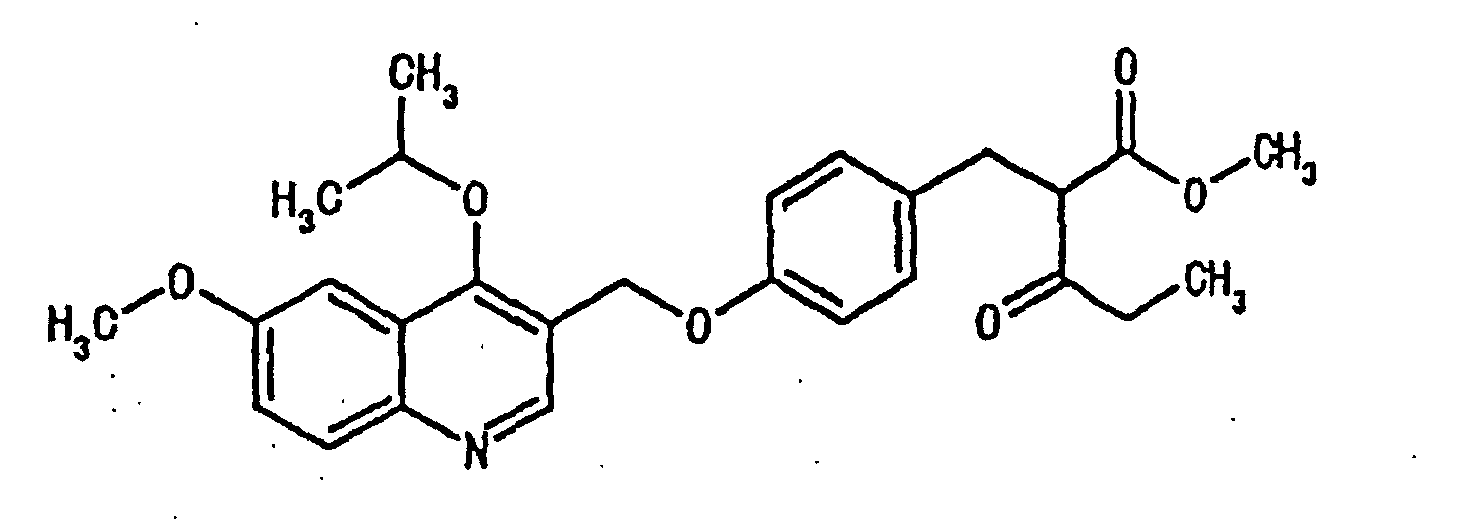
- 4-Isopropoxy-6-methoxyquinoline-3-methanol (989 mg, 4 mmol) synthesized in Reference Example 4 and methyl 2-[(4-hydroxyphenyl)methyl]-3-oxopentanoate (1.0 g, 4 mmol) synthesized in Reference Example 40 were subjected to the same treatment as in Example 1, followed by treatment with 4 N hydrochloric acid and dioxane, to obtain an intended title compound (1.25 g, 62%) as white crystals.
Melting point = 107°C (dec.)
1H-N.M.R.(DMSO-d6, 270MHz)d=9.18(s, 1H), 8.28(d, 1H, J=9.3Hz), 7.77(dd, 1H, J=2.7, 9.3Hz), 7.55(d, 1H, J=2.7Hz), 7.18 and 7.02(2d, each 2H, J=8.4Hz), 5.32(s, 2H), 4.98(quintet, 1H, J=6.0Hz), 4.02(t, 1H, J=8.0Hz). 4.00(s, 3H), 3.59(s, 3H), 2.99(d, 2H, J=8.0Hz), 2.61-2.37(m, 2H), 1.42(d, 6H, J=6.0Hz), 0.86(t, 3H, J=7.3Hz) -

- 4-Isopropoxy-6-methoxyquinoline-3-methanol (1.12 g, 4.52 mmol) synthesized in Reference Example 4 and 2-[(4-hydroxyphenyl)methyl]-3-oxobutanoic acid N-methylamide (1.0 g, 4.52 mmol) synthesized in Reference Example 42 were subjected to the same treatment as in Example 1 to obtain an intended title compound (870 mg, 43%) as a colorless transparent syrup.
1H-N.M.R.(CDCl3, 270MHz)d=8.80(s, 1H), 7.98(d, 1H, J=9.6Hz), 7.70-7.35(m, 2H), 7.09 and 6.92(2d, each 2H, J=8.5Hz), 6.20(q, 1H, J=4.6Hz), 5.20(s, 2H), 4.57(quintet, 1H, J=5.3Hz), 3.96(s, 3H), 3.60(dd, 1H, J=5.9, 8.2Hz.), 3.16(dd, 1H, J=5.9, 13.5Hz), 3.05(dd, 1H, J=8.2, 13.5Hz), 2.76(d, 3H, J=4.6Hz), 2.10(s, 3H), 1.40(d, 6H, J=5.3Hz) -
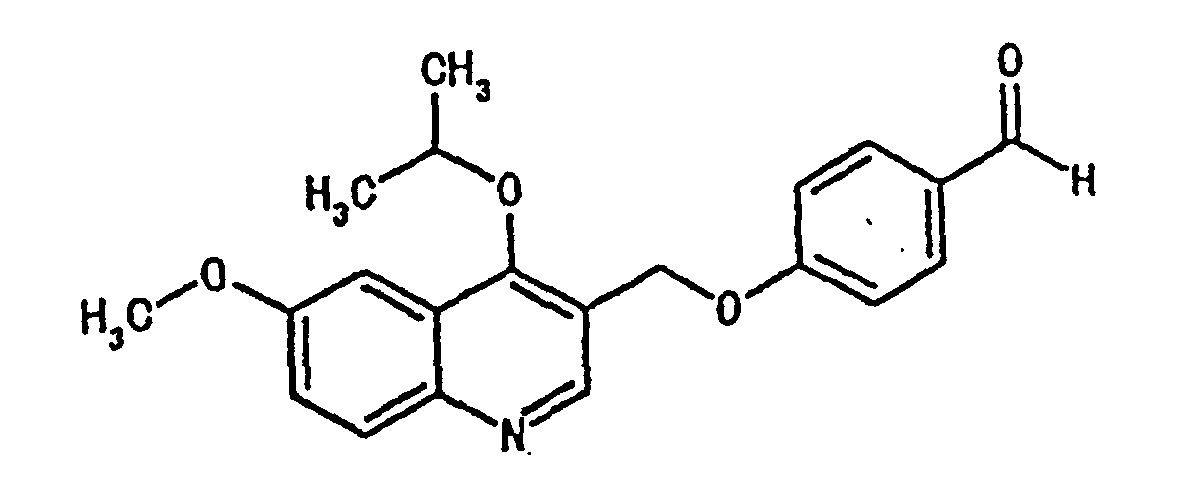
- 4-Isopropoxy-6-methoxyquinoline-3-methanol (4.95 g, 20 mmol) synthesized in Reference Example 4 and 4-hydroxybenzaldehyde (2.93 g, 24 mmol) were subjected to the same treatment as in Example 1 to obtain an intended title compound (3.84 g, 55%) as a colorless transparent syrup.
1H-N.M.R.(CDCl3, 270MHz)d=9.00(s, 1H), 8.82(s, 1H), 8.01(d, 1H, J=9.9Hz), 7.86(d, 2H, J=8.9Hz), 7.41-7.36(m, 2H), 7.12(d, J=8.9Hz), 5.33(s, 2H), 4.58(quintet, 1H, J=6.0Hz), 3.96(s, 3H), 1.42(d, 6H, J=6.0Hz) -

- The aldehyde compound (1.0 g, 2.85 mmol) synthesized by the reaction 1 of Example 25 was suspended in toluene (25 ml). Thereto were added a 65% aqueous N-methylacetoacetamide solution (531 mg, 3.0 mmol) and piperidine acetate (200 mg). The mixture was refluxed for 6 hours with heating. The reaction mixture was allowed to cool and poured into water (100 ml), and extraction of an intended compound was conducted using ethyl acetate. The organic layer was subjected to vacuum concentration. The residue was purified by silica gel column chromatography (equivalent product of Merck C-300: 60 g, acetone : toluene = 1 : 2) to obtain a colorless transparent syrup (450 mg). The syrup was treated with 4 N hydrochloric acid and dioxane to obtain an intended title compound (270 mg, 20%) as a colorless amorphous material.
1H-N.M.R.(DMSO-d6, 270MHz)d=9.21(s, 1H), 8.28-8.24(m, 2H), 7.77(dd, 1H, J=2.5, 8.5Hz), 7.61(d, 2H, J=8.9Hz), 7.57-7.49(m, 2H), 7.20(d, 2H, J=8.9Hz), 5.41(s, 2H), 4.97(quintet, 1H, J=5.9Hz), 4.01(s, 3H), 2.69(d, 3H, J=4.6Hz), 2.33(s, 3H), 1.43(d, 6H, J=5.9Hz) -
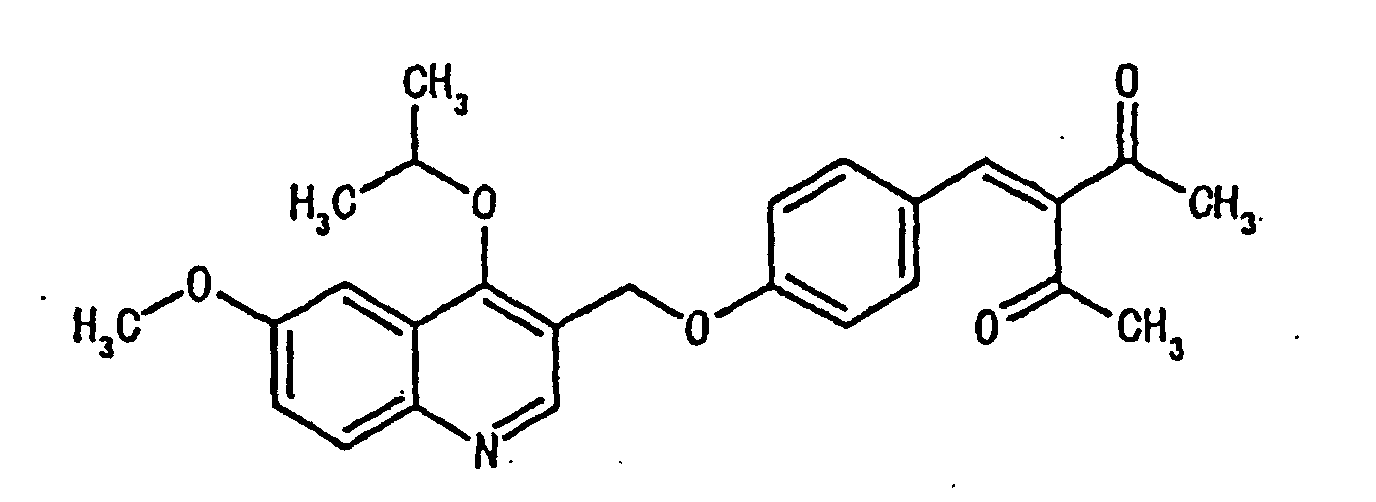
- The aldehyde compound (1.0 g, 2.85 mmol) synthesized by the reaction 1 of Example 25 and acetylacetone (300 mg, 3.0 mmol) were subjected to the same treatment as in the reaction 2 of Example 25 to obtain an intended title compound (680 mg, 55%) as light yellow crystals.
Melting point = 114 to 115°C
1H-N.M.R.(CDCl3, 270MHz)d=8.81(s, 1H), 7.98(dd, 1H, J=3.0, 6.9Hz), 7.42-7.36(m, 5H), 7.01(d, 2H, J=8.7Hz), 5.28(s, 2H), 4.56(quintet, 1H, J=6.1Hz), 3.97(s, 3H), 2.41 and 2.33(2s, each 3H), 1.42(d, 6H, J=6.1Hz) -

- 4-Isopropoxy-6-methoxyquinoline-3-methanol (742 mg, 3 mmol) synthesized in Reference Example 4 and diethyl 3-hydroxyphenyl)methylmalonate (1.2 g, 4.5 mmol) synthesized in Reference Example 44 were subjected to the same treatment as in Example 1, followed by treatment with 4 N hydrochloric acid and dioxane, to obtain an intended title compound (1.34 g, 90%) as white crystals.
Melting point = 114°C (dec.)
1H-N.M.R.(DMSO-d6, 270MHz)d=9.20(s, 1H), 8.26(d, 1H, J=9.2Hz), 7.76(dd, 1H, J=2.9, 9.5Hz), 7.55(d, 1H, J=2.9Hz), 7.25(t, 1H, J=8.0Hz), 6.99(s, 1H), 6.96(d, 1H, J=8.6Hz), 6.86(d, 1H, J=8.6Hz), 5.33(s, 2H), 4.99(quintet, 1H, J=6.0Hz), 4.10(q, 4H, J=7.3Hz), 4.01(s, 3H), 3.84(t, 1H, J=8.1Hz), 3.08(d, 2H, J=8.1Hz), 1.44(d, 6H, J=6.3Hz), 1.10(t, 6H, J=7.3Hz) -

- 4-Isopropoxy-6-methoxyquinoline-3-methanol (620 mg, 2.5 mmol) synthesized in Reference Example 4 and diethyl 3-hydroxy-4-methoxyphenyl)methylmalonate (1.11 g, 3.76 mmol) synthesized in Reference Example 46 were subjected to the same treatment as in Example 1, followed by treatment with 4 N hydrochloric acid and dioxane, to obtain an intended title compound (920 mg, 65%) as white crystals.
Melting point = 132 to 134°C
1H-N.M.R.(DMSO-d6, 270MHz)d=9.17(s, 1H), 8.29(d, 1H, J=9.2Hz), 7.78(dd,1H, J=2.9, 9.2Hz), 7.56(d, 1H, J=2.9Hz), 7.13(s, 1H), 6.92(d, 1H, J=8.3Hz), 6.82(d, 1H, J=8.3Hz), 5.31(s, 2H), 5.05(quintet, 1H, J=6.3Hz), 4.05(q, 4H, J=7.2Hz), 4.01(s, 3H), 3.83(t, 1H, J=8.0Hz), 3.73(s, 3H), 3.03(d, 2H, J=8.0Hz), 1.44(d, 6H, J=6.3Hz), 1.10(t, 6H, J=7.2Hz) -
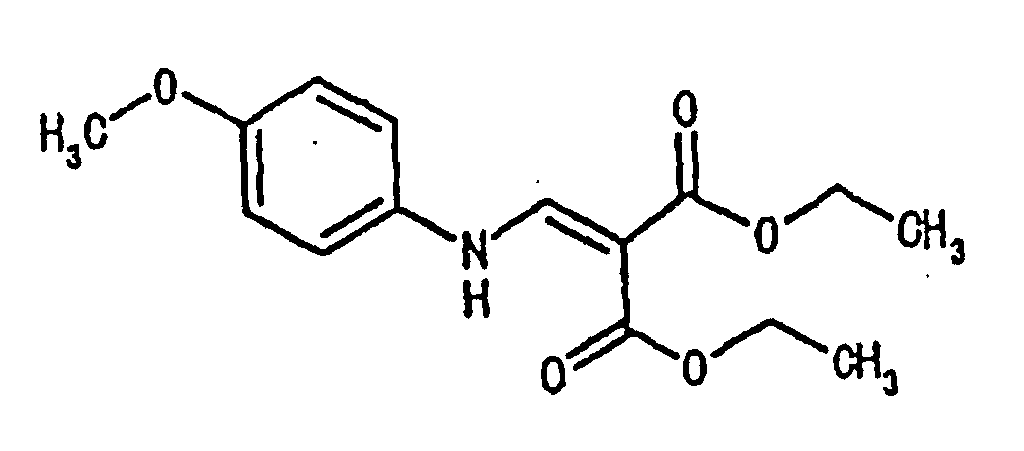
- 4-Methoxyaniline (49.3 g, 0.4 mol) was mixed with diethyl ethoxymethylenemalonate (86.5 g, 0.4 mol). The mixture was stirred at 120°C for 2 hours and then cooled. The ethanol formed was removed by vacuum distillation to obtain an intended title compound as a brown crude syrup (117 g, 100%).
1H-N.M.R.(DMSO-d6, 270MHz)d=10.70(d, 1H, J=9.0Hz), 8.31(d, 1H, J=9.0Hz), 7.30and6.95(2d, each 2H, J=8.5Hz), 4.18 and 4.12(2q, each 2H, J=7.3Hz), 3.75(s, 3H), 1.25 and 1.23(2t, each 3H, J=7.3Hz) -
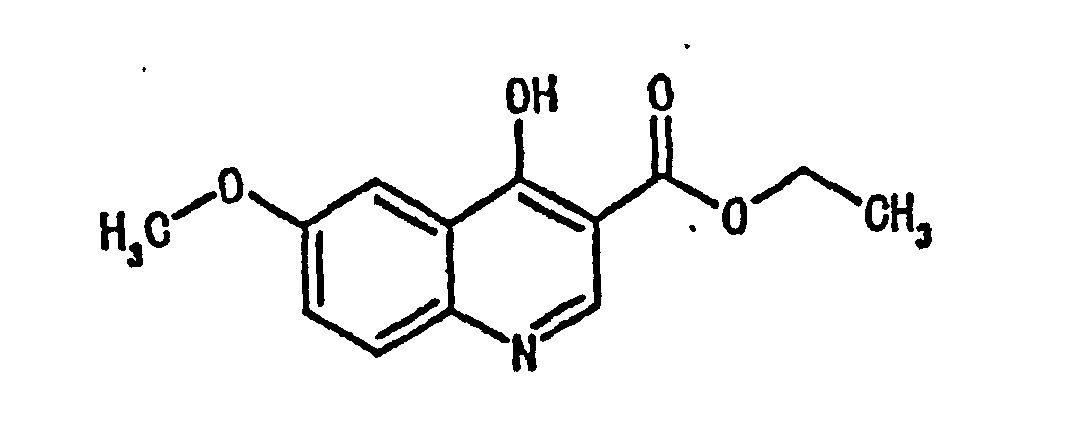
- The malonic acid derivative (117 g, 0.4 mol) synthesized in Reference Example 1 was dissolved in diphenyl ether (500 ml). The solution was stirred at 260°C for 1 hour. The resulting material was cooled slowly to room temperature with stirring, to obtain intended crude crystals. The crude crystals were collected by filtration and then subjected to sludging with ethyl acetate (300 ml) to obtain an intended title compound (44.2 g, 45%) as brown crystals.
Melting point = >260°C
1H-N.M.R.(DMSO-d6, 270MHz)d=8.49(s, 1H), 7.59(d, 1H, J=8.8Hz), 7.58(d, 1H, J=2.9Hz), 7.33(dd, 1H, J=2.9, 8.8Hz), 4.24(q, 2H, J=7.1Hz), 3.85(s, 3H), 1.29(t, 3H, J=7.1Hz) -
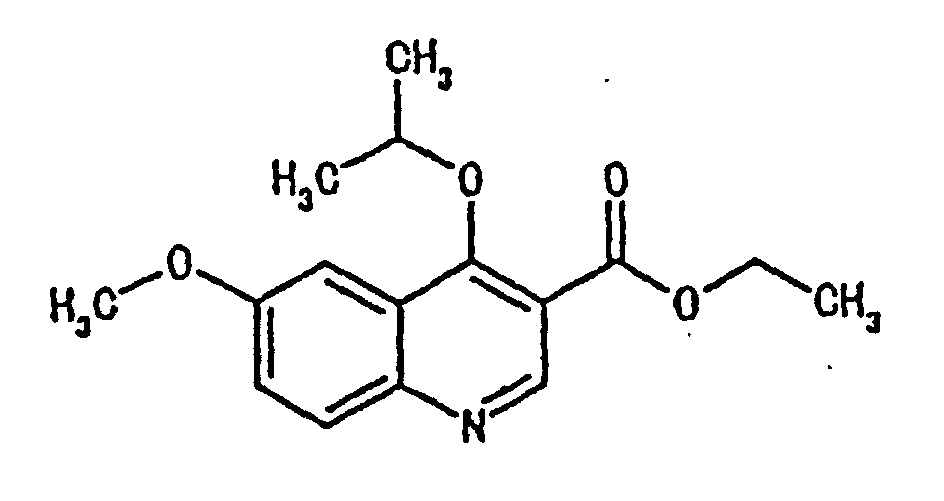
- The quinolinol derivative (25 g, 0.1 mol) synthesized in Reference Example 2 was dissolved in methylene chloride (400 ml). Thereto were added, at room temperature, 2-propanol (12.1 g, 0.2 mol), triphenylphosphine (34.3 g, 0.13 mol) and diethyl azodicarboxylate (22.8 g, 0.13 mol). The mixture was stirred at room temperature for 4 hours and then diluted with chloroform (500 ml). The resulting material was washed with water. The organic layer was dried over anhydrous magnesium sulfate and then subjected to vacuum concentration. The residue was purified by silica gel column chromatography (equivalent product of Merck C-300: 500 g, ethyl acetate : hexane = 1 : 2) to obtain an intended title compound (27.5 g, 94%) as a light yellow transparent syrup.
1H-N.M.R.(CDCl3, 270MHz)d=8.90(s, 1H), 7.95(d, 1H, J=8.8Hz), 7.55-7.45(m, 2H), 4.60(quintet, 1H, J=6.3Hz), 4.40(q, 2H, J=7.3Hz), 3.90(s, 3H), 1.35(t, 3H, J=7.3HZ), 1.30(d, 6H, J=7.3Hz) -
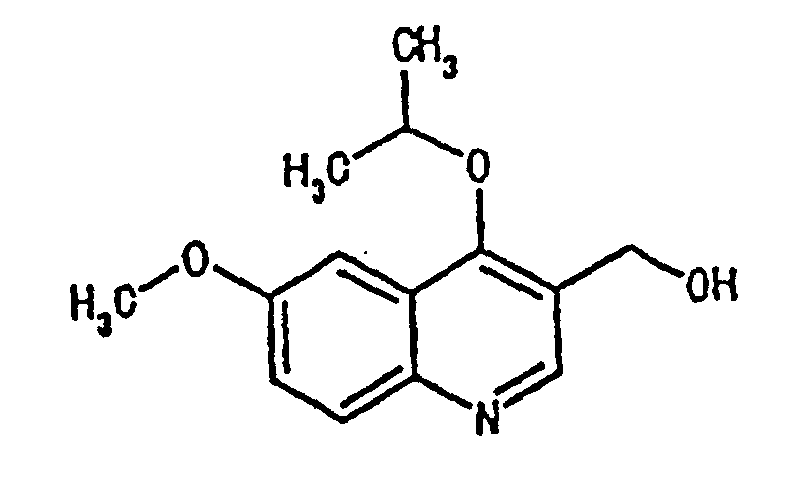
- The quinoline derivative (5.0 g, 17.3 mmol) synthesized in Reference Example 3 was dissolved in methylene chloride (150 ml). Thereto was dropwise added a toluene solution containing 1 M diisobutyl aluminum hydride at -60 to -50°C. The mixture was heated to 0°C and stirred for 2 hours. To the reaction mixture was added a saturated aqueous sodium sulfate solution. The resulting precipitate was collected by filtration, followed by washing with ethyl acetate. The filtrate was subjected to vacuum concentration. The residue was purified by silica gel column chromatography (equivalent product of Merck C-300: 120 g, methanol : chloroform = 1 : 20). Successively, crystallization was conducted using a small amount of a mixed solvent consisting of ethyl acetate and hexane, to obtain an intended title compound (4.05 g, 95%) as light yellow crystals.
Melting point = 66 to 68°C
1H-N.M.R.(CDCl3, 270MHz)d=8.75(s, 1H), 7.95(d, 1H, J=8.5Hz), 7.35-7.25(m, 2H), 4.88(s, 2H), 4.62(quintet, 1H, J=6.5Hz), 4.40(q, 2H, J=7.3Hz), 3.93(s, 3H), 1.42(d, 6H, J=7.3Hz) -

- Diisopropylamine (6.07 g, 60 mmol) was dissolved in tetrahydrofuran (120 ml). Thereto was dropwise added a hexane solution of 1.5 M n-butyl lithium (40 ml, 60 mmol) slowly at -60°C. The mixture was heated to 0°C, stirred for 20 minutes, and cooled again to -60°C. Thereto was dropwise added slowly a solution of ethyl ethoxyacetate (7.93 g, 60 mmol) dissolved in tetrahydrofuran (40 ml). The mixture was stirred at the same temperature for 1 hour. Then was dropwise added a solution of 4-benzyloxybenzaldehyde (10.6 g, 50 mmol) dissolved in tetrahydrofuran (80 ml). The mixture was stirred at the same temperature for 1 hour. To the reaction mixture was added a saturated aqueous ammonium chloride solution (250 ml) and the mixture was heated to room temperature. Extraction of an intended compound was conducted using ethyl acetate. The organic layer was washed with water, dried over anhydrous magnesium sulfate, and subjected to vacuum concentration. The residue was purified by silica gel column chromatography (NHDM-1020 produced by Fuji Silysia Chemical Ltd.: 250 g, ethyl acetate : hexane = 1 : 2) to obtain an intended title compound (14.6 g, 85%) as a colorless transparent syrup-like diastereomer mixture.
1H-N.M.R.(CDCl3, 270MHz)d=7.90-7.26(m, 7H), 6.94(d, 2H, J=9.8Hz), 5.06(s, 2H), 4.90-4.85(m, 0.75H), 4.80-4.75(m, 0.25H), 4.14-3.90(m, 3H), 3.75-3.40(m, 2H), 2.98(d, 0.25H, J=3.9Hz), 2.90(d, 0.75H, J=3.9Hz), 1.26-1.05(m, 6H) -

- The alcohol compound (13.0 g, 37.7 mmol) obtained in Reference Example 5 was dissolved in methylene chloride (120 ml). Thereto were added trifluoroacetic acid (30 ml) and triethylsilane (13.2 g, 113 mmol) at room temperature. The mixture was stirred at room temperature for 4 hours and then poured into a saturated aqueous sodium bicarbonate solution. The organic layer was separated, dried over anhydrous magnesium sulfate and subjected to vacuum concentration. The residue was purified by silica gel column chromatography (equivalent product of Merck C-300: 200 g, ethyl acetate : hexane = 1 : 4) to obtain an intended title compound (11.5 g, 92%) as a colorless transparent syrup.
1H-M.M.R.(CDCl3, 270MHz)d=7.45-7.25(m, 5H), 7.16 and 6.89(2d, each 2H, J=8.5Hz), 5.04(s, 2H), 4.16(q, 2H, J=7.3Hz), 3.97(t, 1H, J=6.3Hz), 3.63-3.57(m, 1H), 3.38-3.32(m, 1H), 2.95(d, 2H, J=6.6Hz), 1.67(t, 3H, J=7.7Hz), 1.22(t, 3H, J=7.7Hz) -

- The ester compound (11.0 g, 33.3 mmol) obtained in Reference Example 6 was dissolved in ethanol (159 mmol). Thereto was added 10% palladium-carbon (containing 50% of water) (2.2 g, 1 wt. % as Pd). The mixture was stirred vigorously in a hydrogen atmosphere at normal pressure at room temperature for 3 hours. The catalyst was removed from the reaction mixture by filtration using Celite. The filtrate was subjected to vacuum concentration to obtain an intended title compound (7.06 g, 89%) as a crude syrup.
1H-N.M.R.(CDCl3, 270MHz)d=7.08 and 6.73(2d, each 2H, J=8.6Hz), 4.17(q, 2H, J=7.0Hz), 3.99(t, 1H, J=6.6Hz), 3.66-3.55(m, 1H), 3.43-3.32(m, 1H), 2.95(d, 2H, J=6.6Hz), 1.23(t, 3H, J=7.7Hz), 1.17(t, 3H, J=7.7Hz) -

- 3,5-Dimethylaniline (12.1 g, 0.1 mol) and diethyl ethoxymethylenemalonate (21.6 g, 0.1 mol) were used as starting materials and subjected to the same treatment as in Reference Examples 1 to 3 to obtain an intended title compound (10.1 g, 35%) as a brown syrup.
1H-N.M.R.(CDCl3, 270MHz)d=9.04(s, 1H), 7.68(s, 1H), 7.15(s, 1H), 4.61(quintet, 1H, J=6.3Hz), 4.44(q, 2H, J=7.0Hz), 2.89 and 2.49(2s, each 3H), 1.44(t, 3H, J=7.0HZ), 1.33(d, 6H, J=6.3Hz) -
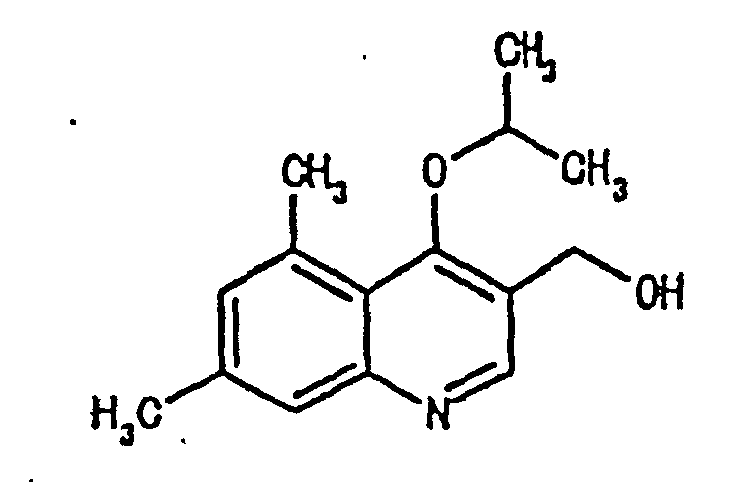
- The ester compound (3.5 g, 12.2 mmol) obtained in Reference Example 8 was subjected to the same treatment as in Reference Example 4 to obtain an intended title compound (2.24 g, 75%) as a light yellow syrup.
1H-N.M.R.(CDCl3, 270MHz)d=8.72(s, 1H), 7.64(s, 1H), 7.10(s, 1H), 4.85(s, 2H), 4.54(quintet, 1H, J=6.3Hz), 2.82 and 2.45(2s, each 3H), 1.29(d, 6H, J=6.3Hz) -
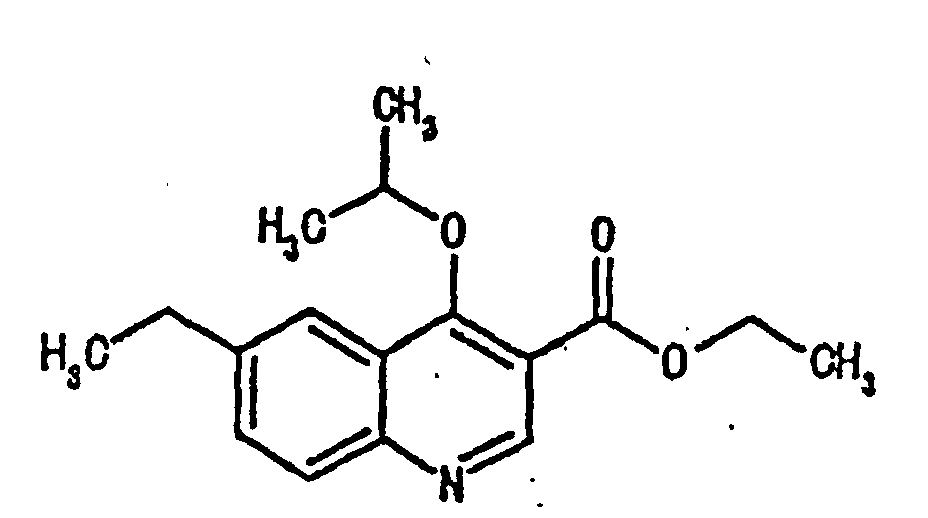
- 4-Ethylaniline (12.1 g, 0.1 mol) and diethyl ethoxymethylenemalonate (21.6 g, 0.1 mol) were used as starting materials and subjected to the same treatment as in Reference Examples 1 to 3 to obtain an intended title compound (13.5 g, 55%) as a brown syrup.
1H-N.M.R.(CDCl3, 270MHz)d=9.14(s, 1H), 8.06(d, 1H, J=1.9Hz), 8.00(d, 1H, J=8.6Hz), 7.64(dd, 1H, J=1.9, 8.6Hz), 4.69(quintet, 1H, J=6.3Hz), 4.46(q, 2H, J=7.3Hz), 2.86(q, 2H, J=7.5Hz), 1.45(t, 3H, J=7.3Hz), 1.39(d, 6H, J=6.3Hz), 1.34(t, 3H, J=7.5Hz) -
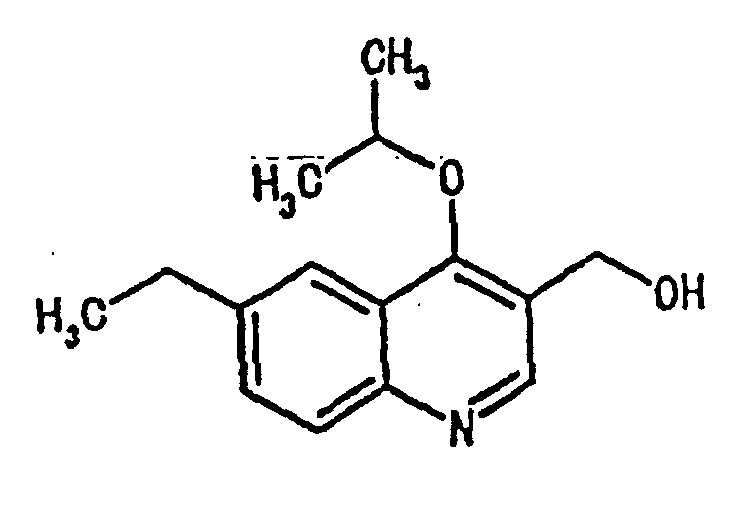
- The ester compound (4.91 g, 20 mmol) obtained in Reference Example 10 was subjected to the same treatment as in Reference Example 4 to obtain an intended title compound (3.53 g, 72%) as light yellow crystals.
Melting point = 43 to 46°C
1H-N.M.R.(CDCl3, 270MHz)d=8.80(s, 1H), 7.98(d, 1H, J=1.5Hz), 7.84(d, 1H, J=8.6Hz), 7.54(dd, 1H, J=1.5, 8.6Hz), 4.90(s, 2H), 4.65(quintet, 1H, J=6.0Hz), 2.85(q, 2H, J=7.6Hz), 1.40(d, 6H, J=6.0Hz), 1.34(t, 3H, J=7.6Hz) -

- The quinolinol derivative (2.47 g, 10 mmol) synthesized in Reference Example 2 was dissolved in methylene chloride (70 ml). Thereto were added, at room temperature, 1-octanol (3.26 g, 25 mmol), triphenylphosphine (3.93 g, 15 mmol) and diethyl azodicarboxylate (2.61 g, 15 mmol). The mixture was stirred at room temperature for 4 hours and then diluted with chloroform (200 ml). The resulting material was washed with water. The organic layer was dried over anhydrous magnesium sulfate and then subjected to vacuum concentration. The residue was purified by silica gel column chromatography (equivalent product of Merck C-300: 100 g, ethyl acetate : hexane = 1 : 5) to obtain an intended title compound (2.82 g, 79%) as a light yellow transparent syrup.
1H-N.M.R.(CDCl3, 270MHz)d=9.03(s, 1H), 7.99(d, 1H, J=9.2Hz), 7.53(d, 1H, J=2.5Hz), 7.43(dd, 1H, J=2.5, 9.2Hz), 4.46(q, 2H, J=7.3Hz), 4.23(t, 2H, J=7.2Hz), 3.95(s, 3H), 1.98-1.90(m, 2H), 1.60-1.50(m, 2H), 1.30-1.20(m, 11H), 0.88(t, 3H, J=6.6Hz) -

- The ester compound (2.6 g, 7.23 mmol) obtained in Reference Example 12 was subjected to the same treatment as in Reference Example 4 to obtain an intended title compound (1.25 g, 54%) as a light yellow syrup.
1H-N.M.R.(CDCl3, 270MHz)d=8.81(s, 1H), 8.00(d, 1H, J=9.2Hz), 7.40-7.35(m, 2H), 4.88(s, 2H), 4.20(t, 2H, J=7.0Hz), 3.95(s, 3H), 2.00-1.90(m, 2H), 1.60-1.50(m, 2H), 1.30-1.15(m, 8H), 0.88(t, 3H, J=6.6Hz) -
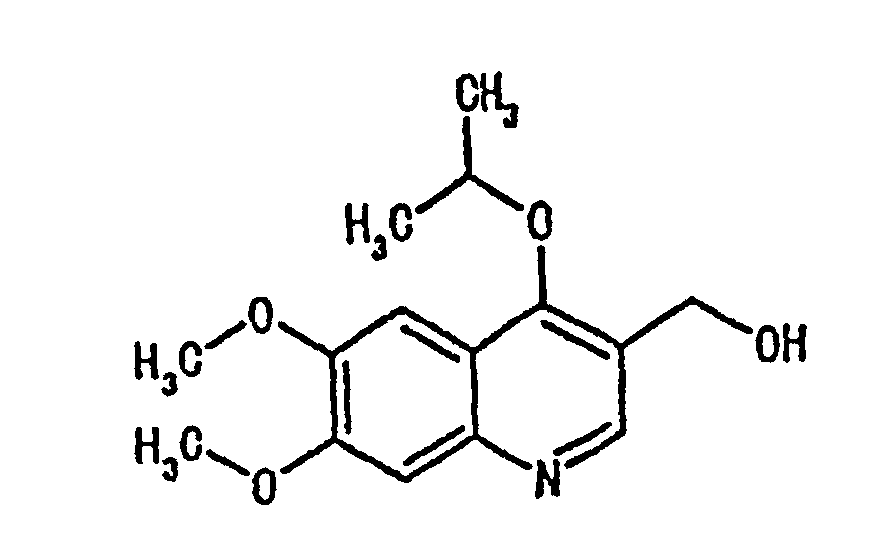
- 3,5-Dimethoxylaniline (15.3 g, 0.1 mol) and diethyl ethoxymethylenemalonate (21.6 g, 0.1 mol) were used as starting materials and subjected to the same treatment as in Reference Examples 1 to 3 to obtain an intended title compound (7.98 g, 25%) as a brown crude syrup. The ester obtained (2.00 g, 6.26 mmol) was subjected to the same treatment as in Reference Example 4 to obtain an intended title compound (1.33 g, 77%) as a light yellow syrup.
1H-N.M.R.(CDCl3, 270MHz)d=8.77(s, 1H), 7.41(s, 1H), 7.37(s, 1H), 4.88(s, 2H), 4.62(quintet, 1H, J=6.5Hz), 4.04 and 3.98(2s, each 3H), 1.40(d, 6H, J=6.5Hz) -

- Methyl 2-phenylquinoline-4-carboxylate (3.0 g) was subjected to the same treatment as in Reference Example 3 to obtain an intended title compound (1.93 g, 72%). 1H-N.M.R.(CDCl3, 270MHz)d=8.22-8.11(m, 3H), 7.96-7.90(m, 2H), 7.73(t, 1H, J=8.6Hz), 7.57-7.42(m, 4H), 5.23(s, 2H)
-

- Ethyl quinoline-6-carboxylate (1.78 g) was subjected to the same treatment as in Reference Example 3 to obtain an intended title compound (1.31 g, 93%).
1H-N.M.R.(CDCl3, 270MHz)d=8.88(d, 1H, J=4.0Hz), 8.20-8.06(m, 2H), 7.81(s, 1H), 7.70(d, 1H, J=8.6Hz), 7.40(d, 1H, J=8.6Hz), 4.91(s, 2H) -

- 4-Methoxyquinoline-2-carboxylic acid (2.42 g) was dissolved in 13% hydrochloric acid-methanol (45 ml). The solution was refluxed for 8 hours, with heating. The reaction mixture was subjected to vacuum distillation. To the residue were added a saturated aqueous sodium bicarbonate solution and ethyl acetate. The ethyl acetate layer was separated, dried over anhydrous magnesium sulfate, and subjected to vacuum concentration to obtain an intended title compound (1.08 g, 42%) as a light brown syrup.
1H-N.M.R.(CDCl3, 270MHz)d=8.24(d, 2H, J=8.6Hz), 7.77(t, 1H, J=6.9Hz), 7.64-7.58(m, 2H), 4.14(s, 3H), 4.09(s, 3H) -

- The ester compound (500 mg) obtained in the synthesis of Reference Example 17 was subjected to the same treatment as in Reference Example 3 to obtain an intended title compound (340 mg, 78%) as a colorless transparent syrup.
1H-N.M.R.(CDCl3, 270MHz)d=8.17(d, 1H, J=8.3Hz), 7.99(d, 1H, J=8.3Hz), 7.70(t, 1H, J=6.9Hz), 7.49(t, 1H, J=6.9Hz), 6.62(s, 1H), 4.86(s, 2H), 4.05(s, 3H) -
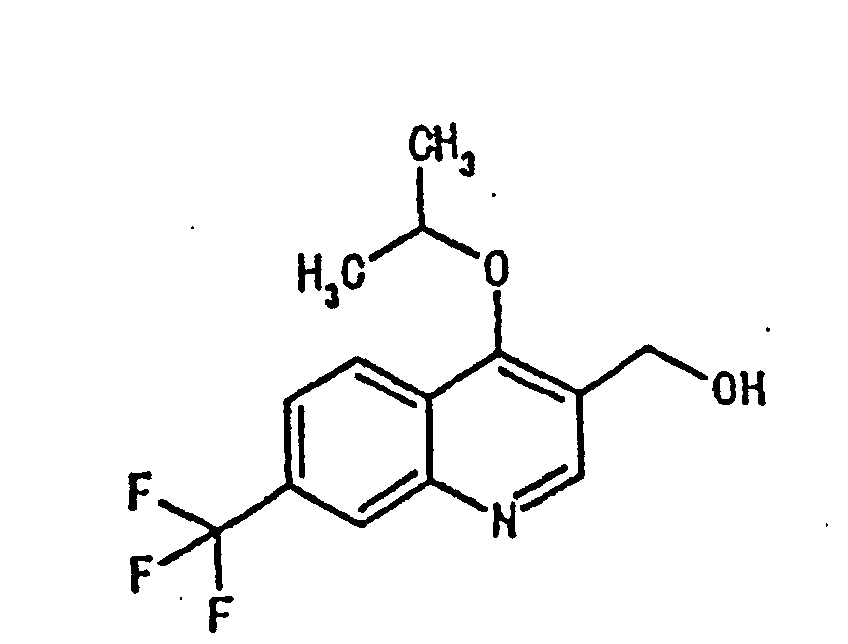
- Ethyl 4-isopropyl-7-trifluoromethylquinoline-3-carboxylate (4.73 g) was subjected to the same treatment as in Reference Example 3 to obtain an intended title compound (570 mg, 14%) as a colorless transparent syrup.
1H-N.M.R.(CDCl3, 270MHz)d=9.02(s, 1H), 8.38(s, 1H), 8.22(d, 1H, J=8.9Hz), 7.70(dd, 1H, J=1.7, 8.6Hz), 4.96(s, 2H), 4.66(m, 1H), 1.43(d, 6H, J=5.9Hz) -
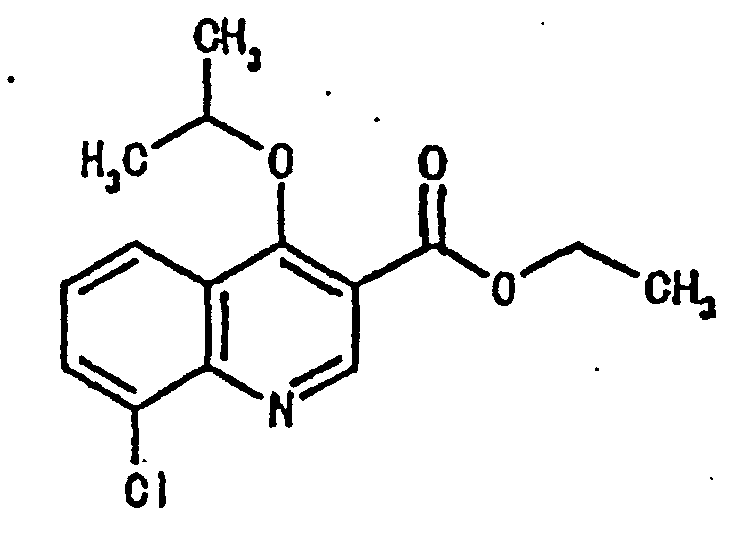
- Ethyl 8-chloro-4-hydroxyquinoline-3-carboxylate (5.22 g, 22.2 mmol) was subjected to the same treatment as in Reference Example 3 to obtain an intended title compound (3.32 g, 92%) as a colorless transparent oil.
1H NMR (CDCl3, 270MHz)) d=9.27(1H, d, J=3.2Hz), 8.20(1H, d, J=2.2Hz), 7.87(1H, d, J=2.2Hz), 4.75(1H, sept, J=5.9Hz), 4.48(2H, dd, J=14, 7.2Hz), 1.45(3H, t, J=7.2Hz), 1.39(6H, d, J=5.9Hz) -

- The ester compound (3.28 g, 11.2 mmol) synthesized in Reference Example 20 was subjected to the same treatment as in Reference Example 4 to obtain an intended title compound (2.25 g, 79%) as white crystals.
Melting point = 88 to 89°C
1H NMR (CDCl3, 270MHz)d=9.02(1H, s), 8.01(1H, dd, J=8.6, 1.4Hz), 7.80(1H, dd, J=7.3, 1.4Hz), 7.43(1H, dd., J=8.6, 7.3Hz), 4.92(2H, brd.s), 4.63(1H, sept, J=6.2Hz), 2.79(1H, brd.s), 1.39(6H, d, J=6.2Hz) -
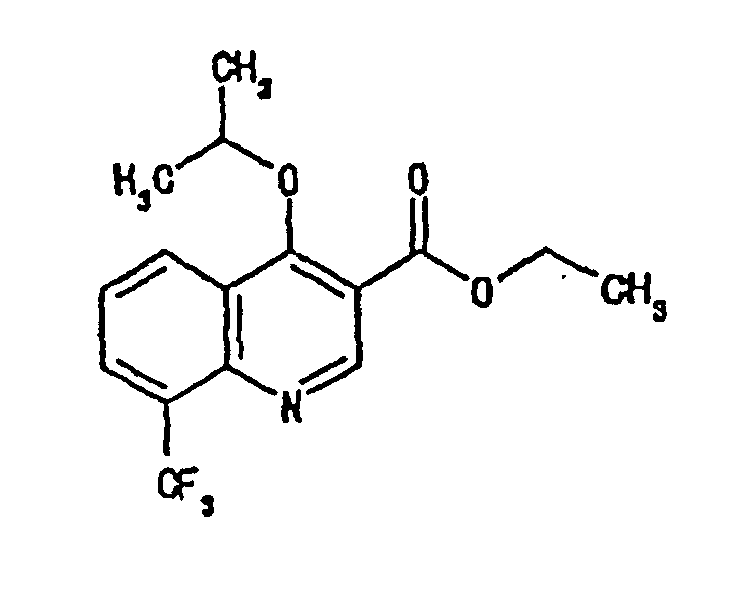
- Ethyl 4-hydroxy-8-trifluoromethylquinoline-3-carboxylate (2.11 g, 7.4 mmol) was subjected to the same treatment as in Reference Example 3 to obtain an intended title compound (2.24 g, 92%) as a colorless transparent oil.
1H NMR (CDCl3, 270MHz) d=9.37(1H, d, J=3.5Hz), 8.54(1H, dd, J=8.6, 0.8Hz), 8.14(1H, dd, J=7.3, 0.8Hz), 7.62(1H, dd., J=8.6, 7.3Hz), 4.77(1H, sept, J=6.2Hz), 4.48(2H, dd, J=14, 7.3Hz), 1.45(3H, t, J=7.3Hz), 1.40(6H, d, J=6.2Hz) -

- The ester compound (1.24 g, 3.8 mmol) synthesized in Reference Example 22 was subjected to the same treatment as in Reference Example 4 to obtain an intended title compound (0.91 g, 84%) as white crystals.
Melting point = 73 to 74°C
1H NMR (CDCl3, 270MHz) d=9.07(1H, s), 8.32(1H, dd, J=8.6, 0.5Hz), 8.05(1H, dd, J=7.3, 0.5Hz), 7.57(1H, t, J=8..0Hz), 4.93(2H, d, J=5.8Hz), 4.64(1H, sept, J=6.0Hz), 2.39(1H, t, J=5.8Hz), 1.41(6H, d, J=6.0Hz) -

- Ethyl 8-fluoro-4-hydroxyquinoline-3-carboxylate (5.22 g, 22.2 mmol) was subjected to the same treatment as in Reference Example 3 to obtain an intended title compound (5.76 g, 94%) as a light yellow oil.
1H NMR (CDCl3, 270MHz) d=9.23(1H, s), 8.14-7.98(1H, m), 7.55-7.45(2H, m), 4.74(1H, sept, J=6.2Hz), 4.48(2H, dd, J=15, 7.2Hz), 1.46(3H, t, J=7.2Hz), 1.39(6H, d, J=6.2Hz) -

- The ester compound (2.00 g, 7.2 mmol) synthesized in Reference Example 24 was subjected to the same treatment as in Reference Example 4 to obtain an intended title compound (1.19 g, 71%) as white crystals.
1H NMR (CDCl3, 270MHz) d=8.95(1H, s), 7.65(1H, dt, J=7.8, 1.6Hz), 7.45(1H, m), 7.38(1H, ddd, J=9.0, 2.7, 1.6Hz), 4.93(2H, s), 4.65(1H, sept, J=6.2Hz), 3.51(1H, brd.s), 1.39(6H, d, J=6.2Hz) -
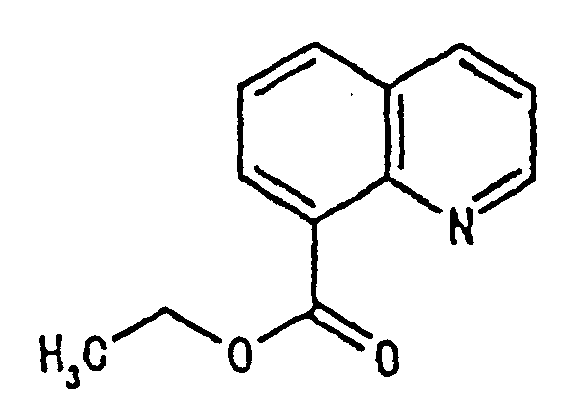
- Quinoline-8-carboxylic acid (1.43 g, 8.3 mmol) was dissolved in ethanol (40 ml). Thereto was added sulfuric acid (0.3 ml), followed by refluxing for 12 hours with heating. The most part of ethanol was removed from the reaction mixture by vacuum distillation. To the residue was added a saturated aqueous sodium bicarbonate solution. Extraction of an intended compound was conducted using ethyl acetate. The organic layer was dried over anhydrous magnesium sulfate and then subjected to vacuum concentration to obtain an intended title compound (0.56 g, 34%) as a yellow oil.
1H NMR (CDCl3, 270MHz) d=9.05(1H, dd, J=4.1, 1.6Hz), 8.18(1H, dd, J=8.4, 1.6Hz), 8.02(1H, dd, J=7.2. 1.6Hz), 7.93(1H, dd, J=8.4, 1.6 Hz), 7.56(1H, dd, J=8.4, 7.2Hz), 7.45(1H, dd, J=8.4, 4.1Hz), 4.54(2H, dd, J=15, 7.3Hz), 1.45(3H, t, J=7.3Hz) -

- The ester compound (0.53 g, 2.6 mmol) synthesized in Reference Example 26 was subjected to the same treatment as in Reference Example 4 to obtain an intended title compound (0.34 g, 81%) as white crystals.
Melting point = 74 to 75°C
1H NMR (CDCl3, 270MHz) d=8.88(1H, dd, J=4.3, 1.9Hz), 8.20(1H, dd, J=8.5, 1.6Hz), 7.76(1H, dd, J=8.1, 1.6Hz), 7.59(1H, dd, J=6.8, 0.8Hz), 7.51(1H, d, J=8.1Hz), 7.45(1H, dd, J=8.1, 4.3Hz), 5.21(2H, brd.s), 5.10(1H, brd.s) -
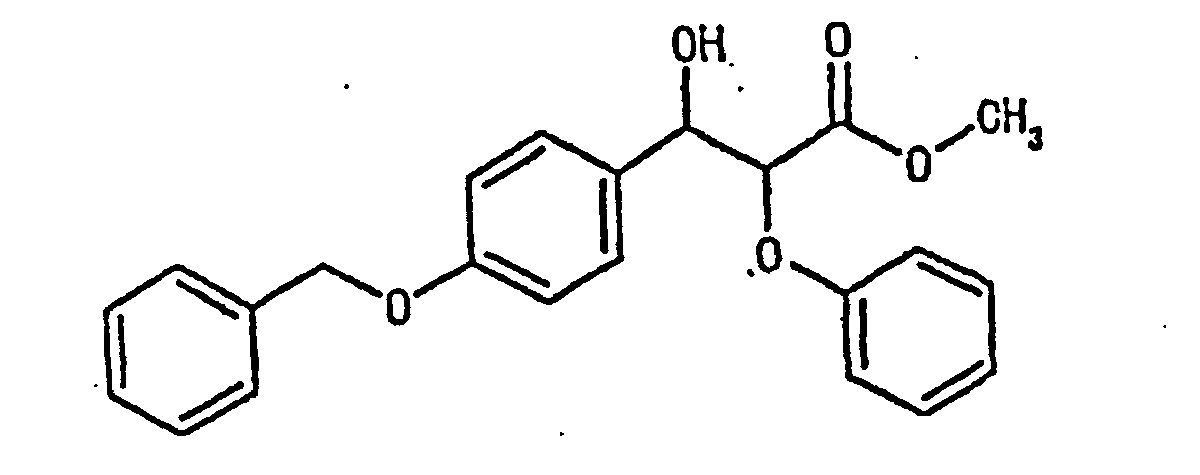
- 4-Benzyloxybenzaldehyde (3.35 g, 15.8 mmol) and methyl phenoxyacetate (2.62 g, 15.8 mmol) were subjected to the same treatment as in Reference Example 5 to obtain an intended title compound (2.57 g, 43%) as a colorless transparent syrup-like diastereomer mixture.
1H-N.M.R.(CDCl3, 270MHz)d=7.44-7.31(m, 9H), 7.00-6.80(m, 5H), 5.17-5.10(m, 1H), 5.06(s, 2H), 4.76((d, 0.7H, 3=6.0Hz), 4.70(d, 0.3Hz, J=5.6Hz), 3.69(s, 2.1Hz), 3.61(s, 0.9Hz), 2.98(d, 0.3Hz, J=5.0Hz), 2.81(d, 0.7Hz, J=4.3Hz) -

- The alcohol compound (2.50 g, 6.61 mmol) synthesized in Reference Example 28 was subjected to the same treatment as in Reference Example 6 to obtain an intended title compound (2.2 g, 92%) as a colorless transparent syrup.
1H-N.M.R.(CDCl3, 270MHz)d=7.43-7.20(m, 9H), 6.98-6.81(m, 5H), 5.03(s, 2H), 4.76(dd, 1H, J=5.6, 7.7Hz), 3.70(s, 3H), 3.20-3.17(m, 2H) -

- The ester compound (2.2 g, 6.07 mmol) synthesized in Reference Example 29 was subjected to the same treatment as in Reference Example 7 to obtain an intended title compound (1.57 g, 95%) as white crystals.
Melting point = 103 to 105°C
1H-N.M.R.(CDCl3, 270MHz)d=7.27-7.14(m, 4H), 6.95(t, 1H, J=8.6Hz), 6.83(dd, 2H, J=1.0, 8.6Hz), 6.75(d, 2H, J=8.6Hz), 4.76(dd, 1H, J=5.6, 7.2Hz), 3.71(s, 3H), 3.19-3.15(m, 2H) -

- 4-hydroxybenzaldehyde (25.3 g, 0.21 mol) was dissolved in methylene chloride (250 ml). Thereto were added chloromethyl methyl ether (25.0 g, 0.41 mol) and diisopropylethylamine (54 g, 0.41 mol). The mixture was stirred at room temperature for 12 hours. The reaction mixture was poured into water (300 ml). Chloroform (200 ml) was added. The organic layer was separated, dried over anhydrous magnesium sulfate, and subjected to vacuum concentration. The residue was purified by silica gel column chromatography (equivalent product of Merck C-300: 250 g, ethyl acetate : hexane = 1 : 4) to obtain an intended title compound (35 g, 100%) as a light brown syrup.
1H-N.M.R.(CDCl3, 270MHz)d=9.90(s, 1H), 7.83 and 7.14(2d, each 2H, J=8.6Hz), 5.26(s, 2H), 3.49(s, 3H) -
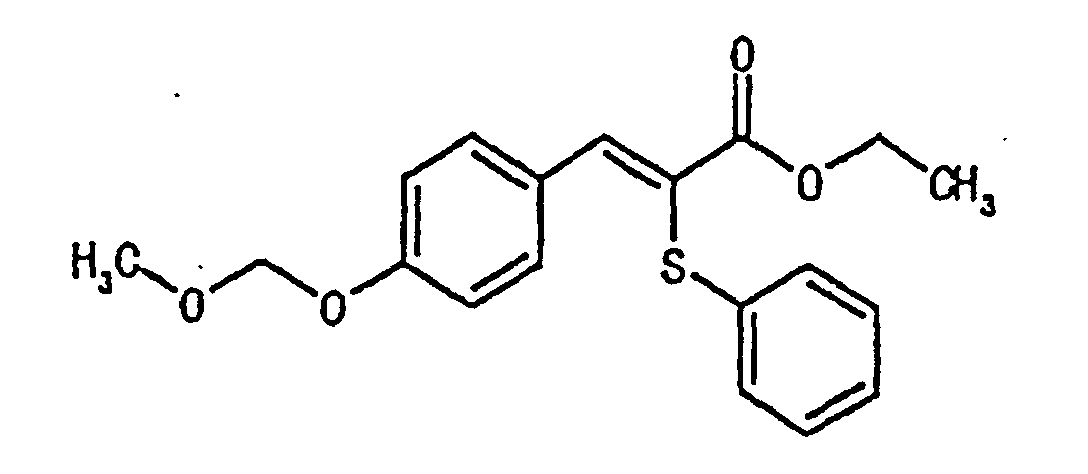
- The aldehyde compound (4.99 g, 30 mmol) synthesized in Reference Example 31 and ethyl phenylthioacetate (4.03 g, 30 mmol) were dissolved in ethanol (60 ml). Thereto was added a 1 N ethanol solution (30 ml) of sodium ethoxide at room temperature. The mixture was heated to 60°C and stirred for 6 hours. The reaction mixture was allowed to cool and diluted with water (200 ml). Extraction of an intended compound was conducted using ethyl acetate. The organic layer was dried over anhydrous magnesium sulfate and subjected to vacuum concentration. The residue was purified by silica gel column chromatography (NHDM-1020 produced by Fuji Silysia Chemical Ltd.: 100 g, ethyl acetate : hexane =1 : 6) to obtain an intended title compound (2.78 g, 27%) as a light yellow syrup.
1H-N.M.R.(CDCl3, 270MHz)d=8.09(s, 1H), 7.87 and 7.05(2d, each 2H, J=8.5Hz), 7.30-7.20(m, 5H), 5.21(s, 2H), 4.11(q, 2H, J=7.3Hz), 3.47(s, 3H), 1.06(t, 3H, 7.3Hz) -
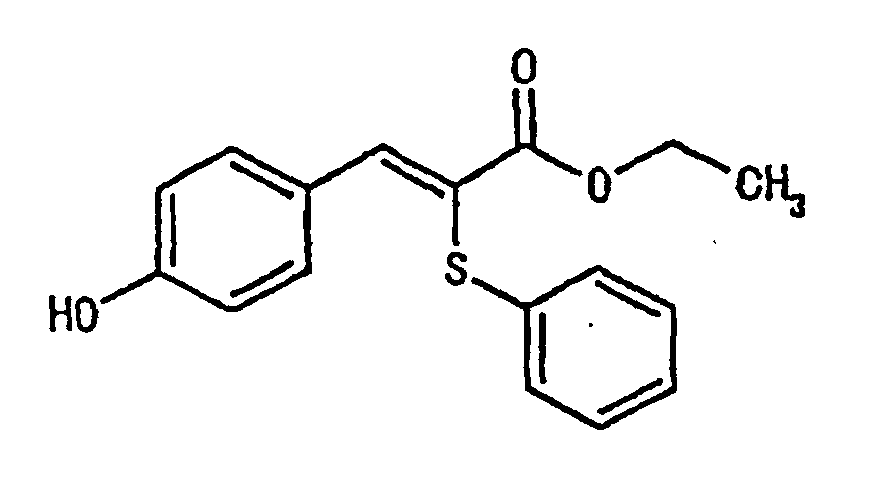
- The ester compound (1.0 g, 2.90 mmol) synthesized in Reference Example 32 was dissolved in methylene chloride (15 ml). Thereto was added a 4 N hydrochloric acid-dioxane solution (5 ml) at room temperature. The mixture was stirred for 2.5 hours. The reaction mixture was poured into a saturated aqueous sodium bicarbonate solution. Thereto was added chloroform. The organic layer was separated and the reaction mixture was subjected to vacuum concentration to obtain an intended title compound (760 mg, 87%) as a light yellow syrup. 1H-N.M.R.(CDCl3, 270MHz)d=8.11(s, 1H), 7.86 and 6.86(2d, each 2H, J=8.5Hz), 7.20-7.10(m, 5H), 4.12(q, 2H, J=6.9Hz), 1.08(t, 3H, 6.9Hz)
-
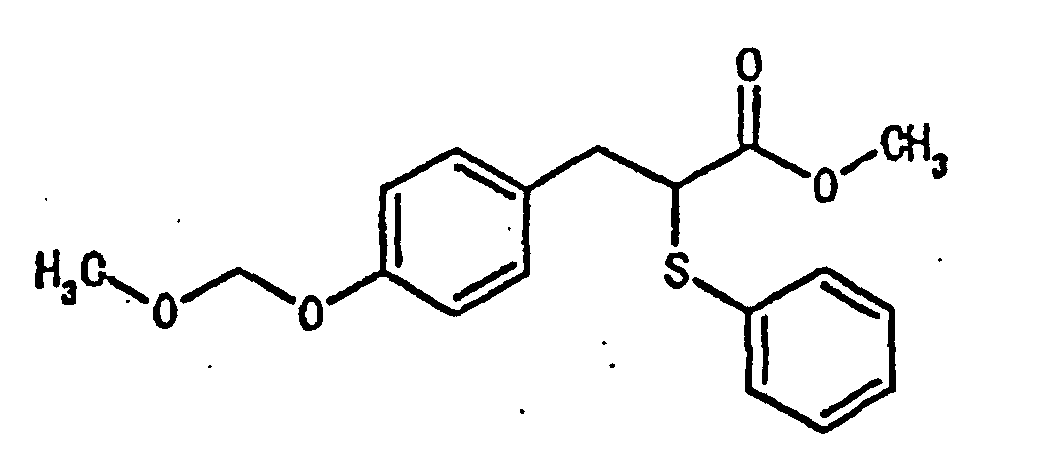
- The ester compound (1.72 g, 5 mmol) synthesized in Reference Example 32 was dissolved in methanol (50 ml). Thereto were added magnesium chips (2.43 g, 0.1 mol) at room temperature. The mixture was stirred for 5 hours. The unnecessary matter was removed by filtration. The filtrate was subjected to vacuum concentration. The residue was purified by silica gel column chromatography (equivalent product of Merck C-300: 80 g, ethyl acetate : hexane =1 : 10) to obtain an intended title compound (740 g, 45%) as a light yellow syrup.
1H-N.M.R.(CDCl3, 270MHz)d=7.45-7.41(m, 2H), 7.32-7.26(m, 3H), 7.10 and 6.94(2d, each 2H, J=8.9Hz), 5.14(s, 2H), 3.86(dd, 1H, J=6.6, 9.2Hz), 3.59 and 3.47(2s, each 3H), 3.14(dd, 1H, J=6.6, 12.8Hz), 3.00(dd, 1H, J=9.2, 12.8Hz) -

- The methyl ester compound (760 mg, 2.29 mmol) synthesized in Reference Example 34 was treated in the same manner as in Reference Example XX to obtain an intended title compound (660 mg, 100%) as a light yellow syrup.
1H-N.M.R.(CDCl3, 270MHz)d=7.45-7.40(m, 2H), 7.33-7.24(m, 3H), 7.04 and 6.73(2d, each 2H, J=8.6Hz), 4.99(s, 1H), 3.84(dd, 1H, J=6.6, 9.2Hz), 3.58(s, 3H), 3.12(dd, 1H, J=9.2, 12.8Hz), 2.99(dd, 1H, J=6.6, 12.8Hz) -
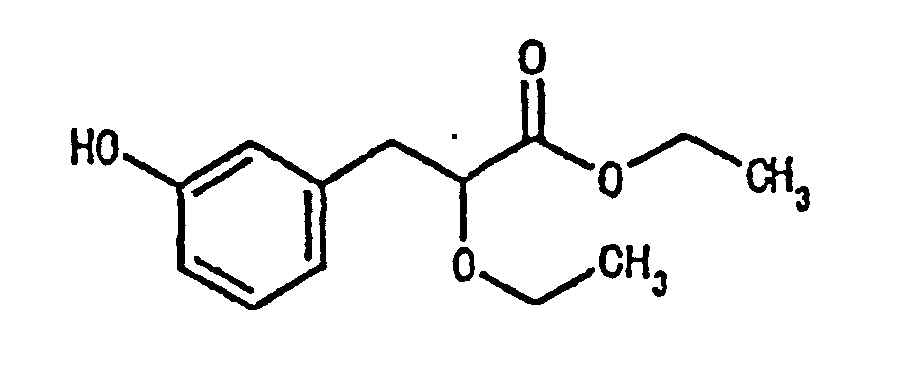
- 3-Benzyloxybenzaldehyde (8.49 g, 40 mmol) was used as a starting material and the same operation as in Reference Examples 5 to 7 was used, whereby an intended title compound (2.0 g, 21%) was obtained as a colorless transparent syrup.
1H-N.M.R.(CDCl3, 270MHz)d=7.15(t, 1H, J=8.0Hz), 6.82-6.69(m, 3H), 5.36(s, 1H), 4.18(q, 2H, J=7.3Hz), 4.02(t, 1H, J=6.9Hz), 3.64-3.56(m, 1H), 3.43-3.34(m, 1H), 2.96(d, 2H, J=6.9Hz), 1.23(t, 3H, J=7.3Hz), 1.16(t, 3H, J=7.3Hz) -
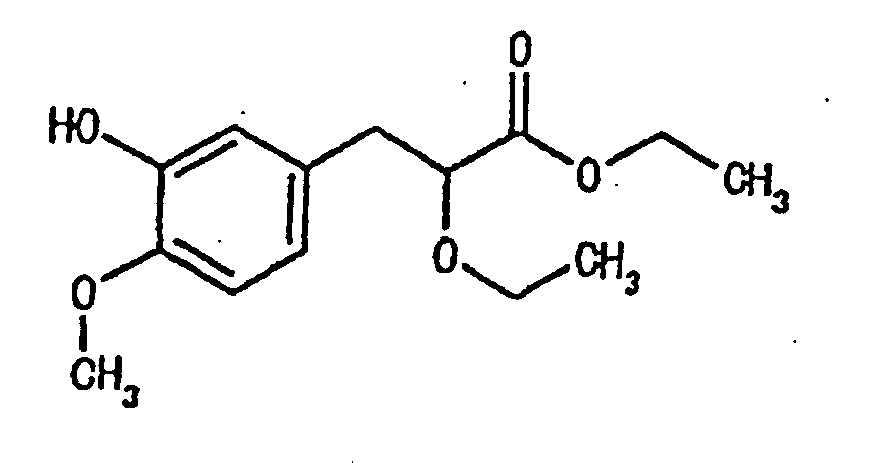
- 3-Benzyloxy-4-methoxybenzaldehyde (6.06 g, 25 mmol) was used as a starting material and the same operation as in Reference Examples 5 to 7 was used, whereby an intended title compound (4.56 g, 68%) was obtained as a colorless transparent syrup.
1H-N.M.R.(CDCl3, 270MHz)d=7.25(d, 1H, J=8.2Hz), 6.84-6.80(m, 2H), 4.14(q, 2H, J=7.1Hz), 3.92(t, 1H, J=6.9Hz), 3.86(s, 3H), 3.33-3.27(m, 1H), 3.43-3.34(m, 1H), 2.88(d, 2H, J=6.9Hz), 1.23(t, 3H, J=7.3Hz), 1.12(t, 3H, J=7.3Hz) -

- 4-Hydroxybenzaldehyde (12.2 g, 0.1 mol) and dimethyl malonate (13.2 g, 0.1 mol) were suspended in benzene (100 ml). Thereto was added piperidine (1 ml). The mixture was refluxed for 4 hours with heating and then allowed to cool. The resulting crystals were collected by filtration and washed with toluene to obtain an intended title compound (17.7 g, 75%) as milky-white crystals.
Melting point = 155 to 157°C
lH-N.M.R.(CDCl3/DMSO-d6, 270MHz)d=9.25(bs, 1H), 7.67(s, 1H), 7.29 and 6.84(2d, each 2H, J=8.6Hz), 3.86 and 3.82(2s, each 3H) -
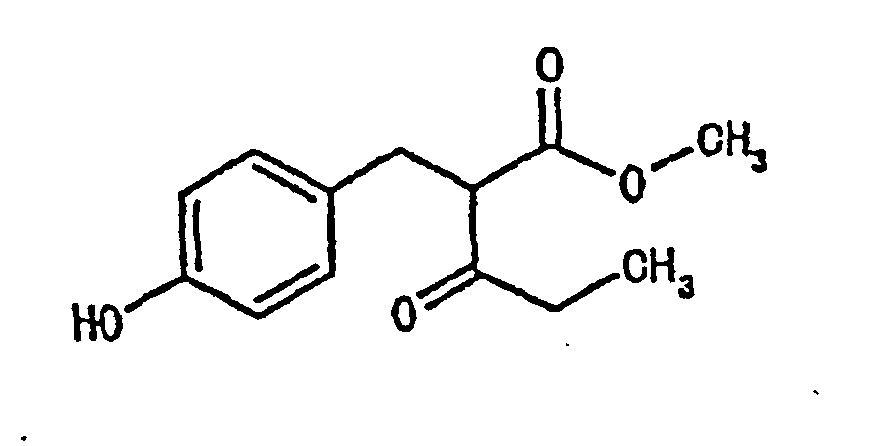
- The olefin compound (11.8 g, 50 mmol) synthesized in Reference Example 38 was dissolved in methanol (200 ml). Thereto was added a 10% palladium carbon powder (water content: 50%) (2.4 g, 1 wt. % as Pd). The mixture was stirred vigorously in a hydrogen atmosphere at normal pressure at room temperature for 1.5 hours. The unnecessary matter was removed by filtration using Celite. The filtrate was subjected to vacuum distillation to obtain an intended title compound (12.0 g, 100%) as a colorless transparent syrup.
1H-N.M.R.(CDCl3, 270MHz)d=7.02 and 6.70(2d, each 2H, J=8.5Hz), 4.90(s, 1H), 3.68(s, 6H), 3.65(t, 1H, J=7.0Hz), 3.10(d, 2H, J=7.0Hz) -

- 4-Hydroxybenzaldehyde (4.0 g, 33 mmol) and methyl 3-oxopentanoate (4.33 g, 33 mmol) were used as starting materials and the same operation as in Reference Examples 38 and 39 was used, whereby an intended title compound (5.0 g, 61%) was obtained as a colorless transparent syrup.
1H-N.M.R.(CDCl3, 270MHz)d=7.01 and 6.81(2d, each 2H, J=8.4Hz), 5.63(s, 1H), 3.77(t, 1H, J=7.7Hz), 3.68(s, 3H), 3.08(d, 1H, J=7.7Hz), 2.65-2.10(m, 2H), 0.98(t, 3H, J=7.3Hz) -
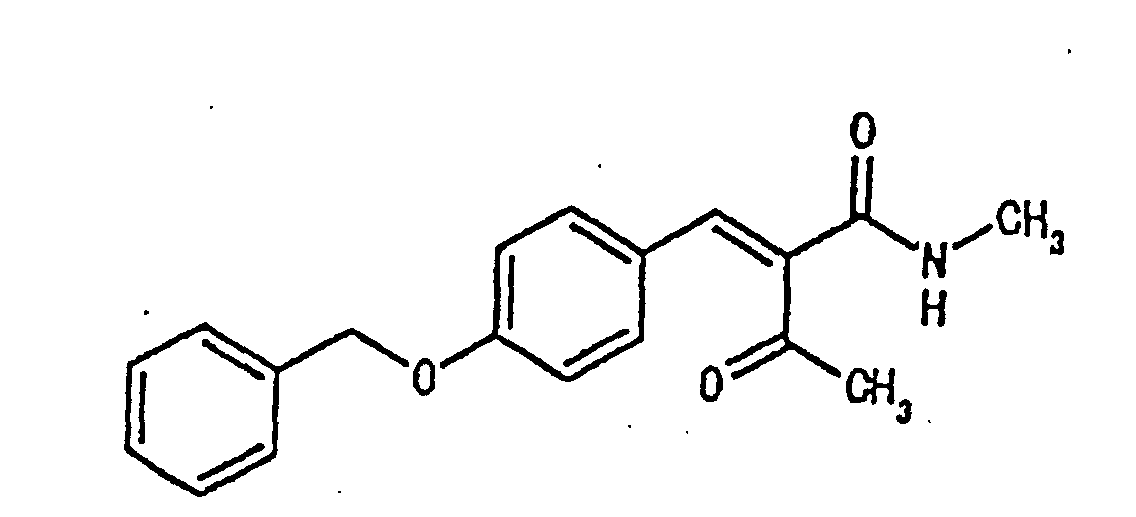
- 4-Benzyloxybenzaldehyde (7.22 g, 34 mmol) and a 65% aqueous N-methylacetoacetamide solution (6.02 g, 30 mmol) were treated in the same manner as in Reference Example to obtain an intended title compound (3.27 g, 32%) as a light brown syrup.
1H-N.M.R.(CDCl3, 270MHz)d=7.52-7.32(m, 8H), 6.97(d, 2H, J=9.2Hz), 5.83(q, 1H, J=4.9Hz), 5.10(s, 2H), 2.92(d, 3H, J=4.9Hz), 2.41(s, 3H) -

- The olefin compound (3.26 g, 10.5 mmol) synthesized in Reference Example 41 was treated in the same manner as in Reference Example 7 to obtain an intended title compound (1.97 g, 85%) as a colorless transparent syrup.
1H-N.M.R.(CDCl3, 270MHz)d=8.53(s, 1H), 6.98 and 6.74(2d, each 2H, J=8.8Hz), 6.75-6.70(m, 1H), 3.57(t, 1H, J=7.5Hz), 3.13-2.97(m, 2H), 2.73(d, 3H, J=5.0Hz), 2.11(s, 3H) -
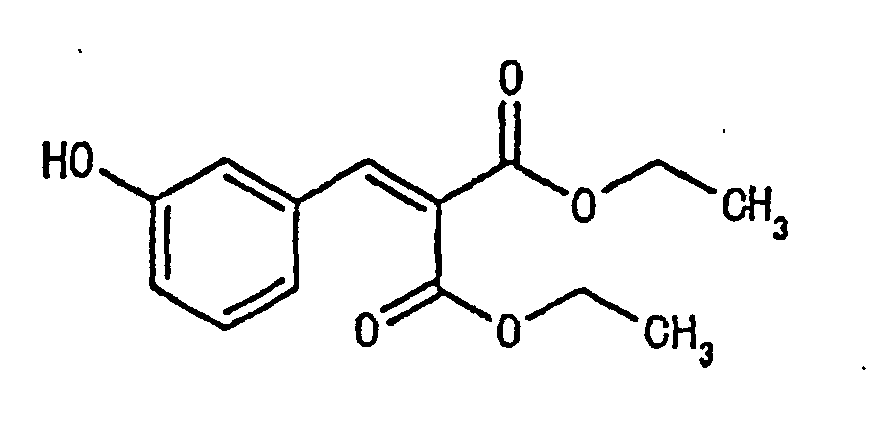
- 3-Hydroxybenzaldehyde (12.2 g, 0.1 mol) and diethyl malonate (16.0 g, 0.1 mol) were treated in the same manner as in Reference Example 38 to obtain an intended title compound (17.2 g, 65%) as light brown crystals.
Melting point = 72 to 74°C
1H-N.M.R.(CDCl3, 270MHz)d=7.68(s, 1H), 7.22(t, 1H, J=8.0Hz), 6.96(d, 1H, J=8.0Hz), 6.92(s, 1H), 6.90(d, 1H, J=8.0Hz), 6.24(s, 1H), 4.35 and 4.31(2q, each 2H, J=6.9Hz), 1.36-1.24(m, 6H) -
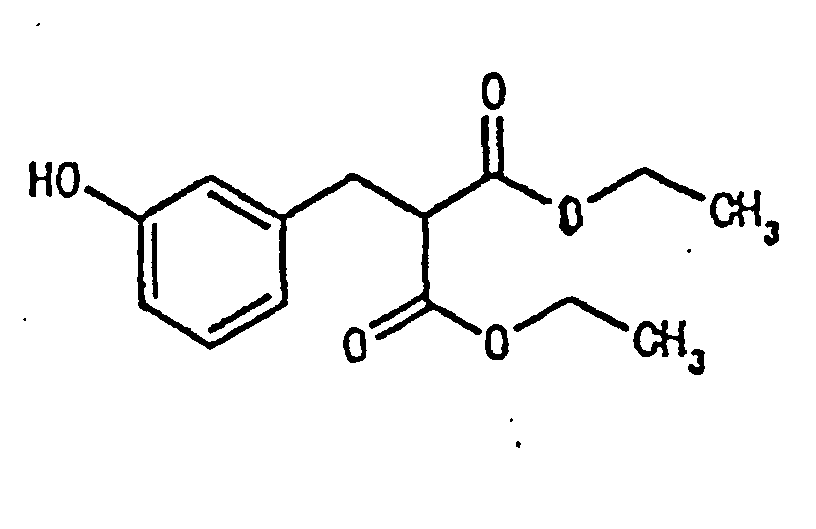
- The olefin compound (13.2 g, 50 mmol) synthesized in Reference Example 43 was treated in the same manner as in Reference Example 39 to obtain an intended title compound (13.5 g, 100%) as a colorless transparent syrup.
1H-N.M.R.(CDCl3, 270MHz)d=7.13(t, 1H, J=8.0Hz), 6.76-6.67(m, 3H), 4.16(q, 4H, J=7.3Hz), 3.65(t, 1H, J=8.0Hz), 3.17(d, 2H, J=8.0Hz), 1.21(t, 6H, J=7.3Hz) -

- 3-Hydroxy-4-methoxybenzaldehyde (7.61 g, 50 mmol) and diethyl malonate (9.61 g, 60 mol) were treated in the same manner as in Reference Example 38 to obtain an intended title compound (11.8 g, 80%) as milky-white crystals.
Melting point = 81 to 83°C
1H-N.M.R.(CDCl3, 270MHz)d=7.61(s, 1H), 7.05-6.99(m, 2H), 6.83(d, 1H, J=8.2Hz), 5.65(s, 1H), 4.37 and 4.29(2q, each 2H, J=7.3Hz), 3.92(s, 3H), 1.36-1.30(m, 6H) -

- The olefin compound (5.89 g, 20 mmol) synthesized in Reference Example 45 was treated in the same manner as in Reference Example 39 to obtain an intended title compound (5.63 g, 950%) as a colorless transparent syrup.
1H-N.M.R.(CDCl3, 270MHz)d=6.78-6.66(m, 3H), 5.59(s, 1H), 4.14(q, 4H, J=7.3Hz), 3.59(t, 1H, J=8.0Hz), 3.12(d, 2H, J=8.0Hz), 1.22(t, 6H, J=7.3Hz) - It was proved by the following experiments that the compounds represented by formulae (1) and (2) according to the present invention have the activity to control PPAR receptor.
- The entire procedure was carried out according to the fundamental methods of genetic engineering and the ordinary method in the yeast one-hybrid or two-hybrid system was applied.
- PGL2-UAS5-TK-luc was prepared as a reporter plasmid carrying a response sequence of Gal4 protein as a basic transcription factor of yeast, an enhancer sequence with five repeat part of UAS, a luciferase gene (luc) under the control of timidine kinase (TK) promoter. Specifically, a DNA fragment encoding a TK promoter (-105/+51) on the downstream side of an enhancer sequence comprising two time repeat of UAS was amplified by PCR using pRL-TK carrying a TK promoter (Promega, Trade name: Catalogue No. E2241) as the template and the primers: 5' primer (SEQ ID NO: 1)After the fragment was cleaved with XhoI-Hind III, pGL2-UAS2-TK-luc was obtained by inserting the resultant fragment into the XhoI-Hind III site located on the upstream side of a luciferase structural gene on pGL2-Basic vector (Promega, Trade name: Catalogue No. E1641).

- After cleavage of a synthetic DNA as an enhancer sequence comprising three time repeat of Ga14 response sequence (SEQ ID NO: 3): 5'-ATTGGTAC(CGACGGAGTACTGTCCTCCGAGCT)x3 AGATCTCGAC) using KpnI and BgIII was carried out, pGL2-UAS5-TK-luc was prepared by inserting the resulting fragment into the KpnI - BgIIIb site of pGL2-UAS2-TK-luc.
- A vector for expression of a chimera receptor protein, in which a ligand binding region of an internuclear receptor human PPARα or PPARγ receptor was fused with the carboxyl terminal of a DNA binding region of yeast Ga14 protein, was prepared as follows:
- The structural gene of pSG5 (STRATAGENE, Trade Name: Catalogue No. 216201) as the basic expression vector was changed for the chimera receptor except that the promoter-enhancer region was maintained as it was.
- The DNA encoding the ligand binding region of the human PPARα or PPARγ receptor was fused on the downstream side of the DNA encoding the DNA binding region and the amino acid sequence from 1 to 147 positions of Ga14 protein so that their reading frames were fitted and the resulting fused DNA was inserted into pSG5 (trade name) on the down stream side of the promoter-enhancer region. In this step, the DNA sequence was arranged so that a signal for transfer into the nucleus (Ala Pro Lys Lys Lys Arg Lys Val Gly (SEQ ID: No:4) derived from SV-40T antigen was located on the amino terminal of the ligand binding region of PPARα or PPARγ receptor in order to localize the chimera receptor in the nucleus.
- Based on comparison of the human PPAR receptors described in R. Mukherjee et al., [see J. Steroid Biochem. Molec. Biol., Vol. 51, p157 (1994)] and M. E. Green et al., [see Gene Expression, Vol. 4, p281 (1995))], as the structural gene part used for the ligand binding region PPARα or PPARγ, the human PPARα ligand binding region: Ser167-Tyr468; and the PPARγ ligand binding region: Ser176-Tyr478 were used, which had the same sequences corresponding to Ser204-Tyr506 for human PPARγ1 receptor and human PPARγ2, respectively.
- In order to monitor influence against the basic transcription, an expression vector was prepared which carried a DNA encoding only the DNA binding region and the amino acid sequence from 1 to 147 position of Gal4 protein defective in its PPAR ligand binding region and a signal for transfer into the nucleus of SV-40T-antigen.
- CV-1 cells used as a host cell were cultivated according to an ordinary method. Specifically, a fetal bovine serum (Intergent, Catalogue No. 1020-90) was added to a Dulbecco's modified Eagle's medium (DMEM) so that the final concentration became 10%. Further, penicillin G (50 U/ml) and streptomycin sulfate (50 µg/ml) were added. Cultivation was conducted in the resulting medium in a 5% carbon dioxide gas at 37°C.
- On the previous day of transfection, the cells were planted into a 24-well plate in an amount of 1.5x10⁵ cells/well, and transfection was conducted using Lipofect AMINE (trade name, GIBCOBRL, Catalogue No. 26300-61). Specifically, to a serum-free medium, OPti-MEM (trade name, GIBCOBRL, Catalogue No. 31985-070) (40 µl/well) were added a reporter plasmid (100 ng/well), a Gal4-PPAR expression vector (12.5 ng/well), pRL-TK (trade name) (200 ng/well) as an internal control, pGEM-3Zf (+) (trade name, Promega, Catalogue No. p2271) (287.5 ng/well) as a carrier DNA and Lipofect AMINE (trade name, GIBCOBRL, Catalogue No. 26300-61) (2.6 µl/well), followed by thorough mixing. Then, Opti-MEM (trade name) (170.2 µl/well) was added. The resulting mixture was added to the cells washed with PBS (phosphate buffered saline) and Opti-MEM (trade name). Cultivation was conducted at 37°C for 16 hours. Then, the medium was substituted with DMEM-10% active carbon-dextran-treated fetal bovine serum (trade name, HyClone, Catalogue No. SH30068.03) containing a present compound; cultivation was conducted at 37°C for 24 hours to fuse the cells; and luciferase activity was measured according to an ordinary method.
- Regarding the PPARα agonist activity, a luciferase activity was taken as 100 which appeared when there was added 10 µM of a positive control compound Wy-14,643 capable of significantly activating the transcription of luciferase gene against PPARα [see Cell, Vol. 83, p813 (1995); J. Biol. Chem., Vol. 270, p12953 (1995); Proc. Natl. Acad. Sci. USA, Vol. 94, p4312 (1997); J. Biol. Chem., Vol. 272, p3406 (1997)]; and a luciferase activity which appeared when there was added a present compound in an amount of 0.1, 1.0 or 10 µM, was shown in Table 1, as a relative activity to the above.
- Regarding the PPARγ agonist activity, a luciferase activity was taken as 100 which appeared when there was added 1 µM of a positive control compound Pioglitazone capable of significantly activating the transcription of luciferase gene against PPARγ [see Cell, Vol. 83, p803 (1995) and J. Biol. Chem., Vol. 270, p12953 (1995)]; and a luciferase activity which appeared when there was added a present compound in an amount of 0.1, 1.0 or 10 µM, was shown in Table 2, as a relative activity to the above.
PPARα agonist activity Compound No. Relative activity 0.1 µM 1 µM 10 µM Example 1 (101) 0.2 0.9 28.7 Example 2 (61) NT 10.4 24.6 Example 3 (102) 0.4 0.9 8.5 Example 4 (104) 0.3 0.3 0.3 Example 5 (71) 0.3 0.5 28.4 Example 6 (67) 5.7 47.1 74.0 Example 7 (63) 0.4 4.5 64.4 Example 8 (65) 0.3 0.3 1.5 Example 9 (97) 0.3 0.4 23.0 Example 10 (32) 0.2 0.3 50.1 Example 11 (99) 25.2 64.3 68.6 Example 12 (85) 0.2 0.3 6.4 Example 13 (76) 0.3 0.9 41.1 Example 14 (86) 0.3 0.3 2.1 Example 15 (82) 0.3 0.3 5.0 Example 16 (32) 0.3 0.4 45.2 Example 18 (112) 0.3 0.3 0.3 Example 19 (108) 0.3 0.3 0.6 NT = Not tested. PPARγ agonist activity Compound No. Relative activity 0.1 µM 1 µM 10 µM Example 1 (101) 98.6 127.1 102.3 Example 2 (61) 85.0 114.2 NT Example 3 (102) 74.1 114.5 108.3 Example 4 (104) 0.4 1.1 14.9 Example 5 (71) 0.3 0.4 11.6 Example 6 (67) 122.1 140.3 124.9 Example 7 (63) 13.5 63.3 114.1 Example 8 (65) 1.3 13.0 107.2 Example 9 (97) 0.6 16.8 110.1 Example 10 (32) 1.0 20.8 123.9 Example 11 (99) 75.2 114.7 105.6 Example 12 (85) 1.2 60.4 111.4 Example 13 (76) 103.9 139.6 130.5 Example 14 (86) 19.6 76.0 132.3 Example 15 (82) 52.3 132.8 124.6 Example 16 (32) 1.6 71.8 127.4 Example 18 (112) 0.5 22.2 89.9 Example 19 (108) 25.2 83.5 97.9 Example 20 (114) 9.3 91.0 109.5 Example 21 (118) 1.4 1.9 22.4 Example 22 (120) 3.5 62.3 107.9 Example 23 (137) 2.8 30.5 63.1 Example 24 (141) 0:8 1.2 9.4 Example 25 (144) 0.7 1.9 6.2 Example 26 (147) 0.1 3.7 12.8 Example 27 (128) 1.2 2.1 42.5 Example 28 (129) 1.3 2.1 14.7 - It was proven by the following experiment that the compound represented by the formula (1) according to the present invention has an action of removing the hTNFα's inhibition for glucose intake induced by insulin stimulus.
- The present compound's action of removing the hTNF α's inhibition for glucose intake induced by insulin stimulus in 3T3-L1 lipocytes was investigated by measurement of glucose concentration in medium.
- Specifically, mouse 3T3-L1 fibroblasts (produced by Dainippon Pharmaceutical Co., Ltd.) were suspended in a Dulbecco's modified Eagle's medium (DMEM) containing 10% of a bovine serum and planted in a 24-well collagen plate; and cultivation was conducted until the cells became confluent. Cultivation was continued for a further 2 days (the day of cultivation completion was taken as the 0 (zero) day of differentiation induction). Then, the medium was substituted with a differentiation induction medium (a DMEM containing 10% of a fetal bovine serum, 0.5 mM of 3-isobutyl-1-methyl-xanthine, 0.25 µM of dexamethasone and 1 µg/ml of insulin), followed by cultivation for 40 hours. On the second day of differentiation induction, the medium was substituted with a DMEM containing 10% of a fetal bovine serum and 1 µg/ml of insulin and cultivation was conducted. On the 4th day of differentiation induction, the medium was substituted with a DMEM containing 10% of a fetal bovine serum and 50 ng/ml of insulin and cultivation was conducted. On the 7th day of differentiation induction when the cells differentiated sufficiently into lipocytes, a compound of the present invention was added to a DMEM containing 10% of a fetal bovine serum, 50 ng/ml of insulin and 5 ng/ml of hTNFα and cultivation was conducted therein. The present compound was beforehand dissolved in DMSO and then added to the medium so that the final concentration of DMSO became 0.1%. On the 9th day of differentiation induction, the medium was substituted with a medium containing the present compound, having the same composition as in the 7th day of differentiation induction. In the above cultivations, 50 U/ml of penicillin and 50 µg/ml of streptomycin sulfate were added to each medium in order to avoid contamination and each cultivation was conducted in a 5% carbon dioxide gas at 37°C.
- On the 11th day of differentiation induction, the medium was substituted with a DMEM containing 2% of a bovine serum albumin (BSA), in order to remove the influence of serum, and cultivation was conducted for 4 hours. The medium was removed and the cells were washed with a Krebs-Ringer buffer (1.2 mM KH2PO4, 4.7 mM KCl, 118 mM NaCl, 25 mM NaHCO3, 2.5 mM CaCl2, pH 7.4) containing 0.1% of the BSA and 180 mg/l of glucose. Then, to each well was added 300 µl of Krebs-Ringer buffer containing 0.1% of the BSA, 180 mg/l of glucose and 0.5 ng/ml of insulin, and cultivation was conducted in a 5% carbon dioxide gas at 37°C for 3 hours.
- The glucose concentration in supernatant liquid of medium, which is an indication of sugar intake, was measured by using Glucose CII Test Wako (produced by Wako Pure Chemicals Industries, Ltd.).
- The activity (the action of removing the hTNFα's inhibition of sugar intake) of the present compound (10 µM) was shown as a relative value when the activity of a positive control compound (Pioglitazone 10 µM) was taken as 100. The results are shown in Table 3.
Compound's removal of hTNFα's inhibition for glucose metabolism Compound No. Relative activity Example 1 (101) NT Example 2 (61) 83 Example 3 (102) NT Example 4 (104) NT Example 5 (71) 67 Example 6 (67) 68 Example 7 (63) 93 Example 8 (65) 91 Example 9 (97) NT Example 10 (32) NT Example 11 (99) NT Example 12 (85) NT Example 13 (76) 81 Example 14 (86) 69 Example 15 (82) 82 Example 16 (32) 70 Example 17 (106) NT Example 18 (112) 107 Example 19 (108) 77 Example 20 (114) 85 Example 21 (118) 51 Example 22 (120) 89 Example 23 (137) 16 Example 24 (141) 48 Example 25 (144) 97 Example 26 (147) 85 Example 27 (128) 74 Example 28 (129) 23 NT = Not tested - It was proved by the following experiment that a compound represented by the formula (1) according to the present invention has an action for inhibiting the production of TNFα.
- A luciferase gene was bonded to the downstream side of human TNF transcription-controlling region . The resulting material was stably inserted into the chromosomes of 3T3-L1 cells. The thus-obtained cell strain No. 46 was used for evaluation.
- The cell strain No. 46 was cultivated according to an ordinary method. Specifically, a bovine serum (Cell Culture Technology, Catalogue No. CC017-502) was added to a Dulbecco's modified Eagle's medium (DMEM) so that the final concentration became 10%. Further, 50 U/ml of penicillin G, 50 ug/ml of streptomycin sulfate and 0.4 mg/ml of G418 were added. In the resulting medium was conducted cultivation in a 5% carbon dioxide gas at 37°C.
- The cell strain No. 46 was planted into a PLL (poly L-lysine)-coated 48-well plate. When the cell strain reached confluence and then at least two days passed, the medium was substituted with the above medium containing 9 ng/m of hTNF (Genzyme) and an activity for TNFα transcription was induced. hTNF was added and, simultaneously therewith, a compound of the present invention was added so that the final concentration became 10 µM. 24 hours later, the cells were observed by a microscope. Then, the cells were fused and the luciferase activity was measured according to an ordinary method.
- Regarding the activity for TNFα transcription, the luciferase activity when DMSO was added in place of the compound, was taken as 100; and the relative activity when 10 uM of the present compound was added, was shown in Table 1. Incidentally, the relative luciferase activity when no hTNF was added, was 40%. The results of evaluation are shown in Table 4.
Activity for TNFα transcription Compound No. Relative activity 10 µM Example 3 (102) 71.7 Example 4 (104) 64.0 Example 24 (141) 71.6 Example 26 (147) 59.0 - Type 2 diabetes mice "KK-Ay/Ta Jci" (male, Clea Japan, Inc., 10-week old) put in cages were used (each cage contained 5 mice). In the morning of the 1st day of test start, a blood was collected from the orbital vein of each mouse. The blood sugar value in the blood was measured by subjecting the blood to deproteinization using perchloric acid, subjecting the resulting material to centrifugation, and subjecting the resulting supernatant liquid to a new blood sugar test (Boehringer Mannheim). Further, the blood was subjected to centrifugation to obtain a plasma and the triglyceride concentration and free fatty acid concentration in the plasma were measured using Triglyceride E-Test Wako and NEFA-C Test Wako (Wako Pure Chemical Industries, Ltd.), respectively. Grouping was made so that the blood sugar values in individual groups became the same. Then, an Example 2 compound (exemplary compound No. 61) was suspended in a 0.5% aqueous CMC solution and administered orally one time per day for 4 days. In the 5th day of test, blood collection was made to measure blood sugar value, triglyceride concentration and free fatty acid concentration. Incidentally, a group to which only the 0.5% aqueous CMC solution was administered, was used as a control group; and Pioglitazone was used in a positive control group. The reduction in parameter in each group was calculated using the following formula. The results are shown in Table 5.
Results of in-vivo evaluation of reduction in blood sugar and reduction in lipid, using KKAy mice Compound group Dose (mg/kg) Reduction in blood sugar (%) Reduction in triglyceride (%) Reduction in free fatty acid (%) Control group - 9 -8 13 Example 2 30 50 57 46 Pioglita-zone 30 28 60 49 - The compound of the present invention is a novel substance and, as shown in Examples and Test Examples, allows PPARα or γ (which is an intranuclear transcription factor) to function strongly. Further, the present compound is low in toxicity and is therefore expected to be used as a preventive or therapeutic agent against various diseases related to PPARα or γ.
Claims (8)
- A quinoline derivative represented by the following formula (1) or a pharmacologically acceptable salt thereof:(wherein R1, R2, R3, R4, R5, R6 and R11 are each independently a hydrogen atom, a lower alkyl group of 1 to 4 carbon atoms, a halogen atom, a hydroxyl group, an alkyloxy group of 1 to 10 carbon atoms, a nitro group, an optionally substituted phenyl group, an amino group which may be substituted with a lower alkyl group of 1 to 4 carbon atoms, a cyano group, a carboxyl group, a lower alkyloxycarbonyl group of 1 to 4 carbon atoms, an aminocarbonyl group which may be substituted with a lower alkyl group of 1 to 4 carbon atoms, or a trifluoromethyl group; R7 and R8 are a hydrogen atom or a lower alkyl group of 1 to 4 carbon atoms and may directly bond to each other to form a carbon-to-carbon double bond; R9 is a hydroxyl group, an alkyloxy group of 1 to 10 carbon atoms, an optionally substituted phenyloxy group, a thiol group, an alkylthiol group of 1 to 10 carbon atoms, an optionally substituted phenylthiol group, a lower alkylcarbonyl group of 1 to 4 carbon atoms, an optionally substituted benzoyl group, a lower alkyloxycarbonyl group of 1 to 4 carbon atoms, an aminocarbonyl group which may be substituted with a lower alkyl group of 1 to 4 carbon atoms, or a carboxyl group; R10 is a hydroxyl group, a lower alkyl group of 1 to 4 carbon atoms, a lower alkyloxy group of 1 to 4 carbon atoms, an optionally substituted phenyloxy group or an amino group which may be substituted with a lower alkyl group of 1 to 4 carbon atoms; and n is an integer of 1 to 4).
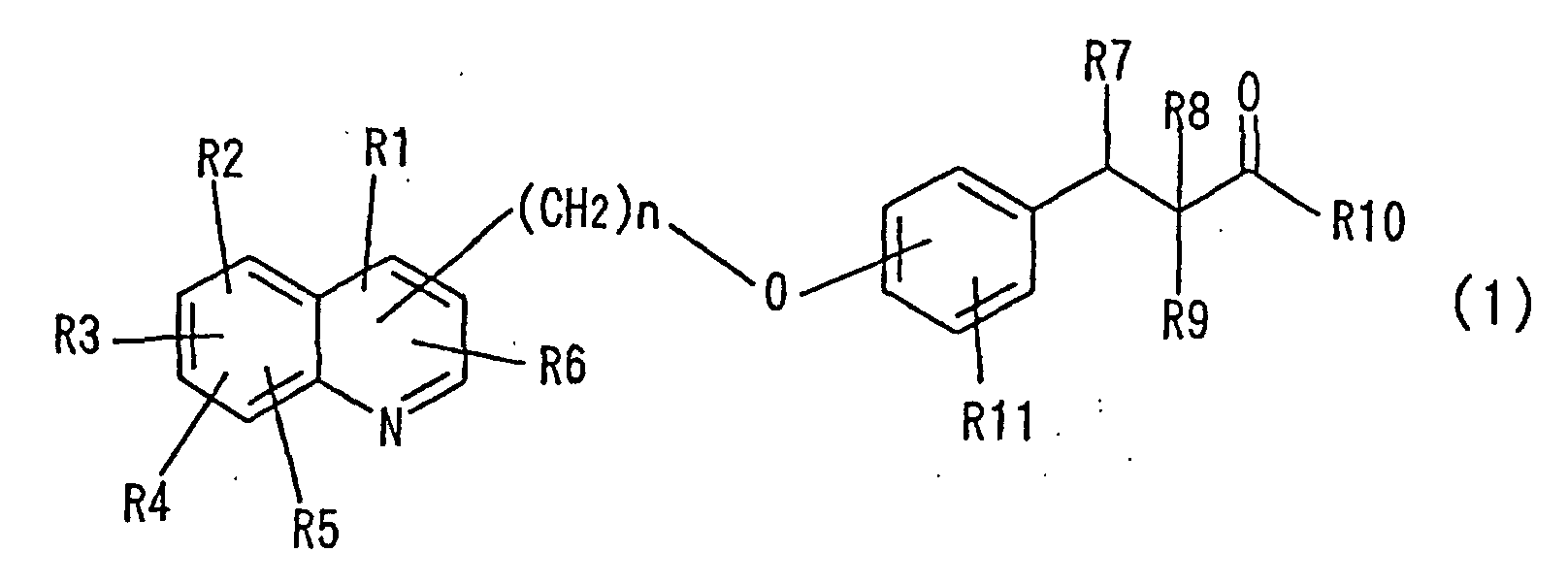
- A quinoline derivative represented by the following formula (2) or a pharmacologically acceptable salt thereof:(wherein R1, R2, R3, R4, R5, R6, R7, R8 and R11 have the same definitions as in Claim 1; and R12 is a lower alkyl group of 1 to 4 carbon atoms or an optionally substituted phenyl group).

- A quinoline derivative represented by the following formula (3) or a pharmacologically acceptable salt thereof:

- An antagonist for peroxisome proliferator-activated receptor α or γ (which is an intranuclear transcription factor), comprising a quinoline derivative set forth in Claim 1, 2 or 3 as an active ingredient.
- An inhibitor for production of tumor necrosis factor α, containing, as an active ingredient, a quinoline derivative set forth in Claim 1, 2 or 3.
- A preventive or therapeutic agent for diabetes comprising a quinoline derivative set forth in Claim 1, 2 or 3 as an active ingredient.
- A preventive or therapeutic agent for hyperlipemia comprising a quinoline derivative set forth in Claim 1, 2 or 3 as an active ingredient.
- A preventive or therapeutic agent for arterioscrelosis comprising a quinoline derivative set forth in Claim 1, 2 or 3 as an active ingredient.
Applications Claiming Priority (3)
| Application Number | Priority Date | Filing Date | Title |
|---|---|---|---|
| JP2000079146 | 2000-03-21 | ||
| JP2000079146A JP2001261654A (en) | 2000-03-21 | 2000-03-21 | Quinoline derivative and intranuclear receptor agonist containing the same as active ingredient |
| PCT/JP2001/002168 WO2001070698A1 (en) | 2000-03-21 | 2001-03-19 | Quinoline derivatives and medicinal use thereof |
Publications (1)
| Publication Number | Publication Date |
|---|---|
| EP1266888A1 true EP1266888A1 (en) | 2002-12-18 |
Family
ID=18596441
Family Applications (1)
| Application Number | Title | Priority Date | Filing Date |
|---|---|---|---|
| EP01914178A Withdrawn EP1266888A1 (en) | 2000-03-21 | 2001-03-19 | Quinoline derivatives and medicinal use thereof |
Country Status (4)
| Country | Link |
|---|---|
| US (1) | US20030212100A1 (en) |
| EP (1) | EP1266888A1 (en) |
| JP (1) | JP2001261654A (en) |
| WO (1) | WO2001070698A1 (en) |
Cited By (6)
| Publication number | Priority date | Publication date | Assignee | Title |
|---|---|---|---|---|
| WO2005049573A1 (en) * | 2003-11-05 | 2005-06-02 | F. Hoffmann-La Roche Ag | Phenyl derivatives as ppar agonists |
| WO2005049572A1 (en) * | 2003-11-05 | 2005-06-02 | F. Hoffmann-La Roche Ag | Benzannelated compounds as ppar activators |
| WO2006111234A1 (en) * | 2005-04-19 | 2006-10-26 | Merck Patent Gmbh | Uv protection |
| WO2008144865A3 (en) * | 2007-05-28 | 2009-07-23 | Fundacao Universidade Fed De S | Process for the preparation and pharmaceutical formulations for 4-quinolinones and quinolines and use thereof |
| WO2009153496A2 (en) | 2008-05-26 | 2009-12-23 | Genfit | Ppar agonist compounds, preparation and uses |
| WO2024132001A1 (en) * | 2022-12-21 | 2024-06-27 | Charles University, Faculty Of Pharmacy In Hradec Kralove | Multitarget nuclear receptor ligands based on 2-(4-(quinolin-2-yloxy)phenoxy)propanoic acid and 2-(4-(quinoxalin-2-yloxy)phenoxy)propanoic acid for the treatment of metabolic and liver diseases |
Families Citing this family (5)
| Publication number | Priority date | Publication date | Assignee | Title |
|---|---|---|---|---|
| WO2003006022A1 (en) * | 2001-07-09 | 2003-01-23 | Dr. Reddy's Laboratories Ltd. | Tetrahydroquinoline derivatives and their use in medicine, process for their preparation and pharmaceutical compositions containing them |
| PE20050676A1 (en) | 2003-12-12 | 2005-11-02 | Wyeth Corp | QUINOLINES REFERRED TO CARDIOVASCULAR DISEASES |
| WO2007063384A2 (en) * | 2005-12-01 | 2007-06-07 | Pfizer Products Inc. | Pyrimidine derivatives for the treatment of abnormal cell growth |
| WO2008112479A1 (en) * | 2007-03-09 | 2008-09-18 | Novartis Ag | Salts of 3- (1h-ind0l-3-yl) -4- [2- (4-methyl-piperazin-i-yl) -quinazolin-4-yl] -pyrrole-2, 5-di one |
| WO2017189958A1 (en) * | 2016-04-29 | 2017-11-02 | The Board Of Regents Of The University Of Oklahoma | Phenylquinoline compositions for treatment of ocular disorders and conditions |
Family Cites Families (5)
| Publication number | Priority date | Publication date | Assignee | Title |
|---|---|---|---|---|
| WO1999011255A1 (en) * | 1997-08-28 | 1999-03-11 | Ono Pharmaceutical Co., Ltd. | Peroxisome proliferator-activated receptor controllers |
| IL135673A0 (en) * | 1997-10-17 | 2001-05-20 | Aventis Pharm Prod Inc | Therapeutic uses of quinoline derivatives |
| IL145922A0 (en) * | 1999-04-28 | 2002-07-25 | Aventis Pharma Gmbh | Di-aryl acid derivatives as ppar receptor ligands |
| PT1177176E (en) * | 1999-04-28 | 2006-08-31 | Aventis Pharma Gmbh | DERIVATIVES OF TRIARILIC ACIDS AS LIGANDS OF PPAR RECEPTORS. |
| IT1320162B1 (en) * | 2000-02-09 | 2003-11-18 | Rotta Research Lab | DERIVATIVES OF THYROSIN WITH ANTI LEUKOTRIENIC ACTIVITY, PROCEDURES FOR THEIR PREPARATION AND THEIR PHARMACEUTICAL USE. |
-
2000
- 2000-03-21 JP JP2000079146A patent/JP2001261654A/en not_active Withdrawn
-
2001
- 2001-03-19 EP EP01914178A patent/EP1266888A1/en not_active Withdrawn
- 2001-03-19 WO PCT/JP2001/002168 patent/WO2001070698A1/en not_active Ceased
- 2001-03-19 US US10/239,310 patent/US20030212100A1/en not_active Abandoned
Non-Patent Citations (1)
| Title |
|---|
| See references of WO0170698A1 * |
Cited By (15)
| Publication number | Priority date | Publication date | Assignee | Title |
|---|---|---|---|---|
| EP2314576A1 (en) * | 2003-11-05 | 2011-04-27 | F.Hoffmann-La Roche Ag | Phenyl derivatives as PPAR agonists |
| WO2005049572A1 (en) * | 2003-11-05 | 2005-06-02 | F. Hoffmann-La Roche Ag | Benzannelated compounds as ppar activators |
| US7115611B2 (en) | 2003-11-05 | 2006-10-03 | Hoffmann-La Roche Inc. | Phenyl derivatives, their manufacture and use as pharmaceutical agents |
| WO2005049573A1 (en) * | 2003-11-05 | 2005-06-02 | F. Hoffmann-La Roche Ag | Phenyl derivatives as ppar agonists |
| CN1875002B (en) * | 2003-11-05 | 2011-08-03 | 霍夫曼-拉罗奇有限公司 | Phenyl derivatives as PPAR agonists |
| US7495001B2 (en) | 2003-11-05 | 2009-02-24 | Hoffmann-La Roche Inc. | Benzannelated derivatives, their manufacture and use as pharmaceutical agents |
| WO2006111234A1 (en) * | 2005-04-19 | 2006-10-26 | Merck Patent Gmbh | Uv protection |
| WO2006111233A1 (en) * | 2005-04-19 | 2006-10-26 | Merck Patent Gmbh | Antioxidants |
| US8106233B2 (en) | 2005-04-19 | 2012-01-31 | Merck Patent Gmbh | Antioxidant compounds |
| US8268293B2 (en) | 2005-04-19 | 2012-09-18 | Merck Patent Gmbh | UV protection |
| WO2008144865A3 (en) * | 2007-05-28 | 2009-07-23 | Fundacao Universidade Fed De S | Process for the preparation and pharmaceutical formulations for 4-quinolinones and quinolines and use thereof |
| WO2009153496A2 (en) | 2008-05-26 | 2009-12-23 | Genfit | Ppar agonist compounds, preparation and uses |
| WO2009153496A3 (en) * | 2008-05-26 | 2010-03-25 | Genfit | Ppar agonist compounds and preparation and uses thereof for treating diabetes and/or dyslipidemia |
| US8461183B2 (en) | 2008-05-26 | 2013-06-11 | Genfit | PPAR agonist compounds, preparation and uses |
| WO2024132001A1 (en) * | 2022-12-21 | 2024-06-27 | Charles University, Faculty Of Pharmacy In Hradec Kralove | Multitarget nuclear receptor ligands based on 2-(4-(quinolin-2-yloxy)phenoxy)propanoic acid and 2-(4-(quinoxalin-2-yloxy)phenoxy)propanoic acid for the treatment of metabolic and liver diseases |
Also Published As
| Publication number | Publication date |
|---|---|
| JP2001261654A (en) | 2001-09-26 |
| US20030212100A1 (en) | 2003-11-13 |
| WO2001070698A1 (en) | 2001-09-27 |
Similar Documents
| Publication | Publication Date | Title |
|---|---|---|
| JP5426813B2 (en) | Salts and polymorphs of potent antidiabetic compounds | |
| JP6152227B2 (en) | New triazolo-pyridine compounds | |
| RU2095354C1 (en) | Thiazolidine compounds, method of preparation thereof, method of reducing sugar content in blood of mammals | |
| SK12122001A3 (en) | Novel tricyclic compounds and their use in medicine, process for their preparation and pharmaceutical composition containing them | |
| WO2009111943A1 (en) | The compounds as the estrogen related receptors modulators and the uses thereof | |
| US8759355B2 (en) | Aryl pyrimidine derivatives, preparation methods and pharmaceutical uses thereof | |
| NO334606B1 (en) | Compounds, pharmaceutical preparations containing them as well as such compounds and preparations for the treatment of metabolic disorders | |
| IL280598B1 (en) | 2,6-diamino pyridine compounds | |
| JP7813730B2 (en) | Thyromimetic agents | |
| US20030212100A1 (en) | Quinoline derivatives and medicinal use thereof | |
| EP1562920B1 (en) | Antiinflammatory 3-arylthio-3-thiazolyl-alkylamines | |
| CN105899509A (en) | Isopropyl triazolo pyridine compounds | |
| CN119080829A (en) | A novel compound and its pharmaceutical composition and use | |
| JP2001261612A (en) | Catecholpropionic acid derivative and nuclear receptor agonist containing the same as active ingredient | |
| US7326727B2 (en) | Furanthiazole derivatives as heparanase inhibitors | |
| EP1036075B1 (en) | Substituted thiazolidinedione and oxazolidinedione having antidiabetic, hypolipidemia and antihypertensive properties | |
| CN101463031A (en) | Indazole and tetrahydrochysene indazole compounds, and preparation, pharmaceutical composition and use thereof | |
| JPH10259129A (en) | Arterialization inhibitor | |
| EP1896396A1 (en) | Anthranilic acid derivatives | |
| US8653134B2 (en) | Hydroxyphenol derivatives, processes for the preparation thereof, pharmaceutical compositions them, and therapeutic uses thereof | |
| KR20070119713A (en) | Substituted carboxylic acid derivatives for use in the treatment of diabetes and lipid disorders, their preparation and use | |
| JP2008512384A (en) | Fibrate compounds having PPAR agonist activity | |
| JP2001131173A (en) | Bicyclic heterocyclic derivative | |
| US20070066683A1 (en) | Selective peroxisome proliferator activated receptor modulators | |
| KR100968705B1 (en) | Novel 2-phenylpyrimidine derivatives and preparation methods thereof |
Legal Events
| Date | Code | Title | Description |
|---|---|---|---|
| PUAI | Public reference made under article 153(3) epc to a published international application that has entered the european phase |
Free format text: ORIGINAL CODE: 0009012 |
|
| 17P | Request for examination filed |
Effective date: 20021014 |
|
| AK | Designated contracting states |
Kind code of ref document: A1 Designated state(s): AT BE CH CY DE DK ES FI FR GB GR IE IT LI LU MC NL PT SE TR |
|
| RIN1 | Information on inventor provided before grant (corrected) |
Inventor name: NAGASE, HIROSHI Inventor name: NAKAO, TOSHIFUMI Inventor name: ASADA, NORIAKI Inventor name: MORIKAWA, MAKI Inventor name: FUKAZAWA, NOBUYUKI Inventor name: TSUNODA, HIDETOSHI Inventor name: YAMAKI, TOSHIFUMI Inventor name: KIBAYASHI, KENJI Inventor name: CHIBA, KYOKO Inventor name: MIGITA, HIDEYUKI |
|
| STAA | Information on the status of an ep patent application or granted ep patent |
Free format text: STATUS: THE APPLICATION HAS BEEN WITHDRAWN |
|
| 18W | Application withdrawn |
Effective date: 20040618 |