EP1266651A2 - UV absorbing and photostabilizing agents and compositions and external preparation for skin - Google Patents
UV absorbing and photostabilizing agents and compositions and external preparation for skin Download PDFInfo
- Publication number
- EP1266651A2 EP1266651A2 EP02013178A EP02013178A EP1266651A2 EP 1266651 A2 EP1266651 A2 EP 1266651A2 EP 02013178 A EP02013178 A EP 02013178A EP 02013178 A EP02013178 A EP 02013178A EP 1266651 A2 EP1266651 A2 EP 1266651A2
- Authority
- EP
- European Patent Office
- Prior art keywords
- group
- ultraviolet
- skin
- hydrogen atom
- ultraviolet absorbent
- Prior art date
- Legal status (The legal status is an assumption and is not a legal conclusion. Google has not performed a legal analysis and makes no representation as to the accuracy of the status listed.)
- Granted
Links
Images


Classifications
-
- C—CHEMISTRY; METALLURGY
- C07—ORGANIC CHEMISTRY
- C07D—HETEROCYCLIC COMPOUNDS
- C07D237/00—Heterocyclic compounds containing 1,2-diazine or hydrogenated 1,2-diazine rings
- C07D237/02—Heterocyclic compounds containing 1,2-diazine or hydrogenated 1,2-diazine rings not condensed with other rings
- C07D237/06—Heterocyclic compounds containing 1,2-diazine or hydrogenated 1,2-diazine rings not condensed with other rings having three double bonds between ring members or between ring members and non-ring members
- C07D237/10—Heterocyclic compounds containing 1,2-diazine or hydrogenated 1,2-diazine rings not condensed with other rings having three double bonds between ring members or between ring members and non-ring members with hetero atoms or with carbon atoms having three bonds to hetero atoms with at the most one bond to halogen, e.g. ester or nitrile radicals, directly attached to ring carbon atoms
- C07D237/22—Nitrogen and oxygen atoms
-
- A—HUMAN NECESSITIES
- A61—MEDICAL OR VETERINARY SCIENCE; HYGIENE
- A61K—PREPARATIONS FOR MEDICAL, DENTAL OR TOILETRY PURPOSES
- A61K8/00—Cosmetics or similar toiletry preparations
- A61K8/02—Cosmetics or similar toiletry preparations characterised by special physical form
- A61K8/0212—Face masks
-
- A—HUMAN NECESSITIES
- A61—MEDICAL OR VETERINARY SCIENCE; HYGIENE
- A61K—PREPARATIONS FOR MEDICAL, DENTAL OR TOILETRY PURPOSES
- A61K8/00—Cosmetics or similar toiletry preparations
- A61K8/02—Cosmetics or similar toiletry preparations characterised by special physical form
- A61K8/04—Dispersions; Emulsions
- A61K8/046—Aerosols; Foams
-
- A—HUMAN NECESSITIES
- A61—MEDICAL OR VETERINARY SCIENCE; HYGIENE
- A61K—PREPARATIONS FOR MEDICAL, DENTAL OR TOILETRY PURPOSES
- A61K8/00—Cosmetics or similar toiletry preparations
- A61K8/18—Cosmetics or similar toiletry preparations characterised by the composition
- A61K8/30—Cosmetics or similar toiletry preparations characterised by the composition containing organic compounds
- A61K8/49—Cosmetics or similar toiletry preparations characterised by the composition containing organic compounds containing heterocyclic compounds
-
- A—HUMAN NECESSITIES
- A61—MEDICAL OR VETERINARY SCIENCE; HYGIENE
- A61K—PREPARATIONS FOR MEDICAL, DENTAL OR TOILETRY PURPOSES
- A61K8/00—Cosmetics or similar toiletry preparations
- A61K8/18—Cosmetics or similar toiletry preparations characterised by the composition
- A61K8/30—Cosmetics or similar toiletry preparations characterised by the composition containing organic compounds
- A61K8/49—Cosmetics or similar toiletry preparations characterised by the composition containing organic compounds containing heterocyclic compounds
- A61K8/494—Cosmetics or similar toiletry preparations characterised by the composition containing organic compounds containing heterocyclic compounds with more than one nitrogen as the only hetero atom
-
- A—HUMAN NECESSITIES
- A61—MEDICAL OR VETERINARY SCIENCE; HYGIENE
- A61P—SPECIFIC THERAPEUTIC ACTIVITY OF CHEMICAL COMPOUNDS OR MEDICINAL PREPARATIONS
- A61P17/00—Drugs for dermatological disorders
- A61P17/16—Emollients or protectives, e.g. against radiation
-
- A—HUMAN NECESSITIES
- A61—MEDICAL OR VETERINARY SCIENCE; HYGIENE
- A61Q—SPECIFIC USE OF COSMETICS OR SIMILAR TOILETRY PREPARATIONS
- A61Q17/00—Barrier preparations; Preparations brought into direct contact with the skin for affording protection against external influences, e.g. sunlight, X-rays or other harmful rays, corrosive materials, bacteria or insect stings
-
- A—HUMAN NECESSITIES
- A61—MEDICAL OR VETERINARY SCIENCE; HYGIENE
- A61Q—SPECIFIC USE OF COSMETICS OR SIMILAR TOILETRY PREPARATIONS
- A61Q17/00—Barrier preparations; Preparations brought into direct contact with the skin for affording protection against external influences, e.g. sunlight, X-rays or other harmful rays, corrosive materials, bacteria or insect stings
- A61Q17/04—Topical preparations for affording protection against sunlight or other radiation; Topical sun tanning preparations
-
- A—HUMAN NECESSITIES
- A61—MEDICAL OR VETERINARY SCIENCE; HYGIENE
- A61Q—SPECIFIC USE OF COSMETICS OR SIMILAR TOILETRY PREPARATIONS
- A61Q19/00—Preparations for care of the skin
-
- C—CHEMISTRY; METALLURGY
- C07—ORGANIC CHEMISTRY
- C07D—HETEROCYCLIC COMPOUNDS
- C07D237/00—Heterocyclic compounds containing 1,2-diazine or hydrogenated 1,2-diazine rings
- C07D237/02—Heterocyclic compounds containing 1,2-diazine or hydrogenated 1,2-diazine rings not condensed with other rings
- C07D237/06—Heterocyclic compounds containing 1,2-diazine or hydrogenated 1,2-diazine rings not condensed with other rings having three double bonds between ring members or between ring members and non-ring members
- C07D237/10—Heterocyclic compounds containing 1,2-diazine or hydrogenated 1,2-diazine rings not condensed with other rings having three double bonds between ring members or between ring members and non-ring members with hetero atoms or with carbon atoms having three bonds to hetero atoms with at the most one bond to halogen, e.g. ester or nitrile radicals, directly attached to ring carbon atoms
- C07D237/20—Nitrogen atoms
-
- A—HUMAN NECESSITIES
- A61—MEDICAL OR VETERINARY SCIENCE; HYGIENE
- A61K—PREPARATIONS FOR MEDICAL, DENTAL OR TOILETRY PURPOSES
- A61K2800/00—Properties of cosmetic compositions or active ingredients thereof or formulation aids used therein and process related aspects
- A61K2800/40—Chemical, physico-chemical or functional or structural properties of particular ingredients
- A61K2800/52—Stabilizers
-
- A—HUMAN NECESSITIES
- A61—MEDICAL OR VETERINARY SCIENCE; HYGIENE
- A61Q—SPECIFIC USE OF COSMETICS OR SIMILAR TOILETRY PREPARATIONS
- A61Q1/00—Make-up preparations; Body powders; Preparations for removing make-up
- A61Q1/02—Preparations containing skin colorants, e.g. pigments
-
- A—HUMAN NECESSITIES
- A61—MEDICAL OR VETERINARY SCIENCE; HYGIENE
- A61Q—SPECIFIC USE OF COSMETICS OR SIMILAR TOILETRY PREPARATIONS
- A61Q1/00—Make-up preparations; Body powders; Preparations for removing make-up
- A61Q1/02—Preparations containing skin colorants, e.g. pigments
- A61Q1/04—Preparations containing skin colorants, e.g. pigments for lips
- A61Q1/06—Lipsticks
-
- A—HUMAN NECESSITIES
- A61—MEDICAL OR VETERINARY SCIENCE; HYGIENE
- A61Q—SPECIFIC USE OF COSMETICS OR SIMILAR TOILETRY PREPARATIONS
- A61Q1/00—Make-up preparations; Body powders; Preparations for removing make-up
- A61Q1/02—Preparations containing skin colorants, e.g. pigments
- A61Q1/10—Preparations containing skin colorants, e.g. pigments for eyes, e.g. eyeliner, mascara
-
- A—HUMAN NECESSITIES
- A61—MEDICAL OR VETERINARY SCIENCE; HYGIENE
- A61Q—SPECIFIC USE OF COSMETICS OR SIMILAR TOILETRY PREPARATIONS
- A61Q5/00—Preparations for care of the hair
-
- A—HUMAN NECESSITIES
- A61—MEDICAL OR VETERINARY SCIENCE; HYGIENE
- A61Q—SPECIFIC USE OF COSMETICS OR SIMILAR TOILETRY PREPARATIONS
- A61Q5/00—Preparations for care of the hair
- A61Q5/06—Preparations for styling the hair, e.g. by temporary shaping or colouring
-
- A—HUMAN NECESSITIES
- A61—MEDICAL OR VETERINARY SCIENCE; HYGIENE
- A61Q—SPECIFIC USE OF COSMETICS OR SIMILAR TOILETRY PREPARATIONS
- A61Q5/00—Preparations for care of the hair
- A61Q5/06—Preparations for styling the hair, e.g. by temporary shaping or colouring
- A61Q5/065—Preparations for temporary colouring the hair, e.g. direct dyes
Definitions
- the present invention relates to an ultraviolet absorbent, a photostabilizer, and an ultraviolet ray-absorbing composition, a photostabilized composition and an external preparation for skin, which includes with an ultraviolet absorbent or a photostabilizer.
- the invention relates to the improvement of the stability thereof and the use thereof.
- ultraviolet ray of a wavelength below 290 nm is absorbed in the ozone layer, so such ultraviolet ray never reaches the ground surface.
- Ultraviolet ray of 290 nm to 400 nm reaches the ground surface and give various influences. From the standpoint of dermatology, it has been known that ultraviolet ray of a medium wavelength of 290 nm to 320 nm triggers erythema, blistering, melanism activation and chromatosis.
- ultraviolet ray of a long wavelength of 320 nm to 400 nm has an instantaneous melanism action to darken skin immediately after its irradiation and the energy reaches dermis, additionally, it is said that the ultraviolet ray influences the elastic fibers in vascular walls and connective tissues. These actions of medium- to long-wave ultraviolet ray promote skin senility so that these are believed to be one of causes generating spots, freckles, and wrinkles and the like.
- ultraviolet absorbents such as benzotriazole derivatives, benzophenone derivatives, salicylic acid derivatives, p-aminobenzoic acid derivatives, cinnamic acid derivatives and urocanic acid derivatives have been used.
- ultraviolet absorbents are also used as photostabilizers for pigments, perfume, drugs and the like which are used in medical supplies and cosmetics.
- ultraviolet absorbents have been used in fields other than the fields of medical supplies and cosmetics.
- ultraviolet absorbents have been used to give ultraviolet ray prevention effect to various materials such as paints, dyes, pigments, various resins, synthetic rubber, latex, film, fiber and glass, by adding the ultraviolet absorbents to these materials or coating these materials with the ultraviolet absorbents.
- the resulting products or the films thereof or products coated with the films can be protected against ultraviolet ray.
- the ultraviolet absorbents can prevent ultraviolet deterioration and modification to maintain their qualities.
- ultraviolet absorbents can absorb the whole ultraviolet wavelength range of 290 nm to 400 nm.
- ultraviolet absorbents should not have any skin irritation when included in external preparations for skin.
- ultraviolet absorbents should not be decomposed under daylight exposure.
- the ultraviolet absorbents of the related art are not necessarily satisfactory from these views. Further, the ultraviolet absorbents of the related art eventually cause coloring or deposition when used in combination with inorganic powder-based ultraviolet shielding agents commonly used in external preparations for skin. Accordingly, a more satisfactory photostabilizer has been demanded.
- Ultraviolet absorbents of the related art in fields other than the fields of medical supplies and cosmetics have been disadvantageous in that the ultraviolet absorbents sublime or vaporize under heating during sintering of film or during resin molding and in that the ultraviolet absorbents gradually vaporize over time even without heating, leading to the attenuation of the effect.
- the present invention has been attained. It is a purpose of the invention to provide an ultraviolet absorbent and a photostabilizer, both having excellent absorption over a wide range of ultraviolet wavelengths as well as great stabilities together with great safety. It is an additional purpose of the invention to provide an ultraviolet-absorbing composition and a photostabilized composition, in both of which is included the ultraviolet absorbent or the photostabilizer. It is a further purpose of the invention to provide an external preparation for skin, in which the ultraviolet absorbent or the photostabilizer is included.
- the inventors have made investigations. Consequently, the inventors have found that a certain type of pyridazine derivatives have such properties as described above that the pyridazine derivatives are-great ultraviolet absorbents and photostabilizers. Thus, the invention has been achieved.
- the ultraviolet absorbent and the photostabilizer of the invention contain as the effective ingredient the following pyridazine derivative with great absorption over a wide range of ultraviolet wavelengths and with great stability and safety and a salt thereof.
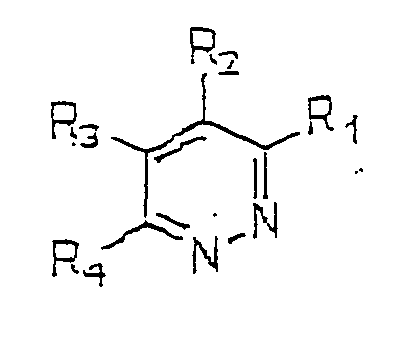
- R 1 and R 4 independently represent hydrogen atom, hydroxyl group, a lower alkyl group, a lower alkoxyl group or N R 5 R 6 group , wherein R 5 and R 6 may be the same or different and represent hydrogen atom, a lower alkyl group, or a lower hydroxyalkyl group;or R 5 and R 6 taken together with nitrogen atom represent a heterocyclic group selected from the group consisting of aziridinyl group, azetidinyl group, pyrrolidinyl group, piperidino group, hexahydroazepinyl group, heptamethylene imino group, octamethylene imino group, morpholino group,thiomorpholino group, piperazinyl group, and 4-lower alky
- the ultraviolet-absorbing composition of the invention characteristically includes the above-mentioned ultraviolet absorbent.
- the photostabilized composition of the invention characteristically includes the above-mentioned ultraviolet absorbent.
- the external preparation for skin in accordance with the invention characteristically includes the above-mentioned ultraviolet absorbent.
- the external preparation for skin in accordance with the invention further includes an inorganic powder.
- the external preparation for skin in accordance with the invention includes the photostabilizer.
- the external preparation for skin in accordance with the invention further includes sequestering agents.
- the pyridazine derivative and/or a salt thereof is preferably included at 0.001 to 20 wt % in the external preparation for skin in accordance with the invention.
- the pyridazine derivative of the invention may be a tautomer under equilibrium under certain conditions. In accordance with the invention, either one of them is described. A tautomer or a mixture with the tautomer may be satisfactory.
- the pyridazine derivative of the invention includes
- the pyridazine derivative of the invention is readily commercially available from ALDRICH CO., SIGMA CO., Tokyo Chemicals K.K. Otherwise, the pyridazine derivative can be synthetically prepared by known methods. Typical examples of the method for producing the derivative are shown below.
- A represents chlorine atom or bromine atom.
- the compound (2) (4,5-dichloro-3-hydroxypyridazine provided that A is chlorine atom or 4,5-dibromo-3-hydroxypyridazine provided that A is bromine atom) can be prepared readily from the compound (1) readily available (mucochloric acid provided that A is chlorine atom or mucobromic acid provided that A is bromine atom). More specifically, the compound (2) can be readily prepared by subjecting the compound (1) (A is chlorine atom or bromine atom) to a ring-closure reaction with hydrazine. Further, the compound (2) is readily commercially available from ALDRICH CO. The pyridazine derivative of the invention can be produced by allowing the compound (2) (A is chlorine atom or bromine atom) to react with amines such as piperidine.
- the pyridazine derivative of the invention can be prepared into an inorganic acid salt or an organic acid salt by known methods.
- the inorganic acid includes for example hydrochloric acid, sulfuric acid, phosphoric acid and hydrobromic acid.
- the organic acid includes for example acetic acid, lactic acid, maleic acid, fumaric acid, tartaric acid, citric acid, methanesulfonic acid, and p-toluenesulfonic acid.
- An ultraviolet absorbent containing the pyridazine derivative of the invention or a salt thereof as the main ingredient can be used in various products, preferably external preparations for skin.
- External preparations for skin in which the inventive ultraviolet absorbent is included can exert a great preventive effect against ultraviolet ray.
- the ultraviolet absorbent is never decomposed under daylight exposure. Thus, the effect can be exerted in a stable manner for a long time.. Furthermore, the ultraviolet absorbent never causes any skin trouble. Thus, the ultraviolet absorbent is useful for an external sunscreen preparation for skin.
- a combination of organic compound-based ultraviolet absorbents and inorganic compound-based ultraviolet shielding agents is used.
- inorganic powders are frequently used in makeup cosmetics.
- an organic ultraviolet absorbent used in combination with inorganic powders may sometimes cause color change.
- the ultraviolet absorbent of the invention can be used in combination with inorganic powders, because no color change occurs even if the ultraviolet absorbent is used together with inorganic powders in the external preparation for skin.
- the inorganic powder includes inorganic powders such as talc, kaolin, boron nitride, mica, silk mica (sericite), white mica, black mica, gold mica, synthetic mica, vermiculite, magnesium carbonate, calcium carbonate, silicic anhydride, aluminium silicate, aluminium oxide, barium silicate, calcium silicate, magnesium silicate, metal tungstate salt, magnesium, silica, zeolite, barium sulfate, sintered calcium sulfate, plaster of Paris, calcium phosphate, fluorine apatite, hydroxyapatite, ceramic powder, and metal soap (zinc myristate, calcium palmitate, aluminum stearate, etc.), as well as inorganic pigments such as titanium dioxide, zinc oxide, iron oxide, iron titanate, carbon, lower -valent oxides of titanium, mango violet, cobalt violet
- the pyridazine derivative of the invention and a salt thereof are useful as photostabilizers and highly optically stabilize dyes, perfume and drugs to be used in medical supplies and cosmetics, in particular. Additionally, the pyridazine derivative of the invention and a salt thereof can produce a photostabilizing effect synergistically enhanced when used in combination with sequestering agents.
- the sequestering agents to be used together with the pyridazine derivative and a salt thereof in accordance with the invention includes for example ethylenediaminetetraacetate (EDTA) sodium salt, ethylenediaminehydroxyethyltriacetate sodium, phosphoric acid, citric acid, ascorbic acid, succinic acid, gluconic acid, sodium polyphosphate, sodium metaphosphate, hydroxyethane diphosphonate salt, and etidronate salt.
- EDTA ethylenediaminetetraacetate
- the external preparation for skin in accordance with the invention includes the above-mentioned ultraviolet absorbent and the above-mentioned photostabilizer.
- the external preparation for skin in accordance with the invention can be in any form with no specific limitation, as long as the external preparation can exert the effect of the invention.
- the external preparation for skin can be in forms of skin care cosmetics such as skin lotion, emulsion, cream, and beauty lotion; makeup cosmetics such as base cosmetics, foundation, lipstick, face color, and eye liner; hair and scalp cosmetics such as hair spray, hair tonic and hair liquid; aromatic cosmetics such as perfume and eau de cologne; and shampoo and rinse.
- the quantities thereof can appropriately be determined, depending on the intended ultraviolet absorption or photostabilization potency.
- the pyridazine derivative and a salt thereof are blended at preferably 0.001 to 20 wt %, more preferably 0.01 to 10 wt % in a composition. Below 0.001 wt %. the ultraviolet preventive effect or the photostabilization effect sometimes cannot be sufficiently obtained. Above 20 wt %, unpreferably, the resulting dosage form can be retained with much difficulty.
- the external preparation for skin in accordance with the invention can include other ingredients, if necessary, which can generally be included in cosmetics and medical supplies.
- the ingredients are liquid fats and oils, solid fats and oils, wax, hydrocarbon, higher fatty acid, higher alcohol, esters, silicone, anionic surfactants, cationic surfactants, amphoteric surfactants, nonionic surfactants, moisturizer, water-soluble polymer compound, thickener, coating agent, lower alcohol, polyvalent alcohol, sugars, amino acids, organic amines, pH adjuster, skin nutritious supplements, vitamins, antioxidant, perfume, powder, coloring agent, and water, in addition to the essential ingredients.
- an ultraviolet absorbent and a photostabilizer other than the pyridazine derivative of the invention may be combined unless the ultraviolet absorbent and the photostabilizer disadvantageously affect the effect of the invention.
- the ultraviolet absorbent of the invention can be blended in products including for example paints, dyes, pigments, various resins, synthetic rubber, latex, film, fiber and glass other than the external preparation for skin, to prepare the products into photostabilized compositions.
- the pyridazine derivative of the invention has such a great thermostability that the pyridazine derivative never vaporizes, the effect can be retained for a long time.
- the pyridazine derivative can be blended at a quantity of preferably 0.001 to 20 wt %, more preferably 0.01 to 10 wt %. Below 0.001 wt %, the resulting photostabilizing effect sometimes may be insufficient. Above 20 wt %, the resulting products are molded with much difficulty, unpreferably.
- 4,5-Dichloro-3-hydroxypyridazine (25.0 g; 0.151 mol) was dissolved in piperidine (120 mol), under reflux condition for 24 hours. After cooling, the deposited crystal was filtered, to give 4,5-dipiperidino-3-hydroxypyridazine in white crystal (30.3 g as a yield of 75 %).
- 6-Chloro-3-hydroxypyridazine (25.0 g, 0.191 mol) was dissolved in morpholine (120 mol), under reflux condition for 24 hours. After cooling, the deposited crystal was filtered, to give 6-morpholino-3-hydroxypyridazine in white crystal (25.8 g as a yield of 74 %).
- 3,6-Dichloropyridazine (25.0 g, 0.168 mol) was dissolved in morpholine (120 mol), for reflux condition for 24 hours. After cooling, the deposited crystal was filtered, to give 3,6-dimorpholinopyridazine in white crystal (33.7 g as a yield of 80 %).
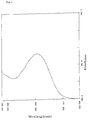
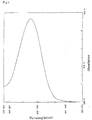
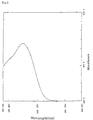
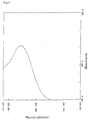
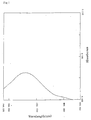
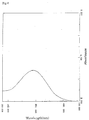
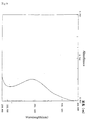
- the pyridazine derivative of the invention can sufficiently absorb 290-400 nm ultraviolet ray reaching the ground surface nearly over the whole range of the wavelengths and hardly absorbs a visible wavelength range above 400 nm.
- the pyridazine derivative of the invention can attain excellent transparency.
- aqueous phase and the alcohol phase were separately prepared and then mixed together.
- Propylene glycol was added to and dissolved in ion exchange water. The resulting solution was retained at 70 °C under heating (aqueous phase). Other ingredients were mixed with the solution. The resulting mixture was melted under heating and retained at 70 °C (oil phase). The oil phase was added to the aqueous phase, for preliminary emulsification with a homomixer to homogeneity. Under thorough mixing, subsequently, the mixture was cooled to 30 °C.
- the external preparations for skin where the pyridazine derivative of the invention was blended had excellent ultraviolet prevention effect. Additionally, the tables show that the amount of the pyridazine derivative of the invention and/or a salt thereof in blend is preferably 0.001 to 20 wt %. Further, it is very pharmaceutically difficult to prepare any formulation at a blend amount of 20 wt % or more.
- the pyridazine derivative of the invention has excellent absorption over a wide ultraviolet range. So as to examine whether or not the pyridazine derivative of the invention can be blended as an ultraviolet absorbent in an external preparation for skin, furthermore, skin irritation, photostability and the influence of inorganic powders were additionally examined.
- Mean score was determined for the assessment on the basis of the following standards.
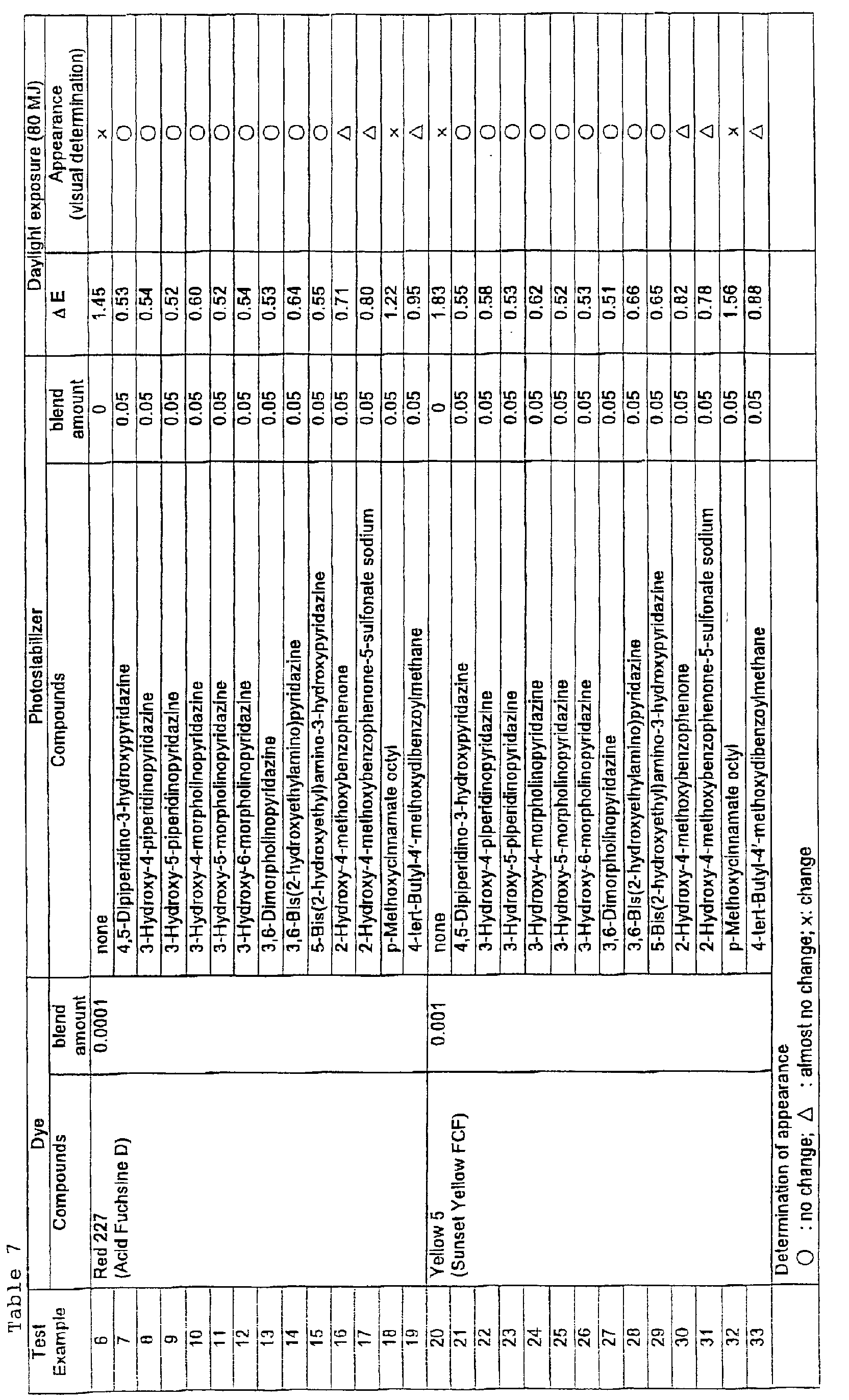
- Aqueous solutions of the pyridazine derivative of the invention were exposed to daylight for 2 weeks (at a daylight exposure of 80 MJ). Subsequently, the remaining ratio and the change of the appearance were examined to measure the ultraviolet spectra with a spectrophotometer (solvent: water; concentration of 10 ppm and optical path length of 1 cm). The area under ultraviolet spectra curve from 290 nm to 400 nm were determined by integration to compare the area with the area before daylight exposure.
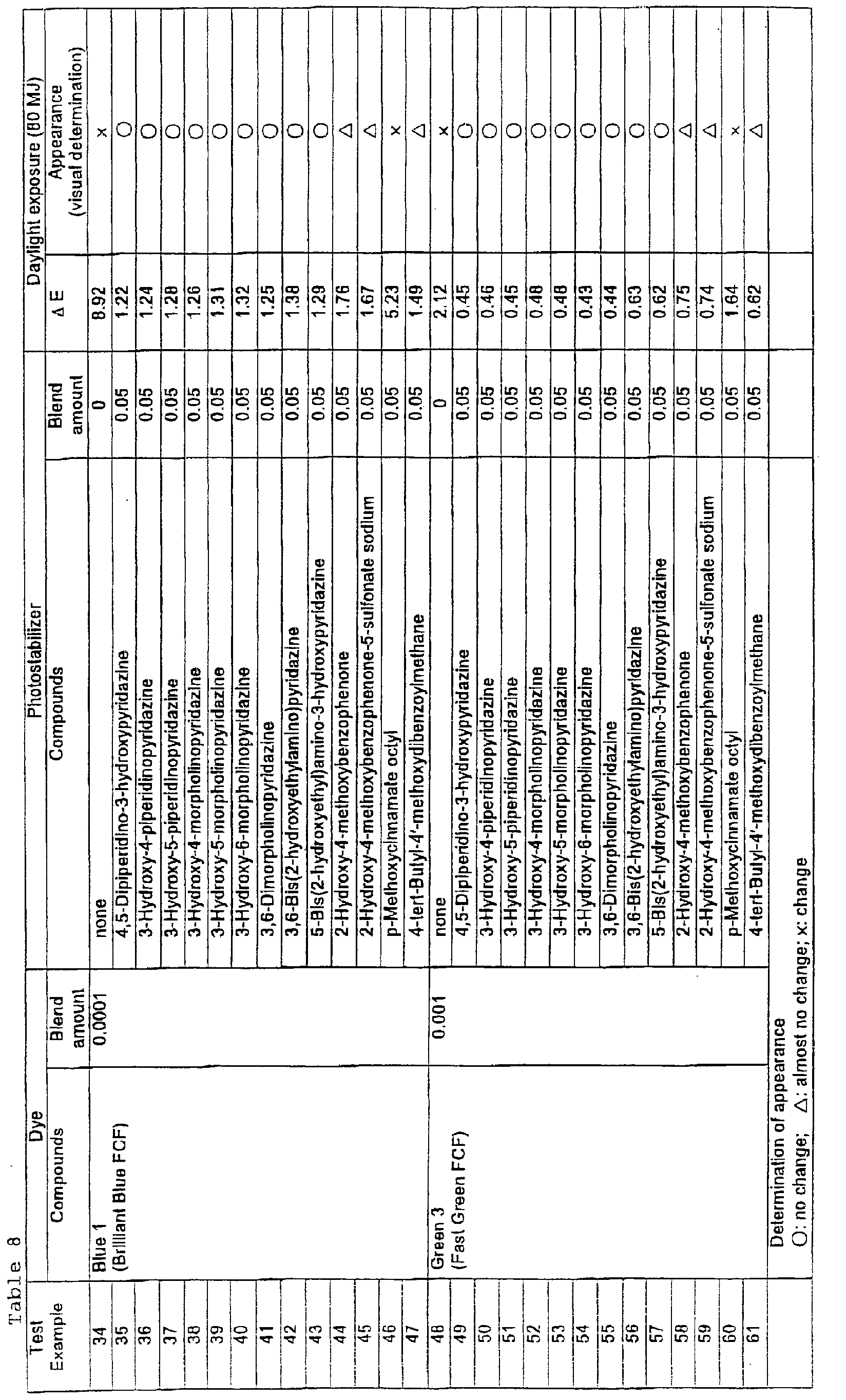
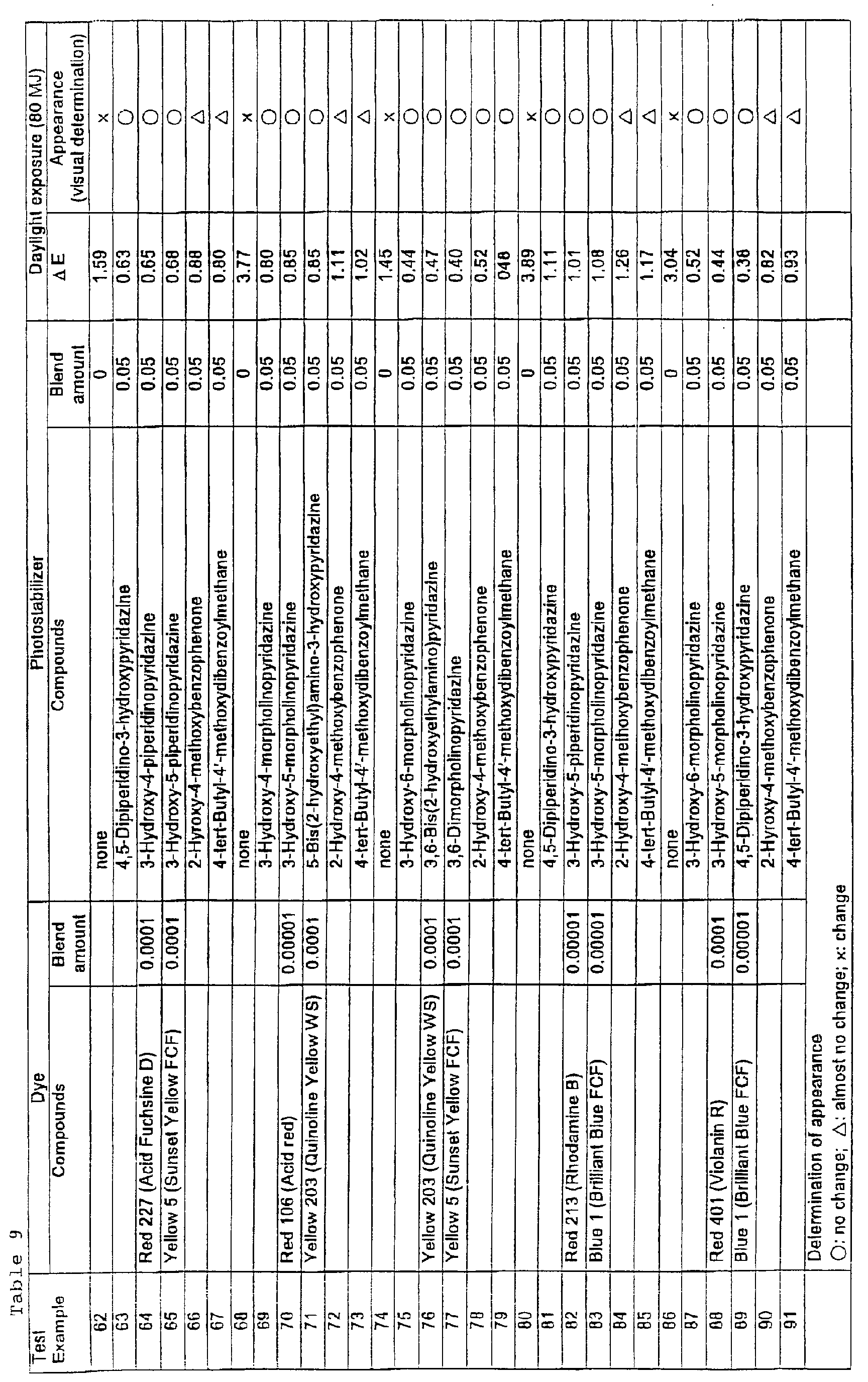
- the pyridazine derivative of the invention was never decomposed even under direct daylight exposure for a long time but was at very high remaining ratios. Furthermore, no change was observed in the shapes or areas of the ultraviolet spectra. Even apparently, no coloring or deposition was observed.
- a sunscreen cream of the following formulation was prepared and stored at 50 °C for 2 months. Under visual observation of the color change, the stability of the inventive pyridazine derivative in combination with inorganic powder-based ultraviolet screening agents commonly in blend as external preparations for skin for the purpose of ultraviolet prevention was examined.
- Sunscreen cream 1. Ethyl cellulose 1.0 wt % 2. Ethanol 5.0 3. 2-Ethylhexylsuccinate 24.0 4. Titanium dioxide 1.0 5. Porous silicic anhydride powder 1.0 6. Spherical nylon powder 1.0 7. Talc 1.0 8. Sericite 1.0 9. Boron nitride 1.0 10. Silicone-treated mica 1.0 11. Ultraviolet absorbent (described in Table 6) 10.0 12. Carboxymethyl cellulose 1.0 13. Ion exchange water qs 14. Preservative appropriate amount 15. Perfume appropriate amount
- the ingredients 3 to 11 were mixed with the resulting mixture under heating, for sufficient dispersion and dissolution. While keeping the dispersion at 70 °C, a solution of the mixture of the ingredients 12 to 15 was gradually added to the dispersion under thorough emulsification with a homomixer. The resulting mixture was cooled to 30 °C under sufficient stirring to prepare sunscreen creams.
- the pyridazine derivative of the invention has no skin irritation and great photostability, with no color change when used in combination with inorganic powders.
- the pyridazine derivative of the invention is very useful as ultraviolet absorbents which can be blended in external preparations for skin..
- test sample For observation of the change of the appearance of each test sample (determination based on visual observation) and the measurement of color difference ( ⁇ E) before and after daylight exposure (80 MJ), the test sample was prepared.
- the color was measured on the Lab coordinate system, to calculate the color difference on the basis of the color before daylight exposure. More specifically, the color difference ( ⁇ E) was calculated on the basis of the measured values (L 1 , a 1 , b 1 ) before daylight exposure.
- ⁇ E [(L 2 -L 1 ) 2 + (a 2 - a 1 ) 2 + (b 2 - b 1 ) 2 ] 1/2
- Blend amount (wt %) Ion exchange water to 100 Brucine-modified alcohol 5 Glycerin 5 Dipropylene glycol 5 Polyoxyethylene-hydrogenated castor oil 1 Methylparaben 0.2 Lactic acid 0.006 Sodium lactate 0.2 Photostabilizer (described in Tables 10 to 12) described in tables 10 to 12 Perfume (described in Tables 10 to 12) described in tables 10 to 12 Total 100
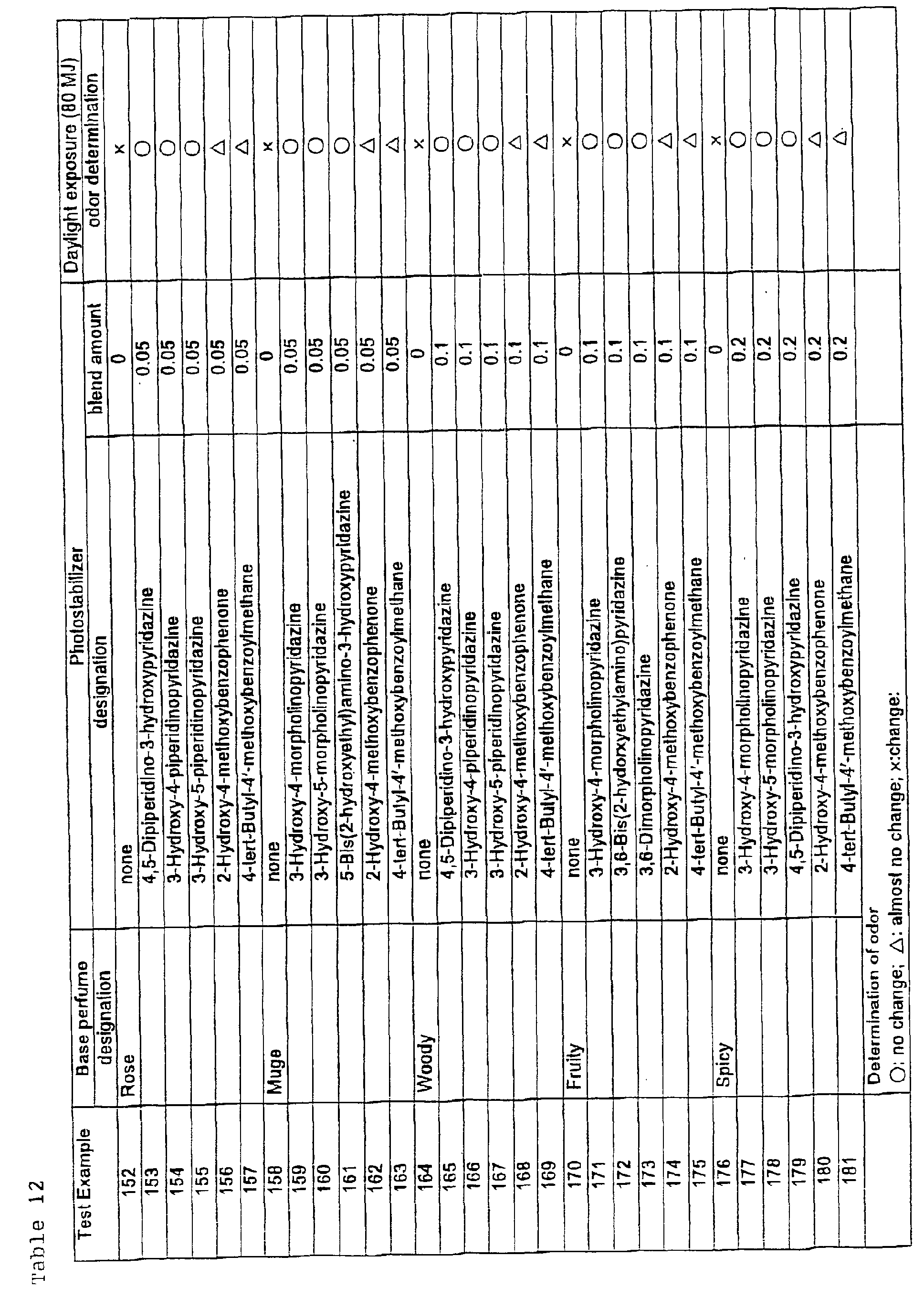
- test sample was prepared for observation of the change of the odor of the test sample (determined by perfume coordinator) before and after daylight exposure (80 MJ).
- the combination of the pyridazine derivative of the invention with sequestering agents has a synergistic effect on the photo stabilization effect, taking in account that sequestering agents when used singly hardly have any photostabilization effect.
- test sample For observation of the change of the appearance of each test sample (determination based on visual observation) and the measurement of the remaining ratio by liquid chromatography before and after daylight exposure (80 MJ), the test sample was prepared. The results are shown in Table 13.
- the results in table 13 indicate that the remaining ratio of drugs via the pyridazine derivative of the invention is far higher, compared with other photostabilizers. Furthermore, it is indicated that the change of the appearance of the compositions is less. Thus, the pyridazine derivative of the invention has excellent photostabilization effect on drugs.
- the present inventors made attempts to improve the photostabilization effect by using a combination of the photostabilizer with sequestering agents. First, the inventors examined the photostabilization effect of dyes and the change of the appearance of each composition, using the following assessment formulations.
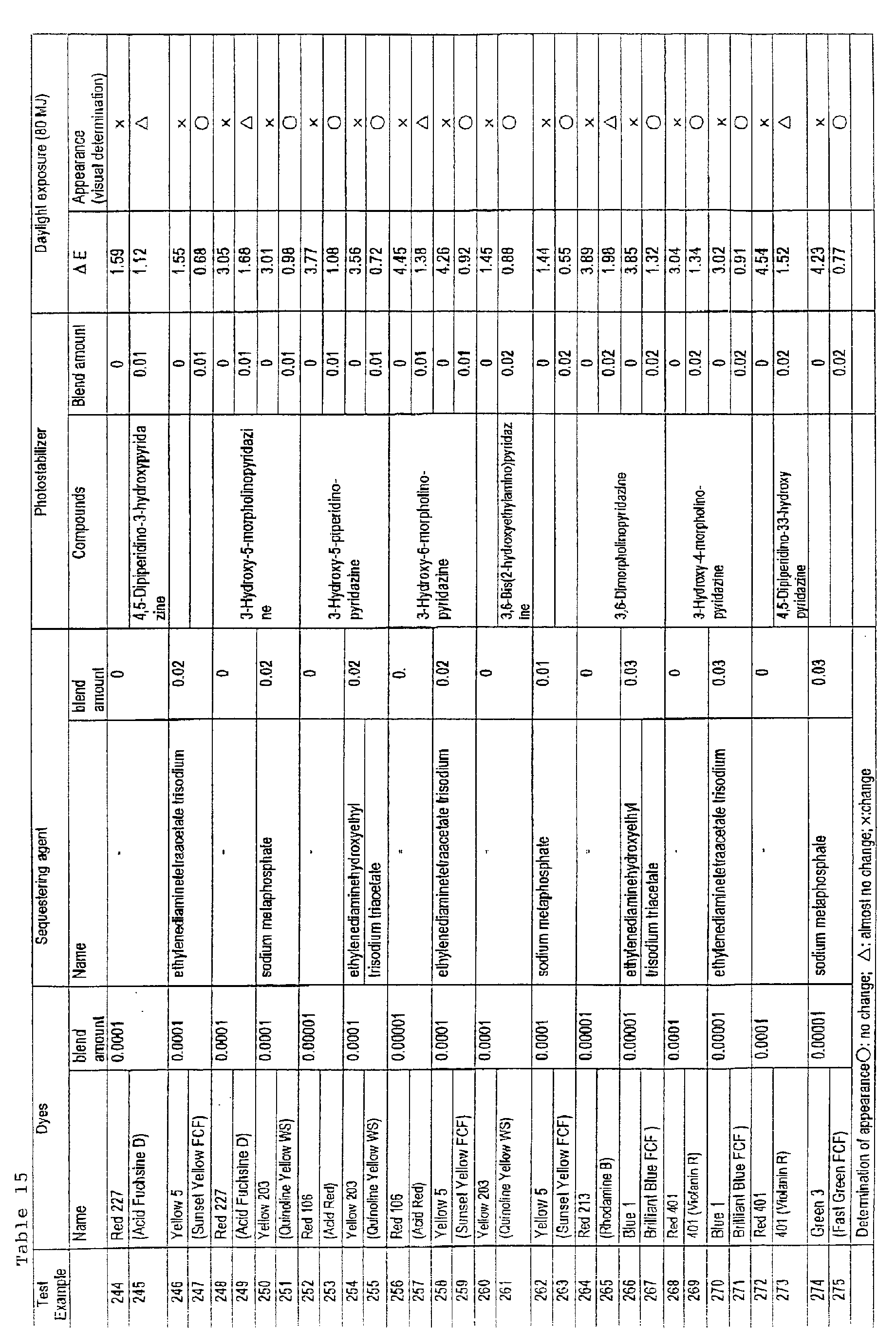
- Each test sample was prepared for observation of the change of the appearance of each test sample (determined visually) and measurement of the color difference ( ⁇ E) before and after daylight exposure (80 MJ).
- the color was measured on the Lab coordinate system, to calculate the color difference on the basis of the color before daylight exposure. More specifically, the color difference ( ⁇ E) was calculated on the basis of the measured values (L 1 , a 1 , b 1 ) before daylight exposure.
- ⁇ E [(L 2 -L 1 ) 2 +(a 2 -a 1 ) 2 +(b 2 -b 1 ) 2 ] 1/2
- the combination of the pyridazine derivative of the invention in combination with sequestering agents has a synergistic effect on the photostabilization effect.
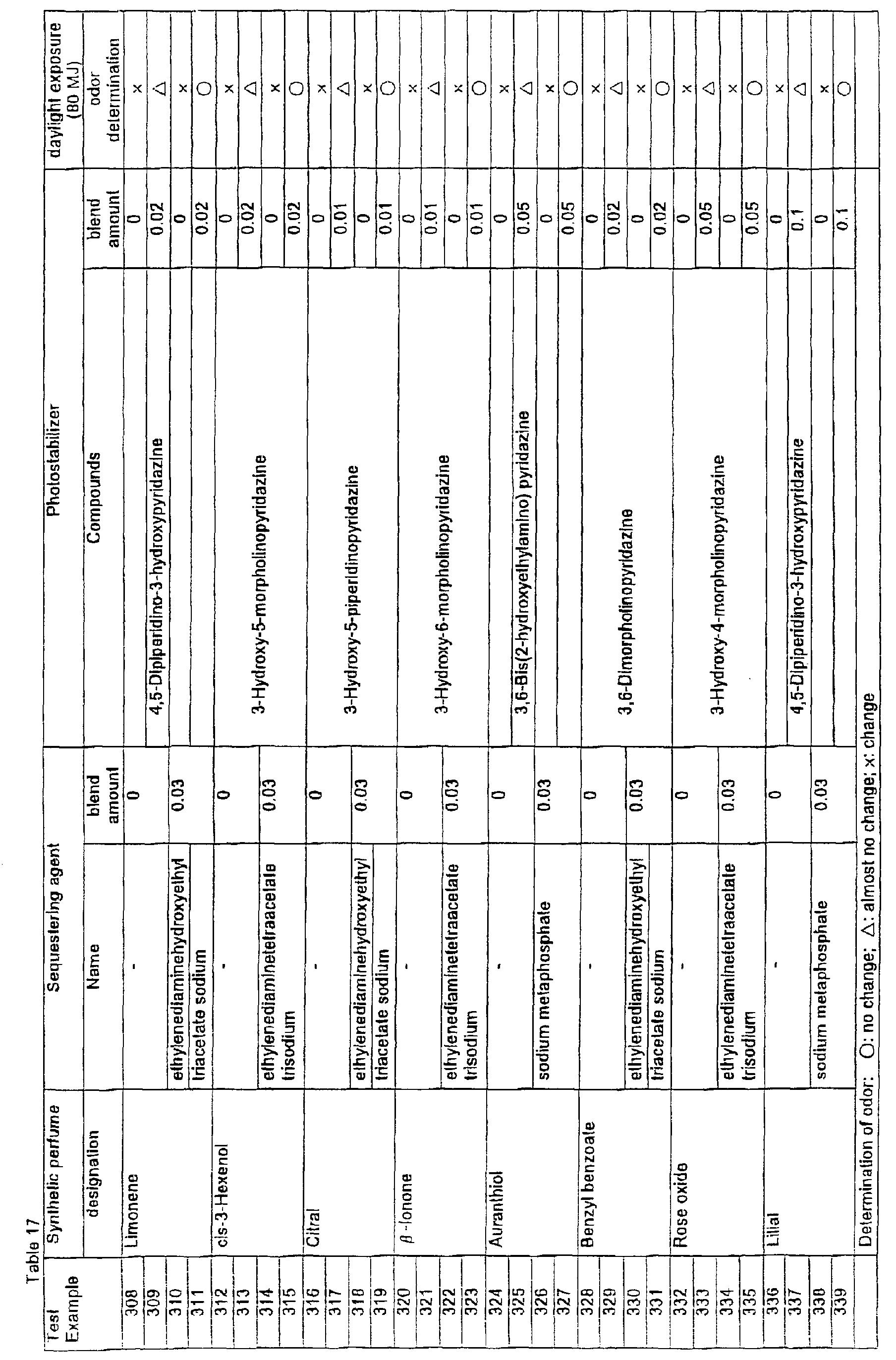
- Blend amount (wt %) Ion exchange water to 100 Brucine-modified alcohol 5 Glycerin 5 Dipropylene glycol 5 Polyoxyethylene-hydrogenated castor oil 1 Methylparaben 0.2 Lactic acid 0.006 Sodium lactate 0.2 sequestering agent (described in Tables 16 to 18) described in Tables 16 to 18 Photostabilizer (described in Tables 16 to 18) described in Tables 16 to 18 Perfume (described in Tables 16 to 18) 0.03 Total 100
- test sample was prepared for observation of the change of the odor of each test sample (determined by perfume coordinator) before and after daylight exposure (80 MJ).
- the combination of the pyridazine derivative of the invention with sequestering agents has a synergistic effect on the photostabilization effect, taking into account that sequestering agents when used singly hardly have any photostabilization effect.
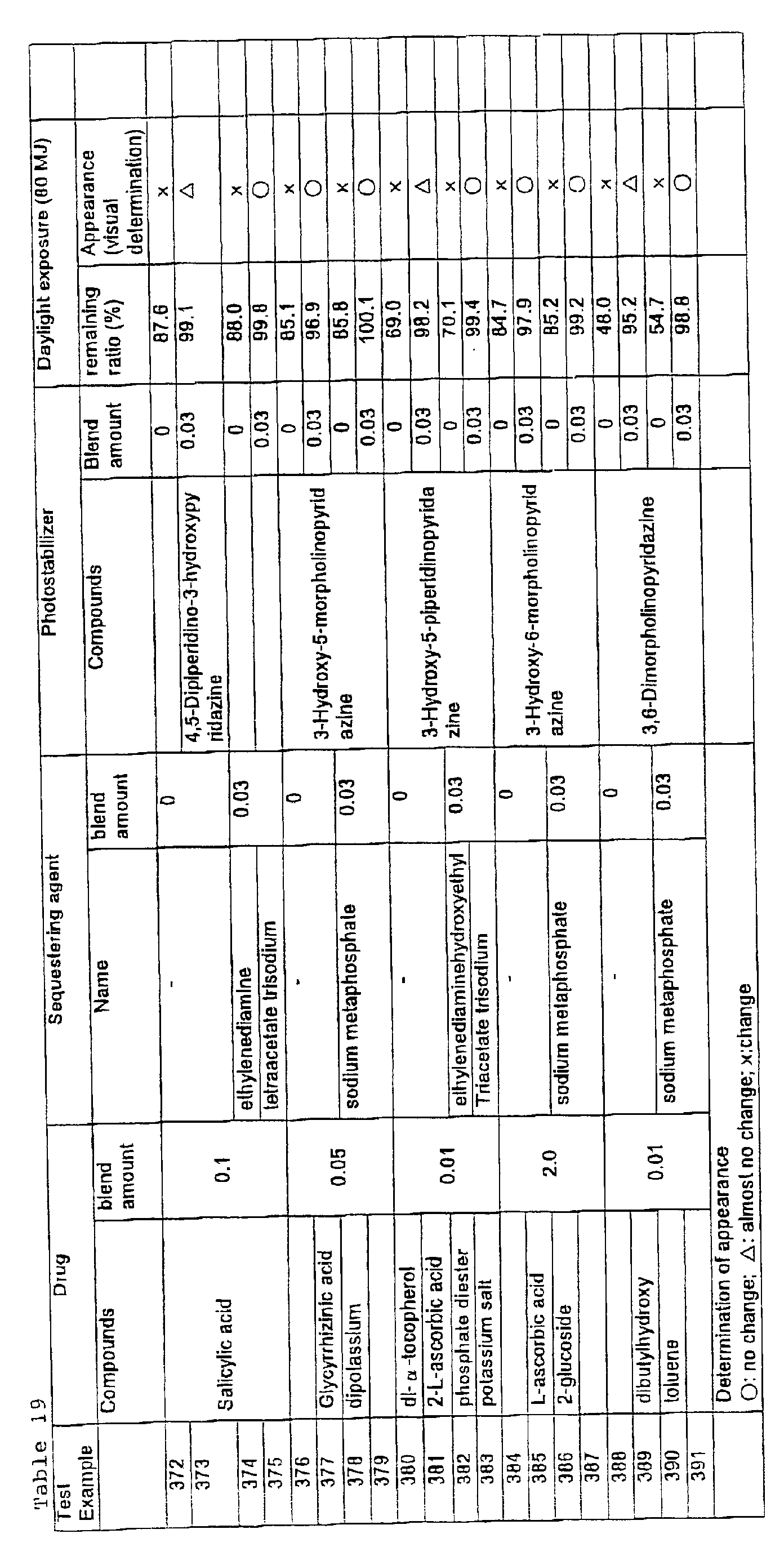
- test sample For observation of the change of the appearance of each test sample (determination based on visual observation) and the measurement of the remaining ratio by liquid chromatography before and after daylight exposure (80 MJ), the test sample was prepared.
- results shown in table 19 indicate that the remaining ratio of a pharmaceutical agent in case of the combination of the pyridazine derivative of the invention with sequestering agents is high, compared with the case without any combination with sequestering agents and additionally that the change of the appearance of each composition is less. Therefore, the pyridazine derivative of the invention in combination with sequestering agents has excellent photostabilization effect.
- the combination of the pyridazine derivative of the invention with sequestering agents has a synergistic effect on the photostabilization effect, taking into account that sequestering agents when used singly hardly have any photostabilization effect.
- Example 1 Skin lotion Alcohol phase Ethanol 10.0 Oleyl alcohol 0.1 POE(20) sorbitan monolaurate ester 0.5 POE(15) lauryl ether 0.5 4,5-Dipiperidino-3-hydroxypyridazine 5.0 Preservative appropriate amount Perfume appropriate amount Aqueous phase 1,3-Butylene glycol 6.0 Glycerin 4.0 Ion exchange water qs
- Example 2 Skin lotion Alcohol phase Ethanol 10.0 POE(20) oleyl ether 0.5 Preservative appropriate amount Perfume appropriate amount Aqueous phase Dipropylene glycol 6.0 Sorbit 4.0 PEG 1500 5.0 4,5-Dipiperidino-3-hydroxypyridazine hydrochloride salt 20.0 Methyl cellulose 0.2 Quince seed 0.1 Ion exchange water qs
- Methyl cellulose and Quince seed were mixed with a part of ion exchange water. The resulting mixture was agitated, to prepare a viscous solution. The remaining ion exchange water and other components of the aqueous phase were mixed and dissolved together, to which was added the viscous solution to prepare a homogenous aqueous phase. After the alcohol phase was prepared and added to the aqueous phase, the resulting mixture was mixed together.
- Example 3 Cream Stearic acid 5.0 Stearyl alcohol 4.0 Isopropyl myristate 18.0 Glycerin monostearate ester 3.0 Propylene glycol 10.0 3-Hydroxy-5-morpholinopyridazine 20.0 Potassium hydroxide 0.2 Sodium hydrogen sulfite 0.01 Preservative appropriate amount Perfume appropriate amount Ion exchange water qs
- Propylene glycol and potassium hydroxide were added to and dissolved in ion exchange water, and the resulting mixture was heated and retained at 70 °C (aqueous phase). Other components were mixed into the mixture, for melting under heating. The resulting mixture was retained at 70 °C (oil phase) . The oil phase was gradually added to the aqueous phase, for preliminary emulsification and homogenous emulsification with a homomixer. Under sufficient agitation, the resulting emulsion was cooled to 30 °C.
- Example 4 Cream Stearic acid 6.0 Sorbitan monostearate ester 2.0 POE(20) sorbitan monostearate ester 1.5 Propylene glycol 10.0 3-Hydroxy-5-piperidinopyridazine 1.0 Glycerin trioctanoate 10.0 Squalene 5.0 Sodium hydrogen sulfite 0.01 Ethylparaben 0.3 Perfume appropriate amount Ion exchange water qs
- Propylene glycol and 3-hydroxy-5-piperidinopyridazine were added to and dissolved in ion exchange water, and the resulting mixture was heated and retained at 70 °C (aqueous phase). Other components were mixed into the mixture, for melting under heating. The resulting mixture was retained at 70 °C (oil phase). The oil phase was gradually added to the aqueous phase, for preliminary emulsification and homogenous emulsification with a homomixer. Under sufficient agitation, the resulting emulsion was cooled to 30 °C.
- Carboxyvinyl polymer was dissolved in a small amount of ion exchange water (A phase).
- a phase PEG 1500, 3-hydroxy-6-morpholinopyridazine and triethanol amine were added to the remaining part of ion exchange water, and the resulting mixture was dissolved together under heating and was then retained at 70 °C (Aqueous phase). Other components were mixed into the mixture, for melting under heating. The resulting mixture was retained at 70°C (oil phase). The oil phase was gradually added to the aqueous phase, for preliminary emulsification. Then, the A phase was added to the resulting emulsion, which was then homogenously emulsified with a homomixer.
- Example 6 Gel 95 % Ethanol 10.0 Dipropylene glycol 15.0 POE(50) oleyl ether 2.0 Carboxyvinyl polymer 1.0 Sodium hydroxide 0.15 3,6-Dimorpholinopyridazine 2.0 Methylparaben 0.2 Perfume appropriate amount Ion exchange water qs
- Carboxyvinyl polymer was homogenously dissolved in ion exchange water (A phase). 3,6-Dimorpholinopyridazine and POE(50) oleyl ether were dissolved in 95 % ethanol, and the resulting solution was added to the A phase. After addition of the ingredients except for sodium hydroxide, sodium hydroxide was added for neutralization and thickening.
- Example 8 Pack A phase Dipropylene glycol 5.0 POE(60) hydrogenated castor oil 5.0 B phase Olive oil 5.0 Tocopherol acetate 0.2 Ethylparaben 0.2 Perfume 0.2 C phase 5-Bis(2-hydroxyethyl)amino-3-hydroxypyridazine 3.0 Sodium hydrogen sulfite 0.03 Polyvinyl alcohol (saponification degree of 90; polymerization degree of 2000) 13.0 Ethanol 7.0 Ion exchange water qs
- the A phase, the B phase and the C phase were separately dissolved homogenously. Then, the resulting B phase was added to the resulting A phase, for solubilization. Then, the resulting mixture was added to the C phase for mixing.
- Example 9 Emulsion Oil phase Stearyl alcohol 1.5 Squalene 2.0 Petrolatum 2.5 Odorless liquid lanolin 1.5 Evening primrose oil 2.0 Isopropyl myristate 5.0 Glycerin monooleate 2.0 POE(60)-hydrogenated castor oil 2.0 Tocopherol acetate 0.05 Ethylparaben 0.2 Butylparaben 0.1 Perfume appropriate volume Aqueous phase 3,6-Bis(2-hydroxyethylamino)pyridazine 1.0 4,5-Dipiperidino-3-hydroxypyridazine 1.0 Sodium hydrogen sulfite 0.01 Glycerin 5.0 Sodium hyaluronate 0.01 Carboxyvinyl polymer 0.2 Potassium hydroxide 0.2 Ion exchange water qs
- the oil phase and the aqueous phase were separately dissolved at 70 °C. Then, the resulting oil phase was added to the resulting aqueous phase, for emulsification with an emulsion machine. Then, the resulting mixture was cooled to 30 °C with a heat exchange machine.
- Example 10 Solid powdery foundation 1. Talc 15.0 2. Sericite 10.0 3. Spherical nylon powder 10.0 4. Porous silicic anhydride powder 15.0 5. Boron nitride 5.0 6. Titanium dioxide 5.0 7. Iron oxide 3.0 8. Zinc stearate 5.0 9. 3-Hydroxy-5-morpholinopyridazine 5.0 10. Liquid paraffin qs 11. Triisooctanoate glycerin 15.0 12. Sesqui-oleate sorbitan 1.5 13. Preservative appropriate volume 14. Perfume appropriate volume
- Example 11 Water-in-oil type emulsified foundation 1. Spherical nylon 10.0 2. Porous silicic anhydride powder 8.0 3. Titanium mica 2.0 4. Silicone-treated sericite 2.0 5. Silicone-treated mica 12.0 6. Silicone-treated titanium dioxide 5.0 7. Silicone-treated iron oxide 2.0 8. Ion exchange water qs 9. 3-Hydroxy-5-piperidinopyridazine 3.0 10. Decamethylcyclopentane siloxane 18.0 11. Dimethylpolysiloxane 5.0 12. Squalene 1.0 13. Polyoxyethylene-modified dimethylpolysiloxane 2.0 14. Preservative appropriate amount 15. Perfume appropriate amount
- Example 12 Face powder 1. Talc qs 2. Sericite 10.0 3. Spherical nylon powder 10.0 4. Boron nitride 5.0 5. Iron oxide 3.0 6. Magnesium carbonate 5.0 7. Squalene 3.0 8. Triisooctanoate glycerin 2.0 9. Sesqui-oleate sorbitan 2.0 10. 3-Hydroxy-6-morpholinopyridazine 0.1 11. Preservative appropriate amount 12. Perfume appropriate amount
- Example 13 Eye shadow 1. Talc qs 2. Mica 15.0 3. Spherical nylon powder 10.0 4. Boron nitride 5.0 5. Iron oxide 3.0 6. Titanium oxide-coated mica 5.0 7. Squalene 3.0 8. Triisooctanoate glycerin 2.0 9. Sesqui-oleate sorbitan 2.0 10. 3-Hydroxy-6-morpholinopyridazine 2.0 11. Preservative appropriate amount 12. Perfume appropriate amount
- Example 14 Lipstick 1. Carnauba wax 0.5 2. Candelilla wax 5.0 3. Ceresin 10.0 4. Squalene qs 5. Trusooctanoate glycerin 10.0 6. Diisostearate glycerin 20.0 7. 3,6-Dimorpholinopyridazine 1.0 8. Macadamia nut oil fatty acid cholesteryl 4.0 9. Synthetic sodium silicate-magnesium 0.5 10. Hydrophobic silica 0.5 11. Ion exchange water 2.0 12. Coloring agent appropriate amount 13. Preservative appropriate amount 14. Perfume appropriate amount
- the ingredient 8 was heated to 60 °C, in which were dispersed the ingredients 9 and 10. To the resulting dispersion was added the ingredient 11 for sufficient agitation. Separately, the ingredients 1 to 7 were dissolved under heating, to which was added the resulting solution, for sufficient agitation.. To the resulting solution were added the ingredients 12 to 14, for dispersion under agitation, which was then molded to prepare a lipstick.
- Example 16 Hair liquid 1. Polyoxypropylene (40) butyl ether 20.0 2. Polyoxyethylene-hydrogenated castor oil 1.0 3. Ethanol 50.0 4. Perfume appropriate amount 5. Preservative appropriate amount 6. Dye appropriate amount 7. 3,6-Bis(2-hydroxyethylamino)pyridazine 2.0 8. Ion exchange water qs
- Example 18 Hair tonic 1. 3-Hydroxy-5-morpholinopyridazine 3.0 2. Ethylene oxide (40 moles) adduct of Hydrogenated castor oil 2.0 3. Ethanol 60.0 4. Perfume appropriate amount 5. Ion exchange water qs
- the novel pyridazine derivative of the invention has very excellent ultraviolet absorption strongly absorbing ultraviolet ray over a wide wavelength range as an ultraviolet absorbent and also has a great photostabilization potency as a photostabilizer. Furthermore, the pyridazine derivative is highly safe and stable. Thus, external preparations for skin can be produced by blending the pyridazine derivative. The resulting external preparations for skin have high ultraviolet prevention effect and improved stability via the photostabilization effect.
Landscapes
- Health & Medical Sciences (AREA)
- Life Sciences & Earth Sciences (AREA)
- Public Health (AREA)
- Veterinary Medicine (AREA)
- Chemical & Material Sciences (AREA)
- General Health & Medical Sciences (AREA)
- Animal Behavior & Ethology (AREA)
- Organic Chemistry (AREA)
- Epidemiology (AREA)
- Birds (AREA)
- Dermatology (AREA)
- Dispersion Chemistry (AREA)
- Toxicology (AREA)
- General Chemical & Material Sciences (AREA)
- Chemical Kinetics & Catalysis (AREA)
- Nuclear Medicine, Radiotherapy & Molecular Imaging (AREA)
- Engineering & Computer Science (AREA)
- Pharmacology & Pharmacy (AREA)
- Bioinformatics & Cheminformatics (AREA)
- Medicinal Chemistry (AREA)
- Cosmetics (AREA)
- Pharmaceuticals Containing Other Organic And Inorganic Compounds (AREA)
- Anti-Oxidant Or Stabilizer Compositions (AREA)
Abstract

Description


1H-NMR (DMSO-d6, TMS, ppm)
δ; 1.56-1.78 (m, 12H; piperidine ring: -N-CH2-CH 2 -CH 2 -CH 2-CH2-N-×2)
3.16 (t, 4H, J = 5.2 Hz, piperidine ring: -CH2-N-CH2-)
3.26 (t, 4H, J = 5.2 Hz,piperidine ring: -CH2-N-CH2-)
7.57 (s, 1H, pyridazine ring, H-6), 10.32 (s, 1H,OH)
MS spectrum: MW = 262 (C14H22N4O = 262.36)
1H-NMR (DMSO-d6, TMS, ppm)
δ: 3.15 (t, 4H, J = 4.8 Hz, -CH2-N- CH2-)
3.67 (t, 4H, J = 4.8 Hz, -CH2-O-CH2-)
6.79 (d, 1H, J = 10.4 Hz, pyridazine ring, H-4 or H-5)
7.49 (d, 1H, J = 10.4 Hz, pyridazine ring, H-4 or H-5)
12.13 (s, 1H,OH)
MS spectrum: MW = 181 (C8H11N3O2 = 181.19)
1H-NMR (DMSO-d6, TMS, ppm)
δ: 3.42 (t, 8H, J = 4.8 Hz, -CH2-N-CH2-)
3.80 (t, 8H, J = 4.8 Hz, -CH2-O-CH2-)
6.92 (s, 2H, pyridazine ring H-4 or H-5)
MS spectrum: MW = 250 (C12H18N4O2 = 250.30)
| a. Lotion | |
| Alcohol phase | |
| 95 % Ethanol: | 25.0 wt % |
| POE (25)-Hydrogenated castor oil: | 2.0 |
| Ultraviolet absorbent (described in Table 1) | 0 to 20 |
| Preservative | appropriate volume |
| Fragrance | appropriate volume |
| Aqueous phase | |
| Glycerin | 5.0 |
| Sodium hexametaphosphate | appropriate volume |
| Ion exchanger water | qs |
| b. Cream | |
| Stearyl alcohol | 7.0 wt % |
| Stearic acid | 2.0 |
| Hydrogenated lanolin | 2.0 |
| Squalene | 5.0 |
| 2-Octyldodecyl alcohol | 6.0 |
| POE (25) cetyl alcohol | 3.0 |
| Glycerin monostearate ester | 2.0 |
| Propylene glycol | 5.0 |
| Ultraviolet absorbent (described in Table 2) | 0 to 20 |
| Perfume | appropriate volume |
| Sodium hydrogen sulfite | 0.03 |
| Ethylparaben | 0.3 |
| Ion exchange water | qs |
| a. Lotion | ||
| Ultraviolet absorbent | Blend amount (wt %) | Ultraviolet prevention effect |
| 4,5-Dipiperidino-3-hydroxypyridazine | 20 | o ○ |
| 10 | o ○ | |
| 5 | o ○ | |
| 1 | o ○ | |
| 0.01 | o ○ | |
| 0.001 | ○ | |
| 0.0005 | Δ | |
| 3-Hydroxy-5-morpholinopyridazine | 20 | o ○ |
| 10 | o ○ | |
| 5 | o ○ | |
| 1 | o ○ | |
| 0.01 | o ○ | |
| 0.001 | ○ | |
| 0.0005 | Δ | |
| 3-Hydroxy-4-piperidinopyridazine | 20 | o ○ |
| 10 | o ○ | |
| 5 | o ○ | |
| 1 | o ○ | |
| 0.01 | o ○ | |
| 0.001 | ○ | |
| 0.0005 | Δ | |
| no included | - | × |
| b. cream | ||
| Ultraviolet absorbent | Blend amount (wt%) | Ultraviolet prevention effect |
| 4,5-Dipiperidino-3-hydroxypyridazine | 20 | o ○ |
| 10 | o ○ | |
| 5 | o ○ | |
| 1 | o ○ | |
| 0.01 | o ○ | |
| 0.001 | ○ | |
| 0.0005 | Δ | |
| 3-Hydroxy-5-morpholinopyridazine | 20 | o ○ |
| 10 | o ○ | |
| 5 | o ○ | |
| 1 | o ○ | |
| 0.01 | o ○ | |
| 0.001 | ○ | |
| 0.0005 | Δ | |
| 3-Hydroxy-4-piperidinopyridazine | 20 | o ○ |
| 10 | o ○ | |
| 5 | o ○ | |
| 1 | o ○ | |
| 0.01 | o ○ | |
| 0.001 | ○ | |
| 0.0005 | Δ | |
| No included | - | × |
| Degree of skin reaction | Score |
| No symptom (negative) | 0 |
| Light (false-negative) | 1 |
| Mild (weakly positive) | 2 |
| Moderate (moderately positive) | 3 |
| Severe (highly positive) | 4 |
- o○:
- mean score of 0.
- ○:
- mean score of more than 0 to less than 1.
- Δ:
- mean score of 1 or more to less than 2.
- ×:
- mean score of 2 or more.
| Ultraviolet absorbent | Dosage form | Determination |
| 4,5-Dipiperidino-3-hydroxypyridazine | lotion | o ○ |
| cream | o ○ | |
| 3-Hydroxy-5-morpholinopyridazine | lotion | o ○ |
| cream | o ○ | |
| 3-Hydroxy-4-piperidinopyridazine | lotion | o ○ |
| cream | o ○ | |
| No included | lotion | o ○ |
| cream | o ○ |
| Degree of skin reaction | Score |
| No reaction (negative) | 0 |
| Light erythema (false-negative) | 1 |
| Erythema (weakly positive) | 2 |
| Erythema + edema (moderately positive) | 3 |
| Erythema + edema + papule (highly positive) | 4 |
| Large blister (most highly positive) | 5 |
- o○:
- mean score of 0.
- ○:
- mean score of more than 0 to less than 1.
- Δ:
- mean score of 1 or more to less than 2.
- ×:
- mean score of 2 or more.
| Ultraviolet absorbent | Dosage form | Determination |
| 4,5-Dipiperidino-3-hydroxypyridazine | lotion | o ○ |
| cream | o ○ | |
| 3-Hydroxy-5-morpholinopyridazine | lotion | o ○ |
| cream | o ○ | |
| 3-Hydroxy-4-piperidinopyridazine | lotion | o ○ |
| cream | o ○ | |
| No included | lotion | o ○ |
| cream | o ○ |
| Ultraviolet absorbent | Remaining ratio | Change of area under ultraviolet spectrum |
| 4,5-Dipiperidino-3-hydroxypyridazine | o ○ | o ○ |
| 3-Hydroxy-5-morpholinopyridazine | o ○ | o ○ |
| 3-Hydroxy-4-piperidinopyridazine | o ○ | o ○ |
| Sunscreen cream | ||
| 1. | Ethyl cellulose | 1.0 wt % |
| 2. | Ethanol | 5.0 |
| 3. | 2-Ethylhexylsuccinate | 24.0 |
| 4. | Titanium dioxide | 1.0 |
| 5. | Porous silicic anhydride powder | 1.0 |
| 6. | Spherical nylon powder | 1.0 |
| 7. | Talc | 1.0 |
| 8. | Sericite | 1.0 |
| 9. | Boron nitride | 1.0 |
| 10. | Silicone-treated mica | 1.0 |
| 11. | Ultraviolet absorbent (described in Table 6) | 10.0 |
| 12. | Carboxymethyl cellulose | 1.0 |
| 13. | Ion exchange water | qs |
| 14. | Preservative | appropriate amount |
| 15. | Perfume | appropriate amount |
| Ultraviolet absorbent | Color change |
| 4,5-Dipiperidino-3-hydroxypyridazine | no |
| 3-Hydroxy-5-morpholinopyridazine | no |
| 3-Hydroxy-4-piperidinopyridazine | no |
| Name of raw material | Blend amount (wt %) |
| lon exchange water | to 100 |
| Brucine-modified alcohol | 5 |
| Glycerin | 5 |
| Dipropylene glycol | 5 |
| Polyoxyethylene-hydrogenated castor oil | 1 |
| Methylparaben | 0.2 |
| Lactic acid | 0.006 |
| Sodium lactate | 0.2 |
| Photostabilizer (described in Tables 7 to 9) | described in tables 7 to 9 |
| Dye (described in Tables 7 to 9) | described in tables 7 to 9 |
| Total | 100 |
Further, the photostabilization effects of the following formulations on individual pharmaceutical agents and the change of the appearance of the compositions were examined, by using the following assessment standards.
| Name of raw material | Blend amount (wt %) |
| Ion exchange water | to 100 |
| Brucine-modified alcohol | 5 |
| Glycerin | 5 |
| Dipropylene glycol | 5 |
| Polyoxyethylene-hydrogenated castor oil | 1 |
| Methylparaben | 0.2 |
| Lactic acid | 0.006 |
| Sodium lactate | 0.2 |
| Photostabilizer (described in Tables 10 to 12) | described in tables 10 to 12 |
| Perfume (described in Tables 10 to 12) | described in tables 10 to 12 |
| Total | 100 |


| Name of raw material | Blend amount (wt %) |
| Ion exchange water | to 100 |
| Brucine-modified alcohol | 5 |
| Glycerin | 5 |
| Dipropylene glycol | 5 |
| Polyoxyethylene-hydrogenated castor oil | 1 |
| Methylparaben | 0.2 |
| Lactic acid | 0.006 |
| Sodium lactate | 0.2 |
| Photostabilizer (described in Table 13) | described in Table 13 |
| Drug (described in Table 13) | described in Table 13 |
| Total | 100 |

The present inventors made attempts to improve the photostabilization effect by using a combination of the photostabilizer with sequestering agents.
First, the inventors examined the photostabilization effect of dyes and the change of the appearance of each composition, using the following assessment formulations.
| Name of raw material | Blend amount (wt %) |
| lon exchange water | to 100 |
| Brucine-modified alcohol | 5 |
| Glycerin | 5 |
| Dipropylene glycol | 5 |
| Polyoxyethylene-hydrogenated castor oil | 1 |
| Methylparaben | 0.2 |
| Lactic acid | 0.006 |
| Sodium lactate | 0.2 |
| sequestering agent (described in Tables 14 to 15) | described in Tables 14 to 15 |
| Photostabilizer (described in Tables 14 to 15) | described in Tables 14 to 15 |
| Dye (described in Tables 14 to 15) | Described in Tables 14 to 15 |
| Total | 100 |

| Name of raw material | Blend amount (wt %) |
| Ion exchange water | to 100 |
| Brucine-modified alcohol | 5 |
| Glycerin | 5 |
| Dipropylene glycol | 5 |
| Polyoxyethylene-hydrogenated castor oil | 1 |
| Methylparaben | 0.2 |
| Lactic acid | 0.006 |
| Sodium lactate | 0.2 |
| sequestering agent (described in Tables 16 to 18) | described in Tables 16 to 18 |
| Photostabilizer (described in Tables 16 to 18) | described in Tables 16 to 18 |
| Perfume (described in Tables 16 to 18) | 0.03 |
| Total | 100 |


| Name of raw material | Blend amount (wt%) |
| lon exchange water | to 100 |
| Brucine-modified alcohol | 5 |
| Glycerin | 5 |
| Dipropylene glycol | 5 |
| Polyoxyethylene-hydrogenated castor oil | 1 |
| Methylparaben | 0.2 |
| Lactic acid | 0.006 |
| Sodium lactate | 0.2 |
| Photostabilizer (described in Table 19) | Described in Table 19 |
| Drug (described in Table 19) | Described in Table 19 |
| Total | 100 |
| Example 1 Skin lotion | |
| Alcohol phase | |
| Ethanol | 10.0 |
| Oleyl alcohol | 0.1 |
| POE(20) sorbitan monolaurate ester | 0.5 |
| POE(15) lauryl ether | 0.5 |
| 4,5-Dipiperidino-3-hydroxypyridazine | 5.0 |
| Preservative | appropriate amount |
| Perfume | appropriate amount |
| Aqueous phase | |
| 1,3-Butylene glycol | 6.0 |
| Glycerin | 4.0 |
| Ion exchange water | qs |
| Example 2 Skin lotion | |
| Alcohol phase | |
| Ethanol | 10.0 |
| POE(20) oleyl ether | 0.5 |
| Preservative | appropriate amount |
| Perfume | appropriate amount |
| Aqueous phase | |
| Dipropylene glycol | 6.0 |
| Sorbit | 4.0 |
| PEG 1500 | 5.0 |
| 4,5-Dipiperidino-3-hydroxypyridazine hydrochloride salt | 20.0 |
| Methyl cellulose | 0.2 |
| Quince seed | 0.1 |
| Ion exchange water | qs |
| Example 3 Cream | |
| Stearic acid | 5.0 |
| Stearyl alcohol | 4.0 |
| Isopropyl myristate | 18.0 |
| Glycerin monostearate ester | 3.0 |
| Propylene glycol | 10.0 |
| 3-Hydroxy-5-morpholinopyridazine | 20.0 |
| Potassium hydroxide | 0.2 |
| Sodium hydrogen sulfite | 0.01 |
| Preservative | appropriate amount |
| Perfume | appropriate amount |
| Ion exchange water | qs |
| Example 4 Cream | |
| Stearic acid | 6.0 |
| Sorbitan monostearate ester | 2.0 |
| POE(20) sorbitan monostearate ester | 1.5 |
| Propylene glycol | 10.0 |
| 3-Hydroxy-5-piperidinopyridazine | 1.0 |
| Glycerin trioctanoate | 10.0 |
| Squalene | 5.0 |
| Sodium hydrogen sulfite | 0.01 |
| Ethylparaben | 0.3 |
| Perfume | appropriate amount |
| Ion exchange water | qs |
| Example 5 Emulsion | |
| Stearic acid | 2.5 |
| Cetyl alcohol | 1.5 |
| Petrolatum | 10.0 |
| POE(10) monooleate ester | 2.0 |
| PEG 1500 | 3.0 |
| Triethanol amine | 1.0 |
| 3-Hydroxy-6-morpholinopyridazine | 10.0 |
| Sodium hydrogen sulfite | 0.01 |
| Ethylparaben | 0.3 |
| Carboxylvinyl polymer | 0.05 |
| Preservative | appropriate amount |
| Ion exchange water | qs |
| Example 6 Gel | |
| 95 % Ethanol | 10.0 |
| Dipropylene glycol | 15.0 |
| POE(50) oleyl ether | 2.0 |
| Carboxyvinyl polymer | 1.0 |
| Sodium hydroxide | 0.15 |
| 3,6-Dimorpholinopyridazine | 2.0 |
| Methylparaben | 0.2 |
| Perfume | appropriate amount |
| Ion exchange water | qs |
| Example 7 Beauty lotion | |
| A phase | |
| 95 % Ethanol | 10.0 |
| POE(20) octyldodecanol | 1.0 |
| Methyl paraben | 0.15 |
| Pantothenyl ethyl ether | 0.1 |
| B phase | |
| Potassium hydroxide | 0.1 |
| C phase | |
| Glycerin | 5.0 |
| Dipropylene glycol | 10.0 |
| Sodium hydrogen sulfite | 0.03 |
| Carboxyvinyl polymer | 0.2 |
| 3-Hydroxy-4-piperidinopyridazine | 0.1 |
| Ion exchange water | qs |
| Example 8 Pack | |
| A phase | |
| Dipropylene glycol | 5.0 |
| POE(60) hydrogenated castor oil | 5.0 |
| B phase | |
| Olive oil | 5.0 |
| Tocopherol acetate | 0.2 |
| Ethylparaben | 0.2 |
| Perfume | 0.2 |
| C phase | |
| 5-Bis(2-hydroxyethyl)amino-3-hydroxypyridazine | 3.0 |
| Sodium hydrogen sulfite | 0.03 |
| Polyvinyl alcohol (saponification degree | of 90; |
| polymerization degree of 2000) | 13.0 |
| Ethanol | 7.0 |
| Ion exchange water | qs |
| Example 9 Emulsion | |
| Oil phase | |
| Stearyl alcohol | 1.5 |
| Squalene | 2.0 |
| Petrolatum | 2.5 |
| Odorless liquid lanolin | 1.5 |
| Evening primrose oil | 2.0 |
| Isopropyl myristate | 5.0 |
| Glycerin monooleate | 2.0 |
| POE(60)-hydrogenated castor oil | 2.0 |
| Tocopherol acetate | 0.05 |
| Ethylparaben | 0.2 |
| Butylparaben | 0.1 |
| Perfume | appropriate volume |
| Aqueous phase | |
| 3,6-Bis(2-hydroxyethylamino)pyridazine | 1.0 |
| 4,5-Dipiperidino-3-hydroxypyridazine | 1.0 |
| Sodium hydrogen sulfite | 0.01 |
| Glycerin | 5.0 |
| Sodium hyaluronate | 0.01 |
| Carboxyvinyl polymer | 0.2 |
| Potassium hydroxide | 0.2 |
| Ion exchange water | qs |
| Example 10 Solid powdery foundation | ||
| 1. | Talc | 15.0 |
| 2. | Sericite | 10.0 |
| 3. | Spherical nylon powder | 10.0 |
| 4. | Porous silicic anhydride powder | 15.0 |
| 5. | Boron nitride | 5.0 |
| 6. | Titanium dioxide | 5.0 |
| 7. | Iron oxide | 3.0 |
| 8. | Zinc stearate | 5.0 |
| 9. | 3-Hydroxy-5-morpholinopyridazine | 5.0 |
| 10. | Liquid paraffin | qs |
| 11. | Triisooctanoate glycerin | 15.0 |
| 12. | Sesqui-oleate sorbitan | 1.5 |
| 13. | Preservative | appropriate volume |
| 14. | Perfume | appropriate volume |
| Example 11 Water-in-oil type emulsified foundation | ||
| 1. | Spherical nylon | 10.0 |
| 2. | Porous silicic anhydride powder | 8.0 |
| 3. | Titanium mica | 2.0 |
| 4. | Silicone-treated sericite | 2.0 |
| 5. | Silicone-treated mica | 12.0 |
| 6. | Silicone-treated titanium dioxide | 5.0 |
| 7. | Silicone-treated iron oxide | 2.0 |
| 8. | Ion exchange water | qs |
| 9. | 3-Hydroxy-5-piperidinopyridazine | 3.0 |
| 10. | Decamethylcyclopentane siloxane | 18.0 |
| 11. | Dimethylpolysiloxane | 5.0 |
| 12. | Squalene | 1.0 |
| 13. | Polyoxyethylene-modified dimethylpolysiloxane | 2.0 |
| 14. | Preservative | appropriate amount |
| 15. | Perfume | appropriate amount |
| Example 12 Face powder | ||
| 1. | Talc | qs |
| 2. | Sericite | 10.0 |
| 3. | Spherical nylon powder | 10.0 |
| 4. | Boron nitride | 5.0 |
| 5. | Iron oxide | 3.0 |
| 6. | Magnesium carbonate | 5.0 |
| 7. | Squalene | 3.0 |
| 8. | Triisooctanoate glycerin | 2.0 |
| 9. | Sesqui-oleate sorbitan | 2.0 |
| 10. | 3-Hydroxy-6-morpholinopyridazine | 0.1 |
| 11. | Preservative | appropriate amount |
| 12. | Perfume | appropriate amount |
| Example 13 Eye shadow | ||
| 1. | Talc | qs |
| 2. | Mica | 15.0 |
| 3. | Spherical nylon powder | 10.0 |
| 4. | Boron nitride | 5.0 |
| 5. | Iron oxide | 3.0 |
| 6. | Titanium oxide-coated mica | 5.0 |
| 7. | Squalene | 3.0 |
| 8. | Triisooctanoate glycerin | 2.0 |
| 9. | Sesqui-oleate sorbitan | 2.0 |
| 10. | 3-Hydroxy-6-morpholinopyridazine | 2.0 |
| 11. | Preservative | appropriate amount |
| 12. | Perfume | appropriate amount |
| Example 14 Lipstick | ||
| 1. | Carnauba wax | 0.5 |
| 2. | Candelilla wax | 5.0 |
| 3. | Ceresin | 10.0 |
| 4. | Squalene | qs |
| 5. | Trusooctanoate glycerin | 10.0 |
| 6. | Diisostearate glycerin | 20.0 |
| 7. | 3,6-Dimorpholinopyridazine | 1.0 |
| 8. | Macadamia nut oil fatty acid cholesteryl | 4.0 |
| 9. | Synthetic sodium silicate-magnesium | 0.5 |
| 10. | Hydrophobic silica | 0.5 |
| 11. | Ion exchange water | 2.0 |
| 12. | Coloring agent | appropriate amount |
| 13. | Preservative | appropriate amount |
| 14. | Perfume | appropriate amount |
| Example 15 Hair foam | ||
| Formulation of Stock solution | ||
| 1. | Acrylic resin alkanol amine solution (50 %) | 8.0 |
| 2. | Polyoxyethylene-hydrogenated castor oil | appropriate amount |
| 3. | Liquid paraffin | 5.0 |
| 4. | Glycerin | 3.0 |
| 5. | Perfume | appropriate amount |
| 6. | Preservative | appropriate amount |
| 7. | Ethanol | 15.0 |
| 8. | 5-Bis (2-hydroxyethyl)amino-3-hydroxypyridazine | 0.01 |
| 9. | Ion exchange water | qs |
| Formulation for charge | ||
| 1. | Stock solution | 90.0 |
| 2. | Liquefied petroleum gas | 10.0 |
| Example 16 Hair liquid | ||
| 1. | Polyoxypropylene (40) butyl ether | 20.0 |
| 2. | Polyoxyethylene-hydrogenated castor oil | 1.0 |
| 3. | Ethanol | 50.0 |
| 4. | Perfume | appropriate amount |
| 5. | Preservative | appropriate amount |
| 6. | Dye | appropriate amount |
| 7. | 3,6-Bis(2-hydroxyethylamino)pyridazine | 2.0 |
| 8. | Ion exchange water | qs |
| Example 17 Hair spray | ||
| 1. | Acrylic resin alkanol amine solution (50 %) | 7.0 |
| 2. | Cetyl alcohol | 0.1 |
| 3. | Silicone oil | 0.3 |
| 4. | Ethanol | qs |
| 5. | Perfume | appropriate amount |
| 6. | 4,5-Dipiperidino-3-hydroxypyridazine | 2.0 |
| 7. | Ion exchange water | 3.0 |
| Formulation for charge | ||
| 1. | Stock solution | 50.0 |
| 2. | Liquefied petroleum gas | 50.0 |
| Example 18 Hair tonic | ||
| 1. | 3-Hydroxy-5-morpholinopyridazine | 3.0 |
| 2. | Ethylene oxide (40 moles) adduct of Hydrogenated castor oil | 2.0 |
| 3. | Ethanol | 60.0 |
| 4. | Perfume | appropriate amount |
| 5. | Ion exchange water | qs |
Claims (13)
- An ultraviolet absorbent comprising as the effective ingredient the following pyridazine derivative or a salt thereof:wherein R1 and R4 independently represent hydrogen atom, hydroxyl group, a lower alkyl group, a lower alkoxyl group or N R5 R6 group , wherein R5 and R6 may be the same or different and represent hydrogen atom, a lower alkyl group, or a lower hydroxyalkyl group or R5 and R6 taken together with nitrogen atom represent a heterocyclic group selected from the group consisting of aziridinyl group, azetidinyl group, pyrrolidinyl group, piperidino group, hexahydroazepinyl group, heptamethylene imino group, octamethylene imino group, morpholino group, thiomorpholino group, piperazinyl group, and 4-lower alkylpiperazinyl group; R2 and R3 independently represent hydrogen atom, bromine atom, chlorine atom, hydroxyl group, a lower alkyl group, a lower alkoxyl group, or NR7 R8 group , wherein R7 and R8 may be the same or different and represent hydrogen atom, a lower alkyl group,or a lower hydroxyalkyl group; or R7 and R8 taken together with nitrogen atom represent a heterocyclic group selected from the group consisting of aziridinyl group, azetidinyl group, pyrrolidinyl group, piperidino group, hexahydroazepinyl group, heptamethylene imino group, octamethylene imino group, morpholino group, thiomorpholino group, piperazinyl group, and 4-lower alkylpiperazinyl group; and wherein R1, R2, R3 and R4 are not simultaneously hydrogen atom and R2 and R3 are not simultaneously morpholino group.
- An ultraviolet absorbent according to claim 1, where R1 is hydroxyl group.
- An ultraviolet absorbent according to claim 1, where R1 is hydroxyl group and R4 is hydrogen atom.
- An ultraviolet absorbent according to claim 1, where R1 represents hydroxyl group; R2 and R3 independently represent NR7 R8 group wherein R7 and R8 may be the same or different and represent hydrogen atom, a lower alkyl group, or a lower hydroxyalkyl group; or R7 and R8 taken together with nitrogen atom represent a heterocyclic group selected from the group consisting of aziridinyl group, azetidinyl group, pyrrolidinyl group, piperidino group, hexahydroazepinyl group, heptamethylene imino group, octamethylene imino group, morpholino group, thiomorpholino group, piperazinyl group, and 4-lower alkylpiperazinyl group, wherein R2 and R3 are not simultaneously morpholino group; and R4 represents hydrogen atom.
- An ultraviolet absorbent according to claim 1, where R1 represents hydroxyl group; R2 and R3 independently represent N R7 R8 group wherein R7 and R8 may be the same or different and represent a lower hydroxyalkyl group or R7 and R8 taken together with nitrogen atom represent a heterocyclic group selected from the group consisting of pyrrolidinyl group, piperidino group, morpholino group ,piperazinyl group, and 4-lower alkylpiperazinyl group, wherein R2 and R3 are not simultaneously morpholino group; and R4 represents hydrogen atom.
- A photostabilizer containg one or both of a pyridazine derivative or a salt thereof according to any of claims 1 to 5.
- An ultraviolet-absorbing composition containing an ultraviolet absorbent according to any of claims 1 to 5.
- A photostabilizer according to claim 6, which further contains a sequestering agent.
- A photostabilizer composition, which comprises a photostabilizer according to claim 6 or 8.
- An external preparation for skin, which contains an ultraviolet absorbent according to any of claims 1 to 5.
- An external preparation for skin, which contains a photostabilizer according to claim 6 or 8.
- An external preparation for skin according to claim 10, which additionally contains an inorganic powder.
- An external preparation for skin according to any of claims 10 to 12, wherein the content of a pyridazine derivative or a salt thereof is 0.001 to 20 wt %.
Applications Claiming Priority (2)
| Application Number | Priority Date | Filing Date | Title |
|---|---|---|---|
| JP2001182640A JP4514992B2 (en) | 2001-06-15 | 2001-06-15 | Ultraviolet absorber, light stabilizer, and ultraviolet absorbing composition, light stabilizing composition and skin external preparation containing the same |
| JP2001182640 | 2001-06-15 |
Publications (3)
| Publication Number | Publication Date |
|---|---|
| EP1266651A2 true EP1266651A2 (en) | 2002-12-18 |
| EP1266651A3 EP1266651A3 (en) | 2003-01-08 |
| EP1266651B1 EP1266651B1 (en) | 2006-09-06 |
Family
ID=19022705
Family Applications (1)
| Application Number | Title | Priority Date | Filing Date |
|---|---|---|---|
| EP02013178A Expired - Lifetime EP1266651B1 (en) | 2001-06-15 | 2002-06-14 | UV absorbing and photostabilizing agents and compositions and external preparation for skin |
Country Status (6)
| Country | Link |
|---|---|
| US (1) | US6676932B2 (en) |
| EP (1) | EP1266651B1 (en) |
| JP (1) | JP4514992B2 (en) |
| KR (1) | KR20020096931A (en) |
| DE (1) | DE60214470T2 (en) |
| TW (1) | TWI247613B (en) |
Cited By (2)
| Publication number | Priority date | Publication date | Assignee | Title |
|---|---|---|---|---|
| EP1674133A1 (en) * | 2004-12-16 | 2006-06-28 | KPSS-Kao Professional Salon Services GmbH | Cleansing composition |
| US12343424B2 (en) | 2016-01-29 | 2025-07-01 | Arizona Board Of Regents On Behalf Of The University Of Arizona | Photochemically stable, non-leaching, bridged polysilsesquioxane based sunscreens |
Families Citing this family (2)
| Publication number | Priority date | Publication date | Assignee | Title |
|---|---|---|---|---|
| JP2007231099A (en) * | 2006-02-28 | 2007-09-13 | Fujifilm Corp | Dispersion |
| JP5641708B2 (en) * | 2008-04-11 | 2014-12-17 | ビタミンC60バイオリサーチ株式会社 | Stabilizer for compounding ingredients such as external preparation for skin and method for producing external preparation for skin |
Family Cites Families (5)
| Publication number | Priority date | Publication date | Assignee | Title |
|---|---|---|---|---|
| JPS6017299B2 (en) | 1977-11-21 | 1985-05-02 | アデカ・ア−ガス化学株式会社 | Light stabilizer for synthetic resins |
| JPH03239729A (en) * | 1990-02-19 | 1991-10-25 | Hosomi Seisakusho:Kk | Synthetic resin molding |
| JP4119082B2 (en) * | 1999-12-15 | 2008-07-16 | 株式会社資生堂 | Pyridazine derivative and method for producing the same, ultraviolet absorber and light stabilizer mainly comprising the pyridazine derivative, ultraviolet absorbing composition containing the same, and external preparation for skin |
| US6395896B2 (en) | 1999-12-15 | 2002-05-28 | Shiseido Co., Ltd. | Pyridazine derivatives, manufacturing method and related composition |
| JP2002371193A (en) * | 2001-06-15 | 2002-12-26 | Shiseido Co Ltd | Ultraviolet-absorbing resin composition, vessel and ultraviolet-absorbing coating agent |
-
2001
- 2001-06-15 JP JP2001182640A patent/JP4514992B2/en not_active Expired - Fee Related
-
2002
- 2002-06-13 US US10/167,423 patent/US6676932B2/en not_active Expired - Fee Related
- 2002-06-14 DE DE60214470T patent/DE60214470T2/en not_active Expired - Lifetime
- 2002-06-14 TW TW091113105A patent/TWI247613B/en not_active IP Right Cessation
- 2002-06-14 EP EP02013178A patent/EP1266651B1/en not_active Expired - Lifetime
- 2002-06-15 KR KR1020020033475A patent/KR20020096931A/en not_active Withdrawn
Cited By (2)
| Publication number | Priority date | Publication date | Assignee | Title |
|---|---|---|---|---|
| EP1674133A1 (en) * | 2004-12-16 | 2006-06-28 | KPSS-Kao Professional Salon Services GmbH | Cleansing composition |
| US12343424B2 (en) | 2016-01-29 | 2025-07-01 | Arizona Board Of Regents On Behalf Of The University Of Arizona | Photochemically stable, non-leaching, bridged polysilsesquioxane based sunscreens |
Also Published As
| Publication number | Publication date |
|---|---|
| KR20020096931A (en) | 2002-12-31 |
| EP1266651B1 (en) | 2006-09-06 |
| JP4514992B2 (en) | 2010-07-28 |
| DE60214470D1 (en) | 2006-10-19 |
| US6676932B2 (en) | 2004-01-13 |
| US20030198608A1 (en) | 2003-10-23 |
| DE60214470T2 (en) | 2007-05-31 |
| EP1266651A3 (en) | 2003-01-08 |
| JP2002371265A (en) | 2002-12-26 |
| TWI247613B (en) | 2006-01-21 |
Similar Documents
| Publication | Publication Date | Title |
|---|---|---|
| US5141741A (en) | Anti-sunburn skin-care preparation | |
| KR20070075219A (en) | N-long chain acyl neutral amino acid ester compound | |
| JPH0640886A (en) | Skin external preparation | |
| JP4376765B2 (en) | Cinnamic acid derivatives, their use as UV absorbers, UV-absorbing compositions containing the same, and skin external preparations. | |
| US6676932B2 (en) | Ultraviolet absorbent, photostabilizer, ultraviolet ray-absorbing composition, photostabilized composition and external preparation for skin | |
| JP4557335B2 (en) | Water-soluble ultraviolet absorber, ultraviolet-absorbing composition containing the same, and external preparation for skin | |
| JP4119082B2 (en) | Pyridazine derivative and method for producing the same, ultraviolet absorber and light stabilizer mainly comprising the pyridazine derivative, ultraviolet absorbing composition containing the same, and external preparation for skin | |
| CN101472881B (en) | Benzylidene malonamide and salt thereof, ultraviolet ray absorbent, and agent for external application to the skin | |
| JP2000319629A (en) | Water-soluble broad-range ultraviolet absorber, ultraviolet-absorbing composition containing the same, and external preparation for skin | |
| JP2008007444A (en) | A novel cinnamic acid derivative, its use as an ultraviolet absorber, and an ultraviolet-absorbing composition and an external preparation for skin containing the same. | |
| KR100518713B1 (en) | Pyridazine derivatives, process for preparing them and compositions including the same | |
| WO2008041525A1 (en) | Furylmethylene malonamide compound and salt thereof, ultraviolet ray absorbent, and external preparation for skin | |
| JPH07206651A (en) | Ultraviolet absorber | |
| JP2008007443A (en) | Cinnamic acid derivatives, their use as UV absorbers, UV-absorbing compositions containing the same, and skin external preparations. | |
| JP5117758B2 (en) | UV absorber and UV-absorbing skin external preparation composition containing the same | |
| JP2006131855A (en) | Water-soluble ultraviolet absorber and ultraviolet-ray absorbing composition containing the same, skin external preparation | |
| JP4887207B2 (en) | Ultraviolet absorber and skin external preparation composition containing the same | |
| JP2009137855A (en) | Producing method for each of glass molding, preform for precision press molding and optical element | |
| JP2009137854A (en) | Malonamide compound or salt thereof, UV absorber, external preparation for skin | |
| JP2009137853A (en) | 4-aminobenzylidene malonamide compound or its salt, ultraviolet-ray absorbent, external preparation for skin |
Legal Events
| Date | Code | Title | Description |
|---|---|---|---|
| PUAI | Public reference made under article 153(3) epc to a published international application that has entered the european phase |
Free format text: ORIGINAL CODE: 0009012 |
|
| PUAL | Search report despatched |
Free format text: ORIGINAL CODE: 0009013 |
|
| AK | Designated contracting states |
Kind code of ref document: A2 Designated state(s): AT BE CH CY DE DK ES FI FR GB GR IE IT LI LU MC NL PT SE TR |
|
| AX | Request for extension of the european patent |
Free format text: AL;LT;LV;MK;RO;SI |
|
| AK | Designated contracting states |
Kind code of ref document: A3 Designated state(s): AT BE CH CY DE DK ES FI FR GB GR IE IT LI LU MC NL PT SE TR |
|
| AX | Request for extension of the european patent |
Free format text: AL;LT;LV;MK;RO;SI |
|
| 17P | Request for examination filed |
Effective date: 20030203 |
|
| AKX | Designation fees paid |
Designated state(s): DE FR GB IT |
|
| 17Q | First examination report despatched |
Effective date: 20040524 |
|
| GRAP | Despatch of communication of intention to grant a patent |
Free format text: ORIGINAL CODE: EPIDOSNIGR1 |
|
| RIC1 | Information provided on ipc code assigned before grant |
Ipc: A61Q 19/00 20060101ALI20060206BHEP Ipc: A61Q 17/04 20060101ALI20060206BHEP Ipc: C07D 401/14 20060101ALI20060206BHEP Ipc: C07D 413/04 20060101ALI20060206BHEP Ipc: C07D 237/06 20060101ALI20060206BHEP Ipc: C07D 413/14 20060101ALI20060206BHEP Ipc: A61K 8/49 20060101AFI20060206BHEP Ipc: C07D 401/04 20060101ALI20060206BHEP |
|
| GRAS | Grant fee paid |
Free format text: ORIGINAL CODE: EPIDOSNIGR3 |
|
| GRAA | (expected) grant |
Free format text: ORIGINAL CODE: 0009210 |
|
| AK | Designated contracting states |
Kind code of ref document: B1 Designated state(s): DE FR GB IT |
|
| PG25 | Lapsed in a contracting state [announced via postgrant information from national office to epo] |
Ref country code: IT Free format text: LAPSE BECAUSE OF FAILURE TO SUBMIT A TRANSLATION OF THE DESCRIPTION OR TO PAY THE FEE WITHIN THE PRESCRIBED TIME-LIMIT;WARNING: LAPSES OF ITALIAN PATENTS WITH EFFECTIVE DATE BEFORE 2007 MAY HAVE OCCURRED AT ANY TIME BEFORE 2007. THE CORRECT EFFECTIVE DATE MAY BE DIFFERENT FROM THE ONE RECORDED. Effective date: 20060906 |
|
| REG | Reference to a national code |
Ref country code: GB Ref legal event code: FG4D |
|
| REF | Corresponds to: |
Ref document number: 60214470 Country of ref document: DE Date of ref document: 20061019 Kind code of ref document: P |
|
| ET | Fr: translation filed | ||
| PLBE | No opposition filed within time limit |
Free format text: ORIGINAL CODE: 0009261 |
|
| STAA | Information on the status of an ep patent application or granted ep patent |
Free format text: STATUS: NO OPPOSITION FILED WITHIN TIME LIMIT |
|
| 26N | No opposition filed |
Effective date: 20070607 |
|
| PGFP | Annual fee paid to national office [announced via postgrant information from national office to epo] |
Ref country code: GB Payment date: 20130612 Year of fee payment: 12 Ref country code: DE Payment date: 20130612 Year of fee payment: 12 |
|
| PGFP | Annual fee paid to national office [announced via postgrant information from national office to epo] |
Ref country code: FR Payment date: 20130624 Year of fee payment: 12 Ref country code: IT Payment date: 20130620 Year of fee payment: 12 |
|
| REG | Reference to a national code |
Ref country code: DE Ref legal event code: R119 Ref document number: 60214470 Country of ref document: DE |
|
| GBPC | Gb: european patent ceased through non-payment of renewal fee |
Effective date: 20140614 |
|
| REG | Reference to a national code |
Ref country code: DE Ref legal event code: R119 Ref document number: 60214470 Country of ref document: DE Effective date: 20150101 |
|
| REG | Reference to a national code |
Ref country code: FR Ref legal event code: ST Effective date: 20150227 |
|
| PG25 | Lapsed in a contracting state [announced via postgrant information from national office to epo] |
Ref country code: DE Free format text: LAPSE BECAUSE OF NON-PAYMENT OF DUE FEES Effective date: 20150101 Ref country code: IT Free format text: LAPSE BECAUSE OF NON-PAYMENT OF DUE FEES Effective date: 20140614 |
|
| PG25 | Lapsed in a contracting state [announced via postgrant information from national office to epo] |
Ref country code: FR Free format text: LAPSE BECAUSE OF NON-PAYMENT OF DUE FEES Effective date: 20140630 Ref country code: GB Free format text: LAPSE BECAUSE OF NON-PAYMENT OF DUE FEES Effective date: 20140614 |