EP1265239A1 - Mobile electronic apparatus and method for controlling read/write rate of data - Google Patents
Mobile electronic apparatus and method for controlling read/write rate of data Download PDFInfo
- Publication number
- EP1265239A1 EP1265239A1 EP01980914A EP01980914A EP1265239A1 EP 1265239 A1 EP1265239 A1 EP 1265239A1 EP 01980914 A EP01980914 A EP 01980914A EP 01980914 A EP01980914 A EP 01980914A EP 1265239 A1 EP1265239 A1 EP 1265239A1
- Authority
- EP
- European Patent Office
- Prior art keywords
- write
- read
- recording medium
- data
- rate
- Prior art date
- Legal status (The legal status is an assumption and is not a legal conclusion. Google has not performed a legal analysis and makes no representation as to the accuracy of the status listed.)
- Withdrawn
Links
Images

Classifications
-
- G—PHYSICS
- G11—INFORMATION STORAGE
- G11B—INFORMATION STORAGE BASED ON RELATIVE MOVEMENT BETWEEN RECORD CARRIER AND TRANSDUCER
- G11B20/00—Signal processing not specific to the method of recording or reproducing; Circuits therefor
- G11B20/02—Analogue recording or reproducing
- G11B20/04—Direct recording or reproducing
-
- G—PHYSICS
- G11—INFORMATION STORAGE
- G11B—INFORMATION STORAGE BASED ON RELATIVE MOVEMENT BETWEEN RECORD CARRIER AND TRANSDUCER
- G11B19/00—Driving, starting, stopping record carriers not specifically of filamentary or web form, or of supports therefor; Control thereof; Control of operating function ; Driving both disc and head
- G11B19/02—Control of operating function, e.g. switching from recording to reproducing
- G11B19/04—Arrangements for preventing, inhibiting, or warning against double recording on the same blank or against other recording or reproducing malfunctions
-
- G—PHYSICS
- G11—INFORMATION STORAGE
- G11B—INFORMATION STORAGE BASED ON RELATIVE MOVEMENT BETWEEN RECORD CARRIER AND TRANSDUCER
- G11B20/00—Signal processing not specific to the method of recording or reproducing; Circuits therefor
- G11B20/10—Digital recording or reproducing
-
- G—PHYSICS
- G11—INFORMATION STORAGE
- G11B—INFORMATION STORAGE BASED ON RELATIVE MOVEMENT BETWEEN RECORD CARRIER AND TRANSDUCER
- G11B20/00—Signal processing not specific to the method of recording or reproducing; Circuits therefor
- G11B20/10—Digital recording or reproducing
- G11B20/18—Error detection or correction; Testing, e.g. of drop-outs
Definitions
- the present invention relates to a mobile electronic device for saving data of a first recording medium in a second recording medium, and a data read/write rate control method therefor.
- Some of mobile audio apparatuses such as an onboard audio apparatus can save audio signals of a recording medium in another recording medium.
- Such an onboard audio apparatus can successively play back musical compositions from a recording medium which saves only desired musical compositions, or can do away with carrying of a recording medium which records audio signals into a vehicle next time.
- a force While a vehicle travels, a force generally acts on the vehicle due to vibrations caused by a rough road surface or the acceleration/deceleration of the vehicle. A force acting on the vehicle also acts on the onboard audio apparatus. As a result, the position of a head for reading out an audio signal from a source recording medium or the position of a head for writing an audio signal in a destination recording medium is relatively displaced from a normal position with respect to the recording medium, generating a read/write error.
- Detection means detects a force acting on a mobile unit, and control means controls at least either the variable read or write rate on the basis of the detection.
- the error rate can be suppressed in at least either read or write by decreasing at least either the read or write rate. Even during movement of the mobile unit, data in the first recording medium can be stably saved in the second recording medium, therefore the device is reliable.
- the force acting on the mobile unit has the predetermined value or less, at least either the read or write rate can be increased unless the error rate becomes excessively high.
- Data in the first recording medium can be saved in the second recording medium within the shortest time corresponding to the moving state of the mobile unit, therefore the device is convenient.
- display means displays a prospective end time of data write in the second recording medium.
- the driver or passenger of the mobile unit can easily know the prospective end time, therefore the device is highly convenient.
- control means controls at least either data read from the first recording medium or data write in the second recording medium on the basis of the prospective end time of data write in the second recording medium and the prospective moving time of the mobile unit.
- the prospective end time is shorter than the prospective moving time, at least either one of the read rate of data from the first recording medium and the write rate of data in the second recording medium can be decreased within the range of the prospective moving time. Even while the mobile unit moves, data in the first recording medium can be further stably saved in the second recording medium, therefore the device is highly reliable.
- the prospective end time is longer than the prospective moving time, data read from the first recording medium and data write in the second recording medium can be stopped. This can prevent a case in which save of data is not ended yet at the end of movement of the mobile unit, therefore the device is highly convenient.
- vibrations acting on the mobile unit are detected. If this vibration has a predetermined value or more, the error rate can be suppressed in at least either read or write by decreasing at least either the read or write rate. Even during movement of the mobile unit, data in the first recording medium can be stably saved in the second recording medium, therefore the device is reliable.
- the vibration acting on the mobile unit has the predetermined value or less, at least either the read or write rate can be increased unless the error rate becomes excessively high.
- Data in the first recording medium can be saved in the second recording medium within the shortest time corresponding to the moving state of the mobile unit, therefore the device is convenient.
- At least either one of the read rate of data from a first recording medium by read means and the write rate of data in a second recording medium by write means is variable.
- Detection means detects an error rate in at least either read or write, and control means controls either the variable read or write rate on the basis of the detection.
- the error rate in at least either read or write has a predetermined value or more, the error rate can be suppressed by decreasing at least either the read or write rate. Even during movement of the mobile unit, data in the first recording medium can be stably saved in the second recording medium, therefore the device is reliable.
- the error rate has the predetermined value or less, at least either the read or write rate can be increased unless the error rate becomes excessively high.
- Data in the first recording medium can be saved in the second recording medium within the shortest time corresponding to the moving state of the mobile unit, therefore the device is convenient.
- display means displays a prospective end time of data write in the second recording medium.
- the driver or passenger of the mobile unit can easily know the prospective end time, therefore the device is highly convenient.
- control means controls at least either data read from the first recording medium or data write in the second recording medium on the basis of the prospective end time of data write in the second recording medium and the prospective moving time of the mobile unit.
- the prospective end time is shorter than the prospective moving time, at least either one of the read rate of data from the first recording medium and the write rate of data in the second recording medium can be decreased within the range of the prospective moving time. Even while the mobile unit moves, data in the first recording medium can be further stably saved in the second recording medium, therefore the device is highly reliable.
- the prospective end time is longer than the prospective moving time, data read from the first recording medium and data write in the second recording medium can be stopped. This can prevent a case in which save of data is not ended yet at the end of movement of the mobile unit, therefore the device is highly convenient.
- Detection means detects a force acting on a mobile unit and an error rate in at least either read or write, and control means controls either the variable read or write rate on the basis of the detection.
- the force acting on the mobile unit has a predetermined value or more, or the error rate in at least either read or write has a predetermined value or more, the error rate can be suppressed by decreasing at least either the read or write rate. Even during movement of the mobile unit, data in the first recording medium can be stably saved in the second recording medium, therefore the device is reliable.
- the force acting on the mobile unit has the predetermined value or less, and the error rate has the predetermined value or less, at least either the read or write rate can be increased unless the error rate becomes excessively high.
- Data in the first recording medium can be saved in the second recording medium within the shortest time corresponding to the moving state of the mobile unit, therefore the device is convenient.
- display means displays a prospective end time of data write in the second recording medium.
- the driver or passenger of the mobile unit can easily know the prospective end time, therefore the device is highly convenient.
- control means controls at least either data read from the first recording medium or data write in the second recording medium on the basis of the prospective end time of data write in the second recording medium and the prospective moving time of the mobile unit.
- the prospective end time is shorter than the prospective moving time, at least either one of the read rate of data from the first recording medium and the write rate of data in the second recording medium can be decreased within the range of the prospective moving time. Even while the mobile unit moves, data in the first recording medium can be further stably saved in the second recording medium, therefore the device is highly reliable.
- the prospective end time is longer than the prospective moving time, data read from the first recording medium and data write in the second recording medium can be stopped. This can prevent a case in which save of data is not ended yet at the end of movement of the mobile unit, therefore the device is highly convenient.
- vibrations acting on the mobile unit are detected. If this vibration has a predetermined value or more, the error rate can be suppressed in at least either read or write by decreasing at least either the read or write rate. Data in the first recording medium can be saved in the second recording medium within the shortest time corresponding to the moving state of the moving unit, therefore the device is convenient.
- the vibration acting on the mobile unit has the predetermined value or less, at least either the read or write rate can be increased unless the error rate becomes excessively high.
- Data in the first recording medium can be saved in the second recording medium within the shortest time corresponding to the moving state of the mobile unit, therefore the device is convenient.
- a data read/write rate control method for a mobile electronic device In a data read/write rate control method for a mobile electronic device according to the present invention, at least either one of the read rate of data from a first recording medium and the write rate of data in a second recording medium is variable. A force acting on a mobile unit and an error rate in at least either read or write are detected, and either the variable read or write rate is controlled on the basis of the detection.
- the force acting on the mobile unit has a predetermined value or more, or the error rate in at least either read or write has a predetermined value or more, the error rate can be suppressed by decreasing at least either the read or write rate. Even during movement of the mobile unit, data in the first recording medium can be stably saved in the second recording medium, therefore the method is reliable.
- the force acting on the mobile unit has the predetermined value or less, and the error rate has the predetermined value or less, at least either the read or write rate can be increased unless the error rate becomes excessively high.
- Data in the first recording medium can be saved in the second recording medium within the shortest time corresponding to the moving state of the mobile unit, therefore the method is convenient.
- a prospective end time of data write in the second recording medium is displayed.
- the driver or passenger of the mobile unit can easily know the prospective end time, therefore the method is highly convenient.
- At least either data read from the first recording medium or data write in the second recording medium is controlled on the basis of the prospective end time of data write in the second recording medium and the prospective moving time of the mobile unit.
- the prospective end time is shorter than the prospective moving time, at least either one of the read rate of data from the first recording medium and the write rate of data in the second recording medium can be decreased within the range of the prospective moving time. Even while the mobile unit moves, data in the first recording medium can be further stably saved in the second recording medium, therefore the method is highly reliable.
- vibrations acting on the mobile unit are detected. If this vibration has a predetermined value or more, the error rate can be suppressed in at least either read or write by decreasing at least either the read or write rate. Data in the first recording medium can be saved in the second recording medium within the shortest time corresponding to the moving state of the mobile unit, therefore the method is convenient.
- the vibration acting on the mobile unit has the predetermined value or less, at least either the read or write rate can be increased unless the error rate becomes excessively high.
- Data in the first recording medium can be saved in the second recording medium within the shortest time corresponding to the moving state of the mobile unit, therefore the method is convenient.
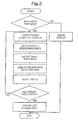
- a mode of the present invention which is applied to an onboard audio apparatus and data read/write rate control method therefor will be described with reference to Figs. 1 and 2.
- an audio signal in a compact disk 12 is saved in a hard disk 13, and audio is played back from the hard disk 13.
- a read section for the compact disk 12 can store, e.g., 100 compact disks 12.
- the hard disk 13 may be of internal type in which the hard disk 13 is incorporated in the onboard audio apparatus 11, or of external type in which the hard disk 13 is connected to the onboard audio apparatus 11.
- the hard disk 13 has a recording capacity of, e.g., 64 Gbytes.
- a central processing unit 14 checks whether read of audio signals from the compact disk 12 and write of the audio signals in the hard disk 13 are possible. In other words, the central processing unit 14 checks whether the compact disk 12 is set in the read section for the compact disk 12 and whether the hard disk 13 has a free recording capacity. If the compact disk 12 is not set in the read section or the hard disk 13 does not have any free recording capacity, the central processing unit 14 displays a message to this effect on a display device 15, and does not save any audio signal.
- the central processing unit 14 detects a force acting on the vehicle. More specifically, the central processing unit 14 differentiates vibration signals output from a vibration detector 16 with respect to time, differentiates position signals output from a GPS antenna 17 to calculate second-order derivatives with respect to time, or differentiates vehicle speed signals output from a vehicle speed pulse generator 18 with respect to time. In this manner, the central processing unit 14 detects a force acting on the vehicle.
- Audio signals in the compact disk 12 are read out via an optical head 21.
- the read rate is variable and controlled by a control device 22 to, e.g., 20 times the normal playback rate at maximum.
- the audio signals read out from the compact disk 12 are temporarily stored in a storage device 23.
- the audio signals read out from the storage device 23 are compressed by a high-speed encoder 24 which adopts ATRAC3 or MP3 as an audio compression method.
- the compressed signals are written in the hard disk 13.
- the write rate of audio signals in the hard disk 13 is high and variable.
- the central processing unit 14 detects error rates in read from the compact disk 12 and write in the hard disk 13, and adjusts the read and write rates on the basis of the above-described force and error rates. If the above-described force has a predetermined value or more or the above-described error rate has a predetermined value or more, the central processing unit 14 sends an instruction of decreasing the read rate to the control device 22, and also decreases the write rate. If the above-described force or error rate is larger than the predetermined value, the central processing unit 14 may not execute read from the compact disk 12 and write in the hard disk 13.
- the prospective write end time is also determined.
- the central processing unit 14 displays this prospective end time on the display device 15. Then, audio signals are read out from the compact disk 12 at the adjusted read rate, and written in the hard disk 13 at the adjusted write rate. This save is performed every predetermined length of audio signals or predetermined length of time. Every time save of this unit ends, whether all target audio signals are saved is checked.
- the central processing unit 14 detects a force acting on the vehicle again, and also repeats the subsequent processing. If the detected force acting on the vehicle or the error rates in read from the compact disk 12 and write in the hard disk 13 vary from the previously detected force or error rates, the read and write rates are adjusted again.
- the central processing unit 14 sends an instruction of decreasing the read rate to be lower than the previous one, and also decrease the write rate. If both the above-described force and error rate are lower than the previous ones, the central processing unit 14 sends an instruction of increasing the read rate to be higher than the previous one, and also increases the write rate.
- the prospective end time of write in the hard disk 13 also varies from the previous one.
- the central processing unit 14 displays the varied prospective end time on the display device 15. If all target audio signals are saved, a list, i.e., directory in the hard disk 13 is updated, and the save ends.
- audio signals read out from the hard disk 13 are decompressed by a decoder 25 which employs the same audio compression method as that of the high-speed encoder 24.
- the decompressed signals are converted from digital signals into analog signals by a D/A converter 26, power-amplified by a power amplifier 27, and supplied to a loudspeaker (not shown).
- the read rate from the compact disk 12 and the write rate in the hard disk 13 are both variable.
- only one of the read and write rates may be variable, and only the variable read or write rate may be controlled.
- the read and write rates are controlled based on both the force acting on the vehicle and the error rates of read from the compact disk 12 and write in the hard disk 13.
- the read and write rates may be controlled on the basis of only one of the force and error rates.
- the central processing unit 14 can predict the prospective vehicle traveling time in route navigation. If the prospective write end time is shorter than the prospective vehicle traveling time, the read rate from the compact disk 12 and the write rate in the hard disk 13 can be decreased within the range of the prospective traveling time. If the prospective end time is longer than the prospective traveling time, read from the compact disk 12 and write in the hard disk 13 can be stopped.
- audio signals in the compact disk 12 are saved in the hard disk 13.
- audio signals in a recording medium other than the compact disk 12 may be saved in a high-speed writable, large-capacity recording medium other than the hard disk 13.
- Data such as video signals or other digital signals except audio signals may be saved.
- processing of saving audio signals of the compact disk 12 in the hard disk 13 starts upon operating a button or the like.
- save processing may automatically start when the compact disk 12 is set in the read section for the compact disk 12.
- the onboard audio apparatus 11 comprises the decoder 25 serving as a means for playing back audio signals.
- the onboard audio apparatus 11 may comprise only a means for saving data without any means for playing back data.
- the present invention is applied to the onboard audio apparatus 11 as a kind of onboard electronic device used in a vehicle and the data read/write rate control method therefor.
- the present invention can also be applied to a mobile electronic device used in a variety of mobile units such as a shipboard and aircraft and a data read/write rate control method therefor.
- the present invention can be utilized for a mobile electronic device such as an onboard audio apparatus used in a mobile unit such as a vehicle, shipboard, or aircraft, and a data read/write rate control method therefor.
Landscapes
- Engineering & Computer Science (AREA)
- Signal Processing (AREA)
- Signal Processing For Digital Recording And Reproducing (AREA)
- Rotational Drive Of Disk (AREA)
Abstract
In a mobile electronic device (11), at least
either one of the read rate from a first recording
medium (12) and the write rate in a second recording
medium (13) is variable. A detection means (14)
detects a force acting on the mobile unit, and a
control means (14) controls at least either the
variable read or write rate on the basis of the
detection. Even while the moving unit moves, data in
the first recording medium (12) can be stably saved in
the second recording medium (13), improving the
reliability. Data in the first recording medium (12)
can be saved in the second recording medium (13) within
the shortest time corresponding to the moving state of
the mobile unit, improving the convenience.
Description
The present invention relates to a mobile
electronic device for saving data of a first recording
medium in a second recording medium, and a data
read/write rate control method therefor.
Some of mobile audio apparatuses such as an
onboard audio apparatus can save audio signals of a
recording medium in another recording medium. Such an
onboard audio apparatus can successively play back
musical compositions from a recording medium which
saves only desired musical compositions, or can do away
with carrying of a recording medium which records audio
signals into a vehicle next time.
While a vehicle travels, a force generally
acts on the vehicle due to vibrations caused by a rough
road surface or the acceleration/deceleration of the
vehicle. A force acting on the vehicle also acts on
the onboard audio apparatus. As a result, the position
of a head for reading out an audio signal from a source
recording medium or the position of a head for writing
an audio signal in a destination recording medium is
relatively displaced from a normal position with
respect to the recording medium, generating a
read/write error.
There is a demand for saving an audio signal
within a short time by saving it at a rate higher than
a normal audio signal playback rate. However, high-rate
saving is readily influenced by a force acting on
the vehicle, and the read/write error rate further
increases. It is difficult for the conventional
onboard audio apparatus to stably save an audio signal
from a source recording medium to a destination
recording medium while the vehicle travels, resulting
in low reliability.
It is an object of the present invention to
provide a mobile electronic device which is reliable
for being capable of stably saving data of a first
recording medium in a second recording medium even
during movement of a mobile unit and which is
convenient for saving data of the first recording
medium in the second recording medium within the
shortest time corresponding to the moving state of the
mobile unit, and a data read/write rate control method
therefor.
In a first mobile electronic device according
to the present invention, at least either one of the
read rate of data from a first recording medium by read
means and the write rate of data in a second recording
medium by write means is variable. Detection means
detects a force acting on a mobile unit, and control
means controls at least either the variable read or
write rate on the basis of the detection.
If the force acting on the mobile unit has a
predetermined value or more, the error rate can be
suppressed in at least either read or write by
decreasing at least either the read or write rate.
Even during movement of the mobile unit, data in the
first recording medium can be stably saved in the
second recording medium, therefore the device is
reliable.
If the force acting on the mobile unit has
the predetermined value or less, at least either the
read or write rate can be increased unless the error
rate becomes excessively high. Data in the first
recording medium can be saved in the second recording
medium within the shortest time corresponding to the
moving state of the mobile unit, therefore the device
is convenient.
In a preferred first mobile electronic device
according to the present invention, display means
displays a prospective end time of data write in the
second recording medium. The driver or passenger of
the mobile unit can easily know the prospective end
time, therefore the device is highly convenient.
In another preferred first mobile electronic
device according to the present invention, the control
means controls at least either data read from the first
recording medium or data write in the second recording
medium on the basis of the prospective end time of data
write in the second recording medium and the
prospective moving time of the mobile unit.
If the prospective end time is shorter than
the prospective moving time, at least either one of the
read rate of data from the first recording medium and
the write rate of data in the second recording medium
can be decreased within the range of the prospective
moving time. Even while the mobile unit moves, data in
the first recording medium can be further stably saved
in the second recording medium, therefore the device is
highly reliable.
If the prospective end time is longer than
the prospective moving time, data read from the first
recording medium and data write in the second recording
medium can be stopped. This can prevent a case in
which save of data is not ended yet at the end of
movement of the mobile unit, therefore the device is
highly convenient.
In still another preferred first mobile
electronic device according to the present invention,
vibrations acting on the mobile unit are detected. If
this vibration has a predetermined value or more, the
error rate can be suppressed in at least either read or
write by decreasing at least either the read or write
rate. Even during movement of the mobile unit, data in
the first recording medium can be stably saved in the
second recording medium, therefore the device is
reliable.
If the vibration acting on the mobile unit
has the predetermined value or less, at least either
the read or write rate can be increased unless the
error rate becomes excessively high. Data in the first
recording medium can be saved in the second recording
medium within the shortest time corresponding to the
moving state of the mobile unit, therefore the device
is convenient.
In a second mobile electronic device
according to the present invention, at least either one
of the read rate of data from a first recording medium
by read means and the write rate of data in a second
recording medium by write means is variable. Detection
means detects an error rate in at least either read or
write, and control means controls either the variable
read or write rate on the basis of the detection.
If the error rate in at least either read or
write has a predetermined value or more, the error rate
can be suppressed by decreasing at least either the
read or write rate. Even during movement of the mobile
unit, data in the first recording medium can be stably
saved in the second recording medium, therefore the
device is reliable.
If the error rate has the predetermined value
or less, at least either the read or write rate can be
increased unless the error rate becomes excessively
high. Data in the first recording medium can be saved
in the second recording medium within the shortest time
corresponding to the moving state of the mobile unit,
therefore the device is convenient.
In a preferred second mobile electronic
device according to the present invention, display
means displays a prospective end time of data write in
the second recording medium. The driver or passenger
of the mobile unit can easily know the prospective end
time, therefore the device is highly convenient.
In another preferred second mobile electronic
device according to the present invention, the control
means controls at least either data read from the first
recording medium or data write in the second recording
medium on the basis of the prospective end time of data
write in the second recording medium and the
prospective moving time of the mobile unit.
If the prospective end time is shorter than
the prospective moving time, at least either one of the
read rate of data from the first recording medium and
the write rate of data in the second recording medium
can be decreased within the range of the prospective
moving time. Even while the mobile unit moves, data in
the first recording medium can be further stably saved
in the second recording medium, therefore the device is
highly reliable.
If the prospective end time is longer than
the prospective moving time, data read from the first
recording medium and data write in the second recording
medium can be stopped. This can prevent a case in
which save of data is not ended yet at the end of
movement of the mobile unit, therefore the device is
highly convenient.
In a third mobile electronic device according
to the present invention, at least either one of the
read rate of data from a first recording medium by read
means and the write rate of data in a second recording
medium by write means is variable. Detection means
detects a force acting on a mobile unit and an error
rate in at least either read or write, and control
means controls either the variable read or write rate
on the basis of the detection.
If the force acting on the mobile unit has a
predetermined value or more, or the error rate in at
least either read or write has a predetermined value or
more, the error rate can be suppressed by decreasing at
least either the read or write rate. Even during
movement of the mobile unit, data in the first
recording medium can be stably saved in the second
recording medium, therefore the device is reliable.
If the force acting on the mobile unit has
the predetermined value or less, and the error rate has
the predetermined value or less, at least either the
read or write rate can be increased unless the error
rate becomes excessively high. Data in the first
recording medium can be saved in the second recording
medium within the shortest time corresponding to the
moving state of the mobile unit, therefore the device
is convenient.
In a preferred third mobile electronic device
according to the present invention, display means
displays a prospective end time of data write in the
second recording medium. The driver or passenger of
the mobile unit can easily know the prospective end
time, therefore the device is highly convenient.
In another preferred third mobile electronic
device according to the present invention, the control
means controls at least either data read from the first
recording medium or data write in the second recording
medium on the basis of the prospective end time of data
write in the second recording medium and the
prospective moving time of the mobile unit.
If the prospective end time is shorter than
the prospective moving time, at least either one of the
read rate of data from the first recording medium and
the write rate of data in the second recording medium
can be decreased within the range of the prospective
moving time. Even while the mobile unit moves, data in
the first recording medium can be further stably saved
in the second recording medium, therefore the device is
highly reliable.
If the prospective end time is longer than
the prospective moving time, data read from the first
recording medium and data write in the second recording
medium can be stopped. This can prevent a case in
which save of data is not ended yet at the end of
movement of the mobile unit, therefore the device is
highly convenient.
In still another preferred third mobile
electronic device according to the present invention,
vibrations acting on the mobile unit are detected. If
this vibration has a predetermined value or more, the
error rate can be suppressed in at least either read or
write by decreasing at least either the read or write
rate. Data in the first recording medium can be saved
in the second recording medium within the shortest time
corresponding to the moving state of the moving unit,
therefore the device is convenient.
If the vibration acting on the mobile unit
has the predetermined value or less, at least either
the read or write rate can be increased unless the
error rate becomes excessively high. Data in the first
recording medium can be saved in the second recording
medium within the shortest time corresponding to the
moving state of the mobile unit, therefore the device
is convenient.
In a data read/write rate control method for
a mobile electronic device according to the present
invention, at least either one of the read rate of data
from a first recording medium and the write rate of
data in a second recording medium is variable. A force
acting on a mobile unit and an error rate in at least
either read or write are detected, and either the
variable read or write rate is controlled on the basis
of the detection.
If the force acting on the mobile unit has a
predetermined value or more, or the error rate in at
least either read or write has a predetermined value or
more, the error rate can be suppressed by decreasing at
least either the read or write rate. Even during
movement of the mobile unit, data in the first
recording medium can be stably saved in the second
recording medium, therefore the method is reliable.
If the force acting on the mobile unit has
the predetermined value or less, and the error rate has
the predetermined value or less, at least either the
read or write rate can be increased unless the error
rate becomes excessively high. Data in the first
recording medium can be saved in the second recording
medium within the shortest time corresponding to the
moving state of the mobile unit, therefore the method
is convenient.
In a preferred data read/write rate control
method for the mobile electronic device according to
the present invention, a prospective end time of data
write in the second recording medium is displayed. The
driver or passenger of the mobile unit can easily know
the prospective end time, therefore the method is
highly convenient.
In another preferred data read/write rate
control method for the mobile electronic device
according to the present invention, at least either
data read from the first recording medium or data write
in the second recording medium is controlled on the
basis of the prospective end time of data write in the
second recording medium and the prospective moving time
of the mobile unit.
If the prospective end time is shorter than
the prospective moving time, at least either one of the
read rate of data from the first recording medium and
the write rate of data in the second recording medium
can be decreased within the range of the prospective
moving time. Even while the mobile unit moves, data in
the first recording medium can be further stably saved
in the second recording medium, therefore the method is
highly reliable.
If the prospective end time is longer than
the prospective moving time, data read from the first
recording medium and data write in the second recording
medium can be stopped. This can prevent a case in
which save of data is not ended yet at the end of
movement of the mobile unit, therefore the method is
highly convenient.
In still another preferred data read/write
rate control method for the mobile electronic device
according to the present invention, vibrations acting
on the mobile unit are detected. If this vibration has
a predetermined value or more, the error rate can be
suppressed in at least either read or write by
decreasing at least either the read or write rate.
Data in the first recording medium can be saved in the
second recording medium within the shortest time
corresponding to the moving state of the mobile unit,
therefore the method is convenient.
If the vibration acting on the mobile unit
has the predetermined value or less, at least either
the read or write rate can be increased unless the
error rate becomes excessively high. Data in the first
recording medium can be saved in the second recording
medium within the shortest time corresponding to the
moving state of the mobile unit, therefore the method
is convenient.
A mode of the present invention which is
applied to an onboard audio apparatus and data
read/write rate control method therefor will be
described with reference to Figs. 1 and 2. In an
onboard audio apparatus 11 of this mode, an audio
signal in a compact disk 12 is saved in a hard disk 13,
and audio is played back from the hard disk 13. A read
section for the compact disk 12 can store, e.g., 100
compact disks 12. The hard disk 13 may be of internal
type in which the hard disk 13 is incorporated in the
onboard audio apparatus 11, or of external type in
which the hard disk 13 is connected to the onboard
audio apparatus 11. The hard disk 13 has a recording
capacity of, e.g., 64 Gbytes.
If a button for saving an audio signal of the
compact disk 12 in the hard disk 13 is operated during
traveling of a vehicle, a central processing unit 14
checks whether read of audio signals from the compact
disk 12 and write of the audio signals in the hard disk
13 are possible. In other words, the central
processing unit 14 checks whether the compact disk 12
is set in the read section for the compact disk 12 and
whether the hard disk 13 has a free recording capacity.
If the compact disk 12 is not set in the read section
or the hard disk 13 does not have any free recording
capacity, the central processing unit 14 displays a
message to this effect on a display device 15, and does
not save any audio signal.
If read of audio signals from the compact
disk 12 and write of the audio signals in the hard disk
13 are both possible, the central processing unit 14
detects a force acting on the vehicle. More
specifically, the central processing unit 14
differentiates vibration signals output from a
vibration detector 16 with respect to time,
differentiates position signals output from a GPS
antenna 17 to calculate second-order derivatives with
respect to time, or differentiates vehicle speed
signals output from a vehicle speed pulse generator 18
with respect to time. In this manner, the central
processing unit 14 detects a force acting on the
vehicle.
Audio signals in the compact disk 12 are read
out via an optical head 21. The read rate is variable
and controlled by a control device 22 to, e.g., 20
times the normal playback rate at maximum. The audio
signals read out from the compact disk 12 are
temporarily stored in a storage device 23. The audio
signals read out from the storage device 23 are
compressed by a high-speed encoder 24 which adopts
ATRAC3 or MP3 as an audio compression method. The
compressed signals are written in the hard disk 13.
The write rate of audio signals in the hard disk 13 is
high and variable.
The central processing unit 14 detects error
rates in read from the compact disk 12 and write in the
hard disk 13, and adjusts the read and write rates on
the basis of the above-described force and error rates.
If the above-described force has a predetermined value
or more or the above-described error rate has a
predetermined value or more, the central processing
unit 14 sends an instruction of decreasing the read
rate to the control device 22, and also decreases the
write rate. If the above-described force or error rate
is larger than the predetermined value, the central
processing unit 14 may not execute read from the
compact disk 12 and write in the hard disk 13.
After the read and write rates are determined,
the prospective write end time is also determined. The
central processing unit 14 displays this prospective
end time on the display device 15. Then, audio signals
are read out from the compact disk 12 at the adjusted
read rate, and written in the hard disk 13 at the
adjusted write rate. This save is performed every
predetermined length of audio signals or predetermined
length of time. Every time save of this unit ends,
whether all target audio signals are saved is checked.
If an audio signal to be saved remains in the
compact disk 12, the central processing unit 14 detects
a force acting on the vehicle again, and also repeats
the subsequent processing. If the detected force
acting on the vehicle or the error rates in read from
the compact disk 12 and write in the hard disk 13 vary
from the previously detected force or error rates, the
read and write rates are adjusted again.
That is, if at least either one of the above-described
force and error rate is higher than the
previous one, the central processing unit 14 sends an
instruction of decreasing the read rate to be lower
than the previous one, and also decrease the write rate.
If both the above-described force and error rate are
lower than the previous ones, the central processing
unit 14 sends an instruction of increasing the read
rate to be higher than the previous one, and also
increases the write rate.
After the read and write rates are adjusted,
the prospective end time of write in the hard disk 13
also varies from the previous one. The central
processing unit 14 displays the varied prospective end
time on the display device 15. If all target audio
signals are saved, a list, i.e., directory in the hard
disk 13 is updated, and the save ends.
To play back audio signals from the hard disk
13 which stores audio signals, audio signals read out
from the hard disk 13 are decompressed by a decoder 25
which employs the same audio compression method as that
of the high-speed encoder 24. The decompressed signals
are converted from digital signals into analog signals
by a D/A converter 26, power-amplified by a power
amplifier 27, and supplied to a loudspeaker (not shown).
In the onboard audio apparatus 11 and data
read/write rate control method therefor described above,
the read rate from the compact disk 12 and the write
rate in the hard disk 13 are both variable.
Alternatively, only one of the read and write rates may
be variable, and only the variable read or write rate
may be controlled.
In the onboard audio apparatus 11 and data
read/write rate control method therefor described above,
the read and write rates are controlled based on both
the force acting on the vehicle and the error rates of
read from the compact disk 12 and write in the hard
disk 13. Alternatively, the read and write rates may
be controlled on the basis of only one of the force and
error rates.
Since the above onboard audio apparatus 11
comprises the GPS antenna 17, the central processing
unit 14 can predict the prospective vehicle traveling
time in route navigation. If the prospective write end
time is shorter than the prospective vehicle traveling
time, the read rate from the compact disk 12 and the
write rate in the hard disk 13 can be decreased within
the range of the prospective traveling time. If the
prospective end time is longer than the prospective
traveling time, read from the compact disk 12 and write
in the hard disk 13 can be stopped.
In the onboard audio apparatus 11 and data
read/write rate control method therefor described above,
audio signals in the compact disk 12 are saved in the
hard disk 13. Alternatively, audio signals in a
recording medium other than the compact disk 12 may be
saved in a high-speed writable, large-capacity
recording medium other than the hard disk 13. Data
such as video signals or other digital signals except
audio signals may be saved.
In the onboard audio apparatus 11 and data
read/write rate control method therefor described above,
processing of saving audio signals of the compact disk
12 in the hard disk 13 starts upon operating a button
or the like. Alternatively, save processing may
automatically start when the compact disk 12 is set in
the read section for the compact disk 12. The onboard
audio apparatus 11 comprises the decoder 25 serving as
a means for playing back audio signals. Alternatively,
the onboard audio apparatus 11 may comprise only a
means for saving data without any means for playing
back data.
In the above mode, the present invention is
applied to the onboard audio apparatus 11 as a kind of
onboard electronic device used in a vehicle and the
data read/write rate control method therefor. The
present invention can also be applied to a mobile
electronic device used in a variety of mobile units
such as a shipboard and aircraft and a data read/write
rate control method therefor.
The present invention can be utilized for a
mobile electronic device such as an onboard audio
apparatus used in a mobile unit such as a vehicle,
shipboard, or aircraft, and a data read/write rate
control method therefor.
Claims (15)
- A mobile electronic device for saving data of a first recording medium in a second recording medium, wherein
at least one of a read rate of read means for reading out the data from the first recording medium and a write rate of write means for writing the data read out by the read means in the second recording medium is variable,
detection means detects a force acting on a mobile unit, and
control means controls at least either the variable read or write rate on the basis of the detection. - A mobile electronic device according to claim 1, wherein
prediction means predicts a prospective end time of the write, and
display means displays the prospective end time. - A mobile electronic device according to claim 1, wherein
first prediction means predicts a prospective end time of the write,
second prediction means predicts a prospective moving time of the mobile unit, and
the control means controls at least either one of the read and the write on the basis of the prospective end time and the prospective moving time. - A mobile electronic device according to claim 1, wherein the force includes a vibration.
- A mobile electronic device for saving data of a first recording medium in a second recording medium, wherein
at least one of a read rate of read means for reading out the data from the first recording medium and a write rate of write means for writing the data read out by the read means in the second recording medium is variable,
detection means detects an error rate in either one of the read and the write, and
the control means controls at least either the variable read or write rate on the basis of the detection. - A mobile electronic device according to claim 5, wherein
prediction means predicts a prospective end time of the write, and
display means displays the prospective end time. - A mobile electronic device according to claim 5, wherein
first prediction means predicts a prospective end time of the write,
second prediction means predicts a prospective moving time of the mobile unit, and
the control means controls at least either one of the read and the write on the basis of the prospective end time and the prospective moving time. - A mobile electronic device for saving data of a first recording medium in a second recording medium, wherein
at least one of a read rate of read means for reading out the data from the first recording medium and a write rate of write means for writing the data read out by the read means in the second recording medium is variable,
detection means detects a force acting on a mobile unit and an error rate in either one of the read and the write, and
control means controls at least either the variable read or write rate on the basis of the detection. - A mobile electronic device according to claim 8, wherein
prediction means predicts a prospective end time of the write, and
display means displays the prospective end time. - A mobile electronic device according to claim 8, wherein
first prediction means predicts a prospective end time of the write,
second prediction means predicts a prospective moving time of the mobile unit, and
the control means controls at least either one of the read and the write on the basis of the prospective end time and the prospective moving time. - A mobile electronic device according to claim 8, wherein the force includes a vibration.
- A data read/write rate control method for a mobile electronic device for saving data of a first recording medium in a second recording medium, wherein
at least one of a read rate for reading out the data from the first recording medium and a write rate for writing the readout data in the second recording medium is variable, and
the method comprises
the first detection step of detecting a force acting on a mobile unit,
the second detection step of detecting an error rate in either one of the read and the write, and
the control step of controlling at least either the variable read or write rate on the basis of the first or second detection. - A data read/write rate control method for a mobile electronic device according to claim 12, further comprising
the prediction step of predicting a prospective end time of the write, and
the display step of displaying the prospective end time. - A data read/write rate control method for a mobile electronic device according to claim 12, wherein the method further comprises
the first prediction step of predicting a prospective end time of the write, and
the second prediction step of predicting a prospective moving time of the mobile unit, and
at least either one of the read and the write is controlled in the control step on the basis of the prospective end time and the prospective moving time. - A data read/write rate control method for a mobile electronic device according to claim 12, wherein the force includes a vibration.
Applications Claiming Priority (3)
| Application Number | Priority Date | Filing Date | Title |
|---|---|---|---|
| JP2000344077 | 2000-11-10 | ||
| JP2000344077A JP2002150662A (en) | 2000-11-10 | 2000-11-10 | Electronic equipment for mobile objects |
| PCT/JP2001/009418 WO2002039448A1 (en) | 2000-11-10 | 2001-10-26 | Mobile electronic apparatus and method for controlling read/write rate of data |
Publications (2)
| Publication Number | Publication Date |
|---|---|
| EP1265239A1 true EP1265239A1 (en) | 2002-12-11 |
| EP1265239A4 EP1265239A4 (en) | 2007-07-25 |
Family
ID=18818332
Family Applications (1)
| Application Number | Title | Priority Date | Filing Date |
|---|---|---|---|
| EP01980914A Withdrawn EP1265239A4 (en) | 2000-11-10 | 2001-10-26 | MOBILE ELECTRONIC APPARATUS AND METHOD FOR CONTROLLING READER / DATA WRITING RATE |
Country Status (5)
| Country | Link |
|---|---|
| US (1) | US20030047057A1 (en) |
| EP (1) | EP1265239A4 (en) |
| JP (1) | JP2002150662A (en) |
| KR (1) | KR20020064965A (en) |
| WO (1) | WO2002039448A1 (en) |
Cited By (1)
| Publication number | Priority date | Publication date | Assignee | Title |
|---|---|---|---|---|
| CN1971743B (en) * | 2005-11-24 | 2010-06-16 | 株式会社电装 | Recording system and recording method for recording data |
Families Citing this family (4)
| Publication number | Priority date | Publication date | Assignee | Title |
|---|---|---|---|---|
| JP4799404B2 (en) * | 2004-03-31 | 2011-10-26 | 三洋電機株式会社 | Information recording method, information recording / reproducing apparatus, and information recording / reproducing apparatus |
| US8490092B2 (en) | 2011-07-06 | 2013-07-16 | Microsoft Corporation | Combined live migration and storage migration using file shares and mirroring |
| US9223607B2 (en) * | 2012-01-17 | 2015-12-29 | Microsoft Technology Licensing, Llc | System for replicating or migrating virtual machine operations log by throttling guest write iOS based on destination throughput |
| US9600206B2 (en) | 2012-08-01 | 2017-03-21 | Microsoft Technology Licensing, Llc | Request ordering support when switching virtual disk replication logs |
Family Cites Families (23)
| Publication number | Priority date | Publication date | Assignee | Title |
|---|---|---|---|---|
| US3092879A (en) * | 1960-03-11 | 1963-06-11 | Foseco Int | Metal casting moulds |
| US3120022A (en) * | 1961-01-27 | 1964-02-04 | Studebaker Packard Corp | Adjustable spacer |
| US4857630A (en) * | 1987-12-07 | 1989-08-15 | E. I. Du Pont De Nemours And Company | Hyperbranched polyarylene |
| US5196502A (en) * | 1991-11-05 | 1993-03-23 | Eastman Kodak Company | Method for the preparation of multiply-branched aromatic polyesters |
| US5214122A (en) * | 1992-07-13 | 1993-05-25 | Eastman Kodak Company | Preparation of multiply-branched cycloalkyl polyesters and multiply-branched cycloalkyl polyesters |
| US5225522A (en) * | 1992-07-13 | 1993-07-06 | Eastman Kodak Company | Multiply-branched aliphatic-aromatic polyesters and method for preparing multiply-branched aliphatic-aromatic polyesters |
| JPH07331141A (en) * | 1994-06-03 | 1995-12-19 | Brother Ind Ltd | Recording ink |
| JPH07334915A (en) * | 1994-06-09 | 1995-12-22 | Ricoh Co Ltd | CD-ROM duplication device |
| JPH0855423A (en) * | 1994-08-11 | 1996-02-27 | Shinano Kenshi Co Ltd | Disk player |
| JP3203976B2 (en) * | 1994-09-05 | 2001-09-04 | 日産自動車株式会社 | Vehicle driving force control device |
| JPH0927164A (en) * | 1995-07-11 | 1997-01-28 | Matsushita Electric Ind Co Ltd | Optical disk vibration suppression control device |
| JPH0961184A (en) * | 1995-08-30 | 1997-03-07 | Matsushita Electric Ind Co Ltd | Route search display device |
| JP2766472B2 (en) * | 1996-05-01 | 1998-06-18 | 株式会社東芝 | Disk unit |
| JPH1125586A (en) * | 1997-07-01 | 1999-01-29 | Lg Electron Inc | Optical disk drive device |
| JP3490881B2 (en) * | 1998-01-12 | 2004-01-26 | ティアック株式会社 | Optical disk drive |
| JPH11312143A (en) * | 1998-04-28 | 1999-11-09 | Clarion Co Ltd | Information processor, its method, car audio system, its control method, and recording medium with information processing program recorded therein |
| US6285522B1 (en) * | 1998-06-05 | 2001-09-04 | Seagate Technology Llc | Rotational vibration compensation using a dedicated surface with a constant frequency pattern |
| JP3273599B2 (en) * | 1998-06-19 | 2002-04-08 | 沖電気工業株式会社 | Speech coding rate selector and speech coding device |
| US6300388B1 (en) * | 1998-10-29 | 2001-10-09 | Agfa-Gevaert | Ink compositions for ink jet printing |
| US6310115B1 (en) * | 1998-10-29 | 2001-10-30 | Agfa-Gevaert | Ink compositions for ink jet printing |
| US6549147B1 (en) * | 1999-05-21 | 2003-04-15 | Nippon Telegraph And Telephone Corporation | Methods, apparatuses and recorded medium for reversible encoding and decoding |
| US6539392B1 (en) * | 2000-03-29 | 2003-03-25 | Bizrate.Com | System and method for data collection, evaluation, information generation, and presentation |
| US6704619B1 (en) * | 2003-05-24 | 2004-03-09 | American Gnc Corporation | Method and system for universal guidance and control of automated machines |
-
2000
- 2000-11-10 JP JP2000344077A patent/JP2002150662A/en not_active Abandoned
-
2001
- 2001-10-26 US US10/169,091 patent/US20030047057A1/en not_active Abandoned
- 2001-10-26 KR KR1020027008312A patent/KR20020064965A/en not_active Ceased
- 2001-10-26 EP EP01980914A patent/EP1265239A4/en not_active Withdrawn
- 2001-10-26 WO PCT/JP2001/009418 patent/WO2002039448A1/en not_active Ceased
Cited By (1)
| Publication number | Priority date | Publication date | Assignee | Title |
|---|---|---|---|---|
| CN1971743B (en) * | 2005-11-24 | 2010-06-16 | 株式会社电装 | Recording system and recording method for recording data |
Also Published As
| Publication number | Publication date |
|---|---|
| US20030047057A1 (en) | 2003-03-13 |
| EP1265239A4 (en) | 2007-07-25 |
| KR20020064965A (en) | 2002-08-10 |
| JP2002150662A (en) | 2002-05-24 |
| WO2002039448A1 (en) | 2002-05-16 |
Similar Documents
| Publication | Publication Date | Title |
|---|---|---|
| US7616540B2 (en) | Apparatus for and method of recording and reproducing information | |
| US6427103B2 (en) | Information processing apparatus of on-vehicle type | |
| EP1265239A1 (en) | Mobile electronic apparatus and method for controlling read/write rate of data | |
| US20050007918A1 (en) | Information reproduction apparatus, information reproduction method and information recording medium for a rotation control program | |
| JPH08105753A (en) | Route guidance system for mounting on vehicle | |
| US20030053381A1 (en) | Driving apparatus and driving method for actuator, and information recording / reproducing apparatus | |
| JP2006129223A (en) | Content playback volume setting device and in-vehicle content playback system | |
| US7751690B2 (en) | Recording and reproducing apparatus | |
| CN101009121B (en) | Recording and reproducing device, recording and reproducing method, and vehicle-mounted recording and reproducing device | |
| JP4135021B2 (en) | Recording / reproducing apparatus and program | |
| JP3499441B2 (en) | In-vehicle navigation system | |
| JP2006275907A (en) | Navigation device, navigation processing method, and program | |
| JP2007017715A (en) | Car navigation system | |
| JP2005153659A (en) | Car audio system | |
| JP4777840B2 (en) | In-vehicle information terminal | |
| JPH0981959A (en) | Information recording medium and in-vehicle information recording / reproducing apparatus using this information recording medium | |
| JP5595173B2 (en) | In-vehicle disk playback device | |
| JPH07122002A (en) | CD controller | |
| JPS6282559A (en) | disc playback device | |
| JP2006127580A (en) | In-vehicle data playback device | |
| JP2011170917A (en) | Device, method and program for replaying recording medium for mobile object, and recording medium stored with program for replaying recording medium for mobile object | |
| JP2003281842A (en) | Vibration controller for on-vehicle device, and vibration control method therefor | |
| JP2005293670A (en) | Information recording/reproducing device and method, and program | |
| JPH0684332A (en) | Disk player device | |
| JPH05135500A (en) | Digital data reproducer |
Legal Events
| Date | Code | Title | Description |
|---|---|---|---|
| PUAI | Public reference made under article 153(3) epc to a published international application that has entered the european phase |
Free format text: ORIGINAL CODE: 0009012 |
|
| 17P | Request for examination filed |
Effective date: 20020703 |
|
| AK | Designated contracting states |
Kind code of ref document: A1 Designated state(s): AT BE CH CY DE DK ES FI FR GB GR IE IT LI LU MC NL PT SE TR |
|
| RBV | Designated contracting states (corrected) |
Designated state(s): DE FR GB |
|
| A4 | Supplementary search report drawn up and despatched |
Effective date: 20070627 |
|
| STAA | Information on the status of an ep patent application or granted ep patent |
Free format text: STATUS: THE APPLICATION HAS BEEN WITHDRAWN |
|
| 18W | Application withdrawn |
Effective date: 20071204 |