EP1264961A1 - Method of producing petroleum - Google Patents
Method of producing petroleum Download PDFInfo
- Publication number
- EP1264961A1 EP1264961A1 EP00905284A EP00905284A EP1264961A1 EP 1264961 A1 EP1264961 A1 EP 1264961A1 EP 00905284 A EP00905284 A EP 00905284A EP 00905284 A EP00905284 A EP 00905284A EP 1264961 A1 EP1264961 A1 EP 1264961A1
- Authority
- EP
- European Patent Office
- Prior art keywords
- oil
- horizontal
- containing reservoir
- permeability
- well
- Prior art date
- Legal status (The legal status is an assumption and is not a legal conclusion. Google has not performed a legal analysis and makes no representation as to the accuracy of the status listed.)
- Granted
Links
- 238000000034 method Methods 0.000 title description 6
- 239000003208 petroleum Substances 0.000 title description 2
- 230000035699 permeability Effects 0.000 claims abstract description 86
- 238000002347 injection Methods 0.000 claims abstract description 69
- 239000007924 injection Substances 0.000 claims abstract description 69
- 238000004519 manufacturing process Methods 0.000 claims abstract description 64
- 238000004088 simulation Methods 0.000 claims description 19
- 238000004364 calculation method Methods 0.000 claims description 9
- 238000004458 analytical method Methods 0.000 claims description 8
- 239000000203 mixture Substances 0.000 claims description 4
- 239000003921 oil Substances 0.000 description 125
- 239000010779 crude oil Substances 0.000 description 46
- 238000011084 recovery Methods 0.000 description 36
- 239000004615 ingredient Substances 0.000 description 11
- VNWKTOKETHGBQD-UHFFFAOYSA-N methane Chemical compound C VNWKTOKETHGBQD-UHFFFAOYSA-N 0.000 description 10
- 230000000704 physical effect Effects 0.000 description 10
- 230000015572 biosynthetic process Effects 0.000 description 5
- 239000012530 fluid Substances 0.000 description 5
- 239000011435 rock Substances 0.000 description 5
- 238000005457 optimization Methods 0.000 description 4
- 230000001186 cumulative effect Effects 0.000 description 2
- 238000006073 displacement reaction Methods 0.000 description 2
- 230000003287 optical effect Effects 0.000 description 1
- 230000035945 sensitivity Effects 0.000 description 1
- 238000010408 sweeping Methods 0.000 description 1
Images




Classifications
-
- E—FIXED CONSTRUCTIONS
- E21—EARTH OR ROCK DRILLING; MINING
- E21B—EARTH OR ROCK DRILLING; OBTAINING OIL, GAS, WATER, SOLUBLE OR MELTABLE MATERIALS OR A SLURRY OF MINERALS FROM WELLS
- E21B43/00—Methods or apparatus for obtaining oil, gas, water, soluble or meltable materials or a slurry of minerals from wells
- E21B43/30—Specific pattern of wells, e.g. optimising the spacing of wells
- E21B43/305—Specific pattern of wells, e.g. optimising the spacing of wells comprising at least one inclined or horizontal well
-
- E—FIXED CONSTRUCTIONS
- E21—EARTH OR ROCK DRILLING; MINING
- E21B—EARTH OR ROCK DRILLING; OBTAINING OIL, GAS, WATER, SOLUBLE OR MELTABLE MATERIALS OR A SLURRY OF MINERALS FROM WELLS
- E21B43/00—Methods or apparatus for obtaining oil, gas, water, soluble or meltable materials or a slurry of minerals from wells
- E21B43/16—Enhanced recovery methods for obtaining hydrocarbons
- E21B43/18—Repressuring or vacuum methods
Definitions
- the present invention relates to an oil production method for producing oil from oil-containing reservoirs by providing horizontal wells comprising at least a gas injection well and a production well, which are disposed horizontally opposing to each other, at high recovery factor.
- An object, according to the present invention is to provide an oil production method, wherein oil can be produced from oil-containing reservoirs at high recovery factor, by optimizing the distance between the gas injection well and the production well in the horizontal wells to be dig out with respect to a certain oil-containing reservoir.
- a method for producing oil from an oil-containing reservoir with using horizontal wells which are dig into the oil-containing reservoir, at an appropriate distance between a gas injection well and a production well thereof, depending upon at least a ratio between an averaged vertical permeability and an averaged horizontal permeability (a ratio kv/kh), in the oil-containing reservoir producing the oil therefrom.
- a method for producing oil from an oil-containing reservoir with using horizontal wells which are dig into the oil-containing reservoir, at an appropriate distance between a gas injection well and a production well thereof, depending upon at least a ratio between an averaged vertical permeability and an averaged horizontal permeability (a ratio kv/kh), layer thickness and inclination of the oil-containing reservoir producing the oil therefrom.
- a method for producing oil from an oil-containing reservoir with using horizontal wells which are dig into the oil-containing reservoir, at an appropriate distance between a gas injection well and a production well thereof, depending upon at least a ratio between an averaged vertical permeability and an averaged horizontal permeability, layer thickness and inclination of the oil-containing reservoir producing the oil therefrom, and compositions of a gas to be injected as well.
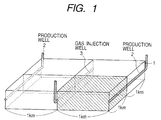
- Fig. 1 shows diagrammatically the condition where the horizontal production well 2 and the horizontal gas injection wells 3, each being about 2 km in the length, are dig into at a distance of about 1 km between them.
- a balance is obtained between two (2) kinds of forces, i.e., (1) fluid viscous forces caused due to the gas injection wells and the production wells and (2) buoyancy caused due to the difference in density between the crude oil and the injection gas, so that sweep efficiency of the crude oil by the gas injected from the gas injection well 2 with pressure comes to be at the maximum, thereby bringing the recovery factor of crude oil to be the maximum value.
- the following optimizing method is worked out upon an assumption of fully using a production capacity of the wells which maximize the fluid viscous forces of the above-mentioned (1).
- Figs. 2(a) through 2(c) are diagrammatic views for showing flow configurations within an oil-containing reservoir and a pressure profile between the horizontal wells, as was also shown in the conventional art, and in particular, Fig. 2 (a) shows a plan view for showing the flow configuration within the oil-containing reservoir, Fig. 2 (b) a cross-section view for showing the flow configuration within the oil-containing reservoir, and Fig. 2 (c) the pressure profile between the horizontal wells, respectively.
- the pressure of gas injection and the pressure of oil production are fixed.
- ratio kv/kh A ratio between an averaged vertical permeability and an averaged horizontal permeability (hereinafter, being called by the "ratio kv/kh") is also fixed.
- a half- or semi-cylindrical flow 4 occurs in the vicinity of the horizontal gas injection well 3
- a linear flow 5 appears over all the thickness of formation when it is separated far from the vicinity of the gas injection well 3.
- the half- or semi-cylindrical flow 6 occurs again.
- "X" indicates the distance between the horizontal wells
- "r" a radius of the half- or semi-cylindrical flow.
- the present invention applies the fact that the portion where the semi-cylindrical flow 4 occurs depends upon the ratio kv/kh and the layer thickness of the formation, and in particular when the layer thickness of the formation is fixed, the ratio kv/kh has an influence upon a pressure profile between the horizontal wells.
- Figs. 3(a) to 3(c) are diagrammatic views of a displacement process of crude oil with injection gas, showing the flow configurations within the oil-containing reservoir upon the basis of the flow configurations and the pressure profile between the horizontal wells, according to the present invention.
- the Fig. 3(a) shows the profiles between the horizontal wells, including viscous force (pressure gradient) composed of viscous force L in the horizontal direction and the viscous force V in the vertical direction and further buoyancy B, while showing the distance on the horizontal axis and the pressure gradient on the vertical axis.
- the Fig. 3(b) shows the viscous forces L and V and the buoyancy B by arrows of the respective directions thereof. Further, the mark C shows a force being composed thereof.
- the Fig. 3(c) shows the condition where crude oil is swept out through the gas injection.
- the factor controlling or governing the behavior of sweeping of the crude oil by the gas injection is a balance between the viscous forces L and V and the buoyancy B.
- the viscous forces L and V are affected only by the distance "X" between the wells. Namely, if the viscous forces L and V are very large comparing to the buoyancy B, the injection gas injected from the horizontal gas injection well 3, not disperses up and down, but reaches to the horizontal production well 2 directly, therefore an amount of the crude oil displaced thereby comes to be very restricted.
- an optimization can be made on the distance between the horizontal gas injection well 3 and the horizontal production well 2, by conducting simulation upon the basis of the factor mentioned above, about the oil-containing reservoirs, from which the oil production is expected to, thereby obtaining an improvement in the recovery factor of crude oil.
- a model for the simulation an area defined between the horizontal gas injection well 3 and the horizontal production well 2 shown in the Fig. 1 is applied to, i.e., avertical two (2) dimensional oil-containing reservoir model. With this model, the oil-containing reservoir having such the physical property values shown in Fig.
- initial data including, such as, the temperature to be set for the oil-containing reservoir, the pressure of the gas injected from the gas injection well 3, and the compositional ingredients of the crude oil (shown in Fig. 5) are inputted, and then the gas having the certain compositional ingredients (shown in the Fig.
- Equation (Eq. 1) The law of conservation of mass can be expressed by the following equation (Eq. 1) for each ingredient "i”.
- the simulator mentioned above uses a discrete one of the (Eq. 1): where, “r” means a phase; “ ⁇ ” phase density, “S” phase saturation factor, “ ⁇ ” porosity factor, “X” mol ratio, “V” phase velocity; and "n p " a number of phases, respectively.
- the Darcy's law is an equation of experiences, representing a relationship between velocity and viscosity of a fluid passing through within a porous medium and pressure gradient, as be indicated by the following equation (Eq. 2) where, "v” indicates flow velocity; “k” permeability of rock; “ ⁇ ” viscosity of fluid; and “dp/dx” pressure gradient, respectively.
- the flow velocity is in inverse proportion to the viscosity while it is in proportion to the pressure gradient, and a constant of proportionality thereof is the permeability.
- the permeability is the value, which is inherent to the rock, and is represented by a unit of "Darcy".
- Fig. 4 shows the physical property values of the layer thickness, the porosity and the horizontal permeability in a certain oil-containing reservoir.
- Those three kinds of physical property values are allowed to have different values for each layer, however since the optimum value of the distance between the horizontal wells lies within a range around from 500 m to 1,500 m, they are assumed to be changed very little in the horizontal direction, and further assumed to have no change within the same layer. Accordingly, in a case where those three kinds of physical property values change greatly within the range around from 500 m to 1,500 m of the optimum value between the horizontal wells, it may be sufficient to input the of physical property values, which are changed for each distance of 40 m, for example, at which the oil-containing reservoir is divided into.
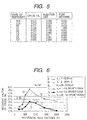
- Fig. 5 shows the compositional ingredients of the crude oil which is originated from the same oil-containing reservoir as was mentioned in the above, as well as in the injection gas.
- the crude oil is only one in the kind thereof, as shown in the Fig. 5.
- the pressure gas to be injected from the horizontal gas injection well 3 is also supposed to have the compositional ingredients as shown in the Fig. 5.
- the crude oil contains 0.655 of the ingredients of intermediate qualities being higher than C6, on the contrary to this, the injection gas 0.737 of methane.
- the injection gas 0.737 of methane.
- the injection gas contains 0.155 and 0.063 of C2 and C3, respectively, and has a property of easily dissolving into crude oil.
- the Fig. 6 shows the recovery factors of crude oil (a cumulative amount of production/deposits), in the case where the horizontal well distance between the horizontal gas injection well 3 and the horizontal production well 2 is changed within a range from 200 m to 2 km and the averaged horizontal permeability kh to 1mD, 5mD and 20mD, respectively, as shown at upper-right therein.
- the case t shows the recovery factor of crude oil when the injection gas reaches to the production well 2 (when it breaks through (B'thru)
- the case g shows that when gas-oil ratio (GOR) reaches to 5,000 scf/stb (5Mscf/stb).
- the averaged value kh of the horizontal permeability of the oil-containing reservoir is assumed to be of three (3) kinds, i.e., 1mD, 5mD, and 20mD. Then, in all of the cases, common values are given to the production pressure and the injection pressure. Also, the ratio (the ratio "kv/kh") between the averaged vertical permeability "kv” and the averaged horizontal permeability "kh” is assumed to be one (1). As apparent from t1-t3 and g1-g3 in the Fig. 6, it can be seen that there exists the horizontal well distance, which can give the maximum recovery factor of crude oil according to the present invention. And, it also can be seen that the averaged horizontal permeability "kh” hardly exerts an influence upon the recovery factor of crude oil if the value "kv/kh” is at a constant value (being constant in the pressure gradient).
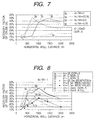
- Fig. 7 shows the recovery factors of crude oil (the cumulative amount of production/deposits), in the case where the horizontal well distance between the horizontal gas injection well 3 and the horizontal production well 2 is changed within the range from 200 m to 2 km and the ratio between the averaged vertical permeability and the averaged horizontal permeability is changed, as shown at upper-right therein, and in particular when the gas-oil ratio (GOR) reaches to 5Mscf/stb.
- GOR gas-oil ratio
- the ratio "kv/kh” in the oil-containing reservoir it is necessary to presume or speculate the ratio "kv/kh" in the oil-containing reservoir to be dig out with the horizontal wells from the core analysis and the spot test. And, treating the simulation, upon the basis of the ratio "kv/kh” presumed, enables to calculate out the optimal horizontal well distance according to the present invention. Also, when the ratio "kv/kh” comes to be small, such as about 0.2 rather than 1, the optimal horizontal well distance is widen from about 700 m to about 1.5 km.
- the ratio "kv/kh" comes to be less than 0.2, the averaged horizontal permeability comes to be small, and then the injection gas reaches directly or straightforward to the horizontal production well 2 without dispersing up and down even if the horizontal well distance is widen up to about 2 km, therefore the crude oil to be displaced therewith is limited, such as about 30% in the recovery factor of crude oil.
- the optimal horizontal well distance according to the present invention is affected by the ratio between the averaged vertical permeability and the averaged horizontal permeability in the oil-containing reservoir, greatly.
- FIG. 8 shows a result of the simulation made in the similar manner, but with setting the oil-containing reservoir model at the layer thickness (about 100 m) as two (2) times large as that treated in the above-mentioned Figs. 6 and 7.
- the case of t7 -t9 indicates the recovery factor when the injection gas reaches to the production well 2 (the B'thru), and the case of g7-g9 when the gas-oil ratio (GOR) reaches to 5,000 scf/stb (5Mscf/stb).
- the averaged value "kh" of horizontal permeability of the oil-containing reservoir is assumed to be in three (3) kinds, i.e., 1mD, 5mD and 20mD. And then, in all of the cases, common values are given to the production pressure and the injection pressure. Also, the ratio between the averaged vertical permeability and the averaged horizontal permeability (the ration "kv/kh") is assumed to be 1. As apparent from those t7-t9 and g7-g9 in the Fig. 8, it is found out that there can exists the horizontal well distance which gives the maximum recovery factor of crude oil according to the present invention, even when the layer thickness comes to be as two (2) times large as the oil-containing reservoir.
- the optimal horizontal well distance is widen up to about 1 km when the oil-containing reservoir comes two (2) times large in the layer thickness thereof. Namely, it can be seen, in the case where the ratio "kv/kh" of the oil-containing reservoir is 1 and the layer thickness thereof is about 100 m, preferably, the horizontal well distance be set around from 700 m to 1,200 m.
- the Fig. 9 shows a result of the simulation made in the similar manner, but with setting the oil-containing reservoir model at the layer thickness of about 10 m, i.e., one-fifth (1/5) of to that treated in the above-mentioned Figs. 6 and 7.
- the case t10-t12 indicates the recovery factor when the injection gas reaches to the production well 2 (the B'thru), and the case g10-g12 when the gas-oil ratio (GOR) reaches to 5,000 scf/stb (5Mscf/stb).
- the averaged value "kh” of horizontal permeability of the oil-containing reservoir is also assumed to be in three (3) kinds, i.e., 1mD, 5mD and 20mD. And then, in all of the cases, common values are given to the production pressure and the injection pressure. Also, the ratio between the averaged vertical permeability and the averaged horizontal permeability (the ration "kv/kh") is assumed to be 1. As apparent from those t10-t12 and g10-g12 in the Fig. 9, it is also found out that there can exists the horizontal well distance which gives the maximum recovery factor of crude oil according to the present invention, even when the layer thickness comes to be one-fifth (1/5) of the oil-containing reservoir.
- the optimal horizontal well distance comes to be narrow to about 300 m when the oil-containing reservoir comes to be one-fifth (1/5) in the layer thickness thereof. Namely, it can be seen, in the case where the ratio kv/kh of the oil-containing reservoir is 1 and the layer thickness thereof is about 10 m, preferably, the horizontal well distance be set around from 200 m to 600 m.
- FIG. 10 shows a result of the above-mentioned simulation, wherein the model of oil-containing reservoir, which is treated in the above-mentioned Figs. 6 and 7, is inclined by sixty (60) degree from the horizontal plane with positioning the gas injection well 3 upward and the production well 2 downward, i.e., the recovery factors of crude oil at the times t13-t15 of break-through (B'thru) for each the horizontal well distance and those at the times g13-g15 when the gas-oil ratio reaches to 5Mscf/stb, respectively.
- the model of oil-containing reservoir which is treated in the above-mentioned Figs. 6 and 7 is inclined by sixty (60) degree from the horizontal plane with positioning the gas injection well 3 upward and the production well 2 downward, i.e., the recovery factors of crude oil at the times t13-t15 of break-through (B'thru) for each the horizontal well distance and those at the times g13-g15 when the gas-oil ratio
- the averaged value "kh" on horizontal permeability of the oil-containing reservoir is also assumed to be in three (3) kinds, i.e., 1mD, 5mD and 20mD.
- t1 and g1 show the cases where the horizontal wells are not inclined.
- t13-t15 and g13-g15 in the Fig. 10 it can be seen that the influences of the averaged horizontal permeability upon the optimal horizontal well distance and the recovery factor of crude oil are small, even in the case where oil-containing reservoir is inclined by sixty (60) degree with positioning the gas injection well 3 upward and the production well 2 downward.
- the Fig. 11 shows a result of the simulation made, but with inclining the oil-containing reservoir by sixty (60) degree and setting position of the wells upside down, i.e., positioning the production well upward while the gas injection well downward, and it includes the respective recovery factors of crude oil at each the horizontal well distance, at the times t16-t18 of break-through and at the times g16-g18 when the gas-oil ratio reaches to 5Mscf/stb.
- the averaged value "kh" on the horizontal permeability of the oil-containing reservoir is assumed to be in three (3) kinds, i.e., 1mD, 5mD and 20mD.
- t1 and g1 show the cases where the horizontal wells are not inclined.
- Fig. 12 shows a result of the simulation in a case where the inclination of the oil-containing reservoir is inclined by 45 degree from the horizontal plane, although 60 degree in the above-mentioned Fig. 11, and it is indicated by t19-t21 and g19-g21.
- the averaged value "kh" on the horizontal permeability of the oil-containing reservoir is assumed to be in three (3) kinds, i.e., 1mD, 5mD and 20mD.
- t1 and g1 show the cases where the horizontal wells are not inclined. From this Fig. 12, it can be seen that the influences of the horizontal permeability upon the optimal horizontal well distance and the recovery factor of crude oil are small.
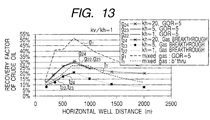
- FIG. 13 shows a result when a methane gas of 100% is injected into the models of oil-containing reservoirs, which are treated in the above-mentioned Figs. 6 and 7, and is indicated by t22-t24 and g22-g24. From this, it becomes clear that there exists the well distance which can bring the recovery factor of crude oil at the maximum even if the injection gas is changed in the composition of gradients thereof.
- the buoyancy caused due to the difference between the crude oil and the injection gas is changed, and as a result of this, the recovery factor of crude oil is changed.
- the present invention it is possible to obtain the optimization of the horizontal well distance with paying attention onto the ratio between the averaged vertical permeability and the averaged horizontal permeability in the oil-containing reservoir to be dig out through the horizontal wells.
- the layer thickness and/or the inclination of the oil-containing reservoir can be investigated easily.
- the ratio of averaged vertical permeability/averaged horizontal permeability (the ratio of "kv/kh”) can be also assumed easily.
- the digging position should be determined before digging out both the gas injection well 3 and the production well 2
- data which are obtained from the wells dig out neighboring thereon within the same oil-containing reservoir, or alternatively to use other data obtained from analogous oil-containing reservoirs.
- the averaged vertical permeability and the averaged horizontal permeability can be calculated out through a data obtaining method which will be explained below.
- the ratio of averaged vertical permeability/averaged horizontal permeability (the ratio of "kv/kh") is most important for determining the optimal horizontal well distance, among various factors thereof.
- the present invention it is possible to produce the oil from an oil-containing reservoir with good efficiency, by optimizing the distance, etc., between the gas injection well and the production well of the horizontal wells to be dig into the oil-containing reservoir, with ease.
Landscapes
- Geology (AREA)
- Life Sciences & Earth Sciences (AREA)
- Engineering & Computer Science (AREA)
- Mining & Mineral Resources (AREA)
- Environmental & Geological Engineering (AREA)
- Fluid Mechanics (AREA)
- Physics & Mathematics (AREA)
- General Life Sciences & Earth Sciences (AREA)
- Geochemistry & Mineralogy (AREA)
- Production Of Liquid Hydrocarbon Mixture For Refining Petroleum (AREA)
- Fats And Perfumes (AREA)
- Management, Administration, Business Operations System, And Electronic Commerce (AREA)
- Physical Or Chemical Processes And Apparatus (AREA)
Abstract
Description


Claims (4)
- A method for producing oil from an oil-containing reservoir with using horizontal wells, which are dig into the oil-containing reservoir, at an appropriate distance between a gas injection well and a production well thereof, depending upon at least a ratio between an averaged vertical permeability and an averaged horizontal permeability, in the oil-containing reservoir producing the oil therefrom.
- A method for producing oil from an oil-containing reservoir with using horizontal wells, which are dig into the oil-containing reservoir, at an appropriate distance between a gas injection well and a production well thereof, depending upon at least a ratio between an averaged vertical permeability and an averaged horizontal permeability, layer thickness and inclination of the oil-containing reservoir producing the oil therefrom, and compositions of a gas to be injected as well.
- A method for producing oil as defined in either one of the claims 1 and 2, wherein said ratio between an averaged vertical permeability and an averaged horizontal permeability is calculated out upon basis of a result of core analysis or spot test in the oil-containing reservoir.
- A method for producing oil from an oil-containing reservoir, comprising a sequence of the following steps:a first calculation step for calculating out a ratio between an averaged vertical permeability and an averaged horizontal permeability, layer thickness and inclination, upon basis of a result of core analysis or spot test on the oil-containing reservoir producing the oil therefrom;a second calculation step for calculating out an appropriate distance between a gas injection well and a production well, through conducting simulation upon a relationship between viscous force and buoyancy with using a model of horizontal wells on said oil-containing reservoir, from the averaged vertical permeability and the averaged horizontal permeability, the layer thickness and the inclination, which are assumed in said first calculation step;a step for digging the horizontal wells including the gas injection well and the production well, so that they are kept at the calculated appropriate distance between them, which is calculated out in said second calculation step; anda step for producing the oil from the oil-containing reservoir with using the horizontal wells dig in said digging step.
Applications Claiming Priority (1)
| Application Number | Priority Date | Filing Date | Title |
|---|---|---|---|
| PCT/JP2000/001025 WO2001063092A1 (en) | 2000-02-23 | 2000-02-23 | Method of producing petroleum |
Publications (3)
| Publication Number | Publication Date |
|---|---|
| EP1264961A1 true EP1264961A1 (en) | 2002-12-11 |
| EP1264961A4 EP1264961A4 (en) | 2004-07-28 |
| EP1264961B1 EP1264961B1 (en) | 2011-11-23 |
Family
ID=11735709
Family Applications (1)
| Application Number | Title | Priority Date | Filing Date |
|---|---|---|---|
| EP00905284A Expired - Lifetime EP1264961B1 (en) | 2000-02-23 | 2000-02-23 | Method of producing petroleum |
Country Status (5)
| Country | Link |
|---|---|
| US (1) | US6619396B1 (en) |
| EP (1) | EP1264961B1 (en) |
| JP (1) | JP3657225B2 (en) |
| NO (1) | NO334618B1 (en) |
| WO (1) | WO2001063092A1 (en) |
Cited By (1)
| Publication number | Priority date | Publication date | Assignee | Title |
|---|---|---|---|---|
| GB2398900A (en) * | 2003-02-27 | 2004-09-01 | Schlumberger Holdings | Identification of best production potential oil wells and identification of drilling strategy to maximise production potential |
Families Citing this family (10)
| Publication number | Priority date | Publication date | Assignee | Title |
|---|---|---|---|---|
| CA2494391C (en) * | 2005-01-26 | 2010-06-29 | Nexen, Inc. | Methods of improving heavy oil production |
| CN101818620B (en) * | 2010-04-26 | 2013-04-10 | 徐萍 | Mining method for maximum reservoir contact well |
| CN101806207A (en) * | 2010-04-26 | 2010-08-18 | 徐萍 | Horizontal well three-dimensional intersection well pattern structure |
| CA2703319C (en) * | 2010-05-05 | 2012-06-12 | Imperial Oil Resources Limited | Operating wells in groups in solvent-dominated recovery processes |
| US8532968B2 (en) * | 2010-06-16 | 2013-09-10 | Foroil | Method of improving the production of a mature gas or oil field |
| CA2859215A1 (en) * | 2011-12-22 | 2013-06-27 | Shell Internationale Research Maatschappij B.V. | Oil recovery process |
| US9784081B2 (en) | 2011-12-22 | 2017-10-10 | Shell Oil Company | Oil recovery process |
| CN103089230B (en) * | 2013-01-24 | 2015-10-14 | 中国石油天然气股份有限公司 | A kind of solvent-assisted fire flooding gravity drainage recovery method of oil reservoir |
| CN106437674B (en) * | 2015-08-06 | 2019-04-09 | 中国石油化工股份有限公司 | Imitative water injection of horizontal well well pattern adaptation method |
| US11608734B2 (en) | 2020-05-11 | 2023-03-21 | Saudi Arabian Oil Company | Systems and methods for creating hydrocarbon wells |
Family Cites Families (5)
| Publication number | Priority date | Publication date | Assignee | Title |
|---|---|---|---|---|
| US4385662A (en) * | 1981-10-05 | 1983-05-31 | Mobil Oil Corporation | Method of cyclic solvent flooding to recover viscous oils |
| US4598770A (en) * | 1984-10-25 | 1986-07-08 | Mobil Oil Corporation | Thermal recovery method for viscous oil |
| US6321840B1 (en) * | 1988-08-26 | 2001-11-27 | Texaco, Inc. | Reservoir production method |
| US5314017A (en) | 1992-10-05 | 1994-05-24 | Board Of Trustees Of The Leland Stanford Junior University | Method of assisting the recovery of petroleum in vertically fractured formations utilizing carbon dioxide gas to establish gravity drainage |
| US5513705A (en) * | 1995-05-10 | 1996-05-07 | Mobil Oil Corporation | Foam mixture for steam and carbon dioxide drive oil recovery method |
-
2000
- 2000-02-23 EP EP00905284A patent/EP1264961B1/en not_active Expired - Lifetime
- 2000-02-23 US US09/979,552 patent/US6619396B1/en not_active Expired - Lifetime
- 2000-02-23 WO PCT/JP2000/001025 patent/WO2001063092A1/en not_active Ceased
- 2000-02-23 JP JP2001561888A patent/JP3657225B2/en not_active Expired - Lifetime
-
2001
- 2001-11-27 NO NO20015766A patent/NO334618B1/en not_active IP Right Cessation
Cited By (1)
| Publication number | Priority date | Publication date | Assignee | Title |
|---|---|---|---|---|
| GB2398900A (en) * | 2003-02-27 | 2004-09-01 | Schlumberger Holdings | Identification of best production potential oil wells and identification of drilling strategy to maximise production potential |
Also Published As
| Publication number | Publication date |
|---|---|
| EP1264961B1 (en) | 2011-11-23 |
| NO334618B1 (en) | 2014-04-28 |
| NO20015766D0 (en) | 2001-11-27 |
| JPWO2001063092A1 (en) | 2004-05-20 |
| US6619396B1 (en) | 2003-09-16 |
| JP3657225B2 (en) | 2005-06-08 |
| EP1264961A4 (en) | 2004-07-28 |
| WO2001063092A1 (en) | 2001-08-30 |
| NO20015766L (en) | 2002-01-17 |
Similar Documents
| Publication | Publication Date | Title |
|---|---|---|
| US7289942B2 (en) | Performance prediction method for hydrocarbon recovery processes | |
| Hearn | Simulation of stratified waterflooding by pseudo relative permeability curves | |
| Baker | Reservoir management for waterfloods-Part II | |
| Settari et al. | Productivity of fractured gas-condensate wells: A case study of the smorbukk field | |
| EP1264961B1 (en) | Method of producing petroleum | |
| CN113032996B (en) | Water channeling channel identification method for hypotonic fractured reservoir horizontal well | |
| Rawnsley et al. | Evaluation of a new method to build geological models of fractured reservoirs calibrated to production data | |
| Mathews et al. | Fractal methods improve Mitsue miscible predictions | |
| Deutsch et al. | Challenges in reservoir forecasting | |
| Balbinski et al. | Prediction of Offshore Viscous Oil Field Performance | |
| Saleri et al. | Engineering control in reservoir simulation: Part I | |
| Stern | Practical aspects of scaleup of simulation models | |
| CN114118657A (en) | Gas drive well interval spread degree quantification method and gas channeling production well treatment judgment method | |
| Han et al. | Assessing B-factor through production analysis and simulation modeling in Permian unconventional wells | |
| Tang et al. | Reservoir studies with geostatistics to forecast performance | |
| Bertram et al. | Experiences in gas-condensate well test analysis using compositional simulation | |
| Holtz et al. | Reservoir characterization methodology to identify reserve growth potential | |
| Aliyev | INTEGRATED UPSCAILING TECHNIQUES IN CHIRAG RESERVOIR MODELLING | |
| Adegbesan et al. | Key Performance Drivers for Horizontal Wells Under Waterflood Operations in the Layered Pembina Cardium Reservoir | |
| Johnson et al. | The Kuparuk River field: a regression approach to pseudo-relative permeabilities | |
| Quintero Oliveros | Development and Optimization of Mature Fields through Connectivity Analysis | |
| Thiele et al. | Streamline-assisted history matching | |
| Reiss et al. | Flow in Fissured Reservoirs | |
| Wehr et al. | Fault seal: contrasts between the exploration and production problem | |
| Dietrich | A Method for Determining Reservoir Fluid Saturations Using Field Production Data (Includes Associated Paper 6408) |
Legal Events
| Date | Code | Title | Description |
|---|---|---|---|
| PUAI | Public reference made under article 153(3) epc to a published international application that has entered the european phase |
Free format text: ORIGINAL CODE: 0009012 |
|
| 17P | Request for examination filed |
Effective date: 20011127 |
|
| AK | Designated contracting states |
Kind code of ref document: A1 Designated state(s): AT BE CH CY DE DK ES FI FR GB GR IE IT LI LU MC NL PT SE |
|
| RBV | Designated contracting states (corrected) |
Designated state(s): FR GB NL |
|
| REG | Reference to a national code |
Ref country code: DE Ref legal event code: 8566 |
|
| A4 | Supplementary search report drawn up and despatched |
Effective date: 20040615 |
|
| RIC1 | Information provided on ipc code assigned before grant |
Ipc: 7E 21B 43/16 B Ipc: 7E 21B 43/18 A |
|
| 17Q | First examination report despatched |
Effective date: 20040805 |
|
| GRAP | Despatch of communication of intention to grant a patent |
Free format text: ORIGINAL CODE: EPIDOSNIGR1 |
|
| GRAS | Grant fee paid |
Free format text: ORIGINAL CODE: EPIDOSNIGR3 |
|
| GRAA | (expected) grant |
Free format text: ORIGINAL CODE: 0009210 |
|
| AK | Designated contracting states |
Kind code of ref document: B1 Designated state(s): FR GB NL |
|
| REG | Reference to a national code |
Ref country code: GB Ref legal event code: FG4D |
|
| REG | Reference to a national code |
Ref country code: NL Ref legal event code: T3 |
|
| PLBE | No opposition filed within time limit |
Free format text: ORIGINAL CODE: 0009261 |
|
| STAA | Information on the status of an ep patent application or granted ep patent |
Free format text: STATUS: NO OPPOSITION FILED WITHIN TIME LIMIT |
|
| 26N | No opposition filed |
Effective date: 20120824 |
|
| REG | Reference to a national code |
Ref country code: FR Ref legal event code: PLFP Year of fee payment: 17 |
|
| REG | Reference to a national code |
Ref country code: FR Ref legal event code: PLFP Year of fee payment: 18 |
|
| REG | Reference to a national code |
Ref country code: FR Ref legal event code: PLFP Year of fee payment: 19 |
|
| PGFP | Annual fee paid to national office [announced via postgrant information from national office to epo] |
Ref country code: NL Payment date: 20190218 Year of fee payment: 20 |
|
| PGFP | Annual fee paid to national office [announced via postgrant information from national office to epo] |
Ref country code: GB Payment date: 20190218 Year of fee payment: 20 |
|
| PGFP | Annual fee paid to national office [announced via postgrant information from national office to epo] |
Ref country code: FR Payment date: 20190215 Year of fee payment: 20 |
|
| REG | Reference to a national code |
Ref country code: NL Ref legal event code: MK Effective date: 20200222 |
|
| REG | Reference to a national code |
Ref country code: GB Ref legal event code: PE20 Expiry date: 20200222 |
|
| PG25 | Lapsed in a contracting state [announced via postgrant information from national office to epo] |
Ref country code: GB Free format text: LAPSE BECAUSE OF EXPIRATION OF PROTECTION Effective date: 20200222 |