EP1264916A1 - Corrosion restraining method and corrosion-resisting device - Google Patents
Corrosion restraining method and corrosion-resisting device Download PDFInfo
- Publication number
- EP1264916A1 EP1264916A1 EP01908160A EP01908160A EP1264916A1 EP 1264916 A1 EP1264916 A1 EP 1264916A1 EP 01908160 A EP01908160 A EP 01908160A EP 01908160 A EP01908160 A EP 01908160A EP 1264916 A1 EP1264916 A1 EP 1264916A1
- Authority
- EP
- European Patent Office
- Prior art keywords
- sulfuric acid
- corrosion
- filtration
- stainless steel
- noble metal
- Prior art date
- Legal status (The legal status is an assumption and is not a legal conclusion. Google has not performed a legal analysis and makes no representation as to the accuracy of the status listed.)
- Withdrawn
Links
Images

Classifications
-
- B—PERFORMING OPERATIONS; TRANSPORTING
- B01—PHYSICAL OR CHEMICAL PROCESSES OR APPARATUS IN GENERAL
- B01D—SEPARATION
- B01D39/00—Filtering material for liquid or gaseous fluids
- B01D39/14—Other self-supporting filtering material ; Other filtering material
- B01D39/20—Other self-supporting filtering material ; Other filtering material of inorganic material, e.g. asbestos paper, metallic filtering material of non-woven wires
- B01D39/2027—Metallic material
-
- B—PERFORMING OPERATIONS; TRANSPORTING
- B01—PHYSICAL OR CHEMICAL PROCESSES OR APPARATUS IN GENERAL
- B01D—SEPARATION
- B01D39/00—Filtering material for liquid or gaseous fluids
- B01D39/14—Other self-supporting filtering material ; Other filtering material
- B01D39/20—Other self-supporting filtering material ; Other filtering material of inorganic material, e.g. asbestos paper, metallic filtering material of non-woven wires
- B01D39/2055—Carbonaceous material
-
- B—PERFORMING OPERATIONS; TRANSPORTING
- B01—PHYSICAL OR CHEMICAL PROCESSES OR APPARATUS IN GENERAL
- B01J—CHEMICAL OR PHYSICAL PROCESSES, e.g. CATALYSIS OR COLLOID CHEMISTRY; THEIR RELEVANT APPARATUS
- B01J19/00—Chemical, physical or physico-chemical processes in general; Their relevant apparatus
- B01J19/0053—Details of the reactor
- B01J19/0073—Sealings
-
- B—PERFORMING OPERATIONS; TRANSPORTING
- B01—PHYSICAL OR CHEMICAL PROCESSES OR APPARATUS IN GENERAL
- B01J—CHEMICAL OR PHYSICAL PROCESSES, e.g. CATALYSIS OR COLLOID CHEMISTRY; THEIR RELEVANT APPARATUS
- B01J19/00—Chemical, physical or physico-chemical processes in general; Their relevant apparatus
- B01J19/02—Apparatus characterised by being constructed of material selected for its chemically-resistant properties
-
- C—CHEMISTRY; METALLURGY
- C01—INORGANIC CHEMISTRY
- C01B—NON-METALLIC ELEMENTS; COMPOUNDS THEREOF; METALLOIDS OR COMPOUNDS THEREOF NOT COVERED BY SUBCLASS C01C
- C01B17/00—Sulfur; Compounds thereof
- C01B17/69—Sulfur trioxide; Sulfuric acid
- C01B17/74—Preparation
- C01B17/76—Preparation by contact processes
- C01B17/80—Apparatus
-
- C—CHEMISTRY; METALLURGY
- C23—COATING METALLIC MATERIAL; COATING MATERIAL WITH METALLIC MATERIAL; CHEMICAL SURFACE TREATMENT; DIFFUSION TREATMENT OF METALLIC MATERIAL; COATING BY VACUUM EVAPORATION, BY SPUTTERING, BY ION IMPLANTATION OR BY CHEMICAL VAPOUR DEPOSITION, IN GENERAL; INHIBITING CORROSION OF METALLIC MATERIAL OR INCRUSTATION IN GENERAL
- C23F—NON-MECHANICAL REMOVAL OF METALLIC MATERIAL FROM SURFACE; INHIBITING CORROSION OF METALLIC MATERIAL OR INCRUSTATION IN GENERAL; MULTI-STEP PROCESSES FOR SURFACE TREATMENT OF METALLIC MATERIAL INVOLVING AT LEAST ONE PROCESS PROVIDED FOR IN CLASS C23 AND AT LEAST ONE PROCESS COVERED BY SUBCLASS C21D OR C22F OR CLASS C25
- C23F13/00—Inhibiting corrosion of metals by anodic or cathodic protection
- C23F13/005—Anodic protection
-
- C—CHEMISTRY; METALLURGY
- C23—COATING METALLIC MATERIAL; COATING MATERIAL WITH METALLIC MATERIAL; CHEMICAL SURFACE TREATMENT; DIFFUSION TREATMENT OF METALLIC MATERIAL; COATING BY VACUUM EVAPORATION, BY SPUTTERING, BY ION IMPLANTATION OR BY CHEMICAL VAPOUR DEPOSITION, IN GENERAL; INHIBITING CORROSION OF METALLIC MATERIAL OR INCRUSTATION IN GENERAL
- C23F—NON-MECHANICAL REMOVAL OF METALLIC MATERIAL FROM SURFACE; INHIBITING CORROSION OF METALLIC MATERIAL OR INCRUSTATION IN GENERAL; MULTI-STEP PROCESSES FOR SURFACE TREATMENT OF METALLIC MATERIAL INVOLVING AT LEAST ONE PROCESS PROVIDED FOR IN CLASS C23 AND AT LEAST ONE PROCESS COVERED BY SUBCLASS C21D OR C22F OR CLASS C25
- C23F15/00—Other methods of preventing corrosion or incrustation
-
- B—PERFORMING OPERATIONS; TRANSPORTING
- B01—PHYSICAL OR CHEMICAL PROCESSES OR APPARATUS IN GENERAL
- B01D—SEPARATION
- B01D2239/00—Aspects relating to filtering material for liquid or gaseous fluids
- B01D2239/04—Additives and treatments of the filtering material
- B01D2239/0442—Antimicrobial, antibacterial, antifungal additives
-
- B—PERFORMING OPERATIONS; TRANSPORTING
- B01—PHYSICAL OR CHEMICAL PROCESSES OR APPARATUS IN GENERAL
- B01D—SEPARATION
- B01D2239/00—Aspects relating to filtering material for liquid or gaseous fluids
- B01D2239/04—Additives and treatments of the filtering material
- B01D2239/0457—Specific fire retardant or heat resistant properties
-
- B—PERFORMING OPERATIONS; TRANSPORTING
- B01—PHYSICAL OR CHEMICAL PROCESSES OR APPARATUS IN GENERAL
- B01D—SEPARATION
- B01D2239/00—Aspects relating to filtering material for liquid or gaseous fluids
- B01D2239/04—Additives and treatments of the filtering material
- B01D2239/0471—Surface coating material
- B01D2239/0478—Surface coating material on a layer of the filter
-
- B—PERFORMING OPERATIONS; TRANSPORTING
- B01—PHYSICAL OR CHEMICAL PROCESSES OR APPARATUS IN GENERAL
- B01D—SEPARATION
- B01D2239/00—Aspects relating to filtering material for liquid or gaseous fluids
- B01D2239/08—Special characteristics of binders
-
- B—PERFORMING OPERATIONS; TRANSPORTING
- B01—PHYSICAL OR CHEMICAL PROCESSES OR APPARATUS IN GENERAL
- B01J—CHEMICAL OR PHYSICAL PROCESSES, e.g. CATALYSIS OR COLLOID CHEMISTRY; THEIR RELEVANT APPARATUS
- B01J2219/00—Chemical, physical or physico-chemical processes in general; Their relevant apparatus
- B01J2219/00049—Controlling or regulating processes
- B01J2219/00051—Controlling the temperature
- B01J2219/00074—Controlling the temperature by indirect heating or cooling employing heat exchange fluids
- B01J2219/00087—Controlling the temperature by indirect heating or cooling employing heat exchange fluids with heat exchange elements outside the reactor
- B01J2219/00094—Jackets
-
- B—PERFORMING OPERATIONS; TRANSPORTING
- B01—PHYSICAL OR CHEMICAL PROCESSES OR APPARATUS IN GENERAL
- B01J—CHEMICAL OR PHYSICAL PROCESSES, e.g. CATALYSIS OR COLLOID CHEMISTRY; THEIR RELEVANT APPARATUS
- B01J2219/00—Chemical, physical or physico-chemical processes in general; Their relevant apparatus
- B01J2219/00049—Controlling or regulating processes
- B01J2219/00245—Avoiding undesirable reactions or side-effects
- B01J2219/00247—Fouling of the reactor or the process equipment
-
- B—PERFORMING OPERATIONS; TRANSPORTING
- B01—PHYSICAL OR CHEMICAL PROCESSES OR APPARATUS IN GENERAL
- B01J—CHEMICAL OR PHYSICAL PROCESSES, e.g. CATALYSIS OR COLLOID CHEMISTRY; THEIR RELEVANT APPARATUS
- B01J2219/00—Chemical, physical or physico-chemical processes in general; Their relevant apparatus
- B01J2219/02—Apparatus characterised by their chemically-resistant properties
- B01J2219/0204—Apparatus characterised by their chemically-resistant properties comprising coatings on the surfaces in direct contact with the reactive components
- B01J2219/0236—Metal based
-
- B—PERFORMING OPERATIONS; TRANSPORTING
- B01—PHYSICAL OR CHEMICAL PROCESSES OR APPARATUS IN GENERAL
- B01J—CHEMICAL OR PHYSICAL PROCESSES, e.g. CATALYSIS OR COLLOID CHEMISTRY; THEIR RELEVANT APPARATUS
- B01J2219/00—Chemical, physical or physico-chemical processes in general; Their relevant apparatus
- B01J2219/02—Apparatus characterised by their chemically-resistant properties
- B01J2219/025—Apparatus characterised by their chemically-resistant properties characterised by the construction materials of the reactor vessel proper
- B01J2219/0277—Metal based
- B01J2219/0286—Steel
-
- Y—GENERAL TAGGING OF NEW TECHNOLOGICAL DEVELOPMENTS; GENERAL TAGGING OF CROSS-SECTIONAL TECHNOLOGIES SPANNING OVER SEVERAL SECTIONS OF THE IPC; TECHNICAL SUBJECTS COVERED BY FORMER USPC CROSS-REFERENCE ART COLLECTIONS [XRACs] AND DIGESTS
- Y02—TECHNOLOGIES OR APPLICATIONS FOR MITIGATION OR ADAPTATION AGAINST CLIMATE CHANGE
- Y02P—CLIMATE CHANGE MITIGATION TECHNOLOGIES IN THE PRODUCTION OR PROCESSING OF GOODS
- Y02P20/00—Technologies relating to chemical industry
- Y02P20/141—Feedstock
Definitions
- This invention concerns a method of suppressing corrosion of stainless steels or carbon steels exposed to environments of sulfuric acid or sulfuric acid-containing solution, an apparatus having corrosion resistance and a method of producing heat resistant forming products using the apparatus.
- Sulfuric acid has generally been used in the field of chemical industries such as for fibers, fertilizers and chemicals. Since sulfuric acid has a corrosive effect, materials having corrosion resistance have to be selected for handling sulfuric acid at high concentration. While various corrosion resistant materials have been known, stainless steels have been used in many cases and, particularly, as materials of apparatus used in the field of the chemical industry.
- Examples of such apparatus can include, filtration apparatus incorporated with stainless steel filters.
- the stainless steel filters have been used generally in view of the corrosion resistance thereof.
- filters comprising various corrosion resistant materials such as Teflon can be used.
- Teflon can be used in a case of filtration for fluids at high viscosity, particularly, for filtration at high accuracy of 10 ⁇ m or less.
- stainless steels have to be used inevitably in actual situations for the corrosion resistant material.
- type 316L stainless steel is an industrially available material.
- An example for filtration of fluids at high viscosity includes filtration for film materials in production steps for heat resistant films such as aramid films or polyimide films.
- heat resistant films such as aramid films or polyimide films.
- the surface of the film has to be smooth. Therefore, various methods of controlling the surface smoothness of the film by filtration of film materials using filters have been reported.
- the filter material is restricted to industrially available stainless steels. Among them, sintered non-woven fabric filters made of type 316L stainless steel have been used.
- the cost of the apparatus itself is increased since the material is expensive, as well as the time for delivery of the apparatus often brings about a problem since the corrosion resistant material is difficult to be obtained. Further, it requires an extremely special working technique, which is not practical. Further, depending on the characteristics of the corrosion resistant materials, fabrication can not sometimes be conducted. Particularly, as in the case of the non-woven fabric filter described previously, there are those materials that are manufactured industrially only by type 316L stainless steel.
- the method (ii) above requires various considerations on the arrangement of electrodes or the current control upon application of the anodic protection method.
- Japanese Patent Application Laid-Open No. 53-5043 (1978) (US Patent No. 4145393) and Japanese Patent Application Laid-Open No. 60-238492 (1985) disclose simple and convenient corrosion preventive methods.
- Japanese Patent Application Laid-Open No. 53-5043 (1978) concerns a corrosion preventive method in a case of using a vessel made of gray cast iron in the environment of boiling sulfuric acid wastes (70% - 90% concentration), in which corrosion is suppressed by bringing a noble metal into contact with a vessel made of cast iron or by the incorporation or by existence of ions of noble metals in sulfuric acid wastes.
- 60-238492 (1985) concerns a corrosion preventive method of titanium or titanium alloys in the environment of high temperature nitric acid, in which corrosion is suppressed by bringing zirconium or zirconium alloy into contact with titanium or titanium alloy.
- none of the corrosion preventive methods described above is directed to stainless steels.
- a subject of this invention is to provide a simple and convenient method of suppressing corrosion of stainless steels exposed to sulfuric acid environments.
- Another subject of this invention is to provide a corrosion resistant apparatus that can be used with no remarkable corrosion in sulfuric acid environments.
- a further subject of this invention is to provide a process for stably producing forming products of high quality from heat resistant resin ingredients containing sulfuric acid at high concentration.
- the present inventors have made an earnest study on the corrosion phenomenon of stainless steels exposed to the environment of sulfuric acid or sulfuric acid-containing solution and, as a result, have found that corrosion of the stainless steels can be suppressed by bringing a noble metal such as platinum, gold or silver into contact with a portion of the stainless steels. Further, in the course of various studies, it has been found that such a corrosion suppressing method is effective also for carbon steels.
- the cathode polarization characteristics of noble metals such as platinum, gold, silver and alloys thereof, in the environment of sulfuric acid or sulfuric acid-containing solution are remarkably active and the over-voltage for each of them is lower when compared with the cathode polarization characteristics of carbon steels and stainless steels.
- the cathode characteristics of noble metals in a potential region in which the stainless steel is in the active state sometimes show a current density higher by about 10 4 times at the greatest compared with the current density in the active dissolution of the stainless steels.
- the noble metals described above are excellent in the corrosion resistance and the general corrosion rate is extremely low in the environment described above.
- the corrosion suppressing method according to this invention is a corrosion suppression method for stainless steels or carbon steels exposed to environments of sulfuric acid or sulfuric acid-containing solution in which stainless steels or carbon steels are in contact with a noble metal.
- the surface area ratio of the noble metal relative to the stainless steels or carbon steels is preferably 1/10,000 or more.
- the sulfuric acid concentration of the sulfuric acid-containing solution is preferably 70% by weight or more.
- the noble metal is preferably a metal or an alloy selected from the group consisting of platinum, gold, silver and palladium, or alloys thereof.
- An apparatus is an apparatus made of stainless steels or carbon steels exposed to the environments of sulfuric acid or sulfuric acid-containing solution, in which a noble metal is in contact with at least a portion in the apparatus made of stainless steels or carbon steels.
- the noble metal is preferably a metal or an alloy selected from the group consisting of platinum, gold, silver and palladium, or alloys thereof.
- the apparatus according to this invention preferably includes apparatus or apparatus elements selected at least by one from the group consisting of reactors, columns, vessels, pipelines, heat exchangers, filtration apparatus, pumps, valves and measuring instrument equipments. Further, the apparatus according to this invention preferably has at least a filtration apparatus having a filter in which the ratio of the surface area of the noble metal relative to the filtration area is 1/1000 to 1000/1.
- a production method for heat resistant forming products according to this invention is a method of producing heat resistant forming products from a resin solution containing sulfuric acid, in which the resin solution containing sulfuric acid is filtrated by using the apparatus at least having the filtration apparatus described above, and the resultant filtrates are formed into forming products.
- the forming products are preferably fibers or films.
- the resin solution containing sulfuric acid preferably contains polyamide or polyimide.
- a first embodiment of this invention concerns a corrosion suppressing method.
- the corrosion suppressing method according to this invention is a method of suppressing corrosion of stainless steel or carbon steel exposed to the environment of sulfuric acid or sulfuric acid-containing solution in which the stainless steel or carbon steel is brought into contact with a noble metal.
- the stainless steel or carbon steel has to be in electric connection with the noble metal.
- the stainless steel or the carbon steel and the noble metal may be in direct contact or may be in contact by way of a conductive member with each other.
- a bare material of a noble metal can be in direct contact or in contact by way of a conductive member with the surface of the stainless steel or carbon steel.
- they may be in contact with each other by providing a membrane of the noble metal to a portion of the stainless steel or carbon steel.
- a member coated with a membrane of the noble metal may be in direct contact or in contact by way of a conductive member with the surface of the stainless steel or carbon steel.
- the conductive member there is no particular restriction on the conductive member, and gaskets, packings, seals or bolts made of stainless steel are used suitably.
- deposition of the noble metal membrane can be attained by using a customary method such as plating, cladding, vapor deposition, flame spray, sputtering or ion plating. While several examples are shown for the method of contact with the stainless steel or carbon steel, the contact method is not restricted only to them but they may be properly modified within a range where the stainless steel or carbon steel and the noble metal are in conduction with each other.
- the corrosion suppressing method according to this invention can be attained also by adding a salt of a noble metal which is dissociated in sulfuric acid or sulfuric acid-containing solution and present as ions of the noble metal to sulfuric acid or sulfuric acid-containing solution.
- the corrosion-prevention mechanism may be considered as below.
- the carbon steel or stainless steel put under the sulfuric acid environment suffers from general corrosion at the initial stage.
- the noble metal present as ions in the solution is in contact with the surface of the carbon steel or the stainless steel, the noble metal is precipitated to cover a portion of the carbon steel or stainless steel. This results in the same effect as in a case where the noble metal is in direct contact with the stainless steel or carbon steel in which the potential of the metal shifts from the active state potential region to the passive state potential region to suppress corrosion.
- the noble metal to be in contact with the stainless steel or carbon steel includes Ru (ruthenium), Rh (rhodium), Pd (palladium), and Ag (silver) having atomic numbers of 44 to 47, and Os (osmium), Ir (iridium), Pt (platinum) and Au (gold) having atomic numbers of 76 to 79.
- the noble metal may be used individually or may be used as an alloy in combination of two or more of the metals.
- the noble metal in the corrosion suppressing method is selected properly in accordance with the corrosion characteristics of the environment to which the stainless steel or carbon steel is exposed.
- Pt, Au, Ag, Pd, or alloys thereof particularly excellent in corrosion resistance are preferred.
- the alloy those having Pt, Au, Ag or Pd contents of 50% or more in total are particularly preferred.
- Pt or Au is used.
- noble metal-containing salts can be used. Those noble metal salts containing Pt, Au, Ag or Pd are preferred and containment of Pt or Au is particularly preferred.
- the concentration of sulfuric acid in the sulfuric acid-containing solution for the corrosion suppressing method described above is preferably 70 wt% or more and, more preferably, 85 wt% or more in view of corrosion suppression.
- the temperature applied to sulfuric acid or sulfuric acid-containing solution in the corrosion suppressing method is, preferably, 50°C or lower for the carbon steel and, preferably, 100°C or lower for the stainless steel with the practical point of view.
- the area ratio between the carbon steel or stainless steel, and the noble metal depends on the concentration and the temperature of sulfuric acid and the kind of the metal material, a preferred surface area ratio of the noble metal to the carbon steel or stainless steel is 1/10,000 or more and, more preferably, 1/500 or more.
- a noble metal is brought into contact with the carbon steel or stainless steel exposed in the environment of sulfuric acid or sulfuric acid-containing solution at high concentration having a strong corrosiveness to electrically connect them, thereby capable of suppressing the corrosion of the carbon steel or stainless steel easily and effectively.
- the second embodiment of this invention concerns a corrosion resistant apparatus.
- the apparatus according to this invention is an apparatus made of stainless steels or carbon steels exposed to environments of sulfuric acid or sulfuric acid-containing solution, in which at least a portion in the apparatus made of the stainless steels or carbon steels is in contact with a member made of a noble metal.
- apparatus used in the present specification means various apparatus and apparatus elements made of carbon steels or stainless steels used in the environments of sulfuric acid and sulfuric acid containing solution. It preferably includes apparatus and apparatus elements selected by at least one from the group consisting of reactors, columns, vessels, pipelines, heat exchangers, filters, pumps, valves and measuring instrument equipments. Since the filter has a large surface area, it suffers from a significant effect of corrosion with sulfuric acid. Therefore, a remarkable effect can be attained by the application of this invention to an apparatus at least having the filter.
- the stainless steel or the carbon steel constituting the apparatus, and the noble metal have to be electrically conducted.
- the apparatus made of the stainless steel or the carbon steel and the noble metal have to be in direct contact or in contact by way of a conductive member with each other.
- a bare material of the noble metal can be in direct contact or in contact by way of a conductive member with the surface inside the apparatus.
- they may be brought into contact with each other by the provision of a noble metal membrane to a portion on the surface inside the apparatus made of the stainless steel or carbon steel.
- a member covered with a membrane of a noble metal may be in direct contact or in contact by way of a conductive member with the surface inside the apparatus made of the stainless steel or the carbon steel.
- the material for the connective member which can include, for example, a metal material, stainless steel being preferred.
- the conductive member gaskets, packings, seals or bolts made of stainless steel are used suitably.
- the deposition of the noble metal membrane can be attained by using a well-known method such as plating, cladding, vapor deposition, flame spray, sputtering or ion plating.
- the thickness of the membrane comprising the noble metal is practically from 0.01 ⁇ m to 10 mm. When the film thickness is 0.01 ⁇ m or less, it is possibly peeled during use. Further, when the thickness is 10 mm or more, it can not be used practically since the cost is very much expensive. While several methods of contact have been illustrated as described above, the contact method is not restricted only to them and can be modified properly within a range where the stainless steel or the carbon steel, and the noble metal are in electric conduction with each other.
- the noble metal to be in contact with the surface inside the apparatus made of the stainless steel or carbon steel includes Ru, Rh, Pd and Ag having atomic numbers of 44 to 47, as well as Os, Ir, Pt and Au having atomic numbers of 76 to 79.
- Such noble metal can be used either individually or as an alloy in combination of two or more of the metals.
- the noble metal applied to the apparatus according to this invention is properly selected in accordance with the corrosion characteristics of the environment to which the apparatus made of stainless steel or carbon steel is exposed.
- Pt, Au, Ag, Pd or alloys thereof of particularly excellent corrosion resistance are preferred.
- the alloys those having Pt, Au, Ag or Pd content of 50% or more in total are particularly preferred.
- Pt or Au is used.
- the apparatus constituted as described above can be used favorably with no corrosion even when exposed to the environment of a solution containing sulfuric acid as the main ingredient.
- the solution comprising sulfuric acid as the main ingredient means a solution with a sulfuric acid content of 50 wt% or more and the solution may contain resin ingredients. Further, it may be sulfuric acid itself.
- the resin ingredients can include a resin disclosed, for example, in Japanese Patent Application Laid-Open No. 11-222529 (1999), with no particular restriction.
- the sulfuric acid concentration calculated from the sulfuric acid ingredient and the water content in the solution is 70 wt% or more and, particularly, 85 wt% or more in view of the corrosion.
- the apparatus according to this invention is to be described further specifically assuming a filtration apparatus having a stainless steel filter.
- the apparatus according to this invention is not restricted to the filtration apparatus but is applicable to all of apparatus and apparatus elements used in sulfuric acid lines such as pipelines, containers, heat exchangers and pumps.
- the stainless steel filter incorporated in the filtration apparatus is a filtration apparatus element formed of a stainless steel material.
- the stainless steel material constituting the filter can include those stainless steels such as types 316 - 316L and 304L. Among them, type 316L stainless steel is mainly used.
- the fine shape of the filter may be any of a type in which the non-woven fabric of fine stainless steel fibers is sintered, a type in which those knitted into a metal net shape are sintered, and a type of sintered powder.
- a type formed by sintering non-woven fabric is used preferably.
- the entire shape of the stainless steel filter can include those in which filter elements are molded and fabricated into a leaf disk shape, molded and fabricated into a candle type (cylindrical form), molded and fabricated into pleats shape and molded and fabricated into a plate shape, with no particular restriction to them.
- the filtration apparatus as an embodiment of this invention comprises the stainless steel filter described above and a vessel in which the filter is placed, and the shape of the container is appropriately selected in accordance with the shape of the filter.
- a noble metal is brought into contact with at least a portion of the apparatus, that is, the filtration apparatus, and then the noble metal and the stainless steel filter are electrically connected.
- the method of contact and the noble metal is disposed on the inner surface of the filtration vessel or parts of the filtration apparatus, for example, by plating, cladding, vapor deposition, flame spray, sputtering or ion plating and the stainless steel filter is electrically connected therewith by way of a conductive member formed, for example, of a metal material.
- the stainless steel filter and the inner surface of the filtration vessel or parts of the filtration apparatus provided with the noble metal can be connected by using, for example, gaskets, packings or bolts made of stainless steel.
- the positional relation with the stainless steel filter that the surface of the stainless steel filter and the surface of the noble metal are made closer as much as possible.
- the distance between the surface of the noble metal and the surface of the filter is preferably 50 cm or less and, particularly preferably, 20 cm or less.
- the ratio of the surface area of the noble metal to the filtration area is 1/1000 - 1000/1.
- “Filtration area” means not a solution contact surface area of the stainless filter but a filtration surface area calculated based on the shape of the stainless filter (leaf disk, candle, plate or the like).
- surface area of noble metal means an area in contact with the solution to be filtered. For the definition described above, when the ratio of the surface area of the noble metal relative to the filtration area is less than 1/1000, corrosion suppression is not sufficient and a solution of stable quality can not be obtained.
- the ratio of the surface area of the noble metal to the filtration area is 1000/1 or more, provision of the noble metal to the apparatus is substantially impossible, which is not practical.
- the ratio of the surface area of the noble metal relative to the filtration area is from 1/20 to 20/1.
- the filtration area is preferably set such that the initial pressure loss in the filter is 0.001 MPa or more, and 20 MPa or less while different depending on the application use of the filtration apparatus and the shape of the filter incorporated into the apparatus.
- the filtration area is desirably set such that the initial pressure loss is ranges from 0.01 MPa to 10 MPa and, more preferably, from 0.05 MPa to 5 MPa.
- "Initial pressure loss” means a pressure difference before filtration and after filtration in the initial state where filtration of the solution is started. When the initial pressure loss is large, the filtration accuracy tends to be worsened and the durability of the filter tends to be shortened. On the contrary, if the initial pressure loss is small, the size of the apparatus is increased, which is not practical.
- the filtration apparatus described above is to be explained more specifically for the filtration apparatus used in subsequent examples with reference to the drawings as an example.
- the filtration accuracy and the specific surface area of the filter were measured by the methods as shown below.
- a gas adsorption area of the filter was determined by a BET method and the surface area relative to the filtration area was defined as a specific surface area (unit: m 2 /m 2 ).
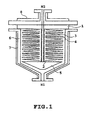
- Fig. 1 is an embodiment according to this invention, which is a schematical cross sectional view illustrating a filtration apparatus using a leaf disk filter.
- a partition plate 1 a center pole 2, a leaf disk filter 3, a spacer 4, an end plate 5, a vessel 6, a jacket 7 for keeping the temperature of the vessel and a lid (with jacket) 8.
- the leaf disk filter 3 is of a type formed by sintering a non-woven fabric made of type 316L stainless steel fibers of 7 inch outer diameter, and the filtration accuracy of the filter is 3 ⁇ m.
- the specific surface area to the filtration area of the leaf disk filter 3 is 150 m 2 /m 2 .
- the leaf disk filters 3 has 178 mm outer diameter and 60 mm inner diameter. As can be seen from Fig. 1, since the leaf disk filters 3 are used by the number of eight, the filtration area thereof can be calculated as 3529 cm 2 by the following equation: ⁇ ( ⁇ outer diameter ⁇ 2) 2 - (inner diameter ⁇ 2) 2 ) ⁇ ⁇ ⁇ 2 ⁇ 8 ⁇ .
- the spacer 4 is a disk made of type 316 stainless steel having 7 inch outer diameter and 2 mm thickness and the surface layer is electrolytically plated uniformly with Au to a thickness of 2 to 3 ⁇ m.
- the noble metal is not disposed on the inner surface of the vessel 6.
- rod-shaped distance bars each of ⁇ 1 mm made of type 304 stainless steel (not illustrated) are disposed radially for ensuring the flow channel of the solution.
- a solution to be filtered enters from N1 into the vessel, filtered through the leaf disk filters 3 and then discharged through the center pole 2 from N2.
- the leaf disk filters 3 and the spacers 4 applied with Au plating are sealed by a metal gasket (not illustrated) and electrically conducted. Further, the ratio of the surface area of noble metal (Au plated area) relative to the filtration area is about 7/8. The maximum distance between the surface of the leaf disk filter and the Au-plated surface is 10 mm.
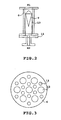
- Fig. 2 shows a schematical cross sectional view illustrating a filtration apparatus using a candle type filter as an embodiment according to this invention.
- a vessel 6 a conical member 9, a candle type filter 10, and a flange 11 for setting the filter.
- N1 shows an inlet for the solution and N2 shows an exit for the filtered solution.
- the conical member 9 is used for unifying the flow rate and disposed in the candle type filter 10.
- the conical member 9 is made of type 316 stainless steel.
- the candle filter 10 is of a type formed by sintering a metal gauze made of type 304 stainless steel and has a filtration accuracy of 10 ⁇ m.
- the filter 10 has 35 mm outer diameter and 150 mm height. Accordingly, the filtration area thereof can be calculated as 165 cm 2 by the following equation: ⁇ outer diameter ⁇ ⁇ ⁇ height ⁇ .
- the inner surface area of the vessel 6 is electrolytically plated with Pt to a thickness of 1 to 2 ⁇ m. Since a metal packing is used for the flange 11, the vessel 6 and the candle type filter 10 are electrically conducted.
- the ratio of the Pt-plated surface area (surface area of noble metal) relative to the filtration area is about 5/1.
- the specific surface area to the filtration surface of the candle type filter 10 is 20 m 2 /m 2 .
- the maximum distance between the surface of the candle type filter and the Pt surface is 15 mm.
- Fig 3 is a schematic cross sectional view illustrating a filtration apparatus using a plurality of cylindrical filters as an embodiment according to this invention.
- a vessel 6 a cylindrical filter 12 and a rod-like member 13.
- N1 shows an inlet for a solution and N2 shows an exit for a filtered solution.
- the cylindrical filter 12 has 60 mm outer diameter and 500 mm length and is fabricated into a pleats shape.
- the filtration area of the cylindrical filter 12 is determined as an area of the pleats-like shape which is extended into a planar shape, which is 2.8 m 2 for seven filters.
- the rod-like member 13 is formed by vapor depositing Au to a thickness of 0.1 ⁇ m. on the surface of a rod made of type 304 stainless steel.
- the vessel 6 is formed of type 304 stainless steel and the noble metal is not disposed on the inner surface of the vessel 6.
- the cylindrical filter 12 and the rod-like member 13 are sandwiched vertically by two partition plates. Accordingly, they are electrically conducted with each other by way of the partition plates.
- the specific surface area to the filtration area of the cylindrical filter 12 is about 20 m 2 /m 2 . Further, the ratio of the Au-vapor deposition area (noble metal surface area) of the rod-like member 13 relative to the filtration area of the cylindrical filter 12 is about 1/7.4. Further, the maximum distance between the Au-vapor deposited surface and the surface of the cylindrical filter 12 is 70 mm.
- the corrosion resistance of the apparatus formed of the stainless steel or carbon steel exposed to the sulfuric acid environment can be improved remarkably.
- products caused by the corrosion of the stainless steel filter are extremely small and filtration products of good quality can be obtained.
- the stainless steel filter provides an element which can substantially be used industrially in the filtration of highly viscosity fluids at high accuracy.
- the stainless steel filter comprises fine wires and has a large surface area, effect of the sulfuric acid corrosion to the solution is remarkable. Accordingly, a significant effect can be obtained when this invention is applied to the stainless steel filter. That is, by the constitution of the filtration apparatus according to this invention, it is possible to stably filter corrosive fluids, particularly, a solution mainly comprising sulfuric acid (particularly) at a good quality.
- Apparatus for processing solutions mainly comprising sulfuric acid are versatile such as sulfuric acid production facilities, sulfuric acid purification facilities, aramid fiber production facilities, aramid film production facilities and respective polymers recovery facilities.
- the apparatus is an equipment which is indispensable, particularly, for filtration at high accuracy in fiber or film production facilities. Accordingly, when the corrosion resistant apparatus according to this invention is applied to such facilities, the solutions can be processed at good quality and stably to attain improvement for the quality of products and improvement for the operation efficiency.
- a third embodiment according to this invention concerns a method of producing heat resistant forming products.
- the method of producing heat resistant forming products according to this invention has a feature of filtering a heat resistant resin solution containing sulfuric acid as the starting material for the heat resistant forming products by using an apparatus at least having a filtration apparatus having corrosion resistance to sulfuric acid or sulfuric acid-containing solution, and forming and fabricating the obtained filtrates into a predetermined shape.
- the method of producing the heat resistant forming products can be practiced suitably by using the corrosion resistant apparatus, particularly, the filtration apparatus made of the stainless steel or carbon steel described previously for the second embodiment according to this invention. That is, in the filtration apparatus, the noble metal has to be in contact with at least a portion on the inside surface of the filter apparatus exposed to the sulfuric acid-containing solution. When the noble metal is in contact with at least a portion on the inside surface of the filter apparatus and electrically conducted therewith, corrosion of the apparatus made of the stainless steel or carbon steel can be suppressed effectively. As a result, it is possible to improve the effect of corrosion for apparatus known so far and provide a heat resistant forming products of higher quality.
- the ratio of the surface area of the noble metal to the filtration area of the filter is preferably 1/1000 - 1000/1.
- the filtration area of the filter is desirably set such that the initial pressure loss in the filter is 0.001 MPa or more and 20 MPa or less. It is desirable to set the filtration area such that the initial pressure loss is within a range preferably from 0.01 MPa to 10 MPa and, more preferably, from 0.05 MPa to 5 MPa.
- the heat resistant forming products as an object of this invention mean forming products comprising heat resistant resin in a wide range recognized by those skilled in the art.
- the corrosion resistant apparatus of this invention can be used for the production of polyamide or polyimide films or fibers in the sulfuric acid environment to attain the improvement in the quality of the products and improvement of the operation efficiency with no particular restriction.
- remarkable effect can be obtained by corrosion suppression in a case where the heat resistant resin solution is a system that exposes to apparatus to a corrosive atmosphere, for example, a system of a heat resistant resin solution comprising sulfuric acid as a main ingredient (solution at a concentration of sulfuric acid of 50 wt% or more).
- Heat resistant films comprising polyamide or polyimide are described, for example, in Japanese Patent Application Laid-Open No. 49-131247 (1974), Japanese Patent Application Laid-Open No. 51-81854 (1976), Japanese Patent Application Laid-Open No. 52-84245 (1977), Japanese Patent Application Laid-Open No. 52-85251 (1977), Japanese Patent Application Laid-Open No. 58-42649 (1983), Japanese Patent Application Laid-Open No. 59-45124 (1984), Japanese Patent Application Laid-Open No. 61-246918 (1986), Japanese Patent Application Laid-Open No. 62-70421 (1987), Japanese Patent Application Laid-Open No. 60-15436 (1985), Japanese Patent Application Laid-Open No. 60-15437 (1985). and Japanese Patent Application Laid-Open No. 62-488726 (1987). Also in the production of such heat resistant films, it is possible to provide films of more excellent quality by the application of the corrosion resistant apparatus according to this invention.
- a method of producing a heat resistant film for use in a magnetic recording medium is to be described.
- a heat resistant film is used as a base film for a magnetic recording medium, the surface of the film has to be smooth.
- description is to be made for the method of producing a heat resistant film including a step of filtering a heat resistant resin by using a filtration apparatus having a stainless steel filter and a step of forming the obtained filtrates into a film shape.
- Usual stainless steel filters suffer from corrosion when exposed to the sulfuric acid environment and result in deterioration of the film quality by the corrosion.
- those resins having heat resistance such as polyamide resin or polyimide resin are used.
- those resins applied preferentially with the solution film forming method to the melting film forming solution are preferred.
- the heat resistant resin solution used in this invention is a solution in which a heat resistant resin is dissolved into a solvent, which also includes a solution of a precursor for the heat resistant resin.
- a polymer soluble to an organic solvent may be polymerized directly in a solvent and used as it is, without isolation of the resin, as a starting solution of the film, or an inorganic salt such as calcium chloride may be added and used as a solution aid.
- a polymer may be isolated once and then formed into a solution, for example, by re-dissolution.
- Those less soluble to an organic solvent such as poly-para-phenylene terephthalamide (hereinafter referred to as PPTA) may be dissolved in a concentrated sulfuric acid to form a solution.
- PPTA poly-para-phenylene terephthalamide
- a tetracarboxylic acid anhydride and an aromatic diamine may be reacted in an organic solvent to form a polyamide acid, and the solution is used as it is or it may be once cyclized into a polyimide which is then dissolved again in a solvent to form a solution.
- concentration of the resin in the solution is selected for proper condition for each of the resins. Generally, a concentration of 0.1 to 50% by weight, particularly, 1 to 30% by weight is often used.
- “Lubricant” is fine particles for forming fine projections on the surface of a film when the material is formed into the film. Presence of fine projections on the surface of the film can improve the slidability between each of the films to avoid blocking phenomenon or the like.
- the lubricant can include fine particles of organic compounds and inorganic compounds. For example, fine particles of polystyrene, silica, alumina, titanium oxide, calcium sulfate, calcium carbonate, zeolite, carbon black and other metals or metal compounds, or colloidal silica can be used.
- the size of such fine particles it is preferred that they are contained in the solution such that the average grain size in the obtained film is 500 nm or less and, particularly, 10 to 200 nm.
- the amount of the lubricant it is preferred to control the solution such that it is contained by 0.001 to 2% by weight, particularly, 0.01 to 1 % by weight in the film.
- the control can be conducted by controlling the concentration of the resin and the concentration of the lubricant in the solution.
- the lubricant is dispersed into the resin solution by previously being dispersed in a solvent used for the polymerization of the resin.
- it is dispersed into a resin solution, for example, by a method of previously dispersing into a solvent used for the re-dissolution of the resin, or by a method of taking out a portion of the solvent, dispersing the lubricant therein and then admixing the same to a resin solution.
- the means for dispersing the lubricant various kinds of homogenizers may be used and, particularly, a ultrasonic wave homogenizer is recommended since the dispersing force is excellent.
- lubricants mono-dispersed in a colloidal state are commercially available and use of them by dilution is preferred for attaining a dispersion state with an average aggregation degree of 10 or less, but a care should be taken since the lubricant tends to be aggregated depending on the solvent used or the dilution condition, which makes it difficult to obtain an aimed effect.
- the colloidal lubricant tends to be aggregated, it is important to take a consideration, for example, that the colloidal dispersion is once diluted with that for a solvent identical with the liquid dispersion and then it is mixed with a solvent for dissolving the resin under sufficient stirring.
- the heat resistant resin solution it is essential to filter the heat resistant resin solution by using a stainless steel filter in electric connection with the noble metal.
- impurities include impurities in solvent, impurities in heat resistant resins and impurities attributable to additives such as the lubricant and also include impurities which inevitably intrude, upon various operations, for example, resin charging operation and dissolving operation.
- filtration is conducted also for removing aggregates of lubricants or lubricants of undesired particle size.
- By filtering to remove the impurities pinholes or breakage of the film caused by coarse impurities, or coarse projections can be decreased. Further, in a case of using the lubricant, control for the surface shape of the film can be facilitated.
- a filter capable of capturing 99,5% or more of those with a particle size of 10 ⁇ m. preferably, 5 ⁇ m or more is used preferably. Accordingly, for the filtration accuracy, a filter of 5 ⁇ m or less is used preferably. With such filtration at high accuracy, films of high quality with less large projections and less pin holes can be obtained.
- filtration of a heat resistant resin solution it is preferred to conduct filtration at a constant flow rate by using a gear pump of good constant volume performance so as to keep pressure fluctuation in the filter as low as possible.
- a gear pump of good constant volume performance it is preferred to use those ensuring the constant volume performance for the filtration flow rate such that fluctuation per 1 hour in the filter is within 10%, particularly, within 1% of the pressure loss.
- the production method according to this invention is effective, particularly, in a case of producing heat resistant forming product with a heat resistant resin solution system in which the apparatus used in the production step is exposed to the corrosive atmosphere (for example, heat resistant resin solution system comprising sulfuric acid as the main ingredient).
- the heat resistant film accompanying filtration by using the stainless steel filter leaching of metal ingredients from the stainless steel filter and leaching of corrosion products can be suppressed.
- heat resistant films of high quality excellent in the surface property of the film with less defects can be produced.
- a heat resistant film of high quality with extremely less metal ingredient content can be produced.
- the heat resistant film of high quality as described above is useful as a base film for use in a magnetic recording medium, and the method according to this invention is useful for the industrial production of heat resistant films at high quality.
- This example illustrates the effect of corrosion suppression for various kinds of stainless steels in a sulfuric acid solution at high concentration.
- test specimens shown in Table 1 were immersed in a environment of 98 wt% aqueous solution of sulfuric acid at 80°C, to conduct a corrosion test.
- As a test specimens in contact with gold each of stainless steel test specimens gold plated at one side was used. In this case, the area ratio between gold and stainless steel was 1:1.
- Corrosion was evaluated by calculating the corrosion rate based on the change of the weight for the test specimens before and after immersion respectively. The results are shown in Table 1. From Table 1, it can be seen that the corrosion rate for stainless steel is suppressed to about 1/8 in any of the cases of type 304 steel and type 316 steel by making gold contact with stainless steel. Corrosion rate for each of stainless steels (mm/year) No contact Contact with gold Corrosion suppression rate Type 304 stainless steel 0.6 0.08 1/8 Type 316 stainless steel 0.4 0.05 1/8
- This example illustrates the corrosion suppression effect for carbon steel in a sulfuric acid solution at high concentration.
- test specimens shown in Table 2 were immersed, respectively, in an aqueous environment of 98 wt% solution of sulfuric acid at 40°C, to conduct a corrosion test.
- test specimens in contact with gold Each of carbon steel test specimens gold plated at one side was used. In this case, the area ratio between gold and stainless steel was 1:1.
- Corrosion was evaluated by calculating the corrosion rate based on the change of the weight for the test specimens before and after immersion respectively. The result is shown in Table 2. From Table 2, it can be seen that the corrosion rate for carbon steel is suppressed to about 2/3 by making gold contact with carbon steel. Corrosion rate for carbon steel (mm/year) No contact Contact with gold Corrosion suppression rate Carbon steel 0.3 0.2 2/3
- This example illustrates a range for the corrosion resistant conditions of stainless steel.
- Type 316 stainless steel test specimens gold plated on one side were put to a corrosion test at a sulfuric acid concentration of 90 wt% or higher and 100 wt% or lower and under the temperature condition of 50°C or higher and 100°C or lower. In this case, the surface area ratio between stainless steel and gold was 1:1.
- the test specimens described above were immersed in an aqueous solutions of sulfuric acid at various temperatures and concentrations and kept for about 100 hours, and then the change of the weight of the test specimens was measured. The result was converted to the corrosion rate (mm/year) and the range for the condition of 0.1 mm/year or less is shown by a dotted line in Fig. 4.
- This example illustrates the corrosion suppression effect for stainless steel in a sulfuric acid solution at high concentration containing a polymer.
- a concentrated sulfuric acid solution at 99.8 wt% in which silica was dispersed was prepared to which PPTA (poly-p-phenylene terephthalamide) was dissolved to a polymer concentration of 11 wt%, to obtain a sulfuric acid solution of the polymer (the sulfuric acid solution of the polymer is hereinafter referred to as a dope).
- PPTA poly-p-phenylene terephthalamide
- the filter had an outer profile dimension of 20 mm square, since the specific surface area of the filter was 150 m 2 /m 2 , the actual surface area of the stainless steel was 60,000 mm 2 . Further, the specific surface area of the filter was determined according to the BET method based on the gas adsorption area of the filter and the surface area to the filtration area was defined as a specific surface area (m 2 /m 2 ). Further, the filtration area is not a solution contact surface area of the stainless steel filter but a filtration area calculated based on the shape of the stainless steel filter (for example, leaf disk, candle and plate-like shape).
- the diameter of the platinum wire in contact with the filter was 0.8 mm and the length thereof in contact with the stainless steel filter and immersed in the dope was 80 mm. Accordingly, the contact surface area of the platinum wire was 126 mm 2 . Accordingly, the surface area ratio between the stainless steel and the platinum was about 480:1. While they were immersed in the dope for 2 days under the condition where both of them were in contact, oscillations of the natural immersion potential did not occur and no distinct corrosion was observed for the stainless steel filter. Thus, it has been found that when the stainless steel is in contact with the noble metal at a area ratio of about 500:1, the potential is stabilized and the corrosion suppression effect can be obtained.
- Example 5 a filtration apparatus in which a noble metal was not electrically conducted was used for comparison with Example 5.
- Example 5 A solution of concentrated sulfuric acid at 99.8% in which silica was dispersed in the same manner as in Example 5 was prepared.
- the filtration apparatus was constituted in the same manner as the filtration apparatus used in Example 5 except for using the apparatus shown in Fig. 3 in which Au was not vapor deposited on the rod-like member 13.
- circulatory filtration for the concentrated sulfuric acid and elemental analysis were conducted in the same manner as in Example 5.
- Table 3 In Table 3, the amount of Fe which was the greatest in the amount as the leaching ingredient was described. Although not described in Table 3, the amount of Cr and Ni was also changed under the similar trend.
- Example 5 Result of elemental analysis in Example 5 and Comparative Example 1 Number of day for circulation Before filtration 1 day 3 day 5 day 7 day
- Example 5 Amount of Fe (ppb) 100 120 180 230 250 Increment of Fe (PPb) 20 60 50 20 Comparative Example 1 Amount of Fe (ppb) 95 120 8000 10000 11000 Increment of Fe (PPb) 25 7880 2000 1000
- a filtration apparatus using a leaf disk filter made of stainless steel shown in Fig. 1 was used.
- Example 6 a filtration apparatus in which the noble metal was not electrically conducted was used as a comparison with Example 6.
- a dope was obtained in the same manner as in Example 6.
- the filtration apparatus was constituted in the same manner as the filtration apparatus used in Example 6 excepting that Au-plating was not applied to the spacer 4 in the filtration apparatus shown in Fig. 1.
- the dope was filtered and elemental analysis was conducted in the same manner as in Example 6.
- Table 4 the amount of Fe which was the greatest in the amount as the leached ingredient was described.
- the amount of Cr and Ni was also changed under the similar trend. Further, the pressure fluctuation at about 0.2 MPa was caused frequently for about 2 weeks from the start of filtration.
- Example 6 Result of elemental analysis in Example 6 and Comparative Example 2 Number of day for liquid passage after starting use of filter 1 day 3 day 5 day 10 day 15 day 20 day
- Example 6 Amount of Fe (ppb) 180 200 190 230 180 180 Comparative Example 2 Amount of Fe (ppb) 200 50000 60000 30000 25000 23000
- the filtration apparatus using the leaf disk filter made of stainless steel shown in Fig. 1 was used while modifying a portion thereof.
- Example 6 a filtration apparatus in which the Au-plated spacers and the stainless filters were arranged alternately was used (refer to Fig. 1). In this example, however, a filtration apparatus in which Au-plated spacers were disposed by the number of three relative to the stainless steel filters by the number of eight was used. The dope was filtered in the same manner as in Example 6 except for modifying the portion of the apparatus used in Example 6.
- the area of the Au-plated spacer relative to the filtration area of the filter that is, the ratio of the surface area of the noble metal relative to the filtration area is about 3/8.
- the maximum distance between the Au-plated surface and the filter surface was about 20 mm.
- Table 5 The results of elemental analysis for the filtered solution in this example was summarized in Table 5.
- a filtration apparatus using the leaf disk filter made of stainless steel shown in Fig. 1 was used with a portion thereof being modified.
- Example 6 the filtration apparatus having the Au-plated spacers was used (refer to Fig. 1), but the filtration apparatus Au-electroplated on the inner surface of the vessel 6 was used in this example.
- the dope was filtered in the same manner as in Example 6 except for modifying a portion of the apparatus used in Example 6.
- the Au-plated surface on the inner surface of the vessel that is, the surface area of the noble metal is about 1/3 as the ratio to the filtration area of the filter.
- the maximum distance between the Au plated surface and the filter surface is about 60 mm.
- Example 7 Amount of Fe (ppb) 180 200 250 280 270 280
- Example 8 Amount of Fe (ppb) 210 510 640 630 650 640
- Pinhole inspection was conducted, under continuous running, by a current conduction detection type pin hole tester in which a brush type electrode planted with carbon fibers and in contact at the tips thereof with a film surface is disposed on the upper surface of a film over the substantially entire width of the film, and a metal roll type electrode which rotates at a same linear speed as the film in contact with the lower surface of the film is opposed thereto (PFVI-1AVR type machine, manufactured by Kasuga Denki Co.).
- the inspection voltage was made constant at 400 V.
- the surface of the film was inspected under a view field of 100 cm 2 and the height of large projections was measured by a multiple interference method. The inspection was conducted five times for an identical sample and the average number thereof was defined as a number per 100 cm 2 .
- This example concerns production of a heat resistant film by using the filtration apparatus shown in Fig. 1.
- Liquid dispersion of colloidal silica containing 40% of spherical silica with an average particle size of about 80 nm in water was diluted with distilled water to 5% concentration.
- the diluted liquid dispersion was added under stirring to 101% sulfuric acid previously filtered and purified with a teflon filter (filtration accuracy: 0.1 ⁇ m).
- the obtained solution was filtered by a filter made of teflon at 1 ⁇ m cut, to form a concentrated sulfuric acid solution at a silica concentration of 0.035%.
- PPTA poly-p-phenylene terephthalamide
- a solution of PPTA resin hereinafter, the resin solution is referred to as a dope. It has been found that the dope is in a liquid crystalline state, for example, causing irregular reflection for light upon stirring and showing optical anisotropy of rendering the dark view field to bright view field in the Cross Nicol of polarization microscope under the optical microscopic observation.
- the prepared dope was kept at a constant temperature of 65°C and filtered by using the filtration apparatus shown in Fig. 1, by using a gear pump of high constant volume performance.
- the initial pressure loss was 1.1 MPa.
- the pressure fluctuation was 0.5% or less per 1 hour.
- the filtered dope was cast from a die onto an endless belt made of tantalum polished to a mirror face, at a draft ratio of 1.5 under an atmosphere at class 10 to 100.
- the film was applied with stretching in the transverse direction by 1.2 times while gripping both edges of the film with a grip and then applied with a hot blow drying and a heat treatment at 420°C while keeping a constant length state by gripping the edges as they are. Then, the portions held by the grip were slit and removed to adjust the width to 620 mm.
- the obtained PPTA film had a thickness of 4.1 ⁇ m, which was sampled periodically to conduct inspection for the surface property and elemental analysis for the film.
- the results are summarized in Table 6. Since the ingredients detected mainly in the elemental analysis for the film were stainless steel ingredients, iron, chromium and nickel in total are shown as representative values in Table 6.
- This example relates to the production of heat resistant films by using the filtration apparatus formed by modifying a portion of the filtration apparatus used in Example 9.
- This example relates to the production of heat resistant films by using the filtration apparatus formed by modifying a portion of the filtration apparatus used in Example 9.
- the Au-plated spacers were used (refer to Fig. 1), whereas Au-plated spacers were not used but the inner surface of the vessel 6 was electrolytically plated with Au in this example. Filtration of the dope and, subsequently, forming of the films were conducted in the same manner as in Example 9 by using the filtration apparatus constituted in the same manner as in Example 9 excepting for the modification as described above.
- the Au-plated area on the inner surface of the vessel relative to the filtration area of the filter that is, the ratio of the surface area of the noble metal to the filtration area is about 1/3.
- the maximum distance between the Au-plated surface and the filter surface is about 60 mm.
- Results of various tests on the heat resistant films produced according to this example are summarized in Table 6. Results of various test on film Days after film formation (day) 1 3 5 7 10 15 20 Example 9 Pinhole (N/1000 m 2 ) 8 6 1 1.5 1 0.6 0.7 Large projection (projection of 270 nm or more) (N/100 cm 2 ) 4 3 5 5 4 4 4 Film element analysis (ppb) 250 300 280 290 280 280 270 Comp.
- Example 9 to Example 11 using the filtration apparatus electrically conducted with the noble metal the quality, that is, the surface property, defects and the metal ingredient content of the film were excellent and they were industrially practical.
- the corrosion suppressing method according to this invention can suppress corrosion of stainless steels or carbon steels exposed to sulfuric acid environments easily and effectively. Further, when the corrosion suppressing method according to this invention is applied to the apparatus used generally in the field of the sulfuric acid production industry or chemical industry using sulfuric acid, not only the durability of the apparatus is improved but also deterioration of the quality of the products caused by the corrosion of the apparatus can be improved remarkably. For example, films of high quality can be produced at a high yield by using filtration apparatus having corrosion resistance to the production of heat resistant films.
Landscapes
- Chemical & Material Sciences (AREA)
- Organic Chemistry (AREA)
- Chemical Kinetics & Catalysis (AREA)
- Engineering & Computer Science (AREA)
- Materials Engineering (AREA)
- Mechanical Engineering (AREA)
- Metallurgy (AREA)
- Life Sciences & Earth Sciences (AREA)
- Geology (AREA)
- Inorganic Chemistry (AREA)
- Filtering Materials (AREA)
- Filtration Of Liquid (AREA)
- Prevention Of Electric Corrosion (AREA)
- Preventing Corrosion Or Incrustation Of Metals (AREA)
Abstract
Description
| Corrosion rate for each of stainless steels (mm/year) | |||
| No contact | Contact with gold | Corrosion suppression rate | |
| Type 304 stainless steel | 0.6 | 0.08 | 1/8 |
| Type 316 stainless steel | 0.4 | 0.05 | 1/8 |
| Corrosion rate for carbon steel (mm/year) | |||
| No contact | Contact with gold | Corrosion suppression rate | |
| Carbon steel | 0.3 | 0.2 | 2/3 |
| Result of elemental analysis in Example 5 and Comparative Example 1 | |||||
| Number of day for circulation | Before | 1 | 3 | 5 | 7 day |
| Example 5 | |||||
| Amount of Fe (ppb) | 100 | 120 | 180 | 230 | 250 |
| Increment of Fe (PPb) | 20 | 60 | 50 | 20 | |
| Comparative Example 1 | |||||
| Amount of Fe (ppb) | 95 | 120 | 8000 | 10000 | 11000 |
| Increment of Fe (PPb) | 25 | 7880 | 2000 | 1000 |
| Result of elemental analysis in Example 6 and Comparative Example 2 | ||||||
| Number of day for liquid passage after starting use of | 1 | 3 | 5 | 10 day | 15 day | 20 day |
| Example 6 Amount of Fe (ppb) | 180 | 200 | 190 | 230 | 180 | 180 |
| Comparative Example 2 Amount of Fe (ppb) | 200 | 50000 | 60000 | 30000 | 25000 | 23000 |
| Result of elemental analysis in Examples 7 and 8 | ||||||
| Number of day for liquid passage after starting the use of | 1 | 3 | 5 | 10 day | 15 day | 20 day |
| Example 7 Amount of Fe (ppb) | 180 | 200 | 250 | 280 | 270 | 280 |
| Example 8 Amount of Fe (ppb) | 210 | 510 | 640 | 630 | 650 | 640 |
| Results of various test on film | ||||||||
| Days after film formation (day) | 1 | 3 | 5 | 7 | 10 | 15 | 20 | |
| Example 9 | Pinhole (N/1000 m2) | 8 | 6 | 1 | 1.5 | 1 | 0.6 | 0.7 |
| Large projection (projection of 270 nm or more) (N/100 cm2) | 4 | 3 | 5 | 5 | 4 | 4 | 4 | |
| Film element analysis (ppb) | 250 | 300 | 280 | 290 | 280 | 280 | 270 | |
| Comp. Example 3 | Pinhole (N/1000m2) | 10 | 300 | 280 | 500 | 100 | 20 | 15 |
| Large projection (projection of 270 nm or more) (N/100 cm2) | 4 | 250 | 150 | 200 | 180 | 80 | 50 | |
| Film element analysis (ppb) | 3000 | 8000 | 7500 | 11000 | 5000 | 3500 | 3300 | |
| Example 10 | Pinhole (N/1000 m2) | 9 | 7 | 6 | 6 | 8 | 7 | 7 |
| Large projection (projection of 270 nm or more) (N/100 cm2) | 3 | 11 | 19 | 16 | 12 | 14 | 12 | |
| Film element analysis (ppb) | 300 | 3500 | 380 | 410 | 360 | 360 | 390 | |
| Example 11 | Pinhole (N/1000 m2) | 10 | 20 | 15 | 7 | 5 | 8 | 9 |
| Large projection (Projection of 270 nm or more) (N/100 cm2) | 3 | 29 | 30 | 22 | 25 | 21 | 23 | |
| Film element analysis (ppb) | 500 | 700 | 600 | 550 | 480 | 500 | 520 |
Claims (11)
- A method of suppressing corrosion of stainless steels or carbon steels exposed to the environments of sulfuric acid or sulfuric acid-containing solution, wherein
the stainless steel or carbon steel, and a noble metal are brought into contact with each other. - A corrosion suppression method according to claim 1, wherein the surface area of the noble metal to the stainless steel or the carbon steel is 1/10000 or more.
- A corrosion suppression method according to claim 1 or 2, wherein the concentration of sulfuric acid in the sulfuric acid-containing solution is 70% by weight or more.
- A corrosion suppression method according to any one of claims 1 to 3, wherein the noble metal is a metal selected from the group consisting of platinum, gold, silver and palladium or an alloy thereof.
- An apparatus made of stainless steels or carbon steels exposed to environments of sulfuric acid or sulfuric acid-containing solution, wherein
a noble metal is in contact with at least a portion inside the apparatus made of stainless steels or carbon steels. - An apparatus according to claim 5, wherein the noble metal is a metal selected from the group consisting of platinum, gold, silver and palladium or an alloy thereof.
- An apparatus according to claim 5 or 6, wherein the apparatus made of the stainless steels or carbon steels includes apparatus or apparatus elements selected at least by one from the group consisting of reactors, columns, vessels, pipelines, heat exchangers, filtration apparatus, pumps, valves and measuring instrument equipments.
- An apparatus according to claim 7, wherein the apparatus made of the stainless steels or carbon steels is an apparatus at least having a filtration apparatus, and the filtration apparatus has a filter with a ratio of the surface area of the noble metal to the filtration area of 1/1000 to 1000/1.
- A method of producing a heat resistant forming product from a resin solution containing sulfuric acid in which the resin solution containing sulfuric acid is filtered by using the apparatus according to claim 8 and the obtained filtrate is formed into a forming product.
- A method according to claim 9, wherein the forming product is a fiber or a film.
- A method according to claim 9 or 10, wherein the resin solution containing sulfuric acid contains a polyamide or a polyimide.
Applications Claiming Priority (5)
| Application Number | Priority Date | Filing Date | Title |
|---|---|---|---|
| JP2000053979 | 2000-02-29 | ||
| JP2000053979 | 2000-02-29 | ||
| JP2000054252A JP4467127B2 (en) | 2000-02-29 | 2000-02-29 | Filtration method |
| JP2000054252 | 2000-02-29 | ||
| PCT/JP2001/001523 WO2001064973A1 (en) | 2000-02-29 | 2001-02-28 | Corrosion restraining method and corrosion-resisting device |
Publications (2)
| Publication Number | Publication Date |
|---|---|
| EP1264916A1 true EP1264916A1 (en) | 2002-12-11 |
| EP1264916A4 EP1264916A4 (en) | 2007-02-21 |
Family
ID=26586390
Family Applications (1)
| Application Number | Title | Priority Date | Filing Date |
|---|---|---|---|
| EP01908160A Withdrawn EP1264916A4 (en) | 2000-02-29 | 2001-02-28 | Corrosion restraining method and corrosion-resisting device |
Country Status (3)
| Country | Link |
|---|---|
| EP (1) | EP1264916A4 (en) |
| AU (1) | AU2001236004A1 (en) |
| WO (1) | WO2001064973A1 (en) |
Cited By (3)
| Publication number | Priority date | Publication date | Assignee | Title |
|---|---|---|---|---|
| WO2004108992A1 (en) * | 2003-06-03 | 2004-12-16 | Titanium Metals Corporation | Fabricated titanium article having improved corrosion resistance |
| WO2012146976A1 (en) * | 2011-04-29 | 2012-11-01 | Eaton Corporation | Fluid vessel with abrasion and corrosion resistant interior cladding |
| WO2021160804A1 (en) | 2020-02-14 | 2021-08-19 | Haldor Topsøe A/S | Process for the removal of particulate matter from an aqueous stream |
Family Cites Families (9)
| Publication number | Priority date | Publication date | Assignee | Title |
|---|---|---|---|---|
| US3208925A (en) * | 1960-01-07 | 1965-09-28 | Continental Oil Co | Anodic protection against corrosion |
| JPS4850951A (en) * | 1971-10-29 | 1973-07-18 | ||
| DE2627536C2 (en) * | 1976-06-19 | 1978-06-08 | Hoechst Ag, 6000 Frankfurt | Process for the corrosion protection of cast iron in boiling concentrated sulfuric acid |
| JPS60238492A (en) * | 1984-05-09 | 1985-11-27 | Sumitomo Metal Ind Ltd | Method for preventing corrosion of titanium or titanium alloy |
| JPS624889A (en) * | 1985-06-28 | 1987-01-10 | Mitsubishi Heavy Ind Ltd | Method for preventing hydrogen induced cracking |
| US5130080A (en) * | 1990-04-02 | 1992-07-14 | General Electric Company | Method of providing extended life expectancy for components of boiling water reactors |
| JP2634299B2 (en) * | 1990-05-23 | 1997-07-23 | 三菱重工業株式会社 | Pd-added stainless steel for high temperature, high concentration sulfuric acid |
| JPH04202679A (en) * | 1990-11-30 | 1992-07-23 | Hitachi Ltd | Corrosion prevention method for welded parts |
| JP3322105B2 (en) * | 1995-12-19 | 2002-09-09 | 東レ株式会社 | Base film for magnetic recording medium, method for producing the same, and magnetic recording medium using the same |
-
2001
- 2001-02-28 AU AU2001236004A patent/AU2001236004A1/en not_active Abandoned
- 2001-02-28 EP EP01908160A patent/EP1264916A4/en not_active Withdrawn
- 2001-02-28 WO PCT/JP2001/001523 patent/WO2001064973A1/en not_active Ceased
Cited By (5)
| Publication number | Priority date | Publication date | Assignee | Title |
|---|---|---|---|---|
| WO2004108992A1 (en) * | 2003-06-03 | 2004-12-16 | Titanium Metals Corporation | Fabricated titanium article having improved corrosion resistance |
| WO2012146976A1 (en) * | 2011-04-29 | 2012-11-01 | Eaton Corporation | Fluid vessel with abrasion and corrosion resistant interior cladding |
| US9126130B2 (en) | 2011-04-29 | 2015-09-08 | Eaton Corporation | Fluid vessel with abrasion and corrosion resistant interior cladding |
| WO2021160804A1 (en) | 2020-02-14 | 2021-08-19 | Haldor Topsøe A/S | Process for the removal of particulate matter from an aqueous stream |
| US12599858B2 (en) | 2020-02-14 | 2026-04-14 | Topsoe A/S | Process for the removal of particulate matter from an aqueous stream |
Also Published As
| Publication number | Publication date |
|---|---|
| WO2001064973A1 (en) | 2001-09-07 |
| EP1264916A4 (en) | 2007-02-21 |
| AU2001236004A1 (en) | 2001-09-12 |
Similar Documents
| Publication | Publication Date | Title |
|---|---|---|
| US8684187B2 (en) | Semipermeable polymers and method for producing same | |
| Teodoro et al. | Ternary nanocomposites based on cellulose nanowhiskers, silver nanoparticles and electrospun nanofibers: Use in an electronic tongue for heavy metal detection | |
| Mollahosseini et al. | Interfacially polymerized thin film nanofiltration membranes on TiO2 coated polysulfone substrate | |
| Kajau et al. | Leaching of CuO nanoparticles from PES ultrafiltration membranes | |
| US9216385B2 (en) | Application of rejection enhancing agents (REAs) that do not have cloud point limitations on desalination membranes | |
| DE69812416T2 (en) | EXTRACTION MODULE FOR GASEOUS HYDROGEN | |
| Wang et al. | Surface charge regulation of reverse osmosis membrane for anti-silica and organic fouling | |
| EP2168667A1 (en) | Composite semipermeable membrane | |
| Teow et al. | Studies on the surface properties of mixed‐matrix membrane and its antifouling properties for humic acid removal | |
| Ronen et al. | Experimental characterization and numerical simulation of the anti-biofuling activity of nanosilver-modified feed spacers in membrane filtration | |
| JPH04223300A (en) | Method for elongating expected life of boiling water reactor | |
| CN108055830A (en) | Method and apparatus for assessing the contamination status of a reverse osmosis system | |
| Jabur et al. | Fabrication of electrospun chitosan/nylon 6 nanofibrous membrane toward metal ions removal and antibacterial effect | |
| KR101783163B1 (en) | Pretreatment solution for electroless plating and electroless plating method | |
| DE112016001523T5 (en) | Reverse Osmosis Composite Membrane and Method of Making a Reverse Osmosis Composite Membrane | |
| EP4337808A1 (en) | Electrode for gas evolution in electrolytic processes | |
| Mitrouli et al. | Polyamide active layers of low pressure RO membranes: data on spatial performance non-uniformity and degradation by hypochlorite solutions | |
| EP0474365B1 (en) | Filter cleaning | |
| WO2011057816A2 (en) | Method for spatially resolving the enlargement of nanoparticles on a substrate surface | |
| WO2001064973A1 (en) | Corrosion restraining method and corrosion-resisting device | |
| EP1858629B1 (en) | Process for producing a polymer membrane, and polymer membrane | |
| EP2731913B1 (en) | Method for producing p-type semiconducting tio2 nanotubes | |
| Ved et al. | Functional properties of electrolytic alloys of Cobalt with Molybdenum and Zirconium | |
| KR20200042437A (en) | Method and apparatus for inspection of polymeric membrane aging in water treatment process | |
| JP2004115282A (en) | Filtration method of sulfuric acid solution |
Legal Events
| Date | Code | Title | Description |
|---|---|---|---|
| PUAI | Public reference made under article 153(3) epc to a published international application that has entered the european phase |
Free format text: ORIGINAL CODE: 0009012 |
|
| 17P | Request for examination filed |
Effective date: 20020927 |
|
| AK | Designated contracting states |
Kind code of ref document: A1 Designated state(s): AT BE CH CY DE DK ES FI FR GB GR IE IT LI LU MC NL PT SE TR |
|
| AX | Request for extension of the european patent |
Free format text: AL;LT;LV;MK;RO;SI |
|
| RBV | Designated contracting states (corrected) |
Designated state(s): AT NL |
|
| REG | Reference to a national code |
Ref country code: DE Ref legal event code: 8566 |
|
| RIC1 | Information provided on ipc code assigned before grant |
Ipc: C23F 13/00 20060101AFI20010912BHEP Ipc: C01B 17/80 20060101ALI20070111BHEP Ipc: B01J 19/02 20060101ALI20070111BHEP Ipc: C23F 15/00 20060101ALI20070111BHEP |
|
| A4 | Supplementary search report drawn up and despatched |
Effective date: 20070124 |
|
| STAA | Information on the status of an ep patent application or granted ep patent |
Free format text: STATUS: THE APPLICATION IS DEEMED TO BE WITHDRAWN |
|
| 18D | Application deemed to be withdrawn |
Effective date: 20070423 |