EP1264908A1 - SLIDING CONTACT MATERIAL COMPRISING Ag-Ni BASED ALLOY HAVING Ni METAL PARTICLES DISPERSED AND CLAD COMPOSITE MATERIAL, AND DC COMPACT MOTOR USING THE SAME - Google Patents
SLIDING CONTACT MATERIAL COMPRISING Ag-Ni BASED ALLOY HAVING Ni METAL PARTICLES DISPERSED AND CLAD COMPOSITE MATERIAL, AND DC COMPACT MOTOR USING THE SAME Download PDFInfo
- Publication number
- EP1264908A1 EP1264908A1 EP01951906A EP01951906A EP1264908A1 EP 1264908 A1 EP1264908 A1 EP 1264908A1 EP 01951906 A EP01951906 A EP 01951906A EP 01951906 A EP01951906 A EP 01951906A EP 1264908 A1 EP1264908 A1 EP 1264908A1
- Authority
- EP
- European Patent Office
- Prior art keywords
- sliding contact
- contact material
- powder
- based alloy
- dispersed
- Prior art date
- Legal status (The legal status is an assumption and is not a legal conclusion. Google has not performed a legal analysis and makes no representation as to the accuracy of the status listed.)
- Withdrawn
Links
Images


Classifications
-
- C—CHEMISTRY; METALLURGY
- C22—METALLURGY; FERROUS OR NON-FERROUS ALLOYS; TREATMENT OF ALLOYS OR NON-FERROUS METALS
- C22C—ALLOYS
- C22C33/00—Making ferrous alloys
- C22C33/02—Making ferrous alloys by powder metallurgy
-
- C—CHEMISTRY; METALLURGY
- C22—METALLURGY; FERROUS OR NON-FERROUS ALLOYS; TREATMENT OF ALLOYS OR NON-FERROUS METALS
- C22C—ALLOYS
- C22C32/00—Non-ferrous alloys containing at least 5% by weight but less than 50% by weight of oxides, carbides, borides, nitrides, silicides or other metal compounds, e.g. oxynitrides, sulfides, whether added as such or formed in situ
- C22C32/0089—Non-ferrous alloys containing at least 5% by weight but less than 50% by weight of oxides, carbides, borides, nitrides, silicides or other metal compounds, e.g. oxynitrides, sulfides, whether added as such or formed in situ with other, not previously mentioned inorganic compounds as the main non-metallic constituent, e.g. sulfides, glass
-
- H—ELECTRICITY
- H01—ELECTRIC ELEMENTS
- H01H—ELECTRIC SWITCHES; RELAYS; SELECTORS; EMERGENCY PROTECTIVE DEVICES
- H01H1/00—Contacts
- H01H1/02—Contacts characterised by the material thereof
- H01H1/021—Composite material
- H01H1/023—Composite material having a noble metal as the basic material
- H01H1/0231—Composite material having a noble metal as the basic material provided with a solder layer
-
- H—ELECTRICITY
- H01—ELECTRIC ELEMENTS
- H01R—ELECTRICALLY-CONDUCTIVE CONNECTIONS; STRUCTURAL ASSOCIATIONS OF A PLURALITY OF MUTUALLY-INSULATED ELECTRICAL CONNECTING ELEMENTS; COUPLING DEVICES; CURRENT COLLECTORS
- H01R39/00—Rotary current collectors, distributors or interrupters
- H01R39/02—Details for dynamo electric machines
- H01R39/022—Details for dynamo electric machines characterised by the materials used, e.g. ceramics
- H01R39/025—Conductive materials
-
- B—PERFORMING OPERATIONS; TRANSPORTING
- B22—CASTING; POWDER METALLURGY
- B22F—WORKING METALLIC POWDER; MANUFACTURE OF ARTICLES FROM METALLIC POWDER; MAKING METALLIC POWDER; APPARATUS OR DEVICES SPECIALLY ADAPTED FOR METALLIC POWDER
- B22F2998/00—Supplementary information concerning processes or compositions relating to powder metallurgy
-
- H—ELECTRICITY
- H01—ELECTRIC ELEMENTS
- H01H—ELECTRIC SWITCHES; RELAYS; SELECTORS; EMERGENCY PROTECTIVE DEVICES
- H01H1/00—Contacts
- H01H1/12—Contacts characterised by the manner in which co-operating contacts engage
- H01H1/36—Contacts characterised by the manner in which co-operating contacts engage by sliding
-
- H—ELECTRICITY
- H01—ELECTRIC ELEMENTS
- H01H—ELECTRIC SWITCHES; RELAYS; SELECTORS; EMERGENCY PROTECTIVE DEVICES
- H01H11/00—Apparatus or processes specially adapted for the manufacture of electric switches
- H01H11/04—Apparatus or processes specially adapted for the manufacture of electric switches of switch contacts
- H01H11/048—Apparatus or processes specially adapted for the manufacture of electric switches of switch contacts by powder-metallurgical processes
-
- H—ELECTRICITY
- H01—ELECTRIC ELEMENTS
- H01R—ELECTRICALLY-CONDUCTIVE CONNECTIONS; STRUCTURAL ASSOCIATIONS OF A PLURALITY OF MUTUALLY-INSULATED ELECTRICAL CONNECTING ELEMENTS; COUPLING DEVICES; CURRENT COLLECTORS
- H01R43/00—Apparatus or processes specially adapted for manufacturing, assembling, maintaining, or repairing of line connectors or current collectors or for joining electric conductors
- H01R43/06—Manufacture of commutators
-
- Y—GENERAL TAGGING OF NEW TECHNOLOGICAL DEVELOPMENTS; GENERAL TAGGING OF CROSS-SECTIONAL TECHNOLOGIES SPANNING OVER SEVERAL SECTIONS OF THE IPC; TECHNICAL SUBJECTS COVERED BY FORMER USPC CROSS-REFERENCE ART COLLECTIONS [XRACs] AND DIGESTS
- Y10—TECHNICAL SUBJECTS COVERED BY FORMER USPC
- Y10T—TECHNICAL SUBJECTS COVERED BY FORMER US CLASSIFICATION
- Y10T428/00—Stock material or miscellaneous articles
- Y10T428/12—All metal or with adjacent metals
- Y10T428/12014—All metal or with adjacent metals having metal particles
- Y10T428/12028—Composite; i.e., plural, adjacent, spatially distinct metal components [e.g., layers, etc.]
- Y10T428/12063—Nonparticulate metal component
-
- Y—GENERAL TAGGING OF NEW TECHNOLOGICAL DEVELOPMENTS; GENERAL TAGGING OF CROSS-SECTIONAL TECHNOLOGIES SPANNING OVER SEVERAL SECTIONS OF THE IPC; TECHNICAL SUBJECTS COVERED BY FORMER USPC CROSS-REFERENCE ART COLLECTIONS [XRACs] AND DIGESTS
- Y10—TECHNICAL SUBJECTS COVERED BY FORMER USPC
- Y10T—TECHNICAL SUBJECTS COVERED BY FORMER US CLASSIFICATION
- Y10T428/00—Stock material or miscellaneous articles
- Y10T428/12—All metal or with adjacent metals
- Y10T428/12493—Composite; i.e., plural, adjacent, spatially distinct metal components [e.g., layers, joint, etc.]
- Y10T428/12771—Transition metal-base component
- Y10T428/12861—Group VIII or IB metal-base component
- Y10T428/12896—Ag-base component
Definitions
- the present invention relates to a sliding contact material that is used in a sliding part electrically switching on and off by a mechanical sliding action, particularly to a sliding contact material that is used in a commutator for a small direct-current motor which is used for loading of taking a CD in and out in a CD player or used for sending a pick to move a lens for reading signals of a CD, and further used in a commutator for a small direct-current motor which is used in household electrical appliances that are driven with a rechargeable battery (and others, including an earth ring and a rotary switch).
- the abrasion in sliding contact materials is divided broadly into cohesion abrasion and scratch abrasion.
- abrasion in sliding contact materials is divided broadly into cohesion abrasion and scratch abrasion.
- the surface of a sliding contact material is finished to be considerably smooth, it is not a complete plane surface from the microstructural point of view and there are many micro uneven parts.
- metal surfaces are made contacted each other, though it seems that they are apparently contacted over the wide range of areas, they are practically in the state that projected sections out of the micro uneven parts existing in the surfaces are contacted, so that the true contact area is smaller than the apparent one. Consequently, high pressure will be applied on this true contact area, i.e., the projected sections that are contacted, to generate the deposition of contacted metals.
- cohesion abrasion is produced by which the soft metal is torn off and moved to the hard metal. Further, in the case where materials of different hardness are contacted, or in the case where hard particles are contained in one side even when soft metals are contacted, the soft metal is mechanically sheared by the hard metal to produce scratch abrasion.
- Such abrasion phenomena depend heavily on the hardness of each metal material to be contacted, the bonding abilities of those metals and others, and abrasion phenomena of sliding contact materials also become remarkable basically in proportion to the contact pressure, so the abrasion phenomena can be reduced by the hardening of materials.
- abrasion phenomena also greatly change according to the change of temperature and humidity and the existence of any corrosive component, organic vapor, dust and the like when the materials are contacted. And since this change of abrasion phenomena is the change of the contacting states at the contact part, it will cause increasing in contact resistance to affect greatly the stable maintenance of contact resistance.
- Abrasion phenomena mentioned above are concretely induced between a commutator and a brush when a cladding composite material using a sliding contact material is built into a small direct-current motor as a commutator and the motor is driven at high speed rotation. That is, the sliding contact material constituting the commutator is subjected to contact friction for a long stretch of time and frictional heat is also added, resulting in inducing cohesion abrasion and scratch abrasion as mentioned above in the combined state.
- the surface of the sliding contact material is shaved by the abrasion phenomena to produce abrasion powder, which powder causes to increase contact resistance, make conduction short by filling up gaps between commutators with the abrasion powder or be attributable to generate noise.
- the metal i.e., the sliding contact material that is provided on the surface layer of the cladding composite material is broken by abrasion and the abrasion will reach to the base material under the composite material.
- the base material which is easily oxidized, is exposed, all sorts of electrical troubles may be caused by the metal oxide of the base material. Accordingly, when a so-called two-layer or three-layer cladding composite material is constituted and used as a commutator, it is an extremely important subject to improve an alloy material composing each layer.
- a sliding contact material that is used in a commutator for a small direct-current motor which is used for loading of taking a CD in and out in a CD player or used for sending a pick to move a lens for reading signals of a CD and a sliding contact material that is further used in a commutator for a small direct-current motor which is used in household electrical appliances that are driven with a rechargeable battery
- a two layer cladding composite material in which a Ag-Cd alloy containing 1 to 2 wt.% Cd and the balance of Ag is used in the surface layer, and Cu or a Cu alloy is used in the base layer (e.g., Ag 99 - Cd 1 / Cu)
- a two-layer cladding composite material in which a Ag-Cd-Ni alloy containing 1 to 2 wt.% Cd, 0.01 to 0.70 wt.% Ni and the balance of Ag is used in the surface layer
- Cu or a Cu alloy is used in the base layer
- alloy composition / Cu described in the parentheses mentioned above means a cladding composite material constituting two layers and the " / " means the interface between the surface layer and the base layer. Further, the numerals described after the elements of alloy compositions mean the values in weight percent.
- Such Ag-Cd alloy and Ag-Cd-Ni alloy are materials that are very excellent in electrical functions, hardness and low contact resistance properties, and are disclosed in, for example, Japanese Patent Publication No. Hei 2-60745 as a sliding contact material comprising a Ag alloy that contains at least one of Sn and Cd in 1 to 5 wt.% and the balance of Ag for a commutator in a small direct-current motor.
- Japanese Patent Publication No. Hei 2-60745 as a sliding contact material comprising a Ag alloy that contains at least one of Sn and Cd in 1 to 5 wt.% and the balance of Ag for a commutator in a small direct-current motor.
- a sliding contact material of Ag-Zn-based alloys in which 1 to 10 wt.% Zn and 0.5 to 1.0 wt.% at least one metal selected from the group of Te, Co, Ni, Cu, Ge, Ti and Pb are added in Ag.
- This sliding contact material contains Te, Co, Ni, Cu, Ge, Ti and Pb in order to retard the oxidation of Zn, maintain the sulfuration resistance and lubricity of the sliding contact material, improve the abrasion resistance and stabilize the low contact resistance because of the characteristics that these metals are oxidized more easily than Zn.
- this sliding contact material also has low contact resistance at the initial stage similarly to Ag-Cu alloy and the like, but the contact resistance changes with the passage of time and becomes high as the period of its usage is prolonged.
- sliding contact materials of Ag-Zn alloys and Ag-Zn-Ni alloys are disclosed. These materials also have low contact resistance, but do not gain a sliding contact material in which abrasion phenomena are controlled to such a degree as to improve the life of a motor.
- the present invention is aimed at providing a sliding contact material that has an alloy composition containing no harmful substance like Cd, especially excellent contact resistance properties, electrical functions that are good and is not subject to secular change, and abrasion resistance practically bearing comparison with conventional sliding contact materials, and further aimed at lengthening the life of a motor by the use of a sliding contact material having such excellent properties as a commutator for a small direct-current motor.
- the present inventors have devoted themselves to the study and found that the above-mentioned subjects would be solved by the usage of a sliding contact material of Ni metal particle-dispersed-type Ag-Ni-based alloy produced in such a method that 0.7 to 3.0 wt.% Ni powder, an additive of Li 2 CO 3 powder corresponding to 0.01 to 0.50 wt.% Li after being converted to metal and the balance of Ag powder were mixed and stirred to form a uniformly dispersed mixture, then the mixture was formed and sintered.
- the sliding contact material of Ni metal particle-dispersed-type Ag-Ni-based alloy of the present invention is an alloy of Ag-Ni series in which Ni particles are dispersed in a Ag matrix and Li 2 CO 3 is moderately dispersed in the alloy. Li 2 CO 3 dispersed in this material forms LiOH . H 2 O on the surface of the material during its sliding and the formed LiOH . H 2 O becomes a coating and serves as a lubricant on the sliding part to lower the frictional resistance of the material. As a result, the abrasion resistance of the material is improved.
- Conventional sliding contact materials for example, Ag-Zn alloys, Ag-Cu alloys and the like are also aimed at controlling abrasion phenomena by forming oxide bands of ZnO and CuO, but these alloys produce ZnO and CuO in surplus at the contact part with the passage of time when they are let alone in the air, resulting in increasing the contact resistance of the material conversely.
- CuO having low electric conductivity is produced in surplus, the contact resistance is remarkably increased. Even in case of ZnO that is electrically conductive, its excessive production will increase the contact resistance.
- Ni metal particles in Ag matrix slightly form NiO on the polar surface, but NiO does not cover all the surface of the contact because Ni exists as metal particles in the material.
- Li 2 CO 3 dispersing in the material is small in quantity as it is converted to 0.01 to 0.50 wt.% Li metal, it does not have as much influences as to increase the contact resistance.
- the sliding contact material of Ni metal particle-dispersed-type Ag-Ni-based alloy of the present invention is also produced by the so-called powder metallurgy method, Ni metal particles and Li 2 CO 3 , which exist in Ag matrix, are dispersed with extreme uniformity. In the dissolution method, however, Ag-Ni series alloys having the same compositions as those in the present invention cannot be formed. From that reason, in the present invention, the improvement of the stability of the contact resistance and the abrasion resistance, which could not be made by sliding contact materials of conventional Ag-Zn-Pd-Cu-Ni alloys and the like, can be achieved at the same time without containing Cd.
- Ni metal particles in this sliding contact material of Ni metal particle-dispersed-type Ag-Ni-based alloy of the present invention mainly performs a role of improving the abrasion resistance of the sliding contact material. If the amount of Ni is less than 0.7 wt.% when mixed as Ni powder, the effect of improving the abrasion resistance with Ni metal particles tends to decrease, and if the amount is over 3.0 wt.%, the abrasion resistance will be excessively improved to wear the brush, resulting in the shortening of the durable life of the motor. Mixing Ni powder in 0.7 to 2.0 wt.% will be able to make the properties of the sliding contact material of Ni metal particle-dispersed-type Ag-Ni-based alloy related to the present invention most excellent.
- the amount of Ni contained in the material is 0.7 to 3.0 wt.%.
- such sliding contact material of Ni metal particle-dispersed-type Ag-Ni-based alloy is daringly formed by fusion casting, because Ag and Ni are hardly dissolved each other when they are fused, they are separated in two phases and exist separately in the fused state respectively so that Ni is upper side and Ag is lower side in a crucible. Accordingly, even if they are cast, only such a Ag-Ni alloy as Ni is segregated can be obtained.
- the sliding contact material of Ni metal particle-dispersed-type Ag-Ni-based alloy of the present invention cannot be formed by the dissolution method.
- the sliding contact material of an alloy of Ag-Ni series of the present invention is formed by the powder metallurgy method, Ni particles in the material become to be in the state of dispersed with extreme uniformity in Ag matrix and function sufficiently to improve the abrasion resistance.
- Li 2 CO 3 that is dispersed in the sliding contact material of Ni metal particle-dispersed-type Ag-Ni-based alloy of the present invention becomes to be LiOH . H 2 O at the sliding part, that is, the contact surface and works as a lubricant. If the amount of the dispersed Li 2 CO 3 is less than 0.01 wt.% Li after being converted to metal, it tends to decrease in exerting the function as a lubricant, and if the amount is over 0.5 wt.%, the stability of the contact resistance of the sliding contact material tends to lower as well as the lowering of its processability.
- Li 2 CO 3 About Li 2 CO 3 , mixing Li 2 CO 3 powder in the rate of 0.05 to 0.20 wt.% Li after being converted to metal will be able to make the properties of the sliding contact material of Ni metal particle-dispersed-type Ag-Ni-based alloy related to the present invention most excellent.
- the present inventors have performed all sorts of studies on additives for the sliding contact material of Ni metal particle-dispersed-type Ag-Ni-based alloy and found that the subjects of the present invention could be achieved by adding La 2 O 3 in addition to Li 2 CO 3 .
- it is a sliding contact material of Ni metal particle-dispersed-type Ag-Ni-based alloy produced in such a method that 0.7 to 3.0 wt.% Ni powder, additives of Li 2 CO 3 powder corresponding to 0.01 to 0.50 wt.% Li after being converted to metal and La 2 O 3 powder corresponding to 0.01 to 1.00 wt.% La after being converted to metal, and the balance of Ag powder were mixed and stirred to form a uniformly dispersed mixture, then the mixture was formed and sintered.
- This La 2 O 3 disperses in the material similarly to Li 2 CO 3 , and La 2 O 3 particles themselves work as lubricant and further exist in not only Ag matrix but also the inside of Ni metal particles to contribute to improve the abrasion resistance of the material together with the synergistic effect of improving the abrasion resistance of Ni metal particles. If the amount of the dispersed La 2 O 3 is less than 0.01 wt.% La after being converted to metal, it cannot obtain the synergistic effect with Ni metal particles, and if the amount is over 1.00 wt.%, the stability of the contact resistance of the sliding contact material tends to lower as well as the lowering of its processability.
- La 2 O 3 is adopted in the sliding contact material of Ni metal particle-dispersed-type Ag-Ni-based alloy of the present invention.
- the sliding contact material of Ni metal particle-dispersed-type Ag-Ni-based alloy of the present invention is used as a commutator in a motor
- soldering can be achieved in soldering treatment needed to electrically connect a commutator and processability of the material for forming it in a commutator shape is also improved.
- the thickness of the sliding contact material of the present invention which material is buried under the base material in accordance with a motor to be used, can be controlled by adopting a form of a cladding composite material, an expensive sliding contact material can be restricted to use partly, leading to an economically favorable result.
- a cladding composite material in which the sliding contact material of the present invention is buried under the part of the base material of Cu or a Cu alloy, it is preferable to coat at least part of the surface of the sliding contact material with Au or a Au alloy.
- Au or a Au alloy is known to be excellent in corrosion resistance and to be a good material for a sliding contact material to realize low contact resistance, it is economically disadvantageous to use them in large quantities because of its expensiveness.
- a cladding composite material like this is used for a commutator of a motor, good driving of the motor becomes possible because of the excellent contact resistance property of Au or a Au alloy at the initial stage of its usage, and even if Au or a Au alloy is broken down due to abrasion, because the sliding contact material of the present invention exists in the inner part, it is possible to further use the motor continuously.
- the small direct-current motor can be driven with low starting voltage.
- the cladding composite material is used for loading or sending a pick in a CD player, the life of the small direct-current motor itself can be prolonged.
- Table 1 shows the compositions of sliding contact materials in Examples 1 and 2.
- Table 2 shows compositions of sliding contact materials in Conventional example 1 and Comparative example 1 that their properties were compared. Further, the sliding contact material in Comparative example 1 is one that the present inventors developed before. Ag powder (wt.%) Ni powder (wt.%) Li 2 CO 3 powder (converted to Li metal, wt.%) La 2 O 3 powder (converted to La metal, wt.%).
- Example 1 The balance 1.0 0.1 - Example 2 The balance 1.0 0.1 0.3 Ag Cd Pd Cu Zn Ni Conventional example 1 The balance 2.0 - - - 0.3 Comparative example 1 The balance - 0.5 0.5 0.5 0.3 (Wt.%)
- Ni metal particle-dispersed-type Ag-Ni-based alloy in Example 1 In a sliding contact material of Ni metal particle-dispersed-type Ag-Ni-based alloy in Example 1, first, 1.0 wt.% Ni powder, Li 2 CO 3 powder corresponding to 0.1 wt.% Li after being converted to metal and the balance of Ag powder were stirred in a ball mill for 4 hours to make a powder mixture in which each powder was dispersed uniformly. Then, the powder mixture was filled into a cylindrical vessel and was subjected to the forming by compression treatment in which pressure of 4.9 ⁇ 10 5 N (50 t f) was added from the longitudinal direction of the column to form a cylindrical billet of 50 mm in diameter. Subsequently, the cylindrical billet was sintered at a temperature of 1123 K (850°C) for 4 hours. The forming by compression treatment and the sintering treatment were repeated four times.
- the cylindrical billet which had been subjected to the forming by compression and the sinter treatment, was formed to a wire rod of 6.0 mm in diameter by hot extruding. Continuously, the rod was formed to a wire rod of 1.6 mm in diameter by the wire drawing process.
- Example 2 In a sliding contact material of Ni metal particle-dispersed-type Ag-Ni-based alloy in Example 2, first, 1.0 wt.% Ni powder, Li 2 CO 3 powder corresponding to 0.1 wt.% Li after being converted to metal, La 2 O 3 powder corresponding to 0.3 wt.% La after being converted to metal and the balance of Ag powder were stirred in a ball mill for 4 hours to make a powder mixture in which each powder was dispersed uniformly. Then, the powder mixture was filled into a cylindrical vessel and was subjected to the forming by compression treatment in which pressure of 4.9 ⁇ 10 5 N (50 t f) was added from the longitudinal direction of the column to form a cylindrical billet of 50 mm in diameter. The following processes will be omitted because they are the same as those in Example 1.
- Conventional example 1 and Comparative example 1 relate to sliding contact materials obtained by the dissolution method.
- each metal was dissolved so that each composition shown in Table 2 would be obtained.
- casting, extruding and wire drawing were carried out to form a wire rod of 1.6 mm in diameter.
- Each wire rod formed as mentioned above was processed to a tape in shape with a rolling machine. Then, the tape was inlaid and joined in Cu material as a base material to prepare a cladding composite material.
- This cladding composite material was heat-treated at 1023 K (750°C) and repeatedly rolled to make a two-layer cladding composite material of 0.2 mm in total thickness and 19 mm in width.
- FIG. 1 shows so-called two-layer cladding composite materials in which a sliding contact material shown in this embodiment is buried in part of a base material comprising of a Cu alloy.
- perspective views in FIG. 2 show so-called three-layer cladding composite materials in which a sliding contact material shown in this embodiment is buried in part of a base material comprising of a Cu alloy and further part of the buried sliding contact material is coated with Au or a Au alloy.
- FIG. 1a and FIG. 2a and 2b show cladding composite materials covered with a single line of the sliding contact material and FIG. 1b shows a cladding composite material covered with two lines of the sliding contact material.
- symbol 1 indicates the sliding contact material of the present invention
- symbol 1' in FIG. 2 indicates the exposed part showing partly exposed part of the buried sliding contact material
- symbol 2 indicates a base material comprising of a Cu alloy
- symbol 3 indicates Au or a Au alloy.
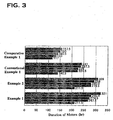
- motors using sliding contact materials of Ni metal particle-dispersed-type Ag-Ni-based alloy in Examples 1 and 2 showed more excellent durability than that in motors using the sliding contact material containing Cd in Conventional example 1.
- the sliding contact material in Comparative example 1 tends to provide deteriorated durability, but it was confirmed that motors become to have sufficiently practical durable lives in Examples 1 and 2.
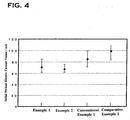
- the sliding contact materials of Ni metal particle-dispersed-type Ag-Ni-based alloy of the present invention have durability equal to or higher than conventional sliding contact materials containing Cd even in such use conditions as an electric current value of 250 mA and a rotation number of 12000 rpm. Further, it has been proved that the sliding contact materials of Ni metal particle-dispersed-type Ag-Ni-based alloy of the present invention have higher capability of lowering the initial no-load electric current value when compared to conventional sliding contact materials containing Cd.
- the sliding contact materials of Ni metal particle-dispersed-type Ag-Ni-based alloy of the present invention have alloy compositions containing no harmful substance like Cd, electrical functions that are good and is not subject to secular change, and abrasion resistance practically bearing comparison with conventional moving contact materials.
- the sliding contact material of Ni metal particle-dispersed-type Ag-Ni-based alloy of the present invention is applied to a household electric appliance provided with a small direct-current motor using a rechargeable battery, since the motor maintains low contact resistance with time and can be driven with low starting voltage, the motor can be continuously used for such a long period of time as being unrealizable so far and further the life of the rechargeable battery used for driving the motor can also be prolonged.
Landscapes
- Chemical & Material Sciences (AREA)
- Engineering & Computer Science (AREA)
- Materials Engineering (AREA)
- Metallurgy (AREA)
- Organic Chemistry (AREA)
- Mechanical Engineering (AREA)
- Inorganic Chemistry (AREA)
- Composite Materials (AREA)
- Ceramic Engineering (AREA)
- Contacts (AREA)
- Motor Or Generator Current Collectors (AREA)
- Powder Metallurgy (AREA)
- Manufacture Of Alloys Or Alloy Compounds (AREA)
- Manufacture Of Switches (AREA)
- Conductive Materials (AREA)
Abstract
Description
| Ag powder (wt.%) | Ni powder (wt.%) | Li2CO3 powder (converted to Li metal, wt.%) | La2O3 powder (converted to La metal, wt.%). | |
| Example 1 | The balance | 1.0 | 0.1 | - |
| Example 2 | The balance | 1.0 | 0.1 | 0.3 |
| Ag | Cd | Pd | Cu | Zn | Ni | |
| Conventional example 1 | The balance | 2.0 | - | - | - | 0.3 |
| Comparative example 1 | The balance | - | 0.5 | 0.5 | 0.5 | 0.3 |
| (Wt.%) |
| Temperature | 295 K (22°C) |
| | 50% |
| Voltage | 6.5 V |
| Electric current | 250 mA |
| Mode | Normal revolution (clockwise seen from the output side) 2 seconds - |
| Number of rotations | 12000 rpm |
| Torque | 7.84×10⁻⁴ N-m (8 gf-cm) |
| The number of tested motors | 5 motors |
| Each time when each of tested 5 motors stopped in the endurance test (hr) | |||||
| Example 1 | 221.5 | 267.5 | 274.5 | 280.5 | 321.0 |
| Example 2 | 211.5 | 279.5 | 280.5 | 294.0 | 309.0 |
| Conventional example 1 | 140.5 | 224.5 | 226.0 | 237.5 | 241.0 |
| Comparative example 1 | 117.0 | 133.0 | 140.5 | 150.0 | 157.5 |
| The minimum value | The maximum value | The average value | |
| Example 1 | 61.3 | 85.1 | 71.3 |
| Example 2 | 62.5 | 75.2 | 67.6 |
| Conventional example 1 | 71.1 | 99.8 | 84.6 |
| Comparative example 1 | 84.7 | 107.0 | 98.1 |
| (mA) |
Claims (5)
- A sliding contact material of Ni metal particle-dispersed-type Ag-Ni-based alloy, the material being a sliding contact material of an Ag-Ni-based alloy that is used in a sliding part electrically switching on and off by a mechanical sliding action, wherein the material is produced in such a method that 0.7 to 3.0 wt.% Ni powder, an additive of Li2CO3 powder corresponding to 0.01 to 0.50 wt.% Li after being converted to metal and the balance of Ag powder are mixed and stirred to form a uniformly dispersed mixture, then the mixture is treated with forming and sintering processes.
- A sliding contact material of Ni metal particle-dispersed-type Ag-Ni-based alloy, the material being a sliding contact material of an Ag-Ni-based alloy that is used in a sliding part electrically switching on and off by a mechanical sliding action, wherein the material is produced in such a method that 0.7 to 3.0 wt.% Ni powder, additives of Li2CO3 powder corresponding to 0.01 to 0.50 wt.% Li after being converted to metal and of La2O3 powder corresponding to 0.01 to 1.00 wt.% La after being converted to metal and the balance of Ag powder are mixed and stirred to form a uniformly dispersed mixture, then the mixture is treated with forming and sintering processes.
- A cladding composite material, wherein the sliding contact material of Ni metal particle-dispersed-type Ag-Ni-based alloy according to Claim 1 or 2 is buried on a part of a base material made of Cu or a Cu alloy.
- A cladding composite material in which the sliding contact material of Ni metal particle-dispersed-type Ag-Ni-based alloy according to Claim 1 or 2 is buried on a part of a base material made of Cu or a Cu alloy, wherein at least part of the buried sliding contact material of Ni metal particle-dispersed-type Ag-Ni-based alloy is coated with Au or a Au alloy.
- A small direct-current motor, wherein the cladding composite material according to Claim 3 or 4 is used as a commutator.
Applications Claiming Priority (3)
| Application Number | Priority Date | Filing Date | Title |
|---|---|---|---|
| JP2000220359A JP3789291B2 (en) | 2000-07-21 | 2000-07-21 | Ni metal particle dispersion type Ag-Ni alloy sliding contact material and clad composite material and DC small motor using the same |
| JP2000220359 | 2000-07-21 | ||
| PCT/JP2001/006218 WO2002008480A1 (en) | 2000-07-21 | 2001-07-18 | SLIDING CONTACT MATERIAL COMPRISING Ag-Ni BASED ALLOY HAVING Ni METAL PARTICLES DISPERSED AND CLAD COMPOSITE MATERIAL, AND DC COMPACT MOTOR USING THE SAME |
Publications (2)
| Publication Number | Publication Date |
|---|---|
| EP1264908A1 true EP1264908A1 (en) | 2002-12-11 |
| EP1264908A4 EP1264908A4 (en) | 2003-03-05 |
Family
ID=18714977
Family Applications (1)
| Application Number | Title | Priority Date | Filing Date |
|---|---|---|---|
| EP01951906A Withdrawn EP1264908A4 (en) | 2000-07-21 | 2001-07-18 | SLIDING CONTACT MATERIAL, COMPRISING AN AGNI-BASED ALLOY, WHICH HAS METALLIC PARTICLES IN NOR DISPERSE AND A PLATE COMPOSITE MATERIAL AND DIRECT CURRENT COMPACT MOTOR USING THE SAME |
Country Status (6)
| Country | Link |
|---|---|
| US (1) | US6638334B2 (en) |
| EP (1) | EP1264908A4 (en) |
| JP (1) | JP3789291B2 (en) |
| KR (1) | KR100473495B1 (en) |
| CN (1) | CN1138012C (en) |
| WO (1) | WO2002008480A1 (en) |
Cited By (3)
| Publication number | Priority date | Publication date | Assignee | Title |
|---|---|---|---|---|
| WO2009003902A1 (en) * | 2007-06-30 | 2009-01-08 | Robert Bosch Gmbh | Electrical machine |
| WO2018130382A1 (en) * | 2017-01-10 | 2018-07-19 | Siemens Aktiengesellschaft | Contact pin for an electric switch, electric switch with said type of contact pin and method for producing said type of contact pin |
| EP3889280A4 (en) * | 2018-11-30 | 2022-03-16 | Tanaka Kikinzoku Kogyo K.K. | CONDUCTIVE MATERIAL WITH EXCELLENT ABRASION RESISTANCE AND EXCELLENT HEAT RESISTANCE |
Families Citing this family (12)
| Publication number | Priority date | Publication date | Assignee | Title |
|---|---|---|---|---|
| JP2002030376A (en) * | 2000-07-21 | 2002-01-31 | Tanaka Kikinzoku Kogyo Kk | Ag-Ni alloy switching contact material of Ni metal particle dispersion type and relay using the same |
| JP4111906B2 (en) * | 2003-11-26 | 2008-07-02 | マブチモーター株式会社 | Sliding contact material, clad composite material and DC small motor using the same |
| JP4252582B2 (en) * | 2005-05-12 | 2009-04-08 | マブチモーター株式会社 | Commutator material and brush material for DC small motor, clad composite material and DC small motor using the same |
| JP2009245659A (en) * | 2008-03-28 | 2009-10-22 | Furukawa Electric Co Ltd:The | Slide contact material for electric motor |
| CN101924312B (en) * | 2009-06-09 | 2013-01-09 | 重庆川仪自动化股份有限公司 | Alkali metal-added silver-based sliding contact material containing rare earth |
| CN101924311B (en) * | 2009-06-09 | 2012-12-19 | 重庆川仪自动化股份有限公司 | Alkali metal-containing silver-copper-nickel sliding electrical contact material |
| CN101924288B (en) * | 2009-06-09 | 2013-01-09 | 重庆川仪自动化股份有限公司 | Silver base sliding electrical contact material containing alkali metal and palladium |
| DE102009029687A1 (en) * | 2009-09-23 | 2011-03-24 | Robert Bosch Gmbh | Commutator for power transmission in an electrical machine |
| RU2529605C1 (en) * | 2013-05-27 | 2014-09-27 | Федеральное государственное бюджетное образовательное учреждение высшего профессионального образования "Южно-Уральский государственный университет" (национальный исследовательский университет) (ФГБОУ ВПО "ЮУрГУ" (НИУ)) | Production method of sliding contacts |
| RU2533893C1 (en) * | 2013-07-31 | 2014-11-27 | Федеральное государственное бюджетное образовательное учреждение высшего профессионального образования "Южно-Уральский государственный университет" (национальный исследовательский университет) (ФГБОУ ВПО "ЮУрГУ" (НИУ) | Manufacturing method of sliding contacts from powder compositions based on carbon |
| CN104357704A (en) * | 2014-10-27 | 2015-02-18 | 李博 | Nickel oxide dispersion-strengthened silver-based alloy and preparation method thereof |
| KR20160069242A (en) | 2014-12-08 | 2016-06-16 | 희성금속 주식회사 | Manufacturing method of clad for vehicle relay contact and clad for vehicle relay contact manufactured therefrom |
Family Cites Families (9)
| Publication number | Priority date | Publication date | Assignee | Title |
|---|---|---|---|---|
| JPS5213689A (en) | 1975-07-24 | 1977-02-02 | Natl Res Inst For Metals | The electric junction material |
| JPS5681649A (en) | 1979-12-08 | 1981-07-03 | Matsushita Electric Works Ltd | Contact material |
| US4502899A (en) | 1981-06-30 | 1985-03-05 | Matsushita Electric Works, Ltd. | Electric joint material |
| JPS5893849A (en) | 1981-11-30 | 1983-06-03 | Matsushita Electric Works Ltd | Contact material |
| JPS61246337A (en) | 1985-04-24 | 1986-11-01 | Matsushita Electric Works Ltd | Contact material |
| JPH06104873B2 (en) * | 1986-07-08 | 1994-12-21 | 富士電機株式会社 | Silver-metal oxide contact material and manufacturing method thereof |
| JP2834550B2 (en) * | 1989-08-02 | 1998-12-09 | 古河電気工業株式会社 | Sliding contact material for small current region and method of manufacturing the same |
| JPH0371522A (en) | 1989-08-10 | 1991-03-27 | Furukawa Electric Co Ltd:The | Electric contact material and manufacture thereof |
| US5800932A (en) * | 1995-02-28 | 1998-09-01 | The Furukawa Electric Co., Ltd. | Electric contact material and a manufacturing method therefor |
-
2000
- 2000-07-21 JP JP2000220359A patent/JP3789291B2/en not_active Expired - Lifetime
-
2001
- 2001-07-18 US US10/088,082 patent/US6638334B2/en not_active Expired - Lifetime
- 2001-07-18 EP EP01951906A patent/EP1264908A4/en not_active Withdrawn
- 2001-07-18 WO PCT/JP2001/006218 patent/WO2002008480A1/en not_active Ceased
- 2001-07-18 KR KR10-2002-7003615A patent/KR100473495B1/en not_active Expired - Lifetime
- 2001-07-18 CN CNB018026125A patent/CN1138012C/en not_active Expired - Lifetime
Cited By (5)
| Publication number | Priority date | Publication date | Assignee | Title |
|---|---|---|---|---|
| WO2009003902A1 (en) * | 2007-06-30 | 2009-01-08 | Robert Bosch Gmbh | Electrical machine |
| WO2018130382A1 (en) * | 2017-01-10 | 2018-07-19 | Siemens Aktiengesellschaft | Contact pin for an electric switch, electric switch with said type of contact pin and method for producing said type of contact pin |
| CN110168688A (en) * | 2017-01-10 | 2019-08-23 | 西门子股份公司 | Contact piece of electrical switch, electrical switch having same, and manufacturing method of same |
| US10861661B2 (en) | 2017-01-10 | 2020-12-08 | Siemens Aktiengesellschaft | Contact pin for an electric switch, electric switch with said type of contact pin and method for producing said type of contact pin |
| EP3889280A4 (en) * | 2018-11-30 | 2022-03-16 | Tanaka Kikinzoku Kogyo K.K. | CONDUCTIVE MATERIAL WITH EXCELLENT ABRASION RESISTANCE AND EXCELLENT HEAT RESISTANCE |
Also Published As
| Publication number | Publication date |
|---|---|
| US20030061903A1 (en) | 2003-04-03 |
| KR20020044145A (en) | 2002-06-14 |
| KR100473495B1 (en) | 2005-03-09 |
| CN1138012C (en) | 2004-02-11 |
| EP1264908A4 (en) | 2003-03-05 |
| JP2002042594A (en) | 2002-02-08 |
| US6638334B2 (en) | 2003-10-28 |
| CN1388833A (en) | 2003-01-01 |
| JP3789291B2 (en) | 2006-06-21 |
| WO2002008480A1 (en) | 2002-01-31 |
Similar Documents
| Publication | Publication Date | Title |
|---|---|---|
| US6638334B2 (en) | Sliding contact material comprising Ag-Ni based alloy having Ni metal particles dispersed and clad composite material, and Dc compact motor using the same | |
| US6245166B1 (en) | Material for sliding contact, composite clad material, and small-sized direct current motor using the same | |
| KR0147816B1 (en) | Electrical contact material, manufacturing method thereof and electrical contact using the material | |
| JPWO1999001584A1 (en) | Sliding contact material, clad composite material, and small DC motor using the same | |
| US5876862A (en) | Sliding contact material, clad compoosite material, commutator employing said material and direct current motor employing said commutator | |
| CN110323902B (en) | Formation of graphite coating on surfaces of starter and commutator | |
| US6815862B2 (en) | Multilayer brush | |
| US7160632B2 (en) | Material for sliding contacts, clad composite material and small-sized DC motor using the same | |
| KR100776857B1 (en) | Commutator and brush materials for small electric dc motor, clad composite material, and small electric dc motor using the same | |
| JP5342931B2 (en) | Sliding contact material, clad composite material and motor | |
| JPH02185937A (en) | Sintered contact material for low pressure switch for electric power | |
| JPH08260078A (en) | Sliding contact material, clad composite material, and small DC motor using the same | |
| US20070042650A1 (en) | Sliding electrical contact part | |
| CN100457936C (en) | Commutator material, brush material, clad composite material, and small-sized DC motor | |
| JP5150429B2 (en) | Combination structure of sliding contact members used in automotive DC switches | |
| JP2002080922A (en) | Sliding current collector made of Cu-graphite sintered material with excellent wear resistance | |
| JP2004183077A (en) | Electric sliding contact material and small DC motor having the same | |
| JP4991983B2 (en) | Sliding contact structure | |
| JPH02280647A (en) | Communicator for motor | |
| JP2004353002A (en) | Electrical contact materials and switches | |
| JPS60187639A (en) | Material for electric contact and manufacture | |
| JPS5935513B2 (en) | Rectifier for small DC motor |
Legal Events
| Date | Code | Title | Description |
|---|---|---|---|
| PUAI | Public reference made under article 153(3) epc to a published international application that has entered the european phase |
Free format text: ORIGINAL CODE: 0009012 |
|
| 17P | Request for examination filed |
Effective date: 20020416 |
|
| AK | Designated contracting states |
Kind code of ref document: A1 Designated state(s): AT BE CH CY DE DK ES FI FR GB GR IE IT LI LU MC NL PT SE TR |
|
| A4 | Supplementary search report drawn up and despatched |
Effective date: 20030122 |
|
| RIC1 | Information provided on ipc code assigned before grant |
Ipc: 7H 02K 13/00 B Ipc: 7H 01H 1/02 B Ipc: 7H 01H 11/04 B Ipc: 7C 22C 32/00 A Ipc: 7H 01H 1/04 B Ipc: 7C 22C 1/04 B |
|
| 17Q | First examination report despatched |
Effective date: 20030416 |
|
| RBV | Designated contracting states (corrected) |
Designated state(s): DE FR GB IT |
|
| STAA | Information on the status of an ep patent application or granted ep patent |
Free format text: STATUS: THE APPLICATION IS DEEMED TO BE WITHDRAWN |
|
| 18D | Application deemed to be withdrawn |
Effective date: 20041130 |