EP1264823A1 - Process for the preparation of 2,3-dicyanopropionates - Google Patents
Process for the preparation of 2,3-dicyanopropionates Download PDFInfo
- Publication number
- EP1264823A1 EP1264823A1 EP01113967A EP01113967A EP1264823A1 EP 1264823 A1 EP1264823 A1 EP 1264823A1 EP 01113967 A EP01113967 A EP 01113967A EP 01113967 A EP01113967 A EP 01113967A EP 1264823 A1 EP1264823 A1 EP 1264823A1
- Authority
- EP
- European Patent Office
- Prior art keywords
- formula
- compound
- alkyl
- reaction
- salt
- Prior art date
- Legal status (The legal status is an assumption and is not a legal conclusion. Google has not performed a legal analysis and makes no representation as to the accuracy of the status listed.)
- Withdrawn
Links
- 238000000034 method Methods 0.000 title claims abstract description 24
- 238000002360 preparation method Methods 0.000 title claims abstract description 9
- HHNXOWUQVSCKQY-UHFFFAOYSA-N 2,3-dicyanopropanoic acid Chemical class OC(=O)C(C#N)CC#N HHNXOWUQVSCKQY-UHFFFAOYSA-N 0.000 title 1
- 150000001875 compounds Chemical class 0.000 claims abstract description 38
- WSFSSNUMVMOOMR-UHFFFAOYSA-N Formaldehyde Chemical compound O=C WSFSSNUMVMOOMR-UHFFFAOYSA-N 0.000 claims abstract description 27
- 238000006243 chemical reaction Methods 0.000 claims abstract description 16
- 150000002825 nitriles Chemical class 0.000 claims abstract description 9
- 150000003839 salts Chemical class 0.000 claims abstract description 7
- MLIREBYILWEBDM-UHFFFAOYSA-M 2-cyanoacetate Chemical compound [O-]C(=O)CC#N MLIREBYILWEBDM-UHFFFAOYSA-M 0.000 claims abstract description 5
- 125000004191 (C1-C6) alkoxy group Chemical group 0.000 claims abstract description 3
- 125000004169 (C1-C6) alkyl group Chemical group 0.000 claims abstract description 3
- 125000006552 (C3-C8) cycloalkyl group Chemical group 0.000 claims abstract description 3
- 125000003903 2-propenyl group Chemical group [H]C([*])([H])C([H])=C([H])[H] 0.000 claims abstract description 3
- 125000001494 2-propynyl group Chemical group [H]C#CC([H])([H])* 0.000 claims abstract description 3
- 125000001997 phenyl group Chemical group [H]C1=C([H])C([H])=C(*)C([H])=C1[H] 0.000 claims abstract description 3
- 239000002904 solvent Substances 0.000 claims description 15
- XNWFRZJHXBZDAG-UHFFFAOYSA-N 2-METHOXYETHANOL Chemical compound COCCO XNWFRZJHXBZDAG-UHFFFAOYSA-N 0.000 claims description 12
- 239000012954 diazonium Substances 0.000 claims description 8
- 150000001989 diazonium salts Chemical class 0.000 claims description 8
- HCMJWOGOISXSDL-UHFFFAOYSA-N (2-isothiocyanato-1-phenylethyl)benzene Chemical compound C=1C=CC=CC=1C(CN=C=S)C1=CC=CC=C1 HCMJWOGOISXSDL-UHFFFAOYSA-N 0.000 claims description 6
- 229910052736 halogen Inorganic materials 0.000 claims description 6
- 150000002367 halogens Chemical class 0.000 claims description 6
- 229930040373 Paraformaldehyde Natural products 0.000 claims description 5
- 229920002866 paraformaldehyde Polymers 0.000 claims description 5
- 125000004767 (C1-C4) haloalkoxy group Chemical group 0.000 claims description 4
- 125000004765 (C1-C4) haloalkyl group Chemical group 0.000 claims description 4
- 238000010992 reflux Methods 0.000 claims description 2
- 239000000543 intermediate Substances 0.000 abstract description 4
- 230000015572 biosynthetic process Effects 0.000 abstract description 2
- 238000003786 synthesis reaction Methods 0.000 abstract description 2
- RTZKZFJDLAIYFH-UHFFFAOYSA-N Diethyl ether Chemical compound CCOCC RTZKZFJDLAIYFH-UHFFFAOYSA-N 0.000 description 17
- VEXZGXHMUGYJMC-UHFFFAOYSA-N Hydrochloric acid Chemical compound Cl VEXZGXHMUGYJMC-UHFFFAOYSA-N 0.000 description 12
- 239000000203 mixture Substances 0.000 description 12
- LFQSCWFLJHTTHZ-UHFFFAOYSA-N Ethanol Chemical compound CCO LFQSCWFLJHTTHZ-UHFFFAOYSA-N 0.000 description 9
- YXFVVABEGXRONW-UHFFFAOYSA-N Toluene Chemical compound CC1=CC=CC=C1 YXFVVABEGXRONW-UHFFFAOYSA-N 0.000 description 9
- QGZKDVFQNNGYKY-UHFFFAOYSA-N Ammonia Chemical compound N QGZKDVFQNNGYKY-UHFFFAOYSA-N 0.000 description 8
- LPXPTNMVRIOKMN-UHFFFAOYSA-M sodium nitrite Chemical compound [Na+].[O-]N=O LPXPTNMVRIOKMN-UHFFFAOYSA-M 0.000 description 8
- XLYOFNOQVPJJNP-UHFFFAOYSA-N water Substances O XLYOFNOQVPJJNP-UHFFFAOYSA-N 0.000 description 7
- XEKOWRVHYACXOJ-UHFFFAOYSA-N Ethyl acetate Chemical compound CCOC(C)=O XEKOWRVHYACXOJ-UHFFFAOYSA-N 0.000 description 6
- -1 alkyl cyanoacetate Chemical compound 0.000 description 6
- 238000001816 cooling Methods 0.000 description 6
- 239000003085 diluting agent Substances 0.000 description 6
- 239000000243 solution Substances 0.000 description 6
- VHUUQVKOLVNVRT-UHFFFAOYSA-N Ammonium hydroxide Chemical compound [NH4+].[OH-] VHUUQVKOLVNVRT-UHFFFAOYSA-N 0.000 description 4
- QAOWNCQODCNURD-UHFFFAOYSA-N Sulfuric acid Chemical compound OS(O)(=O)=O QAOWNCQODCNURD-UHFFFAOYSA-N 0.000 description 4
- 239000002253 acid Substances 0.000 description 4
- 229910052784 alkaline earth metal Inorganic materials 0.000 description 4
- 239000002585 base Substances 0.000 description 4
- KXZJHVJKXJLBKO-UHFFFAOYSA-N chembl1408157 Chemical compound N=1C2=CC=CC=C2C(C(=O)O)=CC=1C1=CC=C(O)C=C1 KXZJHVJKXJLBKO-UHFFFAOYSA-N 0.000 description 4
- 229910052500 inorganic mineral Inorganic materials 0.000 description 4
- 239000011707 mineral Substances 0.000 description 4
- 235000010288 sodium nitrite Nutrition 0.000 description 4
- 0 *c(cc1*)cc(*)c1N Chemical compound *c(cc1*)cc(*)c1N 0.000 description 3
- ZWEHNKRNPOVVGH-UHFFFAOYSA-N 2-Butanone Chemical compound CCC(C)=O ZWEHNKRNPOVVGH-UHFFFAOYSA-N 0.000 description 3
- SGLKIEOMYXTGBH-UHFFFAOYSA-N 2-methoxyethyl 2-cyanoacetate Chemical compound COCCOC(=O)CC#N SGLKIEOMYXTGBH-UHFFFAOYSA-N 0.000 description 3
- CSCPPACGZOOCGX-UHFFFAOYSA-N Acetone Chemical compound CC(C)=O CSCPPACGZOOCGX-UHFFFAOYSA-N 0.000 description 3
- WEVYAHXRMPXWCK-UHFFFAOYSA-N Acetonitrile Chemical compound CC#N WEVYAHXRMPXWCK-UHFFFAOYSA-N 0.000 description 3
- UHOVQNZJYSORNB-UHFFFAOYSA-N Benzene Chemical compound C1=CC=CC=C1 UHOVQNZJYSORNB-UHFFFAOYSA-N 0.000 description 3
- YMWUJEATGCHHMB-UHFFFAOYSA-N Dichloromethane Chemical compound ClCCl YMWUJEATGCHHMB-UHFFFAOYSA-N 0.000 description 3
- LYCAIKOWRPUZTN-UHFFFAOYSA-N Ethylene glycol Chemical compound OCCO LYCAIKOWRPUZTN-UHFFFAOYSA-N 0.000 description 3
- PEDCQBHIVMGVHV-UHFFFAOYSA-N Glycerine Chemical compound OCC(O)CO PEDCQBHIVMGVHV-UHFFFAOYSA-N 0.000 description 3
- OKKJLVBELUTLKV-UHFFFAOYSA-N Methanol Chemical compound OC OKKJLVBELUTLKV-UHFFFAOYSA-N 0.000 description 3
- ZMXDDKWLCZADIW-UHFFFAOYSA-N N,N-Dimethylformamide Chemical compound CN(C)C=O ZMXDDKWLCZADIW-UHFFFAOYSA-N 0.000 description 3
- FAPWRFPIFSIZLT-UHFFFAOYSA-M Sodium chloride Chemical class [Na+].[Cl-] FAPWRFPIFSIZLT-UHFFFAOYSA-M 0.000 description 3
- 230000001476 alcoholic effect Effects 0.000 description 3
- LTYRAPJYLUPLCI-UHFFFAOYSA-N glycolonitrile Chemical compound OCC#N LTYRAPJYLUPLCI-UHFFFAOYSA-N 0.000 description 3
- 238000011065 in-situ storage Methods 0.000 description 3
- 239000003701 inert diluent Substances 0.000 description 3
- 239000012442 inert solvent Substances 0.000 description 3
- 239000000155 melt Substances 0.000 description 3
- VLKZOEOYAKHREP-UHFFFAOYSA-N n-Hexane Chemical compound CCCCCC VLKZOEOYAKHREP-UHFFFAOYSA-N 0.000 description 3
- 239000012074 organic phase Substances 0.000 description 3
- ITNMAZSPBLRJLU-UHFFFAOYSA-N 2,6-dichloro-4-(trifluoromethyl)aniline Chemical compound NC1=C(Cl)C=C(C(F)(F)F)C=C1Cl ITNMAZSPBLRJLU-UHFFFAOYSA-N 0.000 description 2
- QPZYPAMYHBOUTC-UHFFFAOYSA-N 5-amino-1-[2,6-dichloro-4-(trifluoromethyl)phenyl]pyrazole-3-carbonitrile Chemical compound NC1=CC(C#N)=NN1C1=C(Cl)C=C(C(F)(F)F)C=C1Cl QPZYPAMYHBOUTC-UHFFFAOYSA-N 0.000 description 2
- XTHFKEDIFFGKHM-UHFFFAOYSA-N Dimethoxyethane Chemical compound COCCOC XTHFKEDIFFGKHM-UHFFFAOYSA-N 0.000 description 2
- KFZMGEQAYNKOFK-UHFFFAOYSA-N Isopropanol Chemical compound CC(C)O KFZMGEQAYNKOFK-UHFFFAOYSA-N 0.000 description 2
- LRHPLDYGYMQRHN-UHFFFAOYSA-N N-Butanol Chemical compound CCCCO LRHPLDYGYMQRHN-UHFFFAOYSA-N 0.000 description 2
- WYURNTSHIVDZCO-UHFFFAOYSA-N Tetrahydrofuran Chemical compound C1CCOC1 WYURNTSHIVDZCO-UHFFFAOYSA-N 0.000 description 2
- 239000003513 alkali Substances 0.000 description 2
- 229910021529 ammonia Inorganic materials 0.000 description 2
- 239000007864 aqueous solution Substances 0.000 description 2
- QARVLSVVCXYDNA-UHFFFAOYSA-N bromobenzene Chemical compound BrC1=CC=CC=C1 QARVLSVVCXYDNA-UHFFFAOYSA-N 0.000 description 2
- 239000003795 chemical substances by application Substances 0.000 description 2
- MVPPADPHJFYWMZ-UHFFFAOYSA-N chlorobenzene Chemical compound ClC1=CC=CC=C1 MVPPADPHJFYWMZ-UHFFFAOYSA-N 0.000 description 2
- 125000004185 ester group Chemical group 0.000 description 2
- 150000002148 esters Chemical class 0.000 description 2
- 238000001704 evaporation Methods 0.000 description 2
- 230000008020 evaporation Effects 0.000 description 2
- 230000007062 hydrolysis Effects 0.000 description 2
- 238000006460 hydrolysis reaction Methods 0.000 description 2
- 229910052751 metal Inorganic materials 0.000 description 2
- 239000002184 metal Substances 0.000 description 2
- 239000000575 pesticide Substances 0.000 description 2
- CXWXQJXEFPUFDZ-UHFFFAOYSA-N tetralin Chemical compound C1=CC=C2CCCCC2=C1 CXWXQJXEFPUFDZ-UHFFFAOYSA-N 0.000 description 2
- 125000000876 trifluoromethoxy group Chemical group FC(F)(F)O* 0.000 description 2
- 125000002023 trifluoromethyl group Chemical group FC(F)(F)* 0.000 description 2
- SCYULBFZEHDVBN-UHFFFAOYSA-N 1,1-Dichloroethane Chemical compound CC(Cl)Cl SCYULBFZEHDVBN-UHFFFAOYSA-N 0.000 description 1
- RYHBNJHYFVUHQT-UHFFFAOYSA-N 1,4-Dioxane Chemical compound C1COCCO1 RYHBNJHYFVUHQT-UHFFFAOYSA-N 0.000 description 1
- OCJBOOLMMGQPQU-UHFFFAOYSA-N 1,4-dichlorobenzene Chemical compound ClC1=CC=C(Cl)C=C1 OCJBOOLMMGQPQU-UHFFFAOYSA-N 0.000 description 1
- DURPTKYDGMDSBL-UHFFFAOYSA-N 1-butoxybutane Chemical compound CCCCOCCCC DURPTKYDGMDSBL-UHFFFAOYSA-N 0.000 description 1
- ZNQVEEAIQZEUHB-UHFFFAOYSA-N 2-ethoxyethanol Chemical compound CCOCCO ZNQVEEAIQZEUHB-UHFFFAOYSA-N 0.000 description 1
- TVUQIUWJPQTAMU-UHFFFAOYSA-N 2-methoxyethyl 2,3-dicyanopropanoate Chemical compound COCCOC(=O)C(C#N)CC#N TVUQIUWJPQTAMU-UHFFFAOYSA-N 0.000 description 1
- HEDRZPFGACZZDS-UHFFFAOYSA-N Chloroform Chemical compound ClC(Cl)Cl HEDRZPFGACZZDS-UHFFFAOYSA-N 0.000 description 1
- XDTMQSROBMDMFD-UHFFFAOYSA-N Cyclohexane Chemical compound C1CCCCC1 XDTMQSROBMDMFD-UHFFFAOYSA-N 0.000 description 1
- ZAFNJMIOTHYJRJ-UHFFFAOYSA-N Diisopropyl ether Chemical compound CC(C)OC(C)C ZAFNJMIOTHYJRJ-UHFFFAOYSA-N 0.000 description 1
- IAZDPXIOMUYVGZ-UHFFFAOYSA-N Dimethylsulphoxide Chemical compound CS(C)=O IAZDPXIOMUYVGZ-UHFFFAOYSA-N 0.000 description 1
- NTIZESTWPVYFNL-UHFFFAOYSA-N Methyl isobutyl ketone Chemical compound CC(C)CC(C)=O NTIZESTWPVYFNL-UHFFFAOYSA-N 0.000 description 1
- UIHCLUNTQKBZGK-UHFFFAOYSA-N Methyl isobutyl ketone Natural products CCC(C)C(C)=O UIHCLUNTQKBZGK-UHFFFAOYSA-N 0.000 description 1
- BZLVMXJERCGZMT-UHFFFAOYSA-N Methyl tert-butyl ether Chemical compound COC(C)(C)C BZLVMXJERCGZMT-UHFFFAOYSA-N 0.000 description 1
- FXHOOIRPVKKKFG-UHFFFAOYSA-N N,N-Dimethylacetamide Chemical compound CN(C)C(C)=O FXHOOIRPVKKKFG-UHFFFAOYSA-N 0.000 description 1
- SUAKHGWARZSWIH-UHFFFAOYSA-N N,N‐diethylformamide Chemical compound CCN(CC)C=O SUAKHGWARZSWIH-UHFFFAOYSA-N 0.000 description 1
- SECXISVLQFMRJM-UHFFFAOYSA-N N-Methylpyrrolidone Chemical compound CN1CCCC1=O SECXISVLQFMRJM-UHFFFAOYSA-N 0.000 description 1
- CTQNGGLPUBDAKN-UHFFFAOYSA-N O-Xylene Chemical compound CC1=CC=CC=C1C CTQNGGLPUBDAKN-UHFFFAOYSA-N 0.000 description 1
- CYTYCFOTNPOANT-UHFFFAOYSA-N Perchloroethylene Chemical compound ClC(Cl)=C(Cl)Cl CYTYCFOTNPOANT-UHFFFAOYSA-N 0.000 description 1
- 239000002202 Polyethylene glycol Substances 0.000 description 1
- ZLMJMSJWJFRBEC-UHFFFAOYSA-N Potassium Chemical compound [K] ZLMJMSJWJFRBEC-UHFFFAOYSA-N 0.000 description 1
- XSTXAVWGXDQKEL-UHFFFAOYSA-N Trichloroethylene Chemical compound ClC=C(Cl)Cl XSTXAVWGXDQKEL-UHFFFAOYSA-N 0.000 description 1
- 150000001298 alcohols Chemical class 0.000 description 1
- 125000001931 aliphatic group Chemical group 0.000 description 1
- 229910052783 alkali metal Inorganic materials 0.000 description 1
- 150000001408 amides Chemical class 0.000 description 1
- 125000003118 aryl group Chemical group 0.000 description 1
- 229950005499 carbon tetrachloride Drugs 0.000 description 1
- 229960001701 chloroform Drugs 0.000 description 1
- 229940117389 dichlorobenzene Drugs 0.000 description 1
- 229960001760 dimethyl sulfoxide Drugs 0.000 description 1
- POLCUAVZOMRGSN-UHFFFAOYSA-N dipropyl ether Chemical compound CCCOCCC POLCUAVZOMRGSN-UHFFFAOYSA-N 0.000 description 1
- 150000002170 ethers Chemical class 0.000 description 1
- ZIUSEGSNTOUIPT-UHFFFAOYSA-N ethyl 2-cyanoacetate Chemical compound CCOC(=O)CC#N ZIUSEGSNTOUIPT-UHFFFAOYSA-N 0.000 description 1
- 229940052308 general anesthetics halogenated hydrocarbons Drugs 0.000 description 1
- 150000008282 halocarbons Chemical class 0.000 description 1
- GNOIPBMMFNIUFM-UHFFFAOYSA-N hexamethylphosphoric triamide Chemical compound CN(C)P(=O)(N(C)C)N(C)C GNOIPBMMFNIUFM-UHFFFAOYSA-N 0.000 description 1
- 229930195733 hydrocarbon Natural products 0.000 description 1
- 150000002576 ketones Chemical class 0.000 description 1
- 238000004519 manufacturing process Methods 0.000 description 1
- AUHZEENZYGFFBQ-UHFFFAOYSA-N mesitylene Substances CC1=CC(C)=CC(C)=C1 AUHZEENZYGFFBQ-UHFFFAOYSA-N 0.000 description 1
- 125000001827 mesitylenyl group Chemical group [H]C1=C(C(*)=C(C([H])=C1C([H])([H])[H])C([H])([H])[H])C([H])([H])[H] 0.000 description 1
- IATZLNCRIIUXJM-UHFFFAOYSA-N methyl hept-2-ynoate Chemical compound CCCCC#CC(=O)OC IATZLNCRIIUXJM-UHFFFAOYSA-N 0.000 description 1
- 239000012299 nitrogen atmosphere Substances 0.000 description 1
- 239000003208 petroleum Substances 0.000 description 1
- 239000012071 phase Substances 0.000 description 1
- 229920001223 polyethylene glycol Polymers 0.000 description 1
- 229910052700 potassium Inorganic materials 0.000 description 1
- 239000011591 potassium Substances 0.000 description 1
- 239000002243 precursor Substances 0.000 description 1
- BDERNNFJNOPAEC-UHFFFAOYSA-N propan-1-ol Chemical compound CCCO BDERNNFJNOPAEC-UHFFFAOYSA-N 0.000 description 1
- FVSKHRXBFJPNKK-UHFFFAOYSA-N propionitrile Chemical compound CCC#N FVSKHRXBFJPNKK-UHFFFAOYSA-N 0.000 description 1
- 239000011541 reaction mixture Substances 0.000 description 1
- 159000000000 sodium salts Chemical class 0.000 description 1
- LMBFAGIMSUYTBN-MPZNNTNKSA-N teixobactin Chemical compound C([C@H](C(=O)N[C@@H]([C@@H](C)CC)C(=O)N[C@@H](CO)C(=O)N[C@H](CCC(N)=O)C(=O)N[C@H]([C@@H](C)CC)C(=O)N[C@@H]([C@@H](C)CC)C(=O)N[C@@H](CO)C(=O)N[C@H]1C(N[C@@H](C)C(=O)N[C@@H](C[C@@H]2NC(=N)NC2)C(=O)N[C@H](C(=O)O[C@H]1C)[C@@H](C)CC)=O)NC)C1=CC=CC=C1 LMBFAGIMSUYTBN-MPZNNTNKSA-N 0.000 description 1
- 125000005207 tetraalkylammonium group Chemical group 0.000 description 1
- DZLFLBLQUQXARW-UHFFFAOYSA-N tetrabutylammonium Chemical compound CCCC[N+](CCCC)(CCCC)CCCC DZLFLBLQUQXARW-UHFFFAOYSA-N 0.000 description 1
- 229950011008 tetrachloroethylene Drugs 0.000 description 1
- VZGDMQKNWNREIO-UHFFFAOYSA-N tetrachloromethane Chemical compound ClC(Cl)(Cl)Cl VZGDMQKNWNREIO-UHFFFAOYSA-N 0.000 description 1
- YLQBMQCUIZJEEH-UHFFFAOYSA-N tetrahydrofuran Natural products C=1C=COC=1 YLQBMQCUIZJEEH-UHFFFAOYSA-N 0.000 description 1
- 229960002415 trichloroethylene Drugs 0.000 description 1
- 239000008096 xylene Substances 0.000 description 1
Classifications
-
- C—CHEMISTRY; METALLURGY
- C07—ORGANIC CHEMISTRY
- C07D—HETEROCYCLIC COMPOUNDS
- C07D231/00—Heterocyclic compounds containing 1,2-diazole or hydrogenated 1,2-diazole rings
- C07D231/02—Heterocyclic compounds containing 1,2-diazole or hydrogenated 1,2-diazole rings not condensed with other rings
- C07D231/10—Heterocyclic compounds containing 1,2-diazole or hydrogenated 1,2-diazole rings not condensed with other rings having two or three double bonds between ring members or between ring members and non-ring members
- C07D231/14—Heterocyclic compounds containing 1,2-diazole or hydrogenated 1,2-diazole rings not condensed with other rings having two or three double bonds between ring members or between ring members and non-ring members with hetero atoms or with carbon atoms having three bonds to hetero atoms with at the most one bond to halogen, e.g. ester or nitrile radicals, directly attached to ring carbon atoms
- C07D231/38—Nitrogen atoms
-
- C—CHEMISTRY; METALLURGY
- C07—ORGANIC CHEMISTRY
- C07C—ACYCLIC OR CARBOCYCLIC COMPOUNDS
- C07C253/00—Preparation of carboxylic acid nitriles
Definitions
- This invention relates to a process for preparing certain 2,3-dicyanopropionic esters and their use in the synthesis of pesticides and pesticide intermediates.
- Ethyl 2,3-dicyanopropionate was first synthesized by Higson and Thorpe in 1906 (J. Chem. Soc. 89, 1460 (1906)) and later by Dickinson (J. Am. Chem. Soc. 82, 6132 (1960)) by reaction of formaldehyde cyanohydrin with the sodium salt of ethyl cyanoacetate. Due to the inherent problem of having to isolate the highly watersoluble and fairly unstable intermediate formaldehyde cyanohydrin, Hawkins et al. (WO 97/32843, 12.9.97) suggested a process avoiding the cyanohydrin altogether by reacting an alkyl cyanoacetate in the presence of sodium cyanide with formaldehyde. This procedure gives the corresponding 2,3-dicyanopropionic alkyesters in good yields; however, it requires absolutely waterfree conditions. Thus, none of these attempts is totally satisfactory.
- the present invention in a first aspect, provides a process for the preparation of 2,3-dicyanopropionic esters which avoids the use of formaldehyde cyanohydrin, simplifies waterfree conditions and gives the required product in high yield and with high purity.
- the present invention provides a process for the preparation of a compound of formula wherein R represents branched or unbranched (C 1 -C 6 -alkoxy) 1-10 -C 2 -C 6 -alkyl, C 3 -C 8 -cycloalkyl, allyl, propargyl, phenyl or phenyl-C 1 -C 6 -alkyl; or a salt thereof; which comprises the reaction of a cyanoacetate of formula wherein R is defined as in formula I, with formaldehyde or a source thereof in the presence of a cyanide salt.
- R represents unbranched (C 1 -C 2 -alkoxy) 1-2 -C 2 -C 4 -alkyl, C 4 -C 6 -cycloalkyl or phenyl-C 1 -C 2 -alkyl, more preferably unbranched C 1 -C 2 -alkoxy-C 2 -C 4 -alkyl or phenyl-C 1 -alkyl, most preferably unbranched C 1 -alkoxy-C 2 -C 4 -alkyl.
- Suitable salts of cyanides encompass metal salts and organic salts such as tetraalkylammonium, preferably tetrabutylammonium, cyanides.
- Suitable metal salts are alkali or alkaline earth metal cyanide salts, particularly alkali metal cyanides, especially potassium or sodium cyanide.
- the product may be isolated as the alkali or alkaline earth metal salt.
- the reaction mixture is acidified, for example with a mineral acid such as sulfuric of hydrochloric acid, to yield the compound of fomula I in the free form.
- the reaction may be carried out with formaldehyde itself; however, it is usually preferred to use the polymerised form known as the commercially available paraformaldehyde.
- reaction partners can be reacted with one another as they are, i.e. without the addition of a solvent or diluent, e.g. in the melt. In most cases, however, the addition of an inert solvent or diluent, or a mixture thereof, is of advantage.
- solvents or diluents are: aromatic, aliphatic and alicyclic hydrocarbons and halogenated hydrocarbons, such as benzene, toluene, xylene, mesitylene, tetraline, chlorobenzene, dichlorobenzene, bromobenzene, petroleum ether, hexane, cyclohexane, dichloromethane, trichloromethane, tetrachloromethane, dichloroethane, trichloroethene or tetrachloroethene; alcohols, such as methanol, ethanol, propanol, isopropanol, butanol, ethylene glycol, polyethylene glycol, ethylene glycol monomethyl ether, or glycerol; ethers, such as diethyl ether, dipropyl ether, diisopropyl ether, dibutyl ether, tert-butyl
- a molar equivalent of a compound of formula II is mixed with about a molar equivalent of a cyanide salt and the mixture gradually treated with about a molar equivalent of formaldehyde in its paraformaldehyde precursor form in ethylene glycol monomethyl ether under unhydrous conditions at temperatures of about 0 to about 160°C or at the reflux temperature of the solvent, particularly at temperatures of about 0 to 40°C.
- the present invention provides a process for the generation of the compound of formula wherein R 1 , R 2 and R 3 represent independently of each other halogen, C 1 -C 4 -haloalkyl, C 1 -C 4 -haloalkoxy or SF 5 ; preferably R 1 and R 3 halogen and R 2 trifluoromethyl, trifluoromethoxy or SF 5 ; which process comprises reacting the compound of formula I with the diazonium salt of a compound of formula wherein R 1 , R 2 and R 3 are defined as in formula III, to give a compound of formula wherein R 1 , R 2 and R 3 are defined as in formula III; and cyclisation of the compound of formula V by means of a base, preferably ammonia.
- reaction partners can be reacted with one another as they are, i.e. without the addition of a solvent or diluent, e.g. in the melt.
- a solvent or diluent e.g. in the melt.
- an inert solvent or diluent e.g. inert solvent or diluent, or a mixture thereof. Examples of such solvents or diluents are given above.
- the complete reaction sequence is carried out in an alcohol or ether, more preferably in an alcohol.
- Especially preferred solvents is ethylene glycol monomethyl ether.
- the diazonium salt of a compound of formula IV may be prepared using common diazotising agents known in the literature, preferably with a molar equivalent of sodium nitrite and a mineral acid such as hydrochloric or sulfuric acid at a temperature of about -10 to about 40°C, particularly from about 0 to about 10°C.
- the diazonium salt is generated in situ in order to ensure its quick reaction with the compound of formula I before being reduced by the alcoholic solution.
- Subsequent hydrolysis of the ester group and cyclisation is preferably carried out with an aqueous base, particularly aqueous ammonia.
- the present invention provides a process for the in situ generation of the compound of formula I and the subsequent preparation of the compound of formula III, wherein R 1 , R 2 and R 3 represent independently of each other halogen, C 1 -C 4 -haloalkyl, C 1 -C 4 -haloalkoxy or SF 5 ; preferably R 1 and R 3 halogen and R 2 trifluoromethyl, trifluoromethoxy or SF 5 ; which process comprises
- reaction partners can be reacted with one another as they are, i.e. without the addition of a solvent or diluent, e.g. in the melt.
- a solvent or diluent e.g. in the melt.
- an inert solvent or diluent e.g. inert solvent or diluent, or a mixture thereof. Examples of such solvents or diluents are given above.
- the complete reaction sequence is carried out in an alcohol or ether, more preferably in an alcohol.
- Especially preferred solvents is ethylene glycol monomethyl ether.
- reaction step a) is carried out as described above, whereby the product of step a) is generally acidified with an alcoholic solution of a mineral acid.
- the diazonium salt of a compound of formula IV required in step b) may be prepared using common diazotising agents known in the literature, preferably with a molar equivalent of sodium nitrite and a mineral acid such as hydrochloric or sulfuric acid at a temperature of about -10 to about 40°C, particularly from about 0 to about 10°C.
- the diazonium salt is generated in situ in order to ensure its quick reaction with the compound of formula I before being reduced by the alcoholic solution.
- Subsequent hydrolysis of the ester group and cyclisation in step c) is preferably carried out with an aqueous base, particularly aqueous ammonia.
- the compound of formula III is an important intermediate for the preparation of pesticidally active compounds.
- 2-Methoxyethylcyanoacetate (3.5 ml) and sodium cyanide (1.72 g) are suspended in 2-methoxyethanol (18 ml) and treated with paraformaldehyde (1.05 g) in portions under ice-cooling. After addition the mixture is left to warm up to room temperature and stirred for 6 hours. The reddish mixture is then acidified to pH 2 with ca. 4 ml aqueous hydrochloric acid under ice-cooling and finally the solvent evaporated at 55°C in vacuo.
- 2-Methoxyethylcyanoacetate (2.7 ml) and sodium cyanide (1.33 g) are suspended in 2-methoxyethanol (14 ml) and treated with paraformaldehyde (0.81 g) in portions under ice-cooling. After addition the mixture is left to warm up to room temperature and stirred for 6 hours. The reddish mixture is then acidified to pH 2 with ca. 3 ml aqueous hydrochloric acid under ice-cooling and 2,6-dichloro-4-trifluoromethylaniline (5.75 g), dissolved in 2-methoxyethanol (20 ml), is added within 5 minutes.
- an aqueous solution (10 ml) of sodium nitrite (2.42 g) is added dropwise within 2 minutes and the mixture stirred for 3 hours under ice-cooling.
- the mixture is then set to pH 9 by addition of aqueous ammonia (25%) and stirred overnight at ambient temperature.
- aqueous ammonia 25%) and stirred overnight at ambient temperature.
- the residue is extracted with ethyl acetate / water, and the organic phase washed twice with water and with a saturated sodium chloride solution, dried, filtered and evaporated to dryness in vacuo.
- the residue is recrystallized from toluene to give the title compound, m.p. 141-2°C.
Landscapes
- Chemical & Material Sciences (AREA)
- Organic Chemistry (AREA)
- Organic Low-Molecular-Weight Compounds And Preparation Thereof (AREA)
Abstract
The invention relates to a process for the preparation of a compound
of formula
 wherein R represents branched or unbranched
(C1-C6-alkoxy)1-10-C2-C6-alkyl,
C3-C8-cycloalkyl, allyl, propargyl, phenyl or
phenyl-C1-C6-alkyl; or a salt thereof;
which comprises the reaction of a cyanoacetate of formula
wherein R represents branched or unbranched
(C1-C6-alkoxy)1-10-C2-C6-alkyl,
C3-C8-cycloalkyl, allyl, propargyl, phenyl or
phenyl-C1-C6-alkyl; or a salt thereof;
which comprises the reaction of a cyanoacetate of formula
Description
- This invention relates to a process for preparing certain 2,3-dicyanopropionic esters and their use in the synthesis of pesticides and pesticide intermediates.
- Ethyl 2,3-dicyanopropionate was first synthesized by Higson and Thorpe in 1906 (J. Chem. Soc. 89, 1460 (1906)) and later by Dickinson (J. Am. Chem. Soc. 82, 6132 (1960)) by reaction of formaldehyde cyanohydrin with the sodium salt of ethyl cyanoacetate. Due to the inherent problem of having to isolate the highly watersoluble and fairly unstable intermediate formaldehyde cyanohydrin, Hawkins et al. (WO 97/32843, 12.9.97) suggested a process avoiding the cyanohydrin altogether by reacting an alkyl cyanoacetate in the presence of sodium cyanide with formaldehyde. This procedure gives the corresponding 2,3-dicyanopropionic alkyesters in good yields; however, it requires absolutely waterfree conditions. Thus, none of these attempts is totally satisfactory.
- The present invention, in a first aspect, provides a process for the preparation of 2,3-dicyanopropionic esters which avoids the use of formaldehyde cyanohydrin, simplifies waterfree conditions and gives the required product in high yield and with high purity.
- Therefore, the present invention provides a process for the preparation of a compound of formulawherein R represents branched or unbranched (C1-C6-alkoxy)1-10-C2-C6-alkyl, C3-C8-cycloalkyl, allyl, propargyl, phenyl or phenyl-C1-C6-alkyl; or a salt thereof;

which comprises the reaction of a cyanoacetate of formulawherein R is defined as in formula I, with formaldehyde or a source thereof in the presence of a cyanide salt.
- Preferably, R represents unbranched (C1-C2-alkoxy)1-2-C2-C4-alkyl, C4-C6-cycloalkyl or phenyl-C1-C2-alkyl, more preferably unbranched C1-C2-alkoxy-C2-C4-alkyl or phenyl-C1-alkyl, most preferably unbranched C1-alkoxy-C2-C4-alkyl.
- Suitable salts of cyanides encompass metal salts and organic salts such as tetraalkylammonium, preferably tetrabutylammonium, cyanides. Suitable metal salts are alkali or alkaline earth metal cyanide salts, particularly alkali metal cyanides, especially potassium or sodium cyanide.
- The product may be isolated as the alkali or alkaline earth metal salt. Preferably, the reaction mixture is acidified, for example with a mineral acid such as sulfuric of hydrochloric acid, to yield the compound of fomula I in the free form.
- The reaction may be carried out with formaldehyde itself; however, it is usually preferred to use the polymerised form known as the commercially available paraformaldehyde.
- The reaction partners can be reacted with one another as they are, i.e. without the addition of a solvent or diluent, e.g. in the melt. In most cases, however, the addition of an inert solvent or diluent, or a mixture thereof, is of advantage. Examples of such solvents or diluents are: aromatic, aliphatic and alicyclic hydrocarbons and halogenated hydrocarbons, such as benzene, toluene, xylene, mesitylene, tetraline, chlorobenzene, dichlorobenzene, bromobenzene, petroleum ether, hexane, cyclohexane, dichloromethane, trichloromethane, tetrachloromethane, dichloroethane, trichloroethene or tetrachloroethene; alcohols, such as methanol, ethanol, propanol, isopropanol, butanol, ethylene glycol, polyethylene glycol, ethylene glycol monomethyl ether, or glycerol; ethers, such as diethyl ether, dipropyl ether, diisopropyl ether, dibutyl ether, tert-butyl methyl ether, ethylene glycol monomethyl ether, ethylene glycol monoethyl ether, ethylene glycol dimethylether, dimethoxydiethylether, tetrahydrofuran or dioxane; ketones such as acetone, methyl ethyl ketone or methyl isobutyl ketone; amides such as N,N-dimethylformamide, N,N-diethylformamide, N,N-dimethylacetamide, N-methylpyrrolidone or hexamethylphosphoric acid triamide; nitriles such as acetonitrile or propionitrile; and sulphoxides, such as dimethyl sulphoxide. Preferably, the reaction is carried out in an alcohol or ether, more preferably in an alcohol. Especially preferred solvents is ethylene glycol monomethyl ether.
- In a preferred process, a molar equivalent of a compound of formula II is mixed with about a molar equivalent of a cyanide salt and the mixture gradually treated with about a molar equivalent of formaldehyde in its paraformaldehyde precursor form in ethylene glycol monomethyl ether under unhydrous conditions at temperatures of about 0 to about 160°C or at the reflux temperature of the solvent, particularly at temperatures of about 0 to 40°C.
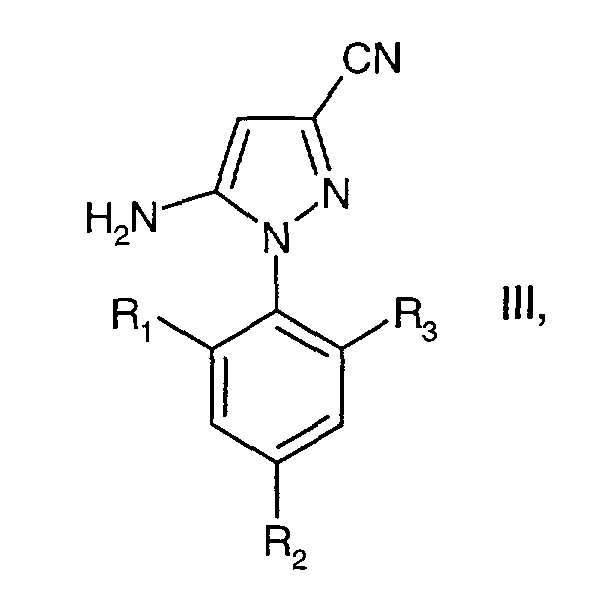
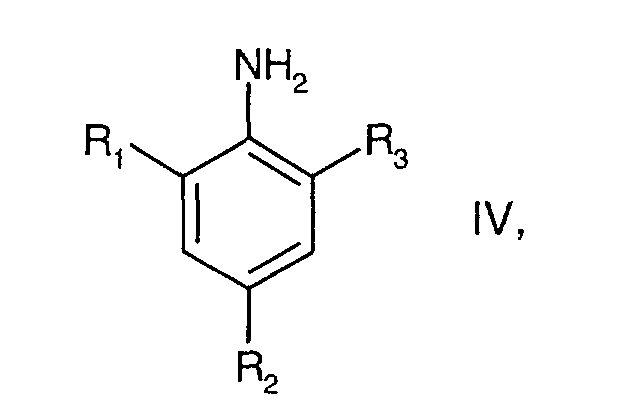
- In a second aspect, the present invention provides a process for the generation of the compound of formulawherein R1, R2 and R3 represent independently of each other halogen, C1-C4-haloalkyl, C1-C4-haloalkoxy or SF5; preferably R1 and R3 halogen and R2 trifluoromethyl, trifluoromethoxy or SF5; which process comprises reacting the compound of formula I with the diazonium salt of a compound of formula
 wherein R1, R2 and R3 are defined as in formula III, to give a compound of formula
 wherein R1, R2 and R3 are defined as in formula III; and cyclisation of the compound of formula V by means of a base, preferably ammonia.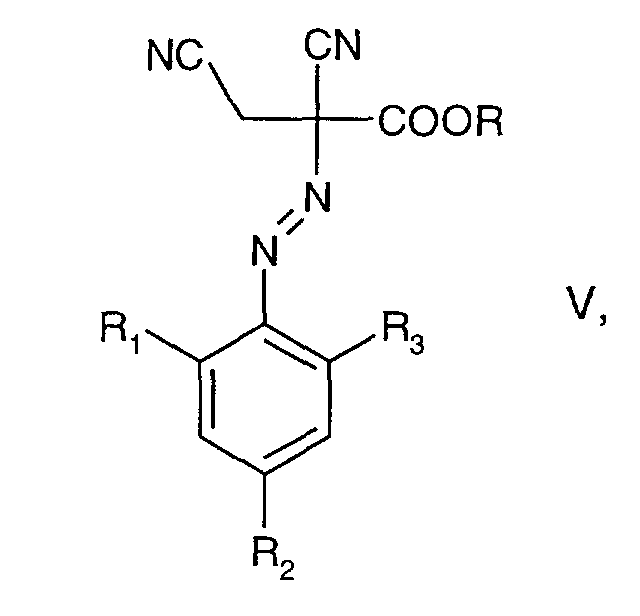
- In this process, the reaction partners can be reacted with one another as they are, i.e. without the addition of a solvent or diluent, e.g. in the melt. In most cases, however, the addition of an inert solvent or diluent, or a mixture thereof, is of advantage. Examples of such solvents or diluents are given above. Preferably, the complete reaction sequence is carried out in an alcohol or ether, more preferably in an alcohol. Especially preferred solvents is ethylene glycol monomethyl ether.
- In a preferred process, the diazonium salt of a compound of formula IV may be prepared using common diazotising agents known in the literature, preferably with a molar equivalent of sodium nitrite and a mineral acid such as hydrochloric or sulfuric acid at a temperature of about -10 to about 40°C, particularly from about 0 to about 10°C. Preferably, the diazonium salt is generated in situ in order to ensure its quick reaction with the compound of formula I before being reduced by the alcoholic solution. Subsequent hydrolysis of the ester group and cyclisation is preferably carried out with an aqueous base, particularly aqueous ammonia.
- In a third aspect, the present invention provides a process for the in situ generation of the compound of formula I and the subsequent preparation of the compound of formula III, wherein R1, R2 and R3 represent independently of each other halogen, C1-C4-haloalkyl, C1-C4-haloalkoxy or SF5; preferably R1 and R3 halogen and R2 trifluoromethyl, trifluoromethoxy or SF5; which process comprises
- a) reacting a cyanoacetate of formula II with a cyanide salt and formaldehyde or a source thereof, to give a compound of formula I;
- b) reacting the compound of formula I thus obtained with the diazonium salt of a compound of formula IV, wherein R1, R2 and R3 are defined as in formula III, to give a compound of formula V, wherein R1, R2 and R3 are defined as in formula III; and
- c) cyclisation of the compound of formula V by means of a base, preferably ammonia.
-
- In this process, the reaction partners can be reacted with one another as they are, i.e. without the addition of a solvent or diluent, e.g. in the melt. In most cases, however, the addition of an inert solvent or diluent, or a mixture thereof, is of advantage. Examples of such solvents or diluents are given above. Preferably, the complete reaction sequence is carried out in an alcohol or ether, more preferably in an alcohol. Especially preferred solvents is ethylene glycol monomethyl ether.
- In a preferred process, reaction step a) is carried out as described above, whereby the product of step a) is generally acidified with an alcoholic solution of a mineral acid. The diazonium salt of a compound of formula IV required in step b) may be prepared using common diazotising agents known in the literature, preferably with a molar equivalent of sodium nitrite and a mineral acid such as hydrochloric or sulfuric acid at a temperature of about -10 to about 40°C, particularly from about 0 to about 10°C. Preferably, the diazonium salt is generated in situ in order to ensure its quick reaction with the compound of formula I before being reduced by the alcoholic solution. Subsequent hydrolysis of the ester group and cyclisation in step c) is preferably carried out with an aqueous base, particularly aqueous ammonia.
- The compound of formula III is an important intermediate for the preparation of pesticidally active compounds.
- The following non-limiting examples illustrate the present invention.
- 2-Methoxyethylcyanoacetate (3.5 ml) and sodium cyanide (1.72 g) are suspended in 2-methoxyethanol (18 ml) and treated with paraformaldehyde (1.05 g) in portions under ice-cooling. After addition the mixture is left to warm up to room temperature and stirred for 6 hours. The reddish mixture is then acidified to pH 2 with ca. 4 ml aqueous hydrochloric acid under ice-cooling and finally the solvent evaporated at 55°C in vacuo. The residue is extracted with diethyl ether/water, the water phase is washed with diethyl ether, the combined organic phases are washed twice with water and then with a saturated sodium chloride solution, dried, filtered and evaporated to dryness in vacuo. The residue is distilled at 180°C and 0.08 mbar to give the title compound as brownish oil.
- To 2-Methoxyethylcyanoacetate (491 mg), dissolved in 2-methoxyethanol (4 ml), aqueous hydrochloric acid (0.65 ml) and then 2,6-dichloro-4-trifluoromethylaniline (575 mg), dissolved in 2-methoxyethanol (2 ml), is added under a nitrogen atmosphere. At 5 to 10°C, an aqueous solution (1 ml) of sodium nitrite (242 mg) is added dropwise within 2 minutes and the mixture stirred for 3 hours under ice-cooling. The mixture is then set to pH 9 by addition of aqueous ammonia (25%) and stirred overnight at ambient temperature. After evaporation of the solvent the residue is extracted with ethyl acetate / water, and the organic phase washed twice with water and with a saturated sodium chloride solution, dried, filtered and evaporated to dryness in vacuo. The residue is recrystallized from toluene to give the title compound, m.p. 141-2°C.
- 2-Methoxyethylcyanoacetate (2.7 ml) and sodium cyanide (1.33 g) are suspended in 2-methoxyethanol (14 ml) and treated with paraformaldehyde (0.81 g) in portions under ice-cooling. After addition the mixture is left to warm up to room temperature and stirred for 6 hours. The reddish mixture is then acidified to pH 2 with ca. 3 ml aqueous hydrochloric acid under ice-cooling and 2,6-dichloro-4-trifluoromethylaniline (5.75 g), dissolved in 2-methoxyethanol (20 ml), is added within 5 minutes. At 5 to 10°C, an aqueous solution (10 ml) of sodium nitrite (2.42 g) is added dropwise within 2 minutes and the mixture stirred for 3 hours under ice-cooling. The mixture is then set to pH 9 by addition of aqueous ammonia (25%) and stirred overnight at ambient temperature. After evaporation of the solvent the residue is extracted with ethyl acetate / water, and the organic phase washed twice with water and with a saturated sodium chloride solution, dried, filtered and evaporated to dryness in vacuo. The residue is recrystallized from toluene to give the title compound, m.p. 141-2°C.
Claims (7)
- A process for the preparation of a compound of formulawherein R represents branched or unbranched (C1-C6-alkoxy)1-10-C2-C6-alkyl, C3-C8-cycloalkyl, allyl, propargyl, phenyl or phenyl-C1-C6-alkyl; or a salt thereof;

which comprises the reaction of a cyanoacetate of formulawherein R is defined as in formula I, with formaldehyde or a source thereof in the presence of a cyanide salt.
- A process according to claim 1 wherein the reaction is carried out at temperatures of about 0 to about 160°C or at the reflux temperature of the solvent.
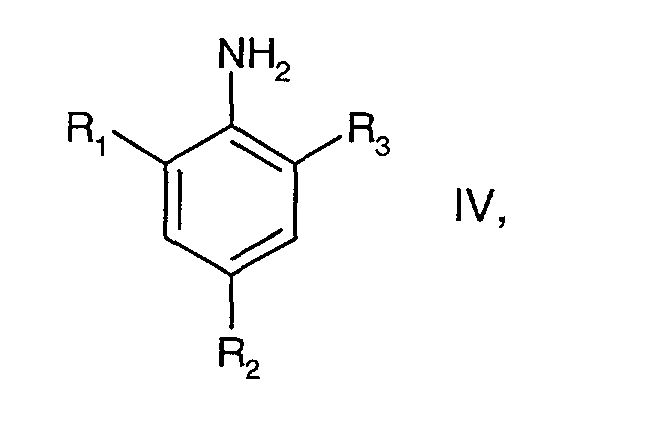
- A process for the preparation of a compound of formulawherein R1, R2 and R3 represent independently of each other halogen, C1-C4-haloalkyl, C1-C4-haloalkoxy or SF5; which process comprises reacting the compound of formula I with the diazonium salt of a compound of formula
 wherein R1, R2 and R3 are defined as in formula III, to give a compound of formula
 wherein R1, R2 and R3 are defined as in formula III; and cyclisation of the compound of formula V by means of a base.
- A process for the preparation of a compound of formula III, wherein R1, R2 and R3 represent independently of each other halogen, C1-C4-haloalkyl, C1-C4-haloalkoxy or SF5; which process comprisesa) reacting a cyanoacetate of formula II with a cyanide salt and formaldehyde or a source thereof, to give a compound of formula I;b) reacting the compound of formula I thus obtained with the diazonium salt of a compound of formula IV, wherein R1, R2 and R3 are defined as in formula III, to give a compound of formula V, wherein R1, R2 and R3 are defined as in formula III; andc) cyclisation of the compound of formula V by means of a base.
- A process according to any one of the previous claims, wherein R represents unbranched C1-C2-alkoxy-C2-C4-alkyl or phenyl-C1-alkyl.
- A process according to any one of the previous claims, wherein the source of formaldehyde is paraformaldehyde.
- A process according to any one of the previous claims, wherein the reaction is performed in presence of ethylene glycol monomethyl ether as a solvent.
Priority Applications (1)
| Application Number | Priority Date | Filing Date | Title |
|---|---|---|---|
| EP01113967A EP1264823A1 (en) | 2001-06-08 | 2001-06-08 | Process for the preparation of 2,3-dicyanopropionates |
Applications Claiming Priority (1)
| Application Number | Priority Date | Filing Date | Title |
|---|---|---|---|
| EP01113967A EP1264823A1 (en) | 2001-06-08 | 2001-06-08 | Process for the preparation of 2,3-dicyanopropionates |
Publications (1)
| Publication Number | Publication Date |
|---|---|
| EP1264823A1 true EP1264823A1 (en) | 2002-12-11 |
Family
ID=8177674
Family Applications (1)
| Application Number | Title | Priority Date | Filing Date |
|---|---|---|---|
| EP01113967A Withdrawn EP1264823A1 (en) | 2001-06-08 | 2001-06-08 | Process for the preparation of 2,3-dicyanopropionates |
Country Status (1)
| Country | Link |
|---|---|
| EP (1) | EP1264823A1 (en) |
Cited By (5)
| Publication number | Priority date | Publication date | Assignee | Title |
|---|---|---|---|---|
| CN100391936C (en) * | 2005-11-07 | 2008-06-04 | 栾忠岳 | A kind of technique of synthesizing 2,3-ethyl dicyanopropionate |
| CN103214395A (en) * | 2013-03-26 | 2013-07-24 | 南通市海圣药业有限公司 | Synthesizing process of 2,3-dicyanoethylpropionate |
| CN103396366A (en) * | 2013-08-06 | 2013-11-20 | 盐城工学院 | Production method of 5-amino-3-cyano-1-(2,6-dichloro-4-trifluoromethylphenyl)pyrazole |
| CN106117145A (en) * | 2016-07-12 | 2016-11-16 | 潍坊鑫诺化工有限公司 | The preparation method of 5 amino 1 (2,6 dichloro-4,4 trifluoromethyl) 3 cyano pyrazoles |
| CN112094235A (en) * | 2020-11-11 | 2020-12-18 | 苏州开元民生科技股份有限公司 | Preparation method of 5-amino-3-cyano-1- (2, 6-dichloro-4-trifluoromethylphenyl) pyrazole |
Citations (5)
| Publication number | Priority date | Publication date | Assignee | Title |
|---|---|---|---|---|
| EP0295118A1 (en) * | 1987-06-12 | 1988-12-14 | Rhone-Poulenc Agriculture Limited | N-phenylpyrazole derivatives |
| WO1993006089A1 (en) * | 1991-09-27 | 1993-04-01 | Zeneca Limited | N-phenylphrazoles as insecticides and acaricides |
| DE4343528A1 (en) * | 1993-12-16 | 1995-06-22 | Schering Ag | New di-heterocyclyl-benzene or pyridine derivs. |
| WO1997032843A1 (en) * | 1996-03-05 | 1997-09-12 | Rhone-Poulenc Agrochimie | New processes for preparing pesticidal intermediates |
| WO1998040358A1 (en) * | 1997-03-12 | 1998-09-17 | Rhone-Poulenc Agro | Process for preparing pyrazole derivatives |
-
2001
- 2001-06-08 EP EP01113967A patent/EP1264823A1/en not_active Withdrawn
Patent Citations (5)
| Publication number | Priority date | Publication date | Assignee | Title |
|---|---|---|---|---|
| EP0295118A1 (en) * | 1987-06-12 | 1988-12-14 | Rhone-Poulenc Agriculture Limited | N-phenylpyrazole derivatives |
| WO1993006089A1 (en) * | 1991-09-27 | 1993-04-01 | Zeneca Limited | N-phenylphrazoles as insecticides and acaricides |
| DE4343528A1 (en) * | 1993-12-16 | 1995-06-22 | Schering Ag | New di-heterocyclyl-benzene or pyridine derivs. |
| WO1997032843A1 (en) * | 1996-03-05 | 1997-09-12 | Rhone-Poulenc Agrochimie | New processes for preparing pesticidal intermediates |
| WO1998040358A1 (en) * | 1997-03-12 | 1998-09-17 | Rhone-Poulenc Agro | Process for preparing pyrazole derivatives |
Non-Patent Citations (1)
| Title |
|---|
| AIZENCANG, G. ET AL.: "Synthesis of Isoornithines and Methylputrescines. An Evaluation of Their Inhibitory Effects on Ornithine Decarboxylase", JOURNAL OF MEDICINAL CHEMISTRY, vol. 38, no. 21, 1995, pages 4337 - 4341, XP001018869 * |
Cited By (7)
| Publication number | Priority date | Publication date | Assignee | Title |
|---|---|---|---|---|
| CN100391936C (en) * | 2005-11-07 | 2008-06-04 | 栾忠岳 | A kind of technique of synthesizing 2,3-ethyl dicyanopropionate |
| CN103214395A (en) * | 2013-03-26 | 2013-07-24 | 南通市海圣药业有限公司 | Synthesizing process of 2,3-dicyanoethylpropionate |
| CN103396366A (en) * | 2013-08-06 | 2013-11-20 | 盐城工学院 | Production method of 5-amino-3-cyano-1-(2,6-dichloro-4-trifluoromethylphenyl)pyrazole |
| CN103396366B (en) * | 2013-08-06 | 2015-12-02 | 盐城工学院 | The production method of 5-Amino 3 cyano-1-(2,6-dichlor-4-trifluoromethyl phenyl) pyrazoles |
| CN106117145A (en) * | 2016-07-12 | 2016-11-16 | 潍坊鑫诺化工有限公司 | The preparation method of 5 amino 1 (2,6 dichloro-4,4 trifluoromethyl) 3 cyano pyrazoles |
| CN112094235A (en) * | 2020-11-11 | 2020-12-18 | 苏州开元民生科技股份有限公司 | Preparation method of 5-amino-3-cyano-1- (2, 6-dichloro-4-trifluoromethylphenyl) pyrazole |
| CN112094235B (en) * | 2020-11-11 | 2021-02-26 | 苏州开元民生科技股份有限公司 | Preparation method of 5-amino-3-cyano-1- (2, 6-dichloro-4-trifluoromethylphenyl) pyrazole |
Similar Documents
| Publication | Publication Date | Title |
|---|---|---|
| KR100314118B1 (en) | N-phenylacetaminonitrile | |
| TWI440629B (en) | Process for the regioselective preparation of 1-alkyl-3-haloalkylpyrazole-4-carboxylic acid derivatives | |
| JP4039693B2 (en) | A new process for preparing pesticide intermediates | |
| CN1103759C (en) | The preparation method of insecticide intermediate | |
| US6620944B1 (en) | Process for preparing pesticidal intermediates | |
| US4912229A (en) | Process for the preparation of 3-cyano-4-aryl-pyrroles | |
| TWI647215B (en) | Method for preparing 3,5-dihaloalkylpyrazole derivatives from α,α-dihalamine | |
| KR102410034B1 (en) | PROCESS FOR PREPARING 3,5-BIS(HALOALKYL)PYRAZOLE DERIVATIVES FROM α,α-DIHALOAMINES AND KETIMINES | |
| CA2582141C (en) | Process for the preparation of pyrazoles | |
| WO2020212991A1 (en) | Preparation of substituted pyrazoles and their use as anthranilamides precursors | |
| DE4433967A1 (en) | Process for the preparation of alkoxytriazolinones | |
| US6673956B2 (en) | Processes for preparing pesticidal intermediates | |
| EA009069B1 (en) | Process for the preparation of phenyl pyrazole compounds | |
| JPH01197472A (en) | Production of 5-amino-1-phenyl-4-nitropyrazoles | |
| US7923571B2 (en) | Process for preparing substituted 2-alkoxycarbonyl-3-aminothiophenes | |
| KR20190039177A (en) | Preparation of 3-amino-1- (2,6-dichlorophenyl) pyrazole | |
| US6344589B1 (en) | Method and intermediate products for producing bis(oxime)monoethers | |
| KR101829181B1 (en) | Method for preparation of certain 1,5 disubstituted tetrazoles | |
| CS224639B2 (en) | Method for producing 3,6-disubstituted 4-amino-1,2,4-triazine-5-one | |
| JPS59130278A (en) | Manufacture of 2-alkylthiomethyl-4-hydroxypyrimidine | |
| HUP0002028A2 (en) | 5-aminopyrazole-4-carboxylate derivatives and process for preparing such compounds | |
| WO2011064798A1 (en) | Process for the preparation of a pyrazole derivative | |
| MXPA98007125A (en) | New processes for the preparation of pesticide intermediaries | |
| JP2002069041A (en) | Method for producing propargylamine compound | |
| CA2210443A1 (en) | New nitropyrazole esters, a process for their preparation and their use for the preparation of a nitropyrazole amide |
Legal Events
| Date | Code | Title | Description |
|---|---|---|---|
| PUAI | Public reference made under article 153(3) epc to a published international application that has entered the european phase |
Free format text: ORIGINAL CODE: 0009012 |
|
| AK | Designated contracting states |
Kind code of ref document: A1 Designated state(s): AT BE CH CY DE DK ES FI FR GB GR IE IT LI LU MC NL PT SE TR |
|
| AX | Request for extension of the european patent |
Free format text: AL;LT;LV;MK;RO;SI |
|
| STAA | Information on the status of an ep patent application or granted ep patent |
Free format text: STATUS: THE APPLICATION HAS BEEN WITHDRAWN |
|
| 18W | Application withdrawn |
Effective date: 20030109 |