EP1263965B1 - Avirulent, immunogenic flavivirus chimeras - Google Patents
Avirulent, immunogenic flavivirus chimeras Download PDFInfo
- Publication number
- EP1263965B1 EP1263965B1 EP01910882A EP01910882A EP1263965B1 EP 1263965 B1 EP1263965 B1 EP 1263965B1 EP 01910882 A EP01910882 A EP 01910882A EP 01910882 A EP01910882 A EP 01910882A EP 1263965 B1 EP1263965 B1 EP 1263965B1
- Authority
- EP
- European Patent Office
- Prior art keywords
- den
- virus
- pdk
- viruses
- chimeric
- Prior art date
- Legal status (The legal status is an assumption and is not a legal conclusion. Google has not performed a legal analysis and makes no representation as to the accuracy of the status listed.)
- Expired - Lifetime
Links
- 241000710831 Flavivirus Species 0.000 title abstract description 85
- 230000002163 immunogen Effects 0.000 title abstract description 34
- 241000700605 Viruses Species 0.000 claims abstract description 673
- 229960005486 vaccine Drugs 0.000 claims abstract description 109
- 108090000623 proteins and genes Proteins 0.000 claims abstract description 97
- 150000001413 amino acids Chemical class 0.000 claims abstract description 50
- 102000004169 proteins and genes Human genes 0.000 claims abstract description 50
- 230000002238 attenuated effect Effects 0.000 claims abstract description 47
- 125000003729 nucleotide group Chemical group 0.000 claims description 86
- 239000002773 nucleotide Substances 0.000 claims description 84
- 206010012310 Dengue fever Diseases 0.000 claims description 48
- 208000025729 dengue disease Diseases 0.000 claims description 48
- 208000001490 Dengue Diseases 0.000 claims description 43
- 150000007523 nucleic acids Chemical class 0.000 claims description 34
- 108020004707 nucleic acids Proteins 0.000 claims description 31
- 102000039446 nucleic acids Human genes 0.000 claims description 31
- 241000710815 Dengue virus 2 Species 0.000 claims description 25
- 101710204837 Envelope small membrane protein Proteins 0.000 claims description 23
- 101710145006 Lysis protein Proteins 0.000 claims description 23
- ROHFNLRQFUQHCH-YFKPBYRVSA-N L-leucine Chemical compound CC(C)C[C@H](N)C(O)=O ROHFNLRQFUQHCH-YFKPBYRVSA-N 0.000 claims description 15
- ROHFNLRQFUQHCH-UHFFFAOYSA-N Leucine Natural products CC(C)CC(N)C(O)=O ROHFNLRQFUQHCH-UHFFFAOYSA-N 0.000 claims description 12
- MTCFGRXMJLQNBG-UHFFFAOYSA-N Serine Natural products OCC(N)C(O)=O MTCFGRXMJLQNBG-UHFFFAOYSA-N 0.000 claims description 7
- KZSNJWFQEVHDMF-UHFFFAOYSA-N Valine Natural products CC(C)C(N)C(O)=O KZSNJWFQEVHDMF-UHFFFAOYSA-N 0.000 claims description 7
- 210000000234 capsid Anatomy 0.000 claims description 6
- 101710117545 C protein Proteins 0.000 claims description 5
- 241000710872 Dengue virus 3 Species 0.000 claims description 4
- 239000004474 valine Substances 0.000 claims description 3
- 125000002987 valine group Chemical group [H]N([H])C([H])(C(*)=O)C([H])(C([H])([H])[H])C([H])([H])[H] 0.000 claims description 2
- 230000035772 mutation Effects 0.000 abstract description 105
- 230000003612 virological effect Effects 0.000 abstract description 40
- 101710172711 Structural protein Proteins 0.000 abstract description 35
- 230000005847 immunogenicity Effects 0.000 abstract description 17
- 201000010099 disease Diseases 0.000 abstract description 7
- 208000037265 diseases, disorders, signs and symptoms Diseases 0.000 abstract description 7
- 230000036039 immunity Effects 0.000 abstract description 6
- 230000001717 pathogenic effect Effects 0.000 abstract description 3
- 208000024891 symptom Diseases 0.000 abstract description 3
- 239000008194 pharmaceutical composition Substances 0.000 abstract 1
- 210000004027 cell Anatomy 0.000 description 120
- 241000699670 Mus sp. Species 0.000 description 79
- 208000015181 infectious disease Diseases 0.000 description 72
- 235000001014 amino acid Nutrition 0.000 description 65
- 239000002299 complementary DNA Substances 0.000 description 47
- 229940024606 amino acid Drugs 0.000 description 43
- 235000018102 proteins Nutrition 0.000 description 41
- 239000000203 mixture Substances 0.000 description 37
- 241000725619 Dengue virus Species 0.000 description 36
- 238000002474 experimental method Methods 0.000 description 36
- 125000003275 alpha amino acid group Chemical group 0.000 description 35
- 230000002458 infectious effect Effects 0.000 description 35
- 230000002068 genetic effect Effects 0.000 description 32
- 230000010076 replication Effects 0.000 description 29
- 230000003053 immunization Effects 0.000 description 26
- 101710128560 Initiator protein NS1 Proteins 0.000 description 22
- 101710144127 Non-structural protein 1 Proteins 0.000 description 22
- 230000035945 sensitivity Effects 0.000 description 22
- 238000006467 substitution reaction Methods 0.000 description 22
- 239000012634 fragment Substances 0.000 description 21
- 210000002966 serum Anatomy 0.000 description 21
- 238000002649 immunization Methods 0.000 description 20
- 230000009467 reduction Effects 0.000 description 20
- 241000699666 Mus <mouse, genus> Species 0.000 description 19
- 229940125575 vaccine candidate Drugs 0.000 description 18
- 238000000034 method Methods 0.000 description 17
- 238000004113 cell culture Methods 0.000 description 16
- 238000010240 RT-PCR analysis Methods 0.000 description 15
- 239000002609 medium Substances 0.000 description 15
- 108091003079 Bovine Serum Albumin Proteins 0.000 description 14
- 239000012091 fetal bovine serum Substances 0.000 description 14
- 230000003472 neutralizing effect Effects 0.000 description 14
- 238000003556 assay Methods 0.000 description 13
- 241000282693 Cercopithecidae Species 0.000 description 12
- 108020004414 DNA Proteins 0.000 description 12
- 108091092724 Noncoding DNA Proteins 0.000 description 12
- 108020000999 Viral RNA Proteins 0.000 description 12
- 241000894007 species Species 0.000 description 11
- 238000012360 testing method Methods 0.000 description 11
- 239000013598 vector Substances 0.000 description 11
- 238000011714 129 mouse Methods 0.000 description 10
- 101710144111 Non-structural protein 3 Proteins 0.000 description 10
- 108010076039 Polyproteins Proteins 0.000 description 10
- 238000010367 cloning Methods 0.000 description 10
- 108091032973 (ribonucleotides)n+m Proteins 0.000 description 9
- CSCPPACGZOOCGX-UHFFFAOYSA-N Acetone Chemical compound CC(C)=O CSCPPACGZOOCGX-UHFFFAOYSA-N 0.000 description 9
- 230000003247 decreasing effect Effects 0.000 description 9
- 239000003937 drug carrier Substances 0.000 description 9
- 108010030074 endodeoxyribonuclease MluI Proteins 0.000 description 9
- 230000012010 growth Effects 0.000 description 9
- 238000006386 neutralization reaction Methods 0.000 description 9
- 239000013612 plasmid Substances 0.000 description 9
- 230000037432 silent mutation Effects 0.000 description 9
- 229920000936 Agarose Polymers 0.000 description 8
- 101150013191 E gene Proteins 0.000 description 8
- BBBXWRGITSUJPB-YUMQZZPRSA-N Glu-Lys Chemical compound NCCCC[C@@H](C(O)=O)NC(=O)[C@@H](N)CCC(O)=O BBBXWRGITSUJPB-YUMQZZPRSA-N 0.000 description 8
- 241000282412 Homo Species 0.000 description 8
- 238000011161 development Methods 0.000 description 8
- 230000001018 virulence Effects 0.000 description 8
- 238000004458 analytical method Methods 0.000 description 7
- 230000015572 biosynthetic process Effects 0.000 description 7
- 238000010276 construction Methods 0.000 description 7
- 230000000694 effects Effects 0.000 description 7
- 238000009472 formulation Methods 0.000 description 7
- 238000000338 in vitro Methods 0.000 description 7
- 230000002829 reductive effect Effects 0.000 description 7
- 230000004083 survival effect Effects 0.000 description 7
- 241000710829 Dengue virus group Species 0.000 description 6
- 241000255925 Diptera Species 0.000 description 6
- 108091028043 Nucleic acid sequence Proteins 0.000 description 6
- 239000002671 adjuvant Substances 0.000 description 6
- 238000012163 sequencing technique Methods 0.000 description 6
- UCSJYZPVAKXKNQ-HZYVHMACSA-N streptomycin Chemical compound CN[C@H]1[C@H](O)[C@@H](O)[C@H](CO)O[C@H]1O[C@@H]1[C@](C=O)(O)[C@H](C)O[C@H]1O[C@@H]1[C@@H](NC(N)=N)[C@H](O)[C@@H](NC(N)=N)[C@H](O)[C@H]1O UCSJYZPVAKXKNQ-HZYVHMACSA-N 0.000 description 6
- 238000003786 synthesis reaction Methods 0.000 description 6
- 229940031351 tetravalent vaccine Drugs 0.000 description 6
- 241000711549 Hepacivirus C Species 0.000 description 5
- 101800000515 Non-structural protein 3 Proteins 0.000 description 5
- 101150064860 PRM gene Proteins 0.000 description 5
- JGSARLDLIJGVTE-MBNYWOFBSA-N Penicillin G Chemical compound N([C@H]1[C@H]2SC([C@@H](N2C1=O)C(O)=O)(C)C)C(=O)CC1=CC=CC=C1 JGSARLDLIJGVTE-MBNYWOFBSA-N 0.000 description 5
- 201000002950 dengue hemorrhagic fever Diseases 0.000 description 5
- 229940023605 dengue virus vaccine Drugs 0.000 description 5
- 238000010790 dilution Methods 0.000 description 5
- 239000012895 dilution Substances 0.000 description 5
- 230000006870 function Effects 0.000 description 5
- 210000003734 kidney Anatomy 0.000 description 5
- 239000004337 magnesium citrate Substances 0.000 description 5
- 244000052769 pathogen Species 0.000 description 5
- 108090000765 processed proteins & peptides Proteins 0.000 description 5
- 239000000523 sample Substances 0.000 description 5
- TVZRAEYQIKYCPH-UHFFFAOYSA-N 3-(trimethylsilyl)propane-1-sulfonic acid Chemical compound C[Si](C)(C)CCCS(O)(=O)=O TVZRAEYQIKYCPH-UHFFFAOYSA-N 0.000 description 4
- 108091093088 Amplicon Proteins 0.000 description 4
- 102100034349 Integrase Human genes 0.000 description 4
- WHUUTDBJXJRKMK-VKHMYHEASA-N L-glutamic acid Chemical compound OC(=O)[C@@H](N)CCC(O)=O WHUUTDBJXJRKMK-VKHMYHEASA-N 0.000 description 4
- 241001465754 Metazoa Species 0.000 description 4
- 238000000692 Student's t-test Methods 0.000 description 4
- 206010058874 Viraemia Diseases 0.000 description 4
- APKFDSVGJQXUKY-INPOYWNPSA-N amphotericin B Chemical compound O[C@H]1[C@@H](N)[C@H](O)[C@@H](C)O[C@H]1O[C@H]1/C=C/C=C/C=C/C=C/C=C/C=C/C=C/[C@H](C)[C@@H](O)[C@@H](C)[C@H](C)OC(=O)C[C@H](O)C[C@H](O)CC[C@@H](O)[C@H](O)C[C@H](O)C[C@](O)(C[C@H](O)[C@H]2C(O)=O)O[C@H]2C1 APKFDSVGJQXUKY-INPOYWNPSA-N 0.000 description 4
- 239000000090 biomarker Substances 0.000 description 4
- 230000000295 complement effect Effects 0.000 description 4
- 238000001514 detection method Methods 0.000 description 4
- 239000003085 diluting agent Substances 0.000 description 4
- 238000010166 immunofluorescence Methods 0.000 description 4
- 238000011081 inoculation Methods 0.000 description 4
- 235000015097 nutrients Nutrition 0.000 description 4
- 238000001179 sorption measurement Methods 0.000 description 4
- 238000004448 titration Methods 0.000 description 4
- 230000004580 weight loss Effects 0.000 description 4
- 241000283707 Capra Species 0.000 description 3
- 241000588724 Escherichia coli Species 0.000 description 3
- WHUUTDBJXJRKMK-UHFFFAOYSA-N Glutamic acid Natural products OC(=O)C(N)CCC(O)=O WHUUTDBJXJRKMK-UHFFFAOYSA-N 0.000 description 3
- 239000004233 Indanthrene blue RS Substances 0.000 description 3
- 241000710842 Japanese encephalitis virus Species 0.000 description 3
- CKLJMWTZIZZHCS-REOHCLBHSA-N L-aspartic acid Chemical compound OC(=O)[C@@H](N)CC(O)=O CKLJMWTZIZZHCS-REOHCLBHSA-N 0.000 description 3
- COLNVLDHVKWLRT-QMMMGPOBSA-N L-phenylalanine Chemical compound OC(=O)[C@@H](N)CC1=CC=CC=C1 COLNVLDHVKWLRT-QMMMGPOBSA-N 0.000 description 3
- -1 NS2B Proteins 0.000 description 3
- 101800001030 Non-structural protein 2A Proteins 0.000 description 3
- 101800001020 Non-structural protein 4A Proteins 0.000 description 3
- 108020004711 Nucleic Acid Probes Proteins 0.000 description 3
- 229930182555 Penicillin Natural products 0.000 description 3
- 239000004285 Potassium sulphite Substances 0.000 description 3
- 108010067390 Viral Proteins Proteins 0.000 description 3
- 108010087302 Viral Structural Proteins Proteins 0.000 description 3
- 238000007792 addition Methods 0.000 description 3
- 125000000539 amino acid group Chemical group 0.000 description 3
- 230000005875 antibody response Effects 0.000 description 3
- 230000000680 avirulence Effects 0.000 description 3
- 230000037396 body weight Effects 0.000 description 3
- 239000004303 calcium sorbate Substances 0.000 description 3
- 239000003916 calcium stearoyl-2-lactylate Substances 0.000 description 3
- 238000012512 characterization method Methods 0.000 description 3
- 230000007547 defect Effects 0.000 description 3
- 238000012217 deletion Methods 0.000 description 3
- 230000037430 deletion Effects 0.000 description 3
- GNBHRKFJIUUOQI-UHFFFAOYSA-N fluorescein Chemical compound O1C(=O)C2=CC=CC=C2C21C1=CC=C(O)C=C1OC1=CC(O)=CC=C21 GNBHRKFJIUUOQI-UHFFFAOYSA-N 0.000 description 3
- 238000010348 incorporation Methods 0.000 description 3
- 238000011534 incubation Methods 0.000 description 3
- 238000002347 injection Methods 0.000 description 3
- 239000007924 injection Substances 0.000 description 3
- 239000007788 liquid Substances 0.000 description 3
- 229940031348 multivalent vaccine Drugs 0.000 description 3
- 239000002853 nucleic acid probe Substances 0.000 description 3
- 229940049954 penicillin Drugs 0.000 description 3
- 229920001184 polypeptide Polymers 0.000 description 3
- 102000004196 processed proteins & peptides Human genes 0.000 description 3
- 238000010188 recombinant method Methods 0.000 description 3
- 238000011084 recovery Methods 0.000 description 3
- 230000000717 retained effect Effects 0.000 description 3
- 238000012216 screening Methods 0.000 description 3
- 239000007787 solid Substances 0.000 description 3
- 239000000243 solution Substances 0.000 description 3
- 229960005322 streptomycin Drugs 0.000 description 3
- 239000000725 suspension Substances 0.000 description 3
- 238000001890 transfection Methods 0.000 description 3
- LHEJDBBHZGISGW-UHFFFAOYSA-N 5-fluoro-3-(3-oxo-1h-2-benzofuran-1-yl)-1h-pyrimidine-2,4-dione Chemical compound O=C1C(F)=CNC(=O)N1C1C2=CC=CC=C2C(=O)O1 LHEJDBBHZGISGW-UHFFFAOYSA-N 0.000 description 2
- 241000256118 Aedes aegypti Species 0.000 description 2
- APKFDSVGJQXUKY-KKGHZKTASA-N Amphotericin-B Natural products O[C@H]1[C@@H](N)[C@H](O)[C@@H](C)O[C@H]1O[C@H]1C=CC=CC=CC=CC=CC=CC=C[C@H](C)[C@@H](O)[C@@H](C)[C@H](C)OC(=O)C[C@H](O)C[C@H](O)CC[C@@H](O)[C@H](O)C[C@H](O)C[C@](O)(C[C@H](O)[C@H]2C(O)=O)O[C@H]2C1 APKFDSVGJQXUKY-KKGHZKTASA-N 0.000 description 2
- FRYULLIZUDQONW-IMJSIDKUSA-N Asp-Asp Chemical compound OC(=O)C[C@H](N)C(=O)N[C@@H](CC(O)=O)C(O)=O FRYULLIZUDQONW-IMJSIDKUSA-N 0.000 description 2
- 108010041986 DNA Vaccines Proteins 0.000 description 2
- 206010014596 Encephalitis Japanese B Diseases 0.000 description 2
- 101710121417 Envelope glycoprotein Proteins 0.000 description 2
- 101710091045 Envelope protein Proteins 0.000 description 2
- 241000710781 Flaviviridae Species 0.000 description 2
- SCCPDJAQCXWPTF-VKHMYHEASA-N Gly-Asp Chemical compound NCC(=O)N[C@H](C(O)=O)CC(O)=O SCCPDJAQCXWPTF-VKHMYHEASA-N 0.000 description 2
- BCVIOZZGJNOEQS-XKNYDFJKSA-N Ile-Ile Chemical compound CC[C@H](C)[C@H](N)C(=O)N[C@H](C(O)=O)[C@@H](C)CC BCVIOZZGJNOEQS-XKNYDFJKSA-N 0.000 description 2
- 102100025458 Inosine triphosphate pyrophosphatase Human genes 0.000 description 2
- 102000006992 Interferon-alpha Human genes 0.000 description 2
- 108010047761 Interferon-alpha Proteins 0.000 description 2
- 102000003996 Interferon-beta Human genes 0.000 description 2
- 108090000467 Interferon-beta Proteins 0.000 description 2
- 102000008070 Interferon-gamma Human genes 0.000 description 2
- 108010074328 Interferon-gamma Proteins 0.000 description 2
- 201000005807 Japanese encephalitis Diseases 0.000 description 2
- KZSNJWFQEVHDMF-BYPYZUCNSA-N L-valine Chemical compound CC(C)[C@H](N)C(O)=O KZSNJWFQEVHDMF-BYPYZUCNSA-N 0.000 description 2
- 208000006941 Laboratory Infection Diseases 0.000 description 2
- 102000004407 Lactalbumin Human genes 0.000 description 2
- 108090000942 Lactalbumin Proteins 0.000 description 2
- KFKWRHQBZQICHA-STQMWFEESA-N Leu-Phe Chemical compound CC(C)C[C@H](N)C(=O)N[C@H](C(O)=O)CC1=CC=CC=C1 KFKWRHQBZQICHA-STQMWFEESA-N 0.000 description 2
- XGDCYUQSFDQISZ-BQBZGAKWSA-N Leu-Ser Chemical compound CC(C)C[C@H](N)C(=O)N[C@@H](CO)C(O)=O XGDCYUQSFDQISZ-BQBZGAKWSA-N 0.000 description 2
- BJFJQOMZCSHBMY-YUMQZZPRSA-N Met-Val Chemical compound CSCC[C@H](N)C(=O)N[C@@H](C(C)C)C(O)=O BJFJQOMZCSHBMY-YUMQZZPRSA-N 0.000 description 2
- 101800001019 Non-structural protein 4B Proteins 0.000 description 2
- 108010075285 Nucleoside-Triphosphatase Proteins 0.000 description 2
- 108091034117 Oligonucleotide Proteins 0.000 description 2
- 206010033799 Paralysis Diseases 0.000 description 2
- 101710188315 Protein X Proteins 0.000 description 2
- 108090000944 RNA Helicases Proteins 0.000 description 2
- 102000004409 RNA Helicases Human genes 0.000 description 2
- 208000009714 Severe Dengue Diseases 0.000 description 2
- UIIMBOGNXHQVGW-UHFFFAOYSA-M Sodium bicarbonate Chemical compound [Na+].OC([O-])=O UIIMBOGNXHQVGW-UHFFFAOYSA-M 0.000 description 2
- 108700022715 Viral Proteases Proteins 0.000 description 2
- 241000710886 West Nile virus Species 0.000 description 2
- 241000710772 Yellow fever virus Species 0.000 description 2
- 239000004480 active ingredient Substances 0.000 description 2
- 229960003942 amphotericin b Drugs 0.000 description 2
- 210000003567 ascitic fluid Anatomy 0.000 description 2
- 229940031567 attenuated vaccine Drugs 0.000 description 2
- 230000001580 bacterial effect Effects 0.000 description 2
- 239000003855 balanced salt solution Substances 0.000 description 2
- 239000011692 calcium ascorbate Substances 0.000 description 2
- 239000001527 calcium lactate Substances 0.000 description 2
- 229940041514 candida albicans extract Drugs 0.000 description 2
- 239000013553 cell monolayer Substances 0.000 description 2
- 230000001413 cellular effect Effects 0.000 description 2
- 230000034994 death Effects 0.000 description 2
- 238000009795 derivation Methods 0.000 description 2
- 238000004520 electroporation Methods 0.000 description 2
- 229960003239 encephalitis vaccine Drugs 0.000 description 2
- 239000000284 extract Substances 0.000 description 2
- 239000001963 growth medium Substances 0.000 description 2
- 230000036541 health Effects 0.000 description 2
- 239000000413 hydrolysate Substances 0.000 description 2
- 230000028993 immune response Effects 0.000 description 2
- 230000009851 immunogenic response Effects 0.000 description 2
- 239000004615 ingredient Substances 0.000 description 2
- 208000014674 injury Diseases 0.000 description 2
- 239000002054 inoculum Substances 0.000 description 2
- 229960003130 interferon gamma Drugs 0.000 description 2
- 210000003292 kidney cell Anatomy 0.000 description 2
- 230000000670 limiting effect Effects 0.000 description 2
- 239000002502 liposome Substances 0.000 description 2
- 238000004519 manufacturing process Methods 0.000 description 2
- 239000000463 material Substances 0.000 description 2
- 239000012528 membrane Substances 0.000 description 2
- 239000000693 micelle Substances 0.000 description 2
- 238000002703 mutagenesis Methods 0.000 description 2
- 231100000350 mutagenesis Toxicity 0.000 description 2
- PGSADBUBUOPOJS-UHFFFAOYSA-N neutral red Chemical compound Cl.C1=C(C)C(N)=CC2=NC3=CC(N(C)C)=CC=C3N=C21 PGSADBUBUOPOJS-UHFFFAOYSA-N 0.000 description 2
- 230000008520 organization Effects 0.000 description 2
- 229920000642 polymer Polymers 0.000 description 2
- 238000002360 preparation method Methods 0.000 description 2
- 230000002265 prevention Effects 0.000 description 2
- 239000004018 propan-1,2-diol esters of fatty acids Substances 0.000 description 2
- 230000001681 protective effect Effects 0.000 description 2
- 102000005962 receptors Human genes 0.000 description 2
- 238000005215 recombination Methods 0.000 description 2
- 230000006798 recombination Effects 0.000 description 2
- 238000011160 research Methods 0.000 description 2
- 230000004044 response Effects 0.000 description 2
- 238000002864 sequence alignment Methods 0.000 description 2
- 238000002741 site-directed mutagenesis Methods 0.000 description 2
- 229940031626 subunit vaccine Drugs 0.000 description 2
- 239000003826 tablet Substances 0.000 description 2
- 238000002560 therapeutic procedure Methods 0.000 description 2
- 238000013518 transcription Methods 0.000 description 2
- 230000035897 transcription Effects 0.000 description 2
- 230000008733 trauma Effects 0.000 description 2
- 229940126580 vector vaccine Drugs 0.000 description 2
- 239000003981 vehicle Substances 0.000 description 2
- 230000035899 viability Effects 0.000 description 2
- 230000029812 viral genome replication Effects 0.000 description 2
- XLYOFNOQVPJJNP-UHFFFAOYSA-N water Substances O XLYOFNOQVPJJNP-UHFFFAOYSA-N 0.000 description 2
- 239000012138 yeast extract Substances 0.000 description 2
- 229940051021 yellow-fever virus Drugs 0.000 description 2
- HDTRYLNUVZCQOY-UHFFFAOYSA-N α-D-glucopyranosyl-α-D-glucopyranoside Natural products OC1C(O)C(O)C(CO)OC1OC1C(O)C(O)C(O)C(CO)O1 HDTRYLNUVZCQOY-UHFFFAOYSA-N 0.000 description 1
- RDEIXVOBVLKYNT-VQBXQJRRSA-N (2r,3r,4r,5r)-2-[(1s,2s,3r,4s,6r)-4,6-diamino-3-[(2r,3r,6s)-3-amino-6-(1-aminoethyl)oxan-2-yl]oxy-2-hydroxycyclohexyl]oxy-5-methyl-4-(methylamino)oxane-3,5-diol;(2r,3r,4r,5r)-2-[(1s,2s,3r,4s,6r)-4,6-diamino-3-[(2r,3r,6s)-3-amino-6-(aminomethyl)oxan-2-yl]o Chemical compound OS(O)(=O)=O.O1C[C@@](O)(C)[C@H](NC)[C@@H](O)[C@H]1O[C@@H]1[C@@H](O)[C@H](O[C@@H]2[C@@H](CC[C@@H](CN)O2)N)[C@@H](N)C[C@H]1N.O1C[C@@](O)(C)[C@H](NC)[C@@H](O)[C@H]1O[C@@H]1[C@@H](O)[C@H](O[C@@H]2[C@@H](CC[C@H](O2)C(C)N)N)[C@@H](N)C[C@H]1N.O1[C@H](C(C)NC)CC[C@@H](N)[C@H]1O[C@H]1[C@H](O)[C@@H](O[C@@H]2[C@@H]([C@@H](NC)[C@@](C)(O)CO2)O)[C@H](N)C[C@@H]1N RDEIXVOBVLKYNT-VQBXQJRRSA-N 0.000 description 1
- YYGNTYWPHWGJRM-UHFFFAOYSA-N (6E,10E,14E,18E)-2,6,10,15,19,23-hexamethyltetracosa-2,6,10,14,18,22-hexaene Chemical compound CC(C)=CCCC(C)=CCCC(C)=CCCC=C(C)CCC=C(C)CCC=C(C)C YYGNTYWPHWGJRM-UHFFFAOYSA-N 0.000 description 1
- 102000040650 (ribonucleotides)n+m Human genes 0.000 description 1
- ZORQXIQZAOLNGE-UHFFFAOYSA-N 1,1-difluorocyclohexane Chemical compound FC1(F)CCCCC1 ZORQXIQZAOLNGE-UHFFFAOYSA-N 0.000 description 1
- WEEMDRWIKYCTQM-UHFFFAOYSA-N 2,6-dimethoxybenzenecarbothioamide Chemical compound COC1=CC=CC(OC)=C1C(N)=S WEEMDRWIKYCTQM-UHFFFAOYSA-N 0.000 description 1
- KZDCMKVLEYCGQX-UDPGNSCCSA-N 2-(diethylamino)ethyl 4-aminobenzoate;(2s,5r,6r)-3,3-dimethyl-7-oxo-6-[(2-phenylacetyl)amino]-4-thia-1-azabicyclo[3.2.0]heptane-2-carboxylic acid;hydrate Chemical compound O.CCN(CC)CCOC(=O)C1=CC=C(N)C=C1.N([C@H]1[C@H]2SC([C@@H](N2C1=O)C(O)=O)(C)C)C(=O)CC1=CC=CC=C1 KZDCMKVLEYCGQX-UDPGNSCCSA-N 0.000 description 1
- 108010042708 Acetylmuramyl-Alanyl-Isoglutamine Proteins 0.000 description 1
- OMLWNBVRVJYMBQ-YUMQZZPRSA-N Arg-Arg Chemical compound NC(N)=NCCC[C@H](N)C(=O)N[C@@H](CCCN=C(N)N)C(O)=O OMLWNBVRVJYMBQ-YUMQZZPRSA-N 0.000 description 1
- JQFZHHSQMKZLRU-IUCAKERBSA-N Arg-Lys Chemical compound NCCCC[C@@H](C(O)=O)NC(=O)[C@@H](N)CCCN=C(N)N JQFZHHSQMKZLRU-IUCAKERBSA-N 0.000 description 1
- 239000004475 Arginine Substances 0.000 description 1
- 241000238421 Arthropoda Species 0.000 description 1
- NALWOULWGHTVDA-UWVGGRQHSA-N Asp-Tyr Chemical compound OC(=O)C[C@H](N)C(=O)N[C@H](C(O)=O)CC1=CC=C(O)C=C1 NALWOULWGHTVDA-UWVGGRQHSA-N 0.000 description 1
- DCXYFEDJOCDNAF-UHFFFAOYSA-N Asparagine Natural products OC(=O)C(N)CC(N)=O DCXYFEDJOCDNAF-UHFFFAOYSA-N 0.000 description 1
- 101000583086 Bunodosoma granuliferum Delta-actitoxin-Bgr2b Proteins 0.000 description 1
- 108090000565 Capsid Proteins Proteins 0.000 description 1
- 102100023321 Ceruloplasmin Human genes 0.000 description 1
- 241000282552 Chlorocebus aethiops Species 0.000 description 1
- 241000867607 Chlorocebus sabaeus Species 0.000 description 1
- 108091026890 Coding region Proteins 0.000 description 1
- 208000003322 Coinfection Diseases 0.000 description 1
- 241000712471 Dhori virus Species 0.000 description 1
- 101100364969 Dictyostelium discoideum scai gene Proteins 0.000 description 1
- 239000001836 Dioctyl sodium sulphosuccinate Substances 0.000 description 1
- 206010061818 Disease progression Diseases 0.000 description 1
- 241001125671 Eretmochelys imbricata Species 0.000 description 1
- 240000000915 Fagraea fragrans Species 0.000 description 1
- 229930182566 Gentamicin Natural products 0.000 description 1
- CEAZRRDELHUEMR-URQXQFDESA-N Gentamicin Chemical compound O1[C@H](C(C)NC)CC[C@@H](N)[C@H]1O[C@H]1[C@H](O)[C@@H](O[C@@H]2[C@@H]([C@@H](NC)[C@@](C)(O)CO2)O)[C@H](N)C[C@@H]1N CEAZRRDELHUEMR-URQXQFDESA-N 0.000 description 1
- LOJYQMFIIJVETK-WDSKDSINSA-N Gln-Gln Chemical compound NC(=O)CC[C@H](N)C(=O)N[C@@H](CCC(N)=O)C(O)=O LOJYQMFIIJVETK-WDSKDSINSA-N 0.000 description 1
- JZOYFBPIEHCDFV-YUMQZZPRSA-N Gln-His Chemical compound NC(=O)CC[C@H](N)C(=O)N[C@H](C(O)=O)CC1=CN=CN1 JZOYFBPIEHCDFV-YUMQZZPRSA-N 0.000 description 1
- CLSDNFWKGFJIBZ-YUMQZZPRSA-N Gln-Lys Chemical compound NCCCC[C@@H](C(O)=O)NC(=O)[C@@H](N)CCC(N)=O CLSDNFWKGFJIBZ-YUMQZZPRSA-N 0.000 description 1
- KOSRFJWDECSPRO-WDSKDSINSA-N Glu-Glu Chemical compound OC(=O)CC[C@H](N)C(=O)N[C@@H](CCC(O)=O)C(O)=O KOSRFJWDECSPRO-WDSKDSINSA-N 0.000 description 1
- 108090000288 Glycoproteins Proteins 0.000 description 1
- 102000003886 Glycoproteins Human genes 0.000 description 1
- VPZXBVLAVMBEQI-VKHMYHEASA-N Glycyl-alanine Chemical compound OC(=O)[C@H](C)NC(=O)CN VPZXBVLAVMBEQI-VKHMYHEASA-N 0.000 description 1
- 208000003140 Kyasanur forest disease Diseases 0.000 description 1
- QNAYBMKLOCPYGJ-REOHCLBHSA-N L-alanine Chemical compound C[C@H](N)C(O)=O QNAYBMKLOCPYGJ-REOHCLBHSA-N 0.000 description 1
- 125000003412 L-alanyl group Chemical group [H]N([H])[C@@](C([H])([H])[H])(C(=O)[*])[H] 0.000 description 1
- DCXYFEDJOCDNAF-REOHCLBHSA-N L-asparagine Chemical compound OC(=O)[C@@H](N)CC(N)=O DCXYFEDJOCDNAF-REOHCLBHSA-N 0.000 description 1
- 125000003338 L-glutaminyl group Chemical class O=C([*])[C@](N([H])[H])([H])C([H])([H])C([H])([H])C(=O)N([H])[H] 0.000 description 1
- AGPKZVBTJJNPAG-WHFBIAKZSA-N L-isoleucine Chemical compound CC[C@H](C)[C@H](N)C(O)=O AGPKZVBTJJNPAG-WHFBIAKZSA-N 0.000 description 1
- FFEARJCKVFRZRR-BYPYZUCNSA-N L-methionine Chemical compound CSCC[C@H](N)C(O)=O FFEARJCKVFRZRR-BYPYZUCNSA-N 0.000 description 1
- 125000002842 L-seryl group Chemical group O=C([*])[C@](N([H])[H])([H])C([H])([H])O[H] 0.000 description 1
- QIVBCDIJIAJPQS-VIFPVBQESA-N L-tryptophane Chemical compound C1=CC=C2C(C[C@H](N)C(O)=O)=CNC2=C1 QIVBCDIJIAJPQS-VIFPVBQESA-N 0.000 description 1
- OUYCCCASQSFEME-QMMMGPOBSA-N L-tyrosine Chemical compound OC(=O)[C@@H](N)CC1=CC=C(O)C=C1 OUYCCCASQSFEME-QMMMGPOBSA-N 0.000 description 1
- 206010024887 Louping ill Diseases 0.000 description 1
- NVGBPTNZLWRQSY-UWVGGRQHSA-N Lys-Lys Chemical compound NCCCC[C@H](N)C(=O)N[C@H](C(O)=O)CCCCN NVGBPTNZLWRQSY-UWVGGRQHSA-N 0.000 description 1
- KDXKERNSBIXSRK-UHFFFAOYSA-N Lysine Natural products NCCCCC(N)C(O)=O KDXKERNSBIXSRK-UHFFFAOYSA-N 0.000 description 1
- 239000004472 Lysine Substances 0.000 description 1
- 241000282567 Macaca fascicularis Species 0.000 description 1
- 108010052285 Membrane Proteins Proteins 0.000 description 1
- 102000018697 Membrane Proteins Human genes 0.000 description 1
- 201000009906 Meningitis Diseases 0.000 description 1
- 201000005805 Murray valley encephalitis Diseases 0.000 description 1
- 101100364971 Mus musculus Scai gene Proteins 0.000 description 1
- 241000288894 Myotis Species 0.000 description 1
- 108010079364 N-glycylalanine Proteins 0.000 description 1
- 240000003492 Neolamarckia cadamba Species 0.000 description 1
- 101710188653 Non-structural protein 4b Proteins 0.000 description 1
- 101800000508 Non-structural protein 5 Proteins 0.000 description 1
- 101710144121 Non-structural protein 5 Proteins 0.000 description 1
- 208000011448 Omsk hemorrhagic fever Diseases 0.000 description 1
- 108091005804 Peptidases Proteins 0.000 description 1
- 102000035195 Peptidases Human genes 0.000 description 1
- GKZIWHRNKRBEOH-HOTGVXAUSA-N Phe-Phe Chemical compound C([C@H]([NH3+])C(=O)N[C@@H](CC=1C=CC=CC=1)C([O-])=O)C1=CC=CC=C1 GKZIWHRNKRBEOH-HOTGVXAUSA-N 0.000 description 1
- 102000004160 Phosphoric Monoester Hydrolases Human genes 0.000 description 1
- 108090000608 Phosphoric Monoester Hydrolases Proteins 0.000 description 1
- 108091034057 RNA (poly(A)) Proteins 0.000 description 1
- 241000538730 Rocio Species 0.000 description 1
- 238000012300 Sequence Analysis Methods 0.000 description 1
- WOUIMBGNEUWXQG-VKHMYHEASA-N Ser-Gly Chemical compound OC[C@H](N)C(=O)NCC(O)=O WOUIMBGNEUWXQG-VKHMYHEASA-N 0.000 description 1
- NFDYGNFETJVMSE-BQBZGAKWSA-N Ser-Leu Chemical compound CC(C)C[C@@H](C(O)=O)NC(=O)[C@@H](N)CO NFDYGNFETJVMSE-BQBZGAKWSA-N 0.000 description 1
- XZKQVQKUZMAADP-IMJSIDKUSA-N Ser-Ser Chemical compound OC[C@H](N)C(=O)N[C@@H](CO)C(O)=O XZKQVQKUZMAADP-IMJSIDKUSA-N 0.000 description 1
- 108010022999 Serine Proteases Proteins 0.000 description 1
- 102000012479 Serine Proteases Human genes 0.000 description 1
- FAPWRFPIFSIZLT-UHFFFAOYSA-M Sodium chloride Chemical compound [Na+].[Cl-] FAPWRFPIFSIZLT-UHFFFAOYSA-M 0.000 description 1
- 206010041896 St. Louis Encephalitis Diseases 0.000 description 1
- QAOWNCQODCNURD-UHFFFAOYSA-L Sulfate Chemical compound [O-]S([O-])(=O)=O QAOWNCQODCNURD-UHFFFAOYSA-L 0.000 description 1
- 210000001744 T-lymphocyte Anatomy 0.000 description 1
- BHEOSNUKNHRBNM-UHFFFAOYSA-N Tetramethylsqualene Natural products CC(=C)C(C)CCC(=C)C(C)CCC(C)=CCCC=C(C)CCC(C)C(=C)CCC(C)C(C)=C BHEOSNUKNHRBNM-UHFFFAOYSA-N 0.000 description 1
- AYFVYJQAPQTCCC-UHFFFAOYSA-N Threonine Natural products CC(O)C(N)C(O)=O AYFVYJQAPQTCCC-UHFFFAOYSA-N 0.000 description 1
- 239000004473 Threonine Substances 0.000 description 1
- 208000004006 Tick-borne encephalitis Diseases 0.000 description 1
- 241000710771 Tick-borne encephalitis virus Species 0.000 description 1
- RTAQQCXQSZGOHL-UHFFFAOYSA-N Titanium Chemical compound [Ti] RTAQQCXQSZGOHL-UHFFFAOYSA-N 0.000 description 1
- 241000202380 Toxorhynchites amboinensis Species 0.000 description 1
- HDTRYLNUVZCQOY-WSWWMNSNSA-N Trehalose Natural products O[C@@H]1[C@@H](O)[C@@H](O)[C@@H](CO)O[C@@H]1O[C@@H]1[C@H](O)[C@@H](O)[C@@H](O)[C@@H](CO)O1 HDTRYLNUVZCQOY-WSWWMNSNSA-N 0.000 description 1
- QIVBCDIJIAJPQS-UHFFFAOYSA-N Tryptophan Natural products C1=CC=C2C(CC(N)C(O)=O)=CNC2=C1 QIVBCDIJIAJPQS-UHFFFAOYSA-N 0.000 description 1
- CGWAPUBOXJWXMS-HOTGVXAUSA-N Tyr-Phe Chemical compound C([C@H](N)C(=O)N[C@@H](CC=1C=CC=CC=1)C(O)=O)C1=CC=C(O)C=C1 CGWAPUBOXJWXMS-HOTGVXAUSA-N 0.000 description 1
- 241000710959 Venezuelan equine encephalitis virus Species 0.000 description 1
- 241000251539 Vertebrata <Metazoa> Species 0.000 description 1
- 241000464917 Vieja Species 0.000 description 1
- 208000003152 Yellow Fever Diseases 0.000 description 1
- 208000020329 Zika virus infectious disease Diseases 0.000 description 1
- 230000002411 adverse Effects 0.000 description 1
- 239000000443 aerosol Substances 0.000 description 1
- 235000004279 alanine Nutrition 0.000 description 1
- HDTRYLNUVZCQOY-LIZSDCNHSA-N alpha,alpha-trehalose Chemical compound O[C@@H]1[C@@H](O)[C@H](O)[C@@H](CO)O[C@@H]1O[C@@H]1[C@H](O)[C@@H](O)[C@H](O)[C@@H](CO)O1 HDTRYLNUVZCQOY-LIZSDCNHSA-N 0.000 description 1
- KOSRFJWDECSPRO-UHFFFAOYSA-N alpha-L-glutamyl-L-glutamic acid Natural products OC(=O)CCC(N)C(=O)NC(CCC(O)=O)C(O)=O KOSRFJWDECSPRO-UHFFFAOYSA-N 0.000 description 1
- 230000004075 alteration Effects 0.000 description 1
- 229940037003 alum Drugs 0.000 description 1
- 239000000427 antigen Substances 0.000 description 1
- 230000000890 antigenic effect Effects 0.000 description 1
- 102000036639 antigens Human genes 0.000 description 1
- 108091007433 antigens Proteins 0.000 description 1
- 239000003963 antioxidant agent Substances 0.000 description 1
- 235000006708 antioxidants Nutrition 0.000 description 1
- ODKSFYDXXFIFQN-UHFFFAOYSA-N arginine Natural products OC(=O)C(N)CCCNC(N)=N ODKSFYDXXFIFQN-UHFFFAOYSA-N 0.000 description 1
- 108010068380 arginylarginine Proteins 0.000 description 1
- 108010062796 arginyllysine Proteins 0.000 description 1
- 235000009582 asparagine Nutrition 0.000 description 1
- 229960001230 asparagine Drugs 0.000 description 1
- 235000003704 aspartic acid Nutrition 0.000 description 1
- 108010040443 aspartyl-aspartic acid Proteins 0.000 description 1
- 108010068265 aspartyltyrosine Proteins 0.000 description 1
- 239000000022 bacteriostatic agent Substances 0.000 description 1
- OQFSQFPPLPISGP-UHFFFAOYSA-N beta-carboxyaspartic acid Natural products OC(=O)C(N)C(C(O)=O)C(O)=O OQFSQFPPLPISGP-UHFFFAOYSA-N 0.000 description 1
- 229920001400 block copolymer Polymers 0.000 description 1
- 210000004369 blood Anatomy 0.000 description 1
- 239000008280 blood Substances 0.000 description 1
- 239000000872 buffer Substances 0.000 description 1
- 244000309466 calf Species 0.000 description 1
- 239000000969 carrier Substances 0.000 description 1
- 230000003197 catalytic effect Effects 0.000 description 1
- 239000003795 chemical substances by application Substances 0.000 description 1
- 238000003776 cleavage reaction Methods 0.000 description 1
- 230000000052 comparative effect Effects 0.000 description 1
- 150000001875 compounds Chemical class 0.000 description 1
- 108091036078 conserved sequence Proteins 0.000 description 1
- 229920001577 copolymer Polymers 0.000 description 1
- 210000004748 cultured cell Anatomy 0.000 description 1
- 230000002939 deleterious effect Effects 0.000 description 1
- 201000009892 dengue shock syndrome Diseases 0.000 description 1
- 238000013461 design Methods 0.000 description 1
- LOKCTEFSRHRXRJ-UHFFFAOYSA-I dipotassium trisodium dihydrogen phosphate hydrogen phosphate dichloride Chemical compound P(=O)(O)(O)[O-].[K+].P(=O)(O)([O-])[O-].[Na+].[Na+].[Cl-].[K+].[Cl-].[Na+] LOKCTEFSRHRXRJ-UHFFFAOYSA-I 0.000 description 1
- 230000005750 disease progression Effects 0.000 description 1
- PRAKJMSDJKAYCZ-UHFFFAOYSA-N dodecahydrosqualene Natural products CC(C)CCCC(C)CCCC(C)CCCCC(C)CCCC(C)CCCC(C)C PRAKJMSDJKAYCZ-UHFFFAOYSA-N 0.000 description 1
- 239000002552 dosage form Substances 0.000 description 1
- 229940079593 drug Drugs 0.000 description 1
- 239000003814 drug Substances 0.000 description 1
- 239000000839 emulsion Substances 0.000 description 1
- 206010014599 encephalitis Diseases 0.000 description 1
- 239000002158 endotoxin Substances 0.000 description 1
- 238000005516 engineering process Methods 0.000 description 1
- 230000008029 eradication Effects 0.000 description 1
- 230000001605 fetal effect Effects 0.000 description 1
- 238000001914 filtration Methods 0.000 description 1
- 239000012530 fluid Substances 0.000 description 1
- 239000000499 gel Substances 0.000 description 1
- 238000012908 genetic validation Methods 0.000 description 1
- 229930195712 glutamate Natural products 0.000 description 1
- 235000013922 glutamic acid Nutrition 0.000 description 1
- 239000004220 glutamic acid Substances 0.000 description 1
- ZDXPYRJPNDTMRX-UHFFFAOYSA-N glutamine Natural products OC(=O)C(N)CCC(N)=O ZDXPYRJPNDTMRX-UHFFFAOYSA-N 0.000 description 1
- 108010055341 glutamyl-glutamic acid Proteins 0.000 description 1
- VPZXBVLAVMBEQI-UHFFFAOYSA-N glycyl-DL-alpha-alanine Natural products OC(=O)C(C)NC(=O)CN VPZXBVLAVMBEQI-UHFFFAOYSA-N 0.000 description 1
- 239000008187 granular material Substances 0.000 description 1
- 238000009396 hybridization Methods 0.000 description 1
- 230000002134 immunopathologic effect Effects 0.000 description 1
- 238000001727 in vivo Methods 0.000 description 1
- 238000003780 insertion Methods 0.000 description 1
- 230000037431 insertion Effects 0.000 description 1
- 210000000936 intestine Anatomy 0.000 description 1
- 238000007918 intramuscular administration Methods 0.000 description 1
- 239000007927 intramuscular injection Substances 0.000 description 1
- 238000010255 intramuscular injection Methods 0.000 description 1
- 238000007912 intraperitoneal administration Methods 0.000 description 1
- 229960000310 isoleucine Drugs 0.000 description 1
- AGPKZVBTJJNPAG-UHFFFAOYSA-N isoleucine Natural products CCC(C)C(N)C(O)=O AGPKZVBTJJNPAG-UHFFFAOYSA-N 0.000 description 1
- 231100000636 lethal dose Toxicity 0.000 description 1
- 230000001665 lethal effect Effects 0.000 description 1
- 208000032839 leukemia Diseases 0.000 description 1
- 150000002632 lipids Chemical class 0.000 description 1
- 229940124590 live attenuated vaccine Drugs 0.000 description 1
- 229940023012 live-attenuated vaccine Drugs 0.000 description 1
- 210000005265 lung cell Anatomy 0.000 description 1
- 108010054155 lysyllysine Proteins 0.000 description 1
- 210000004962 mammalian cell Anatomy 0.000 description 1
- 238000005259 measurement Methods 0.000 description 1
- 230000007246 mechanism Effects 0.000 description 1
- 108020004999 messenger RNA Proteins 0.000 description 1
- 229930182817 methionine Natural products 0.000 description 1
- 239000011859 microparticle Substances 0.000 description 1
- 239000004005 microsphere Substances 0.000 description 1
- 238000002941 microtiter virus yield reduction assay Methods 0.000 description 1
- 238000012986 modification Methods 0.000 description 1
- 230000004048 modification Effects 0.000 description 1
- BSOQXXWZTUDTEL-ZUYCGGNHSA-N muramyl dipeptide Chemical compound OC(=O)CC[C@H](C(N)=O)NC(=O)[C@H](C)NC(=O)[C@@H](C)O[C@H]1[C@H](O)[C@@H](CO)O[C@@H](O)[C@@H]1NC(C)=O BSOQXXWZTUDTEL-ZUYCGGNHSA-N 0.000 description 1
- 230000000869 mutational effect Effects 0.000 description 1
- 239000002105 nanoparticle Substances 0.000 description 1
- 238000001668 nucleic acid synthesis Methods 0.000 description 1
- 239000002674 ointment Substances 0.000 description 1
- 239000003883 ointment base Substances 0.000 description 1
- 238000007911 parenteral administration Methods 0.000 description 1
- 239000002245 particle Substances 0.000 description 1
- 231100000255 pathogenic effect Toxicity 0.000 description 1
- 229940056360 penicillin g Drugs 0.000 description 1
- 239000000546 pharmaceutical excipient Substances 0.000 description 1
- COLNVLDHVKWLRT-UHFFFAOYSA-N phenylalanine Natural products OC(=O)C(N)CC1=CC=CC=C1 COLNVLDHVKWLRT-UHFFFAOYSA-N 0.000 description 1
- 108010073025 phenylalanylphenylalanine Proteins 0.000 description 1
- 239000002953 phosphate buffered saline Substances 0.000 description 1
- 230000006461 physiological response Effects 0.000 description 1
- 239000004033 plastic Substances 0.000 description 1
- 238000003752 polymerase chain reaction Methods 0.000 description 1
- 229920002503 polyoxyethylene-polyoxypropylene Polymers 0.000 description 1
- 239000000737 potassium alginate Substances 0.000 description 1
- 239000000843 powder Substances 0.000 description 1
- 125000002924 primary amino group Chemical group [H]N([H])* 0.000 description 1
- 230000000644 propagated effect Effects 0.000 description 1
- 235000019833 protease Nutrition 0.000 description 1
- 238000000746 purification Methods 0.000 description 1
- 230000009257 reactivity Effects 0.000 description 1
- 230000003362 replicative effect Effects 0.000 description 1
- 108091008146 restriction endonucleases Proteins 0.000 description 1
- 230000002441 reversible effect Effects 0.000 description 1
- 102200061173 rs886054247 Human genes 0.000 description 1
- 230000007017 scission Effects 0.000 description 1
- 238000007423 screening assay Methods 0.000 description 1
- 239000004299 sodium benzoate Substances 0.000 description 1
- 235000017557 sodium bicarbonate Nutrition 0.000 description 1
- 229910000030 sodium bicarbonate Inorganic materials 0.000 description 1
- 239000011780 sodium chloride Substances 0.000 description 1
- 239000002904 solvent Substances 0.000 description 1
- 239000001593 sorbitan monooleate Substances 0.000 description 1
- 235000011069 sorbitan monooleate Nutrition 0.000 description 1
- 229940035049 sorbitan monooleate Drugs 0.000 description 1
- 229940031439 squalene Drugs 0.000 description 1
- TUHBEKDERLKLEC-UHFFFAOYSA-N squalene Natural products CC(=CCCC(=CCCC(=CCCC=C(/C)CCC=C(/C)CC=C(C)C)C)C)C TUHBEKDERLKLEC-UHFFFAOYSA-N 0.000 description 1
- 239000007858 starting material Substances 0.000 description 1
- 229960002385 streptomycin sulfate Drugs 0.000 description 1
- 238000007920 subcutaneous administration Methods 0.000 description 1
- 238000010254 subcutaneous injection Methods 0.000 description 1
- 239000007929 subcutaneous injection Substances 0.000 description 1
- 238000003239 susceptibility assay Methods 0.000 description 1
- 239000000375 suspending agent Substances 0.000 description 1
- 230000009044 synergistic interaction Effects 0.000 description 1
- 239000002562 thickening agent Substances 0.000 description 1
- RTKIYNMVFMVABJ-UHFFFAOYSA-L thimerosal Chemical compound [Na+].CC[Hg]SC1=CC=CC=C1C([O-])=O RTKIYNMVFMVABJ-UHFFFAOYSA-L 0.000 description 1
- 229940033663 thimerosal Drugs 0.000 description 1
- 230000000699 topical effect Effects 0.000 description 1
- 238000011282 treatment Methods 0.000 description 1
- OUYCCCASQSFEME-UHFFFAOYSA-N tyrosine Natural products OC(=O)C(N)CC1=CC=C(O)C=C1 OUYCCCASQSFEME-UHFFFAOYSA-N 0.000 description 1
- 238000011144 upstream manufacturing Methods 0.000 description 1
- 210000003501 vero cell Anatomy 0.000 description 1
- 239000008215 water for injection Substances 0.000 description 1
- 229960001515 yellow fever vaccine Drugs 0.000 description 1
Images


Classifications
-
- A—HUMAN NECESSITIES
- A61—MEDICAL OR VETERINARY SCIENCE; HYGIENE
- A61K—PREPARATIONS FOR MEDICAL, DENTAL OR TOILETRY PURPOSES
- A61K39/00—Medicinal preparations containing antigens or antibodies
- A61K39/12—Viral antigens
-
- A—HUMAN NECESSITIES
- A61—MEDICAL OR VETERINARY SCIENCE; HYGIENE
- A61K—PREPARATIONS FOR MEDICAL, DENTAL OR TOILETRY PURPOSES
- A61K39/00—Medicinal preparations containing antigens or antibodies
- A61K39/12—Viral antigens
- A61K39/295—Polyvalent viral antigens; Mixtures of viral and bacterial antigens
-
- A—HUMAN NECESSITIES
- A61—MEDICAL OR VETERINARY SCIENCE; HYGIENE
- A61P—SPECIFIC THERAPEUTIC ACTIVITY OF CHEMICAL COMPOUNDS OR MEDICINAL PREPARATIONS
- A61P31/00—Antiinfectives, i.e. antibiotics, antiseptics, chemotherapeutics
- A61P31/12—Antivirals
-
- A—HUMAN NECESSITIES
- A61—MEDICAL OR VETERINARY SCIENCE; HYGIENE
- A61P—SPECIFIC THERAPEUTIC ACTIVITY OF CHEMICAL COMPOUNDS OR MEDICINAL PREPARATIONS
- A61P31/00—Antiinfectives, i.e. antibiotics, antiseptics, chemotherapeutics
- A61P31/12—Antivirals
- A61P31/14—Antivirals for RNA viruses
-
- A—HUMAN NECESSITIES
- A61—MEDICAL OR VETERINARY SCIENCE; HYGIENE
- A61P—SPECIFIC THERAPEUTIC ACTIVITY OF CHEMICAL COMPOUNDS OR MEDICINAL PREPARATIONS
- A61P37/00—Drugs for immunological or allergic disorders
- A61P37/02—Immunomodulators
-
- A—HUMAN NECESSITIES
- A61—MEDICAL OR VETERINARY SCIENCE; HYGIENE
- A61P—SPECIFIC THERAPEUTIC ACTIVITY OF CHEMICAL COMPOUNDS OR MEDICINAL PREPARATIONS
- A61P37/00—Drugs for immunological or allergic disorders
- A61P37/02—Immunomodulators
- A61P37/04—Immunostimulants
-
- C—CHEMISTRY; METALLURGY
- C07—ORGANIC CHEMISTRY
- C07K—PEPTIDES
- C07K14/00—Peptides having more than 20 amino acids; Gastrins; Somatostatins; Melanotropins; Derivatives thereof
- C07K14/005—Peptides having more than 20 amino acids; Gastrins; Somatostatins; Melanotropins; Derivatives thereof from viruses
-
- C—CHEMISTRY; METALLURGY
- C07—ORGANIC CHEMISTRY
- C07K—PEPTIDES
- C07K14/00—Peptides having more than 20 amino acids; Gastrins; Somatostatins; Melanotropins; Derivatives thereof
- C07K14/005—Peptides having more than 20 amino acids; Gastrins; Somatostatins; Melanotropins; Derivatives thereof from viruses
- C07K14/08—RNA viruses
- C07K14/18—Togaviridae; Flaviviridae
-
- C—CHEMISTRY; METALLURGY
- C12—BIOCHEMISTRY; BEER; SPIRITS; WINE; VINEGAR; MICROBIOLOGY; ENZYMOLOGY; MUTATION OR GENETIC ENGINEERING
- C12N—MICROORGANISMS OR ENZYMES; COMPOSITIONS THEREOF; PROPAGATING, PRESERVING, OR MAINTAINING MICROORGANISMS; MUTATION OR GENETIC ENGINEERING; CULTURE MEDIA
- C12N7/00—Viruses; Bacteriophages; Compositions thereof; Preparation or purification thereof
-
- A—HUMAN NECESSITIES
- A61—MEDICAL OR VETERINARY SCIENCE; HYGIENE
- A61K—PREPARATIONS FOR MEDICAL, DENTAL OR TOILETRY PURPOSES
- A61K39/00—Medicinal preparations containing antigens or antibodies
- A61K2039/51—Medicinal preparations containing antigens or antibodies comprising whole cells, viruses or DNA/RNA
- A61K2039/525—Virus
- A61K2039/5254—Virus avirulent or attenuated
-
- A—HUMAN NECESSITIES
- A61—MEDICAL OR VETERINARY SCIENCE; HYGIENE
- A61K—PREPARATIONS FOR MEDICAL, DENTAL OR TOILETRY PURPOSES
- A61K39/00—Medicinal preparations containing antigens or antibodies
- A61K2039/51—Medicinal preparations containing antigens or antibodies comprising whole cells, viruses or DNA/RNA
- A61K2039/525—Virus
- A61K2039/5256—Virus expressing foreign proteins
-
- A—HUMAN NECESSITIES
- A61—MEDICAL OR VETERINARY SCIENCE; HYGIENE
- A61K—PREPARATIONS FOR MEDICAL, DENTAL OR TOILETRY PURPOSES
- A61K39/00—Medicinal preparations containing antigens or antibodies
- A61K2039/51—Medicinal preparations containing antigens or antibodies comprising whole cells, viruses or DNA/RNA
- A61K2039/53—DNA (RNA) vaccination
-
- A—HUMAN NECESSITIES
- A61—MEDICAL OR VETERINARY SCIENCE; HYGIENE
- A61K—PREPARATIONS FOR MEDICAL, DENTAL OR TOILETRY PURPOSES
- A61K39/00—Medicinal preparations containing antigens or antibodies
- A61K2039/70—Multivalent vaccine
-
- C—CHEMISTRY; METALLURGY
- C12—BIOCHEMISTRY; BEER; SPIRITS; WINE; VINEGAR; MICROBIOLOGY; ENZYMOLOGY; MUTATION OR GENETIC ENGINEERING
- C12N—MICROORGANISMS OR ENZYMES; COMPOSITIONS THEREOF; PROPAGATING, PRESERVING, OR MAINTAINING MICROORGANISMS; MUTATION OR GENETIC ENGINEERING; CULTURE MEDIA
- C12N2770/00—MICROORGANISMS OR ENZYMES; COMPOSITIONS THEREOF; PROPAGATING, PRESERVING, OR MAINTAINING MICROORGANISMS; MUTATION OR GENETIC ENGINEERING; CULTURE MEDIA ssRNA viruses positive-sense
- C12N2770/00011—Details
- C12N2770/24011—Flaviviridae
- C12N2770/24111—Flavivirus, e.g. yellow fever virus, dengue, JEV
- C12N2770/24121—Viruses as such, e.g. new isolates, mutants or their genomic sequences
-
- C—CHEMISTRY; METALLURGY
- C12—BIOCHEMISTRY; BEER; SPIRITS; WINE; VINEGAR; MICROBIOLOGY; ENZYMOLOGY; MUTATION OR GENETIC ENGINEERING
- C12N—MICROORGANISMS OR ENZYMES; COMPOSITIONS THEREOF; PROPAGATING, PRESERVING, OR MAINTAINING MICROORGANISMS; MUTATION OR GENETIC ENGINEERING; CULTURE MEDIA
- C12N2770/00—MICROORGANISMS OR ENZYMES; COMPOSITIONS THEREOF; PROPAGATING, PRESERVING, OR MAINTAINING MICROORGANISMS; MUTATION OR GENETIC ENGINEERING; CULTURE MEDIA ssRNA viruses positive-sense
- C12N2770/00011—Details
- C12N2770/24011—Flaviviridae
- C12N2770/24111—Flavivirus, e.g. yellow fever virus, dengue, JEV
- C12N2770/24122—New viral proteins or individual genes, new structural or functional aspects of known viral proteins or genes
-
- C—CHEMISTRY; METALLURGY
- C12—BIOCHEMISTRY; BEER; SPIRITS; WINE; VINEGAR; MICROBIOLOGY; ENZYMOLOGY; MUTATION OR GENETIC ENGINEERING
- C12N—MICROORGANISMS OR ENZYMES; COMPOSITIONS THEREOF; PROPAGATING, PRESERVING, OR MAINTAINING MICROORGANISMS; MUTATION OR GENETIC ENGINEERING; CULTURE MEDIA
- C12N2770/00—MICROORGANISMS OR ENZYMES; COMPOSITIONS THEREOF; PROPAGATING, PRESERVING, OR MAINTAINING MICROORGANISMS; MUTATION OR GENETIC ENGINEERING; CULTURE MEDIA ssRNA viruses positive-sense
- C12N2770/00011—Details
- C12N2770/24011—Flaviviridae
- C12N2770/24111—Flavivirus, e.g. yellow fever virus, dengue, JEV
- C12N2770/24134—Use of virus or viral component as vaccine, e.g. live-attenuated or inactivated virus, VLP, viral protein
-
- Y—GENERAL TAGGING OF NEW TECHNOLOGICAL DEVELOPMENTS; GENERAL TAGGING OF CROSS-SECTIONAL TECHNOLOGIES SPANNING OVER SEVERAL SECTIONS OF THE IPC; TECHNICAL SUBJECTS COVERED BY FORMER USPC CROSS-REFERENCE ART COLLECTIONS [XRACs] AND DIGESTS
- Y02—TECHNOLOGIES OR APPLICATIONS FOR MITIGATION OR ADAPTATION AGAINST CLIMATE CHANGE
- Y02A—TECHNOLOGIES FOR ADAPTATION TO CLIMATE CHANGE
- Y02A50/00—TECHNOLOGIES FOR ADAPTATION TO CLIMATE CHANGE in human health protection, e.g. against extreme weather
- Y02A50/30—Against vector-borne diseases, e.g. mosquito-borne, fly-borne, tick-borne or waterborne diseases whose impact is exacerbated by climate change
Definitions
- the present invention relates to the fields of immunology and virology and more particularly to avirulent, immunogenic flavivivirus chimeras for the production of immunogenic, live, attenuated flavivirus vaccines.
- Dengue viruses are mosquito-borne pathogens of the genus Flavivirus (family Flaviviridae).
- DEN dengue-1, dengue-2, dengue-3 and dengue-4
- the flavivirus genome is a single-stranded, positivo-sense RNA approximately 11 kb in length, containing a 5'-noncoding region (5'NC); a coding region encoding the viral structural proteins; five nonstructural proteins, designated NS1, NS2A, NS2B, NS3, NS4A, NS4B, NS5; and a 3'-noncoding region (3'NC).
- the viral structural proteins include the capsid, premembrane/membrane and envelope. The structural and nonstructural proteins are translated as a single polyprotein. The polyprotein is then processed by cellular and viral proteases.
- dengue viruses cause millions of cases of disease every year, ranging from dengue fever to the often fatal dengue hemorrhagic fever/dengue shock syndrome (DHF/DSS). Secondary infection of humans with a heterologous serotype of DEN virus may induce an immunopathological response and is considered a possible risk factor for DHF/DSS. Therefore, the need exists for development of a vaccine that confers simultaneous protection against all dengue virus strains.
- the other vaccine candidates are DEN-2 PDK-53 (nucleotide sequence, SEQ ID NO:15; amino acid sequence, SEQ ID NO:16), DEN-3 PGMK-30/FRhL-3 (thirty passages in primary green monkey kidney cells, followed by three passages in fetal rhesus lung cells) and DEN-4 PDK-48.
- These four candidate vaccine viruses were derived by tissue culture passage of wild-type parental DEN-1 16007, DEN-2 16681. DEN-3 16562 and DEN-4 1036 viruses, respectively.
- DEN-2 PDK-53 has the lowest infectious dose (50% minimal infectious dose of 5 plaque forming units or PFU) in humans, is strongly immunogenic, and produces no unacceptable clinical symptoms.
- the DEN-1 PDK-13, DEN-3 PGMK-30/FRhL-3 and DEN-4 PDK-48 vaccine virus candidates have higher 50% minimal infectious doses of 10,000, 3500, and 150 PFU, respectively, in humans.
- the higher infectious doses required for the latter three vaccine candidates raises concerns regarding the relative efficacy of each serotype component in a tetravalent dengue virus vaccine.
- the DEN-2 PDK-33 virus vaccine candidate henceforth abbreviated PDK-53, has several measurable biological markers associated with attenuation, including temperature sensitivity, small plaque size, decreased replication in mosquito C6/36 cell culture, decreased replication in intact mosquitoes, loss of neurovirulence for suckling mice and decreased incidence of viremia in monkeys.
- Clinical trials of the candidate PDK-53 vaccine have demonstrated its safety and immunogenicity in humans.
- the PDK-53 vaccine induces dengue virus-specific T-cell memory responses in human vaccine recipients. Nucleotide differences between DEN-2 16681 and PDK-53 have been Identified ( Kinney et al., Virology, 230, 1997 )
- dengue virus vaccines to confer protection against one or more dengue virus serotypes.
- What would be ideal is a vaccine that would simultaneously protect an individual against several virulent strains of this potentially dangerous family (Flaviviridae) of viruses. Therefore, a tetravalent vaccine that can be used to immunize an individual against all four dengue serotypes is particularly needed.
- WO93/06214 describes a chimeric virus for use in a vaccine preparation having a genome comprising nucleic add sequences encoding a structural protein from one flavivirus and nucleic add sequences encoding a non-structural protein from another flavivirus.
- the immunogenic flavivirus chimeras are provided, alone or in combination, in a pharmaceutically acceptable carrier as immunogenic compositions to minimize, inhibit, or immunize individuals against infection by one or more flaviviruses or flaviviral strains, particularly strains of the dengue virus serotypes DEN-1, DEN-2, DEN-3 and DEN-4.
- the immunogenic flavivirus chimeras may be used as multivalent vaccines to confer simultaneous protection against infection by more than one species or strain of flavivirus.
- the flavivirus chimeras are combined in an immunogenic composition useful as a tetravalent vaccine against the four known dengue virus serotypes.
- avirulent, immunogenic flavivirus chimeras contain the nonstructural protein genes of the attenuated dengue-2 virus, or the equivalent thereof, and one or more of the structural protein genes or immunogenic portions thereof of the flavivirus against which immunogenicity is to be conferred as defined in the claims.
- a nucleic add also referred to herein as a nucleic add chimera
- the avirulence of the attenuated PDK-53 virus stain is attributable to the presence of specific amino acid substitution mutations in the nonstructural proteins and a nucleotide substitution mutation in the 5' noncoding region.
- This nucleotide substitution mutation occurs in the stem of a stem-loop structure that is conserved in all four dengue serotypes.
- a single mutation at NS1-53, a double mutation at NS1-S3 and at 5'NC-57, a double mutation at NS1-53 and at NS3-250, and a triple mutation at NS1-53, at 5'NC-57 and at NS3-250 can provide an attenuated DEN-2 virus.
- the genome of any dengue-2 virus containing non-conservative amino acid substitutions at these loci can be used as the backbone in the avirulent chimeras described herein.
- other flavivirus genomes containing analogous mutations at the same loci, after amino acid sequence or nucleotide sequence alignment and stem structure analysis can also be used as the backbone structure and are defined herein as being equivalent to attenuating mutations of the dengue-2 PDK-53 genome.
- the backbone that region of the chimera that comprises the 5' and 3' noncoding regions and the region encoding the nonstructural proteins, can also contain further mutations to maintain stability of the avirulent phenotype and to reduce the possibility that the avirulent virus or chimera might revert back to the virulent wild-type virus.
- a second mutation in the stem of the stem/loop structure in the 5' noncoding region will provide additional stability, if desired.
- chimeric viruses can comprise nucleotide and amino acid substitutions, deletions or insertions in their structural and nonstructural proteins in addition to those specifically described herein.
- the structural and nonstructural proteins are to be understood to include any protein comprising or any gene encoding the sequence of the complete protein, an epitope of the protein, or any fragment comprising, for example, two or more amino acid residues thereof.
- Compositions may comprise a pharmaceutically acceptable carrier and attenuated chimeric viruses of this invention which contain amino acid sequences derived from other dengue virus serotypes, other flavivirus species or other closely related species, such as hepatitis C virus. Amino acid sequences derived from other dengue virus serotypes, other flavivirus species or other closely related species, such as hepatitis C virus, can be expressed in a host, host cell or cell culture.
- Proteins or polypeptides comprising the amino acid sequences derived from other dengue virus serotypes, other flavirirus species or other closely-related species can act as immunogens and, thus, be used to induce an immunogenic response against other dengue virus serotypes, other flavivirus species or other closely related species.
- Compositions may comprise a pharmaceutically acceptable carrier, one or more attenuated chimeric viruses of this invention and further immunizing compositions.
- further immunizing compositions include, but are not be limited to, dengue virus vaccines, yellow fever virus vaccines, tick-borne encephalitis virus vaccines, Japanese encephalitis virus vaccines, West Nile virus vaccines, hepatitis C virus vaccines or other virus vaccines.
- Such vaccines may be live attenuated virus vaccines, killed virus vaccines, subunit vaccines, recombinant DNA vector vaccines or any combination thereof
- Mixtures of attenuated flavivirus chimeras can be used as vaccines in order to impart immunity against several flavivirus species simultaneously.
- virus chimera encoded by the nucleic acid chimera as defined in the claims containing amino acid or nucleotide substitutions which retain immunogenicity of the virus while preventing any pathogenic effects of the virus.
- nucleic acid chimeras as defined in the claims, comprising nucleotide sequence from an attenuated dengue-2 virus and nucleotide sequence from a second flavivirus, wherein the nucleotide sequence from the second flavivirus directs the synthesis of flavivirus antigens.
- compositions for vaccines comprising more than one flavivirus species are described.
- compositions and methods for imparting immunity against more than one flavivirus simultaneously are described.
- Nucleic acid probes and primers for use in any of a number of rapid genetic tests that are diagnostic for each of the vaccine viruses of the current invention are described. This may be embodied in polymerase chain reaction assays, hybridization assays or other nucleic acid sequence detection techniques known to the art. For example an automated PCR-based nucleic acid detection system is described.
- Immunogenic flavivirus chimeras a dengue-2 virus or dengue-2 virus equivalent backbone for preparing the flavivirus chimeras of this invention and methods for preparing the flavivirus chimeras are described herein.
- the immunogenic flavivirus chimeras are useful, alone or in combination, in a pharmaceutically acceptable carrier as immunogenic compositions to minimize, inhibit, or immunize individuals against infection by one or more flaviviruses or flaviviral strains, particularly strains of the dengue virus serotypes DEN-1, DEN-2, DEN-3 and DEN-4.
- the immunogenic flavivirus chimeras may be used as a multivalent vaccine to confer simultaneous protection against infection.
- the dengue virus chimeras are combined in an immunogenic composition useful as a tetravalent vaccine against the four known dengue virus serotypes.
- Immunogenic flavivirus chimeras of the current invention are also useful, in combination with avirulent virus strains, in a pharmaceutically acceptably carrier, as immunogenic compositions to minimize, inhibit or immunize individuals against infection by multiple pathogenic species.
- one or more of the immunogenic flavivirus chimeras of the current invention can be combined with avirulent virus serotypes of selected flaviviruses to provide a safe and effective tetravalent vaccine against the four known dengue virus serotypes.
- the flavivirus chimeras of the current invention may be combined with avirulent virus vaccines to provide a safe and effective vaccine against infection by multiple pathogenic species.
- Compositions may comprise a pharmaceutically acceptable carrier, one or more attenuated chimeric viruses of this invention and further immunizing compositions.
- further immunizing compositions include, but are not be limited to, dengue virus vaccines, yellow fever vaccines, tick-borne encephalitis vaccines, Japanese encephalitis vaccines, West Nile virus vaccines, hepatitis C virus vaccines or other virus vaccines.
- Such vaccines may be live attenuated virus vaccines, killed virus vaccines, subunit vaccines, recombinant DNA vector vaccines or any combination thereof.
- Chimeras can comprise the backbone of the dengue-2 virus of an attenuated dengue-2 virus and further nucleotide sequences selected from more than one dengue virus serotype, other flavivirus species, other closely related species, such as hepatitis C virus, or any combination thereof. These chimeras can be used to induce an immunogenic response against more than one species selected from the dengue virus serotypes, flavivirus species, other closely related species or any combination thereof.
- the preferred chimera is a nucleic acid chimeras comprising a first nucleotide sequence encoding nonstructural proteins from an attentuated dengue-2 virus, and a second nucleotide sequence encoding a structural protein from a second flavivirus, wherein, the attenuated dengue-2 virus is vaccine strain PDK-53 as defined in the claims.
- amino acid is used herein to refer to an amino acid (D or L) or an amino acid mimetic that is incorporated into a peptide by an amide bond.
- the amino acid may be a naturally occurring amino acid or, unless otherwise limited, may encompass known analogs of natural amino acids that function in a manner similar to the naturally occurring amino acids (i.e ., amino acid mimetics).
- an amide bond mimetic includes peptide backbone modifications well known to those skilled in the art.
- amino acid sequence or in the nucleotide sequence encoding for the amino acids, which alter, add or delete a single amino acid or a small percentage of amino acids (typically less than 5%, more typically less than 1%) in an encoded sequence are conservatively modified variations, wherein the alterations result in the substitution of an amino acid with a chemically similar amino acid.
- Conservative substitution tables providing functionally similar amino acids are well known in the art. The following six groups each contain amino acids that are conservative substitutions for one another:
- virus chimera means an infectious construct comprising a portion of the nucleotide sequence of a dengue-2 virus and further nucleotide sequence that is not from the same dengue-2 virus.
- the further nucleotide sequence may be sequences from dengue-1 virus, dengue-3 virus or dengue-4 virus.
- infectious construct indicates a virus, a viral construct, a viral chimera, a nucleic acid derived from a virus or any portion thereof, which may be used to infect a cell.
- nucleic acid chimera means a construct comprising nucleic acid comprising a portion of the nucleotide sequence of a dengue-2 virus and further nucleotide sequence that is not of the same origin as the nucleotide sequence of the dengue-2 virus.
- any chimeric flavivirus or flavivirus chimera of the invention is to be recognized as an example of a nucleic acid chimera.
- the structural and nonstructural proteins used in the invention are to be understood to include any protein comprising or any gene encoding the sequence of the complete protein.
- RNA genome of the chimeras of the current invention are recited in the sequence listings in terms of DNA.
- Dengue virus types 1-4 are mosquito-borne flavivirus pathogens.
- the flavivirus genome contains a 5'-noncoding region (5'-NC), followed by a capsid protein (C) encoding region, followed by a premembrane/membrane protein (prM) encoding region, followed by an envelope protein (E) encoding region, followed by the region encoding the nonstructural proteins (NS1-NS2A-NS2B-NS3-NS4A-NS4B-NS5) and finally a 3' noncoding region (3'NC).
- the viral structural proteins are C, prM and E, and the nonstructural proteins are NS1-NS5.
- the structural and nonstructural proteins are translated as a single polyprotein and processed by cellular and viral proteases.
- the flavivirus chimeras of the invention are constructs formed by fusing non-structural protein genes from one serotype of dengue virus with protein genes encoding structural protein from a different serotype of dengue virus, as defined in the claims.
- avirulent, immunogenic flavivirus chimeras described herein contain the nonstructural protein genes of the attenuated dengue-2 virus, or the equivalent thereof, and one or more of the structural protein genes, or antigenic portions thereof, of the flavivirus against which immunogenicity is to be conferred.
- Suitable flaviviruses include, but are not limited to those listed in Table 1.
- flaviviruses for use in constructing the flavivirus chimeras as described are wild-type, virulent DEN-1 16007, DEN-2 16681, DEN-3 16562 and DEN-4 1036 and attenuated, vaccine-strain DEN-1 PDK-13, DEN-2 PDK-53 (SEQ ID NO:15; SEQ ID NO: 16), DEN-3 PMK-30/FRhL-3 and DEN-4 PDK-48.
- suitable flaviviruses, or variants of the above listed flaviviruses are described herein. Genetic differences between the DEN-1, DEN-2, DEN-3 and DEN-4 wild type/attenuated virus pairs are shown in Tablets 2-5 along with changes in the amino acid sequences encoded by the viral genomes.
- DEN-2 PDK-53 The sequence listings for DEN-2 PDK-53 provided herein (SEQ ID NO:15; SEQ ID NO:16) correspond to the DEN-2 PDK-53-V variant, wherein genome nucleotide position 5270 is mutated from an A to a T and amino acid position 1725 of the polyprotein or amino acid position 250 of the NS3 protein contains a valine residue.
- the DEN-2 PDK-53 variant without this nucleotide mutation, DEN-2 PDK-53-E differs from PDK-53-V only in this one position.
- DEN-2 PDK-53-E has an A at nucleotide position 5270 and a glutamate at polyprotein amino acid position 1725, NS3 protein amino acid position 250 (Table 3).
- chimeras are based on the DEN-2 virus-specific infectious clone backbones and the structural genes (prM-E or C-prM-E) insert of other flaviviruses. Each designation begins with DEN-2 for the dengue-2 backbone, followed by the strain from which the structural genes are inserted. The particular backbone variant is reflected in the next letter.
- the particular DEN-2 backbone variant from which the chimera was constructed is indicated by the following letter placed after a hyphen, parent 16681 (P), PDK53-E (E), or PDK53-V (V); the last letter indicates the C-prM-E structural genes from the parental (P) strain or its vaccine derivative (V) or the prM-E structural genes from the parental (P1) or its vaccine derivative(V1).
- DEN-2/3-VP1 (SEQ ID NO:9; SEQ ID NO:10) denotes the DEN-2 PDK-53V backbone and the prM-E genes from wild-type DEN-3 16562
- DEN-2/4-VP1 (SEQ ID NO:11; SEQ ID NO:12) denotes the DEN-2 PDK-53V backbone and the prM-E genes from wild-type DEN-4 1036;
- Other chimeras of the present invention denoted in the same manner, are clearly defined herein by the disclosed sequences.
- DEN-2/1-PV is defined herein as consisting of the wild-type dengue-2 backbone, DEN-2 16681, and the C-prM-E genes of the vaccine strain of dengue-1, DEN-1 PDK-13.
- the first mutation is a C-to-T (wild type-to-PDK-53) nucleotide mutation at genome nucleotide position 57 (nt 57) in the 5' noncoding region.
- the second mutation is a A-to-T mutation at genome nucleotide position 524, encoding the amino acid substitution Asp-to-Val in the structural protein premembrane region, prM-29.
- a Gly-to-Asp wild type-to-PDK-53 mutation was discovered at nonstructural protein NS1-53 (genome nucleotide position 2579); a Leu-to-Phe (wild type-to-PDK-53) mutation was discovered at nonstructural protein NS2A-181 (genome nucleotide position 4018); a Glu-to-Val (wild type-to-PDK-53) mutation was discovered at nonstructural protein NS3-250 (genome nucleotide position 5270); and a Gly-to-Ala mutation (wild type-to-PDK-53) was discovered at nonstructural protein NS4A-75 (genome nucleotide position 6599).
- the attenuated PDK-53 virus strain has a mixed genotype at genome nt 5270. A significant portion (approximately 29%) of the virus population encodes the non-mutated NS3-250-Glu that is present in the wild type DEN-2 16681 virus rather than the NS3-250-Val mutation. As both genetic variants are avirulent, this mutation may not be necessary in an avirulent chimera.
- the avirulence of the attenuated PDK-53 virus strain can be attributed to the presence of specific mutations in the nucleotide sequence encoding nonstructural proteins and in the 5' noncoding region (Example 5).
- a single mutation at NS1-53, a double mutation at NS1-53 and at 5'NC-57, a double mutation at NS1-53 and at NS3-250 and a triple mutation at NS1-53, at 5'NC-57 and at NS3-250 result in attenuation of the DEN-2 virus.
- the genome of any dengue-2 virus containing such non-conservative amino acid substitutions or nucleotide substitutions at these loci can be used as the backbone in the avirulent chimeras described herein.
- the backbone can also contain further mutations to maintain stability of the avirulent phenotype and to reduce the possibility that the avirulent virus or chimera might revert back to the virulent wild-type virus.
- a second mutation in the stem of the stem/loop structure in the 5' noncoding region will provide additional avirulent phenotype stability, if desired. Mutations to this region disrupt potential secondary structures important for viral replication.
- mutations in the 5' noncoding region have the ability to disrupt the function of the positive-sense RNA strand and the function of the negative-sense strand during replication.
- a single mutation in this short (only 6 nucleotide residues in length) stem structure in both DEN and Venezuelan equine encephalitis viruses disrupts the formation of the hairpin structure ( Kinney et al., Virology 67, 1269-1277, (1993 )). Further mutations in this stem structure decrease the possibility of reversion at this locus, while maintaining virus viability.
- flavivirus genomes containing an analogous stem structure that consists of short nucleotide sequences (stems consisting of 6 or more base pairs in the stem-loop structure) located in the 5' noncoding region and having one or more mutations in the stem structure may also be useful as the backbone structure of this invention.
- Such mutations may be achieved by site-directed mutagenesis using techniques known to those skilled in the art.
- flavivirus genomes containing analogous mutations at the same loci after amino acid sequence alignment are described as the backbone structure of a chimera and are defined herein as being equivalent to the dengue-2 PDK-53 genome. It will be understood by those skilled in the art that the virulence screening assays, as described herein and as are well known in the art, can be used to distinguish between virulent and avirulent backbone structures.
- the flavivirus chimeras described herein can be produced by splicing one or more of the structural protein genes of the flavivirus against which immunity is desired into a PDK-53 dengue virus genome backbone, or the equivalent thereof as described above, using recombinant engineering techniques well known to those skilled in the art to remove the corresponding PDK-53 gene and replace it with the desired gene.
- the nucleic acid molecules encoding the flavivirus proteins may be synthesized using known nucleic acid synthesis techniques and inserted into an appropriate vector. Avirulent, immunogenic virus is therefore produced using recombinant engineering techniques known to those skilled in the art.
- the gene to be inserted into the backbone encodes a flavivirus structural protein.
- the flavivirus gene to be inserted is a gene encoding a C protein, a PrM protein and/or an E protein.
- the sequence inserted into the dengue-2 backbone can encode both the PrM and E structural proteins.
- the sequence inserted into the dengue-2 backbone can encode the C, prM and E structural proteins.
- the dengue virus backbone is the PDK-53 dengue-2 virus genome and includes either the spliced genes that encode the PrM and E structural proteins of dengue-1 (DEN-2/1), the spliced genes that encode the PrM and E structural proteins of dengue-3 (DEN-2/3), or the spliced genes encode the PrM and E structural proteins of dengue-4 (DEN-2/4), wherein the spliced gene that encodes the structural protein of dengue-3 virus directs the synthesis of an E protein that contains a leucine at amino acid position 345.
- the chimera of this invention encodes the C structural protein of PDK-53 dengue-2 virus and directs the synthesis of a C protein that contains a serine at amino acid position 100 and comprises a spliced gene encoding the structural proteins of dengue-4 which directs the synthesis of an E protein that contains a leucine at amino acid position 447.
- the chimera of this invention encodes the C structural protein of PDK-53 dengue-2 virus and directs the synthesis of a C protein that contains a serine at amino acid position 100 and comprises a spliced gene encoding the structural proteins of dengue-4 which directs the synthesis of an E protein that contains a leucine at amino acid position 447 and a valine at amino acid position 364.
- the structural proteins described herein can be present as the only flavivirus structural protein or in any combination of flavivirus structural proteins in a viral chimera of this invention.
- the chimeras of this invention are engineered by recombination of full genome-length cDNA clones derived from either of the PDK-53 dengue-2 virus variants (-E or -V(SEQ ID NO:15)).
- the uncloned PDK-53 vaccine contains a mixture of two genotypic variants, designated herein as PDK53-E and PDK53-V.
- the PDK53-V variant contains all nine PDK-53 vaccine-specific nucleotide mutations, including the Glu-to-Val mutation at amino acid position NS3-250.
- the PDK53-E variant contains eight of the nine mutations of the PDK-53 vaccine and the NS3-250-Glu of the parental 16681 virus.
- Infectious cDNA clones are constructed for both variants, and viruses derived from both clones are attenuated in mice.
- the phenotypic markers of attenuation of DEN-2 PDK-53 virus include small plaque size, temperature sensitivity (particularly in LLC-MK 2 cells), limited replication (particularly in C6/36 cells), attenuation for newborn mice (specifically loss of neurovirulence for suckling mice) and decreased incidence of viremia in monkeys.
- the chimeras that are useful as vaccine candidates are constructed in the genetic backgrounds of the two DEN-2 PDK-53 variants which all contain mutations in nonstructural regions of the genome, including 5'NC-57 C-to-T (16681-to-PDK-53) in the 5' noncoding region, as well as mutations in the amino acid sequence of the nonstructural proteins, such as, for example, NS1-53 Gly-to-Asp and NS3-250 Glu-to-Val.
- Suitable chimeric viruses or nucleic acid chimeras containing nucleotide sequences encoding structural proteins of other flaviviruses or dengue virus serotypes can be evaluated for usefulness as vaccines by screening them for the foregoing phenotypic markers of attenuation that indicate avirulence and by screening them for immunogenicity.
- Antigenicity and immunogenicity can be evaluated using in vitro or in vivo reactivity with flavivirus antibodies or immunoreactive serum using routine screening procedures known to those skilled in the art.
- the preferred chimeric viruses and nucleic acid chimeras provide live, attenuated viruses useful as immunogens or vaccines.
- the chimeras may exhibit high immunogenicity while at the same time producing no dangerous pathogenic or lethal effects.
- a tetravalent vaccine is needed to provide simultaneous immunity for all four serotypes of the virus.
- a tetravalent vaccine can be produced by combining dengue-2 PDK-53 with the dengue-2/1, dengue-2/3, and dengue-2/4 chimeras described above in a suitable pharmaceutical carrier for administration as a multivalent vaccine.
- the chimeric viruses or nucleic acid chimeras as described can comprise the structural genes of either wild-type or attenuated virus in a virulent or an attenuated DEN-2 virus backbone.
- the chimera may express the structural protein genes of wild-type DEN-1 16007 virus or its candidate PDK-13 vaccine derivative in either of the DEN-2 PDK-53 backgrounds.
- the immunogenicity of the chimeric viruses expressing the structural proteins of DEN-1 16007 virus was higher as compared with the neutralizing antibody titers elicited by the PDK-13 vaccine virus and the chimeras expressing the structural proteins of the PDK-13 virus.
- the chimeric DEN-2/1-EP and -VP viruses which express the structural genes of wild-type DEN-1 16007 virus within the genetic background of the two DEN-2 PDK-53 variants, are potential DEN-1 vaccine candidates that are superior to the candidate PDK-13 vaccine.
- DEN-2/3 and DEN-2/4 chimeras in Examples 2-4, also showed that chimeric viruses containing structural protein genes from wild-type DEN-3 or DEN-4 virus within the DEN-2 PDK-53 backbones, are suitable vaccine candidates which retain all of the attenuated phenotypic markers of the DEN-2 PDK-53 viruses (Table 14), while providing immunogenicity against DEN-3 or DEN-4 virus.
- the strategy described herein of using a genetic background that contains the determinants of attenuation in nonstructural regions of the genome to express the structural protein genes of heterologous viruses has lead to development of live, attenuated flavivirus vaccine candidates that express wild-type structural protein genes of optimal immunogenicity.
- vaccine candidates for immunogenic variants of multiple flaviviral pathogens can be designed.
- Viruses used in the chimeras described herein are typically grown using techniques known in the art. Virus plaque titrations are then performed and plaques counted in order to assess the viability and phenotypic characteristics of the growing cultures. Wild type viruses are passaged through cultured cell lines to derive attenuated candidate starting materials.
- Chimeric infectious clones are constructed from the various dengue serotype clones available.
- the cloning of virus-specific cDNA fragments can also be accomplished, if desired.
- the cDNA fragments containing the structural protein or nonstructural protein genes are amplified by reverse transcriptase-polymerase chain reaction (RT-PCR) from dengue virus RNA with various primers. Amplified fragments are cloned into the cleavage sites of other intermediate clones. Intermediate, chimeric dengue virus clones are then sequenced to verify the accuracy of the inserted dengue virus-specific cDNA.
- RT-PCR reverse transcriptase-polymerase chain reaction
- Full genome-length chimeric plasmids constructed by inserting the structural protein or nonstructural protein gene region of dengue serotype viruses into vectors are obtainable using recombinant techniques well known to those skilled in the art.
- the nucleotide sequence for DEN-2 PDK-53-V is provided in SEQ ID NO:15,.
- Amino acid sequences for DEN-2 PDK-53-V is provided in SEQ ID NO:16.
- the -E variant of PDK-53, which varies from PDK-53-V at nucleotide position 5270 and amino acid position 1725 of the polyprotein is further described in Table 3.
- a comparison of the critical nucleotide and amino acid substitutions that have been discovered between the parent strain and the attenuated virus is shown in Table 3.
- the sequence of the DEN-2 cDNA amplicons was amplified from DEN-2 viral genomic RNA by reverse transcriptase-polymerase chain reaction (RT-PCR).
- the Mahidol DEN-1, DEN-3 and DEN-4 attenuated viruses all have amino acid mutations in the E protein (Tables 2,4 & 5).
- Each of the latter three viruses possess a Glu-to-Lys (parent-to-vaccine) mutation in the E protein, although the mutation is located at a different amino acid residue in the E protein. This substitution causes a shift from a negatively charged amino acid to a positively charged one.
- the Glu-to-Lys substitution in the E protein of DEN-4 vaccine virus was the only mutation present in the E protein, while the E proteins of DEN-1 and DEN-3 vaccine viruses had five and three amino acid mutations, respectively.
- the NS1-53 mutation in the DEN-2 PDK-53 vaccine virus is significant for the attenuated phenotype of this virus, because the NS1-53-Gly of the DEN-2 16681 virus is conserved in nearly all flaviviruses, including the tick-borne viruses, sequenced to date.
- the Mahidol DEN-4 vaccine virus also contains an amino acid mutation in the NS1 protein at position 253. This locus, which is a Gln-to-His mutation in DEN-4 PDK-48 vaccine virus is Gln in all four wild serotypes of dengue virus. This Gln residue is unique to the dengue viruses within the flavivirus genus.
- the NS1 protein is a glycoprotein that is secreted from flavivirus-infected cells. It is present on the surface of the infected cell and NS1-specific antibodies are present in the serum of virus-infected individuals. Protection of animals immunized with NS I protein or passively with NS1-specific antibody has been reported. The NS1 protein appears to participate in early viral RNA replication.
- the mutations that occurred in the NS2A, NS2B, NS4A, and NS4B proteins of the DEN-1, -2, -3 and -4 attenuated strains were all conservative in nature.
- the flaviviral NS3 protein possesses at least two recognized functions: the viral proteinase and RNA helicase/NTPase.
- the 698-aa long (DEN-2 virus) NS3 protein contains an amino-terminal serine protease domain (NS3-51-His, -75-Asp, -135-Ser catalytic triad) that is followed by sequence motifs for RNA helicase/NTPase functions ). None of the mutations in the NS3 proteins of DEN-1, DEN-2, or DEN-3 virus occurred within a recognized motif.
- the NS3-510 Tyr-to-Phe mutation in DEN-1 PDK-13 virus was conservative.
- DEN-1 virus Since the wild-type DEN-2, -3 and -4 viruses contain Phe at this position, it is unlikely that the Tyr-to-Phe mutation plays a role in the attenuation of DEN-1 virus.
- the NS3-182 Glu-to-Lys mutation in DEN-1 PDK-13 virus occurred at a position that is conserved as Asp or Glu in most mosquito-borne flaviviruses and it may play some role in attenuation.
- the NS3-250-Glu in DEN-2 16681 virus is conserved in all mosquito-borne flaviviruses except for yellow fever virus.
- the viral chimeras described herein are individually or jointly combined with a pharmaceutically acceptable carrier or vehicle for administration as an immunogen or vaccine to humans or animals.
- pharmaceutically acceptable carrier or “pharmaceutically acceptable vehicle” are used herein to mean any composition or compound including, but not limited to, water or saline, a gel, salve, solvent, diluent, fluid ointment base, liposome, micelle, giant micelle, and the like, which is suitable for use in contact with living animal or human tissue without causing adverse physiological responses, and which does not interact with the other components of the composition in a deleterious manner.
- the immunogenic or vaccine formulations may be conveniently presented in viral PFU unit dosage form and prepared by using conventional pharmaceutical techniques. Such techniques include the step of bringing into association the active ingredient and the pharmaceutical carrier(s) or excipient(s). In general, the formulations are prepared by uniformly and intimately bringing into association the active ingredient with liquid carriers.
- Formulations suitable for parenteral administration include aqueous and non-aqueous sterile injection solutions which may contain anti-oxidants, buffers, bacteriostats and solutes which render the formulation isotonic with the blood of the intended recipient, and aqueous and non-aqueous sterile suspensions which may include suspending agents and thickening agents.
- the formulations may be presented in unit-dose or multi-dose containers, for example, sealed ampoules and vials, and may be stored in a freeze-dried (lyophilized) condition requiring only the addition of the sterile liquid carrier, for example, water for injections, immediately prior to use.
- sterile liquid carrier for example, water for injections
- Extemporaneous injection solutions and suspensions may be prepared from sterile powders, granules and tablets commonly used by one of ordinary skin in the art.
- Preferred unit dosage formulations are those containing a dose or unit, or an appropriate fraction thereof of the administered ingredient. It should be understood that in addition to the ingredients particularly mentioned above, the formulations may include other agents commonly used by one of ordinary skill in the art.
- the immunogenic or vaccine composition may be administered through different routes, such as orat or parenteral, including, but not limited to, buccal and sublingual, rectal, parenteral, aerosol, nasal, intramuscular, subcutaneous, intradermal, and topical.
- the composition may be administered in different forms, including, but not limited to, solutions, emulsions and suspensions, microspheres, particles, microparticles, nanoparticles and liposomes. It is expected that from about 1 to about 5 doses may be required per immunization regimen.
- Initial doses may range from about 100 to about 50,000 PFU, with a preferred dosage range of about 500 to about 20,000 PFU, a more preferred dosage range of from about 1000 to about 12,000 PFU and a most preferred dosage range of about 1000 to about 4000 PFU.
- Booster injections may range in dosage from about 100 to about 20,000 PFU, with a preferred dosage range of about 500 to about 15,000, a more preferred dosage range of about 500 to about 10,000 PFU, and a most preferred dosage range of about 1000 to about 5000 PFU.
- the volume of administration will vary depending on the route of administration. Intramuscular injections may range in volume from about 0.1 ml to 1.0 ml.
- the composition may be stored at temperatures of from about -100°C to about 4°C.
- the composition may also be stored in a lyophilized state at different temperatures including room temperature.
- the composition may be sterilized through conventional means known to one of ordinary skill in the art. Such means include, but are not limited to, filtration.
- the composition may also be combined with bacteriostatic agents, such as thimerosal, to inhibit bacterial growth.
- the immunogenic or vaccine composition described herein may be administered to humans, especially individuals traveling to regions where dengue virus infection is present, and also to inhabitants of those regions.
- the optimal time for administration of the composition is about one to three months before the initial infection.
- the composition may also be administered after initial infection to ameliorate disease progression, or after initial infection to treat the disease.
- adjuvants may be administered in conjunction with the chimeric virus in an immunogen or vaccine composition.
- adjuvants include, but are not limited to, the following: polymers, co-polymers such as polyoxyethylene-polyoxypropylene copolymers, including block co-polymers, polymer P1005, Freund's complete adjuvant (for animals), Freund's incomplete adjuvant; sorbitan monooleate, squalene, CRL-8300 adjuvant, alum, QS 21, muramyl dipeptide, CpG oligonucleotide motifs and combinations of CpG oligonucleotide motifs, trehalose, bacterial extracts, including mycobacterial extracts, detoxified endotoxins, membrane lipids, or combinations thereof.
- Nucleic acid sequences of the DEN-1 16007 DEN-1 PDK-13 , DEN-2 16681, DEN-2 PDK-53 (SEQ ID NO:15), DEN-316562, DEN-3 PGMK-30/FRhL-3, DEN-4 1036 and DEN-4 PDK-13 viruses are useful for designing nucleic acid probes and primers for the detection of dengue virus in a sample or specimen with high sensitivity and specificity.
- Probes or primers corresponding to each viral subtype can be used to detect the presence of DEN-1 virus, DEN-3 virus and DEN-4 virus, respectively, to detect dengue virus infection in general in the sample, to diagnose infection with dengue virus, to distinguish between the various dengue virus subtypes, to quantify the amount of dengue virus in the sample, or to monitor the progress of therapies used to treat a dengue virus infection.
- the nucleic acid and corresponding amino acid sequences are also useful as laboratory research tools to study the organisms and the diseases and to develop therapies and treatments for the diseases.
- Nucleic acid probes selectively hybridize with nucleic acid molecules encoding the DEN-1, DEN-3 and DEN-4 viruses or complementary sequences thereof.
- selective or “selectively” is meant a sequence which does not hybridize with other nucleic acids to prevent adequate detection of the dengue virus. Therefore, in the design of hybridizing nucleic acids, selectivity will depend upon the other components present in a sample.
- the hybridizing nucleic acid should have at least 70% complementarity with the segment of the nucleic acid to which it hybridizes.
- the term “selectively hybridizes” excludes the occasional randomly hybridizing nucleic acids, and thus, has the same meaning as “specifically hybridizing.”
- the selectively hybridizing nucleic acid can have at least 70%, 80%, 85%, 90%, 95%, 97%, 98%, and 99% complementarity with the segment of the sequence to which it hybridizes, preferably 85% or more.
- Example 1 The invention is defined by the appended claims. The subject matter of examples 1, 5 and 6 are included for comparative purposes. Example 1
- Wild-type DEN-1 16007 and DEN-2 16681 viruses were available in the virus collection at the Centers for Disease Control and Prevention (Atlanta, GA).
- DEN-1 16007 virus was recovered from the serum of a patient with DHF/DSS in 1964 in Thailand.
- the virus was isolated following three passages in grivet monkey kidney BS-C-1 cells and one passage in LLC-MK 2 cells, passaged twice in Toxorhynchites amboinensis mosquitoes, and then passaged in primary dog kidney (PDK) cells at the Center for Vaccine Development, Mahidol University, Thailand, to derive the candidate DEN-1 PDK-13 vaccine virus ( Yoksan et al., "Dengue virus vaccine development: study on biological markers of uncloned dengue 1-4 viruses serially passaged in primary kidney cells," pp. 35-38, In Arbovirus research in Australia, Proceedings of the Fourth Symposium.
- Viruses were grown in LLC-MK 2 and C6/36 cells in Dulbecco's modified minimal essential medium (DMEM) containing penicillin/streptomycin and 5% fetal bovine serum (FBS). Virus plaque titrations were performed in 6-well plates of confluent Vero or LLC-MK 2 cells as described previously ( Miller et al., Am. J. Trop. Med. & Hyg. 35: 1302-1309 (1986 )).
- DMEM Dulbecco's modified minimal essential medium
- FBS fetal bovine serum
- the first 4-ml overlay medium containing 1% SeaKem LE agarose (FMC BioProducts, Rockland, Maine) in nutrient medium (0.165% lactalbumin hydrolysate [Difco Laboratories, Detroit, Mich.]), 0.033% yeast extract [Difco], Earl's balanced salt solution, 25 mg/L of gentamycin sulfate [Bio Whittaker, Walkersville, Md.], 1.0 mg/L of amphotericin B [Fungizone, E. R. Squibb & Sons, Princeton, N.J.], and 2% FBS) - was added after adsorption of the 200- ⁇ l virus inoculum for 1.5 h at 37°C.
- DEN-2 vectors were used for construction of the chimeric D2/1 clones. These were modified from the DEN-2 infectious clones reported by Kinney et al. (Virology 230:300-308 (1997 )).
- Clone pD2-16681-P48 was modified from pD2/IC-30P-A to contain cloning sites MluI and NgoMIV at nucleotide positions 451 and 2380, respectively.
- the same cloning sites were introduced into both DEN-2 PDK-53 virus-specific clones, pD2/IC-130Vx-4 and -130Vc-K, and the modified clones were designated as pD2-PDK53-E48 and pD2-PDK53-V48, respectively.
- DEN-2 clones Two intermediate DEN-2 clones, pD2I-P and pD2I-E, were constructed by deleting the HpaI (nt-2676) to XbaI (3' terminus of viral genomic cDNA) fragments of pD2-16681-P48 and pD2-PDK53-E48, respectively. These intermediate clones were used to subclone DEN-1 virus-specific cDNA fragments.
- cDNA fragments containing the C-prM-E genes of DEN-1 16007 or PDK-13 virus were amplified by reverse transcriptase - polymerase chain reaction (RT-PCR) from DEN-1 viral RNA with primers DEN-Bg1.5NC (5'-TAGAGAGC AGATCT CTG-3'(SEQ ID NO:31); conserved sequence in the 5'NCR of dengue viral genomes, underlined sequence is a BgIII site) and cD1-2394.Ngo:
- telomeres were grown in Escherichia coli XL1-Blue cells.
- Recombinant viral RNA was transcribed and capped with the cap analog m 7 GpppA from 200-400 ng of XbaI-linearized cDNA, and transfected into 3-4 x 10 6 LLC-MK 2 or BHK-21 cells by electroporation.
- Transfected cells were transferred to 75-cm 2 flasks in DMEM medium containing 10% FBS.
- Viral proteins expressed in the transfected cells were analyzed by indirect immunofluorescence assay (IFA). Virus-infected cells were fixed in ice-cold acetone for 30 min.
- Viruses were harvested after 8 to 10 days, and were then passaged in LLC-MK 2 cells once (DEN-2-16681-P48, DEN-2 PDK53-E48 and -V48, DEN-2/1-PP, - EP, and -VP) or twice (DEN-2/1-PV, -EV, and - VV) to obtain working seeds.
- D2/1-EV and - VV viruses were passaged a third time in LLC-MK 2 cells to obtain higher viral titers required for challenge or immunization of mice.
- Plaque sizes were measured 10 days after infection in LLC-MK 2 cells. Mean plaque diameters were calculated from 10 plaques for each virus. Viral growth curves were performed in 75-cm 2 flasks of LLC-MK 2 or C6/36 cells at approximately 0.001 multiplicity of infection (m.o.i.). After adsorption for 2 h, 30 ml of DMEM medium (for LLC-MK 2 cells) or overlay nutrient medium (for C6/36 cells) containing 5% FBS and penicillin/streptomycin was added, and the cultures were incubated in 5% CO 2 at 37°C or 29°C, respectively. Aliquots of culture medium were harvested at 48-h intervals for 12 days, adjusted to 12.5% FBS, and stored at -80°C prior to titration.
- Temperature sensitivity was tested in LLC-MK 2 cells. Cells grown in two sets of 75-cm 2 flasks were infected and incubated as described for the growth curve study. One set of cultures was incubated for 8 days at 37°C, the other at 38.7°C. The ratio of virus titer at 38.7°C versus the titer at 37°C was calculated. Virus was designated as temperature-sensitive if the virus titer at 38.7°C was reduced 60% or greater, relative its titer at 37°C.
- Viral RNA was extracted from virus seed or by using the QIAmp Viral RNA kit (Qiagen, Valencia, Calif.). DEN-1 virus-specific primers were based on the published data of the Singapore strain S275/90 ( Fu et al., Virology 88: 953-958 (1992 )). Five to 7 overlapping viral cDNA fragments were amplified by RT-PCR with the Titan One-Tube RT-PCR System (Roche Molecular Biochemicals, Indianapolis, Ind.). Both strands of the cDNA amplicons were sequenced directly. For sequencing of the DEN-1 PDK-13 viral genome, template genomic RNA was extracted directly from a vial of the candidate DEN-1 PDK-13 vaccine (lot March 10, 1989).
- the 5'- and 3'- terminal sequences of the DEN-1 16007 and DEN-1 PDK-13 viral genomes were determined with the 5' RACE kit (GIBCO BRL) and by tailing the genomic RNA with poly(A). Automated sequencing was performed as recommended on a PRISM 377 sequencer (Perkin-Elmer/Applied Biosystems, Foster City, Calif.).
- mice Litters of newborn, 1-day-old outbred white ICR mice were inoculated intracranially with 5,000 PFU of virus in a volume of 30 ml. They were observed daily for paralysis and death, and surviving mice were individually weighed once each week for 5 weeks.
- Neutralizing antibody responses were tested in 3-week-old ICR mice. They were inoculated intraperitoneally with 10 4 PFU of virus, and were boosted with the same amount of virus 3 weeks or 6 weeks later. Mice were bled 2 days prior to the boost and 3 weeks after boosting.
- inbred AG-129 mice which lack receptors for both interferon alpha/beta and interferon gamma ( Muller et al., Science 264:1918-1921 (1994 )), as these mice have been found to be susceptible to intraperitoneal challenge with high doses of wild-type DEN-1 virus, strain Mochizuki.
- mice 3.5-4.5-week-old inbred AG-129 mice were immunized intraperitoneally with 10 4 PFU of wild-type DEN-1 16007, Mahidol candidate vaccine DEN-1 PDK-13, chimeric DEN-2/1-EP or chimeric DEN-2/1-VP virus. These immunized mice were challenged intraperitoneally with a lethal dose of DEN-1 Mochizuki virus.
- Mouse serum samples were tested for neutralizing antibodies by serum- dilution plaque-reduction neutralization test (PRNT).
- PRNT serum- dilution plaque-reduction neutralization test
- Sixty PFU of DEN-1 16007 virus was incubated with serial 2-fold dilutions of heat-inactivated (56°C for 30 min) mouse serum specimens overnight at 4°C.
- the neutralizing antibody titer was identified as the highest serum dilution that reduced the number of virus plaques in the test by 50% or greater.
- a silent cDNA artifact was incorporated into the chimeric clones at nt-297 (T-to-C).
- a silent mutation at nt-1575 (T-to-C) was engineered into all of the chimeric clones to remove the natural XbaI site in the E gene of the DEN-1 virus.
- Titers after transfection of LLC-MK 2 or BHK-21 cells were 10°-10 6 PFU/ml for the chimeric viruses D2/1-PP, -EP, and -VP containing the C-prM-E of DEN-1 16007 virus. These titers increased to 10 6.5 -10 7.5 PFU/ml after a single passage in LLC-MK 2 cells, comparable to the titers obtained for their parental viruses. Lower titers of 10 2 -10 4 PFU/ml were obtained in transfected cells for the chimeric DEN-2/1-PV, -EV, and - VV viruses containing the C-prM-E of DEN-1 PDK-13 virus.
- D2/1-PV virus reached 10 6 PFU/ml after 2 passages in LLC-MK 2 cells, whereas D2/1-EV and -VV viruses reached titers of 10 3.3 - 10 5.3 PFU/ml after two or three passages.
- Cells infected with any of the chimeric DEN-2/1 viruses were positive by IFA with monoclonal antibody 1F1 (specific for DEN-1 E protein) and negative with monoclonal antibody 3H5 (specific for DEN-2 E protein), indicating that appropriate DEN-1 E proteins were expressed by the chimeras.
- the DEN-2/1-PP, DEN-2/1-EP, and DEN-2/1-VP viral genomes were fully sequenced by directly analyzing overlapping RT-PCR fragments amplified from genomic viral RNA extracted from master seeds. All three genomes had the expected sequence.
- All of the chimeric DEN-2/1 viruses produced smaller plaques, relative to the 6.8 ⁇ 0.4-mm plaque of wild-type DEN-1 16007 virus in LLC-MK 2 cells ( FIG. 2A ).
- Both DEN-2/1-EP (3.1 ⁇ 0.3 mm) and -VP (2.8 ⁇ 0.3 mm) viral plaques were similar in size to those of DEN-1 PDK-13 virus (2.9 ⁇ 0.3 mm).
- the chimeric viruses DEN-2/1-PV, DEN-2/1-EV, and DEN-2/1-VV containing the C-prM-E of DEN-1 PDK-13 virus formed tiny (1.3 ⁇ 0.3 mm) or pinpoint ( ⁇ 1 mm) plaques.
- the DEN-2 16681-P48 virus produced 3.5 ⁇ 0.3-mm plaques that were similar to plaques of wild-type DEN-2 16681 virus.
- the DEN-2 PDK53-V48 virus formed plaques that were smaller and fuzzier than those of the DEN-2 PDK53-E48 virus.
- the 5.1 ⁇ 0.3-mm plaques of DEN-2/1-PP virus were larger than those of the other chimeric viruses, but smaller than those of DEN-1 16007 virus.
- Temperature sensitivity was determined on day 8 or 10 after infection as indicated in FIG. 2B . Temperature sensitivity was based on the reduction of virus titers at 38.7°C from those at 37°C. Temperature sensitivity was calculated from measurements taken in at least 3 experiments.
- the DEN-2 PDK53-V variant (D2-PDK53-V48) was more temperature sensitive than DEN-2 PDK53-E virus (D2-PDK53-E48) and DEN-2 16681 virus (DEN-2-16681-P48) was somewhat temperature sensitive (70-87% titer reduction at 38.7°C). Multiple temperature sensitivity tests for DEN-2-PDK53-E48 virus resulted in 83%-97% growth reduction. The titer of DEN-1 16007 virus was reduced by 40% or less at 38.7°C, making it the least-temperature sensitive virus in this study. All of the chimeric viruses were temperature sensitive relative to DEN-1 16007 virus, and were at leat as temperature-sensitive as PDK-13.
- DEN-1, DEN-2, and chimeric D2/1 viruses reached peak titers between 8 and 10 days after infection in LLC-MK 2 cells ( FIG. 2B ).
- the clone-derived viruses DEN-2-16681-P48, DEN-2-PDK53-E48, and DEN-2-PDK53-V48 replicated to 10 7.0 PFU/ml or greater, as did DEN-2 16681 and PDK-53 viruses.
- DEN-2-PDK53-V48 virus replicated slower than the DEN-2-PDK53-E48 virus during the first 4 days after infection.
- Chimeric DEN-2/1-PP, DEN-2/1-EP, DEN-2/1-VP, and DEN-2/1-PV viruses reached peak titers over 10 6.7 PFU/ml, comparable to the peak titers of their parental DEN-1 and DEN-2 viruses.
- Chimeric DEN-2/1-EV and -VV viruses which had peak titers of 10 5.6 -10 5.9 PFU/ml or lower in several separate experiments, replicated less efficiently than the other viruses.
- the PDK-13 virus-specific chimeras result in lower virus titers recovered from transfected cells, relative to the 16007 virus-specific chimeras.
- Previous experiences with DEN-2/DEN-1 and DEN-2/DEN-4 chimeras indicate that chimeric viruses which exhibit crippled replication during transfection and later develop high virus titers after passage in cell culture often accrued unexpected mutations.
- Viruses of increased replicative ability may arise through selection of subpopulations of virus variants, resulting from incorporation errors during in vitro transcription of cDNA.
- Chimeric viruses that replicate well in transfected cells were more genetically stable after passage in LLC-MK 2 cells. Efficient replication with minimal passage in mammalian cell culture may be an important criterion of genetic stability and suitability for an infectious clone-derived vaccine virus.
- Viral growth curves in C6/36 cells were monitored following infection of C6/36 cells at an approximate multiplicity of 0.001 PFU/ml ( FIG. 3 ).
- the three DEN-2 backbone viruses, DEN-2-16681-P48, DEN-2-PDK53-E48 and DEN-2-PDK53-V48 replicated like the original DEN-2 16681 virus and the two PDK-53 variants, respectively.
- Both DEN-2-PDK53-E48 and DEN-2-PDK53-V48 viruses replicated about 4000-fold less efficiently than the DEN-2-16681-P48, DEN-1 16007 and PDK-13 viruses in C6/36 cells.
- DEN-1 16007 and PDK-13 viruses replicated to high titers of 10 8.7 and 10 8.4 . PFU/ml, respectively.
- the chimeric DEN-2/1-PP virus replicated to 10 5.2 PFU/ml, which was equivalent to the peak titers of the two DEN-2-PDK53 variants.
- Replication of chimeric DEN-2/1-EP and DEN-2/1-VP viruses was very inefficient in C6/36 cells. These viruses reached peak titers of lower than 10 2 PFU/ml.
- DEN-1 16007 virus-infected ICR mice had significantly lower mean body weights (p ⁇ 0.00003, Student's t test), relative to the control group inoculated with diluent, between 21-35 days after challenge. All of the ICR mouse groups challenged with five chimeric DEN-2/1 viruses (DEN-2/1-VV virus was not tested) had lower mean weights (p ⁇ 0.02) when compared to the control group, but their mean weights were significantly greater (p ⁇ 0.004) than the DEN-1 16007 group 28 days after infection. The mean body weights of ICR mouse groups challenged with 10 4 PFU of DEN-1 16007 or PDK-13 virus were nearly identical to those of the ICR mice challenged with 5000 PFU of DEN-1 16007 virus between 7-35 days after challenge.
- the PDK-13 virus and all three of the chimeras containing the PDK-13 structural genes induced minimal or low reciprocal PRNT titers of 10-20 against DEN-1 16007 virus by 20 days after primary immunization in Experiment 1.
- a somewhat higher reciprocal PRINT titer of 40 was elicited by each of these viruses by 41 days after immunization in Experiment 2.
- the development of neutralizing antibodies was slower and of lower magnitude following immunization with PDK-13, DEN-2/1-PV, - EV, or -VV virus than with 16007, DEN-2/1-PP, -EP, or -VP virus in these mice.
- the PDK-13, DEN-2/1-PV, DEN-2/1-EV, and DEN-2/1-VV viruses appeared to be less immunogenic than the 16007, DEN-2/1-PP, -EP, and -VP viruses in these outbred mice.
- Pooled serum samples from mice immunized with DEN-2-16681-P48, DEN-2-PDK-53-E48, or DEN-2-PDK-53-V48 virus did not contain detectable cross neutralizing antibody against DEN-1 16007 virus.
- Inbred AG-129 Mice To test the immunogenicity of the chimeric viruses, groups of 3.5-4.5-week-old inbred AG-129 mice were immunized intraperitoneally with 10 4 PFU of wild-type DEN-1 16007, Mahidol candidate vaccine DEN-1 PDK-13, chimeric DEN-2/1-EP, or chimeric DEN-2/1-VP virus. At 26 days after primary immunization, pooled sera from mice immunized with chimeric DEN-2/1-EP or DEN-2/1-VP virus had reciprocal 70% serum dilution-plaque reduction neutralizing antibody titers (PRNT 70 ) of 80-160.
- PRNT 70 serum dilution-plaque reduction neutralizing antibody titers
- mice All eleven of the control, non-immunized mice died within 21 days (average survival time of 11.5 ⁇ 4.2 days [mean ⁇ standard deviation]) after challenge, whereas all of the DEN-1 (16007, PDK-13, DEN-2/1-EP, DEN-2/1-VP) virus-immunized mice survived challenge with DEN-1 Mochizuki virus. At 34 days after challenge with DEN-1 Mochizuki, all of the virus-immunized mice had reciprocal PRNT 70 titers of 1280-2560. The chimeric DEN-2/1-EP and DEN-2/1-VP viruses were highly immunogenic and protective for AG-129 mice.
- the DEN-1 PDK-13 virus had five amino acid mutations in E, including E-130 Val-to-Ala, E-203 Glu-to-Lys, E-204 Arg-to-Lys, E-225 Ser-to-Leu, and E-447 Met-to-Val.
- Amino acid mutations in the nonstructural genes included NS3-182 Glu-to-Lys, NS3-510 Tyr-to-Phe, and NS4A-144 Met-to-Val.
- the PDK-13 virus-specific E-477-Val was incorporated into all of the chimeric constructs.
- the immunogenicity of the chimeric DEN-2/1-EP and DEN-2/1-VP viruses in adult crab-eating monkeys was tested. Immunization of monkeys was accomplished by means of subcutaneous injection with 10 6 PFU of chimeric DEN-2/1-EP or DEN-2/1-VP virus. Sera obtained from the immunized monkeys were analyzed for the presence of viremia by direct plaque assay of serum aliquots in LLC-MK 2 cell monolayers maintained under agarose overlay in 6-well plates, and by inoculation of serum aliquots into cultures of LLC-MK2 cells maintained in liquid medium. No infectious virus was identified in any of the monkey sera by either of these two classical assay methods.
- DEN-2 clones pD2I-P and pD2I-E were used to subclone the DEN-3 16562 virus-specific cDNA fragment.
- the cDNA fragment containing the prM-E genes of wild-type DEN-3 16562 virus was amplified by reverse transcriptase - polymerase chain reaction (RT-PCR) from DEN-3 viral RNA with primers D3-435.MIu:
- DEN-2 clones containing the truncated DEN-2 virus-specific cDNA sequence from nt 2203-10723 (3'-end) of DEN-2 16681, PDK53-E, or PDK-53-V virus were obtained by deletion of the 5'end (including T7 promoter sequence and DEN-2 nts 1-2202) of the virus specific cDNA in the full-length clones, pD2-16681-P48, pD2-PDK53-E48, and pD2-PDK53- V48, respectively.
- An AscI site was also introduced at nt 2358 (22 nts upstream of the NgoMIV site) to facilitate the in vitro ligation. This AscI site was excised prior to performing the in vitro ligation of the full genome-length, chimeric DEN-2/3 infectious clones.
- Recombinant viral RNA was transcribed from XbaI- linearized cDNA and capped with the cap analog m 7 GpppA. LLC-MK 2 or BHK-21 cells (3- 5x10 6 cells) were transfected by electroporation as described by Kinney et al. (J. Virol 230: 300-308 (1997 )). Transfected cells were transferred to 75-cm 2 flasks in DMEM medium containing 10% FBS. Viral proteins expressed in the transfected cells were analyzed by indirect immunofluorescence assay (IFA). Virus-infected cells were fixed in ice-cold acetone for 30 min.
- IFA indirect immunofluorescence assay
- Viruses were harvested after 5 to 11 days, and were then passaged in LLC-MK 2 cells once to obtain working seeds. Viral genomes extracted from these seeds were sequenced to confirm the genotypes of the progeny viruses.
- An earlier strategy using 5'-end D2I/D3 intermediate clones containing authentic DEN-3 16562 prM-E genes resulted in mutations at several different positions in the genomes of the viruses recovered from transfected LLC-MK 2 or BHK-21 cells and passaged once in LLC- MK 2 cells.
- the three DEN-2 backbone vectors used for construction of the chimeric DEN-2/4 clones were modified as described above.
- the DEN-2 infectious clones have been previously reported in Kinney et al., 1997.
- Clone pD2-16681-P48 was modified from pD2/IC-30P-A to contain cloning sites MluI and NgoMIV at nucleotide positions 451 and 2380, respectively.
- the same cloning sites were introduced into both DEN-2 PDK-53 virus-specific clones, pD2/IC-130Vx-4 and -130Vc-K, and the modified clones were designated as pD2-PDK53-E48 and pD2-PDK53-V48, respectively.
- DEN-2 clones Two intermediate DEN-2 clones, pD2I-P and pD2I- E, were constructed by deleting the HpaI (nt-2676) to XbaI (3' terminus of viral genomic cDNA) fragments of pD2-16681-P48 and pD2-PDK53-E48, respectively. These intermediate clones were used to subclone DEN-4 1036 virus-specific cDNA fragments. The cDNA fragment containing the prM-E genes of DEN-4 1036 virus was amplified by reverse transcriptase - polymerase chain reaction (RT-PCR) from DEN-4 viral RNA with primers D4-453Mlu:
- RT-PCR reverse transcriptase - polymerase chain reaction
- the three mutations located in the structural genes (C and E) were introduced into the chimeric DEN-2/4-PP, -EP, and -VP infectious cDNA clones to obtain DEN-2/4-PP1, -EP1, and -VP1 clones, respectively. All three of these chimeric DEN-2/4 clones produced viable, high-titered chimeric viruses in LLC-MK 2 cells immediately after transfection indicating that these three mutations helped the viruses to replicate in LLC-MK 2 cells. Chimeric DEN-2/4 clones were also mutagenized to contain different combinations of the four mutations to determine which mutations are needed for replication efficiency of the chimeric DEN-2/4 viruses in LLC-MK 2 cells.
- the DEN-4 E-447 (Met-to-Leu) mutation alone or together with the DEN-4 E-364 mutation, in combination with the DEN-2 C-100 (Arg-to-Ser) mutation was adequate to allow derivation of DEN-2/4 virus in LLC-MK 2 cells.
- Recombinant plasmids pD2/4-PP1, -EP1, and -VP1 all were grown in Escherichia coli XL1-Blue cells.
- Recombinant viral RNA was transcribed and capped with the cap analog m 7 GpppA from 200-400 ng of XbaI-linearized cDNA, and transfected into 3-5.10 6 LLC-MK 2 cells.
- Transfected cells were transferred to 75-cm 2 flasks in DMEM medium containing 10% FBS. Viral proteins expressed in the transfected cells were analyzed by indirect immunofluorescence assay (IFA). Virus-infected cells were fixed in ice-cold acetone for 30 min.
- IFA indirect immunofluorescence assay
- Viruses were harvested after 8 to 10 days, and were then passaged in LLC-MK 2 cells once to obtain working seeds. The genomes of all these three working seeds were fully sequenced, and all the chimeric DEN-2/4 viral genomes contained the expected sequences.
- the nucleotide and amino acid sequences for the DEN 2/4 chimera are provided herein at SEQ ID NO: 11 and SEQ ID NO: 12, respectively.
- the viable, infectious chimeric DEN-2/3 and DEN-2/4 viruses which express the prM/E gene region of wild-type DEN-3 16562 or wild-type DEN-4 1036 virus, respectively, expressed appropriate DEN-3 or DEN-4 virus-specific envelope protein (E) epitopes, as analyzed by indirect immunofluorescence of virus-infected LLC-MK 2 cells with virus-specific anti-E monoclonal antibodies.
- E envelope protein
- These chimeric viruses, as well as chimeric DEN-2/1 virus also expressed appropriate DEN serotype-specific neutralization epitopes when tested against standard polyvalent mouse ascitic fluids or monoclonal antibodies in serum dilution-plaque reduction neutralization tests (Table 8).
- the chimeric DEN-2/1-EP, DEN-2/3-EP1, and DEN-2/4-EP1 viruses were neutralized by these standard DEN virus-specific antibodies to reciprocal PRNT 50 titers that were at least as high as those that occurred for wild-type DEN-1, DEN-3, and DEN-4 viruses, respectively (Table 8). These neutralization data indicated that the chimeric DEN-2/1, DEN-2/3, and DEN-2/4 viruses expressed appropriate DEN serotype-specific neutralization epitopes of DEN-1, DEN-3, and DEN-4 viruses, respectively.
- the replication and temperature sensitivity of DEN-2/3 chimeras in LLC-MK2 cells was monitored as the replication and temperature sensitivity of DEN-2/1 chimeras was examined in Example 1.
- Chimeric DEN-2/3-PP1 and DEN-2/4-PP1 viruses exhibited either borderline temperature sensitivity (DEN-2/3-PP1) or no temperature sensitivity (DEN-2/4-PP1).
- the chimeric DEN-2/3-EP1 and -VP1 as well as the chimeric DEN-2/4-EP1 and -VP1 viruses, all of which were constructed in the genetic background of the DEN-2 PD-53-E or -V variant, retained the temperature-sensitive phenotypes that were exhibited by the two PDK-53 variant viruses (DEN-2-PDK53-E48 and -V48 viruses, respectively).
- the chimeras constructed in the background of the PDK-53-V variant exhibited a higher degree of temperature sensitivity than did those constructed in the background of the PDK-53-E variant.
- Average plaque size in mm follows each virus or chimera in brackets: DEN-3-16562 (6.6), DEN-2/3-PP1 (5.4), DEN-2/3-EP1 (4.5), DEN-2/3-VP1 (2.3), DEN-4-1036 (8.6), DEN-2/4-PP1 (3), DEN-2/4-EP1 (1.5), DEN-2/4-VP1 (1.2), DEN-2-16681-P48 (4.2), DEN-2-PDK53-E48 (2.5) and DEN-2-PDK-53-V48 (1.8).
- plaque sizes of the DEN-2/3-PP1 and DEN-2/4-PP1 viruses exhibited mean plaque diameters that were larger than those of the DEN-2 16681 or PDK-53 virus (as described in Example 1), but smaller than those of wild-type DEN-3 16562 and DEN-4 1036 viruses, respectively. This indicates that structural genes from the donor DEN-3 and DEN-4 viruses and capsid and/or nonstructural gene regions in the recipient genetic background of DEN-2 16681 virus both affected plaque size.
- the chimeric DEN-2/3-EP1 and -VP1 and DEN-2/4-EP1 and -VP1 viruses exhibited significant reductions in plaque size, relative to wild-type DEN-3 16562 and DEN-4 1036 viruses, respectively.
- the DEN-2 PDK-53 background-specific effect on plaque size may result from synergistic interaction of the mutations at the NS1-53 and NS3-250 loci of DEN-2 PDK-53 virus. Consequently, -VP1 chimeras exhibited greater reductions in plaque size than did the -EP1 chimeras.
- the chimeric DEN-2/1, DEN-2/3, and DEN-2/4 viruses constructed in the genetic background of the candidate DEN-2 PDK-53 vaccine virus retained the phenotype of decreased plaque size as exhibited by DEN-2 PDK-53 virus.
- Both of the Mahidol candidate DEN-2 PDK-53 variants exhibit decreased replication efficiency, relative to wild-type DEN-2 16681 virus, in mosquito C6/36 cell culture (DEN-2-PDK-53-E48 and -V48 versus DEN-2-16681-P48 virus).
- the decreased replication ability in C6/36 cells has been attributed to the mutations at the two 5'-NC-57 and NS1-53 loci in the DEN-2 PDK-53 virus; consistent with this view, both variants replicated to equivalently reduced peak titers in these cells.
- the wild-type DEN-3 16562 and DEN-4 1036 viruses which reliably caused 100% fatality in newborn mice, constituted a more sensitive model for attenuation of viral neurovirulence than does the DEN-2 16681 challenge model, which results in 50-100% fatality in newborn mice challenged with this virus.
- the Mahidol candidate DEN-4 PDK-48 vaccine virus also resulted in 100% fatality in challenged mice, although the average survival time of these mice was about two days longer than for mice challenged intracranially with wild-type DEN-4 1036 virus (Table 9).
- the chimeric DEN-2/3-EP1 and -VP1 and chimeric DEN-2/4-EP1 and -VP1 viruses were attenuated (no fatalities) for newborn mice.
- This attenuation may be attributable, at least in part, to the attenuated DEN-2 PDK-53 genetic background of these chimeric viruses, because the chimeric DEN-2/4-PP1 virus exhibited significant neurovirulence (62.5% mortality) in these mice.
- This latter chimera was constructed in the genetic background of wild-type DEN-2 16681 virus.
- mice were immunized intraperitoneally with 10 5 PFU of wild-type or Mahidol vaccine candidate DEN-3 or DEN-4 virus or with 10 5 PFU of chimeric DEN-2/3-EP1 or DEN-2/4-EP1 virus (Table 10).
- the chimeric DEN-2/3-EP1 virus elicited reciprocal PRNT 70 titers of 80-320 at 4-6 weeks after primary immunization. These titers were essentially equivalent to those elicited by the Mahidol DEN-3 vaccine virus (strain PGMK-30/FRhL-3).
- the parental DEN-2 16681 virus, several intermediate PDK passages (PDK-5, - 10, -14, -35, and -45) of 16681 virus, recombinant 16681/PDK-53 viruses, and the genetically characterized LLC-MK 2 -1 passage of the candidate PDK-53 vaccine virus were investigated.
- DMEM Dulbecco's modified minimal essential medium
- FBS fetal bovine serum
- GBCO-BRL sodium bicarbonate
- penicillin G penicillin G
- streptomycin sulfate streptomycin sulfate
- Plaque titrations were performed in confluent monolayers of Vero cells in plastic 6-well plates as described previously ( Miller et al., Am. J. Trop. Med. & Hyg. 35: 1302-1309 (1986 )).
- a 200- ⁇ l inoculum of virus was adsorbed for 1.5 h at 37°C, followed by the addition of 4 ml of agarose overlay medium containing 1% SeaKem LE agarose (FMC BioProducts, Rockland, Md.) in nutrient medium (0.165 % lactalbumin hydrolysate [Difco Laboratories, Detroit, Mich.], 0.033% yeast extract [Difco], Earl's balanced salt solution, 25 mg/L of gentamicin sulfate [Bio Whittaker, Walkersville, Md.], 1.0 mg/L of amphotericin B [Fungizone®, E.
- the 5'NC mutation occurred in a possible stem structure.
- the NS1 and NS3 mutations both occurred at loci conserved in some flaviviruses.
- 14 recombinant pD2/IC- 16681/PDK-53 plasmids were constructed by exchanging cDNA fragments between pD2/IC-30P-A (16681 clone) and pD2/IC-VV45R (PDK-53 clone) at restriction enzyme sites SstI (preceding the T7 promoter), SalI (nt-165), SphI (nt-1380), SpeI (nt-2370 and nt-3579), KpnI (nt-4493), XhoI (nt-5426), and XbaI (3' end of the clone).
- All recombinant plasmids were grown in Escherichia coli , strain XLI-blue, and were linearized at the unique XbaI site engineered at the 3' terminus of the cDNA.
- BHK-21 cells were transfected with transcribed viral RNA by the method of Liljestrom et al. (J. Virology 63: 4107-4113 (1991 )).
- the D2/IC-P5 and D2/IC-V13 viruses should be equivalent (cognate) because both viruses contain 5'NC-57-C, NS1-53-Asp, and NS3-250-Val.
- the cognate virus pairs derived from reciprocal mutagenesis of the 16681 and PDK-53 virus- specific infectious clones are indicated in Table 11.
- prM-29-Asp locus of DEN-2 16681 virus into pD2/IC-VV45R and pD2/IC-P5 to derive recombinant D2/IC-Pp and -P5p viruses, respectively. Reciprocal recombinations yielded D2/IC-Vp and -V5p viruses.
- Each clone-derived virus (transfected BHK-21 seed) was propagated once in LLC-MK 2 cells.
- the genotypes of all of the LLC-MK 2 -1-passaged, recombinant 16681/PDK-53 viruses were confirmed by complete nucleotide sequence analyses of their genomes. Because all of the viruses had the expected nucleotide sequences, we inferred that their cDNA clones were also correct. All of the clone-derived viruses contained the 16681 virus- specific nt-8571-C locus, which is the site of a silent mutation in PDK-53 virus.
- RT-PCR reverse transcriptase-polymerase chain reaction
- Viruses were analyzed for plaque size, temperature sensitivity, and replication in LLC-MK 2 and C6/36 cells. Plaque sizes were evaluated after 9 days of incubation under agarose in LLC-MK 2 cell monolayers grown in 6-well plates. Viral growth curves were performed in 75-cm 2 flasks of LLC-NM 2 or C6/36 cells inoculated at multiplicity of infection (m.o.i.) of approximately 0.001 PFU/cell.
- multiplicity of infection m.o.i.
- Temperature sensitivity assays were performed in LLC-MK 2 cells grown in 75-cm 2 flasks. The cells were inoculated at a m.o.i. of about 0.001 PFU/cell. After adsorption for 2 h at 37°C, 30 ml of DMEM medium containing 5% FBS was added. One set of cultures was incubated for 8 days at 37°C, the other at 38.7°C. The ratio of virus titer at 38.7°C versus the titer at 37°C was calculated.
- mice Litters of newborn, outbred white ICR mice were inoculated intracranially with 10 4 PFU of virus in a volume of 30 ml. Mice were individually weighed once a week and were observed for paralysis or death for 35 days.
- plaque phenotypes of P13 and P51 viruses were similar to those of their cognate V5 and V3 viruses (indicated by graph bars with identical solid or cross-hatching pattern in FIG. 4 ).
- the 2.8-mm plaque size of P53 virus differed from 16681 viral plaques to a lesser degree (p ⁇ 0.03) than did the 2.1-mm plaques of its cognate V1 virus.
- the 1.1 - 1.6-mm plaques of cognate virus pairs V13 (P5) (containing PDK-53 virus-specific NS1 and NS3 loci), V53 (P1) (PDK-53 virus-specific 5 ⁇ NC and NS3 loci), and V51 (P3) virus (PDK-53 virus-specific 5'NC and NS1 loci) were essentially equivalent to the 1.3-mm plaques of PDK-53 virus.
- V51 virus produced a plaque phenotype that was similar to that of PDK-53 virus
- all three 16681 virus-specific 5'NC-C, NS1-53-Gly, and NS3-250-Glu loci were required within the PDK-53 background of P513 virus to reconstitute the plaque phenotype of 16681 virus.
- the presence of all three PDK-53 loci in the 16681 backbone generated V513 virus, which had a smaller (p ⁇ 0.001, Student's t test) plaque phenotype than that of either PDK-53 or VV45R virus.
- the difference between the plaque size of PDK-53 virus and that of VV45R virus was not significant.
- Vp virus which contained the PDK-53 virus-specific prM-29-Val locus in the 16681 background, had a significantly (p ⁇ 0.002) reduced plaque size of 2.6 mm.
- the 1.0-mm plaque phenotype of Pp virus (16681 prM-29-Asp locus in the PDK-53 background) was essentially identical to the 1.1-mm and 1.3-mm plaques of VV45R and PDK-53 viruses ( FIG. 4A ), respectively.
- the prM-29 locus did not affect the plaque phenotypes of P5p (1.0 ⁇ 0.0 mm) and V5p (2.0 ⁇ 0.4 mm) viruses, which produced plaques similar to those of P5 (1.1 ⁇ 0.3 mm) and V5 (2.3 ⁇ 0.4 mm), respectively.
- Virus V1 and cognate viruses P3 (V51), which showed 84-86% average reductions in titer, were slightly more temperature-sensitive than 16681 virus.
- the 16681 virus and its clone-derived 30P-A virus replicated to average peak titers of 10 8.6 -10 8.8 PFU/ml at 12 days after infection in two independent growth-curve experiments in C6/36 cells ( FIG. 4C ).
- the replication of PDK-53 virus (peak titer of 10 4.5 PFU/ml) and its clone- derived VV45R (peak titer of 10 4.6 PFU/ml) virus was approximately 15,000-fold less efficient in C6/36 cells.
- the 16681 virus-specific 5'NC and NS1 loci within the PDK-53 background of P51 virus fully reconstituted the replication efficacy to that of wild-type 16681 virus.
- the PDK-53 virus-specific 5'NC and NS1 loci within the 16681 background of V51 virus were sufficient to establish the crippled replication phenotype of PDK-53 virus.
- V53 virus Although the average peak titer of V53 virus was about 40-fold greater than that of V5 virus in C6/36 cells, the peak titers of P513, P13, P53, V3, V13, V513, and P3 viruses were very similar to those of P51, P1, P5, 30P-A, V1, V51, and VV45R viruses, respectively. These data indicated that the NS3-250 locus had little or no observable effect on replication in C6/36 cells ( FIG. 4C ). Vp and 16681 viruses had nearly equal average peak titers in C6/36 cells, as did P5 and P5p viruses.
- Pp and V5p viruses produced average peak titers that were slightly higher (8- and 40-fold, respectively) than those of PDK-53 and V5 viruses, respectively.
- the prM-29 locus appeared to have little or no effect on viral replication in C6/36 cells.
- mice Two litters of newborn white ICR mice, eight mice per litter, were infected intracranially with 10 4 PFU of virus.
- the DEN-2 16681 virus and its clone-derived 30P-A virus cause 50%-100% mortality in these mice.
- Average survival times (AST) for mice succumbing to challenge with 16681 or 30P-A virus ranged from 15.2 to 16.8 days in various experiments.
- Mice were weighed individually every 7 days after infection. A single mouse died by day 1 after infection, presumably as a result of inoculation trauma, in each of the P53 and Vp groups (Table 12). These two mice were excluded from the analyses. There were no fatalities and no weight loss in the control, diluent-inoculated group.
- mice neurovirulence phenotypes were observed (Table 12).
- the first phenotype consisted of the mouse-virulent viruses DEN-2 16681, 30P-A, P513, P51, V3, and Vp, which caused at least 50% mortality with AST of 13.2-17.0 days (Table 12).
- a second phenotype consisted of the mouse-attenuated PDK-53, W45R, V513, Pp, and cognate V51 (P3) viruses, which caused no mortality, and the nearly attenuated V1, cognate V13 (P5), P5p, and V5p viruses, which killed only 1 of 16 mice (Table 12).
- the presence of the two PDK-53 virus-specific 5'NC-57-T and NS 1-53-Asp loci within the 16681 genetic background was sufficient to result in or maintain attenuation in cognate viruses V51 (P3). Except for P53 virus, all of the viruses containing the PDK-53 virus-specific NS1-53-Asp locus were attenuated or nearly attenuated.
- the third phenotype that of intermediate virulence, characterized cognate virus pairs V5 (P13) and V53 (P1), and P53 virus which caused 18.75%-37.5% mouse mortality and significant weight loss (p ⁇ 0.001, Student's t test, at 3 weeks after infection, relative to diluent-inoculated control mice) in mice that survived virus challenge.
- Viruses V5 (P13) and V53 (P1) contained the 5'NC-57-T, but not the NS1-53-Asp, locus of PDK-53 virus.
- V1 virus (6.25% mortality) was more attenuated than V5 virus, which produced 18.75% mortality and significant weight loss in the survivors.
- the 16681 virus-specific 5'-NC-57-C locus caused little reversion to virulence in P5 virus (6.25% mortality), whereas the NS1-53-Gly moiety in P1 virus resulted in an intermediate level (37.5%) of mortality and significant weight loss in the survivors.
- P53 virus had an intermediate virulence phenotype.
- the NS1-53 locus had a more significant effect on the virulence phenotype than did the 5'-NC-57 locus.
- the prM-29 locus showed no effect in P5p, Pp, and Vp viruses, relative to P5, PDK-53, and 16681 viruses, respectively.
- the V5p virus which contained both PDK-53 virus-specific 5NC-57-T and prM-29-Val loci, was nearly attenuated (Table 2).
- the NS3-250 locus did not appear to contribute significantly to mouse neurovirulence phenotype in V3, P13, V53, V13, and P3 viruses, which exhibited phenotypes that were equivalent to 16681, P1, V5, V1, and PDK-53 viruses, respectively.
- the difference in the level of mortality caused by P53 and P5 viruses suggested that the 16681 virus-specific NS3-250-Glu locus might contribute somewhat to the virulence phenotype within certain genetic contexts.
- NS2A-181 Leu-to-Phe mutation and the silent mutations at E-37, NS3-342, and NS5-334 appeared by passage PDK-5 and were the predominant moieties by passage PDK-10 (NS2A-181), PDK-14 (E-373, NS3-342), or PDK-35 (NS5-334). Mutations 5'-NC-57 C-to-T, prM-29 Asp-to-Val, NS1-53 Gly-to-Asp, and NS4A-75 Gly-to-Ala occurred by passage PDK-35.
- the 5'-NC-57-T was predominant at passage PDK-35, while the other listed mutations became predominant by passage PDK-45,
- the NS3-250 Glu-to-Val mutation appeared by passage PDK-45 and is not fully mutated to the virus-specific Val in the current PDK-53 vaccine candidate (Table 13).
- the PDK-45 virus was genetically equivalent to the PDK-53 vaccine virus. In the present study, no attempt was made to determine the relative proportions of the two nucleotides at the mixed genetic loci shown in Table 13.
- the PDK-53 vaccine contains two genetic variants at nt-5270.
- Table 4 Summary Of Nucleotide And Amino Acid Differences Between The Genomes Of DEN-3 16562 Virus And Its Vaccine Derivative, Strain PGMK-30/Frhl-3 Genome Nucleotide Position Nucleotide Amino Acid Protein Position Polyprotein Position 16562 PGMK-30FRhL-3 16562 PGMK-30/FRhL-3 550 C T Ala Ala prM-38 152 1521 C/T C Ser/Leu a Ser E-196 476 1813 G A Lys Lys E-293 573 1838 A G Ser Gly E-302 582 1913 G A Glu Lys E-327 617 2140 C T Ala Ala E-402 682 3725 T C Phe Leu NS2A-86 1211 4781 C A Gln Lys NS3-90 1563 a Two significant genetic variants were located at nt-1521.
- DEN-2 and DEN-3 virus-specific, envelope glycoprotein-specific (E-specific) monoclonal antibodies D2-H5 and D3-8A1, respectively.
- DEN-3 16562 virus or DEN-4 1036 virus was expressed in the genetic background of wild-type DEN-2 16681 virus (PP1 viruses), Mahidol candidate vaccine DEN-2 PDK-53-E variant (EP1 viruses), or Mahidol candidate vaccine DEN-2 PDK-53-V variant (VP1 viruses).
- mice 3.5 - 4.5 weeks in age, were immunized intraperitoneally with 10 5 PFU of virus.
- b Wild-type DEN virus. Reciprocal dilution of pooled serum that neutralized 70% or greater of the input wild-type DEN-3 16562 virus that was used to test sera from mice immunized with DEN-3 or chimeric DEN-2/3-EP1 virus, or the input wild-type DEN-4 1036 virus that was used to test sera from mice immunized with DEN-4 or chimeric DEN-2/4-EP1 virus.
- d Mahidol candidate vaccine virus DEN-3 PGMK-30/FRhL-3 (P30/FRhL-3), DEN-4 PD-48.
- G . . . P3 (V51) . . . . E . P51 (V3) c . G . . . P53 (V1) c . . . E . P13 (V5) . . G . E . P513 (30P-A) c . G . E . Dengue-2 PDK-53 determinants in 16681 background c 5'NC-57 prM-29 NS1-53 NS2A-181 NS3-250 NS4A-75 DEN-2 16681 c D G L E G 30P-A (P513) . . . . . V5 (P13) t . . . . .
- the genome of the candidate dengue-2 PDK-53 vaccine virus differs from that of its 16681 parent at nine nucleotide loci, including three silent mutations (not shown), a mutation at genome nucleotide position 57 in the 5' noncoding region (5'NC-57; lower case letters), and five nucleotides encoding amino acid mutations (upper case, single-letter abbreviations) at viral polypeptide positions premembrane (prM)-29, nonstructural protein 1 (NS1)-53, NS2A-181, NS3-250, and NS4A-75 (32).
- the candidate PDK-53 vaccine also contains a genetic variant that has Glu at NS3-250 (32).
- the numerical designations for recombinant Px and Vx viruses indicate parental (P in virus designation) 16681 virus-specific loci engineered into the PDK-53 virus-specific infectious cDNA clone (top series) or reciprocal candidate PDK-53 vaccine (V in virus designation) virus-specific loci engineered into the 16681 clone (bottom series), respectively.
- P5 and V13 are cognate viruses, assuming that the PDK-53 virus-specific phenotype is determined predominantly by the 5'NC-57, NS 1-53, and NS3-250 loci.
- Both P5 and V13 viruses contain the 5'NC-57-c, NS1-53-Asp, and NS3-250- Val loci within the genetic backgrounds of PDK-53 and 16681 viruses, respectively.
- c Genetic loci from PDK-53 virus were engineered into the cDNA background of the 16681 Virus-specific infectious clone, pD2/IC-30P-A. Dots indicate sequence identity with 16681 virus.
- VV45R (V513) 0 - t V D F V A DEN-2 PDK-53 0 - t V D F V A a Percent mortality and average survival time (AST) ⁇ standard deviation (SD) of newborn, outbred white ICR mice challenged intracranially with 10 4 PFU of virus. Sixteen mice per group, except for the P53 and Vp groups in which a single mouse died by day I after infection, presumably as a result of inoculation trauma. These two mice were excluded from the study.
- b See text for explanation of virus genotypes. Solid dots indicate sequence identity with 16681 virus.
- c See text for explanation of virus and cognate virus designations.
- Nucleotide position 57 lies within the 5' noncoding region of the viral genome.
- c The virus-specific amino acid residues (16681 - PDK-53) are shown for each amino acid position.
- d A, C, G, and T (cDNA sense) nucleotides are indicated.
- e Two genetic populations were identified for this locus in the virus. The order of the two nucleotides reflects relative peak heights of the nucleotide signals in sequence chromatograms. Table 14 Conservation of DEN-2 PDK-53 phenotypic attenuation markers in chimeric DEN viruses.
- DEN virus Attenuation phenotype DEN-2 a DEN-2/1 DEN-2/3 DEN-2/4 Attenuation in mice + + + + + Decreased replication in C6/36 cells + + + + Small plaques in LLC-MK 2 cells + + + + Temperature sensitivity in LLC-MK 2 cells + + + + a Mahidol candidate DEN-2 PDK-53 vaccine virus.
- the chimeric DEN-2/1, DEN-2/3,and DEN-24 viruses were constructed in the DEN-2 PDK-53 genetic background, NS3-250-Val or -Glu variant.
- the phenotypes shown for chimeric viruses are representative of chimeric viruses constructed in the background of either variant of DEN-2 PDK-53 virus.
Landscapes
- Health & Medical Sciences (AREA)
- Life Sciences & Earth Sciences (AREA)
- Chemical & Material Sciences (AREA)
- Virology (AREA)
- Organic Chemistry (AREA)
- General Health & Medical Sciences (AREA)
- Medicinal Chemistry (AREA)
- Immunology (AREA)
- Veterinary Medicine (AREA)
- Pharmacology & Pharmacy (AREA)
- Animal Behavior & Ethology (AREA)
- Public Health (AREA)
- Genetics & Genomics (AREA)
- Microbiology (AREA)
- Biochemistry (AREA)
- Bioinformatics & Cheminformatics (AREA)
- Engineering & Computer Science (AREA)
- Molecular Biology (AREA)
- Nuclear Medicine, Radiotherapy & Molecular Imaging (AREA)
- General Chemical & Material Sciences (AREA)
- Chemical Kinetics & Catalysis (AREA)
- Epidemiology (AREA)
- Mycology (AREA)
- Gastroenterology & Hepatology (AREA)
- Proteomics, Peptides & Aminoacids (AREA)
- Biophysics (AREA)
- Wood Science & Technology (AREA)
- Zoology (AREA)
- Communicable Diseases (AREA)
- Oncology (AREA)
- Biomedical Technology (AREA)
- Biotechnology (AREA)
- General Engineering & Computer Science (AREA)
- Medicines Containing Antibodies Or Antigens For Use As Internal Diagnostic Agents (AREA)
- Micro-Organisms Or Cultivation Processes Thereof (AREA)
- Medicines Containing Material From Animals Or Micro-Organisms (AREA)
- Medicines That Contain Protein Lipid Enzymes And Other Medicines (AREA)
- Pharmaceuticals Containing Other Organic And Inorganic Compounds (AREA)
Abstract
Description
- The present invention relates to the fields of immunology and virology and more particularly to avirulent, immunogenic flavivivirus chimeras for the production of immunogenic, live, attenuated flavivirus vaccines.
- Dengue viruses are mosquito-borne pathogens of the genus Flavivirus (family Flaviviridae). Four serotypes of dengue virus (often abbreviated "DEN") have been identified, including dengue-1, dengue-2, dengue-3 and dengue-4 (DEN-1 to DEN-4). The flavivirus genome is a single-stranded, positivo-sense RNA approximately 11 kb in length, containing a 5'-noncoding region (5'NC); a coding region encoding the viral structural proteins; five nonstructural proteins, designated NS1, NS2A, NS2B, NS3, NS4A, NS4B, NS5; and a 3'-noncoding region (3'NC). The viral structural proteins include the capsid, premembrane/membrane and envelope. The structural and nonstructural proteins are translated as a single polyprotein. The polyprotein is then processed by cellular and viral proteases.
- Transmitted by Aedes aegypti mosquitoes to humans in tropical and subtropical regions of the world, dengue viruses cause millions of cases of disease every year, ranging from dengue fever to the often fatal dengue hemorrhagic fever/dengue shock syndrome (DHF/DSS). Secondary infection of humans with a heterologous serotype of DEN virus may induce an immunopathological response and is considered a possible risk factor for DHF/DSS. Therefore, the need exists for development of a vaccine that confers simultaneous protection against all dengue virus strains.
- Since eradication of Aedes aegypti mosquitoes appears to be practically infeasible, development of safe, effective vaccines against all four serotypes of dengue virus is a World Health Organization priority. However, no approved, effective vaccine against any of the dengue virus strains is currently available. It has been demonstrated that serial passage of wild-type flaviviruses in various cell cultures, such as primary dog kidney (PDK) cells, produces virus variants that have reduced virulence, retain immunogenicity and produce no untoward clinical symptoms.
- Live, attenuated dengue viruses of all four serotypes have been developed at Mahidol University in Thailand by passaging the wild-type viruses in cell culture. These are currently the most promising live, attenuated vaccine candidates for immunization against dengue virus infection and/or disease. These vaccine candidates have been designated by a combination of their dengue serotype, the cell line through which they were passaged and the number of times they were passaged. Thus, a
dengue serotype 1 wild-type virus passaged inPDK cells 13 times is designated as DEN-1 PDK-13 virus. The other vaccine candidates are DEN-2 PDK-53 (nucleotide sequence, SEQ ID NO:15; amino acid sequence, SEQ ID NO:16), DEN-3 PGMK-30/FRhL-3 (thirty passages in primary green monkey kidney cells, followed by three passages in fetal rhesus lung cells) and DEN-4 PDK-48. These four candidate vaccine viruses were derived by tissue culture passage of wild-type parental DEN-1 16007, DEN-2 16681. DEN-3 16562 and DEN-4 1036 viruses, respectively. - Preliminary human clinical trials with these attenuated viruses have indicated that DEN-2 PDK-53 has the lowest infectious dose (50% minimal infectious dose of 5 plaque forming units or PFU) in humans, is strongly immunogenic, and produces no unacceptable clinical symptoms. The DEN-1 PDK-13, DEN-3 PGMK-30/FRhL-3 and DEN-4 PDK-48 vaccine virus candidates have higher 50% minimal infectious doses of 10,000, 3500, and 150 PFU, respectively, in humans. The higher infectious doses required for the latter three vaccine candidates raises concerns regarding the relative efficacy of each serotype component in a tetravalent dengue virus vaccine. Although only one immunization with monovalent DEN-2 PDK-53 virus or DEN-4 PDK-48 virus was required to achieve 100% seroconversion in human subjects, a booster was needed to achieve the same seroconversion rate for DEN-1 PDK-13 and DEN-3 PGMK-30/FRhL-3 viruses, which have the two highest infectious doses for humans.
- The DEN-2 PDK-33 virus vaccine candidate, henceforth abbreviated PDK-53, has several measurable biological markers associated with attenuation, including temperature sensitivity, small plaque size, decreased replication in mosquito C6/36 cell culture, decreased replication in intact mosquitoes, loss of neurovirulence for suckling mice and decreased incidence of viremia in monkeys. Clinical trials of the candidate PDK-53 vaccine have demonstrated its safety and immunogenicity in humans. Furthermore, the PDK-53 vaccine induces dengue virus-specific T-cell memory responses in human vaccine recipients. Nucleotide differences between DEN-2 16681 and PDK-53 have been Identified (Kinney et al., Virology, 230, 1997)
- Except for DBN-2 PDK-53 virus, the number and identity of the genetic mutations that accrued during multiple passages in cell culture and that are associated with the attenuated phenotypes of the vaccine candidates are unknown. Neither the relative contributions of such attenuation-associated mutations to the actual mechanism of attenuation, nor the potential for reverse mutations to revert any of the vaccine candidates to the virulent biological phenotype of the wild-type dengue virus are known for any of these four vaccine candidates, An understanding of the attenuation markers of a vaccine candidate is critical for the prediction of its stability and safety.
- Accordingly, there is a need for avirulent, yet immunogenic, dengue viruses to be used in the development of dengue virus vaccines to confer protection against one or more dengue virus serotypes. What would be ideal is a vaccine that would simultaneously protect an individual against several virulent strains of this potentially dangerous family (Flaviviridae) of viruses. Therefore, a tetravalent vaccine that can be used to immunize an individual against all four dengue serotypes is particularly needed.
- Chimeric viruses for use in vaccines have been described.
WO93/06214 - Immunogenic flavivirus chimeras, a dengue-2 virus backbone for preparing the flavivirus chimeras and methods for producing the flavivirus chimeras are described. The immunogenic flavivirus chimeras are provided, alone or in combination, in a pharmaceutically acceptable carrier as immunogenic compositions to minimize, inhibit, or immunize individuals against infection by one or more flaviviruses or flaviviral strains, particularly strains of the dengue virus serotypes DEN-1, DEN-2, DEN-3 and DEN-4. When combined, the immunogenic flavivirus chimeras may be used as multivalent vaccines to confer simultaneous protection against infection by more than one species or strain of flavivirus. Preferably, the flavivirus chimeras are combined in an immunogenic composition useful as a tetravalent vaccine against the four known dengue virus serotypes.
- The avirulent, immunogenic flavivirus chimeras provided herein contain the nonstructural protein genes of the attenuated dengue-2 virus, or the equivalent thereof, and one or more of the structural protein genes or immunogenic portions thereof of the flavivirus against which immunogenicity is to be conferred as defined in the claims.
In one aspect the present invention provides a nucleic add (also referred to herein as a nucleic add chimera) comprising: - a first nucleotide sequence encoding nonstructural proteins and a capsid (C) protein from an attenuated dengue-2 virus vaccine strain PDK-53; and
- a second nucleotide sequence encoding a premembrane (prM) protein and an envelope (E) protein of dengue-3 virus, wherein the E protein contains a leucine at amino acid position 345.
- a first nucleotide sequence encoding nonstructural proteins and a capsid (C) protein from an attenuated dengue-2 virus vaccine strain PDK-53, wherein the C protein contains a serine at amino add position 100; and
- a second nucleotide sequence encoding a premembrane (prM) protein and an envelope (E) protein of dengue-4 virus, wherein the E protein contains a leucine at amino acid position 447.
- In evaluating the chimeric virus of the invention, it was unexpectedly discovered that the avirulence of the attenuated PDK-53 virus stain is attributable to the presence of specific amino acid substitution mutations in the nonstructural proteins and a nucleotide substitution mutation in the 5' noncoding region. This nucleotide substitution mutation occurs in the stem of a stem-loop structure that is conserved in all four dengue serotypes. In particular, a single mutation at NS1-53, a double mutation at NS1-S3 and at 5'NC-57, a double mutation at NS1-53 and at NS3-250, and a triple mutation at NS1-53, at 5'NC-57 and at NS3-250, can provide an attenuated DEN-2 virus.
- Furthermore, the genome of any dengue-2 virus containing non-conservative amino acid substitutions at these loci can be used as the backbone in the avirulent chimeras described herein. Furthermore, other flavivirus genomes containing analogous mutations at the same loci, after amino acid sequence or nucleotide sequence alignment and stem structure analysis can also be used as the backbone structure and are defined herein as being equivalent to attenuating mutations of the dengue-2 PDK-53 genome.
- The backbone, that region of the chimera that comprises the 5' and 3' noncoding regions and the region encoding the nonstructural proteins, can also contain further mutations to maintain stability of the avirulent phenotype and to reduce the possibility that the avirulent virus or chimera might revert back to the virulent wild-type virus. For example, a second mutation in the stem of the stem/loop structure in the 5' noncoding region will provide additional stability, if desired.
- These chimeric viruses can comprise nucleotide and amino acid substitutions, deletions or insertions in their structural and nonstructural proteins in addition to those specifically described herein.
- The structural and nonstructural proteins are to be understood to include any protein comprising or any gene encoding the sequence of the complete protein, an epitope of the protein, or any fragment comprising, for example, two or more amino acid residues thereof.
- A method for making the chimeric viruses of this invention using recombinant techniques, by inserting the required substitutions into the appropriate backbone genome is described herein.
- Compositions may comprise a pharmaceutically acceptable carrier and attenuated chimeric viruses of this invention which contain amino acid sequences derived from other dengue virus serotypes, other flavivirus species or other closely related species, such as hepatitis C virus. Amino acid sequences derived from other dengue virus serotypes, other flavivirus species or other closely related species, such as hepatitis C virus, can be expressed in a host, host cell or cell culture. Proteins or polypeptides comprising the amino acid sequences derived from other dengue virus serotypes, other flavirirus species or other closely-related species, can act as immunogens and, thus, be used to induce an immunogenic response against other dengue virus serotypes, other flavivirus species or other closely related species.
- Compositions may comprise a pharmaceutically acceptable carrier, one or more attenuated chimeric viruses of this invention and further immunizing compositions. Examples of such further immunizing compositions include, but are not be limited to, dengue virus vaccines, yellow fever virus vaccines, tick-borne encephalitis virus vaccines, Japanese encephalitis virus vaccines, West Nile virus vaccines, hepatitis C virus vaccines or other virus vaccines. Such vaccines may be live attenuated virus vaccines, killed virus vaccines, subunit vaccines, recombinant DNA vector vaccines or any combination thereof
- Mixtures of attenuated flavivirus chimeras can be used as vaccines in order to impart immunity against several flavivirus species simultaneously.
- Described are virus chimera encoded by the nucleic acid chimera as defined in the claims, containing amino acid or nucleotide substitutions which retain immunogenicity of the virus while preventing any pathogenic effects of the virus.
- It is the object of the present invention is to provide nucleic acid chimeras as defined in the claims, comprising nucleotide sequence from an attenuated dengue-2 virus and nucleotide sequence from a second flavivirus, wherein the nucleotide sequence from the second flavivirus directs the synthesis of flavivirus antigens.
- Compositions for vaccines comprising more than one flavivirus species are described.
- A method for making immunogenic or vaccine compositions using recombinant techniques by inserting the required substitutions into an appropriate flavivirus genome is described.
- Compositions and methods for imparting immunity against more than one flavivirus simultaneously are described.
- Nucleic acid probes and primers for use in any of a number of rapid genetic tests that are diagnostic for each of the vaccine viruses of the current invention are described. This may be embodied in polymerase chain reaction assays, hybridization assays or other nucleic acid sequence detection techniques known to the art. For example an automated PCR-based nucleic acid detection system is described.
-
-
FIGURE 1 schematically shows the genomic organization of the chimeric DEN-2/DEN-1 viruses. Designations of the chimeras are based on the DEN-2 virus-specific infectious clone backbones and the structural genes (C-prM-E) insert of DEN-1 viruses. Underlined letters of the backbone and insert viruses are used in the designations. D2/1 indicates DEN-2/DEN-1 chimera; the first letter following the hyphen is the DEN-2 viral backbone, parent 16681 (P), PDK53-E (E), or PDK53-V (V); the last letter indicates the structural genes from the parental DEN-1 16007 (P) strain or its vaccine derivative, strain PDK-13 (V). The PDK53-E backbone contains three DEN-2 PDK-53 virus-specific amino acid mutations (NS1-53-Asp, NS2A-181-Phe, and NS4A-75-Ala) as well as the 5'NC-57 mutation of PDK-53 virus. The PDK53-V backbone contains these same PDK-53 virus-specific loci plus the additional PDK-53 virus-specific NS3-250-Val locus. -
FIGURES 2A and 2B show the growth characteristics of the chimeric DEN-2/DEN-1 viruses in LLC-MK2 cells. Stippled bars indicate DEN-1 16007 virus and the chimeric viruses expressing the structural proteins of DEN-1 16007 virus. Bars with stripes indicate DEN-1 PDK-13 virus and the chimeric viruses expressing structural proteins of PDK-13 virus. Blank bars indicate the three DEN-2 backbone viruses derived from infectious clones of DEN-2 16681 virus (P48) and the two variants (PDK53-E and PDK53-V; E48 and V48, respectively).Figure 2A : Mean (± SD) plaque diameters. Values were calculated from ten individual plaques of each virus onday 10 after infection. pp: pinpoint-size plaques less than 1 mm.Figure 2B : Temperature sensitivity (ts) and peak titers of chimeric viruses onday -
FIGURE 3 shows the growth curves of DEN-1 16007, DEN-1 PDK-13, DEN-2 16681-P48, DEN-2 PDK53-E48, DEN-2 PDK53-V48 and chimeric DEN-2/DEN-1 viruses in C6/36 cells. Cells were infected at an approximate m.o.i. of 0.001 PFU/ml. -
FIGURES 4A-C. Figure 4A : Mean plaque diameters ± SD in millimeters (n=12) of DEN-216681, PDK-53 and recombinant 16681/PDK-53 viruses at nine days after infection in LLC-MK2 cells.Figure 4B : Peak replication titers at 6-8 days after infection of LLC-MK2 cells at a m.o.i. of approximately 0.001 PFU/cell in a single experiment. Temperature sensitivity (ts) scores for viruses grown at 37 °C or 38.7 °C in LLC-MK2 cells are shown above the graph bars for peak replication titers. Scores of (-), (+/-) and (+) indicate less than 81%, 81-89% and 90-97% reduction in viral titer, respectively, at 38.7 °C. Scores were determined at eight days after infection.Figure 4C : Average peak replication titers at 12 days after infection of C6/36 cells at a multiplicity of approximately 0.001 PFU/cell in two independent experiments. Individual peak titers from the two experiments are indicated by vertical lines in each graph bar. The numerical designations for recombinant Px and Vx viruses (where x = 5'NC, NS1, and/or NS3 loci) indicate parental (P in virus designation) 16681 virus-specific loci engineered into the PDK-53 virus-specific infectious cDNA clone or reciprocal candidate PDK-53 vaccine (V in virus designation) virus-specific loci engineered into the 16681 clone, respectively. Cognate viruses are indicated in all three graphs by graph bars of identical solid or cross-hatching pattern. The cognate for P5 virus is V13 virus, assuming that the viral phenotype is determined predominantly by the 5'NC-57, NS1-53 and NS3-250 loci. Both P5 and V13 viruses contain the 5'NC-57-C (16681), NS1-53-Asp (PDK-53) and NS3-250- Val (PDK-53) loci within the genetic backgrounds of PDK-53 and 16681 viruses, respectively. - The following description includes the best presently contemplated mode of carrying out the invention. This description is made for the purpose of illustrating the general principles of the inventions and should not be taken in a limiting sense.
- Immunogenic flavivirus chimeras, a dengue-2 virus or dengue-2 virus equivalent backbone for preparing the flavivirus chimeras of this invention and methods for preparing the flavivirus chimeras are described herein. The immunogenic flavivirus chimeras are useful, alone or in combination, in a pharmaceutically acceptable carrier as immunogenic compositions to minimize, inhibit, or immunize individuals against infection by one or more flaviviruses or flaviviral strains, particularly strains of the dengue virus serotypes DEN-1, DEN-2, DEN-3 and DEN-4. When combined, the immunogenic flavivirus chimeras may be used as a multivalent vaccine to confer simultaneous protection against infection. Preferably, the dengue virus chimeras are combined in an immunogenic composition useful as a tetravalent vaccine against the four known dengue virus serotypes.
- Immunogenic flavivirus chimeras of the current invention are also useful, in combination with avirulent virus strains, in a pharmaceutically acceptably carrier, as immunogenic compositions to minimize, inhibit or immunize individuals against infection by multiple pathogenic species. For example, one or more of the immunogenic flavivirus chimeras of the current invention can be combined with avirulent virus serotypes of selected flaviviruses to provide a safe and effective tetravalent vaccine against the four known dengue virus serotypes. The flavivirus chimeras of the current invention may be combined with avirulent virus vaccines to provide a safe and effective vaccine against infection by multiple pathogenic species.
- Compositions may comprise a pharmaceutically acceptable carrier, one or more attenuated chimeric viruses of this invention and further immunizing compositions. Examples of such further immunizing compositions include, but are not be limited to, dengue virus vaccines, yellow fever vaccines, tick-borne encephalitis vaccines, Japanese encephalitis vaccines, West Nile virus vaccines, hepatitis C virus vaccines or other virus vaccines. Such vaccines may be live attenuated virus vaccines, killed virus vaccines, subunit vaccines, recombinant DNA vector vaccines or any combination thereof.
- Chimeras can comprise the backbone of the dengue-2 virus of an attenuated dengue-2 virus and further nucleotide sequences selected from more than one dengue virus serotype, other flavivirus species, other closely related species, such as hepatitis C virus, or any combination thereof. These chimeras can be used to induce an immunogenic response against more than one species selected from the dengue virus serotypes, flavivirus species, other closely related species or any combination thereof.
- The preferred chimera is a nucleic acid chimeras comprising a first nucleotide sequence encoding nonstructural proteins from an attentuated dengue-2 virus, and a second nucleotide sequence encoding a structural protein from a second flavivirus, wherein, the attenuated dengue-2 virus is vaccine strain PDK-53 as defined in the claims.
- The terms "a," "an" and "the" as used herein are defined to mean one or more and include the plural unless the context is inapproppriate.
- The term "residue" is used herein to refer to an amino acid (D or L) or an amino acid mimetic that is incorporated into a peptide by an amide bond. As such, the amino acid may be a naturally occurring amino acid or, unless otherwise limited, may encompass known analogs of natural amino acids that function in a manner similar to the naturally occurring amino acids (i.e., amino acid mimetics). Moreover, an amide bond mimetic includes peptide backbone modifications well known to those skilled in the art.
- Furthermore, one of skill in the art will recognize that individual substitutions, deletions or additions in the amino acid sequence, or in the nucleotide sequence encoding for the amino acids, which alter, add or delete a single amino acid or a small percentage of amino acids (typically less than 5%, more typically less than 1%) in an encoded sequence are conservatively modified variations, wherein the alterations result in the substitution of an amino acid with a chemically similar amino acid. Conservative substitution tables providing functionally similar amino acids are well known in the art. The following six groups each contain amino acids that are conservative substitutions for one another:
- 1) Alanine (A), Serine (S), Threonine (T);
- 2) Aspartic acid (D), Glutamic acid (E);
- 3) Asparagine (N), Glutamine (Q);
- 4) Arginine (R), Lysine (K);
- 5) Isoleucine (I), Leucine (L), Methionine (K, Valine (V); and
- 6) Phenylalanine (F), Tyrosine (Y), Tryptophan (W).
- As used herein, the terms "virus chimera," "chimeric virus," "flavivirus chimera" and "chimeric flavivirus" means an infectious construct comprising a portion of the nucleotide sequence of a dengue-2 virus and further nucleotide sequence that is not from the same dengue-2 virus. The further nucleotide sequence may be sequences from dengue-1 virus, dengue-3 virus or dengue-4 virus.
- As used herein, "infectious construct" indicates a virus, a viral construct, a viral chimera, a nucleic acid derived from a virus or any portion thereof, which may be used to infect a cell.
- As used herein, "nucleic acid chimera" means a construct comprising nucleic acid comprising a portion of the nucleotide sequence of a dengue-2 virus and further nucleotide sequence that is not of the same origin as the nucleotide sequence of the dengue-2 virus. Correspondingly, any chimeric flavivirus or flavivirus chimera of the invention is to be recognized as an example of a nucleic acid chimera.
- The structural and nonstructural proteins used in the invention are to be understood to include any protein comprising or any gene encoding the sequence of the complete protein.
- Nucleotide sequences of the RNA genome of the chimeras of the current invention are recited in the sequence listings in terms of DNA.
- Unless defined otherwise, all technical and scientific terms used herein have the same meaning as commonly understood by one having ordinary skill in the art to which this invention pertains. Although other materials and methods similar or equivalent to those described herein can be used in the practice or testing of the present invention, the preferred methods and materials are now described.
- Dengue virus types 1-4 (DEN-1 to DEN-4) are mosquito-borne flavivirus pathogens. The flavivirus genome contains a 5'-noncoding region (5'-NC), followed by a capsid protein (C) encoding region, followed by a premembrane/membrane protein (prM) encoding region, followed by an envelope protein (E) encoding region, followed by the region encoding the nonstructural proteins (NS1-NS2A-NS2B-NS3-NS4A-NS4B-NS5) and finally a 3' noncoding region (3'NC). The viral structural proteins are C, prM and E, and the nonstructural proteins are NS1-NS5. The structural and nonstructural proteins are translated as a single polyprotein and processed by cellular and viral proteases.
- The flavivirus chimeras of the invention are constructs formed by fusing non-structural protein genes from one serotype of dengue virus with protein genes encoding structural protein from a different serotype of dengue virus, as defined in the claims.
- The avirulent, immunogenic flavivirus chimeras described herein contain the nonstructural protein genes of the attenuated dengue-2 virus, or the equivalent thereof, and one or more of the structural protein genes, or antigenic portions thereof, of the flavivirus against which immunogenicity is to be conferred. Suitable flaviviruses include, but are not limited to those listed in Table 1.
- Other suitable flaviviruses for use in constructing the flavivirus chimeras as described are wild-type, virulent DEN-1 16007, DEN-2 16681, DEN-3 16562 and DEN-4 1036 and attenuated, vaccine-strain DEN-1 PDK-13, DEN-2 PDK-53 (SEQ ID NO:15; SEQ ID NO: 16), DEN-3 PMK-30/FRhL-3 and DEN-4 PDK-48. Further suitable flaviviruses, or variants of the above listed flaviviruses, are described herein. Genetic differences between the DEN-1, DEN-2, DEN-3 and DEN-4 wild type/attenuated virus pairs are shown in Tablets 2-5 along with changes in the amino acid sequences encoded by the viral genomes.
- The sequence listings for DEN-2 PDK-53 provided herein (SEQ ID NO:15; SEQ ID NO:16) correspond to the DEN-2 PDK-53-V variant, wherein genome nucleotide position 5270 is mutated from an A to a T and amino acid position 1725 of the polyprotein or amino acid position 250 of the NS3 protein contains a valine residue. The DEN-2 PDK-53 variant without this nucleotide mutation, DEN-2 PDK-53-E, differs from PDK-53-V only in this one position. DEN-2 PDK-53-E has an A at nucleotide position 5270 and a glutamate at polyprotein amino acid position 1725, NS3 protein amino acid position 250 (Table 3).
- Throughout the text, designations of the chimeras are based on the DEN-2 virus-specific infectious clone backbones and the structural genes (prM-E or C-prM-E) insert of other flaviviruses. Each designation begins with DEN-2 for the dengue-2 backbone, followed by the strain from which the structural genes are inserted. The particular backbone variant is reflected in the next letter. The particular DEN-2 backbone variant from which the chimera was constructed is indicated by the following letter placed after a hyphen, parent 16681 (P), PDK53-E (E), or PDK53-V (V); the last letter indicates the C-prM-E structural genes from the parental (P) strain or its vaccine derivative (V) or the prM-E structural genes from the parental (P1) or its vaccine derivative(V1). For exemple; DEN-2/3-VP1 (SEQ ID NO:9; SEQ ID NO:10) denotes the DEN-2 PDK-53V backbone and the prM-E genes from wild-type DEN-3 16562; DEN-2/4-VP1 (SEQ ID NO:11; SEQ ID NO:12) denotes the DEN-2 PDK-53V backbone and the prM-E genes from wild-type DEN-4 1036;. Other chimeras of the present invention, denoted in the same manner, are clearly defined herein by the disclosed sequences. For instance, DEN-2/1-PV is defined herein as consisting of the wild-type dengue-2 backbone, DEN-2 16681, and the C-prM-E genes of the vaccine strain of dengue-1, DEN-1 PDK-13.
- Nine nucleotide mutations between the genomes of the wild type DEN-2 16681 virus and two attenuated PDK-53 virus strains are identified herein (Table 3). Three of these mutations are silent mutations in that they do not result in the production of an amino acid that differs from the amino acid in the same position in the wild type virus. The first mutation is a C-to-T (wild type-to-PDK-53) nucleotide mutation at genome nucleotide position 57 (nt 57) in the 5' noncoding region. The second mutation is a A-to-T mutation at genome nucleotide position 524, encoding the amino acid substitution Asp-to-Val in the structural protein premembrane region, prM-29.
- In the nonstructural protein regions, a Gly-to-Asp (wild type-to-PDK-53) mutation was discovered at nonstructural protein NS1-53 (genome nucleotide position 2579); a Leu-to-Phe (wild type-to-PDK-53) mutation was discovered at nonstructural protein NS2A-181 (genome nucleotide position 4018); a Glu-to-Val (wild type-to-PDK-53) mutation was discovered at nonstructural protein NS3-250 (genome nucleotide position 5270); and a Gly-to-Ala mutation (wild type-to-PDK-53) was discovered at nonstructural protein NS4A-75 (genome nucleotide position 6599).
- The attenuated PDK-53 virus strain has a mixed genotype at genome nt 5270. A significant portion (approximately 29%) of the virus population encodes the non-mutated NS3-250-Glu that is present in the wild type DEN-2 16681 virus rather than the NS3-250-Val mutation. As both genetic variants are avirulent, this mutation may not be necessary in an avirulent chimera.
- It was unexpectedly discovered that the avirulence of the attenuated PDK-53 virus strain can be attributed to the presence of specific mutations in the nucleotide sequence encoding nonstructural proteins and in the 5' noncoding region (Example 5). In particular, a single mutation at NS1-53, a double mutation at NS1-53 and at 5'NC-57, a double mutation at NS1-53 and at NS3-250 and a triple mutation at NS1-53, at 5'NC-57 and at NS3-250, result in attenuation of the DEN-2 virus. Therefore, the genome of any dengue-2 virus containing such non-conservative amino acid substitutions or nucleotide substitutions at these loci can be used as the backbone in the avirulent chimeras described herein. The backbone can also contain further mutations to maintain stability of the avirulent phenotype and to reduce the possibility that the avirulent virus or chimera might revert back to the virulent wild-type virus. For example, a second mutation in the stem of the stem/loop structure in the 5' noncoding region will provide additional avirulent phenotype stability, if desired. Mutations to this region disrupt potential secondary structures important for viral replication. In particular, mutations in the 5' noncoding region have the ability to disrupt the function of the positive-sense RNA strand and the function of the negative-sense strand during replication. A single mutation in this short (only 6 nucleotide residues in length) stem structure in both DEN and Venezuelan equine encephalitis viruses disrupts the formation of the hairpin structure (Kinney et al., Virology 67, 1269-1277, (1993)). Further mutations in this stem structure decrease the possibility of reversion at this locus, while maintaining virus viability. Furthermore, flavivirus genomes containing an analogous stem structure that consists of short nucleotide sequences (stems consisting of 6 or more base pairs in the stem-loop structure) located in the 5' noncoding region and having one or more mutations in the stem structure may also be useful as the backbone structure of this invention.
- Such mutations may be achieved by site-directed mutagenesis using techniques known to those skilled in the art. Furthermore, other flavivirus genomes containing analogous mutations at the same loci after amino acid sequence alignment, are described as the backbone structure of a chimera and are defined herein as being equivalent to the dengue-2 PDK-53 genome. It will be understood by those skilled in the art that the virulence screening assays, as described herein and as are well known in the art, can be used to distinguish between virulent and avirulent backbone structures.
- The flavivirus chimeras described herein can be produced by splicing one or more of the structural protein genes of the flavivirus against which immunity is desired into a PDK-53 dengue virus genome backbone, or the equivalent thereof as described above, using recombinant engineering techniques well known to those skilled in the art to remove the corresponding PDK-53 gene and replace it with the desired gene. Alternatively, using the sequences provided in the sequence listing, the nucleic acid molecules encoding the flavivirus proteins may be synthesized using known nucleic acid synthesis techniques and inserted into an appropriate vector. Avirulent, immunogenic virus is therefore produced using recombinant engineering techniques known to those skilled in the art.
- As mentioned above, the gene to be inserted into the backbone encodes a flavivirus structural protein. Preferably the flavivirus gene to be inserted is a gene encoding a C protein, a PrM protein and/or an E protein. The sequence inserted into the dengue-2 backbone can encode both the PrM and E structural proteins. The sequence inserted into the dengue-2 backbone can encode the C, prM and E structural proteins. The dengue virus backbone is the PDK-53 dengue-2 virus genome and includes either the spliced genes that encode the PrM and E structural proteins of dengue-1 (DEN-2/1), the spliced genes that encode the PrM and E structural proteins of dengue-3 (DEN-2/3), or the spliced genes encode the PrM and E structural proteins of dengue-4 (DEN-2/4), wherein the spliced gene that encodes the structural protein of dengue-3 virus directs the synthesis of an E protein that contains a leucine at amino acid position 345.
- In a particular embodiment, the chimera of this invention encodes the C structural protein of PDK-53 dengue-2 virus and directs the synthesis of a C protein that contains a serine at amino acid position 100 and comprises a spliced gene encoding the structural proteins of dengue-4 which directs the synthesis of an E protein that contains a leucine at amino acid position 447.
- In a further embodiment, the chimera of this invention encodes the C structural protein of PDK-53 dengue-2 virus and directs the synthesis of a C protein that contains a serine at amino acid position 100 and comprises a spliced gene encoding the structural proteins of dengue-4 which directs the synthesis of an E protein that contains a leucine at amino acid position 447 and a valine at amino acid position 364. The structural proteins described herein can be present as the only flavivirus structural protein or in any combination of flavivirus structural proteins in a viral chimera of this invention.
- The chimeras of this invention are engineered by recombination of full genome-length cDNA clones derived from either of the PDK-53 dengue-2 virus variants (-E or -V(SEQ ID NO:15)). The uncloned PDK-53 vaccine contains a mixture of two genotypic variants, designated herein as PDK53-E and PDK53-V. The PDK53-V variant contains all nine PDK-53 vaccine-specific nucleotide mutations, including the Glu-to-Val mutation at amino acid position NS3-250. The PDK53-E variant contains eight of the nine mutations of the PDK-53 vaccine and the NS3-250-Glu of the parental 16681 virus. Infectious cDNA clones are constructed for both variants, and viruses derived from both clones are attenuated in mice. The phenotypic markers of attenuation of DEN-2 PDK-53 virus include small plaque size, temperature sensitivity (particularly in LLC-MK2 cells), limited replication (particularly in C6/36 cells), attenuation for newborn mice (specifically loss of neurovirulence for suckling mice) and decreased incidence of viremia in monkeys. The chimeras that are useful as vaccine candidates are constructed in the genetic backgrounds of the two DEN-2 PDK-53 variants which all contain mutations in nonstructural regions of the genome, including 5'NC-57 C-to-T (16681-to-PDK-53) in the 5' noncoding region, as well as mutations in the amino acid sequence of the nonstructural proteins, such as, for example, NS1-53 Gly-to-Asp and NS3-250 Glu-to-Val.
- Suitable chimeric viruses or nucleic acid chimeras containing nucleotide sequences encoding structural proteins of other flaviviruses or dengue virus serotypes can be evaluated for usefulness as vaccines by screening them for the foregoing phenotypic markers of attenuation that indicate avirulence and by screening them for immunogenicity. Antigenicity and immunogenicity can be evaluated using in vitro or in vivo reactivity with flavivirus antibodies or immunoreactive serum using routine screening procedures known to those skilled in the art.
- The preferred chimeric viruses and nucleic acid chimeras provide live, attenuated viruses useful as immunogens or vaccines. The chimeras may exhibit high immunogenicity while at the same time producing no dangerous pathogenic or lethal effects.
- Until now, an effective vaccine against all strains of dengue virus has been unavailable. Individual live attenuated vaccine candidates for all four serotypes have been developed by serial passage of wild-type viruses in primary dog kidney (PDK) cells or other cell types. As described above, the PDK-53 virus is a useful dengue vaccine candidate. However, a vaccine derived from PDK-53 would only provide immunity against the DEN-2 serotype.
- To prevent the possible occurrence of DHF/DSS in patients vaccinated against only one serotype of dengue virus, a tetravalent vaccine is needed to provide simultaneous immunity for all four serotypes of the virus. A tetravalent vaccine can be produced by combining dengue-2 PDK-53 with the dengue-2/1, dengue-2/3, and dengue-2/4 chimeras described above in a suitable pharmaceutical carrier for administration as a multivalent vaccine.
- The chimeric viruses or nucleic acid chimeras as described can comprise the structural genes of either wild-type or attenuated virus in a virulent or an attenuated DEN-2 virus backbone. For example, the chimera may express the structural protein genes of wild-type DEN-1 16007 virus or its candidate PDK-13 vaccine derivative in either of the DEN-2 PDK-53 backgrounds.
- As described in Example 1, all of the chimeric DEN-2/1 viruses containing the C, prM and E proteins of either DEN-1 16007 virus (DEN-2/1-EP and -VP chimeras) or PDK-13 virus (DEN-2/1-EV and -VV chimeras) in the backbones of DEN-2 PDK-53 retain all of the phenotypic attenuation markers of the DEN-2 PDK-53 virus. The chimeric DEN-2/1-EP and -VP viruses, which contain the C, prM and E proteins of DEN-1 16007 virus are more genetically stable after passing in cell culture than the DEN-2/1-EV and -VV viruses. The immunogenicity of the chimeric viruses expressing the structural proteins of DEN-1 16007 virus was higher as compared with the neutralizing antibody titers elicited by the PDK-13 vaccine virus and the chimeras expressing the structural proteins of the PDK-13 virus. Thus, the chimeric DEN-2/1-EP and -VP viruses, which express the structural genes of wild-type DEN-1 16007 virus within the genetic background of the two DEN-2 PDK-53 variants, are potential DEN-1 vaccine candidates that are superior to the candidate PDK-13 vaccine. These two chimeras replicate well in LLC-MK2 cells and retain the attenuation markers associated with DEN-2 PDK-53 virus, including small plaque size, temperature sensitivity, restricted replication in mosquito cells and attenuation for mice. They are at least as immunogenic as wild-type DEN-1 16007 virus in mice.
- Other examples, such as DEN-2/3 and DEN-2/4 chimeras, in Examples 2-4, also showed that chimeric viruses containing structural protein genes from wild-type DEN-3 or DEN-4 virus within the DEN-2 PDK-53 backbones, are suitable vaccine candidates which retain all of the attenuated phenotypic markers of the DEN-2 PDK-53 viruses (Table 14), while providing immunogenicity against DEN-3 or DEN-4 virus. The strategy described herein of using a genetic background that contains the determinants of attenuation in nonstructural regions of the genome to express the structural protein genes of heterologous viruses has lead to development of live, attenuated flavivirus vaccine candidates that express wild-type structural protein genes of optimal immunogenicity. Thus, vaccine candidates for immunogenic variants of multiple flaviviral pathogens can be designed.
- Viruses used in the chimeras described herein are typically grown using techniques known in the art. Virus plaque titrations are then performed and plaques counted in order to assess the viability and phenotypic characteristics of the growing cultures. Wild type viruses are passaged through cultured cell lines to derive attenuated candidate starting materials.
- Chimeric infectious clones are constructed from the various dengue serotype clones available. The cloning of virus-specific cDNA fragments can also be accomplished, if desired. The cDNA fragments containing the structural protein or nonstructural protein genes are amplified by reverse transcriptase-polymerase chain reaction (RT-PCR) from dengue virus RNA with various primers. Amplified fragments are cloned into the cleavage sites of other intermediate clones. Intermediate, chimeric dengue virus clones are then sequenced to verify the accuracy of the inserted dengue virus-specific cDNA.
- Full genome-length chimeric plasmids constructed by inserting the structural protein or nonstructural protein gene region of dengue serotype viruses into vectors are obtainable using recombinant techniques well known to those skilled in the art.
- The nucleotide sequence for DEN-2 PDK-53-V is provided in SEQ ID NO:15,. Amino acid sequences for DEN-2 PDK-53-V is provided in SEQ ID NO:16. The -E variant of PDK-53, which varies from PDK-53-V at nucleotide position 5270 and amino acid position 1725 of the polyprotein is further described in Table 3. A comparison of the critical nucleotide and amino acid substitutions that have been discovered between the parent strain and the attenuated virus is shown in Table 3. The sequence of the DEN-2 cDNA amplicons was amplified from DEN-2 viral genomic RNA by reverse transcriptase-polymerase chain reaction (RT-PCR).
- Unlike PDK-53, which contains no amino acid mutations in the E protein relative to wild type dengue-2 virus, the Mahidol DEN-1, DEN-3 and DEN-4 attenuated viruses all have amino acid mutations in the E protein (Tables 2,4 & 5).
- Each of the latter three viruses possess a Glu-to-Lys (parent-to-vaccine) mutation in the E protein, although the mutation is located at a different amino acid residue in the E protein. This substitution causes a shift from a negatively charged amino acid to a positively charged one. The Glu-to-Lys substitution in the E protein of DEN-4 vaccine virus was the only mutation present in the E protein, while the E proteins of DEN-1 and DEN-3 vaccine viruses had five and three amino acid mutations, respectively.
- The NS1-53 mutation in the DEN-2 PDK-53 vaccine virus is significant for the attenuated phenotype of this virus, because the NS1-53-Gly of the DEN-2 16681 virus is conserved in nearly all flaviviruses, including the tick-borne viruses, sequenced to date. The Mahidol DEN-4 vaccine virus also contains an amino acid mutation in the NS1 protein at position 253. This locus, which is a Gln-to-His mutation in DEN-4 PDK-48 vaccine virus is Gln in all four wild serotypes of dengue virus. This Gln residue is unique to the dengue viruses within the flavivirus genus. The NS1 protein is a glycoprotein that is secreted from flavivirus-infected cells. It is present on the surface of the infected cell and NS1-specific antibodies are present in the serum of virus-infected individuals. Protection of animals immunized with NS I protein or passively with NS1-specific antibody has been reported. The NS1 protein appears to participate in early viral RNA replication.
- The mutations that occurred in the NS2A, NS2B, NS4A, and NS4B proteins of the DEN-1, -2, -3 and -4 attenuated strains were all conservative in nature. The NS4A-75 and NS4A-95 mutations of DEN-2 and DEN-4 vaccine viruses, respectively, occurred at sites of amino acid conservation among dengue viruses, but not among flaviviruses in general.
- The flaviviral NS3 protein possesses at least two recognized functions: the viral proteinase and RNA helicase/NTPase. The 698-aa long (DEN-2 virus) NS3 protein contains an amino-terminal serine protease domain (NS3-51-His, -75-Asp, -135-Ser catalytic triad) that is followed by sequence motifs for RNA helicase/NTPase functions ). None of the mutations in the NS3 proteins of DEN-1, DEN-2, or DEN-3 virus occurred within a recognized motif. The NS3-510 Tyr-to-Phe mutation in DEN-1 PDK-13 virus was conservative. Since the wild-type DEN-2, -3 and -4 viruses contain Phe at this position, it is unlikely that the Tyr-to-Phe mutation plays a role in the attenuation of DEN-1 virus. The NS3-182 Glu-to-Lys mutation in DEN-1 PDK-13 virus occurred at a position that is conserved as Asp or Glu in most mosquito-borne flaviviruses and it may play some role in attenuation. As noted in previous reports, the NS3-250-Glu in DEN-2 16681 virus is conserved in all mosquito-borne flaviviruses except for yellow fever virus.
- The viral chimeras described herein are individually or jointly combined with a pharmaceutically acceptable carrier or vehicle for administration as an immunogen or vaccine to humans or animals. The terms "pharmaceutically acceptable carrier" or "pharmaceutically acceptable vehicle" are used herein to mean any composition or compound including, but not limited to, water or saline, a gel, salve, solvent, diluent, fluid ointment base, liposome, micelle, giant micelle, and the like, which is suitable for use in contact with living animal or human tissue without causing adverse physiological responses, and which does not interact with the other components of the composition in a deleterious manner.
- The immunogenic or vaccine formulations may be conveniently presented in viral PFU unit dosage form and prepared by using conventional pharmaceutical techniques. Such techniques include the step of bringing into association the active ingredient and the pharmaceutical carrier(s) or excipient(s). In general, the formulations are prepared by uniformly and intimately bringing into association the active ingredient with liquid carriers. Formulations suitable for parenteral administration include aqueous and non-aqueous sterile injection solutions which may contain anti-oxidants, buffers, bacteriostats and solutes which render the formulation isotonic with the blood of the intended recipient, and aqueous and non-aqueous sterile suspensions which may include suspending agents and thickening agents. The formulations may be presented in unit-dose or multi-dose containers, for example, sealed ampoules and vials, and may be stored in a freeze-dried (lyophilized) condition requiring only the addition of the sterile liquid carrier, for example, water for injections, immediately prior to use.
Extemporaneous injection solutions and suspensions may be prepared from sterile powders, granules and tablets commonly used by one of ordinary skin in the art. - Preferred unit dosage formulations are those containing a dose or unit, or an appropriate fraction thereof of the administered ingredient. It should be understood that in addition to the ingredients particularly mentioned above, the formulations may include other agents commonly used by one of ordinary skill in the art.
- The immunogenic or vaccine composition may be administered through different routes, such as orat or parenteral, including, but not limited to, buccal and sublingual, rectal, parenteral, aerosol, nasal, intramuscular, subcutaneous, intradermal, and topical. The composition may be administered in different forms, including, but not limited to, solutions, emulsions and suspensions, microspheres, particles, microparticles, nanoparticles and liposomes. It is expected that from about 1 to about 5 doses may be required per immunization regimen. Initial doses may range from about 100 to about 50,000 PFU, with a preferred dosage range of about 500 to about 20,000 PFU, a more preferred dosage range of from about 1000 to about 12,000 PFU and a most preferred dosage range of about 1000 to about 4000 PFU. Booster injections may range in dosage from about 100 to about 20,000 PFU, with a preferred dosage range of about 500 to about 15,000, a more preferred dosage range of about 500 to about 10,000 PFU, and a most preferred dosage range of about 1000 to about 5000 PFU. For example, the volume of administration will vary depending on the route of administration. Intramuscular injections may range in volume from about 0.1 ml to 1.0 ml.
- The composition may be stored at temperatures of from about -100°C to about 4°C. The composition may also be stored in a lyophilized state at different temperatures including room temperature. The composition may be sterilized through conventional means known to one of ordinary skill in the art. Such means include, but are not limited to, filtration. The composition may also be combined with bacteriostatic agents, such as thimerosal, to inhibit bacterial growth.
- The immunogenic or vaccine composition described herein may be administered to humans, especially individuals traveling to regions where dengue virus infection is present, and also to inhabitants of those regions. The optimal time for administration of the composition is about one to three months before the initial infection. However, the composition may also be administered after initial infection to ameliorate disease progression, or after initial infection to treat the disease.
- A variety of adjuvants known to one of ordinary skill in the art may be administered in conjunction with the chimeric virus in an immunogen or vaccine composition. Such adjuvants include, but are not limited to, the following: polymers, co-polymers such as polyoxyethylene-polyoxypropylene copolymers, including block co-polymers, polymer P1005, Freund's complete adjuvant (for animals), Freund's incomplete adjuvant; sorbitan monooleate, squalene, CRL-8300 adjuvant, alum, QS 21, muramyl dipeptide, CpG oligonucleotide motifs and combinations of CpG oligonucleotide motifs, trehalose, bacterial extracts, including mycobacterial extracts, detoxified endotoxins, membrane lipids, or combinations thereof.
- Nucleic acid sequences of the DEN-1 16007 DEN-1 PDK-13 , DEN-2 16681, DEN-2 PDK-53 (SEQ ID NO:15), DEN-316562, DEN-3 PGMK-30/FRhL-3, DEN-4 1036 and DEN-4 PDK-13 viruses are useful for designing nucleic acid probes and primers for the detection of dengue virus in a sample or specimen with high sensitivity and specificity. Probes or primers corresponding to each viral subtype can be used to detect the presence of DEN-1 virus, DEN-3 virus and DEN-4 virus, respectively, to detect dengue virus infection in general in the sample, to diagnose infection with dengue virus, to distinguish between the various dengue virus subtypes, to quantify the amount of dengue virus in the sample, or to monitor the progress of therapies used to treat a dengue virus infection. The nucleic acid and corresponding amino acid sequences are also useful as laboratory research tools to study the organisms and the diseases and to develop therapies and treatments for the diseases.
- Nucleic acid probes selectively hybridize with nucleic acid molecules encoding the DEN-1, DEN-3 and DEN-4 viruses or complementary sequences thereof. By "selective" or "selectively" is meant a sequence which does not hybridize with other nucleic acids to prevent adequate detection of the dengue virus. Therefore, in the design of hybridizing nucleic acids, selectivity will depend upon the other components present in a sample. The hybridizing nucleic acid should have at least 70% complementarity with the segment of the nucleic acid to which it hybridizes. As used herein to describe nucleic acids, the term "selectively hybridizes" excludes the occasional randomly hybridizing nucleic acids, and thus, has the same meaning as "specifically hybridizing." The selectively hybridizing nucleic acid can have at least 70%, 80%, 85%, 90%, 95%, 97%, 98%, and 99% complementarity with the segment of the sequence to which it hybridizes, preferably 85% or more.
- The present invention is further illustrated by the following non-limiting examples, which are not to be construed in any way as imposing limitations upon the scope thereof.
- The invention is defined by the appended claims. The subject matter of examples 1, 5 and 6 are included for comparative purposes. Example 1
- Wild-type DEN-1 16007 and DEN-2 16681 viruses were available in the virus collection at the Centers for Disease Control and Prevention (Atlanta, GA). DEN-1 16007 virus was recovered from the serum of a patient with DHF/DSS in 1964 in Thailand. The virus was isolated following three passages in grivet monkey kidney BS-C-1 cells and one passage in LLC-MK2 cells, passaged twice in Toxorhynchites amboinensis mosquitoes, and then passaged in primary dog kidney (PDK) cells at the Center for Vaccine Development, Mahidol University, Thailand, to derive the candidate DEN-1 PDK-13 vaccine virus (Yoksan et al., "Dengue virus vaccine development: study on biological markers of uncloned dengue 1-4 viruses serially passaged in primary kidney cells," pp. 35-38, In Arbovirus research in Australia, Proceedings of the Fourth Symposium. CSIRO/QIMR, Brisbane, Australia (1986); Bhamarapravati & Sutee, Vaccine 18: 44-47 (2000)). A single LLC-MK2 passage of this candidate vaccine virus (lot March 10,1989) was used, unless otherwise mentioned. Following the aforementioned mosquito passages, the 16007 virus was passaged once in LLC-MK2 cells for use.
- Viruses were grown in LLC-MK2 and C6/36 cells in Dulbecco's modified minimal essential medium (DMEM) containing penicillin/streptomycin and 5% fetal bovine serum (FBS). Virus plaque titrations were performed in 6-well plates of confluent Vero or LLC-MK2 cells as described previously (Miller et al., Am. J. Trop. Med. & Hyg. 35: 1302-1309 (1986)). The first 4-ml overlay medium -- containing 1% SeaKem LE agarose (FMC BioProducts, Rockland, Maine) in nutrient medium (0.165% lactalbumin hydrolysate [Difco Laboratories, Detroit, Mich.]), 0.033% yeast extract [Difco], Earl's balanced salt solution, 25 mg/L of gentamycin sulfate [Bio Whittaker, Walkersville, Md.], 1.0 mg/L of amphotericin B [Fungizone, E. R. Squibb & Sons, Princeton, N.J.], and 2% FBS) - was added after adsorption of the 200-µl virus inoculum for 1.5 h at 37°C. Following incubation at 37°C for 7 days, a second 2-ml overlay containing an additional 80 µg/ml of neutral red vital stain (GIBCO-BRL, Gaithersburg, Md.) was added. Plaques were counted 8 to 11 days after infection.
- Three DEN-2 vectors were used for construction of the chimeric D2/1 clones. These were modified from the DEN-2 infectious clones reported by Kinney et al. (Virology 230:300-308 (1997)). Clone pD2-16681-P48 was modified from pD2/IC-30P-A to contain cloning sites MluI and NgoMIV at nucleotide positions 451 and 2380, respectively. The same cloning sites were introduced into both DEN-2 PDK-53 virus-specific clones, pD2/IC-130Vx-4 and -130Vc-K, and the modified clones were designated as pD2-PDK53-E48 and pD2-PDK53-V48, respectively. Two cloning errors were found in the original pD2/IC-130Vx-4 and -130Vc-K at nt-6665 and nt-8840. These defects were corrected in pD2-PDK53-E48 and -V48. The introduced NgoMIV cloning site resulted in two nucleotide mutations (nt 2381 and 2382; TG to CC), which encoded a Val-to-Ala substitution at E-482. The nucleotide changes introduced at the MluI site were silent. The MluI site introduced at the C/prM junction was used to clone the prM-E genes of heterologous viruses.
- Two intermediate DEN-2 clones, pD2I-P and pD2I-E, were constructed by deleting the HpaI (nt-2676) to XbaI (3' terminus of viral genomic cDNA) fragments of pD2-16681-P48 and pD2-PDK53-E48, respectively. These intermediate clones were used to subclone DEN-1 virus-specific cDNA fragments. The cDNA fragments containing the C-prM-E genes of DEN-1 16007 or PDK-13 virus were amplified by reverse transcriptase - polymerase chain reaction (RT-PCR) from DEN-1 viral RNA with primers DEN-Bg1.5NC (5'-TAGAGAGCAGATCTCTG-3'(SEQ ID NO:31); conserved sequence in the 5'NCR of dengue viral genomes, underlined sequence is a BgIII site) and cD1-2394.Ngo:
- (5'-TGTGACCATGCCGGCTGCGATGCACTCACCGA-3' (SEQ ID NO:32); underlined NgoMIV site followed by complementary sequence near the 3' end of the E gene of DEN-1 virus). Amplified fragments were cloned into the BgIII-NgoMIV sites of the intermediate pD2I-P and pD2I-E clones. Intermediate, chimeric pD2/1 clones were sequenced to verify the accuracy of the inserted DEN-1 virus-specific cDNA. Fragments excised from the intermediate pD2/1 clones with SstI (preceding the T7 promoter) and NgoMIV were cloned into the full genome-length DEN-2 vectors, pD2-16681-P48, pD2-PDK53-E48, and pD2-PDK53-V48. Six full genome-length chimeric pD2/1 plasmids were constructed by inserting the C-prM-E gene region of DEN-1 16007 or PDK-13 virus into these three vectors (
FIG. 1 ). The plasmids were designated pD2/1-XY and their virus derivatives were designated DEN2/1-XY, where X = the infectious DEN-2 clone background (P = parental 16881 clone, E = PDKS3-E variant, V = PDK53-V variant) and Y = DEN-1 virus-specific C-prM-E insert (P = parental 16007 strain, V = PDK-13 vaccine candidate). The PDK53-E backbone contains three DEN-2 PDK-53 virus-specific amino acid mutations (NS1-53-Asp, NS2A-181-Phe and NS4A-75-Ala) as well as the 5'NC-57 mutation of PDK-53 virus. The PDK53-V backbone contains these same PDK-53 virus-specific loci plus the additional PDK-53 virus-specific NS3-250-Val locus. - All recombinant plasmids were grown in Escherichia coli XL1-Blue cells. Recombinant viral RNA was transcribed and capped with the cap analog m7GpppA from 200-400 ng of XbaI-linearized cDNA, and transfected into 3-4 x 10⁶ LLC-MK2 or BHK-21 cells by electroporation. Transfected cells were transferred to 75-cm2 flasks in DMEM medium containing 10% FBS. Viral proteins expressed in the transfected cells were analyzed by indirect immunofluorescence assay (IFA). Virus-infected cells were fixed in ice-cold acetone for 30 min. DEN-1 and DEN-2 virus-specific monoclonal antibodies 1F1 and 3H5, respectively, were used in the assay, and binding was detected with fluorescein-labeled goat anti-mouse antibody. Viruses were harvested after 8 to 10 days, and were then passaged in LLC-MK2 cells once (DEN-2-16681-P48, DEN-2 PDK53-E48 and -V48, DEN-2/1-PP, - EP, and -VP) or twice (DEN-2/1-PV, -EV, and - VV) to obtain working seeds. D2/1-EV and - VV viruses were passaged a third time in LLC-MK2 cells to obtain higher viral titers required for challenge or immunization of mice.
- Plaque sizes were measured 10 days after infection in LLC-MK2 cells. Mean plaque diameters were calculated from 10 plaques for each virus. Viral growth curves were performed in 75-cm2 flasks of LLC-MK2 or C6/36 cells at approximately 0.001 multiplicity of infection (m.o.i.). After adsorption for 2 h, 30 ml of DMEM medium (for LLC-MK2 cells) or overlay nutrient medium (for C6/36 cells) containing 5% FBS and penicillin/streptomycin was added, and the cultures were incubated in 5% CO2 at 37°C or 29°C, respectively. Aliquots of culture medium were harvested at 48-h intervals for 12 days, adjusted to 12.5% FBS, and stored at -80°C prior to titration.
- Temperature sensitivity was tested in LLC-MK2 cells. Cells grown in two sets of 75-cm2 flasks were infected and incubated as described for the growth curve study. One set of cultures was incubated for 8 days at 37°C, the other at 38.7°C. The ratio of virus titer at 38.7°C versus the titer at 37°C was calculated. Virus was designated as temperature-sensitive if the virus titer at 38.7°C was reduced 60% or greater, relative its titer at 37°C.
- Viral RNA was extracted from virus seed or by using the QIAmp Viral RNA kit (Qiagen, Valencia, Calif.). DEN-1 virus-specific primers were based on the published data of the Singapore strain S275/90 (Fu et al., Virology 88: 953-958 (1992)). Five to 7 overlapping viral cDNA fragments were amplified by RT-PCR with the Titan One-Tube RT-PCR System (Roche Molecular Biochemicals, Indianapolis, Ind.). Both strands of the cDNA amplicons were sequenced directly. For sequencing of the DEN-1 PDK-13 viral genome, template genomic RNA was extracted directly from a vial of the candidate DEN-1 PDK-13 vaccine (lot March 10, 1989). The 5'- and 3'- terminal sequences of the DEN-1 16007 and DEN-1 PDK-13 viral genomes were determined with the 5' RACE kit (GIBCO BRL) and by tailing the genomic RNA with poly(A). Automated sequencing was performed as recommended on a PRISM 377 sequencer (Perkin-Elmer/Applied Biosystems, Foster City, Calif.).
- Litters of newborn, 1-day-old outbred white ICR mice were inoculated intracranially with 5,000 PFU of virus in a volume of 30 ml. They were observed daily for paralysis and death, and surviving mice were individually weighed once each week for 5 weeks.
- Neutralizing antibody responses were tested in 3-week-old ICR mice. They were inoculated intraperitoneally with 104 PFU of virus, and were boosted with the same amount of
virus 3 weeks or 6 weeks later. Mice were bled 2 days prior to the boost and 3 weeks after boosting. - The ICR strain of inbred mice used above are not usually fatally susceptible to challenge with wild-type DEN-1 virus. Therefore, to fully test the ability of the DEN-2/1 viral chimera to induce an effective immune response, it was necessary to utilize inbred AG-129 mice, which lack receptors for both interferon alpha/beta and interferon gamma (Muller et al., Science 264:1918-1921 (1994)), as these mice have been found to be susceptible to intraperitoneal challenge with high doses of wild-type DEN-1 virus, strain Mochizuki. Therefore, 3.5-4.5-week-old inbred AG-129 mice were immunized intraperitoneally with 104 PFU of wild-type DEN-1 16007, Mahidol candidate vaccine DEN-1 PDK-13, chimeric DEN-2/1-EP or chimeric DEN-2/1-VP virus. These immunized mice were challenged intraperitoneally with a lethal dose of DEN-1 Mochizuki virus.
- Mouse serum samples were tested for neutralizing antibodies by serum- dilution plaque-reduction neutralization test (PRNT). Sixty PFU of DEN-1 16007 virus was incubated with serial 2-fold dilutions of heat-inactivated (56°C for 30 min) mouse serum specimens overnight at 4°C. The neutralizing antibody titer was identified as the highest serum dilution that reduced the number of virus plaques in the test by 50% or greater.
- To assess the potential of infectious cDNA clones derived from the two variants of DEN-2 16681 PDK-53 virus (PDK-53-E and PDK-53-V) to serve as vectors for vaccine development, we engineered chimeric DEN-2/DEN-1 cDNA clones (D2/1-EP, D2/1-VP, D2/1-EV, and D2/1-VV) containing the structural genes (C-prM-E) of wild-type DEN-1 16007 virus or its vaccine derivative, strain PDK-13, within the backbone of these two vectors (
FIG. 1 ). Two other chimeric clones, D2/1-PP and D2/1-PV, containing the structural genes (C-prM-E) of DEN-1 16007 or PDK-13 virus in the backbone of wild-type DEN-2 16681 virus, were also constructed for comparison (FIG. 1 ). We sequenced the entire full-length genomic cDNA in all of the infectious clones. A silent cDNA artifact was incorporated into the chimeric clones at nt-297 (T-to-C). A silent mutation at nt-1575 (T-to-C) was engineered into all of the chimeric clones to remove the natural XbaI site in the E gene of the DEN-1 virus. - Titers after transfection of LLC-MK2 or BHK-21 cells were 10°-106 PFU/ml for the chimeric viruses D2/1-PP, -EP, and -VP containing the C-prM-E of DEN-1 16007 virus. These titers increased to 106.5-107.5 PFU/ml after a single passage in LLC-MK2 cells, comparable to the titers obtained for their parental viruses. Lower titers of 102-104 PFU/ml were obtained in transfected cells for the chimeric DEN-2/1-PV, -EV, and - VV viruses containing the C-prM-E of DEN-1 PDK-13 virus. D2/1-PV virus reached 106 PFU/ml after 2 passages in LLC-MK2 cells, whereas D2/1-EV and -VV viruses reached titers of 103.3 - 105.3 PFU/ml after two or three passages. Cells infected with any of the chimeric DEN-2/1 viruses were positive by IFA with monoclonal antibody 1F1 (specific for DEN-1 E protein) and negative with monoclonal antibody 3H5 (specific for DEN-2 E protein), indicating that appropriate DEN-1 E proteins were expressed by the chimeras. The DEN-2/1-PP, DEN-2/1-EP, and DEN-2/1-VP viral genomes were fully sequenced by directly analyzing overlapping RT-PCR fragments amplified from genomic viral RNA extracted from master seeds. All three genomes had the expected sequence.
- All of the chimeric DEN-2/1 viruses produced smaller plaques, relative to the 6.8 ±0.4-mm plaque of wild-type DEN-1 16007 virus in LLC-MK2 cells (
FIG. 2A ). Both DEN-2/1-EP (3.1 ±0.3 mm) and -VP (2.8 ±0.3 mm) viral plaques were similar in size to those of DEN-1 PDK-13 virus (2.9 ±0.3 mm). The chimeric viruses DEN-2/1-PV, DEN-2/1-EV, and DEN-2/1-VV containing the C-prM-E of DEN-1 PDK-13 virus formed tiny (1.3 ±0.3 mm) or pinpoint (<1 mm) plaques. The DEN-2 16681-P48 virus produced 3.5 ±0.3-mm plaques that were similar to plaques of wild-type DEN-2 16681 virus. The DEN-2 PDK53-V48 virus formed plaques that were smaller and fuzzier than those of the DEN-2 PDK53-E48 virus. The 5.1 ±0.3-mm plaques of DEN-2/1-PP virus were larger than those of the other chimeric viruses, but smaller than those of DEN-1 16007 virus. - Viruses were tested for temperature sensitivity in LLC-MK2 cells. Temperature sensitivity was determined on
day FIG. 2B . Temperature sensitivity was based on the reduction of virus titers at 38.7°C from those at 37°C. Temperature sensitivity was calculated from measurements taken in at least 3 experiments. - The DEN-2 PDK53-V variant (D2-PDK53-V48) was more temperature sensitive than DEN-2 PDK53-E virus (D2-PDK53-E48) and DEN-2 16681 virus (DEN-2-16681-P48) was somewhat temperature sensitive (70-87% titer reduction at 38.7°C). Multiple temperature sensitivity tests for DEN-2-PDK53-E48 virus resulted in 83%-97% growth reduction. The titer of DEN-1 16007 virus was reduced by 40% or less at 38.7°C, making it the least-temperature sensitive virus in this study. All of the chimeric viruses were temperature sensitive relative to DEN-1 16007 virus, and were at leat as temperature-sensitive as PDK-13.
- All of the DEN-1, DEN-2, and chimeric D2/1 viruses reached peak titers between 8 and 10 days after infection in LLC-MK2 cells (
FIG. 2B ). The clone-derived viruses DEN-2-16681-P48, DEN-2-PDK53-E48, and DEN-2-PDK53-V48 replicated to 107.0 PFU/ml or greater, as did DEN-2 16681 and PDK-53 viruses. Although reaching similar peak titer, DEN-2-PDK53-V48 virus replicated slower than the DEN-2-PDK53-E48 virus during the first 4 days after infection. Chimeric DEN-2/1-PP, DEN-2/1-EP, DEN-2/1-VP, and DEN-2/1-PV viruses reached peak titers over 106.7PFU/ml, comparable to the peak titers of their parental DEN-1 and DEN-2 viruses. Chimeric DEN-2/1-EV and -VV viruses, which had peak titers of 105.6-105.9 PFU/ml or lower in several separate experiments, replicated less efficiently than the other viruses. - The PDK-13 virus-specific chimeras result in lower virus titers recovered from transfected cells, relative to the 16007 virus-specific chimeras. Previous experiences with DEN-2/DEN-1 and DEN-2/DEN-4 chimeras indicate that chimeric viruses which exhibit crippled replication during transfection and later develop high virus titers after passage in cell culture often accrued unexpected mutations. Viruses of increased replicative ability may arise through selection of subpopulations of virus variants, resulting from incorporation errors during in vitro transcription of cDNA. Chimeric viruses that replicate well in transfected cells were more genetically stable after passage in LLC-MK2 cells. Efficient replication with minimal passage in mammalian cell culture may be an important criterion of genetic stability and suitability for an infectious clone-derived vaccine virus.
- Viral growth curves in C6/36 cells were monitored following infection of C6/36 cells at an approximate multiplicity of 0.001 PFU/ml (
FIG. 3 ). The three DEN-2 backbone viruses, DEN-2-16681-P48, DEN-2-PDK53-E48 and DEN-2-PDK53-V48, replicated like the original DEN-2 16681 virus and the two PDK-53 variants, respectively. Both DEN-2-PDK53-E48 and DEN-2-PDK53-V48 viruses replicated about 4000-fold less efficiently than the DEN-2-16681-P48, DEN-1 16007 and PDK-13 viruses in C6/36 cells. DEN-1 16007 and PDK-13 viruses replicated to high titers of 108.7 and 108.4. PFU/ml, respectively. The chimeric DEN-2/1-PP virus replicated to 105.2 PFU/ml, which was equivalent to the peak titers of the two DEN-2-PDK53 variants. Replication of chimeric DEN-2/1-EP and DEN-2/1-VP viruses was very inefficient in C6/36 cells. These viruses reached peak titers of lower than 102 PFU/ml. - Groups of newborn to one-day-old ICR mice (n=16) were inoculated intracranially with 5000 PFU of virus. Wild-type DEN-2 16681 virus was 100% fatal with average survival time at 14.1 ± 1.6 days, while both clone-derived DEN-2-PDK53-E48 and DEN-2-PDK53-V48 viruses failed to kill any ICR mice. Unlike DEN-2 16681 virus, which typically kills 50% or greater of challenged mice, the wild-type DEN-1 16007 virus caused only a single fatality (21 days after challenge) in the ICR mice. The DEN-1 PDK-13 virus did not kill any of the ICR mice. DEN-1 16007 virus-infected ICR mice had significantly lower mean body weights (p<0.00003, Student's t test), relative to the control group inoculated with diluent, between 21-35 days after challenge. All of the ICR mouse groups challenged with five chimeric DEN-2/1 viruses (DEN-2/1-VV virus was not tested) had lower mean weights (p<0.02) when compared to the control group, but their mean weights were significantly greater (p<0.004) than the DEN-1 16007 group 28 days after infection. The mean body weights of ICR mouse groups challenged with 104 PFU of DEN-1 16007 or PDK-13 virus were nearly identical to those of the ICR mice challenged with 5000 PFU of DEN-1 16007 virus between 7-35 days after challenge.
- Outbred ICR Mice: To test the immunogenicity of the chimeric viruses, groups of 3-week-old ICR mice (n=8) were immunized intraperitoneally with 104 PFU of virus in
Experiment 1 and Experiment 2 (Table 7). InExperiment 1, the mice were bled 20 days after primary immunization and then boosted 2 days later. InExperiment 2, the mice were bled 41 days after primary immunization and boosted 2 days later. Table 7 shows the reciprocal, 50% plaque-reduction endpoint PRNT titers of the pooled serum samples from each immunized group. The range of individual titers for the eight mice in many of the groups is also shown. In both experiments, the reciprocal titer of the pooled serum from 16007 virus-immunized mice was 80 before boost and 2560 after boost. In both experiments, mice immunized with chimeric DEN-2/1-PP, -EP, or DEN-2/1-VP viruses had a pooled serum titer that was at least as high as those of the 16007 virus-immunized groups before (reciprocal titers of 40-160) and after (reciprocal titers of 2560-5210) boost. The immune responses of the mice in these virus groups were nearly equivalent in bothExperiment 1 andExperiment 2. - The PDK-13 virus and all three of the chimeras containing the PDK-13 structural genes induced minimal or low reciprocal PRNT titers of 10-20 against DEN-1 16007 virus by 20 days after primary immunization in
Experiment 1. A somewhat higher reciprocal PRINT titer of 40 was elicited by each of these viruses by 41 days after immunization inExperiment 2. The development of neutralizing antibodies was slower and of lower magnitude following immunization with PDK-13, DEN-2/1-PV, - EV, or -VV virus than with 16007, DEN-2/1-PP, -EP, or -VP virus in these mice. One mouse in the DEN-2/1-PV group inExperiment 1 and one mouse in each of the DEN-2/1-EV groups in both experiments failed to produce a detectable PRNT titer before boost. Boosted titers were also higher for the PDK-13, DEN-2/1-PV, -EV, and -VV-immunized groups in Experiment 2 (pooled reciprocal titers of 160-2560) than in Experiment 1 (pooled reciprocal titers of 80). Except for the DEN-2/1-PV group inExperiment 2, these boosted titers were lower than the boosted PRNT titers induced by wild-type 16007 virus and chimeric DEN-2/1-PP, -EP, and -VP viruses containing the structural genes of the wild-type DEN-1 16007 virus (Table 7). The high PRNT titer obtained for the pooled serum of the mice boosted with DEN-2/1-PV virus resulted from two mouse sera which had reciprocal titers of 2560 and 10,240. The remaining 6 mice in this group had reciprocal titers of 20 to 640, which were similar to the individual titers of mice in the PDK-13, DEN-2/1-EV, and -VV groups. The PDK-13, DEN-2/1-PV, DEN-2/1-EV, and DEN-2/1-VV viruses appeared to be less immunogenic than the 16007, DEN-2/1-PP, -EP, and -VP viruses in these outbred mice. Pooled serum samples from mice immunized with DEN-2-16681-P48, DEN-2-PDK-53-E48, or DEN-2-PDK-53-V48 virus did not contain detectable cross neutralizing antibody against DEN-1 16007 virus. - Inbred AG-129 Mice: To test the immunogenicity of the chimeric viruses, groups of 3.5-4.5-week-old inbred AG-129 mice were immunized intraperitoneally with 104 PFU of wild-type DEN-1 16007, Mahidol candidate vaccine DEN-1 PDK-13, chimeric DEN-2/1-EP, or chimeric DEN-2/1-VP virus. At 26 days after primary immunization, pooled sera from mice immunized with chimeric DEN-2/1-EP or DEN-2/1-VP virus had reciprocal 70% serum dilution-plaque reduction neutralizing antibody titers (PRNT70) of 80-160. These titers were equivalent (within 2-fold) of the neutralizing antibody response elicited by the candidate DEN-1 PDK-13 vaccine, but lower than the 640 titer elicited by the wild-type DEN-1 16007 virus. Control mice injected intraperitoneally with phosphate buffered saline had titers of less than 10. All mice were challenged intraperitoneally with 107 PFU of wild-type, virulent DEN-1 virus, strain Mochizuki, at 28 days after primary immunization. All eleven of the control, non-immunized mice died within 21 days (average survival time of 11.5 ± 4.2 days [mean ± standard deviation]) after challenge, whereas all of the DEN-1 (16007, PDK-13, DEN-2/1-EP, DEN-2/1-VP) virus-immunized mice survived challenge with DEN-1 Mochizuki virus. At 34 days after challenge with DEN-1 Mochizuki, all of the virus-immunized mice had reciprocal PRNT70 titers of 1280-2560. The chimeric DEN-2/1-EP and DEN-2/1-VP viruses were highly immunogenic and protective for AG-129 mice.
- We sequenced the genomes of wild-type DEN-1 16007 virus (GenBank accession number AF180817) and its PDK-13 vaccine derivative (accession number AF180818). There were 14 nucleotide and 8 encoded amino acid differences between 16007 and PDK-13 viruses (Table 2). Silent mutations occurred at genome nucleotide positions 1567, 2695, 2782, 7330, and 9445 in the E, NS1, NS4B, and NS5 genes. Unlike the candidate DEN-2 PDK-53 vaccine virus, which has no amino acid mutations in the E protein, the DEN-1 PDK-13 virus had five amino acid mutations in E, including E-130 Val-to-Ala, E-203 Glu-to-Lys, E-204 Arg-to-Lys, E-225 Ser-to-Leu, and E-447 Met-to-Val. Amino acid mutations in the nonstructural genes included NS3-182 Glu-to-Lys, NS3-510 Tyr-to-Phe, and NS4A-144 Met-to-Val. The PDK-13 virus-specific E-477-Val was incorporated into all of the chimeric constructs.
- The immunogenicity of the chimeric DEN-2/1-EP and DEN-2/1-VP viruses in adult crab-eating monkeys (Macaca fascicularis) was tested. Immunization of monkeys was accomplished by means of subcutaneous injection with 106 PFU of chimeric DEN-2/1-EP or DEN-2/1-VP virus. Sera obtained from the immunized monkeys were analyzed for the presence of viremia by direct plaque assay of serum aliquots in LLC-MK2 cell monolayers maintained under agarose overlay in 6-well plates, and by inoculation of serum aliquots into cultures of LLC-MK2 cells maintained in liquid medium. No infectious virus was identified in any of the monkey sera by either of these two classical assay methods. By these two virus assays, no viremia was detectable following immunization with either chimeric DEN-2/1-EP or DEN-2/1-VP virus. Monkey sera were tested for DEN-1 virus-specific neutralizing antibodies. At 30 days after primary immunization, sera from three individual monkeys immunized with chimeric DEN-2/1-EP virus had reciprocal 50% serum dilution-plaque reduction neutralizing antibody titers (PRNT50) of 80, 160 and 1280. Sera from three individual monkeys immunized with chimeric DEN-2/1-VP had reciprocal PRNT50 titers of 160, 160 and 640. Monkeys injected with diluent as a control for the experiment had reciprocal PRNT50 titers of less than 10, as did all of the monkeys just prior to immunization. The chimeric DEN-2/1-EP and -VP viruses elicited DEN-1 virus-specific neutralizing antibodies in non-human primates.
- An in vitro ligation strategy was used for the full genome-length DEN-2/3 infectious clones.
- Intermediate DEN-2 clones, pD2I-P and pD2I-E were used to subclone the DEN-3 16562 virus-specific cDNA fragment. The cDNA fragment containing the prM-E genes of wild-type DEN-3 16562 virus was amplified by reverse transcriptase - polymerase chain reaction (RT-PCR) from DEN-3 viral RNA with primers D3-435.MIu:
- (5'-TGCTGGCCACTTAACTACGCGTGATGGAGAGCCGCGCA-3' (SEQ ID NO:33); underlined MluI site followed by DEN-3 virus sequence near the 5' end of the prM gene) and cD3-2394.Ngo:
- (5'-TGTAATGATGCCGGCCGCGATGCATGAAAATGA-3' (SEQ ID NO:34); underlined NgoMIV site followed by complementary sequence near the 3' end of the E gene of DEN-3 virus). The MluI site contained a silent mutation for DEN-2 virus at amino acid prM-5-Thr. This position is Ser in DEN-3 virus, but Thr in chimeric DEN-2/3 virus. The NgoMIV site resulted in a Val-to-Ala substitution at E-482 of DEN-2 virus, and an Ile-to-Ala substitution at E-480 of DEN-3 virus. The amplified fragment was cloned into the MluI-NgoMTV sites of the intermediate pD2I-P and pD2I-E clones. A restriction site, AscI, was introduced downstream of the NgoMIV site by site-directed mutagenesis to facilitate in vitro ligation. This unique AscI site was only 16 nts downstream from the NgoMIV site and was excised prior to in vitro ligation of the full-length DEN-2/3 clones. An additional mutagenesis at nt 1970 (A-to-T) which changed amino acid E-345 from His to Leu, was introduced to permit derivation of viable chimeric viruses in LLC- MR2 cells, as explained below. These intermediate chimeric DEN-2/3 clones, pD2I/D3-P-Asc and pD2I/D3-E-Asc, were sequenced to verify the accuracy of the inserted DEN-3 virus-specific cDNA. A silent mutation was incorporated at nt 552 (C-to-T) in both intermediate chimeric clones.
- Intermediate DEN-2 clones containing the truncated DEN-2 virus-specific cDNA sequence from nt 2203-10723 (3'-end) of DEN-2 16681, PDK53-E, or PDK-53-V virus were obtained by deletion of the 5'end (including T7 promoter sequence and DEN-2 nts 1-2202) of the virus specific cDNA in the full-length clones, pD2-16681-P48, pD2-PDK53-E48, and pD2-PDK53- V48, respectively. An AscI site was also introduced at nt 2358 (22 nts upstream of the NgoMIV site) to facilitate the in vitro ligation. This AscI site was excised prior to performing the in vitro ligation of the full genome-length, chimeric DEN-2/3 infectious clones.
- Three to ten mg of the 5'-end pD2I/D3 and 3'-end D2 intermediate clones were digested by AscI, treated with calf intestine phosphatase (CIP), and then digested with NgoMIV. The excised small AscI-NgoMIV fragments were removed by passing the digested DNA through Qiagen PCR-purification spin columns. The large 5'- and 3'-end, linearized intermediate clones were then ligated together (5' : 3' = 1:3 molar ratio) to obtain full genome-length DEN-2/3-PP1 (pD21/D3-P1-Asc ligated with pD2- Pm^b-Asc), DEN-2/3-EP1 (pD2I/D3-E1-Asc ligated with pD2-Em^b-Asc), and DEN-2/3-VP1 (pD2I/D3- E1-Asc ligated with pD2-Vm^b-Asc). These ligated DNAs were then cut with XbaI to produce the linearized 3'-end of the viral cDNA required for transcription of the recombinant viral RNA.
- Recombinant viral RNA was transcribed from XbaI- linearized cDNA and capped with the cap analog m7GpppA. LLC-MK2 or BHK-21 cells (3- 5x10⁶ cells) were transfected by electroporation as described by Kinney et al. (J. Virol 230: 300-308 (1997)). Transfected cells were transferred to 75-cm2 flasks in DMEM medium containing 10% FBS. Viral proteins expressed in the transfected cells were analyzed by indirect immunofluorescence assay (IFA). Virus-infected cells were fixed in ice-cold acetone for 30 min. DEN-3 and DEN-2 virus-specific monoclonal antibodies 8A1 and 3H5, respectively, were used in the assay, and binding was detected with fluorescein-labeled goat anti-mouse antibody. Viruses were harvested after 5 to 11 days, and were then passaged in LLC-MK2 cells once to obtain working seeds. Viral genomes extracted from these seeds were sequenced to confirm the genotypes of the progeny viruses. An earlier strategy using 5'-end D2I/D3 intermediate clones containing authentic DEN-3 16562 prM-E genes resulted in mutations at several different positions in the genomes of the viruses recovered from transfected LLC-MK2 or BHK-21 cells and passaged once in LLC- MK2 cells. A mutation at nt 1970 from A to T, which changed amino acid E-345 from His to Leu, was found in seven of nine independently recovered recombinant viruses. It was obvious that the original DEN-2/3 chimeric viruses were unstable in LLC-MK2 and/or BHK-21 cells. The single mutation at E-345 was the only mutation that occurred in the genomes of three recovered viruses, indicating that this mutation might help to stabilize the viruses in culture. We introduced this mutation in all the infectious DEN-2/3 clones and recombinant viruses recovered from such mutagenized clones proved to be stable in cell culture.
- The three DEN-2 backbone vectors used for construction of the chimeric DEN-2/4 clones were modified as described above. The DEN-2 infectious clones have been previously reported in Kinney et al., 1997. Clone pD2-16681-P48 was modified from pD2/IC-30P-A to contain cloning sites MluI and NgoMIV at nucleotide positions 451 and 2380, respectively. The same cloning sites were introduced into both DEN-2 PDK-53 virus-specific clones, pD2/IC-130Vx-4 and -130Vc-K, and the modified clones were designated as pD2-PDK53-E48 and pD2-PDK53-V48, respectively. Two cloning errors were found in the original pD2/IC-130Vx-4 and -130Vc-K at nt-6665 and nt-8840. These defects were corrected in pD2-PDK53-E48 and -V48. The introduced NgoMIV cloning site resulted in two nucleotide mutations (nt 2381 and 2382; TG to CC), which encoded a Val-to-Ala substitution at E-482 of DEN-2 virus. The nucleotide changes introduced at the MluI site were silent for DEN-2 virus and chimeric DEN-2/4 viruses. The MluI site (near the C/prM junction) and NgoMIV site (close to E/NS1 junction) were used to clone the prM-E genes of heterologous viruses.
- Two intermediate DEN-2 clones, pD2I-P and pD2I- E, were constructed by deleting the HpaI (nt-2676) to XbaI (3' terminus of viral genomic cDNA) fragments of pD2-16681-P48 and pD2-PDK53-E48, respectively. These intermediate clones were used to subclone DEN-4 1036 virus-specific cDNA fragments. The cDNA fragment containing the prM-E genes of DEN-4 1036 virus was amplified by reverse transcriptase - polymerase chain reaction (RT-PCR) from DEN-4 viral RNA with primers D4-453Mlu:
- (5'-GGCGTTTCACTTGTCAACGCGTGATGGCGAACCCCTCA-3' (SEQ ID NO:35); underlined MluI site followed by sequence near the 5' end of the DEN-4 1036 viral genome) and cD4-2394.Ngo:
- (5'-AGTGATTCCGCCGGCAGCTATGCACGTCATAGCCAT-3' (SEQ ID NO:36); underlined NgoMIV site followed by complementary sequence near the 3' end of the E gene of DEN-4 virus). Amplified fragments were cloned into the MluI-NgoMIV sites of the intermediate pD2I-P and pD2I-E clones. Intermediate, chimeric DEN-2/4 clones were sequenced to verify the accuracy of the inserted DEN-4 virus-specific cDNA. A silent mutation was incorporated at nt 1401 (A-to-G) in both intermediate clones. Fragments excised from the DEN-2/IC-P48, -VE48, and -VV48 clones with NgoMIV and ScaI (downstream of DEN-2 cDNA sequence in these plasmids) were cloned into NgoMIV/ScaI-cut chimeric D2/4 intermediate clones to obtain the full-length chimeric D2/4-PP, -EP, and -VP clones. However, transcribed RNA from these chimeric clones only produced viable DEN-2/4 chimeric viruses in transfected C6/36 cells, but not in transfected LLC- MK2 cells. After passaging the chimeric viruses in C6/36 cells one more time to obtain higher titers, these viruses were passaged in LLC-MK2 cells five times to obtain stable chimeric DEN-2/4 viruses which replicated efficiently in LLC-MK2 cells. Titers of the virus seeds increased from 200 PFU/ml at the first LLC-MK2 cell passage to over 106 PFU/ml at the fifth LLC-MK2 cell passage.
- The genomes of viruses from the first, second, third and fifth LLC-MK2 cell passages of the chimeric DEN-2/4-PP viruses were sequenced. Four mutations, DEN-2 virus-specific, C-100 (Arg-to-Ser), DEN-4 virus-specific E-364 (Ala- to-Ala/Val mix), DEN-4 virus-specific E-447 (Met-to-Leu) and DEN-2 virus-specific NS4B-239 (Ile-to-Leu) were identified (amino acid positions based on chimeric DEN-2/4 virus sequences). The three mutations located in the structural genes (C and E) were introduced into the chimeric DEN-2/4-PP, -EP, and -VP infectious cDNA clones to obtain DEN-2/4-PP1, -EP1, and -VP1 clones, respectively. All three of these chimeric DEN-2/4 clones produced viable, high-titered chimeric viruses in LLC-MK2 cells immediately after transfection indicating that these three mutations helped the viruses to replicate in LLC-MK2 cells. Chimeric DEN-2/4 clones were also mutagenized to contain different combinations of the four mutations to determine which mutations are needed for replication efficiency of the chimeric DEN-2/4 viruses in LLC-MK2 cells. The DEN-4 E-447 (Met-to-Leu) mutation alone or together with the DEN-4 E-364 mutation, in combination with the DEN-2 C-100 (Arg-to-Ser) mutation was adequate to allow derivation of DEN-2/4 virus in LLC-MK2 cells.
- Recombinant plasmids pD2/4-PP1, -EP1, and -VP1 all were grown in Escherichia coli XL1-Blue cells. Recombinant viral RNA was transcribed and capped with the cap analog m7GpppA from 200-400 ng of XbaI-linearized cDNA, and transfected into 3-5.106 LLC-MK2 cells. Transfected cells were transferred to 75-cm2 flasks in DMEM medium containing 10% FBS. Viral proteins expressed in the transfected cells were analyzed by indirect immunofluorescence assay (IFA). Virus-infected cells were fixed in ice-cold acetone for 30 min. DEN-4 and DEN-2 virus-specific monoclonal antibodies 1H10 and 3H5, respectively, were used in the assay, and binding was detected with fluorescein-labeled goat anti-mouse antibody. Viruses were harvested after 8 to 10 days, and were then passaged in LLC-MK2 cells once to obtain working seeds. The genomes of all these three working seeds were fully sequenced, and all the chimeric DEN-2/4 viral genomes contained the expected sequences. The nucleotide and amino acid sequences for the
DEN 2/4 chimera are provided herein at SEQ ID NO: 11 and SEQ ID NO: 12, respectively. - The viable, infectious chimeric DEN-2/3 and DEN-2/4 viruses, which express the prM/E gene region of wild-type DEN-3 16562 or wild-type DEN-4 1036 virus, respectively, expressed appropriate DEN-3 or DEN-4 virus-specific envelope protein (E) epitopes, as analyzed by indirect immunofluorescence of virus-infected LLC-MK2 cells with virus-specific anti-E monoclonal antibodies. These chimeric viruses, as well as chimeric DEN-2/1 virus, also expressed appropriate DEN serotype-specific neutralization epitopes when tested against standard polyvalent mouse ascitic fluids or monoclonal antibodies in serum dilution-plaque reduction neutralization tests (Table 8). The chimeric DEN-2/1-EP, DEN-2/3-EP1, and DEN-2/4-EP1 viruses were neutralized by these standard DEN virus-specific antibodies to reciprocal PRNT50 titers that were at least as high as those that occurred for wild-type DEN-1, DEN-3, and DEN-4 viruses, respectively (Table 8). These neutralization data indicated that the chimeric DEN-2/1, DEN-2/3, and DEN-2/4 viruses expressed appropriate DEN serotype-specific neutralization epitopes of DEN-1, DEN-3, and DEN-4 viruses, respectively.
- The replication and temperature sensitivity of DEN-2/3 chimeras in LLC-MK2 cells was monitored as the replication and temperature sensitivity of DEN-2/1 chimeras was examined in Example 1. The chimeric DEN-2/3-PP1, -EP1, and -VP1 viruses and chimeric DEN-2/4-PP1, -EP1, and -VP1 viruses, which expressed the prM/E gene region of DEN-3 16562 virus or DEN-41036 virus in the genetic background of DEN-2 16681 (-PP1), DEN-2 PDK-53-E variant (-EP1), or the DEN-2 PDK-53-V variant (-VP1), respectively, all replicated to high peak titers of at least 106.3 PFU/ml in LLC-MK2 cells. As defined in terms of the reduction of virus titers at 38.7°C versus those at 37°C (-, +, 2+, 3+ indicate titer reduction of less than or equal to 60%, 61-90%, 91-99%, >99%, respectively, calculated from at least 3 experiments). Chimeric DEN-2/3-PP1 and DEN-2/4-PP1 viruses exhibited either borderline temperature sensitivity (DEN-2/3-PP1) or no temperature sensitivity (DEN-2/4-PP1). The chimeric DEN-2/3-EP1 and -VP1, as well as the chimeric DEN-2/4-EP1 and -VP1 viruses, all of which were constructed in the genetic background of the DEN-2 PD-53-E or -V variant, retained the temperature-sensitive phenotypes that were exhibited by the two PDK-53 variant viruses (DEN-2-PDK53-E48 and -V48 viruses, respectively). The chimeras constructed in the background of the PDK-53-V variant exhibited a higher degree of temperature sensitivity than did those constructed in the background of the PDK-53-E variant.
- The plaque size resulting from inoculation of LLC-MK2 cells placed under agarose overlay, used as a biological marker to determine attenuation as described in Example 1, was also examined for the chimeric DEN-2/3 and DEN-2/4 viruses. Average plaque size in mm follows each virus or chimera in brackets: DEN-3-16562 (6.6), DEN-2/3-PP1 (5.4), DEN-2/3-EP1 (4.5), DEN-2/3-VP1 (2.3), DEN-4-1036 (8.6), DEN-2/4-PP1 (3), DEN-2/4-EP1 (1.5), DEN-2/4-VP1 (1.2), DEN-2-16681-P48 (4.2), DEN-2-PDK53-E48 (2.5) and DEN-2-PDK-53-V48 (1.8).
- The plaque sizes of the DEN-2/3-PP1 and DEN-2/4-PP1 viruses exhibited mean plaque diameters that were larger than those of the DEN-2 16681 or PDK-53 virus (as described in Example 1), but smaller than those of wild-type DEN-3 16562 and DEN-4 1036 viruses, respectively. This indicates that structural genes from the donor DEN-3 and DEN-4 viruses and capsid and/or nonstructural gene regions in the recipient genetic background of DEN-2 16681 virus both affected plaque size. The chimeric DEN-2/3-EP1 and -VP1 and DEN-2/4-EP1 and -VP1 viruses exhibited significant reductions in plaque size, relative to wild-type DEN-3 16562 and DEN-4 1036 viruses, respectively. The DEN-2 PDK-53 background-specific effect on plaque size may result from synergistic interaction of the mutations at the NS1-53 and NS3-250 loci of DEN-2 PDK-53 virus. Consequently, -VP1 chimeras exhibited greater reductions in plaque size than did the -EP1 chimeras. The chimeric DEN-2/1, DEN-2/3, and DEN-2/4 viruses constructed in the genetic background of the candidate DEN-2 PDK-53 vaccine virus retained the phenotype of decreased plaque size as exhibited by DEN-2 PDK-53 virus.
- The ability of the viruses to replicate in mosquito C6/36 cell culture, used as a biological marker to determine attenuation as described in Example 1, was also examined for the chimeric DEN-2/3 and DEN-2/4 viruses. Average peak titers in units of Log10 PFU/ml follow each virus or chimera in brackets; D3-16562 (7.3), DEN-2/3-PP1 (7.6), DEN-2/3-EP1 (5.2), DEN-2/3-VP1 (5.7), D4-1036 (8.7), DEN-2/4-PP1 (7.8), DEN-2/4-EP1 (4.5), DEN-2/4-VP1 (4.4), DEN-2-16681-P48 (8.3), DEN-2-PDK53-E48 (5.4) and DEN-2-PDK-53-V48 (5).
- Both of the Mahidol candidate DEN-2 PDK-53 variants exhibit decreased replication efficiency, relative to wild-type DEN-2 16681 virus, in mosquito C6/36 cell culture (DEN-2-PDK-53-E48 and -V48 versus DEN-2-16681-P48 virus). The decreased replication ability in C6/36 cells has been attributed to the mutations at the two 5'-NC-57 and NS1-53 loci in the DEN-2 PDK-53 virus; consistent with this view, both variants replicated to equivalently reduced peak titers in these cells. This crippled replication phenotype in C6/36 cells was retained in the chimeric DEN-2/3-EP1 and - VP1 and DEN-2/4-EP1 and -VP1 viruses, all of which replicated to lower peak titers than did the wild-type DEN-3 16562 or DEN-4 1036 virus, respectively. The chimeric DEN-2/3-PP1 and DEN-2/4-PP1 viruses, constructed in the genetic background of wild-type DEN-2 16681 virus, replicated to essentially the same extent (DEN-2/3-PP1) as or somewhat lower (DEN-2/4-PP1) than the wild-type DEN-3 16562 and DEN-4 1036 viruses, respectively. These results indicate that the replication-crippling effect of the 5'-NC-57 and NS1-53 loci in the DEN-2 PDK-53 virus-specific background was preserved in those chimeric viruses that were constructed within the DEN-2 PDK-53 genetic background.
- Newborn, outbred, white ICR mice (n=16 for each group) were challenged intracranially with 104 PFU of wild-type DEN-3 and DEN-4 viruses, Mahidol candidate vaccine DEN-3 and DEN-4 viruses, chimeric DEN-2/3-PP1, -E1, -VP1 viruses, and chimeric DEN-2/4-PP1, -EP1, and -VP1 viruses (Table 9). The wild-type DEN-3 16562 and DEN-4 1036 viruses, which reliably caused 100% fatality in newborn mice, constituted a more sensitive model for attenuation of viral neurovirulence than does the DEN-2 16681 challenge model, which results in 50-100% fatality in newborn mice challenged with this virus. Interestingly, the Mahidol candidate DEN-4 PDK-48 vaccine virus also resulted in 100% fatality in challenged mice, although the average survival time of these mice was about two days longer than for mice challenged intracranially with wild-type DEN-4 1036 virus (Table 9). Like the DEN-2 PDK-53 vaccine virus and both of its variant populations, the chimeric DEN-2/3-EP1 and -VP1 and chimeric DEN-2/4-EP1 and -VP1 viruses were attenuated (no fatalities) for newborn mice. This attenuation may be attributable, at least in part, to the attenuated DEN-2 PDK-53 genetic background of these chimeric viruses, because the chimeric DEN-2/4-PP1 virus exhibited significant neurovirulence (62.5% mortality) in these mice. This latter chimera was constructed in the genetic background of wild-type DEN-2 16681 virus.
- Inbred AG-129 mice were immunized intraperitoneally with 105 PFU of wild-type or Mahidol vaccine candidate DEN-3 or DEN-4 virus or with 105 PFU of chimeric DEN-2/3-EP1 or DEN-2/4-EP1 virus (Table 10). The chimeric DEN-2/3-EP1 virus elicited reciprocal PRNT70 titers of 80-320 at 4-6 weeks after primary immunization. These titers were essentially equivalent to those elicited by the Mahidol DEN-3 vaccine virus (strain PGMK-30/FRhL-3). However, the chimeric DEN-2/4-EP1 virus elicited neutralizing antibody titer of 20-40, which was lower than the 80-320 titer elicited by the Mahidol vaccine candidate DEN-4 PDK-48 vaccine virus. Nevertheless, both chimeric DEN-2/3 and DEN-2/4 viruses elicited neutralizing antibody responses in AG-129 mice.
- The parental DEN-2 16681 virus, several intermediate PDK passages (PDK-5, - 10, -14, -35, and -45) of 16681 virus, recombinant 16681/PDK-53 viruses, and the genetically characterized LLC-MK2-1 passage of the candidate PDK-53 vaccine virus were investigated.
- Cell cultures of BHK-21 (clone 15), LLC-MK2, Vero, and C6/36 were grown in Dulbecco's modified minimal essential medium (DMEM) supplemented with 10% heat- inactivated (56°C for 30 min) fetal bovine serum (FBS; HyClone Laboratories, Inc., Logan, Utah), 3.7 g/L of sodium bicarbonate (GIBCO-BRL, Life Technologies, Gaithersburg, Md.), 100 units/ml of penicillin G, and 100 mg/ml of streptomycin sulfate (GIBCO-BRL).
- Plaque titrations were performed in confluent monolayers of Vero cells in plastic 6-well plates as described previously (Miller et al., Am. J. Trop. Med. & Hyg. 35: 1302-1309 (1986)). A 200- µl inoculum of virus was adsorbed for 1.5 h at 37°C, followed by the addition of 4 ml of agarose overlay medium containing 1% SeaKem LE agarose (FMC BioProducts, Rockland, Md.) in nutrient medium (0.165 % lactalbumin hydrolysate [Difco Laboratories, Detroit, Mich.], 0.033% yeast extract [Difco], Earl's balanced salt solution, 25 mg/L of gentamicin sulfate [Bio Whittaker, Walkersville, Md.], 1.0 mg/L of amphotericin B [Fungizone®, E. R. Squibb & Sons, Princeton, N.J.], and 2% FBS). Following incubation at 37°C for 7 days, a second 2-ml agarose overlay containing 80 µg/ml of neutral red vital stain (GIBCO-BRL) was added.
- During the genetic validation of clone-derived DEN-2 viruses in the present study, two cDNA cloning errors were discovered, nt-6665 A-to-G (NS4A-97 Tyr-to-Cys) and nt-8840 A-to-G (NS5-424 Glu-to-Gly), in the previously reported PDK-53 virus-specific pD2/IC-130Vc-K (NS3-250-Val variant) clone (Kinney et al., Virology 230: 300-308 (1997)). These defects were corrected in a newly derived PDK-53 virus-specific (NS3-250-Val variant) clone, pD2/ICVV45R
- In preliminary studies, recombinant 16681/PDK-53 viruses containing PDK-53 virus-specific gene regions within the genetic background of 16681 virus were used to investigate the genetic loci involved in the attenuation markers of PDK-53 virus. Analyses of these viruses indicated that the PDK-53 mutation at nt-57 in the 5'NC region and the amino acid mutations at NS1-53 (analyzed in a linked manner with the NS2A-181 mutation) and NS3-250 were the determinants of the PDK-53 virus-specific phenotype. The prM-29 mutation has little effect on virulence. Based upon sequence analysis and comparison, the 5'NC, NS1 and NS3 mutations were subjected to further mutational analysis. The 5'NC mutation occurred in a possible stem structure. The NS1 and NS3 mutations both occurred at loci conserved in some flaviviruses. 14 recombinant pD2/IC- 16681/PDK-53 plasmids were constructed by exchanging cDNA fragments between pD2/IC-30P-A (16681 clone) and pD2/IC-VV45R (PDK-53 clone) at restriction enzyme sites SstI (preceding the T7 promoter), SalI (nt-165), SphI (nt-1380), SpeI (nt-2370 and nt-3579), KpnI (nt-4493), XhoI (nt-5426), and XbaI (3' end of the clone). All recombinant plasmids were grown in Escherichia coli, strain XLI-blue, and were linearized at the unique XbaI site engineered at the 3' terminus of the cDNA. BHK-21 cells were transfected with transcribed viral RNA by the method of Liljestrom et al. (J. Virology 63: 4107-4113 (1991)).
- The genotypes of the recombinant D2/IC-Px (where x = 5, 1, and/or 3 to indicate the incorporation of the parental [P in the virus designation] 16681 virus-specific 5'NC-57, NS1-53, and/or NS3-250 loci into the pD2/IC-VV45R [PDK-53] backbone) and D2/IC-Vx (where x indicates the reciprocal incorporation of the three candidate PDK-53 vaccine [V in the virus designation] virus-specific loci within the pD2/IC-30P-A [16681] backbone) viruses are shown in Table 11. If the 5'NC, NS1, and NS3 loci are the primary determinants of the PDK-53 virus-specific phenotype, then the D2/IC-P5 and D2/IC-V13 viruses should be equivalent (cognate) because both viruses contain 5'NC-57-C, NS1-53-Asp, and NS3-250-Val. The cognate virus pairs derived from reciprocal mutagenesis of the 16681 and PDK-53 virus- specific infectious clones are indicated in Table 11. To further investigate the prM-29 locus, we moved the prM-29-Asp locus of DEN-2 16681 virus into pD2/IC-VV45R and pD2/IC-P5 to derive recombinant D2/IC-Pp and -P5p viruses, respectively. Reciprocal recombinations yielded D2/IC-Vp and -V5p viruses.
- Each clone-derived virus (transfected BHK-21 seed) was propagated once in LLC-MK2 cells. The genotypes of all of the LLC-MK2-1-passaged, recombinant 16681/PDK-53 viruses were confirmed by complete nucleotide sequence analyses of their genomes. Because all of the viruses had the expected nucleotide sequences, we inferred that their cDNA clones were also correct. All of the clone-derived viruses contained the 16681 virus- specific nt-8571-C locus, which is the site of a silent mutation in PDK-53 virus. Direct sequencing of overlapping cDNA amplicons generated from DEN-2 viral genomic RNA using reverse transcriptase-polymerase chain reaction (RT-PCR) was used to determine the sequence of all but the termini of the cDNA. The sequences of the 5'- and 3'-terminal 30 nucleotides of the genome were determined by direct sequencing of the infectious clone cDNA in plasmid pBRUC-139. The D2/IC- prefix is eliminated in the virus designations in Table 11 and the following text.
- Viruses were analyzed for plaque size, temperature sensitivity, and replication in LLC-MK2 and C6/36 cells. Plaque sizes were evaluated after 9 days of incubation under agarose in LLC-MK2 cell monolayers grown in 6-well plates. Viral growth curves were performed in 75-cm2 flasks of LLC-NM2 or C6/36 cells inoculated at multiplicity of infection (m.o.i.) of approximately 0.001 PFU/cell. After adsorption at 37°C for 2 h, 30 ml of DMEM medium (LLC-MK2 cells) or overlay nutrient medium (C6/36 cells) containing penicillin/streptomycin and 5% FBS was added, and the cultures were incubated in 5% CO2 at 37°C or 29°C, respectively. Aliquots of culture medium were removed at 48-h intervals, adjusted to 12.5% FBS, and stored at -80°C prior to virus titration.
- Temperature sensitivity assays were performed in LLC-MK2 cells grown in 75-cm2 flasks. The cells were inoculated at a m.o.i. of about 0.001 PFU/cell. After adsorption for 2 h at 37°C, 30 ml of DMEM medium containing 5% FBS was added. One set of cultures was incubated for 8 days at 37°C, the other at 38.7°C. The ratio of virus titer at 38.7°C versus the titer at 37°C was calculated.
- Litters of newborn, outbred white ICR mice were inoculated intracranially with 104PFU of virus in a volume of 30 ml. Mice were individually weighed once a week and were observed for paralysis or death for 35 days.
- Mean diameters of virus plaques (n=12) at 9 days after infection under agarose overlay in LLC-MK2 cells were measured (
FIG. 4 ). The largest plaques (3.2-3.4 mean diameter) were produced by the wild-type 16681 virus, its clone-derived 30P-A virus, and the recombinant P513 virus, which contained the 5'NC, NS1, andNS3 16681 virus-specific loci in the VV45R (PDK-53) virus genetic background (Table 11). These three 16681-specific loci within the PDK-53 genetic background were sufficient to reconstitute the large plaque phenotype of the 16681 virus. - Individual PDK-53 virus-specific 5'-NC-57-T, NS1-53-Asp, and NS3-250-Val mutations incorporated into the 16681 genotype each resulted in significantly (p < 0.00003) decreased plaque sizes of 2.1-2.3 mm in V5, V1, and V3 viruses, respectively, versus those of 16681 virus. The plaque phenotypes of P13 and P51 viruses were similar to those of their cognate V5 and V3 viruses (indicated by graph bars with identical solid or cross-hatching pattern in
FIG. 4 ). The 2.8-mm plaque size of P53 virus differed from 16681 viral plaques to a lesser degree (p < 0.03) than did the 2.1-mm plaques of its cognate V1 virus. The 1.1 - 1.6-mm plaques of cognate virus pairs V13 (P5) (containing PDK-53 virus-specific NS1 and NS3 loci), V53 (P1) (PDK-53 virus-specific 5`NC and NS3 loci), and V51 (P3) virus (PDK-53 virus-specific 5'NC and NS1 loci) were essentially equivalent to the 1.3-mm plaques of PDK-53 virus. These results indicate that all pairwise combinations of these three P1DK-53 virus-specific loci in the 16681 backbone generated a small-plaque virus similar to PDK-53 virus. Although V51 virus produced a plaque phenotype that was similar to that of PDK-53 virus, all three 16681 virus-specific 5'NC-C, NS1-53-Gly, and NS3-250-Glu loci were required within the PDK-53 background of P513 virus to reconstitute the plaque phenotype of 16681 virus. The presence of all three PDK-53 loci in the 16681 backbone generated V513 virus, which had a smaller (p < 0.001, Student's t test) plaque phenotype than that of either PDK-53 or VV45R virus. The difference between the plaque size of PDK-53 virus and that of VV45R virus was not significant. - Recombinant Vp virus, which contained the PDK-53 virus-specific prM-29-Val locus in the 16681 background, had a significantly (p < 0.002) reduced plaque size of 2.6 mm. However, the 1.0-mm plaque phenotype of Pp virus (16681 prM-29-Asp locus in the PDK-53 background) was essentially identical to the 1.1-mm and 1.3-mm plaques of VV45R and PDK-53 viruses (
FIG. 4A ), respectively. The prM-29 locus did not affect the plaque phenotypes of P5p (1.0 ± 0.0 mm) and V5p (2.0 ± 0.4 mm) viruses, which produced plaques similar to those of P5 (1.1 ± 0.3 mm) and V5 (2.3 ± 0.4 mm), respectively. - All of the viruses replicated well in LLC-MK2 cells, reaching peak titers of 107.3 - 107.9 PFU/ml at 6-8 days after infection. PDK-53 and its clone-derived VV45R virus replicated at a reduced rate during the first four days after infection, relative to the other viruses. To determine temperature sensitivities, virus-infected LLC-MK2 cells were incubated at 37°C or 38.7°C in 2-5 experiments (
FIG. 4B ). Temperature sensitivity scores were determined at 8 days after infection. All of the viruses exhibited some degree of temperature sensitivity under these conditions. In individual experiments, wild-type 16681 virus showed 75-80% titer reduction at 38.7°C. Virus V1 and cognate viruses P3 (V51), which showed 84-86% average reductions in titer, were slightly more temperature-sensitive than 16681 virus. However, only PDK-53, VV45R, V513, P5p, Pp, and the cognate recombinant viruses V13 and P5, all of which contained both the NS1-53-Asp and NS3-250-Val PDK-53 virus- specific loci, reproducibly showed 90-97% average reduction in titer at 38.7°C. - The 16681 virus and its clone-derived 30P-A virus replicated to average peak titers of 108.6-108.8 PFU/ml at 12 days after infection in two independent growth-curve experiments in C6/36 cells (
FIG. 4C ). The replication of PDK-53 virus (peak titer of 104.5 PFU/ml) and its clone- derived VV45R (peak titer of 104.6 PFU/ml) virus was approximately 15,000-fold less efficient in C6/36 cells. The 16681 virus-specific 5'NC and NS1 loci within the PDK-53 background of P51 virus fully reconstituted the replication efficacy to that of wild-type 16681 virus. Conversely, the PDK-53 virus-specific 5'NC and NS1 loci within the 16681 background of V51 virus were sufficient to establish the crippled replication phenotype of PDK-53 virus. Recombinant cognate virus pairs V5 (P13) and V1 (P53), which contained the PDK-53 virus- specific 5'NC region or NS1 locus, respectively, replicated to average peak titers of 105.9 - 106.7 PFU/ml. Although the average peak titer of V53 virus was about 40-fold greater than that of V5 virus in C6/36 cells, the peak titers of P513, P13, P53, V3, V13, V513, and P3 viruses were very similar to those of P51, P1, P5, 30P-A, V1, V51, and VV45R viruses, respectively. These data indicated that the NS3-250 locus had little or no observable effect on replication in C6/36 cells (FIG. 4C ). Vp and 16681 viruses had nearly equal average peak titers in C6/36 cells, as did P5 and P5p viruses. Pp and V5p viruses produced average peak titers that were slightly higher (8- and 40-fold, respectively) than those of PDK-53 and V5 viruses, respectively. The prM-29 locus appeared to have little or no effect on viral replication in C6/36 cells. - To investigate the neurovirulence of the recombinant viruses, two litters of newborn white ICR mice, eight mice per litter, were infected intracranially with 104 PFU of virus. The DEN-2 16681 virus and its clone-derived 30P-A virus cause 50%-100% mortality in these mice. Average survival times (AST) for mice succumbing to challenge with 16681 or 30P-A virus ranged from 15.2 to 16.8 days in various experiments. Mice were weighed individually every 7 days after infection. A single mouse died by
day 1 after infection, presumably as a result of inoculation trauma, in each of the P53 and Vp groups (Table 12). These two mice were excluded from the analyses. There were no fatalities and no weight loss in the control, diluent-inoculated group. - Three mouse neurovirulence phenotypes were observed (Table 12). The first phenotype consisted of the mouse-virulent viruses DEN-2 16681, 30P-A, P513, P51, V3, and Vp, which caused at least 50% mortality with AST of 13.2-17.0 days (Table 12). In two other independent experiments, the Vp virus caused 46.67% mortality with AST of 17.4 ± 1.4 days (n=16) and 56.25% mortality with AST of 18.3 ± 1.3 days (n=16). In an independent experiment, P51 virus caused only 25% mortality with AST of 15.9 ± 5.5 days (n=16). A second phenotype consisted of the mouse-attenuated PDK-53, W45R, V513, Pp, and cognate V51 (P3) viruses, which caused no mortality, and the nearly attenuated V1, cognate V13 (P5), P5p, and V5p viruses, which killed only 1 of 16 mice (Table 12). The presence of the two PDK-53 virus-specific 5'NC-57-T and NS 1-53-Asp loci within the 16681 genetic background was sufficient to result in or maintain attenuation in cognate viruses V51 (P3). Except for P53 virus, all of the viruses containing the PDK-53 virus-specific NS1-53-Asp locus were attenuated or nearly attenuated.
- The third phenotype, that of intermediate virulence, characterized cognate virus pairs V5 (P13) and V53 (P1), and P53 virus which caused 18.75%-37.5% mouse mortality and significant weight loss (p < 0.001, Student's t test, at 3 weeks after infection, relative to diluent-inoculated control mice) in mice that survived virus challenge. Viruses V5 (P13) and V53 (P1) contained the 5'NC-57-T, but not the NS1-53-Asp, locus of PDK-53 virus. V1 virus (6.25% mortality) was more attenuated than V5 virus, which produced 18.75% mortality and significant weight loss in the survivors. Conversely, the 16681 virus-specific 5'-NC-57-C locus caused little reversion to virulence in P5 virus (6.25% mortality), whereas the NS1-53-Gly moiety in P1 virus resulted in an intermediate level (37.5%) of mortality and significant weight loss in the survivors. Unlike the nearly attenuated cognate V virus, P53 virus had an intermediate virulence phenotype. The NS1-53 locus had a more significant effect on the virulence phenotype than did the 5'-NC-57 locus.
- The prM-29 locus showed no effect in P5p, Pp, and Vp viruses, relative to P5, PDK-53, and 16681 viruses, respectively. The V5p virus, which contained both PDK-53 virus-specific 5NC-57-T and prM-29-Val loci, was nearly attenuated (Table 2). The NS3-250 locus did not appear to contribute significantly to mouse neurovirulence phenotype in V3, P13, V53, V13, and P3 viruses, which exhibited phenotypes that were equivalent to 16681, P1, V5, V1, and PDK-53 viruses, respectively. The difference in the level of mortality caused by P53 and P5 viruses suggested that the 16681 virus-specific NS3-250-Glu locus might contribute somewhat to the virulence phenotype within certain genetic contexts.
- Intermediate passages PDK-5, -10, -14, -35, and -45 of the 16681 virus were analyzed to determine the accrual of the nine nucleotide mutations in the PDK-53 vaccine strain. Amplicons were amplified directly from genomic mRNA extracted from the viral seed by RT/PCR. Automated sequencing of small genomic regions, which contained the nine relevant loci, was performed by using appropriate primers. The nucleotide residues identified at each of the nine loci for these viruses are shown in Table 13. The NS2A-181 Leu-to-Phe mutation and the silent mutations at E-37, NS3-342, and NS5-334 appeared by passage PDK-5 and were the predominant moieties by passage PDK-10 (NS2A-181), PDK-14 (E-373, NS3-342), or PDK-35 (NS5-334).
Mutations 5'-NC-57 C-to-T, prM-29 Asp-to-Val, NS1-53 Gly-to-Asp, and NS4A-75 Gly-to-Ala occurred by passage PDK-35. The 5'-NC-57-T was predominant at passage PDK-35, while the other listed mutations became predominant by passage PDK-45, The NS3-250 Glu-to-Val mutation appeared by passage PDK-45 and is not fully mutated to the virus-specific Val in the current PDK-53 vaccine candidate (Table 13). Approximately 29% of the viral population in the PDK-53 vaccine contains NS3-250-Glu. The PDK-45 virus was genetically equivalent to the PDK-53 vaccine virus. In the present study, no attempt was made to determine the relative proportions of the two nucleotides at the mixed genetic loci shown in Table 13.Table 1 Viral Candidates for Flavivirus Chimeras+ Primary Mosquito-Borne Species Other Mosquito-Borne: Species Dengue-1** Alfuy Jugra Dengue-3 ** Bagaza Kokobera Dengue-4 ** Banzi ** Ntaya Yellow fever ** Bouboui Rocio ** Japanese encephalitis ** Bussuquara ** Sepik ** Murray Valley encephalitis ** Edge Hill ** Spondweni ** St. Louis encephalitis ** Ilheus Stratford West Nile ** Naranjal Tembusu Kunjin * Israel turkey meningitis Uganda S Usutu ** Wesselsbron** Zika ** Tick-Borne: No Arthropod Vector Demonstrated Absettarov ** Apoi * Gadgets Gully Aroa Hanzalova ** Cacipacore Hypr ** Carey Island Kadam Cowbone Ridge Karshi Dakarbat ** Kumlinge ** Entebbe bat Kyasanur Forest disease ** Jutiapa Langat Koutango * Louping ill ** Modoc * Meaban Montana Myotis leukemia Omsk hemorrhagic fever ** Negishi ** Powassan ** Phnom-Penh bat Royal Farm Rio Bravo ** Russian spring Saboya summer encephalitis ** Sal Vieja Saumarez Reef San Perlita Tyuleniy Sokuluk * = Laboratory infection reported
** = Natural and laboratory infection reported
+ = List includes the currently classified members of the Flavivirus genus in the International Catalogue of Arboviruses, Including Certain Other Viruses of Vertebrates, Nick Karabatsos, ed. The American Society of Tropical Medicine and Hygiene. 1985.Table 2 Summary of Nucleotide And Amino Acid Differences Between The Genomes Of DEN-1 16007 Virus And Its Vaccine Derivative, Strain PDK-13 Genome Nucleotide Position Nucleotide Amino Acid Protein Position Polyprotein Position 16007 PDK-13 16007 PDK-13 1323 T C Val Ala E-130 410 1541) G A Glu Lys E-203 483 1543) A G 1545 G A Arg Lys E-204 484 1567 A G GIn Gln E-211 491 1608 C T Ser Leu E-225 505 2363 A G Met Val E-477 757 2695 T C Asp Asp NS1-92 867 2782 C T Ala Ala NSI-121 896 5063 G A Glu Lys NS3-182 1657 6048 A T Tyr Phe NS3-510 1985 6806 A G Met Val NS4A-144 2238 7330 A G Gln Gln NS4B-168 2412 9445 C T Ser Ser NS5-624 3117 Table 3 Summary Of Nucleotide And Amino Acid Sequence Differences Between The Genomes Of DEN-2 16681 Virus And Its Vaccine Derivative, Strain PDK-53 Genome Nucleotide Position Nucleotide Amino Acid Protein Position Polyprotein Position 16681 PDK-53 16681 PDK-53 57 C Ta - - 524 A T Asp Val prM-29 2055 C T Phe Phe E-373 653 2579 G A Gly Asp NS1-53 828 4018 C T Leu Phe NS2A-181 1308 5270 A T/A Glu Glu/Valb NS3-250 1725 5547 T C Arg Arg NS3-342 1817 6599 G C Gly Ala NS4A-75 2168 8571 C T Val Val NS5-334 2825 [a] 5' noncoding region.
[b] The PDK-53 vaccine contains two genetic variants at nt-5270.Table 4 Summary Of Nucleotide And Amino Acid Differences Between The Genomes Of DEN-3 16562 Virus And Its Vaccine Derivative, Strain PGMK-30/Frhl-3 Genome Nucleotide Position Nucleotide Amino Acid Protein Position Polyprotein Position 16562 PGMK-30FRhL-3 16562 PGMK-30/FRhL-3 550 C T Ala Ala prM-38 152 1521 C/T C Ser/Leua Ser E-196 476 1813 G A Lys Lys E-293 573 1838 A G Ser Gly E-302 582 1913 G A Glu Lys E-327 617 2140 C T Ala Ala E-402 682 3725 T C Phe Leu NS2A-86 1211 4781 C A Gln Lys NS3-90 1563 a Two significant genetic variants were located at nt-1521. Table 5 Summary Of Nucleotide And Amino Acid Differences Between The Genomes Of DEN-4 1036 Virus And Its Vaccine Derivative, Strain PDK-48 Genome Nucleotide Position Nucleotide Amino Acid Protein Position Polyprotein Position 1036 PDK-48 1036 PDK-48 1211 T C Ile Ile E-91 370 1971 G A Glu Lys E-345 624 3182 G C Gln His NS1-253 1027 6660 C T Leu Phe NS4A-95 2187 6957 A A/T Ile Ile/Phe NS4B-44 2286 7162 T C Leu Ser NS4B-112 2354 7546 C C/T Ala Ala/Val NS4B-240 2366 7623 G T/G Asp Tyr/Asp NS5-21 2508 Table 6 Summary Of Non-Silent Mutations Between The Genomes Of The Parent-Vaccine Strains Of DEN-1, DEN-2, DEN-3, And DEN-4 Viruses Genome Nucleotide Position DEN-1 DEN-2 DEN-3 DEN-4 57 5'NC-57 c-t 524 prM-29 D-V 1323 E-130 V-A 1521 E-196 S/L-S 1541) E-203 E-K 1543) 1545 E-204 R-K 1608 E-225 S-L 1838 E-302 S-G 1913 E-327 E-K 1971 E-345 E-K 2363 E-477 M-V 2579 NS1-53 G-D 3182 NS1-253 Q-H 3725 NS2A-86 F-L 4018 NS2A-181 L-F 4781 NS3-90 Q-K 5063 NS3-182 E-K 5270 NS3-250 E-V/E 6048 NS3-510 Y-F 6599 NS4A-75 G-A 6660 NS4A-95 L-F 6806 NS4A-144 M-V 6957 NS4B-44 I-I/F 7162 NS4B-112 L-S 7546 NS4B-240 A-A/V 7623 NS5-21 D-D/Y Table 7 Immunogenicity of viruses in mice. Plaque reduction-neutralization titer" against DEN-1 16007 virus Experiment 1b Primary Boost Experiment 2b Primary Boost Immunizing Pooled sera virus (Range) Pooled sera (Range) Pooled sera (Range) Pooled sera (Range) DEN-1 16007 80 (20 - 80) 2560 (80 - 20480) 80 (20 - 160) 2560 (160 - 5120) D2/1-PP 80 c 5120 c 40 (10 - 160) 5120 (160 -10240) D2/1-EP 80 (20 - 320) 10240 (640 - 20480) 160 (20 - 320) 5120 (2560 -≥10240) D2/1-VP 40 (10 - 160) 2560 (160 - 5120) 80 (10 - 320) 5120 (40 - ≥ 10240) DEN-1 PDK-13 10 (10 - 40) 80 c 40 (20 - 80) 320 (20 - 640) D2/1-PV 10 (<104-20) 80 c 40(10-80) 2560 (20 - ≥10240) D2/1-EV 20 (<10d- 20) 80 c 40 (<104-40) 160 (10 - 320) D2/1-VV 10(10-40) 80 c 40(10-160) 160 (20-640) a Titers are the reciprocal dilution yielding at least 50% plaque reduction.
b 3-week-old outbred ICR mice were immunized intraperitoneally with 104 PFU of virus, and were boosted with thesame virus dose 3 weeks later inexperiment experiment 2. Primary = serum taken 20 days (experiment 1) or 41 days (experiment 2) after primary immunization. Boost = serum taken 21 days after boost in both experiments.
c Individual titers were not determined.
d Only one mouse serum titer was less than 10 in these groups.
e Bold titers indicate the pooled sera titers were 4 fold higher than the titers calculated with 70% plaque reduction. All other pooled titers were either no different from or two fold higher than 70% plaque reduction titers.Table 8 Neutralization of chimeric DEN viruses by standard antibodies Antibody Virus D1-AFa D2-AFa D2-H5b D3-AFa D3-8A1b D4-AFa DEN-1 16007c 1280d 40 20 40 ≤ 20 20 DEN-2/1-EPe 2560 ; ; ; ; ; DEN-216681c 80 2560> 40960 40 < 20 40 DEN-316562c 80 160 40 1280 5120 40 DEN-2/3-EP1c ; ; ; 2560 20480 ; DEN-4 1036c 20 40 < 20 80 < 20 1280 DEN-2/4-EP1c ; ; ; ; ; 2560 a AF = DEN-1 (D1), DEN-2 (D2), DEN-3 (D3), and DEN-4 (D4) virus-specific mouse ascitic fluids (polyvalent antisera).
b DEN-2 and DEN-3 virus-specific, envelope glycoprotein-specific (E-specific) monoclonal antibodies D2-H5 and D3-8A1, respectively.
c Wild-type DEN virus.
d Reciprocal serum dilution-plaque reduction neutralization titers (50% endpoint) are shown;
; = not tested
c Chimeric DEN-2/1-EP, DEN-2/3-EP1, or DEN-2/4-EP1 virus expressing structural genes of DEN-1 16007, DEN-3 16562, or DEN-4 1036 virus, respectively.Table 9 Neurovirulence of chimeric DEN-2/3 and DEN-2/4 viruses in newborn white ICR mice Challenge Virusa Percent Mortalityb AST (SD) (days)c DEN-316562d 100.0 14.1 (2.1) DEN-3 P30/FRhl-3e 15.0 16.2 (3.2) DEN-2/3-PP1f 32.5 19.0 (2.1) DEN-2/3-EP1f 0.0 - DEN-2/3-VP1f 0.0 - DEN-4 1036d 100.0 8.6 (0.6) DEN-4 PDK-48e 100.0 10.7 (1.5) DEN-2/4-PP1f 62.5 17.8 (2.8) DEN-2/4-EP1f 0.0 - DEN-2/4-VP1f 0.0 - DEN-2 16681d 87.5 15.2 (2.6) DEN-2 PDK53-E48c 0.0 - DEN-2 PDK53-V48c 0.0 - Diluent 0.0 - a Newborn mice were challenged intracranially with 104 PFU of virus.
b {Number of fatalities / total number (n=16) of mice challenged} x 100.
c Average survival time (AST) and standard deviation (SD); - = not applicable, becausE there were no fatalities in this group.
d Wild-type DEN serotype virus
e Mahidol candidate DEN vaccine virus: DEN-3 = PGMK-30/FRhL-3 (P30/FRhL-3); DEN-4 = PDK-48; DEN-2 = PDK-53-E variant (NS3-250-Glu locus) and PDK-53-V variant (NS3-250-Val locus). Both PDK-53-E and -V variant viruses were derived from infectious cDNA clones of the variants.
f Chimeric DEN-2/3 or DEN-2/4 virus. The prM/E gene region of DEN-3 16562 virus or DEN-4 1036 virus was expressed in the genetic background of wild-type DEN-2 16681 virus (PP1 viruses), Mahidol candidate vaccine DEN-2 PDK-53-E variant (EP1 viruses), or Mahidol candidate vaccine DEN-2 PDK-53-V variant (VP1 viruses).Table 10 Protective efficacy of chimeric DEN-2/1 viruses in AG-129 micea Reciprocal neutralizing antibody titer against appropriate homologous DEN-3 or DEN-4 virus at 4 or 6 weeks after immunization Immunizing Virus 4 weeks 6 weeks DEN-3 16562b 320c 640 DEN-3 P30/FRhL-3d 160 320 DEN-2/3-EP1c 80 320 DEN-4 1036b 160 1280 DEN-4 PDK-48d 80 320 DEN-2/4-EP1c 20 40 a AG-129 mice are an inbred strain that lack receptors for interferon alpha/beta and interferon gamma. Mice, 3.5 - 4.5 weeks in age, were immunized intraperitoneally with 105 PFU of virus.
b Wild-type DEN virus.
c Reciprocal dilution of pooled serum that neutralized 70% or greater of the input wild-type DEN-3 16562 virus that was used to test sera from mice immunized with DEN-3 or chimeric DEN-2/3-EP1 virus, or the input wild-type DEN-4 1036 virus that was used to test sera from mice immunized with DEN-4 or chimeric DEN-2/4-EP1 virus.
d Mahidol candidate vaccine virus, DEN-3 PGMK-30/FRhL-3 (P30/FRhL-3), DEN-4 PD-48.
e Chimeric DEN-2/3-EP1 or DEN-2/4-EP1 expressing the prM/E gene region of DEN-3 16562 or DEN-4 1036 virus, respectively.Table 11 Genotypes of recombinant DEN-2 16681/PDK-53 viruses Clone-derived virus (cognate)b Dengue-2 16681 determinants in PDK-53 backgrounda 5'NC-57 prM-29 NS1-53 NS2A-181 NS3-250 NS4A-75 DEN-2 PDK-53 t V D F V A VV45R (V513) . . . . . . P5 (V13) c . . . . . P1 (V53) . . G . . . P3 (V51) . . . . E . P51 (V3) c . G . . . P53 (V1) c . . . E . P13 (V5) . . G . E . P513 (30P-A) c . G . E . Dengue-2 PDK-53 determinants in 16681 backgroundc 5'NC-57 prM-29 NS1-53 NS2A-181 NS3-250 NS4A-75 DEN-2 16681 c D G L E G 30P-A (P513) . . . . . . V5 (P13) t . . . . . V1 (P53) . . D . . . V3 (P51) . . . . V . V51 (P3) t . D . . . V53 (P1) t . . . V . V 13 (P5) . . D . V . V513 (VV45R) t . D . V . a The genome of the candidate dengue-2 PDK-53 vaccine virus differs from that of its 16681 parent at nine nucleotide loci, including three silent mutations (not shown), a mutation at genome nucleotide position 57 in the 5' noncoding region (5'NC-57; lower case letters), and five nucleotides encoding amino acid mutations (upper case, single-letter abbreviations) at viral polypeptide positions premembrane (prM)-29, nonstructural protein 1 (NS1)-53, NS2A-181, NS3-250, and NS4A-75 (32). Genetic loci from the parental 16681 virus were engineered into the cDNA background of the PDK-53 virus-specific infectious clone, pD2/IC-VV45R. Dots indicate sequence identity with PDK-53 virus (NS3-250-Val variant). The candidate PDK-53 vaccine also contains a genetic variant that has Glu at NS3-250 (32).
b The genotypes of wild-type DEN-2 16681 virus, its attenuated vaccine derivative, DEN-2 PDK-53 virus, infectious clone-derived VV45R (genetically equivalent to the PDK-53 NS3-250- Val variant) and 30P-A (equivalent to wild-type 16681) viruses, and recombinant 16681/PDK-53 viruses are shown. The numerical designations for recombinant Px and Vx viruses (where x = 5'NC, NS1, and/or NS3 loci) indicate parental (P in virus designation) 16681 virus-specific loci engineered into the PDK-53 virus-specific infectious cDNA clone (top series) or reciprocal candidate PDK-53 vaccine (V in virus designation) virus-specific loci engineered into the 16681 clone (bottom series), respectively. P5 and V13 are cognate viruses, assuming that the PDK-53 virus-specific phenotype is determined predominantly by the 5'NC-57, NS 1-53, and NS3-250 loci. Both P5 and V13 viruses contain the 5'NC-57-c, NS1-53-Asp, and NS3-250- Val loci within the genetic backgrounds of PDK-53 and 16681 viruses, respectively.
c Genetic loci from PDK-53 virus were engineered into the cDNA background of the 16681 Virus-specific infectious clone, pD2/IC-30P-A. Dots indicate sequence identity with 16681 virus.Table 12 Neurovirulence of DEN-2 16681, PDK-53, and recombinant 16681/PDK-53 viruses in newborn white ICR mice Mouse challengea Virus genotypeb Virus (cognate)c Mortality (%) AST (SD) (days) 5'-NC 57 prM 29 NS1 53NS2A 181 NS3 250 NS4A 75 DEN-2 16681 68.75 15.2 (1.2) c D G L E G 30P-A (P513) 81.25 14.6 (2.3) . . . . . . P513 (16681) 100.0 13.2 (1.6) . V . F . A P51 (V3) 50.0d 15.9 (5.5) . V . F V A P1 (V53) 37.5d 19.0 (4.2) t V . F V A P13 (V5) 37.5d 13.5 (2.1) t V . F . A P53 (V1) 20.0d 17.0 (7.8) . V D F . A P5p (V13) 6.25 15.0 . . D F V A P5 (V13) 6.25 27.0 . V D F V A Pp (PDK-53) 0 -e t . D F V A P3 (V51) 0 - t V D F . A V3 (P51) 75.0d 16.4 (3.2) . . . . V . Vp (16681) 87.5 17.0 (0.9) . V . . . . V53 (P1) 18.75d 21.3 (6.1) t . . . V . V5 (P13) 18.75d 21.7 (4.2) t . . . . . V5p (P13) 6.25 20.0 t V . . . . V13 (P5) 6.25 17.0 . . D . V . V1 (P53) 6.25 22.0 . . D . . . V51 (P3) 0 - t . D . . . V513 (PDK-53) 0 - t . D . V . VV45R (V513) 0 - t V D F V A DEN-2 PDK-53 0 - t V D F V A a Percent mortality and average survival time (AST) ± standard deviation (SD) of newborn, outbred white ICR mice challenged intracranially with 104 PFU of virus. Sixteen mice per group, except for the P53 and Vp groups in which a single mouse died by day I after infection, presumably as a result of inoculation trauma. These two mice were excluded from the study.
b See text for explanation of virus genotypes. Solid dots indicate sequence identity with 16681 virus.
c See text for explanation of virus and cognate virus designations.
d Mean body weight of surviving mice was significantly lower (p < 0.001, Student's
t test) than that of diluent-inoculated control mice (not shown) at 3 weeks after infection.
e Average survival time is not applicable because there was no mortality in this mouse group.Table 13 Evolution of DEN-2 virus, vaccine strain PDK-53, during passage of the parental 16681 strain in primary dog kidney (PDK) cells Genome nucleotide positiona / Translated polypeptide positionb / Encoded amino acidsc 57a 524 2055 2579 4018 5270 5547 6599 8571 prM-29b E-373 NS1-53 NS2A-181 NS3-250 NS3-342 NS4A-75 NS5-334 Virus D - Vc F - F G - D L - F E - V R - R G - A V - V 16681 Cd A C G C A T G C PDK-5 C A C/Te G T/C A T/C G C/T PDK-10 C A T/C G T A C/T G T/C PDK-14 C A T G T A C G T/C PDK-35 T T/A T A/G T A C C/G T PDK-45 T T T A T A/T C C T PDK-53 T T T A T A/T C C T a Genome nucleotide positions of the nine nucleotide sequence differences between 16681 and PDK-53 viruses. Nucleotide position 57 lies within the 5' noncoding region of the viral genome.
b Protein designations are as follows: prM = premembrane protein; E = envelope glycoprotein; NS = nonstructural protein.
c The virus-specific amino acid residues (16681 - PDK-53) are shown for each amino acid position.
d A, C, G, and T (cDNA sense) nucleotides are indicated.
e Two genetic populations were identified for this locus in the virus. The order of the two nucleotides reflects relative peak heights of the nucleotide signals in sequence chromatograms.Table 14 Conservation of DEN-2 PDK-53 phenotypic attenuation markers in chimeric DEN viruses. DEN virus Attenuation phenotype DEN-2a DEN-2/1 DEN-2/3 DEN-2/4 Attenuation in mice + + + + Decreased replication in C6/36 cells + + + + Small plaques in LLC-MK2 cells + + + + Temperature sensitivity in LLC-MK2 cells + + + + a Mahidol candidate DEN-2 PDK-53 vaccine virus. The chimeric DEN-2/1, DEN-2/3,and DEN-24 viruses were constructed in the DEN-2 PDK-53 genetic background, NS3-250-Val or -Glu variant. The phenotypes shown for chimeric viruses are representative of chimeric viruses constructed in the background of either variant of DEN-2 PDK-53 virus. -
- <110> The Government of the United States of America, as represented by the Secretary, Department of Health and Human Services, Centers for Disease control and Prevention
- <120> AVIRULENT, IMMUNOGENIC
FLAVIVIRUS CHIMERAS - <130> 14114.0334P1
- <140>
60/182, 829
<141> 2000-02-16 - <170> FastSEQ for Windows Version 4.0
- <210> 9
<211> 10717
<212> DNA
<213> Artificial Sequence - <220>
<223> Description of Artificial Sequence:/Note = synthetic construct - <221> CDS
<222> (97)...(10266) - <400> 9


- <210> 10
<211> 3389
<212> PRT
<213> Artificial Sequence - <220>
<223> Description of Artificial Sequence:/Note = synthetic construct - <400> 10


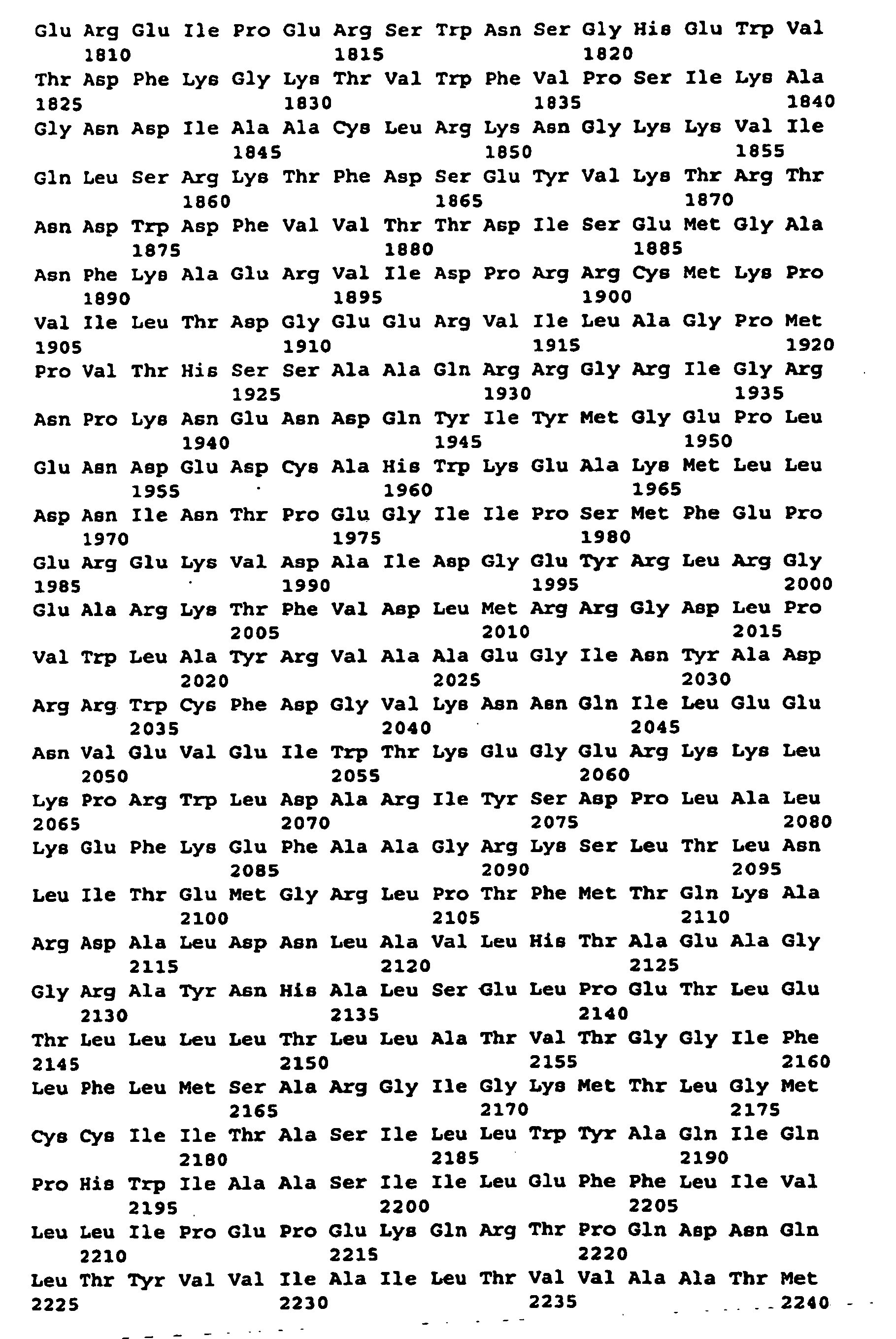


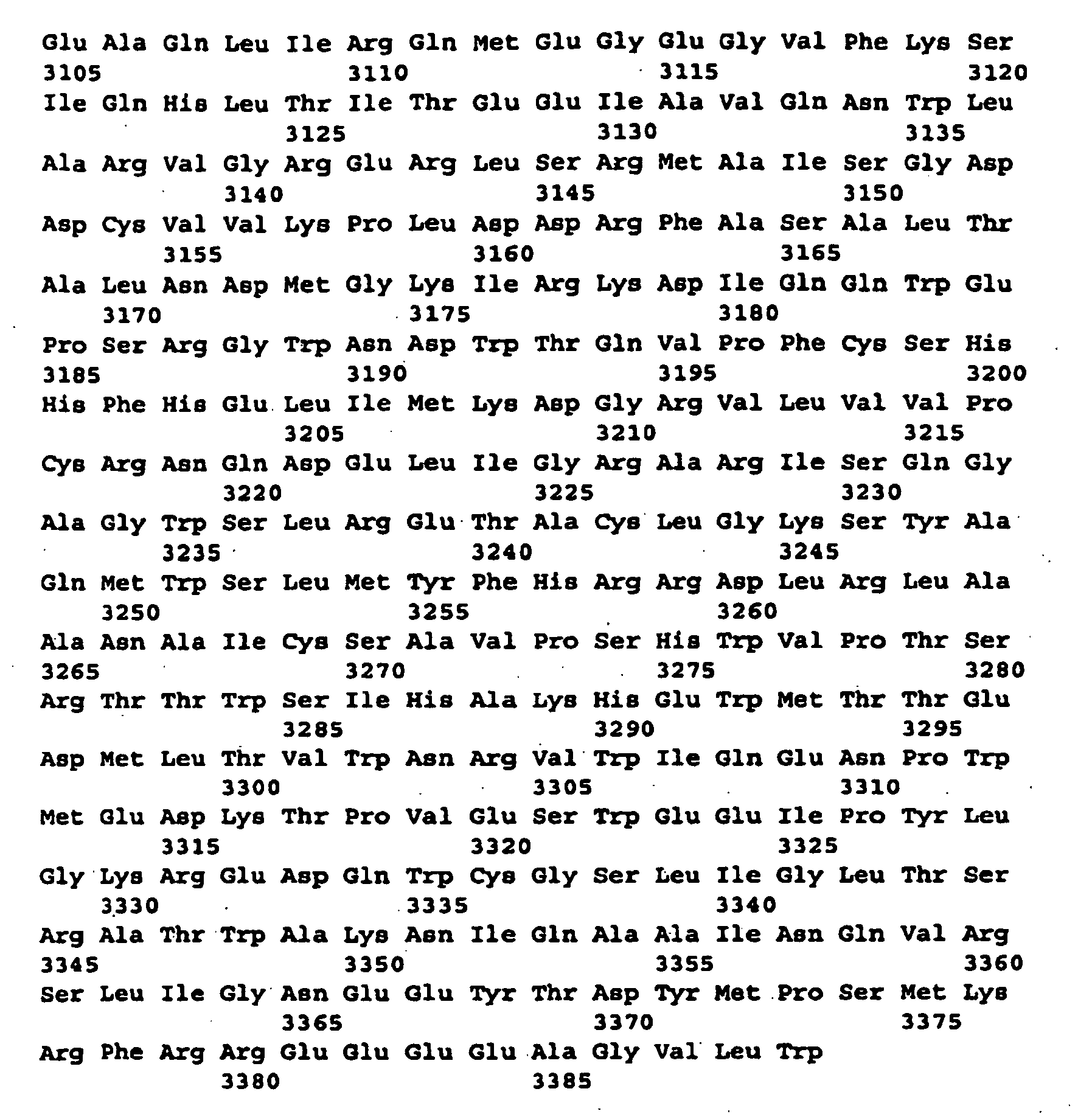
- <210> 11
<211> 10723
<212> DNA
<213> Artificial Sequence - <220>
<223> Description of Artificial Sequence:/Note = synthetic construct - <221> CDS
<222> (97)...(10272) - <400> 11


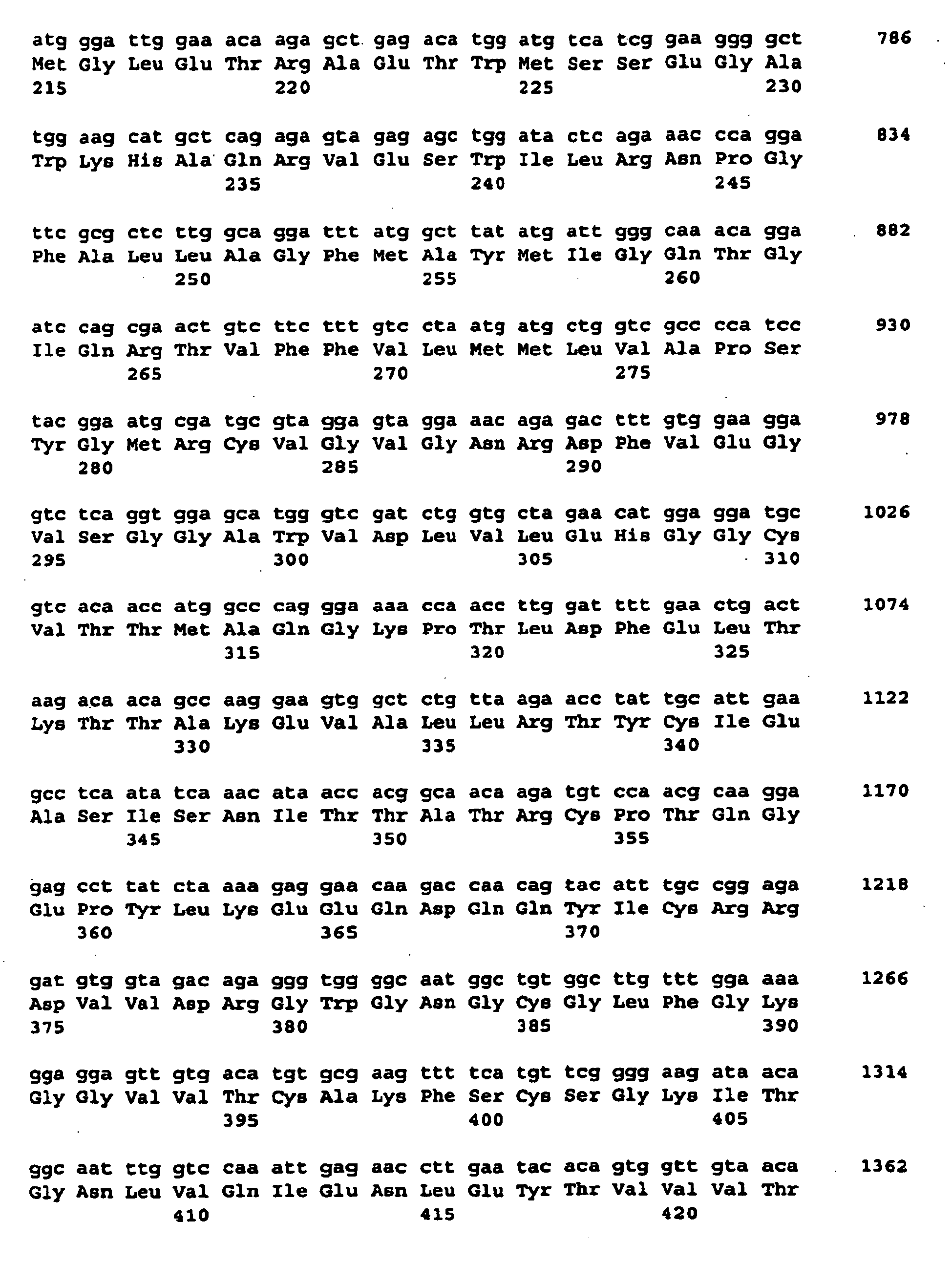


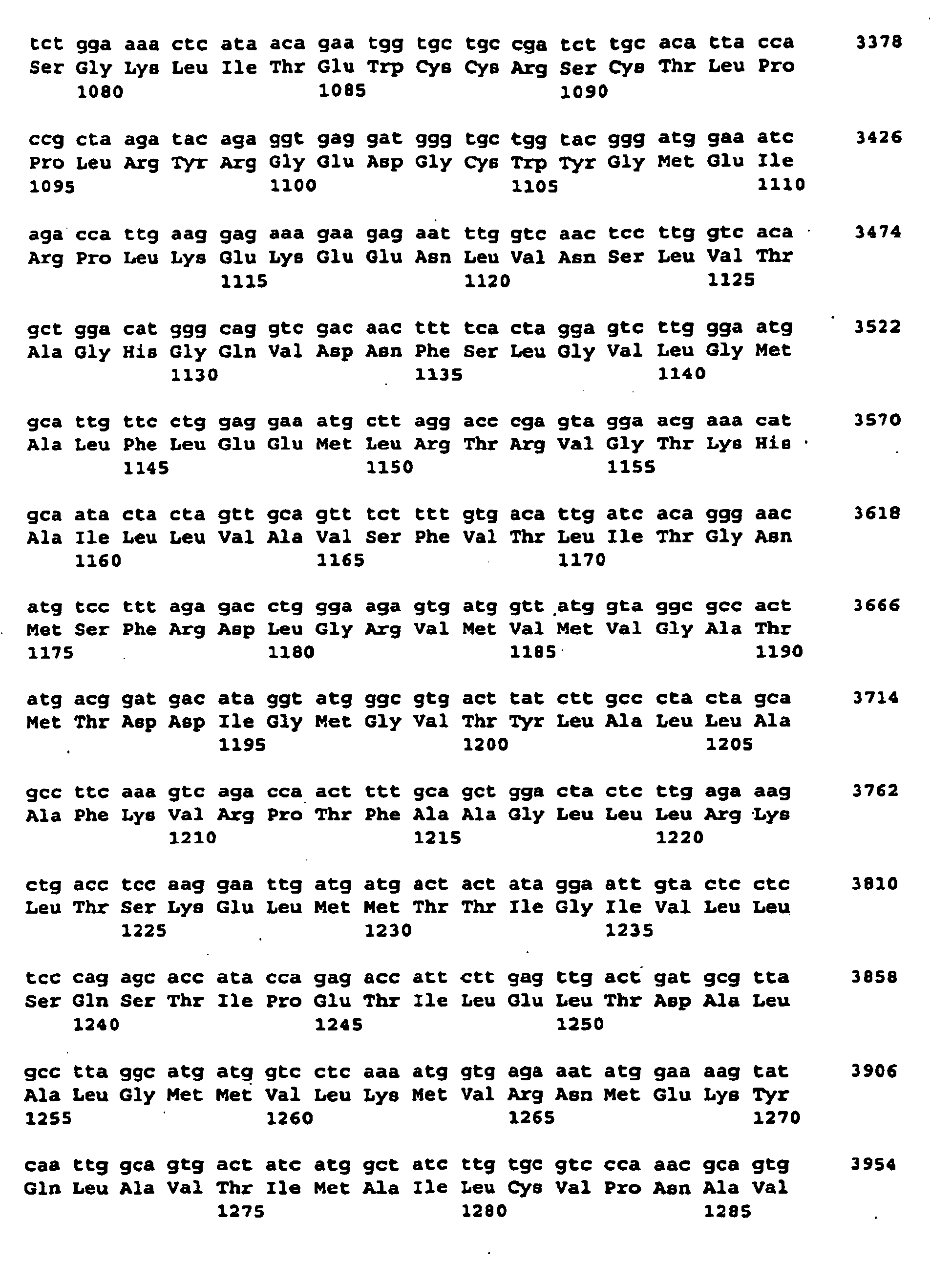

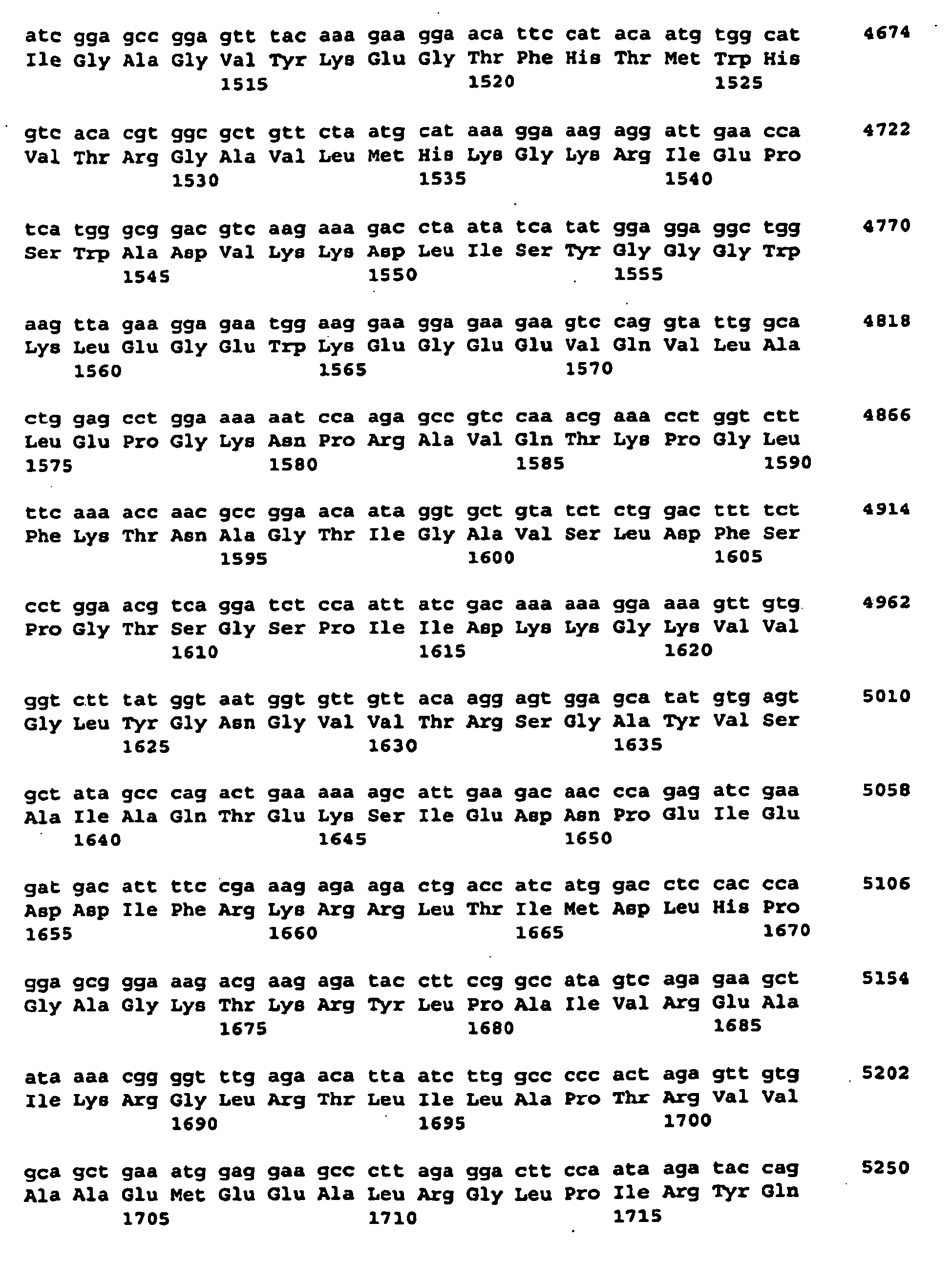


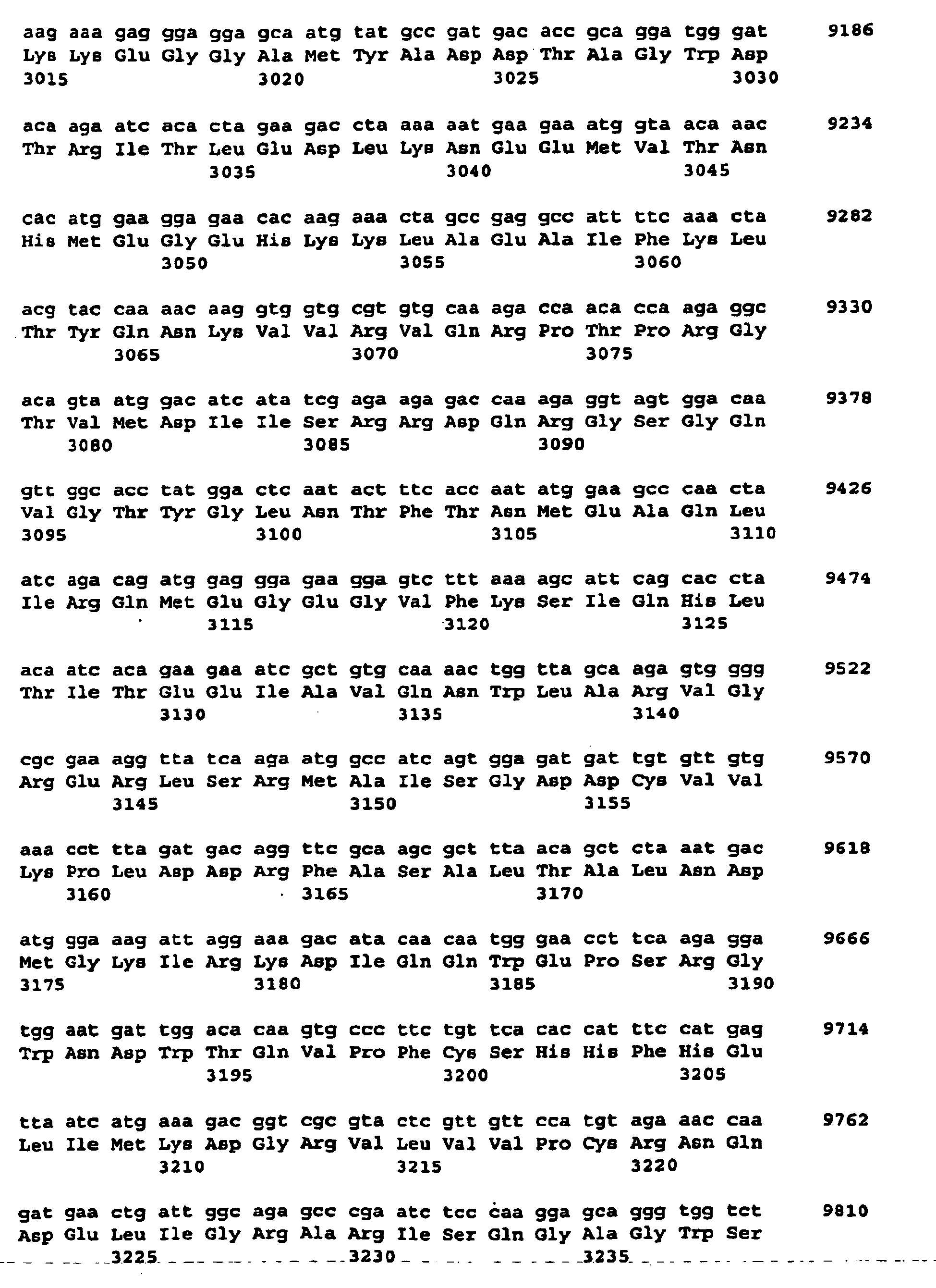

- <210> 12
<211> 3391
<212> PRT
<213> Artificial Sequence - <220>
<223> Description of Artificial Sequence:/Note = synthetic construct - <400> 12


- <210> 15
<211> 10723
<212> DNA
<213> Artificial Sequence - <220>
<223> Description of Artificial Sequence:/Note = synthetic construct - <221> CDS
<222> (97)...(10272) - <400> 15


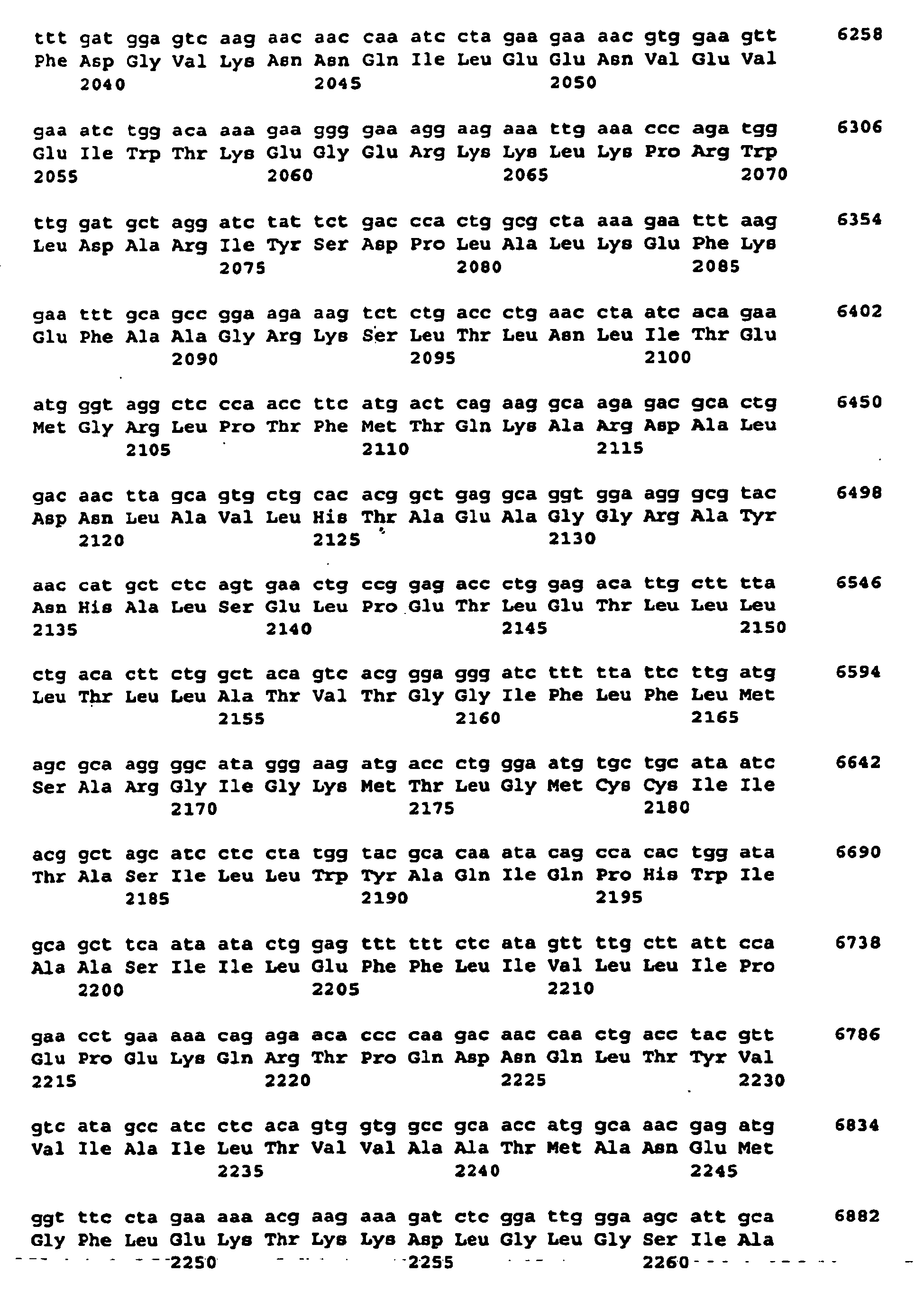


- <210> 16
<211> 3391
<212> PRT
<213> Artificial Sequence - <220>
<223> Description of Artificial Sequence:/Note = synthetic construct - <400> 16


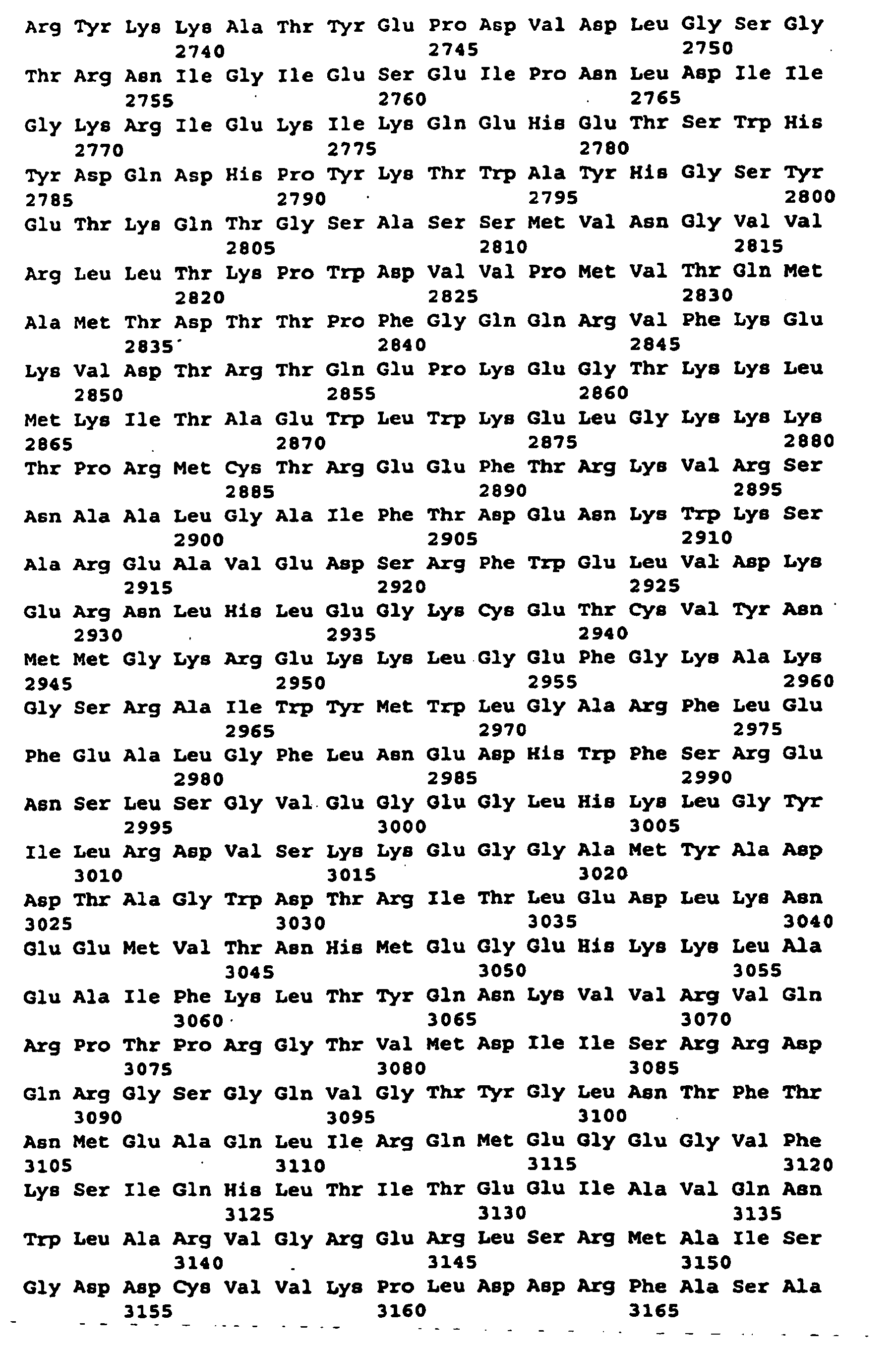

- <210> 31
<211> 17
<212> DNA
<213> Artificial Sequence - <220>
<223> Description of Artificial Sequence:/Note = synthetic construct - <400> 31
tagagagcag atctctg 17 - <210> 32
<211> 32
<212> DNA
<213> Artificial Sequence - <220>
<223> Description of Artificial Sequence:/Note = synthetic construct - <400> 32
tgtgaccatg ccggctgcga tgcactcacc ga 32 - <210> 33
<211> 38
<212> DNA
<213> Artificial Sequence - <220>
<223> Description of Artificial Sequence:/Note = synthetic construct - <400> 33
tgctggccac ttaactacgc gtgatggaga gccgcgca 38 - <210> 34
<211> 33
<212> DNA
<213> Artificial Sequence - <220>
<223> Description of Artificial Sequence:/Note = synthetic construct - <400> 34
tgtaatgatg ccggccgcga tgcatgaaaa tga 33 - <210> 35
<211> 38
<212> DNA
<213> Artificial Sequence - <220>
<223> Description of Artificial Sequence:/Note = synthetic construct - <400> 35
ggcgtttcac ttgtcaacgc gtgatggcga acccctca 38 - <210> 36
<211> 36
<212> DNA
<213> Artificial Sequence - <220>
<223> Description of Artificial Sequence:/Note = synthetic construct - <400> 36
agtgattccg ccggcagcta tgcacgtcat agccat 36
Claims (8)
- A nucleic acid comprising:a first nucleotide sequence encoding nonstructural proteins and a capsid (C) protein from an attenuated dengue-2 virus vaccine strain PDK-53; anda second nucleotide sequence encoding a premembrane (prM) protein and an envelope (E) protein of dengue-3 virus, wherein the E protein contains a leucine at amino acid position 345, said leucine corresponding to the leucine at amino acid position 625 of SEQ ID NO:10.
- A nucleic acid comprising:a first nucleotide sequence encoding nonstructural proteins and a capsid (C) protein from an attenuated dengue-2 virus vaccine strain PDK-53, wherein the C protein contains a serine at amino acid position 100 said serine corresponding to the serine at amino acid position 100 of SEQ ID NO:12; anda second nucleotide sequence encoding a premembrane (prM) protein and an envelope (E) protein of dengue-4 virus, wherein the E protein contains a leucine at amino acid position 447, said leucine corresponding to the leucine at amino acid position 727 of SEQ NO:12.
- The nucleic acid of claim 2, further comprising a valine at position 364 of the E protein.
- The nucleic acid of any one of claims 1 to 3, wherein the prM protein and the E protein are from a virulent strain.
- The nucleic acid of claim 1, encoding SEQ ID NO: 10.
- The nucleic acid of claim 5, having the nucleotide sequence of SEQ ID NO: 9.
- The nucleic acid of claim 2, encoding SEQ ID NO: 12.
- The nucleic acid of claim 7, having the nucleotide sequence of SEQ ID NO: 11.
Priority Applications (3)
| Application Number | Priority Date | Filing Date | Title |
|---|---|---|---|
| DK10177474.3T DK2278012T3 (en) | 2000-02-16 | 2001-02-16 | Immunogenic dengue 2 virus chimeras |
| EP15180834.2A EP3000477A1 (en) | 2000-02-16 | 2001-02-16 | Avirulent, immunogenic flavivirus chimeras |
| EP10177474.3A EP2278012B1 (en) | 2000-02-16 | 2001-02-16 | Immunogenic Dengue 2 virus chimeras |
Applications Claiming Priority (3)
| Application Number | Priority Date | Filing Date | Title |
|---|---|---|---|
| US18282900P | 2000-02-16 | 2000-02-16 | |
| US182829P | 2000-02-16 | ||
| PCT/US2001/005142 WO2001060847A2 (en) | 2000-02-16 | 2001-02-16 | Avirulent, immunogenic flavivirus chimeras |
Related Child Applications (4)
| Application Number | Title | Priority Date | Filing Date |
|---|---|---|---|
| EP10177474.3A Division EP2278012B1 (en) | 2000-02-16 | 2001-02-16 | Immunogenic Dengue 2 virus chimeras |
| EP15180834.2A Division EP3000477A1 (en) | 2000-02-16 | 2001-02-16 | Avirulent, immunogenic flavivirus chimeras |
| EP10176287.0 Division-Into | 2010-09-10 | ||
| EP10177474.3 Division-Into | 2010-09-17 |
Publications (2)
| Publication Number | Publication Date |
|---|---|
| EP1263965A2 EP1263965A2 (en) | 2002-12-11 |
| EP1263965B1 true EP1263965B1 (en) | 2011-09-28 |
Family
ID=22670221
Family Applications (3)
| Application Number | Title | Priority Date | Filing Date |
|---|---|---|---|
| EP01910882A Expired - Lifetime EP1263965B1 (en) | 2000-02-16 | 2001-02-16 | Avirulent, immunogenic flavivirus chimeras |
| EP10177474.3A Expired - Lifetime EP2278012B1 (en) | 2000-02-16 | 2001-02-16 | Immunogenic Dengue 2 virus chimeras |
| EP15180834.2A Withdrawn EP3000477A1 (en) | 2000-02-16 | 2001-02-16 | Avirulent, immunogenic flavivirus chimeras |
Family Applications After (2)
| Application Number | Title | Priority Date | Filing Date |
|---|---|---|---|
| EP10177474.3A Expired - Lifetime EP2278012B1 (en) | 2000-02-16 | 2001-02-16 | Immunogenic Dengue 2 virus chimeras |
| EP15180834.2A Withdrawn EP3000477A1 (en) | 2000-02-16 | 2001-02-16 | Avirulent, immunogenic flavivirus chimeras |
Country Status (10)
| Country | Link |
|---|---|
| US (6) | US7094411B2 (en) |
| EP (3) | EP1263965B1 (en) |
| JP (1) | JP4656794B2 (en) |
| AT (1) | ATE526411T1 (en) |
| AU (4) | AU2001238441B2 (en) |
| CA (2) | CA2941182A1 (en) |
| DK (1) | DK2278012T3 (en) |
| ES (2) | ES2554254T3 (en) |
| PT (1) | PT2278012E (en) |
| WO (1) | WO2001060847A2 (en) |
Families Citing this family (80)
| Publication number | Priority date | Publication date | Assignee | Title |
|---|---|---|---|---|
| US7425437B2 (en) | 1999-11-26 | 2008-09-16 | Crucell Holland B.V. | Vaccines against West Nile Virus |
| CA2941182A1 (en) | 2000-02-16 | 2001-08-23 | The Government Of The United States Of America As Represented By The Secretary, Department Of Health And Human Services | Avirulent, immunogenic flavivirus chimeras |
| EP1322338A4 (en) * | 2000-10-04 | 2005-04-13 | Univ Pennsylvania | COMPOSITIONS AND METHODS FOR USE OF THE CAPSID PROTEIN FROM FLAVIVIRES OR PESTVIRUSES |
| AT410634B (en) * | 2001-02-21 | 2003-06-25 | Franz X Dr Heinz | ATTENUATED LIFE VACCINE |
| US7740863B2 (en) * | 2001-04-06 | 2010-06-22 | Merial | Recombinant vaccine against West Nile Virus |
| CA2467397A1 (en) * | 2001-11-26 | 2003-06-05 | Replikun Biotech Pty Ltd | Flavivirus vaccine delivery system |
| AU2002356690B2 (en) * | 2001-12-04 | 2008-07-24 | Bavarian Nordic A/S | Flavivirus NS1 subunit vaccine |
| CA2472468C (en) * | 2002-01-10 | 2015-11-24 | Alexander G. Pletnev | Construction of west nile virus and dengue virus chimeras for use in a live virus vaccine to prevent disease caused by west nile virus |
| AU2013213749A1 (en) * | 2002-01-10 | 2013-08-29 | The Government Of The United States Of America, As Represented By The Secretary, Department Of Health And Human Services | Construction of West Nile virus and dengue virus chimeras for use in a live virus vaccine to prevent disease caused by West Nile virus |
| JP2005519639A (en) | 2002-01-15 | 2005-07-07 | アカンビス インコーポレーティッド | Flavivirus vaccine |
| US7459297B2 (en) * | 2003-05-30 | 2008-12-02 | Centre National De La Recherche Scientifique -Cnrs | Active truncated form of the RNA polymerase of flavivirus |
| WO2006029300A2 (en) | 2004-09-09 | 2006-03-16 | Research Development Foundation | Flavivirus variants having phenotypic variation and immunogenic compositions thereof |
| CA2591665C (en) | 2004-12-20 | 2015-05-05 | Crucell Holland B.V. | Binding molecules capable of neutralizing west nile virus and uses thereof |
| AU2005320001B2 (en) * | 2004-12-24 | 2011-05-19 | The Research Foundation For Microbial Diseases Of Osaka University | Attenuated chimeric flavivirus bearing attenuated Japanese encephalitis virus gene as backbone |
| WO2006120230A2 (en) | 2005-05-12 | 2006-11-16 | Crucell Holland B.V. | Host cell specific binding molecules capable of neutralizing viruses and uses thereof |
| WO2006134433A1 (en) | 2005-06-17 | 2006-12-21 | Sanofi Pasteur | Dengue serotype 1 attenuated strain |
| US7455842B2 (en) * | 2005-12-05 | 2008-11-25 | University Of Kansas | Chimeric West Nile viruses and uses thereof |
| US8299214B2 (en) * | 2006-03-13 | 2012-10-30 | Keio University | Influenza infection-inhibiting peptide, influenza virus infection inhibitor, liposome, and influenza preventive/therapeutic agent |
| AR061197A1 (en) * | 2006-06-07 | 2008-08-13 | Sanofi Pasteur | DENGUE VIRUS 3 CEPAS VIVAS ATENUADAS |
| FR2903605A1 (en) | 2006-07-12 | 2008-01-18 | Sanofi Pasteur Sa | IMMUNIZATION METHOD AGAINST THE FOUR SEROTYPES OF DENGUE |
| FR2906724B1 (en) | 2006-10-04 | 2009-03-20 | Sanofi Pasteur Sa | METHOD OF IMMUNIZATION AGAINST THE 4 SEROTYPES OF DENGUE. |
| US20090155854A1 (en) * | 2006-11-03 | 2009-06-18 | National Health Research Institute (An Institution Of Taiwan, R.O.C.) | METHOD FOR AMPLIFYING A FLAVIVIRUS cDNA IN A PROKARYOTIC CELL |
| CA2668834C (en) * | 2006-11-07 | 2016-10-11 | Sanofi Pasteur Biologics Co. | Stabilization of vaccines by lyophilization |
| FR2909286B1 (en) | 2006-12-01 | 2012-06-08 | Sanofi Pasteur | IMMUNIZATION METHOD AGAINST THE 4 SEROTYPES OF DENGUE |
| SI2144998T1 (en) * | 2007-04-06 | 2017-05-31 | Takeda Vaccines, Inc. | Methods and compositions for live attenuated viruses |
| CA2686398C (en) * | 2007-05-07 | 2016-05-03 | The Board Of Regents Of The University Of Texas System | Two-component genome flavivirus and uses thereof |
| AU2008325537B2 (en) * | 2007-11-07 | 2014-07-24 | Japan As Represented By The Director-General Of National Institute Of Infectious Diseases | West nile virus vaccine, and method for production thereof |
| ES2615390T3 (en) | 2008-03-05 | 2017-06-06 | Sanofi Pasteur | Process to stabilize a vaccine composition containing adjuvant |
| WO2009134717A1 (en) * | 2008-04-30 | 2009-11-05 | The Government Of The United States Of America As Represented By The Secretary Of The Department Of Health And Human Services, Centers For Disease Control And Prevention | Chimeric west nile/dengue viruses |
| WO2009152147A2 (en) * | 2008-06-09 | 2009-12-17 | La Jolla Institute For Allergy And Immunology | Compositions and methods for dengue virus (dv) treatment and vaccination |
| EP2143440A1 (en) | 2008-07-09 | 2010-01-13 | Sanofi Pasteur | Stabilising agent and vaccine composition comprising one or several attenuated living flavivirus |
| CN105219734B (en) * | 2008-12-05 | 2020-03-03 | 武田疫苗公司 | Compositions, methods and uses for inducing viral growth |
| US8568739B2 (en) | 2009-05-28 | 2013-10-29 | The United States Of America, As Represented By The Secretary, Department Of Health And Human Services | Antigenic chimeric tick-borne encephalitis virus/dengue virus type 4 recombinant viruses |
| US9211323B2 (en) | 2009-06-01 | 2015-12-15 | Takeda Vaccines, Inc. | Compositions and methods for administration of vaccines against dengue virus |
| US8968996B2 (en) | 2009-06-01 | 2015-03-03 | Takeda Vaccines, Inc. | Compositions and methods for rapid immunization against dengue virus |
| WO2011026139A1 (en) * | 2009-08-31 | 2011-03-03 | Gen-Probe Incorporated | Dengue virus assay |
| EP2353609A1 (en) | 2010-02-04 | 2011-08-10 | Sanofi Pasteur | Immunization compositions and methods |
| US10238734B2 (en) | 2010-03-23 | 2019-03-26 | The Regents Of The University Of California | Compositions and methods for self-adjuvanting vaccines against microbes and tumors |
| US8685649B2 (en) | 2010-06-10 | 2014-04-01 | The United States Of America As Represented By The Secretary Of The Navy | RT-LAMP assay for the detection of pan-serotype dengue virus |
| US10308689B2 (en) | 2010-06-24 | 2019-06-04 | La Jolla Institute For Allergy And Immunology | Dengue virus (DV) polypeptide sequences, T cell epitopes and methods and uses thereof |
| US20120294889A1 (en) * | 2010-11-12 | 2012-11-22 | Paxvax, Inc. | Chimeric Flavivirus Vaccines |
| US8895028B2 (en) * | 2012-07-20 | 2014-11-25 | Arbovax, Inc. | Methods and compositions for dengue virus 3 (DV3) infectious clone |
| MY168959A (en) | 2012-07-24 | 2019-01-28 | Sanofi Pasteur | Vaccine compositions for the prevention of dengue virus infection |
| CA2878599A1 (en) | 2012-07-24 | 2014-01-30 | Jiansheng Yao | Vaccine compositions for prevention against dengue virus infection |
| TW201920677A (en) * | 2012-11-08 | 2019-06-01 | 美商武田疫苗股份有限公司 | Compositions, methods and uses for dengue virus serotype-4 constructs |
| BR112015012515B1 (en) | 2012-11-30 | 2023-04-11 | Sanofi Pasteur | USE OF ANTIGENS, NUCLEIC ACID CONSTRUCTS OR VIRAL VECTORS CAPABLE OF EXPRESSING A VIRUS-LIKE PARTICLE (VLP) OF DENGUE AND A VACCINE AGAINST MEASLES, A VACCINE AGAINST MUMPS AND A VACCINE AGAINST RUBELLA |
| JP2016504315A (en) * | 2012-12-14 | 2016-02-12 | タケダ ワクチン, インコーポレイテッドTakeda Vaccines, Inc. | Compositions, methods of administration and uses for trivalent dengue virus formulations |
| CA3177572C (en) | 2013-03-15 | 2026-02-03 | The Government Of The United States Of America As Represented By The Secretary Of The Department Of Health And Human Services | Compositions and methods for dengue virus chimeric constructs in vaccines |
| MX2016000021A (en) * | 2013-07-05 | 2017-04-06 | Bioneer Corp | Dengue virus-specific sirna, double helix oligo-rna structure comprising sirna, and composition for suppressing proliferation of dengue virus comprising rna structure. |
| WO2015095735A2 (en) * | 2013-12-20 | 2015-06-25 | The Regents Of The University Of Michigan | Vaccine compositions and uses thereof |
| US10428313B2 (en) | 2014-06-20 | 2019-10-01 | The United States Of America, As Represented By The Secretary, Department Of Health And Human Services | Chimeric West Nile/Dengue viruses and methods of use |
| TWI852899B (en) | 2014-09-02 | 2024-08-21 | 法商賽諾菲巴斯德公司 | Vaccine compositions |
| WO2016120843A1 (en) * | 2015-01-29 | 2016-08-04 | Technophage, Investigação E Desenvolvimento Em Biotecnologia, Sa | Antibody molecules and peptide delivery systems for use in alzheimer's disease and related disorders |
| US10857222B2 (en) | 2015-07-03 | 2020-12-08 | Sanofi Pasteur | Concomitant dengue and yellow fever vaccination |
| MA42502A (en) | 2015-07-21 | 2018-05-30 | Modernatx Inc | VACCINES AGAINST INFECTIOUS DISEASE |
| US11364292B2 (en) | 2015-07-21 | 2022-06-21 | Modernatx, Inc. | CHIKV RNA vaccines |
| EP3364950A4 (en) | 2015-10-22 | 2019-10-23 | ModernaTX, Inc. | VACCINES AGAINST TROPICAL DISEASES |
| NZ782252A (en) * | 2015-11-27 | 2025-12-19 | Km Biologics Co Ltd | Live virus having a bank of dengue virus attenuated strains, and a dengue vaccine containing same as antigens |
| WO2017109698A1 (en) | 2015-12-22 | 2017-06-29 | Glaxosmithkline Biologicals Sa | Immunogenic formulation |
| BR112018077540A2 (en) | 2016-07-08 | 2019-10-01 | The United States Of America, As Represented By The Secretary, Department Of Health And Human Services | chimeric dengue / zika virus as zika vaccines live attenuated virus |
| KR102511472B1 (en) * | 2016-11-28 | 2023-03-16 | 메디젠, 인크. | Vaccines against infectious diseases caused by positive-stranded RNA viruses |
| WO2018151816A1 (en) | 2017-02-16 | 2018-08-23 | Modernatx, Inc. | High potency immunogenic compositions |
| KR102832926B1 (en) | 2017-04-26 | 2025-07-10 | 에프. 호프만-라 로슈 아게 | Availability and immunoreactivity of Zika virus NS1 polypeptide |
| US10653767B2 (en) | 2017-09-14 | 2020-05-19 | Modernatx, Inc. | Zika virus MRNA vaccines |
| AU2018346724B2 (en) | 2017-10-05 | 2025-01-09 | Sanofi Pasteur | Compositions for booster vaccination against dengue |
| WO2020041309A1 (en) * | 2018-08-21 | 2020-02-27 | The Regents Of The University Of Michigan | Materials and methods for inhibiting flavivirus infection |
| CN112912106A (en) | 2018-09-05 | 2021-06-04 | 武田疫苗股份有限公司 | Dengue vaccine unit dose and administration thereof |
| US11426461B2 (en) | 2018-09-05 | 2022-08-30 | Takeda Vaccines, Inc. | Methods for preventing dengue and hepatitis A |
| US11464815B2 (en) | 2018-09-05 | 2022-10-11 | Takeda Vaccines, Inc. | Dengue vaccine unit dose and administration thereof |
| WO2020190750A1 (en) | 2019-03-15 | 2020-09-24 | Modernatx, Inc. | Hiv rna vaccines |
| EP4477230A3 (en) * | 2019-08-06 | 2025-05-14 | The University of North Carolina at Chapel Hill | Methods and compositions for stabilized recombinant flavivirus e protein dimers |
| EP4110381A1 (en) | 2020-02-27 | 2023-01-04 | Takeda Vaccines, Inc. | Method for removing host cell dna from virus preparation |
| US12318439B2 (en) * | 2021-05-09 | 2025-06-03 | Board Of Regents, The University Of Texas System | Attenuating viral mutations in protein genes |
| WO2023147342A2 (en) | 2022-01-25 | 2023-08-03 | Takeda Vaccines, Inc. | Large-scale flaviviral vaccine production and manufacture |
| WO2023158989A1 (en) | 2022-02-15 | 2023-08-24 | Takeda Vaccines, Inc. | Dengue vaccine batch mixing process |
| EP4519847A1 (en) | 2022-05-04 | 2025-03-12 | Takeda Vaccines, Inc. | Computer-based determination of flavivirus infectivity |
| CN120225693A (en) | 2022-11-18 | 2025-06-27 | 武田疫苗股份有限公司 | Method for determining the proportion of live attenuated flaviviruses having a nucleotide sequence comprising at least one attenuated locus in a preparation |
| CN120529951A (en) | 2022-11-29 | 2025-08-22 | 武田疫苗股份有限公司 | Large-Scale Flavivirus Vaccine Production and Manufacturing |
| WO2025122855A1 (en) | 2023-12-08 | 2025-06-12 | Takeda Vaccines, Inc. | A method for determining the concentration of residual vero cell genomic dna in a sample containing virus obtained from production in vero cells |
| WO2026077983A1 (en) | 2024-10-08 | 2026-04-16 | Sanofi R&D Vaccins | Compositions and methods for stabilizing live-attenuated flaviviruses |
Citations (1)
| Publication number | Priority date | Publication date | Assignee | Title |
|---|---|---|---|---|
| WO1996040933A1 (en) * | 1995-06-07 | 1996-12-19 | The Government Of The United States Of America, Represented By The Secretary Department Of Health And Human Services | Infectious dengue 2 virus pdk-53 as quadravalent vaccine |
Family Cites Families (21)
| Publication number | Priority date | Publication date | Assignee | Title |
|---|---|---|---|---|
| JPS5276941A (en) | 1975-12-23 | 1977-06-28 | Ito Masato | Method of conversing infrared rays |
| JPH0768267B2 (en) | 1986-06-05 | 1995-07-26 | 財団法人阪大微生物病研究会 | Flavivirus antigen |
| JPH084508B2 (en) | 1987-09-16 | 1996-01-24 | 国立予防衛生研究所長 | Recombinant vaccinia virus |
| JP2511494B2 (en) | 1988-05-12 | 1996-06-26 | 善治 松浦 | Method for producing Japanese encephalitis virus surface antigen protein |
| US6184024B1 (en) * | 1988-07-14 | 2001-02-06 | The United States Of America As Represented By The Department Of Health And Human Services | Chimeric and/or growth-restricted flaviviruses |
| IL91304A0 (en) | 1988-08-20 | 1990-03-19 | Us Health | Recombinant vaccinia virus for prevention of disease caused by flavivirus |
| MY109299A (en) | 1990-08-15 | 1996-12-31 | Virogenetics Corp | Recombinant pox virus encoding flaviviral structural proteins |
| US5514375A (en) | 1990-08-15 | 1996-05-07 | Virogenetics Corporation | Flavivirus recombinant poxvirus vaccine |
| US5494671A (en) | 1990-08-27 | 1996-02-27 | The United States Of America As Represented By The Department Of Health And Human Services | C-terminally truncated dengue and Japanese encephalitis virus envelope proteins |
| DE69230316T2 (en) * | 1991-09-19 | 2000-07-13 | Us Health | CHIMERIC AND / OR GROWTH-INHIBITED FLAVIVIRES |
| JPH05276941A (en) | 1992-02-28 | 1993-10-26 | Nippon Zeon Co Ltd | Production of noninfectious structure particle containing surface antigen protein of virus belonging to family flavivirus |
| ATE227584T1 (en) | 1995-05-24 | 2002-11-15 | Hawaii Biotech Group | SUBUNITY VACCINE AGAINST FLAVIVIRUS INFECTION |
| CA2282790C (en) * | 1997-02-28 | 2011-04-19 | St. Louis University | Chimeric flavivirus vaccines |
| ATE314476T1 (en) * | 1997-10-08 | 2006-01-15 | Us Gov Health & Human Serv | CHIMERIC VACCINE AGAINST TICK ENCEPHALITIS VIRUS |
| US7417136B1 (en) | 1998-06-04 | 2008-08-26 | The United States Of America As Represented By The Secretary, Department Of Health And Human Services, Centers For Disease Control And Prevention | Nucleic acid vaccines for prevention of flavivirus infection |
| CA2941182A1 (en) * | 2000-02-16 | 2001-08-23 | The Government Of The United States Of America As Represented By The Secretary, Department Of Health And Human Services | Avirulent, immunogenic flavivirus chimeras |
| US6441262B1 (en) * | 2001-02-16 | 2002-08-27 | Exxonmobil Chemical Patents, Inc. | Method for converting an oxygenate feed to an olefin product |
| CA2440593A1 (en) | 2001-03-12 | 2002-09-19 | Yale University | Compositions and methods comprising west nile virus polypeptides |
| AU2002252387A1 (en) | 2001-03-14 | 2002-09-24 | Lipogenics, Inc. | Novel anti-inflammatory compositions and methods of use |
| JP5276941B2 (en) | 2008-09-24 | 2013-08-28 | 株式会社村田製作所 | Large displacement actuator |
| BR112018077540A2 (en) * | 2016-07-08 | 2019-10-01 | The United States Of America, As Represented By The Secretary, Department Of Health And Human Services | chimeric dengue / zika virus as zika vaccines live attenuated virus |
-
2001
- 2001-02-16 CA CA2941182A patent/CA2941182A1/en not_active Expired - Lifetime
- 2001-02-16 AU AU2001238441A patent/AU2001238441B2/en not_active Expired
- 2001-02-16 DK DK10177474.3T patent/DK2278012T3/en active
- 2001-02-16 US US10/204,252 patent/US7094411B2/en not_active Expired - Lifetime
- 2001-02-16 ES ES10177474.3T patent/ES2554254T3/en not_active Expired - Lifetime
- 2001-02-16 AT AT01910882T patent/ATE526411T1/en active
- 2001-02-16 JP JP2001560231A patent/JP4656794B2/en not_active Expired - Lifetime
- 2001-02-16 EP EP01910882A patent/EP1263965B1/en not_active Expired - Lifetime
- 2001-02-16 EP EP10177474.3A patent/EP2278012B1/en not_active Expired - Lifetime
- 2001-02-16 CA CA2398872A patent/CA2398872C/en not_active Expired - Lifetime
- 2001-02-16 WO PCT/US2001/005142 patent/WO2001060847A2/en not_active Ceased
- 2001-02-16 PT PT101774743T patent/PT2278012E/en unknown
- 2001-02-16 EP EP15180834.2A patent/EP3000477A1/en not_active Withdrawn
- 2001-02-16 AU AU3844101A patent/AU3844101A/en active Pending
- 2001-02-16 ES ES01910882T patent/ES2374131T3/en not_active Expired - Lifetime
-
2006
- 2006-08-18 US US11/506,251 patent/US7641909B2/en not_active Expired - Lifetime
-
2007
- 2007-01-25 AU AU2007200319A patent/AU2007200319B8/en not_active Expired
-
2009
- 2009-08-25 AU AU2009212794A patent/AU2009212794B2/en not_active Expired
- 2009-10-28 US US12/607,746 patent/US8025887B2/en not_active Expired - Fee Related
-
2011
- 2011-08-18 US US13/212,845 patent/US8673316B2/en not_active Expired - Fee Related
-
2014
- 2014-01-28 US US14/166,393 patent/US9463233B2/en not_active Expired - Fee Related
-
2016
- 2016-09-06 US US15/257,430 patent/US10335478B2/en not_active Expired - Fee Related
Patent Citations (1)
| Publication number | Priority date | Publication date | Assignee | Title |
|---|---|---|---|---|
| WO1996040933A1 (en) * | 1995-06-07 | 1996-12-19 | The Government Of The United States Of America, Represented By The Secretary Department Of Health And Human Services | Infectious dengue 2 virus pdk-53 as quadravalent vaccine |
Non-Patent Citations (1)
| Title |
|---|
| HUANG C. Y-H. ET AL.: "Dengue 2 PDK-53 as a chimeric carrier for tetravalent Dengue vaccine development", J VIROL, vol. 77, no. 21, November 2003 (2003-11-01), pages 11436 - 11447, XP003005064, DOI: doi:10.1128/JVI.77.21.11436-11447.2003 * |
Also Published As
Similar Documents
| Publication | Publication Date | Title |
|---|---|---|
| US10335478B2 (en) | Avirulent, immunogenic flavivirus chimeras | |
| AU2001238441A1 (en) | Avirulent, immunogenic flavivirus chimeras | |
| Kinney et al. | Construction of infectious cDNA clones for dengue 2 virus: strain 16681 and its attenuated vaccine derivative, strain PDK-53 | |
| AU667836B2 (en) | Chimeric and/or growth-restricted flaviviruses | |
| AU2011250694B2 (en) | Construction of west Nile virus and dengue virus chimeras for use in a live virus vaccine to prevent disease caused by West Nile virus | |
| KR20060135844A (en) | Flavivirus vaccine | |
| AU2015213355B2 (en) | Avirulent, immunogenic flavivirus chimeras | |
| AU2012202659B8 (en) | Avirulent, immunogenic flavivirus chimeras | |
| AU2012202659B2 (en) | Avirulent, immunogenic flavivirus chimeras | |
| HK1224916A1 (en) | Avirulent, immunogenic flavivirus chimeras | |
| AU2019203166A1 (en) | Construction of West Nile virus and dengue virus chimeras for use in a live virus vaccine to prevent disease caused by West Nile virus | |
| HK1106723B (en) | Vaccines against japanese encephalitis virus and west nile virus | |
| HK1106723A1 (en) | Vaccines against japanese encephalitis virus and west nile virus |
Legal Events
| Date | Code | Title | Description |
|---|---|---|---|
| PUAI | Public reference made under article 153(3) epc to a published international application that has entered the european phase |
Free format text: ORIGINAL CODE: 0009012 |
|
| AK | Designated contracting states |
Kind code of ref document: A2 Designated state(s): AT BE CH CY DE DK ES FI FR GB GR IE IT LI LU MC NL PT SE TR |
|
| AX | Request for extension of the european patent |
Free format text: AL;LT;LV;MK;RO;SI |
|
| 17P | Request for examination filed |
Effective date: 20021025 |
|
| RAP1 | Party data changed (applicant data changed or rights of an application transferred) |
Owner name: THE GOVERNMENT OF THE UNITED STATES OF AMERICA, AS |
|
| 17Q | First examination report despatched |
Effective date: 20031127 |
|
| RAP1 | Party data changed (applicant data changed or rights of an application transferred) |
Owner name: THE GOVERNMENT OF THE UNITED STATES OF AMERICA, AS Owner name: MAHIDOL UNIVERSITY |
|
| GRAP | Despatch of communication of intention to grant a patent |
Free format text: ORIGINAL CODE: EPIDOSNIGR1 |
|
| RAP1 | Party data changed (applicant data changed or rights of an application transferred) |
Owner name: MAHIDOL UNIVERSITY Owner name: THE GOVERNMENT OF THE UNITED STATES OF AMERICA, AS |
|
| GRAS | Grant fee paid |
Free format text: ORIGINAL CODE: EPIDOSNIGR3 |
|
| GRAA | (expected) grant |
Free format text: ORIGINAL CODE: 0009210 |
|
| AK | Designated contracting states |
Kind code of ref document: B1 Designated state(s): AT BE CH CY DE DK ES FI FR GB GR IE IT LI LU MC NL PT SE TR |
|
| REG | Reference to a national code |
Ref country code: GB Ref legal event code: FG4D |
|
| REG | Reference to a national code |
Ref country code: CH Ref legal event code: EP |
|
| REG | Reference to a national code |
Ref country code: IE Ref legal event code: FG4D |
|
| REG | Reference to a national code |
Ref country code: DE Ref legal event code: R096 Ref document number: 60145374 Country of ref document: DE Effective date: 20111124 |
|
| REG | Reference to a national code |
Ref country code: NL Ref legal event code: T3 |
|
| REG | Reference to a national code |
Ref country code: SE Ref legal event code: TRGR |
|
| PG25 | Lapsed in a contracting state [announced via postgrant information from national office to epo] |
Ref country code: FI Free format text: LAPSE BECAUSE OF FAILURE TO SUBMIT A TRANSLATION OF THE DESCRIPTION OR TO PAY THE FEE WITHIN THE PRESCRIBED TIME-LIMIT Effective date: 20110928 |
|
| REG | Reference to a national code |
Ref country code: ES Ref legal event code: FG2A Ref document number: 2374131 Country of ref document: ES Kind code of ref document: T3 Effective date: 20120214 |
|
| PG25 | Lapsed in a contracting state [announced via postgrant information from national office to epo] |
Ref country code: CY Free format text: LAPSE BECAUSE OF FAILURE TO SUBMIT A TRANSLATION OF THE DESCRIPTION OR TO PAY THE FEE WITHIN THE PRESCRIBED TIME-LIMIT Effective date: 20110928 Ref country code: GR Free format text: LAPSE BECAUSE OF FAILURE TO SUBMIT A TRANSLATION OF THE DESCRIPTION OR TO PAY THE FEE WITHIN THE PRESCRIBED TIME-LIMIT Effective date: 20111229 |
|
| PG25 | Lapsed in a contracting state [announced via postgrant information from national office to epo] |
Ref country code: PT Free format text: LAPSE BECAUSE OF FAILURE TO SUBMIT A TRANSLATION OF THE DESCRIPTION OR TO PAY THE FEE WITHIN THE PRESCRIBED TIME-LIMIT Effective date: 20120130 |
|
| PG25 | Lapsed in a contracting state [announced via postgrant information from national office to epo] |
Ref country code: DK Free format text: LAPSE BECAUSE OF FAILURE TO SUBMIT A TRANSLATION OF THE DESCRIPTION OR TO PAY THE FEE WITHIN THE PRESCRIBED TIME-LIMIT Effective date: 20110928 |
|
| PLBE | No opposition filed within time limit |
Free format text: ORIGINAL CODE: 0009261 |
|
| STAA | Information on the status of an ep patent application or granted ep patent |
Free format text: STATUS: NO OPPOSITION FILED WITHIN TIME LIMIT |
|
| 26N | No opposition filed |
Effective date: 20120629 |
|
| PG25 | Lapsed in a contracting state [announced via postgrant information from national office to epo] |
Ref country code: MC Free format text: LAPSE BECAUSE OF NON-PAYMENT OF DUE FEES Effective date: 20120229 |
|
| REG | Reference to a national code |
Ref country code: DE Ref legal event code: R097 Ref document number: 60145374 Country of ref document: DE Effective date: 20120629 |
|
| PG25 | Lapsed in a contracting state [announced via postgrant information from national office to epo] |
Ref country code: TR Free format text: LAPSE BECAUSE OF FAILURE TO SUBMIT A TRANSLATION OF THE DESCRIPTION OR TO PAY THE FEE WITHIN THE PRESCRIBED TIME-LIMIT Effective date: 20110928 |
|
| PG25 | Lapsed in a contracting state [announced via postgrant information from national office to epo] |
Ref country code: LU Free format text: LAPSE BECAUSE OF NON-PAYMENT OF DUE FEES Effective date: 20120216 |
|
| REG | Reference to a national code |
Ref country code: FR Ref legal event code: PLFP Year of fee payment: 16 |
|
| REG | Reference to a national code |
Ref country code: FR Ref legal event code: PLFP Year of fee payment: 17 |
|
| REG | Reference to a national code |
Ref country code: FR Ref legal event code: PLFP Year of fee payment: 18 |
|
| PGFP | Annual fee paid to national office [announced via postgrant information from national office to epo] |
Ref country code: IT Payment date: 20200128 Year of fee payment: 20 Ref country code: DE Payment date: 20200204 Year of fee payment: 20 Ref country code: IE Payment date: 20200210 Year of fee payment: 20 Ref country code: NL Payment date: 20200212 Year of fee payment: 20 Ref country code: GB Payment date: 20200206 Year of fee payment: 20 Ref country code: ES Payment date: 20200302 Year of fee payment: 20 Ref country code: SE Payment date: 20200210 Year of fee payment: 20 Ref country code: AT Payment date: 20200127 Year of fee payment: 20 |
|
| PGFP | Annual fee paid to national office [announced via postgrant information from national office to epo] |
Ref country code: CH Payment date: 20200213 Year of fee payment: 20 Ref country code: BE Payment date: 20200114 Year of fee payment: 20 |
|
| PGFP | Annual fee paid to national office [announced via postgrant information from national office to epo] |
Ref country code: FR Payment date: 20200113 Year of fee payment: 20 |
|
| REG | Reference to a national code |
Ref country code: DE Ref legal event code: R071 Ref document number: 60145374 Country of ref document: DE |
|
| REG | Reference to a national code |
Ref country code: NL Ref legal event code: MK Effective date: 20210215 |
|
| REG | Reference to a national code |
Ref country code: CH Ref legal event code: PL |
|
| REG | Reference to a national code |
Ref country code: GB Ref legal event code: PE20 Expiry date: 20210215 |
|
| REG | Reference to a national code |
Ref country code: SE Ref legal event code: EUG |
|
| REG | Reference to a national code |
Ref country code: IE Ref legal event code: MK9A |
|
| REG | Reference to a national code |
Ref country code: AT Ref legal event code: MK07 Ref document number: 526411 Country of ref document: AT Kind code of ref document: T Effective date: 20210216 |
|
| REG | Reference to a national code |
Ref country code: BE Ref legal event code: MK Effective date: 20210216 |
|
| PG25 | Lapsed in a contracting state [announced via postgrant information from national office to epo] |
Ref country code: GB Free format text: LAPSE BECAUSE OF EXPIRATION OF PROTECTION Effective date: 20210215 Ref country code: IE Free format text: LAPSE BECAUSE OF EXPIRATION OF PROTECTION Effective date: 20210216 |
|
| REG | Reference to a national code |
Ref country code: ES Ref legal event code: FD2A Effective date: 20210625 |
|
| PG25 | Lapsed in a contracting state [announced via postgrant information from national office to epo] |
Ref country code: ES Free format text: LAPSE BECAUSE OF EXPIRATION OF PROTECTION Effective date: 20210217 |