EP1262867A1 - Procédé d'implémentation d'une pluralité d'interfaces d'objets - Google Patents
Procédé d'implémentation d'une pluralité d'interfaces d'objets Download PDFInfo
- Publication number
- EP1262867A1 EP1262867A1 EP02291287A EP02291287A EP1262867A1 EP 1262867 A1 EP1262867 A1 EP 1262867A1 EP 02291287 A EP02291287 A EP 02291287A EP 02291287 A EP02291287 A EP 02291287A EP 1262867 A1 EP1262867 A1 EP 1262867A1
- Authority
- EP
- European Patent Office
- Prior art keywords
- interface
- objects
- description
- class
- language
- Prior art date
- Legal status (The legal status is an assumption and is not a legal conclusion. Google has not performed a legal analysis and makes no representation as to the accuracy of the status listed.)
- Ceased
Links
Images


Classifications
-
- G—PHYSICS
- G06—COMPUTING OR CALCULATING; COUNTING
- G06F—ELECTRIC DIGITAL DATA PROCESSING
- G06F9/00—Arrangements for program control, e.g. control units
- G06F9/06—Arrangements for program control, e.g. control units using stored programs, i.e. using an internal store of processing equipment to receive or retain programs
- G06F9/46—Multiprogramming arrangements
- G06F9/465—Distributed object oriented systems
-
- G—PHYSICS
- G06—COMPUTING OR CALCULATING; COUNTING
- G06F—ELECTRIC DIGITAL DATA PROCESSING
- G06F9/00—Arrangements for program control, e.g. control units
- G06F9/06—Arrangements for program control, e.g. control units using stored programs, i.e. using an internal store of processing equipment to receive or retain programs
- G06F9/44—Arrangements for executing specific programs
- G06F9/448—Execution paradigms, e.g. implementations of programming paradigms
- G06F9/4488—Object-oriented
- G06F9/4492—Inheritance
Definitions
- the present invention relates to a method of implementing a plurality of object interfaces, these objects being in particular components of COM type program (in English: "Component Object Model) developed by Microsoft.
- the method is used in particular during the design a computer systems management program based on a hierarchy of objects organized into collections of objects, in particular for the creation or modification of these collections of objects, these collections being themselves objects in the COM sense.
- a interface is the public part of an object, i.e. the interface provides a user or client with functionalities, called methods, to manipulate objects, some methods can be called properties. However, the interface only presents the methods but does not allow performing these methods.
- the designer develops, in an object-oriented programming language, for example the C ++ language, a program implementing the methods exposed by each interface.
- the object of the present invention is therefore to overcome the drawbacks of the prior art by proposing a method for implementing a plurality object interfaces to limit the volume and redundancy of the code of implementing interfaces and simplifying maintenance, i.e. in particular the corrections of the interface implementation code.
- the method is characterized in that the step of memorizing in a file a description of the object interface generic, in the interface description language, includes a description of a first generic interface corresponding to a collection variable size objects and a description of a second generic interface corresponding to a collection of fixed-size objects.
- the method is characterized in that the interface description language is the "Interface Definition” language Language "(IDL).
- the method is characterized in that the object oriented programming language is C ++.
- each object interface is an object collection interface exposing all methods of managing a collection.
- the invention also has as a corollary object the computer system for the implementation of the method of the invention and the computer program corresponding.
- a COM object or component is a component distributed software type.
- COM technology allows two COM type objects to communicate with each other without taking consideration of the platform on which each component is installed, in the since these platforms are connected to the same network.
- a COM object interface is actually a set of features which are accessible by customers. By clients, we must understand here applications such as Visual Basic (sold by Microsoft), Visual Basic scripts, pages of type "Internet page". The interface presents or exposes to these customers the functionalities that the COM object achieves corresponding. Likewise, through its implementation, a interface makes this COM object perform the operations corresponding to the functionality called by the client. The internal execution mode of functionality of the COM object interface is not visible to the client.
- the implementation of the interface must allow the execution of all features exposed by the interface.
- the description of the functions of a interface is realized through an interface description language, for example, the IDL language (in English: “Interface definition Language").
- the language chosen for the implementation of a interface is an object oriented language, such as C ++.
- model classes called commonly in English "template” which generate one or more functions in the same way but on objects of different types. So a only model class allows, by choosing as parameter of this function a specific type of object, to perform the function of this class for the type of specified object. The use of a model class then makes it possible to reduce the volume of code for the execution of the same functionality for types of different objects.
- the IDL interface description language does not allow to associate, to an interface, an implementation class of type model class.
- the co-class of an interface cannot be a template class.
- programming languages oriented object and more particularly the C ++ language, provide a mechanism inheritance. This mechanism allows a given class to reproduce the functionality of another class it inherits.
- the principle of the method according to the invention consists in inheriting the class of implementation of a particular interface of a plurality of interfaces, of a model class, this model class describing the functionality of a plurality interfaces.
- the implementation class of the particular interface is not a template class but inherits only of a model class.
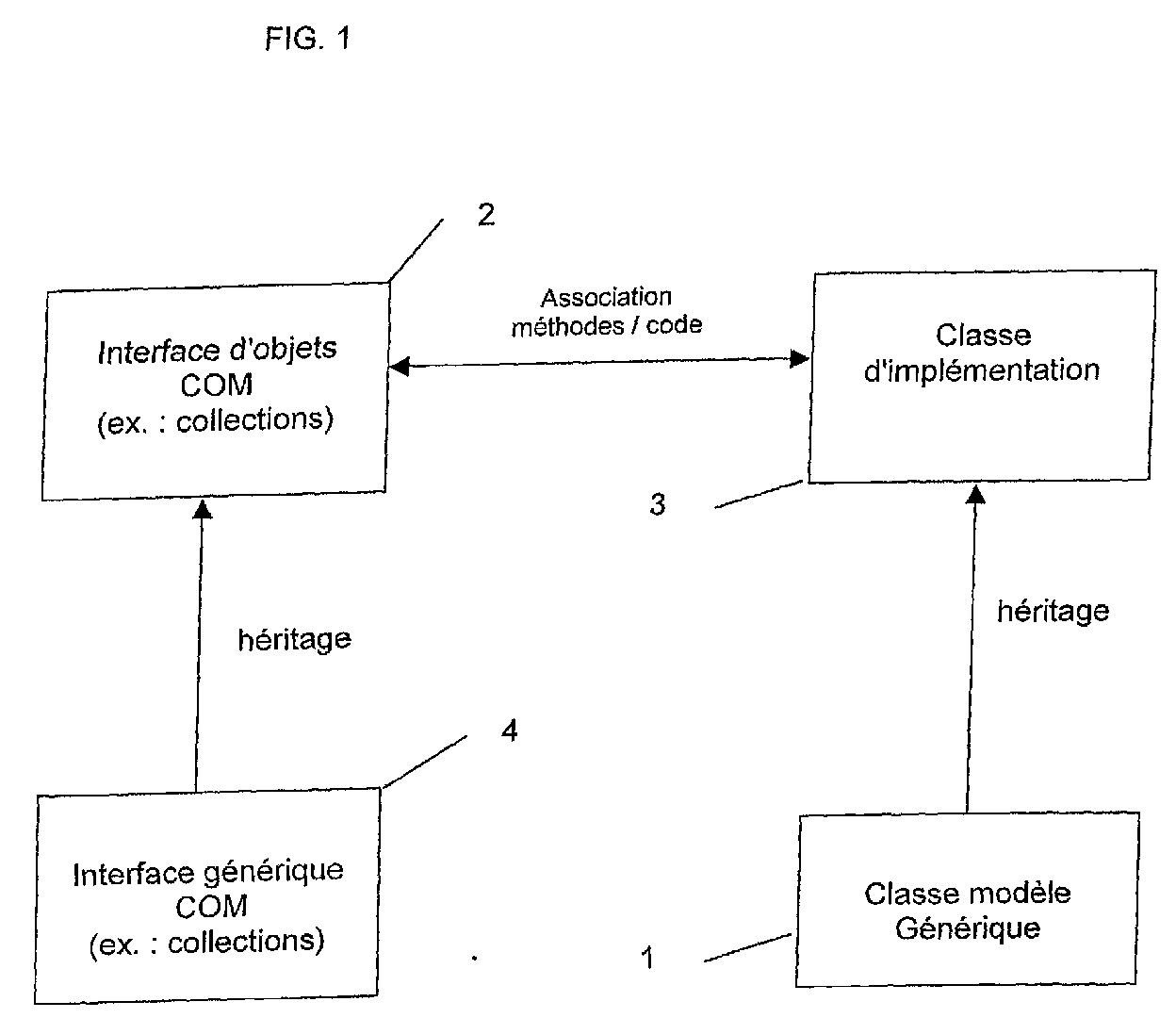
- Figure 1 summarizes the mechanism of the method according to the invention. All first, the designer of an application based on the use of a plurality of interfaces builds a model class (1), called generic, allowing to realize the functionality (s) common to all the particular interfaces. In other words, if all the particular interfaces expose the one or more same functionality, even when applied to objects of very different types, the model class performed by the designer will describe this or these functionalities.
- the declaration of the inheritance of the model class consists in declaring, in the class of implementation (3) of the particular interface, as a parameter of the class model, in particular the type of the object or objects to which the features of the particular interface (2).
- the designer defines a so-called generic interface (4) which exposes all the functionality of the interfaces particular including the same set of features. So the definition of each particular interface consists in inheriting the particular interface from the generic interface. In other words, the definition of an interface particular is limited to the declaration of the inheritance of the generic interface.
- each software object in the COM sense (C10, C11, C12, C111, C112) of the structure corresponds in our example, to a component hardware that a management platform can manage through the management program. That is, for each hardware component, a software object (C10, C11, C12, C111, C112) contains or manages its own material characteristics, such as serial number, temperature, number, nature and identification of the subcomponents.
- Each object in the software structure is uniquely identified and is accessible through Icol *. * (20, 21, 201, 202) interfaces of collections objects and interfaces Iobj *. * (10, 11, 12, 111, 112) of collected objects.
- Each collection of objects includes a determined and fixed number of objects or a variable number of objects.
- the lobj *. * (10, 11, 12, 111, 112) interfaces of collected objects are interfaces that expose methods (30 to 32, 300 to 302, 310, 3000, 3100) allowing to manipulate the corresponding objects.
- the methods of these interfaces Iobj *. * (10, 11, 12, 111, 112) of collected objects serve in particular to know or modify the state of a particular COM object (C10, C11, C12, C11, C112).
- Each object in a collection corresponds to a interface of collected objects.
- the different objects collected from the same collection are then numbered in ascending order starting from 0, so it it is possible to access the desired object among the objects of a collection and to its interface.
- Iobj *. * (10, 11, 12, 111, 112) of collected objects, called object interfaces as part of our example are not affected directly by the method according to the invention. Indeed, each object is handled differently depending on its type, therefore, methods exposed in Iobj *. * object interfaces are different from object to object other. Among the methods exposed by Iobj *. * Object interfaces, it can exist at least one specific method (31, 32, 301, 302) called pointer of collection. This collection pointer actually gives access to the interface of collection corresponding to the objects of the lower level in the hierarchy.
- the lobj0 (10) interface of the parent object (C10) i.e. from the point input to the structure, exposes methods that include two pointers (31, 32) Ptlcol1.1 and Ptlcol1.2 of collection to access respectively a first collection interface (20) Icol1.1 and a second interface collection (21) Icol1.2.
- the lobj1.1 (11) interface of collected objects corresponding to the first collection interface (20) Icol1.1 includes two collection pointers (301, 302) Ptlcol2.1, Ptlcol2.2 to access respectively to a first collection interface (201) Icol2.1 and a second collection interface (202) Icol2.2.
- the method according to the invention can apply to the implementation of Icol *. * (20, 21, 201, 202) interfaces of collections of objects since they always exhibit the same game of methods.
- the designer of the management program describes using the interface description language (IDL) each interface Icol *. * (20, 21, 201, 202) of collections of objects.
- IDL interface description language
- these Icol *. * (20, 21, 201, 202) interfaces of object collections always expose the same methods.
- the descriptions of these interfaces Icol *. * (20, 21, 201, 202) of collections of objects are therefore almost always the same.
- the difference is that the number of objects in the collection is either fixed or variable. Therefore, in order to avoid duplicating the code to describe each interface, the designer describes a first interface so-called generic corresponding to a collection of objects of variable size and a second so-called generic interface corresponding to a collection of objects to fixed size.
- IDynCollection be the name of the first generic interface corresponding to a collection of variable-size objects.
- the description of this interface in IDL language is then of the type
- this description includes an implementation of each of the methods specific to the collection of objects, namely, "_NewEnum”, “Count”, “Item”, “Add”, “Remove” and “Clear”.
- IStaticCollection be the name of the second generic interface corresponding to a collection of fixed-size objects.
- the description of this interface in IDL language is then of the type
- this description therefore includes an implementation of each method specific to object collections, namely, "_NewEnum”, “Count”, “Item”, “Add”, “Remove” and “Clear”.
- the designer describes in a model class of the programming language, for example, in C ++ language, the code of a generic collection named for example CGenerique.
- Parameters of the model class include in particular the name of the collection interface and the type of objects collected.
- the first line of the description includes the name of the class model ("CGenerique") and the parameters of the model class ("class Itf” and "class Obj”).
- the first parameter "class Itf" of the model class will correspond to the name of the object collections interface and the second parameter "class Obj" will correspond to the name of the objects to collect.
- STDMETHOD invokes the use of a macro (identifier representing an expression written in C ++ language) defining the signature of the method in question. It is followed by the name of the feature, or method, defined and parameters of this method (not specified in The example : "mitted ").
- Method 1 and Method 2 correspond to two of the six methods ("_NewEnum”, “Count”, “Item”, “Add”, “Remove”, “Clear") exposed by a collection interface.
- the other four methods are implemented in the same model class, and so similar to Method 1 and Method 2.
- the CGeneric class provides the implementation of all collection management methods.
- the C ++ code of the model class constituting the generic collection is stored in a determined file in storage means, by example in the same directory as the interfaces description file generics in the IDL language.
- the designer describes, using the language C ++, an implementation class corresponding to each of the interfaces Icol *. * (20, 21, 201, 202) of collections of objects.
- the implementation class "Ccol1.1” of the object collections interface "Icol1.1” allowing the collection of objects whose implementation class is "Cobj1.1”, is of the type
- the first line indicates the creation of a Ccol1.1 class by inheritance from the CGenerique class, using the lcol1.1 interface as the interface mentioned in the code describing this same CGeneric class.
- the word "public” is a way of specifying the scope of an object in the program structure.
- BEGIN_COM_MAP invokes a macro (defined in the ATL library of software elements) specifying the beginning of the list of interfaces to associate with class Ccol1.1.
- COM_INTERFACE_ENTRY invokes a macro (ATL) specifying that the interface in parentheses (here Icol1.1 then IDispatch) is a interface to associate with the implementation class Ccol1.1.
- IDispatch is the name of a fundamental interface whose must inherit all interfaces supporting client applications that dynamically acquire information about their methods and properties.
- END_COM_MAP invokes a macro (ATL) specifying the end of the list of interfaces to associate with the class mentioned by the line "BEGIN_COM_MAP".
Landscapes
- Engineering & Computer Science (AREA)
- Software Systems (AREA)
- Theoretical Computer Science (AREA)
- Physics & Mathematics (AREA)
- General Engineering & Computer Science (AREA)
- General Physics & Mathematics (AREA)
- Stored Programmes (AREA)
Abstract
Description
- la figure 1 représente un schéma des liens existant entre des interfaces d'objets COM et leur classe d'implémentation respective,
- la figure 2 représente la structure hiérarchisée de composants COM d'un programme de gestion de systèmes informatiques utilisant le procédé selon l'invention.

- « propget » indique que la méthode est une propriété, accédée en lecture.
- « id(DISPID_VALUE) » indique que le numéro d'identification de la méthode au sein de cette interface est « 0 ». En effet, « DISPID_VALUE » est une constante de valeur « 0 », identifiant toujours cette méthode « Item » propre aux collections. De la même façon, « DISPID_NEWENUM » est une constante de valeur « -4 ».
- « helpstring » défini un texte (chaíne de caractères) servant à expliquer la méthode.
- « Index » est le nom d'un paramètre de type « VARIANT » utilisé en entrée (« in ») c'est à dire de l'appelant (client) vers l'appelé (serveur) ;
- « *pval » est le nom d'un paramètre de type pointeur, pointant sur des variables de type « VARIANT », utilisé en sortie (« out »), c'est à dire de l'appelé (serveur) vers l'appelant (client) ;
- le mot « retval » indique que la valeur retournée par le paramètre concerné (c'est à dire *pval) constituera la valeur retournée par la méthode à l'issue de son exécution (valeur retournée par la méthode).
- Le nom « IUnknown » est le nom d'une l'interface fondamentale, obligatoirement présente dans tous les objets COM, et dont doivent hériter toutes les autres interfaces.





Claims (8)
- Procédé d'implémentation, dans un système informatique incluant au moins un processeur et des moyens de mémoire, d'une pluralité d'interfaces d'objets, ces objets étant des objets du type COM « Component Object Model » ou des collections de ces objets, et contenus dans les dits moyens de mémoire,
caractérisé en ce qu'il comprend :une étape de mémorisation dans un fichier d'une description de chaque interface (2) d'objets dans un langage de description d'interface (IDL),une étape de mémorisation dans un fichier d'une description dans un langage de programmation orienté objet d'une classe (1) modèle, cette classe correspondant à l'implémentation d'une interface (4) dite générique exposant toutes les méthodes des interfaces (2) d'objets décrites dans le langage de description d'interfaces,une étape de mémorisation pour chaque interface (2) d'objet dans un fichier de la description, dans un langage de programmation orienté objet, d'une classe (3) héritant de la classe (1) modèle et correspondant à l'implémentation de l'interface (2) d'objet. - Procédé selon la revendication 1, caractérisé en ce qu'il comprendune étape de mémorisation dans un fichier d'une description dans le langage de description d'interfaces, de l'interface d'objet (4) générique,une étape de mémorisation dans un fichier de la description de chaque interface (2) d'objets consistant alors à établir une relation d'héritage avec l'interface (4) d'objets générique dans le langage de description d'interface.
- Procédé selon la revendication 2, caractérisé en ce que l'étape de mémorisation dans un fichier d'une description de l'interface d'objet (4) générique, dans le langage de description d'interfaces, comprend une description d'une première interface générique correspondant à une collection d'objets à taille variable et une description d'une deuxième interface générique correspondant à une collection d'objets à taille fixe.
- Procédé selon l'une des revendications 1 à 3, caractérisé en ce que le langage de description d'interfaces est le langage "Interface Definition Language" (IDL).
- Procédé selon l'une des revendications 1 à 4, caractérisé en ce que le langage de programmation orienté objet est le langage C++.
- Procédé selon l'une des revendications 1 à 5, caractérisé en ce que chaque interface (2) d'objet est une interface de collection d'objets exposant toutes les méthodes de gestion d'une collection.
- Système informatique incluant au moins un processeur et des moyens de mémoire contenant des objets du type COM « Component Object Model » ou des collections de ces objets, caractérisé en ce qu'il comprend des moyens pour la mise en oeuvre du procédé selon l'une des revendications précédentes.
- Programme d'ordinateur comprenant des portions / moyens /instructions de code de programme pour l'exécution des étapes du procédé selon l'une des revendications 1 à 6, lorsque ledit programme est exécuté sur un ordinateur.
Applications Claiming Priority (2)
| Application Number | Priority Date | Filing Date | Title |
|---|---|---|---|
| FR0107025A FR2825491B1 (fr) | 2001-05-30 | 2001-05-30 | Procede d'implementation d'un pluralite d'interfaces d'objets |
| FR0107025 | 2001-05-30 |
Publications (1)
| Publication Number | Publication Date |
|---|---|
| EP1262867A1 true EP1262867A1 (fr) | 2002-12-04 |
Family
ID=8863749
Family Applications (1)
| Application Number | Title | Priority Date | Filing Date |
|---|---|---|---|
| EP02291287A Ceased EP1262867A1 (fr) | 2001-05-30 | 2002-05-28 | Procédé d'implémentation d'une pluralité d'interfaces d'objets |
Country Status (3)
| Country | Link |
|---|---|
| US (1) | US7039900B2 (fr) |
| EP (1) | EP1262867A1 (fr) |
| FR (1) | FR2825491B1 (fr) |
Families Citing this family (7)
| Publication number | Priority date | Publication date | Assignee | Title |
|---|---|---|---|---|
| US7424702B1 (en) | 2002-08-19 | 2008-09-09 | Sprint Communications Company L.P. | Data integration techniques for use in enterprise architecture modeling |
| US7213233B1 (en) * | 2002-08-19 | 2007-05-01 | Sprint Communications Company L.P. | Modeling standards validation tool for use in enterprise architecture modeling |
| US20040226029A1 (en) * | 2003-05-09 | 2004-11-11 | Gelme Andrew Anthony | Interface for distributed objects and development platform therefor |
| US7681178B1 (en) * | 2005-07-22 | 2010-03-16 | Adobe Systems Incorporated | Cascading style sheets (CSS) prototype pointer chaining in object-oriented environment |
| US8490051B2 (en) * | 2007-02-28 | 2013-07-16 | Microsoft Corporation | Generic interface for numeric types |
| US7992130B2 (en) * | 2007-05-07 | 2011-08-02 | Microsoft Corporation | Class-based object-oriented features in class-less script language |
| US8667466B2 (en) | 2010-12-28 | 2014-03-04 | Microsoft Corporation | Parameterized interface identifier techniques |
Citations (1)
| Publication number | Priority date | Publication date | Assignee | Title |
|---|---|---|---|---|
| EP0702291A1 (fr) * | 1994-09-19 | 1996-03-20 | Sun Microsystems, Inc. | Procédé et mécanisme pour l'invocation des objets avec héritage interface |
Family Cites Families (8)
| Publication number | Priority date | Publication date | Assignee | Title |
|---|---|---|---|---|
| US5699310A (en) * | 1990-06-29 | 1997-12-16 | Dynasty Technologies, Inc. | Method and apparatus for a fully inherited object-oriented computer system for generating source code from user-entered specifications |
| US5832264A (en) * | 1995-07-19 | 1998-11-03 | Ricoh Company, Ltd. | Object-oriented communications framework system with support for multiple remote machine types |
| US5822587A (en) * | 1995-10-20 | 1998-10-13 | Design Intelligence, Inc. | Method and system for implementing software objects |
| US6023578A (en) * | 1997-05-09 | 2000-02-08 | International Business Macines Corporation | Systems, methods and computer program products for generating an object oriented application for an object oriented environment |
| US6023579A (en) * | 1998-04-16 | 2000-02-08 | Unisys Corp. | Computer-implemented method for generating distributed object interfaces from metadata |
| US6615405B1 (en) * | 2000-01-06 | 2003-09-02 | Power Quest Corporation | Method and system for distributing and maintaining software across a computer network |
| US6721942B1 (en) * | 2000-03-31 | 2004-04-13 | Unisys Corporation | Component object model interface to C++ type conversion |
| US7293255B2 (en) * | 2000-09-25 | 2007-11-06 | Sun Microsystems, Inc. | Apparatus and method for automated creation of resource types |
-
2001
- 2001-05-30 FR FR0107025A patent/FR2825491B1/fr not_active Expired - Lifetime
-
2002
- 2002-05-28 EP EP02291287A patent/EP1262867A1/fr not_active Ceased
- 2002-05-30 US US10/157,498 patent/US7039900B2/en not_active Expired - Lifetime
Patent Citations (1)
| Publication number | Priority date | Publication date | Assignee | Title |
|---|---|---|---|---|
| EP0702291A1 (fr) * | 1994-09-19 | 1996-03-20 | Sun Microsystems, Inc. | Procédé et mécanisme pour l'invocation des objets avec héritage interface |
Non-Patent Citations (6)
| Title |
|---|
| CHRISTOPHE WARLAND <WARLAND@MONTEFIORE.ULG.AC.BE>: "Presentation", DOCUMENT INTERNET, May 1997 (1997-05-01), XP002193199, Retrieved from the Internet <URL:http://www.bejug.org/new/pages/articles/corba/node59.html> [retrieved on 20020307] * |
| CHRISTOPHE WARLAND <WARLAND@MONTEFIORE.ULG.AC.BE>: "Presentation", DOCUMENT INTERNET, May 1997 (1997-05-01), XP002193200, Retrieved from the Internet <URL:http://www.bejug.org/new/pages/articles/corba/node68.html> [retrieved on 20020307] * |
| GUY EDDON; HENRY EDDON: "Inside Distributed COM", 1998, MICROSOFT PRESS, ONE MICROSOFT WAY, REDMOND, WASHINGTON 98052-6399 * |
| HARALD KOSCH <HARALD.KOSCH@ITEC.UNI-KLU.AC.AT>: "Advance Distributed Design Patterns with Java RMI -- RMI and Inheritance", DOCUMENT INTERNET, 2 May 2001 (2001-05-02), XP002192575, Retrieved from the Internet <URL:http://www.itec.uni-klu.ac.at/~harald/ds2001/rmi/pattern/pattern2.html> [retrieved on 20020307] * |
| JEAN-LIN PACHERIE: "Système de motifs pour l'expression et la parallélisation des traitements d'énumérations dans un contexte de génie logiciel", THÈSE DE DOCTORAT, 18 December 1997 (1997-12-18), Rennes, France, XP002191179 * |
| JEAN-MARC JÉZÉQUEL, JEAN-LIN PACHERIE: "PARALLEL OPERATORS", ECOOP. EUROPEAN CONFERENCE ON OBJECT-ORIENTED PROGRAMMING, XX, XX, no. 1003, 1996, pages 1 - 22, XP000884231 * |
Also Published As
| Publication number | Publication date |
|---|---|
| FR2825491B1 (fr) | 2003-12-05 |
| FR2825491A1 (fr) | 2002-12-06 |
| US7039900B2 (en) | 2006-05-02 |
| US20030018833A1 (en) | 2003-01-23 |
Similar Documents
| Publication | Publication Date | Title |
|---|---|---|
| US8280919B2 (en) | Systems and methods for validating design meta-data | |
| US7865480B2 (en) | Systems and methods for validating objects models | |
| EP1096394A1 (fr) | Système et procédé de gestion de la persistance des composants EJB dans un annuaire accédé par LDAP | |
| WO1997017660A1 (fr) | Interface administrateur pour base de donnees dans un environnement informatique distribue | |
| EP1387261A1 (fr) | Logiciel de generation de code d'application informatique et langage de description de logiciel | |
| EP0672983A1 (fr) | Procédé de gestion de l'héritage multiple d'objets persistants et partagés | |
| FR2826749A1 (fr) | Description d'une interface applicable a un objet informatique | |
| FR2825491A1 (fr) | Procede d'implementation d'un pluralite d'interfaces d'objets | |
| FR3021769A1 (fr) | Dispositif et procede de generation d'au moins un fichier informatique pour la realisation d'une interface graphique d'un equipement electronique, et produit programme d'ordinateur associe | |
| EP1046104A1 (fr) | Creation dynamique de classes d'objets | |
| FR2827406A1 (fr) | Methode generique de parcours d'un arbre objets pour invoquer une methode specifique sur certains objets dudit arbre | |
| US20050235250A1 (en) | Type system | |
| FR2914090A1 (fr) | Dispositif de traitement pour la normalisation de barres representatives de grandeurs variables ponderees | |
| FR2889325A1 (fr) | Architecture a composants logiciels pour les applications a plate-forme d'execution donnant acces au niveau metaprogramme | |
| WO2000026775A1 (fr) | Derivation d'une classe d'objets par heritage, instanciation ou clonage | |
| Blakowski et al. | May the Ontologies Be with You! Towards a user-friendly web-based editor for semantic web service description | |
| FR3070775B1 (fr) | Allocation dynamique utilisant plusieurs piles | |
| WO2001097013A2 (fr) | Procede de gestion de classes pour un langage de programmation oriente objet a resolution dynamique et outil de generation des structures natives depuis les binaires java mettant en oeuvre ce procede | |
| EP4457646A1 (fr) | Système et procédé pour la gestion d'un lac de données | |
| EP1049971A1 (fr) | Procede de commande d'une fonction executable par des commandes specifiques a des logiciels differents | |
| WO2012149977A1 (fr) | Procede et systeme correspondant de generation d'une application logicielle manipulant des donnees structurees. | |
| WO2005013145A2 (fr) | Procede permettant a un utilisateur de developper des applications informatiques appliquees a des donnees qualifiees dans un systeme de gestion de donnees (sgd) | |
| WO2000072511A1 (fr) | Procede de manipulation, dans un systeme informatique, d'objets d'un arbre de contenance | |
| FR2815434A1 (fr) | Procede de verification de coherence de codes destines a un systeme embarque, notamment une carte a puce | |
| FR2787217A1 (fr) | Generation d'interface permettant d'acceder a des sites centraux |
Legal Events
| Date | Code | Title | Description |
|---|---|---|---|
| PUAI | Public reference made under article 153(3) epc to a published international application that has entered the european phase |
Free format text: ORIGINAL CODE: 0009012 |
|
| AK | Designated contracting states |
Kind code of ref document: A1 Designated state(s): AT BE CH CY DE DK ES FI FR GB GR IE IT LI LU MC NL PT SE TR |
|
| AX | Request for extension of the european patent |
Free format text: AL;LT;LV;MK;RO;SI |
|
| 17P | Request for examination filed |
Effective date: 20030604 |
|
| AKX | Designation fees paid |
Designated state(s): AT BE CH CY DE DK ES FI FR GB GR IE IT LI LU MC NL PT SE TR |
|
| 17Q | First examination report despatched |
Effective date: 20050420 |
|
| RAP1 | Party data changed (applicant data changed or rights of an application transferred) |
Owner name: BULL SAS |
|
| 17Q | First examination report despatched |
Effective date: 20050420 |
|
| RAP1 | Party data changed (applicant data changed or rights of an application transferred) |
Owner name: BULL SAS |
|
| STAA | Information on the status of an ep patent application or granted ep patent |
Free format text: STATUS: THE APPLICATION HAS BEEN REFUSED |
|
| 18R | Application refused |
Effective date: 20141017 |